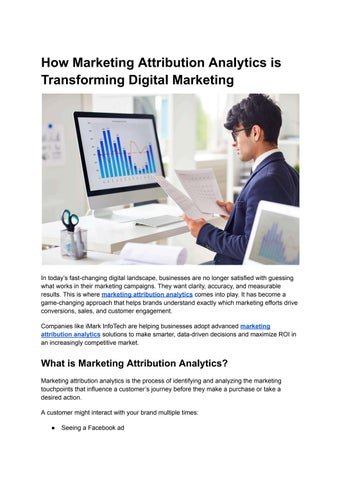
How Marketing Attribution Analytics is Transforming Digital Marketing
In today’s fast-changing digital landscape, businesses are no longer satisfied with guessing what works in their marketing campaigns. They want clarity, accuracy, and measurable results This is where marketing attribution analytics comes into play It has become a game-changing approach that helps brands understand exactly which marketing efforts drive conversions, sales, and customer engagement
Companies like iMark InfoTech are helping businesses adopt advanced marketing attribution analytics solutions to make smarter, data-driven decisions and maximize ROI in an increasingly competitive market.
What is Marketing Attribution Analytics?
Marketing attribution analytics is the process of identifying and analyzing the marketing touchpoints that influence a customer’s journey before they make a purchase or take a desired action.
A customer might interact with your brand multiple times:
● Seeing a Facebook ad
● Clicking a Google search result
● Reading a blog post
● Receiving an email campaign
Attribution analytics helps determine which of these interactions contributed most to the final conversion.
Instead of relying on assumptions, businesses can now use data to understand performance at every stage of the funnel
Why Marketing Attribution Analytics Matters More Than Ever
The modern customer journey is complex and non-linear. People interact with brands across multiple platforms before making a decision Without attribution analytics, businesses risk:
❌ Misallocating marketing budgets
❌ Overvaluing or undervaluing certain channels
❌ Missing opportunities for optimization
❌ Poor return on ad spend (ROAS)
With marketing attribution analytics, companies gain a clear picture of what is truly driving results
How Marketing Attribution Analytics is Transforming Digital Marketing
1. Smarter Budget Allocation
One of the biggest transformations brought by marketing attribution analytics is improved budget allocation. Businesses no longer need to rely on guesswork.
Instead, they can identify:
● Which channels generate the highest ROI
● Which campaigns underperform
● Where to invest more or reduce spending
For example, if paid ads bring conversions but organic content drives higher-quality leads, companies can adjust their strategy accordingly
2. Understanding the Customer Journey
Modern customers interact with brands multiple times before making a purchase. Marketing attribution analytics provides a complete view of this journey
It helps answer questions like:
● What was the first interaction?
● Which touchpoint influenced the decision?
● What led to the final conversion?
This insight allows marketers to build more personalized and effective campaigns
3. Improved Campaign Performance
With detailed insights, marketers can optimize campaigns in real-time Instead of waiting for end-of-month reports, they can:
● Adjust ads instantly
● Improve messaging based on performance
● Focus on high-performing channels
This leads to better engagement, higher conversions, and reduced wasted spend.
4. Data-Driven Decision Making
Gone are the days of relying on intuition With marketing attribution analytics, decisions are backed by real data.
Businesses can:
● Identify best-performing content
● Optimize landing pages
● Improve email marketing strategies
● Enhance social media performance
This creates a culture of accountability and measurable success
5. Enhanced ROI Tracking
One of the most powerful benefits of marketing attribution analytics is precise ROI tracking. Businesses can clearly see which campaigns generate revenue and which do not
This helps in:
● Justifying marketing investments
● Scaling successful campaigns
● Eliminating low-performing strategies
Ultimately, this leads to higher profitability and sustainable growth
Types of Marketing Attribution Models
Understanding attribution models is essential for effective analysis. Some commonly used models include:
1. First-Touch Attribution
Gives credit to the first interaction a customer has with your brand
2. Last-Touch Attribution
Assigns full credit to the final interaction before conversion.
3. Linear Attribution Distributes credit equally across all touchpoints
4. Time-Decay Attribution
Gives more credit to interactions closer to the conversion.
5. Data-Driven Attribution
Uses machine learning to assign credit based on actual impact
Each model provides different insights, and businesses often use a combination for better accuracy
Role of AI and Automation in Attribution Analytics
Artificial Intelligence is revolutionizing marketing attribution analytics by making it more accurate and efficient
AI-powered systems can:
● Analyze large datasets instantly
● Identify hidden patterns
● Predict customer behavior
● Optimize marketing strategies automatically
This allows marketers to focus more on strategy and creativity rather than manual data analysis.
Challenges in Marketing Attribution
While powerful, attribution analytics does come with challenges:
● Data fragmentation across platforms
● Difficulty in tracking offline conversions
● Privacy regulations limiting data collection
● Complexity in multi-device tracking
However, with the right tools and expertise from companies like iMark InfoTech, these challenges can be effectively managed.
Future of Marketing Attribution Analytics
The future of marketing attribution analytics is highly promising As technology evolves, we can expect:
● More advanced AI-driven attribution models
● Real-time cross-channel tracking
● Improved privacy-compliant analytics
● Deeper integration with automation tools
● More accurate customer journey mapping
Businesses that adopt these advancements early will have a significant competitive advantage
Conclusion
Marketing today is no longer about guesswork it is about precision, insights, and continuous optimization. Marketing attribution analytics has transformed the way businesses understand customer behavior and measure campaign success
With the expertise of iMark InfoTech, companies can unlock the full potential of attribution analytics, make smarter decisions, and achieve sustainable digital growth.
In a world driven by data, those who understand attribution will lead the future of digital marketing.