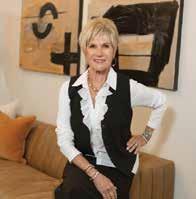
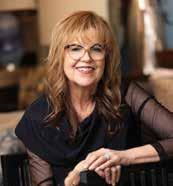
Actively selling Desert Mountain since January 1995, Karen draws on her experience of having designed four custom homes and building two “Golden Nugget” award winners, to provide the detailed expertise Desert Mountain clients require. Her knowledge of the community and exclusive attention to Desert Mountain properties allows her to provide detailed knowledge of the community’s history, club operations, design review, and other issues important to members.
QUIETLY REFINED: WHERE COMFORT MEETS INTENTION
This interior captures the essence of modern luxury through restraint and intention. A sculptural double-pod sectional creates two intimate corners — perfect for curling up with a book, watching a movie or stealing an afternoon nap. Swivel chairs positioned at the windows blur the line between indoors and out, inviting the desert landscape into your daily life.
At the center, an upcycled Brazilian oxcart coffee table introduces character and history, serving as a beautiful reminder that true style honors both old and new. Every element in this room tells a story, from the custom-designed rug that anchors the space to the carefully chosen accessories that reflect the homeowners’ personal journey.
A soft, cohesive palette allows texture, light and form to lead, creating a space that feels both curated and effortlessly comfortable. Thoughtful layering and clean silhouettes strike a balance between sophistication and livability — proof that true elegance is often found in subtlety and that luxury speaks most eloquently through intention and restraint.
SUE BICKERDYKE
THIRD THURSDAY ART NIGHT
THURSDAY,
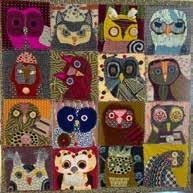
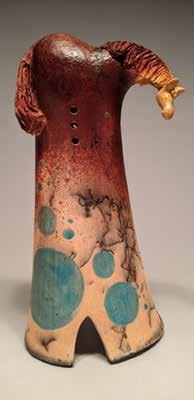
ARTIST RENE PALOMINO Reversed Painted Mixed Media
THIRD THURSDAY ART NIGHT
THURSDAY, MAY 21 FROM 4 TO 7 PM
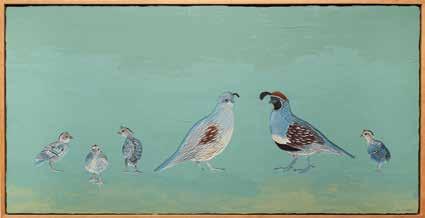
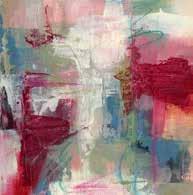
BRITT HANSEN In the Sage, 18” by 36”
MARTIN BOURBEAU
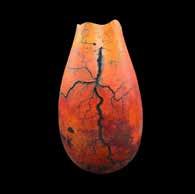
Double Jeopardy, 30” by 60”
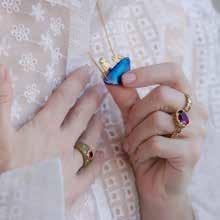
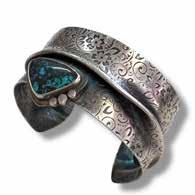
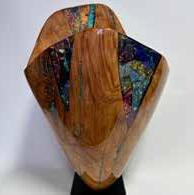
LEAH REI Desert Jewel, 20” by 20”
S ANDERSON LINCOLN
PUBLISHER
Shelly Spence
MANAGING EDITOR
Joseph J. Airdo
GRAPHIC DESIGNER
Meaghan Mitchell
CONTRIBUTING WRITERS
Joseph J. Airdo
Francine Coles
Shannon Severson
PHOTOGRAPHERS
Francine Coles
Loralei Lazurek
ADVERTISING SALES
Cindi Calcinari 860-966-3271 cindi@imagesaz.com
From the Publisher
There is a moment in every great performance when the music stops — when the last note hangs in the air and the audience holds its collective breath before the applause begins. That suspended instant is not silence. It is everything the music just said, still reverberating.
May in Arizona carries that same quality. The season is winding down, the heat beginning to assert itself, and we find ourselves pausing to take stock of all we’ve experienced these past months before the summer asks us to slow down and breathe. It’s a natural rhythm — not an ending, but a breath between movements.
This month, Images Arizona celebrates music in all its forms and all the extraordinary people who make it. We’ve spent these pages with composers and vocalists, educators and collectors, performers and storytellers — people for whom music is not background noise but the primary language through which they understand and communicate the world. Their stories reminded us, again, that music is among the most direct paths between one human heart and another. It transcends generation, geography, circumstance. It finds us exactly where we are.
Images Arizona P.O. Box 1416
Carefree, AZ. 85377 623-341-8221
shelly@imagesaz.com imagesarizona.com
And so, in that spirit, we have some news to share: after this issue, Images Arizona will be taking a summer pause. We’ll return in October, refreshed and ready — and we are genuinely excited about what we’re planning for our fall issues. We’ll be working hard behind the scenes on some extraordinary stories for the season ahead.
In the meantime, imagesarizona.com will be your companion for summer — a full library of Arizona arts, dining, travel, and community coverage to guide your explorations through the warm months. We’ll see you there, and we’ll see you in October.
From our family to yours, we wish you a summer full of music, wherever you find it.
Happy listening!
Shelly Spence Publisher, Images Arizona
Photography by Loralei Lazurek
Cloth & Conscience Fashioning a Sustainable Future
Writer Shannon Severson // Photographer Chris Loomis
An Icelandic fisherman hoists a teeming mass of silver-skinned cod from the frigid waters of the North Atlantic onto his wind-tossed trawler — a portion of the more than 200,000 tons harvested annually in this remote island nation. Beyond what is consumed for food, Iceland’s 100% Fish Project’s zero-waste efforts are part of a vision for sustainability that stretches all the way to ASU FIDM, Arizona State University’s fashion school.
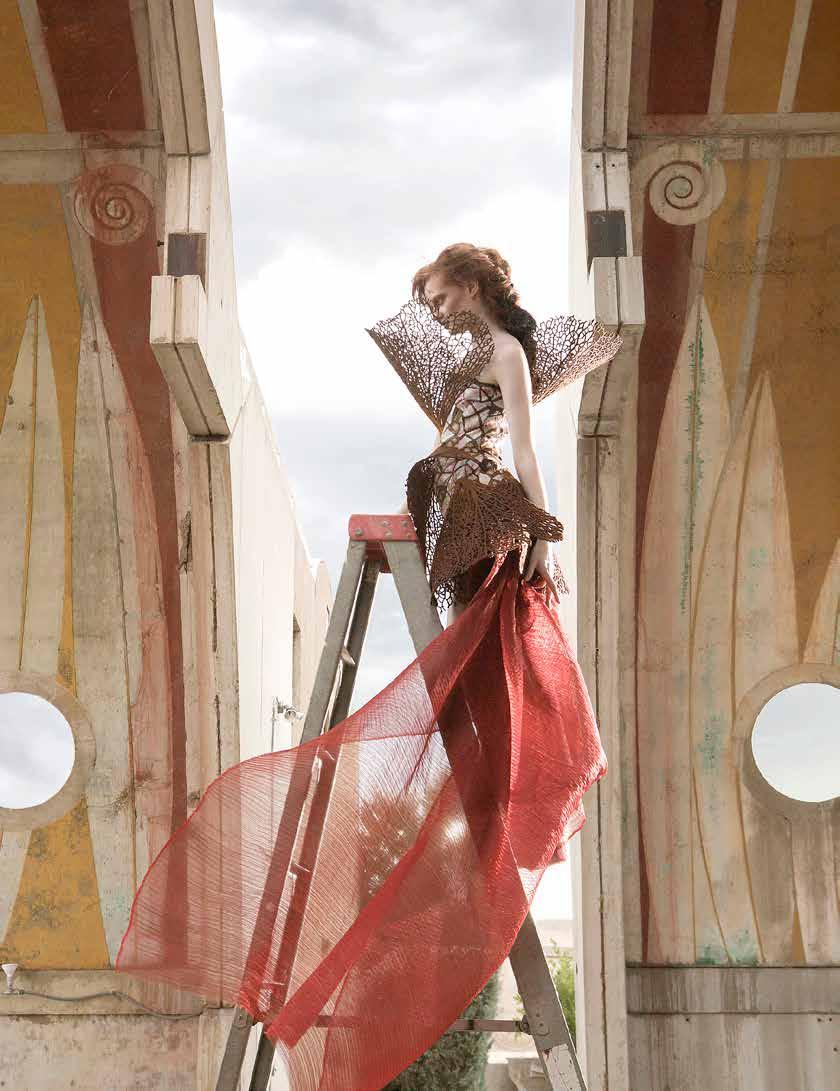
Fusion on First is the school’s gleaming 16-story atelier in downtown Phoenix that houses design studios, digital media labs and a textile lab. Here, overlooking the downtown skyline, Associate Professor Galina Mihaleva — an internationally award-winning fashion designer — transforms the carefully cleaned and preserved fish skin into laser-cut modules that create a material nine times stronger than lamb or cow leather. Mihaleva interlocks the circular and amygdaloid pieces to create an entirely new textile that can become a skirt one day and a handbag the next, a material experiment that embodies the program’s sustainability goals.
Mihaleva has studied, taught, designed and created couture fashion, wearable art and technologically advanced pieces with sustainability at their core. She’s lived and worked around the world and now teaches Materials and Techniques at the institution. Her work has earned global recognition: the Tiffany Award at Paris Fashion Week (2016), the Rumi Award in the United States
(2016) and the WOW Designer Development Award in New Zealand (2024), among dozens of international exhibitions and red-carpet showings, including regular appearances at the Cannes Film Festival.
One of her primary textiles is polyester — a fabric that can take up to 150 years to decompose but can be stretched, twisted, formed, heated and then reused time and again to create impactful fashion. ASU FIDM is both Mihaleva’s classroom and experimentation lab.
The workstations at Fusion on First are a convergence of curiosities: lasered fish-skin modules cluster beside a stack of vintage wool jackets; a 3D-printed clasp cools next to a boiled-polyester bubble skirt. At one end of the state-of-the-art lab, Mihaleva can print human-cellsized sensors onto a flexible sheet while across the room, students like recent graduate Isabelle Johnson-Heston lay out portfolios of capstone pieces that read like a syllabus for sustainable fashion.
Galina Mihaleva, an internationally award-winning fashion designer and associate professor at ASU FIDM, creates sustainable couture and medical wearable technology that transforms materials like fish skin into high fashion while improving patients’ lives.
The future of fashion is no longer to just produce more, more, more collections. Now it’s ‘What do we produce and how do we help?’ As I get older, I realize that it’s better to meet one more person or help one more child than to make one more dress. What we are doing is changing lives. Galina Mihaleva
The $28 million expansion of ASU FIDM into Los Angeles — in the former FIDM building — was designed to put this kind of experimentation and career preparation into one fashion school with two complementary, collaborative locations. The school’s home in downtown Los Angeles boasts the ASU FIDM Museum, with a 15,000-piece fashion collection that serves as a resource for faculty and students, as well as the community.
As Tinseltown glam fuses with desert design, Mihaleva embodies the promise of ASU FIDM. Trained at Bulgaria’s Academy of Fine Arts with a master’s degree, she learned textiles “from the fiber up.” She learned English upon her arrival in Phoenix, picking up the vernacular of the fashion industry here by earning a fashion design associate degree at Phoenix College, then going on to a doctorate at ASU. She has spent a career folding craft into research.
“It’s about knowing your material — in intimate relationship with your medium,” she says.
That intimacy has produced wearable high-fashion installations — “Tranquility,” which visualizes urban noise via embedded LEDs, and “Sense,” a coral-like dress made from 100 yards of manually twisted fabric that cycles from brilliant color to stark white to represent reef bleaching using 15 years of reef data encoded into the dress — alongside applied projects for hospitals and rehabilitation clinics.
Mihaleva’s work utilizes soft sensors embedded in textiles to detect environmental pollutants, conductive-thread breath monitors that comfort young cancer patients and soft exoskeletons paired with virtual reality therapy to restore muscle
movement for stroke survivors. She collaborates with engineers, neuroscientists and technological experts.
“Wearable tech can be hopeful. It can improve people’s lives,” she says.
Her assignments push students to think beyond aesthetics: materials, lifecycle tradeoffs and the social impacts of design become studio work. All begin with a personal story, and the details are negotiated from there.
One student with scoliosis had been mocked for wearing the required medical brace in her native Iran. Mihaleva encouraged her to work with her doctors, body-scan technology and 3D printing to create a fashionable brace that could be worn with pride.
“When she presented it, we all cried,” Mihaleva recalls. “It was something very personal. And with 3D printing it can be affordable. Wearable tech enables a better future.”
Isabelle Johnson-Heston graduated from ASU FIDM in 2025 with a Bachelor of Arts in Fashion Business and a minor in Sustainability after beginning her fashion education at FIDM's Los Angeles campus.
Those lessons are exactly what students like Johnson-Heston wanted when she moved from FIDM’s Los Angeles campus— where she earned an associate degree in merchandising — to ASU’s new four-year program and graduated in 2025 with a Bachelor of Arts in Fashion Business and a minor in Sustainability. The transition shifted her perspective.
“I loved my time in Los Angeles, but the experiences that ASU was able to provide for me in such a seamless way — especially being able to go and study abroad in Florence — there was nothing like it,” she says.
Study abroad, she adds, turned abstract brand histories into tactile inspiration: thrift-based workshops that repurposed donated high-end fabric, studio visits to Gucci and Ferragamo, and professors still active in the industry.
The built environment at Fusion on First made a difference in very practical terms for Johnson-Heston. There, everything is at a student’s fingertips to learn, dream and experiment under the guidance of world-class professors.
Mihaleva says she’s a craftsperson who blurs the lines between craft and technology. The atelier’s knitting machines, looms, laser cutters and 3D printers are the best of both worlds — technology is a collaborator, not a replacement for human thoughts and touch.
“We continue the craft and use technology — including AI — to enable us to be faster and more precise,” she says.
For Johnson-Heston, the accessible labs and responsive advising reduced friction: “Seeing Fusion on First — it was immaculate. It has every tool you could imagine. The professors, counselors and staff always had an answer for me on the spot.”
Johnson-Heston embraced the chance to learn the handson basics of sketching, sewing and pattern reading after primarily focusing on the business side during her time in Los Angeles.
“I felt like I was learning in reverse, as I was a little bit older than the other students, but my professors were so understanding,” she recalls.
The payoff is craft fluency and market readiness while tapping into collaborative ASU research, internships and study abroad pathways that turn coursework into careerready skills. Students also gain access to scholarships and industry luminaries. ASU FIDM students earned 10 awards from the prestigious 2025 Fashion Scholarship Fund competition, elevating the program’s national profile.
Through it all, sustainability remains a focus for designers like Mihaleva, who has innovated the reuse of fabrics into award-winning couture design -- from decompositionresistant polyester to earth-friendly wool that becomes fertilizer when buried and can even be embedded with seeds. For Johnson-Heston, sustainability became more than just a buzzword.
“It means more than I thought it did,” she explains. “I learned from both programs that everyday life can affect our world. We can make little changes, pay more attention to labels and tags and what we eat and wear. It makes a big difference.”
Mihaleva envisions designers who can prototype sustainably and work across supply chains and professional disciplines.
“The future of fashion is no longer to just produce more, more, more collections,” she explains. “Now it’s ‘What do we produce and how do we help?’ As I get older, I realize that it’s better to meet one more person or help one more child than to make one more dress. What we are doing is changing lives.”
As fashion transforms futures, the work continues. Mihaleva guides her students while maintaining her professional practice: In March, her wearable art took center stage at Scottsdale Art Week’s Opening Night Vernissage, benefiting Phoenix Art Museum. The fashion presentation — part of the international art fair featuring more than 120 galleries at WestWorld — offered Arizona audiences a rare opportunity to witness how sustainable couture and technology-infused designs translate from laboratory to runway.
Meanwhile, Johnson-Heston works in retail management in Minnesota as she pursues internship opportunities and volunteers with Dress for Success, buoyed by the program she says “added confidence” and made her feel more prepared.
The promise of ASU FIDM is an institutional translation: craft practices elevated by research infrastructure that takes shape on a human scale in its meaningful application. The success metrics are simple — accomplished faculty that supports and elevates learning, creates an internship-tojob pipeline and boosts the local economy as Phoenix becomes a central hub of the fashion industry.
As those metrics materialize, the fabric of improved lives and new careers will grace runways and medical rehabilitation facilities, and students will keep learning the art of turning scarcity into abundance. That alone is a useful definition of sustainable education: not the absence of waste, but a program capable of turning constraints into creative systems that endure.
asufidm.asu.edu
Community
THROUGH MAY 3
DADDY LONG LEGS
The Phoenix Theatre Company presents this heartwarming musical based on the classic novel by Jean Webster. $60+. See website for times. Hormel Theatre, 1825 N. Central Ave., Phoenix. 602-254-2151; phoenixtheatre.com
THROUGH MAY 31 COWGIRL UP! ART FROM THE OTHER HALF OF THE WEST
The newly renamed Sigler Western Museum presents the nation’s leading showcase of contemporary Western women artists. This dynamic exhibition and sale features paintings, drawings and sculptures from 55 acclaimed and emerging creators across the United States and Canada. Celebrating women's voices and perspectives in the Western genre, the event offers a deeper understanding of the American West. See website for prices and hours. Sigler Western Museum, 21 N. Frontier St., Wickenburg. 928-684-2272; westernmuseum.org
MAY 2 KENTUCKY DERBY FUNDRAISING PARTY
The Holland Center brings the spirit of
THROUGH MAY 3
Writer Joseph J. Airdo
TENDERLY: THE ROSEMARY CLOONEY MUSICAL
The Phoenix Theatre Company presents an intimate and poignant tribute to one of America’s most cherished voices. This two-person musical traces Rosemary Clooney’s journey from her meteoric rise in Hollywood to her personal struggles with mental health and her triumphant comeback. $60+. See website for times. Judith Hardes Theatre, 1825 N. Central Ave., Phoenix. 602-254-2151; phoenixtheatre.com
Churchill Downs to Scottsdale with “The Winning Trifecta: Food, Fun, & Fancy Hats.” This annual fundraiser features a Southern-style buffet, bourbon tastings and mint juleps, all set against a live broadcast of the race on a big screen. Guests are encouraged to don their finest Derby attire for a chance to win prizes for best hat and best-dressed couple. Proceeds benefit the center’s arts and education programs. $50. 2–5 p.m. The Holland Center, 34250 N. 60th St., Scottsdale. 480-488-1090; hollandcenter.org
MAY 5
MEDICINAL PLANT FORAGING WORKSHOP
The Desert Awareness Committee presents a hands-on workshop exploring how to identify, harvest and prepare medicinal plants from the desert. Led by Diane Vaszily and Tammy Teegardin, participants collect wild plants, use a wooden plant press and create a medicinal journal while learning to make poultices, infusions, tinctures and ointments. Attendees should wear outdoor attire and bring a water bottle; snacks and materials are provided. $110; discounts available. 8:30 a.m.–12:30 p.m. Harmony Hollow Ranch, 44316 Spur Cross Road, Cave Creek. 480-4881090; hollandcenter.org/desert-awareness
MAY 9–10
SPRING STUDIO OPEN HOUSE
Beth Zink and her guest artists open the doors to her Cave Creek studio for a spring exhibition. Visitors can view vibrant contemporary artwork, learn about the creators’ artistic processes and enjoy complimentary snacks and beverages. The two-day event also features daily drawings for raffle prizes. Free. 10 a.m.–4 p.m. Beth Zink Studio, 33444 N. 55th St., Cave Creek. 480980-3848; bethzinkart.com
MAY 13–30
AN EVENING AT DESERT BOTANICAL GARDEN
Surrounded by the magnificent desert landscape with the setting sun as a backdrop, this audience favorite features two distinct ballet experiences. The program highlights the U.S. premiere of Artistic Director Daniela Cardim’s “Reset,” exploring themes of modern urban life to a score by Gabriel Prokofiev, alongside Lar Lubovitch’s “Concerto Six Twenty-Two,” a joyful work inspired by Mozart. See website for prices. 8 p.m. Desert Botanical Garden, 1201 N. Galvin Parkway, Phoenix. 602-381-1096; balletaz.org
SPRING ARIZONA RESTAURANT WEEK
The Arizona Restaurant Association invites diners to explore the state’s culinary scene during this 10-day tasting tour. Participating restaurants — from five-star dining to hidden gems — offer exclusive three-course prix fixe menus, allowing guests to discover new favorites or revisit beloved local spots at a fraction of the usual cost. The event features a diverse array of cuisines, with meals priced at $33+. See website for participating restaurants. arizonarestaurantweek.com
MAY 19
CELEBRATING 250 YEARS OF AMERICA
In the third installment of his four-part series, Jim Sherbert delves into the American Revolution, tracing how escalating disputes with British authority and new restrictions on personal freedoms and self-government led colonists to revolt. The lecture highlights the bold vision of the Declaration of Independence and the hardships of the revolutionary struggle that followed. Free; donations appreciated; registration requested. 4–5:30 p.m. Holland Community Center, 34250 N. 60th St., Scottsdale. 480-488-1090; hollandcenter.org
MAY 21
CAREFREE ART NIGHT
Local and regional artists showcase their work at participating galleries during this monthly celebration. Enjoy live music, refreshments, artist talks and demonstrations. Free. 4–7 p.m. See website for participating galleries and event map. visitcarefree.com/artnight
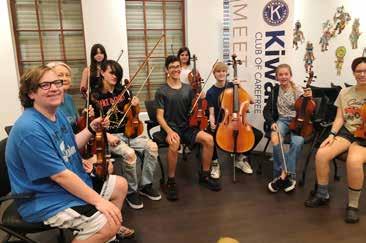
KIWANIS PANCAKE BREAKFAST FEEEDS HUNDREDS
The Kiwanis Club of Carefree served 762 attendees at its annual pancake breakfast this spring, supported by 45 Kiwanis members and 72 student volunteers. Beyond serving more than 2,000 pancakes, the organization highlighted its ongoing community impact by presenting a grant to the Desert Hills Little League Girls Softball Team. The club also announced a new partnership with Grand Canyon University to cover room and board for a full year for two students aging out of the foster care system. kiwaniscarefreee.org
TOWN OF CAREFREE DEDICATES NEW SCULPTURE
The Town of Carefree, alongside Sue Bickerdyke Interiors and longtime resident Richard Burns, recently hosted a dedication ceremony for the new “Flights of Learning” sculpture in the Carefree Desert Gardens. Created by artist Bryce Pettit, the piece is designed to inspire both children and adults to embrace learning. The artwork also serves as a heartfelt tribute to the Burns family — especially the late Liz Burns — honoring their ongoing commitment, generosity and support to the community. carefree.org
The Garment League Tailors Phoenix Into a Fashion Powerhouse
Pattern Recognition
The first time Tricee Thomas shut down Central Avenue for a fashion show, Phoenix’s downtown core had never seen anything like it. Two hundred fifty models. Twenty-five designers. An entire city street transformed into a runway, with the urban skyline as backdrop and the light rail humming past just blocks away. It was 2017, and Thomas — a Fashion Institute of Technology graduate with three decades of industry expertise — had just announced that Phoenix belonged in the same conversation as New York, Los Angeles and Miami.
“I moved here in 2013 — relocated downtown from the East Coast — and at that time, there wasn’t a whole lot going on,” Thomas says. “I know we had Phoenix Fashion Week, but it was held in Scottsdale. There was simply no fabric, no real fashion presence happening in downtown Phoenix.”
What began as that audacious street takeover has evolved into something far more ambitious: The Garment League, Arizona’s leading fashion education nonprofit, serving more than 920 young creatives annually and now launching Pattern, the state’s first fashion industry trade school. Where other cities treat fashion as a luxury import, Thomas is building an ecosystem of homegrown talent — teaching pattern making and tech packs alongside business acu-
men, then showcasing the results on runways that rival anything produced on the coasts.
“I saw the opportunity and went for it,” Thomas says.
But opportunity revealed a problem. After that inaugural On Central show, Thomas partnered with then-Mayor Greg Stanton, who pushed her toward nonprofit status. The reason became clear immediately.
“What we found during that show was a significant lack of education,” Thomas says. “Designers didn’t have focus or direction — they didn’t know about manufacturing, they didn’t know how to get samples made.”
From that realization, The Garment League pivoted from spectacle to substance, launching education programs that treat fashion with the same structural rigor as architecture — where pattern making becomes blueprint, draping becomes engineering, and every garment requires a foundation before ornamentation. The organization now operates on three pillars — art, education, and workforce development — each designed to professionalize an industry that Phoenix has historically treated as hobby rather than vocation.
Writer Joseph J. Airdo // Photography Courtesy of The Garment League
It’s all about bringing big-city energy to Phoenix. I’ve never been a fan of the typical hotel runway. There’s something really magical about being outside with the city as your backdrop. That’s big city. That’s big fashion. Tricee Thomas
THE CLASSROOM AS STUDIO
Walk into a Garment League classroom and you won’t find watered-down curricula or beginner-friendly shortcuts. Students as young as 8 learn flat sketching and specking — industry terminology for technical specification sheets — using the same fundamentals that Thomas teaches adults. It’s an approach born from her FIT training and decades working in markets where precision means the difference between a sample and a sellable garment.
“With our kids, we teach them flat sketching and specking first — the same fundamentals — but we don’t water anything down,” Thomas says. “They’re learning just like our adults are learning, and there’s something about it that they just absorb. They’re like sponges.”
The Fashion Industry Youth Initiative, known as FIYI, integrates STEM concepts into K-12 learning through fashion. Students calculate fabric measurements, apply geometry to pattern-making — learning how a two-dimensional blueprint transforms into three-dimensional form — and explore color theory through the lens of psychology and science. They complete research papers. They present their design processes publicly, building communication skills alongside creative ones.
“I’ve got an 11-year-old who just flew to Atlanta to do a 13-piece showcase,” Thomas says.
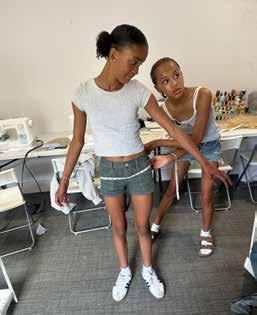
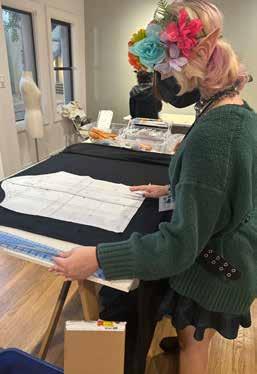
Tricee Thomas, founder and CEO of The Garment League, has transformed Phoenix’s fashion landscape since relocating from the East Coast in 2013.
A Fashion Institute of Technology graduate with more than 30 years of industry experience, Thomas now serves more than 920 youth annually through fashion education programs and is launching Arizona’s first fashion industry trade school this spring.
“It’s amazing. These kids are different — some of them are beating my colleagues.”
The program offers after-school sessions, weekend workshops, and summer camps, serving youth ages 8 to 17. The results extend beyond runway shows: In the last two years alone, five Garment League students have been accepted to FIT, with others headed to Parsons and other top design schools.
“We’ve helped them build their portfolios for the application process and everything,” Thomas says.
Perhaps most striking is the demographic shift Thomas has witnessed. Fourteen years ago, when education programming began, the student body skewed heavily female. Today, one Saturday class runs entirely male — young men designing streetwear with entrepreneurial intensity.
“I remember when I was coming up, if you were a guy who loved fashion, you kind of had to sneak around about it,” Thomas says. “And now it’s just the opposite — these kids are being entrepreneurs. I’ve got two seniors whose Instagrams are going crazy. They’re doing shows, and they’re really, really good designers.”
BEYOND THE SEWING MACHINE
But Thomas knows that talent without business acumen leads nowhere. The Garment League teaches the “grit and grime” of the industry — how to communicate with manufacturers, what a tech pack actually contains, how to price garments accounting for labor and materials.
This spring, that philosophy expands dramatically with the launch of Pattern, a two-year certificate program designed as an affordable alternative to four-year fashion degrees. Led by instructors with
a minimum 10 years of industry experience, Pattern focuses on technical design, garment construction, and the structural precision that separates hobbyists from professionals.
The curriculum reflects Thomas’ frustration with predatory education models she’s observed elsewhere, where emerging designers are encouraged to take on debt before launching careers.
“I’ve heard about programs in other states where emerging de-
signers are being pushed to take out loans before they’ve even launched their careers,” Thomas says. “That’s not right.”
The alternative? Instructors who remain active in fashion, not just teaching about it. Pattern also offers business classes tailored specifically to fashion entrepreneurship, taught with the understanding that most designers will need to navigate manufacturing, marketing and retail simultaneously.
“The reality is, when you have professionals teaching who have actually been in this industry for decades — people who are still actively working in fashion, not just teaching about it — the knowledge becomes accessible,” Thomas says.
THE STREET AS STAGE
Education without exhibition remains theoretical. That’s why Thomas treats runways as galleries, public installations that legitimize fashion as visual art while giving emerging designers professional-caliber exposure. On Central — having entered its ninth year in March — continues to shut down Central Avenue, transforming downtown Phoenix into a fashion capital for one spectacular evening.
“It’s all about bringing big-city energy to Phoenix,” Thomas says. “We’re the fifth largest city in the country. We should have been on the map with the rest of the fashion capitals years ago. I’ve never been a fan of the typical hotel runway. There’s something really magical about being outside with the city as your backdrop. That’s big city. That’s big fashion.”
The scale has grown: This year’s show was the largest yet, featuring both Arizona-based talent and national designers. Thomas also produces Phoenix Swim Week and Phoenix Man, each designed to generate support for The Garment League’s educational mission while spotlighting Arizona’s expanding fashion scene.
Yet for all the growth — the city recognition, the newcomer award Thomas recently received, the increasing number of organizations producing downtown shows — she remains focused on a larger goal: unifying Arizona’s fragmented fashion community.
“Arizona has come a long way, but I think people are pulling from everywhere else except here,” Thomas says. “And there’s so much talent here, which makes me so upset. One of the things I think Arizona has to do first is come together as a whole. It’s so separated and divided.”
DEFINING DESERT FASHION
Ask Thomas whether Arizona has developed a distinctive aesthetic, and she offers nuanced optimism. The state has moved beyond turquoise-and-silver clichés, she notes, with designers producing work that rivals coastal markets.
“If you ask me, we’re keeping up with the other fashion capitals,” Thomas says. “What I see on the East Coast is
happening here. The other good thing is people are moving here, so we’ve got that influence from all around us. We’re not missing a beat — and we get to do ours year round because the weather is so beautiful.”
But a cohesive “Phoenix look” remains elusive, largely because the community hasn’t yet unified behind homegrown talent with the collective force of other fashion cities. Thomas continues advocating at City Hall for designers to be included in public art installations, for vacant downtown retail spaces to be filled with local fashion rather than left empty.
“When there are calls for artists on the sides of buildings, I’m advocating for fashion designers to be considered — let us come in and dress the lobbies with our garments,” Thomas says. “You have these spaces downtown where all the retail is sitting vacant — let the designers take these spaces and do something with them. That’s what I’m fighting for now.”
A NATIONAL CONVERSATION
That advocacy extends to The Garment League’s next evolution. The organization itself is transitioning into a national conference platform, having launched its first multiday event in
March — the day before On Central. The conference brought fashion educators, industry professionals, and organizations from across the country to Phoenix, positioning the city as a hub for fashion education discourse.
Meanwhile, the day-to-day programming — FIYI classes, adult workshops, Pattern courses — will operate under a new umbrella: House of Patterns. It’s a reorganization that reflects maturity and ambition in equal measure, separating education operations from the national platform while allowing both to scale.
For Thomas, who took an FIT class herself not long ago, the work remains deeply personal. Fashion, she insists, is not frivolous.
“When I was coming up in this industry, people thought fashion was just playing with fabric and glitter all day,” Thomas says. “But it really is a successful, fulfilling career. If you ask me, fashion makes the world go ‘round.”
Fifteen years after relocating to Phoenix, Thomas has constructed infrastructure that didn’t exist—laying foundations with trade schools, erecting frameworks through youth programs, and building a growing cohort of designers who understand that great fashion, like great architecture, requires both vision and precision. The question now isn’t whether Phoenix belongs in the fashion conversation. It’s whether the rest of the country is paying attention.
thegarmentleague.org // houseofpatterns.co
Human Magic
Composer Zina Goldrich Brings ‘Ever After’ to Phoenix Theatre Company
On weekend afternoons in New York, Zina Goldrich’s parents hosted jam sessions that drew some of the finest musicians of their generation — Billy Taylor, Grady Tate, Eddie Daniels, Roland Hanna. Her father, a physician who spent Monday nights playing trumpet with the Mel Lewis/Thad Jones Big Band at the Village Vanguard, kept a household where music wasn’t an occasion. It was just the air.
“I was just a kid, and I was like, ‘It’s too loud,’” Goldrich says. “But it all sunk in and I loved it. It’s the best way to grow up I can ever think of.”
It sunk in, all right. Fifty years later, Goldrich is one of American musical theater’s most distinctive composers — a writer whose scores carry what she describes as “a lot of jazz voicings, flat nines, sharp thirteens, all sorts of wonderful things like that.” She didn’t choose that vocabulary so much as inherit it, the way children absorb a first language before they know there are others. And this May, she brings the culmination of nearly two decades of creative labor to Phoenix Theatre Company’s Stephenson Theatre: “Ever After,” a full-scale
musical based on the 1998 Drew Barrymore film — a revisionist Cinderella story with no fairy godmother, no magic wand and no shortage of ambition.
Goldrich’s path from that living room to this stage winds through an education assembled from multiple traditions. She began classical piano studies young, absorbed pop from the radio, then trained at the BMI Lehman Engel Musical Theatre Workshop in New York under composers including Maury Yeston. Later, she completed a graduate program in Scoring for Motion Pictures and Television at USC, where she studied with Oscar-winning film composer Jerry Goldsmith. Her first professional job was playing keyboards on the world tour of “A Chorus Line” — a fitting entry point for someone whose career would be spent, in various capacities, working from inside the music outward.
That instinct runs through her years as a working pit musician, something few composers of her standing can claim. She played keyboards on Broadway for “Avenue Q,” “Oklahoma!” and “Titanic” — sitting inside an orchestra, night
Writer Joseph J. Airdo // Photographer Justin Schuman
Our job as theater creators is to make the audience feel something. The worst thing that can happen is that you leave and you don’t even think about what you just saw. Zina Goldrich
after night, playing someone else’s score until she knew it from within.
“If you love a score, hearing it from inside the orchestra changes everything,” she says. “When you play something eight times a week, you get deep into it. You discover different things every night, which is wonderful.”
What she discovered, more than anything, was a fundamental lesson about restraint. Music in the theater has a dramatic function, and that function often requires stepping back. Underscoring that draws attention to itself has already failed.
“A lot of the time, you’re writing music for a scene but you have to stay out of the way,” she says. “You never really
notice that when you’re watching a show, because if you’re paying attention to the underscoring, it isn’t doing its job. It has to support the drama without calling attention to itself.”
It was Yeston — her mentor, with whom she worked on “Grand Hotel” and “Titanic” — who crystallized that lesson most clearly.
“Knowing when music gets to take center stage, and knowing when to stay out of the way,” she says. “There are comedy songs where your job is to land the jokes — it’s not about the most intricate, fascinating melody you’ve ever written, although you still want to write something musically satisfying. Your main objective is to serve the lyric. But then there are moments where — like when the prince sings his big love ballad, ‘Right Before My Eyes,’ — that
music had better be gorgeous and memorable. You need to do your job.”
She has been doing her job on “Ever After” since 2007, when the show had its first New York reading. Since then, it has moved through workshops, a world premiere at New Jersey’s Paper Mill Playhouse in 2015, a sold-out run at Atlanta’s Alliance Theatre in 2019, a pandemic, a new book collaborator in Kate Wetherhead, a 2023 concert staging in Minnesota and a 2025 workshop in New York. Now Phoenix.
Goldrich saw the film the day it opened, pregnant with her daughter, her mother and sister alongside her.
“There were a lot of people who were very excited to be there,” she recalls. “We had the best time. It was just a wonderful, feel-good, smart telling of the story, and that’s what we hope we’ve done with the musical as well.”
The source material — written by Susannah Grant, Andy Tennant and Rick Parks — retells the Cinderella story without a trace of the supernatural. Danielle de Barbarac is not a girl waiting for magic to save her. She’s an orphaned
farmer’s daughter in Renaissance France, fiercely intelligent, who disguises herself as a noblewoman to free a servant friend and accidentally catches the attention of a prince. Leonardo da Vinci serves as a witty mentor. In this telling, the fairy godmother is a genius.
“We like to talk about the power of human magic,” Goldrich says. “It’s not that there’s no magic in the show — there is. It just comes from the power of love. And Leonardo da Vinci is, in our story, the Fairy Godmother. And he’s pretty magical.”
Scoring a fairy tale that refuses to behave like one demands a particular kind of musical honesty. The score cannot reach for enchantment as a dramatic shortcut — it has to carry the emotional weight that magic would otherwise provide. Goldrich’s most direct tool for that is contrast: letting the music say what the character won’t.
“Sometimes a character doesn’t know that she’s lying to herself, but the music is telling the audience how she’s actually feeling,” she says.
She points to “Who Needs Love,” a number in which Danielle, having already met the prince, learns that her stepsister spent time with him — and responds with elaborate, chatty denial. The song is her protesting too much. It’s very “I just don’t care.”
“But when you get to the bridge, the lyric goes ‘love — and its raging fire, and its wild desire, and its drunken haze,’” Goldrich says. “And you’d think, given her attitude, the music would be detached. But the music is so passionate and rhapsodic that you know she’s lying. You just know. That’s the fun of it — the music is telling the audience what she’s feeling even though she won’t admit it to herself.”
This is what nearly 20 years of development buys: the accumulated wisdom of knowing which moments are working and which aren’t — and the patience to act on it. Some songs have barely changed since the first reading.
“My Cousin’s Cousin,” which Danielle sings when the prince first encounters her as she tries to slip away, has survived every workshop and production untouched.
Others have shifted — not scrapped, but relocated. “Is There Anything Leonardo Can’t Do?” was originally staged at the ball. Now it opens the court to da Vinci near the show’s start, reframing the whole production’s relationship to its most whimsical character.
“It’s a celebration of him either way,” she says. “We’re just trying it in a different place to see if it works better there.”
The Stephenson Theatre, which Phoenix Theatre Company opened in 2025 as one of only two new regional theater houses built in the country that year, gives “Ever After” infrastructure it hasn’t always had: a full fly loft, an orchestra pit, 500 seats with clear sightlines in every direction. Goldrich visited during local casting and knew immediately.
“That place is gorgeous,” she says. “There’s not a bad seat in the house. I looked around and thought, there’s just no better place we could do this. We’re very excited that they’ve taken a chance on a really big musical.”
What she’s hoping for when the curtain comes down on opening night is simple, and also the hardest thing in theater to achieve.
“Our job as theater creators is to make the audience feel something,” she says. “The worst thing that can happen is that you leave and you don’t even think about what you just saw. But if you go home and you remember bits of it — ‘I liked that song,’ or ‘I loved that scene where they argued,’ or ‘I loved the song when they first met’ — that’s what I hope for.”
She loved writing it. That much is clear. It took a village, and a Vanguard, and the better part of two decades. But the music, as it turns out, was always there — waiting, in the vocabulary she learned before she knew she was learning anything at all.
phoenixtheatre.com
EXPERIENCE
‘Ever After’
May 6–June 21, 2026 // See website for times Dr. Stacie J. and Richard J. Stephenson Theatre Phoenix Theatre Company // 1825 N. Central Ave., Phoenix $60+ // 602-254-2151 // phoenixtheatre.com
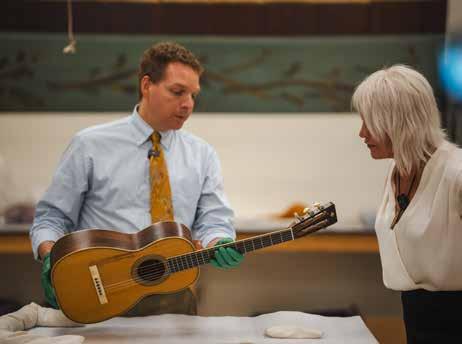
Sarah James had come to the old convent in Pittsburgh for silence — a private meditation retreat, nothing spiritual about it, just a quiet place to think. What she found instead, leaning against a wall in one of the rooms, was a guitar. She asked one of the nuns if she could buy it.
“Honey, you don’t have to buy it,” the sister said. “Just take it. We’ll give it to you.”
James took the guitar to a luthier. His jaw dropped: “You don’t know what you have here.”
What she had was a 1938 Martin 000-28 — what James calls a triple-ought 28, considered the Holy Grail of Martin guitars. She had pulled it from a convent wall thinking nothing of it, and walked out holding one of the most coveted acoustic instruments in the world.
“That’s the guitar that really started everything for me,” says James, now a Scottsdale-based singer-
songwriter, recording artist, and founder of Vintage Guitar Legacies, a video series dedicated to the history and stories of exceptional instruments. “For me, these instruments are connected to people. The sister who owned it was in her 90s, retiring from the order. She said, ‘Oh, the kids play with that all the time.’ And here I am finding out how significant it is.”
That moment of accidental discovery crystallized something James had been circling her whole life — a conviction, inherited from a mother who collected early American antiques and a father who ran the oldest wooden boat-building company on the Great Lakes, that the objects people make and play and pass along carry something irreplaceable inside them. At 76, she has built an artistic life organized around that conviction, performing across the North Valley while simultaneously running a video series that has drawn subscribers from around the world.
The two pursuits are more entangled than they might appear.
Strings Attached Sarah James and the Stories Old Guitars Tell
James launched Vintage Guitar Legacies during COVID, initially as a way to share the instruments accumulating behind her at Lucky Now Studios, her home recording space in Scottsdale. Each episode profiles a single guitar — its history, its construction, its provenance — with a guest musician demonstrating what the instrument actually sounds like in capable hands. The 1938 Martin was among the first. Others followed: a 1966 Gibson Trini Lopez Deluxe, a mid-1960s Buck Owens Harmony guitar whose episode has reached 38,000 views, and eventually instruments with considerably heavier history attached to them.
A Martin D-28 owned and recorded by Steve Earle. A 1957 Stratocaster that once belonged to Waylon Jennings. A 1959 Martin D-18e whose specs, James says, match those of Kurt Cobain’s guitar — the one he played at Nirvana’s MTV Unplugged concert in New York — right down to the rare Bartolini pickup. Only 300 were made.
“I can feel the vibe coming from these instruments,” James says. “When I pick up a guitar that was owned by Steve or another artist, it changes the way I play. Something happens. You approach the instrument the way it feels in your hands.”
The Earle guitar came with a specific story. Earle used it recording “The Mountain,” a 1999 collaboration with Del McCoury that found him venturing deep into bluegrass territory. James eventually added “The Mountain” to her own live repertoire — playing it, she says, on the very instrument Earle used to record it. Last year, Del McCoury came through Phoenix for a date at the Musical Instrument Museum. James brought the guitar.
Writer Joseph J. Airdo // Photography Courtesy of Sarah James
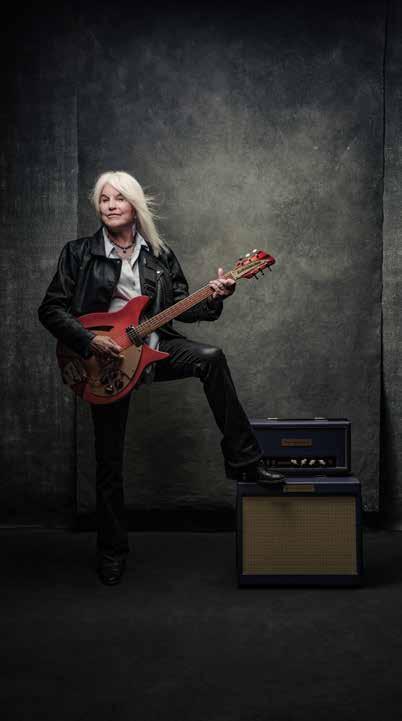
Scottsdale singer-songwriter Sarah James has spent 12 years building a performing career and a video series dedicated to the instruments that carry music’s history forward.
For Sarah James, every guitar has a story worth telling — and after a lifetime of raising a family and building a career, she's finally the one doing the telling.
“He said, ‘Oh, I remember this — Steve had it on the tour,’” she recalls.
That exchange — the living chain of musicians, instruments, and stories — is precisely what VGL was built to document. The series has now taken James to a 40-year-old family-owned guitar shop in Pittsburgh, to Elderly Instruments in Lansing, Michigan, where founder Stan Werbin let her spend three days filming, and most recently to NAMM — the National Association of Music Merchants — in Anaheim, where she walked the convention floor with a cameraman and media credentials and came home with 16 episodes in three days.
“I don’t see many women doing what I do in the vintage guitar world,” she says. “There are a lot of guys out there, and I love them, but it’s fairly rare to find a woman talking seriously about these instruments. Sometimes there’s that initial reaction of, ‘What does she know?’ Well, I know quite a lot.”
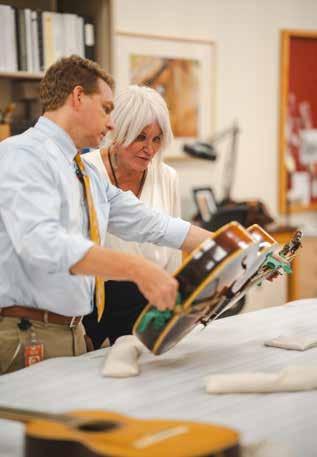
The series has also drawn her into a deepening relationship with the Musical Instrument Museum in Phoenix — one of her first stops after moving to Arizona 12 years ago. Last year, she approached the MIM’s philanthropy office and donated two instruments from her personal collection: the 1957 Waylon Jennings Stratocaster and a 1936 Martin D-18, both in exceptional condition. The MIM’s curator, she says, looked at the Stratocaster and asked whether she was certain she wanted to part with it.
She was.
“It blesses me,” James says. “For me, it’s the giving. I wanted them to be curated and cared for in a place where thousands of people can enjoy them. The tour they gave me of the curator’s suite — getting a sneak peek into the bowels of that museum — was a genuinely touching moment for me.”
The performing life runs parallel to all of it. James plays the Cave Creek and North Scottsdale circuit regularly — Whiskey & Wings, Copper Bull Restaurant, Local Johnny’s, Raven’s View — as a solo act, as the Sarah James Duo, and fronting the Sarah James Project, a full band. She performs with the Desert Cats All-Star Band as well, a loose collective of Valley musicians whose upcoming date at Desert Mountain reflects how thoroughly she has embedded herself in the community since arriving from Pittsburgh. During summer months, James tours western Pennsylvania and New York — including a residency at the Chautauqua Institution in Chautauqua, N.Y., the landmark arts and education assembly where she performs, writes, and works on her craft.
“I love meeting people from all walks of life — bikers, golfers, bankers,” she says. “Music is the common denominator. It brings people together and lets them forget, for a moment, what they’re going through. That’s a beautiful thing.”
The songwriting came late — or rather, the recording of it did. James has been writing for years, but it wasn’t until about a decade ago that she committed fully to releasing music. Her latest single, “Swedish Machine” — a lighthearted song drawn from memories of traveling the Swedish countryside in an old Volvo — arrived on all streaming platforms in April. Before it, “Better Than This” surpassed 200,000 YouTube streams in just a few months.
It began one rainy Arizona night when she was sitting at her monitor, feeling melancholy, watching something unfold on the screen that she couldn’t quite believe.
“The lyrics started coming out of me: raindrops running down my window… And when I looked at that image, the thought
At 76, Sarah James is releasing original music, running a globally followed vintage guitar series, and donating legendary instruments to the MIM — on her own terms and timeline.
came to me: shouldn’t we be better than this?”
She still writes lyrics by hand — old school, she says, because she’s a tactile person, because it helps. She brought the pages to Aaron Howard, her producer and longtime collaborator.
“He looked at them and said, ‘Yeah, we’ve got something here,’” James recalls. “It started out as something folky and dirge-like, but by the time we were done, it became this anthem — it builds and builds.”
There’s a line in an earlier James song, “Take It or Leave It,” that functions almost as a thesis statement for this chapter of her life: The window’s closing fast now, got no time to f--- around. She wrote it, she says, about exactly this — about growing older and bolder, about the things that call to you from under the bed while you’re raising a family and building a life, about the decision to finally answer.
Her heroes reinforce the point. She counts Ringo Starr — 85 and still actively touring — as a mentor, and saw him perform at the Celebrity Theatre in Phoenix last year.
“Music keeps me young and relevant,” she says.
James’ guitar was under the bed for a long time. She raised two kids, has grandchildren now, built a career in Pittsburgh before the desert took hold.
“I’m at a place in my life where I finally get to do what I want to do,” she says. “But it was always calling me. And now I’m at a station in life where I get to answer.”
She pauses, and then: “The windows may be closing fast, but I’m going to jump through them.”
Whiskey & Wings // 34406 N. Black Mountain Parkway, Cave Creek
Free // 480-275-6417 // whiskeyandwingsaz.com
Friday, May 15 // 5–8 p.m.
Raven’s View // 42016 N. Old Mine Road, Cave Creek Free // 480-378-3755 // ravensviewwinebaraz.com
Desert-Raised, World-Bound
Arizona Aria
During a Choirs of America dress rehearsal at Carnegie Hall, 400 singers fell silent when conductor Z. Randall Stroope called for a volunteer to sing the bass solo “Soldier, Soldier, Won’t You Marry Me?” Jacob Soulliere raised his hand, sang the part and was chosen on the spot. That small, decisive moment — stepping forward and being chosen to tell the story — is one of several that map this young baritone’s steady climb from Arizona choirs to major stages.
“No one raised their hand except me,” Soulliere recalls. “I sang it and conductor Stroope said, ‘You got it!’”
That moment established a pattern — initiative meeting preparation, confidence meeting craft. His willingness to step forward, combined with an early commitment to developing his voice and working with the finest teachers, would set the course for everything that followed.
Adopted from Sofia, Bulgaria, at age 2 and raised in Anthem, Soulliere is the product of a tight network of church choirs, youth ensembles and early vocal training that guided him from local stages to international recognition. In Arizona, he was a two-time winner of the Upscale Singers Cheryl Siebs Memorial Competition and, as a winner of
the Arizona Musicfest vocal competition under conductor Robert Moody, was invited to perform at the Musical Instrument Museum as “one of Arizona’s finest young musicians” at age 16. For six years, he served as a soloist at Christ the Lord Lutheran Church in Carefree, where he was awarded a scholarship.
Soulliere believes his talent may be rooted in his DNA — his biological parents were part of Bulgaria’s culture of traveling musicians. His mother noticed his singing ability early and enrolled him in the Phoenix Boys Choir, where he trained under George Stangelberger — a conductor whose résumé included the Vienna Boys Choir and work alongside the Three Tenors — and later advanced into the master’s program under Herbert Washington.
At Boulder Creek High School, he was introduced to mezzo-soprano Mary Sue Hyatt, former director of the school of music at Kent State University, who became his vocal coach and mentor. She, in turn, introduced him to opera coach Henri Venanzi, formerly chorus master of the Arizona Opera and now at the Cincinnati Opera. Together, the three became what Soulliere calls “the three musketeers,” working through recitals and repertoire for the better part of a decade.
Writer Shannon Severson // Photography Courtesy of Jacob Soulliere
Singing is the only instrument that has text. I found a love for it — and for poetry. It’s like a puzzle to communicate emotion on stage. Jacob Soulliere
What they gave him, he says, were two complementary educations most young singers never receive.
“Recital is a manual transmission and opera is automatic transmission,” he explains. “Mary Sue taught me vocal development with a particular quality for each titled recital performance — each selection has its own story, like a mini opera. Henri’s coaching
Jacob Soulliere, the Anthem-raised baritone whose journey from the Phoenix Boys Choir to Carnegie Hall and the San Francisco Conservatory is a testament to the community that first recognized his voice.
taught me how to navigate my voice through different opera roles. I had the best of both worlds and still do.”
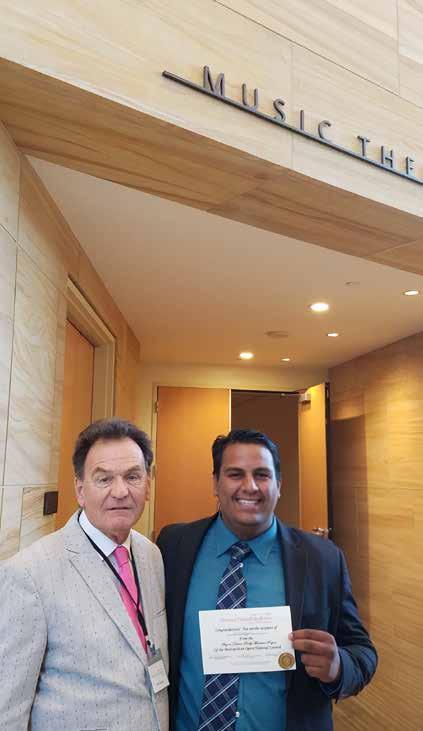
Soulliere earned his bachelor’s degree from Manhattan School of Music and is now pursuing a master’s degree in voice at the San Francisco Conservatory of Music. His résumé reflects a meteoric trajectory: multiple performances at Carnegie Hall — including a post-win recital after the 2022 American International Protégé Vocal Competition — a White House appearance, an Earth
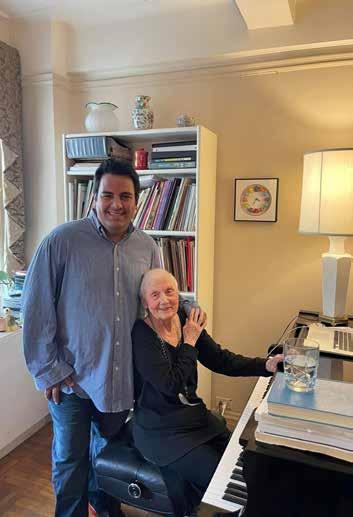
Jacob Soulliere with opera coach Henri Venanzi, formerly chorus master of the Arizona Opera, who introduced him to the world of opera and remains one of his most formative mentors.
Day concert in Central Park with the Munich Symphony, and a spot in the Metropolitan Opera Laffont Competition’s Rocky Mountain region as the youngest participant at 20.
At the conservatory, he studies under Lester Lynch, a Wagner and Verdi specialist who continues tightening the connections between vocal technique, historical context and dramatic truth.
Jacob Soulliere with Marlena Malas, the celebrated mezzosoprano and voice teacher at Manhattan School of Music, where Soulliere earned his bachelor’s degree.
“A classical singer communicates the experience of the character at the time the composer imagined it,” Soulliere says. “Who were the composer’s friends? Which painters and thinkers shaped the era? What was happening in the world? All of this informs the music I bring to life. It’s important for future generations to see history re-enacted live on stage.” He pauses. “It’s important to me, at least.”
A pivotal turning point came during a summer at Opera in the Ozarks, where Soulliere performed the role of Baron Douphol in Verdi’s “La Traviata.” Standing onstage with the chorus rising behind him, something shifted.
“I felt a thrill of inspiration,” he recalls. “The chorus singers’ voices rose up behind me as I performed. That summer, I learned how to live inside a role. It’s not just about singing well; it’s about carrying the characters’ life experiences and emotions and communicating them on stage.”
Opera, he has come to understand, demands multidisciplinary dedication — vocal technique, diction, languages, history, art and literature. Soulliere describes himself as text-obsessed, driven to master diction in English, Italian, German, Latin, French and Russian alike.
“I’m a text fanatic,” he says. “Singing is the only instrument that has text. I found a love for it — and for poetry. It’s like a puzzle to communicate emotion on stage.”
The ambition is real, but so is the perspective.
“I may not be the next Richard Tucker,” he says, “but through the gift God gave me, I can touch the hearts of others.”
Interpretation, he insists, must begin with the words on the page. He is deliberate about limiting early exposure to existing recordings.
“Most opera recordings are 40 to 50 years old and those pieces have been performed in that same way for decades,” he explains. “I don’t want to pick up an imitation. That’s where my musicality comes in — I take ideas from different recordings and fuse them into something that’s mine.”
Though his career now takes him far from the Arizona desert, he returns when he can — most recently singing at Christ Anglican Church’s Easter services, catching up with friends and faculty, and fitting in a round of golf.
“Every time I come home, I feel like I’m getting older, but that translates into enjoying breaks more each time,” he reflects.
To young singers in the same choir risers he once occupied, his advice is direct.
“If you really love music, pursue it,” he says. “You only have one life. You should do something that you love and that makes you happy. I’m not saying it will be an easy reward, but music — whether professionally or in the community — is so therapeutic and it’s something that is really worth pursuing.”
Preparation, he adds, is everything.
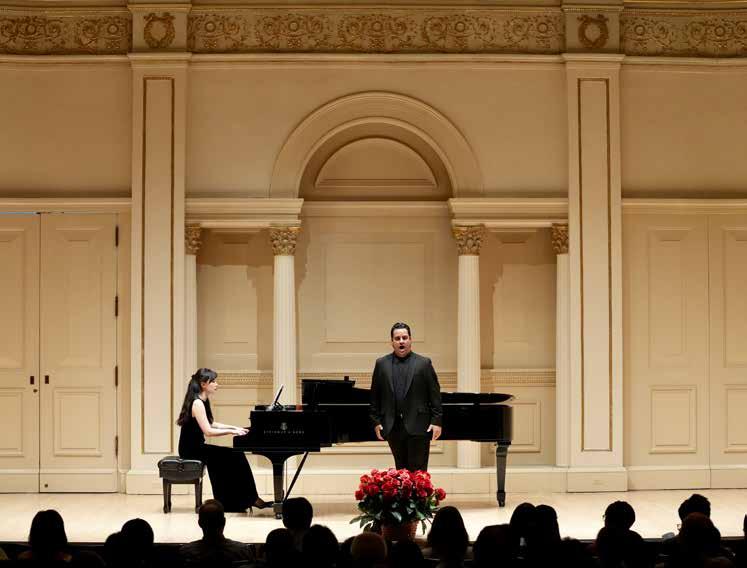
Jacob Soulliere on the stage at Carnegie Hall, where he has performed multiple times — including a post-win recital following the 2022 American International Protégé Vocal Competition.
“What serves on stage is preparation. If you have prepared, you have nothing to worry about. You have to live in the score, understand the text and what the composer wanted. It takes discipline but the process is its own reward.”
The horizon is bright. The conservatory’s current season has him performing Jules Massenet’s “Cendrillon” as Le Roi and Count Almaviva in Mozart’s “Le Nozze di Figaro.” He has an invitation to perform Elaine Hagenberg’s vocal works at Saint-Sulpice in Paris, along with a recital in the city. Ongoing collaborations with the Musical Instrument Museum, the Phoenix Boys Choir and the White House are also in development. He offers trial lessons and performance bookings.
“I love what I create and I love the process that leads me there,” he says, “from the first rehearsal, the staging, the language coaching, to the history classes that illuminate the world behind the music.”
The moment that set it all in motion — a teenager's hand raised in a silent room at Carnegie Hall — was more than an audition. It was a declaration. Now, with a dream of someday performing at the Metropolitan Opera, Jacob Soulliere continues to aim higher, advancing the art of opera note by careful note.
jacobsoulliere.com
photo essay
Craig Miller
Elk in the Room
Photographer
Payson photographer Craig Miller has spent 15 years documenting elk at pay phones, on volleyball courts and across Wells Fargo parking lots — proof that in one Arizona mountain town, the wildlife never got the memo about staying outside.
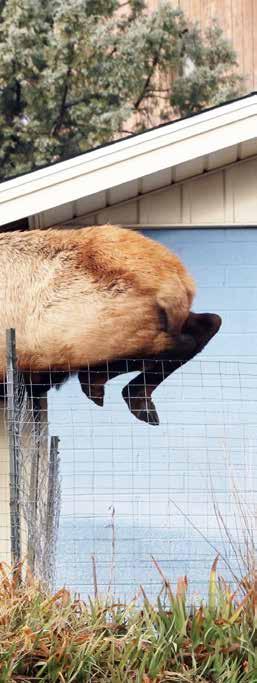
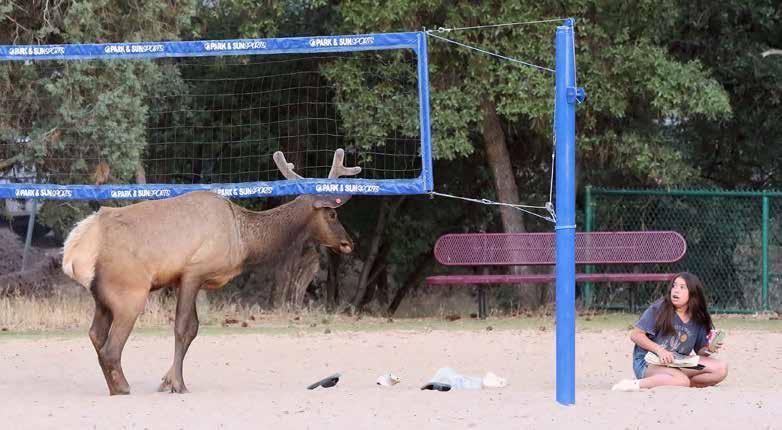
The elk does not knock. It simply arrives — on your deck, in your rose garden, at the pay phone on the corner you forgot was still there. It walks across the Wells Fargo parking lot with the unhurried confidence of someone who has somewhere to be, pauses at a bird feeder with the focused attention of a connoisseur, and ducks beneath a volleyball net with a grace that has no particular interest in being appreciated. The cars lined up behind it on the road can wait.
This is Payson — or rather, this is what Payson actually is, beneath the assumption that town and wilderness occupy separate territories with a clearly posted boundary between them. That boundary, if it ever existed, dissolved long ago. Payson grew up inside elk habitat, not on its edge. The elk were here first, and they have not forgotten it.
Photographer Craig Miller has spent 15 years documenting what happens when that fact reasserts itself. Going out once or twice a day, every day, he has built a body of work that moves through registers most wildlife photography never attempts: the slapstick of a young girl slowly registering that an elk has joined her volleyball game, the odd tenderness of a massive animal delicately licking a pink rose, the quietly surreal image of an elk standing at a pay phone — two things the modern world has largely moved on from, occupying the same frame as if to confer on the matter.
Miller doesn’t engineer these moments. He finds them. “With the elk, it’s mostly opportunistic,” he says. “They just happen to be near something you’d expect to find humans or other animals around.” But opportunism, practiced daily with enough patience and attention, eventually looks a lot like vision.
The elk in this collection are not lost. They are not confused. They are not wandering into foreign territory with wide, frightened eyes. They are, by every available measure, at home — locking antlers on a high school football field, investigating the geometry of a chain-link fence, grazing their way through neighborhoods where some residents set out bird feeders and others, Miller notes, are less charmed. “Some of us love the elk,” he says. “Some find them a nuisance — don’t like them eating their prize rose bushes, coming into their garages or tipping over their garbage cans.”
The elk, for their part, seem unbothered by the distinction.
Writer Joseph J. Airdo // Photographer Craig Miller
With the elk, it’s mostly opportunistic — they just happen to be near something you’d expect to find humans or other animals around. Craig Miller
I think we’ve all here in Payson gotten used to elk being a part of our lives. Some of us love them; some find them a nuisance — they don’t like the elk eating their prize rose bushes, coming into their garages or tipping over their garbage cans. Craig Miller
Meet the Photographer
Craig Miller grew up in the suburbs of Chicago, where wildlife and urban infrastructure kept a more conventional distance from each other. After earning degrees from Aurora University in social work, physical education and education, he built a career as a public school teacher and counselor. In 2002, he and his wife, Ann, relocated to Payson for semiretirement and the mountain air.
The elk came with the territory.
Miller had been a hobbyist photographer since childhood, but it was in Payson, about 15 years ago, that the practice became something more serious — a daily commitment, pursued once or twice a day, every day. He teaches advanced photography at Eastern Arizona College and, with Ann, operates one of Payson’s most decorated small businesses: a combined photography and disc jockey service that has been voted the town’s best in both categories by Payson Roundup readers for 14 consecutive years. The work moves between art forms, but the instinct is the same in each — attentiveness to what the moment is actually offering.
His photography has appeared in books, magazines, newspapers and calendars, and on the walls of homes and businesses throughout the region. His first Images Arizona feature, “Advent of Antlers,” was published in December 2020. This is his second.
He still goes out every day. As for what he hopes people take away from these particular images, Miller doesn’t overthink it. “Just a smile,” he says, “and a ‘Hey, Mary, you’ve got to see this picture DJ Craig posted today.’”
Payson’s elk, for their part, continue to provide the material — on the football field, in the rose garden, at the pay phone, wherever they happen to be.
djcraiginpayson.com
Writer Joseph J. Airdo // Photographer Dillon Driscoll
A Carefree Vocalist
Finds Her Life’s Purpose — One Memory at a Time
Song of the Soul
Vivian hadn’t spoken in five years. She lived in a memory care community, confined to a wheelchair, her hands beginning to turn in on themselves. But when Shannon Wallace entered the room — when the music started — something happened. Vivian moved her arms. She danced a little. She smiled.
At the end of that day’s session, Wallace sang “Let Me Call You Sweetheart” directly to her. It’s the song she always uses to close — timeless, gentle, older than either of their generations. When the last note faded, Vivian said two words.
“Beautiful. Beautiful.”
Wallace’s jaw dropped. So did the jaw of Vivian’s son, who came to see his mother every single day. He turned to Wallace with tears on his face. “Shannon,” he said, “I have not heard my mother’s voice in five years. I can’t even tell you what this means.”
That moment — not the touring, not the television career, not the two decades in marketing — is what Shannon Wallace has spent the past decade pursuing. A Carefree resident and jazz vocalist of 30 years, Wallace is the founder of Musical Memory Care, an interactive program that uses music, movement and memory games to reach people living with dementia, cognitive impairment and developmental disabilities. What began as a volunteer commitment to a single memory care community has grown into something she never anticipated: a program now serving participants in 40 countries.
It started, as the best stories often do, with a question she couldn’t answer.
Several years ago, the Arizona Commission on the Arts offered a $5,000 grant to individual artists. Wallace fit the criteria — a professional vocalist, working steadily, building toward her debut album — and $5,000 was mean-
Music is the elixir of the soul. It doesn’t matter what song, what era, what genre. It’s a soul-to-soul relationship. Shannon Wallace
ingful help toward the $25,000 the recording would require. She began filling out the application. Then she hit a question that stopped her cold.
How does your project benefit your community?
“I thought, well, they can buy my music and hopefully enjoy it,” she recalls. “And then I thought — what am I actually doing for my community? Nothing, other than looking glamorous and singing in front of a 20-piece big band orchestra while husbands and wives danced together.”
She stopped the application. The question had done something more valuable than help her secure funding — it had forced a reckoning.
“I decided the onus was on me to do something for my community,” she says. “So I asked myself: who do I want to work with? And seniors have always been my jam.”
She called an accompanist friend — Charles Lewis, already a senior himself at the time, now 92 and still playing in the Valley — and together they found a memory care community to visit. Wallace arrived knowing almost nothing about the world she was entering. She learned quickly, for instance, that you don’t call them facilities.
“They’re called communities,” she says. “There’s a stigma with the word facility that the elder care industry has moved away from.”
Shannon Wallace, jazz vocalist and founder of Musical Memory Care, has spent a decade using song to reach active adults and people living with dementia — building a program that now serves participants in 40 countries from her home community of Carefree.
The learning curve over those first three years was enormous. But the most important lesson came early, and it reframed everything that followed.
“I realized I wasn’t singing for seniors — I was singing with them,” she says. “It’s a ‘with,’ not a ‘for.’ They taught me more than I could ever provide, and what they provide me is a cup that runneth over, every single day.”
For two years, she showed up to that community every Monday, Wednesday and Friday — for free — while her marketing firm ran in parallel. Eventually she went to Rhonda Thiel, then executive director of a Koelsch Senior Communities property, and said there was something to this. Thiel helped her figure out the transition from volunteer to professional, and the two have remained close colleagues ever since.
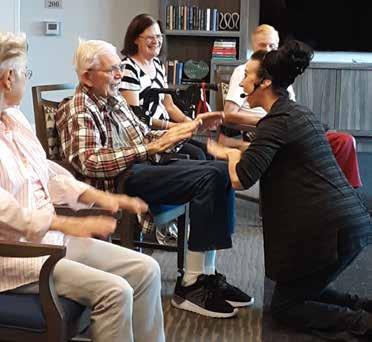
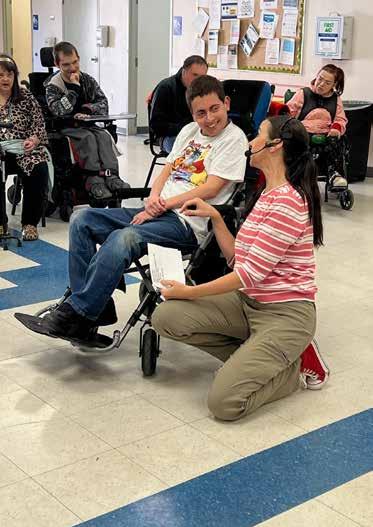
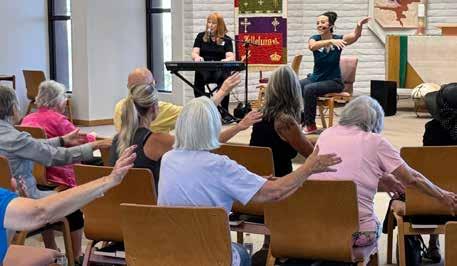
Today, a Musical Memory Care workshop looks like this: chairs arranged in a semicircle, name tags on every participant, Wallace working her way around the room before a single note is played — good morning, Beth; good morning, Charlie — conducting a quiet cognitive read as she goes. She’s an entertainer, and an entertainer reads the room. Whether she’s in front of 1,000 people at a jazz concert or 15 people in a memory care community, she says, the job is the same.
The sessions blend music with movement and problemsolving games in ways that are deceptively demanding. In one exercise, participants snap, clap, touch their nose and touch their ears — then sing a song they know from the time of their life while maintaining the full sequence. That’s memory, motor coordination and lyrical recall firing simultaneously. If everyone is keeping pace, Wallace raises the difficulty. If she sees someone struggling, she dials it back.
The songs are not chosen for her own affinity with the Great American Songbook — though that’s where her heart lives. They’re chosen for her participants. Research has established what Wallace calls the “time of their life” — the music absorbed roughly between ages 16 and 30, which leaves a lasting neurological imprint and remains accessible even as other memories erode. If a participant was born in 1933, she does the math on what was popular during their formative years. Born in 1956, same calculation.
“It’s only when someone is around 90 or 95 that the Great American Songbook becomes their time of their life,” she says. “Which is really my time, in that regard, too.”
Carefree resident Shannon Wallace is a certified dementia practitioner, professional jazz vocalist and founder of Musical Memory Care — a program born from a single grant application question she couldn’t answer in good conscience.
Shannon Wallace leads monthly Music, Memory and Movement workshops at Christ the Lord Lutheran Church in Cave Creek, part of the community-wide effort that helped Carefree and Cave Creek earn their Dementia Friendly America designation this past February.
Memory Makers
Carefree and Cave Creek are now officially dementia-friendly — and the designation is anything but honorary.
On Feb. 17, both communities received Dementia Friendly America designation, awarded jointly. DFA typically designates one community at a time but made an exception given how closely the two towns interact. Sherri Boozikee, neighbor engagement specialist at Foothills Caring Corps, spent months building the case — securing the support of FCC Executive Director Brent Downs, then taking it to both town councils in January. Both voted unanimously in favor.
Earning the designation requires assembling a cross-sector action team, submitting a formal application with letters of support and committing to ongoing evaluation. A launch meeting on Jan. 14 drew more than 20 community members; about a dozen signed on to form the Dementia Friendly Action Team, co-chaired by Home Instead President Kelly Cornelius and representing restaurants, churches, businesses, clinics and first responders. For participating businesses, the ask is straightforward: have staff complete a 45-minute information session and display dementia-friendly branding in return.
The designation formalizes what FCC had already been building. The Memory Cafe — held the third Thursday of every month at Good Shepherd of the Hills Episcopal Church — brings people living with dementia and their care partners together in a free, drop-in setting. Caregivers gather for peer support while participants engage in activities. Twenty-eight people attended the last one.
“We're trying to eliminate the stigma,” Boozikee says, “and that starts with everyone understanding what this looks like and how to help.”
foothillscaringcorps.org
Her wardrobe is not incidental. She wears solid colors and red sneakers in every session — in person and online — because as dementia advances, peripheral vision narrows and the ability to locate a focal point breaks down. She wants to be easy to find. She wants her participants to know, before a word is spoken, that this is the same person who was here last time.
“Consistency is the point,” she says.
Vivian understood this. She was in the later stages — stage seven is what Wallace describes as the threshold of transition, where speaking and self-feeding are largely gone — but the eyes, she insists, remain the windows into the soul until the very last moment. Vivian’s eyes were always dancing.
“Music is the elixir of the soul,” Wallace says. “It doesn’t matter what song, what era, what genre. It’s a soul-to-soul relationship. And Vivian was a hundred thousand percent still in there.”
That conviction now anchors Wallace’s work in her own backyard. The second Monday of every month, she leads a free Music, Memory and Movement workshop at Christ the Lord Lutheran Church in Carefree — one of the signature programs that helped Carefree and Cave Creek earn their joint Dementia Friendly America designation this past February. Of the roughly 40 new neighbors Foothills Caring Corps meets each month, about 40% are somewhere on a memory challenge journey. Carefree’s average resident age is 70. These are her people, and she knows it.
She had to walk away from a grant application to find them. She had to ask herself an uncomfortable question in an empty room and sit with the silence until the answer came. What came back wasn’t an album or an accolade. It was Vivian. And a room full of people who, when the music starts, are still entirely, unmistakably here.
“I’ve had a lot of opportunities in my life,” Wallace says. “I love this one most of all.”
shannonwallacesings.com // musicalmemorycare.com
The B-Side
Music Alive! Teaches the Valley to Listen
Every Wednesday morning, something unexpected happens inside two buildings off Thompson Peak Parkway in North Scottsdale. People gather — 100 of them, sometimes more — not for a concert, not for a gala, but to learn. To listen. To play ukulele for the first time at 70. To argue about James Taylor. To find out, with some surprise, that they are not alone in loving this music as much as they do.
Most people who know Arizona Musicfest know it as a concert series — 35 years of world-class performances, a sold-out season drawing more than 50,000 ticket buyers, a roster of guest artists that has included Johnny Mathis, Mandy Patinkin and Joshua Bell. What those same people may not know is that a parallel programming track has been quietly growing beneath that marquee. It’s called Music Alive!, and this season more than 5,000 people will pass through its doors.
“For a long time we had two pillars — the concert season and what we did for youth,” says Allan Naplan, Musicfest’s executive and producing director. “Now we have a very stable third pillar, and that’s Music Alive! and our community engagement programs.”
The idea came to Naplan in his third year leading the organization, when something obvious suddenly became impossible
to ignore. The community surrounding Musicfest — largely retirees in one of the Valley’s most affluent corridors — was showing up for evening performances in enormous numbers. They loved music. They had time. And during the day, Musicfest had nothing to offer them.
“I thought, this is such a ripe opportunity,” Naplan recalls.
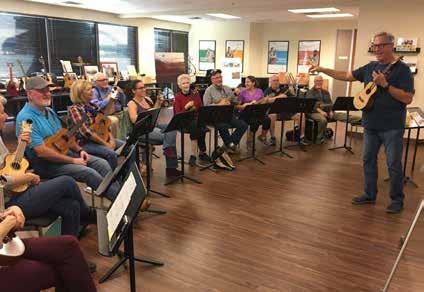
He launched the program in 2016 with characteristic modesty. The original offering was called Music and Muffins — structured like a book club, built around a weekly listening list that participants would explore on their own time before gathering to discuss it. The muffins helped. So did the content. So, perhaps most importantly, did the simple act of bringing people together around a shared passion. The common area of Musicfest’s then-offices in Carefree started filling up every week with people playing ukulele. It was, Naplan says, unmistakable proof of concept.
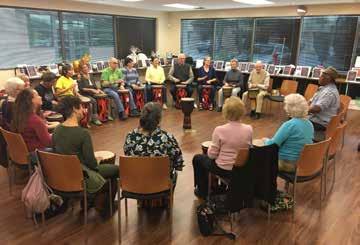
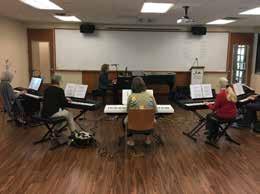
Today, Music Alive! spans roughly 350 events per season — free lectures, music theory classes, drumming circles, instrument lessons, guided listening seminars and a clinical partnership with the Neurologic Music Therapy Services of Arizona that treats the organization as a laboratory for evidencebased cognitive health programming. During the height of
Writer Joseph J. Airdo // Photography Courtesy of Arizona Musicfest
Allan Naplan, executive and producing director of Arizona Musicfest, created Music Alive! in 2016 as the organization’s third pillar — a year-round commitment to community engagement that now draws more than 5,000 participants annually.
Behind every great piece of music, there’s a compelling story. That’s why it’s called Listen Up — at the end of the day, it’s teaching people how to listen to music better and how to get more out of the experience. Josh Condon
the season, from January through April, there are five to six events every week.
The man most responsible for that programming is Josh Condon, Musicfest’s resident artist and director of community music programs. His background is the kind that resists a single sentence: classically trained pianist, jazz musician, musical theatre director, former cruise ship music director for Norwegian, Celebrity and Princess cruise lines. He came to Musicfest three years ago through a mutual friend, with no particular plan to become a community music educator.
“I never thought I would be in this particular kind of role,” Condon says. “But my background lends itself to the variety that Musicfest provides. When I do these sessions, I’m not thinking of it as teaching per se. I’m simply sharing my own genuine interest in the topic with the audience. I’m somewhat of a nerd — you look up interviews from artists, you learn everything about the style and interpretation. And I think that’s what resonates.”
The flagship offering Condon leads is Listen Up, a weekly Wednesday morning seminar that he describes as a program with no single format. Some sessions are lectures. Some are
guided listening exercises. Some unfold in a podcast-style dialogue with a guest artist. What they share is a consistent mission: to illuminate the music, the person who made it and the human impulse that drove its creation.
“Behind every great piece of music, there’s a compelling story,” Condon says. “What I’m trying to isolate is this: every piece of music was created by a real human, in real time, in a real place. What were they motivated by? What rules were they following — or breaking?” He pauses. “I also try to give people the vocabulary to talk about what they’re hearing, to put words to things they may have always felt but could never articulate. That’s why it’s called Listen Up — at the end of the day, it’s teaching people how to listen to music better and how to get more out of the experience.”
The people in those Wednesday morning chairs are, by Condon’s description, curious people — people of good taste, as Michael Feinstein recently told an audience of them directly. They skew older, reflecting the community Musicfest has always served, though Condon resists language that makes the programming sound exclusive. What he will say, carefully and with some feeling, is that for many of the people who
come through those doors, Music Alive! is doing something that goes well beyond music appreciation.
“We are explicitly building community,” he says. “Studies have shown that seniors who maintain an active social life are happier, live longer, have better health. Someone comes in, hears music they love, looks over at a stranger and says — oh, you love this too? A friendship is born when one person says to the other, ‘I thought it was just me.’”
Naplan makes the same point from an institutional angle. The program is free — no admission, no per-class fee for the lectures and seminars — because it is understood as a charitable mission, subsidized by the margin the concert season generates on sold-out nights, as well as through the generosity of Musicfest’s donors.
“Instead of paying $10 or $15 per class,” he says, “our patrons are giving very meaningfully at the end of the season, because they know we are greatly enhancing their quality of life. It has become part of their lifestyle.”
The music-making classes — piano fundamentals at three levels, ukulele, guitar, West African drumming, HealthRhythms drumming sessions — carry a modest fee of $200 to $225 for an eight-session course, with class sizes running between eight and 15 participants. Condon doesn’t teach them himself; he recruits for them, and the recruiting, he says, is everything.
“If it’s a perfunctory exercise for the teacher, that translates immediately to the students,” he says. “But if the teacher is passing on genuine joy, genuine excitement, a real love for the art — that connects.”
What happens to an adult who learns an instrument for the first time, or returns to one abandoned 60 years ago, is something Condon has watched closely. Audience members used to come up to him after performances and say they wished they hadn’t quit piano. They were 70. They had quit at seven. Music Alive! exists, in part, to answer that wish.
“Music happens in time,” he says. “You’re coordinating your brain with your hands with your ear — all in real time, all within a rhythmic constraint. For people going through dementia, music and musical memory is often the very last thing to go, long after speech and shortterm memory have faded. It lives in a deep place in the brain and the spirit. But there’s also just the profound sense of accomplishment. I think it’s so valuable for anyone, at any age, to do hard things and see them through.”
Once a month, Condon loads his materials into his car and drives to the city of Scottsdale’s Via Linda Senior Center to deliver a smaller version of what he does at Musicfest — a promotional session for an audience that, on a good day, numbers about a dozen. He admits that early on, the disparity gave him pause. He mentioned it to Naplan. They decided to keep going.
NAD+ cellular rejuvenation
N A D + ( N i c o t i n a m i d e A d e n i n e D i n u c l e o t i d e ) i s a p o w e r f u l c o e n z y m e
e s s e n t i a l f o r c e l l u l a r e n e r g y a n d r e p a i r . W i t h a g e a n d s t r e s s , N A D +
l e v e l s d e c l i n e , l e a d i n g t o f a t i g u e , c o g n i t i v e d e c l i n e , a n d p r e m a t u r e a g i n g . N A D + t h e r a p i e s h e l p r e s t o r e o p t i m a l l e v e l s , i m p r o v i n g e n e r g y , f o c u s , a n d o v e r a l l v i t a l i t y .
B y p r o m o t i n g c e l l u l a r r e p a i r a n d c o m b a t i n g o x i d a t i v e s t r e s s , N A D + t h e r a p y i s i d e a l f o r i n d
Recharge Your Cells: Experience the Benefits of NAD+ Therapy We offer
From the Top
The youngest people in Arizona Musicfest’s orbit and the oldest don’t often share the same room. But they share the same institutional commitment — and occasionally, the same stage.
Musicfest’s youth programming runs parallel to Music Alive!, built around the conviction that an organization serious about music’s future has to invest in the people who will make it. That investment takes several forms.
Six annual competitions across divisions — strings, winds and brass, piano, voice, jazz and chamber ensemble — give young Arizona musicians a professional performance context and, for winners, cash prizes and a place in the Young Musicians Concert Series. From there, standouts earn access to the Access to Artistry Masterclass Series, working directly with the nationally and internationally acclaimed guest artists who anchor Musicfest’s main stage season.
The Arizona Musicfest Scholarship Program, launched in 2011, has awarded a combined $233,640 to students pursuing college degrees in music — a merit-based program that draws from the competition pipeline and requires prior participation in Musicfest’s youth programs. Recipients have gone on to the Juilliard School, Manhattan School of Music and elite orchestras across the country. Some have come back to solo with the Festival Orchestra — a full-circle moment that Allan Naplan describes with undisguised pride.
A newer initiative reaches further. The Summer Music Camp Scholarship Program, now in its third year, is 100% need-based — built for students whose school-year momentum would otherwise evaporate over a long Arizona summer. Aligned with partner Valley arts organizations serving underserved communities, the program has sent students to Interlochen Arts Academy in Michigan, Brevard Music Center in North Carolina, Meadowmount School of Music in New York and Berklee College of Music’s Aspire summer program in Boston, among others.
The concert season fills the hall. The scholarships fill the pipeline.
azmusicfest.org/youth
On one particular morning, Condon loaded the car early, drove over, and caught himself doing the math — all of this preparation, all of this effort, for 12 people. It was a fleeting thought. But it was there.
Walking out to the parking lot after the session, a woman named Doris stopped him. She told him about her first husband, a musician. Her second husband, the love of her life, recently lost. The long days at home afterward. Her daughter calling, urging her to get out. She wasn’t someone who had hobbies, she said. She had been an executive. But she loved music. So she came to his session at the senior center, and then she started coming to everything at Musicfest.
“You have given me, in however many years I have left, my first hobby,” she told him. “And that has given me a new reason to live.”
Condon gets quiet for a moment.
“I was so angry at myself for having walked in with anything less than full presence for that moment,” he says. “Because what I do here is so much bigger than me. I think about Doris, and I think — there are probably many other Dorises out there. And I try to facilitate spaces where anyone can come and have that kind of moment, whatever their story is.”
Music Alive! programming runs year-round. The instrument classes conclude in mid-May, but Wednesday morning sessions continue through the summer — a Songs of Summer series, film screenings, iced coffee — before ramping back up to five events a week when the concert season returns in the fall.
“Five years from now, Music Alive! will be even bigger,” Naplan says. “I have no doubt about that.”
Condon frames it somewhat differently, in the way that people who do the work rather than run the organization tend to frame things.
“I’m always their gateway drug,” he says, “into whatever they choose to explore.”
azmusicfest.org/education
Americana Troubadour Jai Graves Is Done Waiting
As he stood beneath the spotlight with a roaring audience filling his ears, Jai Graves did something unusual — he took off his signature dark sunglasses and cowboy hat, showing his sincere gratitude at a turning point in his career. The country and Americana musician claimed his 2025 Rising Star Award after nine weeks of competition — and 42 years of honing his talent.
“I don’t think I’ve ever felt that moment before of, ‘I’m doing the right thing,’” he recalls. “That level of ‘Wow — this is real! I’m getting recognized for what I do.’ I’m not sure I’ve ever felt so humbled.”
“I play onstage with sunglasses and usually wear a hat. I have anxiety and being in a room in front of hundreds of people is really hard for me. I took them off to show people how much it meant. It was a big moment.”
Writer Shannon Severson // Photography by Cheri Pyles and Yorg Kerasiotis
Jai Graves spent years playing Detroit dive bars before the Sonoran Desert gave him both a home and a creative identity rooted in open skies and desert grit.
My life is a dichotomy — half in wellness and half debauchery — playing in bars with everyone getting drunk. Jai Graves
He’s come a long way. His grandfather let him play with his banjo at age four. As a boy, he taught himself to strum his father’s guitar upside down, left-handed like Jimi Hendrix. He grew up playing hockey with his three brothers and played goalie before thousands of fans at the University of Kentucky. That’s where he debuted onstage at a Lexington wine bar — playing Steve Miller and Dave Matthews Band covers.
“They offered me $50 and all the wine I could drink — I didn’t even like wine at 18, but it was free,” he laughs. “My audience was 30 rich people drinking wine, eating cheese and listening to some dumb kid with a fake ID who really didn’t know how to sing. Really nice people. I eventually quit hockey; I realized girls like guys with a guitar and all their teeth.”
The support from Graves’ family has propelled him throughout the journey, and he estimates he has close to 5,000 shows under his belt. His encouraging parents and the grandfather who gave him free run of every instrument — banjo, fiddle, pedal steel, mandolin — are people he will always credit.
“My grandpa was the coolest dude you’d ever meet in your life. He never told me no — I could pick up any instrument. For a child, when you find something that inspires you like that, it’s about as good a blessing as it gets.”
His first foray into the professional arena — an American Idol audition on the South Side of Chicago — ended in heartbreak. At one point, he set music aside entirely, came to Arizona and built a successful career as a yoga teacher and stretch therapist in Paradise Valley and at the area’s luxury resorts.
“My life is a dichotomy — half in wellness and half debauchery — playing in bars with everyone getting drunk,” he observes. “I was giving music a break but now it’s back at the forefront.”
All of it led to this turning point. He’s let the day job fade and is now a full-time musician, playing 300 shows annually.
After the thrill of an invitation to Austin’s South by Southwest this spring, he reflects on that moment on the Foley Ranch
Singer-songwriter Jai Graves performs across the Valley weekly, bringing a sound he describes as alternative country — raw Americana with Southern rock edges and no apologies.
stage and all it set in motion. He was honored to perform at the inaugural Arizona Desert Country Music Awards in November 2025. Despite a full backup band onstage, he chose to go it alone.
“I stood up and it was just me and my guitar in front of all the best people in my industry — it was a pretty stupid move,” he says with a laugh. “I was the only artist who got to play original music. If I had let the band play it would have sounded way bigger. I’ve always been a solo performer. I’ve gotten used to playing alone in the lineup between two big bands and I love it.”
Graves says he’s shed the stage fright that comes with inexperience, and many hardscrabble years have built his resilience.
“A lot of people have no idea of the roots of my music. I spent years in Detroit getting my ass kicked and playing for $50. I’ve played behind chicken wire; I’ve been robbed.”
Scottsdale, he says, is much nicer than Detroit. The sunglasses still help.
“It gives me a shield and allows me not to worry about what’s going on in front of me.”
With the Rising Star Award, landmark performances and a development contract in hand, Graves is setting
his sights on what’s next: a debut album with studio time split between Detroit and his adopted hometown of Phoenix, slated for release this summer.
He’s writing his own music, playing multiple instruments and collaborating with a local songwriter. In Michigan, he’ll record with producer and instrumentalist Yorg Kerasiotis and “Country Hop and Roll” artist Louie Lee, with other Detroit musicians potentially joining the sessions. The interplay between collaborators — and the adrenaline of composing from a single line that arrives without warning — are both part of what the process demands.
“The recording process is such a different thing from performing. It takes a lot of time and focus. I know what the song looks like when I write it and I know what it looks like when these people help me finish it. I put different songs away for different producers. I’ve learned a lot through the process. I’m taking my time with it but I also want to get it done. I’m in the zone.”
A multi-instrumentalist and 2025 Rising Star Award winner, Jai Graves is finishing his debut album with studio sessions split between Phoenix and Detroit.
The sound? Tough to classify, he says — country mixed with Southern rock Americana, somewhere in the territory of Grammy winner Sturgill Simpson.
“I don’t write ‘bro country,’” he says. “I write music that’s real to me. I think I’d be called alternative country. I feel confident these songs are really good. This is my life and what I want to do. That’s why I’m going so hard.”
Arizona has been good to Graves — not just for the gigs he plays around the Valley each week, but for how the landscape has shaped his songwriting.
“Riding horses, cactus and dirt and dust and clear skies — all that is country music,” he says. “Just being outside. Country music gets me away from technology. It’s like, ‘Let me put my phone down and listen to this album.’”
He’s not alone in believing Arizona country is on the verge of something larger.
“Arizona is really developing an awesome country music scene,” he says. “There are some people who want to make this a little Nashville; they’ve put me on the radio and have been so good to me. I think Arizona country is really going to be a force in the next five to 10 years. You’re going to see a bunch of people coming from the greater Phoenix area.”
The sunglasses go back on. The hat goes back on. And Jai Graves walks out to do it again — another stage, another room full of strangers who don’t know his name yet. That’s the part that drives him, the part no award or development contract fully explains. Arizona gave him the landscape and the community. Detroit gave him the scars. Kentucky gave him the hunger. Now all of it is headed into a recording studio, into a debut album that’s been 42 years in the making. He’s not waiting to see how it lands.
“If I don’t do it now,” he says, “it's never going to happen.”
Writer Shannon Severson
Jubilate Conservatory Turns Musical Literacy Into a Lifelong Gift
Play It Forward
Small fingers grip the bow of a violin, gliding across the strings as the instrument sings in the hands of a young student at Jubilate Conservatory of Music. More than tools for making sound, the violin and bow are doorways to community, history and self.
Laya Field is the school’s founder and director — a composer, curriculum author, operatic vocalist and violin and viola instrumentalist. Her vision for a multigenerational community music program has come to life among the white stuccoed walls of Carefree’s Spanish Village, where the conservatory opened its doors last November, conveniently situated next to a coffee shop for parents who linger while students practice.
“Jubilate — pronounced ju-bil-ah-tay — means joyful,” she explains. “A joyful conservatory of music. We have children and adults; everyone is welcome here. Our focus is to guide children into becoming literate musicians.”
As afternoon sunlight streams into the cozy studio, Field reflects on her Northern California upbringing, where her church organist mother would nestle young Laya into a basket as she worked the pedals and keys of a glorious pipe organ. The reverberant sounds of the organ, accompanying choral oratorios and eventually violin lessons, awakened her musical DNA, prompting her to pursue
music education at Humboldt State University, where she studied violin and voice as a rare contralto.
When she moved to Arizona and her church asked her to assemble a children’s choir, her enthusiasm gave way to concern when, among 15 young participants, only one could match pitch. As she surveyed the mothers and grandmothers of the children with the same results, she had a
Photography Courtesy of Jubilate Conservatory of Music
worrying thought: “I started imagining the country with no one being able to sing. Music is one of the major, unifying tools for people and for our country. It transcends time and connects us with history.”
Field was determined to restore musical literacy in a welcoming environment with a curriculum strong on the basics. Ultimately, she sees music as a means to bond human beings; her nonprofit conservatory uses voice, instruments and rich musical heritage that crosses generational and cultural boundaries.
“Music is a language,” Field explains. “You read it; you write it; you speak it. Anyone could go to Germany, for example, and communicate with music even if they didn’t share a language.”
Family and community support, particularly from the Kiwanis of Carefree, guided Field through solidifying her nonprofit business model and helped with funding grants. Conservatory students have been invited to play at the Sanderson Lincoln Pavilion for Kiwanis-sponsored Christmas events and other community-sponsored festivals like Earth Day.
“Laya is more than a music instructor,” says Edward Edling, a Kiwanis funds request committee member.
“Her love for her pupils, along with her passion, have made her a life-changing mentor to many. I’ve
Music is a language. You read it; you write it; you speak it. Anyone could go to Germany, for example, and communicate with music even if they didn’t share a language. Laya Field
witnessed several of her pupils grow up to be engaging and talented musicians. Kiwanis will continue to support her mission.”
In December 2025, the school received special recognition from Rep. David Schweikert for “outstanding public service and entrepreneurial achievement,” with a special certificate and an emissary present at the Carefree studio’s ribbon cutting.
Instructor Esme Peters found her musical voice at an early age when she joined a parks and recreation program that filled the gap in music education at her Portland, Oregon, public school. She sees her younger self reflected in many of her students.
“I started private violin lessons at age 5 but it wasn’t a big joy for me until I joined the community children’s orchestra,” she recalls. “The conductor was a very theatrical woman who made it fun. That’s when music became what I wanted to do and now want to share with others.”
With a degree in violin performance from the University of Oregon, Peters is completing her master’s in music performance at Arizona State University and had taken a few teaching jobs before finding Jubilate. She was immediately drawn to the intentionality of Field’s instructional methods and the community-oriented nature of the ensemble classes and teaching space. She is one of 11 teachers at the conservatory, giving private violin and viola lessons and serving as lead instructor of the string orchestra and string quartets. Field says there’s a camaraderie among students and teachers that bonds musicians of all ages.
“For anyone, playing alongside friends makes it more enjoyable,” Peters says. “Many approaches can be limiting; playing in a group is part of what really resonates with me as a teacher and with my students at Jubilate.”
Field explains that Jubilate takes a one-room schoolhouse approach, particularly with the Jubilate Violin Orchestra, where older students become mentors and teachers for younger or less experienced students. She advocates music immersion as a holistic teaching method.
“It’s teaching the children to understand musical concepts without telling them what they are,” Field says. “I’ve patterned it after group family music sessions; if someone isn’t singing, they may be playing the spoons or a tambourine.”
Peters says it’s easy to fall into a trap of focusing only on the individual notes on the page. At Jubilate, students aren’t just “doing the math” but also listening to the other instruments around them, hearing the music as a whole, singing and even composing as they learn musical fundamentals.
Field encourages her students — who have grown in number from 6 in the early days of 2008 to 51 today — to write their own compositions. At the conservatory’s Composers Concert in November, teachers will exclusively perform pieces written by their pupils.
“I didn’t write music until I had to in college,” Peters adds. “It was daunting. To have the children do it from the beginning is so great.”
The response from families and students — who are learning recorder, violin, viola, cello, piano, percussion and voice — has been overwhelmingly positive. Most participate in both private lessons and at least one ensemble class.
Ava Cohen recalls beginning classes with Field when she was in second grade, having no musical knowledge at the time. Now 16 years old, she plays violin, sings, participates in ensemble and choir and even teaches theory to younger students in Jubilate’s Music From the Heart class.
The foundations she learned using Jubilate’s approach helped her grasp music as a whole rather than in disconnected pieces. She can sight read multiple clefs and pick up guitar and piano, and says reading, writing and singing the language of music has made a profound difference in her life.
“I gained the ability to express myself and stimulate my mind in ways I otherwise wouldn’t be able to,” she says. “I write and compose pieces and songs that can convey a meaning big or small. Jubilate has been a place that has helped me grow and has given me a foundation that is strong and purposeful. It has been an amazing experience; I have skills and talents that I can use throughout my whole life to achieve more.”
Cohen says her problems subside when she’s immersed in music, and that music’s positive effects on cognitive function and focus ring true in her own experience. Jubilate’s program, she adds, has helped her become “a better version of myself.”
The conservatory offers string lessons for adults with plans for a recorder ensemble centered on early Baroque music in the coming year. Each Saturday, the Jubilate Violin Orchestra — comprising musicians ages 5 through adult — meets at the Desert Foothills Library in Cave Creek, a free, open gathering of the musical community.
“Each piece I write has multiple skill levels so every musician can participate where they’re at, skillwise,” Field says.
“This brings people together; it creates healthy socialization for the children. They’re not playing video games, they’re practicing Bach! Their brain synapses are all working together; it helps them to center and work things out.”
On the fourth Sunday of every month from 2:30–3:30 p.m., Jubilate’s percussion teacher leads a family drum circle at Sanderson Lincoln Pavilion where everyone uses rhythm instruments, with an optional parade around the Sundial at the session’s conclusion.
Field’s participants include homeschool, private school and Cave Creek Unified School District students, but many also come from North Scottsdale, Anthem and North Phoenix. Events on Saturdays — including occasional faculty recitals — make attendance easier, and there’s an online music library for remote students. Visitors are welcome to stop by if the door is open, and Jubilate’s free online newsletter regularly announces scheduled concerts and events.
The year culminates in the Spring Concert — a final recital Saturday, May 23 from 1–3 p.m. at Desert Foothills Library featuring all of the conservatory’s ensembles.
In this musical one-room schoolhouse, Jubilate reaches beyond recitals to build something lasting: a community of musicians who hear the world differently because of what they’ve learned here, and who carry that gift into lives that are richer for it.
jubilateconservatoryofmusic.org
MUSIC
Jubilate Conservatory of Music Spring Concert
Saturday, May 23 // 1 p.m. // Desert Foothills Library
38443 N. School House Road, Cave Creek // Free jubilateconservatoryofmusic.org
Writer Joseph J.
Music to His Years Vietnam Veteran Turns
TLife’s Soundtrack Into Literature
he field house at Bethany College is winding down toward its final song when the dean of students pulls Doug Bradley aside. April 4, 1968. A small town in the West Virginia hills, a Thursday night crowd that came out to see Dionne Warwick — and Warwick is about to come offstage. The dean leans in: Martin Luther King Jr. has been assassinated. In Memphis. About an hour ago.
Bradley is 20 years old, the school’s social chairman, responsible for bringing 19 acts to this tiny campus in just over two years. He drove Warwick from the airport himself. He knows she’ll want to do one or two more songs. He also knows, from the faces he can already see, that something is wrong.
This is the kind of moment that doesn’t belong in anyone’s college years. And yet there it is — the first chapter in what will become a lifetime of intersections between music and history, between songs and the events they outlast.
Bradley, a Vietnam veteran and part-time Phoenician who lives near Piestewa Peak, published “The Tracks of My Years: A Music-Based Memoir” in August 2025. The book — which earned the Vietnam Veterans of America’s 2025 Excellence in Arts Award and drew blurbs from Pulitzer Prize winner David Maraniss and “Matterhorn” author
Karl Marlantes — organizes a life not by dates or milestones but by songs. Each chapter takes its title from a track that shaped it. The companion 46-song Spotify playlist is essentially the table of contents. And what that playlist contains — Sinatra giving way to doo-wop giving way to Motown giving way to Hendrix — is the arc of postwar American music history, lived from the inside.
Airdo // Photography Courtesy of Doug Bradley
Doug Bradley, author, educator and Vietnam veteran, splits his time between Madison, Wisconsin, and the Phoenix area, where he teaches courses on music, Vietnam, memoir and memory at Arizona State University.
Doug Bradley at his typewriter at U.S. Army headquarters in Long Binh, South Vietnam, in 1971 — where music from Hendrix to Motown provided what he calls the soundtrack soldiers needed to “fight and stay alive.”
“Music has always been there for me,” Bradley says. “But the turning point, absolutely, was Vietnam. Music was what we needed to cling to, to keep us alive, to keep us connected to one another, to the rest of the company, to the rest of the world.”
The story begins in Philadelphia, where Bradley grew up listening to his father croon big band standards and his older brother rehearse doo-wop with street-corner groups. When the family relocated to the Pittsburgh suburbs, Bradley assembled a 45 RPM collection and spun records at high school dances. He was, in other words, exactly the kid who would end up social chairman at Bethany College — a tiny school in Bethany, West Virginia, where he ran for office on a promise to bring Smokey Robinson and the Miracles to campus.
He won. And on March 5, 1967, Smokey showed up.
“I was 19, 20 years old,” Bradley recalls. “You’re a young kid and these are your idols. You just want to do right by them and not screw up.”
Music was what we needed to cling to, to keep us alive, to keep us connected to one another, to the rest of the company, to the rest of the world. Doug Bradley
The concert went off without a hitch — and then, as the Miracles were leaving, someone said they wanted to play some ball. Smokey sat it out. But Bobby Rogers, Pete Moore and Ronnie White followed Bradley into the gym, found a ball, and played two-on-two in dress shoes on the hardwood.
“It was like being in church,” Bradley says.
That night was one of 19 concerts in just over two years — Jefferson Airplane, Count Basie, Sam and Dave, the Fifth Dimension — that made tiny Bethany an unlikely musical oasis in the West Virginia hills. But none of them prepared Bradley for the night Dionne Warwick came to town.
She had canceled twice before — November 1967, then January 1968 — before finally honoring her contract that April. Her band had flown into a small regional airport separately, so she committed to one long set and gave everything she had. The crowd was full. The night was good.
Then the dean intercepted Bradley near the stage.
“I could see she could already tell by looking at the people right there that something was wrong — we were just shaken,” Bradley says. “So I said, ‘I’m so sorry. This is terrible. Dr. King —’” He didn’t need to finish the sentence.
Doug Bradley receives his diploma from Bethany College in Bethany, West Virginia, where as social chairman he brought 19 acts to campus in just over two years — among them Smokey Robinson and the Miracles, Count Basie and Dionne Warwick.
“It was remarkable how she got strong, got strong in an instant,” he says. “She said, ‘I need to sing. I have to get this out.’”
She never got the chance. A local sheriff, worried about unrest, ordered the lights up and the field house cleared. The audience filed out not knowing why. Warwick left without singing another note.
“I think we all would have been healed by what she needed to sing that night,” Bradley says. “It never happened because somebody decided it was going to be too risky.”
A year after that night, he was drafted. He aced the Army’s aptitude test and earned assignment as a journalist, eventually landing at U.S. Army headquarters in Long Binh, South Vietnam, from November 1970 to November 1971. Nixon had signaled the American withdrawal was coming. Nobody wanted to be the last GI killed in Vietnam. So they kept their heads down — and they listened.
“Everybody had a radio, everybody had records, everybody had tape decks,” Bradley says. “Vietnamese bands, Korean bands, music coming from every direction. Some guys listened to country, a lot of us listened to Hendrix. Whatever it was, it was what we needed to fight and stay alive.”
“The Tracks of My Years” doesn’t stop at the music. It also moves through the complicated personal terrain that makes any memoir worth reading — including a prolonged, unresolved relationship with a high school teacher who opened the teenage Bradley’s eyes to Bob Dylan and the Beatles, and whose intentions Bradley is still working to fully understand.
The book took 10 to 12 years to assemble, built from memory, journals and verification calls to family members. He had to make sure he got the early songs right, he says — “16 Candles,” “Smoke Gets in Your Eyes,” Sinatra — songs he confirmed with his brother and parents while they were still alive to ask.
Vietnam changed everything, he says, but not only in the ways you’d expect.
“I had to learn patience,” he explains. “I had to learn forgiveness. And I think about where we are now as a country — this division, this fracture. It feels as serious as anything since Vietnam, maybe the Civil War. If you can find something to hold on to — music, memory, food, family, whatever it is — hold on.”
Bradley has found that something, both in his writing and in the life he’s built near Piestewa Peak, where he teaches continuing studies courses at Arizona State University on music, Vietnam, memoir and memory. He speaks about his adopted state the way he speaks about the music that sustained him in Southeast Asia — with the gratitude of someone who knows exactly what it means to need something and find it.
“Everybody’s got their own soundtrack,” he says. “You’re up, you’re down, you’re here, you’re there, and through all of it, music is what connects you to yourself.”
doug-bradley.com
Doug Bradley, his brother and their father in the early years before rock and roll drew battle lines in the household.
As Arizona’s temperatures climb, the English Rose Tea Room does what it does best — offer a graceful escape. This summer, Jo Gemmill’s beloved Carefree destination shifts into its garden season, softening the palette and lightening the menu while keeping the bone china, crystal chandeliers and old-world hospitality that have made it a community fixture for more than two decades.
The seasonal menu leans into florals and brightness: delicate finger sandwiches built around seasonal ingredients, fruit-inspired pastries, and an expanded tea selection that runs from classic hot service to chilled options — citrus, berry and herb-infused teas that feel made for Arizona afternoons. The patio, outfitted with shade and misters, delivers a genuine al fresco experience.
May is among the tea room’s most celebratory months, and this Mother’s Day is already fully booked — but Gemmill hasn’t forgotten those celebrating at home. Tea treats are available for takeaway, making the tradition transportable.
Princess-themed teas continue to delight younger guests on weekends, while a new monthly series launches this summer: Friday
Dining Guide
evening events running 5 to 7 p.m., limited in seating and built around rotating themes. The inaugural evening takes its cue from “Bridgerton” — elegant, whimsical and designed for a summer night out. Subsequent themes will be announced on the website, and early reservations are the only insurance.
It adds up to something the English Rose has always understood: the best summer afternoons are not rushed; they are sipped.
BOURSIN DIP WITH PISTACHIOS AND HOT HONEY
Francine Coles
Writer and Photographer
thefancypantskitchen.com
Recipe
Three ingredients, five minutes, zero effort — and yet this dip has a way of stopping a party cold. A wheel of Boursin pressed onto a plate, blanketed in salted pistachios and finished with a generous drizzle of hot honey, delivers the kind of sweet-heat-salty combination that turns crackers into vehicles for one more bite. It works as a weeknight snack, an effortless happyhour offering, or the appetizer you bring when you want people to ask for the recipe.
Yield: 6 servings
INGREDIENTS:
1 5.4-ounce wheel Boursin cheese, garlic and herb variety
1/2 cup roasted salted shelled pistachios, chopped (about 1/4 cup crushed)
3–4 tablespoons hot honey
Crackers or apple slices, for serving
DIRECTIONS:
1. Let the Boursin come to room temperature for 15 minutes to soften for easier spreading.
2. Choose a serving plate or platter. Use the back of a spoon to press the Boursin into an even layer across the surface.
3. Top evenly with the pistachios. Drizzle generously with hot honey.
4. Serve immediately with crackers or apple slices. Include a small spreading knife or spoon for easy plating.