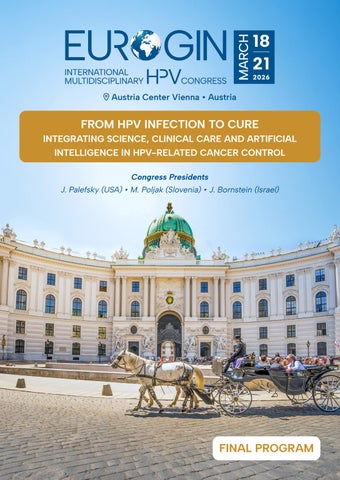
EUROGIN 2026 - Final Program

Page 1


FROM HPV INFECTION TO CURE

INTEGRATING SCIENCE, CLINICAL CARE AND ARTIFICIAL INTELLIGENCE IN HPV-RELATED CANCER CONTROL

Congress Presidents

J. Palefsky (USA) • M. Poljak (Slovenia) • J. Bornstein (Israel)

TABLE OF CONTENTS

SS

SS

SS

SS

WEDNESDAY MARCH 18

SCIENTIFIC SESSIONS

SS 01 • HPV SCREENING

IN TRANSGENDER INDIVIDUALS – WHO, WHY, HOW, AND WHAT TO DO WITH THE RESULT

CHAIR: Milerad H. (Sweden) • Palmer T. J. (UK) • Sundström K. (Sweden)

With increasing acceptance of transgender individuals in society, the particular health problems that they pose need to be recognized and managed. One of these problems is HPV infection and its consequences in transgender individuals who still have a cervix and vagina, and in transgender individuals with a neo-vagina. This session aims to set out how finding, assessing and treating HPV infections is managed within existing health care programs and then to discuss the ways in which transgender individuals can be approached, screened and managed.

SS 01-1 • Introduction

SS 01-2 • Identifying and inviting transgender individuals who should be screened – a survey of practice around the world

Milerad H. (Sweden)

Palmer T. J. (UK)

Sundström K. (Sweden)

Palmer T. J. (UK)

SS 01-3 • Communication of HPV risk and screening to transgender individuals Berner A. (UK)

SS 01-4 • Cervical cancer screening in the trans and non-binary community

SS 01-5 • Urine self-sampling as an alternative cervical screening method for the LGBTQ+ community

SS 01-6 • Assessment and management of HPV positivity in native cervico-vaginal tissues and in neo-vaginal tissues

SS 01-7 • Concluding remarks

Moscicki A. B. (USA)

Davies-Oliveira J. (UK)

Milerad H. (Sweden)

Sundström K. (Sweden)

Milerad H. (Sweden)

Palmer T. J. (UK)

Sundström K. (Sweden)

Discussion and Q&A

SCIENTIFIC SESSIONS

• HPV POINT OF CARE TESTS – HARNESSING THE EFFORTS OF THE WIDER MOLECULAR DIAGNOSTICS COMMUNITY TO EFFECT REAL CHANGE

CHAIR: Cuschieri K. (UK) • Poljak M. (Slovenia)

Robust point of care HPV tests will be critical for the fulfilment of HPV elimination goals. Arguably we have not engaged the full breadth of international molecular diagnostic expertise to support their development. To address this, in this two-part session we will

• Assess the development and implementation of POC tests using targets other than HPV, reflecting on what we can - and should - learn

• Hear from early career researchers regarding the challenges of developing an HPV POC and how the EUROGIN community can support

• Gain updates from technology experts on extraction and amplification systems designed specifically to support POC tests

• Hear from those directly involved in the development and application of novel POC tests including HPV POC tests

SS 02-1 • Introduction Cuschieri K. (UK) Poljak M. (Slovenia)

PART A • SETTING THE SCENE AND MAPPING THE LANDSCAPE

SS 02-A1 • The history and evolution of non-HPV POC and near-POC in LMIC

Blondeel K. (Belgium)

SS 02-A2 • What we learnt from extensive use of SARS-CoV-2 POC and near-POC tests Poljak M. (Slovenia)

SS 02-A3 • WHO TTPs – setting standards for future HPV POC and near-POC tests Almonte M. (Switzerland)

SS 02-A4 • The challenges and wins of developing a low-cost point-of-care screening test for high-risk human papillomavirus (HR-HPV) Boswell E. (UK)

SS 02-A5 • Developments in crude extraction to support HPV POC and near-POC tests Vorsters A. (Belgium)

SS 02-A6 • Developments in amplification and detection to support HPV POC and near-POC tests

PART B • CASE STUDIES POC

SS 02-B1 • Isothermal amplification test for the detection of 16 and 18 in resourcelimited settings

SS 02-B2 • Development, evaluation, and translation of point-of-care high-risk HPV tests

Snoek B. (Netherlands)

Kundrod K. (USA)

Richards-Kortum R. (USA)

SS 02-B3 • Biosensors and bioelectronics for the rapid detection of pathogens O’Sullivan C. (Spain)

SS 02-B4 • Rapid electronic quantification of pathogens using DNA nanoballs Pelechano V. (Sweden) Discussion and Q&A

SCIENTIFIC SESSIONS

Hall N1 12.00 • 13.30

SS 03 • GLOBAL HPV LABORATORY NETWORK: STRENGTHENING HPV LABORATORY CAPACITY FOR CERVICAL CANCER ELIMINATION

CHAIR: Arroyo Mühr L. S. (Sweden) • Padalko E. (Belgium)

This session brings together leading experts to present recent advances and strategic developments in global HPV laboratory networks. The focus will be on the evolving needs from WHO, innovations in assay evaluation and sample adequacy, and the implementation of laboratory support and training in new regions.

SS 03-1 • Introduction

Arroyo Mühr L. S. (Sweden)

SS 03-2 • Needs from WHO and possibilities for LabNet Almonte M. (Switzerland)

SS 03-3 • Proficiency studies 2.0: Evaluation of novel HPV assays

SS 03-4 • Sample adequacy revisited: Lessons from large-scale self-sampling programs

SS 03-5 • Advisory task force for HPV testing in new countries: Lab manual, training and rollout

Yilmaz E. (Sweden)

Cocuzza C. (Italy)

Cuschieri K. (UK)

SS 03-6 • International collaboration for HPV prevalence studies Dillner J. (Sweden)

SS 03-7 • Updates from NRL countries: France

Lepiller Q. (France)

SS 03-8 • Updates from NRL countries: Belgium Padalko E. (Belgium)

SS 03-9 • Updates from NRL countries: Brazil Soares M. (Brazil)

SS 03-10 • Updates from NRL countries: Norway

Soreng K. (Norway)

SS 03-11 • Updates from NRL countries: Scotland Cuschieri K. (UK)

SS 03-12 • Updates from NRL countries: Slovenia Oštrbenk A. (Slovenia)

SS 03-13 • Updates from NRL countries: Sweden Eklund C. (Sweden)

Discussion and Q&A

CLINICAL SESSIONS

CS 01 • APPLICATION OF METHYLATION

TEST IN THE MANAGEMENT OF WOMEN WITH CIN, VULVAR OR ANAL LESIONS

CHAIR: Bleeker M. (Netherlands) • Heideman D. (Netherlands)

Altered DNA methylation is one of the key epigenetic events that contributes to the development of cancer. Changes in DNA methylation patterns are already detectable at the stage of precancerous lesions and can be measured using sensitive molecular methods. Accordingly, DNA methylation analysis has evolved as on of the most promising tools for early detection and risk stratification of cervical, vulvar and anal lesions. This session will discuss the value of methylation markers in the management of cervical, vulvar or anal precursors.

CS 01-1 • Introduction

Bleeker M. (Netherlands) Heideman D. (Netherlands)

CS 01-2 • Risk stratification of CIN by methylation analysis Dovnik A. (Slovenia)

CS 01-3 • Follow-up of patients with cervical (pre)cancer by methylation analysis Griffioen M. (Netherlands)

CS 01-4 • Risk stratification of AIN by methylation analysis

CS 01-5 • Risk stratification of vulvar precursors by methylation analysis

Clifford G. (France)

Bleeker M. (Netherlands)

CS 01-6 • Anogenital (pre)cancer detection by methylation analysis in non-invasive sample types De Vries D. (Netherlands)

CS 01-7 • Implementation of methylation tests in clinical management: Barriers and solutions Bonde J. (Denmark)

Discussion and Q&A

CLINICAL SESSIONS

Hall B 10.30 • 12.00

CS 02 • USE OF SELF-SAMPLE IN THE CLINICAL FOLLOW-UP OF WOMEN

CHAIR: Brotherton J. (Australia) • Louvanto K. (Finland)

Discover how self-sampling is reshaping the clinical follow-up of women beyond routine screening. This session brings together experts to explore innovative applications of self-sampling from re-testing in screening programs and post-treatment follow-up of HSIL to monitoring HPV persistence with high accuracy. We’ll also discuss how self-sampling can improve patient adherence in follow-up care. The session will conclude with a dynamic panel discussion on future possibilities in this rapidly evolving field.

CS 02-1 • Introduction Louvanto K. (Finland) Brotherton J. (Australia)

CS 02-2 • Self-sample in screening re-testing

Berkhof H. (Netherlands)

CS 02-3 • Post-treatment follow-up after of HSIL Bomans L. (Belgium)

CS 02-4 • Accuracy of self-sampling for monitoring HPV persistence Brotherton J. (Australia)

CS 02-5 • Improving patient adherence with self-sampling in follow-up care Sasieni P. (UK)

CS 02-6 • Panel discussion - Future possibilities

Discussion and Q&A

FREE COMMUNICATIONS

FC 01 • HPV VACCINES I

CHAIR: Goodman M. (USA) • Vaughan L. (USA)

Hall N1 8.30 • 10.00

FC 01-1 • Impact of HPV vaccination on the US population: Update and clinical implications Vaughan L. (USA)

FC 01-2 • 9-valent HPV vaccine single-dose efficacy studies to support posology change: Development of study designs and assessment of regulatory feedback

FC 01-3 • Long-term effectiveness of the 9-valent HPV vaccine in women aged 16-26 years at vaccination from Scandinavian countries

FC 01-4 • Immunogenicity and safety of 2-dose 9vHPV vaccine regimen administered 3 years apart among boys and girls

FC 01-5 • Extended follow-up of invasive cervical cancer risk after quadrivalent HPV vaccination: A nationwide register-based study

FC 01-6 • HPV vaccination in German women undergoing excisional CIN therapy and impact of reimbursement on the acceptance (HPV vacCINe study): A cross-sectional study

FC 01-7 • Rwanda’s model for achieving cervical cancer elimination benchmarks before 2030

FC 01-8 • A prospective, single-arm, multi-center clinical study of the immunogenicity of nonavalent HPV vaccine administered prior to renal transplantation in adults

Luxembourg A. (USA)

Pathirana J. (Switzerland)

Jotterand V. (Switzerland)

Sparen P. (Sweden)

Wähner C. (Germany)

Hagenimana M. (Rwanda)

Goodman M. (USA)

FREE COMMUNICATIONS

FC 02 • HPV SCREENING

CHAIR: Del Mistro A. (Italy) • Dhillon S. (Belgium)

FC 02-1 • De-intensification of the Dutch HPV-based cervical cancer screening program for vaccinated cohorts: Model-based costeffectiveness analysis

FC 02-2 • Long-term risk of CIN3+ in women E6/E7 mRNA negative: 7.5 year follow up of the NTCC2 study

FC 02-3 • Clinical performance of the Alinity m HR HPV assay with vaginal self-samples from a Belgian screening population

FC 02-4 • Three years of co-testing 2020–2022: Correlation of diagnostic colposcopy with histology in cases of normal cytology and HPV-HR persistence

FC 02-5 • Persistent co-infections with high-risk HPV genotypes: Differential risk for cervical disease progression

FC 02-6 • Vaccination status is not required to improve the efficiency of screening in vaccinated cohorts: A modeling study

FC 02-7 • Accuracy of HPV testing in detecting precancerous lesions: Effect of prevalence and screening history

FC 02-8 • HPV prevalence and abnormal cytology in women with HIV living in The Gambia

FC 02-9 • Impact of audio-visual aid on cervical cancer awareness amongst women attending a tertiary care centre

Hall N1 10.30 • 12.00

Corbeij L. (Netherlands)

Benevolo M. (Italy)

Vanden Broeck D. (Belgium)

Xhaja A. (Germany)

Numminen E. (Finland)

Jansen E. (Netherlands)

Leoni F. (Italy)

Avala Ntsigouaye J. (Congo Brazzaville)

Gowda Seshadri J. (India)

FREE COMMUNICATIONS

FC 03 • EPIDEMIOLOGY I

CHAIR: Munk C. (Denmark) • Kusters J. (Netherlands)

FC 03-1 • Incidence trends of anogenital warts among girls and women with autoimmune disease in Sweden, 2006-2022

FC 03-2 • Incidence trends in anogenital warts across 20 years in DenmarkImpact of human papillomavirus vaccination

FC 03-3 • HPV prevalence and genotype distribution among anogenital warts patients in China between 2016 and 2020: A multicenter study prior to HPV mass vaccination

FC 03-4 • Investigation of HPV prevalence after the introduction of the HPV vaccine in Norway. How to prevent cervical cancer in a vaccinated population?

FC 03-5 • Infection dynamics and persistence of the human papillomavirus over four years in women of reproductive age : A longitudinal cohort study in rural Madagascar

FC 03-6 • Oncological outcomes of human papillomavirus (HPV)-negative cervical cancer

FC 03-7 • Increased cervical cancer incidence in the target age of screening –Variation by mode of detection

FC 03-8 • Updated high-risk HPV genotype distribution in cervical lesions: Insights from a Chilean oncology reference center

FC 03-9 • Virological and immunohistochemical analysis of laryngeal papilloma with low-risk human papillomavirus infection

Grönlund O. (Sweden)

Rasmussen E. L. K. (Denmark)

Chen B. (China)

Falkenthal T. E. H. (Norway)

Rausche P. (Germany)

Kantathavorn N. (Thailand)

Partanen V. M. (Finland)

Selman C. (Chile)

Suzuki M. (Japan)

FREE COMMUNICATIONS

FC 04 • MOLECULAR BIOLOGY I

CHAIR: Hawkes D. (Australia) • Kaufmann A. M. (Germany)

Hall N2 10.30 • 12.00

FC 04-1 • CRISPR-Cas9 knockout of miR-205-5p in CaSki cells impairs tumorigenicity and enhances chemoradiotherapy response

FC 04-2 • Integrative multi-omics Mendelian randomization reveals immune-epigenetic crosstalk driving cervical carcinogenesis

FC 04-3 • Serological response to human papillomavirus type 16 early genes (E1, E2, E4, E6, and E7) in Finnish children during a 3-year follow-up period

FC 04-4 • A next-generation multiplex RT-qPCR for comprehensive HPV genotyping and molecular severity diagnosis of cervical dysplasia

Causin R. L. (Brazil)

Chen L. (China)

Rinne S. (Finland)

Ewald C. (Germany)

FC 04-5 • Role of telomerase in HPV associated cancer initiation Liu X. (USA)

FC 04-6 • Prediction of lymph node metastases of HPV-driven penile cancer using liquid biopsy – Preliminary results

FC 04-7 • Beyond histopathology: Clinical implications of HPV detection in sentinel lymph nodes using next generation sequencing

Rosing F. (Germany)

Bonlokke S. (Denmark)

FC 04-8 • Comparing HPV-16 lineage distribution using Novel Affinity plus probe assay Akinyi I. (Kazakhstan)

FC 04-9 • Assessment of the prevalence of HPV infection and anal cytological abnormalities in patients with HPV-related lower genital tract lesions (cervix, vagina and vulva)

FC 04-10 • Moderate to severe cervical dysplasia with HPV-negative results: Cytology and p16/Ki67 dual staining as predictor of tissue-positivity for high-risk HPV

FC 04-11 • Partial genotyping in the triage of HPV-positive women: How the application of the new guidelines for the use of molecular biomarkers could affect the Tuscany Cervical cancer screening program

De Marco L. (Italy)

Dreyer G. (South Africa)

Paganini I. (Italy)

FREE COMMUNICATIONS

FC 05 • MANAGEMENT AND DIAGNOSIS I

CHAIR: Lua R. (Mexico) • Paraskevaidis E. (Greece)

FC 05-1 • Is there an increased risk of cervical stenosis after cervical excision in postmenopausal women?

FC 05-2 • Is cone length a risk factor for internal margin positivity in high-grade squamous intraepithelial lesions based on age?

FC 05-3 • Is Endocervical Curettage (ECC) necessary for all HPV16/18-positive patients? A stratified analysis of 671 cases

FC 05-4 • HPV testing in the follow-up management in cervical cancer screening: Analysis of women with cytological abnormalities and negative high-risk HPV test

FC 05-5 • A comparative study on long-term pregnancy outcomes of hiporfin photodynamic therapy versus LEEP for cervical HSIL

FC 05-6 • Cervical radiofrequency ablation for high-grade squamous intraepithelial lesions: 12-month outcomes and predictors of persistence in a single-center cohort

FC 05-7 • Integrating Female Genital Schistosomiasis (FGS) recognition into a “seeand-treat” model for women’s health in Eswatini: A pragmatic clinical flow for cervical cancer and Neglected Tropical Diseases (NTD) elimination

FC 05-8 • Topical immunomodulatory treatment (IMIQUIMOD) of cervical intraepithelial lesions: Cytological and molecular response rate

FC 05-9 • Comparative efficacy and safety of different 5-ALA concentrations in photodynamic therapy for hrHPV-Related CIN2 with p16 positivity: A multicentre, randomised, double-blind, placebo-controlled study in China

Hall N2 12.00 • 13.30

Gustafson L. W. (Denmark)

Yu Y. (China)

Mongia A. (Italy)

Liu Y. (China)

Liu J. (China)

Norris T. (Canada)

Mieza-Arana J. A. (Spain)

Wei Y. (China)

Li M. (China)

SCIENTIFIC SESSIONS

Hall C 13.30 • 15.00

SS 04 • HPV RELATED INFECTIONS AND DISEASE OF THE UPPER AIRWAY

Human papillomavirus (HPV) is a key cause of recurrent respiratory papillomatosis (RRP) and certain head and neck cancers, both posing significant global health challenges. RRP is a chronic, incurable disease requiring frequent surgeries, severely impacting quality of life. Nevertheless, limited worldwide epidemiological data restricts our ability to accurately assess its burden. Additionally, real-world evidence highlights the potential of quadrivalen and nonavalent HPV vaccines to effectively prevent RRP. Meanwhile, HPV-driven oropharyngeal cancers are increasing, especially among males, yet the natural history and oral HPV infection incidence in the general population are not well understood. Continuous monitoring of HPV genotype distribution is essential to quantify the evolving burden and guide prevention strategies. Furthermore, modeling studies on genderneutral HPV vaccination are vital to inform future policies. Together, these findings underscore the importance of HPV vaccination into global health strategies to reduce the clinical and societal impact of HPV-associated upper airway diseases.

SS 04-1 • Introduction: Clinical perspective of HPV diseases of the upper airway Klussmann J. P. (Germany)

SS 04-2 • Living with RRP- A patient perspective

SS 04-3 • Trends in the incidence of adult- and juvenile-onset recurrent respiratory papillomatosis in the United States

SS 04-4 • Incidence of Recurrent Respiratory Papillomatosis (RRP) in Denmark and Sweden during 2000-2023: Two nation-wide cohort studies in children and young adults

SS 04-5 • Comparative modeling of RRP elimination strategies in the UK and Denmark

SS 04-6 • Incidence, persistence, and clearance data of oral HPV: The PROGRESS US study

SS 04-7 • Comparison between SPF10-DEIA-Lipa25 and Allplex HPV-DNA detection method in HPV-related head and neck lesions

SS 04-8 • Biomarkers concordance analysis: The BROADEN study

SS 04-9 • Assessing vaccination strategies towards HPV-related oropharyngeal cancer elimination in Spain

Discussion and Q&A

McClellan K. (USA)

Mahale P. (USA)

Sundström K. (Sweden)

Birger R. (USA)

Giuliano A. (USA)

Pavón M. Á. (Spain)

Alemany Vilches L. (Spain)

I. (USA)

Diakite

SCIENTIFIC SESSIONS

SS 05 • DEBATE SESSION

CHAIR: Cuschieri K. (UK) • Palmer T. J. (UK)

Debate sessions have been a popular offering in EUROGIN congresses since the 1990s. Pairs of leaders in the field capture the arguments on opposing sides of controversial or hot topics in HPV science and its practical aspects, such as vaccination, cervical cancer screening, or disease management. They present their arguments and then debate with each other. The session in 2025 will showcase debates on four key areas: (i) should anal screening be implemented now, (ii) is HPV testing necessary for the diagnosis of HPV-related oro-pharyngeal squamous carcinoma, (iii) is 5 year recall safe after a HPV negative self-sample, and (iv) is HPV genotype prevalence in CIN more relevant than HPV prevalence in invasive carcinoma. Presenters are not necessarily staunch supporters of the position they were asked to defend; they can be neutral or even prefer the other side. They were asked to provide the audience with a clear and balanced view of the state of the controversy or evolving science in each area.

SS 05-1 • Introduction Cuschieri K. (UK) Palmer T. J. (UK)

SS 05-2 • Routine recall following negative self-screen; 3 or 5+ years?

> 5+ years

> 3 years

SS 05-3 • We need to implement anal screening for high-risk groups right now

> Yes

> No

SS 05-4 • Optimal diagnostic work-up for HPV status in OPC; one test or two?

> Two tests

> One test

SS 05-5 • How to ascribe risk status of HPV types – CIN or cancer?

> CIN

> Cancer

Discussion and Q&A

Costa S. (Netherlands) Elfström M. (Sweden)

Cuming T. (UK) Wentzensen N. (USA)

Alemany Viches L. (Spain) Waterboer T. (Germany)

Palmer T. J. (UK) Dillner J. (Sweden)

SCIENTIFIC SESSIONS

SS 06 • BROADENING THE

IMPACT OF

HPV

C 17.00 • 18.30

VACCINATION – FROM CERVICAL CANCER TO OTHER HPV-RELATED DISEASES

CHAIR: Castle P. (USA) • Lei J. (Sweden)

While cervical cancer remains a central focus of HPV vaccination efforts, an increasing body of evidence highlights the role of HPV in a broader range of anogenital and oropharyngeal cancers. This session will explore the evolving landscape of HPV-related disease prevention, including evidence on the vaccine’s effectiveness against high-grade lesions and malignancies of the cervix, vulva, vagina, penis, anus, and oropharynx. The session will also address surveillance gaps and the need for international collaboration in tracking the burden of all HPV-related diseases.

SS 06-1 • Introduction

SS 06-2 • Making a case for a global pooling project on HPV vaccination outcomes

SS 06-3 • When should we be able to observe the impact of HPV vaccination on noncervical cancers?

SS 06-4 • Getting our act together: HPV surveillance in Australia

SS 06-5 • The next chapter in HPV vaccination: What to measure?

Discussion and Q&A

Lei J. (Sweden)

Castle P. (USA)

Sasieni P. (UK)

Brotherton J. (Australia)

Lei J. (Sweden)

Hall

SCIENTIFIC SESSIONS

Hall N1 13.30 • 15.00

SS 07 • DEVELOPMENTS AND STANDARDIZATION OF METHYLATION TESTS

IN CERVICAL, ANAL AND URINE SAMPLES

CHAIR: Hesselink B. (Netherlands) • Van Keer S. (Belgium)

DNA methylation is emerging as a powerful biomarker in the early detection and prevention of cancers. This session brings together leading experts to explore the current landscape of methylation-based screening and detection technologies, validation frameworks, and clinical applications across different sample types and cancer sites. From cervical to anal cancer, and from conventional cervical samples to innovative approaches using urine samples, we will also look ahead to next-generation technologies and their potential impact.

SS 07-1 • Introduction Hesselink B. (Netherlands) Van Keer S. (Belgium)

SS 07-2 • Current landscape and novel developments of methylation-based tests for screening of HPV-related cancers Hansel A. (Germany)

SS 07-3 • Guidelines on methylation test requirements for screening of HPV-related cancers (VALMETH)

SS 07-4 • Developments in automation of methylation-based testing

Nedjai B. (UK)

Hesselink B. (Netherlands)

SS 07-5 • Cervical cancer: Correlation methylation detection between (self)-sampling and biopsy Gribnau J. (Netherlands)

SS 07-6 • The position of urine samples for methylation-based screening of female gynaecological cancers Van Keer S. (Belgium)

SS 07 -7 • Anal cancer screening: Evidence, practical implications & role of methylation tests Cuming T. (UK)

Discussion and Q&A

SCIENTIFIC SESSIONS

SS 08 •

HPV

VACCINATION: EVIDENCE FOR UTILITY OF ONE DOSE

CHAIR: D’Souza A. (USA)

Recently, several studies examining the efficacy and immunogenicity of a single-dose regimen of HPV vaccines have been completed suggesting a single dose of HPV vaccine provides high levels of protection against HPV, even several years after vaccination, and induces a robust immune response. This session will review current evidence about single-dose vaccination efficacy. We will also review the current HPV vaccination implementation programs and how they differ by country and provide an overview of changing vaccine program recommendations by different bodies. We will discuss the epidemiologic and economic modeling of 1 VS 2 HPV doses and the programmatic cost implications of a single-dose HPV vaccine regimen.

SS 08-1 • Introduction and efficacy of single-dose vaccination D’Souza A. (USA)

SS 08-2 • HPV vaccination implementation programs – Overview of current vaccine types and dosages in different countries and what current recommendations are by different bodies

SS 08-3 • Epidemiological and economic modelling of 1 dose VS 2 doses

SS 08-4 • Programmatic cost implications of a single-dose HPV vaccine regimen

Discussion and Q&A

M. (USA)

Mvundura M. (USA)

Ndiaye C. (Senegal)
Jit

SCIENTIFIC SESSIONS

Hall N1 17.00 • 18.30

SS 09 • WHAT HAVE WE ACHIEVED AFTER TWO DECADES OF HPV VACCINE USE IN POPULATIONS?

CHAIR: Jit M. (USA)

2026 marks the 20th anniversary of a global health milestone: the first licensure and introduction of HPV vaccines to national programs. Over two decades, the work of the HPV community has transformed cancer prevention, sparked groundbreaking discoveries and inspired worldwide efforts to ensure high and equitable access to vaccination. This multidisciplinary panel brings together some of the key people who have been part of that story to reflect on how far we’ve come, and what the next 20 years may hold. As we face new challenges, like growing vaccine hesitancy and uncertain funding, what lessons can we draw from the HPV vaccine story to shape the future of immunization and cancer prevention?

SS 09-1 • Introduction Jit M. (USA)

SS 09-2 • What have we learned about the vaccines since 2006, from 20 years of research and surveillance? Dillner J. (Sweden)

SS 09-3 • How has HPV vaccine uptake evolved over 20 years? Bruni L. (Spain)

SS 09-4 • How have Gavi-supported countries rolled out the vaccine and closed equity gaps?

Kobayashi E. (Switzerland)

SS 09-5 • Impact of 20 years of vaccination - How many lives have been saved? Jit M. (USA)

SS 09-6 • What will the next 20 years bring? Ndiaye C. (Senegal)

Discussion and Q&A

CLINICAL SESSIONS

Hall B 13.30 • 15.00

CS 03 • TURNING CERVICAL DIAGNOSTIC UNCERTAINTY INTO CLINICAL DECISION

COORDINATION: Monsonego J. (France)

CHAIR: Paraskevaidis E. (Greece) • Siegler E. (Israel)

Despite major advances in cervical cancer prevention, diagnostic uncertainty remains a central challenge in colposcopy and clinical management, particularly in complex situations where the transformation zone is not fully visible, risk stratification is imperfect, or clinical decisions carry significant consequences.

This session addresses one of the most critical questions in modern cervical care: how to translate uncertainty into informed, safe, and individualized clinical decisions, while avoiding both under- and over-treatment. We will explore the high prevalence and clinical implications of Type 3 transformation zone colposcopy, where traditional visual assessment reaches its limits, and discuss strategies for personalized management of CIN, balancing oncologic safety with reproductive and quality-of-life considerations. Particular attention will be given to decisionmaking during pregnancy, a context in which diagnostic confidence and clinical judgment are paramount. The session will also highlight how biological markers are reshaping risk assessment, including the evolving role of HPV genotyping, DNA methylation assays for women with incomplete visualization of the transformation zone, and the clinical value of HPV integration testing in refining colposcopic practice.

Finally, we will look toward the future, examining how artificial intelligence can integrate clinical, colposcopic, and molecular data to support clinicians, reduce unnecessary conisations, and move cervical diagnostics toward a truly precision-based, decision-guided approach. Together, these contributions aim to transform uncertainty from a limitation into a structured, evidence-based driver of better clinical decisions.

CS 03-1 • Introduction

CS 03-2 • Prevalence of TZ3 colposcopy

CS 03-3 • Individualized care for CIN

CS 03-4 • Decision making during pregnancy

CS 03-5 • Role of genotyping

CS 03-6 • DNA methylation for risk stratification of women without fully visible transformation zone at colposcopy

CS 03-7 • The value of HPV integration testing in colposcopy practice

CS 03-8 • AI contribution to reduce unnecessary conizations

Siegler E. (Israel)

Paraskevaidis E. (Greece)

Kalliala I. (Finland)

Paraskevaidis E. (Greece)

Siegler E. (Israel)

Bonde J. (Denmark)

Binderup K. O. (Denmark)

Yu N. (China)

Madathil S. (Canada) Discussion and Q&A

CLINICAL SESSIONS

Hall B 15.30 • 17.00

CS 04 • REAL-LIFE EVIDENCE OF SCREENING IN POST-MENOPAUSAL WOMEN

CHAIR: Elfström M. (Sweden) • Milerad H. (Sweden)

As countries are switching to HPV-based screening and screening through their populations, an increased focus has been given to screening and follow-up of post-menopausal women. Actual clinical data on the optimal follow-up of post-menopausal women will help to guide risk stratification and implementation, ultimately achieving better protection against disease and earlier diagnosis. There are several countries that have implemented HPV-based screening "catch-up" screening in post-menopausal women. Their experiences with regard to sampling methods, risk for disease, and clinical follow-up will be highlighted in this session.

CS 04-1 • Introduction Elfström M. (Sweden)

CS 04-2 • Using at-home urine sampling to screen women aged 60-79 in the UK: Catch-up screen Gilham C. (UK)

CS 04-3 • Risk of CIN and cancer in post-menopausal women Kalliala I. (Finland)

CS 04-4 • Catch-up screening - A once HPV test for post-menopausal women: Implementation, communication, and learnings Russell N. (Ireland)

CS 04-5 • HPV positivity in post-menopausal women: A clinical protocol for follow-up and management Milerad H. (Sweden)

Discussion and Q&A

CLINICAL SESSIONS

CS 05 • VAIN: THE FORGOTTEN TERRITORY

Hall B 17.00 • 18.30

CHAIR: Bornstein J. (Israel) • Haran G. (Israel) • Vieira-Baptista P. (Portugal)

Vaginal Intraepithelial Neoplasia (VAIN) represents a frequently overlooked yet clinically significant HPV-related lesion. This session will comprehensively address challenges in diagnosis, persistence, treatment, and surveillance, with a focus on recent advances and evidence-based approaches for expert colposcopists. Particular emphasis will be placed on VAIN after hysterectomy, risk factors for recurrence, and the evolving therapeutic landscape.

CS 05-1 • Introduction

Bornstein J. (Israel) Haran G. (Israel) Vieira-Baptista P. (Portugal)

CS 05-2 • VAIN: The vanishing pathology? Regauer S. (Austria)

CS 05-3 • Human papillomavirus in the vagina – A new disease or a cervical echo? Preti M. (Italy)

CS 05-4 • Colposcopy of the vaginal epithelium – New nomenclature

Bornstein J. (Israel)

CS 05-5 • VAIN 2-3 – Post hysterectomy to treat or to watch Haran G. (Israel)

CS 05-6 • Current knowledge and controversies on anti-HPV vaginal topical treatment Vaknin Z. (Israel)

Discussion and Q&A

FREE COMMUNICATIONS

FC 06 • HEALTH EDUCATION, AWARENESS, ADVOCACY I

CHAIR: Osazuwa-Peters N. (USA) • Waller J. (UK)

FC 06-1 • A national survey on the knowledge, attitudes and practice towards human papillomavirus (HPV) and HPV vaccine among males in China

FC 06-2 • Navigating trade-offs in expanding HPV vaccination to older girls or young boys: National stakeholder perspectives from low- and middle-income countries

FC 06-3 • Bridging awareness and action: Knowledge, attitude and uptake of HPV vaccine among female undergraduates in Nigeria

FC 06-4 • Evaluating uptake and impact of HPV vaccination and history of cervical cancer screening in the British general population: Findings from large, nationallyrepresentative, cross-sectional surveys (Natsal)

FC 06-5 • Knowledge, attitudes, and perceptions towards HPV Vaccines in three South Asian countries at different stages of vaccine introduction: Implications for policymakers from the GLOBE-HPV project

FC 06-6 • From missed opportunities to missed prevention: Pathway and machine learning analyses of HPV vaccination gaps and the role of rurality

FC 06-7 • Is there a knowledge gap? A survey-based assessment of HPV vaccination awareness among obstetrician-gynecologists and pediatricians

FC 06-8 • Understanding contextual barriers and facilitators to future implementation of a novel point-of-care HPV DNA test in Mozambique

FC 06-9 • Gender differences in high-risk lifestyles and HPV infection status

FC 06-10 • Human PapilloWHAT!?

FC 06-11 • The prevalence and the pattern of high-risk HPV infection in postmenopausal women in Slovakia

Hall N2 13.30 • 15.00

Wu H. (China)

L. (USA)

Fashola O. (Nigeria)

Dema E. (UK)

Ejaz M. (Pakistan)

Christini K. (USA)

Dubrovina S. (Kazakhstan)

Montealegre J. (USA)

Zhang W. (China)

Oostingh G. J. (Austria)

Kúdela E. (Slovakia)

Zhang

FREE COMMUNICATIONS

FC 07 • SELF-SAMPLING I

CHAIR: Brotherton J. (Australia)

FC 07-1 • Genotype-specific HPV cycle threshold patterns in self-samples predict triage outcomes in the Danish cervical screening program

FC 07-2 • Self-sampling for HPV DNA: A breakthrough in accessible and sensitive screening

FC 07-3 • Higher sensitivity for HPV detection in self-collected samples

FC 07-4 • Gynaecological follow-up after invitation by self-sampling or conventional invitation letters amongst under-screened women for cervical cancer enrolled in CapU4 study

FC 07-5 • Diagnostic performance of a PAX1/JAM3 methylation assay on selfcollected versus clinician-collected cervical samples

FC 07-6 • CervicalMethDx: A precision tool to enable at-home sampling and expand access to cervical cancer prevention while reducing unnecessary biopsies in the United States and Puerto Rico

FC 07-7 • At-home urine collection: Usability and specimen stability

FC 07-8 • Patient experiences of completing in-clinic HPV self-sampling as part of cervical cancer screening in primary care in the U.S.

FC 07-9 • Self-sampling as a screening choice for all: A qualitative study of preferences and information needs among UK-based women

FC 07-10 • Urine and vaginal self-sampling to encourage participation in cervical screening in current non-attenders

FC 07-11 • Optimizing HPV detection in urine via ultra-short fragment targeting: A comparative study with cervical samples

N2 15.25 • 17.00

Pedersen H. (Denmark)

Eleutério R. (Brazil)

Lagheden C. (Sweden)

Lefeuvre C. (France)

Liou Y. L. (China)

Guerrero-Preston R. (Puerto Rico)

Crawford Parks T. (Canada)

Pratt R. (USA)

Waller J. (UK)

Cao J. (UK)

Niu H. (China)

Hall

FREE COMMUNICATIONS

Hall N2 17.00 • 18.30

FC 08 • ANAL AND VULVOVAGINAL DISEASES AND NEOPLASIA

CHAIR: Clifford G. (France) • Goldstone S. E. (USA)

FC 08-1 • Multizonal intraepithelial neoplasia of the lower genital tract and anus in Women: Terminology for defining the disease Ellis L. (UK)

FC 08-2 • Toward objective anal cancer screening: Swab-based genome-wide methylation marker discovery and novel test development

FC 08-3 • Incidence of anal cancer following excisional treatment for cervical HSIL in the United States, 2013–2021

FC 08-4 • The prevalence of anal intraepithelial neoplasm and anal cancer in patients diagnosed with HPV-related gynecological diseasesA prospective study

FC 08-5 • Anal HPV genotyping prevalence and attribution to precancer in the Anal Cancer Etiology and Screening (ACES) study, a diverse cohort of individuals referred to HRA

FC 08-6 • Incorporation of high-resolution anoscopy in lower genital tract pathology unit

FC 08-7 • Evaluation of self-collected anal HPV testing in HIV-negative women with a history of lower genital tract neoplasia

FC 08-8 • Diagnostic performance of the ASCL1/ZNF582 methylation test for detection of high-grade vulvar intraepithelial neoplasia and vulvar cancer

FC 08-9 • Virological and epigenetic determinants of vulvar neoplasia severity

FC 08-10 • Risk factors, management and HPV genotyping of vulvar intraepithelial neoplasia (VIN) in women living with HIV

Steenbergen R. (Netherlands)

Chiao E. (USA)

Stukan M. (Poland)

Cohen C. (USA)

Nassar Melic N. (Spain)

Gaisa M. (USA)

De Vries D. (Netherlands)

Guillet V. (France)

E. (Belgium)

Baucher

FREE COMMUNICATIONS

FC 09 • ANAL DISEASES AND NEOPLASIA

CHAIR: Palefsky J. (USA)

Room 1.85/1.86 12.30 • 14.30

FC 09-1 • Comparison of various possible screening strategies for anal cancer: HPV-cytology cotesting and biomarkers for risk stratification

FC 09-2 • Anal neoplasia screening guidelines - Analysis of clinical performance and HRA utilization

FC 09-3 • High-resolution anoscopy training utilizing anal simulation models and standardized model patients: Results from the ADCI preceptorship and practice management program

FC 09-4 • Screening for anal cancer and precancer in women with HIV (SANCA)

FC 09-5 • HPV-related anal precancerous lesions in MSM: A comparative study of PrEP users and HIV-positive individuals

FC 09-6 • A new paradigm for anal cancer prevention: Immediate treatment of probable anal high-grade dysplasia (HSIL) based on appearance during highresolution anoscopy (HRA)

FC 09-7 • Utility of TTMV-HPV DNA in resolving clinically indeterminate findings after treatment and during anal cancer surveillance

FC 09-8 • Analysis of the efficacy and safety of laser therapy for high-grade anal intraepithelial neoplasia in HIV-negative individuals

FC 09-9 • Long-term oncological outcomes after salvage surgery for anal squamous cell carcinoma – A national cohort study

FC 09-10 • Outcomes of electrocautery ablation for anal precancer in women living with HIV

FC 09-11 • Initial assessment of a coriouls versicolor-based anal gel for the treatment of low-grade anal intraepithelial lesions

FC 09-12 • Stratifying risk of premalignant anal lesions among immunocompetent women with genital human papillomavirus virus infection

Pompeo G. (Italy)

Winters J. (USA)

Bucher G. (USA)

Carlander C. (Sweden)

Surmont M. (Belgium)

Goldstone S. E. (USA)

Lloyd S. (USA)

Sui L. (China)

Jacobsen S. (Sweden)

Liu Y. (USA)

Mediavilla M. C. (Spain)

Del Pino M. (Spain)

Centeno

SPECIALIZED WORKSHOPS

WS 01 • COLPOSCOPY COURSE

CHAIR: Bornstein J. (Israel)

Welcome to the EUROGIN Colposcopy Course

The management of cervical precancer has advanced considerably in recent years, yet its cornerstone remains colposcopy. Performing colposcopy requires solid knowledge and clinical experience. In this course, participants will learn the fundamentals of colposcopic practice, including proper use of the colposcope, standard protocols, and the principles of diagnosing and treating precancerous cervical lesions.

The EUROGIN Colposcopy Course was founded by Professor Albert Singer and is currently led by Professor Jacob Bornstein, Chair of the IFCPC Nomenclature Committee, which developed the contemporary colposcopic terminology. Colposcopy is the visual examination of the cervical epithelium using uni- or binocular magnification. Abnormalities associated with squamous and glandular precancer can be identified, especially after applying a 5% acetic acid solution, which reveals epithelial and vascular changes within the stroma. These alterations occur in the transformation zone, where glandular epithelium undergoes metaplasia to squamous epithelium.

The upper limit of this process, the new squamocolumnar junction, should be fully visualized; otherwise, lesions may extend into the endocervix. Any visible abnormality can be sampled by a simple punch biopsy. Colposcopy remains indispensable in diagnosing and managing cervical precancer. It is indicated in abnormal cytology, highrisk HPV infection, or when clinical signs raise suspicion of early invasive disease.

Educational Objectives

Upon completing this activity, participants should be able to:

• Describe the anatomy, cytology, histology, and colposcopic appearance of the cervix.

• Explain the pathophysiology of lower genital tract neoplasia and HPV’s role.

• Apply the IFCPC colposcopy terminology.

• Recognize the diagnostic features of minor and major cervical lesions, glandular lesions, and cervical cancer.

• Correlate cytologic, colposcopic, and histologic findings.

• Outline treatment options such as cryotherapy and LLETZ.

• Provide appropriate patient education and counseling.

WS 01-1 • Opening, the normal and abnormal cervix and the colposcopy examination

WS 01-2 • American recommendations for managing abnormal cervical screening

WS 01-3 • European recommendations for managing abnormal cervical screening

WS 01-4 • Treatment of cervical precancer and treatment’s complications

WS 01-5 • Conclusion

Bornstein J. (Israel)

Wentzensen N. (USA)

Arbyn M. (Belgium)

Haran G. (Israel)

Bornstein J. (Israel)

SPECIALIZED WORKSHOPS

WS 02 • ANAL DISEASES WORKSHOP

Vulvar and anal intraepithelial neoplasia: Time to expand HPV-related screening

CHAIR: Nyitray A. (USA) • Preti M. (Italy)

Room 1.85/1.86 15.00 • 17.00

While cervical cancer screening is well established, vulvar and anal intraepithelial neoplasias (VIN and AIN) remain underrecognized despite sharing the same HPV-related etiology and increasing incidence. This session aims to stimulate discussion on whether current preventive strategies should expand to systematically include VIN and AIN—making a case for more comprehensive, risk-based screening models in the context of HPV-associated disease.

WS 02-1 • Introduction Preti M. (Italy) Nyitray A. (USA)

WS 02-2 • Anal and vulvar cancer epidemiology: Populations at risk Clifford G. (France)

WS 02-3 • Vulvar and anal intraepithelial neoplasia classification: A shared biological spectrum? Bornstein J. (Israel)

WS 02-4 • New evidence on anal cancer screening Albuquerque A. (Portugal)

WS 02-5 • Vulvar screening at the time of cervical cancer screening Vieira-Baptista P. (Portugal)

WS 02-6 • Barriers to anal cancer screening and the role of self-sampling Nyitray A. (USA)

WS 02-7 • The future of anal cancer screening: Spotlight on methylation markers Steenbergen R. (Netherlands)

WS 02-8 • Non-invasive sampling for detection of vulvar (pre)cancer Bleeker M. (Netherlands)

WS 02-9 • HPV vaccine impact on vulvar and anal cancer prevention Joura E. (Austria) Discussion and Q&A

SPECIALIZED WORKSHOPS

WS 03 • SELF-SAMPLING IN CERVICAL CANCER SCREENING WORKSHOP: THE EUROPEAN EXPERIENCE

CHAIR: Bouma A. (Netherlands) • Cloostermans L. (Netherlands)

HPV self-sampling is now offered as a complementary specimen collection option in several national cervical screening programs. This workshop will bring together those responsible for implementation, oversight, and quality assurance to exchange practical experience. Participants will discuss how evidence has been translated into practice, share insights from target populations and healthcare providers, and distil actionable advice for programs preparing to introduce or scale up HPV self-sampling.

WS 03-1 • Introduction

Cloostermans L. (Netherlands) • Bouma A. (Netherlands)

WS 03-2 • Panel discussion

• Bonde J. (Denmark)

• Brouwer E. (Netherlands)

• Del Mistro A. (Italy)

• Elfström M. (Sweden)

• Nygard M. (Norway)

Discussion and Q&A

THURSDAY

ARTIFICIAL INTELLIGENCE FORUM

AI 01 • ARTIFICIAL INTELLIGENCE FOR CERVICAL SCREENING

CHAIR: Arroyo Mühr L. S. (Sweden) • Basu P. (France)

This session will explore the latest advancements in applying artificial intelligence (AI) to cervical cancer screening. Four leading experts will present cutting-edge developments from international initiatives that leverage AI for image analysis, risk prediction, and automated decision support. Together, these contributions illustrate how AI may reshape screening programs and accelerate progress toward the elimination of cervical cancer.

AI 01-1 • Introduction Arroyo Mühr L. S. (Sweden) Basu P. (France)

AI 01-2 • Validating the HPV-Automated Visual Evaluation (PAVE) strategy De Sanjosé S. (Spain)

AI 01-3 • n-Gyn: An AI-based solution for triaging HPV positive women Basu P. (France)

AI 01-4 • AI-based risk stratification in HPV screening

Dillner J. (Sweden)

AI 01-5 • AI in the clinical management of HPV-positive women Madathil S. (Canada)

Discussion and Q&A

ARTIFICIAL INTELLIGENCE FORUM

AI 02 • SMART SCREENING TO PRECISION CARE: OPPORTUNITIES FOR ARTIFICIAL INTELLIGENCE IN HPV RELATED & OTHER HEAD & NECK CANCERS

CHAIR: Madathil S. (Canada)

Head and Neck Cancer (HNC), including HPV-associated oropharyngeal disease and oral potentially malignant disorders, shows rising incidence, late detection, and heavy survivorship burden worldwide. Advances in AI enable risk stratification from clinical and behavioral data; image-based community and dental screening; multimodal prognostic modeling fusing imaging, pathology, and molecular (HPV, genomics) data; and adaptive treatment and follow-up support. Translation lags because datasets remain fragmented, models fail across sites, and predictive uncertainty is rarely communicated, yet crucial for triage and counseling, especially in low-resource settings. This fast-paced forum will focus on trustworthy pathways to embed AI across the HNC continuum. A moderated discussion will synthesize regulation, workflow integration, patient communication, and engaging audience input. Aligned with EUROGIN’s mission to reduce the burden of HPV-related disease through prevention, screening, and translational research, the session broadens the lens to encompass the wider Head and Neck Cancer spectrum while retaining a strong focus on HPV-driven oropharyngeal intersections.

AI 02-1 • Introduction

AI 02-2 • Web-based systems for toxicity prediction in head and neck cancer

AI 02-3 • NOra: AI-driven prescriptive workflow for oral cancer detection

AI 02-4 • Privacy and security considerations in multi-institutional collaboration for AI model development and deployment

Discussion and Q&A

Madathil S. (Canada)

Marai G. E. (USA)

Pathak S. (USA)

Dekker A. (Netherlands)

ARTIFICIAL INTELLIGENCE FORUM

AI 03 • PREDICTIVE AI AND IMAGING APPROACHES IN CERVICAL SCREENING AND MANAGEMENT

CHAIR: Wentzensen N. (USA)

Our field has seen important advances in artificial intelligence over the last decade, which have led to development of classification algorithms for cervical screening and management that are now entering clinical practice. In this session, we will describe general principles of digital imaging and AI algorithm development and show how they are applied to cervical cytology, dual stain cytology, and cervical histology. The speakers will introduce AI-based applications that are at different development stages and particularly focus on how these technologies are already or will be integrated in cervical screening and management algorithms.

AI 03-1 • Introduction

Wentzensen N. (USA)

AI 03-2 • Approaches to digital imaging and AI algorithm development Grabe N. (Germany)

AI 03-3 • Evaluation of AI-based pap cytology Bergeron C. (France)

AI 03-4 • Evaluation of automated dual stain for triage of HPV-positives

AI 03-5 • AI-based evaluation of cervical histology

Discussion and Q&A

Wentzensen N. (USA)

Miranda Ruiz F. (Germany)

ARTIFICIAL INTELLIGENCE FORUM

AI 04 • COLPOSCOPY CASE STUDIES: AI LIVE DIAGNOSIS AND DECISION MAKING

Interactive session

CHAIR: Madathil S. (Canada) • Monsonego J. (France)

For the first time in an international forum, this unique interactive session will bring colposcopy into the era of artificial intelligence. Six real clinical cases will be presented by expert colposcopists, each sharing their visual assessment, diagnostic impression, and management decision. In a groundbreaking format, every case will then be submitted live to the audience for diagnostic evaluation, allowing participants to compare their impressions with those of the experts and finally with the AI model’s prediction displayed in real time. This dynamic exchange will provide an unprecedented opportunity to explore how AI can assist clinicians in improving diagnostic consistency, objectivity, and confidence in managing HPV-related lesions. It will also highlight concordances, discrepancies, and the added value of human–AI collaboration in clinical decision-making. Join us for this live, high-impact experience that bridges clinical expertise, audience participation, and cuttingedge AI technology a glimpse into the future of colposcopy.

AI 04-1 • Introduction

Madathil S. (Canada) • Monsonego J. (France)

AI 04-2 • Case studies

• Lua R. (Mexico)

• Preti M. (Italy)

• Hampl M. (Germany)

• Milerad H. (Sweden)

Discussion and Q&A

ARTIFICIAL INTELLIGENCE FORUM

AI 05 • SUBMITTED PAPERS

CHAIR: Madathil S. (Canada) • Wentzensen N. (USA)

AI 05-1 • Artificial intelligence for individualized cancer risk prediction in cervical screening Garcia Serrano A. (Sweden)

AI 05-2 • Deep learning-assisted versus manual reading in routine cervical cytopathology: A multicentre randomised crossover trial

AI 05-3 • Reduction in cytological triage after a positive HPV self-test: Performance of CIN3+ prediction based on HPV viral load, age, and screening history

AI 05-4 • Improving workforce efficiency using AI-assisted digital cytology: A modelbased evaluation for the NHS cervical screening programmes

AI 05-5 • Towards comprehensive AI-assisted colposcopy: Automatic differentiation of cervical, vaginal, and vulvar HSIL and LSIL lesions

AI 05-6 • AI in colposcopy: A promising alternative to VIA for cervical cancer screening in Cambodia

AI 05-7 • Artificial intelligence as a potential tool to manage increased gynaecological inquiries faced by a patient advocacy organisation in the United Kingdom

AI 05-8 • Empowering cervical cancer screening in Africa: The role of artificial intelligence and medical students when expert access is limited

AI 05-9 • Bridging the communication gap: Family physician-specialist referral challenges and AI-enabled solutions in Canadian healthcare

AI 05-10 • Artificial intelligence-assisted decision-making to improve vulnerable women’s participation in cervical cancer screening in France – design and early implementation of a cluster randomized trial

Xue P. (China)

Kroon K. (Netherlands)

Wilson A. (UK)

Castro I. (Portugal)

Paulikat M. (Germany)

Lamnisos A. (UK)

Gutierrez M. (Spain)

Malouin M. (Canada)

Selmouni F. (France)

SCIENTIFIC SESSIONS

Hall C 14.00 • 15.30

SS 10 • URINE-BASED BIOMARKERS: A PROMISING AVENUE FOR GYNECOLOGICAL CANCER PREVENTION

CHAIR: Steenbergen R. (Netherlands) • Van Keer S. (Belgium)

Urine sampling offers several advantages over clinician-collected cervical and self-collected vaginal samples in the context of cervical cancer prevention. One of the key benefits is the ease of collection and the high level of acceptance among women. The number of studies supporting the use of urine for HPV DNA detection is rapidly increasing. However, research on its clinical performance and its application in primary screening populations is still in its early stages. This session will discuss current technical and clinical developments on the analysis of HPV DNA and molecular markers for the detection of cervical lesions in urine, and its promising avenue for other female gynaecological cancers. As will it discuss its potential for vaccination monitoring through HPV and its induced antibodies.

SS 10-1 • Introduction

SS 10-2 • New developments on first-void urine for prevention of HPV-related cancers

SS 10-3 • New technologies: IMPRESS for cervical cancer screening – Improved methylation profiling using restriction enzymes and smMIP sequencing

SS 10-4 • New technologies: Urinary miRNAs as non-invasive biomarkers for cervical cancer

SS 10-5 • New technologies: EM-sequencing and copy number analysis for the detection of gynecological cancer in urine

SS 10-6 • New technologies: Mutation sequencing for endometrial cancer detection in urine

SS 10-7 • Assessing HPV and DNA methylation dynamics in urine for optimized cervical cancer detection

SS 10-8 • Feasibility of first-void urinary high-risk human papillomavirus testing among women living with HIV in Guinea-Bissau - A multicenter cross-sectional study

Discussion and Q&A

Steenbergen R. (Netherlands) Van Keer S. (Belgium)

Vorsters A. (Belgium)

Van Den Borst E. (Belgium)

Xu M. (Netherlands)

Nouwens A. (Netherlands)

Paytubi S. (Spain)

Griffioen M. (Netherlands)

Tranberg M. (Denmark)

SCIENTIFIC SESSIONS

SS 11 • HPV VACCINATION OF ADULT WOMEN

CHAIR: Bardou M. (France) • Dillner J. (Sweden)

The session will review the latest evidence and ongoing work on HPV vaccination of adult women, specifically: Can vaccination be used to extend protection of cervical cancer screening of hard-to-reach vulnerable groups? What is the latest evidence from the adequately powered NOVEL trial on HPV vaccination at conization of women with CIN2+? How effective is HPV vaccination among adult women in systematic reviews? What is the costeffectiveness of concomitant HPV vaccination and HPV screening? What are the experiences of concomitant HPV vaccination and HPV screening in Low-Income and High Income country settings?

SS 11-1 • Introduction Bardou M. (France) Dillner J. (Sweden)

SS 11-2 • HPV vaccination of vulnerable women Elfström M. (Sweden)

SS 11-3 • Effect of HPV vaccination at conization for CIN Kyrgiou M. (UK)

SS 11-4 • Systematic review on effect of vaccination of adult women with or without concomitant HPV testing

SS 11-5 • Cost-effectiveness of combined HPV vaccination and HPV screening (Faster strategy)

Tisler A. (France)

Stuart R. (Australia)

SS 11-6 • Update on combined HPV vaccination and HPV screening in an LMIC country Uwinkindi F. (Rwanda)

SS 11-7 • Update on the national trial of combined HPV vaccination and HPV screening in Sweden Arroyo Mühr L. S. (Sweden) Discussion and Q&A

SCIENTIFIC SESSIONS

SS 12 • EXPANDING HPV VACCINE USE BEYOND GIRLS AND YOUNG WOMEN: WHO SHOULD RECEIVE THE HPV VACCINE NEXT?

CHAIR: Brisson M. (Canada)

Single-dose vaccination and increased vaccine supply provide the opportunity for countries to extend HPV vaccination to populations other than girls targeted by routine vaccination. In this session, we will present the current state of the clinical evidence for vaccination of boys, for younger age at vaccination (infants and young children) and for older adults. In addition, we will present the potential population-level impact of expanding HPV vaccination beyond girls and young women.

SS 12-1 • Introduction Brisson M. (Canada)

PART A • MALES

SS 12-A1 • What is the clinical evidence for 1-dose for males?

SS 12-A2 • What would be the population-level impact and cost-effectiveness of universal 1-dose vaccination?

PART B • INFANTS & YOUNG CHILDREN

Sauvageau C. (Canada)

Laprise J. F. (Canada)

SS 12-B1 • What is the clinical evidence for 1 dose at ages below 9 years of age? Lynch J. (South Korea)

SS 12-B2 • What could be the population-level impact and cost-effectiveness of vaccinating below 9 years of age?

PART C • OLDER ADULTS

SS 12-C1

• What is the clinical evidence for transmission blocking?

SS 12-C2 • What could be the population-level impact and cost-effectiveness of vaccinating beyond 20 years of age?

Discussion and Q&A

Brisson M. (Canada)

Pavón M. Á. (Spain)

Baussano I. (France)

SCIENTIFIC SESSIONS

SS 13 • HOW TO IMPROVE ACCURACY IN CERVICAL CANCER SCREENING IN SETTINGS WITH LIMITED INFRASTRUCTURE

CHAIR: De Sanjosé S. (Spain) • Inturrisi F. (Italy)

Accurate cervical cancer screening remains a critical challenge in settings with limited infrastructure, where gaps in diagnostic performance, data quality, and follow-up can undermine program effectiveness. This session highlights practical, evidence-driven approaches to strengthen accuracy across the screening continuum, even in resource-constrained environments. Presentations will explore different aspects, including how HPV testing can reduce misclassification to improve detection of clinically relevant disease, and the role of robust electronic data systems particularly DHIS2 in ensuring completeness of screening rounds and enabling effective program monitoring. As many countries transition to new screening algorithms, maintaining high standards of quality becomes essential; this session will review tools and methods for assessing and safeguarding quality during implementation. Finally, innovative approaches to enhance the performance of visual assessment for HPV-positive women at triage will be presented. Together, these insights offer pragmatic solutions to improve accuracy and equity in cervical cancer screening globally.

SS 13-1 • Introduction

SS 13-2 • Use of HPV testing and test characteristics to reduce misclassification

De Sanjosé S. (Spain)

Inturrisi F. (Italy)

Inturrisi F. (Italy)

SS 13-3 • DHIS2 as an electronic data collection system for completeness of screening rounds Prieto Egido I. (Spain)

SS 13-4 • Assessing quality when moving to new screening algorithms Bruni L. (Spain)

SS 13-5 • Approaches to improve performance of visual assessment of HPV+ at triage

Discussion and Q&A

Egemen D. (USA)

SCIENTIFIC SESSIONS

Hall N1 17.30 • 19.00

SS 14 • ANAL CANCER SCREENING: MOVING BEYOND THE HIGH-RISK GROUPS

CHAIR: Palefsky J. (USA)

Anal cancer is rare in the general population, but the incidence of this disease is increasing, particularly among older individuals. In contrast, anal cancer is not rare among certain well-known high-risk groups including men who have sex with men, people living with HIV and women with a history of VIN3/vulvar cancer. While these groups have been recommended for anal cancer screening, in terms of absolute numbers, most cases of anal cancer are attributable to individuals who do not fit into these categories. This session will focus on what other groups in the general population should be recommended for screening, if any, and how screening can be performed in the general population to reduce the incidence of anal cancer.

SS 14-1 • Introduction Palefsky J. (USA)

SS 14-2 • Populations at lower risk of anal cancer

Clifford G. (France)

SS 14-3 • Methods for screening low risk groups Palefsky J. (USA)

SS 14-4 • Prevalence and determinants of anal HPV infection in adults aged 50–74 years: Findings from a population-based pilot study in Costa Rica (PREVENIR study)

SS 14-5 • Concordance between cervical and anal HPV infection in a population-based study of women aged 50-74 years in Costa Rica, PREVENIR study

Discussion and Q&A

Ocampo R. (Costa Rica)

Carvajal L. (USA)

SCIENTIFIC SESSIONS

SS 15 • HPV SCREENING IN LMIC

Room 1.85/1.86 14.00 • 15.30

CHAIR: Almonte M. (Switzerland) • Bhatla N. (India) • Dillner J. (Sweden)

HPV screening is the second pillar of the WHO strategy for global elimination of cervical cancer. As high performance screening can have an immediate effect on lower cervical cancer incidence, it is particularly important that population-based HPV screening can be performed also in LMIC. While it is evident that copying of the same strategies as used in High Income Countries would be difficult and probably not very effective, an increasing number of LMIC countries are making progress with innovative ways to implement HPV-based screening. The session will include global overviews from the WHO and from the International Cancer Screening Network (ICSN) as well as reports from five LMIC countries who are achieving progress in HPV-based screening, also under problematic circumstances.

SS 15-1 • Introduction

SS 15-2 • Some highlights of the HPV screening pillar of the WHO cervical cancer elimination strategy

SS 15-3 • HPV screening in India

SS 15-4 • HPV screening in Ethiopia and the International Cancer Screening Network (ICSN)

SS 15-5 • HPV screening in Peru

Almonte M. (Switzerland)

Bhatla N. (India) Dillner J. (Sweden)

Almonte M. (Switzerland)

Bhatla N. (India)

Gizaw M. (Ethiopia)

Matos A. (Peru)

SS 15-6 • HPV screening in Rwanda Uwinkindi F. (Rwanda)

SS 15-7 • HPV screening in Ukraine Kovalyov O. (Ukraine)

Discussion and Q&A

SCIENTIFIC SESSIONS

Room 1.85/1.86 14.00 • 15.30

SS 16 • MICROBIOME, INFLAMMATION AND PROGRESSION TO CERVICAL CANCER

CHAIR: Kyrgiou M. (UK) • Moscicki A. B. (USA)

The growing field in microbiome technology has allowed a deeper look into the important role of the vaginal microbiome and HPV health and disease. ‘Omics such as metabolomics, lipidomics, cytokine analysis and epigenetic profiling give us valuable insight into how the microbiome functions in protecting humans from disease. This session will examine inflammatory and metabolomic markers in predicting CIN 2+ in a longitudinal cohort. Longitudinal cohorts are critical in defining important predictors of HPV progression allowing for more accurate triage of HPV positive women. This session will also describe global metabolomic and lipidomic profiling to elucidate the complex metabolic interactions between the cervicovaginal microbiota, HPV infection, and host inflammatory responses in the context of cervical carcinogenesis—including sustained proliferative signaling, evasion of immune responses, and dysregulated metabolism—which will be used to identify potential diagnostic biomarkers and therapeutic targets. Along the themes of this session interactions among the cervicovaginal microbiome, epigenetic profiling, and immune response will also be examined in the context of HPV progression. More specifically microbial metabolites have been shown to act as epigenetic modifiers, altering DNA methylation in epithelial and immune cells. In turn, microbial induced inflammation can lead to oxidative and nitrosative stress promoting epigenetic instability. This immune microenvironment can reinforce or counteract epigenetic silencing of tumor suppressor and antiviral genes, linking local immunity, the vaginal microbiome, and epigenetics.

SS 16-1 • Introduction

SS 16-2 • Cervical vaginal microbiome, metabolomic and inflammation in a prospective cohort that developed CIN 2+

SS 16-3 • Cervico-vaginal microbiome and cervical pre-invasive and invasive disease: Evolution of the evidence

Kyrgiou M. (UK)

Moscicki A. B. (USA)

Moscicki A. B. (USA)

Kyrgiou M. (UK)

SS 16-4 • Microbiome, epigenetics and the immune system Ellis L. (UK)

SS 16-5 • Unraveling HPV-host interaction: The role of the cervicovaginal microbiome and multi-omic signatures

Discussion and Q&A

Herbst-Kralovetz M. (USA)

FREE COMMUNICATIONS

FC 10 • EPIDEMIOLOGY II

CHAIR: Jit M. (USA) • Palmer T. J. (UK)

Hall N1 8.00 • 9.30

FC 10-1 • Testosterone is associated with HPV prevalence in males Jackson S. (USA)

FC 10-2 • Characteristics and risk factors of multiple HPV-related neoplastic events: A case-control study Edorh L. (France)

FC 10-3 • Longitudinal study of the natural history of HPV infections among a cohort of HPV vaccinated women in Finland 16 years post-vaccination

FC 10-4 • Trends in anogenital warts in Brazil (2011–2023): A growing burden among age groups not covered by the national immunization program

FC 10-5 • Prevalence of high-risk human papillomaviruses (HPV) in Slovenian women attending organised national cervical cancer screening 14 years after implementation of the national HPV vaccination program

FC 10-6 • Distribution of high-risk Human papillomavirus (hrHPV) genotypes in real world cervical scrapings from a Brazilian cervical cancer diagnostic facility

FC 10-7 • High-risk HPV type-specific persistence and clearance rates in populationbased cervical cancer screening setting

FC 10-8 • HPV genotyping among women using intrauterine devices: A longitudinal study in Rio de Janeiro

FC 10-9 • Prevalence of HPV DNA and p16 expression in head and neck cancer of unknown primary, HNCUP: Assessing discordance and prognostic implications

FC 10-10 • p16INK4A investigation results in the research project “The role of vaginal microbiota in human papillomavirus (HPV) clearance and persistence”

Ortega Llobet M. (Sweden)

P. C. (Peru)

Poljak M. (Slovenia)

Saddi V. A. (Brazil)

Bohinc K. (Slovenia)

Amaral J. (Brazil)

Bark R. (Sweden)

Sani C. (Italy)

Pungartnik

FREE COMMUNICATIONS

FC 11 • SCREENING METHODS I

CHAIR: Ogilvie G. (Canada) • Sasieni P. (Italy)

Room 1.85/1.86 8.00 • 9.30

FC 11-1 • Pooled hrHPV testing for more cost-effective cervical cancer screening: Simulation and feasibility evidence from low- and middle-income countries

FC 11-2 • Declining cytology accuracy with age: The role of HPV genotype in postmenopausal cervical screening

FC 11-3 • High-grade cervical intraepithelial neoplasia (CIN3+) risk discrimination using combination of hrHPV genotyping and cytology: The Piedmont Region (Italy) organised population based screening programme experience

FC 11-4 • Long-term cervical cancer risk following negative hrHPV-based versus negative cytology-based screening: A population-based study

FC 11-5 • Novel screening and triage approach to detect cervical precancer with HPV extended genotyping and automated visual evaluation (PAVE)

FC 11-6 • The value of a doble triage with cytology and partial (HPV 16/18) genotyping in mRNA-positive women attending a primary HPV screening program

FC 11-7 • Human papillomavirus (HPV) primary cervical screening utilising a universal offer of HPV self-testing in Aotearoa New Zealand (NZ): A clusterrandomised non-inferiority trial

FC 11-8 • Diagnostic accuracy of human papillomavirus tests on self-collected menstrual blood for the detection of cervical lesions: a systematic review and meta-analysis

FC 11-9 • Optimizing the management of cytology ASC-US: A methylation-based triage strategy in minimizing unnecessary colposcopy procedures

FC 11-10 • Feasibility of single-day screen-and-treat approach in low-resource setting

FC 11-11 • Histological outcomes and colposcopic findings in persistently hrHPVpositive women with NILM or ASC-US triage cytology

FC 11-12 • Automation for HPV-based screening: a time and motion study

Pan F. (Netherlands)

Martola E. (Finland)

Armaroli P. (Italy)

De Kok I. (Netherlands)

De Sanjosé S. (Spain)

Granados R. (Spain)

MacDonald E. J. (New Zealand)

Ji X. (China)

Cai B. (China)

Felix J. C. (USA)

Hulmi J. (Finland)

Hawkes D. (Australia)

FREE COMMUNICATIONS

FC 12 • CERVICAL NEOPLASIA

CHAIR: Hillemanns P. (Germany) • Siegler E. (Israel)

Room 1.85/1.86 10.00 • 11.30

FC 12-1 • Lifestyle risk factors for cervical glandular and squamous cell neoplasia Orumaa M. (Norway)

FC 12-2 • Characterization of mutational signatures in tumor tissue from cervical cancer infected with different HPV types Soares M. (Spain)

FC 12-3 • Severity of cervical intraepithelial neoplasia in the cone specimen and subsequent risk of preterm birth – a population-based cohort study

FC 12-4 • Evaluating p16/Ki67 dual stain as an additional special-circumstance criterion for p16 immunohistochemistry within the proposed updated LAST-2025 framework: Results from a 10-Year study

FC 12-5 • Assessment of clinical outcomes and prognostic factors of laser ablation therapy for high grade squamous interaepithelial lesions

FC 12-6 • Non-surgical treatment of cervical high-grade squamous intraepithelial lesions with APL-1702 in women of childbearing age: A subgroup analysis from the APRICITY study

FC 12-7 • Effectiveness of a non-invasive treatment using a vaginal gel in promoting HPV clearance and regression of cervical intraepithelial neoplasia: A randomized controlled trial

FC 12-8 • HPV DNA testing and triage strategies for cervical cancer screening in sub-Saharan Africa: Prevalence, Genotype distribution, and management of hrHPV-positive women

Randrup T. (Denmark)

Mazurec K. (Poland)

Zarchi M. (UAE)

Hillemanns P. (Germany)

Kristensen M. K. (Denmark)

Endallew B. T. (Ethiopia)

Karimi

FREE COMMUNICATIONS

FC 13 • TRIAGE FOR HPV POSITIVE WOMEN

CHAIR: Gilham C. (UK) • Louvanto K. (Finland)

Room 1.85/1.86 15.45 • 17.30

FC 13-1 • Clinical performance of routine HPV genotype risk-based screening: A population-based evaluation in the capital region of Denmark

FC 13-2 • The clearance of HR-HPV of vaginal self-sampling and triage value of extended genotyping for cervical cancer screening

FC 13-3 • Risk-based triage of HPV-screening positive women aged ≥60 years using FAM19A4/miR124-2 methylation biomarkers

FC 13-4 • Host-cell methylation and/or HPV genotyping for CIN3+ detection in HPV-positive women with low-grade cytology: Performance and efficiency including follow-up sampling from Dutch HPV-based screening

FC 13-5 • HPV genotyping with DNA methylation for triage of self-sampled HPVpositive women

FC 13-6

• Tailoring cervical cancer screening in China for HPV 52/58-prevalent regions: A triage strategy using PAX1/JAM3 methylation testing

FC 13-7 • Development of triage recommendation of the European commission initiative on cervical cancer

FC 13-8 • 7-type HPV mRNA triage improves long-term CIN2+ risk stratification vs cytology in HPV DNA–positive women

FC 13-9 • Genotype-specific HPV E6/E7 mRNA triage improves risk stratification and reduces referrals in DNA-positive ASC-US/LSIL

FC 13-10 • CervicaDx, a ciRNAseq-based triage test tackling todays specificity challenges in cervical cancer screening.

FC 13-11 • Cervical cancer and pre-cancerous lesion risk prediction in hrHPVpositive women in screening

FC 13-12 • Epigenetic age acceleration as risk biomarker of CIN (cervical intraepithelial neoplasia) progression for HPV positive women

FC 13-13 • Factors affecting triage test adherence after positive HPV test in women aged 60 and above in the Netherlands compared to those under the age of 60

Von Kappelgaard L. (Denmark)

Li J. (China)

Nielsen T. D. (Denmark)

Griffioen M. (Netherlands)

Wisman B. (Netherlands)

Dong W. (China)

Ramirez Pineda A. T. (France)

Falang B. M. (Norway)

Soerbye S. W. (Norway)

Leenders W. (Netherlands)

Kregting L. (Netherlands)

Ballenghien C. (UK)

Jemal E. (Netherlands)

HPV AND HEAD & NECK FORUM

HN 01 • SUBMITTED PAPERS I

CHAIR: Deshmukh A. (USA)

Hall N2 8.00 • 9.30

HN 01-1 • DNA immunotherapy INO-3107 demonstrates long-term surgical intervention reduction in HPV-6 & 11 recurrent respiratory papillomatosis

HN 01-2 • Zopapogene imadenovec-drba, a novel adenoviral vector-based immunotherapy, induces complete responses and sustained reduction of surgical debulking procedures in adult patients with recurrent respiratory papillomatosis

Sumner M. (USA)

Norberg S. (USA)

HN 01-3 • Ten-year follow-up of molecular response as measured by HPV DNA viral load in blood Mazurek A. (Poland)

HN 01-4 • Telemedicine and remote early detection for engaged HPV-OPC survivorship (TREEHOuS) Windon M. (USA)

HN 01-5 • Opioid use at diagnosis and survival outcomes in HPV-positive oropharyngeal cancer Mazul A. (USA)

HN 01-6 • Oropharyngeal squamous cell carcinoma and HPV in Stockholm 2000-2022 Jörtsö E. (Sweden)

HPV AND HEAD & NECK FORUM

HN 02 • EPIDEMIOLOGY AND PREVENTION OF HPV+ OROPHARYNGEAL CANCER

CHAIR: Lang Khus K. A. (USA)

The epidemiology of HPV-associated head and neck cancers has evolved considerably over recent decades. As the impact of widespread HPV vaccination continues to unfold, further shifts in disease patterns are expected. A thorough understanding of these changing trends and their contributing risk factors remains vital for guiding public health policy and prevention strategies. This session will examine recent developments and disparities in oropharyngeal cancer incidence and survival and will include presentations on oral HPV epidemiology and vaccination.

HN 02-1 • Introduction

HN 02-2 • Disparities in OPSCC incidence and survival in the US

HN 02-3 • Results from the Prevalence of Oral HPV Infection, a Global Assessment (PROGRESS) Study

HN 02-4 • Vaccination for preventing oral HPV infection (focus on older ages at vaccination)

HN 02-5 • Age and tumour presentations differ between HPV type 16 positive and other high-risk HPV type-positive oropharyngeal squamous cell carcinomas (OPSCC) in a Swedish cohort of 2000-2022

HN 02-6 • BROADEN study updates

Discussion and Q&A

Lang Khus K. A. (USA)

Deshmukh A. (USA)

Alemany Viches L. (Spain)

Giuliano A. (USA)

Dalianis T. (Sweden)

Waterboer T. (Germany)

HPV AND HEAD & NECK FORUM

HN 03 • SCREENING FOR HPV+ OROPHARYNGEAL CANCER

CHAIR: D’Souza A. (USA) • Lang Khus K. A. (USA)

The incidence of human papillomavirus (HPV)–driven oropharyngeal squamous cell carcinoma continues to increase in many regions worldwide. While several promising biomarkers are currently under investigation, effective population-based screening remains elusive. This session will provide an overview of the current state of research, the promises and potential pitfalls, and highlight the most recent data from ongoing studies.

HN 03-1 • Introduction and updates on ongoing US-based studies Lang Khus K. A. (USA)

HN 03-2 • Does data suggest we can screen and identify who is at increased risk of OPC? D’Souza A. (USA)

HN 03-3 • TRINITY & TEJAS study updates Sturgis E. (USA)

HN 03-4 • Modeling risk of OPC after HPV positivity

HN 03-5 • Multi-cancer early detection tests and HPV+ OPC

Discussion and Q&A

Robbins H. (France)

Van Abel K. (USA)

HPV AND HEAD & NECK FORUM

HN 04 • LIQUID BIOPSY FOR HPV+ OROPHARYNGEAL CANCER: TRANSFORMING DIAGNOSIS AND SURVEILLANCE

CHAIR: Brenner C. J. (USA) • Rettig E. (USA)

Human papillomavirus–positive oropharyngeal cancer (HPV+ OPC) represents the fastest-growing head and neck cancer subtype, yet diagnosis and surveillance still rely heavily on imaging and invasive procedures. This session will explore how liquid biopsy technologies especially circulating tumor HPV DNA (ctHPV DNA) assays are redefining detection, risk stratification, and post-treatment monitoring for these patients. Presenters will highlight recent advances in ultrasensitive digital PCR and next-generation sequencing approaches, emerging urine-based tests, and the integration of molecular results into clinical decision-making and telemedicine frameworks. Case studies and prospective trial data will demonstrate how these assays enable earlier recurrence detection, guide therapeutic interventions, and expand access to precision oncology in diverse care settings. Attendees will gain a clear understanding of the translational and clinical potential of HPV liquid biopsy, from laboratory development to real-world implementation in personalized cancer care.

HN 04-1 • Introduction

HN 04-2 • Tumor-informed and tumor-naive ctDNA for HPV-positive tumors

HN 04-3 • Postoperative ctHPVDNA: Primetime for pathologic risk stratification?

HN 04-4 • Performance of urine ctHPVDNA assay

HN 04-5 • Economic considerations for circulating tumor DNA in HPV-associated oropharyngeal cancer

HN 04-6 • FLUID: A national multicenter prospective study using liquid biopsies to detect HPV DNA as biomarker for OPSCC recurrence

HN 04-7 • Deep sequencing of HPV ctDNA for molecular residual disease detection

Discussion and Q&A

Brenner C. J. (USA)

Honore N. (Belgium)

Routman D. (USA)

Brenner C. J. (USA)

Haring C. (USA)

Speel E. J. (Netherlands)

Bratman S. (Canada)

HPV AND HEAD & NECK FORUM

HN 05 • SUBMITTED PAPERS II

CHAIR: Windon M. (USA)

HN 05-1 • Episomal HPV16-A1 in oropharyngeal squamous cell carcinoma (OPSCC) is associated with good response to treatment

HN 05-2 • Immunological profiling of HPV-associated oropharyngeal cancers: development of a personalized prognostic score

HN 05-3 • Broadening a multiplex HPV early antigen biomarker beyond HPV16 for diagnosis of HPV-driven oropharyngeal cancer: pooled analysis from 10 studies

HN 05-4 • Analytical validation demonstrates high performing lab-developed droplet digital PCR test for HPV ctDNA

HN 05-5 • Analysis of oxidative stress and metabolic reprogramming in HPV positive head and neck squamous cell carcinoma

HN 05-6 • Methylation biomarkers in liquid biopsies of patients with HPV-related oropharyngeal squamous cell carcinomas

HN 05-7 • Mapping the spatial heterogeneity of the immune microenvironment in recurrent respiratory papillomatosis

Hall N2 17.30 • 19.00

Malassigne V. (France)

Nguyen D. H. (France)

H. (USA)

Balaji H. (Germany)

Njoku R. C. (Italy)

Forslund O. (Sweden)

Kusters J. (Netherlands)
Walline

HPV AND HEAD & NECK FORUM

Hall N2

HN 06 • BIOLOGICAL INSIGHTS INTO HPV+ OPC ONCOGENESIS

CHAIR: Badoual C. (France)

8.00 • 9.30

HPV-associated head and neck cancers, particularly oropharyngeal carcinoma, provide a unique model for the interaction between the virus, tumor cells and the microenvironment. This session provides a comprehensive overview of recent advances, ranging from the classification of HPV-associated cancers and the role of the tumor microenvironment to virocellular signatures that distinguish HPV-positive oropharyngeal cancers from other anatomical sites. Systemic serological approaches will provide insight into host immune responses and their potential diagnostic and prognostic value. Particular attention will be given to metabolic reprogramming in oropharyngeal cancer, highlighting virus-induced vulnerabilities that could be exploited for therapeutic purposes. Finally, the development of therapeutic vaccines targeting HPV-induced malignant tumors will be discussed, including the validation of target epitopes, the use of orthotopic tumor models and the induction of mucosal antitumor immunity. Overall, this session emphasizes a strongly translational perspective at the crossroads of virology, immunology and innovative cancer therapies.

HN 06-1 • Introduction

HN 06-2 • Microenvironment & HPV classification

HN 06-3 • Uncovering the functional antibody landscape in HPV-associated oropharyngeal squamous cell carcinoma

HN 06-4 • Virocellular signatures of HPV+ OPC VS other anatomical locations

Badoual C. (France)

Badoual C. (France)

Roy V. (USA)

Bravo I. (France)

HN 06-5 • Metabolic reprogramming in oropharyngeal cancer: From viruses to vulnerabilities Huebbers C. (Germany)

HN 06-6 • Development of a therapeutic vaccine against HPV-induced malignancies –Validated target epitopes, orthotopic tumor models, induction of mucosal anti-tumor immunity

Discussion and Q&A

Riemer A. (Germany)

HPV AND HEAD & NECK FORUM

HN 07 • NEW DISCOVERIES IN MOLECULAR EPIDEMIOLOGY

CHAIR: Kejner A. (USA) • Virani S. (France)

This session presents cutting-edge research on the molecular underpinnings of HPV-driven oropharyngeal cancer (OPC), integrating viral, host, and tumor biology. Talks will cover intratumoral and inter-nodal heterogeneity revealed by combined exome and viral genome sequencing, mechanisms of OPC progression linked to PIK3CA mutations, and viral genomic features associated with prognosis. The session will also highlight translational advances, including an E7-IL2 conjugated vaccine and its immunologic correlates. Together, these studies illustrate how integrating viral genomics, somatic alterations, and immune responses can refine our understanding of disease evolution and inform therapeutic strategies in HPV-related OPC.

HN 07-1 • Introduction

HN 07-2 • Exome and viral genome sequencing of multiple tumor regions from HPV+ OPC patients reveals extensive heterogeneity and confirms early metastasis to the cervical lymph nodes

HN 07-3 • TP53, the original cancer gene... TP53, the original cancer meme

HN 07-4 • Viral features and prognosis

HN 07-5 • Immune correlates from a neoadjuvant trial of an E7-targeted IL2 conjugated T-cell engager in HPV+ oropharynx cancer

HN 07-6 • Molecular traits distinguishing HPV-positive oropharynx cancers at high risk of treatment failure

Discussion and Q&A

Virani S. (France)

Fenton T. (UK)

Hayes N. (USA)

Virani S. (France)

Zaretsky J. (USA)

Basu D. (USA)

HPV AND HEAD & NECK FORUM

Hall N2 11.30 • 13.00

HN 08 • IMMUNOTHERAPY, INNOVATIONS IN PERSONALIZED THERAPY

CHAIR: Klussmann J. P. (Germany)

This session will review several approaches to personalized therapy for HPV-associated cancer. These are designed to reduce the significant long-term side effects of conventional head and neck cancer treatment with surgery and radio(chemo)therapy. These will include ctDNA-guided therapy and risk adapted reduction of adjuvant therapy. Further therapeutic vaccinations are included. Neoadjuvant concepts will also be discussed. The session will, therefore, review important results and considerations for improving the treatment of HPV-associated head and neck cancer.

HN 08-1 • Introduction Klussmann J. P. (Germany)

HN 08-2 • ctDNA-guided CRT for HPV+ OPC Schoenfeld J. (USA)

HN 08-3 • Neoadjuvant approaches to definitive treatment and ctHPVDNA dynamics Rosenberg A. (USA)

HN 08-4 • PATHOS trial updates Jones T. (UK)

HN 08-5 • Next-generation post-operative de-escalation for HPV+ OPC Routman D. (USA)

HN 08-6 • Targeting HPV16 by vaccination: How can it work and what is needed for clinical effect Ottensmeier C. (UK)

Discussion and Q&A

HPV AND HEAD & NECK FORUM

Hall N2 14.30 • 16.00

HN 09 • LIVING WELL AFTER HPV ASSOCIATED HEAD AND NECK CANCER: THE IMPORTANCE OF SURVIVORSHIP

CHAIR: Starmer

Patients with HPV associated head and neck cancer are often younger at diagnosis and enjoy more favorable cure rates. This raises concerns for long-term functional, social, and emotional repercussions of treatment. Expectations amongst this population are generally high with hopes of returning to pre-cancer function and quality of life. In this session we will highlight considerations to optimize long-term survivorship and quality of life including addressing fears of recurrent disease through use of liquid biopsies, managing depression and anxiety, identifying and managing head and neck lymphedema and dysphagia, and holistic patient centered rehabilitation.

HN 09-1 • Introduction

HN 09-2 • Psychological wellness in HPV+ OPC

HN 09-3 • Impact of ctHPVDNA -guided surveillance on patient quality of life

HN 09-4 • Early survivorship interventions to optimize function and quality of life

HN 09-5 • Proactive surveillance in the HPV era: A model of care to prevent and mitigate late treatment effects

HN 09-6 • Head and neck lymphedema in survivorship

Starmer H. (USA)

Osazuwa-Peters N. (USA)

Rettig E. (USA)

Nilsen M. (USA)

Roe J. (UK)

Starmer H. (USA) Discussion and Q&A

HPV AND HEAD & NECK FORUM

HN 10 • RECURRENT RESPIRATORY PAPILLOMATOSIS (RRP) –

SCIENTIFIC AND CLINICAL UPDATES

CHAIR: Pransky S. (USA)

Recurrent Respiratory Papillomatosis (RRP) has been a vexing clinical problem for over 150 years, with recurrent growths in the airway managed by serial surgical debridement, exacting a tremendous toll on patients and their caregivers. This session will review up-to-date biologic understandings of RRP, and state-of-theart treatments, including a variety of non-surgical strategies used to control papilloma growth and address the underlying causative viral infection. Results of key clinical trials and FDA-approved medications will be discussed, as the field moves towards a non-surgical management strategy for this chronic disease.

HN 10-1 • RRP: Introduction to the clinical problem Pransky S. (USA)

HN 10-2 • Impact of HPV-subtype on RRP biology

Wikenheiser-Brokamp K. (USA)

HN 10-3 • Immune dysregulation in RRP Eckel H. (Germany)

HN 10-4 • Prevention and treatment of juvenile-onset RRP

HN 10-5 • Local bevacizumab injections as a surgical adjunct in RRP

Kranebitter V. (Austria)

Jackowska J. (Poland)

HN 10-6 • Systemic bevacizumab for treatment of aggressive RRP Campisi P. (Canada)

HN 10-7 • HPV-specific immunotherapy for RRP Norberg S. (USA)

HN 10-8 • A new RRP clinical treatment algorithm Friedman A . (USA)

Discussion and Q&A

SCIENTIFIC SESSIONS

SS 17 • HPV SELF-SAMPLING IN ROUTINE SCREENING PROGRAMS

CHAIR: Kusters J. (Netherlands) • Dillner J. (Sweden)

An increasing number of countries have now moved on from the older policies when self-sampling was used only to increase screening coverage among non-attenders. Self-sampling is now used as a primary screening strategy for women in the general population. The switch is driven not only by saving of resources and as a convenience reform for the women, it also enables a better cervical cancer protection by increasing the population attendance of the screening programs. The advantages are particularly evident from a program perspective, and a comprehensive overview can thus be obtained by summarizing the experiences of countries that have switched to self-sampling in the general population, in this session presented by representatives from Denmark, Australia, the Netherlands, Sweden, Nauru, Papua New Guinea, Fiji, Malaysia & Timor Leste.

SS 17-1 • Introduction Kusters J. (Netherlands) Dillner J. (Sweden)

SS 17-2 • Experiences of HPV self-sampling in the routine screening program of Denmark Bonde J. (Denmark)

SS 17-3 • Experiences of HPV self-sampling in the routine screening program of Australia Hawkes D. (Australia)

SS 17-4 • The Dutch experience in switching towards self-sampling in the national cervical screening program

Bogaards H. (Netherlands)

SS 17-5 • Experiences of HPV self-sampling in the routine screening program of Sweden Elfström M. (Sweden)

SS 17-6 • Experiences of HPV self-sampling in routine screening in the Indo-Pacific region (Nauru, PNG, Fiji, Malaysia & Timor Leste)

Discussion and Q&A

Saville M. (Australia)

SCIENTIFIC SESSIONS

SS 18 • POLICIES TO ACCELERATED CERVICAL CANCER ELIMINATION

AND CERVICAL CANCER SCREENING AMONG VACCINATED WOMEN/ BIRTH COHORTS

CHAIR: Baussano I. (France)

The Global Strategy designed by the World Health Organization to eliminate cervical cancer as a public health problem, is grounded on the following main pillars:

A) 90% of girls fully vaccinated with HPV vaccine by age 15 years,

B) 70% of women are screened with a high-performance test by 35 years of age and again by 45 years of age,

C) 90% of women identified with cervical disease receive treatment (90% of women with precancer treated, and 90% of women with invasive cancer managed).

These targets should be met by 2030 for countries to ensure that cervical cancer elimination is reached worldwide by the beginning of the next century. However, the tight integration of HPV vaccination and HPV- and risk-based screening can accelerate progresses towards elimination of several decades. In this session, leading public health experts will discuss the experience of several European countries actively engaged in reaching cervical elimination.

SS 18-1 • Introduction Baussano I. (France)

SS 18-2 • Screening guideline updates to maximize benefits and avoid harms: Real-life experience of risk-based screening

SS 18-3 • Risk stratification at individual level: The Italian experience

SS 18-4 • Cervical cancer screening in vaccinated cohorts: Using public health decision modelling to support recommendations

SS 18-5 • Cervical cancer elimination: What can behavioral economy do to help?

SS 18-6 • Evaluating the impact of ECDC vaccination and screening policies for newly arrived migrants: A pathway to reducing infection-related (including cervical) cancers in Europe

Discussion and Q&A

Elfström M. (Sweden)

Giorgi Rossi P. (Italy)

Gini A. (France)

Hassine A. (France)

Alberts C. (Netherlands)

SCIENTIFIC SESSIONS

SS 19 • HPV PRIMARY SCREENING IN WOMEN OVER 50

CHAIR: Ogilvie G. (Canada) • Smith L. W. (Canada)

9.30

As regions around the world transition to HPV primary screening, evaluation of various aspects of HPV primary screening in women over 50 is crucial, given they are nearing the end of the cervical screening trajectory. This demographic is largely unvaccinated, and have a long history of screening with cytology. It’s crucial for jurisdictions to understand their intentions and attitudes surrounding HPV screening. In addition, long-term evaluation from both clinical trials and real world evidence can enhance our understanding of the potential nuances of HPV primary screening in this demographic. This session will include a variety of perspectives of HPV primary screening in women over the age of 50.

SS 19-1 • Introduction Ogilvie G. (Canada) Smith L. W. (Canada)

SS 19-2 • Clinical implications of the updated understanding of HPV natural history Kalliala I. (Finland)

SS 19-3 • Use and validity of urine testing for HPV screening in women over 50 Vorsters A. (Belgium)

SS 19-4 • Cervical screening attitudes, intentions and interventions in women over 50 Waller J. (UK)

SS 19-5 • Long-term follow-up of HPV primary screening in Sweden in women over 50 Wang J. (Sweden)

SS 19-6 • HPV screening in women aged over 50 years: 20-year follow-up of the ARTISTIC trial cohort Gilham C. (UK)

Discussion and Q&A

SCIENTIFIC SESSIONS

SS 20 • DOES THE HPV VACCINE DELIVER ITS PROMISE IN REAL LIFE?

CHAIR:

This session aims to critically evaluate the performance of HPV vaccination programs beyond clinical trials. Since the vaccine’s introduction, extensive research has demonstrated its efficacy in preventing infection with high-risk HPV types and reducing precancerous lesions. However, translating these outcomes into populationlevel impact depends on numerous factors, including vaccine coverage, adherence to dosing schedules, socioeconomic disparities, and the strength of public health infrastructure. Emerging evidence suggests substantial declines in HPV prevalence and cervical abnormalities in vaccinated cohorts, yet challenges remain in achieving equitable access and sustaining long-term protection. This symposium provides real-life outcomes from diverse regions and identifies gaps in surveillance and policy. Through a multidisciplinary approach, participants will explore how scientific evidence aligns with real-world outcomes and what steps are needed to optimize the vaccine’s public health benefits.

SS 20-1 • Introduction Bonde J. (Denmark)

SS 20-2 • The Swedish experience Dillner J. (Sweden)

SS 20-3 • The Scottish experience

Palmer T. J. (UK)

SS 20-4 • The Slovenian experience Poljak M. (Slovenia)

SS 20-5 • The Danish experience Bonde J. (Denmark)

Discussion on the perspectives of changing HPV prevalence in the context of risked-based screening

SCIENTIFIC SESSIONS

Room 1.85/1.86 8.00 • 9.30

SS 21 • VAGINAL MICROBIOME AS A BIOMARKER TO PREDICT RESPONSE TO TREATMENT OF CERVICAL CANCER PRECURSORS

CHAIR: Basu P. (France) • Broutet N. (Switzerland)

There is growing evidence that the vaginal microbiome plays a role in cervical carcinogenesis and treatment outcomes. Changes in the microbiome can cause chronic inflammation, induce DNA damage, and produce metabolites that influence oncogenesis or tumor suppression. Studies show that a Lactobacillusdominant vaginal microbiome supports cervical mucosal homeostasis, whereas dysbiosis and elevated proinflammatory cytokines (IL-1β, IL-8, TNF-α) and reduced IFN-γ, are associated with HPV persistence and cervical precancers. Among women living with HIV, immune suppression amplifies these effects. Diagnostic tools for studying vaginal microbiome are advancing, with many sequencing and molecular assays now available, though most remain research-based and require complex laboratory analyses. How microbiome information can be used in diagnostics and treatment is still largely unexplored but may include microbiome profiling for risk stratification and restoring Lactobacillus dominance to improve outcomes and personalize prevention.

SS 21-1 • Introduction

SS 21-2 • Vaginal microbiome, HPV and cervical carcinogenesis

SS 21-3 • Microbiome diagnostics – Potential for wider application in cervical cancer prevention

SS 21-4 • Vaginal microbiome in women living with HIV

SS 21-5 • A longitudinal study of microbiome and DNA methylation combination to predict treatment outcomes

SS 21-6 • Vaginal microbiome as a predictor of treatment response in women living with HIV

Discussion and Q&A

Basu P. (France)

Broutet N. (Switzerland)

Kyrgiou M. (UK)

Gheit T. (France)

Taghavi K. (France)

Nejdai B. (UK)

Basu P. (France)

CLINICAL SESSIONS

Hall B 8.00 • 9.30

CS 06 • NAVIGATING HPV DISCLOSURE AND PARTNER MANAGEMENT: CLINICAL AND PSYCHOSOCIAL PERSPECTIVES

CHAIR: Bornstein J. (Israel) • Preti M. (Italy)

Although protocols for managing women diagnosed with high-risk human papillomavirus (hrHPV) through cervical cancer screening are well-established, guidance concerning their male or female partners remains underdeveloped. The diagnosis raises questions regarding sexual transmission, latency, reinfection, psychosocial stress, and preventive strategies. Recent studies emphasize the need for nuanced, patient-centered communication and shared decision-making. This session will provide a critical overview of the most current recommendations, including recent CDC and WHO updates, emotional and relational dynamics, the role of HPV vaccination in partners, and the ongoing need for empirical data on partner outcomes and transmission dynamics.

CS 06-1 • Introduction

CS 06-2 • Setting the scene: Evolving global recommendations for HPV partner management

CS 06-3 • The patient experience: Understanding the emotional response to a positive HPV diagnosis

CS 06-4 • The overlooked partner: Health and psychosexual consequences

CS 06-5 • To tell or not to tell? Disclosure, latency, and ethical considerations

CS 06-6 • Prevention strategies: Condom use, male vaccination, and oropharyngeal HPV risk

CS 06-7 • Gaps and priorities in HPV partner research

Audience Q&A and expert panel discussion

Bornstein J. (Israel)

Bornstein J. (Israel)

Vieira-Baptista P. (Portugal)

Bornstein J. (Israel)

Bornstein J. (Israel)

Joura E. (Austria)

Preti M. (Italy)

CLINICAL SESSIONS

CS 07 • SUPPORT FOR CLINICAL MANAGEMENT OF HPV-RELATED CERVICOVAGINAL CONDITIONS

CHAIR: Megui J. L. (France)

This session will address the challenges in communicating information to patients who discover they carry a highrisk HPV during screening and are experiencing anxiety. Additionally, it will cover management strategies for lowgrade lesions: what surveillance protocols to follow, which treatments to propose, and when to implement them. For high-grade lesions, the session will discuss therapeutic options, the role of possible surveillance in some cases, and follow-up strategies. It will also explore how to approach a suspected glandular endocervical lesion. In some cases, it is crucial to investigate multifocal lesions within the lower genital tract, including the cervix, vagina, vulva, and occasionally the anus.

CS 07-1 • Introduction Mergui J. L. (France)

CS 07-2 • How to inform an HPV positive patient Mergui J. L. (France)

CS 07-3 • Management of low-grade cervical lesions

CS 07-4 • Management of high-grade cervical lesions

CS 07-5 • Management of multizonal diseases

CS 07-6 • Management of cervical glandular diseases

Discussion and Q&A

Freeman Wang T. (UK)

Carcopino X. (France)

Freeman Wang T. (UK)

Carcopino X. (France)

FREE COMMUNICATIONS

FC 14 • EPIDEMIOLOGY III

CHAIR: Lei J. (Sweden) • Charpentier C. (France)

FC 14-1 • High-risk HPV types in 3 South Asian countries among screeningeligible women: Implications for cervical cancer screening from the Global Burden Estimation of Human Papillomavirus (GLOBE-HPV) project

FC 14-2 • Retrospective analysis of the correlation among human papillomavirus and Pap test results in remote Guatemala

FC 14-3 • Incidence of de novo HPV infections related to use of different contraceptive methods – a retrospective cohort study

FC 14-4 • Prevalence and risk factors for human papillomavirus infection in patients with immune-mediated inflammatory diseases: A prospective singlecentre study

FC 14-5 • HPV testing in a Portuguese high-volume center –Real and contemporary data

FC 14-6 • HPV prevalence at multiple anatomical sites among transgender people: The PrevHPV-TG ANRS study

FC 14-7 • Assessing the burden of cervical cancer in Brazil: Hospitalization and mortality trends from 2011 to 2023

FC 14-8 • Evaluating mucosal T cell immune correlates of Human Papilloma Virus (HPV) infection, clearance and persistence among sex workers in Nairobi

FC 14-9 • Concordance and transmission directionality of genital HPV infection within heterosexual couples: Analyses with frequentist and Bayesian approaches

FC 14-10 • Association between STI history and HPV detectability among young, sexually active women

FC 14-11 • Clinical significance of HPV genotyping in patients with endometrial carcinoma

Hall M1 8.00 • 9.30

Hill A. (Switzerland)

Armstrong C. (USA)

Mateus D. (Portugal)

Ferré V. (France)

Caetano-Oliveira R. (Portugal)

Charpentier C. (France)

C. (USA)

Kibii B. (Canada)

Kassam P. (Canada)

Ng K. (Canada)

Zivadinovick L. (Serbia)

Parellada

FREE COMMUNICATIONS

FC 15 • EPIDEMIOLOGY IV

CHAIR: Brisson M. (Canada) • Wang J. (Sweden)

Room 1.85/1.86 10.00 • 11.30

FC 15-1 • Higher risk of cervical cancer remains after one HPV-negative screening test in women over 50 with a previous cervical abnormality: Registry-based cohort study

FC 15-2 • Cervical lesions and HIV infection: Role of HPV viral load

FC 15-3 • Risk-based assessment of cervical precancer and cancer using HPV testing, cytology and colposcopic impression: results from the ESTAMPA multicentric study

FC 15-4 • Risk of cervical cancer differs between women with incident, persistent and history-unknown HPV genotype detection in cervical screening

FC 15-5 • Hormonal contraception and the risk of progression in women diagnosed with cervical intraepithelial neoplasia grade 2

FC 15-6 • Cervical, anogenital, and oral HPV incidence and persistence in adult women and men: A systematic review and meta-analysis

FC 15-7 • High-grade cervical lesions and infections of human papillomavirus during pregnancy and risk of preterm birth - A population-based cohort study in Sweden

FC 15-8 • Prevalence and genotype distribution of cervical human papillomaviruses infection across cytology categories in China: A national population-based study of 1,191,312 women from 2020 to 2024

FC 15-9 • Epidemiology of cervical HPV infection among women 50-74 years old participating in a population-based pilot study of anal HPV infection in Costa Rica (PREVENIR study)

FC 15-10 • Liquid biopsy using circulating cell-free HPV-DNA in HPV-positive head and neck cancer reveals fast responders and early peakers

FC 15-11 • HPV status alters T-cell immunoprofiles in oesophageal adenocarcinoma

Yao Q. (Sweden)

Jary A. (France)

Valls J. (Spain)

Wang J. (Sweden)

Randrup T. (Denmark)

Tadese B. K. (USA)

Eschelbach K. (Sweden)

Gao D. (China)

Carvajal L. (USA)

Birgersson M. (Sweden)

Rajendra S. (Australia)

FREE COMMUNICATIONS

FC 16 • COLPOSCOPY

CHAIR: Elfgren K. (Sweden) • Trottier H. (Canada)

FC 16-1 • Assessing the clinical value of cervical biopsies in individuals with transformation zone type 3 at colposcopy: A cross-sectional study

FC 16-2 • From test result-based to risk-based triage: Reducing unnecessary referrals in cervical cancer screening without compromising health benefits

FC 16-3 • HPV genotyping as a triage tool: Improving risk stratification and reducing colposcopy referrals in Finnish screening

FC 16-4 • Evaluation of a national External Quality Assessment (EQA) program for colposcopic examinations in Sweden 2022-2025

FC 16-5 • Catch-up HPV screening of elderly women – Evaluation of a clinical protocol for HPV positive women

FC 16-6 • Implementation of a colposcopy unit in a private hospital in the Algarve –South of Portugal

FC 16-7 • E7 protein rapid test correlated with mobile Eva Pro colposcopy in daily practice – Prospective study

FC 16-8 • Improving equity in colposcopy services: Implementing community colposcopy clinics within indigenous-led health services in Aotearoa New Zealand

FC 16-9 • Education and accreditation in colposcopy and cervical cancer preventionExperiences from Sweden

Bertelsen V. M. (Denmark)

Schevenhoven V. (Netherlands)

Leino A. (Finland)

Elfgren K. (Sweden)

Andrae B. (Sweden)

Ribeiro V. (Portugal)

Glab G. (Poland)

Ormandy J. (New Zealand)

Karrberg C. (Sweden)

SCIENTIFIC SESSIONS

Hall C 14.30 • 16.00

SS 22 • NEXT-GENERATION SEQUENCING AND BIOINFORMATICS: HPV BIOMARKERS IN THE GENOMIC ERA

CHAIR: Arroyo Mühr L. S. (Sweden) • Stosic M. (Norway)

Next-generation sequencing has transformed HPV research, offering unprecedented insight into viral genomics, host responses, and disease mechanisms. This session brings together experts to discuss the most promising HPV-related biomarkers and the technical realities behind generating reliable genomic data. The first part focuses on recent advances in viral variants, gene expression, methylation, and cervical microbiome, highlighting their potential for improving screening and patient management. The second part addresses the less visible but critical challenges—reference databases, variant calling, and integration analysis—that determine the quality and interpretation of sequencing results. Together, these talks provide a comprehensive view of where the field stands and how close we are to translating genomic discoveries into clinical practice.

SS 22-1 • Introduction

PART A • BIOMARKERS IN FOCUS (SCIENTIFIC

UPDATES)

Arroyo Mühr L. S. (Sweden)

Stosic M. (Norway)

SS 22-A1 • HPV variants and lineages: Do they matter for screening and prognosis? Mirabello L. (USA)

SS 22-A2 • Gene expression as a biomarker: Challenges in detection and interpretation

SS 22-A3 • Methylation of host genes: From research to clinical application

Kaufmann A. (Germany)

Widschwendter M. (UK)

SS 22-A4 • Cervical microbiome: Gatekeeper or bystander in HPV persistence? Rounge T. (Norway)

PART B • BEHIND THE SCENES – DATA, TOOLS, AND PITFALLS

SS 22-B1 • Mapping to HPV and databases: Choosing the right reference and tool

SS 22-B2 • Variant calling: Accuracy, filtering, and interpretation

SS 22-B3 • Integration analysis: Signals VS noise

Final wrap-up / Call to action

How close are we to clinical implementation?

Arroyo Mühr L. S. (Sweden)

Stosic M. (Norway)

Molina M. (Netherlands)

SCIENTIFIC SESSIONS

SS 23 • PREVENTION OF HPV-RELATED CANCERS AMONG PEOPLE LIVING WITH HIV IN THE AMERICAS

CHAIR: Giuliano A. (USA) • Siminski S. (USA)

Cancer incidence among people living with HIV (PLWH) is significantly higher than HIV negative populations for cancers that are caused by infection. In the case of human papillomavirus (HPV)-driven cancers the incidence of anal cancer (AC) ranges from ~22 to 85 cases/100,000 among PLWH compared to ~1 to 2/100,000 among HIV negative individuals, the incidence of cervical cancer is ~6-fold higher among women living with HIV (WLWH) compared to their HIV negative counterparts, and the incidence of oropharyngeal cancer is ~2-fold higher. Outcomes following cancer treatment are significantly worse for these cancers among PLWH compared to HIV negative patients. As such, there is an urgent need to find efficacious methods to reduce HPV-driven cancer incidence among PLWH. The US National Cancer Institute (NCI) has been supporting multiple studies and trials designed to test efficacy of different cervical cancer screening modalities and vaccines to prevent pre-cancer lesions caused by HPV among men and women living with HIV. The design and results of these studies will be presented.

SS 23-1 • Introduction to NCI HIV/HPV cancer prevention clinical trials networks Giuliano A. (USA) Siminski S. (USA)

SS 23-2 • Cervical cancer screening in WLWH in the Dominican Republic Madeleine M. (USA)

SS 23-3 • Cervical and anal cancer screening implementation for PLWH in Puerto Rico and Mexico

Ortiz A. P. (Puerto Rico)

SS 23-4 • Novel methods for triage after an HPV positive test in WLWH in Mexico and Brazil Villa L. (Brazil)

SS 23-5 • HPV antibody responses to three, two and one dose(s) of 9-valent HPV Vaccine in children with HIV

Duerr A. (USA)

SS 23-6 • HPV vaccination to prevent oropharyngeal cancer among men living with HIV Wilkin T. (USA) Discussion and Q&A

SCIENTIFIC SESSIONS

SS 24 • ASSESSMENT OF THE SAMPLE CELLULARITY SHOULD BE AN OBLIGATORY PART OF THE QUALITY ASSURANCE PROGRAMS IN HPV-BASED CERVICAL CANCER SCREENING

CHAIR:

In line with international guidelines, many countries have or are in the process of transitioning from cytology to HPV-based cervical cancer screening, offering improved sensitivity and longer screening intervals. WHO’s recommendations for the elimination of cervical cancer have also recently included the implementation of costeffective HPV testing on self-collected samples, improving screening coverage and access to treatment, although relying on non-professional sample collection. Sample cellularity can significantly reflect test accuracy in cervical cancer prevention programs; however, unlike cytology-based screening, no consensus guidelines presently exist for sample quality assessment in HPV DNA molecular testing of both clinician and self-collected samples. This session aims to address potential challenges in evaluating sample cellularity by HPV molecular assays and encourage discussion on the need to introduce appropriate sample adequacy assessment as part of the quality assurance of HPV-based screening programs.

SS 24-1 • Introduction

SS 24-2 • Challenges and potential solutions in defining sample cellularity

SS 24-3 • Sample adequacy assessment: Experience from the VALHUDES validation studies

SS 24-4 • Effect of sample cellularity on HPV test results: Real-life experience from The Netherlands

SS 24-5 • Review of major external quality control panels for HPV testing

SS 24-6 • Challenging samples signaling problems with sample cellularity and inhibition should be included in the External Quality Control Panels

SS 24-7 • Cellularity, clinical significance, and validation aspects

Discussion and Q&A

Arbyn M. (Belgium)

Cocuzza C. (Italy)

Doorbar J. (UK)

Cocuzza C. (Italy)

Schuurman R. (Netherlands)

Cuschieri K. (UK)

Oštrbenk A. (Slovenia)

Arbyn M. (Belgium)

SCIENTIFIC SESSIONS

SS 25 • NOVEL APPROACHES FOR CERVICAL SCREENING AND MANAGEMENT OF WOMEN LIVING WITH HIV

CHAIR: De Sanjosé S. (Spain) • Inturrisi F. (Italy)

Women living with HIV remain disproportionately affected by cervical cancer, facing higher rates of HPV persistence, precancer, and recurrence. As global efforts accelerate toward elimination, there is an urgent need to refine screening and management strategies tailored to this high-risk population. This session aims to review the latest evidence and explore innovations shaping cervical cancer prevention in women living with HIV. Presentations will address updated insights from the literature, the value and feasibility of triage in this population, and emerging technologies such as extended HPV genotyping and AI-assisted visual evaluation. Speakers will also examine the treatment options for women living with HIV and discuss new biological understanding of reserve cells and their role in disease recurrence. Together, these perspectives aim to inform optimized, evidence-based strategies that can improve outcomes and advance equity in cervical cancer prevention for women living with HIV globally.

SS 25-1 • Introduction

De Sanjosé S. (Spain) Inturrisi F. (Italy)

SS 25-2 • Literature review on screening for HIV population Kelly H. (UK)

SS 25-3 • Do we really need a triage for women living with HIV?

SS 25-4 • Extended genotyping and AI-assisted visual evaluation as a strategy for women living with HIV

SS 25-5 • Could the high efficacy of thermal ablation be extended to women living with HIV?

SS 25-6 • Do reserve cells play a role in recurrence of disease among women living with HIV?

Discussion and Q&A

Dreyer G. (South Africa)

De Sanjosé S. (Spain)

Cremer M. (USA)

Doorbar J. (UK)

CLINICAL SESSIONS

Hall B 13.00 • 14.30

CS 08 • HPV IN EARLY CHILDHOOD: TRANSMISSION, IMMUNITY, AND IMPLICATIONS FOR VACCINATION

CHAIR: Louvanto K. (Finland) • Trottier H. (Canada)

This session explores one of the most overlooked aspects of HPV epidemiology its presence and impact in early childhood. Leading experts will present the latest evidence on vertical transmission and HPV prevalence in newborns, the natural history of early-life HPV infections, and immune and serological responses in children. The session will also delve into intra-family HPV transmission, highlighting how these findings can inform future prevention strategies. The session will conclude with a dynamic panel discussion, bringing together all speakers to consider whether our current HPV vaccination schedules should be rethought in light of emerging evidence from early-life exposures.

CS 08-1 • Introduction

Louvanto K. (Finland) Trottier H. (Canada)

CS 08-2 • Vertical transmission and HPV prevalence in newborns Kalliomaa N. (Finland)

CS 08-3 • Natural history of early-life HPV infections

CS 08-4 • Immune and serological responses to HPV in children

CS 08-5 • HPV vaccination impact on mother to child HPV transmission

Panel discussion - Rethinking HPV vaccination timing

Discussion and Q&A

Bénard A. (Canada)

Louvanto K. (Finland)

Koivisto T. (Finland)

CLINICAL SESSIONS

Hall B 14.30 • 16.00

CS 09 • NEW EUROPEAN GUIDELINES FOR CERVICAL CANCER PREVENTION

CHAIR: Arbyn M. (Belgium) • Basu P. (France)

In collaboration with the Joint Research Centre of the European Commission and the International Agency for Research on Cancer, a multi-disciplinary group of international experts are updating the European Guidelines on Cervical Cancer Screening, supported by two agencies specialized in systematic reviews (Cochrane Spain and Sciensano). The project named European Commission Initiative on Cervical Cancer (EC-CvC) is developing evidence-based recommendations following the GRADE guidelines. In 2025, this process resulted in recommendations proposing HPV-based screening for asymptomatic individuals aged 25 to 64 years. Currently, guidance regarding screening intervals for women with a negative HPV-test and triage of HPV-positive women, based on the future risk of CIN3+ or cervical cancer is being finalized. The initiative is also expected to publish guidelines for screening of HPV vaccinated populations with HPV test (age to start and stop, screening interval, triaging) by middle of 2026. In parallel with developing the screening recommendations, the initiative is also developing a quality assurance scheme encompassing the continuum of care starting from primary prevention of cervical cancer to survivorship of cancer patients.

CS 09-1 • Introduction

CS 09-2 • Overview of methods

Arbyn M. (Belgium) Basu P. (France)

Taghavi K. (France)

CS 09-3 • Approved guidelines so far Nowakowski A. (Poland)

CS 09-4 • How to assess the magnitude of effects of interventions

CS 09-5 • Triage of HPV+ women

Giorgi Rossi P. (Italy)

Arbyn M. (Belgium)

CS 09-6 • Screening intervals for HPV-based screening Wentzensen N. (USA)

CS 09-7 • Follow-up after treatment of cervical precancer Bomans L. (Belgium)

Discussion and Q&A

FREE COMMUNICATIONS

FC 17 • HEALTH EDUCATION, AWARENESS, ADVOCACY II

CHAIR: Hanley S. (UK) • Olkov I. (France)

FC 17-1 • Effectiveness of community-based culturally tailored cervical cancer awareness interventions among women and decision-making men in low-resource settings: A pre-post design evaluation

FC 17-2 • HPV infection: Between awareness and reluctance

FC 17-3 • A conceptual framework for risk-stratified cancer screening: Insights from EUCanScreen and application to cervical cancer screening

FC 17-4 • To tell or not to tell: Disclosure of positive HPV test to male partners among hispanic immigrant women in the US

FC 17-5 • Risk of HPV-related cancers among people living with HIV and solid organ transplant recipients: A population-based, nested casecontrol study

FC 17-6 • Differences in social, political, and demographic correlates for HPV vaccine decision-making by age of vaccination

FC 17-7 • Determinants for hesitancy in human papillomavirus (HPV) vaccine uptake among school girls in Jimma Town, Ethiopia. A mixed approach: Quantitative and qualitative

FC 17-8 • Changes in HPV vaccination coverage following the singledose schedule switch: Analysis of WHO-UNICEF estimates of national immunization coverage

FC 17-9 • Rurality, religiosity and HPV vaccination in the Mountain West of the United States

FC 17-10 • A consideration of social factors hindering HPV vaccination in Japan: Toward improving vaccination coverage

FC 17-11 • Evaluating the impact of a comprehensive sexual health education program in Canada: Healthy relationships 101

FC 17-12 • Family-based mass education sessions to promote HPV selfcollection in vulnerable populations in Tamil Nadu, India, lessons from implementation research

Hall N2 13.00 • 14.30

Abdul Karim Siddique F. (Netherlands)

Petca A. (Romania)

Venturelli F. (Italy)

Canedo J. (USA)

Meglic E. (Sweden)

Thompson E. (USA)

Park S. (USA)

Kepka D. (USA)

Ito M. (Japan)

Rosberger Z. (Canada)

Oommen A. M. (India)

Endallew B. T. (Ethiopia)

FREE COMMUNICATIONS

FC 18 • HEALTH EDUCATION, AWARENESS, ADVOCACY III

CHAIR: Smith J. S. (USA) • Virani S. (France)

FC 18-1 • A qualitative study to explore women’s and community health promoters’ experiences with Elimisha A stigma-responsive HPV testing service delivery model in Western Kenya

FC 18-2 • Screening the evidence: Barriers to implementing anal cancer screening in the UK

FC 18-3 • Combined HPV vaccination and cervical cancer screening interventions: Scoping review

FC 18-4 • HPV vaccination in Portugal: A success story of coverage and adherence under the national immunisation programme

FC 18-5 • Regional alliance for cervical cancer prevention in Eastern Europe and Central Asia: Advancing toward the WHO 90–70–90 targets through regional collaboration

FC 18-6 • What’s driving negative sentiments about vaccination in the United States? A quantitative content analysis of social media content

FC 18-7 • Behaviorally informed text messages to boost gender-neutral HPV vaccination: Evidence from a large-scale RCT in Colombia

Hall B 16.30 • 18.30

Mohamed A. (USA)

Evans M. (UK)

Reimand H. (Estonia)

Pereira N. (Portugal)

Khomasuridze T. (Turkey)

Ryan G. (USA)

Martinez Villarreal D. (USA)

FC 18-8 • Increasing HPV vaccination rates through collaboration Coulter L. (Canada)

FC 18-9 • Mobilizing additional healthcare professionals to advance HPV vaccination in Ontario, Canada; A collaborative approach

FC 18-10 • Healthcare workers’ perspectives on the implementation of universal HPV vaccination: Early findings from a multi-country study

FC 18-11 • Accelerating the elimination of HPV cancers in the Southeastern U.S.: A regional call to action and implementation toolkit

FC 18-12 • ENGAGe TEENs: Peer advocacy as a tool for HPV awareness and prevention

FC 18-13 • Human papillomavirus awareness, knowledge and vaccination willingness in Madagascar: A cross-sectional study

FC 18-14 • Determining the challenges and opportunities for increasing HPV vaccine awareness in Bangladesh: Insights from a qualitative study

FC 18-15 • Short educational interventions to improve awareness of cervical cancer and HPV screening: A pre–post study

Durand N. (Canada)

Bolio A. (Mexico)

Hull P. (USA)

Streglova E. (Belgium)

Schramke L. (Germany)

Mostari S. (Bangladesh)

Delgado Lopez D. (Ecuador)

FREE COMMUNICATIONS

FC 19 • SCREENING FOR WOMEN DIFFICULT TO REACH

CHAIR: Almonte M. (Switzerland) • De Sanjosé S. (Spain)

FC 19-1 • Retrospective descriptive cross-sectional comparison of rural and urban Pap test recipients in remote Guatemala

FC 19-2 • Impact of armed conflict on cervical cancer screening and HPV vaccination: A meta-analysis with a Ukraine case study

FC 19-3 • HPV-based cervical cancer screening during war: A pilot project in SouthEastern Ukraine

FC 19-4 • Community-based self-sampling and colposcopy at the community level: Field experience with difficult to reach women in a rural of area of Cuenca, Ecuador

Garcia K. (USA)

Goodman A. (USA)

Arroyo Mühr L. S. (Sweden)

Vega B. (Ecuador)

FC 19-5 • HPV self-sampling for unhoused women Rodriguez N. (USA)

FC 19-6 • Evaluation of performance of LAMP assays for HPV point-of-care screening test in clinical samples

FC 19-7 • Understanding healthcare provider priorities and cervical cancer screening for persons with a cervix experiencing homelessness

FC 19-8 • Health service readiness to integrate HPV screening and vaccination among vulnerable populations within the HPV-FASTER-Implement Project

FC 19-9 • PROJECT TENDA +: Cervical cancer screening model for HR-HPV genotyping in women with limited access to the National Screening Program –Brazil (DC)

FC 19-10 • The feasibility of internet-facilitated community model model in cervical cancer screening: Evidence from large-cohort study in China

FC 19-11 • Cervical cancer screening and treatment in difficult-to-reach areas: A single-day high-yield approach in Ilha do Marajó, Amazonas, Brazil

FC 19-12 • The geography of participation: Spatial and demographic patterns of enrollment in the ULACNet-202 cervical cancer trial among women living with HIV in Mexico

Boswell E. (UK)

Shirazipour C. (USA)

Tisler A. (France)

Zonta M. (Brazil)

Qu X. (China)

Inturrisi F. (Italy)

Portillo-Romero A. (Mexico)

FREE COMMUNICATIONS

FC 20 • METHYLATION I

CHAIR: Hansel A. (Germany) • Wisman B. (Netherlands)

FC 20-1 • DNA methylation-based analysis: Accurate and effective triage for HPVpositive self-samples in long-term non-attenders

FC 20-2 • Development of a urine-based workflow to detect methylation markers associated with cervical intraepithelial neoplasia abnormalities and cervical cancer

FC 20-3 • Association of NKX6.1 promoter methylation with HPV infection, histological subtype and patient outcomes in cervical lesions

FC 20-4 • Assessment of a DNA methylation test as triage method in a modified program for cervical cancer screening in Cambodia

FC 20-5 • Efficacy evaluation of CISCER for cervical cancer screening: A multicenter study in China

FC 20-6 • Prognostic performance of ASCL1/LHX8 methylation testing on cervical tissues and scrapes

FC 20-7 • Evaluation of human and viral methylation, in addition to partial genotyping, for a molecular triage strategy in women under active surveillance for CIN2

FC 20-8 • Detection of recurrent endometrial cancer via DNA methylation analysis of cervicovaginal self-samples and urine

FC 20-9 • DNA methylation markers in minimally invasive samples for early detection of gynecological (pre-)cancers: A systematic review

Stratford E. W. (Norway)

P. (Hong Kong)

Hansel A. (Germany)

Liu X. (China)

Runello F. (Netherlands)

Gori S. (Italy)

Nouwens A. (Netherlands)

T. (Belgium)

Yin
Rabelo-Santos S. H. (Brazil)
Pinxteren

FREE COMMUNICATIONS

FC 21 • SELF-SAMPLING II

CHAIR: Bogaards H. (Netherlands) • Saville M. (Australia)

Room 1.85/1.86 18.00 • 19.30

FC 21-1 • Application of self-sampled cervical exfoliated cells for HPV E6/E7 mRNA detection in cervical cancer screening: A multicenter clinical validation study

FC 21-2 • Development of a novel, urine-based high-risk human papilloma virus polymerase chain reaction test to predict cervical intraepithelial neoplasia abnormalities associated with cervical cancer

FC 21-3 • Enhancing cervical cancer screening reach: Unveiling the efficacy of at-home urine-based HPV detection

FC 21-4 • Comparing quality and suitability of self-collected vaginal and urine samples to clinician collected cervical samples for HPV testing

FC 21-5 • Implementation of village doctor-delivered HPV self-sampling for cervical cancer screening in rural low-resource settings: A mixed-methods evaluation

FC 21-6 • Reactions to a positive HPV test following at-home self-collection among underscreened women in a U.S. safety net health setting: A qualitative analysis

FC 21-7 • Understanding women’s perspective on acceptability and feasibility of cervical cancer screening with human papilloma virus self-sampling

FC 21-8 • Acceptability of self-sampling for hrHPV DNA testing in cervical cancer screening in Florence

FC 21-9 • Acceptability of self-collected first void urine samples for cervical screening: ACES acceptability

FC 21-10 • Feasibility and acceptability of HPV self-sampling among transfeminine and non-binary adults who were assigned male at birth at birth

FC 21-11 • From policy to practice: Gaps in cervical cancer screening coverage and the promise of HPV self-sampling in rural communities of Cuenca, Ecuador

Xiao F. (China)

R. (China)

M. S. (UK)

Qiu L. (China)

Deshmukh A. (USA)

Pimple S. (India)

Viti J. (Italy)

Davies-Oliveira J. (UK)

Berner A. (UK)

Pozo-Palacios J. (Ecuador)

Chiu Y. T. R. (Hong Kong)
Wu
Vidali

SPECIALIZED WORKSHOPS

WS 04 • VULVAR DISEASES WORKSHOP

CHAIR: Hampl M. (Germany) • Joura E. (Austria)

Preneoplasia of the vulva and invasive vulvar cancer can be divided into the following groups: Human papillomavirus (HPV)-associated lesions being p16 positive and HPV-independent d-VIN lesions with p53 mutations. The clinical course of disease and prognosis are dependent on their etiology, with the second group having worst prognosis. A third group of vulvar cancer is p53 wild type and p16 negative, and has an intermediate risk. This workshop will provide state-of-the-art lectures on the clinicopathological aspects of vulvar neoplasia including ESGO guidelines for treatment, as well as the management of the groin lymph nodes in invasive vulvar cancer. This will be complemented with lectures on the rare Pagets disease, perianal disease and the role of the microbiome in vulvar disease.

WS 04-1 • Introduction Hampl M. (Germany)

WS 04-2 • The key points of ESGO prevention guidelines: Vulva / vagina / anus Preti M. (Italy)

WS 04-3 • Histology of vulvar pre-neoplasia Bleeker M. (Netherlands)

WS 04-4 • Extramammary Morbus Paget: A rare but relevant disease on the vulva Hampl M. (Germany)

WS 04-5 • Management of lymphnodes in invasive vulvar cancer: What is new? Woelber L. (Germany)

WS 04-6 • Microbiome in vulvar disease: Is it relevant?

Vieira-Baptista P. (Portugal)

WS 04-7 • Anal disease: It’s not a male phenomenon, what should the vulvologist know? Kreuter A. (Germany)

Discussion and Q&A

DEUTSCHSPRACHIGER WORKSHOP

LW 01 • I ZERVIX - NEUESTE ERKENNTNISSE

VORSITZ: Regauer S. (Österreich) • Reich O. (Österreich)

LW 01-1 • Einführung

LW 01-2 • HPV-Impfung: Neue Daten und Zukunftsperspektive

LW 01-3 • Was H. zur Hausen nicht berücksichtigte

LW 01-4 • WHO 2026: Was kommt neu für die Zervix?

LW 01-5 • HPV und Expression von Biomarkern

Diskussion - Fragen und Antworten

Regauer S. (Österreich)

Reich O. (Österreich)

Joura E. (Österreich)

Reich O. (Österreich)

Regauer S. (Österreich)

Kaufmann A. (Deutschland)

• 11.30

DEUTSCHSPRACHIGER WORKSHOP

LW 02 • II. ZERVIX - HPV INFEKTION UND DYSPLASIE

VORSITZ: Hillemanns P. (Deutschland) • Henes M. (Deutschland)

LW 02-1 • Einführung

LW 02-2 • Kritische Schritte der HPV-assoziierten zervikalen Pathogenese

LW 02-3 • HPV und Dysplasie an verschiedenen Lokalisationen

LW 02-4 • Registerstudie Dysplasie Deutschland: Erkenntnisse und Konsequenzen

Hillemanns P. (Deutschland)

Henes M. (Deutschland)

Smola S. (Deutschland)

Gallwas J. (Deutschland)

Henes M. (Deutschland)

LW 02-5 • Komplementäre Therapie der HPV-Infektion: Was sagen die Studien? Hütter C. (Österreich)

Diskussion - Fragen und Antworten

13.00 • 14.30

DEUTSCHSPRACHIGER WORKSHOP

LW 03 • III. ZERVIX- UND VAGINALKARZINOM

VORSITZ: Gallwas J. (Deutschland) • Kind A. (Schweiz)

LW 03-1 • Einführung

LW 03-2 • Zertifizierungsstrukturen Dysplasie Schweiz, Österreich, Deutschland

LW 03-3 • Operative Behandlung des frühen Zervixkarzinoms

LW 03-4 • Das fortgeschrittene- und rezidivierte Zervixkarzinom

LW 03-5 • Vaginale Präkanzerosen und Vaginalkarzinom

Diskussion - Fragen und Antworten

Raum M1 14.30 • 16.00

Gallwas J. (Deutschland)

Kind A. (Schweiz)

Kind A. (Schweiz)

Hillemanns P. (Deutschland)

Polterauer S. (Österreich)

Huang D. (Schweiz)

Kaffeepause 16.00 • 16.30

DEUTSCHSPRACHIGER WORKSHOP

LW 04 • IV. ANOGENITALE KARZINOGENESE

VORSITZ: Salat A. (Österreich) • Regauer S. (Österreich)

LW 04-1 • Einführung

LW 04-2 • Anale Karzinome und Präkanzerosen

LW 04-3 • Peniskarzinom – Gemeinsamkeiten mit vulvärer Karzinogenese

Salat A. (Österreich)

Regauer S. (Österreich)

Salat A. (Österreich)

Regauer S. (Österreich)

LW 04-4 • Vulvakarzinome – Therapieoptionen Widschwendter A. (Österreich)

LW 04-5 • Lichenoide Dermatosen - Risikofaktoren für Karzinomentwicklung Eberz B. (Österreich)

Diskussion - Fragen und Antworten

CENTRAL AND EASTERN EUROPE WORKSHOP

Room 1.85/1.86 11.30 • 13.00

CEE 01 • TACKLING CERVICAL CANCER IN EASTERN AND CENTRAL EUROPEPART I

CHAIR: Nowakowski A. (Poland) • Poljak M. (Slovenia)

CEE 01-1 • Introduction

CEE 01-2 • Review of 15 years of collaborative efforts to obtain reliable data on burden of HPV-related cancers and implementation of cervical cancer prevention programs in Eastern and Central Europe

Poljak M. (Slovenia)

Poljak M. (Slovenia)

CEE 01-3 • Population-based national/regional cancer registries in Eastern and Central Europe Zadnik V. (Slovenia)

CEE 01-4 • Burden of cervical cancer in Eastern and Central Europe

Serrano Carro B. (Spain)

CEE 01-5 • Burden of other HPV-related cancers in Eastern and Central Europe Alemany Vilches L. (Spain)

CEE 01-6 • HPV vaccination implementation and estimates of vaccine coverage in Eastern and Central Europe Bruni L. (Spain)

CEE 01-7 • Cervical cancer screening practices and implementation of HPV-based screening in Eastern and Central Europe Arbyn M. (Belgium)

CEE 01-8 • Estimates of cervical cancer screening age-specific coverage in Eastern and Central Europe

Discussion and Q&A

Serrano Carro B. (Spain)

CENTRAL AND EASTERN EUROPE WORKSHOP

Room 1.85/1.86 14.30 • 16.00

CEE 02 • TACKLING CERVICAL CANCER IN EASTERN AND CENTRAL EUROPEPART II

CHAIR: Nowakowski A. (Poland) • Poljak M. (Slovenia)

CEE 02-1 • History of HPV vaccine implementation in The Republic of North Macedonia: Ups and downs

Dimitrov G. (North Macedonia)

CEE 02-2 • History of HPV vaccine implementation in Romania Căpîlna A. (Romania)

CEE 02-3 • Status of HPV vaccination implementation in Baltic countries

CEE 02-4 • Overcoming challenges in HPV vaccination: A case study from Wroclaw, Poland

CEE 02-5 • Implementation status of national organized HPV-based cervical cancer screening in Estonia

CEE 02-6 • Implementation status of national organised HPV-based cervical cancer screening in Latvia

CEE 02-7 • Implementation status of national organized HPV-based cervical cancer screening in Lithuania

CEE 02-8 • Implementation status of national organized HPV-based cervical cancer screening in Albania

CEE 02-9 • Implementation status of national organized HPV-based cervical cancer screening in Montenegro

Discussion and Q&A

Žodžika J. (Latvia)

Ludwikowska K. (Poland)

Veerus P. (Estonia)

Žodžika J. (Latvia)

Ivanauskienė R. (Lithuania)

Filipi K. (Albania)

Samardžić I. (Montenegro)

CENTRAL AND EASTERN EUROPE WORKSHOP

Room 1.85/1.86 16.20 • 18.00

CEE 03 • TACKLING CERVICAL CANCER IN EASTERN AND CENTRAL EUROPEPART III

CHAIR: Nowakowski A. (Poland) • Poljak M. (Slovenia)

CEE 03-1 • Colposcopy services and practices in Eastern and Central Europe

CEE 03-2 • Treatment of high-grade cervical lesions in Eastern and Central Europe

CEE 03-3 • Treatment and management of cervical cancer in Eastern and Central Europe

CEE 03-4 • Diagnosis and treatment of women with high-grade cervical lesions and cervical cancer in the Czech Republic

CEE 03-5 • Management of women with high-grade cervical lesions and cervical cancer in Romania

CEE 03-6 • Management of women with high-grade cervical lesions and cervical cancer in Croatia

CEE 03-7 • Management of women with high-grade cervical lesions and cervical cancer in Hungary

CEE 03-8 • Management of women with high-grade cervical lesions and cervical cancer in Poland

Discussion and Q&A

Kesić V. (Serbia)

Knapp P. (Poland)

Pakiž M. (Slovenia)

Sláma J. (Czech Republic)

Căpîlna A. (Romania)

Klarić M. (Croatia)

Lukács E. (Hungary)

Nowakowski A. (Poland)

SATURDAY MARCH 21

SCIENTIFIC SESSIONS

Hall C 8.00 • 9.30

SS 26 • MULTILEVEL VIRAL GENOMICS AND THE INTERPLAY BETWEEN HUMAN-VIRAL VARIANTS: RELATION TO DISEASE RISK AND PATIENT OUTCOMES

CHAIR: Mirabello L. (USA) • Wentzensen N. (USA)

Next-generation HPV whole genome sequencing in combination with somatic sequencing has provided many important new insights into HPV carcinogenesis. This session will summarize several new findings related to HPV variation and immune evasion, the interplay between somatic changes and HPV variants, and the potential for clinical risk prediction related to host and viral genetic changes.

SS 26-1 • Introduction Mirabello L. (USA)

SS 26-2 • Details of HPV variation and intrahost viral changes: Relation to immune evasion disease risks Mirabello L. (USA)

SS 26-3 • New cervical cancer somatic driver mutations, HPV integration patterns, and interaction with HPV variants Dean M. (USA)

SS 26-4 • Episomal and integrated HPV and relation to HPV variants and patient outcomes

SS 26-5 • Human somatic driver mutations and interaction with HPV variants: Implications for risk prediction

Discussion and Q&A

Brenner C. J. (USA)

Mirabello L. (USA)

SCIENTIFIC SESSIONS

SS 27 • TRANSFORMING ANOGENITAL CANCER PREVENTION: THE POTENTIAL OF METHYLATION ANALYSIS FOR EARLY DETECTION

CHAIR: Heideman D. (Netherlands) • Wisman B. (Netherlands)

DNA methylation biomarkers have emerged as promising tools for early detection of anogenital cancer. Changes in DNA methylation patterns are representative of the progression risk of the underlying precancerous lesion, can be accurately measured in clinician-collected and self-collected screening samples using sensitive molecular methods. This session will discuss the value of DNA methylation analysis for anogenital cancer prevention and highlights next steps towards implementation in screening programs.

SS 27-1 • Introduction

SS 27-2 • DNA methylation as a triage marker in primary HPV-based cervical cancer screening

SS 27-3 • Methylation markers for anal cancer screening

SS 27-4 • Methylation markers for detection of vulvar precursors with a high cancer risk

SS 27-5 • Endometrial cancer detection by DNA methylation analysis

SS 27-6 • DNA methylation as triage test in HPV-positive women who participate in screening by self-sampling

SS 27-7 • What steps to take to introduce DNA methylation analysis into organized cervical cancer screening?

Discussion and Q&A

Heideman D. (Netherlands) Wisman B. (Netherlands)

Heideman D. (Netherlands)

Ferré V. (France)

Bleeker M. (Netherlands)

Tranberg M. (Denmark)

Wisman B. (Netherlands)

Cuschieri K. (UK)

SCIENTIFIC SESSIONS

SS 28 • CHALLENGES IN THE LABORATORY METHODS FOR THE SCREENING, DIAGNOSIS AND MANAGEMENT OF HPV-ASSOCIATED OROPHARYNGEAL CANCER

CHAIR:

The increasing incidence of HPV-driven oropharyngeal cancer emphasizes the need for advanced laboratory methods capable of accurately establishing diagnosis and predicting clinical outcomes, thereby distinguishing patients eligible for de-escalated treatment from those requiring intensified therapy. Unfortunately, oropharyngeal carcinomas are often detected at advanced stages, due to the lack of symptoms in the early phases of disease. Screening methods and improved laboratory technologies, such as liquid biopsies, and innovative biomarkers, would allow to guide the early diagnosis, personalized management and early detection of disease recurrences, with important implications for patients’ quality of life. This session aims to highlight and stimulate discussion on the challenges and recent advances in the laboratory methods for the improved diagnosis and management of HPV-associated oropharyngeal cancer.

SS 28-1 • Introduction

SS 28-2 • HPV16 E6 serology based screening and early detection of HPV-driven oropharyngeal cancer

SS 28-3 • HPV RNA detection in tissue biopsies for the accurate diagnosis of HPVassociated oropharyngeal cancer

SS 28-4 • Optimal molecular annotation of oropharyngeal cancer

SS 28-5 • HPV DNA in liquid biopsies as a diagnostic marker for the early detection and management of HPV-associated cancers

SS 28-6 • Validation of laboratory biomarkers for HPV-associated oropharyngeal cancer

Discussion and Q&A

Arbyn M. (Belgium) Cocuzza C. (Italy)

Waterboer T. (Germany)

Kaufmann A. (Germany)

Connor L. (UK)

Martinelli M. (Italy)

Arbyn M. (Belgium)

SCIENTIFIC SESSIONS

SS 29 • COMPARING EXPERIENCES AND PROTOCOLS: SCREENING

PROTOCOLS WITH GENOTYPING AND P16 AS A TRIAGE

TEST

CHAIR: Bonde J. (Denmark) • Carozzi F. (Italy)

Effective management of HPV-positive women is a pivotal step in HPV-based cervical screening, influencing colposcopy referrals, CIN3+ detection, and the balance of screening benefits and harms. Current triage strategies increasingly leverage HPV genotype-specific risk stratification and biomarker-based identification of transforming infections, yet optimal integration into screening algorithms remains debated.

Extended HPV genotyping, beyond HPV16/18, allows risk differentiation among HPV-positive women, guiding tailored referral and follow-up pathways. p16/Ki-67 dual-stain cytology (CINtec PLUS) offers a immunohistochemistry informed triage by detecting HPV-driven cell cycle deregulation, providing higher specificity than cytology while maintaining comparable sensitivity for high-grade lesions. However, the relative and combined utility of these approaches varies across studies and programmes due to differences in protocol design, risk thresholds, and management strategies. This session will:

• Compare triage protocols incorporating extended HPV genotyping and p16/Ki-67 dual staining, alone or in combination with cytology.

• Present evidence from clinical trials and real-world programme experiences, including comparisons of extended genotyping vs. HPV16/18/other high-risk-based triage.

• Examine test performance metrics (sensitivity, specificity, PPV), genotype-specific and cumulative risk estimates, and the impact on colposcopy referral and follow-up intensity.

• Discuss implications for risk-based management guidelines and practical implementation of genotype-specific and biomarker-based triage.

The session will conclude with a focused discussion to identify converging evidence, unresolved methodological issues, and priorities for harmonizing triage algorithms and guiding future HPV screening recommendations.

SS 29-1 • Introduction

SS 29-2 • Primary human papillomavirus–based cervical screening in Denmark: Comparison of extended genotyping, CinTec Plus or HPV16/18/other HR as triage of screening positive samples

SS 29-3 • Comparison of HPV-positive triage strategies combining extended genotyping with cytology or p16/ki67 dual staining in the Italian NTCC2 study

SS 29-4 • Comparing experiences and protocols: Screening protocols with genotyping and p16 as a triage test

SS 29-5 • Italian guidelines risk based screening for genotyping and p16 triage

Bonde J. (Denmark) Carozzi F. (Italy)

Schroll J. B. (Denmark)

Giorgi Rossi P. (Italy)

Wentzensen N. (USA)

Giorgi Rossi P. (Italy)

Del Mistro A. (Italy) Discussion and Q&A

FREE COMMUNICATIONS

FC 22 • HPV VACCINES II

CHAIR: Giorgi Rossi P. (Italy) • Villa L. (Brazil)

Hall N2 8.00 • 9.40

FC 22-1 • Barriers and facilitators to HPV vaccination in college health: A CFIR informed qualitative analysis Liebermann E. (USA)

FC 22-2 • The HPV serology standardization initiative: Leveraging serology and standards to inform public health decisions

FC 22-3 • Long-term effectiveness and immunogenicity of the quadrivalent HPV vaccine in young women from three Nordic countries: 18-year follow-up of the FUTURE II study

FC 22-4 • The real-world impact and effectiveness of human papillomavirus vaccination on invasive cancer prevention: A systematic literature review

Pinto L. (USA)

Krüger Kjaer S. (Denmark)

Wang W. (USA)

FC 22-5 • Long-term safety of HPV vaccination in relation to early pregnancy outcomes Koivisto T. (Finland)

FC 22-6 • Results on the impact of HPV vaccination at 12yrs through individual linkage between vaccination and screening registers from Italian organised screening programs

FC 22-7 • Effectiveness and herd protection of HPV vaccines through primary HPV screening data

FC 22-8 • An Ad26-MVA-BN therapeutic vaccine targeting HPV16/18-related disease is immunogenic in preclinical models and in women with persistent HPV infections

FC 22-9 • Therapeutic effect of hpv vaccination in young patients with persistent HPV infection in Azerbaijan

FC 22-10 • Human papillomavirus vaccination and high-grade vulvovaginal lesions

FC 22-11 • Building HPV vaccine confidence among healthcare workers in Nigeria: A codesign process

FC 22-12 • Implementation and outcomes of a publicly funded post - conization HPV vaccination strategy in Chile: Real-world data from 2024-2025

FC 22-13 • Prevention of human papillomavirus (HPV) infection in pediatric kidney (KTx) and liver transplant recipients (LTx) and in pediatric patients with advanced chronic kidney disease (CKD): A prospective multicenter trial (HPVaxResponse study)

Giorgi Rossi P. (Italy)

Acuti Martellucci C. (Italy)

Zahn R. (Netherlands)

Zeynal N. (Azerbaijan)

Deng Y. (Sweden)

Akinsola K. O (Nigeria)

Acuña M. J. (Chile)

Waterboer T. (Germany)

FREE COMMUNICATIONS

FC 23 • METHYLATION II

CHAIR: Steenbergen R. (Netherlands)

FC 23-1 • The impact of methylation status on treatment decisions in patients with cervical changes through individual clinical cases Meglic L. (Slovenia)

FC 23-2 • Beta-globin cycle threshold value in primary HPV screening as a predictor of sufficient DNA yield for HPV methylation analysis

FC 23-3 • Genome-wide methylation profiling of CIN2/3 and cervical squamous cell carcinoma

FC 23-4 • Could testing for methylation of FAM19A4/miR124 improve HPV-based cervical cancer screening?

Oštrbenk A. (Slovenia)

Sakoltchik J. (Netherlands)

Lindroth Y. (Sweden)

FC 23-5 • Advanced HPV screening and triage: A full molecular workflow with automation and self-sampling Alfedi G. (Italy)

FC 23-6 • Automated bisulfite conversion for methylation analysis: Validation of the Methica CC Kit supported with PurePrep 96 workflow

FC 23-7 • Superior performance of dual PAX1/JAM3 methylation assay over cytology in triage of high-risk HPV-positive women across age and genotype

FC 23-8 • DNA methylation as diagnostic and prognostic biomarker for oropharyngeal cancer – A proof-of-concept study

FC 23-9 • LINE-1 methylation in oropharyngeal cancer: The interplay of HPVinfection and TP53 mutation

Van Belzen N. (Netherlands)

Liang H. (China)

Vermassen T. (Belgium)

Perfler S. (Italy)

FREE COMMUNICATIONS

FC 24 • MANAGEMENT AND DIAGNOSIS II

CHAIR: Cremer M. (USA)

Room 1.85/1.86 8.00 • 9.30

FC 24-1 • IPVS statement on reputed treatments for HPV infection: Evidence, risks, and standards for clinical evaluation

FC 24-2 • Clinical application of balloon stent for the treatment of cervical adhesions after loop electrosurgical excision procedure: A prospective cohort study

FC 24-3 • Is bigger always better? Factors influencing the volume of the conization cone, fragmentation, and margin status: A single-center retrospective analysis

FC 24-4 • Intraoperative human papillomavirus as an early test of cure following cervical loop electrosurgical excision procedure for high-grade squamous intraepithelial lesion

FC 24-5 • Management of cervical CIN2+ risk in young women with lowgrade cytology within a primary HPV screening program. Advantages of reflex mRNA HPV testing

FC 24-6 • Cervical Er:YAG laser in low risk CIN management: A promising treatment option based on preliminary data

FC 24-7 • Efficacy and acceptability of thermal ablation versus cryotherapy for CIN2/3: Results from a randomized non-inferiority trial

FC 24-8 • Comparison of the efficacy of different regimens of ALA-PDT in high-risk HPV infection patients with cervical low-grade squamous intraepithelial lesions: A real-world cohort study in China

Arroyo Mühr L. S. (Sweden)

Cong Q. (China)

Trojnarska D. (Poland)

Bradbury M. (Spain)

Gutiérrez-Pecharromán A. (Spain)

Akhan S. E. (Turkey)

Cremer M. (USA)

Qiu L. (China)

FREE COMMUNICATIONS

FC 25 • SCREENING METHODS II

CHAIR: Eklund C. (Sweden) • Lagheden C. (Sweden)

Room 1.85/1.86 9.30 • 11.00

FC 25-1 • Long-term follow-up of HPV/cytology co-testing in organized cervical screening and clinically indicated settings

FC 25-2 • Biomarker panel to predict persistent anal HSIL to optimise screening in MSM living with HIV: SEPAC study

FC 25-3 • Not just another task; This is people’s lives: Healthcare provider experiences of implementing HPV self-testing as the primary offer of cervical screening

FC 25-4 • Women’s preferences for clinician- VS self-collection in cervical cancer screening – An international survey

FC 25-5 • Benefit-harm trade-offs in cervical cancer screening strategies: A decisionanalysis guiding the Austrian national committee for cancer screening of the austrian federal ministry of health

FC 25-6 • A resource utilization comparison method for cervical screening and triage strategies, including extended HPV genotyping, p16/Ki-67 dual stain, and cytology

FC 25-7 • Effect of repeat invitations on cervical screening participation: A population-based cohort study

FC 25-8 • Comparison of second and first round outcomes of primary HPV testing within the organized population-based screening program in Piedmont, Italy

FC 25-9 • Trends in cervical cancer screening participation and HPV genotype distribution among young women in Finland

FC 25-10 • Analysis of the results of the second round of the pilot project in the Republic of Karakalpakistan

FC 25-11 • Performance of VIA-based screening algorithm for cervical cancer screening in Cambodia

FC 25-12 • Comparison of SurePath and ThinPrep cytology screening effectiveness in a large European population

Sundström K. (Sweden)

Gilson R. (UK)

Slater T. (New Zealand)

Lamnisos A. (UK)

Sroczynski G. (Germany)

Egemen D. (USA)

Baltzer N. (Sweden)

Giordano L. (Italy)

Pikkujamsa H. (Finland)

Zakhirova N. (Uzbekistan)

Hampl M. (Germany)

Andrews J. (USA)

FREE COMMUNICATIONS

FC 26 • SELF-SAMPLING III

CHAIR: Gray P. (Sweden) • Sargent A. (UK)

FC 26-1 • Registry-based evaluation of the switch to population-based HPV screening and HPV self-sampling in Sweden

FC 26-2 • Interval cervical cancers after self-sampling for human papillomavirus in the general population of the capital region of Sweden

FC 26-3 • Introducing self-sampling for cervical cancer screening: A regional implementation study in Pirkanmaa, Finland

FC 26-4 • Implementing hrHPV self-sampling and midwife-led colposcopy for cervical cancer screening in Ghana: Preliminary results from the CARCISCAN pilot and training protocol

FC 26-5 • A real-world comparison of benefits and potential harms of HPV vaginal self-sampling versus clinician-based sampling in the Danish cervical cancer screening programme - A registry study

FC 26-6 • Performance of HPV testing and genotyping in the new Dutch cervical cancer screening program with primary self-sampling

FC 26-7 • Diagnostic accuracy of the Daye diagnostic tampon compared to clinician-collected and self-collected vaginal swabs for detecting HPV: A comparative study

FC 26-8 • Clinical and analytical evaluation of the Allplex HPV HR assay for use with self-collected first-void urine samples

Nordqvist Kleppe S. (Sweden)

Gray P. (Sweden)

Kyllönen S. (Finland)

Taumberger N. (Austria)

Jühne J. (Denmark)

Costa S. (Netherlands)

M. (Belgium)

Milanova V. (UK)
Bell

FREE COMMUNICATIONS

FC 26 • SELF-SAMPLING III

CHAIR: Gray P. (Sweden) • Sargent A. (UK)

Hall M1 8.00 • 10.00

FC 26-9 • Predictors of HPV self-sampling intentions to improve equity in cervical cancer screening in Ireland Murray A. M. (Ireland)

FC 26-10 • Feasibility and acceptability of HPV self-sampling for cervical cancer screening among transmasculine and non-binary adults

FC 26-11 • Medical economic evaluation of first-void urine home self-sampling strategy in a regional organized cervical cancer screening in non-attendees women (the PapU access study)

FC 26-12 • Patient characteristics associated with screening modality in U.S. community-based primary care clinics offering in-clinic HPV self-sampling

FC 26-13 • Capturing the first urine void is critical for monitoring HPV-specific humoral immunity at the site of infection

FC 26-14 • Comparative agreement of urine, self-collected, and clinician-collected samples for HPV detection, multiple infections, and viral load using different commercial tests

FC 26-15 • Urine high risk human papillomavirus testing as an alternative to posttreatment cervical sampling: A post-treatment population concordance study

FC 26-16 • Urine human papillomavirus (HPV) testing as a strategy for cervical screening in high-risk older women – The Alternative CErvical Screening (ACES) 65+ study

S. (USA)

Jackson
Payan C. (France)
Winer R. (USA)
Teblick L. (Belgium)
Termini L. (Brazil)
Sargent A. (UK)
Crosbie E. (UK)

FREE COMMUNICATIONS

FC 27 • HPV TESTING

CHAIR: Lepiller Q. (France) • Yilmaz E. (Sweden)

FC 27-1 • The 2025 global HPV DNA typing and HPV screening proficiency studies Eklund C. (Sweden)

FC 27-2 • Validation of Harmonia HPV, LyoHarmony HPV and Venus HPV assay on ThinPrep samples collected in population-based cervical cancer screening program

FC 27-3 • Independent assessment of a high capacity, versatile pre-analytic instrument

FC 27-4 • Evaluation of HR-HPV genotyping in urine: Comparison with cervical swabs and time-of-day effects

FC 27-5 • Interlaboratory comparison of HPV detection : A national collaborative study

FC 27-6 • Development of a partitioning digital PCR assay for the detection and quantification of type-specific human papillomavirus

FC 27-7 • Cervical screening in Ukraine during wartime: Trends in HPV testing, cytological abnormalities, and HPV 16/18 prevalence

Bonde J. (Denmark)

Squassina A. (Italy)

Xiao B. (China)

Lepiller Q. (France)

McMahon H. (UK)

Botsiun P. (Ukraine)

FREE COMMUNICATIONS

FC 28 • MOLECULAR BIOLOGY II

CHAIR: Pimenoff V. (Finland)

Hall N2 11.00 • 13.00

FC 28-1 • Uncovering the proteomic signatures of HPV persistence and cervical cancer: A UK biobank study

FC 28-2 • HPV16 early genes serology among couples in a six-year follow-up

FC 28-3 • Targeted inhibition of the cellular deacetylase SIRT1 with a selective smallmolecule induces replication stress, G2/M arrest, and radiosensitization in HPV16+ models

FC 28-4 • The application value of rapid detection of E7 protein in the diagnosis of cervical precancerous lesions

FC 28-5 • Epigenetic biomarkers for cervical cancer progression: A scoping review

FC 28-6 • Profiling human papillomavirus lineage-specific capsid antigenicity using geographically diverse natural infection antibodies

FC 28-7 • The role of biomarkers in predicting treatment outcomes after therapy for HSIL and early-stage cervical cancer

FC 28-8 • Platforms RNA-based for HPV cancer immunotherapy: Novel therapeutic targets as mRNA-based and long non-coding RNAs (lncRNAs) vaccines

FC 28-9 • Clinical outcomes of paiteling in managing hr-HPV–positive cervical intraepithelial neoplasia: Efficacy and safety assessment?

FC 28-10 • Oncogenic HPV types ecology and evolution without and with vaccine induced selective pressure

FC 28-11 • Efficacy and safety of ruili traditional Chinese herbs gel in treating persistent HPV Infection: A multicenter prospective study

FC 28-12 • Genomic copy number variations in human papillomavirus (HPV) – induced and HPV – independent penile cancer

FC 28-13 • Molecular heterogeneity of oropharyngeal cancer according to p16 status suggests Vorinostat as a new potential therapeutic approach

FC 28-14 • High-risk HPV Integration Initiates the carcinogenic positive feedback loop via recognizing HPV-specific stripe transcription factors

Kyrgiou M. (UK)

Anttonen K. (Finland)

Gariglio M. (Italy)

Zhao C. (China)

Ladoukakis E. (UK)

Panwar K. (UK)

Mwesige B. (Uganda)

Simoes R. S. Q. (Brazil)

Cong Y. M. (China)

Pimenoff V. (Finland)

Zhang L. (China)

Regauer S. (Austria)

Fratta E. (Italy)

Cao C. (China)

FREE COMMUNICATIONS

FC 29 • MICROBIOME

CHAIR: Herbst-Kralovetz M. (USA)

Room 1.85/1.86 11.00 • 12.30

FC 29-1 • Characterization of cervical microbiota and its associations with HPV infection and cytological changes in women from Rio de Janeiro, Brazil

FC 29-2 • One-year restoration of vaginal health: Synergistic dynamics of microbiome and metabolome following the elimination of high-grade cervical intraepithelial neoplasia

FC 29-3 • Microbiome-driven risk of HPV persistence and cervical disease progression across women’s physiological phases

FC 29-4 • Role of cervicovaginal microbiome and metabolome in ALA-PDTmediated HPV clearance in patients with cervical HSIL

FC 29-5 • Vaginal microbiome and cervical dysplasia

FC 29-6 • Efficacy of a multi-ingredient coriolus versicolor-based vaginal gel on hr-HPV clearance: Preliminary results from the papilocare randomized clinical trial

FC 29-7 • Efficacy of a Coriolus versicolor-based vaginal gel on HR-HPV clearance: Final results from the PALOMA 2 clinical trial

Siqueira J. (Brazil)

F. (Puerto Rico)

Zhang M. (China)

Rokos T. (Slovakia)

Quesada A. (Spain)

Dai W. (China)
Godoy-Vitorino
Lopez Cavanillas B. (Spain)

Turn static files into dynamic content formats.

Create a flipbook