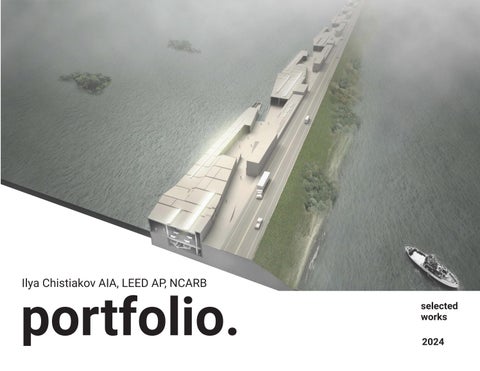
portfolio.
Ilya Chistiakov AIA, LEED AP, NCARB
LaGuardia Airport
Qatar Arlines Staff Housing
Jamaica Crossing
300 West Broward 5. MAZD Moscow
6. NYU Langone - Cobble Hill 7. One City Centre
8. Skolkovo City of Innovation
9. Weller Hall Hofstra University
10. Brooklyn Museum of Art
11. Italian American Museum
12. New Holland Island
13. Plant-A-BALL Parks
14. Master of Architecture Thesis

Ilya Chistiakov AIA, LEED AP
Licensed Architect, NY, NJ
Green Building Council
American Institute of Architects NCARB
CURRICULUM VITAE
EDUCATION
Harvard University
• Master of Architecture
Massachusetts College of Art and Design
• Bachelor of Architectural Design Cambridge, US
EXPERIENCE
Regular
Foster + Partners
Architect ( Overseas Qualified )
• Gergiev Cultural Center, Vladikavkaz - Cultural
• Qatar Airlines Staff Housing competition, Doha - Mixed Use
• Pushkin Museum of Art, Moscow - Cultural
ODA Architecture
Architect
• 300 West Broward - Multifamily / Mixed Use
• MAZD - Mixed Use
HLW International
Architect
• Hostra University Weller Hall - Education
• Lower Manhattan Cultural Council headquaters - Workplace
Skidmore Owings & Merrill ( SOM )
Technical Architect
• One City Centre - Commercial
Perkins Eastman
Architect
• NYU Lagone Cobble Hill - Healthcare
• Various National and International Healthcare projects
Ennead Architects
Architectural Designer
• Brooklyn Museum of Art - Cultural
• New Science Building - Science & Technology
Internships / Consulting / Other engagements
AARIS Design Architects
• The John Coltrane Home renovation into a Jazz Museum
FXCollaborative
• Jamaica Crossing - Mixed Use
Hellmuth, Obata Kassabaum ( HOK )
• LaGuardia Airport - Aviation
Office for Metropolitan Architecture ( OMA )
• Skolkovo Innovation City, Moscow - Masterplan
WorkAC
• New Holland Island
New York, US 2012 Rotterdam, NL 2010
1. LaGuardia Airport Redevelopment
Firm: HOK
My role: Architect
Status: Built
LaGuardia Airport’s new Terminal B symbolizes the top-tobottom transformation of one of the nation’s highest-profile airports.The transparent, fluid design of the 850,000-sq.ft. Arrivals and Departures Hall (headhouse) celebrates movement while conveying a strong civic presence in a city known for its remarkable architecture.
My involvement in the redevelopment of LaGuardia Airport Terminal B project centered on producing the technical documentation package for the submission to the reviewing authorities including NYC DOB, FAA, BSA and others. I was responsible to ensure compliance with the safety, construction and building code requirements specific to the aviation industry and played a crucial role in the design of key construction details, including the exterior enclosure of the bridge and the concourses in BIM/Revit. I was deeply involved in managing consultant coordination as well as in the larger design decision-making process and architectural documentation to meet the stringent project criteria.
Our team had a bold vision of creating two island concourses accessed from the main terminal through two 450-footlong, 65-foot-high pedestrian bridges.These pedestrian overpasses provide an apt metaphor for New York - as a city of islands and bridges. For passengers, the bridges offer stunning panoramic views of Manhattan’s skyline and the surrounding boroughs. The form of the bridges embodies elegance within demanding constraints, giving travelers the feeling they’re part of the airport’s operations.


Many of the sustainable design strategies enhance the passenger experience. The team focused on creating an optimal building orientation, providing flexibility for constant change, and using natural and locally sourced materials. Strategic use of daylighting and clear lines of sight highlight important destinations, helping travelers intuitively move through the terminal while reducing the need for artificial lighting. A solar thermal system generates hot water for restrooms
Image: HOK
2. Qatar Airlines Staff Housing
Firm: Foster + Partners
My role: Architectural Designer
Status: Idea
Sustainablity designed to provide comfort and functionality for airline staff, this housing complex blends modern aesthetics with practical living spaces. The project features a series of sustainable and energy-efficient modules tailored to meet the needs of employees as they commute for their work shifts. Each unit emphasizes natural light, efficient spatial organization, and community-oriented amenities to foster a sense of home and convenience aligned with cultural aspects of housing in the Middle East.

Professional work at Foster+Partners : Housing in Doha, Qatar
Ilya Chistiakov AIA, LEED AP


The Crossing at Jamaica Station is a mixed-use, mixed-income development in downtown Jamaica, Queens in New York City. One of the first major construction projects following the neighborhood’s rezoning, the project occupies a central location at the corner of Archer Avenue and Sutphin Boulevard, across from the LIRR Jamaica Station. Proximity to major transportation routes connects residents to the greater urban environment, while ground-floor commercial retail and community facility spaces activate the surrounding context.
In my role as an architect on The Crossing at Jamaica Station, I was deeply engaged in the construction documentation and construction administration phases of the project particularly reviewing and updating the design documents in BIM for changes due to value engineering and scope revisions. I handled the re-issuance of the revised items to the construction team and coordinated with the general contractor and other stakeholders on the review and approval of shop drawings, submittals and change orders. Additionally, I took a leading role in the re-designing of the low-rise building facade and several key construction details particularly the exterior enclosure elements at the building side facing the tracks.
The first building in the development, a 600,000-square-foot, 28-story high-rise, contains 539 units and rises from a three-story retail and parking garage podium. The façade animates the urban streetscape with a vertical composition of light-colored, precast panels. The second, shorter building, a 170,000-square-foot, 14-story mid-rise, contains 130 units and will incorporate community facility space. Its façade is a horizontal composition of variegated brick and strip windows. Both buildings have a mix of studios to three-bedroom apartments. The project features private garden apartments at the setback above the podium, and tenant amenity spaces atop the podium and on the rooftops of both buildings.

3. The Crossing at Jamaica Station
Firm: FX Collaborative
My role: Architect Status: Built Image:


Firm: ODA
My role: Architect/Designer
Status: Built
Designed as an urban gateway to the heart of Downtown Fort Lauderdale, Broward Crossing is comprised of two 38-floor towers on top of a 10-floor podium, bringing together a vibrant mixed-use program of 956 units and 23,752 square feet of ground level commercial use.
As an architect and a core member of the design team on this project I was responsible for the deliverables within the Schematic Design phase, including the typical floor plans, individual unit layouts, exterior and interior views as well as the key construction details. I managed the documentation for the submission to the Architecture Board of Ft. Lauderdale for approval and tracked progress. I was also involved in the value engineering and coordination cycle with the respective consultants and stakeholders as well as in participated in client and city review meetings.
The unique bridged massing of the towers creates a focal point for visitors and residents and adds an iconic new element to the growing skyline. The site is located at an important junction between major transportation hubs, civic and cultural institutions, and commercial attractions. To the northeast are the transportation hubs of the Brightline station and the Broward Central Bus Terminal. To the northeast and southwest are the civic and cultural landmarks including the future Joint Governmental Campus, the Museum of Discovery and Science, the Broward Center for the Performing Arts, and Esplanade Park. To the east is the vibrant commercial street of Las Olas Boulevard.

4. Broward Crossing


1/8"
1/8"


Firm: ODA
My role: Architect
Status: Idea
The MAZD project, is a master plan for a 23-acre site located on the outskirts of Moscow, within the industrial Magistralnaya Ulitsa territory. This mixeduse development aims to transform the area into an innovative neighborhood that integrates residential, commercial, and public spaces.
As a key member of the design team working on the Schematic Design submission, I was responsible for the delivery of the design and technical documentation package that included overall floor plans, circulation diagrams, renderings as well as typical construction details. My main toolset included Revit and Rhino.
The vision for the MAZD Territory includes a modular design featuring a mix of villa residences with quiet patios and condominium towers with retail, dining, and office spaces. The project is defined by a prominent roofline that mimics the topography of a hill, and a series of towers extending the undulating silhouette of the complex. This creates an iconic skyline marker and organizes both open and enclosed spaces, promoting a walkable, self-sustained environment where living, working, and leisure activities seamlessly blend together

5. MAZD
Image: ODA


The proposed development prioritizes green spaces and pedestrian pathways, enhancing the urban fabric and setting guidelines for future expansions. This approach reflects the growing demand among Moscow’s residents, especially millennials, for neighborhoods that offer a balanced and interconnected lifestyle


SITE1


The schematic design submission focused on defining the overall vision and layout of the mixed-use development. One of the challenges my team faced was adapting the design to the local building codes and construction requirements as well as coordinating with the local architecture team.
I was deeply involved in the coordination with the local architects, participating in project meetings and leading the information exchange process.


Image: ODA


The NYU Langone Cobble Hill Ambulatory Care Center is a modern healthcare facility that brings essential medical services to the heart of Brooklyn’s Cobble Hill community. The new five-story, 160,000 square-foot building, replaces the former Long Island College Hospital building and integrates seamlessly with the historic neighborhood.
As a leading member of the architectural team I was involved in this project from its intial stage through the end of design development phase to the submission for approval by the city authorities. I was responsible for defining the overall massing of the building, constrained by the zoning envelope as well as producing typical floor layouts and key exterior and interior details in Revit. My responsibilities also included coordination with structural, mechanical and zoning and medical planning consultants.
The center includes a stand-alone emergency department, outpatient surgery center, cancer center, and diagnostic imaging services. Its facade features a sleek combination of glass curtain walls and terracotta panels, which harmonize with the surrounding brick architecture. The building’s design emphasizes natural light and views, with floor-to-ceiling windows providing patients and visitors with a connection to the Cobble Hill streetscape

6. Langone Medical Center
Firm: Perkins Eastman
My role: Architectural Designer Status: Built
Image: Perkins Eastman


Image: Perkins Eastman
My role: Architect
Status: Built
One City Centre (OCC) in Bangkok, Thailand is a landmark skyscraper in the city’s Ploenchit district. This 61-floor building, which stands at 275 meters is the tallest building in Bangkok. The project incorporates high-performance glass envelope, external shading fins, and a side-core design that minimizes solar heat gain, enhancing energy efficiency and occupant comfort.
For the One City Centre project, I served as the technical architect inlvolved in the delivery of the design and technical documentation from the initial concept through the end of design development submission to the client and their local authorities and agencies. My area of focus included translating the initial design concept through a series of presentations to the client and their consultants into a complete design development set, all based in Revit. Particular attention was given to the typical commercial office floors, core design, parking and the crown / observation deck. I handled documentation production and was responsible for consultant coordination.
Working with the technical team through the code and zoning review process I ensured that the project met local requirements, client’s vision and fit the budget. Additionally, I was involved in coordination with structural, environmental and mechanical consultants, integrating sustainable technologies into the scheme. One of the major challenges encountered was navigating architectural review and approval process with Thai building code and zoning.

7. One City Centre
Firm: SOM


The building features 115,600 square meters of office space spread across its floors, with column-free designs providing flexible layouts for tenants. OCC also boasts a rooftop dining area on the 58th to 61st floors, offering panoramic views of Bangkok, along with a 5,000-square-meter green space at its base. The project has achieved a two-star Fitwel rating, recognizing its commitment to enhancing workplace well-being and environmental responsibility. Additionally, it is directly connected to the Ploenchit BTS station via a skybridge, ensuring convenient access for commuters. OCC is not just a commercial hub but also a lifestyle destination, integrating retail outlets, cafes, and relaxation areas to foster a balanced work-life environment for its occupants
Firm: OMA
My role: Designer Status: Idea


The Skolkovo City of Innovation, is an ambitious project aimed at creating Russia’s version of Silicon Valley. Located in the Moscow suburb of Skolkovo, this high-tech business area spans 400 hectares and is intended to be a hub for technological innovation and entrepreneurship. The development features a university, a technopark, a congress center, office buildings, laboratories, residential areas, and various social and recreational facilities.
For the Skolovo competition, I functioned as the design team architect, fully immersed in the project from the early stages of the design to the preparation and delivery of the final submission. My core responsibilities included research and analysis of the existing conditions, site strategy, phasing of the development and sustainability approaches. I was also responsible for the coordination with our engineering consultant (WSP) and local stakeholders.
Skolkovo’s design emphasizes sustainability, with a significant portion of its energy coming from renewable sources, and the city is designed to encourage walking and cycling while prohibiting internal combustion vehicles. The initiative has drawn significant investment and collaboration from international entities like MIT and global tech companies such as Cisco and IBM, aiming to foster a vibrant ecosystem of startups and research institutions.

8. Skolkovo City of Innovation


The renovation of the Brooklyn Museum’s Great Hall involved a thoughtful integration of modern systems and design elements into the historic fabric of the space. The project introduced discreet freestanding walls that house advanced climate control systems, ensuring optimal conditions for art preservation. This intervention was designed to maintain the hall’s grandeur while meeting contemporary museum standards.
As an architectural design lead on this project, I produced all of conceptual and schematic design presentation materials for the review by the client as well as consultant coordination. Working in Revit and Rhino / Studio MAX I produced various layout options, associated views and details as well as renderings and circulation diagrams. I attended internal design reviews and client meeting representing the project.
A key feature of the renovation is the new grand staircase and glass bridge, which visually and functionally enhance the visitor experience by providing a seamless connection between the lobby and the upper galleries. This approach aligns with the principle of creating fluid, accessible spaces that encourage exploration and interaction with the exhibits.

9. Brooklyn Museum of Art Great Hall
Firm: Ennead
My role: Architectural Designer Status: Built
Image: Ennead Architects


Brooklyn Museum Option C
Firm: HLW
My role: Project Architect
Status: Built
EXTERIOR VIEW - VIEW FROM NORTHEAST WELLER HALL RENOVATION
The renovation of Weller Hall at Hofstra University was a comprehensive project that transformed the original building into the Center for Career Design and Development at Hofstra and the educational partner INTO.
My role as a Project Architect on this project centered on producing construction documents while managing an architectural team and acting as “gatekeeper” for the entire job. As a Project Architect I was responsible for overseeing the project from schematic design through construction documents to construction administration and completion. Our team produced all design and documentation materials in Revit and was involved in consultant coordination, client reviews, agency approvals as well as construction administration process.
The project aimed to modernize the building while maintaining its historical significance, providing updated spaces for student services and academic functions. The renovation included upgrading the HVAC systems, installing energy-efficient lighting, and enhancing the interior design to create a more inviting and functional environment for students and staff.

10. Hofstra University Weller Hall
Image: HLW
Gateway Nexus Crossroads
• Gateway to the central quad • Connecting the main campus to the east campus • Great visibility from the main street - California Avenue
DESIGN CONCEPT
Inspired by tradition Create a new front door.


Symmetrcal form New elevator creates asymmetry New facade unifies both, frames the entrance and adds a refreshed look


As a Project Architect, I was deeply involved in the production of technical documentation including designing and executing key exterior enclosure details, wall sections, partition types and specifications. I also played a major role in the construction administration phase of the project, being responsible for the shop drawings and submittals review, attended construction site walkthroughs and coordination meetings.
Firm: OPAL
My role: Project Architect, Interior Design Consultant Status: In-Construction
The design for the Italian American Museum is an innovative structure with two above-ground and two below-ground levels. A central skylight and a four-story atrium are key elements, allowing natural light to illuminate the lower floors, creating a visually and functionally cohesive space.
The museum aims to celebrate and preserve Italian American heritage, showcasing artifacts that chronicle the community’s journey from early immigration to the present day. Items on display will include traditional tools, personal artifacts, and historical objects from a former local financial institution that served the Italian community. The design also includes a facade set back from the street, creating a welcoming public space and an impressive entryway.
As a Project Architect and an interior design lead I was responsible for translating the initial architectural design concept into the detailed design development and construction documentation packages for pricing and construcion. I produced sets of architectural drawings and specifications using Rhino and Revit, ensuring precision and coordination across all trades. My role required close collaboration with lighting designers as well as structural, mechanical, electrical, and plumbing (MEP) engineers. I attended site meetings, and led consultant coordination calls coordinating lighting design, HVAC and equipment selection.

11. Italian American Museum


12. Plant-A-BALL Parks
Childhood is a period in one’s life in which developmental physiology place, and shapes personalities and characteristics of adulthood. typically perceived as a phase in one’s life in which exploring, socializing, learning and of course, playing are all taking place. Play be argued as one of the principal activities in which other developmental categories are stimulated. It allows children to utilize creativity, imagination, dexterity, as well as physical, cognitive and emotional strength. It is this developmental stage in a child’s life that chose to focus on in this brief. We believe that every child should provided with a dynamic engaging place to play. Many cities are currently faced with a high number of vacancies across their existing fabric. With that in mind, our proposal of a BALL PARK provides experimental platform for criticism of play equipment design today how it can further provide a synergy between ecologies, cities, and populations that occupy them. This new model of equipment will promote and stimulate fun for the future of play, and create a series of miniature worlds for children to inhabit in the city.
Firm: Mixed, Collaboration
My role: Designer
Status: Idea, Honorable Mention
Plant-A-BALL PARKS creates a series of play structures that not only generate a sense of place, but also house a synergy of interventions at the site and city scale. The sphere is ideal for capturing the imagination of children as well as providing a versatile shape in which to encapsulate the proposed interior play program. A flexible primitive volume that can be manipulated into other platforms of play. The orbs height and scale provide adequate housing for the planting compartments above, as the shell’s design enables the trees and plantings space to grow through the membrane and stabilize itself with the existing sub-grade.
As a leading member of the design team, I contributed to all aspects of this proposal from intial concept to final submission. Particularly I focused on the relationship of the interconnecting bridges to the orbs. I produced the detailed 3D diagrams, study models and visualizations using advanced 3D modeling software such as Rhino and Revit which were used to communicate our design ideas effectively to the competition jury.
Contemporary play structures must address a multitude of developmental characteristics identified with growth and progression of childhood development as well as conform to local government’s ordinances on safety. The task of enticing children outside to play has become more difficult with continued technological advancements that compete for children’s attention vs. the desire to be physically active.


Urban Playscapes International competition


INSECT HABITAT
ANIMAL HABITAT AMPHIBIAN HABITAT
Professional
plant a BALL PARKS

BIRD HABITAT
work at Perkins Eastman : Playscapes International Competition Entry- Honorable Mention
The site for this oasis is an 8-hectare historical landmark island bordered by canals in the heart of a major metropolitan area within 20-minutes walking distance of major cultural sites and tourist attractions. Conceived in 1719, it became a military port in 1721 and remained in military possession, closed to the general public, for 300 years. We have imagined this site a microcosm of wider urban context a cultural “city within the city” that sponsors a vast range of public spaces and programs, from the visual and performing arts, to new technologies, to education, to markets and a hotel. Rather than adding new architectural statements, however, we have worked primarily through subtraction to carve from the historic warehouses their amazing potential for public and cultural activity, retaining as much public outdoor space as possible.
Childhood is a period in one’s life in which developmental physiology takes place, and shapes personalities and characteristics of adulthood. This is typically perceived as a phase in one’s life in which exploring, socializing, learning and of course, playing are all taking place. Play could be argued as one of the principal activities in which other developmental categories are stimulated. It allows children to utilize creativity, imagination, dexterity, as well as physical, cognitive and emotional strength. It is this developmental stage in a child’s life that we chose to focus on in this brief. We believe that every child should be provided with a dynamic engaging place to play. Many cities are currently faced with a high number of vacancies across their existing urban fabric. With that in mind, our proposal of a BALL PARK provides an experimental platform for criticism of play equipment design today and how it can further provide a synergy between ecologies, cities, and the populations that occupy them. This new model of equipment will promote and stimulate fun for the future of play, and create a series of miniature worlds for children to inhabit in the city.
POOL BALL

Playgrounds of today have become fields for designers to create safe and entertaining equipment that can foster imagination, activity, and fun for children and their parents. Contemporary play structures must address a multitude of developmental characteristics identified with growth and progression of childhood development -as well as conform to local government’s ordinances on safety. The task of enticing children outside to play has become more difficult with continued technological advancements that compete for children’s attention vs. the desire to be physically active.


BALL BOSQUE


Playscapes International Competition


AN URBAN BALL!
These structures are intended to provide planning departments with a tactically urban sustainable and playful solution to their issues of land vacancies. Vacant lots are eyesores on communities and are becoming more typical in the urban fabric. BALL parks can be utilized as a temporary or permanent installation into the site. With the understanding that time and planning needs can change, the BALL structures are intended to be easily transferable but also provide an appropriate framework for redefining the contemporary play structure in flexible urban areas. They can also be utilized in existing urban parks as the standards for play equipment become more complex.
These structures can be highly valuable for children in rural scenarios as well. While issues of site contamination may not be the primary issue of concern, the BALL archetype is suited to take on productive programming such as, water purification filters, air filters, energy panels, and food growth.
PlantaBALL parks are an interactive, multi functional approach intended to engage children and adults in an outdoor recreational setting. This new model of equipment will promote and stimulate fun for the future of play, and create a series of miniature worlds for children to inhabit in the city.


Professional work at Work AC : Urban Oasis

My role: Designer Status: Idea
This urban redevelopment proposal focuses on New Holland Island’s unique identity as a “city within the city.” Originally a naval installation, the 8-hectare island in the heart of St. Petersburg was inaccessible to the public for some 300 years. The scheme preserves both the site’s incredible collection of 18th century warehouses and its more intangible heritage – while turning the heart of the island into a public park and introducing new programs, including residences, galleries, retail, a hotel, high-tech office space, and a new museum.
As a core member the design team, I was deeply involved in the design development of the Museum and the new Public Park scope of this proposal creating a number of large scale physical models as well as architectural diagrams and renderings in Rhino. I was reponsible for the delivery of the final submission package including architectural and preservation narratives, existing conditions analysis, proposed plans, elevations as well as detailed 3D views.
Weaving through the high brick arches of the existing structures, a raised interior promenade introduces pedestrian life and modern infrastructure into the historic warehouses. Voids carved into the buildings’ upper levels make an architecture out of subtraction, bringing the park and sunlight into the buildings.
tural sites and tourist attractions. Conceived in 1719, it became a military port in 1721 and remained in military possession, closed to the general public, for 300 years. We have imagined this site a microcosm of wider urban context a cultural “city within the city” that sponsors a vast range of public spaces and programs, from the visual and performing arts, to new technologies, to education, to markets and a hotel. Rather than adding new architectural statements, however, we have worked primarily through subtraction to carve from the historic warehouses their amazing potential for public and cultural activity, retaining as much public outdoor space as possible.


13. New Holland Island Firm: WORKac


Ilya Chistiakov Master of Architecture, Harvard GSD
Ilya Chistiakov AIA, LEED AP


Master of Architecture Thesis, Harvard
While the development of industrial technologies that has occurred during the XX century is certainly a cause of many current environmental issues, it may also be solution to some of them. Through research and application of environmentally conscious design including climate engineering, renewable energy and waste management strategies it is possible to reduce our ecological impact on the planet thus procuring the continuing existence of human civilization. I strongly believe that it is through shared knowledge and research that we can find a way out of our current environmental problems. Because of the current cataclysmic mutations of our ecologies, antropogenic destruction of our biosphere, I would argue that in the near future we may be facing some of the most extreme and hostile climate conditions yet encountered. Our civilization will have to develop a set of survival skills that will become a key to the sustainability of human life on Earth.
The thesis claims for a synthesis of architecture, infrastructure and the landscape through a new typology of farming and agriculture facilities and their processes in the context of rural Netherlands.

14. Synthesis of Architecture, Infrastructure and Landscape


With 70 percent of its population already living below sea level, the Netherlands is projected to experience an average sea level rise of 56 cm around its coastline over the next 100 years, conjunction with continuous soil subsidence due to intense land management practices.