Office: 10001 Stonell Drive

Office: 10001 Stonell Drive
Member of FUSIE (Federazione Italiana Stampa Unitaria all’Estero)
Louis, Missouri 63123

The Verrazzano-Narrows bridge boasts 1 million bolts, 3 million rivets, 143,000 miles of wiring strands contained within 26,108 wires comprising the four suspension cables. But there apparently is not enough room for the letter “z” to properly spell the bridge’s name on road signs.
In 1524, Giovanni da Verrazzano became the first European to enter New York Harbor. Today, across The Narrows entrance to this harbor, stands a monumental bridge named in honor of the Italian explorer. It is the longest suspension bridge in America, longer even than the Golden Gate Bridge. While this bridge should be a source of pride to all ItalianAmericans in the metropolitan area, it has become, instead, an annoyance to many. Since its opening in 1964, signs referring to this bridge carry a dreadful spelling error: They drop the second “z” and misspell the bridge Verrazano.
Just a few days ago, a young and proud Italian-American, Robert Nash, was the latest calling attention to this error. He instituted a petition (at GoPetition.com) to MTA Bridge and Tunnels asking that the problem be addressed. His effort is garnering social media and popular support,
including that of MTA Commissioner Alen Cappelli.
Too costly to fix.
But the MTA says the process of correcting relevant signage and documents is too costly and there will be no change. So, following this logic, will there never again be a street, bridge, park, roadway or other public place that can undergo a name change? I hardly think so, especially with so much historical revision and reconsideration occurring.
Just to add a note of befuddling irony here, there are two other bridges named after the Italian explorer. One, the Verrazzano-Jamestown Bridge in Rhode Island, is correctly spelled. The other, in Maryland, connecting Assateague Island with the mainland, is misspelled a la New York.
To think, it was only a few weeks ago that we crowned winners in the National Spelling Bee. What would these kids say? “We can spell Gesellschaft, but can you tell us what Verrazzano Bridge you are referring to? In a sentence, please.”
So really, what’s the fuss? Well, even small matters like misspellings reveal deeper aspects of an issue. To begin with, understanding the history and context of naming the bridge will provide insight. When the bridge was first planned, Robert Moses, the 20th century master urban planner, opposed naming it for the Italian navigator. Moses felt that Verrazzano was only a minor historical figure and that the
name was too difficult for him to pronounce anyway. Some sources indicate Moses preferred to name the structure simply the Narrows Bridge in order to save space.
For good measure, it should be noted as well that the Throg’s Neck Bridge, between Queens and the Bronx, has also carried a misspelling for decades — it should be Throgg’s Neck. The name has its roots in a section of the Bronx where an English associate of Roger Williams named John Throckmorton settled. Over the years, his name was corrupted to Frocke, and the surrounding area Frockes Neck. Eventually it became known as Frogs Neck and ultimately morphed into Throggs Neck. But the second “g” was dropped in the bridge’s name. Moses, again, was the culprit; he claimed the longer version would not fit on many street signs.
Fortunately, the Italian Historical Society of America lobbied Gov. Nelson Rockefeller and he had the final word — if not the correct spelling, for early on in the typed documents the second “z” was dropped and lost to future documentation up to the present day.
Historical accuracy.
Apart from the problem of historical and literary accuracy (and perhaps some prejudice) the erroneous spelling should be unacceptable in today’s era of political correctness and identity politics. Everything is scrutinized relating to ethnic, national and racial groups, from pronunciation of names
Continued on page 5
MANAGING
ENGLISH
COPY
EDITORIAL
To subscribe to Il Pensiero, advertise or request a photographer at your event, email info@ilpensiero.net.
July: June 14
August: July 12
September: August 16
October: September 13
November: October 18
December: November 15

Degli articoli firmati che appaiono sul giomale sono responsabili i singoli autori, i quali non rappresentano necessariamente il punto di vista generale, ne’ esprimono la politica de “Il Pensiero.” Operando conforme alle nostre vedute democratiche, si accetta la collaborazione di persone esprimenti il piu’ largo arco di opinioni, senza pregiudiziale di sorta.
The signed articles appearing in Il Pensiero “The Thought” are the opinions of the individual authors, who do not represent the general point of view, nor do they express the views of Il Pensiero. We accept the collaboration of people expressing the most wide range of opinions. Opinions expressed in Il Pensiero “The Thought” are not necessarily those of Il Pensiero and Il Pensiero does not accept responsibility for advertising content. Any images supplied are at the owner’s risk.


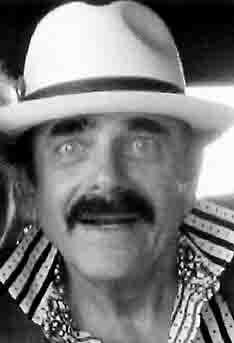
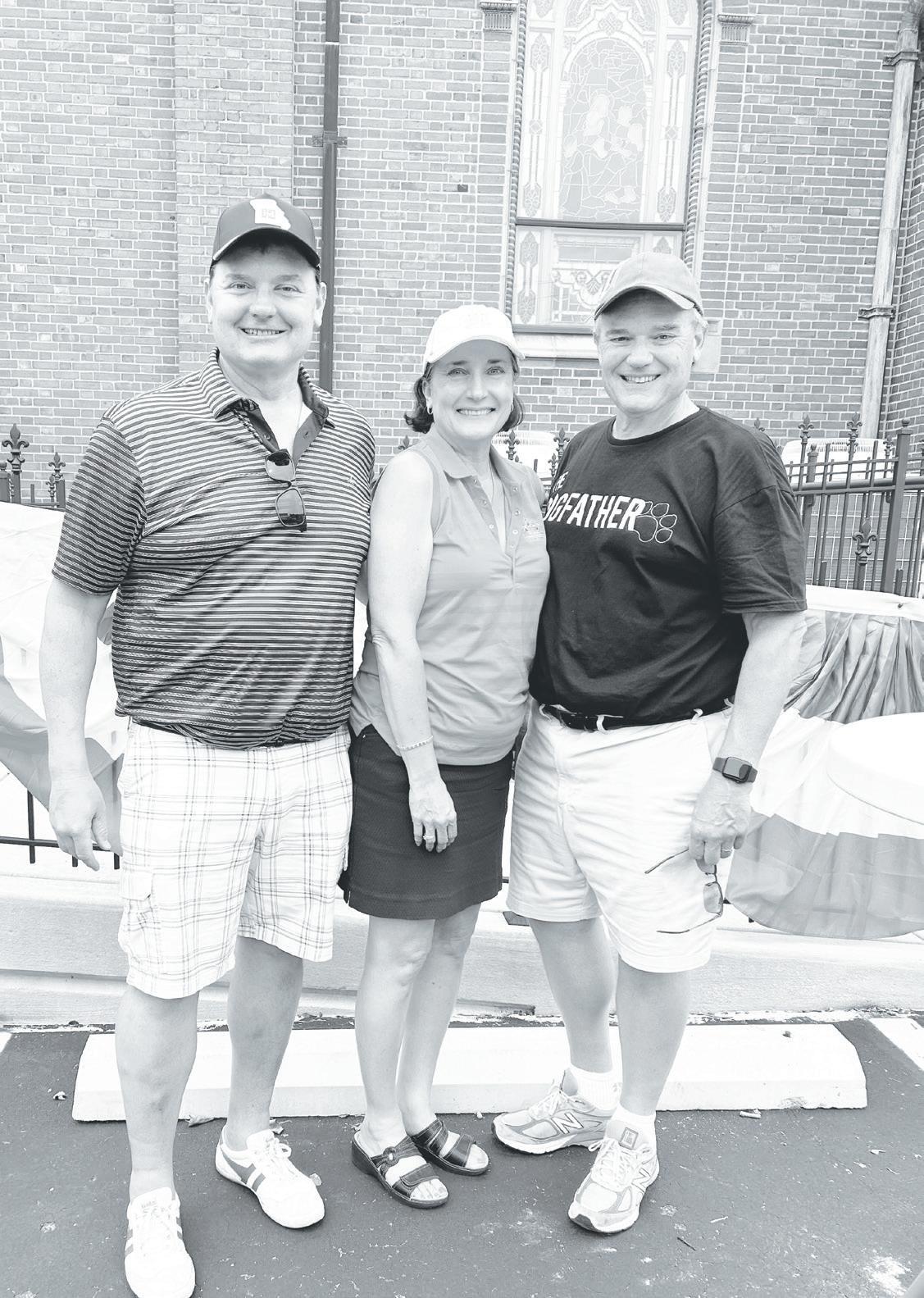
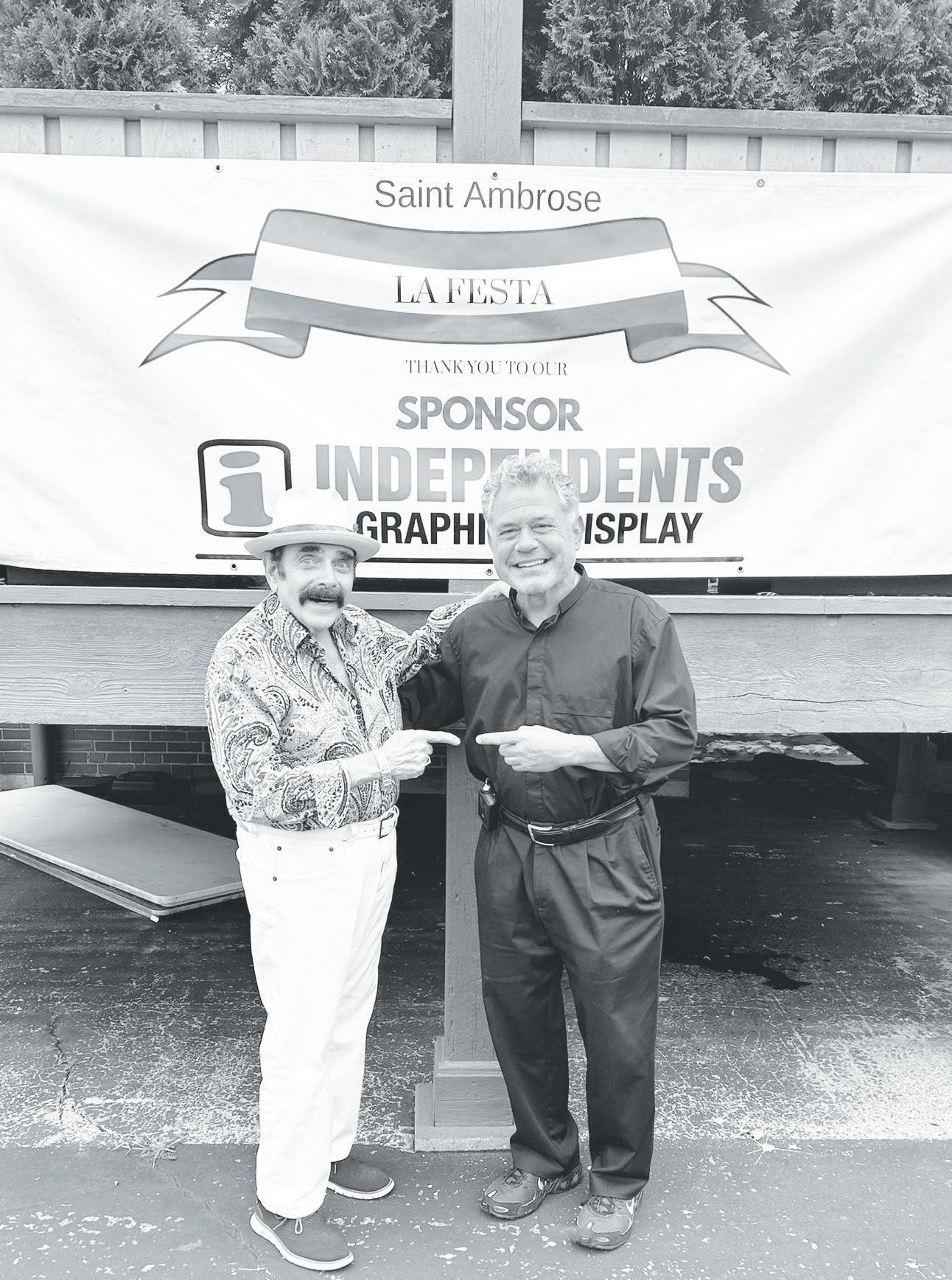
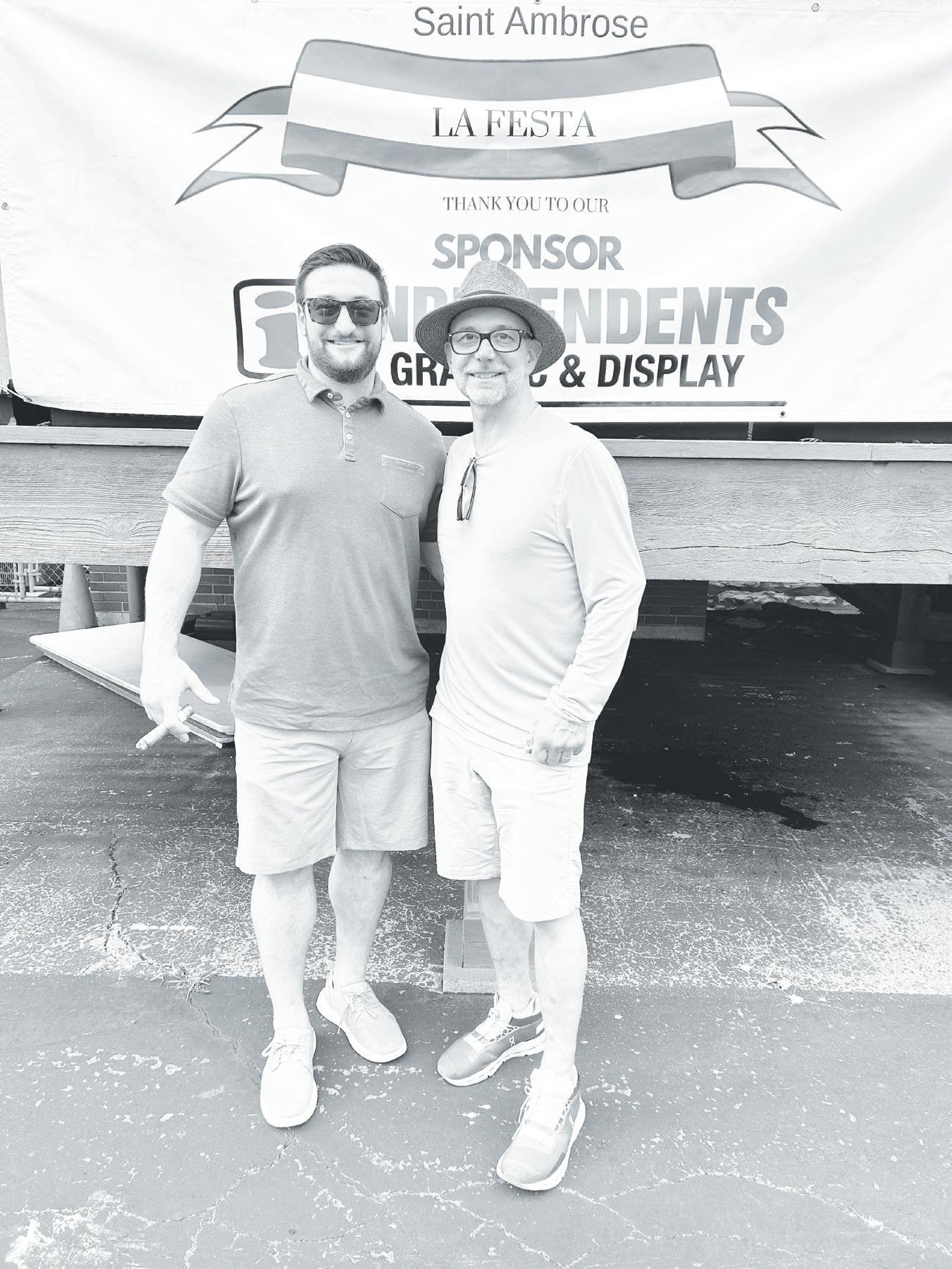
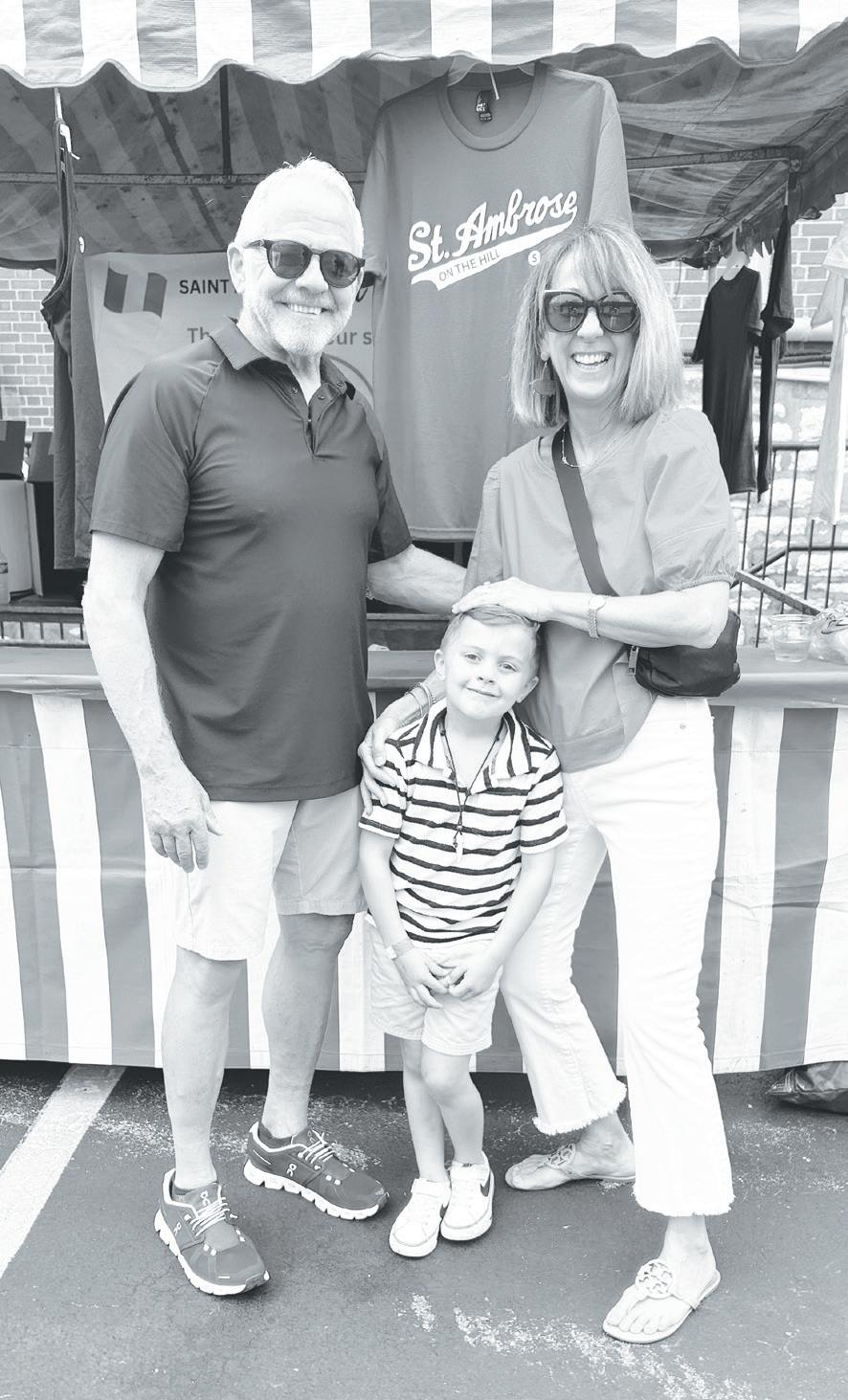
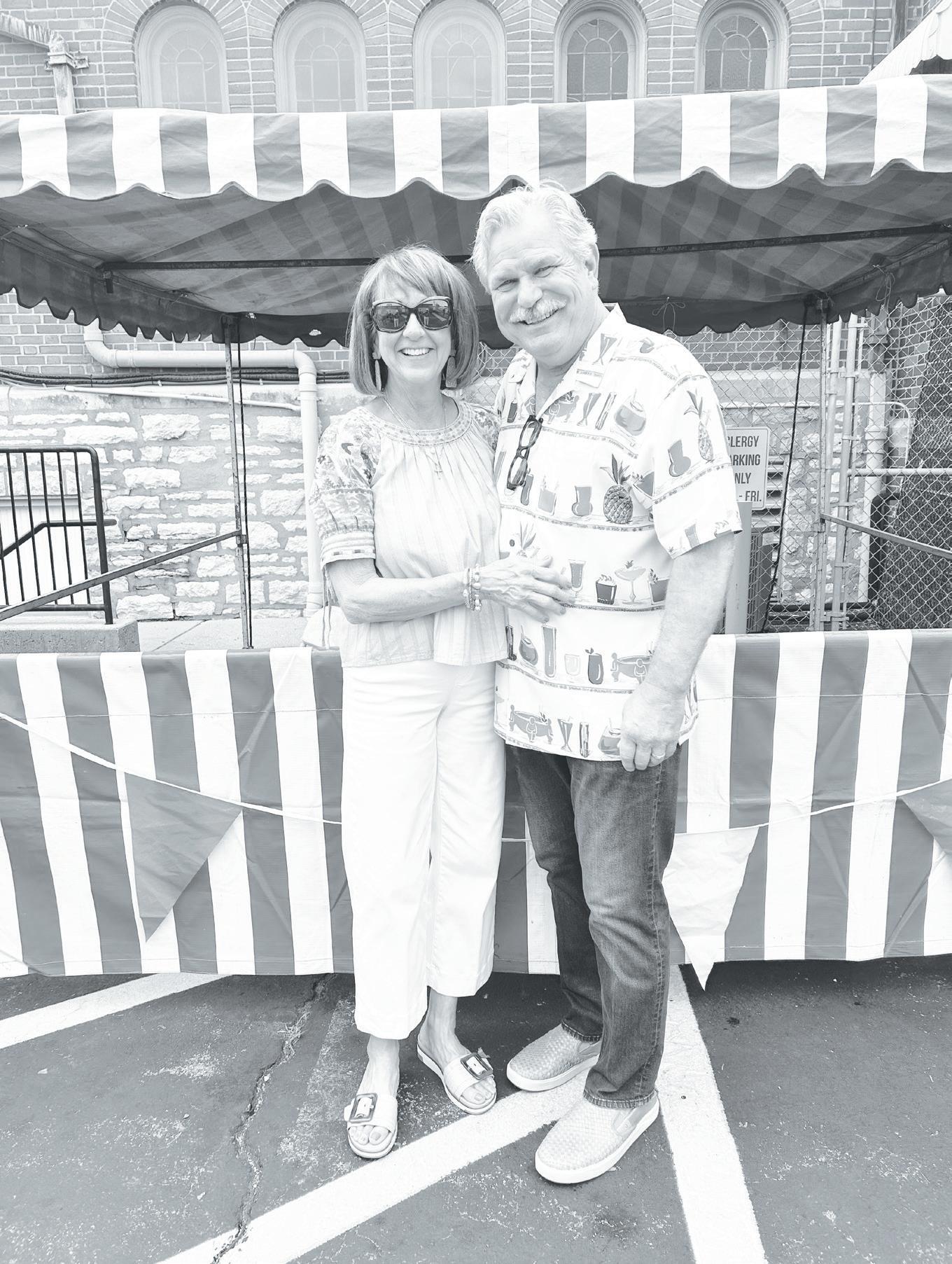
La Festa at St. Ambrose Catholic Church The Hill, St. Louis, MO May 5, 2024
Continued from page 1
— especially those of TV newscasters — to spelling of tribal names for which no indigenous alphabet exists.
Now it is one thing to endure misspellings of our names on bills, receipts and such. Most of us have experienced this in today’s world where a drive to be accurate and to research spellings if necessary has given way to passive reliance on spellcheck. But it is quite another thing to have misspellings on important documents. To give two personal examples, one of my honorary degrees has my name misspelled; a first run of one of my books also had an error in the spelling of my name. Perhaps this doesn’t compare to the character in The Godfather whose surname was changed from Andolini to Corleone by an immigration officer! What would the DMV say to alternate versions of your name?
Finally, Italian-Americans have grown too silent in the rowdy arena of policy and politics. With 17 million people nationwide, Italian-Americans can be a potent force. In the New York Metro area, in which the bridge is centered, the percentage of Italo-Americans is huge: New Jersey, 16.8 percent; New York, 13 percent; Connecticut, 18.7 percent — in Staten Island, the total is 37 percent.
New Jersey posts six of the top 11 counties nationally in percentage of ItalianAmericans, according to figures from the National Italian American Federation. The top counties are Ocean, with 25.3 percent; Monmouth, with 23.2 percent, and Bergen, with 22 percent (and the highest total of Italian-Americans, 194,000).
In our immediate localities, some interesting percentages emerge: Totowa, 37.7 percent; Fairfield, 37.2 percent; South Hackensack, 36.3 percent; Woodland Park, 34.3 percent and Lyndhurst, 33.8 percent. Mamma Mia!
Coming together on this bridge issue could well break the inertia that characterizes the lack of identity politics in the Italian-American community.
Clearly, the spelling error has to be addressed, and in this age of electronics the best way to correct errors and oversights is to bring them to public attention in social media and internet-based petitions. To all who of you who have been dissed by your name being misspelled, join in. Forza!
Silvio Laccetti is a retired professor of history at the Stevens Institute of Technology, Hoboken.
The National Italian American Foundation (NIAF) and the Italian American Citizenship Assistance Program (ITAMCAP) announced an exclusive multi-year partnership to help members of the Italian
American community obtain recognition of their Italian citizenship.
According to U.S. Census data, there are over 17 million Americans of Italian descent, making it the seventh largest ethnic group in the United States. While exact numbers are difficult to verify, it’s estimated that several million individuals in this population are eligible for Italian citizenship based on having at least one Italian-born ancestor.
Under the new agreement, NIAF will promote and raise awareness of ITAMCAP’s expert citizenship services among its nationwide membership base and supporters. In turn, ITAMCAP will offer exclusive discounted packages to help NIAF members efficiently navigate the complex process of securing Italian dual citizenship.
“Obtaining Italian citizenship opens invaluable opportunities to reconnect with one’s roots and heritage, but also provide the possibility to live and work in Italy and the European Union,” said NIAF President Robert V. Allegrini. “This partnership with ITAMCAP allows NIAF to make that dream an accessible reality for our community.”
ITAMCAP specializes in providing comprehensive, white-glove assistance through the bureaucratic hurdles of the citizenship process, from gathering necessary documentation and certified translations to representing clients before Italian consulates. With legal experts in both U.S. and Italian citizenship law, ITAMCAP helps clients skillfully cut through red tape.
Furthermore, as part of this collaboration, ITAMCAP will award a fulltuition scholarship to pursue a bachelor’s degree in Global Law at the Luiss University in Rome beginning in September of 2024. The full-tuition scholarship will be awarded to one Italian American student to attend Luiss’s three-year undergraduate program in Global Law Luiss Guido Carli.
“For many Italian Americans, the prospect of claiming their Italian citizenship gets delayed or abandoned due to the daunting paperwork requirements,” said Giorgio Nusiner, president of ITAMCAP. “Our partnership with NIAF allows us to streamline this journey and celebrate their Italian heritage.”
The partnership commences immediately, with discounted ITAMCAP packages being offered to NIAF members. More details can be found at niaf.org.
Sponsored by the Italian Club of St Louis Italian for Travelers
Session 1: Tuesdays
June 4, 2024 – July 2, 2024 | 4–6 p.m.
Class held in St. Ambrose Church basement on Wilson and Marconi Avenues.
Tuition for this 5-week class is $50. Instructor: Barbara Klein.
Session 2: Tuesdays
July 16, 2024 – August 13, 2024 | 4–6 p.m.
Class held in St Ambrose Church basement on Wilson and Marconi Avenues.
Tuition for this 5-week class is $50. Instructor: Barbara Klein.
Designed for those planning to travel to
Italy. This course will introduce students to the fundamental vocabulary and phrases useful for basic travel needs.
Beginner’s Italian 1 Tuesdays | June 11, 2024 – August 6, 2024 6:30–8:30 p.m. No class on July 9.
Class held in St Ambrose Church basement on Wilson and Marconi Avenues. Tuition for this 8-week class is $80. Instructor: Barbara Klein.
Designed to introduce students to the fundamentals of Italian grammar and develop basic communication skills. Emphasis is placed on basic grammar, vocabulary, pronunciation and listening comprehension. Textbook required.
Please visit our website to register. italianclubstl.org/courses.
A record 37 St. Louis- area restaurants have joined forces, all offering one pizza of any size or topping combination at half price through the summer and fall, expiring November 30. That is, for anyone who has a “2024 St. Louis Pizza Passport” in hand. The program, launched in 2020, is designed to celebrate STL’’s love of pizza, while raising needed funds for an organization making an impact in the community. For $30, purchasers can enjoy one pizza at a 50% discount at all participating restaurants. And, with each passport sold, a donation will be made to Home Sweet Home, the region’s first and largest furniture bank, providing essential household items and furnishings to families in need. The goal this year is to raise more than $7,000.
“What we’ve created is an awesome excuse to explore the main streets and municipalities of the region, while trying out some of the best pizza found anywhere,” said Michael Powers, Founder of the St. Louis Square Off Pizza Festival on The Hill, a beloved event that had to be reimagined due to COVID. “Pizza makers played a vital role in keeping all of us fed when we were sheltered in place, really showing how important these local restaurants are to our daily lives. The introduction of the passport drove traffic to these locally-based pizza places, while raising funds, and awareness, for a deserving nonprofit.”
Participating restaurants are located in the St. Louis metropolitan area, which includes the City of St. Louis and surrounding counties in two states, encompassing dozens of ZIP codes, so people can sample squares (or slices) from the best purveyors of pizza from South City to Crystal City, from St. Peter’s to Waterloo and all places in between. Pizza styles vary greatly from St. Louis thin crust to woodfired Neapolitan.
Visit thepizzapassport.org for more informatinon.
$1,000 Scholarship
Austin Heath Il Pensiero
Submit content to info@ilpensiero.net before June 14, 2024 to be featured in the July issue. We look forward to receiving your announcements! Thank you

Submit an obituary to info@ilpensiero.net by June 14, 2024 for the July issue.
Vincenza (Vickie) Marino
Fortified with the Sacraments of the Holy Church on Monday, May 27, 2024. Beloved wife of the late Giuseppe Marino and loving mother of Louis, Peter, James and Michael.

A Special Note:
Thank you to my dad, James Marino, for supporting me and being my champion during my time as publisher. Carina Marino
and the Il Pensiero staff


Continued from page 5
The Misericordia Society awarded a $1,000 scholarship on May 17 at the eighth grade graduation ceremony at St. Ambrose Church. The scholarship competition was open to any eighth grade student at St. Ambrose School who planned to attend a Catholic high school. It was preferred that the applicant be of Italian heritage, though the competition was open to all the students. A 500-word essay was required on the topic of “What being part of the Italian community in St. Louis means to me?” The scholarship was awarded to Joseph Curran, son of Thomas and Adele (Gianino) Curran. Joseph will attend St. John Vianney High School in the fall, and he and his family will receive the check at the July Misericordia meeting. Below is the winning essay:
Joseph Curran|St. Ambrose|April 30, 2024 What does being part of the Italian Community in Saint Louis mean to me?
My name is Joseph (my Nonna calls me Giuseppe), and I’m proud to be part of the Italian community. My mom’s parents are from the town of Augusta in Sicily. Her family arrived in St. Louis on April 3, 1963. In social studies class we had an immigration project, and I asked my Nonna a lot of questions about her life on The Hill. I was impressed to find out how hard my family worked to be successful. When you talk to my Nonna, she always says how hard it was to find food to find that she was familiar with. That’s why they stayed close to The Hill to find bakeries and goods that
they knew. My mom grew up on The Hill, and as a child, she went to St. Ambrose School. That’s where she learned to speak English. I am the second generation coming to St. Ambrose, and I love whenever my mom says she went up those same front steps to enter school. At St. Ambrose, they teach Italian lessons, and although I really don’t know how much I’ve learned, when my mom and dad try to say something in secret using Italian, I usually understand what they’re talking about. The traditions at St. Ambrose are something I have grown up with, such as St. Joseph’s table. I was named Joseph in honor of St. Joseph, because I was expected to be born on his feast day. Before coming to St. Ambrose, I attended the Sacred Heart Villa on The Hill. It was there that the Apostles of the Sacred Heart of Jesus taught me about Him. The Sisters also taught me about their foundress, Mother Clelia Merloni. She was a very strong woman who endured so many difficulties. When we say our morning prayer in the car, we always ask Blessed Mother Clelia to pray for us. I have served the Italian community by helping to set up for the Sick and Elderly Ravioli Dinner. I also have worked at the St. Ambrose Athletic Association Trivia Night. I have been an altar server at St. Ambrose. This summer, my family and I are going to Italy. This will be my first trip to Europe. We will spend four days in Rome, which is my mom’s favorite city. After this, we will fly south to Augusta, and there I’ll meet all my mom’s family. To me they will be second and third cousins, and second and third aunts and uncles, but
Continued on page 7

Continued from page 6
The National Italian American Foundation (NIAF) is proud to announce the creation of the NIAF DiLella Fellows Program, an all-expenses-paid, weeklong strategic business and political tour of Italy for outstanding young Italian American and Italophile professionals between the ages of 25-40.
Continued on page 8 they are still my family who I hear so much about. I hope my Italian lessons will help me along the journey in a foreign country. I am excited to learn more about my heritage on my trip to Italy! I am going to be attending St. John Vianney High School in the fall. Thank you for allowing me to apply for this Misericordia Society Scholarship.
The inaugural NIAF DiLella Fellows Program will take place September 5-12, 2024, bringing 12 exceptional fellows to Italy for an unforgettable professional development experience and a journey crisscrossing the Italian peninsula, with stops in Como, Milano, Bologna, Firenze and Roma. The once-in-a-lifetime opportunity will provide participants an indepth understanding of the Italian economic


and political landscape through high-level meetings with government leaders and business luminaries, behind-the-scenes tours of iconic Italian companies, and attendance at the prestigious Ambrosetti Forum in Cernobbio on Lake Como, all while immersing themselves in the economic and political forces shaping the nation.
“We are thrilled to launch this innovative new program that will cultivate the next generation of leaders strengthening ties between the United States and Italy,” said NIAF President Robert Allegrini. “The NIAF DiLella Fellows will gain invaluable insights into the Italian business world while forging lifelong personal connections.”
Highlights of the NIAF DiLella Fellows Program include:
- Meetings and interactions with former government oXicials, business authorities and thought experts
- Access and in-depth experiences at legendary Italian firms, including production line tours at Ferrari and Lamborghini, exclusive tastings at Antinori wineries, and more
- Two-day attendance at the Ambrosetti Forum’s “Intelligence on the World, Europe, and Italy” at Villa d’Este in Cernobbio
- Networking events with leaders and executives
The program is made possible


Continued from page 7
through the generosity of NIAF Board Member Daniel M. DiLella, a principal of Equus Capital Partners, Ltd., serving as the firm’s President and Chief Executive OXicer.
“I’m honored to help NIAF create this unparalleled opportunity to develop rising Italian American talent and deepen bilateral relations,” said DiLella. “The DiLella Fellows will walk away with profound insights into the modern Italian way of life and business.”
Applications for the 2024 NIAF DiLella Fellows program are now open through July 22, 2024. Details and application information can be found at niaf.org.
Stray Dog Theatre (SDT) is excited to continue its twenty-first season with a production of Ripcord at the Tower Grove Abbey, opening on Thursday, June 6, 2024 and running through Saturday, June 22, 2024.
Ripcord opened Off-Broadway on October 20, 2015, at the Manhattan Theatre Club in a limited engagement. Written by David Lindsay-Abaire and directed by David Hyde Pierce, the cast features Marylouise Burke, Rachel Dratch, Glenn Fitzgerald, and Holland Taylor. David Lindsay-Abaire is an American playwright, lyricist and screenwriter. He received the Pulitzer Prize for Drama in 2007 for his play Rabbit Hole, which also earned several Tony Award nominations. In 2016,
Lindsay-Abaire was named co-director of Juilliard’s Lila Acheson Wallace American Playwrights Program. Lindsay-Abaire won both the 2023 Tony Award for Best Book of a Musical and Tony Award for Best Original Score for the musical adaptation of his play Kimberly Akimbo.
Ripcord is presented through special arrangement with Dramatists Play Service, Inc.
Ripcord synopsis: The Golden Girls meets The Odd Couple in this madcap comedy. When cantankerous Abby is forced to share her room in a retirement home with endlessly chipper Marilyn, a feud between the mismatched roommates results in a bet to determine who stays and who goes. Seemingly harmless at first, the two women quickly escalate into dangerous games of one-upmanship.
June 6-22, 2024: Show times are Thursdays – Saturdays at 8 p.m. Additional performance at 2 p.m. on Sunday, June 16.
Venue: Tower Grove Abbey, 2336 Tennessee Avenue, St. Louis, MO 63104. Gated Parking.
Tickets: Adults $35/Seniors (65+) and Students $30 (Cash/Checks/All Major Credit Cards)
Additional Information and Ticket Reservations: Call 314-865-1995 or visit straydogtheatre.org. Accessible Performances
ASL Interpretation: The 6/7, 6/14, and 6/21 performances will be presented
with ASL interpretation by students from Southwestern Illinois College. ASL interpreted performances are suitable for audience members who are Deaf, deafened, or have hearing loss. They can also be valuable for people who are learning ASL.
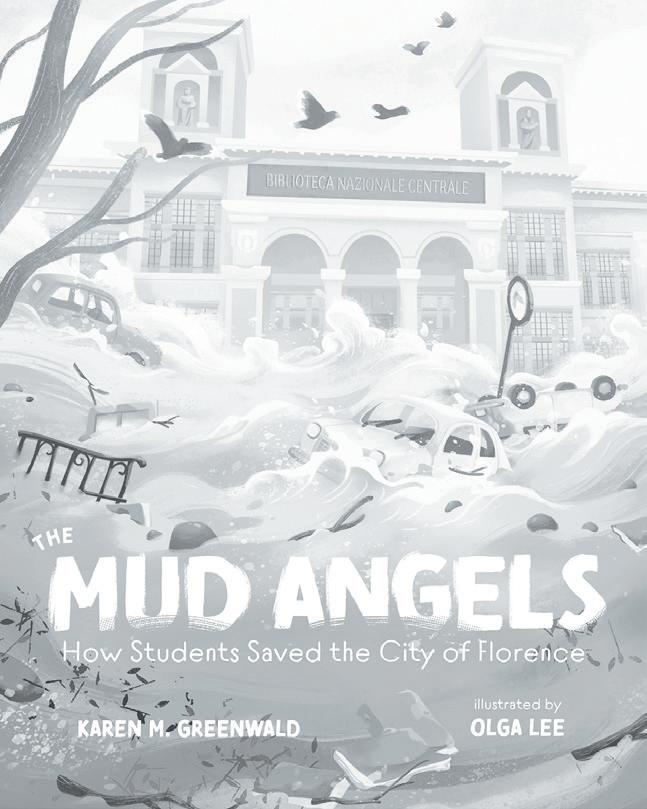
Mud, mud, mud. Slimy, sticky, stinky mud. Everywhere. Everything. Covered in mud.
The devastating events of November 4, 1966, indelibly changed Florence as the Arno River sent extreme waves crashing into the vibrant, historic city and cultural hub. It only took hours to submerge the city’s storied landscape into 600,000 tons of stinky, oil, and debris-filled sludge. The water and mud left behind threatened to destroy centuries of fragile art, antique documents, and hand-painted books. Amidst the sadness, fear, and destruction, Florence also found itself awash in a seemingly endless number of unlikely heroes…Angeli di Fango. Mud Angels.
THE MUD ANGELS: HOW STUDENTS SAVED THE CITY OF FLORENCE (Albert Whitman 4.4.24) is the first English language children’s picture book about youth from Italy and around the world who spontaneously united to help save Florentine treasures. Beginning with
Continued on page 10






Continued from page 8 the first “wave”—students living in Florence on study abroad programs—readers watch as Mud Angels meet along the dangerous trek to the Bibiloteca Nazionale. Together, they plunge into the water and mud-filled basement. Without heat, protective gear, or a shared language, and with scant light, they search through waist-deep sludge for sixteenth and seventeenth century books. Once Florence’s precarious situation becomes global news, others arrive en masse. Even those without an ancestral connection to Italy choose saving irreplaceable antiquities over their own safety. Why? Losing any piece of Italian history feels personal.
According to the American Library Association’s Trade Review, Booklist, “[Illustrator] Lee’s scenes of tumultuous waves washing down city streets amply convey a sense of the widespread devastation to go with Greenwald’s vivid descriptions of the wreckage… The volunteers’ dedication comes through clearly, too… A true episode worth commemorating.” The Massachusetts Youth Services Book Review gave The Mud Angels their star equivalent, calling it, “An uplifting story,” for kids ages 6-12, “… especially if they are in need of inspiration…” Award winning children’s author, Karen M. Greenwald’s research includes extensive interviews with 16 “Mud Angels.” For three years, she consulted with the Biblioteca Nazionale Centrale di Firenze’s conservator, the (then) director of the University of Florence’s CEDAF program, Tuscan libraries, and Florentines who remembered the flood. Tuscan news source Intoscana.IT featured an interview with Ms. Greenwald on last year’s flood anniversary. Italian journalist and I AM Books (Italian bookstore) owner Nicola Orichuia hosted a virtual launch in April featuring Ms. Greenwald and two Mud Angels. An international audience of over one hundred attended.
According to Greenwald, “The story of the Angeli di Fango is a testament to the importance of cultural preservation, the possibility of international cooperation, and the spirit of volunteerism. And, as one third grader eloquently remarked after reading the book, this story ‘…proves that kids and teenagers can change the world.’ It is also my love letter to the Florentine citizens and the brave, diverse young people who risked health and safety to help preserve fragile pieces of the past for future generations.”
About Karen M. Greenwald KAREN M. GREENWALD is an awardwinning children’s author. Her book, A VOTE FOR SUSANNA, THE FIRST WOMAN MAYOR (Albert Whitman), was named a Kansas Notable Book in 2022. Kansas chose it to represent their state at the Library of Congress National Book Festival and in the Library of Congress’ Great Reads from Great Places initiative. It also took center stage at several events of the National Women’s History Museum. Released in April, THE MUD ANGELS: HOW STUDENTS SAVED THE CITY OF FLORENCE (Albert Whitman) has received rave reviews from ALA’s Booklist. It has been featured on the Italian Language Foundation’s blog and in an article on Intoscana.IT. Semi-annually,
Karen holds book drives for underserved school libraries. She co-founded popular kidlit contest, #SunWriteFun, which also focuses on helping under-resourced school and public libraries. Professionally, her strategic branding efforts have earned 17 international awards, including a 2023 Platinum MEA. Prior, she practiced international environmental conservation law. She is a Phi Beta Kappa graduate of Georgetown University and holds her JD from Georgetown University Law Center.
He was resting in Phoenix airport waiting for a connecting flight to Los Angeles where he would run an invitational 1500m race in the buildup to this year’s Olympic Trials this month. Vincent Ciattei was approaching the end of a long journey that had all the qualities of a “Rocky” movie. His road had been tough, long, beset by obstacles and detours, but he had surmounted all of these, now being so very close to his Olympic dream. But, at 29 years of age, this would likely be his last chance to achieve his ambition.
Curiously, this “sogno” was not born as a childhood obsession. It wasn’t till freshman year in high school that Vincent became interested in cross country racing, and this only because he sought to use it to get in shape for his preferred sport, basketball. But in sophomore year, rational analysis of his physical attributes (Vincent was later to receive an engineering degree!) indicated his best chance for athletic success was in running sports.
And so began what became a superlative running career at Perry Hall High School in the suburban Baltimore area. During his final two years there he became a seven-time State Champion at various distances, and a two-time First Team New Balance All American in the mile run. Then it was on to Virginia Tech where his excellence achieved new heights. He was a member of the NCAA national championship DMR team; he was a three time national silver medalist in the 1500/mile distance, and he was a three time Atlantic Coast Conference champion in the mile/1500. (1500 meters, 4921 ft., is considered the metric mile).
Given his huge successes, passion and enjoyment of running, after graduation Vincent opted for a professional running career instead of what could have been a lucrative one in business/engineering. He joined the Nike Oregon Track Club Elite team (2018-2022). The road ahead looked clear, clean and inviting. But, in his first
few days in Eugene, Vincent suffered a very serious stress fracture that laid him up for five months and could have ended his career. Suddenly, he was on a “Rocky” road and on a journey like that of Odysseus. Only through his determination and the dedication of his physical therapist, David Campbell, was Vincent’s pro career saved from dying before it had begun. But the obstacles continued. He was running in the time of Covid. The years 2019-2021 were tough traveling. Much of professional sports had been canceled in 2020. Only sporadic, low level track meets were available. It wasn’t till 2021 that Vincent got into running rhythm again, compiling enough success to be invited to the 2021 Olympic trials. Again, disaster struck. Right before the championship, he suffered another injury and his run for glory ended short of his goal.
2022 brought more disappointmentwith himself and in his training. Was it time to end this Odyssey? No! Emphatically. He persevered, and in April 2023 he won his first major championship, the USATF National Road Mile Championship. Suddenly, at age 28, Vincent’s career took flight. Seven of his ten personal best times came between August 2023 and May 2024.
I asked Vincent “Why didn’t you give up?” He unhesitatingly replied: “I was so amped up since high school to make running my main focus. During my 2018 rehab with Campbell I channeled my whole being into it. Despite other difficulties later, I had invested too much of myself in the sport not to carry on towards my Olympic objective. To quit would have been selfbetrayal.”
He credits his coaches – Marilyn Bevans, Ben Thomas, Mark Rowland, and Stephen Haas – teammates, and trainers for helping him through the toughest times and drawing out and developing his talent. But he credits another major factor in fueling his gritty determination to stay the course- his large family, his Italian American heritage and its values.
The Ciattei family traces its roots to the Trento region in Italy. Vincent says his biggest fans are his family. Many watch or travel to his competitions to support him. He has channeled traditional Italian qualities of hard work, striving for excellence, combined with a never-say-die attitude and a willingness to butt heads when necessary. All of this supports his Olympic journey
So where does Vincent Ciattei stand now. He has this year’s 5th best time in the world for the indoor mile at 3:50.56. Barring mishaps, he will be at the Olympic trials in the middle of this month. At age 29, Vincent knows this has to be the time to realize the dream. He looks forward to competing with the best in America, and like Rocky, ascending that long stairway victoriously.
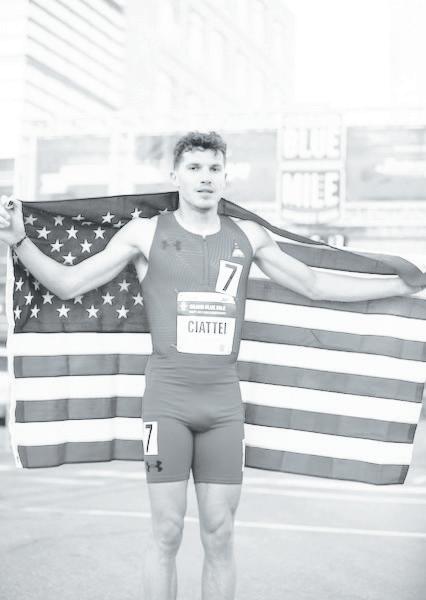
Vincent celebrates after winning the 2024 U.S. Road Mile Championship
THOMAS BOTZIOS–CONSOLE GENERALE
500 N. Michigan Ave., Suite 1850 Chicago, IL 60611 phone: 312-467-1550
certified email (PEC): con.chicago@cert.esteri.it italcons.chicago@esteri.it Hours: (open to public)
Monday-Friday 9 a.m.-12:30 p.m.
Onorario D’Italia/Honorary Vice Consul Joseph Colagiovanni
BAKER BOTTS L.L.P. 190 Carondelet Plaza, Suite 1475 St. Louis, MO 63105-3443
Tel: 314-275-0351
Fax: 314-275-0371
email: saintlouis.onorario@esteri.it
VISTI/VISAS visti.chicago@esteri.it 312-995-5487
PASSAPORTI/DOCUMENTI VIAGGIO/ NAVIGAZIONE/ PASSPORTS/ EMERGENCY TRAVEL DOCUMENTS passaporti.chicago@esteri.it 312-995-5485
AIRE anagrafe.chicago@esteri.it 312-995-5485
ELETTORALE/ ELECTORAL elettorale.chicago@esteri.it 312-995-5485
STATO CIVILE/VITAL RECORDS chicago.statciv@esteri.it (312) 995 5485
CITTADINANZA/CITIZENSHIP cittadinanza.chicago@esteri.it (312) 995 5484
UFFICIO STUDENTI/CODICI FISCALI/ EQUIPOLLENZA TITOLI DI STUDIO/ COMMERCIALE/ STUDENT OFFICE/ FISCAL I.D./EQUIVALENCY OF DEGREES AND PROFESSIONAL TITLES/ COMMERCIAL commerciale.chicago@esteri.it 312-995-5486
NOTARILE/NOTARY legale.chicago@esteri.it 312-995-5483
UFFICIO SCUOLA/ EDUCATION OFFICE scuola.chicago@esteri.it 312-995-5489
Italian Trade Agency 401 N. Michigan Ave., Suite 1720 Chicago, Illinois 60611 chicago@ice.it 312-670-4360 website:ice.it/it
Agenzia Nazionale del Turismo/ Italian Government Tourist Office
500 N. Michigan Ave., Suite 2240, Chicago, IL 60611 312-644-0990 italiantourism.com
ONLY FOR ITALIAN CITIZENS WITH TRUE EMERGENCIES (accidents, arrests, etc.):
Available from 8 a.m. - 9 a.m. and from 5 p.m. - 10 p.m. CST Monday –Friday, and from 8 a.m. - 10 p.m. Saturday, Sunday, and holidays – Call +1(312) 909-0304
Emergencies between 10 p.m. and 8 a.m. CT, contact the MAECI at 011 39 06 36912666
Istituto Italiano di Cultura di Chicago Italian Cultural Institute of Chicago 500 N. Michigan Ave., Suite 1450 Chicago, IL 60611 phone: 312-822-9545 fax: 312-822-9622 email:iicchicago@esteri.it website:iicchicago.esteri.it