The views and opinions expressed within Better Tomorrow are reported from live events and are those of the individual contributor/s. They do not necessarily reflect the official policy or position of the contributor’s employer, organisation, committee or other group or individual.
ILC
While every effort has been made to ensure the accuracy of information, ILC will not accept responsibility for errors or omissions or for consequences arising from reliance on information published. The opinions expressed in Better Tomorrow are not necessarily the opinions of, or endorsed by ILC unless otherwise stated.
COPYRIGHT
All rights reserved. No part of the material contained within this publication may be reproduced or copied in any form or by any means without written permission from ILC.
Innovation with impact at ClaimsTech - The Pitch 2025
Jonathon Valentine
ClaimsTech Lead, ILC CTO, ThingCo
ILC
A little over three years ago, ClaimsTech – The Pitch was little more than an idea – a way to spotlight early-stage innovation and create a platform where the insurance claims sector could engage with new thinking in a fresh, accessible format.
Fast forward to 2025 and we could not be more proud of what this event has become.
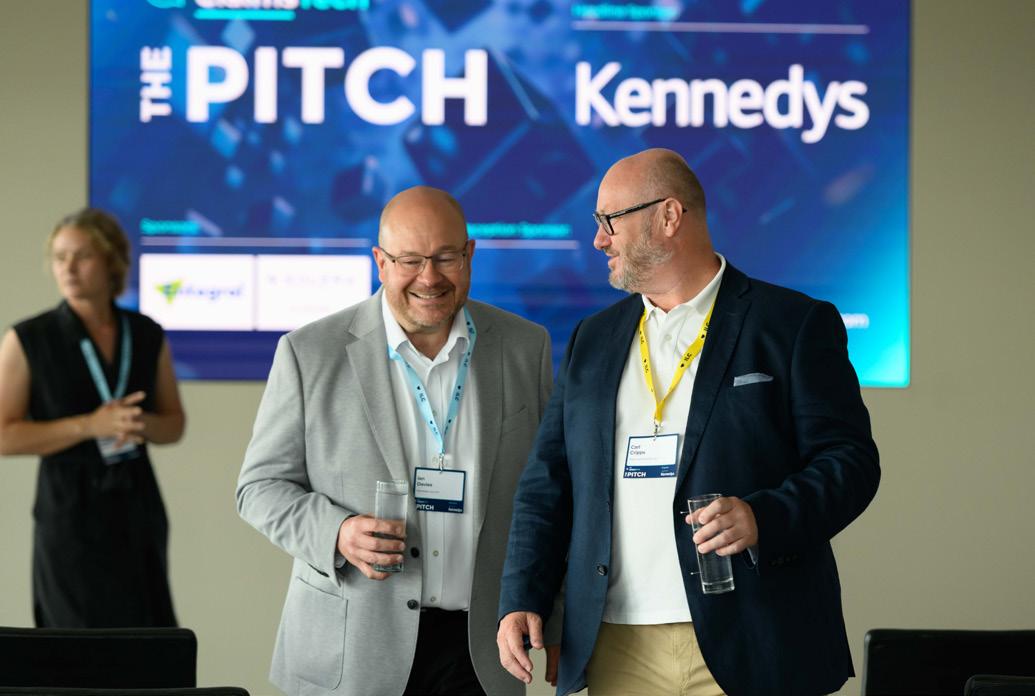
This third edition of ClaimsTech - The Pitch, held at Kennedys’ offices in London, brought together a genuinely global and diverse group of finalists – with founders joining us from Europe, the US, and across the UK. Each one delivered a bold and brilliant proposition, and it was clear from the room’s energy that these ideas are not only inspiring but genuinely relevant to the future of claims. Finalists
With the support of our headline sponsor Kennedys, alongside Solera Audatex and Entegral, and networking reception sponsor Kennedys IQ, we’ve been able to build something that’s more than just a showcase. This is a community-driven initiative – one that thrives on openness, curiosity and a shared ambition to shape a better tomorrow.
The theme for 2025 - ‘Positive impacts: technology shaping the future of claims’ - gave us a clear focus –to look beyond buzzwords and hype, and highlight solutions that offer meaningful change. From AI and automation to customer experience and sustainability, the five finalists demonstrated just how wide-reaching the impact of innovation can be when it’s rooted in the real world. The competition also highlighted how even today good ideas are not always reliant on AI.
But ClaimsTech - The Pitch isn’t just about tech – it’s about trust. One of the most important dynamics we explored this year was the relationship between start-ups and insurers. That trust gap still exists, and bridging it is essential if we want to unlock the full potential of these innovations. Our panel session, ‘Insurers – ally or adversary?’, tackled this head on and started the kind of open conversation we need more of in the months ahead.
For me, one of the most exciting developments this year was the depth of our partnerships. From InsurLab Germany for helping to spread the word, to Insurtech UK, Finpro and Kennedys who also contributed towards an incredible winner’s package prize valued at in excess of £40,000. We’re delighted to have built a support network that continues beyond the event itself – helping our finalists gain traction, secure mentoring, and navigate the complexities of the insurance world.
Finally, a huge thank you to everyone who took part – from those who entered to our finalists, sponsors, judges, and attendees. You are helping to drive real momentum in this space.
This event continues to grow because the sector wants – and needs – what it offers: new thinking, fresh energy, and a collaborative approach to change. I’m already excited for what next year will bring.
Until then – let’s keep the conversation going.
JV
Kennedys opens ClaimsTech – The Pitch 2025 with a call to embrace innovation
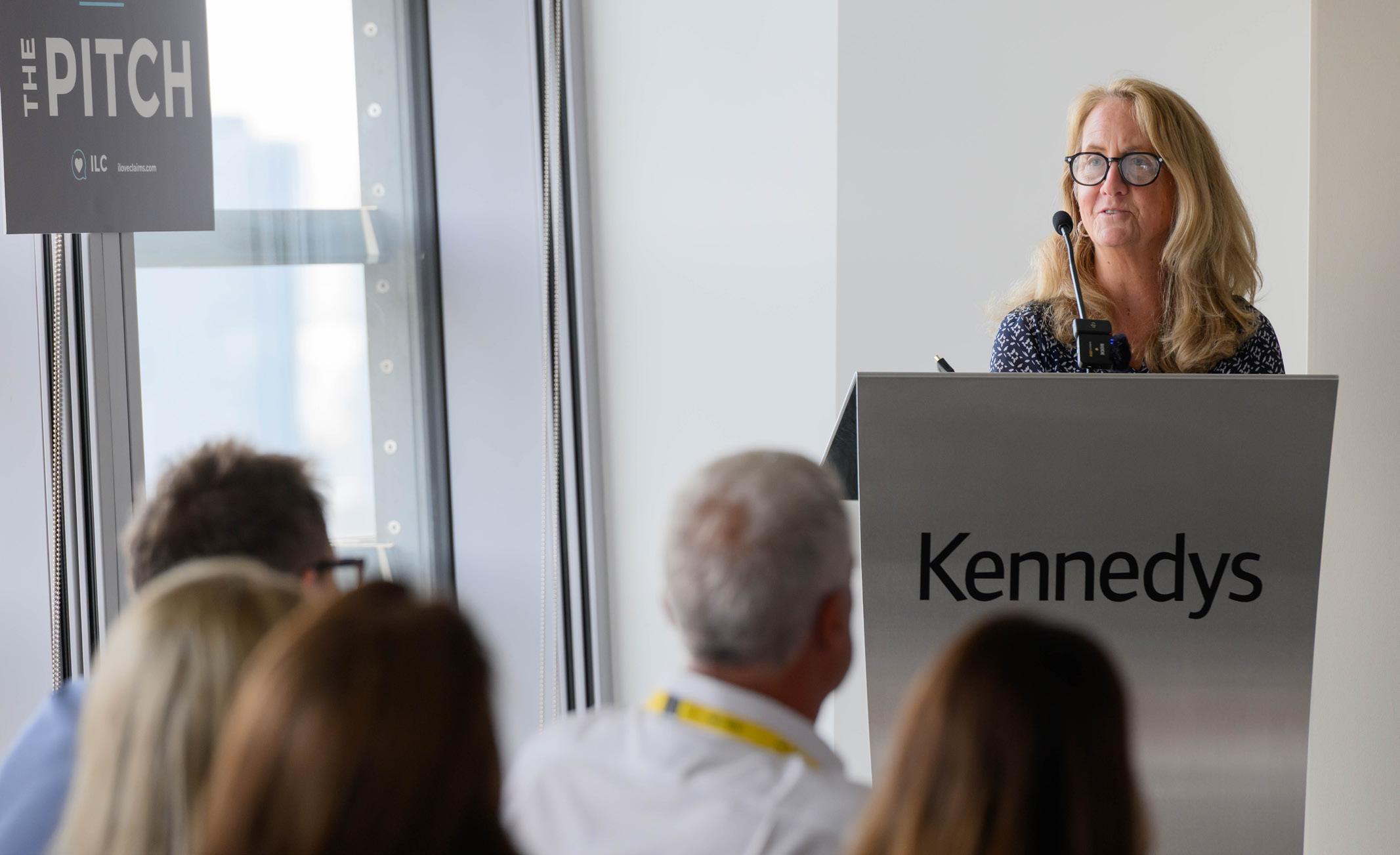
Meg Catalano Global Managing Partner Kennedys
Kennedys Law LLP, headline sponsor of ClaimsTech – The Pitch 2025, opened the event with a warm welcome from Meg Catalano, Global Managing Partner.
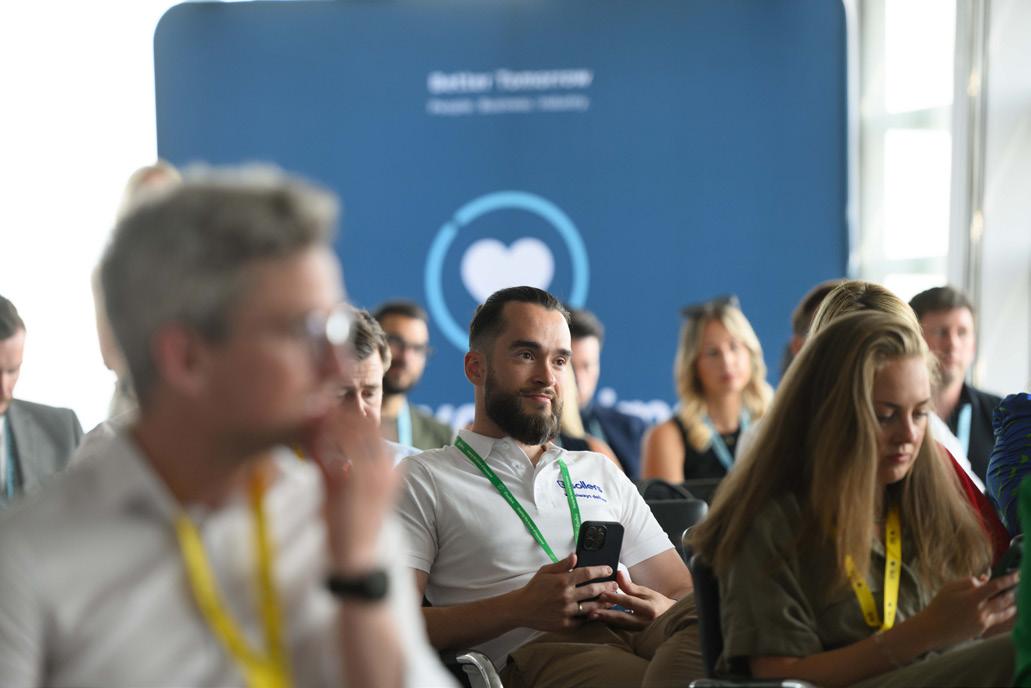
Speaking to a packed room of insurers, innovators, and sector specialists, Meg acknowledged the pace of change across the industry – and the importance of staying engaged and open-minded in a time of rapid technological evolution.
“Kennedys
is committed to supporting the future of claims through initiatives like ClaimsTech –The Pitch.”
“Terms like ‘innovation’ and ‘insurtech’ have shifted from niche conversations to everyday vocabulary.
Reflecting on how much the language around innovation has changed in recent years, Meg highlighted how terms like ‘innovation’ and ‘insurtech’ have shifted from niche conversations to everyday vocabulary. For those outside of the tech world, she admitted, the speed and scale of transformation can be daunting – but also exciting and essential to embrace.
As a law firm that specialises in insurance, Kennedys is closely aligned with the sector’s future – not just from a legal standpoint, but also through its understanding of clients’ evolving operational and technological needs. Meg acknowledged that while law may not always be seen as the natural home of innovation, Kennedys is proud to support initiatives that drive progress and collaboration.
She praised the start-ups participating in ClaimsTech - The Pitch, describing their mindset as “living and breathing this new stuff every single day,” and expressed enthusiasm for seeing how the ideas presented would develop and make a real impact.
As part of its support, Kennedys offered a mentorship package to the winner of the competition, including 50 hours of business expertise across IT, claims handling, and business development – designed to help bridge the gap between innovation and real-world application.
Meg closed by thanking attendees and wishing all finalists success, reinforcing Kennedys’ commitment to supporting the future of claims through initiatives like ClaimsTech – The Pitch.
Meet the experts
Matthew Adlem Head of Credit Hire
Acorn Insurance & Financial Services Ltd
Adrian Brown Director East Consulting Ltd
Andy Henner
Head of Technical Claims (UK GI)
Ecclesiastical
Greg Cole UK Claims Director
Aioi Nissay Dowa Europe
Paula Coulthard Griffiths VP - Insurance & Partnerships Marshmallow
Carl Cripps Claims Director Direct Commercial Ltd
Andrew Eade
Head of AD Strategy & Fullfilment 1st Central
James Fairgrieve
Head of Innovation
Aventum Group Ltd
Charlotte Halkett
Senior Consultant
Milliman
James Hann
Supplier Relationship Manager
Allianz
Tom Hewitt
Head of First Response
Trinity Claims
Muriel Innes
Claims Change Programme
Lead Aviva Lee Kemp
Senior Product Owner - Claims
Markerstudy Insurance Services
Limited
Richard King
CEO Ticker
Dawn Marsden
Head of Claims Supplier Management and Engineering Services
esure
Ian Marsh
Head of Property Claims Saga
Tony Martins De Sa
Claims Data and Technology Lead NFU Mutual
Marc Mercer
Director of European Claims Inshur Inc
Alistair Moodie Director KnowRisk Energy
Hannah Pinches Head of Motor Claims Direct Line Group
Natalie Spurrier
Claims Director The AA
Victoria Sutton
Business Performance Director (Corporate & Commercial Claims) Howden
Dave Thompson Director of Claims Tesco Insurance & Money Services
Miss Moneypenny Technologies – Turning the digital wallet into a service gateway
Anna Bojic CEO & Co-Founder
Miss Moneypenny Technologies
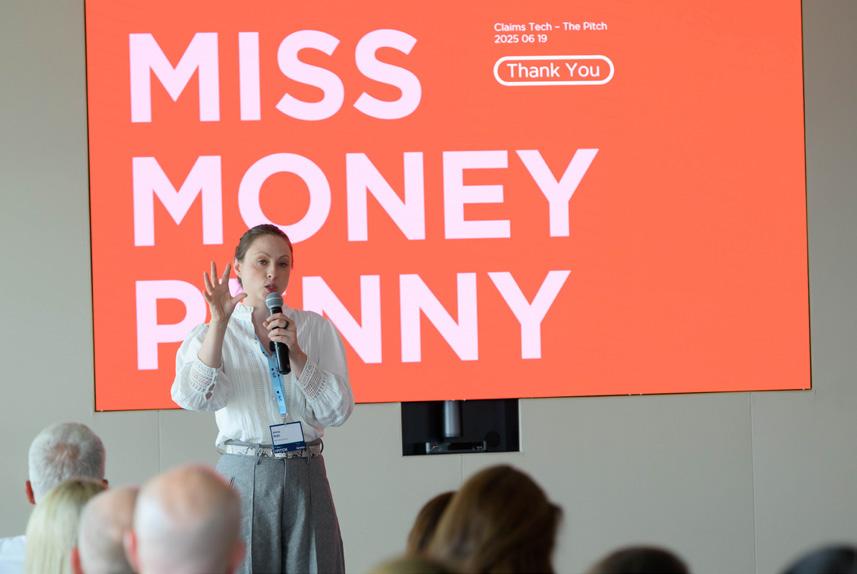
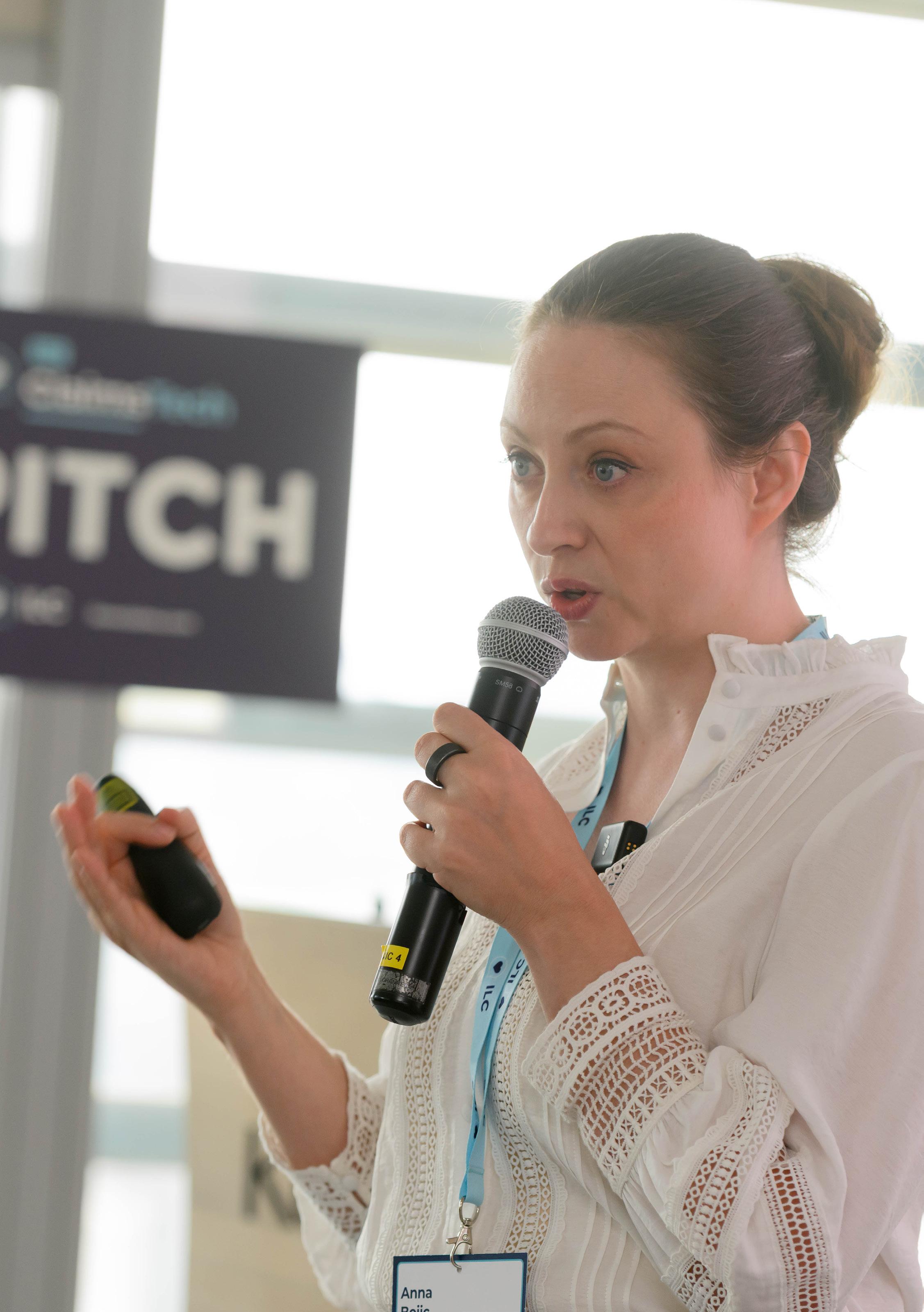
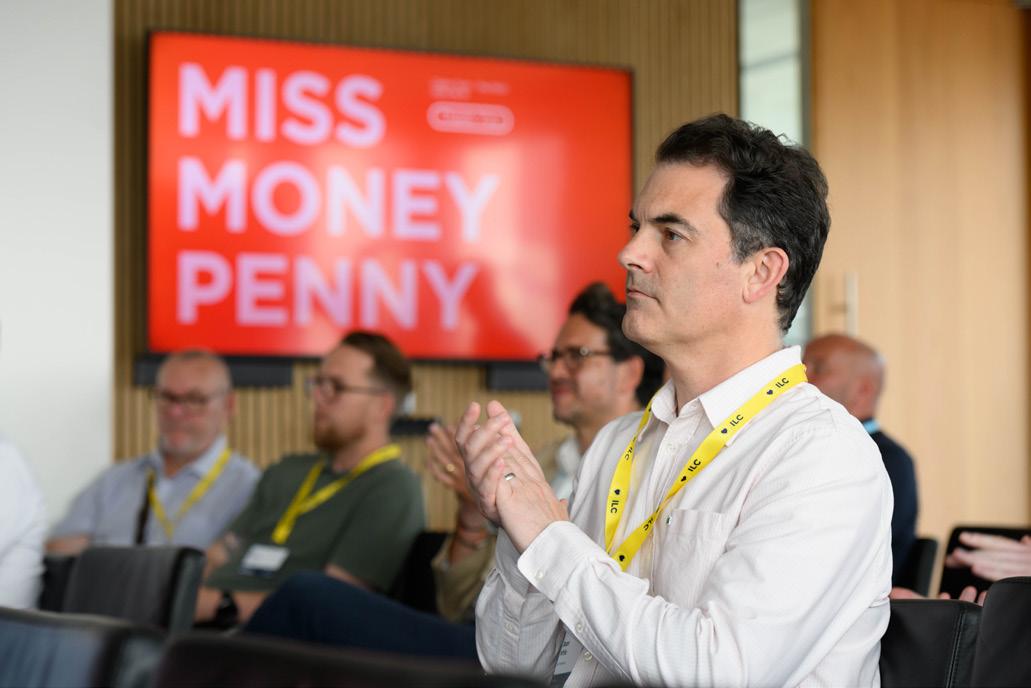
The opening pitch set an impressive tone, as Anna Bojic, CEO and Co-Founder of Miss Moneypenny Technologies, took to the stage to present a powerful case for transforming insurance customer engagement through everyday mobile wallet technology.
Anna introduced Miss Moneypenny as the company behind Wallet Studio – a platform already trusted by more than 30 insurers and MGAs globally. The central proposition? To turn the widely adopted but underutilised mobile wallet into a two-way, real-time communication channel that enhances insurance service delivery, simplifies the claims journey, and reduces operational costs.
“The opportunity lies in going much further – embedding dynamic, interactive experiences directly into the wallet interface.”
Everyday technology, untapped potential
As Anna explained, billions of people already use Apple Wallet and Google Wallet daily – for payments, transport, boarding passes and more. Yet insurers, she argued, have largely overlooked the potential of this technology, typically limiting its use to static proof-of-insurance documents. The opportunity lies in going much further – embedding dynamic, interactive experiences directly into the wallet interface.
She illustrated how the wallet, once integrated with Wallet Studio, becomes far more than a digital credential. It becomes a living digital service – with up-to-date policy information, seamless access to customer support, claims reporting, and push notifications that prompt timely action. Crucially, the platform connects users directly into insurer ecosystems, creating frictionless journeys and improving satisfaction and outcomes.
From concept to impact: real-world examples
To demonstrate practical use cases, Anna shared three powerful insurer case studies:
1. Zurich – car insurance efficiency
Zurich leveraged Wallet Studio to embed a digital insurance card within customers’ mobile wallets. The solution not only enabled policyholders to access information and services instantly, but also allowed them to share key details – such as accident information – via a QR code in the event of a collision. This seamless process activated Zurich’s partner repair network early and drove claimants directly into its approved process, resulting in improved customer experience and lower costs. The solution is now being used globally across Zurich’s territories.
2. ERGO – travel insurance support
Travel scenarios are notoriously stressful, and ERGO identified that even with access to thirdparty healthcare networks, uptake remained low due to user friction. With Wallet Studio, ERGO pushed emergency cards into mobile wallets, complete with geo-location triggers. On arrival at international airports, users receive prompts directing them to the right support, including direct access to medical services through Air Doctor – all without login or manual data entry. This level of integration transformed customer experience and kept users within ERGO’s care network.
3. Major German insurer – legal insurance access
A large German carrier deployed Wallet Studio across multiple product lines, including legal insurance. Customers are now routed directly to legal chat services or connected to lawyers from the insurer’s trusted network – all initiated from within their wallet. This direct access has already reduced unnecessary escalations and driven customer retention, while simultaneously creating a new sales channel for legal consultations.
Measurable outcomes
Anna shared compelling statistics from the platform’s deployment:
• Conversion rates for wallet-based experiences ranged between 25% and 60% – significantly higher than typical mobile apps.
• In car insurance, connecting both parties early in the claims process generated savings of €1,500 per claim.
• Weather-based push notifications – such as hailstorm alerts – helped prevent losses entirely, saving millions.
• In legal insurance, 50% of users were guided to the correct legal channel at first contact, reducing strain on call centres and downstream costs.
She also highlighted the cumulative impact of 19 million service messages delivered over five years – many of which were actionable, proactive communications that helped insurers move from reactive support to guided journeys.
A trusted channel, a scalable solution
Responding to audience questions, Anna addressed concerns around the longevity and consumer readiness of wallet technology. She noted that legal documents, boarding passes and even visa applications are increasingly being stored in mobile wallets, and that consumers view the wallet as a secure, familiar, and low-friction tool –making it well suited to insurance use cases.
She also confirmed that Wallet Studio is APIintegrated with insurer systems, ensuring policy data is always accurate and up to date. Push notifications and reminders can be customised, while real-time expiry alerts and renewal prompts ensure customers remain informed and in control.
Final reflections
Miss Moneypenny’s Wallet Studio blends technical feasibility with genuine customer benefit and Anna’s message was simple but powerful: when insurers meet customers where they already are – in the tools they use every day – the potential for engagement, efficiency, and loyalty rises dramatically.
In a space often preoccupied with apps and portals, Miss Moneypenny Technologies offered a refreshing and proven alternative – one that simplifies the experience without compromising impact.
“Weather-based push notifications – such as hailstorm alerts – helped prevent losses entirely, saving millions.”
“In
car insurance, connecting both parties early in the claims process generated savings of €1,500 per claim.”
PITCH 2
Perfect Group – raising the standard for transparency in contents handling
Joe Grafton Chief Commercial Officer Perfect Group
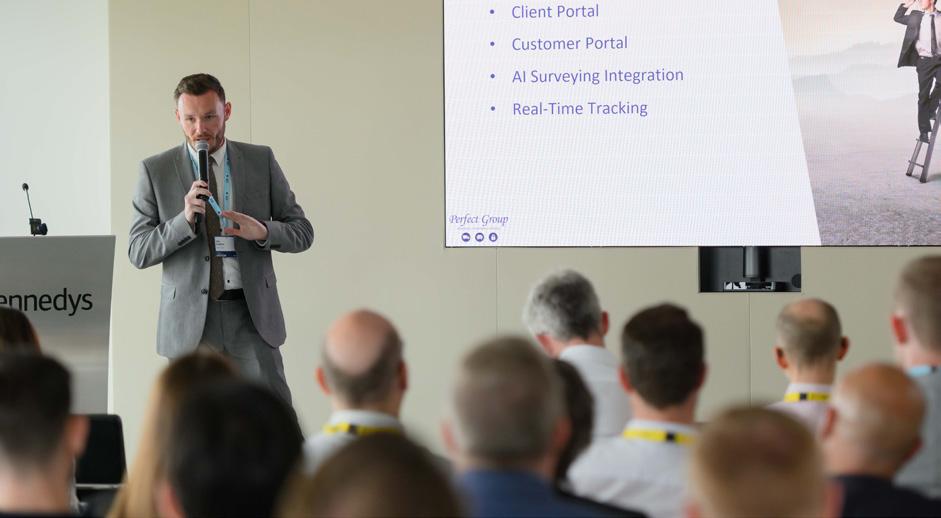
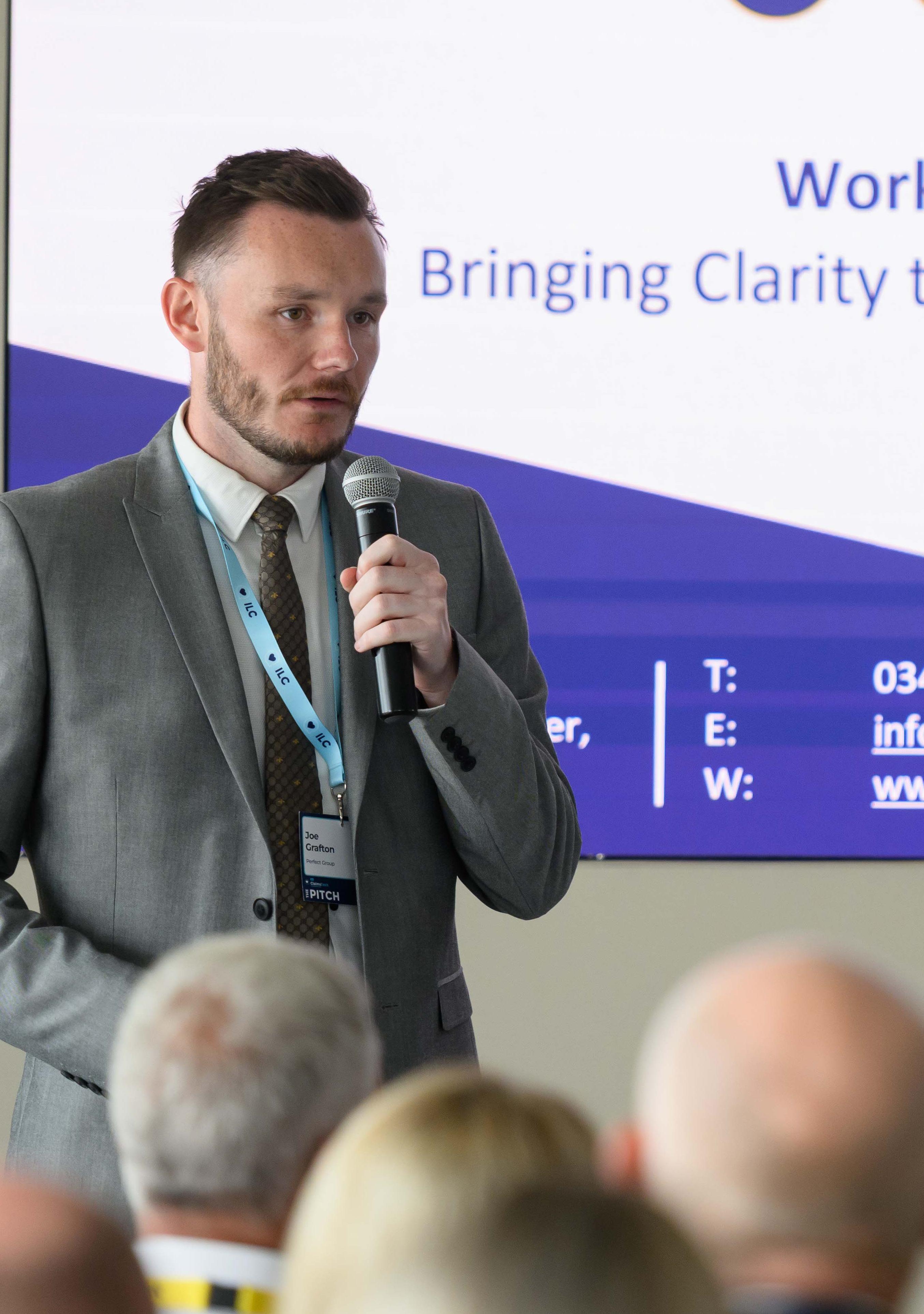
Joe Grafton, Chief Commercial Officer at Perfect Group, delivered a compelling presentation on how the business is transforming the removals and contents storage process within insurance claims. His message was clear: transparency, accountability and customer reassurance are critical – and technology is the enabler to deliver all three at scale.
Perfect Group specialises in the removal, storage and redelivery of contents following property insurance claims. While the service itself is essential, Joe was quick to highlight the emotional complexity often involved: “We’re taking away everything someone owns, sometimes in the middle of a crisis,” he explained. “People are confused, anxious, and desperate for clarity. They want to know where their things are – and they deserve that transparency.”
From stress to structure: building a better experience
This human-centred challenge became the driver behind the development of Worksmart – Perfect Group’s in-house app. Originally built to standardise internal inventory recording, the app has evolved into a full-scale customer and insurer engagement platform that tracks every item from collection to return, complete with photographic evidence, GPS data and digital signatures.
“This means we can send the right team with the right vehicle, at the right time. It’s simple, efficient and makes life easier for everyone involved.”
The impact has been immediate. Since launching Worksmart, customer complaints have dropped by 64%, thanks in large part to the introduction of visual confirmation, detailed item records, and realtime tracking updates.
Customers no longer need to call and ask “Where is my sofa?” – they can see for themselves, via the app, with complete visibility over their items’ condition, location, and status.
Reducing insurer cost and increasing defensibility
For insurers, the app supports faster resolutions and fewer disputes. With digital logs and geotagged photography, every step of the process is recorded and traceable, creating defensible records that can help resolve queries and validate claims.
As Joe described, “If a customer queries damage, we can show exactly what condition the item was in at pick-up, at storage, and at return – with photographic proof and timestamped records.” The technology also supports customer self-service, reducing inbound queries and allowing insurer resources to focus elsewhere.
AI and automation: next-generation removals
Looking ahead, Perfect Group is taking Worksmart even further. A new customer portal is being rolled out, offering end-to-end visibility for policyholders, including tracking arrivals, accessing documentation, and seeing which operatives are handling their items.
Meanwhile, a significant AI development is being integrated into the process. Customers will be able to complete a contents scan using their smartphone – simply rotating 360° through a room – with the app automatically identifying and categorising furniture, heavy items and volume data. This innovation allows for accurate quoting, resourcing, and pre-visit planning, reducing delays and unnecessary site visits.
Joe explained, “This means we can send the right team with the right vehicle, at the right time. It’s simple, efficient and makes life easier for everyone involved.”
Bridging the supplier ecosystem
One of the biggest industry pain points, Joe acknowledged, is the disconnect between different suppliers working on the same claim. Delays, confusion and miscommunication often arise when coordination breaks down. The Worksmart app is being developed to integrate with third-party platforms and claims centres via API, creating a smoother experience for all parties and supporting a more joined-up approach.
Joe said, “We don’t want to reinvent anyone’s system – we just want ours to speak to theirs. We’re customer-facing, not system-heavy. Our aim is to eliminate the ‘where are they?’ guesswork from removals and give everyone involved better visibility.”
A product designed for insurance
Unlike many removals tech solutions that have been retrofitted for insurance, Worksmart was designed with claims in mind from the start. Joe confirmed that over 90% of Perfect Group’s removals are insurance-led, and the system was built to serve that specific journey – from policyholder to claims handler, loss adjuster to restorer.
In time, Joe said, there may be opportunities to open the technology to other businesses, but for now the focus remains on refining the platform for Perfect Group and its partners.
Final thoughts
Perfect Group’s pitch highlighted the importance of not only improving operational efficiency but also of creating a more transparent and human experience at what is often a vulnerable time for customers. By combining realtime technology with accountability and care, the company is setting a new benchmark for how removals and storage should be handled within insurance claims.
As Joe concluded, “We believe every customer deserves to know where their world is – and we’re using technology to make that possible.”
“If a customer queries damage, we can show exactly what condition the item was in at pick-up, at storage, and at return – with photographic proof and timestamped records.”
“We believe every customer deserves to know where their world is – and we’re using technology to make that possible.”
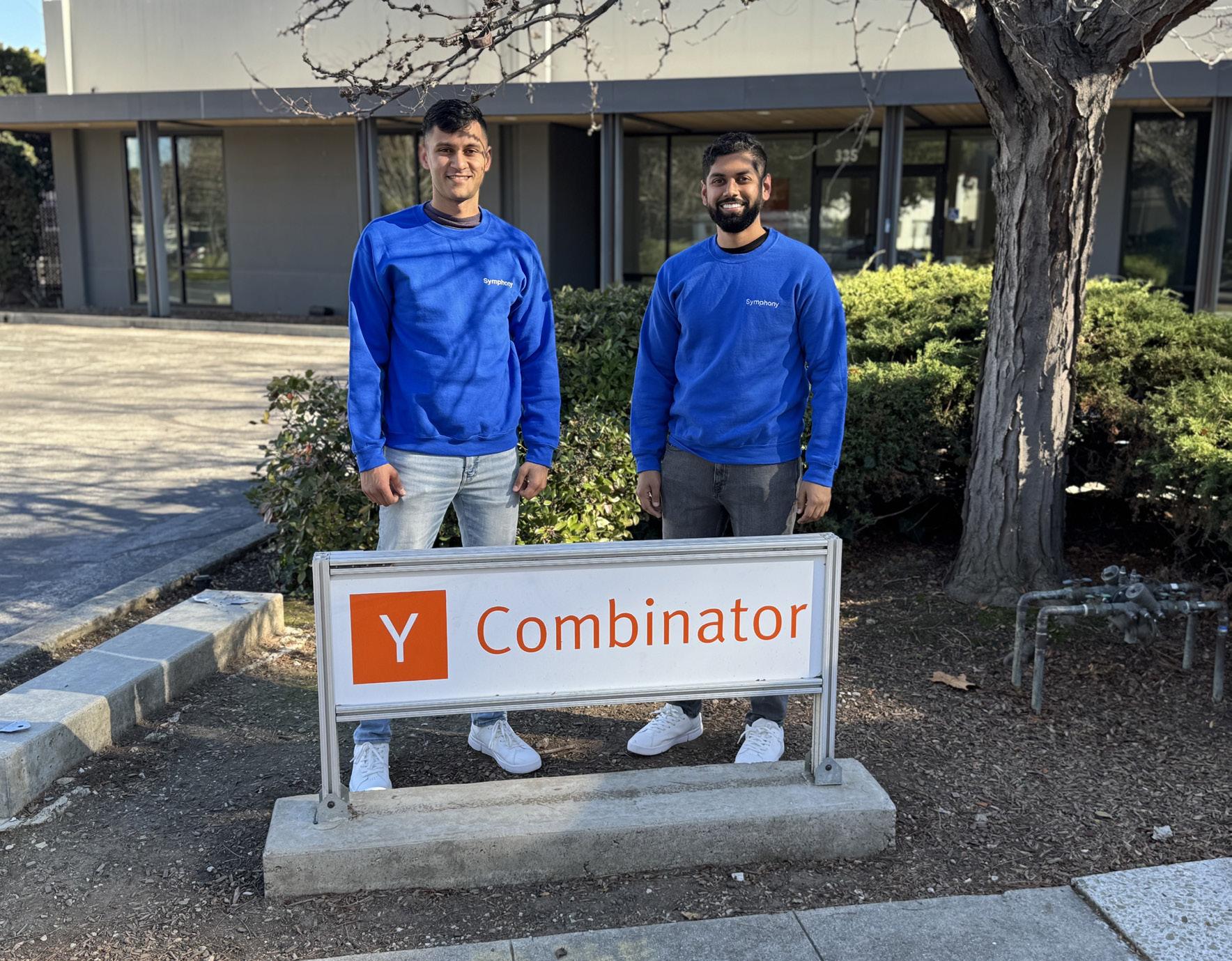
Symphony –voice AI and the future of adjuster training
Murtaza Ali Co-founder & CEO Symphony
“Build hyper-realistic role-play simulations that replicate what actually happens in the real world.”
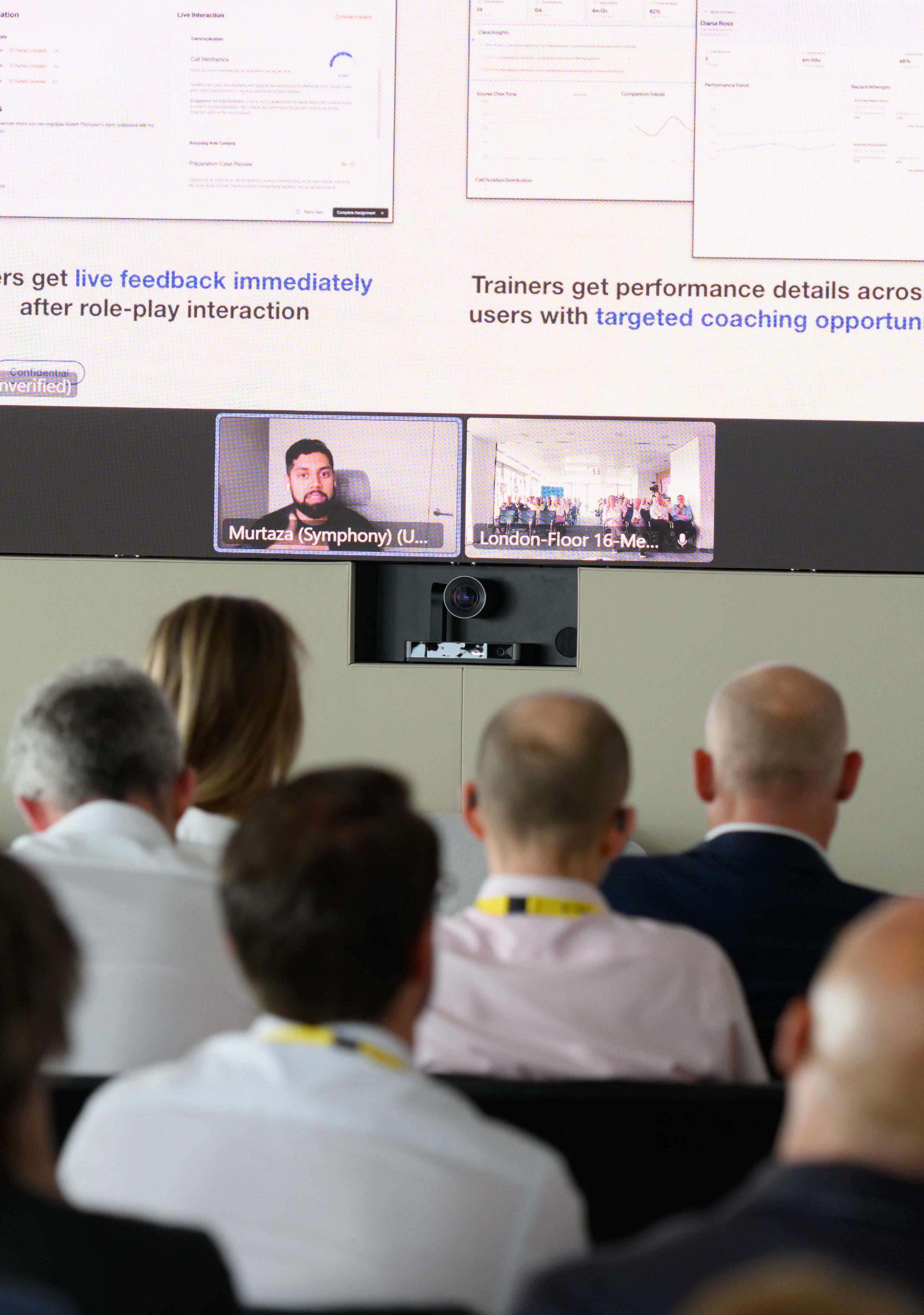
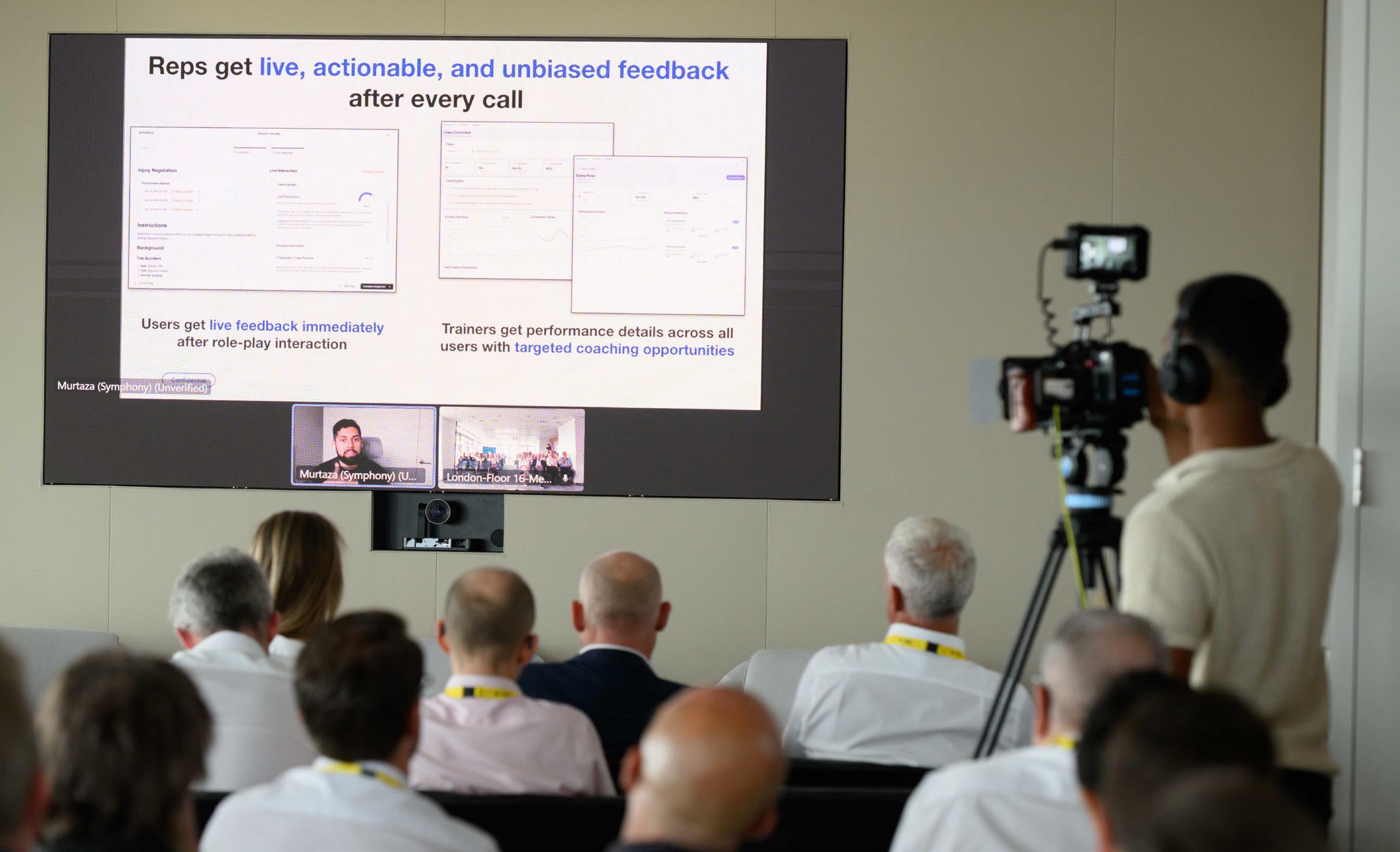
Murtaza Ali, CEO and Co-Founder of US-based insurtech and overall competition winner Symphony, took to the virtual stage live from San Francisco. Despite the early hour, Murtaza delivered a standout presentation that explored how AIpowered simulations can transform the way insurers train and support frontline claims professionals.
Symphony’s platform harnesses voice AI to simulate real-world insurance scenarios –enabling claims handlers to practise customer interactions in a safe, repeatable, and highly realistic environment. Murtaza opened with a reminder of the limitations of traditional training, which often consists of classroom sessions, static materials, or basic role-playing. Symphony’s goal, he said, is to “build hyperrealistic role-play simulations that replicate what actually happens in the real world”.
AI-powered training for real-world scenarios
At the heart of Symphony’s offering are its intelligent voice agents – emotionally nuanced, fully interactive characters that mimic customers, bodyshops, lawyers, and more. These agents can be customised to reflect a wide range of scenarios, such as a customer reporting their first accident, or a claims handler negotiating a settlement with a claimant’s legal representative.
Each session is scored using a tailored rubric developed in collaboration with the insurer, with performance feedback delivered instantly to the user. Managers and supervisors also receive detailed reports, providing consistent and objective insights into team capabilities. This allows them to target coaching where it’s needed most and monitor progress across new hires and existing staff alike.
Faster onboarding and measurable impact
Symphony is already working with several of the top 10 P&C carriers in the US, including one that recruits up to 4,000 adjusters annually. These organisations have seen tangible results: faster onboarding, more confident claims handling, and measurable reductions in supervisor escalations.
Murtaza highlighted that the ability to create bitesized simulations – lasting anywhere from two to 25 minutes – enables insurers to focus on specific training objectives, whether it’s managing difficult conversations, gathering key data, or adhering to internal processes. “What we’re doing is mapping what ‘great’ looks like for your organisation, and building that into the training,” he said.
Customisable and scalable
One of Symphony’s standout features is its no-code scenario builder. Supervisors can upload real-life transcripts or documents to quickly generate new training modules. For example, if a handler has a challenging live call, that script can be transformed into a new simulation for the wider team to practise – creating a continuous loop of real-world learning and improvement.
Symphony also supports dynamic rubric creation, enabling organisations to define their own standards and benchmarks across different roles, regions, or lines of business.
“What we’re doing is mapping what ‘great’ looks like for your organisation, and building that into the training.”
In response to questions from the audience, Murtaza confirmed that the platform’s AI agents can be adapted for specific use cases, including recognising and responding to vulnerable customers. Simulations can also be configured to reflect difficult customer behaviours – such as aggression, manipulation, or confusion – giving users experience of emotionally charged situations before facing them in live calls.
Beyond training: a gateway to live AI assistance
While Symphony’s initial focus is on training, its long-term vision goes further. Murtaza revealed that the same technology used to simulate conversations is now being trialled in live claim environments. For example, one partner is using Symphony to provide real-time prompts and support to adjusters during calls – helping them ask the right questions, follow process, and maintain consistency.
This, he suggested, is where AI can truly begin to augment human performance in claims – not by replacing people, but by guiding and supporting them in complex scenarios.
Symphony is also exploring chat-based training and assessment, which is already being used by one carrier to reflect the growing role of live messaging in claims handling.
Global potential
While all deployments to date have been in the US, Murtaza confirmed that Symphony is ready to expand internationally. Although additional testing may be required for new languages and compliance environments, the underlying platform is built for scalability.
Asked whether the tool could support broader uses such as contents valuation, Murtaza explained that Symphony’s AI capabilities are continually evolving, and that its primary aim is to strengthen adjuster performance in ways that improve customer outcomes and operational efficiency.
Final thoughts
Symphony’s pitch stood out for its clarity of purpose, practical application, and forward-thinking approach to workforce development. In a sector grappling with high turnover and increasing complexity, the ability to train claims professionals using realistic simulations – and then carry that learning into live environments – offers powerful potential.
As Murtaza summarised: “We’re not just training people. We’re helping you define what great looks like, and building AI to help you achieve it.”
“Supervisors can upload reallife transcripts or documents to quickly generate new training modules.”
“Not by replacing people, but by guiding and supporting them in complex scenarios.”
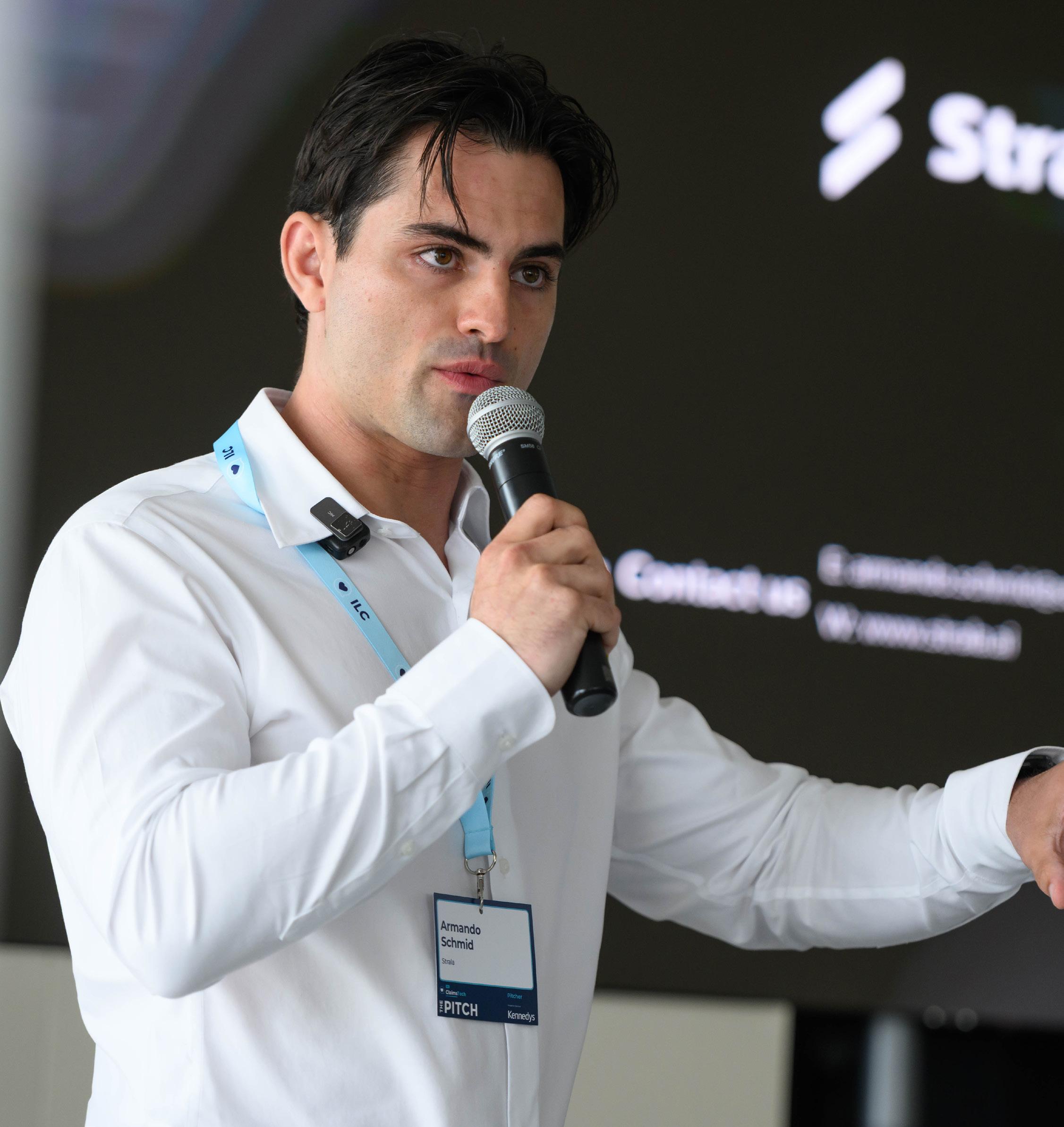
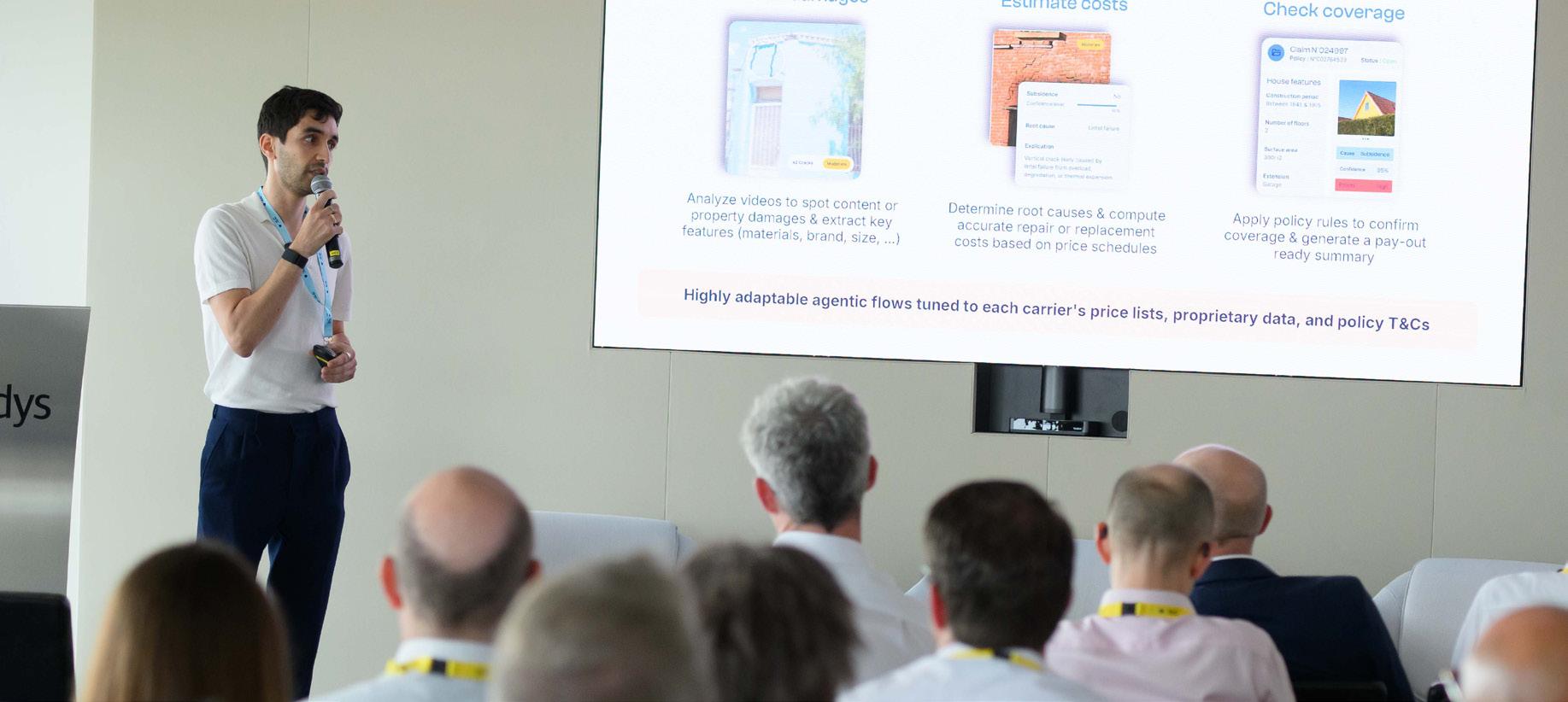
Strala –reimagining the TPA model with AI-powered claims resolution
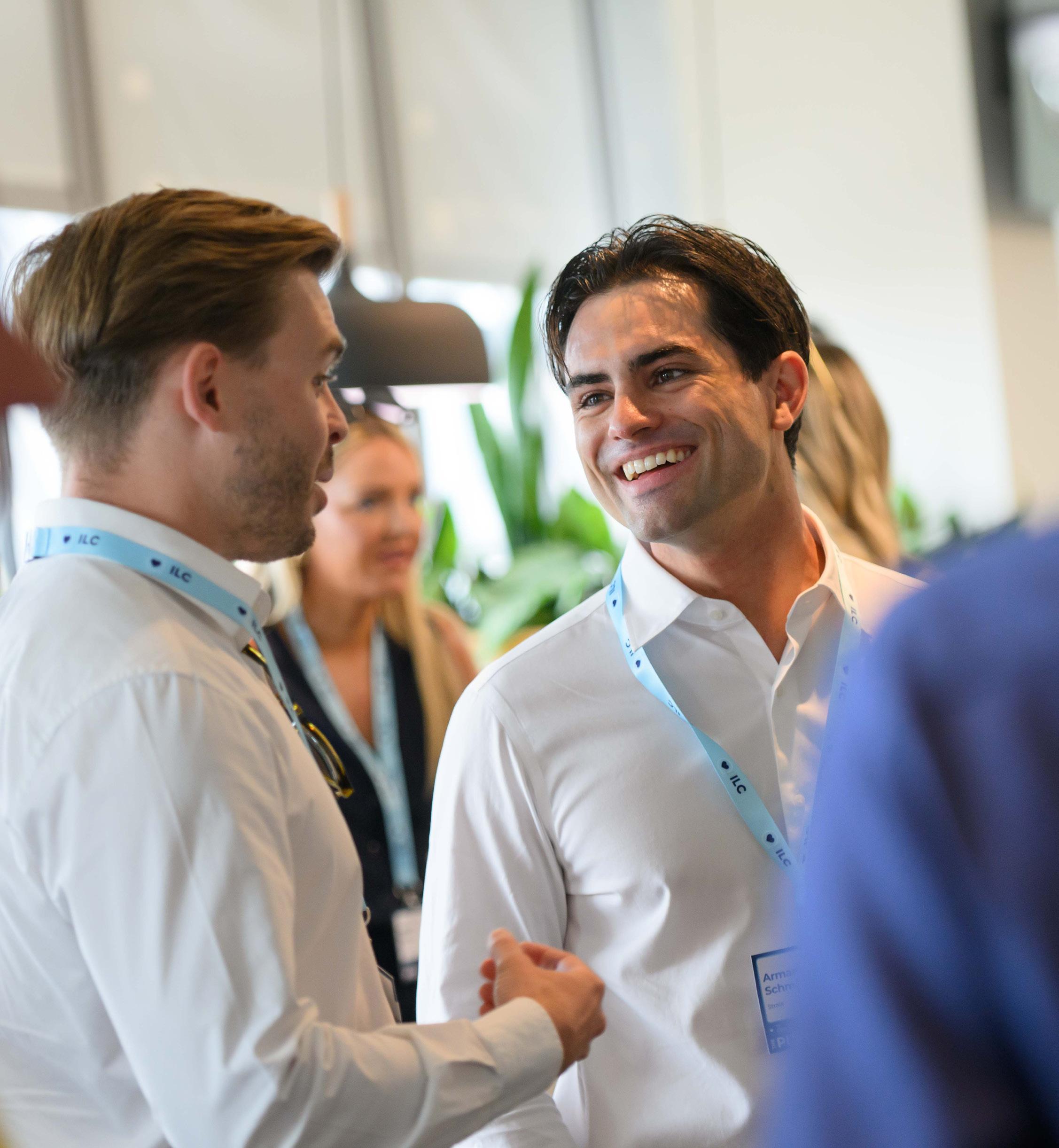
Armando Schmid CTO Strala Group
“Within 15 years, a large portion of today’s adjusters will have retired – and there won’t be enough people to replace them.”
Strala Co-Founder and CTO
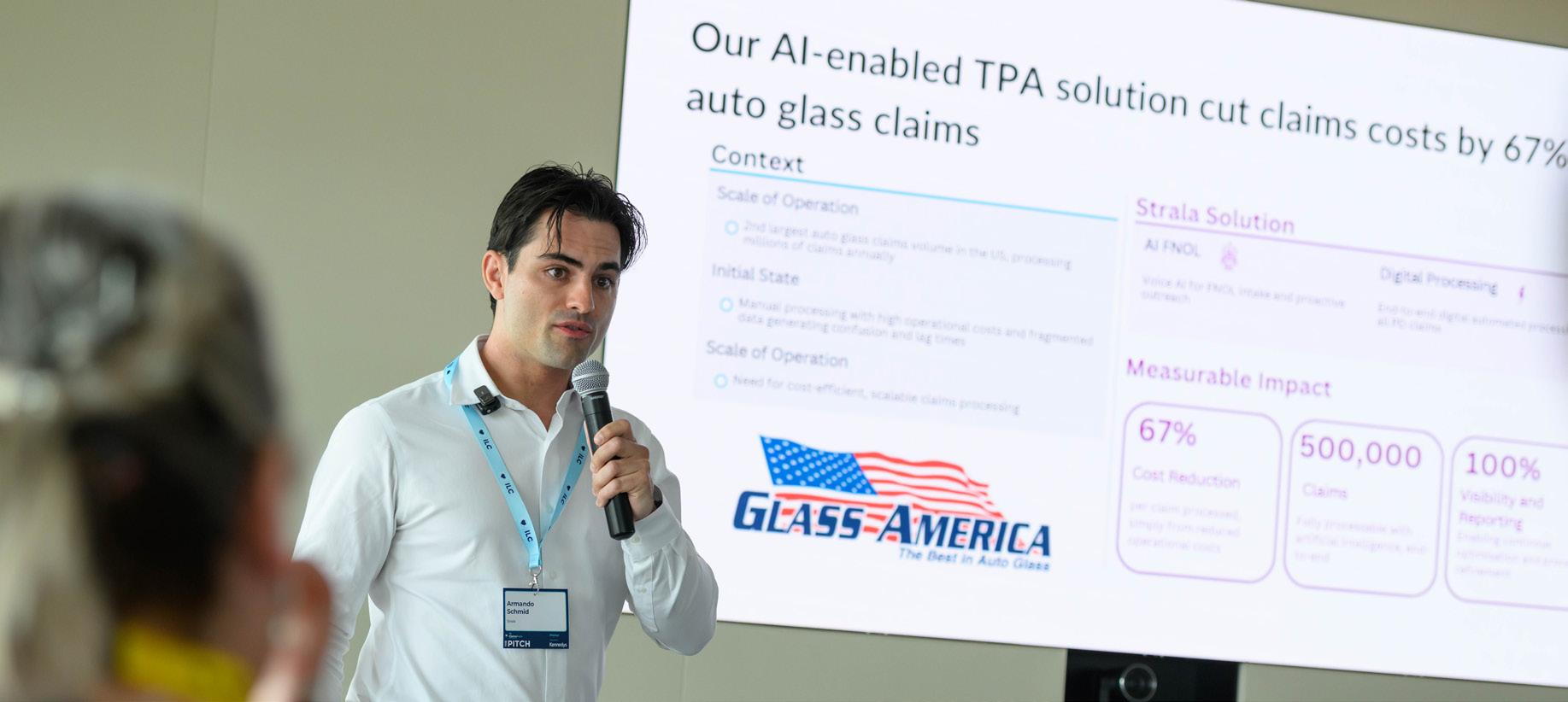
Armando Schmid delivered a bold and compelling pitch, challenging the status quo of third-party administration (TPA) in property and casualty claims.
With a background in AI and deep experience in insurance, Armando introduced Strala as an “AInative TPA” that blends automation with industry expertise to transform the efficiency, quality and scalability of claims handling.
Opening with a simple question – “Who here is happy with their TPA?” – Armando acknowledged a common frustration in the room. He described the traditional TPA experience as slow, manual and fragmented, often reliant on outdated technology and strained by the pressures of an ageing workforce. “Within 15 years, a large portion of today’s adjusters will have retired – and there won’t be enough people to replace them,” he warned.
Automating the mundane, not the meaningful
Strala’s proposition is clear: automate the tedious, repetitive parts of the claims process – such as document chasing, vendor follow-ups and initial information validation – while retaining human control over the complex, high-value stages such as negotiation, estimation and settlement.
Armando explained that Strala offers a modular platform built around each phase of the claims lifecycle, from FNOL to subrogation. But unlike traditional software providers, Strala does not sell tools – it delivers outcomes. The company operates as a full-service TPA, offering insurers a plug-andplay model where AI and human expertise combine to deliver faster resolutions, reduced overheads, and improved visibility.
A platform built by domain experts
Strala’s founding team brings together toptier engineers from elite AI labs (Oxbridge, Ivy League, and more) and seasoned professionals from across the insurance landscape, including claims handlers, fleet specialists, and legal experts. This hybrid DNA ensures that the technology is grounded in real-world understanding.
“We don’t just develop tech for the sake of it,” Armando said. “We understand the workflow – and we change it with purpose.” The company currently works with 26 clients in the US, including captives, fleet insurers and carriers, and is now preparing to enter the UK market.
Delivering
scale where it’s needed most
One of Strala’s earliest clients – Glass America, a US-based auto glass, windscreen replacement or repair business – partnered with Strala to address a growing backlog of claims and customer service breakdowns. Strala’s solution scaled the operation effectively, especially during catastrophe events when volumes spike and traditional TPAs struggle to keep up. “The answer can’t always be more people,” said Armando. “We need scalable solutions – and that’s what our AI-enhanced claims model offers”.
“We don’t just develop tech for the sake of it. We understand the workflow – and we change it with purpose.”
UK expansion and flexible deployment
In response to audience questions, Armando confirmed that Strala’s technology is fully adaptable to different jurisdictions, including the UK. While the core AI logic remains consistent, each deployment is tailored to reflect marketspecific regulations, terminology and integration needs.
Integration has historically been a barrier for innovation in large carriers, and Strala has designed around that. Its “forward deployed” engineers work directly with client systems and teams to handle as much of the integration work as possible –a service model that dramatically reduces go-live timelines.
Strala also supports hybrid deployments, allowing insurers to use selected AI modules within their in-house teams before transitioning to full TPA support. Early-stage partnerships often begin with specific use cases such as FNOL or triage, gradually expanding as trust and results grow.
“The answer can’t always be more people. We need scalable solutions –and that’s what our AI-enhanced claims model offers.”
Built-in expertise for complex claims
Crucially, Strala is not solely a technology company – it also employs its own network of loss adjusters, legal professionals, and medical experts. This allows the business to offer end-toend claims handling, ensuring that AIsupported processes are grounded in professional oversight and regulatory compliance.
This full-service model means that carriers don’t have to “rip and replace” existing approaches – they can access the benefits of AI without needing to manage its implementation or ongoing development internally.
Final thoughts
Strala’s pitch stood out for its honesty, practicality and clarity. Armando avoided hype and focused on delivering measurable results: faster resolutions, greater visibility, and more control over operational performance. With highprofile investors (including Peter Thiel’s Founders Fund) and real-world traction already underway, Strala represents a new generation of tech-enabled service providers who understand the sector’s pain points and are building solutions that meet insurers where they are.
As Armando concluded, “If you’re unhappy with your TPA – talk to us. There’s a better way.”
“If you’re unhappy with your TPA – talk to us. There’s a better way.”
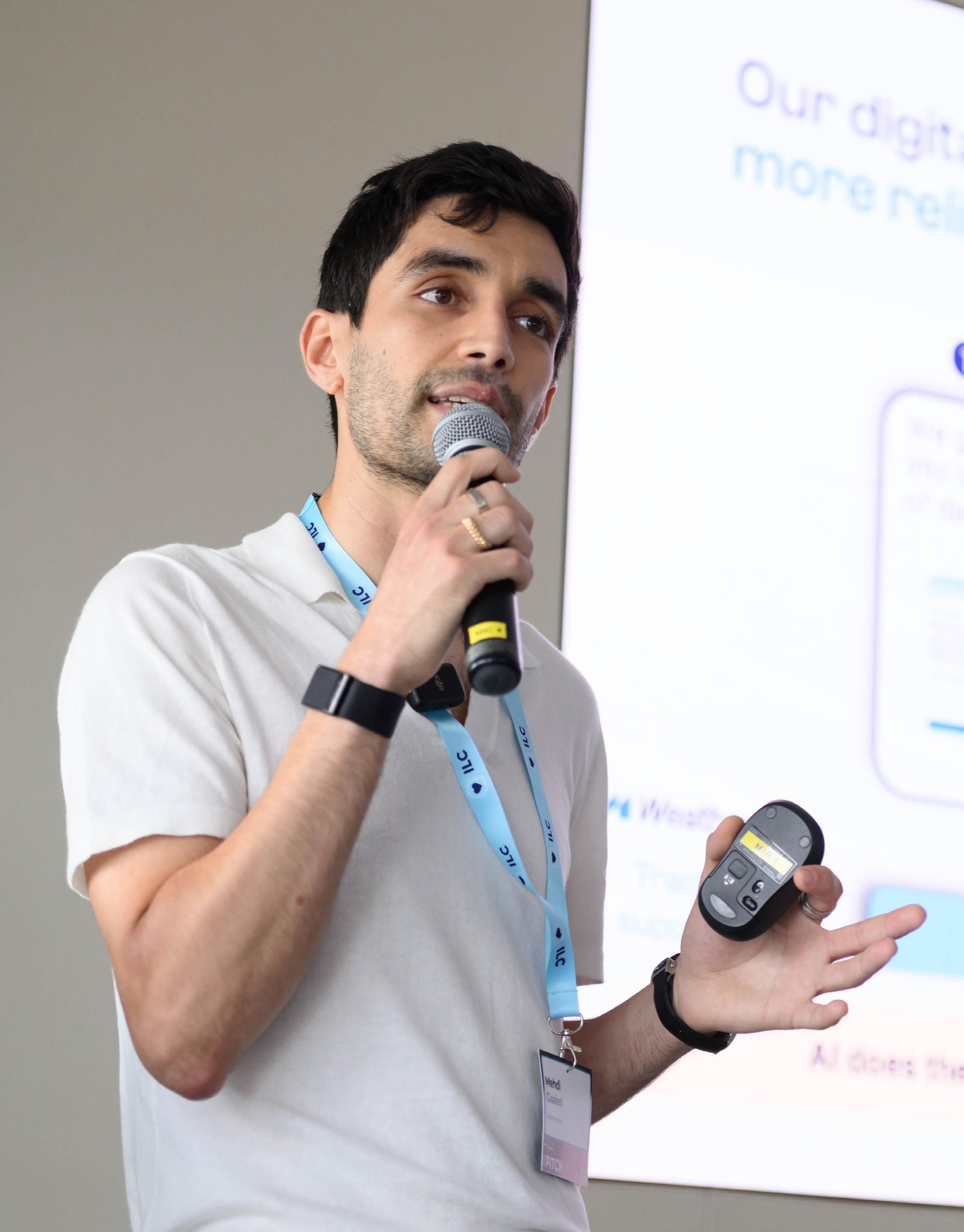
claims with AI-powered triage
Mehdi Gaaied CEO Weathermind
“A human adjuster reviews and validates the AI assessment, generating a settlement report in just 15 minutes – a process that typically takes up to two hours manually.”
Mehdi Gaaied, CEO of Weathermind, delivered a compelling presentation on how AI-driven triage can help insurers address one of the industry’s most pressing operational ‘natural disaster’ challenges: managing the sheer volume and complexity of low-value property claims.
Mehdi opened with a stark statement – “lowvalue claims are breaking the system” – before unpacking the reasons why. He cited high overhead costs, long cycle times, inconsistent pricing, and a disproportionate share of claims being referred unnecessarily to surveyors, adjusters or TPAs. The result: inefficiencies that erode customer satisfaction and inflate combined ratios.
A smarter way to manage claims
Weathermind’s solution is to act as a “smart filter” – rapidly identifying low-risk, transactional claims that can be handled remotely, while escalating complex cases to the insurer’s supply chain for further attention. It’s a hybrid model where AI performs the heavy lifting, and human expertise adds oversight and assurance.
Here’s how it works:
A digital self-service journey prompts the customer to upload photos or videos of the damage.
• Weathermind’s AI agents analyse the visual inputs to identify and classify property and contents damage.
• The system then estimates repair or replacement costs using fair market value, insurer-specific pricing, policy terms, and depreciation logic.
• A human adjuster reviews and validates the AI assessment, generating a settlement report in just 15 minutes – a process that typically takes up to two hours manually.
Real-world application: subsidence triage
To bring the model to life, Mehdi shared a live use case from France, where Weathermind supports one of the country’s largest insurers in managing subsidence claims. Traditionally, subsidence assessments can take up to six months and cost hundreds of euros per case. Weathermind’s AI-first approach has reduced that to three days and €150 – filtering out the 66% of claims that typically do not result in a payout. This allows expert resources to be redirected to genuine, high-priority cases.
Built for scale and future expansion
Weathermind is currently operational in France, working with several insurers on property claims including subsidence, escape of water and flood. The team includes AI engineers, insurance specialists and the former head of remote loss adjustment at a leading European TPA – ensuring both technical depth and sector experience.
Asked about expansion into the UK, Mehdi confirmed that conversations are already underway and that the platform has received strong interest. The roadmap includes support for fulfilment as well as cash settlement, which is currently the focus. Mehdi stressed the importance of providing the same quality of experience across both settlement types – a priority for future iterations.
Driving trust through transparency
Weathermind has also prioritised fraud prevention and customer satisfaction. By restricting uploads to live-taken media, and using geolocation and timestamping, the platform ensures inputs are authentic. Its AI agents assess whether the visual evidence supports the claim narrative, flagging discrepancies in real time.
In terms of customer experience, Mehdi shared that response times and clarity of communication are key drivers of satisfaction – particularly in repudiated claims. Weathermind’s system provides detailed reports explaining decisions, and offers customers the option to speak directly to a claims handler if further support is needed.
Accuracy and performance
On accuracy, Weathermind’s AI achieves 85–90% reliability in identifying root causes and calculating costs – depending on claim type and input quality. To improve consistency, users are provided with guidance on capturing effective videos and photos. Mehdi also noted a 1.75 out of 2 satisfaction score (on a proprietary rubric) for Weathermind’s explanation reports – indicating strong customer understanding and acceptance of outcomes.
Final thoughts
Weathermind’s pitch brought ClaimsTech – The Pitch 2025 to a close with a clear message: the industry cannot afford to continue processing low-value claims with high-cost methods. By combining AI triage with human validation, Weathermind offers a scalable way to deliver faster, cheaper and more consistent outcomes – all while improving customer transparency and control.
As insurers face rising frequency and severity from climate-related events, solutions like Weathermind offer a timely opportunity to create the “elasticity” needed to respond at scale – without sacrificing accuracy or empathy. A strong end to a day full of innovation.
“Weathermind’s AI-first approach has reduced that to three days and €150 – filtering out the 66% of claims that typically do not result in a payout.”
“By restricting uploads to livetaken media, and using geolocation and timestamping, the platform ensures inputs are authentic.”
“The industry cannot afford to continue processing low-value claims with high-cost methods.”
Symphony crowned winner
In a hotly contested field of cuttingedge insurance claims innovation, Symphony emerged as the overall winner of ClaimsTech - The Pitch 2025.
Symphony’s pitch – spotlighting its voice AI roleplay simulation technology – wowed the expert panel with its innovative approach, ultimately earning top honours and a business development prize package worth circa £40,000. The prize, which includes contributions from ILC, Finpro, Insurtech UK and Kennedys, will help accelerate growth and further Symphony’s mission to transform the claims experience through technology.
Murtaza Ali, Co-Founder & CEO of Symphony, shared his excitement immediately post-winning: “That’s amazing. We’re so honoured and excited to have won ILC’s ClaimsTech – The Pitch 2025! Thank you to all the experts in the audience for the interest and support in technology we truly believe can have a significant positive impact on claims.”
Reflecting on the strength of this year’s competition, Jonathon Valentine, ClaimsTech Lead at ILC and CTO at ThingCo commented: “This year’s ClaimsTech – The Pitch was nothing short of exceptional. The level of entries and the strength of innovation on display was truly worldclass. We’ve seen solutions that have the potential to redefine the future of claims, and Symphony stood out for their vision, execution, and potential for real industry impact.”
Now recognised alongside previous winners such as Enviro Trees and Shift Technology, Symphony joins a growing list of startups making waves in the claims sector through ClaimsTech’s vibrant platform.
Murtaza Ali Co-founder & CEO
Symphony
SHOWCASE Solera Audatex
– driving sustainability through smarter claims data
Marco Iriarte Senior Director of Operations
Solera Audatex
“The core concept of Sustainable Estimating is simple but powerful: by overlaying emissions algorithms on top of existing claims data, insurers and repairers can view the estimated greenhouse gas (GHG) emissions associated with each job.”
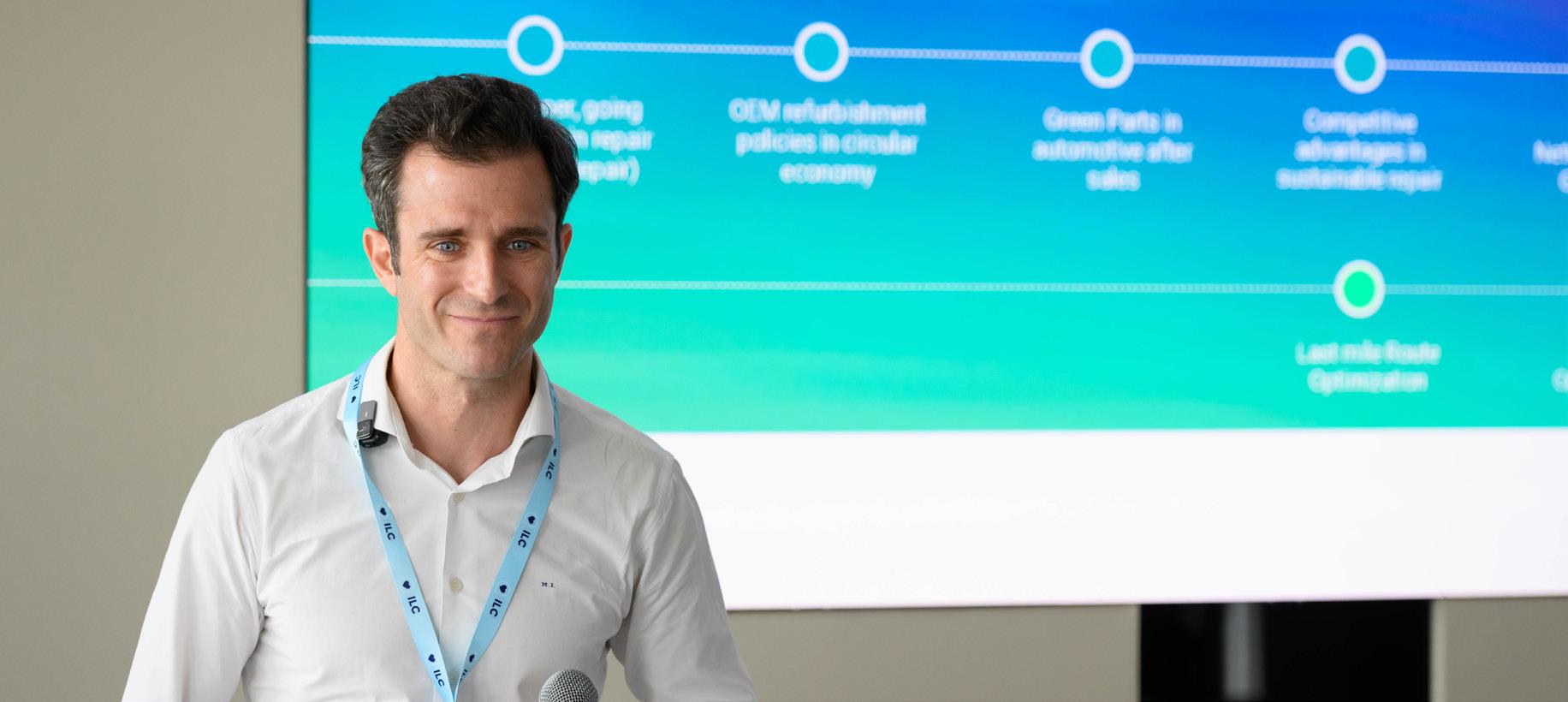
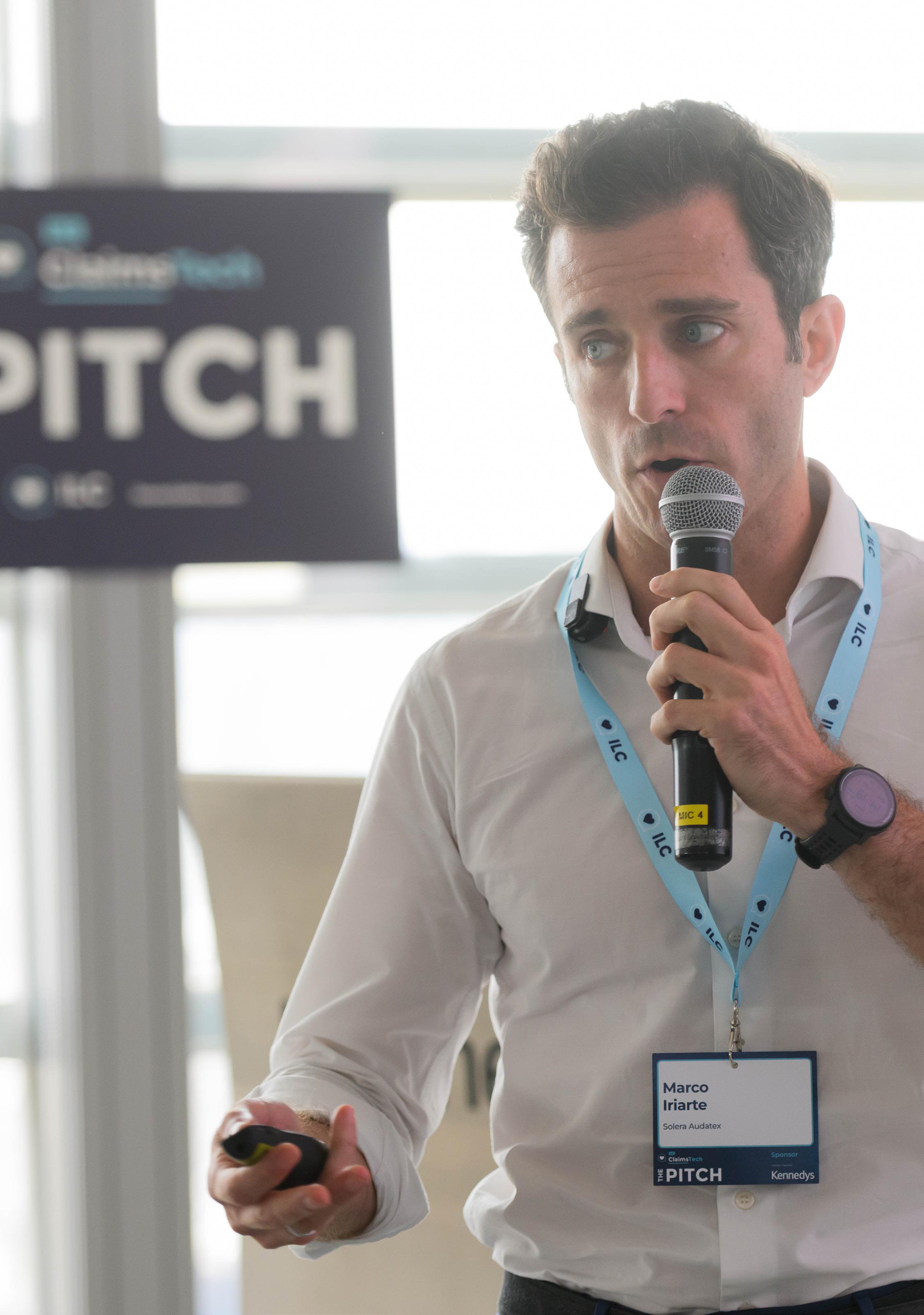
In a thought-provoking showcase session, Marco Iriarte Somolinos, Senior Director of Operations at Solera Audatex, lifted the lid on how the organisation is leveraging its data and technology to bring sustainability to the heart of the insurance claims process.
Opening with a nod to the startup energy in the room, Marco reminded the audience that although Solera is a large global business, innovation remains central to its operations. Over the past four years, Solera has invested heavily in building a framework known as Sustainable Estimating – a data-powered solution that translates vehicle repair estimates into carbon footprint insights using standardised emissions protocols.
Solera’s role in the mobility ecosystem
Positioned as a backbone in the global mobility and risk ecosystem, Solera manages around 60% of the world’s motor claims and works with more than 200 OEMs. With over five petabytes of data – and deep integrations into insurers, repairers, and supply chain systems – the company is uniquely placed to measure the environmental impact of vehicle repairs at scale.
The core concept of Sustainable Estimating is simple but powerful: by overlaying emissions algorithms on top of existing claims data, insurers and repairers can view the estimated greenhouse gas (GHG) emissions associated with each job. This includes Scope 3 emissions – such as the manufacture, transport and use of parts and paint – which are increasingly in focus for ESG reporting.
A trusted, certified methodology
Marco shared that Solera has achieved ISO 14064 certification – an international standard for quantifying and reporting GHG emissions. This validation ensures that the carbon data delivered to clients is both robust and auditable, helping insurers and bodyshops avoid accusations of “greenwashing” and instead build a narrative rooted in measurable, verifiable performance. The methodology follows recognised industry protocols and leverages peerreviewed emissions calculation frameworks to ensure consistency and credibility.
Importantly, he clarified that this initiative isn’t about guilt or climate anxiety. Rather, it’s a practical step toward creating efficiencies, improving combined ratios, and building more sustainable operating models.
Use cases and measurable impact
The platform already supports more than 40 million processed claims across 17 countries, with several Tier 1 insurers and multi-service organisations actively using the solution. It connects real-time claim information – such as VINs, part types, geography, and OEM data –with emissions databases to generate actionable insights.
Marco outlined specific applications:
• Repair Vs replace decisions: By analysing CO₂ output alongside cost and time, insurers can make greener repair choices.
• Preferred repairer steering: CO₂ emissions can be factored into volume allocation strategies, supporting a more sustainable network model.
• Green part selection: Carbon savings can be calculated when using recycled or remanufactured parts.
• Paint processes: With paint-related operations comprising 80% of claim emissions, Solera’s integration with paint manufacturers enables precise tracking of volatile organic compounds (VOCs) and emissions per litre used.
• Underwriting integration: Incorporating emissions metrics into risk pricing models and developing sustainabilitylinked insurance products
A dashboard built for action
To make insights accessible, Solera has created its own proprietary sustainability dashboard. Unlike generic platforms such as Tableau or Power BI, the tool is purposebuilt for the claims ecosystem, allowing users to segment data by geography, bodyshop, OEM, part type and more.
This visibility allows insurers and repairers to build custom reports, spot inefficiencies, and make targeted improvements across their operations. Marco referred to the dashboard as “the anchor point” – a foundation from which real change can begin.
A sector-wide opportunity
Marco concluded with a rallying call for collaboration. He urged the industry not to delay action for fear of imperfection, but to find the right partners and start measuring now. “Don’t take it personally – it’s not about feeling guilty,” he said. “It’s about starting to move and gaining traction.” Early adopters are already gaining a competitive edge in procurement tenders, strengthening investor confidence, and positioning their networks as sustainability leaders
Solera’s efforts already extend into wider sustainability initiatives, including participation in the European Union’s circular economy platform and a longterm partnership with the four largest paint manufacturers. The company now processes 100% of P&C claims in Denmark through a sustainability lens, and similar progress is being made across the UK and Europe.
Final thoughts
Solera’s session offered a clear and compelling example of how big data can drive real-world sustainability – not through abstract strategy, but by embedding carbon insight directly into existing workflows.
With regulatory, investor, and customer pressure on the rise, Solera’s Sustainable Estimating platform provides a timely and practical tool for claims professionals looking to align operational performance with environmental responsibility.
As ILC’s Jonathon Valentine noted in closing, “The ESG slide has become one of the most important in any investor deck. It’s great to see solutions like this bringing it to life in a meaningful way.”
“The tool is purposebuilt for the claims ecosystem, allowing users to segment data by geography, bodyshop, OEM, part type and more.”
“Don’t take it personally – it’s not about feeling guilty. It’s about starting to move and gaining traction.”
Entegral – data-driven decisions and the future of repair logistics
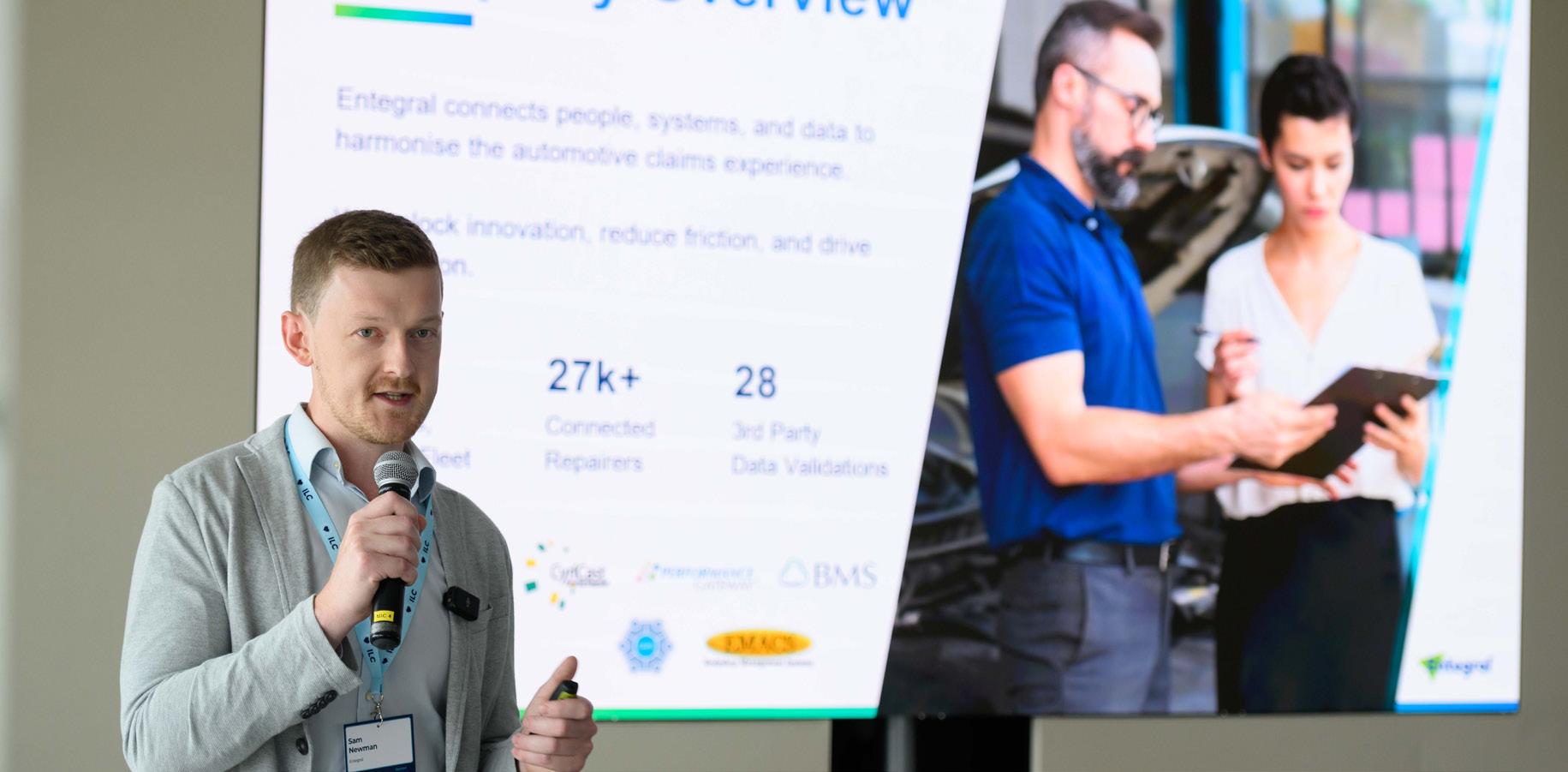
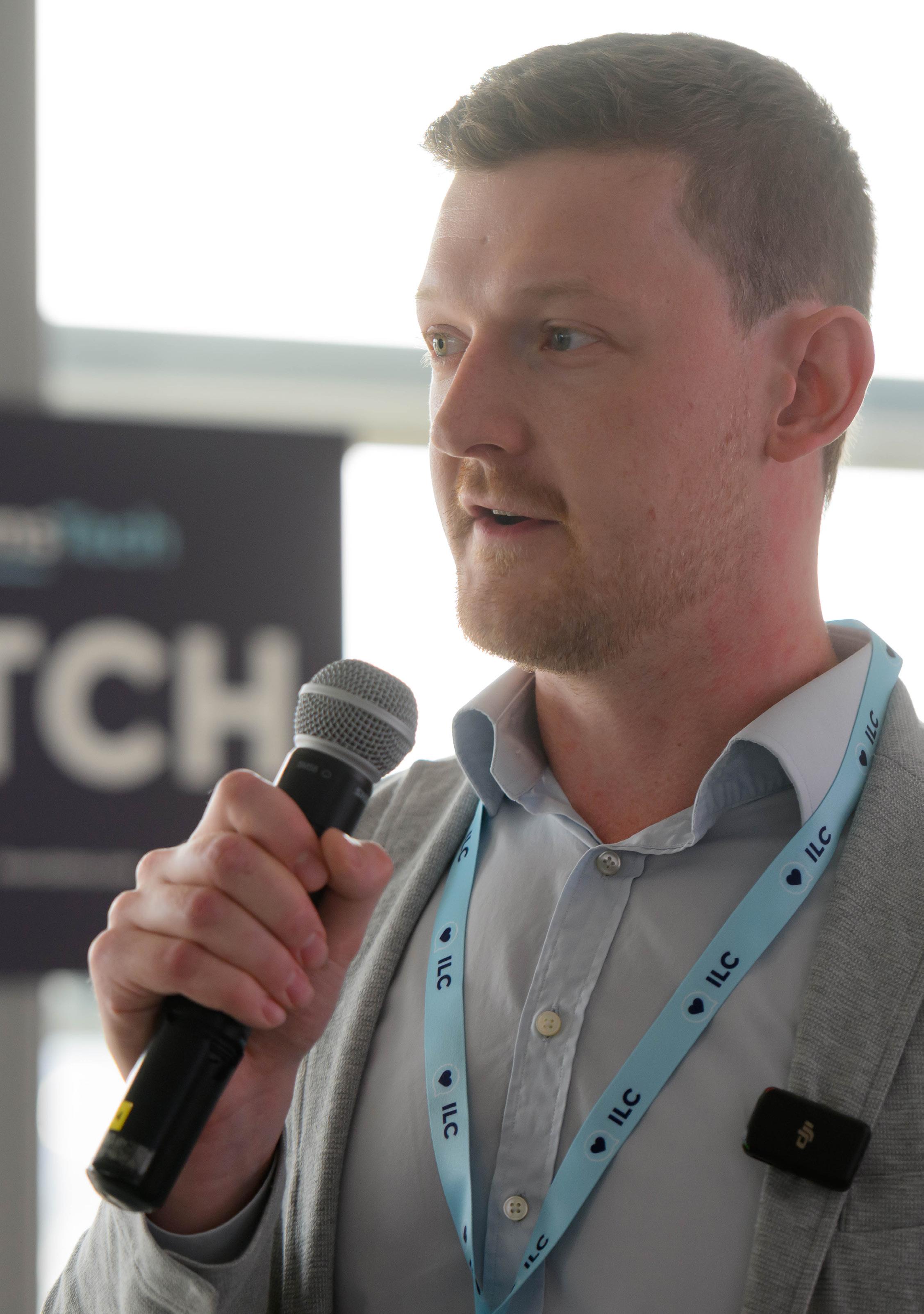
Sam Newman Sales & Business Development Director Entegral
Sam Newman, Sales & Business Development
Director at Entegral, delivered an insightrich session, offering a rare window into both consumer behaviour trends and the evolving technological infrastructure behind insurance repair workflows.
Wholly owned by Enterprise Mobility, a global mobility solutions provider, Entegral began life as an in-house solution, built to support Enterprise’s need to repair a 2.4 million-strong global vehicle fleet. But it quickly became clear the platform’s capabilities could also support insurers, who were also seeking smarter ways to manage claims workflows, allocate repairs, and track capability across their networks.
From internal platform to industry solution
Today, Entegral connects over 70 insurers, fleet companies and car manufacturers with profiles on 27,000 repairers worldwide. The platform’s mission is to harmonise claims journeys, streamline decision-making, and drive automation – all from claim intake to repair completion.
Sam explained how Entegral now serves as a central data hub, providing integrations with all major UK repair management systems through its CAPS product. This enables seamless two-way data exchange, allowing insurers to gather, process and act on claims data without additional admin or friction.
Insights from the front line
In a compelling data segment, Sam shared trends observed across Entegral’s ecosystem. Key takeaways included:
• Drop in claims volumes: Monthly UK repairs have declined from around 110,000 in early 2024 to just above 100,000 today, driven by higher excesses and reduced claim frequency.
• Shifting severity: While non-drivable claims increased in late 2024, 2025 has seen a return to more minor incidents –suggesting a rebound in low-impact collisions.
• Cycle times: Key-to-key times have begun to fall again after peaking over the winter months, offering hope of greater repair efficiency.
• EV complexity: One EV brand’s repairs take four days longer on average than other brands, with significantly higher parts costs and lower non-drivable rates – influenced, Sam noted, by the fact that many are operated as fleet or salary sacrifice vehicles.
“One EV brand’s repairs take four days longer on average than other brands, with significantly higher parts costs and lower non-drivable rates.”
A smarter, more personalised repair journey
Sam walked the audience through Entegral’s latest technology developments. Smart Assist enables insurers to collect information at first notification of loss (FNOL), to help determine the severity and characteristics of the damage, and route the claim to the most appropriate supplier – whether a certified EV repairer, a mobile technician, or a smart repair centre.
Once allocated, work is managed through connected systems, with full visibility for all stakeholders and proactive communication pushed to customers via SMS, email or appbased notifications. The platform’s self-service capabilities also allow customers to choose their own repairer based on logic set by the insurer, upload images, and track progress in real time.
Connecting the wider ecosystem
While much of Entegral’s growth has centred around repair, the business is now focused on broadening connectivity across the entire claims value chain. Sam pointed to several areas ripe for digital transformation:
• Recovery agents: Still often managed by phone and email, these services can now be integrated via API for faster coordination.
• Green parts: Greater insurer interest in sustainability is driving demand for real-time access to recycled parts inventories.
• Salvage partners: Vehicle status and disposal updates are being brought directly into claims platforms for improved visibility.
By creating a single API gateway, Entegral is helping insurers remove legacy friction and join up the disconnected stages of the claims lifecycle – enabling smarter decisions and faster customer outcomes.
Final reflections
Sam’s session was both technically detailed and strategically insightful – providing ClaimsTech attendees with a clear picture of how claims data can be turned into real-world value when properly connected and operationalised.
His closing message was simple: connectivity is no longer a “nice to have” – it’s a commercial and customer imperative. And as Entegral continues to scale its reach beyond repair, the potential for faster, smarter and more sustainable claims processes is only growing.
“Smart Assist enables insurers to collect information at first notification of loss (FNOL) to help determine the severity and characteristics of the damage, and route the claim to the most appropriate supplier.”
“Connectivity is no longer a ‘nice to have’ – it’s a commercial and customer imperative.”
Anna Bojic CEO & Co-Founder Miss Moneypenny Technologies
Armando Schmid CTO Strala Group
Paul Brotzel Global Chief Information Officer Kennedys
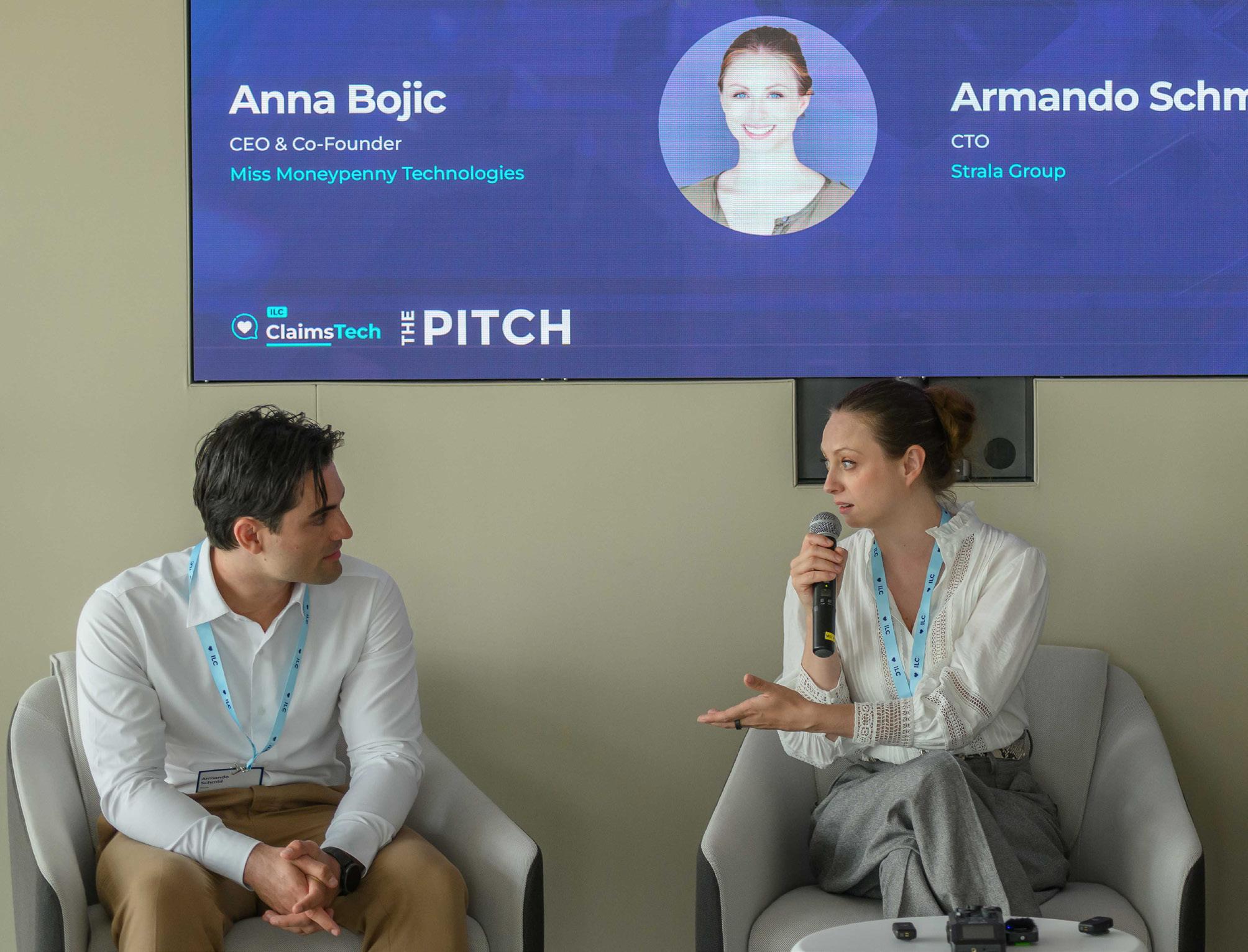
Hosted by ILC’s Jonathon Valentine, the panel featured Paul Brotzel, Global Chief Information Officer at Kennedys; Anna Bojic, CEO and Co-Founder of Miss Moneypenny Technologies; and Armando Schmid, Co-Founder and CTO of Strala.
The panel’s theme: ‘Insurer: ally or adversary?’provided the perfect lens through which to examine the nuanced relationship between start-ups and the established insurance world. What followed was a refreshingly honest, often humorous, and consistently insightful conversation.
Breaking into insurance: a tough but rewarding journey
Both Anna and Armando admitted to entering the sector almost by accident – Anna from a background in fine arts and cultural studies, and Armando from AI research. What kept them here, they said, was the industry’s depth, complexity, and potential for impact. But they also acknowledged the significant barriers to entry – from regulatory requirements and procurement delays to risk aversion and legacy systems.
“Insurance companies want to work with you,” said Anna, “but sometimes their systems simply don’t allow it. We had to build a tech-free launcher just to get one pilot off the ground”.
Legacy tech and the innovation challenge
Paul, drawing on his decades of experience across insurance, broking and now law, spoke candidly about the realities of legacy tech. “In a previous role, we had 176 policy systems globally. Try doing a policy migration once – you’ll never want to do it again,” he joked.
But he stressed that meaningful innovation doesn’t necessarily come from building flashy tools. “It’s about doing things more efficiently and delivering real value. Law and insurance both need to stop focusing internally and start thinking more about what their clients actually need”.
He also praised the move towards componentbased, microservices architecture, highlighting it as a shift that allows for more agile and collaborative approaches across the sector.
“In a previous role, we had 176 policy systems globally. Try doing a policy migration once –you’ll never want to do it again.”
Paul Brotzel
“Insurance companies want to work with you, but sometimes their systems simply don’t allow it. We had to build a tech-free launcher just to get one pilot off the ground.”
Anna Bojic
The startup struggle: urgency vs patience
Jonathon raised a key issue for tech founders: balancing the patience required to navigate insurer decision-making with the urgency of start-up burn rates. Armando explained how Strala initially targeted smaller, more agile captives and MGAs to build traction, while Anna credited their early success to clients willing to vouch for them publicly – “something you just don’t see in automotive or telecoms”.
Both agreed that trust and openness were critical. “This industry is incredibly supportive – once you’re in,” said Anna. “Clients will go out of their way to help you succeed because they want you to stick around”.
“This industry is incredibly supportive – once you’re in. Clients will go out of their way to help you succeed because they want you to stick around.”
Anna Bojic
“Claims and underwriting don’t always talk. That lack of alignment makes it harder for startups to meet the right metrics or create measurable value.”
Armando Schmid
What needs to change?
When asked what one thing they would change about the insurance mindset, Anna didn’t hesitate: “Stop trying to build everything yourself. It’s a very insurance thing –sending people to innovation events, then going home and trying to replicate what they saw. Instead, find the right partner, customise together, and go faster”.
Paul echoed the sentiment, reflecting on the need to stop viewing core systems as differentiators. “It’s not the platform that makes you special, it’s what you do with it. The content and the service – that’s where the value lies”.
Armando added that internal collaboration within insurers still poses a barrier: “Claims and underwriting don’t always talk. That lack of alignment makes it harder for start-ups to meet the right metrics or create measurable value”.
Final thoughts: from theory to impact
The session closed with reflections on open insurance and whether the industry could benefit from more standardisation – akin to open banking. Paul was optimistic but realistic: “Would it help? Yes. Will it happen soon? Probably not – insurers are still too fragmented, and the capital structures too complex”.
As Jonathon thanked the panel, he summed up the conversation: “Trust, collaboration, and a shift in mindset –that’s what will drive the next generation of change in this industry.”
The discussion was a fitting conclusion to a day packed with innovation – and a reminder that, while technology continues to push boundaries, progress will depend as much on people, culture and shared ambition as it does on code.
WHAT WAS SAID
“Really impressed with this year’s finalists and the format used on the day. Event venue and guests resulted in great networking.”
“Strong pitches. Engaging content in an excellent location with a good spread of attendees across the insurance sector.”
“Great concept, and fantastic opportunities for a range of start-ups across the claims industry, to not only network, but to gain exposure in a smaller setting.”
“The balance between pitches and time to mix with peers was ideal.”