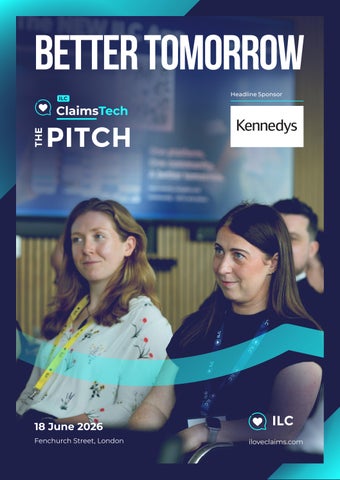
Better Tomorrow Headline Sponsor
ClaimsTech
18 June 2026 Fenchurch Street, London
ILC iloveclaims.com
ClaimsTech Headline Partner
Corporate Partners
Event Sponsor
Associate Partners
Previous winners 2023
2024
ILC 2
iloveclaims.com
2025
ClaimsTech
ILC DISCLAIMER
COPYRIGHT
Contributors
All rights reserved. No part of the material contained within this publication may be reproduced or copied in any form or by any means without written permission from ILC.
The views and opinions expressed within Better Tomorrow are reported from live events and are those of the individual contributor/s. They do not necessarily reflect the official policy or position of the contributor’s employer, organisation, committee or other group or individual. ILC While every effort has been made to ensure the accuracy of information, ILC will not accept responsibility for errors or omissions or for consequences arising from reliance on information published. The opinions expressed in Better Tomorrow are not necessarily the opinions of, or endorsed by ILC unless otherwise stated.
3
BETTER TOMORROW
THE PITCH 2026
Contents 6
30
A new chapter for ClaimsTech – The Pitch
Veridox reimagines the first line of defence against insurance fraud
Jonathon Valentine
10 Fixzy AI demonstrates a new approach to property claims Paul Greaves
14 FraudOps targets investigation efficiency Amar Galla
20 Nolana presents agentic AI platform Ty Zamkow
24 SwiftCase demonstrates AIdriven claims support Adam Sykes
4
Dan Sandler
34 PANEL
Building trust through technology Mitch Anderson, Peter Dubiez and George Robbins
40 WINNER
ClaimsTech – The Pitch 2026 Veridox
42 ClaimsTech – The Pitch 2026 Feedback
43 The ILC App Your events, insights and community – all in one place.
5
BETTER TOMORROW
THE PITCH 2026
A new chapter for ClaimsTech – The Pitch When ClaimsTech – The Pitch was first launched, the ambition was straightforward: to provide the insurance claims industry with a platform to discover emerging technology businesses that could genuinely help solve real operational challenges.
Jonathon Valentine ClaimsTech Sector Lead ILC CTO ThingCo
ILC
Each year, that ambition has remained unchanged. What has changed is the pace at which technology is evolving. Artificial intelligence has dominated headlines over the past 12 months, but for those working in insurance claims the conversation has moved well beyond possibility. Increasingly, the focus is no longer on what AI might achieve one day, but on how organisations are beginning to deploy it responsibly within live claims operations. Across the industry, insurers, suppliers and technology providers are exploring how AI can improve efficiency, enhance customer service and support better decision-making, while recognising that governance, transparency and human oversight remain fundamental. Those themes were evident throughout this year’s ClaimsTech – The Pitch. The 2026 competition proved to be the strongest in the event’s history. The volume and quality of applications received meant that, for the first time, the programme introduced a semi-final stage before the live final.
6
That additional round enabled the judging panel to assess a wider range of businesses while ensuring that the finalists presenting in London represented some of the most exciting technology businesses currently developing solutions for the insurance claims sector. Reaching the final was therefore a significant achievement in itself. The five finalists – Fixzy AI, FraudOps, Nolana, Swiftcase and Veridox – approached very different challenges across the claims journey. Collectively, however, they reflected many of the issues currently facing insurers and claims professionals: improving operational efficiency, supporting fraud investigations, reducing administrative workloads, strengthening governance and finding practical ways to integrate AI into existing claims environments. Although each business presented a different proposition, several common themes emerged during the day. Perhaps most notably, every finalist emphasised that AI should support experienced claims professionals rather than replace them. Whether focused on fraud detection, claims automation, property assessment or workflow management, the technologies demonstrated throughout the competition consistently retained the principle of a ‘human in the loop’. As AI capabilities continue to develop, that balance between automation and professional judgement is becoming increasingly important for insurers seeking to introduce new technologies responsibly.
A NEW CHAPTER FOR CLAIMSTECH – THE PITCH
The wider AI landscape also continues to evolve at remarkable speed. Only a short time ago, AI agents capable of managing end-to-end processes were largely theoretical. Today, organisations are beginning to deploy specialist AI agents across multiple operational tasks, often working together to support complex workflows. At the same time, insurers must also navigate new challenges surrounding governance, regulation, model transparency and data security. Those developments reinforce why events such as ClaimsTech – The Pitch matter. Technology innovation should never be considered in isolation. Understanding how solutions operate, how they integrate with existing claims processes and how organisations maintain appropriate oversight is equally important. The opportunity to see products demonstrated, question founders directly and hear how businesses are approaching real operational challenges remains one of the defining strengths of the event. That spirit of collaboration continues to underpin the ClaimsTech community.
ClaimsTech – The Pitch really is an opportunity for insurers, technology providers, legal specialists, investors and industry partners to come together, share ideas and explore how innovation can support better outcomes across the claims sector. The event would not be possible without the continued support of its partners. Thanks go to headline sponsor Kennedys for once again hosting the final in London, together with Corporate Partners Solera Audatex and Verisk. ILC is also grateful for the support provided by sponsors HLBS, Shift and Unitary, alongside Associate Partners FinPro, InsurLab Germany and InsurTech UK, all of whom continue to play an important role in supporting innovation across the insurance claims community. A particular thank you must also go to the judging panel. More than 25 senior insurer representatives gave their time and expertise to assess this year’s finalists, asking searching questions and carefully evaluating each presentation. Their knowledge and engagement are central to maintaining the credibility and integrity of the competition. 7
BETTER TOMORROW
THE PITCH 2026
This publication captures the key discussions, demonstrations and ideas presented throughout the day. Rather than simply reporting who won, it reflects the wider themes that emerged across each presentation and provides an overview of how different technology providers are seeking to address some of the industry’s most pressing challenges. Congratulations go to every business that entered this year’s competition and, in particular, to our five finalists. Making the final in such a competitive field was a significant achievement, reflecting both the strength of the technologies showcased and the continued growth of innovation across the insurance claims sector. Finally, congratulations to Veridox, whose presentation impressed the judging panel to secure the title of ClaimsTech – The Pitch 2026 winner. The standard throughout the competition was exceptionally high, and the close nature of the judging reflected the quality of every finalist. If this year’s event demonstrated anything, it is that innovation within insurance claims continues to accelerate and is exactly why the ClaimsTech community continues to grow in both scale and significance each year.
JV
8
A NEW CHAPTER FOR CLAIMSTECH – THE PITCH
BETTER TOMORROW 9
BETTER TOMORROW
THE PITCH 2026
Fixzy AI demonstrates a new approach to property claims Digital property assessment and AI-assisted scoping formed the focus of Fixzy AI’s presentation where Paul Greaves, CEO of Fixzy AI, demonstrated how the company’s platform has been developed to support property claims by combining mobile surveying, artificial intelligence and workflow automation. Paul Greaves CEO Fixzy AI
Opening the live demonstration, Paul explained that the platform enables users to capture structured property information through a mobile application before making the same data immediately available through a desktop environment. According to Paul, this creates a single source of truth from the first property inspection, allowing surveyors, contractors, claims professionals and office based teams to work from the same information in real time while reducing delays between site visits, claim assessment and repair decisions.
Inspection Using a live video demonstration of a property scan, Paul showed how users can capture individual rooms or multiple damaged areas during a single inspection. He explained
10
that the application creates a digital model of the property, automatically generating accurate 3D and 2D floor plans, recording room dimensions and the precise location of damage before producing detailed repair scopes. According to Paul, these digital property records provide consistent measurements that can be reused throughout estimating, reporting and repair planning, helping reduce the risk of inaccurate measurements and over scoping while creating a reliable digital record of the property’s condition. According to Paul, users identify damaged areas through a simple point and select process, with the platform calculating measurements automatically and creating a structured digital record of each affected location. He suggested this approach helps improve consistency between inspections while enabling the same information to be shared immediately across the wider claims process rather than being recreated at multiple stages.
Human oversight Throughout the presentation, Paul described the technology as a tool designed to support rather than replace experienced claims
FIXZY AI DEMONSTRATES A NEW APPROACH TO PROPERTY CLAIMS
professionals. Once information has been captured on site, he explained that AI generates an initial scope of works before the output is reviewed by a member of the claims team. Human oversight remained a consistent theme during the demonstration. Paul said every AI generated scope is subject to review before progressing further, with amendments made by users feeding back into the platform’s learning process. According to Paul, this enables the technology to improve over time while ensuring that final technical decisions continue to rest with experienced professionals. Discussing the development of the platform, Paul explained that Fixzy AI has been trained using millions of property damage images and datasets annotated by experienced tradespeople and surveyors, combining practical repair expertise with artificial intelligence to help the platform understand not only what damage looks like, but how it should be assessed and repaired.
Collaboration Paul also highlighted the company’s ongoing collaboration with the University of Edinburgh, where academic research is combined with practical property repair expertise to support the continued development of the platform’s computer vision and AI capabilities. According to Paul, exposing researchers and developers to real world claims scenarios has helped shape technology designed specifically for the complexities of property claims rather than generic image recognition. The demonstration also explored how AI is being applied to assessment reporting. Paul explained that policy documentation can be combined with property data captured during the survey, allowing the platform to begin producing elements of the assessment automatically. Where information cannot be determined through AI alone, he demonstrated how users can supplement reports using voice input, enabling descriptions to be dictated while prompting users to complete any remaining information required. According to Paul, this functionality has been developed to reduce the amount of time claims professionals spend preparing documentation following site inspections. Reflecting on discussions
with insurers, contractors and loss adjusters, he explained that administrative report writing had become one of the principal areas the business wanted to address through automation, enabling experienced professionals to spend more time applying technical judgement rather than completing repetitive administrative tasks.
Workflow Rather than describing the technology simply as an AI solution, Paul positioned the platform as a connected digital workflow designed to replace a range of traditional manual processes. During the demonstration, he highlighted the removal of tape measures, handwritten notes and multiple disconnected systems, arguing that structured property information can instead be captured once and reused throughout estimating, reporting, validation and repair planning. According to Paul, this approach improves consistency while reducing duplication throughout the property claims journey. The presentation also explored how the technology could support insurers during periods of increased claims volumes while helping address the industry’s growing shortage of experienced property claims professionals. Paul explained that structured digital property information and AI-assisted workflows enable less experienced personnel to capture high quality evidence in the field while experienced surveyors and loss adjusters remain focused on reviewing assessments, applying professional judgement and progressing claims more efficiently. According to Paul, some organisations are already using customer service representatives to capture property information during surge events, while experienced claims professionals remain office based to review assessments and progress claims. He suggested this enables specialist expertise to be focused where it delivers the greatest value while maintaining consistency across larger volumes of claims.
Thermal imaging The demonstration also highlighted the integration of thermal imaging technology. Paul explained that the platform can incorporate information captured using thermal imaging cameras to identify 11
BETTER TOMORROW
THE PITCH 2026
damage that may not be visible during a visual inspection, including moisture hidden behind walls, floors or tiled surfaces. According to Paul, combining thermal imaging with structured digital property surveys enables insurers to build a more complete picture of the damage before determining the most appropriate repair strategy. He suggested this information can support earlier decisions around whether a property should be directed towards restoration or repair, helping improve both efficiency and customer outcomes. Paul explained that the platform also includes remote assistance capabilities designed for lower value, higher volume claims. According to Paul, policyholders can be guided through a simplified scanning process using their own mobile devices, allowing insurers to gather structured property information without requiring an immediate site visit.
Digitally enabled Concluding the presentation, Paul described the platform as part of a wider move towards digitally enabled property claims, combining mobile surveying, AI assisted assessment, accurate digital measurement, intelligent workflow automation and expert human oversight into a single connected process. Rather than simply automating existing tasks, he suggested the industry’s future lies in capturing better property information at the first opportunity, creating a structured digital record that can be shared instantly across the claims lifecycle and enabling faster, more consistent decisions while ensuring experienced professionals remain central to every important judgement.
12
FIXZY AI DEMONSTRATES A NEW APPROACH TO PROPERTY CLAIMS
BETTER TOMORROW 13
BETTER TOMORROW
THE PITCH 2026
FraudOps targets investigation efficiency The operational challenges that follow fraud detection took centre stage during FraudOps’ presentation, where Amar Galla, Founder of FraudOps, argued that while insurers have invested heavily in identifying potentially fraudulent claims, many investigation teams continue to face significant manual workloads once referrals are received. Amar Galla Founder FraudOps
Opening the session, Amar suggested that fraud detection technology has matured considerably over the past decade, with increasingly sophisticated systems capable of identifying suspicious claims and generating large volumes of alerts. However, he argued that the investigation process that follows has not evolved at the same pace, creating operational bottlenecks for counter fraud teams. According to Amar, investigators often continue to rely on multiple disconnected systems, spreadsheets, emails and manual processes to gather evidence, manage investigations and monitor case progression. He suggested that this fragmented approach limits operational visibility, increases administration and reduces the amount of time experienced investigators can spend applying their expertise to individual cases.
Support Against that backdrop, Amar introduced FraudOps as a platform designed to support investigators after a fraud referral has been made. Rather than focusing on fraud detection itself, he explained that the technology has been developed to automate much of the administrative work associated with investigations while leaving investigative decisions firmly in the hands of experienced professionals.
14
FRAUDOPS TARGETS INVESTIGATION EFFICIENCY
According to Amar, the platform connects to multiple internal and external data sources, automatically gathering information that investigators would otherwise need to retrieve manually from a variety of systems. He said this includes running searches, collecting supporting intelligence and monitoring connected data sources for new information that may become relevant during the course of an investigation.
Connected Rather than requiring investigators to repeatedly revisit multiple databases, Amar explained that the platform continues monitoring connected information sources and alerts users when new intelligence becomes available. He suggested this enables investigators to work with more up-to-date information without increasing their administrative workload. A central element of the demonstration focused on operational efficiency. Amar said FraudOps incorporates a dedicated case management system designed specifically for fraud investigation workflows, allowing referrals, evidence and investigative activity to be managed within a single environment rather than across multiple applications. He argued that bringing together investigation management, workflow automation and information gathering enables teams to reduce manual administration and focus more time on progressing active investigations.
Efficiency saving
including data collection and evidence gathering. Amar cited examples where customers had calculated efficiency savings associated with reducing manual workloads, while emphasising that the greatest benefit comes from increasing investigators’ capacity to examine more referrals rather than replacing existing teams. That additional capacity, he suggested, allows organisations to investigate a greater proportion of suspicious claims generated by existing fraud detection systems. Where limited resources previously meant some referrals could not be reviewed, Amar argued that reducing administrative effort enables investigators to progress more cases without increasing headcount.
Visibility Alongside efficiency, governance and compliance formed another key theme of the presentation. Amar explained that every activity completed within the platform is recorded, creating a comprehensive audit trail covering both AI-supported actions and decisions made by investigators. According to Amar, this provides organisations with greater visibility of how investigations progress and enables them to demonstrate how decisions have been reached should cases be challenged or reviewed. He also suggested that centralising investigation activity within a single platform can help organisations strengthen compliance with their own data protection policies by reducing reliance on emails, spreadsheets and locally stored documents.
Automation and AI
To illustrate the potential impact, Amar shared examples from organisations already using the platform. According to Amar, one customer experienced a significant reduction in its backlog of investigation referrals after introducing the system, enabling cases to be triaged and allocated more efficiently.
Discussing the technology itself, Amar explained that FraudOps combines established automation with AI capabilities. He said the platform integrates with a range of existing data providers and thirdparty services, allowing investigators to retrieve information automatically without manually accessing multiple systems or transferring information between applications.
He also said organisations using the platform have reported faster investigation times through the automation of routine administrative activities,
He also demonstrated how AI agents have been developed to support specific investigation tasks. According to Amar, these agents can analyse
15
BETTER TOMORROW
THE PITCH 2026
unstructured information, organise intelligence into a more structured format and assist investigators by following organisation-specific operating procedures while continuing to work under human supervision. Implementation was another area explored during the presentation. Amar said the platform has been designed to integrate with existing insurer environments, allowing organisations to connect data sources and begin using automated workflows without lengthy implementation projects. He explained that information can be received through system integrations, emails or existing data feeds before cases are created automatically within the investigation platform.
Ongoing progress Returning to the wider fraud landscape, Amar argued that insurers have already made considerable progress in strengthening fraud detection capabilities. The next challenge, he suggested, is ensuring investigation teams have the tools needed to deal efficiently with the growing number of referrals generated by those systems. Concluding the session, Amar summarised the company’s proposition by suggesting that while detection technology identifies potential fraud, FraudOps has been developed to support everything that follows. Through workflow automation, integrated case management and AI-assisted investigation support, he argued the platform is intended to reduce administrative workloads while enabling investigators to spend more time applying their expertise to complex cases.
16
FRAUDOPS TARGETS INVESTIGATION EFFICIENCY
BETTER TOMORROW 17
18
19
BETTER TOMORROW
THE PITCH 2026
Nolana presents agentic AI platform Agentic AI and its potential to improve claims efficiency formed the focus of Nolana’s presentation, where Ty Zamkow, CoFounder and CEO of Nolana, demonstrated how the company’s platform automates claims operations while maintaining human oversight of decision-making.
Ty Zamkow Co-Founder & CEO NolanaAI
Introducing the business, Ty explained that Nolana’s focus is on reducing claims cycle times, decreasing indemnity spend, and addressing many of the operational challenges faced by insurers. Nolana is part of the 16th cohort of the Lloyd’s Lab, and Ty mentioned that both before joining and throughout the Lloyd’s Lab, the company spent hundreds of hours working with claims professionals, technology providers, and insurers to understand the key pain points in claims processing and determine where artificial intelligence could deliver the greatest operational benefit.
Recurring themes According to Ty, three recurring themes emerged from those discussions. The first was the continued pressure of claims inflation, driven by factors including litigation, increasing repair and replacement costs, supply chain disruption, and the growing sophistication of fraud. The second centred on the amount of time claims professionals spend on repetitive administrative activities, including rekeying of data, document handling, information gathering, and chasing updates. Finally, he pointed to the fragmented nature of many claims operations, where information lives across multiple systems and communication channels, increasing duplication and inefficiency while creating a reliance on tribal knowledge. Ty suggested that recent advances in AI have created new opportunities to address these long-standing operational challenges.
20
NOLANA PRESENTS AGENTIC AI PLATFORM
Rather than relying on a single AI model, he explained that Nolana has developed a collection of specialist AI agents, each designed to perform specific functions within the claims process while operating under human supervision.
AI agents He proceeded to demonstrate the platform and outlined how Nolana developed different types of AI agents, each responsible for specialised functions, such as analysing information, supporting decisionmaking, managing customer communications, and carrying out operational tasks. According to Ty, these agents work together within a central control framework that monitors AI performance, provides a detailed audit trail, and gives explanations for AIgenerated recommendations. Ty emphasised that the platform was designed to support rather than replace experienced claims professionals. He said administrative activities can increasingly be automated, allowing handlers and adjusters to focus on applying professional judgement to more complex decisions. Nolana’s demo illustrated how the platform supports the claims journey from first notification of loss (FNOL) onwards. Ty explained that AI guides customers through the initial claim submission process by asking the right questions at the right time, validating information as it is received, and routing claims to the right teams based on claim type and severity.
Automatic requests The next part of the demo showed how Nolana’s AI agents automatically request missing information from policyholders, analyse documents, identify potential fraud indicators, and provide recommendations. According to Ty, each recommendation is supported by citations and reasoning that allow claims professionals to understand how the AI reached its conclusion before deciding whether to accept or reject the recommendation.
Customer communication formed another important part of the presentation. Ty explained that the platform was designed to operate across multiple communication channels that customers and handlers use, while maintaining context throughout the claims journey. According to Ty, this reduces the need for customers to repeat information when moving between different channels and enables claims teams to quickly access a more complete view of each case. Lastly, Ty highlighted Nolana’s claims lifecycle module, which gives insurers real-time visibility across their claims portfolio by consolidating data from multiple systems into a single view. The module identifies claims pending action, recommends next best steps, drafts communications, and enables handlers to progress cases with a single click.
Modular architecture Ty said the Nolana platform was developed using a modular architecture, allowing insurers to deploy individual capabilities rather than undertaking a wholesale technology replacement. He explained that Nolana supports integrations with a wide range of policy administration, claims management, and customer relationship management systems, enabling insurers to deploy the platform within their existing technology stack and begin delivering value in a matter of weeks. For legacy platforms without API capabilities, Nolana can instead operate through an AI layer on top of the claims handler’s desktop, avoiding the need for system integration. The session also explored the importance of explainability and governance. Ty said every decision made within the platform, whether generated by AI or completed by a member of staff, is recorded together with an explanation of how that decision was reached. According to Ty, this enables organisations to review AI activity and retain visibility of the reasoning behind recommendations. Data security and deployment options were also discussed. Recognising the importance of data residency for insurers, Ty explained that the platform can be deployed either within Nolana’s cloud environment or entirely within the customer’s own environment, depending on organisational requirements.
21
BETTER TOMORROW
THE PITCH 2026
Collaborations Ty also outlined several recent collaborations with insurers and industry partners through the Lloyd’s Lab. He said these engagements have helped shape the platform’s ongoing development while identifying additional opportunities to apply AI within claims operations. Two examples currently being piloted with insurers focus on dormant claims and subrogation. Ty explained that Nolana developed ways of using AI to identify claims that have stalled due to missed follow-ups or outstanding actions, helping insurers maintain progress throughout the lifecycle of a claim and accelerate reserve release. He also described work aimed at identifying potential subrogation opportunities earlier in the claims process, enabling evidence to be preserved and cases directed to the appropriate teams at an earlier stage.
Support not replace According to Ty, AI should be viewed as a tool that supports claims handlers rather than replaces claims expertise. While today’s AI systems are highly capable, neither AI nor humans are 100% accurate. A good standard for human claims accuracy is generally considered to be around 80–90%. The goal is therefore not to replace one imperfect decision-maker with another, but to combine them. AI recommendations are reviewed by a claims professional before action is taken, combining the speed and consistency of AI with human judgement to deliver better outcomes than either could achieve alone, while requiring only a fraction of the time of today’s manual process. By handling routine operational tasks and providing decision support, AI allows claims professionals to focus on the complex cases where judgement, customer interaction, and technical expertise deliver the greatest value.
22
NOLANA PRESENTS AGENTIC AI PLATFORM
BETTER TOMORROW 23
BETTER TOMORROW
THE PITCH 2026
SwiftCase demonstrates AIdriven claims support Artificial intelligence’s potential to reshape insurance claims handling was the focus of SwiftCase’s presentation where Adam Sykes, Founder and CEO of SwiftCase, demonstrated how the company’s platform has been developed to automate many of the administrative tasks associated with claims while retaining human oversight of key decisions.
Adam Sykes Founder & CEO SwiftCase
Opening the session, Adam encouraged delegates to consider the customer’s perspective at the point of first notification of loss. For many policyholders, he said, making a claim follows what may have been the most stressful event of their year. Whether reporting an incident by telephone in the early hours of the morning, submitting photographs through a mobile device or sending an email, those first interactions can have a significant impact on how customers perceive both the claims process and their insurer. Against that backdrop, Adam explained that SwiftCase has developed its platform to support organisations from the moment a claim is reported. Rather than relying solely on claims handlers to interpret information received through multiple channels, he said the system is designed to analyse incoming communications before recommending the next stage within an insurer’s existing claims workflow.
Specific Throughout the presentation, Adam returned to the distinction between general-purpose AI tools and technology built specifically for insurance claims. While public awareness of artificial intelligence has increased significantly through the emergence of generative AI, he suggested that consumer platforms are not designed around an insurer’s own operational processes, historical claims data or governance requirements. 24
SWIFTCASE DEMONSTRATES AI-DRIVEN CLAIMS SUPPORT
According to Adam, SwiftCase’s approach is to embed AI within an organisation’s established workflows, allowing recommendations to be made using the insurer’s own rules, processes and operational controls rather than relying on unrestricted generative responses. Demonstrating the platform, Adam explained that information can be received through a variety of communication channels, including email, voice calls, messaging services and application programming interfaces (APIs). He said the system is designed to interpret documents, photographs and customer communications before validating key details such as the likely value of a claim, potential liability and the next actions required within the claims journey.
Governance Rather than presenting AI as an autonomous decision-maker, Adam repeatedly emphasised the importance of governance. He said the platform is intended to identify missing information, inconsistencies or gaps in the evidence rather than making assumptions where information is incomplete. Where uncertainty exists, or where liability remains disputed, he explained that the system is designed to escalate cases for human review rather than progressing them automatically. That principle of human oversight remained a consistent theme throughout the presentation. While the platform can automate significant elements of claims administration and provide evidence-backed recommendations, Adam told delegates that settlement decisions and payment authorisations remain the responsibility of experienced claims professionals. Supporting those decisions is a comprehensive audit trail. Adam explained that every action undertaken throughout the claims journey whether completed by AI, an existing automation or a member of staff - is recorded within the platform. According to Adam, this enables organisations to demonstrate how decisions have been reached while supporting governance, regulatory requirements and consumer duty obligations.
Customer Customer vulnerability also featured within the demonstration. Adam said the platform has been designed to recognise indicators that a customer may require additional support during the claims process. Where those indicators are identified, he explained that the system can adapt its communication while continuing to follow the organisation’s established customer service procedures and referring cases to claims professionals where appropriate. Alongside customer communication, Adam discussed the operational efficiencies the platform is intended to deliver. He said AI can undertake much of the repetitive work involved in gathering, interpreting and routing information, allowing experienced handlers to spend more of their time reviewing complex cases and making decisions where professional judgement remains essential.
Integration Integration with existing technology was another area explored during the session. Recognising that many insurers continue to operate multiple legacy platforms, Adam said SwiftCase has been developed to work alongside established claims environments rather than replacing them. He explained that the platform can connect through a range of existing interfaces, including APIs, secure file transfers, spreadsheets and email, enabling organisations to introduce AI capabilities while continuing to use their current systems. Adam also highlighted the configurable nature of the platform. Rather than imposing a standard operating model, he said SwiftCase is designed to reflect each insurer’s own claims processes and areas of competitive differentiation, allowing organisations to retain established ways of working while introducing additional automation.
25
BETTER TOMORROW
THE PITCH 2026
Development To illustrate the platform’s development, Adam shared examples of SwiftCase’s experience across insurance and other regulated industries. He said the wider platform has processed millions of claims and outlined examples where administrative workloads have been reduced, enabling organisations to increase the proportion of specialist staff focused on technical claims work rather than routine processing. Scalability formed another important part of the discussion. Adam explained that the platform has been designed to accommodate increases in claims volumes, allowing insurers to respond to surge events without fundamentally changing the way claims are managed. By automating routine processes while maintaining human oversight, he suggested organisations can continue to deliver consistent customer service during periods of heightened demand. Concluding the presentation, Adam invited insurers to evaluate the platform using their own claims data rather than relying solely on demonstrations. He suggested this approach enables organisations to assess how AI could operate within their own environments and understand the potential operational impact using real claims scenarios.
26
SWIFTCASE DEMONSTRATES AI-DRIVEN CLAIMS SUPPORT
BETTER TOMORROW 27
28
29
BETTER TOMORROW
THE PITCH 2026
Veridox reimagines the first line of defence against insurance fraud Dan Sandler Director Veridox
Dan Sandler, Founder and CEO of Veridox – overall competition winner - outlined how insurers can improve both fraud detection and operational efficiency through a new approach to document intelligence. Rather than relying solely on investigators manually reviewing thousands of documents, Veridox acts as a first line of defence, analysing every incoming file for risk before automatically allowing lower-risk cases to proceed and routing higher-risk files for human review. By ensuring every document is assessed rather than just a small proportion, insurers can identify more fraudulent activity while allowing investigators to focus their expertise on the highest-risk cases.
Sophisticated Opening the session, Dan highlighted the growing challenge insurers face as fraud becomes more sophisticated and document volumes increase. He explained that the industry’s biggest constraint is no longer simply detecting fraud, but doing so consistently and at scale. Veridox addresses both challenges by combining multiple specialist AI capabilities to analyse documents, images and supporting evidence within seconds, presenting structured, explainable outputs that improve operational decision-making while increasing the likelihood of identifying suspicious activity. According to Dan, the platform is designed to become an insurer’s first line of defence, helping organisations analyse every document consistently before it reaches an investigator, improving both fraud detection and operational efficiency. 30
VERIDOX REIMAGINES THE FIRST LINE OF DEFENCE AGAINST INSURANCE FRAUD
Specialist AI Demonstrating the platform, Dan showed how users can upload individual documents, images or complete case files through a web-based dashboard. Once submitted, each file is analysed using multiple specialist AI modules, including optical character recognition, QR code analysis, font analysis and external verification, before the results are combined into a single, evidence-backed assessment. Rather than producing a single risk score, Veridox presents explainable outputs, beginning with headline observations before progressing to detailed technical findings, supporting evidence and recommended next steps. Every conclusion is backed by a transparent audit trail, enabling investigators to understand how the platform reached its findings before making a final decision.
Transparency The presentation emphasised that transparency is central to the platform’s approach. Rather than simply assigning a risk score, Dan said the system is designed to provide investigators with the evidence supporting each finding, enabling them to review, challenge or accept the conclusions before progressing an investigation. Delegates were also shown how investigators can interact directly with the platform through an integrated AI assistant, allowing them to explore evidence further, generate summaries, prepare supporting documentation and ask follow-up questions without leaving the case file. Where investigators disagree with the platform’s assessment, Dan explained that they can amend the suggested risk profile and record the reasons for doing so. He said those decisions help refine future outputs within the organisation’s own implementation of the platform, allowing the technology to evolve alongside operational requirements. Although the presentation centred on insurance claims, Dan suggested insurers are increasingly
exploring wider applications for the technology. He explained that some organisations are considering its use across underwriting, policy validation, employee compliance and other operational processes where document verification forms part of decision-making.
AI Courtroom The session then turned to one of the industry’s fastest-growing challenges: distinguishing authentic from AI-generated images. Dan explained that as synthetic content becomes increasingly convincing, insurers need better ways to assess authenticity while understanding the reasoning behind any conclusion. He demonstrated Veridox’s AI Courtroom, where separate AI defence and prosecution agents each build a case for and against an image being genuine. Their arguments are then presented to an independent AI judge, which weighs the evidence before delivering a verdict and written judgement. Rather than simply labelling an image as real or fake, the feature provides investigators with a clear explanation of the evidence considered and the reasoning behind the decision, supporting confident, transparent decision-making.
Evidence based Reflecting on his background as a solicitor, Dan explained that evidence remains at the heart of every successful fraud investigation. While AI can help identify risk and surface information far more quickly than manual review alone, he argued that investigators must always be able to understand, explain and justify the conclusions they reach particularly where claims are challenged or progress to litigation. Dan also spoke about Veridox’s product philosophy, explaining that the platform is developed in close collaboration with insurers. Customer feedback, he said, plays a central role in shaping new capabilities, ensuring the platform continues to evolve alongside changing fraud trends and operational requirements.
31
BETTER TOMORROW
THE PITCH 2026
Accuracy remained a recurring theme throughout the session. Dan argued that the real value isn’t simply identifying more fraud, but providing investigators with the evidence and context needed to make faster, more confident and more defensible decisions.
Human decision making Despite the rapid advancement of AI, Dan was clear that investigators remain central to the process. Veridox, he said, is designed to strengthen human decision-making, not replace it, acting as an intelligent first line of defence that allows experienced investigators to focus their time where it adds the greatest value. Closing the presentation, Dan said the fight against fraud will continue to evolve as AI becomes more sophisticated. Success, he suggested, will depend on insurers and technology providers working together to build faster, more consistent and more effective fraud investigations.
32
VERIDOX REIMAGINES THE FIRST LINE OF DEFENCE AGAINST INSURANCE FRAUD
BETTER TOMORROW 33
BETTER TOMORROW
THE PITCH 2026
Building trust through technology Partnerships, data and collaboration were at the centre of discussion during the expert panel where three previous winners of the competition explored what it really takes to deliver successful innovation across insurance claims.
Mitch Anderson Founding GTM Lead Symphony
Peter Dubiez Chief Executive Officer Envirotrees
George Robbins Head of UK, Ireland & Nordic Markets Shift Technology
Artificial intelligence continues to dominate conversations across the insurance market, but while technology is evolving at unprecedented speed, the panel agreed that successful innovation depends on far more than the latest software. Bringing together George Robbins, Head of UK, Ireland & Nordic Markets at Shift Technology (winner in 2023); Mitch Anderson, Founding GTM Lead at Symphony (winner in 2024); and Peter Dubiez, Chief Executive at Envirotrees (winner in 2024), the discussion examined the realities of bringing new technology into one of the world’s most established industries. Rather than focusing on the capabilities of individual platforms, the conversation centred on three recurring themes: data, trust and partnership.
Unlocking better data One of the first topics to emerge was the industry’s ongoing relationship with data. Despite years of digital transformation programmes, insurers continue to face challenges created by legacy systems, fragmented datasets and inconsistent technology platforms. George admitted he had been surprised by how slowly the insurance market has progressed compared with other sectors. He suggested that while banking and other industries have made significant advances in connecting and utilising their data, many insurers continue to wrestle with information spread across multiple systems, making innovation more complex than it needs to be.
34
BUILDING TRUST THROUGH TECHNOLOGY
Mitch echoed that view, describing the challenge of modernising technology built up over decades through acquisitions and changing business models. For many insurers, he highlighted how legacy systems continue to perform critical functions, but noted that they can also slow the adoption of new technology.
George agreed, highlighting the importance of robust governance when deploying AI solutions. Helping insurers understand how models are trained, how decisions are reached and where the technology’s limitations lie is essential if confidence is to grow. Accuracy also remains a key consideration.
Rather than viewing this as a barrier, the panel agreed it represents one of the biggest opportunities for technology providers capable of helping insurers unlock greater value from their existing data.
George explained that Shift Technology sets demanding performance standards internally, believing AI should only support operational decisions when it performs at a level comparable with experienced claims handlers.
AI supporting people Artificial intelligence inevitably featured throughout the discussion, but the panellists were keen to move beyond headlines and focus on practical implementation. For Mitch, success begins with people rather than technology. He highlighted how Symphony has deliberately introduced AI by supporting claims professionals first, allowing adjusters to build confidence through AI-enabled training before introducing greater levels of automation into day-today workflows. Building trust, he suggested, is just as important as building capability.
The objective is not to replace expertise but to help claims teams access knowledge more consistently while supporting less experienced colleagues.
Specialism matters Another consistent theme was the importance of industry expertise. All three organisations have chosen to focus on solving specific insurance challenges rather than developing technology for multiple sectors. George explained that Shift Technology has remained entirely focused on insurance, allowing the business to combine deep market knowledge with extensive claims data.
35
BETTER TOMORROW
THE PITCH 2026
Mitch shared a similar philosophy, arguing that understanding insurance workflows, regulation and customer expectations creates a competitive advantage that cannot easily be replicated. Peter described Envirotrees’ approach in much the same way: rather than attempting to transform insurance itself, the business has concentrated on understanding vegetationrelated risks and helping insurers reduce the impact of subsidence and weather-related claims. The panel agreed that successful innovation often comes from solving a single problem exceptionally well rather than trying to solve every challenge at once.
Building partnerships While technology was the backdrop to the discussion, collaboration became its defining message. Each panellist emphasised that lasting success depends upon strong partnerships between insurers and technology providers. For Mitch, the most successful relationships are built on openness and honesty, with both organisations working together to solve problems and continuously improve outcomes. Peter explained how long-term collaboration with insurers has enabled Envirotrees to become involved much earlier in the claims journey, helping prevent losses before they occur rather than simply responding once damage has happened. George identified four qualities that underpin successful partnerships: listening, transparency, collaboration and commitment. He argued that AI is only as effective as the data used to train it, meaning insurers and technology providers must work together if models are to continue improving over time.
36
Prevention over cure The conversation also highlighted an important shift taking place across the claims sector: technology is increasingly enabling insurers to identify and reduce risk before claims occur. For Peter, this preventative approach benefits everyone involved. He emphasised how reducing claims lowers operational costs, improves customer outcomes and helps minimise the wider environmental impact associated with repairs. As connected technologies and predictive analytics continue to develop, preventing claims may become just as important as handling them efficiently.
BUILDING TRUST THROUGH TECHNOLOGY
Looking ahead The panel concluded by offering advice to emerging ClaimsTech businesses looking to enter the insurance market. George encouraged innovators to build genuine barriers to entry through specialist expertise and unique data rather than relying solely on partnerships.
Mitch encouraged organisations to understand insurance workflows in detail and remain focused on delivering measurable improvements in speed, quality or customer service. Although each speaker approached the discussion from a different perspective, they arrived at the same conclusion: technology will undoubtedly continue to reshape claims, but its long-term success will depend on trust, collaboration and a deep understanding of the problems it is designed to solve.
Peter advised businesses to respect the complexity and heritage of the insurance sector, recognising that meaningful change requires patience, persistence and long-term commitment.
BETTER TOMORROW 37
38
39
ClaimsTech
Congratulations 2026 Winner
Veridox was announced as the overall winner of ClaimsTech The Pitch 2026 live at the event. Dan Sandler, Chief Executive Officer at Veridox – presenter of the winning pitch – said he was equally delighted and surprised to win the competition. “It’s amazing. Thank you all so much. There were some incredible pitches and technologies featured as part of the competition, so we’re really blown away to have won.”
+
Jonathon Valentine, ILC ClaimsTech Sector Lead, said: “This was the most competitive edition of ClaimsTech – The Pitch to date. The standard throughout the day was exceptionally high and the judging process was incredibly close. Congratulations to Veridox on delivering such a compelling pitch and congratulations on taking this year's title." Winning the competition sees Veridox presented with a 12-month business development package which includes content marketing exposure via ILC, membership to Insurtech UK and business support from FinPro.
ILC iloveclaims.com
40
Better Tomorrow
+
ClaimsTech - The Pitch 2026
41
ClaimsTech
18 June 2026 Fenchurch Street, London
Feedback What was said “Events like this are a reminder that the claims tech space is attracting serious talent and serious thinking.” “The competition was fierce and showcased the strength of a range of emerging solutions throughout the claims sector.” “A fascinating insight into the innovative technology solutions that have the potential to transform claims solutions for the better.”
+
“High quality pitches, great panel, targeted audience. I thoroughly enjoyed it, thank you!”
ILC iloveclaims.com
42
Better Tomorrow
ILC Events & Insights The ILC App Your events, insights and community – all in one place. ILC is proud to unveil its all-new platform – designed to deliver a seamless, more connected experience for the insurance claims community.
Why the App? • Unlock a richer, more connected
Find your event information as normal,
experience beyond events and
featuring agendas, sponsors, speakers,
emails
delegate lists and more. Choose your preferences and personalise
• A more personalised experience
your feed, reading the latest articles and
• Engage, be heard & belong
newsletters for your chosen insurance
• Stronger together – A thriving
sectors
claims community
All in one place.
Register in 3 simple steps 1
Download the app
2
Register as a new user
3
Verify your email
ILC
iloveclaims.com
bu En si su ne re ss ev do er w yo nl ne ao i ds n y to ou da r y!
One platform. One community. A better tomorrow.
43
MGA
MGA Claims Conference 2026 Join us 5 November 2026
8 Northumberland Avenue London WC2N 5BY
+
MGAA members benefit from a 10% discount off all sponsorship packages. A 25% discount on exhibition stands is also available for MGAA Supplier Members. Strictly limited number available.
44
ILC
iloveclaims.com
Better Tomorrow
Property Claims Event 2026 Join us 25 & 26 November 2026 Telford International Centre, Telford
+
ILC ClaimsTech - The Pitch 2026
iloveclaims.com
45
ILC
Contact us To discuss an ILC Corporate Partnership, as well as other ways that we can help in the marketing and brand awareness of your company at an ILC event, please contact: Liane Price
Rachael Hunt
Sales & Account Manager
Events Director
liane@iloveclaims.com
rachael@iloveclaims.com
07850 220714
07813 146944
Jonathon Valentine ClaimsTech Sector Lead jonathon.valentine@ iloveclaims.com 07912 680339
ILC iloveclaims.com
46
Better Tomorrow
ILC
Events calendar Built for claims professionals By claims professionals
Find out
Liane Price
more today
liane@iloveclaims.com
ILC
ClaimsTech - The Pitch 2026
Sales & Account Manager 07850 220 714 iloveclaims.com
Visit: www.iloveclaims.com
47
Better Tomorrow Headline Sponsor
ClaimsTech
18 June 2026 Fenchurch Street, London
ILC iloveclaims.com