HIGH-LEVEL INTELLIGENCE FOR MOTOR CLAIMS DECISION-MAKERS
CHRIS ASHWORTH
10
TRANSFORMING INSURANCE FOR GOOD: LEADERSHIP LESSONS FROM DAVID MCMILLAN
DAVID MCMILLAN 14
TELEMATICS AT A TIPPING POINT: UNLOCKING VALUE FROM DATA ADOPTION
LEVI FRANCIS, PENNY SEARLES & MARK SHEPHERD
20
GLOBAL TRADE SHIFTS AND GEOPOLITICAL PRESSURE: WHAT INSURERS NEED TO KNOW
JOHN GIBSON 26
NAVIGATING THE NEXT DECADE: CONSOLIDATION, CONFLICT AND THE CHALLENGE OF CHANGE
HUW EVANS 32
REPAIRING THE FUTURE: DATA, CAPABILITY AND THE RACE TO SUSTAINABILITY
CHRIS APLIN
CUSTOMER, CULTURE AND CLAIMS INFLATION: TESCO INSURANCE STRATEGIC PLAYBOOK
DAVE THOMPSON
WINDSCREENS, SENSORS AND SOFTWARE: THE NEW FRONTIER IN VEHICLE REPAIR
IAN ROWLANDS
48
SALVAGE, SUSTAINABILITY AND THE POWER OF DATA: REWRITING THE ROLE OF VEHICLE RECYCLING
MIA CONSTABLE 54
TURNING DATA INTO A STRATEGIC ASSET: BUILDING THE CONNECTED CLAIMS ECOSYSTEM
DAVID VELLA 60 THE LEGAL LANDSCAPE: A NEW NORMAL IN MOTOR CLAIMS
DONNA SCULLY & EMMA FULLER 66
ILC MOTOR CLAIMS: CORPORATE PARTNER DIRECTORY
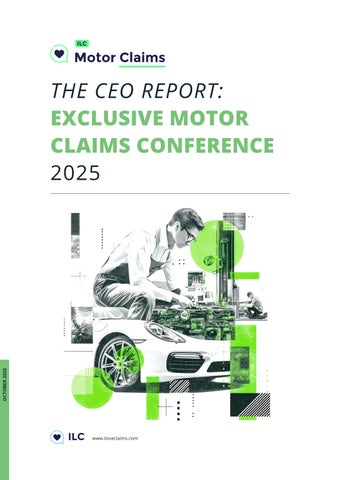
THE CEO REPORT: HIGH-LEVEL INTELLIGENCE FOR MOTOR CLAIMS DECISION-MAKERS
A new era of insight for motor insurance leadership
CHRIS ASHWORTH Founder ILC
“This is our industry’s go-to reference for every motor insurance CEO.”
In a sector defined by complexity, disruption, and rapid evolution, decision-making at the top demands more than intuition - it demands intelligence. Recognising this, ILC has launched The CEO Report: a landmark annual publication providing CEOs and Board Members across the UK’s motor insurance market with clear, datadriven insights into the forces shaping claims, performance, and the customer experience.
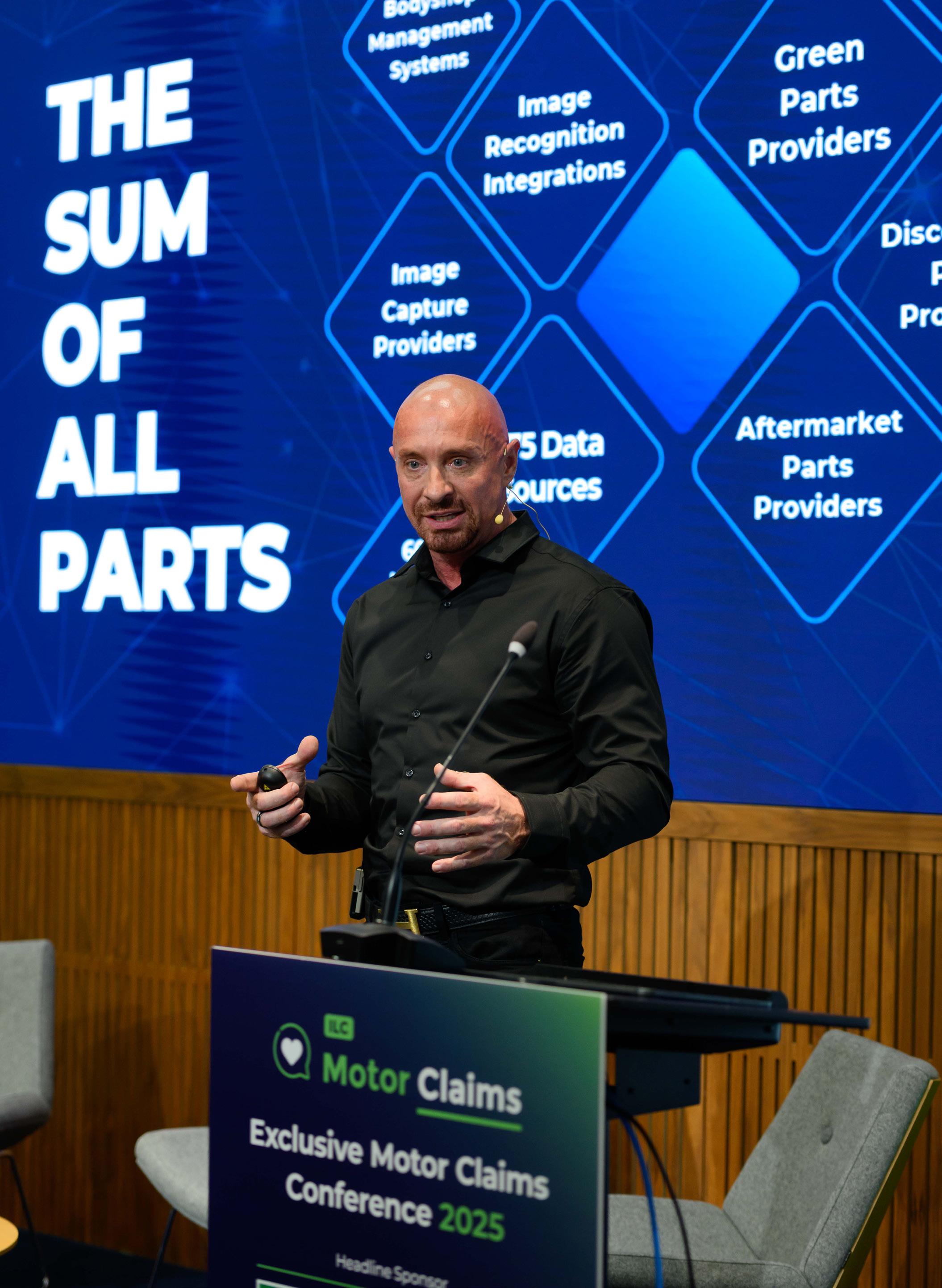
As Chris Ashworth, Founder & Motor Sector Lead, ILC, put it during the Exclusive Motor Claims Conference 2025: “We want this to be something that CEOs and board members can reference and instantly understand what’s happening in the industry.”
Built from the collective expertise of the ILC community - including leading insurers, supply chain partners, data analysts, and technology innovators - The CEO Report consolidates the year’s most significant developments, emerging risks, and market intelligence into a single, strategic reference point.
The result is a publication designed not just to inform, but to support boardroom decisions, strengthen leadership foresight, and help connect the dots across the complex motor claims ecosystem.
WHY THE INDUSTRY NEEDS THE CEO REPORT NOW
The motor insurance sector has entered a period of unprecedented transformation. Post-pandemic recovery, inflationary pressures, parts shortages, fraud evolution, and mobility disruption have converged to create a challenging operating environment.
While individual stakeholders - from underwriters to claims directors - have deep expertise in their own domains, CEOs and Boards require a high-level, joined-up understanding of how these factors interact and where future risks or efficiencies may lie.
The CEO Report meets that need by providing:
• Macro-level trends across claims frequency, cost inflation, and supply chain resilience.
• Sector-by-sector analysis connecting the respective components of the motor market.
• Expert interpretation from ILC’s community of expert practitioners and partners.
• Actionable intelligence to inform strategic planning and boardroom discussion.
As Chris explained: “It’s not just about us in this room. It’s about making sure we dissipate the information that’s learned and shared - aligning with the ILC ethos of a better tomorrow.”
This better tomorrow approach underpins everything ILC does: creating a connected industry where collaboration replaces competition and where insights are shared to elevate the whole market.
KEY FIGURES BEHIND THE CEO REPORT
12 major ILC events annually covering motor, property, MGA and claims technology.
A community of 11,500 insurance claims professionals
Supported all year round by more than 45 corporate supply chain partners and 35 insurer partners
A PLATFORM BUILT ON PARTNERSHIP AND PROVEN DATA
ILC’s strength lies in its community. With 12 flagship claims events per year, including the renowned Exclusive Motor Claims Conference, the newly introduced Mobility in Insurance Conference, and the established vehicle repair centric ARC360 – as well as the dedicated Advisory Boards, ILC draws together the full spectrum of the claims industry - from insurers and repairers to technology firms, data specialists, and legal experts.
These gatherings, and the relationships they forge, form the backbone of The CEO Report Insights are not gathered in isolation; they are developed through collaboration, dialogue, and shared experience.
“Our partners are with us every step of the way,” said Chris. “Not just by a badge, but by people in the room, by content throughout the year, and by championing the value of claims within the insurance sector.”
This network approach ensures that The CEO Report reflects not just what’s happening in theory, but what’s happening on the ground - in repair shops, supply chains, underwriting models, customer journeys, and the boardrooms where strategy meets execution.
3,000+
delegates typically attend ILC events annually
Continuous industry engagement through digital channels and partnerships with leading bodies such as ABI, NBRA, Consumer Intelligence, and many more
These partnerships provide a constant stream of credible, measurable intelligence that fuels the data-led commentary within the CEO Report. 7
FROM CONFERENCE INSIGHT TO STRATEGIC INTELLIGENCE
The genesis of The CEO Report is rooted in ILC’s Better Tomorrow series - its post-event publication summarising insights from key conferences. But as the scale of industry challenges grew, so too did the need for a more substantial, enduring reference.
“Post-event, we always produce a publication called Better Tomorrow,” said Chris. “But we’ve seen a bigger opportunity - a way to create something truly valuable to the industry. Something we want CEOs to have on the shelf of their offices.”
By evolving from summary to strategic report, ILC now delivers a resource designed specifically for leadership audiences, with deep analysis and a focus on what matters most for strategic direction - cost, risk, resilience, and innovation.
The CEO Report also introduces a continuous insight cycle: a rolling programme of updates and data refreshes throughout the year, ensuring intelligence remains current and actionable.
THE POWER OF CONNECTION: ILC’S EXPANDING ECOSYSTEM
Beyond events, ILC is deepening collaboration with industry bodies, fraud investigators, and data providers, extending insight far beyond traditional boundaries.
As Chris noted: “We’re really looking to make sure that the ILC community is interlinked with the wider insurance industry.”
Representation with organisations such as AutoRaise, NBRA, and IFIG highlight the value of shared intelligence in tackling the skills crisis, ensuring the voice of repairers is heard and combating emerging risks like fraud and claims leakage. Similarly, alliances with technology and analytics firms – amongst a host of other specialisms - are enabling richer, more datacentric perspectives on cost drivers and operational efficiency.
The CEO Report distils these collaborations into structured insight sections, allowing readers to:
• Benchmark their organisation’s performance against market norms.
• Identify new claims challenges, models and automations.
• Understand the macro trends influencing repair capacity, cost inflation, and consumer behaviour.
A REFERENCE FOR THE BOARDROOM
The CEO Report is built for the way leaders consume information: concise, data-rich, and strategically focused. Each edition will include:
1. Macro market overview – Key metrics across claims frequency, cost trends, repair cycle times, and customer satisfaction.
2. Expert commentary – Perspectives from ILC partners, industry bodies, and data analysts.
3. Forward indicators – Analysis of emerging technologies, regulatory developments, and macroeconomic influences.
4. Strategic insights – Case studies demonstrating how insurers are adapting to challenges through innovation and collaboration.
The publication’s digital format allows for interactive data visualisations and live updates, while a limited printed edition ensures a tangible presence in boardrooms across the UK.
“Even better than that,” Chris explained, “it gives us a continuous theme throughout the year - updating the industry on those metrics and helping everyone understand why things are changing.”
“It’s about joining up the dots from across the insurance ecosystem - and using data to make the whole industry stronger.”
DRIVING A BETTER TOMORROW
At its heart, The CEO Report is a manifestation of ILC’s core mission - to make the insurance claims industry ‘better tomorrow through what we learn today’.
That mission extends beyond content. Through initiatives like the annual ILC Day, which supports the Rainbow Trust Children’s Charity, ILC continues to demonstrate the power of community in action. It’s a reminder that leadership insight and social responsibility can go hand in hand - that progress in data, culture, and collaboration are interconnected.
As ILC continues to expand into new domains, The CEO Report will grow too - integrating cross-sector intelligence to reflect the converging nature of modern insurance. The inclusion of emerging markets and evolving claims structures ensures the report remains forward-looking and comprehensive.
“This is a huge opportunity,” said Chris. “We want CEOs to have this as their annual reference point - a quick connection to the experts, the data, and the understanding that drive better decisions.”
CONCLUSION: INTELLIGENCE FOR LEADERSHIP
The CEO Report isn’t just another publication - it’s a strategic tool for leadership. In a market where every decision has financial, regulatory, and reputational implications, clarity is power.
Through ILC’s unique access to live industry data, trusted partnerships, and expert interpretation, The CEO Report delivers that clarity - helping leaders navigate uncertainty, seize opportunity, and build more resilient organisations.
In a word, it’s intelligence at your fingertips - built by the industry, for the industry, with one goal: ensuring that every CEO and Board Member has the insight they need to lead with confidence.
SUMMARY OF KEY TAKEAWAYS
Purpose:
Annual, data-led insight publication for insurer CEOs and boards.
Scope:
Covers market trends, operational challenges, fraud, mobility, and innovation.
Contributors:
ILC community experts, partners, and data analysts.
Format:
Digital and print; continuously updated throughout the year.
Audience:
Motor insurance executives and board-level leaders.
Core Mission:
Equip leaders with intelligence to shape a better, more connected claims ecosystem.
“Understanding why things change is just as important as knowing that they are changing.”
TRANSFORMING INSURANCE FOR GOOD: LEADERSHIP LESSONS FROM DAVID MCMILLAN
DAVID MCMILLAN CEO Esure
“Our North Star was to fix insurance for good. We wanted to create the leading digital personal lines insurer in the UK.”
In an industry driven by transformation but constrained by legacy, few leaders have redefined what’s possible in such a short time as David McMillan, former CEO of esure Group.
When David was appointed CEO in 2019, esure was at an inflection point. He took over a business with strong foundations and clear potential, and set about revitalising its performance and culture. Five years later, under his leadership, esure delivered £126.8m in annual profit for the financial year ending December 2024 and a Net Promoter Score (NPS) of 63, marking a dramatic turnaround in both financial performance and customer sentiment.
Following his vital role played in leading esure’s transformation, David recently stepped down from his role as CEO of esure following the acquisition by Ageas - completed in October - which he described as “a logical fit that brings complementary strengths together”.
This transformation journey - from a traditional insurer to an agile, customer-led digital organisation - provides a blueprint for what modern insurance leadership looks like.
FROM CRITICAL JUNCTURE TO COMPETITIVE EDGE
When David joined esure, there were several challenges to overcome: a balance sheet that required strengthening, outdated systems, and a culture not yet suited to rapid change.
“We were on the back foot a bit,” he recalled. “But we had this North Star - to fix insurance for good.”
Supported by Bain Capital, esure pursued a wide-ranging transformation strategy - rebuilding its technology platform from the ground up, replacing a patchwork of legacy systems, and overhauling customer journeys for a digital-first approach. The scale of change went far beyond digital investment: it redefined the company’s identity, culture, and capability.
“We reviewed and changed every piece of technology we inherited. We optimised about 30 customer journeys - and then continually enhanced them to improve the customer experience,” explained David. This relentless focus on transformation positioned esure as a leader in digital capability.
CULTURE AS THE TRUE ENGINE OF CHANGE
While technology enabled transformation, David is clear that culture delivered it.
He inherited what he describes as an “old-fashioned, command-and-control culture” and set about creating one built on agility, empowerment, and customer focus.
“Changing the culture of an organisation is the hardest, but also the most rewarding part,” David said. “We believed we couldn’t compete unless we could move faster than everyone else.”
That belief led to an environment where innovation was celebrated, and the embracing of new technology, such as AI, was pivotal.
The results speak volumes: not only profitability and customer advocacy, but also an employee engagement score at an all-time high.
“It’s a phenomenal place to work,” David reflected. “A proper digital, customer-centric, supportive culture.”
BUILDING IN PARTNERSHIP: BAIN’S ROLE IN SUSTAINED TRANSFORMATION
Transformation at scale requires alignment between investors and leadership - something David credits Bain Capital for delivering.
“They always held to the vision and they were steadfast in their support,” he said.
There were several headwinds which had to be overcome which demonstrated the resilience of that partnership:
• The COVID-19 pandemic, which disrupted operations and claims handling.
• The war in Ukraine, which created significant disruption for some of esure’s technology delivery teams.
• The insurance profitability challenges of 2021–23, as claims costs spiked amid supply chain disruption and inflation.
Through each phase, Bain’s commitment allowed esure to stay the course - investing in digitalisation, customer experience, and culture even when profitability was under pressure.
“They were very, very supportive all the way through,” David said.
TALENT, PURPOSE, AND THE NEXT GENERATION
As insurers face growing challenges attracting new talent, David believes the solution lies in purpose, transformation, and empowerment.
“Having a mission that isn’t centred on making money, but on the customer, is critical,” he explained. “Our purpose - fixing insurance for good - was something people could believe in.”
He sees transformation as a magnet for ambitious professionals: “The best people are attracted to change. They want to compete, innovate, and make a difference.”
“We wanted to create the leading digital personal lines insurer in the UKand along the way, we fixed insurance for good.”
The focus on enabling data scientists - a role David once led at QBE and Aviva - is particularly relevant for insurers seeking to modernise analytics and AI. Under his leadership, data science was operationalised at speed - giving technical talent direct influence on business outcomes.
David said, “We created an environment where data scientists could dream, build, and get their models straight into production - something rare in this industry.”
For a generation drawn to impact and immediacy, David’s model offers a compelling case study: give talent the autonomy to create, the tools to deploy, and the mission to inspire.
THE FUTURE OF SCALE: INTEGRATION AND DIFFERENTIATION
The acquisition of esure by Ageas represents a convergence of complementary strengths:
• Ageas’ dominance in broker distribution, and
• esure’s leadership in digital and direct channels.
“It was a very logical fit,” David said. “They’ve got massive strength in broker, and we’ve got massive strength in direct.”
He views the combined group as one to watch in the UK market, leveraging both reach and agility.
“They’ll start as number three, but they’ve got the goods to go for silver or gold.”
However, David cautions that scale alone is not a differentiator in the modern insurance ecosystem. For CEOs, the strategic imperative lies in delivering distinct customer experiences and leveraging technology to reduce cost and friction.
“There are a number of large suppliers in mobility, salvage, and glass. If everyone’s using the same providers, how do you differentiate?” said David.
That question, he suggests, is driving a new wave of vertical integration - with major carriers like DLG and Aviva investing in their own repair networks and claims infrastructure to secure competitive advantage.
HARNESSING AI: THE NEXT FRONTIER IN CLAIMS
For David, the next phase of transformation in the insurance industry will be defined by how effectively insurers harness artificial intelligence to drive efficiency, profitability, and customer satisfaction.
David said, “AI can transform customer experience and drive efficiencies. Everybody’s got to be on that.”
While many carriers have experimented with automation and machine learning, he warns that no one in the industry has yet achieved a “10 out of 10” customer experience.
The challenge for leaders, therefore, is not simply adopting AIbut embedding it into the claims journey in ways that elevate both customer outcomes and operational performance.
LEADERSHIP LESSONS FOR INSURER CEOS
David’s five-year transformation journey offers several strategic lessons for insurance leaders navigating disruption and consolidation:
1. Anchor strategy to purpose
A mission that goes beyond profit inspires teams, attracts talent, and sustains transformation. Fixing insurance for good became more than a slogan - it became a movement within esure.
2. Invest in culture as much as code
Digital success starts with mindset. Agile, empowered cultures consistently outperform command-and-control hierarchies.
3. Build partnerships that withstand volatility
Bain’s consistency through periods of uncertainty demonstrates the power of investor alignment and a shared vision.
4. Differentiate through experience, not just scale
In a market of similar suppliers, customer experience is the ultimate competitive advantage.
5. Make AI a customer-first lever
Deploy automation to enhance satisfaction and trust in the claims journey.
“Agility became our secret sauce - we couldn’t outspend bigger players, but we could move faster.”
CONCLUSION: FIXING INSURANCE FOR GOOD
David McMillan’s journey with esure captures the central challenge - and opportunity - facing the motor insurance sector today: building digital capability and customer trust in equal measure.
His results - £126.8m profit, 63 NPS, and a culture of empowerment shows what’s possible when leadership vision, disciplined investment, and cultural renewal align.
As the newly merged Ageas Group (including Saga) integrates esure’s digital DNA with its scale and distribution, the industry will be watching closely. The message is clear: speed, purpose, and culture are now as valuable as capital.
For CEOs and boards shaping the future of claims and underwriting, David’s legacy is a reminder that transformation is not a technology project - it’s a leadership imperative.
“AI will change everything,” he concluded. “But the real transformation starts with how we lead.”
KEY DATA POINTS ��
Metric / Milestone
EBITDA (2024)
Customer Satisfaction (NPS)
Cultural Impact
Detail / Impact
£126.8m (year-end December 2024)
63
Employee engagement at all-time high
Technology Overhaul Replacement of legacy systems
Customer Journeys Redesigned
Profitability Transformation
30+ iterative redesigns
Bain partnership navigated COVID, war in Ukraine, inflationary cycles
“People will forget what you say or do - but never how you make them feel. That’s true for customers and for teams.”
David McMillan quoting Maya Angelou
TELEMATICS AT A TIPPING POINT: UNLOCKING VALUE FROM DATA ADOPTION
LEVI FRANCIS Director, GI Actuarial Pricing Lead KPMG UK
PENNY SEARLES Chairman Howden Driving Data Ltd
SHEPHERD Assistant Director - Head of General Insurance Policy ABI
Telematics has been part of the insurance conversation for nearly two decades - but it has yet to deliver on its full potential. Despite early optimism, adoption remains limited, fragmented, and often misunderstood.
“The data, the capability, and the accuracy are all there now. We’re at a tipping point.”
Penny Searles
Yet as costs fall, data quality improves, and artificial intelligence reshapes the claims and pricing landscape, experts across the industry agree that we are now at a tipping point. The technology, the capability, and the economics have aligned - and the question for CEOs is no longer if telematics will deliver value, but how fast their organisations can capitalise on it.
“We’ve proven it works. There’s fundamental evidence now with data and loss ratio. If the data is used, it makes a massive difference,” said Penny Searles, Chairman, Howden Driving Data Ltd.
MARK
A 15-YEAR JOURNEY: FROM PROMISE TO PROOF
For Penny, a pioneer in driving behaviour data, the challenge has always been turning telematics from concept to commercial reality.
“I’ve tried so hard over 15 years,” she reflected. “Initially, it was cost - £250 per policy in 2008 just to get the data. Now it’s about £60 a year, but you still have to justify that against an average premium of £350 to £400.”
The economics are shifting. The price of high-quality data collection has fallen by almost 75% since telematics’ early trials, while the sophistication of data analytics has grown exponentially. The issue now, Penny argues, is no longer about cost or capability - it’s about utilisation.
“The reason it doesn’t work well is nobody uses the data,” she said.
For the few insurers that have mastered integration - notably Admiral and Hastings - the performance impact has been clear. Both have achieved measurable improvements in loss ratio through disciplined use of telematics in pricing and claims. Their example shows what’s possible when leadership commits to using behavioural data as a strategic asset.
THE PRICING CHALLENGE: DATA MEETS DISCIPLINE
According to Levi Francis, Director - GI Actuarial Pricing Lead at KPMG the industry’s challenge lies in turning raw data into meaningful pricing signals.
“We are starting to see telematics data flow through into pricing,” Levi explained. “But it really comes down to how you use it.”
Different telematics suppliers still use different data formats and definitions - a fragmentation problem that limits scale. Levi highlighted the need for data standardisation and the creation of centralised data warehouses, where insurers can normalise and analyse data efficiently.
“If one provider defines acceleration on a one-to-five scale and another uses A-to-E, bringing that data together is critical,” explained Levi.
The early promise of “cheaper insurance for better driving” was also structurally flawed, he said: “You’re telling customers they’ll pay less, but you as the insurer have to invest more to run it. Those two things compete against each other.”
As a result, many early adopters retreated before the claims benefits were proven. But today, the analytics maturity to extract predictive power from telematics data is vastly greaterand that changes the economic equation.
B2B: THE QUIET SUCCESS STORY
While retail adoption has been slow, fleet and B2B telematics are proving the commercial case. In this market, the ‘skin in the game’ is greater, and the data is deeper.
“In fleets, loss ratios that were 110 or 120 are now down to 60 or 65,” Levi reported. “They’ve done it by narrowing their footprint, focusing on entities that have a stake in outcomes, and using data properly.”
These are not marginal gains - they represent a 40-50% reduction in loss ratio, translating directly into pricing competitiveness and profitability.
The difference lies in behavioural visibility over time. Fleets are observed continuously, making sustained behavioural analysis and intervention possible.
“On the personal lines side, people behave well for a year to get their bonus, then drop out,” Levi explained. “In fleets, you can’t fake it. Long-term observation gives real insight.”
The telematics ecosystem is now being supercharged by AI - particularly in call summarisation, driver feedback, and predictive loss modelling - creating a data environment that goes far beyond speeding or braking scores.
Levis highlighted, “Using AI with telematics data - summarising tone, sentiment, driver interaction - is far more powerful than just applying one-way factors.”
“In fleets, loss ratios that were 120 are now down to 60 - that’s what happens when you use the data properly.”
Levi Francis
THE CONSUMER DISCONNECT: DEMAND AND TRUST
For Mark Shepherd, Assistant Director - Head of General Insurance Policy at the ABI, the problem is not just on the supply side - it’s also about consumer perception.
“There’s been a lack of user demand,” Mark said. “Customers don’t see the benefit, whether it’s lower premiums or a better claim service.”
Marketing has typically focused on younger or higher-risk drivers, leaving the mainstream market disengaged. Early inconsistencies in user experience - from device failures to underwhelming app performance - further eroded confidence.
“There’s a belief gap - customers don’t understand what they’re gaining, and insurers haven’t articulated the payback clearly enough,” suggested Mark.
The UK’s price-sensitive insurance culture compounds the issue. As Penny noted, advertising remains fixated on price, while overseas markets, particularly the US, emphasise value and service.
“In the US, it’s about what your insurance does for youtelematics could play that same role here, if we shift the message.”
DATA FRAGMENTATION: THE INDUSTRY’S ACHILLES HEEL
Telematics has struggled under the weight of data inconsistency. Multiple suppliers - each with their own format, metrics, and “secret sauce” - have created a fragmented landscape.
“We’ve got ThingCo, Howden, IMS - all with different formats. There’s no consistency in the data people receive,” Penny said. “Credit score is no different to behaviour score - but behaviour score isn’t standardised.”
This lack of standardisation limits portability and scalability. In Italy, by contrast, regulatory action has driven adoption by requiring data portability between insurers - allowing customers to transfer their driverbehaviour records much like a credit score.
“If customers can take their behaviour record from one insurer to another, it’s fairer and encourages engagement,” Mark explained. “Italy’s shown that regulation can accelerate adoption.”
CLAIMS TRANSFORMATION: FROM AGATHA CHRISTIE TO AI
Telematics’ greatest unrealised potential may be in claims. The technology provides real-time crash alerts, impact data, and location precision that can transform the entire loss management process.
“If you can tell a claims director exactly when a car crashes and what happened, they’d say: fantastic - let’s go,” said Penny. “You can calculate the loss straight away, retrieve the vehicle, and deal with the claim faster and cheaper.”
Some insurers have already demonstrated what happens when telematics data is combined with AI-driven damage assessment.
“You can link telematics data straight into AI software to evaluate the cost of a claim - the car, the impact, the loss - and everyone’s off and running,” she said. “It means faster, more efficient, lower-cost claims.”
Despite this, an informal show-of-hands at the Exclusive Motor Claims Conference revealed a sobering reality: almost no one in the room was currently using telematics in claims.
“That’s it,” Penny concluded. “Go away and have another look - the data’s there, and it can give you a USP with your clients.”
POLICY, REGULATION, AND THE ROAD AHEAD
Telematics’ potential extends beyond commercial advantage - it’s increasingly part of the policy debate around affordability and fairness. The ABI’s 10-point plan for motor insurance highlights telematics as a key lever for improving affordability, particularly for young drivers, where average premiums continue to rise due to claim severity and collision frequency.
“Telematics is one of the few solutions government can easily support,” Mark said. “It’s industry-led, seen as fairer, and links price to behaviour - something consumer groups favour.”
In parallel, government and UN standards bodies are now examining data portability, privacy, and interoperability as connected-vehicle regulation advances. The ABI expects telematics to play a growing role in liability decisions for semi-autonomous and automated vehicles.
“Our priority is ensuring future vehicles have the right data capability to make liability decisions as automation grows,” Mark confirmed. “That’s more important now than ever.”
KEY FIGURES AND INSIGHTS
Metric / Trend
Data acquisition cost (per policy)
Adoption leaders
Fleet loss ratio improvement
Young driver affordability
AI in telematics
Standardisation gap
Italy model
“You can link telematics straight into AI damage assessment - faster claims, lower cost, delighted customers.”
Penny Searles
Data Point / Observation
£250 in 2008 → ~£60 today
Admiral, Hastings (direct players)
110–120 → 60–65 (40–50% reduction)
Key focus of ABI’s 10-point plan
Now used for call analysis, tone detection, and claim cost prediction
Multiple providers with incompatible data formats
Regulatory portability of driving-behaviour records
TRANSPARENCY: THE MISSING LINK
For telematics to reach its potential, transparency between insurer and customer must improve. Levi argues that feedback loops - showing drivers how behaviour affects pricing - are key to building trust and engagement.
“Tell the customer what feeds into their price, and what they can do to reduce it,” he said. “It’s not just about monitoring - it’s about dialogue, transparency, and partnership.”
The parallel with “smart home” insurance is striking. As Levi noted, “LeakBot worked because customers knew exactly what they needed to do to get their price down. Telematics should be the same.”
When behaviour, feedback, and pricing are connected in a clear way, telematics evolves from a monitoring tool into a mechanism for mutual value - reducing risk, claims cost, and premiums simultaneously.
“Telematics is one of the few solutions government can easily support. It’s industry-led, seen as fairer, and links price to behaviour - something consumer groups favour.”
Mark Shepherd
THE CEO PERSPECTIVE: FROM EXPERIMENT TO ECOSYSTEM
For CEOs and boards, telematics now represents a strategic inflection point - a chance to convert 20 years of experimentation into a competitive edge. The insights shared by Penny, Levi and Mark point to three immediate imperatives for leaders:
1. Embed telematics in strategy, not projects.
The value comes when data informs claims, pricing, and fraud - not when it sits in pilot programmes.
2. Standardise and integrate.
Drive consistency in definitions, formats, and platforms to unlock scalability and enable crossinsurer collaboration.
3. Lead with transparency.
Make the benefit clear to customers - lower premiums, faster claims, fairer pricing - and engagement will follow.
As telematics and AI converge, the industry faces a rare opportunity: a technology that can simultaneously cut cost, improve experience, and reduce risk. But capitalising on it requires leadership alignment and execution discipline - qualities that define the most successful insurers in any era.
CONCLUSION: TURNING DATA INTO DIFFERENTIATION
Telematics is no longer a technology story; it’s a leadership story. The data is robust, the tools are ready, and the economic case is proven. What remains is commitment - from boardrooms willing to make it a cornerstone of strategy rather than a side experiment.
As Penny urged the industry: “Go away and have another look.”
For an industry under pressure to improve efficiency, experience, and trust - it may be the most important look CEOs take this year.
GLOBAL TRADE SHIFTS AND GEOPOLITICAL PRESSURE: WHAT INSURERS NEED TO KNOW
JOHN GIBSON
Client Relationship Director Kennedys
The global insurance and claims landscape is being reshaped by geopolitical events, trade disruption, and an accelerating shift in supply chain models. For UK motor insurers, these forces are already filtering through in the form of increased costs, constrained supply, and evolving risk profiles.
As John Gibson, Client Relationship Director at Kennedys, told delegates at the ILC Exclusive Motor Claims Conference, “No insurer in this room can fix these impacting factors – but every insurer can prepare to be resilient against them.”
THE WORLD HAS CHANGED - AND SO HAS TRADE
John opened his address by framing the dramatic shifts in global dynamics over the past year. “In the last year alone, 1.6bn people across 70 countries have gone to the polls,” he noted - a wave of political change spanning democracies and emerging markets alike. “We’ve seen unprecedented change in economic policy, regulatory environments, and how multinational companies do business.”
This political churn, he warned, is directly influencing the UK insurance market, particularly through its impact on the complex, globalised supply chains that underpin vehicle production, parts, and repair.
“Insurers, companies, and individuals are now running a gauntlet of competing priorities — from trade and sanctions to environmental standards and energy transition,” John said. “It’s a really changing world that we’re operating in.”
SHIPPING DISRUPTION: A GLOBAL BOTTLENECK
Few sectors feel the consequences of global disruption more acutely than logistics and transport - the arteries through which vehicles, components, and commodities flow. John highlighted the continued vulnerability of maritime routes, emphasising that 80–90% of global trade is carried by cargo ship, with 30% of container traffic passing through the Suez Canal.
But the geopolitical flashpoints surrounding key chokepoints - such as the Strait of Hormuz, through which 20% of the world’s oil and most LNG supplies travel - have caused profound dislocation.
“Eighty percent of all container traffic that would normally go through the Red Sea now doesn’t anymore,” John said. “It’s all going around the southern tip of Africa. That adds about £1m per ship in fuel costs and roughly two weeks in delay. On top of that, war risk premiums for those ships have increased 400% in the last year.”
The ripple effects are significant. Port warehouses are “saturated in capacity,” onward transit vehicles are overloaded, and distribution delays are “significant - and not just in Asia, but in Europe.”
This has knock-on effects for insurers: rising claim costs, increased fraud and theft, and greater loss frequency in marine and cargo lines. “We’re seeing more fraud on goods, more spoiling, more damage, and more theft,” said John. “And when that happens, the price of those goods only goes one way.”
CYBER THREATS AT SEA
An underappreciated dimension of this disruption, John warned, is cyber interference in maritime systems. “We’re seeing disruption of AIS (automatic identification systems) and jamming of GPS,” he explained. “This is disrupting how we get our goods and services.”
While such risks may feel remote from the UK motor market, their effects cascade through supply chains - from delayed vehicle deliveries to inflated costs of replacement parts and raw materials.
THE TARIFF SHOCKWAVE
Beyond conflict, John identified another major destabiliser: tariffs. He described the global trade system as undergoing a “reset,” driven by US tariff policy and countermeasures by other major economies.
“The US Supreme Court begins hearing the tariff appeal on 5 November,” he explained. “Tariffs will continue at least until that appeal concludes. The Trump administration has pushed for a resolution by the end of 2025, but even then, does the world go back to a pre-tariff landscape? Unlikely.”
“Eighty percent of all container traffic that would normally go through the Red Sea now doesn’t anymore… adding £1 million per ship in fuel costs and two weeks in delay.”
The response from other powers has been swift. “The leaders of Russia, China, and India met at the recent Shanghai Cooperation Organisation summit hosted by China,” he said. “These are very different economies with different relationships to the West, but the potential for global realignment of trade is clear.”
This shift is already affecting the automotive sector. “The Society of Motor Manufacturers & Traders car registration data shows that BYD registered almost as many cars in the UK in 2025 so far as Tesla. Their exports to the UK are up by almost 500% this year,” John revealed. “This is what’s coming.”
NEW MANUFACTURERS, NEW RISKS
The influx of Chinese manufactured electric vehicles (EVs) is not merely a market trend - it’s a structural change that will reshape claims, repair networks, and underwriting models.
For UK insurers, this means dealing with an increasingly diverse and complex vehicle parc, often featuring unfamiliar technologies and limited parts availability.
An audience member raised this directly, pointing to the growing prevalence of BYD’s affordable EVs and the challenge for insurers in understanding their repairability. John agreed: “The insurance industry still doesn’t really understand the risk around electric vehicles - especially when all the parts are manufactured in China” he said.
He went on to describe “tariff washing” - the practice of routing exports through a third country to sidestep tariffs - as a growing complexity that could distort supply chains further. “We’re already seeing manufacturers move production into Europe to lower costs,” he said. “There’s even Chinese state-sponsored insurance now operating within Lloyd’s, positioned to support their domestic automotive ambitions. That’s a whole new competitor entering our market.”
INFORMATION AS A STRATEGIC ASSET
Asked how insurers could prepare for such volatility, John was clear: “ Information is power.”
He urged insurer leaders to embed global intelligence into decision-making processes. “A lot of this is being done to us as an industry,” he said. “So it’s about surrounding yourself with the right information, understanding what you can influence, and being brave enough to act when you can.”
This, he suggested, should extend to underwriting and claims strategy. “Insurers are starting to ask us: How do I underwrite for this? How do I plan for this? How do I build a claim strategy for this?”
For many, this will mean shorter planning horizons. “The world is moving really, really quickly,” he said. “When I stood on this stage last year, BYD had registered fewer than 5,000 vehicles - they’re now approaching 30,000. The Strait of Hormuz has changed dramatically in that time. Energy prices have gone up exponentially. So, yes - this changes how far ahead a business can plan.”
INFLATION BEYOND THE SUPPLY CHAIN
While much of the discussion focused on trade and logistics, John also acknowledged the broader inflationary pressures spilling into other claim types. When asked whether geopolitical shifts could impact injury claims - for instance, through increased costs in rehabilitation or prosthetics - his response was unequivocal.
“You’re absolutely right,” he said. “Repatriation and rehabilitation are key areas. People are moving around the world more easily, but what’s available on the ground varies widely. We’ve had cases in Colombia, for example, where the infrastructure for rehab just doesn’t exist as it would here. It’s a growing concern across multiple lines of business.”
OPPORTUNITY IN THE TURBULENCE
Despite the challenges, John believes this period of upheaval offers insurers a chance to prove their value. “The world is tough right now - nationally, globally,” he said. “But for insurers, this is a unique opportunity to demonstrate value to customers.”
That value, he argued, lies in preparedness and agility: the ability to understand systemic risk, price volatility, and customer impact - and respond faster than competitors.
“Businesses are reassessing their supply chains, exploring alternative routes and new markets,” he said in closing. “The global realignment of trade creates an evolving landscape for insurers to navigate - but those who understand it first will be best placed to lead.”
“Cyber disruption is now part of global trade risk - with GPS jamming and spoofing of identification systems an emerging risk.”
KEY INSIGHTS FOR CEO s AND BOARDS
1.6bn voters in 70 countries last year have reshaped political and economic landscapes.
80–90% of global trade moves by sea;
80% of Red Sea container traffic now diverted, adding approximately
£1m per ship in fuel costs and 400% higher war risk premiums.
BYD’s UK registrations up almost 500% year-on-year - now close to matching Tesla levels.
Global shipping capacity down 15% causing saturation at European ports.
Chinese insurers now operating within Lloyd’s, supporting mainland manufacturers’ international expansion.
Inflationary pressures are spilling into injury and rehabilitation claims via global cost differentials.
THE CEO PERSPECTIVE
For motor insurance leaders, John’s analysis underscores the need for board-level attention to supply chain fragility, international trade dynamics, and geopolitical intelligence.
In an era where every supply disruption translates to higher claims cost and longer repair cycle times, strategic resilience is no longer optional - it’s existential.
As John concluded: “These challenges are expected to persist as the global realignment of trade creates an evolving landscape for insurers to navigate. While businesses reassess their supply chains, exploring alternative trade routes and new markets - insurers must evolve with them.”
“Total losses are high. Green parts usage is low. Data-driven automation can flip that balance and unlock sustainability at scale.”
“Chinese
state-sponsored insurers are now operating in Lloyd’sprepared for the influx of Chinese manufactured vehicles into the UK and Europe.”
Kennedys is a specialist insurance law firm with a leading local authority and public sector team.
With 13 UK offices, including locations in England, Scotland and Northern Ireland, we provide extensive advice on matters including abuse and social care, fraud, property damage, highways, public and employers’ liability claims and support our clients on commercial work, cyber and data protection risks, employment law, and regulatory defence.
We recognise the challenges and ever-changing demands faced by local authorities, and our experience with the public sector means we understand the importance of cost effective and timely advice.
Our aim is to make you as effective and efficient as possible by providing clear, straightforward legal support that will minimise your risk and reduce your indemnity spend.
NAVIGATING THE NEXT DECADE: CONSOLIDATION, CONFLICT AND THE CHALLENGE OF CHANGE
HUW EVANS Partner - Head of Insurance KPMG UK
As the global motor insurance landscape undergoes its most rapid evolution in decades, the market faces a paradox: fewer players, but greater complexity. Speaking at the ILC Exclusive Motor Claims Conference, Huw Evans, Partner - Head of Insurance at KPMG UK - described an industry “caught between the need for scale and the power of specialism,” operating against a backdrop of geopolitical volatility, regulatory fatigue, and technological revolution.
For insurers, he argued, the next decade will demand not only operational efficiency and technological agility, but a fundamental rethink of how risk itself is understood.
CONSOLIDATION DEFINES THE MARKET
Huw began by identifying consolidation as the defining characteristic of the UK motor insurance sector in 2025. “For example, we’ve seen Aviva and DLG come together earlier in the year to create the largest motor insurer in the UK,” he noted. “It’s not hard to see what’s driving deals like this - cost advantages, the battle for talent, and the cost of implementing significant new and expensive technology.”
“The
market is increasingly about scale or specialism - and not much in between. You’re either big enough to drive cost and data advantage, or specialist enough to outsmart everyone else.”
Mergers, he said, are being fuelled by the dual pressures of capital efficiency and digital transformation. “Capital providers are demanding performance improvementswhether you’re a listed business needing a higher return on equity or a privately backed insurer needing to justify your investment case,” Huw explained.
The result is a market increasingly polarised between scale and specialism.
“We’re seeing providers who are exceptionally good at small, specialist areas of insurance, and then we’re seeing the big players consolidating into powerful franchises. The market is now about scale or specialism - and not much in between.”
That polarity is reshaping competitive dynamics. Major carriers are leveraging volume, data and distribution power, while MGAs and niche underwriters thrive through agility, expertise and clean technology stacks. “The best niche players,” Huw said later in Q&A, “are those with the best underwriting, fast claims processes, and no legacy baggage. But the challenge is: if someone else works out how to do your niche better - you’re out of business pretty quickly.”
POLITICAL AND REGULATORY PRESSURES EASE - FOR NOW
Turning to the policy landscape, Huw offered a rare note of relief. “For the first time in years, there’s a little less political pressure on the motor market,” he observed. “Premiums are lower, which always helps, and some of the major challenges - such as the Ogden discount rate - are now in a more settled place.”
After a decade in which issues such as whiplash reform, credit hire and young driver regulation placed the motor market under the political microscope, the focus of policymakers has drifted elsewhere. “That may not last,” Huw cautioned, “but for the time being, other parts of the insurance sector are attracting greater attention.”
Regulatory intensity has also eased slightly. “We’ve seen significant change over the past 10 years - from general insurance pricing practices to the introduction of Consumer Duty,” he said. “But there’s now a government-level message to regulators: stop layering new regulation on top of the old.”
For many insurers, the heavy investment in Consumer Duty compliance has produced a silver lining. “It’s created exactly what the regulators wanted - better data, stronger governance, and a clearer line of sight to customer outcomes,” Huw said. “For larger groups, the ability to handle regulation efficiently has become a real differentiator.”
However, he cautioned that some issues will remain live. “Data and the use of data are sensitive pointsparticularly in the EU and the US,” he said. “And the industry’s relationship with credit hire is unlikely to go unremarked upon forever.”
OPERATIONAL TRANSFORMATION: THE DRIVE FOR EFFICIENCY
While regulation may have slowed, transformation within insurers has not. “From a consultant’s perspective, this is a period of intense operational change,” Huw said. “Most large firms are spending significant sums trying to streamline front-, middle- and back-office processes - functions that historically operated in silos and simply don’t work in a modern environment.”
The focus, he said, is on reducing manual intervention, automating claims, and replacing legacy systems. “We’re seeing strong investment in AI, automation, and straightthrough processing,” he explained. “In pricing, firms are turning to specialist technologies that can integrate with data-rich platforms. In claims, the drive is to eliminate unnecessary handoffs and increase consistency.”
The implications are profound: insurers that fail to modernise risk being structurally uncompetitive. “It’s about getting your systems in a place where they can work effectively with modern data partners,” Huw said. “That’s not optional anymore.”
CONFLICT AND GEOPOLITICAL INSTABILITY: A RISK MULTIPLIER
Huw then shifted focus from the domestic to the globalconnecting his analysis to John Gibson’s earlier remarks on trade and conflict. “There are twice as many conflicts in the world today as there were in 2010,” he said. “Not just the ones we see on the news every day, but globallyas measured by independent institutes.”
That escalation is not limited to traditional battlefields. “Conflicts now manifest through supply chain attacks, shipping route disruption, and manufacturing blockages,” he explained. “This is a dangerous, more armed world - and for any business with an international footprint, it would be brave not to plan for it.”
Huw urged insurers to factor these scenarios into their risk and capital planning. “We’re living in a world where conflict can directly affect parts supply, repair cycle times, and inflation,” he said. “Understanding these dynamics isn’t optional - it’s core to resilience.”
A MULTIPOLAR WORLD: THE END OF GLOBALISATION AS WE KNEW IT
Huw argued that the very fabric of global order has changed. “Those of us who built careers in the 1990s and 2000s operated in a largely globalised world - free movement of people, one dominant superpower, consistent regulatory cooperation,” he said. “That world no longer exists.”
Instead, we now live in a multi-polar, regionalised system, where alliances are shifting and trade blocs compete for influence. “Who is in what bloc - for trade or political purposes - really matters now,” Huw said. “We need to know who our reliable partners are, and which ones might be vulnerable to disruption.”
For insurers, that awareness is critical to sustainable growth. “These aren’t just interesting things to read about in The Economist,” he said. “They’re central to how we plan - from our reinsurance partners to our tech suppliers and our claims chains.”
AI, AUTOMATION AND THE DIGITAL REVOLUTION
Of all the disruptive forces at play, Huw sees artificial intelligence as the most underestimated. “We namecheck AI all the time,” he said. “But how much do we really think about what it will look like in five years - or what it means for our business models?”
He cautioned against complacency. “Most technologists agree that agentic AI and robotics will transform the nature of work faster than the Industrial Revolution ever did. That took 140 years to evolve. The digital revolution is moving exponentially faster.”
For insurers, that creates a dual imperative: harness the technology for operational advantage, and prepare for the new risks it introduces. “Cyber risk is now at the forefront,” Huw said. “We’ve seen major, sustained attacks on large firms - often state-backed, far more sophisticated than a teenager in a bedroom.”
Huw warned that identity access management failures are the weak link. “Complex supply chains and third-party contractors are often the way in,” he said. “And many companies are simply not prepared for a sustained, systemic cyberattack. The impact can be devastatingoperationally and reputationally.”
THE MACRO HORIZON: POPULATION, CLIMATE AND SYSTEMIC RISK
Looking further ahead, Huw identified three long-term megatrends that will reshape the global insurance landscape: population growth, climate change, and technological acceleration.
Population growth: “There were six billion people in 2000,” he said. “There are 7.3bn today, and we’ll likely reach 8.5bn by the mid-2030s. That’s an enormous shift in exposure and demand for protection.”
Climate change: “We’re almost certainly going above 2°C of global warming,” he warned. “That will impact migration, insurable risk, and the resilience of the very infrastructure our industry relies on.”
Technology: “The pace of the digital revolution is unprecedented in human history,” he added. “We have to understand how it will change everything - from risk selection to claims management to customer interaction.”
OPPORTUNITY IN COMPLEXITY
Despite the warnings, Huw’s message was ultimately optimistic. “The insurance industry has always thrived on complexity,” he said. “We exist to make risk manageable - and there’s more risk in the world today than ever before.”
But that, he stressed, requires a recalibration of mindset. “We must ask whether our risk models, partnerships, technology, and commercial assumptions are robust for the world we now live in,” he urged. “If they’re not, we need to evolve them - fast.”
His closing words were a call to leadership: “This is a world of greater and more complex risk - but also greater opportunity. The insurers who face in, think broadly, and plan deeply will be the ones who thrive.”
“The world we grew up in - one of stable globalisation - is gone. We now operate in a multi-polar world where trade blocs define opportunity and risk.”
KEY INSIGHTS
FOR CEO s AND BOARDS
Consolidation continues: mergers driven by cost, talent, and technology needs.
Scale or specialism defines market structure - mid-tier players risk being squeezed.
Regulatory pressure easing, but data use and credit hire remain areas of scrutiny.
Operational transformation accelerating: AI, automation, and system modernisation top agendas.
Twice as many global conflicts as in 2010 - reshaping supply chains and cost structures.
Multi-polar geopolitics replacing globalisation: regional trade blocs matter more.
Cyber threat
landscape shifting to state-backed, systemic attacks.
Population to hit 8.5bn by 2035;
Global warming exceeding 2°C likely - increasing systemic risk.
AI revolution moving faster than the Industrial Revolution - redefining risk, efficiency, and workforce models.
CONCLUSION
For insurer CEOs and boards, Huw’s insights serve as both a warning and a roadmap. The market’s fundamentals - capital discipline, cost control, and customer focus - remain essential. But the context in which those fundamentals operate has shifted dramatically.
From conflict risk to cyber threat, from AI acceleration to demographic change, insurers must plan not for the world that was, but for the one that’s coming. And in that world, foresight will be the ultimate competitive advantage.
“We are living through a digital revolution moving faster than any in human history — and our risk models are still catching up.”
GI Actuarial Pricing Proposition
A strong insurance pricing function is fundamental to enabling General Insurers and MGAs to drive profitability, maintain a competitive advantage, ensure customer satisfaction, comply with regulations, and operate efficiently.
Why KPMG?
• Deep expertise & pricing credentials developed hands-on in industry
• Strong command of personal and commercial lines risks and retail pricing techniques including GLMs, GAMs and GBMs across personal and commercial lines
• A wealth of experience in MGA delegated UW authority practices, and in personal and commercial lines distributions.
• Holistic understanding of how pricing integrates with the whole ecosystem including claims & policy admin TPAs
REPAIRING THE FUTURE: DATA, CAPABILITY AND THE RACE TO SUSTAINABILITY
CHRIS APLIN Head of Network Operations Advanced Repair Network (Activate Group)
“Sustainability is no longer optional. Insurers are holding networks accountable for Scope 3 emissions, and data is the bridge between compliance and cost control.”
The UK’s motor repair sector in 2025 is stabilising after years of volatility - but the pressures of cost, capability and sustainability continue to mount. As Chris Aplin, Head of Network Operations at Advanced Repair Network (part of the Activate Group), told delegates at the ILC Motor Claims Conference 2025: “Cycle times are improving, yes - but the cost and capability challenges are not going away. The next phase of repair evolution will be defined by data, sustainability, and electric vehicles.”
The collision repair sector enters 2025 on firmer ground than in the immediate post-pandemic years. Capacity bottlenecks have eased, lead times have fallen, and operational performance is improving. Yet the structural pressures of inflation, technological complexity, and workforce shortages remain.
“Average cycle time now stands at 30 days, a notable step forward when you consider that in July 2023, lead times alone exceeded that figure,” said Chris. “That’s a sign of resilience returning to the market.”
But costs remain elevated. Between 2020 and 2024, the sector experienced 35% inflation in parts prices, a sustained driver of higher average repair costs. By July 2025, the average repair cost stood at £2,950, down modestly from £3,014 a year earlier - the first reversal after two years of steep increases.
While modest, this shift reflects improved supply chain efficiency and a stabilising claims frequency. “We’re seeing fewer small cosmetic repairs and fewer large complex cases,” Chris explained. “More work is now falling in the mid-size range. That’s reshaping workflow management, cost dynamics, and insurer pricing.”
The repair mix, he said, is “normalising” after years of disruption - but insurers continue to demand greater transparency and data connectivity to understand how repairer performance and parts sourcing affect costs.
SUSTAINABLE REPAIR TAKES CENTRE STAGE
Chris identified sustainability as one of the strongest forces shaping the sector in 2025. “Insurers are now laser-focused on tackling Scope 3 emissions - the indirect emissions generated across the supply chain, including those created during the repair process,” he said.
To meet these demands, repair networks are investing in new processes, technologies and reporting frameworks. The introduction of Aries, a system designed to improve emissions visibility and reporting across networks, marks an important milestone.
“Aries is expected to enhance visibility, strengthen reporting, and improve accountability around emissions,” Chris explained. “It’s a big step forward in aligning repair networks with insurer ESG objectives.”
Bodyshops, meanwhile, are taking tangible action. Many are investing in solar energy, advanced air-drying systems, and digital job cards to cut energy use and paper waste. These efforts, Chris said, are helping to “move the sector towards a more sustainable future that supports both environmental goals and cost control.”
GREEN PARTS: INCREMENTAL PROGRESS, SIGNIFICANT POTENTIAL
Despite growing focus, adoption of green (recycled) parts remains incremental. “Green parts usage has edged up just one per cent year-on-year,” Chris reported. “It’s progress - but it also highlights how far we still have to go.”
From a repairer’s perspective, green parts can be a lifeline. “They’re a valuable alternative when new parts are delayed or unavailable - and can even prevent a vehicle from being written off,” he said. Yet challenges persist: inconsistent quality, excessive restoration requirements, and consumer resistance.
“Some policyholders are reluctant to accept recycled components,” Chris noted. “That underlines the importance of promoting their environmental and financial benefits more clearly to build customer confidence.”
For CEOs, this is not simply a sustainability issue - it’s a cost and supply-chain resilience question. “With tariffs, energy costs, and global supply pressures rising, every sustainable part used is also a potential cost avoided,” Chris said. “But we need standardisation and consistent messaging across the market to make that real.”
THE EV SURGE: A 1,400% TRANSFORMATION
The most profound structural change in the repair market is the surge in electric vehicles (EVs). “In 2019, fewer than 2,000 EV repairs were carried out per quarter in the UK,” Chris said. “By 2025, that number has risen to over 30,000 — a 1,400% increase.”
EVs now account for eight to 10% of all vehicle repairs, transforming workshop operations, training needs, and cost models. The catalyst: government incentives, improved charging infrastructure, and the 2030 ICE phase-out deadline.
Repairers are responding. “Networks are investing heavily in EV training, insulated tooling and dedicated highvoltage bays,” Chris said. “This has significantly widened capability - but the investment requirement is huge.”
Higher repair costs and improved parts availability are also changing total-loss patterns. “EVs are now being repaired more often than written off,” Chris explained. “That’s boosting repair volumes - but the complexity is still much higher.”
EV repair costs currently run 14% higher than internal combustion engine (ICE) equivalents, largely due to expensive batteries, sensors and electronics, plus the extra labour time for safe handling. “EV repairs take on average 21 days key-to-key, versus 12–13 days for ICE vehicles - a 24% increase year-on-year,” he said.
Encouragingly, the gap is narrowing. “EV costs have actually decreased 1.4% year-on-year, showing that as supply chains mature and experience builds, efficiency is improving.”
“The next wave of consolidation will be driven not by volume, but by ESG compliance, data transparency, and investment capability.”
BYD AND THE CHANGING OEM LANDSCAPE
The EV surge is reshaping not just workshop activity but manufacturer dynamics. “Tesla continues to lead UK EV sales,” Chris said, “but BYD has now entered the market with a competitively priced range and the production capacity to match it.”
This influx of Chinese manufacturers is accelerating market competition and creating new repair challenges.
“Access to repair methods can be a nightmare,” Chris admitted. “We haven’t seen enough BYD vehicles through our network yet to build reliable data on cost and cycle time, but early signs suggest complexity will be high.”
The divergence between prestige and mainstream brands is also widening. “Premium makes like Tesla and BMW carry much higher repair costs due to complex technology and parts pricing,” Chris said. “By contrast, brands like Peugeot and Renault are showing lower average repair costs - simpler repair methods, more affordable parts, and wider repair capability.”
2026 OUTLOOK: CHANGE AND CONSOLIDATION
Looking ahead, Chris forecasted that 2026 will bring a mix of opportunity and attrition. “Cycle times could continue to fall as capability improves,” he said, “or stabilise if complexity, EV growth and supply-chain pressures persist.”
Parts costs remain a key unknown. “Tariffs and global
THE LABOUR EQUATION: PAY, SKILLS AND PIPELINE
One of the most pressing challenges raised during discussion was labour. “Labour rates are too low,” acknowledged Chris, responding to an audience question. “But if we increase rates too far, more vehicles become total losses. That’s the balancing act.”
In the Midlands, repairers report average labour rates of £33–£34 per hour, despite paying technicians around £22–£23 per hour. Rising living wages are tightening margins, with no parallel uplift in insurer allowances.
“The result,” Chris said, “is a squeeze that risks discouraging investment in training and capability.”
Attracting new talent remains another concern. “We’re struggling to bring young people into the trade,” he said. “Apprenticeships are vital, but the funding and qualification structure isn’t helping.” Current entry requirements demand Level 4 maths and English for 16–19-year-olds, excluding many capable vocational candidates.
Industry representatives warned that government training funds have been redirected to construction, leaving motor trades short. “We need to make this industry accessible again,” Chris agreed. “Activate Group is working hard to promote apprenticeships and rebuild the skills pipeline, but it needs coordinated industry action.”
VEHICLE SOPHISTICATION AND THE SKILLS GAP
Vehicle complexity continues to climb. “The investment required to repair modern vehicles is huge,” Chris said. “Sensors, cameras, and megacastings - where large parts of the chassis are manufactured as a single piece - are making repairs harder and more expensive.”
Chinese EVs, in particular, present challenges. “They’re fully loaded with technology, and repairers are struggling,” he admitted. “That complexity is driving up cycle times and costs.”
The skills and capacity gap is now a systemic issue. “Technicians can earn more in other trades,” Chris said. “Without better pay and clearer career paths, we’ll struggle to attract and retain the talent we need.”
He called for collaborative action between insurers, repair networks, training bodies and government. “We all need to put our heads together,” he said. “The next generation of repair capability depends on it.”
STRATEGIC OUTLOOK
For insurer CEOs, Chris’ message was clear: data-driven insight and long-term investment must guide the next phase of repair strategy.
Cycle times are improving, but costs, labour, and sustainability pressures will define competitiveness in 2026 and beyond. EV growth and regulatory scrutiny will reward those networks - and insurers - that build genuine transparency into their supply chains and capability models.
“The market is stabilising,” Chris concluded, “but the next chapter won’t be about doing more of the same. It will be about doing it smarter, greener, and with a workforce ready for the vehicles of tomorrow.”
KEY INSIGHTS FOR CEO s AND BOARDS
Cycle times average 30 days down from 35 in 2024 — a 14% improvement.
Parts inflation up 35% (2020–2024); average repair cost now £2,950.
Green parts usage up just 1% but ESG reporting tightening via ARIES.
EV repairs surged 1,400% since 2019 - now 8–10% of total volume.
EV costs still 14% higher than ICE repairs, but down 1.4% year-on-year.
EV cycle time: 21 days Vs 12–13 days for ICE vehicles.
Labour rates: £33–£34/hr average; technician pay £22–£23/hr.
Skills shortage and apprenticeship funding crisis threatening capacity.
Sustainability and ESG compliance emerging as competitive differentiators.
Award-winning motor claims management, tailored to insurers, brokers & MGAs.
Technology-led solutions
Customer-first approach
Insight-driven management
Scan the QR code to learn more.
www.activate-group.com
CUSTOMER, CULTURE AND CLAIMS INFLATION:
TESCO INSURANCE
STRATEGIC PLAYBOOK
DAVE THOMPSON Claims Director, Tesco Insurance & Money Services
“Colleague experience drives customer experience. You can’t have one without the other - and that’s where our success begins.”
In an insurance market dominated by consolidation, digital disruption, and cost volatility, Tesco Insurance is quietly proving that scale isn’t everything. Its success, says Claims Director Dave Thompson, lies in simplicity, culture, and an unrelenting focus on customer experience.
“Tesco Insurance may not be the biggest insurer in the UK,” Dave told ILC delegates, “but our strength lies in agility, brand trust, and an operating model built around our people and our customers. That combination gives us a real edge.”
FROM LOSS ADJUSTER TO CLAIMS LEADER: LESSONS IN PERSPECTIVE
Dave’s career spans more than 30 years - 23 in loss adjusting and eight in insurance. “I didn’t plan to work in insurance,” he admitted. “But once I joined a graduate scheme with a loss adjuster in Newcastle, I was hooked.”
That formative experience, he says, shaped his leadership approach. “Those 23 years grounded me across multiple lines of insurance. I saw the industry from the supplier side - pitching for business, understanding insurers wants and needs.” he explained. “It taught me that capability development and coaching are everything. That’s the approach I’ve carried into my current role.”
His advice to those building careers in insurance is characteristically pragmatic: “People often focus on what they can’t do when changing roles. I always ask them to flip that - focus on the transferable skills and the mindset you can bring. If you’ve got curiosity, work ethic, and the right support, you can learn anything.”
TESCO INSURANCE: SMALL, SIMPLE, AND STRATEGICALLY ALIGNED
While part of the Tesco Group, the insurance and money services division operates with a streamlined focus: UK home and motor, alongside affinity partnerships in pet, travel, and life. “It’s a relatively simple organisation compared to many other UK insurers” Dave said, “but that simplicity gives us agility.”
With fewer legacy systems and closer alignment between claims, underwriting, pricing, and commercial teams, Tesco Insurance can act decisively. “Our structure means we can move faster,” he explained. “That closeness - operationally and culturally - has proven hugely beneficial.”
THE CUSTOMER-CENTRIC CORE
For Tesco Insurance, the customer isn’t just a strategic priority - it’s the organising principle. “Number one in Tesco Insurance is always the customer,” Dave said. “Every process, every digital journey, every claims decision - it all starts with what’s best for the customer.”
The company’s claims operation in Newcastle, employing around 400 colleagues, is built on that ethos. “The first time I walked into the business, I was struck by the sheer commitment to customers,” Dave recalled. “Every single person, every meeting, every conversation - the customer is front and centre.”
But customer focus, he stressed, starts with colleague experience. “Colleague experience drives customer experience,” he said. “We invest heavily in colleague support, from coaching and training to career pathways and digital tools. We want every colleague to feel they have the skills and technology to deliver world-class service.”
That investment has paid dividends. The attrition rate in claims is very low in comparison to similar organisations, and colleague engagement scores are exceptional. “Our Great Place to Work score was 89 in claims in 2025.” Dave said. “Absence levels are low, attrition is minimal - and that colleague advocacy and consistency of service flows directly into the quality of customer outcomes.”
DIGITAL TRANSFORMATION: HUMANCENTRED BY DESIGN
“We are incredibly proud of Tesco Insurance’s motor digital claims journey. We built our motor claims journey using human-centred design,” Dave explained. “We engaged with over 1,000 customers in the design process - and were supported by the Tesco Group’s digital team, the same people who built the online shopping journey.”
The result is a fully digital motor claims experience that mirrors the simplicity of Tesco’s retail operations - fast, intuitive, and customer-friendly. “One of our suppliers told me recently: ‘I’ve seen a lot of digital journeys in the marketplace. I haven’t seen one better than yours.’”
Critically, automation hasn’t come at the expense of people. “We didn’t make anyone redundant in that process.” Dave said. “Instead, we repurposed roles. We now have thousands of customers choosing to self-serve and have no-touch claims running straight through the system, but those freed-up colleagues are redeployed to complex cases - the ones that need empathy, judgment, and a human touch.”
“Technology should empower people, not replace them. The best digital journeys are built upon a customer centric design process.”
INFLATION AND THE NEW RISK AGENDA
For all its operational strengths, Tesco faces the same external pressures as every insurer. “The biggest issue keeping me awake at night is claims inflation,” Dave said. “It’s the number one question I’m asked about - and it’s the biggest challenge to keeping our pricing competitive for our customers, delivering value and maintaining growth.”
He described a risk landscape dominated by geopolitical tension, supply chain fragility, and cost volatility. “If you look down my risk register, you’ll see it all there - trade disruptions, outsourcing risks, the impact of global conflict,” he said. “And then there’s AI and digital - both a huge opportunity and a new source of risk.”
The challenge, he noted, is balance. “We’re embracing AI, machine learning, and roboticsbut to support our people, not replace them. Car accidents don’t happen every day. When they do, it’s a big deal for the customer. That requires empathy, not algorithms.”
EVS, RISK APPETITE AND MARKET EVOLUTION
Looking ahead, Dave expects the UK motor market to evolve along several fronts - not least the electric vehicle (EV) transition. “Every insurer in the UK now has an EV strategy,” he said. “The question is how fast to move, and with which brands.”
Repairability and supply chain readiness are critical factors. “Underwriters are already differentiating by brand – and following closely all market developments as well as engaging with Thatcham Research, market data and repair costs,” Dave explained. “Some of the new entrants to the industry are making huge strides in improving repairability and engagement with the insurance sector, and that’s welcome.”
Beyond EVs, Dave sees consolidation and regulatory focus as enduring themes. “The Motor Insurance TaskForce will keep the spotlight on customer outcomes and operational resilience,” he said. “That’s a good thing. It pushes all insurers to raise their standards.”
PARTNERSHIPS BUILT ON TRANSPARENCY
In his closing remarks, Dave turned his attention to the insurance supply chain - a relationship he believes must evolve. “We don’t want master–servant relationships,” he said. “We want partnerships built on trust, transparency and shared success.”
That means honest conversations about capability, cost and performance. “If a partner tells me everything is perfect, I’m suspicious,” he said. “If they tell me where the challenges are - and how we can solve them together - that’s a partner I’ll work with.”
This ethos extends across Tesco’s network. “We don’t want suppliers who are struggling to survive,” Dave said. “We want them to flourish, invest, and innovate - because that drives better outcomes for our customers. And that’s what I’m committed to delivering .”
For Tesco Insurance, collaboration isn’t a buzzwordit’s a risk management strategy. “Regulators expect us to demonstrate control and governance throughout the supply chain,” he said. “That’s why transparency and partnership are non-negotiable.”
LEADERSHIP FOR A COMPLEX FUTURE
In an increasingly complex and regulated landscape, Dave believes the industry’s competitive advantage will come from simplicity, empathy, and execution.
“Claims inflation, AI, ESG, EVs - the challenges are huge,” he said. “But the fundamentals don’t change. If you look after your people, if you build trusted partnerships, and if you always put the customer first, you’ll thrive.”
That philosophy - equal parts operational discipline and human understanding - sits at the heart of Tesco Insurance’s success.
As Dave put it: “Great outcomes for customers don’t happen by accident. They happen when your people are empowered, your partners are trusted, and your culture never loses sight of what really matters.”
KEY INSIGHTS FOR
CEO s AND BOARDS
Claims inflation remains the top operational risk, driven by supply chain cost and global volatility.
Tesco Insurance’s attrition rate in claims operations is among the lowest in the UK market; Great Place to Work score: 89.
Digital transformation success: human-centred design involving 1,000 customers in journey creation; no staff redundancies.
AI and automation deployed to augment human empathy, not replace it.
EV strategy central to underwriting and claims — risk appetite guided by close monitoring of industry data.
Supply chain relationships transitioning from transactional to transparent, partnershipbased models.
Focus on colleague wellbeing directly linked to customer satisfaction and retention.
“We’re not just selling insurance - we’re extending the Tesco promise of simplicity, trust, and value into customers’ financial lives.”
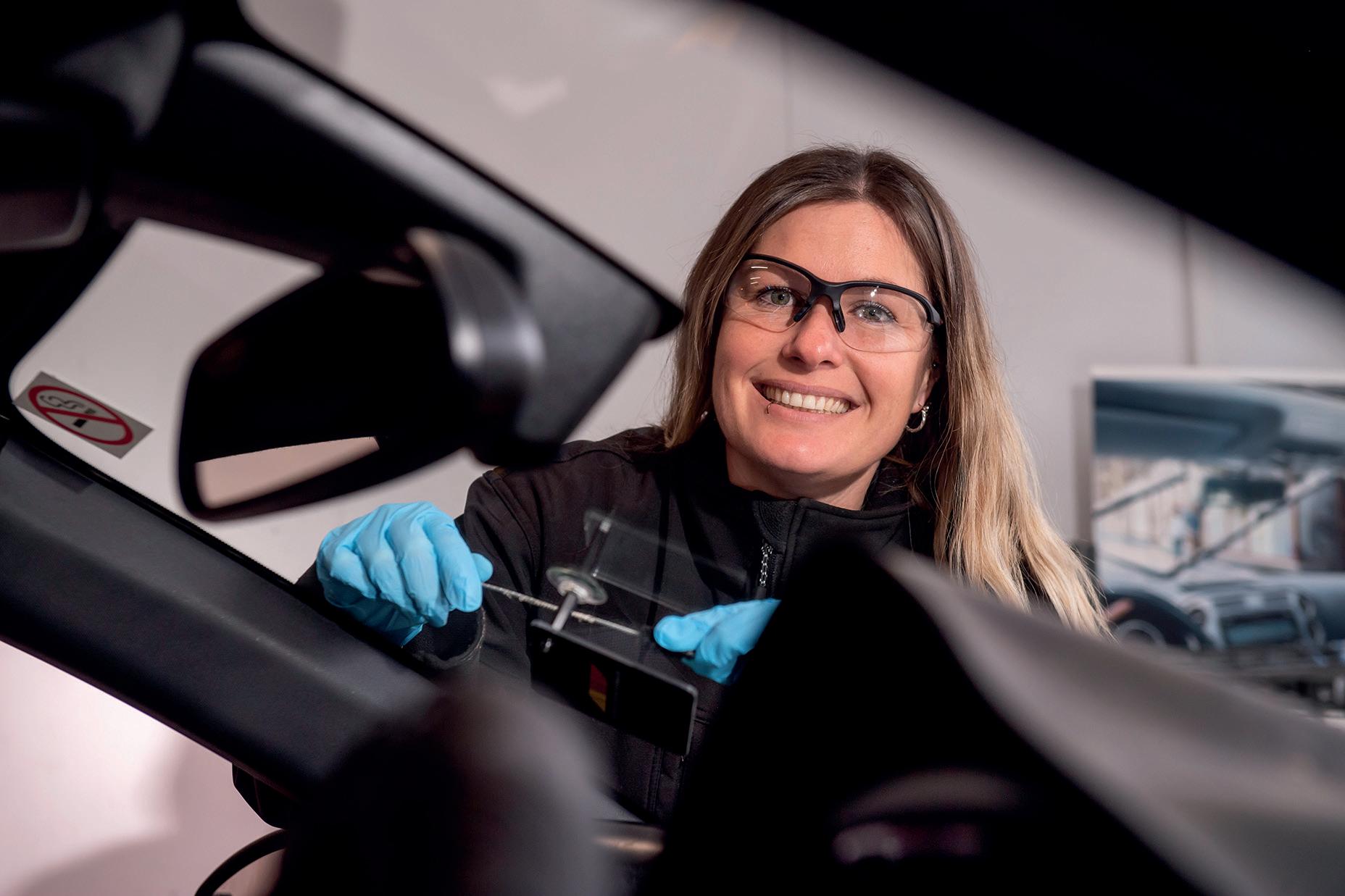
WINDSCREENS, SENSORS AND SOFTWARE:
THE NEW FRONTIER IN VEHICLE REPAIR
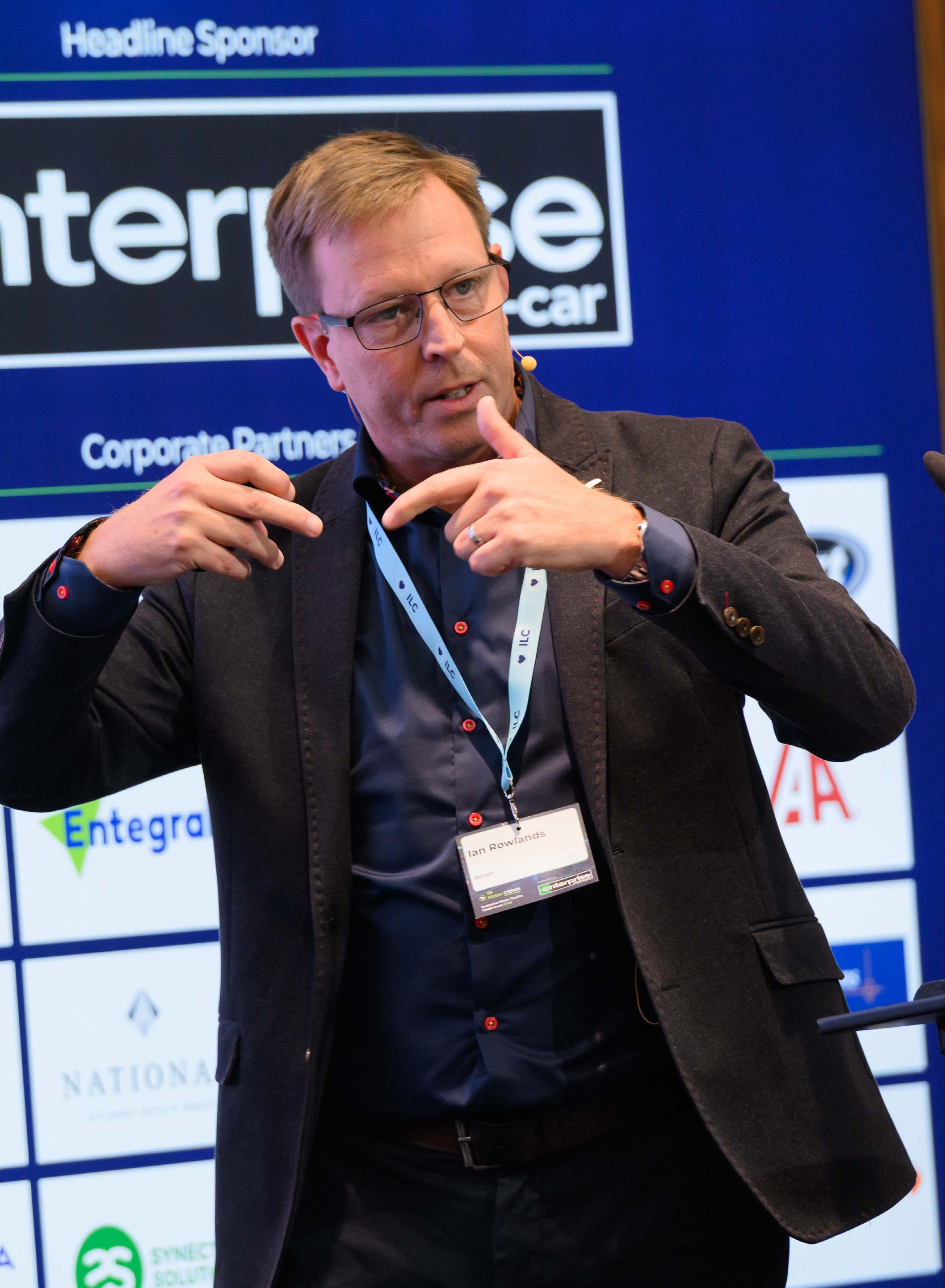
IAN ROWLANDS Commercial Director Autoglass® (Belron UK)
“More cameras mean more recalibrations - 3.6 million last year alone by Belron globally. ADAS complexity is growing faster than any other vehicle technology.”
The future of vehicle repair is being shaped not by body panels or paintwork, but by glass. As vehicles become smarter, safer, and more software-driven, windscreens are emerging as one of the most technologically complex components in modern vehicles.
At the ILC Exclusive Motor Claims Conference, Ian Rowlands, Commercial Director at Autoglass, delivered a masterclass in what’s coming next - and why insurers need to prepare now for a world where glass repair and recalibration play a pivotal role in safety, cost, and customer experience.
“ADAS, electrification, and glass complexity are converging. Every insurer and repairer needs to be ready for a future where recalibration is as critical as replacement,” stated Ian.
THE GLASS REVOLUTION: FOUR FORCES OF CHANGE
According to Ian, four structural trends are redefining the vehicle glass repair, replacement and recalibration (VGRRR) market:
1. The rise of ADAS and sensors
2. The shift to software-defined vehicles
3. The electrification of the car park
4. Growing glass complexity
“These trends are not distant possibilities - they’re here today,” Ian said. “They’re changing how we work, the skills we need, and the partnerships we rely on.”
1. ADAS AND THE AGE OF THE SMART WINDSCREEN
Since 2014, Advanced Driver Assistance Systems (ADAS) have had the most significant impact on the vehicle glass market. “And ADAS is only going one way,” Ian warned. “It’s going to continue to grow.”
By 2026, 60% of all new vehicles sold globally will feature Level 2 ADAS or higher capability, according to McKinsey data. In Europe, automatic emergency braking (AEB) has been mandatory on all new vehicles since 2024 - one of the biggest drivers of ADAS adoption.
Today, 32% of vehicles in the UK have a camera mounted behind the windscreen. By 2030, that number is projected to reach 53%.
“More cameras mean more recalibrations,” Ian said. “Globally, Belron performed 3.6 million recalibrations in 2024, up 1 million in just two years. That’s extraordinary growth - and it’s a worldwide phenomenon.”
As car manufacturers pursue higher levels of automation, cameras remain their sensor of choice - with emerging systems now featuring stereo, trifocal, and even thermal imaging cameras. The next wave includes augmented reality heads-up displays and long-range LiDAR sensors, the latter expected to be central to Level 3 autonomous vehicles.
This evolution will drive a major increase in calibration demand - and complexity. “We’re moving from single to dual recalibrations,” Ian said. “That means a static calibration in a controlled environment, followed by a dynamic calibration on the road.”
Digital calibration will also become standard. “As ADAS becomes fully integrated into software-defined vehicles, digital methods will be essential. There’s no sign of self-calibration becoming mainstream - in the past we have seen vehicle manufacturers rolling back from that approach due to increasing recalibration complexity,” he explained.
The implications for insurers are significant. Each recalibration adds cost, and as liability shifts toward manufacturers and system providers in the age of semiautonomy, proof of calibration will become essential for regulatory compliance and claims defensibility.
“Certification will be critical,” Ian said. “If a vehicle fails to detect a hazard, insurers will need to prove the sensors were calibrated correctly. The liability question gets bigger every year.”
2. SOFTWARE-DEFINED VEHICLES: OPPORTUNITY AND THREAT
Vehicles are no longer mechanical platforms with embedded electronics; they are software ecosystems on wheels. “All new cars built since 2022 are connected to the internet,” Ian explained. “Manufacturers have launched service-oriented platforms that enable overthe-air updates, new features, and entirely new business models.”
The benefits are substantial:
• Enhanced road safety through vehicle-tovehicle (V2V) and vehicle-to-infrastructure (V2I) communication
• Remote vehicle diagnostics and dynamic updates
• Personalised connected services for motorists
Yet for the aftermarket and insurers, the trend brings challenges. “OEMs are increasingly using Secure Gateway technology,” Ian said. “This is a physical barrier on the vehicle network blocking access needed for diagnostics and recalibrations. This limits the ability of the independent aftermarket to compete in an efficient manner with OEMs.”
The consequence, he warned, is that these barriers add unnecessary cost and affect free competition in the aftermarket, as well as consumers’ freedom of choice, which can lead to higher prices.
“Secure gateways restrict access to the vehicle data we need to repair safely and efficiently,” he said. “This is a fundamental challenge for the aftermarket - and for insurers relying on that ecosystem.”
Belron wants to ensure a level playing field for the independent aftermarket. This means for many years we invest in legislative affairs and lobbying to ensure a robust legal framework that preserves access to vehicle data and the right to repair. It’s not just about us, - it’s about preserving customer choice, and affordability.
3. ELECTRIFICATION AND THE CHANGING VEHICLE MIX
The shift to electric vehicles (EVs) is not just transforming powertrains - it’s revolutionising glass design. “EVs use thinner glass to reduce weight and improve aerodynamics,” Ian said. “They also use solar coatings to limit air conditioning demand and extend range.”
But electrification also complicates the repair landscape. “We’re seeing a constant influx of new vehicle brands, particularly from China,” he explained. “Each one brings new design specifications, new glass types, and new calibration requirements.”
This diversity creates logistical and technical challenges. “We need the right glass, the right fitting instructions, and the right recalibration data - for every model, as soon as it hits the market,” Ian said.
Autoglass is tackling this through deep partnerships and predictive data.
“We work with leading glass suppliers that also produce glass for the vehicle manufacturers to ensure availability, for example Fuyao’’ he said. “And we use AI forecasting to predict demand by market and vehicle type. That ensures we have the right parts, at the right volume at the right place.”
Internally, a team of specialists gathers and ingests OEM repair and recalibration instructions daily to ensure recalibration readiness. “We partner with manufacturers, including new ones from China, to access fitting instructions and calibration data,” Ian added. “It’s all about staying one step ahead.”
4. THE ERA OF COMPLEX GLASS
If one word defines the future of vehicle glass, it’s “complexity.” In 1980, a windscreen had perhaps two functions: tinting and shading. Today, it can have up to 28 different functions - from defrosting and heating elements to sensor integration, cameras, antennas, and augmented reality projections.
While glass surface area has stabilised, some models are pushing extremes. “Look at the Lucid Air, for example,” Ian said. “The entire upper cabin is almost one piece of glass.”
This innovation brings both opportunities and complications:
• Larger glass areas require multiple technicians and specialised handling tools.
• Head-up displays (HUD), even with Augmented Reality (AR), demand optical precision
• By 2029, AR HUD penetration in new EU vehicles is expected to reach 15%
“If your HUD projection isn’t pin-sharp, that’s a customer dissatisfaction issue waiting to happen,” Ian warned. ’For insurers and networks, that means that glass quality and fitting standards matter more than ever’’
THE HIDDEN RISK: MISSING CALIBRATIONS
In a Q&A following the presentation, Ian addressed a growing concern - the number of vehicles on UK roads operating with uncalibrated or mis-calibrated sensors.
“I think it’s a real issue,” he said. “There’s no onboard diagnostic to tell you that your ADAS system isn’t functioning correctly. We suspect there are many of vehicles out there that haven’t been recalibrated properly after glass replacement. That’s a safety gap we can’t ignore.”
“The fight for fair access to vehicle data is one of the most important battles in our industry today. Without it, we risk losing customer choice and cost control.”
He also cautioned against the trend of insurance policies excluding windscreen cover, a practice gaining traction in aggregation channels. “It’s a dangerous trend,” he said. “Customers often don’t realise they lack cover until they make a claim. Given that windscreens are the most frequent claim type, removing them from base policies is short-sighted.”
STRATEGIC IMPLICATIONS FOR INSURERS
For insurers and claims leaders, the takeaways are clear:
• ADAS is accelerating, driving up calibration frequency, complexity and technical skill requirements.
• Digital calibration certification will be essential for liability management.
• Software-defined vehicles threaten data accessand, by extension, independent repair cost control.
• EV growth will reshape glass mix, supply logistics, and network capability needs.
In response, insurers must work closely with partners who invest in technology, data access, and training. “It’s about being ready for the vehicles of tomorrow,” Ian said. “If your partners can’t identify, source, and recalibrate the glass correctly, you’re exposed - operationally, financially, and reputationally.”
A CALL TO COLLABORATE
Ian ended with a clear message to the insurance market: the glass of the future isn’t just a component - it’s a system.
“It’s connected, it’s intelligent, and it’s central to safety,” he said. “That means recalibration isn’t just a workshop process; it’s part of the safety assurance chain. We all have a stake in getting it right.”
As the industry faces a wave of autonomous, connected and electric vehicles, collaboration between insurers, repairers, and manufacturers will be vital.
“Our challenge,” Ian concluded, “is to stay ahead of technology that changes faster than ever - because safety, customer confidence, and cost control depend on it.”
KEY FIGURES AT A GLANCE
60% of global new car sales to feature Level 2+ ADAS by 2026
3.6 million recalibrations performed globally by Belron in 2024 (up one million in two years)
32% of UK vehicles currently have camera-based ADAS; projected 53% by 2030
28 functions in the average modern windscreen
15% of EU new cars to feature AR head-up displays by 2029
EV windscreens now more technologically advanced than ICE equivalents
“Today’s windscreens can perform 28 functions - they’re becoming the most complex, safety-critical component in modern vehicles.”
SALVAGE, SUSTAINABILITY AND THE POWER OF DATA: REWRITING THE ROLE OF VEHICLE RECYCLING
MIA CONSTABLE Head of Business Development e2e Total Loss Vehicle Management
For decades, vehicle salvage has sat on the periphery of insurance and claims conversations - seen largely as an operational necessity rather than a source of value, data, and sustainability. That perception is changing fast.
At the ILC Exclusive Motor Claims Conference, Mia Constable, Head of Business Development at e2e Total Loss Vehicle Management, outlined how technology, data integration, and green parts adoption are redefining the salvage sectorand why insurers must bring salvage strategy into the boardroom.
“Salvage and recycling are no longer the afterthought of the claims processthey are integral to the industry’s sustainability, cost control and customer value agenda,” stated Mia.
FROM RECOVERY TO DATA INTELLIGENCE
e2e operates as a national network of independent salvage sites, unified through a single digital platform. “We’ve been working for several years to centralise the flow of data from across our sites,” Mia explained. “That has enabled us to build a single platform where salvage and recycled parts data are processed together.”
This shift from logistics to data intelligence is fundamental. “We’re not just collecting and disposing of vehicles anymore - we’re analysing what happens to them, how they’re categorised, how their components can re-enter the supply chain,” she said.
“We’ve offered over 180,000 recycled parts this year - yet less than five per cent were ordered. The opportunity for cost reduction and carbon saving is enormous.”
The outcome: a centralised parts platform, consolidating real-time information from across e2e’s network and integrating directly with repairers. “It’s transforming how insurers, bodyshops, and recyclers collaborate,” Mia noted.
REPAIR VS TOTAL LOSS: SMARTER DECISIONS THROUGH DATA
The question of whether a vehicle should be repaired or written off has become one of the most strategically important in the claims journey.
“What we’re seeing is a shift toward keeping vehicles on the road - more going down the repair route,” Mia said. “But that decision is increasingly complex. It’s not just about damage - it’s about data.”
e2e’s system collates multiple data points into that decision-making process, including:
• Pre-accident value (PAV)
• Cost of repair
• OEM versus green part pricing
• Parts availability
• Auction and resale value predictions
“Insurers are trying to bring all of this together - fraud detection, weather data, image analytics - but it’s often dispersed across multiple systems,” she explained. “Our goal is to help centralise that data flow, giving a clearer picture of whether a repair or a total loss offers the better outcome.”
MARKET DYNAMICS: THE POST-COVID RESET
Mia shared e2e’s internal data on salvage values, illustrating how the sector has recalibrated since the pandemic.
“Before March 2024, we saw some major distortions,” she said. “COVID, Brexit, and a shortage of second-hand vehicles all drove salvage values up, while settlement values rose even faster. The gap between what insurers paid out and what they recovered widened significantly.”
The FCA’s introduction of settlement value guidance in early 2024 has since stabilised the market. “If you look at our data - average claimant settlement and average salvage settlement have now levelled,” she said. “Over the past 18 months, values have held steady, fluctuating within £50–£100. It’s a new equilibrium.”
“The gap between settlement and salvage has finally stabilised - but data visibility remains the key to protecting insurer margins.”
Forecasts suggest this trend will hold through the remainder of the year. “Our analysts predict consistent salvage values through the second quarter of 2025,” Mia added. “That’s good news for planning, but it also highlights the need to leverage this data more proactively.”
GREEN PARTS: OPPORTUNITY STILL UNTAPPED
One of the most striking insights from e2e’s presentation was the gap between available recycled parts and actual uptake.
e2e’s PartsMarket system, launched in early 2025, consolidates all recycled OEM parts from across its network into a single searchable marketplace. The platform was developed in partnership with Audatex and piloted with 12 repairers, including major bodyshop groups.
“We’ve now processed over 30,000 repair assessments in the first six months,” Mia reported. “From those, we identified and offered over 180,000 non-safety-related recycled parts - an average of 13 parts per repair.”
The potential cost savings are significant - yet adoption remains low. “Despite that stock being available, fewer than five per cent of those parts are actually ordered,” Mia revealed. “That’s a huge missed opportunity - financially and environmentally.”
e2e is now working closely with repairers to understand the barriers. “Many cite legacy concerns: part quality, delivery reliability, or the assumption that green parts will delay the repair,” she said. “But our protocols guarantee quality assurance, 48-hour delivery, and a defined returns process. The market has evolved - the perception hasn’t.”
“The Salvage Sector Index will do for our industry what the housing index did for property — bringing transparency, confidence and dataled forecasting.”
WHY THE DISCONNECT?
Mia believes the low utilisation rate is a symptom of legacy habits rather than capability. “Bodyshops are used to sourcing multiple parts simultaneously,” she explained. “They’ll order from several suppliers and keep whichever arrives first, cancelling the rest. That behaviour drives unnecessary cost and waste.”
e2e’s data shows the top reasons for returns include multiple ordering and part number mismatches.
“In many cases, the part number is the same but includes a slight variation at the end,” Mia said.
“That’s where collaboration with OEMs is vital. We need manufacturers to work with the recycling sector to standardise data and part numbering to make matching more accurate.”
This is becoming more urgent as vehicle technology increases in complexity. “ADAS systems and sensorintegrated components mean one small variation in part design can make a huge difference,” she said. “Manufacturers sharing data would solve a lot of that friction.”
EVS AND NEW BRANDS: PLANNING FOR WHAT’S COMING
While the recycled parts market is growing, EV and Chinese-brand salvage remains in its infancy. “From our network’s perspective, EVs and Chinese vehicles are still a slow burner,” Mia said. “We’re not yet seeing the volume of damaged vehicles coming through, but we know it’s coming.”
e2e has already begun preparing for that influx.
“We’ve built the platform and data capability to handle it,” she said. “The early signs from manufacturers like BYD suggest the market will accelerate rapidly as those vehicles mature.”
The implications for insurers are clear: repair networks and supply chains will need to adapt to unfamiliar vehicles and new parts ecosystems.
“When those vehicles start entering claims volumes, availability of recycled components will be essential to control costs and turnaround times,” Mia said. “This is the moment to get ready.”
THE SUSTAINABILITY IMPERATIVE
Beyond cost and efficiency, Mia positioned green parts adoption as a critical enabler of insurers’ ESG goals.
“Scope 3 emissions are now front and centre for insurers,” she noted. “Every recycled part used represents a measurable carbon saving - and a reputational win. Repairers and insurers that build green parts into their workflows will lead on sustainability reporting and customer transparency.”
e2e’s role, she said, is to make those benefits measurable. “We’re developing the ability to track and report carbon savings across every part transaction,” Mia explained. “That data can directly support insurers’ ESG disclosures - and demonstrate tangible progress against sustainability targets.”
BUILDING THE SALVAGE SECTOR INDEX
Looking ahead, e2e is working on an ambitious next step - the creation of a Salvage Sector Index.
“Think of it as the housing market index - but for salvage,” Mia explained. “We want to aggregate the data we hold and invite contributions from across the industry to create a comprehensive index for the UK salvage and recycling sector.”
The index will initially cover:
• Salvage values
• Scrap metal index data
• Used car prices (via partnerships)
• Auction bidder behaviour and demand trends
“This would give insurers and stakeholders a reliable benchmark for performance, pricing and forecasting,” Mia said. “It’s an open invitation - we want the whole market to contribute.”
KEY FIGURES AT A GLANCE
30,000+ repair assessments processed through e2e’s platform (H1 2025)
180,000+ non-safety parts identified and offered back to bodyshops
13 recycled parts per repair on average
<5% actual usage representing a major growth opportunity
Salvage value variance: £50–£100 range across last 18 months
12 repairer groups participating in e2e PartsMarket pilot
STRATEGIC IMPLICATIONS FOR INSURERS
For insurer CEOs, the implications of Mia’s insights are clear and far-reaching:
• Salvage strategy is now a data strategy. The ability to track, forecast, and monetise vehicle end-of-life outcomes is becoming a competitive differentiator.
• Green parts are an untapped lever for cost control and ESG delivery. With less than 5% utilisation, the growth potential is immense.
• Collaboration with OEMs on part numbering, data sharing and ADAS compatibility will be key to unlocking efficiency.
• EV and new-brand readiness will define network resilience over the next three years.
• Salvage value stability provides opportunity for strategic forecasting - but only if data integration improves.
• ESG reporting increasingly depends on measurable recycling and carbon data.
48-hour delivery guarantee on recycled parts
CONCLUSION: TURNING SALVAGE INTO STRATEGY
Mia’s message to the industry was unambiguous: the salvage sector’s future lies not in scrapyards but in data, sustainability, and digital integration.
“Every decision on repair versus total loss, every part ordered or recycled - it all feeds into the insurer’s wider strategy on cost, carbon, and customer,” she said. “The potential is huge, but it requires collaboration.”
The next frontier, she added, is mindset. “For too long, salvage has been viewed as the end of the claim. It’s time we saw it as the start of a smarter, more sustainable way of doing business.”
DIFFERENT
TURNING DATA INTO A STRATEGIC ASSET: BUILDING THE CONNECTED CLAIMS ECOSYSTEM
DAVID VELLA Managing Director – UK & Ireland GT Motive
“A £100 glass excess on a £1,300 calibration claim highlights the disconnection between data and decisionmaking.”
The insurance sector is standing at a crossroads where technology, data, and operational strategy converge. For David Vella, Managing Director of GT Motive UK & Ireland, the direction is clear: those who treat their data as a strategic asset - not just an operational by-product - will define the future of motor claims.
David highlighted, “An estimating system isn’t just processing claims. It’s generating a goldmine of intelligence. The real question is: are you using it?”
HARNESSING DATA: FROM PROCESS TO INSIGHT
GT Motive processes vast volumes of estimating data across 175 data streams, 600 million parts prices, and millions of transactions in 30 countries. That scale gives David a unique view of industry trends - and a clear warning for insurers: “These aren’t future pressures. They’re here now.”
The top five trends visible across GT Motive’s global data are:
1. Parts price inflation
2. Supply chain disruption
3. ESG and sustainability demands
4. AI and automation adoption
5. Integration and data connectivity gaps
“Too many organisations still see data as an administrative function,” David said. “But when analysed strategically, it becomes the most powerful lever an insurer has - for cost control, risk management, and customer experience.”
INFLATION IN THE SUPPLY CHAIN: A PROFITABILITY ISSUE
Parts price inflation continues to ripple through every layer of the claims process. “A headlamp is up 15% in a year,” David said. “A bumper - 43%. Every increase compounds severity, indemnity spend, and ultimately, pricing models.”
This isn’t just a supply chain issue, he argued. “It’s a profitability issue. Every insurer needs to ask: are our underwriting models keeping pace with these changes?”
Nowhere is this more evident than in glass claims. By next year, 40% of vehicles on UK roads will have ADASenabled windscreens requiring recalibration. Yet the typical customer excess on a glass claim remains around £100, while the average repair cost - parts, labour, and calibration - now exceeds £1,300.
“That gap between customer contribution and true cost can’t remain,” David said. “It’s a perfect example of how underwriting, pricing, and claims must be linked by shared data - not treated as separate silos.”
THE CONNECTED ECOSYSTEM: DATA WITHOUT BORDERS
No insurer operates in isolation. The claims journey is increasingly defined by the ability to connect across multiple partners - from green parts providers and salvage agents to AI imaging tools and aftermarket parts suppliers.
“The value lies in how well you connect,” David explained. “Integration and collaboration across the ecosystem aren’t nice-to-haves anymore - they’re critical to speed, accuracy, and insight.”
GT Motive’s work focuses on enabling this connectivity through open, API-driven systems. “As an agnostic data provider, our job is to make the ecosystem work seamlessly,” he said. “But the strategic choice is yours: do you want to own that connected ecosystem or leave it fragmented?”
For David, the opportunity is vast. “Smarter decisionmaking, better supply chain performance, accurate ESG reporting - the answers are already in your data,” he said. “The only question is whether you’re unlocking its full value.”
AI, AUTOMATION, AND THE CLAIMS WORKFLOW
The rise of AI, robotic process automation (RPA), and predictive analytics is reshaping claims operations across Europe. But David was quick to stress that the technology must serve the strategy - not the other way around.
“AI should enable faster insight and better decisionmaking - not just faster processing,” he said. “At GT, we’re already using agentic AI to update estimating models in real time across 30 countries. It translates data into local languages, adjusts regional parts pricing, and updates systems automatically. That means faster, more accurate models with less manual input.”
The potential for insurers is transformative. “Imagine applying the same principles to claims,” David said. “From image capture to triage, parts sourcing to repair allocation - AI can remove friction and deliver precision. But the key is collaboration. We need joined-up data across partners and platforms.”
CYBER RESILIENCE: PROTECTING THE DATADRIVEN FUTURE
The industry’s growing reliance on data also brings heightened cyber risk. “Cyber incidents don’t just affect systems - they affect people, relationships, and trust,” David warned.
“Reducing single points of failure and embedding continuity planning are essential,” he said. “Working with partners who meet standards such as ISO 27001 ensures both operational resilience and data integrity.”
For insurers, this is not merely a compliance issue - it’s a trust issue. “Data underpins customer confidence,” David said. “If that trust is compromised, it’s not just the claim that’s at risk - it’s the brand.”
“It’s not about being clever with AIit’s about collaboration. Data only delivers value when it’s connected.”
GREEN PARTS AND ESG: DATA MEETS SUSTAINABILITY
One area where data integration is already paying dividends is sustainability. “Over the past two years, we’ve worked closely with green parts specialists - including e2e, Silverlake, and Trents - to understand why adoption remains stuck at around 2–2.5%,” David said.
David outlined, “The appetite is there. The ESG case is clear. The problem has been the cataloguing - poor data, mismatched part numbers, inconsistent pricing. That’s what we’re fixing.”
GT Motive’s new integrations deliver a common data format, with verified manufacturer pricing and supersession logic, giving repairers and insurers confidence that the part they select is the right one. “Automation and business rules are the next step,” he said. “If the system can automatically identify the right green part for a given vehicle profile, we remove hesitation and human error from the process.”
That automation could have a dramatic impact on total loss ratios. “Total losses are at an all-time high, while green parts utilisation is at an all-time low,” David said. “If we can flip that balance, the gains for insurers and customers are significant.”
THE CHINESE DATA GAP
Echoing other sessions, David drew attention to the rapid influx of Chinese vehicle manufacturers - and the data vacuum accompanying them. “The vehicles are comingfast,” he said. “But the repair data isn’t.”
Chinese OEMs can bring a new model from concept to production in 18 months, compared to several years for traditional manufacturers. “They make the cars, but they don’t always share how to fix them,” David noted.
GT Motive is working with Thatcham Research and other international partners to close that gap. “We’re engaging directly with the OEMs and with large leasing companies who are purchasing these vehicles,” he explained. “We’re saying: if these cars are on UK roads, they must be repairable. You can’t just sell them without the data.”
The approach includes reverse-engineering repair manuals as vehicles enter the market. “Sometimes, we’re creating the manual as we go,” he said. “It’s not ideal - but it’s essential if the supply chain is to function.”
INTEGRATION AS STRATEGY
The common thread across David’s message is integration - not as a technical exercise, but as a business strategy.
He described GT Motive’s ecosystem as “agnostic and APIdriven”, capable of connecting with any partner across the supply chain. “Whether it’s a salvage network, a paint company, an accident management firm, or a repair network, we can plug them in,” he said. “The goal is to make data flow - seamlessly, securely, and intelligently.”
Insurers that take advantage of that openness can rapidly expand their digital reach without sacrificing control. “We’re seeing more and more demand for integrated ecosystems where claims, supply chain, and ESG data sit side by side,” he said. “That’s what’s coming next.”
THE FUTURE: FROM SILOES TO STRATEGY
Looking forward, David believes the next evolution in claims management will come from breaking down siloes between underwriting, claims, and supply chain data. “Those departments are still too separate in many organisations,” he said. “Yet they rely on the same information.”
Future-ready insurers, he said, will use data to anticipate trends rather than react to them. “It’s about understanding where risk is moving - not just recording it after the fact.”
At GT Motive, this philosophy is already being put into practice. “We’re applying the same models internally,” David explained. “We use data to predict parts pricing, update systems automatically, and maintain global accuracy. The technology is already here. It’s how we use it that matters.”
“Total losses are high. Green parts usage is low. Data-driven automation can flip that balance and unlock sustainability at scale.”
THE CEO PERSPECTIVE: DATA AS AN ENABLER
For insurer leaders, David’s message is both challenge and opportunity. “You already have the data,” he said. “The question is whether you’re treating it as a strategic enabler or leaving it trapped in silos.”
That means shifting mindset - from operational efficiency to strategic foresight. “Claims data isn’t just about settling faster,” he concluded. “It’s about shaping pricing, risk, ESG, and customer value.”
“The insurers who win will be those who harness their data - connect it, automate it, and use it to anticipate rather than react.”
KEY INSIGHTS FOR CEO s AND BOARDS
£1,300 average glass claim Vs £100 average excess - a clear mismatch between cost and pricing models.
40% of UK vehicles will have ADAS-enabled windscreens by 2026, increasing calibration demand.
15% Headlamp prices up 43% bumpers up year-on-year - inflation directly impacting claims severity.
Green parts adoption still below 3% despite major cost and ESG potential.
30+ countries and 600 million parts prices processed through GT Motive’s data ecosystem.
18-month product cycles for new Chinese vehicles - but limited repair data availability.
Facilitating a seamlessly connected ecosystem, centred around delivering actionable data for oversight and transparent decision-making.
THE LEGAL LANDSCAPE: A NEW NORMAL IN MOTOR CLAIMS
DONNA SCULLY Director Carpenters Group
“It takes 30% longer to run a claim on the new portal than on the old one - that can’t be right after a £50 million investment.”
EMMA FULLER Partner & Head of Motor and Casualty Market Strategy
DAC Beachcroft
After four years of the most significant reforms in the history of motor injury law, the UK’s claims environment has reached what many describe as a fragile ‘new normal’.
Claims frequency is down, costs remain stubbornly high, and legal complexity continues to evolve.
At the ILC Exclusive Motor Claims Conference, Donna Scully and Emma Fuller offered rare dual insight - from claimant and defendant perspectivesinto where the sector stands and what comes next.
“The fact that legal hasn’t even been mentioned until this late in the day tells you something,” said Donna. “The reforms have in part done what they set out to do - they’ve driven claims volumes down by 50% and costs by 80% at the lower end.”
Donna Scully
FOUR YEARS ON: WHIPLASH REFORMS HAVE CHANGED EVERYTHING
Both speakers agreed: the Whiplash Reforms, launched in May 2021, have transformed the motor injury landscape.
“There’s no question they’ve achieved their core objectives,” said Emma. “Claims volumes are down sharply, many of the murkier operators have exited the market, and fraud has reduced.”
For insurers, the reforms have delivered on their fundamental aims: fewer claims, lower legal costs, and predictable damages. But for claimant representatives, the experience has been mixed.
“The new system has fundamentally changed access to representation,” Donna acknowledged. “The portal was meant to empower litigants in person (LIP), but the truth is only around three to four per cent of claims are from genuine LiPs. It’s effectively a professional-user system now.”
While both sides praised the reforms’ impact on fraud and frequency, Donna pointed to the OIC Portal’s inefficiencies as a major drag on performance. “It takes 30% longer to run a claim on the new portal than on the old one,” Donna noted. “That can’t be right after a £50m investment.”
A SUCCESS STORY - BUT NOT A PERFECT ONE
The data tells a compelling story.
• Personal injury claims are down around 50% compared to pre-reform levels.
• Whiplash awards are down up to 80% due to tariff limits.
• Mixed injury claims now make up 69% of all OIC submissions.
• The small claims track limit has not increased - pushing many claims above the £5,000 threshold and adding pressure on costs.
“The fall in frequency is good news,” said Emma, “but inflation is undoing much of that progress. The first quarter of 2025 saw £3.2bn spent on motor claims - the highest since records began.”
While fewer claims reach court, the complexity of those that do has increased. “The reforms were meant to simplify,” Scully said, “but the mixed injury problem and tariff confusion are fuelling disputes.”
Both experts cited causation as a major emerging battleground. “We’re seeing far more claims where every conceivable limb has been injured in a low-speed impact,” Emma remarked. “It’s hard to reconcile, and medical experts aren’t always challenging it.”
MedCo (Medical Reporting and Coordination) is reportedly working with industry to tighten medical standards and embed causation analysis more firmly into expert reports.
THE CURVEBALL: MAZUR V CHARLES RUSSELL SPEECHLYS
While reform has largely settled, both Donna and Emma warned that unexpected developments continue to shake the sector.
“The recent High Court ruling in the Mazur v Charles Russell Speechlys case, about who can legally run litigation, has been a shock,” Donna said. “It challenges whether non-solicitors and paralegals can manage claims..”
Having championed alternative legal routes into the profession in support of social mobility, Donna described the decision as “extremely challenging”. “For 20 years, we’ve told people these are simple cases that people with adequate training can handle - and now suddenly we’re saying they require qualified solicitors. We are a sizable firm with a high number of people who qualify as an authorised person, but others may not be so fortunate, and this ruling will challenge their business model significantly. .”
Emma agreed that the uncertainty has rattled firms across the sector. “It’s not government reform - it’s case law - but it’s having a huge operational impact,” she said.
ECONOMIC PRESSURES: THE COST SPIRAL
Despite falling claim volumes, claim costs are at record highs. Emma explained that while technology and road safety improvements are reducing collisions, economic factors are driving up the value of each case.
“Care costs are a major pressure point,” she said. “There’s been no stabilisation in that area, and it’s pushing up large bodily injury settlements. Even with fewer accidents, the overall spend keeps rising.”
The cost-of-living crisis is also reshaping fraud. “We’ve seen a decrease in organised fraud through the OIC,” Emma noted, “but a rise in opportunistic fraud - misrepresentation, underinsurance, and exaggeration. It’s what always happens in tough economic times.”
FIXED RECOVERABLE COSTS: STILL EVOLVING
Fixed costs, introduced to create certainty, remain under review. “They’re being looked at again later this year,” said Emma. “There are still rogue points and unresolved judgments, but we’ll have more clarity in 2025.”
Donna agreed that constant revision has become the norm. “I’ve been through reform after reform for 30 years,” she said. “It never stops – one of our core values is agility for a reason, we just adapt.”
COMPULSORY MEDIATION: THE NEW BOTTLENECK
One of the newest developments is compulsory mediation for non-injury claims under £10,000 - a well-intentioned reform that both lawyers said is proving problematic.
Emma explained: “The idea is sound - more mediation, fewer trials. But the implementation is flawed. Mediations are happening before disclosure, so the parties don’t have the documents they need to settle. It’s just adding time and cost.”
Donna was equally sceptical. “There aren’t enough mediators to handle the caseload,” she said. “It sounds good on paper, but in practice, it risks becoming another delay point in an already congested system.”
Both agreed, however, that early settlement remains vital. “We’ve run our own mediation tool for years,” Donna added. “When it’s voluntary and structured, it works brilliantly. But compulsion without process just creates friction.”
CREDIT HIRE AND MOBILITY: STEADY BUT SCRUTINISED
Credit hire - a perennial flashpoint - is enjoying a rare period of stability. Emma described current conditions as “cautiously positive”.
“The GTA rate review and ADR process have made real progress,” she said. “The FCA’s report suggests continued collaboration rather than radical reform. That’s encouraging.”
Donna agreed, but urged action on abuse. “We all know where the problems are,” she said. “There are still inflated bills and gaming behaviours that distort the system. The data exists to identify them - we just need to use it.”
Her message was clear: “If the MIB has the data to know who’s gaming the portal, they should name names. We talk about high costs, but we’re not holding the outliers accountable. That has to change.”
THE PORTAL PROBLEM: FIX, DON’T SCRAP
The OIC Portal has now had 35 releases in four years - compared to just seven updates in 14 years for its predecessor. “That says it all,” Donna observed.
After a period of intense development and investment, Carpenters were quickly able to put successful processes in place.. “It works,” she said. “But now we need governance - someone independent of the MIB to oversee improvements.”
Key issues include:
• No time limits on stages, allowing cases to drift.
• Low offers pushing claims unnecessarily into litigation.
• Complex cases clogging a process designed for simplicity.
Judges, she added, are frustrated too. “I spoke to one who said they’re assigning senior judges to OIC cases - small claims being treated like multi-track disputes. That’s not what was intended.”
“Reform fatigue is real, but the industry’s alignment right now is encouraging. We’re all focused on the same things - cost control, efficiency, and better outcomes for genuine claimants.”
Emma Fuller
The industry is taking matters into its own hands. “At a recent roundtable hosted by Carpenters Group, with key industry participants including the ABI, we had real consensus,” Donna said. “Everyone wants to fix the portal - make it quicker, fairer, and more user-friendly. We’d rather do that ourselves than wait for government review. We want to make it easier for customers to get the service they deserve.”
SHARED PRIORITIES: CAUSATION, COLLABORATION AND CUSTOMER
Despite their traditional opposition, Donna and Emma agreed on the way forward: collaboration.
Both are working with MedCo, the ABI, and insurers to improve medical reporting standards and address causation. “Doctors must engage with causation properly,” Donna said. “Otherwise, we’ll keep arguing over every elbow and knee - and customers will wait longer for settlement.”
Emma echoed the point: “Reform fatigue is real, but the industry’s alignment right now is encouraging. We’re all focused on the same things - cost control, efficiency, and better outcomes for genuine claimants.”
CONCLUSION: A FRAGILE CALM
After decades of near-constant upheaval, the motor claims legal landscape is showing rare signs of stability. But both Donna and Emma warned that this equilibrium remains fragile.
“The next phase is about refinement, not revolution,” said Emma. “We need to make what we’ve got work better.”
Donna agreed: “The portal is here to stay. The reforms are here to stay. Our job now is to fix the gaps, tackle abuse, and deliver faster, fairer outcomes for customers.”
“It’s a calmer landscape — for now,” Donna concluded. “But as history shows, in this industry, calm never lasts long.”
KEY INSIGHTS
FOR CEO s AND BOARDS
50% drop in motor injury claims volumes since 2021.
£3.2bn spent on motor claims in Q1 2025 - highest on record.
35 OIC portal releases in four years - Vs seven for its predecessor.
Whiplash damages down
80%
small claims limit still at £5,000.
2–4% of claims from genuine LiPs - OIC effectively a professional portal (Official statistics from OIC show 12%).
Compulsory mediation adding process time without resolution benefit.
“Compulsory mediation sounds good on paper - but without disclosure and capacity, it just adds delay to an already congested system.”
Donna Scully
69% of OIC claims now mixed injury cases.
Credit hire stable but still open to abuse.
Consensus emerging across claimant and defendant sides on portal reform.
https://csg.dacbeachcroft.com/ai-in-claims
CORPORATE PARTNER: DIRECTORY Motor Claims
Activate Group is the faster, smarter collision management partner. We manage hundreds of thousands of motor claims each year on behalf of leading insurers, brokers, MGAs, and fleet operators, delivering an efficient, end-to-end experience for drivers and policyholders. Our mission is simple: get people back on the road quickly and safely while maintaining exceptional repair quality and controlling costs.
Our connected, data-driven ecosystem brings together every stage of the claims and repair journey - from first notification of loss through to engineering, vehicle repair, parts supply, consultancy, and specialist claims handling.
• Motor Repair Network: Customer-focused motor claims partner providing cost-effective, right-first-time claims and repair journeys.
• Avant Repair Network: Award-winning repair network offering high-quality claims and repair services.
• sopp+sopp: Fleet-specialist accident and claims management, minimising downtime and protecting commercial reputations.
• Activate Accident Repair: A UK-wide network of state-of-the-art repair centres located where demand is highest.
• Activate Parts: Our in-house supplier delivering sustainable, costefficient parts at speed.
• Avant Consult: Industry-leading provider of manufacturerapproved paint and body repair programmes and training.
Across the Group, we’re driven by a shared purpose: to make someone’s bad day better. Our people bring empathy, innovation, and expertise to every interaction, ensuring a market-leading service from first call to final repair.
AKZONOBEL
www.akzonobel.com/en
Since 1792, we’ve been supplying the innovative paints and coatings that help to color people’s lives and protect what matters most. Our world class portfolio of brands – including Dulux, International, Sikkens and Interpon – is trusted by customers around the globe.
We’re active in more than 150 countries and use our expertise to sustain and enhance everyday life. Because we believe every surface is an opportunity. It’s what you’d expect from a pioneering and long-established paints company that’s dedicated to providing more sustainable solutions and preserving the best of what we have today – while creating an even better tomorrow. Let’s paint the future together.
AUTOGLASS
www.autoglass.co.uk
Autoglass® is one of the UK’s leading specialists for vehicle glass repair, replacement, and recalibration service. Autoglass® has the widest reaching network in the UK with over 1,000 technicians providing a world class service to motorists.
Autoglass® is the industry leader in ADAS recalibration. It was the first to market with a recalibration solution and has led the industry since, continually investing in technical expertise and capabilities, to deliver the most efficient and best service to our customers ensuring we remain at the forefront of a growing market. Autoglass® works with insurance, fleet and lease companies – large and small – across the full spectrum of industries. Autoglass® handles the vehicle glass claims for nine of the top 10 motor insurance companies in the UK, providing a world-class service to policyholders demonstrated by its NPS score of 75 in 2022. The company has a dedicated specialist glazing division which repairs and replaces glass on everything from trains to combine harvesters. For details of our glass repair, replacement and recalibration service visit autoglass.co.uk
AUXILLIS
www.auxillis.com
With more than 30 years’ experience, Auxillis is one of the UK’s leading providers of claims solutions for the insurance industry. Managing over 200,000 claims a year, we provide seamless FNOL, replacement vehicle, ULR, and repair services to our insurer, broker, automotive, and MGA partners. Our expertise and knowledge is dedicated to making claims less complex, keeping customers mobile, and getting them back on the road quickly and safely.
BHR ASSIST INSURANCE SERVICES LIMITED (BHRA)
www.bhrassist.co.uk
BHR Assist Insurance Services Limited (BHRA) delivers a pioneering, technology driven approach to credit hire mitigation. Using secure Azure cloud infrastructure and API integrations, we streamline insurer workflows and provide a holistic, defensible solution to credit hire challenges. Our suite of services — INTERVENE, COMPARE, STATEMENT, EXCHANGE, and GTA Check — leverages live contemporaneous BHR data to challenge inflated CHO invoices, automate credit hire offers, and empower claims handlers with real time insights. CPR compliant statements routinely deliver substantial savings compared to commercial and GTA hire rates, while comparison and automation tools reduce staffing costs and litigation risk.
GTA Check provides 100% accuracy against known GTA codes and is widely used by insurers and CHOs to ensure correct billing and recovery. By improving the accuracy of vehicle supply and eliminating errors in group allocation, GTA Check reduces leakage and mitigates the risk of overpaying on GTA claims where the wrong group has been charged. By enhancing reserving accuracy, cutting claim handling times, and equipping staff with actionable data, BHRA transforms credit hire strategy into a transparent, efficient, and cost effective process. Built on honesty, integrity, and accuracy, our innovative platform delivers measurable results and sustainable outcomes for insurers across the UK and beyond.
CAPS® vision is to connect every part of the UK Repair Industry. Our aim is to connect insurers and work providers with their entire repair network. Bodyshops, parts, glass, engineers, recovery and salvage. Since its inception, CAPS® has evolved into a vital cog in the automotive claims and repair ecosystem. Its platform, renowned for its real-time data-sharing capabilities, has revolutionised how stakeholders interact and collaborate. With CAPS®, the industry has witnessed a significant reduction in time and costs associated with processing claims and repairs. The platform integrates seamlessly with a wide array of claims reporting software and is synonymous with efficiency and connectivity. Today, CAPS® stands as a testament to innovation, continually adapting and growing to meet the ever-changing needs of the automotive claims and repair industry in the UK.
CAPS® ensures everyone's on the same page, improving how we all communicate and share data. CAPS® can also make life easier for body shops, parts companies and the wider supply chain by cutting down on manual processes and legacy communication methods. Our goal? To get the entire automotive claims and repair industry across the UK sharing data in real-time, making the industry more connected and approachable than ever.
CARPENTERS GROUP
www.carpentersgroup.co.uk
Carpenters Group is a leading provider of insurance and legal services, with over 30 years’ experience delivering fully outsourced claims solutions. Working in partnership with insurers, brokers and managing general agents, we combine deep insurance knowledge with legal expertise to support clients throughout the claims journey. Our team of around 1,500 colleagues operates from seven locations across the UK, including Liverpool, Leeds, Manchester, Haywards Heath and Glasgow.
We pride ourselves on long-standing relationships built on trust, quality and innovation. As a technology-driven business, we continually invest in digital solutions to enhance customer experience and streamline processes. Our services span motor and home claims, legal expenses, serious injury, credit hire and subrogated recovery, supported by a 24/7 FNOL centre. At Carpenters Group, we are committed to doing the right thing for our clients, colleagues and communities, delivering exceptional outcomes every time.
COPART
www.remarketing.copart.co.uk
Copart is a global leader in online vehicle remarketing and recycling, handling over 500,000 vehicles each year in the UK through their patented online ‘live’ auction platform. Delivering service excellence and maximum value throughout the total loss process and offering the UK’s largest inventory of quality assured green parts, they are proud to be the partner of choice across the insurance sector. Copart offers the latest technologies, a 500+ transport fleet, over 1,000 acres for secure storage, and 33 locations across the UK & Ireland. Copart. Always moving forward.
DAC BEACHCROFT
www.dacbeachcroft.com
DAC Beachcroft Claims Solutions Group offers a full range of claims services to insurers and commercial clients. Our aim is to be the partner of choice across all UK jurisdictions for every client in need of legal claims services. Acting for all 20 of the largest UK insurers, our Claims Solutions Group is organised into three service lines – Casualty, Property and Strategic – each with distinct, specialist products. This enables us to provide our insurance clients with all the key elements of a full service claims law firm, delivered through our network of offices in England, Wales, Scotland and Northern Ireland, including London, Belfast, Birmingham, Glasgow and Newport. Our deep and broad expertise, and extensive client base, means we can draw on unrivalled datasets from which to identify trends and devise innovative and creative solutions. Our Claims Solutions Group is part of DAC Beachcroft LLP, an international legal business operating, in addition to the UK, across Europe, Asia Pacific and Latin America. We are a founding member of Legalign Global.
e2e occupies the unique position of being the only UK business dedicated entirely and exclusively to the management of total loss claims. Without any distractions from this core role, we can focus on the operationally efficient, cost effective, and customer driven claims experience that our insurer and corporate clients rightly demand of us.
Supported by our salvage fulfilment and reclaimed parts supply chains we are building a technology-led total loss claims management company which delivers a range of services that are leading edge, of the highest quality, and secure the best returns for our clients and their policyholders. Major investment in IT development across our Auction Services, Parts Platform, and Data/Analytics capabilities maintains our position as one of the leading providers of total loss claims management services. Led by a workforce that is built on passion and commitment plus the skills, knowledge, and experience of our first-class supplier networks, we are unceasing in our efforts to be leading the way in a new generation of dedicated resource and expertise. Here at e2e we have only one mantra that we follow. We Deliver Excellence. Differently.
ENTEGRAL
Entegral® is a software platform that streamlines the post-incident process for service providers to keep claims moving, and get customers back on their way. The focal point of Entegral is data-infused network management that supports two-way communication between work providers and repairers. The platform then alleviates the guesswork from deployment, by combining repairer capabilities with customer requirements, we recommend the most appropriate repairer to the claims handler. This proactive approach replaces manual and paper processes and improves control and transparency. We finish with real time claim tracking that offers total visibility as the claim progresses.
Entegral integrates with third-parties to enable real-time communications and collaboration between tens of thousands of repairers, manufacturers, insurance providers, and other industry professionals around the world. Headquartered in Surrey, Entegral combines product names you might recognize: ARMS® Business Solutions, Cyncast, and Performance Gateway. An industry-leading source of profile body shop data and insights, we serve more than 50 insurers, vehicle manufacturers, and bodyshops in the US, Canada, UK, Ireland, and Puerto Rico, including a majority of the top 25 insurance companies. This robust profile data, combined with the operational processes, make Entegral a key component in any claim workflow.
ENTERPRISE RENT-A-CAR
www.enterprise.co.uk/en
TRUSTED INDUSTRY PARTNER AND SPECIALISTS IN INSURANCE REPLACEMENT RENTALS
For more than 65 years, Enterprise has established itself as a leader in providing replacement vehicles and courtesy cars that are relied upon in the event of an accident. By working closely with our insurance, broker, body-shop, assistance provider and dealership partners we’ve developed a unique approach to managing each of their replacement vehicle needs. With the scale, technology and expertise we’re able to provide a value for money and high-quality solution that keeps your customers mobile. By constantly reviewing the needs of the market, Enterprise continues to develop new and innovative mobility solutions to better support the needs of its customers.
As a privately-owned company, Enterprise prides itself on its ability to react quickly to changes and challenges in the market. This flexibility, together with a continuous focus on innovation and growth through service excellence, means Enterprise has the strength and adaptability to succeed, no matter what the market conditions.
GT MOTIVE
www.gtmotive.co.uk
With an award-winning estimation platform, GT Motive is devoted to developing software solutions for the automotive industry. Offering a range of products including accurate estimating solutions and streamlined cloud-based workflow platforms, GT Motive helps insurers, repairers, engineers, and fleet companies to achieve their goals and drive efficiencies in engineering and claims management.
Through collaboration, automation, integration, and innovation, GT Motive continuously strives to create unique solutions to improve claims operations for all stakeholders. GT Motive recently launched their game changer…GT Global, a collaborative ecosystem that connects the latest workflow technology for engineering and claims management with GT Motive’s core capabilities around estimatics and data. GT Global is the communications layer around the core estimatics model and facilitates collaboration, the receipt of the instructions for the repairer or the engineer with different profiles, different audit rules, validation rules, etc and all of the processing around authorisation and total loss. GT Global is a reliable and viable alternative to existing platforms, with state-of-the-art secure cloud technology, the estimating solution is based in OE data and updated in real time. Secure collaboration between engineers and repairers has never been easier and more secure with GT Estimate, the leading estimating solution.
IAA
www.iaai.co.uk
IAA Holdings, LLC (IAA), an RB Global company (NYSE: RBA) (TSX: RBA), is a trusted global marketplace for insights, services and transaction solutions for commercial assets and vehicles. Leveraging leading-edge technology and focusing on innovation, IAA’s unique platform facilitates the marketing and sale of total-loss, damaged and low-value vehicles.
IAA serves a global buyer base – located throughout over 170 countries – and a full spectrum of sellers, including insurers, dealerships, fleet lease and rental car companies, and charitable organisations. For more information on IAA in the UK visit IAAI.co.uk and for more information about RB Global visit RBGlobal.com.
INNOVATION GROUP
www.innovation.group
Innovation Group have been managing critical incidents in the car and home on behalf of some of the world's leading insurers, brokers and MGAs for over 25 years.
At Innovation Group, we are dedicated to supporting our clients and their customers when it matters most. Our goal is to minimise the impact of unexpected events by delivering a comprehensive, end-to-end claims management service, from first notification of loss (FNOL), through to final settlement. If you’re seeking a technology-driven, innovative solution for motor claims management, we are the ideal partner. We work closely with you and your customers to manage the entire claims process on your behalf, offering a digitally connected experience across our supply chain. This ensures a frictionless, jargon-free, and transparent journey, always keeping customers at the heart of what we do. Please get in touch to find out what sets us apart from other TPAs within the market.
KENNEDYS
www.kennedyslaw.com
Kennedys is a global law firm with over 2,500 people, in 45 offices across 21 countries around the world. The firm has particular expertise in litigation and dispute resolution, especially in defending insurance and liability claims. We provide a broad range of specialist legal services to insurers and reinsurers, MGAs, brokers, corporates, healthcare providers, public sector bodies and other organisations, delivering straightforward advice even when the issues are complex.
Known for our presence across all lines of insurance business in multiple jurisdictions, the firm has developed a strong reputation for the provision of legal services to the global motor insurance market. Our Corporate Partnership with I Love Claims forms part of a continuing commitment to significantly invest and grow our presence in the UK motor sector where we make a real difference to our clients. We’re a fresh-thinking firm, and not afraid to bring new ideas to the table beyond the traditional realm of legal services.
LKQ provides comprehensive, end-to-end support designed to help repairers operate more efficiently, confidently and sustainably. From market-leading parts, paints and consumables to tools, equipment and technical insight, it delivers a complete offer built around the needs of modern bodyshops. Through LKQ Academy – the UK’s largest dedicated bodyshop training provider – repairers can access IMI-accredited courses, intelligent repair training and tailored sustainability programmes that reduce carbon, cut costs and build long-term capability. LKQ also provides hands-on business and technical support, helping repairers streamline workflows, unlock new revenue streams and stay aligned with the latest repair technologies.
With solutions ranging from its Intelligent Repair Proposition to sustainability planning and workshop optimisation, it focuses on delivering practical value that supports real-world growth. As a trusted partner to bodyshops of every size, it works to strengthen performance, elevate customer experience and support a more sustainable future for the industry.
NATIONAL ACCIDENT REPAIR GROUP
www.national-arg.co.uk
National Accident Repair Group remains committed to fostering healthy competition within the UK collision repair sector. By championing independent repairers, we enable customer choice, maintain competitive repair costs, and raise service standards across the industry. Our multi-layered, future-focused network delivers personalised, high-quality repair solutions on a truly national scale. Recent investments in senior leadership have strengthened our claims management and service delivery capabilities, ensuring agility and responsiveness to evolving client and customer needs.
Looking ahead to 2026, our strategy centres on sustaining market-leading performance across core services. This will be powered by advanced, customisable algorithms that harness real-time performance data—streamlining processes, improving operational efficiency, and reducing costs for all stakeholders. At National, we are shaping a smarter, more connected future for accident repair—delivering measurable value and innovation across the entire supply chain.
NATIONAL WINDSCREENS
www.nationalwindscreens.co.uk
National Windscreens is a UK market leaders in the repair, replacement and calibration of vehicle glass and associated advanced driver assistance systems (ADAS).
We specialise in sustainable solutions, offering convenient locations, high-quality products and smart solutions. We recognise our responsibility in preserving the planet’s primary resources and securing its future, helping our partners and customers make simplified and sustainable decisions. Our aim is to be the sustainable choice in the UK, focused on decarbonisation and working towards our near-term, verified group level Science Based Targets. We have continued to make progress in all three of our sustainability areas: Climate, Our People and Governance. For further information please visit www.nationalwindscreens.co.uk, and get in touch with a member of the National Windscreens team.
PRECISION REPAIR GROUP
www.precisionrepairgroup.com
Precision Repair Group (PRG) launched in 2025 as a new national collision repair group, uniting the industry’s leading independent repairers across the UK.
PRG delivers high-quality repair services spanning mainstream, prestige, and commercial fleet. The Group is committed to supporting the long-term success of its businesses while creating a resilient, sustainable nationwide network designed to meet the evolving needs of insurers, fleets and OEMs.
The Precision commitment is to build a repair organisation focused on partnership and quality. Businesses joining PRG retain their brand, leadership and long-standing customer relationships, while gaining access to group-level expertise, investment and procurement benefits. The Group will continue to grow through the year - and at January 2026, it includes Alton Cars, DSL, Fast Track ARC, HB ARN, Hilton Coachworks and Turners Accident Repair.
PROCLAIM CARE
www.proclaim-group.co.uk
Proclaim Group unites three award-winning specialist rehabilitation services: Proclaim-Care, Obair Associates, and Resolve Health to deliver exceptional rehabilitation, vocational, and occupational therapy services.
• Comprehensive Care: From focused treatment programs to complex catastrophic case management, we provide the full spectrum of rehabilitation solutions
• Trusted by Insurers: Our independence and goal driven approach ensure the best outcomes for clients while offering seamless support.
• Specialist Expertise: Complementary vocational rehabilitation and occupational therapy services create a holistic client experience.
• Industry Support: Through our dedicated Training Academy, we provide free specialist training to strengthen knowledge and skills across the sector.
At Proclaim Group, our purpose it to make a positive difference to people's lives by revolutionising the delivery, accessibility and inclusivity of injury and condition management and rehabilitation. Our services are outcome focused to support adults and children impacted by an illness or injury. Vocational services assist a return to work.
S&G RESPONSE
www.sandgresponse.co.uk
S&G Response has been providing outsourced claims handling services to a wide variety of stakeholders in the motor supply chain including insurers, intermediaries and self-insured fleet clients since 2009. We are one of the few privately owned businesses in our sector operating with scale allowing clients direct access to the ownership for accelerated decision-making capability. We remain flexible and nimble and therefore able to react to new opportunities and meet the specific requirements of our customers.
The business operates a “hub and spoke” model with its supply chain with ongoing investment in people and processes utilising workflow and automated processes to strip out frictional activity and facilitate the end-to-end coordination of partners requirements. We stay ahead of the curve and up to date with market intelligence and industry dynamics giving us the flexibility to adapt and proactively approach the way we operate to deliver on client expectations.
SOLERA
www.solera.com
Solera is the global leader in vehicle lifecycle management software-as-a-service, data, and services. Through four lines of business – vehicle claims, vehicle repairs, vehicle solutions, and fleet solutions – Solera is home to many leading brands in the vehicle lifecycle ecosystem, including Identifix, Audatex, DealerSocket, Omnitracs, LoJack, Spireon, eDriving/Mentor, Explore, cap hpi, Autodata, and others.
Solera empowers its customers to succeed in the digital age by providing them with a “one-stop shop” solution that streamlines operations, offers datadriven analytics, and enhances customer engagement, which Solera believes helps customers drive sales, promote customer retention, and improve profit margins. Solera serves over 280,000 global customers and partners in 120+ countries. For more information, visit www.solera.com.
THINGCO
www.thingco.com
Intelligent Connected Insurance Solutions – reducing risk and creating customer value through telematics.ThingCo was formed in 2018 by Mike Brockman, the founder of insurethebox, the worlds first telematics only insurer, which was majority purchased by the MS&AD Group in 2015. Mike is a worldrenowned expert in all aspects of motor insurance with more than 45 years of experience in the field. ThingCo was created to help the insurance industry move forward faster in the complex world of connected car.
ThingCo has developed a range of software tools that is tailored to the needs of insurers for managing risk. The Platform can absorb data from any device or source providing insurers (and OEMs) the full range of ThingCo services. In addition, ThingCo has developed a patented solar powered device, branded “Theo”, that is designed to deliver optimal data quality for insurance risk management purposes. In this complex field, ThingCo are experts at data analysis, risk management, first notification of loss (claims) and have developed all the proprietary tools to manage the process on behalf of the insurer. ThingCo reduces risk to the insurer which allows insurers to price competitively but also deliver superior loss ratios. ThingCo works with insurers to design connected products that are attractive to end customers and that will sell in volume.
VERISK
Verisk Claims Solutions supports insurers, brokers, and MGAs at every step of the claim life cycle with claims management solutions and analytical tools that utilise robust, market-researched data, artificial intelligence, and machine learning to streamline your workflow, control costs, and fight fraud while also improving the policyholder experience.
From remote video collaboration with policyholders and image recognition technologies for property and motor, to managing complex personal injury and Credit Hire claims, subrogation, dispute resolution, and even fraud detection, Verisk’s ecosystem of claims solutions equips you with everything you need to provide a consistent and seamless claims journey. Verisk is a leading provider of data, analytics, and software to the insurance market. The company operates through numerous business units that offer risk-assessment services and decision analytics to insurance professionals in many disciplines throughout personal lines, commercial lines, and the London Market.
VIZION
VIZION
Founded in 2009, Vizion Network Ltd is recognised as a pioneer in the delivery of repair and IT solutions. The business manages and repairs all makes and types of vehicles with a strong network of the UK's finest repairers, utilising bespoke digital systems that support and guide the customer along the entire claims journey. These automations help reduce time and effort from initiation of the claim, through to validation, deployment, progression, handling, feedback and beyond.
For the fifth year in succession, Vizion has been listed by the Financial Times – in partnership with Statista - as part of its FT1000 Europe's Fastest Growing Companies Report 2025. It has also been recognised by the FT and Statista as one of Europe’s Long Term Growth Champions for the second consecutive year and every year since this award began.
WHICHRATE
www.whichrate.co.uk
One of the very first investigators of credit hire went on in 2007 to establish Whichrate, the longest standing provider of BHR reports. With a team of former police officers Whichrate has a formidable reputation for high quality reports and success in court. Whichrate provides a seamless journey from intervention products through a wide range of reports, including for specialist vehicles, assisting in effective prelitigation negotiations and fully CPR compliant Statements. All reports are subjected to a five-stage quality process ensuring robustness and accuracy.
Whichrate’s own in-house software team and data scientists are based in the UK. This ensures continual development and investment in its systems, benefiting Whichrate’s customers and their handling of claims. All data and services are secured in UK AWS centres with multiple availability zones for seamless backup and recovery. Invaluable MI is provided free of charge to customers for both national and regional inflation tracking. Bespoke data, presentations, training, and unique insights are also offered on a regular basis, such as EV models and availability, wider market claims trends and CHO rates.Contact our experts today on 0800 534 5347 or admin@whichrate.co.uk