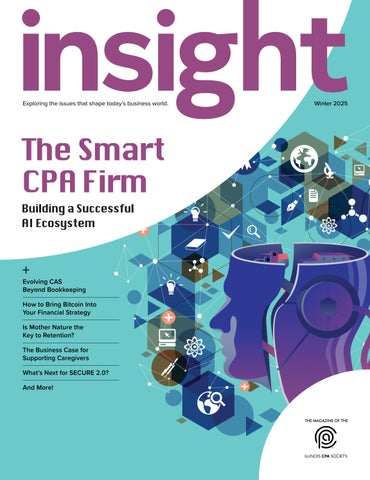
Exploring the issues that shape today’s business world.
The Smart CPA Firm
Building a Successful AI Ecosystem

Evolving CAS Beyond Bookkeeping
How to Bring Bitcoin Into Your Financial Strategy Is Mother Nature the Key to Retention? The Business Case for Supporting Caregivers
What’s Next for SECURE 2.0? And More!

ILLINOIS CPA SOCIETY MEMBER DISCOUNT PROGRAM












ILLINOIS CPA SOCIETY
550 W. Jackson Boulevard, Suite 900, Chicago, IL 60661 www.icpas.org
Publisher | President and CEO
Geoffrey Brown, CAE
Editor
Derrick Lilly
Assistant Editor
Amy Sanchez
Senior Creative Director
Gene Levitan
Proofreaders
Kari Natale, CAE | Mari Watts
Photography
Derrick Lilly | iStock
Circulation
Jeff Okamura
ICPAS OFFICERS
Chairperson
Brian J. Blaha, CPA | Winding River Consulting LLC
Vice Chairperson
Mark W. Wolfgram, CPA | Bel Brands USA Inc.
Treasurer
Jennifer L. Cavanaugh, CPA | Grant Thornton LLP
Secretary
Lindy R. Ellis, CPA | Ernst & Young LLP
Immediate Past Chairperson
Deborah K. Rood, CPA | CNA Insurance
ICPAS BOARD OF DIRECTORS
Amy M. Chamoun, CPA | Cherry Bekaert Advisory LLC
Pedro A. Diaz de Leon, CPA, CFE, CIA | Sikich LLP
Kimi L. Ellen, CPA | Benford Brown & Associates LLC
Monica N. Harrison, CPA | Tinuiti
Joshua Herbold, Ph.D., CPA | University of Illinois
Enrique Lopez, CPA | Lopez & Company CPAs Ltd.
Kimberly D. Meyer, CPA | Meyer & Associates CPA LLC
Girlie A. O’Donoghue, CPA | Portillo’s Inc.
Matthew D. Panzica, CPA | BDO USA PC
Jennifer L. Rada, CPA | PwC LLP
Leilani N. Rodrigo, CPA, CGMA | Galleros Robinson CPAs LLP
Richard C. Tarapchak, CPA | Verano Holdings Corp.
Andrea Wright, CPA | Johnson Lambert LLP
Stephanie M. Zaleski-Braatz, CPA | Miller Cooper & Co. Ltd.
BACK ISSUES + REPRINTS
Back issues may be available. Articles may be reproduced with permission. Please send requests to lillyd@icpas.org.
ADVERTISING
Want to reach 20,000+ accounting and finance professionals? Advertising in Insight and with the Illinois CPA Society gives you access to Illinois’ largest financial community. Contact Mike Walker at mike@rwwcompany.com.
Insight is the magazine of the Illinois CPA Society. Statements or articles of opinion appearing in Insight are not necessarily the views of the Illinois CPA Society. The materials and information contained within Insight are offered as information only and not as practice, financial, accounting, legal or other professional advice. Readers are strongly encouraged to consult with an appropriate professional advisor before acting on the information contained in this publication. It is Insight’s policy not to knowingly accept advertising that discriminates on the basis of race, religion, sex, age or origin. The Illinois CPA Society reserves the right to reject paid advertising that does not meet Insight’s qualifications or that may detract from its professional and ethical standards. The Illinois CPA Society does not necessarily endorse the non-Society resources, services or products that may appear or be referenced within Insight, and makes no representation or warranties about the products or services they may provide or their accuracy or claims. The Illinois CPA Society does not guarantee delivery dates for Insight. The Society disclaims all warranties, express or implied, and assumes no responsibility whatsoever for damages incurred as a result of delays in delivering Insight. Insight (ISSN1053-8542) is published four times a year, in spring, summer, fall, and winter, by the Illinois CPA Society, 550 W. Jackson, Suite 900, Chicago, IL 60661, USA, 312.993.0407. Copyright © 2025. No








ceooutlook
Geoffrey Brown, CAE President and CEO, Illinois CPA Society
Advocacy for Us Is Advocating for All
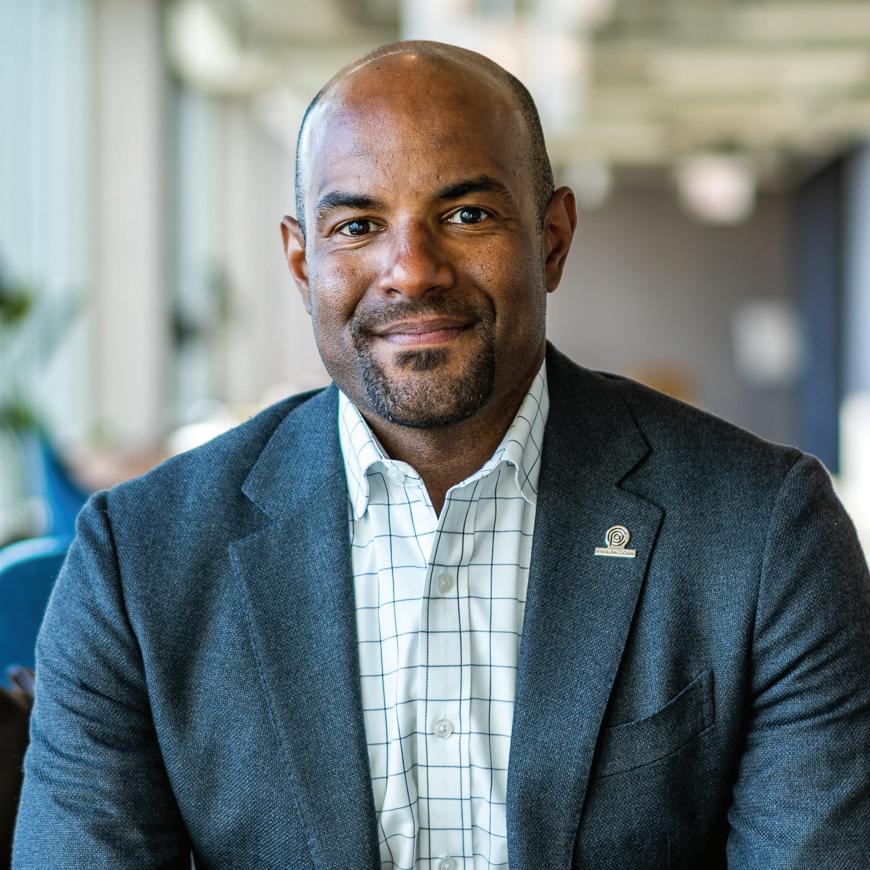
Professional associations have a duty to effectively represent the collective interests of their constituents and stakeholders. Are we living up to that duty?
Advocacy is one of the Illinois CPA Society’s key strategic drivers, and as the profession navigates the current environment, our advocacy focus has never been more important. When most think about advocacy, the first thing that comes to mind is likely government relations. While government relations and stewarding purposeful policy is an important part of advocacy, our advocacy initiatives involve so much more.
Advocacy, in my view, is a fundamental element of our work as a professional association that’s accomplished in a variety of ways:
• Advancing and pursuing public policy that supports certified public accountants (CPAs), CPA firms, and the broader business community.
• Leveraging our position as a respected thought leader to further our organization’s mission and the profession’s standing.
• Actively sharing the collective voice of our members and stakeholders to steer not only public policy but to enhance the public’s knowledge.
• Engaging in responsible lobbying and other political activities necessary to gather the resources required to support our purposes.
In this current climate, it’s imperative that we ensure our advocacy priorities advance, as we have a duty to effectively represent the interests of our constituents and stakeholders before a variety of governmental bodies and the public.
From a legislative and public policy perspective, I’m proud to say that we fulfilled our key legislative priorities in 2025. Our team worked diligently to see that the Illinois Public Accounting Act was amended to add new pathways to CPA licensure within our state. At the same time, we effectively enhanced CPA practice mobility within and beyond our borders. We also successfully advocated
against tax policies that would’ve negatively impacted CPAs and their firms, all while advocating for the fair taxation of the business community and the public. These important policy achievements alone have paved the way for our efforts yet to come.
However, while we work with stakeholders on relevant issues and advocate on your behalf, we also encourage you to get involved in the important work of advancing both practical public policy and the CPA profession. To start, you can support our advocacy initiatives and policy efforts by:
• Using your local legislative voice. When called upon, contact your legislators and regulators to amplify our messaging.
• Engaging your local media. Media outlets often seek CPAs for their expertise and professional opinions on a wide variety of business and finance topics. Don’t be shy about engaging with media outlets in your area.
Advocacy helps ensure that we aren’t missing opportunities to advance CPAs, the profession, or our organization and its mission.
In fact, the book “Forces for Good: The Six Practices of High-Impact Nonprofits” states the most effective organizations are actively engaging in advocacy as a fundamental strategy for greater impact.
Organizations like ours have a responsibility to create conditions for their members and stakeholders to thrive. We’ve found that intentional, fact-based engagement—combined with relevant technical assistance—is a powerful tool. We’re not just pursuing a policy agenda; we’re engaging with policymakers and advocating for our collective community—and we’re making positive change because of it.

capitolreport
Martin Green, Esq. Senior Vice President and Legislative Counsel, Illinois CPA Society @GreenMarty
Navigating the CPA Credential’s New Regulatory Frontier

As alternative practice structures grow and a new mobility framework emerges, questions around the use of the CPA credential are surfacing. Here’s what CPAs and CPA firms need to know.
The certified public accountant (CPA) credential is the stock and trade of our profession, demonstrating a practitioner’s integrity, experience, competence, and professionalism. It’s for these reasons that CPA regulators protect the public interest through regulation, state CPA societies serve as trustees of the CPA brand and their respective accounting acts, and licensees maintain the highest standards and expectations of the credential.
Recently, discussions over use of the CPA credential have come into focus for a couple of reasons. One being the rise of alternative practice structures and private equity (PE) ownership in accounting firms. Additionally, many state societies, including the Illinois CPA Society, were successful in passing legislation to add additional pathways to CPA licensure, moving from state-based mobility to individual-based mobility.
Here, I’ll be reviewing what professional statutes and regulations say about use of the CPA credential and address what’s currently playing out with the rise of alternative practice structures and PE in the profession.
WHAT DO THE RULES SAY?
The Illinois Public Accounting Act and the AICPA Code of Professional Conduct both provide statutory and professional standards on the use of the CPA credential.
According to Section 1 of the Illinois Public Accounting Act (225 ILCS 450/1), a person must be either licensed or registered to use the CPA credential in Illinois or meet the requirements of substantial equivalency outlined in Section 5. This statutory order is by design. It reflects how the use of the CPA credential goes hand and glove with the protection of the public’s interest.
Section 9 of the act outlines restrictions on the use of the CPA credential. The act authorizes the Illinois Department of Financial and Professional Regulation (IDFPR) to investigate alleged and
improper use of the CPA credential and assess whether a civil penalty is necessary (not to exceed $10,000 for each offense). This authority and steep penalty are to protect the public from those who aren’t licensed and may be illegally holding themselves out as CPAs.
The AICPA Code of Professional Conduct also addresses the use of the CPA credential in the Acts Discreditable Rule (ET Sections 1.400.001, 2.400.001, and 3.400.001). Collectively, these sections provide that members are required to follow accountancy laws and regulations when using the CPA credential in the jurisdictions which they practice. Failure to follow the rules on the use of the CPA credential in a manner that is false, misleading, or deceptive is a violation of the Acts Discreditable Rule.
Notably, failure to follow the AICPA Code of Professional Conduct can result in professional ethics complaints with state societies and the AICPA and possible professional sanctions. Additionally, a complaint can be filed against the CPA by the IDFPR under Section 20.01 of the act (Grounds for Discipline). Unethical conduct is further defined in the Illinois Public Accounting Act’s Administrative Rules (68 IAC 1420.200), which adopts the AICPA Code of Professional Conduct.
THE STATE OF PLAY
The growing emergence of alternative practice structures and PE ownership in accounting firms has raised issues with the use of the CPA credential. The National Association of State Boards of Accountancy Private Equity Task Force released a white paper, “Alternative Practice Structures and Private Equity: Considerations and Questions for Boards of Accountancy,” that poses core questions related to the areas of independence, professional standards, public disclosures, and regulatory oversight. While the white paper doesn’t provide guidance on the use of the credential, it does highlight that the credential’s usage is a part of broader independence and public interest concerns.
Select state boards of accountancy have sent inquiries to CPA firms who organize into alternative practice structures. These boards have requested background on the formal alternative practice structure, ownership arrangement, representation to the public on the consolidated forms, and firm names on signature lines.
For example, the Virginia Board of Accountancy has issued guidance regarding the use of the CPA credential on social media, particularly in cases where individuals no longer hold an active Virginia CPA license. The guidance provides that only those with current active Virginia CPA licenses may use the CPA credential in any professional context, including social media profiles. Misuse of the title, even unintentionally, can lead to disciplinary action by the Virginia board. This is yet an example of the new norms we’re living in.
In an effort to mitigate board discipline, some CPA firms have responded by telling their CPAs not to use their credentials on business cards and email signature lines. Their rationale behind this is that state regulators may determine they aren’t a CPA firm and therefore shouldn’t hold themselves out as CPAs.
LOOKING AHEAD
As you can see, a great deal of evolution is occurring across the accounting enterprise. As a profession, we’re in reset mode.
Moving forward, practitioners must be mindful of regulatory requirements for the use of the CPA credential and the professional obligations of independence. As individual mobility provisions are enacted, practitioners should exercise due care of the respective state mobility laws. Firms implementing alternative practice structures should also ensure that the requirements and provisions of the AICPA Code of Professional Conduct are met and surpassed. If we overlook or short-circuit fidelity of the professional responsibility requirements, this creates high risk to the profession in an already high-risk regulatory environment.
Boards of accountancy also need to closely monitor these trends and developments to avoid regulatory overreach. After all, a proper regulatory balance must be achieved to protect the public interest and allow the evolving changes to ripen.
Transforming Your CAS Practice Into a Strategic Advisory Powerhouse
By moving beyond traditional bookkeeping and reporting, CAS professionals can gain a competitive edge and give clients what they truly need—strategic leadership.
BY CHUCK TEEL, CPA

These questions don’t just analyze performance, they create a roadmap for better decisions. They change how clients view finance. The discussion shifts from “What happened?” to “Why did it happen, and what should we do next?”
MOST CLIENT ACCOUNTING SERVICES (CAS) practices are still built around bookkeeping. The work stops when the books close and reports go out. That approach made sense when compliance and data accuracy were clients’ main priorities, but today clients expect more: They want insight, leadership, and a partner who can help them see what’s really happening in their business and what to do about it.
In many firms, the focus on CAS remains on recording transactions, maintaining ledgers, and preparing reports. Those are necessary, but they’re no longer sufficient.
At my firm, we learned that financial reporting only creates value when it leads to better decisions. Our true work begins after the numbers are presented. Once the report is issued, we ask questions like:
1. What’s driving these results, good or bad?
2. Are there policy or behavioral issues contributing to substandard performance?
3. Are there structural or systemic factors that limit progress?
In my experience, most CAS teams don’t take that next step. They finish the report and move on to the next close cycle—but there’s a cost to that traditional practice.
THE COST OF STAYING TRANSACTIONAL
When a firm stops at the report, it stops short of its potential. Clients can get data anywhere, but they can’t get judgment. Without interpretation, even the most accurate financials become static.
Firms that stay transactional also limit their people. When professionals spend all their time producing reports, they rarely develop the ability to interpret them. They don’t learn to connect financial performance to operational behavior. That skill is what separates accountants from strategic finance leaders, like chief financial officers (CFOs).
UNDERSTANDING THE BUSINESS BEYOND THE NUMBERS
To lead like a CFO, CAS professionals must understand the businesses they serve. That means knowing more than the financials. It requires understanding the client’s industry, competitive pressures, culture, and leadership style.
Numbers tell a story, but they never tell the whole story. When I meet with clients, I study how they operate before I look at their numbers. How do they make decisions? How do teams communicate? What expectations shape their goals?
The best CAS leaders can interpret how each business function affects financial results. For instance, they know that sales drive revenue but also affect cash flow and inventory; they recognize that marketing creates demand but can strain production capacity; and they understand how operations, HR, and leadership behavior influence the financials. In other words, the numbers are the scoreboard, but the business is the game.
BUILDING THE BRIDGE FROM BOOKKEEPING TO STRATEGY
Importantly, becoming strategic doesn’t mean abandoning accounting fundamentals—it means using them as the foundation for business insight. I think of this as a progression: Bookkeeping captures transactions, accounting organizes them, financial strategy interprets them, and business decisions act on them.
The bridge between accounting and strategy is built through curiosity and context. You have to understand what drives results and how each department contributes to them. Once you connect those dots, your advice shifts from technical to strategic.
For example, if a client’s margins are shrinking, a traditional CAS approach might focus on cost control or reporting accuracy. A strategic CAS leader, however, will look deeper and ask questions like: Are prices too low for current market conditions? Are labor inefficiencies eroding gross margin? Is turnover in sales or production affecting output?
When CAS professionals start thinking like CFOs, their questions change too. They move from accuracy to insight, from reconciliation to recommendation. These types of questions can help shift the dialogue with your clients:
• What specific behaviors or policies are affecting profitability?
• Are staffing patterns supporting the company’s growth plans?
• How do marketing and sales decisions affect production costs?
• Are we managing working capital effectively, or are operational habits limiting cash flow?
• What cultural or leadership factors are influencing performance?
These questions deepen your role with clients. You stop being the person who explains the numbers and become the one who helps improve them.
5 STEPS TO STRATEGIC LEADERSHIP
The transition from bookkeeping to strategic leadership begins with a single change in mindset. Here are five steps that can help your team evolve.
1. Reframe the purpose of reporting: A financial report isn’t the final product—it’s the start of a conversation. In every client meeting, ask questions that connect the numbers to decisions. Instead of explaining variances, explore their causes. Make the discussion about improvement, not compliance.
2. Build context for each client: Spend time understanding how a client’s business operates. Learn what metrics really matter to their leadership and observe how communication and accountability flow inside the company. The more context you build, the more relevant your insights become.
3. Develop business fluency in your team: Hire and train professionals who can think beyond accounting. Encourage them to understand sales, marketing, operations, and HR. The best CAS teams speak the language of business, not just finance.
4. Change how you price and deliver CAS: If you bill by the hour, you’re reinforcing a transactional mindset. Strategic CAS is about outcomes, not activity. Move toward fixed-fee or retainer models that reflect access, responsiveness, and judgment. Clients pay for leadership, not labor.
5. Get to the conference room: CAS shouldn’t live behind a desk— it belongs in the conversations where business directions are set. Attend planning meetings, forecasting sessions, and operational reviews. When finance has a seat in those discussions, it stops being a support function and becomes a strategic one.
The future of CAS belongs to those who move beyond reports and into reasoning. Clients no longer need accountants who deliver numbers—they need advisors who can interpret them. As accounting professionals, our role is to connect data and decisions. That’s where CAS becomes a true leadership discipline and where certified public accountants (CPAs) can make the greatest impact.
After all, the risk isn’t that automation will replace CPAs. The risk is that clients will stop viewing CPAs as strategic business advisors essential to their business decisions. The firms that survive will be those that lead with questions, not spreadsheets.
Chuck Teel, CPA, is the founder and CEO of Teel+Co Strategists and CPAs.

Cryptocurrency on the Balance Sheet: Opportunity or Gamble?
Clearer rules, stronger oversight, and new opportunities are helping corporate finance leaders evaluate whether digital assets fit into their financial strategies.
BY BRIDGET MCCREA

FOR YEARS, CRYPTOCURRENCY SAT ON THE FRINGES of corporate finance, often viewed as too volatile, unregulated, and untested for the balance sheet. That perception is changing.
As reported by Deloitte in its second quarter 2025 North American CFO Signals survey, chief financial officers (CFOs) say nearly 25% of finance functions are expected to use digital currency within two years, rising to almost 40% among companies with $10 billion or more in revenue. In fact, Tesla, Strategy (formerly MicroStrategy), and Block (formerly Square), among many others, have all added bitcoin to their treasuries, positioning the cryptocurrency as both a hedge against inflation and a strategic asset.
Still, about 43% of CFOs cite the price volatility of non-stablecoin cryptocurrencies as a top concern and 42% point to accounting and controls complexity. With public companies raising an estimated $86 billion this year to acquire cryptocurrency (more than they’ve raised through initial public offerings in the United States), many corporate finance leaders on the sidelines are weighing whether they should add cryptocurrencies to their balance sheets.
UNCLE SAM LEADS THE CHARGE
Two recent policy moves have helped pull cryptocurrency into the financial mainstream. The first is the Governing and Enabling
Nationwide Infrastructure for Unified Stablecoins (GENIUS) Act, which sets clear rules for stablecoins pegged to the U.S. dollar. It limits issuance to approved financial institutions, requires every coin to be backed one-for-one with safe assets, and enforces regular audits and transparency. The goal of the act is to make stablecoins as safe and regulated as traditional currencies and bank deposits.
The second policy move is the creation of the U.S. Strategic Bitcoin Reserve, established by an executive order in March 2025. Modeled after the nation’s petroleum reserve, it signals federal confidence in bitcoin as a store of value and potential hedge against risk.
Ron Levy, co-founder and CEO of The Crypto Company, says the GENIUS Act and Strategic Bitcoin Reserve have helped establish the structure and oversight needed for broader cryptocurrency adoption. “Both of those measures give more confidence to our industry and to the masses,” he says. “They’re very different steps, but together they show that digital assets are becoming part of the financial system.”
He says companies now have safer options for managing digital holdings than they did just a few years ago. “You can now hold it with a third-party custodian that’s a legitimate, federally chartered company,” Levy says, who points to Anchorage Digital Bank (which manages more than $100 billion in assets) as an example of the infrastructure now supporting corporate participation.
Federal agencies are currently seeding the Strategic Bitcoin Reserve with bitcoin confiscated from criminal cases. Levy sees this
as a practical starting point and one that could help normalize bitcoin’s role over time: “They’re kind of doing what Michael Saylor, co-founder of Strategy and a longtime bitcoin advocate, did—taking a long-term view of rising value.”
WHY BITCOIN? LESSONS FROM EARLY ADOPTERS
Strategy, the world’s first and largest bitcoin treasury company, has been investing in bitcoin since 2020, regularly raising funds by selling shares and issuing convertible debt to support its ongoing purchases. The company now holds more than 640,800 bitcoins, over 3% of the total supply of 21 million, according to the company’s quarterly earnings report for the three-month period ended Sept. 30, 2025.
Notably, investing in bitcoin has proven lucrative for the company, which now ranks as one of the 100 largest nonfinancial companies listed on the Nasdaq stock exchange.
Block, the American technology company and financial services provider behind Square and Cash App, is another early adopter of bitcoin. In October 2025, they began allowing eligible Square businesses to automatically convert a percentage of card sales into bitcoin, and in November 2025, eligible Square businesses were able to begin accepting bitcoin payments directly through the company’s point-of-sale system.
“We’re doing this because bitcoin gives entrepreneurs a new lever: a way to spend and invest outside of traditional rails—with faster settlement, lower fees, and long-term potential. Until now, these tools have been out of reach for most small businesses,” says Miles Suter, bitcoin product lead at Block, in an October 2025 blog post.
STRATEGIES FOR IMPLEMENTATION
Jonathan Rose, CEO of BlockTrustIRA, says early adopters, like Strategy and Block, have demonstrated the importance of developing a clear, articulated strategy before implementation. For example, Strategy has shown how effectively communicating a treasury diversification approach can create shareholder value beyond direct asset appreciation.
“These pioneers have also established effective models for governance, including specialized committee structures and expertise development,” Rose says, who adds that most successful implementations feature phased approaches with dedicated resources for managing digital assets (rather than adding responsibilities to existing treasury functions).
“They’ve also demonstrated how to navigate volatility through disciplined buying strategies,” he points out, “utilizing market dips for accumulation rather than attempting to time market peaks.”
For optimal results, Rose says finance leaders should focus on three areas before implementing cryptocurrency into their business ecosystems:
1. Knowledge development: Ensure teams understand both the technological fundamentals and evolving accounting standards with cryptocurrency.
2. Infrastructure implementation: Establish relationships with institutional-grade custodians and develop appropriate control systems.
3. Policy creation: Develop comprehensive frameworks before implementation (rather than reacting to emerging opportunities).
Levy says another good approach is to treat bitcoin as a long-term strategic investment. “You’d be a little silly not to at least entertain it,”
he says. “This is happening quickly, and organizations can start small to get comfortable with it.” He adds that newer cryptocurrencies are designed to support what he calls “real-world assets,” or physical goods and infrastructure represented on blockchain networks.
Levy sees emerging sectors like decentralized infrastructure and digital asset tokenization as two areas with growth potential right now. The World Economic Forum, for instance, has highlighted the rise of decentralized physical infrastructure networks, which aim to link real-world systems to blockchain technology. “Even a small investment of time to learn this space can pay off,” Levy stresses.
“Knowledge is king in this arena.”
TESTING THE WATERS
Some finance leaders are taking a measured approach as they test the digital asset waters. Rose says most start small and stay grounded in traditional treasury discipline.
“In my conversations with CFOs across industries, I’ve noticed most organizations approach cryptocurrency allocation through a graduated framework,” Rose says. “They typically begin with a conservative 1%-3% of their treasury, using established treasury management principles to determine appropriate exposure.”
This approach helps companies understand how cryptocurrency holdings behave before allocating larger sums of their reserves to these assets, since managing risk and reporting accuracy top their list of priorities.
That strategy could also prove useful as companies rethink where and how they hold cash in a less predictable financial system. “After the 2009 banking crisis and COVID-19 pandemic, many finance leaders realized that keeping all of their companies’ reserves in the bank carries risk,” he says.
Of course, digital assets carry risks themselves. For instance, market swings can affect valuations when assets are marked to market, and volatility remains an ongoing factor. Even so, Levy believes bitcoin’s long-term performance compares well to traditional options: “The growth ahead of us is bigger than that behind us. Bitcoin is something that should be considered, but it isn’t without short-term risk or risk in general.”
PUTTING THE ACCOUNTING INFRASTRUCTURE IN PLACE
Behind the scenes, accounting standards are beginning to reflect the growing role of digital assets in corporate finance. For example, companies used to record digital assets as intangibles, recognizing losses when values dropped but not gains when they recovered. New accounting guidance now allows mark-to-market treatment, which gives CFOs a more accurate picture of value and performance.
Shehan Chandrasekera, CPA, head of tax strategy at CoinTracker, says these changes and clearer regulations are helping move cryptocurrency adoption from a speculative to a standard practice.
“It’s like how no one has to specify that they’re using the internet or the cloud anymore—stablecoins are headed in the same direction,” Chandrasekera predicts. “They’re becoming a normal part of financial operations rather than a special line item in the books.”
“It’s still early but not too early,” Levi says. “Start learning, and see where digital assets fit on your balance sheet. The more finance leaders understand the space now the better prepared they’ll be as adoption spreads.”
Bridget McCrea is a Florida-based freelance writer specializing in business and technology.
HIRING & RETENTION
Mother Nature: Accounting’s Next Most Effective Recruiting and Retention Tool?
Creating an environment that fosters happier, healthier, and more productive employees may be as simple as getting them outside and engaged in nature.
BY JENNA E. SCHNIZLEIN, CPA, CGMA, MBA

I WANT TO BE ABUNDANTLY CLEAR: I love my job, and I love being a certified public accountant (CPA). Has it been challenging? Yes. Has it been frustrating at times? Absolutely. Has it been worth it? Without a doubt. Are there changes the profession could consider making? I believe so, and you may be surprised at how easy and effective they could be.
THE ROAD NOT TAKEN
It’s not new information that the accounting profession is losing people (at all levels), and fewer college students are considering it as a career choice. Articles in CPA publications have warned us of this for years, and now national publications like the Wall Street Journal are letting everyone else know too. Perhaps it’s because we haven’t done nearly enough to highlight how the profession and CPAs’ roles have evolved with the world around us. One example of this evolution is the CPA’s important role on environmental, social, and governance (ESG) issues.
What if our profession did something similar? What if we took a good, hard look at what we’re doing to our people and instead of
continuing down the same road we’ve been going down, we strongly consider a different type of ESG for individuals? One doesn’t have to go far to find out what unhappy employees have to say about their jobs, but imagine what potential recruits would find if there were messages from happy employees painting a completely different picture of what it looks like to be an accountant? Perhaps an easy first step toward that future starts with shifting our focus to creating a workplace that has a more altruistic motive. We could take the lead from other industries, such as health care, and create a space that fosters “environmental and social connections for personal growth.” Accounting and finance leaders that recognize the importance of fostering their employees’ personal ESG initiatives have the unique opportunity to be innovative and break the stereotypical mold for our profession.
MOTHER NATURE’S IMPACT ON WORK PRODUCTIVITY
One solution may be as simple as getting your people outside. It wasn’t until we (society) stopped being outside that we began pouring time and money into studying mother nature’s impact. When people feel better, they perform better, and research supports this claim. Studies have found that connecting with nature makes us feel better, makes us think better, helps us sleep better (i.e., we’re happier, healthier, and more productive versions of ourselves when we spend time outside). Being around and
connecting with nature helps our mood, focus, thinking, and connection with others (which has atrophied significantly in the years since the COVID-19 pandemic). It’s no wonder that over the last 10 to 15 years, the pursuit of certain academic degrees that keep us indoors, like accounting, has dropped, down 17% from 2012 to 2022. However, degrees that get us outside, like environmental sciences, have increased, up 24% from 2016 to 2022.
REDEFINING ACCOUNTING THE ESG WAY
Putting trust in leadership to support personal ESG initiatives is crucial to having employees taking advantage of them. As a leader, you can support your employees by creating and communicating new initiatives and the reasons for them. Make sure to provide a safe space for employees to provide feedback if they feel like they’re unable to take part in this movement. You can also give examples of things they can do and encourage them to share other ways, ideas, and struggles with the larger group for inspiration.
Here are some ideas to support your employees’ personal ESG initiatives:
• Walking meetings: Encourage taking in-person meetings outside or taking virtual meetings from the phone when appropriate to incorporate some movement and fresh air into them.
• Volunteering opportunities: Working together in a different capacity with colleagues is a great way to foster culture and connect with your organization’s community while getting out into the environment.
• Equipment for working outdoors: Consider providing an allowance for employees to purchase equipment that allows them to work outside more comfortably. For example, screen glare is a real deterrent on sunny days, but a shade hood can be purchased for under $20 on Amazon.
• Open-air office space: If possible, providing a working area where windows or doors can be opened to allow fresh air in has benefits.
• Nature soundscapes: When getting outside isn’t an option, even the sounds of nature have been shown to elicit some of the same health benefits as being outdoors. While an office-wide soundtrack might not be appropriate, perhaps incorporating soundscapes into break rooms or communal spaces may be an option.
As you can see, the opportunities are limitless, the risks are nearly nonexistent, and the potential impact on the profession could be life changing.
I hear from far too many people that there are many employees within their organizations who’ve reported feeling like they can’t take time away for professional development or volunteering because it takes away from the hours that could be going toward their monthly hour budget—this is heartbreaking. I’m sure that management’s intention when communicating those numbers wasn’t to limit their employees’ opportunities to better themselves, nor was it intended to prevent them from engaging positively within their communities. But when the expectation is set that meeting those numbers isn’t really a goal, but rather a requirement, it’s not hard to understand how the interpretation was derived. That being said, if you’re able to enjoy the warmth of the sun or a nice breeze or some outdoor scenery during those hours, suddenly, those goals may not seem as daunting.
We know what the future of the profession looks like if we don’t do anything—the same as it’s looked for decades. Continuing with a “same as last year” approach may be considered borderline negligent. Instead, why not try embodying the “get outside and
enjoy nature” approach? We might be able to easily create a working environment that fosters happier, healthier, more satisfied, and more productive employees at little to no cost.
After all, as poet Robert Frost famously penned:
Two roads diverged in a wood, and I— I took the one less traveled by,
And that has made all the difference.
Which road will you choose?
Jenna E. Schnizlein, CPA, CGMA, MBA, is the director of financial operations and innovation at Sikich. The views expressed in this opinion article are those of the author and not of the Sikich organization.

LEADERSHIP &
The Business Case for Supporting Caregivers
An increasing number of employees are facing the heavy burden of caregiving at home. Here’s how employers can offer support—and prevent top talent from walking out the door.
BY CLARE FITZGERALD

come home, you’re helping care for your loved ones full time. A lot of times caregivers feel like they have to cut back on their work.”
AS AMERICA’S POPULATION CONTINUES TO LIVE LONGER, more professionals are stepping into caregiving roles for aging parents, partners, or other family members—often while managing rigorous careers. In fact, according to the U.S. Bureau of Labor Statistics (BLS), more than 37 million people were providing unpaid elder care in the United States as of 2023, and 61% of those elder care providers were employed.
Data on Alzheimer’s caregivers offers a view on the workplace impact of these personal responsibilities. According to 2021 research from the Alzheimer’s Association, 18% of the 12 million Americans providing care to people with Alzheimer’s or dementia shifted from full-time to part-time work, 9% gave up their jobs completely, and 6% retired early. For those who stayed in the workplace, 57% had to arrive late to work, leave work early, or take time off for caregiving duties.
MaryGrace Sharp, MPH, program manager with the Illinois chapter of the Alzheimer’s Association, describes this reality that many are struggling with: “You’re working full time, and then right when you
As talent shortages continue to challenge the accounting and finance profession, certified public accounting (CPA) firms and other organizations can’t afford to overlook the growing impact of caregiving responsibilities on their employees—or the opportunity that comes with supporting them.
ORGANIZATIONAL, CAREER RIPPLE EFFECTS
Shannon Stone-Winding, president and CEO of the Chicago-based Black Alliance of Colleges and Employers, has witnessed caregiving trends in her work addressing corporate talent retention and recruitment gaps—and in her own life as the spouse of a disabled military veteran. “We spend so much time training and investing in our talent. They do everything right to move up in their careers, but then life changes,” she explains. “If employees leave their organizations or fields because they don’t feel like they can contribute in the same way, then all this knowledge, wisdom, and expertise get lost.”
Unfortunately, in many cases, employers don’t recognize or address the challenge—and they miss the business case for doing so. According to a 2024 “Healthy Outcomes” report published by Harvard Business School, 80% of workers acknowledged that
caregiving responsibilities affect productivity, compared to only 25% of employers.
Employers also may underestimate the effects of caregiving on career advancement for employees at all levels—especially for women and mid-career professionals. According to BLS data, nearly 60% of elder caregivers are women, and almost 4.5 million people in the U.S. are members of the “sandwich generation,” those who are parenting children under the age of 18 and providing care for their own parents.
Sharp has talked with many mid-level professionals whose careers— and C-suite aspirations—stalled when their personal lives shifted: “These are talented people who feel like they can’t handle the rigor of high-level jobs while keeping up with their caregiving duties.”
Bonnie Buol Ruszczyk, president and manager of the Accounting MOVE Project, an annual benchmarking initiative that uses demographic analysis and workplace culture assessments to drive greater inclusion in the accounting profession, says caregiving can have a big impact on how quickly female accounting professionals become firm partners—or if they even pursue the partner track. “Women will voluntarily take themselves out of the running for partner if they feel like they can’t perform that role at 100%, which is sad because they miss out on opportunities, and firms lose valuable employees.”
When people are forced to question whether their jobs will work with the new normal of their lives, they look for ways to transition into other options, but Stone-Winding says employers have the power to prevent that career drift: “There are solutions if workplaces are willing to approach this issue as a problem of retention.”
EXPANDING AWARENESS, RESOURCES
Many of the workplace changes resulting from the COVID-19 pandemic, such as remote work, virtual meetings, and reduced travel, have helped caregivers remain in the workforce. But as time goes on, many employers are abandoning these concessions at a time when tackling the caregiving challenge may actually require a continued evolution of these benefits and resources. Here are some alternative solutions for employers to consider:
• Educational offerings: Company-organized lunch-and-learn sessions and health fairs can be helpful resources. Sharp facilitates these types of sessions on a variety of topics related to Alzheimer’s, such as managing difficult conversations, early detection, care options, treatment resources, disability laws, and more.
• Employee wellness tools: Caregivers who are juggling many responsibilities also can benefit from resources that focus on their own well-being, such as programs and apps that promote healthy habits and allow people to connect and address personal stress.
• Extended leave: For caregivers and others who may need to leave the workplace but intend to return, a leave of absence can provide time to tend to a personal situation. The AICPA offers a leave-of-absence toolkit designed for employees and employers to create a mutually beneficial path for an extended leave. According to Mandy Gallagher, Ph.D., lead manager of the Diversity and Inclusion Women’s Initiatives team at the AICPA, the toolkit has generated positive feedback as a tested resource for successfully structuring a leave of absence: “Employees and managers really appreciate tips for developing a plan that allows people to come back recharged and ready to go.”
• Job-sharing options: Sharp also suggests implementing buddy systems and additional supervision: “If a caregiver needs to step away quickly, it helps to know someone can pick up a project where they left off.”
• Part-time partnership models: Although few firms offer or publicize part-time options, Buol Ruszczyk says they can have several positive effects. “A lot of times a partner or someone who’s close to becoming partner has a caregiving responsibility that arises suddenly. Rather than talking to firm leadership and asking about the possibility of a part-time schedule, they’ll just leave because they don’t realize the firm would be willing to work with them,” she explains. “But those situations also create an opportunity to split up responsibilities and allow others to step up and show that they’re ready to help out and take on more.”
CREATING A CULTURE OF CARE
For organizations unsure of how best to approach caregiving challenges or provide a supportive culture, Stone-Winding suggests going to the experts: the employees themselves.
“Make space to listen so people feel comfortable sharing what they’re facing,” she recommends, noting that survey tools can help organizations gather data on what issues are impacting employees’ lives and abilities to work—and how best to provide services and support.
Buol Ruszczyk agrees and stresses that communication (both ways) is key, because employers may need to raise awareness of resources and demonstrate they mean what they say. “There’s a lot of opportunity here for organizations to prove that they listen to their people and care about what they need,” she stresses. “Employees need to see that if something happens, there’s some flexibility built in, that leaders will have their backs, and they can still advance in their careers.”
Importantly, acknowledging the personal struggles of your employees also creates loyalty over time. “We all have lives and things that pop up that we need to take care of,” Buol Ruszczyk says. “Knowing that an employer is going to be supportive when those things happen creates a loyalty that most organizations would love to have but rarely do.”
Not only will a supportive approach to caregivers improve retention, Buol Ruszczyk says it can also help employers connect with emerging talent, as younger professionals generally highly value work-life balance: “Gen Z appears hesitant to enter the accounting and finance profession after they compare it to similar industries and question whether it offers the same flexibility. We see young professionals looking for career paths that fit the lifestyles they want to have.”
Building on that, Stone-Winding says employers that offer flexibility and support will become the destination for emerging talent: “Employers that prove themselves to be welcoming and willing to evolve with their people will be viewed as places for lifelong careers.”
Ultimately, Gallagher says that providing caregiving solutions should become a higher priority for employers, as it’ll stem the financial impact of staff turnover and workflow inconsistencies while simultaneously making their organizations “shining examples” in a competitive talent landscape.
Clare Fitzgerald is a freelance writer covering the accounting, finance, and insurance industries.
What’s Next for SECURE 2.0 and Secure Choice?
Key provisions of the SECURE 2.0 Act will roll out throughout 2025 and 2026, bringing both opportunities and challenges to your clients.
BY RON ULRICH

SECURE 2.0 CHANGES
Auto Enrollment Mandate for New 401(k) and 403(b) Plans
FOR CERTIFIED PUBLIC ACCOUNTANTS (CPAs), recent legislative changes are offering a chance to initiate valuable retirement planning discussions with clients—both for their personal and business finances.
Passed in December 2022, the SECURE 2.0 Act removes key obstacles to higher savings for both individuals and employers. It expands coverage, provides increased tax incentives, and streamlines plan rules, making it more attractive for employers to offer retirement plans and simpler for employees to participate in them.
Throughout 2025 and 2026, key provisions of the SECURE 2.0 Act will roll out, presenting both planning opportunities and challenges to your clients. Since most Americans are famously underprepared for retirement, many of your clients may not be aware of these upcoming changes and their impact.
Here’s everything you need to know.
Under the SECURE 2.0 Act, most new 401(k) and 403(b) plans must automatically enroll employees at a default contribution rate of 3% of pay, increasing by 1% each year until reaching at least 10%. These requirements take effect for plan years beginning on or after Jan. 1, 2025. Eligible workers must be enrolled unless they affirmatively opt out of the plans. As part of the provisions, employers who establish new plans should also be drafting plan documents with this auto enrollment feature.
Notably, not every employer or plan is subject to the new mandate. The organizations that are exempt from this mandate include those with 10 or fewer employees, those who’ve been operating for less than three years, and those that follow certain plan types (e.g., church-sponsored, governmental, and SIMPLE IRA plans). Likewise, any retirement program that was formally adopted before Dec. 29, 2022, remains grandfathered in, even if the program’s effective date falls after the enactment of the SECURE 2.0 Act.
Retirement Plan Access for Long-Term Part-Time Employees
As of Jan. 1, 2025, anyone who’s worked at least 500 hours per year for two consecutive years will be eligible to join their employer’s retirement plan—down from the previous three-year threshold. In October 2024, the IRS issued guidance on including long-term part-time staff in 403(b) plans. Although final rules for 401(k) plans haven’t been released, proposed regulations appeared in November 2023, and the IRS has stated that any effective date won’t precede plan years starting Jan. 1, 2026.
Student Loan Matching Contributions
Many employees struggling to repay student loans miss out on retirement plan matching contributions from their employers because they can’t afford to contribute to the plans. However, under the SECURE 2.0 Act, employers can now base matching contributions on student loan payments even if the employee makes no direct retirement contribution. This applies to borrowers and co-signers repaying their own loans or loans for dependents, provided they certify their payments each year.
Expanded Catch-Up Contributions for Individuals Ages 60 to 63
The SECURE 2.0 Act now enables individuals between ages 60 to 63 to make enhanced catch-up contributions to their retirement plans. They can contribute the greater of $10,000 or 150% of the standard catch-up limit, which will be $11,250 for 2025 (with inflation adjustments in subsequent years). This exceeds the standard $7,500 catch-up limit available to those ages 50 and older, which provides an important opportunity for higher earners approaching retirement to increase their savings. This enhanced limit is available in the calendar year an employee turns 60 years old and reverts back to the standard limit in the calendar year when they turn 64 years old.
For more information, refer to the IRS guidance on 401(k) limit increases and catch-up contributions for 2025.
Roth Catch-Up Contributions for High Earners
Starting in 2026, employees who earn more than $145,000 from the same employer in the previous year will be required to use a Roth (after-tax) individual retirement account (IRA) for their catch-up contributions. This rule, originally set to begin in 2024, was postponed in order to provide more time for implementation and notification. In January 2025, the U.S. Department of the Treasury and the IRS issued proposed regulations to help plan administrators implement and comply with the new Roth catch-up rule. Employers will have the option to automatically switch employees’ contributions from a pre-tax account to a Roth account without needing new elections from the employee.
Illinois State-Mandated Retirement Plan
The Illinois Secure Choice Retirement Savings Program has been in place since 2018. Like the SECURE 2.0 Act, it offers another opportunity to connect with clients about their retirement savings.
The program is a state-mandated initiative aimed at providing retirement savings options for employees of private-sector businesses that don’t offer employer-sponsored retirement plans. Notably, there are some similarities and differences between this program and the SECURE 2.0 Act, which are outlined below.
• Automatic enrollment: Similar to the SECURE 2.0 Act requirement, employees of eligible businesses are automatically enrolled. However, the Illinois plan mandates a 5% payroll
deduction into a Roth IRA. Employees can opt out of the plan, adjust their contributions at any time, and convert to a traditional IRA if desired.
• Employer criteria: Unlike in the SECURE 2.0 Act, which exempts employers with 10 or fewer employees, Illinois employers with five or more employees who’ve been in business for at least two years and don’t offer a qualified retirement plan are required to participate in the Secure Choice program.
• Program administration: The Illinois plan is managed by the Illinois Secure Choice Savings Board, with Ascensus College Savings Recordkeeping Services LLC handling day-to-day operations. There are no employer fees and employers don’t make contributions to employee accounts.
• Investment options: The program provides a set of investment options chosen by the Illinois Secure Choice Savings Board. Employers aren’t required to answer questions about the program, manage investment options, process distributions, or provide investment or tax advice. Additionally, employees manage their accounts directly through the Illinois Secure Choice program.
• Penalties for noncompliance: Employers who fail to comply may face fines of $250 per employee for the first year and $500 per employee for subsequent years.
With more changes ahead, now’s the time to explore how the SECURE 2.0 Act and Illinois Secure Choice program could impact your clients. By taking a proactive approach to guiding small businesses and individuals through these important retirement planning programs, CPAs can enhance their client relationships and establish a service area around a topic that provides year-round value and drives loyalty and business growth.
Ron Ulrich is the vice president of product consulting and compliance at ADP.

The Audit Committee’s Expanding Role
What CPAs Need to Know
With audit committees being asked to take on more emerging risks, new research examines what these additional responsibilities and duties mean for effective governance and oversight.
BY JOSHUA HERBOLD, PH.D., CPA
The audit committee used to have a clear job: oversee financial reporting, internal controls, and the external auditor. As business complexity grows, however, those days are over.
Today’s audit committees are increasingly being asked (and sometimes told) to take on cybersecurity oversight; enterprise risk management; environmental, social, and governance reporting; and other emerging risks that don’t fit neatly into another committee’s charter. It’s a dramatic expansion that’s reshaping corporate governance, often in ways that create new problems even as boards of directors try to solve old ones.
A new study published by Karneisha Wolfe, assistant professor of accountancy at the University of Illinois Urbana-Champaign, and her co-authors Lauren Cunningham (University of Tennessee), Sarah Stein, and Kimberly Walker (both at Virginia Tech), pulls back the curtain on how many audit committees are handling this evolution.
In their research paper, “Redefining Perceived Boundaries: Insights Into the Audit Committee’s Evolving Responsibilities,” the researchers interviewed 29 audit committee members (mostly chairs) from public companies across the United States in various industries and sizes. In accounting research, this type of study is known as “qualitative research,” which is a fundamentally different approach from the statistical analyses that dominate most accounting journals. Instead of examining thousands of companies through databases to find patterns in numbers, the researchers conducted in-depth interviews, asking open-ended questions and letting conversations flow naturally.
“It was fun and insightful to learn about a topic directly from the practitioners who are in the role. I believe that’s one of the key advantages of qualitative research,” Wolfe says.
The researchers evaluated their interviews using a theoretical framework known as “boundary work theory,” which examines how professionals negotiate the invisible lines that define the roles and responsibilities within a team or group—in other words, “who does what.” In settings where multiple groups collaborate toward a shared goal (e.g., committees within a corporate board), these boundaries help distinguish activities and allocate resources, but they’re rarely fixed.
“Collaborative boundary work theory suggests that to achieve a shared goal, boundaries that distinguish each of the smaller teams’ duties need to be established. The responsibilities should be based on the teams’ expertise,” Wolfe explains.
However, in practice, these boundaries don’t always remain clearly defined. As the researchers’ paper notes, “Given the ambiguous nature of the work within interprofessional collaborations, professional boundaries are often fluid such that environmental changes may initiate boundary adjustments; these adjustments can result in new responsibility assignments that may no longer align with professionals’ expertise.”
The audit committee might extend its boundary to absorb new responsibilities, blur its boundary by sharing oversight with another committee, or maintain its boundary and let someone else handle it. Ultimately, each choice has implications for workload, expertise alignment, and governance effectiveness.
The Kitchen Sink Problem
Wolfe explains that because the audit committee’s traditional role expands to different aspects in the organization, the audit committee is often seen as the default committee to assign new duties to when the responsibilities don’t directly relate to other board committees’ expertise. In fact, the researchers found that audit committees extend their boundaries to take on new responsibilities 54% of the time. Sometimes they do this willingly because they have relevant expertise or want the comfort of knowing an important risk is properly overseen. But they may also do it reluctantly, feeling they’re the board’s “default choice” or “dumping ground.” As one research participant put it, “the audit committee is the kitchen sink.”
This matters because the two types of boundary extensions lead to very different outcomes. For example, audit committees that genuinely want new responsibilities tend to actively seek specialized training and upskill their members. However, those that reluctantly accept new responsibilities are more likely to leverage whatever expertise they already have and hope for the best—or worse, they may push substantive discussion back to the full board level.
The Real Cost of Overload
Multiple research participants expressed concern that additional audit committee responsibilities inevitably compromise oversight. Audit committee meetings are already packed, and while committees can add meetings or extend time, there are practical limits to what directors can process, especially when they’re serving on multiple committees or boards.
One risk is that core financial reporting oversight becomes less substantive. As one research participant noted, “I think we ought to just make sure we’re focused on the basics. The primary mandate is making sure the integrity of the financial statements is there and that internal controls are functioning. And, quite frankly, every time another responsibility comes onto the audit committee, you have to give a little less somewhere else.”
Blurred Lines
Some boards try to solve the overload problem by having audit committees share oversight responsibilities with risk committees. This creates what the researchers call “blurred boundaries,” where both committees see the same materials on a given topic, discuss it, and report to the full board. Their theory is reasonable: share the workload, leverage different expertise, and avoid overburdening one committee. But the reality of this practice is more complicated than that. That’s because blurred boundaries create two opposite risks:
1. Oversight gaps: If both committees assume the other is handling detailed follow-up, issues can fall through the cracks.
2. Duplication: If both committees cover the same ground, it’ll waste time and frustrate management by having them prepare for and present to multiple committees.
Therefore, to make blurred boundaries work, active coordination is required by committee members. That means both groups

should hold joint committee meetings, have regular calls between committee chairs to coordinate agendas, and create a formal documentation process, spelling out who’s responsible for what specific aspect of a shared risk area.
The Trust Factor
Importantly, trust is an essential feature of audit committee work. When audit committee members have strong relationships with management, they hear about problems sooner, get more candid answers, and have difficult conversations more productively.
Unfortunately, the shift to virtual board meetings during the COVID19 pandemic decreased audit committees’ opportunities to build trust with management, potentially impacting oversight effectiveness. Before the pandemic, many audit committees held informal dinners with chief financial officers (CFOs) and other key executives the night before committee meetings. Rather than focusing on a formal agenda, these were relationship-building opportunities where audit committee members and management could discuss concerns about talent development in the finance function, hear what was really on the CFO’s mind, and develop the kind of trust that makes people share problems rather than hide them.
Virtual meetings eliminated most of these opportunities. Although audit committees have tried to adapt with brief virtual check-ins, multiple research participants noted that these don’t replicate the same dynamic.
What This Means for CPAs
Whether you serve on an audit committee, advise one as an external auditor, or work with one in a corporate finance role, the researchers’ findings have practical implications for certified public accountants (CPAs). The evidence from their research suggests that how audit committees take on new responsibilities (whether willingly or reluctantly, with adequate resources or making do, or with clear boundaries or muddled ones) matters as much as whether they take them on at all. That’s something every CPA involved in corporate governance should be thinking about.
With this in mind, here are four strategies that CPAs can use to take on expanding audit committee responsibilities effectively.
1. Recognize that boundary decisions are strategic choices with real consequences. When boards are deciding where new oversight responsibilities should live, the easy answer isn’t always the right answer. Defaulting to the audit committee can create problems down the road. It’s better to have an uncomfortable upfront conversation about capacity and expertise than to create a governance gap disguised as a solution.
2. Demand coordination mechanisms. If on an audit committee with blurred boundaries, don’t rely on informal understanding or assume the other committee is handling things. Joint meetings, documented responsibility matrices, and regular communication between committee chairs are essential.
3. Fight to preserve relationship-building opportunities. Even with hybrid meeting formats, audit committees need unstructured time with key executives. If your board meetings have gone fully virtual or mostly virtual, this may be a red flag. The efficiency gains may be creating hidden costs and compromising important relationship building that only happens in person.
4. Be honest about expertise gaps. Many audit committee members were appointed for their financial expertise but now oversee cybersecurity, climate risk, and other technical areas far outside traditional accounting. That’s not a personal failing—it’s a structural mismatch. Effective audit committees acknowledge these gaps and address them through targeted training, expert consultants, or reconsidering whether they’re the right committee for the job.
Overall, as audit committees continue to take on new and complex duties, CPAs can play a critical role in making sure those responsibilities enhance the board’s ability to govern well.
Joshua Herbold, Ph.D., CPA, is a teaching professor of accountancy and associate head in the Gies College of Business at the University of Illinois Urbana-Champaign and sits on the Illinois CPA Society Board of Directors.

The Smart CPA Firm
Building a Successful AI Ecosystem

As AI moves from possibility to business necessity, many accounting firms risk rushing in without thoughtful adoption and integration.
BY TERI SAYLOR
The growing importance of artificial intelligence (AI) in the modern workplace is reflected in recent data. A 2025 Thomson Reuters Future of Professionals survey of 2,275 professionals and C-suite leaders revealed that 80% of respondents believe AI will have a high or even transformative impact on their profession within five years, and over half believe their organization is already benefiting from the use of AI.
Yet, despite growing enthusiasm, many organizations, including certified public accounting (CPA) firms, are realizing that successful AI adoption involves more than simply adding new tools—it requires thoughtful and meaningful integration with existing systems, processes, and people, and navigating this transition requires strategies for adopting and embedding AI in ways that strengthen, rather than disrupt, current technology ecosystems.
Getting Started
Building an AI ecosystem isn’t just about adopting next-level technology—it’s about building a data-driven environment that allows intelligent systems, people, and processes to work together.
David Fuge, chief information officer in the Virginia office of Johnson Lambert LLP, recommends beginners simply start by interacting with the AI tools already accessible to them and becoming fluent in them.
“I think people just need to jump in and start getting their feet wet while building a sense of literacy around how to use AI effectively,” Fuge says. “How do you communicate with it, what happens when you ask it for certain things in certain ways, and are you getting what you want from it?”
Megan Angle, CPA, a partner at Porte Brown in Chicago, recommends experimenting with a single undertaking first. For example, try integrating generative AI into your normal processes and aim to reduce the amount of time it typically takes to generate and articulate ideas and complete tasks. “Then use AI to track results, including time savings per engagement, turnaround time for deliverables, and error reduction,” she suggests.
As your AI comfort grows, Angle recommends launching a pilot project in areas with high transaction volume and intense manual labor, focusing on repetitive, rules-based tasks, like bank feed classification, tax document extraction, or engagement letter creation.
Using popular apps, like ChatGPT, Microsoft 365 Copilot, Claude, and Gemini, is good to start with, Angle says, but also experiment with the AI features in software you may also be familiar with, like QuickBooks and Sage. Another option is to explore modular AI applications, like Dext, Docyt, or DataSnipper, which can connect to existing systems.
“Our firm uses DataSnipper, which integrates with Excel to automate repetitive tasks like data extraction and cross-referencing from source documents,” Angle explains. “It uses AI and optical character recognition to extract text from PDFs, documents, and images that we scan into our system.”
For Ayala Clinkman, CPA, PMP, senior director of business solutions at Business Technology Partners in Chicago, ChatGPT is the go-to AI tool for tracking time. Using it, she can analyze timesheets in minutes and spot areas where she can improve efficiency and boost the bottom line. She also uses ChatGPT to analyze financial reports and large volumes of data for spotting trends that could help her firm manage its budget and streamline practice management processes.
ChatGPT has even helped Clinkman improve client communication. She recalls a client who emailed her requesting a fee reduction: “I was able to provide ChatGPT with all the nonconfidential information I needed to convey to my client, and it helped me answer their questions in one, comprehensible message that didn’t come off as rude or groveling.”
The Necessity of Safeguarding Data
According to Randy Johnston, executive vice president of K2 Enterprises, privacy, compliance, and transparency aren’t optional in the world of accounting, but users generally don’t realize the vulnerability of data shared or stored in AI tools.
“So many users don’t understand the security and privacy implications of the AI engines, and they’re inputting way too much personally identifiable data and bank and financial statements into them,” Johnston cautions. “Users have the potential to expose confidential client information, open channels for cybersecurity risks, and facilitate unintentional data leakage.”
Notably, misuse of AI tops the list of concerns among practitioners who completed the Thomson Reuters survey, with 23% of respondents reporting concern over unethical use of AI.
However, good policies and a strong governance framework can help convert AI from a risk factor into a strategic advantage, ensuring that automation enhances human expertise rather than undermines it.
In the summer 2025 Insight article, “6 Keys to AI Adoption in Accounting and Finance,” Fuge and his colleague Andrea Wright, CPA, identified key elements that should be outlined in an AI governance strategy. They noted that policies should have clear answers and controls around:
• The data that should be collected and stored.
• How data is processed and used.
• Who has access (and under what conditions).
• How data accuracy, completeness, and consistency are maintained.
• Sensitive and confidential client data is protected.
• How long data is retained and securely disposed of.
• How compliance is ensured.
For Clinkman, any use of AI must be vetted: “Any platform or tool needs to be approved and deemed safe and secure. To avoid the risk of disclosing client information, we don’t even use transcribing tools.”
Likewise, Fuge advises avoiding using the free versions of AI tools and carefully vetting any software your firm subscribes to.
“If you’re going to use AI tools and input client data into them, you need to make sure you’re doing so with appropriate confidentiality agreements in place and a substantial third-party risk management vetting process,” Fuge says. “It’s important to include guarantees around data retention and what the software providers can and can’t do with the data.”
Fuge outlines these safeguards for protecting data:
• Never upload sensitive data to free AI platforms.
• Ensure the appropriate confidentiality agreements are in place with third-party vendors.
• Clarify data retention rules and how long the vendor may store your information.
• Maintain controls to prevent data breaches.
• Establish strong policies around password controls and the use of AI on personal and mobile devices.
Selecting AI Software in an Overwhelming Market
The AI marketplace is being flooded with tools spurred by rapid innovation, new integrations, features, and capabilities.
Johnston, who often consults with firms on technology needs and vendor contracts, recommends starting with a single reliable platform that ensures trusted systems will operate as intended— safely, securely, and free from harmful consequences. He recommends Claude and Microsoft 365 Copilot.
Additionally, when it’s time to expand, Johnston advises taking a “less is more approach.”
“A few years ago, I started cautioning people against having too many subscriptions, applications, and integrations, which all lead to too much complexity,” he stresses. “Don’t just throw a lot of technical tools against an issue. Instead, be more intentional and strategic with the tools you already have.”
“Technology is moving so fast, you can find yourself checking the marketplace every six months to explore what’s new,” Angle acknowledges, which is leading many firms to begin internally developing AI tools to help cut through the noise of the crowded marketplace and find a solution that works best for their needs.
“There are a decent number of firms that have hired data scientists and people who are writing code and creating their own AI components,” she says. “While not feasible for every firm, it’s exciting to see what these firms are doing and what they’re capable of.”
Johnston gives a nod to the growth in both volume and complexity of software and how difficult it can be for firm management to define what they need, especially if their practice includes tax, audit, and client accounting services. Still, defining needs as clear as possible is essential before venturing into the software marketplace or developing an internal solution—AI decisions need to be based on facts rather than emotions.
Overall, when considering purchasing or developing an AI solution:
• Start by mastering a single platform, keeping safety and security in mind.
• When expanding, take a targeted approach and avoid subscribing to unnecessary software.
• Do a needs assessment based on your firm’s services and business practices.
• Consider a system that fits your firm’s size, needs, and culture.
Fostering AI Literacy
The Thomson Reuters survey found that organizational leaders who proactively reconfigure their workforces for the AI era will gain a competitive advantage by aligning talent with technology.
At Porte Brown, Angle says implementing new ideas is spread across multiple roles: “We have a director of quality control, a team that champions new concepts and ideas, and a group of partners who are constantly reviewing and evaluating AI implementation within the firm.”
She believes the use of AI is leading to a paradigm shift that’ll change job descriptions for most accounting professionals. She predicts it’ll eliminate 90% of their hands-on tasks and free them up to spend more time on higher-value work, such as analysis, advising clients, and interpreting results rather than just gathering them.
“It’s just a matter of how we’re changing our staff development initiatives to quickly get them to where we need them to be,” she says.
Fuge and his team are leveling up their younger staff by leveraging AI tools to enable them to complete more complex tasks.
“There’s a lot of buzz around AI taking accounting jobs and eliminating junior roles,” Fuge says. “However, we see this as an opportunity to enable junior staff to do what used to be reserved for our more senior professionals.”
Johnston notes that many CPA firms are going through this change cycle right now. To better position themselves for this shift, Johnston says firms should evaluate their current staffing model and invest in training and upskilling (which can be done internally).
“When it comes to AI and training, we advocate for taking a continuous learning approach—investing in internal training is almost mandatory,” Johnston says. “Training programs work best when small teams attend educational events to get new ideas, then bring them back and teach them to everybody else.”
To build an effective AI-ready team:
• Determine staff roles, such as quality control lead and technology champions, that fit your practice.
• Implement the use of AI to level up early-career staff, enabling them to complete more complex tasks.
• Focus on internal training and upskilling.
• Encourage staff to take a self-directed approach to learning through experimentation while keeping guardrails in place.
• Establish open communication channels for sharing ideas, successes, and failures.
The Time Is Now
No doubt, the hesitation around AI is real: It’s new, it’s fast-changing, and it can feel overwhelming for many organizations. But the experts emphasize that waiting for the right moment to adopt it is no longer realistic.
“We’re seeing AI integrated into every program we touch, and we’re going to go there whether we like it or not,” Angle stresses.
“It’s not even about figuring out when we’re ready for it because we’re already there.”
Johnston assures fledgling users to never fear AI, reminding them it’s just a tool to make our jobs easier: “Using AI is all about creating task-specific, role-based technology that automates workflows and saves time.”
Fuge stresses it’s really just about getting started and comfortable with it: “Using AI regularly and looking at it like just another managerial tool is a good way to get started. Now’s the time to hone your skills so you don’t fall behind.”
Teri Saylor is a freelance journalist in Raleigh, N.C. who writes about business and lifestyles.

By embracing generational differences, CPA firms can create stronger teams and a more resilient profession prepared for the future.
BY CHRIS CAMARA

Generational conflict is an ancient tale: Zeus had enough of his father Kronos’ tyranny, which led to an Olympian takeover. All three of King Lear’s daughters turned against him in their own ways. The parents ruined everything for Romeo and Juliet, and Hamlet managed to end up on both sides of the feud. Much like the generational tensions that played out in these fictional, mythological stories, the modern workplace has its own version. Today, four (and sometimes five) generations of professionals are working side by side, all with distinct motivations, communication styles, expectations, and approaches to work. Undeniably, and understandably, these distinctions allow tensions to creep.
But managing multiple generations needn’t be an intractable problem. Instead, it can be an opportunity for an inclusive culture and a key differentiator in the marketplace.
GROWING SKILLS GAPS AMPLIFY TENSIONS
Amplifying generational tensions in recent years are the growing skills gaps among early-career professionals and their more experienced supervisors—with many supervisors sharing the sentiment that younger professionals just aren’t cutting it for today’s workforce needs.
offered encouraging feedback, they didn’t fully clarify how expectations would evolve as he progressed from intern on up.
“If I wanted to receive that same positive feedback as a consultant, I’d have to significantly develop my skills to get to the next level,” Rouse explains.
Since then, Rouse has taken a proactive approach to his career development. For instance, after immediately receiving feedback, he now schedules a meeting with his supervisor to ask how it would change if he were a senior staff member, manager, and so on. This allows the feedback he receives to involve more than a snapshot in time—it illustrates a growth trajectory.
“This is why I think it’s really important for accounting firms to recognize and reward strong people managers who go beyond their individual expertise and really mentor and develop young professionals,” Rouse says. “Those are the people who sustain a firm’s culture and collective growth.”
Notably, the special feature supports Rouse’s take: According to the research findings, early-career professionals and supervisors both placed equal value on the importance of mentorship or coaching in skill development, suggesting that it may be the key to closing the skills gap and minimizing generational friction.
EXPANDING PERSPECTIVE: SEEING THE WHOLE PICTURE
EXPLORE www.icpas.org/ readiness
In the Illinois CPA Society’s latest Insight Special Feature, “The Readiness Divide: How Next-Gen Accounting Talent Measures Up,” researchers uncovered notable disconnects between how prepared early careerists felt in their first full-time roles and how prepared managers felt their early-career employees were in their roles. Across 37 skills among six distinct categories, early-career professionals significantly overestimated their career readiness, rating themselves 7.39 on average on a 10-point scale, while managers rated them at just 4.95. Likewise, managers rated them far lower on critical thinking and problem-solving skills, adapting communication styles to fit audiences, choosing the right communication channels, and demonstrating professionalism.
John Bennecke, CPA, managing principal at Baker Tilly Advisory Group, has seen this criticism play out in real time, admitting that managers can be hypercritical of these skills gaps. However, he pushes back: “It’s easy to be critical, but what are you as managers doing to supplement that accidental learning that used to happen in real time?”
Gone are the days of learning side by side in the office every day. At the same time, the expectations of younger professionals are much different than they were for older generations. As the special feature points out, today’s professionals are expected to be more than just accountants, “they must also serve as trusted and strategic advisors, focusing on where their clients and their organizations are now and where they’re going.”
LESSONS FROM THE GROUND FLOOR
Importantly, managers surveyed in the special feature acknowledged their shortcomings in preparing younger professionals for the realities of the current landscape. They noted they should do a better job at giving effective feedback, have more candid conversations with their staff to identify skills gaps, clarify career goals, and better explain what skills are needed to advance.
The experiences of Thomas Rouse, CPA, risk and controls consultant at Crowe in Chicago, may be instructive for understanding how managers can help bridge the divide.
Before serving in his current role, Rouse held two internships with the same team that he works with now. At the time, Rouse didn’t realize that excelling as an intern would mean that he’d be prepared for the demands of his current role. Although managers
Nicole Maimon, CPA, a senior tax consultant in Deloitte’s Chicago office, believes generational collaboration works best when each group appreciates each other’s perspectives and unique contributions to the team.
She notes it’s important to remember that each group looks at things through a different lens: “Senior leadership is thinking about clients and relationship management, while middle management is thinking about tax planning, value propositions, and opportunities. Younger professionals—the ones who are really in the weeds—are thinking about the overall process of how to complete the deliverable.”
As Maimon puts it, when younger professionals can see the big picture from senior leadership—the end goal and how the firm provides value—and more experienced professionals can learn ways to change processes and improve efficiency from early careerists, it results in a deeper sense of team and better client experience. In fact, Maimon recalled a client meeting early in her career where she contributed a technology solution while a senior leader leveraged their strong relationship-building skills. By combining their strengths, they achieved a successful outcome for the client and the firm.
COMMUNICATION: THE MISSING SKILL EVERYONE NEEDS
One theme running through these experiences is the importance of clear communication, which would smooth some of the frictions

that can arise on all sides. No matter your experience level, excellent communication sets you apart.
“I tell people all the time, if you’re the person who wants to give the information, it’s your responsibility to know how the other person will take that information,” stresses Sandra Wiley, president and shareholder of Boomer Consulting Inc., who helps firms navigate culture and communication across generations.
Maimon, a Gen Z professional, ran head on into that problem recently. After delivering a project to a senior leader for review, comments came back written, in cursive, and on a printed PDF. Not unlike many professionals her age, Maimon can’t read cursive, creating a hiccup in the process.
But it’s not just older, more experienced professionals that need to be mindful of their communication. Maimon admits that early careerists can rely too heavily on artificial intelligence (AI) in writing emails to clients, which can lend itself to having information, requests, and overall intentions be misunderstood by the recipients.
“You should be leveraging AI, but it shouldn’t be doing all your thinking,” Maimon stresses.
WHAT DRIVES DIFFERENT GENERATIONS?
Understanding generational motivations can go a long way toward more effective communication.
According to the special feature, managers believed financial incentives would be the main motivator for younger professionals to build new skills. However, younger professionals rated a desire to feel more confident and capable in their roles as their top motivator (interestingly, financial incentives were the third reason for them).
“Younger professionals obviously want to be properly compensated, but what they really care about is whether they’re living a life with value and meaning,” Maimon explains.
But that doesn’t mean early-career professionals don’t care about career progression—they do. Maimon says they just need support, knowledge, and resources that come from above. As Maimon explains, support empowers them to be more confident, engaged, and successful.
Wiley believes getting young professionals involved in higher-level client work earlier in their careers would be a game changer in all of this.
Bennecke agrees, noting that younger staff would feel more ownership if they had their own client list, adding to a collective responsibility for top-quality client service: “We should want them to understand that it’s a 50-50 relationship. We’re going to provide you with the opportunity and the clients, and the other 50% is investing in your own professional development.”

BRIDGING THE DIVIDE STARTS WITH LEADERSHIP
Easing generational conflicts is everyone’s business, but Wiley stresses that partners must take the lead, setting the example for others: “If you’re a firm leader, relationship building has to start with you. If you say you don’t have time to go out and have all these conversations, then don’t be surprised if you don’t get the loyalty.”
Many firms are already experimenting with practical ways to strengthen cross-generational ties. Here are a few examples:
• Schedule in-person trainings: At Baker Tilly, principals hold monthly, ad-hoc trainings on technical topics with no remote option. The idea is to replace some of the learning that previously took place in person with low-pressure but content-heavy sessions focusing on a case study. Deloitte offers soft skills training on communication, organization, and time management.
• Offer in-person social events: Deloitte partners invited earlycareer professionals into their homes for dinner during the less busy summer season. Boat rides, Cubs games, and other events were also held for all levels to get to know each other outside the workplace.
• Mentor both early and seasoned professionals: Any time an older professional mentors a younger one, they’ll learn something new themselves. Maimon mentors young college students in an intern program that simulates real-life client engagements, helping them learn how to communicate and collaborate with clients, peers, and managers. Younger professionals can teach their older colleagues too, such as technology tips. At Crowe, Rouse was assigned a career coach and peer liaison, someone with one more year of experience.
• Hold structured development meetings and assess readiness regularly: Baker Tilly holds monthly trainings with individuals across all levels as a supplement to firmwide trainings. Evaluations are done in real time to help professionals prepare to manage others, and individuals create their own personal work plans so they have ownership of their career trajectories.
• Put younger generations in charge: Wiley worked with an Alabama firm where a younger professional told a managing partner that he wanted to work 40 hours a week all year, including busy season, and make a lot of money. The partner said, “Me too.” Together, they figured out how to reduce the tax season workload to 48 hours per week.
Overall, Wiley argues that real progress begins with mindset. Framing a multigenerational workforce as an asset rather than a challenge would go far to ease the frictions that often arise.
“They’ve got to stop grumbling,” Wiley admits of firm leaders. “I hate to say it like that, but I talk to firm leaders all the time, and the thing that concerns me is there are still leaders who don’t try to understand the other generations that they’re working with, and they don’t try to understand how to change their firms to meet changing expectations.”
Wiley believes the solution is as simple (or as difficult) as changing the way firms do business and harnessing the talents that every generation brings to the table: “If we do that, we’ll build a great profession. If we don’t, I worry for the next generation of accounting firms.”
Ultimately, the multigenerational workforce isn’t a problem to fix but a chance to grow stronger together. By embracing collaboration and curiosity, firms can bridge gaps and build a more united profession prepared for the future.
Chris Camara is a Rhode Island-based freelance writer who has covered the accounting profession for more than 20 years.

Claire Burke, CPA CFO and Treasurer, Dearborn Group claire_burke@mydearborngroup.com
5 Ways AI Will Transform Accounting and Finance
AI isn’t the end for accountants—it’s the beginning for those who are ready to embrace it.
Artificial Intelligence (AI) is no longer a futuristic concept—it’s a present-day force reshaping industries across the globe, including accounting and finance. Traditionally viewed as a field rooted in meticulous manual processes and human judgment, accounting has entered an era where automation, data analytics, and intelligent systems are redefining how financial information is gathered, analyzed, and interpreted.
While some fear AI will replace accountants, the truth is more nuanced. Rather than eliminating the profession, I believe AI is poised to evolve it. Here are five ways I see AI transforming the accounting and finance profession.
1. AUTOMATING ROUTINE AND REPETITIVE TASKS
One of AI’s most immediate effects on accounting is the automation of repetitive and timeconsuming tasks. For example, data entry, bank reconciliations, expense categorization, and invoice processing can now be handled by AI-powered systems with remarkable accuracy and speed.
Certain bookkeeping software already leverages machine learning algorithms to automatically categorize transactions and flag anomalies. This reduces human error and frees accountants from the drudgery of manual data entry, allowing them to focus on more analytical and value-added work.
In auditing, AI tools can review massive data sets and identify irregularities far more efficiently than human auditors. These systems use pattern recognition to detect potential fraud, errors, or compliance issues that might otherwise go unnoticed. Such automation not only improves accuracy but also shortens audit cycles and lowers costs.
2. ENHANCING DECISION MAKING THROUGH PREDICTIVE ANALYTICS
AI is also aiding the transformation of accounting and finance professionals from recordkeepers into trusted business advisors who shape future decisions. Rather than simply recording and reporting past events, accountants can now leverage AI-driven predictive analytics to forecast future trends and outcomes.
By analyzing historical data, market conditions, and economic indicators, AI systems can provide insights into cash flow, revenue projections, and risk exposure. For instance, predictive models can help a business anticipate seasonal fluctuations in revenue or identify customers at risk of defaulting on payments. This data-driven foresight empowers accountants to act as strategic advisors. Instead of just reporting numbers, they can guide clients and organizations toward optimizing operations, managing risks, and capitalizing on growth opportunities.
3. IMPROVING ACCURACY AND REDUCING FRAUD
AI’s ability to detect anomalies and patterns is a powerful tool in combating financial fraud and errors. Traditional audits rely on sampling, i.e., examining a subset of transactions to infer the accuracy of financial statements. AI, however, can review all transactions in real time, spotting unusual patterns or inconsistencies that might indicate fraudulent activity. For instance, machine learning models trained on historical fraud data can flag suspicious transactions instantly, allowing accountants and auditors to investigate potential issues before they escalate.
AI tools also improve compliance by automatically checking transactions against complex regulatory frameworks, ensuring companies remain within the bounds of tax and financial reporting laws. This shift enhances both transparency and trust in financial reporting. As a result, stakeholders—from investors to regulators— can have greater confidence in the accuracy and integrity of financial statements.
4. TRANSFORMING TAX PREPARATION AND COMPLIANCE
Tax preparation and compliance are among the areas most ripe for AI-driven transformation. Tax regulations are complex, frequently change, and vary by jurisdiction. AI systems can automatically update themselves with the latest tax laws, interpret their implications, and apply them to specific financial data sets. Some tools even use natural language processing and machine learning to guide users through tax filing, identifying deductions, and optimizing returns based on historical patterns.
For corporate accountants, AI can help ensure compliance across multiple regions by continuously monitoring transactions and flagging those that may violate local tax rules. This reduces the risk of costly penalties and audits while also improving overall efficiency.
In the near future, AI-powered tax assistants may even provide realtime tax planning, such as analyzing ongoing business transactions and suggesting adjustments to optimize tax outcomes throughout the fiscal year.
5. ELEVATING THE ROLE OF THE ACCOUNTANT
Perhaps the most profound impact of AI on the accounting and finance profession isn’t technological but professional. As machines take over manual and repetitive functions, the human role in accounting and finance is evolving toward strategic analysis, interpretation, and advisory work.
Accountants equipped with AI tools can provide deeper insights and more sophisticated recommendations. They’ll spend less time preparing reports and more time helping businesses understand what those reports mean. I’ll emphasize it again: This shift positions accountants as strategic advisors who can translate complex data into actionable strategies for growth, investment, and sustainability. This is why soft skills, such as communication, critical thinking, and ethical reasoning, will become increasingly important to master.
Looking ahead, the integration of AI into accounting and finance is expected to expand. We may see intelligent systems capable of providing real-time financial reporting, automated audits, and seamless integration with blockchain-based ledgers, ensuring complete data transparency. AI assistants could even become a standard part of accounting workflows, providing instant answers to financial queries, generating customized reports, or simulating the financial impact of strategic decisions.
This is why I don’t see AI replacing accountants—I see it only augmenting them. The profession will shift from one focused on historical data accuracy to one centered on insight, foresight, and strategy. Accountants who embrace AI won’t only remain relevant but also indispensable in guiding organizations through an increasingly complex and data-driven world.
The challenge now, however, lies in adaptation: embracing technology, developing new skills, and upholding ethical standards in a rapidly changing digital landscape. For those willing to evolve, the future of accounting isn’t one of obsolescence but of unprecedented opportunity. Are you willing to embrace our new future?
Tailored Team Training
“We come to you!”
Provide your staff with the professional and personal development training they need, from the convenience of your own office.
Benefits:
•Train your staff as a team and get everyone on the same page.
•No travel costs or downtime.
•Choose a date that works for you.
•Tailor the course to meet the specific needs of your firm/company and employees.
•Discuss confidential information without competitors present.
•Take advantage of ICPAS’ access to top-rated instructors and courses from high-quality CPE providers.
Cost:
$4,900 for a full-day training for up to 25 employees.
Get started today!
Schedule your Tailored Team Training session today by contacting Gayle Floresca at 312.517.7618 or florescag@icpas.org
ILLINOIS CPA SOCIETY

Brian J. Blaha, CPA Managing Director, Winding River Consulting LLC bblaha@windingriverconsulting.com
ICPAS member since 2011
The Power of 3 Letters in a Changing Profession
Here’s why I’ll never remove the CPA designation from my name.
My certified public accountant (CPA) journey began more than 30 years ago, back before the 150-hour rule existed. Back then, in Wisconsin, you needed to pass the CPA exam and complete three years of professional experience before becoming licensed.
Those of us who took the exam in those days remember exactly where we were when we received our results. For me, it was January. I still remember standing in my first apartment out of college, opening the letter, and seeing that I’d passed all four parts in one sitting. I was overjoyed and, strangely, incomplete.
It wasn’t until three years later when my certificate arrived from the state that it finally hit me: I was a CPA. I marched straight to my office manager and ordered new business cards. I was a card-carrying CPA, and I was proud of it.
For many years, that sense of pride lived quietly in the background of my career—until recently, when I started hearing that some firms are now asking people to remove their CPA designation from email signatures, business cards, and LinkedIn profiles.
While this isn’t directly tied to the influx of private equity firms or the rise of alternative practice structures impacting the CPA profession, it’s certainly related.
From the perspective of firms requesting this change from staff, it’s mostly to avoid confusion about whether someone is “holding out” as a CPA in public practice, especially amid varying jurisdictions. Friends of mine at large, diversified firms tell me this has technically been policy for years—but it was rarely enforced or questioned. Now, with the rise of alternative practice structures and mobility concerns, the debate is front and center.
Here’s the reality: In many alternative practice structures, the main business entity isn’t technically a CPA firm, so it can’t represent itself as one. The audit firm (or CPA entity) remains a separate legal entity, operating under a management agreement with the nonCPA entity. From a legal and compliance standpoint, I understand the rationale for removing the CPA designation from employees’ names. Our licensing rules were written for a time when “CPA firm” meant audit, accounting, and tax—not a multifaceted professional services organization with advisory, technology, and strategy practices.
Needless to say, this all points to one conclusion: It’s time for us to modernize our licensing model—for individuals and firms.
A CHANGING PROFESSION
We’ve talked for years about how firms are expanding into advisory services because clients want more holistic services. While that’s true, firms need new growth engines to keep pace with rising expenses, technology investments, and partner expectations. The accounting industry grows at roughly 6% to 8% annually, yet to be competitive, many firms push for growth north of that range.
As firms have evolved, so have their competitors. Today, many wealth advisory and law firms offer tax services. Outsourced accounting providers—often not CPA firms—deliver accounting and fractional chief financial officer services. Consulting firms handle valuations and mergers and acquisitions. Many of these organizations employ CPAs, even if they’re not CPA firms. Yet, as a profession, we’ve been fixated on “the firm” rather than “the professional.” Ultimately, I believe the CPA designation should be owned by the individual and portable throughout their career journey.
A PERSONAL REFLECTION
As I shared in my spring 2025 Insight article, “How Are You CPAing?,” earning the CPA credential opens a “choose-your-ownadventure” career. CPAs work in every corner of the economy. We should be proud to display those three letters—they reflect a standard of excellence and trust that we’ve worked hard to earn.
A year ago, I left a top 20 firm to join Winding River Consulting, where our clients are primarily CPA firms or firms adjacent to the profession. I also continue to volunteer with the Illinois CPA Society, serve as a member of AICPA Council, and serve on two boards in the education sector. That CPA designation still carries weight— not just in our profession, but in every boardroom and client conversation I enter.
I’m careful, of course, not to represent myself as a practicing CPA performing audits or tax work. But my license is part of who I am—a reflection of the education, ethics, and rigor that shaped my career.
That’s why I believe it should be up to the individual to decide whether they want to display their CPA designation. After all, we earned our licenses. We should be proud to tell the world we’re CPAs and to show that this profession opens doors to countless career paths.
THE PIPELINE AND THE NEXT GENERATION
If anything, the current conversation about the CPA designation should motivate us to double down on restoring our talent pipeline, because the world is going to need more CPAs, not fewer.
In a world powered by artificial intelligence (AI), for example, a CPA’s value isn’t going away—it’s evolving. Someone must keep AI in check, validate its outputs, and ensure what’s being reported is trustworthy and ethical. Someone has to interpret those results in a way that makes sense to clients, regulators, and stakeholders. That someone is, and should remain, a CPA.
But the next generation of CPAs will need to be different. They’ll need to be both technically sharp and emotionally intelligent, blending business acumen with adaptability, curiosity, and human understanding. Technical mastery—the foundation of our credibility—will always carry weight, but the profession demands talent with what we used to call “soft skills.” In today’s reality, those soft skills have become the new hard skills: relationship management, critical thinking, storytelling with data, and the ability to guide clients through complexity with empathy and clarity. Combined with technical acumen, these are the capabilities that make the CPA designation timeless.
The facts remain that every business needs accountants, and accounting is the language of business. Every business needs people who bring the analytical mindset, discipline, and integrity that come with being a CPA.
So, despite what some may say, a well-rounded education and the professional foundation behind the CPA credential still matter. The world may be changing fast—but the power and meaning of those three letters following our names endures.
CPA PAC
The Illinois CPAs for Political Action (CPA PAC) serves as a strong collective voice for CPAs and CPA firms and provides a foundation for successful legislative advocacy. Good citizenship is promoted through the personal and financial participation of Illinois CPA Society members and others in the elective process at the state level of government.
CPA PAC is a respected nonpartisan political action committee that contributes and supports candidates for state offices who support the legislative goals of the profession.

Illinois CPAs for Political Action recognizes the following firms for their support of the CPA PAC.




Thank you to Illinois CPA Society members and their organizations for continued support of the CPA PAC through financial contributions.
ICPAS would also like to recognize Crowe and EY for their continued support of our advocacy efforts.
SUPPORT CPA PAC
Your support makes these legislative achievements possible. We encourage you to donate to CPA PAC and contribute to future successes.
CPA PAC accepts individual and corporate donations. Contributions may be sent to:
Illinois CPAs for Political Action 524 S. Second Street, Suite 504, Springfield, IL 62701-1705
A copy of our report(s) filed with the Illinois State Board of Elections is available for viewing at www.elections.il.gov or for purchase from the State Board of Elections, Springfield, IL.

Jon Lokhorst, CPA, CSP, PCC
Executive Leadership Coach, Your Best Leadership LLC jon@yourbestleadership.com
Sharpen Your Critical Thinking to Boost Your Team’s Readiness
Talent readiness is a shared responsibility. Follow this framework to strengthen your critical-thinking skills and unlock your team’s full potential.
In the 2025 Insight Special Feature, “The Readiness Divide: How Next-Gen Accounting Talent Measures Up,” the Illinois CPA Society (ICPAS) identified significant talent readiness gaps across 37 crucial skills in six distinct categories relevant to the rapidly changing accounting profession. Overall, early-career workers rated themselves an average score of 7.39 on a 10-point scale, compared to their managers’ average rating of 4.95, with critical thinking, problem solving, and communication skills seeing the most significant gaps between the two groups.
How do we begin narrowing the gaps? I’ll suggest that managers and leaders practice better critical thinking themselves. And, in fact, making their processes visible can help their team follow it for themselves. After all, as ICPAS President and CEO Geoffrey Brown, CAE, declared, closing the gap is a shared responsibility.
Of course, while it’s easy to highlight the need for better critical thinking, the term can be fuzzy without further explanation. In my workshops on the topic, I like to share the following definition from experts Michael Scriven and Richard Paul from the University of Tennessee at Chattanooga: “Critical thinking is the intellectually disciplined process of actively and skillfully conceptualizing, applying, analyzing, synthesizing, and evaluating information … as a guide to belief and action.”
With that said, I’ve developed a six-element framework that can help make critical thinking more actionable. Tailored to the accounting profession, the following six elements can be applied to virtually any engagement, project, or decision. Think of these six elements as a habit stack that strengthens judgment and decision making under pressure.
1. SITUATIONAL AWARENESS: CONTEXT AND RELEVANCE
The first step in developing your critical-thinking skills is to know the purpose behind your work. Who are your key stakeholders, and what do they care most about? How’s the information going to be used in decision making? A brief scan of internal factors and external environments can provide important context to these questions and help you separate relevant signals from noise, avoiding wasted effort.
For example, let’s say a routine close of an accounting period looks fine until you notice a seasonal change in revenues, threatening a key loan covenant. By performing a brief context scan, you can turn the issue into a problem-solving discussion to preserve working capital and lender relationships.
2. INTELLECTUAL CURIOSITY: IMAGINATIVE QUESTIONING
Curiosity turns data and underlying activity into insight, so go beyond surface facts to test assumptions and alternatives. Challenge your assumptions by asking questions like
“Why?,” “What if?,” and “What else?” Additionally, proactively seek disconfirming evidence to address potential gaps in perspectives, oversights in reasoning, or groupthink within the team. Lastly, invite a designated team member to critically challenge your conclusion before moving forward with it. For example, before finalizing a position in a tax planning engagement that includes a highly complex transaction, document the authority and rationale behind your initial thoughts. Then, identify potential evidence you could actively seek that would overturn your position before reaching your conclusion.
3. PATTERN RECOGNITION: MATCHING AND TRENDS
Another way to draw better conclusions is by comparing information to prior periods, budgets, industry norms, and other benchmarks. At the same time, you can’t accept those comparisons at face value without properly recognizing the underlying context for them (as described earlier). To do so, spot recurring trends, patterns, behaviors, and outcomes, while watching out for anomalies. Identify exceptions by anchoring on operating cycles and the few key drivers that move results.
For example, an organization may consider establishing a decision prompt related to when staff-related expenses exceed a percentage of revenue during a fiscal quarter. The decision prompt would signal the chief financial officer to review and assess whether the situation is a temporary spike or one that requires action.
4. GAP ANALYSIS: MISSING ELEMENTS AND ROOT CAUSES
When reality diverges from expectations, pause to look beyond the numbers. Investigate what’s missing or misaligned, whether you started with faulty assumptions, experienced miscues in communication, or encountered breakdowns in systems and processes. Perform a root cause analysis by taking a deeper dive into variances in the relationships between planned activities and expected results. Remember, problems are often surface-level indicators of underlying behaviors that skew results.
For example, if a CPA firm client with multiple business interests often complains of cash flow shortfalls resulting in late vendor payments, a root cause analysis may reveal that the client frequently withdraws excess cash from profitable businesses to support their lifestyle and entities operating at a deficit.
5. CLEAR COMMUNICATION: MEANING AND RELEVANCE
Great thinking falls flat if others can’t act on it. When communicating ideas and recommendations, provide an executive summary that starts with the bottom line, or the most crucial information needed for decision making. Tailor your approach in communicating the same message to diverse audiences with differing needs and expertise (i.e., the CEO, board, and operations managers).
For example, simplify complex terms and remove accounting and technical jargon and acronyms when communicating with nonfinancial people. Additionally, support your points with understandable stories and visuals.
6. INSIGHTS TO ACTION: TURNING IDEAS INTO RECOMMENDATIONS AND ACTION PLANS
The best critical thinking pays off when it moves from identifying issues and problems to generating tangible solutions. Build a habit of proactively making recommendations and prioritizing them
by impact and feasibility. Make sure to assign ownership for implementation, monitoring results, and watching for potential midcourse corrections and adjustments.
For example, let’s say a client accounting services (CAS) team notices a jump in a client’s monthly office supplies expense from $1,000 to $5,000 for three consecutive months. After applying the first five elements of this six-part framework, the CAS team may uncover a weakness in the client’s purchasing process, prompting a corrective action plan to ensure the overspending doesn’t recur.
ADDITIONAL TIPS FOR SUCCESS
In addition to these six steps, I’d be remiss not to mention the influence artificial intelligence (AI) can have on your critical thinking. When used appropriately, AI can be a force multiplier for critical thinking. As my professional speaker colleague Ford Saeks suggests, “treat AI like an intern.” Meaning, as you use AI, make sure to provide context and constraints when using it for brainstorming, research, and drafting. Ask for sources, ensuring adherence to professional standards, current regulations, and organizational policies. Then, perform a critical review and translate outputs into your own words—just like you do when assigning a project to an intern.
Lastly, it’s important to remember that the responsibility of critical thinking falls on you. Don’t wait for someone else to develop you— develop yourself. Filter assignments through the six-part framework and seek feedback from experienced leaders and mentors. Over time, you’ll notice that your insights and recommendations gain more notice and credibility. And, by sharpening your critical-thinking skills, you’ll not only strengthen your capabilities but also help narrow the talent readiness gap within your team and organization.

MARK YOUR CALENDAR!
August 26-27, 2026
Donald E. Stephens Convention Center Rosemont, Illinois

Elizabeth Pittelkow Kittner CPA, CGMA, CITP, DTM CFO and Managing Director, Leelyn Smith LLC ethicscpa@gmail.com ICPAS member since 2005
From Bias to Balance: Embedding Ethics Into the Performance Review Process
Ethical performance reviews build trust and strengthen workplace culture. Here’s how to put ethical practices into action.
Performance reviews can affect culture, compensation, and careers. When ethics are integrated into a company’s performance review process, it encourages fairness and promotes positive employee behaviors.
To ensure fairness and integrity, employees should be evaluated based on consistent, jobrelated criteria, and the review process should be transparent across the organization. This process includes having clear and transparent job descriptions, reporting structures, and performance expectations.
Reviewers also have a responsibility to uphold ethical standards in both the writing and delivery of feedback, demonstrating respect for each person’s role in the organization and their potential for growth and development. Additionally, establishing a committee to oversee performance reviews can further strengthen accountability and help maintain ethical practices across the organization.
PERFORMANCE REVIEW PITFALLS
One of the best ways to ensure ethical standards are upheld in the performance review process is to make reviewers aware of the potential behavioral pitfalls that can occur. Here are three of them:
1. Conflicts of interest: Conflicts of interest can come into play when there are personal relationships or organizational politics involved. For example, it is generally advantageous for a supervisor to give a positive performance review, especially if that person takes work from the supervisor’s plate, because it will reflect positively on the supervisor to have staff performing well.
2. Biases: Biases are judgments that can infiltrate the opinions of reviewers. Three common ones include:
• Halo/horns effect: This bias relates to a supervisor’s own partialities for good traits or bad traits. For example, a supervisor may prefer to work with introverts more than extroverts and may evaluate staff based on these preferences.
• Recency bias: This bias relates to people who place more weight on more recent activities compared to events that took place earlier in the review period. This practice could be appropriate if staff improved over time, and it could be unfairly applied to someone whose larger projects occurred earlier in the review period.
• Primacy bias: This bias is the opposite of recency bias. It relates to a supervisor’s first impression of an employee that shapes their views of that employee. For example, if an employee makes a good first impression, the supervisor may not record lower
performance items over time, and conversely, if an employee makes a bad first impression, it may be difficult for the supervisor to notice and record improvement.
3. Overemphasizing results over conduct: This practice is easy to do and can encourage unethical behavior to achieve a goal instead of achieving it ethically. When organizations prioritize revenue, profitability, or productivity without examining the means to achieve these metrics, a “results over culture” imbalance can develop. This imbalance can erode trust, morale, and organizational reputation. An example of this behavior would be a manager who consistently delivers on-time results and then also pressures the team past healthy limits. This “win at any cost” approach can lead to employees feeling undervalued, underappreciated, and distrustful of the organization.
STRATEGIES THAT PROMOTE ETHICAL PERFORMANCE REVIEWS
Despite these potential pitfalls, there are thoughtful ways in which organizations can structure performance reviews to promote an ethical review process. Here are four strategies to consider:
1. Build a culture that supports ethics and psychological safety. Help staff feel comfortable speaking up about fairness and other concerns. When people feel supported in their roles, they are more likely to speak up when they see something they would like improved within the organization, which helps to make the organization better. As part of safeguarding culture, it is important to document conflicts of interest to understand individual incentives and then put controls in place to promote fairness, like segregation of duties and dual reviews. Other ways to build a healthy culture include encouraging leaders to model behaviors consistent with the values of the organization, recognizing individuals and teams who are demonstrating the values of the organization, and providing ways for people to speak up when they have questions about an initiative or project.
2. Provide training. It can be beneficial to offer supervisors training on how to set goals and expectations for their team members. Supervisors should be encouraged to hold regular one-on-one meetings with their teams to discuss performance throughout the year instead of only during review times. Additionally, provide bias training for the whole organization so people can be aware of the biases that exist and can work on avoiding them. Supervisors should also be taught to deliver feedback honestly and incorporate development plans after each review to show that the feedback leads to action. Understandably, difficult feedback can be tough to communicate. In her book, “Dare to Lead,” author Brené Brown notes that delivering difficult feedback requires clarity: “Clear is kind. Unclear is unkind.” As we think about this concept in the context of performance reviews, we should help people feel comfortable sharing difficult feedback by expressing the importance of honesty and providing coaching and practice.
3. Implement a system that incorporates multiple reviewers and 360-degree feedback. Having multiple reviewers allows an organization to gather more information about a person’s performance, including feedback from colleagues at the same level. Different perspectives help balance subjectivity and fairness in the review and evaluation process. Group discussions about individuals may also help determine a fuller picture of someone’s performance. Anonymous feedback mechanisms are helpful too, especially in a 360-degree review process. For staff
receiving feedback, it may also be helpful to prepare them to receive the feedback with curiosity instead of defensiveness; pausing and reflecting before responding is a skill that benefits people at all levels. Individuals should also feel that they can respond to feedback professionally and through the correct channels if they do not agree with the feedback.
4. Use artificial intelligence (AI) responsibly. AI is making its way into the performance review process. In fact, some organizations have found it helpful with phrasing and overall consistency across reviews. As with many processes involving AI tools and other technologies, data privacy should be considered before implementation to ensure private information remains confidential. If using AI to ensure review accuracy, human review and oversight processes should be securely in place.
Overall, ethical performance reviews signal a healthy organizational culture. When conducted with fairness and transparency, performance reviews can build trust, strengthen employee engagement, and create genuine excitement for the future.
For organizations that prioritize ethics in their review processes, balance should replace bias and honest discussions can encourage people to achieve results in the right way, which will support individual and organizational success.

Art Kuesel President, Kuesel Consulting art@kueselconsulting.com
How AI Is Changing the Way CPAs Build Business
Here’s how leading CPA firms and consultants are using AI to uncover business opportunities and maximize growth.
Dean Quiambao, CPA, is a partner and regional technology industry leader for Armanino, a top 20 accounting and consulting firm in Silicon Valley, and even he marvels at how quickly artificial intelligence (AI) is advancing.
Referencing a comment made by Michelle Valentine, co-founder and CEO of Anrok, an AI tax compliance platform, Quiambao says the most underrated statement in the age of AI is: “How fast are you willing to let go of your prior beliefs?”
He and his colleague Sam Coursey, who leads Armanino’s business development and sales team, are quickly trying to implement as much change as possible into their firm’s business development process. Like Quiambao and Coursey, other certified public accounting (CPA) firms are doing the same, finding that AI tools can help uncover new opportunities, speed up research, and personalize outreach in ways that weren’t possible a year ago.
To explore how AI is reshaping CPA business development, I interviewed four experts who are putting these tools to work every day to stay competitive in an increasingly AI-driven marketplace: John Atkinson, founder of GrowthLogik; Neil Barrow, founder of EnabledBD; and Coursey and Quiambao.
To what extent has AI affected, changed, or influenced your business development processes?
Atkinson: AI allows me to do the work of literally four people. I have a client that had 30 business development activities he wanted to do, and within seconds, I built a prioritized roadmap for the client. It’s also made it easier for me to research and prepare questions when meeting with a new firm.
Barrow: AI allows us to more easily do research, iterate ideas, build ideal client profiles, create business development plans, and understand the market and the problems our clients may be dealing with. However, with that comes the need for more effective communication with our clients and prospects.
Coursey: Our sales and business development processes haven’t fundamentally changed with AI, but it’s helped us get better answers faster, get higher-quality touchpoints with clients, move more quickly, and remove administrative burdens.
What impact do you expect AI to have on the future of business development?
Atkinson: It’s certainly going to have a massive impact on the way firms go to market. Also, AI is reducing the number of billable hours and very soon that’ll free up practitioners’ time, allowing them to be a true trusted advisor for more clients.
Barrow: What’s coming is all the possibilities around relationship intelligence. For instance, I currently use BD Buddy, an AI-powered recruitment platform, which sits in on calls and helps make connections.
Quiambao: Most accounting and finance professionals (about 80%) are using large language models (LLMs) to help them with the basics (e.g., writing emails). But people like
Coursey are building things from the ground up. While AI’s impact is going to be great, it’s going to take a very large upskilling for all of us to use it to its full potential. What tools do you or your clients use, and how do they help?
Atkinson: I use the GrowBIG AI tool by Mo Bunnell, a former actuary who writes a lot of books on business development and professional services. He’s taken all his content, notes, books, podcast episodes, everything, and dumped it into this LLM—and it’s free for anyone to use. I also use Beautiful.ai, ChatGPT, Clay, HubSpot, Propense.ai, Salesforce, Unify, and many others. There are a zillion tools out there, and because there are so many, I think the bottom line is that firms need to carefully think about how they can slowly adopt the right tools to make them more effective.
Barrow: There are some great tools being developed, such as Navi, a recording software that you can ask questions related to business development. There are also some great tools already out there, like Introhive and Propense.ai, which can help suggest conversations and actions to take with clients. For example, the tool might suggest a client or prospect that would be a strong candidate for client accounting services. These tools are accelerating because they integrate with LLMs—like ChatGPT, Claude, or Perplexity—to connect the dots (e.g., create a business development follow-up script). I’ve been testing Google NotebookLM to dump all my transcripts, trainings, and other projects and communications with clients into a folder and ask it questions.
Quiambao: Coursey built us an agent called Wingman. He’s trained the agent to be able to suggest the types of questions we should ask and what information we should know before a client meeting. It’s the most-used agent in the firm. We’re also using Microsoft Copilot and OpenAI. We also encourage our vendor partners to use AI to help solve our problems. An example of this is our relationship with LinkedIn and their Sales Navigator tool. What are some downsides business developers should watch out for?
Atkinson: It’s important to get clarity to avoid getting overwhelmed. Don’t look for the perfect tool when a really good one is right in front of you. Also, face-to-face conversations will never be replaced—clients like to work with people, not computers. Those fundamentals have to stay in place.
Barrow: Relying too much on automation is a potential downside. We’re starting to be able to tell when writing is done with AI, especially on LinkedIn. When ChatGPT was first coming out, I was using it to build tools for my job, but I noticed I didn’t like how it made me feel when I got the results—I feel like it made me dumber, and I’d have to start over. However, I did find it helpful to ideate, so that’s where I get the most value. Overall, picking up the phone and going to in-person events are still going to be important in the future (if not more so) because if everybody’s going to be trying to automate relationship development, then it’s no longer going to be a differentiator or accelerant to building better relationships.
Coursey: I think you always have to be cautious of your LLM getting tripped up over requests. It doesn’t do you any good to be really fast but wrong.
While AI offers CPA firms tremendous business development potential, it comes with a learning curve and requires a thoughtful balance between technology and human touch that enables trusting client relationships. After all, as these four experts highlight, the best business developers aren’t being replaced by AI—they’re the ones embracing it and learning how to use it wisely.

List your firm on ICPAS’ FIND A CPA Directory today.
This FREE benefit is exclusively for ICPAS members.
The user friendly online directory allows individuals, businesses, and not-for-profits to access your firm’s information through a simple search on our website.
Add or update your firm’s listing today, visit www.icpas.org/firmdirectory

Andrea Wright, CPA Partner, Johnson Lambert LLP awright@johnsonlambert.com
ICPAS member since 2010
A Better Way to Comply: Inside DOL’s New Self-Correction Program
New rules give employee benefit plan administrators a more efficient path to compliance.
The regulatory framework for employee benefit plans is changing, and for fiduciaries, it’s a welcome development.
Imagine correcting a common employee benefit plan error, like a late contribution, with a simple online form instead of a months-long formal application. Thankfully, we no longer have to imagine.
For the first time in nearly two decades, the U.S. Department of Labor (DOL) updated its Voluntary Fiduciary Correction Program (VFCP), adding a new “self-correction” component. This isn’t just a procedural change—it’s a fundamental shift that provides a more efficient path to compliance for employee benefit plans.
PREVIOUS VFCP PROCESS
Under the former standards, fiduciaries were required to submit an application to the DOL to obtain relief. After the application was received, fiduciaries were then issued a “no-action” letter to confirm that no enforcement actions would be taken against the plan provider.
Two areas that frequently require corrective action are delinquent participant contributions and minor participant loan failures. While these errors don’t necessarily involve large sums of money, failure to correctly identify and report them can lead to civil investigation, potentially large civil penalties, and excise taxes.
The DOL’s primary focus in the 2025 changes was to simplify the process for these types of minor errors in order to focus greater resources on more significant violations. With over 700 closed civil investigations in 2024, the DOL is prioritizing cases that can result in greater recoveries for plans. This creates a collaborative compliance environment that benefits both plan sponsors and governmental entities seeking to increase enforcement efficiency.
NEW COMPONENTS OF SELF-CORRECTION
The new program standards simplify compliance by reducing paperwork for self-correction. Under the new standards, administrators can self-correct delinquent contributions and delinquent participant loan repayments.
Contributions retained beyond the time regulated by the DOL (29 CFR 2510.3-102) are the most common type of transaction that’ll be corrected under the new VFCP. To comply with the new self-correction component (SCC), the following requirements must be met:
• Plan and plan sponsors must not be under DOL investigation.
• Providers must calculate lost earnings on late-remitted contributions using the DOL’s online calculator.
• Calculated lost earnings must not exceed $1,000 less any excise tax.
• Contributions are remitted to the plan within 180 days of the date of withholding.
Given all requirements are met, the DOL requires notification through the new SCC notice tool. After submission of the SCC, users can expect an email acknowledging the correction. This notification provides protection from civil enforcement by the DOL.
Overall, this streamlined compliance process can help providers navigate complex situations like deposit errors discovered in newly acquired subsidiaries. The chart below helps illustrate the improved process.
Requirement/ Feature
Eligibility and scope
VFCP Application (Pre-2025)
All delinquent contributions and loan repayments
Process and procedure Formal application
Interaction with the DOL
Full DOL review (this could involve back-and-forth communication)
SCC (Effective March 17, 2025)
Strictly limited to cases where lost earnings are $1,000 or less. The correction is made within 180 calendar days of withholding/receipt
Self-correction and notice
No DOL review (process is automated, and the electronic notice is filed for recordkeeping purposes)
Official outcome Formal “no-action” letter No “no-action” letter
• Failure to timely remit contributions or participant loans.
• Loans made at fair market interest rates to a disqualified person.
• Purchases and sales of assets to a disqualified person.
• Purchases and sales of illiquid assets by plans.
• Using plan assets to pay settlor expenses to service providers.
• Sale of property to a plan and leaseback of property at fair market rental value.
The new VFCP went into effect on March 17, 2025. A full explanation of changes, including prohibited transaction exemptions, can be found in the Federal Register briefing.
No doubt, these changes clearly mark a new era for proactive compliance, giving employee benefit plan administrators a powerful tool to address common fiduciary errors. The changes offer more than administrative relief—they provide an opportunity to build a more robust and resilient benefit plan governance structure. By understanding these new rules and preparing your organization to use them, you can move from a reactive mindset to a proactive, confident approach to fiduciary responsibility.
This column was co-authored with Daniel Larson, senior associate, and Jayme Malimban, CPA, principal, at Johnson Lambert LLP.
Documentation
Submit all supporting documentation (e.g., payroll reports, proof of payment, lost earnings calculations, and signed statements)
The sponsor must complete a “retention record checklist” and keep all supporting documentation on file (i.e., retain everything)
Cost and burden
Often complex, time-consuming, and typically required the paid assistance of Employee Retirement Income Security Act counsel
Designed to be fast, simple, and inexpensive
STRATEGIC BENEFITS FOR YOUR PLAN
The new SCC is an innovative step to quickly fix an area of correction before it becomes a significant compliance risk. Using the new program, employers can examine the underlying compliance risks that require small corrections. Rather than getting bogged down like in the previous application process, your resources can be freed up to enhance procedures that strengthen efficiency in the corrected areas.
Additionally, the new process provides excise tax relief for certain transactions, provided that all requirements are met. Such transactions include:

Brian Kearns, CPA, CFP, RIA Founder, Haddam Road Advisors brian@haddamroad.com
ICPAS member since 1989
Setting the Record Straight on S Corporations
Making the jump from limited liability corporation to S corporation isn’t the right strategy for every business. Here’s what CPAs should help their clients consider before making the switch.
I‘ve seen all kinds of memes on social media lately about S corporations. Many of these contain titles like, “How the Rich Use S Corps to Explode Their Wealth!” and “Switch Your LLC to an S Corp for HUGE Tax Savings!”
Many business owners I’ve met talk about the S corporation election as a means to reduced self-employment taxes. But the S corporation election can be way more complex than just minimizing the effect of a payroll tax, and it’s our job as fiduciaries to communicate that to a broader audience.
Yes, minimizing the unpleasantness of a 15.3% levy for self-employment is very attractive. After all, one can easily see the allure of “HUGE Tax Savings!” But going from the flow-through taxation of a limited liability company (LLC) to an S corporation carries other ramifications that, down-the-line, can have real adverse tax consequences for a business owner if handled improperly.
In other words, considering S corporation status requires a decades-long view. This is especially true for startups, whose future appreciating assets will be impacted by their entity structure and long-term tax planning.
As a certified public accountant (CPA), you can play a key role in helping your clients determine if crossing the realm of 1040 personal taxation into the corporate tax and legal system makes sense for them. Here are a few insights to consider.
DOES THE MATH MAKE SENSE?
The S corporation election should be considered on a case-by-case basis. It’s important to keep in mind that once a client goes over the Federal Insurance Contributions Act limits ($176,100 for 2025), the self-employment tax issue has less impact and may not make a material difference in the final tax bill.
Now that the 20% qualified business income deduction (QBID) is permanent, there’s also a balancing act to consider between minimizing self-employment tax and maximizing the QBID. For example, S corporation owners who are working in the business receive a salary for services performed and flow-through income based on their ownership percentage. However, the salary paid to the S corporation shareholder isn’t considered qualified business income. A key difference is that an LLC owner’s entire share of the business’ ordinary income is considered qualified business income, and there’s no exclusion for a salary. This could potentially result in a higher QBID. Conversely, W-2 wages (which an S corporation is required to pay) can sometimes enable a larger QBID than an LLC owner would receive. However, this depends on the specific income level and business characteristics.
Also, don’t forget—different states do things differently. For instance, in Illinois, S corporations are subject to a 1.5% entity-level tax on flow-through income. This offsets the benefit of
S corporation non-salary distributions not being subject to the 1.45% Medicare tax.
Additionally, your clients need to consider the balance sheet. It’s not overly dramatic to say that a cornerstone of the future after-tax value of a business starts with entity selection and continues with asset placement in the proper entity. Remember, a client’s business may be new and growing year after year, but they need to weigh whether the restrictions of an S corporation election are worth the limited advantage of lower self-employment tax.
TRY TO KEEP REAL PROPERTY OUT OF IT
While it’s true that the pass-through nature of a LLC allows for greater flexibility in managing the allocation of income, losses, and distributions, it’s common practice to keep real property out of S corporations.
“Real property can generally be distributed from an LLC partnership or LLC disregarded to the member(s) without tax consequence. But when appreciated assets are distributed out of an S corporation— to the extent the value of the asset exceeds its adjusted basis—the entity will recognize gain, which will be passed through to the shareholder(s) or, in an LLC that’s taxed as an S corporation, to the member(s),” explains Jessica Oldani of Oldani Entrepreneurial Law PC. “Typically, business owners don’t wish to pay tax on the gain from receipt of assets developed in their own businesses.”
Real and tangible assets are usually easy for owners to envision as appreciable property, but intangible assets may be the things that accelerate in value at a breathtaking rate. Think of it this way: There was a time when people didn’t say, “I’ll have a Coke,” “Let’s Google it,” or “I’ll take an Uber.” Yet, these are now multibillion-dollar words.
“These days, the majority of business value consists of intellectual assets. Most businesses, even the smallest, have brand names, logos, databases, processes, expertise, websites, and other original content. We expect all this intellectual property to appreciate, and often, it’s self-created,” Oldani stresses.
She adds that many entrepreneurs have big plans for growth and expansion or for the eventual sale of their businesses and may benefit from staying flexible in order to move things around as needed, including to potentially distribute certain intellectual property to themselves (e.g., using it to consult for a few hours per month in retirement).
“We’re thoughtful before making an S corporation election that might make things more difficult and costly for our clients in the long run,” Oldani says. “If our clients need to minimize self-employment tax or include W-2 wages in the tax equation, there are multiple strategies to consider—an S corporation election might be among them, but the client needs the full picture to make an educated decision.”
THE S CORPORATION ELECTION IS A ONE-WAY TICKET
Oldani stresses that for an LLC taxed as an S corporation, you can’t just revoke your S corporation election to get back to your original LLC tax type. “I can get you back into a partnership LLC or disregarded LLC, but I have to do some legal gymnastics to get you there.”
As she further explains, “When you make your S corporation election, the IRS deems you to have first made a C corporation election underneath it. So, if you revoke or lose your S corporation election, you end up as an LLC taxed as a C corporation, not your original pass-through LLC.”
BE CAREFUL WITH AGREEMENTS
Lastly, when making the S corporation election, owners must be mindful of the LLC operating agreement. For instance, Oldani says that if language in the operating agreement isn’t aligned with the S corporation requirements, it needs to be updated to preserve the election. Suffice it to say, considering an S corporation election requires more than a very narrow employment tax withholding lens.
Overall, while electing S corporation status can provide some real benefits to certain businesses, it isn’t the solution for every client. CPAs need to work with a good business lawyer and proactive financial planner and advisor to counter the recent viral ‘’HUGE Tax Savings” narratives with balanced, asset-aware guidance.
Each day, the Illinois CPA Society works to help create an environment that favors and supports the accounting profession and you, our members.

Advocating for CPAs in Illinois
For more information, contact: Marty Green Senior Vice President and Legislative Counsel greenm@icpas.org l 217.789.7914 www.icpas.org

Keith Staats, JD
Special Counsel, Duane Morris LLP kstaats@duanemorris.com
ICPAS member since 2001
The Complex Reality of Illinois’ Income Tax
Illinois’ history of decoupling from federal tax legislation— combined with various credits, deductions, and additions— creates a complex system that erodes the state’s tax base.
The Illinois Income Tax Act (IITA) has become complex for many taxpayers—but that wasn’t always the case. The IITA was simple when first enacted in 1969. It piggybacked off the federal Internal Revenue Code (IRC), with few variations. Today, the IITA simply uses the IRC as a starting point in determining net income subject to Illinois income taxation.
There are three primary reasons for the current complexity: 1) legislation decoupling the IITA from various IRC provisions; 2) a plethora of Illinois credits and deductions; and 3) various additions.
Generally speaking, decoupling has been used in response to changes to the federal IRC that would reduce Illinois income taxes if allowed to flow through to the IITA; Illinois credits and deductions are used to incentivize new businesses to come to Illinois, promote expansion by existing Illinois businesses, and influence taxpayer behaviors; and additions are used to “correct” what state policymakers determine to be lower Illinois taxes resulting from the application of the IRC at the state level.
Unfortunately, there’s ongoing incongruity between legislation aimed at preserving Illinois’ tax base by decoupling from federal IRC changes and legislation aimed at providing credits and subtractions that erode it. In the end, these conflicting practices often leave existing Illinois taxpayers feeling the effects of the former, while new Illinois taxpayers receive the benefits of the latter.
DECOUPLING THE IITA FROM IRC PROVISIONS
As I predicted in my last column, the Illinois General Assembly decoupled again from the IRC during its fall veto session via passage of Senate Bill (SB) 1911. The tax omnibus bill allows Illinois to decouple from a portion of the federal One Big Beautiful Bill Act (H.R. 1)— specifically, IRC Section 168(n) related to qualified production deductions for manufacturing. Under Section 168(n), businesses may elect to deduct 100% of new production property in the year in which the property is placed in service rather than deducting a portion of the cost of the property each year over the life of the property as laid out in the IRC.
The rationale for decoupling is that the state can’t afford the loss of revenue from the current budget year that began on July 1. While it’s true that IRC Section 168(n) could create a loss of state tax dollars for the current fiscal year, that isn’t true in the long term. In the long term, the state should collect as much tax revenue as it would if Section 168(n) hadn’t been enacted. That’s because Section 168(n) changes when the cost of qualified production property may be deducted. For instance, if a taxpayer elects the 100% deduction in year one, taxes are reduced in year one but are increased over the remainder of useful life of
the production property for which the 100% deduction was claimed. However, state revenues are viewed in Springfield on a year-toyear basis instead of the long term.
All in all, SB 1911 continues an almost 25-year history of Illinois decoupling from federal legislation, making Illinois tax compliance much more complex. As a result, taxpayers must keep one set of books for purposes of depreciation for federal purposes and another for Illinois.
Importantly, there will likely be other provisions of H.R. 1 that Illinois legislators will consider decoupling from during the upcoming spring 2026 legislative session—so stay tuned for more complexity!
CREDITS AND DEDUCTIONS
As I’ve stated earlier, the IITA has an ever-expanding list of Illinoisspecific credits and deductions. The credits and deductions favor specific types of taxpayers and are designed to incentivize companies to relocate to Illinois or expand in Illinois, among other things. However, in my estimation, this focus tends to leave behind existing Illinois taxpayers.
Three of the most expensive credits (in terms of the impact on the state budget) that illustrate this effect include:
1. Illinois Research and Development (R&D) Credit: This credit is tied to the definitions in the federal R&D credit. On the surface, it would seem that the credit should benefit all Illinois businesses that engage in R&D in the state—except it doesn’t. The Illinois R&D credit is a credit for increasing qualified research in Illinois. In other words, companies that engage in extensive amounts of qualified R&D only receive credit for increases in the amount of R&D year over year based on a statutory formula. As a result, the credit is skewed toward companies locating or relocating their research facilities to Illinois, not for companies that are merely maintaining a steady level of R&D in Illinois.
2. Economic Development for a Growing Economy (EDGE) Tax Credit: The EDGE credit is designed to attract new businesses to Illinois or encourage the expansion of existing Illinois businesses by providing income tax credits for capital investment and job creation.
3. Film Production Services Tax Credit: This credit is designed to entice film production in the state by providing credits to offset Illinois income taxes that would otherwise make Illinois an unattractive location in comparison to states with lower tax rates. The film credit has gone through multiple expansions since being enacted around 20 years ago. Most recently, SB 1911 added additional enhancements to the credit.
The Illinois Comptroller’s Tax Expenditure Report for fiscal year (FY) 2023 (the most recent year for which data is currently available) further illustrates how substantial these tax credits are. According to the report, the film credit reduced corporate income tax receipts by $156 million, the EDGE credit reduced receipts by $140 million, and the R&D credit reduced receipts by $106 million. In all, these three credits account for reduced receipts of $402 million, or more than 5% of the total corporate income tax receipts for FY 2023 of $7.32 billion.
ADDITIONS
Lastly, the IITA is made even more complicated by the numerous additions—such as modifications and decoupling provisions—that emerge. For example, there are currently 18 possible additions to federal taxable income that may be required by IITA Section 203(b).
The overwhelming majority of these additions result from decoupling from the IRC. For example:
• Section 203(b)(2)(D): Results from Illinois decoupling from federal net operating loss deductions.
• Section 203(b)(2)(e-10): Results from Illinois decoupling from federal bonus depreciation.
• Sections 203(b)(2)(e-12 through e-15): Result from Illinois requiring taxpayers to add back certain federal deductions attributable to payments made to foreign companies.
Suffice it to say, the history of the IITA reveals an ongoing pattern of decoupling from the IRC alongside introducing additions to federal adjusted gross income (individuals) and federal taxable income (corporations) in instances where federal legislation would erode the Illinois tax base. At the same time, Illinois legislators of both parties continue to erode the Illinois tax base by providing more and more credits and deductions skewed toward enticing new businesses to relocate to Illinois. As such, existing Illinois businesses ultimately get left behind in the complexity—they receive the tax increases, not the tax decreases.

insights from the profession’s influencers
Geralyn Hurd, CPA
Drawing from a decades-long public accounting career, this technology leader is committed to alleviating the profession’s challenges and fostering an innovative culture.
BY AMY SANCHEZ
Addressing some of accounting’s most laborious pain points requires more than technology—it takes a deep understanding of the profession itself. That knowledge and expertise is exactly what Geralyn Hurd, CPA, brings to her work as the president and founder of K1x Inc., an independent software as a service (SaaS) company harnessing artificial intelligence (AI) to tackle the challenges of taxexempt and pass-through entities.
Hurd’s portfolio includes multiple patents and patent applications, and today, her software powers some of the nation’s most prominent accounting firms. Her leadership has also earned K1x a spot on Fast Company’s 2025 list of the World’s Most Innovative Companies.
Despite what these achievements may suggest, Hurd didn’t originally set out to become a leading technology innovator. Prior to leading K1x, she spent 32 years in public accounting, working for some of the largest firms in the country, including Arthur Andersen, BDO USA PC, and Crowe LLP—a background she says gave her the foundation for what she does today.
“Public accounting taught me the importance of customer service and building solid client relationships,” Hurd says. “While we might be selling software, people are using it, and you need to serve those people and make sure you’re satisfying why they purchased it.”
Although Hurd’s roots were firmly planted in public accounting, her journey into the technology space began mostly by necessity to address industry demands and changing requirements: “The IRS had completely revamped its reporting requirements for the practice area I was supporting at Crowe, and we needed to think of a different way to approach how we were gathering that information.”
Hurd led Crowe’s tax technology and innovation practice and credits her time in that role to learning about software development and how it can be used to streamline tasks.
“One thing that was unique about Crowe is that they had ‘innovation dollars’ that you could apply for, and it gave you access to a software developer and an entire team,” Hurd explains. “It allowed our team to think innovatively and differently about how to tackle problems.”
Drawing from that experience, Hurd eventually made the decision to set out on her own, taking 40 people from her team along with her—a collective decision she says was a lot about the success of one of their products and timing: “We had the good fortune to incubate a product and see what it could do. We were at a point where the real market for our software products were other accounting firms—and because of that, we knew it would be best to do that independently.”
Of course, going from the professional services world to a SaaS startup didn’t come without challenges, but she’s learned to embrace that there’s some beauty to be found in them: “Small startup teams are allowed to be nimble and have much more control over a product, but the downside is that you don’t have a bench of resources to draw from.”
Another challenge has been leading a 100% remote team while keeping innovation at the forefront: “It can be challenging to create an innovative culture in this type of setting—but there are things that we do to change that.”
K1x holds quarterly “innovation days,” where they carve out space to give staff the time to think about new ideas and products. They also have a formal reward program for bonus opportunities.
“I’ve found that if somebody puts forward a good idea, then somebody builds on top of that idea and so on—it gets people excited and becomes infectious,” Hurd explains.
Overall, being innovative isn’t optional for Hurd’s team: “We’re an innovation and AI-first company—we’re in the business of innovation. In our world, it’s just natural that we have to continue putting ourselves out of business and creating competitive differentiators in the marketplace. It’s part of our DNA.”
For Hurd, that mindset, and knowing the positive impact her products have on accounting professionals, is what keeps her committed to fostering an innovative culture: “In our profession, there’s a ton of pain—lots of wasted hours on trying to manage through a very analog approach to work. Being able to change and alleviate that pain is really satisfying.”
That satisfaction is ultimately why Hurd embraces and champions AI’s role in the profession. While some express concerns that AI will replace accountants, Hurd doesn’t see it happening: “I think AI will take away a lot of the base operations that should be taken away. This affords us the capacity to focus on helping clients achieve their goals and getting them to use data to help inform their decisions, which is really what the profession should be about.”



ICPA Candidate
University NIU
Volunteerism
NABA Inc. (Vice President, NIU) ICPAS
(Young
Leaders Advisory Council)
remember when artificial intelligence (AI) was beginning to make its way into the profession. The reaction was fear—fear that it would replace employees, take away opportunities for entry-level staff, and take over the foundational tasks that young professionals like me rely on to learn and grow. Today, that fear hasn’t disappeared; many of my peers still wonder whether AI will shrink opportunities for new accountants, financial analysts, auditors, and others entering the profession. But rather than seeing AI as a threat, I decided to look at it differently: What if AI wasn’t here to replace us but to challenge us to do the parts of our roles that truly matter?
As accounting professionals, our responsibilities are framed by standards that are explicit about the human element of judgment. The Public Company Accounting Oversight Board’s Audit Standard 1105, Audit Evidence, for example, reminds us that the sufficiency and appropriateness of evidence depend on our evaluation, not just on the quantity or sophistication of the data. Similarly, the AICPA’s AU-C 500 and the International Standards on Auditing 500 emphasize that, regardless of how evidence is generated, the auditor must determine its reliability. Legal requirements and professional ethics also make clear that accountability for the audit opinion can’t be delegated to AI.
Understanding this professional guidance has changed how I view AI, especially in audit. I often compare AI to a junior colleague: It can process vast amounts of information, identify unusual journal entries, and flag transactions outside expected ranges in minutes. But just as we wouldn’t sign off on a junior staff member’s work without review, we can’t accept AI’s outputs at face value. Oversight, documentation, and skepticism remain central to our roles—the legal liability remains with us.
As a young professional, I’m entering the profession at a moment when AI is rapidly embedded in audit workflows. While it may seem like a narrowing of my role, I’ve come around to seeing it as a chance to elevate it. Instead of spending hours on repetitive tasks, I can now devote more energy to the critical human functions of auditing: exercising skepticism, making ethical judgments, and ensuring independence. This is where the AICPA’s Code of Professional Conduct and the International Ethics Standards Board for Accountants’ Code of Ethics take on new relevance: Our professional values give meaning to our work.
Therefore, my advice to my peers is simple: Don’t fear AI, but don’t overrely on it either. Your human input is the real value you bring to the table. Treat AI as you would a teammate whose work you’d critically review before signing your name. Be curious about how it functions, be transparent with managers when you don’t understand its reasoning, and be proactive in building the skills AI can’t replicate (e.g., judgment, communication, and integrity). These are the qualities that’ll define our relevance.
Overall, I’ve come to believe that embracing AI isn’t the end of the career ladder. It’s a new rung, one that pushes us to climb higher and build the profession’s future on skills no machine can replicate.
Dream Vacation Lake Como (Italy)