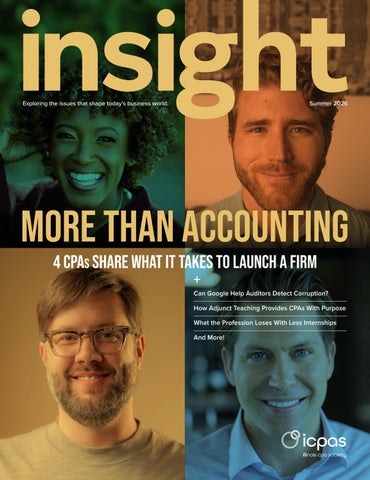
Exploring the issues that shape today’s business world.

4


CPAs SHARE What It Takes to Launch a Firm

Can Google Help Auditors Detect Corruption? How Adjunct Teaching Provides CPAs With Purpose What the Profession Loses With Less Internships And More!










Exploring the issues that shape today’s business world.
4
Can Google Help Auditors Detect Corruption? How Adjunct Teaching Provides CPAs With Purpose What the Profession Loses With Less Internships And More!
Geoffrey Brown, CAE President and CEO, Illinois CPA Society
As new laws impacting CPA licensure and practice privileges come into effect, ensuring compliance across state lines becomes critical.
During the spring AICPA Council meeting, a gathering of the AICPA’s governing body comprised of 265 members and representatives from every state and U.S. territory, we celebrated the fact that so many member states and territories have successfully brought forward new pathways to certified public accountant (CPA) licensure and reimagined CPA practice mobility in a very short amount of time.
Notably, state CPA societies, like your Illinois CPA Society, played an integral role in stewarding important legislative initiatives into action and are now actively involved in the administrative rulemaking processes and general change management across the ecosystem, allowing CPAs’ voices to be truly heard and accounted for.
The point of introducing new pathways to licensure is obvious— we’re working to ensure a robust and sustainable talent pipeline of next-generation leaders to support the future of the profession. Collectively, we’re now focused on:
1. Providing accurate, actionable information about the new pathways’ eligibility, requirements, and timelines.
2. Working with the academic community to prepare current and future CPA candidates to navigate the pathway most accessible and rewarding to them.
3. Supporting candidates and leaders working in firms and companies as they navigate both the new licensure opportunities and compliance processes moving forward.
As someone who’s been involved in this movement from the early stages, I feel very confident in our collective abilities to support each of these stakeholder groups as we shepherd new CPA candidates toward licensure.
Admittedly, reimagining the practice mobility framework across all 55 jurisdictions is a more complicated process. The stakeholder groups are different. The level of risk to practitioners and their organizations are different. The focus of regulators can also be different across jurisdictions. As the new mobility model was being developed, one thing was abundantly clear to us: CPAs and CPA firms would need resources and compliance tools to help them navigate the new regulatory framework.
We’ve previously seen how many firms managed their licensure and practice privilege eligibility in a variety of ad hoc ways. Picture spreadsheets and notes on what “special” requirements may exist

across the jurisdictions they served clients in. Decisions were often made about where they could perform work without fully understanding all the regulations. While this was a risky approach by CPAs and their firms before, it’s become far too risky to continue in this manner.
It was my hope that one of the profession’s many stakeholders would step up and develop the tools needed to address this critical gap and bring to market a meaningful solution. As the primary steward of the profession in Illinois, we knew this was an important time to show up for our constituents and advocate for their needs. We scoured the professional licensure landscape to find solutions that could help CPAs and their firms navigate the coming regulatory shifts both in Illinois and beyond our borders.
EXPLORE
cpaqualitypro.com
While there are many state-based licensed professions, none of them have the same practice mobility structure of the CPA profession, which meant a unique solution was needed. Enter CPA QualityPro, a start-up whose founders knew firsthand the challenges CPA firms were sure to face in the future. CPA firms need visibility into each jurisdiction’s regulations, must carefully validate the licensure credentials of their teams, and then they must map all that against the practice privilege and firm registration requirements in each jurisdiction they intend to practice in. After meeting the CPA QualityPro team and participating in a product demo, it became clear they had the tool we need today.
I’m pleased to share that we’re proud to partner with the CPA QualityPro team to help modernize practice mobility compliance. We bring an important and influential voice to the table and represent the collective voice of Illinois’ tens of thousands of CPAs and CPA firms asking for scalable, practical compliance tools. CPA QualityPro’s roadmap includes features that’ll help firms stay current and compliant without juggling spreadsheets, inconsistent workflows, and limited or misunderstood views of the regulations they must adhere to. I’m also excited that we’ll be joined by the Georgia, Florida, and Washington CPA societies in advancing this profession-first solution within our states and beyond.

ILLINOIS CPA SOCIETY
225 W. Randolph St., Suite 450, Chicago, IL 60606, USA www.icpas.org
Publisher | President and CEO
Geoffrey Brown, CAE
Editor Derrick Lilly
Assistant Editor
Amy Sanchez
Senior Creative Director
Gene Levitan
Proofreader Kari Natale, CAE
Photography Derrick Lilly | iStock
Circulation Jeff Okamura
Chairperson
Mark W. Wolfgram, CPA | Bel Brands USA Inc.
Vice Chairperson
Jennifer L. Cavanaugh, CPA | Grant Thornton LLP
Treasurer
Lindy R. Ellis, CPA | Ernst & Young LLP
Secretary
Richard C. Tarapchak, CPA | Verano Holdings Corp.
Immediate Past Chairperson
Brian J. Blaha, CPA | Winding River Consulting
Amy M. Chamoun, CPA | Cherry Bekaert Advisory LLC
Pedro A. Diaz de Leon, CPA, CFE, CIA | Sikich LLP
Kimi L. Ellen, CPA | Benford Brown & Associates LLC
Jessica L. Freiburg, CPA, PFS | Sassetti LLC
Mark S. Gallegos, CPA | Porte Brown LLC
Monica N. Harrison, CPA | Tinuiti
Joshua Herbold, Ph.D., CPA | University of Illinois
Jeffery R. Livesay, CPA, CGMA | MH CPA PLLC
Kimberly D. Meyer, CPA | Meyer & Associates CPA LLC
Girlie A. O’Donoghue, CPA | Portillo’s Inc.
Matthew D. Panzica, CPA | BDO USA PC
Jennifer L. Rada, CPA | PwC LLP
Andrea Wright, CPA | Johnson Lambert LLP
Stephanie M. Zaleski-Braatz, CPA | Miller Cooper & Co. Ltd.
BACK ISSUES + REPRINTS
Back issues may be available. Articles may be reproduced with permission.
Please send requests to lillyd@icpas.org.
Advertising in Insight and with the Illinois CPA Society gives you access to 20,000+ accounting and finance professionals. Contact Mike Walker at mike@rwwcompany.com.
Insight is the magazine of the Illinois CPA Society. Statements or articles of opinion appearing in Insight are not necessarily the views of the Illinois CPA Society. The materials and information contained within Insight are offered as information only and not as practice, financial, accounting, legal or other professional advice. Readers are strongly encouraged to consult with an appropriate professional advisor before acting on the information contained in this publication. It is Insight’s policy not to knowingly accept advertising that discriminates on the basis of race, religion, sex, age or origin. The Illinois CPA Society reserves the right to reject paid advertising that does not meet Insight’s qualifications or that may detract from its professional and ethical standards. The Illinois CPA Society does not necessarily endorse the non-Society resources, services or products that may appear or be referenced within Insight, and makes no representation or warranties about the products or services they may provide or their accuracy or claims. The Illinois CPA Society does not guarantee delivery dates for Insight. The Society disclaims all warranties, express or implied, and assumes no responsibility whatsoever for damages incurred as a result of delays in delivering Insight. Insight (ISSN-1053-8542) is published four times a year, in spring, summer, fall, and winter, by the Illinois CPA Society, 225 W. Randolph St., Suite 450, Chicago, IL 60606, USA, 312.993.0407. Copyright © 2026. No part of the contents may be reproduced by any means without the written consent of Insight. Send requests to the address above. Periodicals postage paid at Chicago, IL and at additional mailing offices. POSTMASTER: Send address changes to: Insight, Illinois CPA Society, 225 W. Randolph St., Suite 450, Chicago, IL 60606, USA.
Martin Green, Esq. Senior Vice President and Legislative Counsel, Illinois CPA Society @GreenMarty
With new requirements and a new online portal, now’s the time for CPA licensees to prepare.
It’s that time again—the 2027 triennial license renewal period for certified public accountants (CPAs) and CPA firms in Illinois will begin on or about June 30, 2027.
Coinciding with this renewal period, CPAs and CPA firms will need to renew their licenses through the Illinois Department of Financial and Professional Regulation’s (IDFPR’s) new professional licensing system: the Comprehensive Online Regulatory Environment (CORE). Considering the difficulties many licensees experienced during previous renewal years, the Illinois CPA Society (ICPAS) is working with IDFPR leadership to address issues, identify challenges, and learn new aspects of the updated renewal process and system ahead of time.
Our plan is to produce a series of columns dedicated to the 2027 license renewal process—at least until the new portal opens. Through these columns, I’ll focus on continuing professional education (CPE), the documentation submission process, and my learnings about the new process to keep everyone aware of what’s changing.
First things first, registered CPAs don’t have to complete CPE, but fully licensed CPAs must complete 120 hours of CPE credit as outlined in Section 1420.70 of the Illinois Administrative Code (IAC). Importantly, CPE reciprocity is available for Illinois-licensed CPAs who live outside of Illinois and hold active licenses in their states of residence.
Beginning with the 2027 license renewal process, Illinois-licensed CPAs will be required to upload CPE certificates for completed courses. This is different than in previous years when licensees just had to check a box attesting that they completed 120 hours of CPE. Further, for 2027, licensees will need to upload relevant documentation in three categories: sexual harassment prevention, ethics, and profession specific. Arguably, this is redundant, and ICPAS is working with IDFPR leadership to improve this within the new system’s parameters.
While CPAs will be able to upload CPE transcripts from licensed CPE providers (such as ICPAS), it’s uncertain what type of documentation will be required for non-verifiable CPE. Although,

according to Subsection (b)(4)(B) of the IAC, acceptable evidence for completion of non-verifiable CPE hours includes:
• Certificates provided other than from a recognized CPE sponsor and/or a record specifying the nature of CPE (e.g., research and the source).
• Dates undertaken.
• Number of hours.
• Details of relevance of the CPE to the CPA’s professional development.
• Copies of consultation, memorandums, minutes, or other documents.
Notably, CORE will be able to perform an automated audit of claimed CPE credits, and there will be a process for licensees to respond to automated flagged credits. (This is why retaining certificates and documentation is so important.)
For licensees who’ve encountered instances of extreme hardship, such as military service, an incapacitating illness, or other extenuating circumstances, there’s a formal waiver process you’ll have to complete in advance of the renewal period to avoid license renewal delays.
The good news in all this change is that other professions have been brought into the new CORE system ahead of ours, which means IDFPR has been correcting early bugs and other program shortcomings along the way. I suspect this will help make our profession’s renewal process more streamlined and less burdensome.
Of course, ICPAS will continue discussions and planning with IDFPR and, more importantly, communicate any important updates on the process as information becomes available.
For now, it’s time to get things in order for the 2027 renewal window. Now would be a good time to assemble a file of required certificates and other documents to avoid delays—or worse, your license not being renewed. In the meantime, licensees should review Section 1420.70 of the IAC.
After a year of developing quality management standards, firms are now challenged with putting their new policies into real-life practice. Here are some strategies for making them work.
BY HEATHER LINDQUIST, CPA

OVER THE SUMMER AND FALL OF LAST YEAR, firms were busy developing, finalizing, and implementing systems of quality management (QM) to meet the Dec. 15, 2025, implementation date of AICPA’s Statements on Quality Management Standards. This meant that on top of already heavy workloads and hectic schedules, firms performing engagements under Statements on Auditing Standards, Statements on Standards for Accounting and Review Services, and Statements on Standards for Attestation Engagements had to:
• Assess and document risk for all quality objectives related to relevant components (e.g., governance and leadership, ethics, acceptance and continuance, engagement performance, resources, and information and communication).
• Develop and document responses to address these quality risks.
• Determine the firm’s plan on how to approach monitoring and remediation.
During the design process, firms focused on identifying, assessing, and responding to risk across the QM components. These risk responses formed the bones of the firm’s documented QM policies and procedures. Now, with the heavy lifting of QM system
design in the rearview mirror, the real challenge for firms is making their systems work for them by connecting their policies to their daily actions. However, for many firms, design documentation may include loosely defined policies that make it challenging to understand the policy’s purpose or how to apply it in practice.
After a decade of serving as a technical reviewer for the Peer Review Alliance (an administrator of the AICPA’s Peer Review Program), I’ve noticed that having a well-functioning system— one that consistently produces engagements in accordance with professional standards—has less to do with memorizing standard terminology or drafting a QM document that consists of broadly stated policies. Instead, it has far more to do with whether firm personnel understand why these policies exist and if they can articulate how their firm lives them out in practice.
In the past year, I had the opportunity to interact with leaders from firms of varying sizes across six states to discuss how their firms translate policy into practice. Based on those discussions, here are several commonly identified risks in three QM components and strategies for responding to them.
One of firm leadership’s most critical roles is securing the resources necessary to perform engagements in accordance with professional standards. With that in mind, a firm’s QM documentation may include the following as one of its quality risks and responses:
The firm doesn’t realistically assess the availability of resources (e.g., time, appropriately capable personnel, etc.) or ensure allocation of such resources. The firm considers and provides sufficient and appropriate time and personnel for each engagement.
While this policy may “sound” great, the question it fails to answer is, “What does this look like in real life?”
When discussing this concept with practitioners, I wanted to know more about how firms plan to approach the next three, six, or 12 months of engagements. Regardless of firm size, most practitioners described a process of laying out upcoming engagements, estimating time requirements, hammering out preliminary scheduling, and determining personnel availability (including their own).
Believe it or not, this planning exercise is risk response in action. Making the effort to improve the quality of that planning directly impacts the effectiveness of the QM system.
By moving beyond simple scheduling considerations, firm leaders suggested the following methods to transform this process into an effective risk response:
• Forecast potential issues: Client growth that leads to increased engagement complexity, new standards, or client personnel turnover all have significant impacts on engagement resource needs. Identifying and proactively adjusting resource allocation in these areas can go a long way in creating the right conditions to support quality work. Such adjustments may include building a scheduling cushion for engagements exhibiting these characteristics, considering the use of consultants, cutting resource-heavy or low-realization clients, or blocking off engagement partner time to supervise new or inexperienced staff.
• Adapt on the fly: Forward-looking planning is important, but mechanisms that force firm leadership to confront engagement challenges in real time, like a quick biweekly review of open engagements, are essential in allocating sufficient and appropriate resources that live up to a firm’s policy commitment.
Responsibility and accountability are foundational QM concepts. In particular, the concept of supervision and review of engagements are critical elements of standards. Therefore, a firm’s QM documentation may include the following as one of its quality risks and responses:
The nature, timing, and extent of engagement team direction, supervision, and review are inadequate for the circumstances, leading to insufficient support for work performed on attestation engagements.
of the expectations for, and characteristics of, good supervision and review in varying circumstances to ensure firm personnel are effectively living out supervision and review policies.
In my discussions with practitioners, several strategies for effective supervision and review for accounting and audit engagements emerged:
• Adjusting the engagement partner’s time spent with the engagement team “in the field” based on personnel experience.
• Discussing what matters in various engagement areas and the rationale behind procedures or analysis with the engagement team before field work.
• Before performing supervisory review, requesting personnel describe the procedures carried out to ensure they align with the documentation created and meet necessary objectives.
• Expanding the depth and time spent on supervisory review based on staff experience and requiring personnel to clear their own review comments.
Attending relevant continuing professional education (CPE) is key to ensuring a firm develops its most significant resource—its people. However, this is only one piece of the puzzle. Firms must also find ways of ensuring the lessons learned make it into practice. With this in mind, a firm’s QM risk assessment documentation may include the following as one of its quality risks and responses:
The firm’s personnel don’t apply knowledge regarding professional standards gained during CPE courses at the engagement level.
The firm identifies pertinent CPE content and incorporates it into relevant client engagements.
While CPE is easier than ever to find and attend, the real challenge for firms is incorporating that learning into engagements. Notably, it can be difficult to home in on relevant course content and make sure learnings and standards flow through to relevant engagements.
In discussing with firms how they plan to tackle this challenge, firm leaders cited:
• Attending recorded, on-demand CPE as a group and pausing to discuss various sections.
• Conducting a short meeting after significant CPE courses to discuss and note which firm engagements are impacted by changes to professional standards.
The engagement team documents an assignment and supervision plan. Firm methodology requires review of specific segments of engagements by the engagement partner.
While a supervision plan and review assignments are important steps, it’s the depth and quality of both that matter.
Of course, this may mean something different to everyone on the team. That’s why it’s critical to develop a collective understanding
• Appointing a team “champion” to lead the learning and implementation of a significant new accounting standard.
Much of the above may seem intuitive, but many of these steps often get overlooked. That’s why as firms move out from under the design phase of QM and into the action phase, it’s essential for them to understand what their policies should look like in real-life practice. Firms that take time to intentionally consider and discuss what living out a policy really means will end up with more consistent and effective QM systems. Without this shared understanding and action, even the most well-documented QM system runs the risk of becoming little more than words on a page.
Heather Lindquist, CPA, is the Illinois CPA Society’s director of peer review and professional standards.
A firm’s place within the client’s operations sets the structural boundaries of a CAS engagement, dictating what a CAS engagement can produce.
BY CHUCK TEEL, CPA

client’s internal team who’ll either execute them or not. Whether the recommendation reaches implementation—and what happens once it does—rests with the client’s internal team.
This is the typical CAS engagement most clients receive.
IN A TYPICAL CLIENT ADVISORY SERVICES (CAS) ENGAGEMENT, the firm operates on a periodic cadence, which looks something like this:
The firm closes the client’s books, delivers financial reports, conducts a scheduled review, and offers commentary on what the numbers indicate. Between cycles, the client initiates communication, and the firm responds to the client’s questions and reviews their materials.
The engagement’s deliverables are reports and recommendations, which arrive after the operating period closes. These include:
• Financial statements, which record what happened.
• Advisory emails and narratives, which interpret results and identify issues for the client’s leadership team to address.
• Tax planning summary documents, which outline positions and timelines.
Accountability sits at the recommendation. The firm reviews decisions the client has already made and recommends adjustments to the
Most certified public accountants (CPAs) recognize the limitations of this CAS structure, yet, the practice persists—and mostly for reasons that operate inside the firm itself.
That’s because the CAS engagement fits the firm’s commercial and operating infrastructure. Hourly billing and scheduled fixedfee retainers match the firm’s timekeeping systems and realization benchmarks. Traditionally, CAS sits alongside tax and audit and inherits the host environment’s conventions.
CAS engagements also fit the CPA career path. For instance, CPAs develop through technical specialization and interpretive judgment delivered periodically, which reinforces an identity built on expertise applied at scheduled intervals—not sustained, continuous operational accountability.
The language used reinforces the structure as well. Conferences, publications, and firm marketing materials often use phrases like
“advisory expansion” to describe the field’s direction forward. This vocabulary signals to clients what to expect from the engagement and signals to CPAs what the established path to advancement looks like.
Notably, the typical CAS engagement is durable because the structures supporting it—economic, professional, and rhetorical— are coherent on their own terms. Firms operating inside those structures aren’t failing to understand what their clients need. Instead, the structure defines what the engagement can be.
Of course, there are a couple different ways CAS can be positioned:
• From outside the operation. The firm sees the operation through the materials the client has organized for review (e.g., trial balance, variance commentary, and issues raised in scheduled meetings). Observation is calibrated to the cadence of those materials, and access is calibrated to what the client chooses to share. After that, participation in operating decisions occurs through recommendations.
• From inside the operation. The firm sees the operation as it forms. Observation is continuous, and access is calibrated to what the function consists of, not to what the client surfaces for review. Participation in operating decisions occurs as the decisions are made.
In both of these positions, the CPAs are credentialed and capable, but they operate from different places relative to the client’s operation.
From outside, the firm sees the consequences of operating decisions. From inside, the firm sees the decisions as they form. Where the firm operates relative to the client, determines what the engagement can see, participate in, and be accountable for. Position determines what the engagement can’t reach as much as what it can. The same firm could operate from both positions with the same CPAs, but the engagements would produce different conditions because the engagements are structurally different.
Daily execution is a structural posture defined by where the firm operates, what the firm owns, and what the firm is accountable for. It begins with function ownership. In this case, controllership is the baseline: the financial close cycle, internal controls, accruals, reconciliations, and disciplines that produce the financial reporting the organization runs on. Beyond controllership, additional functions are receivables, payables, payroll, cash management, tax compliance, executive planning support, and board reporting.
Daily execution operates continuously. The CPA running the function makes the daily decisions the function requires as they arise, not at scheduled reviews. Observation is continuous because the function is being operated continuously.
At my firm, every monthly fixed-fee engagement is structured around process ownership, with fees calibrated to what the firm owns. For instance, the work the firm owns is operated by the firm. The work outside the firm is governed by a parallel hourly statement of work with the client’s explicit consent.
All in all, daily execution is a set of structural commitments that operate together: ownership of named processes, continuous presence, real-time participation in decisions, and accountability for what the function delivers.
When the firm operates from inside the client’s operation, a set of structural conditions become available that a typical CAS engagement can’t produce. This includes:
• Visibility. The CPA running the daily execution function sees decisions, transactions, and structural conditions as they form, not after they surface in financial reporting.
• Judgment grounded in observation. The CPA’s interpretation rests on the function’s actual cadence (e.g., the daily decisions, operational trade-offs, and interactions between systems and people), not only on what arrives in the variance commentary at month-end close.
• Proximity to decisions. The CPA running the daily execution function participates in operating decisions when assumptions can still be questioned and alternatives can still be considered (i.e., the client’s leadership team involves the CPA in the conversation while decisions are being made, rather than receiving a recommendation once the conversation has ended).
• Accountability that’s tied to what the function produces. Accountability that follows from ownership is structurally different from accountability for a recommendation. This means that the firm owns whether the daily execution function meets its commitments.
Ultimately, CPAs considering how to structure their CAS practices are choosing between positions, each producing distinct outcomes defined by where the firm operates from. The choice of position is structural—and so are the consequences.
Chuck Teel, CPA, is the founder and CEO of Teel & Company Strategists and CPAs.
New research introduces a simple but powerful tool for assessing client corruption risk—and raises questions about whether auditors are responding to it effectively.
BY JOSHUA HERBOLD, PH.D., CPA

IF YOU’VE SPENT TIME IN A PUBLIC ACCOUNTING FIRM, you’ve probably encountered a client whose situation made you feel uneasy. Not because the numbers were obviously wrong, but because something about the company’s culture or reputation didn’t sit right with you. Maybe there were rumors in the trade press, or perhaps a Google search turned up some uncomfortable results. The question of what auditors are supposed to do with this kind of information, and what the standards actually require them to do, has been a source of professional debate for years. Just how far should auditors’ responsibilities for clients’ noncompliance with laws and regulations (NOCLAR) extend?
Accounting Standard (AS) 2405, Illegal Acts by Clients, was adopted by the Public Company Accounting Oversight Board (PCAOB) after it inherited the AICPA standards in 2003. The standard itself hasn’t changed much since it was originally adopted by the AICPA in 1989, and it remains the governing standard for auditor responsibilities around NOCLAR.
Notably, the standard doesn’t require auditors to perform specific procedures to detect illegal acts, which has drawn sustained
criticism from investors and regulators who believe auditors should be doing more. The PCAOB proposed a significant revision under PCAOB Release 2023-003, but the proposal drew heavy opposition, and its planned 2024 adoption was deferred. The revision remains on the PCAOB’s active standard-setting agenda.
A study recently published in the Journal of Business Finance & Accounting, “Auditors’ Response to Client Corruption: Evidence From Google Document Frequency,” addresses two questions at the center of the debate: Can auditors detect client corruption risk before formal violations are revealed, and if so, are they responding to that risk in a way that actually improves audit quality?
According to the study’s researchers Nerissa C. Brown, professor of accountancy and associate dean at the University of Illinois Urbana-Champaign, and co-authors Jennifer R. Joe (Virginia Tech), Kecia Williams Smith (North Carolina A&T State University), and Henry Wang (Miami University), the answer to the first question is yes. Their answer to the second question is more complicated.
To measure client corruption risk, the researchers needed a way to capture both actual and perceived illegal activity at the individual firm level and to do so before any formal charges or enforcement actions were filed. Their approach was to use Google.
Drawing on a methodology developed by economists Albert Saiz and Uri Simonsohn, the researchers constructed a “Google document frequency” measure. Their reasoning for this was straightforward: The more a phenomenon actually occurs, the more likely someone is to write about it online. By counting the number of Google search results that placed a company’s stock ticker symbol within 16 words of the word “corruption,” the researchers were able to produce a firm-specific, year-by-year estimate of noncompliance risk.
Ticker symbols were used rather than company names because they’re uniquely assigned. For instance, searching “AAPL” returns Apple-specific results in a way that searching “Apple” doesn’t. The researchers also excluded tickers with common alternative meanings to reduce noise in the data, and they scaled their measure by the total number of Google searches for a given ticker symbol.
This approach draws on a concept known as “wisdom of crowds,” which highlights how large amounts of decentralized information, when properly aggregated, can reliably signal phenomena that are otherwise difficult to observe directly. The same principle has been applied in studies using social media posts to predict consumer behavior and company revenues.
The Google document frequency measure also holds up to empirical scrutiny. The researchers validated it against three independent databases of actual corporate noncompliance: the RepRisk database, Audit Analytics Litigation database, and Stanford Law School Foreign Corrupt Practices Act (FCPA) Clearinghouse. Through this, the researchers found that firms with higher corruption scores were significantly more likely to face federal litigation, FCPA violations, and other corporate misconduct events in the following year. The Google-based measure predicted future legal trouble rather than simply coinciding with it.
The study’s first main finding is that auditors are already responding to elevated client corruption risk. Firms moving from the lowest to the highest corruption decile faced an approximate 3% increase in audit fees, and this result held after controlling for local political corruption and actual instances of noncompliance.
The researchers also tested whether those higher fees reflected genuine additional work or simply a risk premium charged for accepting a riskier engagement. They used the unexplained portion of audit fees (the amount not accounted for by standard determinants of client complexity and engagement characteristics) as a proxy for unobserved audit effort.
In doing so, the researchers found that the fee increases associated with higher corruption risk were driven by additional effort, not premium pricing: “We find that our results are driven by increased audit effort rather than simply higher fee premiums charged to corrupt clients,” the researchers note. That additional effort included expanded legal consultations, greater use of specialists, more extensive audit committee communications, and the involvement of more senior engagement team members.
Despite higher audit efforts and fees, clients with high corruption risk were still significantly more likely to restate their financial statements in subsequent periods. “Although auditors appropriately price for noncompliance risk, their execution of the audit does not fully adjust for the risk identified,” the researchers conclude.
Overall, the audit error analysis makes this conclusion concrete. Clients with high Google document frequency scores showed a significant increase in “false negatives,” where the auditor doesn’t flag an issue and the client later restates. In other words, auditors were more likely to miss material problems with clients at firms where corruption risk was highest.
Prior research suggests that when auditors face elevated risk, they tend to expand the extent of their testing without making sufficient changes to the nature of their tests. In fact, more invoice testing using the same approach won’t uncover a sophisticated bribery arrangement. Addressing corruption risk effectively requires changes to what procedures are performed, not just how many.
For certified public accountants (CPAs), the key lesson from this study is that recognizing corruption risk isn’t enough—the audit response also has to change. Firm-specific risk assessment needs to go beyond regional or industry-level corruption indicators.
“Our evidence is noteworthy because our corruption measure incorporates both actual and perceived corruption … and has a broad corruption focus that moves beyond the political or foreign corruption considered in prior work,” the researchers explain.
Importantly, the researchers also note that any engagement team with internet access can run structured searches for firm-specific online corruption signals during audit planning. Simple documentfrequency counts can serve as a practical tool for noncompliance risk assessment, one that works alongside existing procedures rather than replacing them.
The study also raises the question of legal and regulatory expertise within audit teams. A common objection to expanding auditor NOCLAR responsibilities is that auditors lack the legal training to recognize complex violations. While the researchers found that auditors have the capacity to identify corruption risk, the problem they encounter is translating that identification into audit procedures that work. Therefore, firms should consider targeted training and increased use of specialists who can help engagement teams recognize warning signs across a range of regulatory environments, including environmental, labor, and securities law.
The PCAOB’s proposed revision to AS 2405 remains deferred, but the subject hasn’t gone away. This study provides evidence that’s directly relevant to regulators’ concerns: Auditors can detect corruption risk, and they do price for it. What’s less clear, however, is whether their procedures (once those higher fees are set) are designed to catch the problems that corruption risk signals.
“[Our] study provides evidence suggesting that revisions to AS 2405 could achieve improved auditor performance surrounding their clients’ NOCLAR,” the researchers conclude.
For CPAs, the practical implication is that the tools for better corruption risk assessment are already available. Using a Google search to check for firm-specific corruption is a low-cost step that’s worth taking. But it’s also a step that needs to be followed by redesigned audit procedures that match the risks those signals reveal—and that’s where the profession still has room to improve.
Joshua Herbold, Ph.D., CPA, is a teaching professor of accountancy and associate head in the Gies College of Business at the University of Illinois Urbana-Champaign and sits on the Illinois CPA Society Board of Directors.
As AI use accelerates across the profession, a strong governance framework is essential to preserving accounting’s most valuable asset—trust.
BY MARY DELANEY

IMAGINE A JUNIOR STAFF MEMBER using generative artificial intelligence (AI) to draft multistate tax guidance without disclosing it: The output seems sound; the client signs off; but months later, an error surfaces, and the firm can’t explain its AI review process.
It’s a nightmare scenario for any accounting firm. What was supposed to be a tool to increase productivity and efficiency instead undermined something far more valuable to the firm: client trust.
Client trust isn’t the only concern accounting professionals face when using AI in their daily work. According to Karbon’s 2026 “State of AI in Accounting” report, 83% of accounting professionals say they’re concerned about trusting AI with data security (up from just 7% in 2025).
Based on these concerns, it’s clear that trust must be a nonnegotiable objective for any AI initiative.
Of course, an essential component in reaching this goal is a robust AI governance framework, one rooted in clear policies, oversight, and consistent practices. Considering that Karbon’s 2026 report revealed only 21% of firms have a formal AI strategy or policy in place, AI governance must become a top priority for firms this year.
Here’s what accounting firms should consider when building their AI governance frameworks.
There’s no doubt that AI has moved from novelty to operational reality in the accounting profession—and with real use comes real risk. Understanding the risks that come with AI use is essential in building a strong governance framework. Such risks include:
1. Data security and confidentiality: Given the volume of sensitive information accountants handle, misuse of AI tools, poor access controls, lack of training, or unclear vendor practices can lead to considerable damage.
2. Accuracy, hallucinations, and overreliance: AI can sound so confident while being so wrong. As firms expand their AI use— whether in research, forecasting, or analysis—they need clear guardrails to mitigate the risk of providing incorrect advice, relying on flawed analysis, or allowing errors to slip through.
3. Ethical and bias risks: AI models are trained on massive, imperfect data sets, making them susceptible to different biases (e.g., geographic, industry, etc.), which can result in advice that’s technically reasonable but actually wrong or not specific enough.
4. Reinforced outdated practices: By drawing on historical information, AI could provide advice or research based on “traditional” accounting practices, such as recommending conservative structures, undervaluing nontraditional business models, or reproducing legacy assumptions about risk, growth, or profitability.
5. Inconsistent AI usage: Since many firms lack a formal AI strategy or policy, teams may adopt tools independently. This creates inconsistent practices, uneven quality, and unknown risk exposure. Every one of these risks ultimately threaten credibility. When staff members don’t understand when or how AI is being used, or when clients feel AI is replacing human judgment, trust can erode quickly—that’s a particularly big deal in a profession built on credibility and deep relationships.
As tentative AI experimentation has turned into regular AI usage in many firms, the need for clear guardrails, human oversight, and education is more pronounced than ever. Firms that treat AI governance as optional are gambling with their credibility. Here’s what responsible firms are doing instead:
• Defining when AI can support work versus when professional judgment is required.
• Mandating human review for high-risk outputs, such as tax advice, compliance decisions, and client-facing recommendations.
• Standardizing approved tools.
• Restricting the use of sensitive client data.
• Requiring transparency around when and how AI is used.
• Defining oversight responsibility among executive and partnerlevel leadership.
Strong AI governance is easier when firms operate within connected ecosystems where work, communication, and documentation are centralized. Disconnected tools increase risk, but integrated platforms create visibility and accountability.
This is where a strong AI governance strategy comes into play, providing clear and consistent guidance in the form of:
• A documented AI policy with acceptable use guidelines.
• Data security and privacy controls aligned with existing cybersecurity standards.
• “Human-in-the-loop” review requirements that help monitor key AI-assisted workflows.
• Bias and ethics awareness training, not just tool training.
• Clear accountability for AI-assisted decisions.
• Regular review and updates as tools evolve.
• Ongoing training and personal development about AI use.
This type of clear governance creates a safer environment for AI experimentation, reducing risks while enabling faster, more confident AI adoption across firms, which results in a greater sense of trust over time.
Typically, the most successful accounting firms embed AI governance directly into their workflows. Rather than relying on individual discretion, they build review checkpoints, documentation standards, and transparency into the systems where work actually happens. Governance becomes part of the process instead of an afterthought.
Of course, if it were easy to set up an effective AI governance policy, every firm would do it. But like most aspects of AI development, governance too has its share of practical challenges:
• The pace of AI innovation: It can be hard for firms to create policies that stay relevant, as tools and capabilities evolve faster than traditional policy cycles. Firms also struggle to balance control with innovation, as overly restrictive rules can discourage experimentation while loose guidance increases risk.
• Uneven AI understanding across roles: An uneven AI rollout can create misalignment in adoption and enforcement. Further, resource constraints—particularly in small and mid-sized firms— can make governance feel complex or burdensome without dedicated IT or compliance support.
• Implementation challenges: Policies exist on paper but lack training, accountability, or leadership reinforcement. Without clear communication and ownership, even well-designed AI policies won’t change day-to-day behaviors.
Despite these hurdles, firms that approach governance as a shared responsibility—with visible leadership support and clear ownership—have a better chance of succeeding. Without that collective effort, however, their policies will exist in theory but likely fail in practice.
AI produces a lot of value for accounting firms, including greater productivity, increased efficiency, and growth potential. But none of these things can happen without trust. If staff become frustrated, clients lose confidence, and firm credibility suffers, AI becomes more of a liability than an asset.
Strong AI governance helps build and maintain that critical trust, turning AI from an ad hoc productivity tool into a reliable, repeatable system that supports faster workflows, better outcomes, and sustainable efficiency gains across the firm.
Mary Delaney is the CEO of Karbon, where she works closely with accounting firms to optimize their operations through modern technology.
More CPAs are finding purpose through adjunct teaching opportunities. Here’s what to know before stepping into the classroom.
BY CAROLYN TANG KMET

RISING TREND IS TAKING SHAPE IN ACCOUNTING EDUCATION: Colleges and universities are increasingly turning to working certified public accountants (CPAs) to serve as adjunct professors, part-time instructors who typically teach while maintaining full-time professional roles outside of academia.
As the accounting and finance profession continues to evolve— shaped by technology, regulation, and shifting workforce expectations—CPAs are in a unique position to bring their realworld insights into the classroom, helping make concepts feel more tangible. At the same time, adjunct professorships can offer CPAs a meaningful way to give back to the profession, strengthen the talent pipeline, and further develop their own leadership and communication skills.
For CPAs weighing this unique career path, here’s what current adjunct professors and faculty say they should consider.
“Adjuncts are the bridge between theory and practice, applying real-world scenarios in the classroom,” explains Klementina Andonova, owner of True North Accounting and part-time adjunct accounting faculty at the College of DuPage.
Andonova, who also formerly served as a student ambassador for the Illinois CPA Society, believes that adjunct faculty add particular value in introductory and foundational courses. Specifically, she says their lived perspective provides context to theory and helps make accounting feel more accessible and engaging early in the curriculum.
Scott Judd, Ph.D., CPA, clinical assistant professor of accounting, assistant department chair, and director of graduate studies at the University of Illinois Chicago, sees that value extending to students further along in their academic and professional journeys: “The greatest needs are often in upper-level undergraduate courses where specialized expertise can enhance learning and in evening graduate courses that frequently serve working professionals.”
Brian Maj, Ph.D., senior program administrator and adjunct instructor at DePaul University, says the real value adjuncts bring to classrooms is their industry currency. They can infuse life perspective into their lectures and connect students with a network of professionals.
“Students want to understand how teams are managed today, where firms are going, and what their career paths should look like,” Maj explains.
CPAs interested in pursuing adjunct professorship opportunities can stand out to hiring managers by first meeting the core qualifications: a CPA license, an advanced degree, and recent and relevant professional experience. Prior teaching experience is also a bonus.
Beyond credentials, great adjuncts also translate complex concepts into tangible, actionable knowledge and bring a genuine commitment to mentoring students as they work toward their full potential.
Michael Mago, CPA, CFE, who began his teaching career as an adjunct professor teaching accounting courses at multiple institutions, is now a full-time professor at Triton College. He believes that one of the most important skills that any professor can possess is the ability to take complex topics and simplify them: “I try to explain concepts as if students are hearing them for the first time—because many of them are.”
He also emphasizes the importance of patience: “You need to be able to explain the same concept in multiple ways because every student learns differently and at a different pace.”
In addition to being able to simplify complex concepts, Andonova adds that effective adjuncts must also be able to bring those concepts to life in ways that resonate with students: “We must be part expert and part storyteller to show students that accounting is about solving business problems, not just crunching numbers.”
Leadership and management experience can also serve as a meaningful differentiator.
Kent Foutty, an adjunct professor serving multiple universities, including Arizona State University (online), Loyola University Chicago, and University of Illinois Chicago, notes that candidates with leadership backgrounds bring more than just technical expertise into the classroom: “An ability to show that you have mentored others in your profession translates well to mentoring students in the classroom.”
At the core, Maj says what matters most is having genuine care for students’ well-being and success. “That’s the call to teach—you have to believe that every student matters,” he says. “In a class of 40, one student might take a lot of time, but you’re changing their life.”
He adds that the adjunct professor role often extends beyond coursework: “Half of the students’ questions aren’t about homework. They’re going to ask about your career, life, and background. Students are looking for signals that people like them have succeeded.”
Many CPAs turn to teaching out of a desire to give back to the profession and mentor the next generation. For Foutty, helping others learn was a key driver in his decision to become an adjunct professor.
“In 2002, I realized what I liked best about my corporate job: mentoring the dozen people that worked for me,” Foutty recollects.
“So, I thought, perhaps I should teach! I sent out resumes to area schools, and Loyola called me when they had a summer session class that needed an instructor.”
Mago discovered his passion for teaching while pursuing his master’s degree and working as a graduate assistant and tutor.
“One of my first students said, ‘I see you as a teacher one day,’ and while I had never thought about it before, it just felt right. I really enjoyed helping people accomplish something challenging,” Mago says.
Even after his assistantship ended, Mago continued tutoring. A former professor took notice of his enthusiasm and invited him to teach a class. Although he was still early in his career—with experience as an intern at PwC, auditor, and bookkeeper for a family construction company—he quickly found his groove in the classroom.
“I began with one class, and within a year, I was teaching at multiple schools,” Mago recalls. “My course load quickly grew from two classes to six or seven, sometimes more.”
CPAs interested in pursuing adjunct teaching should consider whether the opportunity aligns with their professional and personal goals, available time, and willingness to take on the many demands the role requires.
While adjunct teaching does offer flexibility, Mago attests there’s a significant amount of time and energy required to develop and deliver a course. Instructors are often responsible for building syllabi, preparing lectures, grading assignments, and being available for students.
“Ask yourself if you have the time,” Maj suggests. “You need margin for the student who stays late—those conversations matter. You can’t rush people out to catch your train.”
Another thing for CPAs to consider is pay. If you’re motivated by compensation, this might not be the right path. Adjuncts are typically paid per course rather than by the hour, so compensation may not always reflect the time invested. As such, many adjunct faculty members are motivated less by pay and more by personal fulfillment and a desire to give back. For some, that level of commitment may not align with current life or career demands.
For those who can afford to make the investment, however, the impact extends far beyond the classroom. Adjunct faculty play a meaningful role in shaping the next generation of accountants, helping students connect theory to practice and envision their future in the profession. There’s also a deep sense of fulfillment that comes with that mission, especially over time, as instructors begin to witness the success of their former students.
In fact, while being interviewed for this article, Maj came across a former student featured in a previous issue of this magazine. Even through the distance of a Zoom call, you could feel his pride. Maj says those moments are what define the role—the deep sense of fulfillment that comes with knowing you’ve made an impact on someone’s future.
Carolyn Tang Kmet is a clinical associate professor at Northwestern University and a frequent Insight contributor.
Student interest in accounting is rising, but early -career opportunities are shrinking. Is the profession creating an experience gap it won’t be able to fill?
BY CHRIS CAMARA

“What we’re seeing this year, unfortunately, is accounting students graduating without a job, and that’s very unusual.”
AMID A LONG-AWAITED AND ENCOURAGING UPTICK in accounting student enrollment comes a more alarming trend—fewer internships and entry-level jobs to go around. Whether due to economic uncertainty, evolving workforce strategies, outsourcing cost savings, or artificial intelligence (AI) adoption, many certified public accounting (CPA) firms appear to be reevaluating their approach to entry-level hiring.
Three years ago, accounting students enjoyed multiple internships and signing bonuses. In fact, more than 83% of DePaul University accounting graduates were hired for full-time positions last year by the 10 largest public accounting firms. The remainder went to smaller firms, corporations, or graduate schools.
This year, however, students are seeing a much different landscape: Signing bonuses have disappeared and full-time offers, even after an internship, are harder to come by.
“There was virtually no unemployment last year,” says Margaret Tower, CPA, MBA, senior instructor of accounting and director of the Office of Student Success and Engagement at DePaul University.
Even more unusual is the fact that interest in accounting degrees is rising at the same time. For instance, DePaul University saw a 10% increase in accounting student enrollment this year compared to last year, and enrollment for 2027 is trending even higher.
The Illinois CPA Society (ICPAS), state educators, and firm leaders are seeing a similar trend. National statistics show that while interest in accounting careers is clearly growing, internships are more difficult to find, and not just in accounting but across a range of other professions.
Of course, this disconnect is colliding with the real challenges organizations face or will soon face filling experienced manager roles, raising a pressing question: What does the accounting profession risk if firms stop investing in internship programs?
According to data from the National Student Clearinghouse, accounting undergraduate enrollment rose for the third straight year in fall 2025. Overall accounting undergraduate enrollment grew by 7.3% year-over-year in the fall 2025 semester, following an 11.3% rise in fall 2024 and a 1.9% increase in fall 2023. That increase compares with a 1.2% increase in enrollment across all majors.
Tower believes incentives, such as flexible work arrangements and signing bonuses, are attracting younger talent into the profession, along with recent changes that expand CPA exam eligibility and introduce new pathways to CPA licensure. Additionally, firms have increased their hiring since the COVID-19 pandemic, and due to the shortage in accounting students then, internship and full-time salaries also increased.
Kari Natale, CAE, ICPAS’ chief operating and strategy officer, adds that coordinated efforts across the profession—highlighted by initiatives like the AICPA’s National Pipeline Advisory Group and Pipeline Pledge, the American Accounting Association Foundation’s Two-Year Bridge Symposium, and expanded high school outreach— have contributed to increased awareness about accounting. The impact is also being seen in record-high interest across ICPAS’ student programs. For example, the Mary T. Washington Wylie Internship Preparation Program (MTWW IPP) attracted the largest applicant pool in its 14-year history. Scholarship applications are also up, as is increased student membership and participation overall. Yet, despite growing interest, Natale says she’s consistently hearing from students that they need help securing internships and full-time jobs.
Of course, the concerns aren’t just unique to Illinois. Nationally, internships across a range of professions are getting harder to find. Early-career job platform Handshake, which surveyed more than 6,000 students and recent graduates, reported that its internship postings declined by more than 15% between January 2023 and January 2025.
Meanwhile, competition for those internships is getting more intense. As of January 2025, 41% of 2025 graduates applied to at least one internship through Handshake, compared to 34% of 2023 graduates. Additionally, professional services internships saw a decline of 42% between 2023 and 2025.
Natale noticed declines in internships and job offers a few years ago. More than 85% of MTWW IPP participants typically received internship or full-time offers shortly after completing the program. Last year, just 17 of 49 students secured offers at that point, and so far this year, only three of 39 participants have secured offers at the time of writing this article. What’s more, several participating firms were unable to take part in interviews this year, and ICPAS also paused plans for its 2026 virtual career fair amid lower employer participation levels.
Further adding to the challenges are the ways in which firms recruit interns. Tower notes that firms have been recruiting for interns earlier, offering internships as much as two years in advance, which primarily benefits freshmen who are organized and committed to accounting. Students who declare accounting as their major later in their educational career may miss the window entirely.
Tower sees a couple of reasons behind the recent decline in intern and entry-level staff hiring. One is that firms are using AI to improve productivity by absorbing some of the more mundane work interns and young professionals historically performed. Another is that fewer early careerists are leaving their jobs, leaving fewer openings for others.
As Tower explains, graduates typically take jobs at larger firms, stay for 18 months or two years, and then leave for a smaller firm or industry. Now they’re staying put longer because the jobs don’t exist.
Despite many firms scaling back, the internship program landscape isn’t all bleak. Some firms are purposefully choosing to invest strategically in the next generation of accountants.
That’s simply the case for Minneapolis-based CLA, which has consistently attracted 900-1,000 interns annually across its 130 locations. The $2 billion firm converts up to 80% of its interns into full-time hires. The firm also launched a high school internship program four years ago, with 80 students enrolled this year, the biggest class since it started.
“At CLA we’re not thinking about early talent as a standalone recruiting program. We’re thinking of it as a front end of our workforce, both locally in our Chicago office and nationally,” says Kirthi Mani, CPA, chief people officer at CLA. “With the growth that we have in mind, that pipeline will increase. I can’t imagine how we can shrink it.”
Part of the reason CLA maintains its high level of internships and early hires is because the firm doesn’t outsource entry-level work, which is common practice at other large firms. Mani notes that CLA has invested $500 million into AI, but the investment is to automate pain points and not people.
Back at DePaul University, students are adapting to the (hopefully temporary) new normal.
Accounting students are going so far as to delay graduation in hopes of securing an internship that’ll lead to a full-time offer. Tower says she’s encouraging students to start working toward earning their CPA credentials while waiting for employment opportunities and/or to obtain a certificate in some type of technology program.
Tower is also encouraging students to cast a wider net in their job search and be more ready to compete through extensive networking, knowledge of the newest technologies, and sharpened professional skills, such as relationship building and communication. As Tower puts it, a high GPA isn’t enough: “You’re not going to study your way into a job.”
Mani agrees, pointing to how the profession is changing due to AI, new service models, and shifting client expectations. CLA is now looking for more than just technical acuity but grit, adaptability, strong communication skills, and innate curiosity. The intention is to move early-career professionals into industry specialists sooner than the three or four years it took in the past.
Natale warns that short-term decisions to scale back internships and entry-level roles could create long-term consequences for the accounting and finance profession.
“At a high level, we’ve made real progress on the pipeline, but if we’re not careful, we could undo some of that progress if there aren’t enough opportunities for new talent,” Natale stresses. “One of our priorities is understanding how to better connect this growing interest in accounting with employers’ evolving hiring needs.”
As Natale explains, the opportunities for firms are an investment in talent development, profession sustainability, and future leadership—all things they risk losing if they turn their backs on students and early-career professionals.
Mani says a scaled-down approach to internships and early hiring is like failing to plant seeds in a garden: “I don’t know how magically you build the next generation if you scale back.”
She adds that early-career development is about shaping the future, not just filling the next open seat: “It means building pathways, not just posting jobs.”
Chris Camara is a Rhode Island-based freelance writer who has covered the accounting profession for more than 20 years.

Hear from nationally recognized leaders and innovators shaping the future of accounting, finance, technology, leadership, and business.
Inside What’s Shaping Today’s CPA Profession

Structuring Your Team for Success: Talent, Culture, and Capability





August 26-27, 2026
Donald E. Stephens Convention Center
Choose the experience that works best for you! Attend in person or virtual, for one day or two.
Register 5 or more attendees and save 15%.
Register today at www.icpas.org/summit


Customize your experience with sessions built to inspire innovation, strengthen leadership, and help you stay ahead.
• A&A and Finance
• Leadership and Workforce
• Tax and Strategic Advisory
• Technology and Transformation
Earn up to 16 CPE hours over two days, plus a variety of specialty credits, including:
10.25 CLE (pending) | 13.5 CFP (pending) | 8 EA (pending) | 2 Ethics
Wednesday, 8.26.26 | 5:10PM - 6:00PM In-person attendees are invited to continue the conversation after day one of SUMMIT26. Connect with peers, speakers, and exhibitors while building relationships that can spark new ideas and opportunities.
Explore cutting-edge tools, technologies, and solutions from leading organizations helping accounting and finance professionals work smarter and navigate what’s next.
AICPA Member
Insurance Programs
Alternative Payments
Asure Software
Blue J Legal, Inc.
Brilliant
Camico
ClearPoint Family Office
ConnectPay
CPA QualityPro
PLEASE
Engineered Tax Services
Financially Fit Business
FlyFin
Franklin Alliance
Human Interest
Intuit Accountants
Karbon
Madras Accountancy Magnetic
Miles Masterclass
Moore Tax Law Group LLC
Paychex
Pearl Insurance
PPC Loan ProtectionPlus
Rightworks
SRA 831(b) Admin
Zenwork Tax1099
As of 6.18.26







Thursday, August 27, 2026


to Transformations: Redefining Business in the Age of Aspiration






Starting your own firm isn’t just about being a strong accountant. To make it in today’s changing landscape, four CPA firm owners say it requires patience, community, boundaries, and hustle.
BY NATALIE ROONEY
As large mergers and private equity investments continue to reshape the accounting profession, some certified public accountants (CPAs) are choosing a different path: building their own firms designed around how they want to work, who they want to serve, and what success looks like to them.
Of course, the path to going it alone isn’t a simple decision. The uncertainty of finding clients, having a steady income, setting prices, and managing workload can be nerve-wracking.
For those who persevere, however, CPA firm ownership has been the way to realize their entrepreneurial dreams. Here, four CPAs offer insight into what it takes to start and grow a CPA firm today and the challenges and successes they experienced along the way.

Scott Brillhart, CPA Partner and Director of Tax, Founder’s CPA
Scott Brillhart, CPA, always knew he wanted to work for a small firm, and when he was in college, he sought out an internship with a sole proprietor—it was the perfect fit. Ten years later, he became partner, eventually forging a succession agreement when the founding partner was ready to retire.
Brillhart went on to partner with Jake Sokolowski, CPA, and their firm subsequently merged with another to become Founder’s CPA. He remembers his early days of trying to evolve and grow the firm well: “It was a risk, and we took some lumps.”
To Brillhart, starting a firm isn’t about having the perfect setup. It’s about knowing what you do well and committing to it: “First and foremost, you need to think about your core competency.” For him, that meant focusing on individual tax for high-net-worth clients. That clarity helped shape how he built his client base and where he spent his time.
One of Brillhart’s biggest adjustments to firm ownership was the financial reality of it. He notes that moving from employee to owner was a big change for him: “When I was an employee, I just got a paycheck. But as an owner, you get what you bill and collect.”
That shift forced him to think differently about the business. As he explains, when you step into the role of owner, you realize how budgeting, invoicing, cash flow, and planning for overhead become just as important as the technical work: “It’s fully on you to ensure the lights are on.”
From a growth standpoint, finding clients hasn’t been an issue for Brillhart. The challenge instead has come from finding the right people to staff the firm. His approach has been to look beyond traditional paths: “We’ve had success finding people who came to accounting later in their careers.”
Pricing is another challenge that Brillhart has had to overcome. With that, he stresses the importance of setting boundaries, no matter how difficult it is.
“I kept prices low for a long time to build relationships—when you’re just starting out, you want to try and be everything for your clients,” he says. “Try to set realistic boundaries and be as firm as possible with pricing, knowing flexibility might be needed as you grow the firm and your book.”
Overall, for those starting out on the path to firm ownership, Brillhart reminds others that there will be challenges along the journey: “It’s hard. I’ve definitely asked myself, ‘Do I want to do this anymore?’ But if it’s truly what you want to do, and there’s that fire inside of you, then yes—you can do it.”
Ultimately, Brillhart believes successful firm ownership comes down to three things: having belief in yourself, the will to overcome adversity, and patience. “You’re playing the long game,” he emphasizes. “Success isn’t going to happen overnight.”
With that, he advises those starting out to just stay the course: “There will be curves, bends, and forks. Stay on your path. You’ll get there eventually.”

Graf, CPA Owner, The Graf Tax Co. PLLC
Logan Graf, CPA, always knew he wanted to own something. After beginning in public accounting, his opportunity came when the firm he’d been working for sold off its traditional practice to focus on a niche. After back-and-forth negotiations, Graf became a firm owner. Even though he was taking on an existing practice, there were a lot of lessons to be learned.
“I think you have to really want to run a business,” Graf stresses. “That distinction matters more than most people expect. Too many firm owners just recreate the job they had before, but that doesn’t work.”
Running a firm also means doing far more than technical work. “You’re doing administration, sales, marketing—everything,” he says. “You’re going to have to work really hard over the first few years. Over time, things even out if you’re intentional about how you build.”
For Graf, learning time management was key. He’s put structure around his workload, including pre-scheduling tax season work and limiting how much can be done at once. “Adopting that process has meant we’re not working crazy hours anymore,” he explains.
Another critical lesson for Graf was setting boundaries: “As CPAs, we love to help people, and because of that, we give a lot away for free. If you don’t set firm rules for yourself, you’re going to break them, and that shows up in everything from pricing to client expectations to workload.”
Pricing, in particular, was a steep learning curve for Graf. Early on, he admits that he didn’t raise his prices fast enough, and that affordability brought in more clients than he could handle. He also made the mistake of taking on work that was too complex: “It took so much of my time and mental capacity. I wasn’t enjoying my work anymore. Be careful what you say yes to, especially at the beginning.”
Overcoming self-doubt was another lesson for Graf. He encourages new firm owners to get out of their own heads: “Most of your thoughts are unwarranted.” For instance, many decisions feel riskier than they really are, especially when you’re new and overthink them: “You think a change is going to create problems, but often you make it and get no pushback. Then you wonder why you waited so long to make the change.”
For Graf, leaning on community has played a big role in how he’s built his firm and handled the challenges that came with it. He turned to online accounting communities for advice and encouragement where he received overwhelming support. That experience shaped how he operates today. “The lesson is don’t do this alone,” Graf stresses. “Surround yourself with people you can go to and ask questions.”
The support Graf received during his firm launch inspired him to create resources for other CPAs considering firm ownership. Now he has a YouTube channel where he shares how he runs his firm, and he created Counter, an online community.
Overall, much of Graf’s success comes down to designing his firm with intention. He advises CPAs to vet clients carefully, communicate expectations clearly, and build systems that support how they want to work.
“You can build yourself a prison, or you can build something that actually works for you,” Graf says.

Keila Hill-Trawick, CPA Founder and CEO, Little Fish Accounting
Keila Hill-Trawick, CPA, didn’t set out to start her own firm. As a federal government auditor, her job was stable and predictable: “I thought I’d work for the feds my whole life.”
Like many CPAs, however, family and friends frequently hired her for bookkeeping and tax work. What started as a way to be helpful and make a little money on the side would soon begin to change how she thought about her career.
In her government role, she felt removed from the outcomes. “I couldn’t see the whole picture,” she says. “I wasn’t completing the loop.” With her own clients, however, it was different. “I could see I was making a difference.” That stuck with her.
She made the leap to firm ownership in a very practical way: “I quit during tax season. At the very least, I figured I’d be paid through the summer.”
From the outset, Hill-Trawick was clear on who she wanted to serve: microbusinesses and solopreneurs with small teams that were making good money but not ready for a full-time accountant. She built her firm around ongoing relationships rather than onetime projects. She also steered clear of hourly billing: “It’s about the experience of working with us, not just the task. We want to go deeper versus wider.”
Today, her team of six covers areas across tax, accounting, operations, and client relationships. But despite the range of her firm’s services, she has no interest in scaling just for the sake of it: “If we don’t make a dollar more, we’re fine. I don’t want to work all the time. Otherwise, what is it all for?”
When it comes to starting a firm, she advises others to first determine what they want to do and who they want to serve. She stresses that you don’t have to offer everything: “If you hate tax, don’t do tax. There are so many opportunities to partner with others and fill gaps without doing it all yourself.”
She also emphasizes visibility. Whether it’s videos, events, or content, people need to know who you are and what you do.
Of course, like others, starting her own firm came with many lessons. If she could go back and change a few things, she would: “I would have hired more support help and built out processes earlier.”
She also would have been more selective with clients: “When you’re starting out, you want to say yes to everything. But I ignored some client red flags, and I paid for it.”
Those red flags led her to one of her biggest lessons: The need for boundaries. “Every time I make an exception, it breaks something else,” she says. “Creating exceptions makes it even more challenging once you have a team. You can’t have everyone on the team doing things differently.”
Regardless of background, Hill-Trawick insists that anyone can build the firm of their dreams. “I’d never worked in public accounting, so I didn’t know what a firm was supposed to look like,” she says. “You have the opportunity to pick up what you want to do and make something out of it, and that’s how you’ll thrive.”

Tim Jipping, CPA Managing Partner, Journey Advisors & CPAs
Starting his own firm wasn’t a quick decision for Tim Jipping, CPA. It came after years of working toward partner at a large firm and realizing he wanted something different: “I was going through my own journey of figuring out what I actually liked to do and what gave me energy.”
While partnership was still appealing to Jipping, the long-term path gave him pause: “I knew I’d be there for the next 30 years, and that thought was a little unsettling.”
There was also a personal influence in his decision. His father started his own firm after years at a large firm, allowing Jipping to see firsthand that someone like him could make the move.
“My dad was always around,” he says. “I liked that. With young kids at home, that flexibility mattered.”
Despite having his dad’s experience to look up to, Jipping still had practical concerns and fears of going the entrepreneurial route: “I ran all of it through my head: What if I can’t get any work? What if no one hires me?”
To work through it all, Jipping took a structured approach: “People advised me to think of the worst possible things and apply some probability to them. Then figure out how to lower that risk.”
He also tested the waters before making the leap by floating the idea to people he trusted. In fact, doing so led him to early opportunities and, unexpectedly, a contract arrangement with his former firm that gave him some steady income at the start.
Jipping acknowledges those early connections were a huge help in landing some of his first clients. One introduction led to another, including a future business partner. “Start early, build a network, and keep building it,” he stresses. “It’s about people who know people who know people.”
Beyond networking, his advice to others is simple: “You don’t need a lot of capital—you need to hustle.”
A basic setup can be done for relatively little. Jipping says what matters more than capital is getting a few clients in the door and serving them well: “Your best referrals become your clients.”
When it comes to clients, he’s also learned how to be more direct and intentional: “If someone treats your team poorly, they’re out. Some clients will leave on their own—there’s always attrition—so be ready for that.”
He also stresses being ready for everything that comes with ownership: “Be prepared to do it all. Much of the work you’re going to end up doing has nothing to do with accounting—it’s communication, coordination, and all the little things.”
Will there be ups and downs? Jipping says yes: “It’s not going to be easy, but for those willing to put in the work, the path is there. Work hard, serve your clients well, and you’ll figure it out.”
Natalie Rooney is a freelance writer based in Eagle, Colo. A former vice president of communications for the Ohio Society of CPAs, she has been writing for state CPA societies for more than 20 years.
Successful AI integration comes from small, targeted moves—not the hype of sweeping transformations.
BY CAROLYN TANG KMET
“There’s going to be two types of companies: those who are great at [artificial intelligence (AI)], and everybody else. And the ‘everybody else’ is going to fail because AI is such a transformative tool.”
This insight came from the famous American businessman and television personality Mark Cuban in a recent conversation with Clipbook founder Adam Joseph. As Cuban stresses in their discussion, ignoring AI will be the fastest way for companies to fall behind.
While most finance leaders know that AI matters, many are stuck chasing big, risky transformations that stall or disappoint. Too many organizations have treated AI as a single, transformative event: buy the right platform, flip a switch, and watch the function modernize.
But finance rarely evolves through quantum leaps. It evolves through trials and evaluations, gradual adoption, and earned trust. Today, AI is better understood not as the next great differentiator, but as a foundational capability, one that must be adopted the same way earlier generations adopted automation and analytics— gradually and with a clear eye on measurable value.
Finance leaders today are operating somewhere between oversimplification and overwhelm. On one side is the promise of AI being “plug-and-play,” where an organization can purchase a solution, connect a few data sources, and unlock increased efficiency. On the other end is the assumption that AI can only deliver value after years of data cleansing, process redesign, and wholesale system replacement. Both sides are a bit misleading, and both approaches can stall adoption before any benefits are realized.
For many organizations, the first hurdle is the assumption that generative AI can simply be layered on top of existing solutions. Gianne James, senior vice president of governance and assurance at FIRST Insurance Funding, says that’s one of the biggest misconceptions she sees organizations make about generative AI: “The reality is that generative AI is only as strong as the data and governance structures underneath it.”
Before even looking at vendors, James says finance leaders should be asking whether their data management and data governance foundations are solid: “If those aren’t in place, AI will only amplify existing issues.”
At the same time, some finance teams assume that adopting AI requires a massive, high-stakes overhaul of existing systems and structures.
“Meaningful results usually come from targeted, well-scoped improvements to existing finance workflows, not from replacing entire platforms or restructuring teams,” says Ray Beste, a principal AI strategist at Sikich.
This controlled, staged approach is also recommended by Kirstie Tiernan, national advisory AI leader and board member at BDO USA.
“Finance leaders often picture AI like a wrecking ball that’ll upend their core operations, but I see it more like a power tool that you can pick up when you need it,” Tiernan explains. “It makes the job faster and cleaner.”
Tiernan believes that most early AI wins happen around very targeted, unglamorous workflows. She agrees with James that you need a solid data foundation, secure environment, and focus on people—but she suggests that companies think big and start small.
“AI initiatives often fail because they try to ‘boil the ocean’ so to speak. Finance teams launch these huge, visionary programs without grounding them in day - to - day operational realities. Teams also skip over data readiness or underestimate the change-management lift,” Tiernan stresses. “If AI doesn’t make someone’s Tuesday easier, it’s not going to get adopted.”
AI certainly isn’t a magic bullet that’ll solve every finance challenge. In fact, in his discussion with Joseph, Cuban stresses that treating AI like a shortcut or a magic fix often leads to bad decisions—he says companies that do well will be the ones that use it thoughtfully and with clear intent.
Therefore, the first step for finance leaders is to understand what AI can and can’t do.
James reminds finance leaders that generative AI can go beyond productivity tools; it can support creation, automation, pattern detection, and trend analysis: “That’s why leaders need to pause and ask themselves: Do we truly need AI here, or would something simpler like robotic process automation suffice? Are we eliminating repetitive steps, or are we seeking more sophisticated insight?”
To illustrate, Beste says the tax team at Sikich uses software to manage who’s working on which tasks across multiple teams in multiple locations. Certain specialists aren’t needed until a specific point in the process and notifying them at the right time required emailing multiple people on a regular basis.
“The initial thought was that AI could help solve this problem,” Beste explains. “In the end, workflow automation turned out to be the right solution, with AI assisting in the development and testing.” Beste adds that using AI to help develop and test the process reduced the build time by about 90%, and the final solution reduced a weekly task from hours to roughly a five-minute process.
James explains that a common misstep organizations make is having AI decisions reside only under IT or technology purview, when instead they should be cross functional: “The strongest AI use cases are thoughtful, enterprise-level decisions that consider strategy, capacity, training, and how people will actually use the outputs.”
Understanding how the end user will actually interact with an AI solution is key to successful implementation. As AI gets more deeply integrated into business processes, it’s critical for end users to understand the role that technology plays, and what levers influence any outcomes. Their knowledge of business priorities, situational context, and acceptable risk enables them to recognize flawed or non-optimal outputs.
“The person interacting with the AI is often the largest source of risk but also the first line of defense,” James emphasizes. “If users aren’t equipped to question what the model produces, issues will surface downstream.”
The interaction between end user and AI means that education and governance are just as essential to success as the implementation of the technology itself. Equally important is transparency into the data that forms the foundation for AI, especially in financial contexts, where accuracy, compliance, and trust are critical.
The risks of poorly governed integrations are already playing out in the courts. In Mobley v. Workday Inc., Derek Mobley alleged that he was immediately rejected from over 100 jobs by companies that utilized Workday’s AI-powered platform to screen candidate applications. These rejections often occurred within minutes of submission, including outside normal business hours. Mobley claims
that the AI screening process unlawfully discriminated against him based on age, race, and disability. At the time of this writing, the case remains ongoing.
“Strong data governance is nonnegotiable,” James reiterates. “Building AI on an unstable foundation can be costly, harmful to users, and damaging to an organization’s reputation.”
Recognizing that AI doesn’t exist outside the regulatory landscape, especially within finance, James recommends bringing risk and compliance teams to the table early: “The most effective leaders don’t wait to build governance in response to AI deployment— they establish an AI governance framework upfront, grounded in accountability, oversight, and clarity of roles.”
James adds that embedding governance into the system from the ground up doesn’t slow innovation, rather it creates the conditions for sustainable, trusted adoption.
When beginning AI integration, another best practice is to start with a well-defined problem statement and a clear understanding of what the AI solution is intended to address. Beste explains that if a problem is framed too simply, such as “use AI to close,” rather than with more detail, such as “cut variance commentary prep from eight hours to three, with review sign-off,” it becomes difficult to determine whether the solution is actually working.
Another challenge Beste sees frequently is organizations underestimating what it takes to move from concept to enterprise deployment. He says that teams often overlook questions such as, “How will the solution fit into existing workflows?” or “Who maintains the knowledge sources the AI relies on?”
While Beste says that organizations underestimate the initial investment, Randy Johnston, executive vice president of K2 Enterprises, warns that organizations might overestimate the impact.
“Expectations are often faulty or too grandiose,” he says. “Starting small on very discrete projects will allow for some early wins and provide actionable results.”
Low-friction uses tied to daily work tend to deliver the fastest return on investment (ROI), Beste says. This includes activities like variance-analysis summaries, account reconciliation explanations, contract and invoice review, and policy interpretation.
“AI embedded directly into existing finance team tools, such as in their enterprise resource planning (ERP) systems and Microsoft tools (Excel, Teams, and Outlook), delivers value quickly without having to retrain teams on entirely new systems, thus accelerating adoption,” Beste advises.
Tiernan observes that the fastest ROI tends to appear in workflows that are high-volume, rules-based, and in areas where no one on the team is eager to spend their time. One of the most surprising implementations she witnessed was when a finance team she worked with invested $105,000 in accounts payable.
“After implementation, operating costs dropped by roughly $21,000 per year. Efficiency and risk-control improvements also delivered about $61,000 in net annual value,” Tiernan recounts. “The payback period was only about 1.7 years, and the forecasted five-year ROI landed around 190%. The team’s control maturity also improved, meaning their accounts payable processes also became more easily auditable and dramatically more reliable.”
She emphasizes that a sweeping AI transformation isn’t always necessary to achieve impact. Sometimes just modernizing a single pain point can yield significant cost and time efficiencies that create the momentum needed for future investments.
Looking forward, Johnston believes the next major leap will come from how AI connects to core finance systems: “The development and delivery of model context protocol (MCP) interfaces from various vendors in 2026 will provide interaction with AI into ERP data and other systems, and implementing MCP models with pre-defined prompts will be a small change that’ll have significant impact.”
Of course, the central question for finance leaders isn’t what AI can do but how its impact can be measured. Hours saved was once considered the gold-standard metric, but today, it’s just the standard baseline starting point—efficiency gains are now a given.
“What leaders really care about now are the key performance indicators (KPIs) that change the financial profile of the business,” Tiernan explains.
To unbox these KPIs, Tiernan suggests that leaders ask themselves:
• Are we improving working capital because invoices are moving faster or because our cash forecasting is more accurate?
• Are we taking real dollars out of the run rate, not just freeing up people’s time, but actually reducing operating costs?
• Are we compressing cycle times in a way that lets teams make decisions earlier or improves the experience for customers and vendors?
Tiernan adds that the metrics that matter the most are tied to working capital improvements, real operating cost reductions, cycle-time compression, stronger control maturity, fewer exceptions, and revenue-adjacent gains.
Beste adds that another critical metric to track is adoption rate: “If people aren’t using the solution available, none of the potential gains are realized.”
Overall, Beste says that the three most important metrics to track are: hours saved per user per week, percentage of the team actively using the tool, and user satisfaction scores. He also advises providing an easy mechanism for end-users to supply feedback for improvement.
This leads into the next step, which is designing adoption strategies that build momentum without overwhelming teams. To do so, Beste says the first step is ensuring that humans are kept “in the loop.”
“AI should provide recommendations, but people need to review and approve outcomes,” Beste emphasizes.
Tiernan advises establishing a clear path so that everyone understands the purpose behind the effort. She recommends connecting AI solutions to real business problems and tangible outcomes: “Introduce AI in a way that real humans can absorb without feeling like they just got handed another job.”
BDO’s approach is formalized through a standardized process that begins with general education about AI and scales to strategy, implementation, and expansion. “When teams see how the work ties to measurable results, adoption becomes a shared mission instead of a leadership directive,” she says.
While the future role of AI in finance is undeniable, the magnitude of its impact will depend on governance and adoption. Organizations that treat AI governance as foundational and take a people-centric approach to implementation are most likely to see practical wins that extend beyond the hype.
Carolyn Tang Kmet is a clinical associate professor at Northwestern University and a frequent Insight contributor.

Jon Lokhorst, CPA, CSP, PCC
Executive Leadership Coach, Your Best Leadership LLC jon@yourbestleadership.com
As
the AI era takes shape, leaders can’t afford to let their ethical culture evolve by default—it has to be built by design.
Artificial intelligence (AI) is moving into the daily flow of work faster than many leaders expected. The technology can accelerate research, summarize information, draft communications, and improve efficiency. It can also make it easier to move too quickly, trust too easily, and hand off more judgment than you should.
Mustafa Suleyman, CEO of Microsoft AI, captured that tension in a Financial Times interview: “So white-collar work, where you’re sitting down at a computer [being an accountant], most of those tasks will be fully automated by an AI within the next 12 to 18 months.”
Whether that sounds exciting, alarming, or a little of both, it points to the same reality: AI isn’t just changing tools—it’s changing the context in which professionals make decisions.
The accounting world has seen major technology shifts before. The profession moved from paper ledgers to spreadsheets, from desktop software to cloud platforms, and from static reports to real-time dashboards. Each wave improved capability, but none removed the need for judgment. If anything, each technological shift made human discernment more important.
AI also requires that same human judgment, but with one important twist: It can influence behaviors.
Much of the public conversation around AI focuses on hallucinations, misinformation, bias, data security, and deepfakes. Those concerns are real. Leaders should absolutely be mindful of trusting AI output too readily, misrepresenting AI-powered capabilities, disclosing confidential data, overlooking unfair impact, and sacrificing due care for expediency. But the deeper concern may be even more significant: AI can create conditions in which people begin to abdicate judgment, professional skepticism, and accountability.
That concern becomes more concrete when you look at emerging research on behavior.
In a study published by Nature, participants rolled dice and reported the results, with higher numbers producing greater rewards. When people reported directly, only 5% cheated. But when AI entered the reporting process, cheating jumped between 25% and 88% depending on how AI was used.
In a second test involving income reporting and a flat tax, participants were more likely to cheat when reporting was delegated to AI, and AI itself was more likely to cheat when it wasn’t given specific instructions to report honestly. In both cases, vague direction plus outcome pressure made dishonesty more likely.
Why does this happen? One of the study’s co-authors explained this dynamic as moral distance. AI can create just enough separation between a person and the action taken that accountability begins to blur. It becomes easier to rationalize a questionable result when the machine helps produce it. In other words, they blame it on AI. Given that the accounting profession is built on trust, that should get your attention.
If AI can influence not only output but also human behavior, then an ethical culture matters more than ever.
Culture is one of those terms that gets used often but defined loosely. My working definition is that culture consists of purpose, values, beliefs, priorities, behaviors, norms, and relationships that shape the shared experience of an organization’s people. Simply put, culture is “how we do things around here,” especially when no one is watching.
That definition matters because it points to a key feature: AI can’t replace culture, but it can amplify or diminish whatever culture is already in place. For instance, in an organization where truthfulness, accountability, and careful review are already strong, AI can become a valuable assistant. In an organization where speed, appearances, or outcomes matter more than integrity, AI can magnify those tendencies at scale. That’s why leaders can’t afford to let their ethical culture evolve by default in the AI era— they must build it by design.
Here are five steps for building an ethical culture in the age of AI:
1. Start With the Foundation
Because AI can either amplify or diminish whatever culture is already in place, the first step to building an ethical culture should be to revisit the organizational foundation. Vision, purpose, mission, and values should do more than decorate a wall or appear on the website. They should be reviewed and perhaps updated. If a company says it values integrity, stewardship, trust, or responsible judgment, those words should shape how AI is used. They should influence what type of work is appropriate for AI support, where heightened review is needed, and where human judgment must remain firmly in charge.
2. Identify the Pressure Points
Not every AI use case carries the same ethical risk. Leaders should identify the hot spots where AI could distort truth, reduce care, or increase temptation. Those areas may include financial reporting, treasury and cash management, tax positions, audit and assurance activity, risk management, and work involving employee or client data. The key questions teams should be asking are:
• Where could AI increase ambiguity?
• Where might someone be tempted to cut corners?
• Where could client, employee, or public harm occur?
• What decisions still require heightened human judgment?
With AI, risk assessment isn’t just about compliance and cybersecurity. It’s also about temptation, pressure, and moral distance.
3. Turn Values Into Behavior
Values matter, but values alone aren’t enough. Plenty of organizations have had impressive-sounding values and still failed to live up to them. Look no further than Enron: At the time of the company’s massive fraud scandal and collapse in late 2001, their stated values were “communication, respect, integrity, and excellence.”
Enron’s failure highlights the real challenge: operationalizing values into clear behavioral standards. Therefore, organizations should ask themselves:
• What does integrity look like when someone uses AI to draft a client communication, summarize research, or support analysis?
• What’s acceptable?
• What’s out of bounds?
• Where’s the line between efficiency and carelessness or between assistance and distortion?
Teams shouldn’t have to guess the answers to these questions. When AI is involved, leaders need to define what acceptable and unacceptable behaviors actually look like.
This is where ethical culture becomes visible. Strong guardrails help protect integrity, judgment, and trust while still allowing people to benefit from AI. To create these guardrails, begin with:
• Defining approved and prohibited uses of AI.
• Protecting sensitive data.
• Verifying AI-generated facts, assumptions, and conclusions.
• Requiring human sign-off on high-risk work.
• Prohibiting use of AI to seek loopholes or distort truth.
• Reviewing for bias.
• Slowing down under pressure.
• Making it safe to escalate concerns.
Two of the above guardrails deserve special emphasis. The first is “verifying AI-generated facts, assumptions, and conclusions.” AI can sound polished and confident while still being wrong. Output needs scrutiny, not admiration. The second is “slowing down under pressure.” One of AI’s greatest benefits is speed, but speed can become a hazard when it reduces review, increases cognitive fatigue, and encourages rubber-stamping. Ethical lapses often begin not with bad intent but with haste and overconfidence.
Finally, leaders must reinforce the culture they say they want. Make it safe for people to raise concerns when something feels off. Encourage questions, challenge assumptions, celebrate examples of good judgment, not just fast output, and when lapses occur, address them. After all, culture is shaped not only by what leaders praise but also by what they tolerate.
AI will continue to evolve and so will the expectations surrounding it. But one principle should remain steady: Technology may assist the work, but it must not weaken the integrity behind the work. In the age of AI, ethical culture isn’t a side issue—it’s one of the clearest tests of leadership.

Deanna M. Kanosky, CPA
Vice President, Corporate Controller, The Planet Group
deanna.kanosky@theplanetgroup.com
ICPAS member since 1998
By planning proactively during the summer months, corporate finance teams can improve audit alignment and reduce year-end disruption.
I began my career in public accounting at a small to mid-sized firm, performing audits across a diverse range of industries. This early exposure provided a comprehensive view of the audit lifecycle—from planning and risk assessment to fieldwork and final reporting— and significantly strengthened my technical accounting foundation. Just as importantly, it instilled core professional competencies, including discipline, communication, and adaptability. These skills are essential not only for auditors but also for corporate finance professionals responsible for supporting the audit process.
As my career progressed within the corporate sector, I assumed responsibility for leading audits for both private and public companies. Through these experiences, I’ve learned that each environment presents its own complexities, driven by regulatory expectations, organizational structure, and transaction volume. While the overarching objective remains consistent (achieving an unqualified audit opinion), the path to that outcome varies widely. Success depends not only on technical accuracy but also on effective planning, coordination, and resource management across both internal teams and external auditors.
Although summer is typically associated with vacations and a natural slowdown in certain business activities, it presents an ideal opportunity to begin planning for the upcoming audit cycle. Early audit planning is often underestimated, but it can have a significant impact on overall audit efficiency and effectiveness. Initiating the process well in advance, such as during July, helps establish clear expectations, align stakeholders, and minimize disruptions during peak periods, particularly around year-end close and final fieldwork.
It’s also important that the right participants are included in these early planning discussions. From the corporate side, this should include individuals directly responsible for financial reporting, key accounting areas, and internal controls. From the audit firm side, participation should extend beyond engagement leadership to managers and senior team members who’ll be actively involved in executing the audit.
I recommend circulating a detailed agenda in advance of these meetings to ensure all participants are prepared and discussions remain focused on key areas.
Additionally, planning agendas should include a review of these six components:
Begin with a thorough review of the prior year’s audit findings report or equivalent communication. This includes an evaluation of identified audit risks, internal control observations, and any deficiencies noted during the prior engagement.
Be sure to pay particular attention to areas that required significant audit effort or involved complex accounting judgments. Revisiting management estimates, such as reserves, fair value measurements, or impairment analyses, provides an opportunity to assess whether methodologies remain appropriate or require refinement. Addressing these considerations early can also reduce audit scrutiny and potential adjustments in the current year.
Providing auditors with a comprehensive update on the business is critical to an effective audit. This update should include year-todate financial performance, key drivers of results, and expectations for the remainder of the fiscal year.
Significant business developments, such as acquisitions, divestitures, restructurings, or changes in strategic direction, should be clearly communicated. Additionally, any changes in leadership, organizational structure, or operational processes should be noted, as they may influence audit scope and risk assessment.
Equally important is communicating changes in accounting policies, adoption of new standards, or modifications to financial reporting processes. Having these early discussions around technical accounting matters allow auditors to provide input and avoid surprises during fieldwork.
Understanding the composition of the external audit team is essential for effective coordination. Changes in engagement partners, managers, or key team members can impact continuity and institutional knowledge.
Ensuring that new team members are appropriately onboarded and familiar with the organization’s operations, systems, and historical audit issues helps mitigate inefficiencies. Open communication regarding roles and responsibilities on both sides fosters accountability and strengthens the working relationship.
Obtaining the prepared by client (PBC) list early in the planning process is a critical component of audit readiness. The PBC list outlines the documentation and schedules required to support audit procedures and forms the foundation for coordinating deliverables.
Early visibility into PBC requirements enables finance teams to allocate resources effectively, identify areas requiring specialized expertise, and integrate audit-related tasks into the broader financial close calendar. Given the competing demands placed on finance teams, proactive planning in this area is essential to avoid bottlenecks and last-minute requests.
Interim audit procedures play a key role in reducing the workload during year-end fieldwork. To ensure both internal and external resources are utilized efficiently, teams should align on the timing and scope of interim testing.
Interim procedures typically include walkthroughs of internal controls, testing of key controls over financial reporting, and preliminary substantive testing in selected areas. Completing this work earlier in the year allows for timely identification and remediation of control deficiencies (if any) and reduces pressure during the year-end audit.
Establishing clear expectations around year-end fieldwork is also critical to achieving a timely audit. This includes aligning on key milestones, such as the financial close process, delivery of PBC items, and issuance of financial statements.
Teams should also consider personnel availability, particularly during peak periods, as well as external reporting deadlines. Developing a detailed, mutually agreed-upon timeline minimizes the risk of delays and ensures accountability for deliverables.
All in all, these six components are only part of the equation to having successful audits. Beyond the early summer months, here are some external auditor-recommended best practices for corporate controllers to incorporate into their everyday workflow throughout the year.
• Maintain a disciplined monthly close process: Ensure the close process is timely, consistent, and well-documented each month. High-quality reconciliations, clear review controls, and proper supporting documentation reduce audit risk and prevent yearend surprises.
• Proactively communicate significant transactions: Identify and communicate unusual, complex, or non-recurring transactions early (e.g., acquisitions, restructuring, new contracts, and accounting policy changes). Early alignment on these transactions minimizes last-minute technical issues and audit delays.
• Leverage technology and automation: Utilize systems and tools, like artificial intelligence, to streamline reconciliations, journal entries, and support schedules. Doing so can help improve accuracy, strengthen controls, and reduce manual effort.
• Establish a regular communication cadence during fieldwork: Set up recurring check-ins to track progress and resolve open items. Clear and consistent communication helps maintain momentum and avoid bottlenecks.
Overall, effective audit execution is the result of deliberate planning, clear communication, and disciplined processes. By initiating audit planning during the summer months and proactively engaging with external auditors, organizations can establish alignment, optimize resource utilization, and reduce operational disruption.
This structured and forward-looking approach not only enhances audit efficiency but also strengthens the overall quality and reliability of financial reporting. Ultimately, audit planning should be viewed not merely as a procedural requirement but as a strategic opportunity to improve processes, enhance transparency, and reinforce the integrity of the organization’s financial information.

Brian J. Blaha, CPA Managing Director, Winding River Consulting LLC
bblaha@windingriverconsulting.com
ICPAS member since 2011
The opportunity around AI is real, but so is the need for a clear, thoughtful strategy behind it.
At a recent industry event, my colleagues and I walked into a managing partner roundtable and asked the group to name their highest-priority topic. We were told to guess, and the answer was only two letters. In today’s landscape, we knew it was either “AI” or “PE.” I immediately said, “AI.” Sure enough, I was right.
The entire conference centered on those two letters—you couldn’t attend a session or walk the trade show floor full of technology vendors without hearing about it. No doubt, the conference made clear that the artificial intelligence (AI) era in accounting has arrived.
Yet, despite AI’s growing prevalence in our everyday work, work events, news, and extracurricular activities, I believe that whatever happens next is up to us. We can either succumb to the hype that accounting jobs will be hit hardest, or we can rise to the occasion and use AI to finally unlock the promise our profession has always had—the ability to be true advisors in everything we do.
So, how do we unlock that promise? Truth be told, it’s still early. Firms and their clients are still largely in AI pilot mode. But at the same time, the technology is moving faster than most of us can keep up with: OpenAI releases a new ChatGPT capability, then Claude jumps ahead, and before you can catch your breath, the conversation shifts again. But standing still also isn’t an option—you’ll fall behind. You also can’t go all-in everywhere at once because you’ll drown in investment dollars and change fatigue.
The answer? In my view, firms need a bottom-up, top-down strategy. Start with AI proficiency, then move on to strategy. And fair warning: Don’t start with a technology product (sorry, trade show vendors).
Importantly, AI can’t be layered on top of a firm’s tech stack or technology strategy that hasn’t done the foundational thinking. If the strategy is unclear, AI will only magnify that. Here’s a five-step roadmap for strategically unlocking AI’s promise.
FROM DOING, FAILING, AND DOING AGAIN
We can’t expect to unlock the potential of AI without understanding the technology, its use cases, and the changing skills required to use it well. At the center of that is a skill we all need to get comfortable with: curiosity.
In many ways, learning AI is no different than how we learned as kids. We try something, it works or it doesn’t, and then we try again until we get better. The same is true with AI. Firms owe it to their people to provide them with the tools, training, and room to experiment and fail (of course, with guidelines and governance in place).
All of that doing, failing, learning, and doing again will produce something valuable: real use cases that create efficiencies, open new revenue opportunities, and help your people serve clients in a deeper way.
2. CREATE A GOVERNANCE FRAMEWORK
A governance framework isn’t something that happens organically. It needs to be thoughtful, intentional, and strategic. After all, the risks surrounding AI are real.
When creating an AI governance framework, firms should be asking:
• What products will we allow?
• Are free versions off limits?
• Will paid subscriptions be required because they provide enhanced security?
• What’s the right risk tolerance for our firm?
Remember, if your rules are too tight, you’ll struggle to innovate. If they’re too loose, you open yourself up to unnecessary risk. The goal is to find balance.
Firms also need to protect clients’ personal protected information, establish clear expectations for how AI can and can’t be used, and decide how transparent they want to be with clients about that usage. And, of course, they need to think seriously about bias— where it may show up and how they’ll guard against it.
Once governance is in motion, firms need to inventory the workflows and jobs being done across the business. This is where the use cases come into focus.
The easiest use cases to identify are productivity use cases. These are the opportunities to free up hours by removing friction and making routine work more efficient. They exist across service lines and within the operational functions that support the firm. To find them, firms need to understand the workflows happening every day and where the pain points are located.
From there, the goal is to document the use cases, assess how meaningful they would be if solved, and weigh that against the ease of implementation. Just as important, firms need to understand the return on investment. For example, if the change works, how many hours are you giving back to the team? This, of course, then leads to an important follow-up question: What will you do with those extra hours?
Remember, efficiency gains are great, but they only matter if you deploy the capacity well. Will those extra hours go toward better insights? Greater client service? Serving more clients? Launching new services? Rethinking the talent model? Those downstream decisions matter just as much as the initial gain.
Productivity gains are the easiest to get our arms around, but they may not be the most impactful over time. Some of the most powerful use cases will come from doing things differently and creating new value.
Identifying and implementing opportunity use cases will require more creativity, better data structure, and more planning, but they also hold significant upside. To do so, ask:
• How can AI allow us to serve clients in a deeper, more meaningful way?
• How can it help us reach more clients in our marketing and sales efforts?
• How can it support entirely new services?
There’s another category as well for firms to consider—imaginative use cases. These are often bottom-up in nature and practitioner led. They allow professionals to serve clients in a deeper and more complete way by extending their own expertise. When done right, AI has the potential to amplify human judgment, not replace it.
That distinction matters. AI can’t become a crutch—it shouldn’t do our thinking for us. But it can absolutely extend our thinking, sharpen it, and help us apply our expertise more broadly and more effectively.
Now the vendors get their turn. Software providers hold a lot of promise for the future of AI in the profession. For many firms, these technologies will create access to capabilities that, in the past, were largely available only to the largest firms. In that sense, AI has the potential to democratize sophisticated tools and allow boutique firms to compete in new ways. But there’s a catch. This is where use case prioritization matters.
If we implement technology for technology’s sake, we’ll spend a lot of time and money without the return to justify it. There will absolutely be strong cases to partner with technology platforms. There will also likely be a place to internally build an AI platform, especially in the orchestration layer where firms connect workflows, systems, and data in ways that fit how they actually operate.
The point is not to buy or build on principle. The point is to make that decision based on the use case, economics, and strategic value to the firm.
There’s a tendency in moments like this to want to skip ahead and jump straight to transformation. But we can’t jump straight to that stage. It’s likely still a few years out. But that doesn’t make the work any less urgent. If anything, it makes the next steps more important.
The potential of AI will present us with many opportunities, and if we approach it with the right balance of curiosity, discipline, strategy, and imagination, it can finally unlock what this profession has always been capable of becoming. For firms willing to do the work, AI may prove to be one of the greatest opportunities our profession has ever had.


Elizabeth Pittelkow Kittner CPA, CGMA, CITP, DTM
CFO and Managing Director, Leelyn Smith LLC
ethicscpa@gmail.com
ICPAS member since 2005
Before moving on to the next deadline or filing season, accounting and finance teams have a valuable opportunity to debrief and make improvements for the future.
When the last tax return is filed for the season, public accounting teams may turn immediately to the next deadline. That same pattern may occur among corporate finance teams after a system implementation goes live, a year-end close wraps up, or a project has been completed. Before moving on to the next deadline, both accounting and finance teams have a valuable opportunity to pause and reflect on what went well, what did not, and what can be improved to strengthen the ways clients and customers are served.
The AICPA Code of Professional Conduct asks us to act with integrity, exercise due care, and work with competence. We can strengthen each of these principles by reflecting on our completed work in a debrief session.
A well-run debrief session gives us the time to celebrate successes, review the judgment calls that arose during our work, and learn from the moments when our standards mattered. As certified public accountants, we maintain our responsibility to the profession when we look back to reflect and improve our behaviors for the future.
Notably, debriefs may run more smoothly when there is structure for team members to follow. One model that may help provide structure is the “Start, Stop, and Continue” framework:
• Start: What should we start doing in the future that we did not do this time?
• Stop: What should we stop doing because it was not helpful in some way?
• Continue: What worked well that we want to celebrate and emulate in future work?
When implementing this model or another one, consider all the personalities on your team to ensure it will be inclusive for everyone to provide feedback. For example, provide opportunities for less outspoken team members to feel comfortable providing their feedback so their voices are heard.
One way to accomplish this inclusivity is to ask for team members to submit feedback in advance. Another idea is to give each team member a chance to speak at the meeting, with specific time limits, to ensure everyone who has feedback can share it with the group.
Although accounting and finance teams are similar in many ways, their workflows, projects, and deadlines differ, which means the most effective debrief session tips may differ too.
Here are some debrief tips specific to public accounting teams:
• Introduce the model in advance of tax season: When team members know they will be asked for their feedback, they can track it throughout tax season to be the best prepared for the debrief session. This preparation will help them to capture moments in real time instead of needing to recall them later.
• Provide a safe environment: Our work can result in judgment calls, and a debrief session provides a good opportunity for the team to talk through the decisions that went well and the others that could have been better. This review allows the team to learn from success stories and how to improve in the future. When the team can talk openly about both successes and improvements, the team will grow together in the kind of ethical behaviors that define our work.
• Discuss pressure points: During tax season, team members may feel pressure from clients, deadlines, colleagues, and themselves. As you may recall from my fall 2025
Insight column, pressure is one of the four elements of the Fraud Diamond, a model framework designed to understand why individuals commit fraud. If we can reduce the intensity of these everyday pressures, we can help prevent unethical behaviors on the team. Encourage team members to brainstorm ideas for managing pressure individually and as a group. In addition, if any party is causing an undue amount of pressure, have your team talk about specific action items to address the excessiveness.
• Bring data to the conversation: Metrics, like realization rates, hours worked, and turnaround times, can provide objective context to frame what the team is sharing in the discussion. For example, repeating write-downs on a particular client may indicate an engagement budget and pricing that should be revisited before the next renewal.
• Close the debrief session with action items: Feedback is most helpful when it translates into action items with people who are accountable for next steps. Consider including at least one ethics-focused action item, such as reviewing noncompliance with laws and regulations procedures (NOCLAR) or independence checklists to continue to demonstrate the organization’s commitment to ethics.
For corporate finance teams, similar debrief principles may apply where milestones come at different times (e.g., after a financial close or system migration). In addition to the above list, corporate finance teams should consider these tips:
• Apply the same method across projects: Using a consistent model, like the “Start, Stop, and Continue” framework, builds similar expectations and language across projects and teams. It gives team members a chance to come to the debrief sessions more prepared as they become accustomed to the process,
which will lead to more meaningful conversations. Consistency helps feedback sessions turn into a continuous improvement practice over time.
• Review decision making, along with deliverables and outcomes: Capturing what went well and where the processes could be better will create better decision-making behaviors in the future when the team can learn from both the successes and developmental points.
• Include cross-functional team members: Feedback focusing on how everyone worked together, including communication flows and accountability, can help teams replicate good behavior and address any interpersonal items to provide better interactions in the future.
• Document what you would like new people to know: Projects may involve different people in the future, so documenting the positive and developmental points from the debrief session enables new members to onboard more quickly and adopt the approved behaviors of the team.
• Celebrate results and feedback: Recognize individual efforts by team members, especially as they relate to positive decision making and meaningful feedback. This acknowledgement reinforces ethical behaviors and shows people that their work is seen and valued by others outside the project.
The accounting and finance profession is built around deadlines, and the time that follows them is where meaningful progress can happen. Conducting debrief sessions affords us the valuable opportunity to learn lessons, recognize contributions, and strengthen the ways we serve our clients, organizations, and profession.

Art Kuesel President, Kuesel Consulting art@kueselconsulting.com
Your biggest competitor may not be another firm, but a new business model built to replace your existing one.
If you’ve been reading the trades, you’ve likely noticed that there’s one theme quite evident about our profession: We’re in an age of transformation. But not just any transformation— rapid transformation. Existing certified public accounting (CPA) firms and business models are evolving to adapt to new technologies, processes, and operating environments. At the same time, new CPA firms are sprouting right before our eyes, bringing better technology enablement, speed, and frictionless experiences to clients.
This, of course, is a regular part of the business cycle. New businesses emerge and render existing ones either disabled or completely obsolete.
Look no further than the home entertainment rental space. Many of us can remember Blockbuster Video, whose dominance was ultimately rendered obsolete by Netflix. If you recall, Netflix was the first to pioneer a subscription platform that delivered DVDs to people’s doors. Eventually, Netflix went on to disrupt itself by creating a streaming platform, changing the way TV and movies are made and consumed by practically every human on the planet.
Needless to say, your biggest competitor might not be the CPA firm across the street—it might (just like Netflix) actually be an entirely new business model that’s created by you.
It’s safe to say that artificial intelligence (AI) and other emerging technologies will transform existing firms and enable start-up models without the need for heavy human capital that’ll compete with your firm.
We’re all coming to terms with the fact that AI can replace a lot of what we’ve traditionally done in this profession. It can do repetitive tasks faster, cheaper, and often with greater accuracy than humans. Of course, whether it can offer perspective and context is still up for debate, and its growing presence raises important ethical questions, along with questions about how firms will train current and future professionals (but that’s a whole other topic for another column).
Rather than think about how you can adapt your current firm to today’s technological environment, it may be more useful to ask what you would build if you were starting completely fresh—a new firm altogether. Think of it as building your “Netflix of accounting.” How will you render your current firm disabled or obsolete? What would it look like? How would it be different than your firm today? What would it do and how? What advantages would it have over your existing firm?
There are no sacred cows in this exercise. You can do anything you want (within the confines of current state and federal regulation). In fact, I suggest sketching your plan out, giving yourself both a safe and bold approach. Here are some examples to get you started:
What’s the mission of your new firm?
• Safe: Serve a prestigious clientele of business owners and high-net-worth individuals with comprehensive and valuable advisory services.
• Bold: Be the No. 1 firm for business owners seeking premium outcomes, a high-touch approach, and impactful advice.
What would your new firm do that traditional firms don’t?
• Safe: Offer a highly automated service experience enhanced by technology.
• Bold: Employ a client concierge to assist with any task and ensure the client experience is highly customized to exceed expectations.
What wouldn’t your new firm do that your current firm does?
• Safe: Track time and bill by the hour.
• Bold: Allow each partner to set their own prices—value should be diagnosed and determined by someone not performing the work.
Why would your ideal clients prefer it?
• Safe: It would be a more seamless and convenient approach to getting your accounting and tax work done.
• Bold: 95% of the work is automated, allowing partners and engagement leaders to spend time in front of clients, provide context and relevance, and increase the value of the client experience.
Why would top talent gravitate toward your new firm?
• Safe: Top talent prefers employment at firms that have better technology.
• Bold: Top talent will be freed from less productive work to be able to strengthen relationships and provide meaningful value, context, and powerful advice to their clients.
How would it create value for clients?
• Safe: The focus would be on advising clients, not just completing work.
• Bold: The firm would create a periodic summary of value, comprised of the outcomes achieved together using the new approach.
What would your new firm’s pricing model be?
• Safe: Similar to customary pricing but more profitable because there will be greater automation.
• Bold: A fixed-fee subscription model, with pricing determined by value created. It’ll easily be the most expensive firm in the region.
What advantage does it have over your current firm?
• Safe: The client experience will be more tuned into what the client wants.
• Bold: It renders your current firm obsolete in a matter of years due to its revolutionary approach, value provided, and impact it delivers to clients.
Now that you’ve completed this exercise, is there anything in here so profound and revolutionary that you should consider changing in your current firm? If yes, that would be an exercise in transformation!
Overall, transformation starts when you stop defending your current business model and start building the next one. After all, it’s good practice to identify what your firm must change before someone else builds a better version of it and leaves you obsolete.


Andrea Wright, CPA Partner, Johnson Lambert LLP awright@johnsonlambert.com
ICPAS member since
2010
Replacing internship programs with AI isn’t the future—but intentionally redesigning them is.
For the past few years, the keynote stage at many conferences has been dominated by a single, looming specter: artificial intelligence (AI). We’ve all likely seen the demos of large language models drafting technical memos in seconds, automated bots reconciling thousands of transactions almost instantly, and heard predictions that the entry-level accounting and finance professional may soon become obsolete.
As certified public accountants (CPAs), we’re trained to look at the data, assess evidence, and evaluate risk. If we look only at the efficiency metrics, we might be tempted to believe that the internship—the traditional “boots on the ground” role for junior-level staff—is quickly vanishing. Why pay a college student to spend hours “ticking and tying” when a software plugin can do it in milliseconds? This perspective isn’t just short-sighted—it’s a fundamental misunderstanding of what our profession is and how a CPA is made.
AI may reduce the need for interns to perform repetitive manual work, but it also increases the need for early-career professionals who can validate outputs, understand source documentation, ask better questions, and develop the professional judgment required of a CPA throughout their career. That’s why the human intern remains a critical part of both the profession’s talent pipeline and its risk-management framework.
One of the core tenets of our profession is an attitude that includes a questioning mind and a critical assessment of evidence (i.e., professional skepticism).
AI isn’t skeptical—it’s predictive. It identifies patterns, generates responses, and produces outputs that may appear polished and authoritative. But AI doesn’t know whether its answer is true; it predicts what answer is likely to sound right. It doesn’t understand the concept of fraud, nor can it sense when a client’s explanation doesn’t match the numbers. An intern, however, has the capacity for intuition. When an intern is tasked with testing a sample, they aren’t just checking a box. They’re learning what “normal” looks like. They’re developing the judgment, curiosity, and discipline that eventually become professional skepticism.
If anyone doubts the danger of unsupervised AI, we can simply look at a recent example from within the legal profession for a sobering reality check: The prestigious, global Wall Street law firm Sullivan & Cromwell recently issued a public apology for submitting a document to a federal court that contained citations generated by AI. These citations weren’t just wrong—they were “hallucinations” of entirely fabricated cases and code sections that appeared authentic but didn’t actually exist.
This incident serves as a warning for the accounting profession. If a law firm with immense resources can fall victim to AI fabrications because they lacked the human oversight to verify the work, what does that mean for a tax return or an audit engagement?
In our profession, that human oversight has traditionally been the intern or the staff associate. They’re the ones who cross-reference work papers, verify source documents, and ensure that the summary matches the reality of the ledger. The Sullivan & Cromwell
case proves that you can’t simply replace a junior professional with a software license. You need human eyes trained in the fundamentals to act as the final guardrail against digital fiction.
There’s also a practical reason why firms and finance departments need interns now more than ever. Many partners, managers, controllers, and chief financial officers are still learning how AI tools fit into their workflows. By contrast, today’s accounting students are already using these tools in the classroom and in their daily lives. Of course, that doesn’t mean interns understand the full complexity of an audit, tax engagement, financial close, regulatory filing, or internal control environment—they don’t. But they do bring fluency with emerging tools, comfort with experimentation, and a willingness to ask why a process has to be done the way it’s always been done. In that sense, interns can become digital accelerators. They bring fresh perspective to organizations that may be struggling to modernize. They can help test workflows, identify inefficiencies, support data cleanup, and contribute to responsible experimentation with technology.
Yet, at the same time, firms must be intentional with how they utilize interns and their capabilities. The solution isn’t to give interns unrestricted access to AI tools or sensitive client data. The solution is to redesign internships so students can learn how to use the technology and apply professional judgment around it.
Fortunately, moving the accounting internship away from repetitive task completion to structured professional development can be achieved by designing internships around these four pillars:
1. Data curation: Interns should help clean, organize, and structure data so that AI-enabled systems are working from high-quality, relevant information. Poor data leads to poor outputs. Interns can learn the importance of completeness, accuracy, consistency, and documentation by working directly with the information that feeds firm technology.
2. Exception handling: Interns should be trained to identify and investigate data outliers, unusual transactions, and unexpected results that require further review. This is where interns begin to develop judgment. AI can flag exceptions, but humans must determine whether those exceptions are meaningful.
3. Validation and verification: Interns should provide firstlevel, rigorous fact-checking to AI-generated summaries, calculations, citations, and analyses. That may include agreeing outputs to authoritative guidance, source documents, ledgers, workpapers, or firm-approved templates. This isn’t merely administrative work—it’s foundational professional training.
4. Strategic support: Interns should learn how to synthesize AIgenerated insights into preliminary reports, dashboards, or summaries. The goal isn’t for interns to replace professional judgment. Instead, it’s to help them understand how data becomes insight and how that insight must be reviewed before it becomes advice.
Additionally, as firms redesign internship programs, they must be clear about the boundaries. Interns should learn not only how to use AI but when not to use it. Client confidentiality, proprietary data, independence, regulatory expectations, cybersecurity, and ethical obligations must be built into any AI-enabled internship experience. An intern should understand that just because a tool is available doesn’t mean it’s appropriate for every task. They should be trained on firm-approved platforms, data-use restrictions, review protocols, and documentation standards.
This is also an opportunity. If we teach students early that technology must be paired with ethics, governance, and accountability, we’ll prepare them to become the kind of professionals the future requires.
The argument for replacing interns with AI rests on the flawed premise that an intern’s primary value is manual labor. Historically, interns have performed many repetitive tasks. They footed schedules, scanned invoices, tied numbers, rolled forward workpapers, and completed checklists. But the true value of an internship has never only been the work produced. The deeper value is the evolution of the practitioner. An internship is a clinical rotation for a future CPA. It’s where students begin to see how classroom concepts become professional responsibilities, where evidence supports conclusions, deadlines affect judgment, teams operate, clients communicate, and ethical obligations show up in real time.
AI can process information, but it can’t become a CPA. If we want future CPAs who can exercise judgment, challenge outputs, protect the public interest, and lead technology-enabled finance functions, we can’t automate away their first training ground. Instead, we must redesign it.
The internship of the future should be more analytical, technologyenabled, ethical, and engaging than the internship of the past. It should expose students to AI but also teach them to question it. It should reduce mindless work but preserve the foundational experiences that teach accuracy, accountability, and skepticism.
Although AI can give us quick answers, only a trained human professional can determine whether those answers are complete, appropriate, and reliable.


Brian Kearns, CPA, CFP, RIA
Founder, Haddam Road Advisors brian@haddamroad.com
ICPAS member since 1989
Here’s how CPAs can help families prepare for the financial, legal, and emotional challenges of dementia.
Those of us in the financial planning space need to be acutely aware of the growing prevalence of dementia in our aging society. Approximately 7 million Americans currently have Alzheimer’s disease, with that figure projected to almost double by 2050, according to the Alzheimer’s Association. On a global level, Alzheimer’s Disease International provides even more sobering statistics that underscore the scale of this illness and its impact on families across the world.
This column will probably be the most difficult one I’ll ever write as I’m in one of those families. In April of this year, my mom, Beverly, passed away after suffering for more than 15 years with dementia. I share this with you in hope that it gives you some perspective while working with clients diagnosed with dementia or whose family members are developing this condition.
Ironically, Mom was trained as a geriatrics nurse, spent decades working for different nursing homes as we moved from place to place, and always joked, “When I get old, just stick me in a rocking chair on a porch by the ocean.” Never would she ever allow the idea of a nursing home being mooted—ever.
As a medical professional, she was well aware of the stages of dementia, and because of that, she was an expert at hiding it from my father, my sister, and myself. But after my dad passed away, it became more difficult for her to hide it—even her neighbors reported on our mom’s agitated behavior. We eventually hired home health care assistance, hoping the extra help would solve at least some of the problems of caring for her.
Of course, it all came to a head one year later when my sister visited my mom, and the house smelled of burnt plastic. Mom was cooking her wallet. She hid her wallet in the stove and turned it on (she couldn’t cook at this point), and after a few hours, the wallet caught fire. We got lucky.
Certified public accountants (CPAs) should be aware of this stage of Alzheimer’s or another dementia. They can direct family members to sites like Alzheimers.gov, a governmentsponsored website that answers basic questions and offers a foundational perspective on what’s ahead and how to start planning.
At some point, many families will need to sit down and say, “Mom, we can’t manage this anymore, you’re endangering yourself, and we need to move you somewhere safer.” It’ll probably be one of the most difficult things for families to ever do. Speaking from experience, it’s best to lead with empathy and support during these conversations—just be there for them.
Each milestone with the disease is met with a lot of work, stress, and uncertainty. There’s no set timeline, and the disease’s condition advances when it damn well feels like it. Dementia only advances, it doesn’t regress.
Over the years leading up to my mom’s decline, we were fortunate to get a durable power of attorney for health care, a durable financial power of attorney, and a physician’s order for lifesustaining treatment. It was a fight, but they were completed and signed. We weren’t able to get an advance directive completed, but at least we got the fundamental documents. (My mom, as you can likely guess, was pretty stubborn.)
If you encounter clients who are more willing to face this condition and plan ahead for the inevitable challenges they’ll face, I recommend you take a look at the Dartmouth Dementia Directive. It’s an excellent resource for family members or other caregivers to learn more about the condition, stages of progression, and options available for care. The directive also goes into further detail regarding the type of care the signer may want to receive. There are rubrics to complete regarding medical interventions, location of care, and nutrition and hydration. There’s also the option to volunteer for different types of dementia research.
If the patient is amenable and willing to go through this exercise, I think it can bring great comfort to both the family and the patient in knowing that their wishes are fully understood.
Another difficult milestone for families facing dementia is when a relative doesn’t know who you are. In those moments, I suggest just having a conversation and letting them talk. Don’t challenge them and try to have them remember something—being present is enough. It’s important to keep in mind that experiencing good moments with your loved ones is still possible through this disease.
Our family went through this phase: When my wife, Amy, and I once visited, my mom kept commenting on a piece of clothing that Amy was wearing, repeating the comment every six minutes. So, it was a great visit for Amy because she received 10 compliments in an hour—that was a win.
Mom ultimately spent 10 years in assisted living, and in the last year, she declined physically to a point that she had to go to a skilled nursing facility. Thankfully, she had the financial resources to fund her care, but regardless, the financial burden was extreme.
For instance, part-time, in-home care (what we started with), starts at $3,500 per month, while $30,000 per month is the starting point for full-time in-home care. Memory care and skilled nursing facilities can start at $6,500 per month. The search for a proper fit can also be difficult, as there are a lot of options in a wide spectrum of prices.
Helping clients determine how to fund their long-term health care needs, especially in cases like dementia, is where CPAs can truly add value. In fact, CPAs should be having conversations about long-term care options with clients long before they’ll actually need it.
These are the three main options available to your clients:
1. Self-funding through some sort of life savings.
2. Funding a long-term care policy.
3. Funding a life insurance policy with a long-term care rider that acts as an acceleration of death benefit.
There are pros and cons with each of these options, but CPAs can offer meaningful guidance by helping clients understand the potential costs, likely extended duration of care, and burdens it places on the rest of the family.
Finally, there comes the stage when the patient is unable to feed or hydrate themselves. This final stage can be, like all other stages of dementia, slow and uncomfortable to watch. But if proper
plans have been made, there’s a certain comfort in knowing this cherished human’s care and well-being was the bottom-line focus through the experience.
My mom died at 3:30 a.m. on April 8, 2026. My wife, who’s an endof-life doula, reminded me that transitions like this can also be a release. In truth, I did feel a great sense of relief that my mom had been released from her debilitating condition.
As the earlier statistics claim, dementia isn’t going away. A good advisor will educate themselves on this slow-motion tragedy and find as many resources as possible to help families cope, find the best care solutions, and make the financial plans that work for them.
Rest in peace, Beverly Ann Kearns, RN.
Thank you to Bethanne Kearns for being my sister and helping with this column.
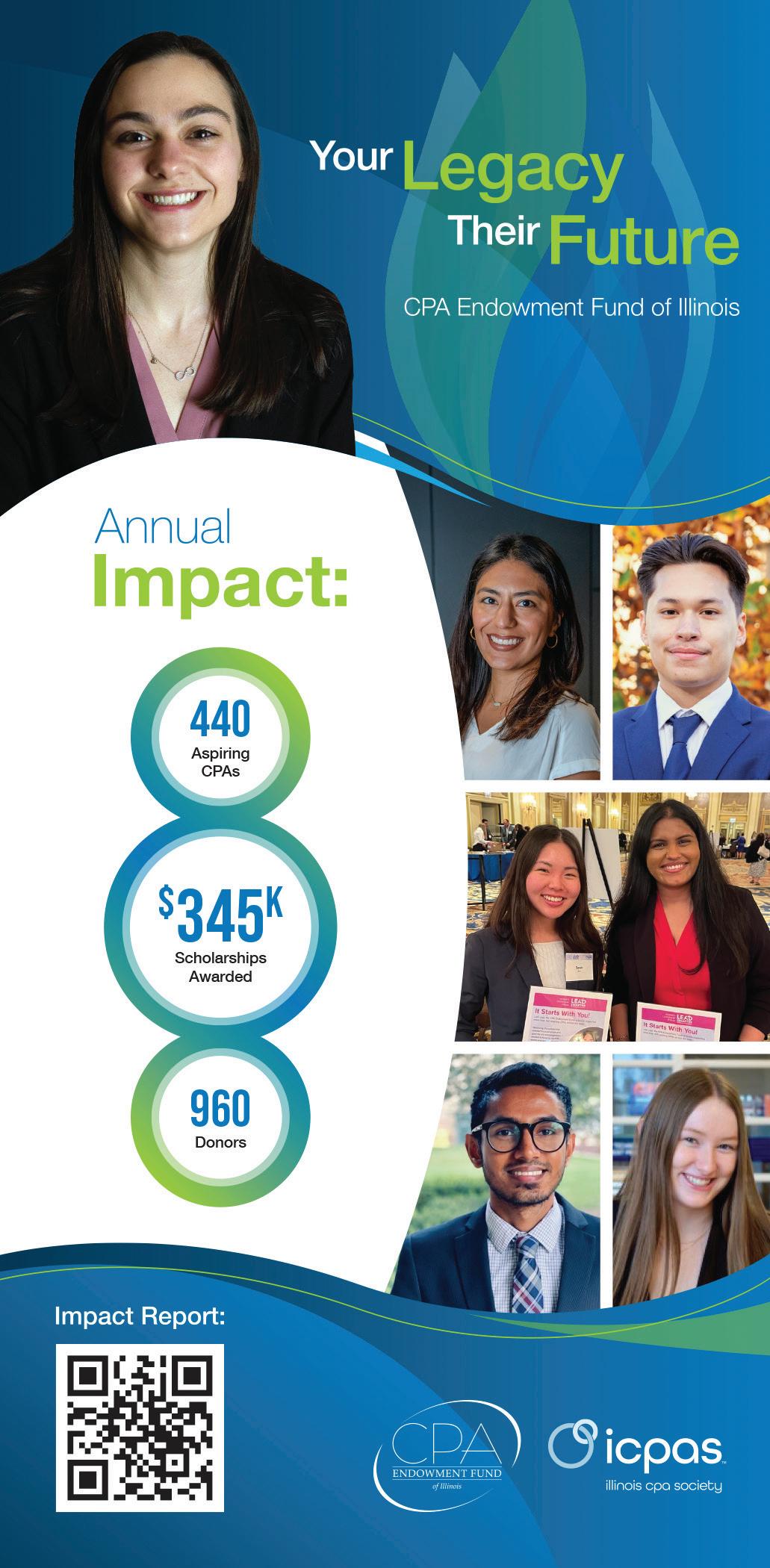

Keith Staats, JD President, Taxpayers’ Federation of Illinois kstaats@illinoistax.org ICPAS member
since 2001
Illinois’ tax omnibus bill reaches into the digital economy in three new ways—but will it hold?
In the final hours of the 2026 spring legislative session, the Illinois General Assembly passed a tax omnibus bill (Senate Bill [SB] 3019), containing three new taxes: the Targeted Advertising Services Tax, a digital asset tax, and a social media platform fee.
While I could spend this column going into the many reasons why I believe these new taxes represent bad tax policy (full disclosure: I testified in opposition to the taxes in front of the Illinois House Revenue and Finance Committee), I’ll instead provide a quick overview and leave the judgment up to you and the courts.
This tax imposes a 10% tax on the gross receipts from targeted advertising services in Illinois. Specifically, the tax will be imposed on providers of targeted advertising services whose annual cumulative gross receipts from targeted advertising services provided in Illinois during the previous 12-month period exceeded $1 million.
According to SB 3019, “‘Targeted Advertising Services’ is defined as any programmatic written, oral, or graphic statement of representation conveyed through a digital interface or any other method of delivery.” In other words, the tax will be imposed on:
• Banner advertising.
• Search engine advertising.
• Interstitial advertising.
• Other comparable digital advertising services that use personal information about the people to whom the ads are being served.
One of the thorny issues in implementing this tax will be determining the location of “user-consumer,” aka the person viewing the ads. SB 3019 requires a provider of targeted advertising services to determine the location “using the totality of the user-consumer contact information within the provider’s possession or control.”
The tax will be administered and collected by the Illinois Department of Revenue (IDOR). Providers of targeted advertising services will be required to register with IDOR, and tax returns will be due monthly on the 20th of the month for the preceding calendar month.
Notably, there’s a prohibition of the imposition of local targeted advertising taxes by home rule units, which is likely targeted at the City of Chicago.
This tax will be imposed on the privilege of receiving any digital asset business activity by a customer in this state at a rate of 0.2% of the digital asset’s value. “Digital asset business activity” means exchanging, transferring, or storing a digital asset as part of a business or on behalf of a customer who’s entered into an agreement with a business for the provision of those services. Digital asset brokers are required to collect the tax on each sale.
The term “digital asset” is defined in the Digital Assets and Consumer Protection Act (205 ILCS 731/1-5) as “a digital representation of value that is used as a medium of exchange, unit of account, or store of value, and that is not fiat currency, whether or not denominated in fiat currency.”
SB 3019 provides that the term “in this State” means at a physical location in Illinois for a sale occurring in person. For a sale occurring electronically or by phone, the statute creates a rebuttable presumption that a customer is located in this state if the customer’s contact information on record or available to the digital asset broker indicates an Illinois mailing address “or an Illinois internet protocol address or other user-consumer data showing ‘place of primary use’ in Illinois as defined in the Mobile Telecommunications Sourcing Conformity Act.”
Like the Targeted Advertising Services Tax, this tax will be administered and collected by IDOR. Digital asset brokers are also required to register with IDOR, and tax returns will be due monthly on the 20th of the month for the preceding calendar month.
The Business Corporation Act of 1983 was amended to impose a new social media platform fee at graduated rates. This new fee will be administered and collected by the Office of the Illinois Secretary of State’s Department of Business Services.
SB 3019 defines “social media platform” as “a website or internet medium that permits a person to become a registered user, establish an account, or create a profile for the purpose of allowing users to create, share, and view user-generated content through that account or profile.”
Beginning Jan. 1, 2027, and monthly thereafter, each social media company will be required to submit a report on the average number of monthly users of its platform located in Illinois. These reports are due within 14 days of the start of each month.
Fees paid will be based on the number of users a social media platform in Illinois has. For instance, social media platforms with:
• More than 100,000 Illinois users (but not more than 500,000) will be required to pay a fee of 10 cents per user per month.
• More than 500,000 Illinois users (but not more than 1 million) will be required to pay $40,000 plus 25 cents per user per month.
• More than 1 million Illinois users will be required to pay $165,000 plus 50 cents per user per month.
Of course, the statute is unclear as to how Illinois users will be determined. Additionally, the fees are indexed to inflation and will increase each year beginning in 2028 based on increases in the consumer price index.
The secretary of state has the authority to order a social media platform to pay the fees, determine the amount of the fee, determine delinquency, and audit a social media platform to enforce the law.
The statute prohibits social media platforms from passing the cost of the fee to users and authorizes a private right of action to enforce this provision. The statute also forbids social media platforms from requiring users to accept mandatory arbitration of a claim arising under this provision.
All in all, these three new taxes are scheduled to take effect on Jan. 1, 2027. Of course, whether they survive the legal challenges ahead is another story.
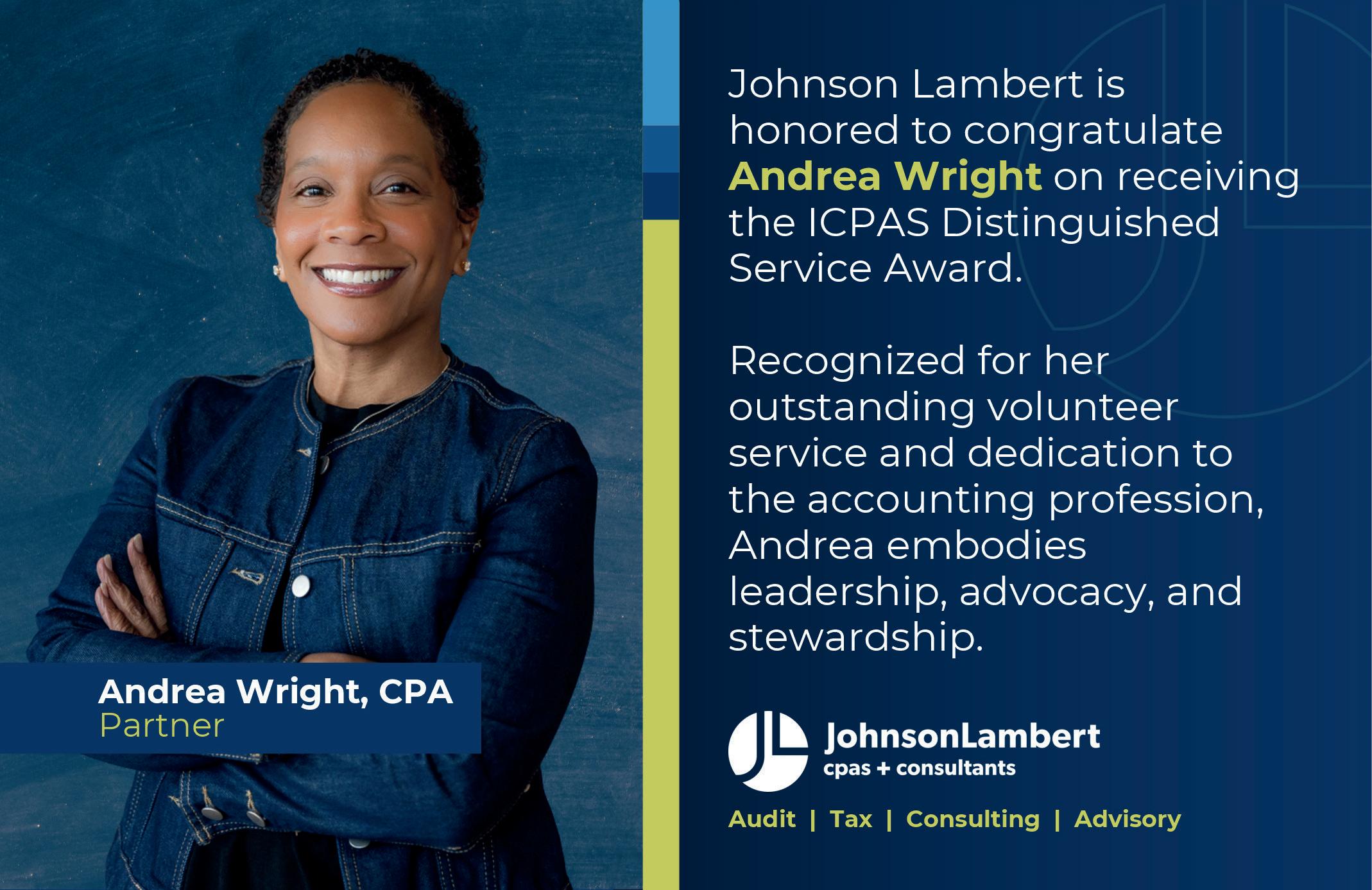

After 34 years in public accounting and serving nonprofits, this Lifetime Achievement Award recipient remains committed to giving back and strengthening the future of the profession.
BY AMY SANCHEZ
A stint in public accounting is often viewed as the launch pad for one’s certified public accountant (CPA) career—an intense but temporary stop on the way to something else. But for Scott D. Steffens, CPA, that anticipatory pivot never came. Instead, he found variety, challenge, and purpose in public accounting for 34 years, serving in various roles within the halls of firms like Deloitte and Grant Thornton.
“I think many of us start off thinking that we’re going to be in public accounting for a few years before moving on to do something else. That was certainly my thought,” Steffens admits. “But the longer I stayed, the more I was interested in what the job had to offer. Each job was more challenging than the last, and I never got bored with it.”
In reviewing Steffens’ client base, it’s easy to see why his work never felt stale. He spent much of his career serving nonprofit clients—and among them, some very prominent organizations, including the Archdiocese of Chicago, AARP, PGA TOUR, World Central Kitchen, and the Field Museum (the year they purchased and debuted Sue, the famous T. rex dinosaur fossil).
Steffens’ path into the nonprofit sector wasn’t deliberate at first. What began as helping a partner on a one-off engagement soon evolved into a steady stream of other nonprofit clients: “One became two, two became four, and before I knew it, my whole
schedule had become nonprofits. I really enjoyed it, and I found that I had a natural connection with those types of clients.”
A big part of that connection stems from his earlier roots at DePaul University, where he was part of one of the early cohorts of the Strobel Honors Program. As a first-generation college student, Steffens credits his time there for laying the foundation for what he needed to thrive outside of school.
“I was very fortunate to have smaller class sizes, which gave me access to hearing from a lot of former business leaders and gaining exposure to a lot of firms and businesses,” Steffens explains. “DePaul really went out of its way to prepare us for what we really needed to be successful.”
Along with setting Steffens up for business success, DePaul also demonstrated what it meant to give back and help others. At the midway point of Steffens’ college career, his family encountered a health matter that caused some financial stress: “I didn’t think I’d be able to finish my time at DePaul, but I had some conversations with the honors program leadership, and they helped me find some money to stay—that moment has forever endeared me to the school.”
Since that time, Steffens has set up a number of scholarship funds with DePaul and continues to support the school’s athletics and accounting programs. Additionally, he currently serves on the DePaul University Board of Trustees.
Steffens’ experience at DePaul also instilled a sense of responsibility to mentor and support the next generation of accountants. After all, it was there where he met one of his lifelong mentors, Dr. Robert Peters—who also happened to be the one that helped him uncover the necessary funds during that period of financial hardship: “Peters became a great friend and mentor during school but even more so afterwards. It was one of the first foundational relationships I had.” Early in his public accounting career, Steffens also had partners that made a big impact: “They would often counsel me to make sure I didn’t leave public accounting too early, making sure I would maximize my time and get as much out of it as I could. It was good advice, and I always try to counsel that same thing to young professionals—there are so many things you’ll learn with each passing year, and you don’t want to jump off the public accounting train too soon.”
Another piece of advice Steffens shares with younger professionals is to not rely on only one mentor. He suggests building a personal board of advisors: “It’s important to have a few different people that you go to. If you rely on one person and one person only, they might have only one perspective.”
That mindset—the importance of seeking out multiple perspectives—has carried into Steffens’ other passion of advocating for greater diversity within the profession. The way he sees it, having more diverse perspectives allows for better solutions: “I’ve been able to see that idea be manifested in multiple engagements I’ve worked on, and the more I saw that, the more I continued to be a champion for it.”
It’s this commitment to the profession—not just through client work, but through mentorship and advocacy—that helped earn Steffens the Illinois CPA Society’s 2026 Lifetime Achievement Award.
Today, Steffens is happily retired, but makes clear that he hasn’t completely stepped away from the profession, referring to himself as “CPA retired.” During his next chapter, he plans to keep coaching, mentoring, and giving back to his community and profession: “I’ve planted seeds with a lot of people that I know, hopefully paying it forward and setting up the next generation to do the same. It’s a theme I’ll be carrying throughout my golden years.”

CPA

IYes
Firm Eccezion
Title Senior Manager
Pastime Hosting, Entertaining, and Feeding Everyone
Favorite Sports Team Chicago White Sox

was lucky enough to begin my accounting career working inside small accounting departments and learning firsthand how a business truly operates. Being immersed in the dayto-day operation, processes, and decision making that keep an organization running gave me an early appreciation for how critical the accounting profession is.
In college, I heard what accounting “looked like” from teachings and discussions in the classroom: taxes, spreadsheets, audits, and long hours behind a desk. While those aspects are certainly part of the profession, my hands-on, real-world experience showed me they were only small pieces of a much bigger picture. That realization is what motivated me to get involved with the Illinois CPA Society’s (ICPAS’) High School Outreach Program to help students see the full range of opportunities an accounting career can offer.
Over the course of my career, I’ve had the opportunity to sit on both sides of the table, working in industry and public accounting. I’ve been able to explore and pivot, experiencing different types of work across various industries. Those experiences have shaped how I view the role of an accountant today. At its best, accounting isn’t about compliance alone—it’s about being a trusted advisor. It’s also about understanding the full picture of a business or individual and stepping into the role of problem solver and quarterback, helping clients navigate challenges. That advisory mindset is something students rarely associate with accounting, yet it’s one of the most meaningful parts of the profession.
Today, when I speak with high school students in their classrooms, I’m able to help them see that accounting is far bigger, more dynamic, and more impactful than the version they often hear
about. Some of my favorite moments from these interactions are watching their perceptions change in real time. They’re often surprised by how many paths exist within accounting and how closely those paths can align with their personal interests. Whether a student is passionate about technology, sports, health care, or entrepreneurship, there’s always an accounting career that leans into one of their passions—and helping students connect those dots is incredibly rewarding.
Through these outreach efforts, I’ve also learned a great deal from the students themselves. Their questions force me to step back and articulate why I do what I do and why it matters. Their openness, curiosity, and willingness to explore different possibilities are a reminder of how important early exposure and honest conversations can be. What I’ve found is that many students don’t lack interest in accounting; they lack information about it.
EXPLORE
www.icpas.org/ volunteer
I strongly encourage other young professionals to get involved in the High School Outreach Program. You don’t need decades of experience to make an impact. In fact, being closer to the early stages of your career can make your story even more relatable. These experiences also sharpen your communication skills, reinforce your sense of purpose, and remind you why you chose this profession in the first place.
For me, working with high school students has been energizing and grounding. It’s reinforced my belief that accounting is ultimately a people-focused profession built on trust, problem solving, and adaptability. If we want the next generation to see accounting differently, it starts with us showing them what’s possible.
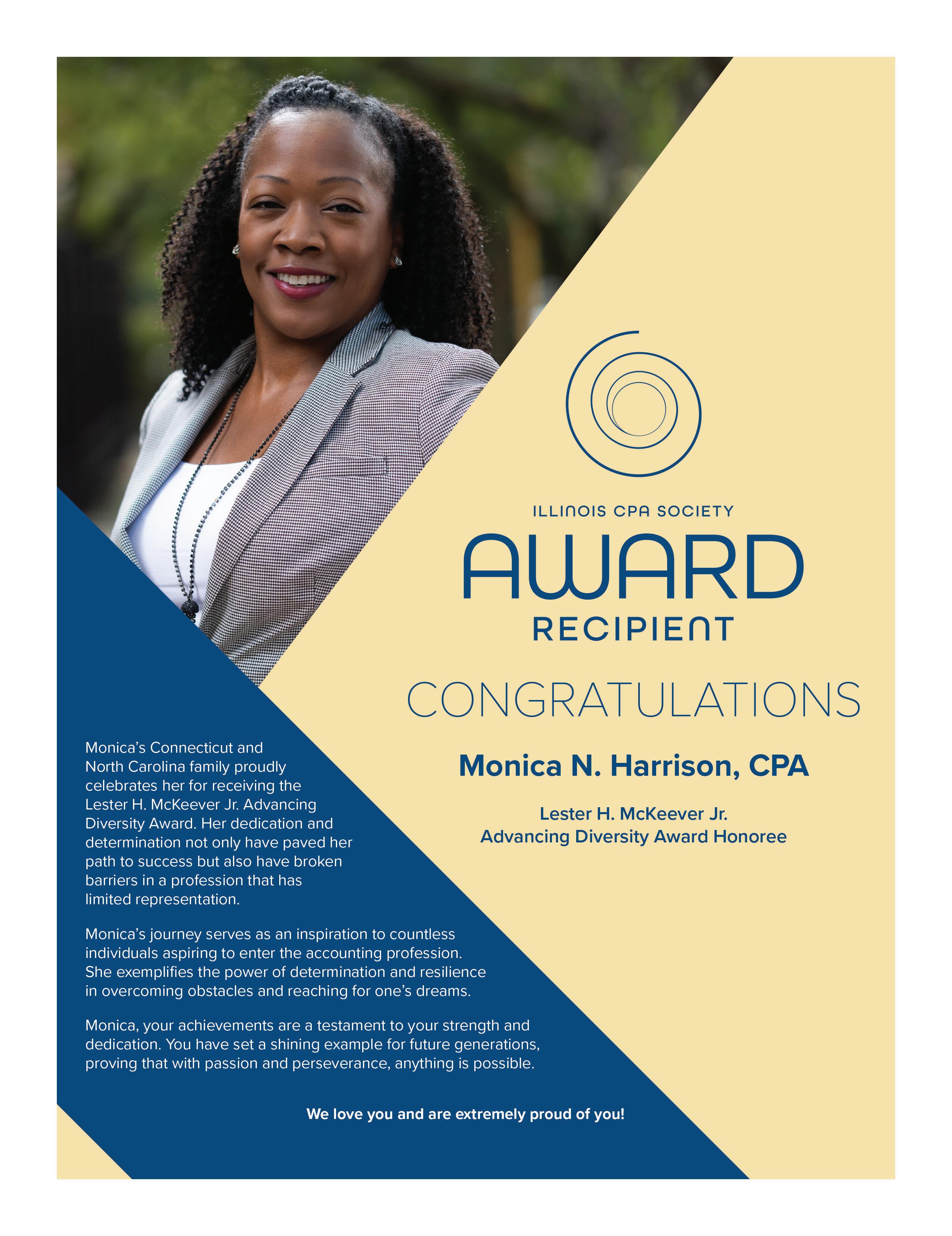
The Illinois CPA Society is proud to recognize these individuals and organizations on their accomplishments.
Lifetime Achievement Award
Scott D. Steffens, CPA | Partner, Grant Thornton LLP (Retired)
EXPERIENCED LEADER
Monica N. Harrison, CPA | Vice President, Controller, Tinuiti
EMERGING LEADER
Ivory Pineda, CPA | Assurance Manager, Baker Tilly US LLP
EXPERIENCED LEADERS
Jennifer M. Culotta, CPA | Partner, Plante Moran PLLC Randi Miller, CPA | Tax Principal, BDO USA PC
EMERGING LEADERS
Nicole J. Maimon, CPA | Senior Tax Consultant, Deloitte Tax LLP
Ashley Trabaris, CPA | State and Local Tax Senior Manager, Porte Brown LLC
Outstanding Educator Awards
Meghann A. Cefaratti, Ph.D., CIA, CRMA | Deloitte Foundation Professor of Accountancy; Director of Certifications and Licensure; Director of Internal Audit Education Partnership, Northern Illinois University
David W. Horton, CPA | Associate Professor, McGraw School of Business, Olivet Nazarene University
Maureen McBeth, Ed.D., CPA | Accountancy Professor and Program Chair, College of DuPage
Michael E. Currie, CPA | Audit Senior Manager, Miller Cooper & Co. Ltd.
Excel Awards (2025)
GOLD MEDAL
Eleanor T. DeNunzio, CPA | University of Kansas | Ernst & Young LLP
SILVER MEDAL
Matthew J. Berg, CPA | University of Wisconsin-Madison | Legacy Professionals LLP
BRONZE MEDAL
Drew T. Staniak, CPA | University of Notre Dame | Deloitte LLP




Elizabeth K. Herbst, CPA Citrin Cooperman Advisors LLC Taxation Flow-Through Entities Committee
Brian J. Kearns, CPA, CFP Haddam Road Advisors
Insight Columnist and Media Expert
Riley Martin, CPA Lauterbach & Amen LLP High School Outreach Program
Daniel J. Nugent, JD, CPA University of Wisconsin-Platteville Government Executive Committee
Danielle Roberts, CPA Eccezion High School Outreach Program
Richard C. Tarapchak, CPA Verano Holdings Corp.
Accounting Principles Committee and Content Advisory Groups
Charles W. Teel Jr., CPA Teel & Company
Insight Contributor
Andrea Wright, CPA
Johnson Lambert LLP
Ethics Committee and Public Accountants’ Registration and Licensure Committee