
A Christ-centered
ministry
of the local church, through associational, state, and national partnerships.
TABLE OF CONTENTS
“BringingHelp,Hope,andHealing”
All Scripture quotations are taken from the Christian Standard Bible unless otherwise noted. Copyright © 2017 by Holman Bible Publishers. Used by permission. Christian Standard Bible®, and CSB® are federally registered trademarks of Holman Bible Publishers, all rights reserved.
The Disaster Relief Operational Procedures Manual (DROP) is a direct outgrowth of the Southern Baptist Disaster Relief (SBDR) Roundtable held April 12-14, 1993, in Nashville, Tennessee. In attendance were representatives of the Brotherhood Commission – which merged into the North American Mission Board (NAMB) in June 1997 – state and regional Baptist conventions, recognized disaster relief volunteers, and the American Red Cross.
Created in partnership with state, regional, and national Southern Baptist conventions and Send Relief.
A common basis for the development of operational procedures. This recognizes each organization is different and each disaster unique, requiring specialized approaches according to type and scope of the disaster, personnel and resources available, and other variables, some of which cannot be foreseen.
A framework which allows the various entities who comprise the Southern Baptist Disaster Relief (SBDR) network to maximize organizational leadership in coordinating Southern Baptist disaster responses at both the command and function levels.
A guide for joint efforts across the SBDR network providing a common language and outlining agreed upon role definitions and minimum standards.
A reference manual for understanding disasters and disaster relief, developing a disaster response plan, training volunteers, and managing disaster relief responses.
A compilation of pertinent information for Southern Baptists involved in every phase of SBDR, from every polity level of Southern Baptist life, and for those who relate to Southern Baptists during disaster relief efforts.
A working manual to be periodically updated by the Review Committee, submitted in writing to the Steering Committee.
A controlled publication, intended for SBDR leadership and other select individuals who need to be familiar with SBDR concepts and approaches to disaster relief operations. Production and distribution of this manual is limited to SBDR leadership and others as determined by The Roundtable.
At the core of SBDR are the commands and the compassion of Christ. Jesus spoke through His “words and deeds” (Luke 24:19) how greatly He values people in crisis. When John the Baptist is imprisoned, (Matthew 11:2-5; Luke 7:19-22) he sends the disciples seeking affirmation that Jesus is the promised Messiah. “Jesus replied to them, “Go and report to John what you hear and see: the blind receive their sight, the lame walk, those with leprosy are cleansed, the deaf hear, the dead are raised, and the poor are told the good news.” (Matthew 11:4-5) Jesus speaks of His mission “to seek and to save the lost” (Luke 19:10) It is a word picture describing Jesus’ desire to go to the ends of the earth in order to save people facing an eternal crisis, the ultimate disaster.
In Matthew 22:37-40, Jesus states the authenticity of our relationship with God is tied to caring for our neighbors. In Luke’s account of this teaching (Luke 10:25-37), Jesus describes our neighbor as any person in crisis. In Matthew 25:32-46, Jesus establishes that our demonstration of His compassion for people in crisis is the standard by which all followers of Christ will be measured. Disaster relief is meeting needs in a timely response with loving care as James 2:15-16 instructs. Demonstrating and communicating Christ’s hope, love, and care is the only agenda.
SBDR is Christian love in “word and deed,” (1 John 3:18), meeting urgent needs of hurting humanity in crisis situations; simply stated, “a cup of cold water to drink in my name” (Mark 9:41).
Research of the Gospels by Pat Melancon reveals that Jesus and His disciples, more often than not, combined meeting a physical need with sharing truth. He found the following:
A need met without the truth presented - 5 times.
Truth presented without a need met - 58 times.
A combination of truth shared, and needs met - 99 times.
Jesus knows the hearts of all men and does not deny meeting physical needs because of their hearts. Meeting physical and spiritual needs provides the most direct path to the hearts of people and leads them to salvation, wholeness, and peace with God. Disaster relief effectively provides multiple relationships, reveals multiple needs, and leads to multiple opportunities to share the Gospel.
SBDR is a cooperative effort between prepared and highly motivated church members from 42 state conventions, the Canadian Baptist Convention, and Send Relief, Inc. to deliver the Gospel message of Jesus Christ through the ministry of disaster relief. Send Relief, a collaboration between the International Mission Board and the North American Mission Board, shares practical help and the hope of Christ while meeting human needs across the globe through compassion ministry.
OUR MOTTO: “BRINGING HELP, HOPE, AND HEALING.”
OUR MOTIVATION can be summed up in one phrase: “A cup of cold water in Jesus’ name” (Matthew 10:42). There is no one who needs “something else to do” as many of us are overcommitted in our schedules. However, the motivation for serving others and obeying the Great Commission to “go” comes from the scriptures and our experience of faith in Christ. How can we not go?
We are motivated by the commands and compassion of Christ (2 Corinthians 5:14).
Jesus communicated through His words and deeds (Luke 24:19).
He values people in crisis (Matthew 9:36).
In Luke 19:10, Jesus speaks of His mission “to seek and to save the lost.” It is a word picture describing Jesus’ desire to go to the ends of the earth in order to save people facing an eternal crisis, the ultimate disaster.
In Luke 10:25-37 and Matthew 22:37-40, Jesus defines our neighbor as anyone in crisis and further states the authenticity of our relationship with God is tied to caring for our neighbor.
In Matthew 25:32-46, Jesus establishes our demonstration of His compassion for people in crisis is the standard by which all followers of Christ will be measured.
Disaster relief is meeting needs in a timely response with loving care:
o James 2:15-16 shows meeting human needs is a faith lived out.
o Acts 2:45 shows meeting human needs is to be a cooperative effort.
o Luke 9:2-6 shows meeting human needs is a companion calling to the proclamation of the Gospel.
SBDR is a Christian network bringing help, hope, and healing to people in crisis.
We envision all SBC life engaged in disaster relief through the church, in the community, and for the gospel.
These core values are the foundation for the ministry of SBDR. They comprise the constant guide by which we perform disaster relief ministry and interact with an affected community, our partners, other organizations, volunteers, and Southern Baptist churches.
SBDR is comprised of individuals who are believers in Jesus Christ. Volunteers are under the imperative to minister to people and demonstrate God’s love as they share the message of hope in Jesus Christ.
“This is how we have come to know love: He laid down his life for us. We should also lay down our lives for our brothers and sisters. If anyone has this world’s goods and sees a fellow believer in need but withholds compassion from him—how does God’s love reside in him?” (1 John 3:16-17)
What would this Christ-centered life look like in your ministry with SBDR?
You are consistent in your faith – even when you are not on a disaster response.
You are active and involved in your local church.
You have a Christ-like relationship with your family and church.
You maintain a steady diet of scripture.
Your character is growing in conformity with Christ’s: being patient and caring, possessing a spirit of love, and desiring to see others saved.
You are prepared to use every opportunity to share your faith in Christ.
SBDR seeks to be a valuable partner, building strong biblical relationships, empowering leaders, volunteers, and partners to serve communities affected by disaster with passion, integrity, professionalism, and credibility.
“Always praying with joy for all of you in my every prayer, because of your partnership in the gospel from the first day until now. I am sure of this, that he who started a good work in you will carry it on to completion until the day of Christ Jesus.” (Philippians 1:4-6)
SBDR adapts to becoming the hands and feet of Jesus in times of disaster while maintaining a commitment to our mission, vision, and values.
. . . we endure everything so that we will not hinder the gospel of Christ. . . . To the weak I became weak, in order to win the weak. I have become all things to all people, so that I may by every possible means save some. (1 Corinthians 9:12c, 22)
SBDR empowers leaders, volunteers and partners through training, mentoring, accountability, and structure. In this way SBDR enables them to use their skills, talents, abilities, and resources to be effective followers of Christ ministering to others affected by disaster.
“Just as each one has received a gift, use it to serve others, as good stewards of the varied grace of God.” (1 Peter 4:10)
SBDR maintains a strategic and intentional partnership with local churches to support, reinforce, and encourage their ministry of making disciples of Jesus Christ and growing the Kingdom of God.
“Now to him who is able to do above and beyond all that we ask or think according to the power that works in us to him be glory in the church and in Christ Jesus to all generations, forever and ever. Amen.”
(Ephesians 3:20-21)
DOES MY PERSONAL RESPONSIBILITY STRENGTHEN OUR ORGANIZATIONAL INTEGRITY?
A volunteer needs a positive mental, social, and spiritual attitude to take on the task of providing physical assistance. As a volunteer, you have the responsibility for your own personal preparation, motivation, attitude, availability, participation, training, and improvement.
Ask these questions of yourself:
Do I have a servant’s heart or am I thinking about myself much of the time?
Am I willing to take directions from others or am I resentful of demands made on me?
Am I able to adapt to ever-changing circumstances or do I become frustrated when things change?
Do I know how to be part of the team, or do I need to be in charge?
Am I going to help people in need, or do I have a personal agenda?
Am I willing to work wherever needed or am I inflexible?
Am I self-controlled in speech, attitude, and actions?
Am I physically strong enough to work long and strenuous days?
Prayerfully consider if the Lord is leading you to serve in this ministry.
Since 1967, SBDR traces its beginning when a few Royal Ambassador (RA) leaders took some RA boys to respond to a Texas hurricane. So, it is appropriate the SBDR logo borrowed the blue and gold color scheme from the rich symbolism of the Royal Ambassador shield:
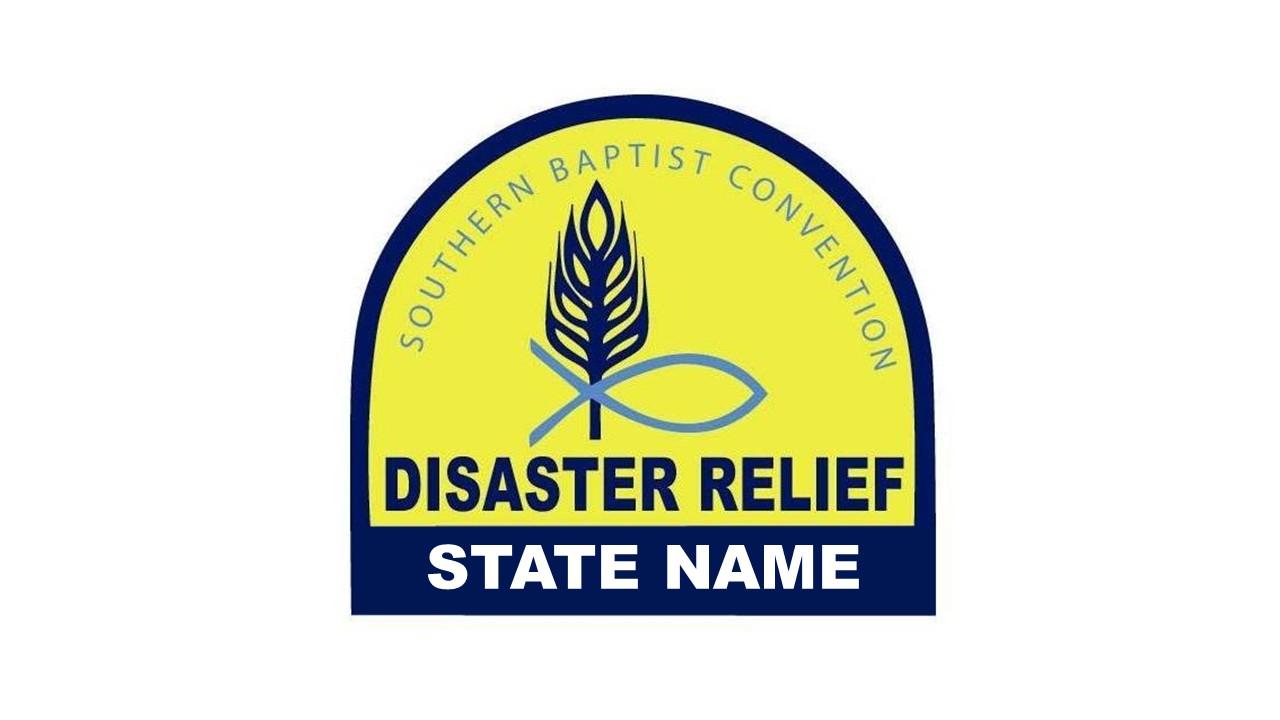
Blue represents the volunteer’s loyalty to Christ which governs our actions and relationships.
Gold represents the worth of every person to Christ.
Arch of the Southern Baptist Convention is the umbrella of the SBDR world-wide cooperative network.
Wheat symbolizes physical help.
Fish symbolizes spiritual help.
Name below the logo identifies the Baptist state convention being represented.
Credentialed team members are urged to wear disaster relief (DR) apparel during a disaster relief response or disaster relief functions, such as training, promotion, and conferences related to SBDR. Upon becoming inactive, SBDR volunteers should check with their state convention director on how to properly repurpose their DR apparel.
As Lloyd Jackson of Virginia stated, “Disaster relief provides a unique opportunity to translate the message and person of Jesus Christ into flesh and blood as His followers respond in love and compassion to hurting people regardless of circumstances, social status, financial situation, language, political persuasion, theological stance, education or race. ‘As you do unto these, you do unto me’ remains the guideline for ministry to people in and through disaster relief.”
“There seems to be no area of mission action that requires more rapid response than during the time of disaster. The disaster comes unexpectedly and with it the opportunity for immediate ministry. If we are unprepared when it strikes and delay action, the opportunity passes with the urgent need.” Laddie Adams, Involving Baptist Men in Disaster Relief (c1988), first Oklahoma Disaster Relief Director.
The Roundtable best represents the historic Baptist principle that associations, conventions, and mission boards were created by local Baptist churches in order to engage in more effective mission and ministry together. The Roundtable representatives join together in interdependent mission and ministry urging each other to “…walk worthy of the calling you have received, with all humility and gentleness, with patience, bearing with one another in love, making every effort to keep the unity of the Spirit through the bond of peace.” (Ephesians 4:1-3).
The Roundtable is the collection of representatives from each SBC convention which gives direction to the ministry partnership. Each of the 42 convention disaster relief directors, or their proxy, make up the voting members of The Roundtable. Each convention may hold only one seat at the table who would be the voting member. The SBDR national director and/or Send Relief will serve in a supporting role.
The Roundtable representatives agree to the following responsibilities and rights:
Respect the autonomy of each co-laborer without compromising the standards and procedures of SBDR.
Respect and honor each co-laborer’s freedom in Christ and ability under the Holy Spirit to determine God’s direction, purpose, and mission.
Minister in ways which enable SBDR to be an effective and positive witness in times of disaster.
Advocate, support, and further the Mission, Vision, and Values of SBDR.
Pray, encourage, and nourish the work of SBDR in a way which honors our Lord and Savior Jesus Christ.
Respect and uphold the standards and procedures established by The Roundtable.
Use the SBDR logo/trademark as established by the North American Mission Board in consultation with The Roundtable representatives.
Do nothing which would tarnish the name, integrity, or reputation of SBDR.
Invest in each co-laborer’s success in bringing help, hope, and healing.
Maintain mutual accountability among The Roundtable representatives – sharing our lives with one another, challenging one another to conform to the image of Christ in an atmosphere of trust.
Participate in the work of The Roundtable by lending expertise and energy to the development of SBDR procedures and standards, the nurture of relationships, and the efforts of SBDR during disaster response.
The work of The Roundtable is carried out by committees established by The Roundtable. These committees include a Steering Committee, Standing Committees, and Ad Hoc Committees as The Roundtable may deem necessary. At no time shall any one convention have more than two (2) representatives on any committee.
The Steering Committee (SC) serves as a working committee providing coordination of the SBDR Roundtable between meetings of The Roundtable. This committee consists of one convention representative from each SBDR region and representative(s) from Send Relief. It is the requirement of each region to appoint their representative to serve on the SC by the December SC meeting. The regional representative members of the SC provide a voice for the conventions within the region they represent between meetings of The Roundtable. Regional representatives are responsible for facilitating communication between the SC and the conventions within their region.
SC regional representatives are appointed to a three-year term, and it is recommended that no one serve more than six consecutive years. Each member’s convention or organization is expected to provide financial resources for the member’s participation. In the event a SC member is unable to complete their elected term, a regional representative will be selected by the conventions which comprise said member’s region to complete the term.
The SC Chair is elected annually from those slated to serve to a one-year term by The Roundtable by secret ballot of those in attendance at the winter meeting of The Roundtable. The SC Chair may serve two consecutive terms. The DROP Manual – Revised January 2024 8
individual receiving the most votes shall be elected as the chair and the individual receiving the second most votes become the vice-chair. In the event of a tie, there shall be a run-off election between the two candidates.
Meetings of the SC may be conducted by conference call, video conferencing, e-mail, or in person. The SC will meet not less than once a quarter. Meetings of the SC require at least 24-hour notice to all members.
The members of the SC work together to develop and recommend to The Roundtable policies, procedures, and practices to strengthen, enhance, and improve the ministry of SBDR. The SC works with standing and ad hoc committee chairpersons and Send Relief to ensure recommendations and decisions made by The Roundtable are moving forward between meetings of The Roundtable.
The SC has authority to make temporary decisions and do business on behalf of The Roundtable regarding matters which cannot wait until regularly scheduled meetings. The SC does not have the authority to make decisions which permanently affect SBDR policies and procedures.
The Roundtable Steering Committee (SC) serves as the voice of The Roundtable between meetings of The Roundtable. The committee is a working committee which serves The Roundtable member organizations and promotes the ministry of SBDR.
1) The SC supports the work of standing and ad hoc committee chairpersons and Send Relief staff members to ensure recommendations and decisions made by The Roundtable are moving forward between meetings.
2) The members of the SC provide input from conventions within the region they represent to Send Relief staff concerning the negotiation of memorandums of understanding and/or agreement with other disaster response organizations and agencies.
3) The SC recommends dates, locations, and agenda for meetings of The Roundtable.
4) The SC solicits and receives the nominations for the Robert E. Dixon Lifetime Achievement, Joel W. Phillips Outstanding Achievement, and Distinguished Service Awards, and selects the award winners in consultation with the leaders of potential recipients’ conventions.
5) The SC identifies and recognizes retiring convention directors with the Laddie Adams award.
6) An ad hoc committee may be established as needed and approved by the SC for a specific function. The SC shall appoint the chair and committee members. The committee ceases to exist upon completion of the task unless assigned another task.
7) The Standing Committee chair will be appointed annually by the SC at the Winter Roundtable.
8) The SC will review and administer the Lowe’s, Home Depot, and SR-SBDR Assistance Fund according to the guidelines approved by The Roundtable.
The SBDR Standing Committees are working committees with responsibility for providing expertise to the SC and the Roundtable on issues concerning the committee’s assigned ministry area.
The Standing Committees will assist the SC in recommending policies, procedures, and practices which affect the assigned disaster relief ministry area to The Roundtable.
The Standing Committees consist of one convention representative from each SBDR region. Candidates are nominated and elected by each region’s convention directors and presented at the December SC meeting. If a region cannot name someone to serve on a Standing Committee, they may surrender their spot to be appointed by the SC. No region may have more than 2 representatives on any Standing Committee.
Each Standing Committee shall have at least one convention director. If a Standing Committee has no convention director among its members, a convention director will be appointed by the SC as a member with full voting rights. The Standing Committee chair will be appointed annually by the SC at the Winter Roundtable.
Standing Committee representatives are elected to a three-year term. Each member’s convention or organization is expected to provide financial resources for the member’s participation. In the event a Standing Committee member is unable to complete their elected term, a regional representative will be selected by the conventions which comprise said member’s region to serve out the remainder of the term. Should a committee member be unable to complete their assigned term, The Roundtable representatives from the conventions in said member’s region will select an individual to complete the unexpired term. There are no term limits of the Standing Committees.
Standing Committees shall be established or dissolved by a vote of The Roundtable representatives.
The SBDR Standing Committees are working committees with responsibility for providing expertise to the SC and The Roundtable on issues concerning the committee’s assigned ministry area. Standing Committees shall meet at least twice per year.
1) Standing Committees will assist the SC by recommending policies, procedures, and best practices which affect the assigned disaster relief ministry area to The Roundtable.
2) Standing Committees are tasked with the development and review of manuals and training materials in their assigned ministry areas.
3) Standing Committees can represent SBDR with national organizations in their respective ministry areas as requested.
4) Standing Committees may add non-voting subject matter experts to assist in their work.
An ad hoc committee may be established as needed and approved by the SC for a specific function. The SC shall appoint the chair and committee members. The committee ceases to exist upon completion of the task unless assigned another task.
In the field of disaster relief services and organizations, the process of managing the disaster response is referred to as the Incident Command System (ICS). ICS is a disaster management process which has proven to be an effective and valuable tool. It is the model for command, control, and coordination of a response, and provides the necessary structure which is repeatable as often as necessary to manage a disaster regardless of the size of the operation. SBDR has adopted this as its disaster relief management system.
Establish a centralized command and control structure.
Provide command level coordination.
Limit the amount of detail one individual must deal with, namely, span of control.
Provide a method to mobilize and demobilize a disaster response.
Provide consistency in command and control across cooperating entities.
The affected convention DR director will initiate the ICS process by assigning command responsibility to an Incident Commander (IC). The individual designated as the IC has responsibility for all ICS functions. The IC may elect to perform all functions or delegate authority to others. The key to making the ICS organization work for SBDR is to make sure the functions needed to manage the size of the disaster are staffed with appropriately trained personnel. Delegation does not relieve the IC from overall responsibility. Decisions and directions of ICS responsibilities for managing a response are the sole discretion of the affected convention DR director.
The SBDR Response Framework (RF) is a guide to how SBDR conducts disaster response. It is built upon scalable, flexible, and adaptable coordinating structures to align key roles and responsibilities across the network. It describes specific authorities and best practices for managing incidents.
The RF is a guide which details how SBDR conducts all-hazards response – from the smallest incident to the largest catastrophe. This document establishes a comprehensive approach to incident response, The Framework identifies key principles, as well as the roles and structures which organize a North American response. It describes how SBDR organizations and partners can apply these principles for a coordinated, effective local, state, national or continental response.
AUDIENCES
The RF is written especially for SBDR organizations and partners. The clear, simple style makes the serious work of incident management understandable for newly elected or appointed SBDR leaders, as well as seasoned practitioners.
The RF also informs emergency management practitioners, explaining the operating structures and tools used routinely by SBDR workers and leaders at all levels.
RESPONSE DOCTRINE
The RF employs the core principles of the National Incident Management System (NIMS) in which responders from different jurisdictions and disciplines can work together more closely to effectively respond to all types of disasters and emergencies.
FOCUS ON PREPAREDNESS
Effective preparedness is a critical precondition for successful response. The RF encourages a higher level of readiness by drawing a sharper focus on the value of the following preparedness activities: planning, organizing, training, equipping, exercising, and applying lessons learned. Knowledge of these key functions supports unity of effort, and thus our ability to bring help, hope, and healing to individuals and communities affected by disaster.
CONDUCT OF DISASTER RESPONSE
SBDR can respond more effectively to incidents and better demonstrate the love of Christ by providing physical, emotional, and spiritual help to those affected by disasters. We do this through engaged partnerships with elected and appointed officials, dedicated emergency management practitioners, nongovernmental organizations, and the private sector, by applying common NIMS principles and response doctrine.
SCOPE
The RF provides structures for implementing network-wide response policy and operational coordination for all types of incidents. It can be partially or fully implemented in the context of a threat, in anticipation of a significant event, or in response to an incident. Selective implementation allows for a scaled response, delivery of the resources needed, and an appropriate level of coordination.
SBDR responds to incidents of all sizes: local community, multiple communities within a state or region, state-wide, regional (multiple states), and national.
1
2
3
LEVEL 1 – A Level I response is one in which the affected convention DR director has all the resources needed to meet the needs and requests.
LEVEL 2 – A Level II response is one in which the affected convention DR director needs assistance from neighboring state DR ministries to meet needs and requests.
LEVEL 3 – A Level III response is one in which the affected convention DR director needs assistance beyond regional resources to meet needs and requests.
the “4 C’s” agreed upon by National Voluntary Organizations Active in Disaster (NVOAD) (communicate, coordinate, cooperate, collaborate) with local officials and other Emergency Management Agency (EMA) partners for response efforts.
clearly with DR volunteers within your state the status of response efforts and opportunities to (or not to) deploy.
4 Communicate clearly with supporting convention DR directors and Send Relief the status of response efforts and opportunities to (or not to) deploy.
5 Assess the situation using information derived from local emergency management, disaster volunteers, SBC & VOAD partners, and local media.
6 Develop & implement objectives & strategies as needed for local response.
7
assistance from region and/or neighboring state(s).
8 Schedule and facilitate coordination calls or communications as needed through the SBDR national director.
9
14
15
Send Relief informed of teams deployed and status using the SBDR national management system even if your state has its own system.
1
6
7
8
11
12
traveling teams with accommodations who may need to overnight/stage in your state.
13 All teams should provide daily reports through the SBDR national management system, and any additional reports requested by the affected convention DR director.
1
2
3
4
5
6
requests for Response Funds from convention DR directors according to fund guidelines.
9
Experience has shown the need for standard training for disaster relief volunteers. There are some general training requirements for a person to be recognized as an SBDR volunteer. SBDR organizations are expected to include the following minimum standards:
Introduction to Southern Baptist Disaster Relief
Spiritual preparation and evangelism.
Individual Southern Baptist Convention required training, including:
o Classroom training in ministry area using SBDR minimum standards for the specific ministry area.
o State convention specific policies and procedures.
Acceptable results from criminal background checks are required of all SBDR credentialed volunteers. Acceptable results will be defined by the appropriate leaders of each SBDR entity which shows due diligence to provide a safe and secure environment for all individuals who come under SBDR influence and care. Particular concern will be for protecting the well-being of those who are especially vulnerable – preschoolers, children, youth, mentally challenged, and senior adults.
Criminal background checks shall be repeated each time a volunteer renews his/her credentials, which shall be every three years. An official SBDR identification badge may not be issued without an acceptable background check. Methods for, administration of, and expenses related to background checks are the responsibility of each cooperating SBDR entity
The nature of disaster relief has changed on a national scale. Social networking technology has created avenues for church/community volunteers to mobilize themselves in response to a disaster. Church/community volunteers are not part of a recognized voluntary agency and often have no formal training in disaster response. However, they are motivated by a sudden desire to help others in times of trouble. They come with a variety of needs and skills. They may come from within the affected area or from outside the area. Yet because they are not associated with any part of the existing emergency management response system, their offer of help is often underutilized by SBDR responders. Church/community volunteers are a people-group whose ministry need is service and who may be responsive to the message of Christ in crisis.
Success with church/community volunteers will require new levels of cooperation and commitment to partnership among SBDR, local churches, the voluntary sector, professional first-responders, and all levels of government. The ICS planning function is responsible for collaborating with local partners to maximize the use of church/community volunteers while preserving SBDR integrity and standards of service.
GUIDELINES
Credentialed volunteers may wear an official SBDR badge, apparel, and other items bearing the SBDR logo from their credentialing state convention. CCV’s should not bear the official SBDR logo.
LOGO
The official SBDR logo described in the section on philosophy is the trademarked property of the North American Mission Board, SBC, and has been approved for use by convention disaster relief ministries for their disaster relief efforts.
TIME AND PLACE
Credentialed team members are urged to wear disaster relief apparel during disaster relief response or disaster relief functions, such as training, promotion, and conferences which relate to disaster relief.
BASIC AND FULL UNIFORM DESCRIPTION
The basic uniform for SBDR credentialed team members consists of two items, which bear the official SBDR logo:
Current SBDR badge with photo identification.
Official logo hat.
The full uniform consists of an official badge, hat and shirt. These items may bear the name of the participating convention.
Colors—Basic colors for disaster relief uniforms are blue and gold.
Pantone Match System:
Gold –PMS 102
Blue – PMS 294
o Outside border of logo
o Words Disaster Relief
o Wheat stalk
Light Blue – PMS 299 (optional contrast)
o Christian fish (Ichthus)
o Words Southern Baptist Convention
Hats – The following hat colors are approved at disaster sites:
Gold – credentialed team members
Blue – team leader
White – convention and incident command disaster relief leadership
Optional items bearing the SBDR logo: approved SBDR Chaplain vest, official automobile ID decals, magnetic automobile IDs, aprons, bandanas, T-shirts, or golf shirts should be worn or displayed only as described above. SBDR teams may produce items which bear the convention name and/or emblem along with the SBDR logo with the approval of their Southern Baptist convention DR director. Some conventions have additional requirements to qualify for specialized patches, chevrons, pins, and other items.
AD HOC COMMITTEE – A committee appointed for the purpose of accomplishing a specific task. The committee ceases to exist upon completion of the task unless assigned another task.
AFFECTED CONVENTION – The Southern Baptist state convention which has experienced a disaster and is responding to the needs of the affected area.
AGENCY – Recognized entity of the Southern Baptist Convention.
AMERICAN RED CROSS (RC) – The national organization given a Congressional Charter to provide disaster relief mass care in the United States.
AREA COMMAND (AC) – An organization established to oversee the management of multiple incidents which are each being handled by a separate Incident Command System organization or to oversee the management of a large or evolving incident that has multiple Incident Management Teams engaged.
ASSISTING CONVENTION – The designation for a Southern Baptist state convention which has been called upon to provide disaster response assistance to another state convention affected by a disaster.
BASE CAMP – The designation used by The Salvation Army for the large feeding units used during disaster responses. There are four of these units in the U.S. These are often staffed by trained SBDR volunteers.
BUNK HOUSE UNIT – A disaster relief unit equipped to provide housing for volunteers. These units typically provide bunk bed accommodations and vary in size and configuration.
BOX MINISTRY UNIT – A disaster relief unit equipped to provide packing boxes and supplies to aid victims in packing their belongings for storage or for moving.
CANTEEN – One of the feeding units used by The Salvation Army. This unit is designed to travel into the affected area and serve from its resources. They can be restocked or come out of the area each evening to restock. Food served by the canteen is often much like fast food. It is staffed by two or more volunteers and may also be used to deliver meals prepared by SBDR feeding units.
CENTER FOR DISEASE CONTROL (CDC) – The Government agency mandated to maintain several departments concerned with occupational safety and health.
CENTER FOR FAITH-BASED AND NEIGHBORHOOD
PARTNERSHIP – A resource for secular and faith-based, nonprofit and community organizations seeking to impact their community and understand federal grant opportunities.
CHAINSAW UNIT – A disaster relief recovery unit equipped to provide tree removal from homes and/or yards damaged by a disaster.
CHAPLAIN – Disaster Relief trained volunteer who has completed approved SBDR Chaplain course(s) and are endorsed by their convention DR. These are men and women who minister to the spiritual and emotional needs of victims and responders.
CHILDCARE UNIT – A disaster relief unit equipped to provide appropriate care for children of families affected by a disaster.
CHURCH/COMMUNITY VOLUNTEERS (CCV’S) – Individuals (or groups) who appear at onsite disaster response coordination centers in response to disasters without having any ties to organized disaster response entities.
COMBINATION UNIT – A disaster relief unit equipped to provide appropriate support to the general public in two or more of the SBDR ministry areas.
COMMAND UNIT – A disaster relief unit equipped to provide appropriate command and control during a disaster response.
COMMUNICATION UNIT – A disaster relief unit equipped to provide appropriate communications during a disaster response.
CONVENTION – A national, state, or regional entity recognized by the Southern Baptist Convention as an affiliated organization.
CONVOY OF HOPE – An independent, Christian, organization which partners with local churches of various denominations as well as business and civic organizatons.
CREDENTIALED TEAM MEMBER – individuals who have met the minimum training standards of their state convention disaster relief.
CRITICAL INCIDENT STRESS MANAGEMENT (CISM) – An intense training and certification of persons equipping them to be a chaplain to victims of acute stress. The training is designed to equip a person to recognize stress, know the steps of coping and to help a victim walk through those steps getting them to a ‘new normal.
DISASTER – An occurrence that causes human suffering or creates human needs that the victims cannot alleviate without assistance. A disaster normally affects more than one person.
DISASTER RELIEF OPERATIONAL PROCEDURES (DROP) – A manual which contains the operational procedures used by SBDR.
DISASTER RELIEF (DR), OR SOUTHERN BAPTIST DISASTER RELIEF (SBDR) – A ministry partnership among state, regional and national Southern Baptist conventions and Send Relief cooperating together in disaster response.
DISASTER RELIEF DIRECTOR (COORDINATOR, ASSOCIATE, ETC.) – The individual who a Southern Baptist state or national convention or national agency assigns the role and responsibility of SBDR leadership according to its own executive policies and procedures, titles vary among the conventions and agencies.
DISASTER RELIEF UPDATE – Report developed by the PIO which documents information about SBDR response activities. Frequency and manner of publication are dependent upon SBDR activity level.
DISASTER RESPONSE UNIT (DRU) – A vehicle used by The Salvation Army to deliver food and other supplies into communities affected by disaster. The DRU usually has a two-person crew and is assigned to a feeding unit and/or warehouse.
DISASTER RELIEF WEBSITE – The SBDR website (http://www.namb.net/dr) provides information and resources pertaining to disaster preparation, responses, and reports.
EMERGENCY MANAGEMENT AGENCY (EMA) – The agency assigned by the government (city, county, state and/or federal) to manage a response to a disaster and/or crisis. The agency has jurisdiction and authority for the government entity’s response.
EMERGENCY OPERATIONS CENTER (EOC) – The designation used by the emergency response community for their headquarters. An EOC can be operational for any government entity (local, county, state, regional, or federal) or department of these entities (fire, police, etc.).
EMERGENCY RESPONSE VEHICLE (ERV) – A vehicle used by the American Red Cross to deliver food and other supplies into communities affected by disasters. The ERV usually has a two-person crew and is assigned to a feeding unit.
FEDERAL EMERGENCY MANAGEMENT AGENCY (FEMA) –The agency assigned by the federal government to manage response to disasters and/or crises. The agency is a part of the Department of Homeland Security and has jurisdiction and authority for the federal government’s response to a crisis event. FEMA works in support of the state emergency management agencies.
FEDERAL EMERGENCY MANAGEMENT AGENCY (FEMA)
COURSES –
IS-100 INTRODUCTION TO INCIDENT COMMAND SYSTEM (ICS) – Provides the history, features, principles and organizational structure of the ICS.
IS-200 INCIDENT COMMAND SYSTEM FOR SINGLE
RESOURCE AND INITIAL ACTION INCIDENTS – This course is designed to enable personnel to operate efficiently during an incident. Provides training and resources for personnel who are likely to assume a supervisory position within the ICS.
IS-700 INTRODUCTION TO NATIONAL INCIDENT
MANAGEMENT SYSTEM (NIMS) – This course introduces and overviews the NIMS which provides a consistent nationwide template to enable all government, private sector and nongovernmental organizations to work together.
IS-800 INTRODUCTION TO THE NATIONAL RESPONSE FRAMEWORK – This course introduces participants to the concepts and principles of the national response framework.
FEEDING UNIT – A disaster relief unit equipped to provide feeding ministry in support of Southern Baptists and our partners.
FLOOD RECOVERY UNIT – A disaster relief recovery unit equipped to provide appropriate support to the general
public in the removal of mud and other debris following a flood or other invasion of water into a building.
INCIDENT ACTION PLAN (IAP) – A plan of action developed by the IMT on a daily basis to establish priorities for the work of that day.
INCIDENT COMMAND – The ICS organizational element responsible for overall management of the incident and consisting of the Incident Commander or Unified Command and any additional Command Staff activated.
INCIDENT COMMANDER – The individual responsible for onscene incident activities, including developing incident objectives and ordering and releasing resources. The Incident Commander has overall authority and responsibility for conducting incident operations.
INCIDENT COMMAND POST (ICP) – The site where the IMT is set up to manage the response operation. This may be a mobile unit designed specifically for this purpose or a building or temporary facility.
INCIDENT COMMAND SYSTEM (ICS) – is a management system which can be used in any size of incident.
INCIDENT MANAGEMENT TEAM (IMT) – A team of trained volunteers appointed, deployed, and empowered to staff a field command post and provide appropriate management to a response for an affected convention.
INTERNATIONAL MISSION BOARD (IMB) – The Southern Baptist Convention’s agency assigned responsibility for international mission activity.
LAUNDRY UNIT – A disaster relief unit equipped to provide appropriate support to the general public and volunteers in the washing and drying of clothes.
LONG-TERM RECOVERY – the phase of the emergency management cycle which begins with the stabilization of the incident and ends when the community has recovered from the disaster's impacts
MEMORANDUM OF UNDERSTANDING OR AGREEMENT (MOU OR MOA) – A document describing a bilateral or multilateral agreement between parties indicating an intended common line of action.
MERCY MEDICAL AIRLIFT (MMA) – The Homeland Security Emergency Air Transportation System (HSEATS) along with trained volunteer pilots is prepared to launch and
conduct missions with either a two-hour or six-hour advance notification.
MILITARY AFFILIATE RADIO SYSTEM (MARS) –Amateur radio operators who keep lines of communication open via ham radios. This allows the units in the field to communicate with the IMT and other field units.
MULTIAGENCY COORDINATION (MAC) GROUP – A group of administrators or executives, or their appointed representatives, who are typically authorized to commit agency resources and funds. A MAC Group can provide coordinated decision making and resource allocation among cooperating agencies.
NATIONAL INCIDENT MANAGEMENT SYSTEM (NIMS) – a comprehensive, national approach to incident management which is applicable at all jurisdictional levels and across functional disciplines.
NATIONAL VOLUNTEER ORGANIZATION ACTIVE IN DISASTER (NVOAD) – Association of organizations which can include national, state, and local volunteer organizations that mitigate and reduce the impact of disasters.
NATIONAL RESPONSE FRAMEWORK (NRF) – Protocols which outline the roles of the various entities: government, military, private, corporate, religious and non-profit. which work together to respond to disasters in the United States. FEMA is the lead agency for domestic disaster responses.
NONGOVERNMENTAL ORGANIZATION (NGO) – A group based on the interests of its members, individuals, or institutions. An NGO is not created by a government, but it may work cooperatively with the government.
NORTH AMERICAN MISSION BOARD (NAMB) – The agency assigned by the Southern Baptist Convention to work with churches, associations and state conventions in mobilizing Southern Baptists as a missional force to impact North America with the gospel of Jesus Christ.
OPERATIONAL STRESS FIRST AID (OSFA) – A tool used to assess the emotional and spiritual condition of persons in stressful situations.
PUBLIC INFORMATION OFFICER (PIO) – The PIO is the spokesperson for an operation, agency, or unit to the news media.
QUICK RESPONSE UNIT (QRU) – a small feeding unit designed for quick response.
REBUILD – assisting a homeowner to return their home to a livable condition.
RECOVERY UNIT – A disaster relief unit equipped to provide appropriate support to the general public in one of the SBDR recovery ministry areas: chainsaw, flood recovery, fire recovery, temporary roofing, or temporary repairs.
RESPONSE FRAMEWORK (RF) – Protocols which outline the roles of the various entities which work together to respond to disasters.
SAMARITAN’S PURSE (SP) – A faith-based organization affiliated with The Billy Graham Association who aids in disasters.
SEND RELIEF (SR) – Send Relief, a collaboration between the International Mission Board and the North American Mission Board, shares practical help and the hope of Christ while meeting human needs across the globe through compassion ministry.
SERVSAFE® – The ServSafe® Food Safety Training Program of the National Restaurant Association which is accredited by the American National Standards Institute (ANSI)-Conference for Food Protection (CFP).
SHOWER UNIT – A disaster relief unit equipped to provide appropriate support to the general public and volunteers for showering.
SOUTHERN BAPTIST DISASTER RELIEF (SBDR), OR DISASTER RELIEF (DR) – A ministry partnership among state, regional and national Southern Baptist conventions and Send Relief cooperating together in disaster response.
SOUTHERN BAPTIST DISASTER RELIEF RESPONSE
FRAMEWORK (SBDR-RF) – Protocols which outline the roles of the various entities which work together to respond to disasters.
SOUTHERN BAPTIST DISASTER RELIEF ROUNDTABLE – A collection of representatives from among state, regional and national Southern Baptist conventions and NAMB/Send Relief and IMB/Send Relief, which gives direction to the ministry partnership of SBDR.
STANDING COMMITTEE – A permanent committee established to oversee assigned tasks on an ongoing basis.
STATEMENT OF UNDERSTANDING (SOU) – The same as a Memorandum of Understanding (MOU) except unlike the MOU it does not have a pre-determined time to revisit the document. A living document which can be revisited any time all parties agree to do so.
STATUS BOARDS – An information mechanism which provides quick-glance, real-time information about a disaster response. A status board might be a white board, projector screen, print, electronic file, etc.
STEERING COMMITTEE – A standing committee which serves the SBDR Roundtable member organizations and promotes the ministry of SBDR.
THE SALVATION ARMY (TSA) – A religious denomination with an emergency services component that responds to disasters.
WATER PURIFICATION UNIT – A disaster response support unit equipped to provide for the treating of water so it can be used for cooking, cleaning, drinking or bathing.
Word Mark SOUTHERN BAPTIST CONVENTION DISASTER RELIEF
Goods and Services IC 042. US 100. G & S: DISASTER RELIEF SERVICES-NAMELY, ORGANIZING, COORDINATING, AND PROVIDING ASSISTANCE DURING NATURAL DISASTERS. FIRST USE: 19741200. FIRST USE IN COMMERCE: 19750100
Mark Drawing Code (3) DESIGN PLUS WORDS, LETTERS, AND/OR NUMBERS
Design Search Code 03.19.24 - Stylized fish, whales, seals, sea lions
05.07.25 - Corn, kernel; Grass seed; Popcorn, unpopped
05.13.25 - Bales of hay or straw; Hay in bales; Other plants including bales of hay or straw; Straw in bales
26.11.02 - Plain single line rectangles; Rectangles (single line)
26.11.25 - Rectangles with one or more curved sides
Serial Number 73605006
Filing Date June 16, 1986
Current Filing Basis 1A
Original Filing Basis 1A
Published for Opposition November 25, 1986
Registration Number 1429648
Registration Date February 17, 1987
Owner (REGISTRANT) BROTHERHOOD COMMISSION OF THE SOUTHERN BAPTIST CONVENTION CORPORATION TENNESSEE 1548 POPLAR AVE. MEMPHIS TENNESSEE 38104 (LAST LISTED OWNER) NORTH AMERICAN MISSION BOARD OF THE SOUTHERN BAPTIST CONCVENTION, INC., THE CORPORATION GEORGIA 4200 NORTH POINT PARKWAY ALPPHARETTA GEORGIA 30202
Assignment Recorded ASSIGNMENT RECORDED
Attorney of Record JOHN R. WALKER, III
Disclaimer NO CLAIM IS MADE TO THE EXCLUSIVE RIGHT TO USE "DISASTER RELIEF" APART FROM THE MARK AS SHOWN
Type of Mark SERVICE MARK
Register PRINCIPAL
Affidavit Text SECT 15. SECT 8 (6-YR). SECTION 8(10-YR) 20070526.
Renewal 1ST RENEWAL 20070526
Live/Dead Indicator LIVE
(Retrieved May 3, 2011, from United States Patent and Trademark Office http://tess2.uspto.gov/bin/showfield?f=doc&state=4001:9o83ko.6.7)