
IFDM Design Issue 2026

Page 1


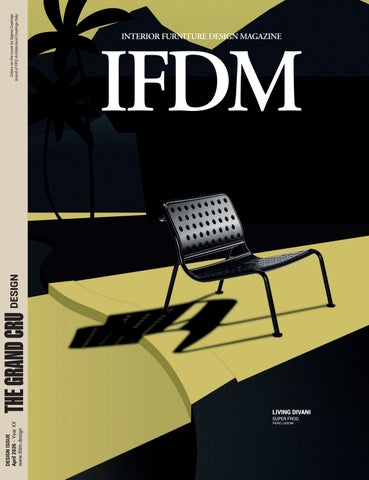
LIVING DIVANI
SUPER FROG
PIERO LISSONI
LIVING DIVANI
SUPER FROG
PIERO LISSONI
Photo © DSL Studio

FOR THOSE WHO KNOW

Creators of luxury kitchen appliances. Established 1683.

Experience ‘Presence’ at Villa Necchi Campiglio. Join us April 21 – 26.

Cubik collection, design by Riccardo Gava
Spazio Milano showroom
via Manzoni 43 Milano

giorgetti.eu

Discover the allure of Venetian light and glass art at

VENINI Milano San Babila Flagship, Via Durini 27, Milan
VENINI Rome Flagship, Via Dei Due Macelli 64, Rome
VENINI Murano Boutique, Fondamenta Vetrai 47, Murano
VENINI Bologna Boutique, Galleria Cavour 4H, Bologna
Cabbage table lamp by Peter Marino
VENINI ON THE ROCKS PETER MARINO
SHOWROOM MILAN / LONDON
ROME / PARIS / CANNES
Salone del Mobile.Milano
Fiera Milano Rho
Hall 24, Booth D38

ATLAS CONCORDE CERAMIC SURFACE ECOSYSTEM

Geometry of Life [Chapter 1]. A movie shot at Palazzo Molteni, Milan. moltenigroup.com

DESIGN BY CARLO COLOMBO

PUBLISHER

Paolo Bleve bleve@ifdm.it

EDITOR-IN-CHIEF

Ruben Modigliani ruben@ifdm.it

EDITOR-AT-LARGE & BRANDED CONTENT CURATOR Veronica Orsi orsi@ifdm.it

MANAGING EDITOR

Giulia Guzzini giulia@ifdm.it

CONTRIBUTORS

Federico Angi

Alessandra Bergamini

Fiammetta Bonazzi

Manuela Di Mari

Stefania Evans

Cristina Kiran Piotti

Naima Morelli

Salvatore Peluso

Sabrina Sciama

EDITORIAL TEAM redazione@ifdm.it

NEW YORK CONTRIBUTOR

Anna Casotti nyc@ifdm.it

DIGITAL DEPARTMENT web@ifdm.it

SALES & MARKETING marketing@ifdm.it

BRAND RELATIONS

Matteo De Bartolomeis matteo@ifdm.it

Camilla Guffanti camilla@ifdm.it

Annalisa Invernizzi annalisa@ifdm.it

GRAPHIC DEPARTMENT

Marco Parisi grafica@ifdm.it

Maripina Cappelletti mari@ifdm.it

the date. Follow IFDM at the world’s leading international trade fairs

ADVERTISING Ph. +39 02 40701449 info@ifdm.it www.ifdm.design

CLOSED BY THE EDITORIAL STAFF 25th March 2026

PRINTED BY Feanza Group Spa Faenza, Italy

Pad. 22 Stand A05 A07 21_26.04 2026

Design’s New Year is celebrated here

There are seasons when design seems to outrun reality – and others when reality itself imposes a pause, a reckoning, a change of pace. Today, we inhabit both conditions at once.

On one hand, we are witnessing what can only be escribed as expansive growth: design is breaking beyond its traditional boundaries to become a total language. No longer merely product, no longer just interiors, but a complete experience.

Branded residences, fully authored buildings, monobrand spaces across the globe that narrate increasingly intimate corporate stories, entire districts conceived as coherent ecosystems – all point to a new ambition: to construct identity through space. Design becomes cultural infrastructure before it is aesthetic expression.

On the other hand, the global context introduces elements of uncertainty that cannot be ignored. Ongoing conflicts, geopolitical tensions, and shifting economic balances are redefining priorities and markets. Every project now contends with a more cautious demand, with supply chains that must be recalibrated, with a notion of sustainability that is no longer declarative but materially necessary.

It is within this unstable equilibrium that contemporary design finds its direction: between vision and responsibility. Seen against this backdrop, the nearly twenty-year journey of IFDM takes on particular significance. Not merely as a temporal milestone, but as the record of a path that has observed, interpreted, and narrated these transformations.

From the initial intuition of giving voice to a sector, to the construction of an editorial platform capable of moving across languages and markets – and celebrating them again this year with Grand Cru of Design

A vantage point that informs this year’s project – leaning on light, photography, and typography to underscore The Design Cru. A direct dialogue between light and product, staging each protagonist of this year’s collections. It is a communication campaign whose guiding thread is design and light – light in a distinctive chromatic shade: “Secret Safari,” color of the year by Sigma Coatings, a brand of PPG Architectural Coatings.

If design today tends toward the “total,” its narrative, too, must expand – becoming more aware, more connected. Perhaps this is the most authentic continuity: to keep one’s gaze open, curious, ready to recognize what changes without losing sight of what endures. Design’s 2026 New Year has officially begun – for our entire community.

The added value

There comes a moment, in the trajectory of mature markets, when the object ceases to be sufficient unto itself. That moment is now, in design, where the rise of the “collectible” sphere – so vibrant that Salone del Mobile.Milano has devoted an entire new section to it – marks a clear shift: we are no longer simply buying chairs, lamps, or tables. We are buying stories, thought processes. We are buying, in a word, meaning. This is neither nostalgia nor elitism. Rather, it is a response to an excess of supply that has made everything available and endlessly reproducible. Against this background noise, the public seems to be seeking objects that endure: not only in material time, but in cultural time. Pieces that bear the trace of error and experimentation. Objects that stand closer to art than to the assembly line.

For the furniture industry, the issue is a delicate one. To pursue this tension without slipping into the logic of fashion - voracious and inevitably superficialmeans restoring primacy to the project itself.

Fashion generates imagery, certainly, but consumes it at the same pace at which it produces it.

Design, if it is to remain relevant, must resist that rhythm. It is telling that, along paths parallel to the major industry showcases, smaller, more lateral events devoted to the applied arts are emerging. They do not compete in scale, but in depth. They point toward a possible direction: less volume, greater intensity.

William Morris once said, “Have nothing in your houses that you do not know to be useful or believe to be beautiful.” More than a quotation, it is a reminder: every object is a cultural choice. And true added value lies precisely there - in its capacity to generate meaning beyond the market.

PAOLO BLEVE | Publisher

THE MDW FACTOR

ALESSIA CAPPELLO

CITY OF MILAN, COUNCILLOR FOR ECONOMIC DEVELOPMENT AND LABOUR POLICIES

Milan stands as the global capital of creativity and design. In addition to its well-established heritage of cultural, artisanal, and industrial excellence developed over time, the city has continuously demonstrated an ability to renew itself and to meet the challenges it has encountered, thereby building a solid and widely acknowledged reputation. The economic impact and the flows generated each year by Design Week make Milan a strategic international crossroads for meetings, networking, and relationships, as well as a benchmark for other sectoral calendars and events, for both stakeholders and the many visitors it attracts. During this period, the city is transformed into a vast, diffuse stage that combines commercial and artisanal exhibition with artistic experimentation. It attracts investments and events, welcoming professionals, residents, and tourists alike. The wide array of events, installations, and exhibitions across every district involved in the urban festival makes a significant contribution each year, transforming historic sites, former industrial spaces, and iconic landmarks. I am confident that this edition too will generate a wealth of new ideas and proposals. We firmly believe that this widespread energy should be allowed to flow freely, while at the same time being guided by a coherent public direction capable of balancing quality of offer, cultural value, and the attractiveness of the numerous events across different contexts. For many years, Milan Design Week has been a fundamental driver of both the city’s and Italy’s economy. Today, we can affirm that, thanks also to its unique format – made possible by an ecosystem supported by prestigious academic institutions, a network of dynamic enterprises, and strong synergies among cultural organizations, associations, and public bodies - it extends well beyond those days. It contributes to establishing Milan as a permanent hub of experimentation and development, attracting talent and ideas even outside the timeframe of Design Week. We hope that this year as well, despite the ongoing and dramatic geopolitical crisis, the event will continue to welcome stakeholders from across the entire value chain, along with numerous enthusiasts, and that it may serve as an opportunity for encounter, dialogue, and collective reflection.

FOUNDER OF THE DIGITAL PLATFORM FUORISALONE.IT AND CREATIVE DIRECTOR OF BRERA DESIGN DISTRICT

Milan Design Week exists because Milan exists. This is not a geographical detail but a cultural condition – one that enables an ongoing dialogue between design and industry. The Fuorisalone emerged within this very system as a spontaneous phenomenon. One of the most compelling outcomes of this process is the Design Week’s capacity to become, each year, a moment of urban regeneration. Districts, buildings, and often overlooked spaces are temporarily reactivated. Many places now central to the geography of the Design Week were first revealed through temporary events that anticipated broader urban transformations.

The city fills with spectacular installations and crowds; hotel rates soar to prohibitive levels, taxis become impossible to find. Such is the Milan Design Week effect, whose repercussions – both positive and negative – are well known. But what drives this success? Where is there room for improvement, and what challenges lie ahead, now and in the future? We put these questions to three key figures behind this macro-event

PAOLO CASATI MARIA PORRO

The Fuorisalone has never lost its open, plural nature – a constellation of initiatives arising from the ground up. This, at times anarchic, dimension has been its true strength. Any attempt to rigidly frame this system through a generic notion of “quality” would risk distorting it, for the Fuorisalone has grown precisely through its ability to embrace the unforeseen.

The Fuorisalone 2026 theme, Being Project, stems from this reflection: design is not an object but a condition.

We have sought to shift the focus from outcome to process – one shaped by attempts, errors, intuitions, and the interplay between different disciplines. The challenge ahead will be to preserve this openness while refining the tools through which the city manages an ever more complex event. In this direction moves Fuorisalone Passport, a digital platform allowing visitors to access events through a single QR code. Milan will remain central if it continues to do what it has always done: connect different worlds and transform this energy into design.

PRESIDENT OF SALONE DEL MOBILE.MILANO

The Salone del Mobile.Milano is far more than a trade fair: it is a cultural and economic infrastructure that forges connections between companies, designers, institutions, and visions. In this sense, its bond with Milan is not merely historical but structural. The Salone brings to the city an extraordinary international momentum: it activates relationships, generates content, and fosters opportunities for exchange between markets and design cultures. Milan, in turn, offers the Salone something equally vital: a unique ecosystem composed of enterprises, schools, showrooms, cultural institutions, and a creative community capable of making design an integral part of the urban fabric. It is this reciprocity that underpins the success of Design Week and its enduring ability to attract a global community year after year. Today, our commitment is to further strengthen this platform. In an international landscape marked by profound transformations, the Salone increasingly aspires to serve as a compass for businesses: a space in which to interpret change, chart new trajectories of growth, and nurture dialogue between industry, research, and design culture. To this end, we are exploring new design territories – such as contract – and developing curatorial platforms like Salone Raritas, which broaden the scope of design while enhancing its most experimental and cultural dimensions. At the same time, we continue to invest in the cultural sphere and in emerging talents, because design today is no longer merely about products: it is thought, methodology, and the capacity to interpret the complexity of the present. Looking ahead, the challenge is twofold: on the one hand, to continue interpreting the complexity of global markets, offering companies a platform capable of guiding, connecting, and generating new opportunities; on the other, to grow while maintaining the highest standards of quality - enhancing the experience for exhibitors and visitors alike, strengthening international reach, and making the richness of this ecosystem ever more accessible and legible.

LARGER THAN REAL?

The Salone reinvents itself, the Fuorisalone polarises, the city calls it to account. Voices from within the system to understand where the world’s most important design week is heading

Milan Design Week is no longer about design. To understand where it is going requires competencies that those who write about chairs and lamps simply do not possess. It is no longer merely an event devoted to design, but a large-scale phenomenon that affects the economy of an entire city. It is the spearhead of a cultural programme that Milan has now structured into themed weeks: art, fashion, design, music… (there is even a Pet Week, dedicated to domestic animals). Layer all this onto the turbulence of the global scenario and the result is vertiginous. To address the issue, we gathered voices from those working within the system and those observing and studying it from its margins. On one side, Annalisa Rosso, Editorial Director and Cultural Events Advisor of the Salone del Mobile, alongside Valentina Ciuffi and Joseph Grima, founders of Alcova. On the other, Bertram Niessen, urban sociologist, author of Abitare il vortice and scientific director of cheFare, an agency for cultural transformation. Let us begin at the

system’s core. The Salone del Mobile is undergoing a profound redefinition. Some of its most representative companies have gradually shifted their centre of gravity from the fairgrounds to the city: last year it was the turn of Molteni & C., among the founders of the event in 1961, which left Rho for a Liberty-style building on Via Manzoni. Before them, Cassina, Giorgetti and other historic brands had made the same move. At the same time, this “diaspora of design” is reassembling elsewhere: in Riyadh, where thirty-five Italian companies have joined forces under the Salone’s own umbrella. The zero edition – Red in Progress, held in the Saudi capital’s Financial District at the end of 2025 – anticipated the first full edition, scheduled (one hopes) for November 2026. Among them were the very brands mentioned above, along with others that had already left the halls of Rho. The Salone, in short, seems poised to remain a reference point for the prestige of Made in Italy design – simply no longer during Design Week.

1. Rendering of Aurea, an Architectural Fiction, an installation presented at the Salone del Mobile.Milano 2026 by Maison Numéro 20 (Halls 13–15); 2 Salone del Mobile Milano meets Riyadh, an installation by Studio Giò Forma; 3 Mission Aldebaran by Marc-Antoine Barrois, awarded last year with the Fuorisalone Award; 4. The Lexus stand at Superstudio, 2025.

It is within this transformation that Salone Contract must be understood, one of the most significant moves of recent years. More than a new section, it is an attempt to read a market in which value no longer lies solely in the individual product, but in the capacity to integrate systems, expertise, data and services. “Through extensive travel – India, Los Angeles, London, Paris, Berlin, Shanghai, Riyadh –we have become acutely aware of this shift. To simplify: we have moved from seeking only old-school dealers to engaging with other interlocutors as well – developers, major architecture firms, hotel chains… The Salone will be able to become the platform for this new model too,” says Annalisa Rosso. The project’s masterplan is signed by Rem Koolhaas and David Gianotten of OMA: its structured debut is scheduled for 2027, but it will begin to take shape already in 2026, with an in-depth forum, a thematic path within the fair, and a targeted invitation programme for international professionals in contract and hospitality. At the other end of the spectrum, this year also sees the debut of Salone Raritas: a curated space dedicated to unique pieces, limited editions and high craftsmanship, designed by Formafantasma. They may seem distant, yet Rosso reads them as complementary: “Raritas and the broader Salone Contract project are in fact symmetrical, two sides of the same coin: a fair that is no longer simply what we once knew. Research has entered, and so has a very strong internationalisation.” The point of contact lies precisely in the relationship between research and market: “There is space for these hyper-muscular sectors, which often lack the time – or perhaps the expertise – to approach research. On the other hand, research is always seeking new economic outlets in order to survive.” One is reminded of a passage from Il design. Storia e controstoria by Andrea Branzi – currently celebrated at the Triennale with a monographic exhibition – which already twenty years ago foresaw the coexistence of serial production, unique pieces and mass customisation: “We can equally observe that the distinction between industrial and artisanal technologies, perhaps valid until the 1970s, no longer makes sense today. Craft is an integral part of industrial cycles and the globalised market, where high technology, hand-made production, oneoffs and diversified series coexist on equal terms: all now belong to an industrial civilisation without true alternatives, in which former technological boundaries have blurred or disappeared.” What can one add? Perhaps this year we may write a new paragraph in that history. If the Salone is reinventing itself, the Fuorisalone is becoming something else entirely. A report published at the end of 2025 by Mr Lawrence – a strategic consultancy co-founded by Rosso – captures a now evident transformation: “Fashion and automotive for some years already, but now also beauty and food & beverage: sectors once at the margins of Milan’s week are now undisputed protagonists. Brands such as Glo, Aesop, Lavazza, CIF, Chiquita – with no direct connection to furniture – have created spectacular installations capable of attracting thousands of visitors.” The goal of these players is engagement, both physical and social. The most scenographic installations are often those least tied to product design, yet they are also the most visited. I admit to having contributed to the phenomenon: I have found myself writing pieces such as “the 10 most Instagrammable installations not to be missed”, attempting to maintain a critical tone that ultimately fed the same logic. The question, at this point, is inevitable: is the Fuorisalone still design week, or is it becoming something larger – and more diffuse – in which design risks being little more than a frame? Is this a drift, or a new opportunity? What emerges is an increasingly sharp polarisation. On one side, experience-driven projects – perception, atmosphere, immersive narrative; on the other, those in which object and design remain central, enhanced by rigorous storytelling and direct professional exchange. This division is mirrored in the audience. “Increasingly evident

is the distance – not only physical but symbolic – between professionals and enthusiasts,” writes Mr Lawrence. “The former frequent showrooms, talks and curated presentations; the latter are willing to queue for immersive installations, free-entry events, or the gadget of the moment. Two different publics, with different rhythms and expectations. And perhaps two parallel Design Weeks.” If two parallel Design Weeks truly exist, Alcova attempts to safeguard the more fragile one. The itinerant platform founded in 2018 by Ciuffi and Grima has become a reference point for contemporary design, each year seeking a delicate balance between emerging studios, established names, craftsmanship, galleries, cultural institutions and brands of varying scale – while maintaining a consistently high standard, the result of the founders’ shared vision and complementarity. “We continue to bring an ingredient that we believe is fundamental in making Design Week a place of discovery and research,” Ciuffi explains. The pressures, however, are considerable: growth, audience management, economic

sustainability – not to mention the logistical and bureaucratic challenges of working each year with new locations, often abandoned buildings that must be secured and made accessible. Grima is well aware of this: “We do not want to become a halfway house between a professional fair and a village festival. We must be very disciplined about this.” The risk, after all, concerns not only Alcova but the entire ecosystem: “Like any phenomenon that tends to grow, the curve is undeniably rising on many fronts: audiences, major brand investment, hotel prices. It is a dynamic that bears all the hallmarks of a bubble. We know how bubbles end, and it would be a pity, because design is becoming ever more important in the contemporary world. We must be far-sighted and think in the medium to long term, not merely chase the numbers of a single edition.” What Ciuffi and Grima call “local techno-craft” – a new generation of designers replacing mass production with research,

self-production and small-scale technologies – is precisely what Alcova seeks to promote. And it is perhaps the most valuable ingredient that Design Week risks losing, squeezed between the budgets of major brands and the costs of an increasingly inaccessible Milan. It is precisely on accessibility – and more broadly on the impact that Design Week has on the city – that Bertram Niessen shifts the focus. For the urban sociologist and scientific director of cheFare, the transformations of Milan’s week must be framed within a much broader context: “The fact that Milan has completely shifted its modes of production – from a city of services and advanced tertiary sectors to a city of events – has changed the very nature of Design Week. It must be read alongside the phase inaugurated by Expo and continued with the Olympic system: the nature of value production in Milan has changed.” The consequences are tangible: “The city has filled with negative externalities.

There is the issue of the housing crisis, with apartments purchased as investments and placed on short-term rental platforms. There is the exponential rise in tourist flows, because before Expo Milan was not a particularly prominent tourist destination: today it is among the leading cities in Italy, and the entire economy has shifted in that direction. In this context, Design Week becomes the moment when stress concentrates: transport systems collapse, queues are everywhere and, above all, the perceived return for residents remains rather low.” There is also a rarely addressed issue: the environmental and semiotic sustainability of the event. “Design Week has monstrously low levels of sustainability: it produces an enormous amount of waste. And there is the question of semiotic pollution: hundreds of thousands of people put the city on display on social networks, and we now know this is not necessarily a positive thing. It tends to drive forms of hit-and-run tourism.” Niessen saves the most uncomfortable point for last: “I find it a very poor indicator that the week has been scheduled over April 25, anniversary of the Liberation of Italy (WW II). In a city currently witnessing a revival of social movements after more than ten years, I am not sure whether the system’s actors realise how negatively this is perceived.” It is difficult to disagree. April 25 is a date deeply felt in Milan, and its overlap with Design Week suggests that the civic impact of the event still requires serious reflection. (A suggestion to readers: that day, skip the showrooms. Join the demonstration.) We spoke of Branzi and that new paragraph to be written. What emerges from these conversations is that the history of design is not written solely through objects, materials and technologies, but also – perhaps above all – through the choices we make about how to organise, promote and render accessible its most important manifestation. That paragraph will not write itself: it is up to all those who inhabit, fund, narrate and consume this system.

5. One of the “forgotten spaces” used by Alcova as exhibition venues. 6. A moment from the festive parade Design Pride, organized by Seletti together with brands from other sectors.

THE DRIVING FORCE

On the centenary of Verner Panton’s birth, his vision returns to the fore: creativity as energy, as living matter, as the emotional construction of space. Contemporary design shows renewed boldness –graphic gestures, ultra-soft forms, optimistic palettes, and craftsmanship that elevates objects into pieces to be cherished. High-tech materials meet enveloping shapes, moving beyond neutrality to restore vitality to contemporary interiors. The modular Domino rug (60 × 60 cm elements) by Verner Panton is one of three collections by the Danish designer reissued by Amini (Hall 22 | A16 & MDW26 Via Borgogna 7). by Sabrina Sciama

Black & White

1 | GLASS DESIGN expands its collection of countertop washbasins with Madison Marmoral, in glass with circular base (HALL 6 | B35). 2 | Asymmetrical volumes and essential geometries for the Flatiron table by Mauro Lipparini for BONALDO (Hall 9 | G09–H08). 3 | Pocopiano, ceramic plate on a circular base by Paolo Stefano Gentile for OROGRAFIE (MDW26 Chiesa di Santa Maria Incoronata, C.so Garibaldi 116). 4 | The table from the SK collection by MDF ITALIA, designed by Studio Klass, combines elegance and technical sophistication: the base features an almost engineering-like interlocking structure with a strong decorative impact (HALL 24 | C14 D19). 5 | Véu by Zanini de Zanine for the outdoor design brand SNOC. Aluminum structure, weave with a leather-like texture (HALL 18 | A09). 6 | Isle Lounge by Asobi Design Studio for TOKIO is a sofa large enough to seat several people in eclectically stellar comfort (www.tokiotokio.com). 7 | The 1669 collection of dining tables and coffee tables in lava stone is the result of the collaboration between NEROSICILIA and BIG – Bjarke Ingels Group. The name recalls the eruption of 1669, which gave rise to the material used for their construction (HALL 24 | D35).

Where Precision meets Passion

Technology, design, precision: every detail expresses a passion. Selected by renowned restaurants, the SKS wine cellar brings excellence to the most ambitious hospitality and residential projects.

COLUMN WINE CELLAR

Curvy

1 | The modular sofa system Paco is designed by Ludovica Serafini and Roberto Palomba for TALENTI HOME. The different elements can be combined to create custom configurations (HALL 22 | A31 A35; MDW26 via Manzoni 11). 2 | Pura is a collection of two-tone cement tiles by Icona Architetti for SANSONE PAVIMENTI, allowing the creation of endless pattern combinations (MDW 26, Piazza Diaz 5). 3 | Dynamic shapes for the modular sofa Phil by FRIGERIO, generated by the succession of juxtaposed padded tubulars (HALL 11 | C25 D18). 4 | The Bacione (a big kiss in Italian) sofa by RUYA AKYOL STUDIO translates a universal gesture into form, matter and presence. Like a kiss that takes shape (SaloneSatellite Hall 7 | E31). 5 | Drawing inspiration from the myth of the Mother Goddess, Debonademeo Studio’s Pachamama collection for ADRENALINA evokes the forms of ancient votive figurines in its design. (MDW26 Boccascena Caffè, Palazzo Litta, 24 Corso Magenta). 6 | Macrodosing dining table by Marc Ange for VISIONNAIRE. base in elements of different woods, top in Breccia Pontificia marble (HALL 11 | G23 H22). 7 | The Houdini stool is made of curved solid ash. Design Antonio De Marco for WOAK

Graphically

1 | With Solida by RAGNO terracotta tiles are transformed into contemporary surfaces with a strong and textured character (MDW26 via Marco Polo 9). 2 | Designed by Giampiero Castagnoli, Marco Fagioli and Emanuel Gargano for RUBINETTERIE TREEMME 5mm combines technical research and formal rigour. The name indicates the thickness that defines both the flow of water and the internal passage (MDW26 Pure Flow, via Palermo 8). 3 | ÉLITIS’s new accessory line draws on the refined graphic sensibilities of Japanese aesthetics. At its core are textured rugs where sculpted lines meet natural, understated palettes. 4 | The Collier deck chair by EMU is characterized by harmonious proportions and measured shapes. Design LCM Marin Design Studio (HALL 22 | B24). 5 | The JV 106 Amazzonia wallcovering collection by JANNELLI&VOLPI is inspired by the natural elements of the rainforest (S.Project | HALL 24 | C32). 6 | Deliberately irregular geometry defines the Alberto table, designed by Maria Vittoria Paggini for FRATELLI BOFFI, developed from an elongated octagonal top (MDW26 Casaornella, via Conca del Naviglio 10). 7 | Graphic profile and strong visual presence define the Bob chair by Studio Park for BILLIANI, characterized by its sled base and also available as a stool (HALL 22 | A32).

DESIGNED FOR DAYDREAMS

WHERE STILLNESS UNFOLDS, THE LIGHT SOFTENS AND DAYDREAMS DRIFT BY THE WATER’S EDGE. CRAFTED FOR MOMENTS WHEN TIME SLOWS AND THE DAY BELONGS ONLY TO YOU.

Ocean Master MAX Bolero: Ombré Blossom Marquesa Double Sun Lounge

Let’s have fun

1 | LAUFEN Tricolor is the result of combining three coordinated colors in a fusion of glossy and matte forms (HALL 10 | B11 B19 C12 C16; MDW26 Laufen space Milano, via Manzoni 23). 2 | MARIMEKKO’s newest floral designs Kukasta kukkaan by Erja Hirvi take the form of bold textile installations and a shoppable curation of ceramics. (MDW26 Osteria Fiori di Marimekko, via Ascanio Sforza 75). 3 | iQ Motion by TARKETT introduces a refined palette of 16 natural tones, drawing inspiration from the enduring appeal of terrazzo. 4 | The PLH DUO lates feature a white-painted aluminum base and levers, paired with a Smile Plastics Kaleido front panel. The DUO collection is an homage to circularity and stems from the collaboration with Mazzucchelli 1849 and Smile Materials (MDW26 PLH Showroom Via Voghera 4/a). 5 | Granite-cement bases and a lightweight structure define the Nolo table by Simone Bonanni for S-CAB, shaped by pure volumes and essential geometries (HALL 18 | E22). 6 | Designed by Catherine Urban, the Trilli Halo lamp by CASARIALTO takes inspiration from the geometric shapes and design of the 60s. 7 | The Succulentia collection of vases and centrepieces by Elena Salmistraro for BOSA is inspired by the observation of the plant world, particularly that of succulents (Hall 24 | D07).

Heritage

1 | Supernova is the new collection by LISTONE GIORDANO and Studio Oliosopatras. It is an oak parquet in the Civita color from the Fontaine line, created from a single module with concave and convex sides that repeats itself in space (S.Project | 24 | D37). 2 | The Pendant suspension lamp in antiqued brass by CARL HANSEN & SON is a tribute to Hans J. Wegner’s work with light. The model was first presented in 1962 (MDW26 via Solferino 11). 3 | The new galvanic copper finish enhances the contemporary and refined aesthetic of ABIMIS’s Atelier kitchen (HALL 04 | D15). 4 | The B.E.L.T. collection by TURRI, designed by Matteo Nunziati, draws inspiration from the woven leather belt, a symbol of the brand’s artisan tradition (HALL 09 | H11 L10). 5 | The Opus armchair by ETRO HOME INTERIORS is part of the Etro Ornamenta collection, which reinterprets the cosmopolitan spirit of Art Déco through a contemporary lens (Oniro Group HALL 13 | C01 C03 C09 D01 D03). 6 | The Écume wall covering by ÉLITIS is created using plaster mouldings shaped like seashells. 7 | Clap!zer0 by DÉCO is the new collection of wood-effect flooring that redefines the concept of material realism (MDW26 Décoroom, via Goito 3).

Yiko. collection designed by Stephane De Winter

Ribbed

1 | Pieces from the Ultras Collection by 6:AM, available as wall lamps and vases, come in three color combinations: yellow/red, blue/light blue, and blue/red (MDW26 Piscina Romano, via Ampere-via Zanoia). 2 | Inspired by the fan-like folds of haute couture, the Plissé wall panels by NOËL & MARQUET are part of the 2026 collection The Harmony of Lines and are made of high-density polystyrene (HDPS). 3 | The Bella partition systems by VIVA PORTE combine a glazed upper part with a milled wooden lower panel. Available in swing, sliding and pivot models (MDW26). 4 | The Atlas rug collection is the result of a collaboration between the international design studio Barber Osgerby and KASTHALL and takes its name from the mountains of North Africa, reinterpreted through rich textures and iridescent shades (MDW26 Kasthall Showroom, Piazza Paolo VI). 5 | JAIPUR RUGS has collaborated with Japanese architect Kengo Kuma to unveil the Faces collection, a series of 16 rugs inspired by the façades of his renowned architectural works (MDW26 Crespi Bonsai Museum, via Marco Minghetti). 6 | The AL CM collection, designed by Martinelli Venezia for BUFALINI MARMI with the artistic direction of Paolo Ulian, was born from the combination of geometric elements with multiple dimensions of centimeters (MDW26 Galleria Rossana Orlandi, via M. Bandello 14). 7 | CESAR presents a new development of Tangram, the project designed by García Cumini. The latest intervention introduces an additional module within the system, expanding its compositional possibilities (MDW26 Cesar Flagshipstore, via Larga 23).

THE ITALIAN SENSE OF BEAUTY

Mirror Mirror

1 | The Coretta console, designed by Alexia Leleu, joins the collections of the MOBILIER NATIONAL. Crafted in raw ceramic and finished in platinum, the piece reveals an unexpected facet of the material, capable of subtle chiaroscuro effects. 2 | FIAM ITALIA presents Still, the new mirror designed by Controvento under the creative direction of Gabriele Chiave, expressing a research path that explores glass as a material connected to transformation and reflection (MDW26 Misura Arredamenti, via Larga 13). 3 | Designed by Paolo Zani, the Barona lamp by WARLI is made of recycled aluminum, painted transparent and reflective, with double direct and indirect lighting (HALL 24 | D41). 4 | The formal purity of the Nur handle by Lorenzo Palmeri for ENTO makes it possible to minimize material use, ensuring a more responsible approach to resources (S.Project | 01 | B11). 5 | The Anima 01 kitchen is a unique piece, made of steel by the Japanese craftsmen of MEISDEL and integrated with wood, quartz and ceramic (MDW26 Tortona Design District). 6 | Tubex is the new collection of taps in AISI 316L steel, particularly resistant to corrosion and external agents, designed by Massimiliano Settimelli for ZAZZERI (HALL 10 | C02).

Open Horizons

1 | Sonora, here in the outdoor version, is a tribute to the desert of the same name on the border between the United States and Mexico and is the result of the collaboration between ILLULIAN and Marìa Cristina Design. 2 | Inspired by koro, the incense container with soft and rounded shapes, the Koro collection, designed by Eli Gutierrez for SKLD Studio, blends Japanese tradition and contemporary craftsmanship (HALL 14 | D29). 3 | Shades of cold tones and soft texture for Borealis, one of the new graphics in the 2026 WALLPEPPER catalogue available in all the supports in the range, from sound-absorbing to water-repellent. 4 | The Fronda vase collection by Studio Marco Piva for PAOLELLI OUTDOOR is made of concrete, elevated to a noble surface capable of dialoguing with the surrounding landscape (HALL 14 | B24). 5 | Flow is the new collection designed by Ludovica Serafini + Roberto Palomba for TALENTI consisting of modular sofas, armchairs, chaise longues, sunbeds and coffee tables (HALL 22 | A31 A35). 6 | The Maximo modular seating system in regenerated resin, by Raffaello Galiotto for NARDI, is equipped with coffee tables in various versions (HALL 14 | A23 B22).

Sculptural

1 | Finished by hand and customizable in materials and finishes, Atolls coffee tables can live as individual elements or as a compositional archipelago. Design by Draw Studio for NEUTRA 2 | The Talea washbasin by Angeletti Ruzza for HATRIA is characterized by the protruding edge on the base and a deep basin visible only from above (HALL 10 | D21).

3 | Detail of the trestle designed by Luisa Castiglioni in the 1960s, now part of the BOCCAMONTE design platform, which collects and enhances the legacy of the twentieth-century architect and designer through archival work, research, and project development (MDW26 Alcova, Villa Pestarini, via Mogadiscio 2/4). 4 | Enveloping backrest and cylindrical swivel base for Amour, sculptural seat with generous shapes designed by Fabrice Berrux for BONALDO (HALL 09 | G09 H08). 5 | The Sebastien modular sofa by DIVIANA is the result of the skillful combination of generous volumes and marble surfaces. The project is curated by Marco Corti, art director of the brand (MDW26 via Monte di Pietà 13/1). 6 | Available in four shapes – round, oval, rectangular and square – the KLUDI - RESA marble-effect countertop washbasins are the result of synergy with the RAK CERAMICS group’s expertise in the ceramic sector (MDW26 RAK Ceramics Design Hub, via Borgogna 8).

Leonardo Duggento

The art of living a long and healthy life

Leopoldo Cavalli, CEO of Visionnaire, exclusively unveils the partnership with The Longevity Suites. Visionnaire will be the design and development engine for revolutionary “Longevity Ready” residential solutions – healthy, personalized homes set to redefine Real Estate by placing 360° well-being and longevity at the core of living

You have a long entrepreneurial history tied to well-being, long before it became such a widespread trend. How did this passion originate, and how has it translated into Visionnaire’s offerings?

Our focus on 360-degree well-being has always been central to our proposals. Personally, I’ve undertaken numerous initiatives in this field. For instance, I was among the first in Italy to introduce cryotherapy machines in spas 16 years ago, integrating the concept of thermogenesis with hot and cold treatments into holistic centers, whereas previously they were exclusively found in medical practices or sports facilities. I also launched an innovative startup, Effetto Viola, which uses engineered music with binaural beats to combat anxiety, panic attacks, insomnia, and stress – a technology now also installed on Trenitalia’s high-speed trains. This interest of mine has naturally extended to Visionnaire, where we’ve incorporated mini-spa and mini-fitness residential concepts into many projects. As early as Salone del Mobile.Milano 2024, we showcased a model suite featuring a master bedroom equipped with a cryosauna, Finnish sauna, and dedicated spaces for yoga and Pilates.

The collaboration with The Longevity Suites seems like a natural progression, yet also a significant strategic choice. How did this partnership come about, and what makes it unique?

The partnership arose from the growing demand among The Longevity Suites clients to integrate clinical protocols into a residential setting. My experience and con-

nections with the board, including co-founder Marco Bizzarri (former ceo of Gucci), facilitated discussions and the signing of this licensing agreement.

Visionnaire is committed to conceiving and delivering residential solutions under The Longevity Suite brand, serving as the design and production engine.

This collaboration complements Visionnaire’s offerings with a precise medical protocol for longevity, targeting a shared clientele: successful individuals who, despite being able to acquire almost anything, strive to extend their healthy lifespan. The desire for health and longevity is a unifying factor for our clients.

We are familiar with The Longevity Suites’ philosophy, centered on prevention and extending “healthy life.” How does this vision translate into a residential project, and what is Visionnaire’s role?

Longevity’s goal is to increase healthy lifespan, not just chronological age, by preventing a prolonged decline through illness. This involves preventing inflammation, which underlies many pathologies. To achieve this, it’s essential to have a ‘dashboard’ to constantly monitor our vital parameters. Longevity Real Estate is designed to make this necessity both luxurious and convenient. Visionnaire integrates this philosophy by designing residential units we call Longevity Ready – truly “healthy havens” that do not promote the onset of illness. This represents a genuine medical lifestyle, a revolution built upon seven specific characteristics, ranging from air and water quality to acoustic comfort and low emissions.

What is the impact of these innovations on the real estate market, and how does Visionnaire ensure the integration of these elements?

We believe this approach will revolutionize Real Estate. While today properties are valued for energy efficiency, in the future, it will be crucial whether a property promotes or detracts from health. Our mission is to certify these homes as Longevity Ready, ensuring they do not compromise well-being. Visionnaire guarantees the integration of these elements through meticulous design and the use of cutting-edge materials and technologies, such as microfiltration systems and Dolby Atmos. We hope these high-end innovations will progressively spread, as these aspects are simply too critical to be overlooked.

Visionnaire is renowned for its sartorial approach. How does this philosophy align with Longevity’s need for standardized medical protocols?

Visionnaire is perhaps the only brand in the furniture industry with such a sartorial attitude. We don’t just sell products; we offer solutions that embody the client’s personality. Three out of ten products we create daily are made for the first and last time, with a range of 3,000 items and 16,000 finishes. Longevity, for its part, acts as a “well-being customizer” for each individual, as everyone requires different supplements, vitamins, and dietary regimens. This shared affinity for offering personalized solutions makes us ideal partners.

Regarding the development of interior design concepts for this partnership, could you provide some details on the vision that will guide the design of these spaces?

For the architectural aspect, we can already name Marco Casamonti, Luca Dini, and HBA as consultants. For interior development, our goal is to broaden our vision, moving beyond Visionnaire’s established aesthetic – traditionally focused on exquisite detail and precious materials – to embrace a living model centered on well-being. To this end, we will engage an external studio that, with fresh perspectives, will guide us in codifying an interior design specifically conceived for longevity.

1. Leopoldo Cavalli, CEO of Visionnaire.

2. The Longevity Suites concept

Timeless Balance

Meridian Collection

Simplicity, neutral tones and a refined finish define a collection that stands out for its balance of functionality and elegance. With its light, flowing forms and subtle curves, Meridian seamlessly integrates into contemporary spaces.

Glazed porcelain tile collection:

Aroma discover more on: marcacorona.it

Miniature

THE GRAND CRU reimagined: design as dream

Last year, IFDM introduced the notion of The Grand Cru of Design, borrowing from the lexicon of oenology to define a rarefied category of excellence. As in the vineyard, where terroir, care, and time converge into singular vintages, so too design was framed as the outcome of precision, authorship, and cultural resonance. Ten “crus” emerged – each a distilled expression of its field – spilling from the printed page into the urban fabric of Milan. In 2026, the project matures into a more immersive, almost cinematic experience. The Grand Cru is no longer simply observed; it is inhabited, refracted, and subtly destabilised. The author of this transformation is Riccardo Fornoni, founder of Creamatelier, an architect whose visual language has long navigated the porous boundary between representation and imagination. His collaborations – ranging from Maison & Objet to the LVMH Group – have demonstrated a refined ability to translate brand

identity into evocative spatial narratives. Here, he brings that sensibility to a public stage. At the heart of this year’s edition lies, once again, a series of covers, each dedicated to a design excellence – yet conceived as fragments of a broader, evolving vision. Their extension into the city – most notably within the San Babila metro station, from April 19 to May 3 – constitutes a bold exercise in perceptual choreography. Posters, video interventions, and an occupation of shared spaces converge into an installation that challenges the neutrality of transit environments. Fornoni’s concept is encapsulated in a phrase that is, at first glance, deceptively simple: “leaning on light, photography and typography to underline every Design Cru”. Each image in the series presents a furnishing object placed within a room whose perspective is deliberately amplified. These interiors – or exteriors – barely suggested, exist on a threshold between presence and absence, rendered in

deep, almost nocturnal tones. Then, like a chromatic ignition, a single hue emerges: Secret Safari, the Colour of the Year selected by Sigma Coatings, a brand of PPG Architectural Coatings Italy and partner of the project. This calibrated intervention is not merely an accent, but a true spatial catalyst. The result is an optical expansion. Walls appear to recede, volumes to dilate. The station – typically a site of hurried passage – acquires an unexpected depth, as if stretched by an unseen force. One’s gaze is momentarily deceived; more intriguingly, one’s bodily perception follows suit. The infrastructure of movement becomes, fleetingly, a place of dwelling. In this sense, The Grand Cru of Design 2026 transcends its initial metaphor. If last year evoked the cultivation of excellence, this edition explores its diffusion –how design, at its most distilled, can permeate everyday life, altering not only what we see, but how we inhabit space.
Design THE GRAND CRU

Design is reinventing itself, crafting spaces that seamlessly blend heritage and innovation. Sculptural forms and pure geometries, coupled with meticulous research into sustainable materials and modularity, redefine comfort and conviviality. These new proposals create dynamic environments, designed to evolve with contemporary living.

Super Frog by Living Divani, design
Piero Lissoni

Super Frog: evolution of an icon

The Super Frog armchair is conceived to celebrate the thirtieth anniversary of the Frog. More than a mere variation, it is an evolution that redefines the object’s identity, enhancing its presence and perception with refined details, drilled or milled structure, lending new lightness and character to the iconic armchair. The proportions expand, the contours become more defined, and the aluminium frame gains greater visual weight. The result is a seat that retains the recognizability of the original while accentuating its character, working on the delicate balance between lightness and solidity that has defined Frog since its inception. Available in armchair and lounge versions, Super Frog continues the dialogue with the 1995 project, updating its language without altering its logic. Further distinguishing this interpretation are the seat and backrest panels, offered in two configurations. Horizontal grooves rhythmically define the surface, emphasizing the depth of the volume; the drilled variant, on the other hand, introduces a more dynamic, almost optical visual effect, lightening the overall perception as it interacts with the light.

Alongside these elements emerges a subtler, unexpected material detail: a finish suggesting the texture of amphibian skin. An ironic, almost narrative reference that plays with the project’s name and adds a

layer of interpretation between reality and suggestion, without ever becoming a simple decorative element. Designed for both indoor and outdoor use, the seat features a glossy painted aluminium frame – in white, black, or wine red – combined with marine-grade okumè panels reinforced with carbon fibre and protected by a matt transparent finish. For interiors, the configuration is completed with matt lacquered panels and removable cushions in fabric or leather, introducing a softer, more adaptable dimension. In Lissoni’s words, Super Frog is like a “beautiful thirty-yearold”: a presence that has transformed over time, gaining greater structure without losing its identity. It is precisely this tension between continuity and change that defines its character, making it suitable for various contexts, from domestic spaces to contract environments.

Super Frog remains a highlight among Living Divani’s creations, available both at the prestigious Living Divani Gallery showroom on Corso Monforte 20 and in the brand’s curated exhibitions. A unique opportunity to explore the latest collections and witness the evolution of this representative piece of contemporary design.

SUPER FROG, design Piero Lissoni

 MDW26: Corso Monforte 20

The forms of conviviality

With Quincy, Antonio Citterio explores the role of the sofa in contemporary living: a space for comfort, intimacy, and conviviality. The new sofa designed for Flexform is therefore characterized by an organic form – sinuous curves alternating with more linear sections – and a monocoque structure that creates a continuous, enveloping shell. Within this shell rest the seat cushions, enriched with soft feather padding. The wide variety of elements, including a generously sized chaise longue, allows for numerous dynamic configurations dedicated to sharing and relaxation.

QUINCY, design Antonio Citterio design  MDW26: Via della Moscova 33

All-encompassing relaxation

BEYOND THE KNOWN

The bed as a multifunctional island, and the bedroom as a living space beyond sleep. This is the extremely contemporary concept that guided the duo Yabu Pushelberg in designing the Lanai bed for Poliform Lanai transcends the idea of furniture to

Designer’s touch

Zanotta has acquired the historical archive of Carlo Mollino: 30 projects, original drawings, and sketches created by the Turin-based architect, designer, and photographer thus become part of the company’s historical archive. This marks the debut of the re-edition of the Vertebra table, which perfectly represents Mollino’s vision, famous for his zoomorphic forms, anatomical lines that curve into sinuous trajectories, drawing arabesques – a design language that blends abstraction and surrealism.

VERTEBRA, design Carlo Mollino

 MDW26: Via Durini 18

become space and architecture, a place to relax, dedicate time to oneself and one’s passions, and enjoy moments of conviviality. The bed is thus enriched with storage units, accessories, and seating – modular elements characterized by organic volumes.

Renewed heritage

It’s a return to its origins for Carl Hansen & Søn, yet always with an eye to the future. Among its new releases, the company presents the CH280 modular sofa and its accompanying CH086 coffee table, originally designed by Hans J. Wegner in 1980. These icons are further celebrated with the “Balanced Principles – Visions of Wegner” exhibition on via Solferino, showcasing new and classic works by Hans J. Wegner and honoring his enduring legacy.

CH280, design Hans J. Wegner

 MDW26: “Balanced Principles” Via Solferino 11

 MDW26: Via Mercato 3

CUPRA becomes Main Partner of Fuorisalone.it, consolidating a journey that began in 2021. The project unfolds between Piazza XXV Aprile and the CUPRA Garage Milano, in Corso Como 1. The brand positions design as a cultural process beyond display, shaping a language that brings together performance, materiality, and identity. The creative process takes center stage, redefining forms and visions while translating community values into tangible solutions. With “Beyond the Known,” CUPRA integrates material experimentation and digital innovation, where matter leads form. Design emerges as a continuous evolution.

 MDW26: Corso Como 1

TIMELESS DESIGN

Meridiani celebrates its first 30 years: an anniversary that serves as an opportunity to reinterpret icons born over these three decades. Collections are thus renewed and expanded while remaining true to their essence, embracing the entire domestic universe – from living to dining, from the sleeping area to the outdoors. An example is the Louis sofa, reinterpreted with new modularity that expands its compositional and expressive possibilities: unprecedented terminal elements, more flexible configurations, a revised seat cushion, and new integrated accessories, such as low tables and leather bookcases. Meridiani thus reinforces its “my home is ME” philosophy, an expression of a design idea that centers individuality, allowing personal interpretation.

 SALONE: Hall 11/G11-H18

 MDW26: Via Manzoni 38

LANAI, design Yabu Pushelberg
 MDW26: Piazza della Scala 5

A secret garden

From the observation of nature growing free and spontaneous, Florenza is born, Ginori 1735’s new tableware and homedecor collection. The floral theme is reinterpreted in a contemporary key, as a detail or expressive fragment, also thanks to a complementary color choice: Acanthus Green, a historic,

earthy, and botanical green, inspired by the acanthus leaves of classical tradition and spontaneous Tuscan vegetation; and Mallow Pink, a soft, slightly dusty field pink, with a coral-lilac vibration that makes it fresh and chic.

 MDW26: Piazza San Marco 3

Sustainable subtraction

Arper and Jean-Marie Massaud’s Aom seating system uses a subtractive, minimalist design: an essential use of materials and construction that reduces overall impact and promotes sustainability. It features essential materials: a lightweight, durable expanded polypropylene (EPP) structure and Breathair® padding – a recyclable elastomeric polyester providing advanced comfort, elasticity, breathability, and water resistance.

AOM, design Jean-Marie Massaud

 SALONE: Workplace 3.0 | Hall 22/B02

 MDW26: Via Pantano 30

Strength in the system

Architecture becomes furniture with Alis, the collection of furnishings designed by Park for Fantoni, which this year is enriched with new elements and configurations. Park translates its architectural approach into the collection, such as the warm materiality of the finishes that conveys a sense of controlled comfort – a distinctive signature of the studio. Characterized by essential lines and a deep exploration of the relationship between surfaces, light, and material, Alis becomes a broad and versatile structured system capable of perfectly interpreting contemporary workspaces. Originally conceived as a program of operational and executive desks, meeting tables, modular bookcases, and storage solutions, the system now in-

cludes coffee tables, coat racks, and new table configurations and sizes that allow for more fluid and personalized space planning. This is also thanks to the wide material palette, which includes white and oak or walnut finishes, textured surfaces in Fenix and linoleum, combined with an aluminum structure covered with Microflex, Fantoni’s ultra-flexible laminate; the tops, meanwhile, are made of melamine-faced chipboard produced with 100% recycled wood.

ALIS, design Park

 SALONE: Workplace 3.0 Hall 24/C02-C10

 MDW26: Indirizzo

Extraordinary everyday

A line drawn in space, a continuous gesture that becomes an object. The concept from which the Graffetta armchair by Lema originates speaks of lightness, fluidity, and harmony. Carlo Colombo (co-founder, along with Paolo Colombo, of the multidisciplinary studio A++ which has taken over the artistic direction of the company) envisioned this piece of furniture as a line bending in the air: the result is a tubular steel structure, airy yet decisive, which visually immediately recalls a paperclip, hence its name. This base cradles the soft cushions, in a harmonious complementarity of vol-

umes and materials. “The paperclip, born at the end of the 19th century, became a symbol of ingenuity and the ability to unite what seems separate,” the company explains. “In the same way, the armchair brings together aesthetics and functionality, precision and abandon, becoming a small domestic architectural object. The seat is an invitation to pause for a moment, to create slow time.”

GRAFFETTA, design Carlo Colombo

 SALONE: Hall 11/B11-C20

 MDW26: Largo Augusto 8

Measured quality

“Welcoming, warm, and convivial. These are the first words that come to mind when looking at Julian,” says Vincent Van Duysen, who designed the new modular sofa for Molteni&C. An articulated system that forms both intimate compositions and more open, generous configurations. A common thread is the contrasting piping that marks its rhythm and draws a continuous path along the armrests and backrests. The precise and measured aesthetic is combined with highly comfortable and ergonomic seating, ensured by its generous depth and double cushioning, with a thin seat cushion.

JULIAN, design Vincent Van Duysen

 MDW26: Palazzo Molteni, Via Manzoni 9

The new life of an icon

The Clay table returns to the spotlight of Milan Design Week with a fresh look that gives a renewed identity to this iconic design by Desalto. Designed by Marc Krusin and winner of numerous international awards, Clay has distinguished itself over time for its silhouette composed of a thin top seemingly suspended above a monolithic inverted truncated cone base. Desalto introduc-

es new wood finishes – natural ash, charcoal ash, and eucalyptus – which enhance its materiality and the depth of its grain, while simultaneously highlighting the formal purity of the design.

CLAY, design Marc Krusin

 SALONE: Hal 09/D10

Distinctive features

Its design identity emerges from a play of graphic lines, a composition of linear strokes. Riflessi’s new chair, Archimede, pays homage to the mathematical rationality that inspired its design (and name). Its silhouette is sleek and essential, with slender legs creating a light profile, while the distinctive “V” shaped opening of the backrest introduces a striking aesthetic detail. Archimede thus celebrates the elegance of

geometry and the value of simplicity: a concept that makes it versatile for use in both residential and hospitality settings. The chair, designed by CarlesiTonelli Studio, is available in three distinct versions: leather or fabric, saddle leather, or with a woven nautical rope backrest.

ARCHIMEDE, design CarlesiTonelli Studio

 MDW26: Corso di Porta Romana 5

Playing with design

An informal and playful gesture conceals the design signature of Volià, a new entry in the Saba collection. Simply flip the upholstery upside down, so that the backrest becomes the seat and the seat becomes the backrest, creating different versions. Nicola Pavan thus transforms the armchair into a dynamic element thanks to countless material-color combinations: the stained solid

Transversal comfort

Bruma by 4 Mariani, designed by Niccolò Devetag, is a collection of lounge seating that combines welcoming forms, attention to detail, and artisanal craftsmanship. Essential comfort emerges from its padded volumes and soft profiles. A minimal steel base supports the suspended seat. The tailored upholstery accentuates its relaxed character, ideal for any setting.

BRUMA, design Niccolò Devetag

 MDW26: Workplace 3.0 Hall 18/E29-F28

Textile evolution

Parà leads textile innovation, elevating natural fibers to new safety standards. Their permanently flame-retardant cotton and linen collections meet international certifications. The Alaska fabric, ideal for enhancing environments with false ceilings and decorative drapes, exemplifies this. Parà’s interior range boasts over 1000 color variations.

The evolution of living

With Case Study Spaces, Zalf continues its research into contemporary living as an open, integrated system capable of adapting and evolving with daily life. This vision includes the equipped wall unit composed of the suspended Freespace shoulder system, complemented by Plana push&pull doors in Opus Calce and Lava finishes. Modulor Lava panels then precisely organize the surface, integrating base storage units with coordinated drawers.

 MDW26: Foro Buonaparte 57

ash structure can be paired with various nuances, chosen from Saba’s extensive textile collection. Opting for a quilted side further increases its eclecticism.

VOILÀ, design Nicola Pavan

 SALONE: Hall 11/H15-H21

 MDW26: Viale Piave 4

70 years of history

Seventy years of history, innovation, and design vision. Rimadesio celebrates this anniversary with the “Becoming” project, a series of experiences that will unfold throughout the year, starting from Milan Design Week, designed to express the values that have guided its evolution. Part of this journey is the expansion of the Rimadesio design collection, signed by Giuseppe Bavuso: among the novelties is the Ori seating, an example of high cabinet-making, whose care and quality immediately emerge from the craftsmanship of the backrest and the refined connection points between the legs and the structure.

ORI, design Giuseppe Bavuso

 MDW26: Palazzo Isimbardi, Corso Monforte 35

 MDW26: Via Visconti Di Modrone 26

Between past and future

Gallotti&Radice celebrates its 70th anniversary with “Tales in Glass,” a celebration of the heritage, craftsmanship, and innovation that have always guided the company and its pioneering use of glass since 1956. Hosted in the halls of Palazzo Meli Lupi di Soragna, the exhibition is a true journey through the infinite lives of glass, between past and future. With an installation curated by Sophie Dries, the project showcases special editions created in collaboration with six international designers: Valentina Cameranesi, Ivana Carpio, Estudio Persona, Rania Hamed, Fumie Shibata, and Miminat Shodeinde, who

reinterpret the brand’s legacy through a contemporary lens. Each interpreter brings a wealth of local knowledge, artisanal techniques, aesthetic languages, and cultural references that influence the way glass is conceived – the common thread of a narrative that spans memory, transparency, light, and depth. An infinitely recyclable material, always current and continuously evolving.

VITRINE, design Ivana Carpio

 SALONE: Hall 9/B09-C12

 MDW26: Palazzo Meli Lupi di Soragna, Via Manin 13

Homage to Modernity

The CH66 returns to life in the Karakter x Cassina collection. It was designed in 1966 by Nicos Zographos, a name Cassina already knew from a collaboration with the company in ‘64. Strongly inspired by the Bauhaus movement, the CH66 takes the typical cantilever chair and inverts it, creating a double curve that forms a visually striking profile between the backrest and the seat. Present in MoMA’s permanent collection in New York, this year the chair is making a comeback thanks to the collaboration between the company and Nicos Zographos’ daughters, Athena and Fotini Zographos.

CH66, design Nicos Zographos

 MDW26: Via Durini 16

MDW26: “Fluid Re-Collection”

Extended family

Pedrali’s Coney collection expands to welcome the new stool, which seamlessly replicates the distinctive aesthetic of the seating family: essential lines and visual lightness. This identity is shaped by the single-material structure of curved steel tubing; the backrest, made of shaped, stamped sheet metal, then recreates equidistant vertical slats in relation to the horizontal slats of the seat. The result is a distinctive pattern that lends durability and modernity to the collection. Coney is suitable for furnishing both indoor and outdoor spaces with the same expressive power and performance, whether in residential or hospitality settings. “The name is a clear reference to Coney Island,” explain the designers, Mandelli Pagliarulo. “Its famous beaches, its amusement parks, the idea of popular celebration that this name evokes are auspicious images for an object intended to provide a backdrop for moments of leisure, joy, and conviviality.”

CONEY, design Mandelli Pagliarulo

 SALONE: Hall 24/C27-C35

Living Kitchen THE GRAND CRU

Kitchens redefine the home’s heart, integrating with living areas. Organic forms, sculptural volumes, refined materials, and advanced modularity combine. Design celebrates conviviality, personalization, and aesthetic-functional balance, creating spaces evolving with inhabitants.

Onda by Febal, design Zaha Hadid Architects

ONDA: the shape of water, a dialogue between light and matter

The ONDA island flows like a current through the kitchen space, uniting Febal Casa’s vision with the architectural sensibility of Zaha Hadid Architects. The metallic-effect back-painted glass door surfaces capture the light, while subtle undulations evoke the movement of the sea, making the island the protagonist of a

setting suspended between dynamism and harmony. The island is part of a collection that is completed by the sideboard, complementary elements where design and functionality meet seamlessly.

The ONDA island stands as the focal point of the space: it integrates hob, sink, and customizable modules, all while main-

taining rhythm and lightness and avoiding any formal rigidity. The sideboard echoes the island’s design language, with balanced proportions and textures, offering visual continuity with the surrounding environment and accentuating depth and luminosity. The signature of Zaha Hadid Architects is evident in the fluid lines and

natural inspirations. The metallic surfaces and undulating fronts become a visual narrative, evoking the movement of water and the shifting perception of light within the space. Every detail, from the aluminum to the finishes of the bases and countertops, contributes to transforming daily gestures into sensory and visually gratifying moments. The materials – from aluminum to metallic glass surfaces, and even stoneware, Laminam, or Neolith for the countertops and bases – offer extensive customization possibilities, while calibrated proportions and the fluidity of forms create a perfect balance between aesthetics and functionality. Febal Casa will be a key player at Milano Design Week 2026 (April 21–26) at Salone del Mobile.Milano EuroCucina (Fiera Milano, Rho), Hall 4, Stand C04–C08, with a stand that will not merely be an exhibition space, but a true architectural project. Concurrently, the brand will be present in the heart of the Brera Design District, at its flagship store on Via Fatebenefratelli 18. ONDA fits into this journey as a manifesto of matter and movement, a project where design is not limited to daily use, but rather tells a contemporary vision of space, composed of rhythm, reflections, and sensory harmony.

ONDA, design Zaha Hadid Architects

 EUROCUCINA: Hall 4/C04-C08

 MDW25: Via Fatebenefratelli 18

A convivial embrace

García Cumini and Cesar continue their design reflection on contemporary kitchen geometry and materials, shaping an unprecedented language. Evolving from the Tangram kitchen, new modules (columns, wall units, wall-mounted bases) now complete and expand the island. The result is an articulated composition, where curved surfaces draw soft landscapes, amidst solids and voids punctuated by vertical grooves with an irregular rhythm, a distinctive feature of the system.

TANGRAM, design García Cumini

 MDW26: Via Larga, 23

Soft effect

Integrating naturally into contemporary living spaces is the vision accompanying Scavolini’s new Flair system. Hence the choice of a design with fluid and rounded forms, which convey the idea of a soft and welcoming environment. This sinuosity develops both through convex elements like curved end units for bases, columns, and wall units, and through a series of concave elements, designed to accommodate curved open shelves. Representative of the system is the concave end unit for the island, which can host a snack table.

 EUROCUCINA: Hall 02/B03-B09

A matter of balance

Molteni&C’s new Physis kitchen brings Vincent Van Duysen’s organic vision to the pulsating heart of the home. The edges and sides are rounded, with a half-bullnose finish that enhances its elegance; rounded lines also define the sink and the snack counter – enriched with a metallic insert that follows the continuity of the curved lines. This sense of velvety tactility is reflected by the primary material that shapes the system: Hinoki veneer, a precious wood essence from Japan, valued for its natural purity and resistance to humidity.

PHYSIS, design Vincent Van Duysen

 MDW26: Palazzo Molteni, Via Manzoni 9

Watchword: lightness

Volare, as its name evokes, is accompanied by an idea of lightness, airiness, and versatile ease. A concept that becomes even more pronounced in the restyling that accompanies this icon of Aran Cucine, which is thus renewed by lightening its volumes, according to Ulisse Narcisi’s design. The materiality of oak is then introduced to provide an immediate perception of solidity, chosen for the bases and the island.

VOLARE, design Ulisse Narcisi

 MDW26: Piazza S. Gioachimo 2N

TIMELESS VICO

There are legends that never fade, and with them, the works that accompany them. Such is the case of Vico Magistretti, a master of design who redefined the concept of formal purity through the elimination of the superfluous. Alongside him is the Cina kitchen, designed for Schiffini in 1986. Exactly 40 years after its creation, Cina retains its modernity intact, as a perfect synthesis of Magistretti’s design philosophy: “to be modern means to be part of a chain with one hand in the future and one in the past.” Schiffini re-proposes this historic model, remaining faithful to the original idea, but reinterpreting it with contemporary materials and technologies. A key element of the model is the steel hood, as is the recessed handle, obtained from the groove in the upper part of the door or the lower part of the wall units: it creates a refined interplay of continuity and lines, drawing a silhouette that recalls the elegance of a flute with a non-superimposed decorative effect, dear to Magistretti.

 MDW26: Via Manzoni 47

A sculptural island

A new chapter opens in the dialogue developed over the years between Antonio Citterio and Arclinea on the island as the focal point of the kitchen space: it is Kora, an island that takes on an almost sculptural and free dimension. Distinctive of the project is the curved line, extended to the snack tables with organic forms, defining an unprecedented formal language for the brand’s collection. The different material possibilities – marble, wood, PVD, and polished steel – provide vibrant and deep surfaces that emphasize the overall design.

KORA, design Antonio Citterio

 MDW26: Via Durini 7

Beyond function

Ernestomeda’s 2026 novelty, Sign Round, evolves Giuseppe Bavuso’s Sign model, originally a natural extension of the living area. It enhances this vision by introducing soft and enveloping lines with fluid and harmonious curves that become an invitation to connection and conviviality. Reinterpreting the sinuous geometries of the seventies in a contemporary key, Sign Round focuses on a dynamic and airy design, perfectly expressed by the island’s snack table, which extends like a wing, conveying lightness and movement.

SIGN ROUND, design Giuseppe Bavuso

 MDW26: Via Larga 13

Focal point of the space

Lago’s 36e8 Formae kitchen renews its aesthetic, embracing angled forms for the new island, moving beyond traditional linear purity. Like a monolith, it maintains complete formal cleanliness thanks to the absence of handles, the continuity of finish on the surfaces, and veins that flow uninterrupted between fronts and top. A sculptural presence that dialogues with the theme of suspension, always part of Lago’s DNA.

36E8 FORMAE, design Daniele Lago

 SALONE: Hall 24/D06-D08

 MDW26: Via Durini 5

DESIGN

MASSIMO IOSA GHINI 21-26

APRILE 2026

Focus on materials

Valcucine’s Milan Design Week explores industrial innovation and contemporary craftsmanship. With the “Crafting Forward” project, integrated into the showroom’s scenography designed by Zanellato/ Bortotto studio, the company simultaneously seeks new expressive possibilities for the kitchen system: glass, stone, and metal

are applied as living surfaces, through processes capable of amplifying their visual depth and tactile quality. Among the material novelties is the first-time use of doors made from real titanium.

 MDW26: Corso Garibaldi 99

Seamless living

From kitchen to living room, and vice versa. The transversality of Arrital systems defines a constantly dialoguing, functional, and aesthetic living ecosystem. In the brand’s new vision, the Ak_Project kitchen is paired with the new Feeling Home system for the living room, characterized by 45°

Exercise in style

Scic’s new Zum Zeri kitchen is presented as a design manifesto for the brand: the skillful use of lines, volumes, and materials takes shape in the large island, the true protagonist of the composition. There are numerous stylistic details: a luminous groove running along the entire perimeter, rounded corners that soften

the rigor of the central block, and materials ranging from the natural quartzite top to the mother-of-pearl lacquer, enriched with leather inserts on the doors.

ZUM ZERI, design Anna & Enrico Cattaneo

 MDW26: Via Durini 19

Integrated spaces

The kitchen becomes a room within a room. In Del Tongo’s vision, this element does not merely furnish, but divides environments, creates new ones, defines paths and depths. An example is the integration of modules such as the storage room and pantries, which transform the kitchen into a habitable architecture. The DT01 model, de-

signed by Andrea Federici, falls within this philosophy, expressing itself in volumetric rigor and a balance between solids and voids.

DT01, design Andrea Federici

 MDW26: Indirizzo

 EUROCUCINA: Hall 04/D25-D27

joints and backlit boiserie. Ak_Project organizes the central volume and introduces a precise vertical gesture: the Lift extraction system also enhances blind spaces, making otherwise invisible functions accessible.

 MDW26: Corso Europa 22

New address

L’Ottocento inaugurates its first flagship store in Milan, in the heart of Porta Venezia. Across its 200sqm on two levels, wood becomes the guiding thread of the project, creating a warm and tactile atmosphere while emphasizing the primary importance of the material in the company’s collections. It emerges, for example, in all its naturalness in the majestic Levante with Etesia composition, the protagonist of the exhibition space. The Levante boiserie system is offered in a glossy English green lacquered version, characterized by its peculiar irregular wave pattern. It then extends as

a complete storage solution in a structured wall used as a pantry; integrating with the Etesia model, characterized by smooth doors with rounded corners, in Canaletto Silky Brown walnut. Etesia shapes the refrigerator and oven columns, wall units and bases with the washing area, up to the important essence island, with its unprecedented square design that houses the hob with integrated hood and the snack counter.

LEVANTE & ETESIA, design Michele Marcon

 MDW26: Viale Piave 4

Precision architecture

A new interpretation for the Sei kitchen designed by Marc Sadler for Euromobil Sei, like the 6 millimeters as the measure for tops, sides, and accessories: a design signature that remains constant in this renovation project that transforms the island into a monolithic volume working through contrasts. The book-matched grain of the doors pairs with stainless steel, while the burnished stainless steel screws are left visible as graphic accents. The project extends to the snack counter and coordinated stools, made with new materials consistent with those of the kitchen.

SEI, design Marc Sadler

 EUROCUCINA: Hall 09/L09-M06

 MDW26: Corso Monforte 30/3

Sculptural functionality

Part of the Impronta collection developed by Doimo Cucine and Ferruccio Laviani, Desco is a new composition centered around a sculptural, essential central counter, bringing extreme functionality to daily domestic life. The counter is designed as both a workspace and a storage area for tools and objects. It’s an element that displays, organizes, and safeguards, interacting with the space and its inhabitants. Desco’s warm materiality adds comfort and appeal.

DESCO, Impront collection, design Ferruccio Laviani

 EUROCUCINA: Hall 04/D19

Color block

The art of French living comes alive in La Cornue kitchens, which are entirely handcrafted by passionate artisans in the Saint-Ouen-l’Aumône atelier, near Paris. At Eurocucina, the company presents a special edition of the Cornufé series with four new shades, selected by de signers Martyn Lawrence Bullard and Matthew Quinn and inspired by the prestigious Château palette: Brands Hatch Green, Goodwood Blue, Quintessential Orange, and Quintes sential Teal (Gloss).

 EUROCUCINA: Hall 04/D19

THE GRAND CRU

Editions

These pieces transcend mere furnishings, elevating design to true art. Here, high craftsmanship meets creative expression, transforming noble materials into unique, collectible pieces. Amidst iconic re-editions and daring experiments, each creation tells a profound story, exploring the expressive power of forms and textures.

Visionnaire Meets NM3: sculptural comfort on stage in Milan

At Milano Design Week 2026, Visionnaire opens the doors of 10 Corso Como to present the VISIONNAIRE meets NM3 project, transforming the iconic concept store’s popup into an immersive space where design and materiality intertwine. The new collection, designed by NM3 – Nicolò Ornaghi, Francesco Zorzi, and Delfino Sisto Legnani – under the creative direction of Eleonore Cavalli, explores the balance between formal rigor, materiality, and human experience. It proposes a coherent language that spans indoor and outdoor, domestic and relational spaces. The collection stems from a reflection on matter as a medium capable of retaining traces, tensions, and transformations, and on the ability of objects to assert a presence that transcends time and space. Some surfaces appear to emerge from a slow process of stratification, while volumes do not seek perfection, but rather a form of authenticity. The VISIONNAIRE meets NM3 capsule unfolds as a coherent system of elements – Stealth, Axiom, Carter, and Blob – where formal rigor and craftsmanship engage in a balanced dialogue. This creates an ensemble that transcends the dimension of individual products to become a spatial experience. Stealth introduces suspended platforms and intimate daybeds, while the low table layers fused glass to create depth. Axiom transforms the dining table into a domestic architectural focal point, and Carter extends the vision to the outdoors, maintaining constructive and formal coherence. Within this context, Blob emerges as

Beyond decoration

Fornasetti’s dreamlike and imaginative universe meets cc-tapis’s experimental approach, which explores the rug as an expressive surface: the result is a collection of rugs balancing imagination and functionality. A series of archival Fornasetti motifs merge with refined textures, handcrafted using natural fibers like Himalayan wool, Merino wool, and silk. The collection spans from large formats to small tapestries, transcending the rug’s function to become collector’s pieces.

 MDW26: Piazza Santo Stefano 10

the sensory heart of the collection, shaping space and transforming the perception of comfort into an architectural gesture. The chaise-longue appears as a continuous volume, molded around a technologically precise sculpted core and clad with individual elements that embrace the structure like a second skin. The caramel-colored leather surface accentuates the continuity of the form, while metallic details act as graphic markers, highlighting the tension between softness and constructive rigor. The condensed stool completes the project, transforming function into a sculptural gesture. The forms evoke typical 1970s aesthetics, where design becomes a system and material surfaces communicate tactile and aesthetic intensity. Blob’s imagery evokes the suspended villas on the hills of Los Angeles, bathed in a cinematic and almost surreal light, reminiscent of John Lautner’s architecture. Volumes, proportions, and surfaces do not aim for formal purity, but for aesthetic tension, transforming comfort into an emotional and visual experience. Visionnaire thus continues to explore a design that does not seek neutrality, but intensity – a design that does not simplify, but amplifies the perception of space, where every object, surface, and volume becomes a narrative tool, capable of moving and engaging those who experience it.

BLOB, design NM3

 MDW26: Corso Como 10

Narrative surfaces

High craftsmanship becomes a cultural act in the new The Deeper Capsule Collection, born from the collaboration between Sahrai Milano and Lorena D’Ilio. Three rugs created by the artist become a narrative canvas through which to reflect on the violated sanctity of nature and call for a shared responsibility to preserve the planet. Each work was first conceived by the artist as a collage of reclaimed fabrics and photographs, then translated into a handmade textile artifact.

THE DEEPER CAPSULE COLLECTION, design Lorena D’Ilio

 MDW26: Via Manzoni 38 & 45

Investigations into matter

Draga & Aurel’s work has always been linked to exploring the potential of materials. First resin, now glass. The creative duo collaborated with Salviati’s master glassmakers, studying their furnace techniques. The result takes shape in the Crisalide lamp collection. The glass sheets that compose them, treated with a fusion technique, bear

the traces of fire and transformation on their surface. With the same spontaneity, they float in space, creating a captivating interaction between light, color, and matter.

CRISALIDE, design Draga & Aurel

 SALONE: Salone Raritas

Digital art

Poltrona Frau’s iconic Archibald once again lends itself to an experimentation halfway between design and art. Following collaborations with artist Felipe Pantone, fashion designer Ozwald Boateng, and Fornasetti, it is now the turn of Shepard Fairey, one of the most influential voices in contemporary street art and founder of the global creative platform OBEY. He draws inspiration from some of his most significant works celebrating the beauty

of Mother Nature and translates them into a motif then digitally printed on Pelle Frau ® ColorSphere Impact Less leather with 3D embossing. The Archibald Delicate Balance Limited Edition, Shepard Fairey, is available in only 200 numbered pieces.

ARCHIBALD DELICATE BALANCE LIMITED EDITION, design Shepard Fairey

 MDW26: Via Manzoni 30

The dialogue between design and high fashion remains a winning combination, a creative cross-pollination that brings together two worlds akin in values and savoir-faire. Into this groove fits the prestigious collaboration between Ligne Roset and Hugo Boss, who reinterpret the iconic Togo, drawing inspiration from the impeccable tailoring, sophisticated aesthetic, and contemporary language of the Maison that combines rigor and elegance. Thus, Togo BOSS is born, presented in a limited edition: a reinterpretation that merges furniture heritage and fashion culture while remaining true to the original expressive power. Available in two versions (a light one, with

Diva Noisette and Kerala Grège leather, and a dark one, with Diva Cachou and Kerala Graphite leather), the special edition of Togo is presented at Fuorisalone in a dedicated installation at Mohd. Designed by Michel Ducaroy in ‘73, Togo immediately became a bestseller and an icon of a generation, with over 1.5 million units sold. Its design, based on an entirely foam structure and upholstery, ensures extreme comfort – now further evolved through the use of foams derived from post-consumer recycled materials.

Classical inspiration

Francesco Forcellini designs the Dorica collection for De Castelli, evoking ancient Greek architecture in its structure. On the surfaces of the sideboards, a sequence of concave flutes recalls Doric columns, creating a vibrant vertical rhythm. This effect is accentuated by the new DeFauvé stainless steel finish:

a gradient that starts from the polished steel of the base and intensifies to a deep red at the top, the result of a metal oxidation process.

DORICA, design Francesco Forcellini

 SALONE: Hall 22/B04

 MDW26: Indirizzo

Research as diversion

Six specialized interior architecture studios, both Italian and international, were invited by Arpa to reinterpret its laminates and materials from the Broadview Materials group – FENIX, Formica, Homapal, and Getacore – and thus showcase their possibilities for three-dimensional application. Six domestic micro-architectures were born, protagonists of the ArchiThoughts-ArchiTouch installation, the third episode of the exhibition project curated by Federica Sala and hosted in the FENIX Scenario spaces during Milan Design Week. Among these is Open Volume designed by RedDuo Studio: When closed, it appears as a monolith, compact and precise, defined by rigorous proportions. With a gesture, the structure opens: the doors transform into

speaker panels and the volume becomes rhythm, while a hidden bar compartment invites sharing and conversation. The surfaces define a pure volume, clad in Arpa® Cioccolato in Lucida finishes, with an elegant and shiny appearance, and Kèr, with expressive tactility, and embellished with Homapal® Alu Plain Polished Tuet Natural and Homapal® Stainless Steel Brushed metallic laminates.

OPEN VOLUME, design RedDuo Studio

 MDW26: Foro Buonaparte 66

TOGO BOSS, design Michel Ducaroy
MDW26: MOHD Milan | Via Turati 3
Art de vivre

Pure geometries

Mo.du.lo is a limited edition collection designed by Etereo exclusively for the American art gallery Studio TwentySeven. Inspired by the aesthetic of 1970s architectural glass, the collection comprises five elements: a dining table, a console, a coffee table, a fumoir, and a floor lamp in three heights, each formed

by modular blocks: pure volumes and reflective surfaces give life to sculptural elements designed to interact with light and transform in space.

MO.DU.LO design Etereo

 SALONE: Salone Raritas

Sculpture, today

Don’t call them mere furniture elements. They are art and interior sculptures that bring the ancient tradition of marble processing into contemporary times. NEUTRA has combined these two dimensions, past and present, by juxtaposing the most authentic craftsmanship with precision engineering. The result is design works that integrate into spaces with marked expressive force and profound sensoriality. Each piece is unique by its very nature, as it is shaped by natural stone. Like the Strobilo lamp, designed by Migliore+Servetto, which captures the force of natural elements in a lighting object: it consists of two circular elements that seem sculpted by the wind, the cylindrical glass body and the marble crowning.

 SALONE: Salone Raritas

 MDW26: Palazzo Visconti, Via Cino del Duca 8

Classic, with a new look

Tacchini introduces a new lacquered finish in a wide chromatic range for the iconic Pigreco chair, the first product designed by Maestro Tobia Scarpa in 1959 and included by Tacchini among its re-editions. The unprecedented finishes further emphasize the design and modernity of the project: the “triangle” at the base supporting the soft seat, the two close-set legs, the balance between solids and voids, and between straight and curved lines.

PIGRECO, design Tobia Scarpa

 MDW26: Largo Treves 5

A STYLISH DEBUT

Marta Sala Éditions makes its debut at Salone del Mobile.Milano within Salone Raritas: a setting perfectly aligned with the vision of the Milanese maison, which has always focused on production that combines architectural rigor, material intelligence, and limited-edition design. This occasion is ideal for celebrating the brand’s ten years of activity, as it presents Collection IX – La Magie du Bois, developed in collaboration with Herzog & de Meuron. The collection fully embodies its philosophy, founded on timeless proportion, structural clarity, and artisanal excellence. Developed in 2024 in collaboration with the international architecture firm for the renovation project of the historic Hotel Les Trois Rois in Basel, the collection introduces wood, particularly Canaletto walnut, as a pivotal element in the brand’s material research. Among the notable pieces is the Velazquez table, designed for the “The Council” cigar lounge at Hotel Les Trois Rois: a technically complex work with architectural appeal, characterized by a base cut in half with a zigzag motif which, once reassembled in a deliberately “incorrect” and slightly rotated manner, allows for an increase in its height.

 SALONE: Salone Raritas

15

MDW26: Corso Monforte

THE GRAND CRU

Performance as Art

Next-generation appliances are both high-performing and visually striking, seamlessly blending advanced technology with refined design to elevate functionality into pure aesthetics. From comprehensive all-in-one solutions to the integration of sustainable materials, innovation is geared towards an advanced user experience where aesthetics and functionality converge.

Gaggenau Expressive series, design
Sven Baacke, Alexander Stuhler, Soeren Strayle

Presence – Gaggenau at Villa Necchi Campiglio

Inside the glass pavilion of Villa Necchi Campiglio, Presence unfolds as an essential architectural composition, defined by pure lines, refined materials and a precise balance between solid and void. The installation invites visitors to slow their gaze and rediscover the value of presence – that quiet quality that emerges when each element is reduced to its essence and every detail gains meaning.

In this setting, Gaggenau – the luxury brand for professional-grade home appliances – positions its products not as standalone objects, but as integral elements of the architecture itself. Integrated within the structure of the installation, they engage in a dialogue with the surrounding space and natural light, revealing the precision of detail and the coherence of a design language that has long defined the brand. Their presence becomes almost sculptural, demonstrating how technology can merge with materiality and space to create a more conscious spatial experience.

Within this spatial composition, the Expressive series – marking the first completely new cavity design in almost twenty years – forms a focal point. Designed to combine formal minimalism with professional performance, the collection introduces a distinctive graphic gesture: two frames and a circle define the front, while a floating control ring appears to hover within a continuous surface of glass and precision-engineered stainless steel. A balance of simplicity and complexity that invites a closer engagement with material, light and proportion.

The result is a rigorous yet highly expressive design, defined by precision and clarity: hand-brushed metal surfaces, bevelled edges and carefully balanced proportions. Behind this essential elegance

lies advanced technology, engineered for professional performance, with high-temperature capability, precision control and integrated self-cleaning. All of this is contained within the signature blue enamel cavity – a hallmark of Gaggenau craftsmanship, where aesthetics and function are seamlessly aligned.

Designed by the Gaggenau Design Team (Sven Baacke, Alexander Stuhler, Soeren Strayle), the Expressive series reflects a synthesis of engineering precision and architectural sensitivity, bringing a new level of clarity and refinement to the domestic

kitchen, where appliances become integral elements of the architectural composition. Throughout the installation, Gaggenau appliances are positioned with intention –integrated through proportion, placement and material, and encountered as part of the architecture.

With Presence, Gaggenau translates this vision into a spatial experience defined by clarity and reduction, inviting visitors to observe design with greater awareness. Guests can move freely, encountering the interplay between architecture and object, and engaging with the relationship

between form, material and function. In an increasingly overstimulated environment, the installation proposes a return to the essential – clear forms, authentic materials and a presence that quietens through restraint, materiality and attention to detail. Throughout Milan Design Week, visitors can experience Presence – where clarity sharpens perception, distraction falls away, and only what matters remains.

 MDW26: Villa Necchi Campiglio, Via Mozart 14, Milan

Wine sanctuary

SKS elevates the wine experience to a new level, bringing professional performance directly into the home environment. Its line of column wine cellars, designed for home connoisseurs, is so advanced that it also finds its place in the hospitality sector, where restaurants and hotels choose SKS for its refined aesthetics and impeccable preservation capabilities, enjoying the same quality and design found at home. These wine cellars, available in built-in and panel-ready versions, are true gems of engineering and design. Offered in two widths, 60 cm to accommodate up to 113 bottles and 45 cm for 71, they guarantee generous capacity. The core of their excellence lies in their ability to create optimal conditions: depending on the model, 2 or

3 separately adjustable temperature and humidity zones can be set, each with its own dedicated evaporator and stainless steel dividing barriers, ensuring a perfect microclimate for every type of wine. The Linear Inverter compressor guarantees quiet operation and the absence of vibrations, crucial factors for wine maturation and preservation.

 FTK: Hall 4/C24-C31

 MDW26: Via Manzoni 47

KitchenAid Artisan Plus: the new stand mixer to see and experience

An icon of design and technology, the new stand mixer introduces an unprecedented integrated LED light, combining performance and aesthetics

In the kitchen, everyone has their own style: both aesthetic and culinary. Those who love to cook are guardians of a timeless legacy, built on precise techniques, recipes passed down through generations, and highly personal preparation secrets. This rich trove of knowledge can now be put into practice with technological efficiency, speed, and precision. KitchenAid’s new Artisan Plus Stand Mixer marks its latest evolutionary step, becoming a bridge between past and future. It’s a must-have for everyone, from seasoned enthusiasts to anyone looking to simplify kitchen tasks, making them more accessible and enjoyable. Its aim is to preserve traditions, making them shine with a new light. After all, since its first legendary stand mixer was introduced in 1919, the brand has been an expert in enhancing home life and valuing culinary know-how. Chad Ries, KitchenAid’s Global Marketing Director, states: “Innovation is at the heart of the company. As the world’s number one brand in stand mixers, we are constantly seeking ways to evolve and offer even more possibilities to culinary creatives. That’s why we’ve introduced the Artisan Plus Stand Mixer, the most advanced tilt-head model in KitchenAid’s history.” The joy of creation truly takes center stage with the new Artisan Plus stand mixer, an indispensable kitchen companion featuring a stainless steel bowl and an unprecedented integrated LED light in the mixer head – a first for KitchenAid. This light illuminates the inside of the bowl for perfect visibility and precise control over every preparation. The dual speed management mode offers a superior user experience, combining precision with maximum intuitiveness. There are 11 preset speeds, including a special ½ speed for incorporating ingredients, designed to gently mix delicate items like whipped egg whites, preserving their structure. Alternatively, power can be adjusted with absolute fluidity by simply rotating the selection lever, which activates precise speed control, ensuring the perfect consistency for every recipe. There’s also the Soft Start function, which gently initiates the mixer’s move-

ment to minimize splashes. A range of included accessories – the bowl, flat beater, stainless steel dough hook, and stainless steel 6-wire whip – are all made from durable, dishwasher-safe stainless steel. Last but not least, design has always held a prominent place in KitchenAid’s history, making its products instantly recognizable. The Artisan Plus is enhanced with contemporary details and 11 new shades designed to interpret every style. This attention to detail extends to the design of the flat beater,

continuous blend without interruptions.

1 The iconic design of the Artisan Plus stand mixer is refreshed with 11 new shades to express every style and personality in the kitchen. 2 With 11 speeds and the flexible beater, the Artisan Plus guarantees impeccable results.

which features a flexible double edge of stainless steel and silicone. This gently scrapes the bowl, ensuring a smooth and

Positive energy

Glem Gas champions energy efficiency with its e·line, a fully electric range. The induction technology allows for direct food heating, bypassing the two-step process of heating the pan then its contents. This significantly reduces preparation times and, consequently, energy consumption. The system also ensures greater temperature control, enhancing cooking quality. Performance is further boosted by features like Booster functions and integrated timers, optimiz-

ing efficiency and time management. This vision is paired with an elegant and essential aesthetic, bringing beauty and practicality to daily life. The technology also ensures the surface around the cooking zones remains cool to the touch, minimizing burn risks, while the perfectly smooth hob allows for quick and easy cleaning with a damp cloth.

 FTK: Hall 02/A26

New generation

Miele’s MasterCool III, the new generation of its MasterCool fridge-freezer series, arrives at Salone boasting design, functionality, and performance. Its aesthetic is defined by generous dimensions and a choice of built-in models, from French door to double door, all featuring interiors crafted entirely from brushed stainless steel. A stylish detail is the Push2open technology, ideal for handleless kitchens. Advanced technology is a key focus: MasterCool III includes an

odor filtration system, integrated cameras for a perfect overview of the refrigerator’s contents, and the new “MasterFresh Pro” freshness system, which keeps food fresh up to five times longer. “DailyFresh ExtraCool” is specifically designed for delicate items like meat, fish, or dairy. Seamless connectivity also links the appliance to the network.

 FTK: Hall 04/C07-D14

 MDW26: Corso Garibaldi 99

Iconic restyling

Bora is refreshing its family of compact cooktops with integrated extraction, the Bora Pure line. The “Pure” designation highlights the exceptional air quality these systems deliver. At FTK, new versions will be showcased, featuring a matte black surface, a more intuitive control interface, and advanced connectivity, including an Assist function and a direct link to the Bora Joy app. The Bora family comprises four compact systems of varying sizes, each equipped with four cooking zones.

 FTK: Hall 02/A18

Innovation continues

Elica’s Lhov is renewed with an elegant matte white finish, enhancing its essential and ultra-linear design, and now introduces voice assistant control. This evolution of Elica’s icon, which revolutionized the kitchen world since its debut, remains the first All-In-One cooking system integrating hob, oven, and extraction into a single product.

This solution creates an advanced user experience. Among its advantages are a 30% larger oven cavity compared to traditional ovens, automatic cooking programs, and an advanced extraction system for both the hob and oven.

 FTK: Hall 04/C01-D08

The joy of the kitchen

Well-being at home stems from the simple management of daily rituals, the functionality of integrated systems that support living, and a clean, tranquil environment. Franke has made this vision its design manifesto, leading to the 2026 novelty: the Box DrainMax sinks. Designed to simplify maintenance, they

combine a linear, refined style with intelligent features. These include a 7” drain kit, ensuring smoother water flow, a removable stainless steel waste basket, and Sound Soft technology with anti-noise patches, reducing noise by up to 10 decibels.

 MDW26: Via Pontaccio 18

Against the current

The appliance is present and visible. Counter to current trends that often conceal appliances, Smeg’s Isola range celebrates the technological elements in the kitchen, transforming them into refined protagonists that harmonize with their surroundings, thanks to soft, rounded forms. The collection includes induction hobs with integrated hoods, designed to pair with a sophisticated

light rail, and hobs to be combined with suspended hoods. Created in collaboration with Stefano Boeri Interiors, Isola received the Design Intelligence Award 2025.

ISOLA, design Stefano Boeri Interiors

 FTK: Hall 04/D03-D07

 MDW26: Via della Moscova 58

Like a simple gesture

Faber introduces a new generation of extractor hobs that offer greater freedom, flexibility, and air control in a single integrated solution. At the heart of the collection is Galileo Wide, conceived for contemporary and open-plan kitchens. Galileo Wide stands out with its 83 cm hob, featuring wider and more flexible

cooking zones that accommodate pots of all sizes. Design is also a key focus: the Frameless Design and the new matte black Ceran® glass surface combine elegance and practicality, proving that aesthetics are equally important.

 MDW26: Via Pontaccio 18

THE GRAND CRU

Wellness & Beyond

The bathroom transforms into a design sanctuary. Pure geometries and architectural volumes merge with precious materials and sensory textures. The integration of light, modularity, and a focus on well-being redefine the space, creating timeless environments that celebrate innovation and functionality.

Cubik collection by Ideagroup, design by Riccardo Gava

Cubik: architectural poetry

At Milano Design Week 2026, Ideagroup invites visitors to discover an unprecedented dialogue between architecture and daily life. The “Architectural Forms. Human Spaces” project unfolds within their Milanese showroom on Via Manzoni, where the walls of a historic building provide an ideal backdrop for exploring new relationships between spaces, materials, and design. The project centers on Cubik, an iconic collection designed by Riccardo Gava that revolutionized Italian bathroom furniture in 2012. Geometric lines, 45° angled edges, and handle-less closures

transform each module into a distinct architectural element, where aesthetics and functionality coexist harmoniously. For Design Week, Cubik expands with new modularities and finishes, offering deeper storage units, suspended modules, and more flexible composition possibilities, all designed to meet contemporary living needs. Materials play a central role: Rovere Caffè and Rovere Termo enhance the natural tactility of wood, while HPL laminates with marble and powder effects broaden the chromatic palette. The 45° aluminum-framed fronts, now available

in all matte and metallic shades from the Ideagroup sample book, combine with glass in glossy, back-lacquered acid-etched, stop-sol, transparent grey acid-etched finishes, and for a deco-inspired option, with “Flutes” ribbed glass. These combinations create contrasts of light and depth that enrich every composition. It’s not merely about aesthetics: each surface becomes a narrative tool, capable of transforming daily gestures like opening a drawer or placing an object into a tactile and visual experience. Beyond Cubik, the exhibition showcases new bathroom complements:

marble tops with integrated basins, Cristalplant countertop basins, and the Giove 03, Pool, and Dream models now also available in marble. The Multiplo mirror is enhanced with an open compartment, adding functionality and aesthetic lightness. The new Snap shower enclosure, designed by Disenia, completes the vision of a total bathroom: a minimal frame, with sliding, folding, or hinged opening options, and extensive customization possibilities for finishes and glass types. Comfort and design converge, transforming the shower space into a flexible and contemporary environment, suitable for niche or corner configurations. In this context, Milano Design Week becomes a unique opportunity for architects, designers, and design enthusiasts to observe how lines, materials, and proportions can transform the perception of space and redefine the bathroom experience, blending functionality, tactility, and visual beauty.

 MDW26: Via Manzoni, 43

Cristina has a dual presence at Milan Design Week (at Salone del Mobile and FuoriSalone) but a single common thread: the project “Every-day Matters. A Study of being Present,” conceived by Experiential/H. Through this, the company stages its renewed vision – placing the individual at the center, focusing on daily life and products that become tools for personal expression. This installation (which expands in the showroom with an artistic installation curated by Sarah Possamai) also becomes an invitation to reflect on daily life and well-being.

 SALONE: Hall 06/A23-B20

 MDW26: Via Pontaccio 8/10

Archi-basin

Skyline: a name that directly evokes the inspiration guiding Antonio Iraci in designing this basin for Antoniolupi. The designer interprets urban architecture, translating it into the bathroom environment through a focus on volumes, material, and light. Recalling the metropolitan skyline, the basin develops across staggered planes: a three-dimensional volume generated by the intersection of parallel and orthogonal surfaces,

and by the voids created in their spatial arrangement. Solids and voids, plays of light and shadow, dictate the rhythm of the composition, which asserts itself in the environment with a strong yet essential presence, enhanced by the materiality of marble.

SKYLINE, design Antonio Iraci

 SALONE: S.Project | Hall 22/A05-A07

Industrial chic

An industrial aesthetic combined with a contemporary sensibility. From this measured encounter, Fantini’s Flora faucet collection takes shape. “A timeless collection with a slight nostalgic hint of memory,” is how its creator, Vincent Van Duysen, defines it. He has also collaborated with the company on the Icona and Icona Deco series. Chic and sophisticated, the Flora project emerges with calibrated proportions that lend harmony to the product, as well as ergonomics and tactility. And it is precisely the handles that add charm to the entire collection. Flora now renews its identity with the exclusive Mokka PVD finish.

FLORA design Vincent van Duysen

 SALONE: Hall 10/B21-C18

 MDW26: Via Solferino 18

Order and rigor

Alice Ceramica’s Lari collection with Studio àr-o, brings balance and order to bathrooms, thanks to a composition based on the intersection of pure volumes. The new proposal is inspired by architectural principles adapted to the domestic context. Suspended units (four lengths, three configurations) offer through modular solutions, open and closed articulations, and a rhythm of solids and voids.

LARI design Studio àr-o

 SALONE: Hall 06/C42

 MDW26: Via Marsala 2

ETERNAL CHARACTER

From private residences to prestigious hotels, Rubinetterie Stella’s Roma series has made history in the most luxurious bathrooms, thanks to a recognizable style and a quality that has become synonymous with reliability. Born in 1926 and produced continuously to this day, the series celebrates one hundred years of presence in the world of design, basing its success on the balance between classical forms and innovation. The project has indeed maintained its original features intact, while constantly evolving in technological solutions and performance. Strong in this DNA, Roma has been chosen over time for prestigious residential and high-profile hospitality projects. Among the most recent are Maison Senato, a luxury residence with prestigious apartments in the heart of Milan, and Palazzo Ottaviani, a short walk from the Basilica of Santa Maria Novella in Florence.

 SALONE: Hall 10/B02

Simple beauty

The Octo mixer collection evolves with the unprecedented Octo X, also designed by David Lopez Quincoces. The common thread of the Zucchetti project is its minimal and distinctive aesthetic: that original geometric rigor that gives the line a timeless elegance. The designer now introduces AISI 316 L stainless steel as a new element, resistant and sustainable, to further enhance the formal precision of the collection and its horizontal surfaces through interaction with light. The single-lever version is now

joined by a three-hole configuration, expanding compositional possibilities and allowing for integration into both contemporary and more classical contexts. With this identity of curved profiles, thin volumes, and balanced proportions, Octo X strengthens the series’ character and becomes a protagonist in the spaces of the Porta Venezia showroom.

OCTO X, design David Lopez Quincoces

 MDW26: Corso Venezia 29

A system for every space

Ceramica Cielo’s approach is characterized by contemporary design that is mindful of daily life. This same philosophy is evident in Enea, the new modular washbasin system designed by Andrea Parisio and Giuseppe Pezzano. Enea is born from the geometric interlocking of a circular basin and a rectangular top. These opposing forms become harmoniously complementary, as well as highly functional. The spacious basin ensures comfort and practicality in daily use, while the integrated side surface provides support and organization, helping to make the system

easily configurable according to space requirements and personal taste. Thin profiles and calibrated proportions also contribute to this, reducing bulk and optimizing depth. The system’s modular logic extends to the mirror’s design, which perfectly follows the rhythm and modularity of the underlying cabinets, creating a continuous equipped wall.

ENEA, design Andrea Parisio & Giuseppe Pezzano

 SALONE: Hall 10/A14-A18

 MDW26: Via Pontaccio 4/6

A continuous line

It appears as a continuous line that outlines and frames the bathroom environment. Infinito transforms a radiant system into a compositional alphabet that interacts discreetly with space. By combining a straight line, a curve, a T, a project of heating elements develops that draws essential, multiform, archetypal geometries on the walls, in continuous dialogue with the interiors. Caleido, together with Marco Piva Studio, changes the stylistic codes of traditional heating systems, focusing on an elegant aesthetic and a sartorial approach. Infinito, in fact, can be shaped and applied in any context, responding to different interior design needs, with the possibility of creating tailor-made solutions thanks to extreme modularity. Made of brass (in polished

chrome, brushed silver, polished and brushed gold, brushed bronze, and brushed titanium finishes), it takes on a refined yet sustainable allure – being a recycled and completely recyclable material, in line with the company’s philosophy that embraces a sustainable production chain.

INFINITO, design Marco Piva Studio

 SALONE: Hall 10/B10

 MDW26: Showroom

9

12

Agape, via Statuto
MDW26: Materia 2.0, via Marco Polo
Louis De Belle

Quiet luxury

Taste, refinement, and classicism define the new AXOR Archivio bathroom mixer collection: that discreet elegance revealed in harmonious forms and precious materials that transcend time and trends.

Designed by the Barber Osgerby architecture studio for AXOR as “a collection destined to last over time,” Archivio thus reinterprets the past with contemporary formal precision, creating a bridge between eras and styles. From the washbasin to the bathtub, and even the shower areas, the common thread is the distinctive aesthetic code: the cross handles with white inserts reinterpret traditional hot/

3D effect

A distinctive feature of the new Gisele furniture collection is a reinterpretation of the 1930s and 1940s fluted (cannettato) motif that vibrantly outlines the surfaces. Thus, Globo and Angeletti Ruzza transform a decorative motif into a compositional language. This conscious reinterpretation of memory also includes meticulous research into glazes and finishes that adds a touch of contemporaneity: the full and compact glazes developed by Globo for the exclusive glossy “Riflessi di Luce” finish enhance the volumes of the fluting, highlighting its depth through a palette ranging from in-

tense, material tones to softer nuances. The floor-standing units of the Gisele collection (available in 85×50 cm and 70×50 cm sizes) are offered with either an integrated basin or a ceramic top designed to accommodate a selection of coordinated Globo basins. The line is then completed by mirrors, a hanger, and two models of ceramic shelves.

GISELE, design Angeletti Ruzza

 SALONE: Hall 10/A02-A04

 MDW26: Corso Monforte 15

And there was light

Glass, light, water. From these elements, FIMA Carlo Frattini’s new Lume shower system takes shape, expanding the dimension of well-being in the bathroom environment, imagined as a refuge for the soul, no longer a simple functional space. Designed by Davide Vercelli, Lume is specifically engineered to redefine the concept of domestic wellness. It does so by introducing the sophisticated language of lighting technology to the shower (in collaboration with Melogranoblu). The heart of the system is a cylindrical body of fluted borosilicate glass that houses the light source: the light radiates into the

space with warm and enveloping tones, and interacts with water in plays of reflections, transparencies, and glimmers. But even when the water stops, the light remains: the system can indeed be used as an autonomous lighting source. Available in three heights and two fluted glass finishes – transparent and mirrored bronze –Lume integrates three types of jets – rain, laminar, and energy – to create highly customizable contemporary scenarios.

LUME, design Davide Vercelli

 SALONE: Hall 06/A25-A27

cold indicators with modern sensibility, while sinuous spouts, bell-shaped bases, slender levers, and sculptural details attest to the care given to every element. Its availability in the extensive AXOR FinishPlus range allows for the creation of bold contrasts and delicate harmonies in multiple configurations – single-lever, three-hole, wall-mounted, or freestanding – enhancing every interior with personality and proportion.

ARCHIVIO, design Barber Osgerby

 SALONE: Hall 06/A35

Tangram design by García Cumini

Not just custom. Considered. Italian craftmanship guided by your vision.

maiora.it

THE GRAND CRU

Lifestyle

Lifestyle translates into a bespoke experience. Amidst understated luxury and exceptional craftsmanship, new collections elevate the everyday. Noble and sustainable materials, evocative forms, and refined details create environments that tell stories of well-being, conviviality, and style, transforming spaces into unique expressions of personality.

Kumiki by Giorgetti, design HBA
Hirsch
Bedner Associates

Interlocking forms between East and West

With Kumiki, Giorgetti explores construction as an expressive element, bringing to the forefront what usually remains hidden. The project, conceived by the international studio HBA – Hirsch Bedner Associates, puts the very act of building in the spotlight: every intersection is revealed, showcasing the cohesion of the components and becoming an integral part of the chair’s story.

The reference to Japanese tradition is not expressed as a formal gesture, but as an approach. The interlocking technique

becomes a system of relationships defined by precision, proportion, and balance. Each connection between the legs, armrests, and backrest is left visible, helping to shape the harmonious whole. The solid Canaletto walnut, worked with meticulous care, produces a lively surface that reacts to light and highlights every construction detail. Kumiki’s construction, built exclusively with interlocking solid wood and entirely free of metal joints or glues, renders it fully recyclable. This design establishes a quality meant to endure, making it an heirloom to

be passed down through generations. The frame unfolds through carefully controlled lines, with sections that taper and open to suggest continuity and rhythm. Any echo of Japanese architecture remains understated, sensed rather than stated. The result is a composed presence: the pieces do not impose themselves on the space, but instead give it character, establishing a quiet interplay between solids and voids.

Set against this structural clarity, the upholstered elements introduce a softer counterpoint. The lounge chair is defined by a continuous, enveloping form, while the armchair develops comfort through more generous, independent cushions. In both cases, upholstery works in balance with the structure, never overwhelming it. Available in single or dual-material combinations of leather and fabric, the collection extends its versatility while maintaining a strong formal coherence, also suited to contract environments. In KUMIKI, detail is not decorative but intrinsic to the project. It is through the precision of its joints and the balance between rigour and softness that the collection finds its expression.

To be presented during Milan Design Week 2026 at Giorgetti Spiga – The Place, KUMIKI offers an opportunity to experience a design in which construction becomes narrative and structure defines identity.

KUMIKI, design HBA

 MDW26: Via della Spiga, 31

Ritual essence

The Edda armchair, designed by Federica Biasi for De Padova, is an ode to the “poetry of form” and “sustainable subtraction.” This design piece, reinterpreting the archetype of the Japanese legless floor seat, stands out for its informal essentiality and profound attention to detail. The stitching, which precisely defines the volumes, and the soft padding invite deep relaxation, while the expertly integrated solid wood structure ensures solidity and a natural touch. Edda is conceived for contemporary environments, where comfort and minimalism merge in calibrated proportions. In Federica Biasi’s vision, the armchair emerges from a “silent dialogue between disciplines, cultures, and memories,” absorbing diverse influences to render them in a measured and coherent

language. Its organic lines and the balance of heterogeneous features amplify De Padova’s formal language, ideally conversing with the collection’s iconic pieces. Edda is not merely a piece of furniture, but an atmosphere that invites slowing down, living each day with care and intention, transforming daily gestures into a ritual of well-being and beauty.

EDDA design Federica Biasi

 MDW26: Via Santa Cecilia, 7

Style in play

True luxury is quality time. Armani/ Casa understands this well, creating a furnishing object to enhance moments of relaxation and transform playtime into a stylish break. Part of the new collection is the Borgonuovo game table, with a clear Art Deco inspiration, designed for playing chess or checkers. The Armani style, rooted in understated elegance and meticulous tailoring, is expressed here as an element of decoration and craftsmanship. Indeed,

refined details define its aesthetic: the structure is in Amara ebony wood, the top is covered in dove-grey leather, and the trim and feet are in light satin brass. The Borgonuovo table, in its minimalist elegance, reveals extreme functionality, enhanced by two practical drawers for storing game pieces and discreetly integrated pull-out cup holders in the corners.

 MDW26: Corso Venezia 14

Natural Wellness

With the Sand Stone, Technogym brings nature into wellness spaces. Inspired by typical Mediterranean sandstone, Sand Stone collection is defined by a neutral hue and features coverings made from an innovative plastic with 2-3% natural mica and 30% recycled components, metallic titanium details, vegan leather surfaces, and natural wood grain. This collection includes cardio, strength, and functional training products, all with a cohesive family feeling.

 SALONE: Hall 22/A10-B09

 MDW26: Via Durini 1

Memorable conviviality

Frette presents Turning Tables, a tableware collection designed with Tara Bernerd, the brand’s Creative Design Partner. The designer’s iconic motifs transform into intricate borders on neutral or saturated fabrics, lending energy and personality to the table setting. “We all love to eat and live well, and share joyful experiences, creating lasting memories,” explains Tara Bernerd. “Placemats are part of the scenery that enriches these everyday occasions.” Frette’s selection of table linens, crafted from its characteristic cotton-linen blend, comes in a palette

designed to complement the brand’s aesthetic universe: with classic hemstitching and geometric borders, they offer a refined base that harmonizes with different seasons and occasions. Alongside the textile products, which also include throws and cushions, a selection of objects designed to enhance the hospitality experience is offered: trays, coasters, jewelry boxes, and storage containers.

TURNING TABLES, design Tara Bernerd

 MDW26: Via Manzoni 11

Classic forever

The Antic table by Franco-Italian designer Joris Poggioli for RH expresses an architectural language that evokes antiquity. Crafted in marble or Italian travertine, the tabletop features beveled edges, while the base recalls the plinths of ancient statues. The natural veining of the stone and its tonal variations make each piece unique.

ANTIC, design Joris Poggioli

 MDW26: Corso Venezia 56

An imaginative world

The imagination guiding Bosa and its roster of creatives knows no bounds. An example? The new Succulentia vases, with which Elena Salmistraro interprets different botanical varieties and transforms them into small postmodern totems. Similarly, the “Futuristic Forest” installation conceived by Matteo Cibic to celebrate the company’s 50th anniversary, is the ultimate expression of this imagination: a landscape of lights, colors, water features, and a ceramic plant kingdom, fantastic and oversized.

SUCCULENTIA, design Elena Salmistraro

 SALONE: Hall 24/D07

 MDW26: Foresta Futuristica, Hotel Senato Milano, Via Senato 22

A sculptural table

Antonio Citterio renews Maxalto’s iconic Ares table, maintaining its sculptural identity intact, which primarily emerges from the base with its X-shaped legs: a strong graphic mark, derived from the intersection of two superimposed profiles, lending formal elegance and structural solidity. The Ares range now expands with renewed proportions, more essential geometries, and new material

variations. This includes new tops offered in lengths of 300 cm and 350 cm, framed by simple, lenticular lines. The wooden base has also been revised, recalling the characteristic “false cross” of the original model but with an even cleaner language. Finally, the available finishes have been enriched: the top can have the same finish as the solid oak or wengé base, or be in marble, including the new polished

Arabescato Venato marble finish (in addition to the already existing polished white Calacatta, matte black Marquinia, and polished black Marquinia marbles in the Maxalto collection).

ARES, design Antonio Citterio

 MDW26: Via Durini 14

Nadia Moro
Sahrai: Moroccan
HEADQUARTERS: VIA A. MANZONI, 45
HERITAGE FOREVER: VIA A. MANZONI, 38

Weaves of light

LcD Textile Edition brings to the stage the poetic value of reuse, revealing the unexpected beauty of production waste. The Belgian company, founded by Luc Druez and known for its textiles that intertwine technical fibers with semi-precious metals, collaborates with Eric Charles Donatien to create the “full metal banquet” scenography, part of the larger MoscaPartners Variations

In the heart of the Serenissima

The history and culture of the Serenissima (Venice) come alive in Geminiano Cozzi 1765’s 510 collection, with its high aesthetic and symbolic value. The name 510 encapsulates two celebrated anniversaries: 260 years of porcelain manufacturing and 250 years of the renowned Gran Caffè Quadri in St. Mark’s Square, an iconic venue for Venetian hospitality. Each piece thus becomes a work of art that pays homage to the beauty of Venetian tradition. Thus, the Chinesi Fiori Finiti collection – part of the new offering – transports us back to 18th-century Venice, when the winds of the Silk Road brought the exotic charm of the East to Europe.

collective at Palazzo Litta: a baroque project based on recycling atelier scraps, such as selvedges, unpursued prototypes, and imperfect weaves, to illustrate the metamorphosis of the collection’s raw material: copper.

 MDW26: “Full Metal Banquet” MoscaPartners Variations, Palazzo Litta, Corso Magenta 24

Return to analog

Tactility returns to the forefront of contemporary design, interpreted by PLH’s new Slider control system. Its core is a natural sliding motion (right/left or top/bottom) to adjust ‘scale-based’ controls: light, sound, and motorized devices like blinds and fans. Its ‘analog’ design, inspired by audio mixer faders, reflects this return. “A simple gesture makes everything modulable, creating tailor-made atmospheres,” says the company. Though evoking a past era, Slider’s contemporary versatility integrates with advanced home automation, available in configurations and finishes for seamless integration into collections like MakeUp, Skin, Slim, Mono, and Keyboard.

 MDW26: Via Voghera 4a

Space of memory

Memory, tradition, and manufacturing artistry are present in Illulian’s new collection. Petals of the Past is conceived by Qatari designer Shaikha Al-Sulaiti, who draws inspiration from the majlis of historic Doha homes – places of gathering and storytelling, where embroidered fabrics and intense red floral

motifs accompanied moments of conviviality and hospitality. The crimson red color becomes the chromatic signature of the composition: along the borders, where large, fluid, almost dreamlike flowers emerge, reinterpreting the emblem found on Qatari Riyal banknotes, and in the central field, from which

Contemporary nomads

This collection is designed for them: young, cultured, and curious travelers, drawn by beauty and discovery, but also by arrival. And it doesn’t matter if the destination is the sea or the mountains.

The Palatino x Campbell-Rey capsule collection accompanies these new contemporary nomads with a series of travel accessories and hotel objects designed by Duncan Campbell and Charlotte Rey, featuring a precise distinctive mark: a double stripe that becomes a recurring motif across all pieces.

46

a grid of mirrored rhombuses derived from Bedouin weaving techniques emerges.

PETALS OF THE PAST, design Shaikha Al-Salaiti

 SALONE: Hall 24/D09

 MDW26: Via Manzoni 41a

 MDW26: La Bottega Collective, Via della Spiga

Rosary is an intimate space, a sanctuary where dreams intertwine with thoughts and imagination takes shape in a softly upholstered headboard. Glazed ceramic beads, a solid wood structure wrapped in wool wadding and upholstered in cotton velvet: distinctive details that speak of precious craftsmanship.

Rosary design India Mahdavi BolzanSpace Showroom, Milano
bolzan.com
BOREALIS - Nava + Arosio Studio
Italamp Headquarter
Via E. Fermi 8, Cadoneghe (PD)
gioiAtelier showroom
Via Melchiorre Gioia 8, Milano

Lighting THE GRAND CRU

Lighting design is pushing new boundaries, blending revisited archetypes with poetic and interactive gestures, and transforming multisensory light into architecture. Material research merges with innovation, creating sustainable and customizable solutions that redefine how we experience illuminated spaces.

On The Rocks by Venini, design Peter Marino

Luminous geometries on stage

Born from the meeting of architectural rigour and the poetry of light, On the Rocks takes shape – Venini’s new collection by Peter Marino, debuting at Milan Design Week 2026. A dialogue between weight and levity, noble materials and subtle reflections, with a monolithic Zimbabwe Black marble base from which crystal modules emerge, evoking the pristine facets of ice cubes. Each lamp is a contemporary totem. The material comes alive through deliberately trapped air bubbles in the glass, casting a vibrant glow that hovers between the natural and the crafted. The effect is simultaneously raw and refined: observing On the Rocks allows one to feel both solidity and transparency, weight and lightness, like architecture illuminated from within.

Peter Marino reinterprets Murano’s artisanal heritage in a contemporary key. The pulegoso crystal, masterfully hand worked, engages in a tactile and visual dialogue with the marble, creating contrasts that surprise and captivate. The essential geometry of

Archetype of light

A simple, archetypal gesture – like carrying and sharing a torch – becomes a familiar and discreet presence in the environment with Torche, Foscarini’s new lamp. Conceived by Rodolfo Dordoni and developed by Architects Cimadoro and Mauro of Dordoni Studio, Torche boasts clean lines and is crafted from cast aluminum. It offers a dual light emission: broad and diffused upwards, and more concentrated and intimate downwards.

TORCHE, design Dordoni Studio

 MDW26: Corso Monforte 19

the base and the iridescent vitality of the glass create a stage-like presence capable of defining a space as if it were a museum installation, while retaining domestic and contract functionality.

Alongside On the Rocks, the Cabbage collection reveals a softer, more enigmatic side of Marino’s vision. Fragmented glass surfaces, recomposed into sculptural volumes, capture and refract the light in ever-shifting ways, evoking a sense of continuous metamorphosis. As in Marino’s other works, the interplay between marble and crystal forms a bridge between Venetian heritage and contemporary language, where light takes centre stage. In this collection, Venini demonstrates its ability to transform artisanal mastery into visionary contemporary design. On the Rocks is more than a lamp: it is a poetic gesture of balance between matter and transparency, a luminous sculpture that invites viewers to observe, immerse themselves, and breathe in the very essence of glass.

During Milan Design Week, from 20 to 26 April, the luminous works from the new collections will take centre stage at the Venini flagship store on Via Durini 27, recently opened in one of Milan’s design districts. The elegant three-level space, designed to showcase light and materials, provides the perfect setting to explore the Venetian brand’s creations in a contemporary and refined context. The collection will also be exhibited at Salone del Mobile.Milano at the Venini booth, Pavilion 9 – Stand C05.

ON THE ROCKS, design Peter Marino

 SALONE: Hall 9/C05

 MDW26: Venini Milano San Babila Flagship, via Durini 27

Multisensory light

Preciosa consistently delivers spectacular light installations during Milan Design Week, and this year is no exception. The Czech company presents “Drifting Lights” at Tempesta Gallery in Brera: 60 vertically and horizontally suspended glass panels form an impressive structure measuring 8.7 × 3.2 × 3 meters. The installation highlights Preciosa’s unique 3D Patch light effect, where light flows through the structure and diffuses into the glass, illuminating encapsulated micro-bubbles like suspended constellations.

 MDW26: Drifting Lights, Foro Buonaparte 68

A touch of lightness

Martinelli Luce’s lamps have taught us how to playfully engage with forms and design, using simple volumes and drawing inspiration from everyday life. The same holds true for Pallino, a design conceived in the 1970s by Elio Martinelli and now revived with the same evocative power. It stands out in any environment like a small architectural piece, composed of two compact and opposing volumes: a slender, curved

base supporting a spherical, adjustable reflector that directs the light. Pallino thus seems to survey its surroundings from a desk or bedside table with a curious gaze: a witty and bold attitude also encapsulated in its name, accompanying moments of lightness.

PALLINO, design Elio Martinelli

 MDW26: Via Borgogna 4

Poetic gestures

Boltons is a lamp that marries a patented optical study with the beauty of hand-worked glass, embodying both innovation and tradition. Herzog & de Meuron envisioned it for Artemide as a union of a transparent body and an adjustable metal disc that acts as a shade. The glass body is uniquely crafted with a delicate internal air bubble, thicker at the top and tapering towards the sides. The disc serves as both a poetic element and a functional tool

to control and direct light. The light source within the lamp projects upwards, animating the glass with reflections without compromising optical efficiency. As the designers explain, “The Boltons lamp encourages interaction and the exploration of fundamental lighting principles.”

BOLTONS, design Herzog & de Meuron

 MDW26: Corso Monforte 19

DIY lighting

Requiring active participation, interaction, and a dose of creativity, MAAP, designed by Erwan Bouroullec for Flos, is far from a simple lamp. It’s built around an ultralight Tyvek® envelope, paper-like in appearance but tear-resistant. This envelope, forming the lamp’s body, is magnetically attached to the wall via four light sources and a cross support. Here lies the project’s originality: MAAP can evolve over time with endless interpretations. Luminous “Dots” allow for infinite reshaping, lightly securing the en-

velope which must be crumpled each time to form a micro-structure for shape and stability. “MAAP is designed to be shaped by our innate inclination to create, by our impulse to give form to objects in response to the context,” explains the designer. Three envelope sizes are available, with the largest extending up to 3.22 meters in width.

MAAP , design Erwan Bouroullec

 MDW26: Corso Monforte 15

Lighting as architecture

Linea Light Group’s expanded vision of illumination positions lighting as a tool for transforming and connecting spaces and the people within them. JackO, their new modular pole-mounted lighting system for public and private outdoor areas (available from 2027), embodies this philosophy. JackO is a customizable system combining pole modules, diffused light modules,

and projector housing modules, ranging from 2.5 to 4.5 meters in height. This allows for configurations with diffused light, targeted beams, or a combination of both. The diffuser, positioned at the top, provides uniform, wide light emission, reaching a diameter of 10 meters on the ground. The combination of diffusers and projectors of various sizes generates personalized scenarios.

Harmony of opposites

Like a drop suspended in space, the Clip lamp creates a poetic imagery defined by the encounter of two materials: glass and metal. Designers Pio&Tito Toso expand Italamp’s collection with this new pendant, where balance and dynamism, freedom and rigor seem to meet. On one side, glass captures and modulates light, diffusing soft reflections reminiscent of dawn; on the other, metal acts as a counterpoint, supporting

and lending a decisive, firm, yet lightweight character. Equipped with two downward-oriented spots for targeted and functional illumination, the Clip pendant is designed for both residential and contract/hospitality settings.

CLIP , design Pio&Tito Toso

 MDW26: Indirizzo

 EUROCUCINA: Indirizzo

A discreet presence

Ribeira brings elegance and flexibility to outdoor spaces. Designed by David Chipperfield for iGuzzini, the lamp takes shape from a pure volume that tapers to create a central void. Within the resulting circular crown, miniaturized Optidiamond optics emit a soft, uniform light. This distinctive design is available in various versions – ceiling, wall, or bollard – and finishes that nod to both architecture and nature:

Revisited classics

In Axia, decorative form, light, and technique merge in a subtle, continuous gesture. Lodes’ new lamp, designed by Vittorio Venezia and Carolina Martinelli, reinterprets the traditional chandelier archetype with a contemporary sensibility. Offered in a single size (approx. 80 cm) and two metallic finishes – Polished Bronze and Black Chrome – that define its personality.

AXIA, design Vittorio Venezia & Carolina Martinelli

 MDW26: Via Moscova 33

timeless white and black, essential grey, earthy rust, and vibrant clay red. Its affinity with the natural world is also evident in its design: crafted without glues or silicones, Ribeira is fully disassemblable and recyclable, reflecting a circular approach.

RIBEIRA, design David Chipperfield

 MDW26: Via Brera 5

Not as it appears

At Alimonti Milano, a narrative unfolds between classic and contemporary, and between sensorially distant materials. The Medusa collection by Etereo serves as the meeting point for these polarities. Encompassing various furniture elements like table, floor, wall, and pendant lamps, as well as accessories, the series explores the tension between softness and density through the encounter of natural stone and metal. The collective – founded by Mirko Sala Tenna and Stefania Digregorio – treats

stone as if it were fabric to achieve a surprising effect: controlled drapes and twists interrupt the slab’s rigidity, generating a vertical rhythm that imparts movement to traditionally static materials. In these creations, bronzed aluminum merges with the natural veins of onyx, creating a balance between precision and spontaneity.

Pure happiness

The vibrant interplay of colors and geometric patterns of the Carretto Siciliano – one of the signature themes of the Dolce&Gabbana Casa collection – is also expressed in the new table lamps. A simple form, composed of two juxtaposed cylinders, becomes like a firework in the rhythm of the decoration. The lampshade is covered in fabric and gives the light a distinctive hue.

 MDW26: Corso Venezia 7

 MDW26: Corso Venezia 53

THE GRAND CRU

Outdoor

Outdoor living is evolving, seamlessly extending our domestic spaces. New collections prioritize comfort, modularity, and sustainability, utilizing natural and recycled materials. Organic design and innovative solutions foster spaces that converse with nature, inviting us to embrace outdoor living with style and responsibility.

Loop by Ethimo, design Elena Salmistraro

Loop: the new outdoor conviviality

When design meets nature, objects emerge that transform the way we inhabit outdoor spaces. From this shared vision comes Loop, the new sofa created by Ethimo together with Elena Salmistraro – a piece that interprets the outdoors as a place of connection, movement and freedom. Loop does not simply occupy space: it brings it to life. Its soft, continuous forms create a fluid, almost organic presence that naturally invites people to gather. Rather than a traditional sofa, it behaves like a small social architecture designed for conversation, encounters and moments of pause under the open sky.

The project was conceived as a volume without hierarchies or fixed orientations. Every side is accessible and the distinction between front and back disappears, encouraging spontaneous and open interaction.

People move around Loop as if within a small domestic landscape – sitting, approaching, shifting positions – allowing the space to evolve naturally.

The new three-seater sofa is freestanding and shaped entirely through technical padding rather than a visible structure. High-performance outdoor fabrics combine durability with a soft, comfortable touch, contributing to a sinuous and welcoming silhouette. Here, the material itself defines the identity of the piece.

Three fabric options enhance the personality of the sofa, while two colour moods evoke different atmospheres. Earth-inspired tones – reds, rust and warm shades – recall Mediterranean landscapes, while sea-inspired hues of blue and aqua echo coastal horizons and shifting light.

Ideal for residential settings, where it becomes a soft and convivial signature within outdoor spaces, Loop also adapts effortlessly to hospitality and contract environments, where its sculptural presence helps

define the character of the setting. With Loop, everything moves – people, conversations, space itself. Ethimo and Elena Salmistraro imagine a new form of outdoor conviviality: freer, more fluid, where design and nature meet in a continuous, harmonious loop.

LOOP , design Elena Salmistraro

 SALONE: Hall 24/C37

 MDW26: Via Felice Cavallotti 8

Open-air architectures

Pratic introduces its lightest bioclimatic pergola to date. Sense encapsulates the brand’s design and technology within a compact structure, minimizing raw material usage and reducing its environmental footprint. Available as a freestanding or wall-mounted unit, Sense modules measure up to 4 x 5.4 meters and can be customized with Pratic’s range of accessories, including blinds, complements, and lighting.

A vibrant rhythm

Talenti’s vision for evolving comfort is embodied in Elton. Designers Ludovica Serafini + Roberto Palomba have integrated an innovative mechanism into the sofa structures – a first for outdoor design – allowing backrests and armrests to re-

cline, enhancing comfort and ergonomics. This technology injects dynamism into the collection, defined by its vibrant rhythm, extreme modularity, the blend of soft lines with solid Accoya wood structures, and complementary coffee tables.

ELTON, design Ludovica Serafini + Roberto Palomba

 SALONE: Hall 22/A31-A35

 MDW26: Via Manzoni 11

Stylish details

More than mere accessories, these are decorative and stylistic elements designed to transform outdoor spaces into fully livable landscapes. Vondom’s Outdoor Rugs Collection stems from this philosophy, crafted to create a frame of well-being while extending the relationship between design and nature. The color palette draws inspiration from earthy tones – Ecru, Cream,

Camel, and Tortora – seamlessly integrating into any context, style, or furnishing. Water and high-temperature resistant, they are available in rectangular and round formats.

OUTDOOR RUGS COLLECTION, design Studio Vondom

 SALONE: Hall 24/D20

Italian living

Perennials’ La Dolce Vita collection captures the vibrant essence of an Italian summer. Fabrics, wall coverings, and rugs for both indoor and outdoor use transport you through coastal landscapes and the imagery of Italy: bursts of color and patterns featuring botanical motifs, contemporary twists on traditional “grandmother’s” checks, small-scale woven squares, and chenille weaves. These diverse offerings invite you to savor every moment, like a relaxing break under the sun.

 MDW26: Via Privata Giovanni Ventura 6

Tufty goes outdoor

The renowned Tufty sofa ventures outdoors. B&B Italia launches the outdoor version of the celebrated modular system designed by Patricia Urquiola in 2005. Tufty-Time 20 Outdoor now extends to exterior spaces, bringing its characteristic design strength, comfort, and versatility, starting with its extreme modularity – featuring 10 modules, including a new curved element.

The structure has been completely re-engineered to withstand outdoor conditions and ensure maximum sustainability: the system is 100% disassemblable.

TUFTY-TIME 20 OUTDOOR, design Patricia Urquiola

 SALONE: Hall 09/E03-F06

 MDW26: Via Durini 14

Fantasy under the sun

Tuuci’s new Softscapes print collection features decorative motifs and imaginative patterns. Applied to single or double canopies, on either the top or bottom, it adds a decorative touch to outdoor settings. Here, for instance, it adorns the Ocean Master MAX Bolero

umbrella, enhancing its elegant domed canopy, supported by curved ribs and stainless steel components – details that underscore Tuuci’s production philosophy, inspired by nautical design.

 SALONE: Hall 24/C19

Between light and wind

Poliform’s outdoor collection introduces new elements that evoke a nature-inspired atmosphere anywhere. Furniture with compact volumes, natural materials, and an organic design allows light and wind to pass through. This is exemplified by the Ponte seating collection, designed by Emmanuel Gallina. Ponte im-

mediately evokes the elegance of the nautical world and its poetic imagery. The architectural bridge-like structure is crafted from solid teak, a robust, warm material with a soft-touch effect; the backrests, made from twisted rope, introduce a refined visual lightness, allowing wind and light to filter through.

design

 MDW26: Piazza della Scala 5

PONTE,
Emmanuel Gallina

OUTDOOR, CABRIO STYLE

Sant’Eufemia, Italy June 30th, at 9 p.m. Natural balance of light and shade. The most exclusive open-air experience. Carrera bioclimatic pergola.

A StellaGroup Company

Energy!

The liaison between Roche Bobois and Missoni continues with the new Formentera outdoor upholstered collection. Designed by Philippe Bouix and covered in Missoni fabrics with sunny and aquatic hues, these pieces are conceived for openair living. The modular sofa perfectly sym-

bolizes the idea of open-air relaxation: generous proportions and a relaxed design create infinite configurations, from classic sofas to lounge islands, aided by practical handles that allow modules to be freely repositioned. Attention to the natural dimension is also evident in it s composition,

which utilizes materials from FSC-certified forests and other renewable sources.

FORMENTERA, design Philippe Bouix

 MDW26: Via Cavallotti 14

In&Out

Desirée transcends indoor boundaries to embrace a comprehensive vision of living, guided by comfort. Into this scenario steps Karin Outdoor, an evolution of an iconic collection by Setsu & Shinobu Ito, now offered in an unprecedented version for outdoor spaces. From the upholstery to the enveloping iroko wood structure, every element contributes to creating a relaxing alcove, de-

signed for living in the open air in total harmony. The collection also draws inspiration from artisanal tradition, reinterpreted with contemporary sensibility, as demonstrated by the carefully crafted woven backrest.

KARIN OUTDOOR, design Setsu & Shinobu Ito

 SALONE: Hall 09/L09 M06

Sculpted dining

From the acclaimed Aspic coffee table series, Gordon Guillaumier extends his vision to the dining world with the Aspic table for Roda. This piece embodies a powerful, monolithic presence, celebrating the raw yet refined essence of concrete. Its sculptural form, characterized by sinuous lines and a subtly dotted surface, creates an architectural statement. Crafted from a sophisticated blend of fine natural miner-

als and organic fibers, the material ensures remarkable resilience and flexibility. Now available in three distinctive, nature-inspired hues – Orange, Green, and Mole – the table integrates harmoniously into its surroundings.

ASPIC, design Gordon Guillaumier

 MDW26: Hall 22/A04-B05

A gentle presence

Waffle: a name, an inspiration. Serralunga’s new planter, enriching its collection, is distinguished by the three-dimensional “waffle” pattern that textures its entire surface, giving it character. The Waffle’s large dimensions soften once placed in a space; the 3D motif is not merely decorative but a clever device to lend lightness and softness to the polyethylene structure, thanks to its moleskin finish. This textured craftsmanship creates a delicate play of light and shadow, further softening its presence.

 SALONE: Hall 14/E24

The beauty of simplicity

In its very essence, Unopiù’s new Igea outdoor furniture collection embodies the classic charm of the Mediterranean. Designed by Matteo Thun and Benedetto Fasciana, it stands out for its soft, subtly retro lines, slender iron structure, and elegant proportions. This comprehensive range allows for the creation of comfortable atmospheres, perfect for enjoying open-air spaces.

IGEA design Matteo Thun and Benedetto Fasciana

 SALONE: Hall 24/D32

 MDW26: Via Pontaccio 9

Outdoor passe-partout

The ongoing collaboration between Lapalma and Mario Ferrarini is exemplified by the Hawi collection. Originally conceived as a stackable chair, it now includes a stool that replicates its aesthetic. The proposal’s twist emerges from the lively counterpoint between the structure’s solidity and the graceful backrest which, while continuous with the frame, lightens as it develops. The

FROM CONCEPT TO CREATION

History, poetry, and passion converge in this outdoor furniture project by Fritz Hansen. The company introduces Vind, a new collection by Danish designer Kasper Salto. Vind was created for the Louisiana Museum of Modern Art, continuing a dialogue between Salto, Fritz Hansen, and the museum that began over two decades ago. “Vind,” Danish for “wind,” evokes the influences of maritime architecture and the natural forces shaping the coast in front of the museum. Its design similarly emphasizes lightness: it’s crafted from 100% powder-coated aluminum, with a seat hand-woven from 150 meters of polyester rope. The Vind series includes an armchair, an armless chair, and a dining table, available in Mist Grey and Hunter Green.

DECORATING WITH CONCRETE

stool, also stackable, enhances the family’s versatile nature with two available heights and various colors for the seat and backrest.

HAWI, design Mario Ferrarini

 SALONE: Hall 24/C09

 MDW26: Via Gorani 4

Paola Navone OTTO Studio lends a fresh, familiar, and effortless expression to Paolelli Outdoor’s primary material: concrete. The SASSI collection reimagines tables, side tables, stools, and vases as extremely versatile and dynamic sculptural forms. The furniture pieces are characterized by pure, soft, and rounded geometries, and a calibrated interplay of solids and voids, showcasing the company’s expertise in molding the material and adapting it to diverse interior settings. Sassi is perfectly suited for both indoor and outdoor spaces, for residential and contract use. This versatility is further enhanced by its color palette, ranging from sage green to urban concrete and anthracite, evoking natural and mineral tones.

SASSI, design Paola Navone OTTO Studio

 SALONE: Hall 14/B24

Sporty volumes

Reflex’s new Orizzonte collection daybed perfectly embodies the line’s spirit: a contemporary vision of relaxation where comfort is not just functional but also immediately visually apparent. Designed by Pininfarina, it joins the sofa and table introduced last year. Pininfarina’s DNA is evident in the surfaces and volumes; inspiration drawn from

the Ferrari Modulo is reflected in the symmetry, formal cleanliness, and the distinctive line that traverses the object, breaking its volume and lightening the perception of the upholstery.

ORIZZONTE, design Pininfarina

 MDW26: Via Madonnina 17

Contract inspiration

The new Idro collection by Fast boasts a clear concept primarily targeting the contract sector. Developed as a comprehensive system, it’s designed to furnish intricate environments dedicated to hospitality and large-scale projects. The collection includes sofas, armchairs, and a range of modules allowing for dynamic configurations, such as poufs, central elements, corner pieces, and chaise

longues. These are complemented by a family of cushioned seating in lounge, large dining, and small dining versions, coordinated coffee tables, and a daybed with a dedicated mattress.

IDRO COLLECTION, design Francesco Meda and David Lopez Quincoces

 MDW26: Via Cesare Battisti 1/Via Durini 2

Embracing versatility

Comfort now fully embraces functionality. With this in mind, Nardi complements its MAXIMO modular seating system with original coffee tables, designed to enhance various moments of relaxation. Alongside the low 80x80 slatted square table, the collection integrates the MAXIMO Tavolino 60 and 70 side tables with round tops. These can be used individually or in compositions to create dynamic height variations. Completing the offering is the MAXIMO Tavolino 33, a small round side table easily attachable to the sofa structure for even smarter use. The tables are crafted from regenerated resin, available in natural colors like cactus, earth, chalk, and basalt.

MAXIMO, design Raffaello Galiotto

 SALONE: Hall 14/A23-B22

 MDW26: Via Pontaccio 19

Mattia
Toselli

THE GRAND CRU

Surfaces

Surfaces are redefining spaces, delving into the essence of materials. From reinterpreting natural stones with high-performance ceramics to innovating with recycled compounds, the focus is firmly on sensory experience, large formats, and sustainability.

Ceramic Surface Ecosystem by Atlas Concorde

Surfaces that tell a story

The Atlas Concorde setting unfolds as a world where each surface takes centre stage, reshaping spatial perception and turning everyday life into a sensory experience. One Space, the concept guiding the brand at Milan Design Week 2026, is far more than an exhibition: it is a living composition where porcelain, materials and furniture converse in a coherent, contemporary language. At the heart of this story lies porcelain stoneware, a material that Atlas Concorde masters and interprets with expertise. This is not merely about aesthetics: each slab becomes a tool to craft atmosphere, balance, and mood. Surfaces are not mere coverings; they are active elements defining the character of the environment. From warm, inviting hues to industrial textures and the timeless luxury of marble, each collection tells a distinct story, merging beauty and functionality without compromise.

One Space also showcases Atlas Plan and

Atlas Concorde Habitat: large-format slabs and furnishings that dialogue with floors and wall coverings to create harmonious, cohesive, and deeply lived-in spaces. Tables, worktops and furniture elements are never isolated; they become integral to the narrative, amplifying the transformative potential of surfaces. It is an approach that blends technological innovation, artisanal craft, and an aesthetic that speaks to both touch and sight. The experience Atlas

Concorde offers goes beyond design alone. It invites exploration of contrasts and combinations, showing how light, materials and proportions interact, and demonstrating that every design choice can redefine spatial perception. The installations are designed to give architects and industry professionals a tangible understanding of the material’s potential, revealing how a surface can become architecture, furniture, and a vessel for emotion.

At the same time, One Space celebrates the precision and rigour of Atlas Concorde’s production. Industrial care intertwines with aesthetic quality, delivering faithful details and flawless surfaces. Every slab, finish, and element is designed to endure both time and scrutiny, without sacrificing lightness, rhythm, or harmony.

 SALONE: S.Project, Hall 24/D38

 MDW26: Via San Marco 12

A dive into memory

No material tells a story quite like Travertine. Its parallel veins, warm ivory-to-hazel tones, and subtly marked surface have collectively become synonymous with beauty and tradition. Inspired by this natural stone and its aesthetic, Sapienstone (an Iris Ceramica Group brand) created Travessa. This collection captures the soul of Travertine, translating it into a captivating and high-performing ceramic surface. Ideal for contract environments, Sapien-

stone’s large slabs, continuous surfaces, countertops, and vertical coverings boast extreme resistance, stability, and durability. Travessa is offered in a Natural finish, which fully conveys the stone’s materiality with a structured surface, and in a unique 320x160 cm format (12 mm thick) designed for continuous, visually impactful applications.

 MDW26: Via Santa Margherita 4

A connection with the city

For Milan Design Week, Florim unveils “Piazza Castello Milano Gentile,” a collaborative project with Nicola Gallizia and Matteo Thun. This installation celebrates Florim’s presence between Foro Buonaparte and Piazza Castello, in Milan’s historic center. “The city’s gentleness, understood as balance, measure, and urban continuity, transforms into a

design language where the surface becomes an expressive tool,” the company explains. This narrative begins at their Rho Fiera Milano stand and continues at their Foro Buonaparte showroom.

 SALONE: S.Project, Hall 24/D24

 MDW26: Foro Buonaparte 14

Encounters with matter

Gypsum, an Italian manufacturer with over 50 years of history, presents highly flexible, eco-friendly materials. Their collections encompass a vast range of gypsum, enhanced polystyrene, and high-performance cement products, shaping architectural elements and design pieces for both indoor and outdoor use. This sensory-driven showcase is now featured at Materia 2.0, Italy’s largest material library, located in the heart of Porta Nuova.

Extra bright

Marazzi’s iconic Crogiolo Lume collection now scales up to an unprecedented size without losing its authentic essence. Grande Lume debuts in 160x320 and 120x278 cm formats (6mm thick), and 162x324 cm (6-12mm thick), amplifying the vibrant experience typical of the collection’s glossy surfaces. These large formats provide continuity for architectural volumes, dramatic walls, and furniture surfaces, suitable for both indoor and outdoor applications.

 SALONE: S.Project, Hall 03/D06

 MDW26: Via Borgogna 2

FLUID SURFACES

Vision takes shape as a project within Refin Studio. For Milan Design Week, Ceramiche Refin’s exhibition space transforms to host an installation by Studio Salaris. Drawing inspiration from the dynamic DTS Glint and Metamorphoses ceramic surfaces, the creative studio has crafted a setting where surfaces gain identity based on the observer’s viewpoint, distance, and focus. The space thus navigates between rational perception and creative intuition, inviting visitors to be co-creators of an intimate, tactile, and ever-changing ceramic experience.

A JOURNEY THROUGH MEMORY AND MATERIAL

Budri revisits the ten collections designed by Patricia Urquiola for the brand from 2009 to 2024 through the “Arc_Hive” museum-like installation. In the Foro Buonaparte showroom, this installation (curated by Alessandra Malagoli Budri, the company’s Creative Director, and Francesca Renai, designer) reflects on the temporality of creativity in contemporary design. In an era of accelerated novelty, Arc_Hive offers a moment for observation and re-reading: an invitation to pause, look deeply, and recognize the value of research and experimentation. The journey begins with the first collaboration between Budri and Patricia Urquiola: Macrosterias, a project that marked a turning point for the company (whose core business at the time was classical inlay), transforming the stone surface into a three-dimensional landscape of patterns, organic geometries, and vibrant colors. Marble became a carpet, a tropical mat, a vertical covering capable of surprising with its depth and visual lightness. From that moment, experimentation became Budri’s distinctive hallmark.

 MDW26: Foro Buonaparte 60
 MDW26: Via Melone 2
 MDW26: Materia 2.0, Via Marco Polo

Seamless continuity

RAK Ceramics redefines application boundaries with Maximus. These large-format porcelain stoneware surfaces enable material continuity and bespoke fabrication, ideal for kitchen islands, vanity tops, work surfaces, and horizontal applications. They are distinguished by their aesthetic quality, replicating the materiality of natural elements, and maximum performance. The range now expands with a new 162x324 cm format in 12mm thickness.

Wood, a living narrative

Alpi has transformed wood research into an open field for creative exploration, collaborating annually with international designers on new experiments. This year, Yabu Pushelberg signs ALPI Aurora Purple, a new surface exploring an intense and iridescent color palette: deep shades of purple, blue, and petrol green gradually traverse the material like layers of light. The pattern appears to expand and contract, alternating denser, more compact areas with luminous openings that shift with the viewing angle. The result is a vi-

brant surface, balancing design precision with atmospheric suggestion. From the Salone del Mobile exhibition space, the project extends to the city showroom, where it takes on a more dreamlike dimension, interacting with the essential and rigorous elements of new collections designed by Piero Lissoni.

AURORA PURPLE, design Yabu Pushelberg

 SALONE: S.Project, Hall 24, D18

 MDW26: Via Solferino 7

Outdoor performance

MEG (Material Exterior Grade) is Abet Laminati’s compact HPL panel developed for exterior building applications. Robust, durable, and high-performing, it’s designed to withstand demanding conditions and extreme climates. The panel consists of a kraft paper core and a decorative surface layer, both impregnated with thermosetting resins, with an environmental impact certified by the EPD HPL Compact product environmental declaration. The panel integrates into ventilated facade systems and is suitable as a rainscreen cladding, for sunshade systems, or for urban furniture production.

 MDW26: Via Borgogna 8

The roar of freedom

Dynamic tension and a commanding presence combine with exceptional liveability and onboard comfort in the new luxurious vessel from the Next Yacht Group brand. Exterior design by Quartostile, interiors by Acube Design

Experience the sea with an architecture that embodies freedom in every form. With the new 36 Exuma, Maiora – a Next Yacht Group brand – continues its program of contemporary yachting renewal through a vessel of uncommon agility. The exterior lines, designed by Quartostile studio, stretch horizontally over a length of 36.90 m, with a progressive increase in volume towards the bow. This particularly sharp bow conveys a sense of tension and performance that flows along the sides, tapering towards the stern. This is not merely an aesthetic expression, but the result of targeted research aimed at maximizing every available cubic centimeter within the 300 GT limit. The full-beam structure, with a 7.90 m beam, accentuates the yacht’s solidity and imposing presence, but more importantly, it enhances guest liveability – accommodating up to 12 in the owner’s suite and four cabins – as well as crew comfort, with a maximum of 5 people in three cabins. However, it is primarily the generous common areas – both interior and exterior – that truly breathe new life, with the design curated by Acube Design rich in detail and quality materials. Everything speaks of visual continuity between inside and out, of a direct relationship with the sea, thanks to expansive windows, soft curves, and fluid transitions that amplify the onboard experience.

Even the chaise lounges integrated into the stern terminals blur the boundaries between living space and the sea, while the net at the bow offers an original relaxation area and amplifies the ingress of natural light into the owner’s suite. The main deck provides a spacious

aft beach area, conceived as an island dedicated to conviviality, where a striking curved teak element emphasizes continuity with the cockpit and salon. This is part of Maiora’s stylistic signature, as is the fully retractable automatic infinity door, which visually spans the entire

vessel, opening up an unobstructed perspective from bow to stern and amplifying the sensation of openness and lightness. Also on the main deck, but forward, is the full-beam owner’s suite, which unfolds into a refined sleeping area with a private study and a spacious bathroom. Its forward position allows for 270° outward visibility, offering the owner an uninterrupted view of the horizon. The lower deck is dedicated to the guest and crew areas. Meanwhile, the upper deck is where the heart of onboard life is concentrated, also housing the wheelhouse: reinterpreted in a futuristic key as a technologically advanced command center, designed to ensure maximum visibility and control at every stage of navigation.

The freedom of the Maiora 36 Exuma also extends to its three waterjet propulsion system, which allows the yacht to effortlessly plane across the water, reaching a maximum speed of 33 knots, with absolute comfort and a total absence of vibrations. This is combined with a weight of just 180 tons, without sacrificing stability and safety, and a reduced draft of only 1.45 meters, which opens up new routes to shallow waters and pristine coastlines.

1 The exterior design of the Maiora 36 Exuma, conceived by Quartostile, develops horizontally and cuts through the water with its sharp bow.

2 The interiors, designed by Acube Design, constantly maintain a connection with the sea.

Leonardo Andreoni,
Gionata Xerra
SHOWROOM MILAN / LONDON
ROME / PARIS / CANNES
COLLECTIBLE DESIGN IS NOW AN ESTABLISHED PHENOMENON. IN A HYPOTHETICAL FUTURE, WHICH OF YOUR PROJECTS WOULD YOU WISH TO REPRESENT YOU – AND

WHY?

We asked thirty designers this question. Here are their answers, together with the novelties they are presenting during MDW

MAKING ICONS

6:AM (EDOARDO PANDOLFO, CO-FOUNDER)

Most likely the 1/1/1 series. It is one of the projects that best conveys our way of experimenting, starting from an ancient technique. Each piece originates from ephemeral molds made with refractory bricks from the furnace and is hand-blown without full control over the final form. The result is always different. Ultimately, it is a fairly faithful metaphor for our work with glass: you understand the material and the process, but you must leave space for people – and for what happens in between. During MDW we will present Over and Over and Over and Over, a manifesto-exhibition at Piscina Romano. The project stems from a reflection on repetition as a generative structure in creative and artisanal work. Modules and objects are repeated until they become architecture and environment. We will also present new evolutions of some collections, including black cast-glass versions of Paysage, the Batch, new variations of ▢ [square], and a series of objects developed from Murano semi-finished elements.

PHILIPPE MALOUIN

Only a small part of my practice is dedicated to collectible design (around 10%). I work with galleries in New York and Europe and generally let them decide where and how the pieces are shown. In that sense, I exist within the gallery framework. One of my favorite pieces is a nylon sideboard I designed for Salon 94 Design. It would be exciting if a gallery commissioned a new piece specifically for the collectible design section at Salone. This year I’m presenting my first project with Alessi: a mass-produced moka pot called Vite. I’m also collaborating with Very Simple Kitchen and Falmec on a smart shelf, presenting a seating system for Meritalia, and showing a range extension for Quadro Design.

CRISTINA CELESTINO

In 2024, I designed Pli for Doppiafirma, an upholstered piece developed in collaboration with Serapian. It was a project that sought to combine multiple layers of interpretation, moving from the sartorial realm to design through craftsmanship. This year I have designed the Stem dining table and the Gea chair for Carpanese; for Ames I conceived the Amazonia chair. I am also presenting the Segnature collection for Cedit (wall and floor coverings), and for Ethimo we designed Vivarium, the stand project at the Rho fairgrounds.

HANNES PEER

Within the realm of collectible design, I would choose Paysage, the modular chandelier developed with 6:AM and produced in Murano. It is composed of blown-glass slabs, each unique, which can be freely assembled into ever-changing configurations. Its modularity is both technical and compositional: the elements aggregate like fragments of a luminous landscape, generating a new spatial structure each time. It is impossible to produce two identical pieces. Each installation creates unexpected chromatic balances, often surprising even to me. It is a project I deeply cherish because it always remains new, always open. It has travelled between New York, Budapest, Berlin and Paris, transforming itself within the space that hosts it. For me, it represents collectible design as an unrepeatable, living work in constant evolution. This year at the Salone, with Minotti, I present a new collection that is never a single object but a complete vision of contemporary living. It is a work constructed with coherence and precision, defining a domestic landscape through relationships between architecture, furnishings and atmosphere. During Milan Design Week, my studio also pursues a parallel research on materials through four collaborations: ceramics with Officine Saffi, carved wood with SEM, glass with 6:AM and marble with Margraf. It is a moment of investigation and experimentation, in which the dialogue between craftsmanship and industry becomes central.

STEPHEN BURKS

Ancestors (Guardian) is a threshold between the physical and metaphysical worlds. It combines some of my favorite materials; a CorTen steel structure and glazed earthenware tiles. Standing some 2 meters tall, it both conceals and reveals through over a hundred triangular voids, some like bones joining both halves of existence. Ancestors (Guardian) creates opportunities to contain and hold space for what one considers most dear. For Milan Design Week, I’m presenting Catalina - a new outdoor collection for Roche Bobois. Catalina features all-weather, powder-coated, oversized stainless steel tubular frames. And all pieces of the collection - including the dining chair, lounge chair, sofa, and tables - express Roche Bobois’ French Art De Vivre through the simple gesture of elegant curved legs.

CALVI BRAMBILLA

As the market drifts toward an increasing uniformity of proposals, collectible design acts as an antidote – a form of resistance against the slide toward a landscape of indistinguishable objects. The designer is an incurable optimist, convinced that each new project will surpass the previous one. A recent piece is the upholstered Nellee chair for Zanotta: we are particularly proud of it for its daring geometry, which nonetheless retains a certain sculptural grace as a whole. At Salone del Mobile 2026 we will be responsible for installations for Dooor, Scab, Unopiù, and Zanotta, as well as the major stands for appliance brands Elica and Fisher & Paykel. There will also be new products, including a significant table for Frigerio.

Mattia
Gobbi, Laila Pozzo, Delfino
Sisto
Legnani e Piercarlo
Quecchia/DSL Studio

CONSTANCE GUISSET

It is very difficult to choose… I think they are all different, but with the same mix of lightness, surprise, movement and humor. I hope this is what characterizes me. But if I had to select one, it could be Suchaillou, a shelter for hikers I made in France, in Haute-Loire, on the Camino de Santiago. It has been designed to fit in the landscape, to be built by local craftsmen in dry stone, using traditional techniques. The shape is quite singular, as it is inspired by local geological formations. It is open to everyone and free. It has been a collective work, including also the inhabitants of the place, some students in a local highschool… This is where I really realized what is a good project to me: designed for its environment, with a strong attention to the geographical, historical and social context. This year, I am happy to be part of the Doppia Firma project, which aims to foster a dialogue between design and craftsmanship. The project was created in 2016 by Fondazione Cologni and Living – Corriere della Sera; with the support of Michelangelo Foundation. We were lucky enough to be paired with a fantastic master artisan, Marco Castorina from Florence. Thanks to his amazing know-how, we were able to design a special object, named Chimera… You can discover it at Casa degli Artisti from April 21 to 2. My work can also be seen in the exhibition « Le Design Défilé », presenting French Design (via Statuto, 11). I will present the Helio chair, made for Drugeot. Statuto 11.

DIEGO GRANDI

I would choose the Mapper_Tappeti Satellitari collection, a project from 2000. It represents me because it is a narrative: it translates the thermographic morphologies of the Earth’s crust into a tactile experience. Between abstraction and infrared photography, the surface reveals the traces of transformation through suspended landscapes, like a silent testimony, performing a radical shift in scale: thousands of square kilometres contained within a domestic perimeter. This year, my presence is entrusted to products born from long-standing collaborations with companies.

FEDERICA BIASI

There is no single object that I feel represents me more than others. However, the Aura chair, designed for Koru, encapsulates a design approach that feels very close to me: a process of subtraction, guided by a deep reflection on material. It is a project that speaks of balance, essentiality, and the importance of craftsmanship – understood both as the value of Made in Italy and as the pursuit of a pure, measured, and conscious beauty. This year’s novelties include Edda, an armchair for De Padova; the Cora outdoor collection for Unopiù; and ongoing collaborations with Gervasoni and Emu, featuring new developments and extensions. Montbook; a family of tables for Fantin; a co-branding project for Campari and Alessi.

DRAGA & AUREL

The objects that perhaps best represent us are those in which we have combined resin and concrete – two materials on which we have conducted extensive experimentation over the years.They differ greatly from one another, both aesthetically and in terms of production characteristics, yet both are “humble” materials, far removed from a traditional notion of luxury: tactile, almost raw, unpredictable. Their combination amplifies their qualities and opens up unexpected possibilities; at the same time, the care devoted to the production process transforms them into something precious. (In the image: Cava coffee table in concrete and epoxy resin.) This year, within the Salone Raritas space, we will present a new experimental project with glass, created together with Salviati, one of Murano’s most important glassworks. As usual, we will also be present at Galleria Rossana Orlandi, with an installation that explores the relationship and overlap between art and design, focusing on the theme of perception.

MARCIO KOGAN

Among the objects we have designed, I believe the pieces created for Minotti represent our work particularly well, especially for the attention to detail and the almost artisanal care in their making, which reflects the way we approach architecture.The Daiki collection is a clear example. It came from the idea of a hotel lobby, a place conceived to last, to be used for a long time, without depending on fashion or trends. The idea came during a stay at the Hotel Okura, in Tokyo, designed by Yoshiro Taniguchi. The interiors were a masterpiece, very elegant, serene, and timeless. Sitting in the lobby, I felt the desire to design a collection for Minotti that could carry some of those same qualities andsensations. When an object is able to go through time without losing its meaning, it naturally becomes part of people’s lives. Daiki carries this intention, the desire to create something simple and precise, capable of remaining relevant and functional for many years. This year we are presenting the Elas collection, developed for Minotti. The collection is a tribute to the women we admire, the Linas, Lottas, Rays, Lilys, Mariannes, and Charlottes, who pioneered design and architecture, embodying a powerful balance between sensitivity and strength. Their legacy lives in the collection’s forms: soft, curved lines that welcome rather than impose, and a woven surface that speaks to the same duality they embodied.

The Dreamland Collection I designed for Ceccotti Collezioni, because I have a feeling that the objects designed for this collection are timeless. My new projects: expansions of the Baia and Lodge collections (Ethimo); new products for Kreoo; a new table for Mara; plus two more expansions: Berlin collection (Oluce) and TeaHouse collection (Ceccotti Collezioni).

FERRUCCIO LAVIANI

I would say that my best sellers often do not coincide with the pieces I am most attached to or personally prefer, because behind each project there are stories that extend well beyond their commercial success. If I were to imagine a sort of small “Laviani Museum in miniature,” I would select a number of projects that meaningfully represent different facets of my work. The Taj lamp for Kartell, because in terms of form, sign, and function it is one of the objects I value most. The Doda armchair for Molteni, especially in its leather version, for its form and comfort, or the Ada armchair for Frigerio. The Habibi tray for Zani & Zani, which brings together production technologies – extrusion and laser cutting – with a graphic sensibility. The Caltagirone cabinet for Not.O, the Arlequin table for Emmemobili, and the Tobia lamp for Foscarini. Installations for Kartell, both at the Salone and in the Via Turati store, as well as new projects including a wall light, one or two wall mirrors, and two rugs; the re-edition of the Neutra lamp (20 years), updated with LED technology and also presented in a new size. A new Kartell × Laufen bathroom collection; seven kitchen models for DoimoCucine, of which I have become art director; a storage unit for Fratelli Boffi; in addition to further projects for Fratelli Boffi, Mara, i4Mariani, and Foscarini.

ELENA SALMISTRARO

I have always believed strongly in both collectible and industrial design, and I consistently seek to intertwine them, as they are not parallel worlds; rather, they should nourish one another. The project I would choose to represent myself is the Legami rug collection for Tai Ping: almost painterly and pop in character, close to collectible design, yet firmly rooted in industrial production. This year at the Salone I will present my marble works with Lithea and my ceramic pieces with Bosa, as well as a storage sideboard for Cappellini and a sofa with sculptural forms for Ethimo.

CHRISTOPHE PILLET

MANDALAKI

From the outset, we have chosen to operate within a hybrid dimension between art and design, developing luminous works that are handcrafted, made to order, and subject to an extremely rigorous level of quality control at every stage. Our production is not conceived for industrial seriality; each piece retains an almost sartorial character. Alongside this, we pursue in-depth and unconventional research into the perception of color: we do not use light as a mere technical function, but as a material capable of generating depth, emotion, and spatial transformation. Each project originates as a collectible work – an object that does not simply occupy space, but perceptually redefines it, establishing an intimate dialogue between light, architecture, and the observer. Halo One is the archetype. It is the first product that defined our language: a minimal form that encapsulates sophisticated optical research and a strong installation-driven intent. It is not conceived as a decorative product, but as an autonomous luminous work with a powerful emotional value. Its presence in space is clear, radical, and unmistakable. A perfect synthesis of formal rigor, technical innovation, and expressive value, achieved with the highest level of construction quality. For Milan Design Week 2026, we are working on a site-specific project for Volvo, as well as the presentation of new products at Galleria Rossana Orlandi. Stay tuned.

SIMONE BONANNI

If I had to choose one object that represents me, it would be the SB005 ashtray designed for Weed’d. It is one of those projects in which form and function cease to converse and begin to coincide. Today, I consider it my most spontaneous work. At the Salone, I will present several projects developed with two longstanding clients, FIAM Italia and Carpanese Home, as well as two new collaborations: an outdoor table with a concrete base and a bed.

MIST-O

It is difficult to choose a single object that might represent us in the future; one would instinctively always answer: the next one. Yet, if we were to look back, we would probably think of a small anodized aluminium candle holder, one of the first objects we designed together for the Salone Satellite. It is a very simple and poetic object, somewhat naive, yet for us it holds above all a symbolic value. It tells the story of the beginning of a journey: a moment of complete design freedom, when we were taking our first steps, with that lightness and openness that often belong to the early stages of any practice. This year, for MDF Italia, we present a series of storage units, both horizontal and vertical, defined by very taut proportions and an extremely essential language. For Living Divani, we introduce a new series of indoor and outdoor tables that expands the Kasumi collection, launched a couple of years ago. It is a family of elements conceived to grow over time, through variations and new developments that preserve its identity while expanding its range of use.

I guess a limited edition piece and about a singular typology like a long chair. The first piece of furniture I designed when my work was focused on product design: the Horizontal chair for E&Y Japan 1998. An ideogram of levitation. This year we are evolving our collaborations with our loyal partners and the list of new design creations to be seen in April 2026 is the following: Aom sofa (Arper), Baldwin low tables (Ceccotti Collezioni), Pat chair (MDF Italia); for Poliform: Attimo long chair, Auguste dining chair, Alfred armchair, Shore outdoor sofa. Then Archibald, a sofa-system, a president task chair and a dining chair all for Poltrona Frau; Serra, outdoor sofa system for Vondom and Karl, an armchair for Zanat.

GIACOMO MOOR

Gallery design is a relatively recent phenomenon, emerging from a discipline, design, that is itself comparatively young. The dynamics that arise in the relationship with the gallerist are particularly interesting, as they are far less constrained by the limitations of industrial production or global distribution. The Palafitte Collection, seven pieces of furniture in which experimentation with pressed bamboo fibre and sandblasted glass gives rise to a landscape of objects that appear to float in mid-air, is a work that moves between research and formal rigor and that effectively represents this particular approach to design. For this MDW, I present a chaise longue for Living Divani, a collection of bathroom fittings for QuadroDesign and, again for QuadroDesign, I have designed the stand at the fair, which, thanks to a specific construction system, will later become an architectural structure in Africa.

NM3

We would like our language to be recognized as such. In this direction, we would hope that the NM26 bookcase or the NM13 stool might become iconic pieces. NM3 presents at Salone del Mobile 2026, in the space at Via Farini 93, CASA NM3, an installation that envisions the home as a sequence of four rooms defined by movable partitions and textile surfaces. A lived-in house, furnished exclusively with NM3 objects and with collaborations developed together with like-minded studios and brands.Within this domestic landscape, our furnishings, together with the evolution of the NM25 and NM26 systems and new elements, construct an essential and everyday atmosphere, enriched by the contribution of partners who introduce an additional layer of objects drawn from their own homes.

If I had to choose one object to represent me, it would probably be Flow[T], designed for Wonderglass. It feels very honest and close to my natural way of thinking, quiet, simple, and shaped by the behavior of material and gravity rather than decoration. This year in Milan I will present Ryo, a new shelving system with Porro, as well as tables and a lighting piece with Established & Sons.

LUDOVICA SERAFINI + ROBERTO PALOMBA

Collectible design often involves objects that have stood the test of time and acquired cultural value. As a studio, we are still relatively new, but when we look at the projects we’ve designed over the years (such as Rituals, a lamp for Foscarini), we like to think they have the potential to become iconic objects. These pieces emerge from a reflection rooted in a theoretical vision of architecture that finds concrete expression in product design. This is why we’re also interested in how these objects interact with the spaces we design: not as isolated elements, but as parts of a broader narrative. We also enjoy encountering these objects at flea markets or in other people’s homes – it means discovering that they’ve begun a second, often unexpected, life. We will be present at both the Salone del Mobile and the Fuori Salone, with projects and collaborations that bring together architecture, design, and craftsmanship. Among these is the Abito exhibition, promoted by the Ministry of Foreign Affairs and International Cooperation, staged within the Salone del Mobile.Milano as the first stop on an international tour. At the fair, there will be installations for Talenti, Tubes, and Ferri 1956, new proposals for Kartell and Talenti, and collaborations with Zanat and Wall&decò. With Poltrona Frau, the studio will explore the world of accessories, while with Alessandro Bini, the story returns to the Protestant Christian Church of Milan, in the heart of Brera.

Marco Menghi, Delfino Sisto Legnani/DSL Studio, Japan Art Tours
NAO TAMURA
JEAN-MARIE MASSAUD

FEDERICO PERI

For “collectible design”, I would mention Living in a Chair, one of my earliest pieces for the Nilufar gallery: a multifunctional element that combines upholstered seating, shelves and storage, bringing together different materials. It was a key project in my trajectory and clearly represents my language: essential geometries, material layering and integrated functionality. This year I will present projects across different categories, from upholstered pieces to side tables, as well as reinterpretations of previously introduced products in new configurations. In addition, there is the evolution of the art direction for a furniture brand, together with the installation of its temporary space. Finally, an interactive installation for a new startup linked to the design world will appear across various locations in the city: I can only reveal that it will “take photos”.

ZANELLATO BORTOTTO

The boundary between serial and collectible design is becoming increasingly subtle: industrial objects from the past are transformed into gallery pieces, while brands reissue them. Galleries are also spaces for research and experimentation. Our work consists in creating a dialogue between companies, designers, and craftsmanship, enhancing traditional techniques and adapting them to the present. Examples include the Mangiafuoco side tables for Moroso, the Patio seating for Ethimo, and the Jack bed for Bolzan. With Moroso, Play with Fire continues, a research project focused on craft techniques related to fire, this year featuring an increasingly rare Venetian glassmaking process. With Ethimo, we will present Ginko, a parasol that expands the Patio collection. With La Cividina, we are developing side tables inspired by the Friuli region, while with Bolzan we are curating an installation during Design Week conceived as a large, flowered canopy bed.

VALERIO SOMMELLA

I believe the Portofino lamp for Nemo represents my work well, combining my formal and aesthetic research with the technical and technological content of industrial production. It is a highly balanced synthesis of these elements, and a product whose clear identity I consider capable of standing the test of time. Perhaps for this reason, it has been included in the 2025 acquisitions of the Collections Contemporaines du Mobilier National in France. For MDW, I present an extensive outdoor collection for the Valencia based company SKLD (Voolcan group). The Arata family, characterised by aluminium structures defined by gentle lines with wide curvature radii, ranges from lounge to dining settings with elegant and discreet elements, extending to poolside pieces with a stronger and more distinctive character. With Ichendorf, I present the Octave collection of glasses and vases in blown borosilicate glass: a series of prisms with an octagonal base, developed in a progressive sequence in both height and diameter, defining a complete range. The name not only clearly refers to the octagonal geometry, but also to musical harmonic progression: an octave is the interval separating the smallest element of the collection from the largest.

Being unable to choose, I would hope that at least some – indeed, all – of the objects I have designed might eventually find their way into a collectible dimension. In truth, I would not choose any one of them; but if I must, then I choose them all. At the Salone, a considerable number of works will be on view: new collections of objects and pieces for Kartell, Living Divani, Porro, Glas Italia, De Padova, Boffi, Roda, Alpi… There will also be a number of installations across the city, including one at the intersection of art and design for Sanlorenzo, as well as installations and exhibition designs for Alpi, Glas Italia, Lualdi, and new collaborations. And we will be celebrating the 40th anniversary of the studio.

STUDIOPEPE

The Ritagli collection: unique, gallery pieces created from reclaimed slabs of precious onyx and marble, developed in collaboration with Alimonti Milano. The family of coffee and side tables emerges from an exploration of chance, of the notions of void and solid, and of the Dadaist ready made. At Salone del Mobile 2026, products designed, among others, for Baxter, Muuto, Tacchini, Exteta and Zanotta will be presented. We will curate the Appartamento Spagnolo for Elle Decor and launch our manifesto project, The Intimacy by Studiopepe, an exploration of intimacy as a tool for knowledge and creativity. The Manifesto Project will be presented during Design Week, accessible by invitation or online booking, and will remain open throughout the year as a Gallery Apartment.

STUDIO KLASS

Most likely the Triennale chair. It was designed for the Triennale di Milano, which is in itself a highly symbolic place for both design and collecting. The fact that it was conceived for a museum context seems significant when considering a possible future as a collectible object. It is also a recognizable and functional piece, in continuity with the history of the place. This year we present several projects: an installation for UniFor in the showroom spaces on Viale Pasubio, new product developments for Molteni&C, and a new table born from a collaboration with an Italian company. We are also designing a stand at Rho Fiera for an international outdoor brand.

OSCAR & GABRIELE BURATTI

Among the products we have designed over the years, the one we would most like to see become a “collectible piece” is the Equatore lamp for FontanaArte, both in its table and suspension versions. It represents us because, like many of our works, it is destined for longevity and expresses that sense of elegance and understated refinement we constantly pursue. At the Salone, we present an architectural furniture system for Porada; an armchair and a table for Gallotti&Radice; an outdoor collection for Gloster; a bathroom fittings system for Hotbath; sculptural furniture for Neutra; a table and chair for Calligaris; and a significant new project for Bonaldo spanning living, dining, and sleeping areas.

YABU PUSHELBERG (GEORGE YABU)

It is difficult to point to a single piece because everything we create is designed to serve a specific purpose. We don’t allow trends to drive our direction; instead, we shape objects to respond to a particular moment. I am a spontaneous person, so I don’t hold onto fixed ideas or favorites. For me, it comes down to what belongs in my home. If I am looking for a chair, I need it to fulfill a specific intent. Perhaps it’s a deep seat that engulfs me and draws me in to read, or a more structured piece that invites me to sit and write a handwritten note. If an object performs its function and I feel that personal connection, then we have done our job. It isn’t about technical specifications or the choice of fabric; it is about the honesty of the object and how it honors the moment. This year we are releasing several new projects with many companies: ADL, Alpi, De Padova, Extra Ordinario, Leolux, Living Divani, MDF Italia, Molteni&C, Poliform, Porro, and Moorgen.

PIERO LISSONI

Network dynamics

At the Salone, global operators and emerging roles reshape the field, as professionals rise and markets evolve.

At Salone del Mobile.Milano, industry operators are far more than mere visitors: they are the true barometer of the sector’s transformations. Over the years, their presence has become increasingly broad and multifaceted, mirroring the evolution of markets and design practices. Andrea Vaiani, Director of Exhibitions, outlines their structure and dynamics: “We can divide operators into three macro-categories, which in reality can be reduced to two: on one side, the global network of retailers; on the other, professionals.” This latter group expands even further when considering “architecture firms and entities such as developers, involved in large-scale projects and the contract sector, now articulated across multiple domains – from hospitality to nautical, from senior living to workplaces.”

Within this context, a shift in distribution systems is also taking place: “In certain international markets, we are witnessing a rationalization of retail, with a strengthening of flagship stores and a reduction in the number of dealers. A phenomenon that is directly reflected in their presence at the fair.”For these reasons, in recent years it is precisely the professional segment that has recorded the most significant growth in percentage terms, Vaiani confirms: “Of the two, it is the one that has grown exponentially.” This trend is linked both to major real estate developments across global markets and to increasingly customized living mod-

els: “The United States is a telling case, strongly characterized by the role of the interior designer, often acting as a direct interlocutor for companies and retailers, even for mid-scale projects. Similar dynamics can also be observed in the Middle East and the Far East.”

In this scenario, new roles and competencies are emerging: “The latest edition of The Euroluce International Lighting Forum was a significant moment of exchange for lighting designers, figures that are becoming increasingly central to the sector. Light is now also functional to well-being, a sign of a more integrated design approach at every level,” Vaiani continues.

Given these premises, the international dimension is a cornerstone: “The presence of foreign operators typically ranges between 60% and 70%. Recently, we have seen a strong return of American operators. Indian operators have entered the top ten, reflecting a market in rapid expansion. For obvious reasons, we experienced a drop in attendance from Russia, although compared to 2023, 2025 saw a marked recovery. And then China, which in the past year has returned to the top five countries in terms of operator presence,” Vaiani adds. “European countries remain solid – particularly Germany, Spain, and France – and in recent years Poland has also entered the top ten.” From one end of the globe to the other: among the ten countries with the highest attendance last year, Brazil ranked sixth and Switzerland tenth.

To respond to this complexity, Salone del Mobile.Milano continues to evolve its tools and formats, while keeping relationships at its core. “The fair remains a crucial moment for placing short- to mid-term product orders and for initiating discussions on larger projects. Above all, it represents a window onto the world, capable of generating new connections and opening access to new markets.” In this sense, Vaiani explains, the digital platform and flow management systems – from QR codes to personalized itineraries – have become strategic tools to optimize meetings and opportunities.

Among the newest initiatives is the launch of Salone Contract, focused on inbound activities: a program designed to identify and engage high-quality, relevant interlocutors for exhibiting companies, inviting and hosting them at the fair to foster meaningful connections and business opportunities. “We have undertaken a targeted scouting effort to identify key figures and promising countries,” Vaiani concludes. “This will enable us, this year, to bring highly qualified operators to the fair, with an increasing focus on contract and the involvement of over 300 international professionals.”

The images accompanying this article are behind-the-scenes photographs from Lost and Roll, a film by photographer and filmmaker Gianluca Vassallo. The project is a natural continuation of Comunità Continua, a report commissioned by Salone del Mobile.Milano in 2024. The film captures the more human and unexpected side of Salone Week: designers, taxi drivers, Polaroid vendors and key figures from the creative ecosystem come together to form a vivid mosaic of a city that transforms for seven days.

Vela chairs - GOOD DESIGN® Award 2025 Enea table, Segno sideboard.
RIFLESSI STORE MILANO | BERGAMO | BRESCIA | ROMA
PESCARA | TORINO | NAPOLI | BARI | REGGIO CALABRIA | PALERMO
Fuorisalone April, 21st – 26th 2026 | Riflessi Store P.zza Velasca 6 Milano

The power of color

Design and neuroscience: an increasingly intertwined path shaping contemporary interiors.

Color is no longer merely an aesthetic matter. It is an integral part of the design process, influencing the perceptual and emotional experience within a space. The world of design is expanding beyond its traditional boundaries, intersecting with the field of neuroscience in a synergy that has become increasingly solid and relevant in recent years. Neuroscientific studies have shown that color is the first element we perceive in a space, even before form: a stimulus the brain processes extremely quickly – often at a preconscious level – translating into physiological responses and, consequently, different emotional reactions. “Beyond aesthetics, color affects blood pressure and neuronal activation,” explains architect Antonio Di Maro, among the first in Italy to explore the relationship between neuroscience and architectural design. His method, grounded in scientific evidence demonstrating how the human mind responds to stimuli through an interplay of visual, tactile, auditory, olfactory, and mnemonic perceptions, aims to enhance people’s everyday well-being. “The brain,” Di Maro continues, “responds to stimuli empathetically, through mechanisms of embodied simulation. For this reason, designing effective environments requires not only technical parameters, but also subjective indices such as emotion, happiness, and well-being.”

From this perspective, color assumes a primary role, becoming a true design language. Some studies – on which Di Maro has based an actual Decalogue for interior design – suggest, for instance, that tones such as sage green and powder blue help reduce heart rate, making them ideal for relaxation areas. Conversely, colors like soft yellow and ochre stimulate dopamine production and thus encourage social interaction, making them suitable for dining spaces. Another recommendation? Avoid total white: “Optical white reflects too much light and can cause ‘cognitive glare,’ making it difficult to relax.”

Designers are looking to this evolution to create truly effective environments and generate positive sensory, emotional, and physical responses. Color thus becomes a fundamental tool for shaping spaces oriented toward well-being – an increasingly central priority in contemporary living, also in response to socio-economic contexts that can generate stress and anxiety. This is evident in the widespread concept of the home as a refuge – welcoming and enveloping, often inspired by the idea of “cocooning” – as well as in hospitality spaces

that are increasingly wellness-oriented. In this scenario, colors work in synergy with natural materials (such as wood, stone, and plant fibers) to create environments capable of reducing anxiety and promoting relaxation. Nature-inspired color palettes, in particular, evoke marine and terrestrial landscapes, helping the brain unwind: this applies both to domestic interiors and to office environments, where they also support concentration. It is no coincidence that PPG’s Color of the Year is “Secret Safari,” a hue between yellow and green that evokes balance and a sense of belonging, representing an invitation to slow down in an increasingly frenetic world. With its organic nuances, it is at once energizing and calming, enveloping and fresh, and thanks to these qualities it conveys a feeling of serenity and connection. Choosing a color therefore means defining how we want to experience spaces and the emotions we wish to activate, in a continuous dialogue with the environment that surrounds us.

1,2 Two projects by architect Antonio Di Maro. 3 4,5 Images from Parallels, the Sigma Coatings trend book for 2026.

The poetry of craftsmanship

The work of seven among this year’s new entries at SaloneSatellite, where the concept of “handmade” meets new technologies and contemporary sensibilities

Her projects move along the boundaries between design, art, and architecture, balancing conceptual and constructive dimensions with the intrinsic essence of functionality. Her practice materializes in functional objects with a sculptural character, derived from their structural – linear or surface – qualities, conceived as minimal expressions capable of defining space and form. Among the exhibited works, Ossa is a luminous object featuring a planar metal structure reminiscent of animal bones, assembled through an interlocking “rib” system: a self-supporting element capable of shaping light and shadow without the use of welding or additives.

Pioneering visions of design culture unfold between experimentation and craftsmanship within the context of SaloneSatellite, founded by Marva Griffin Wilshire in 1998. A stage for creativity where, in its 27th edition, the imagination of young designers under 35 revolves around the theme “Craftsmanship + Innovation” –more than a title, a genuine cultural stance that elevates craftsmanship to the undisputed driving force of design. The power of the hand thus returns to center stage, rede-

fining the codes of the future of design as interpreted by over 700 emerging talents from 43 countries and 23 international schools and universities. Designers who rediscover the poetry of the handmade and project it into a new creative avant-garde, shaping natural materials, genius loci, reclaimed waste, slow production, dedication, and passion. A renewed exploration of the essential bond between human and object, expressed through gestures imbued with emotion and empathy.

France CLÉMENTINE LONG

A Paris-based French ceramist and designer, Clémentine Long established her studio as a space for experimentation, exploring clay and its graphic dimensions. Fascinated by the way objects can tell stories and invite multiple interpretations, her approach emerges from the intersection of design and art, with the aim of creating sculptural objects that explore new uses connected to sensitivity and gesture. At SaloneSatellite, she presents Core, a series of functional sculptures made using coiled clay – a technique that allows her to translate the design process into volume, constructing each form as though it were a sketch.

Belgium LOÏC CORTHALS – STUDIOCORTHALSLOIC

A Belgian designer of furniture and objects, after studying Product Design in Belgium, Loïc Corthals specialized in Furniture Design at the Politecnico di Milano. He now leads his own studio, developing both independent projects and collaborations with brands and manufacturers. His work focuses on the relationship between form, materials, and production: rather than viewing objects as purely aesthetic concepts, he designs with production logic in mind, exploring how materials such as hardwood and leather can define both structure and formal identity. At SaloneSatellite, his works include Duocurve, a lamp that explores how light can be shaped through form and material, and Vara Chair, a demountable solid wood chair with a full-grain leather backrest.

Yamandú
Meléndez, Alí Izaguirre
Venezuela
ALBA IZAGUIRRE

Germany

AENNE STEFFENS

The Netherlands STUDIO TERCET

Switzerland SOLENN ROCH

A French industrial designer based in Switzerland, specializing in ergonomics, mechanical engineering, and product design, Solenn Roch founded her studio in 2023 after gaining experience in the lighting and watchmaking sectors. Her work is distinguished by a meticulous search for essential and functional forms, with particular attention to enhancing user experience and optimizing the use of materials and resources. Among her projects at SaloneSatellite 2026 is a series of lighting objects that highlight craftsmanship and materiality, such as Perle, a modular and customizable lamp in colored glass and ceramic inspired by jewelry.

Founded by two friends – Pim van de Geijn and Berend van de Linde – Studio Tercet is dedicated to creating products that establish a dialogue between aesthetics, materials, and craftsmanship. The name Tercet is inspired by the poetic form of the three-line stanza, reflecting the studio’s ethos. An independent design practice driven by creativity, collaboration, and artisanal values. Among their creations presented at SaloneSatellite are the R15 series, a shelving system both understated and expressive, produced through steel bending techniques combined with 3-axis wood milling; and Dune Bowl, born from a fascination with miter joints combined with kerfing techniques and modern CNC production methods. Its name evokes the sand dunes that inspired its form.

A designer specializing in ceramics and glass, based in Halle, Aenne Steffens draws on her background as a goldsmith to create objects of meticulous detail that combine aesthetics and functionality. Her practice is rooted in a craft-based approach, aimed at deeply understanding materials in order to develop creations marked by timeless design. The responsible use of materials and resources lies at the core of her work. Among the projects presented at the 27th edition of SaloneSatellite are Kerala, a reusable tableware set designed for transport thanks to an adjustable strap, and Tilda, a side table crafted from recycled fused glass and beechwood.

Accademia Di Belle Arti Di Carrara

Artwood Academy

Central Saint Martins

China Academy Of Art

Dar Al Uloom University

Donghua University

An independent designer working primarily with glass, Yixian Wang engages in direct, hands-on experimentation to build a dialogue between craftsmanship, material, and form. Rooted in tradition yet expressed through a contemporary language, his work reveals the quiet character, texture, and presence of the material. At SaloneSatellite, he presents Foggy, a collection of glass accessories designed to oscillate between lighting and decorative functions: each piece can be used individually as a lampshade or combined with others to create sculptural, vase-like compositions. The pieces are made by transforming crocheted fiberglass fabric through kiln firing.

Estonian Academy of Arts

Hawk Hildesheim

Hong Kong Design Institute

Istituto Marangoni

Libera Accademia

di Belle Arti Firenze

Lund University

Parsons School of Design

Politecnico di Milano

Prince Sultan University

Savannah College of Art and Design

Scuola Politecnica di Design

Setsunan University

Tecnológico de Monterrey

Tongji University

Toronto Metropolitan University

University of Macau

China
YIXIAN WANG

THE FORGE OF THE FUTURE

The SaloneSatellite Award, an international stage for designers under 35: a point of arrival, a point of departure

Within the universe of the Salone del Mobile.Milano there exists a space which, since 1998 – thanks to the vision and energy of Marva Griffin – has each year revealed the new voices under 35 shaping design culture. This is SaloneSatellite: an international platform that celebrates not merely the project itself, but what the future of design might come to express. Emerging talent thus becomes the protagonist in a setting where meaningful connections are forged with industry, media, and companies, evolving from prototypes into the everyday objects we encounter in our homes – as so many projects presented here over the years attest. It is along this very thread that, in 2010, the Salone-

Satellite Award came into being. Each year it is chaired by Paola Antonelli – Senior Curator in the Department of Architecture and Design at MoMA, The Museum of Modern Art in New York – flanked by an international jury that changes with every edition. To date, 130 jurors – curators, museum and institutional directors, journalists, designers, and entrepreneurs –have awarded 45 principal winners – three overall winning projects alongside special mentions – drawn from 24 countries across Europe, Asia, Africa, and the Americas. Emerging voices who today may well be part of major collections or collaborating with renowned brands. Now in its 15th edition, the SaloneSatellite Award also functions as a connective and collective platform in which diverse cultural sensibilities engage in dialogue around design intelligence. Marva Griffin recounts to IFDM: “I am pleased by the increased visibility and attention our designers have received over the years. First and foremost through the exhibition – widely visited and warmly received – which gathers all the submitted projects, offering each year a swift overview of the innovations presented at SaloneSatellite, while also fostering

direct exchange among designers, essential to their growth and recognition. Then, of course, for the 45 designers whose work has been acknowledged across the three main award categories. Finally, I would like to thank Pinwu, a studio of three designers based in China and former SaloneSatellite exhibitors, who since 2019 have offered Special Mention recipients a one-month, fully funded residency at their Róng Design Library in Hangzhou. Designers invariably return from this experience enthused, having come into contact with traditional Chinese materials and craftsmanship. And I extend my thanks, beyond Paola Antonelli – a consummate professional and dear friend who has chaired the Jury since its inaugural edition in 2010 – to all 130 figures from the design world who have accepted my invitation to serve, edition after edition. It is not always an easy

task, given the diversity of proposals and opinions, yet the final vote is always unanimous. Today, I once again wish the very best of luck to every designer participating in the 2026 edition – may it be a stimulus to do ever better.” With each edition, the Award renews its vocation: to recognize the thinking that gives rise to a product and to accompany its evolution, focusing on principles such as innovation, craftsmanship, sustainability, and narrative value. We have therefore selected the winning projects and special mentions from 2022 – the first post-pandemic edition of the Satellite Award – through 2025. Among the top prizes: Remx, a walker conceived “to convey a sense of dignity and empower its user, something pleasing to have within one’s environment,” as explained by Nigerian designer Lani Adeoye (2022, now part of MoMA’s Architecture and Design

Collection); Tatami Refab, 3D furnishings made from tatami fibre by the Japanese studio Honoka (2023); the experimental lamp Deformation Under Pressure, combining inflatable PVC with a tensioned aluminium structure by China’s Studio Ololoo (2024); and the Utsuwa-Juhi Series container-vases by Japanese designer Super Rat (Kazuki Nagasawa), awarded last year: “One cannot remain indifferent to the beauty of an object–non-object, to the presence–non-presence of objects,” declared the Jury. “What prevails is the symbolic dimension of the most ethereal essence of design.” “The Award does not simply celebrate the well-designed object,” explains Paola Antonelli. “It captures a mode of thinking – an intuition that precedes the market, a line of inquiry that anticipates industrial scale. It is a form of ‘collective imagination’ that reveals what will prove structural rather than ephemeral. Young designers do not offer easy solutions, but rather radical and tangible visions that address issues such as the environment, equity, new economies, and the relationships between people, industry, and the planet.” Thus tracing a poetic trajectory for the design yet to come.

2022

1st Prize – Lani Adeoye, Nigeria RemX, Walker (acquired by the Architecture and Design Collection, MoMA – Museum of Modern Art, New York) 1

2nd Prize – Studio Gilles Werbrouck / Belgium is Design, Belgium Lamps, crochet lamp made from VHS film 10

3rd Prize – Djurdja Garčević / Young Balkan Design, Serbia Meenghe, street furniture made from tire shavings

Special Mentions

Rasmus Palmgren, Finland – Ease Chair, chair 3

Atelier Ferraro, Germany – +1.5 Celsius, modular furniture

2023

1st Prize – Honoka, Japan

Tatami Refab, 3D furniture made from tatami fibre 11

2nd Prize – Studio Ryte, China

Triplex Stool, flax stool (part of the SaloneSatellite Permanent Collection) 9

3rd Prize – Ahokpe + Chatelin / Belgium is Design, Belgium

Ku-do-azò, hammock

Special Mentions – Rong Design Library Residency

Joaquin Ivan Sansone, Spain

– Junki, stool 5

Weonrhee, Republic of Korea

– Primitive Structure, stool (SaloneSatellite Permanent Collection) 2

Fragmentario, USA

– Avocado Seed Brick, material derived from avocado seeds 8

2024

1st Prize – Studio Ololoo, China Deformation Under Pressure, lamp

2nd Prize – Filippo Andrighetto, Italy–Denmark Veliero, bookshelf

3rd Prize – Egoundesign, Italy Voronoi, set of 3D-printed brass cups

Special Mention – Rong Design Library Residency

Mohamed Romani with Chems Eddine Mechri and Ahmed Bssila (For Creative Tunisia – Onat) Fibra, lamp

2025

1st Prize – Super Rat (Kazuki Nagasawa), Japan Utsuwa-Juhi Series, vases and containers 4

2nd Prize – Luis Marie, The Netherlands Plissade, standing screen 6

3rd Prize – Riccardo Toldo, Italy Fil Rouge, wall lamp 7

Special Mention – Rong Design Library Residency

Quibor (Juan Cortizo), Venezuela – Quibor Project, speaker

Design schools – both Italian and international – have long been among the most vital presences at Milan Design Week. On the one hand, they offer young talents visibility and their very first opportunities to engage with professionals, curators, and journalists; on the other, they introduce fresh perspectives that move beyond conventional furniture design, encouraging the public to conceive the discipline in broader, more open terms. It is increasingly interesting to understand how schools interpret a Fuorisalone that has undergone profound transformation, marked by the growing presence of brands outside the traditional design sphere and by steadily rising participation costs. To explore this from different angles, we spoke with Giulia Cugnasca, Chief Operating Officer of BASE Milano, and Silvio Cioni, Director of Education at Domus Academy. BASE is a cultural center that has strongly invested in the presence of academies and research-driven projects, becoming a connective hub between schools, cultural institutions, and brands. “Four or five years ago, BASE chose to develop a platform capable of operating year-round: a tool to support and amplify research,” Cugnasca explains. Design Week thus becomes a – central, of course – moment within a broader program, an intermediate space between education and the market. From BASE’s vantage point, it is possible to observe how academies are reshaping their presence at the Fuorisalone. “The ways universities approach Design Week have changed dramatically. Some still replicate end-of-year graduation shows, but recently we’ve seen increasingly diverse interpretations,” Cugnasca continues. A telling example is the Royal College of Art, which, after two years of exhibitions, decided to shift its focus to the students’ experience during the Salone. “Together with the studio Lemonot, they will redesign the camping area on BASE’s terrace, experiencing the Fuorisalone first-hand: both as a space for exchanging practices within their community and as a way to access a Design Week that is becoming increasingly unaffordable.” A similar approach can be found at Domus Academy, where self-representation is not the central focus. With UNFOLD, now in its third edition, the academy has created a platform for dialogue among twenty schools from

Not just a showcase

Giulia Cugnasca (BASE Milano) and Silvio Cioni (Domus Academy) discuss how academies and universities are turning Design Week into a field for pedagogical and professional experimentation

around the world. “We wanted a space for meeting and sharing design practices among students from different institutions. Participation is free for schools; however, we ask them to bring their students to Milan, so they can engage directly with how others approach design,” Cioni explains.

“It’s a powerful reality check: it makes you realize how many different pedagogies exist – even within design.” Alongside the collective exhibition – this year under the theme Engage Friction: designing through conflict – UNFOLD features a seminar where students themselves take the stage.

“They will present the value of their projects: how they developed them, and the challenges they encountered.”

This dimension directly engages with professionalization, creating moments of connection between study and work that effectively constitute early professional experiences.

“The design industry is not made of pure creativity alone;

it operates through many other dynamics and logics. Being exposed – with your work and with yourself – is one of the skills designers must learn to manage,” Cioni adds. What ultimately emerges is a shift in perspective: Design Week is no longer merely a showcase for well-crafted objects, but a field of pedagogical experimentation where education moves beyond the classroom and confronts the complexity of the real world.

1 Studio Smarin, which will transform BASE’s Ground Hall into a space designed to host a wide range of activities, from performance to rest. 2, 4 The 2025 edition of UNFOLD, the platform created by Domus Academy. 3 A project by Jean-Baptiste Durand, one of the protagonists at BASE during MDW 2026.

Eugénie Schutte

Museum quality

Collectible

design is redrawing the boundaries between art and design: unique pieces and narratives turn objects into highly sought-after works

A convergence is underway between the worlds of art and design – at the heart of Raritas, the new section of Salone del Mobile – centered on “collectible design,” which brings together historicized design and contemporary creation. It is a new market whose dynamics closely resemble those of the art world.

“If I were to define collectible design today, I would describe it as a free, authorial language that transcends function,” observes Nina Yashar, founder of Milan-based gallery Nilufar and a key figure in the recognition of this form of collecting. “This expressive form emerges from personal research, and transforms each object into narrative, memory, and identity. Material, craftsmanship, and an experimental approach are not mere tools, but integral to the designer’s voice.”

These are often unique pieces or limited editions, crafted with refined materials or experimental techniques that are difficult to replicate. Unlike the contemporary art market, which is grounded in the artist’s signature and institutional recognition, collectible design often develops through the narrative of the project, material research, and the ability of objects to merge innovation with func-

tionality, guided by the criterion of museum quality.

“For me, a museum-quality piece is not simply beautiful or rare – it is an object that tells a story, carries a research process and a clear idea, and communicates through materials, craftsmanship, and form,” Yashar continues. “Recognizing exceptional design requires a holistic gaze: one must grasp the narrative, the care with which it was made, and the impact it has on the viewer.”

When, in 1998, Yashar first juxtaposed antique Oriental rugs – her family business – with Scandinavian design in the exhibition Swedish Rugs and Scandinavian Furniture at her Milan space, this curatorial approach was still unprecedented. It reached full maturity in 2015 with Nilufar Depot, a former industrial site reimagined as a stage for design and experimentation.

“Since then, I have consistently sought to build dialogues across disciplines, pairing rugs, furniture, and diverse elements in unconventional ways,” the gallerist explains. “My approach stems from a desire to move beyond traditional categories and to present design as a tool for storytelling, for creating dialogue, and for shaping everyday experience.”

THE INTERNATIONAL DIMENSION

Beyond Italy, one gallery that has exemplified this approach is Friedman Benda, founded in New York in 2007. Over the years, it has cultivated an intense and ongoing dialogue between design, art, and craft, becoming a key reference point in the contemporary collectible design landscape.

“We inaugurated the gallery with a solo exhibition by Ettore Sottsass, whose extraordinarily expansive vision embraced diverse materials and philosophies, immediately establishing an open approach for the gallery,” says Jennifer Olshin, partner at Friedman Benda.

Over time, the gallery has exhibited works ranging from 1950s paintings and ceramics to contemporary sculptural chairs by Raphael Navot, demonstrating remarkable diversity while remaining true to its original ethos.

Olshin highlights the gallery’s long-term relationships with designers such as Joris Laarman and Andrea Branzi, following their evolution and presenting works like the “Bone” series in museum contexts before their public release. “Today we continue to work across generations, from historical archives to emerging talents, creating networks of inspiration between different practices.”

1 Nilufar gallery’s Via della Spiga headquarters in Milan.
2 An interior at Nilufar Depot. 3 Four Standard chairs by Jean Prouvé, sold at auction by Sotheby’s. 4 The Friedman Benda gallery in New York, featuring an installation by Ferréol Babin. 5 Cherrywood and silk velvet chair designed by Formafantasma, exhibited at Friedman Benda. 6. Installation view of Formation, a Formafantasma exhibition at Friedman Benda.

THE EVOLUTION OF THE MARKET

Shifting sensibilities within market dynamics have also played a role: collectors from various fields have increasingly come to recognize the value of unique or limited-edition works, while galleries and fairs have legitimized this reading of design as a field of expression and experimentation.

Yashar emphasizes how art and design now share the same cultural function: “When I opened the gallery in the late 1970s, in Milan design was seen primarily as functional,” she recalls, noting how, over time, designers began to express themselves with greater force and originality, infusing their work with a poetic and singular dimension comparable to that of artworks.

In France, where there is a deep respect for fine craftsmanship, a longstanding network of galleries has traditionally dealt in period furnishings, expanding since the 1970s to include the twentieth century and contributing to its recognition – one need only consider figures such as Philippe Jousse and Patrick Seguin, who in the 1990s championed the work of Jean Prouvé. Yet the market is not limited to canonical masters.

“Today, design exists within an ecosystem of galleries, international fairs, museums, collectors, auction houses, dealers, and antiquarians, and the public is becoming increasingly knowledgeable and demanding,” notes French dealer Benoît Ramognino of Velvet Galerie in Saint-Ouen, who specializes in utopian architecture and furniture from the 1950s to the 1980s. “I discovered 1960s and 1970s design around 1988 and was immediately drawn to this aesthetic, which marked a break from the more traditional world of antiques.”

His vision was to build a gallery centered on pop culture and utopian design. “I began with inflatable furniture by Quasar Khanh, and then moved toward utopian architectures such as Maison Futuro by Matti Suuronen, from 1968.” He too sees the boundary between contemporary art and design dissolving within collectible design: “Limited editions are destined to be collected; unique pieces are rarely available on the market except by very well-known creators, and increasingly become museum pieces. Small editions, as well as vintage or contemporary limited-edition furniture, constitute the art and design market of tomorrow.”

It is precisely in this context that curatorial and narrative construction become essential in transforming a design object into a collectible work. “It is not simply a matter of displaying a piece, but of creating a context that conveys its story, research, and the designer’s intent,” Yashar concludes. “The curator connects the work to its context, to the market, and to the history of design, revealing its true collectible value.”

7 Maison Futuro by Matti Suuronen. 8 The mobile house Bulle à six coques by Jean-Benjamin Maneval, a utopian architecture featured in the Velvet Galerie catalogue. 9 Bulle à six coques in a 1960s archival image.

Without borders

A

global itinerary across galleries and fairs: collectible design is redrawing the cartography of contemporary practice

By now, a formula capable of dominating any conversation: collectible design. Born some twenty years ago as an almost experimental label, it now describes a complex ecosystem in which galleries, fairs, auction houses, and digital platforms contribute to shaping an ever-evolving imaginary –driven not only by a new class of collectors, but also by interior design and even largescale real estate development.

RARE AND VINTAGE

Historically, the concept was tied to rarity and provenance: from 19th-century furnishings to early 20th-century heirlooms, through to the cult of mid-century design, the radicals, and the Memphis Group. Today, however, the paradigm has expanded. In the contemporary field, rarity is conceived from the outset, through limited editions or site-specific works, while e-commerce and platforms such as 1stdibs, Pamono, and Artemest have opened up new production and distribution channels – without making the phenomenon any less exclusive.

Within the vintage and antique sphere, players such as Brun Fine Art (with galleries in Milan, Florence, and London) remain high-level points of reference. Spending power is significant, as evidenced by the growing demand for 20th-century icons by designers such as Claude Lalanne, Diego Giacometti, and Jean Royère. Auction houses (Sotheby’s, Christie’s, Piasa, and Phillips) play a decisive role: François-Xavier Lalanne’s Hippopotame Bar was sold by Sotheby’s just months ago for $31.4 million, a record price for a design object.

THE GEOGRAPHY OF COLLECTIBLE

It is within the geography of galleries that contemporary collectible design finds its most dynamic expression. In Paris,

Galerie kreo has developed a curatorial programme capable of bringing into dialogue figures such as Virgil Abloh, Ronan and Erwan Bouroullec, Naoto Fukasawa, and Konstantin Grcic, alongside unique or limited-edition works that challenge the discipline’s traditional boundaries. In Milan, Nilufar – whose spaces weave together historical design, mid-century pieces, and contemporary experimentation – consolidates its position as a leading force in collectible design with Nilufar Edition, a platform dedicated to the direct production of works by emerging designers and artists.

Carpenters Workshop Gallery, founded in Paris and now present in London, New York, and Los Angeles, embodies this production-driven dimension, supported by an in-house laboratory that enables artists and designers – from Karl Lagerfeld to Maarten Baas – to explore intersections between art, sculpture, and design. Also in Paris, Patrick Seguin has helped redefine the reading of 20th-century design, particularly through figures such as Jean Prouvé, Charlotte Perriand, and Jean Royère, placing them in an active dialogue with the contemporary.

London looks ahead with Gallery FUMI, a reference point for bold, experimental design where craftsmanship, technology, and manual processes coexist. In Brussels, Atelier Jespers – housed in the former home of sculptor Oscar Jespers – offers an innovative vision, rooted in history yet open to research.

Beyond the European and American axis, new geographies are reshaping the global landscape. In Cape Town, Southern Guild has established itself as a key ambassador for African art and design, with a programme that intertwines aesthetic research and social engagement (and a new space set to open in New York). In Brazil, Mer-

cado Moderno has spent the past 25 years championing modernist design, pairing its historical collection with a contemporary selection – a narrative now extended in Europe by Etel Milano, a space dedicated to Brazilian design culture.

The boundary between emerging and established continues to blur. During the pandemic years, new players emerged, such as Collectional in Dubai – the region’s first permanent gallery dedicated to collectible design – and Objective Gallery, from Shanghai to New York, noted for its ability to merge cultures and languages. In Mumbai, Aequo has created a bridge between local craftsmanship and international designers such as Humberto Campana and Linde Freya Tangelder. In London, Max Radford’s gallery, founded in 2020, focuses on a new generation of designers, exploring materials and processes through unconventional approaches.

FAIRS AND PLATFORMS

At the same time, the fair circuit has played a crucial role in legitimising the phenomenon. As early as 1998, PAD had already recognised the potential of the intersection between art and design, while in the 2000s Design Miami established a prestigious global platform. More recently, the calen-

dar has expanded with events such as Matter and Shape in Paris and Design Miami. In Situ in Seoul, while the Nomad circuit moves between Abu Dhabi, St. Moritz, and the Hamptons.

Collectible design is now firmly embedded within major fair programmes, from Design Shanghai to India Art Fair, from Frieze Los Angeles to Collectible Brussels. In Italy, initiatives such as Raritas at Salone del Mobile and Alcova, alongside Lake Como Design Festival and Edit Napoli, testify to a rapidly growing scene. Notably, there is increasing interest in smaller-scale objects – ceramics in particular – which appeal to collectors for their accessibility and ease of integration into domestic spaces.

Because collectible design is not merely a market category, but a lens through which to interpret the contemporary.

1 The 2026 edition of Nomad St. Moritz, the ninth Swiss edition of this itinerant fair.

2 The Los Angeles outpost of Londonbased Gallery FUMI. 3 Mercado Moderno in Rio de Janeiro. 3 Valerio Capo and Sam Pratt, founders of Gallery FUMI.

OBSESSIONS

The obsession of collectors, like Giulio Iacchetti’s for coffee makers, stems from the desire to explore the infinite variations of an object. The exhibition ‘Le Caffettiere dei Maestri’ (The Coffee Makers of the Masters) at Nuvola Lavazza, in Turin, celebrates this very quest, showcasing a special series of coffee makers where great architects have interpreted them as true domestic architectures

Beyond being a designer, Giulio Iacchetti is a passionate collector. His curiosity drives him to gather the various iterations of an object he loves, marveling each time at how, given the same design brief, numerous designers manage to generate countless variations. Among his collections, that of coffee makers has a particular slant: all the variations are designed by great architects. Hence, the name of an exhibition, ‘Le Caffettiere dei Maestri,’ which opened on April 15th at Nuvola Lavazza, in Turin, and will remain there until September, complemented by a small book published by Corraini. Indeed, for Iacchetti, the coffee maker embodies ritual, symbolism, and a perfect blend of form and function. Among all the objects a home – especially an Italian home – might contain, the coffee maker is the central object of a ritual, “a bit like

the chalice for Mass in church,” Iacchetti says. It’s a secular ritual, of course: if a welcome guest arrives, coffee is made; if there’s news that causes a little apprehension, to ease the tension, coffee is made. Coffee and its preparation are resorted to during life’s pivotal moments to celebrate, welcome, or reflect, as well as in daily life. The core is its preparation, which, especially with the moka pot, requires a process that Italians know well, are fond of, and are very proud of.

From childhood, Giulio Iacchetti was fascinated by the coffee maker, which he saw as a mysterious and somewhat dangerous object. He recalls the anticipation of being able to prepare it, a rite of passage that marked growing up. For him, modernity began at home when a Bialetti moka pot arrived, retiring the previous ‘napoletana’ coffee maker, which required more complex

handling: you had to flip it over the moment the puff of steam emerged, and then you had to let the liquid percolate through the coffee grounds by inverting the coffee maker. He remained fond of that moka pot, caring for and repairing it. Years later, he sadly discovered his mother had thrown it away. This episode strengthened his conviction that coffee makers represent a peculiar design moment, sparking the idea for a collection.

Not a collection of anonymous coffee makers, but all designed by great architects. Many, in fact, have tried their hand over the years at designing a coffee maker. We don’t quite know why this domestic object is so present in the imagination of architects, but many of them have challenged themselves, finding it a topical object, on par with a chair or a door handle. Mendini wrote in 1979: “The coffee maker is not just

an object, a machine; it is an architecture in itself. Every great architect has attempted its design. One aspires to build a coffee maker just as, before dying, one would want to build a tower.” It seems architects interpret the coffee maker as a small piece of domestic architecture, a project achievable even without major clients.

The Bialetti coffee maker, a milestone in Iacchetti’s biography, indeed marked a before and after in how coffee is made in Italy. It’s not just a formal innovation, but a formidable invention: water rising, propelled by steam, through the filter and coffee grounds. This invention laid the groundwork for coffee maker design, with the filter as the central ‘hardware’ around which each architect could interpret the object, both as technology and as aesthetics. In the history of coffee makers, 1979 was a key year: two figures of extreme importance

in Italian design tackled this object. That year, Marco Zanuso was commissioned by Lavazza to design the Carmencita. Not a mere gadget, but an object that evoked tradition (like the handle of Neapolitan coffee makers) and the Carosello character, an object that achieved great success. The same year, Richard Sapper, a student of Zanuso, went to Alessi, invited by Alberto Alessi under the direction of Ettore Sottsass. Sapper, being the technician he was, designed a coffee maker that could be opened and closed with one hand, with a wide base to maximize contact with the heat source. A highly technical object that extolled the functionalist principles of his beloved Ulm School. Both projects, despite their different approaches, were successful. Many other designers, however, were obsessed with the polygon, influenced by the memory of the Bialetti. Examples include

the coffee makers by Michael Anastasiades and Mario Trimarchi for Alessi, by Ferdinand Porsche for Barazzoni, and Alessandro Mendini’s Moka Alessi from 2011. Other coffee makers reflect a personal design approach: like Michele De Lucchi’s Pulcina, which echoes his architectures made of jagged and layered surfaces. The fact that Giulio Iacchetti owns them all is just one of his obsessions.

1 9090, Richard Sapper, Alessi 1979

2 Carmencita, Marco Zanuso, Lavazza 1979

3 Accademia, Ettore Sottsass, Lagostina 1980

4 La conica, Aldo Rossi, Alessi 1984

5 Kore, Ferdinand A. Porsche, Barazzoni, 1991

6 Ossidiana, Mario Trimarchi, Alessi 2014

7 Pulcina, Michele De Lucchi, Alessi 2015

8 Menhir, Michael Anastassiades, Alessi 2024

From supply to ecosystem

Between bespoke production, real estate, and shifting geographies of demand, the “contract factor” is playing an increasingly decisive role in defining the value of a project – reshaping, in the process, the DNA of architectural practices

Over the past twenty years, contract design has undergone a profound transformation, evolving from a spin-off of the furniture industry into a strategic platform for the entire real estate value chain, particularly across the office and hospitality sectors. According to Global Market Insight Inc., the global contract segment is currently worth around €68 billion, with projections pointing to €110 billion by 2035. In Europe alone, the market exceeds €13.5 billion in production, largely concentrated within the continent, while less than 20% of output is directed toward projects outside Europe – primarily in North America, the Middle East, and Asia-Pacific (source: The Contract Furniture and Furnishings Market in Europe Report, CSIL). On the domestic front, isolating precise figures remains complex due to the sector’s heterogeneous nature. What is clear, however, is that contract has become a key driver for the Italian wood-furnishing industry, which reached a global turnover of €52.2 billion in 2025, marking a +1.3% increase. Italy’s major players – from Cassina and Flexform to Molteni & C., Poliform, and Poltrona Frau – are deeply embedded in this shift. B&B Italia Group, through its Maxalto brand, recently unveiled its first luxury show apartment in Europe: a 400-square-metre residence within The Whiteley development in London’s Bayswater district. The project sits within the growing trend of “branded residences” – a hybrid formula expected to reach around 1,000 developments by 2030 – targeting buyers seeking homes designed in collaboration with leading brands from design, hospitality, or fashion. These projects combine high-end hotel services with a strong, recognizable aesthetic identity. A similar trajectory is being pursued by companies such as Contract District Group, a marketplace dedicated to the design and delivery of residential solutions. In 2025 alone, the company completed nearly 500 residential units and is targeting 700 apartments by 2026, according to CEO and founder Lorenzo Pascucci. Its portfolio spans projects from Sardinia to Pantelleria and Cape Verde, alongside a collection of “ready-to-live” apartments in Milan. Pedrali, active internationally since the 1970s and now generating 85% of its revenue through exports to over 100 countries, has brought Italian design to iconic locations such as La Mamounia in Marrakech and the Khufu’s Restaurant overlooking the Giza pyramids. At Salone del Mobile – where the Bergamo-based company has exhibited for 37 years – its stand,

designed by DWA Design Studio, will showcase nine new collections alongside collaborations with Formafantasma and AMDL CIRCLE, the studio founded by Michele De Lucchi. Responding to the growing complexity of this fast-evolving sector, the Salone del Mobile will launch Salone Contract in 2027 – a new dedicated exhibition format previewed in 2026 at Fiera Milano Rho. The masterplan has been entrusted to Rem Koolhaas and David Gianotten of OMA and will include an open forum for industry professionals, who are now expected to manage concept development, logistics, installation, and bespoke product design in an integrated manner.

“Contract requires a systemic vision,” says Andrea Sanguineti, architect and former executive at Artemide, Poltrona Frau Group, and Alias, now Interior Concept & Product Design Director at Oneworks, the Milan-based firm founded in 2007 by Giulio De Carli and Leonardo Cavalli. During Milan Design Week, the studio presents OFFICINA, an initiative aimed at showcasing its design research while fostering dialogue between architects and furniture makers. The exhibition features both realised products and conceptual proposals – from urban furnishings to façade systems

– exploring advanced materials such as 3D-printed ceramics alongside regionally rooted resources like Sicilian lava stone. The goal is to create objects capable of operating across scales, from large public architectures to domestic environments. Sustainability remains central. “First and foremost, it means avoiding waste,” Sanguineti explains. “Products must be reconfigurable, easy to maintain, and repairable. In lighting, for instance, we develop adaptable systems that respond to spatial dimensions, as well as stone boiserie solutions that allow installations to be modified without structural intervention.” In this context, design for contract emerges from an approach that recognizes the interconnections between different project scales – integrating product, architecture, and strategy into a single, cohesive framework.

1 Stream 928, the collection by Manfredi and Oneworks for OFFICINA. 2 Maxalto (B&B Italia Group) designs interiors at The Whiteley London. 3 Oneworks’ project for Passenger Terminal Extension at Riga Airport, Latvia. 4 In Egypt, facing the Giza pyramids, Khufu’s restaurant has been furnished by Pedrali.

From bespoke to icon

Private architectures, events, and special occasions sometimes become fertile laboratories for industrial design. This is demonstrated by fifteen objects selected and narrated for us by a designer with a sharp and engaging voice

Many objects we now recognize as icons of design were not originally conceived as catalogue products. On the contrary, they often take shape within highly specific circumstances: a building, an exhibition pavilion, a restaurant, a workspace, or a temporary event. In such contexts, design does not respond to industrial logic, but rather to concrete requirements of space, function, and use. Designing an object for a space is a natural and lucid act: form and function emerge from the relationship with the environment, from light, proportions, and intended use. In these situations, one often encounters a surprising lightness—unencumbered by the immediate need to negotiate industrial or commercial constraints. Yet this origin, so deeply rooted in context, allows certain objects to develop a distinctive strength. Conceived as integral components of an architectural or exhibition setting, these elements condense within themselves a clarity of design that enables them to transcend the context for which they were created. When this occurs, industry intervenes not to generate the idea, but to recognize and amplify it. From seating designed for a pavilion to lamps created to illuminate a restaurant or a museum, the history of design abounds with objects that have undergone this transition: from specific solution to universal product. In such cases, it is not the catalogue that generates the idea; rather, the reverse is often true. These products are born first in the mind of an architect or designer, for a precise place, and only later find their way into the catalogue of a company capable of recognizing their value and transforming them into icons.

LESS TABLE

JEAN NOUVEL / UNIFOR

Conceived for the offices of the Fondation Cartier in Paris, the table formed an integral part of a broader architectural vision: a structure reduced to its essentials, almost immaterial, consistent with the building’s high-tech and radical aesthetic. It is precisely this conceptual precision that enabled its transition from site-specific furnishing to catalogue product, without any loss of identity.

PAIMIO CHAIR

ALVAR

AALTO / ARTEK

Developed as part of the furnishings for the Paimio Sanatorium in Finland—an integrated architectural and interior project—and later brought into production by Artek, becoming a modern classic.

PAIMIO CHAIR

ALVAR AALTO / ARTEK

Developed as part of the furnishings for the Paimio Sanatorium in Finland—an integrated architectural and interior project—and later brought into production by Artek, becoming a modern classic.

NOMOS DESK

NORMAN FOSTER / TECNO

Originally designed by Norman Foster for his own studio, it was noticed during meetings with Tecno and subsequently developed into a definitive industrial project, becoming an iconic office table.

CLUB 44 TABLE

ANGELO MANGIAROTTI & BRUNO MORASSUTTI / AGAPECASA

Designed specifically for the cultural club of the same name in La Chaux-de-Fonds, the table was never put into production until recently, aside from a limited number of pieces made for the Swiss venue. Now part of the Mangiarotti Collection, its strongly architectural construction in three elements allows each component to express its own qualities: the reassuring mass of truncated-cone concrete supports, the light and graphic presence of the tabletops, and the technical elegance of the cross-shaped steel structure. Even after 65 years, the design retains remarkable freshness and relevance.

CITÉ ARMCHAIR

JEAN PROUVÉ / VITRA

Designed to meet highly specific requirements, it was the first piece to be mass-produced within the framework of a public commission: the furnishing of the new dormitory at the Cité Universitaire in Nancy. It is distinguished by its characteristic steel-sheet runners, which also function as armrests. The headrest further enhances comfort, while the variety of finishes and upholstery options developed over time has made it adaptable to a wide range of domestic settings.

CACCIA CUTLERY

LUIGI CACCIA DOMINIONI

LIVIO & PIER GIACOMO

CASTIGLIONI / ALESSI

Designed in 1938 and originally presented in silver at the VII Milan Triennale in 1940, these cutlery pieces were immediately appreciated for their elegant form, compositional clarity, and balance between craftsmanship and industrial potential. Despite their early acclaim, they only entered industrial production in the 1990s with Alessi, in stainless steel, becoming one of the most representative cutlery series of twentieth-century Italian design.

UNTERLINDEN

HERZOG & DE MEURON / ARTEMIDE

Initially conceived by Herzog & de Meuron as a pendant lamp for the Musée Unterlinden in Colmar, Alsace, it has since become a renowned design object in its subsequent versions. Its design is defined by the sharply pointed lamp head and a matte surface reminiscent of the rustic grain of wood. The body, made of aluminum, is finished with a transparent lacquer that halts and fixes the natural oxidation process, rendering each piece unique. The light beam is precisely controlled by a specially developed high-efficiency lens. The lamp body also functions as a heat dissipator and directs light downward, while the mirror-polished interior acts as an optimal reflector, enhancing luminous output.

ARENZANO LAMP

IGNAZIO

GARDELLA / AZUCENA (today TATO)

Created in 1956 and named after the Ligurian seaside town where Gardella realized several projects, the lamp features a slender body with a solid handle and a Murano glass shade that diffuses a soft, refined light. Available in different sizes as both table and floor lamp, it reflects the evolving tastes of its time.

CARIMATE CHAIR

ICO MAGISTRETTI / CASSINA (today FRITZ HANSEN)

One of Magistretti’s earliest successes, the chair was not conceived as a catalogue product but as a response to a specific design requirement: the Club House of the Carimate Golf Club near Milan in the late 1950s. Inspired by traditional chairs—using simple materials such as wood and woven straw—it incorporates modern details and a vibrant aniline red, in harmony with the architecture. Initially handcrafted and presented at the XII Milan Triennale in 1960, its success led to broader production, including variations and related furnishings.

SPLÜGEN BRÄU LAMP

ACHILLE

CASTIGLIONI

/ FLOS

Designed in 1961 for the renowned Milanese brewery-restaurant commissioned by a beer brand to the Castiglioni brothers (Achille with Livio and Pier Giacomo), the project was more than an interior—it was a cultural event, an experimental space where architecture, graphics, furnishings, and light converged to create an experience. Inspired by large industrial reflectors, the lamp was conceived to illuminate tables with precision, unequivocally declaring its function.

BOOKWORM WALL SHELF

RON ARAD / KARTELL

Originally conceived as an experimental, almost sculptural object reflecting Arad’s exploration of material deformability, it was later transformed by Kartell into an industrial product. It did not originate for a specific architecture but emerged outside the catalogue as a conceptual piece.

AALTO VASE (SAVOY VASE)

ALVAR & AINO AALTO / IITTALA

Originally designed for the Savoy restaurant in Helsinki in 1937, presented at the Paris World’s Fair, and later incorporated into the Iittala catalogue, where it remains one of the most celebrated objects in design culture.

ANT CHAIR ARNE JACOBSEN / FRITZ HANSEN

Although originally conceived for a corporate canteen, Jacobsen’s design for the pharmaceutical company Novo Nordisk later entered mass production and became a staple of the Fritz Hansen catalogue.

24 hours in Milan

Design City in perpetual evolution

A
by Ruben Modigliani and Sabrina Sciama
Dark Room, an installation curated by Print Club Torino / Graphic Days (SuperPlayground, Via Negrotto 59)

Each year, the international design tribe converges on Milan, and the city becomes a platform for experimentation. Design Week does not merely occupy urban space; it redefines it, placing it under a productive strain. This year, that dynamic is especially evident in a series of openings that redraw the map of key destinations. In Piazza della Scala, Poliform moves into the former Palazzo Trussardi, reinforcing the increasingly legible axis of Via Manzoni. Nearby, De Padova establishes Largo Treves as the headquarters of the Boffi | De Padova group. In the Tortona district, Geberit opens a large-scale space, consistent with an area that continues to evolve. Then there is Misuraemme, still in transformation on Via Visconti di Modrone; Zalf in the Piazza Castello area, another “natural hub” for furnishings; and Venini arriving in Piazza San Babila. Meanwhile, Corso Venezia welcomes RH, making its Italian debut with an ambitious flagship space. These are not isolated episodes. They point to a city that is steadily defining itself as a permanent Design City. Milan has become a stable reference point for complex projects, including in the

contract sector, and not only during Salone week. In this sense, Design Week reveals an ongoing process rather than marking an exceptional moment. Yet the collective dimension of the event remains central. The queues outside installations, the word-of-mouth, the shared sense that being there is almost essential. Professionals, enthusiasts, and the simply curious: different audiences coexist, each finding its own entry point. Milan manages to hold these layers together without flattening them. The return of Alcova to the city seems to signal a shift. After ventures beyond the urban perimeter, there is a renewed impulse to redefine a centre, without relinquishing experimentation. On the question of governance, the debate remains open. Councillor Cappello, in her remarks on page 19, points to the need for a form of direction capable of guiding this diffuse energy, balancing quality, cultural value, and overall appeal. Milan continues to function within this tension – between structure and freedom, between planning and spontaneous initiative. It is precisely in this space that its model continues to evolve.

1 | SPARKLING WATER

Via Belfiore 12

Unique pieces or limited editions in glass and precious stones: vases, pitchers, bottles, glasses, and bowls where bubbles become shards of light and shadow.

2 | FILI D’ANIMA

Superstudio Village, Via Negrotto 59

A collection of woven modular rugs born from the collaboration between Francesca Fossati and the artisans of the Su Marmuri Textile Cooperative in Ulàssai, in the heart of Sardinia.

3 | JAN MEUSBURGER

Superplayground, Via Pericle Negrotto 59

Experiments in form, colour, and material define the work of the Austrian designer. Pictured: Holla Hoop, a lounge chair that encourages unconventional postures for a freer, more informal use

4 | MAREA / TIDE

Via Solferino 24

A robotic, interactive aerial structure composed of lightweight helium-inflated modules connected by motorised nodes. The project explores lightness as an unstable balance.

5 | XY, GEOMETRY OF LIGHT

Superstudio, Via Tortona 27

Riccardo Toldo reinterprets the Cartesian plane through light, exploring the subtle boundary between mathematical rigour and sensory perception.

6 | SKYSCRAPERS

Superstudio, Via Tortona 27

An exhibition bringing into dialogue the perspectives of artist Flavio Lucchini and photographer GG –Giangiacomo Rocco di Torrepadula. The starting point: the skyscraper as an icon of modernity.

7 | THE FLAME THAT DOES NOT BURN

Cavallerizze, Via Olona 4

A large circular, concave body in glazed ceramic designed to hold water – an essential element of life, and in many cultures a symbol of purification and cyclicality. Curated by Giuditta Vettese.

8 | USLU DESIGN STUDIO

Alcova, Via Simone Saint Bon 7

A compact furniture collection drawing heavily from disco aesthetics, reinterpreted with a playful twist –objects that bring a generous dose of glamour into everyday life.

9 | ADVANTAGE AUSTRIA

Centro Congressi Fondazione Cariplo, Via Romagnosi 8

More than thirty established companies exhibit alongside young studios and emerging designers. The exhibition concept, by architects Vasku & Klug, revolves around a deep shade of blue.

10 | TEN: THE EVOLVING NOW

Fabbrica Sassetti, Via Filippo Sassetti 31

Isola Design Festival celebrates its 10th anniversary by revisiting the most significant exhibition formats, in a direct connection with the heart of the neighbourhood.

1 | CRAFTED IN PODLASIE

Via Cesare Correnti 14

A project at the intersection of design and Polish cultural heritage, aimed at showcasing the contemporary creativity of the Podlasie region.

2 | THE WUNDERKAMMER

Palazzo Giureconsulti, Piazza dei Mercanti 2

Installed in the central hall on the second floor, the exhibition revisits a selection of projects that have shaped the history of the event. Curated by Nicole Uniquole and Lidewij Edelkoort.

3 | ANIMALE SOCIALE

Casaornella, Via Conca del Naviglio 10

Maria Vittoria Paggini signs and directs an interiors project that restores the home to its most radical nature: dwelling as relationship.

4 | RE-CAMPAIGN

Cavallerizze, Via Olona 4

Studio Mo Man Tai transforms advertising banners into a colourful portal marking the entrance to Cavallerizze. Material transformation as a cultural act.

5 | MERIJN HAENEN

Superattico, Via Bartolomeo Eustachi 40

The Dutch designer’s light installations function as spatial sculptures, presented within Unboxing: A Room as Instrument, curated by Spazio Viruly

6 | DRIFTING LIGHTS

Tempesta Gallery, Foro Buonaparte 68

Preciosa’s 3D lighting effect Patch unfolds across 60 glass panels, exploring the interaction between light, colour, and blown glass, revealing the air bubbles trapped within.

7 | METAMORPHOSIS IN MOTION

MoscaPartners Variations, Corso Magenta 24

For the courtyard of one of Milan’s most beautiful historic palazzi, architect Lina Ghotmeh reinterprets her rigorous, monumental language with a playful twist.

8 | THE SENSORY LAB

Porta Venezia Design District

Sara Ricciardi’s project interprets ceramics as a medium capable of activating emotions, gestures, and relationships within space. The installation features the new Kilim collection by Eccentrico.

9 | COSMIC MEADOW

Cavallerizze, Via Olona 4

Inspired by the animal world and mythology, Elizabeth Lewis’s ceramics draw from natural processes of decay and calcification. Installation curated by Swing Design Gallery.

10 | ANIMA MUNDI, A VISIONARY IMPULSE

Istituto dei Ciechi, Via Vivaio 7

An immersive installation exploring the relationship between technology, nature, and interconnected systems, reflecting on the link between innovation and the human dimension. Curated by Dotdotdot Studio.

1 | DIALOGHI

Paola Lenti, Via Bovio 28

Over forty colour families become protagonists of sensory dialogues across the brand’s textile and material palette.

2 | ALL’ORIGINE

Via Tortona 31

All’Origine Boutique, hosted by Paola Navone at Otto Studio, reflects on time and memory through furniture and 20th-century European objects.

3 | SILHOUETTES: CELEBRATING 15 YEARS

Ordet, Via Filippo Lippi 4

Muller Van Severen presents fifteen aluminium candelabras reinterpreting recurring motifs. As candles burn, the objects transform.

4 | OOOOH, THAT’S EPIQ!

Palazzo Senato, Via Senato 10

The historic courtyard becomes an evolving landscape. Curated by Ricardo Orts, previewing Škoda’s playful new Epiq vision.

5 | CHASING THE SUN

Mediateca Santa Teresa, Via Moscova 28

Veuve Clicquot and artist Yinka Ilori create a journey toward the sun, extended into the Clicquot Café celebrating the Maison’s art de vivre

6 | ALMA WATER – THE SEA ROOM

Cavallerizze, Via Olona 4

A sound pavilion evoking the sea, transporting visitors to Sardinia through collective drum-generated compositions. Curated by Sara Ricciardi.

7 | WARSAW – SÃO PAULO – MILAN

Piazza Velasca 3/5

An exhibition on the 16th floor of Torre Velasca celebrating Jorge Zalszupin, organised by Visteria Foundation with ETEL

8 | MOOOI 25 & PROMISING

Superstudio Più, Via Tortona 27

Curated by Marcel Wanders, this 1,000 sqm exhibition marks Moooi’s return to Milan, 25 years after its debut.

9 | SLOW HAND DESIGN 2026

Supernova / Superstudio Più, Via Tortona 27

“The Futuristic Thai Crafts Evolution” revisits traditional craftsmanship through unexpected approaches.

10 | ONE PROCESS, MANY ECHOES

Via Cesare Correnti 14

Officinanove presents projects interpreting design as a discreet, lasting presence.

Pictured: Flintstone low tables by Antonio Norero.

1 | VILLA PESTARINI

Via Mogadiscio 2/4

Designed by Franco Albini, the villa is the only private residence conceived in Milan by one of the key figures of Italian Rationalism. Inside, several exhibitions curated by Alcova.

2 | PROTOTYPE ISLAND

Foro Buonaparte 54

Curated by Hunn Wai (Lanzavecchia + Wai), the DesignSingapore Council exhibition reflects on Singapore’s cultural mix, offering insights for a better urban future.

3 | NO SPACE FOR WASTE

Fabbrica Sassetti, Via Filippo Sassetti 31

The exhibition brings together circular projects and slow production processes, with a focus on the reuse of waste materials. Pictured: Spatial Divider by Julia Luteracka x Bluba Studio.

4 | INSIEME

Piscina Cozzi, Viale Tunisia 35

An exhibition curated by Sabato De Sarno for the debut of Archivio Italia, an editorial initiative by Vanity Fair Italia dedicated to excellence in manufacturing.

5 | IN CONVERSATION WITH Chiostro del Cappuccio, Via Cappuccio 3/5

A limited edition of sculptural wooden seating conceived for Byredo, designed as moments of quiet dedicated to exchange and contemplation. The edition comprises six pieces in total.

6 | HERITAGE REIMAGINED

Supernova / Superstudio Più, Via Tortona 27

Thai craftsmanship tradition meets new materials and technologies, as in this revolutionary textile created using a bio-melanin fibre.

7 | JŌMON: AN ODE TO MOTHERS

Cavallerizze, Via Olona 4

The Jōmon Vessels by Japanese artist Noe Kuremoto are a love letter to mothers around the world – a celebration of the act of creation as a form of resistance.

8 | FRAGILE STRUCTURE

Anni Wu Gallery, Via Rosolino Pilo 14

Ledongil Workshop is a Seoul-based design studio. Fragile Structure is a design methodology that regards “imperfection” and “instability” as the existential conditions of things.

9 | L’APPARTAMENTO BY ARTEMEST

Palazzo Donizetti, Via Gaetano Donizetti 48

This year’s exhibition is dedicated to Italian Grandeur, where five internationally renowned interior design studios reinterpret the essence of Italy’s cultural capitals.

10 | EDIBLE REVERIES

Via Melzo 34

An encounter between Italian cuisine, design, and innovation, where the simple act of tasting a piece of pasta – Artisia’s 3D-printed creation – becomes a multisensory experience. Bookings at Artisia.com.

1 | KIRIL GEORGIEV

Alcova, Via Giovanni Labus 10

The Bulgarian designer and architect (with an international background) presents his material explorations: blown glass and metal transformed into furniture, lighting, and body ornaments.

2 | RENAISSANCE OF THE REAL

Fondazione Luigi Rovati, Corso Venezia 52

An invitation to reconnect with the “here and now” through touch, sound, and vision. An installation by USM curated by Snøhetta, in collaboration with Annabelle Schneider.

3 | CLOSEUP THE SHAPES OF TIME

Museo Mangini Bonomi, Via dell’Ambrosiana 20

HoperAperta presents a collection of unique pieces –works of art and design – conceived as manifestations of a poetic imaginary. Exhibition curated by Maurizio Barberis and Patrizia Catalano.

4 | MARIE VILAY

Alcova, Via Giovanni Labus 10

In the work of this Luxembourg-based textile designer, complex themes such as migration and decolonisation intertwine, becoming evocative and hypnotic patterns.

5 | OASIS

Spazio Adatto, Viale Abruzzi 13

A 270 sqm space in which to discover and observe, within a vegetal installation, moving mechanical elements created by Dutch designer and maker Rick Tegelaar.

6 | OVER AND OVER AND OVER AND OVER

Piscina Romano, Via Ampère 24

6:AM places its products at the centre of an immersive reflection on contemporary glass, exploring repetition as the creative leitmotif of the works.

7 | LIVIO DELEGUES

Alcova, Via Giovanni Labus 10

Playful forms in stone become “useful sculptures” with Futurist echoes – from Depero to Balla – in the recent work of this French designer based in Jaipur.

8 | ARTIST’S APARTMENT

Via Senato 18

Roberto Bellantoni presents an intimate journey within a space where design projects and two-dimensional architectural visions coexist in a delicate dialogue between art and design.

9 | TOGETHER

Starbucks, Via Durini 28

Slide, Krillmat, Favaretto & Partners and Starbucks collaborated to create a capsule collection using a new material developed from recycled coffee grounds.

10 | ALIMONTI

Corso Venezia 53

In the Medusa collection, the central element is the meeting of metal and stone, sculpted with a 3D, fabriclike effect – creating a compelling tension between softness and density.

1 | YIELD STUDIO

Superstudio Village, Via Negrotto 59

Yield Studio’s chair is one of 33 projects selected from over 200 submissions, representing more than 30 countries through an international open call.

2 | SALAK STUDIO

Alcova, Via Giovanni Labus 10

Their motto is a quote by Dieter Rams: “Good design is as little design as possible.” A principle they translate into sculptural objects that are both minimalist and highly decorative.

3 | FUTURE ARCHIVES

Fabbrica Sassetti, Via Filippo Sassetti 31

Co-curated with Pietro Petrillo, the exhibition explores the future of objects beyond 2050, imagining new ways of archiving emotions, cultural production, and collective memory.

4 | LIGHT IN TENSION

Via Cesare Correnti 14

L I T is a bamboo lamp by Massimo Rigaglia, based on the material’s ability to form soft, slender, lightweight arched lamps. The arch is available in three sizes.

5 | CEZAR MOLDOVAN

Alcova, Via Giovanni Labus 10

The “domestic monumentality” of 1930s design, evolved and made contemporary through the use of materials. A vision of design that is only apparently traditional.

Chris Zhou, Claudiu Ardelean

IFDM PRO trade programme

Tailored. Business. Concierge

IFDM, with 20 years of furniture industry expertise, supports design professionals and companies globally by fostering trust and tailored solutions. It bridges the gap between professionals and brands by aligning on corporate philosophy and production processes. Their comprehensive services include:

• Management & Coordination

• Stylistic & Commercial Solutions

• Research & Selection

• Samples & Rendering

• Measurements & Techical Dept

• Buying & Accounting

• Shipping, Delivery & Installation

concierge@ifdm.it

TANGIBLE/ INTANGIBLE

Though limited in number, this selection of hospitality projects highlights the diverse types and geographical contexts of these venues. They range from urban boutique hotels, such as Les Clarisses in Vic or Julien in Antwerp, to nature retreats like L’Isle de Leos in the Provençal countryside or Nutzhof in the Merano Alpine basin, and larger hotels like NH Collection Grand Hansa, Scandic Pohjanhovi, and W Prague, all icons of international architecture and hospitality recently restored and reopened to the public. Far beyond their varied typologies and locations, these seven stories illustrate how regeneration and modernization projects stem from a deep connection with their context and past, with the cultural heritage and previous lives of the building. After the transformation, the new tangible/intangible value emerges from this complex osmosis and the daily bond with the place, the community, and the people who love to frequent them.

Les Clarisses

The promise of silence: a legacy from its former life as a convent for the Order of the Poor Clares in this building in the historic center of Vic, Catalonia, but also a privilege for its recent transformation into a boutique hotel. Interior designer Susanna Cots orchestrated the common areas – the lobby, the spacious lounge zones, and the restaurant – as places filled with quiet and serenity, shaped with respect for the steadfastness of the ancient walls and the beneficial power of natural light streaming in through large openings. The materials used – raw or refined stone, light lime plaster, and wood – combined in smooth, soft, and organic forms, create an almost idyllic, meditative atmosphere. Original elements such as the layered masonry, stone pillars and vaults, and the fountain have been integrated into the new architectural interpretation, which alternates straight lines with rounded forms, smooth surfaces with rough textures. It becomes welcoming and soft while remaining essential and in harmony with earth tones, which permeate the spaces and the mostly

custom-designed furnishings. The wall decorations above the lounge fireplace and in the restaurant are also soft and organic. The captivating and sophisticated fusion of natural and artificial light is a fundamental component of the project, shaping the atmosphere and the sensation of silence: in the lobby, it highlights the architectural forms of the ancient structure; in the rooms, it creates environments conducive to rest and disconnection; in the common areas, it alternates between moments of intensity and calm. “The light entering through the hotel’s windows has been key to marking the path of the harmonious, architectural, and almost psychological lighting of this project,” states the designer.

Location: Vic, Spain
Interior design: Susanna Cots
Furnishings: on design by Susanna Cots; Blasco&Vila, Kave Home, Pedrali, Sancal, Treku Lighting: Deltalight, Krea, Vibia
Photo credits: Mauricio Fuertes Photography

Hotel Nutzhof

In the Alpine landscape of South Tyrol, the Merano area at the foot of the Texel Group actually enjoys a sub-Mediterranean climate, thanks to the protection of the mountain range and numerous sunny days each year. It’s no surprise, then, that for this hospitality project, the architects at NOA drew inspiration from the surrounding natural context. The hotel, which also operates as a farm, comprises a main house, an annex with apartments and a wellness area, and is nestled within a 4,000 m2 terraced park teeming with rich vegetation including palms, olive trees, vines, banana trees, and cypress trees. “The hotel garden was the starting point for the interior concept,” explains Christian Rottensteiner, partner at the studio and the project’s lead architect. “Its unique feature is being a Mediterranean garden nestled among the Alps. Our design idea was to translate these natural references into materials and colors: warm, earthy tones, textured surfaces, and coarse-grained troweled plaster.” The renovation completely updated the spaces of the 13 apartments, ranging from

35 to 65 m2, and rethought the traditional layout by overturning the concept of separate suite rooms, dissolving them into a “fluid continuum, free from boundaries between bathroom and sleeping area.” The space dedicated to the bathroom and self-care is open, generous, and unconfined. In an osmosis of Alpine sobriety and Mediterranean lightness, the materials include metal, wood, rattan, ceramic, and plaster, while the colors are sober and delicate. The forms of the landscape are reinterpreted and illuminated by natural light. While the custom-made furnishings feature organic lines that echo the curves of the surrounding territory, the wooden structure above the beds, known as the “cielo” (sky), evokes the vine pergolas that welcome guests upon entry.

Location: Lagundo, Italy

Owner: Famiglia Obkircher

Interior design: Noa

Photo credits: Alex Filz

Scandic Pohjanhovi

The first Hotel Pohjanhovi, completed in 1936, was designed by the architectural duo Pauli E. Blomstedt and Märta Blomstedt, leading figures in Nordic functionalist architecture, who successfully blended Lappish tradition with an international spirit. Destroyed in 1944, it was almost immediately rebuilt from the ground up by Aulis E. Hämäläinen. In the decades that followed, it remained a landmark destination for Finnish and international travelers, an exemplar of luxury Nordic hospitality and Finnish functionalist architecture, retaining its recognizable rationalist features in its volumes and layout. In the most recent transformation, undertaken between 2025 and 2026, Finnish studio Fyra was responsible for redesigning the common areas: the restaurant, bar, lobby, new multi-functional rooms for conferences and events, co-working spaces, the gym, and entertainment areas dedicated to young people and children. “The original identity of the 1940s building guided the new concept,” explain the designers. “During the process, the

layers developed over time were removed, and the space was adorned with an understated elegance. Original features that speak to the building’s functionalist identity, such as the lobby floors, counter and the pillars of the restaurant, were revealed and preserved. Existing wall lamps were restored and repositioned to suit the renewed spatial rhythm.” The rhythm of the spaces is decidedly contemporary, the bright atmosphere quiet and fulfilling, and the color palette a tribute to the hues of the Lappish autumn. The materials, particularly wood and fabrics, and the essential, comfortable forms of the furnishings evoke a sense of longevity and the history of Nordic design, all with the refined and elegant touch characteristic of the Helsinki-based studio.

Location: Rovaniemi, Finnish Lapland

Developer: CapMan Real Estate

Hotel operator: Scandic

Interior architecture: Fyra Design Agency

Photo credits: Riikka Kantinkoski

Hotel Julien

“I started Hotel Julien over twenty years ago with the idea of creating a small-scale luxury hotel that feels like visiting close friends. I wanted to offer an intimate, welcoming place with a homely atmosphere. As if you’ve discovered a hidden gem.” The hidden gem in the heart of Antwerp, as owner Mouche Van Hool recounts, opened in 2004 after the renovation of two 16th-century townhouses, becoming a small urban boutique hotel – the first in the Belgian city – a distillation of history, contemporary design, hospitality, and tranquility. In 2025, Julien presents itself renewed, with a new identity designed by architects Peter Ivens and Bea Mombaers. This update doesn’t completely reinvent the hotel but rather reworks and enhances its spaces and atmosphere. The high ceilings, architectural details, wood paneling, silence, white palette, clean lines, layout, and light remain, while new colors and materials are introduced, such as aged oak, patinated metals, crafted stone, natural fabrics, and Carrara marble. Crucially, custom-made furnishings designed by the

architects with solid, tactile, and comfortable forms have been created for the reception, lounge, bar, and breakfast area. In addition to the 20 rooms and the Experience Suite, the hotel offers guests and visitors a bar with a lounge area, a multi-functional event space opening onto the inner garden, a rooftop terrace with views of the cathedral, and a ‘hidden’ spa in the ancient basement spaces.

Location: Antwerp

Owner: Mouche Van Hool

Interior design: Peter Ivens and Bea Mombaers

Furnishings: custom made on design by the architects

Lighting design: PS Lab

Photo credits: Yves Drieghe

L’Isle de Leos Hotel & Spa

The new MGallery address in the heart of Provence is a retreat housed in an ancient rural structure, nestled in the countryside near L’Isle-sur-la-Sorgue. It has been transformed into a guesthouse through a restoration and interior design project aimed at enhancing the authentic spirit of the region in a measured blend with contemporary design. Local materials, antique pieces, artisanal craftsmanship, and custom-made furnishings are exquisitely blended throughout the common areas, swimming pools, the signature restaurant La Roue, the lobby bar Le Nego Chin, the meeting rooms, and the 49 rooms, including 11 suites. A notable collection of paintings, photographs, objects, and books, disseminated throughout all spaces – including works by Raphaël Thierry, René Char, and Jean-Pierre Germain – also contributes to narrating the character and history of Provence. The Capital Alexandre Suite is dedicated to the poet René Char, while the Raphaël Thierry Suite preserves original sketches, sculpture models, and paintings. An original and site-specific

artwork by Jean-Philippe Nuel, who led the interior design project, is featured in the lounge area: an eight-meter-long wall clad with a composition made from traditional terracotta tiles. The large, restored water wheel on the exterior facade also harks back to the historic mills that once operated in this area, traversed by the River Sorgue. This ancient device, with its slow, circular motion, fosters meditation and calm, becoming a positive symbol of unhurried rhythms and slow living.

Location: L’Isle-sur-la-Sorgue, France

Client: Patrick Bruel

Interior design: Jean-Philippe Nuel Furnishings: pools, lounge areas, terraces, and gardens are furnished with custom-made pieces created by Jean Philippe Nuel with Talenti for L’Isle de Leos MGallery

Photo credits: Francis Amiand

NH Collection Grand Hansa

In the early 20th century, architect Armas Lindgren constructed two monumental buildings on Helsinki’s central Mannerheimintie street, which became part of the city’s architectural heritage: the New Student House and the Kaleva-Seurahuone building. Both were once home to hotels almost legendary in the country’s cultural history. Following a meticulous restoration of both structures and the addition of a new extension, the NH Grand Hansa now writes a new chapter in this long history of hospitality, crafted with respect for the past and a desire for contemporaneity. Blending original heritage with new design, the interior project was realized by Carola Rytsölä for the common areas, the 224 rooms and suites, the 160-square-meter presidential apartment, and the event and conference rooms. In the various room types, differentiated by colors, furnishings, and finishes, inspiration came from the four statues placed in front of the main entrance, works by Johannes Haapasalo representing the four temperaments of Galenic medicine: melancholic, phlegmatic, choleric, and sanguine. “The design of the rooms

pays homage to the architectural and decorative details of the historic buildings, both from the interior and the exterior, and the verticality of the original façade.” Archival photographs served as a starting point for the design of new furnishings in many common spaces, as well as for the selection of wallpapers. While the antique chandeliers and Paavo Tynell lamps have been restored and preserved, many contemporary Finnish artworks from the Himmel-blau collection are a new addition. Beneath the ancient dome now lies the panoramic Kupoli cocktail bar, while the new wellness areas offer saunas, a hammam, and a gym.

Location: Helsinki

Hotel owner: Minor Hotels

Architecture: Armas Lindgren and Wivi Lönn

Interior design: Carola Rytsölä Interior Design

Fixed furniture: on design by Carola Rytsölä

Loose furniture: Adea, Artek, Cattelan Italia, Copenhagen 101, De Nona, Edra, Moroso, Munna, Norman Copenhagen, Opinion Ciatti, Poiat, Porro, Potocco, Tonon, Vistosi, Wendelbo

W Prague

Far more than a mere bridge between past and present, the former Grand Hotel Europa, now the W Prague in Václavské Square, stands as a total work of art. It imaginatively narrates over a century of European architecture, decorative arts, design, and craftsmanship. From the meticulously restored Art Nouveau historical structure, both exterior and interior, to the contemporary nine-story elliptical wing, and from the modern Wow Suites to the elaborately decorated common areas, it represents a re-visioning of Art Nouveau aesthetics and Central European culture. Architects drew inspiration from the thematic, material, and decorative richness of this heritage. Examples include the intricate, ornate vegetal and organic forms reminiscent of Alfonse Mucha, the fantastical world of mystical and symbolist vision, and the myth of the alchemical elixir. The theme of the golden elixir recurs throughout the project, from the facade to the lobby – where restored stucco, mosaics, and chandeliers are paired with custom-made bronze reception desks – and into the expansive common areas rich with furnishings and decorative elements. The connecting pathway to the new wing is a ‘Fantastical Garden,’ featuring a ceiling and walls clad in an

enveloping green and gold velvet embroidery, adorned with botanical weaves, hummingbirds, bees, and butterflies, and enhanced by floral chandeliers. In a journey of discovery and surprise, typical Art Nouveau elements – wood paneling, ceramics, stained glass, murals, and wroughtiron balustrades – are harmoniously blended with whimsical and extravagant features that echo throughout both the historic building and the new wing. Custom glass and crystal installations by Adam Ellis or Preciosa, and murals by graffiti artist Michal Škapa, were commissioned specifically for the project. The F&B spaces are particularly refined and imaginative, including the Grand Café, the W Lounge with its indoor terrace, the Bisou bar, the Above Rooftop, and the subterranean speakeasy, Minus One.

Location: Prague

Restoration of heritage areas and elements, architects of records: Chapman Taylor

New wing architecture: Benoy with DAM.architekti

Interior design: AvroKo with Chapman Taylor

Lighting design: RTLD

Crystal pendants and glass artworks: Preciosa

: Eric Laignel, courtesy of Marriott

Photo credits

The international design calendar has grown into an ever denser weave. Alongside the great established landmarks, new platforms are emerging across both consolidated capitals and rising contexts. Today, this system may be read through three lenses: global industrial hubs, interdisciplinary urban festivals, and emerging or regional platforms. Among the former, the Salone del Mobile in Milan remains the undisputed benchmark. Founded in 1961 to promote the excellence of Italian manufacturing, it has evolved into a complex ecosystem that, each spring, activates the entire city. While the fair itself catalyzes business, innovation, and design visions, the Fuorisalone disperses creative energy throughout the districts, via installations, exhibitions, and experimental formats. Paris, too, operates within a strongly business-oriented dimension, where Paris Design Week Factory intertwines with Maison & Objet and Paris Déco Off, drawing thousands of professionals into a network of showrooms and historic venues. Here, design engages deeply with the métiers d’art, reaffirming the enduring value of French decorative arts. In Asia, Design Shanghai – in March, now in its thirteenth edition – has consolidated its status as a key international event. Its return to the Shanghai Exhibition Centre has marked a shift toward a more experiential format, further expanded by the “Design in the City” program, strengthening its urban resonance.

DISTRIBUTED FESTIVALS

Occupying a space between trade fair and urban festival, the London Design Festival – celebrating 24 years this coming September – stands as a pivotal moment. Beyond its dispersed installations, collaborations with institutions such as the V&A and the Design Museum, alongside the opening of studios and historic spaces, reinforce London’s status as a prime destination. Comparable in energy yet more community-oriented is NYCxDesign in May, which weaves together ICFF with a citywide program spanning product launches and cultural discourse. Copenhagen, with its 3 Days of Design in June, presents a singular case: born to celebrate Scandinavian heritage, it has swiftly ascended among global fixtures while retaining a slower narrative rhythm and a pronounced focus on craftsmanship and materials. A Nordic contest unfolds: as Stockholm struggles to maintain centrality, Copenhagen and Helsinki Design Week – distinguished by its strong multidisciplinary vocation – demonstrate growing magnetic appeal. In Miami, each December, art and design converge into a single ecosystem through Miami Art Week and Design Miami, now pivotal moments for collectible design. Galleries and brands, poised between art and function, are complemented by a dense constellation of satellite events.

Design Atlas

A world map of design events, from industrial hubs to emerging platforms, shaping a dynamic, interconnected system

1

1 Launched in 2020 as part of Design Shanghai and curated by designer Frank Chou, Talents is a showcase dedicated to young Chinese designers. 2 In Copenhagen, the citywide event 3daysofdesign is promoted on an urban scale. 3 A moment from Bangkok Design Week. 4 The Souvenir exhibition during NYCxDesign 2025. 5 An installation during Paris Design Week. 6 and 7 Party at Mercer Labs, a museum of art and technology, during NYCxDesign 2025.

THE EMERGENT

Among emerging and regional platforms, DW! São Paulo Design Week stands out, celebrating its 15th anniversary as Latin America’s leading festival, alongside Mexico City Design Week, which foregrounds craftsmanship and experimentation. Dubai Design Week, despite a complex geopolitical context, continues to serve as a cultural crossroads for the Middle East. Singapore Design Week, by contrast – with the FIND fair as its outpost of industrial innovation – is not merely a citywide showcase, but a glocal hub of experimentation, whose energy and vision are reflected across the urban event itself. In Europe, Dutch Design Week in Eindhoven maintains a strongly experimental ethos, while Madrid Design Festival has unexpectedly consolidated its presence within the Spanish scene. In Canada, DesignTO merges design practice with activism, addressing themes such as climate and social justice. Finally, new geographies are asserting themselves with increasing force: Lagos Design Week reflects the expansion of African design, while events such as Design Week South Africa and Melbourne Design Week confirm the ever more widespread diffusion of contemporary design culture.

DATES

• January-February: DesignTO (Toronto), Bangkok Design Week

• February-March: Madrid Design Festival

• March: Design Shanghai, DW! São Paulo Design Week

• April: Salone del Mobile.Milano

• May: NYCxDesign; Melbourne Design Week

• June: 3daysofdesign (Copenhagen)

• August–September: Helsinki Design Week

• September: London Design Festival, Paris Design Week, Downtown Design Riyadh

• October: Dutch Design Week (Eindhoven), Lagos Design Week, Design Week South Africa

• November: Dubai Design Week, Singapore Design Week

• December: Design Miami

SAVE THE DATE

Follow IFDM at the world’s leading international trade fairs

APRIL

5VIE DESIGN WEEK

April 20-26, 2026 Milan (Italy) https://5vie.it

BRERA DESIGN WEEK

April 20-26, 2026 Milan (Italy) https://breradesignweek.it

ISOLA DESIGN FESTIVAL

April 20-26, 2026 Milan (Italy) https://isola.design

PORTA VENEZIA DESIGN DISTRICT

April 20-26, 2026 Milan (Italy) www.portaveneziadesigndistrict.com

SALONE DEL MOBILE MILANO

April 21-26, 2026 Milan (Italy) www.salonemilano.it

SUPERDESIGN SHOW

April 20-26, 2026 Milan (Italy) https://design.superstudioevents.com

MAY

PROPOSTE

May 5-7, 2026

Cernobbio (Italy) www.propostefair.it

HD EXPO + CONFERENCE

May 5-7, 2026 Las Vegas (USA) https://hdexpo.hospitalitydesign.com

NYCXDESIGN

May 14-20, 2026

New York City (USA) www.nycxdesign.com

ICFF

May 17-19, 2026

New York City (USA) https://icff.com/

BLUE DESIGN SUMMIT

May 18-20, 2026

La Speziaondon (Italy) www.bluedesignsummit.it

CLERKENWELL DESIGN WEEK

May 19-21, 2026

London (United Kingdom) www.clerkenwelldesignweek.com

JUNE

SAN FRANCISCO DESIGN WEEK

June 1-12, 2026

San Francisco (USA) https://sfdesignweek.org

INDEX

June 2-4, 2026

Dubai (United Arab Emirates) www.indexexhibition.com

NEOCON

June 8-10, 2026

Chicago (USA) https://neocon.com

CRUISE SHIP INTERIORS DESIGN

EXPO AMERICAS

June 9-10, 2026

Miami (USA) https://cruiseshipinteriors-expo.com

HOTEL & RESORT DESIGN SOUTH

June 9-10, 2026

Miami Beach (USA) https://hotelresortdesign-south.com

3DAYSOFDESIGN

June 10-12, 2026

Copenhagen (Denmark) www.3daysofdesign.dk

SEPTEMBER

CANNES YACHTING FESTIVAL

September 8-13, 2026

Cannes (France) www.cannesyachtingfestival.com

MAISON&OBJET

September 10-14, 2026

Paris (France) www.maison-objet.com

LONDON DESIGN FESTIVAL

September 12-20, 2026

London (United Kingdom) www.londondesignfestival.com

ORGATEC WORSKPACE SAUDI ARABIA

September 13-15, 2026

Riyadh (Saudi Arabia) www.orgatec-workspace-saudi.com

DOWNTOWN DESIGN RIYADH

September 15-18, 2026

Riyadh (Saudi Arabia) www.downtowndesign.com/riyadh

CERSAIE

September 21-25, 2026

Bologna (Italy) www.cersaie.it

MONACO YACHT SHOW

September 23-26, 2026 Monaco (France) www.monacoyachtshow.com

FERIA HÁBITAT VALÈNCIA

September 28 - October 1, 2026

Valencia (Spain) www.feriahabitatvalencia.com

OCTOBER

SALONE NAUTICO

October 1-6, 2026

Genova (Italy) https://salonenautico.com

INTERIOR LIFESTYLE CHINA

October 8-10, 2026

Shanghai (China) interior-lifestyle-china.hk.messefrankfurt.com

EDIT NAPOLI

October 9-11, 2026 Naples (Italy) https://editnapoli.com

INOUT

October 14-16, 2026

Rimini (Italy) www.inoutexpo.it

ORGATEC

October 27-30, 2026

Cologne (Germany) www.orgatec.com

FORT LAUDERDALE INTERNATIONAL BOAT SHOW

October 28 - November 1, 2026

Fort Lauderdale (USA) www.flibs.com

WESTEDGE DESIGN FAIR

October 29-31, 2026

Santa Monica (USA) westedgedesignfair.com

NOVEMBER

EQUIP’HOTEL

November 2-5, 2026 Paris (France) www.equiphotel.com

DUBAI DESIGN WEEK

November 3-8, 2026

Dubai (United Arab Emirates) www.dubaidesignweek.ae

DOWNTOWN DESIGN DUBAI November 4-8, 2026

Dubai (United Arab Emirates) www.downtowndesign.com/dubai

BDNY

November 8-9, 2026

New York City (USA) https://bdny.com

BRUSSELS FURNITURE FAIR

November 8-11, 2026

Brussels (Belgium) www.furniturefairbrussels.be

INTERIHOTEL

November 17-19, 2026

Madrid (Spain) https://interihotel.com

FIND

November 26-28, 2026

Bangkok (Thailand) www.designfairasia.com

DECEMBER

DESIGN MIAMI

December 1-6, 2026

Miami (USA) www.designmiami.com

CRUISE SHIP INTERIORS DESIGN EXPO EUROPE

December 2-3, 2026

Hamburg (Germany) https://cruiseshipinteriors-europe.com

ART BASEL

December 4-6, 2026

Miami Beach (USA) www.artbasel.com/miami-beach

JANUARY

MAISON&OBJET

January 14-18, 2027

Paris (France) www.maison-objet.com

IMM COLOGNE

January 20-23, 2027

Cologne (Germany) www.koelnmesse.it/imm

BOOT DÜSSELDORF

January 23-31, 2027 Düsseldorf (Germany) www.boot.com

AMBIENTE

January 29 - February 2, 2027 Frankfurt am Main (Germany) https://ambiente.messefrankfurt.com

FEBRUARY

STOCKHOLM FURNITURE FAIR

February 9-12, 2027

Stockholm (Sweden) www.stockholmfurniturefair.se

DISCOVER BOATING

MIAMI INTERNATIONAL BOAT SHOW February 10-14, 2027

Miami (USA) www.miamiboatshow.com

WORKSPACE DESIGN SHOW LONDON February 24-25, 2027

London (United Kingdom) https://workspaceshow.co.uk

● Architecture

DESIGN CONNECTS US

New York City May 14–20, 2026

nycxdesign.org Contact: office@nycxdesign.org

Turn static files into dynamic content formats.

Create a flipbook