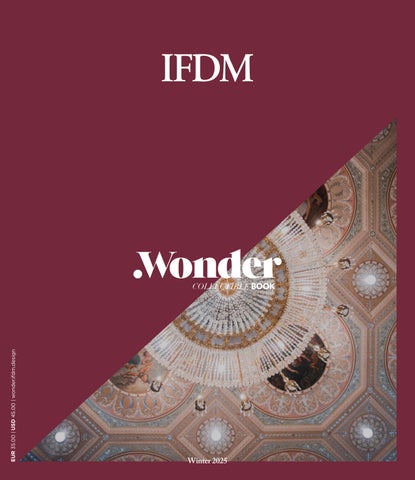
EUR 35.00 | USD 45.00 | wonder.ifdm.design
Winter 2025
Winter 2025
ITACACOLLECTION DESIGN BY CARLO COLOMBO
customerservice@talentispa.com www.t a l e n t i s pa .co m
FEATURES
Winter 2025
04 YEAR X
18
Color stories Pure energy
Interviews
26
WONDER 12 Weil am Rhein | Doshi Retreat | Balkrishna Doshi 14 University of Texas at Dallas | Crow Museum of Asian Art | Morphosis Architects
PEOPLE Chad Oppenheim
22
PEOPLE Andrea Auletta
72
Design is a slalom… very special
116
PEOPLE India Mahdavi The art of crossing boundaries
Projects review
16 Marbella | Nota blu brasserie | Astet Studio
The Ritz-Carlton Masai Mara Safari Camp Kenya
68 Toronto | Suite 115 craft cocktail bar | Atelier Sun 26
110 Los Angeles | LAX Metro Transit Center
Grimshaw | Gruen Associates | Arup
112 Shanghai | Gate M West Bund Dream Center
MVRDV | AISA | Field Operations
114 Milan | Magma, Lubna, Scaramouche | Q-Bic
A front-row safari experience
Fairmont Golden Prague
34
Beyond hospitality: where art meets architecture
Azimut Yachts Avigliana, Italy
40
A complex organism
44
Palazzo Petrvs Orvieto, Italy A journey through time Højvangen Church Denmark
50
A modern approach to spirituality
Eisenhut Boutique Hotel Bolzano, Italy
54
Lively exterior, tranquil interior
Casa Sa Farola Menorca, Spain
58
Symmetry & serenity
Schloss Schauenstein
62
Fürstenau, Switzerland Layered histories
The Social Hub Florence & Rome
76
A ‘blended’ experience
The Waldorf Astoria New York
58 2 | IFDM
Publisher & Editorial Director Paolo Bleve | bleve@ifdm.it
Managing Editor
Giulia Guzzini | giulia@ifdm.it
Deputy Editor, Features & Content Curator Alessandra Bergamini alessandra@ifdm.it
Editor-at-Large
Veronica Orsi | orsi@ifdm.it
Contributors
66 Toronto | POUTx | Studio Author 70 Bangkok | Cloud 11 | Snøhetta | A49 Architects
The architecture of emotion
Winter
84
Between preservation and metamorphosis
90
The 70s chic revival
Kimpton Los Monteros Marbella, Spain
Alessandro Bignami, Mariateresa Campolongo, Matteo De Bartolomeis, Manuela Di Mari, Elena Franzoia, Elena Luraghi, Francesca Oddo
International Contributor New York | Anna Casotti
Digital Editorial Team redazione@ifdm.it
Brand Relations
Matteo De Bartolomeis | matteo@ifdm.it Camilla Guffanti | camilla@ifdm.it Annalisa Invernizzi | annalisa@ifdm.it Spain | Pilar Tendero | pilar@ifdm.it
Graphic Department
Marco Parisi | grafica@ifdm.it
Advertising
Marble/ADV Tel. +39 02 40701449 - info@ifdm.it
Closed by the editorial staff 9th December 2025
Owner and Publisher Marble srl
Head office and Administration
Corso Venezia 8 - 20121 Milano, Italy Tel. +39 02 40701449 - www.ifdm.design
Printed by
Faenza Printing Spa - Faenza, Italy All rights reserved. No part of this publication may be reproduced, stored in a retrieval system or transmitted in any form or by any means, electronic, mechanical, photocopying, recording or otherwise, without the prior written permission of the copyright owner. A record and picture file is available at Marble.
Let’s keep in touch!
FEATURES
Winter 2025
ifdmdesign
96
House of Dior Beverly Hills, USA
96
Serene and edenic
Villa Junot Paris
100 An experience between dream and reality Fondation Cartier Paris
104 A museum-machine BGF45 Bluegame Yachts
108 Sustainable soul, racing performance Aman Nai Lert Bangkok
120 A graceful urban retreat SAN Alia Yachts
128 Where the aft breathes Sauska Tokaj Winery Rátka, Hungary
134 A new winery in Tokaj’s UNESCO landscape The Jellicoe London
138 The different ‘worlds’ of work Rosewood Amsterdam
142 The “sense of place” Casa Fiori Chiari Versilia Marina di Pietrasanta, Italy
148 The hospitality revolution Shebara Resort Red Sea, Saudi Arabia
152 Where biophilia meets futurism
Short Stories
157 A wide view on major international projects
152
by Stefania Evans and Sabrina Sciama
Design inspirations
175 A selection of the most innovative products
for the contract sector by international brands
Next
185 A preview of the upcoming global projects NEXT IN THE WORLD
192 New top hotels: investments shift focus to the Far East On cover
The Waldorf Astoria New York Photo © Noë & Associates/The Boundary
4 | IFDM
EDITORIAL
Winter 2025
Spaces in harmony
T
PAOLO BLEVE Publisher & Editorial Director
he collection of wonders for 2025 is completed by three interviews that are more like live lectures, a series of projects that are magically diverse, a sequence of “Great Beauties” that we don’t always get to present like this, all together, all so different, but all so exciting. The “emotional power of places” is the common thread that links the interviews with three completely different designers, who here in the Book find themselves at the same table, one that harmoniously combines the natural and the artificial: India Mahdavi, Andrea Auletta, and Chad Oppenheim. The challenge to memory is one of the recurring themes of this Wonder Book Winter: memory to be preserved, brought to the surface and enhanced, making ancient spaces contemporary and, in some cases, even futuristic and visionary. The absolute culmination of this challenge is reached by Villa Junot in Montmartre and Palazzo Petrvs in Orvieto, which represent two exciting round trips through time, but also Sa Farola in Menorca, Casa Fiori Chiari Versilia, the Rosewood Hotel, and Schloss Schauenstein – albeit with very different interpretations, but that is the beauty of design grammar – are ambassadors of the coexistence of old and new. Two breathtaking architectural designs (both playing on intersecting circles and round shapes) are undoubtedly the Hungarian one (but the designers’ hands have traveled around the world) of the Sauska Tokaj winery in the Tokaj-Hegyalja region, which UNESCO has listed as a World Heritage Site, and that of the Shebara Resort on the Red Sea, where
each bungalow looks like a spaceship faithfully following the direction indicated by the central building. Sustainability that respects the surroundings is represented by the Ritz-Carlton Masai Mara Safari Camp in Kenya, where, in the heart of the natural habitat, shapes and, above all, materials blend in with the context and respect its origins, as well as impressing with their architecture. A new interior design approach for a special church that focuses on social issues and attracts even those who do not profess a religion, examples of architecture and interiors where industrial style solves the design question, examples of high-level hospitality, and the naval sector, which never ceases to find new concepts. A final journey for this year with the promise of new and always interesting Wonders in 2026!
IFDM | 7
Light inspired by beauty.
With the new collection of lamps inspired by its most iconic vases, Venini renews the art of glassmaking and elevates it through the transparencies and the wonderful shades of light. GRAN BALLOTON LUCE / Color: Milk White / Designer: Venini. BALLOTON LUCE / Color: Red / Designer: Venini. venini.com
CURATOR’S LETTER
Winter 2025
Designing metamorphosis
“T
ALESSANDRA BERGAMINI Deputy Editor
he purpose of design is to elevate the experience of being alive, to create spaces that connect us to nature and to ourselves. Form follows feeling. Structure follows life.” This is how Chad Oppenheim, founder of Miami-based Oppenheim Architecture, introduces and partly summarizes his architectural philosophy and design approach in the interview published in this Winter Wonder Book, which concludes the 2025 collection. Moving beyond the twentieth-century mantra Form follows function, design thinking evolves to integrate emotional states and behaviors, creating and transforming places and spaces that not only meet functional requirements but, more importantly, ignite real and lasting experiences of beauty, well-being, creativity, and connection. The Form follows feeling approach is a way to interpret context, in the layering of its natural, geographical, historical, and social elements, and simultaneously to transform it into a different reality, both human-centric and nature-centric. Is the emotional power of a place, whether new or regenerated, also derived from the metamorphosis that design can generate within a specific context? Many diverse examples of transformation are selected in this Wonder Book to seek an answer to this question: from The Social Hub in Florence and Rome to the Waldorf Astoria in New York, from the Azimut Headquarters to the Rosewood Amsterdam, from the Fondation Cartier pour l’art contemporain to Hotel Schloss Schaeustein, and also projects for The Fairmont Golden Prague, the Heisenhut Hotel, Villa Junot, and Casa Sa Farola. By way of mimesis, one might add that Feeling follows metamorphosis, in a virtuous cycle where transformation reinterprets a place’s potential, adds value, and amplifies emotions.
And if design is metamorphosis towards a better future, fundamental elements of the transformation process are attention to natural elements and the integration of greenery, as unanimously affirmed by the three protagonists featured on the White Box page. “Integrating greenery thoughtfully allows architecture to nurture both the built environment and the communities that inhabit it,” says Lukas Rungger of Noa. “The integration of natural systems within the built environment is not merely an aesthetic exercise but a critical framework for generating spaces that are contextually resonant and culturally grounded,” adds Pooja Shah-Mulani of LW Design. “Introducing the plant world into our daily environments is no longer an option but a necessity: as we no longer live in nature, we must bring nature to us,” concludes Antonio Girardi of PNAT. Feeling also follows greenery.
IFDM | 9
WHITE BOX
Winter 2025
Integrating nature, a design imperative Curated by: Alessandra Bergamini
POOJA SHAH- MULANI LW Design, managing partner & creative
T LUKAS RUNGGER NOA, founder & architect
I
ntegrating nature into design is a central concern for architects, as architecture fundamentally exists to provide protection from environmental conditions – shelter from heat, cold, sun, wind... Yet this very act of separation from the outside world is architecture’s paradox, as every building aims to frame, interpret, and enhance the context in which it resides. Greenery – or natural elements more broadly – thus becomes highly desirable, yet all too often it is treated as a mere cosmetic addition, applied only at the final stages of a project. At NOA, our approach has been different. In our latest urban development project, Renneria, vegetation is treated not just for its aesthetic quality but as a strategic design tool, particularly in creating social islands and fostering placemaking. Agricultural green spaces and community gardens that support private food production serve functions far beyond productivity: their accessibility and appeal foster gathering, belonging, and social interaction. These green islands have the power to become vital meeting points and anchor a neighborhood’s identity, whether in an emerging district or in any new architectural development. Ultimately, integrating greenery thoughtfully allows architecture to nurture both the built environment and the communities that inhabit it. 10 | IFDM
he integration of natural systems within the built environment is not merely an aesthetic exercise but a critical framework for generating spaces that are contextually resonant and culturally grounded. At LW Design, we maintain that architectural and interior interventions which disregard their ecological and socio-cultural surroundings inevitably produce outcomes that feel hollow, lacking in narrative, identity, and long-term relevance. Our approach therefore prioritises an analytical reading of place, ecology, and community as the basis for design.This methodology is exemplified by the Ritz-Carlton Masai Mara, where spatial planning, material selection, and artisanal collaborations were informed by the intrinsic logics of the savannah ecosystem. The project’s low-impact structures, Maasai-inspired forms, and locally produced craft embed the built environment within the region’s environmental and cultural continuum. Similarly, the re-envisioning of Bab Al Shams draws from vernacular desert typologies, leveraging passive environmental strategies, courtyards, and tonal material palettes to strengthen the dialogue between interior space and the desert landscape. Through such projects, we argue that the integration of nature is an operational and ethical imperative, one that enhances environmental performance, strengthens cultural authenticity, and elevates the experiential quality of contemporary hospitality design.
P
ANTONIO GIRARDI Pnat, co-founder
lants are complex living technologies: intelligent systems capable of understanding, reacting to, and interacting with the environment in ways so intricate that they profoundly influence our well-being and health. Today, the most innovative way to design the spaces where we live, work, study, and heal is to reintegrate nature at the heart of architecture, making it a functional part of buildings, not merely a decoration. Introducing the plant world into our daily environments is no longer an option but a necessity: as we no longer live in nature, we must bring nature to us. One of the main critical issues in our buildings is indoor air quality: we spend almost 80% of our time indoors, often in environments much more polluted than the outside. Yet, plants, when correctly integrated into a project, can significantly contribute to reducing pollutants and enhancing the physical, as well as psychological, well-being of those who inhabit those spaces. In this field, one of the most radically innovative systems is Fabbrica dell’Aria: a botanical filtration technology that uses plants, roots, and microorganisms to naturally purify indoor air, leveraging the extraordinary biological capabilities of the plant world. This solution combines ecological sensitivity with scientific research, adding a direct, substantial, and measurable effect on air quality to the perceptual and sensory benefits of greenery. In offices, comfort and concentration improve; in schools, learning is facilitated; in hospitals, plants accompany the healing process; in homes, botanical technology makes what we breathe every day healthier. Valuing the intelligence of the plant world means paving the way for innovation that doesn’t impose itself on nature, but grows with it. No longer closed and inert spaces, but environments that breathe, react, and actively contribute to the well-being of their occupants. From this perspective, the future will be made of places that are more efficient and technologically advanced, but also more alive.
Shangai extendable table, Soffio chairs, Onda suspended sideboard, Techwall bookcase RIFLESSI STORE MILANO | BERGAMO | BRESCIA | ROMA | PESCARA | TORINO NAPOLI | BARI | REGGIO CALABRIA | PALERMO
Winter 2025
WONDER
WEIL AM RHEIN | DOSHI RETREAT | BALKRISHNA DOSHI The Vitra Campus recently unveiled a structure dedicated to contemplation, designed by Pritzker Prize laureate Balkrishna Doshi alongside Khushnu Panthaki Hoof and Sönke Hoof. Inspired by Indian spirituality,
12 | IFDM
WONDER
© Julien Lanoo
it offers a sensory journey through sound and silence, marking Doshi’s first project outside India and his last before his passing in 2023.
IFDM | 13
Winter 2025
WONDER
UNIVERSITY OF TEXAS AT DALLAS | CROW MUSEUM OF ASIAN ART | MORPHOSIS ARCHITECTS © Mauricio Rojas
The Museum in the Edith and Peter O’Donnell Jr. Athenaeum is the heart of the cultural district on the campus, aimed at fostering dialogue between art, architecture and academic research.
14 | IFDM
Winter 2025
WONDER
MARBELLA | NOTA BLU BRASSERIE | ASTET STUDIO © Francisco Nogueira
Through the entrance, the high volume of this organic and geometric vestibule is filled with wood arches covered with leaves, aimed at creating a sensation of natural space.
16 | IFDM
Wainscott Collection walterswicker.com
Winter 2025
COLOR STORIES
Pure energy A vibrant year awaits us, both literally and metaphorically, with colours ranging from yellows to blues and reds. Here’s a sneak peek at the colour trends for 2026, courtesy of ColorWorks Author: Veronica Orsi
18 | IFDM
Trend
L
et’s end the year on a high note with the last five colours that preview next year’s trends. As always, the guide is based on an analysis of emerging social movements. International experts at ColorWorks™ develop the annual ColorForward™ colour map, which translates future trends into 20 key colours organised into five visual stories. Each story reflects an evolution in collective taste in response to cultural shifts and emerging consumer desires. The first three stories have already been featured in previous editions of the Wonder Book, but this latest edition takes us towards 2026 thanks to Roberto Romanin’s narrative. He is a senior designer at the ColorWorks™ design and technology centre. His predictions are invaluable for those who need to understand market trends, design collections and create products that reflect the aesthetics set to dominate in the coming months. They are also invaluable for those seeking creative inspiration from a familiar colour palette that will resonate with the public. Romanin explains that 2026 begins with lighter, more harmonious shades than this year, ushering in an era of energy, brightness, and fragile yet genuine optimism. Soft pastels and mid-tones take centre stage, replacing darker shades seamlessly. Neutrals, the protagonists of recent years, are transformed, remaining delicate yet acquiring subtle nuances that give them depth and distinction. The result is a balanced landscape in which warm and cool tones interact naturally while vibrant yellows and a range of reds take centre stage. A glimpse into the future reveals a clue about 2027: an important and almost inevitable return to neutrals. ColorForward 2026 therefore consists of the stories Wonderland, Bio-Funk, Viviendo de noche, and Carnival of fuels (told in episodes within each edition of the Wonder Book). Wonderland identifies the growing search for escape and comfort, in a multitude of solutions ranging from fantasy to collectible games. Bio-funk takes us through some of the extraordinary information technologies for data processing, such as bio-computing. Viviendo de Noche focuses on the problem of rising temperatures and heat waves that increasingly force us to adapt our daily schedules to different times of day - a factor that could contribute to the growth of the night-time economy. Now it’s time for Carnival of Fuels, the fourth and final story, which tells a more pragmatic tale: the search for alternative fuels that will help us meet the growing demand for electricity.
Winter 2025
PEOPLE
THE ARCHITECTURE OF EMOTION An architecture that feels the earth, light, climate, and culture. This is how architecture responds to its context not just physically, but emotionally, becoming timeless
“T
he emotional quality of architecture stems from the harmony between the natural and the artificial,” says Chad Oppenheim, the visionary architect who founded his eponymous Miami-based studio, Oppenheim Architecture, in 1999 with the aim of designing with sustainability and emotion at its core. “Feeling guides; geometry follows” is a creative philosophy that finds its essence in the genius loci and the culture of the land. This is manifested in exclusive private residences inspired by local topographies, earth-sculpted resorts like Desert Rock in Saudi Arabia, which he calls “perhaps the clearest expression of our philosophy,” and extending to the Ayla Golf Academy & Clubhouse in Jordan, nestled within an ancient and evocative organic form. These are hallmarks of a monumental architecture that harmoniously blends with pristine dunes, beaches, and deserts, using local materials and drawing on millennia-old cultures to narrate the very essence of each project.
author: Anna Casotti projects photo: Ayala Golf Clubhouse (Rory Gardiner); Desert Rock (Red Sea Global and Oppenheim Architecture); College of Europe - Tirana Campus & Signature Villa (Oppenheim Architecture)
22 | IFDM
Chad Oppenheim
How would you describe your creative philosophy, and what principles have guided your projects since you founded Oppenheim Architecture in Miami in 1999? My work has always grown from a sensitivity to how spaces make us feel. Early on, I realized architecture is not about formal vocabulary – it is about resonance. The purpose of design is to elevate the experience of being alive, to create spaces that connect us to nature and to ourselves. Form follows feeling. Structure follows life. The architecture must belong to its place. Since founding the studio in Miami in 1999, this has remained our guiding approach. Every project begins with an understanding of the spirit of the site. We listen to the land, to light, to climate, and to culture. When architecture responds to context emotionally as well as physically, it becomes timeless. What were your main sources of inspiration at the beginning of your career, and how have they evolved over time? My inspiration comes from the emotional power of place. Travel has deepened that awareness. I move through the world as a cultural nomad – learning how different landscapes shape the lives of the people who inhabit them. Over time, I’ve become more focused on distillation: removing excess so the essential qualities of light, material, and landscape can come forward. Looking back at your career to date – and the many awards you’ve received, such as the 2023 American Prize for Architecture – which of your projects do you consider the most representative of your idea of architecture? Desert Rock in Saudi Arabia may be the clearest expression of our philosophy. The resort is carved directly into the Hejaz Mountains, sheltered by rock formations and cooled by the earth. We used excavated stone and sand from the site itself, allowing the architecture to visually merge with the terrain. The intention was always for the natural environment to remain the protagonist – the architecture simply reveals what was already there.
Winter 2025
PEOPLE
Chad Oppenheim
IFDM | 23