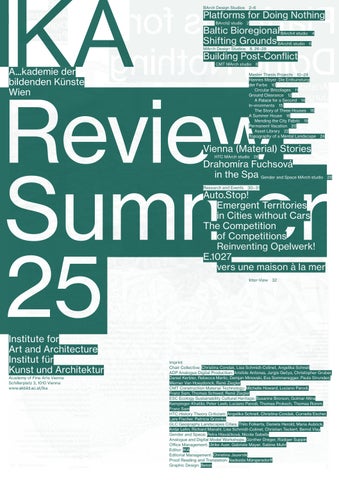
BArch Design Studios
2–6
Platforms for Doing Nothing BArch2 studio
2
Baltic Bioregional BArch4 studio 4 Shifting Grounds BArch6 studio 6 MArch Design Studios
8, 26–28
Building Post-Conflict A...kademie der bildenden Künste Wien
CMT MArch studio
8
Master Thesis Projects 10–24 Hannes Meyer: Die Entkunstung der Farbe 10 Circular Bricolages 11 Ground Clearance 12 A Palace for a Second 14 In-vironments 15 The Story of Three Houses 16 A Summer House 18 Mending the City Fabric 19 Permanent Vacation 20 Asset Library 22 Topography of a Mental Landscape
Review Summer 25 24
Vienna (Material) Stories HTC MArch studio
26
Drahomíra Fuchsová in the Spa Gender and Space MArch studio 28 Research and Events
30– 31
Auto.Stop! Emergent Territories in Cities without Cars The Competition of Competitions Reinventing Opelwerk! E.1027 vers une maison à la mer Inter-View
Institute for Art and Architecture Institut für Kunst und Architektur Academy of Fine Arts Vienna Schillerplatz 3, 1010 Vienna www.akbild.ac.at/ika
32
Imprint Chair Collective: Christina Condak, Lisa Schmidt-Colinet, Angelika Schnell ADP Analogue Digital Production: Aristide Antonas, Jurgis Gečys, Christopher Gruber, Daniel Kerbler, Rebecca Merlic, Damjan Minovski, Eva Sommeregger, Paula Strunden, Werner Van Hoeydonck, René Ziegler CMT Construction Material Technology: Michelle Howard, Luciano Parodi, Franz Sam, Thomas Schwed, René Ziegler ESC Ecology Sustainability Cultural Heritage: Susanne Brorson, Golmar-Mina Kempinger-Khatibi, Peter Leeb, Luciano Parodi, Thomas Proksch, Thomas Romm, Franz Sam HTC History Theory Criticism: Angelika Schnell, Christina Condak, Cornelia Escher, Lars Fischer, Patricia Grzonka GLC Geography Landscapes Cities: Thilo Folkerts, Daniela Herold, Maria Auböck, Antje Lehn, Richard Manahl, Lisa Schmidt-Colinet, Christian Teckert, Bernd Vlay Gender and Space: Petra Hlaváčková, Nicole Sabella Analogue and Digital Model Workshops: Günther Dreger, Rüdiger Suppin Office Management: Ulrike Auer, Gabriele Mayer, Sabine Muhr Editor: IKA Editorial Management: Christina Jauernik Proof Reading and Translation: Nadezda Müngersdorff Graphic Design: Beton