
A call to action: the second Lancet Commission on adolescent health and wellbeing
Sarah Baird, Shakira Choonara, Peter S Azzopardi, Prerna Banati, Judith Bessant, Olivia Biermann, Anthony Capon, Mariam Claeson, Pamela Y Collins, Nicole De Wet-Billings, Surabhi Dogra, Yanhui Dong, Kate L Francis, Luwam T Gebrekristos, Allison K Groves, Simon I Hay, David Imbago-Jácome, Aaron P Jenkins, Caroline W Kabiru, Elissa C Kennedy, Luo Li, Chunling Lu, Jun Ma, Terry McGovern, Augustina Mensa-Kwao, Sanyu A Mojola, Jason M Nagata, Adesola O Olumide, Olayinka Omigbodun, Molly O’Sullivan, Audrey Prost, Jennifer H Requejo, Yusra R Shawar, Jeremy Shiffman, Avi Silverman, Yi Song, Sharlene Swartz, Rita Tamambang, Henrik Urdal, Joseph L Ward, George C Patton*, Susan M Sawyer*, Alex Ezeh*, Russell M Viner*
Executive summary
Adolescents are the future leaders of our world. Ensuring their health and wellbeing—now and in the future—is one of the strongest mechanisms available to safeguard the collective future of humanity and to secure a more just society and a healthier and more productive planet. Investments in the current generation of 10–24-year-olds will reap a triple dividend, with benefits for young people today, the adults they will become, and the next generation of children they will parent. These potential benefits are particularly relevant for Africa and Asia, where around 82% of the world’s adolescents currently live , a proportion that is projected to rise to 85% by 2100. Adolescence is a key developmental phase when dramatic biological growth and psychological maturation have the potential, if nurtured and supported, to unlock the capabilities of young people to be the innovators, educators, advocates, and leaders of the next 50 years. But globally the health and wellbeing of adolescents is at a tipping point. Progress in adolescent health has lagged well behind the improvements that have been made in the health and development of young children across the 21st century. The benefits of progress in children’s health risk being undermined by an increased burden of morbidity and mortality in adolescence, which could jeopardise the prospects of future generations. This increased burden includes rapidly escalating rates of non-communicable diseases and mental disorders, accompanied by threats from compounding and intersecting megatrends, including climate change and environmental degradation, the growing power of commercial influences on health, rising conflict and displacement, rapid urbanisation, the aftermath of the COVID-19 pandemic, and risks of future pandemics. Yet opportunities are also immense, with growing engagement in education, economic development, and digital innovation providing prospects for even the most marginalised adolescents. To tackle these compounding challenges and take advantage of all that the 21st century has to offer, it will be necessary to draw on the power, ideas, and leadership capabilities of young people to reimagine and recreate a healthier, fairer, and just planet. This Lancet Commission comes at a crucial time for adolescent health and wellbeing. Initiated in 2021, it brings together a diverse group of 44 Commissioners who span disciplines, geographies, and generations. The
Commission sets the global tone for shared and inclusive authorship, with a concerted prioritisation and approach to meaningful engagement with youth experts via the inclusion of ten youth Commissioners. Grounded in a set of workstreams co-led by senior Commissioners and youth Commissioners, we have embedded meaningful adolescent and youth engagement throughout all aspects of the Commission, including by bringing together 122 adolescents across the world to engage in what we termed Youth Solution Labs and appointing a
Key messages
Published Online May 20, 2025
https://doi.org/10.1016/ S0140-6736(25)00503-3
*Joint senior authors
Department of Global Health, Milken Institute School of Public Health, George Washington University, Washington, DC, USA (Prof S Baird PhD); Johannesburg, South Africa
• Investments across adolescence—ie, the period between age 10 years and 24 years— will reap a triple dividend, with benefits for young people today, for the adults they will become, and for the next generation of children whom they will parent.
• Despite progress in some areas, without increasing investments, our projections suggest that by the end of the Sustainable Development Goal era in 2030, at least half of the world’s adolescents (1 billion people) will be living in multiburden countries where adolescents experience a complex and excess burden of disease. We project that, in 2030, 464 million adolescents globally will be overweight or obese (143 million more than in 2015) and 42 million years of health life will be lost to mental disorders or suicide (2 million more than in 2015).
• Funding for adolescent health and wellbeing is not commensurate with the magnitude of the challenge and is not targeted to the areas of greatest need. For example, specific funding for adolescent health accounted for only 2·4% of total development assistance for health in 2016–21, despite adolescents accounting for 25·2% of the world population.
• Today’s adolescents are the first human cohort who will live their entire lives under the shadow of climate change. Intergenerational justice demands that current and future generations of adolescents have the resources they need for health and wellbeing.
• Central to effective action is the meaningful engagement of adolescents in policy, research, interventions, and accountability mechanisms that affect them.
• Better indicators and improvement in data systems at the national and global level are required to monitor systemic changes in health and wellbeing outcomes and in the circumstances in which adolescents are growing up.
• Enabling laws and policies provide the foundational environments for sustained improvements in adolescent health and wellbeing. These environments should protect adolescent sexual and reproductive health and rights, reduce the impact of the commercial determinants of health, and promote the healthy use of social media and online spaces.
• Multisectoral actions on mental health, nutrition, sexual and reproductive health, and violence are required to amplify gains made in adolescent health. Coordination is needed between ministries of health and of education with regard to interventions in schools.
Recommended actions
Create enabling environments to transform adolescent health and wellbeing
• Engage, amplify, and protect the voices of adolescents in advocating for change and in making policies to effect change
• Coordinate efforts across the developmental window of adolescence to build on investments in earlier childhood
• Devise a development goal centred on adolescent health and wellbeing, with strengthened measurement, accountability, and coordination through the Office of the UN Secretary-General
• Enhance global, national, and subnational accountability for adolescent health and wellbeing through innovations in indicators, measurement approaches, and reporting processes
• Match financing to adolescents’ health needs, including risks of current and future disease burdens
• Strengthen capacity across the field of adolescent health and wellbeing
Amplify actions within existing systems to address adolescent health and wellbeing
• Hold national education and health ministries jointly accountable for student health and wellbeing
• Ensure universal access to adolescent-responsive health care
• Provide equitable access to high-quality primary and secondary education for all adolescents, with pathways to post-secondary training and economic opportunities
• Scale up gender-responsive actions to accelerate progress towards sexual and reproductive health outcomes and reduce gender-based violence
• Protect adolescents from the adverse effects of violence, armed conflict, and incarceration
• Strengthen community systems that promote mental health and wellbeing
Develop innovative approaches to address complex and emerging health threats in partnership with adolescents
• Limit the impact of commercial drivers on adolescent health and wellbeing
• Promote healthy use of social media and online spaces to prevent harm
• Protect adolescent health and wellbeing now and for the next generation through emergency action against the planetary crisis of climate change, biodiversity loss, and pollution
(S Choonara PhD); Adolescent Health, Murdoch Children’s Research Institute, Parkville, VIC, Australia (Prof P S Azzopardi PhD, K L Francis MBiostat, E C Kennedy MPH, L Li MPH, M O’Sullivan MPH, Prof G C Patton MD, Prof S M Sawyer MD); Centre for Adolescent Health, The Royal Children’s Hospital, Parkville, VIC, Australia (Prof G C Patton, Prof S M Sawyer); Department of Paediatrics, University of Melbourne, Parkville, VIC Australia (Prof P S Azzopardi, K L Francis, L Li, Prof G C Patton, Prof S M Sawyer); Adolescent Health and Wellbeing Program, The Kids Research Institute of Australia, Perth, WA, Australia (Prof P S Azzopardi); National Centre for Epidemiology and
multidisciplinary group of adolescent and youth peer reviewers. Building on the 2016 Lancet Commission on Adolescent Health and Wellbeing, which brought attention to the importance and power of the triple dividend that can accrue by investing in adolescent health, this second Commission unpacks the opportunities and challenges faced by the adolescents of today in the wake of profoundly changing determinants of health and wellbeing and existential global threats. The focus on action in the title of this Commission aims to draw attention to the need for a series of specific, multisectoral actions to safeguard and promote adolescent health and wellbeing towards the end of the Sustainable Development Goal (SDG) era and into the second half of this century.
Insufficient and uneven progress
As of 2024 (the time of writing), headway has been made in reducing communicable, maternal, and nutritional diseases in adolescents globally, and particularly among
female adolescents. Although the greatest gains have been made in south Asia and sub-Saharan Africa, these regions also continue to experience a high burden of disease in adolescents. Progress has also been made in reducing the burden of disease from injuries, although less so in Latin America, north Africa and the Middle East, and sub-Saharan Africa, which continue to carry a heavy burden of preventable deaths and disabilities, including from conflict. Against these advances, strikingly little progress has been made in reducing adolescent non-communicable diseases in every region of the world, with rises globally in obesity-related diseases and mental disorders in young people.
In terms of health risks, substance use (specifically tobacco and alcohol) has declined in every region. However, we project that a third of adolescents will be overweight or obese in 2030 in Latin America, the Middle East, and in high-income countries. Participation in education, the strongest determinant of health, has been a success story, particularly for young women. Yet there are growing numbers of older adolescents who are not in education, employment, or training. We project that almost a third of female adolescents will not be in education, employment, or training by 2030. Although there has been good progress in countries adopting laws and policies to protect and promote adolescent health and wellbeing, in many countries reversals in sexual and reproductive health policy threaten previous gains. The ongoing impact of the COVID-19 pandemic further undermines progress.
Adolescents were largely not specifically accounted for in the SDGs. Despite progress in some areas, without increasing investments, our projections suggest that by the end of the Sustainable Development Goal era in 2030, at least half of the world’s 2 billion adolescents will be living in multi-burden countries, where adolescents will experience a complex and excess burden of disease. We project that, in 2030, 464 million adolescents globally will be overweight or obese (143 million more than in 2015) and that 42 million years of health-life will be lost to mental disorders or suicide (2 million more than in 2015).
Insufficient investment
Development assistance for adolescent health and wellbeing from multilateral donors and countries remains insufficient and poorly aligned to need. Adolescents account for 25·2% of the population in lowincome and middle-income countries and 9·1% of the total burden of disease, but they receive only 2·4% of total development assistance for health. Despite growing evidence that investing in adolescent health and wellbeing is highly cost-effective, investment has been inadequate, mistargeted, and prioritised away from adolescents. Recent dramatic reductions in foreign aid by major donors such as the USA, the UK, and other wealthy countries, further threaten adolescent health.
Novel threats
New threats to health will particularly affect adolescents. Today’s adolescents are the first cohort of humans who will live their entire life experiencing the growing reverberations of climate change. By 2100, a projected 1·8 billion adolescents will live in a world that is expected to warm to around 2·8°C hotter than pre-industrial times. The globalised world provides easy access to harmful commercial products to ever more adolescents, whether sugar-sweetened beverages, ultra-processed foods, or tobacco and e-cigarettes. The digital transition creates both new opportunities and potential harms, particularly for socially marginalised and young adolescents. Adolescents are more likely than other age groups to live in cities. Although living in cities brings many potential benefits, rapid unplanned urbanisation is a major threat to adolescent health. Adolescents are also more likely than adults to be exposed to conflict and to die in war, and the number of adolescents exposed to conflict has more than doubled in the past 30 years. Similarly, adolescents account for a larger proportion of displaced and refugee populations than their general population share, and are likely to account for an even more disproportionally large share as the climate crisis marches on.
Each of these threats has played out in a global economic environment that has been broadly hostile to adolescents, with the 2008 and 2020–21 global financial crises disproportionately affecting adolescent employment. Many adolescents are growing up in countries with high levels of poverty and income inequality, racism and discrimination, and highly inequitable exposure to the consequences of climate change and environmental degradation. Ultimately, an increasing proportion of young people in this century are growing up with limited opportunities.
Actions to address adolescent health and wellbeing
Actions to improve adolescent health and wellbeing need to address established and emerging determinants as well as the growing health inequities experienced by marginalised and hard-to-reach groups of adolescents, both within and across countries. In many cases, multisectoral actions are required to amplify gains, and coordination will be essential between ministries of health and education, particularly in schools.
Adolescent engagement and activism are likely to contribute to creating the social and community changes required to reorient public discourse across a broad array of areas, including climate change, sexual diversity, and disability. Yet it is crucial not to assign the sole responsibility for fixing problems to young people.
In this Commission, we make recommendations based on a set of key principles for effective action. These principles include recognition and upholding of adolescents’ right to participation; ensuring that actions have meaningful adolescent and youth engagement;
promotion of intergenerational justice to ensure that current and future generations of adolescents have the resources they need for health and wellbeing; addressing inequities; acknowledgment of adolescents’ evolving capabilities; improvement of health and wellbeing at all levels, from the individual to the environment (with recognition of the co-benefits of multisectoral actions); ensuring that action is responsive to need; and acknowledgment of the importance of actions to be evidence informed.
Our recommendations aim to ensure that adolescents are strongly positioned to benefit from the health and development agendas that emerge beyond the SDGs. To inform action, we propose a conceptual framework that highlights both the determinants and the sectors responsible for actions to advance adolescent health and wellbeing. In this framework, we position adolescence within the life course, highlight the different age groups within the developmental age span from 10–24 years, and signal the strength of continuities from earlier childhood to adolescence, and from adolescence into adulthood and the next generation. The conceptual framework outlines the determinants of adolescent health and wellbeing and presents levels of influence (ranging from the level of the individual to that of natural systems within a country, with exposures classed as either protective or harmful) and some cross-cutting country-level amplifiers, all occurring in the context of global determinants and shocks. It also identifies the corresponding country-level sectors that are needed to address adolescent health and wellbeing across levels of influence in the context of global responses. To be effective, all actions should involve meaningful adolescent and youth engagement.
Reflecting this framework, our recommended actions include increasing accountability through better UN coordination and stronger multilateral and international global frameworks for cooperation on adolescent health; increasing financing to at least match adolescent population sizes and health burden and need; guaranteeing universal access to adolescent-responsive health care and high-quality primary and secondary education for all young people with pathways to economic opportunities; ensuring that education systems embrace wellbeing alongside educational outcomes within an accountability framework; taking action on the commercial determinants of health (including those that undermine healthy nutrition, promote substance use, and threaten online safety); strengthening policies that protect adolescent sexual and reproductive health and rights; promoting mental health in schools, communities, and cities; and taking emergency action to ensure planetary health.
As populations age and fertility rates fall in even the poorest countries, ensuring the health and wellbeing of adolescents will be crucial to all countries’ health and prosperity. Investment in adolescent health will become increasingly important throughout the 21st century: by
Population Health, Australian National University, Canberra, ACT, Australia (Prof P S Azzopardi); Department of Maternal, Newborn, Child & Adolescent Health & Ageing, World Health Organization, Geneva, Switzerland (P Banati PhD); School of Global, Urban and Social Studies, RMIT University, Melbourne, VIC, Australia (Prof J Bessant PhD); Department of Global Public Health, Karolinska Institutet, Stockholm, Sweden (O Biermann PhD, M Claeson MD); Monash Sustainable Development Institute, Monash University, Melbourne, VIC, Australia (Prof A Capon PhD); Department of Mental Health (Prof P Y Collins MD, A Mensa-Kwao MPH) and Department of International Health (Y R Shawar PhD, Prof J Shiffman PhD), Johns Hopkins Bloomberg School of Public Health, Baltimore, MD, USA; Department of Psychiatry & Behavioral Sciences, Johns Hopkins University School of Medicine, Baltimore, MD, USA (Prof P Y Collins); Academic Affairs, University of the Witwatersrand, Johannesburg, South Africa (Prof N De Wet-Billings PhD); Emerging Professionals Network, International Association for Adolescent Health, Gautam Buddha Nagar, India (S Dogra MA); Institute of Child and Adolescent Health, School of Public Health, Peking University, Beijing, China (Y Dong PhD, Prof J Ma PhD, Prof Y Song PhD); National Health Commission Key Laboratory of Reproductive Health, Beijing, China (Y Dong, Prof J Ma, Prof Y Song); Department of Epidemiology & Biostatistics, Drexel University Dornsife School of Public Health, Philadelphia, PA, USA (L T Gebrekristos MPH); Community Health and Prevention (A K Groves PhD, Prof A Ezeh PhD) and Urban Health Collaborative (Prof A Ezeh), Drexel Dornsife School of Public Health, Philadelphia, PA, USA; Institute for Health Metrics and Evaluation and Department of Health Metrics Sciences, School of Medicine, University of Washington, Seattle, WA, USA (S I Hay DSc); Quito, Ecuador
(D Imbago-Jácome MD); Pacific Planetary Health Hub, Sydney Institute for Infectious Diseases, School of Public Health, Faculty of Medicine and Health, University of Sydney, Sydney, NSW, Australia (A P Jenkins PhD); Centre for People, Place and Planet, School of Science, Edith Cowan University, Perth, WA, Australia (A P Jenkins); Pacific Planetary Health Research Centre, Fiji Institute of Pacific Health Research, Fiji National University, Suva, Fiji (A P Jenkins); Sexual, Reproductive, Maternal, Newborn, Child and Adolescent Health Unit, African Population and Health Research Center, Nairobi, Kenya (C W Kabiru PhD); Women’s, Children’s and Adolescents’ Health Program, Burnet Institute, Melbourne, VIC, Australia (E C Kennedy); Department of Global Health and Social Medicine, Harvard Medical School, Boston, MA, USA (C Lu PhD); City University of New York Graduate School of Public Health & Health Policy, New York, NY, USA (Prof T McGovern JD); Department of Sociology, School of Public and International Affairs, Princeton University, Princeton, NJ, USA (Prof S A Mojola PhD); Department of Pediatrics, University of California, San Francisco, San Francisco, CA, USA (J M Nagata MD); Institute of Child Health (Prof A O Olumide PhD) and Centre for Child and Adolescent Mental Health, College of Medicine (Prof O Omigbodun FMCPsych, R Tamambang MD), University of Ibadan, Ibadan, Nigeria; University College Hospital, Ibadan, Nigeria (Prof A O Olumide); Institute for Global Health, University College London, London, UK (Prof A Prost PhD); Department of International Health, Johns Hopkins University, Baltimore, MD, USA (J H Requejo PhD); Global Financing Facility for Women, Children, and Adolescents, World Bank, Washington DC, USA (J H Requejo); Paul H Nitze School of Advanced International Studies, Johns Hopkins University, Washington, DC, USA (Y R Shawar, J Shiffman); FIA
2100, based on current trajectories, it is projected that nearly 90% of young people will be growing up in countries that currently have limited opportunities and poor health outcomes for adolescents. Adolescence can no longer be ignored. The investments made in this generation of adolescents will determine human and planetary futures, for good or for ill. The time to act is now.
Introduction
“When the music changes, so must the dance.”
—Hausa proverb (west Africa) Adolescents have long been a key source of innovation, creativity, and challenge within human societies. During adolescence, earlier childhood development and life experiences are transformed by sequential waves of biological and psychosocial growth and maturation, thereby priming adolescents for exploration and social engagement. The nearly 2 billion adolescents aged 10–24 years in the world are essential to reinvigorating engagement in public life and trust in institututions.1 Today’s adolescents will be community change-agents for the next 50 years, taking their place as national and global leaders, becoming the foundation of the workforce, and taking on the role of parents and grandparents of those who will take us into the next century.
As the creators and custodians of future national wealth, and for reasons of intergenerational equity, climate justice, and common sense, investment in adolescents should not be neglected in favour of the burgeoning population of older adults globally. As a critical developmental phase in the life course, adolescence can no longer be ignored, and investments made to ensure the health and wellbeing of this
Panel 1: Definition of adolescence
We define adolescents as individuals aged 10–24 years. This definition is consistent with that used in the first Lancet Commission on Adolescent Health and Wellbeing and also detailed elsewhere.2,3 The rationale for this extended age range is based on contemporary understandings of pubertal timing, brain maturation, and social role transitions. In this report, we disaggregate data by age and sex, when relevant, to recognise the differences between early adolescence (age 10–14 years), late adolescence (age 15–19 years), and young adulthood (age 20–24 years), but acknowledge that these age cutoffs are arbitrary. We use the term young people interchangeably with adolescents and acknowledge other similar terms, such as youth, which have varying definitions (eg, our use of the term youth when referring to Youth Commissioners and meaningful adolescent and youth engagement includes people up to 35 years old). We note that the term adolescents and young adults is commonly used to refer to this expanded age range.
generation of adolescents is one of the best strategies to secure the future of humanity and the planet (panels 1, 2).
Many indicators of adolescent health and wellbeing are improving, but others are deteriorating, and the world in which adolescents are growing up is rapidly changing. Global megatrends with profound implications for health and wellbeing are outpacing responses from national governments and the international community. These challenges extend from the degradation of planetary ecosystems to the rapid development of digital technologies, to increasingly pervasive globalised commercial interests, propelled by pronounced demographic shifts.
Africa is central to this global future for adolescents: by the end of the 21st century, it is projected that nearly half the world’s adolescents will live there.4 Large numbers of adolescents will continue to live in south and east Asia, the Middle East, and Latin America. This high proportion of adolescents living outside Europe and North America will require novel investment strategies and scalable and cost-effective actions to maintain the health and wellbeing of these large populations of adolescents.
Many contemporary adolescents have been or are being exposed to a level of conflict and economic and political instability that has not been experienced since World
Panel 2: Adolescents in a rapidly changing world
• The global population of roughly 2 billion adolescents constitutes around 24% of the world’s population. The current generation of adolescents is the largest in the history of humanity. Trends towards smaller family size and ageing societies mean that it is unlikely to be surpassed.4
• Projections suggest that by 2100 around 46% of the world’s adolescents will live in Africa, and that 85% will live in Africa or Asia.4
• The proportion of adolescents living in conflict-affected areas has more than doubled since the 1990s. An estimated 340 million (18%) adolescents now live in conflict-affected areas.5
• Today’s adolescents are the first global generation of digital natives. Globally, 79% of 15–24-year-olds use the internet, a much higher proportion than among any other age-group, and more than 95% of adolescents in highincome and upper-middle-income countries are digitally connected.6
• Today’s adolescents are the first cohort of humans who will live their entire life in a time when the average annual global temperature has consistently been 0·5°C higher than pre-industrial levels.
• Despite increasing participation in education, globally there are increasing numbers of adolescents who are out of school, largely due to early school dropout in subSaharan Africa.7
War 2, and there are grave concerns about developing crises in learning, mental health, and unemployment. Growing within-country inequalities are producing a deepening divide whereby some adolescents benefit from the opportunities provided by urbanisation and migration, whereas others are increasingly left behind. At no other time in recent history have the settings in which adolescents are growing up changed so rapidly for so many. Additionally, the long shadow of the COVID-19 pandemic is amplifying the impact of many of these changes. In addition to those in Africa, the current generation of adolescents in Asia (the region with the largest adolescent population) experience huge inequities in social determinants, health risks, and health outcomes. The window of opportunity to invest in and tackle these issues is rapidly closing. Ultimately, an equity focus that attends to adolescents who are most disadvantaged, wherever they are—including adolescents affected by conflict and war, displaced adolescents, and young people in small island nations particularly affected by climate change—is required.
Adolescence is a time of dramatic growth in human intelligence and cognitive capability.8 It is also the period when lifetime behavioural habits and patterns are forged—for good and for bad. Globally, 83% of lifetime smokers begin smoking by age 24 years,9 and six of the top ten risk factors within the Global Burden of Disease (GBD) 2021 study of adults strongly relate to factors initiated in adolescence (eg, substance use and dietary behaviours).10 Adolescence is also well recognised as a time of risk for mental health: threequarters of lifetime mental disorders have their onset before age 24 years.11
In a rapidly changing world, adolescent health and wellbeing (panel 3) are also evolving fast. New health challenges have arisen that disproportionately affect adolescents in terms of impact or prevalence. Although the prevalence of underweight has declined, the prevalence of overweight and obesity have risen eight-fold in some countries in Africa and Asia over the past three decades,19 and the growing burden of adolescent mental health presents new challenges to high-income, middle-income, and low-income countries alike.20 New data (discussed later in this Commission) enable better understanding of the pervasiveness of exposure to, and perpetration of, violence among young people, and the sexual and reproductive health agenda—for which progress has arguably been most evident—is now threatened by new political forces. Long conceptualised as the healthiest time of life, sitting between the acute risks of premature mortality in early life and the chronic diseases of ageing, adolescence is increasingly understood to be a time of rapidly changing health determinants, which—beyond the immediate effects on the health of young people—have repercussions for future adult health and for the survival, health, and wellbeing of the next generation.21
Panel 3: Definition of wellbeing
The core concepts of wellbeing include satisfaction with life, which is typically characterised by health, happiness, and prosperity.12,13 Beyond subjective happiness and contentment, concepts of wellbeing can include a sense of meaning and purpose to life (known as eudaemonic wellbeing).14 Wellbeing can also be conceptualised as positive features in one’s own self and actions in the world.15 Moore and Keyes highlight that, beyond individual attributes, wellbeing includes wider social integration and contribution.16 Diener proposes that wellbeing is characterised not only by the presence of positive aspects of life and a sense of meaning, but also by an absence of negative exposures.17
Another conceptual approach is to consider the core determinants of wellbeing. One framework of adolescent wellbeing articulates five core domains: health and optimal nutrition; connectedness, positive values, and contribution to society; safety and a supportive environment; learning, competence, education, skills, and employability; and agency and resilience.18 Such framing places health within wellbeing, and is distinct from WHO’s original definition of health (1946), which suggested that health was synonymous with wellbeing.
In this Commission, we focus on the actions required to improve adolescent wellbeing. We use the language of health and wellbeing to bring visibility to the importance of this wider context. We consider actions that address physical and mental health (health-system actions), but our primary focus is on the actions—particularly multisectoral actions—that are required beyond the health system to improve wellbeing.
New opportunities in a rapidly changing world
There are, however, many reasons for hope. Today’s adolescents live in a world of immense resources and opportunities, a world with unprecedented connectedness that is fostered by the rapid expansion of digital technologies, even in the hardest-to-reach places. Growing participation in secondary and tertiary education is increasingly equipping adolescents of all genders with new economic opportunities and providing pathways out of poverty, particularly in the expanding digital and green economies.
Young people increasingly are owning their strengths. Adolescents have been at the heart of efforts to demand action on climate change and social justice and are at the centre of many technological and digital innovations; their voices continue to draw attention to many agendas that are central to adolescent health and wellbeing, including human rights and gender equality. Yet their direct influence on these agendas has been insufficient. Adolescent voices are too often denigrated, tokenised, or actively shut down. Adolescents need to be central participants in any effort to improve their health, wellbeing, and life chances, but the burden of effecting
Foundation, London, UK (A Silverman MSt); National Health Commission Key Laboratory of Reproductive Health, Beijing, China (Prof Y Song); Equitable Education and Economies, Human Sciences Research Council, Cape Town, South Africa (Prof S Swartz PhD); School of Education, University of Cape Town, Cape Town, South Africa (Prof S Swartz); Peace Research Institute Oslo, Oslo, Norway (Prof H Urdal PhD); Department of Women and Children’s Health, King’s College London, London, UK (J L Ward PhD); Population Policy and Practice Research and Teaching Department, University College London Great Ormond Street Institute of Child Health, London, UK (J L Ward, Prof R M Viner PhD)
Correspondence to: Prof Sarah Baird, Department of Global Health, Milken Institute School of Public Health, George Washington University, Washington, DC 20037, USA sbaird@email.gwu.edu
Panel 4: Centring the voices of young people
In this Commission we sought to mainstream meaningful adolescent and youth engagement by drawing on diverse perspectives and leadership at every stage. Adolescents and youth were involved in the conceptualisation and design phase of the Commission, research and analysis, peer review, and the planning and spearheading of dissemination. We first recruited ten young leaders (younger than 35 years) to serve as Youth Commissioners, each of whom was connected to relevant global or national networks.22 One Youth Commissioner was one of the six members of the Commission’s steering committee. Each Youth Commissioner co-led a workstream alongside a senior Commissioner (or an emerging or early-career research leader) to foster intergenerational leadership and meaningful partnerships, alongside efforts to balance power dynamics. Specifically, Youth Commissioners led a study to map the dynamics, successes, and challenges of youth advisory councils in global health (discussed in section 4 of the report) and creatively engaged with adolescents in what we termed Youth Solutions Labs, in which we brought together 122 young people across the world to offer solutions for the Commission (discussed in section 4). Youth Commissioners were remunerated for their work with the Commission, whereas senior Commissioners were not. We also engaged a broader set of voices by recruiting a multidisciplinary adolescent and youth review group of six young people (from 972 applicants) who were extremely well connected to particular activities relevant to adolescent health and wellbeing, and who participated in the peer review meeting, provided feedback on the draft report, and suggested dissemination strategies for how best to reach young people with our key messages.23
We worked hard to engage diverse youth voices. However, almost by definition, young people able to serve as Youth Commissioners or members of the adolescent and youth review group, or even those who participated in the Youth Solutions Labs, are not representative of all young people, particularly those from rural areas, marginalised backgrounds, and younger adolescents. Beyond these formal roles, we have endeavoured to feature the voices of marginalised young people through the research that lies at the heart of this report and, together with our Youth Commissioners, we are committed to dissemination strategies that extend beyond the Global North and the major cities of the Global South.
these improvements should not fall solely or disproportionately on them.
This second Lancet Commission on Adolescent Health and Wellbeing brings together a diverse group of 44 Commissioners from across disciplines, sectors, and geographies.22 Because it is projected that around 41% the world’s adolescents will be growing up in Africa by the end of the century,4 we have emphasised the participation of Commissioners living in Africa or of African descent (11 [25%] Commissioners). We adopted an intergenerational approach to Commission membership that was intended to move towards transformative, complementary partnerships with young people (panel 4).
This Commission is arranged in five major sections and is grounded in original research (panel 5). In section 1, we summarise the advances in adolescent health and wellbeing that have been achieved in the past 10 years and draw attention to where insufficient progress has been made. In section 2, we review the investments that have been made in adolescent health and wellbeing
and explore whether they are sufficient and matched to adolescents’ health needs. Then, we adopt a political economy lens (examining political, social, economic, bureaucratic, and historical factors) to explore the challenges facing the field of adolescent health and present a new investment case for adolescent health and wellbeing. In section 3, we focus on the complex challenges and opportunities posed by global megatrends, novel threats, and emerging determinants that contemporary adolescents now face, with a focus on how these factors affect sexual and reproductive health and rights, mental health, obesity, and violence. In section 4, we present a conceptual framework for understanding contemporary health risks and determinants in the context of the multisectoral actions required to advance adolescent health and wellbeing. We also present a series of case studies to illustrate the scope of the required multisectoral actions, and propose an expanded set of indicators for the post-Sustainable Development Goal (SDG) era. Finally, in section 5 we call for urgent, concerted actions at local, national, and global levels and articulate a set of principles, goals, and specific recommendations to help realise these opportunities for—and with—today’s adolescents towards the end of the SDG era and beyond.
Section 1: Uneven progress in adolescent health in the past 10 years
Why is this Commission needed now?
In 2016, the first Lancet Commission on Adolescent Health and Wellbeing (LC2016) played a key role in focusing global attention on evidence about the health and development needs of adolescents.2 It highlighted the importance of adolescence within the life course and described the triple dividend of benefits that can be reaped by investing in this developmental stage—ie, beneficial health effects for adolescents now, for adolescents when they mature into adulthood in better health, and for the future children of these adolescents.2 LC2016 connected previously siloed but inter-related health issues (eg, sexual and reproductive health, nutrition, maternal health, mental health, substance misuse, and injuries) by adopting a holistic approach to the conceptualisation of adolescent health and wellbeing that focused on health determinants. LC2016 had farreaching impacts. In addition to reaching more than 7·7 million social media users, it has been mentioned in at least 188 policy documents.24 Furthermore, its publication at the commencement of the SDG era helped to focus attention on adolescent health (table 1), with a commitment to adolescents in the Global Strategy for Women’s Children’s and Adolescents’ Health. An accompanying Comment in The Lancet by Ban Ki-moon (then the UN Secretary-General) described adolescents as “the world’s greatest untapped resource”,42 and explicitly signalled the importance of adolescents to achieving the SDGs.
To maintain momentum, the leadership team of LC2016 engaged an expanded group of Youth Commissioners43 and published a series of related papers.3,21,29,31,44–46 Subsequently, adolescents featured in a major financing initiative for the first time: the World Bank’s Global Financing Facility for Women’s, Children’s and Adolescents’ Health (GFF). LC2016 also led to growing recognition of the importance of meaningful adolescent and youth engagement.47 Importantly, the global health community now embraces a broader view of the determinants of adolescent health and wellbeing that recognises that effective adolescent health policies involve multiple sectors and government ministries.18,47,48
Yet despite increased global attention, regions and countries are struggling to gain sufficient investment in the actions required to advance adolescent health and wellbeing. The challenges, as articulated by The Lancet’s Editor Richard Horton,43 include a lack of global leadership and political will, a dearth of data by which to set goals and monitor progress, insufficient evidence for the design of effective, context-specific interventions, a shortage of appropriately trained, equipped, and supported workers, researchers, and advocates, inadequate financial resources, and poor coordination across sectors. Furthermore, the developing momentum for new investments in adolescent health and wellbeing that LC2016 achieved was derailed by the COVID-19 pandemic, and is being further undermined by policies and laws that are increasingly restricting sexual reproductive health and rights globally, together with broad cuts in foreign aid.
Where has progress been made and where are actions needed now?
LC2016 called for investment in actions that were responsive to the needs of specific groups of adolescents (given that needs vary substantially across individuallevel determinants, such as gender, age, disability, and ethnicity) and across sociocultural and structural determinants (eg, socioeconomic status, geographical location, legal and political constructs, and exposure to conflict and displacement), as well as at the intersections of these determinants. To enable responsive actions, LC2016 defined three key groupings based on the leading causes of disability-adjusted life years (DALYs) in different countries. DALYs are a standardised unit that is used to compare the disease burden of different conditions in different countries, populations, and times: one DALY represents one lost year of healthy life because of premature death or the burden of disease or disability. The three key country groupings were multi-burden countries, defined as a burden of communicable, maternal, or nutritional disease causing greater than 2500 DALYs per 100 000 adolescents; injury-excess countries, defined as a burden of injuries causing greater than 2500 DALYs per 100 000 adolescents and less than 2500 DALYs per 100 000 adolescents due to
Panel 5: Summary of Commission methods
This Commission blends previously unpublished original quantitative and qualitative research with broad conceptual reviews in key areas of adolescent health and wellbeing to identify areas in which actions are needed to improve young people’s health and wellbeing. Original research findings are briefly summarised in the relevant sections of this Report, with additional detail provided in the appendix.
Most of the original research we present was conceived and led by Commissioners to facilitate the development of recommendations for this report. We also present some previously unpublished research findings derived from pertinent research that was already underway by Commissioners that was funded by other sources (ie, rather than by specific Commission funding).
The country-level data used in the Commission have been drawn from standardised global datasets, predominantly the Global Burden of Disease study, a global observational epidemiological study of 204 countries and territories overseen by the Institute for Health Metrics and Evaluation (Seattle, Washington, USA) that seeks to comprehensively quantify global, regional, and national health loss over time and provides regularly updated estimates for mortality, morbidity, and other health metrics. We used the most recent available data at the time of analysis, which were from 2021, which we supplemented with data from UN datasets when required. When global datasets were not available for specific outcomes or populations, we used smaller country-specific datasets instead.
The Commission includes systematic reviews addressing key questions based on rapid review methods. However, the broad conceptual literature reviews that provide background in each section were not based on systematic reviews. The Commission also includes detailed qualitative research in key policy areas based on purposive sampling of young people, policy makers, and thought leaders.
To ensure broad engagement with the primary research in the Commission, Commissioners met in person twice in 2023, in Nairobi, Kenya, in May, and in Cape Town, South Africa, in December. At both of these meetings we also hosted national stakeholder meetings to share emerging findings and to gain understanding of local experiences in advancing adolescent health. A third stakeholder meeting was held in Lagos, Nigeria, in August, 2023, at the same time as an adolescent health conference was taking place in the city. At the meeting in Cape Town, we were also joined by senior peer reviewers and a group of adolescent and youth peer reviewers.
communicable, maternal, or nutritional disease; and non-communicable disease (NCD)-predominant countries, defined as a burden due to injuries and communicable, maternal, and nutritional disease of less than 2500 DALYs per 100 000 adolescents.
LC2016 also defined 12 indicators spanning key health outcomes, health risks, and health determinants to enable identification of needs and to monitor future progress. These indicators were subsequently populated for adolescents across 195 countries, largely using data from the GBD 2013 study.44 That analysis found that, globally between 1990 and 2013, greater progress had been made in reducing communicable disease in adolescents (–1 1% annual change for females; –0 9% annual change for males) than in reducing NCDs (–0·5% for females; –0·4% for males). Furthermore, although many countries transitioned from the multiburden or injury excess categories to the NCD-predominant category, differential population
Youth engagement
Lancet Youth Network25
The Lancet Child and Adolescent Health
WHO Youth Council26
Partnership for Maternal, Newborn & Child Health constituency for adolescents and youth27
UNICEF’s Global Girl Leaders Advisory Group
International Association for Adolescent Health Emerging Professionals Network28
Academic
Investment cases for adolescent health29,30
The Lancet Series on adolescent nutrition31
Global Early Adolescent Study
Gender and Adolescence Global Evidence32
Measuring mental health among adolescents at the population level33
Funding of major longitudinal research investments into adolescence
UN agency and multilateral programmatic guidance
Global Accelerated Action for the Health of Adolescents 2.036
Global Action for Measurement of Adolescent Health37,38
UNICEF’s State of the World’s Children report39
UNICEF research briefs40
Disease Control Priorities 3
WHO and UNESCO’s Global Standards for Health Promoting Schools
Global Strategy for Women’s, Children’s and Adolescents’ Health (2016–2030)41
Policy
Global Financing Facility
Global Forum for Adolescents
Description
Six youth commissioners were appointed to advance the recommendations made in the first Lancet Commission on adolescent health and wellbeing.2
Launched in 2017, this medical journal has a youth advisory board and actively supports contributions by youth authors.
Founded in 2022, this council includes youth representatives from health-related and non-health-related organisations and movements.
This initiative has provided an opportunity for young people to advance the Sustainable Development Goals.
Established by UNICEF in 2023, this group consists of girls and women aged 15–24 years who advocate for adolescent girls’ rights and empowerment and leadership on issues affecting girls, such as child marriage, gender-based violence, access to education, climate change, teenage pregnancy, poverty, gendered unfair care burdens, and girls’ needs in humanitarian crises. The group also provides advice and feedback on UNICEF’s work with and for adolescent girls, including policy, advocacy, programming, and overall strategy.
This network, which was established in 2018, aims to support students’, trainees’, and young professionals’ interests, knowledge, and skills in adolescent health.
Papers that highlighted that Sustainable Development Goals will not be met without large-scale investment to build the capabilities of adolescents.
This 2021 Series was the first to bring the health and nutrition communities together to focus on growth and nutrition across the adolescent years. Younger academics and youth advisors were actively engaged in the development and dissemination of the Series.
This study, funded by the Gates Foundation, was established to better understand how gender socialisation in early adolescence occurs in urban areas around the world, and how this socialisation shapes health and wellbeing for individuals and their communities.
Funded by UK aid, this 10-year (2015–25) mixed-methods longitudinal research and evaluation study was established to understand what works to enhance adolescent capabilities and empowerment and follows the lives of 20 000 adolescents in seven low-income and middleincome countries: Ethiopia, Rwanda, Bangladesh, Nepal, Jordan, Lebanon, and Palestine.
This UNICEF-led initiative was established to address the lack of reliable data and tools measuring the mental health of adolescents, particularly in the Global South.
Examples include the Adolescent Brain Cognitive Development study in the USA (which received US$300 million funding),34 a landmark study of adolescent brain development that began in 2015, and the UK-based Adolescent Health Study (which received £62 million funding),35 a longitudinal population study and data platform initiated in 2024 with the goal of increasing knowledge of the health trajectories and outcomes for adolescents. Both of these studies recognise the uniqueness of adolescence as an understudied life stage, rapid recent changes in the health status of adolescents, and the importance of gathering detailed longitudinal biological and psychosocial data.
The first edition, published in 2017, helped to draw attention to the need for a comprehensive response to adolescent health. The second edition, which was published in 2023, incorporated learnings from the previous 6 years.
This group was established by WHO with UN partners to improve health measurement and reporting during key phases of the life course to ensure accountable action. The indicators have been published and are embedded within the Global Accelerated Action for the Health of Adolescents 2.0.
This report examines key issues affecting children and adolescents, and guides UNICEF’s priorities for programming. The 2017 report focused on young people in a digital world, and the 2021 report focused on child and adolescent mental health.
This series of research briefs published in 2017 provided a much-needed review of contemporary research methods for adolescent wellbeing in low-income and middle-income countries.
Moving beyond the previous focus on maternal and child health, volume 8 of Disease Control Priorities 3 (published in 2018) focused on child and adolescent health, with coordinated economic assessments for priority setting at both global and national levels.
The standards and accompanying implementation guidance were developed to help to promote shared understanding of the importance of the education sector to the advancement of adolescent health.
This roadmap aimed to advance the achievement of the highest attainable standard of health for all women, children, and adolescents.
This country-led partnership, which includes adolescents in priority areas, is hosted at the World Bank and fights poverty and inequity by advancing the health and rights of women, children, and adolescents.
The Global Forum for Adolescents sought financial commitments for national government investments in adolescent health and wellbeing. Launched in October, 2023, the 1 8 Billion Young People for Change campaign engaged young people globally on their needs and priorities for health and wellbeing, and demanded that decision makers transform their findings into policies, investments, and actions from world leaders.
Table 1: Selected key initiatives in adolescent health and wellbeing since the 2016 Lancet Commission on Adolescent Health and Wellbeing
growth across countries means that 250 million more adolescents were living in multi-burden settings in 2013 compared with 1990.
We updated this analysis with new data from the GBD 2021 study and include GBD DALY forecasts to 2030. Our new analysis shows that trends in adolescent disease
reduction have been further complicated by the COVID-19 pandemic (figure 1). Between 2010 and 2021, three countries progressed from the multi-burden category to the injury-excess or NCD-predominant categories, but this progress was offset by six countries regressing to the multi-burden category because the burden of disease was greater in 2021 (appendix p 2). Forecasts suggest that 18 countries will progress from the multi-burden to injury-excess or NCD-predominant categories by 2030 and that the adolescent population living in NCD-predominant countries will reach more than 800 million. However, forecasting suggests that, by 2030, more than 1 billion adolescents will live in multiburden countries and almost 200 million will live in injury-excess countries, with poorer health outcomes than adolescents in NCD-predominant countries. An important caveat is that our analysis is limited by the assumption that the epidemiological transition is linear.50 Nonetheless, our findings illustrate how much will be required to equitably advance adolescent health and wellbeing globally.
LC2016 proposed bold global targets for the 12 indicators to be met by the end of the SDG era in 2030 (figure 2; table 2). We assessed progress on these targets to 2021 (mainly by using GBD2021 data) and projected progress to 2030 globally and regionally (table 2; appendix p 4). Data for 2030 were drawn from GBD2021 forecasts (appendix p 5), when available. For all other indicators, we used annual estimates from 2015 to 2021 and calculated the annualised percentage change (determined by fitting a linear model) to estimate the 2030 value of the indicator. This approach does not take into account the changes to the global policy landscape in 2025. We then estimated the required change between 2021 and 2030 to meet the LC2016 targets, taking compounding into account (ie, that each year builds on progress made in the previous years), which yields a slightly more conservative estimate.
Across many regions, progress has been made in reducing communicable, maternal, and nutritional diseases in adolescents, but this progress has been heavily disrupted by the COVID-19 pandemic. At the global level, trends in communicable, maternal, and nutritional disorders are more favourable for female than male adolescents (table 2), with substantial reductions in disease burden in both sexes excluding the COVID-19 shock (appendix p 9), probably as a result of gains made in reproductive health outcomes due to programmatic focus on sexual and reproductive health. Less progress has been made with regard to communicable diseases in both sexes.52 South Asia and sub-Saharan Africa continued to have the highest burden of communicable diseases in 2021, but they were also the regions in which the most progress was made. An annual decline of more than 10% in communicable, maternal, and nutritionrelated DALYs (appendix p 9) would be needed in sub-Saharan Africa to reach the LC2016 target (table 2).
Figure 1: Key transitions in adolescent disease burden globally, 2010–30 (A) shows country transitions between the three defined groupings of leading causes of disability-adjusted life-years in adolescents (ie, multi-burden, injuryexcess, and NCD predominant). The numbers depicted represent the number of countries in each group at each timepoint. (B) shows population count in millions across these groupings. NCD=non-communicable disease. Source: Global Health Data Exchange.49
Progress in reducing the burden of disease and death from injuries among adolescents has been more substantial. Among female adolescents, the 2030 target has already been met in all regions globally. In male adolescents, global levels are forecasted to approach the LC2016 target of less than 2500 DALYs per 100 000 population by 2030. However, in Latin America and the Caribbean, north Africa and the Middle East, and sub-Saharan Africa, future annualised declines of between 5–10% would be required to reach this target by 2030.
Of great concern is the uniform lack of progress towards addressing adolescent NCDs, including mental health disorders. No region is close to meeting the targets set in LC2016, and the global burden of NCDs has increased among female adolescents since 2015. Around a 15% annual decline in NCD-related DALYs would be required to meet global targets by 2030—corresponding to a more than 100-times increase in annual progress since 2015.
For the Global Early Adolescent Study see https://www. geastudy.org/ For the Global Financing Facility see https://www. globalfinancingfacility.org/
Substantial progress has been made in reducing health risks related to substance use (ie, binge drinking and tobacco smoking) across all regions. Targets set in LC2016 are likely to be met by 2030 for female adolescents and might be met for male adolescents. For tobacco smoking, efforts should focus on male adolescents in southeast Asia, east Asia, and Oceania, North Africa and the Middle East, and central Europe, eastern Europe, and central Asia, and efforts to modify binge drinking are required in high-income countries for both sexes.
Progress towards meeting targets related to nutritional risk has been much less impressive. The risk of overweight and obesity has substantially increased across all regions. Based on forecasted estimates, the projected prevalence of overweight and obesity in 2030 will be greater than the 20% target set by LC2016 (23 9% for female adolescents; 22 9% for male adolescents). Of greatest concern are high-income countries, Latin America and the Caribbean, and north Africa and the Middle East, where we project that a third of adolescents will be overweight by 2030.
Progress in anaemia highlights substantial gender inequity: in 2030, we project that globally, 32·7% of female adolescents will be anaemic, compared with only 12 9% of male adolescents. Among female adolescents, the LC2016 target of an anaemia prevalence of less than 10% is projected to be met only in high-income countries. Educational attainment, defined as completing 12 or more years of education, continues to improve, with annual increases of 2% globally, and increases of as much as 7·5% annually for female adolescents and 5·8% for male adolescents in sub-Saharan Africa. However, based on GBD data to 2021, we estimate that global attainment will fall well short of the 80% target for
completion of secondary education by 2030, reaching 57·5% for females and 56·0% for males. This poor projected progress is exacerbated by poor progress in post-secondary educational engagement and high rates of unemployment in certain contexts. In 2030, we project that 30·8% of female adolescents and 19·3% of male adolescents globally will not be in education, employment, or training, with females in north Africa and the Middle East, south Asia, and sub-Saharan Africa the most affected (table 2). Indicators related to contraception and adolescent fertility show improvement, and although we project that the adolescent fertility target is likely to be met globally (except in sub-Saharan Africa), the target of meeting need for contraception will not be achieved globally (table 2).
Data for female child marriage (ie, marriage of girls before age 18 years) were available by region and globally only for 2017 and 2022, with the most recent national estimates shown in figure 2. Globally, UNICEF estimated that 18·6% of 20–24-year-old women in 2022 had got married before they were 18 years, a decline from 21·0% in 2017.51 Regions with the highest proportion of women married before age 18 years had the steepest declines: the prevalence of child marriage declined from 35% in 2017 to 32% in 2022 in sub-Saharan Africa, and from 34% to 26% in south Asia over the same period (figure 2). In 2022, the prevalences of female child marriage in Latin America and the Caribbean (16%) and the Middle East and north Africa (21%) were similar to estimates in 2017, well above the LC2016 target of 10% (figure 2).
Our review of LC2016 indicators shows that although some progress has been made, much remains to be done. Our projections suggest that, by 2030, at least half of the world’s 2 billion adolescents will be living in multiburden countries, where adolescents experience a complex and excess burden of disease. Of particular concern are rapid increases in overweight and obesity, slow progress in anaemia for female adolescents, scant progress related to NCDs, and the growing number of older adolescents not in education, employment, or training. Progress was particularly strong in education participation, especially among female adolescents, but this progress had begun to slow even before the COVID-19 pandemic.53
Collectively, the data we present suggest that the gains in adolescent health and wellbeing envisaged in LC2016 and within the timeframe of the SDGs will not be made. Without political will, policy initiatives, and financial investments to turn things around, large numbers of adolescents will grow up with poor health profiles, which will reduce their ability to contribute to their communities, families, and economies and reduce the likelihood of a sustainable future for the planet.
The LC2016 indicators incompletely capture several contemporary issues arising from growing commercialisation, the digital transition, ecological determinants of health, and forced displacement and conflict, as well as
Health outcomes
Communicable,
DALYs (target:
NCD DALYs
Health
(Table 2 continues on next page)
(Continued from previous page)
Proportion who binge drank (ie, >60 g pure alcohol) in past 30 days (target: <10%)§
Asia, east Asia, and Oceania
Proportion who are overweight or obese (target: <20%)
Proportion with anaemia (target: <10%)
Proportion not in employment, education, or training (target: <10%)¶
(Continued from previous page)
Proportion who complete ≥12 years of education (target: >80%)¶
Proportion whose needs for modern contraceptives are met (target: >80%)|| Global
Birth rate (target: <25 per 1000 female adolescents aged 10–19 years)**
Data are presented by Global Burden of Disease super-region. All targets apply to adolescents aged 10–24 years, unless otherwise specified. The communicable disease group also includes the Global Burden of Disease causes other COVID-19 pandemic-related outcomes and neonatal disorders. *We used the β coefficient from linear regression models of each estimate from 2015 to 2021 to estimate annual percentage change over this period. †Health outcomes and overweight estimates in 2030 came from forecasts by the Institute for Health Metrics and Evaluation; for all other indicators, estimates in 2030 are based on annualised change, 2015–21. ‡Annualised compounded percentage decline needed between 2021 to 2030 to reach targets set in the 2016 Commission. §This target specifically applies to adolescents aged 15–19 years. ¶This target specifically applies to adolescents aged 20–24 years. ||This target specifically applies to adolescents aged 15–24 years. **This target specifically applies to adolescents aged 10–19 years.
Table 2: Progress made in adolescent health against targets set in the 2016 Lancet Commission on adolescent health and wellbeing1
the lingering impacts of the COVID-19 pandemic. New indicators (discussed in section 4) are necessary now and for the post-SDG era to better measure adolescent health and wellbeing over the next 50 years.
The policy landscape: progress, stalls, and reversals
Uneven progress in adolescent health and wellbeing is a product of the legal and policy landscape. National laws and policies affect adolescent health and wellbeing in
many ways, such as by restricting the sale of tobacco to people younger than the legal age and through the use of health warnings on unhealthy foods. More widely, laws and policies shape (and are shaped by) community attitudes to child marriage, female genital mutilation or cutting, and intimate partner violence. They can also limit adolescents’ access to health services, such as by requiring parental consent to access sexual and reproductive health services.
For the Institute for Health Metrics and Evaluation estimates see https://vizhub. healthdata.org/gbd-foresight
Countries with a dedicated adolescent health or wellbeing strategy
Countries with national policies or guidelines for violence in which adolescents are cited as target group
Countries with national policies or guidelines for mental health in which adolescents are cited as target group
Countries with national policies or guidelines for nutrition in which adolescents are cited as target group
Countries with national policies or guidelines for sexual and reproductive health (including pregnancy prevention) in which adolescents are cited as target group
Figure 3: Proportion of countries with a national health strategy addressing 10–19-year-old adolescents and the inclusion of adolescents in national policy initiatives targeting violence, mental health, and sexual and reproductive health, by region
Data were available for 105 countries globally: 44 in sub-Saharan Africa, 20 in southeast Asia, east Asia, and Oceania, five in south Asia, 12 in north Africa and the Middle East, and 24 in Latin America and the Caribbean. Source: WHO.54
The WHO global sexual, reproductive, maternal, newborn, child, and adolescent health policy survey tracks country progress in adopting WHO recommendations in relevant national health policies, strategies, and guidelines.54 The 2022–23 dataset includes information from 105 countries (these data were not collected in the EU and ten countries did not respond to the survey; appendix p 10). Overall, 81 (77%) of the countries that responded (most of which were lowincome and middle-income countries [LMICs]) had strategic plans that address adolescent health and wellbeing, with more countries reporting policies targeted at adolescents on key topics such as violence, mental health, nutrition, and sexual and reproductive health (figure 3), as well as substance use and HIV/AIDS. These findings are reflected in wider dialogues, such as in eastern and southern Africa, where Ministries of health, education and gender have recommitted to sexual and reproductive health policies in the region that are expected to accelerate investments to improve education, health, and wellbeing.55
The prominence of adolescents as a specific population within national policies and guidelines reflects recognition of their unique health and education needs. For example, policies such as free secondary education and age of marriage laws expressly benefit adolescents and have become increasingly widespread. In the same vein, policy shifts in several African nations—specifically Mozambique, Malawi, and Tanzania—have allowed teenage mothers to return to school.56–58 For example, in 2018, driven by activism by civil society groups, the Mozambican Government repealed a 2003 order that
prevented pregnant and parenting adolescents from attending school.59 Globally, efforts to end harmful cultural practices have been strengthened by the adoption of laws that criminalise the practice of female genital mutilation or cutting—particularly in east Africa, where most countries signed a declaration in 2019 to eliminate the practice. There are also broadly positive trends in sexual and reproductive health: at least 60 countries have liberalised abortion policies in the past 30 years, and countries such as Mexico and France now guarantee a right to abortion in their constitution.60 Since 2016, Angola, Barbados, Belize, Bhutan, Botswana, Gabon, India, Nauru, Seychelles, and Trinidad and Tobago have also overturned penal codes related to the criminalisation of consensual same-sex relations.61–63
However, policy reversals, from the repeal of smokefree legislation in New Zealand64 to attempts to overturn a ban on female genital mutilation or cutting in The Gambia,65 threaten previous gains. Legal efforts to criminalise homosexuality and being transgender have increased, particularly in Africa,66 the Middle East,67 and the USA,68 amplifying the already high levels of discrimination and harassment experienced by lesbian, gay, bisexual, transgender, and queer or questioning (LGBTQ+) adolescents and potentially introducing legal barriers to accessing sexual and reproductive health services.69,70 Anti-transgender laws have been upheld, enacted, or proposed in some countries (eg, Bulgaria, USA, Hungary),71–73 and consensual same-sex behaviours remain criminalised in 69 UN member states (32 of which are in Africa).61 Plural legal systems can prioritise
religious or customary law over civil law, and often file exceptions to international agreements that prohibit requirements for third-party consent (eg, from a parent or guardian) for adolescents.74
Policy changes in the USA have had deleterious effects on global progress in sexual and reproductive health. In 2017, for example, the USA reinstated its 1984 Mexico City Policy (commonly known as the Global Gag Rule), which prohibits US federal funding for non-US nongovernmental organisations (NGOs) that provide abortion-related advice, counselling, referral, or services—even in countries where such services are legal and even if the organisation funds these services with their own (non-US) funds.75 Due to linkages between contraception provision and abortion care, the reinstatement of this policy dramatically affected global developmental aid funding for sexual and reproductive health and greatly reduced access to contraception in many LMICs.76 The Mexico City Policy was repealed again in 2021, but was reinstituted in January, 2025. The Dobbs v Jackson decision in 2022, which removed the constitutional right to abortion in the USA, has greatly restricted access to abortion in the USA, and is having global reverberations.60
Progressive support of comprehensive sexuality education over the past few decades is built on a strong foundation of evidence of improved sexual and reproductive health indicators,77–79 international agreements, regional frameworks, and global technical guidance. Yet in many countries previous commitments to comprehensive sexuality education are being increasingly undermined by cultural, religious, and politically organised parental opposition.80 In 2022, Nigeria’s federal government ordered the removal of sex education from the basic education curriculum, with the minister of education arguing that sex education should be left in the hands of parents and religious institutions.81 In 2023, following criticism by conservative groups and the country’s political right, the President of Honduras vetoed a law that included provisions to guarantee comprehensive sexuality education to prevent adolescent pregnancy.82 Even when supportive policies and curriculums exist, implementation remains challenging. In a UN Population Fund survey of 15–24-year-olds in the Asia and Pacific region, only one in three young people thought that sexuality education was taught well in schools.83
A new area of policy debate is the provision of genderaffirming care to adolescents. Transgender and gender-diverse young people face social exclusion and discrimination, which can compromise their health and wellbeing (panel 6). Since 2020 in the USA, a wave of restrictive measures has resulted in more than 100 legal bills undermining the rights of transgender people, restricting access to public spaces, basic services, educational institutions, and elements of health care91 all of which occurred before the re-election in 2024 of
Panel 6: Gender identity
An individual’s sense of gender identity develops in early childhood, but can continue to develop and change through adolescence and even into adulthood. Differences between sex assigned at birth, primarily on the basis of biology, and an individual’s sense of identity can lead to distress, known as gender dysphoria.84 Terms such as transgender and gender diverse, gender fluid, non-binary, gender variant, genderqueer, and gendernonconforming describe individuals whose gender identity differs from their sex assigned at birth or socially assigned gender.84
The newly revised ICD-11 codes include changes that reflect contemporary understandings of sexual health and gender identity.85 WHO describes gender incongruence in childhood as a marked incongruence that must persist for at least 2 years between an individual’s experienced or expressed gender and their pre-pubertally assigned sex.85 Gender incongruence includes a child’s strong desire to be a different gender from their assigned sex, a strong dislike on the child’s part of their sexual anatomy (or anticipated secondary sex characteristics) or a strong desire for the primary (or anticipated secondary) sex characteristics that match their experienced gender, and make-believe or fantasy play, toys, games, activities, and playmates that are typical of their experienced gender rather than their assigned sex.85
Legislative provisions enable or constrain choice and access to psychological therapies, hormonal treatments, and surgery, which are collectively known as gender-affirming therapies, to meet the needs of adolescents to choose their preferred gender identity. There are active debates around access to such treatments for young people, and how to balance the protection of adolescents who are still developing cognitively, socially, and sexually with respect for their autonomy and appreciation of the distress that they can experience. The paucity of strong evidence in the field86 undermines efforts to base treatment on science, with further research urgently needed.86,87 In 2024, the European Academy of Paediatrics (EAP) reviewed the ethical and legal dilemmas facing adolescents with gender dysphoria, their families, and the clinical teams caring for them and stated, “We suggest an approach that maintains the child’s right to an open future whilst acknowledging that the individual child is the crucial person affected by decisions made and must receive appropriate support in decision-making and care for any associated mental health or psychological issues. The EAP advocates a child-centred individual rights-based analytical approach.”87
Enabling legislation ensures that adolescents’ choice and freedom can be supported. For example, in 2024, the Swedish parliament passed a law lowering the minimum age at which people can legally change their gender from 18 years to 16 years. People younger than 18 years still need approval from a guardian, a doctor, and the Swedish National Board of Health and Welfare. Demark, Finland, Norway, and Spain have similar laws.88 In 2021, the Southern African HIV Clinicians Society published a guideline for genderaffirming therapy in South Africa, which suggests that health-care professionals are increasingly supportive of the provision of gender-affirming therapy and meeting the needs of marginalised communities, although it is unclear whether such support extends to those younger than 18 years.89,90
Donald Trump, whose adminstration has demonised transgender people, with already apparent implications for global attitudes and policy.92 Despite substantial increases in the evidence base over the past decade, evidence for the safety and effectiveness of genderaffirming care is of variable quality and is focused almost entirely on high-income countries. These issues have contributed to conflicting views and debates about clinical approaches to gender affirming care.86 Further research is urgently needed to ensure that treatment
Proportion
Proportion of adolescent health expenditure borne by households
Proportion of curative care expenditure spent on mental illness
USD) in China, 2014–2020
provision for transgender and gender-diverse young people is based on sound research, and that evidencebased care is equitably available for adolescents globally. Ultimately, these complex issues need to be approached with empathy, not cruelty.93
Section 2: Towards greater investment in adolescent health
Mismatched and poorly prioritised funding
Even if a favourable policy environment is in place, progress in adolescent health and wellbeing will remain stunted unless financing is matched to adolescents’ needs. Insufficient provision of resources for many health concerns affecting adolescents result in high household out-of-pocket expenditure globally.20,94 Furthermore, because adolescents are often grouped with either children or adults, funding is often not targeted to their age-specific needs. An additional challenge in many LMICs is that funding for adolescent health is often driven by donor priorities and implemented through vertical or siloed programming that is neither integrated into the broader health system nor focused on areas of greatest need.95
We conducted a rapid review of the literature on out-ofpocket and government expenditure for adolescent health globally and found only 12 articles that met our inclusion criteria (which we detail in the appendix, p 12). These studies, which were largely done in high-income countries, suggested high out-of-pocket expenditure for adolescents, particularly around mental health,94 underscoring the importance of access to government rebates and health insurance to ensure equity in health care.96–99 During pregnancy, adolescents particularly require access to the health system. However, in all countries, and irrespective of income level, pregnant adolescents often face heavy financial burdens from out-of-pocket costs, especially if their pregnancy has complications.100
We identified only one paper in which national expenditure on adolescent health was comprehensively analysed. This report showed that in 2014, only 2·8% of total Chinese health expenditure was spent on
adolescents. Of this adolescent health expenditure, 73·1% financed curative care, and 57·9% was paid out of pocket.101 We repeated this analysis using data from China collected in 2016, 2018, and 2020, and found a steady increase in health expenditure per adolescent, from US$94·24 in 2014 to $146·27 in 2020 (table 3). However, the proportion of total health expenditure spent on adolescent health increased only minimally over the same period, to 3·0% in 2020, when adolescents made up 17·4% of the national population. Spending remained focused on curative rather than preventive care, which accounted for 10% or less of adolescent health spending in all the years we assessed. More than half of expenditure was paid out of pocket in each year analysed, and mental health accounted for only a very small component of adolescent curative care expenditure (3·9% in 2020; table 3). In addition to suggesting that the Chinese Government needs to invest more to reduce household out-of-pocket expenditure on adolescent health, these data also show the benefits of identifying the landscape of domestic financing for adolescent health. This type of country-level financial analysis would be greatly facilitated by improved access to agedisaggregated data across countries for monitoring and assessment of health financing.102
In addition to country financing, the external funding environment also remains important in many LMICs. This funding environment includes bilateral (eg, single country) and multilateral donors (eg, the World Bank) and some private foundations (eg, the Gates Foundation). The external funding environment can be assessed by analysing the publicly available aid activities database from the Creditor Reporting System of the Organisation for Economic Co-operation and Development’s Assistance Committee,103 which tracks the range of these disbursements.104–107 A study of disbursements for development assistance for adolescent health and wellbeing (DAAH) from 2003–15 found that these disbursements accounted for only 1·6% of total development assistance for health (total development assistance for health from 2016–21 was $222·9 billion in 2020 US$), with some increases across the period.108 DAAH allocations did not align well with either the adolescent burden of disease or the areas in which the benefit of investment was likely to be greatest.108 We repeated this analysis by tracking DAAH in 132 LMICs from 2016–21 and estimating DAAH for general health and for sexual and reproductive health and HIV/AIDS as was done in the original study.108 We also newly estimated DAAH for gender equality, mental health, COVID-19, and nutrition. We focused on projects for adolescents that targeted any of these health themes (appendix p 14). We found that DAAH accounted for an average of 2·4% of total development assistance for health in 2016–21, a small increase. However, this proportion remains strikingly low, given that adolescents account for a quarter of the global population5 (and more in LMICs)
and 9·1% of the total burden of disease in the 132 LMICs that we assessed.109 DAAH targeted at gender-equality initiatives received the highest investment ($0·76 per adolescent in 2020) across the six health themes (figure 4A). Funding per adolescent increased over time (except for funding for sexual and reproductive health, which decreased from $0·20 per adolescent in 2016 to $0·17 per adolescent in 2021), but overall investments remain extremely low, particularly for mental health and COVID-19 ($0·07 and $0·03 per adolescent, respectively, allocated in 2021). Without appropriate financing, essential progress in adolescent health and wellbeing will not be made.
Countries affected by conflict generally received the highest DAAH for mental health (figure 5). For example, four of the five countries with the highest average per capita annual DAAH for mental health were affected by conflict (ie, Lebanon, Jordan, Iraq, and Syria). Reassuringly, most funding for mental health goes to adolescents with the most need by income (ie, those in low-income countries) and region (ie, those in subSaharan Africa). Yet these funding levels remain greatly mismatched with the scale of adolescent mental health challenges. For example, 114 of 132 LMICs received less than $0·10 of DAAH for mental health per adolescent per year between 2016 and 2021 (figure 5). In view of the centrality of adolescence in the onset of mental disorders,20 this funding is extremely low. At its peak in 2019, DAAH for adolescent mental health accounted for only 0·32% of all development assistance for health, which dropped to 0·25% during COVID-19 (figure 4B). More than 40% of the disbursements for adolescent mental health were for non-health sectors—mostly education (18·3%) and humanitarian assistance (14·2%).
Consistent with previous analysis,108 our findings show that investments in DAAH remain poorly aligned with the adolescent burden of disease (appendix p 21). For example, self-harm, depression, and anxiety accounted for 10·7% of total DALYs among adolescents, but only about $360 000 of DAAH targeted these three health issues, accounting for only 0·02% of total DAAH. From 2016 to 2021, among all bilateral and multilateral donors, the US government was the biggest donor to mental health, general health, and HIV and sexual reproductive health. In view of US foreign aid cuts this year, these numbers are likely to trend down, with potentially catostropic implications in adolescents in the most vulnerable countries, particularly in Africa.110
Political economy of adolescent health and wellbeing
To identify a strategic path towards increasing the prioritisation of investments in adolescent health and wellbeing, we used a political economy lens to examine the political, social, economic, bureaucratic, and historical factors that have hampered the prioritisation of adolescent health and wellbeing. We ground our analysis in a definition provided by Lynch, who noted that a
Figure 4: Development assistance for adolescent health and wellbeing, 2016–21, in US$ per adolescent (A) and as a proportion of total development assistance for COVID-19, gender-equality, nutrition, and health (B) Some projects might fall into multiple categories (in which case funding was double-counted). Expenditure was calculated as in 2020 US$ equivalents. The denominator for calculation of per-adolescent gender-targeted development assistance for health was the number of female adolescents. For calculation of the proportion of disbursements to adolescents, total disbursements to the health sector was the denominator for general health, mental health, and sexual and reproductive health. For gender-equality disbursements, the denominator was total disbursements for gender equality; for nutrition, the denominator was total disbursements for nutrition; and for COVID-19, the denominator was total disbursements was for COVID-19.
political economy approach considers how political and economic structures shape health outcomes through “mechanisms such as the articulation and representation of interests, government (in)action to shape the economy, the translation of economic power into political and health resources, and communities’ actions to reshape the institutions that govern society and the economy”.111
We undertook a qualitative case study and conducted process-tracing112 by triangulating data from key informant interviews with 11 individuals influencing or making global-level decisions about adolescent health and wellbeing within key global institutions or academia
No data
Source: Organisation for Economic Co-operation and Development Creditor Reporting System.103
with data from 34 peer-reviewed organisational reports (appendix p 25). We analysed these data thematically and developed a historical narrative of the key developments relevant to understanding the global prioritisation of adolescent health and wellbeing. Our analysis was grounded in scholarship from political science, public policy, and sociology, and drew particularly on a set of policy frameworks.113,114
Our findings suggest that inherent characteristics of adolescent health and wellbeing make it difficult to prioritise. The field is multisectoral and requires engagement not only from the health sector, but also from the education, social welfare, protection, and justice sectors, and beyond. Adolescence is a complex, varied period, with notable differences between early, middle, and late adolescence (however these periods are defined), and thus actions to address adolescent health and wellbeing require targeting of families, peers, schools, and health services. Furthermore, there remain major issues with access to data and evidence for intervention effects in adolescents, which reduces visibility and prioritisation. Each of these factors complicates efforts to convince policy makers that adolescent health and wellbeing is a good investment. Finally, adolescents are rarely included or represented in formal political institutions and key decision-making processes.
Beyond inherent characteristics, some of the challenges with prioritising adolescent health are related to how proponents and organisations have championed adolescent health. We applied Shiffman’s approach113 to examine the role of the global network concerned with adolescent health and wellbeing in making this issue a global priority. Shiffman identifies four common challenges of global health networks: problem definition
(ie, how proponents understand the problem), positioning (ie, how proponents frame their problem to decision makers), governance (ie, how proponents organise themselves for collective action); and coalition building (ie, how proponents link with external actors to generate support for the issue).
With respect to definition of the problem, there are tensions around the definitions of adolescence. Although the age range of 10–24 years that we use in this Commission is increasingly adopted,3 several overlapping age definitions are commonly used and different definitions around consent (eg, for health consultations), marriage, work, and criminal responsibility add further complexity. The biological underpinnings of adolescence are universal, but the sociocultural framing of adolescence differs, especially in the Global South.115
The breadth of the agenda for adolescent health and wellbeing is another difficulty related to problem definition. An absence of clarity about which issues are part of this broad agenda and which issues should be given priority results in fragmentation of the field. This confusion has been partly driven by the fact that many advocates for adolescent health and wellbeing are specialists (particularly in sexual and reproductive health, HIV/AIDS, or mental health) and also by donors advancing narrow or specific interests rather than broader, comprehensive approaches to understanding and responding to adolescent health and wellbeing. Historically, gains have been made in adolescent health by aligning the field with (or embedding the field within) the broader sexual and reproductive health agenda, although many proponents of adolescent health and wellbeing who do not focus on sexual and reproductive health worry that this approach constrains the wider
adolescent health and wellbeing agenda. Regional priority differences influence opinions on this question. For example, there is relatively more support for alignment of adolescent health and sexual and reproductive health in sub-Saharan Africa than in other regions, as a result of the extent to which HIV/AIDS affects young people. By contrast, there is relatively less support in other regions, where other adolescent health issues are more dominant. For example, proponents concerned with South Asia point to early marriage, malnutrition, stunting, and anaemia as the common problems, and those in central Europe, eastern Europe, and central Asia and Latin America and the Caribbean point to substance misuse and related violence and crime as priority problems.
With respect to positioning, there are also tensions around how the case for adolescent health and wellbeing policy making is best advanced and legitimised. Many adolescent health and wellbeing proponents are motivated by rights-based framings for the advancement of human rights, dignity, and agency,116 but they differ greatly in the extent to which instrumentalist framings (ie, means to an end) should be employed to achieve these ends.117 UN agencies and proponents of sexual and reproductive health have predominantly employed rights-based approaches, but many others argued that policy makers are largely unresponsive to rights-based claims for adolescents. Instead, as exemplified by the stance adopted in LC2016, they position adolescence as a crucial developmental period in the life course, and argue that investment is essential to ensure future socioeconomic prosperity and population health (as adolescents mature, and for the next generation). This positioning aims to counteract the fact that the historically low mortality during adolescence compared with other age groups has made adolescent health difficult to consider as a mortality issue.
With respect to governance, there is little consensus among stakeholders about which sector or global agency should be the primary champion of adolescent health and wellbeing. Many UN agencies are involved in different aspects of adolescent health and wellbeing (eg, WHO, UNICEF, the UN Population Fund, UNESCO), but this fragmentation results in diffusion of responsibility, compared with early childhood, for example, which UNICEF clearly champions. The widening of the adolescent health agenda to include wellbeing has further complicated matters. The creation of the Global Accelerated Action for the Health of Adolescents Framework36,118 (table 1) has enhanced UN agency collaboration on adolescent health. The absence of clear global leadership in adolescent health is perhaps unsurprising given the small number of academic and clinical leaders in the field—particularly in countries in southeast Asia and Africa, which have only really started to embrace adolescent health as a comprehensive field in the past decade (panel 7).
With respect to coalition building, there are insufficient alliances with ministries of finance, parliamentarians, officials in the offices of national leaders, and other political actors who don’t necessarily have a particular focus on adolescents. Furthermore, structural and legal barriers often prevent meaningful engagement with adolescents, and few countries have influential networks of adolescents. For example, there are few linkages between those concerned with adolescence and those focusing on early childhood. However, there are hopeful signs, including new forums such as the Global Forum for Adolescents (which was launched in 2023) and the addition of adolescents into key policy alliances such as the Partnership for Maternal, Newborn & Child Health (PMNCH), which are providing opportunities to centre adolescent voices and
Panel 7: Steps towards national leadership in adolescent health
Contemporary conceptualisations of adolescence and of adolescent health can be traced back to Granville Staney Hall (1846–1924), an American psychologist and educator whose widely influential book Adolescence (1905) established the scientific underpinnings of the field of adolescent health. In the USA, the first clinical programme in adolescent medicine was established in 1951 at Children’s Hospital Boston (Boston, MA). This programme inspired the development of a tranche of early clinical services in US hospitals over the next 25 years that, alongside investments in education and training, helped to establish the clinical and academic underpinnings of adolescent medicine. The Society for Adolescent Medicine was founded in 1968 (and renamed as the Society for Adolescent Health and Medicine in 2010), and an academic journal, the Journal of Adolescent Health, was established in 1980. Pioneering adolescent medicine services followed in Argentina (1954), Australia (1977), Brazil (1974), Finland (1960), France (1975), New Zealand (1994), and the UK (1999). WHO did not formally establish an adolescent health programme until 1990. Training in adolescent health and medicine remains inconsistent, although the situation is rapidly changing. In India, for example, topics related to adolescent health were included in the competence-based medical education curriculum for medical students in 2019, and these topics are now taught in all 706 medical colleges. The USA has led the way in having accredited training programmes in adolescent health and medicine. The US Government’s Leadership Education in Adolescent Health programme is an exemplary model that funds multidisciplinary clinical, academic, and public health training. Few university programmes in any discipline focus on adolescent health. One exception is the University of Melbourne (Parkville, VIC, Australia), which offers accredited online postgraduate training in adolescent health to professionals from various fields, including the health, education, welfare, and justice sectors.
The International Association for Adolescent Health was established in 1987. It supports the development of the field through advocating for the establishment of regional and national multidisciplinary associations that support comprehensive curriculum development, clinical training, research, and advocacy. National associations of specialists in adolescent health remain scarce, especially in regions with large populations of adolescents (eg, Asia and Africa), although there have been substantial developments in the past decade. The Indonesia Adolescent Health Association was established in 2017 and networks effectively with more established national associations in the Philippines and Malaysia. There are only two national associations for adolescent health in subSaharan Africa: the Society of Adolescent Health Uganda and the Society for Adolescent and Young People’s Health in Nigeria (which was established in 2016). A third, the Ghana Association for Adolescent Health and Medicine, is in the process of being established. The Arab Coalition for Adolescent Health and Medicine, which covers the Middle East and north Africa, was established in 2014.
agency in advancing priorities, in facilitating investments, and in programme implementation.
These difficulties in problem definition, positioning, governance, and coalition-building help to explain why, despite available data and the arguments that can and have been made (including in LC2016), adolescent health and wellbeing remains overlooked and poorly funded globally.
Furthering the investment case for adolescents
Previous modelling studies have put the cost–benefit ratio of investments in adolescent health services at 5 4–9 6 (ie, for every $1 spent, between $5 4 and $9 6 are gained in return) and of investments in education and learning at 15 9–28 6.119 Greater benefits are noted in countries with low incomes and a high burden of disease in adolescence. Failure to invest in adolescents between 2024 and 2050 could result in estimated costs of $110 trillion.119 A focused modelling study on the global return on investment from preventing and treating adolescent mental disorders and suicide estimated a rate of return on investment of 23·6% (ie, the gain compared with the original cost of the investment) and a cost of $102 9 per DALY averted over 80 years.120 An analysis focusing on investing in empowerment of girls aged 10–19 years in Africa suggested a more than ten-times return on investment.121 It is important to emphasise that returns on investment for adolescents can occur years in the future. Funders and policy makers will need to take this timescale into account to ensure that decision making does not prioritise quick wins at the cost of broader long-term benefits.
In this Commission, we build on previous modelling, but take an alternative approach to cost–benefit analysis that follows Hendren and Sprung-Keyser122 and Finkelstein and Hendren,123 who developed a unifying method of assessing the impact on social welfare of different programmes and policies. This method introduces gains from empirical estimates of causal effects into a welfare analysis framework. At its essence, this method uses estimates of a policy’s benefits and costs to construct an estimate of the marginal value of public funds (MVPF). This metric measures “the amount of welfare that can be delivered to policy beneficiaries per dollar of government spending on the policy”.122 A positive MVPF indicates a positive effect on social welfare, and an infinite MVPF means that the policy pays for itself. For example, an MVPF of 10 suggests that there are $10 of benefits for every $1 that the policy will cost a government long term.124 Importantly, calculation of MVPF accounts for any impacts on budgets as a result of behavioural changes among beneficiaries (eg, if individuals enter or exit the labour force to become eligible for a programme).123
In an assessment of 133 policies from the USA, Hendren and Sprung-Keyser concluded that MVPFs vary substantially by the age of the beneficiary, and are highest for direct investments in the health and education of lowincome children and adolescents.122 The authors noted
that their findings contrasted with the widely held belief that high-return investments decline when children enter adolescence (as described by the so-called Heckman curve125) and reinforced the idea that adolescence is a second crucial period for investment. Unlike the MVPF for children and adolescents, the MVPF for investment in adults was, on average, substantially lower than those for investment in children or adolescents.122 These analyses highlight the benefits of investing in the developmental years (ie, age 0–24 years).
We built on this evidence base by first analysing the 41 studies in the Policy Impacts Library public database126 (of 413 total studies) as of April 11, 2024, that specifically focused on 10–24-year-olds. Four of these studies focused on younger adolescents (ie, aged 10–14 years), and the other 37 focused on older adolescents (ie, aged 15–24 years). 31 of the 41 studies were related to education. 11 of the 41 studies had an infinite MVPF, suggesting that they were cost negative (ie, the policy would pay for itself), including the only study that was done in an LMIC (it assessed the effect of school-based deworming in adolescents in Kenya).127 28 of the other 30 studies had a positive MVPF. Returns of expenditures of public funds for children are often considered the benchmark for cost–benefit analysis, and more than 50% of studies of investments in children considered in this analysis had an infinite MVPF (figure 6A). Our findings suggest that MVPF estimates for investments in adolescents are on par with those for investments in children aged 0–9 years (figure 6A), and investments in both children and adolescents are associated with better MVPFs than investments in adults. Our data reinforce the value of investing in adolescents, and provide further evidence that the Heckman curve (figure 6B) is not supported by empirical analysis.125
Realising the triple dividend
The great extent of past investments in child health contributes to the compelling evidence base for the positive effects of childhood interventions on adult outcomes.129,130 Long-term benefits produced by these investments include improved employment opportunities and health; reduced reliance on welfare programmes (including social services); reduced levels of incarceration and interaction with juvenile justice systems; and decreased social inequality.130,131 Landmark research, such as the Adverse Childhood Experiences study, shows a clear connection between adverse childhood experiences and negative health and wellbeing outcomes in adulthood, including an increased risk of chronic diseases and mental disorders.132,133 By contrast, the long-term effectiveness of interventions in adolescence and the potential of these interventions to influence adult or inter-generational outcomes remains underexplored. Although there is increasing evidence of interventions that improve adolescent wellbeing during adolescence itself,134 a comprehensive understanding of
the benefits of these interventions beyond adolescence is lacking.
To help address this evidence gap, we conducted a systematic review to synthesise and assess global evidence for the effectiveness of interventions and policies experienced during adolescence on adult outcomes and the outcomes of beneficiaries’ children. We searched several databases for rigorous causal evidence published between Jan 1, 2000, and Aug 31, 2022 (appendix p 26) and identified 175 studies. We focus here on the 51 studies done in LMICs. We identified four programmatic focus areas in which the bulk of the evidence lies: addressing practical barriers to education; social protection to unlock bottlenecks across many domains of wellbeing;135 enhancing skills and capabilities; and improving sexual and reproductive health outcomes (particularly those related to pregnancy and childbearing). The evidence is clear, particularly in Africa, for the long-term effects of education policies and interventions on diverse domains of wellbeing in adulthood, with additional evidence on intergenerational benefits. Following the methods of Bergstrom and Özler134 for assessing the quality of evidence, we summarise our findings in table 4. A closer look at gender differences identified larger effect sizes for education outcomes in girls than in boys, whereas larger effect sizes were noted in boys than in girls for labour market outcomes. These gendered differences could reflect lower baseline education among girls as well as more job opportunities for boys that are “brawnbased”,136 and suggest a need for better labour market opportunities for girls. There is also a strong evidence base for social protection, particularly conditional cash transfers, in Latin America (table 4).
We anticipated diminishing effects as time elapsed after the intervention. Although evidence is still scarce, three of the five studies in which longer-term (ie, >5 years) effects were assessed (excluding the intergenerational studies) showed continued sustained effects.
Section 3: Adolescent health and wellbeing in a rapidly changing world
“The child who is not embraced by the village will burn it down to feel its warmth.”
—African proverb
In addition to insufficient funding that is mismatched to need, progress for adolescents has fallen short due to rapid changes in the drivers of adolescent health and wellbeing, even in the short time since LC2016. Beyond well recognised social determinants (eg, family, peers, and education), there is now stronger awareness of ecological determinants, such as climate change and novel pandemics, and determinants related to access to digital media and artificial intelligence. There is also growing recognition of the commercial determinants of health and the effects of conflict, war, displacement, and
Figure 6: Return on investments in children, adolescents, and adults (A) Marginal value of public funds of investments in children (<10 years), adolescents (10–24 years), and adults (>25 years). (B) Heckman curve of rates of return to human capital investment in disadvantaged children.128 The graph plots the payout per year per dollar invested in human capital programmes at different stages of the lifecycle for the marginal participant at current levels of spending. The opportunity cost of funds (r) is the payout per year if the dollar is invested in financial assets instead. At 2006 funding levels (when this graph was first published), most schooling and post-schooling programmes are overinvested in, whereas preschool programmes for disadvantaged children are underinvested in. (B) is reproduced with permission (RightsLink).
political uncertainty. Although all these determinants act across the life course, their particular effects during adolescence reflect unique vulnerabilities and patterns of exposures across this period, as detailed in LC2016.
Priority
areas of need identified by youth commissioners
Youth Commissioners ensured that the Commission addressed areas of need identified by young people themselves. To do so formally, we collaborated with UNICEF and the GovLab (a not-for-profit implementation partner). First, youth engagements conducted by international research institutions and NGOs in 2020 or later were reviewed, and the issues that were prioritised by youth were recorded. To complement this effort, we analysed additional literature on the problems identified.137 We identified five overarching themes:
Studies (n) Health, mental health, HIV, and nutrition Education attainment, enrolment, completion, and learning outcomes
Education policies and interventions
Policy reform (mandatory schooling, tuition abolishment, and expansion of teaching workforce)
Cash transfers conditioned on or nudging education
School health programmes and girl-friendly schools
School infrastructure development
22 Promising: evidence for a range of positive health outcomes, including those related to mental health, HIV, and anaemia; mixed evidence for effects on BMI and risky behaviours
6 Inconclusive: some evidence of effects on BMI
3 No evidence
6 Promising: one study described improved self-reported nutrition and reduced health complaints
Social protection programmes
Social protection (conditional cash transfer, savings intervention, education subsidies)
9 Promising: two studies showed positive effects on health behaviours
Effective: strong evidence of effects across education enrolment and learning
Promising: strong evidence for increased enrolment; mixed results on attainment and education outcomes
Promising: one study showed that girl-friendly schools had a big effect on education outcomes
Effective: strong evidence for increased enrolment, with effect sizes generally larger in girls than boys
Labour market outcomes and living standards
Promising: positive effects on earnings and savings; vocational programmes showed mixed results for participation in labour markets
Promising: positive effects on labour market outcomes, household living standards, income, savings, and financial knowledge; mixed effects on financial planning
Promising: two studies suggested that deworming programmes positively affected adult earnings
Effective: positive effects on earnings and employment outcomes
Early or forced marriage, early pregnancy, sexual and reproductive health outcomes
Effective: schooling was protective against several negative sexual and reproductive health outcomes
Effective: cash transfers provided protection against early pregnancy in three studies
Promising: two studies described strong evidence for prevention of early marriage and early pregnancy
Promising: three studies showed positive effects on delaying age of first sexual intercourse, increasing contraceptive use, and reducing adolescent pregnancy
Intergenerational outcomes
Promising: three studies found positive evidence for subsequent child education outcomes
No evidence
Effective: three studies showed improved education outcomes (enrolment and completion)
Inconclusive: studies capturing data over longer periods might be required to assess labour market outcomes
Effective: seven studies showed delayed marriage, reduced sexually transmitted infections, and decreased early fertility
Data are from an analysis of 51 studies done in low-income and middle-income countries. The quality of evidence is classified based on the methods provided by Bergstrom and Özler 134
No evidence
Promising: one study suggested positive effects on schooling outcomes among adolescents
No evidence
mental and emotional health; physical health and safety; gender (including sexual and reproductive health and rights); COVID-19; and political, environmental, and socioeconomic factors (including climate change). These thematic areas were mapped visually and formed the basis for an interactive asynchronous consultation with the Lancet Youth Commissioners using Miro (a digital collaborative platform that enables ideas and concepts to be shown visually), during which Youth Commissioners could add additional needs or comment on those included. This process resulted in more than 40 priority needs, which were then categorised into themes and subthemes (figure 7).138
Our definition of priority needs occurred in parallel with efforts by PMNCH to conceptualise adolescent wellbeing,18 and there are some important similarities between these projects. Both highlight that physical and mental health, safety, and opportunities for education and employment are crucial for adolescent wellbeing. PMNCH’s wellbeing framework centres on connectedness, agency, and resilience. These concepts, which largely operate at an individual level, were endorsed by our Youth Commissioners. Our Youth
Commissioners assigned greater prominence to the broader structural and social determinants of health and wellbeing, including crises relating to climate, conflict, gender and racial inequalities (including exposure to gender-based violence), and unjust legal and political systems. They also emphasised the importance of COVID-19, which has had profound long-term effects on adolescent health and wellbeing. In summary, in this Commission we consider adolescent health and wellbeing to be a product of individual assets and experiences positioned within the broader context of national, regional, and global exposures and contexts.
A triple planetary crisis
The most profound of the changing determinants threatening adolescent health and wellbeing is the crisis of climate change, biodiversity loss, and pollution of the air, water, and soil. This framing reflects that humans are embedded within socioecological systems that can both support and endanger life.139 Current adolescents are the first cohort who will live their entire life in a world in which the average annual global temperature has consistently been 0·5°C higher than
This figure was developed by the GovLab in collaboration with this Commission’s Youth Commissioners. *Acknowledge young men not only as perpetrators, but also as victims, of intimate
and consider the need for specific targeted spaces and services.
current pledges for nationally determined contributions hold, is expected to be around 2·8°C (95% CI 2·1–3·4) hotter than pre-industrial times—warming that would have catastrophic effects on human and ecosystem health.141,142 Most of the world’s adolescents live in regions that are already experiencing substantially higher temperatures than mid-20th-century averages.143 The poorest and most vulnerable adolescents, Figure 7: Topic mapping of priority needs related to adolescent health and wellbeing
pre-industrial levels. Their future lives are likely to be characterised by dangerous planetary changes, including biodiversity loss, aerosol pollution, and human-induced changes to water and nutrient cycles. Nearly every adolescent globally has already been exposed to at least one major climate or environmental hazard, shock, or stress.4,140 In 2100, a projected 1 8 billion adolescents will live in a world that, if
particularly those from marginalised racial and Indigenous groups, are most exposed to the consequences of global warming.144
Adolescents are aware of the risks posed by climate change. In a survey of 10 000 adolescents from ten English-speaking countries, 84% were at least moderately worried about climate change, and respondents generally felt negatively about their governments’ responses.145 Even the poorest and most marginalised young people share these concerns. We analysed data from the GAGE study32 of 843 adolescent Rohingya refugees in Cox’s Bazaar, Bangladesh, and found that 774 (92%) were somewhat or very worried about either extreme heat or heavy rains, both of which are consequences of climate change.
We reviewed the effects of both biodiversity loss and climate change on adolescent health and wellbeing and found evidence of striking harm for adolescents, both now and in the near future. Our systematic review of 11 reviews and 34 studies of biodiversity (appendix p 27) found evidence that exposure to biodiversity improved adolescent mental health, wellbeing, and neurocognitive outcomes. Our systematic review of 92 reviews of climate change and 1319 primary studies (appendix p 29)
Climate drivers
Extreme heat More frequent, severe, and prolonged heat events
Poor outdoor and indoor air quality
Increasing temperatures and changing precipitation patterns
Flooding Rising sea levels and more frequent or intense extreme precipitation, hurricanes, and storm surge events
Vector-borne infection
Changes in temperature extremes and seasonal weather patterns
Waterrelated infection
More frequent, severe, and prolonged heat events, more frequent or intense extreme precipitation
Food-related infection Increases in temperature, humidity, and longer warm seasons
Increased temperatures
Poor air quality (due to ozone, particulate matter, increased pollen counts, black carbon, and methane)
Contaminated water, debris, and infrastructure disruption
highlights key pathways through which climate change affects adolescent health and wellbeing (table 5). Our review showed that both acute-onset (eg, hurricanes) and slow-onset (eg, chronic food insecurity) hazards contribute to mental disorders, including post-traumatic stress disorder, anxiety, and depression.
Our review did not consider the more distal impacts of climate change on adolescents, including conflict and forced displacement and disruption to health services and social protection, each of which could have major downstream effects on adolescent health and wellbeing. Other reviews provide evidence that pollution negatively affects cognitive and mental health, respiratory health, and learning.146,147
Yet there are reasons to be hopeful. Far from being passive victims, adolescents are already at the forefront of action on climate, air pollution, and biodiversity loss.148 Prominent individuals exemplify the capabilities of adolescent leadership (panel 8). Although tokenistic youth-washing mars some endeavours for change,156 hundreds of thousands of adolescents have successfully changed the public discourse around climate change,157 although we acknowledge that these efforts have so far failed to drive systemic change.158
Heat-related death and illness
Increased undernutrition due to reduced agricultural production and micronutrient availability
Reduced learning and labour productivity
Premature death
Acute and chronic cardiovascular and respiratory illnesses
Obesity
Abnormal lung and neurological development
Adverse birth outcomes for adolescent mothers
Education disruption
Drowning
Injuries
Infections
Poor mental health
Separation from parents and family, displacement
Poor access to health services
Education disruption
Earlier and geographically expanded vector activity
Water or shellfish contaminated with pathogenic bacteria
Increased growth of pathogens, seasonal shifts in incidence of salmonella exposure
Communicable diseases (eg, malaria, dengue, chikungunya, yellow fever, West Nile fever, and Lyme disease)
Education disruption
Communicable diseases (eg, cholera, typhoid, and Escherichia coli infections)
Education disruption
Salmonella infection, gastrointestinal outbreaks
Education disruption
Table 5: Overview of the effects of climate change on adolescent health and wellbeing
Outdoor work
Pregnancy
Heat island neighbourhoods
Resource-poor communities
Outdoor work
Pregnancy
Living in heat island neighbourhoods
Resource-poor communities
Exposure to polluting fuels from household energy technologies
Living in coastal areas
Resource-poor communities
Being unable to swim
Living in informal urban settlements
Resource-poor communities
Living in proximity to water
Marginalised social location
Resource-poor communities
Exposure to contaminated environments
Frequent outdoor eating from informal vendors
During adolescence, people become increasingly able to perceive unfairness, inequity, and the uses and abuses of power (and are increasingly likely to experience the effects of these factors too). Adolescence is also the time when optimism about the future is at its highest.159 For the past two decades, adolescent political activism has focused on ecology, war and conflicts, social justice, gender equality, and concerns about economic inequality, with rapid developments in digital technologies enabling a level of communication that has driven unprecedented engagement.160 This engagement stands in contrast with formal political power. Currently, only 2·9% of members of parliament globally are younger than 30 years,161 and despite advocacy for change, most adolescents can only vote from age 18 years onwards.162
Although adolescents are often represented as stewards of the future,148 this positioning could have the unintended consequence of allowing the adults driving the climate catastrophe to avoid taking responsibility for their actions. It also risks burdening young people with the responsibility to fix the problems created by previous generations. Many young people are acutely aware of the shrinking horizon of their future and their limited ability to change things,148 and recognise the failures of national, regional, and global actions to address intersecting systemic crises that influence current and future health and wellbeing. Many such young people are calling for a new intergenerational social contract, in which they are fully and equally represented in discussions and decisions about future sustainable development.148
Social media is a powerful tool that amplifies young people’s voices163 and facilitates mobilisation, story sharing, and advocacy. In a study of 2001 adolescents aged 8–17 years by the UK Safer Internet Centre, 680 (34%) respondents reported that the internet had inspired them to take action about a cause and 860 (43%) reported that the internet makes them feel that their voices matter.164 This connectivity has fostered so-called glocal movements that operate locally and globally and intertwine online and offline networks.165
The digital transition
In almost every country, digital technologies increasingly pervade the lives of adolescents. Mobile phone ownership is standard for many adolescents, even in remote and rural areas, but there is substantial digital inequality. In 2020, 63% of people aged 15–24 years globally were estimated not to have access to the internet at home, with particularly low access in sub-Saharan Africa, in rural areas, and among the poorest families.166
The digital transition, and the associated multimodal content and social experiences, creates new opportunities and potential harms.167 On the one hand, digital technologies provide adolescents with opportunities for personal development, enjoyable social interactions and entertainment, wider prospects for education and
Panel 8: Adolescent activism
“Do not get lost in a sea of despair. Be hopeful, be optimistic … Never, ever be afraid to make some noise and get in good trouble, necessary trouble.”
—John Lewis
Adolescent-led and youth-led activism has greatly increased in the past 10–15 years, and has shown the powerful effect that adolescents can have as catalysts for change. Predominantly led by non-governmental organisations, investments in adolescent girls’ leadership programmes are yielding important results. For example, through Plan International’s leadership programmes, the Guatemalan Girls Empowerment Movement brings together adolescent girls from rural areas to discuss their concerns. Among other benefits, this initiative has resulted in girls pursuing opportunities to engage the Guatemalan Congress on gender-equality issues.149 Through Plan International’s programmes in El Salvador, a national girls movement was founded to bring girls and young women together to lead advocacy campaigns on gender equality. These young female activists now have a seat at the table of the Central American Parliament to engage policy makers, and many have contributed to leadership structures within their schools and communities.150 Similarly, the Tipping Point Initiative, run by Care, is a multicountry initiative focused on child marriage that engages girls as activists. In Bangladesh, for example, the Tipping Point Initiative has linked adolescent girls with religious leaders, government officials, and teachers and involved them in various policy and community structures to advocate for an end to child marriages.151
Notable examples of adolescent activism in the USA include Students Demand Action, which challenges the US gun lobby to prioritise youth safety, and the Walkout 2 Learn movement in Florida, which protests discriminatory education policies that have restricted discussions of gender, sexuality, and race in schools.152 People such as Elijah McKenzie-Jackson (who organised from age 15 years with XR Youth, the UK-based independent wing of Extinction Rebellion) and Thandiwe Abdullah (who at 17 years co-founded the Black Lives Matter Youth Vanguard, which focuses on justice for Black children, especially in schools) showcase adolescents’ capacity to mobilise climate action and racial justice campaigns.153,154 The Black Lives Matter Youth Vanguard was successful in stopping random searches within the Los Angeles Unified School District (Los Angeles, CA, USA).153
Initiatives like Global Shaper (a global community) and youth participation in the 27th Conference of the Parties to the UN Framework Convention on Climate Change underscore how young activists are pivotal in global movements for sustainability.155 These endeavours reflect a broader trend of youth activism that challenges stigma and discrimination through seeking racial, gender, and sexual equality, economic justice, and comprehensive sexuality education.152,154,155
employment, and a platform for health promotion and health services (so-called mHealth).168 For young women, digital literacy can be empowering and can increase workforce participation.169 When internet access is available, opportunities could be greatest for socially marginalised adolescents such as disabled, ruraldwelling, and LGBTQ+ adolescents. Evidence suggests that use of digital technologies is advantageous in the connected world,170 and that lack of access to the internet was associated with poor mental health during the COVID-19 pandemic.171
On the other hand, many of the formative social and emotional learning experiences of adolescence are increasingly occurring online, often away from parental supervision, with potentially harmful implications for
adolescent development, health, and wellbeing.167 This shift is concerning because digital technologies can result in exposure to cyberbullying, violent and sexualised content, and dangerous misinformation (including exposure to specific health threats, such as pro-eating disorder and pro-suicide sites, or anti-vaccination views).172 Development of the social brain in adolescence is associated with hypersensitivity to peer influence173 and to enhanced experience of the social emotions of shame and rejection,174 which can magnify the influence of an adolescent’s social environment and heighten sensitivity to online content and social media.
Evidence for the effect of digital media—and particularly social media—on adolescent mental health is highly contested. Some researchers argue that increases in adolescent mental disorders occurred in parallel with rises in smartphone use after 2012 in many countries, and that harmful social media interactions and changes in adolescent time use are probable mechanisms driving increases in mental disorders such as anxiety and depression.175 Others have noted that adolescent mental health problems were rising well before the advent of smartphones.176 This topic has captured media and political attention in many countries, leading to a robust debate about limiting access to online harms, social media, and smartphones, particularly for younger adolescents.
Some evidence suggests potential causal links between social media use and poor adolescent mental health,177 which could lend support to policies and actions to limit adolescent access to social media and smartphones. Evidence is emerging in some fields that profit-driven social media algorithms and some popular influencers (many of whom are also commercially driven) could increase exposure to harmful content, particularly that related to body image and eating disorders.178,179
However, other academics strongly dispute the evidence for population-level links between social media and mental health harms, pointing out that high-quality studies have identified either small or no significant associations,180–182 associations that are smaller than those for known risk factors including inadequate sleep, low physical activity, and family effects.181,182 A 2024 consensus report by the US National Academies of Sciences, Engineering, and Medicine found that the “committee’s review of the literature did not support the conclusion that social media causes changes in adolescent health at the population level”.183
In the absence of consensus and clear evidence, it is necessary to balance acting early to protect adolescents even when evidence of harm is insufficient (the precautionary principle) with ensuring that young people are not inadvertently harmed as a result of their access to the digital world being unduly constrained. A carefully considered approach is particularly important given the fast-moving nature of digital interactions, with some young people already moving on from social media and
adopting new ways of interacting with the online world, including through artificial intelligence (AI).184 Highquality research is needed to help balance these competing demands—particularly studies that provide comprehensive assessments of how adolescents use social media, that include data provided by social media companies, and that enable robust attribution of causality.184,185 Global perspectives are important in view of emerging evidence of differences in how social media and online content affect wellbeing in the Global South.186 Evidence and opinion are mostly consistent on the importance of preventing adolescents’ access to illegal and clearly harmful online content such as terrorist, prosuicide, or pro-eating disorder websites and improving adolescent data privacy. Online safety and privacy legislation has been enacted in the EU and in several countries.187
Early adolescence might be an important target for policy attention, with evidence suggesting that in this period adolescents are particularly developmentally sensitive to social media use.182 As a result, developmentally sensitive design of social media might be most important for this age group. Most actions to limit early adolescent exposure to social media have focused on the national level, with little attention to the individual and family levels. Yet parental monitoring could also be important. We did a cross-sectional analysis using data from the longitudinal Adolescent Brain Cognitive Development study in the USA (appendix p 31),188 and our findings suggested that for adolescents aged 12–13 years, parental restriction of screen use (particularly around bedtime and mealtimes) was associated with reduced odds of being the victim of cyberbullying (adjusted odds ratio 0·81 [95% CI 0·73–0·90]) and of perpetrating cyberbullying (0·76 [0·59–0·99]). Although future longitudinal analyses are needed, these findings suggest that parental monitoring and parental modelling of behaviour, known to be protective for adolescent behaviour and health,189 could also be protective for online activities. However, we acknowledge that the addictive power of algorithm-driven social media use makes parental monitoring highly challenging.
AI is likely to supercharge the potential benefits and harms of digital technologies. By 2023, adolescents were second only to people aged 25–34 years as users of generative AI tools, such as ChatGPT,190 despite advisory restrictions for use by people younger than 18 years. Data are insufficient to understand the effect of generative AI on adolescent health and wellbeing. Potential benefits include rapid advances in personal health care, promotion of personal development, improved safety, widening access to education and knowledge, greater access to creative opportunities, reductions in a range of work burdens, new employment opportunities for those with relevant skills, and increased leisure time. However, gender and socioeconomic inequalities are already emerging in the use of generative AI,190 and there are many potential harms, including from the spread of
misinformation and breaches in data security.191 Additional harms might also arise if adolescents interact with AI systems that have not been designed to take account of their developmental vulnerabilities.192,193 Key among the potential threats are the risk of misinformation and error within educational technologies, the potential to supercharge commercial determinants of health as algorithms behind social media and advertising become more powerful, amplification of harmful online content and cyberbullying, and misuse of adolescents’ personal data.
Generative artificial intelligence could disproportionately affect low-level jobs that historically enabled adolescents to gain a foothold in the workplace. Ensuring that adolescents gain digital literacy for future employment could both individually benefit adolescents and bring co-benefits from increasing opportunities for employment in the evolving green and blue economies (panel 9), thereby potentially reducing pressure on Earth-system boundaries. The International Labour Organization estimates that an additional 8·4 million jobs could be created for adolescents by 2030 through investments to reach net zero.201
Growing influence of commercial determinants
In the USA, more people aged 15–19 years die from homicide and assault than by suicide.202 Although long acknowledged as major killers of adolescents, guns and alcohol are now recognised as harms that result from commercial interests,202–205 similar to tobacco and vaping products, and foods that are high in fat, high in sugar, or ultra-processed. Commercial interests are particularly evident in the global food system, in which increasingly globalised food and beverage corporations have expanded into regional and emerging markets to promote the availability, affordability, and attractiveness of unhealthy foods. Such unhealthy food products now feature prominently in adolescent diets worldwide.31 This change in food culture accompanies shifts from rural to urban environments, which offer fewer opportunities for physical activity, thereby compounding the risk of overweight or obesity.206
The rapid physical growth that characterises adolescence depends on access to nourishing food. Yet concurrent social brain development increases susceptibility to peer and commercial influences around food choices. Adolescents have become key targets of commercial food corporations, with 54% of adolescents globally consuming sugar-sweetened beverages at least once daily.207 Many of these commercial interests also have direct effects on planetary ecosystems—eg, the two largest global soft drink manufacturers, Coca-Cola Co and PepsiCo, are the world’s largest manufacturers of plastic packaging.208 Beyond traditional advertising, social media amplifies the reach of commercial interests into adolescents’ lives and has the potential to overwhelm the protective effects of families, peers, and schools.
Panel 9: Future opportunities for youth employment to benefit planetary health
The green economy, defined as “low carbon, resource efficient and socially inclusive”, provides a macro-economic approach to sustainable economic growth with a central focus on investments, employment, and skills.194 The blue economy “comprises a range of economic sectors and related policies that together determine whether the use of ocean resources is sustainable”.195 Shifts to jobs in these economies will require building the capacities and skills of young people. Young people will need the “knowledge, abilities, attitudes and behaviours … to access and perform green jobs, realise their rights, and make sustainable consumption and lifestyle choices every day, contributing to sustainable development and a low-carbon economy”.196
A transition to more sustainable agrarian practices and increased reliance on a plant-based diet could help to safeguard planetary and human health. More acutely, sustainable agriculture has the potential to be one of the key sectors of green employment for young people. Agri-tourism and eco-tourism could help to reverse youth migration from rural areas to large cities by providing local employment opportunities to young people, fuelling the local economy, and promoting environmentally conscious travel.197
Within efforts to achieve the Sustainable Development Goals by 2030, the health of adolescents working in informal sectors such as agriculture needs to be prioritised. As forces of sustainability and digitisation shape the new world order, new forms of adolescent labour and linked health concerns are emerging in low-income and middle-income countries (eg, e-waste management198,199). In the energy transition from dependence on coal towards renewable energy, adolescent workers in both the old and new energy industry sectors continue to face exploitation and occupational health danger. A shared commitment to address inequalities and advance inclusive and sustainable development is needed to ensure that adolescents are not left behind in the shift to a greener economy.200
Vaping is a gateway to nicotine addiction and cigarette smoking,209 and its rise in popularity among adolescents is a result of industry strategies to recruit the next generation of people addicted to nicotine through sales of youth-oriented flavours in colourful packaging.210 The Global Youth Tobacco Survey reported that the prevalence of current e-cigarette use in 2019 ranged from 1–35% globally among adolescents aged 11–15 years, and was highest in countries with the least restrictions on sales and advertising of e-cigarettes.211
Driven by the pharmaceutical industry and illicit commercial interests,212 opioid overdoses are now the third highest cause of death among people aged 0–19 years in the USA.213,214 Furthermore, although
adolescent drug use is decreasing in the USA, the relative increase in overdose mortality is greater in 10–19-year-olds than in the overall population, which is believed to reflect heightened drug risk from illicit drugs with high potency (eg, fentanyl) in this age group.214
Conflict, war, and displacement
Adolescents are both increasingly exposed to conflict and disproportionately affected by war. Our analyses show that the numbers of adolescents exposed to conflict and war (defined as living within 50 km of a lethal event) more than doubled between 1990 and 2022 (164 million [11%] of 1·51 billion adolescents vs 340 million [18%] of 1·89 billion adolescents; figure 8). This rise reflects an increase in the number of active state-based armed conflicts globally, which are at their highest number since 1946.215 The number of adolescents at risk of exposure to conflict has increased proportionally more than the corresponding increase in the overall population of adolescents since 1990, probably as a result of increased susceptibility to armed conflict in countries with younger age structures compared with countries with older age structures.216,217 Note that the numbers we cite here do not take into account escalations of conflict in DR Congo, Gaza in the Occupied Palestinian Territories, Haiti, Lebanon, Sudan, and Ukraine since 2022.
In most conflicts, male adolescents constitute 20–30% of direct war-related deaths,218 and although data are scarce, most children who are forcibly co-opted as child soldiers are adolescents.219 The effect of conflict on young people is immense, and extends way beyond the already devastating fatal and non-fatal consequences of their direct involvement. Exposure to armed conflict can reduce the protection offered by families, schools, and communities; increases forced displacement and
migration; exposes adolescents to violence and sexual exploitation; disrupts food and water systems; and reduces access to health care.220 Access to health care can be further reduced when health-care workers and healthcare facilities are directly targeted during conflict and when supply chains of commodities are interrupted (eg, contraception, antiretroviral therapy, vaccines). The resultant malnutrition, communicable diseases, physical disabilities, mental disorders, pregnancies, and poverty can have lifelong and intergenerational consequences (panel 10).
Globally, children and adolescents aged 0–17 years account for 40% of people who are forcibly displaced and 41% of the world’s refugees (greater than the population share they account for).222 Many of these displaced children and adolescents are separated from the care and protection of their families—eg, 37% of the migrants aged 0–17 years who arrived in southern Europe in 2020 were unaccompanied by, or separated from, parents or adult carers.223 Between 70% and 98% of these youth migrants were aged 15–17 years, and most of them were boys.223
Poverty, discrimination, and inequality
The economic environment of the past 20 years has been broadly hostile to adolescents. Both the 2008 recession224 and the COVID-19 pandemic201 disproportionately affected adolescent employment. In 2022, adolescents were twice as likely to live in extreme poverty as were adults: 129 million people aged 10–17 years (14·8% of 10–14-year-olds and 11·9% of 15–17-year-olds) lived in homes where the family income was below the World Bank poverty line ($2·15 per day) compared with 304 million (6·4%) of people older than 18 years.225 More widely, most adolescents are growing up in regions and countries with a high level of income inequality, particularly sub-Saharan Africa, Latin America and the Caribbean, and fragile and conflict-impacted countries, which is likely to increase across this century.226 Income inequality has negative effects on adolescent development, due to its strong associations with poor health outcomes,227 including mortality.228
Other forms of inequalities and discrimination underpin uneven progress in adolescent health and wellbeing. In early adolescence substantial gender inequalities consistently emerge.229–231 Gender norms that valorise male dominance and women’s roles as wives, mothers, and household caretakers are associated with increased delinquency and physical violence perpetration among adolescent boys and increased substance misuse, suicide, unsafe sexual behaviours,231,232 and early and child marriage, and reduced employment opportunities, among adolescent girls.233,234 Discrimination against young people from minority groups, including LGBTQ+ adolescents, Indigenous adolescents, and adolescents from racial and ethnic minorities contributes to poor education outcomes (as a result of low academic engagement and achievement),
Panel 10: Adolescent boys—first to be politically mobilised for change, last to be engaged in new governance processes
Analysis of the GAGE longitudinal research study undertaken in collaboration with this Commission shows that in Ethiopia, adolescent boys have played pivotal roles in armed struggles for political change in the past decade but have been largely marginalised in post-conflict peace and reconciliation processes.
For some boys, pressure from peers to participate in youth movements aimed at bringing about political change—eg, to bring about more inclusive leadership or promote the interests of specific ethnic groups perceived to have experience of social injustice—has been a key driver of political mobilisation. In the research sample from East Hararghe in the Oromia region, boys as young as 15 years were found to be essential actors in the Qeerroo youth movement that was at the forefront of mass protests that spearheaded the transition from former Prime Minister Hailemariam Desalegn to Abiy Ahmed Ali, who heralded in widespread changes, including greater recognition for the historically marginalised Oromo community. Similarly, from 2020 onwards, large numbers of adolescent boys joined the Fano nationalist youth movement in Amhara as part of efforts to defend the region and to support the federal government’s efforts to repel the threat of the Tigray People’s Liberation Front during the devastating conflict in northern Ethiopia. In both cases, the movements began as youth-led initiatives, but were subsequently co-opted by broader political forces, which resulted in youth-specific demands remaining unrealised.221
Not all participation was voluntary. We found examples of adolescents, particularly out-of-school boys, who were recruited at as young as 15–16 years to meet regional quotas to join the army. In Amhara, our interviewees noted that they felt
mental disorders (including depression, anxiety, nonsuicidal self-harm, suicide, and substance misuse), risky sexual behaviours, and premature death.235,236 The nearly 180 million adolescents globally with a disability also experience poorer educational attainment, lower employment, and lower life satisfaction than nondisabled peers.237–239 Inequalities related to location can also be striking for adolescents, both between and within countries.
As the literature on discrimination is dominated by narratives from the Global North, we conducted a rapid review of how different forms of discrimination affect adolescent health and wellbeing in the Global South (appendix p 32). The 53 studies we reviewed were predominantly done in sub-Saharan Africa and China, largely focused on school or urban settings, and provided strong evidence for very broad effects of discrimination on health and wellbeing outcomes (table 6). Although there is growing research on LGBTQ+ adolescents, we identified little research about discrimination based on religious identity or ethnicity,
considerable pressure to join the army as a result of advocacy in schools, and through targeted pressure from officials at community meetings and personal contacts. In Tigray, we found that forced recruitment into the armed forces from age 15 years was widespread, especially when midway through the conflict an edict from the Tigray People’s Liberation Front demanded that all households had to contribute at least one family member to the defence force.
Despite young boys being among the first sent to war, our findings underscore that their voices have been largely ignored in the post-conflict reconciliation processes. As a 17-year-old boy from Lay Gyant in Amhara emphasised, “They want us only for fighting but then in peace time they don’t want to remember us.” Many boys explained that they had received minimal material or psychosocial support after active conflict and had not been sought out to participate in community peace dialogues. For former fighters still languishing in camps for internally displaced people, the situation is grim. Many receive only food support, with no option to safely return to their homes. For boys who can find a way to return home, no economic support is provided to rebuild their lives in their home communities.
In terms of the macro-political environment, young people also underscored their deep disillusionment with how their struggles seem to have been in vain. In Oromia, the Qeerroo movement was forcibly disbanded (at best, young people could join the formal Ethiopian Government’s armed forces). In Amhara, the Fano movement has been co-opted by criminal elements and has become engaged in a brutal war with the Ethiopian Federal Government, which unsuccessfully sought to disarm the movement and transition its fighters into the armed forces.
or about adolescents who faced discrimination as a result of their migration status or having been forcibly displaced.
Our review identified potential protective factors for attenuating the negative health outcomes of discrimination. The foregrounding of schools and teachers as sources of support for minority and marginalised learners locates educational contexts at the centre of efforts to bring about change. Positive family, school, and community contexts, food security, and housing stability can provide protective buffers to counter prejudice and discrimination (eg, high familial socioeconomic status and parental education were protective factors against discrimination for both adolescent migrants and adolescents with disabilities).240,241 High levels of parental and sibling support also protected against discrimination on the basis of gender, sexuality, and disability, and discrimination against children who remained in their birth country after parental economic migration.242,243 Financial resources were similarly protective against discrimination, with stipends for
Sexuality-related discrimination
Disability-related discrimination
Gender-related discrimination
Geographical discrimination
Racial or ethnic discrimination
Religious discrimination
Studies (n) Dimensions of adolescent health and wellbeing
13 Depression, anxiety, loneliness, suicide, substance misuse, eating disorders, sexual violence (including homophobic rape), low educational achievement, premature school leaving
12 Peer victimisation and bullying, negative mental health outcomes
8 Sexual violence, post-traumatic stress disorder, female genital mutilation or cutting, negative educational outcomes
12 Suicide, substance misuse, and risky sexual behaviour among young people living on the streets; sleep disorders, self-injury, or suicide ideation among young migrants; poor learning outcomes among rural young people; and violence, substance misuse, risky sex, pregnancy, and school dropout among urban young people
5 Violence, poor mental health, substance misuse, poor educational outcomes
3 Suicide, violence, depression
Table 6: Summary of the effects of discrimination on adolescent health and wellbeing
young women and young people with disabilities resulting in increased agency.229,244 A Lancet Commission on racism and child health is underway and will provide welcome new insight into how racism affects child and adolescent health globally.245 Similarly, to help drive global advocacy and evidence-based action in Indigenous adolescent health, a Global Collective for Indigenous Adolescent Health and Evidence-Based Action has been formed.249
For the most part, the studies we reviewed focused on one dimension of vulnerability and did not engage with issues related to intersecting or overlapping vulnerabilities that adolescents can face. Although an intersectionality lens has been applied to issues in the Global South and is starting to be considered for adolescents,247 quantitative analyses remain scarce.248,249 We explored the role of intersectionality by using data from the GAGE study in Bangladesh (1857 adolescents) and Jordan (2848 adolescents). We used a multilevel analysis of individual heterogeneity and discriminatory accuracy approach to assess both the role of discrimination on one dimension (eg, sex), and intersectionally across several dimensions (eg, sex, disability, refugee status, location, and wealth).250–252 This method (appendix p 37) enabled assessment of how experiencing multiple vulnerabilities affects adolescent health and wellbeing—and specifically whether experiencing multiple dimensions of discrimination is worse than the sum of the individual discriminations.253 This approach seeks to show how much of the difference in an outcome across individuals is driven by individual factors such as gender, disability, and refugee status, and how much is driven by a combination of these factors.
Figure 9 shows the predicted highest school grade attended across different groups of the population in Jordan and Bangladesh at two timepoints 4 years apart. Importantly, in Jordan, educational attainment was lowest among Syrian refugees living in informal tented settlements (makeshift camps on land that they did not legally own) at both timepoints, and these adolescents also experienced the smallest gains (figure 9A). In Bangladesh, Rohingya adolescents living in camps (and who are considered stateless) had low educational attainment and
experienced limited gains due to poor access to formal education (figure 9B). Among Bangladeshis, the greatest gains between the two timepoints were for girls, who surpassed boys in educational attainment within most subgroups (a finding also noted in Jordan). This type of analysis can help to highlight who is being left behind, and the population for whom multiple forms of discrimination exist, which can help to direct interventions and policies to priority populations.
Changing families, peers, and schools
Concurrent with shifts across the wider environments in which adolescents are growing up are rapid changes in factors that have long been known to powerfully shape young lives: family, peers, and schools.189 Globally, compared with past generations, adolescents today are growing up with fewer siblings, are less likely to live with two biological parents, and are older when they leave home and establish their own families, which are themselves increasingly unstable.254 Social interactions are also changing. The COVID-19 pandemic dramatically constrained and altered adolescents’ social contacts,255,256 and there are concerns that these patterns have not returned to how they were before the pandemic.167
Increases in the proportion of adolescents completing secondary education are a triumph of adolescent development. However, global progress had begun to slow even before the COVID-19 pandemic resulted in school closures that affected more than 1 6 billion learners.53,257 In 2021, 57 million adolescents of lower secondary school age (ie, age 12–14 years) and 121 million 15–17-year-olds were out of school globally. Of particular concern is sub-Saharan Africa, where the proportion of adolescents out of school has not decreased since 2010, with an absolute increase in the numbers of out-of-school adolescents due to overall population increases.53 An additional concern is that poor-quality schooling in many LMICs means that attending school does not guarantee the benefits of education.258
Although gender disparities in both primary and secondary education have decreased substantially during the past two decades, educational inequalities in secondary education persist in many LMICs.259
Educational inequalities remain greatest in countries with high fertility and population growth rates. In subSaharan Africa, failure to increase the resources required to educate rising numbers of adolescents is likely to drive further gender disparities.259
Effect of demographic changes
The changing determinants that we have discussed interact with various wider megatrends, such as urbanisation, to shape inequities in ways that influence adolescent health and wellbeing. Yet there are additional concerns when these complex interactions are viewed through the lens of demographic change. One in four adolescents lived in Africa in 2024 compared with only one in ten in 1975.4 57% of adolescents reside in Asia, a similar proportion as in 1950; this proportion is projected to drop to under 40% by 2100.5 In 1950, Europe accounted for 21% of all adolescents, which fell to 6·2% in 2024 and is projected to fall to 4·9% by 2100.5 Latin America and the Caribbean will experience similar declines in their share of the world’s adolescents, from 8·1% to 5·0% by 2100.5 Without rebalancing of the global economy, increasing proportions of young people are likely to grow up in countries with limited opportunities. Within all regions except Africa, adolescents will also shrink as a proportion of the population across this century, although they are projected to remain a very large proportion of the population in Asia and in Pacific island countries.4 As global populations age and fertility decreases, adolescents’ families will increasingly be made up of much older relatives rather than siblings or cousins,260 and adolescents’ peer groups could also shrink. These changes can be anticipated to increase adolescents’ loneliness and social isolation, which could be compounded by male-biased sex ratios in Asian regions through to 2050, which could result in distorted social networks and greater risks of loneliness among young men, who could be unable to find partners.261
Migration trends are likely to reinforce these demographic shifts. The ratio of adolescent to adult (ie, people aged 25 years or older) migrants has been trending downwards in Europe and North America over the past 30 years, with adolescents making up less than 12% of all migrants within these regions in 2020.262 This means that adolescents might not gain access to potential opportunities afforded by migration. In 2020, adolescents made up 23% of all migrants to subSaharan African countries, largely reflecting migration within Africa.262
Global trends towards populations concentrating in cities particularly affect adolescents.263 We did an analysis of longitudinal census data from 20 countries since 1960, which showed that adolescents are more likely to live in urban areas than other age groups (appendix p 38). The proportion of adolescents living in urban areas is likely to increase given that most urban growth to 2050 is
Syrian—informal tented settlement
Male with disability
Female with disability
Male without disability
Female without disability
Syrian—camp
Male with disability
Female with disability
Male without disability
Female without disability
Syrian—host
Male with disability
Female with disability
Male without disability
Female without disability
Palestinian
Male with disability
Female with disability
Male without disability
Female without disability
Jordanian
Male with disability
Female with disability
Male without disability
Female without disability
Camp (lower asset)
Male with disability
Female with disability
Male without disability
Female without disability
Camp (upper asset)
Male with disability
Female with disability
Male without disability
Female without disability
Host (lower asset)
Male with disability
Female with disability
Male without disability
Female without disability
Host (upper asset)
Male with disability
Female with disability
Male without disability
Female without disability
Figure 9: Predicted highest school grade attended by social stratum in Jordan (A) and Bangladesh (B) Error bars represent 95% CIs. For both countries, disability was defined using the Washington Group Questionnaire for having a functional disability. In Jordan, there were three location–nationality groupings: Syrian and Palestinian refugees who live in camps (camp), Jordanians and Syrian refugees who live in regular Jordanian communities (host), and Syrian refugees living in informal tented settlements (informal tented settlements). In Bangladesh, refugee status was defined in relation to Rohingyas living in a refugee camp (camp) versus Bangladeshis living near to the camp (host); the presence or absence of a disability; and relative wealth (with upper asset and lower asset referring to being above or below median economic assets in the sample, respectively).
forecasted to occur in Africa and Asia.264 Even within cities, adolescents are more concentrated in poorer and informal settlement areas than in richer areas. For example, in Nairobi, Kenya, young people (especially young men) are over-represented in informal settlements relative to their population share in Nairobi and Kenya overall.265–267 Urbanisation increases exposure to environmental pollution,268 can disrupt family ties, raises the risk of depression and anxiety,269 and exposes adolescents to obesogenic food, reduced opportunities for physical activity, violence, and transport injuries.206
Yet cities also have the potential to enable increased access to education, employment, housing, and health care,270 particularly if health services are developed to meet the needs of young people.271
Effect of emerging determinants on health
In this sub-section, we move from discussing the changing determinants and novel threats to health to a description of progress and challenges across four areas of health outcomes. We focus first on sexual and reproductive health, which is often prioritised in terms of advocacy, policy, and programmatic investment related to adolescents. We then discuss mental health, obesity, and violence, which have received far less attention, but are increasingly crucial to adolescent health and wellbeing.
Sexual and reproductive health and rights
Building on our data analysis in section 1, we used data from the UN Population Division, UNICEF, UN Population Fund, US Agency for International Development, and WHO to examine trends around 11 specific sexual and reproductive health indicators: age at first sex, age at first marriage, child marriage, adolescent fertility rate, HIV, sexually transmitted infections, human papillomavirus (HPV) vaccination, female genital mutilation or cutting, intimate partner violence, availability of comprehensive sexuality education programmes, and adolescent sexual and reproductive health policies.272–277 We mapped these indicators by country to identify where progress has been made since 2016 (figure 10; appendix p 39). Despite decades of investment in adolescent sexual and reproductive health, we identified a huge gap in data availability across these 11 indicators. Data were not available in most countries for five indicators (age at first sex, child marriage, female genital mutilation, intimate partner violence, and sexually transmitted infections). For the other indicators, available data suggest that until the COVID-19 pandemic, there had been slow but steady improvement in the preceding two decades in most countries. However, national trends masked growing within-country inequality in adolescent sexual and reproductive health, with poor outcomes increasingly concentrated among the poorest and most marginalised adolescents across all regions. Furthermore, in the past few years, increasingly regressive and restrictive policies and laws have threatened progress.
Both fertility and marriage rates declined globally by about 8–9% in female adolescents aged 15–19 years between 2016 and 2022. Declines in adolescent fertility were largest in Denmark, Norway, Türkiye, Ukraine, and United Arab Emirates, with reductions of 40–60% recorded between 2016 and 2022. Over the same period, countries in sub-Saharan Africa had among the slowest decline in adolescent fertility (7·8%) and the highest adolescent fertility—99·4 births per 1000 female adolescents aged 15–19 years in 2022, more than double the global average (41·8 births per 1000 female adolescents aged 15–19 years). Globally, the adolescent fertility rate increased in 18 countries and territories (although in seven, adolescent fertility was low—ie, less than ten births per 1000 female adolescents aged
15–19 years). Between 2016 and 2022, the largest declines in marriage rates among 15–19-year-old female adolescents occurred in Fiji (a 53% decrease) and Spain (a 78% decrease). Over the same period, the proportion of female adolescents aged 15–19 years who were married increased in 13 countries and territories, with the largest increases in North Macedonia (19·4%), Tokelau (15·8%), and Algeria (12·5%). In 22 countries, the proportion of female adolescents aged 15–19 years who were married was less than 1%. Despite global progress, in eight countries in 2022, at least one in three female adolescents aged 15–19 years were married. All but one of these eight countries were in sub-Saharan Africa, with Niger (50·2%) and Mali (40·6%) having the highest proportion of married female adolescents.
Globally in 2023, an estimated 1·55 million adolescents aged 10–19 years (and 3·1 million adolescents aged 15–24 years) were living with HIV, which caused 24 000 deaths among 10–19-year-olds that same year.279,280 85% of adolescents with HIV in 2023 lived in sub-Saharan Africa. The global HIV incidence among adolescents aged 15–19 decreased between 2016 (incidence rate ratio 0·32 [95% CI 0·09–0·55]) and 2023 (0·22 [0·06–0·37]),280 with a more substantial rate of decrease among female adolescents (0·48 [0·13–0·82] in 2016 vs 0·31 [0·08–0·53] in 2023) than among male adolescents (0·17 [0·04–0·38] vs 0·13 [95% CI 0·08–0·53]).280 We noted important gender differences in HIV infections in adolescents. Of new HIV infections among adolescents aged 15–19 years in 2023, females accounted for 64%, but there were substantial regional differences. Whereas female adolescents accounted for 85% of new infections among adolescents in sub-Saharan Africa, in most other regions the proportion of new infections was higher among male adolescents than female. In east Asia and the Pacific, the incidence of new HIV infections in female adolescents aged 15–19 years is continuing to decline, but incidence increased among male adolescents, who accounted for 69% of new infections in 2023.279
We also noted steady improvement in access to treatment among adolescents in sub-Saharan Africa, where the HIV epidemic has been most severe. Overall, the proportion of adolescents aged 15–24 years who had ever been tested for HIV increased from 3% in 2000 to 35% in 2020.281 The proportion of adolescents aged 15–24 years living with HIV who knew their HIV status rose from 5% in 2000 to 65% in 2020.281 However, people aged 15–24 year were less likely to know their HIV status than older age groups (appendix p 43).281 Globally, uptake of antiretroviral therapy (ART) among adolescents aged 10–19 years living with HIV has increased from about 35% in 2016 to 65% of adolescents in 2023, with the highest coverage in eastern and southern Africa (71%).282 However, in a meta-study of studies published between 2014 and 2018, the proportion of people aged 15–24 years living with HIV with viral suppression was lower than the proportion among people aged 25 years or older.283
60% of adolescents living with HIV had been tested and knew their status, 49% of adolescents living with HIV were on ART, and 81% of those on ART had viral suppression; the corresponding proportions in adults aged 25 years or older were 70%, 63%, and 85%.283 The UNAIDS target is 90% for each of these metrics (ie, the 90–90–90 target).284 Adolescents’ relatively low rate of viral suppression shows that more needs to be done to reach and support young people living with HIV. If such support is not provided, the epidemic will continue. Persisting COVID-19-related service disruptions threaten to reverse progress in HIV prevention and treatment among adolescents.285–287 Many countries in sub-Saharan Africa have reported declines in HIV testing and dispensing of ART since 2020,288,289 which will only be compounded by the recent cuts to aid by the USA.
HPV infection accounts for 4·5% of incident cancers globally, yet data for the prevalence of HPV in different regions are not available.290,291 An effective vaccine is available for adolescents and could prevent 70–90% of disease caused by HPV infection. Although programmes to improve vaccine access and uptake have been established,290,292 barriers related to supply and demand limit access.293,294 In 2020, WHO launched the Global Strategy for Cervical Cancer Elimination with the aim of vaccinating 90% of girls against HPV infection by age 15 years by 2023.295 By 2021, global coverage of the vaccine was only 12%, and had increased little since 2016.296 In 2025, access to the HPV vaccine remains low globally. Despite clear cost benefits, the vaccine has yet to be introduced into routine immunisation schedules in many countries.297 Furthermore, despite WHO’s revised recommendation in 2009 to also administer the HPV vaccine to boys, vaccination rates in boys continue to lag well behind those for girls in all regions.
There have been impressive reductions in the rate of pregnancy in adolescents younger than 19 years (table 2). However, there are also concerns among family planning experts that new threats, such as climate change, could prevent further reductions.298 We used Demographic and Health Survey data for 2011–20 for adolescents aged 15–24 to analyse the association between extreme climate events (such as drought and heavy rainfall) and adolescent use of modern contraception in sub-Saharan Africa, which is not on track to reach SDG targets for adolescent pregnancy. Periods of heavy rainfall in tropical zones were associated with reduced odds of modern contraception use (adjusted odds ratio 0·67 [95% CI 0·59–0·77]). Similarly, times of drought in arid areas were associated with reduced odds of contraceptive use (0·85 [0·75–0·97]). As these findings have important implications for future contraceptive access,298 research is needed to understand the mechanisms behind these associations. Potential explanations could include reductions in food security and wealth, poor mental health, increased mobility and migration, and damage to public health infrastructure.
Mental health
Mental disorders and expressions of distress (eg, selfharm, which was discussed extensively in the 2024 Lancet Commission on self-harm299) are the single largest cause of disease burden among adolescents across all countries and were associated with 42·4 million DALYs globally in 2022 (19% of the total disease burden in both sexes). The onset of symptoms of emotional distress, such as anxiety and low mood, is more common during adolescence than at any other time in the life course.300 In a systematic review301 of studies from sub-Saharan Africa, symptoms of anxiety and depressed mood were noted in 27–30% of adolescents. We note that symptoms alone are not diagnostic of mental disorders, which are characterised by functional impairment and disability within a given sociocultural context.302
Mental disorders are particularly common in adolescents, and affect around 10–20% of adolescents in high-income countries.176,303 Systematic, robust data are still not routinely collected for mental disorders among adolescents in LMICs.301 In 2022, high-quality surveys of adolescents aged 10–17 years suggested substantial variation by country: the prevalence of depression and anxiety in Kenya seemed similar to that in high-income countries (12·2%),304 whereas substantially lower prevalences were reported in Indonesia (5·5%)305 and Viet Nam (3 3%).306
Mental health can profoundly influence how adolescents navigate social norms and structures and can affect educational attainment and the transition into employment,307,308 intimate relationships and family formation, exposure to, and perpetration of, violence, and interactions with the digital world. Adolescent mental health is central to global public health in view of the centrality of adolescence in the onset of common mental disorders (65–70% of lifetime mental health problems begin before age 25 years).11,309 Both the high
burden of adolescent mental health disorders and the importance of adolescent mental health for adult health and productivity mean that beyond access to treatment, greater attention to prevention and mental health promotion in adolescence is required.
Growing evidence suggests that mental health in adolescence predicts a wide range of outcomes in later life. A better understanding of mental health trajectories is key to developing targeted and efficient interventions.310,311 We conducted a systematic review of 237 high-quality longitudinal studies.312 When we focused specifically on the findings related to mental health, we noted that mental health from age 10 years to 19 years has pronounced, lasting effects on a range of functional outcomes in adulthood (ie, age 20–65 years; figure 11). 29 (25%) of 117 studies suggested that mental health in adolescence predicted mental health in adulthood. We also noted robust associations between adolescent mental health and adult physical health and substance use (47 [40%] studies had significant findings related to these outcomes), interpersonal relationship quality (17 [15%]), education and employment (12 [10%]), and indicators of societal engagement (6 [5%]).
Adolescent mental health can affect outcomes later in life through various direct and indirect pathways, including via effects on socioeconomic status (which in turn affects educational attainment, employability, and health outcomes),313 and via changes to the nervous, endocrine, and immune systems, which can contribute to chronic health conditions.314 In the wider literature, coping mechanisms like self-esteem and social networks are acknowledged as intermediary processes that can contribute to resilience by buffering or exacerbating the long-term consequences of adolescent mental health difficulties.315–317 Importantly, our review highlights that the mechanisms by which adolescent mental health issues influence outcomes in later life remain underexplored.
Earnings
Education
Work
Perpetration
There is substantial evidence that adolescent mental health has worsened over the past three decades in countries with available data, and deteriorated further during the COVID-19 pandemic. High-quality longitudinal epidemiological data suggest that the population prevalence of common mental disorders, such as anxiety and depression, have increased since the 1980s and 1990s in adolescents in high-income countries.176,318,319 The prevalence of other disorders, such as eating disorders, has also increased globally.320 Diagnoses of neurodevelopmental disorders such as autism and attention deficit hyperactivity disorder have also increased, but whether this increase reflects better ascertainment or a change in population prevalence is unclear.176 Notably these rises in the prevalence of mental and neurodevelopmental disorders are not reflected in modelled DALY estimates for mental disorders and self-harm, which fell minimally between 2010 and 2022 (with wide CIs).
This mixed picture reflects the lack of robust historical adolescent mental health data in most countries, which
are needed to inform trends. In the absence of these data, the extent to which increasing prevalence of mental health disorders in high-income countries reflects rising awareness and recognition of psychological distress in adolescents (and reduction in stigma) is difficult to establish. At least in high-income countries, there is some evidence that growing mental health literacy could lead to increased reporting of symptoms, including overinterpretation of common emotional reactions and experiences as pathological rather than normative.321 Yet even researchers who argue that the prevalence of mental health disorders in adolescence is inflated97 recognise that there is solid epidemiological evidence of rising prevalence, and that increases among adolescents are more substantial and rapid than those among younger children or people aged 25 years or older.176 There is growing awareness of the importance of adolescent mental health services, but access to treatment remains unacceptably low globally. A systematic review suggested that only 6% of children and adolescents received treatment for mental health disorders in LMICs compared with 43% of children and adolescents in highincome countries.322 Data suggest that only 11% of children and adolescents in Kenya,304 8 4% in Viet Nam,306 and 2·6% in Indonesia305 receive treatment for their mental disorders.
Mental health in adolescence is both biologically driven by rapid brain development and heavily shaped by the social, economic, and physical environments in which young people live.323 Developmental factors in adolescence interact with genetic risks and pre-existing vulnerabilities from childhood to increase the risk of mental health conditions in adolescence.324 Yet, as we discussed previously, the key protective factors of family, peers, and schools307,323 are undergoing rapid change in many countries, and emerging and novel determinants, such as climate change, digital and commercial determinants, and increasing conflict and displacement, discrimination, and food insecurity can also greatly affect adolescents’ mental health.307 Physical health changes are also important. Changing patterns of sleep, diet, physical activity, and weight all contribute to emotional wellbeing. For example, the increasing prevalence of obesity is associated with an increase in weight-control behaviours, which are in turn associated with rises in emotional disorders and eating disorders.325
COVID-19 amplified pre-existing risk factors for inequalities in adolescent mental health. GBD estimates suggested that the additional excess global DALYs from anxiety and depression during the pandemic were higher among people aged 20–24 years than any other age group.326 Risk factors for poor mental health during the pandemic included social isolation,326 lack of digital or internet access,171 poor connection to school and to peers,327 and high sensitivity to social rejection.174 We undertook a scoping review of adolescent mental health and wellbeing that focused on recovery in the aftermath of the COVID-19
pandemic. We identified 24 studies (11 from LMICs), many of which suggested that the end of pandemic restrictions was not accompanied by a quick mental recovery among adolescents, with girls and adolescents in LMICs particularly slow to recover (appendix p 45). After the pandemic, we found that the usual protective factors of connection with parents, peers, and schools remained key influences on improved wellbeing.
Obesity
Obesity now affects adolescents in every country, and in many countries the prevalence of overweight and obesity has doubled among adolescents in the past 30 years. The greatest increases in prevalence occurred in LMICs (figure 12), with an eight-times increase in some countries in Africa and Asia. The transition from a predominance of underweight in adolescents globally to that of overweight has been particularly driven by commercial interests, reductions in physical activity that accompany economic development and urbanisation, and increases in screen time. Although these changes affect people of all ages, BMI increases more rapidly during adolescence than in any other life stage.328 The future effects of obesity in adulthood are well described. Less well appreciated is that obesity can have health effects during adolescence (panel 11). Type 2 diabetes among adolescents and young adults is increasing rapidly as a result of the rising prevalence of obesity,330 particularly among Indigenous young people, in whom it can present more severely and be more rapidly progressive than is typically noted in older people in the general population.331
Increased consumption of sugar-sweetened beverages in the form of soft drinks, soda, sweetened milks, and energy drinks is a major contributor to the rising prevalence of obesity. Our analyses of the Global Dietary Database show
org/

that, in 2018, consumption of sugar-sweetened beverages was two-to-three times higher among adolescents than among younger children or adults globally (figure 13). Furthermore, since 1990, consumption of these beverages among adolescents has increased by 24–33% in every region except for high-income countries and Latin America and the Caribbean. Especially notable increases in
Panel 11: Effects of obesity on health in adolescence and later life329
Adolescence
• Cardiovascular effects (hypertension, ventricular dysfunction)
• Respiratory effects (asthma, sleep apnoea, sleep problems)
• Endocrine effects (early puberty, type 2 diabetes, and pre-diabetes)
• Reproductive effects (polycystic ovarian syndrome, infertility)
• Musculoskeletal effects (pain, slipped femoral epiphysis)
• Renal effects (glomerulosclerosis, enuresis)
• Gastrointestinal effects (fatty liver, constipation, reflux)
• Neurological effects (raised intracranial pressure)
• Skin effects (acanthosis nigricans)
• Fatigue and reduced mobility
• Mental health effects (weight stigma, low self-esteem, depression, disordered eating, eating disorders)
Later life
• Type 2 diabetes
• Coronary heart disease (heart attack, stroke, peripheral arterial disease)
• Cancer (a broad range of types)
• Infertility, poor obstetric outcomes
• Osteoarthritis
• Poor mental health
consumption have occurred in southeast Asia, east Asia, and Oceania (57%) and sub-Saharan Africa (89%) among adolescents aged 15–19 years. These increases are evidence of the vulnerability of adolescents to the power of commercial interests. When we analysed the association between consumption of sugar-sweetened beverages and later adolescent overweight (appendix p 46), each additional 100 g consumed increased the prevalence of overweight in the average country by 3 percentage points in the past 30 years, in both sexes, after adjustment for economic development. The global prevalence of overweight among adolescents has doubled since 1990, which suggests that sugar-sweetened beverages are an important contributor to this increase and an important target for national policies aimed at reducing intake. The role of sugar taxes will be discussed in section 4, when we explore promising policy approaches to reducing overweight and obesity.
Violence
Violence is increasingly recognised as deeply toxic for adolescents, yet it remains an almost normal experience in many countries, with nearly half of adolescents experiencing violence,332 particularly in LMICs.333 Together with non-intentional injury, violence accounts for 25·7% of total global DALYs among male adolescents and 12 7% of DALYs among female adolescents. The experience of violence is highly gendered, changes with age, and particularly affects adolescents from marginalised groups. Male adolescents are more likely to face physical violence by peers at school and in the community,334 and face higher rates of homicide,335 and female adolescents are more likely to experience intimate partner violence,331,336 sexual violence,337 and gender-specific violence, such as female genital mutilation or cutting and child marriage.338,339 Caregiver violence is normalised, but experience of this violence among adolescents also differs by age and gender.340–342 A study published in 2024 estimated
that by age 19 years, 24% of ever-partnered adolescent girls across 154 countries had already experienced intimate partner violence.343 There are also high rates of femicide among young people, particularly in Latin America, with rates increasing in countries such as Mexico.344
Female child marriage (ie, marriage before age 18 years) can result in far-reaching negative physical, mental, social, and economic consequences for the child, prevent further enrolment at school, contribute to increased maternal morbidity and mortality among adolescents,345,346 and undermine national development.347–349 Globally as of 2022, an estimated 19% of girls get married before age 18 years,2,349,350 a 17% decline since 2012 (or 9·5% decline since 2017). As the practice of child marriage declines in south Asia, it is increasingly concentrated in sub-Saharan Africa, where, despite international conventions and national laws, it continues because of cultural norms, fuelled by economic hardships, insurgency, conflict, ambiguous legal provisions, and lack of political will to enforce legal provisions.347,349,351,352 It is important to note that not all adolescent unions are forced or nonconsensual: many such unions are driven by unintended pregnancy or are peer-led to avoid social sanctions related to premarital sex.
Female genital mutilation or cutting is associated with major physical and psychosocial consequences in adolescence, including severe pain, haemorrhage, and trauma.353 While estimates of the global prevalence vary,354 a 2022 systematic review and meta-analysis estimated a pooled prevalence of 37% among 15–49-year-olds across 30 included countries and 8% among 0–14-year-olds across 25 countries.
Exposure to violence has gained traction in the past decade as one of the most crucial issues facing adolescents, especially in LMICs, where violence against young people could be increasing.355 Global initiatives such as Girls not Brides, and SDG targets that focus on violence against women and girls (including child marriage and female genital mutilation or cutting) are important. Yet these targets also imply that little attention has been paid to violence against boys, vulnerable groups (such as refugees and sexual and gender minorities; panel 12), and pregnant or parenting adolescents, and reveal the absence of data for many forms of violence against adolescents.
Global megatrends and shocks have increased adolescents’ exposure to violence. Adolescent exposure to violence during conflict is increasing, and adolescents are disproportionately represented in radicalised networks.365 Commercial determinants in the form of organised crime also play a role, whereby young people are recruited into gangs and exposed to violence as both victims and perpetrators.366,367 Digital determinants are also changing the face of violence, and cyberbullying is a growing public health concern. Building on analysis of ABCD data in section 2 and the appendix (p 31), in a companion paper we analysed the prospective relationships of cyberbullying
Panel 12: Experiences of violence by adolescents from sexual and gender minorities
We conducted a scoping review to identify experiences of violence faced by adolescents from sexual and gender minorities in low-income and middle-income countries and the strategies that have been developed to prevent or address this violence (appendix p 47). We identified 37 papers from 34 studies. More publications focused on sexual minorities (n=37) than on gender minorities (n=11). Violence, including sexual violence against adolescents from sexual or gender minorities, was highly prevalent across countries and regions. Classmates, family members, and school staff were the most frequently identified perpetrators of this violence. Violence reported was both physical and psychological, and included verbal abuse, social exclusion, and cyber violence. Our analysis suggested that efforts to advance legal and policy changes are crucial at the national level. Yet even in contexts with less developed policy environments, schools, parents, health facilities, and communities can have important roles in limiting the adverse outcomes associated with victimisation. School staff can be key change agents, whose advocacy can help break the silence around issues related to sexual and gender minorities in general, including violence.356 Teacher training can increase the ability of teachers to recognise and intervene in response to violence and enforce anti-discrimination policies, and can help to equip teachers with the tools to foster healthy student dialogue on sexual and gender minority issues and create safe and affirming classroom environments.357–360 Teachers and school staff can challenge gender stereotypes and create inclusive learning environments.359,360 School-wide policies can help to promote social inclusion among students and help to reduce externalised and internalised stigma faced by adolescents from sexual and gender minorities. Recommended school policy targets include the provision of comprehensive sexuality education that includes discussion of gender-based violence, sexual and gender minorities, and power; incorporation of issues of gender, sexuality, and social justice into curriculums;358,359,361 establishment and enforcement of school antidiscrimination policies on the basis of gender identity or expression and sexual orientation; and ensuring the provision of gender-inclusive spaces and practices for transgender and gender nonconforming students.357–362
Access to affirming counselling services and queer student groups is needed in schools. These interventions can help to create safe spaces for students who are victims of violence to process their experiences, receive support, and learn about available resources.357,358 Health services need access to clinical guidelines and treatment protocols to enable health workers to support the health and wellbeing of adolescents from sexual and gender minorities.363
Importantly, recommendations endorsed by adolescents from sexual and gender minorities should be prioritised. In the studies that we reviewed, young people echoed the need for greater awareness and normalisation of sexual and gender minority identities, and above all the need for inclusion in communities. Research to understand which interventions are most successful—and in which contexts—will be key to future strategies to reduce violence against adolescents from sexual and gender minorities.362,364
experienced at age 11–12 years with mental health, suicidal behaviours, and initiation of substance use (ie, alcohol, tobacco, and marijuana) a year later (ie, at age 12–13 years).368
After adjustment for a range of baseline characteristics, including mental health, being a victim of cyberbullying was prospectively associated with increased depressive symptoms (coefficient 0·61 [95% CI 0·02–1·19]), somatic symptoms (1·00 [0·42–1·57]), attention problems (0·52 [0·03–1·00]), and suicidal behaviours (adjusted odds ratio 2·62 [95% CI 1·73–3·98]). Being a victim of cyberbullying was also prospectively associated with increased odds of initiation of alcohol (adjusted odds ratio 1 98 [95% CI
For Girls not Brides see https:// www.girlsnotbrides.org/
1·53–2 57]), tobacco (3·37 [2·16–5·26]), and marijuana use (4 65 [2 46–8 77]) a year later. These findings point to the importance of teaching young people about responsible online behaviour, of ensuring that schools’ anti-bullying policies are inclusive of cyberbullying, and that support is provided to those who have experienced cyberbullying.
The COVID-19 pandemic amplified risk factors for violence and attenuated the reach of protective systems. Social distancing measures (including lockdown policies and school closures) could have exposed adolescents to more violence online, within their homes from caregivers and partners, and within communities (eg, exposure to violent policing).369,370 Pandemic-related stress could have led to conflict between partners, increased exposure to abusive ex-partners, conflict between parents and adolescents, and increased barriers to reporting violence or seeking services for such violence.371 We conducted a rapid systematic review to examine violence against adolescents during the first 2 years of the COVID-19 pandemic by using the studies compiled in the global tracker of studies of violence against women or children (appendix p 50).372 Adolescents experienced high rates of gender-based violence during the height of the COVID-19 pandemic. Across seven studies, the prevalence of genderbased violence ranged from 3% to 50%, with girls, older adolescents (ie, those aged 18–24 years), and economically marginalised adolescents particularly vulnerable. Patterns of adolescent maltreatment in homes were less clear, probably as a result of reporting challenges during lockdowns. However, adolescents living in households where parents reported poor mental health and high stress were more likely to report experiencing violence than those in households in which parents had better mental health and were less stressed. Female adolescents reported higher violence within their households than did male adolescents.
Climate change is also a risk for violence, through increasing stress, population displacement, and poverty.373 Few studies have systematically assessed whether and how the effects of climate change vary by age. We conducted a rapid review to assess how climate change affects violence against adolescents (appendix p 51). We identified only ten studies that specifically examined adolescents. One quantitative study suggested that adolescents in subSaharan Africa who experienced drought had a higher risk of reporting both a controlling partner and emotional violence than adolescents not living in drought.14 A US
study showed that exposure to increased ambient temperatures in the preceding 1–3 years was positively associated with aggressive behaviours in adolescents, with stronger associations among female adolescents and poorer adolescents.15 Exposure to green space seemed to attenuate this association. The remaining studies, which were mostly descriptive, examined the association between acute weather events (eg, hurricanes, floods, and earthquakes) and exposure to violence for adolescents, with mixed results.
There is an urgent need for new research into adolescents’ exposure to climate change to inform the development and implementation of gender-sensitive policies and programmes designed to maximise their resilience during acute and longer-term climate events. Paired with efforts to reduce carbon emissions and halt further temperature rises, such responses could play an important role in reducing adolescents’ risk of negative effects from climate change, including violence.
These varied emerging threats (eg, pandemics and climate change) are often “interconnected and mutually reinforcing”.374 For example, our analysis of GAGE data for more than 5000 adolescents in Bangladesh showed that cyclone Amphan exacerbated the negative effects of COVID-19 on various outcomes, including mental health. We found that, although cyclone Amphan did not affect the risk of depression across the whole population, it doubled the likelihood of depression in those living in COVID-19 vulnerable households.
Tackling these multifaceted challenges requires actions that focus not only on adolescents, but also on their peers, family, schools, and communities. Multisectoral solutions are required that focus on both prevention and treatment. Interventions should be age-sensitive, gendersensitive, and targeted to vulnerable groups. Data-monitoring systems need to be improved to enable tracking of trends in violence.
Section 4: A conceptual framework, case studies, and proposed indicators for responsive action
The first step towards developing a conceptual framework for adolescent health and wellbeing is to position adolescence within the life course. Although we wish to signal the strength of continuities from earlier childhood to adolescence, and from adolescence into adulthood and the next generation, we also note the importance of considering the developmental coherence of adolescence
and the different age groups within adolescence and young adulthood (figure 14).
The conceptual framework that we developed in this Commission (figure 15) draws together both the determinants and the responsive actions for adolescent health and wellbeing. It accounts for levels of influence, ranging from individual to natural systems within a country (with exposures classed as either protective or harmful) with some selected cross-cutting country-level amplifiers, all in the context of global determinants and shocks. This framework also encompasses the corresponding country-level sectors in which actions are needed to address adolescent health and wellbeing across the levels of influence, again in the context of global responses. To be effective, meaningful adolescent and youth engagement should be a feature of all actions.
Ultimately, health and illness in adolescence primarily result from the interaction of environmental and genetic factors, that are powerfully shaped by families, peers, and
learning environments such as schools. After the early years of life, adolescence is the next period of rapid development in the life course, in which interacting cascades of development in all body systems, including the gonads and brain, drive psychological and sexual development and changes in young people’s social worlds.375,376 Threats to adolescent health and wellbeing arise from widescale perturbation of this complex system of determinants and the megatrends that influence adolescent growth and development. For example, climate change directly produces forced migration, conflict, disruption to education, and eco-anxiety (even in adolescents less overtly affected by climate change). Another example is the actions of commercial entities, which explicitly use marketing techniques that appeal to peer influence, including recruiting cadres of digital influencers, to which adolescents are acutely vulnerable.377 Rather than acting on each of these determinants and megatrends in isolation, actions targeted at their
Panel 13: Exemplars in Global Health: adolescent sexual and reproductive health and rights
The Exemplars in Global Health programme is a global coalition of researchers, academics, experts, funders, country stakeholders, and implementers that aims to identify positive global health outliers, analyse what makes countries successful, and disseminate core lessons so that they can be adapted to other settings. The programme aims to help country-level decision makers, global partners, and funders to make strategic decisions, allocate resources, and craft evidence-based policies. The adolescent sexual and reproductive health and rights exemplars project aims to examine policies and programmes that have advanced sexual and reproductive health, with a focus on reducing high rates of adolescent pregnancy. Positive outlier countries were identified by assessing the annual change in national age-specific fertility rates among 15–19-year-olds relative to mean years of education from 2000 to 2017. Cameroon, Ghana, Malawi, Nepal, Rwanda, and India were selected as exemplars after consideration of data availability, heterogeneity, and the potential transferability of findings.
Synthesis of results across these countries revealed that a common set of strategies was used to promote and protect adolescent sexual and reproductive health, which align with the key themes of this Commission. Commonalities included the presence of supportive policies and legal frameworks, economic empowerment and poverty reduction, improved participation
intersections can amplify benefits. Thus, ideally actions to mitigate climate change could achieve co-benefits across adolescent health and wellbeing (table 5), both directly and through reducing mediators such as forced migration, conflict, and poverty. Acting against the commercial determinants that promote high consumption of sugarsweetened beverages and foods high in fat and sugar could achieve benefits for physical and mental health and also reduce pollution from packaging, carbon generation, biodiversity loss, and, ultimately, climate change.
LC2016 highlighted the essential foundations for actions to advance adolescent health and wellbeing. These foundations included access to national data for core indicators of adolescent health, meaningful adolescent and youth engagement, supportive and enabling laws and policies, and adequate financing.2 Grounded in our conceptual framework, we expand on these foundational elements, and then move beyond them to address some of the new opportunities and challenges faced by today’s adolescents by presenting case studies to illustrate how targeted multisectoral actions can advance adolescent health and wellbeing. We link each case study to the conceptual framework, highlighting both the determinants and actions emphasised as part of the case.
Data availability: subnational data brings attention to within-country inequalities
Moving beyond national data, and consistent with the Exemplars in Global Health programme (panel 13), we
in schooling (which had important linkages to delayed marriage), the provision of comprehensive sexuality education in schools and in the community, broader health-systems strengthening, especially of adolescent-centred health services, social and behaviour change to improve attitudes about adolescents and sexual and reproductive health within the community, explicit efforts to address inequities and ensure that vulnerable adolescents are reached, and multisectoral collaboration to create an enabling environment. Collaboration across sectors was considered crucial to each country’s progress. For example, in Cameroon, the Multisector Program to Combat Maternal, Infant and Adolescent Mortality was established to promote collaboration between the public sector, private sector, communities, the traditional sector, civil society, technical partners, and financial partners. This collaboration, supported by sub-committees with targeted remits, has provided the Cameroonian Ministry of Public Health with information about what interventions are being implemented, where, and by whom, which has enabled it to ensure that programmes are comprehensive and that efforts are not redundant. Despite impressive progress across these exemplar countries, challenges remain, including inadequate monitoring and assessment, cultural barriers, stigma, and inconsistent funding.
undertook subnational analyses in three sub-Saharan African countries (Kenya, South Africa, and Nigeria) to understand variation in health outcomes over time, with the goal of identifying positive and negative withincountry outliers. We focused on Africa for the subnational analyses because it is where almost half of the world’s adolescents are projected to live by 2100. These three specific countries were chosen because Commissioners live and work there and could provide the necessary linkages to key stakeholders. Outliers could be geographical areas (eg, districts or provinces, or urban vs rural setting) or population groups (eg, females vs males, or refugees vs non-refugees) that are performing better or trending differently with regard to specific aspects of adolescent health and wellbeing (eg, sexual and reproductive health or educational participation), with implications for within-country inequality.
We undertook three stakeholder workshops in subSaharan Africa to discuss the findings of our subnational analyses. Invited participants included representatives from government ministries, youth organisations, UN agencies, and NGOs. The purpose of these workshops was to explore insights about the patterns emerging from the data we analysed with the goal of informing policy and programming. Kenya and South Africa had available subnational estimates from the GBD study, and some primary data were also available. In these countries, we reviewed health outcomes, health risks, determinants, and indicators of effective response, prioritising
subnational findings. For Nigeria, we reviewed national trends and key subnational estimates (ie, adolescent fertility and life satisfaction) obtained from the 2018 Demographic and Health Surveys and the 2021 Multiple Indicator Cluster Surveys.
In Kenya, data from the 2019 GBD study suggested remarkable declines in the burden of HIV and sexually transmitted infections in female adolescents, but increasing burdens in male adolescents (figure 16). This pattern was thought to reflect the selective delivery of interventions via antenatal care programmes for women and girls, coupled with poor health-care utilisation by boys. In Kenya, the excess mortality-toincidence ratio for HIV was 1·95 in male adolescents aged 15–19 years and 0·24 in female adolescents aged 15–19 years, a discrepancy that highlights the need for specific interventions to better target boys.
In South Africa, discussions focused on the extent of subnational variation in disease burden from maternal disorders, particularly the ten-times difference in DALYs between the North West, Northern Cape, and Limpopo provinces and the Western Cape and Mpumalanga provinces (figure 17). Although remoteness and population movements across the border could contribute to these findings, extreme heat across the north-western region of South Africa and climate change could also have contributed (eg, via economic insecurity), highlighting the need to address climate change as a complex driver for many health outcomes.298
In Nigeria, discussions centred on life satisfaction, with greater regional variation found in satisfaction among boys than among girls (figure 18). Reduced life satisfaction could reflect differential gender norms and expectations relating to participation in education or employment, reinforcing the need to extend interventions beyond the traditional focus on girls.
A common feature of each discussion was the value that participants placed on having access to national and subnational data, which many participants were seeing for the first time. These discussions reinforced the power of data to bring visibility to particular health topics and groups of adolescents, which could help to reduce inequities and improve health by better targeting of interventions.
Meaningful adolescent and youth engagement
“And the point of young people was to be annoying about the truth they saw until it became evident to [adults]. Every generation must leave an impression. And it had to keep pressing into the group ahead of it until the impression was made permanent. Then a fresh generation would be born and look around, bewildered, at their elders and assert some newfangled idea that years from now would make perfect sense.”
—Danzy Senna, Colored Television
We endeavoured to engage young people as equal partners across all aspects of the workplan (panel 4). We
16: Percentage change from 1990 to 2019 in disease burden associated with HIV and sexually transmitted infections in female (A) and male (B) adolescents in Kenya, by county Disease burden is quantified in disability-adjusted life-years per 100 000 adolescents. Source: Global Burden of Disease (2019). Although more recent data are available, the 2019 data were the latest available data that were presented to the stakeholder group in Kenya (invited participants included representatives from government ministries, youth organisations, UN agencies, and non-governmental organisations.)
DALYs per 100000 female adolescents
17: Disease burden associated with maternal disorders in 2021 in female adolescents in South Africa, by province
Source: Global Burden of Disease, 2021. These data are from an earlier iteration of GBD 2021 study, which was presented to the stakeholder group in South Africa (invited participants included representatives from government ministries, youth organisations, UN agencies, and non-governmental organisations).
DALYs=disability-adjusted life-years.
State
Enugu
Kaduna
Ekiti
Ogun
Niger
Plateau
Adamawa
Oyo
Ebonyi
Zamfara
Cross River
Federal
Sokoto
Ondo
Nasarawa
Benue
Kwara
Yobe
Kano
Lagos
Osun
Multiple Indicator Cluster Survey (2021). *Data are from seven local government authorities.
extended the focus from LC2016 on meaningful adolescent and youth engagement as a human right to recognise the value of meaningfully engaging young people to gain their perspectives and skills for designing a better future for all.2
There are growing calls for meaningful adolescent and youth engagement among a wide range of stakeholders (table 1). The UN Population Fund has established youth advisory panels for sexual and reproductive health globally and nationally in various countries, and has published practical guides to youth engagement in the context of epidemics and pandemics.378,379 In 2020, PMNCH led a global consensus statement on meaningful adolescent and youth engagement that obtained around 170 organisational signatories.380 In 2023, the Africa Centres for Disease Control and Prevention announced a Youth Advisory Team for Health to ensure that continental strategies and initiatives address and are inclusive of adolescents’ health concerns.381 In the research context, increasing attention is being paid to the perceived benefits of partnering with adolescents and to doing co-led research,382 and guidelines have been written in
conjunction with adolescents about how best to engage this age group in health research.383–385 However, so far adolescent engagement in health research has been quite restricted, largely limited to research design and data collection, with little meaningful engagement around agenda-setting and the development of solutions.386,387
In this Commission, we engaged a group of young people to co-design approaches to improving adolescent health and wellbeing in the context of broader development issues. In partnership with UNICEF and the GovLab, these Youth Solutions Labs focused on five priority areas that were identified by our Youth Commissioners: mental and emotional health care, education and employment gaps, sexual and reproductive health education, meaningful youth civic engagement around climate change, and healthy lifestyles and nutrition. COVID-19 and gender were considered as cross-cutting issues relevant to each topic. After an invitation to participate, we selected 259 adolescent change makers aged 16–20 years, 122 of whom attended a Youth Solutions Lab. In the selection process, we balanced the need for geographical and demographic diversity with demonstration of interest in adolescent affairs. Each participant was sent a pre-workshop survey to solicit their initial thoughts on potential solutions. We then hosted six online regional sessions that were informed by SDG regions, UNICEF regions, and time zones (one each for North America and western Europe; Latin America and the Caribbean; eastern Europe and central Asia; the Middle East and north Africa; subSaharan Africa; and Asia-Pacific), in which 122 of the selected adolescents (from 36 countries) participated (appendix p 52).
The high-level recommendations generated largely related to five themes (figure 19). First, social norms should be addressed, particularly those relating to mental health stigma, sexual and reproductive health, rights, and gender. This focus is consistent with adolescence as a time when social norms greatly affect behaviours and health and the time when personal behavioural patterns are formed.232 Second, sectors beyond health, including education, justice, and the private sector, should be engaged. Young people themselves were also identified as important actors. Third, existing services, including what is delivered (particularly in the context of schooling) and how it is delivered (especially in terms of mental health and sexual and reproductive health services) should be reformed. Fourth, digital platforms and technologies should be used as a transformational lever for many recommendations. For example, the workshops on sexual and reproductive health identified digital media as a platform through which health information can be communicated engagingly to young people and as a way of overcoming inequitable access to services. Finally, young people should be engaged, and how their engagement and contribution might help drive change should be valued. Further details of these findings are published elsewhere.388
Mental and emotional health care
Strengthen mental health literacy and training opportunities
Develop new emotional support service delivery options
Improve mental health screening programmes
Establish mental health subsidies
Civic engagement on the climate crisis
Support youth-led action around the climate crisis
Encourage climate crisis education in schools
Institutionalise youth engagement within climate decisionmaking processes
Create new civic engagement programmes for young people
Education and employment gaps
Expand school curriculums to incorporate 21st-century needs
Promote greater access to education for underserved populations
Healthy lifestyles and nutrition
Strengthen health literacy in schools and communities
Support youth-led health and lifestyle interventions
Next, we showcase two examples of the diverse ways in which adolescents and youth can be meaningfully engaged in changing their communities through their engagement in advocacy, activism, and co-design. We then explore how youth advisory councils can move beyond tokenism and provide a checklist of actions to promote meaningful adolescent and youth engagement.
Young female activists fight period poverty
The Youth Solutions Labs showed that young people can contribute important ideas to complex health issues. Young voices are also prominent within activism. However, although the literature credits academics, donors, and NGOs for ensuring that menstrual health and hygiene management have become global public health priorities,389 we suggest that it has not sufficiently documented the influence of girls themselves. For example, in relation to menstrual health and hygiene management, AFRIpads, founded with the support of young women in a rural village in Uganda, is a social enterprise that manufactures reusable sanitary pads. AFRIpads and other organisations, such as Girl Up (in Dar Es Salaam, Tanzania), create awareness of menstruation, lead campaigns tackling taboos, hold drives for menstrual products, advocate for the removal of taxation from menstrual product, and develop and promote environmentally friendly and sustainable products, such as menstrual cups. Global campaigns to provide free sanitary pads in schools and reduce taxes on sanitary products have also included strong calls from girls, particularly in countries in eastern and southern Africa.390,391 In 2017, all school-aged girls in Botswana became eligible to receive free sanitary pads. Kenya was one of the first countries to eliminate tampon taxes, and
Build a culture of learning within educational institutions
Improve and expand instructional methods
Sexual and reproductive health education
Pioneer youth-led sexual and reproductive health education initiatives
Create digital sexual and reproductive health resources
Develop new curriculum for educators
Build intervention infrastructure for young people in crisis
Introduce funding and regulations to encourage better lifestyle choices
Use technology to promote healthier choices
after 2 years of parliamentary debate the Kenyan Government started distributing free sanitary pads to girls in public schools in 2018.392 In west Africa, Ghanaian activists led Don’t Tax My Period protests in 2023, in which adolescent girls were prominent.390,393
Young people’s engagement in planetary health approaches in Fiji Young people are also at the forefront of meaningful change to protect the health of the planet. Although small in land area, Pacific Island nations are large ocean states that manage approximately 20% of the world’s oceans, the primary drivers of Earth’s climatic system.394,395 As self-contained socioecological systems that represent a wide spectrum of critical global challenges, these countries are crucial settings from which to inspire world leadership in planetary health.394
Watersheds (also known as water catchments and river basins) offer a coherent and ecologically representative unit through which to address multiple environmental, socioeconomic, and health objectives.396 Watershed stewardship can help to provide safe drinking water and flood mitigation and to ensure biodiversity conservation and food production, in addition to other ecosystem services that make essential contributions to disease prevention and improved wellbeing. The Watershed Interventions for Systems Health in Fiji (WISH-Fiji) project is an example of a place-based, integrative, community-driven initiative that can achieve benefits for public and environmental health.397,398 Central to this endeavour has been the deep involvement of all segments of the community, particularly adolescents. Here we discuss the pivotal role of adolescents aged approximately 13–25 years in driving change at community and provincial levels.
For more on AFRIpads see https://www.afripads.com/

WISH-Fiji involved a research consortium between two Australian universities, a Fijian university, the Fiji Ministry of Health and Medical Services, WHO, UNICEF, the Pacific Community, and the Wildlife Conservation Society, and was established with funding from the Australian Government’s Indo-Pacific Centre for Health Security and Bloomberg Philanthropies’ Vibrant Oceans Initiative. The five main goals of WISH-Fiji were to reduce the incidence of water-related diseases in people and downstream ecosystems, to empower communities to access and maintain their fundamental right to clean water, to strengthen connections to place, to enhance environmental stewardship and maintain cultural practices, to develop a coordinated mechanism for systems health governance, and to facilitate approaches to sustainable finance and scale interventions
The WISH-Fiji project embraced participatory knowledge co-production and action-oriented research to identify risks, prioritise interventions, and monitor responses within a range of subsystems (ie, the national, watershed, community, individual, and microbiome levels).397,398 The project team used a collaborative screening process to select watersheds, a process that included consideration of recent outbreaks of at least two of the three major diseases in Fiji (leptospirosis, typhoid, and dengue), concerns about drinking water quality, climate vulnerability, recent natural disasters, poor water and sanitation infrastructure, coastal discharge, and high risks to downstream environmental health (eg, sediment smothering of coral reefs). A central approach of the project was to understand when risk factors for each disease in human populations overlapped
with risk factors for downstream environmental impact (eg, increased erosion and coral disease), with the goal of identifying common risks to systems health.
WISH-Fiji enrolled 311 households across 29 rural Fijian communities to help study the effects of co-designed interventions at several levels. Local committees identified risk reduction actions across nine main categories: animal management, drainage, health systems surveillance, hygiene, integrated planning, land use management, sanitation systems, waste management, and water systems. As of 2023, 168 interventions were implemented in the five watersheds across different risk categories and scales. Interventions related to water systems were most frequently prioritised (30 4%), followed by integrated planning (17 9%) and land use management (14 9%).
Adolescents were central to WISH-Fiji, engaging in participatory knowledge co-production, data collection, intervention selection, and implementation and community advocacy. At a district level, WISH-Fiji brokered meetings across multiple sectors to develop Integrated Village Development Plans, ensuring that young people played a key role in shaping district priorities. Each village was represented by five individuals, including the village headman, a health worker, a water committee representative, a women’s group leader, and, importantly, a young leader. The inclusion of a young leader provided a crucial opportunity for young people to directly engage in district-level affairs and to shape decisions that affect their community’s future.
Within their communities, adolescents commonly guided the extensive data-collection process (including interviews, surveys, and observations) under the supervision of a coordinator and a team of trained project staff. For all community dialogues and workshops, men, women, and adolescents were separated into discussion groups to provide their unique perspectives on devising community-led interventions. Adolescents were central to on-the-ground implementation of interventions, including installing new water infrastructure, installing sediment socks, creating tree nurseries, and planting trees, which also enabled them to gain skills in these activities (figure 20).
Adolescents have been central to the success of WISH-Fiji at the community and district levels. Engagement of young people was not always without challenges, because traditional decision-making structures sometimes overlooked their inputs. As a result, careful facilitation was required to ensure adolescents’ voices were heard and respected. However, at national and regional levels, adolescents are still insufficiently involved in decision making.
The involvement of adolescents in the WISH-Fiji project showcases the potential of harnessing the energy, creativity, and lived experience of young people. Ensuring the active participation of adolescents in this communitydriven project meant that, beyond addressing immediate
concerns, the next generation is equipped with the tools and knowledge to champion both sustainability and public health.
Building on the success of WISH-Fiji, WISH-Pacific is now expanding this approach over the coming 4 years to communities in Papua New Guinea and the Solomon Islands, with a focus on landscape, community, and household interventions to reduce disease risks and improve ecosystem health. Through a participatory approach and capacity-building, WISH-Pacific integrates community-led actions with national and regional frameworks, and serves as a scalable blueprint for addressing interconnected health and environmental challenges across the region that actively engages adolescents.
Youth advisory councils (YACs)
YACs have emerged as a mechanism for fostering meaningful engagement of young people within organisations including government agencies, NGOs, and educational institutions.399,400 Typically, the role of YACs is to help to identify priorities, to inform and shape the broader organisation’s work, and to contribute to implementation through public outreach and advocacy.401 YACs can provide platforms for adolescents to contribute their perspectives, insights, and recommendations on issues that directly affect their lives, communities, and futures.402 Emerging research highlights the need for careful and early consideration of strategies to meaningfully engage young people in the co-creation and management of YACs.400,403–406 The literature also highlights important challenges that YACs have faced, including having overly vague remits, feelings of tokenism, limited resources, a lack of transparency, negative attitudes from adults, and limited support from parent organisations.29,5,11–15,19–21
We used a mixed-methods approach to survey 215 current and former members of YACs globally and interviewed a subset to gain more detail (appendix p 54). Most respondents reported that the most important signs of meaningful engagement were the perceived value that the parent organisation placed on the YAC, and the YAC’s power to decide its activities. Meaningful engagement was ultimately described by one respondent as “paying attention to what the youth say, putting it into account, and doing something tangible with the information [they] shared with the organisation”. Meaningful engagement was expressly not about tokenism, ticking boxes, or enabling organisation to say they had young people in the room. Panel 14 summarises important aspects and actions to ensure meaningful engagement with YAC members.
A checklist for meaningful adolescent and youth engagement
Despite increasing calls for meaningful adolescent and youth engagement across research,407 advocacy, and governance structures,408 there is little comprehensive guidance for how best to achieve this goal. Led by our Youth Commissioners, we developed a comprehensive
Integration of the voices and expertise of YAC members into the parent organisation
• Establish policies that clearly state the scope of the YACs’ work
• Co-create YAC agendas and co-appoint YAC leadership
Structured and streamlined communication between YAC members and the parent organisation
• Establish an organisational framework for incorporation of youth voices and YAC recommendations into the organisation’s processes and programmes
• Provide feedback to YAC members on how their recommendations have been acted upon (or not) by the organisation
Opportunities and resources for skill development of YAC members
• Provide capacity-building opportunities and renumeration to YAC members
YAC=youth advisory council.
best practices checklist for meaningful adolescent and youth engagement across different domains (panel 15; detailed checklist in the appendix p 56). The checklist can be tailored to specific issues, and should always be adapted to ensure that it is appropriate for the age of participants. In a companion paper,409 we provide a checklist for adolescent engagement in peer-reviewed research. There are also some national and global measures to track progress and accountability in meaningful adolescent and youth engagement—eg, the UN Population Fund’s Youth Empowerment Index, which captures multiple domains of individual, interpersonal, social, and political participation, empowerment, and agency.410
Enabling
legal and policy environments
The conceptual framework for this Commission was developed to highlight the breadth of government sectors that need to be engaged to improve adolescent health and wellbeing. We start with enabling legal and policy environments, which are necessary to facilitate sustained change. We did a systematic review to assess the global evidence base for the causal impact of exposure to national or subnational laws and policies during adolescence.411 Across the 317 papers we reviewed, there was strong evidence for the role of age of marriage laws, social protection policies (eg, cash transfers), and universal education in improving adolescent health and wellbeing. There was also evidence of the adverse effects of restrictive policies— eg, increases in adolescent pregnancy as a result of policies that reduce adolescent access to sexual and reproductive health care.412
Panel 15: Checklist for best practice meaningful adolescent and youth engagement
General
• Adopt a culture of listening, transparency, co-creation, and responsiveness to adolescent priorities and ideas
• Support capacity development to create nurturing and enabling environments
• Strengthen the notion of equal partnerships by addressing power dynamics
• Value adolescent and youth contributions and expertise from a diversity of perspectives
• Draw on young experts to provide peer support and strategic advice and guidance on meaningful adolescent and youth engagement
• Consider the age of participants and the implications in terms of their capacity to engage in the task
Conception and initiation
• Use transparent and fair processes for adolescent and youth recruitment and participation
• Draft the terms of reference for engagement with adolescents and youth; consider adopting a workingtogether agreement
• Identify potential barriers to adolescent and youth involvement and propose ideas to mitigate these barriers
• Acquire funding to ensure that there are adequate resources for coordination and management of meaningful adolescent and youth engagement, any training that could be required, and any equipment or provisions essential for meaningful participation
• Consider parental, institutional, or financial requirements for engaging minors, including ethics board considerations
Recruitment and selection
• Define selection processes, including processes for reviewing applications
• Establish whether parental consent is required
• Pay attention to diversity (in terms of gender, race, geographical location, etc); be cognisant of barriers to participation that accompany diversity
• Provide respectful and constructive feedback to unsuccessful applicants
Our review highlighted that policy effects often go beyond the original sectoral intent (eg, education policy not only affects education outcomes but also age of marriage, and conversely laws governing age of marriage affect educational attainment). We now provide further insight into the role of laws and policies, discuss when positive actions have been taken, and document the challenges of backsliding policies.
Consistent legal and policy advances: adolescent sexual and reproductive health in Nepal In Nepal between 2001 and 2022, the fertility rate fell from 110 births per 1000 married female adolescents
Onboarding and preparation
• Share, discuss, and finalise clear terms of reference, and allow input from adolescents and youth (including in the setting of collective goals)
• Ensure that adolescents and youth are trained and prepared to handle their role and that they feel supported
• Set expectations for attendance, with built-in flexibility to accommodate young people’s schedules
• Provide adequate access to equipment or resources to enable participation, including stipends or payment for work done
Implementation
• Develop a clear work plan, including adolescent and youthled activities, with a realistic timeline and supported by appropriate supervision and mentorship
• Monitor and strengthen meaningful engagement during implementation
• Consider adolescent-led and youth-led or co-designed tools (eg, data collection or advocacy tools, such as draft petitions)
Accountability
• Use specific, measurable, achievable, relevant, and timebound goals; review these goals regularly and incorporate individual, team, and organisation assessments
• Report on deliverables by providing regular reports (eg, annual reports)
Offboarding
• Reflect on tenure and document learnings to strengthen future meaningful adolescent and youth engagement for the organisation, broader stakeholders, and other youth
• Provide a handover meeting for new members, ideally with a phased or staggered transition
• Support young people to transition to other roles (professional role if possible), including serving as a reference
• Maintain directory of current and past members whose details can be shared (with consent) to enable connecting with programme alumni
aged 15–19 years to 71 per 1000, the proportion using modern contraceptives increased from 9·3% to 14·2%, and the median age at first marriage among women aged 25–49 years increased from 16 8 years to 18 3 years.4 These changes were partly driven by advances in the legal and policy environment that reflected a commitment in the constitution to health as a human right and guarantees that women have the right to safe motherhood, access to reproductive health, and freedom from violence.413 Nepal has enacted a series of policies that support vulnerable groups such as girls, people with disabilities, and LGBTQ+ people.414 Nepal was the first Asian country to identify the existence of gender and
sexual minorities in its constitution415 and the first country in south Asia to allow registration of same-sex marriages.416 Individuals with disabilities and those living with HIV receive allowances from the government,415,417 and girls receive free sanitary pads from schools.418
Nepal’s National Reproductive Health Strategy (1998) included a specific focus on adolescents.15 A separate stand-alone strategy, the National Adolescent Sexual and Reproductive Health Strategy, was enacted in 2000.419 In 2010, the National Adolescent Sexual and Reproductive Health Programme was initiated, and in 2018 the National Adolescent Health and Development Strategy was introduced, the aims of which were to improve the quality of, promote access to, and increase utilisation of health services (including counselling).420 In 2022, adolescent-friendly health services guidelines were prepared to facilitate the implementation of the revised strategy, supported by a sexual and reproductive health package to be delivered by school nurses.421
The development and implementation of these national adolescent sexual and reproductive health policies incorporated the perspectives of adolescents.422,423 For example, the country’s comprehensive sexual education policy, which was introduced in 2017, resulted from engagement by the government’s Curriculum Development Center with the UN Population Fund, UNESCO, and several local youth organisations.424,425 The development and implementation of these policies also drew on the experiences of and assessment of existing programmes.426 The introduction of a certification system for adolescent-friendly sexual and reproductive health services at health facilities,427 for example, resulted from a review of the national adolescent sexual and reproductive health programme,419 which identified various gaps: weak capacity of service providers, poor supervision and monitoring, lack of ownership of the programme at the local level, poor linkage with other programmes, and an absence of education and communication resources.426 As of 2023, 116 health facilities were certified as adolescent-friendly sites.421
Sugar taxes as a national policy response to obesity Whereas experience in Nepal shows the importance of a broadly enabling policy environment for sexual and reproductive health, specific actions are needed in other key areas, such as the response to the global rise in the prevalence of overweight and obesity in adolescents.19 Government actions can be taken to control the commercial determinants driving ever-greater intake of ultra-processed foodstuffs that are high in sugar and fat, including sugar-sweetened beverages.
In many countries, preventive interventions around overweight and obesity have focused on all-age measures, particularly fiscal measures that aim to counteract the impact of commercial determinants of health by reducing the promotion and consumption of foods high in sugar
and fat and by encouraging the reformulation of sugarsweetened beverages.428 Other strands have focused on food labelling interventions to empower consumers to reduce consumption (eg, requiring nutrition labels and calorie counts to be on the front of food packaging) or food system and pricing interventions to increase the availability of healthy foods.
Sugar taxes, which are designed to reduce sugar consumption (particularly via the consumption of sugarsweetened beverages), are among the most popular fiscal measures and have been strongly supported by WHO.429 Increasing evidence suggests that taxation of sugarsweetened beverages reduces purchasing (and probably consumption).428,430,431 General fiscal policies, including those that aim to reduce sugar in sugar-sweetened beverages, are likely to be most effective in adolescents, who not only consume high quantities of these beverages (figure 13) but also are more sensitive to price increases than adults.431 As of August, 2023, more than 100 countries and territories had introduced national sugar taxes according to the Global Sugar Sweetened Beverages Database.
In Africa, the nutrition transition from traditional rural diets to modern urban diets high in processed foods, sugar, salt, and fats is rapidly underway, and these diets are promoted by aggressive marketing to young people.432 Policy interventions are crucial to prevent the increase of the double burden of malnutrition,207,433 especially in Africa—LMICs have been identified as growth markets for food and beverage multinational corporations given the saturation of markets in high-income countries and the weak and ineffective regulatory frameworks that often exist in poorer countries.
As of August, 2022, 80% of the population in Africa lived in areas with taxes on sugar-sweetened beverages.434 The South African Medical Research Council and the University of Witwatersrand Centre for Health Economics and Decision Science worked with seven countries (Botswana, Kenya, Namibia, Rwanda, Tanzania, Uganda, and Zambia) to explore the legal feasibility of implementing taxes on sugar-sweetened beverages to prevent obesity using a novel framework.329,435 The study found that it was legally feasible to introduce a tax in all countries, which Botswana did in 2021. Ultimately, the greatest gains in reducing adolescent obesity are likely to lie in national-level policies that affect people of all ages.
Backsliding in Peru
Important lessons can also be learned when previous progress is threatened. Improvements in Peru’s economy enabled substantial investments that advanced adolescent sexual and reproductive health in the first two decades of the 21st century.436 The fertility rate among female 15–19-year-olds declined from 75% in 1996 to 61% in 2016, and 34% in 2021.437 In 2011, Peru became the first country in South America to introduce a national HPV vaccination programme. By 2019, vaccine coverage (ie,
two doses) was 76% among girls aged 9–13 years.438–440 Guidelines were created to teach comprehensive sexuality education, which was integrated into the basic education curriculum in 2016.441–443
However, political unrest, the COVID-19 pandemic, and growing conservatism has resulted in dangerous backsliding. After the impeachment of the former president in December, 2022, the accompanying political unrest discouraged foreign investments, with negative effects on the economy (which was still recovering from the COVID-19 pandemic).444,445 The pandemic also revealed major weaknesses in Peru’s disaster preparedness and health systems, and by the end of 2021, Peru had recorded the highest mortality rates from COVID-19 worldwide.446
These issues are likely to have contributed to the rise in the adolescent birth rate, which in 2022 was 13% higher than that in 2021, and 39% higher than that in 2020.447 Peru’s poorer regions have been most affected.448 HIV rates are also rising: from 2013 to 2022, prevalence in girls aged 12–17 years doubled from around 4% to 8%.449 Sexual violence is also high. In 2021, 59% of female adolescents aged 10–19 years reported having experienced some type of violence. In 2020, complaints from female 12–17-year-olds constituted 43% of all complaints of sexual violence received by the Centros Emergencia Mujer (ie, the Women’s Emergency Centres).448,450,451
In 2022, Peru’s parliament approved the bill known as Con Mis Hijos No Te Metes (Don’t Mess with My Kids),452 which allows conservative groups to explicitly disregard the 2019 Supreme Court decision to implement the comprehensive sexuality education curriculum in primary and secondary schools and erased the teaching of gender equality from the national curriculum. This decision is particularly unfortunate given Peru’s past leadership in integrating comprehensive sexuality education into basic education in primary and secondary schools.442,443 As a result, only 35% of teachers in Peru have received training in teaching comprehensive sexuality education.453,454
Peru needs to fight to regain previous hard-won gains in adolescent sexual and reproductive health indicators. A new law that prohibits child marriage is welcome, but wider interventions are required to protect young girls. The huge disparity in adolescent sexual and reproductive health indicators within the country, with particularly poor outcomes in the Amazon region, among Indigenous groups, and in girls from the lowest wealth quintile, is particularly worrisome.455 Meaningful engagement with adolescents and youth in programmatic actions is needed, but voluntarism is declining among youth,450 who are reported to have lost faith in their public institutions.456
Leadership drives change
Local champions are needed in all countries to bring attention to region-specific issues and galvanise coalitions of advocates to catalyse change. Adolescent leadership can achieve policy change, and the advocacy of specific young
people is well known (eg, Nobel Peace Prize winner Malala Yousafzai’s commitment to girl’s education, and Greta Thunberg’s climate activism). Academics can also be champions, such as the Nobel Laureate Michael Kremer, who spearheaded the adoption of school-based deworming as a national policy in Kenya, which then motivated similar policies globally.457 Within governments, political leadership can be particularly effective in driving and sustaining effective policy environments. We highlight two examples, in England and Benin, of national leadership in advancing sexual and reproductive health.
England’s teenage pregnancy strategy
The Teenage Pregnancy Strategy began in 1999, with recognition by then Prime Minister Tony Blair that “Britain has the worst record on teenage pregnancies in Europe” and that “failure to take this problem has cost the teenagers, their children and the country dearly”.458 Blair and then Chancellor, Gordon Brown, committed to halving the rate of teenage conceptions in 10 years. Key elements of the government’s national strategy to deliver this commitment were leadership by a crossgovernment ministerial taskforce (including the health, education, and employment ministries); establishment of regional teenage pregnancy partnership boards that funded local service coordinators (eg, teenage pregnancy coordinators in secondary schools); implementation of comprehensive sexuality education in schools and media campaigns that targeted both male and female adolescents; increased access to effective contraception and efforts to target at-risk groups, such as disadvantaged young people; improved support for pregnant and parenting teenagers to encourage completion of education and access to secure housing, with dedicated in-home support; research to provide evidence when needed (eg, among ethnic minority adolescents); quarterly monitoring of adolescent conception data, nationally and by region; and independent assessment after 5 years.
At the 5-year review in 2005, teenage conceptions had dropped by 11% nationally. Marked regional variability led to increased focus on poorly performing areas.459 In 2010, a change of government resulted in discontinuation of central funding, but a number of local areas remained committed to implementation. Under-18 conceptions fell in England by 51% between 1998 and 2014, compared with a mean reduction of 22% across the EU.458 Importantly, greater effects were noted in adolescents from low economic backgrounds,460 and benefits continued to accrue after the discontinuation of central funding. Success seems to have been driven by the effectiveness of cross-government working, with personal leadership from the prime minister and the chancellor supported by funding of national, regional, and local actions, regular monitoring and reporting (ie, an accountability framework), and the use of evidencebased interventions.458
Consistent political leadership in sexual and reproductive health in Benin
Benin has made substantial progress in improving sexual and reproductive health in adolescents. The adolescent fertility rate declined from 26% in 1996 to 20% in 2018,461 the child marriage rate declined from 39% in 1996 to 31% in 2018,461 and the proportion of 15–19-year-olds who had undergone female genital mutilation or cutting fell from 12% in 2001 to 2% in 2011–12.462 One factor that sets Benin apart from many other countries in sub-Saharan Africa is that the country has a longstanding enabling policy context, which has been crafted by key national leaders who have functioned as champions.
In 2021, Benin’s parliament expanded the grounds under which women, girls, and their families could access safe and legal abortion, thereby enacting one of the most liberal abortion laws in Africa. Women and girls can now access safe and legal abortion if the pregnancy is likely to cause material, educational, professional, or moral distress incompatible with the interest of the woman or the unborn child.463 This law benefitted from political support, including from President Patrice Talon, Vice President Mariam Chabi Talata, First Lady Claudine Talon, and several government ministers, including the ministers of social affairs and health, both of whom were gynaecologists. There was also strong advocacy from national civil society organisations, such as the Association Béninoise pour la Promotion de la Famille, the Association of Women Lawyers in Benin, the Collége National des Gynécologues Obstétriciens du Bénin, and youth-led organisations, such as the Coalition of Youth Organisations for Safe Abortion and Medical Students for Choice. Their coordinated lobby for the expanded law was central to members of parliament voting to legalise abortion in most circumstances.464,465
Mariam Chabi Talata, Benin’s first female vice president, is an advocate for women’s health and girls’ education, and is driven by the belief that, “An educated woman is able to defend herself … take charge of her life ... participate in the management of her country”.466 Her leadership has been instrumental in mainstreaming comprehensive sexuality education at all educational levels and policies that allow pregnant girls to remain at school and return to school after giving birth.466,467
Claudine Talon, the first lady, founded the eponymous Claudine Talon Foundation, which has been active in several areas of adolescent sexual and reproductive health. Together with Benin’s national AIDS control programme, it has implemented programmes aimed at prevention of mother-to-child transmission of HIV, supporting young people infected with HIV and providing education about HIV and sexually transmitted infections in middle schools and high schools.468 These efforts have helped to ensure that Benin continues to have a relatively small HIV epidemic compared with other countries in sub-Saharan Africa.274,469
Claudine Talon, together with the ministry of social affairs and UNICEF Benin, launched the Zero Tolerance to Child Marriage campaign in 2016, which aimed to change social norms and create a protective environment for children and their communities.470,471 She has also championed ending female genital mutilation or cutting, and joined first ladies from Burkina Faso and Niger in 2017 to condemn the practice and call for more commitment to ending the practice.472 This advocacy is almost certainly linked to a law enacted in Benin in 2021 that substantially expanded the definition of genderbased violence, and increased the length of criminal sentences for sexual harassment, rape, child and forced marriages, and female genital mutilation or cutting.473 Laws have also expanded the array of sexual and reproductive health services that are provided, enabled qualified nurses to prescribe contraception, and allowed women and adolescent girls to access services without requiring their husband’s permission.473
Financing: essential for progress in adolescent health and wellbeing
Globally, financing of adolescent health is not fit for purpose. Overall funding is well below what is needed, and the funding that is available is often not focused on the areas of greatest need or targeted to age-specific and gender-specific needs. Can lessons be learned from the global health financing landscape to catalyse financial investment in adolescents?
The GFF, which explicitly recognises adolescents as a distinct group, serves as a useful case study of the opportunities and challenges in financing adolescent health and wellbeing.474,475 Launched in 2015, it is a country-led partnership whose global secretariat is hosted by the World Bank. As of 2023, 36 countries had joined the GFF, with the aim of strengthening their health systems and improving access to health care for women, children, and adolescents. The country-led processes involve the development of an investment case and prioritised planning, with alignment of multidonor financing and policy reforms. The GFF’s country-driven co-financing model distinguishes the GFF from other financing mechanisms by both drawing in and aligning resources with the goal of contributing to more sustainable financing for women, children, and adolescents. Yet research for this Commission shows that the actual amount of funding of the GFF directed towards adolescents and the measurable effects on adolescent health and wellbeing have yet to be fully established. Adolescent-targeted investments appear to be greatly lagging: our analyses for this Commission showed that, among the 14 countries that have provided a full breakdown of their investment cases, adolescent health constitutes a mean of only 6% (range <1–28) of the estimated funding for reproductive, maternal, newborn, child, and adolescent health (appendix p 61).
Panel 16: Financing for adolescent health and wellbeing through the GFF in Bangladesh, Ethiopia, and Nigeria: key findings
GFF investment cases
Government-led national health development plans provide the case for investing in women, children, and adolescents in Ethiopia (the Health Sector Transformation Plan II 2021–25), Bangladesh (Health Nutrition and Population Strategic Investment Plan 2016–21), and Nigeria (National Strategic Health Development Plan II 2017–30). These investment cases highlight sexual and reproductive health, but do not include any adolescent-specific budget allocations. Ethiopia also has an Adolescent and Youth Health Strategy (2021–25) and Adolescent and Youth Engagement Guidelines (2018–25). The Bangladeshi Ministry of Health and Family Welfare has a strategy, an action plan, and a costed action plan for adolescent health, and the Ministry of Women and Children’s Affairs has its own strategy related to adolescent health. In Nigeria, the investment case has directed 3% of the total budget (US$50 million) towards piloting adolescent-friendly health services. Adolescent health efforts in Nigeria are supported by the National Policy on the Health and Development of Adolescents and Young People and the Adolescent and Young People Implementation Plan (2021–25).
The Nigerian Ministry of Youth and Sports Development also has an adolescent health strategy that expands on the priorities of the country investment case. Qualitative findings from all three countries underscore that both the attention to, and resources directed at, adolescent health and wellbeing have increased nationally. For example, an interviewee in Ethiopia (a civil society representative) stated that, “It was very recently that the government started investing in youth”. However, investments in adolescent health remain uncoordinated and insufficient to meet current needs, let alone to support longterm programmes.
GFF multi-stakeholder country platforms
In Bangladesh and Ethiopia, the GFF uses multi-stakeholder platforms with which civil society and adolescents have little involvement. Although one interviewee in Ethiopia stated that the GFF contributed to strengthening the country platform, which meets regularly, another (a civil society representative) highlighted that there is “no clear understanding about the GFF, especially [the multi-stakeholder platform] ... There is no functional platform”. In Bangladesh, there was little-to-no knowledge among interviewees of the GFF or any other multi-stakeholder platform bringing stakeholders engaged in
The GFF promotes various financing instruments, including the use of disbursement-linked indicators, whereby disbursement of funds is triggered when targets are reached. Research for this Commission found that examples of such indicators that governments have used to make financial commitments towards adolescent health and wellbeing outcomes in government plans and budgets include the proportion of secondary schools offering sexual and reproductive
reproductive, maternal, newborn, child, and adolescent health and nutrition together.
Programme implementation
In Bangladesh, the GFF aims to support implementation in health outcomes through a multisector-wide approach, which is focused on a school-based health and nutrition programme. However, implementation across the health and education sectors has been hampered by poor collaboration between the two ministries, and the money allocated for health purposes through the education sector remains unused. Interviewees highlighted that this lack of collaboration was reflective of the overall political environment in Bangladesh rather than being unique to the GFF, with a World Bank representative saying that “the minute you get any kind of political coordination as a condition in Bangladesh, it is very difficult”.
Youth-friendly health services
In Ethiopia, youth-friendly health services are a priority for implementation, with targets set to improve adolescent access to health services. Implementation remains insufficient, especially in rural areas, and adolescents remain cautious to seek care due to fears about stigma, disrespect, and a lack of confidentiality. Interviewees accredited challenges with implementation to poor linkages with schools, the absence of involvement of adolescent stakeholders, and low awareness and prioritisation of adolescent health among health professionals.
Monitoring and evaluation
Both Bangladesh’s and Ethiopia’s national plans include indicators to reduce teenage pregnancy rates, but these indicators are not tracked with any monitoring or assessment strategies, even though both countries have adolescentfocused disbursement-linked indicators, which Nigeria also has (appendix p 64). The absence of monitoring systems was well described by interviewees. In Bangladesh, a government representative commented that “there is no priority given to a monitoring system”, and an Ethiopian civil society representative noted that a monitoring and strategy in isolation “is not enough. There should be stakeholders who are responsible for regularly monitoring achievements [related to adolescent health and wellbeing].”
(Panel 16 continues on next page)
health services (Mozambique), annual increases in the number of adolescents using health services at subdistrict and community levels (Ghana), the proportion of health centres with youth-friendly health services (Ethiopia), and development and endorsement of key primary health-care unit guidelines and procedures that include adolescents (Ethiopia). The GFF also uses other innovative financing instruments to accelerate progress on country goals, but these approaches have not yet
(Continued from previous page)
Co-financing
The GFF has contributed to the alignment of funding and financing flows in both Bangladesh and Ethiopia. In Ethiopia, GFF funding has “narrowed financial gaps that cannot be fulfilled through formal funding” according to a GFF representative, and sparked investment in adolescent health and wellbeing by a range of funders. Details on these investments remain unclear, and civil conflict has led some funders to discontinue their investments. Although financing flows have been pooled through the Sustainable Development Goals’ Performance Fund in Ethiopia, key-informant interviews indicated lack of alignment, with one Ethiopian government representative emphasising the need “to better integrate NGO [non-governmental organisation] and private sector funding— this will avoid redundant activities, as resources and activities can be allocated more appropriately, and this will also create transparency”. Meanwhile, details about the size of investments in adolescent health and wellbeing remain unclear. As a World
been explicitly used for adolescent health. Examples include social impact investment, as has been deployed in Cameroon. A development impact bond was launched to scale up kangaroo mother care to save newborn lives. There, an investor (Grand Challenges Canada) provided the upfront funding required to implement the programme and the two outcome funders, the Cameroonian Government (with financing from the GFF) and Nutrition International, agreed to pay the investor when the agreed results were achieved, ensuring effective and efficient use of development funds. The buy-down of interest on loans based on achievement of health and nutrition outcomes has been used in middle-income countries (eg, Guatemala and Indonesia) to direct financing towards specified health outcomes. Use of these financial instruments to achieve targets related to adolescent health and wellbeing could offer a major opportunity for increased and sustainable financing for adolescents if progress were monitored and assessed with well defined indicators and measurement tools.
For this Commission, we conducted a series of case studies in 2023–24 in Bangladesh, Ethiopia, and Nigeria (appendix p 61) to both investigate the contribution of GFF investment to adolescent health and wellbeing and to unpack lessons that can be learned from country processes to influence future investment strategies. We selected Ethiopia because it was among the first countries to join the GFF in 2015, Bangladesh because of its multisectoral engagement with a focus on schools, and Nigeria because of its links to adolescent nutrition and decentralised financing. Key findings are summarised in panel 16.
The findings from these case studies provide important learnings of global relevance, including the need to make
Bank representative explained, “There is no specific adolescent health and wellbeing-related funding mechanism in the current health system and there is no budget allocated for the purpose of improving adolescent health.”
In Bangladesh, a World Bank representative described a “very robust funding landscape”, yet stakeholders worry that the interest of international donors in health financing will diminish in the coming years as Bangladesh transitions from being classified as a lower-middle-income country to an uppermiddle-income country. Interviewees also suggested that poor collaboration means that “the technical funding provided by the GFF cannot and will not be utilised properly” (UN Population Fund representative). A World Bank representative said that, as in Ethiopia, it is “unclear how much funding is directed towards adolescent health and wellbeing … as adolescents remain overlooked”.
GFF=Global Financing Facility for Women, Children and Adolescents.
explicit reference to adolescents in policy and strategy documents and in budget allocations; to ensure that the funding and budgeting for adolescent health and wellbeing spans the necessary sectors; and to strengthen monitoring and assessment systems to measure progress towards national development goals. In sum, these analyses underline the crucial role for high-level government leadership in driving commitment and capacity for effective implementation.
A systematic and transparent monitoring and assessment framework that can track progress on a standard set of core adolescent-specific outcomes, that allows for age and sex disaggregation, and that goes beyond the predominant focus on sexual and reproductive health of girls, is also essential to gain momentum for adolescent health and wellbeing nationally and globally. The GFF investors are encouraged to support countries to strengthen the monitoring and assessment of measurable results and increase meaningful engagement of adolescents and youth in country multistakeholder platforms. These case studies show some progress in policy, programming, and financing for adolescents but not enough to gain full momentum and enable countries to reach impact at scale.
Operationalising multisectoral action: mental health
In this section, we consider how multisectoral action for mental health might be operationalised.52 Based on the evidence we present in this Commission, adolescent mental health should be a high priority for national and international action and investment. In the past decade, recognition of adolescent mental health as a major public health issue has been growing, and young people clearly identify mental health as a key priority, as evidenced in
our Youth Solutions Labs (figure 19). A 2024 Lancet Psychiatry Commission on youth mental health outlined these arguments in detail.20 Adolescent mental health is a major theme in the 1·8 Billion Young People for Change campaign and the 2023 Global Forum for Adolescents. Yet multisector and multidisciplinary collective actions with potential for population-level effects nationally and globally remain limited, with attention often narrowly focused on mental health care. Indeed, in 2023, only 107 of 168 WHO member states reported having an adolescent mental health plan or policy.476 Investment in adolescent mental health is disproportionately small relative to the magnitude of the problem.477 Here, we present four case studies to articulate the underlying reasons for the low prioritisation of adolescent mental health, to explore the roles of peers, families, and schools, and to further assess the role of schools and cities as key settings for action.
Raising the priority of adolescent mental health
The reasons for the low global prioritisation of adolescent mental health remain unclear. In addition to the political economy analysis presented earlier in the Commission (section 2), we reviewed the literature, and conducted key-informant interviews and focus groups with adolescent mental health advocates and adolescents with lived experience predominantly from LMICs (appendix p 65). We identified four themes which have shaped the low prioritisation of adolescent mental health.
First, stigma, whether directed specifically at adolescents with mental health problems or people with mental health problems more generally, and discrimination are key factors hindering the prioritisation and funding of mental health as a topic and reduce opportunities for impact at scale. Our findings suggest that stigma could be falling in some countries, but is increasing in others.
Second, few data outlining the scope of adolescent mental health problems, particularly in LMICs, are available. There are also major measurement challenges with regard to adolescent mental health, particularly in terms of the absence of standardised metrics for population-level outcomes such as anxiety, depression, self-harm, and suicidal ideation in adolescents and the cross-cultural comparability of findings is unclear. Despite concerted global work on measurement, including by the Global Action for the Measurement of Adolescent health collaboration38 and the Measuring Mental Health among Adolescent and Young People at Population level group,478 these gaps are major barriers to action and prioritisation by decision makers.
Third, tensions between rights-based and instrumental arguments for investment in adolescent mental health are accompanied by tensions between medical framings around mental disorders and the broader spectrum of mental health and wellbeing. The diversity of framings
potentially inhibits joint action across actors and sectors, but could provide future inroads to collective action. Finally, previous studies of all-age mental health showed that a fragmented stakeholder community and the absence of global governance or a clear unified message each impeded advocacy efforts.479,480 These issues could have been exacerbated by the extraordinary scarcity of data: in 2017, mental health data were available for only 6·7% of adolescents globally.481 Although the global stakeholder landscape for adolescent mental health is growing, it remains fragmented and uncoordinated, which negatively influences scaling up of funding and action. Differing perspectives on framing lead to a plurality of actions. Meaningful engagement of adolescents has been increasingly recognised as key to effective interventions and policy, yet differing legal frameworks and tokenistic engagements can make such engagement difficult. Some progress has been made in building multisector coalitions for actions, but there are many challenges, such as low commitment to working across sectors, insufficient funding to support multisector and interdisciplinary collaboration, low evidence for the effect of multisectoral interventions, and the pervasive influence of stigma. Additionally, the absence of clear leadership or accountability structures continues to hamper priority-building.
Three actions to prioritise adolescent mental health resulted from our analysis. A consultative process, including meaningful adolescent and youth engagement, should be held to develop an umbrella framing for adolescent mental health, and should be based on common metrics and standardised indicators. Research and programme implementation and assessment should be co-created and led with adolescents, including those with lived experience of poor mental health. The development of a leadership, governance, and accountability structure for a global coalition (of coalitions) to address the challenge of adolescent mental health should be supported.
Scaling up school-based actions for mental health and psychosocial wellbeing
Increasing evidence from randomised controlled studies suggests that school-based interventions can improve mental health and behavioural outcomes in LMICs and in high-income countries, and that these approaches are cost-effective.482 But there are also concerns, particularly from teachers, that teachers and schools do not have the training or resources to serve the mental health needs of students, and that relying on schools to ensure adolescent health and wellbeing detracts from schools as places of learning. The actions we outline here require government support for schools to address the mental health needs of their students, and to ensure that school staffs’ mental health is also prioritised.483
Universal actions should be taken to promote mental health and psychosocial wellbeing, including the
establishment of safe, inclusive, respectful, and nonviolent school environments, reduction of mental health stigma and provision of support for mental health literacy, and building of opportunities for social and emotional learning.484–487 Universal and targeted actions should be disseminated to prevent anxiety and depression, including psychoeducation, psychosocial interventions, and interventions that address key risk factors.488–490
Actions to identify, support, and respond to mental health needs are also required, and include early identification and screening for risk factors and mental health problems, positive behavioural management, access to cognitive behavioural therapy, psychotherapy, and psychoeducation, integration of mental health care into school health services and school-based counselling, and ensuring the availability of referral for more specialised care and support.491,492
School health services exist in at least 102 countries, but mental health has not been given sufficient consideration in routine provision of health services.493 The central role of education systems in supporting student mental health and psychosocial wellbeing is articulated in the WHO and UNESCO Health Promoting Schools global standards,494 and in the joint WHO and UNICEF Helping Adolescents Thrive toolkit.495 Much effort is needed to support countries to strengthen the implementation of school programmes that aim to enhance mental health. In consultation with WHO and UNICEF, we have identified three country case studies of successful approaches (panel 17).
Analysis of 2018 data from the Programme for International Student Assessment in southeast Asia showed that in Thailand, Malaysia, and the Philippines there were positive associations between psychosocial wellbeing and student performance in mathematics, science, and reading (appendix p 68). We analysed data from these countries, which were included in a UNICEFfunded multi-country study done in 2021–22,498 to explore approaches to student mental health and psychosocial wellbeing, policies, and systems-level factors that facilitate integration of mental health and psychosocial support in schools, as well as the challenges that affected implementation. Thailand, Malaysia, and the Philippines have implemented national programmes to address mental health issues in schools that incorporate broad actions to promote safe learning environments, curriculum-based approaches to support social and emotional learning and life skills, and school-based screening, behavioural management, and psychosocial support. In all three countries, social and emotional development, resilience, and positive relationships have been identified as core goals of education in national policies and plans. However, these high-level aspirations are typically not matched by comprehensive actions or strategies to achieve these outcomes. Similarly, educationsector monitoring frameworks and performance indicators
Panel 17: Scaling mental health within school health
Since 2014, the Jamaican Ministry of Education, Youth, and Information has implemented a school-wide positive behaviour intervention and support framework, a studentcentred, psychosocial support intervention that aims to bring school communities together to improve social, emotional, behavioural, and academic outcomes for students.496 School staff are trained in violence prevention, building safe environments, leading response and support services for at-risk students, and promoting positive social and emotional skills. The framework functions at three levels. At the school-wide level, the framework involves disseminating information and lessons on positive behaviours. At the targeted level, it provides specific support to at-risk children, whereas at the intensive level, the focus is on supporting children who need more substantial intervention, including social services.
In 2023, Poland launched a learning passport, an e-learning platform that supports the inclusive education of refugees in the Polish school system.497 The tool is specifically for teachers, with courses on managing stress, cross-cultural communication, and working with students from Ukraine who are traumatised by the Russia–Ukraine war. The courses were designed to build teachers’ psychosocial skills, to improve teachers’ ability to work with a multicultural class, and to advance their professional development. Upon completion, teachers receive a certificate approved by the Polish Ministry of Education and Science.
In 2022, the Nepal Ministry of Health and Population, in partnership with WHO, developed a school mental health package that was integrated into the school nurse programme. The programme draws on WHO’s technical packages for Health Promoting Schools, Helping Adolescents Thrive, GenNext, and the mhGAP Intervention Guide, and has been implemented in Bagmati Province.
are limited to academic performance or attainments in literacy and numeracy, with few or no measures of performance in relation to emotional development, skills, and mental health, which are also stated goals of education. Systems-level challenges included poor coordination of budgeting processes and resource allocation between health and education sectors, insufficient training and support for education-based staff, and low engagement with adolescents in the development of policies and programmes. Inter-ministerial coordination at a national level would facilitate greater recognition of the role of the education sector in mental health and psychosocial wellbeing (and vice versa), greater inclusion of the education sector in national mental health policies, and more coordinated programmes to support mental health and psychosocial wellbeing in schools.
Making cities mental health friendly
The broader environment in which adolescents live also influences their mental health. Cities have both positive and negative effects on mental health.499 People younger than 25 years are the age group most likely to move to cities for education and employment opportunities, and projections suggest that, by 2050, cities will be home to 70% of people younger than 18 years globally.500 Interactions with the complex urban environment can play an important role in adolescent development, and so identification of aspects of urban design that promote
For more on REALLOCATE see https://reallocatemobility.eu
adolescent mental health could have a powerful effect on improving the mental health of adolescents.271
To identify the characteristics of mental health-friendly cities that align with the developmental needs of adolescents, we analysed qualitative data from the Making Cities Mental Health Friendly for Youth study,271 a global priority-setting study with more than 480 participants from 53 countries. Our analysis suggested that cities can help support resilience, mental health, wellbeing, and positive development in young people by implementing policies and programmes across different sectors. These efforts could be particularly effective if they addressed key aspects of adolescent development, such as development of a sense of identity, autonomy, and self-determination, preparation for careers, connection with peers, and exploration of new opportunities. Successful actions involve collaboration across sectors including urban planning, transportation, public health, and education to build supportive environments that promote wellbeing for young people in cities. We identified a set of enablers of healthy development and linked urban actions that cities can take to support adolescent mental health (figure 21).
together local stakeholders in cities to implement inclusive policies and practices for young people. The Child Friendly Cities Initiative aims to create safer and more just, equitable, and inclusive cities for young people, with potential benefits for mental health. Cityspecific youth plans, such as Barcelona’s BCNJove2030501 and Vienna’s Children and Youth Strategy,502 have adopted a holistic approach to involving adolescents, including in policies addressing mental health priorities. These initiatives prioritise the needs of adolescents who are vulnerable to intersecting oppressions501 and the use of public space for adolescents, and emphasise collaboration among government representatives, community organisations, and young people.502 They also provide opportunities that promote independent mobility and enable young people to explore their urban environments autonomously. Projects like REALLOCATE, a mobility initiative in several European cities, empower adolescents to navigate cities independently, thereby fostering selfreliance and decision-making skills.
For the Child Friendly Cities Initiative see https://www. childfriendlycities.org
Some urban interventions that support adolescent mental health are already in place. Global initiatives, such as UNICEF’s Child Friendly Cities Initiative, bring
Urban environment
Adolescent developmental tasks
Autonomy
Peer group integration
Career preparation
Personal identity development
Development of an authentic sense of self, which involves exploring one’s values, beliefs, and goals, and acquiring standards to guide behaviour
Socially responsible behavior
Exploration and discovery
Cities can support adolescent identity development through various strategies, such as the creation of programmes (eg, arts and mentorship programmes), civic participation opportunities, and community-service initiatives that foster self-expression and belonging. Positive adolescent development initiatives, such as
Enablers
• Psychosocial skills training
• Opportunities for mastery*
• Affordable lifestyle
• Security of having basic needs met
• Supportive laws or policies for adolescents
• Non-discriminatory practices
• Job opportunities aligned with interests
• Skill-development programmes
• Identity-development resources
• Dedicated adolescent spaces
• Non-punitive systems
• Supportive social environments for growth
• Promotion of equitable access to opportunities without discrimination (eg, jobs and education)
Actions
School and community
• Implement community experiential learning programmes
• Build conflict-resolution skills (for staff and students) and avoid punitive disciplinary actions
• Consider school start times
• Teach practical life skills in curriculums
Career preparation
• Develop federal programmes for marginalised adolescents that offer education, internships, and career guidance
• Facilitate partnerships between businesses, universities, and schools
Civic engagement
• Create city-led initiatives for adolescents in urban design
• Establish after-school adolescent parliaments for local decisions
•Implement government adolescent agendas for inclusive and supportive environments
• Create school adolescent councils for empowerment
referring to the
San Francisco’s Identity Formation Strategy,503 guide adolescent programming that focuses on strengths and assets and fostering a sense of belonging and purpose.
Further actions that cities can take to support adolescent development include community-based experiential learning programmes—such as Growing North Minneapolis, which promotes learning, healthy social interaction, and wellbeing.504 Cities can also invest in alternative disciplinary strategies—eg, restorativejustice approaches, such as the Restorative Cities505 approach, which provides psychosocial support for adolescents in contact with the law, rather than exposing them to punitive systems.506 Initiatives that prepare adolescents for their future careers, such as teacher coaching interventions and socio-emotional learning programmes in schools, equip adolescents with the skills and confidence needed for academic and economic success and also support emotional development.506 Collaborations between schools, businesses, and community organisations can also create internship and apprenticeship opportunities tailored to adolescents’ needs, thereby promoting career readiness.506
Several initiatives are actively engaging young people in city affairs, providing them with avenues for meaningful engagement in policy-making and legislative processes around issues that directly affect their lives. For instance, the Municipal Youth Assembly in Funchal, Portugal, provides platforms for young people to engage with local government and enact positive change in their communities.507 Cities like Brisbane (QLD, Australia) are proactively engaging youth in the co-design of smart, sustainable urban environments, particularly in response to the urgent challenges posed by the global climate crisis. By involving youth in initiatives (eg, Plan Your Brisbane508), cities are cultivating a sense of ownership and responsibility among young residents for shaping the future of their communities in a sustainable and equitable manner.
Operationalising multisectoral action: road safety enhances adolescent health and wellbeing
Growing urbanisation also comes with risks related to road safety. Unintentional injuries are an important but often overlooked health challenge in adolescence, and deserve more attention than we can devote to them in this Commission.509 Every year, 20 million–50 million people are disabled and an estimated 1 2 million people die because of road traffic injuries.510 90% of these deaths are in LMICs.510 Africa has just 2% of the world’s vehicles but the highest road crash fatality rate of any region.511 India contains only 1% of the world’s vehicles yet accounts for 11% of all road crash deaths.512 Road traffic injuries are the leading cause of death among people aged 15–19 years.513 In addition to injury risks, a lack of pedestrian-oriented urban development, particularly in LMICs, limits young people’s ability to walk safely and exposes them to poor air quality.514
The COVID-19 pandemic transformed cities. The number of motor vehicles on the road plummeted, with people choosing to walk and cycle instead. In many countries, sidewalks were widened to accommodate more pedestrians and car lanes were converted to bicycle lanes.515 At least partly due to this drop in motor vehicles, air pollution in major cities dropped by up to 60%, a change that provided a glimpse into how cities could look and feel without cars.516 In most cities, as pandemic restrictions eased, motor vehicle use rebounded, and air pollution increased again.517
The Safe System approach, a holistic strategy for road safety, takes the view that road safety is a public health concern rather than a matter of personal responsibility. This approach acknowledges that people will inevitably make mistakes, and that the system should be designed to accommodate these errors. Safe System actions include comprehensive speed management to set safe speeds, intersection design that enables people to cross roads safely, road design that accounts for human error, improved public transport, safe vehicle design and technology, and improved coordination and quality of post-crash emergency response and care.518 Such actions can result in substantial reductions in fatalities and serious injuries from road traffic accidents for adolescents, including those in LMICs, and have high benefit-to-cost ratios.519 Additionally, these actions are designed to both reduce vehicle dependence and promote safe, healthy, and environmentally friendly travel modes.
Two case studies from Colombia and India exemplify how investment in road infrastructure and pedestrian and cyclist facilities can make roads safer for adolescents. Both case studies show how the redesign of road infrastructure to be human-friendly rather than car-friendly can reduce vehicular speeds, crash fatalities, and serious injuries.
In Bogotá, Colombia, the World Resources Institute worked with the secretary of mobility to identify important locations for the city’s walk-to-school programme, Ciempiés Caminos Seguros. This cityfunded project started in Suba district, which has a high density of schools, with 45% of students walking to school. The World Resources Institute supported the design and implementation of traffic-calming measures based on traffic data analysis, road inspections, and other relevant transport data. An area of approximately 1 70 km2 that included more than 15 schools was redesigned. Low-speed zones and traffic-calming infrastructure was implemented at various locations (figure 22). More than 12 000 students benefitted from these interventions, which also reduced pollution as a result of fewer school drop-offs by car. Substantial reductions in vehicular speeds were also recorded: before the implementation of the first safe route at the La Toscana–Lisboa crossing, only 23% of vehicles complied with the speed limit, whereas after the redesign, 84% of vehicles complied.
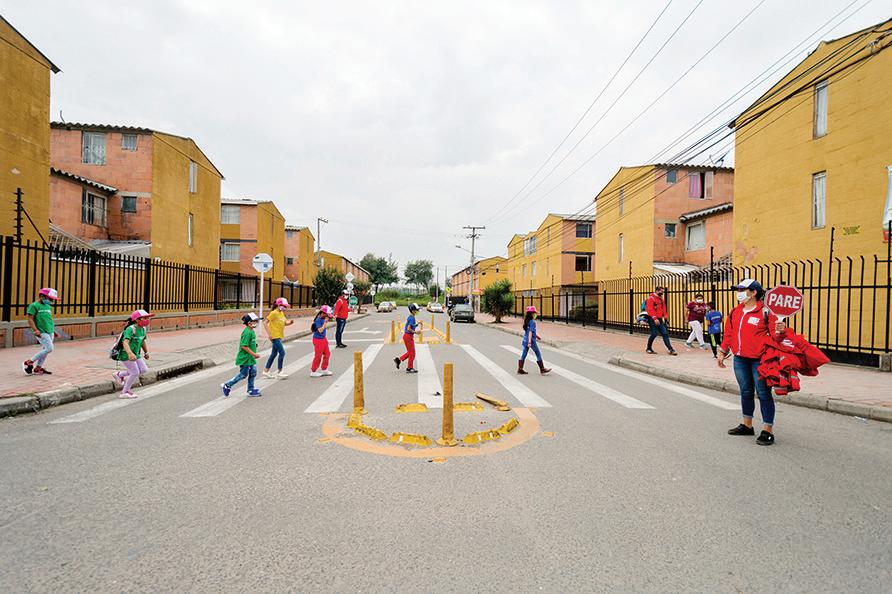

In Gurugram in Haryana state, India, car crash risks for adolescents were reduced through the creation of safer road infrastructure and traffic-management practices. The World Resources Institute used transport and crash data to identify two priority areas in the city: Sector 47 Malibu town and Sadar Bazaar. Discussions with students, parents, and teachers at schools in the neighbourhood were held to gain insights into the perceptions of road users and to explore the safety challenges for students. With the support of the World Resources Institute, a series of interventions was implemented by the Gurugram municipal government along a stretch of 250 m in front of Mount Olympus school: waiting, boarding, and arrival areas for students were created, safer crosswalks with improved signages were introduced, and traffic-calming elements to reduce speeding were instigated. As in Colombia, the improved pedestrian infrastructure led to an increase in walking trips, potentially reducing car use, improving air quality, and enhancing physical fitness.
This vision requires collaboration across transportation, education, law enforcement, and public health sectors. Students should also be included in endeavours to transform the transport system to support safe adolescent mobility and encourage active travel, physical activity, and independence. These transformations have potentially broad social, economic, environmental, and health benefits, and could reduce health-care costs from reducing road traffic injuries and related disabilities and air pollution.
Furthermore, more active lifestyles could help to reduce rates of overweight and obesity.
Prioritisation of support for the most vulnerable adolescents
Support for pregnant and parenting adolescents
Policies and interventions to support the health and wellbeing of the 21 million young girls who become parents during adolescence lag well behind efforts to prevent pregnancies.520,521 Pregnant adolescents initiate antenatal care later in pregnancy and attend fewer antenatal visits than older women.522–524 The explanations for these differences vary across contexts but consistently include lack of knowledge about pregnancy or about where or how to seek care, anticipated stigma,522,525 low support from family or partners,525 and stigma and discrimination within health-care facilities.526 Poverty and competing responsibilities are also barriers to care, as is access to health and other services.
Actions to address pregnant and parenting adolescents’ unique barriers to health care include provider training to reduce discrimination in health services and improve competencies in providing high-quality, provision of developmentally appropriate services to adolescents, and development of policies that enable pregnant and parenting adolescents to consent to receive health services.527 Recognition of pregnant and parenting adolescents’ interdependent rights to health, education, and social participation requires action to address their social needs. Many schools do not meet the educational needs of pregnant and parenting adolescents, as evidenced by high drop-out rates during and after pregnancy.528,529 Reasons for suboptimal outcomes vary by context but consistently include the absence of a favourable policy environment,530,531 anticipated stigma surrounding adolescent pregnancy,532,533 insufficient support for schooling from family or partners,525,534 and enacted stigma and discrimination at school during and after pregnancy.535,536 Additional barriers to optimal educational outcomes include poverty, which can limit access to childcare and other necessary resources for school retention. Although the evidence base for interventions related to adolescent pregnancy, delivery, or postnatal care is small, several exploratory studies suggest that care provided via community health workers537 or peer mentors538 could supplement clinical services and improve outcomes. Robust evidence shows that Janani Suraksha Yojana, a conditional cash transfer in India, had the highest uptake among pregnant adolescents aged 15–19 years, and that overall receipt of the cash transfer was associated with increased facilitybased deliveries.539
Actions to address pregnant and parenting adolescents’ barriers to educational continuity and attainment include ensuring that policies are in place to guarantee and monitor access to education. This approach involves training school leaders and staff. Beyond universal access
to comprehensive sexuality education in schools (ie, for all students), adolescents’ access to crucial information during pregnancy and the postpartum period is also important. Social sector actions to increase social protection for pregnant and parenting adolescents are also important. Cash transfers (or other resource provision) and economic strengthening (ie, savings groups, entrepreneurship, and work-readiness training) should be accessible and available for economically marginalised pregnant and parenting adolescents. Services, including crisis centres and shelters, are needed for pregnant and parenting adolescents who are exposed to gender-based violence.
Programmatic responses to gender-based violence in Nigeria and South Africa
Many women in Africa face high rates of gender-based violence. In Nigeria, among female adolescents, the reported rates of gender-based violence, which includes intimate partner violence and sexual violence, range from 21% to more than 50%.540–542 In South Africa, one of the most violent countries in the world for women,543 35·4% of female adolescents aged 15–17 years have experienced some form of sexual abuse.544 Multiple stakeholders play an important role in responding to gender-based violence, including governments, NGOs, multilateral or donor agencies, and young people.
We undertook qualitative case studies (appendix p 70) with seven organisations in Nigeria and nine organisations in South Africa to explore and describe the NGO programming landscape of response and support services for adolescent survivors of genderbased violence. Nigeria and South Africa are in the process of implementing national-level frameworks on gender-based violence: Nigeria has a Road Map for Ending Violence Against Children by 2030 (adopted in 2016),545 and South Africa has a National Strategic Plan on Gender-based Violence and Femicide (adopted in 2020).543 In Nigeria, programming is shaped by rising levels of insurgency. In South Africa, gender-based violence is recognised as a key driver of the HIV epidemic and is integrated into HIV-focused NGOs and HIV programming. In both countries, NGOs play a pivotal role in programming for adolescent survivors of gender-based violence: they serve as an implementer that are supported by donors, other international NGOs, and UN agencies, and partner closely across government departments, including departments of health, education, and justice.
In Nigeria, most gender-based violence programming implemented by NGOs includes tailored programming for adolescents. This programming can be classed as responsive support services, which include legal services, psychosocial services such as counselling, and opportunities to participate in various economic empowerment initiatives. These services are provided for all survivors of violence, who are primarily women and
female adolescents. Programming sites include schools, churches, and communities, and messaging through media such as radio and television is also used. Most NGOs in Nigeria and South Africa offer comprehensive services that span from medical to legal services and access to safe spaces, such as shelters, either directly or through facilitated referrals. The one-stop-centre model, widely rolled out in South Africa (eg, Thuthuzela Care Centres), offers comprehensive services and support for survivors of gender-based violence. This model is increasingly being adopted in Nigeria by organisations such as the Mirabel Centre. There seem to be gaps in programming for LGBTQ+ adolescents and limited programming in rural areas in both countries. Beyond responsive support services, the most salient feature of NGO programming in Nigeria and South Africa is their commitment to empowering and building agency among survivors through opportunities for skill-building, which include peer-education models.
New indicators are needed for the post-SDG era
To better capture evolving understandings of adolescent health and wellbeing, and to monitor global and countrylevel progress beyond the SDG era, we propose new indicators that build on those proposed in LC2016. We have sought to identify and populate headline indicators that describe health outcomes in greater detail, group causes that require different policy responses, and capture emerging determinants and threats to adolescent health and wellbeing. As was done in LC2016, we have selected indicators that encompass broad health outcomes, risks, and determinants for adolescents and that are harmonised with contemporaneous data for most countries (or most countries where that indicator is relevant).
The indicators are divided into four domains: health outcomes, health risks, social determinants and health, and health policy or intervention (table 7). For health outcomes, the three broad disease burden indicators used in LC2016 have been disaggregated into seven more specific indicators. The one LC2016 indicator on communicable, maternal, and nutritional disease is now reported separately as communicable diseases, nutritional disease, and maternal disease; injury is now reported as intentional injury and non-intentional injury; and non-communicable diseases are now reported as mental health or self-harm and other chronic diseases. We have also added two new health outcome indicators: mortality rate per 100 000 adolescents from all causes, and self-rated life satisfaction.
For the health risk domain, we have included bullying as a new indicator, because bullying is now established as a risk for poor mental health and wellbeing within the GBD study. We also report adolescent smoking in three distinct age groups (previously collectively reported for adolescents aged 10–24 years), because low rates of smoking in adolescents aged 10–14 years can mask higher prevalence in older adolescents.
Definition
Health outcomes
Communicable DALYs* DALYs due to communicable diseases, maternal diseases, and nutritional diseases per 100 000 adolescents
Communicable diseases
DALYs DALYs due to communicable diseases per 100 000 adolescents
Nutritional diseases DALYs DALYs due to nutritional diseases per 100 000 adolescents
Maternal disease DALYs DALYs due to maternal diseases per 100 000 adolescents
Injury DALYs* DALYs due to all injuries per 100 000 adolescents
Intentional injury DALYs DALYs due to intentional injury per 100 000 adolescents
Unintentional injury DALYs DALYs due to unintentional injury per 100 000 adolescents
NCDs DALYs* DALYs due to NCDs per 100 000 adolescents
Mental health and self-harm DALYs DALYs to mental health diseases and self-harm per 100 000 adolescents
Other chronic disease DALYs DALYs due to non-mental-health-related NCDs per 100 000 adolescents
All-cause mortality Deaths from any cause per 100 000 adolescents
Self-rated life satisfaction
Health risks
Cigarette smoking (2016 version)*
Cigarette smoking (age 10–14 years)
Cigarette smoking (age 15–19 years)
Cigarette smoking (age 20–24 years)
Students are asked a question about how satisfied with life or if they are having their best possible life. The response is scored on a Cantril ladder (a vertical visual analogue scale) from 0 to 10, with 10 representing maximum satisfaction or best possible life†
Proportion of adolescents who currently smoke tobacco daily or occasionally
Proportion of adolescents aged 10–14 years who currently smoke tobacco daily or occasionally
Proportion of adolescents aged 15–19 years who currently smoke tobacco daily or occasionally
Proportion of adolescents aged 20–24 years who currently smoke tobacco daily or occasionally
Binge alcohol consumption* Proportion of adolescents aged 15–19 who consume at least 60 g of pure alcohol on at least one occasion in the past month
Overweight*
Anaemia*
Bullying
Proportion of adolescents who are overweight (ie, BMI ≥25 among those aged 19–24 years or meeting International Obesity Task Force criteria for those aged 10–18 years)
Proportion of adolescents with decreased haemoglobin concentrations (ie, <115 g/L in males aged 10–14 years; <130 g/L in males aged 15–24 years; <120 g/L in non-pregnant females; and <120 g/L in pregnant females), irrespective of underlying cause and red blood cell morphology or function
Proportion of adolescents attending school aged 10–17 years who experience bullying of any type (ie, verbal, physical, or cyber) at least once a week (excludes abuse or harassment by siblings, intimate partners, or adults—including teachers)
<2500 DALYs per 100 000 adolescents
558·9 DALYs per 100 000 adolescents
49·8
<2500 DALYs per 100 000 adolescents
adolescents
per 100 000 adolescents
DALYs
We have added seven new indicators to the social determinants domain to capture a wide range of threats to adolescent health and wellbeing. These new indicators include those related to environmental factors (eg, DALYs attributable to air pollution and inadequate water, sanitation, and hygiene facilities, which are increasingly important in the context of climate-related disasters), commercial determinants (eg, consumption of sugarsweetened beverages), conflict (eg, DALYs due to collective violence), displacement (ie, numbers of displaced people) and extreme poverty (ie, the proportion of adolescents living on <$2 15 a day in low-income countries, <$3 65 in
(Table 7 continues on next page)
lower-middle-income countries, and <$6·85 in uppermiddle-income countries). We have also added female genital mutilation or cutting, an SDG indicator that indicates protection of the rights of adolescents, but noted that this indicator is only relevant in some contexts. Health and policy interventions for adolescent health is a new indicator domain. We have moved the LC2016 indicators related to met need for contraception into this domain, along with HPV immunisation and two HIV indicators: HIV knowledge (a measure of the effectiveness of comprehensive sexuality education) and the HIV mortality-to-incidence ratio (a measure of
(Continued from previous page)
Social determinants
Not in education, employment, or training*
Secondary education*
Child marriage*
Adolescent fertility (2016)*
Adolescent fertility (age 10–14 years)
Adolescent fertility (age 15–19 years)
Proportion of adolescents aged 15–24 years not in education, employment, or training
Proportion of adolescents aged 20–24 years who have completed at least 12 years of education
Proportion of female adolescents aged 20–24 years who were married or in unions before age 18 years
Livebirths per 1000 adolescents aged 10–19 years
Livebirths per 1000 adolescents aged 10–14 years
Livebirths per 1000 adolescents aged 15–19 years
Female genital mutilation or cutting Percentage of girls and women aged 15–49 years who have undergone female genital mutilation or cutting
Water, sanitation, and hygiene DALYs due to unsafe water, sanitation, and hygiene facilities per 100 000 adolescents
Air pollution DALYs attributable to air pollution—including ambient particulate matter pollution , household air pollution from the use of solid fuels for cooking, and ambient ozone pollution—per 100 000 adolescents
Collective violence
<25 births per 1000 adolescents
0 03 livebirths per 1000 adolescents aged 10–14 years
livebirths per 1000 adolescents aged 15–19 years
DALYs due to conflict, terrorism, executions, and police conflict per 100 000 adolescents
Poverty Proportion of adolescents living in extreme poverty (ie, <US$2 15 per day in low-income countries, <$3·65 per day in lower-middle-income countries, and <$6·85 per day in upper-middle-income countries)
Displaced people Number of forcibly displaced adolescents aged 12–17 years by country of origin
Sugar sweetened beverages Mean weight of sugar-sweetened beverages consumed daily by adolescents aged 15–19 years
Health and policy interventions
Met need for contraception* Percentage of adolescent females aged 15–24 years whose need for contraception is met by a modern contraceptive method
Human papillomavirus vaccination
Human papillomavirus immunisation coverage (recommended doses as per national schedule) estimates among girls aged 9–14 years (%)
Knowledge of HIV Proportion of adolescents aged 15–24 years with comprehensive, correct knowledge of HIV
HIV mortality-to-incidence ratio
Ratio of death from HIV to incidence of HIV among adolescents
All targets apply to adolescents aged 10–24 years, unless otherwise specified. DALYs=disability-adjusted life-years. NCDs=non-communicable diseases. *These indicators were included in the first Lancet Commission on Adolescent Health and Wellbeing (2016).2 †This target specifically applies to adolescents aged 15–24 years. ‡This percentage is based on a denominator of 204 locations and not the total number of adolescents aged 10–17 years attending school.
Table 7: Proposed new headline indicators for adolescent health and wellbeing
health-system response). We have included these indicators because data are available and because adolescents account for most new HIV infections, represent a large and growing share of the population living with HIV, and have worse outcomes than both children and adults.
For this revised set of indicators, we suggest potential targets for 2030 (table 7).
To identify a target value for each indicator we ranked countries by their 2021 estimate (for both sexes combined) from highest to lowest. Then we chose the value that only 10% of countries had reached (ie, meaning
90% had not achieved it) and suggested this value as the target. Detailed plots of country-level values and 10th centiles are in the appendix (p 75). Of note, setting targets based on the concept of convergence is consistent with the approach adopted in LC2016, but targets can also be considered from a rights perspective (ie, a target that accepts that no adolescent should be harmed). We have not defined targets for indicators for which data coverage is incomplete (ie, when data are available in <70% of settings): life satisfaction, HPV vaccination, knowledge of HIV, child marriage, female genital mutilation or cutting, poverty, and displacement. In
Health outcomes (per 100 000 adolescents)
Mental health and self-harm DALYs (target: 2045·0 DALYs)
Other chronic disease DALYs (target 3986·8 DALYs)
Deaths from all causes (target: 23·9
Health risks
Smoking prevalence
Bullying prevalence‡
Social determinants
Adolescent fertility (livebirths per 1000 female adolescents)*
Age 10–14 years (target: 0·03 livebirths)
Age 15–19 years (target: 4·5 livebirths)
DALYs due to poor water, sanitation, and hygiene facilities per 100 000 adolescents (target 3·3 DALYs)
DALYs due to air pollution per 100 000 adolescents (target: 8·1 DALYs)
DALYs due to violence per 100 000 adolescents (target: 0·04 DALYs)
Mean sugar-sweetened beverage consumption, g per day (target: 90·2 g)§
Health policy*
HIV mortality-to-incidence ratio (target: 0·01)
All targets apply to adolescents aged 10–24 years, unless otherwise specified. DALYs=disability-adjusted life-years. The communicable disease group also includes the Global Burden of Disease causes other COVID-19 pandemic-related outcomes and neonatal disorders. *Health outcomes in 2030 came from forecasts by the Institute for Health Metrics and Evaluation; for all other indicators, estimates in 2030 are based on annualised change, 2015–21. †Annualised compound percentage decline neeeded between 2021 and 2030 to reach the suggested targets in table 6. ‡This percentage is based on a denominator of 204 locations and not total number of adolescents attending school aged 10–17. §These data are from 2018, not 2021, and are for adolescents aged 15–19 years.
Table 8: Global estimates, current progress against targets, and trend analyses to 2030 for the proposed and restructured headline indicators of adolescent health and wellbeing
table 8 we present the current values for these new indicators, and project progress towards 2030 based on trends (not all indicators have sufficient coverage to enable a global estimate, examination of recent changes, or informed future projections).
We have selected indicators that are harmonised with available data.546 There are other important determinants and outcomes (eg, access to the internet, experience of discrimination, and exposure to violence) and better indicators to measure the coverage and impact of interventions that represent important targets for indicator development. There is also a need for effort in defining indicators of effective health intervention coverage.
Section 5: Principles, goals, and recommendations for the post-SDG
“If something is hard to find, dig deeper”
—Yoruba saying
A decade ago, LC2016 proposed six broad recommendations to focus action and investment in adolescent health and wellbeing: reframe adolescent health and wellbeing; set clear objectives based on national and local needs; reconfigure health services for universal health coverage; create protective and empowering social scaffolds through intersectoral partnerships; enhance the engagement of young people; and grow knowledge and capacity. These
recommendations remain just as relevant today as they were a decade ago. The eight core principles for actions that we present in panel 18 sit alongside these recommendations and provide a framework for sustaining improvements in adolescent health and wellbeing.548
We build on these core principles by proposing three overarching goals and 15 specific recommendations for actions (the ordering of responsibility goes from the macro to the micro) to accelerate the necessary improvements in adolescent health and wellbeing that are required beyond the SDGs and into the second half of the 21st century (table 9). These actions align with
input from the Youth Solutions Labs, which engaged over 120 young people globally, and are fully endorsed by our Youth Commissioners. The three goals are the creation of enabling environments to transform adolescent health and wellbeing, the amplification of actions within existing systems to address adolescent health and wellbeing, and the development of innovative approaches to address complex and emerging threats in partnership with young people.
To tackle today’s challenges and take advantage of all that the 21st century has to offer will involve drawing on the power of the ideas, capabilities, and leadership of young people to reimagine and recreate a healthier,
Panel 18: Core principles for actions on adolescent health and wellbeing
A rights-based, strengths-based, and person-centred approach
This approach recognises and upholds the rights of adolescents to good health and overall wellbeing—including the rights to participation, to express identity, and to access services—while ensuring that they are protected from violence and harm. Rather than problematising adolescence, adolescence should be viewed as a key developmental stage of opportunity—a stage of life that, when supported, enables individuals to gain the assets and capabilities that will help to create a better future for everyone.
Meaningful adolescent and youth engagement
Actions that have meaningful adolescent and youth engagement at their core affirm, empower, and catalyse young people’s health and wellbeing, with benefits for young people and broader society.
Intergenerational justice
The adolescents of today are inheriting an increasingly unequal and unstable world. An intergenerational lens is needed to ensure that adolescents are engaged in decisions that affect them (now and in the future) and in decisions that will affect future generations of adolescents, including considerations of the resources they need to inherit from adults for health and wellbeing (eg, a healthy planet).
Address inequities
Actions need to recognise and address existing and systemic inequities based on gender, sexuality, race, disability, ethnicity, and indigeneity and address structural drivers including racism, discrimination, wealth distribution, and geography. Achieving equality requires targeted actions for all genders to challenge stereotypes, promote inclusivity, and ensure equal opportunities for everyone.547 Programming efforts for younger adolescents should address the unique challenges of this age group and provide the necessary support and resources.
Developmentally and contextually appropriate actions
Such actions recognise adolescents’ evolving capabilities, identities, and interpersonal relationships and the increasingly complex and intersecting determinants of adolescent health.
Action at all levels and the co-benefit of actions
Actions should target the drivers and determinants of adolescent health and wellbeing at all levels, including private and public actors—from the individual adolescent, to their families and peers, schools and communities, national laws, and the global environment. Actions to improve adolescent health and wellbeing should explicitly embrace a planetary health approach. Intersectoral actions can produce and amplify co-benefits for individuals and populations, economic development, and environmental stewardship.
Action that is responsive to need
Given projections suggesting that nearly half the world’s adolescents will live in Africa by 2100, global efforts to advance adolescent health should include a focus on Africa. However, this focus should not come at the expense of adolescents in other countries or settings, especially those who are too often left behind. An equity focus is required that attends to the most disadvantaged adolescents, wherever they are, including adolescents affected by conflict and war, displaced adolescents, and young people in small island nations that are uniquely affected by climate change.
Evidence-based action
Evidence for action in adolescent health is rapidly evolving, but key knowledge gaps remain. Actions should be informed by evidence and, when possible, rigorously assessed to enable growing of the evidence base, including from an implementation perspective. Researchers and publishers should strengthen mechanisms to enable knowledge translation, including prioritisation of research that addresses key gaps (including under-represented populations), and should commit to open-access publishing so that new knowledge is widely accessible, including for adolescents. Research efforts should extend from a focus on individual interventions or health concerns to address complex determinants and needs.
Actions Responsibility
Goal 1: Create enabling environments to transform adolescent health and wellbeing
Engage, amplify, and protect the voices of adolescents in advocating for change and making policies to effect change
Establish a framework to ensure that meaningful adolescent and youth engagement is routine in UN agencies, governments, national agencies, regional bodies, NGOs, educational institutions, and health services, and not only in areas of immediate relevance to adolescent health and wellbeing
Build policy architecture that enables safe and respectful participation of young people from diverse backgrounds, and invest in adolescent and youth-led structures that contribute to addressing adolescent health needs
Researchers should involve adolescents in research processes, and journals should require evidence that such involvement occurred
Young people should be supported to advocate for change and engage in participatory activities when possible
Monitoring and assessment systems should be put in place to ensure youth advisory boards and adolescent and youth engagement more broadly are functioning as expected
UN and multilateral agencies, national governments, NGOs, research funders, academic journals, researchers, adolescents themselves
Timeline Measures
Within 2 years Development of a framework by relevant bodies that measures the proportion of youth professionals in organisations (and in leadership within organisations), of relevant multilateral agencies with youth advisory boards and youth members on their governing boards, of countries with youth advisory boards within government structures (and of youth in elected posts), of youth advisory boards that remunerate young people, and of tier 1 journals that require a statement on meaningful adolescent and youth engagement for research that is relevant to young people
Coordinate efforts across the developmental window of childhood and adolescence to build on investments in earlier childhood
Develop a post-SDG development goal centred on adolescent health and wellbeing, with strengthened measurement, accountability, and coordination
Ensure a life-course approach is taken across policy, data, and research initiatives that recognises adolescence as a crucial developmental window beyond early childhood that is transformative in the journey to adulthood
Coordinated actions (eg, investments and data monitoring) are encouraged across each adolescent phase and with earlier childhood and adulthood, as is paying particular attention to the role of gender
Create an adolescent-specific development goal and targets to focus and unite action by countries, to be supported by leadership and coordination from the Office of the UN Secretary-General and with cross-agency engagement
Global goal-setting initiatives should consider the role of adolescents as a demographic contributor and beneficiary, and should ensure that data collection is disaggregated by age and sex across all outcomes of relevance to adolescents
National governments (supported by the UN and multilateral agencies), organisations responsible for data systems, academic journals
UN system and the Office of the UN Secretary-General
Within 2 years Consistent use of terminology and age-based definition in academic journals and UN documents, and by regional bodies and governments, etc
Enhance global, national, and subnational accountability for adolescent health and wellbeing through innovations in indicators, measurement approaches, and reporting processes
Match financing to adolescents’ health needs and account for risks of current and future disease burdens
Build on Global Action for Measurement of Adolescent Health to define indicators for adolescent health and wellbeing to capture evolving needs, determinants, and responses
In the short term, actions should prioritise routine generation and reporting of these indicators—eg, optimal utilisation of available data (including linked administrative and modelled data)
In the medium term, efforts are required to gather better primary data for key outcomes that are not measured, including via the use of validated measures in national and international surveys (eg, Demographic and Health Surveys, Multiple Indicator Cluster Surveys, and the Programme for International Student Assessment)
Sampling should at least disaggregate adolescents by age, sex, disability, and socioeconomic status; data should be reported in a format that is accessible to a broad range of stakeholders, including adolescents, and reporting should include guidance on interpretation and recommended actions
Prioritise the development of strategies tailored to address national adolescent disease burden (that account for subnational variations and other contexts that create inequities, such as gender and indigeneity) to advance adolescent health and wellbeing with evidence-based investment plans and budget allocations
International donors should align financing with country-led strategies to ensure greatest impact
Adolescent health and wellbeing goals should be included in economic and social development plans (or national equivalents) with a unique budget line to facilitate cross-sectoral budget and resource allocation and accountability
Financial strategies should be accompanied by routine monitoring and assessment frameworks with set indicators
National governments, global survey programmes, Research institutions
Within 2 years Indicators that could be part of the goal include mortality; injury; fertility; overweight and obesity; the proportion of adolescents not in employment, education, or training; subjective wellbeing; and the proportion of health, education, and social and welfare financing spent on adolescent-focused programming. Countries could adjust these indicators and combine them with locally relevant indicators as appropriate
By 2030
Governments (including ministries of finance), UN and multilateral agencies, donors
By 2030
Guidance on global and national approaches to measurement and reporting of adolescent health and wellbeing data should include expanded indicator lists in global surveys
We will produce an annual report to be published in The Lancet of progress against key headline indicators of adolescent health and wellbeing (table 7)
Proportion of countries with an adolescent health and wellbeing goal, with explicit national budget allocations for adolescent health and wellbeing, with increasing health financing for adolescent, and with health financing for adolescents proportional to health risks and disease burden
(Table 9 continues on next page)
Actions
(Continued from previous page)
Strengthen capacity across the field of adolescent health and wellbeing
Build the diverse, inclusive national community of researchers, practitioners, educators, and policy makers required to advance local, national, and global improvements in all areas of adolescent health and wellbeing
Research funders should enhance investments in adolescent health and wellbeing, prioritise co-creation and co-design of research with adolescents, and support capacity building for all emerging professionals,511,512 particularly those from low-income and middle-income countries
Core competences in adolescent health should be included in basic public health and clinical training programes
Sustainable leadership in the field should be supported by increasing access to postgraduate training in adolescent health and wellbeing and through the development and support of national, regional, and global multidisciplinary professional associations for adolescent health
Goal 2: Amplify actions within existing systems to address adolescent health and wellbeing
Hold national education and health ministries jointly accountable for student health and wellbeing
Education systems should include measures of wellbeing within their accountability frameworks alongside traditional education metrics
Education systems should implement evidence-based programmes to promote student health and wellbeing (including nutrition, comprehensive sexuality education, mental health literacy, and stigma reduction), with implementation supported by a trained workforce
School systems need to be able to identify vulnerable adolescents at risk of early school leaving, many of whom will require actions from health and welfare systems, and ensure appropriate responses
All schools should be supported to introduce pathways to health care for students with identified concerns
UN and multilateral agencies, research and training institutions, professional associations, research funders
UN and multilateral agencies, national education and health ministries
By 2030
Ensure universal access to adolescentresponsive health care
Provide equitable access to highquality primary and secondary education for all adolescents, with pathways to postsecondary training and economic opportunities
Scale up genderresponsive action to accelerate progress towards sexual and reproductive health outcomes and reduce genderbased violence
Ensure all adolescents have access to comprehensive, developmentally appropriate, and confidential health care, including sexual and reproductive health and mental health services, from competent providers
Free health care, including for health prevention and promotion, should extend across the developmental window from 0 to 24 years, with recognition that some groups of adolescents face particular access challenges, including younger adolescents, pregnant and parenting adolescents, adolescents with disabilities, adolescents in humanitarian settings, adolescent refugees, and LGBTQ+ adolescents
National laws and local policies, including for health insurance, should allow adolescents to access health care without requiring permission from parents, caregivers, husbands, or partners
School-based health services should be made more widely available to provide easier access to care
Introduce policies and programmes to ensure that adolescents have equitable access to high-quality primary and secondary education that recognises the unique needs of girls and boys and the particular needs of adolescents from poor families, Indigenous adolescents, pregnant and parenting adolescents, displaced adolescents and adolescent refugees, LGBTQ+ adolescents, and adolescents with disabilities
Education should adapt to meet the needs and interests of contemporary adolescents and be relevant to local contexts
Education must be provided in humanitarian and conflict settings and education systems should be designed to be resilient to future negative shocks to ensure educational continuity
Countries should enact legislation that prohibits forced and non-consensual child marriage, female genital mutilation or cutting, and sexual violence (including within marriage) and close cultural and religious loopholes in laws and policies that allow these practices to continue
Policies should be implemented to promote delayed pregnancy and ensure access to sexual and reproductive health services, including contraception, abortion, and antiretroviral therapy
Premarital sex between near-age adolescents and same-sex relationships should be decriminalised
Universal access to comprehensive sexuality education in schools should be introduced Laws to uphold the rights of LGBTQ+ adolescents should be introduced, with strong engagement with communities, religious, and civil societies (gender-transformative programs and social protection are key policy tools)
National governments, health providers in conflict and humanitarian settings
By 2030
Proportion of international research funding programmes that specifically address adolescent health and wellbeing, of countries with national multidisciplinary associations for adolescent health and wellbeing, of national research funding that focuses on adolescents, of countries with national competencies for adolescent health (universal, advanced) that align with global competencies, and of countries with accredited undergraduate and postgraduate training programmes in adolescent health
Proportion of countries that include health and wellbeing in education accountability frameworks, that include adolescent health and wellbeing in teacher training, and that adopt UN Global Standards for Health Promoting Schools; proportion of international educational assessment frameworks* that include health and wellbeing indicators
By 2030
National governments By 2030
Proportion of countries with free universal health care for adolescents and national quality health service standards for adolescents that are consistent with global quality standards; proportion of adolescents with out-of-pocket health expenditure
Proportion of countries with laws that facilitate adolescents’ access to health care without parent or partner consent
Proportion of countries with supportive policies around access to education (eg, universal access, cash transfers, and scholarships), participation of adolescents in secondary and post-secondary education by gender and family income (overall and in marginalised groups); proportion of adolescents who are not in employment, education, or training and who are participating in paid work (by sex)
National governments (supported by the UN), donors, NGOs By 2030
Proportion of countries with laws that support adolescent sexual and reproductive health (disaggregated by gender and type of law), providing access to the full package of sexual and reproductive health services for adolescents in line with the Guttmacher–Lancet Commission,513 and with comprehensive programmes in primary and secondary schools; proportion of 15–19-year-old females living in unions (Table 9 continues on next page)
(Continued from previous page)
Protect young people from the adverse effects of violence, armed conflict, and incarceration
Strengthen community systems that promote mental health and wellbeing
Introduce legislation on gun control that limits access to guns for adolescents
Ensure that the rights of adolescents are upheld during armed conflicts and that displaced populations have access to safe spaces and education and health services, including mental health services
Strengthen efforts to prevent adolescents younger than 18 years from being recruited as soldiers and invest in post-conflict rehabilitation for child soldiers
Consider increasing the age of enrolment for national armed forces to 21 years
Involve young people as key voices in peacebuilding efforts
Protect young adolescents from the harms of incarceration, and ensure that the minimum age of criminal responsibility is at least 14 years and that it continues to be increased514
Promote adolescent mental health and wellbeing in schools and the communities in which they are based
Schools should embed whole-school approaches to promoting mental health and wellbeing, including strategies to reduce bullying and school curriculums that enhances social and emotional learning, and timely access to mental health care
Cities should facilitate access to safe and active transport systems that encourage independence and physical activity, and should engage young people in urban design and provide safe and engaging spaces for adolescents to congregate, including ensuring access to green spaces
National governments, supported by the UN Within 2 years Proportion of countries with legislation that limits access to guns among adolescents or prohibits incarceration of young adolescents, national breakdowns of the number of adolescents killed by violence, killed or injured during conflict (as civilians or combatants)
National and municipal governments, civil society organisations
By 2030
Goal 3: Develop innovative approaches to address complex and emerging threats in partnership with young people
Limit the effects of commercial drivers on adolescent health and wellbeing
Promote healthy use of social media and online spaces to prevent harm
Reduce the impact of harmful commercial determinants of health on young people through fiscal and legislative mechanisms to reduce consumption of sugar-sweetened beverages (ie, sugar taxes) and to ban junk food (ie, food high in fat and sugar)
advertising in traditional and online media
Strengthen national tobacco-control legislation, including legislation that bans the advertising and sale of e-cigarettes to adolescents
Introduce stricter regulation and monitoring of, and harm-reduction strategies for, gambling among adolescents
Adopt evidence-informed legislation, guided by global frameworks and accountability mechanisms, to prevent online harms to children and adolescents while also protecting developmentally appropriate access to digital technologies, such as smartphones, particularly for the most marginalised adolescents
Meaningful adolescent and youth engagement should be central to decision making around online spaces and social media
Countries should restrict access to harmful content, as exemplified by the EU Digital Services Act, and protect the privacy of adolescents online
An international coalition supported by UN agencies should task global social media platforms with the redesign of social media to better align with adolescent development, privacy, and safety needs
Education systems should be tasked with building digital literacy among adolescents
Commercial entities and media corporations, regional bodies, national governments supported by the UN, civil society organisations
Global technology companies, national governments supported by the UN, parents
By 2030
Proportion of cities of more than 1 million people with mental healthfriendly policies that include adolescents, proportion of countries that promote wholeschool approaches to mental health
Within 2 years
Proportion of countries with legislation that protects adolescents from exposure to commercial determinants of health (eg, sugar taxes, junk food advertising bans, gambling restrictions, smoke-free generation laws, and bans on advertising and purchasing of vapes)
Proportion of countries with evidence-informed legislation preventing exposure to harmful online content and with locally adapted digital literacy curriculums; proportion of adolescents with access to digital technologies
Protect adolescent health and wellbeing today and for the next generation through emergency action against the planetary crisis of climate change, biodiversity loss, and pollution
Countries are urged to follow the recommendations of the Lancet Countdown on Health and Climate Change to reduce health impacts and improve resilience to unavoidable climate change515
Countries should engage adolescents in developing nationally determined contributions that are sensitive to adolescents’ needs
Countries and international agencies should collaborate to develop and finance plans to equip adolescents with skills and opportunities to obtain jobs in the green and blue economies
Governments and communities should involve young people in advocacy, design, and action in order to make actions more effective and sustainable, and to ensure that intergenerational justice is at the forefront of policy
National governments, communities, civil society organisations, UN agencies
Immediate Proportion of countries adopting and meeting climate and planetary health targets around emissions, renewable energy, and climate policy, and adopting and meeting child and adolescent-sensitive nationally determined contributions; number of adolescent DALYS attributable to air pollution and poor access to water, sanitation, and hygiene facilities
NGOs=non-governmental organisations. SDGs=Sustainable Development Goals. LGBTQ+=lesbian, gay, bisexual, transgender, and queer or questioning. *Frameworks include the Programme for International Student Assessment, the Trends in International Mathematics and Science Study, the Progress in International Reading Literacy Study, the Programme d’analyse des systèmes éducatifs de la Confemen, the Southern and Eastern Africa Consortium for Monitoring Educational Quality, and the Southeast Asia Primary Learning Metrics.
Table 9: Actions recommended by the Commission
fairer, and just planet. Decisions must be made in partnership with young people, and need to be informed by evidence and engage with sectors beyond health. Adequate financial investment and supportive policy environments are needed in every country, as is building
multidisciplinary investment in leadership in adolescent health. Ultimately, the investments made in this generation of adolescents will determine our human and planetary futures, for good or for ill. The time to act is now.
Contributors
The Commission was established by the late GCP and SMS, together with AE. MO’S coordinated the Commission. SB, RMV, AE, SMS, PSA, and SC led the design of the work plan and the structure of the report, including its recommendations, and drafted the report, to which all Commissioners contributed.
Declaration of interests
All authors declare support from the Gates Foundation (INV-056091, INV-048897) for the Commission on Adolescent Health and Wellbeing. DI-J, LTG, SC, LL, SD, RT, AM-K, JMN, YD, and OB report honoraria for their contributions as Youth Commissioners. SS reports royalties from Oxford University Press. AOO reports consulting payments from IPAS, the Society for Family Health, and Plan International Nigeria; royalties from Oxford University Press; a volunteer position on an independent scientific advisory board for a Wellcome Trust-funded study; and nonpaid membership in various organisations, including the Society for Adolescent and Young People’s Health in Nigeria and WHO GAMA. SAM reports honoraria payments from Yale University, Vanderbilt University, Harvard University, New York University, American University, Columbia University, Carleton University, and Northwestern University. DI-J reports payment as a member of the PMNCH Board, is a Youth Advisory Group member of the UGood Project and a board member of IPAS, and holds stock in Pfizer. SAM declares travel support for attending meetings from Wissenschaftskolleg zu Berlin. AOO is a non-paid member of the Society for Adolescent and Young People’s Health in Nigeria and WHO’s Global Action for Measurement of Adolescent Health. AC received travel support to attend meetings afrom the Wellcome Trust, the Australian National Health and Medical Research Council, the Australian Research Council, the European Climate Foundation, the Australian Department of Health and Aged care; the Royal Australasian College of Physicians, and the Victorian Department of Heath. SS declares travel support for meetings from the Human Sciences Research Council and Mastercard Foundation. Commissioners received travel and accommodation support to attend Commission meetings in Kenya (2023) and South Africa (2023), with no payments made to them or their institutions unless otherwise stated. SMS reports an unpaid role as past president of the International Association for Adolescent Health. AE reports financial support through flexible startup funds from Drexel University (made possible by support from Dana and David Dornsife to the Dornsife School of Public Health at Drexel University) for research time and travel. MO’S received subcontract payments through her institutions for her coordination roles for the Commission. JMN, AOO, CL, AKG, CWK, and AM-K received subcontract payments through their institutions for analysis work done for the Commission. All other authors declare no competing interests.
Acknowledgments
Funding for the first and second in-person meetings of this Commission was provided by the Gates Foundation. Part-funding and in-kind support for the convening of the second meeting of the Commissioners, reviewers, and Youth Commissioners was provided by the Human Sciences Research Council (Cape Town, South Africa). Other funding for the Commission was provided by Exemplars in Global Health, and the Commission acknowledges funding support and collaboration from the FIA Foundation to the World Resources Institute for their work on road safety. The funders did not have a role in the research methods, decision to publish findings, or the content of the Commission. Nafisa Ferdous designed the cover art for the printed Commission booklet. We thank the Stellenbosch Institute for Advanced Study for hosting members of the Steering Committee; Marifat Sulaymonova (Drexel, Philadelphia, PA, USA) for coordination of the Commission; Rashida Abbas Ferrand, Kimberly Mihayo, Mariam Naguib, Siri Aas Rustad, Yubraj Acharya, Claudia Adriazola-Steil, Anna Afferri, Ifeoluwa Albert, Chloe Ashton, Sara Bylund, Peipei Chai, Zheyi Cao, Maria Cheng, Narshil Choi, Saini Das, Cara Frances, Susan Goldstein, Daylan Salmerón Gómez, Helen Habibata Habib, Rachael HaileSelasse, Gwyn Hainsworth, Jaqueline Harvey, Karen Hofman, Xiaona Huang, Nicola Jones, Mandisa Khanyile, Manasi Kumar, Nadine Lee, Lemeng Liang, Xi Li, Emilia Lindquist, Paulina A Lindstedt, Xinran Lu, Yiqun Luan, Sara Luckenbill, Nikita Luke, Beryl Nyatuga Machoka, Brian Mafuso, Beatrice W Maina, Zain Memon, Shafkat Meraj, Khadija Mitu,
Talha Mobin, Sheila Mukabana, Joyce Mumah, Yashmita Naidoo, David Newhouse, Erin Oakley, Babatunde Oluwagbayela, Oloruntomiwa Ifedayo Oyetunde, Berk Özler, Samantha L Pagán, Jürgen Rehm, Allison Schwedock, Jennifer Seager, Hassan Ali Dalvi Shirazi, Patrick D Smith, Amanda E Smith, Stefan Swartling Peterson, Beza Afework Taddess, Jonanne Talebloo, Xiaobo Tian, Mark Tomlinson, Simon Marot Touloung, Ingrid van der Heijden, Maria Vedechkina, Quan Wan, Jing Wang, Sheri Weiser, and Workneh Yadete for their insights, without whose hard work this report would not have been possible; the peer and adolescent and youth reviewers Rima Afifi, Chris Bonell, Vinicius Gaby Vieira Rego, Nikita Ghodke, Kaymarlin Govender, Alaka Holla, Shatyam Raze Issur, Jonta Kamara, Edward K Kirumira, Nojus Saad, and Hamaiyal Sana for important feedback on earlier drafts of the report; the GovLab and Youth Solutions Labs contributors and facilitators Natalia González Alarcón, Liliana Carvajal Velez, Hannah Chafetz, Tracy Jo Ingram, Maha Jouini, Sean Jison Kim, Malvikha Manoj, Sara Marcucci, Eugenia Olliaro, Nadiya Safonova, Sampriti Saxena, Adrienne Schmoeker, Analaura Tostado, Stefaan Verhulst, Elena Wüllhorst, Andrew J Zahuranec; and the young people Hana Abbasian, Assia Abeis, Ayomide Aboyade, Karine Abrahamyan, Alao Ibraheem Adebayo, Victor Agbontean, Seyram Agudu, Angelina Ahmad, Zaima Ahmad, Karma Al Amine, Algul Aldag, Meryem Alhouz, Rodrigo Andrés, María Ángel Ojeda Arzuaga, Vigen Aslanyan, Christophine Aubin, Dârâ Aydın, Sara El Baaqyly, Maissa Bakrari, Shaliny Balachandran, Dalitso Joseph Banda, Nadine Belgarrab, Ikram Bichbich, Catherine Bosnoian, Rania Boukdour, Amy Broadbent, Clara Brown, Grace Burn, David Alejandro Valdez Caballero, Rebecca Chawanda, Yipu Chen, Bettina Chintala, Kristy Chung, Alexander Dalton, Mohamed Daly, Ira dela Cerna, Huiwen Deng, Beth Dennis, Angela Leticia Rosales Díaz, David Dix, Farzona Djuraeva, Confiance Dukuzumuremyi, Basma El-Gabbas, Richmond Enning, Alexandra Escol, Hosam Gdache, Nare Ghevondyan, Sethumadhavan Gokulakrishnan, Víctor Manuel Castillo Gómez, Martínez González, Léa Boiridy-Graves, Suren Grigoryan, Angie Lorena Usme Guerrero, Salma Harfi, Toluwalope Ifedayo, Jovanna Ifill, Krispi Jaiswal, Catherine James, Omayma Jamlaoui, Michelle Jiang, Confidence Joseph-George, Kamila Khanibulllina, Vedant Kulkarnim, Nadia Margit Löwengart Kuritzén, Marianne Laloe, Shuyang (Candy) Lei, Mark Devon Maitim, Dominik Mautner, Eva Miklavec, Ivy Miyanda, Tiran Mkrtchyan, Aya Mohamed, Maria Mokrova, Ana Sofia Reyna Morales, Nathan Morris, Andrei Motchenko, Talia Moukashar, Abdessalam Mrabt, Samith Enrique Socarras Muñoz, Lesly Milady Peña Nazarit, Evgeniya Nekhorina, Tam Dan Pham Nguyen, Madeleine Nichols, Nionella Nikonenkova, Bridie O’Kelly, Natalia Danai Delgado Olvera, Maria Jose Rodriguez Palomeque, Rafael Papyan, Mariam Petrosyan, Timothy Pius, Zywalleni Porajow, Ellysia Powell, Natasha Vania Theresia Purba, Jazz Quinto, Luis Ernesto Castañeda Quinto, Nahida Rahman, Chelsea Raphael Rajagukguk, Polina Razinkova, Moneek Sandhu, Regardt Schellack, Akram Sebai, Safeena Shah, Clive Shamakamba, Marie Agnes Rutwaza Singizwa, Sharon Sitania, Ruei Ying (Jess) Sun, Elizaveta Sycheva, Davit Tamazyan, Manvi Tiwari, Lan Khue Trinh Ai, Sofiya Verskina, Shelina Virani, Lisa-Ann Walcott, Karen Wambia, Trinity Weekes, Nicalos Williamson, Shohjahon Xasanov, Zulfiya Yertayeva, Zhaohan (Erica) Zeng who participated in the Youth Solutions Labs.
Disclaimer: PB is a member of the World Health Organization. The author alone is responsible for the views expressed in this publication and they do not necessarily represent the decisions, policy, or views of the World Health Organization.
Editorial note: The Lancet Group takes a neutral position with respect to territorial claims in published maps and institutional affiliations.
References
1 Arendt H. Between past and future. Harcourt Brace and Jovanovich, 1968.
2 Patton GC, Sawyer SM, Santelli JS, et al. Our future: a Lancet commission on adolescent health and wellbeing. Lancet 2016; 387: 2423–78.
3 Sawyer SM, Azzopardi PS, Wickremarathne D, Patton GC. The age of adolescence. Lancet Child Adolesc Health 2018; 2: 223–28.
4 UN Department of Economic and Social Affairs Population Division. World Population Prospects 2024. United Nations, 2024.
5 Obermeier AM, Rustad SA. Conflict trends: a global overview, 1946–2022. Peace Research Institute Oslo, 2023.
6 International Telecommunication Union. Youth internet use. 2023. https://www.itu.int/itu-d/reports/statistics/2023/10/10/ff23-youthinternet-use/ (accessed Sept 7, 2024).
7 UNESCO Institute for Statistics. Global education monitoring report: out of school numbers are growing in sub-Saharan Africa. UNESCO Institute for Statistics, 2022.
8 Hartshorne JK, Germine LT. When does cognitive functioning peak? The asynchronous rise and fall of different cognitive abilities across the life span. Psychol Sci 2015; 26: 433–43.
9 Reitsma MB, Flor LS, Mullany EC, Gupta V, Hay SI, Gakidou E. Spatial, temporal, and demographic patterns in prevalence of smoking tobacco use and initiation among young people in 204 countries and territories, 1990–019. Lancet Public Health 2021; 6: e472–81.
10 Institute for Health Metrics and Evaluation. Global risk factors, both sexes. 2021. http://ihmeuw.org/6i0c (accessed July 5, 2024).
11 Kessler RC, Berglund P, Demler O, Jin R, Merikangas KR, Walters EE. Lifetime prevalence and age-of-onset distributions of DSM-IV disorders in the National Comorbidity Survey Replication. Arch Gen Psychiatry 2005; 62: 593–602.
12 UNESCO. Science for the Sustainable Development Goals, SDG 3: good health and well-being. 2022. https://unesdoc.unesco.org/ ark:/48223/pf0000384308.locale=en (accessed April 17, 2024).
13 Organisation for Economic Co-operation and Development. How’s life? 2020: measuring well-being. Organisation for Economic Co-operation and Development Publishing, 2020.
14 WHO. Towards developing WHO’s agenda on well-being. 2021. https://www.who.int/publications/i/item/9789240039384 (accessed March 10, 2024).
15 Sonnentag S. Dynamics of well-being. Annu Rev Organ Psychol Organ Behav 2015; 2: 261–93.
16 Moore KA, Keyes CL. A brief history of the study of well-being in children and adults. In: Bornstein MH, Davidson L, Keyes CLM, Moore KA, eds. Well-being. Psychology Press 2003: 1–11.
17 Diener E. Subjective well-being. Psychol Bull 1984; 95: 542–75.
18 Ross DA, Hinton R, Melles-Brewer M, et al. Adolescent well-being: a definition and conceptual framework. J Adolesc Health 2020; 67: 472–76.
19 GBD 2021 Adolescent BMI Collaborators. Global, regional, and national prevalence of child and adolescent overweight and obesity, 1990–2021, with forecasts to 2050: a forecasting study for GBD 2021. Lancet 2025; 405: 785–812.
20 McGorry PD, Mei C, Dalal N, et al. The Lancet Psychiatry Commission on youth mental health. Lancet Psychiatry 2024; 11: 731–74.
21 Patton GC, Olsson CA, Skirbekk V, et al. Adolescence and the next generation. Nature 2018; 554: 458–66.
22 Global Adolescent Health. A second Lancet Commission on adolescent health and wellbeing. 2022. https:// adolescentsourfuture.com/2024-lancet-commission/ (accessed March 10, 2024).
23 Global Adolescent Health. Multi-disciplinary Adolescent and Youth Review Group. 2024. https://adolescentsourfuture. com/2024-lancet-commission/youth-review-group/ (accessed March 10, 2024).
24 PlumX Metrics. Our future: a Lancet commission on adolescent health and wellbeing. 2024. https://plu.mx/plum/a/?doi=10.1016/ S0140-6736(16)00579-1&theme=plum-jbs-theme&hideUsage=true (accessed Oct 14, 2024).
25 The Lancet. The Lancet Future Child Campaign: youth engagement. 2019. https://www.thelancet.com/campaigns/child-adolescenthealth/youth-involvement (accessed March 19, 2024).
26 WHO. WHO youth engagement. https://www.who.int/initiatives/ who-youth-engagement (accessed March 19, 2024).
27 Partnership for Maternal Newborn & Child Health. Adolescents and youth. https://pmnch.who.int/about-pmnch/constituencies/ adolescents-and-youth (accessed March 19, 2024).
28 International Association for Adolescent Health. Emerging professionals network. https://iaah.org/emerging-professionalsnetwork/ (accessed March 19, 2024).
29 Sheehan P, Sweeny K, Rasmussen B, et al. Building the foundations for sustainable development: a case for global investment in the capabilities of adolescents. Lancet 2017; 390: 1792–806.
30 Sheehan P, Rasmussen B, Sweeny K, et al. Adolescents in a changing world: the case for urgent investment—interim summary. Victoria Institute of Strategic Economic Studies, 2023.
31 Patton GC, Neufeld LM, Dogra S, et al. Nourishing our future: the Lancet Series on adolescent nutrition. Lancet 2021; 393: 123–25.
32 GAGE Consortium. Gender and adolescence. Why understanding adolescent capabilities, change strategies and contexts matters. Gender and Adolescence: Global Evidence, 2019.
33 UNICEF. Measuring mental health among adolescents at the population level. 2023. https://data.unicef.org/topic/child-health/ mental-health/mmap/ (accessed April 2, 2024).
34 US National Institute on Drug Abuse. Adolescent Brain Cognitive Development Study (ABCD Study). 2024. https://nida.nih.gov/ research-topics/adolescent-brain/longitudinal-study-adolescentbrain-cognitive-development-abcd-study (accessed March 26, 2024).
35 UK Medical Research Council. Adolescent Health Study. 2023. https://www.ukri.org/what-we-do/browse-our-areas-of-investmentand-support/adolescent-health-study/ (accessed March 26, 2024).
36 WHO. Global Accelerated Action for the Health of Adolescents (AA-HA!): guidance to support country implementation (2nd edn). World Health Organization, 2023.
37 Gunnell D, Fernando R, Hewagama M, Priyangika W, Konradsen F, Eddleston M. The impact of pesticide regulations on suicide in Sri Lanka. Int J Epidemiol 2007; 36: 1235–42.
38 Guthold R, Moller AB, Azzopardi P, et al. The Global Action for Measurement of Adolescent health (GAMA) initiative—rethinking adolescent metrics. J Adolesc Health 2019; 64: 697–99.
39 UNICEF. The state of the world’s children—flagship reports. https://www.unicef.org/reports/state-of-worlds-children (accessed March 19, 2024).
40 UNICEF. Adolescent wellbeing. https://www.unicef-irc.org/ research/adolescent-wellbeing/ (accessed March 19, 2024).
41 UNICEF. The global strategy for women’s, children’s and adolescents’ health (2016–2030). 2015. https://data.unicef.org/ resources/global-strategy-womens-childrens-adolescents-health/ (accessed June 26, 2022).
42 Ki-moon B. Sustainability—engaging future generations now. Lancet 2016; 387: 2356–58.
43 Horton R. Offline: adolescent health-vulnerable and under threat. Lancet 2018; 391: 414.
44 Azzopardi PS, Hearps SJC, Francis KL, et al. Progress in adolescent health and wellbeing: tracking 12 headline indicators for 195 countries and territories, 1990–2016. Lancet 2019; 393: 1101–18.
45 GBD 2019 Adolescent Mortality Collaborators. Global, regional, and national mortality among young people aged 10–24 years, 1950–2019: a systematic analysis for the Global Burden of Disease Study 2019. Lancet 2021; 398: 1593–618.
46 GBD 2019 Child and Adolescent Communicable Disease Collaborators. The unfinished agenda of communicable diseases among children and adolescents before the COVID-19 pandemic, 1990–2019: a systematic analysis of the Global Burden of Disease Study 2019. Lancet 2023; 402: 313–35.
47 Bulc B, Al-Wahdani B, Bustreo F, et al. Urgency for transformation: youth engagement in global health. Lancet Glob Health 2019; 7: e839–40.
48 Guthold R, Moller AB, Adebayo E, et al. Priority areas for adolescent health measurement. J Adolesc Health 2021; 68: 888–98.
49 Institute for Health Metrics and Evaluation. Global health data exchange. University of Washington, 2021.
50 Mercer AJ. Updating the epidemiological transition model. Epidemiol Infect 2018; 146: 680–87.
51 UNICEF. UNICEF data warehouse: cross-sector indicators. https:// data.unicef.org/resources/data_explorer/ unicef_f/?ag=UNICEF&df=GLOBAL_DATAFLOW&ver=1.0&dq=. PT_F_20-24_MRD_U18..&startPeriod=2016&endPeriod=2022 (accessed Sept 7, 2023).
52 Azzopardi P, Hijazi Z, Wulan N, et al. Bringing a wider lens to adolescent mental health: aligning measurement frameworks with multisectoral actions. J Adolesc Health 2023; 72: S9–11.
53 UNESCO Institute for Statistics and Global Education Monitoring Report UNESCO. New estimation confirms out-of-school population is growing in sub-Saharan Africa. UNESCO Institute for Statistics, 2022.
54 WHO. Maternal, newborn, child and adolescent health and ageing data portal. https://platform.who.int/data/maternal-newborn-childadolescent-ageing (accessed Nov 21, 2023).
55 UN Population Fund. Leaders from eastern and southern Africa recommit to the education health and wellbeing of adolescents and young people. 2021. https://esaro.unfpa.org/en/news/leaderseastern-and-southern-africa-recommit-education-health-and-wellbeing-adolescents-and (accessed July 29, 2024).
56 Center for Reproductive Rights. Tanzania’s policy change will allow pregnant schoolgirls to continue their education. 2021. https:// reproductiverights.org/tanzanias-pregnant-schoolgirls-education/ (accessed July 29, 2024).
57 Nafungo J. School re-entry for pregnant girls: policy vs practice in Eastern and Southern Africa. 2022. https://www.globalpartnership. org/blog/school-re-entry-pregnant-girls-policy-vs-practice-easternand-southern-africa (accessed July 19, 2024).
58 Malawi Government. Readmission policy for primary and secondary schools. 2018. https://www.massha.org/books/download. php?file=REVISED%20READMISSION%20POLICY%20MAY%20 %202018%20(2).pdf (accessed July 19, 2024).
59 Martinez E, Machado Z. Girls shouldn’t give up on their studies. 2024. https://www.hrw.org/report/2024/02/13/girls-shouldnt-givetheir-studies/pregnant-girls-and-adolescent-mothers-struggles (accessed July 10, 2024)
60 Strasser J, Ouedraogo R, Baird S, Coast E. Global workforce implications of Dobbs v Jackson Women’s Health Organization Lancet 2024; 403: 2669–71.
61 International Lesbian, Gay, Bisexual, Trans and Intersex Association World. State-sponsored homophobia 2020: global legislation overview update. International Lesbian, Gay, Bisexual, Trans and Intersex Association, 2020.
62 González Cabrera C. Barbados High Court decriminalizes gay sex. 2022. https://www.hrw.org/news/2022/12/13/barbados-high-courtdecriminalizes-gay-sex (accessed Feb 15, 2023).
63 Reid G. A Year of challenges and some successes for LGBT people. 2022. https://www.hrw.org/news/2022/06/14/year-challenges-andsome-successes-lgbt-people (accessed Feb 15, 2023)
64 Costello C. Smokefree amendment bill introduced. 2024. https:// www.beehive.govt.nz/release/smokefree-amendment-billintroduced (accessed July 15, 2024).
65 Cole D. The Gambia is debating whether to repeal its ban on female genital mutilation. 2024. https://www.npr.org/sections/ goatsandsoda/2024/03/22/1239276999/the-gambia-is-debatingwhether-to-repeal-its-ban-on-female-genital-mutilation (accessed March 19, 2024)
66 Human Rights Watch. Uganda: court upholds AntiHomosexuality Act 2024. 2024. https://www.hrw.org/ news/2024/04/04/uganda-court-upholds-anti-homosexuality-act (accessed June 19, 2024).
67 Chamaa ME. Anti-LGBTQ backlash grows across Middle East, echoing US culture wars. 2023. https://www.washingtonpost.com/ world/2023/08/03/middle-east-lgbtq-gay-transgender/ (accessed March 19, 2024).
68 Kline NS, Griner SB, Neelamegam M, Webb NJ, Morales JJ, Rhodes SD. Responding to “Don’t say gay” laws in the US: research priorities and considerations for health equity. Sex Res Social Policy 2022; 19: 1397–402.
69 Ramasubban R. Political intersections between HIV/AIDS, sexuality and human rights: a history of resistance to the anti-sodomy law in India. Glob Public Health 2008; 3 (suppl 2): 22–38.
70 Wekesa SM. A constitutional approach to the decriminalisation of homosexuality in Africa: a comparison of Kenya, South Africa and Uganda. PhD thesis, University of Pretoria, 2016.
71 Barbee H, Deal C, Gonzales G. Anti-transgender legislation— a public health concern for transgender youth. JAMA Pediatrics 2022; 176: 125–26.
72 Knight K, Gall L. Hungary court closes door on transgender legal recognition. 2023. https://www.hrw.org/news/2023/02/09/hungarycourt-closes-door-transgender-legal-recognition (accessed Feb 15, 2023).
73 Krasimirov A. Bulgaria rejects treaty to combat violence against women. 2018. https://www.reuters.com/article/us-bulgaria-treatyidUSKCN1FZ0FJ (accessed Feb 15, 2024).
74 Ferguson L, Anderson ME, Liang M, Filmer-Wilson E. Why a good law is not always good enough: a global review of restrictions to supportive laws for sexual and reproductive health and rights. BMJ Glob Health 2024; 9: e014100.
75 Mavodza C, Goldman R, Cooper B. The impacts of the global gag rule on global health: a scoping review. Glob Health Res Policy 2019; 4: 26.
76 Maistrellis E, Juma K, Khanal A, et al. Beyond abortion: impacts of the expanded global gag rule in Kenya, Madagascar and Nepal. BMJ Glob Health 2022; 7: e008752.
77 Goldfarb ES, Lieberman LD. Three Decades of research: the case for comprehensive sex education. J Adolesc Health 2021; 68: 13–27.
78 Lameiras-Fernandez M, Martinez-Roman R, Carrera-Fernandez MV, Rodriguez-Castro Y. Sex education in the spotlight: what is working? Systematic review. Int J Environ Res Public Health 2021; 18: 2555.
79 Kim EJ, Park B, Kim SK, et al. A meta-analysis of the effects of comprehensive sexuality education programs on children and adolescents. Healthcare 2023; 11: 2511.
80 Keogh SC, Stillman M, Awusabo-Asare K, et al. Challenges to implementing national comprehensive sexuality education curricula in low- and middle-income countries: case studies of Ghana, Kenya, Peru and Guatemala. PLoS ONE 2018; 13: e0200513.
81 Idoko C. FG orders NERDC to remove sex education from basic education curriculum. 2022. https://tribuneonlineng.com/fgorders-nerdc-to-remove-sex-education-from-basic-educationcurriculum/ (accessed Feb 15, 2023).
82 Q Costa Rica. “No” to sex education encourages early pregnancies in Central America. 2023. https://qcostarica.com/no-to-sexeducation-encourages-early-pregnancies-in-central-america/ (accessed June 10, 2024).
83 UN Population Fund. My Body is my body, my life is my life: sexual and reproductive health and rights of young people in Asia and the Pacific. United Nations Population Fund Asia-Pacific, 2021.
84 Mezzalira S, Scandurra C, Mezza F, Miscioscia M, Innamorati M, Bochicchio V. Gender felt pressure, affective domains, and mental health outcomes among transgender and gender diverse (TGD) children and adolescents: a systematic review with developmental and clinical implications. Int J Environ Res Public Health 2022; 20: 785.
85 WHO. Gender incongruence and transgender health in the ICD. https://www.who.int/standards/classifications/frequently-askedquestions/gender-incongruence-and-transgender-health-in-the-icd (accessed April 28, 2024).
86 Cass H. Independent review of gender identity services for children and young people: final report (Cass Report). Cass Review, 2024.
87 Brierley J, Larcher V, Hadjipanayis AA, Grossman Z. European Academy of Paediatrics statement on the clinical management of children and adolescents with gender dysphoria. Front Pediatr 2024; 12: 1298884.
88 Olsen JM. Sweden’s parliament passes a law to make it easier for young people to legally change their gender. 2024. https://apnews. com/article/sweden-vote-legal-gender-law-minimum-age-9cfb3c687 9ae03c3187f520eed308377 (accessed May 5, 2024).
89 Spencer S, Meer T, Muller A. “The care is the best you can give at the time”: health care professionals’ experiences in providing gender affirming care in South Africa. PLoS One 2017; 12: e0181132.
90 Tomson A, McLachlan C, Wattrus C, et al. Southern African HIV Clinicians’ Society gender-affirming healthcare guideline for South Africa. South Afr J HIV Med 2021; 22: 1299.
91 American Civil Liberties Union. Fight for LGBTQ rights. https:// www.aclu.org/issues/lgbtq-rights (accessed June 19, 2024).
92 Morland S. Argentina to ban hormone therapy for trans children. 2025. https://www.reuters.com/world/americas/argentina-bangender-surgery-hormone-therapy-minors-2025-02-05/ (accessed Feb 18, 2024).
93 Jenkins S. Ban on trans athletes seeks to demonize, not protect. 2025. https://www.washingtonpost.com/sports/2025/02/05/transathlete-ban-trump-executive-order/ (accessed Feb 18, 2024).
94 Jayawardana D, Gannon B, Doust J, Mishra GD. Excess healthcare costs of psychological distress in young women: evidence from linked national Medicare claims data. Health Econ 2023; 32: 715–34.
95 Sakala JJ, Chimatiro CS, Salima R, Kapachika A, Kalepa J, Stones W. The integration of vertical and horizontal programmes for health systems strengthening in Malawi: a case study. Malawi Med J 2022; 34: 206–12.
96 Blascak N, Mikhed V. Health insurance and young adult financial distress. J Policy Anal Manag 2023; 42: 393–423.
97 Johansson N, Jakobsson N, Svensson M. Effects of primary care cost-sharing among young adults: varying impact across income groups and gender. Eur J Health Econ 2019; 20: 1271–80.
98 Lopes FV, Riumallo Herl CJ, Mackenbach JP, Van Ourti T. Patient cost-sharing, mental health care and inequalities: a populationbased natural experiment at the transition to adulthood. Soc Sci Med 2022; 296: 114741.
99 Nilsson A, Paul A. Patient cost-sharing, socioeconomic status, and children’s health care utilization. J Health Econ 2018; 59: 109–24.
100 Verguet S, Nandi A, Filippi V, Bundy DA. Maternal-related deaths and impoverishment among adolescent girls in India and Niger: findings from a modelling study. BMJ Open 2016; 6: e011586
101 Zhang Y, Chai P, Huang X, et al. Financing adolescent health in China: how much, who pays, and where it goes. J Adolesc Health 2020; 67: S38–47.
102 Avila-Burgos L, Montanez-Hernandez JC, Cahuana-Hurtado L, Villalobos A, Hernandez-Pena P, Heredia-Pi I. Government expenditure on maternal health and family planning services for adolescents in Mexico, 2003–2015. Int J Environ Res Public Health 2020; 17: 3097.
103 Organization for Economic Co-operation and Development. Creditor reporting system. https://www.oecd-ilibrary.org/ development/data/creditor-reporting-system_dev-cred-data-en (accessed May 3, 2022).
104 Pitt C, Lawn JE, Ranganathan M, Mills A, Hanson K. Donor funding for newborn survival: an analysis of donor-reported data, 2002–2010. PLoS Med 2012; 9: e1001332.
105 Gilbert BJ, Patel V, Farmer PE, Lu C. Assessing development assistance for mental health in developing countries: 2007–2013. PLoS Med 2015; 12: e1001834.
106 Ravishankar N, Gubbins P, Cooley RJ, et al. Financing of global health: tracking development assistance for health from 1990 to 2007. Lancet 2009; 373: 2113–24.
107 Pitt C, Greco G, Powell-Jackson T, Mills A. Countdown to 2015: assessment of official development assistance to maternal, newborn, and child health, 2003–08. Lancet 2010; 376: 1485–96.
108 Li Z, Li M, Patton GC, Lu C. Global Development assistance for adolescent health from 2003 to 2015. JAMA Netw Open 2018; 1: e181072.
109 Institute for Health Metrics and Evaluation. Global health data exchange. Institute for Health Metrics and Evaluation, 2019.
110 Mitchell I, Hughes S. Which countries are most exposed to US aid cuts; and what other providers can do. 2025. https://www.cgdev.org/ blog/which-countries-are-most-exposed-us-aid-cuts-and-what-otherproviders-can-do? (accessed Feb 20, 2024).
111 Lynch J. The political economy of health: bringing political science in. Annu Rev Political Sci 2023; 26: 389–410.
112 Beach D, Pedersen RB. Process-tracing methods: foundations and guidelines. University of Michigan Press, 2019.
113 Shiffman J. Four challenges that global health networks face. Int J Health Policy Manag 2017; 6: 183–89.
114 Shiffman J, Smith S. Generation of political priority for global health initiatives: a framework and case study of maternal mortality. Lancet 2007; 370: 1370–79.
115 Ngwenya N, Dziva Chikwari C, Seeley J, Ferrand RA. Are concepts of adolescence from the Global North appropriate for Africa? A debate. BMJ Glob Health 2023; 8: e012614.
116 UNICEF. United Nations Convention on the Rights of the Child. 1995. https://www.unicef.org/child-rights-convention (accessed April 12, 2024).
117 Hawkes S, As Sye E, Barker G, et al. Achieving gender justice for global health equity: the Lancet Commission on gender and global health. Lancet 2025; published online April 6. https://doi. org/10.1016/S0140-6736(25)00488-X.
118 WHO. Global Accelerated Action for the Health of Adolescents (AA-HA!). World Health Organization, 2017.
119 WHO. Adolescents in a changing world: the case for urgent investment. World Health Organization, 2024.
120 Stelmach R, Kocher EL, Kataria I, Jackson-Morris AM, Saxena S, Nugent R. The global return on investment from preventing and treating adolescent mental disorders and suicide: a modelling study. BMJ Glob Health 2022; 7: e007759.
121 Ajayi KF, Koussoubé E, eds. Pathways to prosperity for adolescent girls in africa. World Bank, 2024.
122 Hendren N, Sprung-Keyser B. A unified welfare analysis of government policies*. Q J Econ 2020; 135: 1209–318.
123 Finkelstein A, Hendren N. Welfare analysis meets causal inference. J Econ Perspect 2020; 34: 146–67.
124 Policy Impacts. What is the MVPF? https://policyimpacts.org/mvpfexplained/what-is-the-mvpf/ (accessed Nov 14, 2023).
125 Rea D, Burton T. New evidence on the Heckman curve. J Econ Surv 2020; 34: 241–62.
126 Policy Impacts. The Policy Impacts library. 2023. https://www. policyimpacts.org/policy-impacts-library (accessed Nov 14, 2023).
127 Baird S, Hicks JH, Kremer M, Miguel E. Worms at work: long-run impacts of a child health investment. Q J Econ 2016; 131: 1637–80.
128 Heckman JJ. Skill formation and the economics of investing in disadvantaged children. Science 2006; 312: 1900–02.
129 Campbell F, Conti G, Heckman JJ, et al. Early Childhood investments substantially boost adult health. Science 2014; 343: 1478–85.
130 Tanner JC, Candland T, Odden WS. Later impacts of early childhood interventions: a systematic review. World Bank Group, 2015.
131 Smith JP. The Impact of childhood health on adult labor market outcomes. Rev Econ Stat 2009; 91: 478–89.
132 Daines CL, Hansen D, Novilla MLB, Crandall A. Effects of positive and negative childhood experiences on adult family health. BMC Public Health 2021; 21: 651.
133 Iniguez KC, Stankowski RV. Adverse childhood experiences and health in adulthood in a rural population-based sample. Clin Med Res 2016; 14: 126–37.
134 Bergstrom K, Özler B. Improving the well-being of adolescent girls in developing countries. World Bank Res Observe 2022; 38: 179–212.
135 Araujo C, Baird S, Das S, Berk O, Parisotto L, Woldehanna T Social protection and youth (English). 2024. http://documents. worldbank.org/curated/en/099233306282412835 (accessed Aug 20, 2024).
136 Hamory J, Miguel E, Walker M, Kremer M, Baird S. Twenty-year economic impacts of deworming. Proc Natl Acad Sci USA 2021; 118: e2023185118.
137 Young A. New GovLab resource: R-Search—rapid re-search enabling the design of agile and creative responses to problems. 2015. https://blog.thegovlab.org/new-govlab-resource-r-searchrapid-re-search-enabling-the-design-of-agile-and-creative-responsesto-problems (accessed Nov 1, 2024).
138 Chafetz, H, Saxena S, Ingram TJ, et al. Youth Solutions Labs methods report. The GovLab, 2025.
139 Rockström J, Gupta J, Qin D, et al. Safe and just Earth system boundaries. Nature 2023; 619: 102–11.
140 UNICEF. The climate crisis is a child rights crisis: introducing the Children’s Climate Risk Index. United Nations Children’s Fund, 2021.
141 Kemp L, Xu C, Depledge J, et al. Climate endgame: exploring catastrophic climate change scenarios. Proc Natl Acad Sci USA 2022; 119: e2108146119.
142 Intergovernmental Panel on Climate Change. AR6 synthesis report: climate change 2023. Intergovernmental Panel on Climate Change, 2023.
143 Earth Observatory. World of change: global temperatures. 2022. https://earthobservatory.nasa.gov/world-of-change/globaltemperatures (accessed Nov 3, 2023).
144 Deivanayagam TA, English S, Hickel J, et al. Envisioning environmental equity: climate change, health, and racial justice. Lancet 2023; 402: 64-78.
145 Hickman C, Marks E, Pihkala P, et al. Climate anxiety in children and young people and their beliefs about government responses to climate change: a global survey. Lancet Planet Health 2021; 5: e863–73.
146 Roche IV, Ubalde-Lopez M, Daher C, Nieuwenhuijsen M, Gascon M. The health-related and learning performance effects of air pollution and other urban-related environmental factors on school-age children and adolescents—a scoping review of systematic reviews. Curr Environ Health Rep 2024; 11: 300–16.
147 Theron LC, Abreu-Villaça Y, Augusto-Oliveira M, et al. A systematic review of the mental health risks and resilience among pollutionexposed adolescents. J Psychiatr Res 2022; 146: 55–66.
148 Neas S, Ward A, Bowman B. Young people’s climate activism: a review of the literature. Front Pol Sci 2022; 4: 940876.
149 Rolfe C. This International Day of the Girl, meet the activists fighting for equality around the world. 2023. https://www.planusa. org/blog/activism-for-change-meet-inspiring-young-activists/ (accessed Jan 28, 2025).
150 Ehle D, Rivera T. Case study: what does girl-led advocacy look like? 2023. https://www.planusa.org/blog/what-does-girl-led-advocacylook-like/ (accessed Jan 28, 2025).
151 CARE. Tipping point innovation brief: girl-led activism and advocacy. https://www.care.org/wp-content/uploads/2021/03/ Innovation-Brief_Girl-led-activism_2_pager_Final.pdf (accessed April 2, 2024).
152 DiBenedetto C. 8 of the loudest calls to action from youth activists in 2023. 2023. https://mashable.com/article/youth-activism-2023so-far (accessed April 2, 2024).
153 Twersky C. Thandiwe Abdullah is leading the next generation of the Black Lives Matter movement. 2020. https://www.seventeen.com/ life/a34717855/thandiwe-abdullah-black-lives-matter-voices-of-theyear-2020/ (accessed April 2, 2024).
154 Pierce N. It’s a new era for youth activism—and world leaders must listen. 2023. https://www.weforum.org/agenda/2023/01/davos2023-a-new-era-for-youth-activism-and-world-leaders-must-listen/ (accessed Apr 2, 2024).
155 Dajana MH, Shujat SH. How today’s youth are taking the lead in global climate action. 2023. https://www.weforum.org/ agenda/2023/07/empowering-tomorrows-climate-leaders-howyouth-influence-climate-action/ (accessed April 2, 2024).
156 Climate Reality Project. You’ve heard of greenwashing, but what is youthwashing? 2023. https://www.climaterealityproject.org/blog/ youve-heard-greenwashing-what-youthwashing (accessed Jan 31, 2025).
157 Gasparri G, Omrani OE, Hinton R, et al. Children, adolescents, and youth pioneering a human rights-based approach to climate change. Health Hum Rights 2021; 23: 95–108.
158 Han H, Ahn SW. Youth mobilization to stop global climate change: narratives and impact. Sustainability 2020; 12: 4127.
159 Keating A, Melis G. Youth attitudes towards their future: the role of resources, agency and individualism in the UK. J Appl Youth Stud 2022; 5: 1–18.
160 Maksudyan N. Youth cultures of activism and politics. In: Marten J, ed. The Oxford handbook of the history of youth culture. Oxford University Press, 2023: 293–312.
161 Inter-Parliamentary Union. Youth participation. https://www.ipu. org/impact/youth-participation (accessed July 25, 2024).
162 Kapeke K, Saw P, Krutsch E, et al. Young voices, healthy futures: the rationale for lowering the voting age to 16. Med J Aust 2024; 221 (suppl 10): S18–22.
163 Carnegie M. Gen Z: How young people are changing activism. 2022. https://www.bbc.com/worklife/article/20220803-gen-z-howyoung-people-are-changing-activism (accessed April 2, 2024).
164 UK Safer Internet Centre. Free to be me: piecing together identity online. 2020. https://d1xsi6mgo67kia.cloudfront.net/ uploads/2021/10/Free-to-be-me-Piecing-together-identity-onlineSafer-Internet-Day-2020.pdf (accessed April 2, 2024).
165 Urkidi L. A glocal environmental movement against gold mining: Pascua–Lama in Chile. Ecol Econ 2010; 70: 219–27.
166 UNICEF, International Telecommunication Union. How many children and young people have internet access at home? Estimating digital connectivity during the COVID-19 pandemic. United Nations Children’s Fund, 2020.
167 Magis-Weinberg L, Ballonoff Suleiman A, Dahl RE. Context, development, and digital media: implications for very young adolescents in LMICs. Front Psychol 2021; 12: 632713.
168 McCool J, Dobson R, Whittaker R, Paton C. Mobile health (mHealth) in low- and middle-income countries. Annu Rev Public Health 2022; 43: 525–39.
169 Meherali S, Rahim KA, Campbell S, Lassi ZS. Does digital literacy empower adolescent girls in low- and middle-income countries: a systematic review. Front Public Health 2021; 9: 761394.
170 Przybylski AK, Weinstein N. A large-scale test of the Goldilocks hypothesis. Psychol Sci 2017; 28: 204–15.
171 Metherell TE, Ghai S, McCormick EM, Ford TJ, Orben A. Digital access constraints predict worse mental health among adolescents during COVID-19. Sci Rep 2022; 12: 19088.
172 Mento C, Silvestri MC, Muscatello MRA, et al. Psychological impact of pro-anorexia and pro-eating disorder websites on adolescent females: a systematic review. Int J Environ Res Public Health 2021; 18: 2186.
173 Goddings AL, Burnett Heyes S, Bird G, Viner RM, Blakemore SJ. The relationship between puberty and social emotion processing. Dev Sci 2012; 15: 801–11.
174 Minihan S, Orben A, Songco A, et al. Social determinants of mental health during a year of the COVID-19 pandemic. Dev Psychopathol 2023; 35: 1701–13.
175 Twenge JM, Martin GN, Campbell WK. Decreases in psychological well-being among American adolescents after 2012 and links to screen time during the rise of smartphone technology. Emotion 2018; 18: 765–80.
176 Collishaw S. Annual research review: secular trends in child and adolescent mental health. J Child Psychol Psychiatry 2015; 56: 370–93.
177 Haidt J. The anxious generation: how the great rewiring of childhood is causing an epidemic of mental illness. Allen Lane, 2024.
178 Centre for Countering Digital Hate. YouTube’s anorexia algorithm: how YouTube recommends eating disorder videos to girls. 2024. https://counterhate.com/research/youtube-anorexia-algorithm/ (accessed Dec 10, 2024).
179 Ekinci Y, Dam S, Buckle G. The dark side of social media influencers: a research agenda for analysing deceptive practices and regulatory challenges. Psychol Mark; 2025; 42: 1201–14.
180 Odgers CL. The great rewiring: is social media really behind an epidemic of teenage mental illness? Nature 2024; 628: 29–30.
181 Orben A. Teenagers, screens and social media: a narrative review of reviews and key studies. Soc Psychiatry Psychiatr Epidemiol 2020; 55: 407–14.
182 Orben A, Przybylski AK, Blakemore SJ, Kievit RA. Windows of developmental sensitivity to social media. Nat Commun 2022; 13: 1649.
183 National Academies of Sciences, Engineering and Medicine. Social media and adolescent health. National Academies Press, 2024.
184 Mansfield KL, Ghai S, Hakman T, Ballou N, Vuorre M, Przybylski AK. From social media to artificial intelligence: improving research on digital harms in youth. Lancet Child Adolesc Health 2025; 9: 194–204.
185 Jaycox LH, Murphy ER, Zehr JL, et al. Social media and suicide risk in youth. JAMA Netw Open 2024; 7: e2441499.
186 Ghai S, Magis-Weinberg L, Stoilova M, Livingstone S, Orben A. Social media and adolescent well-being in the Global South. Curr Opin Psychol 2022; 46: 101318.
187 European Commission, Directorate-General for Communications Networks, Content, and Technology. The Digital Services Act (DSA) explained—measures to protect children and young people online. 2023. https://data.europa.eu/doi/10.2759/576008 (accessed Aug 20, 2024).
188 Garavan H, Bartsch H, Conway K, et al. Recruiting the ABCD sample: design considerations and procedures. Dev Cogn Neurosci 2018; 32: 16–22.
189 Viner RM, Ozer EM, Denny S, et al. Adolescence and the social determinants of health. Lancet 2012; 379: 1641–52.
190 Thormundsson B. Global user demographics of ChatGPT in 2023, by age and gender. 2023. https://www.statista.com/ statistics/1384324/chat-gpt-demographic-usage/ (accessed Nov 5, 2023).
191 UK Department for Science, Innovation and Technology. Safety and security risks of generative artificial intelligence to 2025. HM Government, 2023.
192 UNICEF. Policy guidance on AI for children. United Nations Children’s Fund, 2021.
193 Kidron B, Rudkin A. Digital childhood. Addressing Childhood developmental milestones in the digital environment. 5Rights Foundation, 2023.
194 UN Environment Programme. Green Economy. https://www.unep. org/regions/asia-and-pacific/regional-initiatives/supportingresource-efficiency/green-economy (accessed May 3, 2024).
195 UN Department of Economic and Social Affairs. Diving into the blue economy. 2019. https://www.un.org/development/desa/en/ news/sustainable/blue-economy.html (accessed May 3, 2024).
196 Garcia La Moneda L. Save the Children definitions of green skills and jobs for adolescent and youth. Save the Children International, 2022.
197 Rana JC, Bisht IS. Reviving smallholder hill farming by involving rural youth in food system transformation and promoting community-based agri-ecotourism: a case of Uttarakhand state in north-western India. Sustainability 2023; 15: 8816.
198 National Commission for Protection of Child Rights. E-waste and involvement of children in Seelampur, Delhi and Muradabad, Uttar Pradesh, 2020–2021. https://ncpcr.gov.in/uploads/167662863363ef5 299ca1ce_1uttar-pradesh-a-fact-finding-report2020-21.pdf (accessed May 3, 2024).
199 WHO. Children and digital dumpsites: e-waste exposure and child health. 2021. https://apps.who.int/iris/bitstream/hand le/10665/341718/9789240023901-eng.pdf (accessed May 3, 2024).
200 International Labour Organization. Digitalization for circular economy and green jobs for youth. 2023. https://www.ilo.org/ resource/news/digitalization-circular-economy-and-green-jobsyouth (accessed May 3, 2024).
201 International Labour Organization. Global employment trends for youth 2022: investing in transforming futures for young people. International Labour Organization, 2022.
202 US Centers of Disease Control and Prevention. Adolescent Health. 2024. https://www.cdc.gov/nchs/fastats/adolescent-health. htm#print (accessed Nov 3, 2024).
203 Gilmore AB, Fabbri A, Baum F, et al. Defining and conceptualising the commercial determinants of health. Lancet 2023; 401: 1194–213.
204 Friel S, Collin J, Daube M, et al. Commercial determinants of health: future directions. Lancet 2023; 401: 1229–40.
205 Ghebreyesus TA. Achieving health for all requires action on the economic and commercial determinants of health. Lancet 2023; 401: 1137–39.
206 Patil RR. Urbanization as a determinant of health: a socioepidemiological perspective. Soc Work Public Health 2014; 29: 335–41.
207 Yang L, Bovet P, Liu Y, et al. Consumption of carbonated soft drinks among young adolescents aged 12 to 15 years in 53 low- and middleincome countries. Am J Public Health 2017; 107: 1095–100.
208 Wood B, Baker P, Scrinis G, McCoy D, Williams O, Sacks G. Maximising the wealth of few at the expense of the health of many: a public health analysis of market power and corporate wealth and income distribution in the global soft drink market. Global Health 2021; 17: 138.
209 Baenziger ON, Ford L, Yazidjoglou A, Joshy G, Banks E. E-cigarette use and combustible tobacco cigarette smoking uptake among non-smokers, including relapse in former smokers: umbrella review, systematic review and meta-analysis. BMJ Open 2021; 11: e045603.
210 Taylor E, Simonavičius E, Nottage M, et al. Association of fully branded, standardized packaging and limited flavor and brand descriptors of e-liquids with interest in trying products among youths in Great Britain. Addiction 2025; 120: 620–28.
211 Sreeramareddy CT, Acharya K, Manoharan A. Electronic cigarettes use and ‘dual use’ among the youth in 75 countries: estimates from Global Youth Tobacco Surveys (2014–2019). Sci Rep 2022; 12: 20967.
212 Alpert A, Evans WN, Lieber EMJ, Powell D. Origins of the opioid crisis and its enduring impacts. Q J Econ 2022; 137: 1139–79.
213 Friedman J, Hadland SE. The overdose crisis among US adolescents. N Engl J Med 2024; 390: 97–100.
214 Friedman J, Godvin M, Shover CL, Gone JP, Hansen H, Schriger DL. Trends in drug overdose deaths among US adolescents, January 2010 to June 2021. JAMA 2022; 327: 1398–400.
215 Davies S, Pettersson T, Öberg M. Organized violence 1989–2022, and the return of conflict between states. J Peace Research 2023; 60: 691–708.
216 Cincotta R. Population age structure and the vulnerability of states to coups d’état. Stat Politics Policy 2023; 14: 331–55.
217 Cincotta R, Weber H. Youthful age structures and the risks of revolutionary and separatist conflicts. In: Goerres A, Vanhuysse P, eds. Global political demography: the politics of population change. Springer International Publishing, 2021: 57–92.
218 Obermeyer Z, Murray CJ, Gakidou E. Fifty years of violent war deaths from Vietnam to Bosnia: analysis of data from the world health survey programme. BMJ 2008; 336: 1482–86.
219 Brett R. Armed and dangerous—child soldiers. In: Amnesty International, ed. In the firing line: war and children’s rights. Amnesty International, 1999: 55–68.
220 Gates S, Hegre H, Mokleiv Nygård H, Strand H. Development consequences of armed conflict. World Devel 2012; 40: 1713–22.
221 Jones N, Pincock K, Yadete W. Youth movements and political protest: opportunities and limitations of Ethiopia’s Qeerroo movement in affecting transformative change. In: Pincock K, Jones N, van Blerk L, Gumbonzvanda N, eds. Young people in the Global South: voice, agency and citizenship. Routledge, 2024: 237–49.
222 UN Refugee Agency. Global trends in forced displacement in 2022. UN Refugee Agency, 2023.
223 UNICEF. Latest statistics and graphics and refugee and migrant children. United Nations Children’s Fund, 2020.
224 Bell DNF, Blanchflower DG. Young people and the great recession. Oxf Rev Econ Policy 2011; 27: 241–67.
225 Salmeron-Gomez D, Engilbertsdottir S, Cuesta Leiva JA, Newhouse D, Stewart D. Global trends in child monetary poverty according to international poverty lines. World Bank, 2023.
226 Pleninger R, Warrinnier NCA, Yonzan N, Genoni ME, Lakner C. The geography of high inequality: monitoring the World Bank’s new indicator. 2024. https://blogs.worldbank.org/en/opendata/thegeography-of-high-inequality--monitoring-the-world-bank-sne?cid=SHR_BlogSiteShare_EN_EXT (accessed Dec 5, 2024).
227 Commission on Social Determinants of Health. Closing the gap in a generation: health equity through action on the social determinants of health. World Health Organisation, 2008.
228 Ward JL, Viner RM. The impact of income inequality and national wealth on child and adolescent mortality in low and middle-income countries. BMC Public Health 2017; 17: 429.
229 Jones N, Pincock K, Baird S, Yadete W, Hamory Hicks J. Intersecting inequalities, gender and adolescent health in Ethiopia. Int J Equity Health 2020; 19: 97.
230 Baird S, Bhutta ZA, Hamad BA, Hicks JH, Jones N, Muz J. Do restrictive gender attitudes and norms influence physical and mental health during very young adolescence? Evidence from Bangladesh and Ethiopia. SSM Popul Health 2019; 9: 100480.
231 Kågesten A, Gibbs S, Blum RW, et al. Understanding factors that shape gender attitudes in early adolescence globally: a mixedmethods systematic review. PLoS One 2016; 11: e0157805.
232 Kennedy E, Binder G, Humphries-Waa K, et al. Gender inequalities in health and wellbeing across the first two decades of life: an analysis of 40 low-income and middle-income countries in the Asia-Pacific region. Lancet Glob Health 2020; 8: e1473–88.
233 Petroni S, Steinhaus M, Fenn NS, Stoebenau K, Gregowski A. New findings on child marriage in sub-Saharan Africa. Ann Glob Health 2017; 83: 781–90.
234 George AS, Amin A, Lopes CMdA, Ravindran TKS. Structural determinants of gender inequality: why they matter for adolescent girls’ sexual and reproductive health. BMJ 2020; 368: l6985.
235 Nadal KL, Whitman CN, Davis LS, Erazo T, Davidoff KC. Microaggressions toward lesbian, gay, bisexual, transgender, queer, and genderqueer people: a review of the literature. J Sex Res 2016; 53: 488–508.
236 Benner AD, Wang Y, Shen Y, Boyle AE, Polk R, Cheng YP. Racial/ ethnic discrimination and well-being during adolescence: a metaanalytic review. Am Psychol 2018; 73: 855–83.
237 Daley A, Phipps S, Branscombe NR. The social complexities of disability: discrimination, belonging and life satisfaction among Canadian youth. SSM Popul Health 2018; 5: 55–63.
238 Chatzitheochari S, Parsons S, Platt L. Doubly disadvantaged? Bullying experiences among disabled children and young people in England. Sociology 2016; 50: 695–713.
239 Lindsay S, Fuentes K, Tomas V, Hsu S. Ableism and workplace discrimination among youth and young adults with disabilities: a systematic review. J Occup Rehabil 2023; 33: 20–36.
240 Tang W, Dai Q, Wang G, Hu T, Xu W. Impact of parental absence on insomnia and nightmares in Chinese left-behind adolescents: a structural equation modeling analysis. Child Youth Serv Rev 2020; 114: 105076.
241 Asindi AA, Eyong KI. Stigma on Nigerian children living with epilepsy. J Pediatr Neurol 2012; 10: 105–09.
242 Bannink F, Idro R, Van Hove G. “I like to play with my friends”: children with spina bifida and belonging in Uganda. Soc Inclusion 2016; 4: 127–41.
243 Wang Q, Zhang Y, Liu X. Perceived discrimination, loneliness, and non-suicidal self-injury in Chinese migrant children: the moderating roles of parent-child cohesion and gender. J Soc Pers Relat 2021; 38: 825–47.
244 Satyanarayana VA, Chandra PS, Sharma MK, Sowmya H, Kandavel T. Three sides of a triangle: gender disadvantage, resilience and psychological distress in a sample of adolescent girls from India. Int J Culture Mental Health 2016; 9: 364–72.
245 Devakumar D, Gram L, English S, Deivanayagam TA, Huq M, Das P. Racism and health inequity: a global syndemic for children—the Lancet Commission on racism and child health. Lancet 2025; 405: 105–07.
246 Global Collective for Indigenous Adolescent Health and EvidenceBased Action. The health and wellbeing of Indigenous adolescents: a global collective for an equitable and sustainable future. Lancet 2022; 399: 341–43.
247 Beckwith S, Chandra-Mouli V, Blum RW. Trends in adolescent health: successes and challenges from 2010 to the present. J Adolesc Health 2024; 75 (suppl): S9–19.
248 Baird S, Camfield L, Ghimire A, et al. Intersectionality as a framework for understanding adolescent vulnerabilities in low and middle income countries: expanding our commitment to leave no one behind. Eur J Dev Res 2021; 33: 1143–62.
249 Banati P, Jones N, Moreau C, et al. Intersectionality, gender norms, and young adolescents in context: a review of longitudinal multicountry research programmes to shape future action. Lancet Child Adolesc Health 2024; 8: 522–31.
250 Evans CR, Williams DR, Onnela JP, Subramanian SV. A multilevel approach to modeling health inequalities at the intersection of multiple social identities. Soc Sci Med 2018; 203: 64–73.
251 Evans CR, Erickson N. Intersectionality and depression in adolescence and early adulthood: a MAIHDA analysis of the national longitudinal study of adolescent to adult health, 1995–2008. Soc Sci Med 2019; 220: 1–11.
252 Evans CR, Leckie G, Subramanian SV, Bell A, Merlo J. A tutorial for conducting intersectional multilevel analysis of individual heterogeneity and discriminatory accuracy (MAIHDA). SSM Popul Health 2024; 26: 101664.
253 Merlo J. Multilevel analysis of individual heterogeneity and discriminatory accuracy (MAIHDA) within an intersectional framework. Soc Sci Med 2018; 203: 74–80.
254 Institute for Family Studies, Wheatley Institution. World family map: mapping family change and child wellbeing outcomes. Institute for Family Studies, 2019.
255 Baird S, Alheiwidi S, Dutton R, et al. Social isolation and disrupted privacy: impacts of COVID-19 on adolescent girls in humanitarian contexts. Girlhood Studies 2020; 13: 98–115.
256 Baird S, Jones N, Goel N, et al. Adolescent well-being in the time of COVID-19. Partnership for Maternal, Newborn & Child Health, 2021.
257 UNESCO. Survey on national education responses to COVID-19 school closures. 2021. http://tcg.uis.unesco.org/survey-educationcovid-school-closures/ (accessed Dec 15, 2021).
258 Bold T, Filmer D, Martin G, et al. Enrollment without learning: teacher effort, knowledge, and skill in primary schools in Africa. J Econ Perspect 2017; 31: 185–204.
259 Østby G, Urdal H, Rudolfsen I. What is driving gender equality in secondary education? Evidence from 57 developing countries, 1970–2010. Educ Res Int 2016; 2016: 4587194.
260 Popenoe D. American family decline, 1960–1990: a review and appraisal. J Marriage Fam 1993; 55: 527–42.
261 Grosjean P, Khattar R. It’s raining men! Hallelujah? The long-run consequences of male-biased sex ratios. Rev Econ Stud 2018; 86: 723–54.
262 Population Division of the UN Department of Economic and Social Affairs. International migrant stock 2020. United Nations, 2020.
263 Minnesota Population Center. Integrated public use microdata series, international: version 7.3. 2020. https://www.ipums.org/ projects/ipums-international/d020.v7.3 (accessed May 29, 2024).
264 Population Division of the UN Department of Economic and Social Affairs. World urbanization prospects: the 2018 Revision. Population Division of the United Nations Department of Economic and Social Affairs, 2019.
265 African Population Health Research Center. Population and health dynamics in Nairobi’s informal settlements: report of the Nairobi Cross-sectional Slums Survey (NCSS 2012). African Population and Health Research Center, 2014.
266 Beguy D, Elung’ata P, Mberu B, et al. Health & demographic surveillance system profile: the Nairobi urban health and demographic surveillance system (NUHDSS). Int J Epidemiol 2015; 44: 462–71.
267 Wamukoya M, Kadengye DT, Iddi S, Chikozho C. The Nairobi urban health and demographic surveillance of slum dwellers, 2002–2019: value, processes, and challenges. Glob Epidemiol 2020; 2: 100024.
268 Lee KK, Bing R, Kiang J, et al. Adverse health effects associated with household air pollution: a systematic review, meta-analysis, and burden estimation study. Lancet Glob Health 2020; 8: e1427–34.
269 Hannon E, Anselimus SM, Bardikoff N, et al. Why cities matter for adolescent mental health and wellbeing. Lancet 2024; 403: 708–10.
270 Zhang Z, Zhao M, Zhang Y, Feng Y. How does urbanization affect public health? New evidence from 175 countries worldwide. Front Public Health 2022; 10: 1096964.
271 Collins PY, Sinha M, Concepcion T, et al. Making cities mental health friendly for adolescents and young adults. Nature 2024; 627: 137–48.
272 UN Population Division. UN Population Division data portal: interactive access to global demographic indicators. https:// population.un.org/dataportal/home?df=1679947b-3193-4cf0-b929aca110234def (accessed June 16, 2024).
273 WHO. Maternal, newborn, child and adolescent health and ageing data portal. http://platform.who.int/data/maternal-newborn-childadolescent-ageing/national-policies?selectedTabName=Indicators (accessed June 16, 2024).
274 UNICEF. Key HIV epidemiology indicators for children and adolescents aged 0–19, 2000–2021. 2022. https://data.unicef.org/ topic/hivaids/adolescents-young-people/ (accessed Aug 26, 2024).
275 UN Population Division. World population prospects. 2024. https:// population.un.org/wpp/ (accessed Aug 26, 2024).
276 UNESCO. The journey towards comprehensive sexuality education: global status report. 2021. https://unesdoc.unesco.org/ark:/48223/ pf0000379607/PDF/379607eng.pdf.multi (accessed Aug 20, 2024).
277 UNAIDS. UNAIDS data 2021. 2022. HIV: https://www.unaids.org/ sites/default/files/media_asset/JC3032_AIDS_Data_book_2021_ En.pdf (accessed Aug 20, 2024).
278 UNESCO. The journey towards comprehensive sexuality education: global status report, 2021. https://unesdoc.unesco.org/ark:/48223/ pf0000379607.locale=en (accessed May 3, 2024).
279 UNICEF. Adolescent HIV prevention. 2024. https://data.unicef.org/ topic/hivaids/adolescents-young-people/ (accessed June 27, 2024).
280 UNICEF. HIV estimates for children dashboard. 2024. https://data. unicef.org/resources/hiv-estimates-for-children-dashboard/ (accessed Oct 10, 2024).
281 Giguère K, Eaton JW, Marsh K, et al. Trends in knowledge of HIV status and efficiency of HIV testing services in sub-Saharan Africa, 2000–20: a modelling study using survey and HIV testing programme data. Lancet HIV 2021; 8: e284–93.
282 UNICEF. Adolescent HIV treatment. 2024. https://data.unicef.org/ topic/hivaids/adolescent-hiv-treatment/ (accessed June 27, 2024).
283 Green D, Tordoff DM, Kharono B, et al. Evidence of sociodemographic heterogeneity across the HIV treatment cascade and progress towards 90-90-90 in sub-Saharan Africa—a systematic review and meta-analysis. J Int AIDS Soc 2020; 23: e25470.
284 UNAIDS. 90-90-90: treatment for all. https://www.unaids.org/en/ resources/909090 (accessed Dec 3, 2024).
285 Dyer J, Wilson K, Badia J, et al. The psychosocial effects of the COVID-19 pandemic on youth living with HIV in western Kenya. AIDS Behav 2021; 25: 68–72.
286 Van Staden Q, Laurenzi CA, Toska E. Two years after lockdown: reviewing the effects of COVID-19 on health services and support for adolescents living with HIV in South Africa. J Int AIDS Soc 2022; 25: e25904.
287 UNICEF. Children, HIV and AIDS: how will progress be impacted by COVID-19? 2020. https://data.unicef.org/resources/children-hivand-aids-how-will-progress-be-impacted-by-covid-19/ (accessed Nov 24, 2022).
288 UNICEF. UNICEF’s HIV programming in the context of COVID-19: building back better for children, adolescents and women. United Children’s Fund, 2021.
289 Benoni R, Cavallin F, Casigliani V, et al. Assessing the resilience of HIV healthcare services provided to adolescents and young adults after the COVID-19 pandemic in the city of Beira (Mozambique): an interrupted time series analysis. AIDS Res Ther 2024; 21: 29.
290 Serrano B, Brotons M, Bosch FX, Bruni L. Epidemiology and burden of HPV-related disease. Best Pract Res Clin Obstet Gynaecol 2018; 47: 14–26.
291 Lekoane KMB, Kuupiel D, Mashamba-Thompson TP, Ginindza TG. Evidence on the prevalence, incidence, mortality and trends of human papilloma virus-associated cancers in sub-Saharan Africa: systematic scoping review. BMC Cancer 2019; 19: 563.
292 Bruni L, Saura-Lazaro A, Montoliu A, et al. HPV vaccination introduction worldwide and WHO and UNICEF estimates of national HPV immunization coverage 2010–2019. Prev Med 2021; 144: 106399.
293 WHO. Global market study: HPV: World Health Organization, 2018.
294 Kisaakye E, Namakula J, Kihembo C, Kisakye A, Nsubuga P, Babirye JN. Level and factors associated with uptake of human papillomavirus infection vaccine among female adolescents in Lira district, Uganda. Pan African Medical Journal 2018; 31: 184.
295 WHO. Cervical Cancer Elimination Initiative. 2019. https://www who.int/initiatives/cervical-cancer-elimination-initiative (accessed Nov 24, 2022).
296 WHO. World health statistics 2023: monitoring health for the SDGs, sustainable development goals, 2023. https://www.who.int/ publications-detail-redirect/9789240074323 (accessed May 3, 2024).
297 Spayne J, Hesketh T. Estimate of global human papillomavirus vaccination coverage: analysis of country-level indicators. BMJ Open 2021; 11: e052016.
298 Somefun O, Banougnin BH, Smith-Greenaway E. The relationships between drought exposure, fertility preferences, and contraceptive behaviors: a multicountry study. Stud Fam Plann 2024; 55: 5–21.
299 Moran P, Chandler A, Dudgeon P, et al. The Lancet Commission on self-harm. Lancet 2024; 404: 1445–92.
300 McGrath JJ, Al-Hamzawi A, Alonso J, et al. Age of onset and cumulative risk of mental disorders: a cross-national analysis of population surveys from 29 countries. Lancet Psychiatry 2023; 10: 668–81.
301 Jörns-Presentati A, Napp AK, Dessauvagie AS, et al. The prevalence of mental health problems in sub-Saharan adolescents: a systematic review. PLoS One 2021; 16: e0251689.
302 Patel V, Saxena S, Lund C, et al. The Lancet Commission on global mental health and sustainable development. Lancet 2018; 392: 1553–98.
303 Sadler K, Vizard T, Ford T, et al. Mental health of children and young people in England: summary of key findings. NHS Digital, 2018.
304 African Population and Health Research Center, University of Queensland, Johns Hopkins Bloomberg School of Public Health. Kenya—national adolescent mental health survey (K-NAMHS): a report on key findings. African Population and Health Research Center, 2022.
305 Center for Reproductive Health, University of Queensland, Johns Hopkins Bloomberg School of Public Health. Indonesia—national adolescent mental health survey (I-NAMHS) report. Center for Reproductive Health, Universitas Gadjah Mada, 2022.
306 Institute of Sociology, University of Queensland, Johns Hopkins Bloomberg School of Public Health. Viet Nam adolescent mental health survey: report on main findings. Institute of Sociology, 2022.
307 Alegría M, NeMoyer A, Falgàs Bagué I, Wang Y, Alvarez K. Social determinants of mental health: where we are and where we need to go. Curr Psychiatry Rep 2018; 20: 95.
308 Hale DR, Viner RM. How adolescent health influences education and employment: investigating longitudinal associations and mechanisms. J Epidemiol Community Health 2018; 72: 465–70.
309 Solmi M, Radua J, Olivola M, et al. Age at onset of mental disorders worldwide: large-scale meta-analysis of 192 epidemiological studies. Mol Psychiatry 2022; 27: 281–95.
310 Neufeld SAS, Dunn VJ, Jones PB, Croudace TJ, Goodyer IM. Reduction in adolescent depression after contact with mental health services: a longitudinal cohort study in the UK. Lancet Psychiatry 2017; 4: 120–27.
311 Lansford JE, Banati P. Handbook of adolescent development research and its impact on global policy. Oxford University Press, 2018.
312 Banati P, Massaquoi L, Vedechkina M, Baird S. Examining relationships between adolescent conditions and experiences, and outcomes in later life (young adulthood, mid-life, and old age): a systematic review. 2024. https://www.crd.york.ac.uk/PROSPERO/ view/CRD42023407980 (accessed Nov 10, 2024).
313 Johnson A, Bathelt J, Akarca D, Crickmore G, Astle DE, Team RED. Far and wide: associations between childhood socio-economic status and brain connectomics. Dev Cogn Neurosci 2021; 48: 100888.
314 Kuhlman KR, Chiang JJ, Horn S, Bower JE. Developmental psychoneuroendocrine and psychoneuroimmune pathways from childhood adversity to disease. Neurosci Biobehav Rev 2017; 80: 166–84.
315 Velez CE, Krause ED, McKinnon A, et al. Social support seeking and early adolescent depression and anxiety symptoms: the moderating role of rumination. J Early Adolesc 2016; 36: 1118–43.
316 Van Harmelen AL, Kievit RA, Ioannidis K, et al. Adolescent friendships predict later resilient functioning across psychosocial domains in a healthy community cohort. Psychol Med 2017; 47: 2312–22.
317 Nix RL, Bierman KL, Domitrovich CE, Gill S. Promoting children’s social-emotional skills in preschool can enhance academic and behavioral functioning in kindergarten: findings from Head Start REDI. Early Educ Dev 2013; 24: 1000–19.
318 NHS Digital. Mental Health of Children and Young People in England 2022—wave 3 follow up to the 2017 survey. NHS Digital, 2022.
319 Askari MS, Belsky DW, Olfson M, et al. An integrative literature review of birth cohort and time period trends in adolescent depression in the United States. Soc Psychiatry Psychiatr Epidemiol 2024; 59: 899–915.
320 Silén Y, Keski-Rahkonen A. Worldwide prevalence of DSM-5 eating disorders among young people. Curr Opin Psychiatry 2022; 35: 362–71.
321 Foulkes L, Andrews JL. Are mental health awareness efforts contributing to the rise in reported mental health problems? A call to test the prevalence inflation hypothesis. New Ideas Psychol 2023; 69: 101010.
322 Wang S, Li Q, Lu J, et al. Treatment rates for mental disorders among children and adolescents: a systematic review and metaanalysis. JAMA Netw Open 2023; 6: e2338174.
323 WHO, Calouste Gulbenkian Foundation. Social determinants of mental health. World Health Organisation, 2014.
324 Hankin BL, Abramson LY. Development of gender differences in depression: an elaborated cognitive vulnerability-transactional stress theory. Psychol Bull 2001; 127: 773–96.
325 Armitage JM, Collishaw S, Sellers R. Explaining long-term trends in adolescent emotional problems: what we know from populationbased studies. Discover Soc Sci Health 2024; 4: 14.
326 COVID-19 Mental Disorders Collaborators. Global prevalence and burden of depressive and anxiety disorders in 204 countries and territories in 2020 due to the COVID-19 pandemic. Lancet 2021; 398: 1700–12.
327 Widnall E, Winstone L, Plackett R, et al. Impact of school and peer connectedness on adolescent mental health and well-being outcomes during the COVID-19 pandemic: a longitudinal panel survey. Int J Environ Res Public Health 2022; 19: 6768.
328 Norris T, Hamer M, Hardy R, et al. Changes over time in latent patterns of childhood-to-adulthood BMI development in Great Britain: evidence from three cohorts born in 1946, 1958, and 1970. BMC Med 2021; 19: 96.
329 Jebeile H, Kelly AS, O’Malley G, Baur LA. Obesity in children and adolescents: epidemiology, causes, assessment, and management. Lancet Diabetes Endocrinol 2022; 10: 351–65.
330 Wagenknecht LE, Lawrence JM, Isom S, et al. Trends in incidence of youth-onset type 1 and type 2 diabetes in the USA, 2002–18: results from the population-based SEARCH for Diabetes in Youth study. Lancet Diabetes Endocrinol 2023; 11: 242–50.
331 Viner R, White B, Christie D. Type 2 diabetes in adolescents: a severe phenotype posing major clinical challenges and public health burden. Lancet 2017; 389: 2252–60.
332 Sardinha L, Maheu-Giroux M, Stöckl H, Meyer SR, García-Moreno C. Global, regional, and national prevalence estimates of physical or sexual, or both, intimate partner violence against women in 2018. Lancet 2022; 399: 803–13.
333 Tsiros MD, Tian EJ, Shultz SP, et al. Obesity, the new childhood disability? An umbrella review on the association between adiposity and physical function. Obes Rev 2020; 21: e13121.
334 Mathews S, Abrahams N, Martin LJ, Lombard C, Jewkes R. Homicide pattern among adolescents: a national epidemiological study of child homicide in South Africa. PLoS One 2019; 14: e0221415.
335 de Lima Friche AA, Moreira Silva U, Bilal U, et al. Variation in youth and young adult homicide rates and their association with city characteristics in Latin America: the SALURBAL study.
Lancet Reg Health Am 2023; 20: 100476.
336 Kidman R, Kohler HP. Emerging partner violence among young adolescents in a low-income country: perpetration, victimization and adversity. PLoS One 2020; 15: e0230085.
337 Sumner SA, Mercy AA, Saul J, et al. Prevalence of sexual violence against children and use of social services - seven countries, 2007–2013. MMWR Morb Mortal Wkly Rep 2015; 64: 565–69.
338 Devries K, Knight L, Petzold M, et al. Who perpetrates violence against children? A systematic analysis of age-specific and sexspecific data. BMJ Paediatr Open 2018; 2: e000180.
339 Presler-Marshall E, Jones N, Dutton R, et al. Girls don’t shout if they are raped … that is taboo: exploring barriers to Ethiopian adolescents’ freedom from age-and gender-based violence. Gender and Adolescence: Global Evidence, 2020.
340 Presler-Marshall E, Oakley E, Abu Hamad S, et al. Adolescent girls’ and boys’ experiences of violence: evidence from Gender and Adolescence: Global Evidence (GAGE). Gender and Adolescence: Global Evidence, 2022.
341 UNICEF Middle East and North Africa Regional Office, Burnet Institute. Young people’s health and wellbeing in the Middle East and north Africa region: initial secondary analysis of quantitative data for selected indicators of health and wellbeing among 10–24-year-olds in 20 countries. United Nations Children’s Fund Middle East and North Africa Regional Office, 2023.
342 UNICEF Middle East and North Africa Regional Office. Young people’s health and well-being in the Middle East and North Africa region, 2023. 2023. https://www.unicef.org/mena/media/23791/ file/Young%20people%E2%80%99s%20health%20and%20wellbeing.pdf (accessed June 18, 2024).
343 Sardinha L, Yüksel-Kaptanoğlu I, Maheu-Giroux M, García-Moreno C. Intimate partner violence against adolescent girls: regional and national prevalence estimates and associated country-level factors. Lancet Child Adolesc Health 2024; 8: 636–46.
344 Gonzalez Trejo B, Michael YL, Diez Roux AV, et al. Characterising the killing of girls and women in urban settings in Latin America, 2000–2019: an analysis of variability and time trends using mortality data from vital registration systems. BMJ Public Health 2024; 2: e000985.
345 Chalasani S, Maksud N, Cappa C, Finnie A, Casey J. Tracking progress and sharing learning: data and evidence dissemination as a critical contribution to ending child marriage. J Adolesc Health 2021; 69: S6–7.
346 UNICEF. UNFPA–UNICEF Global Programme to End Child Marriage. 2022. https://www.unicef.org/protection/unfpa-unicefglobal-programme-end-child-marriage (accessed Nov 24, 2022).
347 Naveed S, Butt DKM. Causes and consequences of child marriages in South Asia: Pakistan’s perspective. S Asia Stud 2020; 30: 161–75.
348 Nour NM. Health consequences of child marriage in Africa. Emerg Infect Dis 2006; 12: 1644.
349 UNICEF. Child marriage: latest trends and future prospects. 2018. https://data.unicef.org/resources/child-marriage-latest-trends-andfuture-prospects (accessed Nov 24, 2022).
350 UNICEF. Child marriage. 2023. https://data.unicef.org/topic/childprotection/child-marriage/ (accessed Nov 24, 2022).
351 UN Population Fund. Child marriage. 2022. https://www.unfpa. org/child-marriage (accessed Nov 24, 2022).
352 Plesons M, Travers E, Malhotra A, et al. Updated research gaps on ending child marriage and supporting married girls for 2020–2030. Reprod Health 2021; 18: 152.
353 Tammary E, Manasi K. Mental and sexual health outcomes associated with FGM/C in Africa: a systematic narrative synthesis. eClinicalMedicine 2023; 56: 101813.
354 UNICEF. Female genital mutilation. 2024. https://data.unicef.org/ topic/child-protection/female-genital-mutilation/ (accessed Nov 24, 2022).
355 Farouki L, El-Dirani Z, Abdulrahim S, Akl C, Akik C, McCall SJ. The global prevalence of female genital mutilation/cutting: a systematic review and meta-analysis of national, regional, facility, and school-based studies. PLoS Med 2022; 19: e1004061.
356 Msibi T. ‘I’m used to it now’: experiences of homophobia among queer youth in South African township schools. Gender Educ 2012; 24: 515–33.
357 Chan RCH, Suen YT. Effects of identity disclosure on school victimization and long-term educational outcomes among lesbian, gay, bisexual, transgender, and intersex students in China. J Sch Psychol 2023; 98: 96–112.
358 Butler AH, Alpaslan A, Strümpher J, Astbury G. Gay and lesbian youth experiences of homophobia in South African secondary education. J Gay Lesb Issue Educ 2003; 1: 3–28.
359 Graziano KJ. Coming out on a South African university campus: adaptations of gay men and lesbians. Soc Transition 2004; 35: 273–86.
360 Francis D, Monakali E. ‘Lose the act’: pedagogical implications drawn from transgender and non-binary learners’ experiences of schooling. Pedagogy Culture Soc 2021; 29: 715–31.
361 Peng K, Zhu X, Gillespie A, et al. Self-reported rates of abuse, neglect, and bullying experienced by transgender and gendernonbinary adolescents in China. JAMA Netw Open 2019; 2: e1911058.
362 Juarez-Chavez E, Cooney EE, Hidalgo A, Sanchez J, Poteat T. Violence experiences in childhood and adolescence among gay men and transgender women living in Peru: a qualitative exploration. J Interpers Violence 2021; 36: 4235–55.
363 Johansson C, Kullgren C, Bador K, Kerekes N. Gender non-binary adolescents’ somatic and mental health throughout 2020. Front Psychol 2022; 13: 993568.
364 Domínguez-Martínez T, Rebeca RG, Fresán A, Cruz J, Vega H, Reed GM. Risk factors for violence in transgender people: a retrospective study of experiences during adolescence. Psychol Sexuality 2023; 14: 659–75.
365 Bronsard G, Cherney A, Vermeulen F. Editorial: radicalization among adolescents. Front Psychiatry 2022; 13: 917557.
366 Williams AG, Finlay F. County lines: how gang crime is affecting our young people. Arch Dis Child 2019; 104: 730–32.
367 Bellis MA, McManus S, Hughes K, Adisa O, Ford K. The commercial determinants of violence: identifying opportunities for violence prevention through a public health-based framework analysis. Int J Environ Res Public Health 2024; 21: 352.
368 Nagata JM, Shim J, Balasubramanian P, et al. Cyberbullying, mental health, and substance use experimentation among early adolescents: a prospective cohort study. Lancet Reg Health Am 2025 (in press).
369 Parkes J, Datzberger S, Howell C, et al. Young people, inequality and violence during the COVID-19 lockdown in Uganda. 2020. https://discovery.ucl.ac.uk/id/eprint/10111658/1/Young%20 People%20COVID%20lockdown%20Uganda.pdf (accessed June 26, 2024).
370 Babvey P, Capela F, Cappa C, Lipizzi C, Petrowski N, Ramirez-Marquez J. Using social media data for assessing children’s exposure to violence during the COVID-19 pandemic. Child Abuse Negl 2021; 116: 104747.
371 Peterman A, O’Donnell M. COVID-19 and violence against women and children: a third research round up for the 16 days of activism. 2020. https://www.cgdev.org/publication/covid-19-and-violenceagainst-women-and-children-third-research-round-16-days-activism (accessed Apr 4, 2024).
372 Peterman A, O’Donnell M. Global tracker of studies on violence against women and children during COVID-19. 2022. https://docs. google.com/ spreadsheets/d/1w28pmDt-lOIcI9cvaUdAMVVDzftOiI1-/edit?gid=2 69101278#gid=269101278 (accessed Oct 16, 2024).
373 Thurston AM, Stockl H, Ranganathan M. Natural hazards, disasters and violence against women and girls: a global mixed-methods systematic review. BMJ Glob Health 2021; 6: e004377.
374 UN Economic and Social Council. Long-term impacts of current trends on the realization of the Sustainable Development Goals. United Nations Economic and Social Council, 2024.
375 Patton GC, Viner R. Pubertal transitions in health. Lancet 2007; 369: 1130–39.
376 Viner RM, Allen NB, Patton GC. Puberty, developmental processes, and health interventions. In: Bundy D, De Silva N, Horton S, Jamison D, Patton GC, eds. Disease control priorities: child and adolescent development, 3rd edn. World Bank, 2018: 95–105.
377 Lajnef K. The effect of social media influencers’ on teenagers behavior: an empirical study using cognitive map technique. Curr Psychol 2023; 42: 19364–77.
378 UN Population Fund. A practical guide. Meaningful adolescent and youth engagement during responses to epidemics and pandemics. 2021. https://wcaro.unfpa.org/sites/default/files/pub-pdf/ web_61046-unfpa-youth-toolkit-guide-en_20210308.pdf (accessed Nov 18, 2023).
379 UN Population Fund. Global youth advisory panel. 2009. https:// www.unfpa.org/sites/default/files/jahia-events/webdav/site/global/ shared/documents/events/2009/gyap_09.pdf (accessed Nov 18, 2023).
380 Partnership for Maternal Newborn and Child Health. Global consensus statement on meaningful adolescent and youth engagement (MAYE). 2020. https://pmnch.who.int/resources/ publications/m/item/global-consensus-statement-on-meaningfuladolescent-and-youth-engagement (accessed Nov 18, 2023).
381 Africa Centres for Disease Control. Announcement of the Africa CDC Youth Advisory Team for Health (YAT4H). 2023. https:// africacdc.org/news-item/announcement-of-the-africa-cdc-youthadvisory-team-for-health-yat4h/ (accessed Nov 18, 2023).
382 Hawke LD, Darnay K, Relihan J, et al. Enhancing researcher capacity to engage youth in research: researchers’ engagement experiences, barriers and capacity development priorities. Health Expect 2020; 23: 584–92.
383 Wellbeing Health & Youth Commission. Guidebook: youth engagement in health research. 2023. https://www.why.org.au/ resources/guidebook-youth-engagement-health-research (accessed June 24, 2024).
384 Azzopardi P, Clark TC, Renfrew L, Habito M, Ameratunga S. Advancing impactful research for adolescent health and wellbeing: key principles and required technical investments. J Adolesc Health 2024; 75 (suppl): S47–61.
385 Society for Adolescent Health and Medicine. Guidelines on the inclusion and protection of adolescent minors and young adults in health research: a position statement of the Society for Adolescent Health and Medicine J Adolesc Health 2025; published online April 9. https://doi.org/10.1016/j. jadohealth.2025.02.007.
386 Warraitch A, Lee M, Bruce D, et al. An umbrella review of reviews on challenges to meaningful adolescent involvement in health research. Health Expect 2024; 27: e13980.
387 Wilson O, Daxenberger L, Dieudonne L, et al. A rapid evidence review of young people’s involvement in health research. Wellcome, 2020.
388 C Chafetz, H, Saxena S, Ingram TJ, et al. Solutions by youth for a healthier future: findings from the Youth Solutions Labs. The GovLab, 2025.
389 Sommer M, Hirsch JS, Nathanson C, Parker RG. Comfortably, safely, and without shame: defining menstrual hygiene management as a public health issue. Am J Public Health 2015; 105: 1302–11.
390 Sanusi T. 6 Organisations fighting to help women & girls in africa have better periods. 2022. https://www.globalcitizen.org/en/ content/organisations-menstrual-health-periods-africa/ (accessed March 31, 2024).
391 Crankshaw TL, Strauss M, Gumede B. Menstrual health management and schooling experience amongst female learners in Gauteng, South Africa: a mixed method study. Reprod Health 2020; 17: 48.
392 Rodriguez L. 20 Places around the world where governments provide free period products. 2021. https://www.globalcitizen.org/ en/content/free-period-products-countries-cities-worldwide/ (accessed March 31, 2024).
393 Singh T. Ghanaian activists reject high taxes on menstrual products in struggle to “bleed with dignity”. 2022. https://peoplesdispatch. org/2023/06/21/ghanaian-activists-reject-high-taxes-on-menstrualproducts-in-struggle-to-bleed-with-dignity/ (accessed March 31, 2024).
394 Chan N. “Large ocean states”: sovereignty, small islands, and marine protected areas in global oceans governance. Glob Govern 2018; 24: 537–55.
395 Jenkins A, Horwitz P, Arabena K. My island home: place-based integration of conservation and public health in Oceania. Environ Conserv 2018; 45: 125–36.
396 Jenkins A, Capon A, Negin J, et al. Watersheds in planetary health research and action. Lancet Planet Health 2018; 2: e510–11.
397 Jupiter SD, Jenkins AP, Negin J, et al. Transforming place-based management within watersheds in Fiji: the Watershed Interventions for Systems Health project. PLoS Water 2024; 3: e0000102.
398 McFarlane RA, Horwitz P, Arabena K, et al. Ecosystem services for human health in Oceania. Ecosyst Serv 2019; 39: 100976.
399 Augsberger A, Collins ME, Howard RC. The global context of youth engagement: a scoping review of youth councils in municipal government. Child Youth Serv Rev 2024; 156: 107349
400 Augsberger A, Collins ME, Gecker W. Engaging youth in municipal government: moving toward a youth-centric practice. J Commun Pract 2018; 26: 41–62.
401 US Agency for International Development. Youth councils: an effective way to promote youth participation. 2009. https://www. youthpower.org/sites/default/files/YouthPower/resources/ Youth%20Councils-%20An%20Effective%20Way%20to%20 Promote%20Youth%20Participation.pdf (accessed Aug 20, 2024).
402 Collins ME, Augsberger A, Gecker W. Youth councils in municipal government: examination of activities, impact and barriers. Child Youth Serv Rev 2016; 65: 140–47.
403 Collins ME, Augsberger A, Gecker W. Identifying practice components of youth councils: contributions of theory. Child Adolesc Soc Work J 2018; 35: 599–610.
404 Cargo M, Grams GD, Ottoson JM, Ward P, Green LW. Empowerment as fostering positive youth development and citizenship. Am J Health Behav 2003; 27: S66–79.
405 Foster-Fishman P, Nowell B, Deacon Z, Nievar MA, McCann P. Using methods that matter: the impact of reflection, dialogue, and voice. Am J Community Psychol 2005; 36: 275–91.
406 Jennings LB, Parra-Medina DM, Hilfinger-Messias DK, McLoughlin K. Toward a critical social theory of youth empowerment. J Commun Pract 2006; 14: 31–55.
407 Warraitch A, Wacker C, Biju S, et al. Positive impacts of adolescent involvement in health research: an umbrella review. J Adolesc Health 2024; 75: 218–30.
408 O’Sullivan B, Zhong A, Yin LL, et al. The future of global health: restructuring governance through inclusive youth leadership: BMJ Glob Health 2023; 8: e013653.
409 Nagata JM, Imbago-Jácome D, Choonara S, et al. Reporting of research with adolescent and youth engagement. Lancet Child Adolesc Health 2025; published online May 20. https:// doi.org/10.1016/S2352-4642(25)00092-6.
410 UN Population Fund. My body, my life, my world operational guidance: Young People’s Empowerment Index. United Nations Population Fund, 2022.
411 Baird S, Banati P, Das S, Oakley E, Luckenbill S. Evidence on the causal impact of exposure to policies and laws during adolescence on adolescent and later-life health and well-being: a systematic review. 2024. https://www.crd.york.ac.uk/PROSPERO/view/ CRD42023454225 (accessed April 12, 2024).
412 Galárraga O, Harris JE. Effect of an abrupt change in sexual and reproductive health policy on teen birth rates in Ecuador, 2008–2017. Econ Hum Biol 2021; 41: 100967.
413 Constituent Assembly Secretariat, Singha D. Constitution of Nepal 2015. 2015. https://lpr.adb.org/sites/default/files/resource/629/ nepal-constitution.pdf.pdf (accessed Aug 20, 2024).
414 Ganguy M. Nepal’s historic achievement on marriage equality. 2023. https://www.hrw.org/news/2023/07/05/nepals-historicachievement-marriage-equality (accessed Aug 20, 2024).
415 UNAIDS. Global AIDS Monitoring. Country progress report— Nepal. Joint United Nations Programme on HIV/AIDS, 2019.
416 Gurung A. Nepal becomes first country in South Asia to register same-sex marriage. 2023. https://kathmandupost.com/gandakiprovince/2023/11/30/nepal-becomes-second-country-in-asia-toregister-same-sex-marriage (accessed Nov 11, 2024).
417 Holmes R, Samuels F, Ghimire A, Thewissen S. Nepal’s cash allowances for children with disabilities. 2018. https://www. econstor.eu/handle/10419/190852 (accessed Aug 20, 2024).
418 UN Office for the Coordination of Humanitarian Affairs. 1 3 million girls in Nepal to receive free menstrual supplies. 2020. https://reliefweb.int/report/nepal/13-million-girls-nepal-receivefree-menstrual-supplies (accessed Aug 20, 2024).
419 WHO, Government of Nepal. Adolescent sexual and reproductive health programme to address equity, social determinants, gender and human rights in Nepal. World Health Organization Regional Office for South-East Asia, 2017.
420 Deepak Thapa SN. Policy and legal analysis notes: Nepal. A review of the National Adolescent Health and Development strategy in Nepal. 2018. https://www.gage.odi.org/publication/policy-and-legalanalysis-notes-nepal/ (accessed Aug 14, 2024).
421 Government of Nepal. Annual report 2021/2022. Government of Nepal, 2022.
422 UN Population Fund, UNICEF, Government of Nepal. The qualitative study on assessing supply side constraints affecting the quality of adolescent friendly health services and the barriers for service utilization in Nepal. 2015. https://nepal.unfpa.org/sites/ default/files/pub-pdf/AFHS%20Report.pdf (accessed Aug 14, 2024).
423 Nepalese Ministry of Health and Population. Nepal adolescent and youth survey 2010/11. 2011. https://elibrary.nhrc.gov.np/ bitstream/20.500.14356/290/1/663.pdf (accessed Aug 14, 2024).
424 Pokharel S, Kulczycki A, Shakya S. School-based sex education in western Nepal: uncomfortable for both teachers and students. Reprod Health Matters 2006; 14: 156–61.
425 TimilSina A, Gautam K, Maskay J. Nepal comprehensive sexuality education: the way forward. 2017. http://arrow.org.my/wp-content/ uploads/2017/10/Nepal-CSE-brief.pdf (accessed Aug 14, 2024).
426 Nepal Ministry of Health and Population. National adolescent health and development strategy. 2000. https://www.exemplars. health/-/media/files/egh/resources/stunting/nepal/part-2/ adolescent-health-strategy.pdf (accessed Aug 14, 2024).
427 Nepal Ministry of Health and Population. ASRH. https://fwd.gov. np/asrh/ (accessed Aug 14, 2024).
428 WHO. Fiscal policies to promote healthy diets: policy brief. World Health Organisation, 2022.
429 WHO. WHO manual on sugar-sweetened beverage taxation policies to promote healthy diets. World Health Organisation, 2022.
430 Andreyeva T, Marple K, Marinello S, Moore TE, Powell LM. Outcomes following taxation of sugar-sweetened beverages: a systematic review and meta-analysis. JAMA Network Open 2022; 5: e2215276.
431 Hammaker J, Anda D, Kozakiewicz T, et al. Systematic review on fiscal policy interventions in nutrition. Front Nutr 2022; 9: 967494.
432 Delobelle P. Big Tobacco, alcohol, and food and NCDS in LMICs: an inconvenient truth and call to action. Int J Health Policy Manag 2019; 8: 727.
433 Hargreaves D, Mates E, Menon P, et al. Strategies and interventions for healthy adolescent growth, nutrition, and development. Lancet 2022; 399: 198–210.
434 Hattersley L, Mandeville KL. Global coverage and design of sugarsweetened beverage taxes. JAMA Netw Open 2023; 6: e231412.
435 Danielli S, Coffey T, Ashrafian H, Darzi A. Systematic review into city interventions to address obesity. eClinicalMedicine 2021; 32: 100710.
436 Oxford Department of International Development. What have we learned from the Young Lives Study in Peru? https:// ninosdelmilenio.org/wp-content/uploads/2018/06/Summary-PeruCountry-Report-June-20181.pdf (accessed June 6, 2024).
437 Gender Equality Observatory for Latin America and the Caribbean. Gender equality bulletin no 1: child marriages and early unions: inequality and poverty among women, girls and adolescents in Latin America and the Caribbean. 2023. https:// oig.cepal.org/en/documents/bulletin-gender-equality-no-1-childmarriages-and-early-unions-inequality-and-poverty (accessed Aug 27, 2024).
438 Catalan Institute of Oncology, International Agency for Research on Cancer. Human papillomavirus and related diseases report—Peru. 2023. https://hpvcentre.net/statistics/reports/PER. pdf?t=1744114610117 (accessed Aug 12, 2024).
439 Parellada C, Felsher M, Valenzuela G, Flores C, Farias LE, Saxena K. COVID-19 Impact on human papilloma virus immunization program in Peru: modelling time and catch-up rates to close the immunization gap. Int J Infect Dis 2023; 130: S53–156.
440 WHO. Human papillomavirus (HPV) vaccination coverage. https://immunizationdata.who.int/global/wiise-detail-page/ human-papillomavirus-(hpv)-vaccination-coverage (accessed Aug 27, 2024).
441 Peru Ministry of Health. Ministerial resolution no. 719-2018/ MINSA. 2018. https://ampeid.org/documents/peru/ministerialresolution-no-719-2018-minsa/ (accessed Aug 12, 2024).
442 Peru Ministry of Education. Lineamientos de educación sexual integral para la educación básica. 2021. https://busquedas. elperuano.pe/dispositivo/NL/1960234-1 (accessed Aug 12, 2024).
443 Peru Ministry of Education. Programa curricular de educación secundaria. 2016. https://www.minedu.gob.pe/curriculo/pdf/ programa-curricular-educacion-secundaria.pdf (accessed Aug 12, 2024).
444 Cassinelli M. Peru’s recession should be a wake-up call for its politicians. 2023. https://www.atlanticcouncil.org/blogs/newatlanticist/perus-recession-should-be-a-wake-up-call-for-itspoliticians/ (accessed Aug 12, 2024).
445 Jütten M. Political turmoil in Peru. European Parliament, 2023.
446 Dyer O. COVID-19: study claims real global deaths are twice official figures. BMJ 2021; 373: n1188.
447 Favara M, Lavado P, Sánchez A. Understanding teenage fertility in Peru: an analysis using longitudinal data. Rev Dev Econ 2020; 24: 1217–36.
448 UN Population Fund. Every day twelve girls become pregnant in Peru. 2023. https://peru.unfpa.org/en/news/every-day-eleven-girlsbecome-pregnant-peru (accessed Aug 12, 2024).
449 Centro Nacional de Epidemiologia Prevencion y Control de Enfermedades. Situacion epidemiologica del VIH-Sida en el Peru, Centro Nacional de Epidemiologia, Prevencion y Control de Enfermedades, 2022.
450 UN Peru. United Nations Sustainable Development Cooperation Framework, Peru 2022–2026. UN Sustainable Development Group, United Nations Peru, Government of Peru, 2021.
451 UN Population Fund. Perú: maternidad en niñas entre 10 y 14 años creció 14% en 2022. 2023. https://peru.unfpa.org/es/news/ per%C3%BA-maternidad-en-ni%C3%B1as-entre-10-y-14a%C3%B1os-creci%C3%B3-14-en-2022 (accessed Aug 12, 2024).
452 Cabrera CG. Peru is threatening human rights education. 2023. https://www.hrw.org/news/2023/01/24/peru-threatening-humanrights-education (accessed Aug 12, 2024).
453 Motta A, Keogh SC, Prada E, et al. From paper to practice: sexuality education policies and their implementation in Peru. 2017. https:// www.guttmacher.org/sites/default/files/report_pdf/sexuality_ education_policies_and_their_implementation_in_peru.pdf (accessed Aug 12, 2024).
454 Defensoría del Pueblo. Informe sobre la supervisión de intervenciones efectivas para la prevención del embarazo no planeado en adolescentes. Informe Sobre La, 2019.
455 World Bank. Combating gender-based violence in Peru: increasing awareness and resources to prevent violence against women. 2021. https://www.worldbank.org/en/results/2021/04/13/combatinggender-based-violence-in-peru-increasing-awareness-andresources-to-prevent-violence-against-women (accessed Aug 12, 2024).
456 US Agency for International Development. Peruvian youth participation and civic engagement assessment. US Agency for International Development, 2021.
457 Baird S, Hamory Hicks J, Ozier O. Randomized control trial as social observatory: a case study. World Dev 2020; 127: 104787.
458 Hadley A, Ingham R, Chandra-Mouli V. Implementing the United Kingdom’s ten-year teenage pregnancy strategy for England (1999–2010): how was this done and what did it achieve? Reprod Health 2016; 13: 139.
459 Skinner SR, Marino JL. England’s Teenage Pregnancy Strategy: a hard-won success. Lancet 2016; 388: 538–40.
460 Wellings K, Palmer MJ, Geary RS, et al. Changes in conceptions in women younger than 18 years and the circumstances of young mothers in England in 2000–12: an observational study. Lancet 2016; 388: 586–95.
461 Institut national de la statistique et de l’analyse économique. Cinquième enquête démographique et de santé au Bénin (EDSB-V) 2017–2018. Institut national de la statistique et de l’analyse économique, 2019.
462 Institut National de la Statistique et de l’Analyse Économique (INSAE), ICF International. Enquête démographique et de santé du Bénin 2011–2012. Institut National de la Statistique et de l’Analyse Économique, ICF International, 2013.
463 International Federation of Gynaecology and Obstetrics. FIGO welcomes Benin’s new law to address preventable maternal deaths and disability by improving access to safe abortion. 2021. https:// www.figo.org/resources/figo-statements/figo-welcomes-beninsnew-law-address-preventable-maternal-deaths-and-disabilityimproving-access (accessed Feb 27, 2024).
464 Human Rights Watch. Benin: submission to the UN Committee on the Elimination of Discrimination against Women. 2022. https://www.hrw.org/news/2022/10/07/benin-submission-uncommittee-elimination-discrimination-against-women (accessed Feb 27, 2024).
465 Richardson S. A bold step forward: Benin’s new abortion law. 2022. https://www.ipas.org/news/a-bold-step-forward-benins-newabortion-law/ (accessed Feb 27, 2024).
466 Filipovic J. Benin’s first female vice-president on women’s bodies, Amazon warriors and being called a feminist. 2022. https://www. theguardian.com/global-development/2022/mar/15/mariam-chabitalata-benin-first-female-vice-president-on-abortion-rights (accessed Feb 27, 2024)
467 Population Reference Bureau. Strategie Nationale Multisectorielle de Sante Sexuelle et de la Reproduction Des Adolescents et Jeunes au Benin 2010–2020. Benin Ministry of Health, 2010.
468 Fondation Claudine Talon. Fight against HIV/AIDS. 2020. https:// fondationclaudinetalon.org/index.php/lutte-contre-le-vih-sida/ (accessed Feb 27, 2024).
469 UNAIDS. First Lady of Benin launches the Claudine Talon Foundation to improve the lives of women and children across the country. 2017. https://www.unaids.org/en/resources/presscentre/ featurestories/2017/march/20170302_talon (accessed March 17, 2024).
470 Girls Not Brides. Child marriage atlas—Benin. https://www. girlsnotbrides.org/learning-resources/child-marriage-atlas/atlas/ benin/ (accessed Feb 27, 2024).
471 UNICEF. Country office annual report 2019—Benin. https://www. unicef.org/media/90836/file/Benin-2019-COAR.pdf (accessed Aug 23, 2024).
472 Bartha E. First ladies vow to fight “barbaric” genital mutilation in W Africa. 2017. https://news.trust.org/item/20170130201512-xsrs9 (accessed Feb 27, 2024).
473 World Bank. For women and girls in Benin, multi-faceted gender reforms offer new opportunities. 2023. https://www.worldbank.org/ en/news/feature/2023/03/01/for-women-and-girls-in-benin-multifaceted-gender-reforms-offer-new-opportunities (accessed Feb 27, 2024).
474 George AS, Jacobs T, Kinney MV, et al. Are rhetorical commitments to adolescents reflected in planning documents? An exploratory content analysis of adolescent sexual and reproductive health in Global Financing Facility country plans. Reprod Health 2021; 18 (suppl 1): 124.
475 Walmisley U, Kinney MV, Kiendrebeogo JA, Kafando Y, George AS. Any better? A follow-up content analysis of adolescent sexual and reproductive health inclusion in Global Financing Facility country planning documents. Glob Health Action 2024; 17: 2315644.
476 WHO. World mental health atlas 2020. World Health Organization, 2021.
477 Global Mental Health Action Network. Briefing: financing child, adolescent and young people’s mental health. Global Mental Health Action Network, 2022.
478 Carvajal-Velez L, Harris Requejo J, Ahs JW, et al. Increasing Data and understanding of adolescent mental health worldwide: UNICEF’s measurement of mental health among adolescents at the population level initiative. J Adolesc Health 2023; 72: S12–14.
479 Iemmi V. Establishing political priority for global mental health: a qualitative policy analysis. Health Policy Plan 2022; 37: 1012–24.
480 Tomlinson M, Lund C. Why does mental health not get the attention it deserves? An application of the Shiffman and Smith framework. PLoS Med 2012; 9: e1001178.
481 Erskine HE, Baxter AJ, Patton G, et al. The global coverage of prevalence data for mental disorders in children and adolescents. Epidemiol Psychiatr Sci 2017; 26: 395–402.
482 UNICEF. The state of the world’s children 2021: on my mind— promoting, protecting and caring for children’s mental health. United Nations Children’s Fund, 2021.
483 UNICEF. Global multisectoral operational framework for mental health and psychosocial support of children and caregivers across settings. United Nations Children’s Fund, 2022.
484 Barry MM, Clarke AM, Jenkins R, Patel V. A systematic review of the effectiveness of mental health promotion interventions for young people in low and middle income countries. BMC Public Health 2013; 13: 835.
485 Bonell C, Allen E, Warren E, et al. Effects of the Learning Together intervention on bullying and aggression in English secondary schools (INCLUSIVE): a cluster randomised controlled trial. Lancet 2018; 392: 2452–64.
486 Ma KKY, Anderson JK, Burn AM. School-based interventions to improve mental health literacy and reduce mental health stigma— a systematic review. Child Adolesc Ment Health 2023; 28: 230–40.
487 Shinde S, Weiss HA, Varghese B, et al. Promoting school climate and health outcomes with the SEHER multi-component secondary school intervention in Bihar, India: a cluster-randomised controlled trial. Lancet 2018; 392: 2465–77.
488 Caldwell DM, Davies SR, Thorn JC, et al. School-based interventions to prevent anxiety, depression and conduct disorder in children and young people: a systematic review and network metaanalysis. Public Health Res 2021; published online July 21. https:// doi.org/10.3310/phr09080.
489 Bradshaw M, Gericke H, Coetzee BJ, Stallard P, Human S, Loades M. Universal school-based mental health programmes in low- and middle-income countries: a systematic review and narrative synthesis. Prev Med 2021; 143: 106317.
490 Werner-Seidler A, Spanos S, Calear AL, et al. School-based depression and anxiety prevention programs: an updated systematic review and meta-analysis. Clin Psychol Rev 2021; 89: 102079.
491 Sekhar DL, Schaefer EW, Waxmonsky JG, et al. Screening in high schools to identify, evaluate, and lower depression among adolescents: a randomized clinical trial. JAMA Netw Open 2021; 4: e2131836.
492 Grande AJ, Hoffmann MS, Evans-Lacko S, et al. Efficacy of schoolbased interventions for mental health problems in children and adolescents in low and middle-income countries: a systematic review and meta-analysis. Front Psychiatry 2022; 13: 1012257.
493 Baltag V, Pachyna A, Hall J. Global overview of school health services: data from 102 countries. Health Behav Policy Rev 2015; 2: 268–83.
494 WHO, UNESCO. Making every school a health-promoting school: global standards and indicators for health-promoting schools and systems. World Health Organization, 2021.
495 WHO. Helping adolescents thrive toolkit. 2021. https://www.who. int/publications/i/item/9789240025554 (accessed April 6, 2025).
496 UNICEF Education. Jamaica: a whole-school approach to improve learning, safety and wellbeing. 2021. https://www.unicef.org/ media/95671/ file/A%20whole-school%20approach%20to%20improve%20 learning,%20safety%20and%20wellbeing%20(Jamaica).pdf (accessed April 6, 2025).
497 UNICEF Europe and Central Asia. Global e-learning platform launched in Poland to support inclusion of refugees and mental health of all pupils. 2023. https://www.unicef.org/eca/pressreleases/global-e-learning-platform-launched-poland-supportinclusion-refugees-and-mental (accessed April 6, 2025).
498 UNICEF, Burnet Institute. Strengthening mental health and psychosocial support systems and services for children and adolescents in east Asia and the Pacific Region. United Nations Children’s Fund, 2022.
499 Van der Wal JM, van Borkulo CD, Deserno MK, et al. Advancing urban mental health research: from complexity science to actionable targets for intervention. Lancet Psychiatry 2021; 8: 991–1000.
500 UNICEF. Innovation for children in an urbanizing world: a usecase handbook. United Nations Children’s Fund, 2017.
501 Ajuntament de Barcelona. Pla d’Adolescència i Joventut 2023–2030 #BCNJove2030. Ajuntament de Barcelona, 2023.
502 Vienna City Administration. Vienna children and youth strategy 2020–2025. Vienna, 2020.
503 Department of Children, Youth & their Families. Enrichment and skill building. 2024. https://www.sf.gov/information/enrichmentand-skill-building (accessed Aug 16, 2024).
504 Rogers M, Livstrom I, Roiger B, Smith A. Growing north Minneapolis: connecting youth and community through gardenbased experiential learning. HortTechnology 2020; 30: 25–30.
505 European Forum for Restorative Justice. Restorative cities. https:// www.euforumrj.org/restorative-cities (accessed Oct 25, 2024).
506 Backes EP, Bonnie RJ, eds. The promise of adolescence: realizing opportunity for all youth. National Academies Press, 2019.
507 UNICEF. Promoting & increasing participatory citizenship of children and youth in local decision-making. https://www. childfriendlycities.org/promoting-increasing-participatorycitizenship-children-and-youth-local-decision-making (accessed June 17, 2024).
508 Articulous. Plan your Brisbane citywide engagement summary report. 2018. https://forms.brisbane.qld.gov.au/sites/default/files/ pyb_citywide_engagement_summary_report.pdf (accessed Aug 16, 2025).
509 Peden AE, Minniti S, Işin A, Maua R, Bhaumik S. Unintentional injuries in adolescents: a neglected issue in global health. Lancet Child Adolesc Health 2023; 7: 447–49.
510 WHO. Global status report on road safety 2023. World Health Organization, 2023.
511 World Bank. Tackling the road safety crisis in Africa. 2014. https:// www.worldbank.org/en/news/feature/2014/06/06/tackling-theroad-safety-crisis-in-africa (accessed Aug 12, 2024).
512 Hartwig Schafer, Tewari P. How do the poor cope with road crashes in India? 2021. https://blogs.worldbank.org/en/ endpovertyinsouthasia/how-do-poor-cope-road-crashes-india (accessed Sept 2, 2024).
513 UNICEF. Technical guidance for child and adolescent road safety. United Nations Children’s Fund, 2022.
514 WHO. More than 90% of the world’s children breathe toxic air every day. 2018. https://www.who.int/news/item/29-10-2018-more-than90-of-the-worlds-children-breathe-toxic-air-every-day.
515 Katz C. The pandemic has taken cars off urban streets. Will it last? 2020. https://e360.yale.edu/features/the-pandemic-has-taken-carsoff-urban-streets.-will-it-last (accessed Sept 2, 2024).
516 Regan H. Air pollution falls by unprecedented levels in major global cities during coronavirus lockdowns. 2020. https://edition.cnn. com/2020/04/22/world/air-pollution-reduction-cities-coronavirusintl-hnk/index.html (accessed Sept 2, 2024).
517 Dong X, Zheng X, Wang C, Zeng J, Zhang L. Air pollution rebound and different recovery modes during the period of easing COVID-19 restrictions. Sci Total Environ 2022; 843: 156942.
518 Welle B, Sharpin AB, Adriazola-Steil C, et al. Sustainable and safe: a vision and guidance for zero road deaths. 2018. https://www.wri. org/research/sustainable-and-safe-vision-and-guidance-zero-roaddeaths?utm_medium=website&utm_source=archdaily.com.br (accessed Nov 20, 2022).
519 Symons J, Sweeny K. Development of the investment case to reduce road traffic injuries among adolescents. 2021. https://www. fiafoundation.org/media/iyjfnfaj/final-report.pdf (accessed Apr 12, 2024).
520 Sully EA, Biddlecom A, Darroch JE, et al. Adding it up: investing in sexual and reproductive health 2019. Guttmacher Institute, 2020.
521 Sabet F, Prost A, Rahmanian S, et al. The forgotten girls: the state of evidence for health interventions for pregnant adolescents and their newborns in low-income and middle-income countries. Lancet 2023; 402: 1580–96.
522 Magadi MA, Agwanda AO, Obare FO. A comparative analysis of the use of maternal health services between teenagers and older mothers in sub-Saharan Africa: evidence from Demographic and Health Surveys (DHS). Soc Sci Med 2007; 64: 1311–25.
523 Ebonwu J, Mumbauer A, Uys M, Wainberg ML, Medina-Marino A. Determinants of late antenatal care presentation in rural and periurban communities in South Africa: a cross-sectional study. PLoS One 2018; 13: e0191903.
524 Ronen K, McGrath CJ, Langat AC, et al. Gaps in adolescent engagement in antenatal care and prevention of mother-to-child HIV transmission services in Kenya. J Acquir Immune Defic Syndr 2017; 74: 30–37.
525 Hill LM, Maman S, Groves AK, Moodley D. Social support among HIV-positive and HIV-negative adolescents in Umlazi, South Africa: changes in family and partner relationships during pregnancy and the postpartum period. BMC Pregnancy Childbirth 2015; 15: 117.
526 Pell C, Menaca A, Were F, et al. Factors affecting antenatal care attendance: results from qualitative studies in Ghana, Kenya and Malawi. PLoS One 2013; 8: e53747.
527 WHO. Core competencies in adolescent health and development for primary care providers. World Health Organization, 2015.
528 Stoner MCD, Rucinski KB, Edwards JK, et al. The relationship between school dropout and pregnancy among adolescent girls and young women in South Africa: a HPTN 068 analysis. Health Educ Behav 2019; 46: 559–68.
529 Grant MJ, Hallman KK. Pregnancy-related school dropout and prior school performance in KwaZulu-Natal, South Africa. Stud Fam Plann 2008; 39: 369–82.
530 Evans DK, Mendez Acosta A. Lifting bans on pregnant girls in school. Lancet 2020; 396: 667–68.
531 Human Rights Watch. Leave no girl behind in Africa: discrimination in education against pregnant girls and adolescent mothers. Human Rights Watch, 2018.
532 Ruzibiza Y. ‘They are a shame to the community ... ’ Stigma, school attendance, solitude and resilience among pregnant teenagers and teenage mothers in Mahama refugee camp, Rwanda. Glob Public Health 2021; 16: 763–74.
533 Morrell R, Bhana D, Shefer T, eds. Books and babies: pregnancy and young parents in schools. HSRC Press, 2012.
534 Groves AK, Gebrekristos LT, McNaughton Reyes L, Moodley D, Raziano V, Maman S. A mixed-methods study of resilience and return to school among adolescent mothers in South Africa. Glob Public Health 2022; 17: 2111–24.
535 Shefer T, Bhana D, Morrell R. Teenage pregnancy and parenting at school in contemporary South African contexts: deconstructing school narratives and understanding policy implementation. Perspectives in Education 2013; 31: 1–10.
536 Ngabaza S, Shefer T. Policy commitments vs lived realities of young pregnant women and mothers in school, Western Cape, South Africa. Reprod Health Matters 2013; 21: 106–13.
537 de Oliveira MP, Cruz NM, Moura LA, Moura JG, Coelho RMN, de Melo MCP. Care to pregnant adolescents: perspectives and performance of community health agentes. Rev enferm Uerj 2015; 23: 76-81.
538 Laurenzi C, Operario D, Mutambo C, et al. Lessons from implementing ask-boost-connect-discuss, a peer-delivered psychosocial intervention for young mothers living with HIV in Malawi, Tanzania, Uganda, and Zambia. Glob Health Sci Pract 2023; 11: e2300077.
539 Lim SS, Dandona L, Hoisington JA, James SL, Hogan MC, Gakidou E. India’s Janani Suraksha Yojana, a conditional cash transfer programme to increase births in health facilities: an impact evaluation. Lancet 2010; 375: 2009–23.
540 Decker MR, Peitzmeier S, Olumide A, et al. Prevalence and health impact of intimate partner violence and non-partner sexual violence among female adolescents aged 15–19 years in vulnerable urban environments: a multi-country study. J Adolesc Health 2014; 55: S58–67.
541 Onanubi KA, Olumide AO, Owoaje ET. Prevalence and predictors of intimate partner violence among female youth in an urban lowincome neighborhood in Ibadan, south-west Nigeria. Sage Open 2017; 7: 2158244017715673.
542 Okedare OO. Intimate partner violence among unmarried young women (18–24 years) in urban communities, Ibadan, Nigeria. Int J Adolesc Med Health 2023; 35: 259–67.
543 Government of South Africa. National strategic plan on genderbased violence and femicide in South Africa. Government of South Africa, 2020.
544 Artz L, Ward CL, Leoschut L, Kassanjee R, Burton P. The prevalence of child sexual abuse in South Africa: the Optimus study South Africa. S Afr Med J 2018; 108: 791–92.
545 National Population Commission. Nigeria a pathfinding country: a road map for ending violence against children. Federal Government of Nigeria, 2016.
546 Murray CJL. Towards good practice for health statistics: lessons from the Millennium Development Goal health indicators. Lancet 2007; 369: 862–73.
547 Hawkes S, Allotey P, Elhadj AS, Clark J, Horton R. The Lancet Commission on Gender and Global Health. Lancet 2020; 396: 521–22.
548 Yield Hub. A practical guide for enhancing youth partnership in adolescent and youth SRH. 2023. https://yieldhub.global/wpcontent/uploads/2023/07/Final-ALC-Practical-Guide.pdf (accessed April 12, 2024).
Copyright © 2025 Elsevier Ltd. All rights reserved, including those for text and data mining, AI training, and similar technologies.