A Publication by the International Homicide Investigators Association (IHIA)
PRESIDENT’S MESSAGE
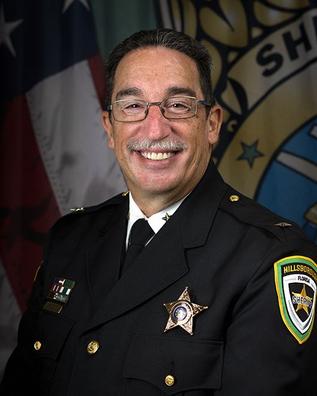
Chief Deputy Frank Losat
Hillsborough County Sheriff's Office
Dear IHIA Members,
As we enter the second half of 2026, I continue to be impressed by the growth of our Association and the commitment of our members to professional development and excellence in homicide investigations
Letter from President
Frank Losat
Updates from the Desk of the IHIA Executive Director Steve Lewis
Our 32nd Annual IHIA International Training Symposium in New Orleans, August 9–13, is rapidly approaching. The Symposium remains the cornerstone of our training mission, bringing together investigators, prosecutors, forensic specialists, and industry partners from across the world This year's program promises to provide exceptional educational opportunities, valuable networking, and the sharing of best practices that ultimately help us better serve victims and their families.
While the Symposium is our flagship event, it is only one part of the extensive training opportunities the IHIA continues to provide throughout the year Through our regional training courses, specialized workshops, conferences, and monthly webinars, we remain committed to delivering relevant and timely education to investigators at every stage of their careers.
None of this would be possible without the dedication of our Board of Directors, instructors, volunteers, sponsors, and members. On behalf of the Board, thank you for your continued support of the IHIA and our mission to advance homicide investigations through education, training, and collaboration
I look forward to seeing many of you in New Orleans this August and at future IHIA events across the country.
Stay safe and thank you for all that you do
Respectfully,
Frank Losat
Frank Losat President International Homicide Investigators Association
Join us in New Orleans for the Annual Symposium
Follow the Path of FIGG - Free Webinar Series
Article: Character and the Pursuit of Truth: Lessons for Investigators
Article: The Hidden Homicides
Article: WMU Cold Case Program recognized as national benchmark for student-police partnerships
Article: The grip of crime: Analyzing strangulation and asphyxiation typologies in homicide cases
New Website
Investigative Technology Summit & Proposal
Submissions
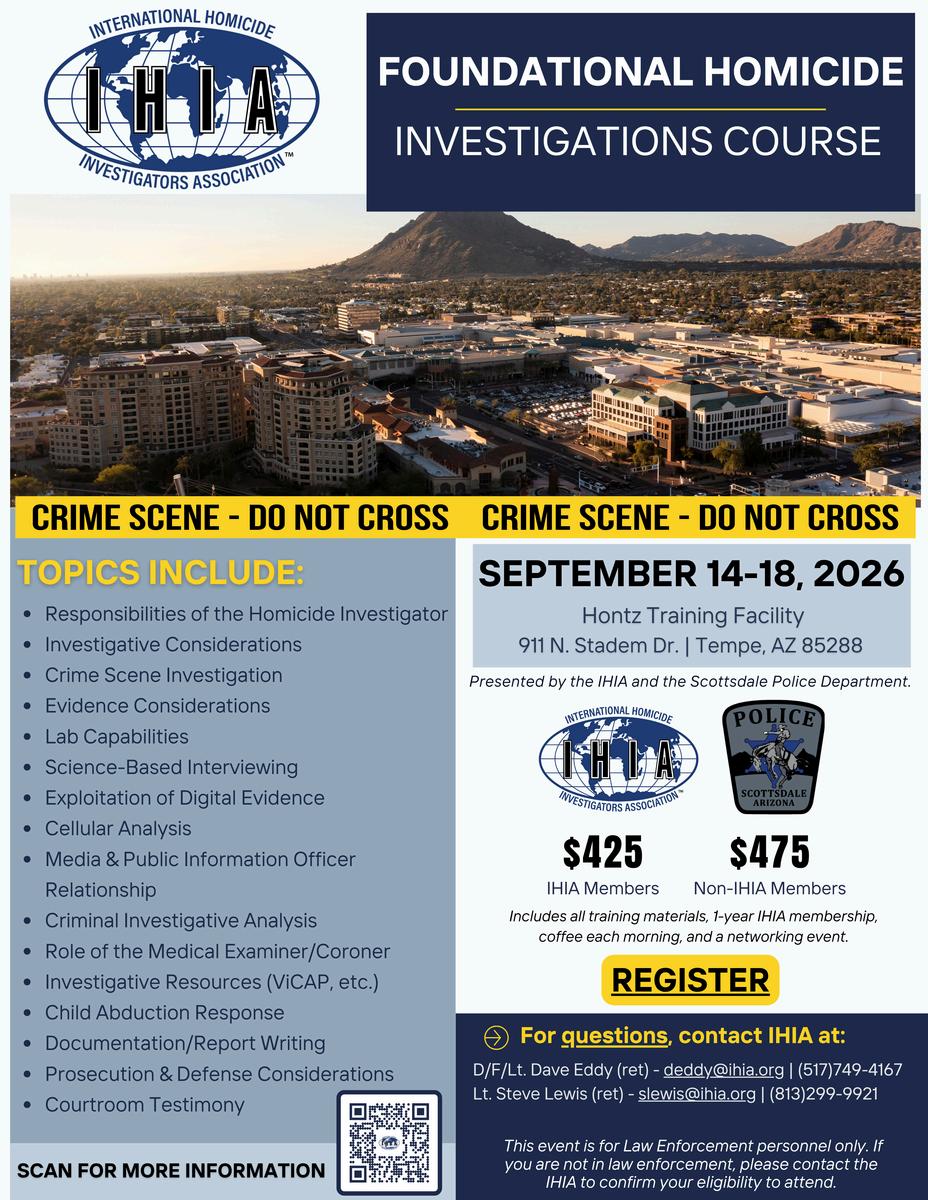
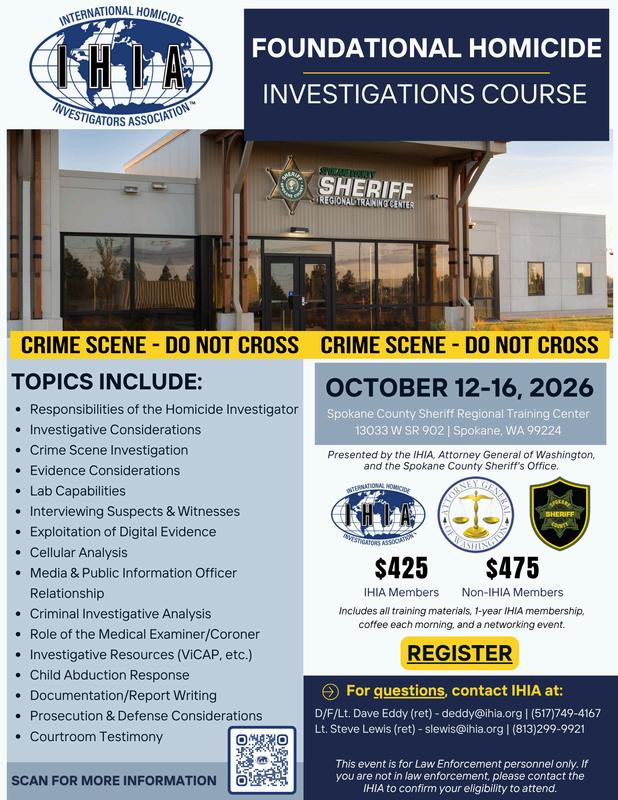
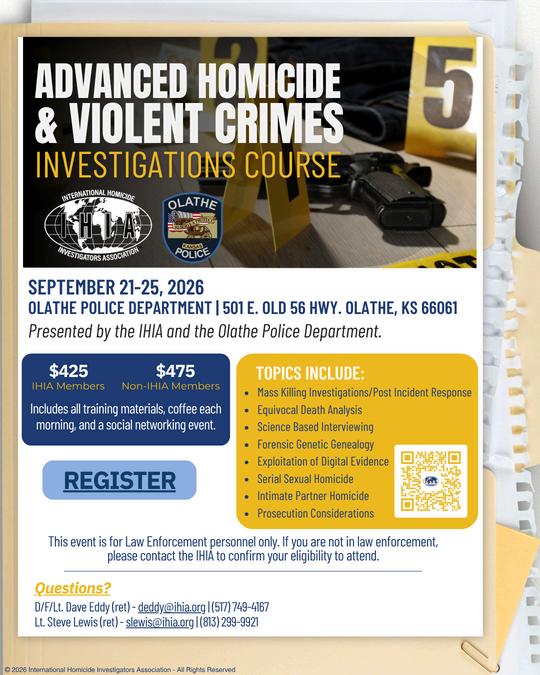
Upcoming Regional Training Opportunities
FIGG FIGG FORENSIC
INVESTIGATIVE GENETIC GENEALOGY
FREE TRAINING OPPORTUNITY
AVAILABLE TO IHIA MEMBERS ONLY
The International Homicide Investigators Association (IHIA) presents Follow the Path of FIGG, a six-part webinar series designed to provide investigators, analysts, forensic professionals, and law enforcement leaders with a practical roadmap for implementing and utilizing Forensic Investigative Genetic Genealogy (FIGG) in criminal investigations
This exclusive member benefit will explore the critical components of building, funding, managing, and sustaining a successful FIGG program through presentations from subject matter experts across the forensic and investigative communities.
FBI IGG PROGRAM Thursday, July 9 1pm-2pm
WHEN THE DNA SPEAKS DIFFERENTLY Thursday, August 20 1pm-2pm
8 MOST COMMON MISCONCEPTIONS ABOUT FIGG Thursday, October 1 1pm-2pm
5 6 4 3 2 1
MAKING FIGG STANDARD PRACTICE
Thursday, June 18 1pm-2pm
FINDING FUNDING FOR FIGG
Thursday, July 30 1pm-2pm
HOW REFERENCE TESTING MAKES OR BREAKS A FIGG CASE
Thursday, September 10 1pm-2pm
EPISODE 2 - The FBI's IGG program offers law enforcement agencies direct support in cases at no cost In this episode, FBI IGG coordinators share what resources are available, how agencies can access them, and how the program can help departments that lack the funding, training, or personnel to pursue these cases on their own.
*Please note that Episode 2 will be offered as a live presentation only, not recorded.
Missed an episode? Previous episodes are available for IHIA members in our Webinar Library Access recordings and catch up on sessions you've missed throughout the series
BY: SERGEANT R. MICHAEL BLAIR HILLSBOROUGH COUNTY SHERIFF'S OFFICE IHIA VICE PRESIDENT
After nearly three decades in law enforcement, I have become convinced that some of the greatest threats to our profession are not the ones we spend the most time discussing. We talk about staffing shortages, retention, recruiting, budgets, public perception, politics, technology, and the challenges of managing a multigenerational workforce. Those are all real challenges Yet when I look back over my career, the incidents that have done the most damage to officers, families, agencies, and public trust rarely started with a lack of manpower or funding.
They started with a lack of character.
Not all at once Not with some catastrophic decision Usually, it began with something much smaller, a compromise, a rationalization, an unchecked ego, a failure to exercise self-control, or a decision made when nobody was watching.
Then one day, what should have remained private becomes public A career is damaged A family is hurt An agency is forced to answer difficult questions Another headline appears, and the profession absorbs another black eye.
As investigators, we spend our careers asking one fundamental question: How did we get here? Perhaps it is time we ask that same question of ourselves
While many challenges facing law enforcement originate outside our control, some of the most damaging originate within it.
That is why I believe one of the most important conversations we can have today is not about tactics, technology, policy, or procedure. It is about character.
THE INVESTIGATOR'S RESPONSIBILITY
The purpose of an investigation is simple: find the truth.
Everything we do, witness interviews, scene processing, forensic examinations, digital evidence analysis, and courtroom testimony, exists to move us closer to that truth. The greatest threats to that process are often internal. Ego. Pride. Assumptions. Bias Overconfidence The belief that we already know the answer
Character is what protects us from those threats.
Integrity Is Not Enough by Itself
Law enforcement has always placed a high value on integrity, and rightly so. Our word matters. Reports matter Testimony matters Truth matters The badge cannot function without integrity
But integrity does not stand alone.
A person cannot be strong in integrity while being careless with humility, self-control, dependability, compassion, or initiative Character traits are connected. When one area is neglected long enough, it eventually affects the others.
THE CHARACTER TRAITS THAT MAKE BETTER INVESTIGATORS
Years ago, while working on an armed robbery investigation, I conducted a sequential photo lineup with a witness After the witness positively identified the suspect, I reviewed my work and realized I had made a mistake. It was neither misconduct nor intentional. I had simply moved too quickly and failed to make the lineup as unique and defensible as it should have been
At that moment, nobody else knew. I could have convinced myself it was close enough. I could have justified moving forward Instead, I had to do something that does not always come naturally in law enforcement. I had to admit I was wrong.
THE HIDDEN HOMICIDES
BY: STUART SOMERSHOE RETIRED MISSING PERSON DETECTIVE
“What are my charges?”
This was the question posed to me by the man handcuffed in my backseat. It was a hot night in August 2001 and I had made a traffic stop of two men in a truck They were extremely tense and when I ran a records check on the passenger and found he had a warrant I thought I had discovered the source of that nervousness.
“You’ve got a parole violation,” I told the handcuffed man
“Just that? No other charges?”
“Isn’t that enough?” I asked, laughing.
“No No, that’s good,” he said and seemed to relax
The interaction puzzled me until a few weeks later when a detective contacted me about the traffic stop. Her missing person investigation showed that I had stopped the two men shortly after they had committed a murder and disposed of the victim’s body
That traffic stop stuck with me and years later I decided to leave patrol and transfer to the missing persons unit. I had visions of investigating complex murder investigations with each new case
The reality, I quickly learned, is nothing like that. The vast majority of missing person cases are non-crimes: runaways; people not communicating; people acting irresponsibly; mental health issues; and addiction issues Of the 7000 new missing person cases Phoenix Police receive annually (20 new ones a day), only a couple dozen of those turn out to be homicides each year
The challenge is finding those hidden homicides in the tsunami of incoming cases This is a nationwide problem Every year there are about 600,000 new missing person entries in NCIC Unfortunately, no one keeps statistics on how many of those missing person cases are actually homicides (I’ve asked the FBI and various agencies with no luck) so all I can rely upon is my personal experience of 15 years working these cases. In that heavy caseload, the homicides are few and far between but the ones that are identified typically turn into some of the most challenging investigations you will handle Often, they become media conflagrations that bring a lot of attention and scrutiny to your agency. Think of the Scott Peterson case or, more recently, the Nancy Guthrie case.
Most cold case investigations sit dormant for years with slim chances of being reopened let alone solved Demonstrating the impact of student-police partnerships, Western Michigan University’s Cold Case Program helped detectives resolve two decades-old homicide cases in just one semester.
“WMU’s program was ahead of its time in the development of student-involved cold case programs and should serve as a benchmark by which other programs around the country measure themselves,” retired Detective 1st Lt. Dave Eddy, director of training operations for the International Homicide Investigators Association, told a group of investigators from around North America at a training in Grand Rapids
“From my investigative experience,” he continued, “the systems approach, processes, outputs and attention to detail reflected in the full case work of the WMU Cold Case Program are noteworthy, and I personally think it worthy of replication by other programs across the country ”
Since its launch, students in the WMU Cold Case Program have helped detectives with Michigan State Police (MSP) and 13 other law enforcement agencies resolve eight cold cases and breathe new life into more than 80 other investigations
“It’s the University’s commitment to the program and its proven record of success that make the WMU Cold Case Program so impactful,” Eddy says.
The success is what drew Detective Sgt Chris Suarez, retired from Michigan State Police, to the program two years ago He now works as its detective liaison, ensuring files are secure,
mentoring students and working with departments to help determine which cases the program will take on
“I just absolutely love what it stands for and the positivity that comes from it for both law enforcement and the University,” he says “I’ve always had a passion for investigation, and to see these cold cases moving along and getting closure ... is pretty awesome to me.”
A FORCE FOR GOOD
The Cold Case Program’s most recent assist came in the case of Linda Meteer, a mother of five whose body was found near Traverse City in 1989 More than 35 years after the crime, detectives reopened the case, and newly tested DNA evidence linked Steven Koon to the murder a break Grand Traverse County Sheriff’s Office Capt. Chris Clark attributes, in part, to his department’s work with Western students
“We got the case material from the detectives, and then the students acted as the research arm for the detectives in any way that would help them in their investigation,” Dr Ashlyn Kuersten, the program’s co-director, said in an interview with 9&10 News.
“The students can draw up documents that might be useful for detectives: a timeline, a family tree, a deep dive into a person of interest and interactive maps ”
“It gives you a little bit of pride at the work your detectives are doing, the work that the students at Western Michigan University are doing, the work that the people at the state labs are doing,” Clark said.
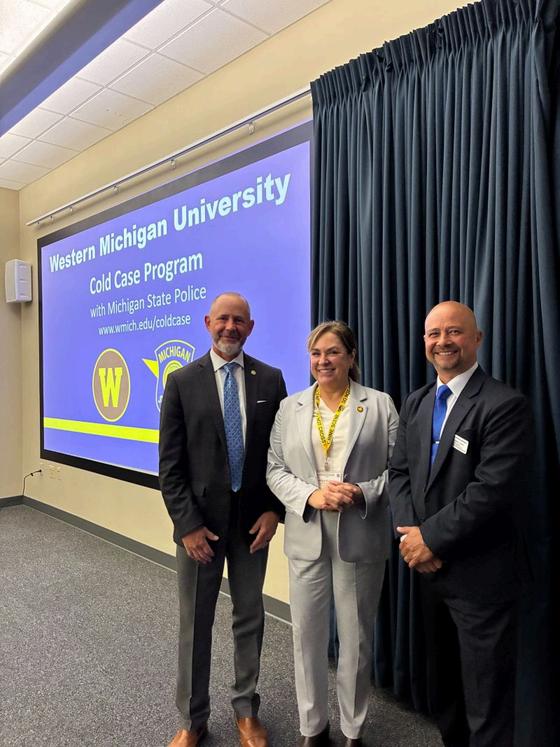
Eddy, Kuersten and Suarez at the International Homicide Investigators Association training in Grand Rapids
THE GRIP OF CRIME: ANALYZING STRANGULATION
AND ASPHYXIATION TYPOLOGIES IN HOMICIDE
CASES
BY: VICTOR G PETRECA PHD, DNP | KALLIOPI TZANI-PEPELASIS PHD | MARIA LOANNOUD PHD
ALICE SIGGERY PHD | LAUREN MCBRIDE BA | ELORA BARROS | ANN W BURGESS DNSC
INTRODUCTION
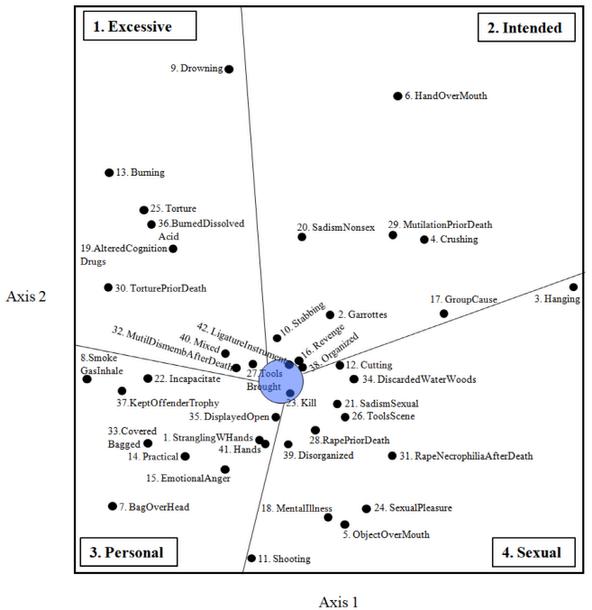
Strangulation in homicide cases is not only a very intimate method of violence but also one that poses significant challenges in forensic and criminal investigations. What motivates the offender to use strangulation in the first place? How often does it relate to a sexually motivated crime versus a sadistic, non-sexual crime? Does the choice of manual strangulation versus ligature change with motive? These questions are potentially answered using multivariate analysis
Strangulation is often employed in domestic violence and sexual homicide and accounts for a substantial portion of violent deaths. Strangulation was the preferred method in 35% of cases involving serial killing and was more predominant in cases involving sexually motivated homicide against women [1]. It is necessary to take a comprehensive approach to studying strangulation homicide patterns and outcomes to identify the behavioral patterns of these offenders better and on a deeper level [2, 3] The categorization of homicide strangulation may also be beneficial for identification by law enforcement, social workers, and first responders Categorization also allows for further analysis and studies on potential warning signs, re-offending patterns, and escalation tendencies within typologies.
Existing research on homicide typologies provides a broad framework for understanding perpetrator behaviors, including their motivations and their methods
While these typologies cover a wide range of violent behaviors, there is a notable lack of specificity when it comes to differentiating between the types of strangulation in particular whether manual or using ligatures and the contextual factors that guide both of these choices This general and broad approach may miss subtle but crucial distinctions that could inform more effective profiling and preventive strategies [4]
TYPOLOGIES IN HOMICIDE LITERATURE
The study of homicide typologies has dramatically advanced our understanding of the various motives and methods employed by perpetrators, allowing for a more effective law enforcement response and prevention Whether it is typologies based on details related to the crime scene, the motivations behind the crime, or simply the type of crime, the organization of crime has aided police work significantly for decades. The Crime Classification Manual, a standard system for understanding these typologies, is one such system that provides a structured approach to categorizing violent crimes, including those involving strangulation [5] Despite its comprehensive approach, the manual's broad organized/disorganized categories may not fully capture the granular specifics of strangulation, thus highlighting the necessity for a more detailed exploration of this method [4, 6]. There has been significant work related to sex offender typologies, opening the door for focused research on subgroups within existing groupings
Research has shown that strangulation is used in 38% of crimes involving intimate partner violence and 12% in sexual assaults, where the perpetrator's desire for control and dominance over the victim is pronounced [7, 8] This method is particularly prevalent in sexual homicides, where it serves not only as a means to kill but also as an expression of power and control, often intertwined with the perpetrator's sexual sadism [4, 9]
Moreover, the choice between manual and ligature strangulation can potentially reveal significant aspects of the offender's profile, including their preparation for the crime, psychological state, and situational influences For example, manual strangulation may indicate a more spontaneous or emotionally charged attack, often observed in domestic settings. In contrast, ligature strangulation could suggest premeditation and possibly a colder, more calculated approach typical of serial killings [10]
NEWWEBSITE
The International Homicide Investigators Association has enhanced its online experience to give members more ways to connect, collaborate, and stay informed.
MEMBERS NOW HAVE ACCESS TO:
A member forum to ask questions, share ideas, discuss cases, and exchange resources with fellow professionals
An IHIA blog featuring the latest news, updates, training announcements, and organizational highlights
A searchable member directory to connect with investigators and professionals across the globe
Improved access to training, events, resources, and member benefits
A comprehensive training calendar with courses, webinars, symposiums, and specialized investigative training opportunities
On-demand webinar access, allowing members to revisit valuable educational content and presentations
Quick registration and event management tools to streamline enrollment in IHIA courses and events
Mobile-friendly access, making it easier than ever to connect with members and access resources from the field; don’t forget to download the Wild Apricot App!
December 8-10, 2026
Hilton Garden Inn at EpicCentral 2935 S State Highway 161
Grand Prairie, TX 75052
Hosted in Grand Prai
CALL FOR PRESENTATIONS
This three-day event will bring together law enforcement investigators and technology partners to showcase how emerging technologies are advancing criminal investigations, from cold case homicides to active investigations.
Each training session will feature a collaborative presentation model: a law enforcement case study presented alongside the technology partner who assisted in the investigation This format emphasizes real-world application and investigative collaboration Proposals may be submitted by individual investigators or technology partners
This summit is designed to provide investigators with practical, real-world training objectives and actionable investigative techniques that can be directly applied to criminal investigations
Interested in learning more? Email ihia@ihia org for additional information and available opportunities.
SUBMIT A PROPOSAL
EVENT PAGE & DETAILS
UPCOMING REGIONAL TRAINING OPPORTUNITIES
COURSE (ROANOKE, VA)
UPCOMING REGIONAL TRAINING OPPORTUNITIES
JULY 20
OFFICER INVOLVED CRITICAL INCIDENT INVESTIGATIONS COURSE (DOWNERS GROVE, IL)
JULY 21
IHIA 32 ANNUAL TRAINING SYMPOSIUM ND (NEW ORLEANS, LA)
As a sponsor or exhibitor, you'll have the opportunity to engage directly with homicide investigators from across the world Strengthen relationships with both individuals and departments while increasing your company's visibility within the law enforcement community Please contact Steve Lewis at slewis@ihia org or 540-898-7898
SPONSORSHIP RECEPTION $2,000
($2,000 exclusive, sponsorship will be shared with non-competing companies if exclusive is not secured)
SPONSORED COFFEE OR SPONSORED BREAKFAST $500/EACH DAY
SPONSOR DAY $500/EACH DAY
Be the exclusive sponsor for a day network with attendees, join them for lunch, and take a few minutes to introduce yourself and share materials A great way to connect directly with investigators from around the world
INVESTIGATIVE QUARTERLY NEWSLETTER ADS
The IHIA e-Newsletter is sent quarterly to 10,000+ readers and posted on our members-only website Advertising space is available in each issue; an ideal way for companies to connect with IHIA members and showcase their products or services.
Trim Size: 519 wide x 200 high (in pixels) Static Only
Rates:
$350 | Premium Position #1
$300 | Premium Position #2
$250 | ALL Other Positions
Due Date for Reservations and Materials: September 2026 Issue | Due August 20th December 2026 Issue | Due November 20th