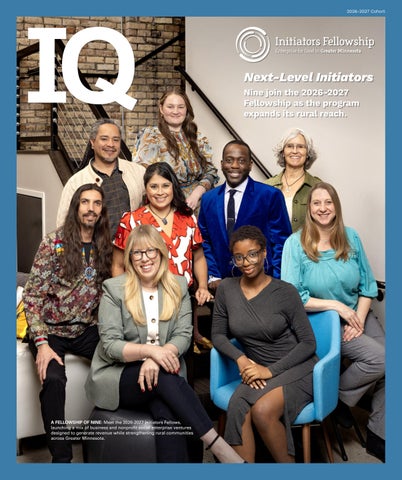
Nine join the 2026-2027 Fellowship as the program expands its rural reach.
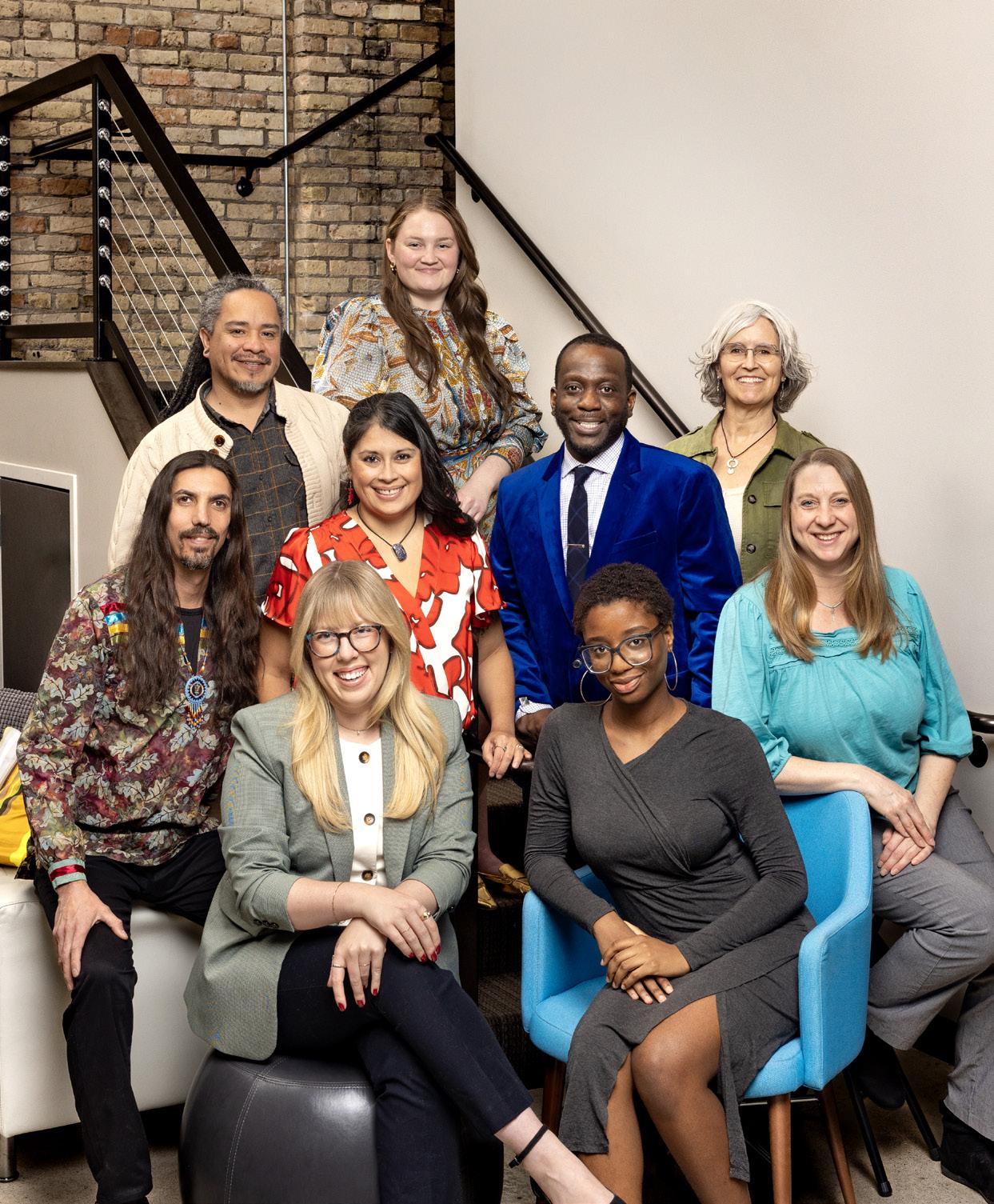
A FELLOWSHIP OF NINE: Meet the 2026-2027 Initiators Fellows, launching a mix of business and nonprofit social enterprise ventures designed to generate revenue while strengthening rural communities across Greater Minnesota.
Next-Level Initiators
By Jon Spayde and Diane Richard
by Paul Middlestaedt
Nine
social entrepreneurs join the 2026-2027 Initiators Fellowship as the program expands its reach across Greater Minnesota
A communications company sharing environmental success stories through podcasts and live events. A counsulting firm helping small-town workplaces and schools navigate conflict and political division. A start-up that equips off-reservation Native youth with job skills and vocational direction. An app connecting innovative Christian music to support listeners’ wellbeing.
These are among the nine ventures launched by members of the 2026-2027 Initiators Fellowship cohort. Over the next two years, the Fellows will receive support to build their social enterprise ventures—a mix of businesses and nonprofits designed to generate their own revenue while advancing social good.
The program is rooted in a simple but powerful belief: Innovators can thrive and make a difference in Greater Minnesota. With new support from the Bush Foundation, that vision is gaining momentum. A multi-year grant will enable the Initiators Fellowship to expand beyond its two-year cohort model and build a statewide network to support rural social entrepreneurs.
Initiators Fellowship Co-director Christine Metzo said the program fills a unique niche.
“I’ve scoured every piece of literature I could find on social enterprise,” she said. “You’ll see a lot of programs that are either global in scope or very metro-based. We are the only program that supports this kind of social entrepreneurship for a rural and smaller-city setting.”
Each Fellow receives a $30,000 annual stipend for two years, along
with leadership development, business education, mentorship and hands-on guidance from the Initiative Foundation and its partners.
“It’s an investment in a person, their personal learning and leadership journey, and their social enterprise development,” Metzo said.
The Fellowship began with a regional vision. Rick Bauerly, founder and CEO of St. Cloud-based Granite Partners, was inspired by Echoing Green, a New York organization that supports social entrepreneurs worldwide. He believed a similar model could be adapted to serve Greater Minnesota.
With support from Granite Partners, the Initiative Foundation launched the first cohort in 2017. What began with four Fellows in Central Minnesota has since expanded across the regions served by the Northwest, West Central and Southwest Minnesota Initiative Foundations. The current cohort also includes northeastern Minnesota through a partnership with Duluth-based Northspan.
Recruitment is intentionally broad, beginning with an open call for applications. From roughly 120 submissions, nine Fellows were selected through a rigorous, multi-stage review process.
Metzo notes that even those not selected for the final cohort benefit from the experience.
“I tell people the application is more than a form—it’s a chance to really pressure-test and refine your idea,” she said. “Even people who aren’t selected have told me the process helped them get clearer and stronger. That’s a win in my book.”
From small towns across Greater Minnesota, the Fellows are proving that bold ideas can take root in the non-metropolitan areas of the state. Here’s a look at the 2026-2027 cohort and their social enterprise ventures.
Photography
Hallie Pond
In the Company of Changemakers
PINE RIVER
INITIATIVE FOUNDATION REGION
You won’t find a New York–style bagel shop on Pine River’s main drag. But you will find songbirds along the riverbanks—something Hallie Pond values just as much.
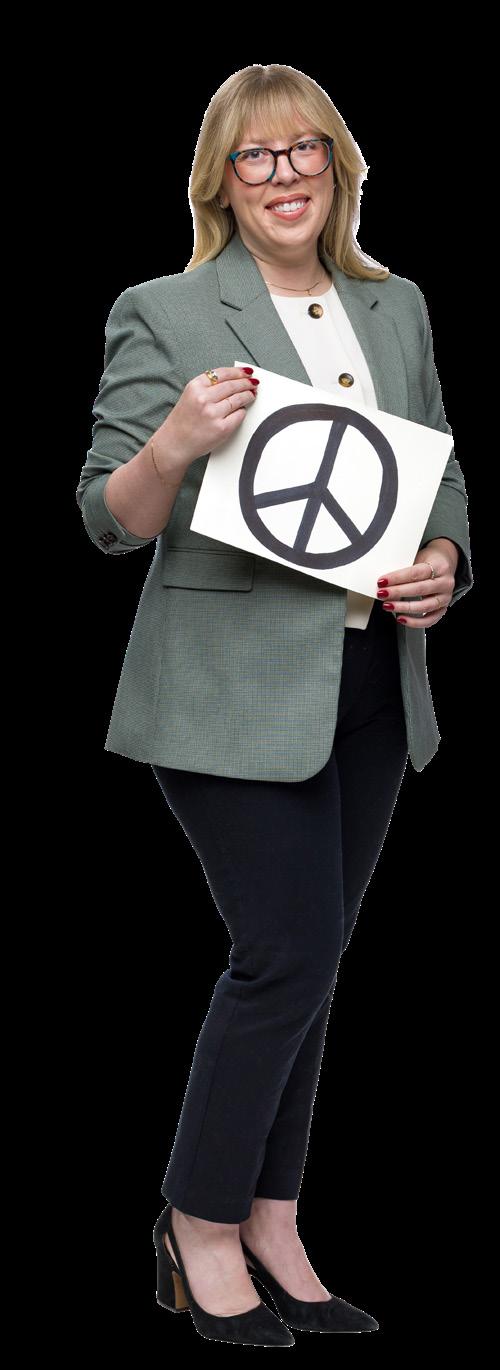
After spending time in Senegal, the San Francisco Bay Area and New York City, where she earned a master’s degree in organizational psychology from Columbia University, Pond has returned home. Now, as a member of the 2026-2027 Initiators Fellowship cohort, she’s building Truespace Consulting, a Pine River–based business that helps workplaces and schools build conflict resilience.
Following her grandmother’s advice— “Don’t get a big head and stay focused on what the community needs, listen with love, be patient and stay curious”—Pond is grounding global experience in small-town relationships.
“Curiosity is one of the most powerful tools we can cultivate to build bridges,” she said.
Conflict, Pond says, is neutral. In Minnesota, where many pride themselves on avoiding confrontation, that can be hard to accept. But unaddressed tension doesn’t disappear—it festers.
“In every organization I’ve ever been in, conflict was not handled well,” she said. Even trends like “radical candor,” meant to encourage honesty, sometimes gave people permission to be direct to the point of cruelty.
Handled well, she argues, conflict becomes an asset. “Conflict is a conduit for innovation, growth and building trust,” Pond said. When addressed successfully, teams find a sense of relief and catapult their growth in a productive direction.
When she enters a workplace where employees hesitate to speak up, Pond begins by setting shared norms—confidentiality and gentle prompts for people to contribute more or less—“with the hope of creating a psychologically brave space.”
From there, she facilitates conversations so the wisdom of the group can emerge. “My job isn’t to give anybody the answers, but to hold that container and bring structure to that conversation.”
Pond launched Truespace Consulting in 2019 and now plans to grow it across the fivecounty area surrounding Pine River. Revenue from workplace engagements helps fund youth programming. Through the Initiators Fellowship, she is developing a roadmap for that next phase.
“To be in the company of changemakers, it’s just fun,” Pond said. “To be alongside others who are compassionate, driven souls working to make positive social change, it’s giving me a lot of energy.”
By Diane Richard, IQ Magazine contributing writer.
SUPPORT FOR RURAL SOCIAL ENTREPRENEURS
Founded in 2017 with early and ongoing leadership and financial investment from Granite Partners, the Initiators Fellowship supports rural social entrepreneurs with capital, coaching and statewide connections that help ideas grow into lasting community impact. As the program expands across Greater Minnesota, applicants are engaged through learning opportunities, peer connections and convenings, creating a supportive network for rural social entrepreneurs. Major support comes from the Bush Foundation, our Minnesota Initiative Foundation partners and Duluth-based Northspan.
Lilly Goyah
The Perfect Praiseworthy Tunes
BIG LAKE
INITIATIVE FOUNDATION REGION
Music wasn’t just background noise for Lilly Goyah. It was a lifeline.
During a painful season of depression, when she experienced suicidal ideation, one song in particular reached her in a way nothing else could. Gospel artist Kirk Franklin’s “My World Needs You”—a tender, prayer-like piece—gave words to feelings she struggled to name.
“At that point, I wasn’t that aware of him,” she said. “But it was a song that went deep.” Unlike much of the upbeat Christian music she’d heard before, this one met her in its heaviness. “So much Christian music is so upbeat—but this song met me where I was.”
Now, the second-generation Liberian American is working to create that same kind of connection for others. Through her Initiators Fellowship social enterprise work, Goyah is developing ANP Streaming (ANP stands for A New Psalm), an app that pairs diverse Christian music from around the world with listeners’ moods and spiritual needs—helping people find songs that speak to exactly where they are.
“I want it to be a platform where people can tell the app how they’re feeling, and it learns what type of songs they like to listen to, depending on the mood they’re in. It will continue to curate a playlist based on their emotions,” she said. A journaling feature will allow listeners to track their responses.
Goyah started ANP Streaming during her senior year at the College of Saint Benedict in St. Joseph. The college’s Enterprise Scholars Program teaches students about the nuts and bolts of business development and takes them overseas for further study. Goyah’s class went to Vietnam, which was the perfect place for her: Instead of working with expensive U.S. tech firms that often outsource to Vietnam, she was able to bypass intermediaries and establish direct connections with Vietnamese app developers.
She’ll use the Fellowship to further develop the app, which she calls the relatively easy part, and also to market it.
“Marketing is the live-or-die for a digital product,” she said. “How well you present your brand, how much people feel like they can be a part of it.”
Marketing and mission go together for Goyah: “I want to be able to see ANP’s impact on diverse people who are proud of their Christian faith coming together, expressing themselves, and creating a space where they feel their stories are heard.”
For Goyah, the goal is simple: to make sure someone else hears the right song at the right time—and know they are not alone.
By Jon Spayde, IQ Magazine contributing writer
I want to be able to see ANP’s impact on diverse people who are proud of their Christian faith coming together, expressing themselves, and creating a space where they feel their stories are heard.”
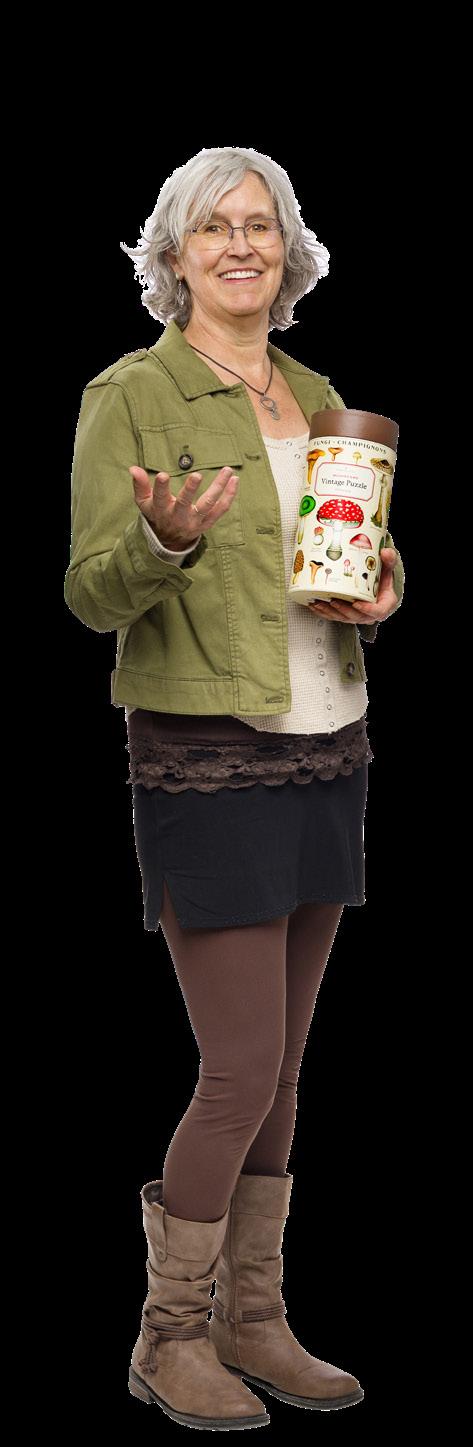
Dacia Dauner
A ‘Micro School’ in Nature BEMIDJI
NORTHWEST MINNESOTA FOUNDATION REGION
tep inside a classroom at Apple Blossom Village in Bemidji and you won’t find rows of desks or glowing screens. Instead, sunlight pours through a skylight into a round yurt, where children gather on wool rugs and the walls curve without corners.
That’s because class here takes place inside domed structures modeled after traditional Mongolian homes. And for founder Dacia Dauner, Apple Blossom’s yurt is one of the healthiest places to learn and grow.
Her favorite place? Nature—in all its wild unpredictability.
“If we want to raise good stewards who care about the Earth, we need to start when they’re little,” Dauner said. In nature, “they build resilience, perseverance. They learn it’s OK to be uncomfortable sometimes. It shapes their brains.”
Drawing on more than 20 years in early childhood and Waldorf education, Dauner and her staff offer family classes, summer camps and mobile forest retreats. The programs promote health, foster stewardship and inspire joy and wonder in the natural world.
Dauner’s introduction to yurts came through the Indigenous Environmental Network (IEN), a Bemidji-based alliance of grassroots Indigenous leaders. The organization shared its yurt with her class, sparking a partnership that continues today. IEN now teaches Apple Blossom students traditional Indigenous and Anishinaabe ways of caring for the earth and one another.
That relationship reflects the school’s broader philosophy. Rooted in Waldorfinspired, nature-based learning, Apple Blossom students spend as much time outdoors as possible.
“Their learning is very play-based with the rhythm of the day,” she said. “We take every indoor activity and do it outside. If it’s painting day, we’re painting outside. If it’s baking day, we’re rolling dough at the picnic tables.”
Dauner describes Apple Blossom Village as a micro school for kindergarten through fourth-grade students, 45 percent of whom are students of color. In the Northwoods, that means packing extra layers. “We’re outside every single day—even in the middle of winter,” she said. “We bundle head to toe.”
Two global events converged to lay the seed for Apple Blossom Village: the COVID19 pandemic and the omnipresence of digital distractions. The pandemic “made it clear in my mind that being outdoors was the healthiest place to be,” Dauner said. And the rise of screen time, she said, has deprived young people of physical play.
“To bring back the magic of childhood and play face to face, that’s what I want to get the word out about,” she said. “The physical movement, they need that so much. Of course, academics too, but they need the freedom to explore and even get bored. Which doesn’t happen much these days.” That, she added, is when the magic happens.
By Diane Richard, IQ Magazine contributing writer
“If we want to raise good stewards who care about the Earth, we need to start when they’re little.”
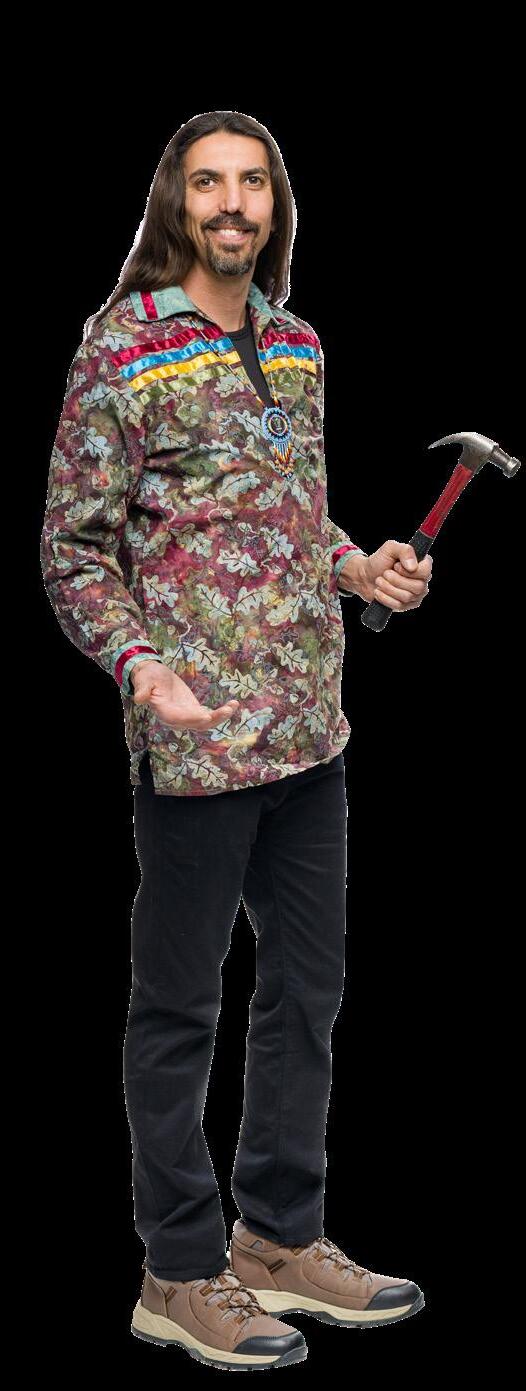
Joshua Jones
A New Deal for Native Youth RED LAKE
NORTHWEST MINNESOTA FOUNDATION REGION
oshua Jones’s resume reads like a road map of restless energy—motocross racer, touring drummer, ranch hand, factory worker. Today, the Red Lake Nation tribal member has found his calling: helping Native youth find steady footing in their own lives.
Though he now lives in Bemidji, about 35 miles south of Red Lake Nation (Miskwaagamiiwi-Zaagaiganing), Jones considers the reservation home. As an enrolled tribal member and hydrologist for the tribe’s Department of Natural Resources, he monitors water quality and works to protect the land and lakes that shaped him.
“It really feels like I’ve had many different lives,” Jones said.
That winding path—from dirt bikes to environmental science—now fuels his vision as an Initiators Fellow. Jones is developing a modern-day version of the Civilian Conservation Corps to create paid work opportunities and mentorship for Red Lake youth.
Jones’s goal is to solicit work for Native youth, ranging from construction and landscaping to food service and security— anything that can serve as an appropriate first step on the job ladder—and then provide ongoing support.
“I’ll tell a customer, ‘Well, I’ve got a crew. We can help,’” he said. “Strengthening community relationships is more important to me than anything, and having a bunch of Red Lake kids in the Bemidji community doing good things, that’s powerful.”
For Jones, the goal is visibility as much as employment—creating opportunities for Native youth to contribute, earn and be seen in a positive light.
Many of those young people, he said, are caught between two worlds. Living off-reservation in Bemidji, they may not have regular access to Red Lake’s Youth Council programs—whether it’s due to
transportation barriers or they don’t meet tribal enrollment requirements. At the same time, steady job opportunities can be limited on the reservation itself.
Jones understands that tension firsthand. After years of searching for direction, he found focus while studying hydrology at Bemidji State University, where he ultimately secured a master’s degree. The experience shaped how he thinks about opportunity—how steady work, mentorship and purpose can help young people find their footing sooner than he did.
When Red Lake’s Family and Children’s Services unit, known as Uplifting Our Relatives (Ombimindwaa Gidinawemaaganinaadog), began building a lakefront recreation area, Jones stepped in—and brought local youth with him. What started as a single project quickly became something more. He saw how paid, handson work paired with Ojibwe cultural learning could build confidence and pride.
More projects followed. In his role at the tribal DNR, Jones continued to hire and mentor young people, weaving together conservation work, cultural knowledge, and job skills. The Initiators Fellowship now gives him the platform to expand that model—reaching more youth and building a structured pathway to help them discover their strengths.
“Putting some money in their pockets is great,” Jones said. “Experiences are great. But I also think about the many stages of my life and how it would have helped me to have had somebody there who kind of kept the ship afloat, kept me pointed in a general direction.”
And there’s something else that’s just as important, he added: “There’s the value of just knowing that, at the end of the day, somebody cares about you.”
By Jon Spayde, IQ Magazine contributing writer
A Grounding in Grit
DETROIT LAKES
WEST CENTRAL INITIATIVE REGION
When Erika Gilsdorf talks about climate leadership, she doesn’t start with policy. She starts with grit.
The Detroit Lakes-based videographer is expanding her storytelling toolkit, moving from film into podcasting to spotlight local environmental voices. Through her social enterprise, she aims to build climate leadership and resilient communities across Minnesota by sharing stories that connect people to the places they call home.
Her new venture, The Global Grit Experience Podcast, will focus on everyday Minnesotans who care for land, water and wildlife—from prairie restorations to backyard pollinator plots.
She defines environmental advocacy broadly. “A farmer is a climate activist when they’re protecting the land,” she said. “Hunters are climate activists when they invest in Ducks Unlimited, which protects wetlands.”
The podcast comes at what she sees as a pivotal moment.
“It’s really frustrating when new legislation can come in and, with a stroke of a pen, erase the work of a generation,” she said. “In this time, we’ve just moved the clocks back on decades of progress. It’s up to people to say, ‘We want consistency. Hey, Minnesota, we value our clean water and our farmland. We’re not going to allow this.’ I think it’s extremely timely right now.”
Through interviews with community members improving the environment in ways big and small, Gilsdorf hopes listeners will see themselves in the work.
“It takes grit, which means perseverance, passion,” she said. “Grit can be in anything. It can be in speaking up for the first time, or for the hundredth time. It can be in planting a pollinator garden that’s a two-by-two plot. Grit is an experience that makes you feel good.”
The idea sharpened during a work trip to Ireland, when a video subject told her, “I’m working on my corner. I hope you’re working on yours.” The phrase stuck.
“It starts local,” she said. “Even locally, county boards will go against environmental priorities. It takes grit to get local people to prioritize environmental health.”
For Gilsdorf, grit is the antidote to complacency. “We slowly start to accept things: Why is there an algae bloom? Why is it smoky all summer?” she said. “It takes grit” to counter complacency—to say, “I’m going to get involved.”
She points to the Indigenous philosophy of the seven-generations principle, which calls on people to consider how today’s decisions will affect descendants far into the future. “When you plant a tree, you’re not going to reap the benefits and sit in the shade. It’s for the next generation. You persevere because it matters.”
In western Minnesota, she believes those small acts—tending a field, restoring a wetland, planting a tree—add up. One corner at a time.
By Diane Richard, IQ Magazine contributing writer
“ When you plant a tree, you’re not going to reap the benefits and sit in the shade. It’s for the next generation. You persevere because it matters.”
Megan Gilsdorf
A ‘Third Space’ for Artists
DETROIT LAKES
WEST CENTRAL INITIATIVE REGION
Megan Gilsdorf grew up under the counter at Norby’s Department Store—sorting hangers, designing window displays and learning how a small-town business shapes a community.
Now she’s launching a social enterprise in Detroit Lakes: a “third space” offering studio access, mentorship, a gallery, coffeehouse and marketplace.
“I’ve got that small-business itch,” she said. “I really have a passion for entrepreneurship and a passion to work hard for community.”
Now in the ideation phase, Gilsdorf still has numerous decisions to make: She needs to name the business, choose a location, build it out and find funders. “[The Initiators Fellowship] is the turning point for me to have the resources and mentorship to figure out how the heck to start something like this,” she said. “It’s mind-blowing.”
Her idea for a creative incubator took root when Gilsdorf and a friend commiserated over missing the innovative sparks that sizzled when they were college students.
“We really mourned the loss of the creative college environment, with endless classes and people coming together,” said Gilsdorf, who spent a couple of years in corporate life after earning a fashion degree from Arizona State University. “It’s so inspiring and collaborative, that cross-collaboration. We discovered we missed this, so maybe others will be [missing
And what better place to build a creative rural hub than in Detroit Lakes?
The west-central Minnesota community has already shown it can think big. The arrival of Danish artist Thomas Dambo’s towering wooden trolls—built with the help of hundreds of local volunteers—transformed parks and trails into destinations and helped land the city on Time magazine’s list of Top 25 places to visit. The sculptures sparked tourism, yes, but they also reflected something deeper: a willingness to invest in public spaces, back local entrepreneurs and treat creativity as economic strategy.
“You can do anything you want in a small town,” she said. “It’s easier here. There’s a lot of creative energy … but nowhere to come together and connect.”
Gilsdorf imagines repurposing an existing space—a warehouse or maybe an old gas station—where artists can gather, experiment and grow. She envisions a place “for people to belong, try new things, mess up along the way,” and a space bold enough to challenge the idea that art is merely a hobby.
Borrowing from the “slow food” movement—Gilsdorf calls it “slow art”—she wants to create a space where creative work can be nurtured with time, mentorship and community support. “It’s for the professional artist, the casual artist and the art curious,” she said. “We’re here to give you the tools and know-how. We have a space for you.”
By Diane Richard, IQ Magazine contributing writer
“ You can do anything you want in a small town. It’s easier here. There’s a lot of creative energy … but nowhere to come together and connect.”
Terrell Grier
Soundtrack for Success
DULUTH
NORTHEAST MINNESOTA, NORTHSPAN
n the music Terrell Grier creates, he found what the streets, the courts and even prison could not give him: a second chance.
Grier grew up in a hard-knock area of Detroit and moved to Duluth more than two decades ago. But stability didn’t come easily. After serving four years in prison, Grier committed to turning his life around. He became a devoted father of three and rebuilt his life with renewed hope.
Then came a setback that shook him to his core. Following his wife’s death, the court removed his children from his custody—a loss that sent him into years of despair.
“I went to a really dark place for maybe five years,” he said. “And then I pulled myself out of that place and decided to use music to escape what I was going through, and to create a sustainable foundation for myself.”
Music became both refuge and direction. Grier created the persona Casino Cuz’O and began uploading videos to YouTube. Two of his songs landed in films. With his confidence returning, he leaned into entrepreneurship, launching a Cuz’O-branded clothing line, a mobile auto-detailing service, and a sneakerrestoration company called Mind Body Sole.
His next chapter began when the Duluth-based Kako Foundation, a nonprofit focused on music education, invited Grier to collaborate on a local music project. The experience reignited something deep within and prompted Grier to launch World of Music, a program that blends music education with youth development.
“I wanted to help youth use music to improve their lives, and not just in a monetary way, but in an internal way,” Grier said. “Musical creativity had been a gateway for me to heal, to reflect on life, and to express myself. And I noticed that with screens so dominant, a lot of the youth don’t
use their creativity anymore.”
Today, Grier is working to give young people the same outlet that once helped him find his footing—and his future.
In schools, churches and community centers, Grier gathers groups of students and helps each contribute a few bars to a shared song. The approach allows quieter youth to participate without pressure while gradually building confidence.
“I’ve seen them go from being timid and not wanting to be a part of something to being excited about taking part,” he said.
Afterward, Grier completes the track in a local studio so students can hear a polished version of something they helped create. For many, it’s the first time they’ve seen an idea turn into something tangible.
Through the Initiators Fellowship, Grier plans to expand World of Music in new directions. He envisions a permanent recording studio along with a mobile unit that brings programming directly to neighborhoods and schools. In addition to songwriting and performance, he plans to teach the business side of music, including registering musical works with organizations such as the American Society of Composers, Authors and Publishers (ASCAP) and building sustainable careers.
“I’m not looking for everyone to go directly into music,” he said, “but for them to be able to feel their own creative spark, to start their own journey, and to be able to heal from whatever they’re going through.”
For Grier, the work is deeply personal— rooted in his own journey and the second chance he continues to build.
By Jon Spayde, IQ Magazine contributing writer
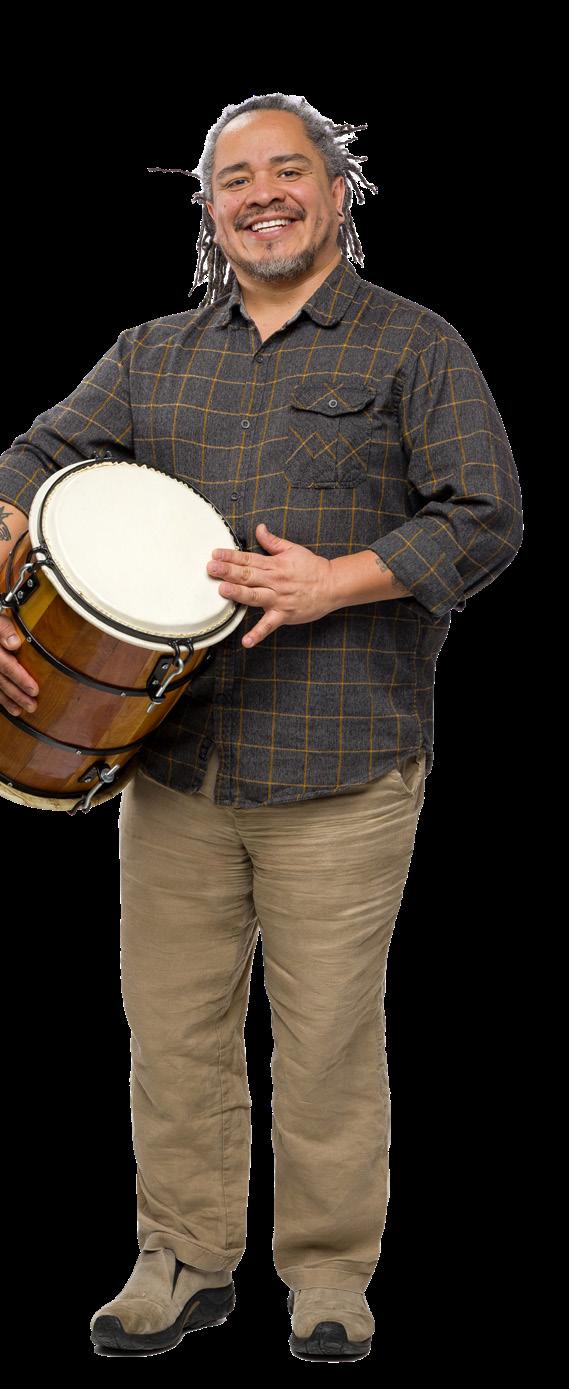
John Salgado Maldonado
A Space for Wellness WILLMAR
SOUTHWEST INITIATIVE FOUNDATION REGION
lthough the world feels smaller than ever, some things still get lost in translation—especially everyday expressions.
“I knew English well, but I found out that people use expressions,” said John Salgado Maldonado, who moved from Chile to Willmar in 2017. “I was walking by and somebody said, ‘Hey, you’re the new guy.’ He said we should ‘touch base sometime.’ I was very confused. Touching base? I felt really uncomfortable.”
Phrases like that—common sayings or idioms that don’t translate word for word—can leave newcomers feeling off balance. For Maldonado, that early confusion became motivation.
“When you’re from other places, I had to try to learn,” he said. “That’s something I continue. That’s part of my life here.”
Over time, he stopped trying to blend in and began sharing more of himself.
“Standing out has pros and cons,” he said. “At the beginning, I tried to fit. I was not showing my cultural differences. I was interacting from the things I had in common. But [later] I was doing more things from my culture.”
That meant teaching Latin dance classes and leading a drum circle that draws people of all backgrounds.
“When you join the drum circle, [Minnesotans] have fear they will do it wrong. They’re shy,” he said. “People start looking at what I’m doing, then I invite them to play. We start making sounds, like improv. We communicate through rhythms. For me, it’s really magical.”
In many ways, his story mirrors Willmar’s. Once a nearly all-white community, the city was 40 percent nonwhite in 2023, according to the American Community Survey. Turkeyprocessing plants, taco shops and Somali markets reflect a changing rural Minnesota.
Maldonado arrived through what he calls a classic Minnesota love story. “I met a woman, and she was from here,” he said. “After a few years, she really wanted to come back here. I said, ‘OK, I’ll take the journey.’”
Today, he is a father of three and a community impact specialist at Woodland Centers, a regional mental health nonprofit.
His social enterprise builds inclusive, connected rural communities through artsbased, wellness-centered and culturally rooted experiences. Grounded in his journey to reclaim and honor his Afro-Latin identity, the work addresses racism and exclusion while fostering healing and collective care. He supports local artists and promotes healthier, more inclusive communities across Greater Minnesota.
His planned wellness center will draw on Indigenous practices, including sound healing and craniosacral massage. He also plans to host arts workshops for local and marginalized artists.
The next step is to find a location and secure funding. “We will need to have sustainability, that’s a big one,” he said.
Like a drum circle, he believes connection takes patience. “By the end, everyone is sharing this good time and sharing rhythms,” he said. “That’s the magic of the drum circle. Everyone is connected, and everyone has a voice.”
By Diane Richard, IQ Magazine contributing writer
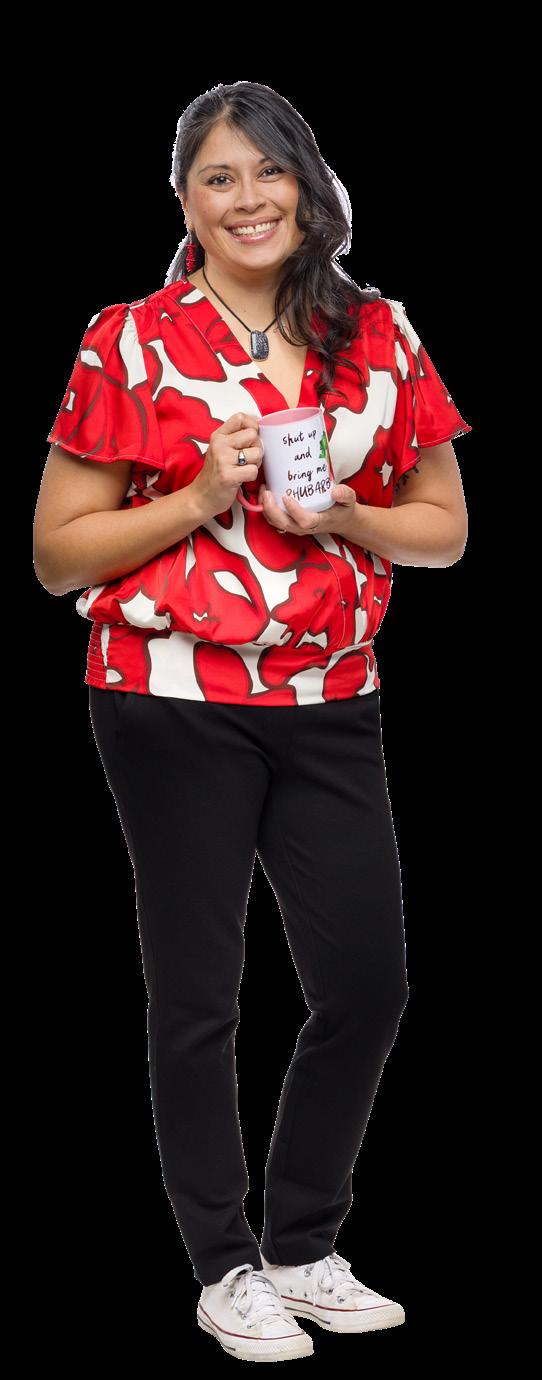
Marcella Prokop
Building Community Connection
BEAVER CREEK
SOUTHWEST INITIATIVE FOUNDATION REGION
Agathering of neighbors in a cidertasting room sounds like a nice way to pass a summer afternoon.
But to Marcella Prokop of Beaver Creek, it’s so much more—it’s an antidote to isolation.
“One of the things we know to be true across Minnesota, even in communities where there’s a lot of social cohesion, is loneliness is a huge social concern,” Prokop said. “Sometimes it’s because of weather, geography. Some of it is … people don’t feel they belong.”
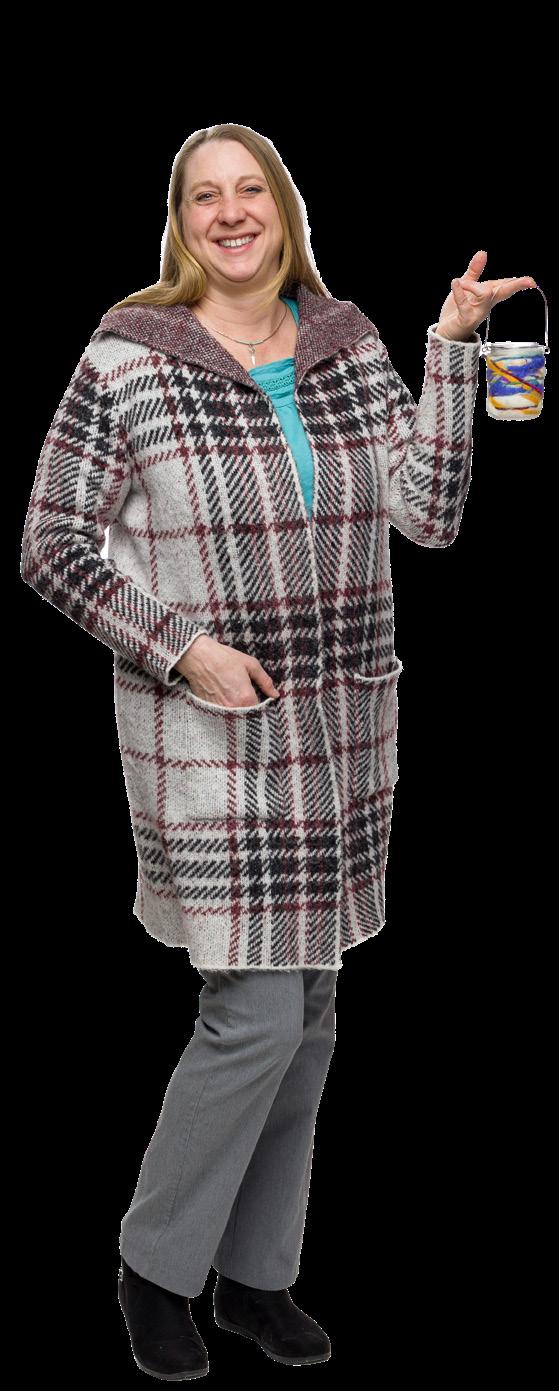
During the summer of 2025, Prokop hosted a rhubarb recipe contest at the Cidery at Blackshire. The Beaver Creek cidery in southwest Minnesota, owned by her partner Sean, became the testing ground for an idea that would blossom into a social enterprise. The contest drew 30 entries—cookies, pies and savory surprises—and more than 80 residents. A local restaurateur judged. Locals performed an Ole and Lena-style skit.
“It was a super-fun afternoon where people could come together around this weed that’s all around Minnesota,” she said.
Watching neighbors linger and laugh, Prokop realized the event tapped into something deeper. She left convinced Beaver Creek needed more free, welcoming gatherings designed simply to spark connection.
Raised on a Nebraska farm by a Colombian mother, Prokop recalls childhood isolation. “We were the only brown, Spanishspeaking people in my rural community,” she said. “As I got older, I saw education as the way out.”
After graduating from college, she landed a job at NBC News in Washington, D.C.,
planning a fast-paced journalism career. Instead, a stroke stopped her two days after her 22nd birthday.
“I thought I was going to be this big-shot journalist,” she said. “I got knocked down fast.” The stroke left Prokop with a visual field deficit and a stark realization: “I learned that I’m not invincible.”
As she recovered, Prokop returned to writing, which had long helped her make sense of the world. She earned a master’s degree in creative writing, taught for 12 years and now serves as director of Access and Workforce Opportunity at Southeast Technical College, helping people “figure out how to upskill or what career path to begin.”
Her work connects her deeply to the community. “I work with underserved populations of all backgrounds and make sure they have the resources they need to persist,” she said. That can mean helping students stay in college when cars won’t start, finances fray or other obstacles erupt. “We need to support that whole life, not just their academic life.”
Creativity anchors Prokop’s culturally sustaining social enterprise—not as entertainment, but as connection.
“I’ve always believed in the power of storytelling, art and connection,” she said. “Because of my background in writing, we will have writing workshops, but also book clubs, canning workshops and pickling parties.”
In a place where winter lingers, Prokop believes shared tables and small rituals can draw neighbors closer. What began with rhubarb could become a lasting antidote to loneliness.
By Diane Richard, IQ Magazine contributing writer
Championing Changemakers
The Initiators Fellowship is a bold strategy that gives next-generation leaders the tools and resources to accelerate their entrepreneurial and leadership skills. Launched in 2017 by the Little Falls-based Initiative Foundation, The program provides wrap-around training, mentoring and guidance—plus $30,000 annually for two years—to support Fellows and their social enterprise ideas to improve Greater Minnesota communities. Visit fellows.greaterminnesota.net or scan the QR code to learn more.
27 Fellowship Graduates
103% Increases in Revenues
$2M+
Cumulative Investments in Fellows
Via stipends and professional development
$5.4M+ In Follow-on Investments Since 2017 4 7 7 9
As reported by the 2022-2023 Cohort
Grant, loan support for Fellows and alumni
INVESTING IN A LIFETIME OF LEADERSHIP
800+ Mentoring & Advising Hours
Contributed by Greater Minnesota leaders
85% Graduates Who Continue Their Social Change Work
Major funding for the Initiators Fellowship comes from a host of regional and statewide friends who believe in linking good people and good causes through diverse economic development opportunities.
Investing in the people and communities of Greater Minnesota has been a central tenet of the Minnesota Initiative Foundations and their partners. Through the Initiators Fellowship, four Greater Minnesota entities—the Initiative Foundation, Northwest Minnesota Foundation, Southwest Initiative Foundation, West Central Initiative and Duluth-based Northspan—are continuing the legacy that began in the 1980s.