t Conference
2026 IEU Environmen
Learning 2026
The newspaper of the Independent Education Union of Australia NSW/ACT Branch (vol 46 #4) June 2026
Learning
at Taronga Zoo
Friday 7 August 2026, 9am-3pm BOOK NOW See page 8 for details
PP 100000871 ISSN No: 0728-4845
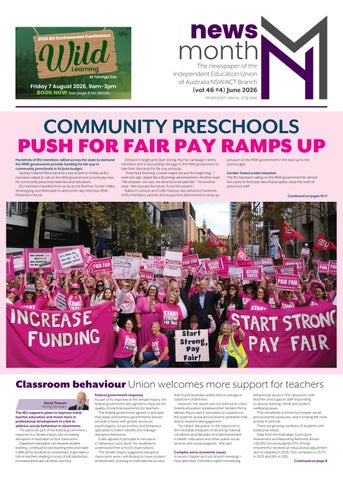
COMMUNITY PRESCHOOLS PUSH FOR FAIR PAY RAMPS UP
Hundreds of IEU members rallied across the state to demand the NSW government provide funding for fair pay in community preschools in its June budget. Sydney’s Martin Place became a sea of pink on 6 May as IEU members rallied to call on the NSW government to fund pay rises for community preschool teachers and educators. IEU members travelled from as far as the Riverina, Hunter Valley, Wollongong and Newcastle to attend the rally held near NSW Parliament House.
Dressed in bright pink Start Strong, Pay Fair campaign t-shirts, members sent a resounding message to the NSW government to take their demands for fair pay seriously. “Preschool teaching: Lowest wages are just the beginning ...” read one sign, styled like a Bunnings advertisement. Another read: “We educate, we care, we deserve to be paid fair.” Yet another read: “We educate the future. Fund the present.” Rallies in Lismore and Coffs Harbour also attracted hundreds of IEU members, parents and supporters determined to ramp up
pressure on the NSW government in the lead-up to the June budget.
Gender-based undervaluation The IEU has been calling on the NSW government for almost two years to fund pay rises that properly value the work of preschool staff. Continued on pages 10-11
Classroom behaviour Union welcomes more support for teachers David Towson Acting Secretary The IEU supports plans to improve initial teacher education and invest more in professional development in a bid to address unruly behaviour in classrooms. The plans are part of the federal government’s response to a Senate inquiry into increasing disruption in Australian school classrooms. Classroom disruption can impede student learning, contribute to lost teaching time and make it difficult for students to concentrate. It also takes a toll on teachers, leading to a loss of job satisfaction, increased stress and, at times, burnout.
Federal government response As part of its response to the Senate inquiry, the federal government also agreed to improve the quality of practical experience for teachers. The federal government agreed in principle that states and territory governments should provide schools with greater access to psychologists, social workers and behaviour specialists to better identify and manage disruptive behaviour. It also agreed in principle to introduce a “behaviour curriculum” for students to understand their school’s expectations. The Senate inquiry suggested disruptive classrooms were contributing to lower student achievement, pointing to international surveys
that found Australia ranked below-average in classroom orderliness. However, the report was not without its critics. Greens education spokeswoman Senator Penny Allman-Payne said it “provided no solutions to the systemic social and economic problems that lead to student disengagement”. “So-called ‘disruption’ in the classroom is the inevitable endpoint of declining material conditions and decades of underinvestment in health, education and other public social services and social supports,” she said. Complex socio-economic issues In recent chapter and sub branch meetings I have attended, members report intensifying
behavioural issues in the classroom, with teachers and support staff responding to diverse learning needs and student wellbeing issues. This complexity is driven by broader social and economic pressures, and it is being felt most acutely in schools. There are growing numbers of students with additional needs. Data from the Australian Curriculum Assessment and Reporting Authority shows 1,125,502 school students (27% of total enrolments) received an educational adjustment due to disability in 2025. This compares to 25.7% in 2023 and 18% in 2015. Continued on page 8