
UN MEDITERRANEO FRAMMENTATO E INTERCONNESSO
Giovanna Fiume*
ARTICLE
ARTICLE
IMediterraneo corsaro. Storie di schiavi, pirati e rinnegati in età moderna (Carocci, Roma, 2025)
l Mediterraneo, mare stretto, interno, chiuso fra terre, “lago”, che si allarga al mar Caspio e al mar Nero, “stagno” attorno alle cui rive ci si raccoglie come rane (secondo la celebre metafora di Platone) o tanto aperto da diventare “Mediterraneo atlantico”, che ingloba la costa da Agadir a Lisbona, di volta in volta ponte o frontiera invalicabile: già la definizione dello spazio geografico mostra la difficoltà di concettualizzarlo come oggetto storiografico – «un falso bel tema»1 lo definì Lucien Febvre, «un personaggio complesso, ingombrante»2, fuori serie e fuori misura per Fernand Braudel –, stratificato al punto da fare dubitare che possa costituire una categoria analitica e persino un tema d’indagine, che gli studiosi periodicamente si dedicano a “ripensare”. La complessità e il fascino del tema hanno dato vita a una produzione storiografica alluvionale, soprattutto negli ultimi trenta anni, che ne ha messo a fuoco singoli aspetti o ha cercato di vedere i fenomeni nel loro insieme, pur senza rinunciare alla varietà e alla ricchezza delle sue manifestazioni3. Tra gli storici prevale la convinzione della grande diversità politica, sociale, economica, culturale dei paesi che si affacciano sul Mediterraneo, a lungo visto come un’unica koiné, culla delle tre religioni del Libro, sede di una comunità di culture, prodotte dall’incontro tra civiltà greca antica e mondo orientale, di cui si sono cercati gli aspetti condivisi, inseguendo l’astrazione di una “cultura mediterranea” e di un’omogeneità antropologica, capace di prevalere sulle differenze. La diversità che lo connota produce conflitti grandi e piccoli – dentro il medievale campo di battaglia tra croce e mezzaluna o il teatro moderno dell’antagonismo tra Spagna e impero ottomano – che non interrompono i rapporti fra società fortemente imbricate tra loro, ma che costituiscono quasi il tessuto connettivo dell’area. Mediterraneo, dunque, come storia di reti e comportamenti economici, di migrazioni e traffici marittimi, frontiere, sconfinamenti e attraversamenti, unità e diversità, coesione e frammentazione dello spazio4; poi “reti di interazione” create per e dalla circolazione di persone, beni, tecniche5 grazie al commercio interculturale6. Il Mediterraneo è un’area di forte instabilità politica e d’intenso transito d’individui,
* professoressa ordinaria di Storia Moderna, Università degli Studi di Palermo
1 F. Braudel, Civilta e imperi del Mediterraneo di Filippo II, vol. i, Einaudi, Torino 1976, p. XXVII
2 Ivi, p. XXIX
3 D. Abulafia, The Great Sea: A Human History of the Mediterranean, Oxford University Press, Oxford-New York 2011.
4 S. D. Goitein, A Mediterranean Society: The Jewish Communities of the Arab World as Portrayed in the Documents of the Cairo Geniza. Economic Foundations, vol. I, University of California Press, Berkeley-Los Angeles 1967; F. Braudel, Civilta e imperi del Mediterraneo di Filippo II, cit.
5 P. Horden, N. Purcell, The Corrupting Sea: A Study of Mediterranean History, Blackwell, Oxford 2000.
6 F. Trivellato, Il commercio interculturale. La diaspora sefardita e i traffici globali in età moderna, Viella, Roma 2016.
gruppi, minoranze diasporiche, merci. Mosaico complesso di comunità politiche e religiose, la sua frammentazione catalizza le relazioni commerciali la cui fragilità non impedisce interazioni regolari e di lungo periodo. Il commercio intra-mediterraneo è il frutto di uno stretto intreccio fra interessi economici e militari e, al suo interno, la schiavitù mostra una forte componente economica e commerciale; entrambi si esprimono attraverso un idioma religioso. Guillaume Calafat e Mathieu Grenet hanno mostrato come le traiettorie delle “mobilità umane” frammentano il quadro unitario del Mediterraneo e fanno comprendere le trasformazioni avvenute nel tempo; essi tengono giustamente in considerazione dispositivi di varia natura (leggi e regolamenti marittimi e commerciali, istituzioni economiche e amministrative, trattati e tregue, passaporti, consolati, porti franchi, fondaci ecc.), messi in atto per regolare il mosaico delle comunità politiche e religiose che cercano di governare migrazioni e diaspore; senza dimenticare che «gli spazi non sono definiti unicamente dalle diverse sovranità, ma dalle pratiche degli attori che li abitano»7. Il “Mare interno”, il “Mare tra terre” nelle loro pagine si frattura come uno specchio, rimanda immagini parziali e dissonanti, diventa la somma di tanti Mediterranei. In questo mare plurale, fatto di «territori sovrapposti e storie intrecciate» i cui confini sono «sia transitori che zone di transito»8, occorre far dialogare unità e diversità, frammentazione e coesione. Iain Chambers parla di liquid materiality per suggerire l’idea di un Mediterraneo multiplo: la liquescenza e la permeabilità della regione sono un modo per comprendere e descrivere ill continuo movimento di uomini e donne sulle sue acque. La storia della schiavitù da corsa è una storia di mobilità e migrazioni. La vita di tutti i nostri personaggi è dominata dal mare, qui si è compiuto il loro destino. In realtà, più che la schiavitù mi interessano gli schiavi, più che la corsa i corsari, più dei riscatti redentori e redenti: in altre parole ho cercato di ricomporre le esperienze e valorizzare le azioni di individui e gruppi, al fine di comprenderne strategie, di individuarne reti di relazioni, di seguirne azioni e comportamenti, persino per quanto possibile indovinarne desideri e sentimenti. Perciò ciascuno dei quattro capitoli del libro ha per titolo un verbo transitivo: corseggiare, cattivare, rinnegare, riscattare. I soggetti di queste azioni sono attivi, intraprendenti, volitivi, hanno intenti che mettono in atto processi, svolgono azioni che transitano verso un (complemento) oggetto con risultati dipendenti da numerose variabili. Essi vivono immersi in un universo sociale denso che è l’acqua di coltura di qualunque azione e che fornisce allo storico l’alfabeto e la chiave per la decodifica. Le relazioni economiche, sociali, politiche agite o subite, lungi dall’essere astratte ed estranee, motivano, consentono, rafforzano, inibiscono, confliggono in ogni singola azione e ancor prima nei pensieri e nei progetti individuali. Per la stessa ragione ho dato importanza ad alcuni luoghi: Malta e Livorno, Tunisi, Algeri, Salé (che apre il Mediterraneo all’Atlantico), per guardare alla reciprocità tra le due sponde, sia dell’esperienza corsara, sia della schiavitù da corsa, sia ai riscatti e agli scambi da cui dipende la redenzione. Corsari cristiani e musulmani agiscono in base alla stessa razionalità economica e a distinte motivazioni politiche, si contendono lo stesso spazio, danno ripetute prove di coraggio e crudeltà, pietas ed efferatezza. Dare a ciascuno una provenienza geografica, un contesto, interessi economici e fedi religiose è il mio modo di sottrarli all’astrattezza (il rapace monaco corsaro cristiano e l’assatanato predone musulmano) e al giudizio morale. Il “Mediterraneo del
7 G. Calafat, M. Grenet, Mediterranees. Une histoire des mobilites humaines (1492- 1750), Editions Points, Paris 2023, p. 34.
8 I. Chambers, Mediterranean Crossings: The Politics of an Interrupted Modernity, Duque University Press, Duhrnam 2008, pp. 35; M. Monge, N. Muchnik, L’Europe des diasporas, XVIe-XVIIIe siecles, Presses universitaires de France, Paris 2019.

fare” si traduce nel “fare il Mediterraneo”, risultato di questo campo di forze e azioni incrociate. Ispirata dalle storie di migrazioni odierne, ho voluto descrivere un mondo di soggetti in movimento, che le difficoltà mettono alla prova, interattivi verso l’ostile realtà ospitante, che elaborano strategie, costruiscono relazioni, scoprono talenti imprevisti, si rivelano capaci di riconfigurare le proprie vite: vediamo all’opera lo schiavo che manifesta tutta la sua agentività, non è una passiva vittima delle circostanze, bensì l’unica merce-che-si-vende-da-sola e che mostra persino consapevolezza di avere diritti. Un esempio eclatante, e a suo modo eccezionale, è quello del conflitto insorto sulla moschea-ospedale di Cartagena che oppose le autorità municipali, il re di Spagna e le autorità maghrebine; esso dimostra il protagonismo, solitamente in ombra, degli schiavi che con azioni collettive costruiscono la moschea di cui sono i beneficiari, la organizzano secondo le forme del diritto islamico – che usano per manifestarsi come comunità –, e si confrontano a muso duro con le giurisdizioni spagnole9. Ma non è da meno la storia delle due donne, l’una cristiana l’altra musulmana, che per riottenere rispettivamente il figlio soldato e il marito corsaro, caduti entrambi nelle mani dell’“infedele”, smuovono mari e monti, superano ostacoli pressoché insormontabili, arrivando fino alla corte del re di Spagna e della reggenza di Algeri, per riuscire a scambiarli “testa a testa” e infine a riabbracciarli10
Schiavitù, guerra da corsa e commercio dei captivi
Nel Mediterraneo si combatte una guerra che contrappone per i tre secoli dell’età moderna l’impero turco e i suoi alleati e l’impero spagnolo, senza conquiste territoriali, strisciante e a bassa intensità, fatta da arrembaggi e razzie sulle coste che producono un bottino di merci e di prigionieri (captivi), ridotti in condizione di schiavitù, indispensabili remieri per tutte le marinerie dell’epoca o da adibire a qualunque mansione e servizio. La legittimità della corsa consente di catturare in mare imbarcazioni, merci e individui e di tutti rivendicare la proprietà. La schiavitù e la forma di riduzione dell’uomo a merce che, in quanto tale, può essere acquistata, venduta, data in affitto, prestata, lasciata in eredità in tutto o in parte. Essa è praticata in età antica da tutte le società che si affacciano sul Mare interno (e non solo) e ha come cause la guerra, il debito e la nascita. Pieza de India, “testa”, negli inventari delle navi negriere in partenza dall’Africa, “sacco pieno d’ossa”, nelle fonti notarili siciliane del xv secolo, property-with-voice in quelle ottomane del xvii secolo, non le viene riconosciuto nessun diritto, poiché esso per definizione attiene alla “persona”, ed e in completa balia del padrone, da cui dipende la sua vita. Questa “merce” muta nel tempo alcune sue caratteristiche in relazione al contesto geografico, alla cronologia dei traffici commerciali e allo sviluppo delle entità statali e delle loro marinerie. Sin dalle sue radici medievali il Mare interno diventa il crocevia di traffici che vanno dalle steppe euroasiatiche al Sahara. Nel medioevo prevalentemente bianca, femminilizzata, proveniente dall’Europa orientale e commerciata da mercanti genovesi e veneziani dai loro stabilimenti sul mar Nero e in Egeo o nera-africana delle popolazioni subsahariane che mercanti arabi conducono fino ai porti di imbarco. Dal primo decennio del Cinquecento la monarchia spagnola concede attraverso contratti commerciali (asientos de negros) il diritto di esportare africani schiavizzati nelle colonie americane; portoghesi e genovesi prima, olandesi, inglesi e francesi poi, organizzano e
9 T. Glesener, D. Hershenzon, The Maghrib in Europe: Royal Slaves and Islamic Institutions in Eighteenth-Century Spain, in “Past & Present”, 259, 2023, pp. 77-116, qui p. 85.
10 D. Hershenzon, “[P]ara que me saque cabesa por cabesa...”: Exchanging Muslim and Christian Slaves across the Western Mediterranean, in “African Economic History”, 42, 2014, pp. 11-36.
gestiscono la tratta attraverso il middle passage atlantico, facendo tappa a Siviglia, Cadice, Lisbona. La messa a coltura delle piantagioni centroamericane di zucchero, caffè, tabacco, cotone nel XVII secolo e lo sfruttamento delle miniere d’argento sudamericane del xviii aumentano la domanda di schiavi, soddisfatta da razzie sempre più intensive che dalla Costa d’Oro o Costa degli Schiavi dell’Africa centro-occidentale si estendono alla Guinea e all’Angola. Mentre gli schiavi africani vengono attratti dall’“invisibile mano” dei mercati d’oltreoceano, l’intensificarsi della guerra da corsa a metà Cinquecento cambia la fisionomia della schiavitù mediterranea, non più bianca, femminilizzata e proveniente dall’Europa orientale e asiatica, ma “mora” nordafricana e prevalentemente maschile; essa matura una serie di caratteristiche che la differenziano anche dalla coeva schiavitù atlantica. Il volume intende non tanto definire, catalogare, generalizzare un fenomeno dentro uno specifico spazio, quanto sbrogliare un intreccio: la corsa è un fenomeno insieme militare, politico, economico e religioso; essa produce la cattività di uomini e donne che, una volta “cattivati” e trasportati nei porti nemici, sono ridotti in schiavitù: sottoposti al prelievo da parte dello Stato (che li sfrutta nella costruzione di opere pubbliche o al remo nelle galere) e venduti a padroni privati (che li usano nell’agricoltura, nei servizi domestici ecc.). Sperimentano acute forme di sfruttamento e dure condizioni di vita che si prolungano mediamente cinque anni, spesso di più e possono diventare definitive. La peculiarità di questa forma di schiavitù sta nella sua reciprocità: cristiani sono schiavi di padroni musulmani nelle province dell’impero ottomano e nel regno del Marocco, musulmani sono schiavi di padroni cristiani nell’Europa meridionale11. Niente di più lontano dalla schiavitù atlantica. Ma c’è un secondo elemento che rende quest’ultima ancora più distante dalla schiavitù mediterranea: il pagamento di un riscatto, organizzato dallo schiavo, da familiari, da ordini religiosi, da istituti laici ed ecclesiastici preposti allo scopo, da benefattori, pii testatori, mercanti e consoli, consente allo schiavo di riguadagnare la libertà. L’operazione di riscatto è prima di tutto un “negozio”, complesso perché “i barbareschi”, come vengono chiamati nelle fonti occidentali gli abitanti delle reggenze di Algeri, Tunisi e Tripoli, pretendono di essere pagati in valuta pregiata (spagnola o veneziana), così che occorre fare ricorso a banchieri che trasferiscono attraverso lettere di cambio il denaro ai loro agenti nel Maghreb, lucrando consistenti provvigioni che accrescono i costi del riscatto. Gli intermediari dell’operazione sono mercanti che operano in quelle aree, rinnegati influenti a corte, agenti consolari europei, missionari; Livorno diventa uno snodo di questo traffico grazie ai mercanti ebrei ivi residenti e ai loro agenti in Nord Africa. Si tratta di transazioni economico-finanziarie ad alto rendimento che creano tra le due sponde del Mediterraneo una rete a maglie strette di banchieri, mercanti, redentori, negoziatori e una pletora di agenti, corrispondenti, fideiussori interessati a speculare sul riscatto, oltre che a liberare familiari e amici. Tutti questi finiscono per inserire i riscatti nelle più comuni transazioni commerciali (noli, prestiti, trasporti marittimi, contratti di acquisto o vendita di mercanzie ecc.) e scatenano la sete di guadagno di un esercito di “piccoli imprenditori” interessati all’alto profitto che questo “negozio” procura a breve e medio termine. Esso trasferisce sulla riva meridionale del Mediterraneo consistenti quantità di denaro, un vero e proprio flusso di valute pregiate e di merci, divenuto il motore del sistema corsaro e creatore di una vera e propria “economia del
11 R. C. Davis, Christian Slaves, Muslim Masters: White Slavery in the Mediterranean, the Barbary Coast, and Italy, 1500-1800, Palgrave-Macmillan, Houndmills 2003; Giovanna Fiume, Schiavitù mediterranee. Corsari, rinnegati e santi di età moderna, Bruno Mondadori, Milano 2009. 4
riscatto”12 che trasforma la nozione stessa di schiavitù. Captivi, rinnegati, redentori, esempi di mobilità forzata diventano figure di una peculiare “diaspora” commerciale13. I riscatti, inoltre, sono estremamente politicizzati, in primis, poiché nelle reggenze la corsa rappresenta un’attività economica di Stato e, in secondo luogo, perché vi si riflettono le tensioni internazionali, aggravando la condizione dei captivi, trattenendo in ostaggio redentori o offrendo in dono i connazionali in cattività ai capi di Stato di cui si ricerca l’alleanza o, come in Marocco, in cambio di materiale navale, armi e munizioni. Gli attori, le pratiche e le norme che costituiscono l’economia del riscatto diventano un regolatore della violenza religiosa e razionalizzano il commercio con i musulmani. Grazie al riscatto questa forma di schiavitù può godere del requisito della temporaneità. E come corollario, soprattutto se per mestiere si va per mare, accade di incappare più volte nei corsari e dopo il riscatto capita di ripetere – una, due, tre volte –l’esperienza della schiavitù: la reiteratività è l’ulteriore peculiarità della schiavitù mediterranea. Infine, trascorsi alcuni anni nell’inutile attesa del riscatto, per una numerosa serie di motivazioni spesso accade che lo schiavo abiuri la propria religione e si converta a quella del paese ospitante. I percorsi di manomissione e di integrazione nel nuovo contesto passano anche attraverso l’abiura della rispettiva religione. Sono chiamati spregiativamente “rinnegati” i cristiani che indossano il turbante e «si fanno turchi»; ma anche i musulmani abiurano e chiedono il battesimo. Questi passaggi di religione costituiscono una pagina di storia della cultura religiosa di età moderna su cui Lucile e Bartolomé Bennassar hanno a suo tempo richiamato l’attenzione14. Anche l’abiura e la conversione conservano una forte reciprocità: schiavi cristiani si convertono all’islam e schiavi musulmani al cattolicesimo, per quanto il primo fenomeno sia meglio conosciuto del secondo. A tal proposito ho provato a sfidare il luogo comune storiografico secondo cui i musulmani non riscattano i correligionari, ma si limitano solamente a scambiarli. Queste conversioni, sincere o opportuniste, segrete o esibite, pongono il tema della liceità della dissimulazione – tutti dicono di essere stati costretti a rinnegare la fede per salvare la vita o lo hanno fatto “di bocca”, ma non “di cuore” – e producono opinioni scrutinate dal Santo Uffizio; dagli interrogatori dei rinnegati emerge una serie di credenze miste, a cavallo tra cristianesimo e islam, ma soprattutto un continuo andirivieni da una religione all’altra; la conversione diventa un modo imposto dalle circostanze di adattarsi a nuove realtà sociali, una sorta di passaporto di chi vive sulla linea di frontiere geografiche, politiche, religiose, linguistiche. Si apre in questi transiti anche la possibilità di una sorta di agnosticismo che fa aderire pragmaticamente a fedi diverse o a nessuna, che seleziona le convinzioni comuni alle tre religioni monoteiste (di cui si fa una “insalata”, come scrive un francescano missionario in Marocco), considerate tutte egualmente capaci di procurare la salvezza spirituale, ma anche di aiutare a costruire reti sociali trasversali. Gli elementi descritti: corseggiare, cattivare, rinnegare, riscattare, a ciascuno dei quali è dedicato un capitolo, si presentano nella realtà tutti insieme, appaiono come un «groppo rintrecciato» – un siciliano preso dai corsari chiederà ai familiari di essere «sciolto da questo inviluppato nodo di maledetta schiavitù»15 – che più si cerca di sciogliere più si avviluppa.
12 16. W. Kaiser (dir.), Le commerce des captifs. Les intermediaires dans l’echange et le rachat des prisonniers en Mediteranee, XVeXVIIIe siecle, Ecole francaise de Rome, Rome 2008.
13 Una discussione sul termine “diaspora” in G. Calafat, S. Goldblum, Editorial. Diaspora(s): liens, historicite, echelles, in “Traces. Revue de Sciences humaines”, 23, 2012, 2, pp. 7-18.
14 B. Bennassar, L. Bennassar, Les Chretiens d’Allah. L’histoire extraordinaire des renegats (xvie-xviie siecles), Perrin, Paris 1989.
15 Archivio di Stato Palermo, Arciconfraternita per il riscatto dei captivi, Riveli di cattivati di Palermo, lettera di Sebastiano Marino, Tunisi
Schiavitù, guerra da corsa, abiura e commercio dei captivi16 s’intrecciano in maniera peculiare nella storia dei paesi che si affacciano sulle sponde del mare dal medioevo ai primi decenni del xix secolo e ciò rende il tema estremamente sfaccettano e composito, difficile da mettere a fuoco disaggregandone i singoli elementi. Inoltre, il dibattito sulla materia ha talvolta implicazioni ideologiche derivanti, da un lato, dal giudizio critico di parte della storiografia verso le ricostruzioni di una schiavitù “bonaria”, che confonde schiavo e servo domestico, verso cui il padrone esercita il rigore patriarcale del capofamiglia; dall’altro dal voler sostituire a una “leggenda nera” del Mediterraneo à la Henri Pirenne, dei campi di battaglia della guerra di religione, una “leggenda dorata” del Mediterraneo dei bazar e del pacifico e intenso scambio mercantile, ignorando la sua storia fatta di «antagonismo, divisione, incomprensione, sfruttamento e violenza»17; infine gli esiti coloniali di questi fenomeni. L’intensa mobilità che caratterizza tutti i soggetti di cui si èparlato pone senza dubbio il tema del rapporto tra mondi segnati da profonde fratture politiche: come pensare il contatto tra società vicine, adiacenti, seppure in conflitto – si chiedono Jocelyne Dakhlia e Wolfgang Kaiser18 – di cui la mobilità sembra il tratto distintivo? Fino a tempi recenti, figure le cui vite conservavano i caratteri dell’eccezionalità sembravano interpretare questa mobilità19: passeurs non solo tra aree geografiche diverse, ma tra mondi e culture, che attraversano frontiere in senso lato sociali, culturali, religiose, posizionandosi entre deux, negli interstizi tra due società con il ruolo di mediatori. Una comunità cosmopolita e girovaga di soggetti transimperiali, stranieri familiari, go-between e trickster travelers, come li hanno chiamati gli studiosi20. Fino al xix secolo (la campagna di Egitto di Napoleone del 1798-1801 e l’invasione di Algeri del 1830) le relazioni soffrono sì di rotture, ma reversibili. Anzi, proprio il conflitto non esclude forme di contatto in contesti di ostilità; le armi non fermano gli scambi. Le zone di contatto non vanno pensate come isolate, ma come un’estesa connettività, all’interno della quale si vanno elaborando forme di neutralizzazione (temporanea) del conflitto. Le popolazioni mediterranee sono caratterizzate da forte mobilità e imbricazione: mercanti, soldati, interpreti, pellegrini, viaggiatori, schiavi, captivi, transfughi politici o religiosi, migranti volontari o esiliati forzati mantengono forme di equilibrio nella tensione, attivano codici comuni, fanno circolare conoscenze, linguaggi, costumi e credenze religiose. Questi “soggetti transimperiali” mostrano la capacità di circolare della maggioranza e la banalità dei fenomeni migratori nel continuum delle società in contatto. La massa critica raggiunta da questi fenomeni denota un mondo di coestensività, consustanzialità tra Europa occidentale e Mediterraneo islamico21. Bisogna
20 luglio 1792, vol. 254, c. n.n.
16 Cfr. G. Fiume, La schiavitu mediterranea tra Medioevo e eta moderna. Una proposta bibliografica, in “Estudis. Revista de Historia Moderna”, 41, 2015, pp. 267-318.
17 E. R. Dursteler, On Bazaars and Battlefields: Recent Scholarship on Mediterranean Cultural Contacts, in “Journal of Early Modern History”, 15, 2011, pp. 413-34, cit. a p. 434.
18 J. Dakhlia, W. Kaiser, Une Mediterranee entre deux mondes, ou des mondes continues, in Idd. (dir.), Les Musulmanes dans l’histoire de l’Europe, vol. ii, Passages et contacts en Mediterranee, Albin Michel, Paris 2013, pp. 7-31, qui p. 8.
19 N. Zemon Davis, Donne ai margini. Tre vite del XVII secolo, Laterza, Roma-Bari 2001; Ead., La doppia vita di Leone l’Africano, Laterza, Roma-Bari 2008; L. Colley, L’odissea di Elizabeth Marsh. Sogni e avventure di una viaggiatrice instancabile, Einaudi, Torino 2010; E. R. Dursteler, Renegade Women: Gender, Identity, and Boundaries in the Early Modern Mediterranean, Johns Hopkins University Press, Baltimore 2011; M. Garcia-Arenal, G. Wiegers, L’uomo dei tre mondi. Storia di Samuel Pallache, ebreo marocchino nell’Europa del Seicento, Viella, Roma 2013.
20 Zemon Davis, La doppia vita di Leone l’Africano, cit.; N. E. Rothman, Brokering Empire: Trans-Imperial Subjects between Venice and Istanbul, Cornell University Press, Ithaca-New York 2011; Garcia-Arenal, Wiegers, L’uomo dei tre mondi, cit.; L. Valensi, Stranieri familiari. Musulmani in Europa (XVI-XVIII secolo), Einaudi, Torino 2013; Trivellato, Il commercio interculturale, cit.
21 Dakhlia, Kaiser, Une Mediterranee entre deux mondes, cit.
farsene una ragione: il Mediterraneo è questo fertile, difficilmente governabile, sensato guazzabuglio.
ARTICLE
MOVILIDAD Y MIGRACIONES EN CLAVE DE GÉNERO EN LA EDAD MODERNA
n.188 28/01/2026
Ofelia Rey Castelao*
Las mujeres constituyeron un componente esencial de los movimientos migratorios de los siglos modernos, pero las dificultades que surgen a la hora de documentar su movilidad las mantuvo a la sombra de la investigación hasta hace unos años. Eran la garantía de la estabilidad en las familias cuando los hombres migraban, pero ellas también se iban, aunque a distancias más cortas. La diversidad de comportamientos, según edades y circunstancias personales y familiares, así como las diferencias territoriales, son los retos de un tema de plena actualidad, dada la importancia de la inmigración femenina en Europa.
Ese fascinante recorrido histórico se inició en fecha desconocida, pero está claro que se aceleró desde comienzos del siglo XVI, con el paso de las familias a los espacios americanos, abundante en ese siglo y en retroceso desde 1630 hasta su recuperación en la segunda mitad del XVIII Esta migración a larga distancia fue mucho menos numerosa que la de los hombres, por cuanto una parte importante de las mujeres casadas optaron por no ir o no pudieron hacerlo; en todo caso, salvo en el caso de aquellas que iban como criadas, se trató de una migración dependiente.
Desde antes de ese proceso ultramarino y en paralelo a él, ellas eran el sector demográfico y laboral mayoritario en la migración del campo a las ciudades y villas necesitadas de criadas y de mano de obra en general. Este tipo de movilidad fue una constante, habitualmente de carácter prenupcial y con el objetivo de reunir un dinero para conformar o reforzar una dote precaria: es lo que suele denominarse «migración del pan». Ahora bien, los núcleos urbanos recibían, además, la «migración de la vergüenza», es decir, aquella que ocultaba un embarazo ilegítimo y estaba compuesta por mujeres que daban a luz allí, entregaban a las criaturas en el torno de alguna institución y retornaban a sus casas o se quedaban para trabajar. Una tercera variante, la «migración de la miseria», se componía de ancianas y mujeres solas y pobres que acudían a las ciudades y villas buscando acogida en refugios y asilos o simplemente para mendigar. Entre ambas existía una fórmula mixta como la que se constata en instituciones como la Misericordia de Barcelona. Otra de las situaciones que explican la movilidad campo-ciudad es la de las nodrizas, casadas o solteras, que se ocuparon de amamantar a los retoños de las clases altas; las famosas «pasiegas», es decir, las nodrizas del valle del Pas (Cantabria), eran las más conocidas, pero no las únicas que practicaban este trasiego territorial.
* catedrática de Historia Moderna, Universidad de Santiago de Compostela.
Es importante subrayar que el destino urbano era el mayoritario en las migraciones internas y de media y corta distancia, pero no era el más apetecido ni se consideraba el más conveniente. Desde el punto de vista social y moral, se tenía por más conveniente la migración campo-campo, es decir, de la casa familiar en una aldea o un pueblo pequeño a otro con demanda de mano de obra para tareas agrícolas, domésticas, de cuidado de ganado o de hilado y tejido. Era muy difícil de detectar por realizarse en distancias cortas, y sabemos por diversas fuentes que era muy precoz, pues en muchos espacios las mujeres que la emprendían contaban menos de diez años.
El otro tipo de movilidad intrarrural era bien distinto: nos referimos a las migraciones temporeras o «golondrina», cuyo destino eran las grandes áreas cerealistas o de gran cultivo que, durante varios meses al año, necesitaban mucha mano de obra: las mujeres adultas, casadas y solteras, del norte peninsular desde el siglo XVI, pero sobre todo en el siglo xviii, formaron parte de las gavillas de segadores que iban a las planicies trigueras de la Meseta para trabajar en el espigueo y en otras tareas; las condenas morales por parte de los obispos, tanto de las zonas de origen como de las de llegada, e incluso algunas prohibiciones por parte de instituciones oficiales como las Reales Audiencias de Galicia y de Asturias, no sirvieron de nada frente al imperativo económico que las guiaba.
En definitiva, las mujeres constituyeron un contingente enorme de la movilidad y las migraciones, mucho mayor y constante de lo que se suponía o sabía hace unas décadas. Obviamente, ellas eran el elemento más estable de las familias, y más todavía cuando sus padres, maridos o hijos eran los migrantes: se responsabilizaban entonces de la jefatura familiar, de administrar los bienes o allegar recursos, pagar rentas e impuestos, acudir al juzgado en caso de conflicto, etc. Sin embargo, esas mismas mujeres pudieron haber estado fuera de sus casas y comunidades antes de casarse, y aquellas que tuvieron pocas oportunidades de desposarse se fueron para no volver.
La intensidad y el ritmo de la movilidad y de las migraciones femeninas, así como su tipología, obedecían a una diversidad territorial muy compleja en la que entraban en juego factores como los tipos de familia (nuclear, troncal); el número de hermanos y el lugar de las mujeres en el sistema de herencia —igualitario o no—; el tamaño de la explotación agraria o el nivel de recursos de otro tipo (artesanal, pesca, ganadería) de sus familias, etc.
La toma de decisiones, que es el gozne de la dinámica migratoria, no les correspondía cuando eran menores de la edad legal, fijada en veinticinco años, pero no se puede saber en qué medida se tenía en cuenta su voluntad a la hora de irse. En la documentación notarial de comarcas del norte y el sur de Galicia, por ejemplo, se han localizado escrituras de emancipación por las que los padres reconocían la autonomía a sus hijas menores, pero de edad superior a dieciocho o diecinueve años, de modo que el dinero que ganasen trabajando les perteneciese a ellas. En varios procesos judiciales hallamos a un sinfín de jóvenes lejos de sus casas y enfrentándose a problemas derivados de su trabajo y de la desprotección familiar, pero no del todo indefensas, ya que la ley preveía actuaciones de oficio y fórmulas de protección que, aun partiendo de un principio moralizante y paternalista, al fin y al cabo funcionaban relativamente bien.
Cuando eran mayores de edad, la decisión de irse o quedarse tenía en cuenta factores de índole personal y privada que son muy difíciles de documentar, salvo en fuentes de tipo narrativo o cualitativo como las ya mencionadas y, en algunos casos, en cartas, informes, etc. En todo caso, se trataba de consideraciones valorativas diferentes a las de los hombres: sin ir más lejos, estos tenían una fuerte motivación en las levas y los servicios militares, que se encuentran en la base de la migración masculina joven, pero esos motivos no las afectaban a ellas. A las mujeres las inducía, en cambio, la búsqueda de una dote, amparo o anonimato, como ya se dijo, pero también el desacuerdo con un matrimonio impuesto por los padres; la mala relación con hermanos y hermanas, madrastras y padrastros, derivada de la convivencia o del reparto de cargas o de un problema en la partición de la herencia; la liberación de un trabajo excesivo que beneficiaba a terceros y no a ellas; la información —más o menos fidedigna— de una posible mejora de su situación y, sobre todo, la falta de oportunidades laborales locales.
Por el contrario, y a diferencia también de los hombres, las retenían circunstancias como la ancianidad, soledad o incapacidad de sus progenitores; la existencia de familiares con impedimentos físicos o psíquicos para el trabajo; las ausencias temporales o definitivas de los padres u otros miembros del grupo doméstico; o bien un testamento hecho a su favor o la promesa —de los padres o, con notable frecuencia, de parientes sin descendencia— de que recibirían una parte de la herencia a cambio de cuidados. La prueba constante de que, si podían obtener recursos cerca de casa, no se alejaban estriba en el retorno de las que se habían ido a ganar dinero antes de casarse, pero, además, es preciso subrayar la importancia que tuvo, en este sentido, la protoindustria rural, en especial la textil. La necesidad permanente de hilatura para mantener los telares —ampliada en la segunda mitad del siglo XVIII con las reales fábricas o las industrias privadas— generó un sustrato laboral para las mujeres tanto en áreas de producción lanar como sedera y, de forma más general, de lino.
El desarrollo de esa opción desde mediados del XVIII permitió que muchas mujeres que habían emigrado para trabajar como criadas o en otros servicios en las ciudades y villas, pudieran quedarse en sus comunidades hilando y, en ciertas comarcas, tejiendo, para un mercado interno y, sobre todo, americano. Durante un tiempo —entre los años sesenta del setecientos y la década final— se vivió la llamada «fiebre del lino» —sería más adecuado «del hilo»—, que retuvo a miles de jóvenes en sus casas gracias a unos ingresos escuetos, pero que les evitaban el riesgo de marcharse solas. Tradicionales canteras de criadas redujeron su oferta de mano de obra y su espacio fue ocupado por mujeres de otras procedencias; el caso de Madrid es el mejor conocido y el que permite comprobar cómo las áreas rurales de La Mancha y otras que suministraban criadas disminuyeron su capacidad y la demanda fue atendida por mujeres del norte, desde Galicia a Cantabria, sobre todo cuando estas se vieron abocadas a emigrar tras la crisis de la fiebre del lino.
En definitiva, frente a la imagen de un sedentarismo general de las mujeres —altamente valorado desde el punto de vista moral por parte de los poderes civiles y eclesiásticos—, la movilidad fue un componente temporal o permanente en las vidas de una parte de ellas que, a día de hoy, no se puede calcular. Tampoco cabe definir un perfil único: desde niñas y adolescentes a ancianas, las mujeres protagonizaron diversos tipos de movilidad y migración que respondían a dinámicas 3
demográficas, económicas y sociales generales, pero también a circunstancias y motivaciones individuales o familiares que, en gran medida, diferían de las de los hombres. Sí puede decirse que a todas ellas las vinculaba la falta de formación y cualificación y el analfabetismo —superior al noventa por ciento a fines del siglo XVIII—, todo lo cual limitó de forma drástica sus opciones de mejora, ya no digamos de prosperidad o ascenso social. Se trataba más bien de sobrevivir o de adquirir cierta autonomía a costa de superar las limitaciones legales y del mercado laboral.
ARTICLE
PALESTINE’S MARITIME RIGHTS VS. ISRAEL’S BULLY TAKEOVER: AN INTERNATIONAL FRAMEWORK
Mutaz M. Qafisheh* and Lamia Kara**
Introduction
With the discovery of tremendous gas reserves in the Eastern Mediterranean, this region has become a globally attractive destination. This geopolitical situation has gained a new dimension with the 2014 accession of Palestine to the 1982 UN Convention on the Law of the Sea (UNCLOS). The Convention not only provides an opportunity for Palestine to declare its maritime zones, such as a territorial sea, contiguous zone, and Exclusive Economic Zone (EEZ), in accordance with international law, but also opens the door for Palestine to claim access to significant economic resources, particularly the natural gas reserves of the Gaza Marine.
The maritime rights of Palestine have been overshadowed by the tremendous humanitarian crisis that risked the very existence of the Palestinians as a people. Palestinians have been denied access to their rights in the sea for over a century. With its declaration in 1948, Israel controlled over 80% of Palestine’s coast. Only a small fraction of the coast on the Mediterranean Sea, about 40 kilometers long, was left over to the Palestinians offshore Gaza. Even in this limited portion, the Palestinians have been for long deprived from controlling their sea. With its accession to UNCLOS, prospects for Palestine to declare its prerogatives under the Convention were vivid. However, the ability to exercise actual control over Palestine’s maritime zones offshore Gaza continue to face enforcement challenges due to Israeli naval blockade, military occupation and, now, genocide. After providing a brief historical context to the sea of Palestine, this article focuses on Palestine’s maritime boundary delimitation, its claims to maritime zones, and settlements of disputes with neighboring states.
Historical Context
The roots of Palestine’s maritime affairs lie in the legal system of the Ottoman Empire, which governed the region from 1516 until 1917. A key factor in this legal legacy was the detailed Ottoman Maritime Code adopted in 1863 and applied to Palestine like the rest of Turkish domains. This Code set up rules for, inter alia, ship registration system, ownership of ships, labor law at the sea, civil and criminal security of ships’ crew, marine insurance, sea transport of persons, shipment of goods, and vessel collision. Another Ottoman law, passed in 1882,
* Professor of International Law and Diplomacy, College of Law and Political Science, Hebron University; Chairperson, Law for Palestine Organization, UK;
**Boğaziçi University’s Faculty of Law, Istanbul
regulated the issue of fishing without addressing maritime zones where fishermen operate. As a natural result of the British Empire standing as the world’s maritime hegemon, British rule in Palestine (1917-1948) advanced the codification of maritime affairs, while leaving the regulation of maritime zones to customary international law. The British High Commissioner for Palestine enacted the Ports Ordinance in 1926, while leaving the aforesaid Ottoman law intact. Based on the Ordinance, Britain inaugurated the Gaza Port in 1945. The Brits simultaneously adopted legislation related to the carriage of goods by sea. The management of fisheries was addressed by the 1937 Fisheries Ordinance.
Historical and legal features that affected Palestine’s maritime rights have continued under the rules of Egypt and Israel. Gaza came under Egyptian military rule after the 1948 conflict. Although Egypt did not formally annex Gaza, it imposed restrictions on Gazans’ maritime activities. The Egyptians permitted fishing boats to sail up to three nautical miles measured from Gaza offshore seaward, but only in designated areas and during daylight. After that, they allowed fishing boats to sail at night with their lights on, and they also continued to criminalize the entry of merchant ships into Gaza port without a permit from the competent authorities. These limitations barred the development of the Gaza maritime zones for two decades.
From the outset of its occupation in 1967 until 1994, Israel imposed a full blockade on the Gaza coast with a complete ban on the entry or departure of ships. Israel enacted a series of military orders to codify the issue of fishing, restricting the fisheries and prohibiting fishing boats from entering specific locations. These measures were introduced chiefly for security purposes, namely to prevent the use of the sea by resistance groups to attack Israeli targets. Although the Palestinian Authority made efforts after 1995 to improve the maritime law in accordance with the Oslo Accords, Israeli restrictions on the use of the Gaza Sea by Palestinians persisted.
The Oslo Accords significantly restricted Palestine’s rights over its maritime zones. Palestine was able to operate in a narrow area offshore Gaza, and most of the time these limitations did not exceed 20 nautical miles. Moreover, Palestinians were often denied the use of the sea in toto, contradicting international law, especially UNCLOS that vests states with the rights to a minimum of 12 nautical miles of territorial waters and 200 nautical miles of EEZ. Thus, the Oslo regime restricted the access of Palestine to the natural resources, particularly the Gaza Marine gas reserves, by preventing Palestine from utilizing those universallyrecognized rights. This state of affair demonstrates that even though the Oslo Accords were set to form transitional political regulation, they contradicted fundamental principles of international law.
Palestine Maritime Zones and Boundary Delimitation
The restrictions imposed by Israel through the Oslo Accords prevented Palestine from exercising sovereignty over its maritime zones. Such restrictions led Palestine to take fresh legal initiatives. After becoming a party to UNCLOS, Palestine attempted to overcome the Israeli restrictions by claiming sovereignty over its sea through declarations filed in 2015 and 2019 at the UN headquarters in New York that defined Palestinian maritime zones as part of the process to
assert statehood; Palestine is now recognized by 157 states in the territory occupied by Israel in 1967, including the Gaza Sea.
Palestine’s declarations are based on UNCLOS regarding maritime zones, particularly the 12nautical mile territorial waters and the 200-mile EEZ. The unilateral declarations can be viewed as an attempt to assert the minimum rights under the international law of the sea, despite the Israeli obstacles. The declarations offer not only technical aspects for delimitation but also foundations that empower Palestine to act as a coastal state on the same footing as other states.
One of the remarkable dimensions of the Palestine declarations is the special emphasis on resources located in the Gaza coast. The Gaza Marine gas field, located approximately 37 kilometers offshore, carries a vital potential for Palestine’s economic independence. Palestine underlined its right of accessibility to marine natural resources in its declarations of maritime areas. Such accessibility is not limited to energy resources. It also extends to other Gazan resources by including fishing and other maritime activities.
While providing a solid legal foundation, Palestine’s declarations have been confronted by political obstacles. Israel’s military control over the Gaza Sea chiefly hindered the de facto enforcement of Palestinian declarations. Egypt’s reservations regarding Palestinian maritime zones add another challenge for effective crystallization of Palestine’s rights under UNCLOS.
Potential Dispute Settlements with Neighboring States
As a non-member of UNCLOS, Israel contends that Palestine lacks sovereignty and statehood and, by extension, the legal rights to maritime zones. It claims that “only sovereign states have the right to maritime zones… as well as to declare maritime zones.” Israel maintains that the Palestinians possess no maritime titles except those spelled out in the ‘Israeli-Palestinian agreements’, claiming that its position is grounded in bilateral agreements rather than universal treaties. This position poses an obstacle for Palestine to exercise its rights under UNCLOS.
Unlike Israel, Egypt is an UNCLOS party. However, shortly after Palestine’s accession to the Convention, in 2017 Egypt declared, under Article 298 of UNCLOS, that it does not accept adjudication or arbitration in relation to maritime boundary delimitation with its neighboring states, including Palestine. In particular, Egypt rejected the Palestinian unilateral declaration of 2019 regarding the geographical points of coordinates pertinent to the lines defining the Palestinian contiguous zone, EEZ, and continental shelf adjacent to the Egyptian border. This dispute becomes critical when it comes to natural gas fields such as Gaza Marine, which equals billions of dollars. Although Palestine possesses rights over these resources under UNCLOS, the lack of agreed-upon maritime boundaries and the objections of Palestine’s neighbors de facto prevent Palestinians from accessing these vital economic assets.
Although Cyprus is an UNCLOS member, it has not recognized Palestine’s maritime claims in practice. An agreement on EEZ was signed between Israel and Cyprus in 2010 without reference to Palestine, despite the fact that Cypriot EEZ overlaps with that of Palestine. In the 3
delimitation treaty, only Israel, Egypt, and Cyprus were recognized as the relevant three states. By doing so, Palestine was removed from the equation. Significantly in this regard, Cyprus referred to UNCLOS Articles 281 and 282, which address the peaceful settlement of disputes. UNCLOS provides various mechanisms for the settlement of disputes among contracting states: negotiation, consultation, conciliation, arbitration at the option of parties, reverting to the International Tribunal for the Law of the Sea, or to the International Court of Justice (ICJ). However, activating these mechanisms within the scope of Palestine has been confronted with critical restrictions, because Israel is not a party of UNCLOS and Egypt has excluded the compulsory arbitration with its declaration under Article 298. Yet Palestine may challenge the boundary delimitations of its three neighbors by filing arbitration proceedings against Cyprus, whose borders overlap with both Israel and Egypt, based on the aforesaid 2010 agreement.
The foregoing shows that disputes between Palestine and neighboring states can be evaluated with diverse scenarios. The realistic way to resolve a dispute with Egypt is through conciliation or negotiation, since binding arbitration is not an option. In the event of a potential dispute with Cyprus, the arbitration mechanism remains as a residual channel. The relation of Palestine maritime entitlements with Israel should be viewed as part of the overall question of illegal occupation, of the land and sea, which needs to be addressed based on the ICJ 2014 advisory opinion that instructed Israel to terminate its occupation of Palestine, including the Gaza Sea.
Conclusion
Palestine’s accession to UNCLOS has opened avenues for potential maritime arrangements, including boundary delimitation, not only in relation to the Gaza neighboring States, but also for the Eastern Mediterranean region at large. In some ways, the boundary overlapping in the Gaza coast is less complex than in other regions of the world as there are no islands, archipelagos, straits, river mouths, bays or landlocked states to contend with. But the protracted pending territorial disagreement necessarily overshadows the maritime law. Thus, the legal boundary delimitation in the Eastern Mediterranean is possible should political actors agree.
It is crucial for Palestine to explore routes within the law of the sea, specifically UNCLOS, that may crystallize the exercise of its maritime rights. The Convention establishes a comprehensive mechanism for settling disputes among states, including those related to maritime zones. As the Gaza Sea is still occupied, it might also be relevant to refer to international humanitarian law rules relating to maritime belligerent occupation, and the ICJ advisory opinion of July 2024 that rendered the Israeli occupation of Palestine unlawful and reiterated the Palestinian people’s right to self-determination as a peremptory norm of international law. The Court also identified “the right to exercise permanent sovereignty over natural resources, which is a principle of customary international law” (para 240), a key element of the right to self-determination.
The Eastern Mediterranean region after Palestine’s accession to UNCLOS is not as before. The Convention creates a series of rights for Palestine in various maritime zones which overlap with the zones of neighboring states: Egypt, Israel and Cyprus. At a certain point, conflicting interests would come to the fore, and the need for dispute settlement would arise. At this point, political realities in the region overshadow the law, and UNCLOS remains largely unenforced. However,
the discoveries of gas resources in the Eastern Mediterranean might accelerate the process for finding solutions to pending maritime conflicts in parallel to the gas exploration. That renders the Convention dispute settlement scheme more relevant than ever.
UNCLOS dispute settlement mechanisms apply beyond state parties that share border lines with Palestine. Disputes with other states are perceived with regard to potential actions by such states in zones whereby Palestine qualifies to exercise sovereignty or sovereign rights. Such disputes can be resolved through arbitration. Examples of such disputes include infringement of innocent passage, over flight, navigation in territorial sea, security and illegal immigration and trafficking in drugs in contiguous zone, fishing, gas exploration, exploitation of the continental shelf, collision, boarding of ships, and the misuse of flags in the high seas. Such operations might include works carried out by commercial ships, military vessels, submarines, aircrafts, and oil rigs owned or operated by UNCLOS state parties either directly or through concessions given to companies or individuals belonging to, or contracted or authorized by, these states. Palestine seems to be aware of third-party actions in its offshore Gaza maritime zones. To this effect, it has issued warnings to such parties. In April 2022, for instance, Palestine, through a communication to the UN Secretariat, alerted all states and other entities against unauthorized and non-consensual maritime activities in the Palestinian maritime zones.
The gap between law and reality in the case of Palestine maritime continues to deny the Palestinian people of their right to self-determination over their natural resources. Even though the Gaza Marine field offers huge potential in terms of economic independence and may contribute to the reconstruction of post-genocide Gaza, the field resources are not utilized due to Israel’s blockade and military occupation. Thus, the struggle of Palestine over maritime areas and the utilization of natural resources thereof is not merely a matter of technical delimitation, but also of political independence, and economic and legal self-determination. The limitations imposed by Israel’s control are incompatible with international law. The exercise by Palestine of its maritime rights are decisive factors for regional stability, and the global legal order, and are likely to continue playing a central role in diplomatic negotiations in the years to come.
Note on References
This article is a summary of these five studies by Mutaz M. Qafisheh and co-authors:
Mutaz M. Qafisheh, Jinan Bastaki & Victor Kattan, ‘Gaza Marine: The Facts and the Law’, Leiden Journal of International Law, Vol. 38, No. 1, 2025, 42-57.
Mutaz M. Qafisheh & Anisha Patel, ‘The Nexus between the Law of the Sea and Human Rights Law in the Context of Maritime Occupation: The Case of Palestine’, ASCOMARE Yearbook on the Law of the Sea, Vol. 4, 2025, 111-188.
Mutaz M. Qafisheh, ‘From Constantinople to Oslo to Gaza: Developments of Palestine’s Maritime Legislation under Colonization’, Marine Policy: The International Journal of Ocean Affairs, Vol. 160, 2024, DOI: https://doi.org/10.1016/j.marpol.2023.105954.
Mutaz M. Qafisheh, ‘Eastern Mediterranean Maritime Boundary Delimitation: The Claims of the State of Palestine under UNCLOS’, Ocean Development & International Law, Vol. 55, No. 3, 2024, 379-393.
Mutaz M. Qafisheh, ‘Law of the Sea Dispute Settlement in Eastern Mediterranean with Particular Reference to the Delimitation of Palestine’s Maritime Boundaries: Negotiation, Conciliation, Arbitration or Adjudication?’ Diplomatica: A Journal of Diplomacy and Society, Vol. 6, No. 1, 2024, 201-230.
INTEGRATING MIGRANTS FOR INTEGRATING REGIONS. SHARED CHALLENGES AROUND THE MEDITERRANEAN
ARTICLE
ARTICLE
In terms of migration, striking similarities between the Arab World and Europe emerge. Both the League of Arab States and the European Union are institutional constructs with a charter providing for the free mobility of people (although this provision is not included in most Arab national legislation). Migration is intense in both regions, with immigrants outnumbering emigrants and intra-regional migration representing a large part of all movements. Both are subject to considerable refugee movements, from within in the Arab states, and from without in the EU.
At the same time, there is a remarkable asymmetry in the Mediterranean: migrants are almost exclusively from South to North. While most migrants from the Arab world land in the EU by plane with a regular visa, others reach it by sea with no visa. The smuggling business has been responsible for over 50,000 deaths out of 3.3 million passengers smuggled since 2000, making the Mediterranean Sea the world’s most lethal border.
Table. Migrant stocks in the Arab States and the European Union in 2024 (in millions and % of total population)
Computed from United Nations Department of Economic and Social Affairs, Population Division (2024). International Migrant Stock 2024
* Professor of Sociology and Demography; Director of the Migration Policy Centre, European University Institute (Florence)
In Mashreq, armed conflicts are critical triggers of migration. Since World War II, it has been the scene of Palestine wars, from the 1948-49 exodus to the current bloodbath in Gaza and violence in the West Bank; Iraqi wars with Iran, Kuwait and the USA; Israel-Lebanon military events; civil conflicts in Sudan, Yemen, Syria, Lebanon and Iraq again, etc.
Palestine refugees are today the world’s oldest refugee population. Due to demography, their number continuously grows. Indeed, Palestinian refugees are defined by the United Nations as persons who lost their homes as a result of the 1948 Arab Israeli conflict, and their descendants. Only return or financial compensation, both vetoed by Israel, could make a Palestinian refugee lose his status of refugee (UNGA Resolution 194). What impact will events started in October 2023 – mass killings of civilians and destruction of housing and infrastructure in the Gaza Strip, and surging violence against civilians in the West Bank – produce on population movements? No one can predict.
Defending Palestine, proclaimed a sacred cause, has legitimized the indefinite perpetuation of authoritarian regimes in several Arab states, producing adverse consequences on freedom and progress, and therefore emigration of their citizens; notably the Syrian civil war, which called into question the international refugee regime. Indeed, Mashreq countries of first asylum (Jordan, Lebanon…) are not parties to the 1950 Refugee Convention. They have no proper refugee status but are subject to a charity-based rather than rights-based approach. Refugees are temporarily sheltered but denied basic rights.
The Syrian crisis called European solidarity into question. EU law protects asylum-seekers and refugees, but the problem is being able to claim asylum. In the absence of resettlement programs or humanitarian visas, the only possibility is to reach the territory of the EU and lodge an asylum claim upon arrival. For this to happen, one can either apply for a regular visa as a tourist, or travel with no visa and resort to the smuggling business. Among the more than 1 million Syrians who claimed asylum in the EU in the 2010s, 77.5% had entered irregularly by sea.
Egypt is another case in point as it faces what might be the biggest migration-related challenge around the Mediterranean Sea. Its 4.8 million emigrants (4% of Egypt’s 118 million inhabitants) are mostly (88%) temporary workers in other Arab countries. Their homeland lives under a double threat from water. Fresh water, from its only source, the river Nile, risks being dried up by dams in Ethiopia and Sudan. Sea water, due to the announced elevation of its level, risks making a large swath of the Nile delta inhabitable for tens of millions. Demographers project a steady increase of Egypt’s population (up to 160 million in 2050). So where could emigrants go if the Gulf States, their overwhelming destination, shut the door?
Gulf States are the first destination of Arab migrants. Their policies on migration are ambivalent: on the one hand, foreign labor is still needed at all skill levels; on the other, immigrants are not fully accepted. Replacing foreign citizens by nationals, called “nationalization”, has been a political objective for decades. While it largely failed, states did not adopt an alternative approach of
naturalization of foreigners to reduce their ratio to nationals. They regard the opening of channels to citizenship as a threat to culture, welfare, and security.
Regarding the Maghreb, 6.3 million emigrants represent 6% of its 109 million inhabitants. Europe is their overwhelming destination (70%). Incidentally, part of the considerable nonmigratory daily circulation of people between Maghreb and Europe, from business to tourism, education, and visits to relatives, is linked to a long history of migration.
Transit migration from Sub-Saharan Africa has been growing in recent decades. It remains limited in numbers, except in Libya, but has a strong impact on the governance of migration. Measures such as laws criminalizing irregular exit and campaigns of regularization were taken in accordance with the EU’s view that transit migrants must be kept away from Europe.
But is transit migration a relevant category? Libya’s exacerbated case incites relativization of the notion. Before 2011, it was a magnet for labor migrants from neighboring Egypt and Tunisia, and farther away in Sub-Saharan Africa. Many would return to their countries at the end of a work contract, but others, originating from conflict areas (Somalia, Sudan, Eritrea…), had a “well-founded fear of being persecuted” if they returned to their homeland. In other countries they would be considered refugees but not in Libya, which has no refugee status in its law. Many were therefore waiting for a passage to the EU, with no visa. They were in transit.
Since the 2011 upheavals, Libya has continued to attract migrant workers, though in smaller numbers (900,000?). How many of them are in transit? No one knows, but their particularly worrying situation is amply documented. Large parts of the territory, its borders and seashores have passed under the control of militias. The worst forms of exploitation can be imposed on Sub-Saharan migrants, from abuse and trafficking to slavery and killing. The EU’s response is ambivalent. It unequivocally condemns abuse, and at the same time closes the door to migration and shuts maritime routes. Keeping would-be migrants in Sub-Saharan Africa is the EU’s response to atrocities in Libya.
Anti-immigration views have recently been soaring, in Europe as elsewhere. They represent a hidden, though serious, threat facing the EU: a threat to the EU’s internal cohesion, as antiimmigration stances go in parallel with euroscepticism, calling into question the Schengen acquis (abolition of border controls between member states) and even the Union itself (Brexit); a threat to the EU’s external relations, for large-scale forced migration has put a heavy burden on Arab countries and Turkey, and resulting tensions South and East of the Mediterranean negatively reverberate on partnership between the two shores; and, finally, a threat to the EU’s economic future, for Europe is entering a period of durable population shrinking and ageing that should invite a reevaluation of immigration.
Eurostat projections find that, if migration stops today, the EU27 will lose 60 million people of working age in the next 30 years and gain 37 million old-age pensioners. Calling on migrants to replace missing natives could be a response to labor shortages and skills ageing. But 3
intolerance is growing: polls reveal negative feelings towards migration as high as 52% among 15-24 years and 68% among over 65s.
From where will future migrants to Europe come? Demographic projections from 2025 to 2050 show a quasi-perfect correspondence at young working age (20-44) between losses in the EU and gains in the Arab world. But are demographic complementarity and geographic proximity sufficient to resuscitate South to North trans-Mediterranean labor migration? At a time of global migration, a complex mix of factors are at play. Among these, a comparative advantage in terms of skills is decisive to transform potential migration into facts.
There are migrant integration deficits to address. The Arab world is characterized by a general lack of integration of migration-related statuses into the framework of rights. Arab nationality laws do not provide for channels to citizenship; therefore, immigration produces non-citizens. The consequences of this are basic rights being denied to many. Deprived of the right to reside, undocumented migrants and refugees find themselves relegated to limbo. Social cohesion is undermined. In the EU, there is a persisting deficit of integration of migrants in the social framework. Social and employment surveys show marked inequalities between people born outside the EU27 and natives. For example, the at-risk-of-poverty rate is 38% for the former against 18% for the latter.
In both the Arab world and Europe, too many migrants continue to belong to where they are from more than where they live, a feeling amplified by internet and the daily communication it allows with families and communities in the homeland. Remaining closer to origin than destination affects the social fabric. It is time for states to find inspiration in the principles stated in the Global Compact for Safe, Orderly and Regular Migration of 2018. Its 22 objectives are all about universal human rights, which migrants must access as any human being.
n.191 29/01/2026 ARTICLE
LA DIPLOMACIA HISPANO MUSULMANA EN EL MEDITERRÁNEO DE LA EDAD MODERNA: PROBLEMÁTICAS Y DESAFÍOS
Rubén González Cuerva*
Entre los siglos XVI y XVII, la monarquía de los Austrias mantuvo unas complicadas relaciones con los poderes musulmanes del Mediterráneo. Su imagen católica la empujaba a la cruzada o, al menos, a una propaganda oficial basada en la lucha contra el islam. En esta línea, la Monarquía Hispánica no estableció relaciones estables con el Imperio otomano hasta finales del siglo XVIII, pero esto no suponía una excepción en la Europa moderna: los contactos y las negociaciones existían y eran fructíferos, pero se producían más discretamente, sin las redes de embajadas o consulados que desarrollaron otros poderes. Este artículo presenta un marco para entender tales intercambios dentro de la historia diplomática, propone las modalidades de estos contactos, sus fases y cómo se representaron —o disimularon— para acabar con un análisis de caso en el Túnez de mediados del siglo XVI, donde los gobernadores del presidio español de La Goleta pactaron complejas alianzas con las dinastías y tribus locales.
Pese a los avances de las últimas dos décadas, la idea generalizada de historia diplomática sigue modelos eurocéntricos y estatalistas. Domina un acercamiento genealógico, por el cual se busca en el pasado el origen de las instituciones y tipologías que se entienden en el presente como habituales. En el caso de la diplomacia, esto implica que se investiguen el intercambio de embajadas y la firma de tratados como sus expresiones más claras. Ese ha sido el modelo clásico de historia diplomática desde el siglo XIX hasta finales del siglo XX1. Desde entonces, la llamada Nueva Historia Diplomática —un nombre muy laxo— lleva desarrollando novedosos acercamientos que se han dinamizado mucho en los últimos años. La presente crisis del orden internacional, basado en normas y en la igualdad soberana entre estados, está abriendo la puerta a que se publiquen más investigaciones sobre modelos diplomáticos alternativos y menos formalizados.2
Al hacer historia diplomática de la Edad Moderna se parte de un anacronismo reconocido: el concepto de «diplomacia» no existe antes del siglo xviii. No se trata de una mera precisión semántica, sino que refleja que aún no existía nuestro entendimiento actual de la política exterior
* científico titular, Instituto de Historia, CSIC.
1 Jacob Burckhardt, Die Cultur der Renaissance in Italien, Schweighauser, 1860; Garrett Mattingly, Renaissance Diplomacy, Houghton Mifflin, 1955.
2 John Watkins, «Premodern Non-State Agency: The Theoretical, Historical, and Legal Challenge», en Maurits Ebben y Louis Sicking (eds.), Beyond Ambassadors: Consuls, Missionaries, and Spies in Premodern Diplomacy, 2020), pp. 19–37; Dorothée Goetze y Lena Oetzel, Early Modern European Diplomacy: A Handbook, De Gruyter Oldenbourg, 2024, pp. 16–17.
como una esfera separada. Por poner un ejemplo: cuando el archivero real Diego de Ayala inventarió en 1568 los papeles más importantes para las relaciones de la monarquía, incluyó «diversas scripturas de capitulaçiones de pazes, treguas, ligas y confederaçiones y alianças y algunas dellas con casamientos hechas entre los reyes de Castilla y León, con otros prínçipes christianos y con prelados y cavalleros de sus reynos y con algunos prínçipes moros».3
Entraban en esa categoría, por tanto, capitulaciones matrimoniales, acuerdos con vasallos y, fuera de la cristiandad, pactos con poderes islámicos. Cuando en 1897 se catalogó una copia de esta documentación, el canon de papeles aceptables se había abreviado mucho y se resumía simplemente como «Tratados internacionales suscritos por España».4 Se había perdido la noción de acuerdos personales para limitarse a las relaciones entre naciones en abstracto.
Este entendimiento formal e internacionalista ha motivado que prácticas de la Edad Moderna que no entran en tal esquema se caractericen como informales, secretas o no estatales, unas categorías que les son extrañas. Investigaciones recientes van mostrando, en cambio, que lo que entendemos actualmente como diplomacia se insertaba en prácticas sociales elitistas bajo la lógica del patronazgo, con lo cual ni había monopolio estatal —en la época, dinástico— ni una distinción clara de la política exterior e interior en el marco de la cristiandad latina. Por fuera de ella, además, la diplomacia global tampoco tenía unas normas distintas ni se apreciaba un choque cultural insuperable, pues el pluralismo normativo y la ambigüedad tolerada —o «hipocresía organizada»— estaban también en la esencia de las relaciones intraeuropeas.5
Según los esquemas clásicos, la diplomacia hispano musulmana moderna se limitaría, hasta finales del siglo xviii, a las cuatro embajadas formales enviadas al Egipto mameluco (Pietro Martire d’Anghiera, 1501), el Imperio otomano (García de Loaysa, 1518), el Marruecos saadí (Pedro Venegas de Córdoba, 1579) y la Persia safaví (García de Silva y Figueroa, 1618). Esta escasez de embajadas oficiales se debe al alto coste reputacional y logístico que implicaban, así como a los pobres resultados que solían ofrecer. En estos cuatro casos, se justificaba que su envío era lícito por causas religiosas: en los dos primeros, para facilitar la comunicación con Tierra Santa; en el tercero, para el rescate de cautivos portugueses en Marruecos y, en el último, para pactar una guerra contra el común enemigo otomano.
Sin embargo, el consejo político dominante en el mundo hispánico lo recogía Saavedra Fajardo en su empresa «Impia foedera»: pactar con herejes e infieles es como la amistad del volcán, coyuntural hasta que erupcione y se lo lleve todo.6 Este marco de política confesionalista, en el que el rey católico de España debía mantener su imagen ofensiva contra el islam, limitaba las opciones de acuerdo. Por un lado, poderes vistos como herejes o infieles consideraban débil al rey español
3 Real Biblioteca, Madrid, II/921, fols. 73r–90v.
4 Archivo Histórico Nacional, Estado, 2876, exp. 12–21.
5 Christian Windler, «Afterword: From Social Status to Sovereignty: Practices of Foreign Relations from the Renaissance to the Sattelzeit», en Tracey Sowerby y Jan Hennings (eds.), Practices of Diplomacy in the Early Modern World, c. 1410–1800, Routledge, 2017, pp. 254–261; André J. Krischer y Hillard von Thiessen, «Diplomacy in a Global Early Modernity: The Ambiguity of Sovereignty», The International History Review, 41, 5, 2019, pp. 1100–1104.
6 Diego de Saavedra Fajardo, Empresas políticas, Planeta, 1988, pp. 619–623.
por depender del Papa o de la Inquisición para su política, mientras que la Francia del cardenal Richelieu lo acusaba de hipócrita por ocultar sus fines terrenales tras excusas piadosas. Por ello, la única forma lícita de relacionarse con príncipes musulmanes era sometiéndolos a vasallaje. Si reconocían la superioridad del rey español y le pagaban un tributo, esto sí resultaba presentable en el marco de la cristiandad.
Tales limitaciones (disimulo público y relaciones asimétricas) explican que los contactos de la Monarquía Hispánica con poderes islámicos se desarrollaran, sobre todo, en la forma de diplomacia indirecta, que «comprende todas las formas de mediación política entre dos (o más) comunidades representadas por una miríada de agentes (como virreyes, gobernadores o autoridades de frontera) que mantienen actividades diplomáticas en nombre (pero sin intervención) de sus soberanos».7
Así ocurrió en Marruecos tras la mencionada embajada de Venegas. Las relaciones continuaron discretamente con comerciantes y frailes enviados por el duque de Medina Sidonia, capitán general de las costas de Andalucía. Lo mismo pasaba en la diplomacia de frontera que encabezaron autónomamente los gobernadores de Orán, Bugía o La Goleta.
Con estas características, se distinguen tres fases en esta diplomacia:
• Reconocimiento (1492-1580): Desde la conquista de Granada hasta la estabilización de la frontera mediterránea con el Imperio otomano, la Monarquía Hispánica desarrolló un proceso de expansión por el Magreb que necesitaba, junto al ejercicio de la violencia, la alianza de poderes islámicos que así se protegían frente a sus enemigos interiores y el expansionismo otomano. Los ministros hispanos, sobre todo virreyes y gobernadores de frontera, capitularon con sultanes, emires y tribus a la vez que establecieron unos contactos cotidianos sin poner en juego la reputación directa del soberano.
• Disimulación (1580-1690): el fin del gran conflicto con los otomanos y la apertura de nuevas alianzas globalizadas llevó a una situación paradójica: por un lado, hubo una amplia presencia de textos sobre embajadas islámicas (al menos 30 panfletos y 21 obras de teatro en este periodo), tanto relativas a misiones reales como ficticias, pero, por otro, no se hizo una sola representación gráfica de las mismas. Mientras que en casi todas las cortes europeas se inmortalizaron las famosas embajadas persas que pasaron por el continente (1599-1624), en España no, pese a que fue donde más tiempo permanecieron, y donde incluso se instalaron numerosos conversos persas. ¿Sería una cuestión de disimulo oficial? Las embajadas islámicas del periodo obligaron a adaptar el protocolo de la Monarquía tras la visita de la misión otomana de 1649 e incluyeron encuentros tan desconocidos como el intercambio de embajadores con el bajá de Gaza (1658-1661), gracias a la mediació n de la red de franciscanos españoles en Tierra Santa.8
7 Rubén González Cuerva y Francesco Caprioli, «Indirect Diplomacy and European Courts», en Rubén González Cuerva y Francesco Caprioli (eds.), Beyond Sovereign Courts: Agents and Practices in Early Modern Spanish and Habsburg Diplomacy, Brepols, 2025, p. 18.
8 Rubén González Cuerva, «Las desconocidas relaciones diplomáticas entre Madrid y Gaza en el siglo xvii», The Conversation, 6 de junio de 2024, https://theconversation.com/las-desconocidas-relaciones-diplomaticas-entre-madrid-y-gaza-en-el-siglo-xvii-231041
Normalización (1690-1800): desde la embajada marroquí de Al Gassani quedó demostrado que estas relaciones podían llevar a pactos fiables sin excesivos conflictos culturales. En las décadas de 1770-1790 se firmaron, por fin, tratados estables con el Imperio otomano, Marruecos, Argel, Túnez y Trípoli, que más allá de lo político reflejaban una nueva visión, exótica y menos conflictiva, de los vecinos islámicos. Los concursos de la Real Academia de Bellas Artes de San Fernando incluyeron desde 1760 temas de encuentros diplomáticos medievales entre cristianos y musulmanes, que de este modo entraban en el naciente canon de la historia nacional oficial.
Por último, queda el caso del protectorado de los Austrias sobre el sultanato hafsí de Túnez (1535-1574). Carlos v conquistó la ciudad en 1535 al otomano Barbarroja, pero no incorporó el reino a su imperio, sino que reinstaló en el trono al derrocado sultán Mulay Hasán, que gobernaría como su protegido. El presidio español de La Goleta era la clave del nuevo sistema. Este fuerte, situado a la entrada del puerto de Túnez, contaba con una guarnición de mil hombres, y sus capitanes se convirtieron en los mediadores políticos fundamentales: estaban a apenas quince kilómetros de la corte tunecina y disponían de abundantes medios militares y económicos frente al empobrecido sultanato. Estos capitanes se encargaron de renegociar los tributos y las capitulaciones con los sultanes hafsíes mientras Carlos v y Felipe ii les dejaban amplio margen de autonomía. Existían algunas líneas rojas: aunque los capitanes intentaban monopolizar la comunicación entre la corte tunecina y la española, los sultanes tenían derecho a mandar por su cuenta embajadores y correos a los soberanos Habsburgo. Estos exigían a los capitanes que trataran a los sultanes tunecinos según su rango regio, pese a sus incumplimientos y su debilidad.
La sociedad política tunecina trascendía a la corte del sultán porque el control del territorio dependía de la alianza con las tribus locales. Los ministros de los Habsburgo estaban familiarizados con ello e intentaron aprovecharlo a su favor. Carlos v prometió su apoyo al sultán, pero también a los jeques de los alárabes, para lo que usaba un lenguaje de legitimidad dinástica frente a los invasores otomanos, sin que la diferencia religiosa fuera un impedimento fundamental. Gracias a esta diplomacia tribal, los capitanes de La Goleta tenían un conocimiento muy pormenorizado de la región y desarrollaron relaciones de patronazgo con los jeques, a los que ofrecían protección, dinero y comida a cambio de otros suministros y tropas. En ocasiones, como el golpe de Estado urdido por el capitán Tovar en 1545 contra el sultán Mulay Hamida o la conquista de Mahdia en 1550, estas alianzas tribales fueron fundamentales para impulsar la política hispana.
En definitiva, el caso tunecino muestra que la diplomacia indirecta era la clave para mantener un orden imperial hispano que dependía del consenso con los líderes territoriales, desde una lógica de patronazgo y de amparo de la legitimidad dinástica hafsí. Por tanto, la comunicación política con los poderes islámicos se demostró constante y flexible. Aunque las causas ideológicas la limitaron, no llegaron a bloquearla.
FAR-RIGHT PARTIES AND LOCAL MIGRATION POLICY-MAKING IN SMALL WESTERN EUROPEAN LOCALITIES
ARTICLE
ARTICLE Andrea Pettrachin*
Introduction
In recent decades, local governments have become increasingly central actors in the governance of migration and migrant integration across Europe The growing relevance of the local level in migration governance is often described in the literature as the “local turn”. National governments across Europe have progressively delegated responsibilities related to migrant reception, integration, and service provision to municipalities. As a result, local governments now play a crucial role not only in implementing national policies, but also in designing autonomous measures in areas such as access to healthcare, education, housing, language training, labour market integration, and political participation. Importantly, this shift has not been confined to large cities. While earlier research focused predominantly on metropolitan areas, small towns and rural localities have increasingly become sites of migrant settlement, particularly through national dispersal policies for asylum-seekers. In countries such as Italy, Austria, and Germany, asylumseekers have been distributed across municipalities in proportion to population size, leading even small villages to host reception centres.
These important developments took place in a historical moment in which far-right parties have expanded their electoral presence not only at the national level, but also within regional and local political arenas. These parties – sometimes referred to as populist radical-right parties following Mudde’s conceptualization or exclusionary populists by Graziano and Caiani – have expanded their presence across all territorial levels of governance. Their support has been particularly strong in smaller localities and rural areas, a pattern observed not only in Europe but also in comparable political contexts such as the United States.
This article addresses the intersection of these two developments by examining how the rise of radical-right parties affects migration policy-making at the local level. The central research question is therefore: What impact do radical-right parties have on local migration policies in small European localities?
To answer this question, the article distinguishes between two types of effects. First, it examines the indirect effects of radical-right parties when they are present in local councils but do not control the local executive. Second, it explores the direct effects observed when far-right parties
* Assistant Professor in Political Science, Department of Political Science, Law and International Studies, University of Padua
enter local office and gain executive power at the local level. Empirically, the analysis of the indirect effects draws on findings from the Horizon 2020 project Whole-COMM (2021-2024), covering 36 localities in seven European countries, while analysis of the direct effects relies mostly on previous qualitative research that I conducted in Italy in 2018-2020.
Small Localities as New Sites of Migration Governance
Before discussing the effects of the growth of far-right parties, it is relevant to introduce the specific context analysed in this lecture, which is that of small localities in Europe, which have traditionally received far less scholarly attention than large metropolitan areas, but account for a substantial share of Europe’s population.
I define small localities – following European Commission and OECD standards – as municipalities with populations between approximately 10,000 and 200,000 inhabitants. This category encompasses rural towns (but excludes very remote rural villages in, for instance, mountainous areas), small towns, and medium-sized towns, which differ significantly from one another but share several structural characteristics relevant to migration governance. These localities generally possess limited administrative capacity. Compared to large cities, they have smaller bureaucracies, fewer specialized staff, reduced financial resources, and thinner civil society networks. Their ability to engage in multilevel governance is also constrained, with infrequent interaction with EU institutions and limited access to European funding schemes, which are often designed with large urban administrations in mind.
Despite these constraints, small localities have hosted substantial numbers of asylum-seekers and refugees, particularly since the mid-2010s. National dispersal systems have often placed similar proportional responsibilities on small and large municipalities alike. As a result, many small localities have faced significant integration challenges without the institutional infrastructure available in major cities.
The Whole-COMM project documented several persistent challenges related to migrant inclusion across the localities studied. Years after arrival, many refugees and asylum-seekers exhibited limited social interaction with local populations, a pattern more pronounced than in larger urban settings. Interviews with local elites revealed widespread assimilationist understandings of integration, with responsibility frequently placed on migrants rather than conceptualized as a shared societal process. While access to employment was often relatively attainable – particularly in economically dynamic regions – access to housing emerged as a major barrier in most of the localities we studied, also due to informal and exclusionary local housing markets
In this context, data we collected in a large-N survey with local residents in Italy, Austria, Germany, and Sweden revealed a striking paradox. While a majority of respondents believed that refugees were not well integrated, most nonetheless expressed support for more inclusive local integration policies. Only a minority opposed the development of additional integration measures. In contrast, interviews with local policy-makers revealed a pervasive perception that
local populations were deeply hostile to migration and inclusion initiatives. This discrepancy points to a significant decoupling between actual public opinion and policy-makers’ perceptions of public opinion. Such misperceptions play a crucial role in shaping local policy choices.
Consistent with these perceptions, migration and integration policies in the small localities studied in the Whole-COMM project were generally underdeveloped Few municipalities had comprehensive integration strategies, monitoring mechanisms, or sustained programmes. Measures addressing language training, healthcare, education, or employment were unevenly distributed, while initiatives fostering contact between migrants and locals or combating discrimination were particularly rare.
These findings challenge earlier assumptions that local governments, especially in smaller contexts, respond pragmatically to integration challenges. Instead, they suggest that local policymaking is increasingly shaped by political calculations and perceived electoral risks.
Indirect Effects of Radical-Right Parties on Local Policy-Making
The presence of far-right parties within local councils was found to exert a significant indirect influence on migration policy-making when these parties did not control local government. This effect was particularly pronounced in municipalities governed by centrist or centre-right parties. Three main mechanisms can be identified. First, the strength of far-right parties altered local governance relations. Their presence tended to reduce both the frequency and quality of interactions between local governments and civil society actors involved in migrant integration. Governance networks became more conflictual and less cooperative, weakening actors that traditionally advocate for inclusive policies.
Second, radical-right parties exerted substantial influence over agenda-setting and public discourses. By consistently mobilizing around migration-related issues, they increased the salience of these topics in local political debates and media coverage. This politicization affected not only governing parties but also pro-migrant non-public actors, who often refrained from visible initiatives to avoid public backlash.
Third, radical-right mobilization contributed to distorted perceptions of public opinion. Protests and campaigns – often organized by small but vocal groups, typically activists coming from other parts of the country and not rooted in the localities – sent powerful signals to local elites, reinforcing the belief that the electorate was overwhelmingly opposed to refugee inclusion. This dynamic fostered policy inaction, issue avoidance, and symbolic rather than substantive policymaking.
Together, these mechanisms demonstrate that local migration governance is no longer insulated from partisan competition, even in small localities traditionally considered less politicized.
Direct Effects: Radical-Right Parties in Local Government
When radical-right parties gain control of local governments, their impact on migration policy becomes more direct, though not uniform. Evidence from Italian case studies shows 3
considerable variation in both discourse and policy outcomes across regions and time. I have examined a number of local governments controlled by far-right parties (mostly the Lega) in Italy between 2017 and 2019, specifically in the Tuscany and Veneto regions.
In some cases, particularly in parts of Tuscany, far-right local governments pursued highly visible exclusionary policies, including withdrawal from national reception systems and symbolic opposition to refugee centres. These measures often had limited practical impact but served strong communicative and electoral functions.
In other contexts, especially in parts of northern Italy, radical-right administrations displayed policy disengagement rather than overt hostility. Some local governments adopted a strategy of non-intervention, while selectively supporting inclusion measures related to labour market needs, often under pressure from local businesses.
In my research I have argued that this variation can be mostly explained by perceived issue salience. When migration was viewed as highly salient among local voters, far-right governments tended to adopt exclusionary and/or symbolic anti-migration policies. When salience was low, they were more willing to tolerate or even implement pragmatic inclusion measures, particularly those aligned with economic interests. This is particularly evident in northeast Italy, where pressure from employers’ associations for more open migration policies and integration measures is very high.
Conclusions and Open Research Questions
This article has shown that far-right parties play a significant role in shaping local migration policy-making in small European localities, both indirectly through opposition and directly when in government. Their influence operates through politicization, distorted perceptions of public opinion, altered governance relations, and strategic adaptation to issue salience.
At the same time, several questions remain open. First, the role of radical-right parties in large cities would deserve further investigation, as urban contexts may produce different dynamics. My findings so far merely apply to the case of small localities. Second, while this article has focused on the effects of the far-right on local migration policies, the relationship between the two might be, in fact, two-way, and the impact of different types of local migration policies on the (local or national) electoral success of far-right parties remains underexplored: do restrictive policies curb or reinforce radical-right mobilization? Finally, more research is needed on effective strategies adopted by progressive local governments to counter radical-right influence without exacerbating polarization.
Addressing these questions is essential for understanding the future of local migration governance in Europe.
ARTICLE
EL CUIDADO Y LA ACOGIDA DE PERSONAS REFUGIADAS EN LA REGIÓN EUROMEDITERRÁNEA
n.193 29/01/2026
Alberto Ares Mateos*
En un momento decisivo para el futuro de Europa, la migración y el refugio requieren abandonar la lógica de la «Europa fortaleza» para construir una Europa basada en la hospitalidad. La experiencia de Jesuit Refugee Service Europe (JRS), que acompaña a más de 200.000 personas en 23 países, propone una alternativa ética y política frente a políticas securitarias que han convertido el Mediterráneo en la frontera más mortífera del planeta.
Introducción: contexto de transformación global
Vivimos una época de transformaciones profundas donde el cambio climático, los conflictos geopolíticos, la desigualdad económica y la transición tecnológica generan nuevos flujos migratorios. Europa se enfrenta a una tensión fundamental: necesita población migrante para sostener su demografía envejecida y su demanda laboral, pero implementa políticas cada vez más restrictivas basadas en percepciones distorsionadas sobre la migración.
Cinco grandes tendencias globales reconfiguran la movilidad humana: la transformación digital acelera cambios laborales y vulnerabilidades; el cambio climático genera desplazamientos ambientales; el envejecimiento demográfico europeo demanda mano de obra joven; el contexto geopolítico multipolar debilita respuestas coordinadas; y la desigualdad creciente actúa como motor migratorio permanente.
Parte 1: La realidad migratoria europea
Los datos: desmontando mitos
Contrariamente a lo que afirman las narrativas alarmistas, la migración irregular representa apenas un 5-10 por ciento de la migración total hacia Europa. En 2021, Europa recibió 2.950.000 entradas regulares frente a 151.417 irregulares. En el escenario global, la migración internacional representa solo el 3 por ciento de la población mundial, una proporción estable desde hace décadas.
Cinco mitos principales requieren ser desmontados con evidencia empírica:
1. Mito: las personas migrantes reciben más ayudas que las locales. Realidad: aportan más de lo que reciben, con un impacto fiscal neto positivo a medio plazo.
* director de Jesuit Refugee Service Europe
2. Mito: Europa está siendo «invadida». Realidad: los flujos migratorios mantienen una relativa estabilidad; solo el 0,6 por ciento de las personas refugiadas globales vive en la UE.
3. Mito: las personas migrantes usurpan empleos a los nacionales. Realidad: complementan mercados laborales, cubriendo nichos desatendidos, y crean empleo gracias al emprendimiento.
4. Mito: aumentan la inseguridad y la delincuencia. Realidad: no hay evidencia de tal cosa; en proporción, las personas migrantes cometen menos delitos que los nacionales.
5. Mito: los muros reducen la inmigración irregular. Realidad: desvían flujos hacia rutas más peligrosas y letales.
Aportaciones positivas
Las personas refugiadas y migrantes generan beneficios multidimensionales: cubren empleos esenciales en los ámbitos de la sanidad, la agricultura, los cuidados y la construcción; sostienen la demografía mediante una población joven; aportan dinamismo cultural e innovación empresarial; contribuyen significativamente a los sistemas fiscales y de pensiones; y facilitan la renovación social y la convivencia plural.
Parte 2: la Europa fortaleza y sus consecuencias
El Mediterráneo: de frontera a cementerio
En 2024, más de 2.200 personas murieron en el Mediterráneo; 10.400 en la ruta atlántica hacia Canarias. Europa ha priorizado la seguridad frente a la protección de la vida. La externalización de fronteras hacia países como Libia, Túnez y Marruecos genera sistemáticas violaciones de los derechos humanos: detenciones arbitrarias, torturas, trabajos forzados y devoluciones.
El Pacto Europeo de Migración y Asilo: análisis crítico
Adoptado en mayo de 2024 y con una plena implementación prevista para junio de 2026, este pacto profundiza el enfoque securitario mediante tres mecanismos problemáticos:
• Screening: procedimiento de control previo que genera una «ficción jurídica de no entrada», privando de libertad a personas que se encuentran en territorio europeo y negándoles sus garantías fundamentales hasta diez días consecutivos.
• Procedimientos fronterizos acelerados: resoluciones en doce semanas sin garantías procesales suficientes, aplicadas discriminatoriamente según la nacionalidad del migrante y las tasas agregadas de reconocimiento.
• Solidaridad flexible: se trata de un mecanismo voluntario que permite a los estados eludir la reubicación mediante contribuciones financieras o la coordinación de las expulsiones, perpetuando desigualdades entre países de primera llegada.
Previsiones para 2026
La implementación provocará un aumento de la detención en las fronteras, incrementará las devoluciones sin protecciones adecuadas, extenderá la externalización hacia terceros países y 2
presionará sistemas de acogida ya colapsados. España, como segundo receptor de solicitudes de asilo en la UE (167.366 en 2024), se enfrentará a desafíos críticos: una tasa de reconocimiento del 18,5 por ciento —muy baja respecto a la media europea del 46,6 por ciento—, la necesidad de una reforma legislativa completa o la saturación de las capacidades, especialmente en Canarias.
Parte 3: hacia una alternativa basada en la hospitalidad
Fundamentos de la hospitalidad como política
La hospitalidad no es una acción caritativa arbitraria, sino una obligación ética y jurídica que implica ocho principios estructuradores:
1. acceso efectivo al territorio y procedimiento de asilo sin obstáculos;
2. libertad de movimiento con detención solo como excepción extrema;
3. condiciones dignas de acogida que promuevan la autonomía;
4. procedimientos justos, individualizados y garantistas;
5. solidaridad vinculante mediante una reubicación obligatoria;
6. protección especial para personas vulnerables;
7. vías legales y seguras para acceder a la protección;
8. integración bidireccional con valoración de la diversidad.
Una recepción impulsada por la hospitalidad: modelo de JRS Europe
Este modelo está basado en tres pilares: acompañar (con presencia y solidaridad); servir (dar una respuesta integral a las necesidades materiales, jurídicas, educativas y espirituales); defender (defensa de los derechos, incidencia política y amplificación de voces refugiadas).
Construcción comunitaria
Superar el individualismo metodológico requiere recuperar los ideales fundacionales de la Unión Europea: la dignidad humana, la solidaridad, la subsidiariedad y el bien común. Europa debe pasar de la securitización a una seguridad humana que garantice estabilidad económica, alimentaria, sanitaria, ambiental, personal, comunitaria y política.
1. Reinterpretar la seguridad desde el enfoque humano
La seguridad humana, concepto desarrollado por el PNUD en 1994, propone sustituir la obsesión por el control fronterizo con políticas que garanticen siete dimensiones básicas: económica, alimentaria, sanitaria, ambiental, personal, comunitaria y política.
2. Reforzar el multilateralismo ético
Frente a la fragmentación multipolar, Europa debe liderar un multilateralismo basado en los derechos humanos mediante, por ejemplo, la creación de una Agencia Europea de Integración que coordine políticas locales, nacionales y supranacionales.
3. Inspiración en los ideales fundacionales
Los valores plasmados en la Declaración Schuman de 1950 (solidaridad concreta, 3
subsidiariedad activa y búsqueda del bien común) contienen antídotos contra el nihilismo contemporáneo. Un ejemplo paradigmático es el programa «Erasmus+ para Refugiados», que desde 2022 ha facilitado la movilidad académica a 12.000 jóvenes desplazados, demostrando cómo la educación puede tejer redes transnacionales de pertenencia.
La Carta Europea de Derechos Fundamentales, en su artículo quince, reconoce el derecho a trabajar como un puente para la integración. Su plena aplicación exigiría:
• el reconocimiento automático de las cualificaciones profesionales entre estados miembros;
• cuotas de contratación pública para empresas que integren a migrantes en puestos cualificados;
• bonificaciones fiscales a patronales que implementen planes de mentoría intercultural.
4. Reimaginar Europa: de fortaleza a comunidad
¿Qué cambiaría si apostáramos por la hospitalidad?
Imaginemos que Europa tomara esta decisión de forma colectiva:
¿Qué pasaría si creáramos vías seguras y legales para la migración?
El caos, los ahogamientos, las redes de tráfico ilegal... Todo ello podría reducirse drásticamente mediante la ampliación de unas mejores vías de migración legal.
¿Y si invirtiéramos en integración en lugar de detención?
Vivienda, educación, formación lingüística, programas de integración en el lugar de trabajo...
Sí, todo eso cuesta dinero; pero la detención también cuesta dinero y no produce resultados positivos.
¿Y si tratáramos el declive demográfico como una oportunidad de renovación en lugar de una crisis a la que resistirnos?
Seguimos abordando la migración casi únicamente desde la lógica del déficit laboral, como mera mano de obra, en lugar de reconocerla como una fuerza vital capaz de renovar nuestras comunidades y ofrecer respuestas creativas a los desafíos demográficos y sociales de nuestro tiempo.
¿Y si reconociéramos que muchas personas migrantes y refugiadas huyen de crisis que nosotros hemos creado?
O de guerras en las que hemos participado, destrucción climática que hemos causado, sistemas económicos que hemos impuesto… Esto cambiaría incluso nuestra mirada ética de la realidad. No veríamos la hospitalidad como mera caridad, sino como restitución y reconciliación.
¿Y si recordáramos que Europa es en sí misma un continente de migrantes?
Los europeos nos vimos en muchas épocas de nuestra historia obligados a migrar, huyendo de guerras, persecuciones, hambrunas. … Ahora que otros desean migrar a nuestro continente, afirmamos que es un fenómeno sin precedentes. No lo es. ¿Por qué olvidamos tan pronto?
Conclusión: El futuro de Europa en juego
Nos encontramos en una encrucijada histórica. Los datos demuestran que las sociedades acogedoras presentan mayores tasas de innovación y cohesión social, mientras que los países con políticas restrictivas se enfrentan a crisis demográficas.
El Mediterráneo del siglo XXI puede ser un cementerio o convertirse en un espacio de encuentro. Europa puede construir muros o comunidad; puede continuar delegando crueldades en terceros países o liderar un multilateralismo basado en los derechos humanos.
La implementación del Pacto Europeo de Migración y Asilo en 2026 ofrece la última oportunidad para que España y Europa adopten enfoques garantistas. Este requiere narrativas esperanzadoras, que sustituyan el miedo por los encuentros, así como instituciones flexibles que combinen el orden con una serie de vías legales amplias, y con políticas que vinculen la acción local con la gobernanza global.
Tal y como expresó Victor Hugo, el verdadero poder europeo reside en convertir la diversidad en fuerza creadora. Las personas migrantes no son un problema que resolver, sino coconstructoras esenciales del futuro común. Su presencia enriquece demográfica, económica y culturalmente. El desafío reside en construir una Europa que reconozca esta realidad.
El tiempo de la hospitalidad es ahora. El futuro de Europa —y su alma— depende de la elección que hagamos.
THE COLONIALITY OF CARE: HOW EUROPE IS REVIVING COLONIAL LABOUR TO SUSTAIN ITS AGEING SOCIETIES
Sara R. Farris*
ARTICLE
ARTICLE
There is a quiet colonial logic at work in the homes of Europe’s elderly. The woman who bathes an old man in Madrid, the carer who helps a dementia patient in a London care home, the childminder who spends her days in a Parisian apartment ‒ chances are she comes from a country that was once colonised by the very society she now sustains. This is not coincidence. It is becoming policy.
Across the United Kingdom, Spain and France ‒ as well as other European countries –governments are increasingly turning to migrants from former colonies to fill a gaping hole in their care and healthcare sectors. In doing so, they are not simply responding to labour market pressures. They are reactivating ‒ and in some cases deepening ‒ colonial hierarchies that never fully disappeared. I call this the coloniality of care : the re-organisation of care labour in contemporary Europe through enduring asymmetries rooted in colonial history, now repackaged through ‘managed’ migration policy.
The numbers are striking
Since 2022, when the UK government created a dedicated visa route for care workers, more than 200,000 migrants have arrived to fill roles across health and social care. By March 2024, over 60% of all Skilled Worker visas were going to health and care occupations ‒with care workers alone accounting for nearly 40% of that total. 1 What is telling is not just the volume but the geography: where the UK once relied on EU workers, it now recruits overwhelmingly from non-European countries, and disproportionately from former British colonies. 2
France tells a similar story. Around one in five workers employed in private households in France was born abroad ‒ double their share of the overall workforce. The segmentation is striking in its precision: 25% of childminders were born in Algeria; 21% in Morocco; 13% of childcare workers come from Ivory Coast. These are not random distributions. They trace the lines of former empire. 3 And France is now formalising this further, revamping bilateral
* Professor in Sociology at the University of Bologna and Reader in Sociology at Goldsmiths University of London
1 https://migrationobservatory.ox.ac.uk/resources/briefings/work-visas-and-migrant-workers-in-the-uk/
2 https://migrationobservatory.ox.ac.uk/resources/briefings/migration-and-the-health-and-care-workforce/
3 https://observatoire.fepem.fr/publication/barometre-n37-les-salaries-immigres-dans-le-secteur-de-lemploi-a-domicile/
cooperation agreements with former African colonies specifically to recruit workers in labour shortages sectors (particularly healthcare).4
In Spain, the dynamic is slightly different but equally revealing. Roughly 840,000 undocumented migrants currently live in the country, of whom around 760,000 ‒ the overwhelming majority ‒originate from Latin America: 290,000 Colombians, 110,000 Peruvians, 90,000 Hondurans. Spain is now proposing to regularise more than 500,000 of them.5 This is presented, in part, as humanitarian. But the timing is not incidental: the private care sector estimates it could absorb 160,000 care workers immediately ‒ a figure that maps almost exactly onto the sector’s labour shortfall. Regularisation is, at least in part, a strategy to address labour shortages in care.6
Colonial ties never really ended
The dominant story in migration studies has tended to treat post-colonial labour migration as a chapter that closed in the 1970s, when most European countries ended active recruitment from former colonies. After that, labour mobility was reframed as a function of neoliberal globalisation: people moving for economic opportunity, no longer because of enduring imperial ties. But this narrative was always incomplete. Colonial relationships continued to shape who moved where, in what conditions, and for what wages.
The concept of ‘coloniality of power’, developed by Latin American scholars Aníbal Quijano,7 Enrique Dussel and Ramón Grosfoguel,8 captures precisely this: the persistence of asymmetric power between former colonisers and colonised long after formal independence. Crucially, this was always also a coloniality of labour. As Quijano put it, the racial division of labour constructed by European colonialism has been a core mechanism of labour control, historically.9 That division was always gendered too. Colonial and post-colonial male migrants went into mines, construction, and agriculture. Women went into private households, hospitals, and care.10
What we are witnessing today is a significant shift in that pattern ‒ not a rupture from it. Postcolonial immigration until the 1980s was mostly male and directed at manufacturing and construction. Today’s post-colonial immigration is mostly female and directed at care. This is not simply a demographic change. It reflects a fundamental reorganisation of European economies in general and social reproduction in particular ‒ of who does what work, including the crucial work of sustaining human life ‒ in which colonial hierarchies are being updated rather than dismantled.
4 https://www.immigration.interieur.gouv.fr/Immigration/Les-accords-bilateraux/Les-accords-bilateraux-relatifs-a-la-mobiliteprofessionnelle
5 https://www.infomigrants.net/en/post/71659/spain-study-finds-that-immigration-is-not-the-solution-to-ageing-population-andfalling-birth-rates
6 https://www.infomigrants.net/en/post/69992/spain-care-sector-looking-to-employ-160000-newly-regularized-migrants
7 https://www.dukeupress.edu/anibal-quijano
8 https://keywords.sites.ucsc.edu/2023/10/13/coloniality-of-power/
9 Quijano, A. (2000). Coloniality of Power and Eurocentrism in Latin America. International Sociology, 15(2), 215-232.
10 Farris, S. R. (2015). Migrants’ Regular Army of Labour: Gender Dimensions of the Impact of the Global Economic Crisis on Migrant Labor in Western Europe. The Sociological Review, 63(1), 121-143. 2
Care cannot be easily automated
Why is this happening now, with such renewed intensity? Several structural pressures converge. European populations are ageing rapidly. The flow of female migrants from Eastern Europe that previously supplied care labour to Western Europe is slowing, at least in some countries. And, crucially, care is one of the very few economic sectors that resist automation.11 As the Global North races toward AI-driven restructuring, the intimate, physical and relational work of caring for another human body remains stubbornly resistant to replacement by machines.
This creates a structural dependency that governments are trying to solve also by reaching back into old colonial networks. Former colonies offer what neoliberal migration policy prizes: workers who are culturally proximate through shared language or religion, who carry lower ‘integration costs’ in the eyes of employers and states, and who can be recruited through bilateral frameworks inherited from imperial administrations. Spain’s preference for Latin American women in care roles ‒ shaped by what scholars have called a collective imaginary of these women as naturally suited to domestic and care work12 ‒ is only the most explicit version of a dynamic playing out across the continent.
Care extractivism
The feminist scholar Christa Wichterich’s concept of ‘care extractivism’ captures what is at stake with uncomfortable clarity.13 Extractivism, in its original sense, refers to the reckless exploitation of natural resources ‒ treating them as infinite and freely available. Care extractivism applies the same logic to human reproductive and affective labour: treating the care capacity of women in the Global South as an endlessly renewable resource, to be drawn upon whenever the Global North faces a crisis of social reproduction.
The parallel is not merely metaphorical. Just as colonial powers extracted raw materials from the colonies to fuel industrialisation in the metropole, contemporary European states are extracting care labour from former colonies to sustain ageing populations at home ‒ without adequately compensating sending countries for the social investment they have made in those workers, and without addressing the care deficits left behind in communities that lose their own carers to emigration.
Europe is facing a genuine care crisis ‒ one that will only intensify as its populations age. The challenge of providing dignified, affordable care for millions of elderly and dependent people is real and urgent. Migration is set to be inevitably part of any response. But on what terms, with what rights, and through what politics?
By proposing the framework of the coloniality of care I insist that those terms cannot be set without acknowledging the structural conditions in which they operate. When Spain regularises
11 Farris, S. R., & Bergfeld, M. (2022). Low-skill no more! essential workers, social reproduction and the legitimacy-crisis of the division of labour. Distinktion: Journal of Social Theory, 23(2-3), 342-358.
12 Gutierrez Rodriguez, Encarnacion. (2014). Domestic work–affective labor: On feminization and the coloniality of labor. Women’s Studies International Forum. 46. 10.1016/j.wsif.2014.03.005
13 Wichterich, C. (2020). Who Cares about Healthcare Workers? Care Extractivism and Care Struggles in Germany and India. Social Change, 50(1), 121-140. 3
undocumented Latin Americans to fill care vacancies, when France revives agreements with former African colonies to recruit nurses, when the UK redirects care recruitment from the EU to former British colonies ‒ these are not neutral, technocratic responses to demographic and societal change. They are decisions that are reproducing and deepening colonial dependencies, even as they are framed in the language of humanitarianism, economic necessity, or managed migration.
In other words, European states are treating migrant care workers from former colonies as units of labour that can be endlessly exploited, with no consideration for the care drain that affects their country of origin. Just like colonialism operated through the extraction of natural resources and labour, current global care chains are also being reconfigured as (post)colonial care chains, whereby European migrant systems resemble more and more the guest worker systems of the 1950s-1970s, though this time dominated by female migrants.
The crisis of care in Europe (and globally, in fact) is real. But solving it by outsourcing its costs to women from former colonies, or the Global South more generally, under conditions of extreme precarity, exploitation and gendered racism is only a continuation of extractivism by other means.
n.195 02/02/2026
GÉNOVA Y ESPAÑA: UN EJE MEDITERRÁNEO ENTRE GEOPOLÍTICA, FINANZAS Y COMERCIO EN LA EDAD MODERNA
ARTICLE
Paolo Calcagno*
La España imperial, en particular después de los estudios fundamentales de Koenigsberger, Elliott y Hespanha, ha recibido una atención historiográfica creciente y persistente, que en los últimos años se ha abordado cada vez más desde una perspectiva global. Por otra parte, las más recientes colaboraciones internacionales —que han involucrado también a historiadores italianos como Gaetano Sabatini, Manfredi Merluzzi y otros— han contribuido a reactivar aún más el debate sobre la categoría de «imperio policéntrico». Sin duda, la dispersión territorial fue una de las características más definitorias de la experiencia de la Monarquía Hispánica durante la primera edad moderna; y frente a este elemento, los problemas que los monarcas de los Habsburgo tuvieron que enfrentar iban más allá del pluralismo jurídico y la delicada negociación política con las élites locales. Mantener unido un imperio, y sostener guerras para conservarlo y luchar contra sus enemigos, requería finanzas sólidas, instrumentos y conocimientos militares, así como sistemas logísticos complejos y eficientes.
Génova y los genoveses desempeñaron un papel primordial a la hora de garantizar el funcionamiento del Imperio español, obteniendo beneficios y posiciones de poder, pero llegando a verse, en más de una ocasión, implicados de manera peligrosa en las intrigas de la política internacional. Ciertamente, el Comune de Génova, con sus mercaderes y sus flotas, había experimentado una gran expansión entre los siglos XIII y XIV en el Mediterráneo oriental y en el mar Negro, para luego orientar sus intereses hacia Occidente, a raíz de la progresiva consolidación del Imperio otomano en la zona. Al mismo tiempo, la apertura y regularización de la «ruta de Poniente», trazada precisamente por los genoveses y destinada al comercio marítimo con el norte de Europa (Flandes, Inglaterra), había convertido a la península ibérica en un importante nodo de un nuevo y más intenso sistema de intercambios europeo. En el siglo XV, las comunidades genovesas en las principales ciudades españolas de las Coronas de Castilla y de Aragón constituían el grupo extranjero predominante, articulando la economía y operando activamente en el ámbito del crédito.
El momento decisivo en la incorporación de Génova dentro de la órbita española se produjo durante la fase crucial de las «guerras de Italia», la que preparó el triunfo de Carlos v en Bolonia —con la coronación de 1530 en la catedral de San Petronio—. Mientras se encontraba en el mar para ayudar a Francisco i a tomar Nápoles, el noble genovés Andrea Doria decidió traicionar la
* catedrático de Historia Moderna, Universidad de Génova.
causa francesa y aliarse con el rey-emperador, al que aseguró el servicio de su flota de galeras. El famoso asiento entre ambos se firmó el 11 de agosto de 1528; y dos semanas después, Doria se convirtió en general del ejército del Mediterráneo, en nombre de los Habsburgo. Para España, la contribución de la llamada «escuadra de Génova» constituyó una garantía hasta la guerra de los Nueve Años —o guerra de la Liga de Augsburgo—. No debe subestimarse la importancia de este punto de inflexión también para la historia de Génova, sobre todo en su papel como eje de la Monarquía. De hecho, Andrea Doria, en octubre de 1528, puso en marcha una comisión de doce reformadores que elaboró una reforma del régimen político interno, favoreciendo la evolución del Comune medieval hacia una verdadera República (aristocrática), finalmente saneada de las endémicas luchas de facciones de las décadas anteriores.
¿En qué medida la pequeña República de Génova —que se corresponde, de forma aproximada, con la actual Liguria— pudo resultar útil para el gran coloso imperial de los Habsburgo? Desde un punto de vista sistémico, los niveles sobre los que se apoyó la alianza fueron tres: logístico, financiero y militar. Partiendo de este último, cabe señalar que el dispositivo naval genovés creció con el tiempo, después del asiento de 1528. Las doce galeras concedidas en arrendamiento por Andrea Doria pronto se convirtieron en quince, y la flota de los «particulares» genoveses —armadores de la nobleza que siguieron el ejemplo de Doria— superó las treinta unidades a lo largo del siglo. Es difícil reconstruir el número exacto de galeras genovesas al servicio de España entre los siglos XVI y XVII, debido a los armamentos y desarmamientos que seguían las distintas campañas militares, así como a algunas ventas a la Corona o traspasos de una escuadra a otra. Por ejemplo, cuando en 1618 el duque de Lerma quiso asegurar la defensa de las costas de la Corona de Aragón, solicitó al rey la compra de cuatro galeras que ya formaban parte de sus distintas escuadras en el Mediterráneo; y Carlo Doria, duque de Tursi, cedió la San Francesco, incluyendo los cincuenta esclavos y los noventa y cuatro buonavoglia de la tripulación. En cualquier caso, el apoyo brindado por los genoveses con sus galeras y su saber marítimo y naval —el Arsenal de Génova construía cascos para la flota española— fue esencial. En todas las principales batallas navales no faltó el apoyo de la escuadra «doriana»; y gracias a los armadores ligures leales fue posible mantener los enlaces entre los distintos eslabones del sistema (la península ibérica, el Estado de los Presidios de Toscana, y los reinos de Nápoles, Cerdeña y Sicilia), y movilizar hombres, equipamientos y mercancías —¡incluyendo la plata! — entre el sur y el norte de Europa.
Para asegurarse del control de las rutas en el Mediterráneo occidental, así como para facilitar los desplazamientos dentro de un escenario tan vasto, no se podía prescindir de Génova y de las dos riberas sobre las que gobernaba la República. Las guerras libradas a lo largo de los siglos XVI y XVII modificaron las necesidades logísticas de la Monarquía. Si ya en la última fase de las guerras de Italia, la alianza genovesa permitió a Carlos v adquirir una superioridad determinante en el mar; el estallido de la revuelta en los Países Bajos otorgó una absoluta centralidad estratégica al trayecto que desde las costas ligures avanzaba hacia los pasos alpinos — el llamado Camino Español —. A partir de los años sesenta, una de las razones que más consolidó las relaciones entre Génova y Madrid fue la disponibilidad de los «pasos» para los soldados que llegaban desde España para dirigirse hacia el norte, o que descendían del Estado
de Milán para embarcarse. Las negociaciones entre el embajador español en la ciudad y el gobierno aristocrático en materia de tránsitos militares dejaron, de hecho, una huella considerable en el Archivo de Génova. Precisamente por la delicadeza de la cuestión —y para no someterse al poder coercitivo de la República—, Felipe ii se interesó por los acontecimientos del Marquesado de Finale, un feudo imperial cuyo dominio estaba disputado, para decidir finalmente ocuparlo militarmente. La posesión española de Finale y la consiguiente presión derivada de la construcción de un puerto destinado a facilitar las operaciones logísticas, representaron una de las mayores fuentes de tensión entre los dos aliados desde finales del siglo XVI. Sin embargo, en realidad el Marquesado no estuvo a la altura de las necesidades de la Corona, y el territorio de la República conservó su importancia durante todo el período considerado.
El aspecto sin duda más conocido en la creación de este eje hispano genovés en el Mediterráneo durante la primera edad moderna es el relacionado con el dinero. Los operadores genoveses implicados en el apoyo al proyecto de los Habsburgo no eran solo armadores o hábiles comandantes navales, sino también —y quizás sobre todo— ricos financieros y empresarios del crédito. Para permitir que Carlos de Habsburgo obtuviera los votos necesarios para la elección imperial, las sociedades genovesas de los Grimaldi y los Fornari-Vivaldi aportaron 110.000 florines, que equivalían aproximadamente a un octavo del total. El compromiso de los banqueros de la República con las finanzas de Carlos v alcanzó su apogeo en los años cincuenta, cuando el porcentaje de sus préstamos cubría el 50,8 por ciento de las necesidades: la suma movilizada entre 1552 y 1556 rondó los cinco millones de ducados. En vísperas de la suspensión de pagos decretada por Felipe ii, en 1575, los financieros genoveses estaban expuestos por casi quince millones, correspondientes al 63 por ciento de toda la deuda de la Corona. Y el culmen de las fortunas de los «hombres de negocios» ligures, la expresión más nítida de la simbiosis entre Génova y la Monarquía, se produjo a caballo entre los siglos XVI y XVII. Basta pensar que, en la primera década del reinado de Felipe III, antes de que se sancionara la tregua con los rebeldes holandeses, el 88 por ciento del dinero prestado al soberano procedía de inversores genoveses, ya dueños incontestables de las finanzas españolas. Pero no se trataba solo de asegurar a los monarcas Habsburgo grandes sumas de dinero, sino de proporcionar sofisticados servicios bancarios para transferir el capital de una plaza a otra. En la práctica, mediante las ferias de cambio, que los genoveses supieron controlar llevando estas actividades a Italia —primero a Piacenza, luego a Novi Ligure —, la plata americana se transformaba en órdenes de pago a favor de los soldados españoles en Flandes o en otros teatros de guerra europeos.
Los genoveses capitalizaron estos servicios, transformando profundamente el rostro de la ciudad con la construcción de palacios e iglesias. Paralelamente, llevaron a cabo un verdadero asalto a los recursos de los reinos dependientes de la Corona española, sobre todo en Italia: feudos, cargos administrativos, beneficios eclesiásticos y contratos fiscales terminaron en manos de los nobles más ligados a la Monarquía, implicados en los asientos de dinero y en los de galeras. Otra manera en que España contribuyó a afianzar la relación con Génova y los genoveses fue la apertura de ricos mercados comerciales repartidos por todo el mundo. Desde la apertura de la Carrera de Indias, los genoveses supieron integrarse obteniendo
naturalizaciones —registradas en los archivos de Sevilla— o recurriendo a testaferros. Y el puerto de Génova, la ciudad, su tejido manufacturero y su mundo laboral giraron en torno a la península ibérica y a los dominios en el Nuevo Mundo durante toda la Edad Moderna, incluso mucho más allá del fin de la dinastía de los Habsburgo en el trono español. Algunas de las principales producciones genovesas, desde los tejidos de seda hasta el papel, tuvieron su destino principalmente en España, y desde allí una parte se exportaba a América.
Además de las atractivas oportunidades económicas, la Corona ofrecía a Génova una protección militar, y en este ámbito se jugaron, en cierta medida, los destinos de la alianza. Pasando del plano sistémico al diacrónico, es posible observar los momentos y comprender las razones de la fisura en la relación, así como del debilitamiento de este importante eje geopolítico y económico. El apoyo decisivo que los genoveses brindaban a los Habsburgo constituía una especie de escudo protector para la República, que podía permitirse gastar relativamente poco en el reclutamiento de hombres y la adquisición de armamentos, pues confiaba en la poderosa defensa de España. Sin embargo, la complicada coyuntura de los años veinte del siglo xviii provocó un enfriamiento repentino en el eje Génova-Madrid. Con ocasión de la crisis bélica por la Valtelina, los enemigos del rey católico (Francia, Ducado de Saboya, República de Venecia) acordaron una maniobra de distracción destinada a alejar a las fuerzas españolas de ese frente: en 1625, 25.000 soldados bajo el mando de Carlos Manuel i atacaron el territorio de la República. Cabe señalar que varias décadas antes, entre 1553 y 1559, Génova había sufrido un ataque franco otomano a las costas del Reino de Córcega, precisamente debido a su estrecha relación con España. Volviendo a 1625, fue también gracias a la ayuda de las tropas provenientes del Estado de Milán que Génova frustró la amenaza, concluyendo así la llamada «primera guerra de Saboya» sin resultados. La configuración cambiada de los equilibrios internacionales tras la muerte de Vincenzo ii Gonzaga, en 1627, y la apertura de una crisis de sucesión en el Ducado de Mantua, alejaron a la República del tradicional aliado habsbúrgico. Felipe IV y el conde duque de Olivares, de hecho, intentaron acercar al duque de Saboya con fines antiborbónicos, justo después de un intento —fallido— de conjura para derrocar al gobierno aristocrático genovés, orquestado por el propio Saboya.
Además, la enésima suspensión de pagos por parte de la Corona —justo a comienzos de 1627—, vinculada al proyecto de Olivares de sustituir a los banqueros genoveses por los marranos portugueses —también fallido—, generó un sentimiento de frustración y alimentó el coro de protestas del «partido» antiespañol en la ciudad. La élite dirigente genovesa no constituía un grupo homogéneo ni orientado de manera unánime en política exterior. Desde los primeros decenios posteriores a la reforma de Andrea Doria, el patriciado se había dividido internamente, llegando incluso a experimentar una crisis política muy fuerte —una especie de «guerra civil» por el poder— en 1575. A la facción filoespañola preponderante, compuesta principalmente por los interesados en el arrendamiento de galeras y los préstamos de dinero, se oponía un grupo de nobles insatisfechos con la «tutela» habsbúrgica, también porque estaban menos implicados en los negocios relacionados con el sistema imperial español. La recomposición tras la crisis de 1575 parecía haber devuelto estabilidad a la República, en nombre de una comunidad de intereses que se apoyaba precisamente en el vínculo con la 4
Corona. En la práctica, incluso las familias de nobleza más reciente entraron a formar parte de la red de intereses genoveses que articulaba el mundo español. Por lo tanto, fue precisamente el delicado momento de la tercera década del siglo el que marcó un giro en el tradicional vínculo entre la Monarquía y la República, que se inclinó decididamente hacia una opción de neutralidad.
En esta cuestión, sin duda, influyó la ambigua conducta de la Corona española respecto al Marquesado de Finale, una auténtica espina en el costado para los genoveses, al constituir una suerte de enclave dentro de su territorio. Pero, de forma general, los años treinta vieron afianzarse en la escena política de la ciudad una formación firmemente «patriótica» — «republiquistas», según la definió el embajador español en Génova—, que no apreciaba la incómoda protección española y buscaba un fortalecimiento militar —sobre todo naval— de la República. En otras palabras, menos galeras arrendadas al rey de España y más barcos — incluso navíos de línea— al servicio de la flota pública. Además, entre las interesantes propuestas de este grupo de presión dentro del patriciado —nunca mayoría, pero en todo caso protagonista de una etapa política muy intensa— se encontraba el relanzamiento de los canales comerciales con el Levante otomano, algo impensable mientras el vínculo con Madrid permaneciera tan sólido. En realidad, fue la peste, en 1656-57, la que acabó con cualquier tipo de debate y diezmó de manera decisiva a toda una generación política. Y en 1659, cuando la Paz de los Pirineos estableció un nuevo orden europeo en el que España ya no era el centro, para Génova el tiempo de las decisiones parecía haber terminado. De hecho, el eje hispano genovés, que en realidad nunca había dejado de funcionar por completo, se convirtió en una especie de salvavidas para una República que empezaba a temer la agresividad de Luis XIV. El Rey Sol exigía de Génova los mismos servicios —apoyo logístico y naval, liquidez financiera, y asociaciones comerciales— que siempre se habían concedido, y que seguían siendo otorgados, a la Corona española. La titubeante actitud de los nobles en el gobierno, que ya utilizaban el discurso de la neutralidad como un débil paraguas protector, no hizo sino posponer la reacción violenta de Francia, que envió una poderosa flota a bombardear Génova en mayo de 1684. Una conmoción que, sin embargo, no provocó un cambio real en las alianzas. De hecho, durante la guerra de los Nueve Años, Carlos ii pudo contar en parte con el viejo aliado «italiano». Hace pocos meses se reconstruyó la curiosa historia de un exvoto realizado por Giovanni Andrea ii Doria Del Carretto en 1694, tras salvarse de una tormenta mientras realizaba una operación logística con sus galeras privadas para los españoles en aguas de Córcega. Una época llegaba efectivamente a su fin, y con la muerte del último soberano de los Habsburgo —1 de noviembre de 1700— todo el sistema que había permitido a Génova y a los genoveses mantener una sólida posición en el escenario internacional se derrumbó definitivamente.
La República se encontró sin un aliado de referencia como en los siglos XVI y XVII, y la ausencia de vínculos abrió una inédita fase de experimentalismo en política exterior que merecería nuevos y actualizados estudios. Al fin y al cabo, aunque la España borbónica dejó de ser un faro en materia de relaciones internacionales, los negocios entre Liguria y la península ibérica continuaron prosperando. En este sentido, mientras la geografía de las inversiones financieras experimentó una notable diversificación, la mirada del puerto y de sus operadores comerciales
siguió dirigida hacia el oeste. Se abría el siglo de la «revolución de los consumos» y la moda de los productos suntuarios americanos (azúcar, tabaco, cacao, café), por lo que la red genovesa se ajustó en consecuencia, movilizando hombres, capitales y navíos. La comunidad más importante, no por casualidad, se ubicó en Cádiz, terminal de las mercancías procedentes de las colonias españolas. En el marco del nuevo impulso globalizador proporcionado por los vínculos Atlántico-Mediterráneo, el probado eje España-Génova operó con notable ritmo, contribuyendo a la redistribución de los productos americanos en el Mare Nostrum
Bibliografía
ÁLVAREZ NOGAL, C., «I genovesi e la monarchia spagnola tra Cinque e Seicento», en Atti della Società ligure di storia patria, XLI/2, 2001, pp. 107-121.
BITOSSI, C., Il governo dei Magnifici. Patriziato e politica a Genova tra Cinque e Seicento, Génova, 1990.
CALCAGNO, P., «La puerta a la mar». Il Marchesato del Finale nel sistema imperiale spagnolo (1571-1713), Roma, 2011.
CARDIM, P., T. HERZOG, J.J. RUIZ IBÁÑEZ y G. SABATINI (eds.), Polycentric Monarchies: How Did Early Modern Spain and Portugal Achieve and Maintain a Global Hegemony?, Eastbourne (UK) 2012.
CARANDE, R., Carlos V y sus banqueros, Barcelona, 1987.
COSTANTINI, C., La Repubblica di Genova nell’età moderna, Turín, 1978.
DORIA, G., «Investimenti della nobiltà genovese nell’edilizia di prestigio (1530-1630)», en Studi storici, 27/1, 1986, pp. 5-55.
ELLIOTT, J. H., Imperial Spain 1469-1716, Londres, 1963.
FELLONI, G., Gli investimenti finanziari genovesi in Europa tra il Seicento e la Restaurazione, Milán, 1971.
GRENDI, E., «Andrea Doria, uomo del Rinascimento», en Atti della Società ligure di storia patria, XIX/1, 1979, pp. 91-121.
KOENIGSBERGER, H. G., The Habsburgs and Europe 1516-1660, Ithaca (NY)-Londres, 1971.
LO BASSO, L., «Gli asentisti del re. L’esercizio privato della guerra nelle strategie economiche dei genovesi (1528-1716)», en R. Cancila (ed.), Mediterraneo in armi (secoli XV-XVIII), vol. 2, Palermo, 2007, pp. 397-428.
MAFFI, D., «Alle origini del “camino español”. I transiti militari in Liguria (1566-1700)», en A. Peano Cavasola (ed.), Finale porto di Fiandra, briglia di Genova, Finale, 2007, pp. 119-149.
MARSILIO, C., «La lunga avventura delle fiere di cambio: da Lione a Novi», en A. Sisti y M. Balbi (eds.), Libri italiani del Seicento nel fondo italiano della biblioteca civica di Novi Ligure, Novi L., 2011, pp. 83-90.
MUTO, G., «La presenza dei genovesi nei domini spagnoli in Italia», in Atti della Società ligure di storia patria, XLIII/1, 2003, pp. 659-671.
PACINI, A., «I presupposti politici del “secolo dei genovesi”. La riforma del 1528», en Atti della Società ligure di storia patria, XXX/1, 1990 (número monográfico).
PACINI, A., Desde Rosas a Gaeta. La costruzione della rotta spagnola nel Mediterraneo occidentale nel XVI secolo, Milán, 2013.Rocío Ben Yessef Garfía, Y., La Monarchia spagnola in una prospettiva policentrica: reti, conflitti, negoziazioni tra scala locale e spazi imperiali (secoli XVI-XVII), Nápoles, 2023.
TASSINARI, M., Galee dei Doria e antichi velieri. Modelli navali restaurati al Santuario di Savona, Savona, 2025.
ARTICLE
WATER-SENSITIVE URBAN DESIGN FOR THE ARID MEDITERRANEAN IN THE CONTEXT OF CLIMATE CHANGE
Hayriye Esbah-Tuncay*
With 23 countries and about 480 million people, the Mediterranean accounts for 7.3% of the world’s population. The region has hosted numerous civilizations throughout history, making it a significant place from a cultural heritage perspective. The area exhibits diverse geographic gradients, as well as socioeconomic and sociocultural conditions. The economy relies on natural resources, especially in the south. Rapid urbanization and population growth are concerning in the southern and eastern Mediterranean countries. These pressures, coupled with climate change, affect urban landscapes and call for serious action across the Mediterranean. This work argues that Mediterranean cities must urgently adopt water-sensitive strategies in the face of climate change and confirms Gareth Doherty’s approach, “Blue could be a framework through which to see the green”1
The Mediterranean is a climate-change hotspot, with rising temperatures. Observed annual mean temperatures over the last 140 years exceed the global mean, now about 1.5 °C above late 19th-century levels.2 Frequent, intensified heat waves fuel wildfires, threaten health, and, with more extended drought periods, food production and biodiversity suffer a great deal. Multisystem pressures among water, land, and coastal ecosystems escalate. The heat makes the Mediterranean ecosystems vulnerable in many ways. Reduced precipitation and increased evaporation increase the risk of wildfires, forest pests, and parasites. Projections indicate that the consequences of climate change will likely lower water availability by 2-15% with 2 °C of warming.3 This would be among the most significant declines globally, leading to more extended periods of dry conditions. Historically, water scarcity has been part of the Mediterranean, but climate change-driven intensification threatens to push natural and managed terrestrial ecosystems to the brink of severe strain. According to Lange, “while the overall amount of precipitation will decrease over the Mediterranean, extreme rainstorms will prevail in northern rim countries. Aside from droughts, floods are and will likely remain the most dangerous meteorological hazards.”4
* Professor of Landscape Architecture, Istanbul Technical University
1 Doherty, G. (2019) Paradoxes of Green. University of California Press.
2 Lange, M. (2020) Climate Change in the Mediterranean: Environmental Impacts and Extreme Events, IEMed Mediterranean Yearbook, 2020: 30-45
3 Cramer, W.; J. Guiot; M. Fader; J. Garrabou; J.-P. Gattuso; A. Iglesias; M. A. Lange; P. Lionello; M. C. Llasat; S. Paz; J. Peñuelas; M. Snoussi; A. Toreti; M. N. Tsimplis and E. Xoplaki, (2018) Climate change and interconnected risks to sustainable development in the Mediterranean. Nature Climate Change, 8 (11), 972-980.
4 Hakim, S. B. (2014). «Mediterranean Urbanism Historic Urban Building Rules and Processes”, Springer.
In the quest for solutions to contemporary urban challenges, there is a growing interest in drawing inspiration from ancient cities. These historical urban centers, despite their antiquity, often showcase innovative approaches to sustainability and resilience that resonate with today’s concerns. By examining how ancient cities managed their infrastructures and designed their living spaces, we can glean valuable insights into creating more flexible and resilient urban environments in the face of climate change.
Sustainable Techniques of the Mediterranean Civilizations
Mediterranean civilizations developed sophisticated, sustainable architectural and urban planning techniques to form the foundation of sustainable design today. Ancient Mediterranean civilizations developed highly advanced and sustainable methods for managing scarce water resources, demonstrating exceptional engineering skill and environmental awareness. A notable example is strategic site selection: for instance, ancient Greeks often located major cities away from water bodies, likely to avoid floods and waterborne diseases and to accommodate a dryclimate lifestyle. Ancient civilizations also worked with the existing topography, making slight modifications to the contours to collect water in terraces for agricultural use. This task required careful observation of the land, including its biotic and abiotic elements. In this sense, nature literacy was at its highest level. The available water levels in water bodies guided agricultural planning and taxation (e.g., measurement of the Nile flood). Efficient rules were established to balance public interest with individual needs.
Architectural and urban planning techniques in the Mediterranean were in harmony with nature. Cities were often located on hills for defense and to improve airflow, and building codes, such as the historic alarife codes in Spain 5 , were developed to ensure that structures were suited to local conditions. The settlements typically featured a dense, compact matrix with narrow streets and attached buildings to enable shade and reduce the heat island effect. Such practice prevented urban sprawl, thereby protecting water bodies and other natural elements. Buildings were strategically oriented to enhance energy efficiency (e.g., maximizing winter sun exposure for warmth and minimizing it during the hot summer months). Construction with thick walls of local materials, such as limestone, sandstone, or adobe, helped regulate interior temperatures. Courtyards were indispensable social spaces and created microclimates that facilitated natural airflow and cross-ventilation. Courtyards were also used to collect water from the roof and store it in an underground cistern. Most courtyards featured water elements (fountains or shallow water surfaces) that cooled the environment and enhanced the ambiance. Climbing plants on pergolas and facades aided cooling and provided food (e.g., grape vines) and habitat. The use of locally abundant materials, such as stone, clay, ceramics, and sustainably sourced wood, minimized transportation costs and carbon footprint. These durable materials were fabricated using innovative techniques to facilitate recycling and reuse.
5 Brown, R.; Clarke, J. (2005) Transition to Water Sensitive Urban Design: The Story of Melbourne, Australia; Facility for Advancing Water Biofiltration. Environmental Management, 36, 455–468.
The notion of water not only shaped cities and lifestyles in the Mediterranean but also influenced beliefs. Ancient Mediterranean civilizations often viewed water as divine or sacred, essential for life. The Nile was worshiped as the god Hapi in Egypt, with its floods celebrated and managed through rituals and engineering. In Greece and Rome, springs, rivers, and fountains were dedicated to deities and linked to temples, where offerings ensured a steady, pure water supply. This spiritual reverence fostered a deep respect for water sources and influenced their preservation and prudent management.
Water scarcity drove the development of sophisticated hydraulic systems for collecting and transporting water, as well as sustainable management practices. For instance, in ancient Athens, natural sources were insufficient, so artificial wells were first used, later replaced by cisterns, and eventually large rainwater reservoirs were built to ensure a stable supply. Under Roman rule, water became a luxury and a symbol of prestige, with expanded public systems and aqueducts delivering water from mountains to fountains. Ancient design differs significantly from modern practice; sustainability as a design principle is a relatively new concept in engineering, with current norms targeting lifespans of roughly 40-50 years, whereas many ancient aqueducts lasted centuries despite earthquakes and wars. Security shaped ancient designs: for example, the Peisistratean aqueduct in Athens was built underground to remain hidden and protected. Responsibility for maintenance fell to communities, with officials overseeing fountains and water structures; accessibility and fairness in water use formed the core of governance.
Key elements of the water-oriented system can be summarized as follows:
- Rainwater harvesting and storage: terracotta pipes, gutters, and channels collected rooftop rainwater into large underground cisterns at both the individual-building and settlement scales; cisterns served most buildings, while well water often supplied drinking water.
- Distribution and public access: Water was conveyed from distant springs and rivers by gravity, often through underground conduits or on arches. The reason the structures were either buried or elevated well above ground was not only hydraulic considerations but also to minimize contamination. Water-fed public baths, fountains, and some homes were utilized for public use. The settlements featured separate underground clay pipes for potable water, stormwater, and sewage. The system is undoubtedly an engineering marvel in an era when no modern technologies were available.
- Water recycling and energy efficiency: Given its scarcity, water was recycled in an energyefficient manner. The effluent from large baths was sometimes reused to flush sewers. Constant flows helped clean streets and sewers. Thanks to gravity-driven distribution, water moved, minimizing energy requirements.
- Water purification: To have clean water, filtration with sand and gravel is used in the sedimentation tanks for primary water treatment. Egyptians used alum, and the Greeks used the Hippocratic sleeve, a cloth strainer to purify water and trap sediment.
- Basin irrigation and flood control: Dams protected towns from flash floods (e.g., Tyrins). Egyptians constructed canals, gates, and reservoirs to divert Nile floods for agricultural use. Tools like the shadoof raised water to higher ground.
- Ancient Mediterranean water structures relied on local, durable materials that ensured longevity and low environmental impact. Stone was the primary building material for arches, dams, and cisterns, while volcanic rock and tufa provided strength and facilitated quarrying. Fired terracotta pipes with lime mortar joints provided waterproof conduits. Concrete composed of lime, sand, water, and pozzolana was used to produce durable, waterproof surfaces in baths and cisterns. Structures were built with local timber, resulting in a low carbon footprint.
Today, lessons from this heritage—local materials, multi-layered infrastructure, energy-efficient distribution, and equitable access—remain essential for future water security. Ancient cities, whether inhabited or abandoned, offer us many ways to make our cities more resilient for the future. The compact lifestyles of past civilizations demonstrate an urban metabolism in which infrastructure and life-support systems were thoughtfully designed to be self-sufficient for days in the event of disaster or war.
Shifting Water Management Paradigm around the World
Despite the wisdom of past civilizations, humanity exceeded Earth’s limits during the period of industrialization. The cities became areas where the rules of nature no longer apply. Under the pressure of rural-to-urban migration, cities faced many challenges related to water and climate, as well as social issues. Climate change magnifies these problems and calls for urgent action. Given the increasing frequency and impact of disasters and shocks, creating livable cities is indispensable. For this reason, Mediterranean cities must reconstruct and reassess their relationship with water during the planning and design stages.
In cities where the natural and built environments are in harmony with each other, social, physical, and economic conditions support each other in a sustainable relationship. Water, an indispensable element of life, is more important than ever in nurturing this relationship.
While some countries worldwide have long-standing experience with water harvesting and rainwater management6, many industrialized cities struggle to allocate human and economic resources to build sound infrastructure.7 Thus, there has been a marked shift in the approach to managing runoff water in cities over the last 50 years. What was once considered gray infrastructure—underground sewage systems that rely on the immediate discharge of water— has now evolved into green infrastructure that employs nature-based design and technologies. In gray infrastructure, this water is treated as waste, while in green infrastructure, it is treated
6 Brown, R.; Ashley, R.; Farrelly, M. (2011) Political and professional agency entrapment: An agenda for urban water research. Water Resour. Manag., 25, 4037–4050.
7 Fletcher, T.D., Shuster, W., Hunt, W. F. Ashley, R. Butler, D., Arthur, S., Thrawsdayle, S. Barraut, S. Semadeni-Davies, A. (2015) SUDS, LID, BMPs, WSUD and more – The evolution and application of terminology surrounding urban drainage. Urban Water Journal, 12:7, 525-542.
as a resource. This paradigm shift has led to the development of many terminologies.8 These globally accepted terminologies sometimes emphasize only geographical differences and, at other times, differ in the issues they emphasize. With the rapid growth of approaches, primarily developed in the late 1980s and 1990s, terminologies that first became widespread as Best Management Practices (BMPs).9 Alternative Techniques,10 Water Sensitive Urban Design,11 were later transformed into Low Impact Development12 and Sustainable Urban Drainage Systems13, which take into account the broader dynamics of cities.
In the 2000s, with the increasing effects of climate change on cities, and heavy and sudden rainfall and long-lasting droughts affecting daily life and the economy more than ever, the Sponge Cities concept, which emphasizes the importance of permeability to increase the resilience of cities, especially from the Far East, was presented by Turenscape in 2013, and the Porous Cities concept was presented by Landprocess in 2016. Under these headings, examples are emerging that transform rivers, wetlands, forests, and macro- and micro-scale urban gaps lost by cities into socially inclusive spaces by considering water and biodiversity elements. Examples from the 2000s supported Derrible’s hypothesis that cities are shaped by the challenges they face.14 However, it is noteworthy that in the countries of the Mediterranean basin, which are dealing with drought on the one hand and floods with irregular and sudden rainfall on the other, a more unique model that overlaps with the realities of this special geography has not yet been described.15
8 Schueler, T.R., (1987). Controlling Urban Runoff: A Practical Manual For Planning And Designing Urban BMPs. Washington: Washington Metropolitan Water Resources Planning Board.
9 Azzout, Y., Barraud, S., Cres, and Alfakih, E., (1994). Techniques alternatives en assainissement pluvial. Choix, conception, réalisation et entretien. Paris, France: Collection Tec & Doc, Lavoisier.
10 Whelans, C., Maunsell, H.G., and Thompson, P., (1994). Planning And Management Guidelines For Water-Sensitive Urban (Residential) Design. Perth, Western Australia: Department of Planning and Urban Development of Western Australia.
11 Department of Environmental Resources (1999). Low-Impact Development: An Integrated Design Approach. Maryland, USA: Department of Environmental Resources, Prince George’s County.
12 CIRIA, (2000). Sustainable Urban Drainage Systems – Design Manual For Scotland And Northern Ireland. Dundee, Scotland: CIRIA Report No. C521.
13 Derrible, S. (2017). Complexity in future cities: the rise of networked infrastructure. International Journal of Urban Sciences, 21:, 68–86
14 Esbah, H. (2021) Water Sensitive Cities. Turkish Water Institute (SUEN) Press. (In Turkish).
15 EEA (2021) Green Infrastructure: enhancing Europe’s Green Capital. European Environment Agency. http://eurlex.europa.eu/legal-content/EN/TXT/?uri=CELEX:52013DC0249 (Visit: 20.09.2021)
To take a comprehensive look at the relationship between cities, water, and nature, and to develop a holistic strategy, it is necessary to understand several key elements:
- Cities have access to water resources on a wide range of scales and of different types (e.g., rainwater as well as graywater).
- Cities provide many ecosystem services. The built environment can both support and complement the natural environment.
- If city decision-makers and the public take a water-sensitive approach and are highly aware, there is socio-political capital for sustainability.
- Green infrastructure is a strategically planned and designed combination of natural and semi-natural elements that collectively deliver a wide range of social, economic, and ecosystem services, reducing cities’ dependence on gray infrastructure.
Green infrastructure is considered an essential mechanism for achieving the policy objectives set out in the European Union’s policies on biodiversity, regional development, climate change, urban resilience, agriculture, forestry, and the environment. In EU policy, green infrastructure is identified as a strategy that can contribute to various areas of the Europe 2020 Growth Strategy through nature-based solutions.16 The principles of green infrastructure planning in the literature include multifunctionality, connectivity, integration with other infrastructures, a participatory process, and the development of a long-term strategy within the framework of sustainable development.
At the broadest scale, green infrastructure aims to protect and restore natural landscape elements, such as forests, river corridors, flood plains, and wetlands, which are essential components of stormwater infrastructure. It includes agricultural landscapes, transportation corridor landscapes that provide multifunctional and local services, and green space arrangements such as neighborhood and city parks, children’s playgrounds, and urban gardens. At the site scale, gardens, rooftops, and green walls around buildings complete this multi-layered, multi-scaled green space network. The mechanisms that collect, filter, infiltrate, detain, and retain water within these units are designed using ecologically and environmentally friendly materials, in a circular manner, and employing ecologically and environmentally friendly techniques; hence the notion of Nature-based Solutions (NbS). It has been scientifically demonstrated that such solutions offer practical strategies for adapting to disasters in cities16. The concept of NbS has gained more importance, especially since the late 1990s. At the 2002 Earth Summit, it was emphasized that nature-based approaches can play an essential role in combating climate change. IUCN was one of the first organizations to support such solutions. The United Nations Environment Programme (UNEP), in its 2019 report “Nature-Based Solutions for Sustainable Development”, demonstrated the link between NbS and the Sustainable Development Goals. In
16 Cohen, S., Janzen, C., Stewart, M., Gretchen, W. (2016) Nature-Based Solutions To Address Global Societal Challenges. IUCN Press.
2020, the European Commission published “Nature-Based Solutions: A Framework”, promoting NbS practices for sustainable development and climate action in Europe. The aim is to both protect ecosystems and safeguard human well-being. In Mediterranean countries, NbS legislation at the local level is not a single, unified law but rather an integrated approach within broader national, regional, and municipal frameworks, primarily focused on climate adaptation, green infrastructure, and urban planning. Competencies in environmental matters are shared among the state, autonomous communities, and local authorities, resulting in implementation and specific regulations that vary by region and municipality. While there is currently no national system for cataloguing all NbS across their territory, many cities and towns are developing their own plans and pilot projects. In this, not only designers, planners, hydrologists, and ecologists, but also policy-makers, are expected to take an active role.
Concluding Remarks
As Gareth Doherty notes in his book Paradoxes of Green, blue provides a critical framework for perceiving green. In this context, it is essential to maintain the water dependence of arid Mediterranean cities at an optimal level in their relationship with green spaces. However, in Mediterranean landscapes under pressure from tourism, agriculture, and urbanization, green spaces created solely for aesthetic purposes may not be particularly ecologically sustainable, as establishing them in arid urban areas entails high environmental costs to maintain. Doherty emphasizes that this is presented as a conscientious imperative between being green and having green, a paradox that makes the provision of urban green, especially in arid geographies, ethically questionable. It would be beneficial for blue, that is, water, to serve as a defining, regulating, and practical framework from the perspective of green and the city as the leading actor in urban design studies for arid Mediterranean regions, seeking to address the negative impacts of climate change as a policy tool.
To improve urban rainwater management, cities can collect, filter, and reuse rainwater from various surfaces by adopting the “mimicking the ecosystem” approach and reducing the urban heat island effect through green areas. Such an ecological approach will yield more economically viable, socially inclusive, and practical solutions. As cities weave more sustainable systems into their urban fabric, the following principles should take priority:
- Safeguard natural areas and permeable surfaces to the greatest extent feasible.
- Minimize development pressures on hydrology and create a network that supports the city’s natural water cycle.
- Manage water on-site to reduce infrastructure burdens and ensure that green spaces perform their hydrological roles.
- Embed green and blue infrastructure within the integrated water management system, featuring diverse typologies such as rain gardens, bioswales, water retention zones, treatment areas, distribution spaces, and wetlands.
- Prevent pollution and promote waste recycling by treating waste—and water—as resources. Recognizing that rainwater and urban wastewater are resources, Mediterranean cities should steward their water through a synthesis of advanced engineering and nature-based solutions.
Vandana Shiva reminds us that “How we design the world in our minds determines how we relate to it in real life. When we design without understanding and considering our limits, we encroach on the limits of our planet. When we design with an awareness of the interconnectedness of relationships, we strengthen these relationships.” It is time to acknowledge the arid realities of the Mediterranean and to reimagine our urban spaces and daily practices to be more water-sensitive.
LA DIMENSIÓN TRANSNACIONAL DE LA MÚSICA Y LA RITUALIDAD GNAWA
Josep Lluís Mateo Dieste*
En 2019, la música y la cultura gnawa de Marruecos fueron reconocidas por la UNESCO como patrimonio inmaterial de la humanidad. En realidad, este reciente reconocimiento expresaba la emergencia de una tradición ritual y musical que había sido marginada y racializada hasta bien entrado el siglo XX. La música y los rituales gnawa surgieron entre los grupos esclavizados y libertos de Marruecos procedentes de África occidental y central. Esta cultura gnawa es el resultado dinámico de un complejo sincretismo entre elementos subsaharianos y el islam norteafricano de los santos y las cofradías sufíes. Tras la eclosión del mundo poscolonial y las migraciones hacia el norte, los gnawa también han construido nuevos espacios entre Europa y el Magreb. Este texto presenta algunas pistas sobre esta historia pasada y las dinámicas presentes a partir de una investigación etnográfica y de archivo en curso entre gnawa del norte de Marruecos y de Barcelona.
Desde sus orígenes, esta cultura de raíces subsaharianas se ha forjado como resultado de una diáspora, un largo proceso de esclavización de poblaciones de África occidental y central que llegaron al norte del continente. Las incógnitas históricas son mayores que las certezas a la hora de documentar en qué momento esta cultura musical y ritual fue conformándose a través de un proceso de sincretismo entre las prácticas transmitidas por las poblaciones esclavizadas y la diversidad religiosa del norte de África, que incluye el culto a los santos y las cofradías sufíes, entre los siglos XVI y XIX. Esta diáspora que llegó a Marruecos dio lugar a lo que ahora conocemos con el nombre de gnawa, pero también alcanzó Argelia, donde es conocida como gnawa o diwan, y Túnez, bajo el nombre de stambeli. Bajo estos orígenes comunes, existen, pues, desarrollos diversos y variantes regionales, así como formas urbanas y rurales. Sin embargo, el movimiento, la esclavización, el sufrimiento y la islamización quedaron reflejados en el repertorio musical, las letras y los rituales de todos estos grupos.
Esta larga historia está plagada de abundantes paradojas. Si los gnawa ocuparon posiciones subordinadas, ya fuera en el trabajo doméstico de las familias de la élite o como soldados del sultán, también se les atribuyeron poderes simbólicos especiales, dotados de la capacidad de proteger, bendecir o controlar a los jnun (genios reconocidos en el Corán), de manera que su presencia ha impregnado diversos escenarios de la vida pública.
* Profesor agregado del Departamento de Antropología, Universitat Autònoma de Barcelona
Llegados al siglo XX, los gnawa se caracterizan por protagonizar una gran variedad de funciones y labores. Además de dedicarse a rituales terapéuticos, como el complejo culto de posesión de la lila (noche), los gnawa acuden a santuarios y peregrinaciones para realizar sacrificios, salen a la calle en diversos momentos del calendario musulmán —sobre todo durante la fiesta del mawlid (celebración del nacimiento del Profeta)— o son llamados para bendecir y amenizar bodas. A partir de mediados del siglo XX asumieron también una lógica folclorista orientada al turismo o a alimentar las demandas festivas del Estado independiente, y desde el último cuarto de siglo incorporaron una nueva dimensión artística vinculada al mundo de los conciertos y la música de fusión.
Durante la época colonial se inició el camino hacia una nueva «transterritorialización» del fenómeno gnawa. Coincidiendo con la abolición de la esclavitud no declarada de modo oficial por las autoridades coloniales francesas y españolas, las imágenes de músicos gnawa callejeros se presentaron desde una óptica racialista y denigrante en tarjetas postales que circulaban hacia las metrópolis, difundiendo un estereotipo de exotismo y primitivismo en la nueva cultura visual de masas. Por su parte, los gnawa incorporaban, a través de estas representaciones, un complemento a sus actividades de supervivencia. Así, empezaron a ser retratados por turistas que acudían a puntos emblemáticos de Tánger, como la Alcazaba o el cabo Espartel. En mi propia investigación estoy datando este fenómeno en la zona costera entre Ceuta y Tetuán, donde los gnawa, en torno a la década de 1960, empezaron a actuar para turistas extranjeros en lugares como el Hotel Yasmina o el Gran Hotel.
Fruto de esta nueva dimensión folclorizante, se iniciaron las primeras giras de gnawa, que actuaron en diversos países europeos. Uno de los primeros viajes de los gnawa de Tetuán, y seguramente del norte de Marruecos, tuvo lugar en 1966, cuando un grupo liderado por el muqaddam Khamlichi fue invitado por el Ayuntamiento de Murcia; un acontecimiento que aún recuerdan los gnawa tetuaníes presentes en aquel primer viaje. Desde entonces, los viajes se sucedieron. En el caso de España, se repitieron a la costa de Levante para participar en los desfiles de las fiestas de moros y cristianos. Entre aquellos primeros viajeros gnawa se hallaba Abdellah, que más tarde se instaló en Barcelona. Por una significativa coincidencia, Abdellah es nieto del maestro Mhammad Harrucha, que en los años 1930 posaba para los turistas con su guembri (laúd tambor) en la Alcazaba de Tánger. Entrado el siglo XXI, su nieto ha tocado para los turistas en el Parc Güell de Barcelona. Como él, otros gnawa empezaron a llegar a Barcelona a finales del siglo XX, acompañando a las grandes migraciones marroquíes que venían a nutrir el mercado secundario de trabajo.
En este sentido, este movimiento poblacional trajo también una minoría de músicos que fueron integrándose en la sociedad europea mientras el fenómeno gnawa experimentaba un salto histórico sin precedentes. En 1998 iniciaba su andadura el Festival Gnawa de Esauira y se inauguraba una nueva etapa en que la música gnawa salía de su ámbito ritual y regional y devenía célebre entre las llamadas «músicas étnicas». El Festival de Esauira recibe a miles de visitantes extranjeros cada año, un éxito que merecería una reflexión en otro artículo sobre las razones de este atractivo entre públicos occidentales ávidos de autenticidad. Los conciertos se extendieron por todo el mundo, y se experimentaron fusiones musicales con mayor o menor
fortuna, siguiendo los precedentes de las célebres colaboraciones entre el maestro tangerino Abdellah el Ghourd y reconocidos músicos de jazz como Randy Weston o Archie Shepp.
Fruto de esta internacionalización, la música y cultura gnawa fueron reconocidas por la UNESCO en 2019 como patrimonio inmaterial de la humanidad. Entremedias emergieron también numerosos debates sobre este proceso de patrimonialización y algunas de sus derivadas, como la mercantilización del espíritu gnawa, de manera que los propios gnawa discuten a día de hoy sobre esta adaptación a las nuevas posibilidades comerciales y artísticas, y en torno al mantenimiento de la herencia ritual de un conocimiento terapéutico que los ancianos consideraban reservado. Con la globalización de lo gnawa se instauró una importante red musical, con músicos y maestros que en la actualidad van y vienen entre el norte de África y Europa, y también con la emergencia, por primera vez, de jóvenes mujeres gnawa marroquíes como Hind Ennaira, Asma Hamzaoui o Halima el Ghourd.
Llegados a este punto, cabe preguntarse por los cambios que tienen lugar con esta diáspora de gnawa marroquíes hacia Europa, y si surge de todo ello una nueva forma de vivir el fenómeno en otro contexto, tal y como ha mostrado la reciente etnografía de Hélène Sechehaye sobre los gnawa de Bruselas. En este sentido, los gnawa siguen una larga historia de adaptaciones y transformaciones, como en sus mitos de origen. Aunque la esclavitud quedó atrás, nuevas desposesiones salen a la luz con los procesos migratorios, y los rituales vuelven a desempeñar un papel decisivo a la hora de brindar apoyo terapéutico, emocional y comunitario a las poblaciones emigradas, al tiempo que los músicos se enfrentan a una larga lista de desafíos. Entre ellos, la supervivencia en un nuevo espacio donde el pluriempleo será obligatorio para muchos y donde los problemas burocráticos les impedirán moverse con libertad en los nuevos escenarios de la tanatocracia de frontera. En este nuevo escenario, los gnawa de la gran área metropolitana de Barcelona encuentran y construyen un nuevo espacio de actividades que cuenta, por ejemplo, con actuaciones en bares musicales y fiestas populares como las cabalgatas de los Reyes Magos, conciertos de multiculturalidad y, sobre todo, participaciones en bodas y otras manifestaciones musicales que se recrean en las ceremonias nupciales, cada vez más solicitadas en Cataluña. En este nuevo marco de actividades, la lila, el ritual central de la identidad gnawa, va a encontrar un nuevo espacio pese a las enormes restricciones que no dejan de aparecer, como la dificultad de hallar espacios adecuados para su celebración, las limitaciones temporales o la imposibilidad formal de cumplir con preceptos rituales como el sacrificio animal, condicionado por las normativas sanitarias europeas.
En este nuevo escenario transnacional, los maestros gnawa se mueven entre los diversos países para dar conciertos y oficiar rituales, y los lazos de solidaridad permiten afrontar los obstáculos arriba mencionados gracias a los principios de reciprocidad magrebíes, aunque también surgen nuevos desafíos como el encuentro de músicos de distintas regiones, que deben negociar sus ritmos y estilos en la propia actuación musical o la lila. Si los flujos de sur a norte alimentan este nuevo escenario, el regreso al Magreb se hace imprescindible por razones personales y familiares, pero también rituales, ya que los vínculos emocionales y la eficacia simbólica de las ceremonias dependen de la peregrinación a lugares como Sidi Ali o Muley Brahim, en Marruecos, o la preparación de lilas capaces de desplegar todo el ciclo ritual.
Sea como fuere, las culturas gnawa, en plural, se encuentran en una nueva encrucijada de innovaciones, como la combinación de estilos o la transformación de ritmos, a causa de las nuevas demandas. Todo ello bajo una notable paradoja, no lo olvidemos: el éxito de una «música del mundo» en un escenario de viejos y nuevos racismos, de viejas y nuevas exclusiones a ambas orillas del Mediterráneo.
Bibliografía
AIDI, H., Decolonizing Gnawa Music, Souffles Monde, 1, 2023, https://www.soufflesmonde.com/ posts/decolonizing-gnawa-music
BECKER, CYNTHIA J., Blackness in Morocco. Gnawa Identity through Music and Visual Culture, University of Minnesota Press, 2020.
CHLYEH, A., Les Gnaoua du Maroc. Itinéraires initiatiques, transe et possession, Éditions le Fennec, 1998.
HELL, B., Le tourbillon des génies. Au Maroc avec les Gnawa, Flammarion, 2002.
KAPCHAN, D., Travelling Spirit Masters. Moroccan Gnawa Trance and Music in the Global Marketplace, Wesleyan University Press, 2007.
SECHEHAYE, Musiques gnawa à Bruxelles. Pratiques et formes rituelles en diaspora, Librairie Philosophique J. VRIN, 2024.
WITULSKI, C., The Gnawa Lions: Authenticity and Opportunity in Moroccan Ritual Music, Indiana University Press, 2018.
ARTICLE
THE CANARY NECROCORRIDOR: VISIBILITY, POLICY, AND SPATIAL ERASURE ACROSS A WORLD OF DEATH1
Mohammed Ouhemmou* and Ricard Zapata-Barrero**
Introduction: A Triptych of Three Blogs Reaching the Same Crossroads Taken together, From the Mediterranean Gaze to the Canary Necrocorridor, Letting Die at the Border: Morocco, Europe, and the Making of the Canary Necrocorridor, and Invisible Crossings: How the Canary Necrocorridor Erases Migrants and Their Deaths form a triptych with three blogs that examines one of the most lethal migration routes toward Europe. Each approaches the Canary corridor from a distinct analytical vantage point, yet all three converge on a shared conclusion: the need to understand this route not as a marginal anomaly but as a fully-fledged necrocorridor, a space where mobility is governed through the production, normalization, and erasure of death.
The first blog situates the Canary route in relation to the hyper-visibility of the Mediterranean, showing how Europe’s political and media gaze selectively amplifies certain deaths while relegating others to statistical noise. The second blog deepens this argument by tracing how Moroccan and European policies actively manufacture the conditions that make the Canary corridor a “world of death”, revealing how deterrence, militarization, and racialized governance coalesce into a necropolitical regime. The third blog turns to the geography of invisibility itself, showing how both movement and mortality along the corridor leave almost no trace in the social and spatial fabric of southern Morocco, producing a landscape where mobility is omnipresent yet unseen, and where death is frequent yet unacknowledged.
Across these three avenues of inquiry visibility, policy, and spatial erasure the series argues that the Canary corridor must be theorized as more than a dangerous route. It is a structurally produced necrocorridor whose violence is neither accidental nor peripheral, but central to contemporary border governance. Understanding its dynamics requires not only empirical documentation but also a deeper theoretical engagement with necropolitics, racialized bordering, and the geographies of ungrievable life
1 This paper is part of an ongoing EuroMedMig Working Paper and as a preliminary draft for a chapter in a collective volume.
* Associate Professor, Ibn Zohr University, and a member of Euro-Mediterranean Research Network on Migration (EuroMedMig) ** Professor of Political Science, Universitat Pompeu Fabra (UPF), Director of GRITIM-UPF
From the Mediterranean Gaze to the Canary Necrocorridor: Europe’s Blind Spot in Migration Deaths
Migration toward the European Union (EU) has for long unfolded via the well-known Mediterranean corridors. While these corridors are oftentimes described as “traditional” and historically established pathways, and despite not being void of risks, they do offer relatively safe and navigable mobility paths. Distances and therefore risks across Mediterranean corridors vary significantly. In the Western Mediterranean, crossings between Morocco and Spain, particularly through the Strait of Gibraltar, can be as short as approximately 13-20 kilometers. In the Central Mediterranean, routes linking Tunisia or Libya to Italy range from roughly 100 kilometers (e.g., Tunisia to Lampedusa) to over 500-700 kilometers from Libyan departure points. By contrast, in the Eastern Mediterranean, crossings from Turkey to the nearby Greek islands can be as short as 8-15 kilometers. However, what unites these routes despite their securitization and inherent risks is that they all fall squarely under the European gaze. Death, accidents, and disappearances on these routes do represent an element of the European media attention. Despite not being the only migration corridor towards the EU, the Mediterranean does occupy a unique position in the European political discourse and public consciousness. Deaths here are visible, documented, and publicly debated, becoming part of Europe’s moral and political theatre. The Mediterranean is often described as the world’s deadliest migration frontier, a sea where policy, not waves, claims the greatest number of lives.
Yet, beyond Europe’s gaze, migration unfolds through far more intricate and deadlier corridors, on the top of which there is the Canary corridor. Despite recurrent tragedies, deaths along this route rarely register in European migration debates. Shipwrecks and frequent accidents do not seem to stir European parliamentary debates, emergency summits, nor public mourning rituals. These deaths disappear into statistics, rendered unmournable and ungrievable events and deemed unworthy of collective attention. The fact that these deaths do not take place in the European front yard, but rather in the negligible backyard is a key geographical element for why the Canary corridor emerges not as just another migration corridor with unfortunate higher death rates. It is a structurally produced world of death, kept far from sight. These deaths are not merely the outcome of bad weather or the supposed recklessness of “kamikaze migrants”. They are rather a continuation of postcolonial policy of entrapment, letting die, and normalization of the death of undesired black bodies. Most importantly, the rise of the Canary necrocorridor is a direct consequence of migration policies that deliberately push migrants away from traditional, monitored routes and into newer, riskier corridors; spaces that function as death worlds.
Letting Die at Europe’s Atlantic African Border: Morocco, Europe, and the Making of the Canary Necrocorridor
The presently involving dynamics of the Canary corridor cannot be understood in isolation from its necropolitical nature and function. It is not just another corridor with high death rates. It is rather a corridor that emerges out of policies and practices that predictably produce mass death and treats it as a natural event. It is a necrocorridor because in essence it is a space of mobility that is shaped by policies and practices of militarization, violence, displacement, dispersal, repression, closure, deterrence, and selective enforcement and deployment of resources that ultimately produces zones of death. The necropolitical nature of the corridor is reinforced by its
geography, positioned in a peripheral zone beyond Europe’s span of attention, empathy, and political urgency. It also connects to its victims, consisting mostly of undesired black bodies. All this creates a context that produces death, and normalizes it as simply an acceptable part of migration. Nature itself becomes weaponized, not as an accidental hazard but as an instrument within a broader architecture of deterrence, where responsibility is diffused and rendered unassignable.
In the context of Moroccan-European relations and the shared migration control and management policy, we highlight four qualities that constitute the necropolitical nature of the Canary corridor.
First, the Canary corridor is characterized by a disproportionally high rate of deaths. While death in the Mediterranean is occasionally spectacularized with major shipwrecks or border accidents, it therefore brings public and governmental attention. Deaths on the Canary corridor do not seem to generate the same heightened moments of visibility. They rarely crystallize into singular, spectacular tragedies; instead, they unfold as dispersed, fragmented, recurrent losses that are absorbed into statistical noise. This slow, repetitive, undramatic, and structurally embedded death is precisely what marks the corridor as necropolitical.
Second, contrary to official narratives, the emergence of the Canary necrocorridor is not the outcome of poor decision-making on the part of migrants, nor malevolent smugglers and human traffickers. The emergence of the corridor is the outcome of policies that for the past years have securitized and militarized traditional and relatively safer migration routes. Traditional migration corridors, including the Mediterranean route and land border crossings such as Ceuta and Melilla, have been closed. In parallel, access those routes was blocked through operation of mass arrest, dispersal, detention, relocation, and prevention of settlement.
Therefore, the emergence of the Canary corridor cannot be understood in isolation from the practices of mass arrest, detention, and internal dispersal carried out across cities in northern Morocco since early 2018 (GADEM, 2018). Starting from this year, migrants were frequently apprehended in border zones such as Tangier and Nador, detained, and then transported to southern regions. This forced displacement dismantled fragile networks of survival and reconfigured migratory geographies, making the Canary route less a choice than a coerced trajectory.
The emergence of the Canary necrocorridor is ironically the outcome of the charm offense Morocco initiated in 2023 with the support of the EU. Morocco has indeed adopted a national strategy for migration and asylum and initiated two major regularization campaigns in 2014 and 2017. This would signal that the country has made amends with its changing migration profile and the rise of transit migrants trapped in limbo. Yet, Morocco has not developed an actual strategy for migration. The official narrative functions largely as diplomatic theatre smoke and mirrors designed to deflect international criticism while maintaining a geopolitical approach to migration. Instead of managing life, education, schooling, unemployment, and health care, Morocco has moved forward to the management of death. In this context, the rise of the Canary 3
necrocorridor is the key indicator for the failure of the national strategy to meet its basic aim; that is, a safe and humane approach to migration. The rise of deaths on this corridor is not arbitrary; it is the outcome of the failure of the state to integrate migrants and grant access to basic rights. Tolerated xenophobia, which has translated into deadly attacks in cities such as Casablanca (DW, 2017) and Tiznit (Ribatnews, 202), further entrenches this necropolitical environment.
The necropolitical nature of the Canary corridor can also be best seen as the unstated policy of letting die. A significant number of deaths on this corridor can in fact be largely avoided with minimal investment in rescue operations. The systematic divestment from rescue infrastructure transforms the sea into an active instrument of death, while the façade of humanitarian concern serves primarily to deflect responsibility.
The outcome is a social and political context that normalized with death. The sea buries the bodies of migrants and forces them into oblivion, unknown and unmourned lives. The available data and statistics, although offering insights into the gravity of the situation and solid ground for advocacy and counter-denialism, create an administrative type of burial. Reducing the dead to rows in a spreadsheet produces a negative abstraction that erodes empathy and renders death an expected feature of migration.
This normalization of death is related both to the modern crises of knowing, or what Slavoj Žižek calls the saturation of knowledge: “We get to know more things much faster, and we don’t know what to do about them… What if what makes us unable to act is not that we don’t know enough, but that we know too much and don’t know what to do with this inconsistent mass of knowledge?” (Žižek, 2010, p. 360).
Indeed, the saturation of knowledge is a key factor that can explain the rise of deaths and the apparent normalization with mass death in many parts of the world. However, this is also connected to the differential value of lives. The Titan-Adriana contrast illustrates this hierarchy starkly. The Titan, carrying five wealthy adventurers, received intense global attention and massive rescue mobilization. The Adriana, carrying around 700 migrants mostly women and children was located by the Greek coast guard yet not met with comparable urgency. Both sank; the Titan and Adriana sank. All five passengers aboard the Titan perished, as did the vast majority of those on the Adriana. Yet the radically different global and governmental responses to these two tragedies are deeply revealing. The Titan received intense international media coverage. Vast resources were mobilized for search and rescue operations, and military assets were deployed across the North Atlantic in a race against time. In a stark contrast, the Adriana, despite being located by the Greek coast guard, was not met with the same urgency. Its passengers were left in conditions that ultimately led to mass death at sea. The Titan-Adriana paradox highlights not just contrast of reaction and attention, but also an undeclared hierarchy of human lives, some of which are worthy of rescue and attention, while others not (Goodman & Moynihan, 2023). In this context, the central but often unspoken actor is the EU and its partner states, whose moral responsibility cannot be dismissed as a series of unfortunate sea accidents. 4
Invisible
Crossings: How the Canary Necrocorridor Erases Migrants and Their Deaths
One of the key ironies of mobility through the Canary necrocorridor is that, despite being a major departure zone and despite frequent news reports of deaths and maritime accidents, the migrants who traverse it remain strikingly invisible within the very space they move through. This corridor stretches from Agadir city in southern Morocco down through the cities of Sidi Ifni, Tarfaya, Boujdour, Dakhla, and toward La Gouira in the extreme southern Morocco. It has been repeatedly documented as a key point of departure for irregular migrants heading toward the Canary Islands. Yet the migrants themselves leave almost no visible trace in the social or spatial fabric of the region, producing a paradoxical geography where intense mobility coexists with near-total public invisibility.
Despite a hyper-active maritime environment marked by stolen fishing boats, failed attempts, interceptions, and fatal accidents, there are few tangible signs of transit or migration embedded in everyday urban or coastal life. Local economies, ports, and beaches show little of the material footprint typically associated with large-scale mobility no informal camps, no visible gathering points, no public negotiations with smugglers, no humanitarian presence.
While in northern Morocco migration, which is essentially an illicit and secretive activity, has transformed into a public performance, with open calls on social media for both in individual or collective migration departures, migrants in southern Morocco seem to have done the opposite. They have internalized and reproduced the state’s politics of invisibilization, minimizing contact with local communities and avoiding any interaction that might draw attention from authorities. Yet, this would not have been possible without an invisible infrastructure of support that provides transportation, food, and housing. This underground logistical network composed of drivers, intermediaries, informal landlords, and local facilitators operates quietly and efficiently, enabling mobility while keeping it out of sight.
The outcome is a movement that gives the region its geopolitical importance but unfolds entirely in the shadows, leaving behind a landscape that feels oddly disconnected from its central role in transnational migration. This invisibility is not only spatial but also moral. Death, too, becomes invisible or rather normalized as an expected part of the mobility process. News about accidents, deaths, injuries, bodies washing ashore, and migrant disappearances circulates in local media, but rarely generates public debate, memorialization, or collective mourning.
Unlike in northern Morocco, especially near the Algerian border, where civil society groups, activists, and local communities increasingly challenge the normalization of migrant death, southern Morocco exhibits a striking absence of such counter-narratives. In the eastern borderlands, grassroots initiatives have emerged to document deaths, organize symbolic burials, and publicly denounce state violence. In contrast, the southern coastal corridor appears to have absorbed death into its everyday rhythms. Bodies washing ashore are treated as routine events; funerals are often anonymous; and the dead are buried without names, rituals, or witnesses.
Local authorities frequently classify these deaths as “maritime accidents” rather than s tructural outcomes of border policy, which further depoliticizes the violence and reinforces the idea that death is a natural, inevitable by-product of migration.
The result is a region where mobility is omnipresent yet unseen, and where death is frequent yet unacknowledged. This double invisibility of movement and of mortality is not accidental but central to the necropolitical logic of the Canary corridor, which depends on keeping migrants out of sight, out of mind, and ultimately outside the realm of public empathy.
Works Cited
DW. (2017, November 25).
Retrieved from
GADEM. (2018). Coûts et blessures: Rapport sur les operations des forces de l’ordre menees dans le nord du Maroc entre juillet et septembre 2018. Rabat: GADEM.
GOODMAN, A., & MOYNIHAN, D. (2023, June 22). A Titanic Disparity in How the World Responds to Maritime Disasters. Retrieved from https://www.democracynow.org/2023/6/22/a_titanic_ disparity_in_how_the#:~:text=Perhaps%20the%20most%20notable%20difference,and%20w ater%20to%20those%20onboard
RIBATNEWS (2020, January 9).
&%$#" *)(' 0$/.-(,+ 54321 736 569$8" 7<;.$/": 5?9$>= https://www.dw.com/ar/5?9$>=-7<;.$/":-569$8"-736-54321-0$/.-(,+-*)('-&%$#"/a-41529514 B3A@' – F$EDC- 0$/.-(": 736 569$8" 7<;.$/": 5?9$>= &G6 H-&D1- JI1
Retrieved from https://www.ribatnews.com/artciles/28583
SLAVOJ ZizEK (2010). Living in the End Times. New York: Verso.
DISINFORMATION AND FREEDOM OF EXPRESSION IN THE EURO-MEDITERRANEAN REGION
Joan Barata Mir *
ARTICLE
ARTICLE
Introduction
In recent years, disinformation has become one of the most significant challenges to democratic governance, the protection of fundamental rights, and social cohesion. In the EuroMediterranean region, this challenge is intensified by political instability, geopolitical tensions, uneven democratic standards, and fragile information ecosystems. This article briefly reflects on the key issues around the concepts of disinformation and freedom of expression, with a particular focus on the evolving regulatory and policy responses at both European and regional levels.
A key element to be underscored from the very outset is that while disinformation constitutes a genuine threat to democratic processes and public trust, responses to it must remain firmly anchored in international human rights standards. In particular, freedom of expression must not be undermined in the name of combating false or misleading information. Instead, disinformation should be addressed as a systemic phenomenon requiring structural, institutional, and societal responses.
The Concept of Information Disorder and Disinformation
To properly understand disinformation, it is necessary to situate it within the broader notion of the “information disorder,” a framework developed by the Council of Europe in 2017,1 where the concepts of mis-, dis- and mal-information are defined and formulated.
The European Commission defines disinformation as “the creation, presentation, and dissemination of verifiably false or misleading information for economic gain or with the intention of deceiving the public, where such conduct may cause public harm.” Importantly, disinformation is not necessarily associated with isolated pieces of content or immediate, observable damage. Rather, it often operates through accumulation, repetition, and narrative construction, gradually eroding trust in institutions, media, and democratic processes. This cumulative and structural nature of disinformation poses serious challenges for systems that are traditionally designed to address discrete unlawful acts rather than ongoing patterns of influence.
* Expert in freedom of expression and media regulation and senior legal consultant at The Future of Free Speech
1 https://www.coe.int/en/web/freedom-expression/information-disorder
Moreover, as harmful as it can be, the concept of disinformation is not necessarily related to the more limited notion of illegal content (defamation, misleading advertising, etc.).
Disinformation and Freedom of Expression
A key issue I address in this article is the relationship between disinformation and freedom of expression. Under international and European human rights law, freedom of expression protects all forms of speech, including information that “shocks, disturbs, or offends,” in the words of the European Court of Human Rights. Crucially, truthfulness is not a condition for protection. False information, opinions, and even misleading statements may fall within the scope of protected expression.
States therefore face a delicate balancing exercise. While disinformation can justify restrictions on freedom of expression in certain exceptional circumstances, such restrictions must always meet strict requirements of legality, necessity, and proportionality. Broad or vague limitations based on concepts such as “fake news” or “rumours” are incompatible with these standards.
At the same time, states have positive obligations. These include promoting access to information, ensuring media pluralism and diversity, and fostering conditions in which reliable, independent journalism can thrive. In my view, these positive obligations are often overlooked in favour of restrictive approaches that ultimately weaken democratic resilience.
Foreign Information Manipulation and Interference (FIMI)
In recent policy debates, increasing attention has been paid to Foreign Information Manipulation and Interference (FIMI). As defined by the European External Action Service (EEAS) of the European Union (EU), FIMI refers to coordinated and intentional patterns of behaviour often not illegal that threaten democratic values, political procedures, and public trust.2
What distinguishes FIMI from traditional understandings of disinformation is its systemic character. The focus is not on individual false statements, but on sustained campaigns that manipulate information environments through amplification, coordination, and exploitation of social divisions. These campaigns may involve state and non-state actors operating through proxies across borders.
The EU’s response to FIMI reflects this systemic understanding. Rather than prioritising content removal, the EU has developed toolkits centred on situational awareness, institutional cooperation, and strategic communication. This approach is more compatible with freedom of expression standards and better suited to addressing complex influence operations.
The Role of the State
It is very important to properly understand the role of states in both producing and responding to disinformation. It is essential to acknowledge that states themselves are often significant sources of disinformation, whether through propaganda, selective disclosure, or manipulation of public narratives.
2 https://www.eeas.europa.eu/eeas/information-integrity-and-countering-foreign-information-manipulation-interference-fimi_en
In many contexts, particularly outside consolidated democracies, governments have relied on measures such as internet shutdowns, criminal sanctions for spreading “false news,” and intrusive regulation of online platforms. These measures are frequently justified on grounds of national security or public order, yet they tend to be ineffective and deeply harmful to freedom of expression.
By contrast, European regulatory developments illustrate a more nuanced approach. The Digital Services Act (DSA) in the EU,3 in particular, represents a shift away from contentbased regulation towards systemic risk governance.
The Digital Services Act and Systemic Risk Management
The DSA introduces due diligence obligations for online platforms, with enhanced responsibilities for very large online platforms and search engines. Rather than requiring platforms to identify and remove disinformation as such, the DSA focuses on systemic risks arising from platform design, algorithms, and business models.
These risks include negative effects on fundamental rights, civic discourse, electoral processes, public security, public health, and the wellbeing of minors. Platforms are required to assess these risks and adopt reasonable, proportionate, and effective mitigation measures.
From a freedom of expression perspective, this approach is significant. It avoids placing public authorities in the role of arbiters of truth and instead targets the structural conditions that enable disinformation to spread at scale. Instruments such as the Code of Practice on Disinformation further reinforce this co-regulatory and preventive model. However, there have also been several critical voices pointing at the fact that this approach has the risk of pushing platforms towards the pro-active elimination of protected speech for the sake of compliance with such preventive regulatory requirements. A key factor would be the need to avoid the imposition of the significant penalties contemplated in this law.
Platform Responses and the Role of Big Tech
Alongside regulatory developments, it is also important to understand how major technology platforms have responded to disinformation through their own governance systems. These responses are primarily implemented through private terms of service and community standards rather than legal obligations, raising important questions about accountability and transparency.
Platforms increasingly distinguish between misinformation and disinformation, and have moved from broad fact-checking initiatives towards targeted interventions addressing specific risks, such as electoral interference, public health misinformation, and coordinated inauthentic behaviour. Measures such as community notes, labelling of AI-generated content, and transparency around political advertising reflect this evolution.
3 https://digital-strategy.ec.europa.eu/en/policies/digital-services-act
However, these developments also illustrate the growing privatisation of decisions that have profound implications for public discourse. This underscores the need for regulatory oversight that respects fundamental rights while ensuring platform accountability.
The Euro-Mediterranean Context
In the Euro-Mediterranean region, responses to disinformation are often characterised by restrictive legal frameworks. Many states have criminalised disinformation, fake news, rumours, or attacks on national symbols and institutions. These laws are frequently accompanied by extensive surveillance of media, online activity, and private communications.
Such approaches are compounded by state propaganda, limited access to public information, weak judicial safeguards, and low levels of digital literacy. While international initiatives such as the EU Task Force South and EUvsDisinfo contribute to countering external influence, their impact is constrained by structural inequalities.
Conclusion
In conclusion, disinformation cannot be effectively addressed through censorship, criminalisation, or emergency powers. Such measures risk undermining freedom of expression and democratic legitimacy while failing to address the structural drivers of information disorder.
A sustainable response requires a holistic approach that combines regulatory oversight of digital platforms, institutional resilience, media pluralism, access to information, and digital literacy. By treating disinformation as a systemic challenge rather than a content problem, it is possible to protect democratic processes without sacrificing fundamental rights.
In the Euro-Mediterranean region in particular, defending freedom of expression is not an obstacle to countering disinformation, it is a prerequisite for doing so effectively.
LA CONSTRUCCIÓN DE NARRATIVAS SOBRE LAS PERSONAS MIGRANTES EN LA REGIÓN EUROMEDITERRÁNEA
Eynel Pilatowsky *
Las narrativas sobre la migración en la región euromediterránea se inscriben en la transformación de las dinámicas de movilidad en el sur de Europa. España, Italia y Grecia pasaron, en pocas décadas, de ser países de emigración a convertirse en países de destino. Este tránsito acelerado no solo modificó la composición demográfica, sino que situó la inmigración como un fenómeno percibido como nuevo y disruptivo. Este trabajo presenta tres etapas narrativas en torno a la migración entendida como amenaza en España, Italia y Grecia, ofreciendo primero una delimitación conceptual y, a continuación, la identificación de tres etapas narrativas a partir de tendencias observables en el debate público.
1. Las narrativas: qué son, cómo se construyen y se vuelven dominantes
Las narrativas son formas compartidas de contar, interpretar y otorgar sentido a la realidad, o a determinados aspectos de ella. Pueden entenderse como representaciones selectivas que suelen conectar al menos dos momentos en el tiempo, pues en la mayoría de los casos incorporan algún tipo de relación causal entre hechos o procesos.1 Las narrativas operan en el plano cognitivo y emocional: estructuran la comprensión de los acontecimientos y activan miedos, deseos y expectativas.2 Circulan, se replican y se adaptan en distintos espacios sociales. Su formación no es excepcional, sino constitutiva de la manera en que las personas comprenden el mundo y se posicionan frente a él.
Desde hace décadas, los estudios sobre opinión pública han debatido si son los medios de comunicación los que moldean las percepciones sociales, si las actitudes de la ciudadanía condicionan los discursos políticos o si son los actores políticos quienes introducen temas en la agenda que luego se traducen en políticas públicas.3 Sin embargo, la formación de narrativas no responde a una relación lineal, sino a un entramado de interacciones en el que todas esas dimensiones se influyen entre sí.
* Experta en opinión pública y percepciones ciudadanas frente a la migración y la xenofobia
1 DENNISON, J., Migration Narratives in the Euromed Region: What People Think and Why, International Centre for Migration Policy Development, 2021, https://www.icmpd.org/file/download/53924/file/Migration%2520narratives%2520in%2520the%2520 Euromed%2520region_what%2520people%2520think %2520and%2520why_EN.pdf
2 PIZARRO CARRASCO, J. J., IGARTUA, J.-J. y BENET-MARTÍNEZ, V., The Influence of Narratives on Subsequent Narratives about Immigration: Individuals as Narratively Shaped Shapers of Reality, BRIDGES Working Paper, 29, 2024, https://www.bridgesmigration.eu/publications/the-influence-of-narratives-on-subsequent-narratives-about-immigration-individuals-as-narratively-shaped-s hapers-of-reality/
3 FREEMAN, G. P., «Immigration and Public Opinion in Liberal Democracies», International Migration Review, 29(4), 1995, pp. 881–902, https://doi.org/10.1177/019791839502900401
Los medios de comunicación, ya sea prensa, televisión, radio, podcasts o redes sociales, desempeñan un papel central en la construcción de narrativas. Mediante la selección de acontecimientos, el encuadre y el tono, los medios influyen en la forma en que la ciudadanía interpreta los hechos. Al mismo tiempo, operan bajo lógicas de mercado y, en la competencia por ganar audiencias, tienden a simplificar debates complejos y favorecer el uso de titulares sensacionalistas.4
La opinión pública constituye una segunda dimensión.5 Esta se configura a partir de experiencias cotidianas y representaciones mediáticas, y se expresa mediante encuestas, protestas, conversaciones públicas y procesos electorales. Los actores políticos, por su parte, capitalizan estas percepciones y las traducen en discursos que buscan interpelar al electorado. A partir de datos de opinión, tendencias mediáticas y dinámicas en redes sociales, ajustan sus posicionamientos e introducen temas que, una vez politizados, adquieren un lugar central en el debate público6. Mediante declaraciones, campañas y propuestas, amplifican determinadas interpretaciones de la realidad y, en ocasiones, formulan nuevas problematizaciones que reorganizan la agenda pública.7
Por último, las políticas públicas no constituyen únicamente el resultado de estas dinámicas, sino también un elemento que las retroalimenta. Las decisiones institucionales envían señales que la ciudadanía y los medios interpretan, reforzando o transformando percepciones existentes. En el ámbito migratorio, por ejemplo, las políticas de contención y seguridad pueden consolidar la noción de que las personas migrantes representan una amenaza.8 En cambio, las medidas de regularización contribuyen a enmarcar la migración como un fenómeno gestionable o incluso beneficioso.9
Aunque el número potencial de narrativas es ilimitado, solo algunas logran consolidarse como dominantes. Esto depende de diversos factores, entre ellos su capacidad para ofrecer explicaciones comprensibles en contextos de incertidumbre, su coherencia y la credibilidad de quienes las promueven.10 Cuando se reiteran en distintos espacios, ya sea en la prensa, en redes sociales, en discursos políticos o en decisiones institucionales, se naturalizan, dejan de percibirse como una interpretación posible y comienzan a asumirse como una descripción incuestionable de la realidad.11
4 MUNGER, K., «All the News That’s Fit to Click: The Economics of Clickbait Media», Political Communication, 37(3), 376–397, 2020, https://doi.org/10.1080/10584609.2019.1687626
5 LIPPMANN, W., Public Opinion, Macmillan, 1922.
6 GARCÉS-MASCAREÑAS, B., «Introducción. La politización de la inmigración: lecciones de un análisis comparado», Revista CIDOB d’Afers Internacionals, 140, 2025, pp. 7–16, https://doi.org/10.24241/rcai.2025.140.2.7
7 BALDWIN, S., «Immigration and its Opponents: Moral Boundaries, Retroactive Shock, and Citizen Attitudes», Journal of European Social Policy, 33(3), 2023, pp. 447–461, https://doi.org/10.1111/1467-923X.12620
8 HUYSMANS, J., The Politics of Insecurity: Fear, Migration and Asylum in the EU, Routledge, 2006.
9 INTER-AMERICAN DEVELOPMENT BANK, The Right to Belong: Migrant Regularization in Latin America and the Caribbean, 2025, https://doi.org/10.18235/0013812
10 BRIDGES – MIGRATION, The Role of Narratives in Shaping Public and Policy Responses to Migration, Policy Brief no. 1, 2023, https://www.bridges-migration.eu/wp-content/uploads/2023/05/POLICY-BRIEFS-BRIDGES-01_OK.pdf
11 BOOMGAARDEN, H. G., y VLIEGENTHART, R., «The Role of Media in Shaping Public Opinion on Immigration: A Meta-Analysis», Comparative Migration Studies, 9, artículo 34, 2021, https://doi.org/10.1186/s40878-021-00259-9
2. Tres momentos narrativos en la región euromediterránea
A lo largo de las últimas décadas, cabe identificar tres momentos narrativos que reflejan cambios en la manera en que la migración ha sido interpretada como fuente de preocupación social. La narrativa alrededor de la migración ha cambiado de ser vista como una amenaza para los mercados laborales y la seguridad pública, hacia una concepción en la que las personas migrantes se perciben como una amenaza a la identidad nacional y a los valores que constituyen a estas sociedades como estados nación.
La migración como una amenaza a la seguridad pública y la economía
Durante los años noventa y la primera década del siglo xxi, el contexto estuvo marcado por procesos de expansión económica, integración europea y una fuerte demanda de mano de obra en sectores como la construcción, la agricultura y los servicios. La implantación de programas de regularización contribuyó a enmarcar la migración como un fenómeno gestionable dentro de las dinámicas económicas en expansión. Todo ello se reflejó en una valoración relativamente positiva por parte de la opinión pública.12
En este período, las preocupaciones en torno a la migración se articularon, sobre todo, alrededor de su impacto en el empleo y la seguridad cotidiana. De acuerdo con datos del Eurobarómetro de 2000, en Grecia las principales inquietudes giraban en torno a la inseguridad. Las percepciones sociales reflejaban temores asociados a la competencia laboral o la presión sobre determinados servicios públicos, más que a cuestiones de carácter geopolítico o identitario.13
La migración como una amenaza a la seguridad nacional
A partir de 2011, el contexto regional experimentó transformaciones significativas derivadas de conflictos en regiones vecinas, especialmente la guerra en Siria, y del consecuente incremento de llegadas por mar de solicitantes de asilo. La migración adquirió una visibilidad sin precedentes a través de una agenda mediática centrada en la noción de una crisis humanitaria en el Mediterráneo.
Este sentido de emergencia generó, al principio, una respuesta de solidaridad por parte de la población receptora, que fue perdiendo fuerza conforme la excepcionalidad dejó de percibirse como temporal. En una encuesta realizada en Lesbos en 2016, el 60 por ciento de los residentes afirmó haber ayudado a solicitantes de asilo, pero solo el 38 por ciento aceptaba su asentamiento permanente en la isla.14
Las representaciones públicas comenzaron entonces a hacer hincapié en cuestiones relacionadas con el control de fronteras, la gestión de flujos y los riesgos asociados a la seguridad nacional. En la opinión pública se observaron signos de deterioro en las actitudes, así como la emergencia de preocupaciones vinculadas al terrorismo y la percepción de una pérdida
12 HERNÁNDEZ, G., y CARTER, B., Narrativas públicas sobre migración en España: estudio de país, Overseas Development Institute, 2023, https://media.odi.org/documents/ODI-Public_narratives_Spain_country_study_SPANISH-revMay23.pdf
13 BAILEY-MORLEY, A. y LOWE, C., Public Narratives and Attitudes Towards Refugees and Other Migrants: Greece Country Profile, Overseas Development Institute, 2023, https://media.odi.org/documents/ODI-Public_narratives_Greece_country_study_08June23.pdf
14 Idem. 3
de control. En Italia, la inmigración pasó de señalarse como principal problema nacional por el 2 por ciento de la población en 2012 al 42 por ciento en 2016. Ese mismo año, el 60 por ciento consideraba que los refugiados aumentarían el riesgo de terrorismo.15
La politización del tema se intensificó, con actores que situaron la migración en el centro del debate electoral tanto en Grecia como en Italia. En paralelo, se adoptaron medidas orientadas a la contención y el refuerzo de los dispositivos de control. En este contexto, la narrativa se desplazó hacia una interpretación de la migración como cuestión de seguridad nacional cuyo énfasis se situaba en la gestión de riesgos y la protección territorial.
La migración como una amenaza a la identidad nacional
El fin de la excepcionalidad en torno a la migración trasladó el debate del plano de la seguridad al plano de lo identitario. El auge de discursos políticos que enfatizan los valores, la etnicidad y la cultura europea en detrimento de otras identidades se vio reflejado también en la opinión pública. De acuerdo con el panel de actitudes sociales de Pew Research de 2023, los países del sur de Europa se encontraban entre aquellos que otorgaban mayor importancia a compartir el idioma, los valores y la religión como criterios de adscripción a la comunidad nacional. En contraste, el criterio territorial ha perdido relevancia. En 2016, el 79 por ciento de la población italiana consideraba que haber nacido en el territorio era un criterio importante de pertenencia; en 2023 esa cifra descendió al 58 por ciento. En Grecia pasó del 77 por ciento al 61 por ciento.16
En el ámbito de la política pública, este giro evidenció el agotamiento de la llamada paradoja liberal: una opinión pública cada vez más negativa frente a la migración coexistía con estados constreñidos por compromisos internacionales en materia de derechos.17 Hoy predominan las políticas abiertamente orientadas a la contención. Al mismo tiempo, la aplicación de la Protección Temporal Europea a personas solicitantes de origen ucraniano, en contraste con las bajas tasas de reconocimiento para otros orígenes, puso de manifiesto que la protección no opera únicamente como cumplimiento de obligaciones internacionales, sino también como un mecanismo selectivo mediante el cual los estados definen a qué poblaciones están dispuestos a admitir.18
En conjunto, este desplazamiento hacia una lectura identitaria de la migración consolida un marco en el que la presencia de personas migrantes se interpreta como amenaza existencial. La llamada «teoría del reemplazo» sintetiza este giro, al presentar la xenofobia como una reacción defensiva frente a una supuesta decadencia demográfica europea. Bajo esta lógica, la inmigración no blanca o no cristiana se construye como un riesgo para la continuidad cultural,
15 HOLLOWAY, K., FAURÈS, D. y KUMAR, C., Public Narratives and Attitudes Towards Refugees and Other Migrants: Italy Country Profile, Overseas Development Institute, 2021, https://chatgpt.com/c/69a6d63d-92ac-8388-810c-5654d4f5d7f1
16 HUANG, C., CLANCY, L. y AUSTIN, S., Language and Traditions Are Considered Central to National Identity: Publics Around the World Divided on Birthplace and Religion as Requirements for National Belonging, Pew Research Center, 2024, https://www.pewresearch.org/global/2024/01/18/language-and-traditions-are-considered-central-to-national-identity/
17 HOLLIFIELD, J. F., HUNT, V. F. y TICHENOR, D. J., «Immigrants, Markets, and Rights: The United States As an Emerging Migration State», Washington University Journal of Law & Policy, 27, 2008, pp. 7–54.
18 BAILEY-MORLEY, A. y LOWE, C., op. cit. 4
mientras que el fortalecimiento demográfico de la población considerada autóctona se convierte en imperativo político. No es casual que este discurso converja con la defensa de la familia tradicional y las políticas pronatalistas. De este modo, la narrativa antiinmigración ha dejado de ser únicamente una postura frente a la movilidad humana y se ha transformado en un marcador ideológico más amplio que se alinea con posturas contrarias a los derechos civiles, humanos y reproductivos.
LES QUINZE GUERRES D’ISRAËL CONTRE GAZA
Jean-Pierre Filiu *
Israël a mené depuis 1948 quinze guerres contre la bande de Gaza, toutes des succès militaires débouchant pourtant sur des défaites politiques, à l’exception de la première intifada, que le Premier ministre Rabin avait conclue en signant les accords d’Oslo avec Yasser Arafat.
La guerre qu’a déclenchée Israël contre la bande de Gaza, à la suite du carnage terroriste perpétré par le Hamas, le 7 octobre 2023, est de très loin la plus meurtrière de l’ensemble du conflit israélo-palestinien. Elle n’est cependant que la quinzième des guerres qu’Israël a livrées à l’enclave palestinienne depuis les hostilités fondatrices de 1948, qui ont transformé la prospère oasis de Gaza, carrefour plurimillénaire d’échanges entre l’Égypte et le Levant, en une « bande » de territoire, aux contours définis par le cessez-le-feu entre Israël et l’Égypte. Alors que l’État hébreu absorbait 77 % du territoire de l’ancienne Palestine et que la Jordanie en annexait 22 %, la « bande de Gaza », administrée par l’Égypte sans lui être annexée, accueillait le quart de la population arabe de Palestine sur 1 % de son territoire historique. Les habitants de l’enclave palestinienne, dont la densité inquiétait déjà les observateurs de l’époque, étaient constitués aux deux tiers de réfugiés venus de toute la Palestine, d’où le rôle structurant qu’assuma dès l’origine l’UNRWA, l’agence de l’ONU dédiée aux réfugiés palestiniens, devenue le premier employeur et le premier prestataire de services de la bande de Gaza. De cette écrasante majorité de réfugiés découle aussi la transformation de Gaza en creuset du nationalisme palestinien, porté par la lutte armée des fedayines.
De la guerre des Frontières aux Intifadas
Après la guerre fondatrice de 1948, les cinq guerres suivantes ont été menées par Israël pour tenter, déjà en vain, d’éradiquer le nationalisme palestinien. C’est d’abord la « guerre des frontières » qui voit Israël implanter une « ceinture de sécurité » de kibboutz militarisés aux portes de l’enclave palestinienne, avec un cycle d’hostilités de basse intensité entre « infiltrations » palestiniennes et « représailles » israéliennes. Puis c’est la première occupation israélienne de Gaza, de novembre 1956 à mars 1957, d’autant plus sanglante qu’elle est vouée à éliminer les fedayines et leurs réseaux, une élimination qui ne sera néanmoins effective qu’avec le rétablissement de la tutelle égyptienne. C’est ensuite la « guerre des Six Jours » israélo-arabe de juin 1967, à la suite de laquelle l’armée israélienne occupe de nouveau l’enclave palestinienne. Cette victoire-éclair n’épargne pourtant pas à Israël une laborieuse « guerre de
* Professeur des universités en Histoire du Moyen-Orient, Sciences Po, Paris
quatre ans » contre une guérilla palestinienne de basse intensité, qui n’est défaite, sous l’autorité du général Ariel Sharon, que par la destruction d’une partie de l’enclave et par l’émergence d’une alternative islamiste au mouvement nationaliste. Durant la « guerre de l’ombre » qui s’ensuit, les services israéliens mobilisent les Frères musulmans du cheikh Ahmed Yassine, le futur fondateur du Hamas, contre les partisans de l’Organisation de libération de la Palestine (OLP).
La septième guerre d’Israël contre Gaza sera la seule où la victoire militaire débouche sur une dynamique de paix – la seule à même de garantir politiquement pour Israël les acquis militaires d’une telle victoire. Il s’agit de la première intifada, ce « soulèvement » non armé de la population des territoires occupés en 1967, à la faveur duquel l’OLP endosse la « solution à deux États ». L’armée israélienne a beau jouer le Hamas contre l’OLP pour affaiblir le soulèvement palestinien, l’élection d’Ytzhak Rabin, en juin 1992, permet au « camp de la paix » de l’emporter en Israël. C’est la percée historique, en septembre 1993, des accords d’Oslo, négociés dans la capitale norvégienne entre Israël et l’OLP, qui reconnaissent ainsi la légitimité de leur nationalisme respectif. Une « Autorité palestinienne », présidée par Arafat, prend en charge les territoires très progressivement évacués par Israël, à commencer par les trois quarts de la bande de Gaza. Mais cette paix accumule les frustrations pour la population israélienne, du fait des attentats du Hamas, et pour la population palestinienne, du fait de la poursuite de la colonisation. D’où la seconde intifada, cette fois armée, de septembre 2000, que Sharon, devenu Premier ministre en février 2001, réprime avec méthode, jusqu’à décréter le retrait unilatéral de la bande de Gaza, en septembre 2005.
Une guerre tous les Deux Ans
Alors que Rabin avait gagé sa victoire face à la première intifada sur un processus de paix avec l’OLP, Sharon refuse de négocier avec l’OLP son retrait de Gaza, favorisant ainsi le Hamas dans l’enclave palestinienne. Les dirigeants politiques et militaires d’Israël sont pourtant convaincus d’avoir, avec ce contrôle à distance, trouvé la formule la moins coûteuse pour gérer le défi persistant de Gaza. Ils ne nourrissent aucune illusion sur le nouveau cycle d’hostilités qu’ils ont ainsi ouvert et qui constitue la neuvième de leurs guerres contre Gaza. Leur offensive initiale, lancée dès octobre 2005, porte en effet le nom symbolique d’« Éternel recommencement ». Cette dynamique militariste ne peut qu’affaiblir l’OLP, expulsée en juin 2007 par le Hamas de la bande de Gaza, dès lors stigmatisée collectivement par Israël comme « entité hostile ». Une telle assimilation de l’ensemble de Gaza au Hamas est naturellement tragique pour la population locale, dont le quadrillage par les milices islamistes est en outre facilité par le blocus israélien. Au sein même du Hamas, un tel blocage favorise la montée en puissance des plus extrémistes, consacrée par la prise de pouvoir à Gaza, en février 2017, de Yahya Sinwar.
Peu importe alors aux gouvernements successifs d’Israël, aux yeux de qui l’essentiel est le ratio désormais très favorable entre les pertes israéliennes, essentiellement militaires, et les pertes palestiniennes, très majoritairement civiles, durant chacune des dixième, onzième et douzième guerre contre Gaza : 13 tués contre 1 417 en décembre 2008 et janvier 2009, 6 contre 166 en novembre 2012 et 72 contre 2 251 en juillet-août 2014. Le niveau
relativement élevé des pertes israéliennes en 2014 s’explique par le choix du Premier ministre Benyamin Netanyahou de lancer, déjà, une offensive terrestre, par définition plus coûteuse en hommes, malgré de très discutables résultats. La décision du même Netanyahou d’écraser dans le sang, à partir de mars 2018, les « marches du retour » vers la frontière avec Israël représente la treizième guerre contre Gaza et permet à Sinwar d’étouffer les dernières voix dissidentes à Gaza. En mai 2021, des émeutes à Jérusalem-Est autour de la mosquée Al-Aqsa, troisième lieu saint de l’Islam, entraînent un cycle d’hostilités où sont tués à Gaza 15 Israéliens et 256 Palestiniens. À l’issue de cette quatorzième guerre, les dirigeants israéliens sont persuadés que le ratio des pertes leur restera indéfiniment très favorable et qu’ils conserveront tout aussi indéfiniment l’initiative militaire à Gaza.
Une guerre d’anéantissement
Cette illusion s’effondre en Israël dans l’épouvante du 7 octobre 2023, avec 1 219 tués (dont 379 militaires) au cours des attaques menées par le Hamas et ses alliés, qui s’emparent en outre de 251 otages. Quant à l’horreur dans laquelle sont plongés depuis lors les 2,1 millions d’habitants de Gaza, elle devrait rappeler au monde entier qu’il n’y a pas, qu’il n’y a jamais eu et qu’il n’y aura jamais de solution militaire à Gaza. La quinzième guerre d’Israël contre Gaza dure pourtant depuis deux ans et demi, au cours desquels la presse internationale s’est même vu refuser tout accès libre au théâtre de cette crise majeure. À bien des égards, la seule « victoire » que Netanyahou et son gouvernement peuvent se vanter d’avoir remportée à Gaza est cette victoire médiatique, qui a interdit aux médias occidentaux de rendre compte directement d’une campagne de destruction aussi féroce que méthodique. Pour avoir séjourné dans la bande de Gaza durant plus d’un mois, au cours de l’hiver 20242025, au sein d’une équipe de Médecins sans frontières, je constate à quel point notre monde mesure mal l’ampleur de la catastrophe en cours, même s’il entretient l’illusion de son « information » à ce sujet.
J’ai tenté de témoigner de la réalité d’une telle guerre d’anéantissement dans Un Historien à Gaza (Les Arènes, 2025), déjà traduit dans une dizaine de langues, dont l’espagnol (Un Historiador en Gaza, La Cebra, 2026 ). Je n’en suis que plus conscient du caractère inabouti de toute description de ce désastre sans précédent, même pour le peuple palestinien dont l’histoire a beau être scandée de tragédies. Le bilan le plus récent de plus de 72 000 tués par l’armée israélienne, dont plus de 21 000 enfants, ne prend pas en compte les milliers de dépouilles toujours ensevelies sous les décombres ou calcinées par les bombes thermobariques. Il n’intègre pas non plus les victimes indirectes du conflit : les blessés ou les malades qui ont succombé du fait de l’effondrement du système de santé ; les morts de faim, de soif ou de froid frappés par les pénuries multiformes ; les victimes des épidémies qui se répandent à cause d’une hygiène désastreuse pour l’écrasante majorité des civils. Le nombre de blessés enregistrés est de plus de 172 000, soit une proportion affolante de 2,4 blessés pour un tué. Quant au bâti de l’enclave palestinienne, il est ravagé à au moins 80 %.
Cette guerre d’anéantissement, la quinzième d’Israël contre Gaza, a été entrecoupée de trêves marquées par des échanges de captifs, durant la dernière semaine de novembre 2023, du 21 janvier au 18 mars 2025, et enfin depuis le 10 octobre dernier. Mais il ne s’agit bel et bien 3
que de trêves, et non de cessez-le-feu, l’armée israélienne bombardant à intervalles réguliers, avec au moins 765 Palestiniens tués depuis le prétendu « cessez-le-feu », soit une terrible moyenne de plus de 4 tués chaque jour. Face à une telle tragédie, l’historien a le devoir de rappeler l’inanité d’une option strictement militaire pour assurer la sécurité d’Israël dans la durée. Soit la paix entre Israéliens et Palestiniens prend sens et forme à Gaza et à partir de Gaza, comme ce fut le cas en 1993, soit le conflit se poursuivra avec une intensité renouvelée, chaque guerre étant plus impitoyable que la précédente.
CLIMATE CHANGE ADAPTATION: IMPACTS ON HUMAN RIGHTS IN THE MEDITERRANEAN REGION
ARTICLE
Michiel Hoornick*
Once a problem for a distant future, the effects of anthropogenic climate change have become increasingly and painfully visible. According to the Intergovernmental Panel on Climate Change (IPCC), hosted by the United Nations (UN), global surface temperature in 2011-2020 has already reached an approximate 1.1°C rise compared to the pre-industrial benchmark of 18501900.1 The European Union (EU)’s Copernicus Climate Change Service similarly reported that 2024 was the first single year to globally exceed 1.5°C above pre-industrial levels.2 These numbers also have a clear human face. Recent droughts, wildfires and heatwaves across the Mediterranean region are clear illustrations of the human and natural costs of climate change.3
The first quarter of this century saw the development of different local and international efforts to alleviate the most immediate effects of climate change. On different levels of government and to varying degrees, policy-makers are investing in adaptation programmes, including investments in urban planning, irrigation, behavioural changes, water storage, early warning systems against natural disasters and more. These actions are necessary and show certain levels of success in limiting the potential harm of climate change. Nevertheless, there are soft and hard limitations to what adaptation programmes can achieve.4 Efforts to reduce global CO2 emissions remain necessary. While adaptation programmes can be implemented locally, mitigation poses inherently global challenges.
Negotiating an International Governance of Climate Change
Addressing climate change requires coordination beyond the national level, which has prompted the development of several international agreements. An increased scientific understanding of anthropogenic climate change during the 1980s led to the negotiation of the UN Framework Convention on Climate Change (UNFCCC) in 1992 and the Kyoto Protocol in 1997. Over three decades later, the centrepiece of international climate governance can be found in the 2015 Paris Agreement and the annual Conference of the Parties (COP), where states aim to negotiate new steps in terms of mitigation, adaptation, climate finance and related questions.
* Researcher in International Law, Geneva Graduate Institute
1 IPCC, ‘Climate Change 2023 Synthesis Report - Summary for Policymakers’ (2023) 4.
2 Copernicus Climate Change Service, ‘2024 Is the First Year to Exceed 1.5°c Above Pre-Industrial Level’ (2025) <https://climate.copernicus.eu/copernicus-2024-first-year-exceed-15degc-above-pre-industrial-level> accessed 20 March 2026.
3 IPCC (n 1) 5–7.
4 ibid 8.
The Paris Agreement can build – with the United States as the most notable exception – on near universal ratification and participation, but its bottom-up approach has its limits. Rather than setting out stringent substantive obligations for individual member states, this approach leaves a substantial amount of discretion as to what steps countries should take to limit their carbon emissions. In doing so, the Paris Agreement leaves it to each country to decide for itself what share of the effort in mitigating climate change is considered ‘fair’ and ‘equitable’.
The Paris Agreement sets out to keep the increase in global average temperature limited to 2℃, and if possible 1.5℃, compared to pre-industrial temperatures.5 However, there is increased awareness of the fact that it will soon be too late to reach either target on the current trajectory.6 Despite recent investments in renewable energy sources such as solar and wind, the global economy remains one based on fossil fuels, with few concrete commitments to regulate and eventually downsize its exploitation.
Reframing Climate Change as a Human Rights Issue
Parallel to the annual climate negotiations under the UNFCCC framework, low-emitting states, Non-Governmental Organizations (NGOs) and other actors have explored the possibilities of human rights venues to push for more climate action. Under international human rights law, states assume the role of duty-bearers to protect, respect and fulfil a certain set of human rights with the individual as the right-holder. The effects of climate change may, either through a failure to mitigate climate change or to adapt to it, have a negative effect on a wide range of rights, including the right to life, right to health and the right to housing. By taking a human rights lens to climate change, this reframes climate inaction as a duty-bearing failure, rather than a negotiation shortfall.
This is not (only) a philosophical debate. Climate change has been formally on the human rights agenda since 2008, when the UN Human Rights Council (UNHRC) mandated a report to conduct “a detailed analytical study on the relationship between climate change and human rights.”7 What started with efforts to map the human rights effects of climate change has since extended into discussions on safeguarding human rights when implementing climate measures and the possible emergence of a standalone ‘right to a safe climate’ – including the corresponding state duty to decrease emissions and stabilise global temperatures.8 In July 2025, the International Court of Justice (ICJ) confirmed that international human rights law forms a relevant legal framework for assessing state obligations in relation to climate change.9
In conjunction with the normative debates at the UN, human rights litigation has been brought as an alternative venue to put pressure on states to take the measures necessary to comply with the objectives set out under the Paris Agreement. In domestic courts, landmark cases such as
5 2015 Paris Agreement, art 2(1).
6 UNEP, ‘Emissions Gap Report 2025: Off Target’ (2025) https://www.unep.org/resources/emissions-gap-report-2025
7 UNHRC Resolution 7/23 (2008) para 1.
8 Lavanya Rajamani, ‘Climate Change’ in Daniel Moeckli and others (eds), International Human Rights Law (4th edn, Oxford University Press 2022) 647.
9 Advisory Opinion on Climate Change (23 July 2025) International Court of Justice.
Urgenda v. Netherlands10 were built on the argument that the global accumulation of CO2 emissions leads to climate change, which in turn results in human harm and – ultimately – in a violation of the legal rights protected by international human rights law. In France, Spain and Italy, among others, domestic courts were asked to respond to similar claims against the respective states.11
On 9 April 2024, the European Court on Human Rights (ECtHR) decided on Verein
Klimaseniorinnen v. Switzerland, where it held that the state has failed to comply with its positive obligations to prevent future climate change-related harm. The applicants, in this case, were a group of Swiss senior women who emphasised the risk of intensified heatwaves to their health. The Court followed this logic and held that the government’s inaction amounted to a violation of Article 8 (right to respect for private and family life) and Article 6(1) (right to a fair trial/access to court) of the European Convention on Human Rights (ECHR).12 Covering 46 States Parties to the Convention, this judgment is set to have a legal effect far beyond the Swiss borders.
The importance of rights-based climate litigation goes beyond its legal impact. Importantly, these climate cases are part of a broader social movement to influence climate policy – one in which success in court is not always the primary goal. Instead, litigators may use cases such as the Klimaseniorinnen to frame climate issues strategically, expand legal boundaries, and maintain public awareness. These cases are often supported by international networks, including civil society organizations (CSOs) like Greenpeace and a wide range of grassroots movements. Climate litigation is rooted in national or regional legal systems, but its political impact reflects a broader transnational movement.
The Added Value of the Rights Lens
How, then, should we assess this so-called ‘rights turn’ in climate litigation?13 Legal cases also have their limits, and the physical limitations of climate mitigation and adaptation faced by policymakers do not fade away through human rights obligations. Governments will have to balance the climate transition with energy dependency, economic competitiveness and geopolitical tensions. Although the IPCC emphasises the long-term benefits of both decarbonisation and adaptation,14 the short-term implementation costs may also lead to political resistance. Switzerland’s parliament has, for instance, called into question the democratic legitimacy of the ECtHR, and has initially rejected the judgment.
The individual cases might only have a limited role in the development and implementation of climate policies, and material effects in terms of decarbonisation are uncertain. However, they do have an important social function in politicising the fossil fuel industry and in shifting public opinion. Strategic litigation cases provide answers to some of the major legal questions that
10 Urgenda Foundation v Government of the Netherlands (09 October 2018) The Hague Court of Appeal.
11 A full list of climate litigation cases can be found at the Climate Litigation Database, operated by the Sabin Center for Climate Change Law at Columbia University: https://www.climatecasechart.com/ (accessed 01 April 2026).
12 Verein Klimaseniorinnen Schweiz and Others v. Switzerland (9 April 2024) ECtHR.
13 Jacqueline Peel and Hari M Osofsky, ‘A Rights Turn in Climate Change Litigation?’ (2018) 7 Transnational Environmental Law 37.
14 IPCC, ‘Climate Change 2023 Synthesis Report - Summary for Policymakers’ (2023) 26. 3
come with the global nature of climate change. How can we prove, for instance, the causal link between the emission of CO2 (which is not unlawful) and its effects (which will be a violation of human rights)? And who should be allowed to bring a case before the court, if we do not know yet who will eventually be harmed by climate change? How should we finally interpret the (positive) human rights obligations for governments and corporations?
In conclusion, human rights litigation should not be seen as a silver bullet, but rather as one of the different lenses to approach climate change. It pushes us to rethink how to see decarbonisation not as a voluntary choice by governments, but as a moral and legal obligation to protect citizens from the negative effects of climate change. Because of the long-term nature of climate change, it also helps to keep the issue on the agenda in times when other issues may seem more urgent. Ultimately, its impact will depend on how effectively legal, political, and social strategies can be combined in the years ahead.
EXTRACTIVISM UNDER NEOLIBERAL AUTHORITARIANISM: A THEORETICAL FRAMEWORK AND SNAPSHOTS FROM TURKEY1
Fikret Adaman*
ARTICLE
ARTICLE
We are witnessing an ongoing turn toward authoritarianism in global politics. Autocrats ‒ ranging from Trump and Putin to Sisi and Erdoğan ‒ have risen to power through democratic elections, often by exploiting populist policies, yet they erode fundamental democratic principles. Although their rhetoric is nationalist and their policies emphasise strengthening the state, they also signal a continuation of the neoliberal global order.
Turkey’s Justice and Development Party (AKP) era (since 2002) has been marked by an interdependent logic of authoritarianism, populism, and developmentalism. These three pillars operate in concert to secure legitimacy, co-opt opposition, and manage dissent. The environment has emerged as a pivotal arena where these dynamics converge, shaping grievances arising from developmentalist projects. Surprisingly, social dissent related to these projects has remained relatively muted and fragmented, with many AKP supporters adversely affected by development continuing to back the party. Beyond formal coercion, a critical element in sustaining power appears to be the widespread belief that bearing environmental costs is a prerequisite for prosperity. The issue is especially pertinent to extractivist ventures, which impose substantial social and environmental costs through resource extraction (see, e.g., RegueiroFerreira et al., 2025).
This article provides a theoretical framework for understanding extractivism under neoliberal authoritarianism and applies it to the Turkish context. It argues that neoliberal governance combines market-oriented restructuring with centralised political authority, enabling a mode of accumulation that relies on the extraction of natural resources, labour, and ecological value while constraining democratic oversight. The framework synthesises theories of extractivism, neoliberalism, and political economy to explain how policy instruments reproduce growth imperatives and reinforce political control.
***
Neoliberalism and authoritarianism have long reinforced one another from the outset. Although many neoliberal governments have employed coercive measures against large segments of
* Professor of Economics, Boğaziçi University
1 This manuscript, arising from my talk “Neoliberalism and Extractivism in Turkey” delivered at the IEMed on 24 February 2026, benefited from the organisers’ and participants’ comments. It relies on my independent and coauthored contributions (Adaman and Akbulut, 2021; Adaman, 2025).
society ‒ as carefully analysed by David Harvey (2005) ‒ to tilt the balance of power away from labour toward capital, history also reveals instances of “left neoliberalisms”, albeit scarce, in which redistributive policies favouring capital were not part of the agenda. Therefore, although neoliberalism has relied on coercive measures when pursuing a capital-friendly trajectory ‒thereby applying pressure to labour ‒ the starting point of our theoretical framework is that authoritarianism is in fact a structural and intrinsic aspect of neoliberalism par excellence (Adaman, 2025).
As a project to extend market logic into every sphere of life, neoliberalism seeks to transform society despite its deleterious social and ecological effects. As an ideology aimed at the depoliticisation of social and political realms through economisation, neoliberalism posits that humans respond to economic incentives and that addressing social and political issues through the creation of appropriate incentives is necessary. Within this framework, viewing human behaviour as a cost-benefit calculation allows neoliberalism to encompass a wide range of theoretical and political perspectives with diverse policy implications, including those that advocate for state intervention (Madra and Adaman 2014).
The inevitability of an authoritarian shift within neoliberalism can be theorised through Karl Polanyi ‒ a Hungarian-British economic historian and social philosopher (1886-1964). Polanyi described capitalism’s ultimate aim as the expansion of market logic into every facet of human life, a process he labelled the “first movement” in The Great Transformation (1944/1992). This movement seeks to create a self-regulating, price-driven market by commodifying land, labour, and money and embedding market relations into political and social institutions. Societies, however, tend to resist such expansive measures, which Polanyi called the “second movement”: protective social and political responses that re-embed the economy within social protections. Thus, state apparatuses are pulled between these competing dynamics (see also Harvey, 2007; Dale et al., 2019). Polanyi anticipated ‒ avant la lettre ‒ the tensions we observe today in neoliberal states. However, because contemporary governments are aligned with neoliberal ideology, they often rely on coercive measures to maintain the system.
But governing a society solely through coercive measures is, in a sense, an impossibility given the long arc of human civilisation. In contemporary politics, ruling a country without some form of democratic elections is now the exception rather than the rule. Hence, the need to build consent as well ‒ at which point Antonio Gramsci, the Italian philosopher and politician (18911937), enters the picture. ***
Gramsci (1929-1936/1971), in his Prison Notebooks, theorised the idea that the ruler would establish its hegemony not only by force alone, but on a combination of “coercion” and “consent” (see also Poulantzas, 1978; Koch, 2022; Carroll, 2024). The hegemonic power would create consent either by shouldering some of the interests of subordinate segments, or by persuading them to accept its dominant ideas, or by both (thus, by building alliances with other social forces and by formulating discursive formations). His term “hegemony” therefore conveys the insight that groups and societies are not governed solely by the legalistic and militaristic measures of the state apparatus, but also by ideas, beliefs and 2
knowledge ‒ which involves the processes of consent-building within a society, thus the formation of “common sense”. Through common sense, which is produced and reproduced through societal culture (and sometimes may well be grounded in traditions), a source of power can forge consent within a societal ent ity.
Although much time has passed since the Notebooks, the Gramscian lens remains powerful for analysing hegemonic rule as a combination of coercion and consent-building, as well as for imagining counter-hegemonic politics that can challenge the dominant order. It is therefore unsurprising that democratically-elected governments that adopt authoritarian measures rely on both coercion and legitimation ‒ and, of course, co-optation (Gerschewski, 2013) that sits between the two.
The interim conclusion is that, on the one hand, Polanyi explains why authoritarianism is inevitable under neoliberal regimes, while on the other hand Gramsci illuminates why authoritarianism should be accompanied by consent-building efforts.
A Polanyian-Gramscian framework can be deployed to examine how the AKP regime couples authoritarian rule with consent-building in the environmental domain. The core claim is that appeals to developmental prosperity ‒ a narrative linking environmental costs to progress ‒have enabled the regime to legitimate its rule by mobilising broad-based support. The prosperity logic of developmentalism has become central to the regime’s hegemony in Turkey, despite locally rooted resistance that seeks to illuminate the social and ecological costs of such engagements.
Although the AKP’s macro-level consent-building strategies for consolidating its power base have included boosting nationalism with an Ottoman flavour that invokes the “glorious past”, pressing for intensified Islamisation and conservative values in Turkish societal life, promoting anti-elitist discourses, implementing anti-gender policies, and creating “enemies”, the fetishisation of economic growth ‒ driven by the triplet of construction, energy, and military sectors and celebrated through so-called megaprojects (including the vast new Istanbul airport) ‒ has been paramount (see, e.g., Özbudun, 2015; Esen and Gumuscu, 2016; Paker, 2017; Tansel, 2018; Adaman and Akbulut, 2021; Akçay, 2021; Arat, 2022; Tu ğ al, 2023 ).
At the core of development projects lies extractivism. The AKP regime has institutionalised extractivist activities as a central strategy to extract natural resources for economic development, whether for domestic use or for export, often disregarding the associated health, social, and environmental costs (Akbulut, 2019; Adaman and Akbulut, 2021). A contemporary instance (2025) involves legislation permitting mining in olive-cultivated areas ‒ one of Turkey’s most important agricultural products ‒ to advance energy production, allowing companies to lease agricultural land for coal extraction (heavily used in electricity production via coal-fired plants, numbering 69 today). The law also includes a clause requiring the planting of two olive trees for every felled tree, a measure critics argue is unlikely to preserve olive production potential or deliver meaningful ecological compensation. 3
Although there is notable discontent over the adverse effects of extractivism, it is largely of the NIMBY (not in my back yard) variety. Concerns include habitat and livelihoods destruction, soil and water contamination, biodiversity loss, long-term ecological degradation, as well as health problems, cultural disruption, and displacement of people in mining areas. Only a small minority critiques extractivism on the grounds that environmental and social costs may be borne by future generations while immediate profits accrue to current actors ‒ creating intergenerational inequities. Additionally, questioning the growth fetish and the idea of development through an extractivist trajectory remains a very marginal voice today. Consequently, the claim that extractivism is a tool of developmentalism that brings prosperity appears hegemonic. It is not surprising, then, to see the incumbent regime labelling opponents of mining ‒ who bear heavy social and environmental costs ‒ as unpatriotic or even as enemies or foreign agents (Adaman et al., 2017).
References
ADAMAN, F. 2025. Quo Vadis? Academic autonomy and freedom: The case of economics discipline in Turkey Review of Radical Political Economics, 57(3), 642–648.
ADAMAN, F., and B. AKBULUT 2021. Erdoğan’s three-pillared neoliberalism: Authoritarianism, populism and developmentalism. Geoforum, 124, 279–289.
ADAMAN, F., B. AKBULUT, and M. ARSEL (eds.). 2017. Neoliberal Turkey and its Discontents: Economic policy and the environment under Erdoğan. I.B. Tauris.
AKBULUT, B. 2019. The “state” of degrowth: Economic growth and the making of state hegemony in Turkey. Environment and Planning E: Nature and Space, 2(3), 513–527.
AKÇAY, Ü. 2021. Authoritarian consolidation dynamics in Turkey. Contemporary Politics, 27(1), 79–104.
ARAT, Y. 2022. Democratic backsliding and the instrumentalisation of women’s rights in Turkey. Politics & Gender, 18(4), 911–941.
CARROLL, W.K. (ed.). 2024. The Elgar Companion to Antonio Gramsci Edward Elgar Publishing.
DALE, G., C. HOLMES, and M. MARKANTONATOU (eds.) 2019. Karl Polanyi’s Political and Economic Thought: A Critical Guide. Agenda Publishing.
ESEN, B., and S. GUMUSCU 2016. Rising competitive authoritarianism in Turkey. Third World Quarterly, 37(9), 1581–1606.
GERSCHEWSKI, J. 2013. The three pillars of stability: Legitimation, repression, and co-optation in autocratic regimes. Democratisation, 20(1), 13–38.
GRAMSCI, A. 1929-1936/1971. Selections from the Prison Notebooks, edited by Q. Hoare and G. Nowell-Smith. Lawrence & Wishart.
HARVEY, D. 2005. A Brief History of Neoliberalism. Oxford University Press.
HARVEY, M. 2007. Karl Polanyi. New perspectives on the place of the economy in society. Manchester University Press.
KOCH, M. 2022. State-civil society relations in Gramsci, Poulantzas and Bourdieu: Strategic implications for the degrowth movement, Ecological Economics, 193.
MADRA, Y.M., and F. ADAMAN. 2014. Neoliberal reason and its forms: De-politicization through economization. Antipode, 46(3), 691–716.
OZBUDUN, E. 2015. Turkey’s judiciary and the drift toward competitive authoritarianism. The International Spectator, 50(2), 42–55.
PAKER, H. 2017. The “politics of serving” and neoliberal developmentalism: The megaprojects of the AKP as tools of hegemony building. In: F. Adaman, B. Akbulut, & M. Arsel (eds.), Neoliberal Turkey and its Discontents: Economic policy and the environment under Erdoğan (pp. 103–119). I.B. Tauris.
POLANYI, K. 1944/1992. The Great Transformation: The Political and Economic Origins of our Time. Boston: Beacon Press.
POULANTZAS, N. 1978. State, Power, Socialism. Verso.
REGUEIRO-FERREIRA, R., P. ALONSO-FERNÁNDEZ, and A. MAÑE-ESTRADA 2025. Economics of Extractivism. Routledge.
Tansel, C.B. 2018. Authoritarian neoliberalism and democratic backsliding in Turkey: Beyond the narratives of progress. South European Society and Politics, 23(2), 197–217.
TU ĞAL, C. 2023. Three routes to autocratic rule: Market reforms, politics, and masculinist performance in the making of right-wing regimes. Journal of Right-Wing Studies, 1(1).
BORDERS CONTROL AND SEARCH AND RESCUE OBLIGATIONS IN THE MEDITERRANEAN: BETWEEN HUMAN RIGHTS AND SECURITY
ARTICLE
Sílvia Morgades Gil*
The European Union’s (EU) policies on migration, asylum and integrated border management are intended to contribute to the effectiveness of the EU’s Area of Freedom, Security and Justice. Their main goal is therefore to prevent illegal migration and effectively manage migration flows, rather than improving the international legal regime on migration from a human rights perspective. While all these policies have acquired a security bias over time, their application by the EU or its member states should not result in disregard of the protection of human rights (HR) standards, nor should it facilitate states neglecting this protection when enforcing their responsibility to control external borders.
As most controls usually do not take place at physical European borders, but rather at airports or consulates, and safe and legal ways of entry are generally scarce and lacking for forced migrants, the sea has become the main route for illegal entry into Europe. On 7 April 2026, for example, 83% of illegal arrivals used the Mediterranean route, despite it being the deadliest maritime route in the world (OIM, Missing Migrants Project and Migration Flow to Europe, Arrivals, April 2026).
For this reason, border management has increased in the seas in two ways. Firstly, EU agencies such as Frontex undertake migration management activities in these areas, which blurs or even transfers the responsibility of states to respect international law (HR; rights associated to international protection) to an actor who would hardly be responsible for breaches of HR. Secondly, states exercise their sovereign power to control their borders, often extending beyond their territorial limits and frequently failing to respect the HR protection standards to which they are clearly obliged when deploying their competences within their territories.
In both cases, the EU Charter of Fundamental Rights is the main limitation on the operational activities of EU agents and member states at sea, because Frontex and member states apply EU law when they undertake rescue operations conducted as part of “Frontex-led joint operations at sea” and in search and rescue (SAR) operations conducted as part of “EU integrated border management activities.” This means that, in both cases, EU law is applied when Frontex and the states fulfil their obligations to preserve life at sea, as set out in
* Serra Hunter Associate professor in International Public Law, UPF, and GRITIM-UPF Senior Researcher
international maritime law. International maritime law establishes two key obligations aimed at saving lives: (a) the duty to render assistance to persons in distress, applicable to all actors present at sea; and (b) the SAR obligations of states over their SAR zones. They are regulated by international instruments classified under international maritime law, e.g. United Nations Convention on the Law of the Sea, (UNCLOS); International Convention for the Safety of Life at Sea (SOLAS); and International Convention on Maritime Search and Rescue (SAR).
Regarding Frontex-led operations at sea, it is possible to highlight two aspects that pose risks to the protection of human rights. On the one hand, there is an ongoing process of digitalization of data on migrants obtained by Frontex (Themis, Indalo, Poseidon) and other actors (EUnavForMed-Sofia and EUnavForMed-Irini are operations created in the Common Foreign and Security EU policy) in maritime operations. There is also an ongoing process of ensuring interoperability between the EU’s large-scale IT systems in the areas of borders, visas, police, judicial cooperation, asylum and migration. Migrants and refugees are included in these strategies to contribute to increasing a high level of security without providing them with sufficient tools to preserve their rights or guarantee their right to apply for international protection. As previously mentioned, all of these activities contribute to the technosecuritisation of migrations, which “normalize the framing of mobility as a problem to be contained rather than a right to be managed” (Chiara Grazinai, “Technosecuritization: Digital Technologies and the Securitization of EU Migration Law”, European Journal of Migration and Law, 28, 2026, p. 43).
On the other hand, Frontex has been reluctant to take responsibility for breaches of international norms. The Court of Justice of the EU (CJEU) has recently ruled, nevertheless, that “Frontex must assume non-contractual liability for any damage caused by its departments or by its staff in the performance of their duties, in accordance with the same principles as those governing the non-contractual liability of the European Union” and “has the obligation to verify that written and enforceable return decisions exist for all persons whom a Member State intends to include in such operations” to avoid liability (case WS, C-679/23 P, GC judgment, 18 December 2025).
Although SAR operations performed by member states are regulated by international law, they constitute EU law enforcement as they are one of the components of the integrated border management concept (Regulation EU 2018/1896 article 3). States must preserve the right to life, which is enshrined in several international instruments, including the Charter of Fundamental Rights of the EU. This right has shaped the interpretation of key concepts in international and EU law relating to the activities that states undertake at sea. Firstly, in the Sea Watch case, the CJEU ruled that the duty to render assistance to persons in distress meant “the conditions of force majeure leave no choice to the shipmaster but to render assistance and welcome persons in distress on board” and the rescued individuals “must not be counted when verifying whether the rules on safety at sea have been complied with” (Cases C-14/21 and C-15/21 Sea Watch judgment, 1 August 2022). Secondly, the Human Rights Committee concluded that the concept of due diligence requires “taking reasonable, positive measures that do not impose disproportionate burdens on States parties in response to reasonably foreseeable threats to life” and that Italy had failed to demonstrate that it has met its due diligence obligations to preserve life. This was due to its failure to respond promptly to a distress call before the Maltese
authorities took over its responsibility (see the Committee’s Views of 4 November 2020 concerning Communication No. 3042/2017 submitted by A.S., D.I., O.I. and G.D versus Italy). Thirdly, in Safi and others v. Greece the European Court of Human Rights (ECHR) found that the state had failed to comply with its positive obligations because they “did not do everything that could reasonably be expected of them to offer” in relation to the requested level of protection to preserve life during a search and rescue operation involving the Greek coastguard, and resulting in the shipwreck of a fishing boat (judgment 7 July 2022).
Finally, in a case against Greece concerning the interception of boats in police operations fighting against human smuggling, the ECHR ruled that “the coastguard did not take the necessary steps to ensure, before firing on the launch’s engine with a view to immobilising it, that there were no other passengers on board.” Consequently “the interception operation at issue was not carried out in such a way as to minimise the use of lethal force and the possible risks to the life of the applicants’ relatives.” For these reasons, the Court ruled that “the use of force in the instant case was neither absolutely necessary nor strictly proportionate to the legitimate aims referred” (Alkhatib et autres c. Grèce, judgment of 16 January 2024).
The reinforcement of obligations at sea derived from international and EU law, combined with the consequences of applying the Common European Asylum System for states, has led to states withdrawing from SAR operations in the Mediterranean. States that fulfill their SAR obligations are ultimately responsible for disembarking rescued people and, if they apply for asylum, for receiving them, assessing their asylum procedures and enforcing return procedures if they are not allowed to stay. Private actors have occupied this space, substituting states in SAR activities, which has created tensions between the aim of protecting human rights of nongovernmental organizations (NGOs) and the goal of avoiding the arrival of migrants who are treated from the security perspective.
Two main conclusions can be drawn from the research. Firstly, with regard to SAR operations: Frontex, the Commission and member states should adopt a procedure for recording all SAR operations, as well as a protocol for action and good practices when aerial surveillance identifies vessels in distress. The EU and its member states should also ensure that there are sufficient vessels at sea to support SAR operations and provide assistance to people in distress. Secondly, to avoid violence in the Mediterranean resulting from action or inaction, the EU and its member states should establish safe and legal entry routes for forced migrants (humanitarian visas, complementary pathways and resettlement), as well as for other individuals (EU talent partnerships, work and residence permits issued in the country of origin for specific job roles).
THE BLACK MEDITERRANEAN: DIASPORIC AND ECOCRITICAL ANXIETIES
Camille
Lavoix*
ARTICLE
ARTICLE
Delivered in the two months preceding the start of my postdoctoral project, this article presented its conceptual orientation and methodological framework to the students of Aula Mediterrània. It was conceived as a double gesture of epistemic humility: first, in the sense articulated by Chinua Achebe, who urged Western academia to adopt a stance “appropriate to their limited experience of the African world” (qtd. in Miller, 1990, p. 2); and second, in the dialogical and critical spirit advanced by Paulo Freire, for whom “no one teaches another, nor is anyone self-taught. People teach each other” (Pedagogy of the Oppressed, 2017, p. 80).
“Es ist ein kleines Paradies.” “Es un pequeño paraíso.” The remark is made by a blond German tourist seated on a plane, gazing down at the Mediterranean coastline and its patchwork of green agricultural fields. It appears in the opening pages of Todo bajo el sol (2021) by Ana Penyas. The scene is set in 1969, under Franco’s dictatorship. In a later section of the graphic novel, Northern European tourists reappear in 1987, eating paella by the beach and composing a familiar postcard image. The years have passed; the image remains. The Mediterranean persists as a “small paradise,” appearing as a consumable landscape—blue water, abundant seafood, fertile soil—yet the aerial and touristic gaze conceals more than it reveals: the labor and ecological degradation that make this abundance possible remain obscured. Beneath this idyllic Mediterranean surface lie unspoken questions: Who built the hotels lining the coast? Who cooked the meal placed before the tourists? Who harvested the vegetables, and under what
* Postdoctoral Researcher, Universität Würzburg
conditions? How overfished, over-polluted, and over-exploited is the Mediterranean Sea in which they swim?
Penyas’ graphic novel already gestures toward answers. Non-white bodies appear in the fields and on construction sites, sustaining the infrastructure of leisure, though their presence has received little critical attention. The Mediterranean postcard is quietly undercut by the visibility of racialized labor. Other contemporary cultural productions make this infrastructure even more explicit. The multilingual documentary The Pickers (2024), directed by Elke Sasse, follows Moroccan women working in Andalusia’s so-called “sea of plastic”. One of them states: “The strawberries taste of women’s suffering and pesticides” (45:52). The fruit is thus inseparable from toxic exposure and exploitative conditions.
I understand this entanglement of racial capitalism and ecological exploitation through the concept of the Black Mediterranean, understood as “Black, like oil, like death, like the contaminated waters that poison mammals and fish” (Iovino, 2017, p. 11) and as “the long history of racial subordination and resistance in the Mediterranean region” (Danewid et al., 2021, p. 14). I further explore how the conceptual frameworks of the Black Mediterranean and Mediterranean ecocriticism allow us to rethink the ecological, social, and political entanglements that shape the region today. Emerging from literature and cultural studies, these frameworks enable me to analyze works of fiction and nonfiction—including documentaries and comics—in order to address the intersection of human and ecological exploitation, of migration and environment in the Mediterranean, from an environmental humanities perspective, particularly through the lens of food.
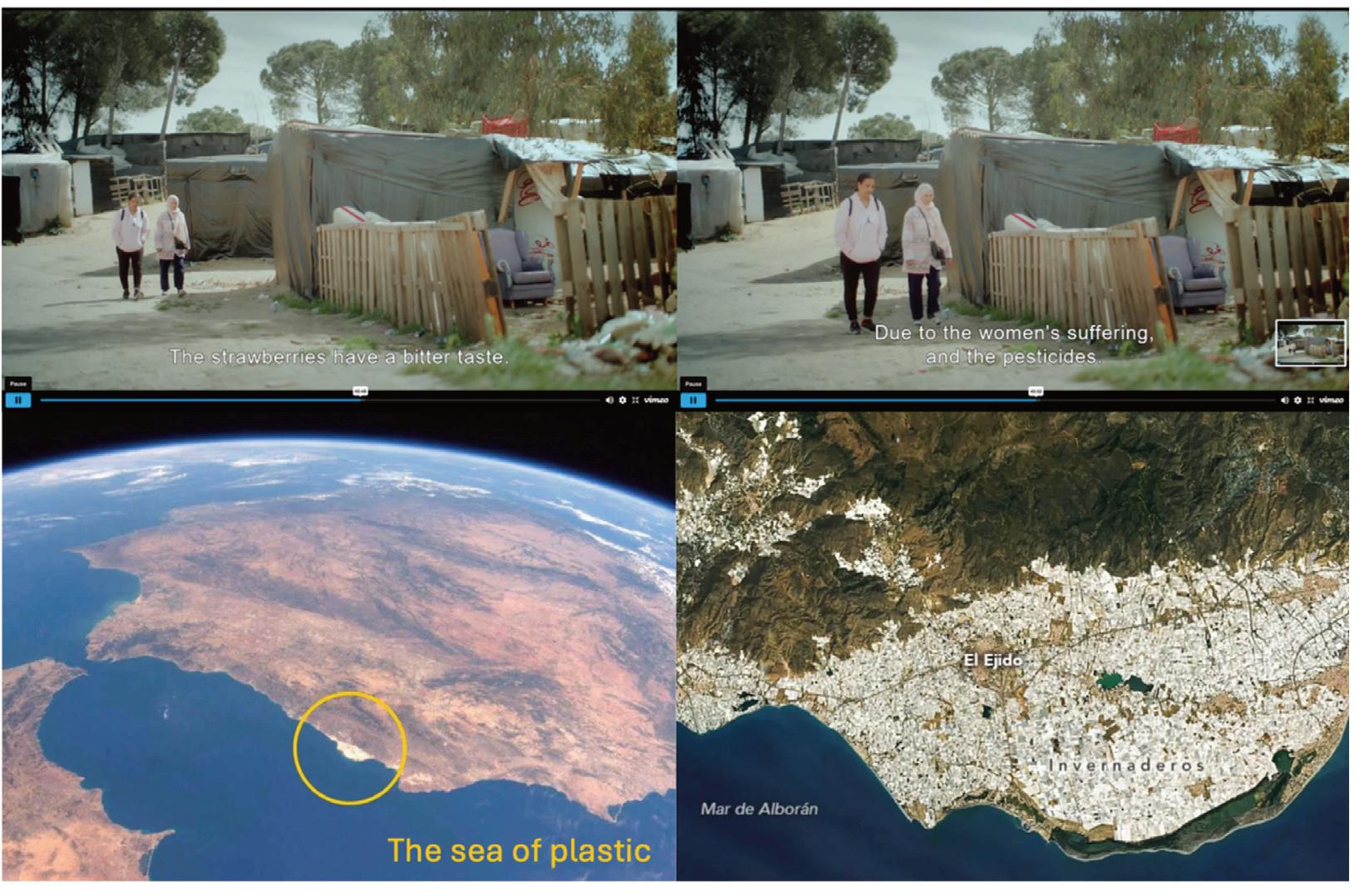
Before defining the second central concept, Mediterranean ecocriticism, it is important to situate it within the umbrella term or larger field of environmental humanities. In recent years, 2
Environmental Humanities have gained considerable traction by showing that the environmental crises are not only a matter for the natural sciences. Environmental Humanities challenges the long-standing division between nature and culture, and highlights that (neo)colonialism, extractivism, class structures, and broader systems of domination are at the root of the ecological and climate crises. Within Environmental Humanities, ecocriticism—positioned at the intersection of literary studies and environmental inquiry—is a particularly dynamic field. My project contributes to ecocriticism’s recent blue turn, which investigates the cultural, political, and ecological dimensions of seas and oceans. It takes the Mediterranean, with its long history of migration and environmental transformation, as its central focus.
I adopt the definition of Mediterranean ecocriticism proposed by Serenella Iovino, Professor of Italian Studies and Environmental Humanities, who edited a special issue of Ecozon@: European Journal of Literature, Culture and Environment on Mediterranean ecocriticism in 2013. This issue helped establish the subfield and provided a framework for studying the exponential growth of artistic works engaging with the natural-cultural compound known as the Mediterranean world. For Iovino, Mediterranean ecocriticism—and I would add, in line with postcolonial ecocriticism more broadly—should reject essentialist visions of the region as anti-historically pure, deconstructing any claim to a “pure” cultural origin, a harmonious cradle of “civilization,” or civilizational superiority. Thus, she argues, our task as ecocritics is not only to de-essentialize the Mediterranean but also to show it, through literature and cultural productions, as evolving, dynamic, and interconnected: a space of porous boundaries, intercultural encounters, and socioenvironmental transformations.
Rather than a stable identity or center, the Mediterranean becomes a living assemblage marked by contingency, connectivity, and ecological-cultural entanglement. The Mediterranean ecosystem itself bears witness to centuries of migration and transplantation: oranges, tomatoes, eucalyptus, and cypress trees, now perceived as quintessentially Mediterranean, are in fact botanical migrants from extra-Mediterranean lands. The region’s landscape, like its cultures, is the result of layered movements, exchanges, and ecological transformations; of hybridity. Since Iovino’s special issue, research emerging mainly from Italian, English, and American Studies has sought to reframe Mediterranean discourses by focusing on marginalized humans (such as migrants and women) and on nonhuman animals—beginning with the Mediterranean Sea itself—leaving an important research gap in other linguistic contexts, such as French, Spanish, and Arabic.
Let us turn to one example with the Algerian series El’sardines (2025), directed by poet Zoulikha Tahar, that offers a striking example of the Mediterranean hybridity of languages, of a rich linguistic entanglement through the story of Zouzou, a 30-year-old bio-marine engineer, who is struggling to tell her family she is leaving to track down the mystery of sardines disappearing from Algerian Mediterranean waters. In an interview with the CNC (2025), Tahar speaks of the several languages used in her series and explains that in contemporary Algeria, parts of the population continue to alternate between Arabic and French, yet this fluctuation is itself evolving: French verbs are “Arabized,” and regional dialects such as Oranese circulate alongside standardized forms. She further explains that younger generations no longer systematically study in France; English is increasingly taught in schools; Middle Eastern television series exert
a form of soft power across North Africa. In the same interview (2025), co-writer Kaouther Adimi notes that she used to speak French a lot with her friends, but that the “Generation Z” is speaking more and more English while Algeria is reviving its Maghrebi dialects. Linguistic hybridity here is not static mixture but an index of historical realignments, postcolonial negotiations, and shifting cultural affiliations. The Mediterranean emerges as a space of ongoing reconfiguration rather than inherited coherence, and the series reflects these shifts while also pointing to broader geopolitical reorientations.
However, recognizing hybridity must also be approached critically. As Cristina Lombardi-Diop has argued in Locating African European Studies (2021), an unreflective celebration of hybridity in Mediterranean discourse can risk neutralizing Blackness, dissolving specific histories of racialization into a generalized narrative of mixture. The language of connectivity may obscure structural inequalities if it glosses over asymmetrical power relations. This tension is particularly visible in the Spanish context, where Spanish-language Black productions continue to “remain invisible in Spanish universities and in the Spanish literary establishment” (p. 295), as Maya G. Vinuesa observes. Similarly, Stephen Small has emphasized the broader invisibility of Black communities within European national narratives.
A further example that complicates celebratory narratives of Mediterranean hybridity is Juan Tomás Ávila Laurel’s historical novel Dientes blancos, piel negra (2021). The novel reconstructs the life of the wealthiest Black woman in Equatorial Guinea, owner of the country’s largest cocoa plantation, who later established herself in nineteenth-century Barcelona. Drawing on the AfroIberian research project directed by anthropologist Yolanda Aixelà-Cabré, Ávila Laurel retraces the history of the krio fernandinos, an Afropolitan community descended from formerly enslaved Anglophone Africans who escaped bondage and formed a prosperous diaspora in the Gulf of Guinea.
In doing so, the text resonates strongly with the theoretical intervention of the Black Mediterranean. As editors of The Black Mediterranean: Bodies, Borders and Citizenship argue in their introduction, this framework enables “a radical re-telling of ‘Europeanness’ by locating questions of race and Blackness at the center of the region typically understood to be the ‘cradle’ of European civilization” (Danewid et al., 2021, p. 15). Rather than accepting the Mediterranean as a harmonious space of exchange and fluid hybridity, the Black Mediterranean concept challenges its idealization by foregrounding “oft-overlooked histories of racial violence and their contemporary reverberations” (Danewid et al., 2021, p. 14). Ávila Laurel’s novel exemplifies how literary narrative can expose these submerged histories.
Such a reframing is crucial when addressing contemporary migration. As Saucier and Woods insist, any discussion of migration in the Mediterranean “that does not ground itself in the historical context of slavery and colonialism is imagining a world that is not, rather than dealing with the world as it is” (2014, p. 60). The Mediterranean border regime cannot be separated from the longue durée of racial capitalism. The infrastructures that once sustained plantation slavery continue to echo in contemporary forms of coerced labor, precarious citizenship, and differential mobility. 4
Food provides a particularly revealing entry point into these structures. As Felipe FernándezArmesto observes, eating constitutes our most intimate contact with the natural environment. Food and agriculture also connect historical slavery with present-day racial capitalism, a continuity visible across many of the cultural works discussed here. Through precarious legal status, debt, confiscated documents, and withheld wages, many migrants work below minimum wage in agricultural sectors across Southern Europe. European Union migration policies frequently render these workers “illegal,” precipitating relations of dependency that resemble forms of modern slavery. In doing so, they reproduce institutional racisms that once justified slavery and colonial expansion, now sustaining regimes of cheap or unpaid labor underpinning Mediterranean food production.
This reality is conveyed through different representative strategies. In non-fiction, the denunciation can be direct: in the trailer of the documentary The Pickers (2024), an interviewee declares, “Welcome to slavery” (1:12). The film makes explicit the structural violence embedded in contemporary agricultural systems. In fiction, by contrast, such critique may appear more obliquely. In Todo bajo el sol, two Black workers are shown harvesting watermelons in a vignette split between blue—evoking the Mediterranean Sea—and green, the cultivated field. Without overt commentary, the image visually sutures leisure and labor, tourism and extraction.
A similar articulation appears in the final episode of the series Dieciocho (2024), directed by Hammudi Al-Rahmoun Font. The episode, titled “Vivir”, opens with the protagonist Moha working in fields outside Valencia on the Spanish Mediterranean coast. Surrounded by other migrant men—none of them white, all speaking with different accents—he harvests onions while joking about football players from their respective countries. The scene resists reducing these workers to passive victims; through humor and camaraderie, they embody forms of agency within dependency. Yet this fragile agency is structurally constrained. Moha had previously worked legally in a kitchen, but once his residence papers are denied, the fields become his only option.
In the same episode, Moha learns that a close friend, also a migrant, has taken his own life. Alone in the field, he cries out in anguish, framed against an expanse of endless vegetables. The camera lingers on both his rage and the agricultural landscape that surrounds him, binding emotional devastation to material environment. Immediately afterward, the parallel narrative follows Celia, the other main protagonist, a university student in marine ecology. Asked by a professor about anthropogenic impacts on coastal and marine ecosystems, she lists pollution, plastic waste, overfishing, habitat destruction, biodiversity loss, and climate change. Al-Rahmoun Font places these scenes back-to-back without explicitly linking migration and climate crisis. Yet the juxtaposition performs the connection. The series assembles the pieces—racialized labor, precarious legality, environmental degradation—whose structural interdependence becomes legible when placed within our chosen frameworks.
Indeed, it is precisely here that the frameworks of the Black Mediterranean and Mediterranean ecocriticism become analytically productive. Rather than treating migration, racism, and climate change as separate issues, these approaches reveal their co-constitution. Mediterranean ecocriticism, as I propose it, insists on connecting these dots: making entanglements explicit by 5
placing cultural works in dialogue with historical analysis and environmental science. The urgency of such dialogue is underscored by the findings of the Intergovernmental Panel on Climate Change (IPCC). The Mediterranean region is identified as a climate change “hotspot”, with warming occurring at rates approximately 20 percent above the global average and with significant declines in rainfall. Major risks include prolonged droughts, more frequent floods, erosion, heatwaves, intensified wildfires, sea-level rise, ocean warming, and acidification, threatening food security, human health and well-being.
When read alongside cultural productions such as The Pickers and Dieciocho, these scientific assessments acquire an embodied, emotional and relatable dimension. As the IPCC emphasizes, “sharing and co-production of knowledge can support climate adaptation practices and enhance sustainability in the Mediterranean region” (p. 2236). In this respect, the work of Mediterranean ecocriticism and the deployment of the Black Mediterranean concept—particularly in classrooms and public interventions—participates in such knowledge-sharing. By contextualizing and placing cultural representations of the Mediterranean in conversation with environmental data and historical analysis, ecocritical practice contributes to a broader effort of making structural entanglements visible.
This project, still at its beginning as part of a larger postdoctoral research trajectory, proposes precisely such a framework: one that reads literature, film, and series not as isolated cultural artifacts but as critical sites where racial capitalism, ecological crisis, and Mediterranean imaginaries intersect and can be collectively rethought.
Selected Bibliography
THE BLACK MEDITERRANEAN COLLECTIVE (2021). The Black Mediterranean (G. Proglio, C. Hawthorne, I. Danewid, P. K. Saucier, G. Grimaldi, A. Pesarini, T. Raeymaekers, G. Grechi, & V. Gerrand, Eds.). Palgrave Macmillan. https://doi.org/10.1007/978-3-030-51391-7
CENTRE NATIONAL DU CINÉMA ET DE L’IMAGE ANIMÉE (n.d.). El Sardines : Les dessous d’une minisérie algérienne en quête d’émancipation https://www.cnc.fr/series-tv/actualites/elsardines-lesdessous-dune-miniserie-algerienne-en-quete-demancipation_2410575
DANEWID, I., PROGLIO, G., HAWTHORNE, C., & HELLER, C. (2021). Introduction. In G. Proglio, C. Hawthorne, C. Heller, & I. Danewid (Eds.), The Black Mediterranean (Mediterranean Perspectives). Palgrave Macmillan. https://doi.org/10.1007/978-3-030-51391-7_2
DAVIS, A. (2020). We Can’t Eradicate Racism without Eradicating Racial Capitalism [Video]. YouTube. https://www.youtube.com/watch?v=qhh3CMkngkY
FREIRE, P. (2017). Pedagogy of the oppressed. Penguin Classics.
INTERGOVERNMENTAL PANEL ON CLIMATE CHANGE (2022). Cross-Chapter Paper 4: Mediterranean Region. In H.-O. Pörtner, D. C. Roberts, E. S. Poloczanska, K. Mintenbeck, M. Tignor, A. Alegría, M. Craig, S. Langsdorf, S. Löschke, V. Möller, & A. Okem (Eds.), Climate Change 2022: Impacts, Adaptation and Vulnerability. Contribution of Working Group II to the Sixth Assessment Report of the IPCC (pp. 2233–2272). Cambridge University Press. https://doi.org/10.1017/ 9781009325844.021
IOVINO, S. (2017). Mediterranean Ecocriticism. Interdisciplinary Studies in Literature and Environment, 24(2), 325–340. https://www.jstor.org/stable/26569774
MILLER, C. L. (1990). Reading through Western Eyes. Theories of Africans: Francophone Literature and Anthropology in Africa, University of Chicago Press, pp.1-30.
SAUCIER, P. K., & WOODS, T. P. (2014). Ex Aqua: The Mediterranean Basin, Africans on the Move, and the Politics of Policing. Theoria, 61(141), 55–75. https://doi.org/10.3167/th.2014.6114104
SMALL, S. (2018). Theorizing Visibility and Vulnerability in Black Europe and the African Diaspora. Ethnic and Racial Studies, 41(6), 1182–1197. https://doi.org/10.1080/01419870.2017.1360362
VINUESA G., M. (2020). Negotiating Afroeuropean Literary Borders: The Inclusion of African Spanish and African British Literatures in Spanish Universities. In Locating African European Studies.
n.206 04/06/2026
LUCHA CONTRA EL TERRORISMO, DERECHOS DE LAS PERSONAS Y GARANTÍAS PROCESALES: UNA APROXIMACIÓN COMPARATIVA ENTRE ESPAÑA Y MARRUECOS
Mohamed Rouin Mazouz*
ARTICLE
ARTICLE
El derecho comparado es una herramienta eficaz para mejorar la calidad de la cooperación judicial en la lucha contra el terrorismo entre España y Marruecos. Así, a lo largo de este artículo se llevará a cabo una aproximación comparativa entre los dos ordenamientos jurídicos, el marroquí y el español, tanto en lo que se refiere al Derecho material como procesal.
Sobre el concepto jurídico penal de terrorismo y los delitos individuales en los códigos penales español y marroquí
Tras las últimas reformas de los dos códigos penales, marroquí y español, realizadas en el año 2015, el concepto legal-positivo de terrorismo se ha vuelto mucho más amplio y sus límites se han desdibujado considerablemente.1 En el caso del ordenamiento español, se han incluido potencialmente, en una interpretación meramente literal del sistema alternativo de finalidades que establece el nuevo art. 573 CPesp, comportamientos que, de modo evidente, no pueden ser considerados de ninguna manera como hechos de terrorismo; se trata, en realidad de conductas delictivas que deben encuadrarse en preceptos generales, o incluso de conductas completamente normales en la vida social. Con la nueva legislación, el terrorismo consiste simplemente en la realización de ciertos delitos individuales2 que persiguen determinados fines. A pesar de que se mantienen los delitos de pertenencia a organización o grupo terrorista, los delitos de terrorismo se configuran ahora al margen de la vinculación del autor con estos grupos u organizaciones. La desaparición de la exigencia de que los delitos de terrorismo sean cometidos por personas que pertenecen, actúan al servicio, o colaboran con organizaciones o grupos terroristas supone que el concepto de terrorismo ha dejado de configurarse solo a partir de su elemento estructural.3 Así, el terrorismo no es necesariamente una violencia organizada.4 Con todo, el elemento organizativo sigue siendo un elemento fundamental en la formulación del concepto de terrorismo en los ordenamientos de ambos países. En ese sentido, el delito de
* profesor titular en la Universidad Abdelmalek Essaâdi de Tánger y profesor asociado en la Universidad Rey Juan Carlos de Madrid
1 Castellví, Monserrat, C., «Terrorismo, arts. 571-580», en Corcoy Bidasolo, M. (dir), Vera Sánchez, J. S. (coord), Manual de derecho penal. Parte especial. Doctrina y jurisprudencia con casos solucionados, tomo 1, actualizada con LLOO 1/2015.2/2015, 2015, p 769.
2 Cancio Meliá, M., en Alonso Rimo, A. Fernández Hernández y A. Cuerda Arnau, M. L. (ed.), Terrorismo, sistema penal y derechos fundamentales, 2018, pp. 95 y ss., con ulteriores referencias sobre el estado de la cuestión en la doctrina jurídica occidental.
3 Ibidem.
4 Castellví Monserrat, C. «Terrorismo. Arts 571-580», en Corcoy Bidasolo, M. (dir.), Vera Sánchez, J. S. (coord.), Manual de derecho penal, parte especial. Doctrina y jurisprudencia con casos solucionados, tomo 1, actualizada con LLOO 1/2015.2/2015, 2015, p. 769.
organización requiere una pluralidad de sujetos intervinientes que deben ser por lo menos tres. Por eso, hay que diferenciar la organización terrorista de la pluralidad subjetiva ordinaria. Según el párrafo segundo del apartado 1 del art. 570 bis y el párrafo segundo del apartado 1 del art. 570 ter del ordenamiento español, hay normas generales de los delitos de criminalidad organizada que pueden ser de referencia para los conceptos de los delitos de organización terroristas y que, a diferencia de los tipos que regulan los delitos de terrorismo en el Código Penal marroquí, requieren necesariamente tres o más personas para que se produzca un delito de organización terrorista. En otras palabras, la fórmula «organización terrorista» debe aplicarse en un sentido muy estricto para referirse exclusivamente a grupos y/o organizaciones que utilizan la violencia extrema para llegar a sus fines terroristas.
Al legislador penal marroquí no le interesa de ningún modo ni el espacio ni el nombre de los miembros de la organización terrorista, tal y como se deduce de los arts. 218-1 y 218-1-1 del Código Penal marroquí. Por lo tanto, desde el año 2003 se da en Marruecos una ampliación del concepto de terrorismo que incluye, en particular, el alcance típico del delito de pertenencia a una organización terrorista, el de colaboración con esta y el proyecto individual de terrorismo.5 Puede decirse que dicha tendencia se ha consolidado con las reformas del año 2015. Por eso, el tradicionalmente denominado elemento teleológico, que caracteriza el terrorismo por la persecución de determinadas finalidades (políticas), ha sufrido importantes modificaciones.
Detención policial y actos de investigación en la Ley de Enjuiciamiento Criminal español y la Ley de Enjuiciamiento Criminal marroquí
En principio, la detención de una persona no ha de prolongarse más allá del tiempo que sea necesario para la práctica de los actos de investigación dirigidos a la identificación del detenido, el esclarecimiento de los hechos y la obtención de efectos y pruebas relacionados con los mismos. Por ello, una vez realizadas estas diligencias, el detenido debe, sin demora, ser puesto a disposición de la autoridad judicial o en libertad. Cuando, finalizadas las diligencias, concurran circunstancias especiales derivadas de la investigación que exijan retrasar el momento de poner físicamente al detenido a disposición del juez, se obrará siempre bajo las instrucciones del fiscal, en el caso marroquí, o del juez, en el caso español, haciéndolas constar por diligencia, al igual que cualquier otra eventualidad, de tal forma que siempre quede constancia detallada del uso del tiempo en el que el detenido ha estado bajo custodia policial. Sin embargo, para evitar privaciones de libertad de duración indefinida o incierta, se establece una duración máxima y limitada de la detención. En ese sentido, el legislador marroquí permite prolongaciones largas y da a la policía judicial más tiempo que el español para investigar casos de terrorismo o casos de orden público.6 No obstante, en el caso español, se podrá prolongar la detención el tiempo necesario para los fines investigadores, hasta un límite máximo de otras cuarenta y ocho horas, siempre que, solicitada tal prorroga mediante comunicación motivada dentro de las primeras cuarenta y ocho horas desde la detención, sea autorizada por el juez en las veinticuatro horas
5 Gil Gil, A., «La expansión de los delitos de terrorismo en España a través del delito de pertenencia a organización terrorista», en Kai, A., Ezequiel, M., Christian, S., (eds), Terrorismo y derecho penal. Programa Estado de derecho para América Latina, Grupo Latinoamericano de Estudios sobre Derecho Penal Internacional, 2015, pp. 342-360.
6 El cómputo del plazo de las setenta y dos horas se inicia en el momento mismo de la detención, que no tiene necesariamente que coincidir con la entrada del detenido en la dependencia policial, y finaliza con la puesta en libertad o a disposición judicial del detenido. Véase Armenta Deu, T., Lecciones de derecho procesal penal, Marcial Pons, 2004, pp. 209-222.
siguientes. En la Ley de Enjuiciamiento Criminal marroquí el plazo máximo de la detención preventiva en los casos de terrorismo puede prolongarse hasta doce días, es decir, noventa horas renovables dos veces, mientras que en el caso español no se pueden superar los cinco días.
Por otro lado, desde los atentados del 11 de septiembre de 2001 en Nueva York, la idea de separación entre inteligencia y proceso penal se ha ido diluyendo,7 en particular en los casos de delitos de terrorismo. Se aprecia, en efecto, un progresivo acercamiento de ambos campos, inteligencia y policía. Se empiezan a utilizar métodos de investigación semejantes y a asumir funciones análogas como la actividad de agentes infiltrados, las escuchas telefónicas, el control de las comunicaciones electrónicas, etc. Además, se han creado sistemas de prevención y análisis sofisticados, y se han desarrollado técnicas y modelos específicos para investigar las conexiones de redes criminales.
En Marruecos, las relaciones entre los diferentes niveles y departamentos de la policía y la inteligencia no están claras y necesitan ser reestructuradas tanto orgánicamente como jurídicamente.8 En España, sin embargo, existe una ley reguladora de este ámbito. En ese sentido, el art. 4 de la Ley Reguladora del Centro Nacional de Inteligencia, Ley 11/2002, enumera de manera detallada las funciones que corresponden a los servicios de inteligencia. El art. 4.a) atribuye a los servicios de inteligencia del CNI la función de obtener, tratar y difundir información y datos y, de manera deliberadamente amplia, señala el tipo de datos que corresponde recoger y analizar a estos servicios: desde aquellos que afecten a los intereses políticos, la seguridad nacional y la estabilidad de las instituciones, hasta los relativos a los intereses económicos, industriales, comerciales o estratégicos. El artículo hace referencia a la prevención, detección y neutralización de grupos o personas que pongan en riesgo el orden constitucional, los derechos y las libertades de los ciudadanos españoles, la estabilidad de las instituciones del Estado y el bienestar de la población.9
Según ese precepto, entre las funciones de los servicios de inteligencia del CNI se encuentra la lucha contra el terrorismo y la delincuencia organizada. La prevención y detección de actividades terroristas, así como la prevención y detección de otras formas de criminalidad grave, aparecen incorporadas en el art. 4.b) de la misma ley.
A título de conclusión, podemos afirmar que el Derecho penal se ha puesto al servicio de la prevención, con el objetivo de alcanzar la seguridad a través de las normas penales. El paradigma de la prevención transforma así el sistema penal en un sistema de seguridad en detrimento de los derechos. Por lo tanto, se normaliza el uso de términos propios del ámbito bélico y de defensa a la hora de combatir el fenómeno del terrorismo. La lucha contra el terrorismo se identifica más con un fenómeno de riesgo que con el esclarecimiento de un crimen concreto. Por ello, la
7 Bachmaier Winter, L., «Información de inteligencia y proceso penal», en Bachmaier Winter, L. (coord.), Terrorismo, proceso penal y derechos fundamentales, Marcial Pons, 2012, p. 58.
8 Citado en Bachmaier Winter, L., «Información de inteligencia y proceso penal», en Bachmaier Winter, L. (coord.), Terrorismo, proceso penal y derechos fundamentales, Marcial Pons, 2012. p 59.
9 Recomendación del consejo de Europa, Rec (2005)10, 20 de abril de 2005, en la recomendación número 9.
tipificación de delitos de riesgo abstracto resulta en una mayor implicación de los servicios de prevención en la investigación penal, y no tanto en las técnicas propias de una ley de enjuiciamiento criminal democratizada.
ARTICLE
LEFTIST PARTIES’ TRAJECTORIES IN THE MIDDLE EAST AND NORTH AFRICA
Massimo
Introduction
Political Islam has dominated the literature on the comparative politics of the Middle East for over four decades now (Sigillò and Ramaioli, 2024). The phenomenon has been examined in all its dimensions, from its electoral strategies and success to its appeal within civil society to its changing ideological tenets to its contribution – whether positive or negative – to processes of democratization to its links to political violence. This overwhelming focus has tended to obscure the presence of several other political movements and currents, which have helped shape the politics of the region. For instance, with a few notable exceptions (Ismael and Ismael, 1998; Ismael, 2005 and 2007; Sluglett, 2018), studies on leftist politics have been very few and far between despite the significant role that leftist parties and movements have played in the Middle East and North Africa since colonial times (Jebari, 2020) and in the aftermath of decolonization (Guirguis, 2020).
Interest in leftist politics in the region has however resurfaced more recently in the aftermath of the 2011 Arab uprisings (Kalfat, 2014; Feliu and Izquierdo-Brichs, 2019). Following the fall of several regimes and the holding of free and fair elections, it was expected that Islamists would do well at the polls, and they duly did, but the nature of the protests as well as the demands emerging from the streets, with an emphasis on socioeconomic issues, also led to expectations that leftist parties would do reasonably well (Cavatorta and Çavdar, 2023). By and large, they did not and their electoral performances were underwhelming. There were popular demands for greater socioeconomic equality and a greater role for the state to ensure it chimed with longstanding leftist preferences and policy proposals, but leftist parties failed to capitalize on them. Thus, what explains their lack of electoral success despite rather favorable conditions? Several explanations have been offered to account for this.
First is the nature of the electoral game in the Arab elections. It has been demonstrated (Wegner and Cavatorta, 2019) that leftist and Islamist voters are actually quite close in their policy preferences when it comes to what kind of measures they would like to see implemented, including a stronger stance against US hegemony in the region and closer ties with fellow Arab
* Full Professor of Political Science and Middle East Studies at the Department of Political Science at Laval University (Canada); ** Assistant Professor in Political Science in the School of Social Sciences, Arts and Humanities at Al Akhawayn University in Ifrane, Morocco
and Muslim states, greater socioeconomic equality, and serious anti-corruption measures. The difference between the two sets of voters has to do with social values such as gender norms with Islamist voters far more conservative than secular-leftist ones. It follows from this that in a more conservative religious environment, leftist parties will perform poorly when such social values become electorally salient as they seemed to have been in post-Arab revolts elections despite the protests focusing on socioeconomic issues.
A second reason has to do with organizational differences (Resta, 2018; Sallam, 2022). Following the uprisings, Islamist movements and parties had a much stronger organization in place whereas leftist parties – the ones that had not been co-opted at least – did not have anywhere near the organizational strength of the Islamists. This is because leftist parties had suffered massively from repression and their links to traditional leftist constituencies in trade unions and universities had been cut off for a long time. Although repression had hit Islamists as well, it was far more difficult for authoritarian regimes to place religion – and the network of unofficial mosques and charities – under tutelage. When free elections finally came, Islamists could count on a widespread and strong network that could be mobilized quickly, resulting in significant electoral victories.
A final reason has to do with the historical tendency of the leftist camp to be divided with several parties vying for a rather limited pool of voters. The leftist camp was divided for instance between those parties and personalities that had agreed to cooperate with the authoritarian regime to keep Islamists out and those formations that had not been co-opted (Cavatorta and Haugbølle, 2011). The former lacked credibility and were quickly marginalized. The latter, despite enjoying a degree of popular legitimacy, were divided over ideological interpretations – and policies to promote – in addition to suffer from clash of personalities that prevented unity (see López García, 2019 for the Moroccan case). While the Islamist camp was not immune from divisions, with the struggle between Muslim Brothers and Salafists a clear example of that, Islamist parties showed much greater ideological coherence and electoral unity.
Although these explanations are all valid to a certain extent, they lack historical depth, and, much more significantly, they fail to engage theoretically with the international dimension of leftist politics. The contention here is that the previous explanations, focusing exclusively on a bilateral relationship between authoritarian regimes and leftist parties or between the latter and other opposition actors in the political system, do not do justice to how leftist parties operated and where their legitimacy and material resources came from. In a way, it is facile to assume that their ideological trajectory towards moderation, co-optation or irrelevance is the outcome of the policies implemented by the regimes against them. In reality, leftist parties have always been part of an international ideological camp that for a long time had the Soviet Union at its helm. The USSR provided both material and, possibly more importantly, ideological legitimacy and this sustained parties across the world and the Arab region too. Thus, when we shift the focus on parties with Marxist roots, it is useful to employ the concepts of external diffusion and isomorphism to explain their trajectory and, ultimately, their inability to succeed electorally. External diffusion refers to the way in which Marxist parties sought to accommodate the demise of world communism as an international project, from which they had derived ideological strength
and material resources. Isomorphism refers to adaptation to the extenuating circumstances (marginalization, repression, co-optation) under which they operated in the context of authoritarian and semi-authoritarian regimes at home. It is thus the joint ‘weight’ of these two mechanisms that is at the root of where leftist political parties in the Arab world are now.
The notion of an external referent problematizes this overly domestic perspective and introduces a crucial factor in explaining how leftist movements have learned, changed and survived, albeit in a much-reduced role. The trajectory of leftist parties towards ideological moderation or electoral irrelevance tells us that an authoritarian context, no matter how repressive (as was the case of Egypt, Iraq or Syria) or skillful in co-opting opponents (as was the case of Morocco and Jordan), has limits in its reach against opposition actors when the latter can continue to be inspired ideologically and/or helped materially by an external referent; the Soviet Union in this case. It should be noted for instance that regimes’ heavy-handed repression of leftist party members and leaders did not seem to dissuade them from renouncing their political engagement. What is more, profound conflicts within leftist formations did not lead to their ideological or organizational capitulation. The apparent success of the Soviet Union was employed as an act of faith in the inevitability of radical political change among Arab leftist militants no matter what the regimes in place did. It is only when doubts began to emerge about the validity of the Marxist project and when faced with the ultimate demise of the Soviet Union and its ideological apparatus that the regimes’ policies towards leftist formations began to matter, leading them to make significant changes towards moderation or leading some of them to double down on their ideological convictions and losing popular appeal by doing so. Thus, the external dimension emerges as a crucial mechanism through which the leftist opposition learned in light of what occurred outside and not solely what occurred inside.
The repercussions of these dynamics can therefore be seen in the electoral marginalization of the left in contemporary Arab politics. The abandonment, for instance, of Marxism-Leninism and the turn towards some sort of social democracy has made several nominally leftist parties relatively marginal actors, unable to benefit from the dominant role that socioeconomic demands for greater equality, social justice and wealth redistribution (Achcar, 2013; Teti et al., 2019) played in the 2011 Arab uprisings. All this does not mean that there is nothing left of the Arab left. As Dahbi points out in his study of Morocco, which could be generalised across the region, leftist politics is still alive and quite well outside of elected institutions and it is thus in civil activism, trade union work and street politics that it might be able to regenerate itself and become once more a commanding political force in the Arab world. The socioeconomic conditions that led to the 2011 uprisings have not changed much, and a renewed impetus for change coming from below might benefit the left this time.
References
ACHCAR, G. (2013). The People Want: A Radical Exploration of the Arab Uprising. University of California Press.
CAVATORTA, F. and ÇAVDAR, G. (2023). Research Symposium: Left-Wing Politics. APSA MENA Newsletter 6(2), 55-57.
CAVATORTA, F. and HAUGBØLLE, R. (2011). ‘Will the real Tunisian opposition please stand up?! Opposition coordination failures under authoritarian constraints’, British Journal of Middle Eastern Studies 38(3): 323-341.
FELIU, L. and IZQUIERDO-BRICHS, F. (2019). Communist Parties in the Middle East. 100 Years of History. Routledge.
GUIRGUIS, L. (2020). The Arab Lefts: Histories and Legacies, 1950s–1970s. Edinburgh University Press.
ISMAEL, T. and ISMAEL, J. (1998). The Communist Movement in Syria and Lebanon. University Press of Florida.
ISMAEL, T. (2005). The Communist Movement in the Arab World. Routledge.
ISMAEL, T. (2007). The Rise and Fall of the Communist Party of Iraq. Cambridge University Press.
J EBARI , I. (2020). The Rise and fall of the Arab Left. In F. Cavatorta, Storm, L. and Resta, V. (Eds.), Handbook on Political Parties in The Middle East and North Africa (pp. 17-32). Routledge.
KALFAT, K. (2014). Mapping of the Arab Left. Rosa Luxemburg Stiftung. Available at: https://www.rosalux.de/fileadmin/rls_uploads/pdfs/sonst_publikationen/Mapping_of_the_Arab_l eft_Tunisia_en.pdf
LÓPEZ GARCÍA, B. (2019). The four faces of Morocco’s communists: PCF, MCP, PLS and PPS. In L. Feliu and F. Izquierdo Brichs (Eds.), Communist parties in the Middle East: 100 years of history (pp. 216-237). Routledge.
RESTA, V. (2018). Leftist parties in the Arab region before and after the Arab uprisings: unrequited love. In F. CAVATORTA, STORM, L. and RESTA, V. (Eds.), Political Parties in the Arab World: Continuity and Change (pp. 23-48). Edinburgh University Press.
SALLAM, H. (2022). Classless Politics: Islamist Movements, the Left, and Authoritarian Legacies in Egypt. Columbia University Press.
SIGILLÒ, E. and RAMAIOLI, M. (2024). L’attivismo islamico in Maghreb. Politiche e ideologie contemporanee. Carocci.
SLUGLETT, P. (2018). The Iraqi Communist Party 1934–79. International Journal of Contemporary Iraqi Studies, 12(2), 101-109.
TETI, A., ABBOTT, P. and CAVATORTA, F. (2019). Do Arabs really want democracy? Evidence from four countries. Democratization 26(4), 645-665.
WEGNER, E. and CAVATORTA, F. (2019) Revisiting the Islamist-Secular divide: Parties and Voters in the Arab World. International Political Science Review 40 (4), 558-575.