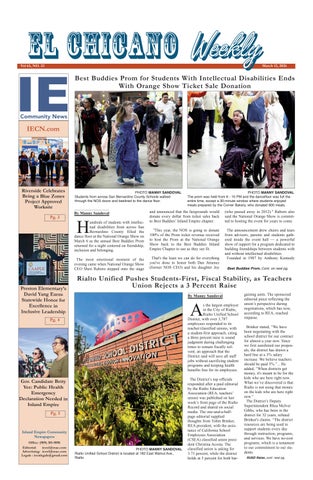
El Chicano 03/12/26

Page 1


EL CHICANo

Hundreds of students with intellectual disabilities from across San Bernardino County filled the dance floor at the National Orange Show on March 6 as the annual Best Buddies Prom returned for a night centered on friendship, inclusion and belonging.

The most emotional moment of the evening came when National Orange Show CEO Sheri Raborn stepped onto the stage

and announced that the fairgrounds would donate every dollar from ticket sales back to Best Buddies’ Inland Empire chapter.

"This year, the NOS is going to donate 100% of the Prom ticket revenue received to host the Prom at the National Orange Show back to the Best Buddies Inland Empire Chapter to use as they see fit.

That's the least we can do for everything you've done to honor both Dan Jimenez (former NOS CEO) and his daughter Joy

A(who passed away in 2012)." Raborn also said the National Orange Show is committed to hosting the event for years to come.

The announcement drew cheers and tears from advisors, parents and students gathered inside the event hall — a powerful show of support for a program dedicated to building friendships between students with and without intellectual disabilities.

Founded in 1987 by Anthony Kennedy

Best Buddies Prom, Cont. on next pg.

s the largest employer in the City of Rialto, Rialto Unified School District, with over 3,787 employees responded to its teacher/classified unions, with a student-first approach, citing a three percent raise is sound judgment during challenging times to remain fiscally solvent; an approach that the District said will save all staff jobs without sacrificing student programs and keeping health benefits free for its employees.

The District’s top officials responded after a paid editorial by the Rialto Education Association (REA, teachers’ union) was published on last week’s front page of the Rialto Record and shared on social media. The one-and-a-halfpage editorial supplied thoughts from Tobin Brinker, REA president, with the assistance of California School Employees Association (CSEA) classified union president Christina Acosta. The classified union is asking for 3.75 percent, while the district holds at 3 percent for both bar-

gaining units. The sponsored editorial piece reflecting the union’s perspective during negotiations, which has now, according to REA, reached impasse.

Brinker stated, “We have been negotiating with the school district for our contract for almost a year now. Since we first sunshined our proposals, the district has drawn a hard line at a 3% salary increase. We believe teachers should be paid 5%.”... He added, “When districts get money, it's meant to be for the kids who are here right now. What we’ve discovered is that Rialto is not using that money on the kids who are here right now.”

The District’s Deputy Superintendent Rhea McIver Gibbs, who has been in the district for 32 years, refuted Brinker's claims. “The district resources are being used to support students every day through instruction, programs, and services. We have no-cost programs, which is a testament to our commitment to our students.

RUSD Raise, cont. next pg.

PHOTO MANNY SANDOVAL
Students from across San Bernardino County Schools walked through the NOS doors and beelined to the dance floor.
PHOTO MANNY SANDOVAL
The prom was held from 6 - 10 PM and the dancefloor was full the entire time, except a 30-minute window where students enjoyed meals prepared by the Corner Bakery, who donated 800 meals.

Best Buddies (cont.)

- Shriver, Best Buddies began as a friendship initiative at Georgetown University and has since grown into the world’s largest nonprofit organization focused on inclusion for people with intellectual and developmental disabilities.

Heather Lozano, coordinator of the Best Buddies Prom and advisor to the Best Buddies chapter at Cajon High School, said the organization’s core mission is simple: create genuine friendships.

“What the club does is pair students in general education with students in special education,” Lozano said. “What you'll see here tonight is the biggest, most wonderful celebration of students being included and accepted by their general education peers. It's really the most beautiful thing I've ever seen.”

Lozano first brought Best Buddies to Cajon High School in 2001. Today, she said, the chapter has grown into the largest club on campus with roughly 220 students involved.

Each week, students meet simply to spend time together — something Lozano said often leads to friendships that last well beyond high school.

“My daughter's Buddy is still her friend,” Lozano said. “My daughter graduated in 2009, and they still call each other on the phone. That's the whole idea of Best Buddies.”

For many families, the annual prom represents an experience that might otherwise be out of reach.

“Parents say, ‘My student usually can't attend prom,’” Lozano said. “So this is that moment of acceptance — watching their students out on the dance floor with their general education peers. It's just so exciting and wonderful.”

That joy was immediately visible as students walked through the doors and headed straight for the dance floor, filling the room with the Cha Cha Slide, the Wobble and a chorus of singing The YMCA.

Unlike traditional proms, the event focuses less on spectacle and more on comfort and accessibility. Lights remain steady, parents are welcome to attend, and students requiring additional support are accompanied by teachers and caregivers.

“The kids don't care,” Lozano said. “The DJ just plays the songs, and the kids sing and dance. It's electric.”

The evening also carried special meaning as the first prom held since the passing of long-

time National Orange Show CEO Dan Jimenez, who passed away in August 2025 after nearly two decades leading the organization.

Lozano said Jimenez became a passionate supporter of students with intellectual disabilities and helped the event grow by offering larger venues at the fairgrounds.

Each year, students would honor Jimenez’s daughter Joy — who passed away in her early 30s — by holding signs during a tribute while the song “Joy to the World” played.

This year, the tribute was renamed “Dancing with Joy,” honoring both Jimenez and his daughter.

Caroline Van Zant, program manager for Best Buddies in Los Angeles and the Inland Empire, said the prom reflects the organization’s broader mission of inclusion.

“This is a massive celebration of inclusion and the Best Buddies mission that Heather has been building for years,” Van Zant said.

Best Buddies operates more than 200 chapters throughout California, including about 65 across Los Angeles and the Inland Empire, Van Zant said.

The organization continues expanding its reach beyond high schools into middle schools and elementary campuses while also offering leadership training, family support and employment programs for people with intellectual and developmental disabilities.

“I would want people to know that there is a Best Buddies program for everyone,” Van Zant said. “Whether you are a person with an intellectual or developmental disability or you love someone who is, there is a way to get involved.”

For Lozano, the prom represents something even deeper — the power of connection.

Having raised a son on the autism spectrum, visibly emotional, she said the friendships created through Best Buddies can change lives. “Watching him grow up without friends, that's why this is such a passion to me,” Lozano said. “To see a child have a friend — that's everything.”

Finally, another exciting opportunity for Best Buddies students is coming April 17th when the National Orange Show Fair hosts its Sunshine Day…an opportunity for these exact students to enjoy the fair before it opens to the general public–another example of the NOS’ commitment to Best Buddies Inland Empire.

RUSD Raise (cont.)

- Some of those include: every elementary student goes on a no-cost field trip, middle and high school students participate in no-cost career exploration and college fairs, and high school students have access to no-cost Advanced Placement exams, PSATs, and SATs. All high school seniors have the opportunity to submit two college applications at no cost to them. In-State and National College Tour opportunities for students at no cost.

She added, “The district has made a concentrated investment in literacy through reading specialists, teacher training through the USC Reading Authorization program, expanded library resources, the Raising a Reader home program, and supplemental instructional tools such as iReady Instruction to strengthen student reading outcomes. Additionally, high school athletic programs are funded to allow students to participate at no cost, ensuring Rialto students have access to quality programs. The District has also invested in parent engagement programs to equip families to better support their child’s learning, notably the USC Family Literacy Program and the UCLA Family Math Project.”

Brinker had also mentioned that inflation has gone up. “When inflation went up a few years ago, the state put a whole bunch of money into schools to help attract and retain teachers,” Brinker said. “Salaries were already low, and when inflation hit, it really devastated a lot of folks in our profession.”

RUSD Associate Superintendent of Human Resources Dr. Denise Ellis stated, “While salary increases are a key component of negotiations, it is also important to recognize that the District provides one of the most competitive benefits packages in the region, including fully paid Kaiser health coverage for employees and their dependents. The District’s priority is to provide a fair and competitive total compensation package that attracts and retains the best professionals to serve our students. We value our employees and remain focused on reaching an agreement that supports our staff while continuing to meet the needs of the students and families we serve.”

According to various news reports, the Record found that several of the school districts in San Bernardino County Schools have not negotiated free health and benefits compensation. In fact, Rialto Unified School is only one of a handful of school districts (with 33 school districts in County Schools) that still offer its employees free health care.

Although REA had stated that teachers are asking for total compensation, including benefits, with the five percent far salary, according to RUSD As-

sociate Superintendent of Business Diane Romo, benefits often include California State Teachers’ Retirement System (STRS), California Public Employees’ Retirement System (PERS), paid leave, professional development, and step-and-column salary increases.

But both unions claim there is a little over $200 million, and they want it for salaries.

The District says state-supplied money still needs to be allocated and is separated based on where the need is, and because it is public money, the district has to be careful and budget responsibly, since more than 85 percent of the money is spent on salaries.

According to Romo, the total fund balance, which includes restricted, committed, and assigned funds, is not just funds available for salary expenditures. Many portions of that balance are legally restricted for specific programs such as Special Education, State and federal grants, facilities, or capital projects, and pension obligations.

Romos stated that on July 1, 2025, the District’s beginning financial reserves for the 20252026 General Fund dollars were $204,605,037; the reserves are comprised of $87,455,279 in unrestricted funds and $117,149,758 in restricted funds that can only be used in compliance with program restrictions.

The projected ending fund balance for 2025-2026 is $170,024,052; of this, $68,315,356 is in unrestricted funds and $101,708,696 is in restricted funds that can only be used in compliance with program restrictions. Restricted funds cannot be used to pay for non-program expenses, such as district-wide raises.

According to REA, class size has been an increasing issue.

McIver-Gibbs’ email indicated that the average class size of TK-5 is approximately 24 students. All elementary schools maintained 1-2 Reading Specialists to support their students’ growth, beyond their original 3year commitment made after the COVID-19 pandemic.

Romo added, “The District provides training to our teachers on Multi-Tiered Support System (MTSS) restorative practices, and other instructional strategies that promote engaging classrooms and support safe schools for our students. Only a small portion is truly ‘unrestricted’, which is what can be used for ongoing salary negotiations.

“The reported $204 million fund balance includes funds that are legally restricted or committed for specific purposes. The district’s actual discretionary reserve is significantly smaller and must be maintained to ensure financial stability and compliance with State requirements.”

According to District

Spokesperson Syeda Jafri, reserves protect students and employees from future financial shocks. “In past school board meeting budget presentations, Mrs. Romo had shared that the cost of running a district, providing raises, and declining enrollment contribute to reduced future state funding,” said Jafri. “She also added that health benefits have to be taken into account, utilities and operational expenses, and economic uncertainty in future state budgets. In California, districts must maintain a minimum reserve (a 3% minimum) under oversight rules from organizations such as the California Department of Education and County Offices of Education.”

Acosta, who oversees custodians, maintenance workers, nutrition, bus drivers, clerks, secretaries, and various school staff who are separate and away from the teachers/nurse/counselor bargaining units, said financial pressures have also pushed many classified employees to work multiple jobs. “I know custodians personally who work two eight-hour shifts,” Acosta said in last week’s editorial piece. “They work nights for Rialto and have a day shift custodial job somewhere else just to make ends meet.”

“The District values all staff members and the work they do every day to support students and schools. We believe they deserve a salary increase that recognizes their contributions while remaining in alignment with what the district can afford,” stated Ellis. “RUSD proposed a total compensation package of 5%, which includes a 3% salary increase and a District contribution of approximately 2% toward the premium increase for health and welfare benefits. This benefit affords staff members and their families ongoing, fully paid Kaiser health care. The District’s proposal provides a salary increase above the state-funded Cost of Living Adjustment (COLA) and is comparable to compensation offered in neighboring districts.”

As the bargaining units aggressively pushed for a five percent raise for 1,286 REA Members, including teachers/counselors/nurses, and 1,297 classified union members pushed for a 3.75 percent raise, the Board of Education had hired a new Superintendent, Dr. Alejandro Alvarez, who took the helm of the district in December 2025.

After a lengthy search last fall filled with multiple stakeholders' meetings and lots of reactions at school board meetings, the Board of Education, with a 5-0 vote, selected Alvarez, bringing stability to the district.

Alvarez is a seasoned school chief who comes from Bassett Unified, serving as a former superintendent.

Read the complete story at IECN.com.

San Bernardino County Approves Fontana Navigation Center With 200

Community News

San Bernardino County has finalized the purchase of a property from the city of Fontana to establish a regional navigation center that will provide 100 shelter beds and 100 recuperative care beds along with supportive services to help the unhoused community transition to permanent housing.

Today, the Board of Supervisors approved the property purchase and an agreement with partner cities that establishes a framework for operating the facility, including funding contributions toward ongoing operations. This action marks a major milestone in advancing a coordinated regional approach to addressing homelessness in western San Bernardino County.

“The board’s action on this agenda item moves us closer to opening a navigation center that will provide critical support for people experiencing homelessness,” said Board of Supervisors Chairman and Third District Supervisor Dawn Rowe. “It will connect individuals to the resources they need to gain stability and thrive.”

The navigation center will serve people experiencing homelessness in the areas represented by Vice Chair and Fifth District Supervisor Joe Baca, Jr., Second District Supervisor Jesse Armendarez and Fourth District Supervisor Curt Hagman.

“The West End Regional Navigation Center reflects our

commitment to expanding services and creating real pathways to stable housing,” said Baca, Jr. “By aligning our resources and efforts, we’ll be able to deliver a stronger and more comprehensive response that will ensure people experiencing homelessness get the care and support they need.”

“This critical project will make a meaningful difference for people experiencing homelessness in western San Bernardino County,” said Armendarez. “We are proud to advance this work with our partner cities and look forward to the navigation center’s immense impact in our community.”

“I’m pleased we’re moving forward with this vital project to provide essential services to those in need,” said Hagman. “This represents a pivotal moment in our ongoing efforts to help individuals and families gain stability and secure permanent housing.”

Fontana Mayor Acquanetta Warren said the property transfer reflects the city’s commitment to partnering with the county to expand housing solutions for people experiencing homelessness.

“This partnership shows what’s possible when local governments work together toward a shared goal,” said Warren. “It advances our regional efforts to expand housing support and enhance coordination in addressing homelessness.”

Riverside Celebrates Being a Blue Zones Project Approved Worksite

Community News

The City of Riverside on Wednesday (3/4) celebrated being named Riverside’s first Blue Zone Project Approved Worksite by unveiling a new “downshift space” where employees can take their breaks in an aesthetically pleasing and relaxing environment that helps reduce stress and boost productivity.

The worksite designation recognizes the City for investing in the health and well-being of its employees through a variety of measures that make it easier for employees to make healthy choices. Research shows that employers that make such changes have healthier employees, less absenteeism and higher morale, which leads to less turnover.

“Well-being should be accessi-

ble to everybody,” said Mayor Patricia Lock Dawson, who noted that the City has embraced Blue Zones principles for nearly a year.

The most recent change at City Hall includes the creation of the “downshift space” on the walkway between the second floor of City Hall and the parking garage. The space, which previously was vacant, has been spruced up with comfortable furniture, plants and healthy snacks on the tables as a refuge from what otherwise can be a stressful environment.

“Focusing on employee wellbeing actually improves worksite outcomes,” City Manager Mike Futrell said. “Healthy employees are excited to come to work. Excitement fuels more creativity and collaboration. We live in stressful times so there is no better time to unveil this.”

Previous worksite changes inspired by Blue Zones included sprucing up stairwells at City Hall with new paint and inspirational slogans to encourage walking instead of taking the elevator; and installing screen savers on all City computers that promote “box breathing” -- inhaling, holding, exhaling, and holding again – to reduce stress and increase focus.

Rikki Hubbard, Lead of Organization and Wellbeing for Blue Zones Project Riverside, thanked the City’s Human Resources Director, Rene Goldman, for embracing the Blue Zones effort to reduce stress and improve the health and wellbeing of City employees.

“It has been a true honor to walk this approval journey with you,” Hubbard said.

Beds to Address

The cities of Chino, Fontana, Montclair, Ontario, Rancho Cucamonga, Rialto and Upland will contribute to startup costs and annual operating expenses, and the county will leverage federal and state funding to reimburse the cost of services.

The site will operate as a low-barrier shelter and serve individuals on a referral-only basis through the county’s coordinated entry system. In addition to temporary shelter, the navigation center will offer behavioral health services, medical care, case management, transportation assistance and housing placement.

The project originated from discussions that occurred during the San Bernardino County Homeless Ad Hoc Committee meetings, which were co-chaired by Baca, Jr. and Hagman, where leaders identified the need for a shared strategy to reduce unsheltered homelessness. As discussions continued, leaders determined that the most effective approach was for all municipalities to work together to create a regional navigation center. Through this partnership, the county and cities will reduce costs, leverage existing resources and strengthen regional collaboration.

The county is in the final stages of selecting an operator to manage and staff the facility. Once an operator is on board, the next phase will focus on completing the necessary tenant improvements. The regional navigation center, located at 11109 Jasmine St. in Fontana, is anticipated to begin serving the community in early 2027.

San Bernardino Named a Tree City USA by the Arbor Day Foundation

Community News

The City of San Bernardino has been recognized as a Tree City USA by the Arbor Day Foundation for its ongoing efforts to maintain and nurture its urban forest. This marks the third consecutive year the City has achieved this recognition.

“Trees play an important role in the health and beauty of our city,” said Mayor Helen Tran. “Being recognized as a Tree City USA for the third consecutive year reflects San Bernardino’s commitment to investing in green spaces, improving air quality, and creating a healthier environment for our residents.”

In the six years since San Bernardino created its Urban Forestry Team, the City has taken significant steps to maintain and grow its forestry program.

The team includes certified arborists, groundworkers, and a beautification team. They manage the planting, trimming, nurturing, and caring for more than

42,000 trees throughout San Bernardino. City trees can be found in local parks, along streets and medians, and other public spaces.

“San Bernardino’s investment into the creation of an Urban Forestry program is yielding us tremendous results,” said City Arborist Matt McDonald.

In recent years, a tree and plant nursery was established by the city to reduce costs and expedite the replacement and planting of new trees.

The team also identifies sick or dying trees and oversees their removal. As a result, the number of claims against the City for damage caused by fallen branches or downed trees has dropped dramatically.

In the past year, San Bernardino planted more than 200 trees and removed almost 700 diseased or dead trees. The Urban Forestry Division is currently working to plant new trees in the locations of recently removed trees as well as identify locations of potential new tree planting sites.

PHOTO CITY OF RIVERSIDE
Riverside Mayor Patricia Lock Dawson, councilmembers, and city staff cutting the ribbon March 4th, 2026.

Preston Elementary’s David Yang Earns Statewide Honor for Excellence in Inclusive Leadership

For David Yang, educational leadership is about ensuring every student, from every background, feels seen and valued. That commitment to cultural visibility was recognized on a statewide stage recently, as the Lena M. Preston Elementary School Assistant Principal was selected a 2026 “Co-Administrator of the Year” by the California Association of Asian and Pasifika Leaders in Education (CAAPLE).

Mr. Yang was one of just 13 educational leaders selected from across the state to receive this prestigious distinction at the CAAPLE Awards Gala, held March 3, at the U.S. Grant Hotel in San Diego. The event was attended by a significant delegation of Rialto Unified School District leadership, including Superintendent Dr. Alejandro Álvarez, Board of Education Vice President Edgar Montes, and Board Members Dr. Stephanie Lewis and Eve-

lyn Dominguez.

"It is my honor to congratulate Mr. Yang on being recognized as a Co-Administrator of the Year by CAAPLE," said Superintendent Dr. Álvarez. "He consistently demonstrates exceptional leadership, compassion for students, and a deep commitment to equity and excellence in education. He builds strong relationships with staff, students, and families, which fosters a positive and inclusive school culture where all learners can thrive."

Upon accepting the award, Mr. Yang took the stage to acknowledge the direct support he has received from the District.

"I would not be standing here without the support of so many incredible people in my life," Yang told attendees. "I’d like to take a moment to recognize and thank the people who drove several hours out of their busy day to come celebrate with me. Thank you to my colleagues from Rialto — we come strong."

The CAAPLE award recognizes exemplary work in education from those who demonstrate leadership, mentorship, and a commitment to increasing visibility and advocacy for Asian American, Native Hawaiian, and Pacific Islander (ANHPI) students. CAAPLE, founded in 2020, is a non-profit organization whose mission is to ensure ANHPI voices are represented at every level of education — from students to educators to leaders — creating environments where students feel seen and positioned to thrive.

As an equity-centered leader, Mr. Yang has been instrumental in cultivating inclusion and cultural visibility within the Rialto Unified School District (RUSD). One notable initiative was bringing the Global Connections Pen Pal Program to Preston Elementary, allowing students to communicate with peers in Taiwan to expand their global horizons.

"Mr. Yang is exceptionally deserving of this recognition," said Preston Elemen-

tary School Principal Erica Bennett. "He is kind, compassionate, and incredibly hardworking, consistently supporting our students, staff, and families. I know he will continue to accomplish great things for our school and community."

The nomination for the award came from within the RUSD family, submitted by Ben F. Kolb Middle School Principal Dr. Tina Lingenfelter, highlighting the District's internal culture of support. With many Preston Elementary students promoting to Kolb Middle School for sixth grade, Dr. Lingenfelter has seen firsthand the results of Mr. Yang’s compassionate work and the foundation he builds for student success.

By honoring leaders like Mr. Yang, CAAPLE continues its mission to strengthen leadership pipelines and ensure inclusive schools for students across California.

PHOTO RUSD
Preston Elementary Assistant Principal David Yang addresses attendees at the CAAPLE Awards Gala in San Diego. During his acceptance speech, Yang thanked a contingent of Rialto Unified School District colleagues for their support as he was recognized as one of only 13 Co-Administrators of the Year in California.
PHOTO RUSD
Rialto Unified School District (RUSD) leaders gathered at the CAAPLE Awards Gala in San Diego to celebrate Preston Elementary Assistant Principal David Yang’s selection as a statewide Co-Administrator of the Year. Pictured from left to right are: Kolb Middle School Principal Dr. Tina Lingenfelter, Deputy Superintendent Dr. Rhea McIver Gibbs, Superintendent Dr. Alejandro Álvarez, Board Member Mrs. Evelyn P. Dominguez, LVN, awardee Mr. David Yang, Board Member Dr. Stephanie E. Lewis, Board Vice President Mr. Edgar Montes, Executive Director of Student Services Dr. Robin McMillon, and Executive Director of Education Services Dr. Manuel Burciaga.

San Bernardino County’s First Diverging Diamond Interchange Opens Near Cal State University

San Bernardino

Community News

Students and staff commuting to California State University San Bernardino today drove through the newly completed Diverging Diamond Interchange (DDI) that opened to drivers late Sunday, March 1. The new DDI interchange also improves the driving experience for local businesses, residents, employees, and community members.

The former interchange at Interstate 215 and University Parkway in San Bernardino was reconfigured into a DDI to improve traffic flow and create a safer interchange. The DDI allows more cars to pass through the interchange during a green light cycle and creates a safer center median sidewalk with concrete barriers between vehicles and pedestrians. Driver safety is increased because the risk for severe traffic collisions is reduced. Vehicles turning or merging left onto I-215 briefly transition to the left side of the

road, eliminating the need to cross oncoming traffic, which reduces the risk of collisions.

SBCTA partnered with Caltrans District 8 and the city of San Bernardino to construct the interchange, which is a first in San Bernardino County. Construction began in November 2024 and while the interchange is now open, minor construction activities are expected to continue over the coming weeks.

The project cost $25.8 million to build. Funding is provided by federal, state, and local resources, including $16.4 million in Measure I funds. Measure I is the half-cent sales tax collected throughout San Bernardino County for transportation improvements. Voters first approved the measure in 1989, and overwhelmingly its extension in 2004, with more than 80 percent voting to extend the measure through 2040. SBCTA administers Measure I revenue and determines which projects receive Measure I funding.

Gov. Candidate Betty Yee: Public Health Emergency Declaration Needed in Inland Empire

Identifying a growing health concern in the Inland Empire, Democratic candidate for California governor Betty Yee said that the state should declare a public health emergency to combat the environmental issues brought on by the expansion of the logistics industry in the region.

Yee took a tour offered by the Center for Community Action and Environmental Justice (CCAEJ), a Jurupa Valley nonprofit, that included several warehouses in the area and met with IE residents that say that the expansion of warehouses and industry built around it have negatively impacted their health.

south is a demolished neighborhood, cleared to pave the way for another warehouse. The school itself was slated to be removed and relocated to a new location as part of a legal settlement: developers agreed to pay $44.5 million to build new school facilities. That plan is now scuttled, said Joaquin Castillejo of the CCAEJ, after that developer left the project and a new one took its place.

The construction of the warehouse south of the school is still tied up in a separate lawsuit brought by CCAEJ and three other environmental non-profits.

Yee spoke little, mostly asking questions, as CCAEJ staff and residents talked about the warehouses' impact on Bloomington's electrical grids and air quality

There, Yee met Blanca Olivares, a resident of the area who is fighting cancer she attributes to the truck fumes. She said her neighborhood has had a high rate of diseases, including cancer and Parkinson's Disease.

Medical professionals identified environmental factors, not genetic, as the cause of her cancer. She would like to live in an area with cleaner air, but she hasn't been able to work due to her cancer, and couldn't afford a move.

"The air, the traffic, the noise, we experience it every night," she said.

Yee said it's a basic right to breathe clean air.

"You just see the pervasiveness of this logistics industry, and you really start to wonder how it impacts everything, it all being shouldered by these communities. I actually do feel like we need to declare a public health emergency, just to bring all the resources to bear about what we need to do to fully understand and unpack all the warehouse impacts, everything from the young people, in schools, to the families," Yee said.

Xochitl Pedraza, a Bloomington resident invited out for the tour, said she was never notified that the area was rezoned.

"It's not just a public health emergency. It's the fault of the government here. If they fail in that, the state can move in," Yee said.

"We're just seeing how the whole area is getting decimated. We're being targeted," Pedraza said.

The CCAEJ brought Yee to the Zimmerman Elementary School in Bloomington. To the school's east is an empty lot, in which a man trotted his horse. To the south east is the Bloomington Commerce Center, a warehouse. To the

Yee was curious if there were any investor's standards that could be controlled to mitigate the growth of warehouses.

"How do we empower communities to take on these kinds of challenges?" she asked.

The tour continued to Nuñez Park in San Bernardino, north of the BNSF Railway's yard.

In the crowded governor's race, Yee polled at eighth place out of 16 candidates in last week's survey by the Public Policy Institute of California. She has 5% of the polled votes. Republican Steve Hilton polled the highest at 14%.

"I hope other candidates in this race step up to say something about this. Because, we can fix this," Yee said.

PHOTO AIDAN MCGLOIN/CAL MATTERS
Gov. candidate and former CA Controller Betty Yee talks with Bloomington resident Xochitl Pedraza in front of the demolished Stallion Lane neighborhood, Zimmerman Elementary School, Bloomington Commerce Center, and horse riding lot in Bloomington on Feb. 26, 2026.

Turn static files into dynamic content formats.

Create a flipbook