The Moreno Valley library was enlivened by residents and planners who assessed the Inland Empire’s logistics future on Saturday, Feb. 21. The Freight Communities Action Coalition (FCAC) convened to dissect the rollout of Assembly Bill 98 (AB 98)—the 2024 warehouse siting law—and its new legislative partner passed in October 2025, Senate Bill 415 (SB 415), as cities scramble to comply with new county and statewide rules.
attendance, the event was a critical assessment of policy language and whether AB 98 and SB 415 can protect vulnerable frontline communities exposed to heavy diesel traffic.
Inland Empire Community News (IECN) requested comments from the South Coast Air Quality Management District (SCAQMD) and the California Air Resources Board (CARB). Neither agency responded by the time of publication.
Unite
AB 98 was designed to shield neighborhoods from industrial sprawl by mandating that new warehouses align with designated truck routes by 2028 and January 1, 2026 for Warehouse Concentration Region (WCR) counties and cities, including Riverside County and San Bernardino County along with the cities of Chino, Colton, Fontana, Jurupa Valley, Moreno Valley, Ontario, Perris, Rancho Cucamonga, Redlands, Rialto, Riverside and San Bernardino. The recent FCAC summit highlighted a growing urgency among Inland Empire advocates because, for those in
The summit began with organizers presenting a tier system ranking jurisdictions according to their compliance with AB 98. According to the presenters, little progress has been made in Riverside County, whereas San Bernardino County jurisdictions have mostly implemented truck routes in compliance with the new ordinances.
Karla Cervantes, a Mead Valley resident and organizer with the Sierra Club and FCAC, said she was encouraged by the community turnout. But she remains frustrated with those cities and counties she says have not
Warehouse Regulation, Cont. on next pg.
San Bernardino Valley College to Celebrate 100 Years with Centennial Gala
: iecnlegals@gmail.com Fontana Unified Middle School Student Selected as Black History Month Parade Grand Marshal
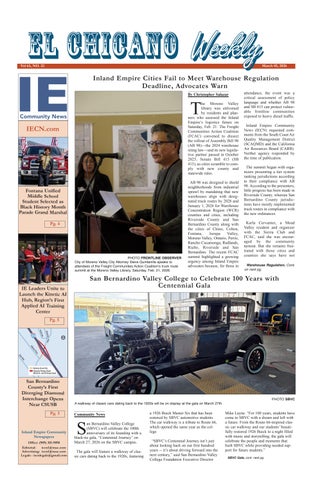
San Bernardino Valley College (SBVC) will celebrate the 100th anniversary of its founding with a black-tie gala, “Centennial Journey” on March 27, 2026 on the SBVC campus.
The gala will feature a walkway of classic cars dating back to the 1920s, featuring
a 1926 Buick Master Six that has been restored by SBVC automotive students. The car walkway is a tribute to Route 66, which opened the same year as the college.
“SBVC’s Centennial Journey isn’t just about looking back on our first hundred years -- it’s about driving forward into the next century,” said San Bernardino Valley College Foundation Executive Director
Mike Layne. “For 100 years, students have come to SBVC with a dream and left with a future. From the Route 66-inspired classic car walkway and our students’ beautifully restored 1926 Buick to a night filled with music and storytelling, the gala will celebrate the people and moments that built SBVC while providing needed support for future students.”
SBVC Gala, cont. next pg.
PHOTO FRONTLINE OBSERVER City of Moreno Valley City Attorney Steve Quintanilla speaks to attendees of the Freight Communities Action Coalition's truck route summit at the Moreno Valley Library, Saturday, Feb. 21, 2026.
PHOTO SBVC
Warehouse Regulation (cont.) - doneenough.
“It’s disappointing,” she said. “For the most part, a lot of them are behind schedule, so that’s not a good thing.”
Cervantes emphasized what she sees as a failure to meet the bill’s “diligent effort” requirement for community engagement.
Steve Quintanilla, city attorney for the City of Moreno Valley, spoke to attendees and echoed Cervantes’ concerns.
“The significant term we're struggling with, or phrase, is ‘diligent effort,’ because under the law, we are required . . . to make a ‘diligent effort’ with respect to community outreach and community engagement over truck routes,” Quintanilla said, adding that he’s unsure how to best meet the policy’s diligent effort requirements.
“But I can tell you, anything you can think of is good.”
Quintanilla said they are working with the Attorney General’s Office to establish an “air quality abatement fee” for warehouse developers to directly fund home or building improvements for those who live near warehouses and commercial truck routes.
“We're currently negotiating with the Attorney General's Office on an abatement fee, instead of abatement air quality fee, where the proposal is that we're going to require each developer of a warehouse facility to pay [for upgrades],” Quintanilla said. “We haven't decided on the number yet . . but that fee is going to be put into an abatement fund and made available to residents or occupants of sensitive receptors to put in thick windows and replace or repair or upgrade their HVAC systems.”
For 18-year-old Perris resident Jose Osuna, the summit marked a deeper commitment to civic responsibility.
He recently attended a Perris City Council meeting concerning the Harvest Landing development. He said he was concerned about the project and described seeing trucks idling near his neighborhood.
“These trucks shouldn't even be driving through residential areas in the first place,” he said, adding, “I don’t want them to be emitting pollution near my backyard.”
Enforcement dominated much of the summit discussion. Attendees suggested that cameras and license plate readers be used to enforce truck routes. However, automatic license plate readers (ALPR) pose problems.
Lieutenant Deirdre Vickers, the public information officer
for the City of Moreno Valley, wrote in an email that: ALPRs “are not used in our city to issue truck route citations,” because they “generally cannot distinguish between a truck making a local delivery on a restricted route and one violating the restriction,” adding that ALPRs are used for criminal investigations—not traffic violations.
According to Vickers, roadway signage and city navigation are a persistent challenge.
“Many drivers rely heavily on GPS navigation systems, which often do not distinguish between standard passenger vehicle routes and designated truck routes,” resulting in drivers inadvertently entering “restricted areas, leading to unintended traffic violations and increased enforcement issues,” Vickers wrote.
While truck route enforcement remains an ongoing issue, Riverside Neighbors Opposing Warehouses (R-Now) Cofounder Mike McCarthy expressed sympathy for drivers and added that more needs to be done to hold warehouse operators accountable for truck route violations.
“The compliance of trucks driving on non-designated truck routes shouldn't simply fall on the independent contractors who are making the deliveries, trying to be on time and who have a schedule to meet,” McCarthy said. “It needs to at least partially fall on the businesses that are employing them, even if they have contracts in place that explicitly limit their liability.”
Joseph Mendoza, a freelance civic planner, spoke to IECN and urged residents to learn more about where they live, whether they live in incorporated cities or unincorporated county areas.
For example, he encouraged residents to use Riverside County’s Geographic Information Systems (GIS) portal, which he referred to as the “gold standard.”
Using the county’s GIS resource, Mendoza explained that residents can pull a report on their parcel to access important information to help them understand where they live and how they can engage with their community.
For Osuna, he’s compelled to act because the struggle extends beyond a single city, affecting the common good of the region.
“The fight is not just in Perris,” he said, harkening on the power of individuals to impact their communities. “Now that I know I can do it, I want to do it.”
SBVC Gala (cont.)
- The event will kick off at 5 p.m. with a Roaring 20s-themed cocktail party in the Applied Technology Building, which opened in March 2025. Guests can bid on silent auction items and listen to live music by the band Pepper Moons.
Dinner and a live auction will follow in the college’s gym, where attendees will take a “Centennial Journey” featuring highlights from the decades and a cast of alumni, students, volunteers and the band Radio Ready. Dinner will be catered by Cutting Edge Catering. All proceeds will support SBVC students.
The gala is co-chaired by Gloria Macias Harrison and Dr. Yolanda Moses. Macias Harrison is a San Bernardino Community College District trustee emerita and co-founder of El Chicano newspaper. Moses is a global anthropology scholar, national higher education leader, former university president and former vice chancellor at UC Riverside.
“I am humbled to serve as cochair for the San Bernardino Valley College 100th anniversary celebration,” Macias Harrison said. “For 66 years SBVC has been a cornerstone for me. More importantly, for a century, SBVC has been a cornerstone for our community, providing a pathway to a brighter future for
students whose lives have become concentric circles reaching family, friends, businesses, government and all the branches that form the tree of life for the Inland Empire. May SBVC continue to be part of the community’s foundation for 100 more years and beyond.”
“It is my honor to be asked to be the co-chair of this gala celebration of the 100th anniversary of this great institution,” Moses said. “SBVC has made me the person I am today. I will always be grateful for the education there that opened the world of possibilities to me. I want to pay it forward.”
To mark its centennial, SBVC will honor 15 people for their service to the college and/or the community. They include:
-Dr. Donald Averill, Chancellor Emeritus of SBCCD
-Dr. John Bancroft, age 101, SBVC alumnus, former SBVC administrator -Dr. Kim Carter-Tillman, SBVC alumna -Dino Ebel, SBVC alumnus, Dodgers thirdbase coach -Captain Gary Kelly, retired SBVC faculty member
-Dr. Tomas Morales, President, CSU San Bernardino
-Rochelle Oquendo, SBVC alumna & manager of Mitla Cafe
-Margaret Ortiz, SBVC alumna & retired employee
-Ken Ramirez, Chairman Emeritus of Yuhaaviatam of San Manuel Nation
-Dr. Diana Z. Rodriguez, Chancellor of the SBCCD
-Paul and Susan Shimoff, SBVC alumnae, local attorney and educator -Dr. Judith Valles, SBVC alumna, first Hispanic mayor of San Bernardino
-Gloria Macias Harrison, SBVC alumna, platinum gala sponsor
Live auction items include an autographed baseball collection from the Dodgers’ Shohei Ohtani, Freddie Freeman and Mookie Betts, a 14k gold ring featuring a 2.31-carat aquamarine cushion cut and .52 carats of diamonds donated by Redlands Jewelers, a seven-night trip to Tuscany and a tailgate party for 10 with SBVC President Gilbert J. Contreras. Silent auction items include a 14k gold amethyst and diamond ring from Queen’s Jewelers and a threenight getaway for four people on the Kentucky Bourbon Trail.
Ticket sales are now closed, join the waitlist at www.sbvcfoundation.org/100gala. Limited sponsorships and corporate tables are available – if interested, contact the foundation at (909) 384-5457.
Rialto Teachers, Staff Demand Raises,
Reserve; Urge
By Manny Sandoval
Twounions representing employees in the Rialto Unified School District say the district is sitting on more than $200 million in reserves while holding firm on a 3% raise offer they argue is worsening staffing shortages, increasing workloads and disrupting student learning.
Leaders of the Rialto Education Association and California School Employees Association Chapter 203 spoke with Inland Empire Community News on March 2, outlining their concerns after nearly a year of contract negotiations.
Tobin Brinker, president of the Rialto Education Association, said negotiations with the district have lasted about 11 months and remain stalled over pay.
“We have been negotiating with the school district for our contract for almost a year now,” Brinker said. “Since we first sunshined our proposals, the district has drawn a hard line at a 3% salary increase. We believe teachers should be paid 5%.”
Brinker said the union tracks 33 comparable school districts across San Bernardino and Riverside counties and estimates Rialto teachers are about 2.7% below the regional average settlement over the past decade.
Citing $204M
Parents to Pack March 11 Meeting
He said inflation and delayed raises have made the gap more noticeable for educators already struggling with the cost of living.
“When inflation went up a few years ago, the state put a whole bunch of money into schools to help attract and retain teachers,” Brinker said. “Salaries were already low, and when inflation hit, it really devastated a lot of folks in our profession.”
Christine Acosta, president of California School Employees Association Chapter 203, said classified employees — including custodians, office staff and support workers — are facing similar challenges.
Her union is seeking a 3.75% raise while the district has remained at 3%.
“We’re only asking for 3.75, and they’re stuck at 3% for us,” Acosta said. “They won’t even move the additional 0.75.”
Both union leaders pointed to Rialto Unified’s financial reserves as a central issue in the negotiations. The district’s 2024–25 unaudited financial report shows a total ending fund balance of roughly $204.6 million.
Brinker said the unions believe that money should be used to support employees and students now rather than being held in reserve.
“When districts get money, it’s meant to be for the kids who are here right now,” Brinker said. “What we’ve discovered is that Rialto is not using that money on the kids who are here right now. They’ve been stashing it.”
Acosta said staffing reductions have also increased workloads for remaining employees. She pointed to layoffs and eliminated positions at the end of the last school year, including custodial and mailroom roles.
“At the end of June, they let go of several classified positions — two custodial positions, the mailroom position and the teacher resource center position,” Acosta said. “Now they’re expecting the people who are left behind to take over those duties.”
Acosta said the removal of mailroom staff has also affected how important district communications are sent to families.
“There were two people in the mailroom — a specialist and a courier assistant,” she said. “The courier assistant delivered mail and packages to school sites, and the specialist handled bulk mailers and compliance letters that needed to go out to parents.”
Read the full story at IECN.com.
Op-Eds
Building the Foundation for Regional Investment Requires Partnership
By Matt Mena, Senior Director, IEGO
Three years ago, when I stepped into my role at IEGO, one of the largest and most complex responsibilities before us was clear: we had to manage and strategically deploy millions of dollars in state funding across the Inland Empire.
Through the California Jobs First initiative and in close partnership with the Inland Empire Labor Institute (IELI) IEGO has been entrusted with more than $9 million in state investment to support economic development, workforce innovation, and industry growth in our region. That level of funding is not simply the result of strong proposals. It reflects the state’s confidence in our ability to manage complexity, coordinate diverse stakeholders, and ensure public dollars generate measurable impact.
Managing this process was not straightforward work. These investments require multi-sector collaboration, strict compliance and reporting standards, and the ability to move from planning to implementation quickly while delivering outcomes that matter to workers, employers, and communities. When I began this role, we understood that success would require more than administrative oversight. It would require building trust, establishing struc-
ture, and ensuring every dollar was deployed with intention.
IEGO has approached this responsibility as a regional backbone organization. We do not operate as a standalone program administrator. Instead, we serve as a neutral convener and implementation partner, aligning local governments, educational institutions, employers, labor leaders, and community-based organizations around shared priorities. That alignment allows state investments to be deployed strategically, fill gaps in the regional economy, strengthen priority industry clusters, and direct resources to the partners best positioned to execute.
The $9 million we have managed has supported initiatives across workforce development, cybersecurity, clean and emerging technologies, advanced manufacturing, and community-centered economic development. From day one, our focus has been on integrating these funds with existing regional assets, avoiding duplication, and maximizing long-term impact rather than concentrating resources in a single institution or geography.
The reality is that distributing funds at this scale is complex. It requires careful governance structures, clear partner agreements, performance tracking, and constant communication. It also requires difficult decisions. Our
team worked diligently to ensure compliance with state requirements while maintaining flexibility for partners working on the ground. The balance between accountability and adaptability is one reason the state continues to trust IEGO.
Equally important, we have grounded every investment in employer demand and labor market data. State dollars must translate into tangible results, including businesses choosing to grow here rather than elsewhere, workers accessing quality career pathways, and emerging industries taking root in the Inland Empire.
What I have learned over the past three years is that effective regional economic development is not the responsibility of any single organization. It is about building infrastructure for collaboration. Complex challenges, workforce shortages, technological shifts, and economic transitions cannot be solved in isolation. They require coordinated regional leadership.
IEGO is proud to play that role. The trust placed in us by the state and the partnerships that make this work possible position the Inland Empire not just to compete for public investment but also to deploy it responsibly, strategically, and at scale.
Alex Pretti Murder Shows What Happens When We Fail to Push Back
By Javier Hernandez, Executive Director, Inland Coalition for Immigrant Justice
This is not an isolated tragedy. It is the second fatal shooting by federal immigration agents in Minneapolis in recent weeks, following the killing of Renée Good, and part of a broader pattern under the Trump administration’s sweeping immigration operations. These actions, arrests without transparency, aggressive confrontations, and now deadly force, are tearing at the threads of our social fabric and threatening the very rights Americans are supposed to hold dear.
Unfortunately, the deadly violence we’ve seen in Minneapolis didn’t come out of nowhere; we saw similar tactics here in the Inland Empire when ICE and federal agents shot at a family vehicle with two US Citizens in-
side in San Bernardino, making it clear our communities are either being used as a training ground, or that these violent methods have become standard practice among federal forces.
There is no room for quiet endorsement, for equivocation, for sitting on the fence. The line has already been drawn, and it was drawn by those who would use federal power to terrorize communities rather than protect them. Every time a federal agency fires a weapon instead of deescalating a situation, whether it’s in Minneapolis, Riverside, San Bernardino, or anywhere else, the boundaries of unacceptable state violence shift, and the human cost grows.
Those deaths are not abstract statistics. They are the direct outcome of a political practice that devalues human life and normalizes brute force.
President Trump Should Restore Crucial Trade Wins From His First Term
By Jeffrey Gerish, Community Member
President Donald Trump is wasting no time completing the ambitious goals left unfinished after his first term.
Soon, he'll have a rare opportunity to complete another critical piece of unfinished business: ending the exploitation of U.S. businesses by our two largest trading partners, Canada and Mexico.
In the coming months, the United States will undertake a scheduled review of the United States-Mexico-Canada Agreement, or USMCA -- the landmark trade deal reached during President Trump's first term. During that review, the administration will have the chance to restore crucial intellectual property protections that Democrats insisted be dropped after the deal was first negotiated.
I was involved in the negotiation of the USMCA as President Trump's deputy U.S. trade representative. The president's goal was to replace the disastrous North American Free Trade Agreement with a modern pact that would protect American workers, innovators, and businesses. A central part of that was strengthening intellectual property protections.
Yet before the deal could take
effect, Democrats in Congress stripped out several key protections. For example, we had secured commitments from Mexico and Canada to provide 10 years of regulatory data protection for certain new medicines. Regulatory data protection provides temporary protection for the confidential information that drug developers share with authorities to prove a medicine is safe and effective before it can be sold.
House Democrats led efforts to remove this provision, claiming that stronger protections would raise drug prices.
That's nonsense. The United States already provides 12 years of regulatory data protection, so the change wouldn't have altered the U.S. market. Removing it has only allowed Canadian and Mexican firms to more easily copy U.S.-made drugs.
Democrats weakened other key IP protections negotiated as part of USMCA, opening the door for Canada and Mexico to undercut U.S. innovators.
Mexico's failures are especially troubling. In the U.S. trade representative's most recent Special 301 Report -- an annual report spotlighting foreign IP violations -- Mexico was placed on the Priority Watch List for "long-standing and significant" concerns, including rampant counterfeiting and piracy.
And Canada has its own shortcomings. It is on the Special 301 Watch List and continues to impose drug price controls that undervalue American-made medicines and exacerbate foreign free-riding on U.S. innovation.
By fixing prices below market value, Canada -- like many wealthy nations -- forces companies to absorb losses abroad, making it harder to fund new research and pushing a greater share of costs onto American patients. President Trump is actively working to resolve this imbalance as part of lowering drug prices for U.S. patients -- and fixing the USMCA is an important place to start.
The needed reforms are straightforward. Create enforceable, verifiable standards mandating respect for IP. Restore the 10-year regulatory data protection standard originally negotiated as part of the USMCA in 2018. Require Canada to abandon price controls and devote a higher, fairer level of spending to new drug development. And enforce full compliance with existing requirements.
The Trump administration now has the opportunity to finish the job it started in the first term on IP protection under the USMCA. For the sake of American workers and innovators, it must not let this opportunity go to waste.
We must push back and we must do it boldly. That means defunding ICE and re-imagining our approach to immigration altogether. Agencies like ICE and the Department of Homeland Security were designed to be machines used against our own communities, now they have become much worse.
There is no middle ground left. It has been consumed by gunfire and chaos, by authoritarian tactics and systemic abuse. The choice before us continues to be crystal clear: stand with humanity, or stand aside as our social fabric unravels.
At the Inland Coalition for Immigrant Justice, we will not stand aside.
Fontana Unified Middle School Student Selected as Black History Month Parade Grand Marshal
Community News
Southridge Tech Middle School eighth-grader and community leader Cyrus Moss, who spearheaded the renaming of O’Day Short Elementary School to honor the history of the Fontana African American family and land, served as Grand Marshal for the 58th Annual San Bernardino County Black History Month Parade and Expo, held on Feb. 28.
Moss rode in the parade and delivered a speech, continuing to spread the O’Day Short family legacy at the expo by talking to students and the broader community about the importance of celebrating Black History Month and being advocates for their community.
“Young student voices are powerful, and you can use your voice to make positive change in your community. Never be nervous, and do what you are passionate about,” Moss said. “I want children of all colors to know that no matter what happens, you can always use your voice to make change.
Don’t ever give up.”
While attending Dolores Huerta International Academy, Moss learned of the tragedy that befell the O’Day Short family, remembered for breaking Fontana’s color barrier in 1945. All four members of the family died after their house burst into flames. In 1950, Randall Pepper Elementary School was built on the same site. After Moss learned about the story, he sought to shine a light on the significance of the Short family.
Since successfully petitioning to rename Randall Pepper Elementary to O’Day Short Elementary, Moss has continued to be recognized for his advocacy and community work. In November 2024, Moss was honored by Assemblymember Eloise Gomez Reyes as a “30 under 30” recipient, given to residents under the age of 30 for their dedication, innovation, and service.
In April 2025, Moss was invited by the San Bernardino County School Boards Association to provide words of inspiration for
its Spring Award recipients. At the beginning of the school year, Moss was the featured speaker at the official renaming ceremony for O’Day Short Elementary, and in November, he was the keynote speaker at Beech Elementary School’s annual Career Day.
Moss continued his advocacy and collaborated with the Board of Education to expand student voices by petitioning to add middle school students to the Superintendent’s Student Advisory Council. Moss is also a member of the Fontana Mayor’s Youth Advisory Council. In January, Moss received a Youth Hero Good Deed award from the Fontana American Legion Auxiliary.
The awards and appearances have not kept Moss from his studies or having fun with his classmates. Moss is on Southridge Tech’s Honor Roll and is a member of the volleyball team.
“I am so proud of Cyrus, he puts his heart into everything he does,” Taneka, Cyrus’
mom, said. “Through all this attention, Cyrus remains very humble. He doesn’t do it for the publicity, he doesn’t brag. That’s what I really admire about him. He brings passion into everything he does.”
The Black History Month Parade was coordinated by San Bernardino County and the Concerned Citizens for the Development of North Fontana, whose president, Ellen Turner, reached out to Moss with an invitation to be the 2026 Grand Marshal. With a theme of “Youthpreneur,” the parade and expo celebrated future leaders and visionaries.
“Congratulations to Cyrus Moss for another monumental achievement, being selected as Grand Marshal and receiving the amazing opportunity to be the face of Black History Month in Fontana,” Superintendent Miki R. Inbody said. “Cyrus shows us that nothing is impossible, that change can be made, and that community members, no matter how young, have the power to remake their communities to promote equality and justice.”
PHOTO FUSD
Southridge Tech Middle School eighth-grader and community leader Cyrus Moss, who spearheaded the renaming of O’Day Short Elementary School to honor the history of the Fontana African American family and land, was selected to serve as Grand Marshal for the 58th Annual San Bernardino County Black History Month Parade and Expo, held on Feb. 28.
PHOTO FUSD
O’Day Short Elementary School students and community members showcased their school pride during the 58th Annual San Bernardino County Black History Month Parade and Expo, held on Feb. 28.
Inland Empire Leaders Unite
to Launch
the
Kinetic
AI Hub, Region’s First Applied AI Training Center
Jacqueline
Community News
SCommunity News
San Bernardino County’s First Diverging Diamond Interchange Opens Near Cal State University
San Bernardino
road, eliminating the need to cross oncoming traffic, which reduces the risk of collisions.
On Saturday, February 21, 2026, the Kinetic AI Hub officially opened at The BBOP Center in San Bernardino, drawing elected officials, education leaders, and regional decision-makers to a grand opening for the region’s first hands-on artificial intelligence training center serving Inland Empire entrepreneurs, nonprofits, and workforce professionals.
The ribbon-cutting ceremony featured live demonstrations, networking opportunities, and insights from leaders across government, education, philanthropy, technology, and entrepreneurship.
tudents and staff commuting to California State University San Bernardino today drove through the newly completed Diverging Diamond Interchange (DDI) that opened to drivers late Sunday, March 1. The new DDI interchange also improves the driving experience for local businesses, residents, employees, and community members.
The former interchange at Interstate 215 and University Parkway in San Bernardino was reconfigured into a DDI to improve traffic flow and create a safer interchange. The DDI allows more cars to pass through the interchange during a green light cycle and creates a safer center median sidewalk with concrete barriers between vehicles and pedestrians. Driver safety is increased because the risk for severe traffic collisions is reduced. Vehicles turning or merging left onto I-215 briefly transition to the left side of the
SBCTA partnered with Caltrans District 8 and the city of San Bernardino to construct the interchange, which is a first in San Bernardino County. Construction began in November 2024 and while the interchange is now open, minor construction activities are expected to continue over the coming weeks.
The project cost $25.8 million to build. Funding is provided by federal, state, and local resources, including $16.4 million in Measure I funds. Measure I is the half-cent sales tax collected throughout San Bernardino County for transportation improvements. Voters first approved the measure in 1989, and overwhelmingly its extension in 2004, with more than 80 percent voting to extend the measure through 2040. SBCTA administers Measure I revenue and determines which projects receive Measure I funding.
The Kinetic AI Hub is an applied innovation and training center focused on advancing AI literacy and the practical use of generative and agentic AI. The hub supports education and workforce development by helping individuals and organizations move from awareness to action in the responsible deployment of emerging technologies.
Entrepreneurs, small businesses, and nonprofit organizations gain access to hands-on training and real-world AI project development, enabling them to apply artificial intelligence to drive growth, improve efficiency, and create new opportunities.
The hub serves entrepreneurs, nonprofits, creatives, and workforce professionals seeking to streamline operations and prepare for the evolving demands of the job market.
Positioning the Inland Empire for the AI Era
The strong turnout from civic and education leaders underscores a growing regional consensus: AI literacy is no longer optional — it is essential for economic competitiveness and mobility.
“At Tomorrow’s Talent, we work at the intersection of employers and education to help the next generation succeed,” said Ginger Ontiveros, President and CEO of Tomorrow’s Talent. “Not all AI is designed for the same purpose — awareness of different tools matters. When you enter the workforce, understanding how to use them is your advantage. That’s how you level up.”
“I am honored to be here for the launch of the Kinetic AI Hub,” said Mayor Mario Saucedo of Redlands. “When we come together regionally to help lift up San Bernardino, we all benefit. Many of us have roots here. Our families are connected to this community. If we work together to strengthen San Bernardino, we strengthen the entire Inland Empire. I’m proud to stand with you in celebrating this important milestone.”
“What impressed me most,” said San Bernardino Councilmember Theodore Sanchez, “was the level of innovation. This is the first time I’ve seen AI being developed and applied from within the community, rather than somewhere in Silicon Valley or on the East Coast. That’s powerful. Instead of AI
being imposed on us, we’re building it ourselves, and that can impact San Bernardino on every level.”
“Nothing surprised me, and I say that because I’ve known Dr. Carter-Tillman for 17 years,” said San Bernardino Councilmember Fred Shorett. “When you understand her vision and commitment to this community, you expect something phenomenal. This is a fantastic facility, and what’s happening here with AI is exactly the kind of innovation San Bernardino needs.”
As artificial intelligence reshapes nearly every sector of the economy, the Kinetic AI Hub positions the Inland Empire as a builder — not a bystander.
The hub provides secure sandbox environments where public institutions, businesses, and nonprofit leaders can experiment with AI through hands-on training and real-world applications without compromising cybersecurity or sensitive data. By creating structured spaces for responsible innovation, the hub helps organizations move from curiosity to implementation while strengthening governance and preparing the region’s workforce for the AI era.
The Kinetic AI Hub is now scheduling one-on-one consultations to assess individual and organizational needs.
To learn how the hub can support AI integration goals, visit www.BBOPcenter.com or call (909) 530-2267.
PHOTO BBOP
Leaders from across California and the Inland Empire gather at The BBOP Center in San Bernardino for the Kinetic AI Hub grand opening, pictured (left to right): Dr. Vanessa Perez-Trang; Nicole Pritchard; Azusena Favela; Dr. Paulette Brown-Hinds; Ginger Ontiveros; Trustee Joseph Williams; Chancellor Diana Rodriguez; San Bernardino Councilmembers Mario Flores, Theodore Sanchez, Fred Shorett and Treasure Ortiz; Redlands Mayor Mario Saucedo; Fontana Mayor Acquanetta Warren; Donnell Layne and spouse; Dr.
Hester; Dr. Kim Carter-Tillman; Nathaniel Vincent; Yvonne Gutierrez-Sandoval; Dr. GwendolynDowdy Rodgers; and Felicia Alexander.
(a/an): CORPORATION Reg strant commenced to
Petitioner or Attorney: MAYRA ALEJANDRA MORENO
Super or Court of California, County of San Bernardino, 351 N Arrowhead Ave San Bernardino CA 92415 San Bernardino County Superior Court – Fami y Law Division PETITION OF: MAYRA ALEJANDRA MORENO FOR CHANGE OF NAME ORDER TO SHOW CAUSE FOR CHANGE OF NAME
Case Number: CIV SB 2602832 TO ALL INTERESTED
PERSONS: Petit oner: MAYRA ALEJANDRA MORENO filed a petition with this court for a decree changing names as follows: Present name: RAYMOND ALEXANDER SOLIS-HERNANDEZ to Proposed name: RAYMOND ALEXANDER MORENO THE COURT ORDERS that all persons interested in this matter appear before this court at the hearing indicated below to show cause, f any, why the petition for change of name should not be granted Any person objecting to the name changes described above must file a written objection that includes the reasons for the objection at least two court days before the matter is scheduled to be heard and must appear at the hearing to show cause why the petition should not be granted If no written objection is timely filed the court may grant the petition without a hearing NOTICE OF HEARING Date: 3/25/2026, Time: 8:30 AM Dept: S25 The address of the court is: same as noted above A copy of this Order to Show Cause shall be published at least once each week for four successive weeks prior to the date set for hearing on the petition in the fo lowing newspaper of general circulat on printed in this county: COLTON COURIER Dated: FEB 11 2026
GILBERT G OCHOA Judge of the Superior Court Published Colton Courier 2 / 2 6 / 2 6 3 / 5 / 2 6 3 / 1 2 / 2 6 3/19/26 C-785
Petitioner or Attorney: Michael David Pina Super or Court of California County of San Bernardino 247 W Third St San Bernardino CA 92401 Civil PETITION OF: MICHAEL DAVID PINA FOR CHANGE OF NAME ORDER TO SHOW CAUSE - CHANGE OF NAME Case Number: CIV SB 2603628 TO ALL INTERESTED
PERSONS: Petit oner:
MICHAEL DAVID PINA filed a petition with this court for a decree changing names as follows: Present name: MICHAEL DAVID PINA to Proposed name: MICHAEL DAVID TORRES THE COURT ORDERS that all persons interested in this matter appear before this court at the hearing indicated below to show cause, if any, why the petition for change of name should not be granted Any person objecting to the name changes described above must file a written objection that includes the reasons for the object on at least two court days before the matter