The best of both worlds ... the in-depth technical features our readers expect, but now also a daily blog with the latest product news and industry updates.
The Industrial ethernet magazine has been rebranded Industrial Ethernet, but it's still the only publication worldwide dedicated to Industrial Ethernet automation and machine control networking, the IIoT and Industry 4.0. The difference is a deepened focus on a daily blog to deliver more and deeper content (more product news, industry updates and technology focus) to keep our readers fully informed ... while also delivering the Industrial Ethernet magazine they have come to expect.
Industrial Ethernet
GET CONNECTED…
Industrial Edge Outlook
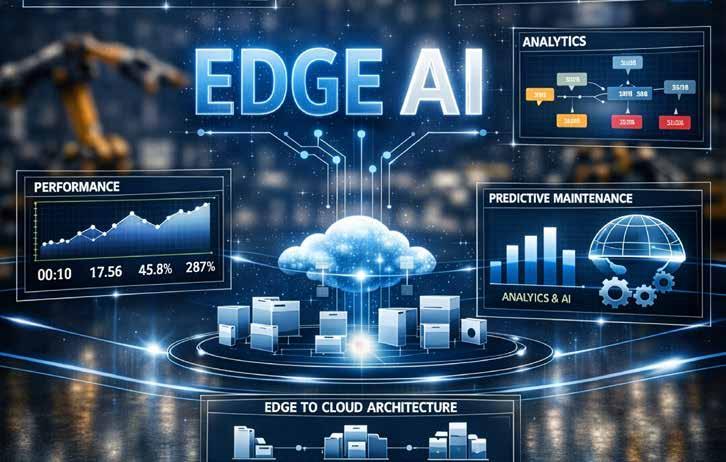
Industrial edge computing is entering a period of rapid expansion, driven by the convergence of AI, 5G, cloud - native architectures, and the rising need for ultra-low-latency, on-premises processing.
A major trend shaping the outlook is the increasing prominence of AI and generative AI at the edge. Organizations are deploying AI-enabled micro-edge systems to support real - time decision - making, adaptive machine vision, predictive maintenance, and automated quality inspection.
As data volumes surge and latency becomes a critical performance determinant, enterprises are placing more compute power directly on factory floors, in vehicles, and within municipal infrastructure. This shift is driven by the need for immediate processing of sensor streams, reduced bandwidth consumption, and stronger security postures that keep sensitive operational data local. The ecosystem is also evolving toward more autonomous and interoperable architectures. Emerging innovations include Edge - as - a - Service (EaaS) models, quantum - edge research, and self - healing edge clusters capable of orchestrating workloads without human intervention. These systems integrate AI - driven orchestration, GPU acceleration, and 5G MEC to support mission - critical industrial operations such as closed-loop automation, predictive control, and real - time anomaly detection. Manufacturing continues to lead adoption.
Looking ahead, industrial edge computing will become the foundational operating layer for autonomous systems. By 2030, analysts expect the edge to manage AI inferencing, real - time control, and compliance across globally distributed networks, reducing reliance on centralized cloud resources and enabling factories, grids, and fleets to operate with unprecedented autonomy. The competitive frontier will center on specialized, domain - tuned edge architectures that deliver deterministic performance, secure localized governance, and seamless integration with cloud ecosystems.
As organizations continue digitizing operations and deploying AI everywhere, the industrial edge will serve as the critical nexus where data, intelligence, and action converge.
Check out two major feature stories on this topic in this issue of Industrial Etherne t. "Edge AI as the Operational Nervous System for Manufacturing" starts on page 6, while "Industrial Edge Shifts Toward Decentralized Intelligence" starts on page 16. Al Presher
Industrial Ethernet magazine
The next issue of Industrial Ethernet magazine will be published in Sept/Oct 2026. Deadline for editorial: Sept 15, 2026 Advertising deadline: Sept 15, 2026
Editor: Al Presher, editor@iebmedia.com
Advertising: info@iebmedia.com
Tel.: +1 585-598-6627
Free Subscription: iebmedia.com/subscribe
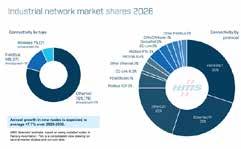
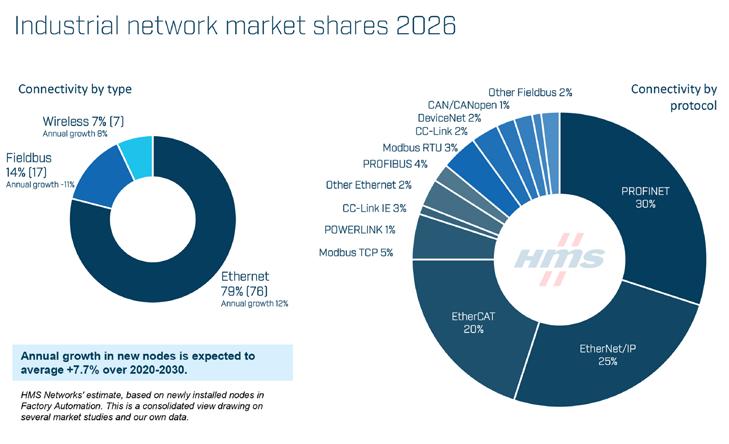
ndustrial Ethernet Market Share: 36 New Products: 50
First Wireless Mesh Network Standard Adopted by ISO/IEC
International recognition as ISO/IEC/IEEE 32857:2026 removes procurement barriers for utilities and smart cities, accelerating adoption of standards-based wireless mesh networking.
The Wi-SUN Alliance, the global ecosystem promoting open, secure, and interoperable wireless mesh networking for utilities and smart cities, today announced that the Wi-SUN Field Area Network (FAN) specification has been formally ratified as ISO/IEC/IEEE 32857:2026. The designation makes Wi-SUN FAN the first wireless mesh networking specification adopted as an ISO/IEC standard and provides utilities, municipalities and infrastructure operators with an internationally recognized framework for wireless mesh networking. This carries direct implications for utility operators, municipal governments, and infrastructure procurement agencies evaluating wireless networking technologies for critical field-area deployments.
“When a specification carries ISO/IEC recognition, it signals to procurement officials, regulators and policymakers around the world that the technology has been vetted at the highest level,” said Phil Beecher, president and CEO of the Wi-SUN Alliance. “Wi-SUN technology
already supports some of the world’s largest utility networks, including nationwide smart metering deployments in Japan and large-scale smart grid projects across North America, Europe and Asia-Pacific, demonstrating that the technology is already proven at scale. ISO/IEC/IEEE 32857:2026 gives utilities, municipalities and infrastructure providers an internationally recognized standard they can rely on and reference when planning the next generation of critical infrastructure.”
Only 3% of IEEE-originated specifications achieve ISO/IEC joint recognition, a distinction that reflects both the technical maturity of the Wi-SUN FAN specification and the strength of the open, consensusbased process behind it. For utilities and municipalities, it removes a significant procurement barrier: procurement officers and regulators can now reference an internationally ratified specification when evaluating or mandating smart grid and smart city connectivity solutions, rather than relying on industry-driven
documentation alone.
“The Wi-SUN FAN specification was developed through exactly the kind of rigorous, consensus-driven technical process that ISO and IEC look for when evaluating IEEE work for joint adoption,” said Gary Stuebing, Past Chair Entity Collaborative Activities Governance Board, IEEE SA. “What ISO/IEC/IEEE 32857:2026 tells the market is that this specification was built to last — designed with the depth and precision that implementers need to build global interoperable, certifiable solutions at scale.”
The Wi-SUN Alliance provides the definitive testing and certification program for this specification, helping ensure products are compliant and fully interoperable in multi-vendor deployments. To learn more visit wi-sun.org/wi-suncertification
Wi-SUN Alliance
Learn More
The designation makes Wi-SUN FAN the first wireless mesh networking specification adopted as an ISO/IEC standard and provides utilities, municipalities and infrastructure operators with an internationally recognized framework for wireless mesh networking.
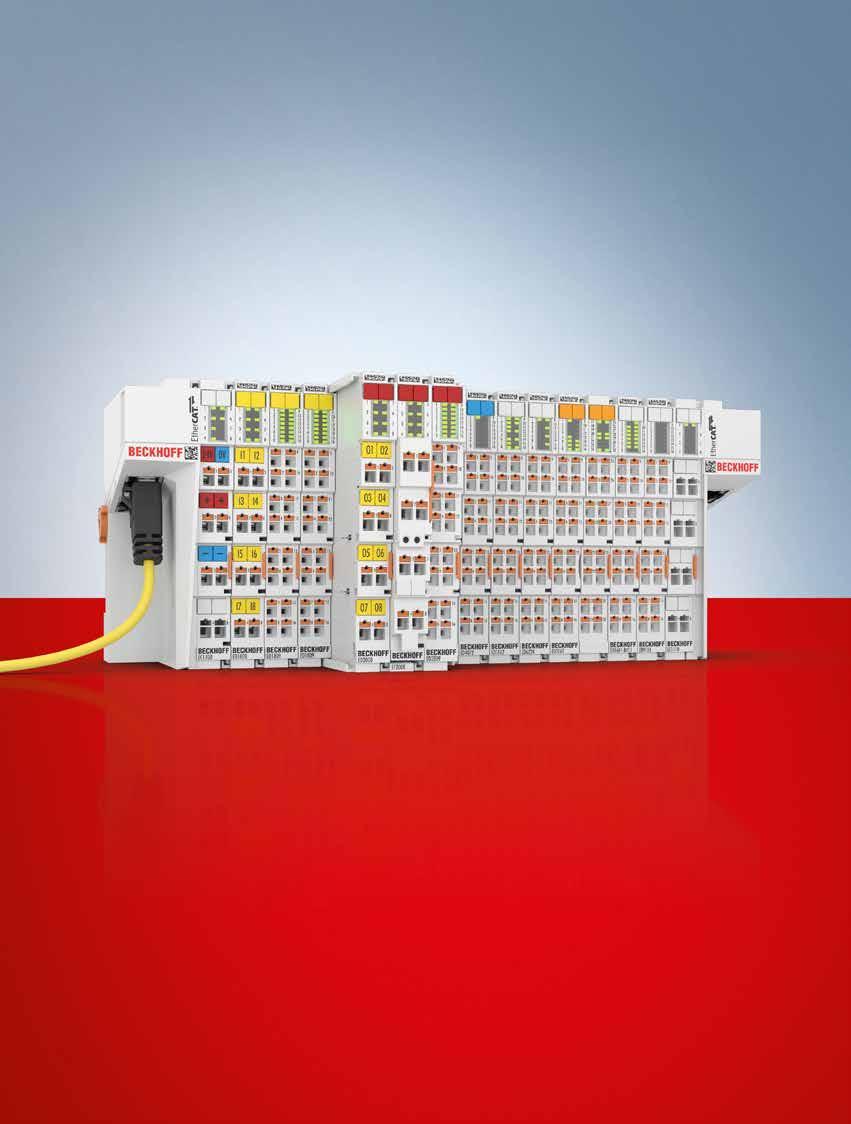
Seamlessly optimized EtherCAT Terminals
The ED series: Quick installation, easy diagnostics
www.beckhoff.com/edxxxx
Users have long appreciated Beckhoff’s EtherCAT Terminals for their excellent performance, scalability, and user-friendliness. The ED series expands the portfolio: thanks to technological upgrades, it provides a future-proof platform for introducing new functions and signal types. compatible: ED and EL Terminals are mechanically compatible with each other cost-efficient: functional improvements at reduced system costs fast and familiar: high-speed EtherCAT communication down to the last terminal user-friendly: completely tool-free connection makes installation easy comprehensive and simple: consistent form factor facilitates setup, maintenance, and diagnostics smart: a DMC code enables terminal identification and diagnostics via the app long-term availability: tried-and-tested EL-series Terminals remain available
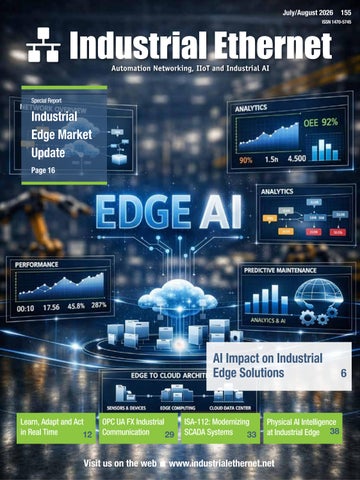
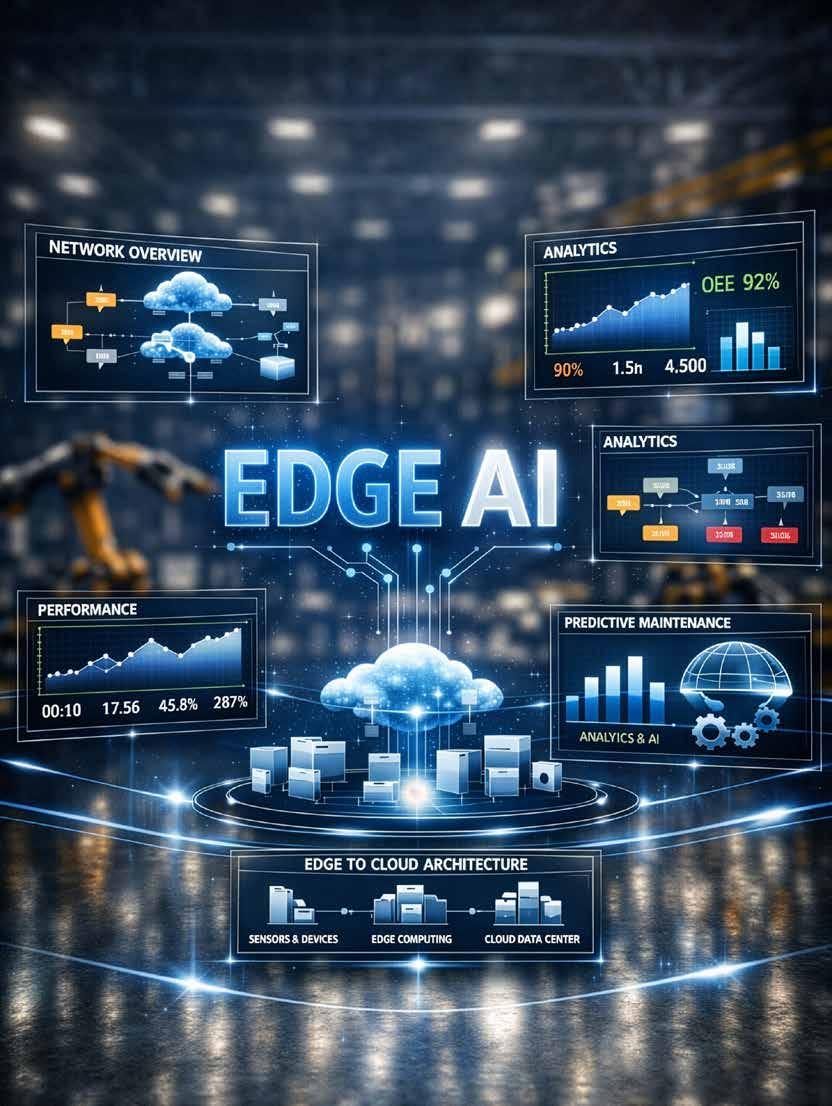
Edge AI as Operational Nervous System of Manufacturing
Edge AI is reshaping manufacturing by pushing intelligence directly onto machines, sensors, and production lines—unlocking faster decisions, lower costs, higher quality, and more autonomous operations. The shift is driven by latency constraints, labor shortages, rising costs, and the need for real-time factory floor insights.
EDGE AI IS RESHAPING SMART MANUFACTURING by pushing intelligence directly onto machines, sensors, and production lines — enabling faster decisions, lower costs, and more autonomous operations. The core impact is real - time responsiveness and reduced dependence on cloud infrastructure, which transforms how factories detect problems, optimize processes, and maintain equipment. The key ways that Edge AI is impacting smart manufacturing include real - time decision-making, reduced latency and higher productivity and operational efficiency. But the bottom line is that Edge AI is becoming the operational nervous system of smart manufacturing, enabling factories to learn faster, respond instantly, and operate more sustainably.
In this special report, Industrial Ethernet magazine reached out to industry experts to get their perspectives on the current state Edge AI technology and what promises to be a bright future.
From Pilot to Production
Edge AI impact set to accelerate as manufacturers operationalize industrial AI with repeatable lifecycle processes.
According to Christian Zillner, Head of AI & Robotics Deployment at Siemens, “Edge AI is already making a measurable impact by enabling AI inference and analytics close to machines, where latency is low and production data can remain on-site. In
practice, this shows up as faster root-cause identification, higher throughput, and reduced downtime- without heavy changes to existing automation."
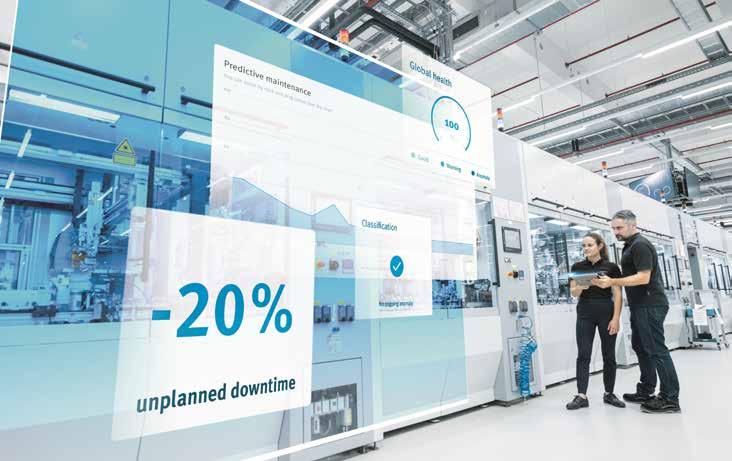
He said that, for example, Inpro (a joint company of Volkswagen and Siemens) monitored the healthiness of thousands of pneumatic clamps and classified failure cause by utilizing the Siemens Industrial Edge and AI architecture, reducing unplanned downtimes and increasing production availability.”
Zillner said that Industrial AI running on Siemens Industrial Edge is scaling beyond pilots through standardized deployment and monitoring. For example, Audi developed an AI model that reliably detects weld splatters on car bodies and implemented an easily scalable AI infrastructure using Industrial
“Edge AI is already making a measurable impact by enabling AI inference and analytics close to machines, where latency is low and production data can remain on-site. In practice, this shows up as faster root-cause identification, higher throughput, and reduced downtime- without heavy changes to existing automation," Christian Zillner, Head of AI & Robotics Deployment at Siemens.
Edge and the Industrial AI Suite from Siemens.
Over the next few years, the impact will accelerate as manufacturers operationalize industrial AI with repeatable lifecycle processes—packaging, deployment, versioning, and monitoring—so industrial AI becomes a governed shopfloor capability rather than a one-off project.
Focus on Technology Solutions
Edge AI is expected to deliver new solutions wherever manufacturers need real-time decisions, scalable rollout, and robust operations. The most active technology areas include:
AI-based quality inspection at scale
• Audi’s weld spatter detection highlights automated inspection with standardized data flow, versioning, and secure deployment from cloud to shopfloor.
• In food production, Coppenrath & Wiese uses an AI-powered visual monitoring approach (Visual Inspection Cockpit on Industrial Edge) to handle highly variable natural products and scale across lines. Predictive maintenance/condition monitoring
• Inpro created predictive maintenance for pneumatic clamps by monitoring the healthiness of the individual clamps and classifying failure cause with AI. This helps to reduce unplanned downtimes
and increase production availability.
• Tetra Pak uses Predictive Service Analyzer on Industrial Edge to combine real-time condition monitoring with AI-driven analysis to predict failures and detect anomalies.
When asked about how Edge AI will provide technology that offers stronger cybersecurity solutions, IT/OT integration or influence real time decision making in factory applications, Zillner offered an optimistic outlook.
“Edge AI strengthens cybersecurity by keeping sensitive manufacturing data on-premises and reducing the attack surface through minimal network transmission. For secure operations the orchestration of devices as well as standardized connectivity, runtime and life cycle management are key,” Zillner said.
“This also enables IT-like standards to be applied in OT environments. Siemens Industrial Edge is specifically designed to bridge this critical gap between IT and OT, connecting shop floor devices seamlessly with enterprise systems while maintaining the reliability requirements of operational technology.”
For real-time decision making, Edge AI enables low-latency processing directly on the factory floor, allowing autonomous operations without cloud dependency and facilitating predictive maintenance through immediate
failure prediction and prevention.
Edge AI delivers substantial additional impacts: It significantly reduces bandwidth costs by transmitting only relevant data to cloud systems while increasing operational availability since factories can continue functioning even without cloud connectivity.
The technology offers a modular and scalable approach, allowing manufacturers to start with specific use cases and expand across the entire facility. Siemens' app-based ecosystem provides pre-built AI solutions that accelerate deployment and time-to-value.
“Furthermore, Edge AI enables real-time digital twin integration for continuous optimization and drives sustainability improvements through optimized energy consumption and waste reduction. Essentially, Edge AI serves as a foundational technology that transforms traditional factories into intelligent, increasingly autonomous, and resilient production environments,” Zillner added.
Edge AI Adoption
Zillner said that “adoption is strongest where there’s clear ROI and a need to scale across many assets, especially automotive, consumer packaged goods, electronics, and machine building/OEMs.”
He said that automotive is moving quickly
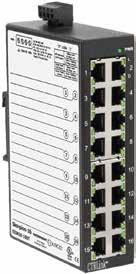
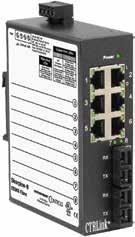
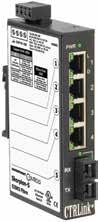
Skorpion Switches Designed for Automation
• Plug-and-play simplicity
10/100 Mbps performance
Auto-MDIX on all copper ports • Auto-negotiated data rate, duplex and flow control on twisted-pair ports • Rugged metal enclosure Skorpion Switches
“Edge AI already outperforms traditional rule-based automation in several areas because machine learning models can identify hi dden patterns, detect anomalies earlier, and continuously optimize processes using live operational data. Compared with cloud-only A I approaches, edge-based AI offers lower latency, higher determinism, stronger cybersecurity, and improved resilience," -- Tom Hammerbacher, Manager Digital Factory at Phoenix Contact.
because quality and throughput gains are immediate: Audi’s AI-based weld spatter detection targets automated inspection across multiple lines and sites.
Consumer packaged goods is adopting Edge AI for inspection and OEE: Coppenrath & Wiese applies AI-powered visual monitoring for bakery products, while Perfetti Van Melle uses edge-based OEE monitoring and diagnostics across multi-vendor PLC environments.
OEMs/machine builders adopt Edge AI to create scalable digital services: Machine Builder Schuler uses Industrial Edge for centralized rollout of software/firmware across large installed bases, enabling new service models.
As far as timeframe Is concerned, many customers are implementing now via targeted use cases (inspection, condition monitoring, performance analytics), then scaling across lines/sites once governance and rollout processes are proven—typically a phased approach over months, not years.
From Pilot to Production
“In the next years, Edge AI’s biggest impact will be the shift from isolated pilots to repeatable, scalable industrial AI operations across factories and fleets. The “superior”
advantage versus traditional architectures is the combination of low-latency local inference plus centralized lifecycle management,” Zillner said.
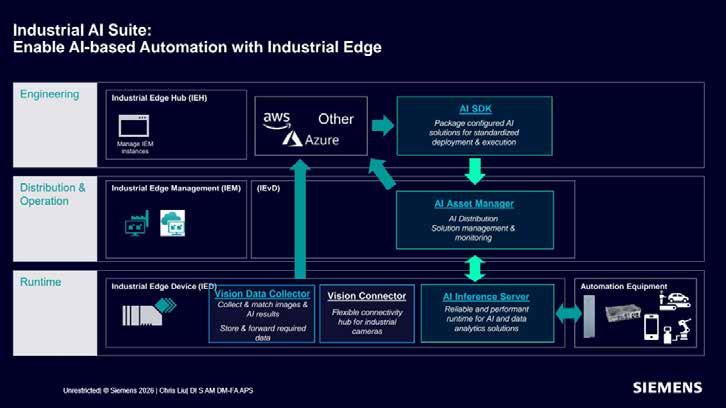
He said that Siemens’ Industrial AI on Industrial Edge portfolio supports this operationalization with AI Software Development Kit (packaging), AI Asset Manager (deployment + monitoring), and AI Inference Server (runtime) – helping standardize AI on the shopfloor.
Enabling Technology for Smart Manufacturing
Bringing intelligence directly into the machine and production environment.
From the Phoenix Contact perspective, Edge AI is becoming a key enabler of smart manufacturing because it brings intelligence directly into the machine and production environment. Instead of sending all operational data to a cloud platform, Edge AI processes and analyzes data locally on industrial edge devices and controllers. This reduces latency, enables determined real-time reactions, and improves operational resilience.
Phoenix Contact’s PLCnext Technology
and industrial edge portfolio support this convergence of automation, AI, and IT/OT integration by combining control, analytics, and open software environments within one ecosystem.
“Today, Edge AI already creates measurable value in predictive maintenance, anomaly detection, machine condition monitoring, intelligent energy management, and AI-supported quality inspection,” Tom Hammerbacher, Manager Digital Factory at Phoenix Contact, told Industrial Ethernet recently.
“In the future, we expect Edge AI to become a standard component of industrial automation architecture. Manufacturers will increasingly use AI at the edge to optimize production processes autonomously, reduce downtime, increase flexibility, and compensate for skilled labor shortages. Combined with software-defined automation and open industrial communication standards, Edge AI will accelerate the transformation toward more adaptive, data-driven, and sustainable factories.”
New Solutions for Smart Manufacturing
According to Hammerbacher, Edge AI is
expected to drive innovation across several key areas of smart manufacturing. One major field is predictive maintenance and condition monitoring, where AI models running directly on industrial edge devices continuously analyze sensor and machine data to identify abnormalities before failures occur. This helps manufacturers minimize unplanned downtime, optimize maintenance schedules, and extend machine lifetime. Another important area is AI-based quality inspection, where vision systems and machine learning algorithms perform real-time defect detection directly on the production line without relying on cloud connectivity.
Open platforms like PLCnext Technology allow machine builders and plant operators to integrate PLC functionality, industrial communication, AI frameworks, and cloud connectivity within one scalable ecosystem. Additional growth areas include digital twins, virtualized control systems, and brownfield modernization where Edge AI enables intelligence to be added to existing production systems without replacing legacy equipment.
Potential Impacts
Edge AI provides technology that promises to offer stronger cybersecurity solutions,
IT/OT integration and influence real -time decision-making in factory applications.
Hammerbacher said that, from a Phoenix Contact perspective, Edge AI significantly strengthens IT/OT integration, cybersecurity, and real-time operational intelligence. One major advantage is that sensitive process and production data can remain inside the factory instead of continuously being transferred to external cloud infrastructures. This improves data sovereignty and helps manufacturers address cybersecurity requirements. Open edge platforms additionally enable secure integration between industrial automation systems, enterprise software, and cloud-based analytics environments.
“Edge AI also has an impact on real-time decision-making because AI models can analyze live operational data directly at machine level and react immediately to changing process conditions. This enables faster diagnostics and autonomous response mechanisms that are difficult to achieve with centralized cloud-only approaches,” Hammerbacher said. “Beyond technical improvements, Edge AI can also help manufacturers address broader industrial challenges such as sustainability goals, energy efficiency requirements, supplychain resilience, and shortages of qualified personnel by supporting operators with
AI-assisted recommendations and automated optimization.”
Applications, Markets and Customers
Hammerbacher said that adoption of Edge AI is accelerating across industries where real-time operation, high system availability, and process optimization are critical business requirements. Early adopters include automotive manufacturing, machine building, semiconductor production, food and beverage, and pharmaceuticals. Phoenix Contact also sees increasing momentum within integrated energy solutions like renewable energy systems where decentralized intelligence and local data processing are becoming increasingly important.
Typical applications include predictive maintenance, AI-supported visual quality inspection, and anomaly detection in complex production environments. Machine builders are especially interested because Edge AI enables new digital service models such as remote diagnostics, condition-based maintenance, and “features on demand.” In addition, manufacturers operating brownfield facilities can integrate Edge AI without replacing existing machines by adding modern edge devices and open connectivity solutions. Many companies are currently moving from
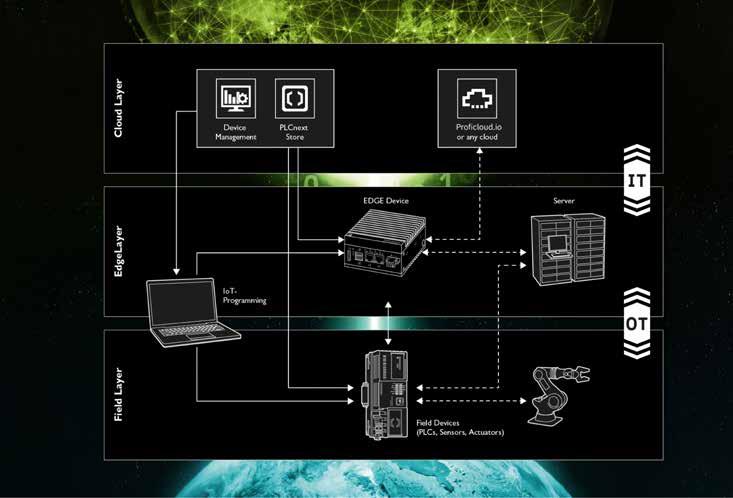
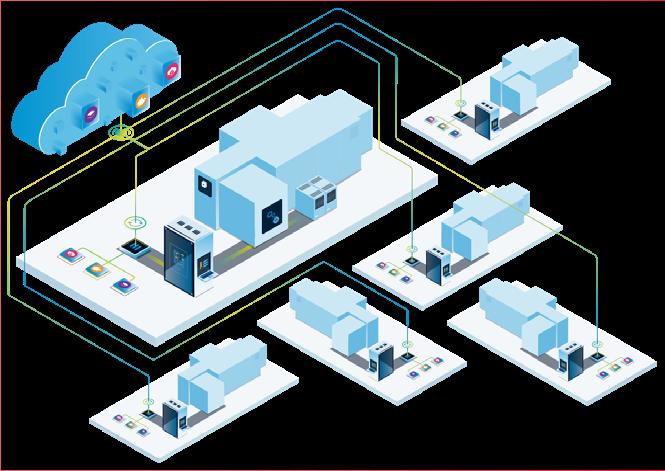
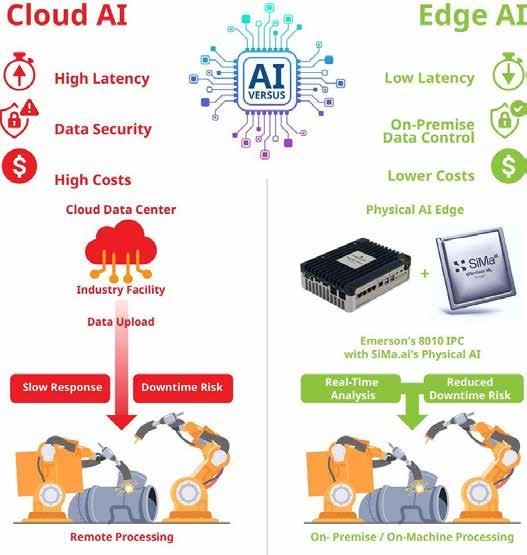
Edge AI provides a system architecture that coordinates activity between the Cloud Layer, the Edge Layer and Field Devices.
“Much of today’s edge AI technology stems from the push for IoT generating more data. Today we have lots of systems that have a ccess to loads of data, but many of them are siloed. As we build smarter data pipelines, especially through unified data fabrics, that d ata can move through edge devices and nodes, giving more systems access to rich data,” Joshua Nixon, Sr. Product Marketing Manager, Emerson.
pilot projects toward scalable implementation. Phoenix Contact expects Edge AI to become a mainstream technology component in industrial automation over the next one to three years as deployment becomes simpler, more secure, and more cost-efficient through software-defined automation platforms.
The next 1-3
years
“Over the next three years, Edge AI is expected to evolve from isolated proof-of-concept deployments into a standard capability within industrial automation systems,” Hammerbacher said. “From a Phoenix Contact perspective, the biggest impact will come from combining AI-enabled edge computing with open automation platforms. This enables manufacturers to build more flexible, scalable, and autonomous production systems while reducing engineering complexity and improving operational transparency.”
He added that Edge AI already outperforms traditional rule-based automation in several areas because machine learning models can identify hidden patterns, detect anomalies earlier, and continuously optimize processes using live operational data. Compared with cloud-only AI approaches, edge-based AI offers lower latency, higher determinism, stronger cybersecurity, and improved resilience because decisions can be executed directly at machine level even without permanent network connectivity.
Phoenix Contact expects the strongest
near-term advantages in predictive maintenance, intelligent quality assurance, cybersecurity monitoring, adaptive manufacturing, and energy optimization. These capabilities will help manufacturers transition from reactive production environments toward predictive and increasingly autonomous operations with higher efficiency, sustainability, and competitiveness.
Advantages of Edge AI
Higher fidelity and lower latency helps generate actionable inputs into the process.
According to Joshua Nixon, Sr. Product Marketing Manager - IPCs, Operator Interfaces, and Edge for Emerson, “much of today’s edge AI technology stems from the push for IoT generating more data. Today we have lots of systems that have access to loads of data, but many of them are siloed. As we build smarter data pipelines, especially through unified data fabrics, that data can move through edge devices and nodes, giving more systems access to rich data.”
Nixon said that modern solutions, built around contextualized data via a seamless data fabric, allow richer AI inputs in the cloud or at the edge. The advantage the edge provides, however, is that when the data is closer to where it has been generated, it provides higher fidelity and lower latency which allows teams to use it to generate actionable inputs into
the process. Essentially, this can mean the difference between generating an alert from analytics in the cloud versus being able to react locally in real-time as part of a closed loop.
“We already see this happening today through applications such as vision, predictive maintenance, and condition monitoring. Often this is happening in remote sites where expert personnel are scarce and maintaining uptime is an even bigger challenge, but even some of the early technology adopters—life sciences companies, for example—are implementing these solutions in large plants,” Nixon said.
Edge AI Technology
“Reliability is probably the most obvious area where Edge AI is rapidly expanding. We’re already seeing edge AI devices that can take rich, contextualized reliability data from devices and process it in analytics software like Emerson’s PACEdge™ platform, close to where that data was generated. This gives teams visibility into equipment health so technicians can intervene at the earliest stages of failure, armed with actionable information to help them make the best decisions to save time and increase efficiency,” Nixon added.
He said that vision-based AI technologies are also fairly common in discrete applications, but also more and more in hybrid and process industries. Leak detection, flare monitoring, facility safety, and similar applications allow organizations to put cameras on certain areas of the plant or specific assets and get feedback
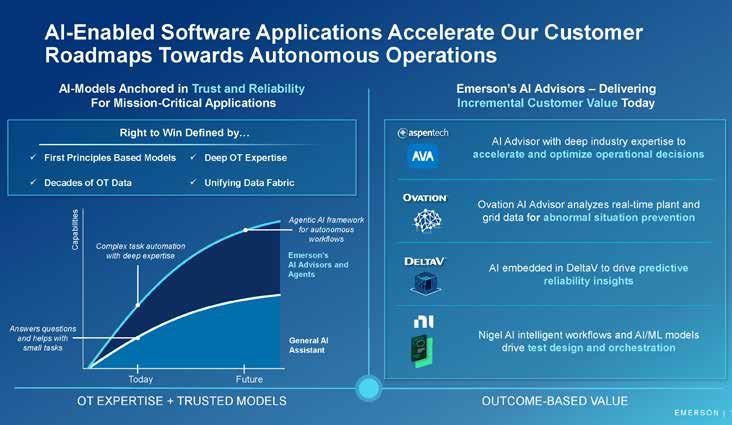
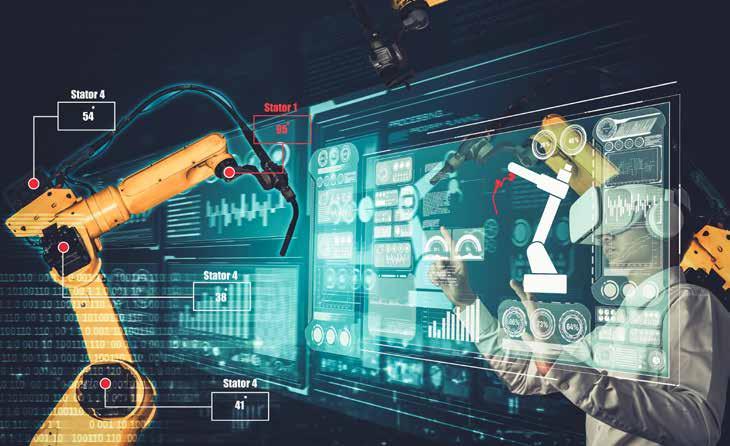
AI-enabled software applications provide a wide range of solutions for real-time decision making and predictive insights that i mprove the performance of smart manufacturing operations.
if there is a functionality or safety issue.
Large language models (LLMs) at the edge are another area where Nixon expects to see massive movement in this space. Users, and especially less experienced ones, can benefit greatly from automation-specific LLMs for upskilling, and fast, intuitive answers to help them be more effective. These systems empower organizations to capture the critical knowledge about their systems and operations in a vast, local knowledge source that can be used with natural language queries. And they don’t have to operate exclusively in the cloud. New technologies like Emerson’s AI-ready industrial PCs are increasingly making it possible to localize LLMs on site for faster response, more targeted, mission specifictraining, and higher security.
Nixon said that process optimization will also be a target for edge AI. However, traditional advanced process control is still the leader in this area right now. In coming years, though, AI will be an incredible tool for non-steadystate optimization. When teams enter upset conditions or manage more complex and unusual operations like startup and shutdown, it will help to provide decision support to keep operators safer and drive better outcomes.
Edge AI solutions
Nixon’s viewpoint is that many of the modern AI tools available are designed to be deployed in the cloud. However, as those tools are increasingly impacting real-time operations
and decision making, having the AI deployed closer to where the process is will naturally be safer. From a cybersecurity perspective, deployments at the edge, closest to the process, are often the safest implementations. Fortunately, for most operational technology teams, this is also where they feel safest in deploying these solutions.
Early adopters are most often the remote locations, smaller plants, and offshore operations where assets are running without lots of personnel readily available. Those sites are always looking for ways to increase safety and optimization, but it is harder than it would be at a large facility with lots of people and easy access to resources.
In areas like reliability, Nixon said they’re already seeing edge AI being applied and lots of automation suppliers are embedding LLM technology in the automation tools they supply. AI advisors are becoming much more common. Vision applications are also becoming more popular. So, for many companies, the time to get started has already come. They’re implementing these technologies—both in pilots and in actual production systems— and are figuring out how to integrate them seamlessly into their processes, and will continue to do so over the next 2 to 3 years.
“The more process optimization focused solutions will likely take longer. Teams not only need access to solutions, they need to trust them to take action. Regardless of the robustness of AI, a human-in-the-loop will be
the reality for the foreseeable future,” Nixon said. “Many organizations will be more likely to take advantage of these technologies as they are rolled out as updates to the existing automation tools they already trust. AI tools thoughtfully built into known automation solutions will be designed around domain expertise that will help teams avoid many of the most common challenges rapidly evolving AI solutions present.”
Anticipated Edge AI impact
“The trajectory of these technologies will likely stay the same in the next few years; however, implementation will likely increasingly move more from the remote locations where the technology is a necessity to more widespread use-cases in line with what early adopters are doing today,” Nixon said.
He said that the biggest changes will come first in predictive maintenance and reliability. This will likely be followed closely or in parallel by edge-deployed LLMs and edge AI technologies for non-steady state systems like skids and modular units.
“AI and the insights it can generate and the data it can analyze will provide us with massive benefits in these coming years. There is a lot of data out there—the result of decades of digital transformation—ready to be analyzed and put to use for significant optimization,” Nixon concluded.
Al Presher, Editor, Industrial Ethernet
Future Industry Will Learn, Adapt and Act in Real Time
Edge and cloud technologies together form the backbone of next generation automation—combining real time responsiveness with enterprise wide visibility to redefine operational excellence.
MODERN INDUSTRIAL AUTOMATION HAS evolved dramatically in recent years. Traditional process control relied heavily on very linear activity. Inputs created outputs, and those outputs triggered control actions. In fact, many industrial processes still follow that physical sequence; however, the decision logic driving the automation has evolved dramatically.
Today’s operations must do more than produce output. Rising energy costs and sustainability pressures are driving continuous optimization. As competition has increased globally and expert workforces have continued to thin, increasingly lean operational technology (OT) teams have found themselves expected to optimize energy use, reduce waste and emissions, and continuously fine-tune performance. Ultimately, these teams are
tasked to do more with less while reducing overhead and driving increased sustainability. Digital transformation has given teams access to the data necessary to implement these changes, but they need the tools to use that data effectively.
Accomplishing those goals requires not just more automation but also smarter automation closer to where workloads occur. This evolution has set the stage for edge and cloud computing as core enablers of operational efficiency.
From deterministic control to learning, self-aware systems
As opposed to the simpler control loops of the past, modern control systems increasingly follow a more complex loop: observe conditions, learn, modify parameters, optimize based on learning, and repeat. This model
was traditionally accomplished by sending historical data to the cloud for processing and analysis. As data scientists made discoveries, they would offer recommendations for improvement that could be engineered into the process.
Today, as data volume and system complexity increase in parallel with the need for fast, flexible, continuous improvement, intelligence must move closer to the process. Moreover, the deep benches of data scientists who used to pore over reams of data are often no longer available, meaning insights must often be gleaned and acted upon on the factory floor. As a result, operators are transitioning from hands-on control to supervisory and optimization roles. This trajectory is pushing operations toward semi-autonomous and, eventually, autonomous behavior.
The future of industry belongs to systems that can learn, adapt, and act in real time.
Computing placement matters
Cloud computing offers near-limitless scalability, centralization, and advanced analytics. However, those key competencies come with a fundamental trade-off. Incorporating the cloud into live production introduces latency. Teams must account for data transmission time, compute time, and command return time. For fast processes and real-time optimization, this latency is unacceptable.
Fortunately, modern edge computing has reduced the need for reliance on cloud systems. Modern edge systems offer local data storage, powerful local analytics, ruggedized hardware to meet industrial demand, and ability to run large language models (LLM) on the edge and process heavy AI workloads to enable near-real-time decision making. As a result, teams can bring their optimization solutions much closer to the process, and the closer that computational capability is to the process, the faster and safer control actions can be.
In fact, this localized compute power is a prerequisite for the semi-autonomous operations many organizations are pursuing today. Consider discrete industries, such as packaging, bottling, and material handling. In many of these facilities, processes move too fast for manual intervention. Every delay increases waste and reduces yield, hence the desire for more autonomous operation. However, autonomous operations require fast perception, immediate response, and minimal human intervention. The systems need enough compute power to detect and
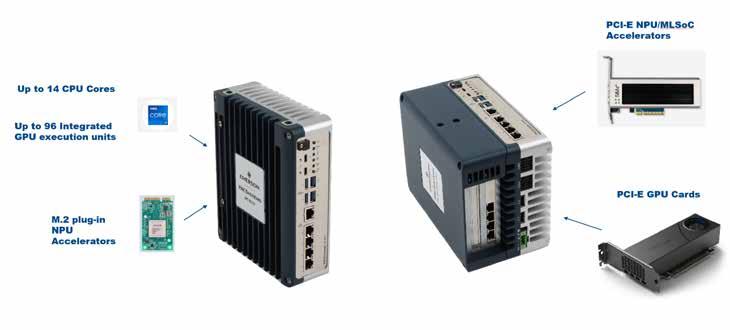
correct issues as they occur, not after the fact. This means bringing the compute power to the process, not vice versa (Figure 1).
Modern workloads are reshaping edge requirements
Control technologies brought computing power closer to the edge decades ago. However, the compute limitations of legacy systems make it difficult or impossible to support modern industrial workloads such as the new artificial intelligence (AI) tools driving today’s most efficient and effective operations. Controller processors alone are often insufficient for sustained AI inference or training.
In response to this challenge, many organizations are now bringing advanced industrial PCs (IPCs) to the edge to help drive modern industrial automation software and AI workloads. The most advanced IPCs now support graphical processing unit augmentation and machine learning systemon-chip technology.
Armed with the high computational capability to run modern AI workloads, these IPCs replace traditional servers and act as AI inference engines, offering capabilities like vision and high-bandwidth sensor streams that can support real-time operations. Yet, industrial environments require deterministic behavior. On the factory floor, reliability matters as much as intelligence. Modern IPCs are designed to meet this challenge, working seamlessly alongside controllers to bring heavy compute directly into the control loop without compromising determinism.
Once significant computing power is placed at the edge, users need a software layer to help manage the new capabilities of their automation. However, not just any software layer will do. Modern edge software platforms are designed specifically to simplify operations in modern industrial environments. Leveraging intuitive interfaces similar to the controls operators already use, containerization, prebuilt applications for the most common competencies, and an application marketplace, the most advanced edge software platforms simplify application deployment, lifecycle management, security, and updating.
OT teams should seek out edge software platforms that are already integrated into IPCs and controllers for simplicity of deployment and management, as well as increased reliability and security. Leveraging solutions that are integrated by default eliminates the need for complex, custom engineering and custom provisions for cybersecurity that can slow deployment and lead to instability over time. Moreover, integrated software empowers OT teams to leverage advanced capabilities without being IT experts.
While it is possible to build custom edge infrastructure—and some organizations do exactly that—doing so can be a challenge for teams with limited personnel, IT expertise, and budgets. Custom edge software solutions require significant engineering resources, ongoing IT support, and deep cybersecurity expertise to ensure smooth and secure operation. Organizations are better off solving
Figure 1: Today's industrial PCs bring significant compute power to the edge to empower teams to run modern workloads as close as possible to the process.
business problems instead of recreating the infrastructure wheel.
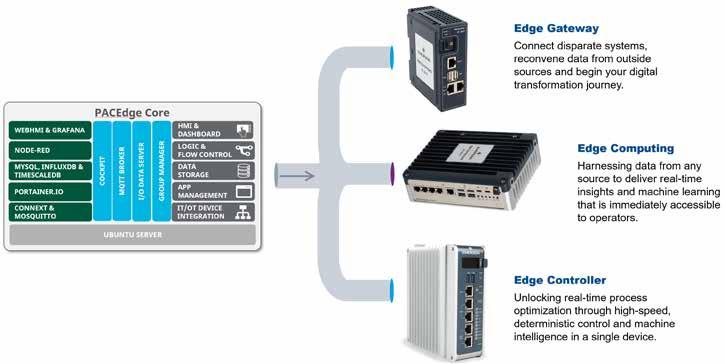
In contrast, field-proven edge platforms are field tested, include built-in security, and reduce time to value. This typically allows OT teams to focus effort on effective algorithms and outcomes, not on maintaining complex infrastructure (Figure 2).
Intelligence at the edge in action
From simple systems to complex and comprehensive architectures, many organizations are already deploying powerful edge technologies to support modern manufacturing strategies.
Monitoring at the edge
Many forward-thinking organizations are deploying edge technologies built on IPCs and edge software platforms to better manage their operations. In some plants, edge controllers are replacing local server infrastructure for visualization and control, making it easier to break down data silos and turn collected data into actionable information to drive improved performance.
Such a solution can be particularly useful for monitoring remote assets spread across hundreds or thousands of miles, such as those in pipelines and pumping stations. Edge controllers with integrated edge software platforms can provide centralized monitoring without deploying server hardware at every site. Teams gain access to data aggregation, visualization, and even connectivity to local and cloud-based analytics applications without requiring personnel to drive to each site to
manually interact with local systems.
Local intelligence for local decisions
Other organizations are leveraging edge computing and integrated software platforms for more complex applications. Such a configuration can be used for autonomous supervision around a facility, site, or even enterprise. As organizations struggle to find and retain experienced personnel, there are fewer people walking around facilities, making it easy to miss issues that may arise. Edge computing applications paired with cameras can detect spills, leaks, fires, and other safety and productivity incidents around the plant and notify personnel for fast resolution.
Edge solutions can also be used for visionbased quality control, such as in mining or material handling operations. In such environments, cameras paired with edge analytics tools use object shape and size detection to help automate diversion of off-specification product. Real-time anomaly detection allows faster response than manual intervention, enabling inline correction rather than reliance on downstream inspection.
Edge as a data aggregator and translator
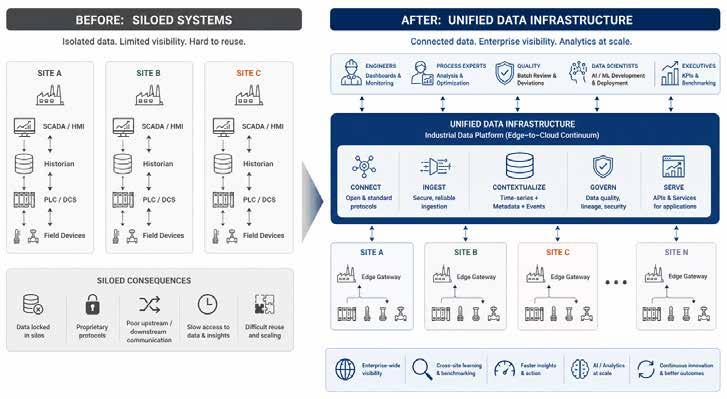
Another important role for edge software platforms is data hub functionality. Industrial plants use dozens of protocols, and trying to interface multiple systems using different protocols is a critical challenge to overcome.
The most advanced edge software platforms can translate a wide array of protocols into unified models such as OPC UA. This simplifies
upper-level system and analytics integration and reduces complexity and latency in control and enterprise layers, ultimately addressing unreliable connectivity scenarios stemming from complex, custom-engineered integration. The same value can be seen in operations taking place in remote or mobile environments, where systems may suffer from unstable or intermittent connectivity. Modern edge systems can store data locally during operation. Once a reliable data connection is established, the data is forwarded, whether to a central operations hub or an enterprise business analytics application. This capability ensures no data loss and continuous insight across operations, no matter how remote.
Looking forward—the growth of AI
Looking beyond today’s capabilities, it is easy to see how edge control and computing technologies will continue to shape operational excellence in parallel with the continuing rise of AI capability. Traditional control loops already perform local optimization. As they incorporate more AI technology, they detect patterns earlier, improve reaction speed, increase flexibility, and drive more optimized and advanced control.
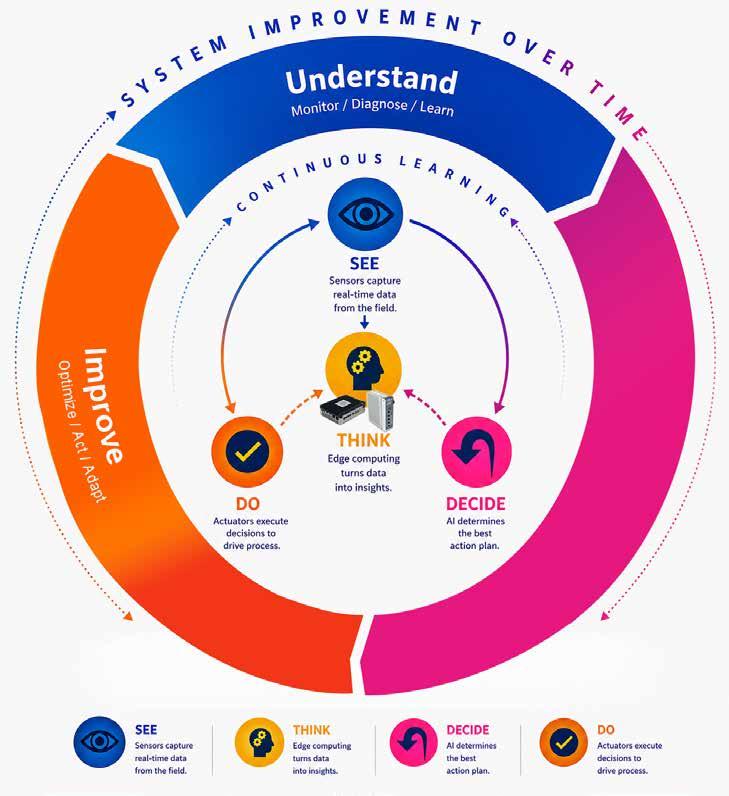
Traditional quality control focuses on post-process inspection. However, that system is changing rapidly. Edge AI enables self-correction at the moment of deviation, reducing batch failures, scrap, and rework. The safer, more sustainable operations coming out of this shift will define the future of manufacturing (Figure 3).
Figure 2: Fit-for-purpose edge platforms provide a software layer to help OT teams manage the most advanced capabilities of their automation.
For example, real-time vision systems are already employed in control to detect and correct defects in manufacturing before scrap occurs. As compute technology and AI competency increases, such strategies will soon become a baseline for effective operation and act as competitive advantage. Yet relying on the cloud for processing will not be enough—teams must start implementing the on-premises, edge-based computational power to start hosting such technologies onsite if they hope to compete as the systems become ubiquitous.
Edge and cloud enable the next generation of industry
Cloud computing provides scale, insight, and enterprise visibility. It has reshaped the face of industrial operations, moving automation from a closed, local system to an enterprise-wide insight generation engine. Edge computing delivers speed, determinism, and real-time intelligence at the source of operations. Together, edge and cloud technologies enable increasingly autonomous, self-optimizing operations that can unlock the modern capabilities necessary to
drive improved throughput alongside safer and more sustainable operations.
The future of industry belongs to systems that can learn, adapt, and act in real time. Organizations that invest thoughtfully in edge and cloud technologies today will define operational excellence in the years to come.
Manish Sharma, global marketing and business development, Emerson.
Figure 3: Think – Decide – Do: Industrial systems must move beyond static automation, they must become truly adaptive.
Industrial edge technology has become a foundational layer of modern smart manufacturing networking architectures by enabling real-time responsiveness, operational continuity, and secure local processing in environments where cloud-only models cannot meet physical constraints.
“Inside machines, many optimization decisions are based on multiple data sources such as component data available via PLCs or, in part, via Ethernetbased fieldbuses, and product and maintenance information provided by the MES. The data often needs to be correlated and analyzed in real time," Dipl. Ing. Eberhard Klotz, Global Sales Director Industry 4.0 and Digitalisation, FESTO.
THE BIGGEST TRENDS IN INDUSTRIAL EDGE computing reflect a decisive shift toward decentralized intelligence, AI - driven autonomy and resilient architectures built for real-world factory conditions.
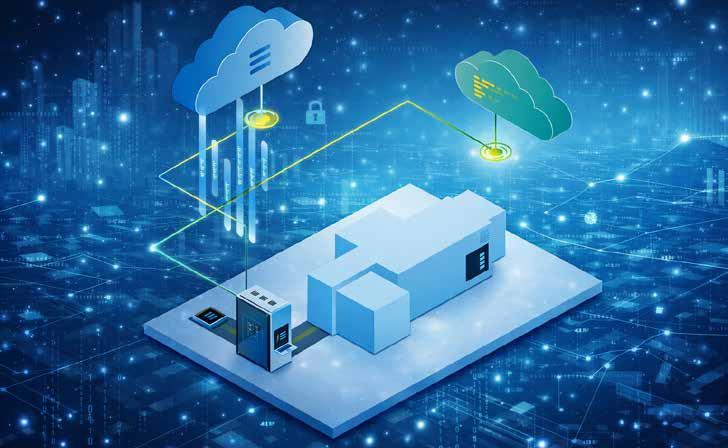
Edge - first architectures are becoming more and more the norm as manufacturers are moving decisively toward designs that process data locally at machines, gateways and use of on - premises servers. More factories are adopting structured three-layer models — Device, Edge and Cloud — where each tier has distinct responsibilities.
In this spedial report, Industrial Ethernet magazine reached out to industry experts to get their perspectives on the current state if Industrial Edge technology, and also look to the future for decisive trends.
Read how our panel of industry experts is breaking down the latest technology trends and how they are shaping industrial network design and performance.
Coordinating Data Sources in Real-Time
Optimization decisions based on multiple data sources and use of Docker containers to ensure flexibility and seamless connectivity between multiple machines and applications.
Dipl. Ing. Eberhard Klotz, Global Sales Director Industry 4.0 and Digitalisation at FESTO, said that key technology trends in edge and cloud computing technology are driving new solutions for manufacturing.
“Inside machines, many optimization decisions are based on multiple data sources, such as component data available via PLCs or, in part, via Ethernet-based fieldbuses, and product and maintenance information provided by the MES. The data often needs to be correlated and analyzed in real time,” Klotz said.
“This requires powerful edge computers (or on-premises systems) and data analytics — today often AI applications — that focus on specific tasks, such as predictive maintenance for a component type or technology family. A second trend is using Docker containers to ensure flexibility and seamless connectivity between multiple machines and applications while also addressing IT/OT requirements and cybersecurity (for example, regulatory frameworks such as the CRA).”
Klotz said that cloud-based solutions typically focus on use cases that require access by many distributed users, or where trend analytics and non-real-time predictions are needed — for example, energy trends, production planning optimizations, or trend comparisons across multiple machines and factories.
Value for smart manufacturing
“Predictive maintenance is a key area where edge computers provide substantial value today. In addition, digital maintenance systems (CMMS — computerized maintenance
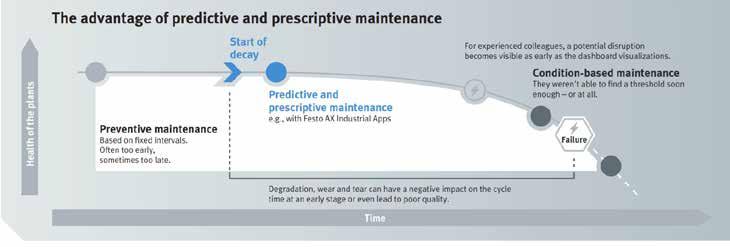
management systems) add significant value to manufacturers. To achieve this, standardized AI apps such as Festo AX Motion Insights Pneumatic and Motion Insights Electric enable monitoring of cylinders and electromechanical axes (servo drives) in a machine and can predict significant deviations and impending maintenance needs — typically about two weeks before a component fails,” Klotz said. He said that this can reduce unplanned downtime by up to 25%. With qualified feedback from maintenance teams (human-in-the-loop), the AI can learn and evolve into a prescriptive
maintenance solution. A CMMS such as Festo Smartenance can improve maintenance team efficiency by roughly 50%. The software combines maintenance and repair management, a machine logbook, and spare-part management into a single cloud-based solution. The web application for maintenance and production managers, and the mobile app for maintenance staff and operators, ensure that all relevant machine information is accessible anytime, anywhere. Messages from the AI can be integrated via an API to directly trigger maintenance tasks and seamless digital workflows.
More Advanced Solutions
Klotz said that standardized AI applications provide benefits to end users (manufacturers) as well as to machine builders (OEMs). Making the right decisions based on data — for example, using machine learning (AI) — first requires substantial training data. Machine builders typically do not have those data because they do not operate the machines. Historically, end users often did not store the data — first because of the cost and second because they lacked the expertise to use them.
This is where Festo provides an advantage: the company collects data from many test cycles of its own products (before release and through decades of endurance testing). It also gathers data from its own production operations. Third, Festo develops the AI algorithms in-house and retains the application knowledge and data science expertise necessary to deploy them.
“Thirty years ago, PLCs were the bottleneck for data: limited and expensive memory/storage, a shortage of specialized programmers, proprietary diagnostic concepts per vendor, and limited options for ubiquitous visualization,” Klotz said.
Until recently, PLC data and data from servo drives were often not available in standardized formats. A key difference today is that required data is provided in Industry 4.0 standard formats such as MQTT and OPC UA. Second, 'big' data can be processed outside the PLC performance bottleneck. As computing systems and storage have become broadly accessible,
this is no longer a practical limitation. Third, data is processed using standardized IT/OT tools such as Docker containers, standardized and specialized AI applications, and edge computers. This enables standardized Festo AI applications, such as Motion Insights Pneumatic, to gather data from cylinders of different brands and visualize results on any computer dashboard.
Engineers at OEMs benefit from a predictive maintenance solution that is globally available and compatible with common hardware (pneumatic cylinders, vacuum grippers, servo drives). They can integrate a Festo application and offer it as an added-value feature in their systems. This gives them a much faster time-tomarket than developing their own application and allows them to showcase an innovative digital machine concept. Alternatively, they can prepare their machines as 'AI ready' and let the end user integrate or activate the Festo applications.
The same applies to the Festo CMMS (maintenance tool), Smartenance, which can also be customized as an OEM-branded version with different colors and logos. End users, on the other hand, can retrofit these applications into existing production systems at any time. Because the applications include AI analytics, data connectivity, and a dashboard, they are plug-and-work solutions even for organizations without in-house AI specialists or data scientists. The only prerequisite for an end user is a modern PLC with an Ethernet interface or fieldbus.
Anticipated Impact
“Over the next 1–3 years, smart factories will increasingly connect machines, automation systems, software, and data to make production more transparent, flexible, and efficient. They will use real time information, intelligent control, and analytics to optimize processes, reduce downtime, and support faster decision making. This will enable greater flexibility and the ability to produce, for example, more customized goods,” Klotz said,
“Therefore, edge computers are likely to become standard on larger machines — provided the end user is not exclusively requiring on premises solutions and central data lakes. Edge computers not only enable data analytics during operation but, when used for control and motion tasks (as with the Festo CEPE range), also provide access to higher level programming environments for machine builders,” he added.
He said that these innovations leverage open source operating systems and real time platforms on edge computers, enabling:
• Seamless and secure connection between IT and OT environments and the cloud.
• Deterministic real time control using standard programming according to IEC 61131 3 (for example, CODESYS) and high level languages such as C/C++, C#, and Python.
• Remote monitoring, data analysis, and a broad set of IoT functions.
• Easy expandability and scalability of applications.
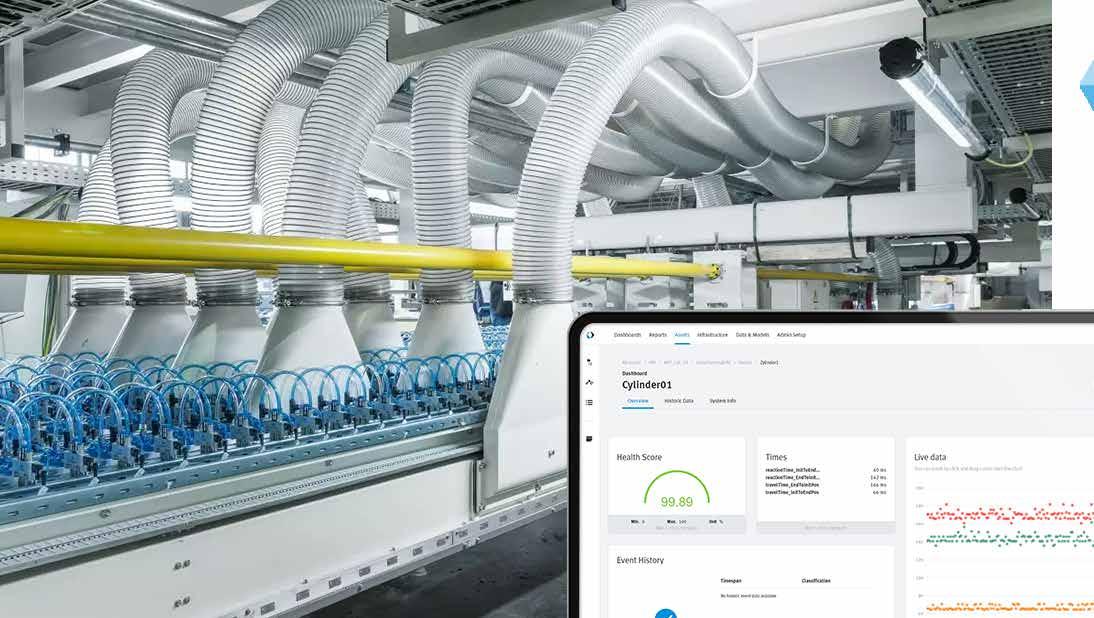
Dashboard of a Motion Insights Pneumatic AI-Application.
Move to Hybrid Architectures
Cloud platforms play central role in scaling analytics, standardizing data access and enabling enterprise-wide learning, while edge resources support local responsiveness.
Chris Liu, architecture and portfolio sales (APS) manager for the Americas, Siemens, said that “Edge AI is shifting AI from a centralized analytics tool to a real-time operational technology assistant. Today, we already see measurable impact in areas such as visual quality inspection, predictive maintenance, anomaly detection, energy optimization, and machine assistance. By running AI directly on the shop floor right at the edge in near real-time where data is captured and processed, manufacturers can make decisions much faster (within milliseconds) for timecritical tasks, while further improving both efficiency and quality.”
“Looking ahead, Edge AI will become a key enabler of autonomous operations. Factories will increasingly use AI at the edge to continuously optimize production, identify process deviations before they create scrap, and help operators resolve issues faster,” Liu said. “The combination of Industrial Edge, operational data, and AI models creates a feedback loop that enables smarter and more responsive manufacturing systems.”
Liu said that Edge AI is expected to offer new solutions for a wide range of smart manufacturing operations:
• Machine vision : Automated quality
inspection, defect detection, safety monitoring, and object recognition
• Predictive and Prescriptive Maintenance: Detecting abnormal machine behavior before failures occur and recommending corrective actions
• Process Optimization: Continuously optimizing machine parameters, throughput, quality, and energy consumption
• Asset Performance Management : Monitoring fleets of machines and identifying performance degradation across multiple sites
• Executable Digital Twins and Simulation: Combining real-time operational data with AI models to predict outcomes and optimize production scenarios
“The most immediate impact is in real-time decision-making ability. Manufacturing environments often require high-speed data collection for both time-series and image data acquisition down to the millisecond, and Edge AI enables local processing without cloud latency. This is critical for quality control, machine protection, process optimization, and autonomous responses,” Liu said.
He said that, for IT/OT integration, edge computing platforms, such as Siemens Industrial Edge, can collect OT data from all industrial sensors, PLCs, drives, and machines while contextualizing and synchronizing the data to IT systems, enterprise applications, analytics, and cloud services in a structured and secure way.
“In the cybersecurity realm, Edge AI helps identify and detect unusual network behavior, ransomware, anomalous device activity, and deviations from expected operating conditions. While AI is not a replacement for cybersecurity frameworks, it can significantly improve threat detection and operational resilience.”
Other major impacts that Liu identified include:
• Reduced cloud bandwidth, storage, and costs
• Improved data compliance and ownership
• Democratization of AI through low-code and no-code tools
• Improved workforce productivity through AI-assisted troubleshooting and knowledge management
Applications and markets
Liu said that Edge AI can be deployed in any industry where data and compute is required. Early adopters include automotive, EV battery, food & beverage, CPG, semiconductor, and aerospace. He thinks that the timeframe depends on the actual use cases. Machine vision, data visualization, and data integration are common edge applications today, while software-defined control (virtual PLC) and broader adoption of autonomous production systems and AI-assisted operational decisionmaking will also become more popular.
He added that Edge AI will continue its
Figure 1: An Edge and AI architecture, like this one powered by Siemens Industrial Edge, powers AI-based automation.
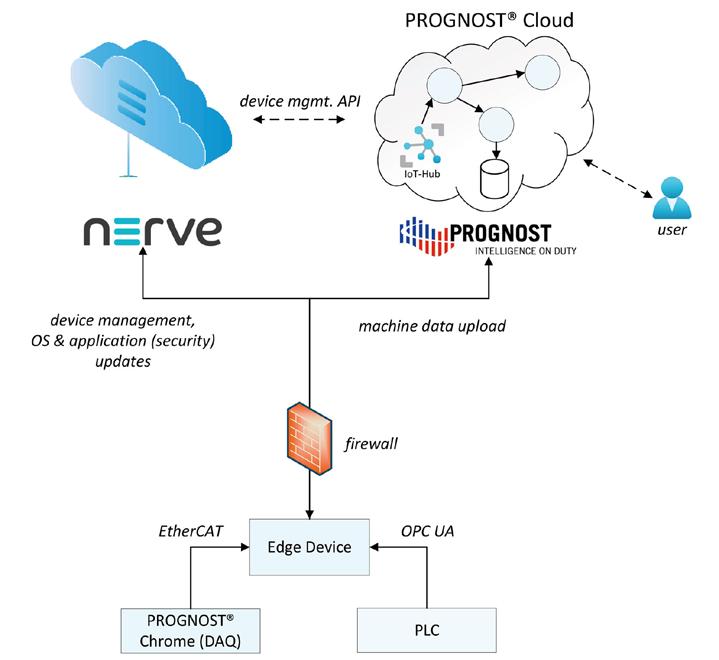
TTTECH Industrial’s IIoT platform for machine builders, Nerve, provides a software backbone for the machine, which combines edg e runtime, industrial connectivity, application management, and cybersecurity in one platform.
trajectory as one of the most impactful technologies in industrial automation. Key areas include:
• Faster response times that enable decisions in real time
• Enhanced data Privacy and securitysensitive production data can remain on-premises while still benefiting from advanced AI capabilities
• Reduced costs associated with data transmission, cloud processing, and storage requirements, delivering faster business value
• Faster scale-up and app deployments on the shopfloor by distributing intelligence across the manufacturing environment
From Connected to SoftwareDefined Machines
More powerful industrial edge platforms that shost both automation and digital applications in a controlled, secure and maintainable way.
According to Marián Hönsch, Director Product Management Industrial IoT at TTTECH Industrial, “a key trend in manufacturing is the shift from connected machines to software-defined machines.”
“In the past, automation architectures often relied on several separate hardware
components: PLCs, IPCs, bus couplers, gateways, remote access devices, and dedicated computers for visualization, analytics or cloud connectivity. This created complexity, higher hardware cost, fragmented maintenance, and a larger cybersecurity attack surface. The current trend is to consolidate these functions onto fewer, more powerful industrial edge platforms that can host both automation and digital applications in a controlled, secure, and maintainable way,” Hönsch said.
“At the same time, edge computing and cloud computing are becoming complementary. The edge is used for real-time data processing, local autonomy, reduced latency, and operation during limited connectivity, while the cloud or central management layer is used for fleet-wide deployment, monitoring, updates, and analytics.”
Hönsch went on to say that another important trend is the containerization of industrial software. Classical automation software providers are increasingly decoupling real-time runtimes from dedicated hardware and making them available as containerized or software-defined runtimes. This accelerates the convergence of real-time control, non-realtime applications, and data services onto one hardware platform.
And finally, AI is changing the speed of
software development. Software developers at machine builders can now create, test, and iterate digital applications much faster. Google’s 2025 DORA research found broad AI adoption among software professionals, with more than 80% of respondents reporting productivity improvements, although trust, quality and governance remain important concerns.
This increases the need for repeatable, secure edge platforms such as Nerve from TTTECH Industrial, where new applications can be deployed and managed consistently at scale.
Consolidation of Machine Software
“One specific area creating strong value is the consolidation of machine software onto one secure industrial edge platform. Instead of distributing functionality across many separate hardware components, machine builders can host real-time control, data connectivity, analytics, visualization, remote access, and digital service applications on a common platform,” Hönsch said.
The argument is that this creates value in several ways. First, it can reduce hardware cost by lowering the number of IPCs, gateways, couplers, and dedicated devices required in the machine. Second, it simplifies engineering because the machine architecture becomes
clearer and easier to maintain. Third, it improves cybersecurity because fewer devices need to be protected, patched, and monitored separately.
TTTECH Industrial’s IIoT platform Nerve is also designed for this architecture. It provides edge node software and a management system that can run in the cloud or on-premises, enabling remote device management, application deployment, and real-time data access.
A key advantage is that machine builders do not necessarily need to rewrite all existing software when moving to this architecture. Existing applications from previous IPCs or platforms can often be containerized or virtualized and executed on Nerve with limited or no migration effort. This makes the transition practical: machine builders can preserve proven software while creating a more scalable and secure platform for future digital services.
Advanced Technology Solutions
Nerve provides a more advanced solution by combining edge runtime, industrial connectivity, application management, and cybersecurity in one platform. On the edge device, Nerve can host different types of workloads, including Docker containers, virtual machines, and CODESYS-based applications. This enables machine builders to run both real-time-oriented automation workloads and non-real-time applications such as analytics, visualization, data preprocessing, protocol conversion, or remote service tools on the same hardware platform.
“A central benefit is isolation. Real-time and non-real-time workloads have different requirements. Control applications need deterministic behavior and protection from interference, while data, analytics and service applications need flexibility and frequent updates,” Hönsch said. “Nerve’s platform approach allows these workloads to coexist while maintaining separation between application domains. This helps machine builders converge software onto one hardware system without losing control over reliability and maintainability.”
Another key feature is remote lifecycle management. Both real-time and non-real time applications can be managed remotely through the Nerve Management System. This allows machine builders to deploy software updates, patches, or new applications continuously and on demand.
From a cybersecurity perspective, consolidating applications on a managed platform can be more secure than distributing them across many unmanaged devices. Nerve is positioned with IEC 62443-4-2 certification at product level. The result is a machine architecture that is easier to maintain, easier to patch and easier to protect.
Technology Advancing
In the past, Hönsch said that traditional machine architectures were often built from many dedicated hardware and software components. A PLC handled real-time control, an IPC hosted visualization or analytics, a gateway translated protocols, a separate remote access box enabled service, and additional hardware was often required for cloud connectivity or customer-specific applications. On top came the safety controllers. Each component had its own operating system, firmware, update process, security model, and maintenance cycle. This fragmented approach worked, but it became difficult to scale, secure, and manage over the full machine lifecycle.
TTTECH Industrial’s IIoT platform Nerve changes this approach by acting as a software backbone for the machine. It provides a common edge platform where different workloads can run side by side, while being managed through a common lifecycle management system. Nerve’s node software runs at the edge, while its management system can run in the cloud or on-premises, and the system can also operate offline where required.
“The other major difference is that modern automation runtimes are becoming less tied to proprietary hardware. Real-time runtimes from established automation ecosystems are increasingly being made available as software components, including containerized deployments. This allows programmable logic to move toward open edge platforms. Over time, this convergence can also include safety-related workloads, where safety control, real-time control, and non-real-time digital applications are hosted on one protected hardware platform,” Hönsch said.
“This is fundamentally different from the past because the machine is no longer defined only by fixed hardware functions. It becomes a managed software system that can be updated, extended, and secured throughout its lifecycle,” Hönsch added.
Addressing Real-world Issues
To meeting modern manufacturing needs, machine builders must reduce hardware cost, shorten development cycles, meet cybersecurity requirements, support remote service, and create new digital services — without compromising reliability, real-time behavior or safety. Engineers need a repeatable platform architecture instead of forcing them to build each IIoT solution as a one-off project.
By hosting real-time and non-real-time applications on one protected edge platform, this helps to reduce the number of IPCs, gateways, bus couplers, and auxiliary devices. This simplifies machine design, commissioning, spare parts handling, documentation, and cybersecurity hardening. Fewer devices also
mean fewer systems to patch, monitor, and maintain.
For software teams, cloud managed edge platforms provide a practical runtime for modern application development. Machine builders are increasingly using AI-assisted development to create analytics, dashboards, predictive maintenance tools, optimization services, and customer-specific applications faster than before.
However, faster software development only creates value if deployment and lifecycle management are scalable. Our IIoT platform Nerve provides an environment where applications can be tested, deployed, updated, and managed consistently across many machines. It behaves the same in development and productive scenarios. Existing software can also be containerized or virtualized, reducing migration effort. This supports faster innovation while preserving proven automation assets and maintaining a secure, manageable machine platform.
Impact of Industrial Edge Computing
“In the next one to three years, Industrial Edge Computing will become a standard part of advanced machine architecture. The differentiator will no longer be whether a machine is connected, but whether it is software-defined, securely manageable, and its software is covered by a lifecyclemanagement,” Hönsch said.
One major impact will be hardware convergence. Machine builders will increasingly reduce separate IPCs, gateways, couplers, and service devices by consolidating workloads onto industrial edge platforms. This can reduce hardware cost, simplify machine architecture, and make cybersecurity management more effective. A second impact will be the convergence of real-time, non-realtime, and, where applicable, safety-related software domains. As automation runtimes become more portable through containers and virtualization, programmable logic, data applications, visualization, analytics and service tools can increasingly run on common hardware platforms with proper isolation.
A third impact will be faster digital innovation. AI-assisted software development will help machine builders create more applications and services in less time. But these applications need a secure home at the machine edge, plus a scalable way to deploy and manage them across fleets. Our IIoT platform Nerve is positioned for this role: it combines edge application hosting, remote software lifecycle management, industrial data connectivity and IEC 62443-oriented cybersecurity.
“The result will be machines with lower hardware complexity, stronger cyber resilience, faster serviceability, and a clearer path toward recurring digital service revenue,” Hönsch said.
"Industrial
Decision-Making at the Physical Edge
Decision-making needs to happen closer to sensors, actuators, and the machines themselves.
According to Dr. Massimiliano Versace, VP Emergent AI at Analog Devices, key technology trends in edge and cloud computing solutions are helping to shape the future of industrial edge computing.
“Industrial systems are textbook examples of closed-loop physical systems, where tough constraints from the physical world – latency, power, variability, and noise – are all at play when it comes to computing applications at the physical edge, and of course applications of Artificial Intelligence in smart manufacturing,” Versace told Industrial Ethernet recently.
“While cloud computing remains essential for aggregation and large-scale model training, the locus of decision-making needs to happen at the physical edge, closer to sensors, actuators, and the machines themselves.”
Several converging trends are underlying this choice of compute location. To be ubiquitous, AI needs to live at the location where data originates, without requiring sizeable compute resources (smaller and low-power compute is required) and high communication bandwidth
to either central AI processors/cloud. Ultraefficient AI compute is required for these applications to enable intelligence to run within strict constraints, including novel architectures inspired by the brain, such as event-driven (neuromorphic) processing and in-memory computation, which dramatically reduce the energy cost of inference.
“On the algorithmic side, we are seeing the rise of on-device learning, where systems not only infer but also continuously adapt in situ,” Versace said. “This enables machines to deal with variability, noise and drift conditions that are endemic to manufacturing environments but simply impossible to capture fully in the traditional AI training pipeline process, with pre-recorded centralized datasets.
These trends are driving computing and AI architectures that tightly integrate sensing and actuation into real-time feedback loops to enable intelligence embedded within industrial machines, leading to more resilient, autonomous, and efficient manufacturing systems.
Predictive and Adaptive Maintenance
Versace said that one of the most important areas of application is predictive and adaptive maintenance at the physical edge.
“While traditional predictive maintenance
relies on cloud aggregation and offline analysis, limiting responsiveness to rare or evolving fault modes that are pre-identified, edge-based approaches enable machines to continuously interpret their own sensory signals, such as vibration, acoustics and temperature, in real time,” Versace said.
He added that the real value emerges when these systems move beyond static (mostly cloud-based) models to incorporate on-device learning and adaptation. Industrial environments are inherently dynamic: machines age, loads change, and operating conditions vary: an AI system trained in a factory in Sweden might not work for the same machine in Indonesia. AI models pretrained once in the cloud are often insufficient to capture these nuanced and evolving industrial realities.
By embedding intelligence directly at the edge, systems can learn the specific operating condition of a machine in their environment, detect subtle deviations from normal behavior and update their internal representations over time. This enables AI to detect faults earlier, continuously optimize machine configurations, and minimize unplanned downtime.
AI that can close the loop between perception, reasoning, and action directly on-device allows manufacturers to move
systems are textbook examples of closed-loop physical systems, where tough constraints from the physical world – la tency, power, variability, and noise – are all at play when it comes to computing applications at the physical edge, and of course applicatio ns of Artificial Intelligence in smart manufacturing," Dr. Massimiliano Versace, VP Emergent AI, Analog Devices.
from reactive monitoring to proactive, selfadjusting systems, a key step toward more autonomous manufacturing.
Emerging Edge AI Solutions
Here are a few technical features that Versace said differentiate these emerging AI solutions at the edge:
• Event-driven computation: Instead of processing all data uniformly, computation is triggered by changes in signals, mirroring the efficiency of biological systems and significantly reducing power consumption.
• In-memory processing: much of the brain’s computation occurs at a neuron’s synapses, where information is simultaneously stored and computed. AI systems that adopt this intuition dramatically reduce data movement, which is a major contributor to energy and latency in traditional systems.
• On-device learning and adaptation: there are families of AI models designed to be trained and updated “on-the-fly”, which allows them to respond to drift, new conditions, or rare events without requiring cloud retraining.
• Tight integration with sensing: Rather than treating sensing as a separate stage, these solutions co-design sensing and compute, enabling more efficient and context-aware processing.
The benefits are substantial: lower power consumption, reduced bandwidth requirements, improved reliability in disconnected environments, and the ability to handle edge cases that are difficult to anticipate in centralized models.
All the above leads to systems that are more efficient, robust, context-aware, and ultimately useful to manufacturers and machine operators.
Technology Distinctives
“This approach is a clear break with respect to cloud-centric paradigm, where data is collected at the edge, transmitted to the cloud, processed in large-scale compute environments, and then insights are sent back to the machine,” Versace said. “We have already witnessed a growing trend in the opposite direction, with AI-powered systems being deployed directly on devices, e.g., for visual quality inspection, where training occurs in the camera itself, without requiring cloud compute.
Versace added that while the old cloudcentric approach works well for aggregate analytics, it breaks down when low power, low-latency, autonomy, or adaptability are required.
When intelligence is pushed down to the edge, decisions are made locally and immediately. The cloud still plays a role,
but primarily for coordination, training, and fleet-level optimization, rather than managing individual decisions and inferences.
Crucially, traditional systems are largely open-loop, namely, they analyze data but do not directly influence the physical system in real time. These new approaches are inherently closed-loop, continuously sensing, interpreting, and acting within tight latency constraints.
“Another key difference is the adaptability of AI algorithms. Previous systems relied on fixed models, whereas modern approaches incorporate continuous learning, allowing machines to evolve over time,” Versace said.
Addressing Engineering Challenges
Versace said that modern industrial systems are operating under increasingly tight constraints (and competitive landscapes!) where more complex insights are required, while machines need to remain reliable in unpredictable environments. AI-powered edge-native approaches address these needs by reducing dependence on data movement, easing bandwidth limits, and improving robustness under intermittent connectivity. Coupled with ultra-efficient compute, where emerging AI compute architectures come into play, these systems can today meet the tough constraints and demands of distributed sensing and embedded systems.
Low-latency/low-power inference enables true real-time control, allowing machines to respond immediately to changing conditions; something cloud-only approaches are not designed to deliver.
Beyond hardware, AI algorithms innovations such as on-device learning, allow for managing variability and uncertainty directly, sidestepping the need of exhaustive upfront modeling, allowing systems to adapt as they operate, learning from the physical world they
are embedded in.
For industrial machine builders this translates into more reliable, increasingly autonomous machines.
Anticipated Industrial Edge Impact
Mirroring the rise of robotics in manufacturing, Versace said that we will witness an increase of autonomy at the physical edge in industrial machines. In a sense, these machines will increasingly adopt similar technologies that autonomous systems, e.g. humanoid robots, are adopting today.
Like humanoid robots, we will see intelligence and AI move closer to where data is created in complex industrial machines, this time embedded directly in sensors and actuators to enable real-time perception, decision, and action without relying on the cloud.
“This increase will mark the emergence of Physical Intelligence for industrial machines, with systems finally able to operate autonomously under real-world constraints of power, time, and uncertainty, and can adapt continuously to changing conditions,” Versace said. “For customers, this will mean less downtime, more efficient operations, and ultimately more profitable outcomes.”
Right-Sized SCADA Solutions
Operational visibility without the cost and complexity traditionally associated with supervisory control systems.
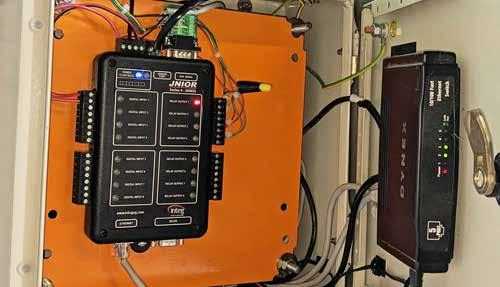
Bruce Cloutier, CEO/Founder of INTEG Process Group, said that “one of the most valuable applications of Industrial Edge Computing is the creation of right-sized SCADA solutions that provide operational visibility without the cost and complexity traditionally associated with supervisory control systems.”
For many smaller applications, the INTEG JNIOR provides a right-sized and easily usable all-in-one Industrial Edge Computing platform for control, visualization, and streamlined connectivity to higher-level computing resources.
While site-isolated SCADA, historian, and PLC stacks once locked data in proprietary silos with poor upstream/downstream commun ication, a unified data infrastructure now connects, contextualizes, and governs data across every site through a common edge-to-cloud pla tform, such as Seeq. This provides engineering, quality, and data science teams with shared access for batch review, deviation monitoring, and AI-scaled analytics instead of one-off, site-by-site integrations.
“Many commercial, manufacturing, and industrial facilities already possess reliable automation assets, including PLCs, sensors, motor controls, and other specialized equipment. The challenge is often not only controlling the process, but also obtaining meaningful operational information from systems that were never designed to share data with enterprise software, remote operators, or cloud-based services,” Cloutier told Industrial Ethernet recently.
Cloutier said that Industrial Edge Controllers address this challenge by bridging operational technology (OT) and information technology (IT), with the flexibility to operate independently of continuous cloud connectivity.
“Positioned close to the equipment, they can fulfill the control role while also collecting data from multiple sources, perform local processing, generating alarms and notifications, and delivering visualization, presenting actionable information to operators,” Cloutier said. “Rather than transmitting large volumes of raw data to external systems, edge devices can filter and organize information locally, forwarding only the events, metrics, and status information that are useful for decision making.”
Recognizing this need, INTEG Process Group developed the JNIOR as a right-sized edge computing solution offering a practical and scalable path forward for many types of users and applications. JNIOR is an easy-to-use,
flexible, and compact automation controller with up to 16 on-board I/O (expandable with remote I/O), and with Ethernet and serial connectivity, providing an effective way to deploy Industrial Edge Computing without unwanted effort and overhead.
“Today's engineers and machine builders are expected to deliver far more than just basic control functionality, even though that remains essential,” Cloutier added. “End users for all types of consumer, commercial, and industrial systems increasingly require remote monitoring, alarm notification, data collection, energy reporting, enterprise integration, cybersecurity, and cloud connectivity. While these capabilities create value, they also introduce additional software layers, communications dependencies, and maintenance requirements that can significantly increase lifecycle risk.”
Cloutier said that carefully selected Industrial Edge Computing solutions can provide the necessary functionality while simplifying the system architecture and minimizing engineering effort. Our approach with the JNIOR edge controller was to establish a purpose-built multi-tasking platform, running an optimized Java Virtual Machine (JVM), so users can develop, debug, and run dependable programs. JNIOR is an Industrial Edge Computing solution for smaller applications, providing responsive control, supporting edge networking/communications, and even includes a full-featured web server.
This combination of control and computing in a compact footprint provides reliable and predictable performance, without the need for users to manage multiple computing resources.
“Industrial equipment often remains in service for decades, while software platforms, communications technologies, and business requirements change continuously. Any Industrial Edge Computing technologies should maintain a focus on being supportable over the long haul. This preserves investment, reduces obsolescence risk, and extends the useful life of both equipment and engineering effort,” Cloutier said.
Move to Hybrid Architectures
Cloud platforms play central role in scaling analytics, standardizing data access and enabling enterprise-wide learning, while edge resources support local responsiveness..
According to Paolo Braiuca, Life Sciences Industry Principal at Seeq, “The biggest trend is the move away from a binary ‘edge versus cloud’ mindset toward hybrid architectures where cloud platforms play the central role in scaling analytics, standardizing data access, and enabling enterprise-wide learning, while edge resources support local responsiveness where needed. Manufacturers are no longer treating plant-floor data as isolated historian or SCADA data; they are increasingly building shared industrial data foundations that
Templated advanced pattern recognition (APR) with AI-assisted analytics provides a view of statistics and quality events from p roducts and sites in a unified always-on dashboard, empowering teams to query and prioritize risk in seconds, instead of compiling and inte rpreting static reports.
connect machines, sensors, manufacturing execution systems (MES), and business systems into a common analytical framework.”
Braiuca said that a second trend is stronger OT/IT convergence. The old automation pyramid with standalone applications and siloed communication is giving way to more decoupled, interoperable architectures with broader connectivity and more transparent data flow.
And third, manufacturers are embedding more analytics and AI into these environments, with cloud-based industrial analytics platforms becoming increasingly important for contextualizing data, scaling advanced analysis across sites, and supporting AI-assisted decision-making from diverse operational data sources.
"Finally, the market is placing greater emphasis on resilience, security, and manageability across distributed operations, because smart manufacturing increasingly depends on connected assets, mixed protocols, and the ability to govern data and applications consistently across sites,” Braiuca said.
Cloud-based Industrial Analytics
“One especially valuable area is cloudbased industrial analytics built on a unified enterprise data infrastructure across multiple sites. In practice, this means creating a common layer that collects, contextualizes, and distributes operational data from plant equipment, automation systems, historians, and enterprise applications into an analytical environment that can be used consistently across the organization,” Braiuca said. “This matters because modern manufacturers do not struggle from a lack of data, but from fragmented data spread across protocols, systems, and locations.”
Cloud-enabled industrial analytics platforms create value by turning that fragmented data
into a shared resource for monitoring, cross-site benchmarking, predictive maintenance, quality analysis, and process optimization. This is where Seeq-style capabilities are especially relevant: the value is not just storing data in the cloud, but contextualizing it, making it accessible to engineers and subject matter experts, and scaling analysis and best practices across facilities (See Figure above).
For regulated sectors such as pharmaceuticals, the benefit is even greater because the enterprise gains standardized visibility, stronger governance, and reusable analytics across facilities, while still preserving local operational responsiveness where needed.
Technical Benefits
Braiuca said that a cloud-centered industrial analytics solution built on a unified data infrastructure is more advanced because it combines capabilities that were once fragmented across historians, reporting tools, custom integrations, and site-specific applications. First, it supports broad connectivity to industrial assets and protocols, allowing data collection from legacy and modern systems without costly rip-and-replace programs.
Second, it contextualizes raw industrial data, turning tags into meaningful process, asset, batch, and production information, which are critical for scalable analysis and collaboration across teams and sites.
Third, cloud deployment makes advanced analytics easier to scale enterprise-wide, enabling users to apply common calculations, visualizations, and monitoring strategies consistently. Fourth, cloud architectures support centralized governance and rapid rollout of analytical improvements, while hybrid deployment supports low-latency and site autonomy needs where required with local
infrastructure.
The benefits include faster insight generation, easier analytics reuse, stronger cross-site consistency, reduced engineering effort, and a clearer path from raw data to operational improvement. This provides a more scalable and usable operating model for industrial analytics.
“Historically, manufacturers worked inside a rigid automation hierarchy, consisting of standalone applications, data silos, poor upstream/downstream communication, and proprietary protocols that limited reuse of information beyond the immediate control context,” Braiuca said. “Local systems were optimized for control, rather than enterprisewide visibility, cross-site learning, or modern analytics deployment.”
The new model decouples data access from individual applications and supports a more fluid edge-to-cloud continuum. Time-critical processing stays close to the machine or line, while larger-scale analytics, benchmarking, and AI development occur centrally, with information relayed to the field or production floor as needed. Platforms like Seeq are built for this shift: instead of requiring a custom integration layer for every historian, SCADA, and MES, Seeq connects directly to the data sources and contextualizes the information, giving engineers, process experts, and quality teams faster access to consistent analytics without waiting on a new point solution each time.
In manufacturing environments, teams are using these platforms to apply the same analytical approaches across processes and sites, which improves batch review, enables earlier deviation identification, and provides better operational context. This methodology supports continuous innovation by breaking down conventional barriers in place with static, siloed environments, creating a shorter
While there are many approaches to implement smart manufacturing, IDEC has evolved their proven PLCs, HMIs, and now the hybrid FT2J PLC+HMI (shown here) to maintain the same rigorous OT performance that users expect, while adding in easy-to-use IT and cloud connectivity, so users can create reliable edge/cloud computing solutions.
path from industrial data to operational action.
Application Challenges
“Engineers and machine builders face a recurring set of problems: integrating new and legacy equipment, dealing with different protocols, supporting low-latency decisions, organizing large volumes of disparate data, securing operational assets, and scaling solutions across multiple devices and sites. Unified edge-cloud data infrastructure addresses these issues directly,” Braiuca added.
At the connectivity level, this approach reduces integration friction by creating a common layer between equipment and higher-level applications. At the compute level, it lets designers place logic where it belongs: local processing for immediacy and resilience, central processing for coordination and advanced analytics. At the lifecycle level, centralized management of edge devices and applications simplifies updates, configuration control, and cybersecurity across fleets rather than box-by-box maintenance.
For machine builders, this means they can design more modular and reusable automation solutions. For plant engineers, it reduces time spent stitching together infrastructure, providing more time to focus on performance, quality, and innovation. Particularly in regulated industries, this architecture helps balance innovation with governance by supporting standardization without sacrificing local operational needs.
Anticipated impact
“Over the next one to three years, we expect
the conversation to shift from proving the value of edge-cloud architectures to governing them at scale. Regulatory and quality expectations, especially in pharma and other validated environments, will push vendors toward analytics platforms that support data integrity, audit trails, and reproducibility natively, rather than as bolt-ons,” Braiuca said. “Additionally, AI will move from pilot projects to embedded, contextual assistance, where engineers increasingly query operational data in natural language and receive answers grounded in validated process context, not generic model output.”
He added that workforce dynamics will be impacted as well. As experienced process experts continue to retire, analytics platforms that capture and apply institutional knowledge—not just raw data—become increasingly critical.
“We will also see a procurement shift, with buyers evaluating platforms based less on edge-versus-cloud considerations, and more on time-to-insight and ease of adoption for non-programmers. The companies that win will be those that make advanced analytics usable by subject matter experts, not just data scientists, closing the gap between having data and acting on it,” Braiuca said.
MQTT, OPC UA, Modbus TCP or EtherNet/IP Connectivity
End users are striving to extract more data, in easier ways, from their automation assets.
Linda Htay, Automation Product Marketing Manager at IDEC Corporation said: “For many years, manufacturing automation
SOURCE:
users recognized that the technologies used for control, visualization, and connectivity/ data-handling were a bit segregated; often using programmable logic controllers (PLCs), human-machine interfaces (HMIs), and PCs, respectively. Even though these roles are different, they all work closely together. For industrial and even commercial use, users demand absolute reliability from these products, while they hoped for them to be reasonably easy to use. Unfortunately, a growing hardware/software technology stack tends to add cost and complexity.”
She said however that expectations have shifted over the years, as end users are striving to extract more data, in easier ways, from their automation assets. They need this data not only for monitoring purposes, but also to support operational optimization and proactive maintenance efforts. Today’s designers have a range of hardware and software options available to them, ranging from inexpensive consumer-grade microcontrollers to more complex platforms running an assortment of open-source software.
“When designing new systems or enhancing existing installations, manufacturers typically deploy edge devices, PLCs, HMIs, gateways, or controllers that can communicate with both legacy equipment and modern Industrial IoT platforms. These devices help collect, normalize, and securely transmit operational data using standards such as MQTT, OPC UA, Modbus TCP, or EtherNet/IP,” Htay said.
An example is how IDEC's FC6A PLC, FT1J/ FT2J PLC+HMI, and HG1J/HG2J HMIs can serve as a bridge between industrial control systems and modern data architectures. With support for MQTT, Modbus TCP, EtherNet/IP, FTP, email, web server functionality, and custom web pages, these devices provide multiple ways for end users to increase the value of equipment while enabling greater visibility and connectivity.
Addressing Engineering Challenges
Htay said that, based on deep experience in supplying automation for the manufacturing sector, IDEC understands that industrial product lifecycles need to be 10+ years, and that machines can run for decades. Modern IT-centric software and consumer-grade products move at a much faster pace, making it both difficult and risky to maintain these over the timeframes needed by industry.
“To create automation solutions that will survive the manufacturing environment over the long haul, designers need access to proven products featuring a compact size, low power consumption, a wide operating temperature range, and industrial certifications such as UL and CE. For these and other reasons, IDEC has continually advanced the PLC (FC6A), HMI (HG1J/HG2J), and hybrid PLC+HMI (FT2J) platforms to deliver the always-on
reliability expected by end users, but with enhancements making them easier to use and ideal for connecting OT with IT. Depending on the product line, common OT and IT protocols ensure developers can build reliable systems using these IDEC products, while enabling direct integration with SCADA, cloud, building, and other host systems.
Multi-protocol Connectivity and Data Standardization
Support for broad industrial connectivity (OPC UA, MQTT, PROFINET, Modbus TCP, Ethernet/ IP) provides a foundation to structure and harmonize shopfloor data for downstream IT and cloud use.
According to Marc Fischer, Global Marketing Manager Industrial Edge at Siemens, “manufacturers are moving quickly from isolated ‘pilot’ architectures to scalable edge-to-cloud platforms that can be rolled out across lines and sites.”
Fischer said that three technology trends stand out:
First, open, multi-protocol connectivity and data standardization are becoming non-negotiable. Plants need to connect both greenfield and brownfield assets and normalize data so it can be reused across applications rather than building and maintaining pointto-point integrations. Siemens Industrial Edge supports broad industrial connectivity (e.g., OPC UA, MQTT, PROFINET, Modbus TCP, Ethernet/IP) and provides a foundation to structure and harmonize shopfloor data for downstream IT and cloud use. Complementing this, a unified data layer that bridges OT and IT is emerging as the backbone for analytics and industrial AI. Edge Apps like Siemens Industrial Information Hub (IIH) create an OT data model and enable standardized publishing (e.g., via MQTT, Unified Namespace [UNS]), while supporting semantic access patterns through GraphQL/REST.
Second, security and lifecycle management at scale are becoming decisive differentiators. As edge deployments grow, customers need centrally managed updates, role-based access, and resilient operations. Siemens Industrial Edge is designed for industrialgrade security and operational resilience, including IEC 62443-aligned capabilities and secure update management. This ensures that edge infrastructure remains protected and maintainable as deployments expand across multiple plants and facilities.
Third, cloud-native analytics and AI multiply value from unified data. Once manufacturers establish a unified data foundation and secure edge-to-cloud infrastructure, cloud-native SaaS applications transform standardized operational data into competitive advantage. Cloud-based
Insights Hub from Siemens provides a powerful, scalable platform for data-driven manufacturing, offering key functionalities like Insights Hub Monitor, Intelligent Energy Management, Quality Prediction, and our Production Copilot.
These offerings are designed to optimize asset uptime, enhance predictive quality, and improve overall throughput. The Siemens Production Copilot, integrated within Insights Hub, uses natural language processing to make advanced analytics accessible to frontline workers. Siemens Predictive Analytics applies machine learning to forecast equipment failures weeks in advance, while Quality Prediction and Energy Optimizer continuously optimize production parameters. By eliminating custom integrations and leveraging standardized data models, manufacturers deploy new analytics use cases in weeks rather than months – and these applications improve continuously as they learn from growing datasets.
Predictive Maintenance at Scale
Fischer said that one specific area creating immediate value is predictive maintenance at scale, combining edge-based data integration and preprocessing with cloud-based analytics.
“With Siemens Industrial Edge and Industrial Information Hub, manufacturers can connect heterogeneous shopfloor assets, harmonize and contextualize data locally, and decide which data stays on premises versus what is securely sent to the cloud. This is especially important for high-frequency signals and sensitive production data, where edge processing reduces bandwidth needs and supports data sovereignty,” Fischer said.
“On top of that data foundation, cloud applications such as Senseye Predictive Maintenance turn equipment data into actionable insights – helping maintenance teams focus on the right assets at the right time without manual analysis. The result is measurable operational impact: Healthcare company Octapharma, for instance, achieved a 50% reduction in unplanned downtime and a 10% increase in Overall Equipment Effectiveness (OEE) by implementing these technologies. This integrated approach enables manufacturers to harness real-time data insights at the edge, reducing latency and empowering predictive maintenance strategies that optimize production efficiency and minimize downtime. This is particularly crucial in highly regulated industries like pharmaceuticals, where continuous quality monitoring, faster responses to process deviations, and greater transparency across production lines are paramount,” he added.
Advanced Solutions
On the edge, Fischer said that Siemens Industrial Information Hub running on
Industrial Edge enables connectivity to a wide range of industrial protocols and systems, helping manufacturers collect and harmonize data from heterogeneous shopfloor environments. It supports local data storage and harmonization using an MQTT data broker, and provides secure data transmission to cloud and IIoT platforms— while allowing customers to decide which data remains on-premises and which data is shared to the cloud. This reduces integration effort, supports data sovereignty, and lowers bandwidth requirements by enabling preprocessing close to the machines.
In the cloud, Senseye Predictive Maintenance applies AI that automatically learns from machine and maintainer behavior, generating models that help direct maintenance attention to where it is most needed. It delivers monitoring, diagnostic, and prescriptive insights and is designed for enterprise-scale deployments—from hundreds to 10,000+ machines—without requiring manual analysis.
“In the past, many maintenance approaches relied on fixed-interval preventive schedules or isolated condition monitoring systems that generated large volumes of alarms and required significant manual interpretation,” Fischer said. “Insights were often trapped in individual plants, and scaling beyond a few critical assets typically meant repeating custom integrations and analysis work.”
“Today’s approach works differently in three key ways. First, data can be connected and prepared at the edge, close to the machines, using gateways and edge computing for secure connectivity and preprocessing—so manufacturers can use existing signals from PLCs, drives, motors, and sensors without redesigning their automation environment.”
Fischer said that industrial AI is also shifting the workload from humans to the system. For example, Senseye Predictive Maintenance uses AI to automatically learn from machine and maintainer behavior, continuously improving diagnostic accuracy and reducing the need for manual inspection. It also uses an Automated Attention Index to prioritize what truly needs action, rather than overwhelming teams with raw data and alerts.
Third, the solution is designed to scale enterprise-wide. Instead of being limited to a single line or site, it is built to deliver value across 100 to 10,000+ machines, enabling consistent maintenance practices and shared learning across plants.
New Automation Solutions
“Engineers and machine builders are under pressure to deliver smarter machines faster— while dealing with heterogeneous shopfloor interfaces, customer-specific IT requirements, and increasing cybersecurity expectations. Industrial Edge and cloud connectivity
“Security and lifecycle management at scale are becoming decisive differentiators. As edge deployments grow, customers need cen trally managed updates, role-based access, and resilient operations. Siemens Industrial Edge is designed for industrial-grade security and operational resilience, including IEC 62443-aligned capabilities and secure update management," -- Marc Fischer, Global Marketi ng Manager Industrial Edge, Siemens.
address these challenges by standardizing data integration and simplifying lifecycle management, so OEMs can focus engineering effort on differentiation rather than plumbing,” Fischer said.
With Siemens Industrial Edge and Industrial Information Hub (IIH), machine builders can connect to a broad range of controllers and devices using flexible Siemens, third-party, or self-built connectivity, including support for upgrading brownfield environments via OPC UA companion specifications. Data is then structured in a consistent way—using IIH as a central data layer and OT data model— so each asset only needs to be connected once, and multiple applications can reuse the same standardized data foundation. This reduces custom point-to-point integrations and makes solutions easier to scale across lines and sites.
In addition, IIH enables data preprocessing, historic capture, live access, and easy synchronization between edge and cloud, including semantic access via an automatically generated graph exposed through GraphQL/ REST APIs—bridging OT usability with IT-friendly interfaces. Finally, centralized
app and device management supports costefficient rollouts and secure data handling with continuous updates by Siemens, helping OEMs meet lifecycle and security expectations across distributed installations.
Looking Ahead
Over the next 1–3 years, Fischer said that Industrial Edge computing will shift from “select use cases” to becoming a standard layer of industrial operations—because manufacturers need faster deployment of digital applications, stronger cybersecurity, and scalable lifecycle management across distributed production.
First, we expect a major acceleration in scalable rollouts of edge applications across machines, lines, and sites. Industrial Edge is designed for real-time local processing and cost-efficient rollouts, with centralized management so deployments remain manageable as they grow.
Second, cybersecurity and compliancedriven update management will become a primary adoption driver. With regulations such as the EU Cyber Resilience Act increasing lifecycle security obligations, manufacturers
and machine builders will need practical ways to roll out security updates not only for their own apps, but also for third-party apps, operating systems, and device firmware. Industrial Edge supports this with secure update management, job tracking, and vulnerability management processes.
Third, edge will increasingly serve as the bridge between heterogeneous OT environments and cloud analytics. With Industrial Information Hub (IIH), customers can collect and standardize data from diverse shopfloor systems, harmonize it locally using an MQTT-based data layer, and securely transmit selected data to major cloud platforms—while keeping control over what stays on-premises.
“We anticipate broader adoption of managed, cloud-hosted edge management to address IT resource constraints. Industrial Edge Management Cloud provides centralized management as a Siemens-hosted SaaS option, reducing the burden of installing, hosting, and maintaining the management infrastructure internally,” Fischer concluded.
Al Presher, Editor, Industrial Ethernet
OPC UA FX: Future of Industrial Communication Is Taking Shape
A new generation of technologies is reshaping this landscape. OPC UA FX together with Time-Sensitive Networking, Ethernet-APL, and wireless technologies such as 5G, is paving the way for a unified communication infrastructure — from sensors and actuators, industrial control systems to edge and cloud platforms.
FOR DECADES, INDUSTRIAL COMMUNICATION has evolved around proprietary fieldbuses and vendor-specific ecosystems. While these technologies enabled reliable real-time communication, they also created fragmented networks and limited interoperability across automation systems.
Today, a new generation of technologies is reshaping this landscape. OPC UA FX (Field eXchange), together with Time-Sensitive Networking (TSN), Ethernet-APL, and emerging wireless technologies such as 5G, is paving the way for a unified communication infrastructure —from sensors and actuators, industrial control systems to edge and cloud platforms.
What once seemed like a long-term vision is now becoming tangible reality.
From Vertical Integration to Real-Time Field Communication
OPC UA (Open Platform Communications Unified Architecture) has already established itself as the de facto standard for secure,
platform-independent data exchange in industrial automation. For many years it has been successfully used to securely exchange data between machines, devices, and software systems, and this across multiple industrial sectors from manufacturing and process automation to energy and infrastructure.
The key components of OPC UA are:
Information Modelling: OPC UA doesn’t just send raw data - it structures it. Devices expose data as rich, object-oriented models (with variables, methods, and relationships), making information meaningful and standardized across systems.
Built-in Security: Security is a core feature, not an add-on. OPC UA includes encryption, authentication, and authorization to ensure that data is transmitted safely and only accessed by trusted parties.
Transport-Agnostic Communication Services: OPC UA can operate over different communication protocols (like TCP, UDP, HTTPS, or WebSockets). This flexibility allows it to work across various networks
and applications - from embedded devices to cloud systems - without being tied to a single transport method.
However, traditional OPC UA was never intended to replace fieldbuses responsible for deterministic control communication. OPC UA FX closes this gap.
By extending OPC UA down to the field level and combining it with deterministic transport, OPC UA FX enables real-time communication between controllers, drives, I/O systems, and other field devices - across vendor boundaries.
The key innovation lies in the Publish/ Subscribe communication model, which enables efficient real-time data distribution across industrial networks – either via UDP/IP routable across networks or Raw Ethernet for shorter cycle times and higher efficiency within a network segment. Combined with TSN, this architecture provides deterministic communication with guaranteed latency and synchronized timing. And since OPC UA FX is based on OPC UA, connectivity is not limited to the field level, but scales up to the edge and the cloud.
Figure 1 - From Automation Pyramid to Open Industrial Network, scalable Industrial Internet of Things (IIoT) deployments.
The result is a single communication framework that can serve the entire automation pyramid based on OPC UA.
Enabling Technologies: TSN, Ethernet-APL and 5G
The transformation towards a unified industrial network is enabled by several complementary technologies.
• Time-Sensitive Networking (TSN) provides deterministic Ethernet communication. Through mechanisms such as precise time synchronization, traffic scheduling, and bandwidth reservation, TSN enables predictable real-time behavior on standard Ethernet networks.
• Single Pair Ethernet (SPE) provides Ethernet communication over a single twisted pair, enabling lightweight, costeffective connectivity for field devices.
• Ethernet Advanced Physical Layer
What is OPC UA FX?
(Ethernet-APL) builds on SPE technology and extends Ethernet connectivity into process automation environments. It supports long cable distances, intrinsic safety for hazardous areas, and simple installation, making Ethernet a practical and robust solution even in demanding process plants.
• 5G complements wired infrastructure by enabling deterministic wireless communication. This is particularly relevant for mobile equipment, flexible manufacturing, and modular production environments.
Together, these technologies enable converged networks, where IT and OT communication can coexist on a single infrastructure.
OPC UA FX Specification Status
The OPC UA FX specification has reached an important milestone with the completion of the
OPC UA FX (Field eXchange) extends OPC UA from information exchange to deterministic control communication.
Key characteristics include:
• Real-time communication using OPC UA PubSub
• Deterministic networking via TSN
• Vendor-independent interoperability
• Unified communication from sensor to cloud
• Integration with OPC UA Companion Specifications
OPC UA FX aims to provide an open, Ethernet-based automation network as an alternative to the fragmented fieldbus landscapes.
Controller-to-Controller (C2C) use case which is at the same time the foundation for the Controller-to-Device (C2D) and Device-toDevice (D2D) use cases.
What OPC UA FX adds to OPC UA
Automation Component (AC): A standardized, modular representation of devices (like PLCs, drives, I/O). Each component includes its data, functions, and interfaces - making devices easier to integrate and reuse across systems.
Connection Manager: Handles how controllers establish and manage communication relationships with other controllers and/or field devices. It automates connection setup (who talks to whom, how, and with which parameters), reducing manual configuration effort.
Offline Engineering: Allows engineers to design and configure systems before hardware is physically connected. Complete setups (devices, connections, parameters) can be planned, simulated, and later deployed.
Profiles: Define standardized feature sets and capabilities for controllers and field devices. Profiles ensure interoperability - devices from different vendors behave consistently if they support the same profile.
In short. OPC UA FX brings real-time capability, easier integration, and standardized engineering to OPC UA, making it suitable for field-level communications.
OPC UA (FX) Ecosystem.
OPC UA FX Controller-to-Controller (C2C) defines how controllers exchange cyclic data in real-time across vendor boundaries. It includes the architecture, information models, networking mechanisms, and engineering concepts required for interoperable communication.
This foundation enables the next phase of development which is currently ongoing:
• Controller-to-Device (C2D) communication
• Device-to-Device (D2D) communication
These extensions will bring OPC UA FX directly to drives, I/O devices, and field instruments.
In parallel, OPC UA Safety supports functional safety communication over the same network infrastructure. This allows safety-related signals to be transmitted over OPC UA FX while maintaining compliance with industrial safety standards.
Ethernet TSN and IEC/IEEE 60802: A Common Network Profile
While TSN (Time-Sensitive Networking) provides a toolbox of deterministic Ethernet mechanisms, interoperability requires a common profile consisting of a set of rules
and constraints.
This is the role of IEC/IEEE 60802, a joint standardization effort defining how TSN should be applied in industrial automation networks.
The profile specifies:
• Time synchronization mechanisms
• Traffic scheduling rules
• Network configuration procedures
• Interoperability requirements
OPC UA FX is aligned with this profile, ensuring that devices from different vendors can communicate deterministically on the same TSN network.
The convergence of OPC UA FX and IEC/IEEE 60802 represents a major step toward vendorneutral real-time Ethernet networks.
Growing Ecosystem of SDKs and Protocol Stacks
Another important indicator of maturity is the rapidly growing ecosystem of OPC UA FX implementations. Automation vendors, software providers, and specialized stack suppliers are actively developing SDKs and communication stacks supporting OPC UA PubSub and
Why OPC UA FX Is Different from Fieldbuses
Traditional fieldbus systems are typically:
• Vendor-specific
• Protocol-isolated
• Limited to single applications or domains
• Difficult to integrate with IT systems
OPC UA FX introduces a fundamentally different approach:
• Open, standardized communication
• Ethernet-based networking
• Built-in security and information modeling
• Seamless integration from field to cloud
Instead of isolated communication islands, OPC UA FX enables a shared industrial communication ecosystem.
early OPC UA FX profiles. The offers include commercial as well as open source solutions. These solutions enable:
• Integration of OPC UA FX stacks into controllers and devices
• Development of interoperable applications
• Evaluation and prototyping by system integrators and OEMs
Although many implementations are still evolving, the ecosystem is clearly gaining momentum as the specifications stabilize.
Prototyping and Interoperability Demonstrations
Interoperability demonstrations have played a key role in validating OPC UA FX concepts. One of the most prominent examples is the C2C Demo Wall, where controllers from multiple vendors communicate over a shared network. These systems exchange cyclic process data in real time while maintaining deterministic communication behavior.
Another highlight is the Cable Robot Demonstrator, which showcases coordinated motion control across distributed controllers. The system demonstrates precise synchronization and low-latency communication, key requirements for advanced automation scenarios.
These prototypes demonstrate that OPC UA FX is not just a specification - it is already working in practice.
Conformance Testing and Certification
As industrial users adopt OPC UA FX, interoperability and reliability must be guaranteed through formal certification. The OPC Foundation is therefore developing comprehensive testing tools, including:
• Compliance Test Tool (CTT) for OPC UA FX
OPC UA FX System Architecture.
• OPC UA Safety Compliance Test Tool (UASCTT) for safety communication
These tools enable automated verification of protocol implementations and ensure that certified devices behave consistently across vendors. Certification programs play a critical role in building confidence and accelerating market adoption.
Current Work: Completing FieldLevel Integration
The current phase of development focuses on completing the field-level communication scope. Key areas of work include how controllers (e.g., PLC, DCS) communicate with motion devices
Ecosystem Momentum
(e.g. frequency converters, servo drives), remote I/O systems and field instruments (sensors, actuators, process devices). The goal is to standardize the real-time data exchange (cyclic communication), the acyclic services (configuration, diagnostics, parameterization) and the device behavior and interfaces by means of standardized information models.
The long-term goal is clear: a fully interoperable automation architecture where devices from different vendors communicate seamlessly.
Outlook: What to Expect This Year
The coming months are expected to mark a turning point for OPC UA FX.
The OPC UA FX ecosystem is expanding rapidly:
• Automation vendors integrating OPC UA FX into controllers
This growing ecosystem is essential for accelerating adoption.
The Vision
OPC UA FX aims to create a future where:
• Controllers, drives, and sensors communicate using the same protocol
• Real-time and IT communication can share the same Ethernet network
• Engineering workflows are standardized across vendors
• Data flows seamlessly from machine to cloud
In this vision, interoperability becomes the default - not the exception.
Several milestones are anticipated:
• The first certified OPC UA FX controller products
• Expanded interoperability demonstrations combining C2C, C2D, and edge/cloud connectivity
• Integration of OPC UA Companion Specifications into live demonstrations
• A multi-vendor demonstrator machine showing realistic production scenarios
At the same time, TSN standardization and certification activities will continue to mature. Together, these developments signal the transition from technology validation to industrial deployment.
From Vision to Industrial Reality
OPC UA FX represents one of the most significant developments in industrial communication in recent decades. By combining OPC UA with deterministic Ethernet networking, standardized information models and open interoperability, it enables a new generation of flexible, scalable automation systems.
While the journey is still ongoing, the progress achieved so far demonstrates that the industry is understanding the benefits and is moving toward a common communication foundation for the digital factory.
Peter Lutz, SPE Technology Evangelist, OPC Foundation
OPC UA FX C2C Demowall.
ISA-112: The New Standard for Modernizing SCADA Systems
Building critical infrastructure is a complex process with many moving parts. It is a team effort that requires personnel with skillsets working together during the project phases for the result to be a successfully operating facility. Because of the prevalence of automation, SCADA professionals are an essential part of this team effort.
IN FEBRUARY 2026, PART 1 OF THE ISA-112 SCADA systems management standard was published by the International Society of Automation (ISA). As the first part of a standard that will eventually be three parts, ANSI/ISA-112.00.01-2025, SCADA Systems – Part 1: SCADA Lifecycle, Diagrams and Terminology provides a vendor-neutral, practical framework for managing supervisory control and data acquisition (SCADA) systems throughout their lifecycle.
Frequently used across multiple industries and for large portions of critical
infrastructure, SCADA systems play an integral role in controlling and monitoring these essential systems. Historically, due to their size, geographic distribution, overall complexity and high-uptime requirements, the task of managing a SCADA system has been challenging and often frustrating for both system owners and designers/ constructors due to a lack of a standardized workflow and common terminology. The publication of ISA-112 – Part 1 breaks this cycle by providing a standardized lifecycle, framework and work processes for all stakeholders of SCADA systems to use.
Introducing ISA-112
The ISA-112 Part 1 standard is built around two key concepts. The first is a standardized lifecycle, also known as standardized workflows, for managing SCADA systems during their entire lifespan from initial planning, design/construction, upgrades/ expansions of the years, operations/ maintenance and technology upgrades over time.
The lifecycle itself is broken into numerous elements called work processes. These work processes are then organized into seven groupings, which are organized
By being involved at every step of the process, SCADA professionals continue to make the world a better place with automation when it comes to critical infrastructure.
into the table above.
Governance, Planning and Resourcing for SCADA Systems
The ISA-112 Part 1 standard lays out specific requirements when it comes to governance, long-term planning and resourcing for SCADA systems. Strong documented governance processes are essential.
To support the SCADA systems, the ISA-112 standard requires SCADA system owners to develop a SCADA governance policy document that clearly defines key governance characteristics of the system. The governance policy provides a framework for how the SCADA system will be developed, built and maintained over time, and it includes a work process for how decisions regarding the SCADA system will be made. It requires executive endorsement and support in the organization, so the role of SCADA is clearly established in the organization.
Well-managed SCADA systems will also have a long-term operational and capital plan. Effective long-term planning includes looking at both system components and engineering investments from a lifecycle approach, recognizing that all parts of the system will need ongoing investments
and upgrades to continue to meet business needs and be sustainable in the long term.
Individual Asset-Owner Collections of their SCADA System Standards
One of the major strengths of the ISA-112 Part 1 standard is that it provides a standardized list of what SCADA system standards a SCADA system owner needs to develop and how to organize them. This standardized grouping makes it easier for system owners to specify how they want their SCADA system designed, built and managed, while also providing the assetowner/end-user specific SCADA standards in a standardized format that can be easily used by consultants, vendor, system integrators and other service providers.
Importantly, ISA-112 does not specify the level of detail an asset owner/end user must use for each of their individual SCADA standards. A small SCADA system may only need a paragraph or two of guidance for each of the individual ISA-112-mandated assetowner/end-user SCADA system standards. Whereas a large complex SCADA system, such as a municipal water/wastewater system for a large metropolitan area or a large natural
gas transmission/distribution network, may need highly detailed specifications, templates and sample drawings/documents for each SCADA system. Whether the individual SCADA standards for an assetowner are very brief or very detailed (in accordance with the asset owner’s wishes), the ISA-112 SCADA system standard provides commonality; they will all be organized in the same way.
SCADA Projects
In addition to providing continuous work processes, the ISA-112 lifecycle also establishes a comprehensive framework for planning and executing SCADA projects, including the SCADA aspects of larger capital programs/projects.
Using ISA-112, SCADA projects begin with scoping the project, developing a project charter, a project terms of reference and defining what the desired outcomes will be. This is then followed by gathering background information, verifying any conditions on site and then preparing a preliminary design brief.
Once the preliminary design has been reviewed and feedback gathered, the next step is to proceed to detailed design. The
decision of how many detailed design stages will be used, and if any supporting technical memos are to be developed, will have been defined in the design team’s Terms of Reference (ToR) at the start of the project.
At the end of each detailed design stage, an increasingly detailed package of drawings and specifications will be provided to the utility for review. As the design stages progress, the number of project drawings and length of the specifications will increase as well.
The Role of the SCADA Team During Detailed Design
From a SCADA perspective, the main goal during detailed design is to ensure that all the various aspects of the design have been properly coordinated with each other, and that the utility’s SCADA design standards are being followed, so the automatic control system will be to work effectively.
Both the utility’s and the design team’s SCADA staff needs to carefully review all the drawings and specs together, not just the SCADA-specific sections, so they can check the overall coordination of the design. In short, this is to ensure the new automated control system – the SCADA system – will be able to effectively monitor, control and log the processes in the newly built facility.
Construction Pricing and Tendering
Once the design phase of a project is completed, the next step to construct the facility. The main deliverable from the design phase are the construction-ready (or tenderready) set of drawings and specifications. These will be used to price and construct the facility.
Construction Phase and Shop Drawings
Once the construction project has been awarded, a construction kick-off meeting will be held, followed by regular construction meetings between the utility, the design team, and the construction team.
At the construction meetings, the construction schedule will be reviewed and details relating to the construction will be coordinated as needed. On most projects, the construction team will be responsible for maintaining the construction scheduled and advising if any upcoming deviations are expected.
As part of the construction process, the contractor will then start to issue shop drawings. Shop drawings consist of product-specific specification sheets and other submissions for the various products the contractor proposes to install along with information about how they propose
to install them.
It’s very important that the shop drawings are reviewed by all the various design disciplines that are impacted by them, and this includes the SCADA team. Most SCADA professionals will want to review the shop drawings to ensure the automation aspects of the project are properly coordinated. Ensuring this coordination is done well is essential.
SCADA Aspects of Construction
While the physical construction takes place, a system integration team will usually work on the off-site SCADA aspects of the project. Depending on how the project is structured, these aspects may be handled by one team or may be split up between several specialty teams that coordinate with each other.
As the work progresses, a series of factory acceptance tests (FATs) will be held for the various pieces of automation/SCADA equipment and software.
For complex systems, Factory Integration Tests (FITs) may also be undertaken. As with any fabrication or development phase, it is always best to resolve problems as early as possible in order to avoid costly rework later on.
Commissioning
Commissioning is the step where all the various pieces of installed equipment, software and support systems on site must work together as a system for the first time. Commissioning is also a busy time with many teams of people coming to site to start-up and test all the various pieces of equipment and support systems. Best practice is for a detailed commissioning plan to be developed and followed for the entire commissioning process.
Commissioning usually starts by individually checking each piece of equipment on its own before attempting to run multiple pieces of equipment together. Only after individual checks are complete can subsystems and then the entire system be tested together.
From a SCADA perspective, commissioning will usually involve power-on checks, equipment functionality checks, I/O wiring checks, loop checks, informal pre-testing, site acceptance tests and site integration tests. Particular attention needs to be paid to the ability of the control system to control the process smoothly, while also ensuring the required permissives/interlocks are enforced and equipment startups/shutdowns are handled smoothly.
Commissioning is also usually the time where the contractor and various equipment vendors will provide training on how all the various pieces of equipment in the plant are to be used, maintained and troubleshooted during the length of the facility.
Performance Test
After all the commissioning tests are complete, the facility will enter a performance test period during which it is expected to run with few, if any, adjustments. For many projects, the utility may make a significant portion of the payments for the for the design firm and construction firm be dependent on the successful completion of various performance tests.
Project Close-Out
The design and construction teams must now both document what has been built in a series of submittals called operations and maintenance manuals (O&M manuals) and as-built documentation.
A typical contractor-provided O&M manual will include the specifications and manuals for every component installed in the plant, along with copies of the associated approved shop drawings, and copies of the various associated configuration settings and commissioning reports. The system integrator will then provide an O&M and as-built package that consists of back-ups of any automation code and documentation on how the various SCADA systems work. Finally, as part of the ToR, the design team will provide an O&M submission to document how the plant is intended to operate from an operations point of view, plus a full set of as-built drawings to reflect how the plant was actually built.
Summary
Building critical infrastructure is a complex process with many moving parts. It is a team effort that requires personnel who have a wide variety of skillsets working together during all the various project phases for the result to be a successfully operating facility. Because of the prevalence of automation, SCADA professionals are an essential part of this team effort. By being involved at every step of the process, SCADA professionals continue to make the world a better place with automation when it comes to critical infrastructure.
Further Reading
• ISA-112 SCADA systems – Part 1: SCADA Lifecycle, Diagrams and Terminology: https://www.isa.org/products/ ansi-isa-112-00-01-2025-scadasystems-part-1
• ISA112 SCADA Systems standards committee: SCADA systems management lifecycle, standards and technical reports for SCADA systems: https//www.isa.org/isa112/
Graham Nasby, P.Eng, PMP, CAP, CISSP, PBX Engineering
Learn More
2026 Industrial Network Market Share Annual Analysis by HMS
Industrial Ethernet accounts for eight of ten new nodes implemented in factories. The Fieldbus usage decline is accelerating, according to HMS Networks’ annual analysis. Wireless technologies continue to connect 7% of new node installations, unchanged from 2025.
HMS NETWORKS HAS RELEASED ITS ANNUAL analysis of the industrial network market, marking twelve consecutive years of tracking how factories and machine builders connect their automation systems in modern manufacturing facilities.
The 2026 study shows that the longrunning shift from traditional fieldbus technologies to Industrial Ethernet has continued through another full year, with Industrial Ethernet now accounting for 79% of newly installed nodes worldwide, up from 76% in 2025 and just 34% when HMS first began publishing these figures in 2015.
After the slowdown of 2024, the market stabilized in 2025. Component availability has returned to normal levels and inventory cycles in highly automated sectors have largely been worked through. While Europe's automotive sector continued to face
headwinds, broader manufacturing activity recovered modestly, and capital spending on new automation projects resumed in most regions.
The 2026 study confirms HMS Networks' expectation of approximately +7.7% average annual growth in newly installed nodes over the next five years, with continued migration of the remaining fieldbus install base to Industrial Ethernet driving much of that expansion.
Industrial Ethernet reaches 79% of new installations
The 2026 analysis shows that Industrial Ethernet now accounts for 79% of new nodes, up from 76% in 2025.
The three leading Ethernet protocols continued to consolidate their position, together representing roughly threequarters of the wired protocol market.
Within Industrial Ethernet:
• PROFINET strengthens its lead at 30% (up from 27%)
• EtherNet/IP follows at 25% (up from 23%)
• EtherCAT continues a strong trajectory at 20% (up from 17%)
• Modbus TCP holds steady at 5%
• CC-Link IE remains stable at 3%
• POWERLINK declines to 1% (from 3%)
• Other Ethernet protocols account for the remaining 2% as market consolidation around the major networks continues
Fieldbus drops to 14% as PROFIBUS decline
Fieldbus technologies now represent 14% of new nodes, down from 17% in 2025. PROFIBUS & PROFINET International's own published figures showed PROFIBUS
Figure 1 - From Automation Pyramid to Open Industrial Network, scalable Industrial Internet of Things (IIoT) deployments.
new-node installations dropping from 1.1 million in 2024 to 1.0 million in 2025, a 9% decline corroborated by HMS Networks' internal data and by HMS's industry survey.
Within Fieldbus:
• PROFIBUS remains the largest fieldbus but drops to 4% (from 5%)
• Modbus RTU holds steady at 3%, reflecting its continued role as the universal low-cost serial protocol
• CC-Link, DeviceNet and CAN/CANopen each remain in the 1–2% range with modest further decline
• Other Fieldbus protocols collectively account for 2%, down from 4%, as the long tail of legacy networks fades
Wireless remains steady at 7%
Wireless technologies continue to connect 7% of new node installations, unchanged from 2025. Wireless retains its established role as a complement to wired industrial networks, particularly valuable for mobile equipment such as AGVs (automated guided vehicles) and AMRs (autonomous mobile robots), retrofitted machinery, and IIoT sensors in hard-to-reach locations.
5G remains an area of significant interest but slow industrial deployment. The complexity of private 5G infrastructure is the most commonly cited barrier. Early industrial 5G deployments continue to grow, particularly in Asia, but the technology has yet to deliver the breakthrough adoption many in the industry expected.
Regional insights
Europe : PROFINET and EtherCAT continue to lead, with strong activity around APL (Advanced Physical Layer) for process automation and SPE (Single Pair Ethernet) for sensor-level connectivity. PROFIBUS decline is most visible in Europe, where the install base is largest and the migration to PROFINET most advanced.
North America : EtherNet/IP remains the dominant protocol, particularly in automotive and discrete manufacturing. Adoption of IO-Link, APL and SPE is gaining clear momentum, supported by interest in OT cybersecurity ahead of the regulatory landscape taking shape around CRA and IEC 62443.
Asia : PROFINET and EtherCAT both continue to grow in the Chinese market. CC-Link IE, the first industrial protocol with TSN mechanism, maintains a strong regional foothold.
HMS Networks' perspective
“Twelve years of data tell a remarkably consistent story. The migration from fieldbus to Industrial Ethernet is now in its later stages, but the more interesting question is
5G remains an area of significant interest but slow industrial deployment.
what happens next. When nearly everything is Ethernet, the conversation shifts from 'which protocol?' to 'what is running on top of it?', functional safety, cybersecurity, TSN, OPC UA, Single Pair Ethernet, IT/OT convergence. That is where the complexity, and the differentiation, will increasingly sit,” said Magnus Jansson, Director of Product Marketing, at HMS Networks.
“The 2026 numbers also reinforce something we have been seeing in our industry survey: cybersecurity is now cited by nearly half of respondents as a top integration challenge, and 93% expect OT cybersecurity to change substantially over the next five years. The protocols matter, but the layers above them increasingly define how factories actually operate.” Magnus continues.
Beyond the protocols: a wider lens on industrial networking
To complement the long-running annual market shares analysis, HMS Networks publishes the State of Industrial Networking, an extended companion report that examines the broader dimensions shaping industrial communication: cybersecurity, leading industry voices from across the world, regional or industry-specific dynamics and much more.
The extended report draws on the Future of Industrial Networks survey, an externally panelled study now in its second annual edition. The 2026 cycle captured responses from industrial designers and users across all major regions and industries, with the
2027 edition opening for participation in June this year. As individual protocol-level shifts grow smaller year on year, the broader picture captured in the extended report will increasingly carry the conversation about where industrial networking is heading.
About the study
The HMS Networks analysis is based on a combination of market insights, internal data, and input from key stakeholders in the industrial automation industry. The study focuses on newly installed nodes in factory automation worldwide, each node being a device or machine connected to an industrial control network. This is the twelfth consecutive year HMS Networks has published this annual analysis.
Magnus Jansson, Director of Product Marketing , HMS Networks
Physical AI Intelligence at the Industrial Edge
Physical AI continuously integrates and analyzes multiple inputs to enable real-time process and energy optimization, safety monitoring, computer vision, asset performance, anomaly detection for quality inspection and predictive maintenance directly on the factory floor and at remote sites.
DEDICATED EDGE COMPUTING EMBEDDED in Emerson’s industrial PCs is transforming real-time intelligence, enabling smart local action and maintaining high performance.
Why Industrial Edge AI Matters
Emerson’s next-generation rugged IPCs enable Physical AI to deliver instant, autonomous decision making and execution to improve safety, productivity, reliability and product quality, while reducing capital expenditure (CapEx), waste and energy use.
Physical AI continuously integrates and analyzes multiple inputs to enable real-time process and energy optimization, safety monitoring, computer vision, asset performance, anomaly detection for quality
inspection and predictive maintenance directly on the factory floor and at remote sites.
Local, simultaneous processing of images, video, audio, text and sensor data brings perception and action together at the industrial edge without affecting latency, security or control-compute resources.
Emerson’s PLCs + AI enabled-IPCs + IIoT ready SCADA /HMI Platform stack delivers a unified industrial edge intelligence platform ideal for future proofing operations.
Emerson is collaborating with SiMa.ai, a leader in Physical AI, to deliver advanced AI capabilities for real-time data analysis on Emerson's industrial PCs in the harshest industrial field environments, on the factory floor and at remote sites.
Global Industrial AI Market
The global industrial AI market reached $43.6 billion in 2024, and according to IOT Analytics, is anticipated to grow at a CAGR of 23% through 2030 to reach $153.9 billion[1]. A key part of this growth will be AI technology at the industrial edge, empowering companies to analyze data and physically intervene instantly – detecting problems, optimizing quality, taking corrective action and engineering autonomous operations – all without relying on cloud connectivity. Workloads that previously required offline engineering studies, dedicated analytics servers or roundtrips to the cloud now run alongside core processes, turning the IPC into an always-on industrial intelligence platform.
Emerson and SiMa.ai. are working together to deliver Physical AI Intelligence to the Industrial Edge.
“As operations teams leverage Physical AI at the edge, they move beyond simple monitoring to closed-loop autonomy where they can adjust processes in real time – minimizing product defects early in the production phase, reducing waste and increasing production efficiency,” said Krishna Rangasayee, SiMa.ai. chief executive officer.
SiMa.ai's MLSoCTM (Machine Learning System on Chip) provides the high-performance compute and industry-leading power efficiency necessary for Emerson's industrial PCs to support Physical AI workloads in real time. By maximizing throughput while maintaining a low thermal footprint, the technology allows for faster decision making and robust security, keeping sensitive proprietary data secure and on-premise across vital operations.
Technology Benefits
Benefits of the new systems include the following:
Autonomous safety: Detect gas and liquid leaks, fire and smoke, unauthorized access and equipment anomalies in real time and in harsh environments where high-speed vision inspection has not been possible.
Increased productivity: Enjoy higher overall equipment effectiveness (OEE) by continuously improving uptime, performance and quality.
Enhanced reliability: Ensure operational continuity in missioncritical systems in remote locations (like upstream oil and gas or mines) with limited connectivity.
Emerson and SiMa.ai bring Physical AI to the industrial edge—enabling real-time, on-machine data processing on rugged industrial PCs deployed at factory floors and remote sites. By moving AI workloads from cloud-based data centers to on-premise edge systems, manufacturers achieve low latency, enhanced data security, lower costs and autonomous decision-making—improving safety, productivity, predictive maintenance and operational reliability across global industrial operations.
Improved product quality: Detect defects during inline product quality inspections during production and adjust parameters instantly to prevent waste.
Reduced CapEx: Identify equipment degradation before failures occur, minimizing costly downtime and capital expenditures for new equipment.
Optimized resources: Continuously improve energy use, compressed air systems and material efficiency to reduce the need for human supervision in unsafe environments.
Air-gapped installations: Provide autonomous AI capabilities in critical air-gapped infrastructures using highly secure industrial control systems in industries like nuclear, power, water and other mission-critical installations.
"As organizations accelerate their journey toward autonomous operations, the ability to deploy intelligent capabilities at the edge
with industrial-grade reliability and security is essential," said Ram Krishnan, chief operating officer of Emerson. "Our partnership with SiMa. ai brings specialized AI computing technology to our industrial PCs that – combined with our integrated sensor technology, edge software and enterprise analytics – delivers the complete AI solution industrial organizations need not just to compete today, but also to thrive well into the future."
Emerson is the only provider offering an integrated, end-to-end technology stack for industrial AI across the enterprise – including smart sensors delivering performance data for AI analysis and on-device edge computing; IIoT-ready SCADA/HMI platform and software that routes intelligence for quick interventions; and enterprise analytics for optimizing operations.
Emerson’s industrial PCs with SiMa.ai technology deliver high performance and
AI-accelerated computing power in a compact, ruggedized platform that can withstand high vibration and shock and temperatures ranging from -40 degrees Fahrenheit to 140 degrees F (-40 degrees to 70 degrees Celsius). They also enable practical AI applications across both discrete and process industries including compressed air and energy usage optimization, waste management, packaging, automotive machine efficiency, semiconductor manufacturing and oil and gas applications such as wellhead management and flare monitoring.
A solution from PROGNOST and TTTECH enables machine builders and operators to implement condition monitoring, predictive maintenance and digital services without compromising on cybersecurity and scalability for future upgrades and extensions.
OFFERING A SECURE IMPLEMENTATION OF digital services, TTTECH is providing the platform base for PROGNOST’s predictive maintenance solution. Using the Nerve IIoT platform for its cloud-based solutions, the UP! product family runs as Docker applications on Nerve, which provides a secure basis for edge-based condition monitoring and remote device management.
PROGNOST Systems GmbH is a global leader in online condition monitoring and machine protection systems for reciprocating compressors and part of Burckhardt Compression AG. The company’s UP! product family provides cloud-based fleet diagnostics and early failure detection for compressors. It is hosted on Nerve, TTTECH Industrial’s secure, IEC 62443-4-2 certified edge computing platform. With Nerve as basis, PROGNOST’s solutions can operate reliably in their
customers’ existing industrial environments, while complying with high requirements for data sovereignty, availability, and offline capability.
PROGNOST Systems GmbH’s UP! product family was introduced in April 2024, extending the company’s offering for machinery monitoring and predictive maintenance. UP! Detect enables automated vibration analysis for the early detection of abnormal compressor behavior to ensure maximum availability and uptime. UP! Insight provides cloud-based fleet monitoring and analytics to improve machine health, reduce costs, and maximize the uptime of compressors.
The UP! product family is run as Docker applications on Nerve from TTTECH Industrial, which serves as the secure, IEC 62443-certified foundation for edge - based condition monitoring and remote device management
via the Nerve Management System. TTTECH’s long-time experience in reliable industrial automation and solutions for safety-critical systems played a key role in PROGNOST’s decision for Nerve, according to Robin Schlup, Team Leader IoT Solutions & Cybersecurity, Burckhardt Compression AG: “Compliance with the Cyber Resilience Act and NIS2 is a must. That’s why we needed a cybersecure platform to host our cloud-based UP! product family and support real-time data collection, processing, and transfer for monitoring and predictive maintenance. Nerve provides this cybersecure basis, as well as the flexibility to extend and upgrade systems.
The collaboration with TTTECH Industrial was smooth – they took our concerns seriously, were open for feature suggestions and adjustments of the roadmap and provided us with competent and fast technical support.”
Nerve is a scalable and modular, IEC 62443-4-2-certified edge computing solution that provides a secure foundation for IIoT applications like predictive maintenance.
TTTECH Industrial’s IIoT platform Nerve is certified on product level according to the industrial cybersecurity standard IEC 62443-4-2, covering the requirements of the Cyber Resilience Act as well as NIS2compliant incident reporting and risk management. It provides centralized device, software, and update management via the Nerve Management System and can be run completely offline, keeping data fully on premises if required, which supports use cases in critical infrastructure applications. As it can be run on any industrial PC, customers can integrate it easily into their existing shop-floor environments.
Herbert Hufnagl, Senior Vice President Industrial, TTTECH, said: “We are excited to collaborate with PROGNOST on their UP! product family and deliver new, valuable
services for their customers. Nerve can be applied for a range of use cases, from brownfield digitalization to condition monitoring, predictive maintenance to machine learning. PROGNOST’s customers operate in critical infrastructure, which often has specific demands. Nerve can accommodate such requirements - it is an open, secure, and scalable IIoT platform that can grow with customers’ business and provide actionable insights for maximizing uptime and reliability in their production.”
The UP! product family in combination with Nerve make high-quality machine monitoring affordable and accessible for all types of reciprocating compressors. End customers gain access to advanced diagnostic and prognostic capabilities tailored for critical infrastructure across sectors such as oil and gas downstream,
petrochemicals, marine, and industrial gases. This combined system supports the deployment of artificial intelligence and machine learning analytics for extensive machine fleets, based on real-time telemetry data and edge computing. End customers can establish predictive maintenance strategies using instantly accessible vibration and process data in expert diagnostic systems.
The solution from PROGNOST and TTTECH enables machine builders and operators to implement condition monitoring, predictive maintenance, and digital services without compromising on cybersecurity and scalability for future upgrades and extensions.
How Jungheinrich and HMS Networks are shaping the future of automated storage with speed, safety, and connectivity. The shuttles operate on the entire bottom level in two dimensions, leveraging the full vertical space above the system for maximum storage capacity.
At the heart of the system is Jungheinrich’s own Warehouse Control System (WCS), which controls automated shuttles via Ethernet communication to ensure they move quickly and safely within a high-density storage grid.
THE POWERCUBE WAS DESIGNED WITH one clear goal—to improve efficiency. By maximizing storage density and accelerating order processing, it helps warehouses handle more goods in less space and time.
At the heart of the system is Jungheinrich’s own Warehouse Control System (WCS), which controls automated shuttles via Ethernet communication to ensure they move quickly and safely within a high-density storage grid. These shuttles operate on the entire bottom level in two dimensions, leveraging the full vertical space above the system for maximum storage capacity.
Meet the PowerCube
The PowerCube was designed with one clear goal—to improve efficiency. By maximizing storage density and accelerating order processing, it helps warehouses handle more goods in less space and time.
At the heart of the system is Jungheinrich’s own Warehouse Control System (WCS), which controls automated
shuttles via Ethernet communication to ensure they move quickly and safely within a high-density storage grid. These shuttles operate on the entire bottom level in two dimensions, leveraging the full vertical space above the system for maximum storage capacity.
Benefits of the PowerCube
• Unique use of space: Up to four times higher storage density compared to conventional shelving.
• High system height: Vertical storage up to 12 meters.
• Scalable design: Flexible throughput, container capacity, and shuttle count.
• Powerful performance: Each shuttle can carry two containers at once, up to 50 kg per container.
• Easy integration: Short assembly times and simple IT connections—no need for floor milling.
“We wanted a system that combines speed, safety, and scalability. PowerCube delivers all three,” said Carlos de Almeida, Head of Software Development at Jungheinrich.
Turning to HMS Networks for Reliable Connectivity
Keeping shuttles moving safely in two dimensions is no easy task—it demands reliable and deterministic wireless communication. Any delay or disruption stops a shuttle, blocks access to storage areas, and can halt the entire line, leading to costly delays. Cables were not an option because the shuttles need complete freedom to move across the bottom level without restrictions. Recognizing the need for reliable connectivity, Jungheinrich turned to HMS Networks. As Carlos puts it, “we’re experts in logistics, not networking, so we contacted HMS for help.”
To ensure reliability, HMS recommended the following robust wireless setup:
• Anybus Wireless Access Points installed throughout the installation for full signal coverage. Dual-band segmentation using 5 GHz for communication with tablets and maintenance devices, and 2.4 GHz for shuttle control and safety communication.
• Anybus Wireless Bridge II, with its
integrated antenna and compact IP67 form factor, for a space-saving installation on each shuttle.
• Point-to-multipoint architecture allows shuttles to roam freely between APs with continuous Ethernet connectivity wherever they are in the system.
• IP67-rated hardware ensures durability in harsh environments, including cold storage where condensation is a risk.
“We really appreciated HMS’ support and guidance. The Bridges and Access Points are working well, but it wasn’t just about the products. Their Wireless & Infrastructure Implementation Assistance service made a big difference, helping us overcome the challenges of deploying wireless connectivity in a dense, metallic structure. Using their expertise and analysis tools, HMS designed the best layout for access points to ensure reliable performance in every installation. In some cases, we even asked HMS to join us at our customer’s warehouse to perform a site survey and validate signal coverage,” said de Almeida.
First deployments in the field
The PowerCube is now entering real-world applications, proving its efficiency and
reliability in multiple installations. “It’s great to see PowerCube out in the field solving issues. Fastbolt, for example, wanted faster order processing and better space utilization. And that’s exactly what the PowerCube is providing,” he added.
The future of automated storage
With the PowerCube, Jungheinrich is setting a new benchmark for automated storage systems. And with HMS providing the wireless backbone that keeps shuttles moving, this
partnership is paving the way for smarter, more efficient warehouses worldwide.
But the journey doesn’t stop here. Jungheinrich plans to scale the PowerCube to larger deployment systems with increasing storage surface and numbers of shuttles, a move that will require advanced wireless design and continuous network monitoring. At the same time, meeting cybersecurity requirements and complying with regulations such as RED, CRA, and NIS2, along with optimizing safety architecture for the upcoming EU Machinery Regulations (2027), will be critical.
“We’re really pleased with the collaboration with HMS. It’s helped us achieve the required robust connectivity, and as we expand and meet cybersecurity and safety requirements, our partnership with HMS will become even more valuable. This is only the start!” concluded de Almeida.
Learn more by exploring at https://www. jungheinrich.co.uk/automation/powercube or https://www.hms-networks.com/anybus.
Article by HMS Networks AB.
Learn More
Jungheinrich’s PowerCube improves efficiency, enabling customers to meet growing demands for faster order processing.
SOURCE:
Anybus Wireless Bridge II Internal Antenna.
SOURCE: HMS NETWORKS
High-Power Delivery for Industrial AI-Ready Networks
As power demands continue to rise, comprehensive High-Power PoE solutions help ensure that industrial networks remain reliable, scalable, and ready for the next generation of edge intelligence. High-Power PoE (IEEE 802.3bt) is the power infrastructure the intelligent edge wants and needs.
HIGH-POWER POE (IEEE 802.3BT) IS the power infrastructure the intelligent edge has been waiting for. As factories automate, smart cities scale, and missioncritical networks push compute closer to the action, a single cable now needs to do it all: deliver the bandwidth and the wattage to keep pace with multi-sensor fusion, advanced imaging, and real-time analytics. IEEE 802.3bt rises to meet that demand, purpose-built for an era where edge devices don't just connect, they compute.
Earlier PoE standards, IEEE 802.3af (15.4W) and 802.3at (30W), were not designed for this new generation of AI-enabled edge devices. Today’s 4K/8K security cameras, Wi-Fi 6/7 APs, and IIoT sensors frequently exceed 30 to 60W of power consumption, creating the need for a new standard supporting the next decade of power-hungry edge equipment.
IEEE 802.3bt meets this demand head-on. It delivers up to 90W-100W per port at the PSE, enough to power AI-enhanced vision and inference modules. Industrial analytics systems run with the stable, uninterrupted power they need for real-time operation, while the standard's backward compatibility makes scaling AI and IIoT deployments straightforward and future-ready. In short, High-Power PoE has become a foundational element for Industrial AI-Ready Networks.
Built for AI-Driven Industrial Edge
Prior PoE standards were limited by available power, leaving them unable to meet the requirements of PTZ cameras, robotics, LED lighting, RFID readers, or HD/4K displays. Power dissipation further constrained deployments. For instance, while an 802.3af PSE can supply 15.4W, the PD receives only 12.95W.
Table 1 shows the effective power a PD receives under different PoE standards.
Defining Power Across Classes
The IEEE 802.3 framework defines PoE power levels across Classes 0 to 8, giving engineers precise power budgeting and interoperability between PSEs and PDs. IEEE 802.3bt (Type 3/4) extends that range with Class 5–8 support while maintaining full backward compatibility with 802.3at/af. This way, mixed-generation devices coexist on the same network without compromise.
Optimized Power Management Through PD Type Recognition
IEEE 802.3bt introduces several enhancements that improve PoE predictability and efficiency:
• Single- vs. Dual-Signature PDs: Singlesignature PDs use one classification circuit, while dual-signature PDs separate power to functional modules such as heaters and PTZ motors.
• Connection Check: bt PoE can distinguish between these PD types. This is something af/at could not do.
• Autoclass: Enables the PSE to measure a PD’s actual power draw for more accurate budgeting in multi-port deployments.
Together, these enhancements improve system stability and enable more efficient use of available power resources.
Key Applications for High-Power PoE Technology Solutions
With up to 90W per port, High-Power PoE supports edge devices that previously required local power sources:
• PTZ & AI-Enhanced IP Cameras: Motors, IR, heaters, and onboard AI modules often exceed 30 to 60W. High Power PoE ensures full functionality via a single cable.
• LED Lighting & Smart Buildings: High-Power PoE can power advanced luminaires and control modules, while reducing standby consumption for greater energy efficiency.
• Wi-Fi 6/7 Access Points: Multi-radio APs often require 60W+ for sustained throughput. The bt PoE supports stable operation without external power.
• Next-Generation IIoT Sensors: Sensors with local processing, wireless modules, or multi-function
Table 1: shows the effective power a PD receives under different PoE standards.
capabilities now rely on bt PoE for stable, centralized power delivery.
Choosing an 802.3bt Industrial PoE Switch
Deploying bt PoE requires careful evaluation of PD power requirements and overall switch power budget. Both the PSE and PD must be compliant with IEEE 802.3bt to ensure safe and predictable operation.
Although many vendors advertise 802.3bt compatibility, some only support Type 3 (60W). Antaira provides full Type 3 and true Type 4 (90W) power across industrial managed switches, unmanaged switches, injectors, and media converters. Flagship examples include the LMP-1204G-SFP-bt-T, a 12-port Gigabit Layer 3 Lite managed switch capable of delivering Type 4 power across multiple ports.
Across its portfolio, Antaira’s high-power PoE solutions offer:
• Robust industrial performance
• Full IEEE 802.3bt compliance
• Up to 100W per port for high-power PDs and future-proof deployments
• Support for high-density, multi-device deployments
• Over 200 models across nine product lines for diverse industrial environments
To address practical challenges in field deployments, Antaira incorporates several
patented mechanisms throughout the system lifecycle to improve operational robustness. These include long-distance remote recovery, automatic adjustment of power budgets when input voltage varies, uninterrupted PoE during firmware upgrades, and controlled power-off to prevent electrical arcing during cable removal.
The Edge Just Got More Powerful
High-Power bt PoE delivering up to 90W dramatically expands what's deployable at the network edge. With 4-pair powering, improved efficiency, and seamless backward compatibility, IEEE 802.3bt Type 4 has become a core enabler for modern industrial, smart building, and IIoT infrastructures.
As power demands continue to rise, Antaira’s comprehensive High-Power PoE solutions help ensure that industrial networks remain reliable, scalable, and ready for the next generation of edge intelligence.
Visit the Antaira website at www.antaira. com to learn more.
Could a Virtual Twin Make Your Changes a Non-Event?
Solutions such as a Virtual Twin can help to validate every move. Upskilling your workforce with immersive environments, and ensuring that every next engineering change is exactly what it should be: a non-event.
ENERGY PERFORMANCE DOES NOT COME from individual initiatives. It comes from operations that were designed with energy in mind at every level. The manufacturers who come through this strongest will be the ones who used digital tools not just to cut costs, but to redesign how they operate—treating the virtual twin not as a project deliverable, but as operational infrastructure.
As we all know, in the fast-paced world of High-Tech, change is the only constant. Whether it’s a sudden shift in market demand, a new regulatory requirement or an engineering change order (ECO), manufacturing engineers are under immense pressure to quickly adapt. But for many, change is synonymous with risk, delays and skyrocketing costs.
What if complexity was no longer a barrier? What if every change you made was, in fact, a “non-event?”
The High-Tech Paradox: Innovation vs. Execution
High-Tech companies face a unique set of challenges. Products are becoming increasingly complex, blending mechanical, electrical, and software components. At the same time, the industry is grappling with skilled labor shortages, supply chain disruptions, and the constant need to protect intellectual property (IP).
Traditional manufacturing planning— relying on spreadsheets and physical prototypes—is struggling to keep up. Research by Tech Clarity shows that:
• 25% of manufacturing engineering time is wasted on non-value-added activities like rekeying or searching for data.
• The cost of physical prototypes and late-stage engineering changes can cripple product profitability.
• Discovering a manufacturability
issue during the production phase is exponentially more expensive than finding it in a virtual environment.
Manufacturing Planning Aspects That Most Impact Product Success and Profitability
Discover how to leverage virtual builds for significant business value by accessing the full report Digitalizing Manufacturing Engineering in the High Tech Industry.
Enter the Virtual Twin: The “NonEvent” Enabler
A Virtual Twin is not just a 3D model; it is a dynamic, science-based representation of the product, processes, resources and operating context across the manufacturing lifecycle, integrating the knowledge and
The IEEE 802.3 standard offers a variety of copper varieties, interoperability and fiber versions, but no auto-negotiation.
know-how needed to create and run it in the real world. By connecting the virtual and real worlds, DELMIA allows engineers to validate manufacturability before a single piece of equipment is commissioned.
Here is how the Virtual Twin transforms change into a non-event:
1. Shifting Left: Finding Issues Sooner
Top performers in the industry are 65% more likely to identify physical issues during the design phase. By “shifting left,” they use 3D simulation to validate assembly processes, line balancing, and ergonomics early in the cycle. When a change is needed, it is tested virtually, ensuring that it works “first time right” when it hits the shop floor.
2. Eliminating the Prototype Bottleneck
Companies leveraging virtual simulation technologies can eliminate approximately one-third of their physical prototypes. This not only saves significant costs but also reduces time-to-market by 37%. Changes that once required weeks of physical testing can now be validated in a virtual afternoon. Quantify the Potential
3. Strengthening the Digital Thread
One of the biggest risks in high-tech is the loss of know-how and intellectual property, especially when working with contract manufacturers. A Virtual Twin
Quantifying the potential of using a digital twin to streamline operations.
creates a secure digital thread that connects all stakeholders from design through production on a shared platform.
Top performers are 29% more likely to collaborate with contract manufacturers in this way, enabling a single source of truth
with controlled access, full traceability and stronger protection of critical IP across the value chain. The Results: Efficiency, Quality, and Sustainability
The business value of this transformation is measurable. By adopting Virtual Twin solutions, manufacturers are seeing:
• 36% reduction in Engineering Change Orders (ECOs).
• 50% less spend on physical prototypes compared to their peers.
• Improved sustainability and regulatory compliance through predictive analytics and simulation of production scenarios.
Is Your Organization Ready?
In the High-Tech industry, top performers are already using Virtual Twins to tame complexity and turn market volatility into a competitive advantage.
Don’t let your next change be a crisis. Solutions such as DELMIA’s Virtual Twin, can help to validate every move, upskill your workforce with immersive environments, and ensure that your next engineering change is exactly what it should be: a non-event.
So, is your manufacturing process agile enough to make your next big change a non-event?
Adrian Wood, Director of Strategic Business Development, DELMIA .
Impact Product Success and Profitability: Efficiency (62%), First-time quality (53%), and Manufacturing cost (51%), Tech Clarity. SOURCE:
TwinCAT 3 Machine Learning Creator
Seamless automation from data to AI model saves programming time and streamlines engineering processes. The AI model is adapted to real-time requirements in the control environment in terms of latency and accuracy.
The TwinCAT 3 Machine Learning Creator (MLC) from Beckhoff greatly simplifies the process of configuring, training, and deploying AI models into real-time automation systems using the standard workflow in TwinCAT 3 automation software. This allows users to handle the entire engineering process, from data collection to the trained model themselves – without any AI expertise of their own. The finished AI model is optimally adapted to real-time requirements in the control environment in terms of latency and accuracy.
A prime application for the versatile TwinCAT 3 MLC (TE3850) is AI-supported image processing for quality assurance. This is delivered as a no-code, web-based platform as a service (PaaS) where users can easily collaborate and manage projects without having to worry about file versioning or synchronization. It not only leverages open AI standards, interfaces, and best practices, but also provides the trained models in the ONNX open standard format. These latencyoptimized AI models for control applications are specially adapted to run on Beckhoff IPCs and with TwinCAT software products, although
they can also be used as ONNX models beyond the Beckhoff ecosystem.
TwinCAT 3 MLC helps automate the AI model training process, making the power of artificial intelligence for automation available to all –including smaller companies. This provides a competitive edge and much-needed solutions for the worsening shortage of skilled automation engineers. And for seasoned AI experts, this solution streamlines their workload considerably while minimizing the potential for errors.
The ability to speed up project development processes offers yet another clear advantage, particularly as the development tool provides extensive and transparent methods for displaying the behavior of the models created and comparing them with each other. Users can also benefit from automated report generation, which supports auditing processes for AI model creation. Another crucial aspect is that the required application-specific data remains protected, since it does not leave the company for a large language model (LLM).
Initially, the focus of TwinCAT 3 MLC was on image processing, but it will be expanded to include the analysis of time-based process
signals. In addition to the TwinCAT 3 MLC Computer Vision extension package (TE3851), TwinCAT 3 MLC (TE3850) also offers the TwinCAT 3 MLC Signals and Time Series module (TE3852). This extends the range of functions to include time-based process signal analysis. This is often crucial for industrial applications, as current, temperature, and vibration curves provide valuable information about the state of processes, components, and tools. The models created with TwinCAT 3 MLC Signals and Time Series detect patterns and deviations in real time based on the relevant data, enabling predictive maintenance, process optimization, and anomaly detection directly in a standard controls environment.
TwinCAT 3 Machine Learning Creator is a purely web-based application. As the engineering takes place entirely in a browser, no local computing power is required. The process of creating AI models is therefore very simple, accessible, and convenient for all users.
Beckhoff Automation
Learn More
SOURCE: BECKHOFF
TwinCAT 3 Machine Learning Creator facilitates automated training of AI models for industrial applications and includes model creation for signal and time series analyses.
Wi-Fi 6 Industrial AP/Routers
Solutions extend Antaira's industrial wireless portfolio offering Wi-Fi 6 performance, flexible antenna configurations, and native router capabilities for Industry 4.0 applications.
EAntaira Technologies has announced the debut of two high-performance Wi-Fi 6 Industrial Access Point/Routers: the AIROLINX-6-MAX-DR-T and the AIROLINX6-DR-T. Both platforms are engineered to deliver rugged, high-throughput 802.11ax connectivity across demanding industrial environments where reliability is missioncritical.
These new AP/Router solutions extend Antaira's proven industrial wireless portfolio with cutting-edge Wi-Fi 6 performance, flexible antenna configurations, and native router capabilities ready to serve the rigorous demands of Industry 4.0.
AIROLINX-6-MAX-DR-TL
Dual-Radio Wi-Fi 6 Industrial AP/Router
The AIROLINX-6-MAX-DR-T is a dual-band, dual-radio industrial 802.11a/b/g/n/ac/ax wireless LAN access point with integrated router capabilities. Equipped with external antennas, it delivers customizable coverage up to 0.4 miles using included antennas and supports an expansive ecosystem of dish, sector, horn, and panel antennas for extended-range and directional deployments.
AIROLINX-6-DR-T
Single-Radio Wi-Fi 6 Industrial AP/Router
The AIROLINX -6-DR-T delivers the same industrial-grade 802.11a/n/ac/ax performance in a single-radio configuration, combining AP functionality with router capabilities in one hardened unit.
External antennas provide coverage up to 0.4 miles with included hardware, while full support for dish, sector, horn, and panel antennas ensures the deployment flexibility required by complex industrial topologies.
Key Applications
• Security – Reliable, high-speed Wi-Fi for IP surveillance cameras and security networks.
• Transportation – Ideal for intersection connectivity, public transit networks, and vehicle-to-infrastructure (V2I) communication.
• Automation – Provides seamless wireless connectivity for SCADA applications, remote monitoring, and industrial IoT.
Antaira Technologies
Learn More
AIROLINX-6-DR-T
AIROLINX-5G-IO-T
ProLinx Edge™ Gateway
Innovative gateway from Belden provides protocol conversion with ability to add Docker containers, gathering and processing data at the network edge for localized decision-making.
Belden announced the release of its new ProSoft Technology ELX3 ProLinx Edge™ Gateway. This offering unites operational technology (OT) protocol conversion with lightweight, Docker-based edge application hosting on a single ruggedized hardware platform – enabling organizations to deploy data acquisition, digital connectivity (including digital twin/asset monitoring) and CPU-based edge analytics directly at the machine level. The gateway gathers and processes data at the network edge for localized decision-making.
As digitization and industrial internet of things (IIoT) transformations push forward, organizations have new opportunities to extract, analyze and act on OT data to propel efficiencies, reduce scrap and waste and reach sustainability targets. The ProLinx Edge Gateway is designed for large, complex industrial networks with a growing number of connected devices. Manufacturers and energy operators in industries such as oil & gas, power distribution and material handling can run compact AI inference models, digital twin connectivity agents and near-real-
time analytics containers alongside proven EtherNet/IP™–to–Modbus TCP/IP protocol gateway functions – all within a single device rated for harsh environments.
The gateway offers powerful features that empower organizations to:
• Achieve OT protocol conversion by enabling EtherNet/IP™ and Modbus TCP/IP data exchange to allow for communication between dissimilar devices in the field.
• Deploy user-defined containers by empowering custom code and algorithm creation for advanced applications like machine learning and predictive maintenance, digital twin/asset monitoring and near-real-time analytics.
• Future-proof edge deployments with a platform designed to expand as additional protocol container gateways are released.
“The ELX3 is ideal for industrial companies looking to unite data from disparate IIoT devices and legacy OT equipment, bringing silos of automation into centralized systems for analysis and action,” said Erik Syme, Director
of Program Management, ProSoft Technology. “By supporting both ProSoft protocol gateway containers and custom containers, the ELX3 gives users the flexibility they need to address today’s most demanding edge applications and scale as their operations evolve.”
Engineered to withstand shock, vibration and electromagnetic compatibility (EMC) tolerances, with a temperature range of -40ºC to +70ºC, and rated for Class I, Division 2 environments, the ProLinx Edge Gateway is suitable for use in harsh environments.
An industrial-grade solution, the gateway addresses the complex requirements of varied industries, including automotive, consumer packaged goods, food and beverage, machine building, process manufacturing, material handling, metals, mining, oil and gas and water and wastewater.
Learn more about the ProLinx Edge Gateway at https://www.prosoft-technology.com/ Products/Gateways/Industrial-Edge-Gateway.
New industrial PCs from Beckhoff offer a significant CPU performance boost that enables faster automation, advanced AI and processing of real-time industrial workloads.
Beckhoff Industrial PCs with the Intel Core Series 2 processors deliver a significant boost in computing performance for demand ing automation, machine learning, and vision applications.decisions.
Beckhoff is integrating optional Intel® Core™ Series 2 processors into C6040 ultra-compact Industrial PCs (IPCs), C6640, C6650, and C6675 control cabinet Industrial PCs with ATX motherboard, and C5240 19-inch slide-in Industrial PCs. With this significant boost in performance, users benefit from the latest CPU innovations while experiencing the convergence of automation and IT that is typical of PC-based control.
The Intel Core Series 2 family of processors offers up to 12 performance cores and up to 4 GHz base clock and 5.9 GHz turbo frequency. This makes the IPCs ideal for all applications with the highest demands on single-core computing power and/or highly parallelized applications that benefit from multiple powerful cores. Felix Wildemann, Industrial PC Product Manager at Beckhoff Automation, says: "For some applications, especially non-control tasks that rely on the operating system's own scheduling, there are many advantages to a hybrid CPU architecture. In the automation and control field, however, many
performance-hungry applications require high single-thread performance and CPU cores that are uniformly organized. That not only delivers more performance per core but also significantly simplifies engineering. We have seen the trend toward hybrid processor architectures for several years at all levels, including Arm® processors, and are therefore pleased that Intel listened to industry feedback and added the Bartlett Lake 12P series of CPUs to their embedded roadmap, which offers a real advantage in industrial applications."
Despite measuring just 132 x 202 x 76 mm, the C6040 ultra-compact Industrial PC is one of the most powerful computers in this series. It is versatile in use and particularly well suited to complex multi-axis motion control, complex HMI applications, and applications with extremely short cycle times, as well as machine learning and machine vision applications.
“Beckhoff’s C6040 ultra-compact Industrial PC is powered by Intel Core Series 2 processors with P-cores, delivering deterministic compute performance
optimized for industrial workloads at the edge,” said Todd Matsler, Sr. Director & GM, Manufacturing Segment at Intel Corporation.
“This long-life platform enables predictable real-time control alongside advanced vision and AI applications within a compact industrial PC design. This collaboration underscores Intel’s commitment to scalable, high-reliability edge computing solutions for next-generation industrial systems.”
The C6640, C6650, and C6675 control cabinet Industrial PCs use an ATX motherboard and offer a wide range of equipment options including the use of large, high-performance graphics cards for advanced machine learning and machine vision applications. The C5240 19-inch slide-in Industrial PC is also equipped with components of the highest performance class, making it ideal for a wide range of machine and system engineering applications.
Beckhoff Learn More
IIoT platform Cybersecurity Certification
The TTTech Nerve platform has received product certification according to the industrial cybersecurity standard IEC 62443-4-2 from TÜV Austria GmbH.
Industrial’s IIoT platform Nerve has been successfully certified according to IEC 62443-4-2.
Industrial companies need connectivity and digitalization to optimize their assets and offer new services, such as predictive maintenance or remote service to their customers. However, connectivity on the shop floor, to the cloud and between companies increases the risks of cyberattacks. The requirements of NIS2 and the Cyber Resilience Act (CRA) extend manufacturers’ liability for cybersecurity across the entire product lifecycle. TTTECH Industrial has been placing cybersecurity at the forefront for years. In December 2025, TTTECH Industrial’s IIoT platform Nerve has been successfully certified according to IEC 62443-4-2, the industrial cybersecurity norm’s substandard that covers IT security for industrial automation systems.
At A Glance
• The IEC 62443 certification covers and, in some cases, even exceeds the requirements of the Cyber Resilience Act (CRA) for products with digital elements that must be applied by December 2027.
• Nerve is an IIoT platform that provides a secure basis for digitalization projects and IIoT applications.
International Industrial Cybersecurity Standards
IEC 62443 is a set of international industrial cybersecurity standards. After achieving certification of its framework for secure product development and lifecycles,
the product certification of TTTECH Industrial’s IIoT platform Nerve according to IEC 62443-4-2 was the next logical step. The Industrial Security Competence Center at TÜV Austria GmbH has successfully certified both the software development process for the product based on IEC 62443 4-1 Maturity Level 3 and the product itself in accordance with IEC 62443 4-2. So far, only a few companies have achieved this product level certification from TÜV, an independent and internationally recognized certification body.
“Cybersecurity is no longer a side topic. It has become a central question for our customers and partners, especially since the CRA has come into effect and must be implemented by all companies in less than two years,” said Herbert Hufnagl, Senior Vice President Industrial, TTTECH.
Nerve is a platform solution that can run on any industrial PC and enables companies to securely establish remote access to machines, roll-out updates of applications and workloads, process data at the edge, and transfer it to the cloud. The centralized Management System can run in the cloud or on-premises, but the platform also allows offline operation if required to ensure full control over sensitive data. Other features relevant for the CRA include role-based user and authorization management, secure remote access, extensive logging mechanisms to monitor system integrity, and encryption of all data transmissions between edge and cloud with Transport
Layer Security (TLS) 1.2.
Product certification according to IEC 62443-4-2 confirms that Nerve is subject to continuous monitoring and upgrades that ensure cybersecurity features are always up-to-date. Customers using Nerve can thus ensure their own systems are compliant with the CRA, reducing legal and operational risks.
Herbert Hufnagl highlighted the benefits for customers: “Nerve’s IEC 62443-4-2 product-level certification is a guarantee for our customers. As IEC 62443 covers and, in some cases, even exceeds the requirements of the CRA, customers can be assured that Nerve provides a secure basis for their IIoT projects now and in the future, so that they only need to focus on their own applications. This makes it easier to securely implement digital services, remote connectivity, and securely encapsulate legacy applications and takes away some of the pressure inherent in compliance with EU regulations.”
Aside from its key market segment machine builders, Nerve can also be used as a platform solution for applications in other industries – e.g., in the energy sector, where it is already as basis for TTTECH Zyne’s real-time platform connecting industrial companies and energy suppliers that was introduced in early 2025.
TTTech
TTTECH
Managed Industrial Ethernet Platform
The next-generation N-Tron NT7000 Series from HMS Networks delivers fast startup, rapid network recovery, and hardware-based precision timing—built for modern industrial networks where seconds matter.
Industrial networks are advancing. They’re getting faster, more complex, and more dependent on uptime than ever before. To meet these demands, HMS Networks—a manufacturer of innovative technologies that empower industrial organizations to control, connect and visualize their data— is pleased to announce the launch of the N Tron® NT7000 Series, an advanced managed industrial Ethernet switch platform designed for real world industrial environments where failure is not an option.
Fast startup and rapid recovery
When a production line comes back online, time matters and seconds count. N-Tron NT7000 is built to minimize downtime with fast boot that passes traffic in less than 7 seconds and N Ring redundancy with ~20 ms healing, helping operations return to service quickly after network faults.
Hardware-based precision timing for time sensitive industrial applications
As motion, robotics, and other time sensitive industrial applications become more common, deterministic timing is no longer optional. N-Tron NT7000 supports hardware based IEEE 1588 PTP for sub microsecond time synchronization, moving timestamping into hardware to reduce variation versus
software based implementations, supporting more consistent timing for demanding applications.
Built for lifecycle simplicity
Deploy faster, replace easier, support smarter. N-Tron NT7000 is designed not just to perform but to simplify the day to day realities of industrial networking.
N View 3 provides switch and topology discovery, network health monitoring, firmware management, and centralized IP addressing. A micro SD card in the switch supports configuration backup and restore, helping enable faster replacement and recovery. For EtherNet/IP environments, CIP messaging AOI and Faceplate help simplify controls integration.
Scalable platform for industrial networks
The N-Tron NT7000 is a platform designed to support a wide range of industrial architectures and installation needs. It is offered in multiple configurations and connectivity options—including copper and fixed fiber variants to fit common compact and complex industrial designs.
Certified for industrial applications
NT7000 is certified for rugged industrial applications that customers actually
deploy in, including UL Ordinary and Hazardous locations as well as ATEX and IECEx certification in addition to IEEE 802.3 compliance and ODVA, marine, railway and rolling stock certifications.
The switches are housed in rugged, DIN-mountable all-metal enclosures and offer high shock and vibration tolerance, along with surge protection, redundant power inputs and extreme operating temperatures.
“Industrial teams keep telling us they need performance they can trust—without added complexity. The N-Tron NT7000 is built for that reality: fast startup, rapid recovery, hardware-based precision timing, and tools that make it easier to deploy, maintain, and restore. It’s designed to keep critical operations running in the environments where uptime matters most,” said Barry Turner, N-Tron Product Manager.
For more information and model specifications for the N-Tron NT7000 managed Ethernet switch platform, visit www.hms-networks.com/managedswitches-products.
For more information about HMS Networks, visit www.hms-networks.com.
HMS Networks
Learn More
N-Tron NT7000 is built to minimize downtime with fast boot that passes traffic in less than 7 seconds and N Ring redundancy with ~20 ms healing, helping operations return to service quickly after network faults.
Eigen Engineering Agent
The Eigen Engineering Agent plans, executes and validates automation engineering tasks end-to-end. It understands the project, writes software, configures the system and refines its work until it meets benchmarks.
Siemens takes AI for the physical world to the next level with two new Eigen Engineering Agent capabilities.
New features include:
• The Eigen Engineering Agent, Siemens’ purpose-built AI for industrial automation, now extends into earlier stages of the automation engineering lifecycle with two new capabilities
• The new capabilities – ECAD integration and standardscompliant project generation – connect electrical designs with software development and turn plain-language machine descriptions into ready-to-use, standards-compliant projects
• Both capabilities are included in the standard subscription at no additional cost
Most AI assistants generate suggestions. The Eigen Engineering Agent does the work: it plans, executes and validates industrial automation engineering tasks end-to-end. It understands the project, writes the control software, configures the system and keeps refining its work until it meets defined quality benchmarks. This allows automation engineers to focus on system-level decisions.
The Eigen Engineering Agent works alongside the TIA Portal, Siemens’ engineering software platform, and is part of the Siemens Xcelerator portfolio.
More than 100 companies in 19 countries are using the Eigen Engineering Agent, including ANDRITZ Metals (Austria), CASMT (China), and Prism Systems (United States). The agent accelerates everyday engineering work such as programmable logic controller (PLC) programming, human-machine interface (HMI) visualization and device configuration, with measurable gains:
• 2 to 5 times faster execution than manual workflows
• up to 50 percent efficiency gains in engineering
• 80 percent improvement in overall solution quality
“The Eigen Engineering Agent shows what AI can deliver beyond the digital world,” said Peter Koerte, member of the Managing Board of Siemens AG and the company’s Chief Technology Officer and Chief Strategy Officer. “It makes companies up to 50 percent more efficient in complex engineering work, while
making the results more reliable. That’s what it takes to build the machines, factories and infrastructure that keep everyday life running – and it’s what real value from AI in the physical world looks like.”
With the new capabilities – ECAD integration and standards-compliant project generation – the Eigen Engineering Agent now understands more of the context that comes before software development itself, including hardware topology, machine structure and engineering intent. The capabilities together move the Eigen Engineering Agent further upstream in the automation lifecycle, helping engineers start from the system as designed rather than from manual setup work.
Today, electrical and automation engineering happen in sequence, using different tools and different ways of describing the same machine. Electrical engineers design the wiring and hardware in ECAD tools. Automation engineers then program how the machine behaves, working from tags, function blocks and control logic.
Translating from one to the other is manual today: engineers retype lists of devices, fix mismatched names and track down late hardware changes. That costs time and creates errors.
The Eigen Engineering Agent reads electrical design files in widely used formats including XML and AML. It detects inconsistencies, resolves or flags them, adds devices to the TIA Portal project, configures the connections and generates PLC tags grounded in the actual hardware topology. The result is a faster,
cleaner start to every project and software that starts from the electrical design as built. Every new automation project starts the same way. Engineers break the machine down into parts, name the modules, organize the data and define how the machine moves between states. Even experienced teams spend days on this before they can write a single line of control software. New hires take longer.
The Eigen Engineering Agent now turns machine descriptions into standards-compliant projects in minutes. Engineers describe the machine in plain language: its stations, devices and how it should behave. The agent generates a complete project that follows the Siemens Automation Framework, Siemens' best-practice reference for structuring TIA Portal projects. The project opens directly in TIA Portal, ready to build on.
“Engineering teams lose time between electrical design and software and between knowing best practices and applying them,” said Vasi Philomin, Executive Vice President and Head of Data and AI at Siemens. “With these new capabilities, the Eigen Engineering Agent brings hardware topology, system structure and engineering intent into the automation workflow, enabling automation engineers to start from a project that already reflects the system they need to automate. This way engineers can focus more on the work that matters.
Siemens Learn More
SOURCE: SIEMENS
The Eigen Engineering Agent works alongside the TIA Portal, Siemens’ engineering software platform.
Dual IEC 62443-4-1 ML3 certifications
Moxa secures dual IEC 62443-4-1 Maturity Level 3 certifications, setting a new benchmark for critical infrastructure security. SOURCE:
Moxa has achieved a significant industry milestone by securing dual IEC 62443-4-1 Maturity Level 3 (ML3) certifications. Recognized by both the IECEE Certification Body Scheme and ISA Security Compliance Institute (ISCI/ISASecure), this dual recognition validates Moxa's rigorous Secure Development Life Cycle (SDL). Furthermore, Moxa distinguishes itself as a premier provider of secure infrastructure, offering proven, auditable cybersecurity capabilities throughout its product life cycle.
ML3 represents an advanced maturity level within IEC 62443-4-1, demonstrating that the organization has thoroughly embedded its SDL. Achieving ML3 shows that Moxa has implemented a standardized, secure development life cycle across the entire company, which is consistently practiced, reviewed, and enhanced. This level of maturity includes comprehensive SDL governance, mandatory threat modeling and risk traceability, formalized operations of the Product Security Incident Response Team (PSIRT), ongoing vulnerability and patch management, and integrating supply-chain security.
The ISASecure SDLA further reinforces this by validating that the SDL is not just defined, but also independently audited and put into practice. This confirms Moxa's expertise in managing vulnerabilities and providing timely security patches across a product's decades-long life cycle. Achieving
dual IEC 62443-4-1 ML3 certifications signifies strong engineering discipline at scale and builds greater confidence across the supply chain.
"Achieving IEC 62443-4-1 ML3, regarded as the baseline for critical infrastructure, is a significant accomplishment that requires a deep, thorough, and organization-wide commitment to cybersecurity," Andy Tsai, regional senior director of UL Solutions at Taiwan. "We're honored to have conducted evaluations for Moxa that enabled Moxa to obtain IEC 62443-4-1 ML3 certification from both IECEE and ISASecure, demonstrating Moxa's rigorous secure-by-design approach and life-cycle product security management."
UL Solutions is a global safety science leader and accredited Certification Body (CB) that evaluates, tests, and certifies products to international standards.
"Achieving the dual certifications of IEC 62443-4-1 ML3 from IECEE and ISASecure is a proof of our evidence-based security practices and the deep competence and expertise of our team," said John Chang, director of R&D Management and Product Security Center at Moxa. "The remarkable milestone also proves our strategic commitment to shaping the future of operational technology (OT) cybersecurity from the ground up, ensuring our products are secure by design to become the secure foundation of the world's most
critical infrastructure."
The standards-based secure development approach positions Moxa and its customers to meet evolving requirements more efficiently. New regulations, such as the EU's Cyber Resilience Act (CRA), are setting higher standards for cybersecurity governance and how products are managed throughout their life cycle. Compliance in this context means proving that products are developed with security in mind from the start, with ongoing efforts in patch management, vulnerability response, and post-market security maintenance.
Moxa's early and deep investment in the IEC 62443 framework—dating back to 2016—demonstrates a proactive rather than reactive culture. Through these achievements, Moxa is now recognized not only for industrial communication and networking hardware but also as a reliable, secure infrastructure provider adept at bridging IT and OT security, thereby simplifying procurement, shortening security due diligence cycles, and commanding higher trust in long life-cycle deployments (10 to 20 years). For more information about Moxa's commitment to CRA readiness, visit the Moxa Cyber Resilience Act (CRA) Portal.
Moxa Visit Website
Industrial Ethernet magazine & blog
The best of both worlds ... the in-depth technical features our readers expect, but now also a daily blog with the latest product news and industry updates.
The Industrial ethernet magazine has been rebranded Industrial Ethernet, but it's still the only publication worldwide dedicated to Industrial Ethernet automation and machine control networking, the IIoT and Industry 4.0. The difference is a deepened focus on a daily blog to deliver more and deeper content (more product news, industry updates and technology focus) to keep our readers fully informed ... while also delivering the Industrial Ethernet magazine they have come to expect.