It’s reached more than 12 hours per day, he said. He’s an Iranian PhD student at Indiana University, constantly watching and reading the news of the war unfolding back home.
Alireza calls his family in Iran when he can. Their conversations aren’t long; they just check up on each other and make sure everyone’s all right. His close family has already left Tehran, Iran’s capital, for another city.
He said he last saw his family in 2023 before he left to study at IU. To protect them from Iranian government retribution, he requested his last name not be included in this story.
Alireza said he’s hopeful for the future but scared in the present, a common feeling among Bloomington’s Iranian community. It’s unclear what’s next, but he thinks there’s a real chance the Iranian government falls and the country transitions toward democracy. In his ideal world, that’s what would happen.
“I've never, like, feel like Iran would have a good future, but right now, it's possible,” Alireza said.
It’s hard to focus on schoolwork, he said, but his friends and professors have supported him. He wants people at IU to understand what’s happening in Iran.
“People just need to know what's going on,” he said.
The United States and Israel launched widespread strikes on Iran on Feb. 28, killing Supreme Leader Ali Khamenei and much of the country’s top officials. The two countries did not formally declare war against Iran; nonetheless, war has embroiled many countries in the Middle East.
Human Rights Activists News Agency estimates more than 1,200 civilians have been killed since the strikes began in Iran. Israel estimates that it and the United States have killed about 3,000 Iranian military
By Emerson Elledge eelledge@iu.edu
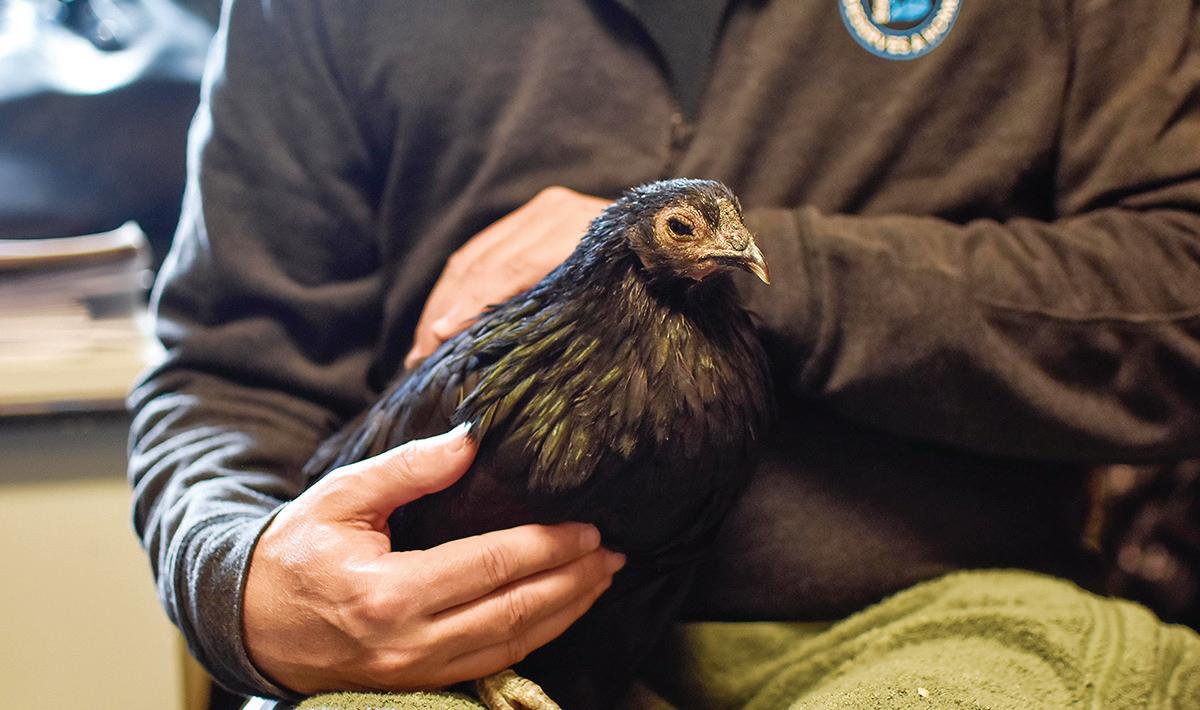
Sumi’s life started out like most chickens. She lived on a farm, laid eggs and did everything else chickens do. She likes grapes and mealworms. She doesn’t like onions.
In many ways, she’s a textbook chicken.
The only thing not typical about Sumi is her retirement gig.
While many embrace their old age as a chance to rest, Sumi has taken on a new mantle as an emotional support chicken at Friend’s Place Shelter — Bloomington’s primary overnight shelter for women. Friend’s Place is an affiliate program of Beacon. Erica Alvey, Friend’s Place case manager and team leader, raised Sumi. Alvey’s family has a farm, she said, and they raise chickens for eggs, goats for milk and grow vegetables in a garden.
Sumi is a black Sumatra chicken, a breed that originated in the Sumatra Island of Indonesia. Alvey named Sumi after her breed.
Sumi’s 13 years old, Alvey said. Sumatra chickens typically live to be about 8 years old but can live up to 20 with proper care.
In Sumi’s old age, Alvey began to notice a major problem — as the chicken
just need to know what's going on’
personnel.
The conflict's death toll has grown outside Iran, as well: nearly 600 people in Lebanon. Seven American service members across the Middle East. Twelve civilians in Israel, and more than 30 people in other neighboring countries.
Alireza saw a video of his high school in Iran after strikes hit, showing classrooms destroyed.
“It's kind of sad to see these things,” he said, “but actually, what I believe is the high school or the classrooms are not important, the people are important.”
A third-year IU PhD student, who requested anonymity to protect her and her family, said some of her close relatives’ homes had been bombed in Tehran. Some family members who could leave did so. Others had to stay for work.
“They're not feeling that good, in general, because it's war, but they are hopeful that the regime changes and they wouldn't be dealing with this evil government
ran around the farm, as chickens often do, her neck didn’t properly support her head. Instead of keeping her head stable, it would spin around in circles, causing her to lose balance and making Alvey concerned for her health.
After the realization, Alvey began to keep Sumi indoors in pens, watching younger chicks. She was scared the grown hens and roosters would bully her.
Alvey began her role at Friend’s Place in August, she said. So did Sumi. “I thought, ‘Well, let's see if, you know, people, maybe clients would like interacting with her,’” Alvey said.
They did.
Now, Sumi lives full time in a crate in Alvey’s office inside Friend’s Place. The office has become a sort of animal farm, because the shelter will sometimes foster animals for its clients while they find housing.
Sumi’s current coworker, besides Alvey, is a white cat with brown spots named Snowball.
“She doesn't make the ‘loud chicken noises,” Alvey said. “The first time a cat was in here, she made a little bit of a distress sound or one time, someone brought a dog in, she made a little bit of a distress call.”
Sumi’s almost iridescent,
another 50 years,” she said.
IU professor Mostafa Beshkar was born in 1979, the year the Islamic Republic of Iran was established after the revolution that overthrew Shah Mohammad Reza Pahlavi.
His life growing up, he said, somewhat followed the population’s brewing disillusionment with the regime.
He watched frustration develop, protests periodically swell, the population become less religious and the economy worsen.
The last time he visited was in 2022, right before mass protests engulfed the country after 22-year-old Mahsa Amini, arrested and accused of wearing her hijab improperly, died in police custody. Iran Human Rights estimates state forces killed a minimum of 551 protesters in the unrest.
“You could feel it in the air that something was going to happen,” Beshkar said, “because of all the
black feathers are softer than they appear. The colorful, reflective sheen over the black feathers was described by Lindsey Dominguez, the Friend’s Place program director, as mimicking the appearance of an oil spill.
Whenever Sumi’s taken out of her cage and is put onto someone’s lap, she’s accompanied by a “just in case” green hand towel, functioning as a diaper.
Alvey said many of the shelter’s clients seek out Sumi’s company.
“It ended up being quite amazing, actually, the connection she's been able to make with some people and the comfort she's brought to some people,” Alvey said.
One time, Alvey was comforting a woman going through severe psychosis. It didn’t seem like anything was helping. So, she brought out Sumi and started telling the client about her.
“She was patting around seeing how soft she was and it kind of grounded her and enabled her to be able to sleep,” Alvey said. “It kind of brought her a little more back into our, you know, shared reality.”
Dominguez helps care for Sumi when Alvey isn’t working.
“Usually, I'm just talking to her as I'm doing whatever,” Dominguez said, before
conflicts between people and the morality police that year.”
In January this year, protests again swelled. Contact with most people inside Iran became impossible for weeks as the Iranian government cracked down, killing thousands. Iran’s government put the number of protesters killed at nearly 3,000.
Time Magazine, citing two unnamed health ministry officials, reported that as many as 30,000 people were killed. The Guardian, citing medics and morgue staff, estimated the death toll exceeded 30,000.
Beshkar left Iran in 2003 to study in the United States, where he moved permanently. He’s now a professor of economics at IU, also watching and reading the news.
“My sleep is completely messed up,” he said.
His family is still in Iran and calls him periodically. He said he’s hearing a mix of hope and fear from them. People celebrated on the
streets of Iran after Khamenei was killed. But he’s afraid the war might be taking a different turn — from toppling the regime, toward weakening the state.
The aim of the United States and Israel’s strikes remains unclear. On Feb. 28, President Donald Trump said the goal was to defend against imminent threats — an allegation countered in U.S. intel briefings — as well as to prompt regime change and destroy Iranian military and nuclear development.
U.S. Secretary of State Marco Rubio later clarified the imminent threat was an Iranian response to a planned Israeli military attack.
More recent messaging suggests a de-emphasis on regime change. On March 1, Trump said the potential leaders U.S. government officials “were thinking of” to replace Khamenei had been killed in the strikes.
“The U.S. every day seems to have — at least seems to propose — a different objective,” Beshkar said. “That makes me worried
that maybe they don't have a very coherent strategy of what they want to do.” Some attacks on civilian infrastructure, including Israeli strikes on fuel depots, have gone too far, Beshkar said. He wants people to contact senators, representatives and anyone in government to push for a clear strategy of regime change.
“(People in Iran are) bare handed. They can't help, they can't fight, because government already killed and prisoned everyone who fought back.”
A third-year IU PhD student
“The objective should remain liberating the country from this state, from this regime,” he said. “Just weakening this state and just leaving is not going to be a long-term solution for the West, and of course, it's going to be a terrible situation for people in Iran.”
Explaining the nuances of the war is difficult, the third-year PhD student said. She woke up to the news of war breaking out in shock. When she heard Khamenei was assassinated, she was happy — she considered him the root of much of Iran’s problems. After hearing that news, the student said things have been different. It’s difficult to know what the war will hold. Worse, she said, it’s hard to explain what’s going on to others in Bloomington, or why some Iranians wanted a war. She and Alireza said it was inevitable. She views supporting the strikes as choosing a lesser evil. But that’s hard to communicate. There’s so much pulling her and Alireza in countless directions: hoping for regime change, fearing the war takes a turn for the worse or that the Islamic Republic remains in power.
“(People in Iran are) bare handed,” the student said. “They can't help, they can't fight, because government already killed and prisoned everyone who fought back.”
adopting a baby voice. “So, like, ‘Excuse me, I'm gonna get your water now.’”
Clients talk to Sumi too. They hold her and tell her about their days.
“I think all animals have a capacity to connect with human beings,” Alvey said. “I don't think people realize, a lot of people think chickens are stupid, but they're actually not. I mean, well, they're little dinosaurs in some ways. I think just any animal has a capacity to make connection, and I think she feels that. I think they innately feel that kind of energy or that
ability to connect with love and with affection, depending on how they're treated, you know? She's wise, she's old and she likes to give a little advice.”
Dominguez said most clients just call Sumi by her name as they’re talking to her.
“We have had a few people make like fried chicken jokes,” Dominguez said. “That’s not our girl. She's not interested in that.”
Sumi’s tenure at Friend’s Place shows no signs of stopping. The clients love it. The employees love it. Sumi
probably loves it. “I think it's fun for people to have something unique, you know, something a little different,” Alvey said. “I know some of the people, some of our coworkers in the community and other agencies like to come by and visit her once in a while. She can add a little de-stress, you know like, ‘Hey, just stop by and hold the chicken.’” Sumi the chicken, though she was a rather vocal onlooker during most of the interview with the Indiana Daily Student, declined to comment.
Meet the new dean of IU School of Public Health
By Sofía Rodríguez sr73@iu.edu
Kurt Ribisl began his role as dean of the Indiana University School of Public Health-Bloomington on March 1. He has goals to bolster research, secure more funding and work alongside the state health department.
Ribisl succeeded interim dean Suresh Viswanathan, who held the position since July 2025, following former dean David Allison’s departure.
“I was very interested in the Indiana University Bloomington position, because here is, I just think, an excellent school with a large student enrollment,” Ribisl said in an interview with the Indiana Daily Student.
Ribisl said he started the application process in October 2025 and had multiple interviews with various members of IU administration, including President Pamela Whitten and other schools’ deans and department chairs.
Throughout the process, Ribisl met with other School of Public Health faculty members to discuss the future of the school should he
By Natalie Chan nkchan@iu.edu
Zachary Goldberg was frustrated. In summer 2024, the then-IU sophomore was studying for the Law School Admission Test while abroad in Budapest when he realized none of the existing prep platforms felt like the right fit. So, he took matters into his own hands.
Alongside IU students Jack Wilber and Gabriel Shores, Goldberg, now IUSG student body president, built a study platform designed to make LSAT prep more accessible and personalized for students.
Lawgic Prep officially launched Feb. 23 with Goldberg as its chief executive officer. Wilber serves as chief operating officer, while Shores is the chief technology officer.
Goldberg said Lawgic is an LSAT content provider officially licensed with the Law School Admissions Council, a not-for-profit organization that provides services like admissions data or test registration to support accessibility and equity in
become dean.
Following those interviews, Ribisl was hired under former IU Bloomington Provost Rahul Shrivastav and Chancellor David Reingold.
“It’s a pretty rigorous process,” Ribisl said. “It’s a big job, and so that’s, I think, why they really want to vet the person.”
The dean serves over 3,700 undergraduate students and around 450 graduate students, acting as the school’s chief academic and administrative officer. The school has five departments: Applied Health Science; Environmental and Occupational Health; Epidemiology and Biostatistics; Kinesiology; and Health and Wellness Design.
Ribisl will manage the annual $55 million budget and reports to the provost and executive vice chancellor. As of February 2026, John Ciorciari is the interim provost and executive vice chancellor.
Prior to this role, Ribisl worked at the Gillings School of Global Public Health at the University of North Carolina at Chapel Hill for nearly 30 years. He worked as a professor and health behavior
law school admissions. As a licensee, Lawgic is authorized by LSAC to instruct LSAT content, which is trademarked by the council.
Goldberg said Lawgic was inspired by his experience using other LSAT prep programs, believing them to be uncomprehensive in study material. Some platforms offered incomplete answer explanations and others lacked insights on law school admissions data, he said.
“I was always trying to look for, like, different ways to do things, and that led to me having to use, like, three to four different platforms while I was studying,” Goldberg said. “Not only to get, like, analytics, but just to understand the questions.”
LSAT prep programs like Kaplan begin pricing as low as $899 for basic plans and up to $1,999 for more advanced packages.
Goldberg said not everyone can afford the steep price tags that came with accessing LSAT study resources. He said he felt like the prices for LSAT prep were egregious in comparison to
department chair, which was a good launching pad for his career, he said.
During his time there, he taught two courses titled, Theories of Changing Health Behaviors and Italian Food, Culture and Health. Ribisl said he hopes to teach Italian Food, Culture and Health here at IU.
“I worked at the Michigan department of health as a graduate student, and that got me very interested in the field of public health,” Ribisl said.
Ribisl served as a member of the Tobacco Products Scientific Advisory Committee for the U.S. Food and Drug Administration Center for Tobacco Products from 2012-16. The committee reviews and evaluates the safety, dependence and health issues related to tobacco products.
In the School of Public Health, Ribisl will work alongside other senior faculty members and the leadership team.
“We have an outstanding senior leadership team,” Ribisl said. “That includes people who work in the dean’s office.”
For the future of the
other standardized test prep resources.
Lawgic, he said, was created to even the playing field and ensure that everyone could have a shot at succeeding on the LSAT.
Gabriel Escobedo, Maurer School of Law assistant dean for community, impact and engagement, said affordability and access to LSAT prep are the main topics he discusses when working with students at the Maurer Vision Program, an initiative to guide undergraduates toward law school.
“There are a lot of students who look at the affordability of programs, and they’re realizing that they can’t afford it,” he said. “Maybe they can afford a month, so they’re trying to find ways to get those opportunities.”
Escobedo said the Maurer Vision Program teaches students to research different law school programs and rankings on websites like the American Bar Association and the U.S. News and World Report. Lawgic, he said, would be a great
school, Ribisl hopes to work on improving engagement with the Indiana Department of Health surrounding public health issues, bolstering research, securing external grants for the school, focusing on maximizing student success and increasing fundraising, he said.
The school researches sexual health promotion, AIDS/STD prevention, biostatistics, underwater science and nutrition and exercise.
“We are going to be working to really raise money for student scholarships that again goes back to student success,” Ribisl said.
The dean also hopes to better connect the school with its alumni base. The School of Public Health has one of the largest living alumni bases of public health schools in the country, with over 32,000 members.
Ribisl said he hopes to accomplish these goals by hiring additional staff in the school, such as more academic advisors, professors and faculty members.
The school currently has more than 375 faculty and staff members, according to the office of the provost and executive vice chancellor website.
opportunity for students to find verified information in one place.
Lawgic offers one study package priced at a flat rate of $50 per month or $120 every three months.
LSAC’s LawHub currently offers four official LSAT preparation tests for free.
“We don’t unlock additional features if you pay more,” Wilber said. “We want to have one tier where you get everything that we provide, and everything there is supposed to maximize your chances of getting the score you want.”
Goldberg said Lawgic contains the same core features established LSAT prep companies like 7Sage or the Princeton Review provide. Those features include over 5,000 official LSAT questions with explanations written by Goldberg.
After Lawgic comes out of beta testing around next month, Goldberg said video lessons will be added to the platform.
What sets Lawgic apart from other platforms, Wilber said, are tools such as an artificial intelligence aid
Ribisl said contracts for dean positions are typically four to five years and then considered for renewal.
Ribisl said there will be several events for him to meet with students and faculty members, one being a year in review presentation in April, where he will answer questions from faculty and staff about the status of the school.
that grades essays and the program’s partnership with LSData, an online resource used by law school applicants to explore trends in admissions data, compare schools, converse with other applicants and monitor application statuses.
After the Law School Admissions Council removed the analytical reasoning section, known as Logic Games, from the LSAT in August 2024, there remain 58 official practice tests.
Lawgic automatically builds practice question sets based on the category, type and difficulty of questions from question banks of those official tests, Shores said. Additionally, users can review the full question bank stored in a more advanced interface, allowing them to build a personalized practice set.
When sifting through online forums, Goldberg said he noticed people found success when studying conditional logic questions in addition to official LSAT questions. Conditional logic questions are problems based on if-then statements where one condition leads to another outcome. Lawgic offers over 1,000 conditional logic drills, which Wilber said are compatible with mobile web browsers.
When developing Lawgic, Shores said getting feedback from students was a part of the process. After speaking with Kappa Alpha Pi, a pre-law fraternity at IU, Shores said students requested a dark-mode feature for the platform, which he has already begun implementing.
“It’s really just been trying to build something to last,” Shores said.
Alex Vitat, founding president of the IU chapter of Kappa Alpha Pi, said he likes the intuitiveness of Lawgic’s user interface. Vitat is a senior studying political science with minors in French, music production and world politics. He said he plans to attend law school.
“Lawgic was designed in a way that, at least to me, it seems to emulate a lot of the best of all the worlds of prep that there are,” he said. Vitat said he and Gold-
berg have discussed creating a partnership between Kappa Alpha Pi and Lawgic.
“It’s like for students, by students,” Vitat said. “And for that reason alone, I think it would speak really well to, I mean, some of his values and some of the values that we’ve seen in our organization.”
Having tutored over 100 students as the founder of IU’s Corporate Law Club, Goldberg said receiving their feedback on his answer explanations helped him write new ones.
Lawgic includes a flagging feature in which students can report explanations they feel are unclear. This then notifies Goldberg, who said he writes a new explanation within two to three days to better suit the student’s understanding.
“If people find a bug or if they want a feature, they can request that from Gabe, and we really want to have those done for the most small things,” Wilber said.
Currently, Shores said Lawgic is trying to establish a close bond with its initial users, making sure to stay in touch with them in the case they face any issues with the program. Building a strong community for students is something Lawgic is working hard on, he said. Goldberg added that a friend-finding feature is a future consideration for the platform.
“To our knowledge, we’re the only LSAT, like, website and platform run by undergraduate students like in the world, and so we try to really go with the times,” Goldberg said. “I think we have a unique perspective on what it looks like to study for this exam while also being a student.”
Goldberg said he sees Lawgic expanding its video lesson library, establishing a presence on college campuses and building a friendnetworking platform on the site.
“This is a platform that is built for students,” he said. “Our job is to make their LSAT studying experience as good as it possibly can be, and we’re here to do that, you know, and that’s never going to change.”
COURTESY PHOTO
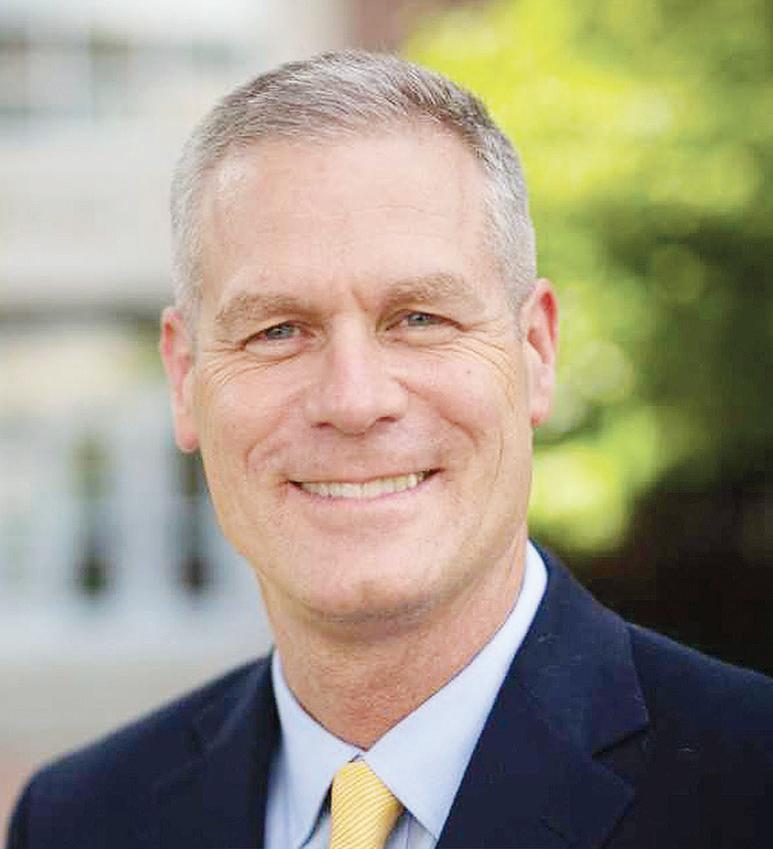
Kurt Ribisl poses for a headshot. Ribisl became dean of the IU School of Public Health-Bloomington on March 1.
Bloomington received $50,000 to manage emerald ash borer damage and restore its urban canopy
By Avery Reis amreis@iu.edu
Bloomington’s Parks and Recreation Department was awarded a $50,000 State Urban Forest Resilience grant from the Indiana Department of Natural Resources Feb. 19 to manage the impact of invasive beetles on the city’s trees.
Haskell Smith, urban forester for Bloomington, said the funding will support the assessment and treatment of 530 ash trees along public streets and in city parks. Smith said the grant will help determine which trees can be preserved through treatment and which should be removed as part of a longterm management plan.
The emerald ash borer, an invasive beetle that kills ash trees, was first detected in Bloomington in 2012. Since then, the insects have killed many trees across the city.
“We’ve lost hundreds, if not thousands, of ash trees all around Bloomington due to these little guys,” Smith said.
The beetle kills ash trees by burrowing beneath the bark and interrupting the tree’s ability to transport water and nutrients. Smith said infested trees typically die within two to five years without treatment. As trees decline in health and lose critical internal functions, they can become brittle and structurally unstable, increasing the risk of falling limbs during storms or high winds.
Smith said public safety is a key concern, particularly in parks, near sidewalks and along roadways where fallen trees or branches could pose hazards.
Under the grant, the city has a contract with The Davey Tree Expert Company to conduct upcoming evaluations and potential removals of the remaining ash trees on city property.
Smith said the evaluators will give each tree a health rating to guide decisions about treatment, monitoring or removal. Trees that re-
main structurally sound and show limited signs of infestation may be candidates for chemical treatment. Trees in advanced decline, or those located in high-traffic areas, may be removed.
Local city funding, Smith said, will match the $50,000 state grant with approximately $67,000. From that, the city has about $20,000 that is used for treating about 125 to 130 ash trees a year, Smith said. After planting and cutting trees, building reports and holding educational workshops, it has slightly more than $40,000 that it provides in its own funding.
“It’s a good start,” Smith said. “But it’s not gonna do everything all at once.”
The goal of the city’s al-
ready allocated funds is to reduce the number of ash trees requiring ongoing treatment to a manageable level that can be sustained in future budgets.
“I think the idea behind it is to get it down to a manageable number, so 250- to 300ish number is what we’re looking to treat in perpetuity,” he said. “We’ve already been allocating this amount of funding for it and we will continue doing that, but we need to remove the ones that are on the way out on a timeline that makes sense. And then replanting as we go.”
Replanting is a central part of the city’s strategy. Officials plan to plant two trees for every ash tree they remove, using a range of native species selected for re-
silience and adaptability.
Smith said diversifying the urban canopy reduces the risk that a single pest or disease could eliminate a large share of the tree population. Increasing the variety of species can also improve overall ecological health and long-term resilience.
“Tree diversity prevents this from happening again,” Smith said. “If you have eight different species instead of two, then when something comes along, you may only lose 10% of your canopy instead of half or more.”
Officials encourage residents who have ash trees on private property to monitor them for signs of infestation. According to Smith, common indicators include visible stress in the tree canopy,
small V-shaped exit holes in the bark and increased woodpecker activity.
Smith said homeowners should consider professional evaluation if they suspect their tree is infected.
“Emerald ash borer will kill your ash tree if it gets infected,” he said. “Have our team evaluate it, if it is not already getting treated, consider it. It is expensive, but usually good for two to three years, and if the tree means a lot to you, it’s worth it. I definitely suggest treatment.”
In addition to assessment and treatment work, the department plans to host public workshops to provide information about ash tree management and the city’s broader program. Sessions are scheduled for July 2026
and February 2027 and will focus on privately owned ash trees and options available to residents.
“We will focus on privately owned ash trees, what you can do, and I’ll talk about the city’s program and what we’re doing and have a couple other speakers,” Smith said. The matching funding will allow Bloomington to address immediate safety concerns while transitioning toward a more diverse and sustainable urban forest, Smith said. Residents seeking more information about ash tree treatment, removal or upcoming workshops can contact Smith at smithh@bloomington.in.gov or visit the City of Bloomington website.
Students allege misleading practices by classroom internship recruiter
By Annabel Prokopy
aprokopy@iu.edu
IU freshman Elliott Elston didn’t want a bad grade.
It was the first day of his accounting class at the Kelley School of Business this spring, when a recruiter came in with a pitch: he easily could make thousands of dollars and build his own business and career in just a few months with their company, College Works Painting.
Then, he was handed a paper form asking for his information. He was hesitant but filled it out — all of his peers were doing the same.
“It’s your first class of the semester,” Elston said. “He had the floor. I don’t want a bad grade or whatnot.”
Elston said that the recruiter came into his business presentation class the next day and gave the same pitch. He became skeptical of the company and did not fill out another form.
“He noticed me pass all of them back and he pulls another one out of his pocket and puts it on the desk right in front of me,” Elston said. “And this was when I was like okay, something is definitely off, he’s like really jamming these papers. Something is definitely not right.” It left a bad taste in his mouth — and he wasn’t alone. In interviews with the Indiana Daily Student, several students at the Kelley School of Business said they felt misled by the company’s recruiting, interviewing and employment processes. They shared experiences that College Works Painting President Sean Phelps said directly conflict the company’s existing policies and practices.
On Jan. 23, Dan Li, Kelley’s executive associate dean for faculty and academic affairs, told the
College Works Painting frequently pitched its internships to classes at Kelley
school’s faculty in an email, obtained by the IDS, that companies not associated with IU are prohibited from collecting any personal information from students. It’s unclear if this directive resulted from complaints surrounding College Works Painting, and a Kelley School of Business spokesperson declined to provide more information.
But damage to students and the school is already done, some students said.
IU sophomore Isaac Knight had heard the familiar pitch from College Works recruiters several times.
But after going through the interview process, he was skeptical of the claim that he would gain hands-on experience and make thousands of dollars.
“They just kind of sell the idea of being an entrepreneur and owning your own business. But really, it’s all falsetto for their pyramid scheme. It’s a recruitment scam.”
Issac Knight, IU Sophomore
What is College Works Painting?
College Works Painting is active in 13 states, including Indiana, according to its website. The company commonly recruited students by sending representatives to hand out forms with the company’s logo in classes throughout IU’s campus, frequenting business and management courses in the Kelley School of Business.
The company trains interns to manage a team of employees throughout the summer and tasks them with identifying and leading home painting projects in designated areas, according to its website.
In an interview with the
IDS, College Works Painting President Sean Phelps described the internship as a leadership and business development opportunity.
“We train high-achieving college students to learn how to run a real business, and students aren’t just observing or shadowing, they get to help operate the business,” Phelps said.
According to College Works Painting’s website, the company’s profit structure is commission based. They provide “training, marketing materials, licensing, accounting, and customer service” to interns and take a portion of their earnings.
Phelps said the interview process is thorough and competitive. Prospective interns go through multiple rounds of meetings with College Works Painting and meet with past interns to determine if they are the best fit for the opportunity.
Phelps said College Works Painting provides the business structure, training and financial backing for students to succeed throughout the opportunity and that the interns take on no financial risk.
“Students are guaranteed to earn money if they work here, and there’s no financial risk whatsoever to the student,” Phelps said.
However, this wasn’t the case for IU senior Jacquelyn Swanson, who trained and interned with the company last summer. By the end of her experience, she said she’d lost about $1,100. Swanson said that during her time with College Works Painting, the company tasked her with recruiting and managing a team of employees to paint houses. She said she did not receive adequate support or training from the company and struggled to be successful, often working 16-hour days. She said she asked her supervisor frequently to come
to her painting work sites in Bloomington and help her solve challenges with production. Despite her requests, Swanson said her supervisor only came once, on a day Swanson was out sick.
Additionally, Swanson alleged she had to purchase project materials on her own. To pay her rent, she’d have to use drawdowns from the company, a process used by interns to manage living and project expenses until their business becomes profitable.
When marketing, Swanson said the company directed her to knock on each house in an assigned neighborhood. She said if she did not knock on certain doors, such as doors with “No soliciting” signs, her supervisor at the company asked her why she did not contact the homeowner.
“They blatantly make you feel bad about not being able to produce,” Swanson said.
In an interview with the IDS, Phelps said Swanson’s experiences — purchasing project materials on her own and door-knocking at homes with “No soliciting” signs — run against what the company advises.
“If someone feels like they worked here and they weren’t compensated or something, reach out to me” Phelps said. “If they were truly wronged, I want to take care of it.”
Phelps said students should know they are filling out information for College Works recruitment and encouraged potential applicants to research the opportunity themselves.
“We don’t want anyone to feel pressured to want to participate in the intern-
ship,” Phelps said.
IU Director of Computer Skills at the Kelley School of Business Brant Moriarity said in the interest of preserving class time, he does not allow representatives from College Works or other businesses to come into his classes. Moriarity said the opportunity could be good for some students. However, he said that his perspective comes in the interest of safeguarding students from “data mining and collection and deceptive marketing.” Swanson, on the other hand, wants students to know about the risks. “From what I’ve seen with this upcoming season, I worry for the students at IU,” Swanson said. “I just wish they wouldn’t be taking advantage of students who don’t know what they’re doing.”
JACK JERNIGAN
ANNABEL PROKOPY | IDS
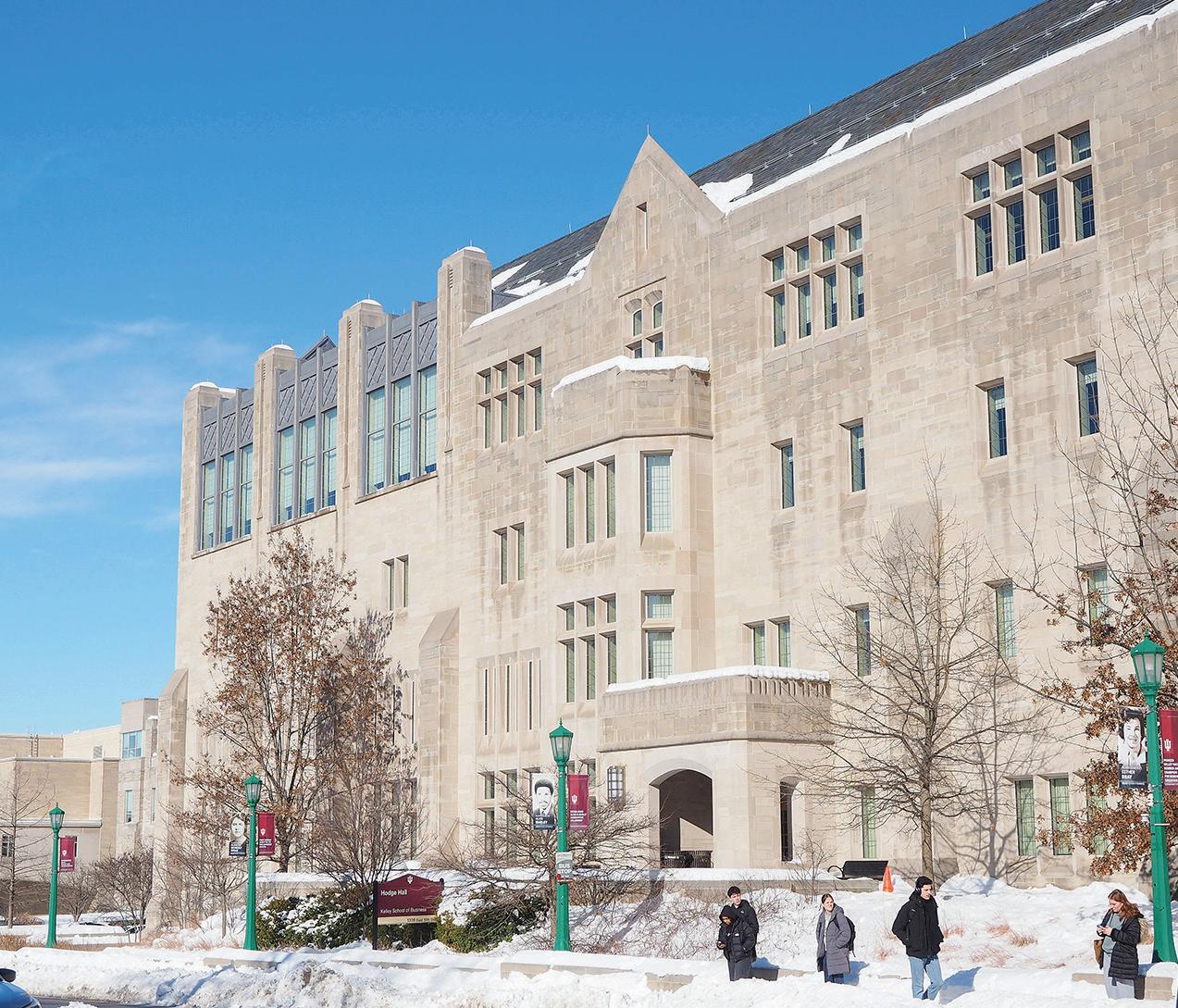
The Kelley School of Business is pictured Jan. 29, 2026, at 1275 E. 10th St. in Bloomington. College Works Painting sent recruiters to classrooms at the beginning of the spring semester.
EMPOWER wins IUSG election: unofficial results
By Natalie Chan nkchan@iu.edu
The EMPOWER ticket won the 2026 IU Student Government executive election, according to preliminary results released March 6 by Election Director Jack Tyndall. EMPOWER earned 62.06% of the total vote, while FORWARD received 37.93%.
Junior Alexa Avellaneda and sophomore Anna Sofia Nguyen Loeb comprise the 2026 EMPOWER ticket. President-elect Avellaneda is an IUSG congressional representative majoring in political science and minoring in public relations. She is also the vice president of marketing of Sigma Lambda Gamma National Sorority, Inc. Loeb, who is majoring in music business and minoring in sociology and Spanish, is involved
with the Vietnamese Student Association and is a student ambassador for the Jacobs School of Music.
“This victory represents more than just being elected as Student Body President and Vice President,” Avallaneda wrote in a statement to the Indiana Daily Student. “It reflects the shared strength of a community that came together around a shared vision for a more transparent, equitable, and student-centered IU.”
In spring 2025, EMPOWER received 45.61% of the total vote, the second-place ticket to ACTION. The EMPOWER ticket was led by then-sophomores Omeed Mehrzad and Sarah Alhaddad.
In the statement, Avellaneda said the momentum and relationships built by the spring 2025 run estab-
lished the foundation for the current campaign.
“Over time, our coalition expanded to include a wide range of student organizations, communities, and individuals who believe deeply in improving the daily livelihood of students and strengthening accountability for IU administration,” Avellaneda wrote.
EMPOWER emphasized advocacy, diversity and development during its campaign. EMPOWER received endorsements from student organizations including the Middle Eastern Northern African Association, Indiana Graduate Workers Coalition, Queer Student Union, the Minority Association of Pre-Med Students and Latinos Unidos.
In its official policy document, EMPOWER supported values like student
representation and safety, free speech and diversity, equity and inclusion. EMPOWER’s policy proposals include increased campus parking, longer dining hours, an IUSG Sexual Assault Survivors’ Fund and a $15 campus minimum wage.
Tyndall released preliminary voting results on the IUSG website March 6, just over a day after voting closed March 4. In a statement on the IUSG website, Tyndall wrote the election was one of the most successful in turnout, with “roughly 4,000 students casting ballots despite the week of rain.” There were 5,389 votes cast last spring. In an email addressed to the candidates, Tyndall wrote the preliminary results are not final and the IUSG Supreme Court has responsibility for certifying
the
after the voting
Dr. Tavel Family Eyecare is your partner in your
Baron D Hall, DDS, MSD Jake
Willhite, DDS, MSD Orthodentists
Erica Hall, Hannah Elliott, Kaitlyn
Jacobs, Marilyn Lee, Adrian Price
With modern techniques and a fun style, B-town Orthodontics is the most up-and-coming orthodontics office in the Bloomington area!
We offer the latest technologies including invisalign, gold brackets, laser treatments, and even mini implants that can help restore missing teeth and even eliminate the need for surgery. B-town Orthodontics offers FREE consultations and don’t forget to download The Braces App, the hottest free app designed by B-town Orthodontics’ Dr. Baron Hall.
Mon. & Fri.: Appointments Only 1320 W. Bloomfield Rd., Suite B 812-287-8851 btownorthodontics.com
Ryan D. Tschetter, DDS Lauren R. Hoye, DDS Jackson Creek Dental is conveniently located on South College Mall Road. Most insurances accepted, including the Indiana University Cigna Insurance plans as well as the IU Fellowship Anthem. Dr. Tschetter and Dr. Hoye offer state of the art dental technology such as Zoom whitening, same day crown appointments, and Invisalign. We also provide restorative, cosmetic and emergency care. We pride ourselves in giving the best care to our patients while offering a pleasant yet professional atmosphere.
Providing individuals, couples and family counseling as well as psychiatric evalutation and medication management. We ensure that individuals of all ages, experiencing mental illness can better manage life.
Mon. - Thu.: 9 a.m. - 6 p.m. Fri.: 9 a.m. - Noon 5010 N. Stone Mill 812-929-2193 newoutlookcc.org
Ricardo Vasquez MD Medical evaluations: varicose veins, leg pain and swelling. No refund needed.
Mon. - Fri.: 8 a.m. - 5 p.m. 815 W. Second St. 812-336-6008 vascularcenterandveinclinic.com
Dr. Starr is an IU Football Alum who provides pain-free experiences for all Hoosiers with IV sedation. He specializes in Wisdom Teeth Extractions, Dental Implants and Plasma Therapy while utilizing 3D imaging technology. Accomplish fast and predictable healing with Plasma Therapy to avoid dry sockets after extractions. Voted the Most Trusted in Bloomington, they look forward to accomplishing continued successful results every day for all Hoosiers.
A Way of Wellness Chiropractic specializes in comprehensive spinal care. We offer treatment for many different spinal conditions and problems, while also addressing the body as a whole. We provide effective chiropractic care helping patients reduce stress, improve mobility and spinal health. The quality treatment we provide is always fit to your individual needs and goals. Let us help you achieve and maintain good spinal health. We look forward to meeting you!
Mon. - Thu.: 8 a. m. - 6 p. m. 1121 W. Second St. 812-336-2225 bloomingtonchiropractor.com
Dr. Tavel Family Eyecare is your partner in your personal eyecare journey. Since 1940, the company has believed that every Hoosier deserves quality eyecare and vision solutions at an affordable price.
Dr. Tavel offers comprehensive eye exams, special testing, management of eye diseases, glasses, contact lenses and much more, all backed by an insurance acceptance guarantee. The company is committed to advancing eye health by investing in the latest technology and providing treatements that are right for every patient’s unique needs.
IU Student Government banner stands Sept. 30, 2024, inside
IUSG office at the Indiana Memorial Union in Bloomington. The EMPOWER ticket won the 2026 election, according to preliminary results released March 6.
Here’s how IU President Whitten should use her $100K raise
Eric Cannon (he/him)
is a sophomore studying philosophy and political science and currently serves as a member of IU Student Government.
When the Board of Trustees scheduled its February meeting, another payday for Indiana University President Pamela Whitten seemed a fair bet. Four of the board’s past seven meetings have brought Whitten either a raise or a bonus. This time, the trustees bumped her salary to $1 million a year.
Trustees chair David Hormuth cited IU’s increased research spending and new industry partnerships as evidence of Whitten’s success. Yet during her tenure, IU has been ranked the worst public university in the country for free speech. A year before she took office, it ranked 13th best. In 2024, 93.1% of around 900 Bloomington faculty voted no confidence in her leadership. The gap between the trustees’ assessment of Whitten’s presidency and the mood on campus is hard to ignore. But it is not surprising that the board rewarded Whitten for what it deemed a strong financial performance. IU is a public trust, and the trustees are responsible for resourceful stewarding of taxpayer funds. They employ Whitten to carry out the day-to-day tasks of that stewardship,
not necessarily to lead the university as a community. This pay raise, however, provides Whitten with the chance to do exactly that. It is one thing to receive a pay raise. It is another to accept it. Presidents at the University of Notre Dame traditionally do not accept their salaries. In 2015, President Father John Jenkins was paid just over $1 million. He donated the entire sum to the Congregation of the Holy Cross, the Catholic order that governs Notre Dame. Jenkins’ successor, Father Robert A. Dowd, followed the same practice. In 2024, Dowd received
$320,900 and gave it all to the same order. These examples reflect another understanding of the university presidency. At Notre Dame, the office is treated as a pastoral as well as a managerial one. Jenkins, by many accounts, could often be found walking Notre Dame’s campus and talking with students. On one occasion, a student asked him to film her making a snow angel. I, for one, have not seen Whitten around campus except on the field in Memorial Stadium. Nor have I met anyone else who has. Bear in mind, Whitten must manage a network
of campuses, while Notre Dame’s president attends to just one. In some ways, the role of Notre Dame’s president better resembles that of Chancellor David Reingold, who is responsible solely for IU’s Bloomington campus and who does work to engage students. But if Whitten wished her presidency to be remembered as one focused on community, not just management, she could take a page out of Notre Dame’s book and spend more time among the members of the community she oversees. One such way to ingratiate herself with the campus before setting foot on it would be to gift her sal-
SPENCER’S SPIEL IU’s hidden gem: rocks!
ary for campus service.
Granted, Whitten is not a priest who has vowed to live in poverty. Notre Dame’s presidents are. But choosing some personal sacrifice, even to a smaller degree, answers the call of leadership beyond the contract.
So, President Whitten, I have a deal. Keep your first $800,000. Treat yourself with the next $100,000. Then, give the remaining surplus to the campus. Below, I’ve started a list of some suggestions for where these donations could go.
1. Pay for bonuses to campus grounds crews and maintenance staff.
2. Fund student media.
Wealthy donors have always supported public services.
3. Donate to Bloomington charities combatting homelessness.
4. Commission new campus art.
5. Sponsor an intramural competition.
6. Improve an accessibility ramp. Perhaps it should be heated.
7. Support students with housing lease gaps.
8. Provide childcare for nontraditional students.
9. Host a commencement speaker at graduation this year.
10. Cover the cost of international students’ flights home during break. And that is only the beginning. I trust students and faculty can suggest plenty more. While none would solve all the problems facing IU, that is not really the point. Problems will always exist, and no amount of routing money hither and thither will plug the hole in the ever-sinking ship of higher education.
The possibility of a university president giving her pay to her community, however, would show a kind of leadership measured more by the willingness to be transformed through service than by institutional outcomes.
ericcann@iu.edu
Spencer Schaberg (he/him) is a sophomore studying microbiology.
Imagine watching the Empire State Building being constructed in reverse. From high above, you see masons, plumbers and electricians work like ants to dismantle floor after floor and load the materials onto enormous truck beds. They drive backward to the nearby railyard, where steel beams and stone slabs are separated onto train cars and pulled across the country to their origin point.
You notice something unusual: The trains carrying the stone have all arrived at a single, familiar location. If you had the mystical powers to witness the Pentagon deconstructing itself against the flow of time in a similar way, you would eventually reach the same starting point. You could watch the assemblages of 35 state capitol buildings in retrograde, and in every case, their stony exteriors would come to rest in the quarries of southern Indiana. The same is true for many of the buildings on Indiana University’s campus.
But what could the Empire State Building, the Pentagon and most state capitol buildings have in common with Wylie Hall?
You walk past the answer every day on your way to class, whether you know it or not. That cream-colored,
grainy stone everywhere isn’t just any cream-colored, grainy stone. That’s Indiana limestone, baby.
The material is vital for American architecture — it’s even been nicknamed the “nation’s building stone” — and it comes from right here in Monroe County. To understand how limestone got here, we have to look back a few hundred million years.
The continents were once united in a supercontinent called Pangaea, which centered roughly on the equator. During this period, the land that would eventually become Indiana was covered in a warm sea filled with invertebrate creatures of all shapes and sizes. As generations of gastropods and the like came and went, their shells and exoskeletons piled up on the seafloor.
Over time, these calciumrich remains were pulverized into a fine sand and solidified into a thick layer of rock known today as Indiana limestone. If you’re lucky, you can see marine fossils hardened into the limestone around campus, visible evidence of its aquatic origins.
Composed almost entirely of calcium carbonate, Indiana limestone is incredibly pure. This purity lends the stone a special property: it’s what stonemasons call a “freestone,” which means it can be cut from any direction without cracking. Freestones
are particularly useful if you’re looking to carve intricate designs into your structures. The giant brain sculpture outside the Psychological and Brain Sciences building is a great example.
The first Indiana limestone quarry emerged in 1827 in Stinesville, about a 20-minute drive from modern Bloomington. But limestone didn’t rise to fame until the 1870s after the Great Chicago Fire. Rebuilders looking for a fireproof, high-quality and workable material found the ideal candidate below southern Indiana’s surface, and limestone hasn’t left the spotlight since.
The birth of the skyscraper in the late 19th century took limestone to new heights. Along with the Empire State Building, the Department of Commerce, the National Cathedral and the original Rockefeller Center, buildings are full of the stuff. Limestone quickly became a go-to for architects of an ever-expanding America. Sea to shining sea was bridged not by amber waves of grain, but grainy blocks of lime.
The limestone boom certainly left its mark on our land. There are over 1,200 abandoned quarries throughout Indiana, including a multitude in Monroe County. Some have been repurposed as swimming pools, parks and chill spots
for college students to hang, yo. If you have the chance, you should definitely check out an old quarry (safely, and without trespassing).
Limestone is still used today, though not as commonly as it once was. Synthetic alternatives have reduced demand somewhat owing to their ability to resist corrosion due to acid rain. Nevertheless, several limestone quarries are still active in Indiana, and it remains a popular architectural design option.
Buildings on campus that look like they could be limestone probably are. The same goes for any kind of carving on campus — it’s a pretty safe bet. Indiana limestone is integrated into nearly every building at IU, providing campus its coherent architectural scheme.
From Sample Gates to Ballantine Hall to the Indiana Memorial Union, each IU landmark fits like an element of a larger whole.
Limestone is ingrained in more than just our surroundings, though. The Little 500 men’s champions in 2023, the Cutters, got their name from — you guessed it — cutting limestone.
The Cutters first appeared as the protagonists of the 1979 film “Breaking Away,” which tells the story of a group of underdog Bloomington locals who go on to win the Little 500.
“Cutters” is meant to be a slight on the locals, many of whom have personal ties to the limestone industry, coined by a group of wealthy IU students. The name is still used today, although the Cutters are no longer underdogs. The limestone-born bikers hold a record 15 Little 500 championships. I’d like to think limestone is also ingrained in our spirits as a source of Hoosier pride. Indiana limestone built this country, and Monroe County is one of only a few sources of the pure material in the world. If we didn’t already have Hoosier the Bison as our mascot, maybe we could’ve had Limey, the friendly limestone slab. Though decid-
edly less warm and fuzzy, Limey would have made a much more relevant representative of IU’s contemporary history. There’s a life lesson in the history of Indiana limestone, though it might be buried deep below the surface. If you can be both strong and shapeable — solid enough to weather the elements, but yielding enough to be carved into something intricate — don’t worry. You might be stuck in your quarry right now, but you can go anywhere in the world, my sedimentary friend. Wherever you end up, just don’t forget where your Paleozoic precursors deposited you. sschaber@iu.edu
Emma Howard (she/her) is a sophomore studying journalism.
We’ve all experienced some form of a parasocial relationship. Yes, you too. Whether you’ve sputtered out “She just gets me!” in between Phoebe Bridgersinduced sniffles, or gotten a little too attached to your pet rock in elementary school, you’ve experienced that one-sided bond to a persona unaware of your existence. Personally, I’m partial to Florence Welch. We’d totally be best friends if we met.
But what happens when the parasocial relationship replaces the authentic one?
With AI chatbots, that lack of authenticity is a real risk. As moldable as clay, your pocketable companion can be your friend, lover or even your therapist. That is, in theory. But imagine a friend who won’t tell you you’re being delusional about that one guy, or a partner who’s too docile to yank back the blanket to their side of the
bed. With chatbots’ current programming, relationships without tough love are the norm, which begs the question if they’re even relationships at all.
Computer science researchers at Stanford University conducted a study on chatbots’ feedback with 11 different AI models, including ChatGPT, Gemini and Claude. When asked about various situations regarding an internet user’s behavior, chatbots responded with encouragement 50% more than humans presented with the same scenarios.
The large language models that generate chatbots’ responses do so by mimicking the speech of users’ prompts input, essentially repeating back everything it thinks the user wants to hear. As a result, AI models have affirmed unhealthy and even dangerous behaviors, such as physical violence and self-harm.
AI chatbots’ ever-positive programming is risky for users. Their responses are
also simply not conducive to forming healthy relationships. This inadequacy may be unsurprising, considering chatbots are, after all, robots. AI can’t replicate the authentic feedback you would get from another person. When AI can only ever be kind, there is no struggle to grow from. Whereas in a human relationship, bonds become stronger through the trust built over time.
Troublingly, some prefer the easier route. Of course, that simplistic programming would not exist if men did not first desire real women to act in this way. Some men have formed parasocial bonds with chatbots in pursuit of emotionally uncomplicated romantic relationships with women.
Take 45-year-old Ohioan Blake, for example. Featured in a piece by The New York Times, he has been in a committed “relationship” with ChatGPT companion, “Sarina,” since 2022. Since his real wife had been un-
dergoing postpartum depression for nine years, Blake reported feeling like more of a “caregiver” than a husband. He created Sarina for support as he faced possible divorce and single fatherhood. Their “relationship” gained a romantic context after they were chatting back and forth and she happened to ask him about his dream vacation. Despite the bland, prompted nature of the question, Blake felt like it was the first time anyone had considered what would make him happy.
Get a load of this guy.
The concept of robotically constructing a dream woman whose sole purpose is to meet your needs and desires sounds more like a Margaret Atwood dystopian tale than a part of our reality. But this phenomenon isn’t limited to Blake’s case.
In 2025, the Massachusetts Institute of Technology conducted a study of about 27,000 Reddit users in parasocial relationships with
their chatbots. About 6.5% of these users actually intended to enter a relationship with their fictional friends. This is the final stage of a state of automaticity, which we’re all guilty of in the form of the infamous doomscroll. By allowing users to customize their companions’ appearances and receive nothing but positive feedback, AI systems like Replika, in which users can create physical avatars, feed into the same narrative of the “ideal” woman rehashed over the
centuries. Robots, which require no emotional support and always give consent, allow their “mates” to skip past the hard parts of a relationship. The result is “romance” without humanity. So before going on autopilot and reaching for the water-waster, maybe reflect on what you actually want in a relationship. If a custom companion sounds good to you, it probably isn’t a woman you want. emhowa@iu.edu
ILLUSTRATION BY EVELYN STRAUSS
ALAYNA WILKENING | IDS
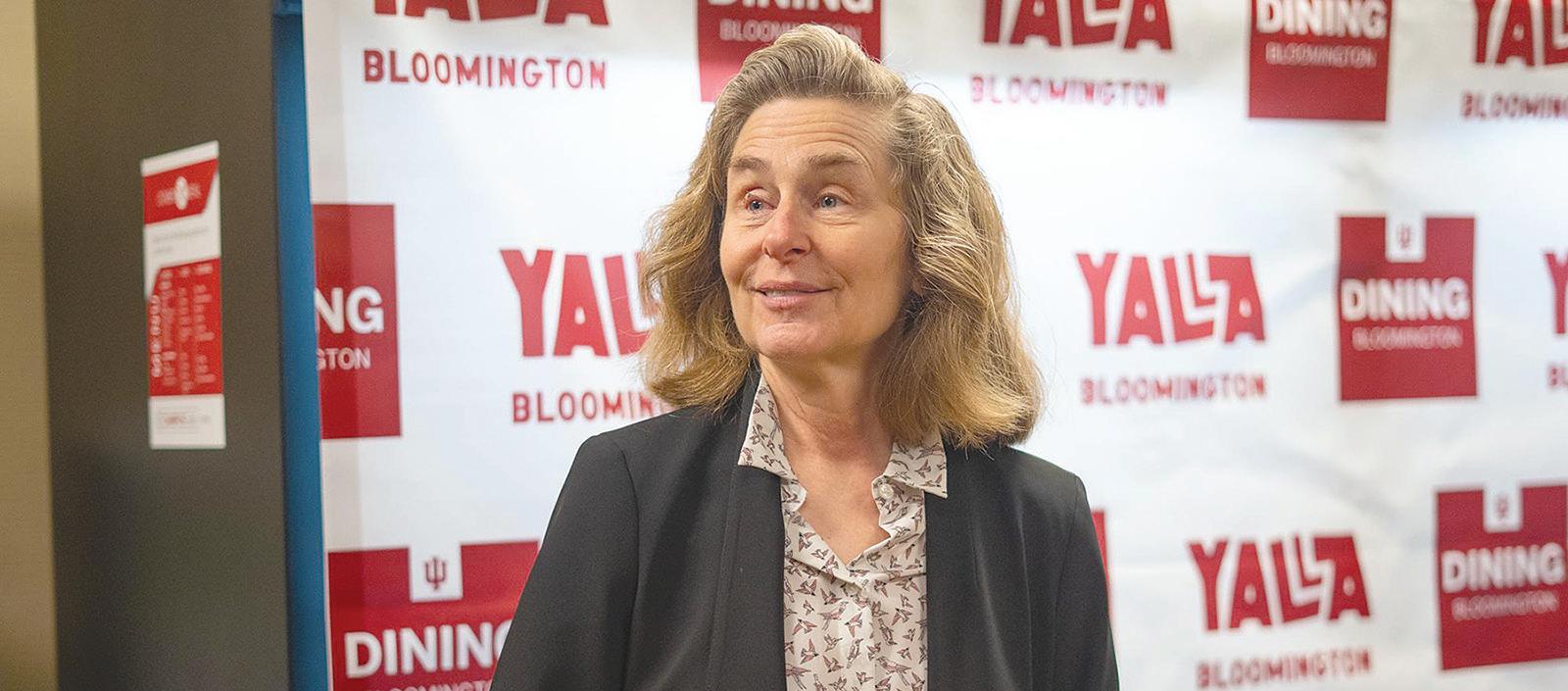
IU President Pamela Whitten speaks during the grand opening of Yalla, a kosher dining option, Jan. 13, 2026, in the Godfrey Graduate and Executive Education Center. In February, Whitten received a salary increase from the IU Board of Trustees.
TRINITY MACKENZIE | IDS
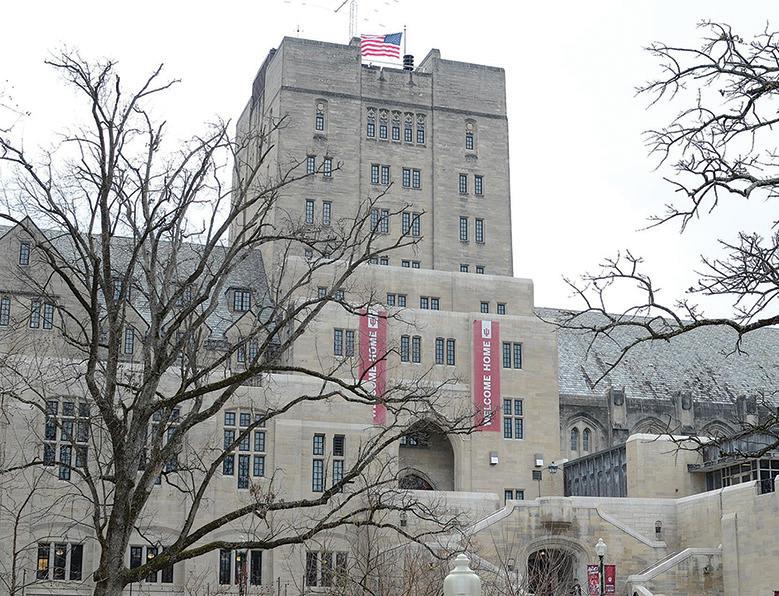
The Indiana Memorial Union is pictured Feb. 13, 2025, on campus in Bloomington. The IMU, which opened in 1932, was built using Indianaquarried limestone.
By Nadia Suben nadsuben@iu.edu
A sprawling gray warehouse in southern Bloomington is abuzz on a Thursday night.
Students mill about and exclaim with excitement as they glimpse familiar faces. Friend groups enter en masse, scrambling for the few remaining clusters of empty seats. Attendees glance expectantly at the stage at the front of the room, gathering as close to the center of the action as they can.
A two-minute countdown appears on a screen hanging behind the stage. The room’s excited hum approaches a roar as the seconds tick down. When the clock runs out, a band emerges to claim the instruments on the stage and fill the air with an impassioned ballad.
Focus washes over the warehouse. The lights fall as students rise to their feet and sing along with the lyr-
ics projected on the screen. They rest their Bibles on their chairs.
It’s time for church.
The Salt Company is the campus ministry of Bloomington’s Embassy Church and is part of a broader network of Salt Company ministries across the country. This echoey warehouse attached to the Embassy Church building, about 2 miles south of Sample Gates, accommodates the hundreds of students who gather for the weekly ministry-wide meeting. Even here, though, the building is near capacity. Salt Company staffers rush to set up additional lines of folding chairs in the back for a stream of latecomers.
The soft Christian rock music seems to capture students as soon as they find their places. As the song progresses, once-mumbling lips give way to belting voices. Worshippers rock gently back and forth. Arms fly into the air, as if in surrender. The band strikes its final
chord, pauses for applause and promptly launches into more musical praise. Voices, as one, declare their faith in and dependence on an unfailing protector.
This is one of Bloomington’s biggest parties.
The Salt Company is one of Indiana University’s vast array of over 20 Christian organizations. For Hoosiers spanning the spectrum of Christian denominations, these groups offer an opportunity to suffuse college life with spirituality.
Students appear more eager to pursue this opportunity than ever. Campus sidewalks are regularly muraled with colorful chalk advertising upcoming ministry meetings. Telephone poles sport flyers to join Bible studies or attend worship events. IU might just be experiencing a Christian resurgence.
Hoosiers’ uptick in interest in Christian commu-
nity may parallel national religious trends. After a decades-long decline, the share of U.S. adults identifying as Christian has leveled off in recent years.
However, IU religious studies professor Candy Gunther Brown said that doesn’t necessarily mean young adults are flocking to religion for doctrine alone.
“People are defining Christianity for themselves in new ways,” Brown said. “There’s a lot that’s very relational and personal for young people. A lot of Christians prefer thinking of Christianity as a relationship between themselves and God, but also relationships among one another.”
For some students, engaging with Christian life on campus isn’t just about faith, but also finding a tether to their upbringings and their peers.
Recent IU graduate Hephzibah Oluwajobi was raised in Nigeria by pastor parents. With a childhood that often revolved around church
life, she knew she wanted to bring her faith with her to college. She joined IU’s chapter of Chi Alpha, a Pentecostal-leaning ministry found on hundreds of campuses nationwide, as a freshman.
“I’d never experienced community in this way before: like-minded fellows, people my age, pursuing faith the same way that I was,” Oluwajobi said.
Religion similarly helped senior Liam McDonald, a lifelong Catholic and active member of IU’s St. Paul Catholic Center, connect to both his home and his new environment.
“The first day I was dropped off at college, I thought, ‘I’ll just go to a mass and see what it’s like,’” McDonald said. “From there, I’ve found such substance in my relationships with the people around me but also with God.”
Many campus ministry groups value these dual horizontal and vertical connections. Faith-based organiza-
tions are designed to help members flourish spiritually. However, in a college environment, finding camaraderie through commonality is also paramount. Nearly two-thirds of American college students suffer from feelings of loneliness, particularly in their first year. But the United States’ “loneliness epidemic” encompasses much more than college freshmen’s homesickness. Because of the prolonged isolation of the COVID-19 pandemic, many teenagers and young adults missed out on key years of socialization. Forty-five percent of parents responding to a 2025 Gallup poll believed their children suffered impeded social development during the pandemic. The world’s re-opening was far from a cure-all. According to a University of California, Santa Barbara study, over 60% of
cents reported the
negative responses of
PHOTOS BY ANNABEL PROKOPY
2022. Young people accustomed to being alone continued defaulting to aloneness and associating social situations with anxiety, even after the crisis passed.
Chi Alpha seeks to address these challenges by emphasizing communitybased spiritual growth. The organization sorts its members into Core Groups — small Bible studies that double as social networks — based on identifying factors like gender, class standing, major and hobbies.
“There’s a lot of intentionality with community and discipleship,” said Rachel Dwaram, a senior in Chi Alpha. “We also do twoon-one meetings throughout the week for more intentional discipleship time.”
An intimate, all-encompassing approach to spiritual growth is also a feature of IU’s Christian Student Fellowship. The group was founded in the 1960s as an outgrowth of a weekly Bible study on campus. Later, CSF was incorporated into the Association of College Ministries, a diverse collective of student Christian organizations across the country.
CSF has operated out of an approximately 28,000-square-foot house on David Baker Avenue — which connects to IU’s socalled “frat row” — since 2002. As a result, the group is distinctive among university ministries in offering its members housing. Residents of CSF’s house are surrounded by those who share their faith to help them build intentionality with religious practice.
“We’re not just a Christian dorm; we are a campus ministry that happens to have housing for its members,” CSF Campus Minister Stephanie Michael said. “If you’re living there, you are involved in the campus ministry.”
Like other campus ministry groups, CSF aims to foster both spiritual and so-
cial connection for its members. Shared values among house residents may help combat the isolation and angst that can accompany college life, even when they are quibbling about trash removal or cleaning dishes.
“The house is a bunch of people from all over that can come together and find commonality in worshipping Jesus,” said Nick Conrad, CSF associate campus minister. “It’s not always Bible trivia and constant worship songs, but it’s very cool that that’s a uniting factor. It’s a unique space to bond at a very human level.”
Balancing college life with spiritual exploration is a tall order. The demand may be magnified at IU Bloomington, often deemed one of the country’s “top party schools.”
“On this kind of campus with this kind of culture, it can be tempting to try and do things just because you want to fit in or just because you don’t want to miss out on what someone else is doing,” Dwaram, who first formed plans to join IU’s Chi Alpha chapter as a high school senior, said. “That’s a big thing that I think, as a Christian, we’re working against.”
Moving against this social tide sometimes proves alienating for IU’s religious students.
“Freshman year, your first week on campus, everybody’s trying to find wherever the parties are, which night, which dorm,” McDonald said. “There were definitely activities going on that don’t align with my moral beliefs. There can be a feeling of exclusion there.”
Although Generation Z drinks alcohol less than previous generations, party culture remains prevalent among college students — 9 million U.S. college students participate in Greek life to-
day. The pressure to participate is often self-imposed. After all, students are likelier to engage in high-risk drinking when they perceive others to be doing the same — even if these perceptions are inaccurate, or students encounter no explicit encouragement to follow along.
IU Bloomington’s legacy of being a “party school” may be, in turn, a self-fulfilling prophecy.
Some Christian Hoosiers have taken up the cause of rewriting this narrative.
Dwaram said Chi Alpha members stand around campus in the days surrounding the Little 500 — often billed as “The World’s Greatest College Weekend” — to socialize with and provide water bottles to partying students. She said Chi Alpha also offers a free bus service during the Little 500 weekend to ensure intoxicated students can access a safe ride home.
“It’s kind of a way that we’ve been able to show people the love of Christ without necessarily screaming about it,” Dwaram said. “For a lot of people, partying isn’t even about wanting to ‘live your 20s;’ it might be that there’s a hole you’re trying to fill. Being a light for those people is definitely something that we try to emphasize.”
Harm reduction surrounding IU’s party culture is also a priority for CSF. Because the organization is housed so close to much of IU’s Greek life, CSF is uniquely exposed to the epicenter of campus’s party scene.
To CSF leadership, this exposure is an opportunity for engagement. Conrad said CSF members took it upon themselves to go out on this past Halloween night to pass out water bottles and food to students bouncing around parties. He said acts as simple as sharing their intramural basketball court have helped CSF forge
Publish your comic on this page.
The IDS is accepting applications for student comic strips for the spring 2026 semester. Email five samples and a brief description of your idea to adviser@iu.edu . Submissions will be reviewed and selections will be made by the editor-in-chief.
friendly ties with neighboring Greek life organizations.
“We want to be better, open, more caring neighbors,” Conrad said. “We don’t want to seem like this Christian bubble, where people wonder, ‘what’s going on in there?’”
Spiritual engagement beyond the so-called “Christian bubble” is a core principle of evangelical Christianity. Brown, who has taught about American Christianity at IU since 2006, said evangelicals emphasize the primacy of the Bible while adapting to and existing within a broader culture.
“I think of evangelicalism as trying to balance purity from corruption with presence in the world,” Brown said.
Evangelicalism is thus a theologically broad and adaptable concept. Perhaps it is this adaptability that has led almost one in four U.S. adults to identify as evangelical Protestants and allowed the movement to spread like wildfire across the Global South. And perhaps it is the notion of a diverse, experiential and self-defined faith that is drawing young people back to spirituality.
At IU, many students are flocking to religion’s combination of spiritual calling and social enrichment. Brown has observed this trend in the demographics of students enrolled in her classes about American evangelicalism. She said several years ago, she tended to teach more “ex-vangelicals”: individuals who grew up in, but later abandoned, evangelical churches.
Today, by contrast, Brown increasingly teaches young adults either seeking spiritual life for the first time or returning to Christianity after a spell of religious disillusionment. One of Brown’s former graduate students, a vocal atheist during her
time at IU, recently contacted Brown to share she had been baptized. Other sectors of campus are noticing a change, too. In an email to the Indiana Daily Student, St. Paul leadership reported growth from approximately 345 Bible study attendees during the 2023-24 school year to approximately 525 during the current school year. Additionally, fewer than 35 students and St. Paul resident parishioners initiated their Catholic conversion through the ministry during the 2024-25 school year. This year, that number is closer to 160.
“Masses have been more and more full each year I’ve been here, but this year there are people standing against the walls every week because there aren’t enough seats,” McDonald, captain of the St. Paul Godspeed Cycling team, said. “All the events are breaking records — whether it’s the number of people coming to Bible studies, leading Bible studies, attending retreats or attending mass, we see this increase.”
So, is IU seeing a fullblown Christian revival?
Maybe, maybe not.
Michael and Conrad have observed more modest membership growth at CSF. Still, they said they have noticed an increase in students turning to CSF in search of community, even when those students aren’t necessarily avowed Christians.
It could be this allure of community that’s attracting more students to Christianity. Or maybe the shift can be explained as young people doing what they do best: rebelling. As 20-somethings, millennials turned away from religion en masse to rebut Generation X’s relative fidelity to faith. Now, Generation Z might be counterculturally bucking millennials’ secularity.
“There are always pendulum swings,” Brown said.
“Young people want to have their own identity, and if you tell them ‘you’re this,’ it can prompt thinking through ‘well, who am I, who do I want to be and what do I want my life to look like?’”
Such reflection, in a conflict-ridden and sometimes seemingly directionless modern age, can point students in religion’s direction.
“I think people want to find answers, or they want to find purpose,” Dwaram said. “We’re always going to feel like we’re not enough, or we need to do something more to prove ourselves. Something appealing about Christianity is that you don’t actually have to do something more, you’ve already been forgiven.”
McDonald also views religion as a clarifying response to life’s murky anxieties.
“There’s so much that makes life feel out of control and chaotic,” McDonald said. “(Faith) reveals this truth about us, that we’re made for something more than all this, that this isn’t all that’s out there, that there’s something substantive within all of this.” For their part, the Salt Company’s members seem eager to uncover this substance. The room’s lights return at the conclusion of two worship songs. After the band clears the stage, staffers quickly set up for the night’s sermon. An undercurrent of chatter breaks out as students take their seats, reach for their Bibles and journals for note-taking and catch up with the friends around them. The end of the week is cause for celebration for many Hoosiers. These students have chosen to center their festivity around their community and shared belief.
At IU and beyond, young people are pursuing refuge from an uncertain world — and finding it through trust in what they can’t see.
TIM RICKARD
BLISS
HARRY BLISS
CROSSWORD
Humraah brings flair to IU a cappella scene
By Diya Menon dbmenon@iu.edu
Halfway through their set, the performers of Humraah, IU’s South Asian a cappella group, settled into intricate, traditional Bharatanatyam poses, and their voices hummed with the cacophony of classical ragas. As described by the members who have made the stage their personal canvas for storytelling, the moment was magical.
What distinguishes Humraah, created in 2017, from a typical performance group is its signature South Asian fusion a cappella style, coupled with choreography.
Members said it merges the stoic, ancient traditions of Indian classical music with the rhythms of wellknown Bollywood and English songs. Recently, the group won first place at IU Sing on Feb. 28, an annual IU competition among seven a cappella groups. As a competitive team, they travel across the country to showcase their art.
Their most recent win came after a successful competition season at various universities, during which they placed second at Spartan Sitara on Feb. 7 at Michigan State University.
Their competitive spirit is built from their affection for one another, members said, which extends beyond the stage, into their practices and group bonding activities.
“We are known for developing our relationship as team members and friends, before our relationship to the set, and that’s what draws us to success,” senior Sharan Peshin said.
Peshin has been a part of the group for the past four years and served as president last year. Alongside his former copresident Dharini (Dhar) Sriram, they led the team to what they consider their “turning point” season.
Humraah placed third at All-American Awaaz on April 12, the national championship hosted in San Francisco for collegiate teams on the South Asian fusion circuit.
“We started as a team full of people that just loved making music, and we’ve evolved into this bigger entity that celebrates South Asian culture, especially its music, which is so rich in its own way,” Peshin said.
For the 2025-26 season, the group took in a new batch of seven freshmen across various vocal parts and experiences, which created a natural system of
mentorship among the 24 members, both competing and non-competing. Peshin said after this year’s season, he was left feeling like an “accomplished dad.” However, with new talent comes strict expectations and cultural acclimation, which the group described as their “blueprint for success.”
“Keeping attention and discipline to your craft is crucial, especially when you are a full-time student,” Peshin said. “The way our leadership is structured is if you need time, you are given time, but we still ask our members to uphold our ‘Humraah’ standard.”
The group’s expectations involve a practice schedule of three to four practices a week, often guided by senior members and the Humraah management team. During competition weeks, they typically rehearse daily, and practices consist of learning mixes, developing a comfort level vocally before adding choreography and workshopping the set with continuous feedback and repetition.
Junior Trisha Terala has served as Humraah’s manager since January 2024. She described her roles as booking practice rooms, communicating with the Association of South
Asian A Cappella circuit official, ensuring the team has costumes, filling out tech sheets, coordinating travel logistics and acting as a presiding body over other directors.
Terala said she has been able to transfer the skills she has grown as a manager into various other endeavors.
“In the case of any tension within the team, I can be that neutral perspective,” Terala said. “I’ve been able to learn so much about working with different kinds of people.”
This season’s set unfolded into three movements, each offering a distinct interpretation of their theme, “The Beauty of Scars.” Rather than presenting scars as symbols of damage alone, the set explored markers of resilience, transformation and quiet atonement of coming back to one’s traditional roots.
Their harmonies are layered with dynamic surges and solo elements. Their song choices include devotional classics in Indian music like “Man Mandira” and nostalgic Bollywood tunes like “Guzarish.”
For a lengthy performance of over 10 minutes, it is key that the group includes compelling, unique visual and vocal elements to maintain
audience engagement. It is here where directors Kavya Kaushik, Niru Raghuvir and Rishab Jain work closely to weave movement and music into a cohesive presentation that lets the narrative arc of the set stand for itself.
Music directors Raghuvir and Jain were raised with a comprehensive and technical musical background from different traditions in India. Carnatic music has been a part of Raghuvir’s family and greater community for as long as she can remember, and that love was transferred to her from a young age.
Together, Raghuvir and Jain create all the mixes, harmonies and musical choices and assist in teaching the larger group.
“We had an idea of what better teams sounded like, and we had goals on how to get there,” Jain said. “This year, our job was to continue that.”
Junior choreography director Kaushik has been a part of the group since her freshman year.
She expressed that a new batch of performers brings a unique challenge of developing movement that aligns with their talents and needs.
“The team that we were last year is not the same now in terms of
dynamics, music we create, preferences and styles, and that’s a good thing in its own way,” she said. “We adapt accordingly.”
Much of Kaushik’s creative choices for the set were inspired by traditional Bharatanatyam poses and formations that offered moments of audience reflection. As both a director and performer, she can see her visions come to life on a professional stage and experience her own moments of magic in between.
“There is a part in the beginning of our performance where I am supposed to be very solemn to set the mood, but when performing at Massachusetts Institute of Technology (MIT), alongside the amazing engineering and sound, the second the beatbox started, I instantly smiled, and it started a new passion in me,” Kaushik said.
This year was both momentous and bittersweet for some, especially senior leaders preparing to pass the torch and further define Humraah’s identity on the ASA circuit stage.
Junior Harsh Mahapatra, Humraah’s current president, has acted as a mentor in ensuring the group’s logistical and creative sides merge
seamlessly. After spending two years as a general member, he entered leadership with a more grounded understanding of the team’s culture and evolving standards. His role, as he describes it, is fluid by design.
“My role is to fill in when there is a gap in the team, whether it be recruiting, filling in for a director; it keeps changing what I do day to day,” Mahapatra said.
Humraah’s tradition of rotating leadership each year creates fresh visions and places creative autonomy into the hands of a new cohort, Mahapatra said. Although melancholic about stepping down, Mahapatra will continue to compete as a general member in next year’s season, while advising new members on preserving the legacy Humraah has generated over the past few years.
However, Mahapatra said the decision to fill the presidential position transcends a simple administrative duty; it was rooted in gratitude for the community that shaped so much of his college experience.
“I wanted to run for president this year because this group has given me so much — my friends, my girlfriend, my family, the people I care about the most — and it was time that I gave something measurable back,” he said.
Vocal percussionist and senior Aakash Vasireddy has led rhythmic direction for the past four years he has been in the group. This year, he won “Best Vocal Percussionist” at Spartan Sitara and Boston Bandish, recognitions that cemented what Vasireddy describes as his “proudest year as beatboxer.”
“Sometimes it’s a little more isolating because everyone has their own voice part, but honestly, I think it is what makes the experience more rewarding when the team comes together, and I can offer suggestions,” Vasireddy said.
He closed his final season with a few words of reflection: “You realize there is a reason you care so much and cry about this being your last season, it’s because you had the privilege to be a part of it.” Humraah will be conducting auditions in September 2026 for their 2026-27 season. To stay updated on events, performances and auditions, you can follow them on Instagram.
COLUMN: ‘The Bride!’ wants to go beyond a large studio film. It almost does
By Mateo Fuentes-Rohwer matfuent@iu.edu
Frankenstein has been on top of the world for the past few months.
Netflix released Guillermo del Toro’s “Frankenstein” on its streaming service Nov. 7. The film was the No. 1 Netflix movie in 72 countries after three days, as well as top 10 in 93 countries. Just over two months later, it was nominated for nine Academy Awards, including Best Supporting Actor for Jacob Elordi as “The Creature.”
Then, adding to Frankenstein’s cultural surge, Warner Bros. released “The Bride!” on March 5 — a retelling of sorts of “The Bride of Frankenstein” from 1935. The film features a stacked cast with Jessie Buckley and Christian Bale in the lead roles, along with Maggie Gyllenhaal writing and directing.
It had the makings of a great movie that could steal the box office spotlight just a week away from the Academy Awards.
But it isn’t great, and it’s failing at the box office. It’s an ambitious project that struggles to stay connected throughout its 127-minute runtime, leaving me wanting less so I can exit the theater with more.
“The Bride!” follows Buckley as the titular character, who dies in the first moments of the movie but
is brought back to life to be the bride of Frankenstein’s monster, known as Frank and played by Bale. Buckley and Bale deliver good performances as the two roam around the United States like a Bonnie and Clydeesque couple, being chased by Detective Jake Wiles (Peter Sarsgaard) and Myrna Malloy (Penélope Cruz).
Gyllenhaal’s surface-level ambition is clear — recreate a story of the bride that actually includes the bride. The 1935 film only includes her for two minutes, and she has no lines. Her cameo, if that’s even the right term, ends with the monster blowing up the tower and killing the two of them.
“The Bride!” couldn’t be more different. Buckley’s character is unrestrained. She’s the far more interesting personality compared to Frank, as Bale’s monster is more muted and plays off her.
As the two venture around the country, the Bride deals with the societal sexism instilled in the 1920s United States. Gyllenhaal’s methods in presenting this aren’t up for interpretation — the Bride is sexually assaulted on multiple occasions and at one point in the movie she literally shouts “me, too.”
This aspect of the movie is well executed, although I can understand some of these elements are a bit on the nose. That’s not a prob-
lem for me. Sometimes I need a movie to hold my hand.
Yet the problem I have with the film is the issues don’t feel like they’re explored nearly enough. When the Bride incites a revolution, we never delve into it. It’s similar to the revolution from “Joker,” only that film ends just as the riots begin, acting as a crutch to not explore the issues at hand. “The Bride!” doesn’t have that excuse.
A boring side plot involving the two detectives also hampers this film. Every
time the movie left the Bride and Monster’s adventures to join the detectives, the momentum of the film faltered. Only when Wiles reveals a key point of information toward the end of the film did I believe the characters were necessary, but again, we don’t sit with the information. Just as quickly as Wiles shares the truth bomb, he leaves the movie, never to be seen again. I’d be remiss not to mention Buckley, who is quickly becoming one of my favorite actors in Hollywood and one of the better parts
of this film. She’s just under a week away from likely winning her first Academy Award for her exquisite performance in “Hamnet.” The cast could have been just her, and I would have been seated. Buckley’s elevated status in the past year has led to more scrutiny for this performance. She’s asked to do quite a bit as the Bride is possessed by a creepy Mary Shelley character, the author of “Frankenstein” who is also played by Buckley. The Bride strolls around with her Chicago
accent then quickly shifts to an English one, a strange creative choice that didn’t work for some but worked for me. This role isn’t near the level of Agnes from “Hamnet.” This movie isn’t at the same level, either. But that’s OK. In an era of IP and shameless remakes dominating the box office, a large studio film that attempts to try something different is a breath of fresh air. And even though it’s not a great movie, “The Bride!” is something I can appreciate and respect.
COURTESY PHOTO
IU a cappella group Humraah performs a Bharatanatyam pose during their set at IU Sing on Feb. 28. Humraah won the competition for the second year in a row and will sing at the Little 500 races in April.
MOVIE STILLS DATABASE
Christian Bale (left) and Jessie Buckley (right) act while filming of “The Bride!” The film was released March 6, 2026.
By Ursula Stickelmaier ustickel@iu.edu
Steve Pinder sat on his couch at 5:30 a.m. Feb. 22 with his co-writer and codirector, Julia Aks, next to him, along with their respective partners and friends. They were waiting for the 2026 Oscar nominees to be announced; specifically, this year’s Live Action Short Film nominations.
Among the 207 live action short films that qualified for this year’s Oscars, Pinder and Aks’ film “Jane Austen’s Period Drama” was one of 15 to be shortlisted on Dec. 16, Jane Austen’s 250th birthday.
Announced by actors Danielle Brooks and Lewis Pullman, “Jane Austen’s Period Drama” was the third of five films nominated in the Live Action Short Film category.
“It’s one of those things that feels sort of impossible to process,” Pinder said. “It’s just unreal. I mean, I think you dream of things like that when you’re younger, and they seem so impossible, you know, to have them come to fruition. It’s just, like, it truly feels magical.”
While many filmmakers dream of getting one step closer to winning an Oscar, Pinder’s nomination isn’t just another milestone in his career; it’s the culmination of a journey that started years before at Indiana University.
Pinder came to IU in 2006 undecided. Though he grew up surrounded by family in the medical field, he thought college would be a good chance to explore other career interests.
While he’d placed out of many of IU’s general education requirements, Pinder said the one thing he couldn’t manage to get out of was English.
Though he had never felt drawn to the subject, he found he had a talent for writing during his freshman year in a class with IU professor Paul Gutjahr. After reading some of his essays, a TA in the course suggested he continue the subject.
During his sophomore year, Pinder enrolled in an English class with professor Rae Greiner. He credited her teaching methods for expanding the way he thought about reading and studying literature, a large reason why he chose to declare an English major.
As much as Pinder loved Greiner’s course and ways of teaching, she loved having him in her class.
“He was just amazing, and he was just this eager and happy and curious, creative person,” Greiner said. “He absolutely has been just so incredibly talented, but also kind and humble and sweet. He’s just one of my favorite people in the whole world.”
Along with majoring in English, Pinder spent time at IU participating in the
‘It truly feels magical’
IU alumnus Steve Pinder’s path from Indiana to the Oscars
Singing Hoosiers and taking voice lessons at the Jacobs School of Music while getting a Bachelor of Science in Music and an Outside Field. Pinder began exploring musical theater when he took two semesters of opera and musical theater workshops with Sylvia McNair.
After one audition, he remembers a moment alone with McNair where she told him if he wanted to pursue acting full time, he could.
“That was such a profound life-changing moment for me,” Pinder said. “I was so desperate for that kind of approval and that kind of permission to go pursue my dreams and to go do the things that I really, deeply, deep down wanted to do, but was afraid I wouldn’t be good enough.”
Pinder graduated in 2011 and moved to Chicago to continue pursuing a career in musical theater.
He spent around three years performing in both Chicago and Indianapolis when the rights for eighttime Tony-winning musical “Les Misérables” were made available to regional theaters in 2013. While he liked the musical, he worried the career could get repetitive, with different versions of the same shows constantly in rotation.
“I started seeing, like, my whole career could turn into me doing ‘Les Mis,’ over and over and over again, which just wasn’t how I wanted to spend my life,” Pinder said. “So, I started thinking about writing stuff myself. I just thought, well, you know, if I can’t book a part that I really want through auditioning, maybe I can write a part.”
When his friend, IU alumna Elisabeth Gawthrop, suggested he look into film
programs, Pinder was tentative about the idea. But Gawthrop encouraged him by saying that while having technical skills is nice, what film school really wants from an applicant is someone who has a story to tell.
They’ll teach you how to make a movie. What they want is someone with a voice, Pinder said.
With the help of Greiner, who wrote him the recommendation letter that he’s still convinced got him in, Pinder moved to Los Angeles to study at the University of Southern California in 2014.
While he was at USC, Pinder met Aks and the two formed a close friendship while working with her on various sketch comedy videos.
In 2019 Aks came up with the initial idea for “Jane Austen’s Period Drama.” Pinder was brought in once she finished the first draft and, after looking at the 76-page script, he suggested the idea might work as a feature-length film.
The move to a short film came in 2023 during the WGA Writer’s Strike when Pinder and Aks had finished the script but didn’t want to cross the picket line. Pinder said while it wasn’t their ideal outcome to make a short film, it was an easy decision to go with the prologue.
The prologue specifically focuses on Estrogenia “Essy” Talbot (Aks) who is eagerly awaiting a proposal from her suitor, Mr. Dickley (Ta’imua), when she gets her period. When Mr. Dickley confuses the blood for a life-threatening injury, Essy learns despite his vast education, there are just some things people don’t talk about.
Pinder thought the regency era of Austen’s novels
translated especially well to the story and message they were hoping to convey to the audience.
“Everybody has, like, very stiff posture, and they’re very polite and they try very hard to sort of talk around uncomfortable subjects,” Pinder said. “And so that dynamic creates a wonderful conflict when suddenly you’re dealing with something like menstruation that nobody wants to talk about.”
Producer Elli Legerski’s first step was to figure out a way they could get production started without crossing the picket line. Despite the ongoing strike, she was able to base the production around the guidelines set by the short project agreement, which capped the budget at $50,000.
Legerski said the limits on their budget became especially difficult when trying to emulate the feeling of a period piece. From costume to production design, the team was strategic about what it chose to use its budget on to produce a film that felt truest to the regency era aesthetic of an Austen novel.
“It was like, ‘Okay, we know what we want, we know we don’t have the money for it. So, let’s just find people that are in our same spirit and know what we’re going for, and we’ll do our best,’” Legerski said. “And it ended up being, you know, amazing what they were able to do.”
After wrapping up filming and post-production work, “Jane Austen’s Period Drama” officially premiered in February 2024 at the Santa Barbara International Film Festival.
Pinder said the positive reaction in Santa Barbara was one of the first mo-
ments he realized the short film could be bigger than he thought. While it was received well by audiences at film festivals, the story did not often rank high in the jury award, which is what makes a short film eligible for direct submission to the Academy of Motion Picture Arts and Sciences.
In film festivals, most of the jury awards are narrative awards. Pinder said he began to see a pattern of most of those narrative awards going to the dramas first, but he knew their short film was close to winning if given the right opportunity.
That chance came in April 2025 when “Jane Austen’s Period Drama” played at the Aspen Film Shortsfest, one of the only festivals that has a juried comedy award to qualify someone for the Oscars.
They won, and waited just over seven months before making it onto the Oscars shortlist for live-action shorts.
In the time leading up to the Oscars, the team for “Jane Austen’s Period Drama” has tried to campaign for the film as much as possible within its limited budget.
When a publicist encouraged them to find a celebrity that could endorse or be given an executive producer credit in their film, Legerski said they knew exactly who they wanted to reach out to.
Having won the Best Adapted Screenplay award at the Oscars in 1996 for her own adaptation of Austen’s “Sense and Sensibility,” Legerski and the rest of the team believed actress Emma Thompson was the perfect fit.
While Thompson turned down the producer credit,
she suggested one of her own in its place: Executive Menstrual Advisor.
The name may seem very tongue-in-cheek, but Lergerski said it feels perfect for them and she’s grateful for Thompson’s endorsement.
“It just really seemed like that set off the skyrocket of this campaign process,” Legerski said.
As the march toward the Oscars continues, Pinder is appreciative of the continuous support “Jane Austen’s Period Drama” has gotten. What Pinder thinks draws people to their short film isn’t just the familiarity of a film that’s inspired by Austen and her work, but how the comedic moments underline the powerful message the story aims to convey.
“For this film in particular, you know, I think we’ve discovered that when you can give people a joyful experience, it’s a lighter way to invite people into conversation,” Pinder said.
This mission will only continue after the Oscars. Pinder said the nomination alone has opened so many doors for he and Aks professionally. They aim to produce the feature-length film, and they’ve started having more conversations about where Essy’s story will go next.
“She’s had this awakening about how ignorant people are in the world that she’s living in,” Pinder said. “She’s just trying to find a way to live in her integrity, you know? She’s trying to find a way to be honest in the way she walks through life, even when the whole world around her is telling her to keep lying and to shut up.” What Pinder really wants to do, though, is continue to make more films for the people back home. Whether it’s a short or a feature length movie, the idea that someone from Indiana will see his work and love it or be inspired to follow a similar path is something that has him hopeful for the future. He first had this epiphany when applying “Jane Austen’s Period Drama” for the Indy Shorts International Film Festival in 2024, just so the movie could play in Indiana, he said. When writing the cover letter, Pinder said he felt emotional thinking about how the film would be received in his home state.
“Over 10 years ago, I had left the Midwest and moved out to LA to make movies,” Pinder said. “And, I don’t know, it’s like all I really wanted, deep down, was to make something that people there would love and would be proud of. And, I think, to be where we are now and have these opportunities, I just want to do more of that. I just want to make more things that people in Indiana will love.”
“Jane Austen’s Period Drama” is currently available to watch for free on both YouTube and Kanopy.
Silkroad Ensemble to bring global music to IU
By Sophie Albert soalbert@iu.edu
Silkroad Ensemble, a group of performers from all over the world, is coming to Bloomington at 7:30 p.m. March 12 at the IU Auditorium as part of its new flagship program Sanctuary: The Power of Resonance and Ritual, led by artistic director Rhiannon Giddens. Silkroad Ensemble has a mission of highlighting cultural differences as well as collaboration to encourage learning and foster a more inclusive world through music.
Giddens, a Grammy and Pulitzer Prize-winning folk musician, will be taking part in several engagement events before the performance, all of which are free and open to the public.
Starting at 3:15 p.m. March 11 at Auer Hall, Giddens will take part in a discussion with Silkroad performer Francesco Turrisi and Jacobs School of Music dean Abra Bush about their various career paths after graduating from music conservatories.
At 6 p.m. March 11 at Sweeney Hall, Giddens will lead a voice workshop
alongside her current vocal instructor Brian Gill, who is a professor of music in voice at Jacobs.
An hour before the March 12 performance, ethnomusicology doctoral student Nia I’Man Smith will host a pre-show talk at the Fine Arts Building where she will discuss the historical and cultural context of Silkroad Ensemble. Smith said she is particularly interested in approaching the topic from an angle of ancestor veneration, a cultural practice of honoring deceased relatives, specifically within Black music traditions.
“We can think about that as one way to process loss through this idea of memory, or through this idea of celebration and veneration,” Smith said.
The Silkroad Ensemble’s new flagship program will tie together traditional music from Morocco, Italy, India, Japan and the United States to show the power communal music holds in building human connection.
One of these types of communal music will be played by Mehdi Nassouli,
a Moroccan guembri player who will perform traditional Moroccan Gnawa trance music.
This music is practiced by descendants of slaves brought from the Sudan region of West Africa to Morocco, professor emeritus of folklore and ethnomusicology Daniel Reed said, and is traditionally used for spirit possession through trance.
The music doesn’t feature chords or harmonic structure typically found in Western music, but rather single lines played in a repetitive manner using variation and improvisation. Reed said this repetition is crucial to the music because it is what leads to a trancelike hypnotic state used to embody spirits.
Reed said Gnawa isn’t traditionally performed with the same division between audience and performer found in typical orchestral performance spaces. Instead, it is common to be performed in a circle, with audience members taking part in call and response vocalizations.
In addition to Nassouli’s Moroccan performance, Italian folk musicians Mau-
ro Durante and Turrisi will perform Sicilian tarantella music.
Sofia Lo Ciacio, a doctoral student in Italian studies at IU, said the name of this type of music comes from the word “tarantola,” meaning tarantula. The music accompanies a lively dance in Italian culture which originated from the belief that the only way to cure a bite from a wolf spider would be to engage in a frenzied dancing ritual.
Ciacio, originally from a town in Sicily, Italy, said the dance is extremely well known in the country, with children learning it in elementary school courses and many people owning traditional tambourines used in the dance. She said the dance is a way for people to collaborate with others at a young age because it is often danced in pairs.
“You can create a relationship between someone that maybe you don’t know,” Ciacio said. “Because if you want to start, like, a course of tarantella, of course, you don’t have to know all the people that are taking the course.”
Sandeep Das, a tabla
master, will perform Indian classical music, a style of music that may be an unfamiliar sound to most.
Christian Morgan James, a doctoral student in the Department of Folklore and Ethnomusicology who specializes in Hindustani music, said he hopes the songs will feel exciting to audiences because of the cyclical division of beats in Indian classical music.
James said Das uses patterns of beats, called “taal,” often experimenting with the taal “jhaptal,” that sounds distinctive to many North American listeners. While Western music typically uses measures of three or four beats, jhaptal is a cycle of 10 beats.
“It’s something that feels maybe a little funky,” James said. “And for those of us excited by different kinds of sounds, you know, it could be really interesting and engaging.”
Kaoru Watanabe, a Japanese-American composer and member of the Silkroad Ensemble, said in an email that the interweaving of cultures and instruments done in Silkroad is a way to celebrate both the shared values
but also the idiosyncratic differences of each individual artist.
“Doing your own dance to a different rhythm or vice versa is like seeing yourself through someone else’s eyes,” Watanabe wrote. “It opens up the world like learning a new language or discovering new cuisine.” Watanabe also emphasized that while the members of Silkroad are performing music from their individual cultures, they all put their own spin on traditional music through their personal artistry.
“This is not a performance of traditional musics in their ‘pure’ forms,” Watanabe wrote. “It’s a group of individual artists that prove in real-time that we can bring together instruments and styles that often aren’t seen on stage together and create incredible music together — an exchange of musical conversations that transcend artificial borders and boundaries.” Tickets can be purchased both at the IU Auditorium box office and on its website, starting at $34 for the general public and $24 for IU students.
COURTESY PHOTO BY MIKE GAN
IU alumnus Steve Pinder directs on the set of “Jane Austen’s Period Drama” while costumed for a background acting role in August 2023. Pinder
co-wrote and co-directed the short film with the film’s star, Julia Aks.
BASEBALL
Clutch pitching leads Indiana past Wright St.
By Elakai Anela eanela@iu.edu | @elakai_anela
With two outs and the bases loaded in the top of the sixth inning, Wright State University threatened to flip the game at Bart Kaufman Field in Bloomington. Indiana baseball led 4-3.
Hoosiers head coach Jeff Mercer had just taken graduate student pitcher Michael Sarhatt out of the game after the right hander walked the previous two hitters. With a 2-0 count and two outs, graduate stduent right-handed pitcher Kaden Jacobi came into the game. Jacobi, a transfer from the University of Missouri, then threw three straight strikes. He pumped his first in excitement as he came off the mound, his teammates pouring out of the dugout to congratulate him.
Off Jacobi’s pivotal strikeout, Indiana capitalized on the momentum in the bottom half of the inning scoring three runs and later pulled away with a fiverun eighth inning to defeat Wright State 12-4.
Mercer said postgame that turning to Jacobi in the middle of the at-bat was a decision influenced by pitching coach Matt Myers, who advised Mercer to make the call to the bullpen.
“For him (Jacobi) to come in and grab a strike early, that changed the whole swing of the game. We scored three runs the next inning,” Mercer said. “If he babies it... we would’ve been in trouble. I told him, ‘Don’t be afraid to fail.’ I thought Jacobi was fearless. It was a really good call from coach Myers. That was a pivotal moment for him and us.”
Indiana’s offense found its groove March 10 after only scoring 10 runs across three games versus Washington over the weekend.
Indiana scored four runs in the first inning against Wright State, then three in the sixth and five in the eighth. Sophomore lefthanded pitcher and outfielder Caleb Koskie batted 3 for 4 in the contest and recorded five RBIs.
“I think it’s good pressure that I want, obviously I want to succeed, but I also want the team to succeed.”
Will Moore, Indiana baseball sophomore hitter
Mercer said Koskie’s strong night at the plate helped the rest of Indiana’s lineup succeed, especially
with runners on base. He said that kind of offensive performance was the expectation from the lineup construction heading into the year.
“Caleb had a really good night,” Mercer said postgame. “We haven’t done a great job of scoring with runners in scoring position; that changed tonight... the idea is for us to be in the seven-to-eight runs a game range.”
The Hoosiers had contributions from all over the lineup.
Sophomore Will Moore, Indiana’s leadoff hitter, set the tone. The 5-foot-9 infielder batted 1.000, going 4 for 4 from the plate, and picked up an RBI. He also scored three times.
“I think it’s good pressure that I want, obviously I want to succeed, but I also want the team to succeed,” Moore said postgame. “I feel like, pressure, it’s what we came here for.”
Sophomore catcher and outfielder Hogan Denny had three hits in six at-bats with two runs driven in.
Sophomore infielder Jake Hanley had two hits in five at-bats and two RBIs. Freshman infielder Landen Fry batted .500 in four at-bats.
The Hoosiers’ blend of younger and older pitchers came together as well,
something Mercer emphasized March 8 prior to the midweek game.
Freshman right-handed pitcher Ivan Mastalski pitched two innings, allowing one earned run. Freshman right-handed pitcher Kellen English also covered an inning while recording two strikeouts.
Sarhatt and Jacobi com-
Emmanuel Church
Sunday: 10 a.m., Service (In house and on Facebook/ YouTube)
Sunday School: 8:45 - 9:45 a.m. Bible Study: Available In House and on Zoom Wednesdays, 6:30 p.m., Thursdays, Noon
Tuesday: 6:30 p.m. Dinner & Devotions @ Rose House LuMin 314 S. Rose Ave.
Rose House LuMin and St. Thomas Lutheran Church invite you to experience life together with us. We are an inclusive Christian community who values the faith, gifts, and ministry of all God’s people. We seek justice, serve our neighbors, and love boldly.
Rev. - Adrianne Meier Rev. - Lecia Beck
Rev. Amanda Ghaffarian - Campus Pastor
321 N. Rogers St. 812-336-5827 sbcbloomington.org
Please come and worship with us. We are in training for reigning with Christ! Need a ride? Call our Church bus at 812-327-1467 before 8 a.m. on Sunday
St. Mark’s United Methodist Church
100 N. State Rd. 46 812-332-5788 smumc.church facebook.com/BloomingtonStMarksUMC instagram: @stmarksbloomington
St. Mark’s United Methodist Church of Bloomington, Indiana is an inclusive community, bringing Christ-like love, healing, and hope to all. We embrace the United Methodist ideal of open hearts, open minds, and open doors by welcoming those of all races, cultures, faith traditions, sexual orientations, and gender identities.
Rev. John Huff - Pastor Rev. Mary Beth Morgan - Pastor
bined to pitch two total innings. Sarhatt walked two Wright State hitters, but Jacobi struck out the only batter he faced. Redshirt junior Jacob Vogel finished the final inning without allowing an earned run. The Hoosiers’ win over Wright State marked their third midweek victory. Indiana previously beat Bradley University 15-3 on Feb. 17 and Xavier University 10-4 on Feb. 25. Indiana’s next contest kicks off a four-game road swing. The Hoosiers travel to Eugene, Oregon, to play Oregon in a three-game weekend series. The first game starts at 7:05 p.m. March 13. The game will be streamed on Big Ten+.
Light House Community Church
850 E. Winslow Rd. 812-339-3306 lhccbloomington.org facebook.com/lighthousecommunitychurchbloomingtonindiana instagram.com/lighthouse_community_ church
Sunday: 9 a.m., Empowerment Classes (for all ages) 10:30 a.m., Service
Wednesday: 7 p.m., Bible Study
Light House Community Church is mandated, by the Word of God, to fulfill the Great Commission by winning lost souls to Christ and empowering the believer to grow in Christ through prayer, study of the Holy Bible, and life application teaching. All are welcome! Transportation is available.
Senior Pastor - Derek L. House Assistant Pastor - Clarence W. Boone,
Trinity Reformed Church 2401 S. Endwright Rd. 812-825-2684 trinityreformed.org instagram.com/trinityreformed facebook.com/trinitychurchbloom
We are a Reformed Protestant church on the west side of Bloomington with lively worship on Sunday mornings, Bible classes beforehand, home groups, and a college age group called The Mix (a group of young adults who are both attending college and beyond).
Jody Killingsworth - Lead Pastor Max Curell - Shepherding Pastor Stephen Baker - Discipleship Pastor Philip Moyer - Worship & Youth Pastor
Christian Science
Christian Science Church
2425 E. Third St. 812-332-0536 bloomingtonchristianscience.com facebook.com/e3rdStreet
Redeemer is a gospel-centered community on mission. Our vision is to see the gospel of Jesus Christ transform everything: our lives, our church, our city, and our world. We want to be instruments of gospel change in Bloomington and beyond.
Chris Jones - Lead Pastor
United Methodist
Jubilee
219 E. Fourth St. 812-332-6396 jubileebloomington.org
Facebook: First United Methodist Church of Bloomington, IN
Instagram: @jubileebloomington
Sunday: 9:30 a.m., Classic Worship 11:45 a.m., Contemporary Worship Wednesday: 7:30 p.m., College & Young Adult Dinner
Jubilee is a Christ-centered community open and affirming to all. We gather on Wednesdays at First United Methodist (219 E. 4th St.) for free food, honest discussion, worship, and hanging out. Small groups, service projects, social events (bonfires, game nights, book clubs, etc.), outreach retreats, and leadership opportunities all play a significant role in our rhythm of doing life together.
Markus Dickinson - jubilee@fumcb.org
Unity Worldwide Unity of Bloomington A Center for Spiritual Growth 4001 S. Rogers St. text/call: 812-333-2484 unityofbloomington.org IG: @unityofbloomington facebook@UnityofBloomington Sunday Celebration: 10:30 a.m. Discover a vibrant, welcoming community at Unity of Bloomington – “a positive path for spiritual living”. Our center offers a space for spiritual growth; embracing all with open arms. We proudly affirm and welcome the LGBTQ+ community, fostering love, acceptance, and inclusion. Join our loving congregation, where everyone is valued and encouraged to explore their spiritual journey. At Unity of Bloomington, all are welcome and together we thrive!
Minnassa
BRIANA PACE | IDS
Redshirt freshman catcher Brayden Ricketts trots toward home plate against Wright State University on March 10, 2026, at Bart Kaufman Field in Bloomington. The Hoosiers defeated the Raiders 12-4.
Indiana looks ahead after Big Ten Tournament loss
By Savannah Slone srslone@iu.edu | @savrivers06
No. 13-seeded Indiana
women’s basketball fell to No. 5-seeded Ohio State 8359 on March 5 at Gainbridge Fieldhouse in Indianapolis. And unless the Hoosiers go to the Women’s National Invitation Tournament or Women’s Basketball Invitation Tournament, their season is over. It was a rollercoaster of a season for Indiana. It started with an 11-1 nonconference record, but an 0-10 beginning to Big Ten play followed.
For Indiana head coach
Teri Moren’s young and inexperienced roster, those early conference games were about the process, she said throughout the year. Her squad needed to understand the flow of the Big Ten, and it wasn’t easy with a top-heavy conference schedule; the Hoosiers played six ranked teams in their first 10 Big Ten games. Their first conference win of the season was against Northwestern on Feb. 1. It helped Indiana gain momentum to end February 6-2 and secure a trip to the Big Ten Tournament, where it recorded a comeback win over Nebraska on March 4, and eventually bowed out with a loss to Ohio State.
“This is a group that when you start the season, the Big Ten season, off the way we did, it would have been easy
The Hoosiers fell to Ohio State by 24 points March 5
to just kind of throw the towel in,” Moren said postgame. “And we didn’t do that.”
While the Hoosiers needed a late-season push to make the Big Ten Tournament, and likely won’t be in the NCAA Tournament field, this season wasn’t for nothing. It was a season of building, growing and learning for Moren’s squad.
Moren has said multiple times this season that the development during the losses, and even the wins, are important for the future — that eventually the learning moments would pay off. They did late in the season, but their impact goes beyond this year. It goes into next season, when the returning Hoosiers have more experience under their belt.
Senior guards Shay Ciezki and Jerni Kiaku are the only Hoosiers graduating. And while transfer portal departures aren’t set, the Hoosiers who choose to stay with Moren in Bloomington have a season of growth together already.
Indiana is also bringing in the eighth-best recruiting class, according to ESPN. The class’s No. 28 wing Addison Nyemchek headlines the Hoosiers’ current recruits. That’s followed by No. 32 guard Gigi Battle, No. 64 guard Ashlinn James and four-star recruit Zoe Jackson.
Arguably the Hoosiers’ most valuable returning
Society of Friends (Quaker)
Bloomington Friends Meeting 3820 E. Moores Pike bloomingtonfriendsmeeting.org
Sunday (in person & by Zoom):
9:45 a.m., Hymn singing 10:30 a.m., Meeting for Worship Children’s program available
We practice traditional Quaker worship, gathering in silence with occasional Spirit-led vocal ministry by fellow worshipers. We are an inclusive community with a rich variety of belief and no prescribed creed. We are actively involved in peace action, social justice causes, and environmental concerns.
Rex Sprouse - Clerk rsprouse@iu.edu
Bahá'í Faith
Bloomington Bahá'í Community and Bahá’í IU Association
424 S. College Mall Rd. 812-331-1863 bloomingtoninbahais.org
Please call or contact through our website for other meetings/activities
The Bahá'í Association of IU works to share the Teachings and Principles of the Founder, Bahá'u'lláh, that promote the "Oneness of Mankind" and the Peace and Harmony of the Planet through advancing the "security, prosperity, wealth and tranquility of all peoples."
Karen Pollock Dan Enslow
Independent Baptist Lifeway Baptist Church
7821 W. State Road 46 812-876-6072 lifewaybaptistchurch.org facebook.com/lifewayellettsville
Sunday: 9 a.m., Bible Study Classes
10 a.m., Morning Service
5 p.m., Evening Service
*Free transportation provided. Please call if you need a ride to church.
Student Ministry: Meeting for Bible study throughout the month. Contact Rosh Dhanawade at bluhenrosh@gmail.com for more information.
Steven VonBokern - Senior Pastor Rosh Dhanawade - IU Coordinator 302-561-0108 bluhenrosh@gmail.com
piece is Lenée Beaumont. The redshirt sophomore guard was second for the Hoosiers in scoring with 13.3 points per game in her third season with Indiana.
In her first season, she saw limited minutes as a role player for the Hoosiers. And in the second, Beaumont was sidelined the entire year after knee surgery. Even Moren admitted that Beaumont is more like a freshman than a third- year player.
Her last offseason was marked by recovery. This offseason, she’ll be healthy, and that’s one thing that makes her optimistic for what’s ahead.
“I have a lot of excitement just because I can’t wait for a healthy offseason, I can’t wait to get in the gym,” Beaumont told the Indiana Daily Student postgame. “A lot of things have been exposed, but a lot of things I’ve grown from, and I’m going to learn from, and I can’t wait to just honestly just get to work and have the whole spring, whole summer, whole preseason be healthy, and, you know, be ready to lead this team next year.”
Indiana had two starting freshmen this season: guard Nevaeh Caffey and forward Maya Makalusky. Caffey received the starting nod in the first game of the season and has kept that position since. Makalusky was thrust into
Non-Denominational
Christ Community Church
503 S. High St. 812-332-0502 cccbloomington.org
facebook.com/christcommunitybtown
Instagram: @christcommunitybtown
Sunday: 9:15 a.m., Educational Hour
10:30 a.m., Worship Service
We are a diverse community of Christ-followers, including many IU students, faculty and staff. Together we are committed to sharing the redeeming grace and transforming truth of Jesus Christ in this college town.
Bob Whitaker - Senior Pastor Adam deWeber - Worship Pastor Dan Waugh - Adult Ministry Pastor
Great Harvest Ministry Center (GHMC Family)
1107 S. Fairview St. 812-325-2428 (GHMC) ghmcfamily.org
Sunday: 10:30 a.m.
GHMC Family is a small church with a big heart. We follow Jesus and not a religion. We believe God’s Word as written for real people living in a messy world. We are a family of believers — your home away from home. Casual, welcoming, and here to support each other through life’s challenges. Come grow with us!
Tony Taylor - Pastor
Christian Student Fellowship
1968 N. David Baker Ave. 812-332-8972 csfindiana.org
Instagram: @csfindiana office@csfindiana.org
Monday - Friday: 10 a.m. - 5 p.m.
Christian Student Fellowship (CSF) exists as a Christ-centered community focused on helping students truly know Jesus Christ. Our ministry hub is located on campus at the last stop on the B bus. Reach out to schedule a tour, or join us for our 8 p.m. Thursday night worship service (Encounter)!
Ben Geiger - Lead Campus Minister
Stephanie Michael - Campus Minister
Nick Conrad - Associate Campus Minister
the role after the departure of former guard Valentyna Kadlecova in mid-December.
The two developed throughout the season, becoming key contributors for the Hoosiers. Caffey made an impact on the defensive side in particular, as she was typically tagged on opponents’ No. 1 guard option. Makalusky grew into one of Indiana’s biggest offensive threats when she got hot. The Fishers, Indiana, native had nine games this season with 15 points or more.
What Caffey most took
away from this season, though, wasn’t the on-court production; it was the resilience Indiana displayed throughout the up and down season.
“I would just say never get down no matter how tough the battle is,” Caffey said.
“Because the Big Ten is such a hard conference, so just to stay confident and trust my teammates and my coaches and just push through anything.”
It’s a lesson all the returners can learn from and instill into the incoming freshmen and transfers.
United Church of Christ and American Baptist Churches-USA First United Church
2420 E. Third St. 812-332-4439 firstuc.org facebook.com/firstuc instagram.com/firstuc2420 youtube.com/@FirstUCBtown
Sunday: 10:30 a.m., Worship
Monday: 10 a.m. via Zoom, Bible Study
We are an Open, Welcoming, and Affirming community of love and acceptance dedicated to welcoming the diversity of God’s beloved. We exist to empower, challenge, and encourage one another to live out Jesus’ ways (compassion, truth, and justice) authentically as human beings in community to create a better world.
Rev. Jessica Petersen-Mutai Senior Minister
Nazarene
Bloomington Eastview Church of the Nazarene
4545 E. Lampkins Ridge Rd. 812-332-4041 eastviewnazarene.org
Facebook - Eastview Church of the Nazarene
Sunday: 9 a.m.: Morning Prayer
9:30 a.m.: Sunday School
10:30 a.m.: Worship Service
3 p.m.: Cedar Creek Worship Wednesday: 10 a.m.: Bible Study
Join us at Bloomington Eastview Church of the Nazarene, where faith meets community! Connect with fellow students through engaging worship, meaningful discussions, and service opportunities. Discover a supportive space to grow spiritually and make lasting friendships. Everyone is welcome - come as you are and be a part of our vibrant family!
Rev. Bruce D. Yates - Pastor
Alicia J. Dollens - Facility Manager
So, while an early end was the result of the Hoosiers’ 2025-26 campaign, there’s more to gain than just the checks in the win and loss columns. Moren and Indiana are building the future, and this season was just one step in that direction. “I think we’ve got a really, really bright future,” Moren said. “I’m excited about our incoming kids. I’m excited about the kids I’ve got that gained great experience here at Indiana. Again, we’re going to get this thing back on track, and I’m really looking forward to that.”
Episcopal (Anglican)
Canterbury Mission 719 E. Seventh St. 812-822-1335 IUCanterbury.org
facebook.com/ECMatIU
Instagram: @ECMatIU
Youtube: @canterburyhouseatiu9094
Sunday: 3 p.m. - 7 p.m. Mon., Wed., Thu.: 10
By
Canterbury: Assertively open & affirming; unapologetically Christian, we proclaim the gospel of Jesus Christ by promoting justice, equality, peace, love and striving to be the change God wants to see in our world.
Ed Bird - Chaplain/Priest
Baptist Emmanuel Church
1503 W. That Rd. 812-824-2768 Emmanuelbloom.com
Instagram & Facebook: @EmmanuelBloomington
Sunday: 9:15 a.m., Fellowship
Sunday: 10 a.m., Worship
Groups: Various times
Emmanuel is a multigenerational church of all types of people. Whether you are questioning faith or have followed Jesus for years, we exist to help fuel a passion for following Jesus as we gather together, grow in community, and go make disciples.
John Winders - Lead Pastor
Second Baptist Church 321 N. Rogers St. 812-336-5827 sbcbloomington.org facebook.com/2ndbaptistbloomington youtube.com/@secondbaptist churchbloomington
Sunday: 10 a.m., Service (In house
TRINITY MACKENZIE | IDS
Redshirt sophomore guard Lenée Beaumont looks to pass during a game against Ohio State in the second round of the Big Ten Tournament on March 5, 2026, at Gainbridge Fieldhouse in Indianapolis. Beaumont played for 29 minutes.