NCAA threatens rule of restitution against Indiana
Safety Louis Moore played the entire 2025 season after suing for his eligibility
By Nathan Shriberg naashri@iu.edu | @NShriberg
The NCAA has threatened to invoke the “rule of restitution” against Indiana University and former Indiana safety Louis Moore in his ongoing eligibility lawsuit. According to a response filed in Texas’ Fifth Court of Appeals, the NCAA believes its Division I Board of Directors is entitled to seek restitution, “if they so choose.”
Listed possible actions include vacating Moore’s individual performances and repealing team victories, “including the national championship.”
Bylaw 12.9.4.2 of the 2025-26 NCAA Division I Manual states if a player ruled ineligible by the NCAA is allowed to participate by a court order that is later “voluntarily vacated, stayed, or reversed,” the Board of Directors is permitted to take action against the institution “in the interest of restitution and fairness.” Possible actions include:
• Vacating individual and team records and performances
• Declaring the institution ineligible for NCAA Championships in the sport and season that the ineligible student-athlete played in “It is draconian,” Boise State University assistant professor Sam Ehrlich said. “It really kind of disincentivize(s) athletes from being able to seek judicial intervention.”
After suing for his eligibility, Moore played the entire 2025 season on a series of court rulings that culminated in a temporary injunction being ordered Sept. 24 that kept him eligible for the rest of the season.
An Indiana Athletics spokesperson said Moore was “cleared to play pursuant to a decision made by the courts.”
Ehrlich, an expert in sports and antitrust law, noted that judges have identified “the rule goes far beyond what it’s intended to do” and encourages schools to “go against court orders.”
A non-jury trial in the district court was originally scheduled for Jan. 29, but court records indicate the trial was canceled. A notice of nonsuit was filed by Moore’s attorneys Jan. 20, the day after Indiana football won the national championship.
The nonsuit was granted eight days later, ordering that all of Moore’s claims against the NCAA are “dismissed without prejudice.” The decree officially closed Moore’s case at the district level, but recent developments in the appellate court have reignited concerns over its fallout.
The NCAA has argued that the injunction — which granted Moore eligibility and enjoins the NCAA from invoking the “rule of restitution” — was voluntarily vacated by the nonsuit, freeing the NCAA Board of Directors to invoke the rule.
While it remains unclear if the NCAA intends to penalize Indiana and other schools involved in similar cases, the argument represents the next step toward reaching an appellate ruling.
Former University of Memphis wide receiver Cortez Braham Jr. and former San Diego State University defensive lineman Tatuo Martinson also sued for
IU admissions portal language sparks concern
Faculty accuse IU of deterring applicants with misleading
By Zoe Reed reedzoe@iu.edu
their eligibility and played the 2025 season under an injunction. However, Braham and Martinson did not file a notice of nonsuit in the district court.
“What’s going on in these three cases isn’t even necessarily about the rule of restitution,” Ehrlich said. “I think it’s just the NCAA really wants an appellate ruling.”
The NCAA seeks an appellate ruling that says its eligibility rules are legal and can’t be challenged under antitrust law. Similar cases have struggled to reach an appellate ruling because of the nature of the timing of the lawsuits with regard to when the player seeks eligibility.
“The appellate courts are going to have to rule on the merits. And I think that’ll say a lot about the enforceability of these rules moving forward.”
Sam Ehrlich, Boise State University assistant professor
As players initiate lawsuits the same year they seek to play, injunctions are frequently granted for those seasons because the courts determine that withholding eligibility would constitute irreparable harm — one of the factors in determining whether an injunction is necessary.
Moore transferred to Indiana following the 2024 season with the intention to play his final year with the Hoosiers. However, prior to the beginning of the year, the NCAA denied his eligibility waiver.
Moore began his collegiate career at Navarro Community College from 2019-21, and the NCAA attempted to count his junior college years against his NCAA eligibility. In the wake of a federal judge in Tennessee granting former Vanderbilt University quarterback Diego Pavia an injunction to play the 2025 season, the NCAA issued a blanket eligibility waiver to players in similar situations, which Moore believed included him.
In each case, the injunctions enjoined the NCAA from enforcing the “rule of restitution” for complying with the order.
The NCAA argued Braham’s case was not moot, and specifically that being prevented from enforcing the “rule of restitution” was reason to keep it going. In a Feb. 9 filing, the NCAA’s attorneys stated they could vacate or strike individual records or performances, vacate team victories, force Braham to return any awards he won during the season or assess a financial penalty to the University of Memphis.
In all three cases, the NCAA contends the injunctions should never have been issued, but the presence of the nonsuit makes Moore’s case unique.
As the Braham and Martinson cases move closer to rulings on their motions to dismiss, college athletics seeks clarity, and Indiana football’s historic 2025 season could hang in the balance.
“The appellate courts are going to have to rule on the merits,” Ehrlich said. “And I think that’ll say a lot about the enforceability of these rules moving forward.”
Indiana University’s Common App admissions portal now tells incoming students “no new admissions will be offered” for dozens of suspended majors being reconfigured under state law.
This includes degrees in gender studies, Earth science and more. Some faculty say the notice misleads students and hinders humanities and language enrollments.
The portal displays a “Program Suspension Notice” for major programs affected by language in the state budget bill requiring universities to eliminate programs that don’t meet minimal enrollment quotas. Bachelor’s programs must have had an average of 15 graduates annually over the past three years to not be counted as a low-enrollment program or ask for an exemption from the Indiana Commission for Higher Education.
Instead of seeking exemptions, IU voluntarily eliminated, suspended or merged 249 low enrollment programs from IU campuses on July 1, 2025. At IU Bloomington, 116 degree programs faced changes.
Out of these 116 degrees, 22 were eliminated and 31 will be suspended after currently-enrolled students complete their programs.
Another 63 were suspended with the goal to either consolidate or merge with other departments, only after being approved by the ICHE.
The notice on IU’s admissions portal warns applicants that majors marked with an asterisk are suspended for spring 2026 admissions and that no new admissions will be accepted.
Students interested in these marked majors can indicate their “major interest(s)” by selecting them as a first or second intended major. The university can then share information about “related courses and available alternatives” and “potential future academic options (subject to necessary approvals).”
An earlier version of the Common Application allowed students to select suspended programs as their “intended major,” but this was updated to the “major interests” option after Feb. 11. Both versions state no new admissions will be offered for suspended programs.
Some high school seniors and parents in the application process could interpret the notice as suggesting all their interests are not available at IU, Deborah Cohn, a Spanish and Portuguese professor at IU, said.
Cohn said the notice should state more clearly that IU still offers these fields of study, even if they may be consolidated or merged as part of the ongoing restructuring process.
“They could have said something more userfriendly, such as, ‘We are currently in the process of applying to offer these, and here’s a contact person,’” Cohn said.
IU spokesperson Mark Bode wrote in an email that the application form allows students to show interest in suspended programs and that the admissions team will reach out to students with alternatives and updates.
“At the launch of this year’s admissions cycle, the IU Admissions team worked to make sure prospective students could indicate areas of interest on their applications, including areas corresponding to suspended programs,” Bode wrote. “The site noted that registering interest in these programs would enable IU to share information on relevant future academic options.”
In February, the ICHE approved new reconfigured programs, IUB Chancellor David Reingold said during a Bloomington Faculty Council meeting Feb. 10. In the meeting, Reingold said that confusing language in the university’s Common
App application would be updated that day or the next.
“The enrollment management staff is working to communicate with currently admitted students in coordination with the College and changes in the application are underway,” Reingold said.
At the Feb. 10 BFC meeting, Reingold addressed faculty worries that enrollment for affected programs is and will continue to go down, telling attendees that applications, admissions and deposits for affected programs are all higher than last year.
Bode clarified Reingold’s statement in an email to the Indiana Daily Student on Feb. 19, confirming that overall applications, admits and deposits for the affected degree programs have increased from previous cycles.
“A definitive assessment of major-specific enrollment trends will be available once the updates to academic structure and assignment of the appropriate program/plan codes to the student records have been completed,” Bode wrote.
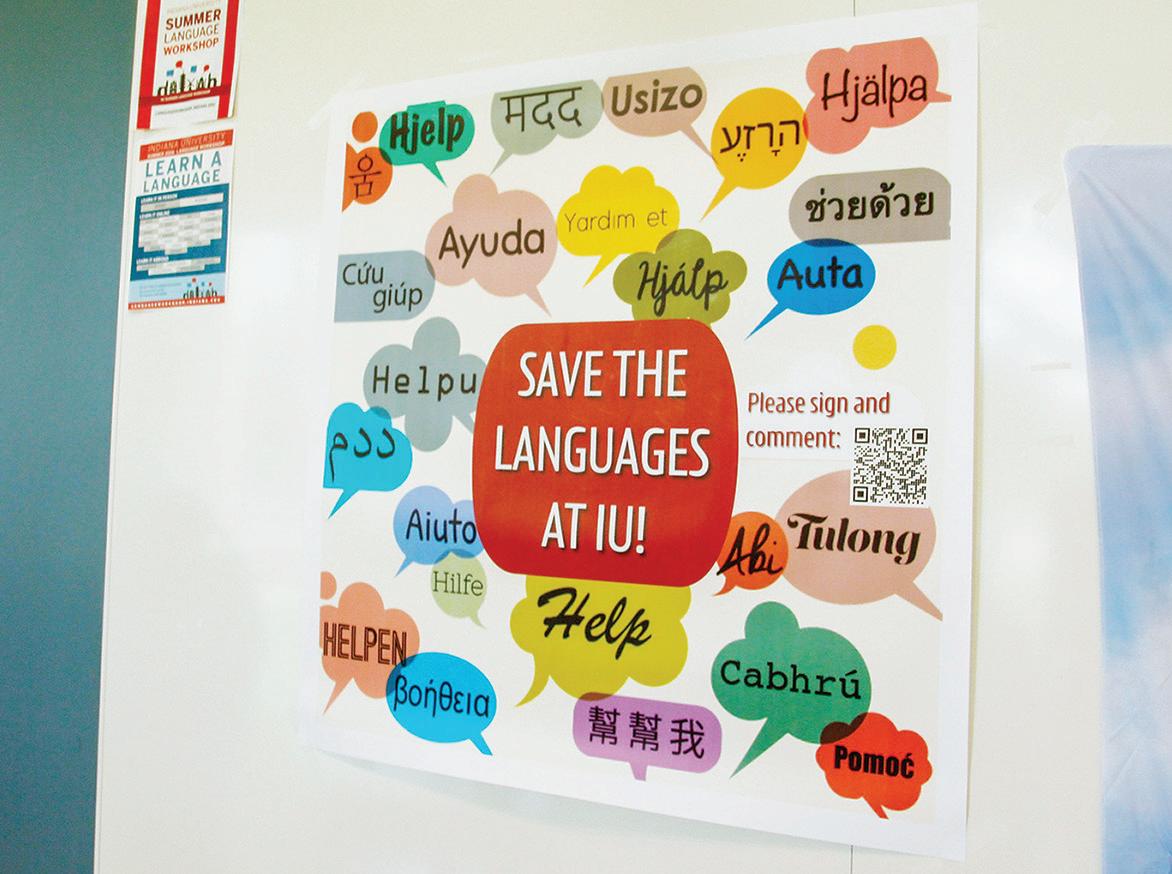
Nicolas Valazza, the interim director of undergraduate studies at IU, helped organize the Save the Languages at IU initiative, a faculty-led group formed to oppose cuts to language programs. He said he received a message from a parent of a prospective student confused about the application a couple weeks ago.
“The admission application was basically saying that they were suspended and no new student would be admitted,” Valazza said.
“So we found this very concerning.” Valazza said students planning to major in suspended studies might see the portal message and choose to attend elsewhere. But since those potential applicants never contacted the departments, faculty have no way to track how many students were deterred. Cohn said departments have been fielding confused calls from incoming students and their parents since the summer.
"The lack of clarification is going to have caused damage to the number of students who were interested in these programs,” Cohn said. “That were given the sense that they don’t even exist anymore.” For Valazza, the issue is urgent. He said clear communication needs to be sent to all incoming students rectifying the information. Beyond enrollment concerns, Valazza said the issue threatens IU’s core identity and reputation.
“The reputation of IU Bloomington is based, on (a) largest extent, on its liberal arts tradition, its humanities, foreign languages, those are our strength,” Valazza said. “I’m still optimistic that the administration has IU in its heart.”
Both Valazza and Cohn said students and parents shouldn’t give up on IU because of the portal language alone.
“Don’t stop with that information,” Cohn said. “Go and reach out to the departments that you and your children are interested in. Get the information, because the information is out there.”
IUB chancellor speaks on freedom of speech at IUSG Q&A
By Elizabeth Schuth ekschuth@iu.edu
IU Bloomington Chancellor David Reingold held a Q&A with IU Student Government Feb. 23, addressing freedom of speech concerns, IU President Pamela Whitten’s raise and non-traditional students. These were some of the key topics:
Future of the IDS and freedom of speech
An IUSG representative questioned IU’s plans regarding potential censorship of diversity, equity and inclusion language. The university closed its DEI office in May following federal and state efforts to curtail DEI in government and education.
In response to the repre-
sentative’s question, Reingold referred to the university’s recent resolution adopting the Chicago
JONATHAN FREY |
JIMMY RUSH | IDS
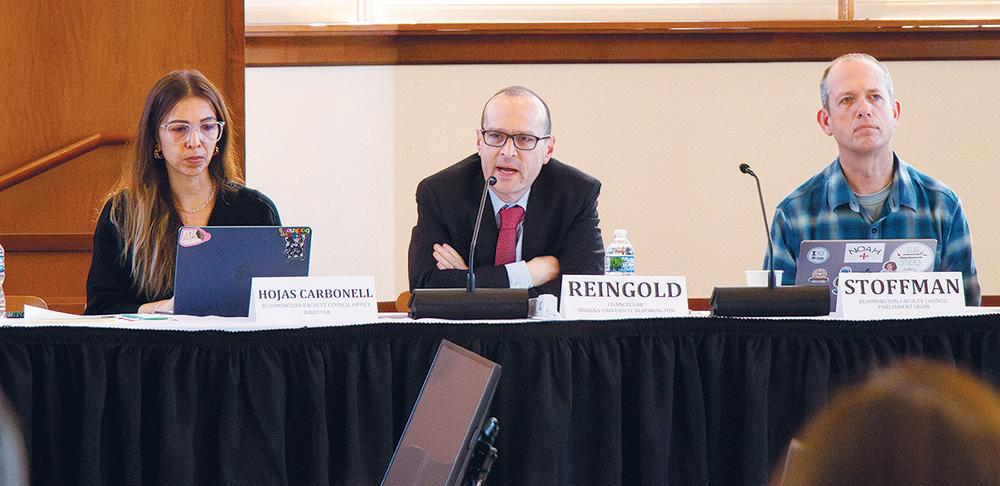
Virginia Hojas Carbonell (left), David Reingold (middle) and Noah Stoffman (right) are pictured during
IU trustees grant Whitten $100,000 raise
By Emerson Elledge eelledge@iu.edu
The Indiana University Board of Trustees gathered Feb. 20 in the Grand Casino Ballroom inside the Madam Walker Legacy Center in Indianapolis for its first meeting of 2026.
The board approved a raise for IU President Pamela Whitten’s contract, adopted the Chicago Principles on Freedom of Expression and considered more during the almost 4-hour-long meetingTrustee W. Quinn Buckner attended the meeting virtually. The eight other members of the board and President Whitten appeared in person.
Chicago Principles on Freedom of Expression
The board unanimously voted to approve the Chicago Principles, a set of free speech guidelines. IU is now the 117th university to adopt these principles for free speech.
“Students are meant to be stretched intellectually, ethically and personally, and that simply cannot happen if disagreement is treated as something to be avoided,” Trustee Sage Steele said at the meeting. “By adopting the Chicago Principles today, Indiana University is making it clear that free expression and academic freedom are our essential values and conditions for learning, discovery and leadership.”
The decision on the Chicago Principles was slated to be one of the last items on
the agenda under new business. But it was the first thing to be decided on after Whitten introduced it during her remarks before turning the microphone back to David Hormuth, the board’s chair, who introduced it for a vote.
BOT-25 Revisions
BOT-25 is IU’s Creation, Reorganization, Elimination and Merger of Academic Units and Programs policy which determines the process of creating, modifying and dissolving academic programs and departments.
A previous concern with the policy was lack of protections for faculty, especially those with tenure.
IU Indianapolis Chancellor Latha Ramchand
presented revisions regarding the policy, focusing on protection for tenured faculty and making the approval process within the bill more digestible for public knowledge.
“We ask, respectfully, that you all approve this policy, the revisions, as I said, are more in the nature of providing clarity over the process for approval,” she said.
The board unanimously approved the revisions.
IU Inc.
IU Vice President for Research Russell J. Mumper, President and CEO of the Indiana University Launch Accelerator for Biosciences
David Rosenberg and IU Vice President and General
Counsel Anthony Prather presented “IU Inc.,” a nonprofit organization created at the request of the trustees’ finance and facilities committee.
IU Inc. is meant to serve as a streamlined way for IU to receive research partners. The developers said it would be an easier way for external partners to develop partnerships.
When it is formally founded, IU Launch Accelerator for Biosciences, IU Applied Research Center and IU Realty — the currently existing IU research partnership programs — will move under the IU Inc. organization. Eventually, new organizations will likely develop under the IU Inc. helm.
The board unanimously approved the creation of the university-affiliated nonprofit organization.
Request to rescind IU Diversity Committee authorization
The board unanimously approved rescinding IU Diversity Committee authorization, an organization originally created under Senate Enrolled Act 202.
The act required universities to approve and authorize the creation of diversity committees at each campus in compliance with 2024 Indiana code.
It required those diversity committees to review and recommend faculty employment policies, review faculty
and administrative personnel intellectual diversity complaints and issue annual reports. The code was repealed last year.
“There's now a need, from my perspective, to rescind the committee authorization,” Prather said in the meeting.
President Whitten contract amendment
The last item the board voted on before adjourning the meeting was amendments to Whitten’s contract.
Buckner requested the board give Whitten a $100,000 raise, making her annual salary $1 million. He also recommended the board maintain her existing bonus structure and increase deferred compensation to $700,000.
“We have the second longest tenured president in the Big Ten,” Hormuth said. “There are several openings in the Big Ten for presidents. We've seen what's happened in higher education with this position. It's a highly valued position, incredible executive process and skills required.”
The board unanimously approved the contract amendment.
Whitten was last given a raise in July 2025 during a board meeting. The motion passed 8-1, with the only dissenting vote coming from then-student trustee Kyle Siebert.
The Board of Trustees are scheduled to next meet June 11 and 12 on the IU Bloomington campus.
What to know about Bloomington’s $50K Flock contract
By Grace Fridy gfridy@iu.edu
As tensions surrounding immigration enforcement around the country grow, activists and some elected officials are continuing to call for the City of Bloomington to end its contract with Flock Safety, which they allege is sharing license plate data with U.S. Immigration and Customs Enforcement and other federal agencies.
Last month, the city released an unredacted version of its $50,000 contract with the public safety technology company after months of requests, the B Square Bulletin first reported. Now the Bloomington City Council may consider a resolution to outline stricter regulations
for surveillance technology in the city.
The release came shortly before about 400 demonstrators protested the city’s contract with Flock on Jan. 30 at City Hall, the same day as a “national shutdown” protest against ICE tactics, encouraging people not to go to school, work or to make purchases.
The ACLU reported in October 2025 that Flock was sharing data from its national license plate scanner network in Massachusetts with ICE. This includes cases where local departments restricted access to just their local officers.
“Having that information available, and especially in today’s political climate, where the safeguards on civil liberties are falling swiftly, is problematic,” Bloomington
City Councilmember Isabel Piedmont-Smith said. “And I don’t want Bloomington to be able to facilitate the removal of people through lack of due process or trampling on their civil liberties.”
Bloomington’s released Flock contract
The unredacted contract was released Jan. 27, after multiple open records requests about Flock yielded heavily redacted versions. The contract released, worth $50,000, is for a mobile security trailer system.
According to Flock’s website, this system comes with two Condor pan tilt zoom cameras, a panoramic video camera, flashing deterrent lights, a two-way “talk down” speaker and access to Flock’s
online platform and mobile app.
Bloomington has a total of 40 Flock cameras, according to a September 2025 document from the Pittsboro Police Department.
The document, obtained via a public records request from the Indiana town’s police department by David Maass, a surveillance technology investigative journalist and professor at the University of Nevada, Reno, contains a list of shared Flock safety devices across the country.
The released contract includes a section about footage disclosure that says: “... Flock may access, use, preserve and/or disclose the Footage to law enforcement authorities, government of-
ficials, and/or third parties…” if it’s a legal requirement or if Flock believes it will detect, prevent or otherwise address issues of security or emergencies.
The contract was signed by the city’s corporation counsel — a member of the legal department — on Dec. 1, 2024.
City Council draft resolution At the Bloomington City Council’s Feb. 18 meeting, Council President Isak Nti Asare introduced a draft resolution about Bloomington’s use of automatic license plate readers, or ALPRs.
In a letter to his colleagues, Asare acknowledged sharing draft legislation at meetings is unusual, but the goal was to get early engagement.
In this letter, Asare states one of the goals of the resolution is to acknowledge that ALPRs require stronger justification due to their locationlinked information collecting.
The resolution would also request that the Bloomington Police Department share a report with the council about who has access to the camera data, and the program’s current rules around auditing and data sharing.
“The deeper issue is whether Bloomington has the institutional capacity to govern technologies that are increasingly common and will continue to be so,” Asare, who is also the co-director of IU’s Cybersecurity and Global Policy Program, wrote in the letter.
The resolution would also state the council’s intent to develop an ordinance outlining rules for the city surrounding surveillance technology and ALPRs, not just Flock cameras specifically.
Bloomington’s next steps
Bloomington Mayor Kerry Thomson first addressed
public concerns over Flock data sharing at a virtual town hall Jan. 26. She said she would meet with Flock in February, and that her intentions were to ensure ICE and other law enforcement could not access Bloomington’s data. The mayor, deputy mayor, chief of police and the city’s corporation counsel met with Flock representatives Feb. 16, Desiree DeMolina, communications director at the Office of the Mayor, said in an email to the Indiana Daily Student.
“We are doing due diligence and will not be rushing into a decision to retain or terminate Flock,” DeMolina wrote. “We will share our findings and any next steps once that evaluation is complete and we have meaningful information to communicate.”
In an open letter written Feb. 12, Piedmont-Smith urged Thomson to cancel the contract, citing the company’s unauthorized placements and failure to deactivate cameras in Cambridge, Massachusetts, and Evanston, Illinois.
Piedmont-Smith wrote that she communicated with an Evanston city councilmember about Evanston’s contract cancellation and the city’s cease and desist sent to Flock. She also wrote that it would be unwise for Bloomington to trust Flock to adhere to the contract restrictions given the company’s history.
“I think the best way forward at this point is to work with the administration to figure out a path forward that can enable our police officers to access whatever information they need to address criminal activity but not put residents at surveillance risk,” Councilmember Hopi Stosberg said in an email to the IDS.
EMERSON ELLEDGE | IDS
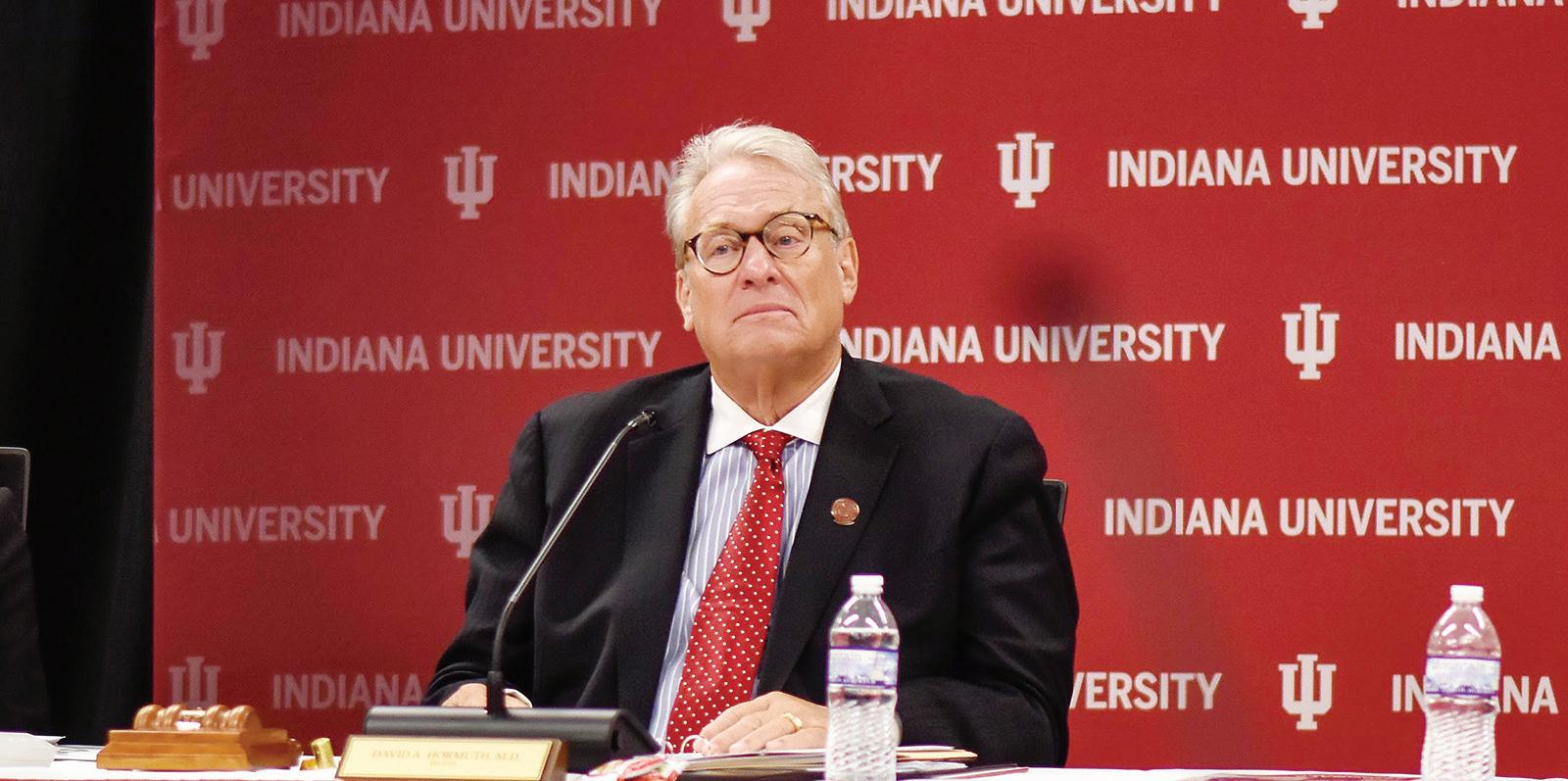
Indiana University Board of Trustees chair David Hormuth listens to a speaker during the BOT’s meeting Feb. 20 in the Madam Walker Legacy Center in Indianapolis. It was the board’s first meeting of 2026.
SPENCER’S SPIEL
Using peptides? Careful, you could be hastemaxxing
Spencer Schaberg (he/him)
is a sophomore studying microbiology.
If you’ve scrolled through TikTok or Instagram lately, you’ve likely seen at least one young man with angular cheeks, a perfectly clear face, a chiseled jawline and, of course, washboard abs. This walking Dior ad calls himself a “looksmaxxer.” He and others like him belong to a subculture of “looksmaxxing” in which they seek to maximize their physical attractiveness through ever stranger and more clinically questionable means.
Looksmaxxing only became mainstream in the past few years. It represents another trend that originated on obscure incel internet forums before it surfaced in our social media feeds. Along with a host of objectively sexist beliefs about women, the incel community was convinced, ironically, that how you look is the most important factor in finding a girlfriend. As a result, some began to go to drastic lengths to manipulate everything from bone density to biochemistry in pursuit of an arbitrary standard of attractiveness.
Is your canthal tilt — the angle of your outer eye — positive, negative or neutral? Does your face have the correct ratio of midface width to chin length, plus or minus 0.5? Are you actively mewing? If not, chances are you’re “sub-five.” If these questions sound superficial, you aren’t cut out to be a ‘maxxer. This obsession with facial structure propelled the subculture into the public sphere due to its comic appeal. Because of this, meme culture embraced looksmaxxing. Some even found genuine interest in
“softmaxxing,” a watereddown version of looksmaxxing that promotes exercise, adopting a skincare routine and sleeping well. But stalwart looksmaxxers are still willing to push their bodies to their biological limits to appear more attractive.
Looksmaxxing influencer Clavicular, for example, says he uses meth to suppress his appetite. Such disregard for personal safety is nowhere more apparent than in the use of synthetic peptides. On TikTok, Instagram and online message boards, users trade peptide injection guides, vendor recommendations and dosing protocols.
Peptides are shorter versions of the amino acid chains the proteins in our bodies are composed of. Unlike standard proteins, which mostly remain inside the cell to perform specialized tasks, our bodies produce these shorter chains to transmit messages between cells and regulate functions, including our growth, immune response and metabolism. By synthesizing similar peptides in a lab, scientists can mimic natural signaling molecules and influence these processes.
Ozempic, for example, is a synthetic peptide that works by imitating the structure of a naturally produced peptide called GLP-1, which
increases your insulin production and lowers your blood sugar after you eat a meal. The two peptides are so similar in structure that the body can’t tell them apart. This makes Ozempic an incredibly powerful drug for promoting weight loss and treating Type 2 diabetes. While it’s not for everyone, at least the FDA has approved Ozempic. This is more than can be said for the looksmaxxers’ typical go-tos.
Looking a little pale? Try Melanotan II, a peptide that spurs melanin production. Maximizing your gym gains? Reach for BPC-157, a peptide that rapidly repairs tissue damage — and is a
ERRANT ERIC
banned substance under the World Anti-Doping Agency. Is Ozempic not cutting it for your weight loss? Try Retatrutide, a peptide still in clinical trials with early results suggesting some could lose up to 30% of their body weight in a little over a year. Never mind none of these has been proven safe in the short- or long-term by the FDA or any other global regulatory body. We don’t listen to those squares. You won’t find them at your local CVS, either. In the United States, the FDA has banned pharmacies from making them. Instead, they’re sold online as research chemicals. Each vial of every wonder-drug,
available at the press of a virtual button, arrives with a disclaimer: “NOT FOR HUMAN CONSUMPTION. RESEARCH USE ONLY.” People inject them anyway, either unaware of or unbothered by risks of contamination, a lack of quality control and nonexistent dosing recommendations.
To worsen matters, many looksmaxxers hope to magnify the effects by “stacking” multiple peptides simultaneously. But our body’s metabolism is incredibly complex. Manipulating multiple metabolic pathways at once drastically increases the risk of unintended side effects. Peptides are powerful tools well suited to redefine public health, when used with proper medical supervision. Just ask anyone with diabetes: The discovery of the peptide insulin won the Nobel Prize in Physiology or Medicine in 1923 and was so revolutionary for treating the condition that all previous medical work in the field became referred to as the “pre-insulin era.” People went from dying of starvation while trying to keep their blood swugar down to living long, healthy lives with diabetes. Many modern peptides can produce similar results, but as the saying goes, fools rush in. FDA approval is a promise the chemical you’re injecting is tested across multiple populations and long periods of time. The only way to know for sure that peptides are safe is to wait until all the results are out. In the meantime, bypassing a medical professional to inject researchgrade peptides you got from the internet looks a lot more like foolmaxxing.
sschaber@iu.edu
SATIRE: Acorn distribution among items discussed by campus squirrels
Eric Cannon (he/him)
is a sophomore studying philosophy and political science and currently serves as a member of IU Student Government.
The Indiana University Board of Acorns gathered in the third nook from the ground inside the Bur Oak tree overlooking the Indiana Memorial Union. The board, which comprises nine squirrels appointed from around IU Bloomington’s campus, approved policies pertaining to acorn distribution, personnel awards and residential expansion during the meeting, which marked the first such gathering this year.
Maxwell Bushy-Tail, chairman of the board and its longest-sitting member, acknowledged the recent tornado that landed in Bloomington to open the meeting.
“Branches shook, but roots stayed strong,” BushyTail said. “I’m glad to see everyone could make it given recent weather.”
Acorn distribution
Board member Elizabeth Walnut introduced a motion to consider acorn distribution for fiscal year 2026, including a 3,000 acorn raise
for President of Trees Michael Pecan, a 2,500 acorn bonus for Pecan, a 1,800 acorn expenditure to cover legal fees associated with an ongoing lawsuit over the board’s outdoor tail-wagging policy and a 500 acorn allocation to the Daily Elm-Leaf.
The board unanimously approved the first three measures. The last failed with one vote in the affirmative and eight in the negative.
“We devote so many acorns to the president of trees’ salary,” Walnut said. “Why do we flip our tails at paying a little bit more for the Daily Elm-Leaf to buy more bark tablets?”
New statue
After these votes, Michael Pecan recommended plans to erect a statue of acorn caching coach Curt Squirelletti. Pecan suggested the statue could be located outside Spruce Hall.
“Coach Squirelletti led our caching team to new heights this year,” Pecan said. “A statue is the least that is in order to honor a perfect season.”
During the 2026 caching season, Squirelletti’s team
cleared more than 25 oak trees’ worth of acorns. In October, the team beat the Purdue University Chipmunks in West Lafayette, hoarding 60% of the game tree’s produce within the hour of playing time compared to the chipmunks’ 11%.
In response to a Daily Elm-Leaf request for comment, Squirelletti’s office said the athletic icon was busy watching scatterhoarding film.
10th Street expansion
Chairman Bushy-Tail presented a motion for the board to consider Project 10th Street, the final item on its agenda, before the meeting ended.
Project 10th Street is a plan to expand the Indiana University squirrel population beyond its traditional range that covers most of the southern half of campus. This sphere includes the southeast residential neighborhood and the grounds of the IMU, noted zones of squirrel habitation. Certain provisions in the plan call on Bloomington to plant trees along 10th Street’s median to accommodate more bushytailed Hoosiers.
“There is no reason squirrels should be limited to the south of campus,” Jennifer Hazelnut, the newest board member, said. “In the past, we fought for the Tree Suites in the IMU. We even won Spruce Hall and Forest Dining Hall. This battle is not too large.” Walnut demanded the board scrap the project.
“Humans at Indiana University use 10th Street as a race track,” Walnut said. “It’s simply not safe for squirrels to traverse as long as there are humans at IU.”
The board decided to table the project for further consideration in a six to three vote.
“While we didn’t decide the issue today, I trust a decision will be reached next time,” Bushy-Tail told the Daily Elm-Leaf. When the meeting ended, the board members and other attendees moved from the Bur Oak to the Whittenberger entrance at the IMU to beg students for food on the sidewalk.
ericcann@iu.edu
We’ve caricatured Trump for too long. Now it’s time to get serious
Emma Howard (she/her) is a sophomore studying cinematic arts.
There are two Trumps. One has committed heinous acts of racism, sexual violence and fascism. Another is a balloon in a baby diaper that floats over a crowd of protest signs wise cracking about his orange complexion. Popular media depictions of Donald Trump over the last decade have overwhelmingly skewed toward the cartoon rather than the man. In this way, he has become a character more than a genuine threat. To put it plainly, the jokes aren’t funny anymore.
In Season 42 of NBC’s “Saturday Night Live,” Alec Baldwin set a season record by appearing as Trump 17 times. Current cast member
James Austin Johnson is on track to beat that record, appearing as Trump in 10 out of the 12 episodes currently aired of Season 51. Among a plethora of political parodies throughout the 27th season of “South Park,” Trump appears as the abuser in a toxic relationship between Satan and himself. If you have so much as opened social media in the past month, you’ve probably been subjected to the endless stream of memes surrounding the sitting president. And if you’ve been conscious at any time over the last decade, his reach has extended from late night shows to casual conversation. I do think that entertainers mean well by speaking out. There is certainly some-
thing to be said for writers and artists using their talents for good. But when we focus on Trump’s absurd speech, mannerisms and physical appearance, especially in the comical depictions we see in the media, we create a benign caricature of a real person who is causing very real harm. In pursuit of soothing our own anxieties, we treat Trump as a piece of fiction. Cartoons, parodies and jokes have allowed him to succeed because in our minds he is a bogeyman we cannot take action against. Comedy, after all, is recognized by some mental health experts as an outlet to tackle difficult subjects from a psychological distance. Cynthia Vejar, an associate professor of mental health counseling at Leba-
non Valley College, wrote in Psychology Today that humor can distract us from what we need to feel.
“When laughter becomes avoidance, it can delay grief, suppress vulnerability, or disconnect us from the emotional truth of a situation,” Vejar wrote.
Because we’ve used humor to handle current crises, they feel more like fiction than reality. When you see an illustration of Trump with wacky hair, a bright orange face and a comically long tie, you are seeing a fake version of him we’ve conjured to distract ourselves from the vile atrocities the man himself has committed. His crusades against immigrants, people of color, women and the LGBTQ+ community are
deplorable, to say the least. And I cannot begin to put into words how incredibly sickening his alleged violence against children is, detailed in claims made to the FBI released by the Department of Justice. Given what we know of Trump, I can no longer bring myself to laugh at him in good faith.
Still, the memes flow like water, reaching users on any social media platform you can think of. When our brains are in a state of automaticity as we scroll, it’s harder to know any better than to laugh, like and share. It’s reached a point where we have become desensitized to the gravest of situations. Memes of Jeffrey Epstein, for example, have also entered wide circulation. Even the official
Democratic Party Instagram account has stooped to the level of lazy short-form edits that make light of Trump’s relationship with Epstein. Normalizing seeing the perpetrators of such crimes in a humorous light semifictionalizes them, and in doing so, diminishes the crimes themselves. We have subconsciously allowed Trump to be a caricature instead of the predator he is. His impact has not only caused devastation on home soil, but throughout the world. But those impacts are lost to our laughter if we continue to distance ourselves from the fact that he is a real person — a real person we can protest and vote against.
emhowa@iu.edu
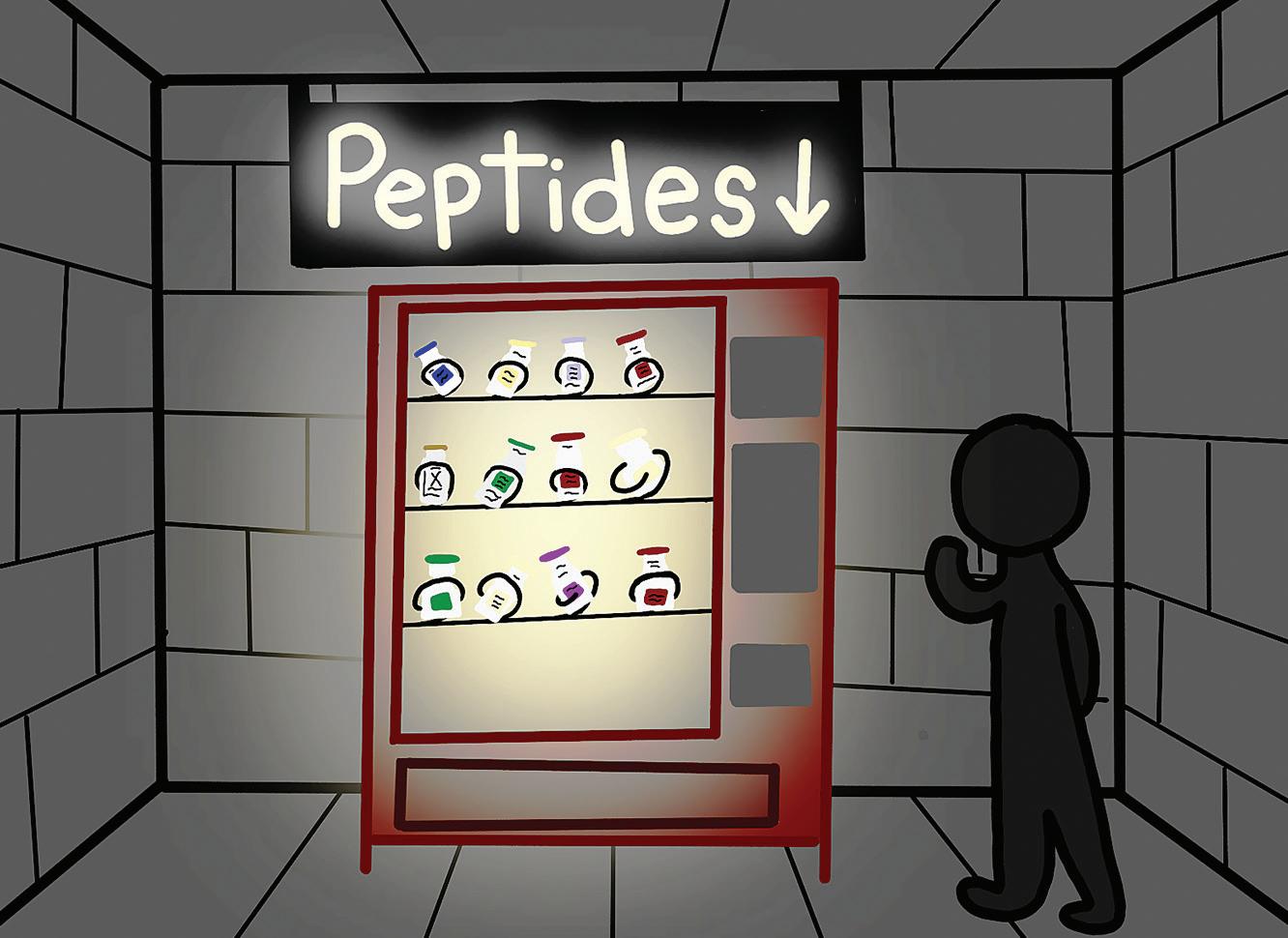
ILLUSTRATION BY CHLOE LAVELLE
ILLUSTRATION BY KELSEY GAULT
The Board of Trustees’ decision to adopt the principles follows several free speech controversies. The Foundation for Individual Rights and Expression named IU the country’s worst public university for freedom of speech in 2025. FIRE cited IU’s handling of the pro-Palestinian Dunn Meadow encampment in 2024 and the cancellation of Palestinian painter Samia Halaby’s exhibition at the Sidney and Lois Eskenazi Museum of Art, among other events.
IUSG member Eric Cannon asked Reingold about the future of the Indiana Daily Student. Reingold encouraged its print edition to continue as long as it follows budget restrictions and called himself “a faithful reader.” He expressed support for entrepreneurial efforts, such as the IDS’ deci-
sion to sell national championship posters. “If the paper has the money to print, it should be able to print as much as it wants or as little as it wants,” Reingold said.
The Media School fired Director of Student Media Jim Rodenbush on Oct. 14 after he refused administrators’ orders to restrict the Oct. 16 print paper to just Homecoming content. Hours later, The Media School cut the print edition entirely, which Reingold wrote in a statement dealt with method of distribution, not editorial content.
After backlash from the paper’s editors, community members, alumni and donors, the chancellor and the university reversed course Oct. 30 and allowed the IDS to resume print. Media School Dean David Tolchinsky announced plans for a task force on the editorial independence and financial sustainability of student media Oct. 20.
President Pamela Whitten’s raise
The IU Board of Trustees unanimously approved a $100,000 raise for President Pamela Whitten at its meeting Feb. 20. She now earns $1 million a year.
Connor Hatch, an IUSG representative for off-campus housing, asked Reingold how the raise improved the student and faculty experience.
Reingold declined to comment, responding it wouldn’t be “appropriate” for him to respond.
“They (the Board of Trustees) have, I think, the best interest of the university, you know, in the decisions that they make, and I fully respect the decisions that they make in that regard,” Reingold said.
Non-traditional students at IU
IUSG congressmember Josh Brewer also brought up his concerns for non-traditonal students, describing himself as the oldest IUSG
member and possibly oldest undergraduate at the Kelley School of Business. He spoke about IU’s lack of effort to recruit non-traditional students.
“Quite frankly, that has been kind of a struggling experience for me because I don't have a lot of people I can relate to on campus that are in my shoes,” Brewer said.
Reingold suggested the university could adjust class times to accommodate older students who may also be working or need childcare. He also encouraged IU Indianapolis as a better option for non-traditional students.
IU spokesperson Mark Bode previously told the IDS that IUB has 441 enrolled undergraduate students over the age of 25, a common marker of non-traditional status, as of this semester. That’s out of nearly 50,000 undergraduates. Non-traditional students can also include students under 25 with dependents or working full time.
Other remarks IU announced in a Feb. 5 press release that Rahul Shrivastav would be stepping down from his role as provost to become interim vice president of student success, a university-wide position. John Ciorciari, dean of the Hamilton Lugar School of Global and International Studies, is now interim provost. Reingold declined to comment on specifics of the provost selection process to the IDS.
The U.S. Department of Justice Civil Rights Division is investigating if IU’s scholarship programs are compliant with federal law and whether the university is “discriminating against program participants based on any statutorily prohibited basis,” the IDS previously reported.
When asked about the investigation, Reingold said IU is fully compliant with federal law.
“If you had a magic wand
that could do immediate change for IU, what would be your first three wishes be?” one representative asked.
Reingold responded he would like to lower tuition, double the amount of dorm rooms available and do a complete restoration of the Indiana Memorial Union.
Reingold said he finds Q&A sessions with students help him keep in touch with the concerns of the student body. “At the end of the day, if we're not serving you guys well and doing what we need to do to give you guys the opportunities that you came here for, then we are in trouble,” Reingold said. “Staying in touch and knowing where you guys are and the things that matter to you is important to me.”
Editor’s note: Eric Cannon is an opinion editor at the IDS. He was not involved in the reporting or editing of this story.
A Way of Wellness Chiropractic specializes in comprehensive spinal care. We offer treatment for many different spinal conditions and problems, while also addressing the body as a whole. We provide effective chiropractic care helping patients reduce stress, improve mobility and spinal health. The quality treatment we provide is always fit to your individual needs and goals. Let us help you achieve and maintain good spinal health. We look forward to meeting you! Mon. - Thu.: 8 a. m. - 6 p. m. 1121 W. Second St. 812-336-2225 bloomingtonchiropractor. com
Baron D Hall, DDS, MSD Jake
Willhite, DDS, MSD Orthodentists
Erica Hall, Hannah Elliott, Kaitlyn
Jacobs, Marilyn Lee, Adrian Price
With modern techniques and a fun style, B-town Orthodontics is the most up-and-coming orthodontics office in the Bloomington area!
We offer the latest technologies including invisalign, gold brackets, laser treatments, and even mini implants that can help restore missing teeth and even eliminate the need for surgery. B-town Orthodontics offers FREE consultations and don’t forget to download The Braces App, the hottest free app designed by B-town Orthodontics’ Dr. Baron Hall.
Tue. - Thu.: 8:30 a.m. - 4:30 p.m. Lunch 12:30 p.m. - 1:30 p.m. Mon. & Fri.: Appointments Only 1320 W. Bloomfield Rd., Suite B 812-287-8851 btownorthodontics.com
Ryan D. Tschetter, DDS
Lauren R. Hoye, DDS
Jackson Creek Dental is conveniently located on South College Mall Road. Most insurances accepted, including the Indiana University Cigna Insurance plans as well as the IU Fellowship Anthem. Dr. Tschetter and Dr. Hoye offer state of the art dental technology such as Zoom whitening, same day crown appointments, and Invisalign. We also provide restorative, cosmetic and emergency care. We pride ourselves in giving the best care to our patients while offering a pleasant yet professional atmosphere.
Providing individuals, couples and family counseling as well as psychiatric evalutation and medication management. We ensure that individuals of all ages, experiencing mental illness can better manage life.
Mon. - Thu.: 9 a.m. - 6 p.m. Fri.: 9 a.m. - Noon 5010 N. Stone Mill 812-929-2193 newoutlookcc.org
Ricardo Vasquez MD Medical evaluations: varicose veins, leg pain and swelling. No refund needed.
Mon. - Fri.: 8 a.m. - 5 p.m. 815 W. Second St. 812-336-6008 vascularcenterandveinclinic.com
Optometry
Dr. Andrew Jones, OD Dr. Marzia Zamani, OD Dr. Mark Houser, OD
Dr. Starr is an IU Football Alum who provides pain-free experiences for all Hoosiers with IV sedation. He specializes in Wisdom Teeth Extractions, Dental Implants and Plasma Therapy while utilizing 3D imaging technology. Accomplish fast and predictable healing with Plasma Therapy to avoid dry sockets after extractions. Voted the Most Trusted in Bloomington, they look forward to accomplishing continued successful results every day for all Hoosiers.
A Way of Wellness Chiropractic specializes in comprehensive spinal care. We offer treatment for many different spinal conditions and problems, while also addressing the body as a whole. We provide effective chiropractic care helping patients reduce stress, improve mobility and spinal health. The quality treatment we provide is always fit to your individual needs and goals. Let us help you achieve and maintain good spinal health. We look forward to meeting you!
Mon. - Thu.: 8 a. m. - 6 p. m. 1121 W. Second St. 812-336-2225 bloomingtonchiropractor.com
Dr. Tavel Family Eyecare is your partner in your personal eyecare journey. Since 1940, the company has believed that every Hoosier deserves quality eyecare and vision solutions at an affordable price.
Dr. Tavel offers comprehensive eye exams, special testing, management of eye diseases, glasses, contact lenses and much more, all backed by an insurance acceptance guarantee. The company is committed to advancing eye health by investing in the latest technology and providing treatements that are right for every patient’s unique needs.
Mon.: 7:30 a. m. - 6
Jan Taylor-Schultz
‘Ghetto fabulous’
Inside Mama Mo’s Hoodoo haven
By Mia Lehmkuhl mialehmk@iu.edu
Nestled inside a small, two-bedroom house on Maple Street, a curated world of herbs, incense and ritual tools beckons. A sacred vèvè symbol drawn on the shop’s threshold calls on Papa Legba to stand guard and ward off negative energies.
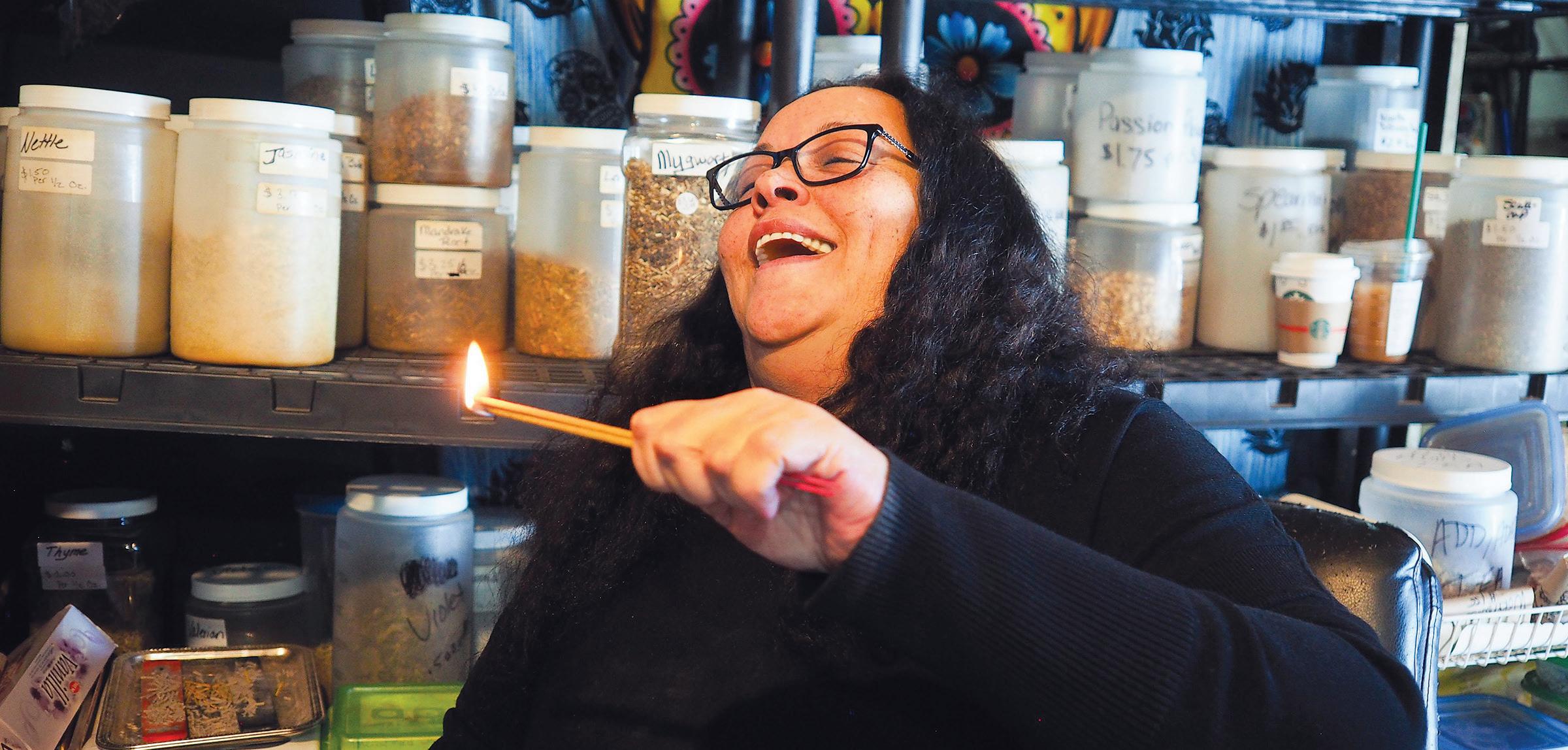
The owner lights two incense sticks, a scent called the Seven African Powers, and sprinkles a mixture of corn starch, peppermint, fenugreek and powdered eggshell about the shop’s nooks and crannies.
She then tends to the three altars at the back, dedicated to Papa Legba, Erzulie (or Ezili) Freda and Santa Muerte.
Papa Legba and Erzulie Freda are lwa, or spirits, in Haitian Vodou, a religion influenced by West African traditions. Papa Legba shares connections with the Yoruba deity Eshu and the Orisha Eleguá in Cuban Santería. Santa Muerte is a deity worshipped primarily in Mexico and Central America, though worship of her is growing in the United States.
In the middle of it all, the owner murmurs a quick blessing over the shop, setting her intention of positive energy for the day ahead. Music hums from her iPad on the table, rotating through a playlist with everything from Professor Longhair to Aretha Franklin.
“Bless this space,” she says. “Give me grace to educate.” Her name is Monice Henson, and she practices ancestral Hoodoo. Though she prefers to go by Mama Mo, a name that more accurately captures her role as someone people seek advice from.
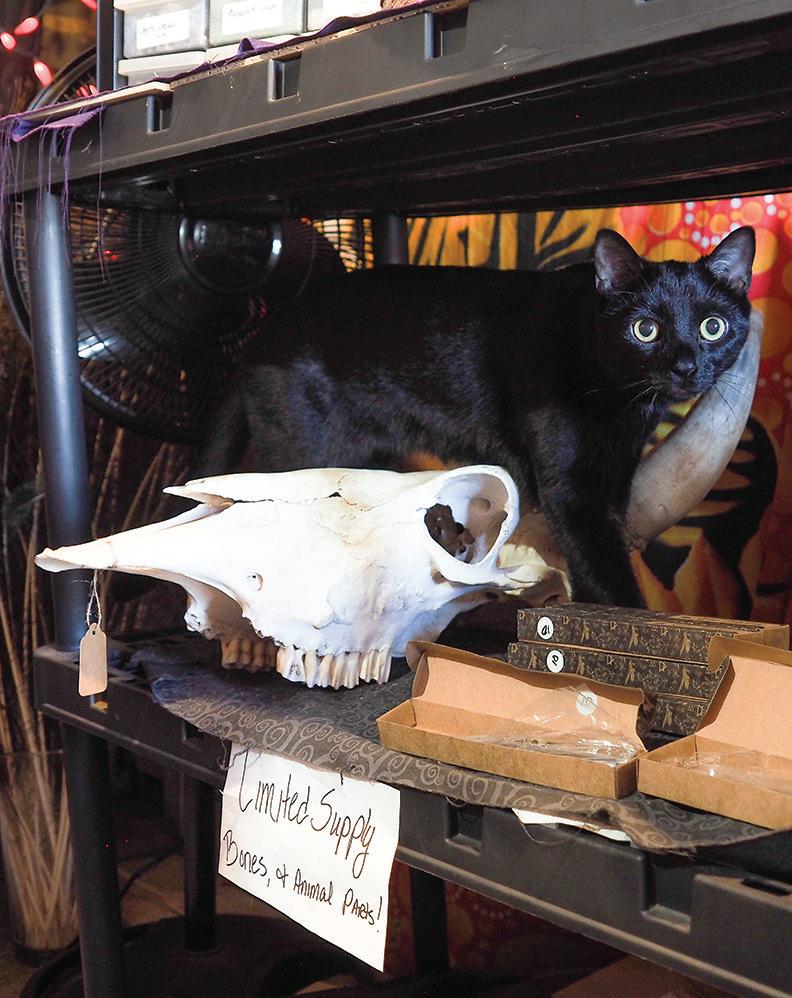
Two black cats sleuth around the shelves. Mama Mo picks up a whisker from the table — a gift from her cat Loki — and deposits it safely into a zip-top bag. As one of the animals that straddle the realm of living and dead in her belief, when cats leave gifts, it’s a sign of good luck. She’ll keep that for later.
In a college town better known for Big Ten sports and limestone, the brightly colored “Voodoo Shop” sign draws attention along a residential street. For its patrons, it marks a sanctuary to find spiritual supplies and, perhaps, a bit of maternal guidance they didn’t know they needed.
“I feel like a lot of people come in with problems or things that they need help with, and I truly believe my mother has a gift at getting that out of people,” Lamonte Henson, Mama Mo’s eldest son, said. The distinction between Hoodoo and Vodou, Mama Mo said, is Vodou is an “organized religion” still in practice today, originating in Africa but predominantly practiced in Haiti. In the United States, particularly in Louisiana, a similar spiritual and cultural practice developed. Enslaved Africans were prohibited from openly practicing religions from the African diaspora, so they aligned their lwa with Catholic saints, observing rituals under the guise of holy days.
Hoodoo carries a more subjective definition de-
pending on the practitioner. For Mama Mo, Hoodoo is ancestral — a magic passed down from generation to generation. For others, she said, Hoodoo represents a closed ancestral practice exclusive to Black Americans.
“I believe Hoodoo can be multicultural,” she said. “You know, there’s Hoodoo in old Italian superstition, there’s Hoodoo in African superstition.”
Mama Mo grew up in Bloomington but later moved to New Orleans for a short time, what she deems the “mecca” of Hoodoo and Louisiana Vodou.
Once she returned to Bloomington at the end of 2016, she realized no shops could accommodate her spiritual practice. She panicked.
A couple weeks later, her sister told her about open studio spaces in part of Bloomington’s Artisan Alley, which is now a nonprofit organization. At the time, Mama Mo sold handmade jewelry online while balancing a full-time job as a hairdresser. Eventually, she scored a shelf in a consignment shop in Artisan Alley.
“And then they kept asking for more stuff, more stuff, more stuff,” she said. “So before I knew it, I was working at the consignment shop and also had another full-time job.”
Soon, Mama Mo graduated from a shelf to the smallest studio space available. Eventually, even the biggest space could not accommodate all she wanted to bring to Bloomington. She dreamt of a place where, no matter what patrons practiced, she had that special something for them on her shelves.
“And that became my motto, you know,” she said, “‘if I don’t have it, I’m gonna get it for you.’” In 2018, Mama Mo opened The Voodoo Shop out of her aunt’s former home. Now, it spans three rooms full of supplies and trinkets for novice or veteran spiritualists.
“I know it was my ancestors talking to me, telling me, there’s a lot more people here, there in the same boat you are,” she said. “So you know how the universe kind of works with you, you know, and opens your path.”
Inside, one can find crystals, grimoires, tarot decks, spell bags, incense, tea mixes, herbs, deity statues or even animal parts — like crow’s feet or bobcat ribs — on her shelves.
“My whole shop is ghetto fabulous,” she said. Running it is a full-time job. Nearly every room in the home, save for her children’s bedrooms, has been absorbed into the business. Mama Mo used to live there, too, but now lives with her mother. Her two youngest sons, William and Julian, live at the shop.
Keeping the shop stocked is a constant balancing act. Every few months, she places bulk herb orders and puts overstock on sale. Trial and error shape how she manages inventory. When she over-orders, she runs sales. When she falls behind, she mixes oils and herbs. Without an apprentice, every task falls on her.
In past years, Mama Mo traveled south about three times a year to pick products
and visit potential distributors with a route stretching from Atlanta to New Orleans, across Florida and looping back through Tennessee.
And although these trips allow her to select items herself, traveling requires her to temporarily close the shop. Now, without extra help, she can’t afford to shut her doors for a week or two.
“I’ve got family that depends on my income for this shop, so it’s hard, it’s, you know, I don’t know what to do,” she said.
Mama Mo sits at her table at the front of the shop. Behind her are towering shelves filled with tubs of herbs, some of which she retrieves for the tea she’s mixing.
Every oil, tea and herb mixture is made or kept in stock by Mama Mo herself, using recipes left by her grandmother – with a twist of her own. She pulls out a small, green box filled with those recipes, sacred to her practice, and grounds up a mixture in a mortar and pestle.
But before Mama Mo ever mixed a spiritual oil, she watched her grandmother whip up homeopathic medicines for just about any ailment.
“My grandmother always had a salve or a spray or something, you know, to fix whatever was ailing you, and they worked, you know, and people came to her for her products,” Mama Mo said. “And I noticed that at a very young age, so I was envious of that.”
She’s of the belief that everyone has the potential to tap into a spiritual gift. For her grandparents, it was Earth magic — gifts in things like gardening and mixing herbs and other materials from the Earth. She insists her grandfather’s garden was the most lush and beautiful garden she’s seen. Mama Mo said she couldn’t grow a plant to save her life.
She said her gift, like her grandmother’s, is an ability to mix ingredients for an intended result. Sometimes, her recipes are specific to an ailment, such as her “I hate being a girl” tea intended to cure menstrual symptoms.
“My ancestors speak to me,” Mama Mo said. “They tell me what I need to make, when I need to make it.”
She said she hears her ancestors in the back of her head and in her gut. And inside The Voodoo Shop, their presence is amplified.
Despite the sanctity of ancestor work in her practice, Mama Mo said her attempts to trace her lineage bring mixed results.
“My grandmother’s side has Creole blood,” she said. “I don’t have any. I only have oral stories of my lineage from there.”
Those stories tell of a family that came from plantations around Louisiana and later settled in Kentucky before arriving in Indiana.
On Mama Mo’s grandfather’s side, she said her bloodline traces back to Matthew Henson — an explorer said to have discovered the North Pole. However, because her great-grandfather died when her grandfather was a young man, her greatgrandmother found some-
For many Black Ameri-
cans like Mama Mo, tracing lineage can prove near impossible. The U.S. slave trade made it very difficult for families to pinpoint exactly where their ancestors came from, as records of those enslaved were unreliably kept or lost to time. As a result, ancestry is often preserved through oral tradition.
“I’m proud of my lineage. I’m proud of my family. I’m proud of what I do,” Mama Mo said.
She said those ancestors sometimes speak through her: a message she’s meant to deliver, an inkling of an item someone needs.
“It becomes part of you, it becomes natural and instinctual,” she said. “It’s not a curse. It’s not something to be scared of.”
For Que Neal, a HoodooVodou practitioner who has paid Mama Mo some visits over the past few months, the ancestors’ presence is palpable in the shop.
“I feel like when you come in this space, you really feel the ancestors, the energy, but you also can come in knowing that you’re going to speak with the owner, they’re going to give you guidance on what you want,” Neal said. “They’re going to give you their best advice and what you should do.”
The shop’s success brings with it challenges. Not everyone treats nontraditional spirituality with deference. Some, Mama Mo said, come in to gawk.
“When you’ve got people just coming in off the B-Line wanting to see what the freak show is, you know, with The Voodoo Shop,” Mama Mo said. “They didn’t have any energy put into it. They didn’t really want to know what it was about.”
IU students, particularly, sometimes don’t take the shop seriously. She said these groups of students, typically groups of girls, come in to ask for “love potions” as they giggle and whisper among themselves.
“‘I’m like, ‘again, this is not Harry Potter. You know, all magical rites and rituals require sacrifice, and when you’re doing love spells, you know, that’s actually black magic,’” she said.
Once they stop at her table, Mama Mo gives them a firm warning about the steep price of black magic — spellworks that seek to unduly influence or manipulate others. And in her Hoodoo practice, what one does comes back to them “times 10.”
“A lot of them require blood, you know, different kinds of sacrifices, and they’re very personal and very, very ancestrally bound, you know,” Mama Mo said, “So it’s powerful shit.”
Despite the occasional gravity of the work, Lamonte said he largely views the Hoodoo his mom practices as a form of healing — one he’s watched her perform just by chatting someone up at the grocery store when she can tell they’re having a bad day.
“I think people have this big misconception of what it is,” Lamonte said. “I think people think of scary curses and voodoo dolls and just all of the negative things that
come with it, and they don’t necessarily take the time to learn that that’s not what it is.” Mama Mo once read tarot cards in a curtained corner of the shop, a service she no longer offers. Other than her needing the space for stock, listening to strangers unpacking heartbreak, uncertainty and sorrow — as well as the large spiritual exchange — took an emotional toll. And without an apprentice to man the front of house, each session began to stretch her too thin.
“It’s a big income that I’m losing out on not being able to do that,” she said. “But again, when I did do readings, I’d have to take very frequent breaks, you know, because it takes a lot out of me to do readings.”
When she did offer readings, many requests were about love. As a single mom who raised three boys, Mama Mo said it upsets her even more when women come in to determine whether a boy likes them.
“To see some of these females come in and give all their energy to a douchebag just tears me up, you know,” she said. “And so I’d always try and show them the strength that they had, and some of them just weren’t ready to accept that, and it breaks me down.”
As the first patron enters within the first few hours of the shop opening, there’s
a chime at the door. Before they peruse her shelves, Mama Mo strikes up a conversation.
“Anything I can help you find, baby doll?” she chirps from her seat.
“Just browsing,” they say. In a few minutes, that patron opens up to her. Perhaps it’s the energy of the shop, or perhaps the ancestors gave them a gentle nudge to speak truth to their troubles. People commonly ask for help on how to rid their homes of negativity. This day was no exception.
“Do you have anything to cleanse my space?” Mama Mo is immediately invested. She asks whether that person lives in a home or shared space.
“I live in an apartment,” the patron says. In places like those, Mama Mo says, the influence of different energies in one space can be tricky.
To provide them with the tools they need without getting spiritually involved herself, she points to the array of pre-made spell bags hanging to her left. The customer promptly takes the largest of them, labeled “Complete home cleansing kit with instructions,” off the hook. The bag holds instructions, a prayer, feather, red brick dust, a candle, sage, black tourmaline, white quartz, iron nails and holy
And with a few taps on her iPad and the swipe of a debit card, Mama Mo and her ancestors claim their
one new.
water.
first sale of the day.
ANNABEL PROKOPY | IDS Mama Mo’s cat, Loki, stares from a shelf on Feb. 7, 2026 at The Voodoo Shop at 920 N. Maple St. in Bloomington. The cat wandered the shop throughout the day.
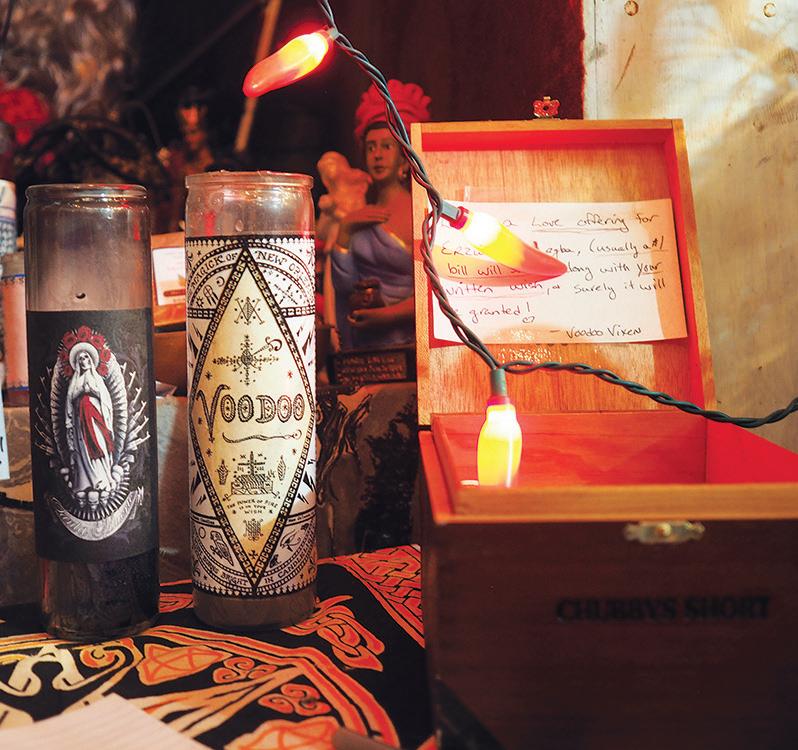
ANNABEL PROKOPY | IDS An altar is pictured Feb. 7, 2026 at The Voodoo Shop at 920 N. Maple St. in Bloomington. The altar collected love offerings.
ANNABEL PROKOPY | IDS
Mama Mo lights incense Feb. 7, 2026, at The Voodoo Shop at 920 N. Maple St. in Bloomington. She used the incense to bless the shop before opening for the day.
Seoul National University musicians showcase music
By Addison Jacoby agjacoby@iu.edu
Musicians from Seoul
National University took the stage in the Global and International Studies Building’s Shreve Auditorium on Feb. 23 to perform “Enlightened Connections: Bridge to Korean Music.” The performance was presented by the university’s Korean music department in partnership with IU’s Institute for Korean Studies and East Asian Studies Center.
The performance at IU was one of many in Seoul National University’s 2026 Global Exchange Project, which serves to strengthen and expand the Department of Korean Music’s international outreach by showcasing both traditional and modern Korean music through traditional instrumentation and costuming.
The exchange project has led the ensemble to IU as the final performance of their tour through the United States.
The ensemble first spent a week at the University of Hawaii before traveling to three surrounding performance spaces within the state.
The ensemble then performed at Purdue University on Feb. 21, where they show-
By Josh Baskin joshbask@iu.edu
cased traditional Korean instruments and how to play them in a pre-show exhibit.
Professor Kyung-A Kim and Korean musicology graduate student Eui-Jin Kim then did a seminar the morning of Feb. 23, before traveling to Bloomington. The hour-long performance began at 7 p.m. Feb. 23, with Eui-Jin Kim introducing the small ensemble and explaining that the first few songs would be solo performances of traditional Korean music accompanied by Seo-Jeong Kim as a percussionist.
Kyung-A Kim took the stage with her piri to begin the first piece, titled “Sangnyeongsan,” which is the opening movement to Yeongsan Hoesang, a piece of Korean court music repertoire.
The piri is a double-reed Korean instrument in the oboe family, consisting of the reeded mouthpiece and eight finger holes producing different notes.
Kyung-A Kim has played the piri for 38 years, now teaching her craft and leading the department of Korean music at Seoul National University.
Sharing her craft throughout the United States was something that she was excited to do, she said, hoping to connect with audi-
ences through music she has spent years performing.
“I believe that this could be a window to connect and help us emphasize Korean traditional music,” Kyung-A Kim said.
As Kyung-A Kim left the stage, Sunny Jung took to the stage to perform “Chunseol” with her 18-stringed gayageum, a traditional Korean instrument which traditionally has 12 strings and movable bridges.
Jung is the executive director of the Korean Performing Arts Center and has played the gayageum for almost 30 years. “Chunseol” is one of her favorite pieces to perform, especially enjoying how it reminds her of when springtime is coming.
“This is my favorite song,” Jung said. “When the spring is coming, you can see still snow like today, yesterday. So, this piece introduced that escape. So, I really enjoy each section, I especially like the last part.”
Three more solo pieces were performed, showcasing instruments like the saenghwang, a traditional Korean wind instrument that Eui-Jin Kim compared to a hand-held organ, while moderating between songs.
After the solo pieces, all members of the ensemble were invited onto the stage
to perform three more songs titled “Frontier!,” “K-Pop Demon Hunters OST” and “Eolssiguya.” The selections were a combination of new and old, attempting to catch the attention of members of the audience with less knowledge of traditional Korean music.
While making the selections for the music, Kyung-A Kim wanted to pick music that American and Korean audiences would get excited about.
“We wanted our Korean music to be more familiar
and friendly to the audience in Indiana,” Kyung-A Kim said. “So, we had to mix with the traditional pieces and the newly created compose pieces so that we could, like present, also the traditional music and also the timber and the sound and ornamentation that we make in Korean tradition.”
The concert ended with a crescendo of Kyung-A Kim’s piri at the end of “Eolssiguya,” indicating to the rest of the ensemble that the music was coming to a booming end.
Laura Judson, assistant director of the East Asian Studies Center at IU, helped coordinate the details of the performance. She said the event presented itself as an amazing learning opportunity for those who do not see performances like it often. “I think it can teach people the appreciation of things that might be new and different, and it can also teach them how universal music is,” Judson said. “You know, it’s a universal language, everybody understands it.”
COLUMN: Glen Powell shines in ‘How to Make a Killing’
Since the release of “Top Gun: Maverick,” Glen Powell has been on a hot streak no one could have expected. He starred in films from established filmmakers like Richard Linklater and acted in summer blockbusters like “Twisters.” This all goes to say that I was highly intrigued when it was revealed Powell would be featured in an A24 film, “How to Make a Killing,” unlike any of his past work.
Released on Feb. 20, “How to Make a Killing” follows Becket Redfellow (Glen Powell), a man disowned at birth by his wealthy family, living a regular lifestyle. After being demoted at his job, Becket decides to go after his family’s inheritance, killing any relatives who stand between him and the money.
The film is told in a recap narration style by Becket in his prison cell as he confesses his crimes to a priest before his death sentence
is delivered. The framing of this narration style reminded me of the opening to “Amadeus,” when Antonio Salieri narrates the film’s events to a priest in a confession of guilt while incarcerated in a psych ward. Starting the film off with this connection to an old classic, I was excited for how the rest of the film would play out. I was also a big fan of the warm, deep color grading paired with a slight addition of grain that made the digital imagery feel like it was shot on film.
While some of Becket’s relatives had little to no personality, Zach Woods and Topher Grace shone as cousins Noah and Steven Redfellow. Woods plays a performative abstract artist, and Grace stars as a glamorized megachurch pastor.
Unfortunately, neither of the two cousins had much screen time, but their presence was strongly felt through their loud personas that were hard to forget. Grace’s character’s introduction stuck with me,
watching him clad in an outfit like something Justin Bieber might wear on his “My World” tour. One of my largest complaints about this film ultimately comes from the story’s development. After Becket kills just one relative, he inherits a highpaying job on Wall Street through nepotism from his estranged uncle and even finds a new girlfriend after killing his second family member.
At this point in the film, it seemed clear that Becket did not need to go after the entire inheritance because he had everything that one would typically want in life, as well as little to no suspicion from authorities. Becket even explicitly asks himself multiple times in the narration why he didn’t stop there, and his answer was merely that it wasn’t over until the money was all his.
This could have satisfied me if he hated his new job or needed the large sum of money for a specific reason,
Publish your comic on this page.
The IDS is accepting applications for student comic strips for the spring 2026 semester. Email five samples and a brief description of your idea to adviser@iu.edu . Submissions will be reviewed and selections will be made by the editor-in-chief.
SUDOKU
but instead Becket’s character lacked a believable motivation and it completely took me out of the film.
Where the strength of the writing dwindled, Powell made up for it with his incredible acting. His narration during each of the kill montages made the acts feel very precise and thought out, adding to the character’s cunning personality. Powell has always been spot-on with his tone and delivery, which I first saw in his performance as Chad Radwell, an egotistical ‘frat-bro’ in “Scream Queens.”
The second half of the film follows Becket continuing with his plan while faced with a new threat from his childhood friend, Julia (Margaret Qualley), who makes multiple attempts to take a piece of the inheritance for herself.
I think Qualley is an exceptionally talented actress, but her character felt very underdeveloped, and her actions didn’t make much sense to me. Julia was es-
tablished as an old friend whom Becket loved to hang out with as a child, but she has a quick change of heart once she sees that Becket is turning his life around. This could have been an exciting dynamic, with an old friend in a similar situation who resents the other for being able to better their life, but there just wasn’t enough screen time with her character for her emotions to resonate strongly
with me. This film could have benefited from a longer runtime so the emotional beats could hit harder and the plot developments would feel less sudden. Regardless, I found all of the kills to be entertaining, and both Powell and Qualley had strong performances. If anything, “How to Make a Killing” proves that the hype around Powell remains justified and the actor is here to stay.
BLISS
HARRY BLISS
CROSSWORD LA TIMES
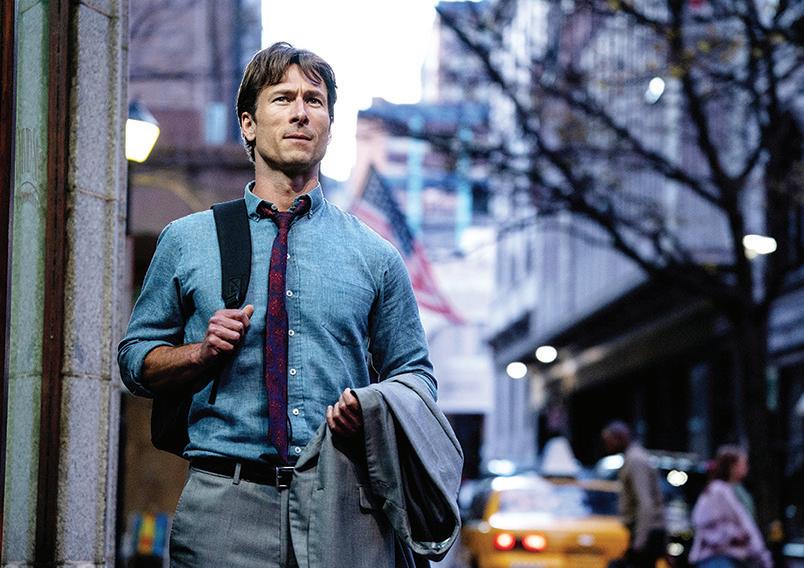
MOVIE STILLS DATABASE Glen Powell acts while filming "How to Make a Killing." The film was released Feb. 20, 2026.
ALISSA ANGEL| IDS
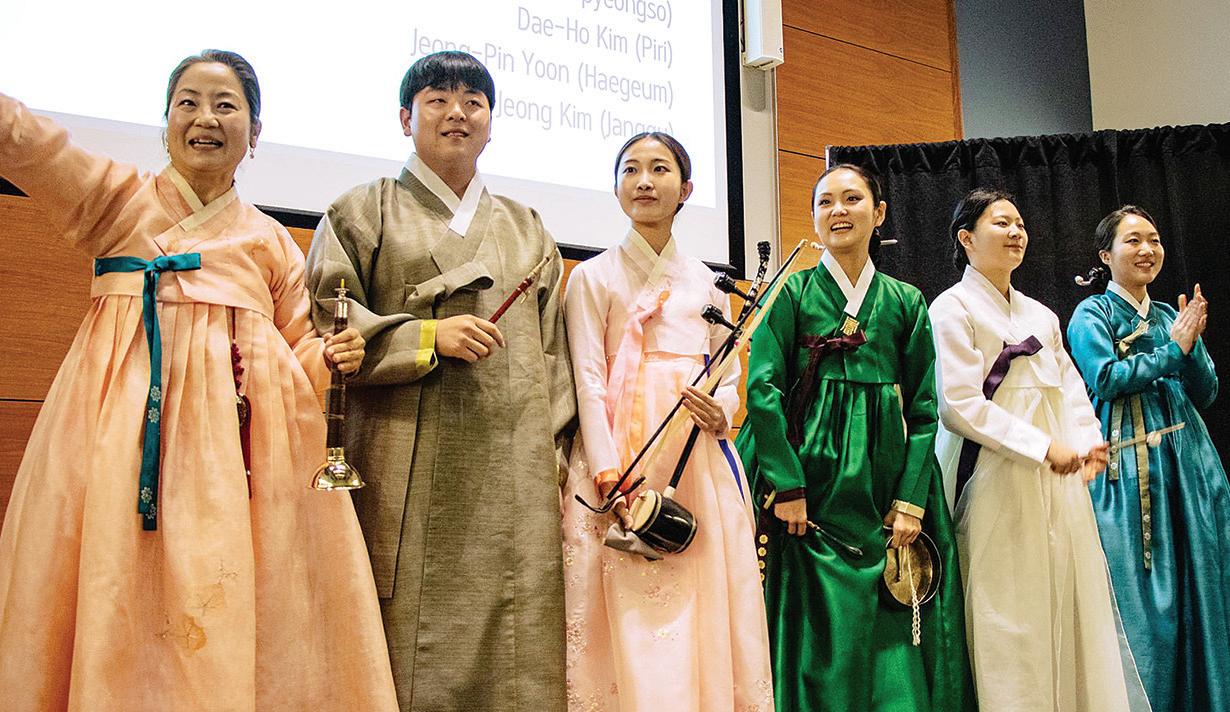
Musicians from Seoul National University perform "Enlightened Connections: Bridge to Korean Music" on Feb. 23, 2026, at the Global and International Studies Building in Bloomington. The performance was part of SNU's 2026 Global Exchange Project.
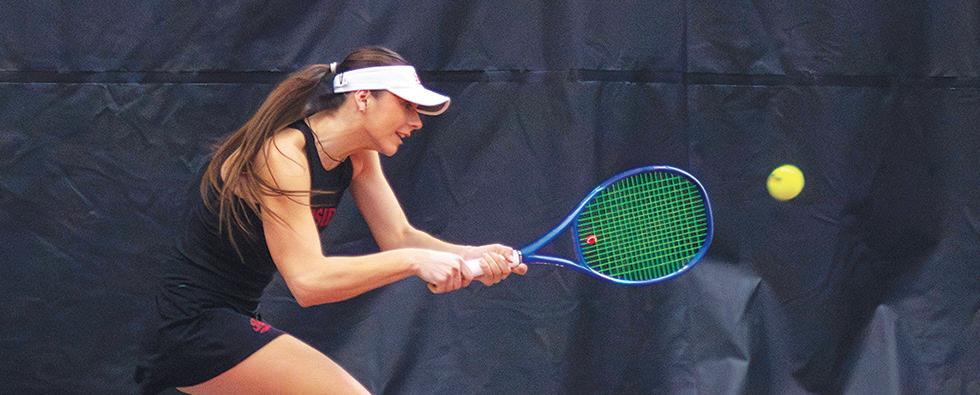
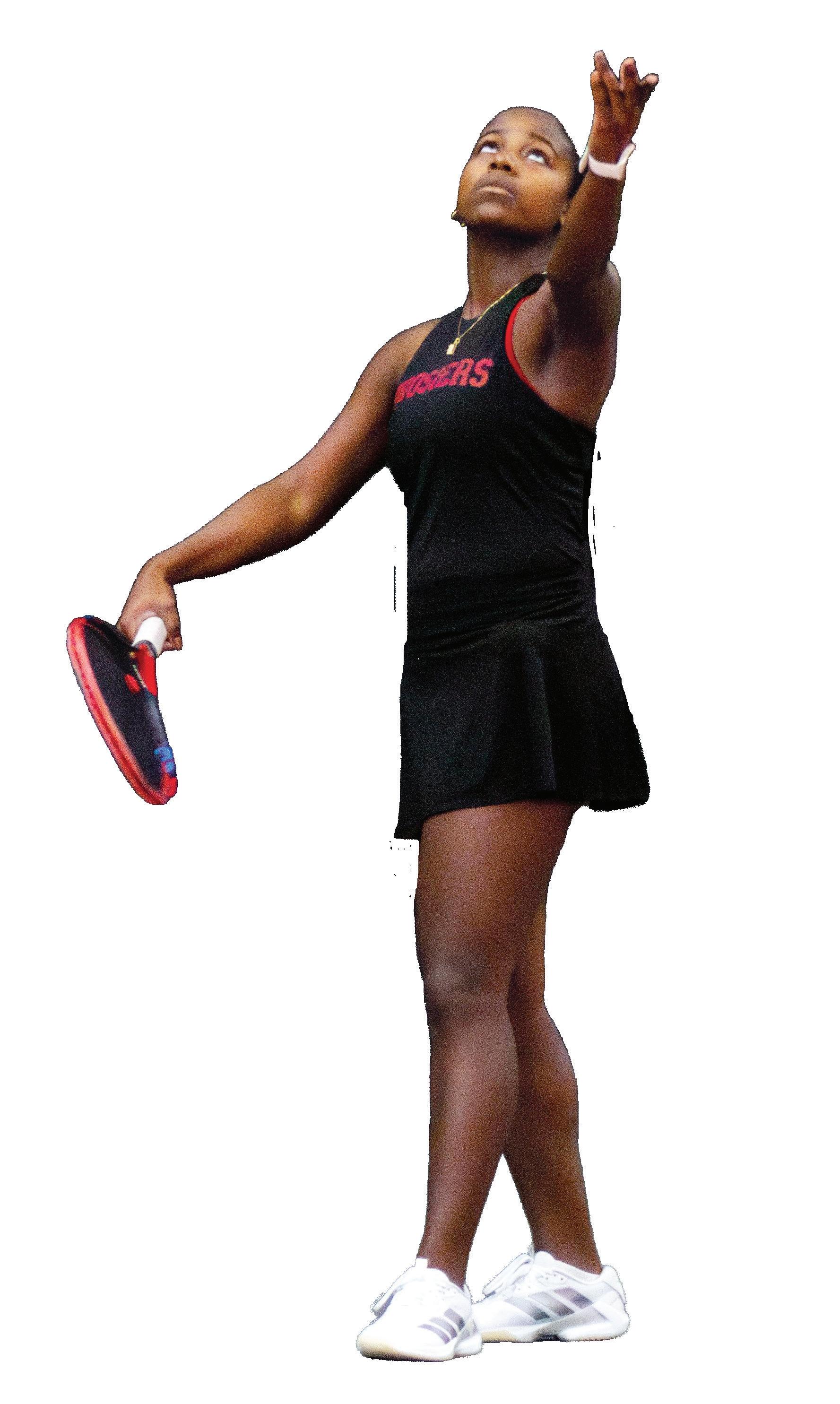
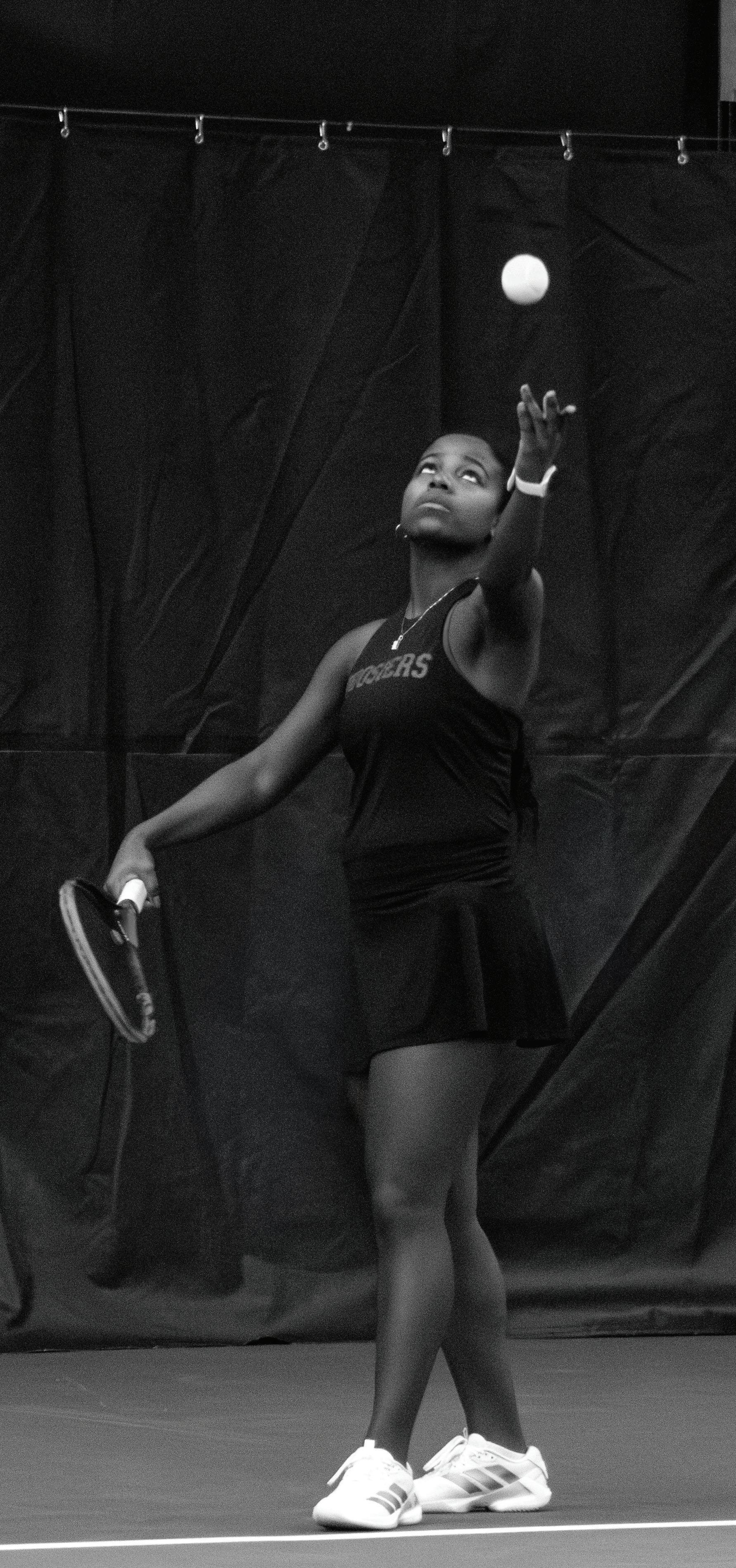
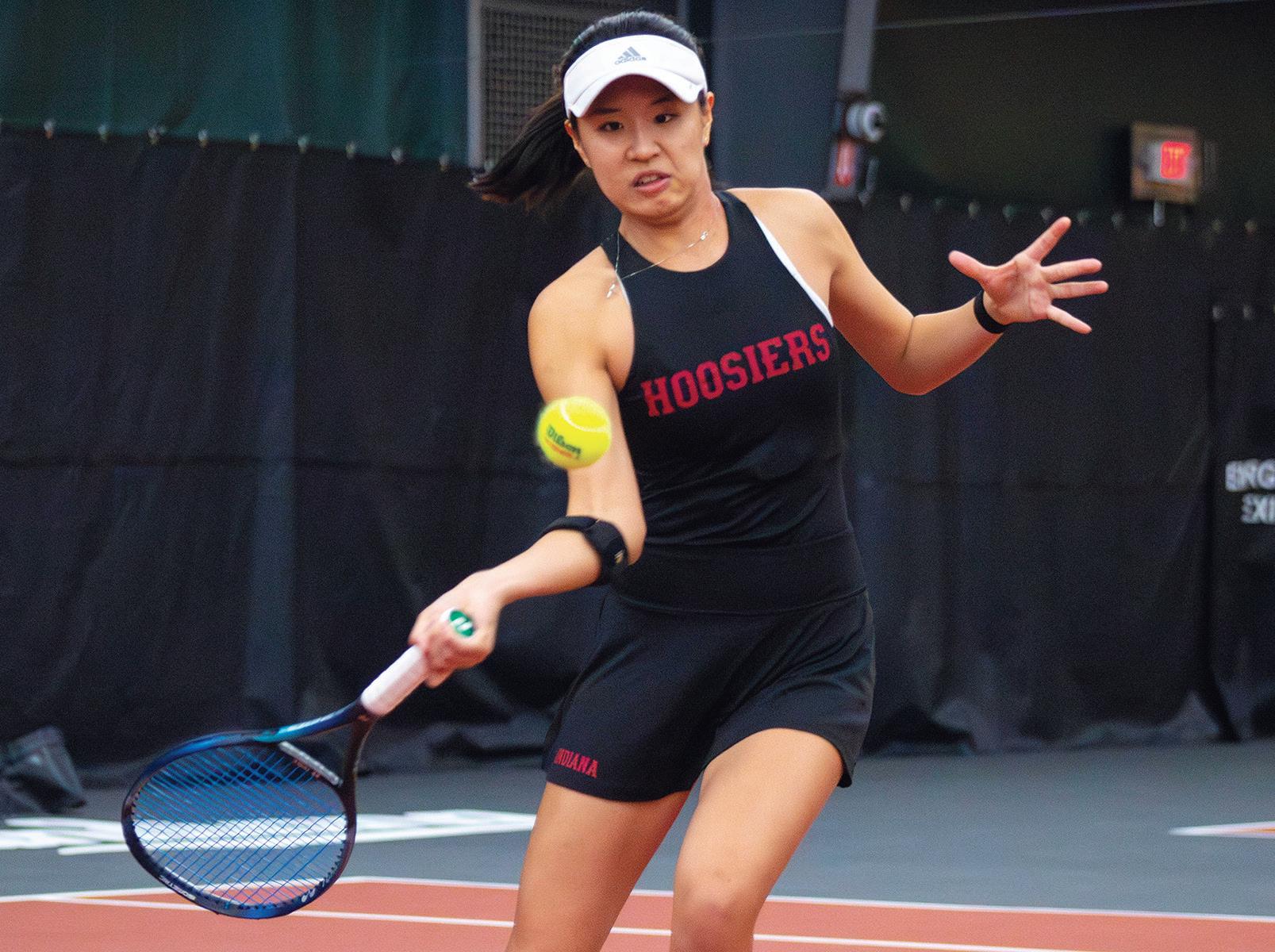
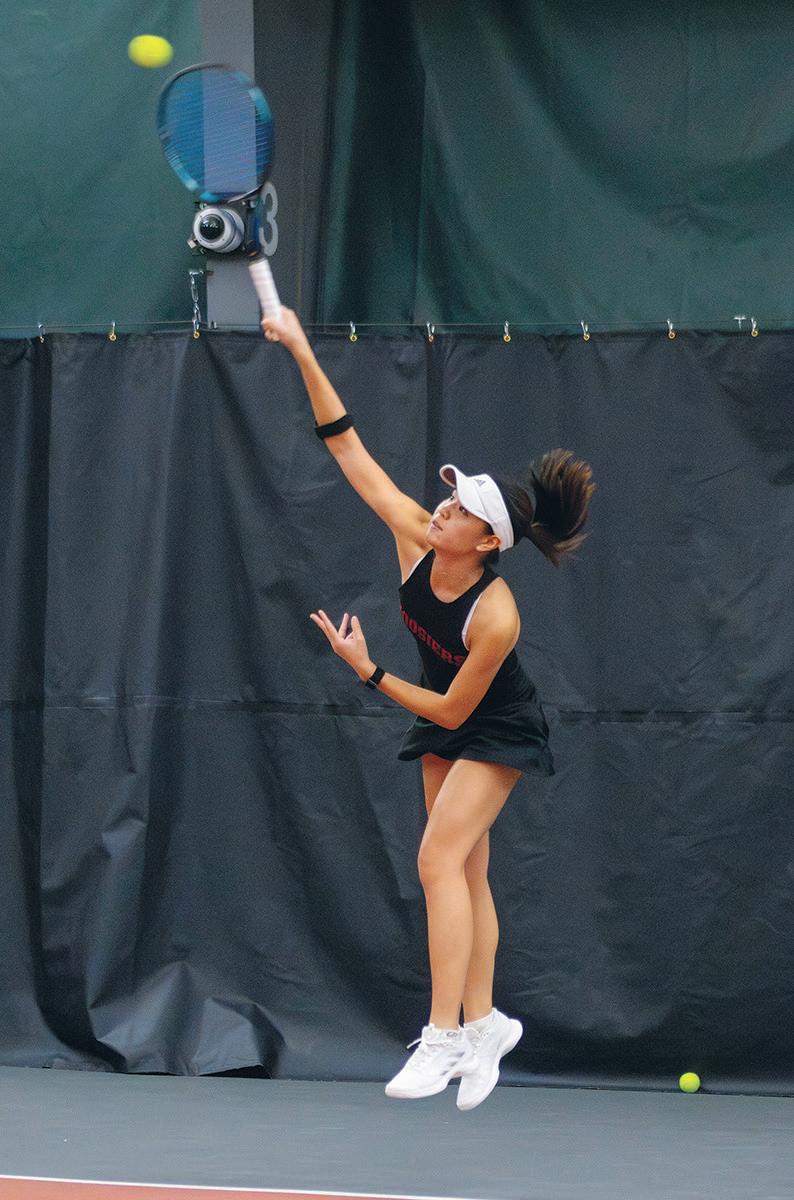
JIMMY RUSH | IDS Junior Elisabeth Dunac tosses the ball up to serve during a match against Cornell University on Feb. 21, 2026, at the IU Tennis Center in Bloomington. The Hoosiers beat
‘You
really appreciate the joy of baseball’
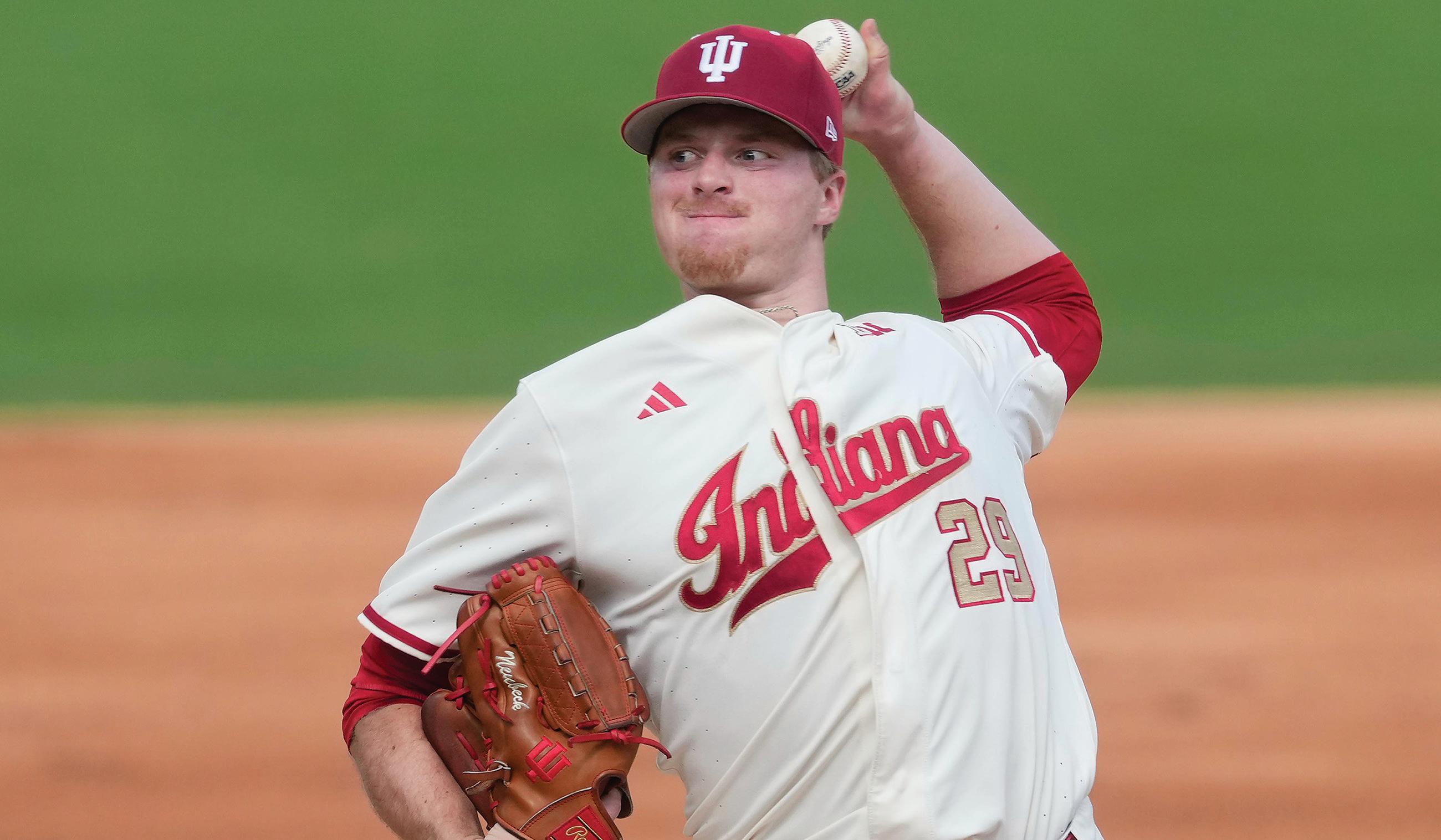
Tony Neubeck’s journey to Indiana after injury
By Elakai Anela eanela@iu.edu
Tony Neubeck once wondered if he would ever throw again.
An elbow injury, which ended his sophomore season, required multiple surgeries to repair. The rehab took 745 days.
Despite the uncertainty, he kept his sights on returning to the mound. In 2025, he did. And now, after transferring to Indiana over the summer, he’s a key part of head coach Jeff Mercer’s rotation.
Neubeck grew up in Hugo, Minnesota, before enrolling at nearby Mahtomedi High School. He also played travel ball for the Minnesota Blizzard, considered one of the state’s elite travel programs.
Neubeck was ranked as the No. 8 prospect in Min-
nesota his senior year and the No. 2 left-handed pitcher in the state by Perfect Game. He was also a twotime All-Conference selection at Mahtomedi, won his conference’s player of the year award in 2021 and captained his high school to the 2021 class AAA MSHL State Championship the same year.
The Southpaw committed to the University of Missouri before his senior year of high school. He started his freshman year in Columbia, Missouri, in 2022. During that first season, Neubeck made 15 appearances with nine starts. He notched seven wins, throwing 54.1 innings. He also threw an immaculate inning — three strikeouts in nine pitches — against the University of Louisiana at Monroe.
Neubeck made six ap-
pearances in his sophomore campaign. He struck out a career-high nine batters in 3.2 innings pitched against then-No. 11 Oklahoma State University in the season opener.
Then, the elbow injury came. His last appearance was March 19, 2023, when he threw a scoreless inning in relief for the Tigers’ 7-1 victory.
At first, he said, doctors diagnosed him with a partial tear in his ulnar collateral ligament, which is more minor than a full tear of the ligament.
Neubeck opted to get a repair surgery for his elbow, hoping for a quicker turnaround due to the nature of the surgery. But it wasn’t effective. As he went through rehab from the first surgery, he fully tore his UCL. The then-sophomore pitcher had to undergo a full UCL
reconstruction surgery — more commonly known as “Tommy John.”
Even after the difficult decision to get Tommy John — a procedure that can require 12-18 months to get back on the field — Neubeck kept his sights on continuing to play college baseball.
“The year that I had surgery, it was my second year of college,” Neubeck said during Indiana baseball’s media day Jan. 28. “The doctor that I was seeing was like, ‘You’ll have no problem getting a sixth year.’ And so, I went into the whole process with the mindset of, ‘I’m going to be here for six years if I have to be.’”
After ending his sophomore season early, the injury forced him to redshirt his junior year.
He returned to the mound as a senior April 2, 2025, for Missouri against
MEN’S GOLF
the University of Arkansas at Pine Bluff after missing two full years.
The left-hander made 10 appearances and four starts that season, throwing a total of 17.1 innings. His final outing as a Tiger was May 16, 2025. Neubeck opened the game and threw two innings in a 13-3 loss to Mississippi State University.
With his health finally back to 100%, Neubeck faced another decision: where’d he go next?
The Southpaw entered the transfer portal following the conclusion of the season. He committed to Indiana in summer 2025 along with his former Missouri teammate, graduate right-handed pitcher Kaden Jacobi.
Neubeck described the transfer portal as a “journey” but said Indiana’s program “checked off the boxes” when he made his decision.
Neubeck has built relationships with his new teammates in Bloomington but remains close with Jacobi.
“We were very close at Mizzou and then coming here, being able to work together; we live together, we’re roommates, stuff like that...” Neubeck said. “It’s quite an experience.”
On opening day, Neubeck was Indiana’s starter. He threw four innings of scoreless ball while recording two strikeouts.
While his final year of collegiate baseball has begun, the graduate pitcher said he remains grateful for the journey.
“You come to appreciate every day that you’re out on the field and every inning you get a pitch after that,” Neubeck said. “You really appreciate the joy of baseball and realize why you’re playing the game.”
Indiana tries to bounce back from fall underperformance
By Sean McAvoy
semcavoy@iu.edu
A golden rule in sports is not to celebrate too early, and golf is no exception. Greg Norman at the 1996 Masters Tournament, Jordan Spieth at the same tournament in 2016 and Jean van de Velde at the 1999 Open Championship were all on the wrong side of it.
For Indiana men’s golf, the 2026 spring season is a chance to rebound from an up-and-down fall schedule. At the Rod Myers Invitational hosted by Duke University on Sept. 5-7 in Durham, North Carolina, Indiana finished in third place with a team score of 858 (-6). The Hoosiers placed behind the Blue Devils and the University of North Carolina Wilmington. But when looking at the record books from the 2025 fall season, those three days in September were the best result for Indiana. The Hoosiers never finished better than third in their other five tournaments, including back-to-back 15th-place performances at the Quail Valley Collegiate Invitational and the Ka’anapali Classic to close out the season.
“I think we underperformed a little bit,” Indiana head coach Mike Mayer said Feb 9. “I really do. I’ve had teams in my history that weren’t the best teams, but I think this team has the potential.”
After coming back from a three-month hiatus in collegiate tournaments, Indiana turned that “potential” into a strong showing at the Gators Invitational in Gainesville, Florida, to open the spring season.
The tournament hosted the last three NCAA Champions — Florida (2023), Auburn University (2024) and Oklahoma State University (2025) — plus 21 golfers in the top 200 of the World Amateur Golf Rankings.
Redshirt senior Clay Merchent ranks 336th on the World Amateur Golf Rankings — the highestrated Hoosier on this year’s roster. However, Merchent was out of the lineup for Indiana’s opening spring tournament due to a lingering injury, Mayer said.
In 2022, Merchent withdrew from the NCAA Regional in Palm Beach Gardens, Florida, after the first round due to persistent rib pain. An injury later diagnosed as Slipping Rib Syndrome kept Merchent out of the final 11 events of the 2022-23 season and the whole 2023-24 season.
Merchent slowly worked his game back to an elite level, culminating in an AllBig Ten Second Team selection last season. He posted a stroke average of 71.58, the fourth-lowest mark in program history. Merchent also finished top five in three events, plus he tied for 15th at the Big Ten Championships and tied for 38th at the NCAA Urbana Regional.
“He played kind of hurt all fall, so we’re trying to do some things to overcome that,” Mayer said. “Extremely talented young man, a
Over the two-day, threeround tournament hosted by the University of Florida at the Mark Bostic Golf Course, the Hoosiers finished tied for eighth place with a team total of 860 (+20). Indiana shared a place with the University of Tennessee at Chattanooga and Georgia Southern University but finished higher than Big Ten foe Penn State.
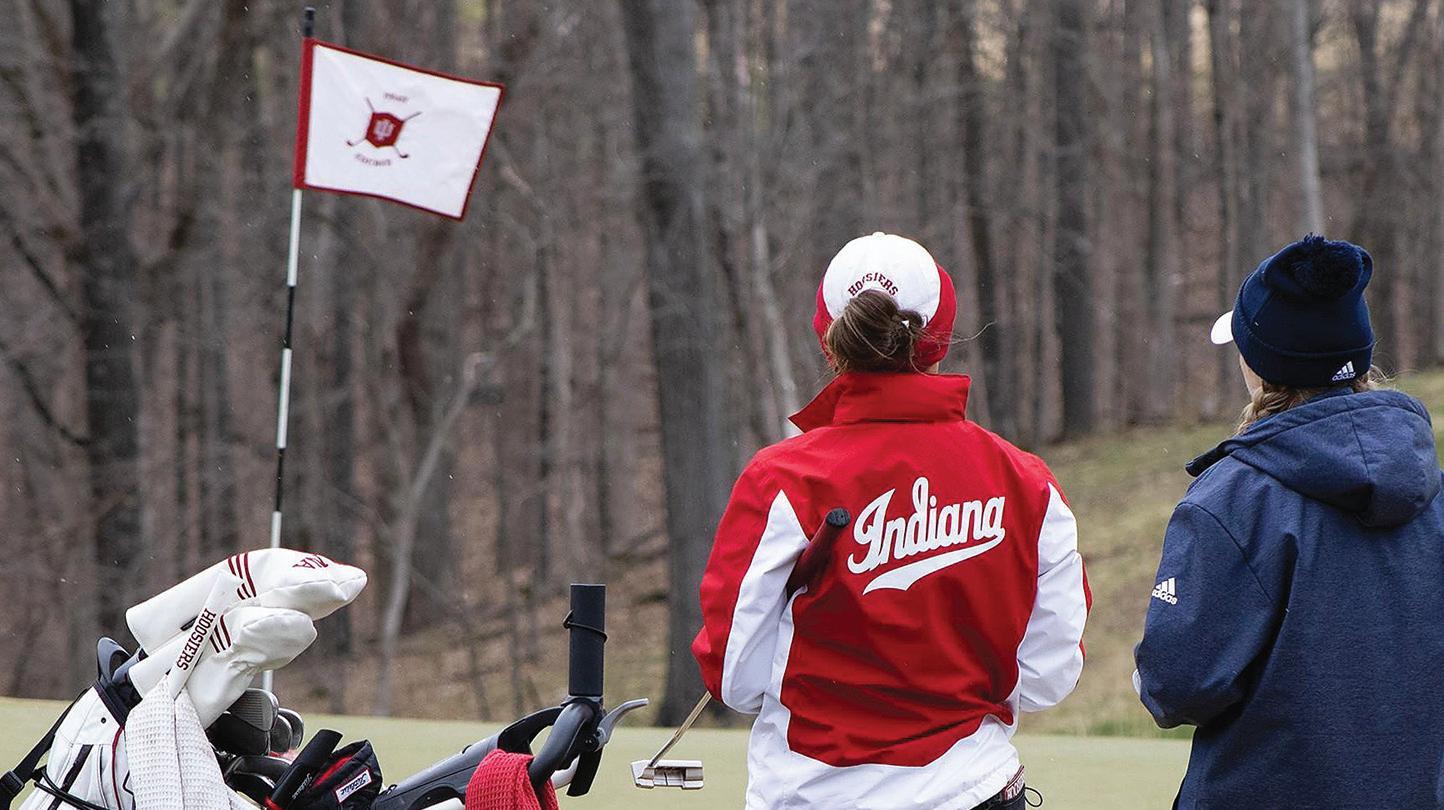
A golf ball is putted across the green during the Hoosier Collegiate Invitational on April 4, 2021, at the Pfau Course in Bloomington. The Hoosiers secured a top-10 finish in three fall tournaments.
talented player. No question on paper, our best player on our team.”
Indiana returned eight out of 10 players from last season. The only departures were then-redshirt senior Robert Bender III and thensenior Kieran Hogarth. In their place, freshmen Jake Cesare and Caleb Schnarr started their first seasons in Bloomington.
Both players joined the Hoosiers after distinguished high school careers. Cesare — the younger brother of junior Alec Cesare — earned All-State first team honors all four years at Westfield High School in Westfield, Indiana. Schnarr finished tied for eighth at the 2025 ISHAA State Finals for Jasper High School in Jasper, Indiana.
“We love Midwestern players,” Mayer said. “They
have that mentality and toughness that we’re looking for ... We want that relationship. We want players who fit our style. We want to fit their style.”
Regardless of high school accolades, more experienced players were rewarded with playing more rounds during the 2025 fall schedule. Merchent, Alec Cesare, junior Nick Piesen and sophomore Bradley Chill Jr. all led the Hoosiers with 18 rounds played. Just behind Merchent at 71.56, junior Cole Starnes has produced the second-lowest stroke average (71.89) between the fall and spring seasons. Chill Jr. is the only Hoosier with a top-five finish after coming tied for third at the Rod Myers Invitational. Learning from its fall re-
sults is crucial for an Indiana program looking to return to the NCAA Championship for the first time since the 2022-23 campaign. At last season’s Big Ten Championships, the Hoosiers finished in eighth place with a total score of 860 (+20).
Now, the Hoosiers will set their sights on Pumpkin Ridge Golf Club in North Plains, Oregon, for the 2026 Big Ten Championships on May 1-3. Indiana is nationally ranked No. 90 by clippd, which is 14th-best in the 18team conference as of Feb. 20.
“We want to be in the thick of things,” Mayer said.
“Not only in the thick of things, but we want to be right there and hoist that championship trophy at the end of the tournament.”
Before the Big Ten Cham-
pionships, the Hoosiers still must play in five tournaments on their 2026 spring schedule. Starting with the Colleton River Collegiate on March 1-2 in Bluffton, South Carolina, and finishing with the Hoosier Collegiate on April 18-19 at The Pfau Course in Bloomington. After last season’s Hoosier Collegiate was deemed unplayable due to heavy rain in Bloomington, the No. 97 golf course on Golf Digest’s America’s 100 Greatest Public Courses gives Indiana a home field advantage. “It’s an incredibly good golf course,” Mayer said. “It gives you a lot of flexibility and options from playing extremely difficult, one of the toughest golf courses in the world, but you can set it up where it’s not.”
PHOTO COURTESY OF THE JACKSONVILLE BASEBALL CLASSIC
Graduate student left-handed pitcher Tony Neubeck throws a pitch during the Live Like Lou Jacksonville Baseball Classic on Feb. 20, 2026, in Jacksonville, Florida. Neubeck transferred to Indiana during the offseason.
Women’s tennis posts best season in years
By Shane O’Hanley
sohanley@iu.edu
Indiana women’s tennis is looking to post its best season in years, and with the Hoosiers’ success in the nonconference slate so far, it is within reach. Indiana currently boasts an 8-1 overall record. The Hoosiers are led by second-year head coach Gabrielle Moore. Moore played four years of collegiate tennis at Southern University and A&M College from 2012-15. She coached at Lake Forest College, Jackson State University, and most recently, McNeese State University before becoming Indiana’s head coach. She led McNeese to a programrecord 20 wins during her final season at the helm in 2023.
Indiana posted an 8-15 record during Moore’s first season. It did, however, record more conference wins than the prior year and a winning record at home. Indiana finished with just six wins, no Big Ten victories and a losing record at home the season before Moore was hired.
This season, Moore and the Hoosiers currently sit at 8-1, with notable wins over the University of Cincinnati and Cornell University.
Indiana opens Big Ten play against Purdue on March 7 in Bloomington. Much of what Indiana has accomplished so far on the court can be attributed to a strong freshman class Moore brought in this season. The class is headlined by five-star recruits Hi’ilani
Williams and Ameia Sorey, two of the top recruits from their class. Alessandra Teodosescu, one of the top recruits from Italy, rounds out the talented class. Williams and Teodosescu have become a dominant pair, and they currently headline the team as No. 1 doubles pair-
ing.
Williams, an Oro Valley, Arizona, native, is one of the top players in the prep circuit. She was ranked as the No. 1 player in Arizona for her class and 28th nationally. Sorey is from Miami and was ranked as the No. 4 player in Florida and 22nd
MEN’S TENNIS
nationally. Teodosescu was named to the Big Ten Players to Watch list heading into this season.
As for the returning Hoosiers, senior Nicole Teodosescu and junior Elisabeth Dunac have provided strong play in both singles and doubles to start the sea-
son. Both have contributed greatly to the team’s success so far, sporting winning records in doubles and singles and bringing experience to a relatively young and inexperienced roster. The Big Ten is loaded with talent throughout the conference this year. Ohio State currently paces the conference with a 8-1 overall record and 1-0 record in conference play. Maryland is 7-1, Washington is 7-0, and Wisconsin is 7-2. Indiana will face Maryland, Ohio State and Wisconsin later this spring. To continue being successful, Indiana has to get off to a stronger start in conference play. It has a combined six wins in conference play over the past three years, and that has resulted in them finishing in the bottom half of the conference. If they are able to split the conference set this year, the Hoosiers have a great chance to finish with a winning record and position themselves well for the Big Ten Tournament. Indiana has two more games on its nonconference slate — the University of Illinois Chicago and Chicago State University on Feb. 27 — before it begins Big Ten play against in-state rival Purdue on March 7.
Men’s tennis looks to build on strong start
By Oliver Swats oswats@iu.edu
As the temperatures begin to rise in Bloomington, it shows spring is right around the corner. And with spring coming, so is the start of Big Ten play for Indiana men’s tennis. Throughout the fall season, Indiana showcased what it could accomplish in the regular season and through conference play. At the Intercollegiate Tennis Association Sectionals in early November, redshirt junior Facundo Yunis advanced to the Sweet 16 in the singles competition.
On the doubles side, two Hoosier duos faced off against each other in the third-place match after losing in the semifinals. Ultimately, Yunis and redshirt junior Sam Landau took down graduate student Michael Andre and sophomore Matteo Antonescu.
At the NCAA Individual Championships, Yunis and Landau made a run but were eventually sent home in the round of 32. Just a week earlier, Landau fell in the round of 64 for the singles championships. It was a strong fall ball showing from the Hoosiers that left much to look forward to in January.
After a 2-0 start to the regular spring season, Indiana went up against two top-10 teams in Mississippi State University on Jan. 18
and the University of Virginia on Jan. 23. The Hoosiers lost by a combined score of 10-2, but the games provided the team with learning experiences and tape to improve.
In the next stretch of games, Indiana went 4-1 and picked up a notable 4-0 win over Texas Tech University on Feb. 20. The Hoosiers now sit at 6-3 overall with UCLA and USC on the horizon. The start of conference play is an important part of the season for Indiana as it will have intense competition throughout the rest of the season. Despite being ranked as the 59th best men’s tennis team in the country, nine Big Ten teams rank ahead of the Hoosiers, including No. 1 Ohio State. The Hoosiers will have their work cut out for them as nine of their 13 remaining matches are against higher ranked teams.
Leading the charge for the Hoosiers is the California native Landau. In the fall season, he became the first Hoosier since Jakub Praibis in 2004 to qualify for the NCAA Individual Championships singles competition. He also qualified for the doubles championships. Landau is 4-1 at the doubles spot thus far this season and 3-1 at singles after missing the first couple of matches due to injury. With four years of col-
lege experience, Landau is a leader for the Hoosiers and takes on the singles one position in the matches he plays. With an all-around polished game, there are very few weaknesses to spot. He has a reliable serve and accurate forehand and backhand. His competition will be tough moving forward, but if Landau continues to improve and play like he has all season, he will be a bright spot for Indiana. Also coming off a strong fall campaign is Yunis. After making it the farthest in the singles position at the ITA Sectionals, he’s 4-1 in singles with three matches unfinished due to the long rallies he grinds out. He was often partnered with Landau in the fall at doubles. This spring he’s played eight of nine matches with sophomore Braeden Gelletich. They’re 4-4 and working on combining their skill sets together, but the younger Gelletich is still improving from his 3-3 fall doubles record.
Landau’s new main doubles partner is Jip Van Assendelft, a senior from the Netherlands who’s also played at Boise State University and the University of Oklahoma. Van Assendelft, who only played three matches in the fall, has struggled in singles play and is 2-4 this year, but he has been a bright spot in doubles. Van Assendelft and Landau are currently the
No. 13 ranked doubles team in the country and are 3-1. Their skill sets have worked well together with Van Assendelft’s height, coming in at 6-foot-3, combined with Landau’s baseline skills.
Also at the doubles position is Andre and An-
SOFTBALL
tonescu, who are the No. 65 ranked doubles team in the country. With two highly skilled doubles partnerships, Indiana will have a shot at making a run in the Big Ten. They have veteran leadership and because of the growth shown by in-
dividual players, Indiana men’s tennis will look to compete in a strong conference schedule. The Hoosiers’ first conference matchup will be against UCLA on March 6 at the IU Tennis Center in Bloomington.
Avery Parker central to Indiana softball’s rise
By Conor Banks conbanks@iu.edu | @ Conorbanks06
When catcher Avery Parker arrived in Bloomington before the 2023 season, Indiana softball had not made the NCAA Tournament in 12 years. The Hoosiers last made an appearance in the NCAA Regionals in 2011 after going 17-3 in Big Ten play.
But Parker’s arrival changed this.
Parker joined the Hoosiers after playing at Westfield High School in Westfield, Indiana. There, Parker owns multiple program records, including most career home runs, RBIs and hits. During her high school career, Parker was a two-time First Team All-State selection and earned Hamilton County Player of the Year honors.
After cementing herself in the Westfield history books, Parker looked to help an Indiana softball program hunting for its first NCAA Tournament appearance in over a decade.
As a Westfield, Indiana, native, Parker understands
what it means to represent her home state. She comes from a family where her grandfather’s loyalty to the Hoosiers helped shape this pride.
“I mean, I take such pride in representing this university,” Parker said during an open practice Feb. 2.
In her first year with the program, Parker hit .304 at the plate with 10 home runs across 59 appearances. She was named to the AllBig Ten Second Team and helped Indiana achieve a 44-18 overall record — the Hoosiers’ first season with more than 40 wins since 1994 — and the program’s first NCAA Tournament appearance since 2011. Now in her final collegiate season, Parker has helped lead Indiana to three consecutive NCAA Tournaments — the longest streak in program history. Throughout the last three seasons, Parker played alongside two of the most productive hitters in Indiana program history — Brianna Copeland and Taylor Minnick. Playing alongside Cope-
land and Minnick has given Parker mentors and valuable teaching moments.
“I always wanted to embody what they did,” Parker said.
Watching Minnick boosted Parker’s confidence and gave her a sense of the hard work it takes to be successful at the collegiate level.
“She was the biggest worker off the field that you would ever see,” Parker said about Minnick. “And for me, watching her put in the work and seeing how it translated to the field is, like, ‘That’s what I can do.’”
Meanwhile, Copeland helped take some pressure off Parker by keeping the mood light on the field.
“With Bri, she just makes softball fun and remembers that the game is fun,” Parker said.
In 2025, Parker finished third on the team — behind Copeland and Minnick — with 11 home runs at season’s end. But with the pair of former Hoosiers now graduated, Parker has taken on an expanded role in 2026 on the field and in the clubhouse for a young Indiana
team with seven freshmen on its roster.
With Parker being one of only three seniors on the team, much of the leadership and mentorship responsibilities fall onto her as a senior captain — a role she is ready to embrace.
“And when you have kids coming in, and that’s all they know, and that’s the expectation, it elevates your play, and elevates your commitment, and elevates your expectation,” Indiana head coach Shonda Stanton said during open practice Feb. 2. “So, we’re excited about Avery being a big part of that.”
Last season, Parker hit a career-high .392 batting average, while driving in 60 runs. Her performance earned her All-Big Ten Second Team honors for the second time as a Hoosier. Through the first 15 games of her final collegiate season, Parker has been efficient from the batter’s box, hitting .486 at the plate. She leads Indiana with seven home runs and 19 RBIs, while guiding the defense from behind the plate.
From a 12-year NCAA Tournament drought, to competing in it for three consecutive years, Parker has been central to Indiana softball’s turnaround and raising the standard for the program. When Parker first arrived in Bloomington, Indiana was chasing relevance. Now, the Cream and Crimson’s eyes are set on a larger goal — an NCAA Women’s College World Series appearance for just the third time in program history. “Yeah, I mean, when I came into Indiana, we hadn’t been to a postseason, I think, like, 12 years,” Parker said. “So, knowing that is what we’re going for, and knowing that our standard is now super regional, and then, ultimately, the World Series.”
JIMMY RUSH | IDS
Then-sophomore Sam Landau swings to return a ball against Ohio State on Mar. 31, 2024, at the IU Tennis Center in Bloomington. The Hoosiers began non-conference play with a 6-3 overall record.
CHLOE LAVELLE | IDS
Then-junior catcher Avery Parker hits the ball against Western Michigan University on March 8, 2025, at Andy Mohr Field in Bloomington. Parker hit .486 through her first 15 games of her final collegiate season.
JIMMY RUSH | IDS
Freshman Alessandra Teodosescu hits the ball during the match against Cornell University on Feb. 21, 2026, at the IU Tennis Center in Bloomington. The Hoosiers went 2-11 in the Big Ten last season.
Indiana regroups and reloads ahead of season
By Noah Boudoris nboudour@iu.edu
As the fairways thaw out, Indiana women’s golf prepares to resume its season after the winter hiatus. The Hoosiers, who were No. 39 in clippd’s rankings released Feb. 25, are headlined by No. 65 senior Madison Dabagia.
As the Hoosiers’ 2024 Big Ten Championship remains in recent memory, head coach Brian May’s squad provides a strong sense of hope for a program that is used to success, having won eight Big Ten titles in its history. The team now has just five spring events scheduled before the postseason begins in April.
Indiana started the fall calendar on a high note, taking second place at the Boilermaker Classic at Kampen-Colser Golf Course in West Lafayette. While the Hoosiers finished one stroke behind nowNo.15 University of Mississippi, Dabagia earned a first-place individual finish, shooting 7-under after three rounds. Dabagia, who is the only Indiana native of the roster, accumulated four top-10 finishes in just five fall tournaments and is currently ranked No. 65 by clippd. Indiana finished in the top 10 in each of the four following events of the fall season. The Hoosiers placed eighth at the Wol-
verine Invitational, sixth at the Mason Rudolph Women’s Championship, fifth at the Illini Women’s Invitational and eighth at the Landfall Tradition. The Hoosiers’ best score of the season came at the Illini Invitational, where they finished 11-under par after three rounds.
Indiana’s roster includes three international golfers: redshirt junior Sheridan Clancy of Perth, Australia, junior Katie Poots of Belfast, Ireland, and redshirt senior Maddie May, the fi-
nal remanent of the 2023-24 team, who is from Christchurch, New Zealand.
Dabagia, Clancy, Poots and May have all been in the lineup in each of the Hoosiers’ seven tournaments of the season. The fifth lineup spot, however, has been shared by freshman Grace Heiss, sophomore Cara Heisterkamp and freshman Saia Rampersaud. With Indiana attempting to rely on its youth for the final slot in the lineup, the three have averaged a score of nearly 16-over-par, with none of
Emmanuel Church
1503 W. That Rd.
812-824-2768 Emmanuelbloom.com
Sunday: 9:15 a.m., Fellowship Sunday: 10 a.m., Worship Groups: Various times
Rose House LuMin and St. Thomas Lutheran Church invite you to experience life together with us. We are an inclusive Christian community who values the faith, gifts, and ministry of all God s people. We seek justice, serve our neighbors, and love boldly
Emmanuel is a multigenerational church of all types of people. Whether you are questioning faith or have followed Jesus for years, we exist to help fuel a passion for following Jesus as we gather together, grow in community and go make disciples.
St. Mark’s United Methodist Church of Bloomington, Indiana is an inclusive community, bringing Christ-like love, healing, and hope to all. We embrace the United Methodist ideal of open hearts, open minds, and open doors by welcoming those of all races, cultures, faith traditions, sexual orientations, and gender identities.
Rev John Huff - Pastor Rev Mary Beth Morgan - Pastor
them proving to be a permanent staple in the lineup.
Rampersaud joined the core four at Indiana’s first event of the spring, the Florida Atlantic Paradise Invitational at Osprey Point Golf Course in Boca Raton, Florida, on Feb. 2-4. The event was headlined by six top-50 teams including Indiana, all of which finished in the top seven. Poots and Dabagia led the way for Indiana, with 11th and 16th place titles, respectively.
The Chevron Collegiate
in Humble, Texas, was the second of Indiana’s five spring events of the season and took place Feb. 23-24 at the Golf Club of Houston. The field of 17 included Oregon, University of North Carolina at Chapel Hill, Mississippi State University and University of Arkansas. The Hoosiers finished in ninth place, fronted by a 2-over-par score from Dabagia.
Following the Chevron Collegiate, Indiana will participate in two events in the state of Georgia.
Light House Community Church 850 E. Winslow Rd. 812-339-3306 lhccbloomington.org facebook.com/lighthousecommunitychurchbloomingtonindiana instagram.com/lighthouse_community_ church
Sunday: 9 a.m., Empowerment Classes (for all ages) 10:30 a.m., Service Wednesday: 7 p.m., Bible Study
Light House Community Church is mandated, by the Word of God, to lost souls to Christ and empowering the believer to grow in Christ through prayer, study of the Holy Bible, and life application teaching All are welcome! Transportation is available Senior Pastor - Derek L. House Assistant Pastor - Clarence W. Boone,
Trinity Reformed Church 2401 S. Endwright Rd. 812-825-2684 trinityreformed.org instagram.com/trinityreformed facebook.com/trinitychurchbloom
We are a Reformed Protestant church on the west side of Bloomington with lively worship on Sunday mornings, Bible classes beforehand, home groups, and a college age group called The Mix (a group of young adults who are both attending college and beyond).
Jody Killingsworth - Lead Pastor Max Curell - Shepherding Pastor Stephen Baker - Discipleship Pastor Philip Moyer - Worship & Youth Pastor
Christian Science Church 2425 E. Third St. 812-332-0536 bloomingtonchristianscience.com facebook.com/e3rdStreet
First, the Valspar Augusta Invitational at Forest Hills Golf Club in Augusta from March 14-15, then the Liz Murphey Collegiate at University of Georgia Golf Course in Athens on March 28-30. Both tournaments will feature zero current top-30 teams. The final regular season event for the Hoosiers, the Therese Hession Buckeye Invitational, is set to tee off from Ohio State University Golf Club in Columbus, Ohio, from April 17-18. Kent State University, Iowa State University and Northwestern will headline the group of 14 teams in Columbus. Postseason competition will begin for Indiana with the Big Ten Championships from April 21-26 at Oakmont Golf Club in Glendale, California. All 18 Big Ten teams will participate, eight of which are currently in the top 50. The winner of the conference championship will automatically qualify for an NCAA Regional on May 11-13. The top-five teams and low individual not on an advancing team from each of the six regionals will participate in the NCAA Championships at Omni La Costa Resort and Spa in Carlsbad, California, from May 22-27. Indiana women’s golf’s season continues with three months of action and seven events remaining as the Hoosiers search for their first national championship.
Redeemer is a gospel-centered community on mission. Our vision is to see the gospel of Jesus Christ transform everything: our lives, our church, our city, and our world. We want to be instruments of gospel change in Bloomington and beyond.
Chris Jones - Lead Pastor
United Methodist
Jubilee
219 E. Fourth St. 812-332-6396 jubileebloomington.org
Facebook: First United Methodist Church of Bloomington, IN Instagram: @jubileebloomington
Sunday: 9:30 a.m., Classic Worship 11:45 a.m., Contemporary Worship Wednesday: 7:30 p.m., College & Young Adult Dinner
Jubilee is a Christ-centered community Wednesdays at First United Methodist (219 E. 4th St.) for free food, honest discussion, worship, and hanging out. Small groups, service projects, social events outreach retreats, and leadership opporrhythm of doing life together Markus Dickinson - jubilee@fumcb.org
Rev. - Adrianne Meier Rev. - Lecia Beck Rev. Amanda Ghaffarian - Campus Pastor Unity Worldwide Unity of Bloomington A Center for Spiritual Growth
Interested in spirituality and healing? We welcome you to our church to explore how you can address issues spiritually and experience healing Christian Science
4001 S. Rogers St. text/call: 812-333-2484 unityofbloomington.org IG: @unityofbloomington facebook@UnityofBloomington
Sunday Celebration: 10:30 a.m.
Discover a vibrant, welcoming community at Unity of Bloomington – “a positive path for spiritual living”. Our center offers a space for spiritual growth; embracing all with open arms. We community, fostering love, acceptance, and inclusion. Join our loving congregation, where everyone is valued and encouraged to explore their spiritual journey. At Unity of Bloomington, all are welcome and together we thrive!
Minnassa Gabon - Spiritual Leader Phyllis Wickliff - Music Director
IDS FILE PHOTO
Then-senior Maddie Dittoem chats with her opponent during the IU Invitational on April 9, 2022. Indiana women’s golf finished in ninth place at the Chevron Collegiate on Feb. 24.
Indiana newcomers look to make impact in 2026 season
By Joe Elms jpelms@iu.edu
Indiana softball gained 12 newcomers from the transfer portal and its freshman class during the offseason, but no matter how they arrived in Bloomington, they are already making an early impact 15 games into the 2026 season. One of the most prominent players to arrive at Indiana via the transfer portal is senior outfielder Ellie Goins.
Goins transferred to Indiana from North Carolina State University following a 2025 season where she registered 13 hits, 10 RBIs and nine runs scored. Through the first 15 games of the season, she has hit a scorching .432 and is fourth on the team with 12 RBIs. She also ranks fourth on the team in hits with 16.
Another transfer who has had an immediate impact is junior utility player Brooke Mannon, who came to Bloomington from the University of Arizona. Mannon starred for the Wildcats both at the plate and on the mound, and she has already had a similar impact for ninth-year Indiana head coach Shonda Stanton and the Hoosiers.
Mannon has already registered eight hits and four RBIs offensively. As a pitcher, she has posted a 1.27 ERA in six appearances. She has pitched 11 innings so far this season, putting up 11 strike-
outs while surrendering five hits and two earned runs.
Also on the pitching side, freshman pitcher Aubree Hooks arrived in Bloomington following a career at Thompson High School in Alabaster, Alabama, and has immediately made her way into the pitching rotation for the Hoosiers. Hooks has appeared in five games, starting four, and has pitched 16.0 innings thus far. She has
Society of Friends (Quaker)
Bloomington Friends Meeting 3820 E. Moores Pike bloomingtonfriendsmeeting.org
Sunday (in person & by Zoom): 9:45 a.m., Hymn singing 10:30 a.m., Meeting for Worship Children’s program available
We practice traditional Quaker worship, gathering in silence with occasional Spirit-led vocal ministry by fellow worshipers. We are an inclusive community with a rich variety of belief and no prescribed creed. We are actively involved in peace action, social justice causes, and environmental concerns.
Rex Sprouse - Clerk rsprouse@iu.edu
Bahá'í Faith
Bloomington
Bahá'í Community and Bahá’í IU Association
424 S. College Mall Rd. 812-331-1863 bloomingtoninbahais.org
Please call or contact through our website for other meetings/activities
The Bahá'í Association of IU works to share the Teachings and Principles of the Founder, Bahá'u'lláh, that promote the "Oneness of Mankind" and the Peace and Harmony of the Planet through advancing the "security, prosperity, wealth and tranquility of all peoples."
Karen Pollock Dan Enslow
Independent Baptist Lifeway Baptist Church
7821 W. State Road 46 812-876-6072 lifewaybaptistchurch.org facebook.com/lifewayellettsville
Sunday:
9 a.m., Bible Study Classes
10 a.m., Morning Service
5 p.m., Evening Service
*Free transportation provided. Please call if you need a ride to church.
Student Ministry: Meeting for Bible study throughout the month. Contact Rosh Dhanawade at bluhenrosh@gmail.com for more information.
Steven VonBokern - Senior Pastor Rosh Dhanawade - IU Coordinator 302-561-0108 bluhenrosh@gmail.com
recorded a 1.31 ERA with nine strikeouts, but she’s given up 15 hits on the year along with three earned runs.
Sophomore pitcher Ella Troutt arrived at Indiana from the University of Georgia, where she finished the 2025 season with a 2-0 record and a 7.68 ERA in 13.2 innings pitched. She notched seven strikeouts on the mound, and she
Sunday: 9:15 a.m., Educational Hour 10:30 a.m., Worship Service
We are a diverse community of Christ-followers, including many IU students, faculty and staff. Together we are committed to sharing the redeeming grace and transforming truth of Jesus Christ in this college town.
Bob Whitaker - Senior Pastor Adam deWeber - Worship Pastor Dan Waugh - Adult Ministry Pastor
Great Harvest Ministry Center (GHMC Family)
1107 S. Fairview St. 812-325-2428 (GHMC) ghmcfamily.org
Sunday: 10:30 a.m.
GHMC Family is a small church with a big heart. We follow Jesus and not a religion. We believe God’s Word as written for real people living in a messy world. We are a family of believers — your home away from home. Casual, welcoming, and here to support each other through life’s challenges. Come grow with us!
Tony Taylor - Pastor
Christian Student Fellowship
1968 N. David Baker Ave. 812-332-8972 csfindiana.org
Instagram: @csfindiana office@csfindiana.org
Monday - Friday: 10 a.m. - 5 p.m.
Christian Student Fellowship (CSF) exists as a Christ-centered community focused on helping students truly know Jesus Christ. Our ministry hub is located on campus at the last stop on the B bus. Reach out to schedule a tour, or join us for our 8 p.m. Thursday night worship service (Encounter)!
Ben Geiger - Lead Campus Minister
Stephanie Michael - Campus Minister
Nick Conrad - Associate Campus Minister
managed to score a run as a pinch runner in a game against Longwood University in February of last year. This season for the Hoosiers, Troutt has pitched 24 innings. She has registered a 2.33 ERA and racked up 20 strikeouts, but she has also given up 23 hits and eight earned runs on the year.
Some of the other newcomers for Indiana include players such as freshman
outfielder Jada Ellison and utility player Josie White. Ellison arrived in Bloomington from Oakland High School in Murfreesboro, Tennessee. She has racked up two hits and two RBIs in six at-bats this season. White was a standout at Greenfield-Central High School in Greenfield, Indiana, where she posted a high school career batting average of .462. So far in the 2026
United Church of Christ and American Baptist Churches-USA First United Church
2420 E. Third St. 812-332-4439 firstuc.org facebook.com/firstuc instagram.com/firstuc2420 youtube.com/@FirstUCBtown
Sunday: 10:30 a.m., Worship
Monday: 10 a.m. via Zoom, Bible Study
We are an Open, Welcoming, and Affirming community of love and acceptance dedicated to welcoming the diversity of God’s beloved. We exist to empower, challenge, and encourage one another to live out Jesus’ ways (compassion, truth, and justice) authentically as human beings in community to create a better world.
Rev. Jessica Petersen-Mutai Senior Minister
Nazarene
Bloomington Eastview Church of the Nazarene
4545 E. Lampkins Ridge Rd. 812-332-4041 eastviewnazarene.org
Facebook - Eastview Church of the Nazarene
Sunday: 9 a.m.: Morning Prayer 9:30 a.m.: Sunday School 10:30 a.m.: Worship Service
3 p.m.: Cedar Creek Worship Wednesday: 10 a.m.: Bible Study
Join us at Bloomington Eastview Church of the Nazarene, where faith meets community! Connect with fellow students through engaging worship, meaningful discussions, and service opportunities. Discover a supportive space to grow spiritually and make lasting friendships. Everyone is welcome - come as you are and be a part of our vibrant family!
Rev. Bruce D. Yates - Pastor
Alicia J. Dollens - Facility Manager
season, she’s only gotten three at-bats but has tallied three hits and an RBI. The Hoosiers have lots of veteran talent, but Stanton has infused her team with youth and new faces. Players such as Goins and Mannon have had immediate impacts on
Episcopal (Anglican)
Canterbury Mission 719 E. Seventh St. 812-822-1335 IUCanterbury.org
facebook.com/ECMatIU
Instagram: @ECMatIU
Youtube: @canterburyhouseatiu9094
Sunday: 3 p.m. - 7 p.m. Mon., Wed., Thu.:
Canterbury: Assertively open & affirming; unapologetically Christian, we proclaim the gospel of Jesus Christ by promoting justice, equality, peace, love and striving to be the change God wants to see in our world.
Ed Bird - Chaplain/Priest
Baptist Emmanuel Church
1503 W. That Rd. 812-824-2768 Emmanuelbloom.com
Instagram & Facebook: @EmmanuelBloomington
Sunday: 9:15 a.m., Fellowship Sunday: 10 a.m., Worship Groups: Various times
Emmanuel is a multigenerational church of all types of people. Whether you are questioning faith or have followed Jesus for years, we exist to help fuel a passion for following Jesus as we gather together, grow in community, and go make disciples.
John Winders - Lead Pastor
Second Baptist Church 321 N. Rogers St. 812-336-5827 sbcbloomington.org facebook.com/2ndbaptistbloomington youtube.com/@secondbaptist churchbloomington
Sunday:
CHLOE LAVELLE | IDS
Indiana softball players huddle during a game against Western Michigan University on March
at Andy Mohr Field in Bloomington. The Hoosiers gained 12 newcomers during the offseason.
Women’s tennis sweeps Cornell
3
1 2 4 5 6 7 9 8
PHOTOS BY JIMMY RUSH | IDS
1. Junior Li Hsin Lin swings toward the ball during the match against Cornell University on Feb. 21, 2026, at the IU Tennis Center in Bloomington. Lin and freshman Ameia Sorey’s doubles match went unfinished after starting 6-5.
2. Junior Li Hsin Lin serves the ball during the match against
Tennis Center in Bloomington. Lin’s singles match
3. Freshman Ameia Sorey reaches back to hit the ball during
2026, at the
Tennis Center in Bloomington. Sorey won her singles match in two sets.
4. Sophomore Nicole Sifuentes (left) and junior Magdalena Swierczynska (right) pose during
match
Cornell University on Feb. 21, 2026, at the
5. Freshman Ameia Sorey extends to return
at
6. Junior Chase Boyer swings toward the ball during the match against Cornell University on Feb. 21,
at the IU Tennis Center in Bloomington. Boyer won her first singles set.
7. Freshman Alessandra Teodosescu (left) and freshman Hi’ilani Williams (right)
Moore (center) during the match against
9. Freshman Hi’ilani Williams swings to hit the ball during the match against
on
21, 2026, at the IU Tennis Center in Bloomington. Williams won her