IDS

By Emerson Elledge eelledge@iu.edu | @emersonelledge
Nianli Ma said she was home alone March 28, 2025, when the FBI came to her and her husband Xiaofeng Wang's house in Carmel, Indiana. Ma wrote in a Signal message to the Indiana Daily Student that she never expected something like that would happen to her family.
“When I opened the door and saw a large group of FBI agents with guns drawn, I froze,” Ma wrote. “It did not feel real. It felt surreal, frightening, and deeply upsetting.”
It’s been more than a year since the FBI searched the couple’s Carmel and Bloomington homes for reasons that weren’t confirmed until warrants were unsealed in October. It’s been more than a year since Wang, a tenured professor at Indiana University, was terminated with no option for rehire. It’s been more than a year since Ma and Wang’s story received international coverage.
Yet, after more than a year of legal battles, Ma wrote she still carries a “constant feeling of uncertainty.”
Who are Nianli Ma and Xiaofeng Wang?
Ma worked as a lead systems analyst and programmer at IU Libraries until IU terminated her last March.
Wang, her husband, worked as a computer science professor at the Luddy School of Informatics, Computing, and Engineering since 2004. He was also listed on an archived webpage as the Luddy associate dean for research and had served on research projects totaling nearly $23 million by 2022.

Timeline of major events IU asked Wang for details in December 2024 regarding his mention in a 2017-18 Chinese grant that was not disclosed to IU, according to a document obtained by the IDS written by a close collaborator. The university informed Wang it would investigate further last February. Wang then notified the university in early March that he had accepted a position at a university in Singapore, now known to be Nanyang Technological University. He joined the university in July, according to his university-associated profile. The FBI arrived at Ma and Wang’s two homes March 28, 2025, and officers were seen carrying boxes of evidence out of the homes. Wang received a termination notice via email from former IU Bloomington Provost Rahul Shrivastav that same day.
Ma was terminated from her position at the university four days prior.
Stanford University cybersecurity scholar Riana Pfefferkorn filed a motion April 1, 2025, to unseal the warrants used to execute the searches. The warrants used to search the couple’s homes were unsealed Oct. 3, 2025. The warrant revealed the search was based on accusations against Wang for false statements, theft or bribery concerning programs receiving federal funds and wire fraud.
One year later: An interview with Ma Ma agreed to a written interview with the IDS and said she is still living in the United States, despite Wang’s job as a professor, cybersecurity associate vice president and head of the
computing division at NTU in Singapore.
“After such a difficult year, I am simply trying to take things one step at a time and move toward a more stable life,” Ma wrote.
When she first saw the FBI at her front door, Ma wrote she was in disbelief.
“How had something that was being addressed through normal university procedures turned into this?” she recalled thinking. “Even now, it is hard for me to understand why such force was used against a family like ours.”
The FBI searches brought media attention to the couple the same day. Ma said she didn’t think the public understood the case revolved around a real family, not just names in headlines.
“People may see the legal case or the public attention, but they do not always see
the daily emotional strain, the financial pressure, and the constant uncertainty that a family carries for such a long time,” Ma wrote.
Wang worked for IU for more than 20 years before his firing. Ma said she used to believe the university she knew for so long stood for values like liberty, fairness and integrity. But that is no longer the case after seeing a “willingness” to set aside procedures when “inconvenient.”
“My husband was treated as though he were guilty before any proper investigation had taken place, and both of us were treated not as longserving members of the university community, but as problems to be removed,” Ma wrote.
Ma said she didn’t think her job would be impacted by the university looking into Wang’s research. She
said her own termination felt “unjust” and that receiving the notice made her feel as though she was not being “seen or treated as an individual.”
She still fears the intensity of investigation conducted was impacted by her and her husband’s nationality. One of the most striking things about the university’s role in the investigation, Ma said, was the “lack of trust” given to her husband, a tenured professor.
“It went so far as to impose termination by association for my employment and bypassed due process, without regard for the profound and lasting harm this would cause our family,” Ma wrote. “That kind of distrust toward members of its own community is deeply unsettling.” Ma said she and Wang lived in Bloomington for 22 years before the investigation.
“For most of that time, we believed we belonged to a community guided by fairness, decency, and mutual respect,” Ma wrote. “It has been painful to discover how fragile that sense of belonging can be. For ordinary people like us, this is not something one simply leaves behind.”
Ma said she hopes people still pay attention to and reflect on her family's case. That, she said, would be how cases like this can be avoided. The reminder of the investigation is constant, Ma said.
“It reaches into every part of daily life and weighs on the whole family,” she wrote. “Even so, we have had to keep going, day by day. We still hope this will end soon, so that we can begin to live a normal life again.”
By Jonathan Frey jonafrey@iu.edu | @byjonathanfrey
INDIANAPOLIS
—
Youhuang Xiang sat handcuffed, clad in a faded black-and-white uniform as he awaited a verdict 1 p.m. April 7 at the U.S. District Court for the Southern District of Indiana. The 32-yearold former postdoctoral fellow at Indiana University pled guilty to one charge of smuggling, resulting in a minor sentence and fine — and his deportation.
Xiang was detained by U.S. Customs and Border Protection on Nov. 23 in Chicago’s O’Hare International Airport. They questioned him about a package he received from his home country of China in March 2024.
Xiang admitted to CBP officials that he received E. coli plasmid DNA from the Chinese Academy of Sciences in that package, despite
By Avery Reis amreis@iu.edu
Third-year students in the IU Maurer School of Law gathered in the DeLaney Moot Court Room on March 31 for what many assumed would be a routine event.
The event was promoted via flyers and on social media as a special surprise students would not want to miss.
“Initially, our eyes started rolling because we thought that she was going to ask us to eventually donate,” Jack Phillips, president of the IU Student Bar Association and a graduating third-year law student, said.
Instead, IU Maurer School of Law Dean Christiana Ochoa delivered some news: an anonymous group of donors had given nearly $1.6 million to the law school, and each student
previously telling CBP it only contained various articles of clothing. The shipment was recorded by customs as a package containing mostly women’s clothing.
Plasmid DNA is a small, circular, nonliving DNA molecule found in most bacteria, including E. coli. It does not have the infectious properties of E. coli, nor is it used to produce the sickness-inducing bacteria, according to the National Human Genome Research Institute. Instead, plasmid DNA is generally used by researchers to replicate genes en masse and study them.
Xiang said during the trial he intended to use the plasmids to further his research into genetically modifying wheat crops to be more resilient against E. coli and other harmful bacteria. He said he ordered a specific kind of plasmid because he was more familiar with it
would receive $10,000.
Ochoa told students the $1.6 million sum would be distributed equally among the graduating students in IU’s Juris Doctor program.
The program, which has 154 students in its senior class, provides a three-year postgraduate professional doctorate that is required to practice law in the U.S.
“The room just went nuts,” Phillips said. “People were screaming and crying and clapping and hugging. It was total bedlam.”
Ochoa said the donors were motivated by a strong belief in the law school and its students. Gerry Regep, another student in the class of 2026, described the atmosphere after the announcement as one of collective relief and gratitude.
“You could feel a collective sigh, a collective breath
from his research in China.
On Nov. 25, he was charged with smuggling, conspiracy to commit smuggling and knowingly falsifying documents and statements to law enforcement, all felonies.
Several friends, family members and colleagues wrote letters to the court in defense of Xiang’s actions and character. One letter came from professor Armin Moczek, chair of IU’s biology program.
“I would like to emphasize that the use of plasmid DNA — the type of DNA Dr. Xiang is accused of having smuggled into the country — is standard practice for molecular biologists,” he wrote. “So standard in fact that we teach it to freshman undergrads and high school interns.”
Another letter came from one of Xiang’s sisters, Qiao, who said he possessed a rare
of fresh air, and just pure excitement and gratitude from the class,” he said. “For a lot of people, this was a lifechanging gift.”
Ochoa said the scale and structure of the donation was highly unusual.
“The law school has never had a gift from which our students benefit to this magnitude directly,” she said. “It is new and truly a unique gift.”
She said the funds are designed to provide flexible support for graduates as they enter the legal profession.
Typically, in order to obtain a JD degree, the flat tuition at IU is $36,950 for instate students, and $58,000 for out-of-state students. According to IU, the 2025-26 total estimated budget for JD students, including books, supplies and other fees, would be $64,294 for in-state and $85,344 for out-of-state.
kindness.
“On one occasion, my mother was bitten by a poisonous insect while working in the fields and her life was in danger,” Qiao wrote. “While Youhuang was away at university, he rushed home immediately upon hearing the news. He stayed by her side day and night at the hospital, accompanying her for tests during the day and staying awake to monitor her IV infusions at night.”
James Tunick, Xiang’s defense attorney, and Assistant U.S. Attorney Matthew Rinka negotiated the terms of a guilty plea agreement that would dismiss the conspiracy and falsification charges.
Both parties agreed to recommend no further jail time for Xiang, as he spent more than four months between prisons in Illinois and Indiana.
Once it became clear
“For every one of our students, it means that they are $10,000 better off than they were before today,” Ochoa said.
According to a report from The Education Data Institute, the average law school graduate is estimated to owe about $130,000 in student loan debt. Additionally, 71% of law school students graduate in debt, with more than $119,000 being the average amount students borrow just to attend law school.
Phillips said that kind of flexibility is especially important given the financial realities facing new law graduates. He pointed to the period between graduation and the bar exam, typically 8-10 weeks, when many students do not yet have steady income.
“You’re kind of scraping everything together just to
Xiang could not get his legal status reinstated, his defense also agreed with the U.S. to recommend a judicial order of removal — deportation.
Xiang, who was in the country on a J-1 visa for work-study programs, was not a U.S. citizen. By pleading guilty to a felony crime of moral turpitude, he vacated his legal right to stay in the country.
Nearly three hours after the sentencing hearing began, Indiana Southern District Judge James Sweeney reached a conclusion.
The terms of the guilty plea were met, and Xiang would not serve any further time in prison. He was also ordered to pay a $500 fine and an additional $100 special assessment fee to the U.S. District Court for the Southern District of Indiana.
Sweeney also issued a judicial order of removal.
make it,” he said. “For something like this to come at such a perfect time… it makes all of our lives so much easier, and immediately.”
Ochoa said the gift could allow students to pay back loans sooner or have the financial freedom to do lowcost or pro bono work.
"We know that this is a great benefit to them and probably also going to be a great benefit to the communities they serve,” Ochoa said.
Multiple Maurer students echoed that idea. Phillips said debt can push graduates toward higher-paying positions over more personally meaningful work.
“If you have a ton of debt, then the big law salary is awfully tempting,” he said. “You might decide to do that because it’s practical, rather than something you’re pas-
Xiang, a native of Jiangsu Province, China, will return home. Tunick said he thinks it could happen as soon as the weekend of April 11.
“I’m thankful the judge saw it was a just sentence, and Youhuang could be back with his family soon,” Tunick said in an interview. Around 20 people came to support Xiang at the hearing, including IU professor Roger Innes, whose lab was the site of Xiang’s research.
Some University of Michigan alumni also came to witness the sentencing following the deportation of UM researcher Yunqing Jian in a similar smuggling case. Xiang will return to his parents and two younger sisters, where he will hope to continue his research, his attorney said during the trial.
“His dream is still to teach biology, maybe as a professor,” Tunick said.
sionate about.” Both students and administrators also framed the moment as a reflection of the law school’s broader sense of community. Phillips said the experience brought the class together in a meaningful way. “I hope that everybody in this class felt profoundly lucky that we were all here together at the same time,” he said. “And the $10,000 is just a really big, sweet cherry on top of an already fulfilling, worthwhile experience.” Ochoa also said that the gift carries a broader message about the legal profession.
“A huge part of the legal profession is about helping others,” Ochoa said. “I would hope that our students have felt that impact in ways that will cause them to give in the future.”
By Natalia Nelson nelsonnb@iu.edu
As a winter storm dropped over a foot of snow over Bloomington in January, Indiana University’s campus closed, bus routes paused and George Langley slept under a bridge. His shoes were wet, and he kept slipping and falling down the incline underneath the bridge. A blanket he had grabbed from a dumpster was frozen and wouldn’t open all the way. He slept fitfully on old couch cushions.
When he woke up, his toes were numb and blackened. Part of his foot was so frostbitten it couldn’t be saved and had to be amputated.
Langley had just been released from spending three months in jail for conversion, or exerting unauthorized control over the property of another.
By the time he was let out, his car, where he had been sleeping, was gone. It was probably impounded, Langley said. It was parked where his mom could keep an eye on it, he said, and she left for vacation. He had nowhere to go, and no relief from temperatures that dipped into the double-digit negatives.
After Senate Enrolled Act 285 — which makes camping and sleeping on public land a Class C misdemeanor under certain circumstances — goes into effect July 1, Langley will have even fewer
places to stay.
If people are still camping within 300 feet of where they received a warning for violating the law, they could be fined up to $500 or jailed for up to 60 days.
Langley said a cop who recently gave him a ride told him about the law. He said the cop told him he couldn’t just sleep wherever anymore.
“Well, where can I stay?” Langley said.
He understands why people may not want to see homeless individuals downtown, sleeping on the sidewalks, he said. But he doesn’t understand why they can’t “camp out of sight.”
“I feel like the whole thing is that they just don’t want it, maybe they feel like it makes Bloomington look bad,” Langley said. “To see all these people who have nothing begging for money or digging through the trash for food.”
Langley was picked up by Katie Norris, the founder and executive director of Hotels for Homeless, on Feb. 18. The organization crowdfunds to find emergency housing in hotels or Airbnbs for people that may not have it otherwise. During the winter storm, Norris said, the organization housed 57 people.
Norris and Langley go way back — he used to date her twin sister. Langley even gave Norris housing a few times years ago when she was homeless.
Langley’s mother was donating blankets to Norris when she told her Langley had his foot amputated and slept outside during the storm.
“I got on the phone with him, and I was like, ‘George, what can I do for you?’ And he was like, ‘Dude, you called me,’” Norris said.
But now they’ve bonded, Norris said. She takes him to his doctor’s appointments and helped him move his bags to his hotel room. She posted about his situation on Facebook to raise the $240 needed for his shelter.
Norris is already preparing for the law to go into effect, she said. Hotels for Homeless has a 15-person bus she intends to use to help get people off the street.
“It’ll be warm, there will be drinks, there will be food, there’ll be coats,” Norris said. “We’ll put gas in it and drive them. Drive it to wherever it needs to go. If they need a tow, we’ll tow it. Nobody’s going to jail.”
In a press release, the Monroe County Sheriff’s Office said it would “comply with the statute as required while continuing to approach these situations with professionalism, compassion and respect for everyone involved.”
The sheriff’s office went on to say it would connect people with available resources and maintain the dignity of those experiencing homelessness while prioritizing public safety.

Bill author Sen. Cyndi Carrasco, R-Indianapolis, said at the bill’s third reading Jan. 28 the law’s misdemeanor provision existed to create a “moment where outreach, diversion and connection to services can occur and to move individuals toward a healthier and more stable life.”
She clarified that the misdemeanor was eligible for diversion, where some offenders can avoid conviction. The law specifically lists a lack of shelter beds as a defense.
The law was not meant to criminalize homelessness, she said, and came from a place of compassion.
But Forrest Gilmore, the executive director of anti-
poverty nonprofit Beacon, thinks the law is “lazy.”
“It pushes all the costs down to the city and county and the local police departments and local jail and doesn’t do anything to address the shelter gap or the housing gap,” Gilmore said.
There isn’t enough housing, shelter, support or health care for people living outside, he said. And he said the law won’t do anything to improve the living conditions of those who are homeless. Friend’s Place, Beacon’s 40-bed emergency overnight shelter, is consistently full.
The shelter has to prioritize Monroe County residents and sometimes has to refer people to oth-
er resources. There aren’t enough accessible beds, Gilmore said. Sometimes people have other barriers to coming inside, like pets they don’t want to leave behind or mental health issues, that make it difficult to share tight spaces. Langley hasn’t really used shelters, he said. There are too many people, he said, and he feels stubborn about it. Though now he’s no longer using crutches — he didn’t want to feel dependent — putting pressure on his foot feels like “pins and needles.” So he doesn’t know what he’s going to be able to do when his foot is fully healed. Right now, Langley said, he’s just lost.
By Grace Fridy gfridy@iu.edu
Amid books, cafegoers and constituents, Bloomington Mayor Kerry Thomson discussed housing, developments and Flock cameras alongside the city’s Planning and Transportation Director David Hittle at a traveling town hall on April 6.
She began the event at Morgenstern Books and Café by discussing housing and homelessness, during which time a protestor held a sign that urged Thomson to talk about Seminary Pointe and said that she’d “lie about it like always.”
“The city is not involved in that land deal, but they are scheduled to be vacated because the county is giving that land to the Capital Improvement Board as part of the convention center project,” Thomson said.
When asked if the city would consider stepping in to save what Thomson referred to as the “affordable housing units” at Seminary Pointe, she said that Senate Enrolled Act 1 has cut Bloomington funds so much that the city can’t take on any more building projects. She also said that it would be expensive to update the apartments to meet city codes.
SEA 1 is a property tax
relief law that Indiana Gov. Mike Braun signed into law in 2025, that has effectively decreased local government budgets.
Thomson then highlighted the Hopewell South development, pointing out that the prices of the 98 homes planned for the development could change now that the construction may be delayed. The Bloomington City Council has delayed a vote three times on a Planned Unit Development that would create new zoning rules for the site to ensure the development can build more housing units at a lower cost.
Thomson has advocated for a speedy development process for Hopewell South, a city-led neighborhood development on the former site of the IU Health Bloomington Hospital. Recently, Thomson called on the city council in press releases, at council meetings and at her recent address to the city to pass the PUD.
“The affordability is the most important thing to me, though, because we increasingly have people, especially younger folks, in Bloomington who move here, and they can’t find a place that is affordable for them to live,” Thomson said.
She also said that the city frequently discusses housing
with IU, and that the challenge in Bloomington is the number of undergraduates that drive up housing costs, arguing many students do not work in the community to fund their housing.
“People can’t move here, and they can’t grow businesses here because there aren’t places for them to live and afford,” Thomson said.
Hittle acknowledged that it’s “tough to build” in Bloomington, and said his department, along with others, have commissioned a third-party audit to identify “communication gaps and redundancies.” He did not specify who this third-party is.
Hittle told the audience that his department is looking at ways to simplify the city’s ordinance, or land use codes, so that more forms of housing can be built to address affordability. In response to a question about wheelchair accessibility, Hittle said consultants working on plans for Hopewell are looking for ways to incorporate accessibility but didn’t share more specific details.
At her January town hall, Thomson addressed public concerns about the Bloomington Police Department’s Flock Security cameras, stating that the city does not want U.S. Immigration and

Customs Enforcement to access Bloomington’s Flock database.
Flock cameras are used for license plate reading, however the ACLU and other groups allege information collected by the cameras can still be accessed by ICE, sparking widespread community concern and a protest on Jan. 30.
During April 6’s town hall, an IU student asked Thomson if there will be
more Flock Security cameras placed around the city, and what she has to say to concerned citizens.
Thomson said the city is finalizing a report that will be sent to city council on April 15 and discussed at its April 22 meeting, and that it is taking safety concerns about immigrant and transgender populations into account.
“We are very carefully weighing people’s privacy, and how those Flock cam-
eras have been used in other places with our ability to solve crimes as well,” Thomson said.
Thomson holds a traveling town hall or traveling office hours every month. At her traveling office hours, individuals can sign up for one-on-one time slots to speak with Thomson. These events rotate between different city districts monthly, and a schedule can be found here.
By Zoe Reed reedzoe@iu.edu
Indiana
University
Bloomington Chancellor
David Reingold discussed faculty excellence, free speech and student success at the State of the Campus address April 7 inside Franklin Hall, as graduate student workers protested for higher wages and benefits.
In the roughly 30-minute speech presented at the end of the Bloomington Faculty Council meeting, Reingold opened by reflecting on the year, including IU’s largestever incoming undergraduate class and a football season he called a “Cinderella story.” Campus and academic growth
In fall 2025, 10,127 incoming undergraduate students joined the IU Bloomington campus, Reingold said. He said the university
anticipates a similarly sized class this fall.
Reingold also addressed IU’s ongoing general education curriculum reform, saying the updated requirements will offer students clarity. He said that more work remains to narrow down the more than 1,000 general education courses offered.
“We will consider how best to offer our students a meaningful core of education, from a coherent and relevant array of courses,” Reingold said.
Reingold also pointed to a $15.7 million investment approved by the IU Board of Trustees during its Feb. 20 meeting to renovate the Musical Arts Center, the Jacobs School of Music’s primary performance venue. It has not undergone a comprehensive upgrade since opening in 1972, Reingold said.
“The MAC is one of the
facilities on Bloomington’s campus that distinguishes the place,” Reingold said.
“It’s an epicenter of arts and humanities and higher education in the United States and beyond.”
Faculty recognition and pay
Reingold recognized 13 faculty members during the address. In March, IU Bloomington named five faculty members as distinguished professors, the most prestigious award offered to faculty.
Eight Bloomington faculty members were also among the 13 IU scholars elected to the American Association for the Advancement of Science, the world’s largest scientific organization, according to a March News at IU press release.
“They are top at the top of your discipline and are extraordinary members of our community,” Reingold said.
Reingold also announced the university plans to raise minimum salaries by an unspecified amount for all academic advisers, which currently start at $43,888 annually. He also said IU will develop a career lab to allow advisers to advance their careers. These changes will take effect July 1, pending the trustees’s approval.
Graduate workers protest Protesters from the Indiana Graduate Workers Coalition yelled from the crowd at the end of Reingold’s speech.
“Make sure you don’t cut our healthcare,” Bryce Greene, a member of the IGWC, said. The IGWC, which is not recognized by the university, is a member-run labor union representing almost 2,000 graduate workers and students at IU, according to its website.
The demonstration included around 20 people holding a sign stating, “living wage for grad workers.” Graduate student academic appointees currently earn a minimum stipend of $24,000 annually, working 20 hours per week for 10 months of the year, as well as receiving health and dental insurance, according to an IU press release.
Graduate student academic appointees are eligible for university-sponsored health and dental insurance coverage through IU’s graduate student insurance plans. According to MIT’s Living Wage Calculator, a single adult with no children needs to earn $44,641 annually to meet basic living expenses in Bloomington.
At the March 3 BFC meeting, Reingold acknowledged that cost of living is a challenge for graduate students, saying his office was working to increase gradu-
ate student stipends for the next fiscal year, with details expected before the end of the semester.
IU Graduate and Professional Student Government representative Matthew Jackson at the March 24 BFC meeting asked Reingold whether proposed stipend raises for graduate students would come at the cost of reducing graduate students’ health insurance coverage. Reingold said then it was an idea that was under deliberation, but that no changes to healthcare plans would move forward.
Protesters’ concerns over the potential for a benefits cut is what led them to demonstrate at the address.
“A pay raise with a benefits cut is not really a pay raise,” Greene told the Indiana Daily Student.
Editor’s note: Bryce Greene is a former opinion columnist for the IDS.






We’re trading our oversight for efficiency, diminishing our safety in the name of opportunity
Spencer Schaberg (he/him) is a sophomore studying microbiology.
In a lonely patch of ocean in the Gulf of Mexico, a shadowy colossus rises over the churning sea. The hulking figure bobs with surprising elegance at the swelling surface — as comfortable there as in the deep, where it exclusively feeds. Listen closely, and its bassy hums can be heard echvoing miles below the depths. This gentle giant needs no introduction — as you probably guessed, I’m talking about the ultradeepwater dynamically positioned semi-submersible offshore drilling rig.
While most are aware of their awesomeness, few know the imminent danger to their survival. Decades of ruthless predation by dastardly environmental conservation groups have left “Petroleus drilliatus” teetering on the brink of extinction.
Luckily, our ever-vigilant secretary of war, Pete Hegseth, has swooped in to cut the long-suffering multibillion-dollar oil conglomerates free from a tangled net of environmental conservation lawsuits. Another win for the plucky underdog!
All jokes aside, it happened March 31, when the United States Endangered Species Committee — or “God Squad,” so named for its ability to decide a species’ fate — convened for the first time in over 30 years. The committee only meets to consider exemptions from the Endangered Species Act, which ordinarily forbids any action that threatens an endangered species with extinction.
This time, the committee was summoned to consider oil and gas drilling operations in the Gulf of Mexico. The gulf serves as the year-round home of Rice’s whale, a critically endangered species with an estimated population of

51. Byproducts of drilling in the gulf, including oil spills, boat strikes and excessive underwater noise, pose a significant threat to the whales’ survival.
The “God Squad” has only convened three times prior. All three were announced months ahead of time, preempted by public hearings and made open to attend. Two of the three committees took more than a month to arrive at a decision.
The March 31 meeting lasted a little less than 16 minutes. The Department of the Interior provided two weeks prior notice, and in lieu of a public hearing or in-person attendance, the American people were offered a livestream. The committee’s verdict was predictable: Oil and gas drilling activities in the Gulf of Mexico would be exempt from the Endangered Spe-
cies Act. The fate of an entire species may have been decided in the time it takes to walk from Wells Library to the Indiana Memorial Union.
In the committee’s defense, they didn’t have much to discuss. Technically, they didn’t even have a say. Thanks to a special provision in the ESA, if the Secretary of War determines an exemption is necessary for national security, an exemption must be granted. After Hegseth made his decision, the committee’s vote was just for show.
Don’t be fooled — this had nothing to do with national security. This was about getting pesky regulation out of the way of sweet, lucrative oil.
The threat, according to Hegseth, is domestic: environmental conservation groups suing to challenge the existing — and in
their opinion, insufficient — regulations put in place to protect Rice’s whale and other marine life. If a judge agrees the protections are too lax, Hegseth worries in his letter to the interior secretary, then oil and gas drilling operations would have to grind to a halt or continue illegally until new regulations can be developed.
But when Hegseth’s worst fears were realized two years ago, the fossil fuels kept flowing. A Maryland court sided with the Sierra Club in 2024 and ordered the regulations to be vacated but provided a nine-month grace period before its order went into effect. The National Marine Fisheries Service created new regulations in this time, and an energy crisis never materialized.
For Hegseth, our national security depends on
more than a functional oil and gas drilling operation in the gulf — it depends on a maximally productive one. Anything short of “realizing the Gulf’s full developmental potential,” as he wrote, constitutes a national security threat, too.
If you’re like me, you’re wondering when exactly unbridled fossil fuel extraction became considered a national emergency. Look no further than Executive Order 14156 on “Declaring a National Energy Emergency.” President Donald Trump signed it the day he was inaugurated, mere hours after promising in his inauguration speech to “drill, baby, drill.” When it comes to maximizing energy production at the expense of the environment, convening the God Squad is one of many extreme tactics recently employed by the Trump ad-
ministration.
In February, the EPA rescinded its 2009 finding which labeled certain greenhouse gases as threats to public health. If the move survives legal challenges, it would severely limit government regulators from enforcing greenhouse gas standards — giving power plants, oil and gas facilities and car manufacturers free rein over their emissions.
On April 3, the Department of the Interior announced plans to merge the Bureau of Ocean Energy Management and the Bureau of Safety and Environmental Enforcement, the agencies responsible for managing ocean energy resources. The two were previously one agency, called the Minerals Management Service, which was disbanded due to safety concerns after the 2011 Deepwater Horizon oil spill. With the two together again, oil and gas operations will be far more streamlined with far less oversight. We’re trading our oversight for efficiency, diminishing our safety in the name of opportunity. As we cut costs and minimize delays for the agencies and companies overseeing our natural resources, we risk losing control of their impact on our environment. Efficiency, speed and profitability are not worth the cost of ungovernable oil and gas drilling in the gulf — and the deregulation of these operations is not life or death for the U.S. So, the graceful form of Petroleus drilliatus rises again above the crashing waves, finally free from the uneconomic bounds of accountability. A flare of natural gas bellows triumphantly into the salty air: this creature is no longer in danger. Whether the same is true for Rice’s whale, or for the rest of the gulf, only time will tell.
sschaber@iu.edu
Guest Writers
Dear President Trump,
While we share the administration’s concerns about the Islamic Revolutionary Guard Corps’ nuclear program and destabilizing activities, strikes on Iranian civilian infrastructure, including power plants, industries, bridges and universities, some of which have already begun, are strategically counterproductive, escalating costs to Americans while reducing our ability to achieve America’s objectives.
Iran’s ability to disrupt the Strait of Hormuz through mines, fast-attack boats, coastal missiles and drones does not depend on power plants or refineries. Destroying civilian infrastructure removes Iran’s incentive to reopen the strait; it does not remove its capability to close it.
Striking infrastructure devastates the livelihood of 92 million civilians. Aside from its resulting humanitarian crisis, it will further widen the scope of the war and allow the IRGC to position themselves as defenders of the nation and rebuild their badly damaged internal support. Infrastructure strikes and a prolonged war also let them blame economic misery on foreign aggression rather than their own mismanagement.
Consistent opinion polls over recent years show that Iranians hold the United States in remarkably high regard. A military strategy that disregards their wellbeing risks squandering one of America’s most valuable — and underutilized — assets in the Middle East: the goodwill of the Iranian people. Beyond Iran, the cost to the United States is immense. Extended closure of the Strait, sustained high oil prices and extensive damage to production facilities
in the region would hurt American consumers directly. Moreover, with lost leverage for achieving peace and a more entrenched IRGC, the risk of this intervention becoming a yearslong war in the Middle East goes up dramatically.
Infrastructure strikes would impose enormous economic and strategic costs on America and humanitarian costs on the people of Iran, while strengthening the IRGC. The strategically superior path is maximum pressure on the IRGC itself, preserving the leverage that makes resolution possible.
Respectfully,
Daron Acemoglu — institute professor, MIT; Nobel Prize in Economic Sciences 2024
Alvin Roth — McCaw professor of economics, Stanford University; Nobel Prize in Economic Sciences 2012; past president of the American Economic Association
Robert B. Wilson — professor emeritus, Stanford University; Nobel Prize in Economic Sciences 2020
Laurence Ales — professor of economics, Carnegie Mellon University
Michael Alexeev — professor emeritus, Indiana University
James E. Anderson — Neenan professor of economics, Boston College
Ashish Arora — professor, Duke University
Cuimin Ba — assistant professor, University of Pittsburgh
Jonathan Baker — professor of law emeritus, American University
Susanto Basu — professor, Boston College
Mostafa Beshkar — associate professor of economics, Indiana University
Jim Berry — associate professor, University of Georgia
Emily Blanchard — asso-
ciate professor, Tuck School of Business at Dartmouth; former chief economist, U.S. Department of State (2022–23)
Michele Boldrin — Joseph G. Hoyt distinguished university professor of economics, Washington University in St. Louis
Severin Borenstein — professor of the Graduate School, University of California, Berkeley
R. Anton Braun — Senior Professor, GRIPS
Luís Cabral — PaganelliBull professor of economics and international business, New York University Stern School of Business
Gregorio Caetano — associate professor of economics, University of Georgia
Karen Clay — Teresa and H. John Heinz III professor of economics and public policy, Carnegie Mellon University
Gian Luca Clementi — professor of economics, New York University
Majid Darvishian — assistant professor of finance, Indiana University
David DeRemer — assistant professor, Nazarbayev University Graduate School of Business
Avi Dor — professor, George Washington University
Piotr Dworczak — associate professor of Economics, Northwestern University
Bruce Elmslie — professor of economics, University of New Hampshire
Hadi Salehi Esfahani — professor emeritus, University of Illinois at UrbanaChampaign
Farid Farrokhi — associate professor, Boston College
Domenico Ferraro — associate professor, Arizona State University
Andrew Garin — associate professor of economics, Carnegie Mellon University
Martin Gaynor — Les-
ter A. Hamburg University professor of economics and public policy emeritus, Carnegie Mellon University
Martin Gervais — professor of economics, University of Georgia
Mahdi Ghodsi — senior economist, The Vienna Institute for International Economic Studies
Gene Grossman — Jacob Viner professor of international economics, Princeton University
Heather A. Haveman — professor of sociology and management, UC Berkeley
Christopher Herrington — associate professor, Virginia Commonwealth University
Thomas J. Holmes — professor of economics, University of Minnesota
Hugo Hopenhayn — professor of economics, UCLA
Roozbeh Hosseini — associate professor, University of Georgia
Xiang Hui — assistant professor, Washington University
David Jinkins — associate professor, Copenhagen Business School
Samuel Kapon — assistant professor, UC Berkeley
Timothy J. Kehoe — distinguished McKnight University professor, University of Minnesota
Natalia Kovrijnykh — associate professor of economics, Arizona State University
David Kuenzel — associate professor of economics, Wesleyan University
Camille Landais — professor of economics, London School of Economics
Ahmad Lashkaripour — associate professor, Indiana University
William D. Lastrapes — professor of economics, University of Georgia
Tommy Leung — associate professor, Wake Forest University
Dmitry Livdan — professor, UC Berkeley
John Lopresti — associ-
ate professor of economics, William & Mary Giovanni Maggi — professor of economics, Yale University
Ladan Masoudie — associate professor of economics, University of Southern California
John McLaren — professor of economics, University of Virginia
Farshid Mojaver — visiting scholar, University of California, Davis
Ali Moghtaderi — associate professor, George Washington University
Benjamin Moll — Sir John Hicks professor of economics, London School of Economics
Stephen Morris — professor of economics, MIT
Enrico Moretti — professor, University of California, Berkeley
Christian Moser — associate professor, Columbia University
Bob Murphy — professor, Boston College
Ishan Nath — assistant professor of public policy, Harvard Kennedy School
Peter Newberry — associate professor of economics, University of Georgia
Aniko Oery — associate professor of economics, Carnegie Mellon University
Svetlana Pashchenko — associate professor, University of Georgia
Harry Pei — assistant professor, Northwestern University
Evan Piermont — associate professor, Royal Holloway, University of London
Jim Rebitzer — emeritus professor, Peter and Deborah Wexler Professor of Management and Economics, Questrom School, Boston University
David Reiley — adjunct professor, University of California, Berkeley
Barak Richman — Alexander Hamilton professor of business law, George Washington University
Luca Rigotti — professor and chair, Department of Economics, University of Pittsburgh
Maryam Saeedi — associate professor of economics, Carnegie Mellon University Ali Shourideh — associate professor of economics, Carnegie Mellon University
Lones Smith — David Blackwell professor of economics, University of Wisconsin–Madison; fellow, Econometric Society
Stephen Spear — professor of economics, Carnegie Mellon University
Kjetil Storesletten — Fink professor of economics and Litterman director of Heller-Hurwicz Economics Institute, University of Minnesota
Philipp Strack — Cowles Foundation professor of economics, Yale University; Clark Medal 2024
Steven Tadelis — professor of economics, business and public Policy, UC Berkeley Haas School of Business
Richard S.J. Tol — professor, University of Sussex and Vrije Universiteit Amsterdam
Robert Town — professor, University of Texas John Turner — Jasper Dorsey chair of public utilities economics, University of Georgia
Richard Van Weelden — professor of economics, University of Pittsburgh
Gustavo Ventura — professor, Arizona State University
Galina Vereshchagina — associate professor, Arizona State University
Matthew Weinberg — professor of economics, The Ohio State University
Laura Weiwu — assistant professor, UC Berkeley Haas School of Business
Stephen Yeaple — professor of economics, Pennsylvania State University letters@idsnews.com
By Sophie Albert soalbert@iu.edu
The national tour of “Beetlejuice” the musical will come to the IU Auditorium for four performances April 10-12.
An hour before each performance, folklore and ethnomusicology PhD student Gwynedd R. Harris will lead a pre-show talk discussing how the movie and musical explore how children play with fear through rhymes and chants, like the cursed repetition of Beetlejuice’s name in the story.
“I know certainly from my own experience watching the movie, that’s something that I loved about it, is that it allows for me to enjoy kind of, like, creepier or kind of dark themes like death, dying, the afterlife, without it being too heavy or too scary,” Harris said. “And so I think that, to return to my whole theme of balancing play with fear, allows us to explore those concepts in a way that is comfortable and, maybe most importantly, fun.”
“Beetlejuice” is the musical adaptation of the 1988 movie of the same name. The eccentric story follows Lydia Deetz, a depressed teen, after her family moves into a home haunted by a dead couple. Once they discover the family’s plan to change the house, the couple tries to scare them away, but instead attract the devious ghost Beetlejuice, who wreaks havoc on everyone.
The musical brought to life the lively imagery and characters from the movie, while shifting the story slightly to have a greater focus on the theme of family.
Ansley Valentine, an associate professor of acting
By Lexi Bunting lexbunti@iu.edu
Editor’s note: This column discusses violent themes.
SPOILER: This column contains potential spoilers for “The Drama.”
Released on April 3, A24’s new film “The Drama,” directed and written by Kristoffer Borgli, asks big questions about unconditional love, forgiveness and if people can really change and grow. Ultimately though, it only halfdelivers on its premise.
Starring Zendaya and Robert Pattinson, the film follows Emma and Charlie, a young couple in Boston very close to getting married when an unexpected turn puts their love to the test. It’s a dark comedy that definitely leans more into the “dark” than the comedy, constantly revolving around one main question: What is the worst thing you have ever done?
The movie opens with the couple’s awkward first meeting in a coffee shop. Emma is reading a fictional book called “The Damage,” hinting at her secret. When she steps away, Charlie snaps a photo and looks it up to pretend he’s read it. He awkwardly tries to start a conversation,

and directing in the Department of Theatre, Drama and Contemporary Dance at IU, said the process of adapting movies into musicals has changed quite a bit over the years. Valentine said when movies were first being adapted into musicals, creatives would simply take the script from the movie and put it on stage without changing much. However, the timing and rhythm of movies are very different from musicals, so those shows weren’t very successful.
Now, writers use the intellectual property from the movie and reimagine it, as was done with “Beetlejuice.”
So, the characters will often
be the same as the movie, but the plot itself will vary to help accommodate the stage setting.
“If you’ve seen the movie, you certainly will recognize what happens in the musical, but it is not, you know, like a line-for-line, momentfor-moment adaptation,” Valentine said. “They really just took the character, you know, the main characters of Lydia and Beetlejuice and the parents and whatnot and the major story points and then, you know, reconfigured it, reimagined it.”
Valentine said this reimagining of the storyline often involves condensing certain scenes and extending moments that didn’t get much time in the movie.
This is a big part of the ad-
dition of music in “Beetlejuice” the musical. He said moments of tension or emotion typically get turned into musical numbers first.
After transforming these moments into songs, Valentine said creatives then question what fun moments would work well as a musical number, like the dinner party scene in “Beetlejuice,” which became the biggest and most elaborate musical number in the show.
However, the version of the musical coming to Bloomington has had its own transformation from the Broadway stage. Mimi Intagliata, an IU alumna, is the executive producer of the “Beetlejuice” national
tour and was tasked with downsizing the production to make it tourable.
Intagliata said she graduated from IU in 1988 as an acting student. After discovering she hated the auditioning process during her time at college, she became involved with stage management. She pursued it after graduating and is now an executive producer at NETwork Tours, a company that does national tours of musicals and plays.
As the executive producer of the “Beetlejuice” tour, Intagliata said she oversees everything from the road team traveling with the show to the management, marketing and sales for the show.
She said she starts working with shows as soon as NETwork gets the rights to tour them. This is typically after a show’s first national tour, which is the first tour the show goes on after Broadway, usually visiting larger cities for long periods of time. NETwork is in charge of the second national tours, which consist of smaller cities, venues and shorter periods of time at each stop. So, she said a big part of her job is downsizing the show to be cost effective and able to tour easily. When downsizing a show, Intagliata said she and her team look for what aspects of the show are crucial to the storytelling, so they ensure that those most important parts are preserved.
“I think as a company we do a really good job adapting the shows from the original, large first nationals to the smaller second nationals,” Intagliata said. “I think in the case of ‘Beetlejuice,’ it’s been really successful.” Intagliata said the show didn’t change much from the first national tour and keeps the same level of heart and wonder from the original production. She said audiences can expect to have a fun and heartfelt time with the show.
“The movie is really… I mean, it’s a classic,” Intagliata said. “I think what was really surprising in a great way to me when I saw the musical is how much heart it has. It really has a sense of, you know, family and finding your family and I think it’s a heck of a lot of fun.” Tickets are available at the IU Auditorium box office and website, starting at $34 for the general public and $26 for IU students.
A24’s new film ‘The Drama’ sparks more questions than answers
which fails at first, and then Emma asks, “Do you just want to start over?” That’s a line that becomes important later.
The rest of the film takes place two years later, in the days leading up to Emma and Charlie’s wedding.
In the weeks leading up to its release, the film’s marketing built a lot of curiosity around a twist revealed within the first 20 minutes — one I was definitely not expecting.
The tension builds during a dinner scene when the couple tastes wedding menu options with their friends, Mike (Mamoudou Athie) and Rachel (Alana Haim). In the conversation, the four start sharing the worst things they have ever done. Mike shares he once pushed a former girlfriend into a rabid dog to save himself, and Rachel confesses she locked a child in a closet for over a day. Charlie vaguely admits to bullying someone when he was younger. But when it’s Emma’s turn, she drunkenly reveals a secret that changes everything.
Emma admits she once planned, but did not carry out, a school shooting, leaving both the characters on screen and the audience stunned.
From there, the film spirals into increasingly chaotic and uncomfortable situations as Charlie struggles to process what he’s learned about his fiancée, slowly driving him to the edge. He is forced to confront what unconditional love really means and at what point certain actions, or even thoughts, become unforgivable.
While the film is, on the surface, thought provoking, it only really half delivers on its premise.
The film features flashbacks to 15-year-old Emma being influenced by aesthetics often associated with male shooters, but the film doesn’t take the time to really unpack that. Her confession itself isn’t specific or deeply explored, and while mental health is briefly mentioned, it’s never fully examined in a meaningful way.
There’s also very little attention given to Emma’s identity as a Black woman or how that might shape her experiences and emotions growing up. The film only vaguely explores how she was bullied as a child and the trauma, but that makes the character feel underdeveloped. Because of this, Emma comes across less as a fully complex person and more as an idea the film introduces

but doesn’t fully commit to exploring.
“The Drama” briefly touches on American culture and its connection to violence, suggesting that many people might have intrusive thoughts that go unseen in society. But once again, it never explores these ideas in a meaningful way, instead returning again and again to awkward, humor-filled scenes that felt distracting rather than insightful.
Throughout the film, Emma defuses uncomfortable situations by pretending she doesn’t know Charlie, acting as if they were meeting again for the first time. This recurring behavior highlights the couple’s tendency to avoid confrontation, even when serious issues are at stake, especially after it’s revealed that Charlie cheated on Emma. The motif comes full circle at the end of the film, when Emma’s early
question, “Do you want to start over?” plays out: the couple essentially resets their relationship, simply forgiving each other. While the ending can feel satisfying, since forgiveness makes for an easy watch, I thought it also undermines the complexity of their experiences throughout the film, making it feel more like a convenient ending than a genuine, thoughtful resolution.
By Joseph Ellis ellijoda@iu.edu
Tom Walsh, a professor and chair of the jazz studies department at Jacobs School of Music, directed a jazz ensemble with Indiana University students April 6 at the Musical Arts Center. About a hundred people attended the event. Walsh’s prolific jazz career long preceded his time at IU. He previously presented concerts and jazz workshops all around the world, including in China, Germany and Costa Rica. He has also been featured as a player on many albums, including Lalo Schifrin’s “Intersections,” New Life Jazz Orchestra’s “Welcome To New Life” and Hugh Marsh’s “Shaking the Pumpkin.”
The event aimed to display jazz music for the greater Bloomington community, and Walsh helped highlight the art form’s global signifi-
cance as well as what makes it distinct compared to other genres of music.
“It’s a style of music that has literally made its way around the world and has blended with other styles of music,” Walsh said. “It is continually evolving, and it is in a lot of ways, is a very creative music. We have some elements that are composed, and we have other elements that are improvised in the moment.”
One of the pieces performed at the event, titled “Swirl Around,” exemplifies this conversational tone.
Written by Christene Jensen, this piece uses different cymbal techniques, improvised trumpet and soprano saxophone solos and guitar solos at the very beginning and end of the piece, all of which work in tandem to create a dizzying effect.
Robert Cozma conducted at the event alongside Walsh. Cozma, a teacher from Alex-
andru Ioan Cuza University in Iaşi, Romania, is currently at IU as a Fulbright Visiting Scholar. He arranged three pieces for the event and was a trombone soloist for one of the songs. One of the pieces he arranged, “Astromaniacs,” originates close to his family.
“My father composed this for a project he did with Romanian musicians and some musicians from Austria,” Cozma said. “So that’s why he called this piece ‘Astromaniacs,’ it mixes ‘astro,’ from Austria, and ‘romanics,’ from Romania.”
“Astromaniacs” featured solo performances from IU students Sai Ramani on tenor saxophone and Zoey Thornburg on trumpet. The trumpet section also used mutes, devices players can put into the bells of their instruments to alter the sound, during this piece, which gave it an old-timey sound.
“Hellgate” and “Out of Socket,” pieces written by

John Yao, were performed at the event. They both featured a lot of grooving from the ensemble. Yao graduated from IU in 2000 and is now a professional jazz musician in New York City. Among the attendees were a
and
members and friends and family of the students. After each solo, students were greeted with enthusiastic applause. Among the audience was Luke Mason, a freshman at IU.
“My roommate, Tony Walker, is playing lead trum-
By Ripra Gupta riprgupt@iu.edu
As an avid TV viewer, I am always looking for new shows and new seasons of familiar favorites. Here are a few series I am looking forward to watching this spring, which will hopefully give you inspiration for your next watch or remind you of a new season on the way.
“The Testaments”
“The Testaments,” a sequel to “The Handmaid’s Tale,” is based on Margaret Atwood’s novel of the same name. The series follows teenagers Agnes (Chase Infiniti), Daisy (Lucy Halliday) and Shunammite (Rowan Blanchard) as they navigate life in Gilead at a prestigious school.
I watched Season 1 of “The Handmaid’s Tale,” but I ultimately stopped because I found it too dark. Based on its description and trailer, “The Testaments” seems to have a lighter tone than its predecessor. I also enjoyed Infiniti in “One Battle After Another” and am looking forward to seeing her take on a different kind of role here. I grew up watching Blanchard on “Girl Meets World,” and I am excited to see her take on a more adult role.
Season 1 of “The Testaments” premiered April 8 on Hulu.
“Hacks” Season 5
“Hacks” follows veteran comedian Deborah Vance (Jean Smart) and the working relationship she forms with younger writer Ava Daniels (Hannah Einbinder). As Vance tries to stay

relevant and Daniels works to establish herself as a Hollywood writer, the series explores their complicated personal and professional lives.
Season 5 of “Hacks” will be the show’s final season. Since its premiere in 2021, the series has maintained its strong plot, comedy and relevance, even with changes in location and the addition of new characters. It also addresses sensitive issues in the comedy industry, such as misogyny and ageism, without feeling performative. I have found the show both engaging and genuine-
ly funny, and while I cannot wait to watch the final season, I am disappointed it is coming to an end.
Seasons 1 through 4 of “Hacks” are currently available on HBO Max, and Season 5 premieres April 9.
“Margo’s Got Money Troubles”
Based on Rufi Thorpe’s novel “Margo’s Got Money Troubles,” the series follows a young single mother who turns to OnlyFans to make money after an affair with her college professor. The show stars Elle Fanning, Michelle Pfeiffer, Nick Offer-

By Joseph Ellis ellijoda@iu.edu
SPOILER: This column contains potential spoilers for “Jujutsu Kaisen” Season 3.
“Jujutsu Kaisen” wrapped up its explosive third season on March 26, airing 12 episodes in total exclusively on Crunchyroll, making it 11 episodes shorter than its previous season.
But even in a shorter runtime, the new episodes maintained and sometimes exceeded the quality of prior seasons.
The show’s first season was a smash hit among American audiences when it released in 2020, in part because of the heightened popularity of anime on TikTok during the pandemic. Audiences connected with the characters, Satoru Gojo in particular, and the show quickly became famous for its high-quality action set pieces.
Season 2 upped the stakes, killing off fan-favorite characters and shifting toward a much darker tone. The second season was received even better than the first because it delivered twice the fights with a higher, almost film-level animation quality.
I am happy to report that Season 3 exceeded my high expectations set by Season 2. The action scenes are beautifully animated and are written in a way that keeps you on the edge of your seat. The show shines when integrating the characters’ internal conflicts with the action pieces, making each battle deeply personal. This season also introduces a ton of new characters whose powers are just as interesting as their motivations.
This season follows our
characters as they try to free their powerful teacher, Gojo, after the ancient sorcerer Kenjaku trapped him in a prison realm. After resurrecting other ancient sorcerers and giving some modern-day citizens the ability to practice sorcery, Kenjaku forces them into a battle royale called the culling game to try and force an evolution for humanity. To free Gojo from Kenjaku and find a way to stop this evolution, our characters must participate in the culling game.
A highlight of this season for me was the introduction of Higuruma, a former public defender and recently awakened sorcerer who battles Yuji, the protagonist, in a unique way. Higuruma can force his opponent into a courtroom trial and if they are found guilty, he can confiscate their abilities. The fight between these two is so compelling because their internal conflicts are intrinsically tied to their battle. Due to events in seasons prior, Yuji is struggling with guilt for crimes that were out of his control. This makes Higuruma a perfect foil for Yuji, as he became jaded toward the judicial system after he failed to stop the sentencing of his innocent client to life in prison.
In other cases, I felt that some fights were underdeveloped. Specifically, I was disappointed with the battle between Megumi and Reggie that takes up episodes 9 and 10. At this point in the story, Megumi has a ton of personal drama that isn’t acknowledged during the fight. While the animation and fight choreography were still outstanding, I felt like this sequence had a ton of wasted potential.
When time is used for
fights that don’t progress the story, the plot can feel underdeveloped or rushed. In this regard, I found the third episode of this season to be really messy. In the third episode, our main characters spend the entire runtime in one room listening to Tengen explain the rules of the culling game as well as elaborate on important plot details.
The reason this episode was lackluster wasn’t because of its lack of action; other episodes in this season had little to no action and were still enjoyable, such as Higuruma’s backstory. This episode wasn’t entertaining because simply explaining plot events (in confusing ways too, mind you) holds little to no emotional weight, and just leaves the viewer bored.
To end on a good note, I’ll say the episode that directly follows this is my favorite episode of the entire series. “Perfect Preparation” is entirely self-contained, following Maki as she faces off against her entire clan all by herself. The episode strikes a perfect balance between emotion, excitement and triumph.
The episode makes bold aesthetic choices that make it stand out from other episodes as well. For example, there is a fight sequence in the episode that is in black and white, with the only color being found in the blood, a potential homage to Quenten Tarantino’s “Kill Bill: Vol 1.” In the end, “Jujutsu Kaisen” Season 3 continues the show’s hot streak of being the best-looking animated series currently being aired. If you liked the previous season or simply enjoy action and animation, be sure to check it out.
man and Nicole Kidman. I heard about this show on the podcast “SmartLess,” where Fanning appeared as a guest, and it convinced me to check it out. The series was not on my radar, and it does not seem like something I would normally watch because the premise feels similar to other shows focused on how money can drive people to make extreme choices. Still, with Fanning producing and a talented cast involved, I am expecting strong writing and performances.
“Margo’s Got Money Troubles” premieres April
15 on Apple TV.
“Beef” Season 2
“Beef” is an anthology series with elements of both drama and comedy. The first season, released in 2023, centered on a road rage incident between two strangers that spiraled out of control. The second season will focus on a young couple played by Cailee Spaeny and Charles Melton and an older couple played by Oscar Isaac and Carey Mulligan. The season will also feature Youn Yuh-jung and Song Kang-ho. Still, not much has been revealed yet about the
plot or the characters. I jumped on the hype train for “Beef” Season 1 and was pleasantly surprised by how much I enjoyed it. The show took unexpected turns and, combined with strong writing and acting, lived up to the hype. Based on the trailer and the limited information released so far, Season 2 appears to focus on those same elements of conflict, drama and comedy. However, the scope of the show seems to have expanded through its characters and setting. I hope the show maintains some of the absurdity and weirdness that made its first season so unique; I will be tuning in to find out.
“Beef” Season 2 premieres April 16 on Netflix.
“The Four Seasons” Season 2
“The Four Seasons” is a comedy series centered on a group of lifelong friends who take multiple trips together throughout a year while navigating their relationships in the later stages of life. Season 1, which starred Steve Carell, Tina Fey, Will Forte and Colman Domingo, ended on a cliffhanger, which is where Season 2 picks up. I started this show without many expectations or much knowledge of what it would be about, but I was pleasantly surprised. It blends comedy and drama well, largely because of its strong cast. I look forward to seeing how the show picks up after the Season 1 cliffhanger, which seems to shift the tone entirely.
“The Four Seasons” Season 2 airs on Netflix on May 28.
COLUMN: Space movies to watch as Artemis II heads back to Earth
By Ripra Gupta riprgupt@iu.edu
On April 1, NASA made history again with the launch of Artemis II, the agency’s first crewed mission around the moon in over 50 years.
Major moments like this often spark renewed interest in space, and Artemis II is no exception. While waiting for the mission to make its scheduled return to Earth on April 10, here is a list of movies to watch to keep the excitement going.
“Project Hail Mary” (2026)
“Project Hail Mary” is a newly released science fiction drama based on Andy Weir’s novel of the same name. The film stars Ryan Gosling as Ryland Grace, a science teacher sent on a space mission to help save humanity. Along the way, he meets an alien named Rocky (James Ortiz), who is trying to save his own planet.
The movie is a heartfelt, feel-good space film and the visuals, particularly the scenes set in space, are stunning and elevate the overall experience. While the alien-human friendship storyline is not original, Ryland and Rocky share a strong comedic dynamic that gives the film much of its charm.
“Project Hail Mary” is currently playing in theaters.
“Interstellar” (2014)
One of the most popular science fiction films of its time, Christopher Nolan’s “Interstellar” is a great choice for space enthusiasts. Set in a future devastated by dust storms and failing crops, the film follows NASA’s search for another habitable planet. Starring Matthew McConaughey as Cooper, a former NASA pilot and engineer turned farmer, the film also features Anne Hathaway, Michael Caine and Jessica Chastain.
Though I found this film to be confusing at times, much like many of Nolan’s other movies, the powerful performances, moving score, stunning visuals and emotional themes of love more than make up for that.
“Interstellar” is the kind of film meant to be experienced on the big screen.
“Interstellar” is streaming on Paramount+ and

Peacock.
“The Martian” (2015)
“The Martian” is a science fiction drama based on the novel of the same name, also by Andy Weir, about botanist and astronaut Mark Watney (Matt Damon), who gets stranded on Mars. The film follows his attempts to survive on the planet and make contact with Earth.
“The Martian” explores heavy themes such as isolation and severe food and water shortages, yet still manages to feel like a dramatic comedy. With its straightforward story and entertaining tone, it is a great space movie to watch with friends.
“The Martian” is available to rent or buy on major digital platforms.
“Hidden Figures” (2016)
If you want a true story that will warm your heart, look no further than “Hidden Figures.”
“Hidden Figures” is a historical drama about the real-life contributions of three Black women at NASA: Katherine G. Johnson (Taraji P. Henson), Dorothy Vaughan (Octavia Spencer) and Mary Jackson (Janelle Monáe).
“Hidden Figures” is a powerful story about contributions that often go overlooked. So much of the focus on NASA and spaceflight is placed on the astronauts, but this film highlights the incredible work of these women, especially because they were denied recognition for so long. The movie is captivating, heartfelt and inspiring.
“Hidden Figures” is streaming on HBO Max and is also available to rent or buy on digital platforms.
“2001: A Space Odyssey” (1968)
“2001: A Space Odyssey” is a timeless science fiction classic about a mysterious alien monolith discovered on the moon and the space mission that follows to investigate its origins. As the mission unfolds, the crew must deal with HAL 9000 (Douglas Rain), the ship’s artificial intelligence system, which slowly begins to turn against them.
This film is a little darker than the others on the list, but, directed by Stanley Kubrick, it remains a classic for a reason. The visuals are stunning and original, and the story feels more relevant than ever with the rise of artificial intelligence and the ethical questions surrounding it.
“2001: A Space Odyssey” is available to stream on HBO Max and is also available to rent or buy on digital platforms.
The film highlights their roles in calculating flight trajectories, programming computers and engineering solutions for NASA during the early 1960s Space Race. The film shows the integral role the women played in making John Glenn the first American to orbit the Earth while also confronting segregation and discrimination.
By Conor Banks conbanks@iu.edu | @conorbanks06
Fernando Mendoza spun the ball downfield to receiver Omar Cooper Jr., whose cleats emitted streaks of lime green and bright crimson as he raced down the sideline to track it. The ball, as it had for most of the workout, dropped into Cooper hands with ease — the finishing touches on Mendoza’s pro day session at the John Mellencamp Pavilion on April 1. Cooper’s momentum carried him out of the end zone. As he pivoted back to his starting point, his former Indiana teammates were already jogging downfield to surround him. They greeted Cooper with high fives, before the group of 10, including Mendoza and his receivers, gathered in a brief huddle led by tight end Holden Staes. The unit held their fists to the pavilion roof and broke the huddle with one word: “brothers.”
“To revisit all those good times we’ve had together on and off the field is very special.”
Fernando Mendoza, former IU quarterback
“It was a little bit of a moment of gratitude,” Mendoza said. “Looking at all those guys and really seeing the special moments I’ve had with each individual. Whether it’s Riley (Nowakowski), whether it’s Holden (Staes), any of the receiv-

ers, the running backs — all those guys. To revisit all those good times we’ve had together on and off the field is very special.”
Mendoza’s workout is possibly the last time any of his receivers will receive a pass from the Heisman Trophy winner. With Mendoza likely being the No. 1 selection in the draft, he had little left to prove to NFL personnel and already opted out of throwing at the NFL Combine in February at Lucas Oil Stadium in Indianapolis. Despite not holding any obligation to throw at Indiana’s pro day, he did
anyway. He even called out each receiver by name and the route they were about to run. Mendoza regularly praised his receivers during the session, including a loud “thank you” to Cooper after a clean route.
“I wanted to best showcase our guys,” Mendoza said. In a postgame interview after Indiana’s victory over Iowa on Sept. 27, Mendoza characterized the Hoosiers as a “band of brothers” — a theme the unit carried with them all the way into April 1.
“Football is really just about that brotherhood and
to be able to compete with your brothers one more time, that was a great feeling,” defensive lineman Mikail Kamara said.
Pro day marked the final on-field showcase for players concluding their time at Indiana, capping a historic season. From a Big Ten Championship to becoming the first 16-0 national champions in the modern era, the Hoosiers accomplished everything they could last season. Yet, April 1 brought mixed emotions for the group of 23 participants.
“It definitely is a little bit bittersweet,” tight end Riley
Nowakowski said after pro day. “You get to the end of the road and it’s like ‘Oh we did great. We did everything we sought out to do. But it is the end of the road. That definitely is a little bit sad.”
While April 1 highlighted the final on-field moments for these players, it underscored Indiana’s emerging profile with all 32 NFL teams represented. ESPN’s Matt Miller projected six former Hoosiers — Mendoza, Cooper, D’Angelo Ponds, Elijah Sarratt, Aiden Fisher and Pat Coogan — to be selected in the upcoming NFL Draft, which would be the most since 1976.
Players like Kamara hope this signals the start of a trend, following the footsteps of schools like the University of Alabama — a program that led all of college football with 62 players on an NFL roster in 2025.
“Hopefully we can turn this (Indiana football) into like ‘Bama bruh,” Kamara said. “Old ‘Bama.” That ambition made the April 1 program significant. With more eyes on Indiana’s pro day than ever before, John Mellencamp Pavilion was filled with focus and professionalism. Scouts intently watched and measured athletic performances.
But the week was more than improving draft stock for a group that had not been together since shortly after the national championship — something Coogan had “been looking forward to for months.”
“It’s great just being back with these guys,” Fisher said. “The last couple nights we’ve all hung out, just doing anything, eating dinner, just sitting around talking. But, we really did have a really special group of guys and it’s so great to be back with everybody and watch everybody perform the way they did today. It was special.”
The group has routinely embraced a “band of brothers” mentality and thrived as “misfits” during its championship run. As many said their goodbyes to Memorial Stadium, it was fitting that their time at Indiana ended with a symbolic huddle breaking word: “brothers.”
By Sean McAvoy semcavoy@iu.edu
After qualifications kicked off the Little 500 spring series March 28, 381 men’s and women’s riders took the track around Bill Armstrong Stadium on March 31 and April 1 to compete for the best individual rider title. Individual Time Trials consist of heats of four riders — who start in each corner of the track — completing four laps around the quarter-mile surface. Even if their team did not successfully qualify for the 33 spots in both the men’s and women’s races, the riders still had a chance to see their name on the timing sheets.
On the men’s side, CUTTERS senior Judah Thompson finished in first place after two consecutive years of placing runnerup. Thompson secured a time of 2:22.27, crossing the finish line 1.39 seconds in front of second place — and CUTTERS teammate — senior Jake Zarov. Zarov produced a time of 2:23.66 to help the 15time champions continue their hot start to the Little 500 spring series. CUTTERS posted the fastest time during qualifications March 28. On March 31, CUTTERS produced another solid team perfor-
The competition marked the second event in the Little 500 spring series
mance as five out of seven riders finished inside the top 50.
Freshman Leo Nelson almost pulled off a 1-2-3 finish for CUTTERS, but Black Key Bulls senior Paul Lee defeated his time of 2:24.87 by .47 seconds. The 2025 champions got off to a slow start during qualifications after finishing fifth, but Lee’s result shows progress after an 18th-place run at last year’s ITTs.
Sigma Alpha Epsilon finished second during qualifications and continued its momentum into March 31 , as five out of eight riders placed inside the top 40 on the leaderboard. Junior Matthew Naas finished in a team-best fifth place with a time of 2:25.02, while his brother, freshman Charlie Naas, came in 24th with a 2:28.05 time.
The Sigma Phi Epsilon duo of sophomore Drew Poplarski and senior Gus Kowalevsky tied with a time of 2:25.07, just .05 seconds behind Matthew Naas’ time.
On the women’s side, Teter senior Leila Faraday finished first with a time of 2:36.62 on April 1. Faraday steadily improved over the previous two seasons competing in ITTs, finishing the 2024 edition in 48th place and placing 15th last year.
Teter finished qualifications in second place and
continued its strong start to the spring series with three riders in the top 15 and five in the top 75. Senior Seneca Simon finished in sixth place (2:39.89), and sophomore Jenna Greenberg came in 15th (2:41.62).
Faraday’s first-place finish dethroned Alpha Chi Omega sophomore Libby Lewis after Lewis made history last year by becoming the first freshman women’s rider to win the ITTs. Lewis finished .37 seconds behind Faraday with a time of 2:37.39.
Alpha Chi Omega came in third place during qualifications and had all seven of its riders finish in the top 60 on April 1. Junior Emma Nelson came in 12th position (2:40.49), while junior Mary Claire Swanson and senior Ellie Marsella finished close behind in 24th (2:44.80) and 26th (2:45.17) place, respectively.
Junior Greta Heyl’s fourth-place finish (2:37.85) led back-to-back defending champion Kappa Alpha Theta April 1. The sorority had six riders inside the top 35 and three inside the top 10, with senior Bailey Cappella finishing seventh (2:40.00) and senior Greta Weeks coming in 10th (2:40.40). 2022 and 2023 champion Melanzana finished qualifications in fifth place, but a 2:37.43 mark secured

senior Evelyn Morris third place on April 1. Sophomore Sophie Peterson was Melanzana’s next best finisher with a 2:43.87 time that garnered her 20th position.
Matthew Naas (Sigma Alpha Epsilon) — 2:25.02 Womens top five
Leila Faraday (Teter) — 2:36.62
Men’s top five 1. Judah Thompson (CUTTERS) — 2:22.27 2. Jake Zarov (CUTTERS) — 2:23.66 3. Paul Lee (Black Key Bulls) — 2:24.40 4. Leo Nelson (Cutters) — 2:24.87
The suit stemmed from alleged invasive rectal exams performed by Brad Bomba Sr.
By Mateo Fuentes -Rohwer matfuent@iu.edu
Editor’s note: This story includes mention of sexual violence or assault.
A federal judge accepted a motion March 31 to dismiss the case of former Indiana men’s basketball players against IU and former head trainer Tim Garl. The lawsuit stemmed from alleged invasive and inappropriate rectal exams by former team physician Brad Bomba Sr., who was the team physician from 1979 until 1998. Former players Haris Mujezinovic and Charlie Miller first attached their names to the lawsuit in October 2024, alleging IU, and later Garl, knew about Bomba Sr.’s years-long abuse and “systematically mishandled” the complaints of the exams. The Southern Indiana District Court ultimately sided with the defendants’ motions to dismiss on grounds that the federal claims were filed well after the two-year statute of
limitations. The plaintiffs argued the two-year clock began after the exams, when they first realized Bomba Sr.’s inspections were sexual harassment and abuse in 2024 and 2025.
However, Judge Tonya Walton Pratt sided with the defendants, stating the plaintiffs “knew of the fact of their injury around the time they were assaulted.”
The court relinquished supplemental jurisdiction, which allows it to hear closely-related claims to ones the federal court has subject matter jurisdiction
for, over the plaintiff’s state claims. It also dismissed the claims without prejudice, stating “they may be refiled in state court and resolved by an Indiana state court.” Allegations against Bomba Sr. first emerged in September 2024, when a former IU men’s basketball player, later identified as Mujezinovic, alleged improper behavior against the former team physician. Mujezinovic and Miller filed the lawsuit in October 2024, first against IU and later amended in January 2025 to include Garl.
In December 2024, Bomba Sr., who was not a defendant in the case, was ruled competent to provide a deposition after his mental health was called into question. Bomba Sr. did not answer 45 questions in the 75-minute deposition and invoked the Fifth Amendment, according to ESPN. He died May 8, 2025. John Flowers joined the lawsuit as a plaintiff in January 2025, and Larry Richardson Jr. joined in March 2025. Numerous other former players have alleged sexual misconduct by Bomba Sr. Jones Day, the law firm tasked by IU with investigating Mujezinovic’s original allegations, determined Bomba Sr. acted in a “clinically appropriate manner.” The report, issued in May 2025, didn’t find Bomba Sr.’s exams to be in “bad faith or with an improper purpose.” Delaney & Delaney, the law firm representing the plaintiffs, declined to comment. An Indiana University spokesperson did not respond to comment at the time of publication.
By Elakai Anela eanela@iu.edu
Indiana’s Caleb Koskie stepped up to the plate. The score was 1-0 Rutgers in the bottom of the first inning April 4, but Indiana had a runner on first base with two outs. The sophomore lefthanded pitcher/outfielder changed the score with one swing, sitting on a first pitch fastball and smoking it out to right-center field. Suddenly, Indiana had a 2-1 advantage.
The Excelsior, Minnesota, native added two more runs in the fifth inning April 4 with a double down the leftfield line. Though Rutgers rebounded to take the win 9-6, Koskie finished the contest with a career-high four hits in five at-bats, driving in four RBIs. He’s the fifth member of Indiana’s sophomore class to record a four-hit game in the last two seasons.
The Cream and Crimson ultimately secured their second series win in Big Ten play this year, with victories on April 3 and April 5. Indiana still suffered the loss April 4 despite Koskie’s career day. This series win brought Indiana to 12-19 overall and 5-10 in Big Ten play this season.
Koskie continued his success in the rubber game April 5 with a 1 for 3 day at the plate but tallied two RBIs.
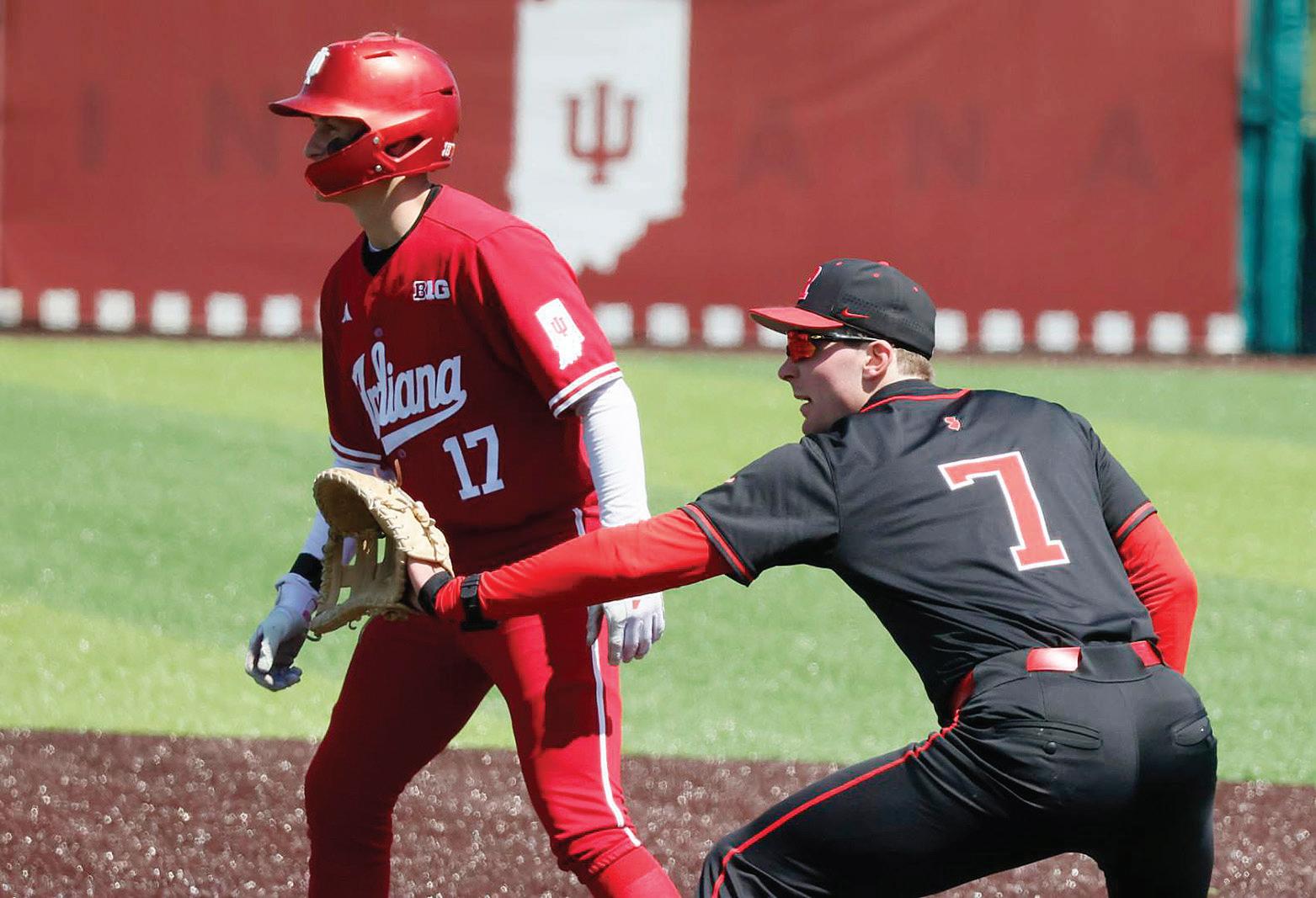
He extended his teambest hitting streak to 12 consecutive games with a single in the bottom of the third inning. One RBI came on a groundout in the bottom of the fifth inning to extend Indiana’s lead, one it didn’t relinquish. The other run driven in was on a sacrifice fly in sixth, capping
off a four-run inning.
The 6-foot sophomore raised his batting average from .320 to .345 through 87 total plate appearances, jumping his season RBI total to 21 in the process. He batted (6 for 12) with a walk over the three-game stretch.
After the series, Indiana head coach Jeff Mercer
praised Koskie for the strides he had made at the plate since the start of the year.
“He struggled early in the year. He was big and couldn’t reach the fastball,” Mercer said postgame April 5. “He was frustrated, and I understood that frustration. But he kept working, made a few swing adjustments...
he’s become an all-around tremendous hitter right in front of our eyes.” Koskie was never supposed to be purely a hitter. He was expected to fit in as a key part of the weekend rotation, but an early season elbow injury — one that didn’t require surgery but still put him on
the shelf pitching wise — forced him to step up as a hitter after getting only 45 atbats last season.
“He came in as a pitcher; I thought he was going to be our Saturday starter,” Mercer said April 5. “But he had the arm injury. He wanted to play; he didn’t get the surgery. Then he doesn’t start the way he wants to but works his way back. He’s got one elbow and one knee right now, yet he goes out and competes for his team.” Mercer also said having a mentor in Koskie’s family “helped him adapt and adjust” when it came to focusing on hitting.
Koskie’s dad, Corey, played nine seasons with the Minnesota Twins, Toronto Blue Jays and Milwaukee Brewers in the MLB. He held a .275 batting average and .825 OPS in 3,399 career atbats.
The sophomore’s defense continued to be solid over the weekend in left field as well. Koskie recorded four put outs in all four chances, extending his season fielding percentage to a perfect .1000. But, for now, Koskie has slowly become one of the best hitters for the Hoosiers.
“Right now, he’s probably the most professional hitter that we have,” Mercer said April 5. “His ability to recognize pitches, stay on the ball the other way; I really trust him with guys in scoring position.”
By Will Kwiatkowski wdkwiatk@iu.edu
Indiana baseball found its rhythm at the plate April 3-5 against Rutgers, and Hogan Denny was right in the middle of it.
The sophomore outfielder has been the anchor at the top of Indiana’s lineup all season, and his strong weekend only added to his dominance, as he helped power the Hoosiers to their second consecutive Big Ten series win at Bart Kaufman Field.
Indiana took two of three games from Rutgers this weekend, opening the series with an 11-0 win in seven innings April 3 before falling 9-6 on April 4. The Hoosiers responded in the April 5 finale with an 8-2 victory to secure the series.
Indiana set the tone in the opener by building its offense inning by inning.
After a quiet first two frames, Denny sparked Indiana’s breakthrough in the third inning to start the scoring. Denny worked a very good at-bat for a twoout walk, setting the table for sophomore first baseman Jake Hanley, who launched a two-run home run to give Indiana a 2-0 lead.
The Hoosiers continued the scoring with their top of the order power in the fourth inning even after recording the first two outs of the inning. After building the workings of a rally with two runners on, sophomore infielder Will Moore delivered a three-run home run to extend the lead, and Denny followed with a double to left field before scoring on a Hanley RBI single, pushing the Hoosiers’ advantage to 6-0.
Denny’s impact carried into the sixth inning.
After Moore reached base, the Mooresville, Indiana, native delivered again, this time driving a two-run home run to left field to extend the lead to 8-0. Indiana added three more runs later in the inning, capping an 11-run performance and securing the run-rule victory.
Denny finished the opener 3-for-4 with a home run, two RBIs and three runs scored, reaching base consistently and setting the tone for the series. He then carried that approach into the second game of the series April 4.
Denny reached base three times, going 2-for-4 with a walk and scoring three
runs as Indiana again built its offense across multiple innings. His presence at the top of the order scoring in the first, third and fifth, as the Hoosiers produced 6 runs.
But unlike the opener, Indiana could not hold the lead. Rutgers responded late, capitalizing on scoring opportunities to take a 9-6 win and force a rubber match April 5. That made the finale a series-defining game. The offense was slow to get going April 5, and so was Denny. Indiana was held scoreless through the first three innings before breaking through in the fourth on a solo home run from redshirt freshman catcher Brayden Ricketts. The Hoosiers added two more runs in the fifth after Denny reached base on a bunt single, stole second and scored on a Jake Hanley double, showing off his baserunning as well as his batting. Hanley later came home on a groundout, extending the lead to 3-0.
Denny’s stolen base, his sixth of the season and the second-most by any Hoosier, further highlighted his versatility, extending his impact beyond his ability
to play multiple positions and serve as a key bat and baserunner.
“Being able to be multifaceted… a lot of really smart, complimentary baseball there… I was really pleased with the way that we responded,” Indiana head coach Jeff Mercer said in a postgame press conference April 5.
Denny’s impact continued to build in the sixth inning, as Indiana loaded the bases before Moore drove in a run with a single. Moments later, Denny lined a single up the middle, driving in two runs and pushing the lead to 6-0. Sophomore outfielder Caleb Koskie followed with a sacrifice fly to cap a four-run inning that gave Indiana full control.
Indiana added a run while allowing two more to close out the series with an 8-2 victory.
Denny now sits at a .344 average with 42 hits, 25 RBIs and six home runs. His dominance in the April 3 game echoes the early season slugfest Denny put on against Bradley University in a home matchup Feb. 17. In that game, Indiana also won early in a 10-run mercy rule while Denny’s bat carried

The Hoosiers lost all three games of the series
By Conor Banks conbanks@iu.edu
In the quarterfinal round of the 2025 Big Ten Tournament, then-No. 10 seed Indiana softball tied then-No. 2 seed UCLA at four runs heading into the sixth inning. With a win, the Hoosiers would have continued their underdog run in the tournament. Instead, the Cream and Crimson went scoreless over the final two frames. Meanwhile, the Bruins pushed across a run in the bottom of the seventh to advance and end the Hoosiers’ tournament run.
From April 3-5, Indiana traveled to Easton Stadium in Los Angeles to face No. 9 UCLA for the first time since its loss last season. While the Hoosiers’ roster had changed — the team brought 12 new players into this season’s matchup — the series followed a similar script. Indiana again struggled in late innings against UCLA, dropping all three games over the weekend.
Entering the weekend, the Bruins’ offense ranked second in the nation with
a .504 on-base percentage and 104 home runs. Yet, UCLA was quiet at the plate through the first four innings of the April 3 game. Indiana scored first, as junior utility player Aly VanBrandt lined a two-RBI double and gave the Hoosiers a 2-0 lead in the top of the third inning.
Junior utility player Alex Cooper hit an RBI double to extend Indiana’s lead to 3-1 in the top of the fifth. The Cream and Crimson remained in control entering the final innings. Then the momentum shifted.
Indiana junior pitcher Taylor Hess exited the game in the fifth inning, and Brooke Mannon entered in relief. The junior owned a team-low 2.18 ERA in the circle heading into the series. However, she loaded the bases in the bottom of the fifth, before walking in a run to bring UCLA within one score.
After keeping one of the nation’s premier offenses in check through five innings, Indiana’s pitching faltered in the sixth frame. After walking in a run an inning
prior and allowing two baserunners to start the sixth, Mannon exited.
Sophomore pitcher Ella Troutt entered the circle in relief. Her first batter — sophomore outfielder Rylee Slimp — launched a threerun home run past the right center field wall, giving the Bruins a 5-3 lead. Indiana scored a run in the seventh, but its sixth inning mistakes resulted in a 5-4 loss.
Like April 3, Indiana kept the game close April 4, trailing 2-1 through four innings. Sophomore pitcher Ella Troutt started in the circle for the Hoosiers. She allowed just one earned run across 3.1 innings pitched.
After Troutt exited in the fourth, UCLA generated more offense. The Bruins hit two home runs in the fifth, extending their lead to 5-1. The Hoosiers’ offense could not keep up, scoring just one run in the sixth frame and dropping April 4’s matchup 7-2. Looking for redemption April 5, Indiana head coach Shonda Stanton again relied on Troutt to start in the circle. Both teams remained scoreless
through three innings. But the Bruins began to find their rhythm in the batter’s box, while the Hoosiers remained quiet at the plate.
Two consecutive Bruins reached base in the fourth, before redshirt junior designated player and infielder Ramsey Suarez roped a double to right-center field. Suarez’s double scored the first run of the game. A fielding error by VanBrandt at second base brought in two more runs for UCLA, as it seized a 3-0 advantage.
The Hoosiers’ offense failed to generate any runs April 5, as the Bruins hit a home run in the bottom of the sixth to help clinch a 4-0 victory. While Indiana remained competitive early, UCLA outscored the Hoosiers 10-3 in the fifth inning and onward to notch the series sweep.
The weekend’s series represented Indiana’s fourth matchup against a ranked opponent this season. The Bruins’ No. 9 national ranking was the highest of any team the Hoosiers have faced. Prior to UCLA, Indiana defeated then-No. 25 Ohio State, before los-
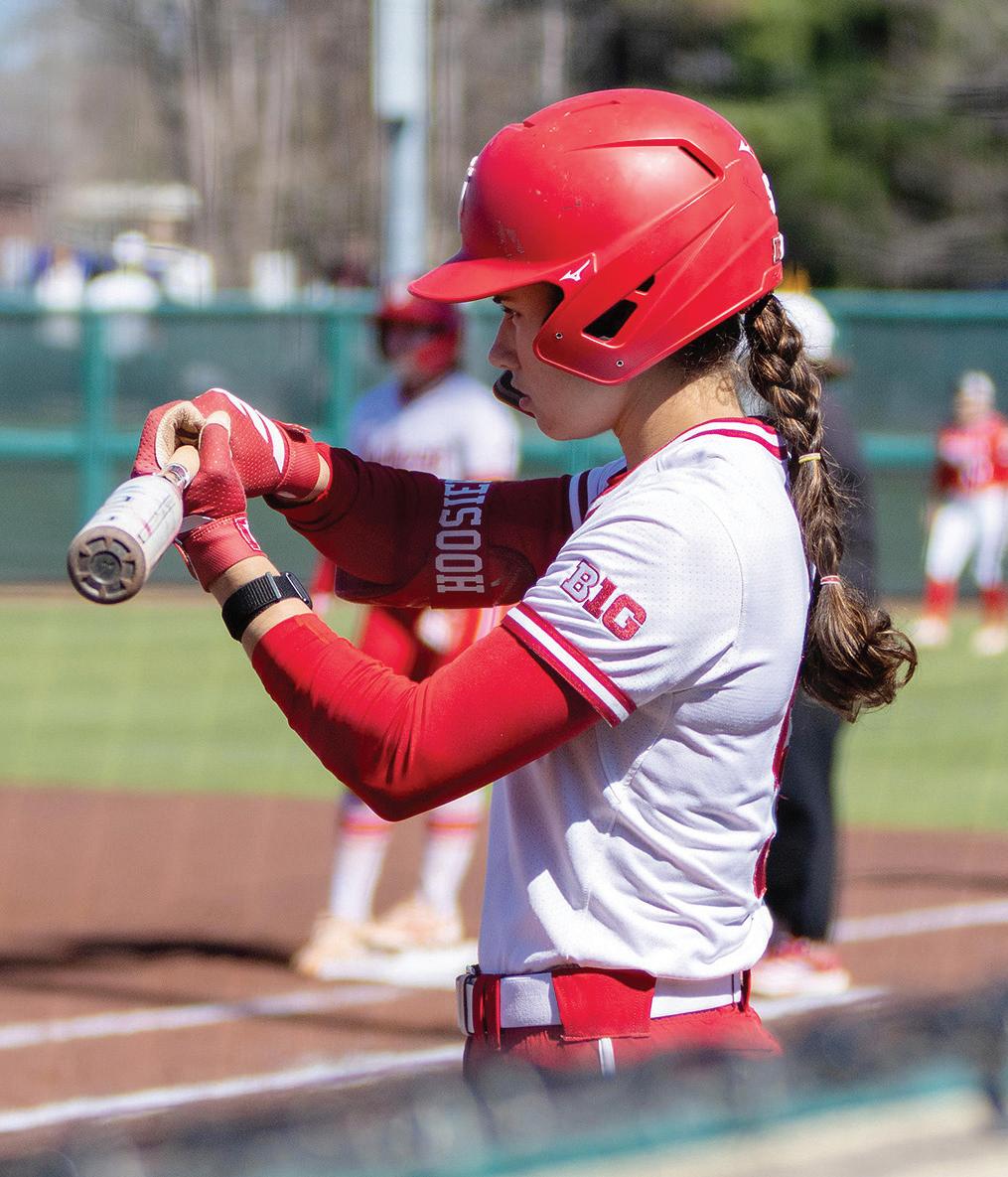
PHOTOS BY BRIANA PACE

1 2 3