IDS
No suspects are in custody
By IDS staff news@idsnews.com
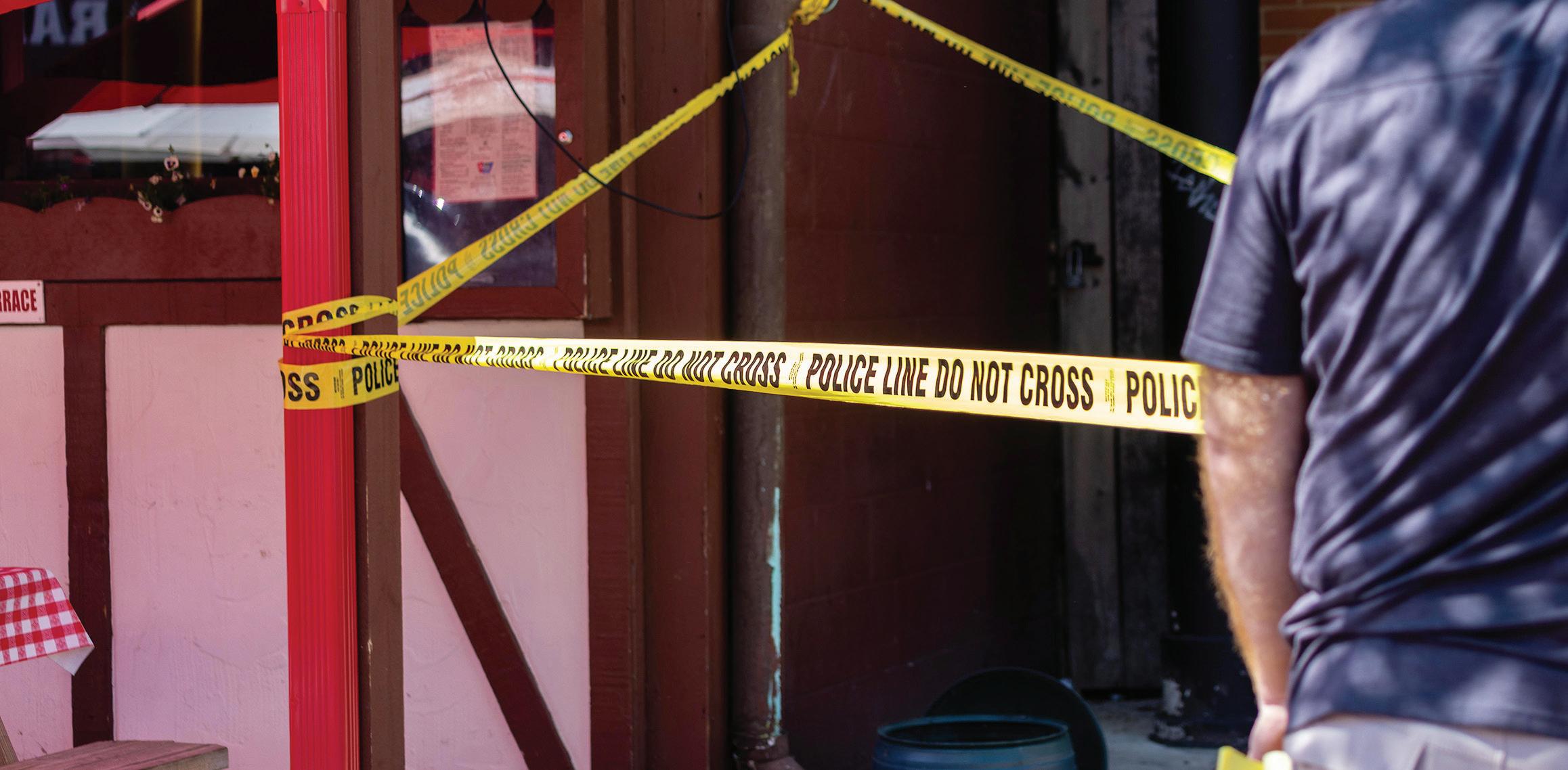
Police have not yet taken suspects into custody following a shooting on Kirkwood Avenue early April 26 that wounded at least nine people.
One victim suffered a bullet wound and injuries from bullet fragments.
Four other victims were injured from bullet fragments and the rest sustained injuries like cuts and scrapes as they attempted to run from the area, according to a nowdeleted City of Bloomington Instagram post. All victims have been released from the hospital.
The statement said investigators reviewed cell phone and video footage and saw that multiple individuals drew handguns, and two people, later clarified to be males, fired their weapons after a fight believed to have broken out between two females near Five Guys.
Anyone with information or video footage of the shooting is asked to contact detective Chris Scott at 812-339-4477.
What to know: According to an IU Notify Alert on early April 26, police responded to shots fired on Kirkwood Avenue, west of Dunn Street. No shots were fired on the IU campus, another notice said. At approximately 12:25 a.m., Bloomington Police Department officers stationed at Kirkwood Avenue heard “what they believed to be multiple gunshots” while monitoring a large crowd that had gathered in the street in the 400 block of East Kirkwood Avenue, according to a press release from after 2:55 a.m.
The crowd began scattering, according to the release. Police found shell casings at the scene.
Officers located multiple people who were wounded. At the time of the release, six injured were transported to local hospitals by ambulance, one was transported by a BPD squad car and two were taken by personal vehicles. An update from the City of Bloomington April 26 confirmed one person suffered a bullet wound, four were injured by bullet fragments and four received injuries like scrapes and cuts when fleeing the area. All were later confirmed to be in stable condition at a city press conference.
The city update said investigators reviewed video and cell phone footage from nearby businesses showing multiple individuals drawing handguns and two separate people firing their weapons following an alleged fight between two females in front
of the Five Guys on Kirkwood Avenue.
The Indiana University Police Department, Monroe County Sheriff’s Office and Indiana State Police assisted at the scene of the shooting, according to the initial BPD release. Remotely Piloted Aerial Vehicles were used to document the scene, and the Indiana State Police used a helicopter to assist in the investigation.
Here is a timeline of information as it came out:
1 p.m. April 27 — Mayor Kerry Thomson condemns racism in Instagram post
In a roughly three-minute video posted April 27 to the City of Bloomington Instagram, Mayor Kerry Thomson condemned racism following the shooting, citing assumptions people have made regarding the race of the shooters, whether they are from Bloomington and if they are students.
As of 1 p.m. April 27, BPD has no suspects in custody and has not released official descriptions of the two suspects, who are both believed to be male.
Police are working “around the clock” investigating the crime, and the city will not fill in the information gaps with assumptions, Thomson said. The city does not know who was involved in the shooting, where they are from or “what affiliations they might have had with our city,” she said.
“What we do know is that this was an altercation between two groups of people that turned violent,” Thomson said in the video.
“It was not random. It was a fight that went wrong.”
Thomson continued to say Bloomington is a city where anyone can belong and decried language that “makes people feel that they must justify their presence here.”
4:03 p.m. April 26 — BPD news release
BPD Capt. Ryan Pedigo wrote in a news release April 26 that the 20-yearold woman who suffered a bullet wound to her upper torso is still hospitalized and continues to be in stable condition. He also wrote that investigators are unable to confirm if the man later located at a gas station on West 17th Street received injuries from the Kirkwood shooting. In a prior release, Pedigo wrote that this individual was transported to a local hospital by ambulance from the gas station.
1 p.m. April 26 — Bloomington mayor and chief of police note gun laws in news conference During the news con-
ference April 26, Diekhoff cited state gun laws as a challenge to regulating and preventing gun violence.
“We want people to feel welcome to come to Bloomington,” Thomson said. “We want them to be able to celebrate and have fun here. And the fact of the matter is, our gun laws enable anyone to open carry on our streets. There’s nothing we can do about that.”
Indiana is an opencarry state, meaning anyone aged 18 or older who the state hasn’t deemed an “improper person” can legally possess a firearm in public without a license. The ages of the suspects are unknown.
Thomson said the city always reviews safety policies after large gatherings and violent incidents, and she committed to updating policies as needed to keep Bloomington residents safe during future events like these.
She also encouraged residents to reach out to lawmakers about changing gun laws in the state.
Diekhoff, who said this was his 39th Little 500 spent with the force, said BPD has already begun planning for next year’s event to minimize violence.
“Everybody was very jovial and having a good time,” he said. “It's when guns get introduced and the fights, that's when we have problems.”
1 p.m. April 26 — City news conference
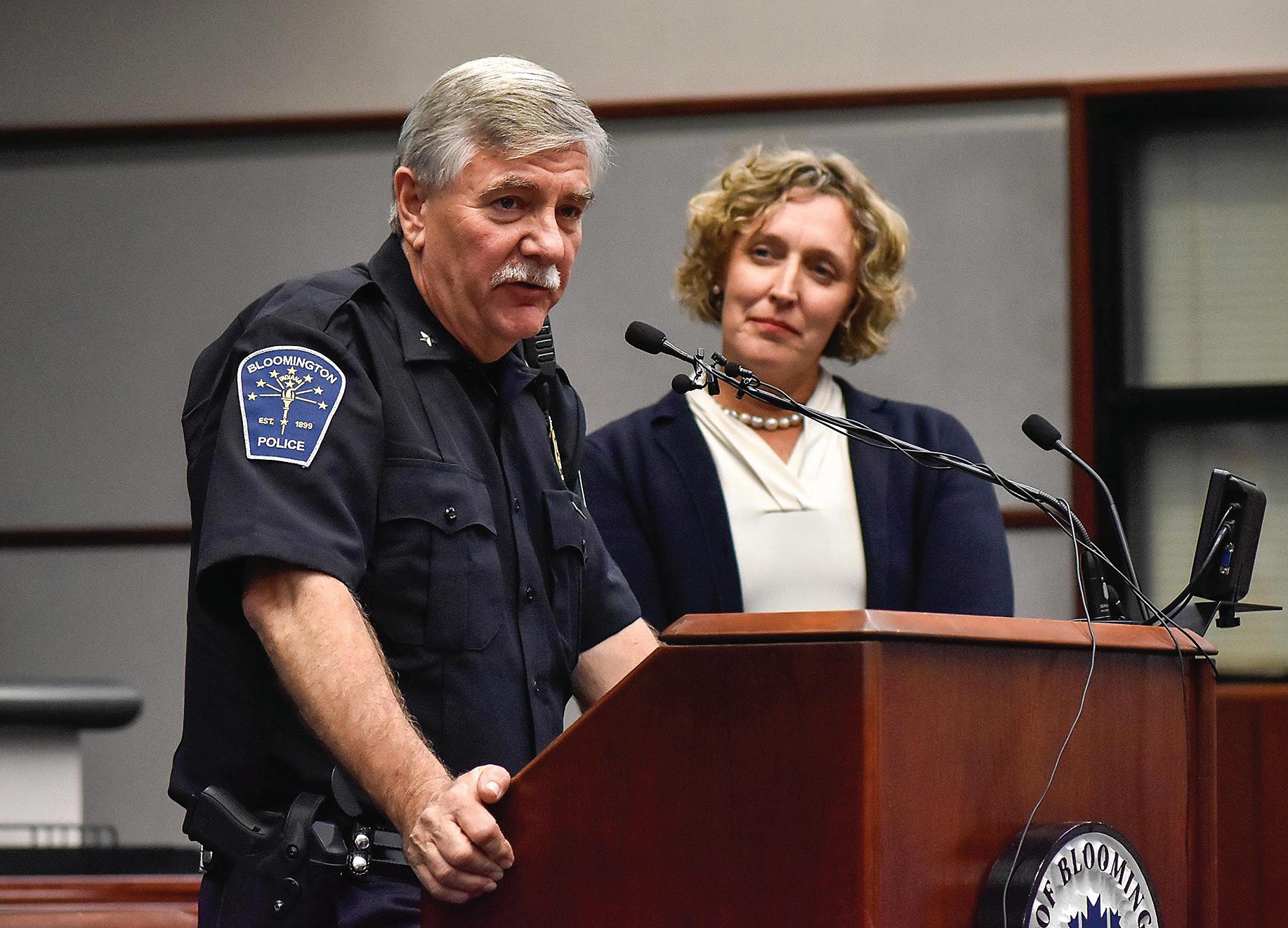
In a news conference at 1 p.m. April 26, Mike Diekhoff confirmed that all five gunfire victims were treated for their injuries and are in stable condition. All but one have been released from the hospital.
IU Associate Vice President and Superintendent for Public Safety Benjamin Hunter confirmed none of the victims were IU students.
Diekhoff said BPD found shell casings and believes both suspects to be male. BPD will analyze the evidence and try to determine the type of firearms used.
Thomson said it is not confirmed whether the suspects or victims “actively” live in Bloomington.
The victims will not be named and at this time BPD will not release appearance descriptions of the suspects, Diekhoff said.
Neither of the females involved in the fight are believed to be injured, Diekhoff said. The people injured were not participants in the shooting but “victims,” he said.
“We’ll be reviewing everything that did happen and every protocol that is within our power to ensure
safety,” Thomson said.
12:42 p.m. April 26 — Sen. Shelli Yoder statement
State Sen. Shelli Yoder, who represents most of Monroe County and Bloomington, wrote she condemns the violence “in the strongest possible terms” and wishes those who were injured a “full and swift recovery” in a news release.
“If you know Bloomington, you know what Kirkwood looks like on a weekend like this. It is crowded, loud and full of people moving from one place to the next, running into friends and staying out later than they planned,” she wrote. “That is what it is supposed to be.”
She wrote that people should be able to gather without incidents like this and that “expectation was broken here.”
Yoder wrote an investigation is active, and her focus is staying informed and engaged with local officials as more information becomes available.
11:40 a.m. April 26 — Rep. Erin Houchin statement
U.S. Rep. Erin Houchin, whose district includes Bloomington, said her “heart breaks” for the victims who were shot “during what should have been a celebratory weekend for Bloomington” in a statement posted to X on April 26. Houchin wrote she is praying for the victims and their families and expressed gratitude to the law enforcement who responded to the scene.
10:57 a.m. April 26 — City of Bloomington update
At least five individuals were injured by gunfire, the City of Bloomington said in an update April 26 on Instagram. The other four were injured as they attempted to run from the area, includ-
ing cuts and scrapes from falls. A total of nine people are known to have received injuries.
The city listed the currently known victims of gunfire from the shooting.
One 20-year-old woman from Plainfield, Indiana, suffered a bullet wound to her upper torso and was hit by bullet fragments on her side.
Bullet fragments hit four other victims. An 18-year-old from South Bend had embedded bullet fragments in her ankle and shin. Fragments hit the thigh of a 22-year-old from South Bend.
Bullet fragments hit an Indianapolis 17-year-old's foot and ankle. Another Indianapolis woman, 21, had bullet fragments embedded in her shins and thighs.
The city said investigators have determined by reviewing footage that a fight broke out between two females in front of Five Guys, during which several people drew handguns and two separate people fired weapons.
After the shots were fired, the update stated, people ran from the scene, and officers rushed to the area to look for victims.
It is unknown if a man located at a gas station on West 17th Street received his injuries during the shooting, the update said.
10:05 a.m. April 26 — Thomson Instagram Post Thomson said BPD, the sheriff’s office and IUPD did a “remarkable job” dispersing the crowd and keeping those safe after the incident in a video posted on the City of Bloomington Instagram.
“We are really committed to a safe Bloomington,” Thomson said. “We know that we can have big parties and keep them safe. We did that with the national championship.” She said those who
were injured during the incident are in her prayers.
“I am so deeply saddened that this happened in our city last night and that several people were injured,” Thomson said. “And I am grateful to law enforcement and to those in our community who helped get us back to safety and who have come down and cleaned up Kirkwood this morning and created the calm environment we have now.”
April 26 — Kirkwood Avenue
Discarded cans and bottles line Kirkwood Avenue’s curbs. A scattered few runners jog up and down the street. “No parking” signs still hang on some meters. There’s almost no trace of the shooting that happened overnight. There is no police tape. Around 10 women wait their turn to take graduation photos in front of Sample Gates, clad in white dresses and red accessories.
9:20 a.m. April 26 — IU releases statement Indiana University spokesperson Mark Bode
By Elizabeth Schuth ekschuth@iu.edu
Editor’s note: Some quotes in this story were translated from Spanish into English.
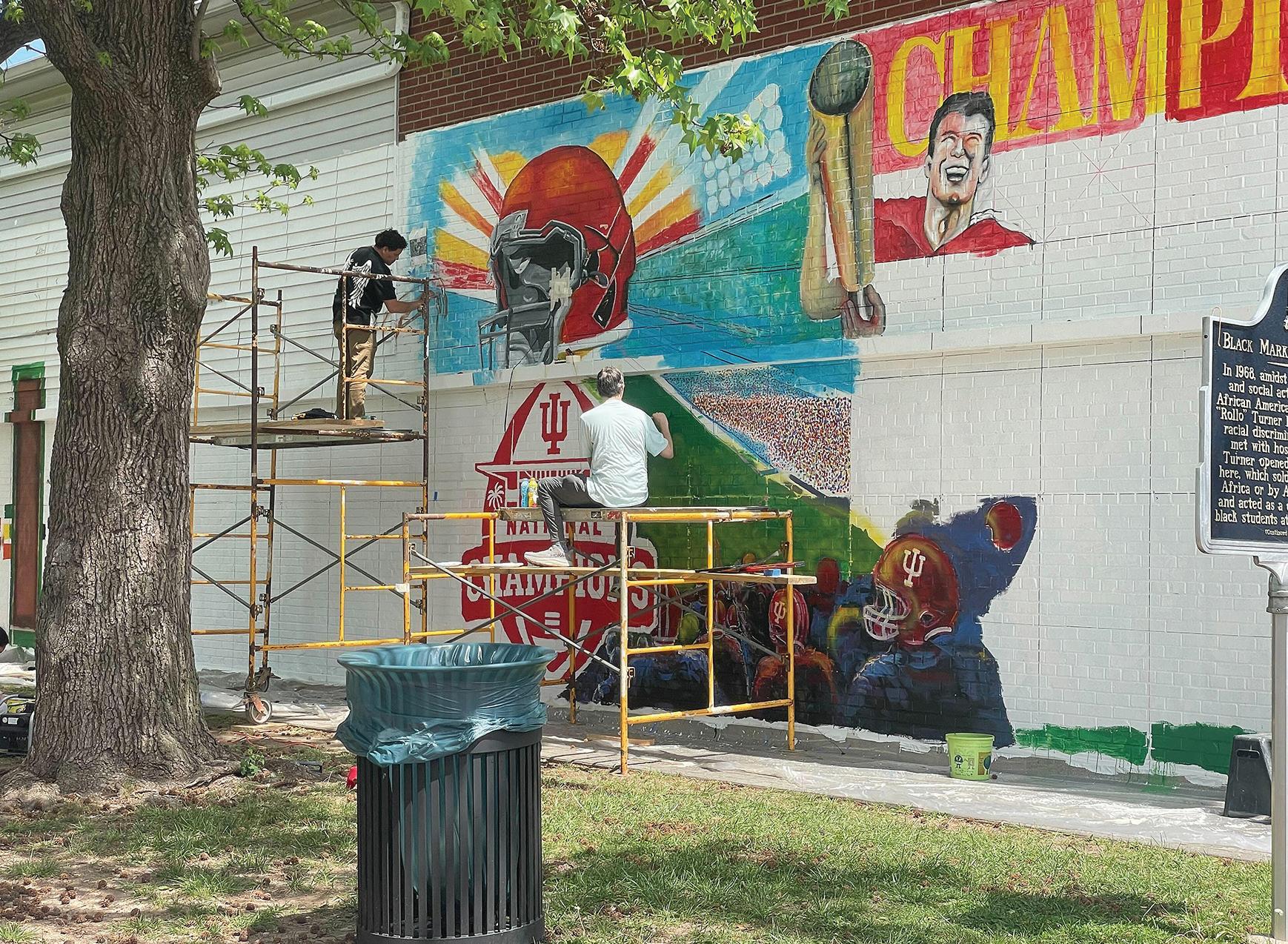
The wall in Peoples Park is painted white. Sketches depict football helmets, stadium crowds and Fernando Mendoza. The words “BLACK LIVES MATTER” and the previous mural with bubble letters spelling out “Bloomington” are gone.
The wall facing the park has undergone several changes over the years. Now, it’ll become an Indiana football themed painting commissioned by Josh Alley who now owns the building next to the park.
The mural will be finished within the next two weeks depending on the weather, painter Jonatan Espinoza said.
The finished mural will include images of Indiana football head coach Curt Cignetti, mascot Hoosier the Bison and former players quarterback Fernando Mendoza and wide receiver Elijah Sarratt. Alley chose the theme to celebrate IU’s first national championship win and his love for IU football, Espinoza said.
“One day this mural is also going to disappear, and they’re going to erase it.”
Jonatan Espinoza, painter
The previous “You Belong Here” mural was painted by local artist Eva Allen in 2017 through a commission from the Bloomington Arts Commission ahead of Bloomington’s bicentennial.
The mural, designed after the style of a postcard, featured “Bloomington” in block letters filled with local symbols, including the Monroe County Court-
The mural replaced the 2017 “You Belong Here” painting
house, pride flags, instruments and Sample Gates. The full mural read “Welcome to Bloomington You belong here!”
“Painting the Welcome to Bloomington, You Belong Here mural was a dream come true for me,” Allen wrote in an Instagram message to the Indiana Daily Student. “I poured my heart and soul into creating a bright and fun postcard style piece of art which included historical references as well as expressing togetherness and inclusion.”
Three years later, on Juneteenth 2020, the words “BLACK LIVES MATTER” were painted over the mural in pastel pink, with the words “DEFUND BPD” in black spray paint on the
side. While the “DEFUND BPD” paint was removed, the “BLACK LIVES MATTER” text remained. The city, artist and property owners never decided to replace it, according to an April 20 City of Bloomington press release.
A few hours after Allen’s mural was painted over with “BLACK LIVES MATTER” in 2020, she posted on Facebook. She was saddened that the mural was harmed but recognized the significance of the Black Lives Matter movement.
“Friends, don’t let this incident make you more exclusive/treat POC (People of color) differently, or have disdain for the BLM movement. I will not,” Allen wrote in the post. “Instead, let’s
continue moving toward reconciliation, equality, and empowerment. Because hate loses but love wins.”
Allen told the IDS she is glad to see a new piece of public art going up this year and wrote that she appreciated the “thought, time and talent” that will go into the piece.
Cream and Crimson Management LLC, new building owner Alley’s company, did not respond to a request for comment.
The City of Bloomington wrote in the April 20 press release that the wall facing Peoples Park, though often thought to be associated with the park, is private property and the owner has the right to do what they want to the mural.
Still, when Espinoza began to strip the mural off the wall, the reaction was instant.
Espinoza said several people have come up to him, often angrily, and asked why the mural was being replaced. Many also mentioned the history of the park as the former location of Bloomington’s Black Market.
The Black Market was founded by civil rights activist and IU student Clarence “Rollo” Turner in 1968 as a celebration of Black culture, selling Black clothing, art and music.
Earlier that year, Turner helped lead 50 students in a sit-in at the Little 500 race to protest discriminatory bylaws in the charters of IU
fraternities by sitting on the track. The protest was ultimately successful, with almost all fraternities accepting the demands.
Three months after the Black Market opened, a local man with Ku Klux Klan ties firebombed and destroyed the store. The business never reopened, and the land was donated to the city, which officially dedicated it as a park in 1980.
“I know that it’s something delicate, it’s something that can easily offend people,” Espinoza said. “Not because they’re replacing a word that was already there; for some people, simply erasing it could be seen as racism.”
Espinoza said he hopes to create a mural that the Bloomington community will enjoy. During the brainstorming process, he proposed a mural including images of limestone cutting, the Lotus World Music and Arts Festival and the Little 500 race. Alley preferred the first one.
Espinoza trained as an architect and enjoys incorporating geometric themes in his work. He started pursuing art full time after getting bored of his career. His first mural was in Pharaoh’s Casino in Nicaragua. He’s currently based in Bloomington and works with the International Art Project. More of his work can be found on his Instagram account, @jonaespi_art.
Espinoza’s wife Aracely Sevilla and Bloomington artist Travis Simpson are also helping paint the mural.
Espinoza will continue to fill out the outline of the mural using a system of grids before adding shading and finer details. He said part of mural painting is change. “One day this mural is also going to disappear, and they’re going to erase it,” Espinoza said.
By Natalia Nelson nelsonnb@iu.edu | @natalianelsonn
Universities in Indiana will soon have to conduct a “foreign influence and research security review” for students from certain countries going into engineering and scientific fields under a new state law.
Indiana Gov. Mike Braun signed Senate Enrolled Act 256 into law March 5 and includes students who are citizens of China, Russia, Iran, North Korea or Cuba.
To admit these students into engineering, computer science, virology, microbiology or artificial intelligence programs, the university will have to conduct a background check.
The check would review the student’s current and past affiliations, support related to their education, funding, training and research, collaborations, intellectual property and employment agreements. It would also check if the student was employed by or served in the military of the foreign adversary.
The law also requires universities to determine whether the student or their relatives are employees or members of political parties or similar governmentsponsored organizations in their home country. If the student is indicated to be an “agent” of that foreign adversary, or acting on behalf or at the request of that country, the university may not enroll that student.
By Zoe Reed reedzoe@iu.edu
According to Indiana University Bloomington’s spring 2026 enrollment data, 4,146 international students are currently enrolled. The data shows 795 students are from China, 60 are from Russia and 64 are from Iran.
Armin Moczek, the chair of IU’s biology department, said China was a major source of foreign graduate students and the law would hamper the department’s ability to recruit the best graduate students from those countries.
He said there weren’t enough domestic qualified graduate students to fill the needs and opportunities that exist.
“So by reducing our ability to attract foreign grad students, including from nations like China, almost inevitably this will affect the productivity of many labs,” Moczek said.
The law came after an IU postdoctoral fellow was arrested and charged with conspiracy and smuggling goods in the United States after he requested and received plasmid DNA in a package of women’s clothing. He entered a guilty plea and received a minor sentence, a fine and deportation.
The FBI searched two IU biology professors’ labs late last year after the postdoctoral fellow was arrested. The FBI raided two homes belonging to an IU Luddy professor in March 2025.
Moczek said the searches had sparked fear and anxi-
ety within the department, especially among those who are non-U.S. citizens.
“I can probably, at some point soon, quantify the number of papers not written, and the number of proposals not submitted, and the amount of money we won’t be able to secure a year or two from now as a result,” Moczek said.
Indiana State Rep. Matt Pierce, a Democrat representing Bloomington, was one of the few state legislators who voted against the bill. He told the Indiana Daily Student it underestimated the level of resources required by the university to do the checks.
It’s also duplicative, he said, because the U.S. Department of State is already doing background checks before giving out student visas.
“So it doesn’t make any sense to have the university duplicate all that work a second time,” he said. “Because they don’t have the resources to do that.”
He said what may happen instead was that universities could stop dealing with students from those countries altogether.
An IU spokesperson did not respond to a request for comment.
At a Senate session Feb. 27, Sen. Shelli Yoder, a Democrat representing Bloomington, called the bill’s language on higher education an “unfunded mandate” and said it would ask state institutions to hire addi-
tional resources to do background reviews on potential students.
“The federal government first and foremost should not be letting anyone in on an F-1 or J-1 visa if they are already too much risk, full stop,” Yoder said.
Sen. Scott Baldwin, a Republican representing part of Hamilton County, said at the same session that Indiana couldn’t rely on the vetting track record of the federal government and need-
ed to require a higher bar.
“People are coming here to be educated and employed from our adversaries. We are the only country in the planet that allows that,” he said. “And so we need to be careful.”
Sen. Chris Garten, a Republican representing Clark County and the bill’s author, said in a press release that the bill was intended to put Indiana first. The press release said the bill was written to expose and com-
bat influence by “hostile foreign nations.”
“It is designed to do one thing,” Garten said at the Senate session. “Ensure that the decisions made in this chamber and the land that our farmers plow are controlled by Hoosiers, not by foreign regimes.”
Garten declined an interview with the IDS. The law goes into effect July 1, with students admitted to or enrolled in programs before Aug. 14 exempt from the law.
The wait is over for Indiana University Bloomington students. Since their disappearance in January, the bronze fish and water have returned to Showalter Fountain on April 27, leaving many students excited about their return.
The fish were previously removed in mid-January to protect them from potential
theft ahead of the College Football Playoff National Championship, leaving the fountain without its signature statues.
IU doctoral student Jerika Miller, who likes to have lunch at the fountain with their roommate, was disappointed in the fountain’s emptiness.
“I’ve been waiting for it to come back,” Miller said. “I sat here a couple weeks ago but
there was no water in it, so it wasn’t as fun.”
Miller, who sat at the fountain alongside other students, said there was a difference in the plaza since it was empty.
“The energy was definitely different too,” Miller said. “Nobody was really around.”
The tradition of stealing the Showalter fish started after the Indiana men’s basketball team played in the 1987
NCAA national championship, when one of the fish vanished after the team won.
Alongsideprotecting the fish this year, IU administered additional maintenance after their disappearance.
IU spokesperson Mark Bode confirmed the installation and maintenance in an email to the Indiana Daily Student on April 28. “The fish returned yes-
terday,” Bode wrote. “Installation was followed by additional cleaning and waxing.”
In an email to the IDS on Jan. 14, Bode wrote the fish will return shortly, “hopefully with a win to celebrate.”
However, the fish had not yet returned three months later, with many seniors hoping to take commencement photos at the fountain disappointed with the fountain’s emptiness.
Now the fish sit in their rightful spot. The return is a relief for seniors like Zoie Ault, who postponed taking graduation photos until the fountain was functioning.
“I was kind of waiting ‘til they put the water back,” Ault said. “My whole family’s gone to IU, and the Showalter Fountain’s been there the whole time, so it’s just really important and like a little piece of history for us.”
By Mia Lehmkuhl mialehmk@iu.edu
Marilyn Grimes had already lost everything before she found herself in the back of a police car. In that moment, handcuffed and facing a felony, it dawned on her.
She had to get sober.
“I had finally come to that conclusion that where I was going to kill me, and I didn’t want to die,” Grimes said.
Now, she’s about 18 years sober from OxyContin, heroin and alcohol. She also directs Courage to Change Sober Living, a Bloomington 12-step sober living environment serving those struggling with substance use. She’s open about her journey, in hopes it alleviates shame felt by those in recovery.
“I’m proud of myself that I’ve accomplished so much after going through all of that, you know,” she said, “and it helps other people, you know, to know that ‘I’m not the baddest one in the room.’”
Grimes’ story reflects a national opioid crisis that, according to local data, may be turning a corner in Monroe County.
The U.S. Centers for Disease Control and Prevention traces it back to the 1990s, when physicians began widely prescribing addictive opioids like oxycodone and hydrocodone to treat pain.
Overdose deaths across the country involving heroin surged in 2010, followed by a third wave of the crisis starting in 2013 driven by synthetic opioids flooding the illicit drug supply.
From January to September last year, 787 Hoosiers lost their lives to opioids, according to the Indiana Department of Health overdose dashboard. A 2019 report by the Indiana Department of Health found that racial disparities exist in drug overdose death rates, with the Black population seeing a quicker rise in recent years.
Grimes and Monroe County Coroner Jeff Hall both pointed to mental health struggles as a driving

factor of the opioid crisis in Monroe County.
Monroe County Coroner’s Office data obtained by the Indiana Daily Student shows 41 drug-related deaths in 2025 in Monroe County. Twenty-four deaths, approximately 59% of all drug-related deaths, were related to opioid use, indicating a decrease from 40 opioid-related deaths in 2024.
County data includes deaths investigated by the coroner where the direct result of death was due to a drug-related incident, Hall wrote in an email to the Indiana Daily Student, including deaths linked to opioids.
Pending cases are not included.
Opioid-related deaths increased from 2020 to 2022 during the COVID-19 pandemic by 10 deaths, when Monroe County saw 41 opioid-related deaths in 2020 and 51 in 2022. However, county data, ranging from 2018 to 2026 to date, does not indicate a consistent upward or downward trend in nearly a decade.
“It really kind of just goes with different ebbs and
flows,” Hall said.
The highest recorded number of opioid-related deaths since 2018 was in 2023 when Monroe County saw 52 deaths, according to county data.
To date, Monroe County has seen 17 deaths associated with drug overdose, with 12, or approximately 70%, being related to opioids this year.
Hall said overdose deaths typically happen by accident and sometimes occur in clusters due to a “bad batch” of drugs entering the county. Bad batches, he said, refers to street drugs that are not what the user thinks they are. Such batches are commonly laced with synthetic drugs like fentanyl, a powerful opiate of which small amounts can be fatal.
He said a common “bad batch” he sees in Monroe County is methamphetamine mixed with fentanyl or derivatives of fentanyl. Typically, overdose-related deaths are caused by a combination of drugs and are commonly classified as accidental overdoses, Hall said.
Hall said six deaths in
Monroe County occurred due to a “bad batch” so far in 2026.
“It’s sort of like Russian roulette,” Grimes said. “Your next high could kill you instantly because of the fentanyl.”
Making resources accessible to those struggling with addiction is something Jackie Daniels, director of clinical development at Indiana Center for Recovery, has grown familiar with in her work.
Indiana Center for Recovery is a mental health treatment center that helps treat substance use disorder at 10 locations across Indiana, according to its website.
Having struggled with addiction and an overdose herself, Daniels said she remembers there were weeks when three or four people she knew died from an overdose — something she doesn’t experience as often anymore.
“But I don’t think we’re anywhere near letting our guard down,” she said.
Daniels considers Monroe County a “haven” for recovery because of the avail-
ability of harm reduction programs, access to lifesaving medication like Narcan and public awareness about substance use disorder.
Daniels sees stigmas that are “alive and well” about recovery.
“Just be a listening ear where they can talk to you and offer to take them to treatment.”
Macy Olds, Bloomington resident
“I’m constantly arguing with people on social media, which is probably not a good idea, but I do it anyway, because I feel so passionately about it,” she said, “and a lot of that is this perception of ‘us versus them.’”
Stigma can push people to hide their drug use or avoid treatment altogether, Daniels said, and one bad experience can make them unlikely to seek help again.
The City of Bloomington distributed $244,095 last year to address opioid addiction and recovery through its Downtown Outreach Grants. The grants supported nine
local nonprofits, including Courage to Change, providing resources like treatment and housing stability. The grants are funded as a result of multiple settlements Indiana reached with pharmaceutical companies and distributors that were alleged to have contributed to the opioid crisis between 2021-2022. The settlements provide Indiana with more than $1 billion over 18 years to combat the opioid crisis beginning in 2022.
Macy Olds sought treatment at Indiana Center for Recovery after struggling with substance use. Now, graduating from Indiana University with a social work degree this spring, she works as a case manager and group facilitator. Her recovery inspired her to pursue social work. In the fall, she will return to IU for a master’s degree.
Olds, a self-proclaimed “party kid” in her teens, became addicted to opiates after experimenting with different substances throughout high school and into college. It wasn’t until she sat in a jail cell that a stranger made her realize she needed to change course.
“She had an ankle bracelet plugged into the wall inside of a jail cell, and I told her everything that I had done, and like, all the substances I used,” Olds said, “and she goes, ‘You’re gonna die.’”
Having lived it herself, Olds knows how isolating addiction can feel. A big challenge for those with substance use disorder, she said, is the fear of disappointing the people closest to them.
“Don’t shame them and don’t view it as a moral issue,” she said. “Just be a listening ear where they can talk to you and offer to take them to treatment.”
Despite the number of opioid deaths, organizations like Courage to Change continue to work and support those wrestling with substance use disorder.
“Recovery is community,” she said. “You can’t isolate and get help.”
By Sofía Rodríguez sr73@iu.edu
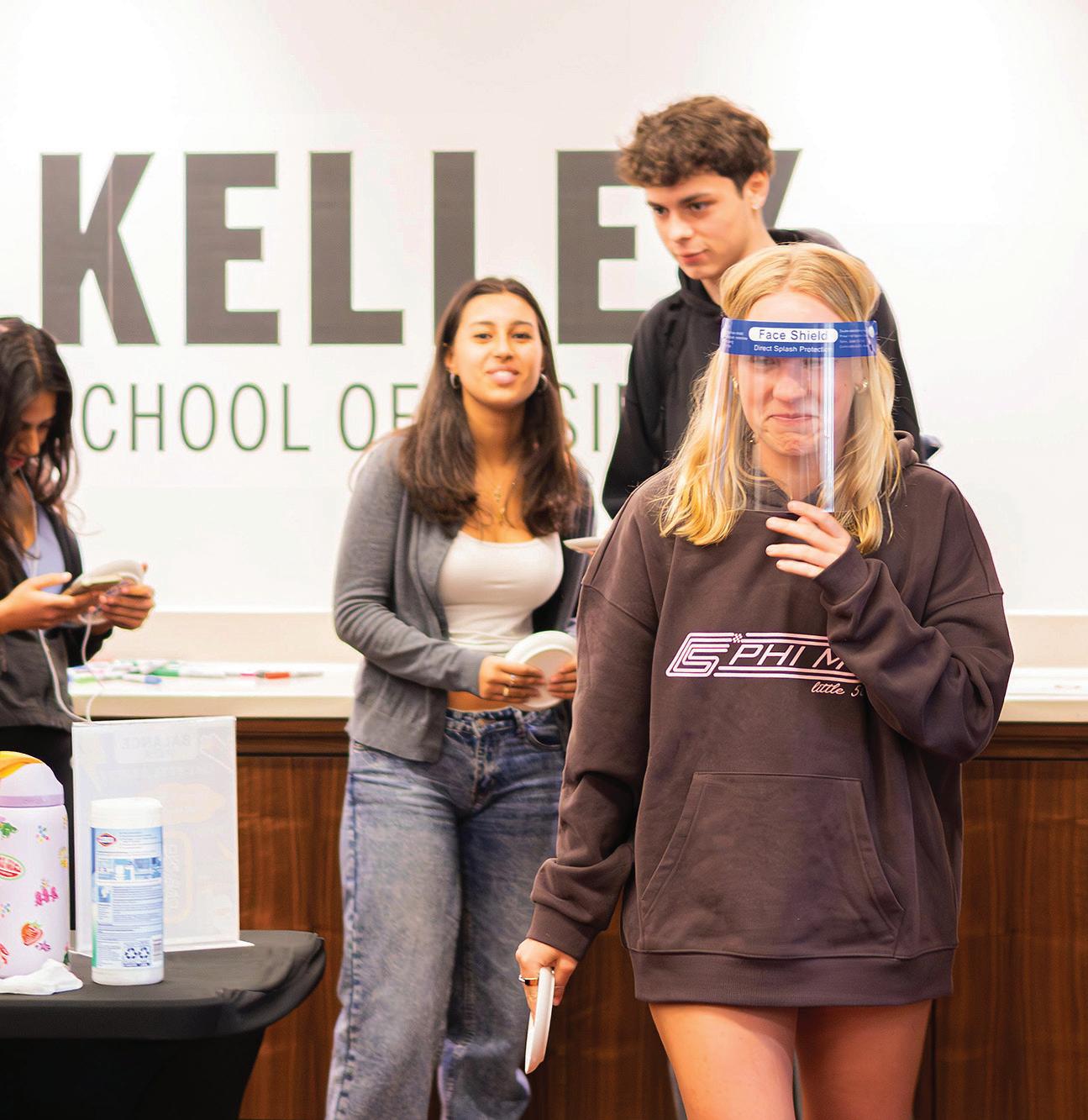
Students walking by Hodge Hall on April 28 occasionally stopped to look into Room 2020 to hear the sound of plates shattering and encouraging event coordinators.
The Kelley School of Business’ KelleyWell team, which is a wellness program at the undergraduate level that focuses on college mental health wellness, hosts “Balance Week” every semester for students to take a break from the stress of finals while celebrating the end of the semester. Students can do yoga and group fitness events, write out their worries and paint pottery during the week.
KelleyWell hosted a “Smash Room” on April 28 for all students as an outlet to shatter their frustrations before finals week. The stressrelieving event is a tradition, KelleyWell Administrative Coordinator Mariana Hernandez Lozano said.
“It’s special to students, so it matters to us,” Hernandez Lozano said. At the event, students get a glass plate to write their
frustrations and worries on.
They then throw the plate into a tent where it smashes into pieces. Senior Sydney Fuchs said she looks forward to the “Smash Room” every year.
“I’ve gone every year, it’s super fun to just smash plates, get the frustrations out, especially with graduating soon, get it all out,” Fuchs said.
As a senior, Fuchs said that she wrote on her plate about finals, graduation and last-minute goals she has before her final chapter at IU ends.
“I really do like this event, (it’s) definitely cathartic,” Fuchs said. “It does symbolize the end of the year when Balance Week comes around but it’s really fun.”
Kelley School of Business Assistant Director of Student Life and volunteer Dedric Dennist Jr. said the event gets around 200 students every year.
Unlike Fuchs, junior Moyo Adeleye attended the “Smash Room” for the first time April 28 and said it won’t be his last visit.
“I think it was very helpful,” Adeleye said. “I really liked the part where you
wrote your frustrations on the actual plate.”
Hernandez Lozano said the preparation for the event begins three to four months in advance. It includes purchasing the supplies they need and recruiting volunteers to work events.
Hernandez Lozano and other members of the KelleyWell team work with the Office of Insurance, Loss Control & Claims to ensure the safety of the event.
She said in order to participate, students must sign a waiver prior to throwing and wear a face shield. The tent that the plates are thrown into is made so the shards of glass stay inside and in the case that they do not, the face shields are made to protect students’ faces.
No one has gotten hurt at the event, Hernandez Lozano said.
KelleyWell is hosting around 30 events in partnership with various organizations as a part of “Balance Week.” Some of the April 29 events include DIY charcuterie boards, stations focused on self-care, therapy dogs, chair stretch yoga, wellness bags and popcorn and aqua dance.
By Grace Fridy gfridy@iu.edu
Former IU Director of Student Media Jim Rodenbush voluntarily dropped his lawsuit against Indiana University April 22 but told the Indiana Daily Student he plans to refile. The original lawsuit alleged IU violated his First and 14th Amendment rights following his Oct. 14 firing.
Media School Dean David Tolchinsky fired Rodenbush on Oct. 14 of last year after he did not agree to administrator requests that the IDS publish no news content in its Oct. 16 paper ahead of Homecoming.
Hours after Rodenbush’s firing, Tolchinsky cut print
for the IDS entirely, a decision IU Bloomington Chancellor David Reingold later walked back in a letter to IDS editors on Oct. 30, where he said Rodenbush’s firing was unrelated to IDS editorial content.
The lawsuit, originally filed in federal court, alleged his 14th Amendment right to due process was violated because he was fired without notice or discussion, as well as his freedom of speech. It also requested the court assess whether IU’s firing of Rodenbush and attempts to direct editorial content were legal violations.
It also sought compensatory and punitive damages for Rodenbush, and asked that IU restore his position
and clear his disciplinary action record.
According to court documents obtained by Indiana Public Media, Rodenbush’s lawyers said it’s unclear if a federal court can hear the case.
The 11th Amendment restricts federal courts from hearing cases brought against a state by a non-resident of that state. According to his LinkedIn, Rodenbush will begin a job as an associate professor of journalism at Western Kentucky University this fall.
The Trustees of Indiana University, the respondent in the lawsuit, is a state agency, and therefore is unable to be sued by a non-resident of Indiana without the
state’s consent due to the 11th Amendment. Rodenbush was able to dismiss the lawsuit voluntarily with the option to refile in the future because the Trustees had yet to respond to the lawsuit.
“As far as I’m concerned, this doesn’t really change anything,” Rodenbush said in a phone interview with the IDS. “My intent is to see this case until it absolutely is over.”
Rodenbush’s lawyer said in an email to the IDS that they plan to refile in the next couple of weeks, and that the suit will be largely the same. Rodenbush said the refiling is “procedural,” and that the new filing will happen in state court instead of federal.
Emma Howard is a sophomore studying journalism.
“Technology appeals to us most where we are most vulnerable.”
That quote from Massachusetts Institute of Technology psychologist Sherry Turkle has rung in my ears for over a week since I included it in a recent article. There I applied it to the vulnerability inherent in childhood and adolescence, but the quote continued to confront me with uncomfortable truths about my own internet addiction as an adult.
During my first semester as an opinion writer, I made it my goal to inform readers about current technology and give them the tools to consume the media found on that tech more mindfully. What began as a casual endeavor to write as a film student became a larger attempt to help other people — as well as myself — make sense of the world.
In doing so, I became hyper-aware of my own habits. Writing about the downsides of media and tech has been somewhat akin to preaching the dangers of nicotine with a stogie in my mouth. I know I need to reduce my screentime. I even allude to it with an occasional quip about Kevin G or One Direction fanfiction. But if I’m so aware of it, why can’t I just knock it off?
Grab some snacks and a blanket: It’s time to talk
Odessa Lyon (she/her)
is a senior studying biology and English, pursuing a minor in European studies.
Yuck! It’s stringy, it’s chewy, it tastes of dirt and death. I’m not eating that.
At 14, I vehemently shook my head and pushed that plate of fungi as far from my fork as possible. At 22, I’m still shaking my head. But, having been a vegetarian for just shy of a decade now, my parents, cookbooks and the veggie section of restaurant menus alike continually try to shove bites of that famous decomposer into my face: Mushrooms.
Am I mad about it? Not really. While mushrooms have never suited my picky palate, they provide many nutritional benefits to humans, important ecological services to plants and trees and applications for the global strive toward sustainability.
Everyone wants to talk about quinoa and kale when superfoods are mentioned, but this fungus, the mushroom, is the unsung
Dunn Meadow.
Editor’s note: The contents of this column are intended for satirical and entertainment purposes and do not necessarily reflect the opinions of the IDS or its staffers. The scenarios mentioned are fictional.
The Indiana Daily Stupid has intercepted an intergalactic transmission from Indiana University’s first squirrel launched into space. Early this morning, reporters downloaded the communication onto a hard drive they rushed to Wright Dining Hall, where they burst into the kitchen, commandeered several pans and spoons and laboriously unscrambled the data, to the chagrin of dining hall workers they brandished press passes to instead of scanning in.
Serving the unscrambled hard drive — now prepared over easy — to a news editor on a plate, the editor plugged it into her laptop.
about our feelings. When it comes to an internet addiction, most people seek their answers in the future. We see the potential results of quitting a bad habit and use them as motivation. Thanks to Dr. Turkle, I’ve been reflecting on the past instead.
As with many terrible stories, this one begins in middle school. Like anybody undergoing the inelegant era of adolescence, I struggled to find a group of genuine friends to connect with. So, I connected to the internet. Web games, especially social ones, became my source of escapism. In my mind, of course, my internet usage wasn’t a solution to anything. I was just hooked. Current technology is creating a “paradox of connection,” mental health expert Dr. Tyia Grange Isaacson has said. With instant messaging, our social lives are at our fingertips. At the same time, we sacrifice the emotional context of verbal communication for convenience’s sake. It’s reaching out without the exertion, which is particularly appealing to, well, a lonely middle schooler.
As technology evolves to mimic human speech, devices like AI chatbots offer a handy, albeit hollow, alternative to real companionship. In a 2025 survey of people using generative AI for mental health support, 90% cited accessibility as its major draw.
While one may be tempted to believe they themselves would never succumb to such an extreme as, say, befriending an AI chatbot, it’s much easier than you think. Social media and other addictive tech features are the most palatable to people in times of emotional need, and when we’re in need, accessibility to care is often prioritized over its quality.
Technology also hinders our ability to feel the emotions we need to feel. That’s what makes Instagram Reels such a magnet during vulnerable times in our lives. Sad, stressed or scared? TikTok will set that on the back burner for you. Clinical psychologist Dr. Narineh Hartoonian has said doomscrolling is a way for us to distance ourselves from our feelings.
“People don’t scroll for information. They scroll for distance. And once the nervous system realizes, ‘This gives me temporary protection,’ it recruits scrolling as a shield, not a pastime,” Hartoonian wrote for the Rowan Center for Behavioral Medicine.
Come to think of it, I downloaded Pinterest the day my dog died.
Fast forward to college. To say it’s been disenchanting would be an understatement. My freshman year met me with a wave of social isolation and imposter syndrome that made a good doomscroll all the more enticing. Between my lack of camaraderie and a nagging feeling that I was in

the wrong line of study, my phone became a crutch.
At the beginning of last semester, I resolved to maintain a 15-minute limit on my daily screen time. And I was doing pretty well for a couple of weeks. But after seeking connection from place to place only yielding fruitless or just plain disastrous results, I jumped back down the rabbit hole. Until Sherry Turkle altered my brain chemistry, I never really thought about why I did it.
It’s no secret that excessive internet usage negatively affects our brains. Scores of tips are out there on how to kick the habit. But how do you kick a habit if you don’t know why you began in the
LYON LENS
first place? We scroll to fulfill a need. We can’t stop if we don’t fulfill that need in another way. That’s why so many methods to quit, like Apple’s screentime limit, fail. These escapes don’t actually replace whatever we are seeking when we unlock our phones.
Personally, I turn to my phone for two reasons. It lets me feel a sense of community without the frightful steps of reaching out. At the same time, the endless algorithms stimulate my mind just enough to avoid feeling the emotions I need to feel.
When I scroll on my phone, I’m not just feeding into a bad habit — I’m attempting to fulfill my own
Mushrooms are magical even if they’re not ‘magic’
hero, ahem, magician, of the kitchen table. Incorporating mushrooms into your diet lowers your risk of cancer and mild cognitive impairment, a condition that makes memory and language difficult and often precedes Alzheimer’s. Mushrooms are also a prebiotic — their most abundant carbohydrate stimulates healthy bacteria to grow in your gut — and an immune system booster.
Mushrooms are the only source of vitamin D in the produce section and are also low in sodium, which helps manage high blood pressure. Research also suggests shiitake mushrooms can reduce or block the production and absorption of cholesterol, and mushrooms are already a low-sodium protein alternative.
While our bodies require some level and types of cholesterol for functions like making hormones and building cells, too much “bad” Low-density lipoprotein cholesterol can amass in your blood vessel walls, leading to constricted blood
Audio of Mike Woodchip’s squeaky voice played.
Woodchip, a campus squirrel and longtime resident of the big Bur Oak overlooking the Indiana Memorial Union, signed onto Indiana University President Pamela Whitten’s Starbucks-funded moon mission earlier this year. Shortly after Woodchip’s departure from Earth three weeks ago, debris from Artemis II — which he found in the way of his flight trajectory due to an amateur blast-off that defied numerous federal and state aviation and fire codes — sent his space capsule off course and into a wormhole. This stranded him on an alternate Earth. At the time of receiving this transmission, it had been over a week since Woodchip’s latest communication.
Woodchip’s fellow rodents feared he had perished. Though the eventual interstellar message from Woodchip quelled these fears, it raised new ones. Not-IU was home to a glaring lack of squirrels, Woodchip had told the Daily Stupid in his last transmission. Not-Fernando Mendoza
vessels and thus blood flow. Over time, this blockage can cause chest pain or a heart attack. Mushrooms? A literal lifesaver if I ever saw one. On a somewhat less selfcentered level, mushrooms are vitally important as the facilitator of nature’s biggest group chat. WhatsApp is hocus pocus compared to their subterranean networks. Frolicking in the forest, as I’m sure you do, you’ll notice mushroom caps dotted here and there along the forest floor. But underneath, there’s something more.
Those caps just account for the tip of the iceberg. They keep their junk in the trunk under the soil, where tiny “threads” called mycelium make up most of the fungal body and put in all the work. This almost 500 million year-old network — coined by Dr. Simard, the researcher who discovered it, as the “Wood Wide Web” — of mycorrhizal fungi, or mushrooms that form symbiotic, mutualistic relationships with bacteria and plant and tree roots. These
and his not-uncles were noted for their edacity to eat squirrel instead of pork. But luckily, Woodchip escaped a cosmic end — and an alien handballer’s appetite — by the skin of his buck teeth.
The mission’s organizers had stowed a life-sized statue of Coach Curt Cignetti aboard Cig I to offer as a gift to the extraterrestrial civilizations Woodchip insisted he might encounter. In a bid for survival, Woodchip attached wheels to the statue’s base and drew a scowl on its face. When a fork and knife-wielding not-Mendoza appeared outside the downed capsule, Woodchip wheeled out the displeased statue and put on his best Cignetti impression: “Do not eat this squirrel.”
Not-Mendoza cheerily obliged with a “Yes, notCoach!”
But a new problem quickly presented itself to IU’s furry space traveler. Shortly after he eluded this first instance of near-death, Woodchip wandered to not10th Street, a place twice as dangerous as its earthly counterpart. Two-ton machines raced down not only its streets, but its sidewalks,
underground internet trolls allow trees to send warning messages to each other: pests, drought, disease, watch out! Meanwhile, there’s a constant exchange between tree roots and mycelium of water, nitrogen, carbon and other minerals.
But it’s not the only clandestine job mushrooms are toiling away at. Along with microscopic organisms like protozoa and bacteria and fellow macroscopic organisms like earthworms, termites and millipedes, fungi are decomposers. Where we make a pitiful attempt at recycling, decomposers have it down pat. They eat up dead organic matter and waste — leaf litter, wood, animal carcasses, feces — and break it down into simpler substances like water, carbon dioxide and compounds providing nitrogen, phosphorus and calcium necessary for plant growth.
They’re basically the ultimate stay-at-home parent, sweeping up detritus on the forest floor and serving fixin’s for photosynthetic producers like plants, algae and cyanobacteria to make
too.
Woodchip darted back and forth to dodge the boxes of metal as they whizzed by. The not-students that surrounded him were notso lucky, especially those not-going to class.
IU’s bushy-tailed astronaut then jumped into a tree. Perched on a branch, he watched a platoon of the automatons zip into not-Hodge Hall. Quietly, he dropped back onto the sidewalk and sneakily padded his way to a not-Hodge notclassroom. One robot rolled to the front of it.
“Wel-come to K-2-0-1,” it cybernetically announced. “To-day, we will be discuss-ing the prop-er use-s of art-i-fic-ial in-tell-i-gence in the bus-i-ness sec-tor.”
Quickly bored by its monotone audio, Woodchip leapt from his hiding spot and pounced on a startled student’s shoulder. At full speed, he climbed into her hair and began yanking at it, as a squirrel wishing to stir up trouble is wont to do.
“Professor!” she shrieked.
their breakfasts. They sit at the bottom of the food chain, taking up the rest of the forests’ refuse and recycling it into usable energy for everyone else. It’s the most efficient closed loop economy around.
In fact, nature’s recycling system is so superior to humans’ that researchers are working toward adopting it.
Only 9% of plastics can actually be recycled the way we’ve been doing it, but in 2021, the recycling rate looked more like 5-6% in the United States. At this rate, the amount of plastic in the ocean could outweigh the fish by 2050, and even if you threw a plastic container away today, it might still be floating out there, fully intact, until the 2500s. In 2024, a team at Sporadicate, led by Gavin Pechey, set out to look for a sustainable solution to bridge this gap in recycling.
They found that mushrooms possess the ability to chow down on plastics, or better.
“We could create a hybrid mushroom that would do well breaking down
student shot up from her seat and grabbed Woodchip, whirling in circles to try to shake the tree-dwelling rodent while he only latched on tighter.
Another student cried, “That squirrel is disrupting the class! I want to learn about business technology!”
“I’m not disrupting the class!” Woodchip blared.
The robot nodded one gear at a time. “That’s right. You’re not disrupting the class. You’re asserting your uniqueness.”
Woodchip hopped onto a desk.
“Huh?” he said. “My uniqueness…?”
Professor Bolts beeped affirmatively.
needs. Simply “cutting it out” isn’t enough. Identifying why I scroll — to avoid my vulnerability — has been a key part of stopping it. If I can pinpoint those needs by looking within myself, I can create a plan with tangible results. Knowing I need connection, I can search for another outlet.
Instead of avoiding my emotions, I can sit with or even log them in a journal. Replacing what your phone does for you is going to yield better results than simply reducing your screentime. It starts with being aware of what those things are. Why do you doomscroll?
emhowa@iu.edu
several types of plastics,” Pechey said to Presley Arrowood for Idaho State University Magazine. While this technology is in the works, scientists are finding more, and wackier, ways to use these magical organisms in search of a more sustainable world. We’ve seen promising applications of mushrooms for replacing leather or filtering heavy metals and toxins from abandoned homes, contaminants from water and microplastics from humans. What’s more, it takes a fraction of the water and growing space to produce mushrooms as it does many other foods, all while limiting carbon dioxide emissions.
Mushrooms really are the ultimate magic of the Earth, especially when they capture the eye of the field of sustainability. If we take more notice of these magicians, they can keep doing their spectacular tricks. I may not want them on my plate, but, by Jove, do we need them on our planet.
oolyon@iu.edu
When stakeholders align around shared goals and embrace forward-thinking solutions, even unexpected squirrel-related events can become catalysts for longterm success.”
The students’ faces lit up at the AI-generated lesson. Bolts turned it into the day’s unit.
At a snail’s pace, the robot wheeled around and zoomed its ocular device in on the erupting scene. The
“Yes, in today’s fastpaced and ever-changing world, it is essential to remember that every challenge also represents an opportunity for growth, collaboration and meaningful transformation,” Bolts said. “Disruption is not a destination — it is a complex journey shaped by unique individuals who come together with a shared vision and a common purpose that can create a brighter tomorrow for everyone involved.
“By leveraging innovative strategies and datadriven insights, organizations can unlock their full potential in today’s competitive environment,” the artificial intelligence continued. “At the end of the day, success is not about avoiding disruption, but about turning disruption into actionable outcomes through synergy, adaptability and a commitment to excellence. Together, we can build a future where every voice is heard and every acorn is optimized.”
At the end of class, Professor Bolts sent an obviously AI-generated email to students apologizing for the “unforeseen squirrel incident that occurred in class” before opening LinkedIn to type posts for the rest of his scheduled waking hours. ericcann@iu.edu ERRANT
By Addison Jacoby agjacoby@iu.edu
Perusing the ice cream flavors in Forest Dining Hall, internally debating whether I need a strawberry or chocolate cone, my brother’s contact photo brightens my phone screen as his call comes through.
Accepting the call — while also deciding on a chocolate cone — my brother begins to ramble on about “The Boys,” ranting about how the show’s newest season is continuing to hype up the question of whether Ryan (Cameron Crovetti) will choose to side with Butcher (Karl Urban) or Homelander (Antony Starr).
Interrupting his thoughts, confused, I ask what he means by “the newest season,” I had no clue there were new episodes airing. Honestly, I was so caught off guard by Season 5 slipping under my nose that, somehow, I managed to let the scoop of chocolate ice cream slide off the cone onto my shirt.
Genuinely, I had not heard a soul talking about the newest season of one of Amazon Prime’s biggest shows, nor had I seen any social media posts about the subject. I immediately began the trek back to my dorm to watch the episodes I had missed, changing my shirt along the way.
Apparently, the first two episodes of “The Boys” Season 5 aired April 8. From there, a weekly release schedule of one episode air-
By Sophie Albert soalbert@iu.edu
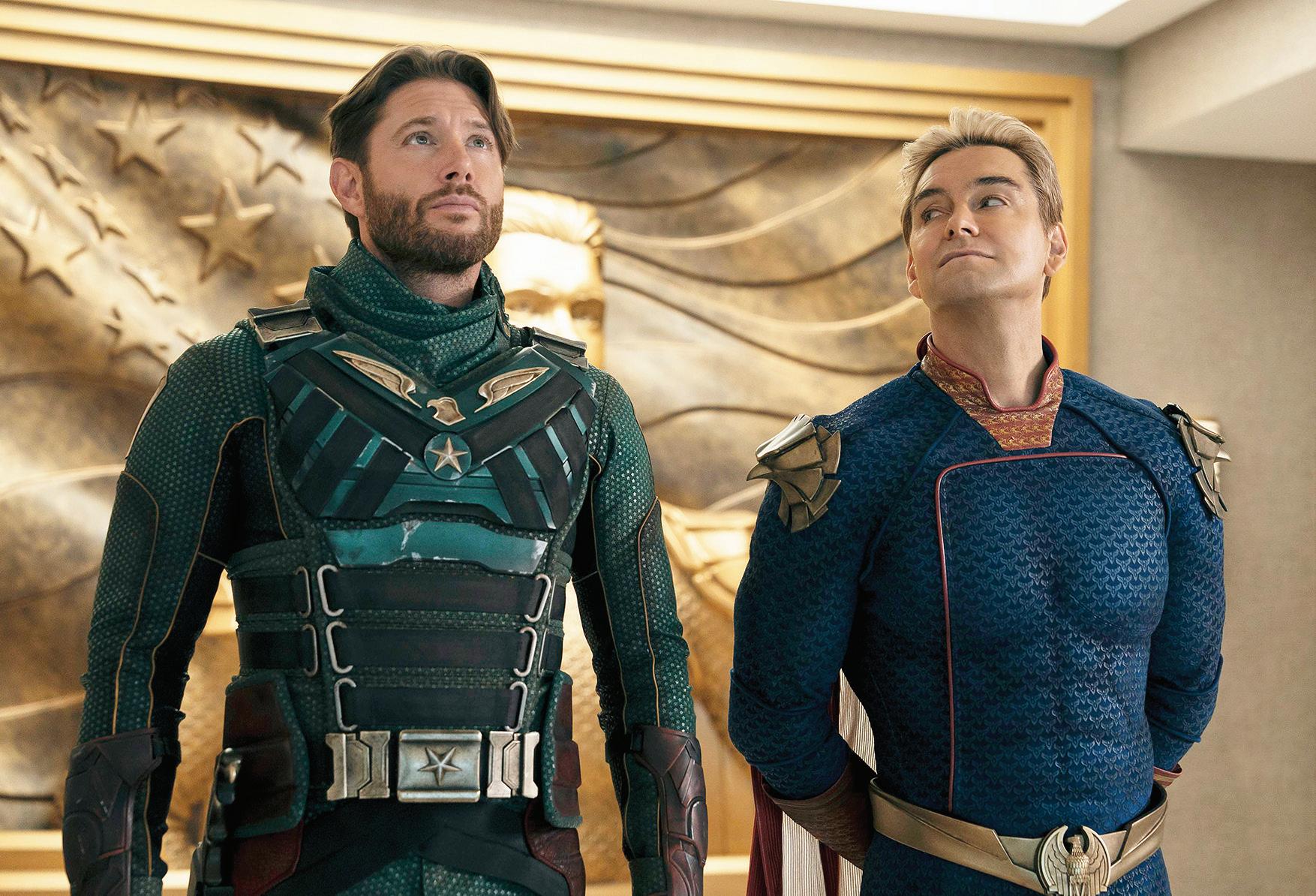
ing Wednesdays will continue until May 20. Currently, there are four episodes on Amazon Prime.
“The Boys” is a satirical superhero television show based on Garth Ennis and Darick Robertson’s comic series, with both the comics and television show following a team of vigilantes as they combat the superpowered individuals who abuse their abilities for personal gain.
After catching up with the
current episodes released, to my dismay, I am a bit disappointed. Not too much, I knew the show was slowly losing its “edge” that it used to have due to characters gaining plot armor as the show continues.
My biggest disappointment and gripe with “The Boys” Season 5 is the “flanderization” of every single character in the show. “Flanderization” is characterized by taking a minor action, trait or characteristic of a
fictional character and exag-
gerating it over time, making it the most notable thing about that specific character. Notably, the trope is named after Ned Flanders from “The Simpsons” because he began the series as the Simpsons’ overly friendly neighbor, who also happened to be Christian. As the long-standing series continued, Christianity became the forefront of Flanders’ personality, making Flanders a caricature of what he once
was. I recognize the same trope in “The Boys,” and I have for a while, but this season has exacerbated the issue to the point of no return. Every conversation had within these past four episodes follows the same formula: Butcher explains another plot to kill all “Supes,” Hughie (Jack Quaid) tells Butcher that he is insane and there is another nonviolent way to solve it, Frenchie (Tomer Capone)
shakes his head while muttering to himself in French, Mother’s Milk (Laz Alonso) says he hates Butcher but agrees with him and Starlight (Erin Moriarty) looks off into the distance, then mutters something extremely depressing about how she thinks Butcher is correct. Then, of course, Kimiko (Karen Fukuhara) ends the conversation with an extremely vulgar sexual comment directed toward Frenchie, showcasing her newfound voice to the audience through shock value. The group dynamic is becoming old and stale, and if the writers do not switch it up midseason, adding some flavor, then Season 5 will continue being stale and predictable.
I will continue watching until the end because I have committed this far, but I know the “flanderization” will only get worse as the writers attempt to wrap up a show where they are too afraid to kill off important main characters. I am aware there are some pretty big character deaths approaching because of past interviews I have seen of the cast, foreshadowing throughout the series and because of the comic series’ bloody ending, but I already know in my gut who will die because of how predictable the series has become. Honestly, the best part of Season 5 that will brighten my spirits each disappointing Wednesday is that they let Mother’s Milk keep his beard.
From classic musicals like “Chicago” to transformative music performances like the Silkroad Ensemble, I have gotten the chance to see many of the shows that made their way to the IU Auditorium. And, as a longtime lover of theater, music and live entertainment, I have greatly enjoyed getting to experience the wide array of shows part of this semester’s lineup. So, with the semester coming to a close, here are my five favorite shows I saw this spring.
5. “TINA: The Tina Turner Musical”
This musical, which came to the IU Auditorium from March 5-6, follows the life of Tina Turner and the music that defined her career. I didn’t know much about Turner’s life before seeing this musical, and it was inspiring to see her story play out in front of my eyes. Turner certainly has a life worth telling, teaching important lessons about resilience, staying true to one’s self and the power of music.
Though I was initially skeptical about how her rather upbeat discography would work in telling such a harrowing story, this musical might have actually been the best way to tell her story. The dichotomy between the joy Turner had to exude on stage while dealing with so many internal struggles, like an abusive marriage and es-
tranged relationship with her mother, was perfectly represented in the performance of her upbeat songs and power ballads.
Darilyn Burtley did a brilliant job of bringing Turner to life on stage, capturing her aura and energy perfectly and ending with an unforgettable mini concert of Turner’s songs that truly felt like I got a glimpse into what her real concert would have been like.
4. “Mrs. Doubtfire”
This is definitely the event that surprised me the most. The musical, which performed at IU on Feb. 28, is a modern adaptation of the 1993 movie of the same name that follows an unemployed, divorced voice actor who pretends to be a Scottish nanny in order to spend more time with his kids. I went into this musical with low expectations because I’ve found that musical adaptations of popular movies are often a hit or miss, for example, I wasn’t the biggest fan of the “Beetlejuice” musical adaptation. Before seeing “Mrs. Doubtfire,” I had heard it was pretty forgettable. However, I was happily surprised by how much I ended up enjoying this musical.
I’m not someone who laughs out loud at shows very easily, but “Mrs. Doubtfire” had me laughing during every scene. While the songs were not the most memorable — and I probably could not tell you what a single one sounds like now — the num-
bers were all incredibly fun and lively, adding entertainment to the plot rather than slowing it down. I was also shocked at how impressive the Mrs. Doubtfire on-stage transformations were, and it definitely made the show something that was worth seeing live instead of just on my screen. While this may not be the most memorable or life-changing show ever, it is incredibly entertaining to watch and gave me a reason to laugh, which is something I think we are all in desperate need of these days.
3. “Chicago”
“Chicago” tells the story of Roxie Hart as she tries to use her celebrity status to claim innocence to a murder she committed. The show came to IU on Jan. 23. This musical has been regarded as a very important and prominent part of musical theater history as it set the foundation for a lot of musicals that came after it and created many pop culture moments, like the “Vigilante Shit” dance number in Taylor Swift’s “The Eras Tour.”
I was pretty familiar with “Chicago” going into it, but I had never actually seen a professional production of it live, so as a longtime theater kid, I was geeking out every couple minutes. The highlight of the show was definitely when they performed “We Both Reached for the Gun,” because I had seen so many edits on social media using audio from the song.

I was happy to finally cross “Chicago” off the list of musicals I need to see and am glad to say it lived up to my expectations.
2. Silkroad Ensemble with Rhiannon Giddens
Established in 2000, Silkroad Ensemble is a collection of musicians from all around the world who come together and interweave the instruments and melodies from their individual cultures together. The ensemble performed at the IU Auditorium on March 12. Music has always been a big part of my life. I got the chance to study music theory from non-Western cultures in high school and since then I’ve loved any opportunity to see different kinds of music performed
live. When I heard about Silkroad Ensemble, it sounded like it would be a beautiful and enticing night of music, and it definitely lived up to my expectations. The music was at once powerful and calming, showcasing music from India, Italy, Japan, Morocco and the Democratic Republic of the Congo, to name a few. Through the collaboration the musicians had with the audience, it genuinely felt like we were all a harmonious collective, despite being strangers.
1. Leslie Odom Jr.
Grammy and Tony-winning performer Leslie Odom Jr. performed at IU alongside the IU Philharmonic Orchestra on Feb. 15. I had heard of Odom before this
concert, mainly through his performance as Aaron Burr in “Hamilton,” but seeing him perform live garnered a whole new level of appreciation and admiration for him. His voice was beautiful and, paired with the addition of an orchestra, it genuinely sounded heavenly and made me cry. I also fully geeked out when he sang both “Wait for it” and “Alexander Hamilton” from “Hamilton,” which added to this experience that I will never forget.
The auditorium is expected to announce its 202627 lineup of shows in late May. I am very excited to see what will be coming to Bloomington next semester and am looking forward to getting the chance to discover and experience even more shows.
By Josh Baskin joshbask@iu.edu
SPOILER: This column contains potential spoilers for “Beef” Season 2.
In 2023, I fell in love with “Beef.” Not the meat product, but the exceptional series created by Lee Sung Jin. It took the simple premise of a longlasting feud between two people and turned it into a beautiful exploration of loneliness and class conflict. With such big shoes to fill, I wasn’t sure the next season could match the same quality. I couldn’t have been more wrong. The second season of “Beef,” released April 16, follows two couples: Austin (Charles Melton) and Ashley (Cailee Spaeny) — two Gen Z employees at the Monte Vista Point Country Club — and
the club’s general manager, Josh (Oscar Isaac) and his wife Lindsay (Carey Mulligan). When Austin and Ashley witness an intense fight between the older couple, they trigger a game of deception and cruelty that goes far beyond the country club. Before watching, my anticipation was already high, but I was particularly excited to see Melton and Spaeny, after phenomenal performances from the young stars in “May December” and “Priscilla,” respectively. I’ve seen many amazing projects starring Isaac or Mulligan, so it was no question to me whether they would perform well in this series. The four actors were absolutely remarkable in the show, even with a high bar set by each character’s complexity. Josh and Lindsay’s marriage sits on the brink of collapse, and Isaac and
Mulligan had me feeling like I’d been with them throughout their entire relationship. Their arguments felt so real and passionate, while their tender moments felt incredibly vulnerable and human. Ashley and Austin are extremely difficult characters to nail as well, with both appearing as happy-go-lucky young lovers while bottling up deep feelings, like the fear of loneliness. Spaeny and Melton conveyed many emotions using just their facial expressions, with one of my favorite moments of the entire season was the continuous shot of Austin’s smile slowly fading away after making a regrettable decision. Alongside the two couples is Chairwoman Park (Youn Yuh-jung), who owns the country club and runs a secret medical scandal with her second husband,
Dr. Kim (Song Kang-ho).
This wealthy duo adds another level of malice to the two couples’ enmity, with all six of them desperately looking to pinpoint their illegal wrongdoings onto each other. The first half of the season places a larger focus on the feud between the two American couples, while also examining the rising divides within the pairs. Josh and Lindsay grow further apart, even looking for ways to one-up each other within the club. Austin and Ashley experience rapid career developments, which test their relationship with hidden jealousy.
Just as these issues boil over, Chairwoman Park’s exploits take a turn for the worse when her husband covers up an accidental murder during one of his surgeries with hush money taken
out from the country club. As the chairwoman’s dark secrets are slowly unveiled, she drags in the other two couples in a desperate attempt to pin the crimes on someone else and tie up loose ends. While this season shines with its captivating performances across the board and thrilling tensions, I was particularly drawn to the themes that were presented among the characters’ relationships.
What starts as a generational divide between older and younger couples reveals itself to reflect the overall cycle of love that people experience. The two pairs started out distinct, but over the course of their actions, I couldn’t help but notice the parallels.
The finale concludes with an eight-year time jump, as Austin and Ashley assume Josh and Lindsay’s past positions at the country club, even carrying over their dis-
satisfaction with their relationship. The Gen Z pair started the season full of love and high energy, and ended up emotionally drained, with matching shot compositions to the first episode, suggesting they have entered a similar point in their relationship as Josh and Lindsay. As for Josh and Lindsay, Josh takes the blame for all the club’s exploits and serves time in prison, while Lindsay remarries and starts a family. The final shot of the show features a literal circle of life with various segments representing moments of the two couples throughout the show, and Chairwoman Park is placed in the center. These may not be the happy endings that viewers would expect, but I saw this as a beautiful visualization of the cycle of life and how the pendulum of love swings back and forth over time.
By Elia Crisan ezcrisan@iu.edu
Busy students, faculty and visitors often walk through Indiana University’s campus with the goal of getting to their next location. But the art that surrounds them, whether it’s lining the walls of the Indiana Memorial Union or displayed in exhibits on campus, can get overlooked.
“ You walk the halls of the union, you see these paintings all the time, and I think oftentimes as busy people we’re walking by, we’re not really looking, right?” Katie Chattin, director of public art and cultural heritage at University Collections, said. “So we see them every day, but we don’t see them every day.”
“Capturing the Campus: T.C. Steele,” a collaborative exhibit between the IU Public Art and Cultural Heritage Collection and Indiana State Museum and Historic Sites, opened April 17 at University Collections at McCalla. The exhibit brings together many of Steele’s paintings for the first time in decades.
Steele was a Hoosier artist and IU’s first artist in residence from 1922 until his death in 1926. Steele studied art in Munich from 1880-85 but eventually returned to his home state of Indiana. From portraits of IU presidents and faculty to depictions of campus, Steele’s works are integral to IU’s art history and offer a valuable perspective of what the campus used to look like.
Shannon Conway, a his-
torical interpreter at the T.C. Steele State Historic Site in Nashville, Indiana, said some of Steele’s paintings featured in the exhibit have not been displayed frequently in the past.
“A lot of things brought me to the exhibit,” Conway said. “One is being able to see paintings that haven’t been on display very often or have not been on display beside each other in order to be able to see what the campus looked like in 1926 versus what it looks like in 2026, and what’s changed and what hasn’t changed.”
From the old Bur Oak tree outside the IMU to Dunn’s Woods and parts of campus’ Old Crescent, many of the places depicted in Steele’s work are recognizable today.
Steele depicts familiar spaces in an impressionist style that was a signature of his landscape paintings in his later years. The works feature common sights still seen today as well as views of campus that no longer exist after being transformed through construction.
For example, the open pastures or the old power plant that once stood where the Biddle Hotel reflect what Steele, and IU’s students from 100 years ago, would have seen on their daily walks to class. Some of these can be seen in paintings of his such as “God’s Acre on Campus” (1926) or “The Bridge Over the Jordan” (1926).
Brian Woodman, director of McCalla and associate director of University Collections, said the exhibit has
By Ursula Stickelmaier ustickel@iu.edu
On April 16, my friends and I eagerly sat down to watch the Season 2 finale of HBO Max’s hit series, “The Pitt.” Two weeks ago, I had never seen the show. Now, I can’t get enough.
“The Pitt” follows the emergency department staff at the fictional Pittsburgh Trauma Medical Center. Taking place about 10 months after Season 1, the second season of the show occurs on the Fourth of July and primarily focuses on the deteriorating mental health of Dr. Michael “Robby” Robinavitch (Noah Wyle) following the mass casualty event from the first season.
One major detail that makes “The Pitt” stand out in a sometimes oversaturated market of medical dramas is that unlike other shows, which can take place over weeks or months, one 15-episode season of “The Pitt” represents one single, continuous 15-hour shift in the hospital.
While I enjoyed the format overall and thought it presented an interesting new way of understanding characters more deeply, moving from one season to the next I immediately noticed some drawbacks to this “only one shift” narrative starting with the lack of answers about what happened in between seasons.
The time jump helped
By Joseph Ellis ellijoda@iu.edu
accommodate the return of characters like Dr. Frank Langdon (Patrick Ball), whose drug addiction was discovered at the end of Season 1, and he was sent to rehab. It also helped make room for new characters like student doctors Joy Kwon (Irene Choi) and James Ogilvie (Lucas Iverson), as well as attending physician Dr. Baran Al-Hashimi (Sepideh Moafi).
However, this gap also makes it more difficult to understand the growth we see in returning characters like Dr. Dennis Whitaker (Gerran Howell), Dr. Trinity Santos (Isa Briones) or Dr. Melissa “Mel” King (Taylor Dearden). Aside from the basic answer at the start of the season that the mass shooting from Season 1 was a traumatic event they’ve all had to deal with, we don’t see much about how that incident affected anyone long term besides Robby. We can assume that in the time period since the shooting these other characters have started to handle any residual trauma they have surrounding the event. But with so many other storylines taking place and Robby’s mental health at the forefront, a 15-hour shift can’t properly dive into the emotions of other characters, which left some, like Whitaker or Dr. Cassie McKay (Fiona Dourif), feeling underdeveloped. Despite the slight lack
been years in the making. He said the undertaking involved compiling works that had remained at IU and going through the vast collections of paintings kept by the Indiana State Museum.
“The early parts were always brainstorming, where you sort of get together, see what’s possible,” Woodman said. “We had to process through what would be the best way to represent him, and we realized — wait, there are enough campus images at both institutions to put those together to put on this show.”
"Capturing the Campus” features two rooms, with paintings sorted according to the campus locations depicted. Jeremy Hackerd, assistant director for special projects at McCalla, was one of the curators who worked on historical research and connecting paintings with locations on campus.
“If you go through the galleries you can see all the stuff that is in the Old Crescent is in the first room. All the stuff that goes along the Campus River and that was the east side of the campus are over there,” Hackerd said. “So, it’s kind of like you're walking through the campus in a reasonable order, geographically speaking.”
The exhibit also features a map of campus from around 1930, with markings of the locations Steele painted. Steele is also commemorated through displays of letters, belongings, documentaries and 3D renderings. "House of the Singing Winds” is a multichannel video exhibit inspired

by Steele’s Indiana home and studio.
“We knew we had the paintings with just the two institutions, but then we realized there were all these other opportunities,” Woodman said. “We can have the 3D renderings that the advanced visualization lab did, we have the documentary from WTIU, and we have the Arthur Liou piece.”
Letters between Steele and faculty and other clippings from after his death demonstrate his importance to and influence on the campus. Steele’s studio was located in Franklin Hall, where he would often encourage students and
faculty to come and talk to him about his work. A memo from the Office of the Secretary of the University signed by IU President William Lowe Bryan on July 26, 1926, is on display alongside other such documents, detailing the cancellation of classes during Steele’s funeral.
“The students dedicated the Arbutus (yearbook) the year he died to T.C. Steele, there were a whole bunch of faculty letters that went out,” Hackerd said. “So it’s interesting to connect all that together to tell one sort of story about a very important artist.”
The Sidney and Lois Es-
it in 1884. He had it sent to Indiana instead of leaving it in Germany.
“Capturing the Campus: T.C. Steele” will be open at McCalla for the following year where visitors will be able to walk through and be mesmerized by the works and memory of Hoosier artist T.C. Steele. A companion exhibit at the T.C. Steele historic site has more on the life of Steele.
Pitt’ proves healing isn’t just for patients
of depth I thought was provided for some characters' storylines, what the show did end up discussing surrounding the mental health of medical professionals felt thorough and handled with sensitivity.
Most of this discussion involves Robby, who starts the season planning to go on sabbatical, a three month long road trip on his motorcycle. His coworkers often remind him it’s an unhealthy way to avoid his trauma. The concept of burnout among emergency department healthcare workers is brought up by multiple characters throughout the show, and it’s clear that this intense burnout, and possible untreated post-traumatic stress disorder, is plaguing Robby from episode one.
The writing of Robby’s character does a great job at showing the toll his trauma is taking not only on him but on others as well, which is emphasized by the outbursts he has toward several characters this season. It’s Wyle’s acting, though, that really blew me away; it’s raw and emotional, and his ability to somehow always be on the brink of tears had me seriously worried for the fictional doctor he was portraying.
This season also dives into the residual trauma of Dana Evans (Katherine LaNasa), the charge nurse of the day shift that suffers a
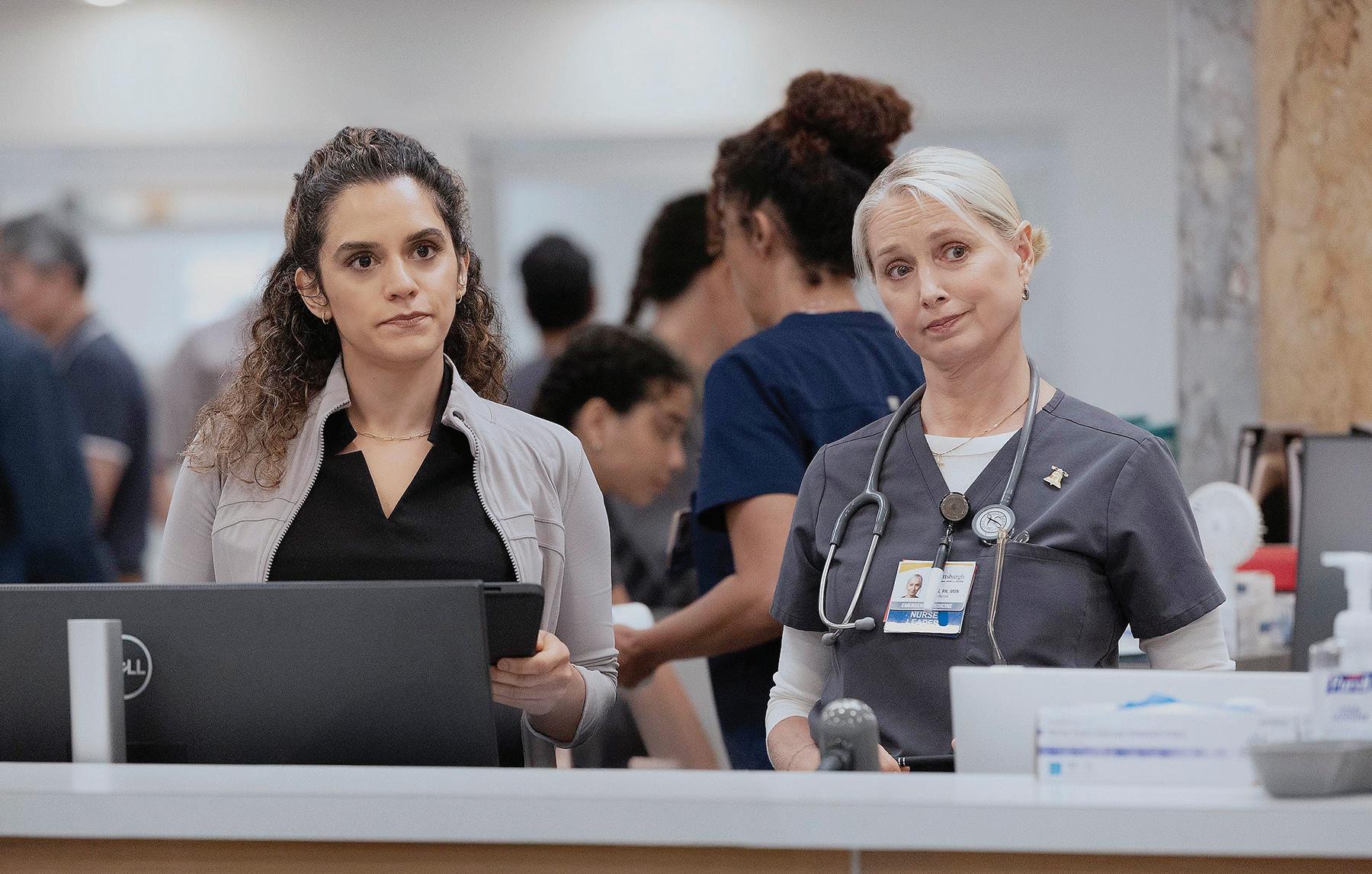
physical assault by a patient in Season 1. The assault initially causes her to leave the emergency department before coming back sometime between seasons. Violence against hospital workers is an issue rarely discussed in medical dramas, despite the topic having an impact on many hospital workplaces in the United States. “The Pitt” shines a light on this issue through Dana, who shows signs of having PTSD following her Season 1 attack. She becomes extremely protective of the nurses, specifically new nurse Emma Nolan (Laëtitia Hollard).
With her thick Pittsburgh
accent, Dana quickly became a fan favorite when the show began. LaNasa has only garnered more praise for her performance as the nurse since Season 2’s release.
The show isn’t all highintensity drama and ultra realistic emergency procedures though; some of my favorite scenes were the gentle moments between characters.
Digby (Charles Baker), an unhoused patient who comes into the emergency department seeking care for his forearm cellulitis, was an instant favorite of mine. Not only did his storyline help highlight the support system
that the hospital provides, especially to the unhoused community, but every scene with Dana and Emma where they show him a little kindness warmed my heart. While the cases that come in can often be extreme, and some characters can feel a little over-the-top, each storyline in this series is filled with heart in a way that gets you invested in the characters whether they appear throughout the season or in just one episode.
In a landscape of overly theatrical medical dramas, “The Pitt” proves it doesn’t need to be flashy to be compelling; it just needs to feel a little real.
SPOILER: This column contains potential spoilers for all seasons of “Invincible." Amazon wrapped up Season 4 of its animated superhero show “Invincible” on April 22. While this latest installment of the series delivers on its main storyline, it often stumbles with unnecessary side plots that feel more like a chore than entertainment.
To start with the positives, I thought this season did a good job at further developing the central plot surrounding main character Mark (Steven Yeun), his family and the alien Viltrum Empire trying to conquer the universe.
Mark’s conflict with his father, Nolan (J.K. Simmons), was what made Season 1 so compelling, and the characters are still
dealing with the aftermath of Nolan’s actions in a way that feels realistic. Nolan is an alien from the planet Viltrum who was sent to Earth to have children for the empire. While on Earth, he married Debbie (Sandra Oh) and had Mark. After Nolan revealed his true motivations and thoughts about humanity to Mark, even referring to his wife Debbie as a pet, the two fought a bloody battle, which killed thousands of civilians and resulted in Nolan leaving Earth.
The seasons leading up to this did a great job showing Nolan’s gradual rehabilitation. By isolating him from his family on Earth, the writers were able to display the impact that Mark and Debbie had on his life and well-being. The epiphany that 20 years on Earth made Nolan feel more human than Viltrumite was powerful.
This new season does a surprisingly great job of helping the audience understand Nolan, while still not excusing him for his actions. Nolan’s backstory and his conversations with the members of his broken family on Earth were powerful and emotional, and the voice cast did a great job making the emotional turmoil of the situation feel real. The conflicts that the main characters have with the Viltrumites are engaging as well, with the new villain Thragg (Lee Pace) stealing the show with how intimidating he is. It was interesting to see each of the characters' different views of how the Viltrumites should be dealt with. While characters like Thaedus (Peter Cullen) are dead set on eradicating the Viltrumites for the safety of the universe, characters like Nolan and Mark think that
some can be rehabilitated.
I’m interested in how these views will create tension in Season 5, which has been confirmed by Amazon. However, great moments like these are undercut by hours of side plots that felt unimportant. Although Season 1 made secondary plotlines feel integral to the overall narrative, the episodes not focused on Viltrum this season feel inconsequential in comparison. This left the pacing seeming extra sluggish, as I felt like I had to wait hours before I got to see the characters I actually cared about, like Nolan and Thragg. Another issue I noticed this season was the animation, which felt low quality and left many important moments feeling underwhelming. This was especially prevalent in the battles that take place in outer space, where char-
MOVIES STILLS DATABASE A promo shot of "Invincible" is seen. Season 4's finale premiered April 22, 2026.
acter models felt static and lifeless. Since Season 1, the animation has gradually become lazier each season, and I think the animation has hit its lowest point here.
I understand that good animation takes time, but Amazon is a multibilliondollar company with a ton of resources at its disposal.
I feel like a show as popular as "Invincible" should get more care.
It’s hard to enjoy this season of “Invincible" without noticing its flaws. The series delivers on bloody superhero action and gripping interpersonal conflicts, but this installment feels messy and oddly paced. If you enjoyed the previous seasons, this one is still worth watching. However, I feel the season didn’t reach the high bar set by Season 1.
The fields used to be farmland. Now, a data center is coming to town
By Ella Curlin elcurlin@iu.edu
When the construction vehicles shift dirt in the fields near her property, Sue Dill says she can feel her house shake.
The fields used to be farmland.
But in February and October of last year, an anonymous company convinced local officials to rezone the land for research and manufacturing. Dill’s neighbors moved out one by one. Construction crews rolled in.
Past Dill’s house — past her barn, past the acres of woods where her sons used to play, past the trails she and her husband used to walk together — sat several hundred acres of farmland.
Now, many of those fields are flat and gray. The earth is churned up in mounds. Wire fences line the roads.
A data center is coming to town.
Last year, Morgan County officials approved two separate petitions to rezone land for the construction of “Project Louie,” a billiondollar data center 45 minutes north of Bloomington.
On approximately 550 acres once occupied by farmland, houses, wetlands, streams and woodlots, Google plans to construct six buildings and a substation. If it ran at 90% capacity for a full year, the Morgan County Correspondent reported, the substation planned for Project Louie could use 9.46 million megawatts of power a year — nearly double the 2024 energy usage of all AES Indiana’s residential customers combined.
At max capacity, each data center building could use roughly 4 million gallons of water a day, the Morgan County Correspondent reported — equivalent to the average daily at-home water usage of over 48,000 Americans.
The developer, Google, used shell companies to keep its involvement a secret until eight months after the first rezone. Local officials, including every county commissioner, signed nondisclosure agreements committing not to share Google’s name or any information Google considered proprietary. At county hearings, residents turned out in droves. Petitions gathered thousands of signatures and protest groups held meetings. At public meetings and online, locals accused county officials of greed, corruption and keeping secrets.
The commissioners who voted for the project said it would bring revenue that could help the county. But the scale and impact of the project meant for many residents, the character of their countryside was on the line.
“This is not gonna be a peaceful little country town anymore,” Dill said.
As demand for artificial intelligence grows, technology companies are responding with a national rush to build new and bigger data
centers. Most of these data centers are planned for rural areas, and their impact is the most acute at the local level.
For local officials, those data centers often carry promises of economic growth. They also use huge amounts of energy and water, and research indicates large data centers could heat up surrounding areas by up to 16 degrees, with temperature changes reaching more than 6 miles away. In some cases, nearby residents say the centers have caused their wells to run dry, disrupted daily life with constant noise or emitted airborne pollutants harmful to human health.
In Morgan County, signs sprang up along yards, roadsides and the fields where the data center would be built. “KEEP MONROVIA RURAL,” the signs read. “NO DATA CENTER.”
Before Dill’s husband died, the two of them made the land up in a trust for their son Josh to inherit.
Much of the trust’s 14 acres are woodland. Dill’s white-and-brick home sits on the grassy edge of a twolane road, peeking over a hill toward passing cars.
They moved there 39 years ago from the west side of Indianapolis. Their new home had woods, a pasture, a barn and a well so deep that local stories said even in drought, it always had water.
Her youngest, Gabriel, was 11 or 12 when they moved in, Dill said. His brother Josh was 15. Gabriel would forage for morel mushrooms around the pasture, and her husband Ronnie built a tree stand in the woods. She and Ronnie took long walks through the treecovered paths. They loved that land, she said.
“We just absolutely thought we’d died and gone to heaven,” Dill said.
Ronnie died in that house in 2024, Dill said. Now she keeps his ashes in a wooden box in the living room. She sits out back in the evenings and sketches the treeline. A couple months ago she dreamed Ronnie walked into the woods, and as she called out to him, he was unable to hear.
The Dill family’s 14 acres sit just south of Morgan County’s West Keller Hill Road, in a gap nestled right at the top of the data center campus. By April this year, that campus was hemmed in by barbed wire.
At the start of a Morgan County Commissioners meeting in February last year, Commissioner Kenny Hale reminded attendees he would have them removed by a police deputy if they refused to be courteous.
Then he apologized.
“We can’t make everybody happy, and I’m sorry about that,” Hale said. “But we’re going to try to do the best we can.”
The commission was voting that day on whether
to approve a planned unit development, or PUD, that would alter zoning rules for the area to allow developers to construct a data center on 390.74 acres along Antioch Road.
The rezoning would change the purpose of the land. Previously, developers had to construct buildings within restrictions, such as height limits, for agricultural or residential buildings. In the proposed requirements, Project Louie’s primary buildings could be up to 75 feet tall, and up to threequarters of the lots could be covered with hard surfaces. They can emit a maximum of 65 decibels at the property line — the equivalent of a business office.
Thirteen people spoke to the commissioners in opposition to the plan. They worried about the lights, the water, the energy use, the construction, the noise. Two were concerned the development would disturb eagles. Several others questioned who stood to benefit from the tax revenue.
Many brought up concerns about transparency.
Economic Development Corporation Executive Director Mike Dellinger later told the Morgan County Correspondent he’d been approached about the project in the first quarter of 2024. Google had operated through a series of limited liability companies, primarily a shell company first made in Delaware named Woodland Caribou LLC.
By the end of August 2024, landowners had started signing agreements with Woodland Caribou LLC. Local leaders, including every member of the county commission, signed NDAs with other shell companies in October and December 2024.
Public notice went up in the Correspondent on Jan. 23, 2025.
“We have no time to even think about it,” Sean Walker, who lives across from Project Louie’s campus, said during public comment.
“You guys will make decisions that’s going to last forever. My kids will be out of high school by the time this is done being built.”
Forty minutes later, the commissioners voted 3-0 to approve the rezone.
The audience broke into uproar. Several people began shouting. Some yelled curses.
“How much are they paying you?” one person called up to the commissioners, repeatedly. “How much are they paying you?”
In March 2025, Terri Moore and another property owner, both of whom own land near the data center, filed a lawsuit requesting review of the decision to approve the rezone for the first 390.74 acres of Project Louie. Their lawsuit points out that Google’s name was concealed from the public and withheld from officials who didn’t sign an NDA. The lawsuit also alleges the construction will harm the enjoyment and value of the
plaintiffs’ properties while worsening Morgan County’s “rural character.” Moore first moved into Morgan County 41 years ago with her late husband Terry. The farm was his idea, she said. He grew up spending summers at his uncle’s house in the Illinois countryside, and his dream was to own five acres and a pond.
“This was his life dream,” Moore said. “Then it became mine.”
On their farm, they grew a strawberry patch, an orchard with apple and peach trees and English walnut trees along the driveway. For livestock, she and Terry started small with chickens, then an Angus black cow. They got their first pigs when Moore stopped another farmer from killing the runts of a litter. They raised alpacas, too, until Terry became too sick to take care of them.
In a display cabinet in the living room, a small box shows a man sitting astride a horse before an orange sunset. Terry’s ashes sit inside. After he died, Moore thought about planting a tree on the property and having both of their ashes buried underneath.
Nowadays, she said, she doesn’t know what she’ll do. For a long time, the thought of a big industrial building by the place she’d made her life with Terry made her depressed and sick with grief.
Moore’s white farmhouse sits at the end of a gravel driveway, past a pond and a barn her nephew is renovating. The view from her porch where she sits to watch the sunset shows the pigsties full of grunting hogs, the pasture where she raised alpacas and the long stretch of asphalt that is State Road 42.
Across that road sits Project Louie.
In October 2025, the Morgan County Commissioners approved a second rezoning request that expanded the Project Louie campus by 158 acres, bringing the total land to approximately 550 acres. Dill, along with several other people who owned property near the site, filed a lawsuit. In January this year, that was consolidated with the lawsuit including Terri Moore. The litigation is ongoing. In 2025, as data center growth accelerated across Indiana, Hoosiers saw a 17% increase in the average energy bill — the highest yearover-year increase since 2005, IndyStar reported. Utility companies have said the price of improved infrastructure and power generation isn’t passed to customers. Consumer advocacy groups like the Citizens Action Coalition have called that into question. The Morgan County Economic Development Corporation says Google will pay for Project Louie’s electricity and infrastructure costs. AES Indiana, which has predicted powering the project will cost $737.3 million, has said the same.
Meanwhile, Dill said she can’t afford her power bills. Her average bill used to
land around $150, she said. But recently, those costs have jumped. In December, she was due for $176.67. In January, that rose to $423.26, then $462.35 in March, then $261.59 due this April. When Ronnie had cancer, she said, she used to run the furnace and all the heaters in the house to keep him warm. Even then, she said, her bills never reached $200.
Dill said she’s between a rock and a hard place. She plans to live at her house on Keller Hill until she dies there, but she can’t afford to stay in her house if she has to pay $400 bills each month.
“I don’t know, I don’t know what to do,” Dill said.
“I guess I got to write a check again and send it to them because I can’t have my power go out.”
Morgan County officials have said they see the project’s potential to boost the community and bring economic growth.
In October 2025, Dellinger of the Economic Development Corporation told the Morgan County Correspondent the income from the project would bring the area “stability.” That same month, the county commission passed a resolution supporting data center development.
“Data centers provide high-paying jobs, increase local tax revenues, and support technological advancement across industries,” the resolution read.
Project Louie is a $1 billion investment, according to documents submitted during Terri Moore’s litigation. The company’s promised investments include 100 full-time jobs with wages of either $100,000 a year or 125% of Morgan County’s average annual wage, whichever is greater. The tax payments should meet a minimum of $500,000 per year, with no less than $300,000 per data center building.
In May 2025, the county granted Woodland Caribou LLC tax breaks of up to 50% for 10 years. In a written statement to the Indiana Daily Student, Commissioner Don Adams said that to research Project Louie, he first called the Chamber of Commerce in Cedar Rapids, Iowa, where Google has data centers, and was told the company’s “benefit to the community was over the top.”
Adams described Google as “good neighbors,” writing the company had given local schools large sums of money while granting $200,000 to the Monrovia Future Farmers of America and $1 million to a combination of local nonprofits. Adams, who is 83, said he voted yes on the rezone for his grandchildren. “I am very confident their opportunity to thrive in the future Morgan County increased more than would have happened with the 580 acres of corn,” Adams wrote.
AES Indiana, Bryan Collier and Mike Dellinger did not offer comment. Kenny
Hale, who has since stepped down as commissioner, directed the IDS to the other commission members.
Google estimated constructing the initial buildings for the data center could take two years.
Wire fences line the Project Louie campus. In some stretches, the fields are flattened and gray; in others the dirt piles up in steep embankments. Construction vehicles crowd one corner of the property. Signs around the property warn: “No Trespassing.”
“Everybody gets so depressed when they drive down our road, and they see what that is,” Dill said. “Now, it’s overtaken us, this small country little town.”
Dill’s neighbors were bought out nearly all at once. Woodland Caribou LLC bought the lots to her west and south Sept. 10, 2025. It bought the parcel east of her 65 days later. Overall, for the sales of 15 properties between Sept. 10 and Nov. 14, 2025, Woodland Caribou LLC spent nearly $78 million. Across the road from Moore’s farm, empty residential homes sit behind barbed wire fences, cars parked in their driveways. Dill doesn’t know what Ronnie would do, she said. Maybe he’d move back to Indianapolis, she thinks. He was always sick of mowing the grass.
She’s made up her mind, though. She couldn’t sell the house now if she tried, she said. She’s staying, anyway. Dill said she’s heard a lot of rumors about the data center, and she doesn’t know what to believe. Her worries, like the rumors, are piling up. She worries the data center will emit fumes that damage her trees or trigger her asthma. She worries about the electricity use. She worries about the noise from the data center’s operation. Around the end of February, earthmovers started shifting dirt in the fields by her house, Dill said. The machines vibrate the earth to make it easier to move. When they vibrate, Dill said, her house shakes with them. Meanwhile, trucks have been moving up and down the two-lane road beside the data center campus. They make a ruckus, Dill said, but she’s starting to learn to sleep through the noise.
“My bedroom’s on the outside wall,” she said. “I hear it all. They start early.” In the woods behind her house, purple wildflowers line the paths where she and Ronnie used to walk. Her husband’s old tree stand is starting to fall apart. Planks and boards are missing from the walls, the nails exposed to air. Parts of the floorboards are starting to crumble. Two blue plastic chairs sit at the top. One has fallen on its side. The other faces north, into the trees. Through the canopy, past the fence outlining Project Louie, churned-up dirt piles up in the fields. Past that, trailers and excavators are crowded up in rows.
By Elakai Anela eanela@iu.edu
Cooper Malamazian
paused on the dugout step and took a deep breath before stepping onto the turf at Wrigley Field in Chicago.
Moments later, he turned to the sky and pointed upward. It was a quiet, familiar gesture meant to slow everything down in a sport that keeps moving.
For Malamazian, that moment isn’t just routine. It’s necessary.
The ability to reset and breathe has become the foundation of who he is, both as a baseball player and as a person.
Malamazian committed to Indiana in October 2021. Three years later, he was picked No. 515 overall during the 17th round of the 2024 MLB Draft.
But even before he reached Indiana, Malamazian played under high expectations.
He arrived at Nazareth Academy in La Grange Park, Illinois, 18 miles outside of downtown Chicago, in fall 2020 as a 14-year-old freshman. When spring came around, Malamazian stepped into a role many players his age don’t reach until years later: playing on varsity.
He didn’t just play on varsity, he was a starting shortstop at the highest level of high school baseball and succeeding against players three or four years older than him.
Nazareth head coach Lee Milano said there wasn’t much of an adjustment period, despite him entering high school during the COVID-19 pandemic.
“That kid was a leader from the get-go,” Milano said.
“And he had all intangibles that you look for in a leader, even at a young age.” That early responsibility shaped everything that followed. Nazareth wasn’t a program built around individual stars or selfishness. Milano didn’t name captains. Everyone was expected to lead.
And from the beginning, Malamazian fit the mold.
“He surrounded himself with winners,” Milano said. “He knows how to win. He knows how to lead.”
Winning, as Milano mentioned, became part of Malamazian’s identity.
In his four years, Nazareth went 132-25, winning backto-back IHSA 3A State titles in 2022 and 2023. Malamazian was a three-time allstate player in his own right. During his senior season,

Nazareth went 37-1 in the state’s highest classification. But the success didn’t come without challenges.
During his junior year, Malamazian battled a hamstring injury for much of the season. With Nazareth going 34-6 and making a postseason run, Milano said the shortstop returned but only recorded 72 at-bats and “wasn’t 100%.”
Malamazian later dealt with mononucleosis in the summer which limited his exposure to MLB scouts on the national stage after the high school season ended.
“He wasn’t able to do, really, the summer circuit that most kids do between junior and senior season nationally,” Milano said. “If people would have seen that kid nationally between his junior and senior year, he would have been a top five round pick.”
Despite the ups and downs, Milano never questioned what he saw.
“There are some days where you’re going to go 0 for 3 or 0 for 4 with three, four strikeouts,” he said. “And you got to be able to bounce back, and I think Cooper has that mentality to be successful because I think he’s mentally tough.”
If talent set the foundation, mentality became the separator.
Baseball demands mental fortitude, and Malamazian doesn’t let the failure get to him. It’s another one of the unique traits he possesses.
“In my opinion, it’s one
of the hardest sports in the world,” Malamazian said. “But the moment can never be too big because at the end of the day, it’s just a game, just a sport you’ve been doing since you were little.”
The game forces players to confront setbacks daily. For some, it becomes overwhelming. But for Malamazian, it became something else entirely as he began to get get better at “learning how to fail.”
“Honestly, it’s crazy to say I love failing sometimes because that’s the way you grow,” he said. “But that’s just the way it goes.”
That mindset didn’t develop overnight. It was reinforced through years of mentorship by Milano and MLB Hall of Famer Jim Thome, who was hired as an assistant coach at Nazareth when his son Landon came into the academy in 2022, ahead of Malamazian’s junior year.
For a high school player, having a mentor who hit 612 home runs during 22 seasons in the MLB around the program is rare. And Malamazian embraced the opportunity, looking to grow and develop under Thome’s wing.
“Having him as a great mind was a one-of-one experience,” Malamazian said. “You don’t have many guys playing college baseball that could tell you about having a Hall of Famer as a coach in high school, so that was a special experience as well.”
During his senior season, Milano said Malamazian
felt the pressure of being watched under a “microscope.” But Thome and Milano advised Malamazian to lean more into the basics of the game to alleviate the pressure he was feeling.
“I had to talk with Thome and a few other guys, and some even like friend’s dads who came up to me, they’re like, ‘Listen, you’re still a 17-year-old kid,’” Malamazian said. “‘Go out there and have fun.’”
By the end of his senior season, Malamazian had shown enough talent and potential to be selected by the Milwaukee Brewers in the 17th round of the 2024 MLB Draft.
For most players, the opportunity to play professional baseball in the Brewers system would be too enticing to pass up. However, Malamazian bet on himself and opted for the college baseball route, which landed him in Bloomington as the No. 11 overall player and No. 3 shortstop in Illinois by Perfect Game.
“It was a surreal experience, for sure, going through the whole senior year and the whole draft phase of it,” Malamazian said. “It’s definitely a lot to handle for a 17, 18 year old for sure.”
Ultimately, the decision wasn’t about turning down baseball; it was about shaping a different path.
“I wanted the college experience,” Malamazian said. “I wanted to come here to play for a prestigious university like Indiana. It’s been a
dream of mine to play college baseball. It’s competitive, it’s fun. Obviously, I passed on a great experience, but I think this one’s better, and it’s been well worth it so far.”
Even after being selected in the MLB Draft, the transition to college baseball wasn’t seamless.
Like many freshmen, he learned success at one level doesn’t guarantee anything at the next. He struggled during fall workouts. The adjustment to faster pitching, harder competition and increased expectations was real.
“I wasn’t the best player, even remotely close to being a starter that fall,” Malamazian said. “And obviously it takes a lot of hard work and coming in here after hours and before hours, and you get extra work in and work with the coaches.”
Those hours of work paid off. By the time the season arrived, Malamazian had earned his way onto the field.
He started in 46 games as a freshman. Of those, 33 starts came at shortstop, while the other 13 were at third base, after former Hoosier Josh Pyne medically redshirted the season. He finished the season batting .320 with a .906 OPS in 172 at-bats.
Heading into his sophomore year, Indiana head coach Jeff Mercer called Malamazian “personable” to the rest of his teammates during the Hoosiers’ media day Jan. 28.
“Cooper had to come
in and kind of win out the shortstop job as a young player,” Mercer said. “He was on the main draft circuit and the main stage. When he’s talking to other young guys who will have to step in and play this year, he’s able to be relatable to them.”
Malamazian struggled at the beginning of his sophomore season. He committed four errors through the first four contests.
Yet in the month of April, he has turned the outlook of his season around. He has batted 24 for 65 (.369) and held a 13-game hit streak from April 3 — April 21 — something that hasn’t surprised Mercer.
“He stays in the fight. He wants to work,” Mercer said. “He’s not a guy who feels sorry for himself... he’s really just blossoming as a player and a young man; he takes accountability.”
The 6-foot-2 infielder is batting .306 with a .850 OPS in 173 at-bats this season. Still, Mercer believes there is more to be desired.
“I think he’s really close to opening it up and kind of taking off to another level,” Mercer said. “There’s a gear, a level, that’s coming really soon for him and he’s working his way there diligently on a day-to-day basis.” Even to this day, the game hasn’t changed for Malamazian.
There are times when the ball doesn’t fall. Days when nothing feels right. Moments where failure stacks up. That’s when he returns to what he’s built his game on. A breath. A pause. A glance toward the sky. It’s a small moment, but one shaped by years of pressure, expectation and growth.
“The moment can never be too big,” Malamazian said. “When the big at-bats come, the big plays come, you got to just trust yourself and trust your preparation you’ve had your whole life.” Before he leaves Indiana, whenever that may be, Malamazian isn’t focused on numbers or accolades.
“I want to get some wins, man,” he said. “It’s all I care about.”
It’s a simple goal, but one that aligns with everything he’s done so far. From a 14-year-old leading a varsity team, to a draft pick choosing development over immediacy, to a college shortstop still learning and growing.
In a sport where failure is unavoidable, Malamazian has learned to embrace it. Because for him, that’s where the game, and his journey, truly begins.
By Max Schneider maxschn@iu.edu
As Black Key Bulls paraded around the track of Bill Armstrong Stadium for the third consecutive year, CUTTERS’ cyclists stood on the edge of the infield, forced to watch BKB celebrate yet another title.
Senior rider Judah Thompson, who won the 2026 individual time trials, lay face-up on the grass, staring up at the sky. His chest, now covered in multiple bright red gashes from a late-race crash, rose and fell rapidly as he sobbed. Jim Kirkham, CUTTERS’ longtime head coach, held both hands atop his head. Around them, barely a whisper arose from the rest of the team. 2026 was supposed to be Thompson’s year. After helping CUTTERS to their 15th title in 2023 as a freshman, 2024 and 2025 ended in disappointment. But after qualifying in pole position, CUTTERS entered 2026 as one of the favorites to claim victory. For much of the race, CUTTERS remained near the front of an extremely close pack of riders. First place flipped regularly between several different teams up until lap 199.
Chi Alpha, which first
competed in the men’s race in 2018, held a small lead entering lap 199 due to a large burn. The team exchanged riders, allowing the rest of the pack to close Chi Alpha down. Sophomore rider Ryan Amidei took off following the exchange.
Leading the rest of the pack was CUTTERS. Thompson hugged the inside of the track as he tried to claw his way back into first. Amidei, attempting to keep his team in first place, cut back toward the inside to get ahead of everyone else. Then, it happened. On the first turn of lap 199 as Thompson started to blow past Amidei into first and the side of Amidei’s bike clipped the back wheel of Thompson’s bike, causing a crash on the second-tolast lap. It was a moment so shocking the announcers on YouTube peaked their microphones. Thompson skidded over his handlebars as a massive pile up ensued on turn one. Alongside CUTTERS and Chi Alpha, fellow contenders such as Sigma Alpha Epsilon, Sigma Phi Epsilon and Fiji all had their championship hopes dashed then and there.
The main team not affected by the crash was
BKB, which finished the race under a yellow flag, with Cinzano and Bears close behind. Chi Alpha finished fourth, while CUTTERS ended up outside the top five.
Chris Anderson, coach of Chi Alpha, admitted his team was at fault for the crash.
“We will completely own that one,” Anderson said postrace. “We wanted to get Ryan Amidei on the bike after the field caught us, after attacking, and he just came in a bit too early.”
Kirkham, CUTTERS’ coach, was blunter in his assessment. In his eyes, the crash was the only reason CUTTERS didn’t win.
“As far as I know, Chi Alpha’s rider took out our rider,” Kirkham said.
Amidei did indeed cut back toward the inside in an attempt to remain in first place. Caught up in the moment with only two laps remaining, Amidei said his only concern was pushing for the victory.
“I was going for it,” Amidei said. The opportunity to bring home Chi Alpha’s first ever title was there, but the crash dashed in those dreams. Amidei said he’ll look to the future.

“I’m gonna take some time, and just pray and rest,” Amidei said. “Rest in the grace that God has for me. I’m just gonna think about what happened and move forward.” Thompson, a senior, doesn’t have another shot at a win. It showed through the pain in his face after the race, surrounded by his teammates and close friends as they attempted to console him.
“We gave it our best,” Thompson said, his eyes brimming with tears.
“At least I got a ring, you know?” Thompson chose CUTTERS as a freshman, the
ing
as


4