IDS
By Ella Curlin elcurlin@iu.edu
By Ella Curlin elcurlin@iu.edu
The protest began at the courthouse and ended with a march down Kirkwood Avenue
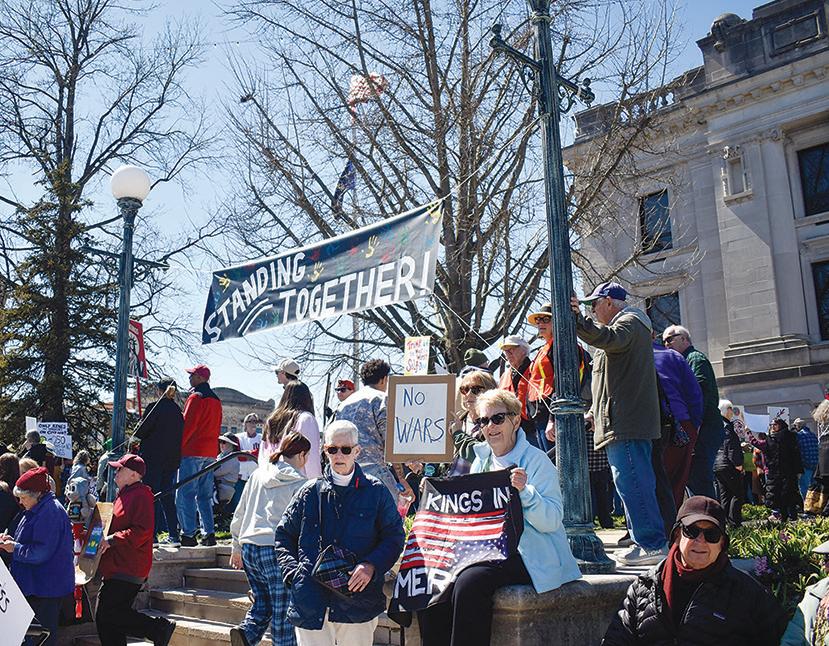
The crowd stretched from Sample Gates past First Christian Church on Kirkwood Avenue on March 28 as several thousand people chanted, marched and held signs in protest of the Trump administration.
Bloomington’s "No Kings" protest began at 1 p.m. at the Monroe County Courthouse and ended shortly after 3 p.m. with a march down Kirkwood Avenue. The protest was one of nearly 3,000 events planned across the United States. Similar events were held in June and October.
The protests were organized by the Bloomington chapter of 50501, a national grassroots group organized to protest the actions of President Donald Trump’s administration.
At the courthouse, representatives manned booths from organizations including Indivisible of South Central Indiana, Medicare for All Indiana, the Bloomington chapter of the League of Women Voters, MADVoters and Mobility Aids Lending Library.
Representatives from local organizations including Exodus Refugee Immigration gave speeches, and musician Carrie Newcomer played guitar and sang songs to the crowd from a stage next to the courthouse. As protesters walked along the sidewalk around the courthouse, they waved signs referencing U.S. Immigration and Customs Enforcement, the Epstein files, the war in Iran and the Trump administration. Some protesters came dressed in costumes, carried American flags or brought musical instruments.
Organizers say early estimates indicate about 3,000 people attended the protest. Paul Smedberg, a volunteer with the Bloomington chapter of 50501 who helped organize the protest, said the crowds at this protest looked like the “largest yet.”


Smedberg said he joined 50501 after attending the first "No Kings" protest in June. Amid the arrests of both non-citizens and U.S. citizens by ICE, Smedberg said he worries for the safety of his Latino family members. He was also motivated to become active by the cutting of federal research
funding, how the Trump administration handled the aftermath of the U.S. capture of Venezuelan President Nicolas Maduro and the war with Iran.
“There aren't many areas that this administration is touching on that doesn't seem totally un-American,” Smedberg said.
By Andrew Miller ami3@iu.edu | @andrew_mmiller
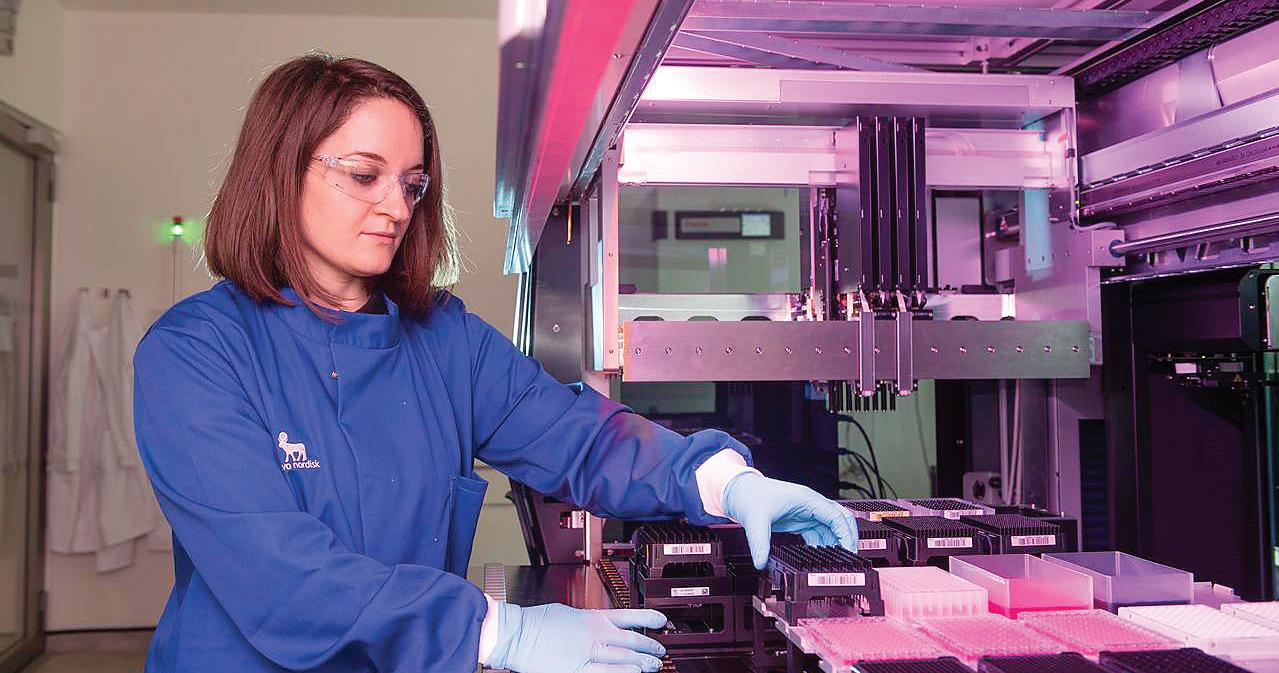
Novo Nordisk will lay off around 400 employees at its Bloomington site at the beginning of May, about a fifth of the drug manufacturing facility’s workforce.
Company spokesperson Stacy Beard confirmed the move in an email to the Indiana Daily Student on March 30. The move follows a tumultuous history for the Bloomington site, including several rounds of layoffs when Catalent owned it from 2017 to late 2024.
say it over and over again.”
The protester said he first donned the frog costume for October’s "No Kings" protest, after anti-ICE demonstrators in Oregon made headlines for wearing inflatable costumes in confrontations with federal agents. He saw it as a way for protesters to appear non-threatening yet slightly mocking toward agents from ICE and the Department of Homeland Security.
“Basically, a way of saying, you know, we're really not afraid of you,” he said.
Farther down the plaza, Zach Reed and Dylan Taylor stood in Revolutionary War uniforms at the top of a grassy hill.
As protesters marched by, Reed and Taylor serenaded them by playing Revolutionary War-era songs like “Yankee Doodle” on plastic recorders. Taylor said they came in costume to symbolize the country’s first fight against monarchy.
“America was found on the principles of being antimonarch,” Taylor said. “I find somebody taking advantage of the system that we've created to be against that type of authoritarianism, getting away with what has happened within the House, the Congress and the executive branch, to be absolutely deplorable.”
Other protesters held up signs with puns, slogans or caricatures of Trump and members of his cabinet.
“Are we great yet?” one sign read, referencing the campaign slogan "Make America Great Again".
Others read “I really miss constitutional checks + balances,” and “Stop Fascism Now.”
On the courthouse plaza shortly before 2 p.m., a large green inflatable frog walked slowly towards the sidewalk, using the long wooden pole on his sign as a walking stick.
“Ribbit ribbit,” the frog chanted, as protesters stopped to take pictures with him.
This was just one of the many chants that the frog, who declined to be named, likes to deploy.
“Ribbit ribbit, get your frog on, uh, frog army coming through. Once you go frog, you don’t go back,” the frog told the Indiana Daily Student. “I think that’s my repertoire right there. I just
The protest ended with a march down Kirkwood, with protesters turning left at Sample Gates and looping back around to the courthouse, where organizers began to pack up tables. They chanted “This is what democracy looks like!” and “No hate, no fear, immigrants are welcome here!” as they marched.
By Natalia Nelson nelsonnb@iu.edu
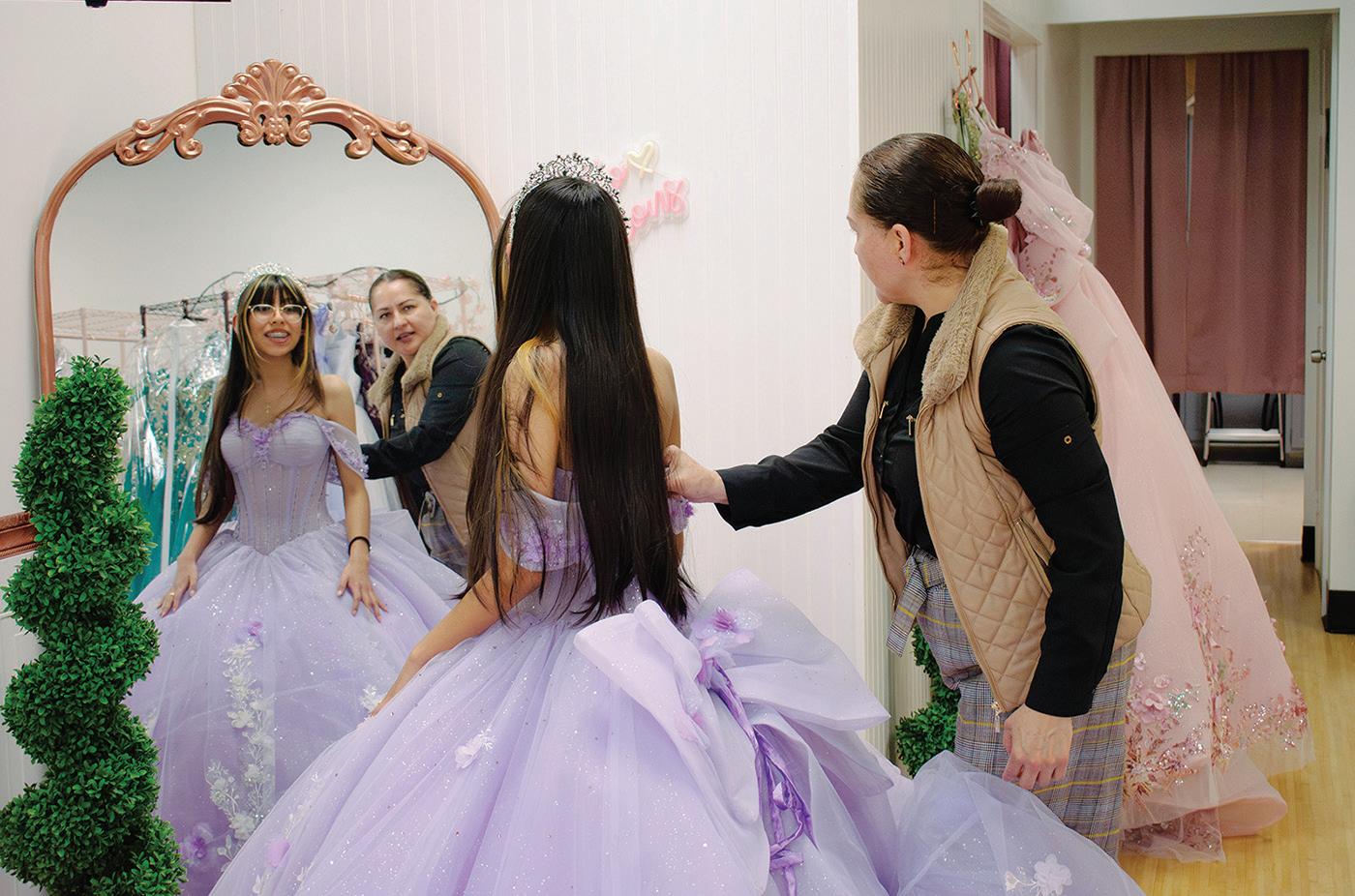
It took nearly 10 minutes to put on the dress.
At the back of Seymour’s only quinceañera boutique, Nadia Herrera laces the purple ribbons up the corset. She leans sideways to avoid stepping on the sparkling floral train.
“Hermosa,” Herrera tells the girl in the dress. “Do you want to put down your hair a bit?”
Mass followed by a party, with the birthday girl performing several dances with her father and her court of damas and chambelanes — a group of male and female friends that accompany the quinceañera.
Herrera studied dance at an academy in Mexico when she was younger and, from there, transitioned to folkloric dance. It takes about three months for Herrera to choreograph and prepare four or five dances with the girl and her court.
thing that you can see in the faces, that they are so proud and they are so happy to see what they are seeing.”
She imports the dresses from a couple suppliers in Mexico and one from the United States. She sells at least one dress a month — more during warmer months, which is the bigger quinceañera season.
Her favorite memories from her work are watching the quinceañera and her court together, seeing their celebrations, laughs and nervousness.
“We are deeply grateful to every impacted colleague and are committed to treating them with respect and dignity through this process, including severance, outplacement assistance and transition support,” Beard said. Catalent, a third-party drug manufacturer, previously owned the site at 1300 S. Patterson Dr. Years of layoffs and alleged mismanagement under Catalent left many workers hopeful for Novo’s takeover bid, looking for a better company culture. Novo Nordisk’s parent company completed its $16.5 billion acquisition of Catalent in December 2024. According to Novo’s website, the Bloomington site employs more than 1,800 people.
of which would be outside of Denmark.
On Tuesday, the City of Bloomington acknowledged the impending layoffs in a press release. The city said Novo Nordisk site head Lars Arnoldsen notified Mayor Kerry Thomson about the reductions, and discussed the local impacts. The city, the release said, will work to connect laid off employees with other work and support.
In September last year, the company announced it would cut 9,000 jobs, 4,000
“Our focus is on the individuals affected,” Mayor Kerry Thomson said in the release. “We know this is a difficult moment for many and we are committed to helping ensure that those impacted have clear pathways forward.”
The 15-year-old girl undoes her long black braid, letting it cascade over the dress’s gauzy sleeves. Herrera chooses a dainty silver crown from a nearby shelf and sets it on top of the girl’s head, tucking a strand of dark hair behind her ear.
“Lift your face, my love,” she says in Spanish. Herrera fluffs out the skirt and helps the girl step in front of a mirror in the corner of the shop next to the pink neon sign that reads “Hello, Gorgeous.”
Herrera moved to Seymour in 2011 from Veracruz, Mexico, after her husband found a job at an auto company. She started choreographing quinceañera dances shortly after.
A quinceañera, which marks a girl’s passage to womanhood on her 15th birthday and can also refer to the girl herself, is celebrated across Latin America. It typically involves a Catholic
She also started working as a master of ceremonies for the parties, making sure the quinceañera and her family has time to enjoy the party.
A quinceañera party can cost thousands of dollars between catering, venue rental, the dress and decorations. As master of ceremonies, Herrera also connects families with vendors.
Herrera stopped choreographing in 2019 and decided to open her dress shop — NH by Nadia Herrera — in May 2024. She said she likes fancy things. Rhinestones are her favorite.
“When they are changing in the fitting room and when, and they go out and the first time they see it in the mirror,” Herrera said. “It’s some-
She loves to help people feel secure and shine. When you’re fifteen, she said, you’re beautiful and that’s it. While now she’s settled with her boutique, it wasn’t always easy for her to transition to life in the United States.
Learning things like how to pay her Duke Energy bill, going to the doctor or communicating with her childrens’ teachers and counselors proved a challenge. Even after living in Seymour for 15 years, she tries to learn a word every day. Today’s was “slightly."
But here, in her little boutique tucked in the corner of a shopping center, she doesn’t need to use it. On a sunny Wednesday in March, a family walks into the shop. They drove from Indianapolis to come here. Herrera greets them in Spanish and guides the girl and her mother through the colorful racks.
“Do you have any color preference?” she asks.
SEE BOUTIQUE, PAGE 4
By Will Tallackson wdtallac@iu.edu
From packaging meals at local food banks to pushupbased fundraisers for charity, several Indiana University fraternities spent the last two months organizing a mix of community service and fundraising efforts across campus and the city.
The efforts reflect a broader push within the IU Interfraternity Council to make both service and philanthropy more central to Greek life, following a February IU IFC meeting, where chapter leaders reviewed their organizations’ strengths and weaknesses.
IFC Vice President of Communications Max Moxley said about 60% of council representatives believed their chapters needed to do more to promote philanthropy.
Chapters responded by shifting efforts toward philanthropic events. IU’s chapter of Acacia, Pi Lambda Phi, Sigma Pi and Theta Chi introduced events focused on charity or volunteering.
Indiana Acacia fraternity organized a weeklong “Seven Days of Service” initiative from Feb. 24 through March 2, part of a broader program adopted by Acacia chapters across the country.
The IU chapter partnered with organizations and businesses including Hoosier Hills Food Bank, New Hope for Families and Rita’s Italian Ice & Frozen Custard, where it hosted a dine-and-donate event Feb. 28.
Members packaged canned goods and cereal into meal kits at the food bank, and they completed maintenance work, including mulching and moving furniture, at New Hope for Families, an organization that provides emergency shelter and early childhood education programs for families experiencing homelessness. The chapter also conducted cleanup efforts along Kirkwood Avenue and at Griffy Lake.
The initiative also included a weeklong canned food drive, where members collected more than 75 donations for Hoosier Hills Food Bank and Community Kitchen of Monroe County, according to Acacia chapter President Hank Temples. The chapter contributed more than 300 service hours over the course of the week, Temples said.
Temples said the initiative was part of an effort to emphasize hands-on service within the chapter, particularly as Acacia works to reestablish itself on campus. The fraternity was suspended from campus from July 2021 to August 2024 for dishonest conduct, endangering others, hazing, destruction of property, alcohol and failure to comply with COVID-19 directives and Office of Student Life policies. The chapter officially returned to campus in fall 2025. The “Seven Days of Service” initiative was focused on direct involvement in the community rather than relying primarily on fundrais-
ing or donations.
“Being there in person, shaking someone’s hand, helping them however they need it, whether it’s packaging up their food supplies or moving mulch, is more impactful than just sending money somewhere,” Temples said.
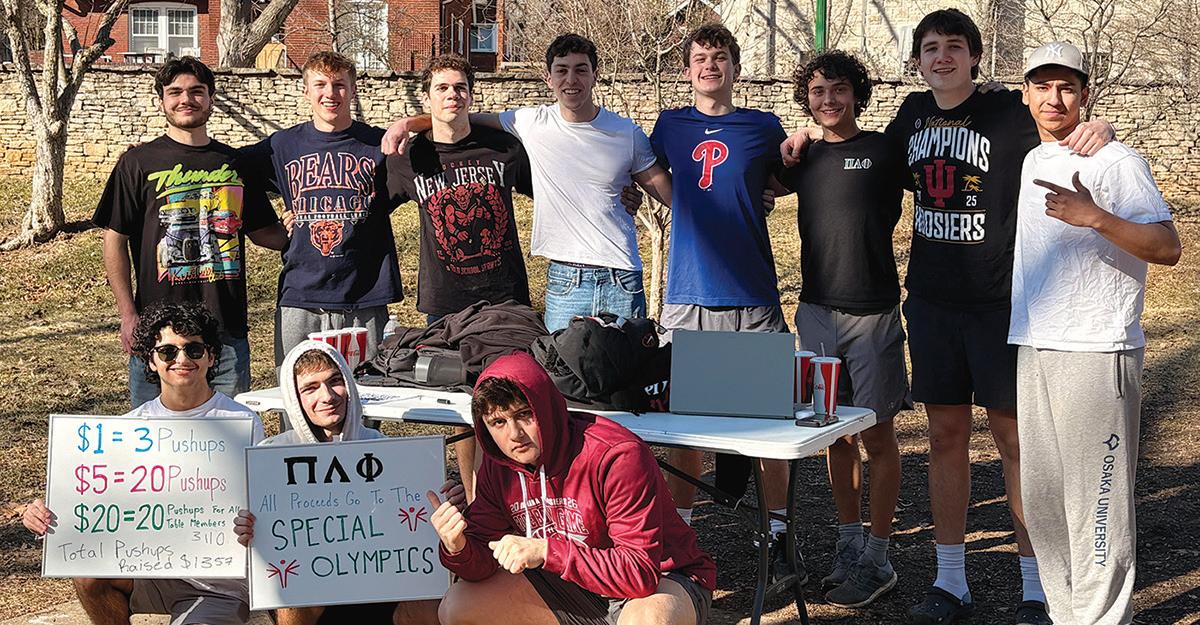
Meanwhile, Pi Lambda Phi fraternity centered its efforts on a campus-based fundraiser aimed at engaging the broader student body, chapter president Atticus Hunter said.
The chapter hosted its annual “Pushups Against Prejudice” event Feb. 27, where members completed pushups to raise donations for the Special Olympics Indiana. For example, participants performed three pushups for a $1 donation, tracking totals on a whiteboard as contributions came in throughout the afternoon.
About 15 fraternity members participated, along with several students who joined while passing by Dunn Meadow. Including donations collected after the event, the chapter completed more than 4,000 pushups and raised $1,600 for the cause, Hunter said.
Sigma Pi focused on hands-on volunteer work through partnerships with local organizations. The fraternity sent nearly 50 members to help with operations at Habitat for Humanity ReStore, which sells donated home goods and building materials, on Feb. 20 and Feb. 21, philanthropy chair Bray-
lon McRoberts said. Members cleaned appliances, including refrigerators and stoves, washed windows and floors and cleared debris from outside the building. They also handled donation intake, unloading items such as couches, tools and light fixtures from vehicles before preparing them for sale, McRoberts said. Inside the store, volunteers split between front-ofhouse and behind-the-scenes work, organizing inventory, repairing items and stocking sections.
McRoberts said the effort was inspired by his own experience volunteering at the ReStore, where he had worked for several weekends. He said he organized the larger chapter event with the goal of bringing a larger group into the store to help with tasks
staff and regular volunteers often do not have time to complete.
In early March, Sigma Pi worked with RedCapes Bloomington, a nonprofit IU student-led organization tackling food security, to collect nonperishable food items and clothing for the Salvation Army.
While Sigma Pi focused on hands-on volunteer work, Theta Chi efforts centered on direct outreach. The fraternity organized a service effort Feb. 22 that supported Wheeler Mission Bloomington, an emergency shelter.
About 50 members packaged supplies, including sweatshirts, hats, gloves, hand warmers, toiletries and food kits, according to freshman Andrew Hall, who organized the effort.
A smaller group then
picked up breakfast sandwiches before delivering the items to Wheeler Mission. Afterward, members walked down Kirkwood Avenue before heading to the Monroe County Public Library, where individuals experiencing homelessness had gathered indoors during cold weather conditions, to distribute the remaining food and supplies.
Hall said the event was designed to provide immediate support for those individuals. As different chapters continue to expand their efforts, Moxley said the IFC aims to make service a defining part of the fraternity experience at IU. “We want the best for the Bloomington community,” Moxley said. “We’re very proud to be here and to serve our community.”
By Avery Reis amreis@iu.edu
At Indiana University, students turn simple handwritten notes and drawings into a source of encouragement for children facing
serious illnesses. The IU chapter of Letters of Love provides emotional support to children battling cancer and other serious conditions through handmade cards. Letters of love, a global organization, was first
founded in Minnesota in 2018. The IU chapter was founded in 2023 by senior Annie Tran, the current president.
Since its establishment, Tran said the club has become a community where

students can volunteer their time and creativity to make a tangible impact on patients.
Tran has always loved handwritten cards. In high school, she started a chapter of Letters for Rose, a nonprofit that writes letters to nursing home residents.
The IU chapter meets monthly, typically in the Indiana Memorial Union, and offers low-commitment opportunities for students to participate. Tran said the club lets students volunteer according to their schedules.
“It is truly about giving back and volunteering your time to make a difference in these children’s lives. You can show up every month or just once a year and it is equally valuable,” she said.
Tran said the meetings are designed to be welcoming and creative. Executive members arrive early to set up flyers with card-writing tips and suggested phrases for letters.
The flyers discourage certain expressions, such as “feel better soon” or “get better” because some children may be in hospice care. Instead, phrases like “you are loved,” “you matter,” and “you are so brave” are recommended. Maria DiMauro, the club’s vice president of finance, said the monthly meetings are a central part of the experience.
“My favorite part is the monthly meetings,” DiMauro said. “We have different themes for the cards, which is fun and helps build community for everyone attending the events. We also collaborate with different brands, whether local or larger companies, to provide free goodies for our members.”
In the past, members have received Clio snack bars, iced teas and Pentel supplies. They can use the products during card-making if they choose and keep

them after the event.
Members can also participate in fundraisers. Last fall, the club hosted a “Letters to a Loved One” event where students could purchase postcards, write messages and have the club mail them.
“So many people came out, wrote postcards, and we sent them off,” DiMauro said. “It was a great experience for everybody involved.”
IU’s chapter has sent over 175,000 cards to patients worldwide, according to BeInvolved. Tran said the cards get sent to the nonprofit headquarters for review and then distributed to children in hospitals across the country.
“It is very heartwarming to see that these cards make them smile so big,” she said. “Seeing photos of children receiving the letters is so meaningful.”
For freshman members, the club offers both a meaningful activity and a social opportunity.
“It is really relaxing to be with friends, and I love the meaning behind it,” IU freshman Lindsey Fasbender said. Tran said the club em-
phasizes the importance of spreading kindness through small actions.
“It is about supporting people in need who may not have the full support that they need,” Tran said. “Being able to get together as a group and rally behind these children is really beautiful.”
Consistent participation from members inspired DiMauro to pursue an executive position, she said.
“After spending my freshman year as a general member and attending almost every meeting, I saw the dedication of others and wanted to help sustain the organization,” DiMauro said. “It is rewarding to know that our work has a positive impact on both the children and the campus community.”
Tran, as president, said she has focused on ensuring the club remains strong in the future by coordinating with the national organization, recruiting members and expanding partnerships. With every card written and every message sent, Tran said she hopes Letters of Love at IU continues to transform small acts of kindness into something far more impactful.

By Jonathan Frey jonafrey@iu.edu | @byjonathanfrey
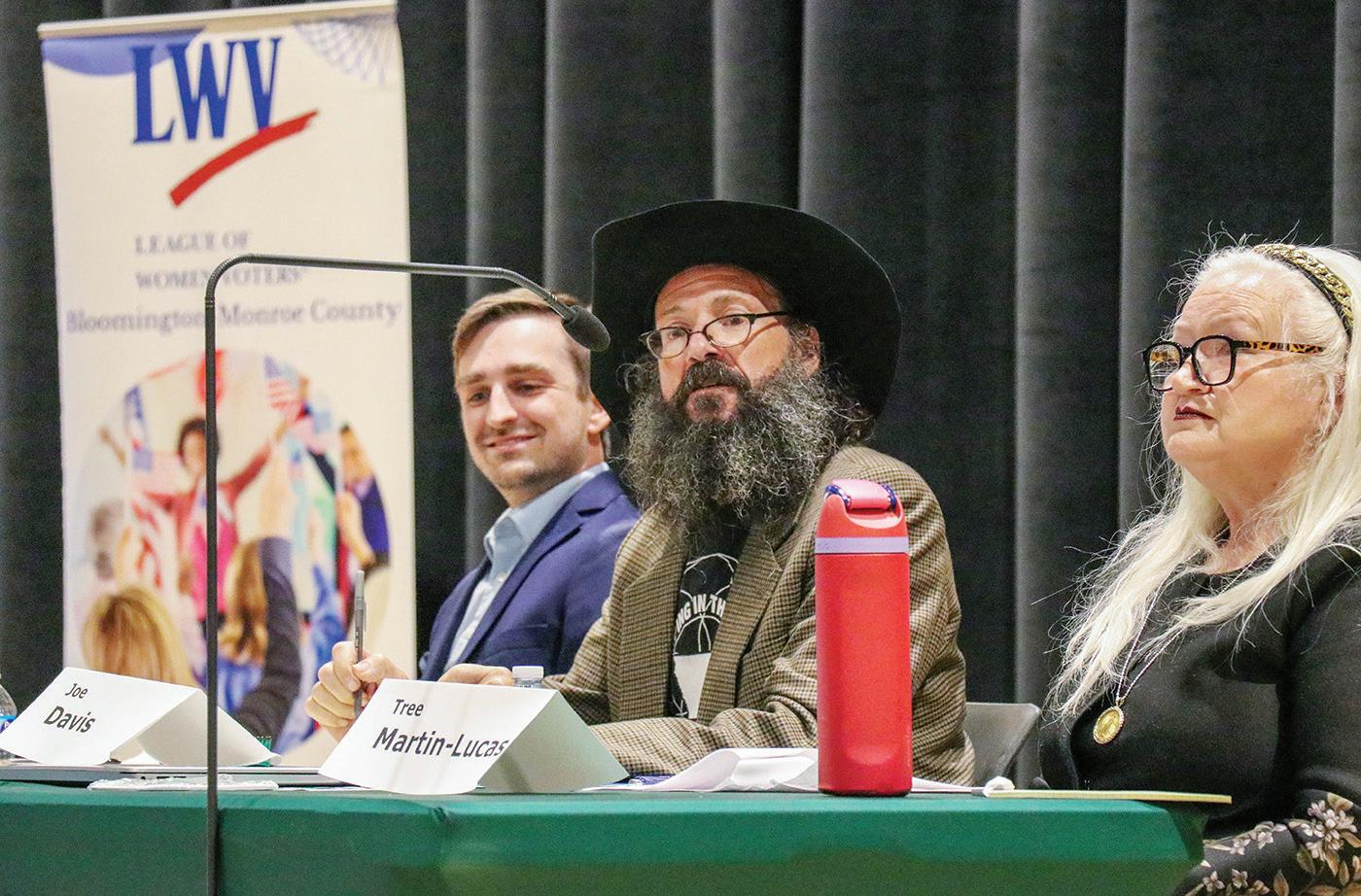
Candidates for the open Monroe County clerk seat and the county prosecutor position met March 30 at Tri-North Middle School in Bloomington to answer questions about their platforms for the public.
The League of Women Voters, a national organization dedicated to empowering women and marginalized communities to vote, organized the event.
County clerk candidates Tree Martin Lucas, Joe Davis and Tanner Branham spoke first in a panel addressing their platforms, plans and potential hurdles.
The county clerk of court handles marriage licenses, voting and voter registration, child support and access to public records. Lucas and Branham have both worked in the Monroe County clerk’s office, the latter currently serving as chief deputy to outgoing clerk Nicole Browne.
Joe Davis, a Bloomington resident who previously ran for a seat on the county council in 2024 as a write-in candidate, joined the race as an outsider to county government and is running as an independent. All three responded to the same set of questions, some predetermined and some sourced from the audience.
All three candidates agreed on implementing voting centers in Monroe County, which would eliminate the need for precinct voting.
“Vote centers? I love them,” Lucas said. “We have to cast out so many votes because people are at the wrong precinct.”
Lucas and Branham, both Democrats, emphasized the importance of working with Republican
majorities on the election board at state and local levels.
Davis encouraged the audience to remember precinct voting is the standard for elderly and disabled community members, and implementing vote centers would likely shut down some precincts in rural areas.
“Those folks, those very rural locations, they will need to be able to have other convenient means of getting registered to vote, or voting on the ballot,” Davis said. “That means an increased outreach with mail-in voting, trying to enable the most early voting, so that people can early vote when they come into Bloomington.”
All three candidates
agreed it was in part the clerk’s duty to encourage higher voter turnout.
“Getting people registered to vote in our electoral process is something I’m deeply passionate about,” Branham said. “I’m currently the chair of the Monroe County Young Democrats. I’ve been tabling at every possible event we can to get young people engaged to vote. So I’m very passionate about that.”
The three candidates agreed on most points, including fostering an inclusive community for marginalized voters and reaching younger voters, but split on supporting a shift to counting early votes as they come in. Branham and Lucas said they would be in favor of tallying votes early to expe-
dite the results process.
“Obviously the big pro is that we get the election results faster, which, we all agree with that, right?” Branham said. “We have to count votes faster.”
But Davis said the risk of losing public support would be too high. He said early voters might be concerned they could be linked to their ballots if they were counted as they were cast as opposed to with the larger group.
Lucas acknowledged the potential optical issues of scanning early ballots but assured the public early scanning would not violate the sanctity of their ballots. She said there are several layers of protection and randomization that prevent a scanner from being able
to assign a ballot to a voter.
The prosecutor candidates took the stage next. Incumbent Erika Oliphant and challenger Benjamin Arrington, both Democrats, spent about 40 heated minutes addressing challenges of the current office and proposals for the future.
Arrington called the current office’s track record of prosecuting violent offenders into question, saying the city deserved a prosecutor who was tougher on crime.
“Right now, we have an administration that fails to maintain its own docket and lets violent predators walk free on missed deadlines,” he said.
Arrington also pledged to follow in the footsteps of Marion County prosecu-
tor Ryan Mears in refusing to prosecute cases of marijuana possession or those concerning the reproductive rights of women, doctors and OB-GYNs.
Oliphant, who has served as county prosecutor since 2019 and won several awards for her work, said Arrington’s ambition to follow Marion’s lead is misplaced and taking drastic action could draw attention to Bloomington from state figures like Attorney General Todd Rokita.
“Making a public declaration does nothing but aggravate those people at the state of Indiana who make our laws, including the governor and Todd Rokita,” she said.
Arrington said his breadth of experience as an administrative law judge, a truck driver and a Pizza Hut manager made him a good candidate all the same.
“This is not a line attorney position. It is an executive, administrative and policymaking role,” he said.
“Monroe County has an office of 18 deputy prosecutors handling a daily docket. The elected prosecutor is the CEO of that office. I have extensive, varied court experience. My job won’t be monopolized at the council table.”
Oliphant said it’s still important as prosecutor to be able to work cases, even if the job doesn’t necessarily entail it.
“You may not think this is a line position, but in times of staffing shortages, I handled a major felony caseload for six months competently while also running the office,” she said. The event ended at 8 p.m., with around 70 people staying for both panels. Early voting for the primaries begins April 7, and election day is May 5.
By Mia Lehmkuhl mialehmk@iu.edu
IU Indianapolis’ Lilly Family School of Philanthropy cut ties with a philanthropy organization after Indiana lawmakers demanded the university launch a formal investigation into the group last week. Indiana lawmakers alleged the group, Muslim Philanthropy Initiative, has ties to Hayat Yolu Association, which the U.S. Department of the Treasury Office of Foreign Assets Control designated as a “sham charity” with ties to militant group Hamas. Susan Guibert, a spokesperson for the philanthropy school, said in a March 31 email to the Indiana Daily Student it is ceasing all training activities, reviewing all partnerships and collaborations and suspending any new partnerships with the Muslim Philanthropy Initiative, which was founded in 2017.
What is Muslim Philanthropy Initiative?
The Muslim Philanthropy Initiative is a project of Amir Pasic, dean of the IU Indianapolis philanthropy school, and the Lake Institute on Faith and Giving, one the school’s five affiliated
groups.
MPI is led by Shariq Siddiqui, inaugural director and assistant professor of philanthropic studies, and is guided by a 13-member Council of Advisors appointed by Pasic. In addition to guidance, the council acts as a financial steward and advocate to create “continuous growth and lasting impact for MPI.” The council comprises thought leaders, philanthropists and nonprofit executives.
Siddiqui and the Muslim Philanthropy Initiative did not respond to request for comment by time of publication.
MPI brings together scholars and philanthropy professionals and offers professional development workshops on fundraising and philanthropic leadership centered on Muslim and Islamic giving traditions. The initiative has trained over 3,500 Muslim nonprofit professionals from more than 30 countries since 2018, its website states.
MPI’s mission, its website states, is equipping communities, organizations and leaders with information and thought leadership to address the “understudied” area of Muslim philanthropy.
The initiative also hosts an annual “Symposium on
Contemporary Muslim Philanthropy and Civil Society,” as well as three to four webinars a year.
Why are lawmakers calling for an investigation?
In a letter to IU, eight Indiana Republican state representatives referenced unspecified “public reporting” that said MPI co-organized an event in January 2026 with Hayat Yolu, the organization designated a “sham charity.”
Siddiqui presented a session, “Philanthropic Leadership and Management for Nonprofits,” according to Radio Republik Indonesia coverage of the three-day training program in Jakarta, Indonesia. The first two days concentrated on fundraising, Siddiqui said at the event. The third day, he told Radio Republik Indonesia, was focused on leadership and project and volunteer management.
Hayat Yolu Deputy Director Ahmad Abu Adam said at the event the organization was trying to enhance the capabilities of their partners in Indonesia through learning new techniques in management, leadership and fundraising. Hayat Yolu Association is a Turkish humanitarian nongovernmental organization founded in 2014,
according to its website.
The U.S. Treasury released a statement March 12 claiming Hayat Yolu is one of three Turkish nonprofit organizations that “have provided significant material support to Hamas.”
The U.S. Treasury OFAC cites internal documents as evidence of links between Hamas and Hayat Yolu, the contents of which are not included. The U.S. Treasury did not respond to an inquiry regarding what influenced its designation by publication.
A “key element” of how Hamas raises money overseas is with nonprofits that channel funds and other assets through Hamas-controlled charities in Gaza, according to the U.S. Treasury release. Hayat Yolu operates in 15 countries, its website states.
The report also identifies Hayat Yolu as an operational headquarters, banking and financial hub for the Muslim Brotherhood, according to Hamas military internal documents said to be obtained by U.S. officials.
The U.S. Treasury OFAC designated the Egyptian and Jordanian branches of the Muslim Brotherhood as terrorist organizations due to their “material support” of Hamas, according to a Janu-
ary press release. According to a U.S. House of Representatives Subcommittee on National Security hearing, the Muslim Brotherhood has affiliates in over 70 countries.
OFAC administers and enforces economic sanctions against targeted foreign jurisdictions in addition to individuals and entities “engaging in harmful activity,” such as terrorists or international drug traffickers. Sanctions may block the property of individuals or entities, or they may prohibit transactions through trade embargoes on sectors of a country’s economy.
OFAC has previously been criticized for lacking transparency in its decisionmaking and due process for designations and their “disparate” impact on minority groups, particularly Muslim charities, according to a Lawyers’ Committee for Civil Rights of the San Francisco Bay Area report.
Lawmakers allege in the letter “public reporting” shows MPI co-organized another event with Hayat Yolu in Istanbul in July 2025. An attendee, who was invited by Siddiqui, posted on LinkedIn stating the event was organized by Hayat Yolu.
According to a now-deleted 2021-25 annual report,
MPI expressed its thanks to a list of organizations for their “generous support in advancing its work,” including Hayat Yolu.
Lawmakers sent the letter to IU President Pamela Whitten and Pasic on March 20. The letter also pointed to a 2022 program about the impact of the war on terrorism on Muslim charities in which IU hosted Sami Al-Arian, a former University of South Florida professor who pled guilty to a charge of conspiring to provide services to the Palestinian Islamic Jihad in 2006.
According to the National Counterterrorism Center, the Palestinian Islamic Jihad was founded as an extension of the Muslim Brotherhood and designated as a foreign terrorist organization in 1997. The legislators’ letter also included requests that IU preserve records related to Hayat Yolu, Siddiqui and MPI, suspend any ongoing ties with Hayat Yolu and disclose whether IU or MPI received funding or support from the organization. The Muslim Philanthropy Initiative, Siddiqui, IU spokesperson Mark Bode and Reps. Ireland and Bascom did not respond to requests for comment by time of publication.
By Emerson Elledge eelledge@iu.edu
In 2019, Monroe County Court Appointed Special Advocate, Inc. moved from the upstairs of the historic Hays Market building in downtown Bloomington to the downstairs. The organization relocated again in 2022 to the Showers West building.
Now, after moving to the top floor in Fountain Square about two weeks ago and signing a 10-year lease, CASA is home.
CASA Executive Director Tia Arthur said the previous director liked the changes; Arthur, however, prefers to experience change only in her caseload.
“I don’t see us moving,” she said.
The space is roughly 1.5 times bigger than the previous, Amber Shride, the or-
ganization’s resource development coordinator, said.
CASA held an open house Tuesday to celebrate the new space, welcoming over 50 community members, staff and volunteers.
CASA is a nonprofit that trains and facilitates courtappointed volunteers who work on behalf of children in the legal system subject to abuse or neglect. Arthur and other advocates try to make children’s voices heard.
“A lot of times their voice is lost in all of these court proceedings,” she said. “You’ve got parents who are interested in what they want. You have the state who’s got their policies and what they want. And then, there’s CASA. And so, our priority is to make sure that we let the judge know what is most important, and that’s what’s best for the child.” Arthur has worked at
CASA since 2012, originally starting as a case coordinator. She’s been executive director since November 2024. Despite working full-time in the position, she still takes cases as a CASA volunteer.
Around 70 volunteers, like Arthur, are CASAs who work cases in their entirety, meeting with children and families throughout a case. Another 20 are child visit monitors, who temporarily take cases until an advocate is assigned to the case.
CASA also has an eightperson staff and accepts two year-long academic internships every August.
CASA is currently working with 239 kids who make up 138 cases, Arthur said in a “State of CASA” speech during the open house.
Around 45 kids remain on CASA’s waitlist, waiting for a visit monitor or CASA to take their case.
Seniors Abigail Trawick and Megan Wendt have been the organization’s interns since August as part of the IU School of Social Work’s required practicum.
Trawick wants to go into macro-level social work, which involves more legislative advocacy than working on individual cases. Her practicum coordinator recommended a CASA internship because of its mix of micro-level social work practice and macro-level court advocacy.
“This has really helped me realize that I still want to go into the court system,” she said.
Sorority Kappa Alpha Theta partners with CASA on a national level for its philanthropy.
IU Theta members are involved with the Monroe County branch by fundraising and volunteering. Senior
in Theta Sierra Sweeney has worked closely with CASA since her sophomore year as a member of its board of directors.
“I definitely really liked the idea of having a philanthropy that was in my own community,” she said. “Then also just hearing about their mission, it really inspired me from my own personal involvement with the court system.”
The organization has already felt welcomed into the new space, CASA office manager Emily Monson said. CASA’s annual volunteer appreciation week will be the last full week of April, and one of the events offered to volunteers is in partnership with the organization’s downstairs neighbor, Brightside Cafe.
“We have a great relationship already starting to form with our neighbors,”
Monson said. “We’re really excited about it. They’re all so welcoming. They’ll come by and ask how we’re doing, and actually kind of peek through the windows and see. It’s been a much friendlier experience because we were one of the only tenants in Showers.” Beyond the move, spring is always busy for CASA. April is National Child Abuse Prevention Month, and CASA hosted a kick-off rally at April 1 at the south courthouse lawn. The organization will also hold weekly blue ribbon walks around the courthouse from noon until 6 p.m. Fridays in April. The move won’t change the mission of the organization, Arthur said.
“I care about kids,” Arthur said. “You know, I don’t want kids to be hurt in this community.”
Anything but pink, the girl responds. The girl’s mom points out a couple of dresses she thinks are too dark. Herrera shows the pair some gowns she thinks are more traditional, some that are more elegant.
“If something happened, you don’t know sometimes to whom you can ask or where you need to go, and for that reason, I like Su Casa.”
The sparkly lilac one gets whisked into the dressing room with the quinceañera, while Herrera struggles to reach the hook as she hangs other dresses outside. They’re all taller than she is, with bulging hoop skirts and
yards of tulle. When Herrera’s not at the shop or dancing with her folkloric dance group, she works as a community health worker for the Seymour branch of Su Casa, which was founded to help Latin American immigrants and Latinos adapt to life in the United States and help them get access to essential services.
She started working at Su Casa in 2022 after it helped her with questions she had about the education system when she moved to Seymour. She calls it her “dream job."
“If something happened, you don’t know sometimes to whom you can ask or where you need to go,” Herrera said. “And for that reason, I like Su Casa.” Back at the boutique, Herrera helps pick up the girl’s endless skirts so she can see the dress from all angles. Smiles light both their
That’s the one.



Baron D Hall, DDS, MSD Jake
Willhite, DDS, MSD Orthodentists
Erica Hall, Hannah Elliott, Kaitlyn Jacobs, Marilyn Lee, Adrian Price
With modern techniques and a fun style, B-town Orthodontics is the most up-and-coming orthodontics
including invisalign, gold brackets, laser treatments, and even mini implants that can help restore missing teeth and even eliminate the need for surger y consultations and don’t forget to download The Braces App, the hottest free app designed by B-town Orthodontics’ Dr Baron Hall.

Tue - Thu.: 8:30 a.m - 4:30 p.m Lunch 12:30 p.m - 1:30 p.m. Mon & Fri.: Appointments Only 1320 W Bloomfield Rd., Suite B 812-287-8851 btownorthodontics com Ryan D Tschetter, DDS Lauren R Hoye, DDS Jackson Creek Dental is conveniently located on South College Mall Road Most insurances accepted, including the Indiana University Cigna Insurance plans as well as the IU Fellowship Anthem state of the art dental technology

COUNSELING CENTER INC
Cher yl Mansell, LCSW RPT Kyle Fouch, PMHNP Alisa Doty, LMHCA
Kaitlyn Mer win, LCSW Chi-Wei “Diana” Kan, LMHC Angie Miller, LMHCA
Marisa Soliday, LSW Stephanie Blanford, LSW Alexandria Conger, LMHCA Amber Hancher, LSW Sydney Conger
Providing individuals, couples and family counseling as well as psychiatric evalutation and medication management We ensure that individuals of all ages, experiencing mental illness can better manage life.
Mon - Thu.: 9 a.m - 6 p.m. Fri.: 9 a.m Noon 5010 N Stone Mill 812-929-2193 newoutlookcc org

Ricardo Vasquez MD
Medical evaluations: varicose veins, leg pain and swelling No refund needed
Mon - Fri.: 8 a.m - 5 p.m. 815 W Second St. 812-336-6008 vascularcenterandveinclinic.com
Optometr y

Dr. Andrew Jones, OD Dr. Marzia Zamani, OD Dr Mark Houser, OD
y



Austin C Starr, D.D.S Board Certified Oral Surgeon HOOSIER ORAL SURGEON
Dr Starr is an IU Football Alum who provides pain-free experiences for all Hoosiers with IV sedation He specializes in Wisdom Teeth Extractions, Dental Implants and Plasma Therapy while utilizing 3D imaging technology Accomplish fast and predictable healing with Plasma Therapy to avoid dr y sockets after extractions Voted the Most Trusted in Bloomington, they look for ward to accomplishing continued successful results ever y day for all Hoosiers.
Go IU!
Mon - Thu.: 8 a.m - 5 p.m. Fri.: 8 a.m - 4 p.m. 473 S Landmark Ave. 812-318-1023 starroralsurger y com
Mon - Thu.: 8 a m - 6 p m. 1121 W Second St 812-336-2225 bloomingtonchiropractor com
Dr Tavel Family Eyecare is your partner in your personal eyecare journey Since 1940, the company has believed that ever y Hoosier deser ves quality eyecare and vision
exams, special testing, management of eye diseases, glasses, contact lenses and much more, all backed by an insurance acceptance guarantee The company is committed to advancing eye health by investing in the latest technology and providing treatements that are right for ever y patient’s unique needs.
Mon.: 7:30 a m - 6 p m. Tue.: Closed Wed.: 7:30 a m - 6 p m. Thu.: 9 a m - 7:30 p m. Fri.: 7:30 a m - 6
Closed
2552 E Third St. 812-233-2343
drtavel.com/locations/bloomington
812-333-1911 insightsoptical.com

It’s Holy Week. Let’s remember what makes religion human
A chatbot lacks the personal experience that informs word choice, tone and message
Emma Howard (she/her)
is a sophomore studying journalism.
Last week, my mom sent me a Facebook Reel of a priest who shared a prayer for daughters. A sweet thought — except the priest wasn’t real.
The robotic voice, blank face and conveniently small caption hinted that generative AI clearly churned out the clip, along with the priest. The video’s distributor, Light of Mercy Catholic, is a Facebook page built on posting religious AI content. Posting several times a day, its videos range from simple prayers to comically absurd depictions of angels that swoop from the sky with an inspirational message.
Despite how inauthentic the page appeared to me, its content has garnered thousands of views, likes and shares.
But when I think of religion, my mind goes to a more organic, human experience. The Sundays of my childhood meant the chill of holy water on my
forehead, the communion wafer sticking to the roof of my mouth and the smell of incense that clouded under fluorescent lights. What made these experiences so memorable was the people who performed their duties with true conviction, like my priest, Fr. Kevin McCarthy. He built our humble parish into what it is today. When mass ended with the clamor of a tambourine, kids would line up at the end of their pews for a high-five. During Lent, he liberally sprayed holy water through the aisles, drenching the congregation. Somewhere among many family tapes of my childhood is a video of him raising me up “Lion King”-style at my baptism.
Fr. Kevin gifted our parish with the humanity that reminds us why we give thanks each week. Rather than merely going through the motions of his religious duties, he made valuable connections with each of us.
High-tech alternatives to traditional practices are stripping religion of all its meaning. AI proselytizing
kills the small moments of love, history and humanity behind those customs.
My descent into the religious AI rabbit hole I found led me to other accounts like Light of Mercy Catholic that exploit religion for content farming. Their clips frequently open with a warning to the effect of “don’t scroll past this video.” They guilt viewers, primarily older audiences, into engaging. Misleading viewers who might not be able to discern generative AI, these videos cannot strengthen one’s faith in a higher power. Instead, the algorithms splice together what they know about religion based on existing works by humans.
This February, Pope Leo XIV urged clergy to avoid using artificial intelligence for homilies.
“To give a true homily is to share faith,” the pope said. AI “will never be able to share faith.”
Digging into the concept of AI homilies, Google’s first search result was none other than HomilyWriterAI, a program created to gen-
erate homilies for Catholic priests. Advertising itself as a “co-creator, not a substitute,” the system lets users put in scripture passages, personal stories and general themes that it will use to construct the text. How could a robot be a co-creator to someone who has, in theory, dedicated their entire life to the church? A chatbot lacks the personal experience that informs word choice, tone and message. Religion of any kind stems from humanity’s pursuit of meaning: Why are we here? Around the world, serving a higher power has given purpose to millions. AI, on the other hand, has no need to make those personal discoveries, as its own existence is no mystery. Any commentary it could provide on faith is redundant, solely built off what humans have already expressed.
The pope’s statement is recent, but AI usage among Catholics seems to be nothing new. Two years ago, a Swiss church installed an AI rendering of Jesus in a
confessional booth, dubbed “Deus in Machina.” While the church stated the installation was not meant as a substitute for the traditional sacrament of reconciliation, the bot, still in operation today, poses as Jesus, and guests are encouraged to speak to it from the heart. Since its installation, thousands of visitors have solicited advice from the bizarre figure.
Of course, any counsel sought from generative AI should be discouraged, as its large language models can only regurgitate back what it believes the user wants to hear, rather than the solid advice they may need. The entire concept of an “AI Jesus” advising Christians defeats the purpose of Christianity itself, mimicking the divine with man-made coding. With this system, visitors are not receiving revelations from above, but outputs from a computer programed to respond like a human to various prompts.
This Holy Week I’m reflecting on the humanity behind not just Catholicism,
but all religions. Religion itself is a system of beliefs that guide how we live on Earth. As humans, we look to a higher power to give us purpose. And while this is a widely contested idea, I think that the idea itself, whether you agree or disagree, is uniquely human. When we hold beliefs we are attempting to make sense of the human experience. AI has no business partaking in that process. A homily or a prayer should come from a place of faith, and faith is exclusively human. And a chatbot could never replicate the beautiful moments of humanity we experience in our own communities from members and clergy who live the word of God in their actions toward other people. As Lent ends and we prepare to celebrate Easter, I think that the best way to honor our faith is to practice tradition as our authentic selves, and in doing so acknowledge the earthly limits of our technology.
emhowa@iu.edu
Eric Cannon (he/him)
is a sophomore studying philosophy and political science and currently serves as a member of IU Student Government.
Amid the sanest March in living memory, Curt Cignetti is not smiling. Sources familiar with the football coach’s facial expressions told the Indiana Daily Stupid he has even furled his brow.
This is because one year after Indiana men’s basketball missed the NCAA Tournament, the team saw its season end again with no tournament to look forward to… …in 2025. Now it’s 2026. The Hoosiers just missed March Madness for the third time in a row. After witnessing Cignetti smile in the aftermath of the College Football National Championship, the Daily Stupid could not bear to see the hair above his right eye twitch at this lack of athletic triumph.
To uncover what went wrong this year, a group of Daily Stupid reporters forewent spring break to comb through over four months of men’s basketball practice and game film. The footage reporters obtained revealed head coach Darian DeVries’ more offbeat tactics some attribute the disappointing season to.
Players spent three hours a day practicing bench warming drills. Then team managers wheeled out carts piled with butter sticks. Players greased their hands with the dairy substance before DeVries lobbed balls at the backboard for them to catch. Most slipped through the players’ buttered-up palms, clobbering their faces.
Later, DeVries was seen returning to his office, where he spun in his swivel
chair, screaming, “I’m a basketball!”
Unfortunately, several journalists who braved watching these painful scenes were hospitalized.
Editors rushed one teary-eyed freshman to the IU Student Health Center after she watched Indiana’s four straight losses to Illinois, Purdue, Northwestern and Michigan State in one sitting. Doctors diagnosed her with calamitas mentis turmalis, a bad mood induced by a disappointing season, but said they were unprepared to treat the affliction. They directed her to Purdue’s CMT Center for Football Fans, a national hub for languishing fans of downright bad teams.
“Why couldn’t they practice rebounding without the butter,” the reporter wailed on the way to Purdue.
The Daily Stupid staff’s sleepless nights attending to film and the sustained disappointment they endured means a complete report remains underway. But they made one interesting find:
Just past the back door students must use to enter Assembly Hall is a lesserknown, way-back door alumni are required to use. At around midnight before the season’s last home game against Northwestern, security cameras caught a hooded figure, estimated to stand at 6-foot-5, enter this door.
Key card records later revealed the mysterious figure was former basketball head coach Mike Woodson. Woodson navigated to his old office, where he leered at the new name plaque on the door — “DeVries” — for an hour. Around the 34-minute mark of the tape, Woodson slightly clenched his fist.
“I’m a basketball,” he whispered, slowly spinning around, before he exited.
The super-duper-wayback door used by Martha the Mop Lady, Assembly Hall’s longtime cleaning lady and thr Indiana Hoosiers’ biggest fan known for singing the fight song before games, is located a mile past the way-back door. Typically, Martha arrives at this entrance bright and early, but Lawrence Bird, the staff member who checks Martha into the building, said she was a bit later this day.
“I would have never known anything was off, though,” Bird said. “She did seem kind of taller.”
Police reports indicated the current Martha — whose identity is a tightlipped university secret but resembles IU President Pamela Whitten — was out of town the night before the game, however.
Bird said he initially laughed off the height change.
“‘Ya wearin’ heels today?’ I asked,” Bird said, slapping his knee for comedic emphasis.
Upon entering the building, the figure thought to be Martha navigated to DeVries’ office, where she loomed over the door for an hour before the coach arrived.
“‘Oh, just mopping the floor, Dearie!’ she told me,” DeVries said. “Her voice was a little deep.”
After DeVries stepped inside the office, security footage showed Martha dumping buckets of soapy water on the floor just outside. She promptly fled the scene — without posting a “Wet Floor Sign.”
“I nearly slipped,” DeVries told the Daily Stupid. “I could have been out

for the game. Then what would we have done, call up Mike Woodson? I began to wonder, ‘Is this really Martha?’” Daily Stupid reporters forwarded through the next four hours of the purported mop lady spinning around in a janitors’ closet. Upon game time, Martha initially stood along the sidelines opposite DeVries, frowning as Northwestern made a fool of the team he — I mean she — loved. Then, it happened. DeVries slipped on a rogue stick of butter.
Team managers had failed to clean it up after practice. He flung his clipboard into the air. It gracefully parachuted into Martha’s hands while Assembly Hall medical staff carried
DeVries to the locker room. Suddenly, Martha ripped her hair off. The entire time, Martha’s hair had been a wig? Wait! This was not Martha. Nay, this was the hero we needed in a Martha costume!
“Mike Woodson!” the student section collectively gasped.
Northwestern’s coach dropped to the floor and prayed that the basketball gods grant him pardon. Woodson turned to his former children who filled the student section to its brims.
“Indeed, it is I,” Woodson boomed. “Mike Woodson, destroyer of Indiana’s foes.”
He faced the Indiana Hoosiers team and called one play after an-
other that answered Northwestern’s barrage of first-half baskets. High up in the stands, Cignetti’s lips curled micrometers upward. All was as it should be. But DeVries returned to the court before the end of the second half. Woodson knew he could not be caught by his successor. He fled. “What was all that about?” DeVries asked a player on the bench while Northwestern shot from halfcourt.
Northwestern’s ball swooshed in the net. DeVries gestured at the player warming the bench. “By the way, good form.” Cignetti scowled, again. ericcann@iu.edu
By Ripra Gupta riprgupt@iu.edu
A wall of graphite handprints honoring Black film legends now lines the inside of the McCalla Building. The markings, reading names from Eartha Kitt to Richard Pryor, are a central feature of “By Their Own Hands: The Black Filmmakers Hall of Fame,” which opened to the public last fall.
Presented by the Black Film Center & Archive and University Collections at McCalla, the exhibit opened on Sept. 5. It highlights the legacy of the Black Filmmakers Hall of Fame Foundation, which was founded in 1974. Curated by the two organizations and supported by the IU Foundation’s Black Philanthropy Circle, the exhibit explores the foundation’s mission to honor Black voices in film and the arts.
Dan Hassoun, archivist at the BFCA, and Sarah Petras, assistant archivist, co-curated “By Their Own Hands.”
“Too often, Black filmmakers and Black film as a whole are pushed down, pushed away or put to the sidelines,” Petras said. “Our goal is to make that as forward-facing and front-facing as possible and to make sure that people are aware that Black film history is film history in the same way that Black American history is American history. It is a huge part of that story, and we want to make sure that it is told.” Petras said Brian Woodman, associate director of University Collections at IU, approached the BFCA to help curate the exhibit, which includes scripts, letters, costume designs and other materials. She said while the BFCA is a film archive, it also collects other materials related to film
By Sophie Albert soalbert@iu.edu

and the filmmaking process, which made the organization well-suited to curate the exhibit.
Hassoun said the exhibit is divided into three major sections that chart the history of the Black Filmmakers Hall of Fame from its beginning to its end, with selected material corresponding to each section.
When visitors first enter the exhibit, they encounter a section on the BFHFI’s emergence and the involvement of celebrities. Further along, a second section highlights the ceremonies it held, while the final section showcases materials tied to
the filmmaking process.
The exhibit includes items such as the Nicholas Brothers’ tap shoes and a script from “Let’s Do It Again” signed by its director Sidney Poitier. This section’s centerpiece is the wall of handprints. Petras said the BFCA received funding from the Black Philanthropy Circle to frame the handprints. The exhibit includes a wall of 42 handprints in the back of the gallery, showing both the breadth of the organization’s accomplishments during its existence and the many filmmakers and actors who did not receive recognition elsewhere, Petras said.
The handprints come from the original Black Filmmakers Hall of Fame Foundation and were created by celebrities inducted into the Hall of Fame. Beside the handprint wall are binders with the stars’ photos and a QR code linking to a website with additional headshots, Hassoun said. “We tried to provide as many access points as possible.”
An educational event highlighting the exhibit took place on Feb. 27 and featured Hall of Fame inductee Denise Nicholas, an actress and writer known for “Let’s Do It Again” (1975), “Capricorn One” (1978) and the
television series “Room 222” (1969-74). Throughout her career, Nicholas received three Golden Globe nominations and won three NAACP Image Awards. Last year she released her memoir, “Finding Home.”
Ja Quita Joy Roberts, finance and office administrator at the BFCA and mentor for the Department of African American and African Diaspora Studies, said bringing Nicholas to IU was a sort of coincidence.
“The AAADS graduate students were planning the Herman C. Hudson Symposium, and Denise was on her book tour for ‘Find-
ing Home,’” Roberts said. “Someone reached out to me and asked whether we would be interested in meeting her, hosting her and showing her around. Of course, the answer was an absolute yes.”
During the event, BFCA Director Novotny Lawrence interviewed Nicholas, and she recalled her journey from the University of Michigan to becoming an actor and later focusing on writing while navigating the realities of being a Black woman in the United States.
“I wanted to be involved in civil rights, but I was a student at the University of Michigan,” Nicholas said during the event. “That was my way into the civil rights movement. I wasn’t afraid to go, as many people were, because it was so violent. I went by way of the Free Southern Theater. I learned how to act while I was acting.”
The exhibit offers students and history enthusiasts a chance to reflect on the legacy of Black filmmakers and the lasting impact of their work.
“As far as what it can do and provide for students, the community, the public and the world, it is inspirational in so many ways,” Roberts said. “What people were able to do with little or nothing at times is amazing. So, it provides a different level of motivation and encouragement for today’s students to see what happened then, what came to be, what has still survived and what is still amazing.”
The exhibit will run through May 31. The BFCA, located on the ground floor of the Herman B Wells Library, will also host events including a Q&A with Jerald Harkness, president and CEO of Studio Auteur, on April 28.
Spring has officially begun and is hopefully here to stay despite the sporadic weather. If you want your music to match the blossoming weather outside, here are five albums that remind me of spring.
“MOSS” by Maya Hawke (2022)
You’ve probably heard of Hawke from her acting career or famous parents, Ethan Hawke and Uma Thurman, but if you haven’t given her music a listen, I highly recommend it. Released in 2022, “MOSS” is my favorite album of hers, and every time I listen to it, no matter the time of year, it always transports me to spring. The album reflects a lot on childhood and adolescence, filling it with a youthful and nostalgic sound that makes me feel warm inside.
Some of my favorite tracks on the album include “Hiatus,” “Luna Moth,” “South Elroy” and “Thérèse,” but the whole album works together really well to paint a picture of Hawke’s coming of age.
“Older” by Lizzy McAlpine (2024)
This is my favorite album of all time. To me, it really encapsulates the sadder aspects of spring. While other albums on this list may be reminiscent of the flowers blooming and the sun shining, this one is for the rainy days. As a lover of depressing music, I adore it.
The album is deep and uses the theme of cycles as it recounts feeling stuck in a loveless relationship. I love McAlpine’s writing because it is at once very simple but also incredibly profound and visceral. I literally cannot listen to the song “Older” without crying because it encapsulates the feeling of being stuck in harmful cycles so well.
Even though I’ve never experienced the situation that inspired this album, I still find a way to relate to all of the songs. While the album is genuinely devastating, there is a strong sense of hope by the end that we can eventually break out of the seemingly never-ending cycles that harm us, highlighted in the songs “Better Than This” and “Vortex.”
Though the deluxe version of the album, “Older (and Wiser),” really propelled McAlpine’s career forward with the songs “Spring into
Summer” and “Pushing It Down and Praying,” if you’ve never listened to the original album in its entirety, I highly recommend giving it a chance.
“Unreal Unearth” by Hozier (2023)
Hozier’s most recent album is a good mix of depressing and upbeat, which I think is a pretty good depiction of spring.
The album is based on Dante’s “Inferno,” with each song representing a different circle of hell. I don’t know too much about Dante’s “Inferno,” but the inspiration makes the album feel like a poetic Greek myth which, as a fan of the Broadway musical “Hadestown,” I love. There is also a big focus on nature throughout the album, which is another reason it reminds me of spring.
This album has some of my favorite songs of all time, including “Unknown/Nth,” which is absolutely devastating, and “First Time,” which is also pretty crushing but sounds groovy.
Hozier has released many extensions to the album, which were all compiled into the album “Unreal Unearth: Unending,” so if you want more of this album after fin-
ishing it, fret not, because there’s an entire album’s worth of bonus songs that are equally as good.
“Forever Is a Feeling” by Lucy Dacus (2025) I only discovered this album recently, but I instantly fell in love with it. It does a great job of capturing the feeling of being in love and has such a calm and beautiful sound. While I think this album has less direct ties to spring, it just gives me so many spring vibes when I listen to it because of the messages of hope and love imbued in it.
Some of my favorite songs from this album are “Ankles,” “For Keeps” and “Best Guess.” This is another album that has a deluxe version with even more songs as well as different arrangements of songs from the original album, so I recommend checking it out as well.
“An Offering: Live at Speakeasy Studios” by Leslie Odom Jr. (2025)
Ever since seeing Odom live at IU Auditorium, I have been obsessed with this album.
It is a collection of covers performed live in front of a small audience, and I adore

the way Odom arranges the songs and how they sound with his voice. They all have a smooth jazzy sound to them, and listening to this album never fails to calm me.
While other albums I’ve picked have had some pretty depressing songs on them, I think this album really highlights the soft sweetness of spring. If you’ve heard the original songs on this album be-
fore, you’ll hear them like never before after listening to it all the way through. And if you’ve never even heard of most of them, this is a great way to discover new songs, sung in Odom’s heavenly voice. I especially love his covers of “On a Clear Day (You Can See Forever)” from the musical of the same name, “Wait for It” from “Hamilton” and Ingrid Michaelson’s “Keep Breathing.”
By Addison Jacoby agjacoby@iu.edu
The Jacobs Opera and Ballet Theater will present its Spring Ballet showcase beginning at 7:30 p.m. April 3 at the Musical Arts Center. There will be two additional shows at 2 p.m. and 7:30 p.m. April 4.
The Spring Ballet will feature three different ballets, including the world premiere of a new ballet by choreographer and IU professor of ballet Sasha Janes titled “ONE.” The other ballets on the program are influential 20th-century ballet choreographer George Balanchine’s “Pas de Dix” and contemporary New York City-based ballet choreographer Jessica Lang’s “Her Door to the Sky.” Throughout each perfor-
mance, the dancers onstage will be accompanied by Jacobs School of Music’s Symphony Orchestra, conducted by professional orchestra conductor Judith Yan. The ballet is also double cast, featuring all 68 students enrolled in the ballet major program within Jacobs but spread out so about a third of the students perform each show.
Sarah Wroth, chair of the Jacobs ballet department, said the Spring Ballet is a mixed-repertory program, featuring both classical and contemporary ballet styles.
“...It means that we get the opportunity to push the dancers’ dancing style in several ways,” Wroth said.
“We do that in this evening with three very different ballets that are great for the audience to enjoy.”
The first piece on the program, Balanchine’s “Pas de Dix,” originally premiered in 1955 and has a duration of about 20 minutes. The ballet features 10 solos, a duet with two women and a quartet with four men.
The music the Symphony Orchestra will play throughout “Pas de Dix” features excerpts from “Raymonda,” an Alexander Glazunov ballet score.
Maya Jackson, a senior studying ballet and business studies, will perform the principal role in “Pas de Dix” the evening of April 4. This is her last ballet with Jacobs before she graduates.
“I feel like ‘Pas de Dix’ is very unique in the setup,” Jackson said. “It’s more classical of Balanchine’s work. It’s very nice because ‘Pas de Dix’ means ‘dance for
10,’ so there’s 10 couples on stage, and there’s movements where we all get to dance together.”
The program’s next piece is Lang’s “Her Door to the Sky,” which has a duration of about 21 minutes. The ballet piece originally premiered in 2016 at the Ted Shawn Theater at the Jacob’s Pillow Dance Festival in the Berkshire Hills of Massachusetts to honor the artwork of Georgia O’Keeffe, an American modernist painter.
The performance will feature 10 dancers performing in contemporary ballet style, meant to evoke the same poetic feeling of O’Keeffe’s work. The Symphony Orchestra will play music composed by Benjamin Britten, a mid-century English composer.
Cordelia Leff, a junior studying ballet and accounting, will dance in “Her Door to the Sky” both nights. She is excited to showcase the work she has put in and watch the other cast perform it in the matinee. Leff did not know much about the piece before the semester began but fell in love with the piece as she learned more about it.
“The music is wonderful. The sets are really cool because that’s a just a huge part of the ballet,” Leff said.
The third and final piece is Janes’ “ONE,” which will be premiering for the first time April 3 night. Janes is a professor of music (ballet) at the Jacobs School of Music and has been working all semester long with students, faculty and designers to create the piece in
Bloomington. “ONE” has three movements that follow the music of American composer Michael Torke’s “Color Pieces,” which includes the movements “Green,” “Purple” and “Ecstatic Orange.” Lasting about 30 minutes, “ONE” has taken the music and applied graceful and expressive dance over it, Wroth said.
“It essentially follows a blue individual as they try and find their community,” Wroth said. “So, they intersect with the green group, and then they intersect with the purple group, and they intersect with the ecstatic orange group. And it’s all in this journey.”
Tickets for the Spring Ballet are available for varied prices and discounted to $12 for students.
By Elizabeth Schuth ekschuth@Iu.edu
Editor’s note: Some quotes in this story were translated from Spanish into English.
Crowds wandered farmers’ market booths Valentine’s Day morning, chatting, snacking and laughing, when a man with a marimba took the stage.
Musician Isaac Salazar belted a cumbia song, playing marimba and two synthesizers. As one of the Bloomington Winter Farmers’ Market’s live performers, Salazar said he finds joy in seeing “everyone dance.”
The Bloomington Winter Farmers’ Market was created in 2004 and takes place at Switchyard Park Pavilion from 9 a.m. to 12:30 p.m. every Saturday morning November through March. During the market there are two musical sets, typically including acoustic performances, according to Bloomington Winter Farmers’ Market Manager Lisa Goch. Salazar performed with Melodía Latina, a group of two to six musicians who Salazar met through his years performing in the Indianapolis area. Unlike a traditional group, the band is flexible to their customer’s budget, changing number of members or music styles based on each request, Salazar said. Their styles include bolero, cha-cha-cha, slow salsa and Latin pop.
Salazar said he plays a variety of music styles including cumbia, merengue, chacha-cha and bachata. His personal favorite is a folkloric style of music featuring the marimba.
Marimbas are similar to xylophones, are made of wooden bars and played with mallets. It’s a percussion instrument and is named after a South African
goddess from Zulu tribal legends, acording to Yamaha’s instrument guide. Salazar’s love of the marimba began on Christmas Eve when he was 6 years old.
“This Christmas, I said, ‘this night, I’m going to discover Santa Claus,’” Salazar said.
During his childhood in Nicaragua, Salazar’s family had a tradition of putting small presents under their pillows while they slept, he said. That night, a wooden toy marimba appeared under his pillow. Salazar has loved the instrument ever since.
Calling himself a street musician, Salazar isn’t lim-

ited to marimba and plays
everything from the guitar to the congas. His father, who was also a musician, taught him to play many of the instruments.
“I love an instrument that has a natural sound,” Salazar said. “I love the instruments that have this sound because of this type of connection with nature. Many times, instruments become my favorites in whatever moment.”
Beyond solo performances, Salazar is a founding member of a marimbabased folkloric band called El Marimbaso. El Marimbaso, which performs primarily in Indianapolis, recently played for a Día de Reyes

Publish your comic on this page.
The IDS is accepting applications for student comic strips for the summer 2026 semester. Email five samples and a brief description of your idea to adviser@iu.edu . Submissions will be reviewed and selections will be made by the editor-in-chief.




celebration at the Eiteljorg Museum in January.
Goch said she first saw Salazar perform as part of El Marimbaso at Bloomington Woolery Farmers’ Market, which has since shut down, several years ago.
“He really engaged our audience,” Goch said. “Everybody was just picnicking in front of the music and dancing.”
When she received Salazar’s application, Goch said she was excited to bring Salazar to the Bloomington Winter Farmers’ Market. The market looks for performers who engage well with customers, especially children, she said.
“Children like to plop
themselves down right in front of music, just hang out there, and they love to dance,” Goch said.
That Saturday of Valentine’s Day, three children and a man in a cowboy hat and a shirt that read “Vote for Pedro” danced in front of Salazar.
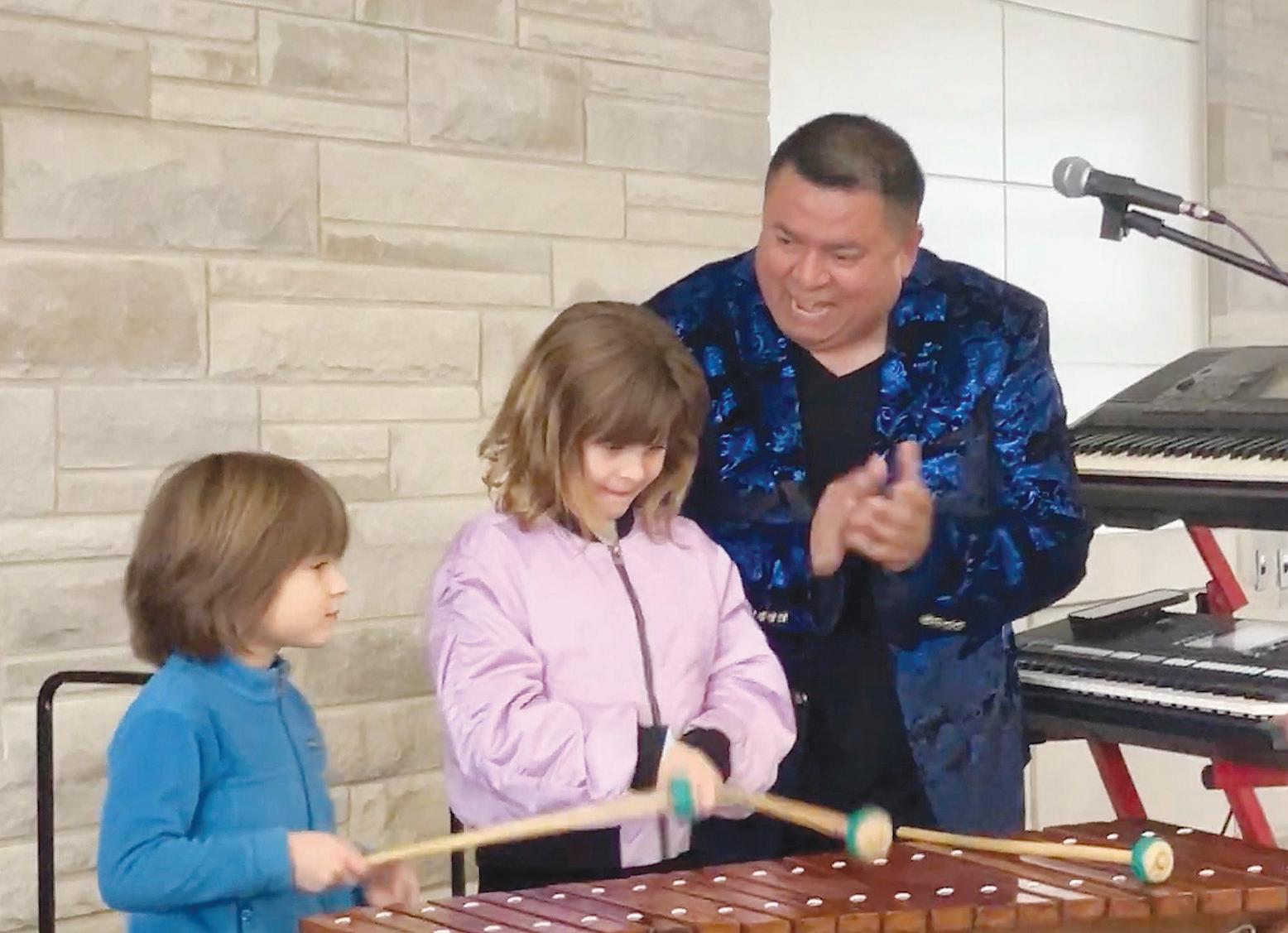
The kids came up and played marimba with him. Two vendors from Lost in the Woods Meadery spun each other around and swayed from side to side.
Salazar said this is one of his favorite parts of performing. He often tries to include children by letting them experiment by playing the marimba with him.
“I love to play merengue,
I love to play cumbia, I love to play cha-cha-cha, I love to play bachata, but my role as a musician is to share this moment with the children,” Salazar said. Goch said she sees performers like Salazar as a way to bring free live music to the public. It’s a special experience for marketgoers to enjoy music for free. These performers are also an important part of the market’s culture.
During the COVID-19 pandemic, the Bloomington Winter Farmers’ Market was unable to have live music performances, making musicians like Salazar feel more important, Goch said.
“A vital part of Bloomington’s community is kind of food and music,” Goch said. “Those are huge components of the Bloomington experience. So they just kind of naturally go together.”
While Salazar’s upcoming performances are mostly private events, videos about past events are on his Facebook pages for Melodía Latina and El Marimbaso. In the future, Salazar said he hopes to teach free music lessons for children in the community. He remembers a time when he was 8 years old and his father approached a piano player in Nicaragua to ask him to teach his son.
“The professor looked at me and told me if you can’t pay, I can’t teach you,” Salazar said. “This impacted me a lot.”
Salazar sees lessons as a way to share his love of music with the community without cost.
“In this medium can unlock light, can unlock ideas, can unlock emotions, it can unlock so many things in a child, understand?” Salazar said. “It can be a beginning, and so this is my favorite part musically.”



By Jack Davis
jjd5@iu.edu
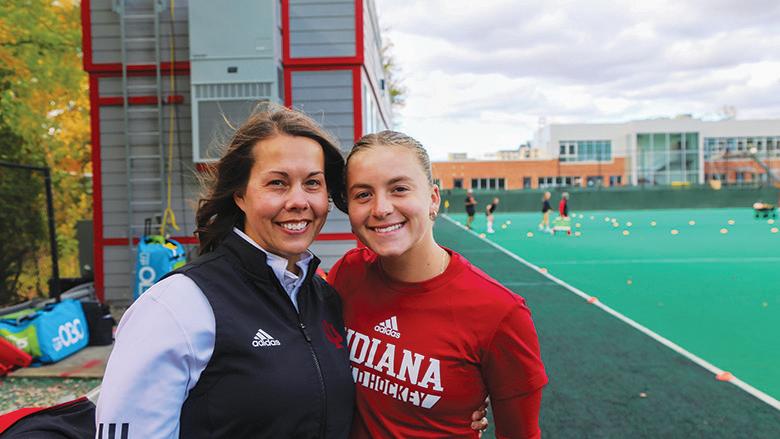
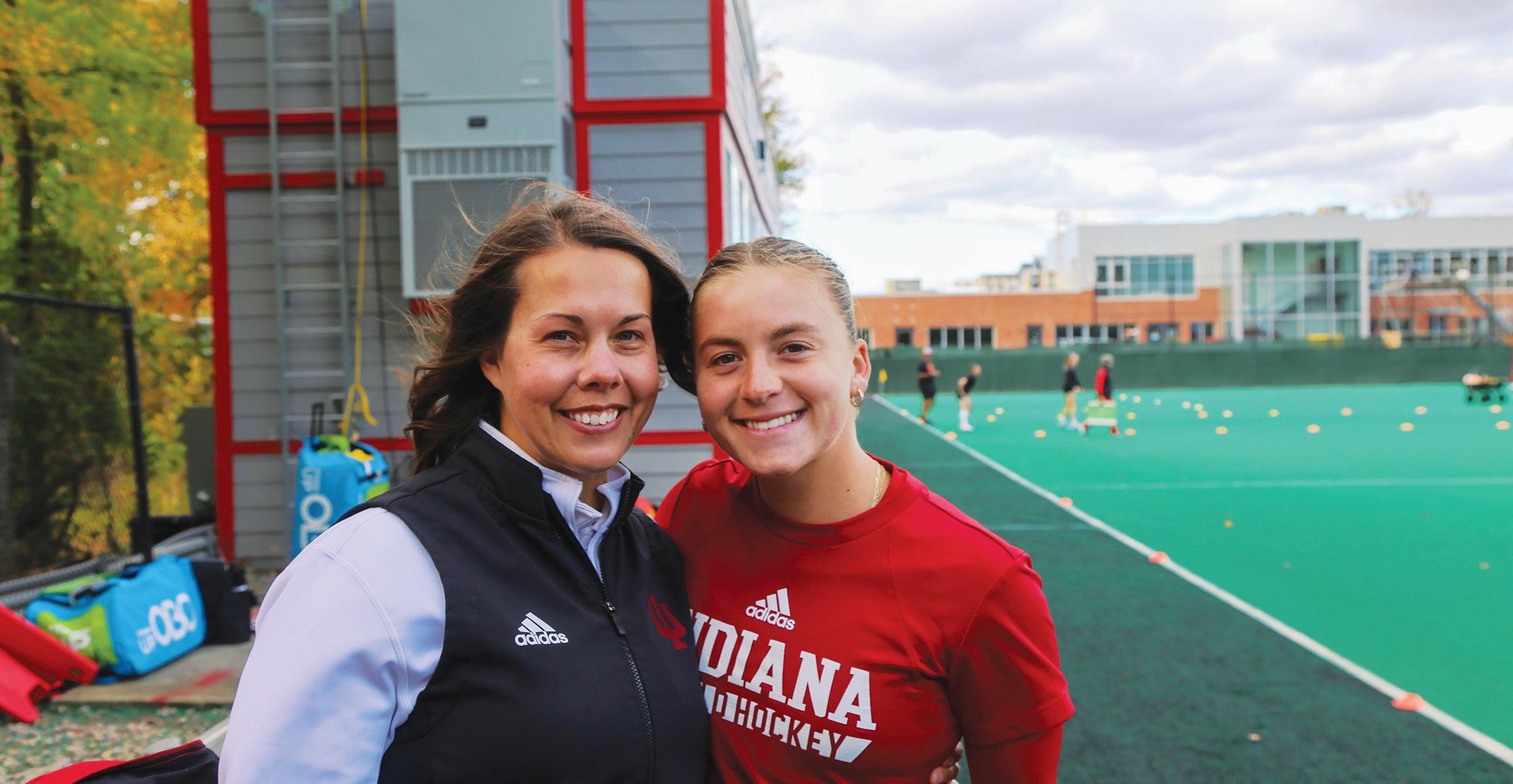
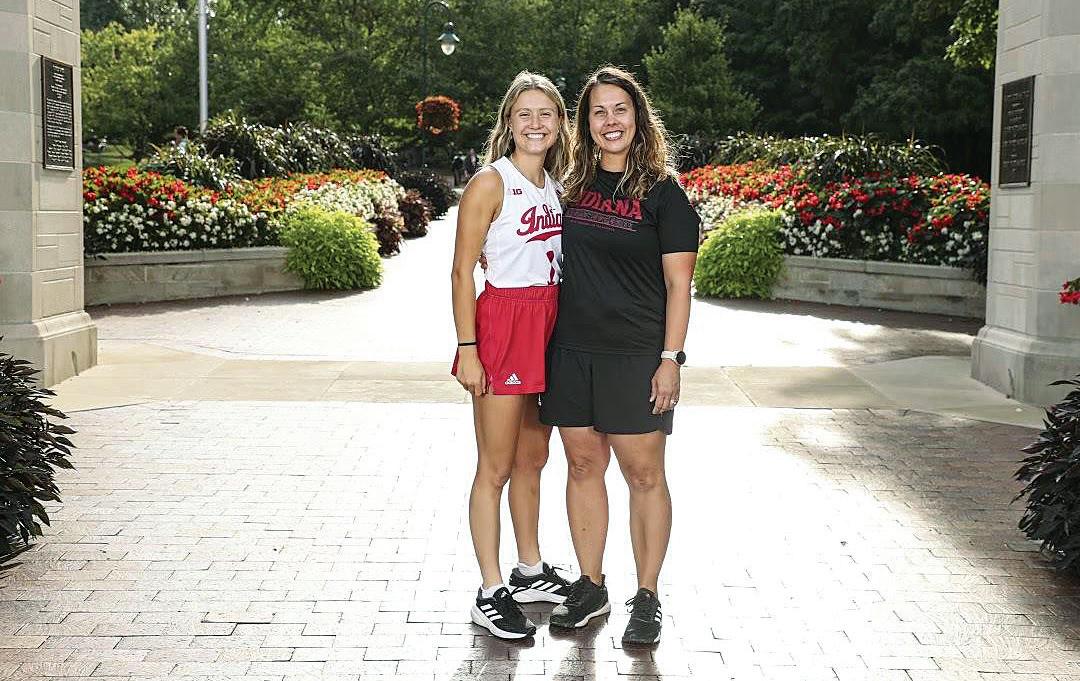
The only thing moving on Deborah Tobias Field at 7:30 a.m. on an early September 2025 morning is the quietly hissing sprinkler. But in a nearby dusty outdoor training closet, Ali Crouch is already in motion. The Indiana field hockey and women’s golf athletic trainer, who also oversees training for the men’s and women’s tennis programs, fills water jugs and pushes carts full of equipment and medical supplies.
The carts squeak as she pushes them toward the sideline. She expertly adjusts field hockey players’ straps and splints.
Around her, the field awakens as turf shoes crunch on gravel. Around 20 teammates’ voices overlap, and head coach Kayla Bashore’s instructions cut through the air.
The season is still fresh. Muscles are adjusting to the grind of practices, weight training and a schedule that can include two games a week, while routines are just beginning to take shape.
Excitement and nervousness hang over the team as Indiana field hockey prepares to start Big Ten play with its Sept. 19 matchup against Iowa, one of the conference’s top teams. Field hockey players push through drills and sprints, their sticks tapping and voices echoing across the field. But on the sideline, Crouch is readying for a different game, one that no scoreboard can capture.
Crouch has been the Indiana field hockey athletic trainer for eight years, working behind the scenes during the demanding regular season.
During her time, she’s seen steady improvement from a team still chasing its first Big Ten and national titles. In the regular season, Indiana often plays two games a week with little time for recovery in between.
Field hockey is a fast, physical sport with players constantly sprinting, cutting and battling for position while controlling a hard ball
with sticks. The toll adds up fast, with injuries ranging from fractured fingers to torn hips that require immediate attention.
That’s where Crouch comes in.
She helps guide players through injuries, manage recovery and keep them on the field through a grueling schedule. Her days are filled with tape and treatments, but also conversations, reassurance and the steady care that holds the team together.
Before practice drills start, Crouch settles near the sidelines, unloading her supplies. Rolls of white tape line the table and scissors lie within reach. She pours Gatorade powder into water jugs, setting them out for easy access. Everything has a place, arranged so she can grab what she needs without looking when a player walks over.
But her impact spreads beyond just injury.
“She’s kind of a jack of all trades,” senior back Kylie Dawson said. “Whatever you need, you kind of talk it through with Ali to see what the best plan is.”
Crouch started playing soccer at nine and played through high school. Her school didn’t have an athletic trainer.
“If you were injured, you just sucked it up and figured it out,” she said.
Curiosity about sports medicine eventually led Crouch to pursue a Master of Science in athletic training at Indiana University. Her interest in the field was partly inspired by her mother, Marcia Young, who worked as a nurse.
After working in both high school and collegiate settings, Crouch returned to Indiana in 2018 as the primary athletic trainer for field hockey.
Players approach her almost instinctively during practice. Sometimes they don’t even need to say what’s wrong. Crouch simply reaches for tape.
“I’ve been coined ‘the guru’ on staff for how to make a splint for a finger fracture,” she said with a smile.
She unwraps a strip of white tape, the edges crinkling, and molds a small splint along an injured finger before practice. She presses the tape snugly but gently as the adhesive mixes with the player’s sweat. Crouch gives a reassuring nod before the player goes back onto the field.
At home, Crouch balances a different kind of routine. She and her husband Eric raise two young children — an 8-year-old daughter Matilda and a 3-year-old son Jennings — and mornings start early. She’s up by 6 a.m., helping Jennings get ready for daycare before making breakfast for Matilda, who dances ballet and participates in Girl Scouts.
By 8:30 a.m., after walking Matilda to the bus stop, Crouch heads to work to begin her day.
But when there is a morning practice, the schedule tightens even more, with the entire family out the door by 7 a.m. Crouch drops Jennings off at daycare, and Eric brings Matilda to school.
Even with the demands of her job, Crouch stays involved in Matilda’s activities, volunteering with her Girl Scout troop.
During the season, Crouch spends more time with the team than with her family. But on the field, she said, she has 25 children to look after.
“Ali quickly becomes their mom more than the coaches are,” field hockey team physician Kevin Miller said. “The coaches are expecting something of them, but they can’t really ‘fail’ Ali.”
Senior midfielder and forward Anna Mozeleski, who has known Crouch since 2022, agrees.
“She was already motherly when I met her, but since she takes care of our physical bodies, she’s just a comforting presence to be around,” Mozeleski said.
Mozeleski remembers a moment at the end of last season when that support mattered most.
“I had to step back because of an injury, and she just listened,” she said. “I was crying and talking about everything, and she just sat there. She even called her husband and said she’d be
late because she wanted to stay and help me through it.”
But caring for the whole team’s mental and physical wellbeing can take an emotional toll. Over the years, Crouch has delivered difficult news to players, like injuries that end seasons, and helped them navigate the uncertainty that follows.
“I feel like I’m a pretty empathetic person,” Crouch said. “Sometimes it hurts me just as much as it hurts them when I have to pull someone from practice because of an injury.”
Dawson still remembers the day Crouch told her she would need surgery on her torn hip.
“I just remember I started crying,” Dawson said. “Ali gave me a hug and told me, ‘We’ll support you no matter what decision you make — if you want to delay surgery or if you want to have it now.’”
That empathy shapes how she approaches the job each day. It guides every decision, from helping players manage injuries to knowing when to offer encouragement, even in moments most never see. When a player’s boyfriend broke up with her, Crouch was the first person she called.
“It’s a balance of knowing your athletes’ bodies but also knowing their personalities, how they cope with setbacks,” she said. “We see them every day. We celebrate their wins, big and small. We worry when they’re hurting. It does start to feel like family.”
When game day arrives, Crouch’s routine shifts from preparation to vigilance.
During Indiana’s game against Iowa, Crouch stays at the end of the bench alongside athletic performance coach Catie Mulligan, their usual spot during practice.
For the hour of play, she moves with the same steady rhythm she uses during training. She refills Gatorade jugs, swaps out water bottles and handles the minor, often overlooked tasks, such as motivating the team and making sure they’re ready to substitute in.
The action picks up in the 25th minute. Iowa strikes
first after Hawkeyes junior midfielder Lieve van Kessel finds the back of the cage. IU responds in the 32nd with junior forward and midfielder Charlotte Glasper converting a pass from junior forward and midfielder Theresa Ricci to tie the score. From the end of the bench, Crouch watches every collision closely. When players tumble to the turf or clutch a stick in hand, her attention sharpens, ready to step in. Moments like that remind players how quickly a season can change. With four minutes remaining, junior forward Mijntje Hagen scores to pull the Hoosiers within one point. The team rallies, pushing forward with intensity, but time is slipping. The play clock ticks down.
Despite all the hats athletic trainers wear in their role, they earn far less than their peers in similar health professions. The national median salary for an athletic trainer sits around $60,250 as of May 2024, while physical therapists earn an average of $101,020 nationally. Physical therapists in the United States must have a doctoral degree and typically take on broader clinical responsibilities, while athletic trainers require a master’s degree and focus on injury prevention, evaluation and on-field care.
In Indiana, the average salary for an athletic trainer is even lower at $58,059. Crouch’s salary, according to the Indiana University faculty/staff salary listing, is just above the national median at $63,561, even as she puts in 60 hours a week during the field hockey season. These realities contribute to high turnover and burnout in the profession.
For Crouch, the emotional demands are real but manageable, partly because of her experience in the field and her ability to set boundaries. Having a family has helped with that. She doesn’t respond to messages after 8 p.m. unless it’s an emergency.
“I try to do a better job of separating myself,” she said. Amid the hands-on work
and emotional labor, Crouch also manages a web of logistical coordination behind the scenes. On game days, she makes sure emergency protocols are in place and that the setup crew and Big Ten Network broadcasters have room to work. She ensures ambulances can navigate the field as safely as possible, doublechecks that extra Gatorade and towels are available and verifies visiting teams have what they need. Even when no crisis arises, this careful orchestration demands constant attention to keep the game running smoothly and everyone safe. That commitment to player wellness is something others in the program have noticed.
“A good athletic trainer communicates well, is flexible, available, trustworthy and accountable,” Miller said. “Ali embodies all of these.” She keeps players supported in every moment: checking in before practice, handing out water bottles to players and finding their dirty mouthguards.
“I truly, really can’t emphasize the point — I’m not sure what place we would be physically without her, but I also can’t say where we would be mentally without her,” Mozeleski said.
The score is 3-2. Indiana pulls its goalie for an extra attacker, desperate to even the score. But in the end, the Hawkeyes’ defense proves to be too much, blocking shots and clearing the ball. After the final whistle, Indiana falls 3-2 to Iowa, a narrow loss after a hard-fought game. Both teams take a few seconds to catch their breath before lining up for handshakes near midfield. Indiana players walk over with subdued expressions, some with hands on hips or sticks at their sides, exchanging quick words with the Hawkeyes as they move down the line. Crouch moves steadily among them, making sure everyone is okay amid the postgame exhaustion. The players’ work is done for

By Jack Davis jjd5@iu.edu
The “World’s Greatest College Weekend” may still be weeks away — set for April 24–25— but on March 28, the pool of teams for the men’s Little 500 was made official during qualifications. With fraternities and sororities rocking the Bill Armstrong Stadium bleachers with chants and cheers, 33 of 39 teams earned a spot in the race in late April. During qualifications, each team has three attempts to complete a clean run. The fastest valid four-lap effort counts as the team’s time. Teams that fault on all three attempts do not qualify. Before the timed run begins, teams take a “fly lap” to get a feel for the track. Once they cross the start line, the clock runs continuously until the final rider finishes. The teams’ times during qualifications determines their starting position in the Little 500. Phi Gamma Delta set the tone early for those that followed. As one of the first teams on the track just after 8 a.m., the team posted a strong time of 2:28.094. While Phi Gamma Delta’s lead held for a couple hours, Sigma Phi Epsilon bested it. Their time of 2:27.216 put them in first place heading into the afternoon.
from the best teams in the field.
Back-to-back reigning Little 500 champions Black Key Bulls earned a time of 2:28.221 to finish fifth overall. Although not enough for the pole position, it remains a strong showing for the returning champions.
Right after Black Key Bulls came Cutters, the most dominant team in men’s Little 500 history. After coming 12th in last year’s qualifiers, the recordsetting 15-time champions had a much better showing, opening their pursuit of their 16th title with a time of 2:25.711, overtaking Sigma Phi Epsilon for the firstplace spot.
Soon after, a string of impressive times followed
showings the rest of the day from teams like CSF Cycling and Bears Cycling, no team surpassed Cutters’ time. Riders will hit the track for the “Spring Series,” which began with the men’s time trials March 31. That’s followed by the Miss N Out race April 10, before the series concludes with the team pursuit April 11. Together, these events set the stage the 75th running of the men’s Little 500.
Final qualifications results: 1. Cutters — 02.25.711 2. Sigma Alpha Epsilon — 02.27.216 3. Phi Gamma Delta
Despite some impressive
By Sean McAvoy
@sean_mc07
As the sun rose over Bill Armstrong Stadium, the 8 a.m. start time for the 2026 women’s Little 500 qualifications didn’t prevent supporters of every team from being loud. After the 2025 edition of qualifying boasted the largest field in the history of the women’s race, 2026 matched last season’s record-breaking total of 36 teams. However, only the fastest 33 teams could qualify for “The World’s Greatest College Weekend.” Each team had to complete four quarter-mile laps, with the riders executing one lap before passing the bike to a teammate or tagging their teammate on a secondary bike to begin the following lap.
The riders pulled off smooth bike exchanges during most of the March 28 event. If a team failed to execute a clean exchange — either by falling off the bike or completing it outside the zone — the team’s qualifying attempt was stopped. Each team received a maximum of three attempts. If a team faulted three times, they would be disqualified.

Kappa Alpha Theta — the winners of the 2024 and 2025 editions of the women’s race — topped the timing sheets March 28. Cheered on by their sorority sisters, junior Greta Heyl, plus seniors Bailey Cappella, Claire Tips and Greta Weeks, compiled a 2:43.883 finish. With 10 race victories (1994, 1995, 2000, 2003, 2014, 2015, 2017, 2018, 2024 and 2025) and 36 top-10 finishes in 37 appearances, the experience paid off for Kappa Alpha Theta. The team finished almost four seconds in front of second-place Teter Cycling. Seniors Leila Faraday, Seneca Simon and Lydia Casiano, plus sophomore Jenna Greenberg, secured Teter’s runner-up spot with a 2:47.546 time. The team has won the Little 500 four times (2005, 2010, 2011 and 2019) in 31 appearances and will look to improve on last year’s fourth-place finish. Led by sophomore Libby Lewis — who became the first freshman rider in his-
tory to win the women’s time trials last season — Alpha Chi Omega finished in third place with a 2:47.911 time. Delta Gamma took first at the 2025 women’s Little 500 qualifications but fell to fourth place this year with a 2:48.347 mark, while Melanzana (2:50.107) rounded out the top five.
The Christian Student Fellowship women’s team was the biggest riser from last year’s qualifying. CSF previously qualified in 29th place and finished 19th in the 2025 race but jumped to sixth place in qualifications March 28 with a 2:50.141 mark. In its first season compet-
ing in the Little 500, SALT Cycling qualified in 11th place with a time of 2:52.164. Twenty of 36 teams crossed the finish line in under three minutes. Phi Gamma Nu (3:11.709), Alpha Xi Delta (3:26.958) and Mezcla (Did not qualify) finished 34th to 36th, respectively, eliminating them from the main race. Mezcla did not post a time after faulting on all three of its attempts. Before the Little 500, the Indiana University Student Foundation organizes three other events. Known as “The Spring Series,” the women’s Individual Time Trials started this stretch of events April 1. Miss N Out on April 10 and the Team Pursuit on April 11 round the series. The winners of the “Spring Series” will earn white jerseys to wear during this year’s race. With qualifications complete, Kappa Alpha Theta will try to make history by recording its third consecutive victory at 4 p.m. April 24. Throughout the previous 37 editions of the women’s race, no team has completed the feat.
By Conor Banks conbanks@iu.edu | @conorbanks06
After clouds lingered for most of March 27, the sun broke through ahead of Indiana softball’s two-game weekend set against the University of Detroit Mercy at Andy Mohr Field in Bloomington. While the sun poked through the clouds, strong winds and cold weather persisted, as the Indiana state and U.S. flags whipped around in left center field.
Between half innings, Indiana head coach Shonda Stanton walked toward her team’s dugout to heat her hands. The elements, however, did not faze freshman pitcher Aubree Hooks.
Hooks delivered the Hoosiers’ first no-hitter of 2026, leading them to an 8-0 runrule victory March 27. After allowing three runs through the first two innings March 28, the Cream and Crimson rebounded to notch a 7-5 victory and improve to 27-7 on the season.
“I thought she did an exceptional job today, especially in the elements,” Stanton said of Hooks postgame March 27. “That’s tough to be in the wind and the cold.
I know I was going over to the heater every half inning to warm up my hands, so I can’t imagine pitching.”
Hooks opened her sixinning no-hitter outing by retiring the first nine batters she faced. She walked fresh-

man outfielder Jenna Higgins to lead off the fourth frame, but Higgins was the Titans’ only base runner of the evening. Hooks finished with two strikeouts through 79 pitches.
To help Hooks notch her first career no-hitter, Indiana’s defense stepped up. Sophomore third baseman
Madalyn Strader made multiple plays along the infield, outstretching her glove to keep balls in front of her.
“It starts with great defense and a good battery, and I thought Strader was exceptional on the corner,” Stanton said.
On March 23 against Oregon, Hooks allowed five earned runs and seven hits across 3.1 innings. But she followed it with a career-best performance March 27.
“Well, my defense worked great, and my catchers were great,” Hooks said. “And I worked a lot with coach

2420 E. Third St. 812-332-4439 firstuc.org
We are an Open, Welcoming, and Affirming community of love and acceptance dedicated to welcoming the diversity of God’s beloved. We exist to empower, challenge, and encourage one another to live out Jesus’ ways (compassion, truth, and justice) authentically as human beings in community to create a better world.
Sunday: 10:30 a.m., Worship Monday: 10 a.m. via Zoom, Bible Study
Evangelical Lutheran Church in America
Rose House LuMin & St. Thomas Lutheran Church
3800 E. Third St. 812-332-5252 Stlconline.org
lcmiu.net
Instagram: @hoosierlumin facebook.com/LCMIU facebook.com/StThomasBloomington
Sunday: 8:30 a.m. & 11 a.m.
@ St. Thomas Lutheran Church
3800 E. Third St.
Tuesday: 6:30 p.m. Dinner & Devotions
@ Rose House LuMin 314 S. Rose Ave.
Rose House LuMin and St. Thomas Lutheran Church invite you to experience life together with us. We are an inclusive Christian community who values the faith, gifts, and ministry of all God’s people. We seek justice, serve our neighbors, and love boldly.
Rev. - Adrianne Meier Rev. - Lecia Beck
Rev. Amanda Ghaffarian - Campus Pastor
St. Mark’s United Methodist Church
100 N. State Rd. 46 812-332-5788 smumc.church facebook.com/BloomingtonStMarksUMC instagram: @stmarksbloomington
Sunday: 10:30 a.m., Service
Mon. - Fri: Office: 9 a.m. - 3 p.m.
St. Mark’s United Methodist Church of Bloomington, Indiana is an inclusive community, bringing Christ-like love, healing, and hope to all. We embrace the United Methodist ideal of open hearts, open minds, and open doors by welcoming those of all races, cultures, faith traditions, sexual orientations, and gender identities.
Rev. John Huff - Pastor Rev. Mary Beth Morgan - Pastor
(Chanda) Bell, and so it’s just a big accomplishment.”
The Hoosiers struggled to score to begin the game, tallying just one run across the first three innings. But Indiana provided Hooks with run support, headlined by a fourrun fourth inning en route to an 8-0 win.
After Hooks dominated in the circle March 27, redshirt
junior Taylor Hess earned the start March 28. Hess did not experience the same suc-
cess Hooks did the evening prior, as the redshirt junior conceded five base runners and two runs in the first inning.
Junior pitcher Brooke Mannon entered in relief of Hess with one out remaining in the opening frame. Mannon notched the final out to get out of the first inning but surrendered a lead-off home run to begin the second. After giving up her fourth home run of the season, Mannon
Light House Community Church
850 E. Winslow Rd. 812-339-3306 lhccbloomington.org facebook.com/lighthousecommunitychurchbloomingtonindiana instagram.com/lighthouse_community_ church
Sunday: 9 a.m., Empowerment Classes (for all ages) 10:30 a.m., Service
Wednesday: 7 p.m., Bible Study
Light House Community Church is mandated, by the Word of God, to fulfill the Great Commission by winning lost souls to Christ and empowering the believer to grow in Christ through prayer, study of the Holy Bible, and life application teaching. All are welcome! Transportation is available.
Senior Pastor - Derek L. House Assistant Pastor - Clarence W. Boone,
Trinity Reformed Church 2401 S. Endwright Rd. 812-825-2684 trinityreformed.org instagram.com/trinityreformed facebook.com/trinitychurchbloom
Sunday: 9:15 a.m., Sunday Bible Classes 10:30 a.m., Worship
We are a Reformed Protestant church on the west side of Bloomington with lively worship on Sunday mornings, Bible classes beforehand, home groups, and a college age group called The Mix (a group of young adults who are both attending college and beyond).
Jody Killingsworth - Lead Pastor Max Curell - Shepherding Pastor Stephen Baker - Discipleship Pastor Philip Moyer - Worship & Youth Pastor
Christian Science
Christian Science Church 2425 E. Third St. 812-332-0536 bloomingtonchristianscience.com facebook.com/e3rdStreet
Sunday: 10 - 11 a.m., Service
Wednesday: 7 - 8 p.m., Testimony Meeting Mon. - Fri: Noon - 2 p.m., Reading Room
Interested in spirituality and healing? We welcome you to our church to explore how you can address issues spiritually and experience healing.
settled in with a message from Stanton.
“Yeah, I asked her (Mannon) and even the rest of the group, ‘Are you having fun playing the game?’” Stanton said. “You know, I think we get caught up in one pitch, or we get caught up in one at-bat. And sometimes out there, we just look a little tense.”
Mannon, who owns a team-low 2.18 ERA, responded. Across 5.2 innings, she accumulated a careerhigh eight strikeouts and did not allow another hit until the seventh, when the Hoosiers held a 7-3 lead. But with her pitch count exceeding 100 in the final inning, Mannon’s arm grew tired. Four consecutive Titans reached base before sophomore pitcher Ella Troutt entered in relief. Detroit Mercy pulled closer with a sacrifice flyout, bringing the score to 7-5. However, Troutt forced a groundout with the bases loaded to end the game, as Indiana claimed a 7-5 victory and swept the two-game set. The Hoosiers are
Inter-Denominational
Redeemer Community Church
111 S. Kimble Dr. 812-269-8975
redeemerbloomington.org
facebook.com/RedeemerBtown
Instagram & Twitter: @RedeemerBtown
Sunday: 9 a.m., 11 a.m.
Redeemer is a gospel-centered community on mission. Our vision is to see the gospel of Jesus Christ transform everything: our lives, our church, our city, and our world. We want to be instruments of gospel change in Bloomington and beyond.
Chris Jones - Lead Pastor
United Methodist
Worship 11:45 a.m., Contemporary Worship Wednesday: 7:30 p.m., College & Young Adult Dinner
Jubilee is a Christ-centered community open and affirming to all. We gather on Wednesdays at First United Methodist (219 E. 4th St.) for free food, honest discussion, worship, and hanging out. Small groups, service projects, social events (bonfires, game nights, book clubs, etc.), outreach retreats, and leadership opportunities all play a significant role in our rhythm of doing life together.
Markus Dickinson - jubilee@fumcb.org
Unity Worldwide
Unity of Bloomington
A Center for Spiritual Growth
4001 S. Rogers St. text/call: 812-333-2484 unityofbloomington.org IG: @unityofbloomington facebook@UnityofBloomington
Sunday Celebration: 10:30 a.m.
Discover a vibrant, welcoming community at Unity of Bloomington – “a positive path for spiritual living”. Our center offers a space for spiritual growth; embracing all with open arms. We proudly affirm and welcome the LGBTQ+ community, fostering love, acceptance, and inclusion. Join our loving congregation, where everyone is valued and encouraged to explore their spiritual journey. At Unity of Bloomington, all are welcome and together we thrive!
Minnassa Gabon - Spiritual Leader
Phyllis Wickliff - Music Director
By Noah Boudouris nboudour@iu.edu
Indiana swimming and diving concluded its season at the NCAA men’s Swimming and Diving Championships, finishing in third place with 351 points. The championships, which were hosted by Georgia Tech University, took place March 25 through March 28 at McAuley Aquatic Center in Atlanta.
The championships featured 21 total events over four days.
Competition commenced March 25 with the 1,650yard freestyle. Indiana senior Zalán Sárkány placed second, finishing with a program and conference record time of 14:12.20. However, the effort was not enough for gold, as Florida freshman Ahmed Jaouadi earned first place by setting an NCAA record time of 14:10.03.
Sárkány’s 1,000-yard split time of 8:33.10 was an NCAA record. His performance in the opening event earned the Hoosiers 17 team points, and a sixth-place finish from sophomore Luke Whitlock added 13 more, for 30 total team points to open the meet. The 200-yard medley relay and the 800-yard freestyle relay also occurred March 25, with Indiana squads taking fourth and sixth place, respectively, and earning a total of 56 team points. Indiana’s fourth
place finish in the 200-yard medley relay was fronted by junior Mikkel Lee, whose time of 18.26 was the team’s fastest of the event.
Indiana ended day one of the championships with 86 total points, knotted with the University of Florida for first place.
March 26 was the first full day of events, with five preliminary races and six finals. Two Hoosiers swam well enough in the morning preliminaries to qualify for a final race: freshman Josh Bey in the 400-yard individual medley and sophomore Alexei Avakov in the 100yard breaststroke. Avakov’s time of 50.89 seconds was a personal best.
Bey and Avakov both earned first-team All American honors with top10 finishes.
In the finals, Bey finished seventh with a time of 3:37.23, awarding Indiana 12 points, and Avakov finished sixth with another personal best time of 50.58, adding 13 more points.
Indiana’s time of 1:15.32 in the 200-yard freestyle relay March 26 earned a 12th-place title for 10 team points.
With five individual Hoosiers and the relay scoring points, Indiana ended day two in fourth place with a total of 132.5 points.
Six more events were slated for March 27, including the meet’s first diving event. After four
preliminary races, five Hoosiers qualified for their respective finals. Senior Owen McDonald finished third in the 100-yard backstroke preliminary with a personal best time of 43.98.
Two different races featured two Hoosiers in the top eight. First, Bey and junior Toby Barnett both qualified for the 200-yard breaststroke final, followed by Sárkány and junior Aaron Shackell cracking the top eight of the 500yard freestyle preliminary. Shackell’s time of 4:11.01 was a personal best.
No Hoosier qualified for the final of the 50-yard freestyle or 3-meter diving. McDonald, Bey, Barnett, Sárkány and Shackell were all honored as first-team All Americans with their finals qualifications.
McDonald finished the 100-yard backstroke final in fifth place for 13.5 points while Barnett finished sixth in the 200-yard breaststroke final for 13 points. Sárkány and Shackell finished fourth and seventh in the 500-yard freestyle final for 15 and 12 points, respectively.
Bey earned 17 points and Indiana’s second silver medal of the championships with a second-place finish in the 200-yard breaststroke final. Bey’s time of 1:48.79 was .18 seconds slower than University of California, Berkeley, sophomore Yamato Okadome, who took gold.
Sárkány swam a Big Ten

and program record 4:07.95 in the final of the 500-yard freestyle, placing fourth.
In the 400-yard medley relay, Indiana placed fifth, finishing in 2:59.96, adding 28 points to the team’s running tally.
Following March 27’s events, Indiana rose to third place with a total score of 254, 77 points behind Florida and 86.5 points behind the University of Texas at Austin.
Three Hoosiers qualified for the final of the 200-yard individual medley March 28: McDonald, who was the top qualifier, Bey and freshman Nolan Cakir. Bey and Cakir both swam personal bests in the preliminary race.
Additionally, sophomore Raekwon Noel and senior
Kai van Westering found their way into the top eight of the 200-yard butterfly and the 200-yard backstroke, respectively. Indiana sent no swimmers or divers to the final of the 100-yard freestyle or platform diving.
McDonald, Bey, Cakir, Noel and van Westering joined the list of Indiana’s first-team All-Americans with their preliminary race results.
McDonald began Indiana’s final afternoon in Atlanta with a secondplace finish in the 200yard individual medley, earning the Hoosiers’ third silver medal. With a time of 1:38.57, McDonald was .09 seconds behind University of Virginia freshman
Check the IDS for your directory of local religious services, or go online anytime at idsnews.com/religious For membership in the Indiana Daily Student Religious Directory, please contact ads@idsnews.com
Society of Friends (Quaker)
Bloomington Friends Meeting
3820 E. Moores Pike bloomingtonfriendsmeeting.org
Sunday (in person & by Zoom):
9:45 a.m., Hymn singing 10:30 a.m., Meeting for Worship Children’s program available
We practice traditional Quaker worship, gathering in silence with occasional Spirit-led vocal ministry by fellow worshipers. We are an inclusive community with a rich variety of belief and no prescribed creed. We are actively involved in peace action, social justice causes, and environmental concerns.
Rex Sprouse - Clerk rsprouse@iu.edu
Bahá'í Faith
Bloomington
Bahá'í Community and Bahá’í IU Association
424 S. College Mall Rd. 812-331-1863 bloomingtoninbahais.org
facebook.com/Baháí-Community-ofBloomington-Indiana-146343332130574
Instagram: @bloomingtonbahai
Sunday: 10:40 a.m., Regular Services, Devotional Meetings.
Please call or contact through our website for other meetings/activities
The Bahá'í Association of IU works to share the Teachings and Principles of the Founder, Bahá'u'lláh, that promote the "Oneness of Mankind" and the Peace and Harmony of the Planet through advancing the "security, prosperity, wealth and tranquility of all peoples."
Karen Pollock Dan Enslow
Independent Baptist Lifeway Baptist Church
7821 W. State Road 46 812-876-6072 lifewaybaptistchurch.org facebook.com/lifewayellettsville
Sunday:
9 a.m., Bible Study Classes
10 a.m., Morning Service
5 p.m.,
Student Ministry: Meeting for Bible study throughout the month. Contact Rosh Dhanawade at bluhenrosh@gmail.com for more information.
Steven VonBokern - Senior Pastor Rosh Dhanawade - IU Coordinator 302-561-0108 bluhenrosh@gmail.com
Non-Denominational
Christ Community Church
503 S. High St. 812-332-0502 cccbloomington.org
facebook.com/christcommunitybtown
Instagram: @christcommunitybtown
Sunday: 9:15 a.m., Educational Hour 10:30 a.m., Worship Service
We are a diverse community of Christ-followers, including many IU students, faculty and staff. Together we are committed to sharing the redeeming grace and transforming truth of Jesus Christ in this college town.
Bob Whitaker - Senior Pastor Adam deWeber - Worship Pastor
Dan Waugh - Adult Ministry Pastor
Great Harvest Ministry Center (GHMC Family)
1107 S. Fairview St. 812-325-2428 (GHMC) ghmcfamily.org
Sunday: 10:30 a.m.
GHMC Family is a small church with a big heart. We follow Jesus and not a religion. We believe God’s Word as written for real people living in a messy world. We are a family of believers — your home away from home. Casual, welcoming, and here to support each other through life’s challenges. Come grow with us!
Tony Taylor - Pastor
Christian Student Fellowship
1968 N. David Baker Ave. 812-332-8972 csfindiana.org
Instagram: @csfindiana office@csfindiana.org
Monday - Friday: 10 a.m. - 5 p.m.
Christian Student Fellowship (CSF) exists as a Christ-centered community focused on helping students truly know Jesus Christ. Our ministry hub is located on campus at the last stop on the B bus. Reach out to schedule a tour, or join us for our 8 p.m. Thursday night worship service (Encounter)!
Ben Geiger - Lead Campus Minister
Stephanie Michael - Campus Minister
Nick Conrad - Associate Campus Minister
United Church of Christ and American Baptist Churches-USA First United Church 2420 E. Third St. 812-332-4439 firstuc.org facebook.com/firstuc instagram.com/firstuc2420 youtube.com/@FirstUCBtown
Sunday: 10:30 a.m., Worship
Monday: 10 a.m. via Zoom, Bible Study
We are an Open, Welcoming, and Affirming community of love and acceptance dedicated to welcoming the diversity of God’s beloved. We exist to empower, challenge, and encourage one another to live out Jesus’ ways (compassion, truth, and justice) authentically as human beings in community to create a better world.
Rev. Jessica Petersen-Mutai Senior Minister
Nazarene
Bloomington Eastview Church of the Nazarene
4545 E. Lampkins Ridge Rd. 812-332-4041 eastviewnazarene.org
Facebook - Eastview Church of the Nazarene
Sunday: 9 a.m.: Morning Prayer
9:30 a.m.: Sunday School 10:30 a.m.: Worship Service
3 p.m.: Cedar Creek Worship
Wednesday: 10 a.m.: Bible Study
Join us at Bloomington Eastview Church of the Nazarene, where faith meets community! Connect with fellow students through engaging worship, meaningful discussions, and service opportunities. Discover a supportive space to grow spiritually and make lasting friendships. Everyone is welcome - come as you are and be a part of our vibrant family!
Rev. Bruce D. Yates - Pastor
Alicia J. Dollens - Facility Manager
Maximus Williamson. Bey and Cakir, the two other Hoosiers who qualified for the final, finished seventh and eighth, respectively. Indiana earned a total of 40 points in the 200-yard individual medley. Noel finished sixth in the 200-yard butterfly for 13 points. Van Westering finished fourth in the 200yard backstroke for 15 points. Indiana finished seventh in the 400-yard freestyle relay, resulting in 24 points for the team, finalizing the Hoosiers’ 351 total points. Indiana finished the day in third place, behind Florida and Texas, its fifth consecutive top-five finish and second straight thirdplace title.
Episcopal (Anglican)
Canterbury Mission
719 E. Seventh St. 812-822-1335
IUCanterbury.org
facebook.com/ECMatIU
Instagram: @ECMatIU
Youtube: @canterburyhouseatiu9094
Sunday: 3 p.m.
Canterbury: Assertively open & affirming; unapologetically Christian, we proclaim the gospel of Jesus Christ by promoting justice, equality, peace, love and striving to be the change God wants to see in our world.
Ed Bird - Chaplain/Priest
Baptist Emmanuel Church
1503 W. That Rd. 812-824-2768 Emmanuelbloom.com
Instagram & Facebook: @EmmanuelBloomington
Sunday: 9:15 a.m., Fellowship
Sunday: 10 a.m., Worship
Groups: Various times
Emmanuel is a multigenerational church of all types of people. Whether you are questioning faith or have followed Jesus for years, we exist to help fuel a passion for following Jesus as we gather together, grow in community, and go make disciples.
John Winders - Lead Pastor
Second Baptist Church 321 N. Rogers St. 812-336-5827 sbcbloomington.org facebook.com/2ndbaptistbloomington youtube.com/@secondbaptist churchbloomington Sunday: 10 a.m., Service (In house and on Facebook/YouTube) Sunday School: 8:45 - 9:45 a.m. Bible Study: Available In House and on Zoom Wednesdays, 6:30 p.m., Thursdays, Noon Please come and worship