Tenants in properties south of the Bloomington Convention Center, including apartments in Seminary Pointe and businesses My Sister’s Closet, Bluetip Billiards and Jeff’s Warehouse, are preparing for relocation.
Leases will end July 7 for about 17 tenants in the area, Capital Improvement Board
President John Whikehart said. The deadline comes from the county’s plans to add a host hotel near the expanded convention center. Construction on an expansion of the convention center started in 2025 and is set to be finished in 2027.
The county purchased the area in 2010 for about $3 million, according to Indiana Public Media. Whikehart said the CIB accepted a land transfer April 15, making it the owner of the area south of the convention center.
After the transfer was complete, the CIB requested the Bloomington Redevelopment Commission enter into negotiations to exchange the property for College Square, north of the convention center, Whikehart said, stating the area south of the center would be better for affordable housing.
Whikehart said the CIB prefers the area north of the convention center as its site for a host hotel.
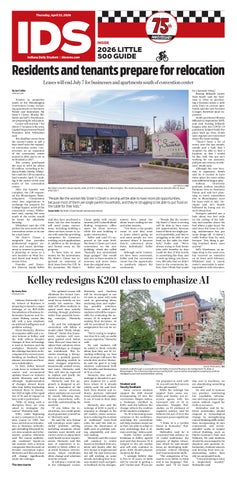
My Sister’s Closet, a nonprofit that provides professional support services and career development to women in poverty, is planning to move to a new location on West Second Street and South Patterson Drive.
Founder and Executive Director Sandy Keller
Leases will end July 7 for businesses and apartments south of convention center
“People like the women My Sister's Closet is serving will be able to have more job opportunities, because most of them are single parent households, and they're struggling to be able to put food on the table for their kids."
said they have purchased a lease, but the new location will need major renovations, including building a client services center to assist with tasks like providing computers for customers working on job applications in addition to the boutique and formal room on the property.
To have time to raise money for the renovations, My Sister's Closet has requested an extension of their lease from the CIB. In the meantime, My Sister’s
Closet spoke with county attorney Jeff Cockerill about finding temporary office space for client services while the new building is under construction.
Keller said until it’s approved at the state level, My Sister’s Closet can’t start renovations on the new building, which she called “basically two uninsulated large garages” that would take two to three months to renovate and move items from the original store.
Keller said several cus-
tomers have asked her about leases ending for her and other tenants.
“Ten times a day people come in and they want to know what's going on and some people are very stressed about it because they're concerned about those individuals,” Keller said.
Although some customers have been concerned, Keller said the convention center has the opportunity to positively impact the community.
“People like the women My Sister's Closet is serving will be able to have more job opportunities, because most of them are single parent households, and they're struggling to be able to put food on the table for their kids,” Keller said. “We're always trying to find better jobs with benefits so they could do that. If this results in something like that, and it ends up being, you know, two, 300 jobs that we didn't have in the community before, then I think that would
be a fantastic thing.” Bluetip Billiards owner Dale Smith said the business is close to purchasing a location about a mile away from its current spot. Smith said the new location is larger, therefore more expensive.
Smith purchased Bluetip Billiards in September 2020, and said hosting billiards leagues after the COVID-19 pandemic helped build the place back up. Now, Smith said, regulars are concerned about the lease ending.
“There's been a lot of worry over the last month, month and a half, that I wouldn't be able to find a location, or that I would be like, well, this just isn't working for me anymore, and just not even try to relocate,” Smith said.
Although the new location is expensive, Smith said he is excited to have more space for more tables and additional league play.
Indiana University graduate student Jonathan Enriquez lives in Seminary Pointe and said he’s planning to move somewhere else in Bloomington once his lease ends in July. Enriquez said he’s mostly bothered by losing out on such cheap rent. Enriquez pointed out a hole about two feet wide on the ceiling of his hallway and another above his bed where a pipe burst. He said since the lease is ending, maintenance has put some things off. It doesn’t really bother him, he said, because “this thing is getting knocked down soon anyway.”
Jeff’s Warehouse, an antique shop in the same area, has received an extension on its lease until February, Whikehart said. A county renter’s association is assisting residents with relocation.
Kelley redesigns K201 class to emphasize AI
By Avery Reis amreis@iu.edu
Indiana University’s Kelley School of Business is preparing to launch a major redesign of its BUS-K201 Foundations of Business Information Systems and Decision Making course this fall, with a new emphasis on artificial intelligence and problem-solving.
Brant Moriarity, director of computer skills and a senior lecturer at Kelley, said the shift reflects broader changes in how technology is used in business and the workplace. Moriarity said the redesign has been in development for several years, building on feedback from alumni, recruiters and business stakeholders.
In 2022, Kelley formed a task force to evaluate the course and recommend updates based on industry needs. Moriarity said that although implementation of changes slowed down after that, Kelley leadership revisited them in December 2025 in light of the rapid rise of AI and its impact on how work is performed.
“With AI being such a disruptive force, we were asked to reimagine the course,” Moriarity said.
K201, while beginning as just a computers in business course in 1963, has since served as an introduction to business technologies including Microsoft Excel, data analysis and information systems, Moriarity said. The course traditionally combined hands-on lab sessions with a lecture component that focused on broader conceptual topics. Moriarity said that structure will change significantly under the redesign.
The new course
The updated course will eliminate the lecture component completely and instead focus entirely on two weekly lab sessions. This shift will allow students to spend more time actively working through problems rather than passively learning concepts, Moriarity said.
He said the redesigned curriculum will follow a model called “Build, Adapt, Defend.” Under this framework, students will complete guided work before class, then use class time to adjust their solutions when new challenges or changes are introduced. This includes inserting a disruption to a prebuilt spreadsheet, adapting models to meet changed objectives, intentionally seeded errors, and more, Moriarity said. They will also be expected to explain and justify the decisions they make.
Moriarity said this approach is designed to address a limitation of the current course structure, where students can succeed by closely following stepby-step instructions without fully understanding the material.
“If you follow the instructions, you could pretty much guarantee yourself an A,” Moriarity said. He said the new format will introduce more openended problem solving, including situations where students must identify and correct errors or adjust their work based on new requirements. Moriarity said this type of experience is intended to better reflect real-world business environments, where conditions often change and solutions must be revised.
AI will play a central role in the redesigned course,
Moriarity said. Students will be encouraged to use AI tools to assist with tasks such as generating ideas, analyzing data and exploring possible solutions. However, he added that students will still be responsible for evaluating the accuracy of AI outputs and making final decisions. AI will be permitted for some assignments but not for exams.
“We’re trying to emphasize that AI is only as useful as your expertise,” Moriarity said.
He said students will be asked to think critically about how they use AI, including reflecting on how their prompts influence the results they receive. Moriarity said the goal is to help students understand both the benefits and limitations of AI as a tool.
Moriarity also said the redesign is intended to prepare students for a workforce where AI is already widely used. He said feedback from alumni and industry partners indicated many professionals regularly use AI tools in their daily work.
Moriarity also said the redesign of K201 is partly a response to changes in the job market, where automation is reducing the number of traditional entry-level roles. He said this shift increases the importance of skills such as problem solving, adaptability and decision making.
Moriarity said the course will continue to evolve based on feedback from students and faculty after the new format is implemented this fall. He said instructors are still working on some details, including how to assess student work and gather feedback on the changes.
Student and faculty feedback
Some current students support the shift toward incorporating AI into the curriculum. Megan Askins, a freshman enrolled in K201, said she believes the change reflects the realities of the modern workplace.
“As AI is becoming more common in the workforce, switching the curriculum will help students stand out as they are able to adapt to new technology that is always evolving,” Askins said.
Austin Gerber, another freshman in Kelley, agreed and said that because AI is integral to the job market and will only continue to grow, K201 should prepare students for that.
“I strongly believe that in five to 10 years, AI skills will be crucial in getting a job,” Gerber said. “If you are
not prepared to work with AI, you will not find success in the job market.”
While the redesign has support from some students and faculty, not everyone agrees with the increased role of AI in education. Douglas Hofstadter, an IU professor of cognitive science, said he believes the use of AI in the classroom poses significant risks.
“I think AI is a terrible threat to humanity,” Hofstadter said.
Hofstadter said he is concerned that reliance on AI could undermine the purpose of higher education, which he said should focus on developing independent critical thinking and communication skills.
“The uniqueness of humanity is its ability to think and to use language,” Hofstadter said. “If we hand
that over to machines, we are abandoning something essential.”
He also said AI systems can produce convincing but unreliable information and may present arguments without regard for truth or accuracy.
Hofstadter said he believes universities should respond to technological change by strengthening critical thinking skills rather than incorporating AI into coursework, and recommended works to inspire critical thinking, such as Martin Gardner’s Fads and Fallacies. He said students should be encouraged to be skeptical and question information, evaluate sources and develop their own understanding rather than rely on automated tools.
“Critical thinking is what is desperately needed,” Hofstadter said.
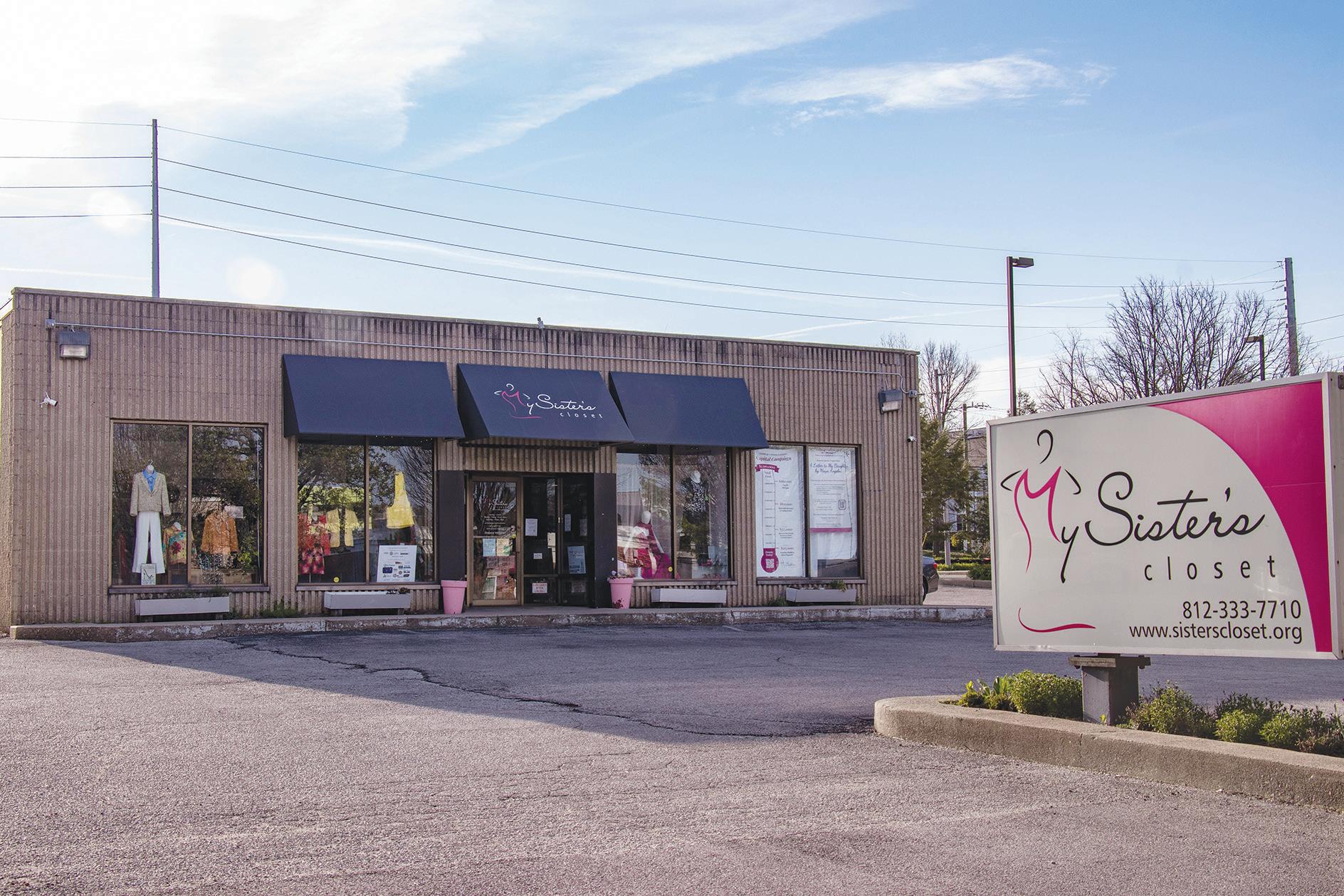
DAVID PEARLMAN | IDS
Students walk through a crosswalk near the Kelley School of Business sky bridge April 14, 2026, in Bloomington. The school recently announced the K201 course will be revamped to emphasize artificial intelligence and real-world problem solving.
Sandy Keller My Sister's Closet founder and executive director LILY WELCH | IDS
My Sister’s Closet is shown April 8, 2026, at 414 S. College Ave. in Bloomington. The resale boutique announced plans to relocate after its lease ends July 7.
Meet Isabel Ponce, force of entrepreneurship
By Elizabeth Schuth ekschuth@iu.edu
Editor’s note: Some quotes in this story were translated from Spanish into English.
After a flood, a fire and a dream, Isabel Ponce knows how to start over.
She walks in Latinus Cafe with her best friend María Clayclamp’s 5-yearold granddaughter bouncing behind her, hair curled and braided in an up-do that would make a Disney princess look shabby.
The cafe is decorated with small American flags, glass cases filled with sweets from croissants to conchas and a rainbow of glass-bottled sodas.
This is one of Ponce’s four businesses that fill a red-roofed strip mall in Seymour, Indiana, off East Tipton Street. There’s her hair salon Estetica Isabel, a cellphone store called Multiservicios María, Latinus Cafe and the newest addition, Luxo Gift Shop.
Ponce’s days are filled with running in between her businesses, highlighting hair, mixing drinks in the cafe and chatting with customers.
Wanting to be her own boss, Ponce followed her lifelong passion for cosmetology. Shortly after arriving in Seymour 27 years ago from Veracruz, Mexico, she attended Seymour’s Hair Force Beauty Academy.
the hair salon and nearly all of her customers at Luxo Gift Shop are Latinos. Latinus Cafe is closer to half. Ponce enjoys her job but also worries for the future. She’s noticed a high level of anxiety in the Latino community in Seymour about increased immigration enforcement and hopes for a future where “there’s not so much fear.”
In August 2025, Immigrant and Customs Enforcement agents alongside the Seymour Police Department and Jackson County Sheriff’s Office arrested 11 immigrants.
“The teacher Alan rented me a tiny room where only my little table, my chair and a customer fit,” Ponce said. She later moved to a storefront next door. Then disaster struck.
Coming home from a trip to Mexico visiting her mother, she returned to see her salon and home in flames. The fire was caused by a towel catching on fire after being left in a dryer. The damage was irreparable.
This wasn’t Ponce’s first time starting over; nearly a decade earlier in 2008, her home in Columbus flooded. Ponce’s best friend María
After graduating, she rented a room from the academy and began taking clients.
Clayclamp remembered calling Ponce the day of the fire.
“When the fire happened, we were left with nothing,” Ponce said. “Every time she was the very first person that came to see me and support me.”
One week later, she reopened her salon at its current location, where it now includes a nail salon, waiting room and stylist stations for men and women.
“I think that when you like to work and you do it with love, everything works out well,” Ponce said.
Ponce is grateful for community members who helped her get back on her
feet by donating money and supplies, including families in Seymour and St. Ambrose Catholic Church. She feels Seymour is “a magical little town.”
Ponce is part of a strong community of migrants that now accounts for 14.9% of Seymour’s population, according to a 2024 survey by the U.S. Census Bureau.
Both Ponce and Clayclamp were attracted to Seymour because of manufacturing jobs, which make up 32.4% of the town’s industry for employed civilians over 16. Ponce’s brother-in-law convinced her to move and work in a factory in Seymour after she spent a few stress-
ful months cleaning hotel rooms in Chicago.
“It’s way more boring than it seemed,” Seymour
Mayor Matt Nicholson said.
“We’re just a little southern Indiana town with some new residents over the years.”
Nicholson credits migrants with the growth of businesses in Seymour, especially restaurants and food trucks. Ponce has also noticed an increase of migrants from Mexico.
“Here there are quite a few Latino businesses because there are quite a few Latinos,” Ponce said.
She finds this useful for her businesses; she estimated 80% of customers at
“I think that the people are afraid because of what they watch on the television, not because of what is happening here, because Seymour is calm,” Ponce said. Ponce’s businesses are also affected by the overall workforce in Seymour. Claycamp specifically mentioned the NTN plant in Columbus, which is set to slowly close in the next 1824 months.
“When work is bad and the factories are bad, she feels it,” Clayclamp said. Regardless, Ponce will continue to get up, go to work and do what she loves.
“Give it your all and go up again,” Ponce said.
Elizabeth Schuth covers immigration issues in southern Indiana. Her work is supported by a rural reporting grant from the Hearst Foundation. Edith Morales, also supported by the grant, contributed to this reporting.
Graduate students discuss race and ethnicity research
By Kendall Geller
kmgeller@iu.edu
R Hunsicker came to the graduate research symposium from the small, close-knit environment of the gender studies department, seeking something they said their own department couldn’t quite offer: a broader community of scholars thinking deeply about gender, sexuality and race.
Hunsicker attended the two-day event to present a project they began in a Black feminist theories class that explores the intersections between Black feminism and asexuality.
“I was looking for a space where I could explore those nuances, which is what brought me to the CRRES symposium,” Hunsicker said.
At the IU Center for Research on Race and Ethnicity in Society symposium, Hunsicker attended panels
that linked topics they rarely see discussed together in academic spaces. One presentation on the connections between music, criminalization and disability stood out in particular as a combination Hunsicker said they “rarely encounter,” and an example of the cross-disciplinary work they hoped to find.
Hunsicker was one of 24 graduate students from disciplines across Indiana University gathered who April 16 and 17 for a two-day symposium showcasing research on race and ethnicity. The keynote address examined how workplace dynamics further racial inequality.
According to its website, interdisciplinary focus is central to the mission of CRRES, which organizes the symposium annually. The center was established in 2012 to expand institutional support for research on race and ethnicity at IU.
Cynthia Wu, an Ameri-
can studies professor who moderated one of the April 17 panels, said legislation in Indiana has contributed to less discussion on race and identity.
Wu’s research focuses on Asian American literature, gender and sexuality and disability studies. She said the symposium highlights how that work continues beyond formal classroom spaces amid the state and government pushback.
“It seems like a lot of the legislation in the state of Indiana is directed at this kind of analysis within classrooms,” Wu said.
State policymakers have taken many steps to limit diversity, equity and inclusion initiatives in public institutions. Indiana Gov. Mike Braun signed an executive order last January dismantling DEI in all state agencies.
Braun also signed Senate Enrolled Act 289 into law last May, which repeals provi-
sions regarding university diversity committees.
The moves led to IU effectively closing the IU Office of the Vice President for Diversity, Equity and Inclusion in May 2025.
Student attendees at the symposium also pointed to more subtle impacts of the changes, including on how they present research.
“I definitely have felt like things that I would like to say in the classroom, maybe I have to change it a little bit,” said Katie Blandford, a history doctoral student.
Blandford also said legislation has influenced how she approaches teaching and discussion, that she has had to be “very specific” and more careful about the way she presents information in the classroom.
Still, students said the symposium allows for sharing research and building community across disciplines.
“I’m from gender studies,
and we’re really small,” Hunsicker said. “And although I love everybody there, we don’t all overlap in terms of the stuff we do. So I was looking for community in that way.”
Hunsicker presented and said the symposium exposed them to research areas they rarely encounter in their own department.
Prior to their panel on racialized aesthetics and sexuality, Hunsicker attended a panel related to music, criminalization and disability.
“Disability studies to begin with is so rare to see being talked about in research that isn’t just pursued independently,” Hunsicker said. “So seeing that in relationship to conversations that are more common things for me to interact with, in terms of criminality and social justice, was really, really fun.”
For graduate students early in their academic careers, the symposium can also help shape their re-
search trajectories.
Mia Moore, an American studies doctoral student who presented on about hip hop and disability, said the presentations prompted new points of reflection. She attended presentations about how some influential Brazilian literature and music has been excluded from prominent Brazilian history.
“Just thinking about what things get recorded and what things don’t, who gets respected, who doesn’t,” Moore said.
She said she is still figuring out what she wants to research long -term.
“I realized that race is a part of that,” Moore said. “And so I think being surrounded by people who are also continuing to think about race and being able to learn from their methods and the scholars that they’re thinking alongside, I think that would be really beneficial for me in my program as I go forward.”
Bloomington ends Flock contract, data sharing with law enforcement
By Grace Fridy gfridy@iu.edu
The City of Bloomington is ending its contract with Flock Security after months of evaluating the company’s controversial license plate reader contract.
Mayor Kerry Thomson announced the choice not to renew the contract, which ended on March 5, according to an April 15 press release. She directed the Bloomington Police Department to begin transitioning away from Flock systems by limiting access to camera data to BPD staff. The city previously shared data with law enforcement throughout Indiana.
The decision follows months of controversy about concerns that the company’s data could be shared with unauthorized agencies or used for immigration enforcement.
The city did not state an official date for when it will stop using Flock cameras or systems, although the press release said it will evaluate other technology and companies that would “better balance public safety needs with privacy protections.”
The press release said that the city’s review, which began in February, considered BPD’s use of Flock systems to safely recover a kidnapping victim and identify suspects in homicide and
roadside sexual assault investigations.
On March 5, the Bloomington City Council unanimously passed a resolution requesting the city to review the contract and submit its findings to council, Bloomington Communications Director Desiree DeMolina wrote in an April 9 email to the Indiana Daily Student.
According to the press release, Bloomington Police Chief Michael Diekhoff submitted a report on Flock use April 15, followed by a memo to city council from the mayor. “This review made clear that if this tool is used, it must be used under narrow parameters, strong account-
ability, and clear public safeguards,” Thomson said in the press release. “We are continuing to evaluate whether other options may better serve the community.”
According to the press release, the city owns 11 Flock license plate reader cameras, four video cameras and four mobile trailer systems that read license plates, record videos and detect gunshots. Law enforcement agencies, including the IU Police Department and Monroe County Sheriff’s Office, have similar systems.
Previous estimates, based on open records obtained from the Pittsboro Police Department, have
placed the number of cameras owned by BPD at 40.
The city’s use of Flock automated license plate readers was the subject of a Jan. 30 protest at city hall that amassed over 400 attendees. Protesters called for an end to the contract over concerns the company’s data is not secure and could be shared with U.S. Immigration and Customs Enforcement.
City Council Vice President Sydney Zulich said in an email to the IDS that she supports the decision to end the contract and hopes the city can continue reducing its use of taxpayer resources to fund the surveillance of residents.
“To all who protested and reach out, thank you!” Zulich said. “This was a product of your activism, and it’s a major win for our city.”
The American Civil Liberties Union reported in October 2025 that Flock data was being shared with ICE in Massachusetts, even in situations where law enforcement limited data sharing to just their officers, as is the case with the April 15 announcement. BPD updated its policies March 26 to officially prohibit the use of Flock data for immigration enforcement and reproductive healthcare investigations within the department.
ELIZABETH SCHUTH | IDS
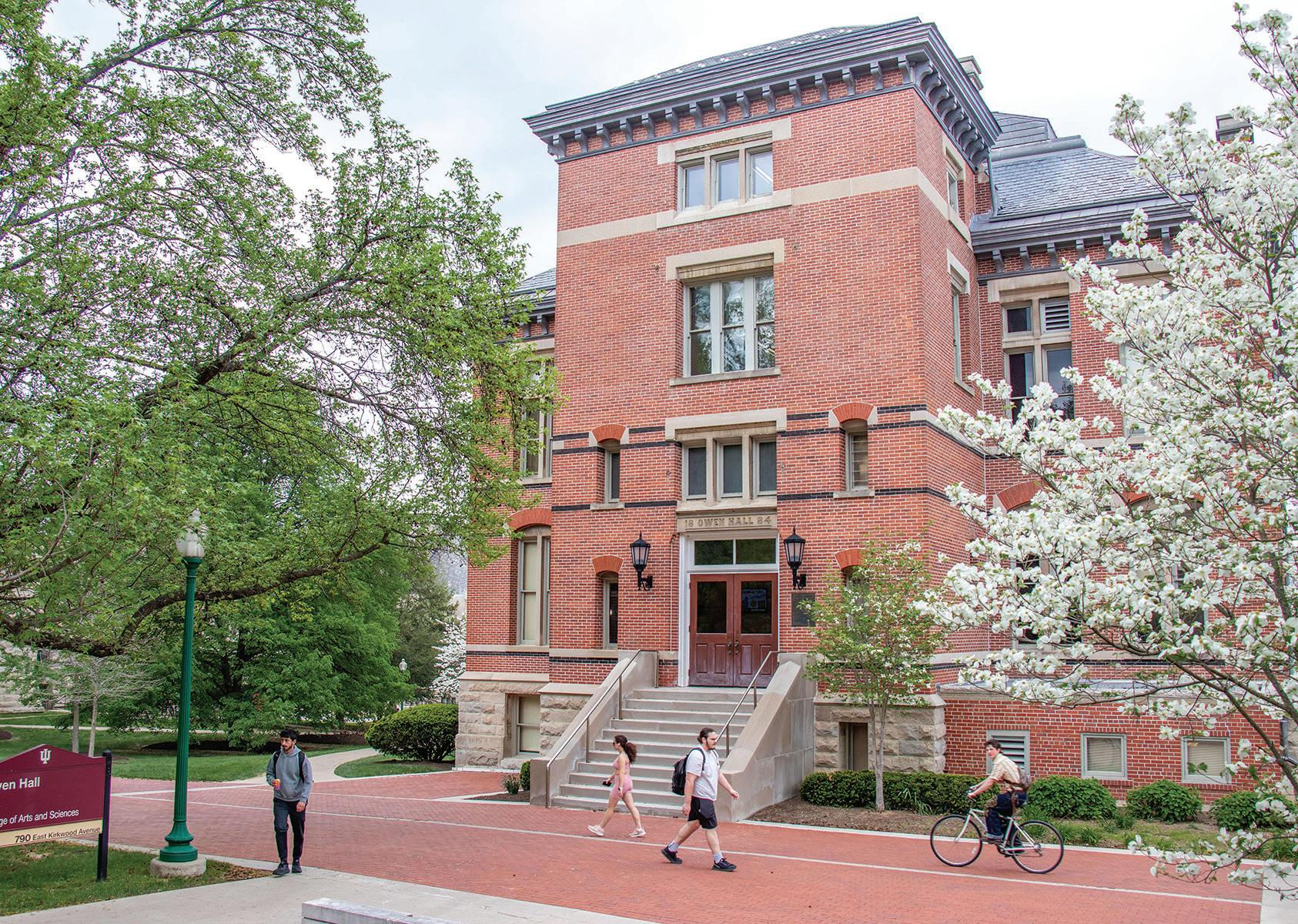
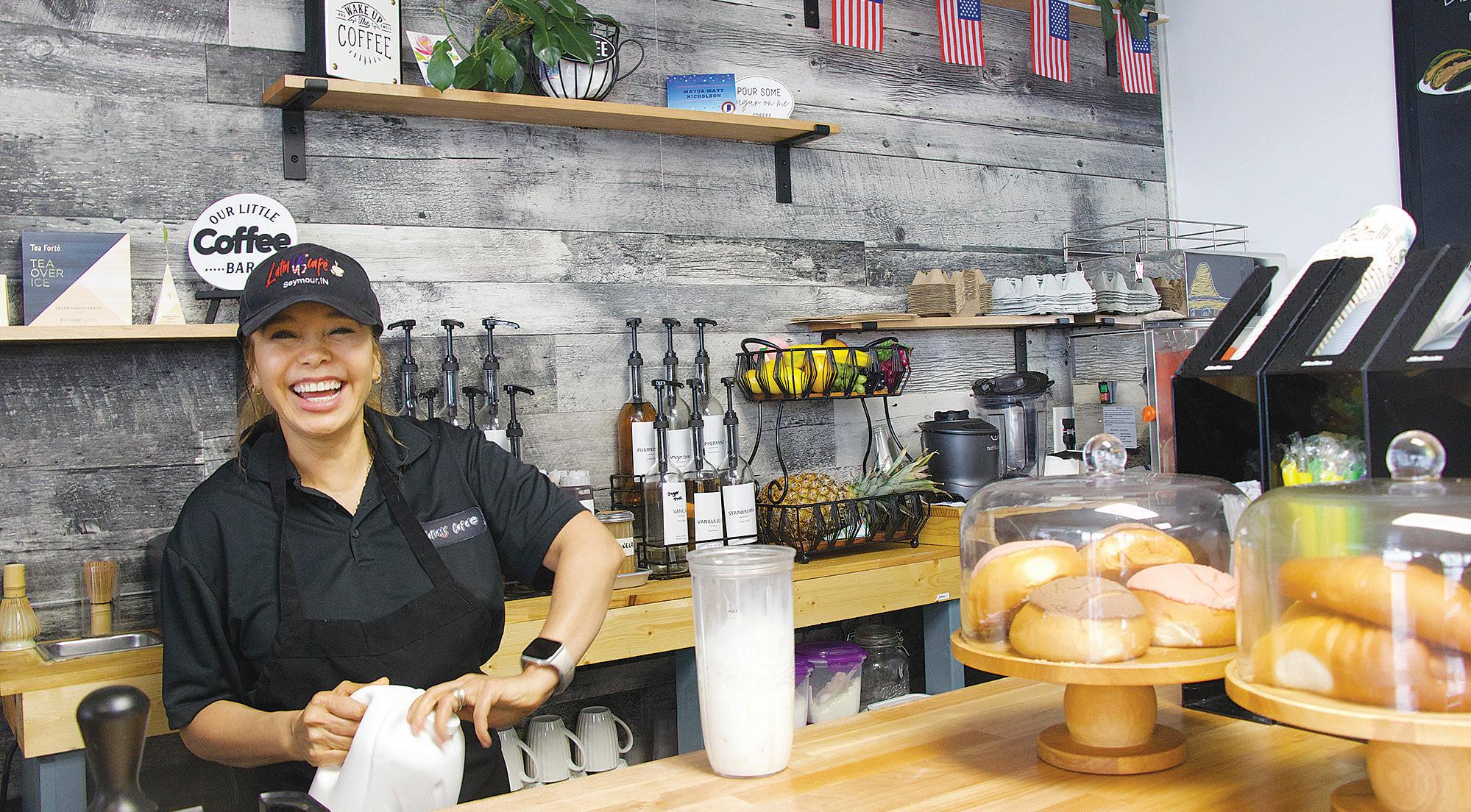
Isabel Ponce mixes a strawberry-flavored
at Latinus Cafe in Seymour, Indiana. She opened the cafe in 2025.
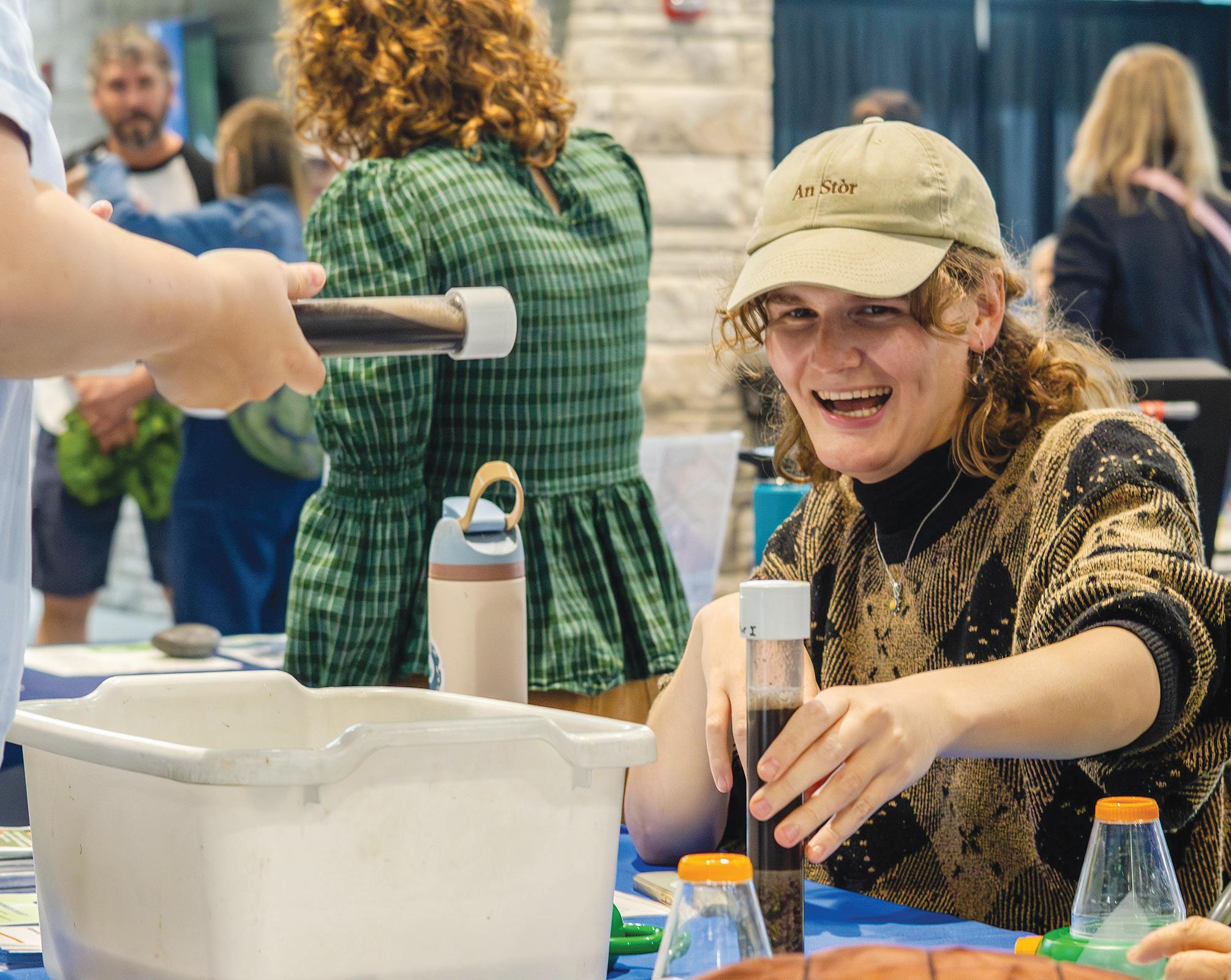
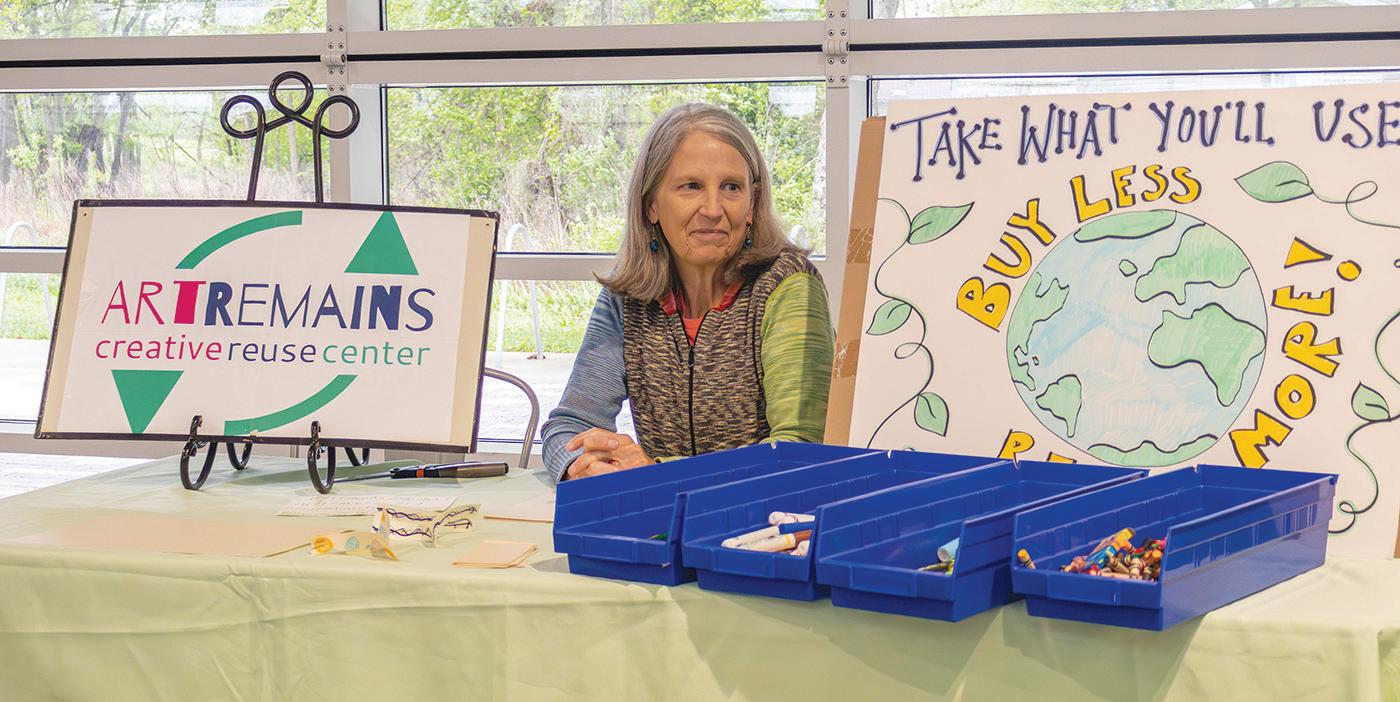
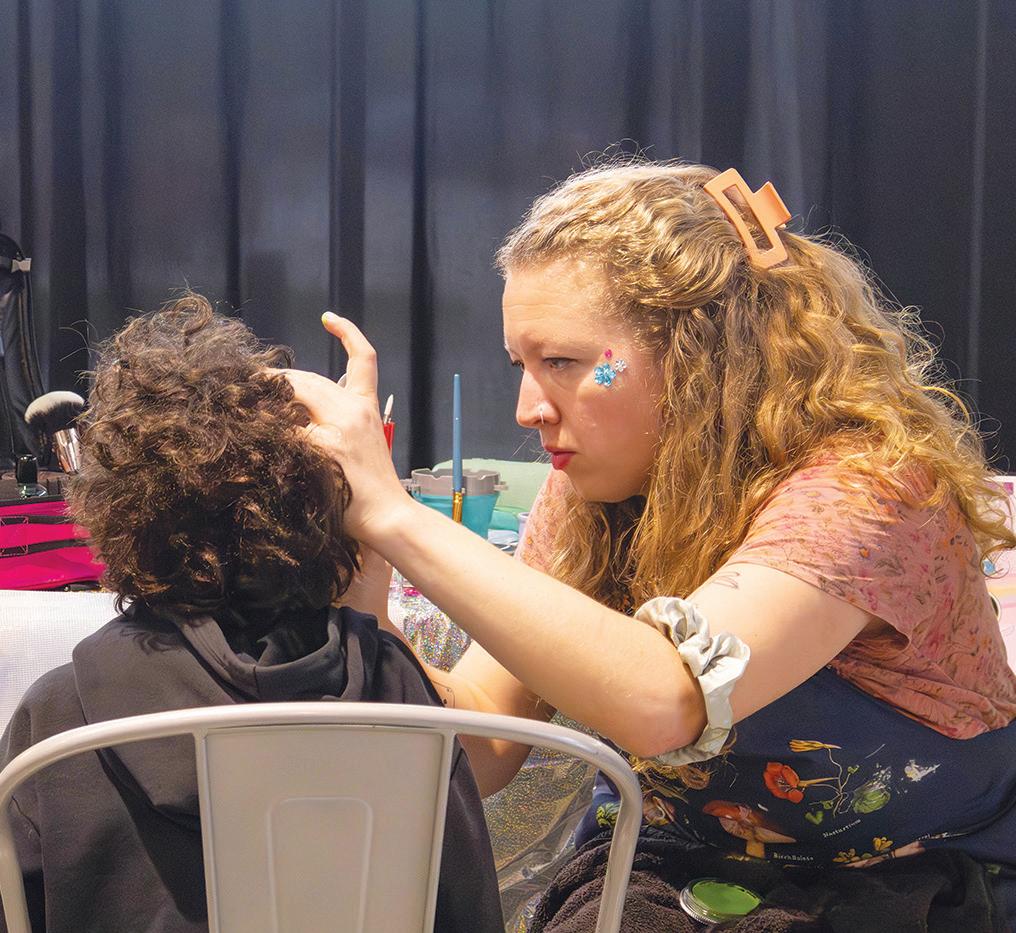
Bloomington Celebrates Earth Day 2026
Find your polling place for the 2026 primary election
By Chloe Oden chloden@iu.edu | @chloeoden0
In just under two weeks, voters will head to the polls for the 2026 Indiana primary election and cast their ballots for candidates running for local, state and federal offices.
Offices up for election include county assessor, commissioner, clerk and prosecutor seats, as well as representative seats for Indiana House District 61 and Indiana’s 9th Congressional District.
Early voting in Monroe County opened April 7 and takes place at the Election Central site at 501 N. Morton St. The last day to vote early is May 4 at noon, and on May 5, official primary voting begins. Which of Monroe County’s 28 polling locations voters can use depends on their registered address.
Voters can check what precinct their address is in
by using the Monroe County Voter Information Map. Indiana University Students living in Bloomington precincts 5, 18, 19 and 23 can vote at the Indiana Memorial Union at 900 E. Seventh St. Registered voters can also find their polling location and times by visiting Indiana’s voter portal at indianavoters.in.gov, clicking “Find Your Polling Place” under “Voting Location” and entering their name, date of birth and county of registration. The Indiana Voting Information Tool also allows users to find a designated voting location by searching the address where a voter is registered. At the polls, voters must bring a photo ID issued by the State of Indiana or the federal government. Voters planning to cast their ballots by mail must apply for an absentee ballot by 11:59 p.m. April 23. The county election
board must receive absentee ballots by 6 p.m. May 5, unless a voter is overseas. People voting by mail from overseas must send their envelopes by May 5, and they must be received by their registered county by 12 p.m. May 15. In- and out-of-state college students can choose to register to vote using the address they live at while attending school or the address they live at while not attending school.
Baron D Hall, DDS, MSD Jake
Willhite, DDS, MSD Orthodentists
Erica Hall, Hannah Elliott, Kaitlyn Jacobs, Marilyn Lee, Adrian Price
With modern techniques and a fun style, B-town Orthodontics is the most up-and-coming orthodontics
including invisalign, gold brackets, laser treatments, and even mini implants that can help restore missing teeth and even eliminate the need for surger y consultations and don’t forget to download The Braces App, the hottest free app designed by B-town Orthodontics’ Dr Baron Hall.
Tue - Thu.: 8:30 a.m - 4:30 p.m Lunch 12:30 p.m - 1:30 p.m. Mon & Fri.: Appointments Only 1320 W Bloomfield Rd., Suite B 812-287-8851 btownorthodontics com
Ryan D Tschetter, DDS Lauren R Hoye, DDS Jackson Creek Dental is conveniently located on South College Mall Road Most insurances accepted, including the Indiana University Cigna Insurance plans as well as the IU Fellowship Anthem state of the art
while atmosphere.
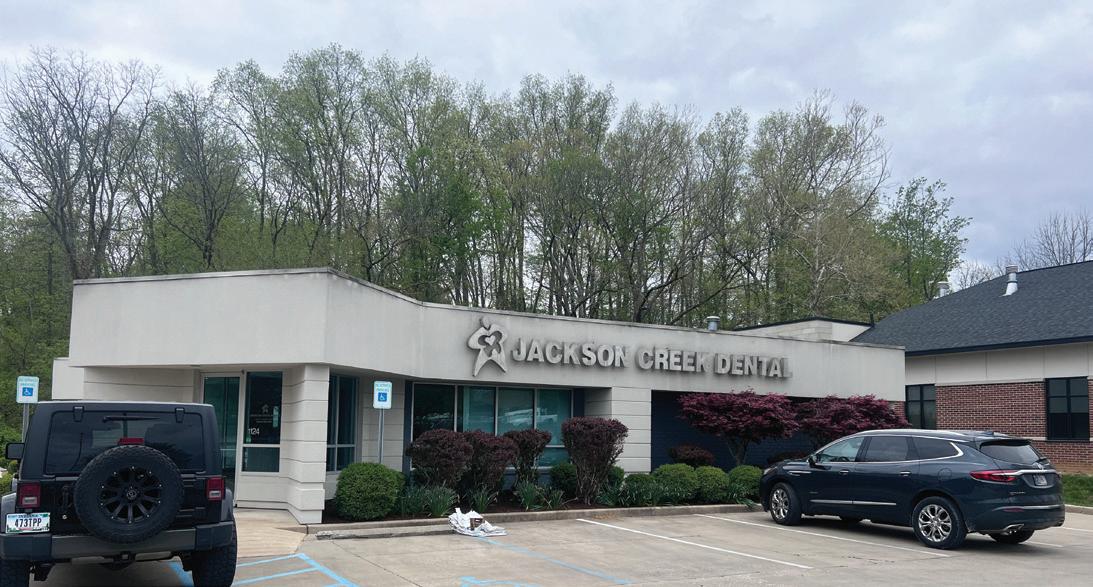
Mon - Thu.: 7 a.m - 5 p.m. Fri.: 7 a.m - 3 p.m. 1124 S College Mall Rd. 812-336-5520 jcdsmiles com
Providing individuals, couples and family counseling as well as psychiatric evalutation and medication management We ensure that individuals of all ages, experiencing mental illness can better manage life.
Mon - Thu.: 9 a.m - 6 p.m. Fri.: 9 a.m - Noon 5010 N Stone Mill 812-929-2193 newoutlookcc org
Ricardo Vasquez MD Medical evaluations: varicose veins, leg pain and swelling No refund needed
Mon Fri.: 8 a.m - 5 p.m.
815 W Second St. 812-336-6008 vascularcenterandveinclinic.com
Dr Starr is an IU Football Alum who provides pain-free experiences for all Hoosiers with IV sedation He specializes in Wisdom Teeth Extractions, Dental Implants and Plasma Therapy while utilizing 3D imaging technology Accomplish fast and predictable healing with Plasma Therapy to avoid dr y sockets after extractions Voted the Most Trusted in Bloomington, they look for ward to accomplishing continued successful results ever y day for all Hoosiers. Go IU!
Mon - Thu.: 8 a.m - 5 p.m. Fri.: 8 a.m - 4 p.m. 473 S Landmark Ave. 812-318-1023 starroralsurger y com
helping patients reduce stress, improve mobility and spinal health The quality treatment we provide is always fit to your individual needs and goals Let us help you achieve and maintain good spinal health We look for ward to meeting you!
Mon - Thu.: 8 a m - 6 p m. 1121 W Second St 812-336-2225 bloomingtonchiropractor com
Dr. Andrew Jones, OD Dr. Marzia Zamani, OD Dr Mark Houser, OD Dr Tavel Family Eyecare is your partner in your personal eyecare journey Since 1940, the company has believed that ever y Hoosier deser ves quality eyecare and vision
exams, special testing, management of eye diseases, glasses, contact lenses and much more, all backed by an insurance acceptance guarantee The company is committed to advancing eye health by investing in the latest technology and providing treatements that are right for ever y patient’s unique needs.
Mon.: 7:30 a
Jan Taylor-Schultz
IDS FILE PHOTO
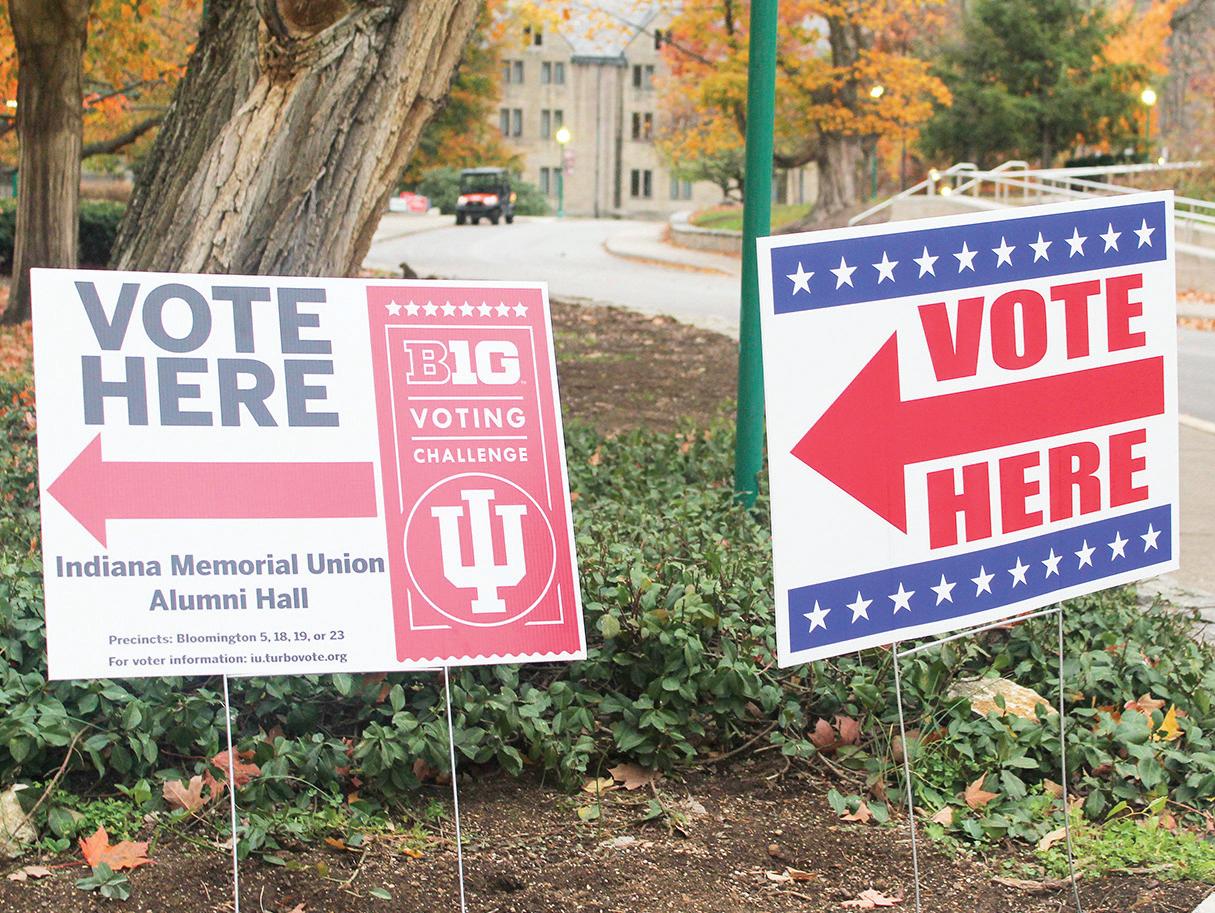
Two signs directing voters toward the polling center inside Alumni Hall are pictured Nov. 5, 2024, outside the Indiana Memorial Union in Bloomington. Early voting in Monroe County opened April 7 for the 2026 Indiana primary election.
Find your local polling place in Monroe County
IU’s dining hall hours don’t work for students
Samantha Shanker (she/her) is a freshman studying media advertising with a minor in business.
On Tuesdays and Thursdays last semester, Veer Talreja, a freshman living at McNutt Quadrangle, wouldn’t get back to his dorm until almost 9 p.m. He was tired and hungry by the time he returned after a long day of classes. However, by the time he was ready for dinner, Talreja said McNutt Dining Hall was closed, leaving him stranded for food options.
Dining halls are many students’ main source of food, especially for those who live on campus. Because IU’s dining halls close at 9 p.m. or earlier on weekdays and 8 p.m. on weekends, many students with demanding schedules, like Talreja, lack meal options when they most need them.
“I was left buying dinner from DoorDash almost every night,” Talreja said.
Emma Howard (she/her)
is a sophomore studying journalism.
A sticky-fingered child with an iPad, coming soon to a location near you!
We’ve all seen it, the tablet screen, also known as the 21st century’s answer to the pacifier. When children are constantly given a source of stimulation to soothe their boredom — cue the “CoComelon” — they lose out on the ability to sit with their own thoughts and selfreflect in an essential way during their formative years. Lonesome has now become a problem to be solved, and our phones provide just enough connection to satisfy the mind. The addictive nature of such devices and the social media they present is correlated with depression, anxiety and other mental health issues among adolescents. But tech companies aren’t alone to blame. In a landmark case this March, technology conglomerates Meta and Google were found liable for negligence by a California jury, citing carelessness over harmful design features. A user alleged the companies’ addictive formatting led to their mental health challenges and sued the companies. Now the companies owe the plaintiff a combination of $6 million in compensation. And yes, platforms like Instagram, Facebook and YouTube all operate on an endless-scroll system, strategically designed to addict users. For that, they should be held accountable.
But despite the many petitions from teens, parents and schools against social media outlets, they aren’t going anywhere. The everlasting algorithms are still generating stacks of cash, and in the United States, current laws do little to regulate social media companies. Under Section 230 of the Communications Act
Ordering outside food often took a toll. Assuming Talreja spent around $15 per meal on DoorDash two times a week, he added roughly $600 a semester to the roughly $5,500 meal plan he already paid for.
IU says it prioritizes student health through various wellness services. Current dining hall closing times, which can leave students hungry or spending their own money on food that may not be sufficient, do not align with that priority. For IU to meet its responsibility to keep its students healthy and happy, administrators should extend dining hall hours.
In my first semester, my classes ended at 8:30 p.m. When I reached my nearest dining hall after classes, it was closing, with employees having already taken away most of the food. So, like Talreja, I ordered meals to my dorm multiple times a
week, spending almost $600 extra during that term. This habit was unsustainable on top of the meal plan that I, like all IU freshmen, was already required to purchase. If the dining halls were open even an additional half hour, I would have saved a lot of money last semester.
However, some students don’t take issue with dining halls’ current hours.
“Being open until 9 itself is very late,” Tutku Sabuncu, another freshman, said.
“Most traditional American families from Indiana eat dinner from 5 to 6 p.m.”
Sabuncu said students who leave class as the dining halls close can use their meal swipes to get food from campus restaurants before their late classes to reheat or save for later.
There are many restaurants on campus, including the poke bowls in Hodge Hall, food court in the Indiana Memorial Union, and
Yalla in the Godfrey Graduate and Executive Education Center. However, these restaurants close no later than the dining halls. In fact, most of them close somewhere between 3 p.m. and 8 p.m.
“You have to consider it from the perspective of the workers who are working these long hours,” Sabuncu said.
Extending dining hall hours would cost the university additional money through spending more on wages for workers and extra food, while only a small population may use the dining halls past 9 p.m. Additionally, the workers may feel burnt out if they were to work more hours with classes the next day. To compensate employees for this extra workload, IU might have to increase the cost of meal plans per semester if it were to extend dining hall hours. However, if the university were to invest in keeping the
dining halls open a bit later, it could be worth it to save the students from spending so much of their money ordering food. There is an alternative option: shared kitchens in IU residence halls. Some of the dorms, including Walnut Grove, Willkie, Spruce Hall, Collins LLC, Ashton Center and Teter Quad, offer kitchens or kitchenettes for floor-wide use. But not every building offers the amenity of a kitchen. My residence hall, McNutt, for example, doesn’t have a kitchen. Right now kitchens are not a universally accessible solution to dining hall access. Ultimately, the campus hours are a complex issue with sensible arguments on both sides. While concerns about staffing, cost, and practicality are important to consider, they don’t fully address the challenges many students face in their schedules. Students are balancing
Parents, a more nuanced approach to tech exists
of 1934, media providers and users cannot be held liable for information distributed by another person on the same platform, which means companies generally cannot be sued over content. The media will not reform over a lawsuit, especially when the legal action one can take against it is limited. Simply, you cannot realistically expect tech companies to safeguard your children. However, you can educate yourself on the workings of social media and teach your kids how to use it responsibly. It’s essential to know the risks. Of course, there’s the danger of the content itself. According to a 2023 American Academy of Pediatrics survey, around 15% of children reported seeing sexually explicit content online under the age of 11. The problem extends beyond what material children can access. On the internet, users become accessible, too. In 2024, an estimate of 300 million children globally were subjected to online solicitation, offences ranging from unwanted messages to image-based sexual abuse. One in nine men — around 10.9% — in the United States admit to committing an online sexual offence toward a child at some point. Sexual exploitation ties into a larger phenomenon of cyberbullying. Nearly half — 46% — of teens aged 13 to 17 face it in some form. Children aged 10 to 16 years who have accessed or shared sexually explicit, violent or hateful content are reported to have a 50% higher risk of suicidal ideation. Unfortunately, a lack of awareness about these risks heightens them. What more danger could a tiny screen pose than the outside world? Because phones and other tech can be used within the safe walls of home, many parents are unsuspecting of the dangers that internet ex-
posure poses.
A 2025 IPSOS survey showed two in three kids aged 5 to 16 have access to the internet inside their bedroom. Meanwhile, about one in seven parents said they are not confident they know what their child views online.
The downsides of the internet expand beyond those initial threats to safety. When kids grow up with this technology during their formative years, it changes how they develop social skills. Digital messaging gives us connection at our fingertips. Want to chat? Shoot off a text. But the downside is that with easy connection, we aren’t being as authentic as we could be.
Because computer mediated communication allows us to edit how we present ourselves to others, we only get the most polished versions of our correspondents. The result is the instant gratification of companionship, without the challenges that could ultimately build a fruitful relationship. There you have a “just right” middle ground between being social but not exerting oneself too much. Sherry Turkle, a social psychologist at the Massachusetts Institute of Technology, refers to this as the “Goldilocks Effect.”
When kids experiencing the awkward stages of adolescence crave social connection, the accessibility of technology is all the more enticing.
“Tech appeals to us most when we’re most vulnerable,” Turkle said in a TED Talk. We all know kids are about the most vulnerable people on the planet. Not only are they legally dependent on adults for support, they are still developing as people. Middle school, for example, is about the most raw, unfiltered epoch of embarrassment in the human experience. As kids and
long classes, jobs, and extracurriculars that may last until the evening. Keeping dining halls open until 9:30 p.m. would help make campus life a little easier for a lot of students. According to the website for the Office of the Registrar, IU offers a 50-minute class block that ends at 8:45 p.m., and a 75-minute class block that ends at 9:55 p.m. By the time students enrolled in one of those blocks get out of class, they’d be without dining hall options. If IU is holding classes until such late hours, they should ensure those students can access food once they’re finished learning. If IU cares about supporting affordability, accessibility and health on campus, it should push back dining hall closing times. That small change could make a big difference.
sjshanke@iu.edu
teens build relationships while they try to make sense of the world, tech preys upon them by providing an easier option. By having comfortable control over how they present themselves online, they can’t develop critical social skills they’ll need in adulthood. When even toddlers get non-stop stimulation from tablets and games, boredom becomes practically unbearable. Being alone becomes a problem when we are granted access to so many people through social media. Take a road trip for instance. Time once taken to gaze out the window in a daydream is now spent hunched over a tiny screen. By not learning the art of entertaining oneself, kids are not thinking in ways that are essential to personal growth.
“What am I going to eat for lunch?” could, with time, become, “What is the meaning of life?” Thinking, no matter how simplistic, is a must. Let those babies ponder! So, yes, technology and the internet pose many risks, especially for children and adolescents. Yet, it would be naive to assume that social media and tech companies will work toward improvement over a lawsuit. Especially considering how difficult it is for such a case to make it to court. I, as much as anyone, would love to see someone like Mark Zuckerberg pay the piper. I just wouldn’t bet on it. Alternatively, parents can be the safety net for their own children. In a perfect world, I could easily say throw away the screens
ILLUSTRATION BY EVELYN STRAUSS
and it will be sunshine from there on out. But given how widespread that tech is, being used from the classroom to the workforce, it’s essential that they are given the tools to use it responsibly. Have an honest conversation with your children about cyberbullying, graphic content and internet safety. Since you know the risks, they should too. Monitor their screen time and make sure you have a firm understanding of what media they are interacting with. Simply handing them an iPad and relying on a largely unregulated system to keep them safe and well-rounded is not enough. Be in the know, keep them in the know and restrict where you can.
emhowa@iu.edu
DAVID PEARLMAN | IDS
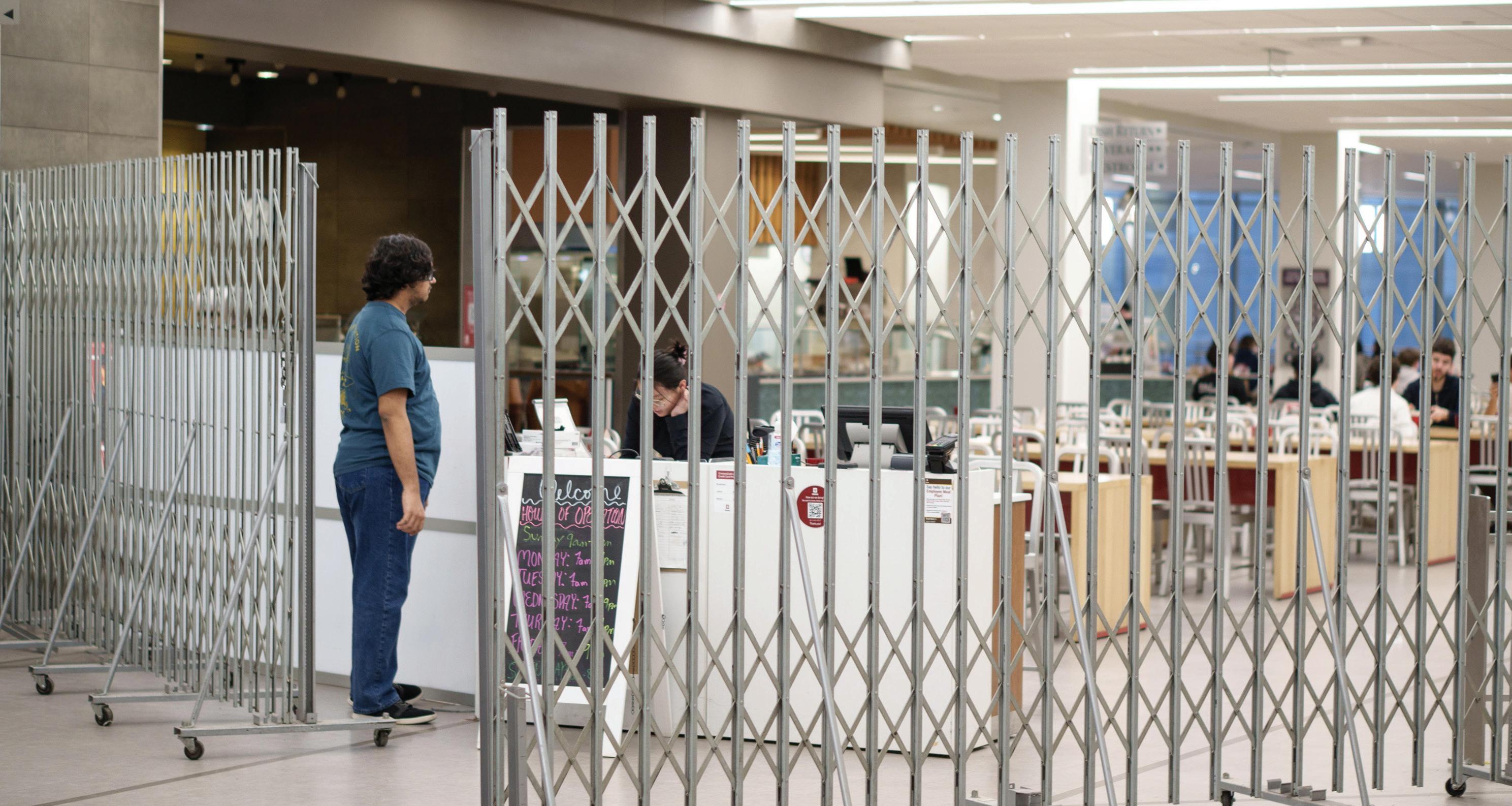
A student stands outside McNutt Dining Hall on April 5, 2026, in Bloomington. The dining hall closed at 8 p.m.
Jacobs honors the 100th birthday of Myron Bloom
By Addison Jacoby agjacoby@iu.edu
The year is 1938. Benjamin and Emma Bloom take their 12-year-old son, Myron, to a concert in Cleveland featuring cellist Emanuel Feuermann.
Leaving the concert hall, Myron knows exactly what he is going to become in life: a musician.
And a musician he became, swiftly beginning his 81-year-long relationship with the art form. Throughout his long life, Myron Bloom was appointed principal solo horn of the Cleveland Orchestra and later professor of horn within the Jacobs School of Music at IU from 1985 to 2016.
Bloom passed away in 2019, leaving behind a distinguished legacy through his family, recorded music and former students.
Now, seven years later, Bloom’s legacy continues.
David Renfro, one of his former students, organized a concert April 17 at Auer Hall in honor of what would have been Bloom’s 100th birthday the next day. The concert exclusively featured former students and family of Bloom, with a few current Jacobs students helping behind the scenes.
“The concert represents generations of his students,” Renfro said. “His legacy as a musician, let alone a horn player, is so large that I hope attendees of the concert walk away with a deeper appreciation of people as a performer, as an educator.”
Renfro said the repertoire featured within the concert naturally came together as more of Bloom’s
former students joined the project. He began organizing the concert because he felt there should be more events and honorariums for his mentor.
Contacting Bloom’s former students and sifting through IU’s registrar’s office dating back to 1985, when Bloom began working there, proved to be a challenge. Records only became digitized in 1994, so Renfro was only able to contact those who studied under Bloom from that year on.
“So, then it was just a matter of tracking them down through Facebook and looking them up online and writing to people to see who would be interested,” Renfro said.
All nine pieces featured throughout the concert included someone closely connected to Bloom, with Bloom’s former student Gwyn Richards beginning the concert with Howard Stoess’ “Sonata, Prelude” (2014). The piece, she said while onstage, was a solemn dedication to his work within the later years of his life.
Between pieces, Bloom’s audio recordings with the Cleveland Orchestra played through Auer Hall, while the projector showcased a slideshow of photos from his life. The recordings featured audio from Franz Schubert’s “Auf dem Strom, D. 943” (1828) and Johannes Brahms’ “Trio in EFlat Major, Op. 40” (1865).
Additionally, Richard King, a Cleveland Orchestra member and one of Bloom’s former students, took the microphone in the middle of the concert to speak of his late teacher’s legacy.
King is one of Bloom’s successors as the principal solo horn of the Cleveland Orchestra.
“We’re all, like, a culmination of everything that’s come before us,” King said. “I feel very much like his teaching and his spirit lives on in our generation, hopefully from there to come.”
The last piece, David Popper’s “Requiem, Op. 66” (1892), featured Bloom’s widow, Susan Moses Bloom, on the cello accompanied by two other cellists and a pianist.
Before beginning the piece, Susan took to the microphone, telling the story of her relationship with her late husband, recalling when they first met in 1994. The couple was engaged within the year and married in 1996.
“I met him because, during his sabbatical leave here, he wanted to study cello,” Susan said. “And so, we met, and after a very, very short period of time, he said, ‘I waited for you my whole life. Will you marry me?’”
As “Requiem, Op. 66” came to a somber end, the dim house lights of Auer Hall brightened. Audience members began to rise, chatting with one another about Bloom and their relationships with him.
Richard Seraphinoff met Bloom in the mid-1980s, then was working with him in the Jacobs horn department by 2000. The two grew closer, and Seraphinoff eventually chose Bloom to be the best man at his wedding and walk his wife down the aisle in 2003.
Thinking of his colleague and friend, Seraphinoff said
he remembered Bloom for his enthusiasm and love for the horn.
“He was very enthusias-
tic about the true, beautiful sound of French horn music being very physical and not just, you know, making time,”
count.”
COLUMN: ‘Lee Cronin’s The Mummy’ favors imagery over nuance
By Josh Baskin joshbask@iu.edu
Following the financial success of “Evil Dead Rise,” Lee Cronin took on a new challenge with his terrifying reinterpretation of a mummy movie, released April 17. Unlike his past film, I think Cronin bit off a bit more than he could chew with his take on the monster. While Universal Pictures owns the rights to its specific iterations of the mummy monster, which dates as far back as 1932, the general concept of mummification is open for anyone to make a film about.
Unfortunately, “Lee Cronin’s The Mummy” was released at a very awkward point in time; Universal announced earlier this year that its “The Mummy” franchise, starring Brendan Fraser, would be getting a fourth film. This led to confusion for fans, as many were unsure if this film would be connected to the franchise. Lee Cronin, the director, confirmed this was one of the driving factors behind putting his name in the title to remind audiences of its distinction from the other films.
I had never seen any other mummy films before Cronin’s, so I was open to seeing
By Michael Sigal msigal@iu.edu
a darker approach than what others may have been used to. Alongside this, as a big fan of the “Evil Dead” films, I loved Cronin’s take on the franchise and was excited to see whichever horror project he would make next.
“Lee Cronin’s The Mummy” begins in Egypt, where Charlie (Jack Reynor) works for a local news station and is looking after his children while their mother, Larissa (Laia Costa), is away at work. Their daughter, Katie (Emily Mitchell), is playing in the garden when she is kidnapped by a mysterious woman who lures her out with candy.
Following the kidnapping, there isn’t much time spent in Egypt with the family, aside from the opening of the investigation, when the lead detective suspects the parents may be responsible for the crime. The film quickly jumps eight years into the future, with the family relocated to New Mexico, now living with Larissa’s mother (Verónica Falcón).
With such a shocking moment for the family, I would have liked a few more scenes immediately after the disappearance to show how they emotionally process the sudden abduction of their daughter. We get an awk-
ward family dinner scene when they are first shown in New Mexico, but the dialogue is so forcefully packed with emotional turmoil, which would’ve been much more fitting for a conversation sooner after Katie’s disappearance.
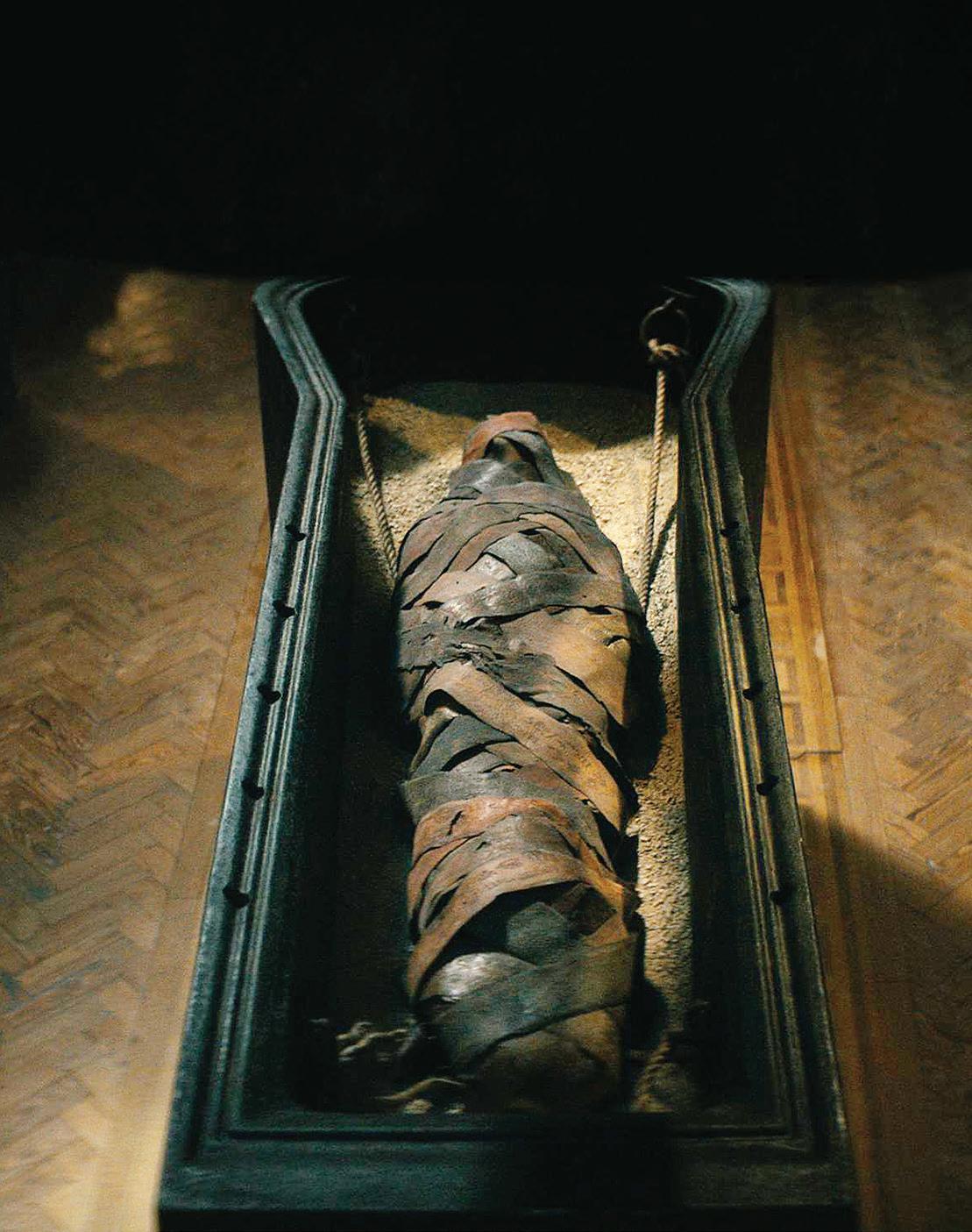
The film picks up its energy when an older Katie (Natalie Grace) is discovered alive in a sarcophagus found in a plane wreckage near their old home in Egypt, and the family reunites with her. From the first sight of Katie, it’s clear she has undergone serious transformations, with her entire body wrapped in parchment fused to her skin, inscribed with ancient texts, which serve to bind the entity possessing her. Larissa and Charlie attempt to interact with Katie, but she’s in a catatonic state, unable to move or speak.
While it’s understandable for her to be in this state, it made it difficult for Katie to be a terrifying character, since she presumably cannot charge toward people or frighten them with words. Cronin worked around this by having Katie secretly move around when the family least suspects, targeting individuals to possess or kill.
Personally, this was not enough to frighten me, as
I am someone who gets scared by sudden, loud jump scares, as opposed to the calculated nature of Katie’s character.
Following Katie’s return, the film splits into a dual narrative with one side focused on the havoc Katie wreaks on her family and the other back in Egypt, where Dalia (May Calamawy), a detective, looks for a breakthrough in the abduction case.
I found Dalia’s detective work to be one of the most engaging aspects of the film, which makes me wonder whether the overall movie could have worked better if Cronin had placed greater emphasis on the mystery rather than its horror elements.
The jump scares may not have been anything groundbreaking, but Cronin certainly knows how to use the gross factor to terrify his audience.
Many scenes with Katie’s deteriorating body caused me visceral reactions. The combination of closeup shots and sounds was enough to make me squirm in my seat.
Cronin’s visuals may be his greatest strength in the film, but Katie and the other possessed family members
act strangely similar to “deadites,” the demons from the “Evil Dead” universe, expelling various liquids and using explicit language to antagonize others. Although I enjoyed this type of evil spirit in Cronin’s “Evil Dead” film, I would have liked to see a different kind of de-
monic entity here, since the mummy is such a different concept. While Cronin’s interpretation of the mummy may not have resonated with me as much as I hoped for, I can appreciate his effort to try something new within the horror genre.
COLUMN: 5 classics to read as the flowers bloom this spring
A different kind of clarity arrives when the spring rolls in, as buds open, paths dry and windows lift. Reading also seems to shift with the seasons. The dense and cold novels of winter give way to books that breathe more with stories that stretch into gardens, landscapes and long walks. April and May call for literature that participates in renewal.
While today’s releases often dominate seasonal reading lists, there is something sentimental about returning to the classics that carry this sense of seasonal awakening. These books understand springtime as a transformation rather than just a setting.
“The Enchanted April” by Elizabeth von Arnim
There may not be a more perfectly timed novel for April than “The Enchanted April.” Set in the aftermath of a gray, rain-soaked London winter, the story follows four women who impulsively escape to an Italian castle for the month. What begins as a simple change of scenery slowly becomes something more restorative. Von Arnim’s novel is adaptive to the smallest shifts, like the warmth of sunlight on skin, the scent of wisteria or the quiet reawakening of joy. The transformation here is gradual, mirroring spring itself, instead of being overdramatic. The book reminds readers that sometimes renewal does not require reinvention, only the right conditions to emerge.
“Anne of Green Gables” by L. M. Montgomery If spring could take human form, it might look a
lot like Anne Shirley. From the time she arrives at Green Gables, Anne transforms her surroundings with an interest in language and the beauty of imagination, turning ordinary places into something bright.
What makes “Anne of Green Gables” such a timeless read is its optimism and attentiveness. Anne notices everything, from the way light filters through trees to the emotional texture of a place. Her perspective gives a second look at everything, aligning perfectly with the spring season when the familiar world begins to feel new again.
“A Room with a View” by E. M. Forster In “A Room with a View,” the transition from cold to warmth is both literal and emotional. The novel begins within the rigid and carefully controlled social world of early 1900s England before
opening outward to the expanses of a sunlit Florence. Forster uses this shift in setting to take apart the constraints that his characters deal with. Under the Italian sun, emotions that were suppressed begin to surface and decisions that felt unthinkable become inevitable. The novel captures the feeling of stepping out of winter layers —both emotional and physical — and discovering what remains underneath them. More than anything, the story is about the courage needed to follow that warmth wherever it leads.
“Emma” by Jane Austen
While “Pride and Prejudice” often takes center stage, “Emma” carries a distinctly late-spring atmosphere. The novel unfolds largely outdoors, in gardens, along walking paths and across carefully
planned social visits that mirror the rhythms of the season. Austen fills the book with moments of brightness, like strawberry pickings, leisurely strolls and sunlit conversations. She also reminds readers that clarity does not arrive altogether and at once. Emma Woodhouse’s misjudgments, especially during the ill-fated Box Hill picnic, reveal how easily warmth and ease can give way to discomfort. I have long considered this Austen’s best-written novel, with the prose and humor that she instills in her main character encompassing deeply profound and witty.
“Leaves of Grass” by Walt Whitman
For those who prefer poetry, “Leaves of Grass” offers something closer to immersion than narrative. Whitman’s work has an energy that
feels inseparable from the natural world, celebrating growth, movement and the physicality of being alive. Reading poems like “Song of Myself” or “Song of the Open Road” in April feels especially fitting. There is a kind of looseness to Whitman’s voice. Its expansiveness echoes the season’s unfolding. His lines move with nature, inviting the reader to do the same — a literary equivalent of stepping outside after a long winter. As the weather continues to grow warmer, remember to keep these classic stories in mind. Both Morgenstern Books & Café and Book Corner hold beautiful editions of these timeless tales, as well as many other novels perfect for your spring reading list. May the spring be bright and the season be filled with stories to open your doors and windows to the warm temperatures.
MOVIE STILLS DATABASE
A still from “Lee Cronin’s The Mummy” is pictured. The film released April 17.
Seraphinoff said. “He really made every note
COURTESY PHOTO
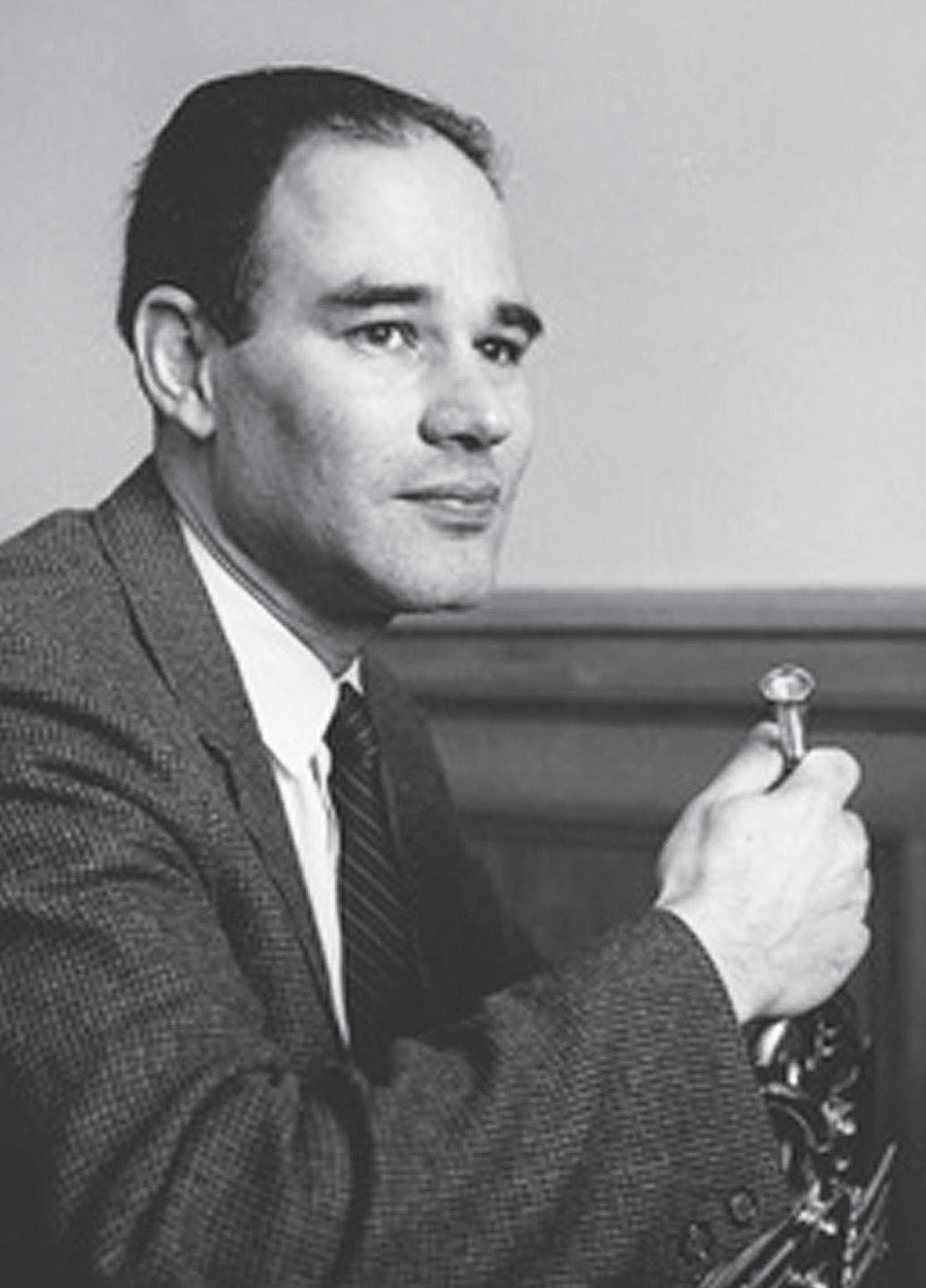
Myron Bloom is pictured. Bloom passed away in 2019.
4 5 1 3
By Mateo Fuentes-Rohwer matfuent@iu.edu
Judah Thompson’s face is covered in sweat. It drips from his hair to his forehead and straight down to the handlebars of his bike.
There’s no talking in the low-ceiling basement. The Hitachi 55-inch screen in the corner displays a broadcast of the 2025 Little 500 race. The pedaling is violent.
The 2026 edition is 84 days away. It may seem far. For Judah and the CUTTERS team, who have been training year-round, it’s almost nothing.
Judah drops his head and keeps driving his legs. He often goes nonverbal in intense workouts, whether it’s out on the streets or inside on the trainers.
The whirring of rollers cuts through the monotonous drum of the five fans.
The basement’s air was once nippy. Now it’s heavy with perspiration, an unpleasant aroma.
CUTTERS are training in the “CUTTERS house,” the unofficial headquarters of the winningest team in Little 500 history. After close to five minutes of intense, breakneck pedaling, ragged breathing takes over. Only Judah, the team captain, says anything.
“Nice job, first set done!”
5. Thompson sits on empty bleachers and poses for a photo after open practice April 20, 2026, at Bill Armstrong Stadium in Bloomington. Thompson will race in his last Little 500 race April 25. 2 The last race He reached the mountaintop in 2023. He’s eying another ascent in 2026
he says to the other six riders.
The workout is meant to replicate the nature of a Little 500 race. Judah has raced in three of them, never finishing below third. He reached the mountaintop in 2023. He’s eying another ascent in 2026.
Judah still pedals, his mind a blank wash. There’s no thought of the pain in his legs. Or the insults he’s heard from CUTTERS’ haters. Or the previous Little 500 races. All that’s in front of him is a wall — the one he’s determined to bike through.
Judah, 21, refused to smile when he finished in third.
Standing atop the platform, holding the 2025 thirdplace trophy and dressed in the skin-tight pink and white kit, he didn’t even crack a grin. He felt no satisfaction.
He had placed one spot worse than last year. Two spots worse than the year before that.
Judah’s competitive drive has made him want to pursue biking professionally, and he’s already competed in the U23 Union Cycliste Internationale Road World Championships in fall 2025. It’s the reason why he wasn’t happy finishing third — it wasn’t first. And yet, it took him
until his junior year of high school to start taking racing seriously, even though it enveloped his childhood.
Judah’s father, Paul Thompson, cycled in the Bloomington community. Jim Kirkham, CUTTERS’ head coach since 1997, knew Paul. In fact, Kirkham said everyone in the regional cycling community knew him.
Even though he loved biking, Paul never pushed Judah to bike competitively when he was younger. One of his first cycling memories was sitting on the back of Paul’s bike as his father rode through the hills of Indiana. Often, the rides would lull Judah to sleep. But swimming was Judah’s sport for 14 years, and he enjoyed it up through his senior year of high school.
“When I get on the track, you’re gonna see the greatest Little Fiver of all time.”
Judah Thompson, Little 500 racer
In 2020, as the COVID-19 pandemic quarantined people across the nation, Judah, then a junior in high school, picked up a bike. There was nothing for him to do other than be inside or be outside by himself, and the latter allowed for cycling.
Riding bikes quickly became Judah’s passion. He traveled the Midwest with a local team he helped start with a friend. He spent time with the Black Key Bulls squad his junior year, joining them for rides and hangouts. He also visited Phi Gamma Delta during a rush event before his first semester of college to inspect the setup of a fraternity team. But Judah’s heart lay with CUTTERS. He met Torin Kray-Mawhorr, a veteran rider who led CUTTERS to victory in 2023, in summer 2020, and the two clicked right away. As a hometown Bloomington kid, one who swam in the quarries just like the characters in “Breaking Away,” Judah’s fit with CUTTERS seemed perfect to Kirkham.
There was no coaxing. There was no elevator pitch or intense recruitment. Kirkham needed people on the roster who wanted to be there. That was Judah.
Early on, Kirkham’s vets, including Kray-Mawhorr, identified Judah as a natural. Judah was eager. He was strong. He had experience. But a successful Little 500 rider required more than that.
3.
4.
“Having that natural talent can disguise the fact that you don’t know what the hell you’re doing because you can just pedal hard,” Kirkham laughed. “So, Judah still had some stuff to learn because his natural reflex was just to pedal hard.”
Stress consumed Judah his freshman year. It grew partly from his need to prove himself.
During that time, he often awoke from night terrors, spotting a figure either in the corner of his room or standing over him. “Get the fuck off me,” he would scream before kicking, punching and sometimes running out of the room.
His heartbeat would intensify, pounding, but after a couple of minutes, he’d return to bed.
Judah doesn’t get the nightmares that often anymore. He attributed the change to numerous factors, including cutting out drinking and meeting his girlfriend, Sophie Boller.
After the 2023 qualifications, Judah’s night didn’t end until 3 or 4 a.m. The night of the 2026 qualifications was much different.
“Everybody was in bed by 10 p.m. that night,” Boller said. “Hung out with a couple of cyclists and stuff and stopped by the bars — no drinking involved.”
Judah doesn’t feel that stress anymore. The ego has separated from the confidence, he said, which came with both time and strong race results. Now, the internal pressure for results no longer weighs him down. It doesn’t mean complacency has seeped in. Judah has been striving for the top spot ever since he tasted it, and he isn’t ready to stop now, ahead of his final Little 500 race. If anything, the confidence has only grown.
“When I get on the track, you’re gonna see the greatest Little Fiver of all time,” Judah said to his coaches recently. Judah doesn’t need many motivators. The euphoric feeling of victory is something he couldn’t describe. It’s what he’s after this spring. However, Judah isn’t sacrificing anything within himself to achieve that goal. He’s still the goofy friend off the bike who cracks jokes and keeps things light. When freshman CUTTERS rider Leo Nelson crashed his bike on a practice qualification race, just four days before the real one, Kirkham raced to Nelson to make sure he was ok. Judah stood and watched with his other teammates, chiming in only seconds after the gasps subsided.
“I guess Leo found his speed limit,” Judah joked.
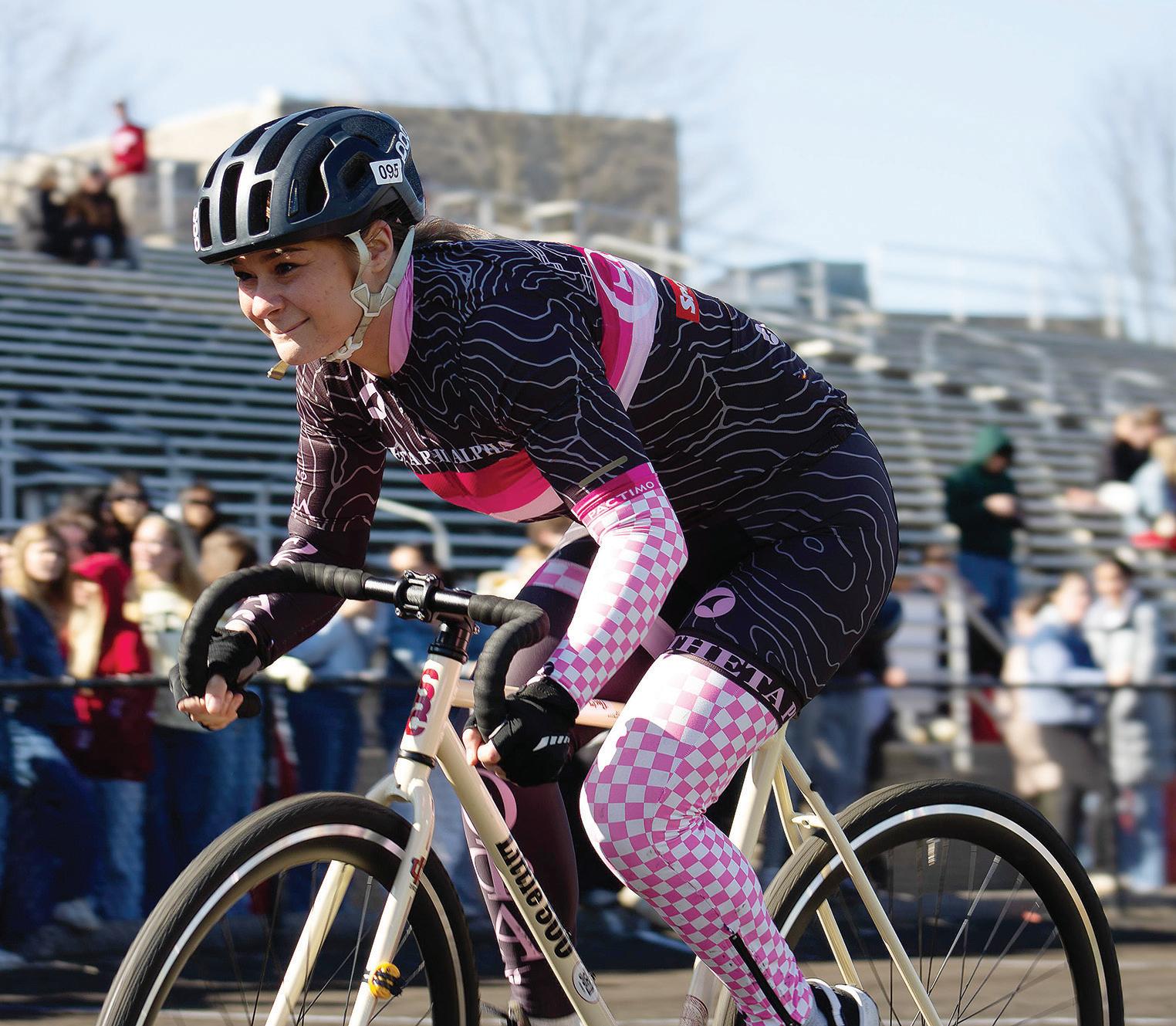
1. Senior Judah Thompson readjusts his sunglasses after a break during open track practice April 20, 2026, at Bill Armstrong Stadium in Bloomington. Thompson is a member of the CUTTERS racing team.
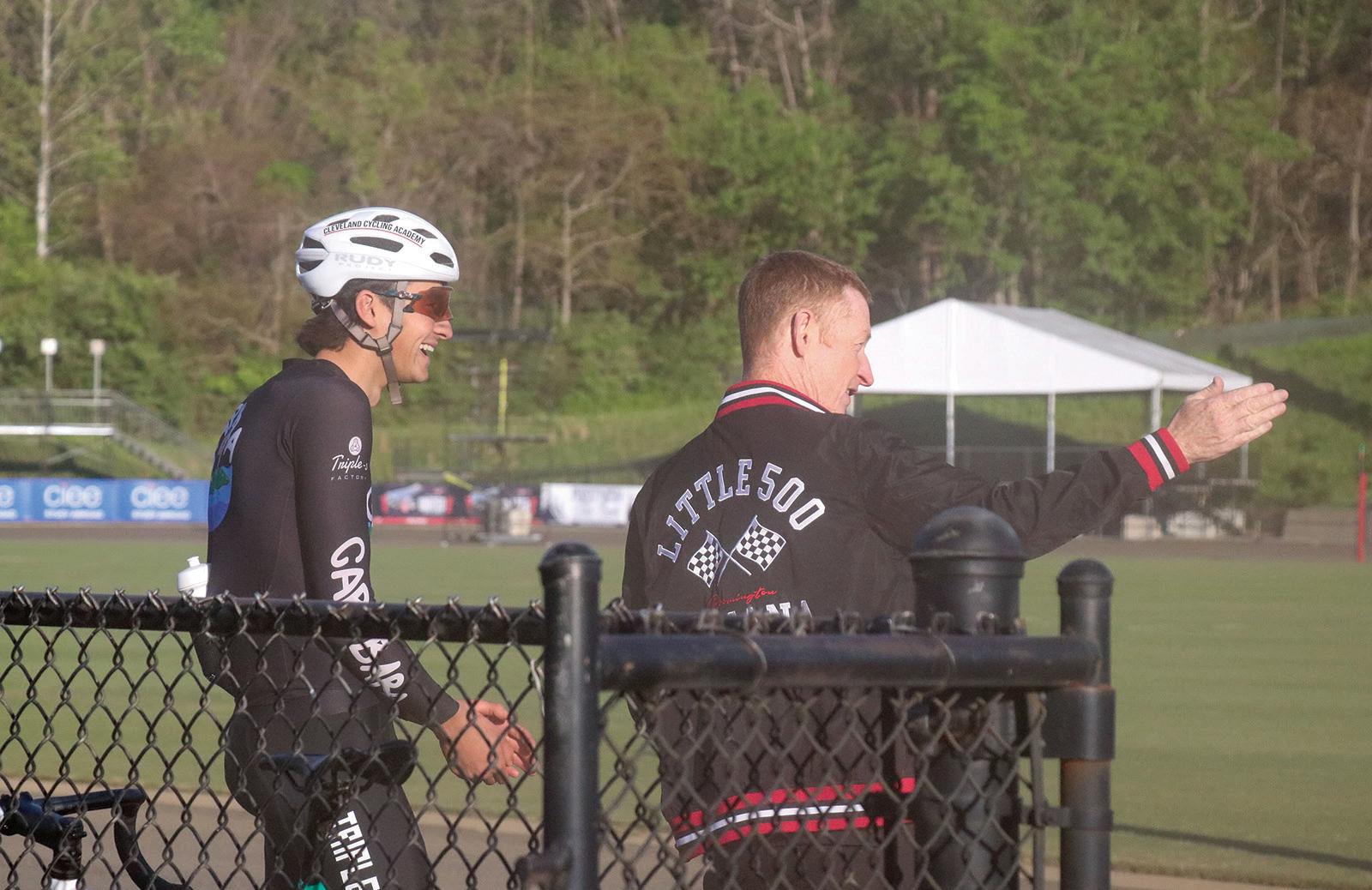
2. Thompson and CUTTERS head coach Jim Kirkham stand on the side of the track and watch the rest of the CUTTERS team race around the track April 20, 2026, at Bill Armstrong Stadium in Bloomington. Thompson joined CUTTERS his freshman year.
Thompson walks his bike off the track during open practice April 20, 2026, at Bill Armstrong Stadium in Bloomington. Thompson began biking seriously during the COVID-19 pandemic.
Thompson pedals through a turn during open practice April 20, 2026, at Bill Armstrong Stadium in Bloomington. Thompson He practiced for about an hour that evening and went slower than he typically would, aiming to get a feel for the track rather than test his speed.
PHOTOS BY EMERSON ELLEDGE | IDS
Nelson said Judah is fun to hang out with. He finds the fun in things, the freshman added. Jacob Koone, a CUTTERS teammate, considers him one of his best friends.
“He’s just all smiles from when we first met,” Koone said. On the bike, Judah’s a different animal.
Kirkham leans forward during a team breakfast Feb. 13 at The Inkwell Bakery & Cafe and looks at one of Judah’s teammates.
“Jake, I have a trick question,” Kirkham says. “How many laps is Little Five?”
“One,” senior Jake Zarov responds.
“Yes, that’s the answer,” Kirkham says. “One lap at a time.”
This mindset is part of what Kirkham has brought to CUTTERS since joining as a rider in 1990. He became the head coach ahead of the 1997 edition when the team held a modest four championships.
CUTTERS now have 15.
Kirkham’s teaching style is what he dubs the “CUTTERS process.” It starts the day after the Little 500 race each year. A summer circuit aims to get riders to grow or improve through unstructured training. The fall semester welcomes back old riders and new ones.
Then training intensifies around New Year’s. CUTTERS often takes a training trip to the Austin, Texas, area during winter break, which allows the riders to bond, train and focus on the Little 500.
It’s a different season entirely when the track opens in the spring, Kirkham said, one that requires remembering the basics of riding on a track for veterans or learning those basics for rookies.
Each year often features
a different set of riders. Sometimes Kirkham has dealt with four rookies; other times, he’s fielded four senior riders. The CUTTERS process doesn’t change. It’s why Kirkham believes CUTTERS has found success, along with his consistent presence in Bloomington.
It’s not about the trophy for Kirkham, and he hopes his riders believe that, too. He wants his athletes to know the time spent during the season wasn’t wasted.
“There’s life after victory — or life after victory and life after defeat, and Judah’s kind of learning those things, you know?”
Jim Kirkham, CUTTERS head coach
This isn’t to say Kirkham doesn’t care about winning. His new motivation tactic includes giving matchboxes with five matches inside to each CUTTERS rider. Each match represents a spring series — qualifications, Individual Time Trials, Miss N Out, Team Pursuit and the Little 500 race. The team burns one after every event. But ultimately, it all comes back to the CUTTERS process.
Judah loves the process — the life skills he’s made, the friendships he’s fostered and the self-discovery he’s undergone.
Kray-Mawhorr could have predicted Judah would fit the CUTTERS mold very early on. He saw himself in Judah, a hard-working freshman with a “sponge” approach to learning. Judah sees the same now with Leo Nelson, a freshman rider also from Bloomington. Judah had the talent in his first year, but he wanted to be better. He wanted to be the best. No CUTTERS rider had ever won four Little 500 races, and Judah
knew that. It was a record he wanted to break. He wanted those four wins to cement his legacy.
CUTTERS didn’t win in 2024 or 2025. Judah can’t break the record or even tie it. But as a four-year rider, two-time captain and twotime All-Star Rider, Judah’s still hunting for another victory.
Judah rounded turn four and spotted the white flag that signaled the final lap of the race. He reached the tough yet rational conclusion — CUTTERS wouldn’t be winning the 2024 Little 500.
That didn’t stop Judah from using every last bit of energy left in the tank. He was about seven seconds behind Will Wagner of BKB, who was in the lead, when he finished the 199th lap. When Judah crossed the finish line past the checkered flag, he was only three seconds behind, securing a second-place finish for CUTTERS.
It didn’t make it any better.
“I remember coming around turn four and seeing Wagner put his hands up,” Judah said. “And then you come across the finish line, and you’re like, ‘fuck.’”
He slowly pedaled back to the pit, tears already forming in his eyes. Sadness and disappointment floated within him, but guilt was the emotion that consumed him.
Guilt because it was his job to finish the race. Guilt because he had the capabilities and control to win the race. Guilt because he finished second, so close to doing so.
CUTTERS wasn’t the top team that year, nor the favorites, and Judah knew that. It didn’t make the result feel any better.
The season was the definition of a learning expe-
rience. In only one year, Judah went from soaking up Kray-Mawhorr’s expertise to becoming the rider everyone relied on. It was scary, he admitted, and it wasn’t something he wanted.
But it didn’t matter whether he wanted it or not. It was his role all the same. He just needed some self-belief and the help of his teammates to fulfill the honor.
“It’s nice to see other people look at you that way,” Judah said. “Like having Leo, Jake and Jacob have that belief that I had in Torin put on me — that gives me confidence and self-belief.”
Judah attacked his summer training hard with the taste of defeat still in his mouth. He returned to his bike the day after his race. There was no time for dwelling on the disappointment.
But no matter the amount of training, the hours spent on the bicycle and the thoughts dedicated to the Little 500, the disappointment of another failed success story came all the same. CUTTERS finished third in 2025 — good for some, but not this team.
From the outside, pressure is higher for CUTTERS than for most other teams. Competing for titles is an expectation.
Opposing fans frequently jeer and boo Judah and his teammates. He said he’s received “rage bait” comments on Little 500 Instagram posts and faced his fair share of insults from CUTTERS’ haters. He doesn’t care about them. If anything, it brings him an extra ounce of motivation.
But Judah’s pressure is only internal. He knows his teammates, coaches and alumni want him to win the race. He wants to do the same for them.
Over the course of his
four years at IU, this sentiment hasn’t changed. Yet, Judah has matured in that time, and his mentality surrounding the race has too.
“There’s life after victory — or life after victory and life after defeat,” Kirkham said, “and Judah’s kind of learning those things, you know?”
When he got on stage to accept the 2025 third-place trophy, Judah didn’t smile. He still isn’t satisfied with the result, but he regrets not handling that situation differently.
“The sun comes up the next day, and it’s not that deep,” Judah said. “I fought as hard as I can to get back up, and it didn’t happen. Whatever. And there’s a lot of teams that would gladly take third place.”
It’s now about more than wins and losses. Yes, Judah intends to secure CUTTERS’ 16th victory April 25. But he also wants to cement his legacy as someone who left a positive impact within CUTTERS and the broader Little 500 community.
He wants to be remembered.
Little 500 qualifications are high stakes. Failure leads to tears; success to unrestrained jubilation.
“I fought as hard as I can to get back up, and it didn’t happen. Whatever. And there’s a lot of teams that would gladly take third place.”
Judah Thompson, Little 500 racer
Anxiety fills the air, only cut out by the frequent chants and cheers from fraternities and sororities. Riders often look tense and rigid as they walk around Jerry Yeagley Field at Bill Armstrong Stadium on
March 28 to pass through the several checkpoints before their qualifications run. Judah couldn’t be more different. He jumps up and down a couple of times as he walks with his team to the start line, his CUTTERS parka billowing in the wind. He skips back and forth across a 10-yard distance, waving to some friends and family in the stands. Through it all, a smile is etched across his face. It doesn’t leave, even as he hops on his bike and races around the track to kick off CUTTERS’ qualification run. As he hops off the bike, his smile remains. He sticks out his tongue and bends over, visibly panting. It’s his last qualification trial; he might as well leave it all out there.
But when Zarov gets off the bike half a minute later, Judah is upright, ready to hype him up with two big high fives. He congratulates Koone when his run is done. As Nelson sprints through the finish line, securing first place and pole position, Judah jumps up and down, laughing and cheering.
After the commotion dies down, almost half an hour after the triumph, the four riders and Kirkham retreat to their alcove between Bill Armstrong Stadium and the Robert C. Haugh Track and Field Complex. As they huddle together, Kirkham gives each rider a matchbox. There’s a message on both sides, specially printed for this moment. One side lists the five events in black font on yellow paper. The other side says:
“We are not here to play it safe. We are here to burn the place down.” Judah lights his match. He watches his flame flicker in the sun.
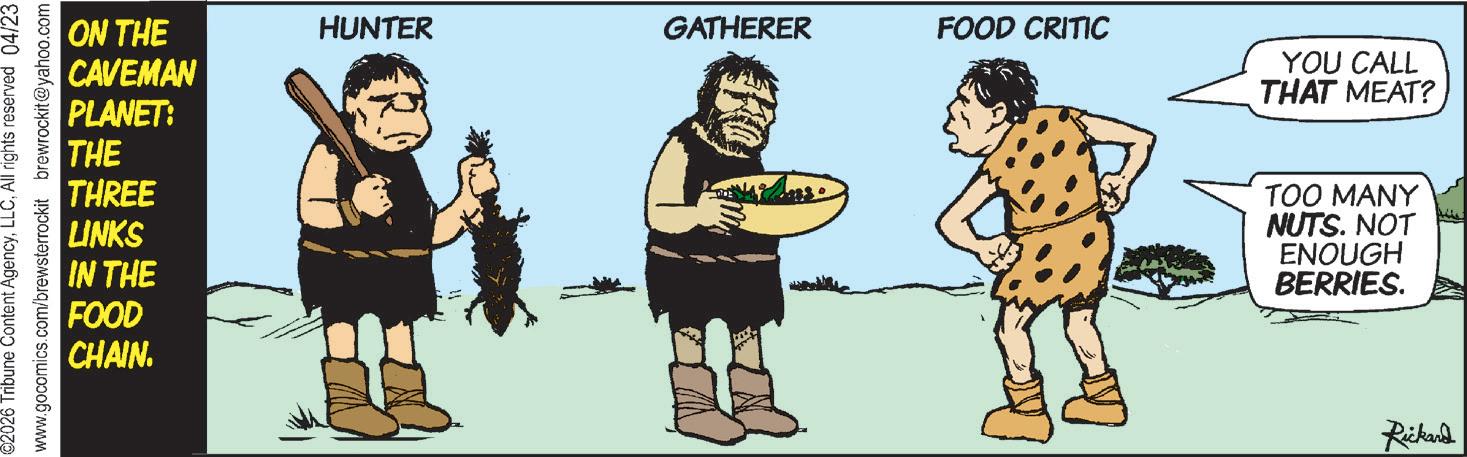
BREWSTER ROCKIT: SPACE GUY!
TIM RICKARD
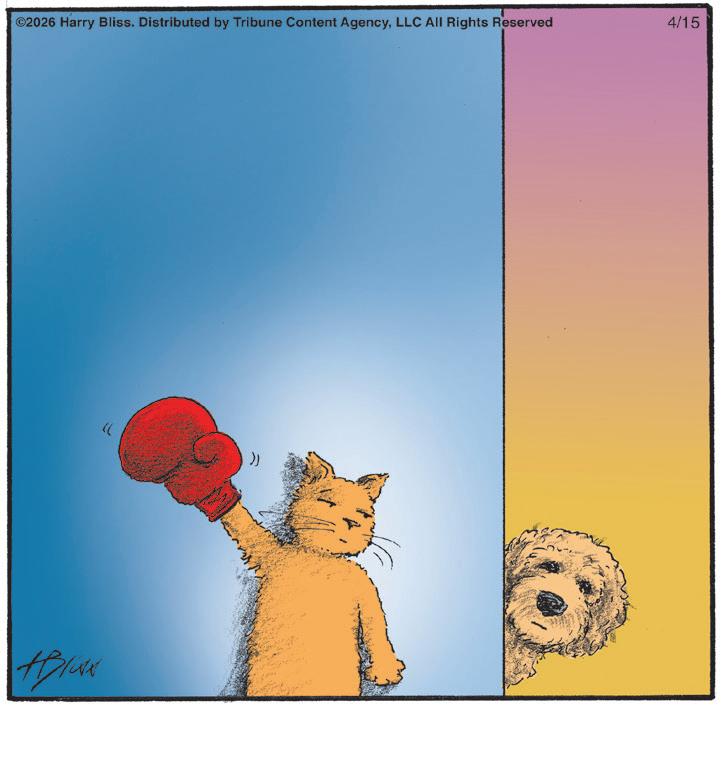
BLISS
HARRY BLISS
BASEBALL
Baseball snags series vs. Abilene Christian
By Elakai Anela eanela@iu.edu
Indiana baseball secured a 5-4 victory April 19 over Abilene Christian University at Bart Kaufman Field in Bloomington, clinching the series win and earning its first one-run victory of the season.
With the game hanging in the balance in the eighth inning, graduate right-hander Gavin Seebold took the mound with two outs and runners on third and first base. He paused on the rubber before delivering a 93mph fastball that blew past Abilene Christian senior infielder Grant Watkins, ending the threat.
Seebold pounded his chest and yelled toward the Indiana dugout as the inning closed, preserving the tie. Moments later, sophomore outfielder Caleb Koskie delivered a two-out go-ahead RBI single in the bottom half of the frame, lifting the Hoosiers ahead for good.
Even in the win, the Hoosiers struggled to capitalize offensively. They went 2 for 12 with runners in scoring position and were outhit 118. Still, Indiana head coach Jeff Mercer viewed the outcome as a “cultural” win because of the fight his team showed.
“It didn’t go our way, and we still came out with a win,” Mercer said. “It’s just baseball sometimes. Today was destined to be one of those games.”
The Hoosiers faced adversity from the start of April 19’s game. Graduate student lefthanded pitcher Conner Linn opened the game against a lefty-heavy top of the order but ran into trouble early.
He allowed a leadoff double and a walk before striking out Watkins, then exited the contest after just 12 pitches and four strikes.
Junior right-handed pitcher Jackson Yarberry entered in relief and immediately surrendered an RBI ground-rule double to Abilene Christian senior infielder Nick Arias, giving the Wildcats a 1-0 lead. With runners on second and third and one out, Yarberry settled in, striking out the next batter and inducing a lineout to second base to end the in-
ning.
From there, Yarberry stabilized the game.
The right-hander delivered five scoreless innings, allowing just three hits and one walk while striking out eight. After entering in the first, he retired 13 consecutive batters and gave Indiana the length it needed.
In his last two appearances, Yarberry has been extended beyond his usual role. After throwing 4.1 innings at Maryland on April 12, he followed it up with five innings April 19.
SOFTBALL
“He’s been tremendous,” Mercer said. “He didn’t really pitch last year, didn’t throw in summer ball, didn’t have a fall. He just got healthy in the winter and started pitching.”
Yarberry said his approach hasn’t changed despite the increased workload in his last two appearances.
“Nothing’s really changed; it’s just not overthinking each inning,” Yarberry said. “At the start of the year, I was getting in my head trying to get into the second inning. Now, I don’t
Aubree Hooks shines as Indiana softball claims series win over Iowa
By Conor Banks conbanks@iu.edu | @conorbanks06
In 2025, Indiana softball posted a 4.60 team-ERA — the fourth highest mark in the Big Ten. Head coach Shonda Stanton upgraded the Hoosiers’ pitching staff in the offseason, adding four arms to the unit, including freshman Aubree Hooks.
Hooks has helped transform the Hoosiers into one of the top pitching staffs in the Big Ten — one that ranked third in the conference with a 3.14 ERA entering their series against Iowa over the weekend.
After pitching in just one game against Purdue the weekend before, Hooks appeared in all three games against the Hawkeyes, powering the Hoosiers to a 2-1 series victory in Iowa City, Iowa. With its two wins, Indiana moved to 34-12 overall and 12-6 in conference play.
While the series was originally slated to begin April 17, weather forced a Saturday doubleheader. Hooks earned the start in the series opener Saturday, and surrendered four hits and one earned run, while striking out one across five innings.
The Hawkeyes struggled to generate offense early, as Hooks retired their first six batters. Iowa senior infielder Avery Jackson picked up the Hawkeyes’ first hit of the game in the third inning, but Hooks fielded a groundout to end the inning without allowing a score.
Hooks allowed her only run on a fourth inning solo home run, giving Iowa some offensive momentum. Following the home run, the Hawkeyes put three more runners on base, but Hooks navigated the traffic around the basepaths, forcing a lineout to escape the inning.
Sophomore pitcher Ella Troutt — Indiana’s ERA leader heading into the series — entered in relief of Hooks in the bottom of the sixth. Troutt held the Hawkeyes scoreless through two innings in the circle, secur-
ing a 2-1 Indiana victory to begin the weekend.
Less than an hour after the series opener ended, the two teams took the field for the second leg of Saturday’s doubleheader, where redshirt junior pitcher Taylor Hess started in the circle for the Hoosiers. After generating just one run against Hooks and Indiana earlier in the day, Iowa’s bats were aggressive to begin the second matchup of the series. The Hawkeyes scored a run in the second inning before adding another in the fourth, leading to Hess’ exit. Junior pitcher and utility player Brooke Mannon relieved Hess with one out in the fourth inning. Mannon quickly loaded the bases, walking the first batter she faced. Mannon then picked up two consecutive outs, including a strikeout to end the fourth, before picking
up a 1-2-3 inning in the fifth.
However, the Hawkeyes strung together an explosive sixth inning, scoring five runs as Stanton cycled through Mannon, Troutt and sophomore Jasmine Reyes in the circle. Meanwhile, Indiana’s offense staged a comeback in the seventh, rallying from down 7-2 to tie the game. With the game knotted at seven, Stanton once again called upon Hooks, and she delivered.
Across four innings, including three in extras, the Alabaster, Alabama, native allowed zero earned runs and just two hits. Mannon and senior outfielder Cassidy Kettleman each drove in a score to secure a 9-7 victory in 10 innings — Hooks’ second win of the weekend.
The series concluded with a matchup April 19. After pitching nine total in-
nings April 18, Hooks stayed ready to enter and close the weekend. While Mannon started, she recorded just one out and gave up three earned runs in the first inning. Stanton did not wait long to react, quickly turning to her go-to arm in the opening frame.
Like she did April 18, Hooks held Iowa in check. She limited the Hawkeyes to one unearned run and six hits. However, Indiana’s offense stalled. Its two runs were not enough to notch the series sweep, dropping the weekend finale 4-2.
After pitching 14.2 innings in two days, Hooks improved her record to 9-2 this season, while lowering her season-ERA to 2.32.
The Cream and Crimson have won five out of their six conference series this season, with their lone loss coming against UCLA.
think anything of it.”
Indiana’s offense scratched across runs to support Yarberry, plating three between the second and third innings — two coming on errors and another on a wild pitch.
Redshirt freshman catcher Brayden Ricketts extended the lead to 4-1 with an RBI double in the fifth inning, giving the Hoosiers breathing room. That cushion didn’t last.
Although Seebold recorded back-to-back strikeouts to end the inning, the damage had been done. The game was tied entering the eighth.
Indiana responded in the bottom half.
With two outs, Koskie delivered the go-ahead single that ultimately decided the game, giving the Hoosiers a 5-4 advantage they would not relinquish.
Graduate right-hander
Reagan Rivera was tasked with closing out the ninth. He retired the first two batters before allowing back-toback singles, bringing the tying run into scoring position. However, Rivera induced a flyout to left field, fittingly to Koskie, to seal the win and pick up his second save. For a team that had struggled to hold late leads throughout the season, the finish carried added weight for the bullpen.
“We finally won a close game,” Yarberry said. “That’s the best feeling you could possibly have. I hope we can get used to this feeling.” Despite allowing three runs in the seventh inning, Mercer said the Hoosiers largely accomplished their plan on the mound.
“We executed on the mound nearly to perfection outside of the one inning,” Mercer said. “Then we were able to find a way to come back and win it late. It was tough and competitive; we had to gut it out.”
Indiana finished its weekend series with a 2-1 record. Over the five-game week, it went 4-1.
Seebold, who entered earlier in relief, navigated the end of the sixth inning but ran into trouble in the seventh. He allowed a tworun home run to open the frame, then, after the bases were loaded, walked in the tying run.
MEN’S BASKETBALL
Former players appeal ruling in case against IU
By Nathan Shriberg naashri@iu.edu | @NShriberg
Editor’s note: This story includes mention of sexual violence or assault.
Former Indiana men’s basketball players appealed the district court’s decision on their lawsuit against Indiana University and former head trainer Tim Garl. A federal judge dismissed the case March 31 and the appeal was filed April 16.
The appeal will be heard by a panel of judges in the U.S. Court of Appeals for the Seventh Circuit in Chicago. The lawsuit first arose from September 2024 allegations against former team physician Dr. Brad Bomba Sr. Bomba, who served as team physician for all IU athletic teams from 19621970 and for men’s basketball from 1979-1998, was accused of conducting inappropriate rectal exams.
A report issued by Jones Day, the firm which IU tasked to investigate the original claims, found in May 2025 that Bomba acted in a “clinically appropriate manner.”
The plaintiffs, former players Haris Mujezinovic, Charlie Miller, John Flow-
ers and Larry Richardson Jr., argued they did not become aware Bomba’s conduct was “sexual harassment and abuse” until 2024 and 2025. However, the court agreed with the defendants that the relevant consideration was the plaintiffs’ “knowledge of Bomba’s conduct,” rather than knowing if it was unlawful. The U.S. District Court for the District of Southern Indiana ruled in favor of the defendants, finding the players “knew of the fact of their injury around the time they were assaulted.” Judge Tonya Walton Pratt dismissed the case on the grounds that the two-year statute of limitations had long passed. While just four former players are attached to the lawsuit, many others have made additional allegations of sexual misconduct against Bomba. During a 75-minute deposition in December 2024, Bomba refused to answer 45 questions and invoked his Fifth Amendment right against self incrimination, ESPN reported. He died May 8, 2025. An IU spokesperson did not immediately respond to a request for comment.
IDS FILE PHOTO
The front of Simon Skjodt Assembly Hall is pictured at sunset Jan. 20, 2022, in Bloomington. Former Indiana men’s basketball players on
COLIN SLOMKA | IDS
Indiana junior right-handed pitcher Jackson Yarberry pitches against Abilene Christian University on April 19, 2026, at Bart Kaufman Field in Bloomington. Yarberry pitched five scoreless innings in the Hoosier win.
KATIE NEWETT | IDS
Freshman pitcher Aubree Hooks pitches to Purdue on April 11, 2026, at Andy Mohr Field in Bloomington. Hooks pitched in all three of the Hoosier’s games against Iowa over the weekend.
Softball wins series over Iowa despite offense
By Joe Elms jpelms@iu.edu
Indiana softball’s typi-
cally explosive offense was hot-and-cold against Iowa throughout the weekend, but it still helped the Hoosiers record a 2-1 series win over Iowa on the road.
The series was originally scheduled from April 1719, but the game April 17 was canceled due to severe weather in Iowa City, Iowa, forcing an April 18 doubleheader, with the rubber match played April 19.
In the first game April 18, Indiana’s offense couldn’t consistently produce against the Iowa pitching staff throughout the game but still did just enough to secure a tight 2-1 win.
Indiana had seven hits but managed just two runs. The scoring did not start until the top of the second inning when junior utility player Aly VanBrandt singled right up to the mound, which brought home fellow junior utility player Brooke Mannon to give the Hoosiers a 1-0 lead.
Iowa tied the game in the bottom of the fourth inning when Hawkeyes sophomore utility player Kiara Sipe hit a home run into center field. Indiana responded in the top of the fifth inning when senior outfielder Ellie Goins hit an RBI sacrifice fly into right field and brought home freshman outfielder Jada Ellison as the Hoosiers retook the lead 2-1.
Even though Indiana’s
offense couldn’t produce consistent runs, the Hoosiers’ pitching rotation stifled Iowa’s hitters as well. Freshman starter Aubree Hooks pitched five innings and gave up four hits and one earned run.
Sophomore pitcher Ella Troutt entered the game in the bottom of the sixth in-
ning and finished the job for the Hoosiers. Over the remaining two innings, Troutt only surrendered one hit. Indiana took the first game of the series 2-1. In the second game of the doubleheader, it initially looked like it could be a repeat of the first game, as Indiana jumped out to a 2-0
Bloomington Bahá’í and Bahá’í IU Association
424 S. College Mall Rd. 812-331-1863
bloomingtoninbahais.org
The Bahá’í Association of IU works to share the Teachings and Principles of the Founder, Bahá’u’lláh, that promote the “Oneness of Mankind” and the Peace and Harmony of the Planet through advancing the “security, prosperity, wealth and tranquility of all peoples.”
Sunday:
10:40 a.m., Regular Services, Devotional Meetings. Please call or contact through our website for other meetings/activities
Evangelical Lutheran Church in America
Rose House LuMin & St. Thomas Lutheran Church
3800 E. Third St. 812-332-5252 Stlconline.org lcmiu.net
Rose House LuMin and St. Thomas Lutheran Church invite you to experience life together with us. We are an inclusive Christian community who values the faith, gifts, and ministry of all God’s people. We seek justice, serve our neighbors, and love boldly.
Rev. - Adrianne Meier
Rev. - Lecia Beck
Rev. Amanda Ghaffarian - Campus Pastor
St. Mark’s United Methodist Church
100 N. State Rd. 46 812-332-5788 smumc.church facebook.com/BloomingtonStMarksUMC instagram: @stmarksbloomington
St. Mark’s United Methodist Church of Bloomington, Indiana is an inclusive community, bringing Christ-like love, healing, and hope to all. We embrace the United Methodist ideal of open hearts, open minds, and open doors by welcoming those of all races, cultures, faith traditions, sexual orientations, and gender identities.
Rev. John Huff - Pastor Rev. Mary Beth Morgan - Pastor
lead after a two-RBI single from freshman utility player Josie White in the top of the second inning. Iowa narrowed the deficit to one run in the bottom half of the frame when Hawkeyes senior outfielder Echo Mattiello hit an RBI sacrifice fly to left field. The Hawkeyes then tied the game with an
RBI single in the bottom of the fourth inning. Indiana didn’t score over the next two innings, and Iowa subsequently blew the game open in the bottom of the sixth inning, scoring five runs including a three-RBI triple by senior outfielder Tory Bennett to take a 7-2 lead.
Light House Community Church
850 E. Winslow Rd. 812-339-3306 lhccbloomington.org facebook.com/lighthousecommunitychurchbloomingtonindiana instagram.com/lighthouse_community_ church
Sunday: 9 a.m., Empowerment Classes (for all ages) 10:30 a.m., Service Wednesday: 7 p.m., Bible Study
Light House Community Church is mandated, by the Word of God, to fulfill the Great Commission by winning lost souls to Christ and empowering the believer to grow in Christ through prayer, study of the Holy Bible, and life application teaching. All are welcome! Transportation is available.
Senior Pastor - Derek L. House Assistant Pastor - Clarence W. Boone,
Trinity Reformed Church 2401 S. Endwright Rd. 812-825-2684 trinityreformed.org instagram.com/trinityreformed facebook.com/trinitychurchbloom
We are a Reformed Protestant church on the west side of Bloomington with lively worship on Sunday mornings, Bible classes beforehand, home groups, and a college age group called The Mix (a group of young adults who are both attending college and beyond).
Jody Killingsworth - Lead Pastor Max Curell - Shepherding Pastor Stephen Baker - Discipleship Pastor Philip Moyer - Worship & Youth Pastor
Christian Science
Christian Science Church
2425 E. Third St. 812-332-0536 bloomingtonchristianscience.com facebook.com/e3rdStreet
Interested in spirituality and healing? We welcome you to our church to explore how you can address issues spiritually and experience healing.
But Indiana then went on a rally, erasing the five-run deficit and tying the game at seven, with a two-RBI single from sophomore infielder Josie Bird and a two-RBI double by sophomore infielder Madalyn Strader on the next at-bat. Neither team could put a run on the board in the eighth or ninth innings. But in the 10th, Indiana struck on a pair of RBI singles from Mannon and senior outfielder Cassidy Kettleman, securing a 9-7 Indiana win. However, in the rubber match April 19, Indiana’s offense seemed to have run out of gas, only putting up two runs on four hits. Iowa opened up the scoring in the bottom of the first inning, as the Hawkeyes put up a three-run frame. Bennett hit an RBI double down the left field line, and Iowa then connected on two more RBI singles to jump out to a 3-0 lead through the opening inning. The scoring lulled until the top of the fourth inning, when Indiana senior catcher Avery Parker hit a home run deep into center field to cut the Hoosiers’ deficit down to two. From there, Indiana only managed one more run. Iowa scored another run in the bottom of the fifth and shut down Indiana’s lineup until the top of the seventh inning until Mannon hit a home run. Iowa took the rubber match 4-2, but Indiana still secured a series win.
Redeemer is a gospel-centered community on mission. Our vision is to see the gospel of Jesus Christ transform everything: our lives, our church, our city, and our world. We want to be instruments of gospel change in Bloomington and beyond.
Chris Jones - Lead Pastor
United Methodist
Jubilee
219 E. Fourth St. 812-332-6396
jubileebloomington.org
Facebook: First United Methodist Church of Bloomington, IN Instagram: @jubileebloomington
Wednesday: 7:30 p.m., College & Young Adult Dinner
Jubilee is a Christ-centered community open and affirming to all. We gather on Wednesdays at First United Methodist (219 E. 4th St.) for free food, honest discussion, worship, and hanging out. Small groups, service projects, social events (bonfires, game nights, book clubs, etc.), outreach retreats, and leadership opportunities all play a significant role in our rhythm of doing life together.
Markus Dickinson - jubilee@fumcb.org
Unity Worldwide
Unity of Bloomington
A Center for Spiritual Growth
4001 S. Rogers St. text/call: 812-333-2484 unityofbloomington.org IG: @unityofbloomington facebook@UnityofBloomington
Sunday Celebration: 10:30 a.m.
Discover a vibrant, welcoming community at Unity of Bloomington – “a positive path for spiritual living”. Our center offers a space for spiritual growth; embracing all with open arms. We proudly affirm and welcome the LGBTQ+ community, fostering love, acceptance, and inclusion. Join our loving congregation, where everyone is valued and encouraged to explore their spiritual journey. At Unity of Bloomington, all are welcome and together we thrive!
Minnassa Gabon - Spiritual Leader Phyllis Wickliff - Music Director
ALEX COIFMAN | IDS
Junior utility player Brooke Mannon awaits a pitch against Purdue on April 12, 2026, at Andy Mohr Field in Bloomington. The Hoosiers won their weekend series over Iowa 2-1.
Koskie delivers go-ahead hit in Indiana baseball’s win
By Will Kwiatkowski wdkwiatk@iu.edu
Indiana baseball’s Caleb Koskie tied a program record early in a rubber match April 19 against Abilene Christian University at Bart Kaufman Field and made the defining play that sealed the 5-4 victory for the Hoosiers.
The sophomore outfielder extended his hitting streak to 21 games with a first-inning single in Indiana’s 5-4 win over Abilene Christian, tying the longest singleseason mark in program history. The mark was set by outfielder Chris Hervey in 2008 and tied by outfielder Alex Dickerson in 2010.
After falling behind 1-0 in the first inning, the Hoosiers answered in the second when freshman second baseman Landen Fry reached on an error and scored to tie the game.
Indiana took control in the third inning with a double from sophomore first baseman Jake Hanley, a wild pitch and a defensive miscue to push two runs across and build a 3-1 lead.
The Hoosiers added another run in the fifth when redshirt freshman catcher Brayden Ricketts doubled in sophomore shortstop Cooper Malamazian, extending the lead to 4-1 and giving Indiana what looked like enough breathing room behind its pitching staff.
The Wildcats fought back, however, removing the cushion Indiana built.
Abilene Christian broke
through in the seventh inning with a three-run rally, highlighted by a two-run home run and an RBI walk that tied the game at four.
The inning erased Indiana’s advantage and forced the Hoosiers into another late-game situation that has negatively defined much of their season. The Hoosiers entered this afternoon’s game 0-7 in one run contests, finally winning its first of the year.
With the game tied in the eighth inning, Koskie stepped to the plate with Fry in scoring position, another runner on first base and two outs. He lined a single through the left side, scoring Fry and giving Indiana a 5-4 lead it would hold to the final out.
“My heart rate is a lot lower when he walks up there,” head coach Jeff Mercer said postgame April 19. “You just feel like something good is going to happen.”
That confidence in Koskie comes from more than results.
Earlier in the game, Koskie had not been as sharp in his approach. He had been beaten on a few pitches and was pressing at the plate. During the middle innings, Mercer pulled him aside for a quick conversation.
Koskie already understood what needed to change.
“Caleb said, ‘I’m getting really pushy with my swing,’” Mercer said.
Mercer agreed and he
Society of Friends (Quaker)
Bloomington Friends Meeting
3820 E. Moores Pike bloomingtonfriendsmeeting.org
Sunday (in person & by Zoom):
9:45 a.m., Hymn singing 10:30 a.m., Meeting for Worship Children’s program available
We practice traditional Quaker worship, gathering in silence with occasional Spirit-led vocal ministry by fellow worshipers. We are an inclusive community with a rich variety of belief and no prescribed creed. We are actively involved in peace action, social justice causes, and environmental concerns.
Rex Sprouse - Clerk rsprouse@iu.edu
Bahá'í Faith
Bloomington Bahá'í Community and Bahá’í IU Association
424 S. College Mall Rd. 812-331-1863 bloomingtoninbahais.org facebook.com/Baháí-Community-ofBloomington-Indiana-146343332130574 Instagram: @bloomingtonbahai
Sunday: 10:40 a.m., Regular Services, Devotional Meetings. Please call or contact through our website for other meetings/activities
The Bahá'í Association of IU works to share the Teachings and Principles of the Founder, Bahá'u'lláh, that promote the "Oneness of Mankind" and the Peace and Harmony of the Planet through advancing the "security, prosperity, wealth and tranquility of all peoples."
Karen Pollock Dan Enslow
Independent Baptist Lifeway Baptist Church
7821 W. State Road 46 812-876-6072 lifewaybaptistchurch.org facebook.com/lifewayellettsville
Sunday:
9 a.m., Bible Study Classes
10 a.m., Morning Service
5 p.m.,
and Koskie discussed the adjustments needed to get him back on track. Hitting is precise — even a small mechanical flaw can disrupt timing and throw an at-bat off — but Koskie didn’t let it linger.
Instead of forcing the next at-bat, Koskie reset his approach, trusted his mechanics and allowed the game to come back to him. The result was a controlled swing in a high-leverage situation, producing the go-
Non-Denominational
Christ Community Church
503 S. High St. 812-332-0502 cccbloomington.org
facebook.com/christcommunitybtown
Instagram: @christcommunitybtown
Sunday: 9:15 a.m., Educational Hour
10:30 a.m., Worship Service
We are a diverse community of Christ-followers, including many IU students, faculty and staff. Together we are committed to sharing the redeeming grace and transforming truth of Jesus Christ in this college town.
Bob Whitaker - Senior Pastor Adam deWeber - Worship Pastor Dan Waugh - Adult Ministry Pastor
Great Harvest Ministry Center (GHMC Family)
1107 S. Fairview St. 812-325-2428 (GHMC) ghmcfamily.org
Sunday: 10:30 a.m.
GHMC Family is a small church with a big heart. We follow Jesus and not a religion. We believe God’s Word as written for real people living in a messy world. We are a family of believers — your home away from home. Casual, welcoming, and here to support each other through life’s challenges. Come grow with us!
Tony Taylor - Pastor
Christian Student Fellowship
1968 N. David Baker Ave. 812-332-8972 csfindiana.org
Instagram: @csfindiana office@csfindiana.org
Monday - Friday: 10 a.m. - 5 p.m.
Christian Student Fellowship (CSF) exists as a Christ-centered community focused on helping students truly know Jesus Christ. Our ministry hub is located on campus at the last stop on the B bus. Reach out to schedule a tour, or join us for our 8 p.m. Thursday night worship service (Encounter)!
Ben Geiger - Lead Campus Minister
Stephanie Michael - Campus Minister
Nick Conrad - Associate Campus Minister
ahead run.
Koskie pulled the pitch past the shortstop, making his proper swing adjustments, while scoring Fry from second base to give Indiana the 5-4 lead, which it would not relinquish.
“It’s that stuff — he’s reevaluating and reevaluating all the time,” Mercer said. “To be able to make that adjustment in a big spot, in game, in real time, is really what makes him such a special hitter.”
For Mercer, that ability goes beyond physical tools; it’s the mental skills that matter so much in hitting.
“It’s the eight inches between his ears that makes him a really special hitter,” he said. The streak itself highlights Koskie’s consistency. Indiana built its early advantage behind timely hitting and sloppy defense from Abilene Christian that allowed two Indiana runs.
Reaching base safely in
United Church of Christ and American Baptist Churches-USA First United Church 2420 E. Third St. 812-332-4439 firstuc.org facebook.com/firstuc instagram.com/firstuc2420 youtube.com/@FirstUCBtown
Sunday: 10:30 a.m., Worship
Monday: 10 a.m. via Zoom, Bible Study
We are an Open, Welcoming, and Affirming community of love and acceptance dedicated to welcoming the diversity of God’s beloved. We exist to empower, challenge, and encourage one another to live out Jesus’ ways (compassion, truth, and justice) authentically as human beings in community to create a better world.
Rev. Jessica Petersen-Mutai Senior Minister
Nazarene
Bloomington Eastview Church of the Nazarene
4545 E. Lampkins Ridge Rd. 812-332-4041 eastviewnazarene.org
Facebook - Eastview Church of the Nazarene
Sunday: 9 a.m.: Morning Prayer
9:30 a.m.: Sunday School 10:30 a.m.: Worship Service
3 p.m.: Cedar Creek Worship Wednesday: 10 a.m.: Bible Study
Join us at Bloomington Eastview Church of the Nazarene, where faith meets community! Connect with fellow students through engaging worship, meaningful discussions, and service opportunities. Discover a supportive space to grow spiritually and make lasting friendships. Everyone is welcome - come as you are and be a part of our vibrant family!
Rev. Bruce D. Yates - Pastor Alicia J. Dollens - Facility Manager
21 consecutive games requires the ability to adjust to different pitchers, pitch types and game situations. It also requires discipline — knowing when to attack and when to stay patient. Koskie has shown that balance throughout Indiana’s recent offensive surge, taking the top of the Hoosiers hitting leaderboard with a .387 batting average and a 1.088 OPS. “He’s a really special player,” Mercer said.
Episcopal (Anglican)
Canterbury Mission
719 E. Seventh St. 812-822-1335 IUCanterbury.org
facebook.com/ECMatIU
Instagram: @ECMatIU
Youtube: @canterburyhouseatiu9094
Sunday: 3
By Appointment
Canterbury: Assertively open & affirming; unapologetically Christian, we proclaim the gospel of Jesus Christ by promoting justice, equality, peace, love and striving to be the change God wants to see in our world.
Ed Bird - Chaplain/Priest
Baptist
Emmanuel Church
1503 W. That Rd. 812-824-2768 Emmanuelbloom.com
Instagram & Facebook: @EmmanuelBloomington
Sunday: 9:15 a.m., Fellowship
Sunday: 10 a.m., Worship
Groups: Various times
Emmanuel is a multigenerational church of all types of people. Whether you are questioning faith or have followed Jesus for years, we exist to help fuel a passion for following Jesus as we gather together, grow in community, and go make disciples.
John Winders - Lead Pastor
Second Baptist Church 321 N. Rogers St. 812-336-5827 sbcbloomington.org facebook.com/2ndbaptistbloomington youtube.com/@secondbaptist churchbloomington Sunday: 10 a.m.,
Steven VonBokern - Senior Pastor Rosh Dhanawade - IU Coordinator 302-561-0108 bluhenrosh@gmail.com
BRIANA PACE | IDS
Sophomore outfielder Caleb Koskie runs the bases against Ball State University on April 7, 2026, at Bart Kaufman Field in Bloomington. Koskie extended his hitting streak to 21 games April 19 against Abilene Christian University.
Indiana golf competes in Hoosier Collegiate Invitational
1 2 3 4 5 6 7 8
PHOTOS BY
1. Junior Cole Starnes prepares for his shot during the Hoosier
in Bloomington. Starnes had
in Bloomington. Starnes played
4. Redshirt senior Ethan Chelf is seen shooting during
Starnes came
6. Junior Cole Starnes looks toward the green during
Everything to know for this year’s Little 500
By Max Schneider maxschn@iu.edu
It’s that time of year once again. Empty your calendar, as the “World’s Greatest College Weekend” returns to Bloomington for the 2026 Little 500.
Thirty-three men’s and women’s cycling teams will compete in 200-lap and 100-lap races to be crowned champions and hoist the Borg-Warner Trophy at the center of Bill Armstrong Stadium. Kappa Alpha Theta and Black Key Bulls are both aiming to capture a threepeat in their respective races.
The 38th edition of the women’s Little 500 will start at 4 p.m. April 24, and the 75th edition of the men’s Little 500 begins at 2 p.m. April 25.
Rules and terms to know
The Pit: Located on the edges of the track with the fan stands, each team of riders will have its own 16-foot pit selected in order of team qualification. A maximum of six people can be in the pit at a time, and no exchanges take place within this 16-foot space.
Exchange: During the race, teams swap out riders while either keeping the same bike or switching. The women are required to complete at least five exchanges over the duration of the race, while the men must make at least 10. Each exchange takes place within a 32-foot designated pit area, and failure to make the exchange within this zone will result in the original rider having to continue the rest of the
lap alongside a two-second penalty.
Penalty: Any team in violation of the rules will receive a penalty, with the minimum penalty time being two seconds and a maximum of 20 seconds. This time must be served in the penalty box, located near the start line, and must be served within 10 laps of the infraction.
Line-up: The order of the riders for the pace lap.
Pace Lap: A lap led by a “pace car” prior to the first lap which slowly progresses in speed.
Pole Position: The team that starts the race in the first position.
Yellow Jersey: The reigning champions of last year’s race will don a bright yellow jersey. Kappa Alpha Theta (women’s) and Black Key
Bulls (men’s) won’t be hard to spot.
Green Jersey: The team which qualifies in the pole position can rep a green jersey. Kappa Alpha Theta and Cutters won the women’s and men’s qualifying races, respectively. However, Kappa Alpha Theta will wear the yellow jersey instead.
Bike: The IU Student Foundation provides each team with two standard bikes. Teams are not allowed to alter the bikes in any way.
Drafting: Riding behind another rider to reduce wind resistance and conserve energy.
Burning: Expelling all remaining energy prior to an exchange.
Borg-Warner Trophy: Nicknamed “Baby Borg,” the trophy is a replica of the fa-
mous Indianapolis 500 trophy. The trophy is presented to the winning team at the podium following the conclusion of the race.
Flags: There are several flags officials may use to control the race. Failure to adhere to any flag will result in a two-second penalty.
• Green: Start of the race
• Red: The race has been stopped, usually for a crash or other track hazard Yellow: Ride cautiously, no passing Black: Ride on outside of the track
• Blue w/ orange stripe: Rider must allow other rider to pass White: Start of the final lap
• Checkered flag: End of the race
Officials IUSF Little 500 race director: Peter Schulz, the person responsible for all racing activities. Judge: Must report all race infractions and irregularities to the chief steward. There are 17 spread throughout the track. Chief steward: Responsible for the conduct of the race. They have the power to assess penalties and disqualify riders. Chief observers: Stationed above the action in observation towers. Three observers help the chief steward with rule enforcement. Safety officials: Responsible for ensuring the safety of all riders during the competition.
How IUSF keeps Little 500 moving behind the scenes
IUSF plays a major role in organizing Little 500 and supporting campus initiatives
By Ripra Gupta riprgupt@iu.edu
One of the most anticipated times at Indiana University is Little 500 weekend, when students, faculty and Bloomington residents come together to celebrate a campus tradition that dates back to 1951. But the cyclists aren’t the only ones who keep the weekend moving. The IU Student Foundation plays a central role in organizing and supporting Little 500 festivities.
IUSF, the student arm of the IU Foundation, was founded in 1950 by former IU Foundation President Howard S. “Howdy” Wilcox Jr. A year after IUSF’s founding, Wilcox came up with the idea for a bicycle race after seeing students race outside a dorm and viewing it as a way to generate support for the foundation. He modeled Little 500 after the Indianapolis 500 as a tribute to his father, Howard Wilcox Sr., who won the race in 1919. This year marks the 75th running of the men’s Little 500 race. The women’s race started in 1988.
“I hope people understand that the race is so much more than two days in April, and that the impact our students have goes far beyond being on that track or helping set up for race day.”
Emily Carrico, IUSF director
IUSF’s mission is to give students the opportunity to help generate private support for the university and make the campus a better place by hosting an array of events throughout the semester, including concerts
and leadership events. One of its main responsibilities each year, however, is organizing Little 500. The process of putting the event together begins months in advance and requires many spokes to keep the wheel turning, from Little 500 riders to general members, captains and the steering committee. Emily Carrico, IUSF director, said she is involved in many parts of organizing the event, particularly on the administrative side. Her work includes supporting student leaders, communicating with alumni, manag-
ing sponsor relations and handling other operational tasks, as well as working with the 75th committee, which was established to celebrate the race’s 75th running. The committee has helped decide on decor, arrange parade cars from different years, secure VIPs for the event, plan alumni interactions and design merchandise.
“As director, I help with a lot of our donors and sponsors and with supporting our students to make sure they are ready,” Carrico said.
IUSF’s pre-race operations help set up the stadium
by making sure teams have the correct pit boards, the pits are in place and the video board is ready.
The race itself began in 1951 to raise scholarship funds for IU students, a purpose it served through 2023.
Now, Little 500 supports the Students Helping Students campaign, in which IUSF students select and help carry out a campus initiative they believe needs attention and affects their peers.
The campaign runs from qualifications through race weekend. During that time, students host more than 20
end. She said
partnership events, including food drives, craft nights and more. The campaign is also funded through ticket sales, teams and donors. In the past, the funds have supported initiatives such as the food insecurity fund, purchasing a vehicle for the Crimson Cupboard, furnishing the Wellness House and supporting satellite Counseling and Psychological Services locations on campus. This year, IUSF is raising money for the Office of Basic Needs, which helps provide IU students with access to essentials such as housing, food, transportation and health
wants
500 to be not only an
able weekend for students and the greater Bloomington community, but also an event that has a significant impact on IU Bloomington’s campus. “I hope people understand that the race is so much more than two days in April, and that the impact our students have goes far beyond being on that track or helping set up for race day,” Carrico said.
IDS FILE PHOTO
IU Student Foundation members Michael Naughtin and Harvest Ham chip bikes to track and time riders during a practice session for Little 500 in 2018. IUSF was founded in 1950.
JIMMY RUSH | IDS
Cyclists race across the eventual finish line during the men’s Little 500 race on April 26, 2025, at Bill Armstrong Stadium in Bloomington. The race was scheduled to begin at 2 p.m.
Howdy” Wilcox poses
The origins of Little 500
By Sydney Weber syaweber@iu.edu
The storied race behind “The World’s Greatest College Weekend” began 75 years ago, when Howard “Howdy” Wilcox Jr. drew inspiration from a group of students racing bikes around an Indiana University dormitory.
The mini race drew a crowd, and Wilcox, who was executive director of the IU Student Foundation, decided to harness the enthusiasm to raise money for student scholarships. The funds were specifically meant for working students, in order to “help those who are helping themselves,” as early slogans said.
The Little 500, as the name implies, is based on the Indianapolis 500 car race, which Wilcox’s father — also named Howard Wilcox — won in 1919. The younger Wilcox was skilled at public relations and headed up the first Little 500 race on May 12, 1951.
The South Hall Buccaneers of Collins Living
Learning Center won with a more than four-minute margin over the second-place team. There were 7,000 attendees and the event raised the equivalent of $73,000 in 2024’s money, according to My IU. By 1955, the Arbutus yearbook was already calling the event “an IU classic.” The tradition of hosting a concert began with IU Foundation Director Bill Armstrong in 1960, when musical quartet The Four Lads performed on the Woodlawn tennis courts. Since then, notable figures and groups like Bob Hope, Chicago, John Mellencamp and then-presidential candidate Barack Obama have made appearances at the race. Throughout the 1960s and 1970s, students of broadcast professor Richard Yoakam provided Indy 500-style broadcasts, according to the Indiana Broadcast History Archive. The campus radio station, WIUS, also provided live coverage from the mid1960s on, and still does un-
der the call sign WIUX.
National coverage of the race, especially after the 1979 coming-of-age movie “Breaking Away,” led to enough donations to build a new stadium, which was eventually named the Bill Armstrong Stadium and is the current site of the race. The Little 500 was held in the 10th Street Stadium until 1980.
The women’s Little 500 has its roots in the 1980s, though Kathleen Cerajeski, an alternate for the Cravens B team, made history in 1976 as the first woman to be part of a men’s team.
In 1987, Kappa Alpha Theta sorority put forth a team that, while not qualifying due to having taken 34th out of 33 places, raised awareness that women wanted to race too. The first running of the women’s race took place the following year, with approximately 11,000 attendees and a victorious Willkie Spring team.
This year is the 75th men’s race and the 38th women’s race, and there’s still more history to be made.
How to stay safe during Little 500 weekend
By Will Tallackson wdtallac@iu.edu
Little 500 weekend is expected to bring large crowds to Bloomington and IU’s campus. The IU Police Department and IU Health said common risks during the weekend include excessive alcohol use, dehydration and navigating crowded environments, encouraging attendees to plan ahead and stay aware.
Drink responsibly Negative effects of alcohol use are some of the most common risks during Little 500 weekend, particularly at large gatherings and parties. People should avoid consuming multiple drinks in a short period of time, as rapid intake increases the risk of dangerous overconsumption and alcohol-related medical emergencies, Ethan Farmer, an emergency medicine physician with IU Health, said.
Farmer recommended consuming only one drink per hour and eating throughout the day to reduce negative effects. He added that drinking without food or hydration, or mixing alcohol with medications, increases the likelihood of illness or medical emergencies.
“Moderation is your friend,” Farmer said. Farmer also recommended drinking water consistently throughout the day, advising individuals to regularly consume 8-12 ounces in regular increments rather than waiting until they feel dehydrated.
He said alternating alcohol with water and eating meals helps maintain hydration. Waiting until you feel dehydrated can put the body at a disadvantage and increase the risk of lightheadedness, fatigue and dry mouth.
Know Indiana’s Lifeline Law
Indiana’s Lifeline Law protects individuals who call for medical help during an alcohol-related emergency, as well as the person experiencing the emergency. The law provides limited immunity from certain alcohol-related offenses, including public intoxication and underage possession or consumption.
To qualify for the law, other individuals present must remain at the scene, provide information requested from officers and cooperate with law enforcement. The law does not protect against more serious offenses, including distributing alcohol to minors, operating under the influence or possessing illegal drugs.
IUPD Public Information Officer Hannah Cornett said students and families should keep the law in mind and not hesitate to seek help in an emergency.
Recognize warning signs and stay aware in crowds
Recognizing when a situation becomes serious, particularly in crowded environments, can help prevent life-threatening emergencies.
Farmer said symptoms such as confusion, repeated vomiting or an inability to respond should not be ignored. He said individuals showing these warning signs should not be left
alone or told to sleep it off and instead require medical attention. Cornett encouraged people to look out for one another, while also planning ahead for safe rides home through designated drivers or rideshare services.
Stay safe on roads and use campus safety apps With increased traffic and visitors expected, Cornett advised both drivers and pedestrians to remain alert and aware of their surroundings. She urged drivers to slow down, follow posted speed limits and avoid distractions, and encouraged pedestrians and cyclists to stay attentive in busy areas.
Cornett also highlighted campus safety tools, including IU Notify, a campuswide emergency alert system that sends notifications about immediate safety threats. Students, faculty and staff are automatically enrolled, while visitors can opt in by texting “SafeIU” to 77295. She additionally suggested downloading the Rave Guardian safety app, available on the Apple App Store and Google Play. The app provides access to emergency services, IU Notify alerts and a timer that alerts selected contacts if the user does not arrive at a destination by their expected timeframe.
LITTLE 500 75 YEARS
ARCHIVES Howard S. “Howdy” Wilcox served as president of the
Foundation and established
Look back at the unforgettable 2025 women’s race
By Will Kwiatkowski wdkwiatk@iu.edu
A year removed from the 37th running of the women’s Little 500, the 2025 race remains defined by a handful of pivotal moments that shaped both its outcome and its lasting significance.
Last year’s race day at Bill Armstrong Stadium opened with anticipation as teams prepared under thenclearing skies. By the time the race began, weather condition from rain that morning had settled, and the field of 33 teams rolled out tightly grouped, each looking to establish their positions early.
The first major turning point came almost immediately. On lap four, a crash in the back half of the pack brought down 15 riders, forcing an abrupt shift in the race’s trajectory. What had begun as a controlled start quickly became a test of recovery and adaptability. Several teams lost contact with the front, while others used the disruption to push forward and create separation.
In the laps that followed, a smaller group emerged at the front, taking advantage of the fractured field. Among them were Teter and Delta Gamma, both of which spent extended stretches setting the pace. WSR, competing with only two riders, also found itself near the front in the early states after capitalizing on the opening created by the crash, despite the long-term challenge of sustaining that position without a full rotation.
As the race settled, the early chaos gave way to a prolonged period of balance. No single team managed to fully break away, and the lead continued to shift as exchanges and positioning
dictated momentum. The field gradually consolidated into a smaller group of contenders, with each lap increasing the importance of efficiency and timing.
By the final quarter of the race, the decisive group had taken shape. Kappa Alpha Theta remained within striking distance, avoiding the spotlight through much of the race after qualifying third. The defending champions relied on patience and control, staying connected to the leaders while other teams absorbed the strain of setting the pace.
That approach set up one of the defining moments of the race. With roughly 15 laps remaining, Theta began to move forward, positioning itself firmly within the lead group as the intensity increased. The gap between contenders continued to shrink, leaving almost no margin for error.
By the final lap, six teams remained in contention, all separated by only seconds.
The race, which had been shaped by chaos early and control in the middle, came down to a tightly packed sprint where any mistake or opening could decide the outcome.
In the closing stretch, Theta’s then-junior Bailey Cappella found that opening. Moving through the final turns, she accelerated into the lead, gaining just enough separation to hold off the field. The finish was razorthin, with first, second and third place riders crossing within a second of one another, underscoring how little separated the top contenders after 100 laps.
The move secured the victory for Kappa Alpha Theta and capped a race that had remained undecided until its final moments. The
four riders — now senior
Bailey Cappella, junior Greta Heyl, senior Claire Tips and senior Greta Weeks — will run it back again this year in hopes of a three-peat.
The win carried historic weight. It marked Kappa Alpha Theta’s second consecutive title and its 10th championship. It became the first women’s team to reach double-digit victories since the race began in 1988. The result reinforced the program’s long-standing presence in the event.
Elsewhere, the race also highlighted the demands and unpredictability of Little 500. WSR’s effort stood out as one shaped by both adversity and persistence. The early crash and two-rider format lead by than junior Sophie Boller and then-senior Willow Thompson placed the team at a disadvantage that proved difficult to
overcome, yet it remained competitive for stretches before ultimately finishing in eighth.
The final standings reflected the depth of the field, with multiple teams still in contention deep into the race and the outcome undecided until the final sprint. The inability of any one team to separate itself highlighted the increasingly competitive nature of the women’s race.
Looking back, the 2025 edition is remembered less for sustained dominance and more for the moments that defined it: The early crash that reshaped the field, the gradual narrowing of contenders and a final lap that brought six teams together in a sprint decided by fractions of a second.
The women’s Little 500 race will return to Bill Armstrong Stadium at 4 p.m. April 24.
2025 men’s Little 500 in review
Black Key Bulls secured back-to-back wins
By Hayden Pope haypope@iu.edu
After bikes tangled and riders fell down in lap 81, Black Key Bulls dominated the rest of the way to finish as back-to-back winners in the 2025 men’s Little 500.
To start the race, Black Key Bulls held a pole position in row one, with Sigma Alpha Epsilon in the middle and 3PH Cycling on the outside. Following in row two were Sigma Phi Epsilon on the inside, Forest Cycling in the middle and Chi Alpha on the outside.
Row three consisted of Phi Delta Theta on the inside, Phi Gamma Delta in the middle and Sigma Nu on the outside, with the rest of the field bunched together behind them.
As the pace car pulled away and the green flag was waved, the riders were off.
On turn four in the early stages of the race, three teams were involved in an early crash in the back half of the pack. Phi Sigma
Kappa, Delta Sigma and Macro Cycling collided and fell behind. During the first 15 laps, six different teams held the lead.
After 60 laps, Phi Kappa Psi had a 4.7-second lead, with Delta Sig falling behind after serving a penalty.
With 119 laps to go, the yellow caution flag was waved as the riders went around turn one. The wipeout crash was caused by the Bears, and involved Forest, Phi Delt, CUTTERS, Sig Ep and FIJI, which all held strong positions in the race at that point.
Once the green flag was waved again with 116 laps remaining, Black Key Bulls, Delta Tau Delta, SAE, Chi Alpha and Human Wheels rounded out the top five.
Halfway through the race, Black Key Bulls, SAE and CUTTERS were all together in the top three with a healthy lead over the rest of the pack. By lap 140, it was a two-team race between Black Key Bulls and SAE.
CUTTERS was in third place, behind the top two by 11 seconds.
With 20 laps to go, the Black Key Bulls had a commanding 30-second lead over second place SAE, as it became a race for second and third place.
In the final laps, Black Key Bulls still held a significant advantage. SAE was behind first place by a full lap, but led third-place CUTTERS by 2 seconds with five laps to go.
Black Key Bulls senior captain Will Wagner crossed the finish line emphatically to secure a back-to-back win for his team. SAE, CUTTERS, Delta Tau Delta and Sigma Phi Epsilon rounded out the top five in the 74th edition of the men’s Little 500.
Black Key Bulls became the first back-to-back champions since CUTTERS in 2018 and 2019. The team will have a shot for a threepeat” in the 75th edition of the men’s Little 500, set for 2 p.m. April 25.
How Strava data drives Little 500 riders to stress and improvement
By Leonardo Vesperini lvesperi@iu.edu
Anticipation mounts as Indiana University marches closer to April 24, the start of the 2026 Little 500. Students have been thinking about how to celebrate the weekend, and athletes have been preparing their bodies for racing. But before the big day, much of the race is won in the months leading up to the wave of the green flag. While riders look superhuman speeding around the track on race day, they’ve been building their strength and fitness for months. Early morning rides, high intensity workouts and mental battles of comparison all make up a base of strength unseen by the spectators in the stands of Bill Armstrong Stadium. Every one of these aspects and more are kept track of in meticulous fashion by the athletes using recording software like Strava. Teams use these apps to keep track of everything from milage to
heart rate to power.
Through weeks of relentless training, the numbers help give athletes clarity and guidance about how their training is progressing.
“It allows me to keep tabs on [my fitness] and make sure that I’m continuing to grow,” sophomore rider Judah Nickoll said.
During his time with 3PH Cycling, Nickoll has been a part of a culture that uses apps like Strava, Trainer Road and Zwift for tracking activities and analyzing statistics after their rides end.
The team uses an in-app club on Strava to keep track of each other’s training and to make sure everyone’s on the same page during the week.
“It works really well with seeing where your teammates are at in the week in terms of their training and how much volume they have,” Nickoll said. These softwares give Nickoll access to an array of different
metrics surrounding his performance; measuring heart rate, power and cadence is crucial in his training program. When his coaches put together workouts for his team, different statistics will be more or less important depending on the time of year or target workout his coaches want the team to achieve.
“If it’s December, we’re doing much more long threshold work where we’re just trying to build fitness,” Nickoll starts. “Whenever we get into like February, March and April, it’s much more so sprinting, working in pace lines, a lot more of the quick, fast twitch muscle fiber type of workouts.”
If these programs were to disappear tomorrow, Nickoll thinks his activity tracking and connection to the team would suffer. He said he would switch to using Garmin as his primary tracker, but said the metrics and social aspect of Garmin pale in comparison to Strava. “I get to see my stuff, but
I’m not necessarily seeing my team’s,” he said. “I would be completely out of the loop on where everybody else was.”
While Strava gives Nickoll an opportunity to keep up with teammates’ training, the aspect of comparison also makes athletes focus more on what others are doing rather than their own improvement.
“It’s a social media,” Nickoll said. “You have to be careful about how you compare [yourself].”
Despite this, Nickoll says Strava and the digitalization of Little 500 training has revolutionized how riders train and prepare for race day. Even though comparison can be a negative, being able to check in on teammates and being aware of metrics while training has made athletes more aware of how to recover and improve.
Junior Jolie Eichorst of the women’s Chi Alpha team has had a similar experience to Nickoll, using training softwares when preparing to compete.
Chi Alpha also uses Strava to track their activities, but they use Garmin bike computers to track their activities and biometrics. For them, heart rate zones are crucial for making sure they’re within the zones their coaches want. Athletes of all sports use this to train at different intensities.
The team also pays attention to how long they can hold paces when doing workouts.
Eichorst and her team use Strava to follow each other and keep up with their training and see how they’re riding compared to fellow teammates and other riders.
She and her team also use the app to keep each other accountable and keep up a standard of effort. This adds a level of mental stress to her training.
“I feel like there is an expected average miles per hour that you should go whenever you go on rides,” Eichorst said. “But even when you’re doing a chill recovery ride, it feels like you
shouldn’t… upload that for other people to see, because it’s just not a hard enough effort to be respected in the community.”
Without Strava, Eichorst said a lot of the pressure to perform would disappear, resulting in an overall less stressful training experience.
“I don’t think that I would feel as pressured by other riders in order to, like, uphold a standard of effort,” Eichorst said. Even though training without the app would help alleviate the stress she feels, knowing people are watching helps keep her accountable. In the end, that helps her ride every day and improve by being consistent. As race day approaches, both Nickoll and Eichorst represent a larger shift in cycling culture toward a newfound focus on statistics and biometrics to train smarter. With Eichorst and Chi Alpha competing April 24, and Nickoll and 3PH Cycling set to race April 25, all their months of training will be put to the test.
FILE PHOTO | IDS
Little 500 riders crash into each other during the 2025 women’s Little 500 on April 25, 2025, at Bill Armstrong Stadium in Bloomington. The crash took place in the fourth lap.
FILE PHOTO | IDS
Kappa Alpha Theta riders (from left to right) Greta Weeks, Greta Heyl, Bailey Cappella and Claire Tips hold up a bike after winning the women’s Little 500 race on April 25, 2025, at Bill Armstrong Stadium in Bloomington. Kappa Alpha Theta won its 10th ever Little 500 race.
WOMEN’S TEAMSFRIDAY
MEN’S TEAMSSATURDAY
INDEX
Each year, three jersey colors are designated to certain teams. The white shirt goes to the winner of the Team Pursuit event, yellow is worn by last years’ winners and green is worn by the pole winners. Black Key Bulls placed first in qualifications. The team chose to wear yellow, but qualified for the green shirt as well.
WOMEN’S
2 3 4 5 6
MEN’S
Forest Cycling
Cinzano
Kappa Alpha Chi Omega CHAARG Cycling Phi Delta Theta
Each spring, more than 25,000 people arrive in Bloomington for what is known as “The World’s Greatest College Weekend” — the Little 500, the largest collegiate bike race in the United States.
But the 2026 Little 500 carries added significance. This year’s men’s race, scheduled for 2 p.m. April 25 at Bill Armstrong Stadium, will be the 75th rendition of the event.
Results from Qualifications on March 28 narrowed the men’s field to 33 teams. But only one will be crowned the champion
Here’s what to know ahead of the 2026 Little 500
Black Key Bulls enter
the 2026 Little 500 as the team to beat after securing back-to-back titles — the first team to repeat since CUTTERS in 2018 and 2019. In 2023, BKB failed to qualify for the race. But BKB engineered a dramatic turnaround, winning the event in 2024 and 2025. Most of the 2025 championship roster will return after the team graduated just one rider. This year’s roster features eight riders, including three seniors, four juniors and a sophomore. However, only four will compete in the Little 500. Despite returning much of its core, BKB struggled in “Spring Series” events. The back-to-back champions finished fifth at qualifications and failed to advance to the finals of the Team Pursuit by 2.19 seconds April 11.
Will BKB’s title run come to an end this year?
Perhaps its two biggest challengers are CUTTERS and Sigma Alpha Epsilon. CUTTERS owns 15 Little 500 titles — the most in event history. Inspired by the 1979 film “Breaking Away,” CUTTERS last won the event in 2023. While BKB has posted back-to-back first place finishes, CUTTERS has dominated the pre-race events. CUTTERS struggled at the 2025 qualifications, coming in at 12th before finishing the race in third place. This year, the team blazed to a 02:25.711 time at qualifications — the fastest mark of the pack — and more than 2.5 seconds faster than BKB.
CUTTERS carried that momentum into the Team Pursuit. The team took first place with a 9:00:12 finish
Close behind CUTTERS during the “Spring Series,” was SAE — last year’s runner-up. In 2025, it was a close contest between SAE and BKB through most of the race. Around Lap 170, SAE stopped for an exchange, allowing BKB to claim a four-second lead that continued to grow. But throughout this year’s “Spring Series,” SAE has shown it is set on reclaiming a top finish in the race. The team competed against CUTTERS in the Team Pursuit championship race, ultimately finishing second with a 9:12.69 time. SAE also placed second at qualifications, posting a 02:27.216 mark.
and
Riders to watch
The 2026 Little 500 Individual Time Trials on March 31 showcased
Two Sigma Phi Epsilon riders also stood out among the rest. Sophomore Drew Poplarski and senior Gus Kowalevsky tied for sixth with a 2:25:07 time in the Individual Time Trials — just five seconds behind Nass. Poplarski also claimed
some of the top riders in this year’s race. Three CUTTERS riders finished in the top five of the Individual Time Trials. Seniors Judah Thompson and Jake Zarov secured the first and second spots in the Individual time trials, respectively. Thompson has been a consistent force for CUTTERS throughout his career. The senior finished second in the Individual Time Trials in 2024 and 2025, before reaching the top spot with a 2:22.27 time in his final year. Thompson also won the 2026 Miss N Out on April 10. Zarov posted a secondplace time of 2:23.66 in the event. Meanwhile, freshman Leo Nelson Lee stopped CUTTERS from a 1-2-3 finish at the Individual Time Trials. Lee placed third with a 2:24.40
As competition closes in, Kappa Alpha Theta looks to 3-peat at 2026 Women’s Little 500
Since the inception of the women’s race, no team has ever won three consecutive championships
By Sean McAvoy semcavoy@iu.edu
Editor’s note: Leila Faraday previously worked at the IDS.
In 1987, four members of Indiana University’s Kappa Alpha Theta sorority narrowly failed to qualify for that year’s edition of the Little 500. Instead of trying to qualify for the event in 1988, the team created the first ever women’s Little 500 race in the then-37-year history of the tradition.
Now, 38 years later, Kappa Alpha Theta is on the precipice of history again after winning the 2024 and 2025 races. Since the inception of the women’s race, no team has ever won three consecutive championships. But as the riders take to the quarter mile track at Bill Armstrong Stadium on April 24, 32 other teams have a target on Kappa Alpha Theta’s back.
“I think I can speak for the whole team when I say, it’s obviously the thought in the back of our mind, but it’s not the pressing matter,” Kappa Alpha Theta senior Bailey Cappella said in an interview with the Indiana Daily Student. “I go out there and ride because I love it, and that’s what it should be.”
But a strong “Spring Series” from the defending champions can give them confidence heading into race day.
Kappa Alpha Theta finished qualifications in first with a time of 2:43.883, which gave the sorority pole position in front of Teter by
3.663 seconds. However, Theta came in third during Team Pursuit, missing out on the championship race by 2.89 seconds to Alpha Chi Omega’s 10:18.47 mark.
During the individual “Spring Series” events, Kappa Alpha Theta also produced strong showings.
Junior Greta Heyl secured a fourth-place finish at Individual Time Trials, as six riders from Theta placed inside the top 35 and three inside the top 10. At Miss N Out, Cappella finished fourth and Heyl took fifth.
“I think spring series is always a good reminder to keep pushing further,” Cappella said. “I think it’s a really good showing on our part, but also just a reminder to, you know, never let your foot off the gas, because there’s always somebody to chase.”
And the chasers are close behind Kappa Alpha Theta.
After Alpha Chi Omega finished last year’s Little 500 in second, it looks to win its first title in the sorority’s history. Since 2021, the team has placed inside the top 10 at every edition of the race.
“I think after last year, placing second, we all have proven to ourselves that it can be done,” Alpha Chi Omega sophomore Libby Lewis said at Little 500 Media Day. “It’s just a matter of, ‘OK, did we work hard enough?’”
Lewis has been a rising star in the Little 500 community after becoming the first freshman ever to win Individual Time Trials last year. Even though Teter senior Leila Faraday defeated
her at this year’s Individual Time Trials, Lewis avenged her loss to take home first place at Miss N Out. As a team, Alpha Chi Omega finished qualifications in third with a time of 2:47.911. The sorority was then beaten by Teter in the women’s championship race at Team Pursuit. Alpha Chi Omega dropped its 10:18.47 qualifying time by 8.25 seconds to 10:10.22. It’s a difference the team said they felt proud of during Media Day.
However, Teter produced the fastest women’s time since the event changed from 10 to 15 laps in 2021: 10:01.87.
“I think that speaks to the field in general too, because it’s competitive ... I’m excited, and lucky to race against such strong, ambitious competitors.”
Alpha Chi Omega junior Emma Nelson
“We can’t even be upset about not winning when a team like Teter goes out and really deserves their win,”
Alpha Chi Omega junior Emma Nelson said at Little 500 Media Day. “I think that speaks to the field in general too, because it’s competitive ... I’m excited, and lucky to race against such strong, ambitious competitors.”
With 33 teams on the starting grid, Teter provides opponents with strong competition. The team has won
the event four times but not since 2019. Teter finished qualifications in second place, as Faraday won Individual Time Trials with a 2:36.62 mark. Making up the second row of the grid will be Delta Gamma, Melanzana and the Christian Student Fellowship. Delta Gamma finished qualifications with a 2:48.347 time and placed fifth at Team Pursuit. Senior Morgan Heim gave the sorority a fifth-place finish at Individual Time Trials.
Melanzana finished last
year’s race in 11th after winning the 2022 and 2023 editions, but senior Evelyn Morris and sophomore Sophie Peterson look to bring the team back to the top spot. Morris secured a third-place result at Individual Time Trials and sixth at Miss N Out, while Peterson was runner-up at Miss N Out.
As race day draws near, riders will prepare for the 100-lap event, which sees the 33 competing teams complete five bike exchanges over the 25.49 miles
around the track. Yet for many riders, the wins and losses are not the end goal, but the community and tradition that the event brings to Indiana University.
“I would call it the privilege of my lifetime to race in the Little 500,” Faraday said in an interview with the Indiana Daily Student. “It has made me a much better person in so many ways, so I’ll always be very grateful for that, and it’s going to mean a lot to me to race the Little 500 for one last time.”
BRIANA PACE | IDS
Kappa Alpha Theta’s Greta Heyl looks toward her teammate after winning the women’s Little 500 race on April 25, 2025, at Bill Armstrong Stadium in Bloomington. Kappa Alpha Theta pulled away in the final stretch to win the race.
BRIANA PACE | IDS
A Theta Phi Alpha rider takes off during qualifications for the Little 500 on March 28, 2026, at Bill Armstrong Stadium in Bloomington. Theta Phi Alpha did not place in the 2025 Little 500 race.
Wilcox House captures the legacy of Little 500
By Lexi Bunting lexbunti@iu.edu
Tucked along Fee Lane, the Wilcox House serves as a living archive to student leadership, philanthropy and tradition. The space has been home to the Indiana University Student Foundation since the early 1980s, serving as both an office and a museum, and highlighting the lasting impact of IU student traditions.
Founded in 1950 by former IU Foundation Director Howdy Wilcox, the IUSF has a long history of student philanthropy and is responsible for creating one of IU’s most iconic traditions: the Little 500. Wilcox introduced the idea of a campus-wide cycling event to raise scholarship funds and create more opportunities for student engagement.
In 2024, the foundation launched an initiative to create an exhibit to celebrate the 75th anniversary of the IUSF, highlighting photographs from the events’ history in an immersive and interactive at the Wilcox House.
IUSF Director Emily Carrico helped advise the project and described it as a strong initiative because of its broad scope and ability to showcase the full history of the tradition.
“When I started, a lot of that history was scattered, there wasn’t a lot of continuity,” she said. “So, we had a couple of seniors in 2024 that took on this project of turning the house into this exhibit where whenever alumni or current students walk in they can see themselves and their experience on the walls.”
Visitors can walk through the house and see decades of photographs documenting student-led initiatives, campus traditions and cultural milestones, starting from the 1950s.
The exhibit is organized by decade, with each room highlighting different traditions and how they have evolved over time. Together, the rooms create a timeline of the tradition and allow visitors time to reflect on the history and legacy of
the event and student life in general at IU.
Mason Schutte, a Cox Legacy Scholar and office assistant for the IUSF, assisted in organizing more than 60 photographs back in 2024 for the exhibit. He said the photographs showcase defining moments throughout the race’s history, including long-standing campus traditions from race weekend, celebrity appearances and important cultural shifts within the event.
Those changes are reflected throughout the exhibit, including photographs from the 1960s documenting campus protests against fraternity bylaws that excluded minority groups, the creation of the women’s race in 1988, and the addition of numerous teams and organizations over time.
“We highlighted just overall the tradition, the philanthropy behind the race, and what it means for a lot of different groups on campus and how that history can impact future riders, alumni and students,” Schutte said.
Carrico said she hopes
that visitors take away an appreciation for the effort of all the students who have contributed their time to the exhibit, as well as a deeper understanding of the foundation itself.
“If we look back over the last 75 years of the race, it’s not just about the Little 500. There is so much that has happened around it for the student foundations over the decades,” Carrico said. “I
think for our students to see all the fun things that have happened over the years, the way the organization has grown and changed, it adds a lot of meaning to the work they do in the present day.”
COLUMN: Non-Little 500 events to go to over the weekend
legiate Weekend.”
By Addison Jacoby agjacoby@iu.edu
The Little 500 hits Bloomington like a massive wave each year, swimming with tradition, celebration and, of course, the largest collegiate bike race in the United States. As the Little 500 quickly approaches, Bloomington is still hosting events for everyone, not just die-hard cycling fans.
The races themselves are the centerpieces of the event, with the women’s race beginning at 4 p.m. April 24, and the men’s race at 2 p.m. April 25. So, I would, of course, put those on the to-do list first.
But besides the races, here are some non-cycling events appearing during “The World’s Greatest Col-
University Twits Sketch
Comedy Performance
The University Twits are an IU sketch-comedy troupe that perform comedy shows once a month in Ballantine Hall. The troupe performs exclusively original material, writing their own sketches and jokes.
The group is showcasing their comedic pursuits at 9 p.m. April 24 in Ballantine Hall, Room 110. The sketchcomedy performance is a free event, encouraged for all to join in an hour of laughs, fun and sketches.
HANDS in Autism’s Art Expo: “Art of the Mind” HANDS in Autism is an Indiana statewide resource center for those with autism
and other special needs. The group annually celebrates art created by autistic individuals in April, especially those who use art as a way of expression. The expo also showcases pieces created by those supporting autism acceptance.
This year’s theme is “Art of the Mind,” featuring pieces showcasing artists’ interpretation of the few words.
The expo is housed in the Indiana Memorial UnionOak Room, beginning with an opportunity to meet the artists and see the exhibitions from 1-4 p.m. April 24. Then, from 9 a.m. to 3 p.m. April 27, the exhibition is again open to visitors.
IU Soul Revue Spring Concert At 7:30 p.m. April 25, IU
Soul Revue is presenting its Spring Concert to the Buskirk-Chumley Theater bringing a night of soul, contemporary Black popular music and R&B to the weekend of cycling. The group is led by accomplished musician James Strong, who has over 30 years of experience within the music industry, having worked with artists including Tupac and LL Cool J. Tickets for the concert are available online or at the box office for $25.92 and discounted to $15.66 for children and students.
Bring Your Own Business Bring Your Own Business is an organization dedicated to showcasing student businesses monthly in Dunn Meadow. From
vintage clothing to plants, the monthly event brings a crowd of student shoppers, ready to purchase a wide variety of items. Bring Your Own Busi-
ness appears again in Dunn Meadow from noon to 4 p.m.
JACK JERNIGAN | IDS
Little 500 bicycles are seen on April 8, 2026, at the Wilcox House in Bloomington. The space has been home
to the Indiana University Student Foundation since the early 1980s.