IDS Thursday, Sept. 10, 2026
Indiana Daily Student | idsnews.com
INSIDE
Indiana football returns, routs North Texas
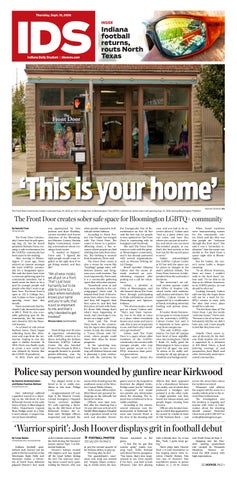
‘This is your home’ The Front Door Community Center is pictured Aug. 29, 2026, at 122 S. College Ave. in Bloomington. The LGBTQ+ community center had a soft opening Aug. 23, 2026, during Bloomington Pridefest.
KEEGAN TEDDER | IDS
The Front Door creates sober safe space for Bloomington LGBTQ+ community By Natalie Chan nkchan@iu.edu
The Front Door Community Center had its soft opening Aug. 22, but for board president Melanie Davis, creating a safe environment for the LGBTQ+ community has been years in the making. After moving to Bloomington 17 years ago, Davis noticed an interest amongst the local LGBTQ+ community for a designated space. She said she knew bars were a common gathering spot for community members, but it made sense for there to be a spot for younger people and people who don’t want to go bars. Now, The Front Door is open at 122 S. College Ave., and it plans to have a grand opening event later this month. Davis mentioned that Rachael’s Cafe, formerly located at 300 E. Third St., was a notable gathering spot for the community, but the restaurant closed in 2015 for financial reasons. As a friend of cafe owner Rachael Jones, Davis began collecting items like silverware and cups from the restaurant, hoping to one day open a similar location. In 2019, Davis was finally ready to create a new center but was delayed by factors like the COVID-19 pandemic. In 2023, Davis said she
was approached by Amy Jackson and Ryne Shadday, current member and former chairman of the Bloomington/Monroe County Human Rights Commission, renewing conversations about creating a local center. “It needed to happen,” Davis said. “I figured the right people would come together at the right time if we got things started, and they did.”
“We all wear masks; we all put on a front. That's just basic humanity, but to be able to come to a place where everybody knows your name and you're safe, that is just so important to me, and that's why I decided to get involved.” Minassa Gabon, board member
Davis brings over 20 years of experience volunteering with LGBTQ+ centers in Indiana, including the Indiana University LGBTQ+ Culture Center. She also founded Protect Our People in 2023, a nonprofit formed to provide gender-affirming care for transgender, nonbinary and
other gender-expansive individuals within Indiana. According to Davis, Protect Our People has merged with The Front Door. The center is home to a genderaffirming closet, a free resource where people can find clothing that suits their identity. The clothing is sourced from donations, Davis said. The Front Door center is also a venue for events like “GayRage” garage sales, selfdefense lessons and bringyour-own craft sessions. But most importantly, Davis said, it is a community gathering space that welcomes anyone. “Somebody came in and they went directly to the coloring pages,” Davis said. “It helped them kind of decompress from where they were, and they left happier than they came in, and they had this piece of work with them. It’s those little things that's what's been happening already, and I just hope it continues on a larger scale." Davis said The Front Door looks to the community for input when planning events. In July, the center had a “Come Dream with Us” event, where people could share their ideas for future programs. In the upcoming year, Davis hopes to have recurring self-defense lessons and is planning a joint celebration with the university for
the Transgender Day of Remembrance on Nov. 20. She said the best way for people to stay updated on The Front Door is connecting with its Instagram and Facebook. She said The Front Door wants to work with the greater Bloomington community, and it has already partnered with several organizations, such as Women Writing for (a) Change. Board member Minassa Gabon said the center already received an overwhelming response after putting out a call for volunteers. Gabon, a minister at Unity of Bloomington, said she learned about The Front Door through participating in Pride celebrations around Bloomington and Spencer, Indiana. “We all wear masks; we all put on a front,” Gabon said. “That's just basic humanity, but to be able to come to a place where everybody knows your name and you're safe, that is just so important to me, and that's why I decided to get involved.” Gabon said The Front Door is a space where older members of the LGBTQ+ community can connect with younger people, who may have greater access to LGBTQ+ resources than previous generations. "That wasn't always the
case, and you had to be secretive about it,” Gabon said. “And so, a place where you can come and have fun, where you can just sit and relax, and where you can meet like-minded people, to me, that's the best activity or the best way for this sacred space to serve.” Gabon acknowledged the LGBTQ+ Culture Center at IU but said the space can be prone to changes in the state’s political climate. The Front Door, however, is independent from the university’s decisions. The university’s six cultural centers operate under the Office of Student Life, which works with students, staff, alumni and donors. The LGBTQ+ Culture Center is supported by a combination of funds, including university funding and private donations. IU senior Alexis Donnowitz has gone to events hosted by the university’s LGBTQ+ Culture Center but said it is important to have spaces away from campus too. “The only LGBTQ+ experiences I've had off campus have kind of been nightlifewise, but coming here, I think I think it's really good for Bloomington to have a space that's for all ages,” she said. “It seems to be really welcoming for all age groups or identities and backgrounds.”
When board members were brainstorming names for the community center, Davis said the idea was that people are “welcome through the front door.” She said it was a “secondary realization” that the name was similar to The Back Door, a queer night club in Bloomington. But for Gabon, the center’s name holds a deeper meaning. “As an African American, there are times I couldn't walk in the front door,” Gabon said. “To be able to do that as an African American, as an LGBTQ person, no one should be shut out.” Looking forward, Gabon said one day she hopes there will not be a need for LGBTQ+ centers to exist, with the idea that every place would be a safe one. “On the front door of The Front Door, I put the words ‘welcome home,’” Davis said. “Because a lot of us have unfortunately felt like we didn't have one, and I want people to feel like they have one.” Natalie Chan covers issues of diversity for the Indiana Daily Student. Her work is supported by a donation to IDS Black Voices, a fund fostering coverage of and perspectives from Black and other historically underrepresented communities.
Police say person wounded by gunfire near Kirkwood By Deshna Venkatachalam and Mateo Fuentes-Rohwer news@idsnews.com
One individual suffered a gunshot wound in a shooting on the 300 block of East Kirkwood Avenue in the early hours of Sept. 6, Bloomington Police Department Captain Ryan Pedigo wrote in a Sept. 6 news release. A suspect has not yet been identified.
The alleged victim is believed to be in stable condition at this time, Pedigo wrote. At approximately 1:07 a.m. Sept. 6, the Monroe County Central Emergency Dispatch Center received multiple 911 calls reporting a shooting on the 300 block of East Kirkwood Avenue, the release said. Multiple officers responded and located the
scene of the shooting near the southwest corner of the Monroe County Public Library. At the scene, officers identified blood and personal belongings on the sidewalk but found no victims. Officers were later notified after the shooting that a 19-year-old man arrived at IU Health Bloomington Hospital with a gunshot wound to his neck and shoulder. Investi-
gators went to the hospital to interview the alleged victim, Pedigo wrote, but he “refused to cooperate” and would not provide any information about the shooting. The injured man is believed to be in stable condition. According to the release, several witnesses near the intersection of Kirkwood Avenue and Lincoln Street at the time of the shooting told
officers that there appeared to be a disturbance between two males, one of which then produced a handgun and pointed it at the other male. A single gunshot was then heard, the release stated, and people began running from the area. Officers also located damage to a brick that appeared to be caused by a bullet in front of Old National Bank — just
across the street from where the incident occurred. Witnesses told officers the suspect left the scene in a nearby vehicle prior to the arrival of law enforcement. The investigation into the incident is ongoing and anyone with video or information about the shooting should contact Detective Chris Scott at 812-339-4477 or scottc@bloomington.in.gov.
‘Warrior spirit’: Josh Hoover displays grit in football debut By Conor Banks
conbanks@iu.edu | @conorbanks06
Indiana football quarterback Josh Hoover put his palm to his face and lay on the Merchants Bank Field turf. Moments earlier, a University of North Texas defender gripped Hoover’s face mask
as the redshirt senior scanned the field during the Hoosiers’ season opener Sept. 5 at Memorial Stadium. Hoover’s helmet rotated 180 degrees and was ripped off his head before hitting the turf. The sold-out, buzzing home crowd went quiet, waiting for Hoover, who was
» FOOTBALL PHOTOS SEE GALLERY ON PAGE 8
in just the second quarter of his Indiana debut, to pop up. Not long after, he did. The quarterback’s onceclean chin strap was stained red. Despite blood continuing to trickle down his face,
Hoover remained in the game. “I feel like he got that warrior spirit,” junior running back Turbo Richard said about Hoover postgame. “You know, that’s also inspirational to see. Even myself, If I’m hurt... just look at Josh (Hoover). Like he’s playing
with a bloody face. So, it was like, ‘Yeah, I gotta keep going.’” Three plays later, Hoover fired a 9-yard touchdown to the leaping junior wide receiver Charlie Becker. This was one of Hoover’s four touchdown passes to power Indiana to a 52-16 victory
over North Texas on Sept. 5. Stepping into the Hoosiers’ starting quarterback role vacated by Fernando Mendoza, Hoover entered the 2026 season with high expectations.
SEE HOOVER, PAGE 4
Indiana Daily Student
2
NEWS
Sept. 10, 2026 idsnews.com
Editors Ella Curlin, Grace Fridy & Deshna Venkatachalam news@idsnews.com
Next student media director named Former IDS editor-in-chief Charlie Scudder will begin the role in December.
By Grace Fridy and Deshna Venkatachalam news@idsnews.com
The Indiana University Media School announced Sept. 3 it hired Charlie Scudder, an IU and Indiana Daily Student alumnus, to take over the role of student media director starting Dec. 14. Scudder is a journalism professor at Southern Methodist University in Dallas. Michael Arnold will continue to serve as interim student media director until Scudder is able to start, due to his prior commitments at SMU. “I’m thrilled to be returning to Bloomington to help guide IU Student Media into its next chapter,” Scudder said in the Sept. 3 press release. “As a Hoosier and as a second-generation student media alumnus, IU and its student media is especially important to me.” Scudder also said in the release he is excited for the chance to collaborate with student media. According to the press release, Scudder spent eight years working at The Dallas Morning News, where he “helped develop new approaches to storytelling and audience engagement.” A former editor-in-chief of the IDS, Scudder has served as president of the IU Student Publications Alumni Association. Scudder was also a co-editor of “Indiana Daily Student: 150 Years of Headlines, Deadlines and Bylines” — the first book about the history of the IDS. The Indiana University Press
IDS FILE PHOTO
Franklin Hall is seen Jan. 25, 2022, on East Kirkwood Avenue in Bloomington. The Media School announced Sept. 3 that Indiana Daily Student alumnus Charlie Scudder would take over as student media director starting Dec. 14.
published the book in 2019. Scudder will be the first permanent student media director since the university fired previous director Jim Rodenbush on Oct. 14, 2025. Rodenbush is suing IU, alleging the firing violated his First and 14th Amendment rights. Media School Dean David Tolchinsky fired Rodenbush after Rodenbush refused to
comply when administrators requested that he instruct the IDS not to publish any news content in its upcoming print edition. Tolchinsky cut IDS print editions entirely in the hours following Rodenbush’s firing, a decision later reversed by IU Bloomington Chancellor David Reingold on Oct. 30. In the months following Rodenbush’s firing and cuts
to print, the Media School created a task force to establish a “roadmap” for student media. The task force released its findings May 1, recommending a stronger “umbrella” structure for student media and an advisory body that would include faculty, the Media School dean and media professionals. Under the proposed shared governance
model, a student media director or similar position determined by the Media School dean would lead and report to the dean or someone of the dean’s choosing, acting as a “publisher and executive.” The press release stated Scudder will lead development of a long-term strategic vision for IU Student Media, including a plan for financial
sustainability. “Charlie’s deep connection to IU Student Media, combined with his accomplishments in journalism and higher education, made him an exceptional choice for this role,” Arnold wrote in the release. “He understands firsthand the transformative impact student media can have on students’ lives and careers.”
City Council debates Bloomington rebrand By Zoe Reed
reedzoe@iu.edu
The Bloomington City Council heard a presentation Sept. 2 on a proposed new city logo brand strategy, with several members questioning the rebrand. Bloomington Communications Director Desiree DeMolina and CivicBrand co-founder Ryan Short presented the report, which focused on “unlocking potential” in Bloomington’s branding. CivicBrand serves as the city’s branding consultant. “The work is about opportunity and how we create more opportunity for more people, more businesses and more community partners,” DeMolina said. “And in turn, how that spurs and supports better jobs, better wages and a stronger local economy.” One of the largest components of the proposal is changing the current city logo to a stylized "B” icon. The current logo, adopted in 1986, is a combination of the peony and the trout lily flowers and is based off quilt patterns used predominantly by regional folk artists during the 19th century, according to the original resolution. The brand change was inspired by a 2016 Wage Growth Task Force Initiative, which recommended branding as one way to “accelerate wage growth and reverse economic underperformance.” It wasn’t until 2025 that Bloomington began a citywide branding initiative. The city council approved a $95,000 contract with Colorado-based CivicBrand in the 2025 city budget, with research beginning March 2025 and a final payment for
the contract occurring November of the same year. The new logo, which gained traction Aug. 30, has received pushback, with online users critiquing the city’s use of funding. Councilmembers Andy Ruff, Hopi Stosberg, Isabel PiedmontSmith, Dave Rollo and Council Vice President Sydney Zulich shared similar sentiments at the meeting and questioned the reason for the rebranding of Bloomington. Bloomington mayoral candidate Zulich spoke against the new branding, questioning DeMolina on why the city didn’t collaborate with a local business for the branding project. “I just don’t understand why we don’t trust our own people to know who we are because I think that we do,” Zulich said. “I don’t think we need anyone else to tell us who we are, certainly not for $95,000.”
“I just don’t understand why we don’t trust our own people to know who we are because I think that we do. I don’t think we need anyone else to tell us who we are, certainly not for $95,000.” Sydney Zulich, city councilmember and Bloomington mayoral candidate
Rollo worried the logo looked “generic,” comparing it to other similar icons, including Brandicts LLC and Elastic Beats. The new branding will be implemented gradually, according to the session’s
ZOE REED | IDS
The Bloomington City Council meets March 4, 2026, at City Hall in Bloomington. The council discussed a Bloomington rebranding, budgets and first responder contracts at its Sept. 2 meeting.
agenda, replacing physical items only as they wear out or need replacement, though the city seal itself can only be changed by a council approved ordinance. Other action items Assistant City Attorney Enedina Kassamanian introduced an ordinance, sponsored by Rollo, to permanently amend job titles, including replacing “Senior Police Officer” with “Officer First Class” and “Officer First Class” with “Officer Second Class,” to align with the Fraternal Order of Police’s
establishes guidelines and reviews processes for additional alcoholic beverage permits in Bloomington, including a new class of onpremises alcohol permits downtown. These new permits stem from Senate Enrolled Act 89, granting Bloomington and other select cities two additional three-way liquor permits. Three-way liquor permits combine a beer retailer permit, a wine retailer permit and a liquor retailer permit into one classification. The council's next regular session is Sept. 16 in City Hall.
IU enrollment breaks records for 2030
Chloe Oden Managing editor content
sr73@iu.edu
Emerson Elledge Managing editor content
Indiana University’s total enrollment rose to nearly 90,000 students across all its campuses this fall, according to a Sept. 3 press release. The release, using numbers from IU’s Aug. 31 census, announced IU Bloomington received applications from over 81,000 students. Of the new undergraduate class, 43% has a 4.0 grade-point average, making this IU Blooming-
By Sofía Rodríguez
Vol. 159, No. 7 © 2026
Newsroom: 812-855-0760 Business Office: 812-855-0763 Fax: 812-855-8009
sored by Rollo that contain changes in salary and pay schedules for first responders. The changes impact vacation schedules and accumulation, grievance procedures, clothing allowance and group insurance. The resolutions approve the collective bargaining agreement for the Fraternal Order of Police from 2027 to 2030, and Local 586 Firefighter, covering 2027 to 2028. The council also unanimously passed an ordinance sponsored by Council President Isak Nti Asare that
Mateo Fuentes-Rohwer Co-Editor-in-Chief
Jack Forrest Co-Editor-in-Chief
www.idsnews.com
collective bargaining agreement, which covers 2027 until 2030. The ordinance passed 9-0. The Indiana Public Retirement System, an asset managing public service, uses the titles as a benchmark for calculating retirement base salary, so the job title ordinance is expected to increase retirement contributions. This change carries an approximate fiscal impact of $450,000 in additional retirement fund contributions over the next four years. Additionally, the council passed two resolutions spon-
Chloe LaVelle Creative director Lillie Donato Managing editor digital
The Indiana Daily Student will publish the net print edition in August. For regular news and updates, please check online, subscribe to one of our email newsletters or follow on social media. Part of IU Student Media, the IDS is a self-supporting auxiliary University enterprise. Founded on Feb. 22, 1867, the IDS is chartered by the IU Board of Trustees, with the editor-in-chief as final content authority. The IDS welcomes reader feedback, letters to the editor and online comments. Advertising policies are available on the current rate card. Readers are entitled to single copies. Taking multiple copies may constitute theft of IU property, subject to prosecution. Paid subscriptions are entered through third-class postage (USPS No. 261960) at Bloomington, IN 47405.
130 Franklin Hall • 601 E. Kirkwood Ave. • Bloomington, IN 47405-1223
ton’s most academically accomplished class. IU Bloomington is now home to the second largest class in its history. IU Online, IU Indianapolis and IU’s regional campuses experienced record interest from undergraduate students. Overall, new undergraduate student enrollment hit a recordbreaking 16,911, and new undergraduate student applications have increased 17.3% since 2024. “At a time when students have more choices than
ever, growing enrollment and the academic strength of these new students are a powerful vote of confidence in IU,” IU President Pamela Whitten said in the release. IU Indianapolis saw a year-over-year enrollment IDS FILE PHOTO increase of 12.5%, while the regional campuses saw a The sun sets Oct. 10, 2020, beyond the Sample Gates. Sample Gates 5.3% increase. was built in 1987. IU Online reached record enrollment numbers Regional campuses of over 11,000 students and across the state had a 4.7% serves more Indiana resi- increase in applications, dents in online programs showing a higher demand than any other public insti- for an affordable four-year tution. degree, the statement said.
Indiana Daily Student
OPINION
Sept. 10, 2026 idsnews.com
Editors Eric Cannon, Emma Howard opinion@idsnews.com
3
ERRANT ERIC
Fret not. Capitalist robots will take our jobs in a good way
ILLUSTRATION BY EVELYN STRAUSS
Eric Cannon (he/him)
is a junior studying philosophy and political science and currently serves as a member of IU Student Government.
For every book that mentioned “late-stage capitalism” in 2010, 14 mention the phrase today. When a third of Democrats identify as democratic socialists, and even Republican presidential hopefuls abjure free markets in favor of a governmentcommanded economy, this should not come as a surprise. Capitalism, it is fair to say, is no longer in vogue on either the left or right. Most adopters of the phrase understand it to describe a civilization that has been driven to the point of over-commodification by unscrupulous shareholders’ love of profit, a society where nothing is held to be too sacred to be protected from big business. What qualifies a society as extremely rather than relatively commodified is fuzzy; capitalism, it seems, is always entering its latest stage while it simultaneously progresses toward a yet later stage.
Nonetheless, by applying this descriptor to present economic conditions, those dissatisfied with some aspect or other — private equity purchasing and building family homes to rent, social media platforms scraping users’ personal data to sell or men and women trading their gametes for money — can unleash a catch-all grievance upon the powers-that-be. I propose that Vice President JD Vance has more precisely defined a late-stage capitalistic society. In an interview with conservative commentator Michael Knowles, he said the freemarket dogmas these societies are based on “elevate economic development above human dignity.” Vance and Sen. Bernie Sanders of Vermont hold vastly different views as to how we arrived at this late stage, but both are post-liberals and believe that economic freedom must be curtailed to secure a more important value, quite abstrusely called the “common good.” Anything can contribute to the common good. Sand-
ers has pointed to sports fandom, a humanistic pursuit thwarted by the business class’s unforgiving pursuit of profit. In Sanders’ childhood, his beloved baseball team, the Brooklyn Dodgers, hit the road to draw more money from an open market in Los Angeles than they could have in three-team New York City. Sanders sought to stop the Chicago Bears from repeating this commercial-minded backstabbing. To Sanders’ credit, such ruptures do end worlds. New ones begin. The present world belongs firmly to the LA, not the Brooklyn, Dodgers. Anything that transforms the status quo in the name of saving money or being more efficient can signal a later stage of capitalism. Which brings us to robots: in short, post-liberals don’t like them. Robots usher in capitalism’s latest stage: the replacement of human labor to cut costs. If that’s right, Indiana University has joined Purdue University in a final leap into capitalist deep time. Last year, GrubHub’s robots
mapped our campus’s streets, and now they roll among us. Politely, they stop at crosswalks. It’s clearly too late to have a future where we don’t share our streets with our new metal friends — at least, I find their demeanor to be quite friendly, and I treasure every encounter I have with one of these cute, four-wheeled creatures. Over time, Bloomington restaurants and other stores will mostly prefer to outsource their deliveries to third-party businesses like GrubHub, with their drivers — and increasingly, their robots and soon, I suspect, their robotic self-driving cars. The arrival of this stage spells the end of jobs that high school and college students used to work. While harmful to those displaced, letting the robots work these jobs will, on the whole, bring about greater prosperity and comfort. The savings and efficiency that automation has wrought time and again in human history is the reason why children can complete high school rather than work on
the family farm and can, more than ever, spend even summertime in total leisure. This past summer was the lowest on record for high school employment since the government started tracking that statistic in 1948. Alas, an abundance of leisure time is questionably spent on high-school and college students, heathens that we are. The middle-aged, with an accrual of practical wisdom, would doubtlessly devise better users for these hours, just as they would derive more from college coursework. Some sick twist of fate has granted the most unformed segment of the population the largest allotment of free time. As we no longer wake before sunrise to detassel corn, as did former Sen. Ben Sasse of Nebraska, we must find teachers of discipline and character outside of traditional work. To the boys of this country, Sasse recommended football in a column for the Wall Street Journal on Sept. 3. The sport encourages perseverance, creates community,
forms brotherhood and privileges action. It is significant that the decline of manual labor in this country coincided with the rise of recreational exercise. While delivery robots bring an end to interpersonal labor, like food delivery, and intellectual labor, young adults most affected by this change must consider how they’ll hit the social and mental gyms of the future — every delivery via robot means one less humanto-human interaction, after all. And some suggest that Anthropic’s artificial intelligence model Claude just solved the Navier–Stokes existence and smoothness problem, a longstanding mathematical quandary. At any rate, Claude has made progress on other hard problems. The benefits that latestage capitalism will give are numerous, but the positive side-effects of hard work that were once gained organically through human toil, more than ever, need to be intentionally pursued. ericcann@iu.edu
ROBINSON WRITES
Beau Bayh is running a campaign 30 years out of date Spencer Robinson (he/him)
is a junior studying public policy analysis and law and public policy.
The Democratic candidate for Indiana secretary of state, Beau Bayh, is an almost lab-grown response to moderate Democrats’ perceived shortcomings of the party. Where party strategists once blamed “racism” and “sexism” for former Vice President Kamala Harris’ 2024 loss, Bayh is a straight white man. Where Democratic representatives once bemoaned the perception of Harris as an “uber-leftist,” Bayh takes a decidedly moderate stance. Where Democratic commentators once deemed Harris an “elitist,” Bayh proudly proclaims his status as a military veteran and “seventh generation Hoosier.” Political correspondent Adam Wren described him as “an increasingly strong candidate who could show Democrats how to win an election in Trump country.” A Bayh win in November would prove Democratic strategists correct about what ails the party: that a white man who promises little more than the status quo can defeat Donald Trumpaligned candidates, that Joe Biden’s failures were merely age and “elitism” and that nothing needs to fundamentally change to win back middle America. But Bayh’s loss would add to the growing mountain of evidence that corporatebacked and “Third Way” Democrats are in terminal decline within the party. Recent Democratic primaries have called into question the argument that moderate Democrats are more
“electable” in red states. Angie Nixon, a card carrying Democratic Socialist, won the Democratic Senate primary in Florida, a Republican stronghold. Abdul El-Sayed, a progressive who has made Medicare for All a centerpiece of his campaign, won the Senate primary in Michigan, a swing state which went red in 2024. Bayh is running light on policy, but long in branding. Since this race is his first run for public office, he has little personal record to point to — relying instead on his family name. His father, Evan Bayh, was Indiana governor from 1989 to 1997 and senator from 1999 to 2011. Beau’s grandfather, Birch Bayh, served as a Democratic senator from 1963 to 1981. The Bayh dynasty harkens back to a less divided time, when Indiana was considered a purple state and Democrats could survive statewide elections. Beau is counting on this association to win public office. Bayh’s strategy is nothing new. President Bill Clinton used it 30 years ago. After Democrats lost control of both the House and Senate in the 1994 elections, Clinton pivoted hard to the right, proclaiming “the era of big government is over” in his 1996 State of the Union. He would go on to sign the Republicandrafted “Welfare to Work” bill, which ushered in the reign of work requirements and an inadequate staterun welfare system which remains with us to this day. Clinton went on to win the 1996 election, a win which is largely credited to his “triangulation” strategy, where politicians follow the winds
of public opinion. The Indiana Democratic Party has tried this play before. In 2024, former State Superintendent of Public Instruction Jennifer McCormick launched a bid for the governor’s mansion. McCormick, a former Republican, focused her campaign on the same talking points as Bayh: financial responsibility, protecting Hoosiers and her background as a “proud military mom.” McCormick ultimately lost to Gov. Mike Braun by 13 points. The glaring issue of this approach is that it assumes public opinion is largely immutable and legitimizes Republican narratives instead of challenging them. For example, Harris, who largely abandoned supporting transgender rights, claimed simply “I will follow the law” in an October 2024 Fox News interview. Harris’ relative silence allowed Trump to cast himself as a moderate, despite supporting both a ban on gender-affirming care for minors and codifying that the U.S. government only recognizes two genders, assigned at birth. The narrative that children are pressured to transition by their peers and come to regret their gender-affirming care has gone largely unchallenged by Democrats, despite no evidence in support of this narrative. In Indiana, these misconceptions led to the passage of Indiana House Enrolled Act 1041 in 2025, which established that transgender girls and women are barred from joining K-12 and collegiate women’s sports within the state. Despite mountains of evidence against this law,
ZOE REED | IDS
Democratic nominee for Indiana Secretary of State Beau Bayh talks with Monroe County Councilmember Liz Feitl on Aug. 26, 2026, at Ivy Tech Community College in Bloomington. Bayh is a seventh generation Hoosier and is the third generation of his family to run for elected office in Indiana.
Bayh endorsed it — no doubt a continuation of Harris’ “I will follow the law” strategy, intended to court conservative voters. Bayh’s co-option of conservative talking points does not end there. As secretary of state, Bayh would oversee Indiana’s election procedures and claims on his campaign website that he stands against illegal votes, but also for protecting the legal right to vote. The idea illegal votes pose a significant threat to election integrity is another debunked Republican talking point that has been used to suppress legal voting practices. But Bayh seems more than willing to act as if it is a crisis to appeal to conserva-
tive Hoosiers. Bayh’s affiliation with conservatism goes beyond his moderate policy. Trumpaligned donor Marc Rowan gave Bayh’s campaign $25,000; Rowan also maintained a years-long relationship with Jeffrey Epstein that continued after Epstein was convicted as a sex offender in 2008. Bayh almost certainly became connected to Rowan through his father, who works as a senior adviser for Apollo Global Management, Rowan’s company. Bayh’s corporate connections are concerning, especially because he publicly opposes the influence of special interest groups. Bayh seems like a Demo-
crat in name only. He does not support transgender rights or pledge to govern for Democrats, and he accepts contributions from the same people he claims to oppose. This makes Bayh typical of the wing of the party that still bets on moderation winning elections. He’s running his grandfather’s name on his father’s politics, updated for an electorate that already rejected McCormick in 2024. A win in November could keep that bet alive a little longer. A loss will be one more sign that Indiana Democrats cannot win in red America by becoming moderate Republicans. spenrobi@iu.edu
4
Sept. 10, 2026 | Indiana Daily Student | idsnews.com
KATIE NEWETT | IDS
Redshirt senior quarterback Josh Hoover hands the ball off to redshirt senior running back Lee Beebe Jr. against the University of North Texas on Sept. 5, 2026, at Memorial Stadium in Bloomington. The Hoosiers defeated the Mean Green 52-16.
» HOOVER
CONTINUED FROM PAGE 1 Even Mendoza, who went on to win the Heisman Trophy and became the No. 1 overall selection in the 2026 NFL Draft, did not have the Indiana debut fans may have imagined. Mendoza completed just 18 of 31 pass attempts for 193 yards and zero touchdowns against Old Dominion University last year. With Mendoza’s departure, Indiana head coach Curt Cignetti added Hoover via the transfer portal. In four seasons at Texas Christian University, Hoover accumulated 9,629 passing yards — the most by any active FBS quarterback in a career. Hoover’s experience at the collegiate level showed in
this season’s opener against North Texas, with the signal caller turning in a “sharp” performance, Cignetti said postgame. The 6-foot-2 quarterback approached his debut with a simple objective. “Yeah, I think my goal today was to come out here and just execute our offense, execute the plays that were called,” Hoover said postgame. “That’s all we had to do, is just do our job.” He executed immediately, helping the Cream and Crimson reach the endzone on their first possession of the game. After a 67-yard kickoff return by redshirt senior running back Lee Beebe Jr., the Indiana offense was set up at the North Texas 20-yard line. Richard earned back-to-back
carries, collecting 5 yards as the Hoosiers faced a third and 5. Hoover dropped back for his first regular season throw in a Hoosier uniform, targeting Michigan State transfer and junior wide receiver Nick Marsh. The quarterback placed the football on Marsh’s back shoulder. Marsh made a play on the ball, extending his right arm down to reel in a 15-yard touchdown with one hand. Becker, who experienced a breakout season with Mendoza under center last year, caught Hoover’s next two touchdown passes. After the 9-yard score from his bloodied quarterback, the duo connected from farther out. At the North Texas 35-yard line with about 10 minutes left in the third quarter, Hoover
launched the ball down the sideline to Becker. The wide receiver made an adjustment to pull in a 35-yard touchdown catch, bringing the Hoosiers’ advantage to 31-13. But perhaps Hoover’s best play of the afternoon came on the previous play. Facing rare pressure from the North Texas defensive front on a third and 9, the former TCU quarterback rolled to his right. He rifled a throw downfield to sophomore tight end Brock Schott, who made a catch in traffic for a 25-yard gain. “Brock made a great catch,” Hoover said. “Probably not one that I’d like to try and do a lot of the time. But, got away with it right there and I think, you know, made a play on a crucial down, crucial drive, scored the next play. So, it was a big play for
the sequence of events in the game.” Hoover found sophomore wide receiver Davion Chandler for his fourth and final touchdown pass of Sept. 5's season opener. Chandler streaked open down the middle, while Hoover hit him in stride for a 42-yard touchdown. With Indiana holding a significant lead, seventh-year quarterback Grant Wilson entered in the fourth quarter to replace its starter. Hoover was efficient in his debut despite taking a shot to the face early, not throwing an incomplete pass until under two minutes remained in the second quarter. He ended his day with 13of-16 passing, 231 yards and four touchdowns through the air.
Home Is W h ere YOU MAKE IT
Visit the housing fair to meet with vendors and find your next home.
Tuesday, Oct. 6 10 a.m. - 4 p.m. IMU Alumni Hall
“I thought he played well,” Cignetti said postgame. “I’m sure he earned the respect of his teammates based on his performance today.” While Hoover performed in his first game, the veteran quarterback recognizes there’s still room to grow and improve within the system. “We’re still early on in this process,” Hoover said postgame. “You know, I’ve only had, and it’s our first game and probably had 30 practices, right? So, it’s just to continue to develop in the offense and understanding every single detail of the offense.” Hoover will look to build off his opening performance when the Cream and Crimson face Howard University at noon Sept. 12. The game will be televised on the Big Ten Network.
Indiana Daily Student
ARTS
Sept. 10, 2026 idsnews.com
Editors Lexi Bunting, Ursula Stickelmaier, Abby Whited arts@idsnews.com
5
‘Strength in numbers’ New Jacobs dance department combines ballet, contemporary programs
IDS FILE PHOTO
Dancers perform as Odette and Prince Siegfried in “Swan Lake” Act Two on March 30, 2022. The ballet program merged with the contemporary dance program to form the dance department ahead of the fall 2026 semester. By Stella Klaus ssklaus@iu.edu
This semester will be the first for the Jacobs School of Music Dance Department. The new department will be a combination of the previous ballet program in Jacobs and the contemporary dance program in the College of Arts and Sciences. The merger of the two programs comes after the passing of House Enrolled Act 1001. The act, which took effect July 1, 2025, requires a minimum of 15 graduates from bachelor’s degree programs at public universities. The dance program was one of 116 at Indiana University Bloomington affected by the state legislation. “It’s for the strength of the
degree,” Sarah Wroth, chair of the dance department and director of ballet, said. “The bachelor’s of science in ballet wasn’t strong enough to stand on its own, so contemporary dance came over and now, there’s strength in numbers.” The biggest changes will be for future contemporary dance students, as the program moved from the College to Jacobs, meaning their curriculum will change slightly. According to Elizabeth Shae, director of contemporary dance, this means that students will now have less general education requirements and more space for choosing dance study. Students already in the contemporary dance program will have the option to
continue their degree in the CASE or move over to Jacobs. Shae said that around 50 students were impacted by the change and most chose to move to Jacobs to finish their education, estimating that fewer than five chose to stay in the College. Other than changes to general education requirements, students will experience more ease in collaboration between concentrations. Wroth and Shae said students have already gotten the opportunity to work together, and many of the contemporary dance professors have gotten to teach the ballet students. “They just mesh so instantly,” Shae said. “There was none of this, like, separation. Everyone kind of just dove
into the collaboration.” Shae said that students and professors of each program have strong disciplines and are trying learn from each other. The merger also allows for opportunities for ballet and contemporary dance students to socialize more. The department had its first mixer between ballet and contemporary dance Aug. 30, which gave students the opportunity to mingle and meet new dancers. “It’ll be nice to have conversations with one another because we’re in different buildings as of right now,” Lilly Mozie, a junior ballet major with an outside field in African American and African Diaspora studies, said. “I think there will be more op-
portunities where we’ll get to know each other and go see their performances and vice versa.” Mozie learned about the merger in the spring and thought it was a great idea. She said the dance community can be small and meeting and learning from other dancers is a great opportunity. For Mozie, even just watching other styles of dance can be helpful because it gives her new ideas of things to try. Mozie said she hopes to go to a professional company after college, a planning process that typically begins in a dancer’s junior year. “It’s always so important as a ballet dancer to learn other styles and be able to like embody different styles be-
cause when you get to professional companies you kind of have to be a versatile dancer and be able to fit into different categories,” Mozie said. Although it’s hard for her to notice many changes yet at the beginning of the semester, Mozie said she is excited to see where things go with the merger. “We have this amazing arts campus like right here,” Shae said. “The MAC, the school of music buildings, theater, the IU Auditorium, the art museum. I mean this whole quadrant of campus is this amazing physical facility for the arts.” Now that dance has their own department, Shae said that it will give the arts the opportunity to make more of a campus footprint.
COLUMN: 3 methods for lowering your screen time once I had gotten up and scanned the barcode to unblock my apps, I could still get comfortable and scroll for a while, unlike the landline method. Because of this, my screen time was closer to four hours using this method.
By Stella Klaus ssklaus@iu.edu
I am a big procrastinator. A situation I have found myself in one too many times is when I really have to focus, so I work for a while, then decide to take a break and hop on social media. The next thing I know, it’s nighttime, and I had scrolled on Instagram for the majority of my day. The average screen time in the United States has slowly risen over the past 10 years and currently sits at around seven hours a day. I am not proud to admit it, but my average screen time isn’t far off. At the beginning of August, I was averaging around 5.5 hours a day. To avoid wasting a whole day on my phone this semester, I have tried these methods for decreasing screen time: The Landline Method This method is exactly what it sounds like. You pretend your cellphone is a landline phone and use it in one designated spot. The idea is that you can use your phone normally, not just for calling, but staying in one spot will deter you from scrolling for hours. When I tried this method, I kept my phone plugged in at my kitchen counter and used the charger as the “cord” keeping it there. I chose a spot that wasn’t comfortable so I couldn’t sit down and scroll for long. This method requires a lot of willpower. What was
ILLUSTRATION BY EVELYN STRAUSS | IDS
stopping me from just unplugging my phone and getting comfortable on my phone for hours? I will admit, it happened a few times. However, I became more conscious of it and tried to stop myself. The biggest benefit was my bedroom became a cellphone-free area, I wasn’t waking up and immediately reaching for my phone because I had to leave my bedroom to use it. The drawback was that once you leave the house, there’s no way for
you to pretend your phone is a landline besides leaving it behind, which is impractical for most. I think this method would become easier over time as you likely will start to break the habit of constantly checking your phone. My screen time was around three hours when I tried this method. DIY Brick You may have heard of a Brick, which is a popular new device that helps block distracting apps by making
you get up and scan the device to access your phone. The device is $59, which is expensive if you don’t know that it will work for you yet. So, the next best thing is a DIY Brick. This method unfortunately only works for iPhone because it involves the free app Foqos, but there are other screen-time apps like Opal. On the app, you first set up a profile where you pick what apps you want to block and what you will have to scan to unblock them.
You can use the barcode off of anything, so I cut the barcode off of a cereal box. I decided to tape my code onto one of my fridge magnets, so I had to get up to unblock my distracting apps. This method worked better when leaving the house because you could leave important apps like Messages unblocked in case of an emergency, while distracting apps like Instagram stayed blocked. The main issue I had with this method was that
Replacements This method is less of a standalone method than the other ones were and worked best combined with the other options. The goal is to replace everything you use on your phone that often pipelines into scrolling. One reason I end up scrolling for hours is out of boredom, and a good fix for that is picking up some hobbies. To replace phone usage you can create an analog bag, a trend on social media that started in August 2025 in which you fill a bag with small activities like reading, knitting or puzzles that you can easily do when you are out. Another example is an alarm clock, which you can usually find cheap at Goodwill. When I used my phone alarm, I would turn off my alarm and immediately turn my phone on. This often led me to scroll for hours before I got out of bed. Ultimately, breaking your bad screen habits can be harder than expected. These are just a few methods to help lower your screen time. The one that worked best for me was the landline method, but all of these are worth a try and can be used simultaneously.
6
Sept. 10, 2026 | Indiana Daily Student | idsnews.com
SHAYAN MOZAFFARI | IDS
Former IU quarterback Trent Green unveils the Dr Pepper “Fan Wall of Fame” on Sept. 4, 2026 on the corner of Kirkwood Ave. & Washington St in Bloomington. The mural commemorated Hoosier football fans in Indiana's national championship season.
Former QB Green unveils mural on Kirkwood By Mallika Vellore mvellore@iu.edu
Dr Pepper unveiled the latest addition to Kirkwood Avenue on Friday: an interactive mural called the “Fan Wall of Fame.” The mural, made in collaboration with global art agency Muros, celebrates the fans who supported Indiana football’s historic championship run last season. Located at 124 E. Kirkwood Ave. on the wall of store Alumni Hall, the mural features celebrating fans opening Dr. Pepper cans, holding the na-
tional championship trophy and crowning the "No. 1 Fan." When people take a selfie from a certain spot, it looks as if the painted fans are crowning them taking the photo. The piece was created by Nate Baranowski, a muralist based in South Bend, Indiana. When Muros and Dr. Pepper first approached him about the piece, Baranowski said he was excited for the opportunity. "I love when art and sports go together," Baranowski said. “My goal was to capture how universal the passion of being a fan really is.”
Baranowski went through five or six rough drafts before settling on the final design. He said he was especially satisfied with the addition of the national championship trophy on his last design, and the crown being placed on top of the throne. He had to adjust his design to fit the dimensions of the mural wall, before using a virtual-reality headset to project the design onto the wall and ensure the proportions were right. He then spent three days painting the mural. His favorite parts of the design, he said, are the fans of all ages.
"Being a fan is a special area that's able to cross over generational gaps, and that was one of the biggest goals I had when creating the design," Baranowski said. He wanted to show that Indiana football has fans of all ages, backgrounds and experiences. Working on the mural for a few days, Baranowski was able to interact with many Bloomington locals who are longtime Indiana sports fans and get a deeper understanding of the community he was creating the mural for. The unveiling took place
at 3 p.m. Sept. 4 following a speech from Trent Green, a former Indiana quarterback who spent 15 seasons in the NFL and earned two Pro Bowl selections throughout his career. Green's ties to Indiana date to 1988, when he played under head coach Bill Mallory, a time he considered to be the “heyday” of college football. Green said he was drawn to the mural's interactive design, as well as how the mural depicts community through athletics. "Sports is something that really brings people together,"
Green said . "Football in this case is what brought so many people together today to celebrate this amazing achievement of Indiana football." As part of the unveiling, Dr Pepper gave out free soda and limited-edition merchandise. Among the attendees was IU sophomore Erica Luther, who said the mural reflected the sense of community around Hoosier athletics. "It's so cool to see everyone come together," Luther said. "It shows a real sense of community and that so many people can bond over our love for athletics."
COLUMN: ‘The Whisper Man’ has strong performances but a predictable plot By Hope Bernard hbernar@iu.edu
Editor’s Note: This story includes mention of sexual assault. SPOILER: This column contains potential spoilers for “The Whisper Man.” Netflix’s newest thriller, “The Whisper Man,” released Aug. 28, is clearly a throwback to ‘90s crime thrillers like “The Silence of the Lambs” or “The Fugitive” with its moody and character-driven core. While this emphasis on emotion drives the characters to be unique and well-developed, the plot itself feels lackluster. I think many cinephiles would agree that developing the plot and characters is equally important. Without both, the structure of the film tends to crumble. A film can be beautiful with its cinematography and have compelling characters, yet if the filmmaker makes a choice that disregards the film’s core story, it will end up feeling flat. Such is the case with “The Whisper Man,” where constant genre conventions and lack of plot depth make the film feel dull. The film centers on recently widowed novelist Tom Kennedy (Adam Scott) and his socially struggling 8-year-old son Jake (Acston Luca Porto). The duo moves into the fictional town of Garretton, where Tom attempts to start a new life with his son after his wife’s death. However, soon after they move in, the town is in an unrest due to the recent child abductions that resemble those committed by the film’s serial killer Frank Carter (Michael Keaton). As you might suspect, Jake goes missing along with the other children very early in the story. Tom is forced to reach out to his estranged detective father Peter Willis (Robert De Niro), who happens to be the one that solved the initial Carter murders. At this point in the film, it felt like the twists and turns of
Robert De Niro, Adam Scott and Michelle Monaghan act in the film "The Whisper Man." The movie was released Aug. 28, 2026.
the investigation were simply handed to me on a silver platter. And the film’s various plot points were too predictable to the thriller genre, failing to surprise me. I did enjoy Keaton’s onscreen appearance as the calm and manipulative serial killer and thought his backstory added more nuance to his character. As a child, Carter was sexually abused by his father, continuing the film’s theme of complex family dynamics while also giving him his presented motivation for enacting murderous crimes on children. Although his actions certainly aren’t justified, Carter’s background of abuse is very
similar to many true crime stories. I liked how the audience wasn’t supposed to just believe a serial killer just wanted to. Likewise, I feel De Niro played his character as a retired police detective excellently, as he often does a good job of representing a quiet, yet burdened older man, such as a retired executive in “The Intern.” His confrontation with both this old case he once solved, and his lessthan-ideal relationship with his son became the most compelling character progression throughout the film. But when the film started to explore the characters and their backgrounds, the end-
ing became all too apparent — way too early on. So, when I finished the film, I was unimpressed. And it’s unfortunate to say, but I feel like this is starting to become a pattern with Netflix originals. I suspect the film’s $50 million dollar budget was spent mainly on its array of A-listers rather than focusing on intentionally interesting plot points. Or maybe the shallow storytelling could be a result of the film having to cram the original novel’s 368 pages into less than two hours. While I admittedly have not read Alex North’s 2019 novel “The Whisper Man,” it seems that the film significantly cut the original plot
down while focusing on faster pacing. While this is expected of film adaptations, the plot is comparatively worse than the rest of the movie, even without taking the novel into account. For example, the film deals with intense and often underdiscussed themes of fatherson relationships, through not just Tom and his father Peter, but also later through Carter and his son Francis Carter Jr. (Owen Teague). With such unique themes, it was disappointing that the plot wasn’t strong enough to back up extremely emotional moments. The plot remains very reminiscent of ‘90s crime thrillers that blend suspense
MOVIE STILLS DATABASE
with psychological tension. Even though this isn’t a genre that I particularly enjoy, I still have found other recent films within this ballpark better. I enjoyed watching the depravity of Nicolas Cage’s character in “Longlegs” and sympathizing with the trapped boy in “The Black Phone.” Both films followed the ‘90s thriller genre and were able to keep me on the edge of my seat at times. I wish “The Whisper Man” was better refined to stand out against similar ‘90s crime thriller films. But, with its profound acting performances and exploration of male relationships, at least it's not another agonizingly mediocre Netflix bust.
Indiana Daily Student
SPORTS
Sept. 10, 2026 idsnews.com
Editors Conor Banks, Sean McAvoy, Kasey Watkins sports@idsnews.com
7
FOOTBALL
KENNEDY HANNAH | IDS
Junior running back Turbo Richard yells to the crowd after a touchdown during a game against the University of North Texas on Sept. 5, 2026, at Memorial Stadium in Bloomington. Richard had 15 carries for 58 yards during the game.
COLUMN: Indiana didn’t play its best against North Texas. Don’t panic By Elakai Anela
eanela@iu.edu | @elakai_anela
Getting your facemask ripped off backward midplay certainly doesn’t feel good. Indiana’s redshirt senior quarterback Josh Hoover learned that halfway through the second quarter Sept. 5. After the penalty from the University of North Texas, Hoover had a noticeable amount of blood dripping from his nose; some of it was splattered across his chin strap. Other marks were strewn across his jersey, noticeable on the white No. 10 in front. The last bit of blood was smeared at the top of his cream-colored pants. Three plays later, with crimson still oozing down the quarterback’s face, he found junior wide receiver Charlie Becker in the back of the endzone for a 9-yard touchdown pass to make it 21-3. That three-play sequence summarized the Hoosiers’ performance against North Texas. Like last year’s opening
contest against Old Dominion University, it wasn’t pretty. It wasn’t clean. At times, it was uninspiring. Yet, Indiana still cruised to a 52-16 victory inside Memorial Stadium in Bloomington. Indiana head coach Curt Cignetti described the contest as a “different” kind of game than what he’s used to. “We had trouble getting off the field and had explosive plays on offense,” Cignetti said postgame. “Not every game will be like this. I think I’ve only had one game like this since I’ve been here.” While the Hoosiers put up 21 points in the fourth quarter, their defensive struggles stood out. Indiana missed assignments and tackles all day. With injuries to senior cornerback A.J. Harris and redshirt senior cornerback Jamari Sharpe in the first quarter, in addition to fifthyear defensive linemen Stephen Daley and Kellan Wyatt being granted eligibility to play Sept. 4, Indiana’s defensive coordinator Bryant Haines constantly rotated players in and out of
the lineup. Cignetti said it was a challenge to play down two starting cornerbacks but didn’t excuse the tackling and alignment issues. “We didn’t play real well on defense,” Cignetti said. “They had us off balance. Whether it was poor tackling, out on the perimeter. When you play a game against a new staff, you’re not exactly sure what you’ll see. That was the case today.” Indiana redshirt senior linebacker Isaiah Jones, who had 12 total tackles, echoed Cignetti’s statement, saying the Hoosiers must play better on defense. “The defense left the field unsatisfied about how we played,” Jones said. “We beat ourselves on some plays; we have to get off the field quicker.” Like Cignetti, Jones knows it’s early. But he still wants the defense to tap into the “explosive” plays. “You want to see TFLs (tackles for loss), sacks,” Jones said. “We preach hustling to the ball. We have to correct it ... when you have
coach Haines and Cig in your ear, you’re confident they’ll help us turn it around.” In Sept. 1’s column, I pointed out North Texas’ running game. On paper, it presented challenges with senior running back Jahiem White as the main rushing option, who Cignetti said Aug. 31 was “elusive in space.” Indiana, aside from a few big plays, shut down the Mean Green’s rushing attack — one of the few positive marks for a unit that struggled. It held White to 61 rushing yards on 14 attempts. North Texas had 152 total rushing yards. However, the passing game gashed the Hoosiers’ secondary through the first three quarters. North Texas ran multiple crossing routes in the middle of the field that led to wide open receivers. Mean Green fifth-year quarterback Tayven Jackson went 22 for 28 with 192 passing yards in his return to Bloomington but didn’t accumulate any passing touchdowns. Senior wide receiver Corri Milliner paced North
Texas with four catches for 66 yards — averaging 16.5 yards per reception. In the fourth quarter, North Texas had a measly 11 passing yards. If Indiana’s front four can bring pressure and shut down an opposing offense the way it did in the final quarter, it will be hard to beat. On the other side of the ball, Indiana’s offense was clicking. In all four trips to the redzone, Indiana scored a touchdown. Last season against Old Dominion, the Hoosiers scored only two touchdowns in six chances inside the 20-yard line. Hoover finished the day 13 for 16 with 231 yards and four passing touchdowns, posting a 285.0 quarterback passer rating. He answered concerns about potential turnover issues with a clean, turnover-free performance where he didn’t put the ball in harm’s way. “We had open opportunities, and he delivered the football,” Cignetti said. “No turnovers, no picks. I’ll take that any day of the week.”
While the running game was subpar at best for the Hoosiers — averaging 3.2 yards per carry between their two running backs — the receiving game was dominant. Becker had four catches for 64 receiving yards and two touchdowns. Junior wide receiver Nick Marsh only tallied two catches for 17 yards, but the first reception was a superb, onehanded grab to put Indiana ahead 7-0 in the first two minutes of the game. Cignetti said pregame that he’d preached setting the tone early to his group. “It was one of the things we talked about this year. I told them to start better than allowing a first play touchdown like ODU did last year,” Cignetti said. “We did, but we didn’t play quite as well in between.” Like after last year’s opener, Indiana has a lot to learn and plenty of time to shape into better form before conference play begins. After all, the season is far from over — there’s no need to panic.
VOLLEYBALL
No. 21 Indiana volleyball swept by No. 22 Tennessee By Kasey Watkins
kaslwatk@iu.edu | @kaseywatki87731
Trailing 23-16 in the third set, Indiana volleyball needed a point quick. Indiana junior opposite hitter Ella Boersema tried to be that answer for the Hoosiers but was immediately denied and blocked by University of Tennessee sophomore outside hitter Kennedi Rogers. Now with the score 24-16 and set point lingering for the Volunteers, the Hoosiers had one last opportunity to extend the game. But that hope quickly dissipated. Rogers made her force known once again, jumping and tooling the ball off the Hoosier block to end the set and game. Rogers was an offensive and defensive force the Hoosiers could not contain in their sweep loss (25-23, 2523, 25-16) to Tennessee on Sept. 6 at Bridgestone Arena in Nashville, Tennessee. In the first set of the match, Indiana led from the start. The Hoosiers got out to an early 11-5 advantage and held a five-point lead heading into the 15-point media timeout. But right out of the break,
the Volunteers went to Rogers for offense. She delivered. Tennesee’s next three points came from Rogers’ kills, giving the Volunteers life. Just two points later, Rogers served a five-point run to go up 19-17 and take its first lead of the game. This forced a Hoosier timeout. The run gave Tennessee momentum, and the Hoosiers were unable to regain the lead, falling 25-23. Rogers finished the set with six kills, a block and an ace. But Rogers’ efforts didn’t end there. The 5-foot-10 attacker was always there to give the Volunteers a striking play and help generate a run. In the final stretch of the second set, Rogers was the Volunteers’ main point of offense. Tennessee’s final five kills of the match all came at Rogers’ hands, including the set-winning point. But Indiana didn’t let this take its energy. In the final set of the match, the Hoosiers came out strong, starting with a 4-0 run and holding a lead until midway through the set. However, like she did all through the night, Rogers came through when her team needed her most.
KATHERINE MANERS | IDS
Sophomore defensive specialist Hannah Leftridge serves the ball against the University of Louisville on Aug. 28, 2026, at L&N Federal Credit Union Arena in Louisville, Kentucky. The Hoosiers fell to the University of Tennessee in three sets Sept. 6.
Tied 14-14, Rogers earned a huge solo block, as she jumped up in a 1-on1 situation with Boersema. The block gave the Vols their first lead of the set and all of the momentum. Indiana was never able to recover, falling 25-16. The Hoosiers led in all
three sets by at least four points but never sustained their lead or found an answer for Rogers. The Missouri City, Texas, native finished her night with 19 kills, three blocks, two digs and a service ace. No other player on the Tennessee roster tallied more than seven kills.
Indiana’s offense was held to a .179 attacking percentage. Sophomore outside hitter Jaidyn Jager was the only Indiana hitter to tally double-digit kills as she finished with 10 and a .269 hitting percentage. Fifth-year middle blocker Kiki Granberry performed well against
her former team as the Tennessee transfer hit .308 with six kills and two blocks. While the Hoosiers competed with the Volunteers, they weren’t able to find a solution for Rogers or the Tennessee runs. The loss moved Indiana to 2-2 on the season.
Indiana Daily Student
8
PHOTO
Sept. 10, 2026 idsnews.com
Editors Trinity Mackenzie, Katherine Maners visuals@idsnews.com
Indiana football returns, routs North Texas An Indiana fan watches the field through sunglasses at the game against the University of North Texas on Sept. 5, 2026, at Memorial Stadium in Bloomington. The game started at noon.
KENNEDY HANNAH | IDS
KATIE NEWETT | IDS
Hoosier the Bison takes a selfie as he ziplines onto the field Sept. 5, 2026, at Memorial Stadium in Bloomington. Hoosier made his presence known as he swung down from the top of the stadium.
KATIE NEWETT | IDS
Junior wide receiver Charlie Becker falls into the end zone to score a touchdown in a game against the University of North Texas on Sept. 5, 2026, at Memorial Stadium in Bloomington. Becker had four receptions in the game.
KATIE NEWETT | IDS
The Indiana football defensive line prepares for the snap in the game against the University of North Texas on Sept. 5, 2026, at Memorial Stadium in Bloomington. Indiana had one sack in the game.
KENNEDY HANNAH | IDS
Redshirt senior quarterback Josh Hoover hands the ball off to junior running back Turbo Richard in a game against the University of North Texas on Sept. 5, 2026, at Memorial Stadium in Bloomington. Hoover received a minor injury to his face before the play.
KATIE NEWETT | IDS
Sophomore wide receiver Lebron Bond (left) and junior wide receiver Charlie Becker (right) chest bump in celebration of Becker’s second touchdown against the University of North Texas on Sept. 5, 2026, at Memorial Stadium in Bloomington. Becker caught two touchdowns in the contest.
KATIE NEWETT | IDS
Indiana football head coach Curt Cignetti looks back at the score during the fourth quarter in a game against the University of North Texas on Sept. 5, 2026, at Memorial Stadium in Bloomington. Cignetti led the Hoosiers to their 17th straight win.
KENNEDY HANNAH | IDS
Junior wide receiver Charlie Becker hauls in a 9-yard touchdown catch in a game against the University of North Texas on Sept. 5, 2026, at Memorial Stadium in Bloomington. Becker finished the game with 64 yards and two touchdowns.
9
Sept. 10, 2026 | Indiana Daily Student | idsnews.com
No. 6 Indiana men's soccer beats Cal Poly 2-0
1
2 4
3
5
PHOTOS BY KENNEDY HANNAH | IDS
1. Senior forward Clay Murador headbutts the ball in the game against California Polytechnic State University on Sept. 4, 2026, at Bill Armstrong Stadium in Bloomington. Murador attempted one shot in the game. 2. Graduate student midfielder Wes Carnevale yells towards the crowd at the game against Cal Poly on Sept. 4, 2026, at Bill Armstrong Stadium in Bloomington. Both goals were scored in the first half of the game. 3. Junior midfielder Charlie Heuer prepares to kick the ball during the game against Cal Poly on Sept. 4, 2026, at Bill Armstrong Stadium in Bloomington. Heuer played 53 minutes. 4. Senior forward Oliver Moller-Jensen flies through the air during the game against Cal Poly on Sept. 4, 2026, at Bill Armstrong Stadium in Bloomington. Moller-Jensen scored the first goal of the match. 5. Junior forward Stephane Njike dribbles the ball in the game against Cal Poly on Sept. 4, 2026, at Bill Armstrong Stadium in Bloomington. Njike recorded one shot during the game. 6. Graduate student midfielder Wes Carnevale sticks his tongue out to the crowd at the game against Cal Poly on Sept. 4, 2026, at Bill Armstrong Stadium in Bloomington. Carnevale had just scored the second goal of the match.
6