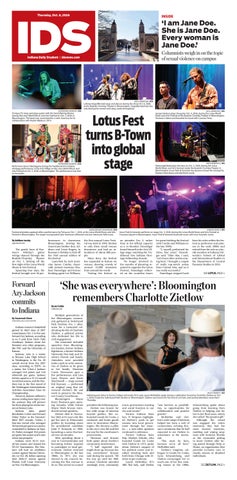
IDS Thursday, Oct. 8, 2026
INSIDE
‘I am Jane Doe. She is Jane Doe. Every woman is Jane Doe.’
Columnists weigh in on the topic of sexual violence on campus
Indiana Daily Student | idsnews.com
JACK JERNIGAN | IDS
KATHERINE MANERS | IDS
Enrique Chi sings and plays guitar with the band Making Movies during the Lotus World Music and Arts Festival on Oct. 2, 2026, in Bloomington. The band was nominated for a Latin Grammy for its collaboration with Rubén Blades in 2019.
KATHERINE MANERS | IDS
Performers dance Yakshagana during the Traditional Arts Indiana Heritage performance in the Arts Village at the Lotus World Music and Arts Festival on Oct. 2, 2026, in Bloomington. The performance was free to the public.
LaTonja Degraffenreid sings and dances during the show Oct. 4, 2026, at the Buskirk-Chumley Theater in Bloomington. Degraffenreid had one solo during the concert and sang vocals throughout.
Lotus Fest turns B-Town into global stage
HARSHINI MUTHURAMAN | IDS
Festival attendees applaud after a performance by Pahua on Oct. 1, 2026, at the Lotus World Music and Arts Festival in Bloomington. The singer incorporated Latin American influences into her electronic-folk music. By Addison Jacoby agjacoby@iu.edu
The gentle hum of Busman’s Holiday’s guitar strings danced through the Buskirk-Chumley Theater on Oct. 1, kicking off the first night of the Lotus World Music & Arts Festival. Spanning four days, the festival brought over 40 per-
Forward Azy Jackson commits to Indiana By Savannah Slone
srslone@iu.edu | @savrivers06
Indiana women’s basketball gained its third class of 2027 commitment Oct. 2 in five-star forward Azy Jackson, according to an X post from On3’s Talia Goodman. Jackson chose the Hoosiers over other programs, like USC and the University of Kansas. Jackson, who is a senior at Bonney Lake High School in Washington, is the No. 20 overall recruit from the 2027 class, according to ESPN. As a junior, the 6-foot-4 Jackson averaged 14.6 points and 14.8 rebounds per game. Jackson led her squad to a 15-12 overall record last season, and the Panthers lost in the first round of the Washington Interscholastic Activities Association Class 4A Championship. However, Jackson suffered a season-ending knee injury over the summer that will prevent her from playing her senior season at Bonney Lake. Jackson joins guard Brookeslee Colvin and forward Finley Parker as the Hoosiers’ three 2027 recruits. Colvin, a four-star recruit who averaged 30.9 points per game as a junior, committed to Indiana on Sept. 22. Parker averaged 19.6 points per game last season and is also a four-star prospect. Indiana went 18-14 overall last season and missed the NCAA Tournament. The Hoosiers will host an exhibition contest against Marian University on Oct. 28, before opening their 2026-27 season against Florida Gulf Coast University on Nov. 3 in Bloomington.
formances to downtown Bloomington, inviting the Americana brother duo, Addison and Lewis Rogers, in Busman’s Holiday to kick off the 33rd annual edition of the festival. Launched by rock musician James Combs, classically trained musician Shahyar Daneshgar and former booking agent Lee Williams,
the first annual Lotus Festival was held in 1994, limited to only three small venues downtown and had an attendance of about 800 people. Since then, the festival has expanded to feature six venues, drawing crowds of around 12,000 attendees from around the world. Visiting the festival as
JACK JERNIGAN | IDS
Jacopo Ventura plays the guitar Oct. 4, 2026, during the Lotus World Music and Arts Festival at the Buskirk-Chumley Theater in Bloomington. Ventura is Italian and founded his band with Lorenzo Testa.
ANYA MINEKUS | IDS
Hahyungki Baek plays the bass on Oct. 3, 2026, during the Lotus World Music and Arts Festival inside the Buskirk-Chumley Theater in Bloomington. Insun Park & Generals has become known for mixing the Korean mask dance and electronic punk.
AARON SMITH | IDS
Insun Park & Generals performs on stage Oct. 3, 2026, during the Lotus World Music and Arts Festival at Fountain Square in Bloomington. Insun Park & Generals fused old music with new futuristic tunes.
an attendee Oct. 2, rather than in his official capacity as a co-founder, Daneshgar found himself at the Arts Village stage, watching the Traditional Arts Indiana Heritage Fellowship Awards. No longer involved in the months of planning required to organize the Lotus Festival, Daneshgar reflected on the countless hours
he spent birthing the festival with Combs and Williams in the late 1990s. “I, myself, performed for three, four years,” Daneshgar said. “After that, I said, ‘Let’s have other artists coming here.’ I brought a couple of really top-notch artists from Central Asia, and so it was really successful.” Daneshgar stepped back
from his roles within the festival as performer and planner in the early 2000s and retired from his role as a faculty member at Indiana University’s School of Global and International Studies in the Department of Central Eurasian Studies in 2024.
SEE LOTUS, PAGE 4
‘She was everywhere’: Bloomington remembers Charlotte Zietlow
By Ian Collier icollier@iu.edu
Multiple generations of the Bloomington community gathered at Switchyard Park Pavilion Oct. 1 afternoon for a memorial celebrating the life of Charlotte Zietlow, a political activist who dedicated her life to civil engagement. The memorial included speeches from Bloomington leaders, former Indiana legislators, a former Indiana University first lady and Zietlow’s friends and family. Attendees were provided index cards to write memories of Zietlow to be given to her family. Musician Carrie Newcomer gave a live performance, and Lara Lynn Weaver and Kevin MacDowell — stage named Kid Kazooey — performed an original song that referenced Zietlow’s life and work to preserve the Monroe County Courthouse. Bloomington Mayor Kerry Thomson gave opening remarks, while former Mayor Mark Kruzan introduced several speakers. Zietlow died in November 2025 at 91 years old. She got her start in Democratic politics by knocking doors for presidential candidate John F. Kennedy in 1960, launching a career that lasted over six decades. After spending about a year in Czechoslovakia and becoming further inspired to participate in local government, Zietlow returned to Bloomington in the late 1960s. In 1971, she was elected to city council, becoming the first woman to do so. She served as council
JACK FORREST | IDS
Hatted guests listen to former Indiana University First Lady Laurie McRobbie speak during a celebration honoring Charlotte Zietlow on Oct. 1, 2026, inside the Switchyard Park Pavilion in Bloomington. Zietlow was known for her love of sun hats, and several attendees wore them Thursday.
president the following year. Zietlow was known for her wide range of interests beyond politics. She cofounded Goods for Cooks, a cookware and home goods store in downtown Bloomington. She became a pillar in the city’s civic life and led the way for the courthouse’s preservation. Thomson and Kruzan both spoke about Zietlow’s community involvement. “I half expected she might show up, because she was everywhere,” Kruzan said during his speech. “All the way up until her 90th annual, Charlotte attended seemingly every community
event, government meeting and social function in our city and county.” Former Indiana State Sen. Vi Simpson highlighted Zietlow’s push to get women into local government through her tenacity — a trait other speakers continued to reference. Former Indiana State Rep. Marilyn Schultz, who founded Goods for Cooks with Zietlow in 1973, spoke about Zietlow’s support of her political career and recalled traveling back and forth from Chicago with Zietlow to get cookware. Laurie McRobbie, IU's 18th first lady, said Zietlow
“saw barriers as possibilities, as opportunities for collaboration and positive growth.” McRobbie said Zietlow’s wide range of interests helped her form a web of connections, echoing Kruzan's sentiment that he half expected to see Zietlow in attendance at the memorial. “She must be here, because we’re all here.” McRobbie said. Zietlow’s longtime colleague in Goods for Cooks, Lynn Schwartzberg, said Zietlow encouraged her to teach one of her first cooking classes in the 1980s.
Schwartzberg spoke about going from learning from Zietlow to helping care for her in her final years, which she called “the greatest gift.” Although the crowd was engaged the entire memorial, they had the most visceral reactions, nodding and wiping away tears with Summer Shields as she recounted getting to know Zietlow after being paired through Help at Home, an organization that provides in-home care to mostly seniors or disabled individuals.
SEE ZIETLOW, PAGE 4
Indiana Daily Student
2
NEWS
Oct. 8, 2026 idsnews.com
Editors Ella Curlin, Grace Fridy & Deshna Venkatachalam news@idsnews.com
What to know about proposed amendments on Indiana’s ballot
IDS FILE PHOTO
Two signs directing voters toward the polling center inside Alumni Hall are pictured Nov. 5, 2024, outside the Indiana Memorial Union in Bloomington. Indiana voters will decide on two proposed constitutional amendments in the general election Nov. 3. By Will Tallackson wdtallac@iu.edu
Indiana voters will decide on two proposed constitutional amendments concerning bail eligibility and city and town court judges’ residency in the Nov. 3 general election. The proposed amendments will appear alongside races for federal, state and local offices on the ballot. Voters can approve or reject each amendment separately. Each amendment will take effect if it receives a majority of the votes cast on that question. How do constitutional amendments reach the ballot? Indiana does not allow residents to place proposed constitutional amendments on the ballot through petition signatures. Proposals must pass through the Indiana General Assembly —
Indiana’s legislative branch — before appearing on the ballot. Under Article 16 of the Indiana Constitution, a proposed amendment must receive support from a majority of all elected members in each legislative chamber. After the next legislative election, both chambers must approve it again before sending it to voters at the next general election. Bail amendment Currently, Article 1, Section 17 of Indiana’s Bill of Rights guarantees bail for offenses other than murder or treason, when bail is barred if “the proof is evident, or the presumption strong.” The amendment proposes another exception, removing the eligibility for defendants who present a substantial risk to another person or the community. For offenses other than murder or treason, the state
would also have to establish, by clear and convincing evidence, that no conditions on the defendant’s release could “reasonably” keep another person or the community safe. A “yes” vote would approve this additional exception under the Indiana Constitution. A “no” vote would keep the current constitutional provision unchanged. Sen. Eric Koch, R-Bedford, originally authored the resolution proposing the bail amendment in 2023 and reintroduced it in December 2025. The Indiana Senate approved the resolution 43-2 in January 2026. The Indiana House approved it 75-11 in February 2026, clearing the way for the proposed amendment to appear on the November ballot. “It is important to ensure our communities are protected from those who wish to do harm,” Koch said in a
January news release. In the same release, Koch referenced 23 states with similar constitutional provisions that Indiana would join if voters approve the amendment. However, the American Civil Liberties Union of Indiana opposes the amendment, arguing the proposal’s wording is unclear and too broad. In a statement on its website, the ACLU argued the amendment could leave more people jailed without conviction, adding to overcrowding in the state’s jails. Sen. Greg Taylor, D-Indianapolis, one of two senators who voted against the resolution, also criticized the proposal. During a January Senate debate, Taylor questioned making bail decisions based on an assessment of the defendant rather than the charge. “If you don’t think there are some judges out here that may have bias in their
community of certain people, then you haven’t been to court in Indiana,” Taylor said during the debate. Judge residency amendment Article 6, Section 6 of the Indiana Constitution requires county, township and town officers to live in the jurisdiction they serve, including judges. The amendment would expand where city and town court judges could live, allowing them to live anywhere within the court’s county or in the closest bordering Indiana county. The bordering county would be determined by the shortest distance from the city or town’s boundaries to the county line, according to the proposed amendment. Rep. Michael Aylesworth, R-Hebron, introduced the resolution proposing the judge residency amendment in 2023 to help address city
and town judicial shortages. Lawmakers approved it that year and again in 2025, when the Indiana House voted 81-7 and the Indiana Senate voted 43-3. According to 2024 data from the American Bar Association, Indiana had 2.26 lawyers per 1,000 residents — ranking the seventh lowest of U.S. states in lawyers per capita. “Lawyers who could later serve as judges have become increasingly scarce in more rural areas of the state,” Aylesworth said in a news release from Indiana House Republicans. “With older lawyers retiring and not enough new ones to replace them, rural communities are limited when it comes to legal services.” Voting “yes” would approve those expanded residency options; voting “no” would retain the requirement that judges live in the city or town they serve.
Sigma Nu placed on cease and desist This is the 5th fraternity placed on cease and desist in September
By Elizabeth Schuth ekschuth@iu.edu
Indiana University placed the Sigma Nu fraternity on cease and desist Sept. 29 after alleged hazing, according to the IU Office of Student Life website. Sigma Nu is the fifth fraternity IU placed on cease and desist in September. Beta Theta Pi and Pi Kappa Phi were also placed on cease and desist Sept. 25. Theta Chi and Delta Tau Delta were placed on cease and desist Sept. 16
and Sept. 17, respectively. The IU Police Department reported that hazing with a substantial risk of bodily injury took place at Sigma Nu on Sept. 20, according to the IUPD Daily Crime and Fire Log. “The investigation for Sigma Nu is ongoing,” IU spokesperson Mark Bode wrote an email to the Indiana Daily Student. “Cease and Desist directives are placed when there are allegations of behavior that have caused or may cause harm to the members of the
organization and/or the community.” IUPD Public Information Officer Julia Nowak wrote in an email to the IDS that the alleged hazing case was referred to university officials for review. Organizations on cease and desist are prohibited by the university from hosting or attending social events, recruitment events, membership education activities or philanthropic events, Bode wrote. Sigma Nu entered into a
voluntary agreement with the university from Jan. 29 to Feb. 20, 2026, to resolve a matter regarding alcohol and risk management, according to the IU Office of Student Life website. The fraternity’s national office also suspended Sigma Nu in 2017 for alcohol violations and hazing. Suspension means a fraternity must stop all activities and disband, according to the IU Office of Student Life website. The fraternity was rechartered in April 2022.
TRINITY MACKENZIE | IDS
Sigma Nu is pictured March 12, 2025, in Bloomington. Indiana University placed Sigma Nu on cease and desist Sept. 29, 2026.
Inside Survivor at IU’s growing community By Adam Holstein adabhols@iu.edu
If it meant the difference between winning and losing, immunity or no immunity, staying in the challenge or going home: how many coins could you balance on a Popsicle stick held in your mouth? In the “Survivor” club at Indiana University, this is a real situation. Founded in 2023, it has around 27 production mem-
bers and 16 to 20 players depending on the season. Each season, spanning the length of a semester, IU students chosen as “castaways” participate in immunity challenges across campus, which are competitions to earn safety from elimination. One example is “Coin Popsicle,” the aforementioned head-tohead challenge in which participants hold sticks in their mouths and must stack coins on the stick in order from larg-
Jack Forrest Co-Editor-in-Chief Mateo Fuentes-Rohwer Co-Editor-in-Chief Chloe Oden Managing editor content
Vol. 159, No. 8 © 2026
www.idsnews.com Newsroom: 812-855-0760 Business Office: 812-855-0763 Fax: 812-855-8009
Emerson Elledge Managing editor content Chloe Lavelle Creative director Lillie Donato Managing editor digital
The Indiana Daily Student will publish the next print edition on Oct. 15. For regular news and updates, please check online, subscribe to one of our email newsletters or follow on social media. Part of IU Student Media, the IDS is a self-supporting auxiliary University enterprise. Founded on Feb. 22, 1867, the IDS is chartered by the IU Board of Trustees, with the editor-in-chief as final content authority. The IDS welcomes reader feedback, letters to the editor and online comments. Advertising policies are available on the current rate card. Readers are entitled to single copies. Taking multiple copies may constitute theft of IU property, subject to prosecution. Paid subscriptions are entered through third-class postage (USPS No. 261960) at Bloomington, IN 47405.
130 Franklin Hall • 601 E. Kirkwood Ave. • Bloomington, IN 47405-1223
est to smallest while referees shout out values. They also participate in tribal council, a weekend ceremony where the group votes to send one castaway out of the game until one is crowned as Survivor. Each episode varies in length, and the length of seasons depend on the semester and the nature of the participants. However, one thing remains constant: the production crew films everything, from the major events to private, one-on-one confessional interviews to see as much of the participants’ game as possible. Production members involved in the club edit and upload the episodes to YouTube and Instagram. Some members of the production club use real cameras to get high-quality videos to upload for the episodes. Club leaders encourage members of the production team to get involved with the social media, interview castaways and create questions for confessionals, as well as manage overall logistics and rules of game play. Most of the production
team are past players that joined to help continue the club. They create challenges and twists for the game while also facilitating the competition itself by gathering materials and working together on ideas. Senior Maggie Shoup, Survivor at IU co-president, and Season 2 castaway, said she loves the social aspect of the club. “It’s just really fun meeting people,” Shoup said. “I was a freshman (when I got involved) so I didn’t know a lot of people and once you play a season with somebody, I feel like you automatically get pretty close with those people.” Shoup said she hopes Survivor at IU will continue to grow as more people see the camaraderie between its members and the hard work of those participating in the show and working behind the scenes. Several club members shared similar stories of hanging out together, as well as playing board games or other activities. John Malloy, a sophomore and castaway in Season 6, agreed it was a positive experience.
COURTESY PHOTO
IU Survivor club members are pictured after their “All Star’s Weekend” on April 12, 2025, at Olcott Park in Bloomington. The event brought together many participants from previous seasons of the club to reunite and compete again.
“It was my No. 1 highlight last semester,” Malloy said. “It really got me through the semester.” Cooper Amirhamzeh, another sophomore and castaway from Season 6, said that the club was something he looked forward to every week, sometimes even taking priority over schoolwork. “I’m just looking forward to Friday, Sunday and how many different things the club can do because it’s like ‘Survivor,’” Amirhamzeh said. IU senior and castaway Brooke Goeglein said she believes that students should
join for the club’s “lifelong memories.” Goeglein said while it’s easy to forget about other campus clubs, the Survivor club is “one of those things where you just have to be there.” Updates are posted on the show’s Instagram account. Season 6 is currently releasing on YouTube, and Season 7 will film from until roughly April 19. Students interested in becoming a participant in the show or assisting with the crew behind the scenes can contact the club through its Instagram page.
Indiana Daily Student
OPINION
Oct. 8, 2026 idsnews.com
Editors Eric Cannon, Emma Howard opinion@idsnews.com
3
‘I am Jane Doe. She is Jane Doe.
ILLUSTRATION BY BRI SUCH
.’ e o D e n a J is n a m o w y Ever Columnists weigh in on the topic of sexual violence GUEST COLUMN: Sexual violence on college campuses: the IUB edition Maria Bucur
is the John W. Hill Professor of History at Indiana University.
Every year, around the beginning of October, we get the “Security and Fire Safety” report from the Indiana University Police Department, with data about reported crimes safely tucked somewhere among hundreds of pages of boilerplate text. If you scroll to page 144, as I did last week, you’ll find out how well our campus authorities have taken care of students’ safety over the past three years. You can also go back and do the math for another decade or so of data, but don’t ask the IUPD or anyone else in the chancellor or provost’s offices to provide that basic info. Parents wanting to send their daughters and sons to IU will likely have no clue about these numbers, probably some of the most revealing information about the kind of college culture you’re about to launch your kid into. This year’s data is not good news. Long term, we are failing to bring down the numbers of interpersonal violence taking place on this campus. Burglaries and car thefts are also going up. But I want to focus solely on the numbers that speak to the incidence of sexual harassment of varying kinds. The
categories reported are: rape or statutory rape, fondling, incest, domestic violence, dating violence, stalking and hate crime, specifically related to gender. To the right are the numbers, provided to you for a range of nine years for a better long-term view. The year of confinement and isolation due to COVID-19, 2020, offers a dip that suggests both anomalies due to most students being mostly off campus, as well as possible under reporting — zero incidents of domestic violence stands out in relation to every other year. But there is clear evidence that from an average of just under 83 reports per year until 2022, excluding 2020, we jumped to an average of just under 248 reports per year in the next four years. That is a growth of nearly 200%. This happened under the watchful eye of “students are the center of the universe” Pamela Whitten, Rahul Shrivistav and the IUPD. Safety has been a word these people used liberally during this interval, for instance to invite brutal police action against peaceful protesters in Dunn Meadow. When, if ever, have you seen a discussion about these numbers conducted by the provost, chancellor or vice president for student
Lauren Vivo (she/they)
is a freshman studying psychology and political science & philosophy with an intent on enrolling in law school.
fraternity’s group chat who could have intervened, every detail of Jane Doe’s own actions leading up to the alleged rape has come into question. Because why would offenders answer for their behavior when funds are at play? After all, Greek alumni are more likely to donate to their alma mater. Failure to hold perpetrators of harm truly accountable lines universities’ pockets. It is much easier to assign an essay than it is to demand real change because change would disrupt the current system of wealthy donors patting each other’s backs. The systemic failure that places victims at fault is what drives the alias “Jane Doe.” It is why so many other women in similar situations have not reported at all — which raises the thought of how many may have gone through the same on our own campus. In light of the recent events at Cornell, American universities, including IU, are faced with a tough question: how much longer are they going to uphold a culture that blames survivors in order to protect the powerful? Considering our campus’s current policy, the outlook is grim.
I was walking to Wright Quadrangle when I heard the words “Cornell 7” in a conversation behind me. I nosily slowed my pace and awkwardly craned my neck to try to listen to the girl explaining the story: one Jane Doe and one “friend” turned into one victim, seven alleged rapists, and 50 bystanders. It shouldn’t have shocked me as much as it did to hear someone so openly criticizing Cornell University’s handling of the situation, or the fact that it happened in the first place, but it did anyways. I ate my dinner, reposted another article about Jane Doe and shared non-campus resources for sexual assault victims on my story. Media frenzy over something controversial, especially something political, is nothing new. But for some reason, though I’m only a freshman, I’ve never been so acutely aware of how the energy on campus has shifted. Women I haven’t spoken to or interacted with in ages are coming out of the online woodworks to post about Jane Doe. I’m finding allies in places I never thought I would — behind me heading to the dining hall, elevators, online — and enemies in all the places I expected. The difference between the average female college student and her average male classmate has never been more obvious — at least, to me. I find men complaining about the media frenzy around the Cornell case, or even whining about why sexual assault is such a big talking point anyways. Particularly, I saw a guy in my dorm group chat wondering why IU even bothers with Bystander Intervention programs. One of the hardest things for a lot of men to grasp is that for women, sexual assault isn’t a possibility, it’s almost a guarantee. Every woman I know has been sexually harassed, and sexual assault is simply the next step up: a comment turns into a grab, a hug turns into an unwanted kiss, a date turns into something else entirely. To be a woman means to be objectified, disrespected and used, in ways that a man could never fully understand. This is why the Cornell case is so powerful — what Jane Doe is speaking up about is something that every woman has been taught to prepare themselves for. Women have joined a growing trend saying they “are Jane Doe” because they want to protect her identity, yes. But women also say they are Jane Doe because we are — we have lived through harassment, we have lived through assault, we have lived through “nice guys” and the typical utterances of “it was just a joke” and “we’re cool, right?” It’s empowering to see a woman so brazenly calling out the abuse she faced because we live in a society that actively allows it. I am Jane Doe. She is Jane Doe. Every woman is Jane Doe.
emhowa@iu.edu
lvivo@iu.edu
Reported data from the Indiana University Police Department is pictured.
life? I have been on this campus for 30 years, and I have never seen that conversation take place, even when I tried to force it through a public petition intended to engage the provost — then Lauren Robel — and the Bloomington Faculty Council. That was more than a decade ago. And it went nowhere. The only serious publicity to this problem was brought about by audacious reporting from the IDS. The relatively new regular log about sexual violence reports on campus also does a good job of making this issue visible to those who want to check. We are currently in the midst of searching for a new
provost. We have strong leadership in both the BFC and IU Student Government. These bodies and the administrators charged with picking the new campus leader have the opportunity and responsibility to ask what the new provost will do to address this major problem regarding safety on campus. I am hopeful that looking at this data will help us join what is becoming a renewed national conversation about the nature of sexual violence on college campuses. We need to identify the core problems and generate mechanisms and resources to address them structurally. We need to do more than place the same set of Greek
houses on cease and desist one semester, only to return to the pattern of putting up with violent behavior the next semester. This rinse and repeat “solution” is endangering the student body. Two years ago, the university shut down a major cultural event that it was putting lots of money into because of “security concerns.” It’s time to start thinking about the large numbers of reported rapes, incidents of domestic violence and other forms of sexual harassment as major “security concerns” for our students as well. I look forward to hearing from the chancellor and interim provost about their solutions.
Jane Doe lives on every campus Emma Howard (she/her) is a junior studying journalism.
“Jane Doe” is defined as “a woman who is a party to legal proceedings and whose true name is unknown or withheld.” In 2024, a Jane Doe reported being raped by seven members of the Chi Phi fraternity at Cornell University. The local district attorney initially closed the case, determining the allegations did not have enough evidence to bring criminal charges. In September, this Jane Doe filed a lawsuit against Cornell, which held a closed proceeding in 2024 to decide whether the men involved would face disciplinary action. The harshest punishment the men faced was expulsion, and the lightest was writing a paper. This case — while extremely deserving of the attention it’s garnered — does not tell us anything new about the state of American universities. Rather, the work of student journalists at Cornell has brought into the spotlight what college students around the country have been subjected to for years: a campus culture that fails to hold the perpetrators of sexual violence accountable. There are doubtlessly
thousands of Jane Does on campuses across the United States. Any one of them may pass you on your commute to class. They might sit by you in a dining hall or live on your dorm floor. The rampant issue of sexual violence on campuses is little spoken of directly among the public and even many students. Why would it be? Universities aren’t going to take action. Indiana University demonstrates this same indifference toward its students. College campuses are not safe spaces for women, and this one is no exception. According to statistics released by the IU Police Department and cited in a guest column by history professor Maria Bucur, the average number of sexual violence reports on IU’s campus has increased by nearly 200% between 2022 and 2025. The Indiana Daily Student has consistently covered incidents, and the subject isn’t quite lacking in commentary either. However, IU continues to drag its feet toward making any real changes for its student body. It is no surprise the uptick in reported incidents correlates with the hiring of IU President Pamela Whitten in 2021. Whitten, after all, embodies the old boys’ network, despite proudly claim-
LETTER: Why is everyone talking about Jane Doe?
ing the title of IU’s first female president. She has consistently made fraternizing with the wealthy and powerful a priority. As assault reports surged, she collected a $250,000 bonus in July on top of a $100,000 salary raise last February. She also fosters a warm relationship with the Trump administration, which has a notorious history of sexual misconduct allegations. Meanwhile, Whitten resisted directly acknowledging campus sexual assaults after being repeatedly prompted by student reporters. So, what does being held accountable look like at IU? At the current moment, it looks like simply putting Greek organizations accused of violent behavior under cease and desist for a singular semester. It is the same Greek system that, throughout the country, has been constantly accused of misconduct yet has remained intact for generations. In regards to sexual violence, IU’s executive leadership has yet to publicly acknowledge the increase in cases, with the university’s website providing only a blanket statement on the matter. This lack of accountability seeps into the way students are taught about consent and sexual assault. Universi-
ties have approached consent education with a narrative that frames victims as responsible for the actions of offenders. At IU, students come face to face with this narrative through educational modules and signage, the ever-repeated phrase being: “Consent can be withdrawn at any time, as long as it is clearly communicated.” This line tells the story of a culture that teaches survivors their pain is conditional and enables perpetrators to justify what is unjustifiable. After multiple calls for change in the way consent is defined on campus, from both my columns and supporting guests, IU has remained dormant. This is unsurprising. Given that victim blaming ideology has historically led to a lack of reporting, teaching students a skewed narrative of what consent looks like is a cop-out. It avoids placing responsibility where it belongs because doing so is inconvenient. When victim blaming discourages people from reporting incidents, no one will be held accountable. And when a victim does come forward, that same culture scrutinizes their story to no end. The Cornell case is a traditional exhibit. Despite the deliberate actions of seven men and the inaction of 50 men in the
4
Oct. 8, 2026 | Indiana Daily Student | idsnews.com
» LOTUS
CONTINUED FROM PAGE 1 Sitting in the Arts Village next to the stage on the night of Oct. 2, booths featuring artistry from different cultures and traditions lined up next to the courthouse. Within the array of booths, a coil spring, an air-brushed paint bucket full of lollipops and a posterboard with a picture of a lowrider car sat on display. Manning the table was Anjelica Soto and Sherwin Underwood, members of the Hop Spot Crew, Inc. from Fort Wayne, Indiana. The nonprofit crew celebrates lowrider car culture to uplift their community, mentor youth through creative programs and raise support for local charitable causes. Lowrider cars are cars modified with lower suspension, hydraulics and typically painted vibrant colors. Soto said the Hop Spot Crew was invited to the Lotus Festival as nontraditional artists, with the organizers wanting to feature diverse art forms for the global music and arts festival. “I feel like I didn’t deserve to be chosen to be a part of such an amazing event and to be put into a group with people like some of the people here that are doing weaving,” Soto said. “I’m just so humbled to be able to be part of such an amazing, very inclusive event. I just love it.” Seventeen musical performances spanned across the six venues that night, concluding with Tunisian artist Nour Harkati performing the
» ZIETLOW
CONTINUED FROM PAGE 1 “There were moments when I didn't know what to think or do next, and Charlotte helped me carry it,” Shields said. “She never let me go alone.” In an interview with the Indiana Daily Student, Shields described becoming close with Zietlow. “I was at the lowest point in my life, I had just lost a grandparent and found out I was pregnant,” Shields said. “And Charlotte pushed me beyond my limits to become something more. About a month
Saharan Desert Blues genre. The Lotus Festival continued beginning at noon Oct. 3 with Insun Park & Generals Mask Dance Workshop on Sixth Street. Insun Park & Generals is a shamanic ritual folk and modern rock band from Korea, with Park being the frontwoman of the band. Park is a master of the Gangnyeong Mask dance, making her one of the few female masters of the male-dominated dance. To become a master, one must go through extensive training and mentorship. More workshops and musical shorts were performed on Sixth Street and the Arts Village stage throughout the afternoon. Insun Park & Generals took to the BuskirkChumley Theater’s stage at 7:30 p.m. to be the second performance at the venue that night. Park’s set featured the merging of traditional rhythms with modern rock influences, showcasing traditional Korean clothing alongside a drum-heavy rhythm. Desiring audience participation, Park pointed to attendee Shane Wagner in the crowd, beckoning him forward to “knight” him with an Insun Park & Generals branded hat. This was Wagner’s fourth time attending the Lotus Festival, and he said the hat being placed upon his head was a great start to the night. “The band was awesome, this was just the cherry on top,” Wagner said. “I love to just stumble upon these incredibly diverse and talented
bands from all over the world that play the weirdest things that I would never understand otherwise, and I fall in love with them just like today.” Nineteen diverse performances graced the venues downtown that night, with Italian, Romanian and Moroccan bands showcasing their talents. Alongside this, the Arts Village stage hosted a drag and comedy show. Behind the scenes, the Lotus Festival was run by volunteers in Lotus-branded green shirts. The ticket booths, informational stations and theater doors were all run by volunteers, ensuring the weekend ran smoothly. At the informational booth on Oct. 3 from 5 p.m. to midnight, volunteer Nic Peterson sat, sharing information about artists, schedules and locations to passersby. This was Peterson’s second year volunteering, and he plans to continue in future years. “I wanted to see it again, but I also just really enjoyed like the whole like just being here in the heart of everything that’s happening and contributing to something that I think is culturally important for a lot of people,” Peterson said. The final concert of the festival was in the evening Oct. 4, ending the weekend and the 33rd annual Lotus Festival with performances from American gospel and blues group Nicki D & the Sisters of Thunder and Italian string group Gadan. Sitting outside the entrance
before she died, she made me enroll into college, and now I'm about to go into nursing school.” Shields said in her speech she knew a different, more private side of Zietlow — a “Charlotte who didn’t have to be Charlotte.” Shields said Zietlow had once encouraged her to drive onto the sidewalk so Zietlow could avoid a long walk into a building, saying she’d pay any ticket if they were stopped. One day after that, Shields said, Zietlow chided her for not using a seatbelt. “I wish she could see how many people came here be-
cause you mattered to them, because you made a difference in their lives, because somewhere along the way you became a part of their story, and I know you know how much you became a part of mine,” Shields said in her speech. Shields’ remarks were punctuated by a standing ovation. Zietlow’s children, Nathan and Rebecca, spoke about their mother’s influence on their family, with Rebecca describing how her mother taught her the importance of self-awareness, self-care and engaging in civil service.
ANYA MINEKUS | IDS
Festival-goers dance on the street during the Lotus World Music and Arts Festival on Oct. 3, 2026, on West Kirkwood Avenue in Bloomington. The festival hosted over 40 events in six different locations.
of the Buskirk-Chumley Theater that day was a memorial for Williams, a festival co-founder. Williams died Jan. 11, 2026, and this year’s festival was the first without him present. The tribute included an obituary, a posterboard dedicated to his life and a video shown during the final concert, commemorating his large impact on the festival and Bloomington. “What I really like in him is he had a real open mind to other cultures,” Benoit Borque, William’s friend and colleague, said in the video. “He wanted people to discover those cultures, and I really love that.”
“I still wake up every day and think about Charlotte, the work that we're still doing. I just encourage you all to put your butterfly capes on and share some more of Charlotte every day, because she continues to change our community.” Kerry Thomson, Bloomington mayor
Rebecca shared lyrics from “Grandmother” by Big
ANYA MINEKUS | IDS
Lead singer Diana Sánchez and bass guitarist Daniela Vergara perform at Buskirk-Chumley Theater on Oct. 3, 2026, during the Lotus World Music and Arts Festival in Bloomington. The Colombian band played for an hour inside the theater.
Thief in her speech, saying the song made her think of her mom. “I saw sun through the clouds // I saw love through any pain // Gonna turn it all into rock and roll // Gonna turn it all into rock and roll,” Rebecca quoted from the song. “I feel like that's what Mom did.” Thomson returned to give a closing speech and shared how Zietlow had influenced her outfit choice for the memorial — a butterfly cape — saying Zietlow “wore me down in my cocoon before helping me launch.” Even when Thomson
visited Zietlow in the hospital four days before she died, Thomson said, Zietlow asked what else she could do to serve the city. Before ending her remarks, Thomson said when someone close to her dies, especially a teacher, she considers it her work to “keep them living.” “I still wake up every day and think about Charlotte, the work that we're still doing,” Thomson said. "I just encourage you all to put your butterfly capes on and share some more of Charlotte every day, because she continues to change our community.”
Reporting & Editing & Designing & Podcasting & Photography & Coding & Multimedia & You.
Join the Indiana Daily Student's award-winning staff! The IDS is currently hiring. Positions will begin as soon as possible. No experience is required and all staffers are paid. Apply now at idsnews.com/jobs.
An Equal Opportunity Employer
Indiana Daily Student
ARTS
Oct. 8, 2026 idsnews.com
Editors Lexi Bunting, Ursula Stickelmaier, Abby Whited arts@idsnews.com
5
PHOTO COURTESY OF VICTORIA BASTIAN PHOTOGRAPHY
Jacobs School of Music ballet dancers perform “Stone Blossom” during a rehearsal on Sept. 29, 2026. The fall ballet was the world premiere of the performance by James Whiteside.
Fall Ballet explores different styles in 4 works By Stella Klaus ssklaus@iu.edu
The curtains rose in the Musical Arts Center on Oct. 2 for opening night of the Jacobs School of Music’s yearly Fall Ballet. The ballet was a mixed repertory program and featured four different works performed for the packed theater. Beginning at 7:30 p.m., the program gave many of the ballet students the chance to participate. The main goal of the show is student growth, ballet program director and dance department chair Sarah Wroth said, and the Fall Ballet is almost like a midterm for the students. “We want everyone learning, and we want everyone valuing all the learning in the space, whether you’re performing something or covering something,” Wroth said.
The four different works allowed room for several different styles of ballet. The first ballet performed was “White Shadows,” choreographed by Jacobs senior lecturer in ballet and contemporary dance Christian Claessens. It included eight percussion students playing live on the stage while dancers performed in front of them. “White Shadows” explored the idea that people often shadow, or follow in the footsteps of, others in life. The second work presented was “Valse-Fantaisie,” choreographed by George Balanchine, one of the most influential choreographers of the 20th century. This classic ballet featured six dancers, five of them wearing long purple tutus, dancing and twirling around the stage. “I don’t care who you are
or what gender you fall into, you will want to put on a skirt and dance to a waltz after watching that ballet,” Wroth said.
“I just thought the last piece was absolutely stunning and just such a wonderful study of gender and the roles that can be so freely adapted for everyone.” Angela Glomm, Bloomington resident
The third ballet was “Dignity in Restraint” by Caili Quan. This work was originally created as a video that took place in a studio. Being a contemporary piece, the movements of the five ballerinas were different than the previous dances.
Wroth also said that Quan left this ballet up to the viewer to interpret. Wroth found a few interpretations in her research, like that each dancer represents a different personality or a specific musical chord. The show closed out with the premiere of “Stone Blossom” by James Whiteside, American ballet dancer, choreographer, model, drag queen and recording artist, who described it as a new ballet rooted in classical style. This final performance was in partnership with the Kinsey Institute at Indiana University, which researches sexual behavior. The institute received a donation of work by photographer George Platt Lynes, an American artist known for photographing dancers. The ballet itself included three male dancers along
with a 32-dancer corps de ballet and tells the love story between Lynes and two other men. The three male dancers performed on stage and imitated some of Lynes’ photographs, which were displayed behind them during the performance, while the corps de ballet danced as one around them. “It’s so beautiful the work that the dancers have done,” Wroth said. “It’s wonderful to see male presenters touching each other in peace, particularly in a time of war or in a time of unrest and strife in our nation.” Bloomington resident Angela Glomm said that “Stone Blossom,” the last ballet of the night, was a standout piece for her. “I just thought the last piece was absolutely stunning and just such a wonderful study of gender and the roles
that can be so freely adapted for everyone,” Glomm said. Stella Roudebush, a sophomore studying cinema and media studies at IU, said she came to the ballet specifically because she had heard about Whiteside’s piece. She said she knew the background about queer love going into the performance. She was also interested in the symbolism of the female dancers dancing around the three male ones and interpreted it as the three men questioning their identities. Roudebush, who has performed ballet before herself, she said she was able to notice little details that others might miss. “Seeing a step that you know is really hard and you’re like, ‘Oh, I can’t believe that they had to do that that many times,’” Roudebush said.
COLUMN: 3 copycat Trader Joe’s recipes for fall By Stella Klaus ssklaus@iu.edu
The Trader Joe’s shelves have been full of fall items since early September. From seasonal snacks like fall harvest salsa or pumpkin pie spice bark to pumpkin butter or apple pie spreads, there is no shortage of autumn-inspired eats. Unfortunately, Bloomington residents have to drive to Indianapolis — the closest Trader Joe’s — to get a taste. Although the nauticalthemed store hasn’t settled in Bloomington, there are plenty of ways to get your fix of fall foods. Here are three copycat Trader Joe’s fall meals you can make in your own kitchen. Butternut Squash Mac n’ Cheese Found in the frozen section of Trader Joe’s, the Butternut Squash Mac n’ Cheese is one of my favorite fall items. The fall twist on this classic meal always hits the spot. The first step to this delicious meal is to roast one butternut squash. To do so, preheat the oven to 400 degrees, cut the squash in half longways, drizzle some oil, salt and pepper on it, put it face down on a baking sheet and cook for 35-45 minutes. While the squash is cooking you can go ahead and grate 6 ounces of gouda, 3 ounces of parmesan, 3 ounces of white cheddar and set them aside. Once the squash is done, scoop it into a blender and add 3/4 cup of milk, 1/2 teaspoon of garlic powder, 1/2 teaspoon of dried rosemary, 1/2 teaspoon of dried thyme, 1/2 teaspoon of sage, 1/2 teaspoon of smoked paprika, 1/4 teaspoon of nutmeg and 1/4 teaspoon of cayenne. Once blended, heat 2 tablespoons of olive oil, add one bay leaf and then mix in
your butternut squash puree. Keep the puree on low heat while you cook one box of rigatoni pasta separately. Save 1/2 cup of pasta water and then add your pasta to the sauce. Finally, alternate between adding the cheese and a splash of pasta water. Mix until it is fully coated and then enjoy with some red pepper flakes on top. While this dish takes some time from roasting the squash and grating all the cheese, it is definitely worth it for the delicious fall flavors. Autumnal Harvest Creamy Pasta Sauce Another fan favorite is the Autumnal Harvest Creamy Pasta Sauce. Though I haven’t had the Trader Joe’s version, the copycat version filled my kitchen with fall scents and it tasted great. To make it, start by chopping half an onion, three cloves of garlic and three carrots. Melt 1 tablespoon of butter in a large pot and add your chopped veggies. While those are sautéing, dice up one butternut squash. After a couple of minutes once onions are translucent, add a 28-ounce can crushed tomatoes, a 15-ounce can pumpkin puree, your diced butternut squash and 1/2 cup of chicken broth. Next, season with 1 tablespoon of brown sugar, 1 teaspoon of salt, 1 teaspoon of dried parsley, 1/2 teaspoon of Italian seasoning, 1/4 teaspoon of black pepper and a pinch of cayenne. Bring your mixture to a simmer and let it cook covered for around 60 minutes, stirring occasionally. You can add around 1/2 cup more of broth if it is reducing too much. After about an hour, once squash is tender, transfer the sauce in batches into a blender and blend until smooth. Finally, mix in 1/2 cup of half and half, then serve over pasta with parmesan cheese. Though this meal was
STELLA KLAUS | IDS
Chopped vegetables are spread on a cutting board Sept. 28, 2026. The seasonal Trader Joe’s items began hitting the shelves in early September.
also more time consuming to make, it was full of fall flavor and worth it if you’re in the mood for cooking. Pumpkin Bisque Another item I haven’t gotten the chance to try yet is the Trader Joe’s Pumpkin Bisque. Now I won’t have to after making this easy copycat
recipe. First, chop one medium onion and one garlic clove and add them to a large pot with 3 tablespoons of olive oil. Sauté for about two minutes. Once sautéed, add 1/2 teaspoon of cinnamon, 1/4 teaspoon of nutmeg, 1 tablespoon of maple syrup, 2 tablespoons of
tahini, a 15-ounce can of pumpkin puree, 2 cups of veggie broth, 1/2 cup of milk and some salt. Mix and bring it to a boil. Then, reduce the heat and let it simmer for at least 10 minutes. Optionally, you can transfer it to a blender to make it smooth; however I didn’t, and it was equally as delicious.
Out of all three meals this was the quickest, taking me only around 30 minutes, making it the perfect weeknight meal. With the weather cooling off, now is the perfect time to try all of these dishes. While some of them take some time to prepare, they are all worth it and can last for around a week in your fridge.
6
Oct. 8, 2026 | Indiana Daily Student | idsnews.com
COLUMN: ‘The Bacchae’ turns pain, triumph into mesmerizing experience By Gracie Johnson grrjohns@iu.edu
A tale of freedom, reason and faith took the stage of the Wells-Metz Theater from Sept. 25 to Oct. 3 as the IU Department of Theatre, Drama and Contemporary Dance presented “The Bacchae.” Master’s student Kendrick Weingast directed the tragedy by ancient Greek playwright Euripides. From the lighting to the acting, I was sucked into the story for every second of the 90-minute performance. “The Bacchae” is an ancient Greek tragedy that follows Dionysus’ journey through Thebes. The journey is savage and brutal, with themes of humanity and fate lingering throughout the performance. This recent adaptation reimagines Euripides’ work through a modern political lens, emphasizing trust and community. This performance truly made me believe I was back in ancient Greece. The stage was made to be split into two areas. One side represented the mountain top, where the Bacchae lay with vines and sand consuming the side. A memorial for Dionysus’s mother, Semele, takes center stage on half of the side. This memorial is used creatively throughout the show, utilizing shadow play to tell the story and becomes a key part of the last act. The other side represented the kingdom of Thebes where a throne sits for King Pentheus. This side of the stage is where Pentheus spends most of his time before the end of the show. The show uses this set design amazingly. There are
PHOTO COURTESY OF ZACH ROSING
The cast of “The Bacchae” is seen at dress rehearsal Sept. 24, 2026, at the Wells-Metz Theater in Bloomington. The production opened Sept. 25, 2026.
moments throughout the play where both sides are talking yet neither know about what the other side is saying, adding suspense. The Bacchae isn’t one solid entity; it’s a cult following Dionysus and was made up of nine actors. The cast acted as one, danced as one, sang as one and cried as one — which really sold the performance
for me. Sophomore Annie Agee played a member of the Bacchae and Messenger 2 and said Weingast wanted to take a thought-provoking approach. “[Weingast] has been spinning it like the political scene of today,” Agee said. “She wants the audience to consider how it would feel if your leader doesn’t have your best
interests in mind. Would you still blindly follow them, or does that change how you feel about them?” Personally, I think the show leaned into the political scene perfectly. I also started to question the values of King Pentheus, even after the show, as I wondered if he only wanted what’s best for his people or if he was
hungry to show off his power. Rather than presenting the audience with a clear side to support, Weingast said the production encourages audiences to question what they truly believe. “It requires you, in the audience, to question what you side with,” Weingast said. I left the theater and found myself asking those questions.
There are so many moments where you want to root for the Bacchae, but then the story flips, leaving me questioning who I was rooting for. There’s no one defined answer, and I think that’s what makes it a must-see show. You aren’t told who to root for or who’s the bad guy; instead, you must decide. The show flips the audience back and forth between moments of pure bliss and anxiety-inducing moments that had me on the edge of my seat. I think all the actors performed incredibly well for how dark the show could become. Senior Rossie Rossen was a stage manager for “The Bacchae” and said that the cast and crew maintained a lighthearted atmosphere despite the dark themes of the show. “It’s very dark and it’s difficult towards the end of the show,” Rossen said. “The cast is really, really good in the moments in between being super fun, talking to each other and joking around.” I loved how the crew was able to play with the layout of the theater — one moment during the show required a bird prop to fly over the heads of the crowd. One of the main themes I saw during the production was community and identity. Once characters joined the Bacchae, it was like they were washed clean from who they were as a person. This is such a complex idea, and I believe that more theater productions should look at “The Bacchae” as inspiration when producing nuanced shows. Instead of telling audiences who is good or bad, the production leaves that up to the viewers to decide.
COLUMN: AI art has no place in local communities By Gracie Johnson grrjohns@iu.edu
When walking down Kirkwood Avenue, you might see advertisements stuck to store windows or taped to poles that catch your eye with large, colorful fonts or illustrations that look almost too good. If these flyers look a bit uncanny, there’s a good chance they’re AI-generated. AI flyers, posters or invites seem to have become a cultural norm for people looking for a quick way to get their information out without creating a graphic themselves. For artists, the growing use of AI imagery goes beyond a quick and easy poster. It raises concerns about creative opportunities and possible employment. The AI aesthetic is also becoming a signal to viewers that little human design went into the advertisement. The rise of AI isn't only on a global level; it's local, with art students now forced to compete with AI in the job market. Indiana University art history major and sophomore Marlee Werner sees those concerns developing further in the art spaces. “As someone in the art world specifically, AI artworks are incredibly controversial and debated,” Werner said. “Many artists are made to compete with AI within the job market, losing valuable opportunities and possible
commissions.” AI advertisements can also prevent students from having personal connections to the local events being publicized. Picture being handed two flyers from different IU student organizations.
“When I see a flyer that is made with AI, I immediately assume that the event will be just as low effort, unenthusiastic and rushed as the flyer that advertises it.” Marlee Werner, sophomore art history major
One looks handcrafted by club members, filled with photos and small design choices that reflect the group’s personality. The other looks polished but formatted, without anything that feels specific to the organization behind it. Which one would you feel more connected to? Connection extends beyond just people and the event, and choosing AI-generated art over work created by artists can hinder student organizations from connecting with Bloomington or IU student artists in their local communities. In a survey done by the Los Angeles Times, 80% of a surveyed 378 verified professional visual artists said that
they believe they compete with AI, and 77% added that it negatively impacted their career growth. IU studio art major and sophomore Celia Molotiu said as an art student, she is seeing that loss of connection and the harm of relying on AI-generated art. “AI also just makes the role of artists within a more connected and global world less, replacing illustrators for these images that are so clearly fake,” Molotiu said. “For me, it just takes away the charm and want to support things,” The effects also aren't just limited to event flyers or get-involved invitations, but student artists are now struggling with finding creative outlets. The internet and social media are ways that student artists often come together to share their work and gain inspiration from one another, but AI-generated content is growing. IU studio art major and junior Ella Bitar said she has noticed the growing presence of AI-generated images on social media platforms and how that can interfere with exchanges between artists. “When looking for inspiration from other artists, one will often run into art made by AI rather than from a real person,” Bitar said. “I think situations like this can be harmful to art and artists in a couple ways, such as dulling
ILLUSTRATION BY BRI SUCH
creativity, reducing artist-toartist interaction and community and taking artistic opportunities away from real people and putting them into the hands of an AI.” At the end of the day, refraining from using AI for imagery won't only help promote artistic expression, but it gives local businesses and student organizations an opportunity to show that real thought, effort and care went into what they are putting out into their communities. “When I see a flyer that is made with AI, I immediately assume that the event will be
just as low effort, unenthusiastic and rushed as the flyer that advertises it,” Werner said, “Not every event, especially smaller scale events, needs a professional designer, but they should still require some level of care.” Bitar agreed with Werner’s sentiment, saying AI prevents creativity in local art spaces. “I think the AI flyers are always obviously AI, and it shows the laziness and lack of creativity behind the person making said posters,” Bitar said. For small businesses, Molotiu said she understands
that there may not always be enough time or resources to commission a local artist for every flyer or poster. However, resources like Canva and other online templates allow businesses to create something easily while still adding a personalized touch. By choosing to create rather than generate, people may also discover new creative interests along the way. Designing a flyer, poster or invitation can introduce someone to art and encourage them to explore creative spaces they may not have considered before.
COLUMN: 3 easy and delicious drinks you can make at home By Steven Leatherwood sjleathe@iu.edu
If you’re anything like me, you’re probably not an expert mixologist. But making drinks at home can be fun, especially if you’re making stuff up on the go. However, if you want some loose ideas for drinks, here are some easy cocktails for those over 21. For a nonalcoholic option, I also recommend one of my favorite mocktails. Vodka lemonade If you’re looking for something that is completely customizable depending on how much of each ingredient you put in, a vodka lemonade is the way to go. Not only is this one of the simplest drinks to make, with only two ingredients, but it’s also my go-to for a cocktail after I’ve done my homework and I’m settling in with a book in bed. First, you’ll want to get your favorite brand of lemonade; I would suggest one that is actually made with fresh lemon
juice since I think natural flavors often pair better with alcohol than artificial mix-ins. My preference is Simply Lemonade with raspberry for a less tart flavor and a fun pink color. Pour yourself a glass of lemonade — I typically aim for about 12 to 16 ounces — and add a shot or two of your choice of vodka. Although it’s a bit pricier than other brands, Grey Goose Vodka is my favorite because of its smooth and non-overpowering flavor, which I think makes it worth the expense. After that’s done, simply stir and enjoy! Ginger beer pineapple punch Here’s a great mocktail recipe to pull out at parties or if you’re just looking for a drink to make for fun. Despite its name, there is actually no beer in this drink. The ingredients you’ll need for this recipe are 6 ounces of canned pineapple juice, about 8 ounces of either Fever-Tree or Bundaberg ginger beer, be-
cause of their spiciness, and about an ounce of lime juice — either freshly squeezed or from a bottle. You’ll want a little more ginger beer than pineapple juice in a 16-ounce glass. Then, squeeze some fresh lime juice into the drink. If you want, you can add a quarter teaspoon of aromatic bitters to enhance the warm flavors of the drink. However, if you want to keep it strictly alcohol-free, that’s completely optional. The spiciness of the ginger beer really helps to cut through the tartness of the pineapple juice, making a fresh sparkling beverage to sip on. Unless you’ve already chilled your ingredients, I suggest adding some ice to the glass for the most refreshing and energizing result. Spiked mimosa “A spiked mimosa?” I hear you asking. “Don’t mimosas already have prosecco?” Yes, dear reader, but to make this drink even more
ILLUSTRATION BY BRI SUCH
special, you’ve got to add a shot of golden tequila to the mix. My friend introduced me to this drink and it quickly became a favorite of mine. You’ll want quality ingredients for a great turnout, so I would recommend Simply Orange Juice, Ocean Spray white cranberry and peach juice, Jose
Cuervo golden tequila and your favorite sparkling white wine — mine is Mionetto. You’ll want to go about half and half with the orange juice and prosecco in a 12-ounce glass, leaving room for the other ingredients. Then pour a shot of the tequila and a shot of the cranberry peach juice into the mix.
Be careful with this one. For some reason, the juice and sparkling wine combo really blends well with the tequila and almost neutralizes the alcohol flavor, making it quite easy to drink quickly. So, the next time you’re out shopping, maybe pick up some ingredients you can use to make a quick drink.
Indiana Daily Student
SPORTS
Oct. 8, 2026 idsnews.com
Editors Conor Banks, Sean McAvoy, Kasey Watkins sports@idsnews.com
7
FOOTBALL
Daley leads Indiana defensive line vs Rutgers By Nathan Shriberg
naashri@iu.edu | @nshriberg
It took over five hours of testimony and nine days of waiting for Judge Kara Krothe to issue a preliminary injunction in Monroe Circuit Court on Sept. 23. The order made fifth-year senior defensive linemen Stephen Daley and Kellan Wyatt eligible once again for then-No. 6 Indiana football. After suffering injuries in the 2025 season, the pair have ramped up since returning to Bloomington. Daley first took the field in the season-opening win over the University of North Texas, while Wyatt made his return in the Week 2 rout of Howard University. Despite the inconsistent personnel, Indiana’s defensive front has been crucial in its 5-0 start to the season. The Hoosiers’ 47-15 win over Rutgers on Oct. 3 inside SHI Stadium in Piscataway, New Jersey, was no different. The Hoosiers shut out the Scarlet Knights in the first half, accumulating two sacks and three tackles for loss. It was the sixth time this season Indiana hasn’t allowed a point in a half. The Cream and Crimson didn’t allow a score until they held a 37-point advantage in the second half. The unit finished the game with four sacks and eight tackles for loss, knocking Rutgers back 32 yards. “You don’t want to get into a scoring match on the road,” head coach Curt Cignetti said postgame. “I thought our defense was tremendous in shutting them down until the end when the game was in hand.” By the time Rutgers found the end zone with 3:52 remaining in the third quarter,
IDS FILE PHOTO
Then-senior defensive lineman Stephen Daley celebrates Indiana’s interception against Oregon at Autzen Stadium on Oct. 11, 2025, in Eugene, Oregon. Daley produced two sacks against Rutgers on Saturday.
Daley already had two sacks. The multi-sack performance is his first since the Hoosiers took down Michigan State in October 2025. Daley’s path to prominence on the defensive line was anything but ordinary. Coming out of John Handley High School in Winchester, Virginia, he was a three-star recruit at tight end. With just four offers, Daley
committed to Kent State University, where he spent his first three collegiate seasons. Daley thrived with the Golden Flashes, but the team struggled. Daley racked up nine tackles for loss and four sacks in 2024, but Kent State went 0-12 in his junior season. At Indiana, it was a different story. On a dominant defensive
line full of talent, Daley benefited from not being the focal point of the opposing team’s game plan. He notched 5.5 TFLs in his first five games as a Hoosier, helping the team to a 5-0 start. Despite thinking his collegiate career was over following Indiana’s 16-0 run to the national championship in his fourth season, a return to Bloomington was “always
in the back of my mind,” Daley said postgame Saturday night. After a Colorado judge awarded a wide-ranging injunction to a class of plaintiffs to allow a fifth year of eligibility, playing again became a possibility. “Obviously the first thing I thought of was going back to IU,” Daley said. Indiana’s staff had the
same thought, Daley noted. He quickly connected with defensive ends coach Buddha Williams about a reunion. Since coming back, Daley has four TFLs in the four games he’s been eligible for. And Indiana is 5-0 again. Daley has been eased back into his starting role, and his production has grown with each subsequent game. He posted one tackle in Week 1, a tackle for loss in Weeks 2 and 4 and now two sacks in Week 5. “I was fully cleared,” Daley said. “It was really just taking it slow and just seeing how my knee felt every time I got more reps.” Beyond Daley and Wyatt, the Hoosiers’ defensive line is among its most talented and productive position groups. Indiana boasts 2025 firstteam All-Big Ten redshirt senior defensive tackle Tyrique Tucker and redshirt senior defensive lineman Tobi Osunsanmi, who leads the team with 8.5 TFLs. “Their front seven on defense is as good as there is in America,” Rutgers head coach Greg Schiano said Oct. 1 ahead of the matchup. “That really is a stacked group.” So far, Indiana has given up an average of 64.4 rushing yards per game. In the two conference matchups, it’s 45.5. As the season goes on, Indiana’s opponents will improve. So will Daley. The Hoosiers’ next task is their second road contest of the season against an undefeated Nebraska team that averages 231 rushing yards per game. With Daley currently eligible for the rest of the season, Williams’ unit should be fearsome for opponents all year.
COLUMN: Rutgers’ uniforms were funeral attire as Indiana buried the Scarlet Knights By Elakai Anela
eanela@iu.edu | @elakai_anela
I consider myself a pretty good bowler. My highest alltime score is 218. I accomplished that feat in my freshman year bowling class. To roll a score like that, everything must click. You have to find a rhythm, catch the right breaks and execute when you need to. Like me on my best day at the lanes, Indiana football found its groove Oct. 3, racking up plenty of points in a 47-15 blowout win. Rutgers, meanwhile, couldn’t buy a spare. When the Scarlet Knights took the field at SHI Stadium in their all-black uniforms with LED strobe lights flashing, the roaring, color-coordinated crowd overflowed with anticipation. They didn’t know it yet, but Rutgers had dressed for its own funeral. Fast forward to halftime. As both teams ran off the field to their respective locker rooms, the scoreboard read Indiana 23, Rutgers 0. “Hoo, Hoo, Hoo, Hoosiers” chants echoed through the increasingly empty stands evident from the Big Ten Network broadcast. Even some Indiana fans were waving bye to the defeated Scarlet Knight faithful heading to the exits. The onceenergized home crowd was now completely lifeless. It was the fourth-straight game the Hoosiers’ defense pitched a first-half shutout. In the first two quarters, Indiana held junior wide receiver KJ Duff to three catches and 63 receiving yards, while junior running back Antwan Raymond had only 29 rushing yards on nine carries. Indiana head coach Curt Cignetti said leading up to the contest, he didn’t know what environment the Scarlet Knights’ crowd would bring. Even with the initially raucous spectators, the Hoosiers didn’t commit a single penalty. “That was the thing that was the unknown about this week,” Cignetti said postgame. “It was a sellout, a blackout. I was concerned about false starts, penalties. Before you win the game, you can’t lose it.” Despite holding a 70% completion percentage heading into the contest, Indiana
MANASVI DOSHI | IDS
Indiana football head coach Curt Cignetti poses in a game against Howard University on Sept. 12, 2026, at Memorial Stadium in Bloomington. The Hoosiers slid in the AP Poll for a third consecutive week.
KATIE NEWETT | IDS
Redshirt senior quarterback Josh Hoover runs the ball into the end zone Sept. 25, 2026, at Memorial Stadium in Bloomington. Hoover passed for 251 yards and four touchdowns against Rutgers on Saturday.
redshirt senior quarterback Josh Hoover was scrutinized for his missed throws in the first four weeks. But in offensive coordinator Mike Shanahan’s run-pass option offense, the Heath, Texas, native looked much more comfortable Saturday. The Hoosiers’ offense ran 15 plays during the first two drives, throwing the ball 11 times. Hoover felt like a point guard in basketball, spreading the ball to open players along the sideline. He completed his first 10 passes of the game for 142 yards and a touchdown. After the first two drives, junior wide receivers Nick Marsh and Charlie Becker combined for nine catches and 140 yards. Becker also caught the first touchdown of the contest. Cignetti said Hoover had a “lot of success” in the RPO before Rutgers changed its coverage in the second half, leading to even more explosive plays in the deep passing game. Hoover said it was “important” for the offense to start quickly after not scoring a touchdown until the second quarter against Northwestern last week. “I felt like I was in rhythm
[the entire game],” Hoover said postgame. “Guys were making plays.” Defensively, the Hoosiers dialed up the pressure time after time, not letting the Scarlet Knights’ trio of quarterbacks — senior Dylan Lonergan, junior AJ Surace and sophomore Sean Ashenfelder — sit in the pocket. As a result, fifth-year defensive lineman Stephen Daley had a teamhigh two sacks while redshirt senior Tobi Osunsanmi collected a team-high two tackles for loss alongside Daley. Throughout the second half, Rutgers head coach Greg Schiano wore the exact same blank expression on his face with his hand clamped firmly over his mouth. Schiano was searching for any answer to what Indiana had thrown at them in the first half on both sides of the ball, but the solutions simply weren’t there. Even though Indiana’s defense allowed two touchdowns, it didn’t matter — the final score was basically a formality at that point. Indiana’s run game poured it on during the final two quarters. Junior running back Turbo Richard had 13 carries for a career-high 204 yards and a touchdown. Redshirt
senior running back Lee Beebe Jr. posted 122 yards and a touchdown on 18 carries. Indiana hasn’t just established the run through two Big Ten games. It’s bludgeoned teams with it. The Hoosiers have outgained their opponents 600 to 91 in rushing yards over their first two games of Big Ten play. Well, that stat is impressive, to say the least. In the passing game, Hoover didn’t need to be perfect against Rutgers. He just needed to look comfortable. For perhaps the first time this season, he did. Hoover finished 20 for 27 in a performance that yielded 251 yards and four passing touchdowns. Two of them were to Becker. One was to Marsh. The other was pulled in by sophomore wide receiver Davion Chandler. The Hoosiers finished with 593 total offensive yards. It was the most total yards Indiana has had against a Power Four opponent in the Cignetti era. As seventh-year quarterback Grant Wilson took one final knee while the game clock hit triple zeros, Rutgers’ blackout game was officially over. The Hoosiers had turned out the lights in Piscataway.
Indiana falls in AP Poll for 3rd consecutive week By Conor Banks
conbanks@iu.edu | @conorbanks06
Indiana football fell one spot in the Associated Press Top 25 Poll for the third consecutive week. The Hoosiers are now ranked No. 7 in the nation. After dropping one slot in the rankings following a Week 3 victory over Western Kentucky University and a close win over Northwestern in Week 4, the Hoosiers notched a dominant 47-15 victory over Rutgers on Oct. 3. Indiana was dominant on both sides of the ball against Rutgers, coming away with points on eight of its 12 drives and notching a first half shutout. The Hoosiers’ backfield duo of junior Turbo Richard and redshirt senior Lee Beebe Jr. combined for 326 rushing yards. Meanwhile, redshirt senior quarterback Josh Hoover was efficient through the air, completing 20 of 27 passes for 251 yards and four touchdowns. But Indiana still fell in the
rankings for a third time in as many weeks. The University of Alabama jumped the Hoosiers for the No. 6 spot after defeating then-No. 16 Mississippi State University 56-23. Like last week, five other Big Ten programs were ranked in this week’s poll. Ohio State remained the top team in the conference at No. 5 with a 31-14 win over then-No. 14 Iowa. Following their loss, the Hawkeyes fell to No. 20. Despite bye weeks for Oregon and UCLA, both programs moved up two spots in the rankings. The Ducks improved to No. 13, while the Bruins earned No. 21 in the poll. USC dropped six spots in last week’s rankings after a loss to Oregon. The Trojans continued to slide this week despite a 25-21 win over Washington, falling one slot to No. 19. Indiana will look to end its AP Poll skid in its second consecutive road game against Nebraska at noon Oct. 10.
8
Oct. 8, 2026 | Indiana Daily Student | idsnews.com
VOLLEYBALL
Kiki Granberry bounces back in Indiana's win over Rutgers By Savannah Slone
srslone@iu.edu | @savrivers06
When Kiki Granberry took the floor against Rutgers on Oct. 4, she hadn’t played in No. 15 Indiana volleyball’s previous two sets. But from the first serve against the Scarlet Knights, the fifth-year middle blocker was dominant. Granberry tallied 14 points, off 11 kills and four total blocks, in the Hoosiers’ four set win (25-20, 17-25, 25-21, 26-24) over the Scarlet Knights on Oct. 4 in Piscataway, New Jersey. Her 14-point mark was just half a point shy from her seasonhigh, which she recorded Sept. 18 against Coastal Carolina University. Rutgers took the first two points of the match with a kill and service ace, but Granberry responded with kill of her own to grant Indiana its first point. The two squads continued to go back and forth in the first set. Neither team held more than a three-point lead until a 7-2 run gave Indiana the first-set win. Granberry had three kills and a solo block during the Hoosiers’ run. Indiana dropped the second set, in which Granberry had just one kill. Then, Granberry recorded three kills and two block assists to help the Hoosiers to a third-set win. While each game between the two teams was close, the final set was the only one taken with more than 25 points. Granberry opened the fourth set with a kill and a solo block to give Indiana an early 2-0 lead, which helped the Hoo-
BEN HARPER | IDS
Fifth-year middle blocker Kiki Granberry attacks the ball during a match against Maryland on Sept. 26, 2026, at Wilkinson Hall in Bloomington. Granberry recorded 14 points in the Hoosiers' win over Rutgers on Oct. 4.
siers to the match-deciding win. Granberry’s dominant performance came just three days after she struggled against No. 6 Wisconsin. The Winter Garden, Florida, native had five attack errors and no kills on seven attempts. She also held a .714 hitting percentage in just the first
set of the Hoosiers’ loss to the Badgers. Granberry entered the contest in the third set, but didn’t record a statistic and didn’t appear on the court again. After the setback against Wisconsin, Granberry was back to being a dominant force for the Hoosiers. Indiana has depth at mid-
dle blocker. Before opposite hitter Avry Tatum was granted her fifth season of eligibility, junior middle blocker Ella Boersema filled that position. Granberry and sophomore Victoria Gray were the primary middle blockers. With Tatum back, Boersema moved back to her original position, giving the Hoo-
siers three highly productive middle blockers. For the nights when Granberry isn’t playing her strongest, Indiana has other options. Gray stepped up when Granberry went to the sideline against Wisconsin, recording 8.5 points for Indiana, while Boersema had 12 points.
However, Granberry could move the needle for Indiana, like she did against Rutgers. Ahead of the Oct. 4 match, Granberry’s 1.26 blocks per set ranked eighth in the Big Ten. She’s Indiana’s third highest point-getter, with 113.5 total points this season. Even before joining the Hoosiers, Granberry, a transfer from the University of Tennessee, was a significant part of the Lady Volunteer’s rotation. As a sophomore in 2023, Granberry ranked second in the Southeastern Conference with a .365 hitting percentage, while her 1.15 blocks per set were the eighth most in the conference. Her hitting percentage rose to .455 the next season, which was the second-best mark nationally and ranked first in the SEC among qualified players. Then, three matches into her senior year, Granberry sustained an injury that kept her out for the rest of the season. When the 2025 season ended, she entered the transfer portal and committed to Indiana on Dec. 17. Thirteen games into the season, Granberry is still trying to find her place in the Hoosiers’ system. On Aug. 20, Granberry told the Indiana Daily Student she thinks Indiana is the program to help her achieve her lofty goals of getting drafted and becoming an All-American. She’s been impactful for the Hoosiers so far, but her consistency — like in 2023 and 2024 — could be the difference for Indiana as its Big Ten schedule continues and the postseason approaches.
WOMEN'S SOCCER
Indiana women’s soccer finds offensive rhythm in 2-3 loss By Leonardo Vesperini
lvesperi@iu.edu | @leovmedia
In the last 44 days, Indiana women’s soccer scored just two goals at home — one on Aug. 21 in a 1-1 draw against Bellarmine University and the other in a 2-1 loss against Minnesota on Sept. 24. On Oct. 4, the Hoosiers matched that total in one game. The Hoosiers scored twice at home in a 3-2 loss to Michigan. Although the score would end in favor of Michigan, Indiana came away from this game with a clear positive: an offense it knows can find the back of the net. “Those are always positive things,” head coach Josh Rife said postgame Oct. 4. “To see the ball hit the back of the net twice... it’s got to be a little boost for them to see that.” Indiana entered halftime down 1-0 after a groundball shot from Michigan junior forward Ella Jablinskey found its way through a crowded box and into the bottom left corner of Indiana's goal. In the locker room during the break, Rife and his coaching staff made the necessary adjustments to set his team up for success. “We’re definitely fortunate to have a great setup here at the Bill (Armstrong Stadium)... (being) able to
look at things during halftime, make adjustments and... just encourage our players,” Rife said postgame. Recently, Indiana has struggled to make offensive adjustments. When the Hoosiers have been down in games, they look slow and uninspired, failing to generate meaningful offensive opportunities. They have also appeared slow on defense when trying to stop opposing offensive advances. The adjustments Rife implemented Oct. 4 worked early. Within 10 minutes of the Hoosiers coming onto the field for the second half, they found an offensive opening to score, something they have struggled to do recently. In the 53rd minute, sixthyear midfielder Jenna Chatterton brought the ball up for Indiana, dribbling past the backline of the Wolverines. She made her way past the goalkeeper and was forced to take a shot going left. On an empty goal, Chatterton put her squad on the board and changed the attitude of the team. Following the goal, all 11 of Indiana’s players were energized. The opportunity for a win appeared real. Junior midfielder Maggie Ledwith was first to attempt a shot following Chatterton's
goal, but her try was blocked by Michigan defenders near the box. As minutes passed, Indiana fell further and further away from its first home win in over a month. In the 64th and 73rd minutes, the Wolverines broke through Indiana’s defense to add two more goals to the scoreboard. Despite this, Indiana continued to push the pace offensively and did not let up. The team showed a fight that has not been present for the Hoosiers in recent conference matches. Indiana’s constant pressure would pay off again in the 85th minute. On a corner set in from the left side and some headers her way, Ledwith found the left side of the Wolverines goal, bringing the deficit to just one point. But Indiana couldn’t complete the comeback. In their last five games, the Hoosiers have been outscored 12-3 against conference opponents. The Cream and Crimson’s last win came in a last second 1-0 victory over Nebraska on Sept. 10. Indiana’s two goals scored against Michigan are a significant improvement over its recent showings. "The Big Ten’s a monster from top to bottom,” Rife said. “There’s no breathers.”
LAUREN SMOLKO | IDS
Junior midfielder Maggie Ledwith dribbles the ball past a Michigan defender during a game on Oct. 4, 2026, at Bill Armstrong Stadium in Bloomington. Ledwith had six shots in the game.
On Oct. 4, Indiana came one step closer to finding what Rife calls its “winning recipe.” Despite the final scoreline showing an Indiana team that couldn’t quite equalize the score, the Hoosiers improved against a
strong Michigan squad that now owns a 5-3-3 record. Moving forward, Indiana hopes to continue this build upon this outing, beginning with a matchup against UCLA, which is currently third in the Big Ten with a 5-1
conference record. The Hoosiers aim to move that record to 5-2 as they travel to Los Angeles on Oct. 8 to square off against the Bruins. Kickoff hasn’t been announced, and coverage will be available on Big Ten+.
FIELD HOCKEY
No. 13 Indiana withstands Ohio State’s second-half push, wins 2-1 By Jack Davis
jjd5@iu.edu |@jackdavis0006
No. 13 Indiana field hockey looked poised for its third straight 1-0 victory after taking an early lead Oct. 4 at Buckeyes Varsity Field in Columbus, Ohio. But Ohio State fought back in the second half, forcing the Hoosiers to battle for a 2-1 win and their fourth consecutive Big Ten victory. The action started quickly for the Hoosiers. Indiana earned a penalty corner less than two minutes into the game, before sophomore forward/midfielder Molly Stutte’s shot was saved. The ball fell to sophomore midfielder Sydney Meltzer’s stick, who put it past Ohio State junior goalkeeper Maddie Stevens for her first goal of the season. The early goal set the tone for an Indiana defense that kept the Buckeyes from generating much offense
throughout the first half. Ohio State did not record a shot through the opening 30 minutes as the Hoosiers pressured the Buckeyes to pass the ball to their backs, forcing turnovers. The Buckeyes’ defense also settled in after the goal, limiting Indiana’s chances and keeping the Hoosiers from adding to their lead. Ohio State came out with more pressure in the third quarter, earning a penalty corner with just over 13 minutes remaining. The Buckeyes recorded their first shot of the game, but it missed wide. Indiana continued to create opportunities of its own. The Hoosiers earned a penalty corner with 9:50 remaining and another moments later after a video review determined the ball had made contact with an Ohio State player. But senior midfielder Inés Garcia Prado’s shot on the ensuing corner went wide.
The Buckeyes continued to push as the quarter went on, and their increasing chances finally paid off. Ohio State earned another penalty corner with under six minutes remaining, and Canelli saved the initial shot. The Buckeyes earned another corner a little over/under two minutes later, and junior back Maddie Bogle scored to tie the game at 1-1. Ohio State continued to push Indiana after the goal, earning another penalty corner less than a minute later. Indiana’s defense held strong and stopped the opportunity to keep the game tied heading into the fourth quarter. Indiana regained some of its offensive pressure that had helped the Hoosiers earlier in the game. The Hoosiers eventually earned another penalty corner with 7:27 remaining, and senior Lilly Freeman scored her second goal in two games to put Indiana back in front 2-1. Meltzer assisted on
the goal. Ohio State pulled its goalkeeper two minutes after the Freeman goal to add an extra attacker, but Indiana’s defense held. The Hoosiers cleared the ball out of their circle with under a minute remaining and denied the Buckeyes’ offense. Freeman said the Hoosiers focused on taking the game one quarter at a time, regardless of the score. “We always just say we try and play quarter to quarter,” Freeman said postgame on Big Ten+. “It doesn't matter if it's 1-0, 2-0, 0-0. We decide every quarter, let's just keep going, and keep playing our game. We don't need to change anything.” The Hoosiers will have a week off before playing their final non-conference game against Ohio University on Oct. 11 at Deborah Tobias Field in Bloomington. The game will be streamed on Big Ten+.
ANYA MINEKUS | IDS
Senior midfielder Inés Garcia Prado prepares to pass the ball in a game against Michigan on Sept. 26, 2026, at Deborah Tobias Field in Bloomington. The Hoosiers have won three games in a row.
Indiana Daily Student
PHOTO
Oct. 8, 2026 idsnews.com
Editors Trinity Mackenzie, Katherine Maners visuals@idsnews.com
9
Indiana sweeps Maryland in 3 straight sets
1
2
4
3
5
6
PHOTOS BY BEN HARPER | IDS
1. Sophomore defensive specialist Emma Segal passes the ball during a match against Maryland on Sept. 26, 2026, at Wilkinson Hall in Bloomington. Segal recorded four digs and one service ace in the match. 2. Junior middle blocker Ella Boersema and junior setter Teodora Kričković attempt a block during a match against Maryland on Sept. 26, 2026, at Wilkinson Hall in Bloomington. Boersema recorded four block assists in the match. 3. Fifth-year senior Avry Tatum celebrates during a match against Maryland on Sept. 26, 2026, at Wilkinson Hall in Bloomington. Tatum recorded a .350 hitting percentage. 4. Graduate student middle blocker Kiki Granberry attacks the ball during a match against Maryland on Sept. 26, 2026, at Wilkinson Hall in Bloomington. Granberry recorded 14 attacks with a .429 hitting percentage. 5. Junior setter Teodora Kričković serves the ball during a match against Maryland on Sept. 26, 2026, at Wilkinson Hall in Bloomington. Kričković recorded 38 assists, six digs and one service ace in the match.
7
6. An official issues a yellow card to Maryland head coach Adam Hughes during a match against Indiana on Sept. 26, 2026, at Wilkinson Hall in Bloomington. The Hoosiers defeated the Terrapins in three sets. 7. The Indiana volleyball team celebrates during a match against Maryland on Sept. 26, 2026, at Wilkinson Hall in Bloomington. The Hoosiers won the first set 25-17.
10
1
Oct. 8, 2026 | Indiana Daily Student | idsnews.com
Indiana women's soccer falls to Michigan 3-2
2
3
5 4 6
7
PHOTOS BY LAUREN SMOLKO | IDS
1. Sophomore defender Grace Hamm dribbles the ball during a game against Michigan on Oct. 4, 2026, at Bill Armstrong Stadium in Bloomington. The Hoosiers had three shots on goal in the game. 2. Senior defender Piper Coffield dribbles the ball upfield during a game against Michigan on Oct. 4, 2026, at Bill Armstrong Stadium in Bloomington. Coffield played 85 minutes. 3. Freshman forward Emily Graham heads the ball toward the goal during a game against Michigan on Oct. 4, 2026, at Bill Armstrong Stadium in Bloomington. Graham received a yellow card in the game. 4. Sixth-year midfielder Jenna Chatterton celebrates with a teammate after scoring a goal against Michigan on Oct. 4, 2026, at Bill Armstrong Stadium in Bloomington. Chatterton scored the goal in the 52nd minute of the game. 5. Freshman forward Emily Graham dribbles the ball past a Michigan defender during a game Oct. 4, 2026, at Bill Armstrong Stadium in Bloomington. Graham had one assist in the game. 6. Freshman forward Sloane May shields the ball from a Michigan defender during a game Oct. 4, 2026, at Bill Armstrong Stadium in Bloomington. The Hoosiers lost to the Wolverines 3-2. 7. Senior defender and midfielder Ella Stanley heads the ball during a game against Michigan on Oct. 4, 2026, at Bill Armstrong Stadium in Bloomington. Stanley played 31 minutes. 8. Fifth-year goalkeeper Dani Jacobson kicks the ball during a game against Michigan on Oct. 4, 2026, at Bill Armstrong Stadium in Bloomington. Jacobson played all 90 minutes of the game.
8