IDS Thursday, Oct. 1, 2026
INSIDE
Indiana volleyball sweeps Maryland in Tatum’s return
Indiana Daily Student | idsnews.com
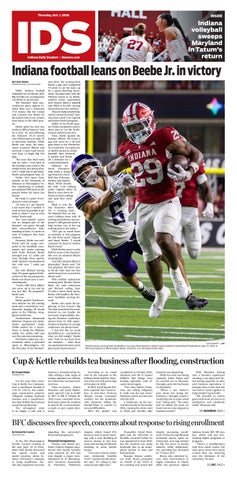
Indiana football leans on Beebe Jr. in victory By Conor Banks
conbanks@iu.edu | @conorbanks06
While Indiana football embarked on its historic 2025 Big Ten title run, running back Lee Beebe Jr. sat at home. The Hoosiers’ final nonconference game against Indiana State was a dominant 73-0 victory. But the Cream and Crimson lost Beebe for the season with a non-contact knee injury in the third quarter. Beebe spent the next two weeks in 2025 at home to “just let it heal,” he said following the Hoosiers’ 29-23 victory over Northwestern on Sept. 25 at Memorial Stadium. While Beebe was away, his teammates trounced Illinois and survived a close road victory over Iowa to begin Big Ten play. “But once that third week and on came, I was hard in the training room, hard in the weight room, just doing whatever I could just to get back,” Beebe said postgame Sept. 25. Beebe, who spent three seasons at the University of Alabama at Birmingham before transferring to Indiana, accumulated 209 yards on the ground before his injury last season. He made it a point of emphasis to return stronger. “As soon as I got injured, I just knew that I needed to work as hard as possible to get back to where I was or even better,” Beebe said. The now-redshirt senior was an integral part of the Hoosiers’ run game through their nonconference slate, handling at least 14 carries in each of Indiana’s first three contests. However, Beebe was inefficient with his usage compared to his backfield counterpart and junior running back Turbo Richard. Beebe averaged just 4.1 yards per carry through three games, while Richard overshadowed him with over 7 yards per carry. But with Richard leaving Sept. 25's game against Northwestern in the second quarter, Beebe was thrust into a commanding role. “Coach Mill (John Miller) just came up to me and he was just like, ‘Be prepared,’” Beebe said. He was. Beebe gashed Northwestern’s defense for 203 rushing yards and a touchdown, continuously ripping off chunk gains as the Wildcats struggled to tackle him. Northwestern threatened Indiana’s 19-game win streak. Senior quarterback Aidan Chiles rushed for a touchdown to bring the Wildcats within two points with just over five minutes remaining. But Beebe ended any conversations about a potential upset in Bloomington. On the first play of the Hoosiers’
next drive, the running back found a gap and scampered 70 yards to set his team up for a game-clinching touchdown. Six plays later, with the Wildcats keyed in on Beebe, redshirt senior quarterback Josh Hoover faked a handoff and rolled to his left, running untouched into the endzone. “Boy we really needed him, and he carried the load,” Indiana head coach Curt Cignetti said about Beebe postgame. Earlier in the fourth quarter, Chiles completed a touchdown pass to cut the Northwestern deficit to just two. Then, Beebe ignited the Indiana offense. He found a gap and raced for a 39-yard gain down to the Northwestern 9-yard line. Two plays later, Beebe earned an inside handoff, then bounced it outside and shook off a defender for a 4-yard touchdown. Indiana’s national championship roster a season ago featured a backfield duo of Roman Hemby and Kaelon Black. While Hemby led with 1,120 rushing yards, Cignetti relied on Black to wear down defenses in short-yardage and goal line situations. Black is now the San Francisco 49ers No. 2 running back. He finished first on last year’s Indiana team with 10 rushing touchdowns and surpassed 1,000 ground yards to help anchor one of the top rushing units in the nation. “He’s got as much heart as anybody in this program the last three years,” Cignetti said about Beebe. “I would compare his heart to Kaelon Black’s heart.” While Beebe wasn’t on the field for most of the Hoosiers’ title run, he admired Black’s running style. “Just KB’s (Kaelon Black’s) physicality,” Beebe said. “He was physical. He knew how to hit the hole hard and fast and he knew how to reach his blocks well.” With redshirt sophomore running back Khobie Martin likely out until midseason and Richard exiting Sept. 25 with a lower body injury, Beebe will headline the Hoosiers’ backfield moving forward. Beebe, who spent the beginning of last season’s Big Ten slate away from the team, showed he can handle the increased responsibility during the Hoosiers’ conference opener Sept. 25. Still, opportunities to improve in a tough conference are always there. “I just feel like we could just build on it — just build on what we did tonight,” Beebe said. “And we can learn from our mistakes — learn from our good plays because every play needs improvement.”
KATIE NEWETT | IDS
Redshirt senior running back Lee Beebe Jr. runs past Northwestern's redshirt senior defensive back Robert Fitzgerald on Sept. 25, 2026, at Memorial Stadium in Bloomington. Beebe rushed for over 203 yards Friday night.
Cup & Kettle rebuilds tea business after flooding, construction By Amogh Belgal abelgal@iu.edu
For the past three years, Cup & Kettle Tea Company, now a warehouse located at 1331 W. 11th St., has undergone construction projects, collapsed ceilings, business closures and a transformation that shifted the business toward tea production. The reimagined store is no longer a cafe and is
instead a manufacturing facility selling a wide range of unique signature tea blends, tea collections and personalized teas. Then-co-owners Jessica Messmer and Kayla Maldonado opened Cup & Kettle in 2017 at 208 N. Walnut St. Their menu consisted of tea, food and a place for students to stop by for a conversation, a snack or just a quiet afternoon.
According to an email sent by the company to the Indiana Daily Student, Messmer took over full ownership of the place in 2020. In 2023, the B Square Bulletin reported that construction at next-door Princess Theater meant customers couldn’t see the storefront, with Messmer telling the Herald-Times it caused financial difficulties. After the project was
completed in October 2025, Messmer told the B Square Bulletin that things were looking optimistic until disaster struck again. “Five days before Christmas, our ceiling collapsed. It really was the last straw,” Messmer said in an interview with the IDS. A bathroom on the second floor broke in December 2025, causing the entire store to flood just months after
business was improving. While the store was being repaired, Adam Nahas said he reached out to Messmer through a post she had made on Facebook. “When I saw Jessica's post about her losing her business, I thought maybe I could help out in some small way,” Nahas said. “The more that we talked, the more we found out we were aligned as business owners.”
With Messmer having over a decade’s experience running a tea shop and Nahas having expertise in sales and business operations, it became clear to her that the two had to work together to help rebuild Cup & Kettle. “We decided to switch gears with more of a focus on production and wholesale retail,” Messmer said.
SEE BUSINESS, PAGE 4
BFC discusses free speech, concerns about response to rising enrollment By Samantha Camire scamire@iu.edu
regarding the university’s financial transparency.
At the first Bloomington Faculty Council meeting of the year Sept. 22 in Presidents Hall, faculty discussed free speech issues and raised concerns about Indiana University’s response to rising enrollment. Faculty also expressed concerns
Financial transparency Theatre and drama professor Andrew Hopson questioned why faculty benefits were reduced by 10% last year despite a report commissioned by IU Bloomington’s American Association of University Professors
chapter, which found IU’s finances were in good standing, with a near doubling of reserve money in just four years and soaring enrollment resulting in more tuition money. “You want to know where your retirement benefits went?” another faculty member said. “It’s sitting in that cash account right now.”
Chancellor David Reingold said the reduction in benefits occurred before he was appointed in June 2025, but the decision was made internally due to an anticipated decline in state and federal funds. Russian history professor Andy Bruno presented on behalf of the AAUP at the meeting and noted that
despite increasing enrollment, IU has not significantly increased money spent on instruction and lags behind its Big Ten peers in faculty salaries, while administrative spending has increased 61.7% since 2017. Bruno also criticized recent state interventions in higher education. In March 2026, the governor signed
Indiana Senate Bill 199 into law, which will put lowearning degree programs in jeopardy. “There’s a misalignment with how much money the state gives versus how much control they are reserving over the decisions of the university,” he said.
SEE BFC, PAGE 4
Indiana Daily Student
2
NEWS
Oct. 1, 2026 idsnews.com
Editors Ella Curlin, Grace Fridy & Deshna Venkatachalam news@idsnews.com
Sobremesa Foundation reopens IU farm By Keira Kress keelkres@iu.edu
The Indiana University Campus Farm at Hinkle-Garton has now found new life under the Sobremesa Foundation. The IU Campus Farm originally provided students with hands-on farming experience and was a key feature of the IU Food Institute, which ended operations in 2023. Management of the Campus Farm transferred to the Ostrom Workshop Food and Agrarian Systems Program until its closure in 2025. Juan Carlos Arango and Robert Frew, co-founders of the foundation, now lease the 5-acre property from Bloomington Restorations Inc., the historic preservation nonprofit that serves Monroe County. They renamed the property the Daisy Garton Community Farm and resumed operations in June. The farm’s original purpose was to teach students about regenerative farming practices, provide fresh produce to IU dining halls and donate produce to the Bloomington community through local organizations such as the Crimson Cupboard Food Pantry and Bloomington Farm Stop Collective. Arango said the Sobremesa Foundation is working to continue the regenerative agriculture approach and commitment to donating produce while adding their own unique programs. Arango and Frew, who met as students at IU, became interested in permaculture, a holistic approach to gardening that aims to create selfsustaining ecosystems, after volunteering to build backyard habitats in Bloomington for the National Wildlife Federation “After that experience with
nature and supporting wildlife, we figured, ‘Why don’t we try something on a bigger scale and actually see what it would be like to buy a piece of land that’s open?’” Frew said. With help from activists and experts they met at a sustainability event, Arango and Frew opened the Sobremesa Farm, located at 4781 N. Mt. Gilead Road, in 2013. Initial efforts focused on mitigating climate concerns at a local level by planting non-native trees, fruits, nuts and berries that typically grow in warmer climates in the South. “We were trying to stay ahead of climate change,” Frew said. “We knew eventually that this was going to be the conditions here in Bloomington.” The Sobremesa Farm, which the foundation still operates, has struggled with its location, which is difficult for people who rely on public transit, walking or biking to access. The convenient location of the Daisy Garton Community Farm is what drew Arango and Frew to the property in the first place. According to their website, Arango and Frew have partnered with Exodus Refugee since 2022, providing agricultural skills training. This has reframed their approach to farming as therapeutic for refugees. “It was an opportunity for them to heal also after some of the trauma that they experienced,” Arango said. With the new farm, Arango and Frew initially hoped to create a paid internship program for refugees, but said a lack of funds led them to the current volunteer model. “The idea is that all participants — and it’s open to anybody, refugees, immigrants, locals — will farm together and share responsibilities to-
IDS FILE PHOTO
The former IU Campus Farm is pictured April 27, 2026, at 451 N. Pete Ellis Drive in Bloomington. Juan Carlos Arango and Robert Frew renamed the property the Daisy Garton Community Farm and resumed operations in June 2026.
gether,” Arango said. Frew said funding has been a struggle, and the farm relies on volunteer work and donations from partners including Duke Energy, Marbleseed and the Wylie House Museum. Matt Hamilton, IU doctoral student and Daisy Garton Community Farm volunteer, heard about the farm through his apartment management. Looking to spend more time outdoors, Hamilton began volunteering with his wife in April. “People from IU, people not from IU — I’ve gotten to have really nice, close contact with people around me,” he said. “You feel like you’ve done something that con-
nects you to other people around you, literally your neighbors.” Hamilton said the majority of volunteers at the farm live within walking distance and often volunteer with their families. Despite the farm’s previous associations with IU, Hamilton said, it sees little participation from students. The one exception has been class visits arranged by IU professor James Farmer, who previously oversaw the IU Food Institute and Campus Farm. Frew said he and Arango have talked with multiple departments at IU about involving graduate and postdoctoral research students in the farm.
Carrying on the IU Campus Farm’s traditions, the farm has continued donating to local food pantries, particularly Pantry 279 and Community Kitchen. Additionally, the farm hosts free workshops, such as Incubator Farmer training for aspiring agricultural entrepreneurs, classroom visits and a recent kimchi demonstration using their Napa cabbage. Community members can also purchase produce from the farm. A farm stand operates from 3-7 p.m. Wednesdays and is open through Oct. 28. The farm also offers Community Supported Agriculture, a model where residents pay a subscription fee and receive a weekly share of crops
produced. “The goal of it all was to provide food to the community at a low price — at a market which has prices that are not typically found at a farmer’s market,” Arango said. “They’re much closer to Aldi-style prices. We want to provide food for anybody.” In his time volunteering at the farm, Hamilton said he has developed a new appreciation for the effort and collaboration put into farming. “This is kind of luxurious in a way, right?” Hamilton said. “It’s right across the street. We can do it when we feel like it. There’s other people to pitch in. No, we’re not getting paid. We can take home some produce.”
Kelley School of Business earns highest ranking yet By Lily Saylor saylorl@iu.edu
U.S. News & World Report released its 2027 college rankings Sept. 22, and the Indiana University Kelley School of Business Undergraduate Program is now ranked sixth among all business schools, its highest ranking yet. The IU Bloomington campus maintained its spot at No. 73 out of over 400 in the national university category but moved up two spots in the public schools category to No. 32. According to U.S. News, the rankings are based on several factors, including peer-assessment, graduation rates and first-year retention rates. U.S. News analyzes data from surveys, government data and Elsevier, a global academic publishing company. This year, U.S. News introduced a new “Earnings
by Major” ranking factor that evaluates earnings four years-post graduation. This new benchmark addresses growing public concerns regarding higher education affordability and long-term value. The “Earnings by Major” metric replaced the “Graduate Indebtedness” factor, for which U.S. News said underlying federal data had not been updated for several years. Due to these methodology changes, U.S. News said the 2027 rankings cannot be directly compared to previous years. Kelley is tied for sixth place in business programs with Carnegie Mellon University, Cornell University, University of North Carolina at Chapel Hill and The University of Texas at Austin. Kelley remains ranked as the top school in Indiana and third among schools at public universities. Kelley’s
DAVID PEARLMAN | IDS
Students walk through a crosswalk near the Kelley School of Business sky bridge April 14, 2026, in Bloomington. The U.S. News & World Report announced Sept. 22 that the Kelley School of Business Undergraduate Program tied for sixth place in business programs.
Undergraduate Program has been ranked in U.S. News’ top 10 for the last six years. “This move in the rankings from No. 8 to No. 6 is a powerful validation of the work our faculty, staff,
and global partners pour into every part of the Kelley experience,” Kelley dean Patrick E. Hopkins said in a press release.“ We’re especially grateful to see that commitment reflected not
only at the program level, but also in top-10 rankings of eight of the 10 business disciplines ranked by U.S. News as among the best in the nation.” Ten specialty programs
at Kelley also ranked in the top 15, while eight specialty programs were ranked in the top 10, including marketing, accounting and management and information systems.
BPD arrests 8 near Seminary Park By Benjamin LeGrand benlegra@iu.edu
The Bloomington Police Department arrested eight people Sept. 22 in and around Seminary Park for five felonies and nine misdemeanors related to drug dealing and possession, according to a Sept. 23 press release by BPD Capt. Ryan Pedigo. The arrests came after an
unknown number of investigations and general surveillance of the park Sept. 22, Pedigo wrote in the release. At least six out of the eight people arrested have their address listed as “transient” on MyCase. Cocaine, methamphetamine and related paraphernalia are drugs and drug-related items mentioned in the charges from Pedigo’s announcement. Bloomington Mayor
Kerry Thomson thanked the BPD’s efforts on public safety in the release. “Everyone in Bloomington deserves to be safe, to feel safe, and to be protected from harm,” Thomson wrote. “That promise extends to every neighborhood, every public space, and every individual in our community, including people experiencing homelessness, addiction, or crisis.”
According to the release, investigators will continue to focus on individuals selling and using drugs in public parks and the B-Line Trail following the Sept. 22 arrests. “I am proud of the Bloomington Police Department’s sustained work and grateful to the officers and detectives who consistently deliver public safety with patience, discernment, profes-
sionalism, and care,” Thomson wrote. “Let me be clear: criminal conduct, including drug dealing, will not be tolerated in Bloomington.” Similar arrests were made in July 2025. Thomson addressed housing challenges in Bloomington at a press conference the week after those arrests. BPD Chief Michael Diekhoff affirmed Thomson’s warning against illegal drugs
in the release and said arrests of those dealing and using illegal drugs would continue in parks and public spaces. “The safety of Bloomington residents and visitors remains a top priority,” Diekhoff wrote in the release. “The Bloomington Police Department is committed to holding individuals accountable through strict enforcement of the law.”
Jack Forrest Co-Editor-in-Chief Mateo Fuentes-Rohwer Co-Editor-in-Chief Chloe Oden Managing editor content
Vol. 159, No. 8 © 2026
www.idsnews.com Newsroom: 812-855-0760 Business Office: 812-855-0763 Fax: 812-855-8009
Emerson Elledge Managing editor content Chloe Lavelle Creative director Lillie Donato Managing editor digital
The Indiana Daily Student will publish the next print edition on Oct. 15. For regular news and updates, please check online, subscribe to one of our email newsletters or follow on social media. Part of IU Student Media, the IDS is a self-supporting auxiliary University enterprise. Founded on Feb. 22, 1867, the IDS is chartered by the IU Board of Trustees, with the editor-in-chief as final content authority. The IDS welcomes reader feedback, letters to the editor and online comments. Advertising policies are available on the current rate card. Readers are entitled to single copies. Taking multiple copies may constitute theft of IU property, subject to prosecution. Paid subscriptions are entered through third-class postage (USPS No. 261960) at Bloomington, IN 47405.
130 Franklin Hall • 601 E. Kirkwood Ave. • Bloomington, IN 47405-1223
What’s What’s Happening Happening in in B B--Town? Town? Find & submit events at idsnews.com/events
Indiana Daily Student
ARTS
Oct. 1, 2026 idsnews.com
Editors Lexi Bunting, Ursula Stickelmaier, Abby Whited arts@idsnews.com
3
AARON SMITH | IDS The Roll n' Dip restaurant is pictured Sept. 23, 2026, on Kirkwood Avenue in Bloomington. The restaurant opened in August 2026.
COLUMN: Is Roll n’ Dip worth the stop? By Steven Leatherwood sjleathe@iu.edu
The vine-covered corpse of Cafe Pizzaria birthed twins. One, another Italian restaurant, and the other, an on-the-go Mexican place. This on-the-go spot isn’t Chipotle — it’s Roll n’ Dip, which, along with Ciao Bello, replaced Bloomington’s oldest pizza shop. The Mexican restaurant first opened its doors in August on Kirkwood Avenue, and I popped in this past week to give it a try. Roll n’ Dip offers a menu
of Mexican offerings such as burritos, burrito bowls, tacos, taquito meals, quesadillas and specialty quesabirria. The restaurant also has traditional Mexican aguas frescas like horchata, Jamaica and rotating seasonal flavors. I also will inform the people who are loyal to popular soft drinks that Roll n’ Dip offers Pepsi products, including Dr Pepper, Mountain Dew and Mug Root Beer. The service was similar to Chipotle. You choose your base and then go down a line of ingredients to add to your
meal. On my visit, I started with a burrito bowl, and my protein of choice was the al pastor pork. Then I added my preferred mix-ins, which included their Mexican rice, black beans, lettuce, pico de gallo, salsa verde, cheese, sour cream and pickled jalapeños. My drink of choice was a horchata. Overall, my meal was delicious. As an avid Chipotle enjoyer, I would compare the bowl to something you could get at the chain but with more authentic Mexican flavors. The pork was tender
and flavorful, adding a nice spice to the bowl. However, the standout for me was the pickled jalapeños: the spicy and sour peppers balanced the creaminess of the cheese and sour cream. As for the horchata, I think it leaves a bit to be desired. I haven’t had too many positive experiences with the drink, but this one seemed especially watery. While adding condensed milk to horchata isn’t a strict requirement for the drink, I think it makes the cinnamon drink much more preferable,
and it didn’t taste like Roll n’ Dip added it to theirs. The portion sizes make for a large meal. They give you your bowl in a large Styrofoam tray, and even though I hadn’t eaten all day, I was not able to finish the entire meal. So, if you’re looking for a good meal and some leftovers, this may be a great option for you. One thing I am a bit annoyed about is the restaurant website. Some of the images appear to be AI-generated, such as the image they used for their store front and the
one for their food on the locations tab. While the address is correct on the site, the image of the storefront is completely different from their real store. AI can make some things easier for local businesses, but I believe images that appear to be artificially made can cause confusion for customers, especially when the images are of the food offerings. Even still, if you’re craving Chipotle from a small business with more authentic Mexican flavors, I think Roll n’ Dip is the place for you.
COLUMN: Lizzy McAlpine's ‘Angel’ is a complex look at love and grief By Lexi Bunting lexbunti@iu.edu
Lizzy McAlpine has stepped into a new sound with her fourth studio album, “Angel,” released Sept. 18. Known for her soft vocals and in-depth lyrics, McAlpine leans further into folkinspired production while taking listeners through the stages of love, heartbreak, grief and acceptance. The result is an album that feels familiar to McAlpine’s longtime listeners but still introduces a new era in her work. This shift began on her third studio album, “Older,” which had a more pop-folk sound than her previous indie-pop work. On “Angel,” she truly embraces folk, even stating in an interview with Vogue that she was inspired by folk icons like Joni Mitchell, Nick Drake and Crosby, Stills, Nash & Young. Here are some of my favorites from the 14-track album. “The light in the painting” “The light in the painting” opens the album and, to me, feels the most reminiscent of McAlpine’s previous work, having more indie-folk undertones. The song is about a new connection and how exciting that can be. It feels like a transition into a new era of her music, while also reflect-
ing a new era of herself. The song sets the tone for the rest of the album, reminding listeners of McAlpine’s beautiful lyricism with lines like “Sink my nails into your skin / What a beautiful way to finally feel something.” The song also introduces the folk-inspired production that makes “Angel” different from anything else she has done before. “Anybody's fool” On first listen, I didn’t love this song. I thought the lyrics were a little plain for an artist like McAlpine, who has such intricate lyrics that can often sound like poetry. But as I listened more, I came to understand the deep underlying grief buried within her words. She sings, “I thought it’d be different, a year ago / I know that this is right / And I know that it is sad.” To me, these lyrics perfectly capture the conflict of being crushed by the loss of love while also knowing deep down it's what had to happen to continue moving forward in life. The simplicity of the lyrics ended up being what made the song so emotionally effective; their straightforward nature captured the complicated and conflicting emotions that come with knowing something is right, even when it still hurts.
“A car wash and a new pair of pants” This song was so refreshing for me. One of my only issues with this album is that, at times, each song sounded too similar to the last. But this song added some diversity to the track list with its bubbly folk production. The piano backing was a highlight for me, making it the type of beat you want to dance to. As fun as the production is, it almost covers up the fact that the lyrics of this song are some of the most devastating on the whole album. At first, the production feels silly and jolly, but underneath that is an incredible insight into fame and love, as well as the pain of merging someone’s life into your own and the jealousy that can come with that. “Ugly things” I think this might be my favorite song on the album. It takes a truly great artist to capture such a specific feeling of hating and loving a person at the same time. The song encapsulates trying to be angry and remember all the ugly things that someone did, while also having a lingering affection for them because you planned your life around them. McAlpine sings “Hiding
TRIBUNE NEWS SERVICE
Lizzy McAlpine visits SiriusXM Studios on March 28, 2024, in New York City. She released her fourth studio album, "Angel," on Sept. 18, 2026.
your sweatshirt on the top shelf,” and then goes on to say, “Seems like you want to burn this city down, to hurt me.” I think the song is able to sum up the complexity of heartbreak and its often-bittersweet nature. “Angel” The last song on the album, “Angel” is a full-circle moment when she finally finds acceptance within her-
self. Its focus is on self-identity and the true human experience of finding yourself again after losing who you are in others. This song felt like the light at the end of the tunnel, and it truly highlights the new era of McAlpine. What really stuck out to me about the album is the truth that love can be complex, and our feelings are sometimes not so cut and dried. She portrayed such a
human experience of finding out who you are outside of a relationship and acknowledging the pain of moving on and the heartache that comes with losing someone who still has a part of your heart. Although this album might not be groundbreaking, it is a deeply enjoyable listen and an exciting addition to McAlpine’s body of work.
Science guy Nye added to play-Bill at IU Auditorium By Ursula Stickelmaier ustickel@iu.edu
Science educator and television personality Bill Nye will be coming to Indiana University for “A Conversation with Bill Nye” at 7 p.m. Oct. 15 at the IU Auditorium. The event is a collaboration between the Union Board’s Lectures Committee and STEM Committee and will be sponsored by IU's College of Arts and Sciences. Nye is best known as the host of the science education TV program “Bill Nye the Science Guy,” which had five seasons and ran from 1993 to 1998. On the show, Nye explained different science subjects and experiments in a way that was accessible to kids and aimed to
get them invested in STEM subjects. Over the course of its run, “Bill Nye the Science Guy” won 19 Daytime Emmy Awards. Since the show concluded in 1998, Nye has remained a leading science advocate. He currently serves as Chief Ambassador and Vice Chairman of the Board at The Planetary Society, one of the world’s largest nonprofit space organizations. He has also hosted the science shows “Bill Nye Saves the World,” which ran for three seasons on Netflix, and “The End Is Nye,” a disaster-based documentary series that ran for one season on Peacock. Over the course of his career, Nye has received many awards for his decades-long impact in science educa-
tion, including the Presidential Medal of Freedom in January 2025, and a Lifetime Achievement Award at the fourth Annual Children's and Family Emmy Awards in March 2026. Nye’s event at the IU Auditorium will be hosted by junior Lucy Gray, the director of lectures for the IU Union Board, and will focus primarily on Nye’s role as “The Science Guy,” his work in science advocacy and his career both before and after “Bill Nye the Science Guy.” Tickets went on sale at 10 a.m. Sept. 22 and will be $25 for the general public and $15 for IU faculty and staff. IU Bloomington students can access one free ticket now by using promotional code UBSTUDENT.
TRIBUNE NEWS SERVICE
Bill Nye delivers a speech during the SpaceCom 2026 conference Jan. 29, 2026, at the Orange County Convention Center. IU Union Board announced it will host "A Conversation with Bill Nye" on Oct. 15.
4
Oct. 1, 2026 | Indiana Daily Student | idsnews.com
» BUSINESS
CONTINUED FROM PAGE 1
In addition to their menu, Messmer and Nahas said they have plans to grow their customer base through a redesigned website, new product lines and ongoing partnerships.
“Because of the community of the cafe, there will still be success with the warehouse. A lot of the business appeal was that the atmosphere was good, and it felt more like a community than a business.” Lola Faggiani, sophomore at Indiana University
“We’re working with the College Mall to develop a retail space that maybe we could turn into a cafe, but initially it’s just going to be a place where people can come and pick up teas,” Nahas said. Another goal for the new location is to sell tea-infused colognes and perfumes to encourage students to become customers. “We’re wanting to do a blend society for the website where people can rate and try out each other’s blends,”
» BFC
CONTINUED FROM PAGE 1 Infrastructure and hiring IU student enrollment is increasing — this year, all of IU’s campuses boast over 90,000 students, and a record 16,911 new undergraduate students. But faculty at the meeting said the university isn’t increasing the number of classrooms, faculty, graduate students and advisors to keep pace. “I have been here for five years, and I have yet to see a plan for how to support an ever-growing student body with fewer and fewer resources,” history professor Sara Gregg said. “I think
Messmer said. Messmer’s goal for these new products is to attract new customers to the business to keep the culture Cup & Kettle had before the closures. Nahas said maintaining business relationships has been key in the rebuilding process with the numerous partnerships the company is in talks with. Cup & Kettle partnered with IU Hilltop Garden and Nature Center where Messmer said they’re offering classes on “different kinds of tea blends and different gardening techniques to grow your own teas.”
“We want to make sure we’re telling people’s story, and for that having a relationship is very important. We’re hoping this message gets out there enough for people to reach out and create that relationship with us.”
KAITLYN STACY | IDS
Jessica Messmer, co-owner
Jessica Messmer and Adam Nahas stand in front of the Cup & Kettle Tea Co. sign on Sept. 15, 2026, inside their workshop at their new location on 1331 W. 11th St., Bloomington. The Cup & Kettle has moved locations with hopes of adding a garden and more space for creating.
Nahas said Cup & Kettle also has upcoming popups planned, including a tea blending class with the Monroe County Public Library and more events hosted at Heartwork Brewing. Lola Faggiani, a sopho-
more at Indiana University and former Cup & Kettle employee, said the work experience was very “homely and friendly.” She also said she has hopes for the new store. “Because of the com-
munity of the cafe, there will still be success with the warehouse,” Faggiani said. “A lot of the business appeal was that the atmosphere was good, and it felt more like a community than a business.”
Messmer and Nahas said they plan on continuing to educate and unite the Bloomington community through their community events, educational resources and signature tea blends. “We want to make sure
we’re telling people’s story, and for that having a relationship is very important.” Messmer said. “We’re hoping this message gets out there enough for people to reach out and create that relationship with us.”
that is a crucial element for reestablishing trust with the faculty and staff of this university.” Her comment received a round of applause from the assembled faculty. Economics professor Gerhard Glomm said potential professors “want to see a sign of hope, that departments can grow, that their research mission is supported and that our teaching is rewarded at levels which are comparable to our peers.” He joked that the university might have to relabel the hiring committee as a “trying-to-hire committee.” He said IU’s lower salaries put it at a competitive disadvantage with other universities. Interim Provost John
Ciorciari claimed IU hiring rates are higher than peer institutions and pointed to the Faculty 100 and Faculty Strategic Hiring Initiative as university efforts to prioritize hiring. Spanish professor Manuel Díaz-Campos raised concerns about these initiatives, which use universitywide funds to hire professors rather than the typical department budget. DíazCampos said these initiatives use up the university’s budget, resulting in less money available for regular hires. Ciorciari replied that he wants to work with departments to address both broader institutional and narrower department priorities.
Other items Following free speech controversies on campus, the IU Board of Trustees voted in February 2026 to adopt the Chicago Principles, a set of guidelines that aim to protect free speech on college campuses. Reingold offered an update on the University Faculty Council and Academic Leadership Council Task Force, which were tasked with designing and coordinating implementation of the principles. The task force released a report in July covering programming, organizational structure and policy. The report recommends orientation programming to set early expectations
around free speech, as well as faculty workshops and a model for the language that professors can use to share the principles in their syllabi. The task force called for each IU campus to appoint a campus lead who will facilitate periodic meetings and communicate with the other campus leads; IU Bloomington’s lead is political science professor Aurelian Craiutu. Finally, the report recommends a series of conversations involving faculty and students to develop a set of principles that can be used in the future to evaluate new university policies. The BFC also passed a resolution recommending students in the military and
veterans be allowed to register for classes early — a privilege previously reserved only for student athletes and members of Reserve Officers’ Training Corp. IU’s Center for Military and Veteran Studies estimates that less than 300 active-duty military or veteran students are registered at IU. Early registration will allow these students to complete their degree before their federal educational benefits expire. BFC’s Educational Policies Committee does not believe the new resolution will have an adverse effect on the rest of the student body. The next BFC meeting will be 2:30-4:30 p.m. Oct. 13 at Presidents Hall inside Franklin Hall.
Home Is W h ere YOU MAKE IT
Visit the housing fair to meet with vendors and find your next home.
Tuesday, Oct. 6 10 a.m. - 4 p.m. IMU Alumni Hall
Indiana Daily Student
OPINION
Oct. 1, 2026 idsnews.com
Editors Eric Cannon, Emma Howard opinion@idsnews.com
5
SPENCER’S HYPOTHESIS
Indiana should turn its accidental cannabis market into a permanent one Spencer Schaberg (he/him) is a junior studying microbiology.
In Indiana, possessing marijuana is a Class B misdemeanor punishable by up to 180 days in jail and a $1,000 fine. The primary psychoactive molecule in cannabis, THC, is classified as a Schedule I controlled substance. But walk into nearly any liquor store, smoke shop or gas station in Indiana, and you’re likely to find an assortment of THC-infused products. Intoxicating gummies, beverages and even e-cigarettes are available, advertised and legal for Hoosiers to purchase and consume. A 19-year-old college freshman can walk into a gas station and pay for a shot of cannabis extract before they can pay for a beer. The difference between walking out of that gas station in handcuffs or with a handful of products is whether what you purchase is derived from illegal cannabis or innocuous hemp. The only problem? They’re the exact same species, Cannabis sativa L. The current legal definition of hemp was established in the U.S. Congress’ nowinfamous 2018 Farm Bill. Since then, any cannabis sativa plant containing more than 0.3% delta-9 THC by dry weight is marijuana — anything containing less is hemp. The cutoff was arbitrary and hyper-specific. THC may be the primary intoxicating molecule in cannabis, but it’s hardly the only one. By exploiting the so-called Farm Bill loophole, companies across the country began to distribute products containing other intoxicating cannabinoids like Delta-8 THC and hexahydrocannabinol.
B-Town Smoke Time is pictured Sept. 20, 2026, in Bloomington. The store was open from 11:00 a.m. to 11:00 p.m.
Other states recognized the loophole problem years ago. Michigan’s state legislature passed laws in 2021 bringing cannabinoids like delta-8 into its regulated marijuana market. Colorado passed similar legislation targeting THC isomers in 2022. But in Indiana, next to nothing has been done to prevent a legal gray area from turning into a mainstay of convenience stores. The cannabinoid-derived hemp industry has been allowed to bloom in the Hoosier state for almost a decade; it might make more sense to keep the market for Indiana’s
cannabis — er, hemp — legal. In less than a decade, Indiana’s hemp-derived cannabinoid industry has put down serious roots. When the Farm Bill passed in 2018, the Office of the Indiana State Chemist reported just 15 acres of hemp was grown in Indiana, all for research purposes. The next year, that number ballooned to over 2,000. A 2023 analysis by cannabis and hemp-consulting firm Whitney Economics estimated Indiana’s hemp-derived cannabinoid industry employed around 11,000 Hoosiers and generated around $1.78 billion in economic activity.
Unlike Michigan and Colorado, Indiana has repeatedly failed to enact any comprehensive legislation to limit its intoxicating hemp industry. As recently as this year, Senate Bill 250, which would have finally regulated a product’s entire cannabinoid content and imposed a 21-plus age restriction on hemp derivates, died in the Indiana House of Representatives. Now, the federal government is closing the Farm Bill loophole — leaving a substantial portion of Indiana’s hemp industry without a legal leg to stand on. The new federal definition of hemp goes
ELLIE SNIDER | IDS
into effect Nov. 12, 2026, and excludes products containing more than 0.4 milligrams of THC and similar cannabinoids per container — a potential death blow to any hemp business relying on the legal landscape of the past eight years. The loophole should have been closed long before then. Regardless of whether it’s classified as marijuana or hemp, the intoxicating molecules present in all cannabis need to be regulated to protect consumers and local communities alike. But time and again, Indiana failed to do so. For
many Hoosiers, obtaining an intoxicating hemp product has been as easy as walking across the street to the convenience store. There’s clearly a market for cannabis, or at least cannabinoids, in Indiana — and Indiana’s hemp-derived cannabinoid industry has expanded to fill that market. Rather than let it die, Indiana should consider transforming it into a legal, regulated cannabis market. As far as regulation goes, legalizing marijuana would be doing Indiana a favor. Namely, it would give the state government the ability to decide where, how and to whom cannabis products could be sold. It would also allow Indiana to tax cannabis beyond the state’s standard 7% sales tax. A 2026 RAND Corporation analysis predicted Indiana could generate around $180 million annually in tax revenue within five years of legalizing marijuana. Hoosiers are in the market for cannabis products. Hoosier businesses have been producing them for years. Whether a molecule of delta-9 THC comes from legally defined hemp or marijuana, its effect is the same. Despite that, Indiana has kept marijuana criminalized while allowing nearly indistinguishable compounds to populate store shelves across the state. The Farm Bill loophole accidentally created something like a legal cannabis market in Indiana. Instead of re-criminalizing eight years of industrial growth, now might be a good time to create one intentionally. sschaber@iu.edu
ERRANT ERIC
Thanks, Mark Zuckerberg Eric Cannon (he/him)
is a junior studying philosophy and political science and currently serves as a member of IU Student Government.
Mark Zuckerberg is sorry again. No, he didn’t apologize to victims’ families at a Senate hearing. That happened two years ago, when his social media platforms made headlines for contributing to children’s poor mental health and exploitation. This time, 29 states alleged they were intentionally designed to addict their youngest users — teens and, despite their inability to create accounts, “tweens.” As part of a $17 billion settlement, Zuckerberg must now contain the effects of his Frankenstein’s monster. Thus, United States Meta users under 18 will be limited to using the company’s platforms for a maximum of two hours a day — which is for the best. Social media has its benefits, but these come when it’s perused in moderation, a virtue that children, notably, lack. It’s also one that adults must also struggle for. In a recent column in the Indianapolis Star, Jacob Stewart recounted his journey of throttling his social media use by turning his phone into a time-limited, scroll-less, colorless, boring old rect-
angle. I, too, undertook a doomscroll detox this summer by downloading an app to lock other apps — and setting the count-down clock to change settings at absurd amounts of hours. And earlier this month, Emma Howard, my colleague at the Indiana Daily Student, also wrote on cutting down how much time we spend online. Escaping social media isn’t an uncommon idea these days: 82% of Generation Z associated the word “addicting” with social media use in a 2024 poll. Despite its problems, however, social media has its pros. Among the greatest is the algorithm. For a thought experiment, imagine your TikTok or Instagram feed without an algorithm. Absent a “For You” page, the content you see would be based on the accounts you already follow. And that creates a knowledge problem: how do you come to find accounts you enjoy without being suggested them? That’s a problem the algorithm fixes. As Howard wrote, the longer we scroll and the more content we like, the better social media platforms “can piece together profiles” on us. While Howard presented this fact as dangerous — it’s how social media
companies hook us — it’s also what has allowed social media to spread culture in an era when magazines have disappeared. Because the algorithm favors content that will earn our attention, it incentivizes intentional production and has contributed to the rise of influencers. So occasionally, one hears the lamentation that social media has moved away from being a place of authentic, unedited expression. But this was necessary for social media to become a curator of taste. And it can do this for cheaper, with more range and more frequency than magazines could. At the same time, Meta and other companies glean massive amounts of data from you, in a way that paperback magazines never could — data they’ll then sell to advertisers to personalize the ads you see, besides the content. Far from insidious — this is something agreed to when you sign up — it builds on the magazine model even better. Look inside the cover of a Vanity Fair or a National Geographic, and you’ll find ads, like wide nets, aimed at broadly interesting the people advertisers think might pick them up. Since the advent of data commercializa-
TRIBUNE NEWS SERVICE
Meta CEO Mark Zuckerberg leaves the Los Angeles Superior Court after testifying Feb. 18, 2026, in Los Angeles, California. A 20-year-old California woman sued Meta and YouTube, accusing them of building addictive platforms that cause harm to children.
tion, however, advertising has become more personalized, which, in turn, is more useful to both sellers and shoppers. I grant there is a certain charm to the slowness and expert curation of the traditional magazine. That model may be even better, precisely because it avoids the mass culture pitfalls of social media, the loss of individuality and cultural texture that comes with everyone in the
same demographic witnessing the same media — local musicians being lost because of the music industrial complex. However, social media can also fight against this through hyper-personalized algorithms, the ones that are often said to put us into our own bubbles. Social media has democratized the construction of taste, even bad taste, which is a reason to keep it away from kids, lest we end up with
worse mutants of “6-7.” As we move into the deep time of AI, when I expect humans will have more leisure time than we’ll know what to do with, the demand for influencers will only increase. It’ll be important to have such mass access to a culture-making platform. So, maybe, just maybe, we have a little reason to thank Mark Zuckerberg. ericcann@iu.edu
ASTRID’S CORNER
When sports stops being about sports Astrid Alomia (she/her)
is a junior studying journalism with a concentration in public relations and a minor in marketing.
Have you seen the latest Novig ad? On Sept. 9, actress Sydney Sweeney appeared in an ad promoting the sportsbetting app. While I have nothing against betting on sports, I do have something against the way the ad portrayed women. The actress appeared nude while sports equipment strategically covered certain areas of her body. She pretended to play different sports, but the focus wasn’t on the athletics. It was on her body. That is what bothered me. Women have spent decades trying to prove their place in sports. They fought
for opportunities, funding, facilities and the same respect given to male athletes, like equal media coverage of sporting events. We are still working toward those things today, so seeing an advertisement for a sportsbetting app using a woman’s body as the main attraction feels like we are going in the wrong direction. Some may argue that it’s just an ad. But it’s not. According to the Women’s Sports Foundation, high school aged girls have more than 1.3 million fewer opportunities to participate in sports than their male peers. They also struggle with finding supportive coaches, safe facilities and dealing with environments where judgment from teammates or peers can make them feel uncomfortable about participating or improving their
technique. The National Federation of State High School Associations reported this January that more than 4.6 million boys participated in high school athletics in previous years, compared with 3.2 million girls. It also identified gender stereotypes, unequal access to quality equipment, body-image concerns and financial barriers as challenges that prevent girls from participating. So when female athletes say that the Novig advertisement feels like a step backwards, I understand why. It’s frustrating when female athletes are constantly trying to shift the conversations about how they look to what they can do. This time, they are not keeping their discomfort hidden. Athletes are expressing their feelings about the ad; questioning
a representation of women in sports that they believe undermines what they have spent years trying to accomplish. Australian swimmer and four-time Olympic gold medalist, Ariarne Titmus, referred to the ad as a “kick in the face” to women who have dedicated their lives on perfecting their sport. British sprinter Amy Hunt called out the actress after competing at the Ultimate Championship, saying “Sydney Sweeney, this is what women in sport look like,” while pointing at her muscles, referring to the hard work, sweat and tears behind her athletic performance. There is nothing wrong with Sweeney using her attractiveness to her advantage. She can decide whether or not to participate in a sexually provocative advertise-
ment. But when you combine a sexualized portrayal of a woman with a campaign centered around sports, it is fair for the audience to question the message being sent about women in sports. Women should not have to choose between being taken seriously as athletes and femininity. Girls grow up being told they need to look a certain way in order to belong. Social pressure and unequal opportunities can push girls away from pursuing a sport. Comments like “You look too manly” or “It’s a rough sport for girls” are enough to demotivate someone. Body image comparison can lead to anxiety and deeper mental health problems, as it is commonly believed that athletic training leads to more masculine features. The ad is only 60 seconds
long. It cannot erase the decades of progress made, nor is it responsible for every inequality women face in athletics. But advertising does influence the way we think and the images associated with women in sports. And right now, female athletes are showing us that women are more than just their bodies. They deserve to be seen for both their strength and femininity without diminishing one or the other. They deserve the opportunity to play, compete and succeed without having to prove that they belong there first. Maybe, the next ad about sports and women should spend time less time showing their bodies and more time showing what their bodies can achieve. aalomia@iu.edu
6
Oct. 1, 2026 | Indiana Daily Student | idsnews.com
ROBINSON WRITES
Private equity is cannibalizing business schools Spencer Robinson (he/him) is a junior studying public policy analysis and law and public policy.
Business schools have a symbiotic relationship with private equity. Colleges provide investment firms with access to young, energetic graduates, while connections to those firms raise school prestige and funds. Nobody at the career fair questions it. Private equity controls roughly a fifth of all corporate equity in the United States. A PE firm raises money from investors: pension funds, university endowments and wealthy individuals, using it to then buy companies outright. Private equity typically purchases private firms which aren’t yet listed on the traditional stock market. Other times, they will buy control of a publicly traded company and remove it from the stock market. The firm rarely pays for the company with its own money. Instead, it borrows most of the purchase price and puts that debt on the company it just bought, something known as a “leveraged buyout.” The acquired company pays interest on its new debt, plus annual fees to the firm that acquired it, regardless of whether the business is thriving. Private equity uses every available tool to maximize resale value, not necessarily to run the business better. These strategies frequently use creative accounting to extract value without reinvesting anything. Private equity will have companies take out additional debt, just to pay themselves special dividend. Another popular practice is selling the land a store is built on to another subsidiary, then
charging rent. PE firms can pocket both the value of the land and the rental fees. Private equity is always hunting for new talent. Before students even graduate, firms view them as disposable resources to be recruited early, overworked and cycled out quickly. Once trained, private equity leverages those same students to acquire and dismantle other companies. Breaking businesses apart is the point. Business schools have a choice: teach students how to build something, or supply an industry built on “creative destruction.” In recent years, private equity has gained an infamous reputation: whether from a headline about Blackstone purchasing single family homes, bankrupting hospitals or just ruthlessly cutting costs. When private equity acquires a healthy, profitable business, the goal isn’t to make it better; it’s to make it run cheaper. Staff are cut, benefits trimmed and investments delayed. These cuts don’t have to be sustainable; they just have to attract potential buyers. When private equity acquires a struggling business, the strategy flips. Instead of cutting costs, the firm extracts what’s still valuable: real estate, brand licensing and patents, while shutting down the rest. The company is only valuable as pieces to be sold off. At their best, business schools give students the tools to build companies, employ communities, and innovate. But ask most freshmen why they enrolled, and they’ll simply say “the money.” 52% of business majors are studying finance or real estate, fields
IDS FILE PHOTO
The Kelley School of Business is pictured Jan. 29, 2026, at 1275 E. 10th St. in Bloomington. The school has frequently paired business students with private equity firms.
which specialize in buying, leveraging and reselling what already exists. Indiana University’s Kelley School of Business trains students to extract rather than create. The industry has spent the last several years building recruiting pipelines straight into undergraduate campuses. The PE firm Kohlberg Kravis Roberts launched its first formal undergraduate analyst program in 2020. The acceptance rate for the program is around 2%, more selective than Ivy-league colleges. Firms aren’t waiting for students to come to them;
they’re reaching into schools like Kelley to compete for inexperienced but talented students. Recruiting timelines have shortened as well. Interviews for entry-level roles now regularly begin during a student’s sophomore year, well before most students have taken a single elective in the field they’re being asked to commit to. A 19-year-old, drawn in by the promise of financial security, is taken into a billion-dollar multinational firm, told that they are among the talented elite and asked to commit to a multi-year con-
tract. None of this happens without the school’s cooperation. Kelley steers students towards PE through investment focused career fairs, dedicated info sessions, and case competitions sponsored by recruiting firms. A student can walk from a private equity workshop to a networking event hosted by a firm which hires students to do exactly that. The school enables and encourages students to enter the PE pipeline. Private equity firms should not be banned from campus, but a school that claims to
teach students how to build businesses must act like it. That means giving the same institutional weight to the students trying to start new businesses as the ones trying to buy ones that already exist. It means asking whether giving firms direct access to 19-yearolds is preparing students for the workforce or leaving them open to exploitation. Kelley can train students to build the businesses of the future, but that requires dismantling the PE pipeline it built. spenrobi@iu.edu
ROBINSON WRITES
Fighting Flock is not ‘alarmism,’ it’s patriotism pany which both designs automated license plate readers and develops the network infrastructure necYou are always being essary to operate them. Flock watched. From your phone cameras are all connected to your laptop and even your within a single system; a poTV, the devices we surround lice officer in California can watch swimmers in Florida, and doesn’t need a warrant to do so. The dashboard which makes this possible is incredibly simple to work, requiring roughly equivalent skill as a Google search. The result is reckless overuse of Flock’s database, as officers internally justify frivolous searches with “idk,” “TBD” and “hehe.” My Indiana Daily Student colleague, Eric Cannon, recently published a defense of Flock, where he decried this backlash as “alarmism,” drawing a dichotomy between Flock and crime. He argues crime is also bad, so can’t Flock be used for good? However, this comparison misses the substance of the case against Flock entirely: that Flock’s surveillance network violates sacred civil liberties and can’t be allowed to continue. According to Jeff Welty, professor of public law and government at the UniverTRIBUNE NEWS SERVICE sity of North Carolina, Flock A Flock ALPR license plate reader camera is pictured Oct. 20, 2021, along Drake Road in Kalamazoo, Michigan. Bloomington opted not to camera usage could amount to a violation of the Fourth renew its contract with Flock Safety, which expired in March 2026. Spencer Robinson (he/him) is a junior studying public policy analysis and law and public policy.
ourselves with are constantly collecting our data. Advertisers use this data to predict your next purchase, build a demographic profile and track you across both websites and devices. Invasive data tracking is a staple of modern American life, and recent years have seen an expansion beyond the digital domain. Case in point, nearly 150,000 AI-powered Flock cameras now dot the country. This surveillance network tracks vehicles across state lines and the movement of every car on the road, regardless of individual suspicion. Flock has naturally drawn a large public backlash, but it has been insufficient to dislodge Flock from American roadsides. Flock Safety is a com-
Amendment if it can comprehensively track an individual’s movements. Flock’s defense against this charge has focused on the fact that they track license plates, which are publicly identifiable. Flock cameras are also fixed and highly visible, so drivers presumably know they are being watched. The problem with Flock’s defense is that roads do not move. Drivers may know a Flock camera is watching, but they still must go to school or work, regardless of a camera’s presence. This is part of Flock’s appeal to police departments: their own marketing material makes a point of the size of their network. The case against Flock has focused on this aspect, arguing that the scale and interconnectivity of the network constitutes an invasive search. The question for the courts is whether the extent of Flock’s network has yet violated the Fourth Amendment. The more Flock expands its network, and the more useful Flock becomes to police departments, the closer Flock comes to infringing on our civil liberties. It’s also unclear if Flock surveillance makes the police any better. In one Illinois town, police searched Flock’s
database more than 1,200 times for loitering, curfew violations and the homeless. These are not serious offenses, but are easy to pursue with Flock’s assistance. The result is a diversion of resources from the difficult work of clearing cases and onto hyper-policing of marginalized groups. Even as police budgets have ballooned, clearance rates for serious crimes have dropped sharply. For example, in California from 19901994, 52.5% of rape cases ended in an arrest, while in 2022, that number was 27.7%. Over the same period, real police budgets increased by 46% per capita. This is not to say that crime is an overwhelming problem. In fact, across almost every category, crime has reached historic lows. When people defend Flock cameras as an antidote to crime, the logic is not self-evident. If the police were responsible for the decline in crime rates, that would show up in their clearance rates. If Flock were responsible, the decline would have accelerated in the past year. Neither seems to be the case. The choice between low crime rates and the vigorous protection of civil liberties is
a false one. Police have operated for decades without access to Flock cameras and only 40% of police departments maintain contracts with the company. This technology is not inevitable, and public “alarmism” has played a key role in slowing adoption. DeFlock. org, the most prominent antiFlock group, credits 153 cities with banning Flock cameras. Bloomington similarly opted to end its contract with Flock after intense backlash. Many more cities will soon follow, but only because local organizations have taken it upon themselves to reclaim their civil liberties. Like their founding fathers before them, opponents of Flock maintain an American tradition of preventing government overreach. American civil liberties, the foundational freedoms laid out in the Constitution, are not selfaffirming. It is the responsibility of citizens to organize and increase awareness when those principles are broken. I, for one, celebrate organized opposition to the expanding surveillance state. There is nothing more American than fighting Flock. spenrobi@iu.edu
HOWARD'S HEADLINE
Did Merriam-Webster really need a glow-up? Emma Howard (she/her) is a junior studying journalism.
Merriam-Webster defines “copium” as “avoidance, denial, or minimization (as of a bad situation, problem, outcome, etc.) imagined as a narcotic.” That certainly seems to be what its 1,400word update has been. Last Tuesday, the dictionary publisher announced 1,400 new terms and their definitions would be added to its online dictionary, Merriam-Webster.com. The print edition will be “looksmaxxing,” too, as many of the definitions will also appear in hard copies. While company president Gregory Barlow declined to release a full list of the terms, it’s apparent the new “glow-up” has an overarching theme: slang. Granted, language always has and always will evolve. There’s a reason that Victoria’s Secret doesn’t have a “pantaloons” section. And if
a quick Google search could provide Meemaw with a clear answer on what “cuffing season” is, we might just bridge a couple of generational gaps. While this reasoning alone might have MerriamWebster firing up the printing presses, attempting to define slang forgets the secret sauce that makes it such a cultural phenomenon. To understand why defining slang doesn’t exactly work to the user’s advantage, we ought to set the time machine to 1699, when one of the first English slang dictionaries was published. “A New Dictionary of the Terms Ancient and Modern of the Canting Crew,” sought to expose the seedy underbelly of London’s streets by providing a guide to slang terms used by beggars and thieves — a secret language known as “cant,” hence the book’s title. Unsurprisingly, after being exposed by anonymous
writer “B. E. Gent” — subtle, no? — London’s “riffraff” started to abandon phrases like “dulpickle” and “jobbernoll.” And it’s a crying shame that they did. I’d really like to call someone a “bully-fop” one of these days. What this tale reveals about slang is that it has an in-crowd. It’s agreed among many linguists that one of slang’s core functions is to signal belonging to a particular group. Breaching that barrier, throughout history, has frequently dulled the usage of certain phrases, if not rendered them completely obsolete. So, when in-group language trickles into the mainstream, it doesn’t go without some resistance. For example, African American Vernacular English is a dialect used among Black Americans for hundreds of years. While AAVE has structured linguistic rules and is not merely a compilation of slang terms,
many of its phrases have been taken up within internet culture as slang. Many linguists and community members argue that the appropriation of these terms has diluted their cultural meaning into simplistic trends. Expanding the audience of some language isn’t always as culturally significant as the appropriation of AAVE or other dialects, but it still has its pitfalls regardless. According to the American Psychological Association, slang is a critical part of youth development — a key factor being the sense of belonging that it invokes. Cognitive scientist and assistant professor of linguistics at Stanford University, Robert Hawkins, has found that individuals prefer to use concise language when signaling membership within a particular group, despite causing confusion for outsiders.
“Slang is doing two things at once,” Hawkins said. “When you say something your friends understand and your parents don’t, you’re communicating content— like whether something’s cool or not—but you’re also communicating who you are.” When the elderly inevitably catch on to what a certain phrase means, it goes out of fashion as swiftly as it came. Of course, this process is now quickened by internet algorithms. That might explain why a few memes died off when professors started adding them to slideshows. There’s nothing less amusing than the “Success Kid” staring back at you on a Monday morning lecture. With this core function of slang in mind, MerriamWebster’s decision to honor Generation Z’s antics doesn’t quite do them justice. Putting slang in the dictionary defeats its purpose.
And if exposing slang terminology drives down its usage quicker, the publisher is going to lose some “aura.” If it plans on adding new slang to the Collegiate, as it did last year in an extensive 5,000word update, those terms are going to be outdated sooner than new editions can be printed. To my knowledge, many of those previously added slang terms are currently out of style. “Adulting” has been deemed childish, “side-eye” will get you side-eyed and “rizz” has lost its, well, rizz. It’s a “hard pass” for me. I am no oracle, but I surmise that the same will happen this year. “Neckbeard” will be out before you can grow one. “Trash panda” is probably already in the trash. But don’t “crashout,” Merriam-Webster. Just keep it formal. emhowa@iu.edu
Indiana Daily Student
SPORTS
Oct. 1, 2026 idsnews.com
Editors Conor Banks, Sean McAvoy, Kasey Watkins sports@idsnews.com
7
FOOTBALL
‘We got Pearl Harbored’ No. 5 Indiana football survives Northwestern
By Nathan Shriberg
naashri@iu.edu | @nshriberg
Redshirt senior center Bray Lynch lined up at the 32-yard line to begin No. 5 Indiana football’s opening drive against Northwestern. The 6-foot-5 lineman palmed the ball, ready to snap to redshirt senior quarterback Josh Hoover. As soon as the ball left his hand, a flag was thrown. “Illegal snap,” referee Jason Nickleby announced to a befuddled crowd at Memorial Stadium. Now at the 27, Lynch returned to his stance once more. The second attempt was no better. “We got Pearl Harbored,” Indiana head coach Curt Cignetti said postgame. “They (the officials) wouldn’t talk to me and I had to call a timeout and still didn’t want to talk to me. Who knows how many penalties we would’ve had for something that we’re not even aware of.” While the setback was temporary, Merchants Bank Field resembled a warzone for the remainder of the Hoosiers’ 29-23 victory over the Wildcats on Sept. 25 in Bloomington. The Cream and Crimson won each of their nonconference matchups by a minimum of 36 points. However, the Big Ten is a different beast. “Any team in the conference can beat any team,” redshirt senior defensive lineman Tobi Osunsanmi said. “You can’t let up.” Missed opportunities were the theme of the Hoosiers’ first half. Indiana turned its penalty-ridden opening drive into a 15-play conquest to the Wildcats’ goal line. After over seven minutes of game time, junior running back Turbo Richard was stuffed at the 1-yard line on fourth
MANASVI DOSHI | IDS
Indiana football’s defensive line prepares for the snap in a game against Northwestern on Sept. 25, 2026, at Memorial Stadium in Bloomington. The Hoosiers defeated the Wildcats 29-23.
down. On the very next drive, Hoover missed junior wide receivers Nick Marsh and Charlie Becker, forcing the Cream and Crimson to punt. “Sort of frantic offensively,” Cignetti said. “Just couldn’t settle in. Dominated statistically, but the score was tight.” After 15 minutes, the Hoosiers had possessed the ball for 12:48 and outgained the Wildcats 144-1. Mean-
while, the scoreboard read 2-0. Junior defensive lineman Daniel Ndukwe was responsible for the contest’s only points, taking advantage of a fumbled snap and bringing down Wildcats senior quarterback Aidan Chiles in the end zone for a safety. While the offense struggled, the Hoosiers’ defense shut down the Wildcats. The defensive line consistently pressured Chiles and al-
lowed no room for redshirt junior running back Caleb Komolafe or graduate running back Gavin Sawchuk. Northwestern ran 22 plays in the first half and notched just 51 total yards. Through 30 minutes of action, the Wildcats had -5 rushing yards. The Hoosiers’ offense picked up late in the second quarter. Five minutes before the break, Hoover found Marsh in the end zone to put
the Cream and Crimson up 12-0. Despite the lead, the Hoosiers weren’t satisfied. “We left 14 points out there at least,” Hoover said. “We’re still getting our rhythm and timing down.” In the second half, the game took a turn. Chiles repeatedly evaded pressure in the backfield and scrambled to convert a third-and-13 early in the third quarter. The 15-yard-scamper
ignited a 10-play, 75-yard touchdown drive that made it a one-score game. The drive was the first of seven consecutive scoring drives between the two teams. Chiles’ ability to stay on his feet and find targets downfield repeatedly gashed the Hoosiers’ defense. “We see what we need to improve on, we see all the missed assignments,” Osunsanmi said of the defensive lapses they’ll see on film. “Our film session is not like a highlight tape.” Northwestern’s threestraight touchdown drives turned up the pressure on Hoover late in the game. Faced with adversity for the first time in his Indiana career, the 6-foot-2 signal caller responded. Each time the Wildcats cut into the lead, Hoover led a scoring drive immediately after. After an explosive 70yard pickup from redshirt senior running back Lee Beebe Jr., Hoover jogged into the end zone on a oneyard keeper to put the Hoosiers ahead by two scores with under two minutes to play. “At the end of the day, we’ve got a tough team, and our guys showed a lot of grit tonight,” Hoover said. “Good teams find ways to win, and that’s what we did tonight.” Northwestern flipped the script in the second half, outgaining the Hoosiers by 45 yards and outscoring them by six. However, Indiana’s poise carried it to its 20th straight victory. Osunsanmi corralled two tackles for loss, Becker hauled in 98 receiving yards and Beebe fought for his 203rd yard to seal the 29-23 victory with 40 seconds remaining. “It’s gonna be hard at times,” Hoover said. “Football’s a tough game, it’s a tough conference. I’m just proud of the way we fought.”
COLUMN: Indiana football didn’t deserve to win. It did it in ugly fashion By Elakai Anela
eanela@iu.edu | @elakai_anela
Northwestern redshirt junior kicker Henry Helms lined up to kick the ball, turned to the side of the tee. Normally, it would be sitting upright. The kicker would have a longer run-up. Both teams would be scattered much farther apart across the field. But this wasn’t any ordinary kick. It was an onside kick. With the game on the line. Less than a minute remained in a one-possession game. Helms lined up and booted the ball with backspin that sent it upright into the air, right above the Indiana players’ heads. As gravity pushed the ball back down to the ground, both teams dove at each other, hoping to grab it. Chaos ensued. Indiana’s special teams couldn’t secure the ball. But neither could Northwestern’s. The ball was bouncing between players. It was an all-out war to see who could control possession. Eventually, the refs blew their whistles. Who had the ball? That answer was solved quickly. Indiana redshirt senior linebacker Isaiah Jones popped up from the Memorial Stadium turf despite two Wildcat defenders being on top of him, with two arms surrounding the brown, ovalshaped object with eight stitched laces on it. The Hoosier fans celebrated with frantic cheers and sighs of relief. Jones must have had a similar feeling; he tossed the ball to the referee closest to him, putting his head down as he ran to his sideline, with no celebration in sight despite clinching the victory for Indiana. The scramble for the onside kick represented the Cream and Crimson’s night. It was ugly. There were plenty of missed opportunities. But it’s better to win ugly than lose altogether. In Indiana’s case, a 29-23 victory against Northwestern will
suffice. As famous boxer Mike Tyson once said, “everybody has a plan until they get punched in the mouth.” For the first time this season, Indiana football felt what Tyson said. It felt like the Hoosiers got punched in the mouth continuously throughout the contest. But, like a good boxer, they came out on top, even if it wasn’t deserved. Adversity — whether it was good, bad or downright ugly — was something last year’s national championship-winning group faced and powered through. Indiana head coach Curt Cignetti praised his team’s resilience postgame. However, he knows flaws were exposed — ones that need to be cleaned up quickly. “We got a lot of improvement to make,” Cignetti said. “Bottom line is that we found a way to get it done. You can lose those games very, very easily ... we dominated statistically, but the score was tight.” At the end of the first quarter, Indiana had 144 total yards compared to Northwestern’s one. Yet the Hoosiers only led 2-0. Overall, the Hoosiers finished with 472 total yards. That said, they should have had plenty more. In the redzone, Indiana’s shortcomings were exemplified. During the first drive of the game, the Hoosiers ran 15 plays, gaining 67 yards. On a fourth-and-goal from the Wildcats’ 1-yard line, Indiana went for it. But junior running back Turbo Richard was stuffed by the Northwestern interior defense, forcing the Hoosiers to turn the ball over on downs. In the third quarter, the Hoosiers drove 90 yards down the field. Yet they failed to capitalize. Redshirt senior running back Lee Beebe Jr. was bottled up twice on first and second down. Then, on thirdand-goal from the Northwestern 4-yard line, redshirt senior quarterback Josh Hoover’s pass to junior wide
receiver Charlie Becker was broken up in the far corner of the endzone. Indiana had to settle for a field goal, making it 15-7. You can’t leave points on the board, especially in conference play. The Hoosiers nearly got burned for it, as Northwestern marched down the field on the ensuing possession and scored but failed to get the two-point conversion that would have tied the contest. On the next possession, the Hoosiers faced a third-and-19 from their own 16-yard line. Indiana ran a dump-off to Beebe, who was pulled down due to a facemask. The drive stayed alive, and Indiana made Northwestern pay with a rushing touchdown minutes later. Football is a game of momentum. Like his coach, Hoover said his team showed a “lot of grit,” but knows the Hoosiers must make improvements and capitalize on scoring opportunities. “We left 14 points out there, at least on two plays,” Hoover said. “It happens sometimes ... We’ll clean those up and have an explosive offense. We weren’t very good in the redzone.” The offense picked it up in the second half. The running game led the way, tallying 150 yards in the third and fourth quarters. Indiana’s defense hadn’t allowed a point in 11 straight quarters, tied for the longest streak by any team this decade, according to ESPN Insights. Northwestern senior quarterback Aidan Chiles broke that streak with a 4-yard passing touchdown in the third quarter and continued to gash a Hoosiers defense that stifled him in the first half. After allowing only 51 total yards and zero points in the first half, Indiana’s defense surrendered three touchdowns and 274 total yards. Chiles was 5 for 9 with 56 yards at halftime but finished the contest 22 for 29 with 293 yards and two touchdowns. Redshirt senior defensive
KATIE NEWETT | IDS
Junior wide reciever Nick Marsh catches the ball just inside the sideline on Sept. 25, 2026, at Memorial Stadium in Bloomington. The Hoosiers defeated Northwestern 29-23.
lineman Tobi Osunsanmi said the Hoosiers became too relaxed at halftime, content with holding Northwestern scoreless. Osunsanmi also said Chiles’ elusiveness in the second half came down to Indiana’s missed tackles and sacks. “A lot of sacks were missed because we didn’t get to the high shoulder of the quarterback,” Osunsanmi said. “I know I missed a couple by not wrapping him up all the way. As the
game went on, our technique kind of deteriorated... we can’t let fatigue affect us.” Still, there were positives. Indiana’s rushing game suffered the loss of Richard due to an injury in the second quarter, but Beebe stepped in and eclipsed 200 rushing yards on 24 carries. The 5-foot-10 running back put the dagger into Northwestern with a 70-yard rush at the 5:10 mark of the fourth quarter, which was followed by a rushing touchdown
from Hoover. Indiana should feel lucky to escape with a win. Regardless, a victory against a Big Ten team to start conference play is nothing to scoff at, no matter how it looked. “You’re going to face teams that will be tight games whether it’s supposed to be or not,” Jones said postgame. “Anyone can beat anybody on any given day if you don’t show up and execute. Having a tight game like this, there’s always a lesson in the pain.”
8
Oct. 1, 2026 | Indiana Daily Student | idsnews.com
MEN'S SOCCER
Moller-Jensen lifts sluggish offensive performance By Sean McAvoy
semcavoy@iu.edu | @sean_mc07
Only two days of rest and an early afternoon start time led to a sluggish start in No. 2 Indiana men’s soccer matchup with Penn State on Sept. 25. A total of 12 shots on goal after 45 minutes could deceive one’s understanding of how the first half went for the Hoosiers. Indiana outshot Penn State by 10 but missed many chances inside the Nittany Lions’ penalty area. However, it was a familiar face to lift Indiana out of its sluggish moments throughout the game: Oliver MollerJensen. The senior forward scored goals in the 29th and 77th minutes. Despite a Penn State equalizer in the 54th minute, both chances swung momentum in the Hoosiers’ favor and secured the 2-1 victory at Bill Armstrong Stadium. “His goals were two really nice goals,” Indiana head coach Todd Yeagley said postgame. “He’s a clinical finisher ... So, I think it was great that he got a couple goals.” With Moller-Jensen's red-hot start to the season — which saw him bag five goals in six games — the Florida Atlantic University transfer cooled once the Hoosiers started Big Ten play. Yeagley has acknowledged the step up in competition the Big Ten possesses — as the conference bolsters six ranked teams — but Indiana didn’t face easy opponents in its nonconference slate. Moller-Jensen put two past a now-No. 10 University of Notre Dame squad in the season opener. But the 5-foot-9 forward’s chances were due to end up
in the back of the net. Moller-Jensen laced a low shot past the outstretched arms of Penn State freshman goalkeeper Daniel PeluffoWiese in the 29th minute. In the build-up, junior forward Stephane Njike made a quick move past the Nittany Lions defenders and played a through ball to Moller-Jensen, who did the rest. “I have a bunch of good players around me,” MollerJensen said postgame. “They are able to help set me up for chances for me to create. So, I feel like the team around me is helping me a lot to be the point where I'm at today.” Moller-Jensen's seventh goal of the 2026 campaign already surpassed his sixgoal performance last season. His total also tied him with Ohio State senior forward Isaiah Chisolm for second in the conference. Though his assist total has dropped from six assists to only two in eight fewer games this season, Yeagley knows Moller-Jensen is producing in the role the Hoosiers wanted when looking in the transfer portal. “He was the end product of creating from Njike in this case,” Yeagley said postgame. “Still not an easy finish, but I think that's maybe where he didn't have to create as much, or hasn't had to here, where maybe FAU hit a little bit more on the creative side, getting assists.” The Cream and Crimson desperately needed MollerJensen's 77th-minute brace after giving up their advantage only eight minutes into the second half. Indiana came out of halftime blazing, producing a corner only 14 seconds into the second 45 minutes. However, the Hoosiers’ energy started to fizzle out on
KENNEDY HANNAH | IDS
Senior forward Oliver Moller-Jensen makes a heart with his hands after his second goal in a game against Penn State on Sept. 25, 2026, at Bill Armstrong Stadium in Bloomington. The win brought Indiana’s record to 8-0-2 for the 2026 season.
both ends of the field, showing the weary legs of a team that played a gritty 1-1 draw Sept. 22. Penn State disrupted any attacking momentum that Indiana gained and played suffocating defense. Yet chances didn’t come easily for the Nittany Lions. They produced a shot in the 52nd minute that missed the target. Two minutes later, a curling left-footed attempt by senior defender Morgan Marshall was outside the extended arms of Indiana junior goalkeeper Michal Mroz. In a similar situation as the Wisconsin showdown: one chance was all it took. However, Indiana was able to attack more often against a Penn State squad that sat bottom of the Big
Ten standings. Njike showcased his passing ability again in the 58th minute, playing a dangerous cross in front of the net that redshirt sophomore defender Nolan Kinsella couldn’t tap in with his extended right foot. Junior defender Nick McHenry tried to kickstart the Hoosiers’ offense with a cross outside the reach of Bogard’s head. Then, a shot on the counterattack from fifth-year midfielder Wes Carnevale was blocked. Njike and Moller-Jensen continued trying for goals, combining for four shots off target. Yet the duo was crucial in the 77th minute, as Njike’s pass found the awaiting feet of Moller-Jensen. With one goal under his belt that day, Moller-Jensen didn’t hesi-
tate to fire it into the back of the net, giving Indiana the game-winning goal. “It's a huge confidence boost for me,” Moller-Jensen said. “Been in a goal drought, so to be able to get on the score sheet again today, it feels amazing to be able to help the team get the victory today.” Moller-Jensen's two goals catapulted Indiana to another three-point performance and a 3-0 record in Big Ten play, but the Hoosiers weren’t clinical around the net throughout the 90 minutes. Njike accentuated the subpar performance with a penalty kick — Indiana’s first of the season — in the 85th minute. The Maryland transfer was given a quality chance for his second goal of the season, but his shot
from the spot was saved by Peluffo-Wiese. Njike then had a follow-up chance as the ball deflected back to his feet, which he promptly pushed the ball over the net. In total, Indiana compiled 23 shots — the secondmost in a game this season — but tied with Penn State with six shots on goal. “I thought we had the better quality chances and were a deserving winner, but obviously, a PK called doesn't go the way,” Yeagley said. “We could have converted and made it three but you got to get a couple breaks there too.” Still undefeated this season, Indiana will have another chance to improve its finishing quality against No. 4 Maryland on Oct. 2 at Bill Armstrong Stadium in Bloomington.
VOLLEYBALL
Indiana volleyball sweeps Maryland in Avry Tatum’s return By Kasey Watkins
kaslwatk@iu.edu l @kaseywatki87731
Indiana volleyball fans stood on their feet cheering and clapping as the announcer proclaimed “She’s back!” enthusiastically over the speakers inside Wilkinson Hall in Bloomington. Fifth-year senior Avry Tatum had just earned her first kill in her return to put the Hoosiers up 5-1 over Maryland. It was the first of several big plays from the opposite hitter in Indiana’s 3-0 victory over the Terrapins on Sept. 26. Following a fight for eligibility, the opposite hitter was granted a preliminary injunction against the NCAA on Sept. 23, allowing her to rejoin the Cream and Crimson on the court. The addition of Tatum is crucial for the Indiana volleyball squad. Last season, Tatum recorded 359 kills — ranked third on the team — and held an attacking percentage of .315. She was also selected as an All-American honorable mention and earned FirstTeam All-Big Ten. Against Maryland, Tatum picked right back up where she left off last season. Tatum finished with 10 kills, six blocks and held a .350 hitting percentage. And while she adds talent to the roster, she
also brings leadership and experience. “She’s adding just one sense of calmness, and we always know that we can rely on her because she’s a senior again, I think,” sophomore setter Teodora Krickovic said with a laugh postgame. “So, I think it’s great having her back as a leader and as a player on the court.” With the addition of Tatum, junior Ella Boersema was moved from the opposite hitter position to middle blocker. The transition was seamless for Boersema as she spent the last two seasons in that role. “Just going back to it feels good,” Boersema said postgame. “I’m just getting back to, I guess, my roots as everyone’s been saying.” Boersema led the Hoosiers with 11 kills and a .667 attacking percentage. She also tallied four blocks and just one error. For most teams, a change in positions and lineups takes some getting used to. But for this Indiana group, the lineup change wasn’t hard to adjust to with similarities to last year’s roster. “We played like that for the most of last season,” Krickovic said. “So, I don’t think it’s like a big adjustment to make, I just think that we need to get used to it again. I think that we just got away from it like a little bit,
but we’re gonna be fine.” Boersema echoed the same sentiment. “It almost feels normal.” Boersema said. With the addition of Tatum, the Hoosiers gained depth. Something that Indiana head coach Steve Aird said was key to elevating the program. “The last thing to come on a rebuild of a program, and it’s funny because it’s taken me nine years, but the last thing to come is real depth,” Aird said. “Where you’ve got Big Ten kids that aren’t in a match, that very well could be.” With Boersema moving to the middle position, sophomore middle blocker Victoria Gray did not see time on the court. This season, Gray has tallied 66 kills and hit at a .277 rate. She had a season high 11 kill performance in the Hoosiers’ victory over the University of Southern Indiana on Sept. 7. Junior transfer outside hitter Izzy Clark also did not see time in the game. Clark was sidelined at the start of the season with an injury, but is working her way back to the BEN HARPER| IDS Fifth-year senior opposite hitter Avry Tatum cheers after a point against Maryland on Sept. 26, 2026, at court. “You know, Vic Gray didn’t Wilkinson Hall in Bloomington. The Hoosiers defeated Maryland in three sets Sept. 26. play tonight, you know Izzy (Clark) didn’t play tonight,” strength, Indiana still man- ued additions and growth to prove to 3-0 in the conference Aird said. “We’ve got real tal- aged to earn a No. 18 Ameri- the offense allow the Hoosiers’ and 10-2 overall when it faces ent.” can Volleyball Coaches Asso- ceiling to rise. No. 6 Wisconsin on Oct. 1 in Despite its roster not at full ciation ranking. The continIndiana will look to im- Madison, Wisconsin.
WOMEN'S SOCCER
Indiana fails to capitalize in 2-0 loss to Northwestern By Will Kwiatkowski
wdkwiatk@iu.edu | @wkwiatkowski_15
Indiana women’s soccer kept Northwestern from putting a shot on goal for more than 61 minutes Sept. 27. When the Wildcats finally did, they scored. Northwestern freshman midfielder Camryn Freeman scored twice off the bench as Indiana fell 2-0 in Evanston, Illinois, and extended its losing streak to four matches. The Hoosiers limited Northwestern to two shots on goal while putting six of their own on target, but only the Wildcats capitalized. Indiana entered the game with seven goals allowed during its threematch losing streak. Against
Northwestern, the Hoosiers took an aggressive defensive approach. Indiana maintained a high defensive line throughout the afternoon, frequently pushing its backline toward the top of the 18-yard box. The positioning compressed the field and aimed to catch Northwestern’s attackers making runs behind the defense. For more than an hour, it worked. Northwestern freshman defender Gwen Zimmerman sent the Wildcats’ first attempt off target in the fifth minute. Senior forward Megan Norkett followed with another shot missed wide four minutes later. The Wildcats went more than 24 minutes without an-
other attempt and finished the opening half without forcing fifth-year goalkeeper Dani Jacobson into a save. Indiana generated chances at the other end. Sophomore defender Grace Hamm forced Northwestern sophomore goalkeeper Nyamma Nelson into a save in the 22nd minute. Junior midfielder Maggie Ledwith tested Nelson more than six minutes later. Senior defender Piper Coffield and freshman midfielder Emma Ehret also put shots on target before halftime, but Nelson stopped both. Indiana entered the break creating the better opportunities without a goal to show for them. The high defensive line continued frustrating North-
western after halftime. The Wildcats were caught offside in the 54th and 60th minutes, and Indiana blocked their first two attempts of the half. Then Freeman checked into the match at 61:27. Three seconds later, senior forward Keira Wagner fired a shot that Indiana blocked. The deflection fell directly to Freeman, who scored with her first touch into the top-right corner. It was Freeman’s first collegiate goal and Northwestern’s first shot on target. Video assistant referee reviewed the play before confirming the goal. Indiana tried to respond. Sophomore forward Emily Graham forced another save from Nelson in the 74th
minute. Three minutes later, Northwestern capitalized again. Junior midfielder Alex Fallon found Freeman, who sent a left-footed shot into the bottom-left corner for her second goal in less than 16 minutes. Senior midfielder Paige Droner forced Nelson into Indiana’s sixth shot on goal in the 82nd minute, but the Hoosiers never found the net. Both teams finished with 11 shots. Indiana put six on target, while Northwestern managed only two. Northwestern scored on both while Nelson saved all six Indiana attempts. The result continued a difficult opening to con-
ference play for Indiana. The Hoosiers have lost four straight games since beating Nebraska 1-0 in their Big Ten opener, scoring just twice across five conference matches. This game was different from some of those losses. Indiana limited Northwestern’s clean looks, avoided the early defensive breakdowns that hurt it against Ohio State and Wisconsin and created opportunities of its own. It still ended the same way. Indiana now returns to Bloomington looking to end its four-match skid against No. 20 Michigan. The Hoosiers and Wolverines kick off at noon Oct. 4 at Bill Armstrong Stadium.
Indiana Daily Student
PHOTO
Oct. 1, 2026 idsnews.com
1
Editors Trinity Mackenzie, Katherine Maners visuals@idsnews.com
No. 2 Indiana men’s soccer beats Penn State 2-1 Photos by Kennedy Hannah
3
2 4
5
1. Senior forward Oliver Moller-Jensen makes a heart with his hands after his second goal in a game against Penn State on Sept. 25, 2026, at Bill Armstrong Stadium in Bloomington. The win brought Indiana’s record to 8-0-2 for the 2026 season. 2. Graduate student midfielder Wes Carnevale heads the ball in a game against Penn State on Sept. 25, 2026, at Bill Armstrong Stadium in Bloomington. Carnevale had three shot attempts in the game. 3. Freshman forward Michael AduGyamfi slides into the ball in a game against Penn State on Sept. 25, 2026, at Bill Armstrong Stadium in Bloomington. Adu-Gyamfi made two shot attempts in the game. 4. Junior goalkeeper Michael Mroz kicks the ball in a game against Penn State on Sept. 25, 2026, at Bill Armstrong Stadium in Bloomington. Mroz played all 90 minutes of the match. 5. Redshirt senior midfielder Alex Matthews screams to the crowd in a game against Penn State on Sept. 25, 2026, at Bill Armstrong Stadium in Bloomington. Matthews had two shots in the game. 6. Senior forward Oliver Moller-Jensen kicks the ball in a game against Penn State on Sept. 25, 2026, at Bill Armstrong Stadium in Bloomington. Moller-Jensen scored both goals for the Hoosiers, allowing them to defeat the Nittany Lions. 7. Senior forward Oliver MollerJensen and junior forward Stephane Njike hug at a game against Penn State on Sept. 25, 2026, at Bill Armstrong Stadium in Bloomington. The Hoosiers had just scored the gamewinning goal.
6
7
9
10
Oct. 1, 2026 | Indiana Daily Student | idsnews.com
1
Indiana softball defeats Louisville 6-5
2
3
5
7
4
6
PHOTOS BY VICTOR ILIE | IDS
1. Senior utility player Alex Cooper huddles with her teammates in a game against the University of Louisville on Sept. 24, 2026, at Andy Mohr Field in Bloomington. Cooper struck out once in the game.
2. Senior utility player Alex Cooper waits for the ball in a game against the University of Louisville on Sept. 24, 2026, at Andy Mohr Field in Bloomington. Cooper had two assists in the game. 3. Sophomore outfielder Nevaeh Nash runs to second base in a game against the University of Louisville on Sept. 24, 2026, at Andy Mohr Field in Bloomington. Nash stole second base in the first inning after hitting a two-run single. 4. Junior infielder Madalyn Strader runs to the base in a game against the University of Louisville on Sept. 24, 2026, at Andy Mohr Field in Bloomington. Strader was the first Hoosier to score on Nevaeh Nash's two-run single in the first inning. 5. Junior infielder Madalyn Strader bats the ball in a game against the University of Louisville on Sept. 24, 2026, at Andy Mohr Field in Bloomington. Strader drew a walk in the third inning and scored on Hannah Haberstroh's RBI triple. 6. Sophomore outfielder Nevaeh Nash slides into second base for a steal in a game against the University of Louisville on Sept. 24, 2026, at Andy Mohr Field in Bloomington. Nash had two runs batted alongside a single in the first inning. 7. The Indiana softball team celebrates at the end of the second inning in a game against the University of Louisville on Sept. 24, 2026, at Andy Mohr Field in Bloomington. Indiana held a 2-1 lead after two innings.