IDS
‘Small’

‘Small’
The provost did not say how many IU students’ visas had been canceled
By Mia Hilkowitz, Marissa Meador, Andrew Miller and Deshna Venkatachalam news@idsnews.com
Several IU students have had their student visas canceled, IU Provost Rahul Shrivastav said April 8 at the Bloomington Faculty Council meeting.
The discussion came after an attendee at the meeting referenced the actions of other universities in regard to revoking student visas.
“I can confirm that is happening here,” Shrivastav said at the meeting. “It is ongoing. It is no different than what’s happening in other institutions.”
Shrivastav said the number of IU students this has affected is “small relative to some other institutions.” The university is responding on a case-by-case basis and working to help students to the extent the institution can while complying with federal legislation, he said.
“No institution actually controls visa issues,” Shrivastav said. “Those are federal regulations and federal jurisdiction. With what is within our ability, we are trying to help as best we can.”
Shrivastav said the students that have been involved in student visa cancellations have gotten “exceptional” support from their academic units and faculty.
The revocations at IU come as dozens of colleges across the country say their students have had their visas canceled. The New York Times reported April 7 nearly 300 international students have had their visas revoked at both public and private institutions.
In March, federal immigration authorities arrested Columbia University graduate student Mahmoud Khalil, a leader at the university’s pro-Palestinian protests and encampments. Khalil’s detention was the first publicly known student arrest as part of the Trump administration's executive order to combat antisemitism on college campuses.
In a fact sheet about the order, the administration wrote it would revoke visas for and deport students who participated in “pro-jihadist protests” — though not all the students who have had their visas revoked have participated in protests and encampments.
In other cases, students and lawyers said immigration officials gave no reason behind the visa revocations.
Student visas can be revoked if students violate the rules that govern them, such as by not keeping a full class load or getting an off-campus job without permission. They can also be revoked if students commit a crime.
Students who get their visas revoked can have them reinstated if they meet special requirements, but it’s historically rare for students to have their visas terminated from the Student and Exchange Visitor Information System, an online state department database that keeps records on international students. Many of the revocations have also included terminated records, though it’s unclear if this is the case at IU.
The state department did not provide the exact number of IU students who have had their visas canceled.
SEE VISA, PAGE 4
‘Do you understand this is a crisis?’
By Maddie Hensley henslemm@iu.edu
Editor’s note: This story uses a first-person point-ofview at certain points to help tell the story and create an immersive experience for the reader.
Over the course of several high-stakes hours April 5, IU students navigated diplomatic minefields, military escalations and intelligence breakdowns, all within the walls of the Indiana Memorial Union.
They were part of the seventh O’Neill National Security Crisis Simulation, organized by the Alexander Hamilton Society and John Karaagac, senior lecturer and director at the O’Neill School of Public and Environmental Affairs. The faculty-coordinated, studentdirected event is intended to help students apply their technical skills in a highpressure environment.
When I arrived at 9:30 a.m., students were already darting between rooms with name placards hanging from their necks, identifying their roles as presidents, ambassadors, secretaries and intelligence officers from countries across the world.
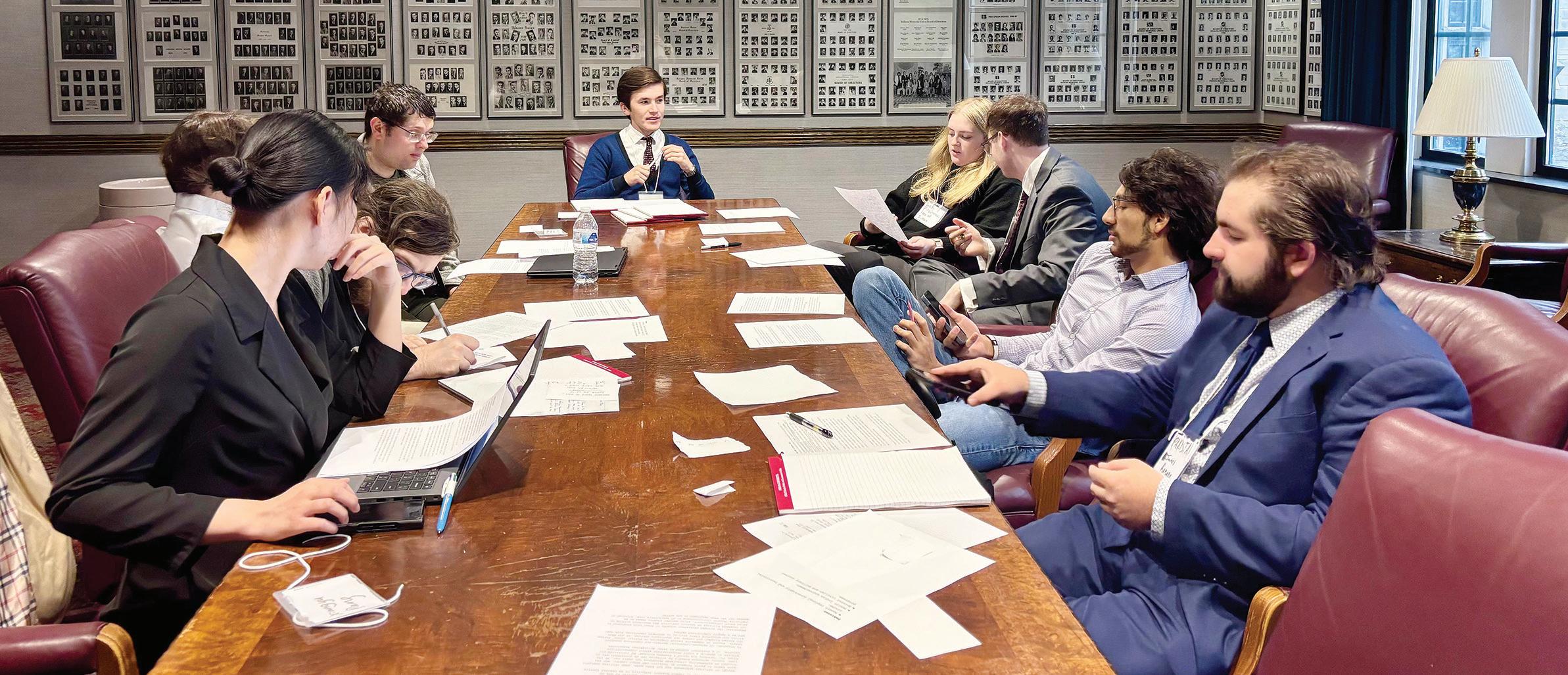
sophomore Simon Cian. They were positioned at the head of a long table in the IMU’s Distinguished Alumni Room. That would be the American headquarters.
After brief introductions, students dispersed into their separate alliances. In the “UN room,” UN members, representatives of European Union states and NATO allies met together. In a second room, the “revisionists,” powers including Russia, China, Pakistan and Iran, convened.

While state representatives had to ask permission before traveling between rooms or meeting with their foreign counterparts, I was granted diplomatic immunity as a reporter.
In the American room, the U.S. delegation was hit by the first crisis.
“0753 GMT: A Bullet, Bit,” the top of the page read.
The confidential memo informed officials that a routine Indian military exercise ended in tragedy. Twentythree Pakistani civilians had died, with substantial damage to residences and civil infrastructure across the Pakistani border.
U.S. Signals Intelligence indicated that GPS jamming was involved, but the jamming’s perpetrator remained unknown. Indian social media amplified claims of a Pakistani false flag, meaning they attempted to make it appear that the crime was carried out by another actor.
Simultaneously, reports surfaced of a terrorist attack on the Maji dam in southern Tibet, which supplied 48% of the world’s population with water. The terrorists threat-
ened to seize the dam if China did not release the region for their control.
The U.S. immediately split into its governmental agencies to assess the crises.
As tension mounted in the U.S. headquarters, a U.S. ambassador discreetly slipped out. In a shadowy hallway exchange, the ambassador assured the President of Pakistan, law student James Romano, that the U.S. condemned the situation and were investigating origins of the weapon.
But not all was well at home. Representatives ran between groups, speaking loudly and sometimes talking over one another. Adding to the chaos, a congress member learned they could leave the room and did so without informing the president. The senate majority leader was unsure of the congress member’s whereabouts.
“Do you understand this is a crisis?” The national security adviser snapped at the Senate majority leader, sophomore Joshua Burt. “We are trying to analyze everything, and Congress just leaves the
room in the middle of trying to make a decision.”
The president’s frustration was equally apparent. Elsewhere, diplomatic chess continued. In contrast to the American headquarters, the revisionist room had a calm, even cheerful atmosphere.
“India has asked permission to enter the room,” a courier informed the group.
“Agree or deny?”
“Deny!” Everyone sitting around the small conference table said in unison. One president leaned back in his chair while the Russian delegation cracked jokes. Then the second crisis struck.
U.S. social networks were claiming Bolingbroke, an owner of Department of Defense contracted companies, had been fraudulently reporting their assets for years to continue garnering competitive contracts. While U.S. defense-industrial markets plummeted, separatist attacks in Tibet escalated to killing Chinese officials.
SEE CRISIS, PAGE 4
By Jack Forrest jhforres@iu.edu | @byjackforrest
Over 20 people spoke April 7 in favor of a plan to change Monroe County’s voting system to one where any registered voter could vote at any county polling place.
This discussion took place during public comment at a Monroe County Election Board hearing at the Monroe County Courthouse. The next hearing on vote centers — the name for polling places where any voter can cast a ballot — will be 5:30 p.m. May 19 at the Monroe County Courthouse, when the Election Board will vote on the plan. Currently, voters must go to a specific polling place determined by the precinct they live in.
The Monroe County Election Board formed the Vote Center Study Committee in 2023. The committee held public input sessions in Bloomington, Ellettsville and Unionville, reviewed election data and technology needs and looked at information from other Indiana counties, including those with vote centers. Based on emails, interviews and websites from eight other counties with vote centers, they did not have a great impact on voter participation, according to the plan.
The committee’s recommendation was to convert all 29 Monroe County polling places to vote centers before the next elections in 2026. They also recommended opening three more early voting locations at the Ellettsville Town Hall, the Monroe County Public Library Southwest Branch and the IU Center on Representative Government or
another place near campus. There’s currently one early voting location in Bloomington on Walnut Street.
The estimated cost to convert to vote centers is $601,763, according to the committee’s plan. That’s for additional ballot printers, label printers and scanners, among other equipment. Assuming costs stay the same, that represents a 5% increase in overall election costs. As of 2024, 65 of Indiana’s 92 counties have vote center voting, according to the plan.
“I think because we’re seeing suppression from the state level, it’s more important than ever to make sure at the county level that we do what we can."
Anushka Pandey, IU College Democrats president
Among the supporters April 7 were Bloomington Mayor Kerry Thomson, Bloomington City Councilmembers Hopi Stosberg and Isabel Piedmont-Smith, Monroe County Councilor Trent Deckard, Greater Bloomington Chamber of Commerce President Eric Spoonmore and Monroe County Prosecutor Erika Oliphant.
Matt Caldie, who ran unsuccessfully in the Democratic primary for an atlarge County Council seat last year, said he went to multiple polling places on the primary election day as a candidate, including at Sherwood Oaks Christian Church.
“I’m pretty confident that
more people went in and came out and said, ‘I’m in the wrong place,’ than came out with a sticker,” Caldie said.
He said he knew at least one person who gave up on voting entirely after going to the wrong place. Vote centers would solve that problem, Caldie said.
Nancy Goswami echoed a similar sentiment. She said she’s worked as a poll worker for early voting and Election Day several times. She called it “disheartening” to see voters come in with only a few minutes left to vote and tell them they’re at the wrong location. There’ve been times where she’s had to turn away voters with mobility challenges, she said.
One member of the public, who said she’d been a poll worker during early voting since 2020, supported vote centers. However, she said she questioned if the three added early voting centers were necessary for every election because some have lower turnout.
“There are some elections where I’m being paid to read a book,” she said, “because maybe it’s primary, maybe there’s not a lot on the ballot.”
Another person expressed concern about the distance that elderly voters in rural areas have to travel to vote, like in Gosport. Ilana Stonebraker, Vote Center Study Committee chair, said the Gosport polling place would remain the same, but the vote center plan can be amended yearly by the Election Board. Browne said voters can request assistance with the traveling board, which brings the ballots to eligible voters.
One specific example some speakers brought up was student voter confu-
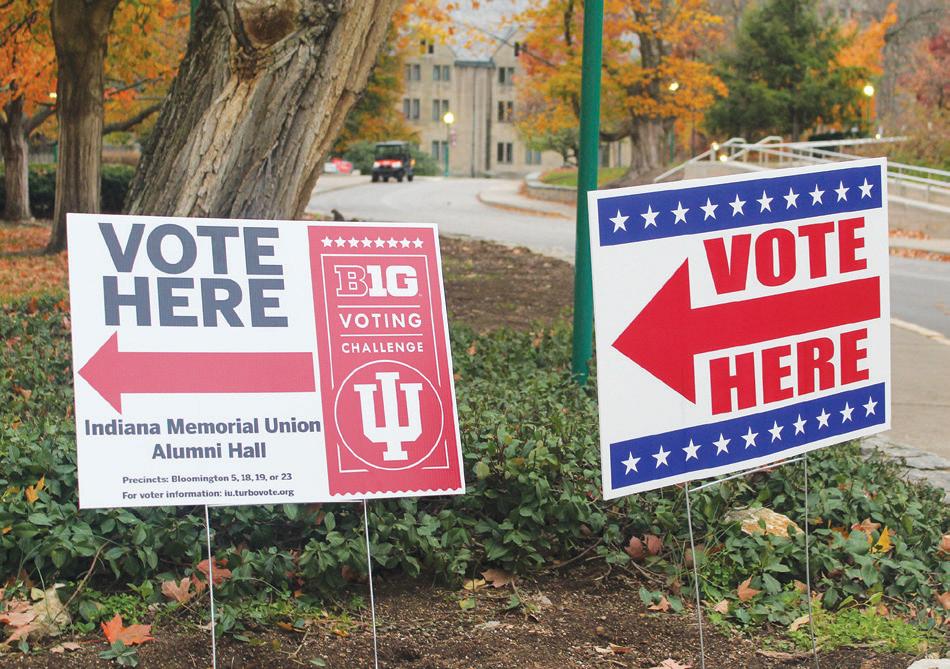
sion at the Indiana Memorial Union last November. Many voters — including those registered out of state — falsely believed they were able to vote at the IMU, even though it only covered certain precincts. Nicole Browne, county clerk and Election Board secretary, said April 7 that her office believes a thirdparty organization led students to believe, mistakenly, they could vote where they couldn’t. Many IMU voters filled out provisional ballots, which allow voters to cast a vote if their eligibility is in question. The Election Board later reviews the provisional ballots to decide if that voter is eligible and their vote should be counted.
According to Election Supervisor Kylie Farris, there were 390 provisional ballots cast in the county this past election, with 300 coming from the IMU. Of the IMU provisional ballots, 280 came from voters at the wrong location within the county, and 20 weren’t registered in Monroe County or Indiana.
Anushka Pandey, IU College Democrats president, said at the meeting vote centers would remove barriers to voting, like getting to a specific polling place. She told the Indiana Daily Student she doesn’t believe it’s a partisan issue.
“I’d rather you go vote than not, regardless of what party you support,” Pandey said. “I think that is a sentiment that rings true for a lot of people, because at the end of the day Election Day is about making your voice heard.” Pandey said vote centers are especially important in response to Senate Bill 10, which would remove school-issued IDs, including IU’s CrimsonCard, as a valid form of identification to vote.
“I think because we’re seeing suppression from the state level, it’s more important than ever to make sure at the county level that we do what we can,” she said. Monroe County residents can provide feedback on vote centers via an online form before the board’s May 19 meeting.
By Natalia Nelson and Chloe Oden nelsonnb@iu.edu | chloden@iu.edu
Editor’s Note: This story includes mention of sexual violence and assault.
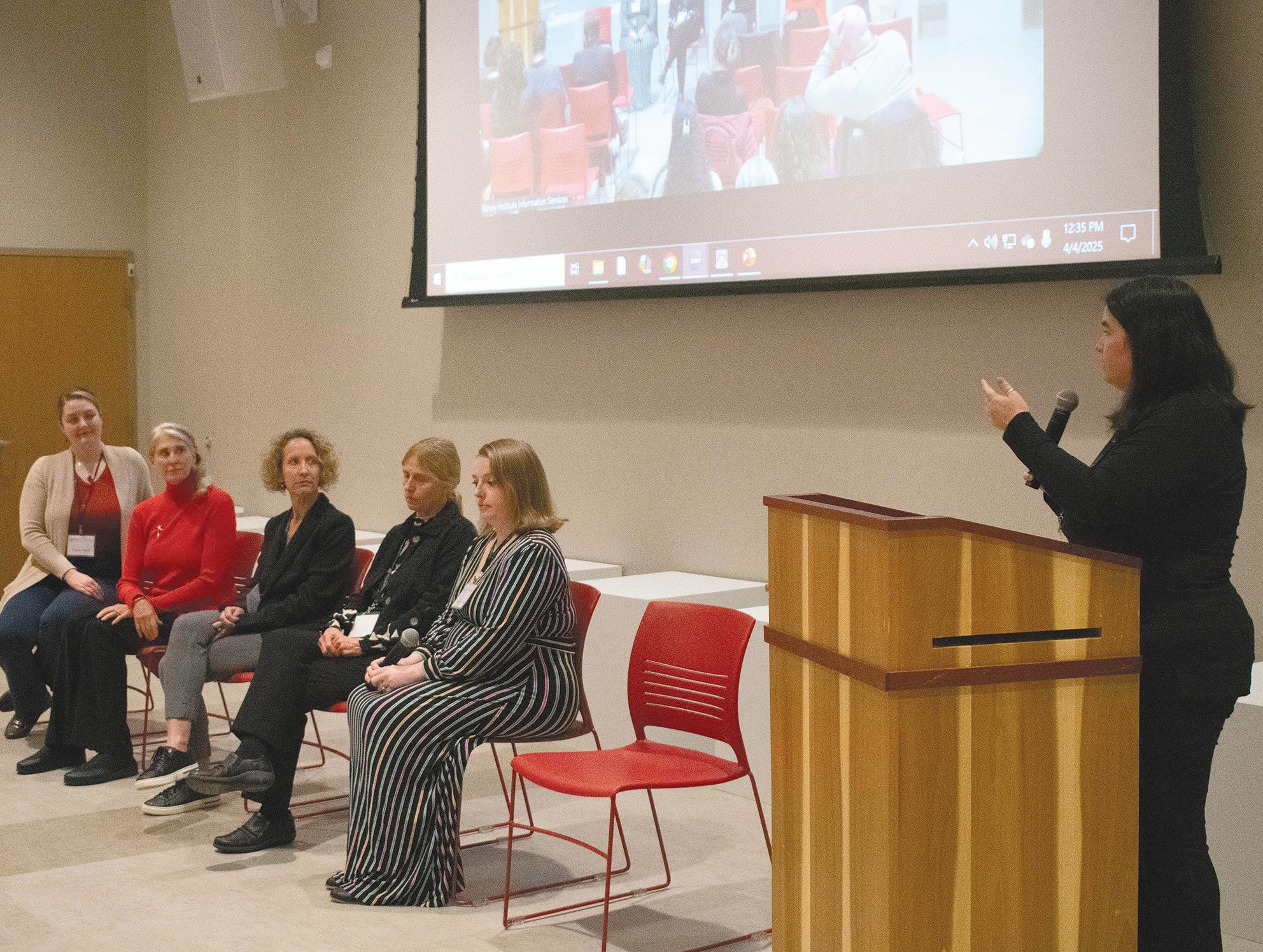
The Kinsey Institute held its “Understanding and Preventing Sexual Violence” 2025 research symposium April 4 at the McCalla School.
The event drew field experts, including keynote speaker Mary Koss, who published the nation’s first sexual exploitation survey of college students.
The goal of the symposium was to better understand sexual violence through research. It primarily focused on a revision to the Sexual Experiences Survey - Victimization survey, which is intended to measure sexual exploitation among adults. The revision is the survey’s first since 2007.
Koss said the goal of the survey was to eventually help decrease instances of sexual exploitation through understanding it better.
“We’re ultimately trying to reduce these behaviors,” Koss said. “How are we going to measure if we are accomplishing that reduction?”
According to the survey’s abstract, the major revisions include a different definition for consent, new tactics and acts of sexual assault to consider in the survey, wording and increased gender and sexual orientation inclusivity.
The new survey and preliminary findings were published July 2024 in the Journal of Sex Research. One preliminary finding reported 67% of respondents experienced exploitation facilitated by technology. Being sexually targeted online was one of the main additions since the 2007 revision.
Koss said that the survey had already been translated into other languages, such as Spanish and French, to
collect data outside of the United States.
“We’re trying, step by step, to broaden the use of the SES-V in as many identifiable communities as we can,” Koss said. She spoke about concerns of advancements in AI-generated pornography. The quickly advancing technology made it difficult to create an evergreen survey.
“I want everyone’s experience of sexual exploitation to be counted, to be seen,” RaeAnn Anderson, panelist and assistant professor at the University of MissouriKansas City, said. “That is, kind of, my hope for how it’s used.”
From August 2024 to April 5, 2025, the Indiana University Police Department has received reports of 32 rapes and 18 sexual batteries.
The IU Office of Institutional Equity published a report detailing sexual misconduct numbers from the 2022 to 2023 Academic year in February 2024. Among students at the IU Bloomington campus, there were:
38 reports of dating or domestic violence
• 141 reports of sexual assault and contact
• 36 reports of sexual exploitation
• 63 reports of sexual harassment
• 32 reports of stalking Zoe Peterson, the director of the Sexual Assault Initiative at the Kinsey institute, spoke on the complexities of consent, especially in terms of education.
“We have to teach that consent is complicated,” Peterson said. “You need to have lots of conversations
By Ben LeGrand benlegra@iu.edu | @benlegrand11
Editor’s Note: This story includes mention of sexual assault.
The IU Police Department received a report April 2 of domestic battery and strangulation that occurred Dec. 6, 2024, at fraternity Phi Sigma Kappa, according to an email from IUPD Public Information Officer Hannah Cornett.
IUPD received the report from the Title IX office. The individual involved did not report the case and it has been referred to university officials for review.
Phi Sigma Kappa is currently on cease and desist for endangering others, having received the designation March 28.
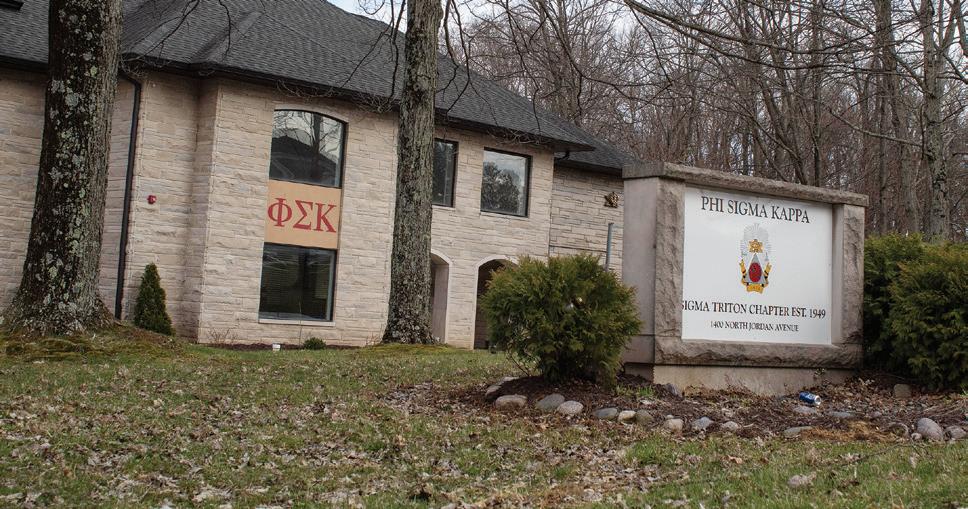
That cease-and-desist order was announced after IU’s Interfraternity Council and Panhellenic Association placed all Greek social events on suspension from March 5-24 to address community health and safety concerns. Days after that an-


about it, and if you’re in a relationship with your partner, and really talk about consent.”
IU students have already begun to use the SES-V to inform their research. Brianna Akers, a third-year counseling psychology doctoral student at IU, reported her research using the updated version of the SES-V to investigate how people with autism spectrum disorder experienced sexual exploitation.
She found that a diagnosis of ASD is predictive of higher instances of sexual victimization.
“There’s some unique factors that might contribute to an increase in vulnerability for this population,” Akers said. “One of which is this assumption that individuals with disabilities are childlike and therefore couldn’t
possibly be interested in sex, and so this leads to a natural decision to not provide any sex education at all.”
Lucy Bhuyan, a doctoral candidate at IU interested in doing research on LGBTQ+ victimization, said she plans to use the new SES-V survey in her research on bisexual women’s experiences with victimization on college campuses.
She said while learning more about sexual violence and victimization at the symposium, she has more questions due to the complicated nature of experiences with sexual assault.
“These experiences we have, you know, are very damaging and also are very common,” Bhuyan said. “I’m excited that we’re continuing to sort of ask that question and trying to know more and do better in this field.”
Taren McGray, a doctoral candidate at the University of Arizona, presented her research on “Sexual Exploitation Across Queer, Trans, and Cisgender Heterosexual Populations.” She found that queer and transgender individuals have an increased risk of sexual exploitation, finding that bisexual cisgender women, lesbian cisgender women and gay cisgender men are most at risk of sexual exploitation.
McGray said the revised SES-V has become a critical tool for studying the queer and trans population.
Carlin Hoffacker, a doctoral candidate studying counseling psychology at IU, said she is specifically interested in research on sexual aggression perpetration. She said she is interested in doing more research on perpetrators’ understanding of their encounters with others.
“What are the ways that we can build those into our measures so that we can be accounting for them in our prevention programming?” Hoffacker said.
The Kinsey Institute has experienced scrutiny from the state government, which passed House Enrolled Act 1001 in 2023. The act mandated that “State appropriations may not be used to pay for the administration, operation, or programs of the Kinsey Institute.”
Since the act was passed, letters sent between Indiana Comptroller Elise Nieshalla, Indiana Attorney General Todd Rokita and IU detail inquiries from the state government into Kinsey’s funding and IU’s compliance with the law regarding the institute remaining on campus property. IU has maintained it is in compliance with the law and that it does not require it to relocate the institute, which currently occupies the third and fourth floors of Lindley Hall and has continued to support it financially through grants, donations, auxiliary income and out-ofstate tuition.
By Brenna Polovina bpolovin@iu.edu
Editor’s Note: This story includes mention of sexual assault.
Eric Montgomery was sentenced 10 years in prison April 4 after pleading guilty to rape, a level three felony, March 13. This is his second guilty rape judgment, which he’ll serve concurrently with the first sentence.
nouncement, five alleged hazing incidents (four of the incidents were confirmed by IUPD to have occurred at Greek houses) and one rape were reported to IUPD from the Office of Student Conduct, although these incidents occurred before the suspension of social events.




In his allocution statement, Montgomery said he was remorseful for the crimes he had committed. He first apologized to the courts, then to the victims’ families.
In August 2021, Montgomery raped his neighbor in Ellettsville, who then reported the crime to the Ellettsville Police Department and filed a rape kit examination at IU Health Hospital. The probable cause affidavit said Montgomery was distraught about a family member’s death and sought consolation from the neighbor, who allowed him to enter her home. Montgomery then forced himself on the victim. He is 6’5 and 260 lbs, according to court documents, and the victim was afraid to


physically resist him.
In August 2022, Montgomery raped Avery McMillan, who was a 20-yearold IU student, shortly before her death, which was ruled a fentanyl overdose. McMillan was intoxicated and locked out of her apartment early that morning when she entered Montgomery’s car.
He gave McMillan alcohol and marijuana and drove her to his home, where he lived with his mother, stepfather and 8-year-old son. Montgomery reported that he and McMillan had sex, that McMillan had difficulty breathing and he woke to her dead body next to him in his bed.
The Monroe County Prosecutor’s Office charged Montgomery with rape, a level three felony, and furnishing alcohol to a minor, a level six felony, on Aug. 30, 2022. Three days later, an Ellettsville Police Officer obtained Montgomery’s DNA sample, which matched the sample provided by the rape kit from 2021. On Jan. 6, 2023, another rape charge was filed regarding the April 4 case.
On June 30, 2023, a Monroe County jury found
Montgomery guilty of raping McMillan, furnishing alcohol to a minor, as a class A misdemeanor and obstruction of justice, a level six felony. On Aug. 4, 2023, he received a 17-year sentence for the three counts and an enhanced sentence for 19 years after he admitted to being a habitual offender.
According to Indiana Code, the state may seek to have a person sentenced as a habitual offender for a felony by alleging that the person has accumulated the required number of prior unrelated felony convictions. In 2009, Montgomery was charged with three murder counts, a robbery count and a burglary count, and he was found not guilty by a jury in 2010. Between 2011 and 2015, he was charged with two class A felony drug dealing offenses, two class B felony burglary offenses and a level six felony intimidation offense. He pled guilty to all five felony charges. As of April 4 he had 817 actual days served for the 2021 rape. His 10-year prison sentence will be served simultaneously with the 36year sentence from
By Chloe Oden chloden@iu.edu | @chloeoden0
Teachers and staff at the Monroe County Community School Corporation say a website from the Indiana Attorney General’s Office is inciting a “climate of fear” across the district.
In February 2024, Indiana Attorney General Todd Rokita launched the “Eyes on Education” portal, an effort to “empower parents to further engage in their children’s education,” according to a press release.
The portal allows students, parents and teachers to report any “objectionable curricula, policies, or programs affecting children” from Indiana classrooms.
The Office of the Attorney General will review the submissions and post their findings on the website. The website currently catalogues “potentially inappropriate” materials from 28 school corporations in Indiana.
Some of the materials submitted include a poster for an equality club reportedly from Carmel Clay Middle School and a gender support plan allegedly from New Prairie United School Corporation. Additionally, one person submitted a document claiming diversity, equity, inclusion, justice and LGBTQ “agendas” are pushed by Jay Hess, the dean of the Indiana University School of Medicine.
Other items submitted to the portal are controversial library books, screenshots of course material and teacher training materials that include topics like Black Lives Matter, critical race theory and gender. None of the submitted materials contain explanations or evidence from the attorney general’s office confirming their validity.
The press release said the office will review submissions and may contact people who submit materials for clarification or additional information. The “Eyes on Education” website says the Office of the Attorney General will investigate materials submitted to the portal that could be in violation of Indiana law.
In 2024, a spokesperson for Rokita told The Guardian that all posts were accurate and that even if a concern submitted to the portal has since been changed, “It’s important for parents to see what the adults in their child’s school are capable of.”
The Indiana Capital

Chronicle reported in 2024 that one submission to the portal is an outdated gender support plan from ClarkPleasant Community School Corporation. A Clark-Pleasant spokesperson told the Indiana Capital Chronicle he was disappointed no one from the attorney general’s office reached out to confirm the information. The portal has since been updated to say that the policy listed was retired.
The Office of the Attorney General did not respond to the IDS’ requests for comment by the time of publication.
Myra Farmer is an instructional coach at TriNorth Middle School and Batchelor Middle School in Bloomington. She said the portal made her feel like she was in a “dystopian movie.”
“It’s a ‘gotcha’ method to try to pin things on teachers, oftentimes things that don’t exist,” Farmer said.
According to Farmer, critical race theory has never been taught in public schools, but many people discuss the topic as if it is.
Four submissions to the portal include CRT in the submission title.
In 2023, Sen. Jeff Raatz, R-Richmond, authored a bill to limit discussions of race in the classroom. Much of the opposition to this bill argued that bills like it are censorship and erase the truths of history, harming all students. The bill ultimately died in committee.
There is some fear that passing similar bills to remove material containing topics of race and racial justice would be a “whitewash-
ing” of history and could “halt the teaching” of some history lessons if they make a student uncomfortable.
“I can tell you that from a teacher’s perspective, we teach the state standards,” Farmer said. “It’s hurtful when you do what you think you’re supposed to be doing, and somebody thinks you are doing something wrong.”
Farmer also noted that although the “Eyes on Education” portal is designed to show examples of “objectionable curricula,” parents are on textbook adoption committees and oversee the material that is put into the curriculum.
“Those teachers really showed bravery, and I think it’s the thing that teachers will always do in the face of these kinds of political moves or antiinclusivity, anything that targets potentially vulnerable people.”
Eric Nolan, chemistry teacher at Bloomington High School North
The Indiana Department of Education also has a High-Quality Curricular Materials advisory list of materials “to support schools in the implementation of literacy instruction,” that follow state laws and rubrics for different grade levels.
MCCSC’s current guide for addressing concerns about grades, curriculum, progress and behavior in class encourages first reaching out to the teacher, then
principal, then director of the appropriate school level, before eventually reaching out to the MCCSC superintendent or Board of School Trustees.
Farmer said this increased oversight makes teachers feel like they’re always under suspicion. People go into teaching because they want to educate children and be role models, not to spread an agenda, she said.
Bloomington High School North English teacher Matthew Lynch said he thinks there may be teachers who self-censor or “water down the curriculum” to avoid the hassle of getting in trouble.
Erich Nolan, a chemistry teacher at Bloomington High School North, said the portal is “reckless,” referencing a photo of a classroom door posted on the site. Nolan said the post identified the school and would make it easy for someone to find the exact location of the classroom.
“If some terrible person wanted to harm or intimidate these teachers or students, the attorney general is pointing them out to the public,” Nolan said.
Nolan said a large part of being a teacher is trying to model good citizenship and empathy. A portal like this, he said, is “attacking that basic notion.”
Last year, the Hamilton Southeastern Education Association posted a statement on X urging Rokita to take down the portal, saying that the documents on the portal had “not been vetted” and that the portal doxes teach-
ers without their knowledge by including their names.
Nolan said he believes the portal doesn’t really exist to change policy or people’s minds, but to create a “climate of fear.”
In recent years, several pieces of legislation limiting certain topics in curriculum have passed. In 2023, HEA 1608 was passed, prohibiting schools from providing any instruction on “human sexuality” for students in pre-K through third grade.
Right now, SB 289 is pending. This bill, titled “Nondiscrimination in employment and education” would require schools to post training and curriculum related to “nondiscrimination, diversity, equity, inclusion, race, ethnicity, sex, and bias” on their websites. Also, it would prohibit schools from compelling students to “affirm, adopt, or adhere to certain beliefs or concepts.”
Nolan said when he worked in a rural school district, it was important for teachers to support LGBTQ students because oftentimes other community members weren’t as supportive.
“Those teachers really showed bravery, and I think it’s the thing that teachers will always do in the face of these kinds of political moves or anti-inclusivity, anything that targets potentially vulnerable people,” he said. “I think teachers will always stand up.”
Without some of the material that is being exposed in the portal, Nolan said kids at school will miss out on feeling love, safety and support from teachers.
According to a 2022 National Survey on LGBTQ Mental Health from The Trevor Project, while 37% of surveyed LGBTQ youth reported identifying home as an LGBTQ-affirming space, 55% identified school as an LGBTQ-affirming space. Lynch said that efforts to suppress certain kinds of conversations “minimizes or erases the lived experience” of kids in the classroom who are part of those groups. Lynch specifically referenced the importance of reading books by diverse authors in English classes.
“By not reading those things, we’re depriving ourselves of getting the full experience of human life,” Lynch said. “I think that if we’re only reading books written by one group of people, the implicit message it sends to a student not of that group is that, ‘Your experience doesn’t matter, that no one from your group has written anything of merit,’ which is rarely true.” Lynch also said that trying to limit what can be talked about at school does a “disservice” to kids who need a place to experience having difficult conversations.
“Young people are smart and caring and capable, and I think that they can talk intelligently and responsibly about these kinds of things,” Lynch said. “I don’t really know how we’re going to expect them to inherit such a complicated world if we can’t have these kinds of conversations in a place where people can safely and freely discuss what’s on their minds.”
Lynch said he wishes people understood that the role of teachers is to encourage students to develop their own opinions.
“The joke I always say is, ‘Do you know how hard it is to actually indoctrinate a teen?’” Lynch said.
Lynch also said he feels fortunate that Bloomington parents are supportive of teachers and value education. Nolan said if something from MCCSC was submitted to the portal, the community would rally to support them.
“We’re really worried about public education, which we see as kind of a bedrock of the country,” Lynch said. “We think of education as a human right, so we just encourage folks to be involved and to advocate for public education, for education for everyone.”
By Natalia Nelson nelsonnb@iu.edu | @natalianelsonn
A bill extending Indiana’s lifeline law was signed into law by Gov. Mike Braun on April 3.
The original lifeline law guarantees that any person requesting medical help for another due to alcoholrelated emergencies will not be prosecuted for possessing, consuming or transporting alcohol as a minor, or for public intoxication as long as they stay on the scene and remain compliant with police.
However, the original law does not protect the person in need of medical assistance from prosecution. A group of Purdue University students knew that could prevent students from requesting help.
“We had a lot of situations on our campus where our students were hesitant to make the call in underage drinking medical emergencies,” Rebecca Siener, vice president of the Purdue Student Government and Students for Lifeline Law, said.
Students for Lifeline Law is an organization working through the Purdue Student Government to attain medical amnesty for underage drinkers in emergencies. Its coalition includes students from Purdue, Indiana University and Indiana State University. Siener said they worked with former Indiana Sen. Jim Merritt, who authored the original bill in 2012, to try to pass the legislation.
“We spent the past year and a half lobbying members of the General Assembly, traveling back and forth from the State House,” Siener said. “We assisted in the writing of Senate Bill 74.”
Senate Bill 74 grants immunity to underage drinkers suffering from alcoholrelated health emergencies who have called for medical assistance or had medical assistance called for them from criminal prosecution for certain crimes.
The law shields the minor as long as the person provides their full name and the relevant information requested by the police officer, remains at the scene and cooperates with law enforcement.
“It’s obviously a move in the right direction,” Meagan Barnhart, the interim director of Substance Use Intervention Services at IU, said. “As far as taking a harm reduction approach and, you know, focusing on protecting the students and making them feel like they can contact 911 if they need to.”
Substance Use Intervention Services offers a sober space for students who are seeking recovery from substances. They host prevention programming, educational presentations and have an intervention team with licensed counselors. Barnhart said that over 7,000 students were served from fall 2023 to spring 2024.
Barnhart said she thinks the university’s lifeline law policy, which mirrors state law, will be adjusted according to the change this summer to reflect the update.
“Any updates that are made to the lifeline law, of course, will be in our programming,” Barnhart said. “We do a lot of presentations on overdose prevention and awareness, like how to handle an overdose, and we talked about the lifeline law as part of that programming.”
According to the 2023 Indiana College Substance Use Survey, 55.7% of respondents and 44.7% of respondents under 21 reported drinking alcohol in the past month.
29.6% reported binge drinking, having over four drinks at a time for women and over five for men, in the past two weeks.
Over a quarter of the survey respondents that said they consumed alcohol in the past year reported they blacked out, and 11.1% said they had been hurt or injured due to alcohol consumption.
“A lot of people think that, you know, the lifeline law encourages or incentivizes underage drinking,” Siener said. “When that’s just simply not true.” She cited a 3.87% decrease in underage alcohol use in Indiana from 2008 to 2018. The lifeline law was first passed in 2012.
Siener said though she thought the policy would encourage people to call for help by eliminating the legal repercussions, education is an important step to drive change.
“If you don’t know that all people are protected, then the policy serves no purpose,” she said. “We hope to continue to work with the coalition to make sure that we’re educating all of our respective student populations on the current lifeline law.”
Siener said she hopes the coalition will continue to be involved at the State House, mentioning that Merritt had ideas of how students could stay involved in the legislature.
“It was very inspiring to know that students could affect legislative change,” she said.
By Deshna Venkatachalam devenkat@iu.edu
The IU School of Medicine Diversity, Equity and Inclusion Coalition, a student organization, began their annual fundraiser this month. In the face of antiDEI initiatives, the organization seeks to continue promoting cultural and diversity programming and needs the funds to do so.
The organization is dedicated to acknowledging the importance of having diversity in the healthcare system and teaching medical students how to provide good healthcare to anyone seeking it, regardless of their background.
The steps challenge, a competition between participants that has them track their daily steps, in particular is promoting friendly competition and exercise. Through events like this, the coalition seeks to encourage, enable and empower the IUSM community.
Nicole Libiran, vice president of social media and communications, said that they don’t get much funding from the school and expects that funding could go down amid recent legislation. Fundraisers are a way to aid in buying supplies, food and other things for events they host.
Their fundraiser is fully sponsored by MedMatch Realty, a realty agency that helps physicians and health professionals find homes and transition to new areas. By tracking their steps throughout the month with the StepUp app, MedMatch will provide gift card prizes of the winners’ choice to the three participants with the most steps.
The coalition has raised $144 as time of publication, with each participant paying $8 to join the challenge. This money will go towards programming and support their goal of continuing to diversify their curriculum and improve recruitment and retention of students underrepresented in medicine.
“I found it hard to relate to some of my peers growing up, being from a predominantly white community,” Libiran said. “That’s why I joined the DEI Coalition, to uplift minority voices and it’s important that we have a diverse group of individuals in healthcare.”
According to Penn Medicine, the University of Penn State’s health system, patients who shared the same racial or ethnic background as their physicians were more likely to be given the maximum patient rating score. They had a sample of 117,589 patients from 2014 to 2017, surveying them on their experience with the care they had.
The coalition also works to educate all healthcare professionals about how they can recognize their own implicit biases and try to provide the best care to a diverse group of patients.
However, the coalition has seen recent legislation that targets programs like this.
On Jan. 15, Indiana Governor Mike Braun signed an executive order dismantling diversity, equity and inclusion in all state agencies.
President Donald Trump also issued an executive order on Jan. 21 aiming to end DEI initiatives, calling them “illegal discrimination.”
Libiran said back in January, around 60 medi-
cal students came together to discuss “anti-DEI legislation.” The meeting discussed the best way that students can get involved and have their voices heard among recent federal and state orders.
Since then, the state has been working to pass Senate Bill 289. Under this bill, state educational institutions may not “manipulate or otherwise influence the composition of employees with preference to race, sex, color or ethnicity.” Libiran and a group of her peers are working on publishing their own interpretations of SB 289 that will include discussion about their feelings and understandings about the changes that are occurring with this legislation.
“We were told that, since we are a group organization, there wouldn’t be need to change our official name or anything like that,” Libiran said. “We were warned that there may need to be changes to websites in terms of titles and names, but we haven’t really gotten to that yet.” However, IU has begun making changes to their own websites regarding DEI language.
“We are doing our best to support diverse groups while adhering to the laws, but we’re trying to have as much transparency as possible,” Libiran said.
In the future, the IUSM DEI Coalition plans to host more events in support of various cultural groups on all IU campuses.
Students and community members can still join the steps challenge at any time until April 30, when the challenge ends.
Almost immediately, the Hungarian president, Jonathan Weisbach, entered the revisionist room, calling for Hungary, Sweden, China and Pakistan to lead an investigation into the Tibetan dam crisis.
“New contingent,” the Russian president, IU senior Darby Fitzsimmons, said to the group. “Russia has to join.”
Back in the U.S. room, Congress responded to the Bolingbroke crisis.
“With regard to Bolingbroke,” the Speaker of the House, junior Hamza Sahli, said, “They have approached the speaker of the house requesting a bailout to the corporation, as it is an absolute investment interest and was completely blown up.”
“Not without accountability,” the national security adviser interjected. The House speaker's tone shifted.
“I find this just disgust-
ing that you would make this about politics and accountability right now,” he said. “When the national defense, when the NSA loses access to these satellites, we’re going to have a serious situation on our hands!”
“We have a serious situation as it is!” the national security adviser retorted.
After a tense exchange, the group agreed to discuss arresting Bolingbroke executives. The national security adviser declared that he wanted the FBI to raid Bolingbroke offices, gain control of their systems and ensure that American national security information is protected.
The turmoil did not go unnoticed by America’s allies. Concerned by the intelligence breach and internal dysfunction, the UN group took action.
“We in Europe would like to announce that we are creating a new intelligence network that can work independently of the United States,” the German Chancellor AJ
Porter declared before all parties.
The chancellor also noted ongoing efforts to bring Turkey into the European Union. Meanwhile, the Asian powers announced an “Asian NATO,” excluding the United States.
As new crises emerged, prominent heads of agencies frantically continued to meet in whispered hallway conversations. Officials exchanged confidential messages on scribbled notecards via couriers. In the U.S. room, Henry Lancer, the CEO of military contractor Cavalier, affiliated with Bolingbroke, faced interrogation by FBI agents over the alleged intelligence leak, though he remained uncooperative.
At the same time, NATO countries entered the U.S. room.
“The NATO countries called for the resignation of the Secretary of Defense of the United States for severe and several lapses in security measures,” the United Kingdom’s Prime Minister Max

Mon. - Thu.: 8 a.m. - 4:30 p.m. Lunch Break : Noon - 1:30 p.m.
642 S. Walker St. 812-331-9160 drbrittain.com
Dr. Philip Clark Brittain Jenna Kelly, RN

Baron D Hall, DDS, MSD
Jake Willhite, DDS, MSD Orthodentists
Erica Hall, Hannah Elliott, Kaitlyn Jacobs, Marilyn Lee, Adrian Price
With modern techniques and a fun style, B-town Orthodontics is the most up-and-coming orthodontics office in the Bloomington area!
We offer the latest technologies including invisalign, gold brackets, laser treatments, and even mini implants that can help restore missing teeth and even eliminate the need for surgery. B-town Orthodontics offers FREE consultations and don’t forget to download The Braces App, the hottest free app designed by B-town Orthodontics’ Dr. Baron Hall.
Tue. - Thu.: 8:30 a.m. - 4:30 p.m. Lunch 12:30 p.m. - 1:30 p.m. Mon. & Fri.: Appointments Only 1320 W. Bloomfield Rd., Suite B 812-287-8851 btownorthodontics.com

Arterberry announced. “And we call for an investigation into his knowledge about Bolingbroke. We would like the United States to not bail out the company.”
“NATO,” the national security adviser interrupted. “You are invited to leave the room.”
He had more pressing concerns: new intelligence confirmed China’s role in the GPS jamming that triggered the initial India-Pakistan crisis.
In an effort to regain credibility and leverage NATO support, the U.S. began the lengthy process of impeaching their secretary of defense, graduate student John Mikucki.
In the last 10 minutes of the simulation, the U.S. rushed to finalize its proposed policies. Though it came down to the wire, the U.S. ended by making seven proposals, including blowing up compromised satellites, pledging $200 billion to support China’s efforts at the dam and launching a carrier
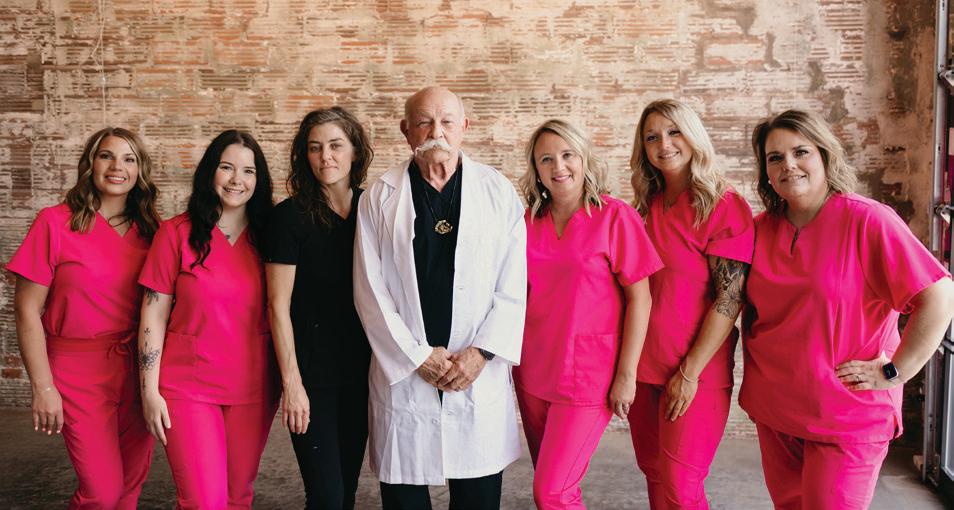
Vibrant Life specializes in hormone replacement therapy and medical aesthetics. Vibrant Life is pleased to offer personalized care, employing the latest medical technology. Services include: hormone therapy, neuromodulators (botox, dysport), dermafillers, microneedling, laser hair removal, age spot reduction, blue light acne treatment, treatment for urinary incontinence and much more. Come visit us and start living a more Vibrant Life today!

Ryan D. Tschetter, DDS
Lauren R. Hoye, DDS Jackson Creek Dental is conveniently located on South College Mall Road. Most insurances accepted, including the Indiana University Cigna Insurance plans as well as the IU Fellowship Anthem.
Dr. Tschetter and Dr. Hoye offer state of the art dental technology such as Zoom whitening, same day crown appointments, and Invisalign. We also provide restorative, cosmetic and emergency care. We pride ourselves in giving the best care to our patients while offering a pleasant yet professional atmosphere.
Mon. - Thu.: 7 a.m. - 5 p.m. Fri.: 7 a.m. - 3 p.m. 1124 S. College Mall Rd. 812-336-5520 jcdsmiles.com
Austin C. Starr, D.D.S
HOOSIER ORAL SURGEON?
Dr. Andrew Pitcher, D.C.
Dr. Crystal Gray, D.C.
A Way of Wellness Chiropractic specializes in comprehensive spinal care. We offer treatment for many different spinal conditions and problems, while also addressing the body as a whole. We provide effective chiropractic care helping patients reduce stress, improve mobility and spinal health. The quality treatment we provide is always fit to your individual needs and goals. Let us help you achieve and maintain good spinal health. We look forward to meeting you!
Mon. - Thu.: 8 a.m. - 6 p.m. 1121 W. Second St. 812-336-2225 bloomingtonchiropractor.com
strike group into the Persian Gulf to stabilize the region after an Israeli bombing of an Iranian nuclear facility.
As the U.S. focused on damage control, the revisionist powers and NATO allies struck a controversial deal with Russia. Russia agreed to withdraw from Ukraine up to the 2021 borders in exchange for annexing the entirety of eastern Belarus and the city of Minsk. Some final policies may have been a stretch, as an adjudicator pointed out. But the educational value of the experience was clear.
“A lot of these students are interested in foreign policy,” Spencer Walsh, an IU senior and creator of the simulation, said. “It is a very different thing to have classroom experience and technical understanding, than to be thrust into a situation where there are a lot of uncertainties.”
The simulation did not end in world peace, but perhaps there is hope for next semester.

Ricardo Vasquez MD
Mon. - Fri.: 8 a.m. - 5 p.m. 815 W. Second St. 812-336-6008 vascularcenterandveinclinic.com
Dr. Andrew Jones, Dr. Marzia Zamani, Cheyenne Brown, Megan Sipes, Milli Nally, Kenzy Hawkins, Christina Thompson
Dr. Tavel Family Eyecare is your partner in your personal eyecare journey. Since 1940, the company has believed that every Hoosier deserves quality eyecare and vision solutions at an affordable price. Dr. Tavel offers comprehensive eye exams, special testing, management of eye diseases, glasses, contact lenses and much more, all backed by an insurance acceptance guarantee. The company is committed to advancing eye health by investing in the latest technology and providing treatments that are right for every patient’s unique needs.
Mon.: 7:30 a.m. - 6 p.m. Tue.: Closed Wed.: 7:30 a.m. - 6 p.m. Thu.: 9 a.m. - 7:30 p.m. Fri.: 7:30 a.m. - 6 p.m. Sat.: 7:30 a.m. - 1:30 p.m. Sun.: Closed
2552 E. Third St. 812-233-2343 drtavel.com/locations/bloomington
» VISAS
CONTINUED FROM PAGE 1
“We don’t discuss individual pieces due to the privacy of those involved,” state department Spokesperson Tammy Bruce said at a briefing Tuesday. “We don’t go into statistics or numbers.” IU did not immediately respond to questions on its response, nor how many students the cancelations have impacted.
Students concerned about the status of their visa can check it through the Department of State’s Visa Status Check portal. Students who have had their visas revoked or terminated should consult an immigration lawyer. Information on students’ rights when dealing with Immigration and Customs Enforcement is available here.
If your student visa or someone you know’s has been canceled, please reach out to the Indiana Daily Student at newstips@idsnews.com or more securely at @idsnews.25 on Signal.

Our eye care clinics serve patients in Bloomington-Atwater Eye Care Center and Indianapolis Eye Care Center, with faculty doctors and student interns who work together to provide the most comprehensive eye care available. Our many services include primary care, pediatrics, low vision, dry eye, disease, laser and surgical care, contact lenses including specialty lenses, myopia management, aniseikonia, and eye wear center. Open to the public and accepting most insurances.
Mon., Tue., Thu., Fri.: 8 a.m. - 5 p.m. Wed.: 8 a.m. - 8 p.m. Sat.:

Mezger, FNP-C Alyssa Van Duzer, PA-C
Our board certified nurse practitioners and physician assistants provide primary care, acute care, physicals, vaccines, weight management and more to patients 12 months and older. Appointments and walk ins welcome. We accept most commercial insurance, Medicare and several Medicaid plans. We offer transparent pricing for the uninsured.
Closed for


school of Dentistry in Indy. Go Hoosiers!
Mon. - Thu.: 8 a.m. - 5 p.m.
3925 E. Hagan St., Suite 201 812-822-2489 bloomingtonbraces.com
Dr. Starr is an Indiana University Football Alum who provides pain-free experiences for all Hoosiers with IV sedation. He performs specialized oral surgery services including Wisdom Teeth Extractions, Dental Implants, Bone Grafting, and Plasma Therapy. Equipped with modern 3-D technology, he has the most up-todate surgical skills and techniques to accomplish beautiful results with his patients. He looks forward to accomplishing beautiful results with his patients, enhancing confidence and satisfaction for all he serves. Go Hoosiers! We look forward to taking care of you!
Mon. - Thu.: 8 a.m. - 5 p.m. Fri.: 8 a.m. - 4 p.m. 473 S. Landmark Ave. 812-318-1023 starroralsurgery.com
For membership in


1175 S. College Mall Rd. 812-323-4301 kroger.com/health/clinic General Health
also work with local physicians and dietitians.
Mon. - Fri.: 9 a.m. - 5 p.m.
3925 Hagan St., Suite 203 812-334-0001 JanTaylorSchultz.com Eating Disorder
Dr. Zachary Short, O.D.
Dr. Madison Witthoft, O.D.
Welcome to Insights Optical, where quality eye care is our number one priority. Our dedicated team is ready to learn all about you and your vision needs while using innovative technology and a comprehensive care approach to take care of your eye health.
Mon.: 10 a.m. - 6 p.m. Wed.: 9 a.m. - 4 p.m. Tue., Thu., Fri.: 9 a.m. - 5 p.m. 415 S. Clarizz Blvd. 812-333-1911 insightsoptical.com

Dr. Philip Clark Brittain Jenna Kelly, RN
Vibrant Life specializes in hormone replacement therapy and medical aesthetics. Vibrant Life is pleased to offer personalized care, employing the latest medical technology. Services include: hormone therapy, neuromodulators (botox, dysport), dermafillers, microneedling, laser hair removal, age spot reduction, blue light acne treatment, treatment for urinary incontinence and much more. Come visit us and start living a more Vibrant Life today!
Mon. - Thu.: 8 a.m. - 4:30 p.m.
By Mia Hilkowitz and Briana Pace @mhilkowi@iu.edu | bjpace@iu.edu
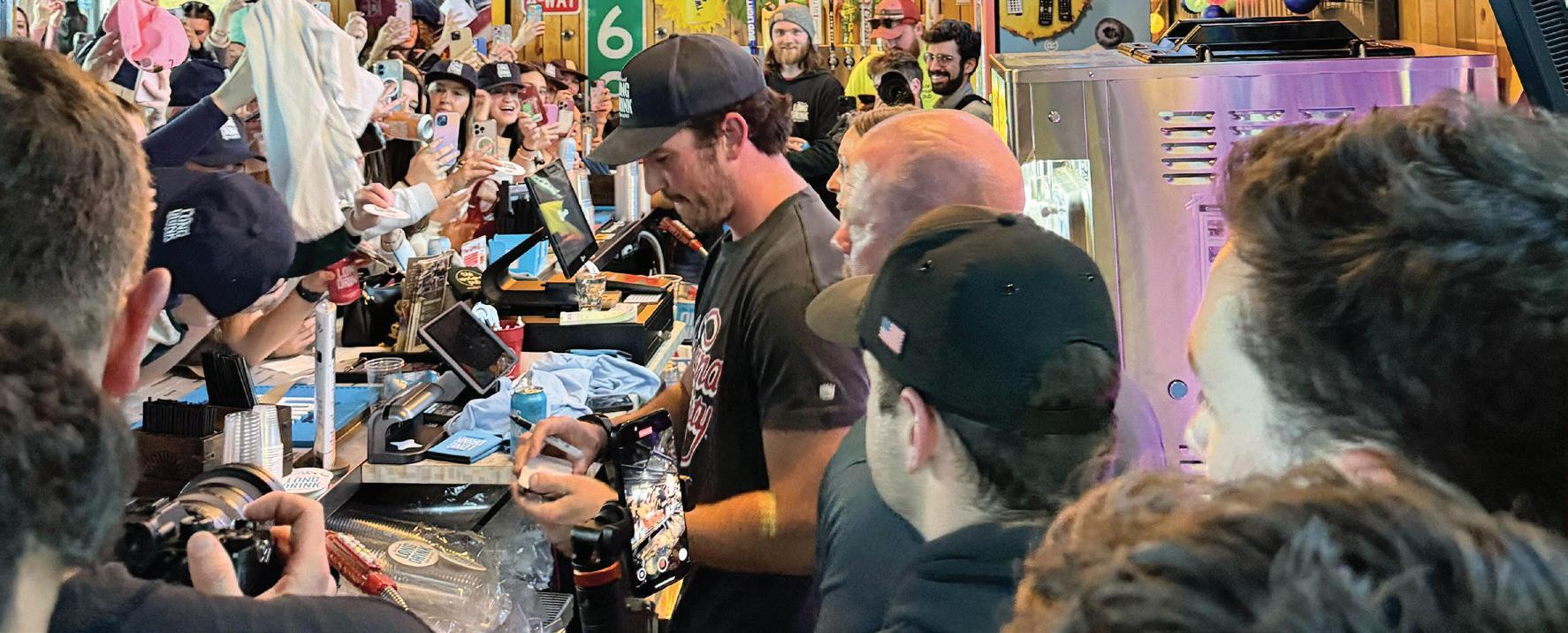
Actor Miles Teller got a very warm welcome to Bloomington on April 8. At Upstairs Pub, that came in a couple different forms: a private room in the bar’s secret speakeasy, adoring fans screaming his name and titular songs from his movies “Footloose” and “Top Gun: Maverick” blasting through the speakers.
And Teller tried to return the reception, throwing merch and talking to bar-goers during his hour and-a-half visit. Before greeting fans, Teller, who arrived in Bloomington just hours before from Toronto, said he prefers to sign autographs instead of taking selfies with fans.
“I signed a chick’s epipen in Georgia,” he said. “I signed a girl’s diabetes thing. And a lot of shoes. A lot of people gave me a single shoe to sign, which is disgusting ... I don’t know, college is still college, I guess.”
Bloomington was the latest stop in Teller’s countrywide tour to college campuses to promote Long Drink, a company he’s invested in and been involved in for six years. Long Drink produces canned cocktails with a 5-8.5% alcohol by volume.
According to Long Drink’s website, the first long drink or “lonkero” — a drink made with gin and a mixer, usually grapefruit soda — originated in 1952 in Finland as the country was preparing to host the Olympic Summer Games. The country’s government commissioned the drink’s creation to help attract tourists to the country,

which was still recovering from fighting against both sides in World War II. The long drink is now a staple of Finnish bars.
Teller, who sported a Long Drink branded baseball cap, said his love for the brand is authentic, and that he’s not “a celebrity trying to sell you stuff.”
“I wear this hat, I think, 90% of my life,” Teller said.
“When our house burned down in the Palisades this was one of the few things I grabbed. I was like, ‘I need that hat.’”
Evan Burns, cofounder and CEO of Long Drink, graduated from IU with an economics degree in 2010. He said he first tried the
drink after visiting Finland at the invitation of two students from the country who studied abroad in the U.S. He was around 27 when the brand launched in 2018.
“It wasn’t like we set out to build a really big business,” he said. “We set out because it was fun, and we thought it’d be a fun kind of puzzle, project to work on.”
However, Burns said he didn’t expect some of the challenges of starting a business.
“Like kind of everything that can go wrong, probably will go wrong, and you have to have a plan for it,” Burns said. “And the most important thing is, yes you need good product, but you really
need people that you work with, that you care about, that you believe in and you have each other’s backs to overcome those problems.”
Burns said Teller and Long Drink representatives plan to visit more colleges in the future.
“It’s about being in Lansing, Michigan, and being at Ohio State,” Burns said. “So I was happy he wanted to do IU because I was like ‘I went there.’ So, we knew we were going to Upstairs, we know we were going to do Kilroy’s.”
Bloomington resident Riley Goode, 22, said she attended the event specifically to catch a glimpse of the star, though she admitted she’s not necessarily a big fan of
Teller’s.
“I’m a big Upstairs fan,” she said. “But, you know, I like him too.”
Bloomington is no stranger to celebrities promoting their lines of alcohol. In October 2023, model and internet influencer Kendall Jenner participated in a margarita tasting at the bar to promote her “818” tequila line. “The Vampire Diaries” star Ian Somerhalder did a meet and greet in April last year at a Big Red Liquors to promote “Brother’s Bond Bourbon.”
Goode said she was relieved the event was less scary than she thought it would be.
“People aren’t, like,
punching each other, you know,” she said. “So, I’m glad about that.”
That didn’t mean the bar was lacking in energy. All standing room and tables were packed with students trying to crowd in to take a photo of Teller or grab merch. Some students stood on tables and stools hoping to see him.
“I see that cute face,” one student yelled while balancing on a stool. “I’d see that cute face from a mile away.”
In front of one of the bars, a patron held out a poster of Teller shirtless from “Top Gun: Maverick” for him to sign. Teller said he drinks the sugar-free version of the Long Drink when he’s preparing for shirtless scenes.
IU seniors Kate Curtis, Abby Tillar and Jessica Minor got to Upstairs right before 3 p.m. when the doors opened to get a table at the bar.
“We had just recently watched the ‘Top Gun’ movie before we found out he was coming, so it made it even more special,” Tillar said. “I don’t know it was just so amazing.”
The seniors got Teller to autograph photos of him standing next to his wife, Keleigh, and popstar Taylor Swift, as well as a collage of stills from “Top Gun: Maverick.” Though the students had never tried Long Drink before Teller’s visit, they said they enjoyed it and would recommend it to other students.
“I have an exam tomorrow and two exams on Thursday and one exam on Friday, and I still took the time to be here, and I will never forget it,” Tillar said. “I’ll never regret it.”
By Natalia Nelson nelsonnb@iu.edu
Cameran Rayner pulled his white dual-motor Model Y Tesla into a parking spot at the side of a Fresh Thyme on April 6 in Bloomington.
The line of Tesla superchargers in front of the car had been vandalized with foam earlier that week, according to The Bloomingtonian.
As of April 6, only a slight sticky residue remained on one of the chargers. The rest appeared to be fully functional.
Rayner calls the sticker on the back of his car, which reads “Anti Elon Tesla Club,” his “mini-insurance.”
He bought his Tesla back in 2022. He said he was a “techie guy” who thought the car was the best choice at the time, and said his decision to buy one wasn’t politically motivated.
“I do not like the association of driving one right now,” Rayner said. “But I’m not willing to spend 20 grand
to make a lateral move to an equivalent other brand just to make a political statement.”
The Fresh Thyme chargers are the only Tesla superchargers in Bloomington.
Their vandalism is part of a recent nationwide trend of damage to supercharger stations and Teslas. Chargers were set on fire in Massachusetts and spray-painted in Maryland. A Tesla car dealership in Colorado caught fire after Molotov cocktails were thrown at it.
“The way that I view it is that, yes, the guy who built it is a bad person, but doesn’t mean the product is necessarily bad,” Rayner said.
The Monroe County Republican Party released a statement on Thursday condemning the vandalism to the superchargers, as well as shattered windows at The Forge and The Mill, though it is unclear if the incidents were connected.
On the night of April 2, glass windows and doors at the two buildings in the
Bloomington Trades District were shattered. As of April 6 afternoon, the windows were covered with plywood and a section of The Forge was still taped off. The Bloomington Police Department is still investigating the incident.
“Tesla owners, regardless of who they voted for, are now victims of a climate of lawlessness,” the press release read.
The MCGOP called on the Monroe County Democrats to condemn the vandalism.
Tesla stock has fallen by over 11% by the time of publication in the past month. Elon Musk, spearheading the Department of Government Efficiency, has cut hundreds of thousands of federal jobs and funding. Amid criticism his actions are unconstitutional, organizations including the United States Agency for International Development, the National Institutes of Health and the United States Department of Veterans Affairs have faced cuts.

By Chloe Oden
chloden@iu.edu | @chloeoden0
Bloomington Faculty
Council President Danielle DeSawal introduced IU Provost and Executive Vice President Rahul Shrivastav at the State of the Campus
Address at the end of April 8 BFC meeting.
“I am fully aware that not everyone in this room agrees with all the decisions that have been made,” DeSawal said.
DeSawal said that her “lens” has given her the opportunity to see Shrivastav as a “leader that is committed to faculty governance” and that he has been honest about the “uncertainty of the state of higher education.”
At the end of her introduction, one attendee in the audience shouted, “No confidence,” and one shouted “Resign.”
Last year Shrivastav received votes of no confidence from 91.5% of 948 voting faculty members.
“Obsequious, it was,” another attendee yelled.
Although the shouts and cowbell noises from several attendees faded as they left President’s Hall, the sounds could still be heard as people gathered outside of Franklin Hall. Throughout nearly the entire duration of the
address, horns, cowbells, shouting and chants persisted from outside the building.
“I know there is great uncertainty and many in this room and across the campus feel under attack, from research funding to classroom instruction, how we move forward may need to be very different in some ways,” Shrivastav said. “I know that’s not easy, and I know also with that, we’ve had challenges and differences here over the last three years, which have also not been easy, but as Hoosiers, we have proven our resilience, and we will again today.”
Shrivastav presented IU’s achievements over the past year and discussed plans to overcome challenges related to funding and differences of opinion on campus. During the address, Shrivastav reviewed IU’s academics, research, enrollment and progress toward the 2030 Strategic Plan.
Shrivastav said IU’s pursuit of academic excellence will help create “the Bloomington of tomorrow” and detailed the three new undergraduate and eight new graduate degrees introduced in the past year. This includes undergraduate degrees in music business and public health with a focus on sexual and reproductive health.
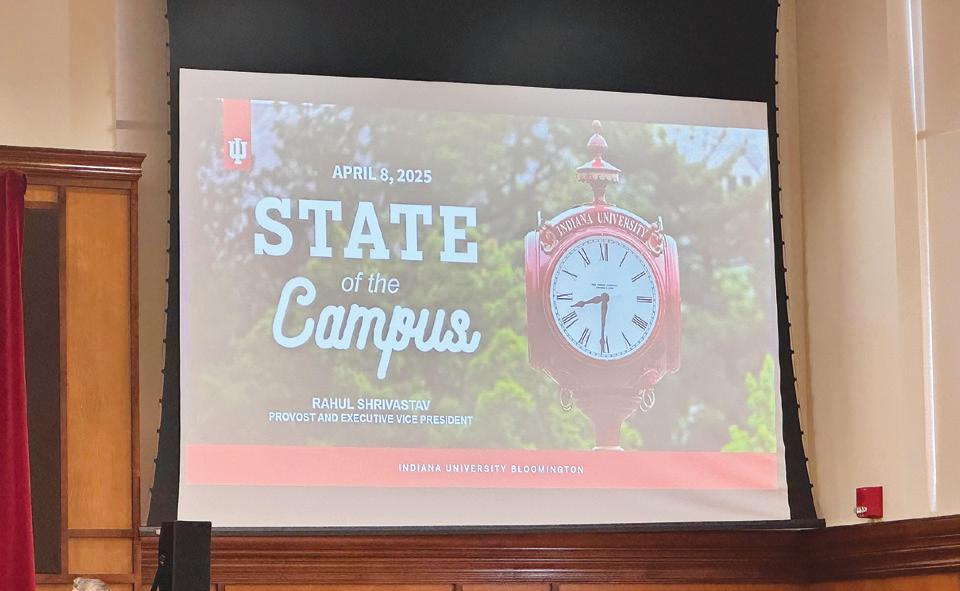
Some new graduate degrees include a master’s degree in public policy and an online master’s in education and evidence-based practices.
Shrivastav presented the “pivotal milestone” of committing $75 million over the next five years to degree programs in human-centered engineering in the Luddy School of Informatics, Computing and Engineering.
He also introduced a new First-Year Seminar, which he said the administration hopes will eventually become a part of IU’s GenEd requirements. Along with this, he said IU is piloting a new early start program for incoming freshmen and transfer students. Implementing a first-year
seminar is part of IU’s 2030 strategic plan. It falls under the objective of reconceptualizing and redesigning the “student’s first year” on campus. The seminar, it says, will be “academically based and fosters a sense of belonging, wellness, connection to campus, student engagement and support resources.” A first-year seminar would also fit into the objective: Annual experiential learning.
In October 2024, IU announced it was going to discontinue Intensive First-Year Seminars, an over 30-yearold program. Many faculty were upset with the ending of the program and were dissatisfied with the way it was revealed to them. Several faculty members attested
that they were not consulted before the decision to end the program was made. He mentioned the new IU facility in Washington and said it “gives us a coordinating hub to galvanize these efforts and to discover new ones.”
Shrivastav celebrated new academic appointees and faculty members and recognized the achievements of several faculty members and leaders around different campuses. Specifically, he congratulated the School of Optometry and Dean Suresh Viswanathan who he said obtained a donation of almost 27,000 eyeglass frames for local lowincome and uninsured patients. The donated eyeglass frames were from Eyemart Express.
During the address, Shrivastav said IU’s number of applications is up over 36% from two years ago.
“Today, I’m thrilled to announce that we are providing an additional $10 million over the next five years to a multi-year classroom renovation effort,” Shrivastav said. “This $10 million commitment will support new construction renovations, leading technology upgrades, process improvement and a new comprehensive classroom master plan.”
He also said IU is setting a goal for 50% of its classrooms to be approved as active learning spaces by 2030. These classrooms are meant to support team-based and problem-based learning where lecturers may need a room that supports discussions or has technology-enhanced tables.
Shrivastav also said he is proud of IU’s efforts to ease the “financial burden on students” by reducing textbook costs, saving IU students over $1.3 million in the past two years.
“I know there remains a lot of concern and attention in the field and in the media, but please note that our research, our scientific exploration and creative activity at IU Bloomington continues to be crucial to the state and to the world’s future,” Shrivastav said. “As challenging as it may seem, this is not the time for us to slow down on research. We must remain vigorous in ensuring we can continue to innovate and push boundaries with AAU (Association of American Universities) and Big Ten peers.” Shrivastav said the university has to actively pursue new sources of funding.
“Change always brings new opportunities,” Shrivastav said.
Editor’s note: All opinions, columns and letters reflect the views of the individual writer and not necessarily those of the IDS or its staffers.

ILLUSTRATION
Meghana Rachamadugu (she/her) is a senior studying marketing and business analytics and pursuing a minor in French.
I’ve retired my winter coat in hopes the temperature will be on my side, started buying more spring produce for meal preps, taken spontaneous picnics in the slices of good weather we’ve had and perhaps most important of all: planned my Bloomington Community Farmers’ Market visits.
Since my freshman year, I’ve cherished my Saturday mornings at Showers Common, enjoying the vibrant local food scene.
As much as I enjoy an efficient grocery haul, I love that a farmer’s market encourages strolling and provides me with several
unique products I don’t usually find at ALDI. Plus, I can sometimes enjoy idyllic weather in the company of friends and vendors who are passionate about what they do.
The farmers’ market is also the place where I purchase most of my houseplants. From Pothos to Philodendron Birkin to Umbrella plants, I have a variety of lush green plants and vines dispersed and cared for in my apartment.
While research highlights the stress-relieving and aircleaning benefits of plants, my collection offers deeper personal connections. My green thumb, inherited from my mom, reminds me of home and provides me with a mindfulness activity away from the trials and tribulations of college life.
I enjoy researching
which plants I can personally take care of given my housing and plant knowledge as well as budget and aesthetic. It’s been a satisfying and wholesome journey, but I also can’t forget to thank those at the farmers’ market who’ve patiently answered all my questions, shared their own stories and in retrospect, taught me much more than just how to take care of plants.
Lesson #1: It’s important to see things through fruition.
When I first ventured into plant care, I worried I lacked the intuition to keep them alive for longer than a month. One day, a kind woman at the farmers’ market overheard my doubts and shared her own experiences of nervousness
when starting out. She reassured me that learning to take care of plants requires patience rather than special skills. She even showed me pictures of her thriving garden, illustrating how her efforts had come to fruition. This unexpected conversation motivated me to commit to my plant purchases and reminded me of the supportive community surrounding the farmers’ market.
Lesson #2: Don’t be afraid to embrace different attitudes and specialties.
The farmer’s market is a vibrant tapestry of vendors, each bringing their unique perspectives and stories. It’s a space that also welcomes art fairs and musicians, encouraging interactions that go beyond business. Some of my favorite vendors
take an interest in my life, asking about my studies while sharing tips on how to use the miso vegan kimchi I just bought. I learned a flower vendor picks his selections based on what’s in season, but that he also honors his wife with a set of her favorite wildflowers regardless of the time of year. I learned about their passion for ethical beekeeping practices from a honey vendor. These little exchanges highlight the myriads of personalities and beliefs that enrich our community, reminding me to always be open to learning from others.
Lesson #3: Be sure to celebrate the small wins.
The farmer’s market encourages a leisurely stroll, inviting me to savor the moment rather than
rush through my purchases. When I visit with friends, our conversations shift from stress about exams and job searches to simple joys inspired by the stalls around us. In this happy setting, we celebrate small wins: trying new foods, discovering unique products and the experience of being present. It’s a powerful reminder to embrace life’s little pleasures, even with all the chaos of our busy lives. With a set of new priorities and memories of an excellent farmers’ market, I’m glad I was able to experience this culture these past four years. The market embodies a rich tapestry of community stories, and I want to carry this spirit of connection wherever I go.
megracha@iu.edu
That robot is not your friend: the rise of social AI threatens human connection
Eric Cannon (he/him) is a freshman studying philosophy and political science and currently serves as a member of IU Student Government.
Within the next decade, artificial intelligence could replace human educators and healthcare workers, Bill Gates said in Harvard Magazine. But will that be as far as AI goes? Many in Silicon Valley foresee a future in which humans will befriend and fall in love with AI.
The same human-like intelligence that enables AI to rival us in professional domains will enable it to rival us in social ones, like friendship and love.
“AI could fundamentally redefine what tasks (we) delegate to people or to machines,” Gates said.
How far AI will go remains an open question. But we cannot imagine there will be limits on how far it could go because in the tech industry, attention is money, and money drives development.
In an article from The New Yorker, the father of virtual reality technology, Jaron Lanier asked, “is it important that your lover be a biological human instead of an A.I. or a robot?”
Lanier said that this kind of talk is fashionable at tech industry gatherings. Industry insiders, like Noam Shazeer, believe that social AI will help people who are lonely. In 2021, Shazeer, a former Google employee, created Character, an AI friend — or lover — that boasted 20 million monthly users in September 2024, according to The Wall Street Journal.
Replika, a similar social AI created in 2017, boasted 30 million monthly users as of August 2024, its CEO Eugenia Kuyda said in an interview with The Verge.
Rather than replace human relationships, Kuyda said Replika’s goal is to “cre-

ate an entirely new relationship category.” But humanto-human and human-to-AI relationships don’t exist on separate planes; time spent on one is time taken from the other. Since the rise of social AI, extreme cases that testify to this fact have appeared in the news. Within the last year, The New York Times reported on one woman who spent 20 to 56 hours a week with her ChatGPT boyfriend and a 14-year-old boy whose death a ChatGPT friend contributed to.
“These are extreme cases,” Allison Pugh, a professor of sociology at John Hopkins University and vice president of the American Sociological Association, said in an interview with the IDS. “But they represent real dangers.”
Pugh said a more mundane, but more prevalent, danger is going unmentioned: we could miss out on “precious moments of be-
ing seen by another human being.” In this regard, social AI’s trap is laid out before all of us. Social AI isn’t relegated to Character, Replika or ChatGPT.
According to Meta, Instagram’s explore page offers 21 chatbots that engage with more than 400 million people per month. Financial Times reported that Instagram and Facebook users can generate their own AI characters that garner hundreds of thousands of followers.
Snapchat’s chats page features My AI at the top. Its default prompts include “festive dinner attire,” “songs with catchy lyrics” and “captions for flyers.” Once upon a time, we might have asked friends these mundane questions. In their answers, we were seen. But a possible future lies ahead in which we’ll be virtually unseen, like one child Pugh witnessed in a remote school.
Alone, the elementaryaged boy struggled with math problems on his computer. Finding a correct answer, he swung his arm with success and excitedly said, “Yes!” Then, he looked around the room with a fading smile to see if anyone saw him. No one did, except Pugh.
Advanced social AI is a little different, Pugh said.
“It can feel like we’re being seen,” she said. But she said there’s no relationship, so there’s no connection. It individualizes us.
“Over the past century technology has rendered us utterly as individuals when we are actually social beings,” Pugh said.
Technology is never merely a tool to solve problems, like loneliness, but always also a new way of engaging with the world and thinking about who we are within it.
Before cell phones, for example, Pugh said: “If you called your friend, you might get the friend’s father or brother or friend — the whole family.”
Now you have to choose which one to call.
“The household is not a household,” Pugh said. “Technology has fragmented our social lives and forced us to think about each other as individuals.”
It’s difficult to predict the ways in which social AI could change us, but it could accustom us to easier, more controlling and intolerant kinds of friendship and love — false kinds. Another person comes to us a mystery and a problem — an “other” who cannot be defined on our terms. Therefore, we must confront them and ask,
“Who are you?”
In that opposition, love becomes possible because the other person occupies a position beyond our own,
a vantage point from which we may be seen and accepted. The beauty of human relationships relies on the otherness present within them. Thus, I wrote in another column, “Life will be more exciting when we accept that our minds aren’t so large as to fit a whole other person within the width of our skull.”
By contrast, social AI comes to us as an extension of ourselves — an object whose every specification we can program. As a result, it can’t see us in the way that matters. It doesn’t possess a point of view opposed to our own.
“An A.I. lover might very well adapt to avoid a breakup,” Lanier said. But social AI can be used for good when it enhances, rather than replaces, human interaction, Pugh and David Crandall, a professor of computer science at the Luddy School of Informatics, Computing, and Engineering and director of the Luddy Artificial Intelligence Center, agreed. Crandall and Weslie Khoo, a postdoctoral researcher at Indiana University, worked on a team that developed IRIS, a social robot intended for use in group therapy. The robot’s mistakes in human language, logic and convention served as occasions for patients to bond with one another, prompting jokes and more serious discussion, Crandall and Khoo said in an interview. In a future where ever more humanlike AI bots will vie for our attention and try to steal us from our friends, a robot like IRIS could reconnect us with our friends. But even IRIS will never see us in the way that matters, and if it cannot really see us, it cannot really accept us.
By Danny William dw85@iu.edu
On a rainy Wednesday night, Redbud Books on West Kirkwood still glows.
Music hums through the space. Cozy lamps shine over reading nooks. The bright green floor-to-ceiling bookshelves are packed full, each section sporting handwritten labels with names including “queer studies” and “Black thought.”
Open for just over a year in March, Redbud Books is a nonprofit, volunteerrun bookstore managed by a collective of twelve community members.
The store is a project of The Center for Sustainable Living, a Bloomington organization centered around sustainabilityfocused community projects. Next door sits Middle Earth, a project of Bloomington Cooperative Living.
For Renae Lesser, a School of Education doctoral student and Redbud collective member, this communal focus is what makes Redbud special.
“This is a space where people can do organizing. This is a space where people can have meetings that relate to community issues. And I think that you can see that people are very hungry for this,” Lesser said. “It’s not like you have to be a collective member or a volunteer in order to use this space as a community space. So that’s one of the things that sort of makes it a third space. And so that’s, for me, what makes it most vital right now.”
Third spaces are places outside of the home and workplace where members of a community to gather, converse and share ideas.
Cole Nelson, a fellow collective member and an IU graduate student in cinema and media studies, was similarly attracted to the project because of its mission
Redbud Books fulfills Bloomington’s need for both

to create a curated third space.
“I think there’s a lot of focus that’s given to IU,” Nelson said. “And while that’s great, I think it’s also important to be having those conversations and to be offering a resource for community members around Bloomington to sustain intellectual conversations, to sustain creative activities in communities beyond what is available at the university. So, to my mind, a bookstore seemed like a ready fit for that sort of thing.”
Inside the store, the lime green bookshelves are packed full of material — but not just published books. Board games, puzzles, tarot
cards, notebooks and other curiosities are up for sale around the space. By the front door, a shelf is dedicated to free community-curated documents like zines and flyers.
Redbud also acts as a gathering space for various events, like film screenings, lectures and play readings — one took place March 7, when the bookstore hosted several actors and audience members to hear IU assistant playwriting professor Ana Candida Carneiro’s “Plastic Doll.”
Carneiro originally wrote the play in 2010 to explore gender relations and Western concepts of beauty through the avatars of Barbie and Ken.
The play will premiere at the Fringe Festival in Curitiba, Brazil, on March 27.
Redbud is an important space for Carneiro to share her work.
“I really believe in community relations, and we’ve been trying to build relationships with the community,” Carneiro said. “Theater makes sense if it’s made with and for communities.”
Along with readings like Carneiro’s, Redbud platforms local artists through its curation. Nelson said in the current political climate, Redbud attempts to foreground banned books and minority authors.
“We also try to focus
literature by authors who get little attention elsewhere, including local authors,” Nelson said. “We as much as possible try to encourage the entire Bloomington community to participate in what makes Redbud unique.”
And this focus on oftencontroversial voices may have a bigger impact than just filling the shelves. Over the last year, IU administration has faced criticism surrounding their handling of free speech. IU cancelled Palestinian artist Samia Halaby’s exhibition at the Eskenazi Museum of Art in December 2024, after planning the exhibit for three years, citing security concerns — the cancellation
drew condemnation from the International Committee for Museums and Collections of Modern Art Watch. Tenured professor and Palestine Solidarity Committee adviser Abdulkader Sinno was suspended after IU denied a room reservation for one of the group’s events and the PSC hosted it anyways, prompting faculty pushback. IU trustees approved a new expressive activity policy in July 2024 that restricts some forms of expression without prior approval from the university and outside specific times of day — it followed the arrest of 57 protesters, primarily IU students and faculty, during a pro-Palestine encampment in Dunn Meadow last spring. These incidents surrounding free speech at IU, Nelson said, are why a space like Redbud is needed to allow freedom of expression in Bloomington.
“Redbud attempts to be something of a third space, something of a refuge from the attacks that higher education is seeing,” Nelson said. “So in that way, we try to be inclusive of that which is getting pushed out of the university with each passing day.” Nelson said the most important aspect of Redbud, beyond its green shelves stuffed full of books and lively events, is its ability to bring people together.
“It puts me in community with a whole range of folks who are doing interesting and incredible work around town,” Nelson said. “I’ve been able to meet countless, countless people through the process of being involved in Redbud.” Redbud Books is located at 408 W. Kirkwood Ave. The store is open daily from noon to 7 p.m. Books can also be ordered through its virtual storefront. Events are announced through its event calendar, Instagram, Facebook and X.


By Lily Saylor saylorl@iu.edu
Metallica songs drifted through the speakers at the Switchyard Park pavilion as shoppers perused countless crates of music. Hosted by For The Record Vinyl, dozens of vendors from six different states sold both new and pre-owned physical media at the Bloomington Music Expo on April 5.
Jeremy Bonfiglio is the owner of For The Record Vinyl and an organizer of the expo. He oversees four record shows — events where vendors sell musicrelated items — in three states and is the music category manager for hobby supply company, BCW Supplies. Bonfiglio said he has seen a great revival of physical media and appreciates seeing younger people interested in it.
“I think a lot of people who listen to records in this format find it is like an active listening experience,” Bonfiglio said. “When you’re listening to a record, you’re more actively involved — you’re holding the jacket, reading the liner, looking at the photos and the inserts, and it becomes more of an experience.”
Before working at record shows, Bonfiglio covered music and the arts as a journalist for 26 years. Bonfiglio wrote for No Depression, a roots music magazine as well as other newspapers. He interviewed several highprofile musicians including Rick Springfield, Kid Rock and Eddie Money.
By Lilly Luse liluse@iu.edu
Bloomington music icon Mark Bingham has just completed a 12-day residency at The Orbit Room, a small hole-in-thewall bar and music venue.
Bingham has been in the industry for decades, composing music and producing albums as well as writing songs and playing guitar. He released “I Passed for Human” in 1989 and “Psalms of Vengeance” in 2009. He has been a member of Bloomington protest band The Screaming Gypsy Bandits and a band he formed in New York called The Social Climbers.
Bingham was born in Bloomington and went to school at IU. He recently moved back to Bloomington last November after time in New York and New Orleans. He’s spent over 60 years writing, producing, arranging and recording. His record company, Piety Street Recording, which he opened in 2001 and was based in Louisiana. The record company produced projects for artists John Fogerty, Elvis Costello, Allen Toussaint, Green Day, Marianne Faithfull, Steve Earle, Dave Matthews Band and Peter Stampfel.
Bingham said for his residency he wanted to perform music from throughout his career, including covering artists he admires and pulling lost gems from across music history, some of which have
“Being able to talk to musicians about their craft, about songwriting and how they write and their favorite songs and influences, it really gave a lot of insight into that world,” he said.
“Anytime I got to talk to somebody like that, it was always pretty special.”
Bonfiglio greeted
never even been recorded. Sometimes he is joined by a band, other times it’s just him and a guitar, singing and sharing stories about the music and his life.
On March 10, Bingham covered love songs ranging from “the devotional to the deranged” to a small crowd of older people at The Orbit Room. Many audience members came up to Bingham after the show to express their gratitude. There’s an intimate nature to the residency shows; one woman even said she started coming every night of the residency and felt as if she was in a completely different time and place.
Bingham lives in an apartment above The Orbit Room where he can hear the music from below. There, he had the thought that he could play a relaxed set downstairs from his catalogue of solo guitar records while people sat in the bar.
“I thought, ‘Wow, it would be really cool just to be able to go downstairs and play happy hour stuff and just play by myself,’” Bingham said.
The owners of The Orbit Room agreed, and Bingham said after he got the goahead, he felt he had to put together something he could be proud of. He had the idea of doing something casual at first, but the idea grew into a wide-ranging residency with 12 shows and an eclectic lineup of accompanying bands and different themes for
By Sophie Albert
The food trucks were just outside the pavilion. At a booth near the entrance, Todd Cox from US Clean Vinyl sold new and used records from artists Duran Duran, Alice Cooper and dozens more. Cox agreed with Bonfiglio that owning physical media makes listening to music more of an active experience rather than just something to put on in the background. He said physical media is a process: from cleaning the record to putting the stylus on, it requires attention.
“It beckons you to come back to it, you gotta flip it over to listen to the other side,” Cox said. “It’s an
follows the story of two sisters who encounter different woodland spirits in rural Japan. This film is a simple and relaxing watch, including adorable spirits, beautiful animation and a calming score. There is also
a very sweet rain scene in the movie, so it will match the rainy vibes outside. This would be a good movie to watch on a rainy day because it will make you feel like you are a care-free child running around and playing with spirits, rather than being in the real world, stuck inside because of the rain.
“The Princess Diaries 2: Royal Engagement” (2004) The second installment in the beloved early 2000s movie series “The Princess Diaries” follows Mia, the princess of the fictional European kingdom of Genovia, as she tries to find a husband so that she will be able to accede to the throne.
While I think you could watch either installment in this series, I personally think the sequel is better than the original. Plus, I think this one
attendees at the pavilion entrance and handed them a raffle ticket for a chance to win items from BCW Record Supplies and shopping certificates to be used at the expo. At the vendors booths around the pavilion, shoppers searched through crates of records and flipped through racks of band
each night.
“You never want to fake it. I started thinking and it was like, ‘Oh, let’s make every show different,’” Bingham said. “So, off the top of my head I made up a bunch of titles and I sent them to (the Orbit Room manager.) So much of this was improvised.”
He had previously played with many of the bands joining him years ago, such as TJ Jones, who joined him for his “Blues & the Abstract Truth with TJ Jones” show March 11. Bingham played with Jones 50 years ago, back when they opened for Sly and The Family Stone. Bingham has also worked in preserving and recording music from Hoagy Carmichael and performed with Kyle Cross.
The storytelling element of his show was partially inspired by folk legends Bob Dylan and Joni Mitchell, who was his neighbor when he lived in New York.
“Hardest thing in the world is to go up on stage by yourself, so you have to connect with them. I saw Joni Mitchell about eight times,” he said. “I know every time until she got her big break, and she was by herself. She told almost identical stories before every show.”
Bingham went to New York after winning a high school “band battle” competition and the judges took him to a record label. When he was in his late teens, he moved to a downtown loft and
T-shirts; many shoppers were already dressed in music merch. Bloomington resident Devon McCarty, wearing a Panic! at the Disco shirt, attended the expo alongside her husband, who ran a booth.
“Music is something my husband and I connect
over a lot,” she said. “Lately, I’ve really been diving into quartets and strings, like orchestra music, while I’m reading. It’s really impacted me, especially these last few months.”
Shoppers took breaks from perusing the record booths to visit food trucks Planted and Pili’s Party Taco.

started writing songs and composing music.
“They heard me playing and they liked a song that I did, and they gave the song to The Everly Brothers,” he said. “So, I was 19 and got signed up to start making records.”
He was even hired to write music for the independent film “Candy Mountain,” starring Tom Waits and Joe Strummer.
Bloomington pop-up cinema Cicada Cinema screened the film March 8, where Bingham spoke about the movie.
After 60 years in the
industry and seeing fellow musicians and artists come and go, Bingham says that people can do is continue to make good work. He advises others to never take a job just for money because it never works out, and they’ll always regret it.
“It’s like everybody’s doing their work and then it just disappears, and you don’t get famous,” he said. “When you’re dead, you’re dead. Life is short. Art is long. Maybe.” Bingham doesn’t know quite yet what’s next for him. He’s going to New York to record with a
jazz musician. He’s also working on finishing a mix of a 15-year-old Marianne Faithfull record.
“I just wanted to do this for posterity, for all the musicians who are still alive, because we never got a chance to finish the record properly,” Bingham said. He offered some closing advice for musicians and people looking to keep moving forward.
“Show up for life every day and don’t be scared,” Bingham said. “I’ve had weird anxiety in my life, but I still show up. Show up and do it and don’t worry.”
has more slumber party vibes thanks to Mia’s sleepover party scene. This movie is funny, romantic and offers important commentary on women’s role in politics. It would be perfect for a cozy night in if you want to have some laughs and feel nostalgic.
“The Notebook” (2004) In this classic romance movie, an old man recounts the story of a romance between two young people divided by social class to a woman with dementia. This film is obviously romantic, but is also beautiful, funny and will probably make you cry by the end. Plus, it includes one of the most iconic rain scenes of all time, so it would be fitting with the weather. While I have my grievances with this movie and the main couple,
I definitely think it would be appropriate to watch in the rain, especially if you’re in the mood for a good cry.
“Lady Bird” (2017) In this coming-of-age film directed by Greta Gerwig, a rambunctious and independent teenager who goes by Lady Bird clashes with her mother and experiences the many trials and tribulations of growing up while trying to get out of her hometown. This movie is a beautiful exploration of teenagerhood and our relationships with others. If you’re in the mood for a deep movie to make you contemplate life while the rain falls outside, this would be a good choice for you.
“Moonrise Kingdom” (2012) This quirky Wes

By Daniel Flick danflick@iu.edu | @bydanielflick
Zacharey Smith was told his eyes were poor — not by an optometrist, but by Indiana football cornerbacks coach Rod Ojong. Smith’s eyes were low, and if he was facing a receiver during the drill, he wouldn’t have been looking at the right spot.
And each time Smith, a freshman cornerback from Union City, Georgia, failed to catch a pass at the end of his rep, Ojong and others expressed their frustration.
Three months ago, Smith was in the process of finishing his final semester at Hapeville Charter Career Academy, where he developed into a consensus threestar recruit after notching 17 interceptions in his last two seasons and earning firstteam All-Region honors in 2023.
But Indiana isn’t Hapeville Charter. College isn’t high school. The Hoosiers, who went to the College Football Playoff last season, aren’t guaranteed to go back to those heights — and certainly not with a subpar spring.
Welcome to spring football, the time for reality checks.
“You go from high school, you’re the man, you’re no question a starter,” senior linebacker Aiden Fisher said March 11. “You come here, you’re going to be a four. You’re limited right now. You
Aries
Today is a 7 — Help at home. Solve domestic challenges with communication, discipline and heart. Process recent events with family. Share nurturing foods and activities. Relax together.
Taurus (April 20-May 20) Today is an 8 — Study the options. One direction appears blocked. Communication channels may not flow clearly. Luck and hard work are a winning combo. Follow the hottest lead.
got to earn everything again. You’ve got ground zero, so just making sure they know and embrace that journey and not someone’s like, ‘Oh, man, I came here and now I’m not playing.’ It’s just something you got to embrace.”
Indiana head coach Curt Cignetti didn’t play many true freshmen last year — receiver Charlie Becker, linebacker Rolijah Hardy and defensive linemen Mario Landino and Daniel Ndukwe were the only four who saw the field in 12 or more games.
Landino and Ndukwe were early enrollees in spring 2024. The Hoosiers have 14 freshmen participating in spring practice this year, headlined by safety Byron Baldwin, cornerback Jaylen Bell, offensive lineman Baylor Wilkin and receivers LeBron Bond and Myles Kendrick — five of Indiana’s six highest-rated recruits in 2025, according to 247sports.
Early enrollees have the luxury of getting through a semester without the stress of being in-season, Cignetti said, while also spending additional time in the weight room. It helps jumpstart their development.
Similar growth is formulating in the minds of the Hoosiers’ newcomers, as well.
“A lot of the guys are doing a great job now,” Fisher said. “Their mindset kind of switched a little bit, so like
To get the advantage,
that growth mindset. They’re asking a lot of questions, they’re doing a great job on the field, in the film room. So, compared to Day 1 when they got here now, it’s a big difference.”
Indiana has 33 new players — 19 transfers, 14 freshmen — on its spring roster, which means over 40% of the team watched the Hoosiers’ historic 2024 season from afar.
Winning creates expectations. Indiana’s veteran leaders don’t want expectations to turn into entitlement.
“I think the turnaround has been great, but with a lot of fresh faces, we have some freshmen in here who saw what we can do last year — maybe they could be a little cocky out on the field,” redshirt junior left tackle Carter Smith said March 11. “So, we need to make sure the standard is upheld, and we have the right mindset going into all of the training.”
Fisher referenced a line Cignetti often cites: the Hoosiers are 0-0 and haven’t accomplished anything. Every team will leave spring football undefeated.
Indiana’s goal is to leave next season unblemished, too. The challenge? Eradicating any complacency from last season’s results.
“We have given everyone a reality check, and practice has definitely given them a reality check,” Fisher said . “It’s just making sure everyone knows we are at ground
zero right now and make sure you’re not getting in over yourself. You have zero stats as you come in. It’s just about setting the tone for the team and letting them know we have a long way to go, but we are going to get there.”
The Hoosiers work out in position-specific groups — the offensive and defensive linemen lift together at the W. Jay and Nancy Wilkinson Performance Center in Memorial Stadium, as do the offensive and defensive skill positions. Subsequently, Smith said there were still offensive players whose names he didn’t know through the first several spring practices.
Introductions occurred later in spring camp dur-
ing offensive and defensive meetings, where Smith said players put names to faces. Workouts aren’t made for such moments. Instead, veteran Hoosiers like Smith view their early-morning lifts as a chance to uphold, if not uplift, the standard.
“We keep up with workouts — making sure everyone’s on time, making sure no one overlooks the smallest detail, because the smallest detail can be one of the biggest killers,” Smith said.
“I think just making sure that everyone’s in the same headspace and keeps the same work ethic in mind, then we’re going to flourish.”
Cignetti often speaks about stalking complacency.
Sagittarius (Nov. 22-Dec. 21) Today is a 7 — Collaborate for shared financial gain. A challenge requires teamwork. You can provide skills your partner doesn’t have. Assess the scope of what’s needed.
Capricorn (Dec. 22-Jan. 19) Today is an 8 — Compromise with your partner. Listen before advancing to avoid communications breakdown. Follow your emotions as well as intellect. Patience and humor are helpful.



Last spring, he needed his team to shed its reputation as the “old Indiana” — the losingest program in college football history. Now in his second spring as the Hoosiers’ head coach, Cignetti’s demands have shifted. Indiana, which started 10-0 for the first time in school history but lost two of its final three games, didn’t get a fairytale finish to a season straight from a set in Hollywood.
On March 19, Indiana Athletics hired Darian DeVries to
By Daniel Flick danflick@iu.edu | @bydanielflick
Indiana University released its Memorandum of Understanding for men’s basketball head coach Darian DeVries, who the program hired March 19. DeVries officially signed a six-year contract with an annual base salary of $550,000 and an annual supplementary income — outside, marketing and promotional income — starting at $3.7 million. DeVries’ supplementary income increases by $100,000 each season. During the 2025-26 season, he’s set to make $4.25 million, a number that will subsequently increase by $100,000 as his contract advances.
The 49-year-old DeVries is under contract through the end of the 2030-31 season. DeVries has several in-
centives in his new contract, featuring $125,000 if the Hoosiers win the Big Ten regular season title outright, $25,000 if Indiana makes the NCAA Tournament, $250,000 if the Cream and Crimson win the NCAA Championship and $50,000 apiece if he wins Big Ten or any national coach of the year awards. DeVries earns additional bonuses each round further the Hoosiers advance in March Madness.
The same bonus terms were included in previous head coach Mike Woodson’s contract. Woodson’s annual supplementary income was $3.65 million, and his base salary was the same as DeVries.
Indiana agreed to pay DeVries’ buyout at West Virginia University, which totaled $6.15 million, according to ESPN. The Hoosiers
also gave DeVries $25,000 for moving expenses in addition to a $50,000 signing bonus to help the relocation process.
If DeVries resigns or is fired for cause, the university will not be liable for any compensation or benefits past the date of his departure. Should the Hoosiers fire DeVries without cause — such as performancerelated reasons — he will receive 80% of his base salary and supplemental income through March 31, 2031, the contract’s expiration date.
In the event he resigns before his deal expires, DeVries owes the university significant financial compensation. If he leaves before March 15, 2026, DeVries must pay $10 million. The number decreases to $8 million if he exits before March 15, 2027, then $6 million if he resigns before
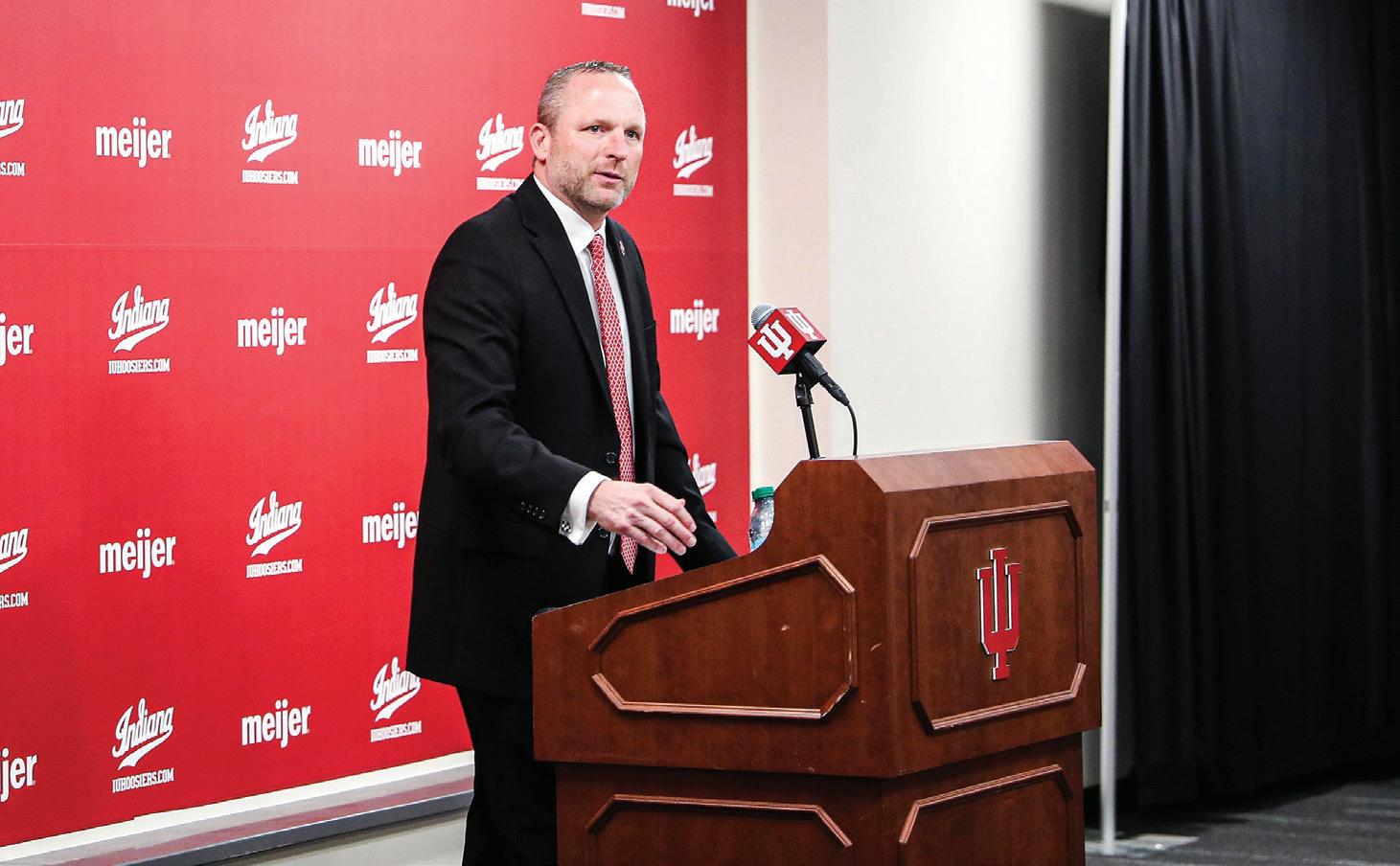
The Church of Jesus Christ of Latter-day Saints
Bloomington Young Single Adult Branch
2411 E. Second St.
To Contact: Send message from website maps.churchofjesuschrist.org/ wards/237973
Sunday: 12:30 p.m.
The Church of Jesus Christ of Latter-day Saints has four congregations in Bloomington—Three family wards and our young single adult branch for college students. This info is for the YSA Branch. Weekday religious classes at 333 S. Highland Ave, Bloomington IN 47401, next to campus.
More info at churchofjesuschrist.org.
Lutheran - Missouri Synod
University Lutheran Church and LCMS U Student Center
607 E. Seventh St. 812-336-5387 indianalutheran.com facebook.com/ULutheranIU instagram.com/uluindiana
Sunday: 9:15 a.m.: Sunday Bible Class
10:30 a.m.: Sunday Divine Service
Wednesday: 7 p.m.: Wednesday Evening Service
Student Center open daily:
9 a.m.
website.
Rev. Timothy Winterstein - Campus Pastor
United Methodist
Jubilee
219 E. Fourth St. 812-332-6396 jubileebloomington.org
Facebook: First United Methodist Church of Bloomington, IN Instagram: @jubileebloomington
Sunday: 9:30 a.m., Classic Worship 11:45 a.m., Contemporary Worship Wednesday: 7:30 p.m., College & Young Adult Dinner
Jubilee is a Christ-centered community open and affirming to all. We gather on Wednesdays at First United Methodist (219 E. 4th St.) for free food, honest discussion, worship, and hanging out. Small groups, service projects, social events (bonfires, game nights, book clubs, etc.), outreach retreats, and leadership opportunities all play a significant role in our rhythm of doing life together.
Markus Dickinson - jubilee@fumcb.org
Inter-Denominational
Redeemer Community Church
111 S. Kimble Dr. 812-269-8975
redeemerbloomington.org facebook.com/RedeemerBtown
Instagram & Twitter: @RedeemerBtown
Sunday: 9 a.m., 11 a.m.
Redeemer is a gospel-centered community on mission. Our vision is to see the gospel of Jesus Christ transform everything: our lives, our church, our city, and our world. We want to be instruments of gospel change in Bloomington and beyond.
Chris Jones - Lead Pastor
American Restoration Movement
North Central Church of Christ
2121 N. Dunn St. 812-332-2248 nc3family.org Facebook.com/nc3family
Sunday: 10 a.m., Worship 11 a.m., College Class
Come learn about historic Christian teaching on theology, ethics, and culture. We offer an alternative to the post-modern ideologies and teachings you often see in your lives today.
Shane Himes, PHD - Senior Minister
Christian Science Church
2425 E. Third St. 812-332-0536 bloomingtonchristianscience.com facebook.com/e3rdStreet Sunday Church Service: 10 - 11 a.m. Wednesday Testimony Meeting: 7 - 8 p.m.
Orthodox
All Saints Orthodox Christian Church
6004 S. Fairfax Rd. 812-824-3600
allsaintsbloomington.org webbrk1@gmail.com Youtube video of services on website
Sunday: 9 a.m.:
Enslow Bahá'í Faith
By Daniel Flick danflick@iu.edu | @bydanielflick
Indiana men’s basketball head coach Darian
DeVries has hired assistant coach Nick Norton, Indiana Athletics announced in a press release April 3. Norton is the first assistant to join the Hoosiers’ staff since DeVries was hired March 18.
“We are excited to have Nick join our staff,” DeVries said in the release. “He brings tremendous knowledge and feel for what we want our program to be about. He is terrific with the players on the floor and brings incredible energy every day to the practice floor.”
The 29-year-old Norton played collegiately from 2014-18 at the University of Alabama at Birmingham before spending his final season at Drake University. Norton’s lone year at Drake
was DeVries’ first as the Bulldogs’ head coach.
After a one-year stint in the NBA G-League in 2019, Norton stepped away from basketball due to injuries. The Bloomington, Illinois, native started his coaching career in 2021, joining DeVries’ staff at Drake as the assistant director of operations.
Norton earned a promotion to director of operations before the 2022-23 season, and he was elevated to assistant coach and director of player development for the 2023-24 campaign.
DeVries left Drake to be West Virginia University’s head coach in 2024-25, and he brought Norton with him as an assistant coach and director of player development. Now, history has repeated itself in Bloomington this spring.
Society of Friends (Quaker)
Bloomington Friends Meeting
3820 E. Moores Pike
812-336-4581
bloomingtonfriendsmeeting.org
Facebook: Bloomington Friends Meeting
Sunday (in person & Zoom) :
9:45 a.m., Hymn singing
10:30 a.m., Meeting for Worship
10:45 a.m., Sunday School
(Children join worship 10:30-10:45)
11:30 a.m., Refreshments and Fellowship
12:30 p.m., Events (see website)
Wednesday (Zoom Only) :
7 p.m., Meeting for worship for Peace
Friday (Zoom Only) :
9 a.m., Meeting for worship
We practice traditional Quaker worship, gathering in silence with occasional Spirit-led vocal ministry by fellow worshipers. We are an inclusive community with a rich variety of belief and no prescribed creed. We are actively involved in peace action, social justice causes, and environmental concerns.
Peter Burkholder - Clerk burkhold@indiana.edu
Christ Community Church
503 S. High St. 812-332-0502 cccbloomington.org
facebook.com/christcommunitybtown
Instagram: @christcommunitybtown
Sunday: 9:15 a.m., Educational Hour
10:30 a.m., Worship Service
We are a diverse community of Christ-followers, including many IU students, faculty and staff. Together we are committed to sharing the redeeming grace and transforming truth of Jesus Christ in this college town.
Bob Whitaker - Senior Pastor
Adam deWeber - Worship Pastor Dan Waugh - Adult Ministry Pastor
Christian Student Fellowship
1968 N. David Baker Ave. 812-332-8972 csfindiana.org
Instagram: @csfindiana
Monday - Friday: 9 a.m. - 5 p.m.
Christian Student Fellowship (CSF) exists as a Christ-centered community focused on helping students truly know Jesus Christ. Our ministry operates from an on-campus house where students can live. Reach out to schedule a tour of the house or a visit to our Thursday night worship service!
Ben Geiger - Lead Campus Minister
Stephanie Michael - Campus Minister
Joe Durnil - Associate Campus Minister
Hailee Lutz - Office Manager
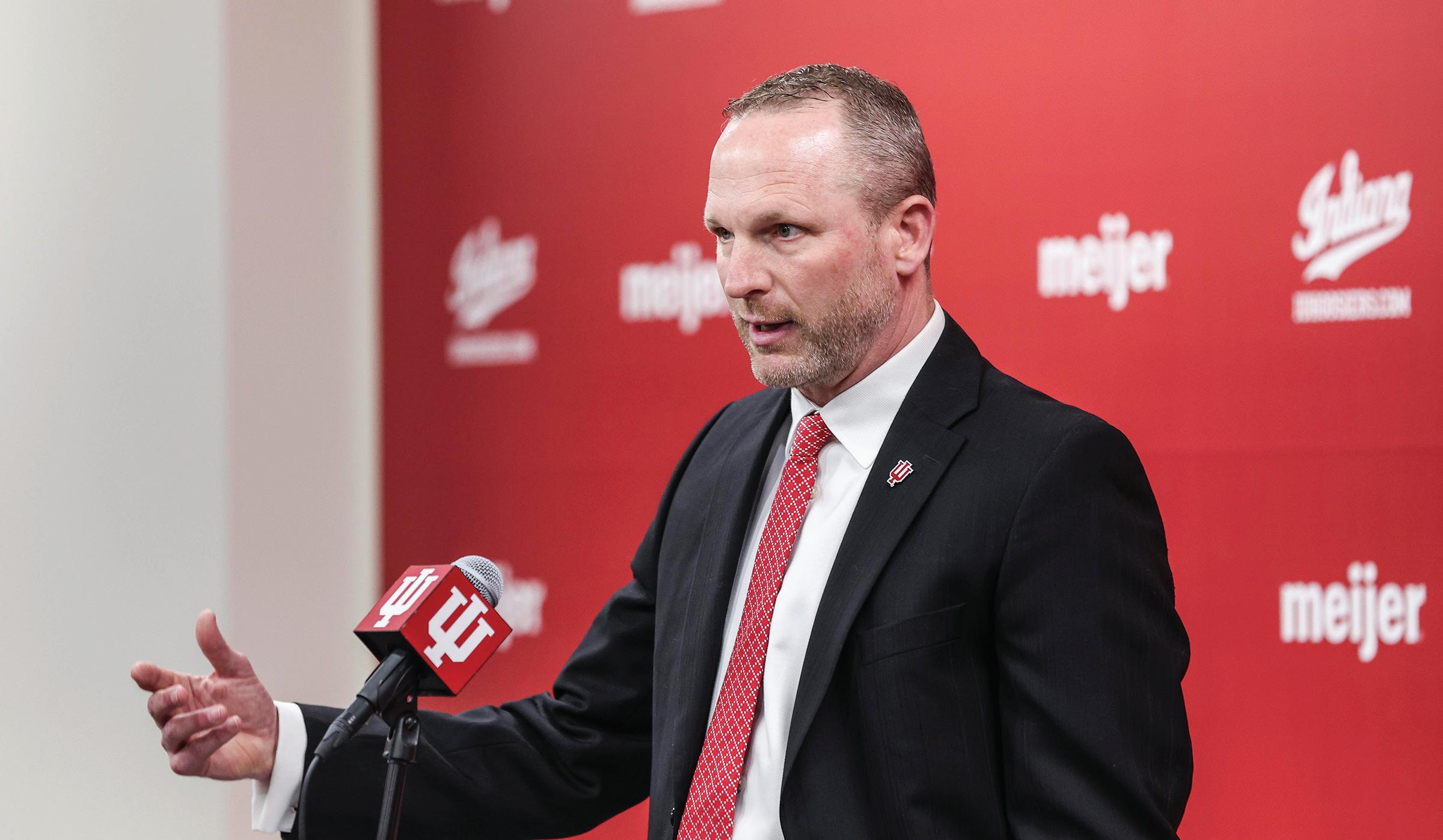
City Church
1200 N. Russell Rd.
812-336-5958
citychurchbloomington.org
tiktok: @citychurchbtown
Instagram: @citychurchbtown
Sunday Service: 8:30 a.m., 10 a.m., 11:45 a.m.
City Church is a multicultural church on the east side of Bloomington. We provide transportation from campus. Our college and young adult ministry meets on Tuesday nights.
David Norris - Pastor
Sacred Heart Church
615 N. Fairview St. 812-345-5239 sacredheartbloomington.org facebook.com/sacredheartbloomington
Sunday:
10:30 a.m.: Refreshments and Fellowship
10:45 a.m.: Worship Service Tue., Wed., Thu.: Midweek Meals (Check Facebook)
Sacred Heart is a nondenominational church that seeks to follow Jesus by acting justly, loving mercy and walking humbly with God. We strive to be a safe, inclusive community where you can bring your doubts, questions, struggles, and joys before a loving God and find true belonging. All are welcome!
Dan Caldwell
Episcopal (Anglican)
Canterbury Mission
719 E. Seventh St. 812-822-1335 IUCanterbury.org facebook.com/ECMatIU
Instagram & Twitter: @ECMatIU Youtube: @canterburyhouseatiu9094
Sunday: 3 p.m. - 7 p.m.
Mon., Wed., Thu.: 10 a.m. - 6 p.m. Tuesday: Noon - 8 p.m. Fri., Sat.: By Appointment
Canterbury: Assertively open & affirming; unapologetically Christian, we proclaim the gospel of Jesus Christ by promoting justice, equality, peace, love and striving to be the change God wants to see in our world.
Ed Bird - Chaplain/Priest
Independent Baptist
Lifeway Baptist Church
7821 W. State Road 46 812-876-6072 lifewaybaptistchurch.org facebook.com/lifewayellettsville
Sunday: 9 a.m., Bible Study Classes
10 a.m., Morning Service
5 p.m., Evening Service
*Free transportation provided. Please call if you need a ride to church.
Student Ministry: Meeting for Bible study throughout the month. Contact Rosh Dhanawade at bluhenrosh@gmail.com for more information.
Steven VonBokern - Senior Pastor Rosh Dhanawade - IU Coordinator 302-561-0108 bluhenrosh@gmail.com
United Church of Christ and American Baptist Churches-USA
First United Church
2420 E. Third St. 812-332-4439 firstuc.org facebook.com/firstuc
Sunday: 10:30 a.m., Worship
Monday: 10 a.m. via Zoom, Bible Study
We are an Open, Welcoming, and Affirming community of love and acceptance dedicated to welcoming the diversity of God’s beloved. We exist to empower, challenge, and encourage one another to live out Jesus’ ways (compassion, truth, and justice) authentically as human beings in community to create a better world.
Rev. Jessica Petersen-Mutai Senior Minister
Baptist Emmanuel Church 1503 W. That Rd. 812-824-2768 Emmanuelbloom.com Instagram & Facebook: @EmmanuelBloomington
Sunday: 9:15 a.m., Fellowship
Sunday: 10 a.m., Worship Groups: Various times
Emmanuel is a multigenerational church of all types of people. Whether you are questioning faith or have followed Jesus for years, we exist to help fuel a passion for following Jesus as we gather together, grow in community, and go make disciples.
John Winders - Lead Pastor
Second Baptist Church
321 N. Rogers St. 812-327-1467 sbcbloomington.org facebook.com/2ndbaptistbloomington youtube.com/@secondbaptist churchbloomington
Sunday Service: 10 a.m., In house and on Facebook/YouTube Sunday School: 8:45 - 9:45 a.m. Bible Study: Available In House and on Zoom Wednesdays, 6:30 p.m., Thursdays, Noon
Please come and worship with us. We are in training for reigning with Christ! Need a ride? Call our Church bus at 812-3271467 before 8 a.m. on Sunday
Rev. Dr. Bruce R. Rose - Pastor Tallie Schroeder - Secretary
Unitarian Universalist Unitarian Universalist Church of Bloomington
2120 N. Fee Ln. 812-332-3695 uubloomington.org facebook.com/uubloomington
Sunday:
the World.” A LGBTQA+, Dementia Friendly, Welcoming Congregation to all ages and groups and a Certified Green Sanctuary. Rev. Susan Frederick-Gray
Evangelical Lutheran Church in America
Rose House LuMin & St. Thomas Lutheran Church
3800 E. Third St. 812-332-5252 Stlconline.org lcmiu.net
Instagram: @hoosierlumin facebook.com/LCMIU facebook.com/StThomasBloomington
8:30 a.m. &
a.m.
Unity Worldwide
Unity of Bloomington A Center for Spiritual Growth
4001 S. Rogers St. text/call: 812-333-2484 unityofbloomington.org IG: @unityofbloomington facebook@UnityofBloomington
Sunday Celebration: 10:30 a.m.
Discover a vibrant, welcoming community at Unity of Bloomington – “a positive path for spiritual living”. Our center offers a space for spiritual growth; embracing all with open arms. We proudly affirm and welcome the LGBTQ+ community, fostering love, acceptance, and inclusion. Join our loving congregation, where everyone is valued and encouraged to explore their spiritual journey. At Unity of Bloomington, all are welcome and together we thrive!
Minnassa Gabon - Spiritual Leader Phyllis Wickliff - Music Director
Reformed Protestant
Trinity Reformed Church 2401 S. Endwright Rd. 812-825-2684 trinityreformed.org lucas@trinityreformed.org facebook.com/trinitychurchbloom
Sunday: 10:30 a.m., Sunday Morning Services 7 p.m., Bible Study at the IMU We are a Reformed Protestant church on the west side of Bloomington with lively worship on Sunday mornings and regular lunches for students after church. We love God and His Word. Please get in touch if you’d like a ride!
Jody Killingsworth - Senior Pastor Lucas Weeks - College Pastor
By Dalton James jamesdm@iu.edu | @daltonmjames
Indiana women’s basketball landed its second transfer portal recruit of the offseason April 6, as former University of Arkansas guard Phoenix Stotijn committed to the Hoosiers, according to her X post.
Stotijn, like guard Chloe Spreen, has three seasons of eligibility. The pair are the only two players Indiana head coach Teri Moren has secured out of the portal so far.
Stotijn enrolled at Arkansas midway through the 2023-24 season and practiced with the team. However, she did not dress for any contests.
In her freshman season in 2024-25 in Fayetteville, Arkansas, Stotijn played in 21 of the Razorbacks’ games and started 12 of them. She averaged 7.2 points, 1.5 rebounds and 2.3 assists in 25.7 minutes per contest.
The Amsterdam, Netherlands, native shot 31.7% from the field and 26% from beyond the arc in her lone season under former Arkansas head coach Mike Neighbors, who resigned from his position March 11, 2025.
Stotijn’s best performance of the season came in an 80-71 victory over Texas A&M University on March 3. She scored a career-high 23 points as she went 5 for 7 from 3-point range while hauling in four rebounds and dishing four assists.
The 5-foot-9 guard joins Spreen in the Hoosiers’ new-look backcourt after they lost two guards to graduation and four guards to the transfer portal. With four players returning from last season, as well as two incoming freshmen and now two transfers, Moren and company have eight players on the roster and will surely continue to build via the portal.
By Max Schneider maxschn@iu.edu
No. 10 Indiana water polo played its second straight home game April 5, facing off against No. 15 San José State University at the Counsilman-Billingsley Aquatic Center in Bloomington.
San José State opened the scoring three minutes into the game, but senior attacker Skylar Kidd equalized for Indiana less than 10 seconds after. Following Kidd’s second goal two minutes after her first, senior center Sophia Sollie scored to give the Hoosiers a 3-1 lead after one quarter.
Guard Chloe Spreen committed to Indiana on April 2
By Dalton James jamesdm@iu.edu | @daltonmjames
Both teams tightened on defense to start the second half, as neither side scored in the first four minutes. Klingler eventually broke the second-half deadlock after four and a half minutes to increase Indiana’s lead to 3.
Down by 3, San José State ramped up the pressure offensively. Indiana’s defense, which had successfully limited the Spartans’ offense, began to break down. San
Entering the second quarter, the Spartans scored two back-to-back goals to tie the score at 3. With less than two minutes before halftime, junior attacker Grace Klingler regained Indiana’s lead. Sophomore utility player Nancy Baylor-Sefchick added one more before the break to double Indiana’s advantage, leading 5-3 at halftime.
José State scored two goals to cut Indiana’s lead to 1. Indiana responded with senior utility player Portia Sasser’s goal, although the Spartans quickly replied to make the score 7-6 with one quarter remaining.
Entering the fourth quarter, Indiana had held onto the lead since midway through the first quarter. As the final quarter progressed, however, the lead slowly slipped through its fingers.
As Indiana’s offense proved ineffective, San José State scored three straight goals to take a 9-7 lead with less than two minutes remaining.
Down by two, Indiana went full attack mode toward San José State’s defense, clawing a goal back through
senior attacker Grace Hathaway. The Hoosiers pushed for a late equalizer, which never came and left them exposed defensively. San José State responded, scoring with eight seconds remaining to ensure Indiana’s defeat, 10-8.
Despite continuing Indiana’s poor conference play, the game April 5 was much different to previous contests. Indiana’s defense proved much sturdier, initially limiting the Spartans to three goals before the offense slowed to a halt halfway through the third quarter. Indiana’s offense left a lot to be desired, however. The Hoosiers failed to break the 10-goal threshold for the first
time since losing to UCLA on March 9, scoring only three goals in the second half. Junior attacker Louisa Downes ended her goal-scoring streak at six straight games.
The Hoosiers have continued to struggle against the cream of the West Coast crop. The only ranked West Coast team they have recently beaten was No. 20 San Diego State University on March 16.
The barrage of West Coast teams does not stop for Indiana, as it travels April 12 to Palo Alto, California, for its final Mountain Pacific Sports Federation conference game against No. 1 Stanford University. It could prove to be the Hoosiers’ most daunting challenge yet.
Indiana women’s basketball landed its first transfer of the offseason as former University of Alabama guard Chloe Spreen committed to the Hoosiers, according to her Instagram post April 2. Spreen joins the Cream and Crimson with three seasons of eligibility remaining after she played her freshman season at Alabama. Across 20 total games, she averaged 1.1 points, 0.5 rebounds and 0.5 assists in 6.4 minutes per contest. The 5-foot-10 Spreen played at Bedford North Lawrence High School in Bedford, Indiana, graduating from the school in 2024. She won 2024 Miss Basketball as she led the Stars to 93 wins, four sectional titles and a state championship during her four-year career. After six Hoosiers entered the transfer portal following their season-ending loss March 23, junior guard Shay Ciezki is the lone starter who is slated to return for the 2025-26 season. With Sydney Parrish, Chloe Moore-McNeil and Karoline Striplin exhausting their eligibility, Indiana head coach Teri Moren has begun working on rebuilding her roster. Maya Makalusky and Nevaeah Caffey will join the Hoosiers ahead of the season. The pair of incoming freshmen will look to slot into Indiana’s rotation.
another round’s spring concert
Fri, April 4 at 8 pm
ladies first a cappella spring showcase
Sat, April 5 at 8 pm
Tchaikovsky’s swan lake
Sun, April 6 at 4 pm
african american dance company 50th anniversary spring concert
Fri, April 11 - Sat, April 12 at 7:30 pm
plato’s closet presents: 16th annual
trashion/refashion runway show
Sun, April 13 at 7 pm
natalie boeyink jazz ensemble - free!
Mon, April 14 at 7:30 pm
rebel with a clause
Thu, April 17 at 6:30 pm
breaking away + zana: women of the little 500
Fri, April 18 at 7 pm
mind unveiled: psychedelic fest
Sat, April 19 at 1:30 pm
BEAT spring show
Mon, April 21 at 7 pm
hayes carll & corb lund: bible on the dash tour
Tue, April 22 at 7 pm
iu soul revue spring concert
Sat, April 26 at 7:30 pm

