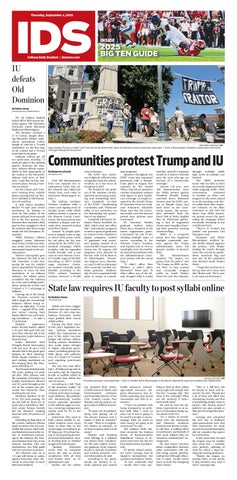
IU defeats Old Dominion
By Dalton James jamesdm@iu.edu | @DaltonMJames
No. 20 Indiana football
kicked off its 2025 season Saturday against Old Dominion University inside Memorial Stadium in Bloomington.
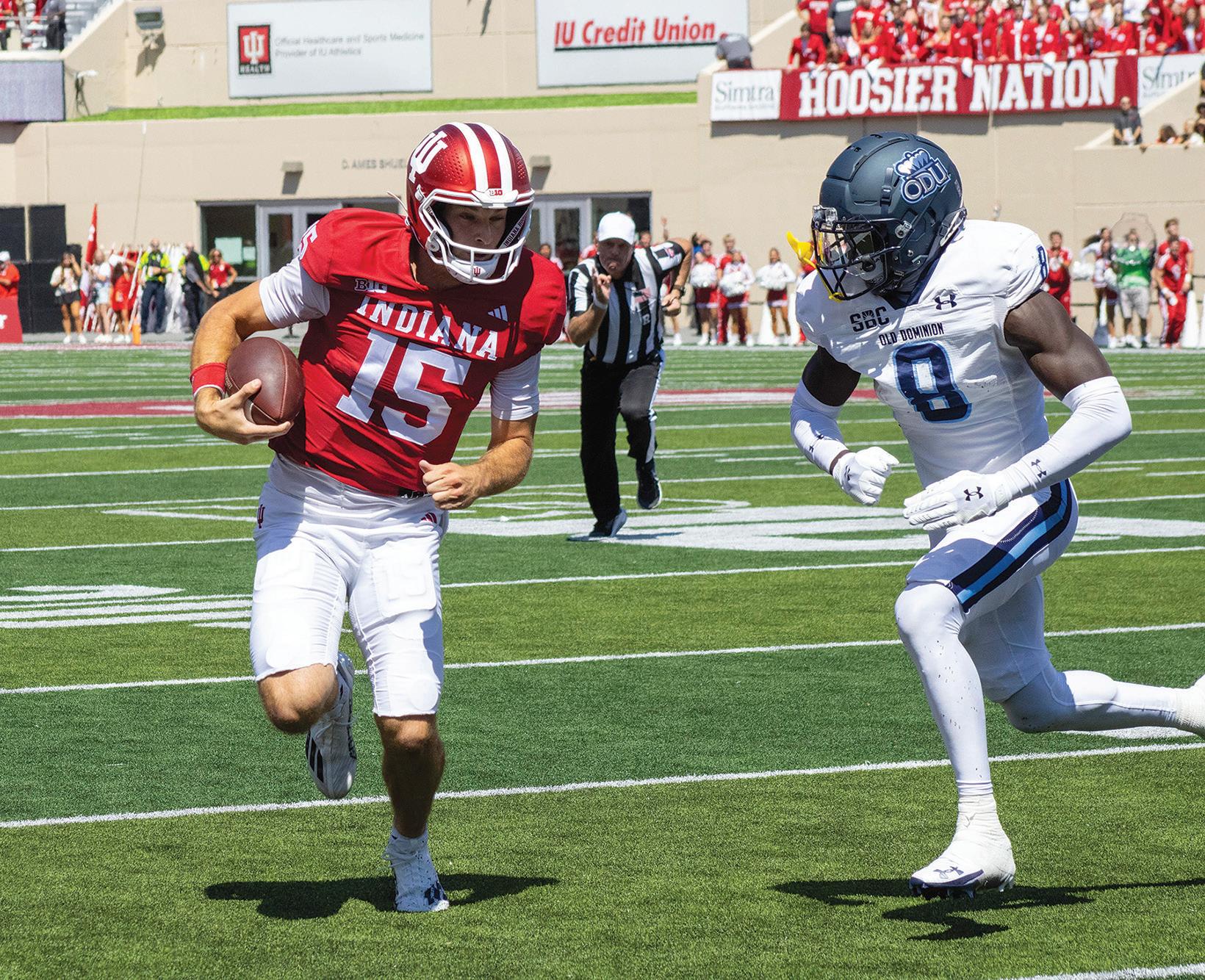
The Hoosiers notched a 27-14 victory, despite allowing Monarchs redshirt sophomore quarterback Colton Joseph to rush for a 75-yard touchdown on the first play of the contest and a 78-yard score later in the game.
Indiana’s offense got off to a quick start, notching 7.5 yards per play in the opening quarter. However, the Hoosiers’ redzone offense squandered its first opportunity of the contest as the Monarchs’ defense held serve at their own 1-yard line on four consecutive plays, forcing a turnover on downs.
On the Cream and Crimson’s ensuing drive, redshirt junior running back Lee Beebe Jr. fumbled at Old Dominion’s 20-yard line.
It took senior Jonathan Brady’s 91-yard punt return touchdown for Indiana to score its first points of the season with just nine seconds left in the first quarter. The Hoosiers then notched a field goal as they struggled to find the endzone after three snaps inside the Old Dominion 10yard line.
While Indiana’s offense struggled, junior defensive back Amare Ferrell and sixthyear senior Louis Moore each intercepted Joseph in the second quarter.
Moore’s interception gave the Hoosiers the ball at the Old Dominion 5-yard line, paving the way for redshirt junior quarterback Fernando Mendoza to score his first touchdown in an Indiana uniform. The Miami native scrambled into the endzone for a five-yard rushing touchdown, giving the Cream and Crimson a 17-7 advantage at halftime.
Coming out of the break, the Hoosiers received the ball to begin the second half. Indiana’s offense strung together an eight-play, 75-yard drive — capped off by sixthyear senior running back Kaelon Black’s two-yard rushing touchdown — to take a 17-point lead.
Redshirt sophomore kicker Nicolas Radicic added a 25-yard field goal with just over three minutes left in the third quarter to give Indiana a 20-point lead.
Junior defensive back
D’Angelo Ponds’ interception with just over 10 and a half minutes left in the game gave Indiana its third takeaway. While Joseph notched a 78yard rushing touchdown on the ensuing drive, the Monarchs still fell by 13.
The Hoosiers finished with 502 yards, gaining 5.6 yards per play. Their defense, with the exception of Joseph’s two lengthy touchdowns, allowed just 161 yards throughout the rest of the contest and prevented the Monarchs from reaching the red zone.
Mendoza finished 18 for 31 for 193 yards passing. He ran the ball six times for 34 yards and a touchdown. Redshirt senior Roman Hemby led the Hoosiers’ running back trio with 110 yards on 23 carries.
Excluding its final drive of the contest, Indiana’s offense made six trips to the red zone. Unlike last season, when Indiana finished second in the nation in touchdown percentage in the redzone, the Hoosiers finished their trips to the redzone Saturday with two touchdowns, two field goals and two turnovers on downs.
The Hoosiers now sit at 1-0 and will return to action against Kennesaw State University at noon Sept. 6 inside Memorial Stadium.
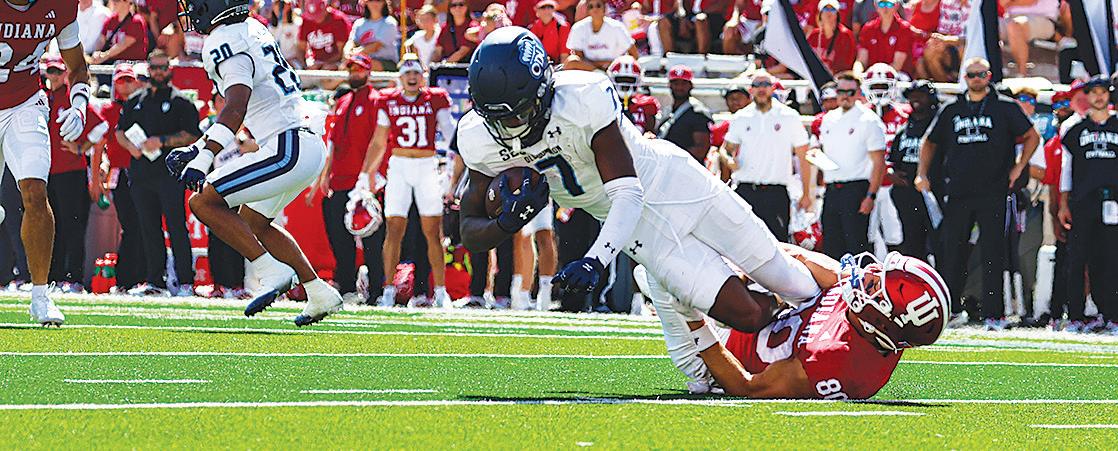
Communities protest Trump and IU
By Benjamin LeGrand benlegra@iu.edu
Over 100 demonstrators from two separate but simultaneous Labor Day rallies chanted and called just blocks from each other in downtown Bloomington on Sept. 1.
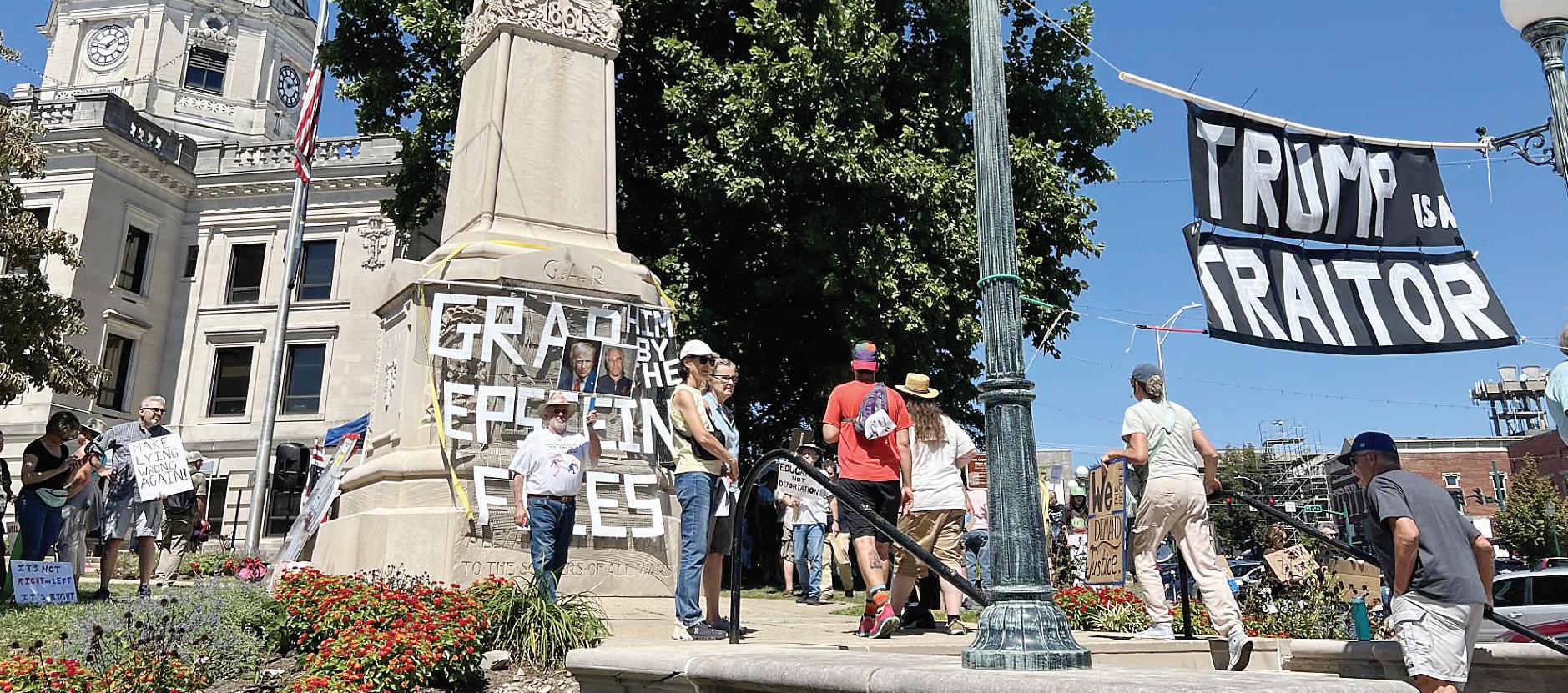
The Indiana Graduate Workers Coalition held a union card signing event at Sample Gates, while 50501 Indiana hosted a protest at the Monroe County Courthouse. The latter protest also included a diaper and formula drive, postcard writing and other booths.
Around 70 people gathered at Sample Gates to sign or renew their union cards, lay out plans for the year and push for the IGWC’s sixdemand campaign, which includes calls for expanded health benefits and a pay raise to meet Monroe County’s livable wage of $43,605, according to MIT’s livable wage calculator. Graduate workers currently make $24,000, according to the IGWC website. Graduate workers received a $1,000
raise in January.
The IGWC also continues to fight for official union recognition from the administration, as it has since its inception in 2019.
“IU should be the product of the students, faculty, staff who are learning, teaching and researching here,” Ann Campbell, co-chair of the IGWC Coordinating Committee, said. “Under the pillar of our university, we are demanding the protection of our degrees.”
Campbell referenced Indiana’s House Enrolled Act 1001, which went into effect July 1 and requires programs to meet a quota of graduates to remain active. Bachelor’s degree programs needed 15 graduates and associate’s degrees needed 10 to meet the bill’s requirements. Across the IU system, 249 programs were affected by the law, with 116 of those at IU Bloomington. Twentytwo degrees were eliminated, and 31 will be eliminated after currently enrolled students graduate. Additionally, 63 were suspended with plans to merge or consoli-
date programs.
Speakers throughout the IGWC event also expressed grievances with a bureaucratic glitch in August, first reported by The Herald Times, that left an unknown number of graduate workers with lapses in their healthcare coverage. In emails acquired by the Herald Times, IU Associate Dean for Graduate Education Elizabeth Dunn said that the university would cover the inactive period once policies were reactivated.
IU American Studies graduate student Sasha Weiss has a mutation in his tumor suppressant genes. It increases his risk of developing multiple types of cancer, according to the National Cancer Institute, and requires him to visit an oncologist every six months. He shared his problems with the administration’s insurance system with the crowd Sept. 1.
“It didn’t affect Pam Whitten; it didn’t affect Shrivastav,” Weiss said. “It didn’t affect any of the admin. Imagine what it would
look like, what IU’s response would be if admin’s benefits were the ones who got cut because of a bureaucratic oversight.”
Around 1:30 p.m., over 100 demonstrators from the 50501 protest against President Donald Trump marched down Kirkwood Avenue, past the IGWC protest at Sample Gates, and back down to the courthouse square. The precession stretched from Fat Dan’s Deli to Nick’s English Hut on Kirkwood, gathering a mix of supportive cheers and a handful of jeering from passerby wearing American flags.
50501 is a nonprofit group that has organized multiple nationwide protests against the Trump administration since the group’s creation in January 2025.
The demonstrators chanted “No justice, no peace, fuck the police,” and “No Trump, no KKK, no fascist USA,” as they crossed and eventually stopped traffic on South Walnut Street for over five minutes,
through multiple traffic light cycles as multiple cars honked.
One 50501 protester stood with his bike in front of a vocally displeased driver while stopping traffic. Their conversation continued to escalate as other cars stopped on the street joined in on the honking, and drivers yelled from their respective vehicles. As the biker continued to yell with the driver, four 50501 protesters spread across the road, aiding the stoppage before eventually retreating to the courthouse lawn.
“They’re in Trump’s hip pocket,” one protester, Lori Stumpner, said.
Stumpner and fellow Bloomington resident Jamie Broker helped organize the protest, with Broker leading the march through town. She carried an upsidedown American flag and was one of the protesters who blocked South Walnut Street.
“I hope they see that we’re fed up, that we’re done with this,” Broker said. “We’re over it, we want our democracy.”
State law requires IU faculty to post syllabi online
By Madelyn Hanes mrhanes@iu.edu
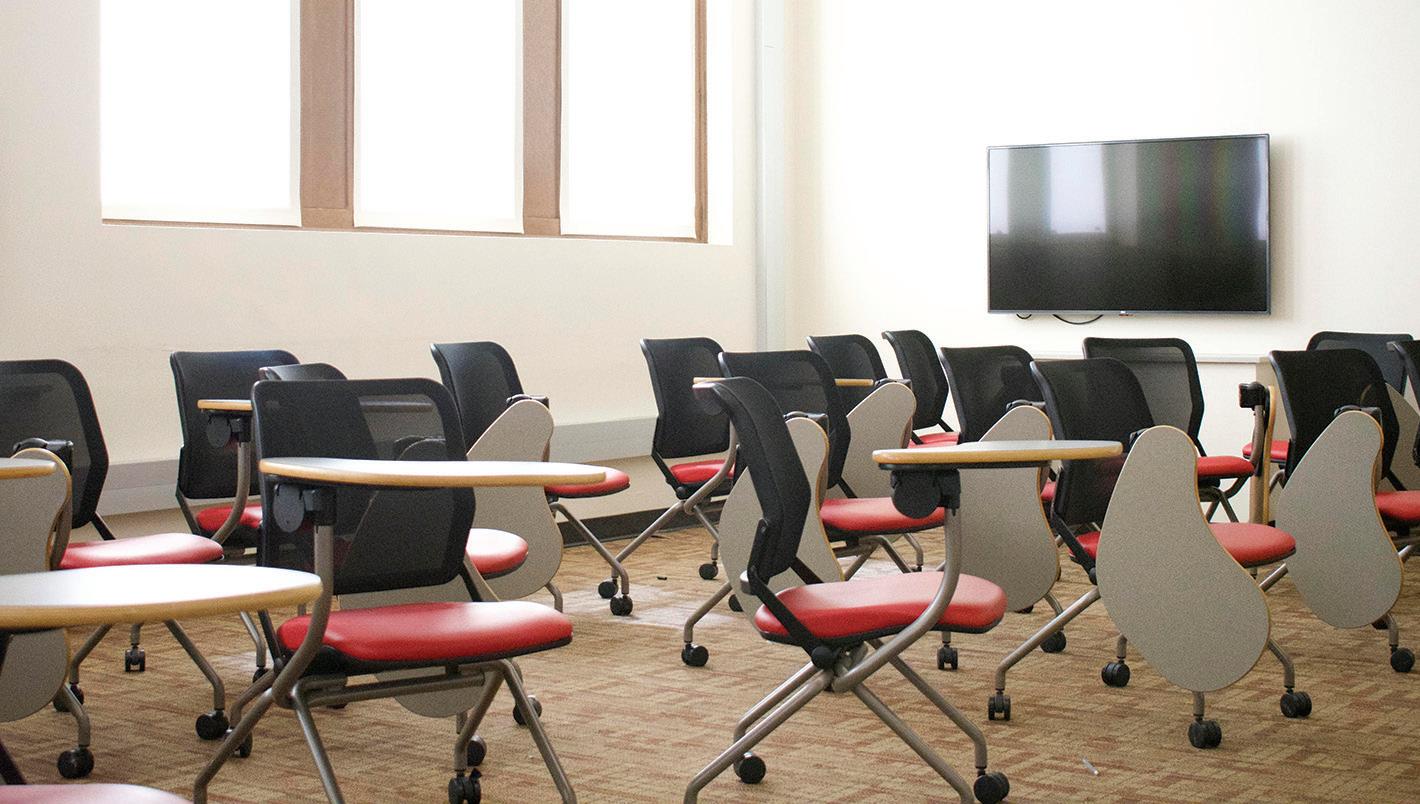
Syllabi now have a bigger audience than just students. Because of a new state law, Indiana University faculty must publish their course syllabi online.
During the final hours of this year’s legislative session, Indiana lawmakers added the requirement as part of the state’s two-year budget bill without debate. During session, lawmakers also made major changes to higher education governance, including giving Gov. Mike Braun sole authority over IU’s Board of Trustees and requiring post-tenure reviews.
The new law took effect July 1. IU followed up with its own policy July 26, requiring faculty to publish syllabi at least seven days before the start of classes.
According to a fall “Start of the Semester Guide,” IU adopted CourseLeaf, a curriculum and course management platform. The platform will automatically transfer course materials uploaded to the syllabus page on Canvas, a learning management system used by IU, to the public site.
Instructors who want to limit certain details to enrolled students must move them to other tabs on the course page, according to an IU blog post. IU advised faculty to avoid posting personal contact information, virtual meeting links or detailed assignment information.
“Indiana University works with its campuses across the state to ensure compliance with all state and federal laws,” an IU spokesperson said. Faculty say the rollout
has provided little clarity.
O’Neill School of Public and Environmental professor and founding director of the Civic Leaders Center Paul Helmke said the policy’s origins make it difficult to interpret.
“It came out of nowhere, along with getting rid of the alumni trustees, and it makes it hard to interpret,” he said. “There is no legislative history to interpret, so we have to guess what it is all about.”
Helmke said debating what belongs in a syllabus has always been complicated. The only explicit university guidance so far requires faculty to include AI policies and exclude personal contact information, he said. According to the guide, faculty are advised to include physical and mental
health resources, technology-related resources, religious observances, bias incident reporting and sexual misconduct and Title IX resources.
“I have no problem with being transparent, no problem with what I cover in class, but if this is going to be used for people to micromanage what we teach in class, faculty are going to be concerned,” he said.
The Indiana Daily Student contacted the Indiana House of Representatives Republican Caucus to request interviews but did not hear back by time of publication.
IU Media School professor Gerry Lanosga said he supports transparency but questions lawmakers’ intent.
“It isn't inherently bad — faculty don’t have any-
thing to hide in their syllabi and people will comply with the law,” Lanosga said. “But what is the rationale? What are the motives? It hasn’t been made clear.”
He said he sees the syllabus requirement as an aspect of education being under attack in the U.S.
“It’s a means of surveillance over our classrooms that threatens academic freedom and almost certainly will have a chilling effect on professors, particularly if they teach subjects that are viewed as controversial,” Lanosga said.
He also raised concerns about competition between other universities with syllabi being posted publicly, noting that although education is open, faculty invest years of work into designing their courses.
“This is a full-time job for faculty to teach and research,” he said. “People put a lot of time and effort into developing courses and that is something people want to protect. But having posted publicly can open people to that sort of competitive pressure.” Lanosga also compared the new law to Indiana’s open-government laws that have protections for trade secrets, but noted lawmakers did not consider that aspect for universities.
At the same time, he said the impact may be smaller than some fear — possibly even positive, pointing to what he called a long-running joke among professors.
“Maybe the impact on posting them to the public is that students may read it more,” Lanosga said.
BENJAMIN LEGRAND | IDS
Signs reading “Trump is a traitor” and “Grab him by the Epstein files” adorn the Monroe County Courthouse steps Sept. 1, 2025, in Bloomington. Protesters carried signs with similar messages throughout the protest.
NATALIA NELSON | IDS
online.
City Council considers DEI training fund cuts
By Deshna Venkatachalam devencat@iu.edu
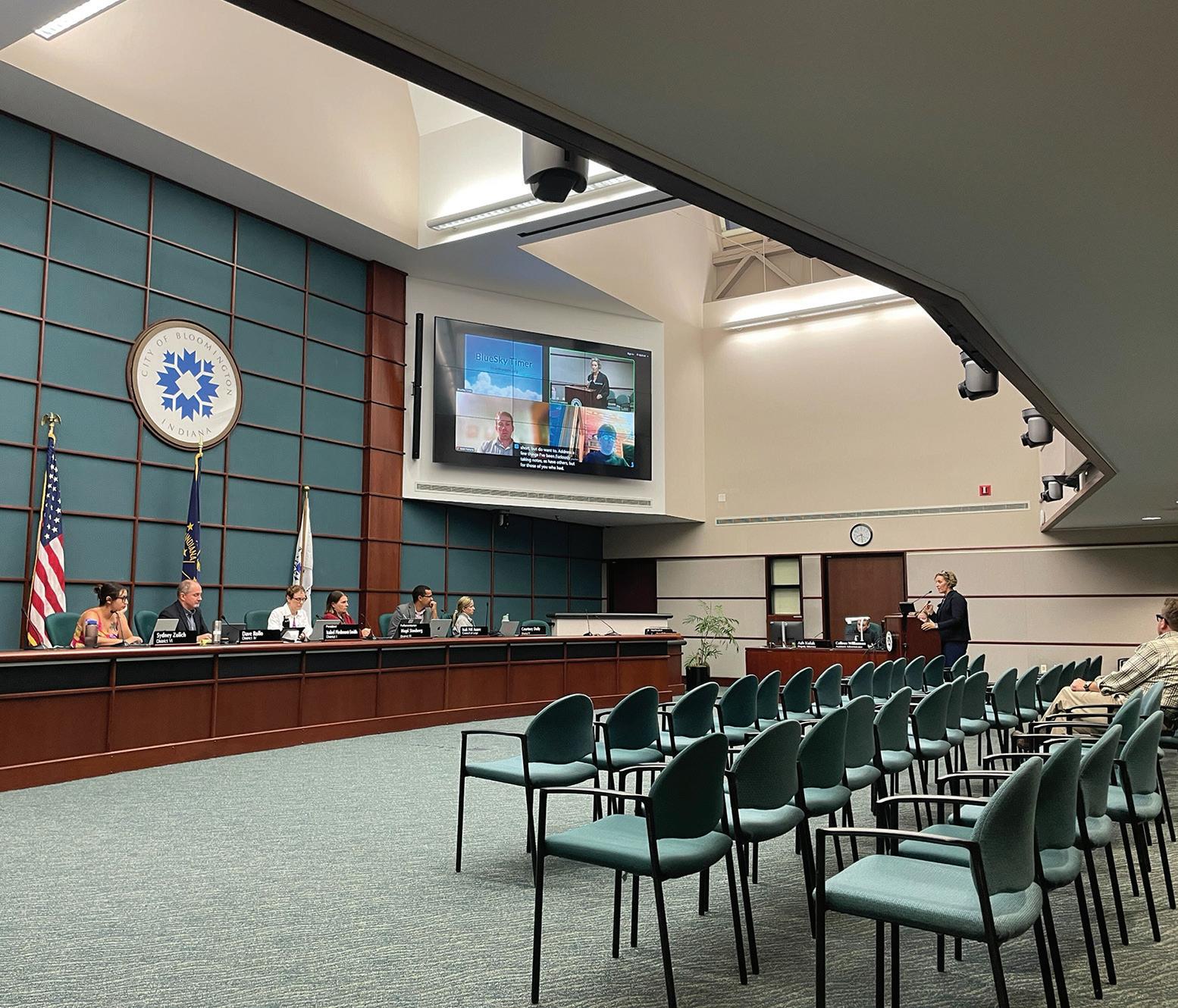
The 2026 proposed city budget would eliminate $300,000 previously allocated for diversity, equity, inclusion and belonging training due to state and federal directives. But at a Bloomington City Council meeting Aug. 25, officials explained this money was not used in the first place.
Around 30 people filled the council chambers Aug. 25 to review the community health and vitality section of the city’s annual budget.
The city’s overall proposed budget includes $54,017,896 in revenue and $65,206,66 in expenditures, for a total general fund deficit of $11,188,770.
Bloomington Mayor Kerry Thomson said the decision to eliminate the DEIB funding was based on the fiscal climate.
Thomson explained Bloomington has less money to work with under Indiana’s Senate Enrolled Act 1. SEA 1 lowers property and local income taxes, decreasing revenue for local governments.
“It has long been the city’s philosophy to universally support those who live here in Bloomington no matter who they are,” Thomson said. “We are not wavering one bit on our values.”
Last year’s budget allocated $300,000 in DEIB training to Bloomington’s Community and Family Resources Department. However the department’s director, Shatoyia Moss, stated during the meeting that the money was never used and the employee onboarding process did not include an element of DEIB training.
Councilmember Courtney Daily asked why the funding wasn’t spent.
City Controller Jessica
McClellan told the council Bloomington’s Human Resources Department and CFRD both received funding for employee training from the American Rescue Plan Act — that funding was separate from the DEIB funding. CFRD spent most of its ARPA allocation, so the extra DEIB training funding went unused. McClellan said it was like two departments were trying to accomplish the same function, and the
CFRD did not have the capacity to use both.
McClellan said that the $300,000 sitting in the general fund will carry over into the next year and can be used for other non-DEIB services.
Via Zoom, Corporate Counsel Margie Rice explained that directives from both the state and federal government prevent the city from using this money to carry out DEIB training. In
January, Indiana Gov. Mike Braun signed an executive order dismantling DEI in state agencies. In the same month, President Donald Trump issued an executive order aiming to “end illegal discrimination” by seeking to end DEI programs in the federal government.
“We have taken a conservative approach to follow the federal and state guidelines even though it may not be consistent with our own lo-
Which student organizations were placed on disciplinary status?
By Chloe Oden chloden@iu.edu
Two student organizations were placed on disciplinary status this summer.
IU defines cease and desist status as “an interim measure placed upon certain aspects of chapter operations when there is an immediate threat or ongoing investigation.”
IU’s definition of suspension requires the organization to cease and desist all activities and disband for a length of time proposed by the IU Office of Student Conduct’s Administrative Panel and determined by the dean of students.
Palestine Solidarity Committee
The Palestine Solidarity Committee was placed on cease and desist Aug. 15 until further notice for disorderly conduct.
A letter sent to the group cited conduct it called “dangerous and disruptive to the university community.”

cal policies,” Rice said. “We do not want to risk losing all the federal funding that the City of Bloomington gets and uses to support important programs and citizens.” Rice said that the city has to certify that it is compliant with federal policy to receive funding. She said she would not advise anybody to sign something and then turn around and do the opposite of what it says, including the city.
“If anyone wants to take issue with the fact that we’re taking a conservative approach, I think that complaint should come directly to the legal department,” Rice said. “We are definitely continuing to work to serve all of those people in need, and we believe that we can best do that by receiving federal funding.”
During the public comment section, former City Councilmember Jim Sims noted that the city does not have a formal definition of DEI. He encouraged the council to create one.
“I’d like to have something more definitive to make sure that we’re able to meet some of those residents that are in need and keep those values that we hold in high priority,” Sims said. City Clerk Nicole Bolden also stepped up to the microphone, prefacing that she was speaking as a resident of Bloomington rather than in her professional capacity. She said she felt disappointed to hear most DEI-related questions directed toward Moss and the CFRD.
“It’s the mayor’s decision, and ultimately a lot of department heads don’t get a lot of say in what they can and can’t have cut,” Bolden said. At the end of the public comment section for the CFRD portion of the meeting, Councilmember Hopi Stosberg said she appreciated the community feedback.
“Coming into this position, there’s going to be moments where you have to choose between one bad decision and another bad decision,” Stosberg said. “I appreciate that so many people can come out and comment on this and are just kind of paying attention to how much this matters.”
Simtra invests $241M in Monroe County
By Gabby Rogers rogersgm@iu.edu
The Monroe County Council approved Simtra BioPharma Solutions’ request for a tax break on a 65-acre site recently acquired in Monroe County on Tuesday, according to a press release.
Simtra BioPharma Solutions develops and manufactures sterile injectable products.
The Bloomington Economic Development Corporation has been working closely with Simtra in support of the multimilliondollar project.
The property previously belonged to Cook Group, according to Indiana Public Media, and operated as a General Electric manufacturing facility.
expansion that adds syringe fill lines, increases lyophilization capabilities and supports clinical-scale production, according to Simtra’s website.
“This project represents more than a facility expansion,” BEDC President Jennifer Pearl said in the press release. “It is an opportunity to redevelop an underutilized industrial site and transform it into a longterm asset for our community.”
The site has more than 300,000 square feet of usable space for under-roof expansion.
The plans included a $241 million capital investment in order to purchase, prepare and equip the first manufacturing line.
The PSC had a large part in organizing the pro-Palestinian encampment on Dunn Meadow that began in April 2024. It has conducted several demonstrations defending free speech and raising awareness for violence in Gaza and the Middle East.
placed on cease and desist in November 2024 for hazing.
Sigma Chi The IU chapter of fraternity Sigma Chi was placed on suspension June 13 for dishonest conduct, endangering others, hazing and physical abuse after being
The Office of Student Life has not listed an end date for the fraternity’s suspension.
Carrying over from the spring semester, the IU chapter of fraternity Beta Sigma Psi is currently on cease and desist until further
notice after being ordered to suspend all organization activities in February. The IU Office of Student Life website cited alcohol and endangering others as reasons for the fraternity’s disciplinary status. There are now 18 organizations on cease and desist, suspension or disciplinary status.

The expansion is intended to improve U.S. production capability for sterile injectable medicines. According to BioCrossroads, Indiana currently leads the country in life sciences and pharmaceutical exports.
Simtra purchased the property in late July with the intention for a facility
Subsequent lines would call for another roughly $100 million investment.
Each line is expected to create approximately 90 jobs with an average compensation of $70,000 annually. The request will be brought to the Monroe County Commissioners for final approval Thursday.
JACK FORREST | IDS
The Sigma Chi house is pictured Nov. 7, 2024, at 601 E. Seventh St. in Bloomington. Sigma Chi was placed on suspension over the summer.
Retired IU faculty sue trustees over new voting policy
By Chloe Oden chloden@iu.edu
Three retired Indiana University faculty members filed a lawsuit against the Board of Trustees on Aug. 20 over BOT-19 and a section of Indiana code, which bar retired faculty from engaging in faculty governance.
The former professors, Steven Sherman, Alex Tanford and Russell Skiba, called for declaratory and injunctive relief to prohibit the board from enforcing the policies.
In an April budget bill, Indiana established IC 2138-11-3, which limited votes taken in faculty governance organizations to current employees. The board enacted BOT-19 in June, stating that only current faculty can participate in faculty gover-
nance. Tanford, a former law professor, said retired faculty serve on a wide range of committees all over campus and not only want to give back to the university, but are asked by deans and department chairs to serve.
“The retired faculty are the ones who have time and experience and knowledge about how this campus works,” Tanford said. “I don’t know what the university is going to do without us.”
One example, Tanford said, is retired professor Steven Sherman, who has served on the benefits committee for around 30 years. That experience, he said, has provided deep knowledge on how to deal with problems and university benefit negotiations.
IU did not immediately
respond to a request for comment.
The plaintiffs are seeking a judgment that BOT-19 is unlawful because they claim it goes beyond the trustees’ legal authority, and that IC 21-38-11-3 is unconstitutional because its addition to the budget bill violated the Indiana Constitution’s singlesubject rule. This rule limits acts to one subject that is clearly expressed in the title to guarantee transparency.
The budget bill was titled: “AN ACT to amend the Indiana Code concerning state and local administration and to make an appropriation.”
The court documents argue that because faculty governance organizations are defined as advisory and have no direct effect on university finances or administration, IC 21-38-11-3 is unconstitu-
tional.
Sherman and Tanford were elected to serve as voting members of the Bloomington Faculty Council as the two retired faculty representatives until June 2026, positions that have been in place for more than 40 years. The BFC is an elected group of faculty, administration and students who make decisions on behalf of the Bloomington campus’ faculty. The new policies prohibit the retired faculty from participating, even in a nonvoting capacity.
Skiba plans to run for an emeritus seat on the BFC for the 2026-2028 term and has volunteered to serve on several BFC committees. Due to BOT-19, he has not been appointed to any.
According to the plaintiffs’ motion for a prelimi-
nary injunction, the retired professors believe they are likely to succeed in their claims that BOT-19 is unlawful, and IC 21-38-11-3 violates the single-subject rule.
The plaintiffs argue irreparable harm will occur because Sherman and Tanford were elected to serve on the BFC but cannot do so unless the injunction is granted.
“No statute gives the trustees the power to decide who can serve on faculty councils, committees, boards and other faculty governance bodies or to interfere with the Faculty Council’s process for appointing qualified members of committees,” the document says.
The plaintiffs claimed no public notice or opportunity for discussion was given for the provision in the budget bill, according to court docu-
ments. Tanford said the plaintiffs did not talk directly to university leadership prior to filing the lawsuit and added that there is not anyone that they could go to. Many retired faculty are angry and have not received any explanation from the university for the policies, he said.
“Once we speak up, lo and behold, we get disenfranchised,” Tanford said. “We’re not just going to sit by and let the administration — without being challenged — take the university in directions that we think are ill advised.”
A hearing on the motion for preliminary injunction was scheduled for Sept. 3, but was canceled due to “a change of judge.” Another date is not yet scheduled.
Palestine Solidarity Committee on cease and desist
By Jonathan Frey jonafrey@iu.edu | @ByJonathanFrey
Weeks after Indiana University placed the Palestine Solidarity Committee of IU on cease and desist, much remains unclear about the reasoning behind the sanction and what comes next.
IU ordered the group to immediately suspend operations Aug. 15, citing in a letter conduct it called “dangerous and disruptive to the university community.”
But the group is reorganizing. Here’s what we know:
What is the Palestine Solidarity Committee?
The PSC was one of the main organizers of the proPalestinian encampment that took place on Dunn Meadow in April last year. More than 50 protesters were arrested during the first three days, with many receiving trespass citations that were later rescinded.
The encampment lasted 100 days, remaining largely unimpeded following the arrests, until IU cleared the
Woman arrested after shooting
By Molly Gregory mogrego@iu.edu | @mollygregory22
The IU Police Department arrested a woman in connection with a shooting on 10th and Walnut Grove streets that prompted a series of emergency IU Notify alerts early the morning of Aug. 23.
The 18-year-old woman was detained after she allegedly shot an individual in the leg and fled the scene via car, IUPD Public Information Officer Julia Nowak said.
Though the shooting took place on IU Bloomington’s campus, Nowak said the individuals involved are not affiliated with the university. The gunshot victim was transported to the hospital with non-life-threatening injuries. The shooter faces a level three felony charge for aggravated battery and a level six felony charge for criminal recklessness.
encampment Aug. 2 last year.
The PSC organized several demonstrations throughout the 2024-25 academic year, including appearing at candlelight vigils defending free speech and demonstrations raising awareness for violence in Gaza and elsewhere in the Middle East.
The organization cites three main demands on its social media accounts:
• IU to cancel or reject all partnerships, investments and other affiliations with Israel, and its partnership with Naval Surface Warfare Center Crane Division.
• IU to disclose all such partnerships between affiliated organizations and Israel or the military industrial complex.
• The resignations of President Pamela Whitten, Provost Rahul Shrivastav and Vice Provost for Faculty and Academic Affairs Carrie Docherty. After its suspension, the organization’s Instagram rebranded to the PSC of Bloomington.
“This account is no longer affiliated with the Palestine Solidarity Committee at Indiana University,” the group said in a post Aug. 19.
Letter from IU
In a letter sent to PSC leadership, first obtained by Indiana Public Media, the Office of Student Conduct ordered the group to cease all organizational activities immediately.
The letter cited alleged violations of the code of conduct, including “the material and substantial disruption of university operations and damage to university property.”
In the letter, IU also requested a roster including all current and former members of the organization. An IU spokesperson did not immediately respond to requests for comment on whether requesting a full roster of students is standard process.
IU Divestment Coalition spokesperson and frequent protester Bryce Greene said the reasoning behind the suspension lacked clarity.
“They have failed to cite any specific action that the organization did wrong,” he wrote in a text to the IDS.
IUPD investigated a PSC organizer last fall in connection with vandalism of the Herman B Wells statue in Dunn’s Woods. In a post on the PSC’s Instagram account, the organizer issued a statement saying they were intentionally targeted as a figurehead in the group.
The organizer didn’t confirm or deny their involvement with the vandalism in an email to the IDS last fall.
The case, which resulted in two charges of criminal mischief, is scheduled for a jury trial in October.
Expressive activity questions
IU’s letter did not explicitly state what policies were violated, referring only to allegations of disruptive behavior during the 202324 and 2024-25 academic years, including “the material and substantial disruption of university operations and damage to university property.” It did not include
any specific incidents.
Much of the clash between IU and the PSC has stemmed from alleged violations of university expressive activity policies.
The policy’s first draft — introduced the night before the encampment began — was used as the basis for the arrests of protesters at the encampment and trespass citations that were later rescinded.
The Board of Trustees introduced a more comprehensive version of the policy in July that year, including a controversial provision banning “expressive activity” — which covered most forms of protest — between 11 p.m. and 6 a.m.
The Board of Trustees approved amendments to the policy in June of this year following a judge ruling the time restrictions to be unconstitutional.
The board removed the time restrictions, revising the rule to read “IU Community Members may spontaneously and contemporaneously assemble and distribute literature
without any prior notice or application requirement, and regardless of group size.”
What’s next?
The PSC has not posted anything to social media or its Substack account since announcing the change to PSC of Bloomington.
College Democrats at IU released a statement Aug. 20 denouncing the university’s decision to sanction the PSC. “This level of disciplinary action has traditionally been used by OSC as a response to student endangerment, hazing, or the use of substances; in other words, measurable harm to the well-being and safety of IU students,” the statement read. “PSC has not conducted any such behavior.”
IUDC also released a statement implying PSC organizers are attempting to regroup and continue action.
“Organizers are working to resolve the situation, but the fight for a free Palestine continues,” the post read.
Michael Arnold to lead WFIU/WTIU
By Samantha Camire scamire@iu.edu
Indiana Public Media will welcome Michael Arnold as the new executive director of “integrated public media” in September, almost a year after IU fired the organization’s executive director and chief financial officer. Arnold will take over the “newly redefined role,” on Sept. 22, according to a WFIU announcement. He will lead all operations across Indiana Public Media and provide “strategic oversight of student media,” The Media School announced Aug. 25. Indiana Public Media is the umbrella organization for WTIU Public Television and WFIU Public Radio and is part of IU Radio and Television Services. RTVS, which the IU Bloomington Office of the Provost used to operate until November 2024, now is part of The Media School, though it maintains a distinct budget and both outlets are editorially independent.
IU fired the previous executive director, Brad Kimmel, and Chief Financial Officer Christina Lirot in September 2024 after
IU Provost Rahul Shrivastav reportedly said the department was going in the wrong direction. Jay Kincaid, director of facilities and technology for The Media School, was appointed as interim executive director.
The leadership change also comes as Indiana Public Media is set to lose $1.4 million, or 14% of total funding, as part of federal cuts to funding for public media stations.
Arnold, who is from Indiana, has worked at media organizations across the country. He last served as chief audience and content officer for KUNC Radio and The Colorado Sound. He has also held leadership roles at Wisconsin Public Radio, Public Radio International and New Hampshire Public Radio, according to the announcement.
“His leadership in public service media and his strategic approach to integrated platforms will help us expand our reach, connect public media to the educational mission of The Media School, and deepen our impact across Indiana and beyond,” David Tolchinsky, the dean of IU’s Media School, said in the announcement.
OLIVIA BIANCO | IDS
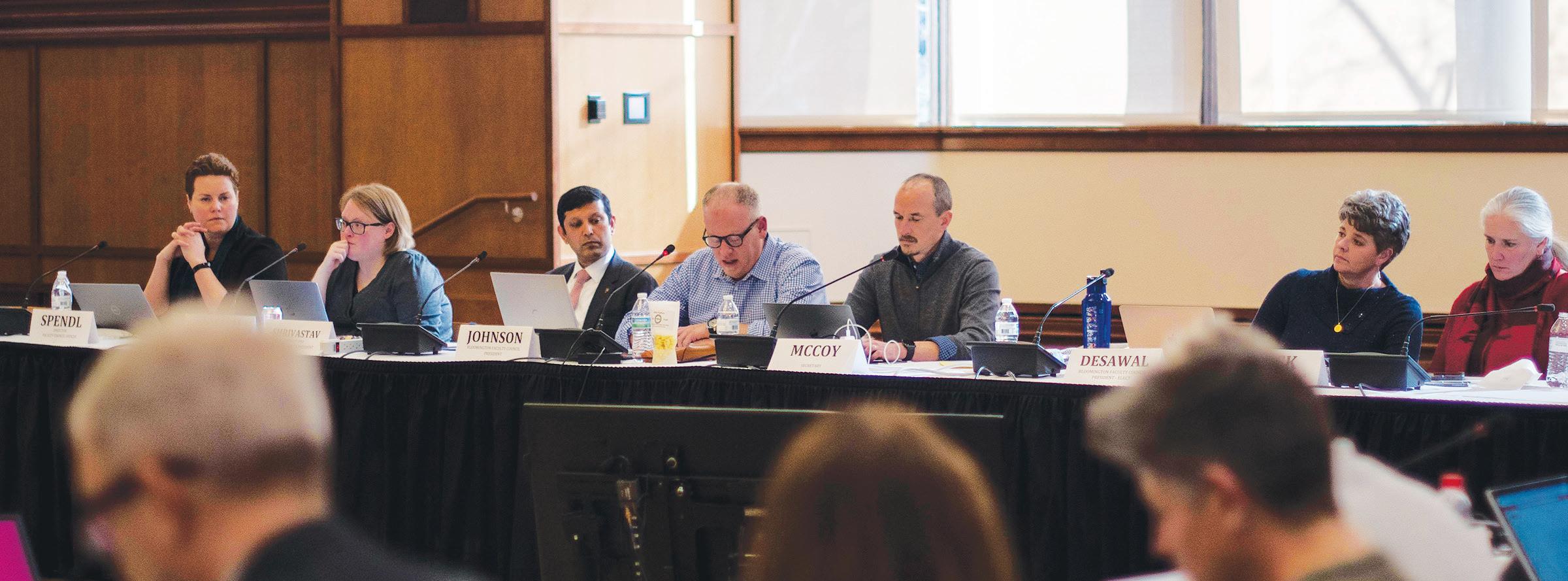
Then-Bloomington Faculty Council President Colin Johnson speaks at a meeting Jan. 16, 2024, at Presidents Hall in Bloomington. Three retired Indiana University faculty members filed a lawsuit against the Board of Trustees on Aug. 20 over new rules that bar retired faculty from engaging in faculty governance.
COURTESY OF JENNIFER COOMBES
Michael Arnold, the new executive director of integrated public media, is pictured. Arnold will assume the new role Sept. 22.
Changes to Bloomington Transit and IU Campus Bus routes
By Kendall Geller kmgeller@iu.edu
Ahead of the fall semester, both Bloomington Transit and IU Campus Bus Service made changes to routes that service IU’s campus, as well as other parts of Bloomington.
Bloomington Transit changes
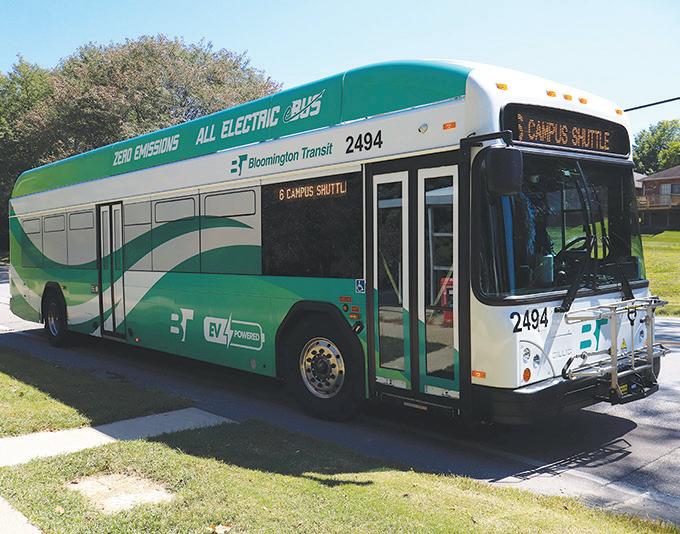
Changes to BT routes 6 and 9 were primarily due to the transition to a new fleet of electric buses that are unable to fit under the low clearance underpass on 10th Street.
The changes to routes 6 and 9 are:
• The 6 Limited no longer runs and its buses were added to the main route 6 with additional stops in the afternoon.
• Route 6 now stops at the Student Recre-
ational Sports Center and Campus View Apartments.
• Route 9 now services Jefferson Street and more of Third Street.
• Both routes 6 and 9 no longer service Tulip Tree Apartments.
According to BT General Manager Bryan Fyalkowski, changes to the 6 and 9 routes mainly affect IU students, while BT’s changes to route 13 primarily affect Bloomington residents and Ivy Tech Community College students. BT introduced route 13 in January as a 60-minute route but found that the time frame was not efficient.
“The bus would be frequently ahead of schedule, causing it to sit idle at some locations while waiting for time to pass,” Fyalkowski said in an email.
Most of the changes to
route 13 attempted to rectify this issue:
• The 13 now serves the Northwest YMCA on inbound trips. Outbound and inbound trips both pass through Ivy Tech and Park 48 industrial park, making it easier for Highland Village residents to reach those destinations.
Along with route changes, BT is shifting to digital bus passes for IU students. Students must download the Umo Mobility app and follow the instructions on BT’s website to ride fare-free during this academic year.
Fyalkowski said students may not use their digital CrimsonCards to scan onto the buses, but if riders still have a valid physical Crimson Card, they can use it to access BT buses for the time being.

Mon., Tue., Thu., Fri.: 8 a. m. - 5 p. m. Wed.: 8 a. m. - 8 p. m. Sat.: 8 a. m. - Noon
744 E. Third St. 812-855-8436 optometry.iu.edu

Baron D Hall, DDS, MSD Jake
Willhite, DDS, MSD Orthodentists
Erica Hall, Hannah Elliott, Kaitlyn Jacobs, Marilyn Lee, Adrian Price
With modern techniques and a fun style, B-town Orthodontics is the most up-and-coming orthodontics office in the Bloomington area!
We offer the latest technologies including invisalign, gold brackets, laser treatments, and even mini implants that can help restore missing teeth and even eliminate the need for surgery. B-town Orthodontics offers FREE consultations and don’t forget to download The Braces App, the hottest free app designed by B-town Orthodontics’ Dr. Baron Hall.
Tue. - Thu.: 8:30 a.m. - 4:30 p.m. Lunch 12:30 p.m. - 1:30 p.m. Mon. & Fri.: Appointments Only 1320 W. Bloomfield Rd., Suite B 812-287-8851 btownorthodontics.com


Ryan D. Tschetter, DDS Lauren R. Hoye, DDS Jackson Creek Dental is conveniently located on South College Mall Road. Most insurances accepted, including the Indiana University Cigna Insurance plans as well as the IU Fellowship Anthem. Dr. Tschetter and Dr. Hoye offer state of the art dental technology such as Zoom whitening, same day crown appointments, and Invisalign. We also provide restorative, cosmetic and emergency care. We pride ourselves in giving the best care to our patients while offering a pleasant yet professional atmosphere.
Mon. - Thu.: 7 a.m. - 5 p.m. Fri.: 7 a.m. - 3 p.m. 1124 S. College Mall Rd. 812-336-5520 jcdsmiles.com
“There may be a time in the future where physical Crimson Cards don't scan at all on our buses, so we are trying to get ahead of that in some respects and avoid any potential headaches,” Fyalkowski said in an email.
IU Campus Bus Service changes
IU Campus Bus Service accommodated BT's lack of service to Tulip Tree Apartments by including it as a stop in its routes, Director Justin VanLeeuwen said in an email.
IU Campus Bus Service modified the E, F and X routes: The E route now stops at Tulip Tree Apartments.
• The F route now begins at the Stadium White Lot, providing access to Third Street and continuing service along
Dr. Andrew Jones, OD Dr.

Our eye care clinics serve patients in Bloomington-Atwater Eye Care Center and Indianapolis Eye Care Center, with faculty doctors and student interns who work together to provide the most comprehensive eye care available. Our many services include primary care, pediatrics, low vision, dry eye, disease, laser and surgical care, contact lenses including specialty lenses, myopia management, aniseikonia, and eye wear center. Open to the public and accepting most insurances.

NEW OUTLOOK
COUNSELING CENTER INC
Cheryl Mansell, LCSW RPT
Kyle Fouch, PMHNP
Alisa Doty, LMHCA
Kaitlyn Merwin, LCSW
Chi-Wei “Diana” Kan, LMHC
Angie Miller, LMHCA
Marisa Soliday, LSW
Stephanie Blanford, LSW
Alexandria Conger, LMHCA
Amber Hancher, LSW Sydney Conger
Providing individuals, couples and family counseling as well as psychiatric evalutation and medication management. We ensure that individuals of all ages, experiencing mental illness can better manage life
Mon. - Thu.: 9 a.m. - 6 p.m. Fri.: 9 a.m. - Noon 5010 N. Stone Mill 812-929-2193 newoutlookcc.org
Dr. Andrew Pitcher, D.C. Dr. Crystal Gray, D.C. A Way of Wellness Chiropractic specializes in comprehensive spinal care. We offer treatment for many different spinal conditions and problems, while also addressing the body as a whole. We provide effective chiropractic care helping patients reduce stress, improve mobility and spinal health. The quality treatment we provide is always fit to your individual needs and goals. Let us help you achieve and maintain good spinal health. We look forward to meeting you!
Mon. - Thu.: 8 a. m. - 6 p. m. 1121 W. Second St. 812-336-2225 bloomingtonchiropractor.com




Austin C. Starr, D.D.S Board Certified Oral Surgeon HOOSIER ORAL SURGEON
Dr. Starr is an IU Football Alum who provides pain-free experiences for all Hoosiers with IV sedation. He specializes in Wisdom Teeth Extractions, Dental Implants and Plasma Therapy while utilizing 3D imaging technology. Accomplish fast and predictable healing with Plasma Therapy to avoid dry sockets after extractions. Voted the Most Trusted in Bloomington, they look forward to accomplishing continued successful results every day for all Hoosiers. Go IU!
Mon. - Thu.: 8 a.m. - 5 p.m. Fri.: 8 a.m. - 4 p.m. 473 S. Landmark Ave. 812-318-1023 starroralsurgery.com
Health/Beauty
Jake Wall, PA-C
Comprehensive Dermatologic Care for All Ages at the Bloomington Forefront, we provide expert dermatologic care for patients of all ages. Our team specializes in the detection and treatment of skin cancer, as well as the management of a wide range of skin conditions, including acne, eczema, psoriasis, rashes, warts, and more. We also offer care for disorders of the hair and nails. Your skin health is our priority
Mon. - Thu.: 7:40 a. m. - 4 p. m. 415 S. Landmark Ave. 812-333-7433

eye care clinics serve patients in Bloomington-Atwater Eye Care Center and Indianapolis Eye Care Center, with faculty doctors and student interns who work together to provide the most comprehensive eye care available. Our many services include primary care, pediatrics, low vision, dry eye, disease, laser and surgical care, contact lenses including specialty lenses, myopia management, aniseikonia, and eye wear center. Open to the public and accepting most insurances, includes free parking.
Mon., Tue., Thu., Fri.: 8 a.m. - 5 p.m. Wed.: 8 a.m. - 8 p.m.

KATHERINE MANERS | IDS
Bloomington Transit bus drives down 10th Street on Aug. 30, 2025, in Bloomington. Routes 6, 9 and 13 were altered to
new electric buses.
OPINION
IU leadership chose cowardice over conviction
Sam Roll (he/him)
is a second year Master of Public Administration student with a concentration in Policy Analysis.
As a second-year graduate student at Indiana University, I am outraged and sickened by how IU leadership chose to respond to Gov. Mike Braun’s executive order to dismantle diversity, equity and inclusion. Or more accurately, how they utterly failed to respond.
Rather than advocate for IU’s core values or speak out in any way against the federal government’s bla-
Prakriti Khurana (she/her)
is a senior studying finance and business analytics.
After the first week of classes, finding a familiar face in a lecture might still be a struggle. If so, you are not alone. I’m starting my senior year at IU, and I still get the jitters when I enter a lecture hall and look at the hundreds of faces, scanning to see if I recognize anyone or if I must prepare to make the dreaded walk of shame to an empty seat. And even worse is when I have to crawl over people to reach the seat in the middle of the row. I have found myself in this position more times than I can count. But perfection in college, like in life, doesn’t exist.
Some weeks you’ll feel like you’re thriving; others, not so much. Over the past three years, I’ve made friends I no longer keep in touch with, became close to people I never expected to meet and found friendships I value more than I ever could have imagined.
Even the “not so much” weeks teach you how to enjoy your own company, focus on a new hobby or pick
tant overreach and authoritarian interference in public education, they chose the path of least resistance — and in my opinion, cowardice: silence, surrender and self-preservation. The university didn’t just “comply” with this executive order; it rolled over. DEI programs were gutted overnight with no transparency, no planning and not even the decency of an explanation. That alone would be shameful.
But to then hand President Pamela Whitten a 28% raise (amounting to nearly
up better study habits. And they don’t last forever. And you don’t always need to find friends in the classroom. My favorite memory of making friends came from an unlikely place: Wordle. I’m not even a big puzzle person, and I only started playing because I saw everyone else posting their grids. Since I started playing, I’ve kept a 100-day streak going, and one casual “Hey, did you get today’s Wordle?” to someone I didn’t know turned into daily check-ins with friends who became some of my closest. We even now have a group chat dedicated to sharing our victories, keeping us connected, even though some of us graduated. What started as healthy competition and a shared interest grew into a friendship I never saw coming. Find one similarity, and it can help you make friends and thrive in college. Failures happen, and you might feel embarrassed at times. But every detour helps you learn about yourself and better navigate college life. Friendships often form in the most unexpected places,
$200,000, more than most IU graduates will ever earn in a year) is morally bankrupt. It signals exactly what this administration values: consolidation of power, political safety and obscene compensation for those at the top. Never mind the students. Never mind the mission of public education. Let’s be clear: IU did not dismantle DEI programs because it believed in doing so. It did so because it was told to, and its leadership, entrusted to represent a 200-year-old public institu-
tion with civic responsibility at its core, chose not to defend its values, its students or its history. That is not leadership. That is institutional cowardice.
And what of the Board of Trustees? Stripped of alumni-elected seats and now appointed entirely by the governor; the board was silent. They approved another bonus for the president in June while equity programs were slashed. At a time when students, faculty and staff were looking for a moral compass, all we got was budget compliance
PRAKRITI’S
and executive self-congratulation.
This administration has made its priorities clear. As programs are cut, offices are closed and support systems disappear, IU leadership remains silent. The people most impacted are left without answers, without advocacy and without representation. The message is clear: this administration will not fight for you.
To make matters worse, recent credible reporting has surfaced that President Whitten plagiarized portions of her 1996 disserta-
tion — an academic offense that would get any graduate student sanctioned, if not expelled. IU claims an “independent review” cleared her, yet the university refuses to release the report. It’s hard to take claims of accountability seriously when transparency is nowhere in sight. IU was built on principles of civic duty, leadership and justice. Today, it is led by those too cowardly to stand for any of them. Now we know better. And I, for one, feel a little less proud to be a Hoosier.
so don’t limit yourself to just lectures.
IU offers so much to keep you engaged, including clubs, organizations, sports, arts and libraries. While you might not immediately find your perfect match in terms of friends, take advantage
of these resources and opportunities — all those small moments add up to experiences that make college worthwhile. In your short time here, make the most of it. Show up to that class even if you don’t know anyone and talk to the person next
AINSLEYS ADVICE
to you; you never know who could become a friend.
So, here’s my advice: don’t give up. Don’t rush the process. The connections you’re looking for are often waiting in small, unexpected places. Most good things take a while to happen and
stressing out about it is not healthy. So go ahead and say
“Hi” to that person sitting next to you and challenge them at Wordle, you might just win and make a new friend in the process.
prkhuran@iu.edu
Off-the-field lessons learned from the great IU football comeback
Ainsley Foster (she/her)
is a senior studying elementary education.
Late in my senior year of high school, I walked into a Kroger wearing an IU hoodie. On the way in, an elderly man, presumably an alumnus, stopped me to jokingly ask if I thought we would make the playoffs this year. It threw me off for two reasons. For one, I didn’t know him and didn’t expect a spontaneous sports question. Secondly, I had not given any thought to IU’s football team.
Looking back, I finally get the joke because there was no realistic chance we would ever make the playoffs, potentially ever. I think I can speak for many of my peers when I say that football was not high on the list of reasons I considered IU as an incoming freshman. Just
two years ago, I attended the Oaken Bucket game with my fiancé, watching the two worst teams in the Big Ten, and we still lost! Since then, much has changed.
This past year, we witnessed the program’s first 10-0 season, its first-ever College Football Playoff appearance and a new singleseason home attendance record. The Hoosiers also set a record for the most single-game points and total yards (701) in their 77-3 victory against Western Illinois University. By the end of the season, the team had finished with eight home wins, the most in program history. Oh, and not for nothing, the Hoosiers secured the program’s largest-ever margin of victory against rival Purdue with a 66-0 win.
This is too good of a turn-
around to let it go by without a sentimental teaching moment, so let’s get into some lessons to be learned from the comeback.
First, the right people make the difference. At the start of the season, 27 players transferred from James Madison University with Cignetti to join Indiana’s line-up, as well as seven assistant coaches. That’s a big change. The transfers who came from Cignetti’s final three teams at JMU are now 41–6 in college, but that wasn’t always the story. According to one article from Sports Illustrated, elite college football programs considered several of the transfers “too small” or “too slow,” resulting in these players being largely ignored by recruiting programs. Thanks to a second chance, their stats tell a
much different story.
Now, these players are some of the most experienced winners in the conference.
After a record-smashing first season with the Hoosiers, these players proved that success often comes from overlooked potential and effective leadership. Cignetti’s ability to identify and develop talent has transformed Indiana into a competitive force, rewriting expectations and setting new benchmarks for the program. Under Cignetti’s leadership, these players have flourished. Secondly, great leadership commands success. After arguably one of the biggest turnarounds in college football, Cignetti was named Big Ten Coach of the Year. What’s amazing is this isn’t even the first time he’s won
an honor of this caliber. This marks the fourth time in his career that he earned coach of the year accolades from the conference level in every conference he’s coached in.
A person doesn’t consistently receive those kinds of awards for mediocrity; great leadership makes a difference. Cignetti didn’t just inherit a struggling program; he reshaped its culture. He instilled confidence, demanded excellence and built a team identity centered on discipline and resilience. The players bought in, and the results speak for themselves: historic wins, national recognition and a fan-base that’s more energized than ever. IU football’s last season was much more than a heart-warming “yay-wearen’t bad-anymore” sports story. It’s a powerful state-
ment about real transformation. Perhaps the real takeaway is that leadership begins with the willingness to step up and take responsibility for what you can control. None of us can rewrite the past, but we can decide how we’ll move forward from it.
Circumstances, setbacks and even failures don’t have to be permanent markers of who we are or what we’re capable of becoming. The story of IU football shows that even after seasons of disappointment, there is always room for renewal. A comeback is never out of reach, and when it does arrive, it often carries with it a strength and resilience that would not have been possible without the struggle that came before.
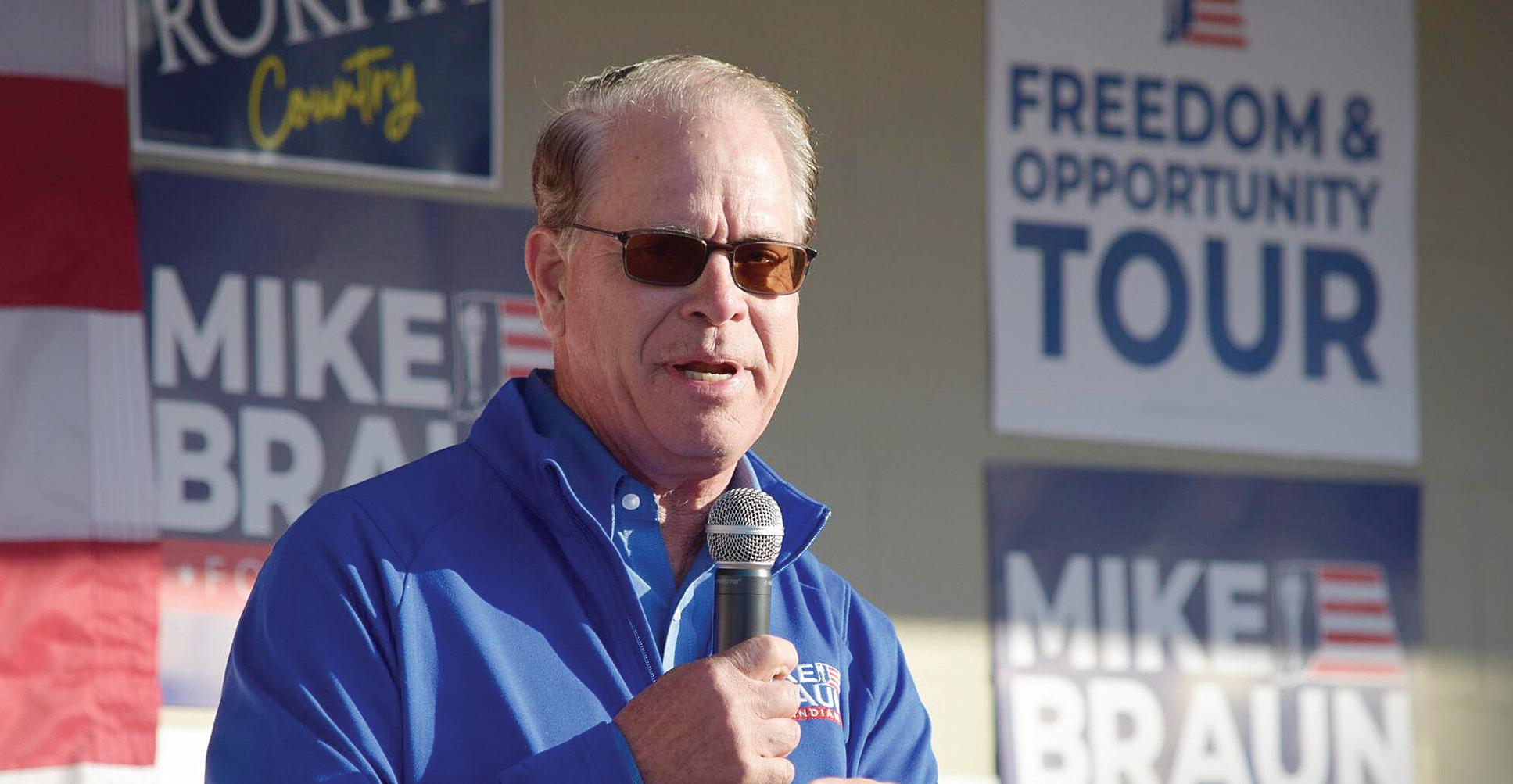
PHOTO BY CASEY SMITH | INDIANA CAPITAL CHRONICLE
Indiana Gov. Mike Braun is pictured campaigning. Braun signed an executive order in January directing state agencies to eliminate diversity, equity and inclusion programs.
ILLUSTRATION BY RICHIE LY
ARTS
Auditorium’s lineup of shows for fall semester
By Sophie Albert soalbert@iu.edu
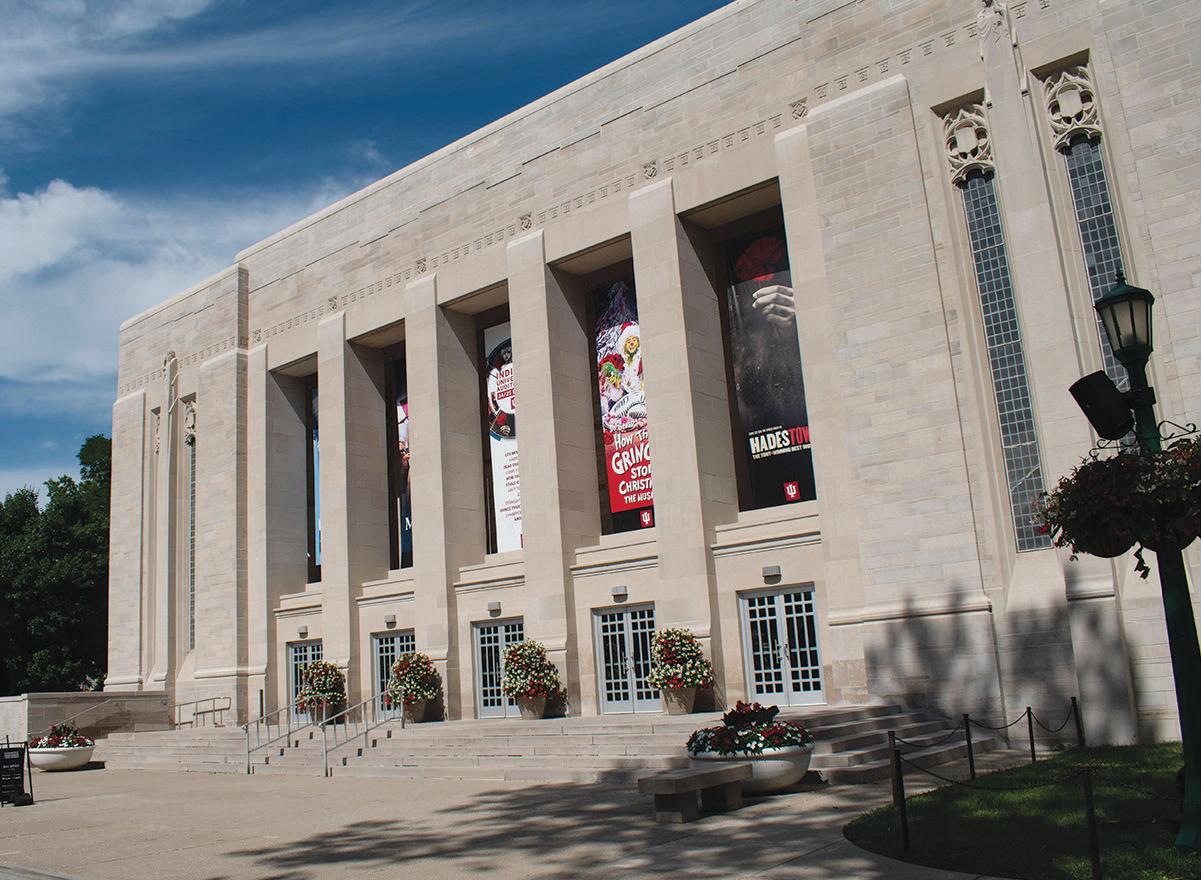
IU Auditorium announced its 2025-26 season in May with single tickets becoming available Aug. 18. With a busy season ahead, here are the shows playing at the auditorium this semester.
Colin Jost — Sept. 21, 2025
“Saturday Night Live”’s
Colin Jost will be coming to IU for one night only for an evening full of comedy and fun. Jost is known for being the co-anchor of “SNL’”s “Weekend Update,” the writer of the 2015 film “Staten Island Summer,” his 2020 memoir “A Very Punchable Face” and being the host of “Pop Culture Jeopardy!.” He performs Sept. 21, with tickets on sale now.
The Book of Mormon — Oct. 3-4, 2025
This Tony Award-winning musical follows an unlikely pair of missionaries as they spread the Good Word across the world. Performed in London, on Broadway and across North America, this musical has rightfully become an international sensation that is making its way to Bloomington this fall. If you’re looking for a good laugh, be sure to catch one of the three performances Oct. 3-4. Tickets are on sale now.
The Tragedy of Hamlet, Prince of Denmark — Oct. 14, 2025
This reimagination of William Shakespeare’s “Hamlet” aims to immerse the audience into the dark world of the iconic tragedy through dance. Led by choreographer Guillaume Côté and director Robert Lepage, this production is all about questioning what we think we know, heralded by an
artistic use of light, shadow and transparency, with the backdrop of minimalist scenography. The production will take place Oct. 14, with tickets on sale now.
Dennis James Hosts Halloween — Oct. 16, 2025
Dennis James, a celebrated cinema organist and Indiana University alumnus, is returning to IU for his annual Halloween performance, a tradition that has been going strong for over 50 years. The show will consist of an onstage performance of “Waxworks,” an old radio thriller that was originally a part of the radio series “Suspense.” The performance will be put on by actors, some of whom
are from IU’s Department of Theatre, Drama and Contemporary Dance. The show will be accompanied by the soundtrack, played by James on the auditorium’s 4,532pipe organ. The show will conclude with a screening of the 1924 German silent film, also titled “Waxworks,” in which James will play the backing soundtrack. Join in on this IU tradition Oct. 16, with tickets on sale now.
Disney’s “Moana” Live-toFilm Concert — Oct. 24, 2025
This screening of the beloved Disney film “Moana” will feature live performances from top Hollywood studio musicians along with
Polynesian rhythm masters and vocalists. If you’re a fan of “Moana,” this event is a great way to see the film like never before and immerse yourself into the world of the film. The live-to-film concert will take place Oct. 24, with tickets on sale now.
Tom Segura: Come Together — Oct. 26, 2025
Tom Segura is an actor, writer and comedian best known for his Netflix specials “Sledgehammer,” “Ball Hog,” “Disgraceful,” “Mostly Stories” and “Completely Normal.” Before his “Come Together” tour, Segura performed over 300 shows during his “I’m Coming Everywhere World Tour,” which
garnered great success. He is also known for his New York Times bestselling book “I’d Like to Play Alone, Please” and his hit podcasts “Your Mom’s House” and “2 Bears 1 Cave.” Segura will be performing for one night only Oct. 26. Tickets are on sale now.
Jacobs Live at the Movies — Nov. 7-8, 2025
Coming to the IU Auditorium for the first time, the annual Jacobs Live at the Movies will screen “The Wizard of Oz,” with its score being performed live by the IU Symphony Orchestra. This event will allow you to see this classic film like never before, brought to life by
the brilliant students from the Jacobs School of Music, conducted by Constantine Kitsopoulos. There will be performances Nov. 7-8, with tickets on sale now.
The Singing Hoosiers Present Holiday Chimes — Dec. 6, 2025 IU’s holiday tradition returns with two performances from the Grammy-nominated “Singing Hoosiers.” These performances will include holiday classics, contemporary songs as well as chorals, with guest appearances from students from the Jacobs School of Music. This show is the perfect way to ring in the holiday season with friends and family. There will be two performances Dec. 6, with tickets on sale now.
Mannheim Steamroller Christmas — Dec. 9, 2025 This Christmas spectacle, created by Grammy Award winner Chip Davis, features classic Mannheim Steamroller Christmas songs performed by 15 musicians playing over 20 instruments. The performance is brought to life by immersive and multimedia effects that are sure to get you into the Christmas spirit. Don’t miss their one and only performance Dec. 9. Tickets are on sale now. Straight No Chaser — Dec. 11, 2025 The classic holiday a cappella group, who got their start at IU 25 years ago,
Celebration of ‘Queen of Salsa’ Celia Cruz coming to IU
By Stella Klaus ssklaus@iu.edu
The Celia Cruz Centennial Celebration begins Sept. 3 and will include four days of events in honor of Cuban musician Celia Cruz. As her 100th birthday approaches Oct. 21, Solimar Otero, director of the Latino Studies Program, organized a multi-day celebration of her life and music. The celebration will kick off with a screening of “Fania All Stars in Africa” at the McCalla Media Gallery 4 p.m. Sept. 3. It will continue with events through Sept. 6 including live music performances, lectures and dancing. Though not quite Cruz’s 100th birthday, Otero decided to organize the celebration at the beginning of the semester to start the school year with an opportunity to bring people together and celebrate community.
The celebration spanning four days offers many different opportunities to learn about and experience music from Cruz, including a live performance at First Thursdays in the Fine Arts
Plaza from Professor Sergio Ospina-Romero, La Salsoteca, Professor Beatrice Capote and Paso a Paso. In addition to this, there will be live salsa music from La Salsoteca starting at 8 p.m. Sept. 5 and 7 p.m. Sept. 6 at the Blockhouse Bar.
There will also be opportunities to learn about Cruz through a workshop given by music scholars Frances Aparicio and Rosa Marquetti Torres from 11:30 a.m. to 1:30 p.m. Sept. 5. that requires registration. In addition to this they will be holding a lecture at 4 p.m. Sept. 5 in the Indiana Memorial Union Georgian room.
“Celia Cruz’s 100th birthday is a perfect reason to celebrate because her life represents one of giving joy, even when times are hard,” Otero said.
Cruz is a Cuban-American musician referred to for many decades as the “Queen of Salsa” for her unique and soulful voice and style. Originally wanting to become a literature teacher, Cruz found her talent for music after she won a talent show and decided to put her studies on hold
COLUMN: ‘Caught
By Joey Sills sillsj@iu.edu
Darren Aronofsky’s “Caught Stealing,” released Aug. 29, ventures into some disturbing territories. No person, nor animal, is safe from sudden, gut-wrenching acts of violence that, at times, legitimately made me wince. It might seem oxymoronic then to say that the film is deeply funny in just about the grimmest sense possible: as much as I cringed at the brutality, I laughed even more. What we have here is a crime caper, in the truest sense of the phrase. And this is a bit of a rarity in the modern Hollywood landscape, especially considering the fact “Caught Stealing” is a standalone feature. It’s no wonder, then, I was reminded of the New Hollywood movement of the 1960s and ‘70s: in fact, Aronofsky’s films wear these influences on their sleeves, directly ref-
to pursue music.
She first became popular in 1950 when she joined the popular orchestra La Sonora Matancera as a replacement for lead singer Myrta Silva. She was the first Black front person to join the group since its start 25 years prior.
After the Cuban revolution, Cruz left Cuba for Mexico and then the U.S., finally settling in New Jersey. Although Cruz was slow to success, she solidified herself as a figure in the salsa scene in the ‘70s and began to collaborate with notable artists, including Johnny Pacheco and Willie Colón.
“Celia’s long career was one of collaboration with musicians from all over the world,” Otero said. “She stands out because she was both so generous musically but also always unmistakenly herself through her original voice, dress and style.”
Growing up with a Cuban mother and a Puerto Rican father, Otero is no stranger to salsa music and would often listen and dance to it while doing her chores. It now feels like an homage to her childhood, and she is interested in
the traditions that continue through live music and performances.
“La Vida es un Carnaval” (Life is a carnival) is one of Cruz’s most famous songs and to Otero represents the understanding that life is short and we should spread love while we can.
“It’s important to cele-
brate Celia Cruz and her music because she inspired people to come together in community through listening and dancing,” Otero said. “We feel less alone and more connected through her voice.”
The Celia Cruz Centennial Celebration is a chance to learn about music, culture and history in an entertaining way through singing and dancing.
“Her important work as a performer and professional makes her a significant historical figure to revisit,” Otero said. “Her music brings people together from many different backgrounds and cultures to celebrate being alive.”
Stealing’ is an entertaining, original comedy thriller
erencing films of the era — Martin Scorsese’s 1985 “After Hours” is particularly singled out — and emulating their visual and thematic styles. What makes “Caught Stealing” more than a simple imitation of this filmmaking era, however, is the fact it understands the single most important quality of that era: it is superbly original and utterly bursting with personality. And it is, as a result, wildly entertaining.
The premise is decidedly simple. Hank (Austin Butler), an ex-high school baseball player and current burntout bartender, is haunted by his past and seeks refuge at the bottom of a bottle. His neighbor, Russ (Matt Smith), has to fly home to London to visit his dying father and entrusts Hank with his cat, Bud. One day, as Hank goes to grab food for Bud from Russ’ apartment, he runs into two Russian mobsters who beat him so badly he loses a
kidney in the hospital. From here on out, Hank is a part of whatever it is Russ was involved in, and thus he must figure out how to uninvolve himself before the people he cares about are hurt. At first glance, this doesn’t seem like the plot of your typical Aronofsky feature: he’s a director primarily interested in the psychological, probing the mind of both the characters he creates and, by extension, the audience as well. It’s certainly a massive departure from his last film, “The Whale.” But at the same time, the fascination with society’s underbelly is clear from the get-go here, and at its core “Caught Stealing” is a cerebral narrative deeply examining Hank’s psyche in a way that doesn’t feel too far removed from one of Aronofsky’s earlier films, “The Wrestler.” It helps then that Aronofsky tapped Butler, an immensely capable performer,
to be his lead. Butler’s been on a bit of a roll recently, at least ever since his appearance in Quentin Tarantino’s “Once Upon a Time in Hollywood” in 2019, and it’s clear he’s something of a generational talent. His performance here is subtler than, say, Elvis Presley or Feyd-Rautha Harkonnen, but it’s compelling precisely because of its mutedness. Hank’s eyes do a lot of the heavy lifting here; they tell us the story when his voice either can’t or won’t. Even by the end of the film, he’s a bit of a mystery: the audience always feels as if there’s something he’s not mentioning, something he’s hiding that would put the whole narrative into perspective. Thankfully, Charlie Huston’s script, based on his 2004 novel of the same name, almost never takes the easy way out. There are clichés here, of course, and twists that aren’t quite as shocking
or impressive as one might hope for, but I think what makes the writing so efficacious is its willingness to venture into (relatively) quiet asides. Each character has a developed personality and a moment, no matter how briefly, where they alone shine — a surprisingly rare quality for a standalone film like it to have, especially one under two hours.
Nell Minnow, in her review for RogerEbert.com, singles out another aspect of the film that makes it particularly personable. She points to the fact that “Caught Stealing,” which takes place in 1998, works with a communication gap that couldn’t have existed should it have occurred in the time of the smartphone. And this is, if not immediately noticeable, an important part of the movie’s pacing: every person whom Hank wants to talk to, needs to talk to, isn’t instantly available. If he has to get
ahold of them, he either has to leave a message at a pay phone or, more often, physically travel to their location. It puts everything under an ever-shrinking time limit, only intensifying what is already a tense situation. While its box office returns thus far have been less than ideal, “Caught Stealing” represents the exact sort of mid-budget, freestanding film that we absolutely need more of. What would have once been a standard, runof-the-mill release now exists as a bit of an anomaly, something to take particular note of. And while it almost certainly will not land in very many “best films of the year” lists, it’s a solid, effective genre-outing that, with its impressive editing, cinematography and sound design, deserves a trip to the theater. If you were thinking of just checking this out once it hits streaming, I’d implore you to reconsider.
PHOTO BY TRIBUNE NEWS SERVICE
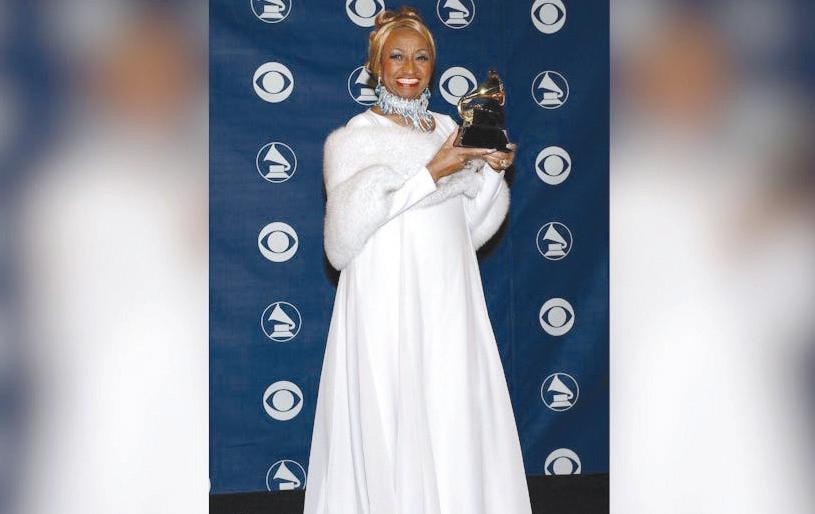
Celia Cruz poses with her Grammy during the 45th Annual Grammy Awards at Madison Square Garden in New York City, on February 23, 2003. Cruz’s unique style and talent for improvising lyrics led many to call her the “Queen of Salsa” as her fame grew.
A conversation with John K. Kruschke,
By Sydney Weber syaweber@iu.edu
John Kruschke has done a lot of writing in academia — journal articles and a textbook on statistical analysis — but in retirement, he’s taken up poetry. Kruschke, who retired from the Department of Psychological and Brain Sciences in 2022, has published poems in SAGE Magazine and Tipton Poetry Journal.
He read some of his poems Aug. 31 at the Writers Guild at Bloomington’s Last Sunday Poetry & Open Mic. The Indiana Daily Student spoke with Kruschke ahead of the reading at Morgenstern Books. This conversation has been lightly edited for clarity and concision.
IDS: How did you get involved with “Last Sunday” poetry reading?
Kruschke: Right. So, I guess I could start by saying I retired three years ago, and I had many, many projects in mind. Poetry writing was not among them, but through a series of sort of happy accidents, I got into some writing and some poetry and I figured, ‘Gee, I’d like to know what’s going on in the community in poetry’ and the Writers Guild at Bloomington has this monthly meeting. They have another, they call it ‘2nd Thursday Spoken Word’ series.
So, I just thought the local writers’ guild would be a wonderful way to see what people are doing in poetry and to see if I could fit in. And so, I just started attending their meetings and found it very encouraging.
IDS: What has the experience of reading at some of those open mic nights been like?
Kruschke: Oh, it’s a lot of fun. It is a very welcoming community. And so, you have a huge variety of people, reading a huge variety of poetry coming from very different motivations. Some can be very personal and emotional. Some will be political, some will be inspirational,

some will be humorous. And so, I think once you’ve been to a few and you see the variety of people at open mic, then you realize, ‘You know, I guess I could do this too. So, I’ll get up there and try it myself.’
IDS: Could you tell me a little bit about your work? Are there particular themes or styles that come up a lot?
Kruschke: There are so many different kinds of poetry, right? You know, as many kinds as there are poets, really. You know, you could say ‘Gee, I’m a musician, but there are so many genres of music, you know, from pop to death metal to opera to
jazz and, and country. And there’s that same kind of spectrum in poetry. So, you can like some poems and find other poems (that) just don’t really resonate at all, but that’s perfectly okay. And that variety is really nice.
I tend to have very carefully crafted poems, and I go through endless revisions before I’m finally settled at all. So, I tend to like some kinds of formal elements in my own poems. But they’re not all strictly formal. Some are free verse. But I do like structure and craft. And then in terms of content, my own poems tend toward, sometimes the spiritual, the expressions of gratefulness or awe, as opposed to expres-
sions of grief or trauma. But many other poets do find an outlet in their poetry for grief and trauma, as well as many other topics. So, I really do just want to emphasize that huge variety in poetry that one encounters.
IDS: You said that poetry writing began after your retirement, tell me more.
Kruschke: In your email, you suggested the question ‘Was there sort of any overlap between my professional interests and the writing of poetry?’
And for me the answer is yes, very much, but at an abstract level. What I loved most about being a professor was the creative freedom.
And that’s creative freedom in research and in teaching.
In fact, in my final semester at IU, when, you know, most faculty would just kind of teach the same old course and coast on through, I created two new courses in my final semester, just because I love putting together new topics and structuring those topics in ways to scaffold the concepts in interesting, creative ways. And it’s that same drive for creativity, a creative outlet, that really drives the poetry as well.
IDS: What semester and year did you retire?
Kruschke: Let’s see. I retired in June of 2022. IDS: Okay.
Kruschke: I really appreciated being a professor exactly for the reason I described. You know, I love the creative freedom, but there are so many other projects I wanted to pursue. I could give you a few other ties to my work as a professor. One of the things I’ve done is an advanced textbook in statistics. Even though I was in Psychological and Brain Sciences, I wrote a book in Bayesian statistics, and in the first two editions at the beginning of each chapter I included a kind of humorous poem to introduce the chapter. So, there were like — in the second edition — like 25 poems for the 25 chapters, but I thought, ‘Gee, if I write another chapter, I can write another poem.’ Extra motivation. Yeah. Otherwise, though, there was not a lot of poetry writing before I retired.
IDS: What pieces are you planning to read at this Sunday’s poetry reading?
Kruschke: I’ve put together a list of nine poems because we’re allowed 20-25 minutes each. Each featured speaker is given that much time. And so, I’ve tested (it) all out; these nine poems should take just the right amount of time. I guess the poem I would call my favorite so far that I’ve written is called ‘Honor Among Sleeves.’ It’s available on my website.
IDS: How did you go about selecting which poems you were going to read aloud?
Kruschke: I think if you’re going to take up somebody else’s time, you know, if you’re going to burn a few minutes of somebody else’s life with your poem, I would hope the poem would be at least somewhat entertaining or engaging or thought provoking. You know, something that makes using up their few minutes not a total waste. So, I tried to pick out poems that a listener or a reader would find at least engaging or entertaining or thought provoking.



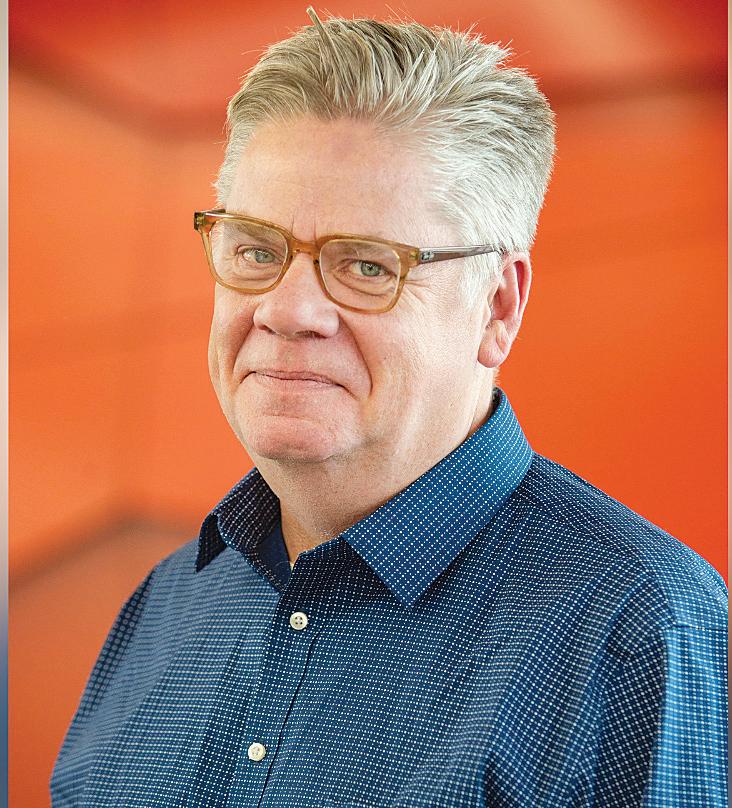
COURTESY PHOTO
John Kruschke is pictured. Kruschke, who retired from IU’s Department of Psychological and Brain Sciences in 2022, has published poems in SAGE Magazine and Tipton Poetry Journal.
Offense hampered by poor red zone execution
By Dalton James jamesdm@iu.edu | @daltonmjames
It had been 273 days since Indiana football last took the field inside Memorial Stadium in Bloomington.
On a picturesque
76-degree sunny Aug.
30 afternoon, the No. 20 Hoosiers returned to the gridiron in front of their home fans — 47,109 of them.
Hoosier the Bison flew into the stadium via parachute. Fans waved white towels emblazoned with “NEVER DAUNTED” and “FAST. PHYSICAL. RELENTLESS.” on them. AC/
DC’s “Thunderstruck” blared throughout the stadium.
But with all the hype behind the Hoosiers, head coach Curt Cignetti wasn’t pleased with his squad’s performance even though it defeated Old Dominion University 27-14.
“Always good to get a win,” Cignetti said postgame. “Wins are hard to get. 1-0. But I guarantee you, everybody in this organization realizes we didn’t play as well as we wanted to. That’s just a flatout fact.”
Indiana began the contest by allowing Old Dominion redshirt sophomore quarterback Colton Joseph to score a 75-yard rushing touchdown. Despite allowing Joseph to notch a 78-yard touchdown in the fourth quarter, the Hoosiers’ defense didn’t allow the Monarchs to take a snap in Indiana territory. However, it was the Hoosiers’ offense that missed numerous opportunities.
During Indiana’s first offensive series, it moved the ball at will. It took the Hoosiers just seven plays to reach the Monarchs’ 1-yard line. But from there, redshirt senior running back Roman Hemby ran the ball twice, sixthyear senior running back Kaelon Black once, while redshirt junior quarterback Fernando Mendoza tossed an incomplete pass to turn the ball over on downs.
The Hoosiers were again driving down the field their second time with the ball. However, redshirt junior running back Lee Beebe Jr. fumbled as the Cream and
Crimson were entering the red zone.
Then, on its third series — after senior Jonathan Brady electrified the crowd with a 91-yard punt return to tie the game at 7 — Indiana again marched its way inside the Old Dominion 10-yard line. And again, the Hoosiers stalled. Hemby ran the ball three times and reached the 1-yard line before losing three yards on third down. This time, unlike the first drive, Indiana settled for a Nicolas Radicic field goal to take a 3-point lead. Mendoza, who was recently projected by CBS Sports to be the No. 1 overall pick in the 2026 NFL Draft, shouldered the responsibility for the Hoosiers’ inability to convert deep in Old Dominion territory.
“I would say that the slow start, I take accountability for that,” Mendoza said. “I think our offensive line played great, I think our receivers
got open, I thought our running backs played great and I thought our tight ends blocked and caught the ball well.”
However, Cignetti wondered if Indiana’s red zone plan just wasn’t a very good one.
The Hoosiers’ coaching staff review the low red zone and goal line plan on Thursdays, Cignetti said. He was “really concerned” about the plan in the lead-up to kickoff.
The second-year Indiana head coach said there weren’t many goal-line plays on film because of the explosive touchdowns the Hoosiers grew accustomed to scoring in their historic 2024 season.
On Aug. 30, Indiana certainly had its opportunities to find the endzone with similar explosive plays.
Mendoza tossed nearly a perfect pass to redshirt
junior wide receiver Omar Cooper Jr. just over four and a half minutes before halftime. With the endzone surely in his sights, Cooper Jr. bobbled and eventually dropped the ball.
Cignetti said he thought his squad had the Monarchs in a position where they could’ve “stuck a fork in them,” but failed to capitalize.
Then, early in the fourth quarter, freshman wide receiver LeBron Bond found open space past his defender down the right sideline. Mendoza tried to deliver another near perfect pass like he did to Cooper Jr., but the signal caller overthrew Bond.
Still, Mendoza finished his Indiana debut 18 for 31 for 193 yards passing. He also ran the ball six times for 34 yards and a touchdown.
But for the Miami native, squandering opportunities in the red zone isn’t playing
up to the Hoosiers’ standard, Mendoza said.
“We got to finish, and I think that’s just an accountability part for myself, and I think the whole offense, if they were all standing right here, would take accountability with that,” Mendoza said. “I mean, that’s unacceptable because we had fantastic drives where we went right down to the 1, 2-yard line. We got to punch those in.”
Although Hemby had eight carries inside the Monarchs’ 10-yard line and failed to find the endzone each time, he still finished as the Hoosiers’ lead back. The Maryland transfer had 23 carries for 110 yards.
Hemby said “execution errors” were the reasoning for Indiana faltering deep in Old Dominion territory.
“We want to be better as an offense, and the first game is always a little tricky,” Hemby said, “but we’ll get
back to the drawing board, watch some film and get it cleaned up.”
Excluding Indiana’s final drive of the game in which they ran out the clock, the Hoosiers made six trips to the red zone: two ended in touchdowns, two in field goals and two in turnovers on downs.
Even with the Hoosiers’ struggles and frustration, Aug. 30 resembles the 2024 season opener. Indiana defeated Florida International University to begin Cignetti’s first season, but there were several mistakes it needed to clean up. It did. Now, the Hoosiers find themselves in a familiar spot. And again, they have a quarterback under center who, although he has just played one game as a Hoosier, has the makings of one that can lead Indiana to another successful season.
Although Mendoza connected with Brady just twice Aug. 30, the latter has noticed a difference in the former from their season together at the University of California, Berkeley in 2024.
“He looks so much more happy here, like even just being with his brother (redshirt freshman quarterback Alberto Mendoza),” Brady said. “I know when I took my visit, I could just tell the energy shift, you know what I’m saying. His leadership has changed. He’s taken the next level to just Fernando Mendoza, and you can tell, you can see that.” The Hoosiers’ next chance to display their improvement comes at noon Sept. 6, when they welcome Kennesaw State University to town. And for them to do so, Mendoza said he needs to get the ball to his receivers in better timing as they are getting out of their breaks at the top of their routes. “I think I got to be better,” Mendoza said, “so we can work more as a well-oiled machine.”
If Mendoza can do so, perhaps the Hoosier faithful, who were itching to see their 2025 squad on the field, will have even more reason to be energetic before and throughout contests.
No. 7 Indiana dominate first half, beat Oregon State
By Mateo Fuentes-Rohwer
matfuent@iu.edu | @mateo_frohwer
No. 7 Indiana men’s soccer had a game plan to follow — and the execution was nearly perfect.
The Hoosiers faced one of their toughest opponents yet with No. 14 Oregon State University coming to Bloomington for the second and final game of the adidas/ IU Credit Union Classic. Unlike some of its other games this season, Indiana had tape to run through.
What head coach Todd Yeagley and his staff found was the Beavers were a possession team — a side that bullied their opponents.
Indiana didn’t plan on doing that.
The Hoosiers completely flipped the script, dominating the first half and securing a 2-0 win Aug. 31 at Bill Armstrong Stadium in Bloomington.
“I think we have a little more, but that’s really good,” Yeagley said postgame about the first 45 minutes. “So, what I’ve seen of this team in training, and, you know, whether it’s exhibition — that’s the ‘A’ range that we want to be at.” For a side that had yet to lead in the first half this season, Indiana didn’t show it. Matches against No. 6 Clemson University, the University of San Francisco and the University of Wisconsin-Green Bay all featured first-half deficits.
But Aug. 31, the Hoosiers were frenetic from the opening whistle, pressing the possession-oriented Beavers and causing havoc.
The chances immediately arrived, with junior forward Collins Oduro winning a ball from Oregon State’s back line in the first minute and producing a cross that had to
be cleared for a corner kick.
Barely over 10 minutes later, senior forward Palmer Ault chested a ball from outside the box and rifled the halfvolley just over the crossbar.
All the while, the Hoosiers limited the Beavers’ time with the ball by maximizing their own possession. With that came chances, which kept pressure on Oregon State, although Indiana failed to convert any of them from open play.
“Really didn’t give them a whole lot,” Ault said. “And it was only 1-0, we could have had a few more to go into the half, but ultimately, a great performance.”
The elusive goal eventually came in the 17th minute. Ault, who already had two goals and an assist entering Aug. 31, tucked away a penalty for the Hoosiers following a Beavers hand ball, marking the first time Indiana had led in the first half this season.
With the one-goal advantage, Indiana didn’t stay complacent — and the opportunities kept coming.
A sequence of three exquisite chances presented an opportunity for the Hoosiers to double their lead, but the score stayed 1-0.
Sophomore forward Michael Nesci, fresh off his first goal of the season against Green Bay on Aug. 28, unleashed a rocket from outside the box with his non-dominant left foot.
Sophomore goalkeeper John Nicolson ultimately parried the chance away, but Indiana stayed on the attack with another opportunity through junior left back Alex Barger just 26 seconds later, with his deflected effort nearly finding the bottom corner of the net. The ensuing corner
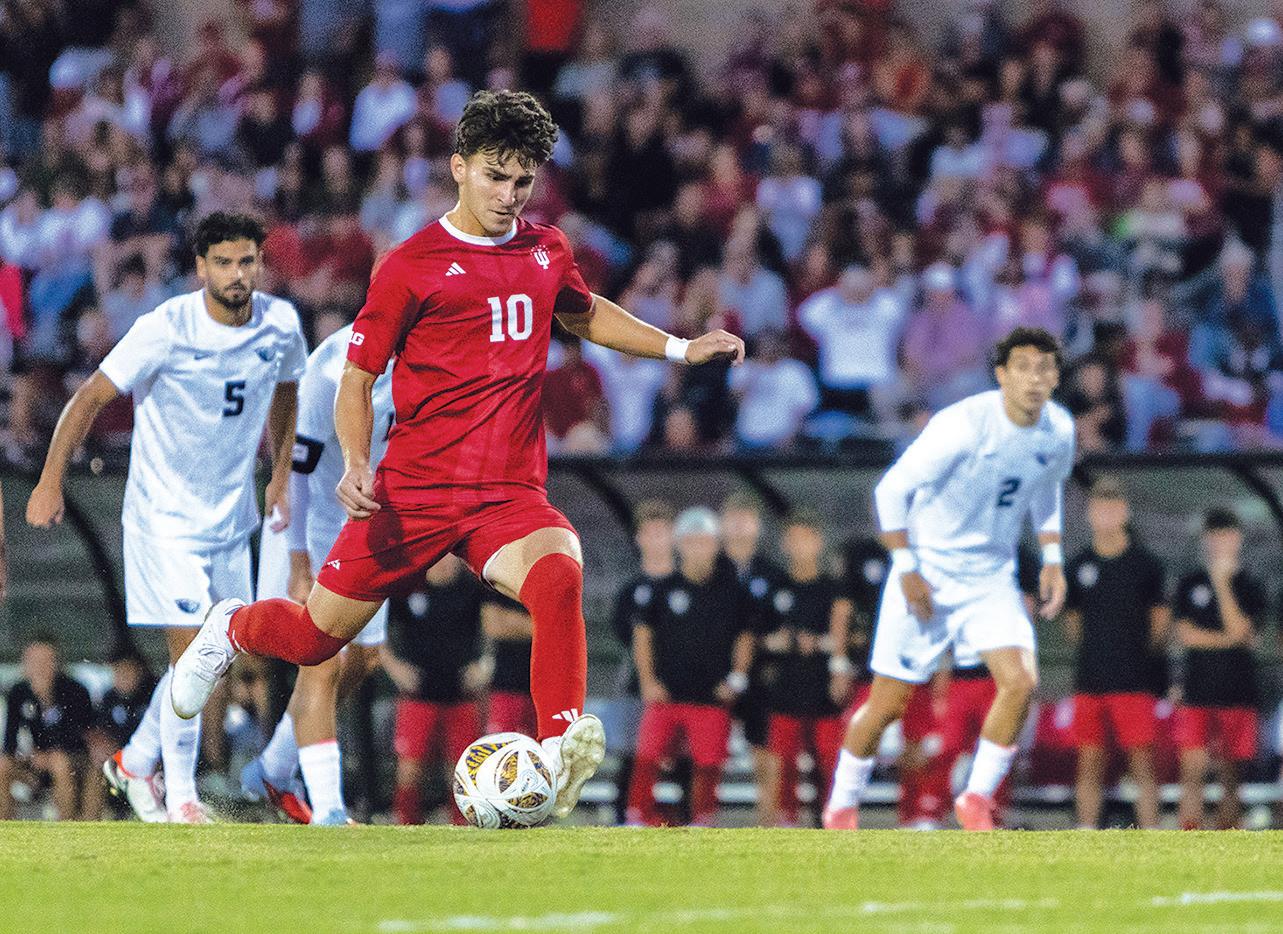
produced another chance for Indiana, as Barger’s looping ball found Easton Bogard’s head. The sophomore forward attempted to play a header back into the middle of the box, but Nicolson batted the ball away, and redshirt junior defender Breckin Minzey’s shot on the rebound sailed over the bar.
Missed chances might have cost Indiana in any other game. But stout defending and purposeful possession kept the Beavers at an arm’s length from the Hoosiers for most of the match, with the Cream and Crimson entering the halftime break up 1-0 while
holding a 12-1 advantage in shots.
“We did everything; they couldn’t do a thing,” Yeagley said. “I thought it could have been multiple goals in that first half.”
The next goal struck only 54 seconds into the second half, as Ault tucked home a volley from a Nesci cross, giving Indiana a two-goal lead.
From that point on, the momentum flipped. Indiana stayed firm, not allowing a goal for the remainder of the match, but Oregon State led 16-1 in shots, forcing four key saves from graduate student goalkeeper Holden Brown.
Indiana’s loss of control wasn’t due to poor play, as Yeagley acknowledged, but rather an uptick in Oregon State’s quality — a side Yeagley believes could make a deep run in the tournament.
“We were kind of in between, and that’s where you don’t want to be against a team that has a couple of special guys,” Yeagley said. “So, we kind of started to pull the line back a little, but then we went into a late game shape just to kind of kill space, and you’re gonna absorb a little bit.” In the end, Indiana absorbed all of Oregon
State’s pressure, securing the dominant 2-0 win over a top 15 opponent. With two more non-conference matches left before Big Ten play, including a road bout against the University of Notre Dame, the Hoosiers sit in a good spot at 3-0-1. Yeagley is pleased with his side’s performances so far, despite the first 20 minutes against San Francisco which he found to be “average,” and the end goal of trophies and success is still very much in sight. But the players also understand they aren’t there yet — and more work still needs to be done.
JIMMY RUSH | IDS Redshirt junior quarterback Fernando Mendoza rushes past an opposing player during a game against Old Dominion University on Aug. 30, 2025, at Memorial Stadium in Bloomington. Mendoza rushed
LAUREN MCKINNEY | IDS
Indiana senior forward Palmer Ault dribbles the ball against Oregon State University on Aug. 31, 2025, at Bill Armstrong Stadium in Bloomington. The Hoosiers defeated the Beavers 2-0.
Indiana grades win over Old Dominion in opener
Richards’ Report Card: See how each Hoosier position group fared against the Monarchs
By Quinn Richards qmrichar@iu.edu | @quinn_richa
For every game this season I’ll be diving into the tape and grading Indiana football’s position groups. While the Hoosiers took home a 27-14 win over Old Dominion University on Aug. 30 at Memorial Stadium, a wide array of performances yielded some vastly different overall grades. See how each of Indiana’s position groups scored on this inaugural edition of Richards’ Report Card.
Quarterbacks
Grade: C-
Explanation: Redshirt junior quarterback Fernando Mendoza struggled to find a consistent rhythm throughout his 18-of-31 performance that yielded 193 passing yards. The University of California, Berkeley, transfer wasn’t particularly accurate and made a few ill-advised throws into heavy traffic. Senior wide receiver Elijah Sarratt didn’t have a target until the second half — that can’t happen. The Hoosiers’ leading receiver in 2024 and Associated Press All-Big Ten second team member is a key weapon that needs opportunities to contribute. Still, Mendoza didn’t turn the ball over and managed an offense that compiled over 500 total yards.
Running Backs Grade: A-
Explanation: The Hoosiers’ rushing attack was the highlight of their offense against
the Monarchs. A threeman rotation — headed by Maryland transfer redshirt senior Roman Hemby — combined for 282 rushing yards on 51 carries. Hemby and company were explosive, routinely reaching the second level for big gains. If not for an early fumble by redshirt junior Lee Beebe Jr. and some red zone shortcomings — which can partly be attributed to poor play-calling — this performance would’ve been an A+.
Receivers
Grade: B-
Explanation: It was a slow day for the Hoosiers’ receivers. Redshirt sixthyear senior E.J. Williams Jr. led the way with five receptions for 45 yards and Sarratt followed close behind with three receptions for 44 yards — all of which came in a heavily targeted second half. Plenty of Mendoza’s passes were behind receivers, sailed above their heads or simply to no one. One of the few deep passes that did hit the mark — a 50-yard throw to a wide-open redshirt junior Omar Cooper Jr. on a streak route — was dropped. That drop alone is enough to bump this grade down one letter.
Offensive Line
Grade: A-
Explanation: Indiana’s offensive line was simply dominant. Pass protection was phenomenal, giving Mendoza plenty of time to sit back in the pocket and work through
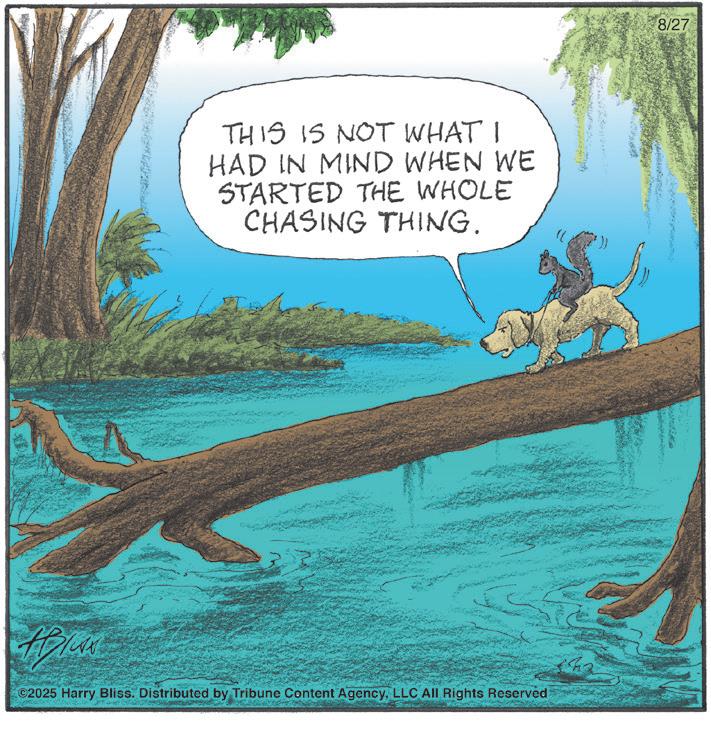
his progressions. The Hoosiers’ quarterback was sacked only once after scrambling out of a pocket that was clean for over three seconds. For the most part, the run blocking was just as commanding. The interior offensive line, anchored by redshirt senior center Pat Coogan, created massive gaps for the Hoosier backs to attack and physically outmatched Old Dominion’s front seven. The only reason this group won’t be getting an A+ is the red zone run game. Play calling aside, Indiana’s talent up front should be enough to overpower a Sun Belt Conference opponent at the goal line. At select points Aug. 30, it wasn’t.
Defensive Line
Grade: C-
Explanation: To give an analogy, this is like getting every multiplechoice question correct but completely failing the short answer. Indiana’s defensive line played a solid game, but it was also the main reason for all of Old Dominion’s points. Redshirt senior defensive tackle Hosea Wheeler was fooled on the first play from scrimmage resulting in a 75-yard touchdown from Monarchs’ redshirt sophomore quarterback Colton Joseph. A similar mistake was made by senior defensive end Kellan Wyatt in the fourth quarter as Joseph gave an encore with a 78-yard scramble to the end zone. Those are losing plays, and I bumped them a letter grade for each. Lastly,
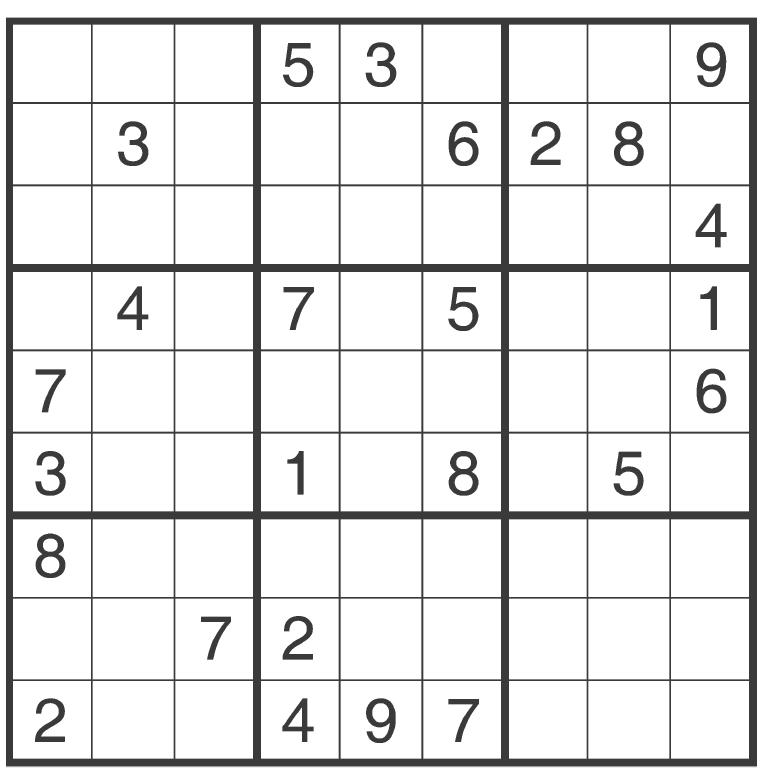
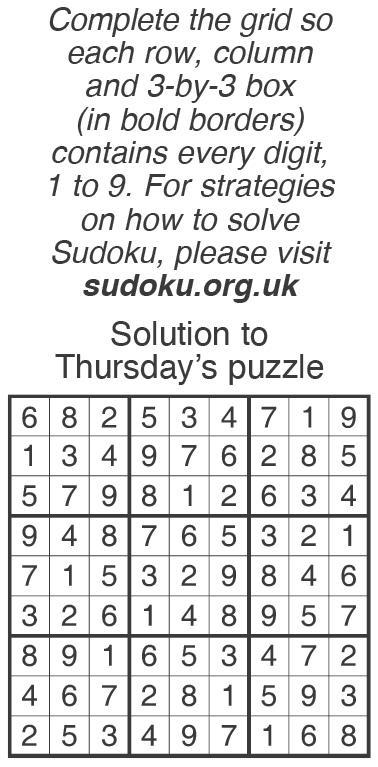
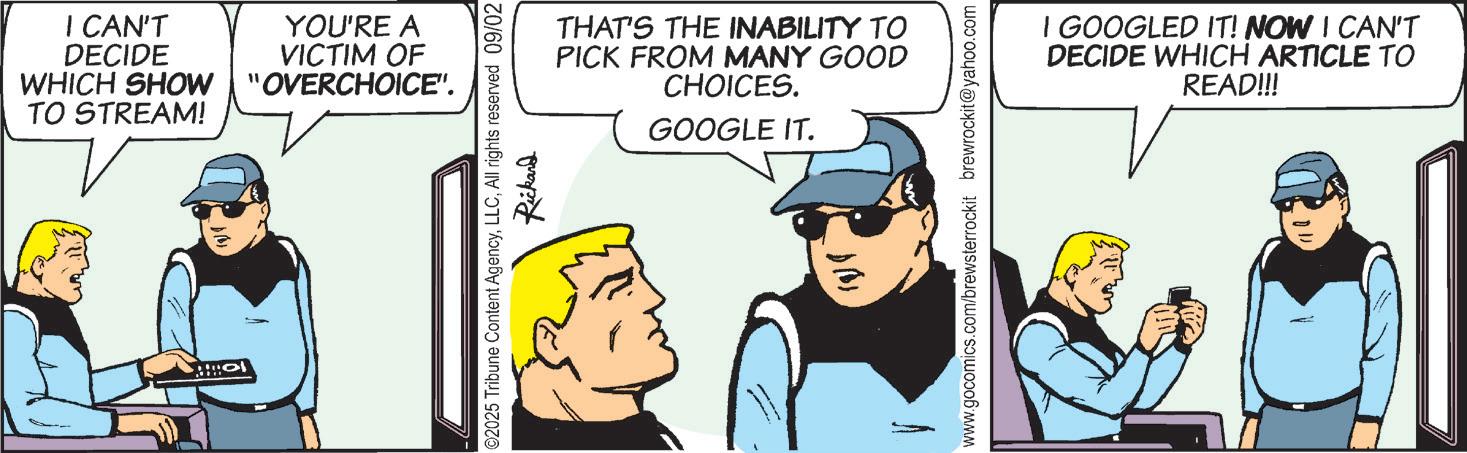
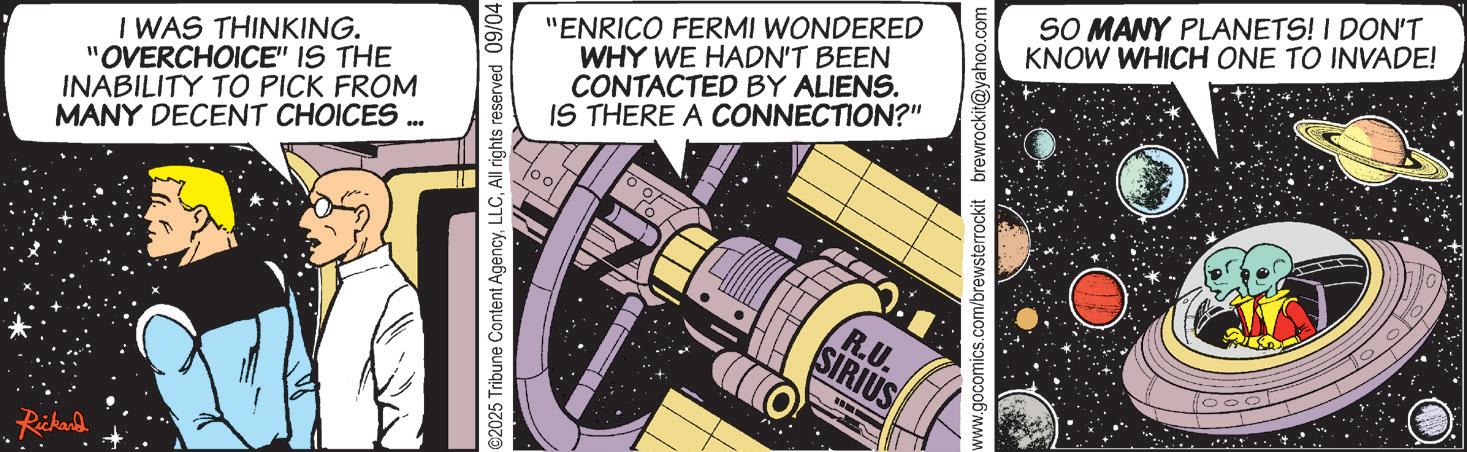
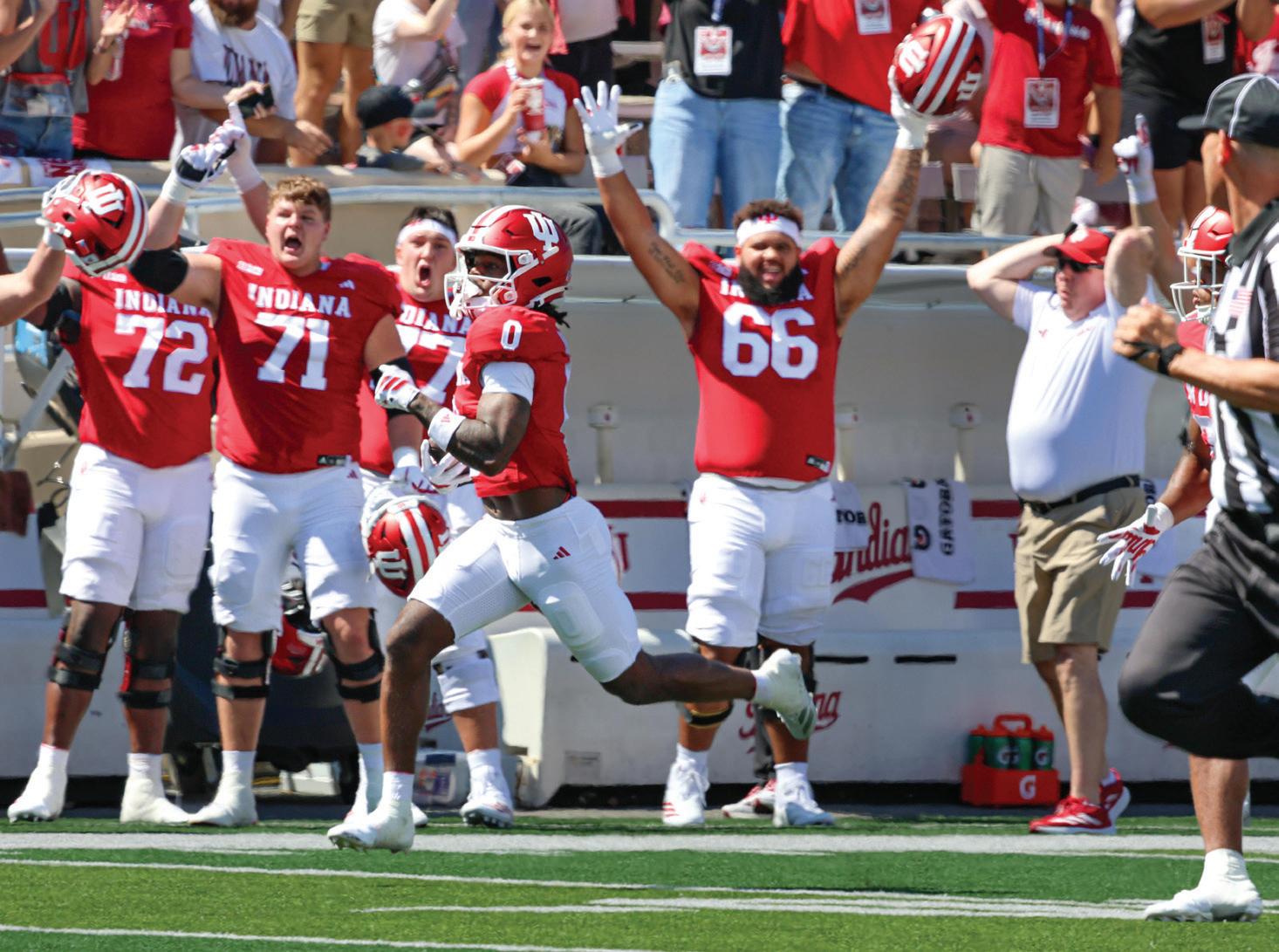
the defensive line managed just one sack and not a single quarterback hurry, albeit against a run-heavy Old Dominion offense.
Linebackers
Grade: C+
Explanation: The linebackers are also going to be punished for Joseph’s chunk runs. Sophomore Rolijah Hardy showed a lapse in discipline on the game’s initial play, clearing the lane for the game’s first score. Still, Hardy and his veteran counterpart senior Aiden Fisher combined for nine total tackles and three quarterback hurries while locking down their assignments in the pass game.
Secondary Grade: A
Explanation: Practically perfect. Indiana’s secondary held the Monarchs’ offense to just 96 yards through the air and intercepted Joseph on three different occasions. Redshirt sixth-year senior free safety Louis Moore led Indiana with seven total tackles. From start to finish the Hoosiers’ defensive backs blanketed Old Dominion’s receiving core and made winning plays. The only gripe preventing this grade from being an A+ is nitpicky, but the secondary needs to be the final line of defense against breakout runs — even against a player with Joseph’s speed.
Special Teams
Grade: A-
Explanation: Who would’ve guessed Indiana’s first run would come from its special teams unit? Senior wide receiver Jonathan Brady’s 91-yard punt return score was the Hoosiers’ longest punt return since 2004 and served as a turning point in Indiana’s seasonopening win. The Hoosiers proceeded to score 27 straight points. Other than kickoff specialist redshirt senior Brendan Franke’s miss on a 52-yard field goal in the closing seconds of the first half, Indiana’s special teams excelled in each of its duties.
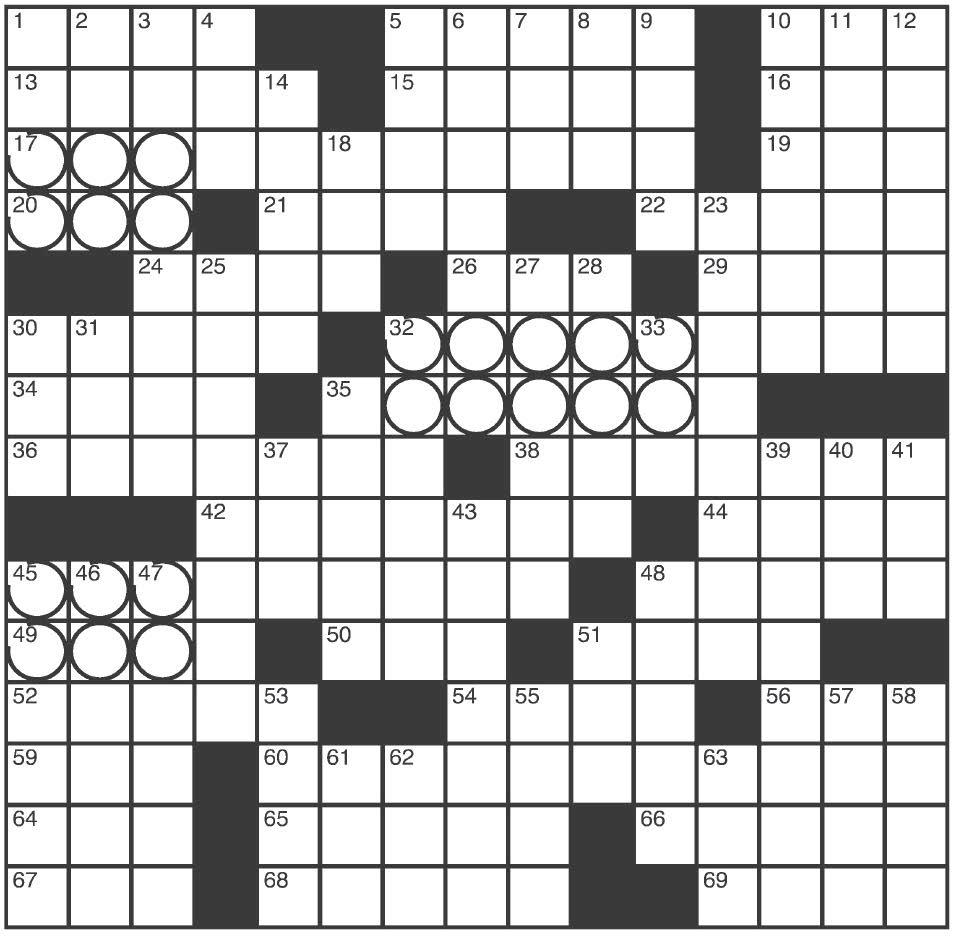
BLISS
SOPHIA KAPLAN | IDS
Senior wide receiver Jonathan Brady runs down the field against Old Dominion University on Aug. 30, 2025, at Memorial Stadium in Bloomington. The Hoosiers defeated the Monarchs 27-14.
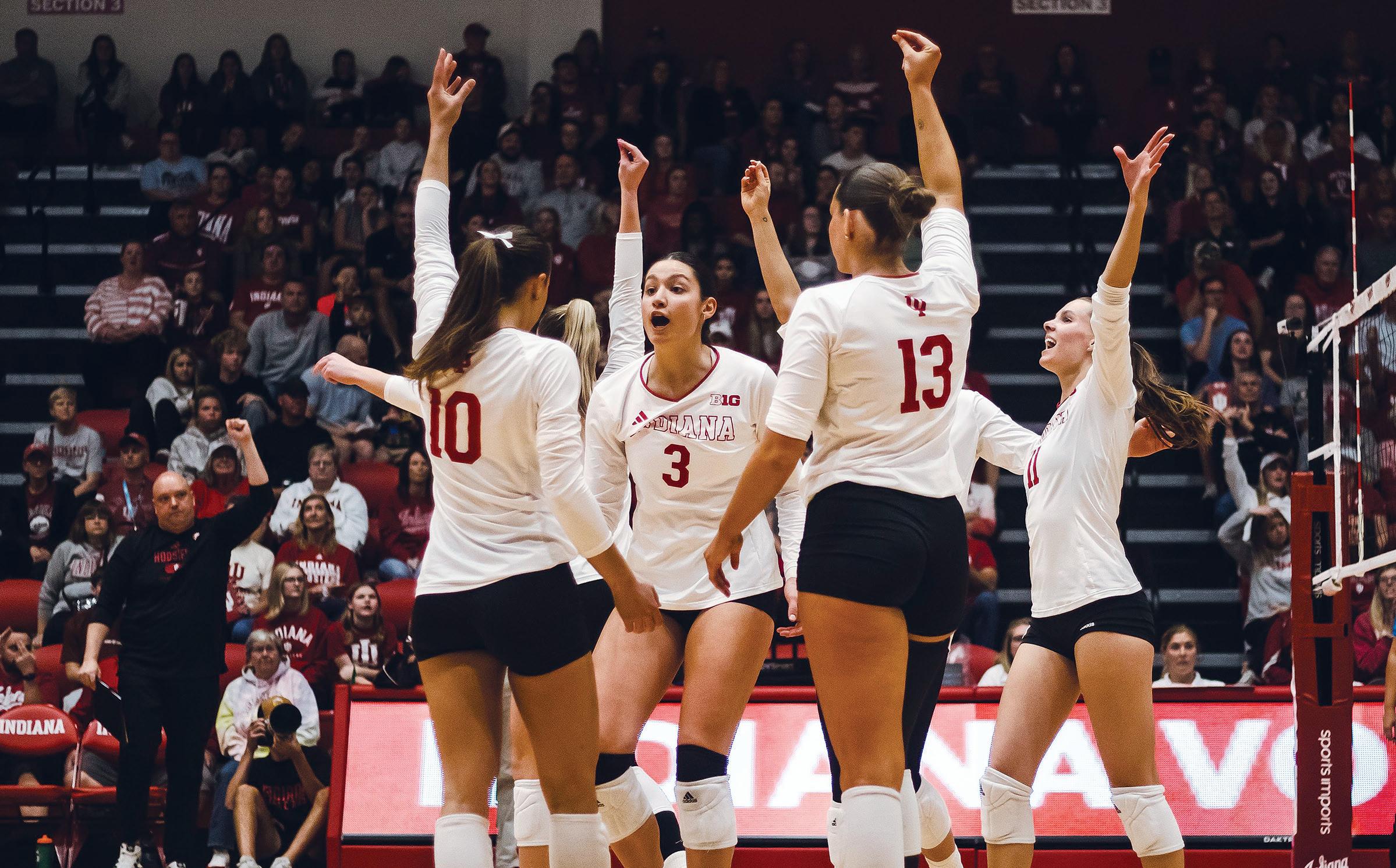
Indiana claims 2nd victory of its season, sweeps VCU
By Savannah Slone srslone@iu.edu | @savrivers06
After successfully completing a reverse sweep against the University of Miami on Aug. 29 to claim its first win of the season, Indiana volleyball extended its winning streak the next day against Virginia Commonwealth University.
The Hoosiers carried momentum from Aug. 29 match into their contest with the Rams and flew past VCU. In just its second match of the season, and its second match of the Canes Classic,
Indiana swept VCU 3-0 at the Knight Sports Complex in Coral Gables, Florida. Freshman outside hitter Jaidyn Jager recorded match highs with 11 kills and 15 points. Senior opposite hitter Avry Tatum and senior outside hitter Candela Alonso-Corcelles were close behind with 10 and nine kills, respectively. Freshman setter Teodora Kričkovi recorded a game-high 30 assists.
Defensively, freshman libero Audrey Jackson tallied eight digs, while Kričkovi and Alonso-Corcelles
had seven and six digs, respectively. Freshman middle blocker Victoria Gray had a game-high six blocks, and Jager recorded five blocks. The Ram’s took the first points of the first set with a kill from senior outside hitter Alicja Jaryszek, which was followed by a service ace from graduate student defensive specialist/libero Haruka Sugimoto. The Hoosiers then went on a 5-0 run that included three straight kills from AlonsoCorcelles. But Indiana and VCU
continued to keep the score close, until Indiana pulled away, winning 5 of the last 7 points. The Hoosiers won the game 25-20 on the back of a strong defensive performance that included six blocks.
To start the second set, the Cream and Crimson found themselves behind 1-4 after a service ace and two kills from VCU and an error from Jager.
Indiana slowly started to dig into VCU’s lead. A kill by senior middle blocker Madi Sell tied the game at 11, and a kill from Tatum — assisted by

Kričković — put the Hoosiers ahead 12-11.
And once it had the lead, Indiana did not let it go. The Hoosiers finished the second set 25-20 and entered the third set looking to sweep the Rams in their second match of the season. At the beginning of the third set, Indiana and VCU remained close. But the Hoosiers’ offense began to heat up with a kill from Jager, which gave Indiana a 10-7 advantage. The Rams continued to fight back, eventually taking a 21-20 lead after a service ace from
Invitational. The Hoosiers will take on Southeast Missouri State University at 7 p.m. Sept. 4. Then, they will face Nothern Kentucky University at 10 a.m. and Western Michigan University at 7 p.m. Sept. 5. All games will be played in Wilkinson Hall and will be streamed on Big Ten+.
GISELLE MARSTELLER | IDS
The Indiana volleyball team celebrates after scoring off a University of Southern California net touch on Nov. 10, 2024, at Wilkinson Hall in Bloomington. The Hoosiers swept Virginia Commonwealth University on Aug. 30.






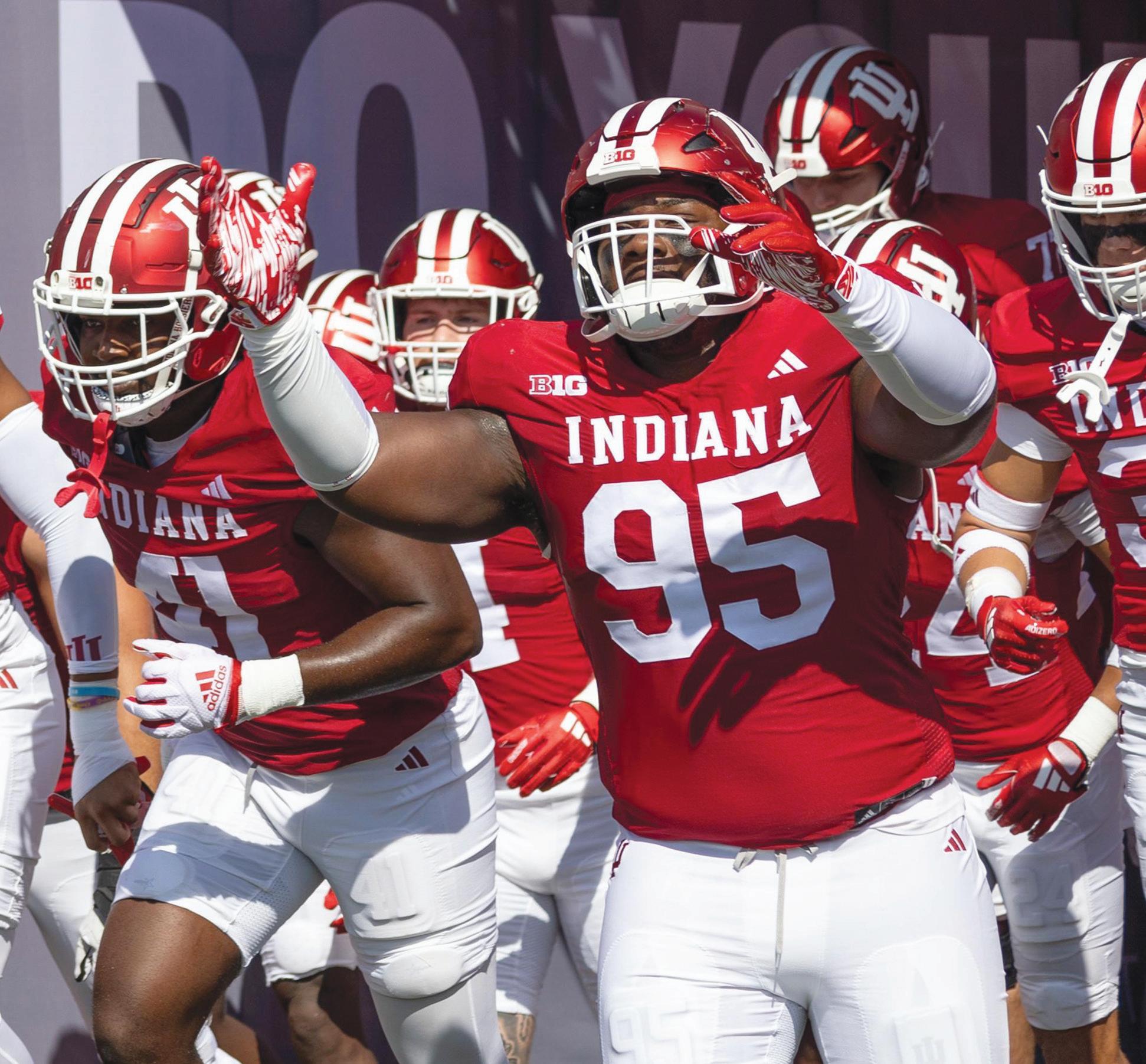
IDS reporters predict superlatives for 2025 season
By Conor Banks, Quinn Richards and Dalton James sports@idsnews.com
Indiana football began its quest for a second consecutive College Football Playoff appearance with a 27-14 win over Old Dominion University on Aug. 30 at Memorial Stadium.
The Hoosiers finished 11-2 in head coach Curt Cignetti’s first season at the helm of the program in 2024. In the offseason, Cignetti and his staff brought in 24 players out of the transfer portal — headlined by former University of California, Berkeley quarterback Fernando Mendoza — to bolster the roster and replace impactful players.
The Indiana Daily Student’s two football reporters and columnist provided their player predictions. Most valuable offensive player
DALTON JAMES: He doesn’t play the most attractive position or score touchdowns, but it’s perhaps the most important: left tackle. Redshirt junior Carter Smith has started every game since the 2023 season opener, protecting the quarterback’s blind side. For Mendoza to succeed this season, he’ll need quality protection to deliver the ball to Indiana’s skill position players. For the Hoosiers’ offensive line — a semifinalist for the Joe Moore Award — to continue their strong play under offensive line coach Bob Bostad, Smith will play a critical role in anchoring the unit.
CONOR BANKS: Senior wide receiver Elijah Sarratt quickly became a household name for Hoosier fans last season, even earning the nickname “Waffle House.” After following Cignetti to Indiana from James Madison University, Sarratt posted 137 yards and one receiving touchdown in his second game as a Hoosier against Western Illinois University.
An all-conference performer in all three of his collegiate
seasons so far, Sarratt headed into the 2025 season leading the nation with 38 consecutive games with a reception. Sarratt looks to extend this streak by building his chemistry with Fernando Mendoza. If their connection is anything like it was with former Indiana quarterback Kurtis Rourke, Sarratt will be in contention for the 2025 Biletnikoff Award — the honor granted to the most outstanding FBS receiver, and one not yet attained by Indiana.
QUINN RICHARDS: An experienced transfer taking over a Curt Cignetti Indiana offense? It’s a recipe that’s worked before. Former Hoosiers quarterback Kurtis Rourke was the program’s most valuable player last season, and I think a similar narrative will unfold with Mendoza in 2025. The three-time Atlantic Coast Conference Quarterback of the Week will be flanked by a pair of proven wide receivers in senior Elijah Sarratt and redshirt junior Omar Cooper Jr. With weapons at his disposal and an experienced offensive line returning for pass protection, Mendoza will be the X-factor in Indiana’s offense. Most valuable defensive player
JAMES: Senior linebacker Aiden Fisher is the unquestioned leader of Indiana’s defense, which ranked second nationally in total defense in 2024. Fisher finished third in the Big Ten with his 118 total tackles in his first season in Bloomington. Not only does the Fredericksburg, Virginia, native command the defense on the field, much like a quarterback does on offense, but he’s one of, if not the, most impactful leaders off the field. In 2024, there were 13 Hoosiers who followed Curt Cignetti from James Madison University. Now, just seven of those players remain, but they’re a group that has consistently played winning football and are “invaluable,” according to Cignetti. I believe Fisher will again garner All-America honors in his final season in the Cream and Crimson.
BANKS: ESPN ranked redshirt senior defensive lineman Mikail Kamara No. 35 in its 2025 top 100 college football player rankings — the highest mark of any Hoosier, and for good reason. Kamara’s ten sacks in 2024 ranked fourth in the Big Ten, and he has improved each season of his collegiate career. Now, with another year under his belt, I expect Kamara to lead the Big Ten in sacks and serve as the anchor in the Hoosiers’ defensive front, which projects to be among one of the best rushing defenses in the nation.
RICHARDS: Junior cornerback D’Angelo Ponds was yet another James Madison transfer who contributed to Indiana’s success last season. Despite doubts on whether his 5-foot9 frame could compete in the more physical Big Ten, he proved himself by taking home first team All-Big Ten honors in a productive 2024. Now, Ponds returns to Indiana’s secondary as a versatile corner that’s poised to be a staple in defensive coordinator Bryant Haines’ nickel set.
Breakout player
JAMES: Redshirt sophomore defensive back Jamari Sharpe earned an increased role at the end of the 2024 season while former defensive back Jamier Johnson missed time with an injury. Sharpe started over Johnson in Indiana’s College Football Playoff first round loss to the University of Notre Dame, totaling four tackles and 0.5 sacks. Johnson — a Pasadena, California, native — transferred to UCLA during the offseason, paving the way for Sharpe to earn the starting role to begin the 2025 season. Sharpe is a player Cignetti has “a lot of confidence” in, and one I expect to take the next step this season opposite D’Angelo Ponds, who earned second-team All-America honors last season.
BANKS: Sophomore linebacker Rolijah Hardy went under the radar as a zero-star recruit coming out of high school in 2024. He was primarily used in
trio packages behind Aiden Fisher and former Indiana linebacker Jailin Walker last season. However, following the departure of Walker, Hardy sprung into a more defined role on the second line of the Hoosiers’ defense throughout training camp. Fisher repeatedly spoke highly of Hardy in the offseason, citing his impressive athleticism and his improved ability to process the game. With higher usage in 2025, Hardy will play an instrumental role in fortifying Indiana’s defense, which allowed the fewest rushing yards in the nation against its opponents last season.
RICHARDS: Redshirt senior running back Kaelon Black sat behind former Hoosier backs Ty Son Lawton and Justice Ellison last season. Despite his minimized role as a thirdstring option, he averaged 5.5 yards per carry — the most of any Indiana rusher — in an offense that scored the most rushing touchdowns in the Big Ten. This season Black will be called on more frequently out of the backfield and his upside is lofty. The James Madison transfer tallied 891 yards from scrimmage in 2024 under Cignetti and will be a threat in both the rushing and passing attack for Indiana this season.
Newcomer of the year
JAMES: Lofty expectations surround quarterback Fernando Mendoza, and for good reason. After spending three seasons at Cal, starting 19 games and appearing in one additional contest, Mendoza departed Berkeley, California, for Bloomington. Better skill position players? Check. Better protection up front? Check. The offense surrounding Mendoza will allow him to thrive in what may be his only season at Indiana, should he declare for the NFL Draft at season’s end. Mendoza’s name will become a household one across the country this season, helping prove Indiana’s 2024 season was no fluke.
BANKS: I find it
difficult to imagine a world where Mendoza does not find success in an Indiana uniform. The junior displayed excellent timing and anticipation in his two seasons with Cal, holding the highest career completion percentage with 66.4%. Mendoza also adds mobility to the Hoosier offense — something the team lacked last season with Rourke under center. Mendoza will enjoy an upgraded unit up front this season, after passing behind a Cal offensive line that allowed 3.85 sacks per game last season — the third worst mark in the nation. With this added time in the pocket, Mendoza and Elijah Sarratt have a shot at developing into one of the best quarterback-wide receiver duos in the nation.
RICHARDS: I’ll give some love to the trenches by highlighting the University of Notre Dame transfer offensive lineman Pat Coogan. The 6-foot-5, 311-pound redshirt senior arrives in Bloomington with 26 career starts over a fouryear stint in nearby South Bend, Indiana, and fills a crucial hole in the Hoosiers’ offense. In 2024, an injury forced Coogan to swap from his initial left guard role and take over center duties for the Fighting Irish, where he started the team’s final 13 games. He helped facilitate Notre Dame’s 200.9 rushing yards per game last season which ranked fifth among Power Four programs. I think that success will translate as Coogan fills the shoes of former Indiana offensive lineman Mike Katic.
Under the radar player to watch JAMES: Freshman defensive back Byron Baldwin Jr’s recruitment was an interesting one. He originally committed to Cignetti and the Hoosiers on April 17, 2024, but he later decommitted Oct. 2, 2024, before then recommitting to Indiana nearly a month and a half later. Now, Baldwin Jr., who Aiden Fisher said has been “a guy that came in and has been bought in,” seems to be in a spot where
he could see action in his first season in Bloomington. Fisher recalled a summer conversation between the two in which Baldwin Jr. asked what he could improve on and how to get onto the field and become an impact player — which Fisher believes he’ll be. Baldwin Jr. has the “it factor,” Fisher said, and I believe he’ll leave his mark this season.
BANKS: The Indiana coaching staff has touted senior defensive lineman Kellan Wyatt as a highenergy and versatile piece of the defensive puzzle throughout training camp. Wyatt spent the last three seasons with Maryland, where he started 28 games in that span before transferring to Indiana. The Hoosiers saw Wyatt’s skillsets on display firsthand in 2024 against the Terrapins. In the matchup, he posted 1.5 tackles for loss and added a solo sack. While Mikail Kamara will receive most of the attention on the edge, the arrival of Wyatt brings a rushing threat opposite of him, while adding versatility in pass coverage.
RICHARDS: This is a fun one. Senior wide receiver Makai Jackson began his college football career at Saint Francis University — an FCS program in Loretto, Pennsylvania — after failing to receive a single FBS offer out of high school. After being named to the FCS Freshman All-American Team, he garnered attention from Appalachian State University and transferred there the next season. Now, after a breakout season with the Mountaineers in 2024, Jackson finds himself playing under the reigning Associated Press Coach of the Year and for an Indiana team coming off a run to the College Football Playoff. He combined for 319 receiving yards over his final two games at Appalachian State and comes to Bloomington with big play potential. Even if Jackson fails to find opportunities as a receiver, his speed and explosiveness could make a difference on special teams where he’ll likely be called on as a return man.
BRIANA PACE | IDS
Indiana football players run out of the tunnel before taking on the University of North Carolina at Charlotte on Sept. 21, 2024, inside Memorial Stadium in Bloomington. The Hoosiers finished last season with their first-ever College Football Playoff appearance.
Men’s soccer’s schedule provides chance to succeed
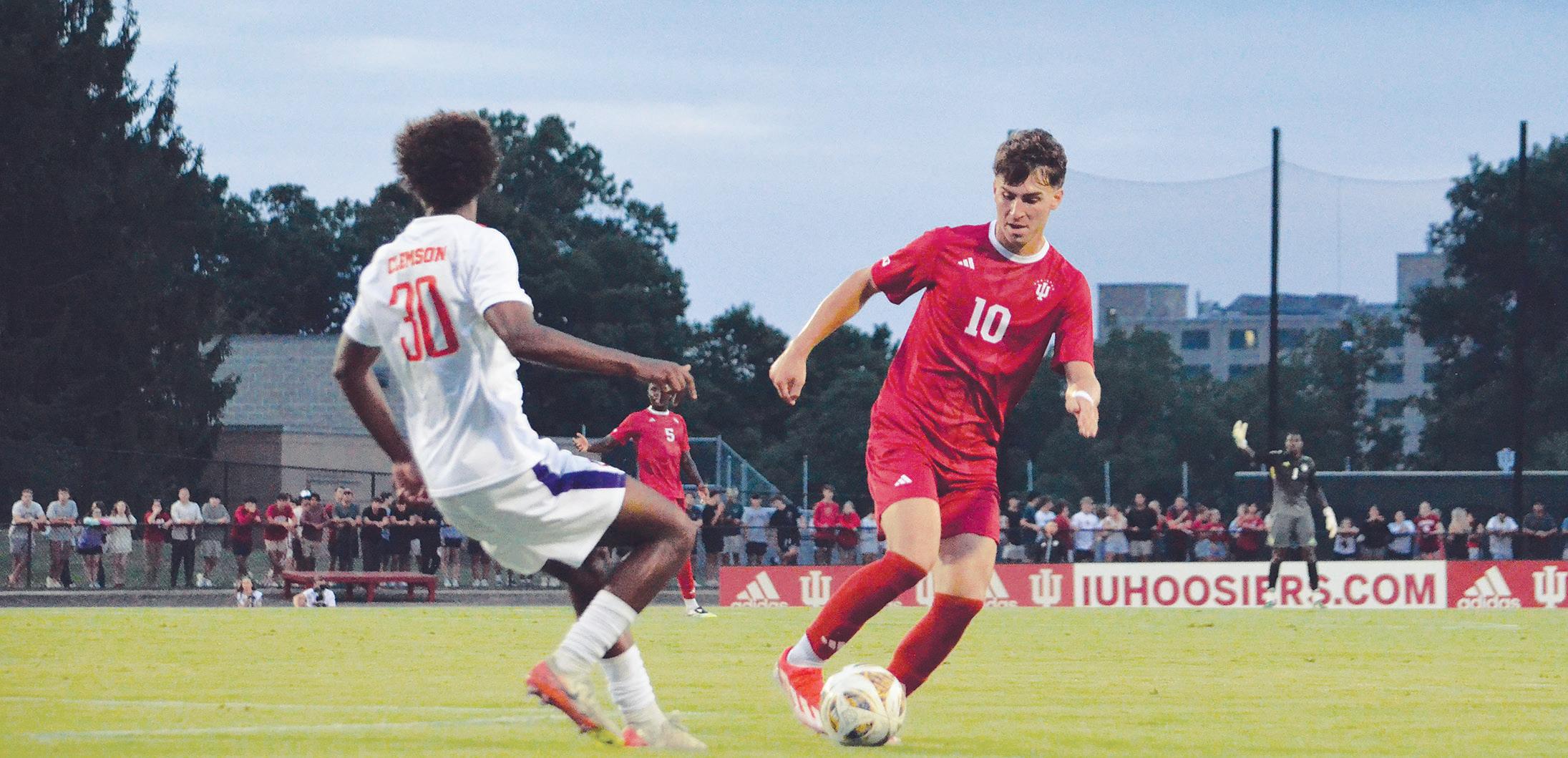
By Elakai Anela eanela@iu.edu @elakai_anela
Indiana men’s soccer is used to success.
The Cream and Crimson have secured 22 total regular-season Big Ten Championships and eight College Cups. Since head coach Todd Yeagley took over the program in 2009, he’s led Indiana to 207 victories over 15 seasons — the most by any program in the NCAA since then.
However, with the Hoosiers coming up short in the Sweet Sixteen of the NCAA tournament last year to Denver University, Yeagley stressed the importance of getting out of the gates hot.
“We’re here to win titles,” Yeagley said in a preseason interview. “These tougher games prepare your competition level, and it’ll help us figure some things out.”
Indiana came into the season ranked No. 11 in the nation by the United Soccer Coaches preseason poll.
A tough schedule to open the year
Despite a five-game homestand, Indiana’s schedule to open the season appeared to be tough on paper. During this homestand, Indiana faced the then-No. 9 ranked Clemson University and then-No. 14 Oregon State University.
Indiana has historically started the season slow. Last year, it began with a loss to Saint Louis University. The Hoosiers then tied with Notre Dame before going 3-3-3 in their next nine games.
Ultimately, Indiana clinched a bid to the NCAA tournament. But the slow start raised general concerns at the time.
So far, Indiana has gone 3-0-1 this season with a win over No. 14 Oregon State, but how it will fare the rest of the season remains unknown.
Yeagley appeared to be satisfied with the start to the year, but he also said
during an interview on Aug. 31 that he understands that his team’s results could help them down the line.
“Being undefeated at this point, four games into the year, against this competition is a good sign for this team,” Yeagley said ahead of Indiana’s match against Saint Louis on Sept. 3. “We have some quality victories under our belt, earning the first couple the hard way.”
What has stood out so far
Could this year be different? Well, there were some answers to that question in the first match of the year against a top-10ranked team.
Indiana’s tie against thenNo. 9 Clemson on Aug. 21 highlighted an improvement in depth. Indiana sophomore defender Josh Maher and sophomore midfielder Charlie Heuer — two players who were expected to be in the fold for much more production than last year — both left the pitch with
Injuries for Indiana men’s soccer showcase strength in depth
By Mateo Fuentes-Rohwer
matfuent@iu.edu | @mateo_frohwer
Indiana men’s soccer begins every season with a tough opening schedule. This season featured thenNo. 9 Clemson University and then-No. 14 Oregon State University. Last year was Saint Louis University and then-No. 8 University of Notre Dame. The year before, then-No. 9 Washington.
The Hoosiers have fared well to begin the season, and head coach Todd Yeagley has been pleased overall with his team’s performances. But Indiana has been without three critical players, forcing its depth to be put to the test.
So far, the depth has delivered.
“There is so much talent that we have in the locker room,” senior forward Palmer Ault said Aug. 31. “We know that no matter what the lineup is — it could be different from game to game — that the team that we put out has any chance of making something special happen against any opponent.”
Indiana’s first critical injury came before the season began against Clemson on Aug. 21. Junior forward Clay Murador, who Yeagley noted was one of the Hoosiers’ best attackers in preseason, didn’t enter the game and has yet to appear in a match this season.
In his stead, sophomore forward Michael Nesci has emerged as an option on the wing, already tallying a goal and an assist. Ault has also shifted from his central role to the outside for certain stretches so far, including when he contributed a goal and an assist in 31 seconds against the University of Wisconsin-Green Bay on Aug. 28. Yet even with the emergence of Nesci and Ault’s versatility, Murador’s absence has been a big hurdle for the Hoosiers to overcome.
“Clay was one of our most dynamic attackers in preseason,” Yeagley said Aug.
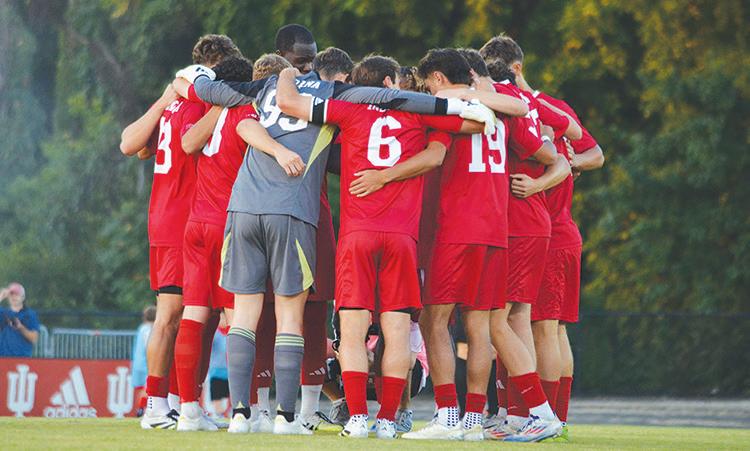
TRINITY MACKENZIE | IDS
Indiana men’s soccer players huddle together during their contest against University of Wisconsin-Green Bay on Aug. 28, 2025, at Bill Armstrong Stadium in Bloomington. The win moved the Hoosiers’ record to 2-0-1.
28. “He came in great, and he was fantastic. He would be in our top rotation based on his performance preseason.”
The match against Clemson also featured two more critical injuries — sophomore midfielder Charlie Heuer and sophomore center back Josh Maher. In their place, Indiana’s depth has once again shined, providing opportunities for players who might not have had the chance.
At the center back position, Maher’s injury led redshirt junior defender Breckin Minzey to break into the starting lineup next to junior defender Victor Akoum. Yeagley also allotted critical minutes against the University of San Francisco on Aug. 24 to redshirt freshman defender Drew Gaydosh, who kept a steady presence in the backline.
As for Heuer, Yeagley has experimented with the gap in midfield. When Indiana needs more offense, the 16-year head coach has turned to junior midfielder Jacopo Fedrizzi — and the Giulia, Italy, native has delivered. In three games in the central position, Fedrizzi contributed three goals and an assist.
But Yeagley has also opted for a more defensive midfielder in senior Cristiano Bruletti. The Commerce Township, Michigan, native slotted in successfully with senior Jack Wagoner
against Oregon State, bringing Yeagley another possible option with Heuer sidelined.
Yet even with the success of his midfielders, Yeagley still knows that Heuer will play a key role once he returns.
“Bruletti is very much more of Wags (Wagoner) in his role, and then when we bring Jaco (Fedrizzi), it’s a very attack-minded eight,” Yeagley said. “Charlie (Heuer) is that perfect hybrid.”
Injuries have not been the only reason Indiana has fostered competition. The No. 1 goalkeeper role has settled with graduate student Holden Brown, who started against San Francisco, Green Bay and Oregon State, but freshman Judewellin Michel also challenged for the position after starting against Clemson.
Indiana’s right back has shifted between graduate student Ben Do and redshirt freshman Nolan Kinsella. Freshman striker Colton Swan has started every match, but his minutes have been shared with sophomore forward Easton Bogard, who scored against the San Francisco.
Heading into Big Ten play, Yeagley will have a tough decision to make as Heuer, Maher and Murador all look set to return from injury. But it’s a good problem for Yeagley to have — and one that shows his squad is capable of success.
injuries. Neither has played in a game since.
The two losses appeared to be a big blow for the Hoosiers, but the new additions of junior midfielder Jacopo Fedrizzi and graduate defender Ben Do have filled gaps in the midfield and defensive sides of the pitch.
Fedrizzi, who won the Big Ten Offensive Player of the Week award for the first week of play, scoring three goals in two games, and Do’s defensive impact have been key reasons why the Hoosiers haven’t conceded a loss.
The other notable moment in the Clemson match was when Indiana fell behind 2-0 in the 60th minute of play. But Indiana was able to come back and salvage a tie in the final minutes. The Hoosiers’ fight was a welcome sign and a breath of fresh air for both the team and the fans, something that the group has carried with them since.
Indiana completed comebacks in its first three
matches despite trailing at halftime in all of them.
The starting group, particularly the goalkeepers, raised other questions. With the loss of JT Harms, who graduated and went on to sign with North Texas SC of the MLS, who would start? How would they fare? How would the lineup shake out as the season progressed?
Yeagley said before the season started that if he had to “draw a line in the sand,” the goalkeeper battle would come down to freshman Judewellin Michel or graduate student Holden Brown.
However, with Brown getting starts in Indiana’s games against Oregon State and Green Bay, it appears he won the job. With the shutout victory he helped put up against then-No. 14 Oregon State, including a series of crucial saves, he seems to be more comfortable in net.
With conference play rapidly approaching and other key non-conference opponents on the schedule,
like No. 17 University of Kentucky on Oct. 14, the pieces to the puzzle are continuing to get sorted.
One piece is junior forward Clay Murador. Although Murador hasn’t played this year, his excellent preseason has been a focal point for the coaching staff. It could also come from a series of bench players, like redshirt freshman forward Nolan Kinsella and sophomore forward Easton Bogard, who have already made an impact this year. It’s hard to know how Yeagley will manage his players as the season progresses. But what is known is that the mix of Indiana’s depth and the hard competition to start the season has yielded good results.
“The tough competition helps us get better as a team,” Yeagley said. “The majority of teams I’ve coached here at Indiana have gotten better as the season has gone on. We’ve got to play the long game.”






TRINITY MACKENZIE | IDS
ISenior forward Palmer Ault dribbles around a Clemson University defender Aug. 21, 2025, at Bill Armstrong Stadium in Bloomington. Ault scored a penalty kick in the 67th minute.
Indiana stifles No. 14 Oregon State in shutout
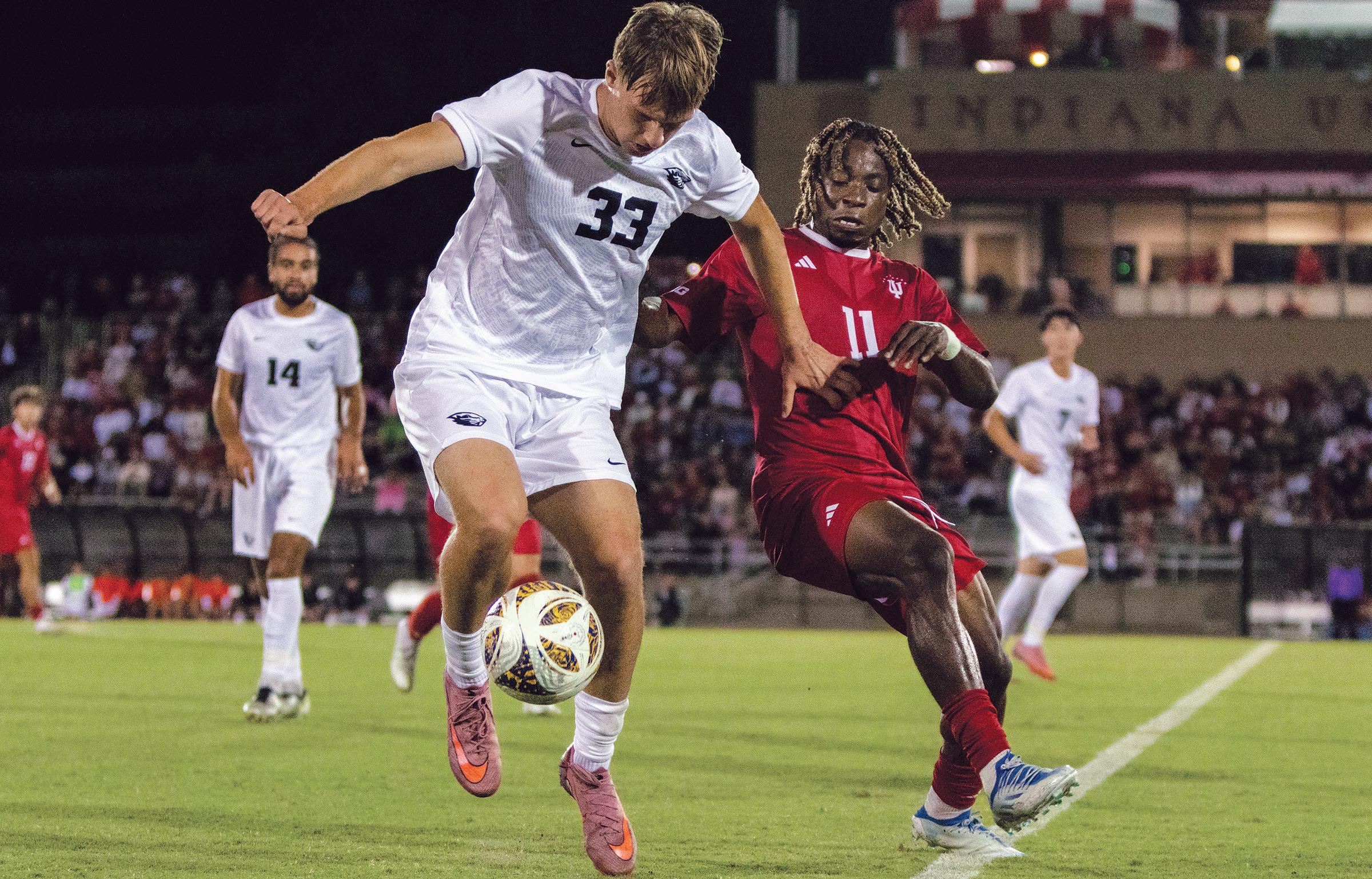
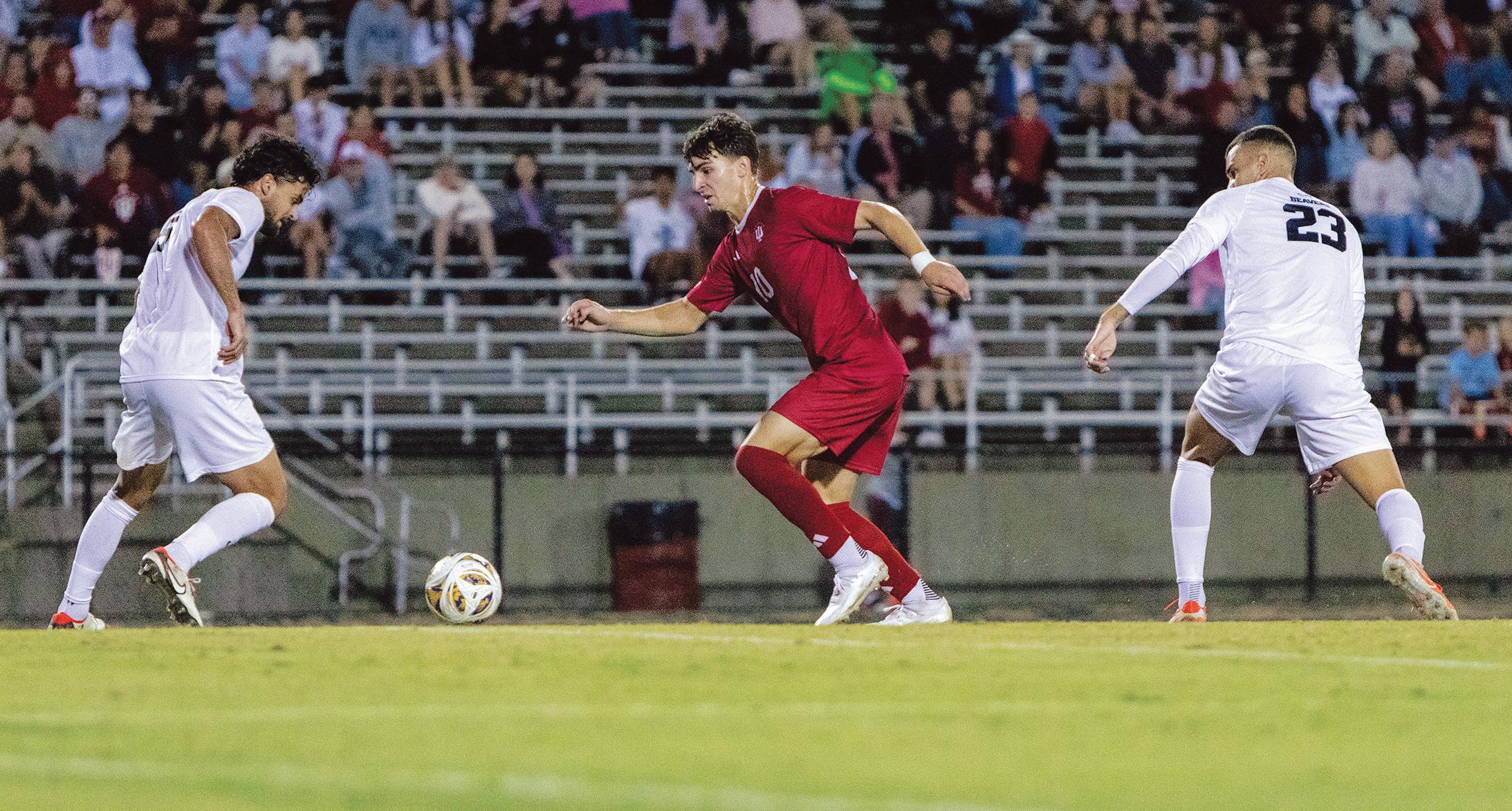
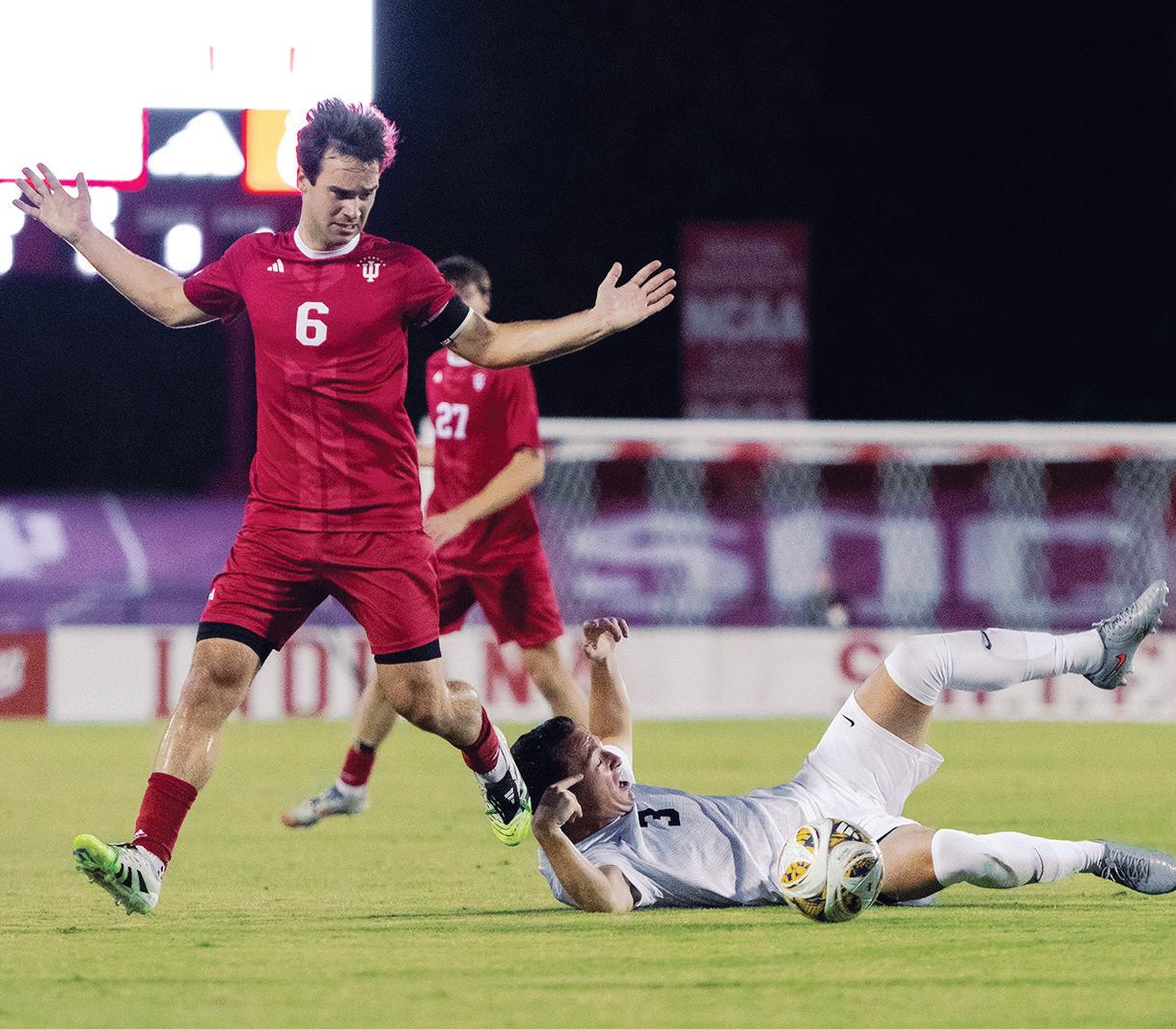
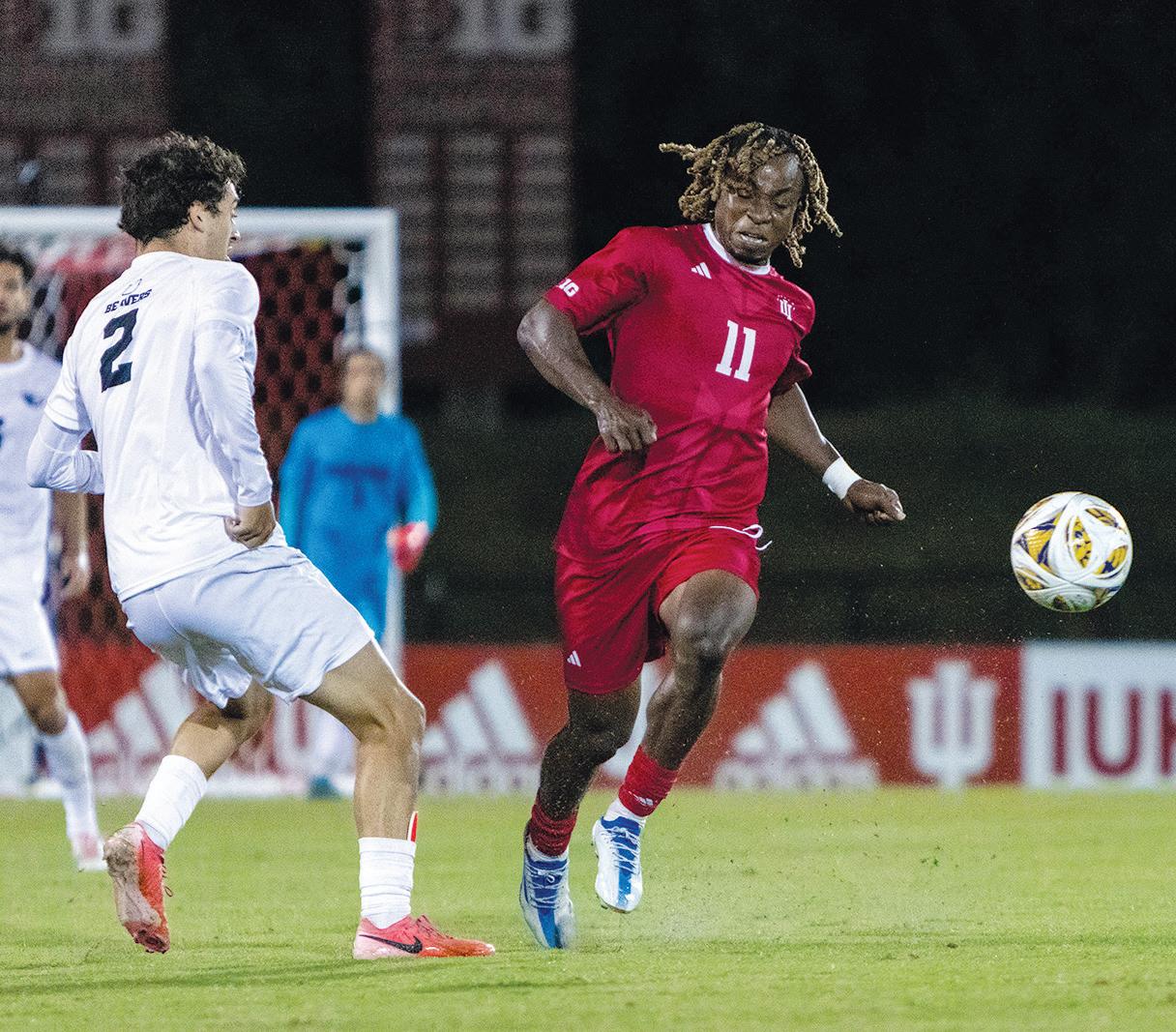
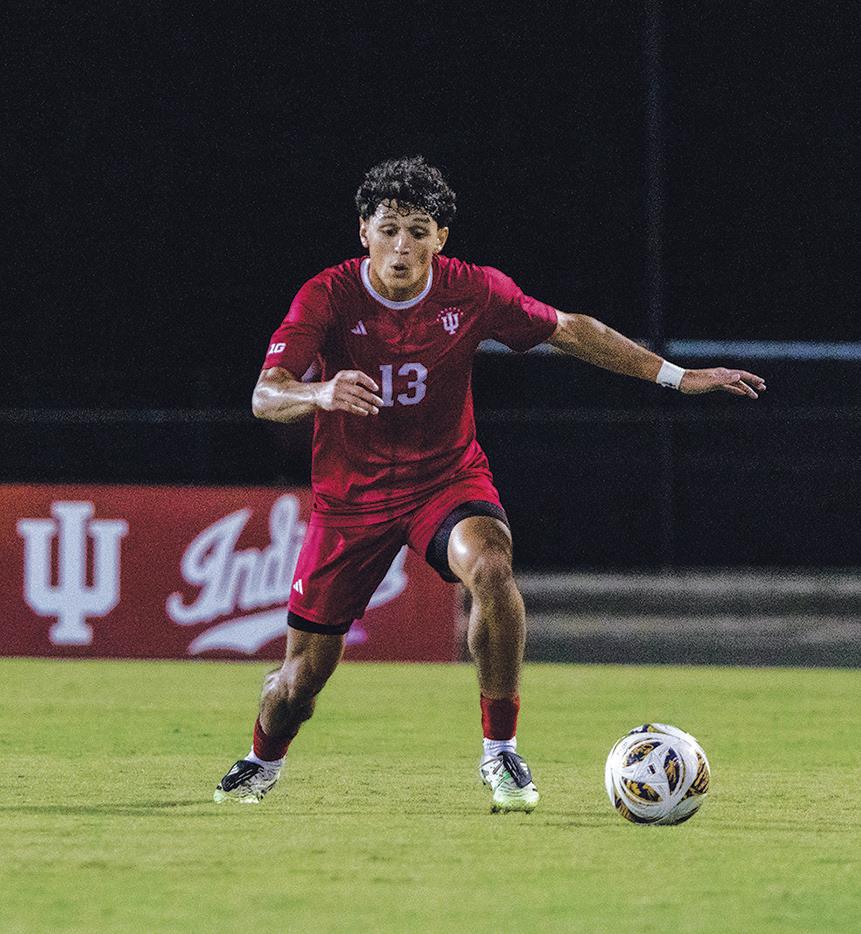
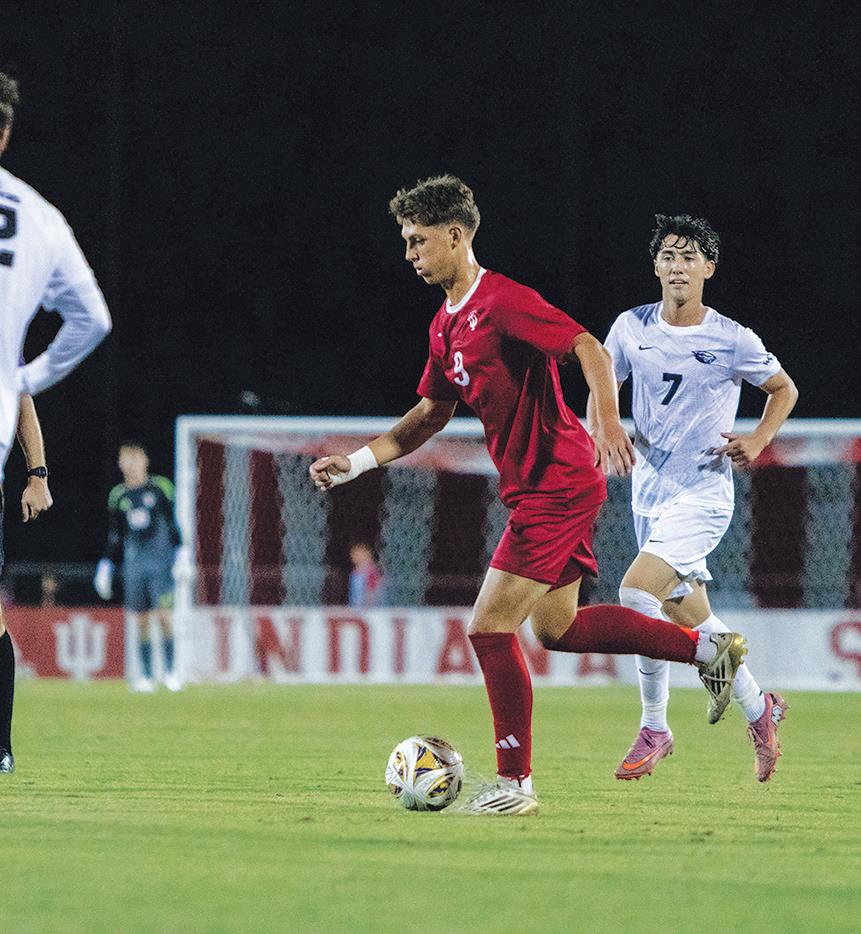
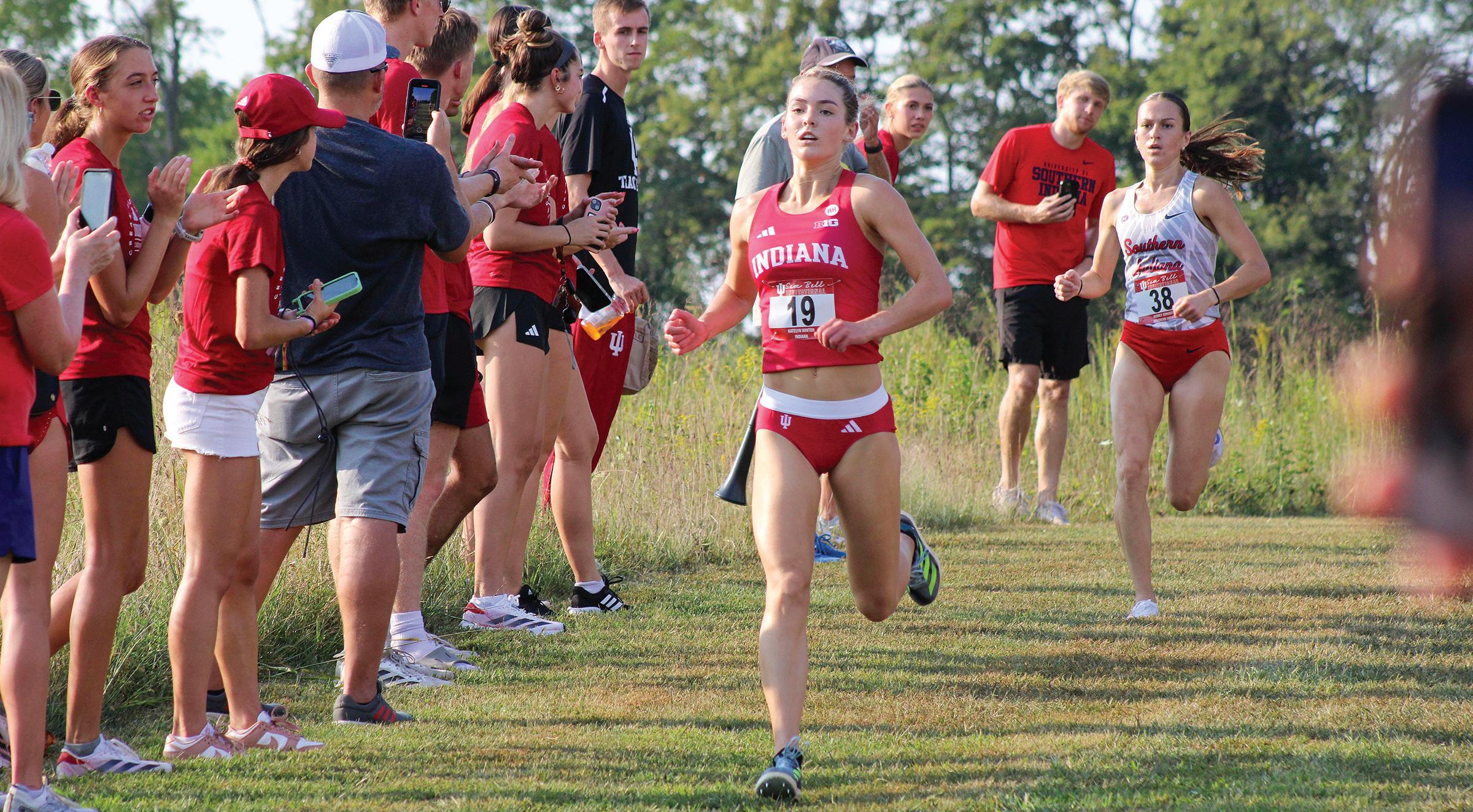
Indiana cross country kicks off 2025 season
By Nathan Shriberg naashri@iu.edu | @NShriberg
Indiana cross country is coming off a lackluster 2024 season. After finishing seventh and ninth, respectively, at the 2024 NCAA Great Lakes Championships, neither the men’s nor women’s team had a runner qualify for the NCAA Cross Country Championships.
Heading into 2025, the outlook isn’t much better. The Hoosier men debuted at No. 8 in the 15-team U.S. Track and Field and Cross Country Coaches
Both Hoosier teams finished outside the Big Ten top five in 2024.
Association Great Lakes Region preseason rankings, while the women’s team landed at No. 9. Neither team was ranked in the USTFCCCA National Coaches’ Poll, which ranks the top 30 teams nationwide.
Despite the absence of acclaim, the Hoosiers kicked off the year with an encouraging performance at the Sam Bell Invitational on Aug. 29. Both Indiana teams took first place. Leading the way for the Hoosier men was redshirt junior Garrett Hicks, who took seventh place out of 57 finishers in the 6k. He kept
his average mile time just below five minutes to put up a personal best 18:38.03. Close behind in ninth and 11th were redshirt freshman Caden Click and redshirt sophomore Aidan Lord, respectively. Redshirt junior Andrew Mangum and redshirt freshman Matt Kim took 13th and 14th place to put the Hoosier team score at a perfect 15. On the women’s side, the Hoosiers occupied each of the top seven places in the 4k to score another perfect 15. Redshirt senior Claire Overfelt crossed the finish
Indiana volleyball back in action for the 2025 season
By Kasey Watkins kaslwatk@iu.edu
The 2025 Indiana volleyball season is back with many new roster additions and a chance to make noise in a tough Big Ten conference.
Last season the Hoosiers finished in 10th place in the Big Ten standings with a conference record of 8-12 and an overall record of 1515.
While the record wasn’t ideal for Indiana, the Hoosiers faced eight top 25 opponents — seven of which are Big Ten programs — including the then-No. 1 University of Texas, thenNo. 2 Nebraska and thenNo. 3 Penn State. It also faced highly ranked teams in Wisconsin, Purdue, Oregon, Minnesota and Southern California.
Indiana was unable to come away from any of these matchups with a win.
Despite playing another tough schedule this season that includes matchups with multiple pre-season top 25 ranked teams, the Hoosiers have the potential to improve off last season with a whole new look to their roster.
After losing nine players from the 2024 roster, including key players in setter Camryn Haworth and libero Ramsey Gary, Indiana brought in a total of eight new additions, including seven freshmen and graduate student outside hitter Jessica Smith from the UCLA beach volleyball program.
The seven freshmen additions make up the No. 14 ranked recruiting class, according to Prep Dig, marking the highest in history for the Indiana volleyball program. The previous highest ranked class was signed in 2020, which was ranked No. 15 in the country.
This plethora of new talent joins the highly valuable veteran hitters of
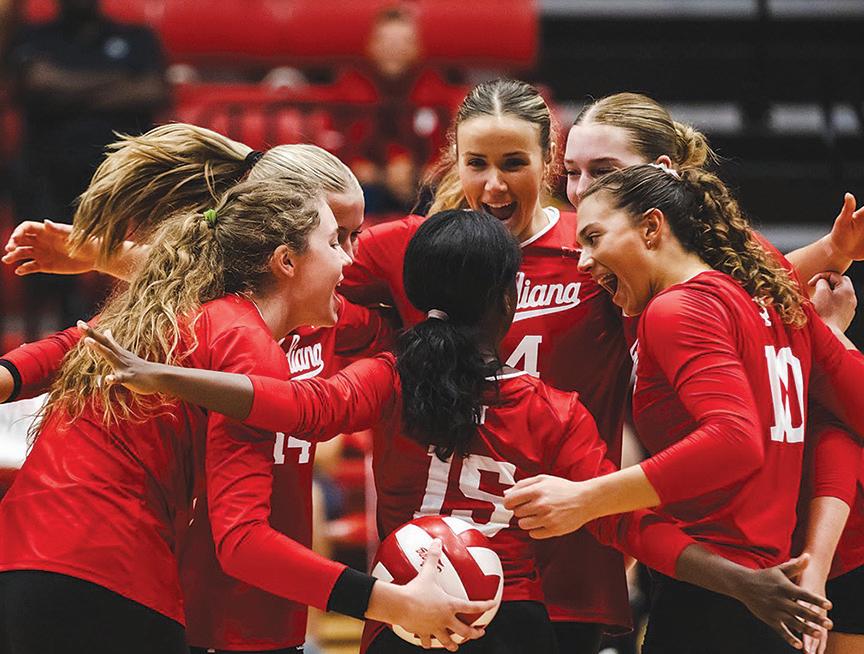
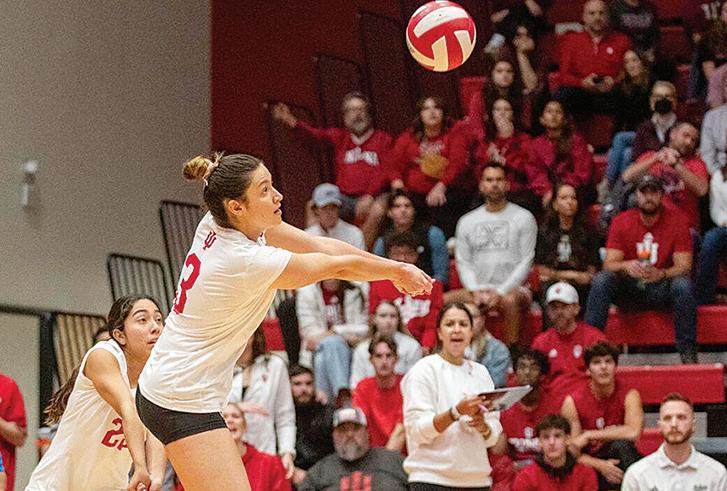
senior Candela AlonsoCorcelles and senior Avry Tatum. Alonso-Corcelles led the team last season with 409 kills, making her one of 10 players in the Big Ten conference to have over 400 kills. Tatum played in 29 of 30 games for the Hoosiers last season, tallying 348 kills, 65 digs, 50 blocks and 28 aces. According to Indiana Athletics, head coach Steve Aird calls this group of players the deepest and most complete roster he’s had in his time as a head coach in the Big Ten. While the season is just now getting started, the Hoosiers are already off to an impressive start. The team started off its 2025 season 2-0. The Hoosiers defeated the University of Miami and Virginia Commonwealth University in the Canes Classic on Aug. 29-30. Indiana pulled off the win over Miami in reverse sweep fashion and defeated VCU in three sets. The reverse sweep over Miami was the program’s first in 10 years and fourth reverse sweep in program history. The Hoosiers will look to keep their win streak alive and capitalize on their stacked roster of new and returning talent. Indiana will next face Southeast Missouri State University at 7 p.m. Sept. 4 in the Indiana Invitational.
line first with a time of 13:45.21. She was followed by junior Lily Myers and sophomore Joey Rastrelli, who rounded out the top three.
Freshmen Ava Jarrell and Alayna Todnem made their collegiate debuts, placing fourth and seventh, respectively. Redshirt junior Katelyn Winton and sophomore Michaela Quinn joined Myers and Rastrelli in posting personal best times. Next up, the Hoosiers will look to build off their strong start at the Spartan Invite Big Ten Preview on Sept. 12 in East Lansing, Michigan.
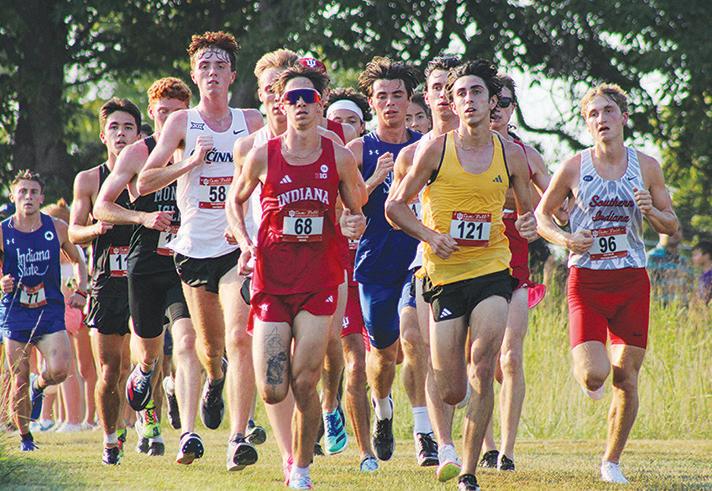



JIMMY RUSH | IDS
Then-sophomore Katelyn Winton runs toward the finish line in the Sam Bell Invitational on Aug. 30, 2024, at the Sam Bell Cross Country course in Bloomington. Both the men’s and women’s cross country teams finished
JIMMY RUSH | IDS
A group of runners led by then-IU freshman Aaron Lord runs in the first lap of the Sam Bell Invitational on Aug. 30, 2024, at the Sam Bell Cross Country course in Bloomington. Lord finished 12th overall in the men’s meet.
GISELLE MARSTELLER | IDS The Indiana volleyball team celebrates Sept. 13, 2024, during a match against Chicago State University at Wilkinson Hall in Bloomington. The Hoosiers finished the 2024 season with an overall record of 15-15.
FILE PHOTO | IDS
Then-sophomore outside hitter Candela Alonso-Corcelles bumps the ball against Ohio State on Oct. 21, 2023, at Wilkinson Hall in Bloomington. Indiana completed a reverse sweep of the University of Miami on Aug. 29.
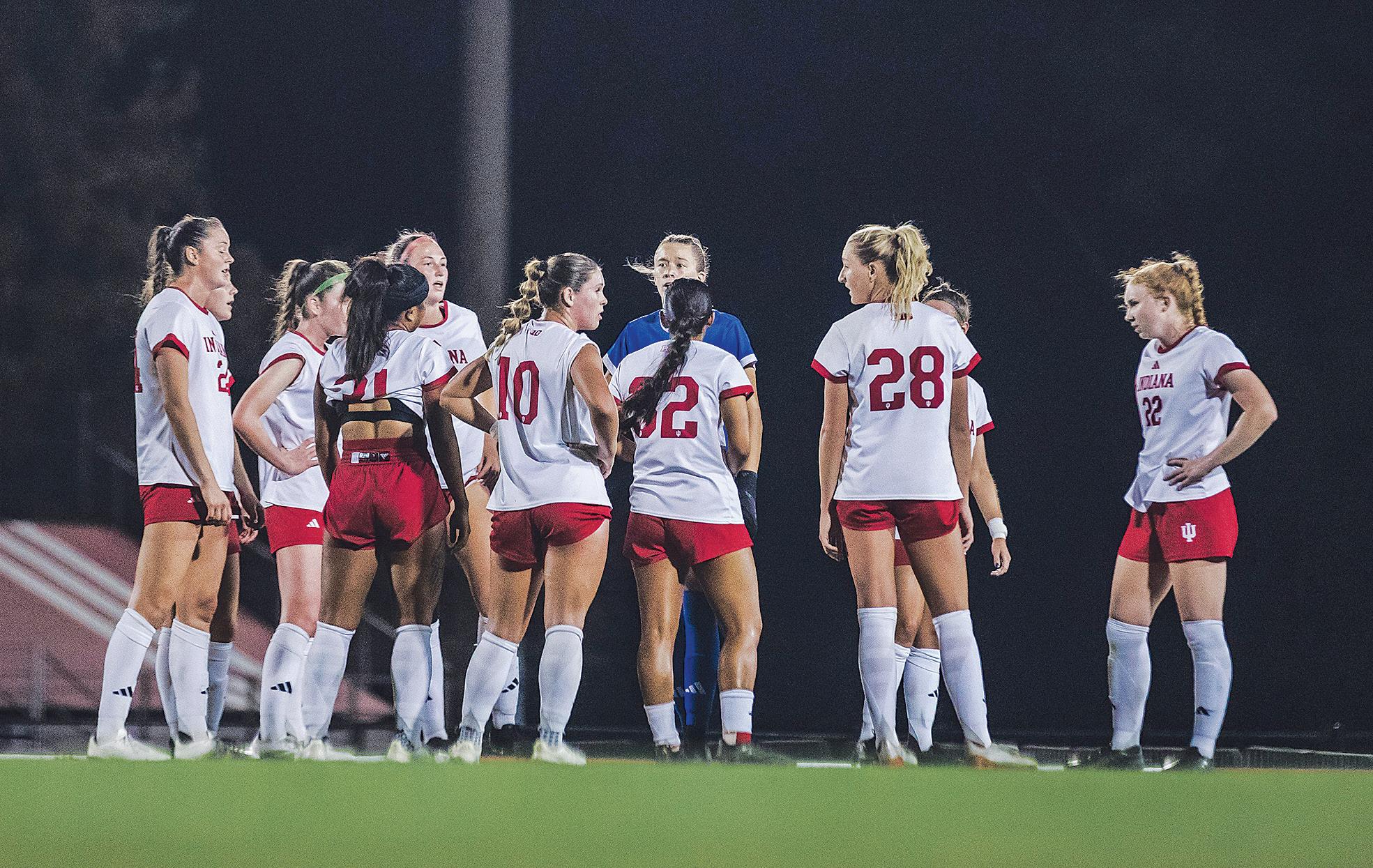
Newcomers look to bring spark to Indiana women’s soccer
By Will Kwiatkowski
Sally Rainey, Indiana’s new graduate transfer goalkeeper, roamed her box barking instructions as Saint Louis University launched a dangerous counterattack in her first start as a Hoosier on Aug. 28th at Hermann Stadium in St. Louis, Missouri. Sophomore forward Audrey Smith broke free, slipping past senior defender Marisa Grzesiak for a one-on-one chance. As the ball rolled into an empty space, Rainey lunged forward to smother the shot and preserve the Hoosiers’ clean sheet. It was a split-second decision, and exactly the kind of presence Indiana brought Rainey to Bloomington for. Rainey arrived at Indiana after a career at the University of New Hampshire. A native of West
Indiana added five newcomers, hoping to shake up the Big Ten race
Lebanon, New Hampshire, she earned America East Goalkeeper of the Year honors in 2023 and 2024, along with United Soccer Coaches All-Region and AllConference distinctions. In 2024, she started all 18 games, finishing with a 12–5–1 record, 0.78 goals-against average and nine shutouts, consistently ranking among her conference’s elite goalkeepers.
Her leadership was evident in Indiana’s 1-0 loss to Saint Louis — her first start for the Hoosiers — where she made five critical saves and helped the Hoosiers contend against a strong Billikens team for the majority of the night.
Between Rainey and senior goalkeeper Dani Jacobson, Indiana’s goalkeeping duo has held the four teams they’ve played to only four scores in what has been a dominating defensive start to Indiana’s season.
Another newcomer making an immediate impact on the Hoosiers’ defense is freshman defender Grace Hamm. She joined Indiana from San Marcos High School in San Marcos, California, where she was an Open Division California Interscholastic Federation champion, a twotime All-League selection with first-team honors and helped her club, Legends FC, reach back-to-back Final Fours.
Hamm made her mark early, contributing to Indiana’s opening-night blowout against Youngstown State University. In her 57 minutes on the pitch, she recorded three shots and assisted sophomore forward Aleyna Quinn, who finished off her pass for a score. Her athleticism showed on all fronts. She created pressure in the attack while spacing the ball effectively on defense and slowing
Youngstown State’s runs. Hamm comes from Indiana soccer blood, as her sister, Camille Hamm, made 58 starts across 69 games played during her four-year long career with the Hoosiers in 2021-24. Hamm’s assist to Quinn marked Quinn’s first goal as a Hoosier after following Indiana head coach Josh Rife from Ball State University in January. Quinn quickly emerged as a scoring threat for Indiana. A native of Newburgh, Indiana, Quinn played in 13 games at Ball State last season and recorded three assists, including one in the seasonopening match.
In her first game against her former team Ball State, Quinn was the hero, scoring the game-winning goal. In the 62nd minute of the match, following a beautifully lofted corner kick from senior forward Marisa Grzesiak, Quinn pounded
in a header past the diving reach of her old teammate, senior goalkeeper Grace Konopatzki. Quinn has ten shots, three of which were on goal in the four games she has appeared in. Her effort and proficiency on the pitch have been promising early in the Hoosiers’ season as they look to continue to find more offensive production as the season progresses. Junior midfielder Ella Stanley is another promising transfer to make a mark on the pitch early in the season. The Beaverdam, Virginia, native joins Indiana from James Madison University where in her sophomore season, she played in all 21 matches tallying 1,407 minutes for the Dukes.
In the Hoosiers’ season opener, she too notched an assist, adding to the dominating win over Youngstown State. In the next match against Ball State,
she saw 40 minutes on the pitch and attempted a shot that soared just wide of the net. Her impact has been off the bench, but the offseason addition adds important depth to the Hoosiers’ midfield. Another midfield transfer, graduate student Jenna Chatterton from Noblesville, Indiana, looks to add to the rotation in the middle. With four years at the University of Tennessee, Chatterton comes with experience and a strong feel for the game. In her first four matches, she played strong, controlling passes from the defense and moving it forward to the offensive front. She took three shots for herself, two of which were on goal.
With a new coaching staff and these new impact players spanning across the entire pitch, the Hoosiers will look to shake things up in the Big Ten standings come conference play.
Women’s soccer heads toward Big Ten under first year coach
By Noah Gerkey ngerkey@iu.edu | @Noah_Gerk
In today’s college sports landscape, roster turnover and change is inevitable. Those roster shakeups such as transfers, incoming freshman and graduates looked a little different for Indiana women’s soccer during the offseason.
In January, former Indiana head coach Erwin van Bennekom announced his resignation from the position to pursue other opportunities. Bennekom’s teams found some success throughout his tenure, with an overall record of 44-39-20 in his six seasons. In 2023, the Hoosiers went 12-4-4 and made the NCAA Tournament for the first time in a decade.
Eventually, Bennekom would join Florida State University as an assistant coach for the women’s soccer program. Following a disappointing season in 2024 — a season that saw six wins and only one lone conference win — Indiana needed to find a new coach and leader for its women’s soccer program.
Little did Indiana Athletic Director Scott Dolson know, the new coach of the team resided in the Hoosier state. At the helm of Ball State University’s women’s soccer program was Indiana alumnus Josh Rife. Rife had found a good amount of success with the Cardinals during his six-year stint as the head coach. Rife held a 49-38-21 re-
The
Hoosiers
were picked to finish 17th in the Big Ten preseason rankings
cord, tallied 33 Mid-American Conference wins and tied a program record for wins in 2019 with 15. Before taking over in Muncie, Indiana, Rife was an assistant at Missouri Baptist University, Liberty University and Mississippi State University. Rife was a member of the Indiana men’s soccer program in 2000-01. He helped lead the Hoosiers to back-to-back Final Four appearances and won a Big Ten Championship in 2001. Now, Rife gets to con tribute to the Indiana soc cer program in a different way on the pitch. This time it is from the sidelines, as the fifth head coach in Indiana women’s soccer history. The Hoosiers’ roster was in need of work after grad uating seven players and seeing three others trans fer away from the program. Based on his winning re cord, it was no surprise to see Rife fill the roster with talented additions. This season, the Hoo siers welcomed two fresh men, forward Tori Brewer and defender Grace Hamm. In addition to the two fresh men, Indiana also brought in four transfers to join the roster — graduate student midfielder Jenna Chatter ton, junior defender Ella Stanley, sophomore for ward Aleyna Quinn and graduate student goalkeep er Sally Rainey. Rainey was named to the Top Drawer Soccer’s Preseason National Rank ing list, sitting at 57th. The list consists of the top women’s soccer play ers in the nation. Along
with Rainey’s recognition, Quinn, junior midfielder Kennedy Neighbors and sophomore defender Haden Vlcek were part of the 2025 Big Ten Players to Watch list.
In the Big Ten preseason poll, Indiana found itself projected to finish 17th of 18 teams, only ahead of
ishers in the conference — USC, UCLA and Ohio State. Through the first few games this season, Indiana has shown flashes and the potential to soar past that preseason projection. The defense has stood out through the initial four matches of the Rife era as the Hoosiers have held
their opponents to just four goals in the first four matches of the season. That’s helped the Hoosiers out-shoot their opponents in three of the first four matches. That defensive presence has allowed Indiana to be within just one goal in each of its two narrow defeats to Saint Louis University and Bellarmine University. Under new direction, Indiana has a new look heading into conference action. The Hoosiers will start Big Ten play against Illinois on Sept. 12 at Demirjian Park in Champaign, Illinois.

GISELLE MARSTELLER | IDS
The Indiana women’s soccer team gathers in center field during a stoppage of play against Ohio State on Sept. 13, 2024, at Bill Armstrong Stadium in Bloomington. The Hoosiers fell 2-1 to Bellarmine University on Aug. 31.
JIMMY RUSH | IDS
from
Indiana starts season with Old Dominion win
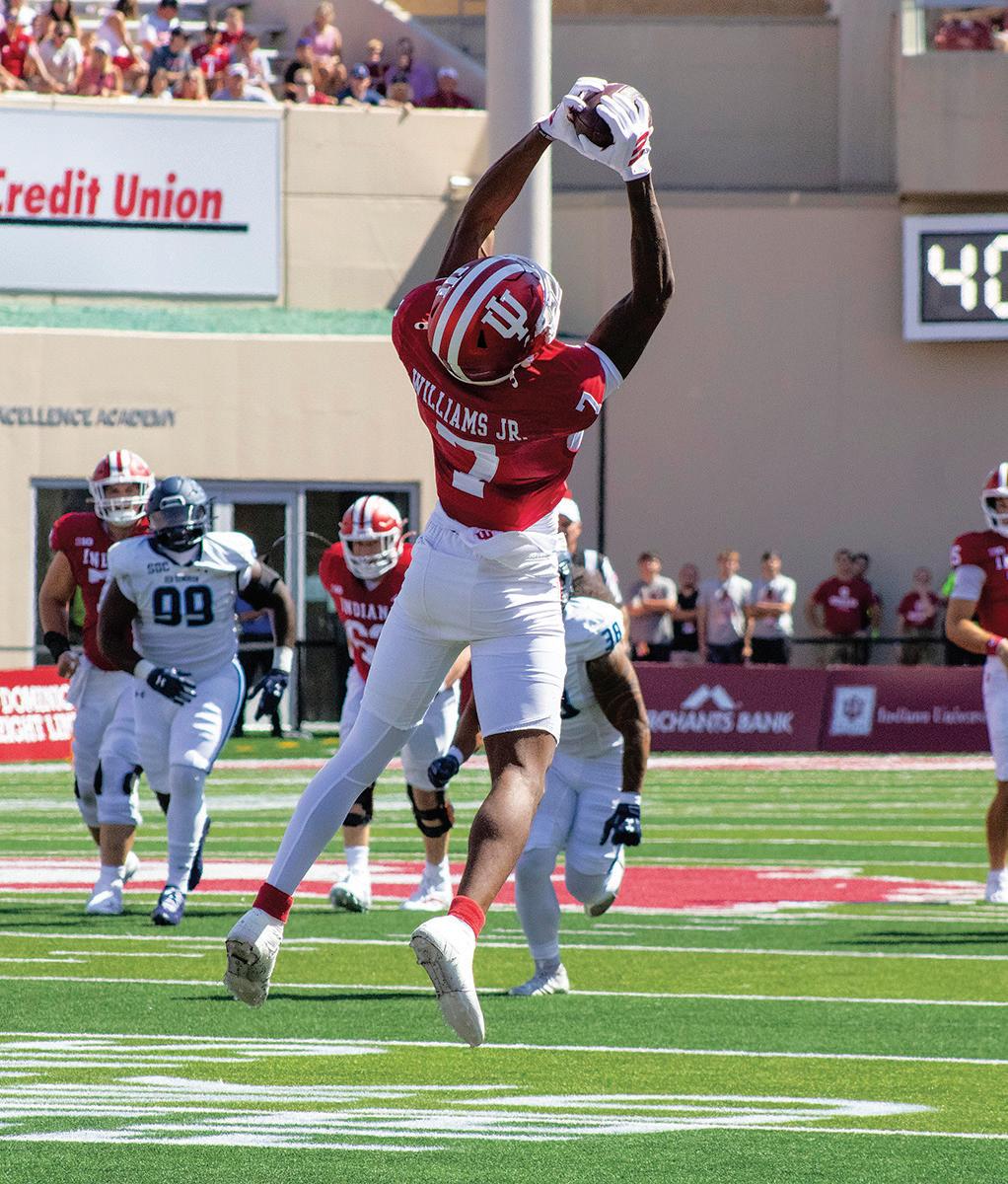
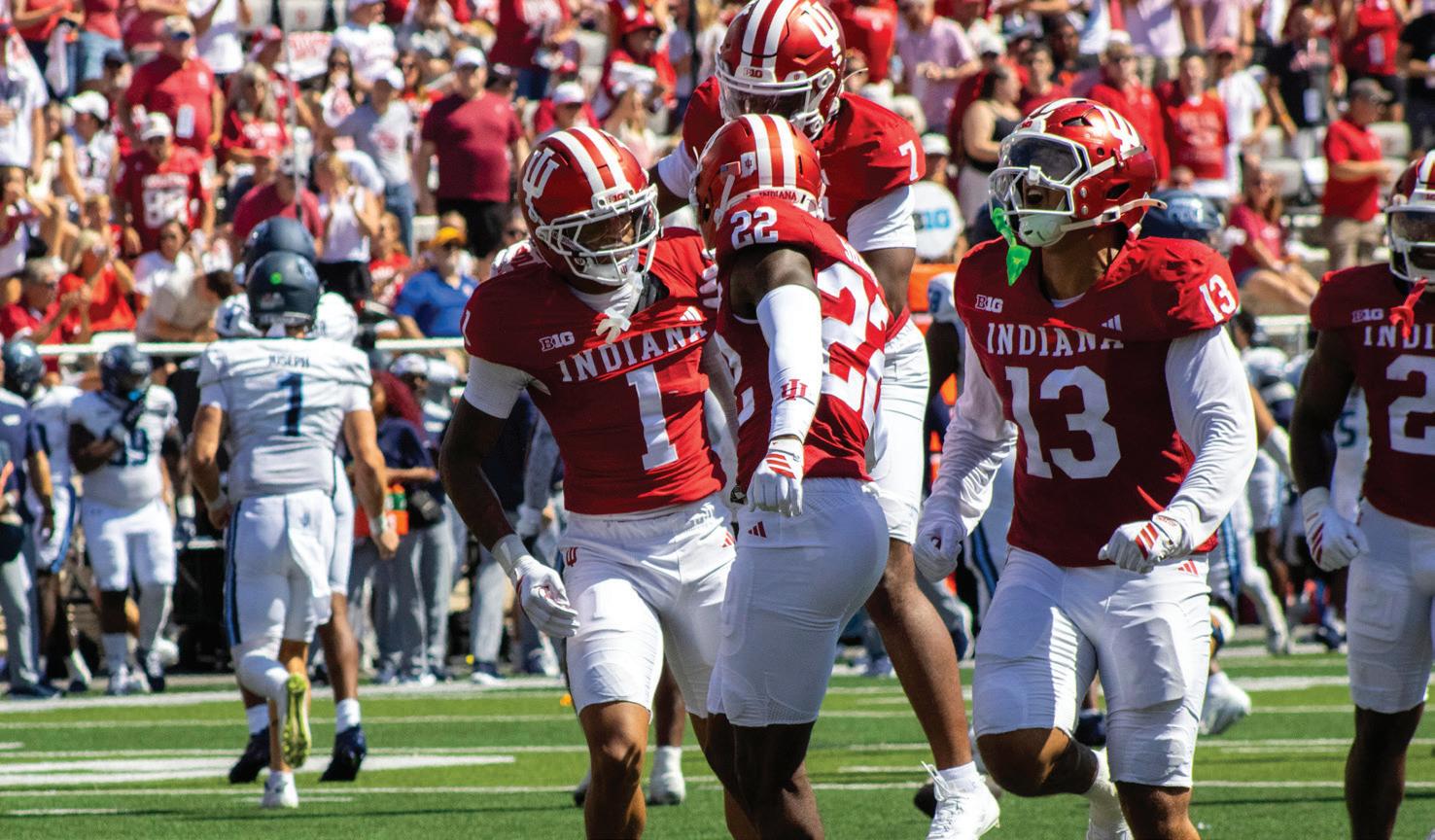
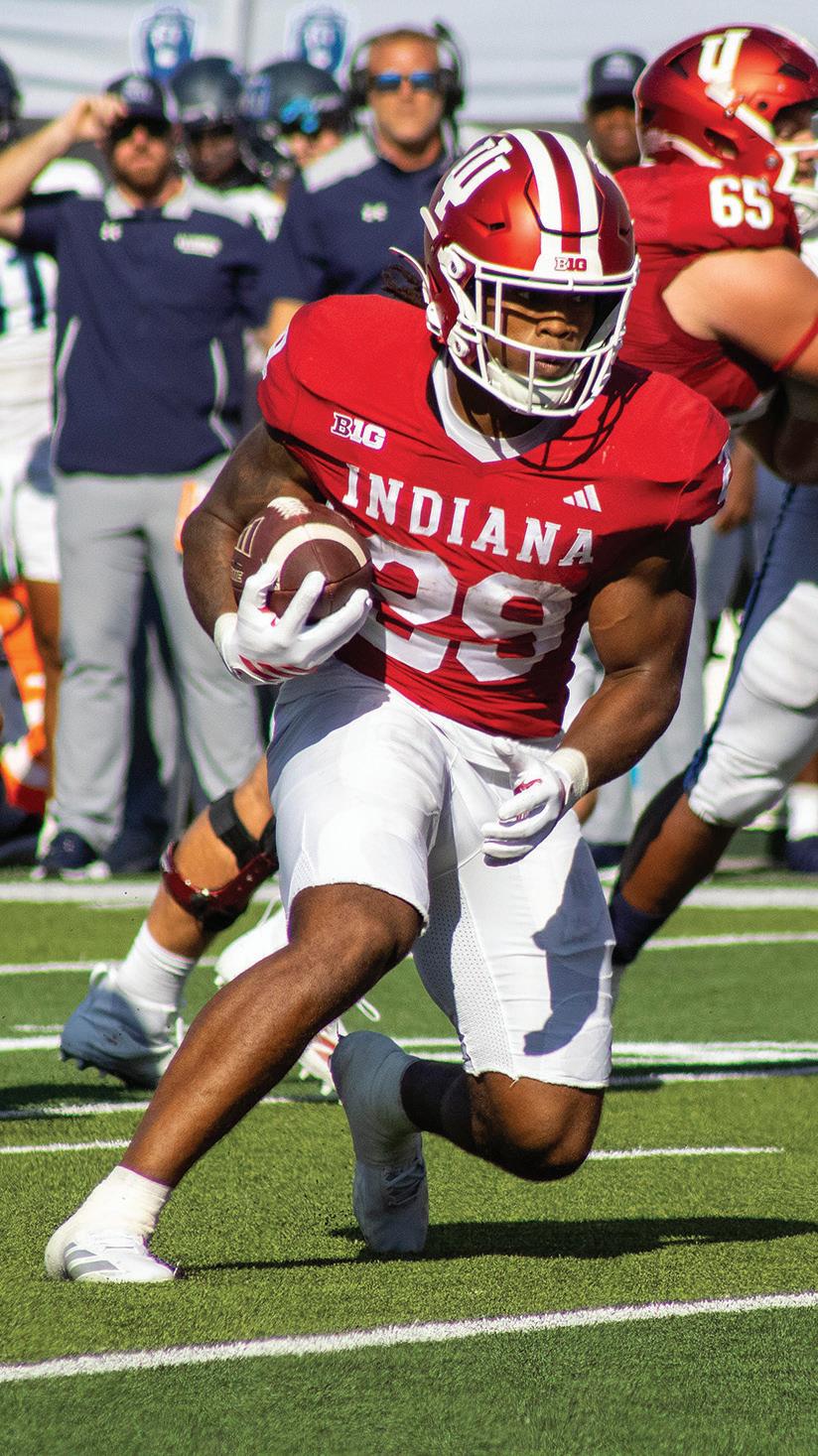
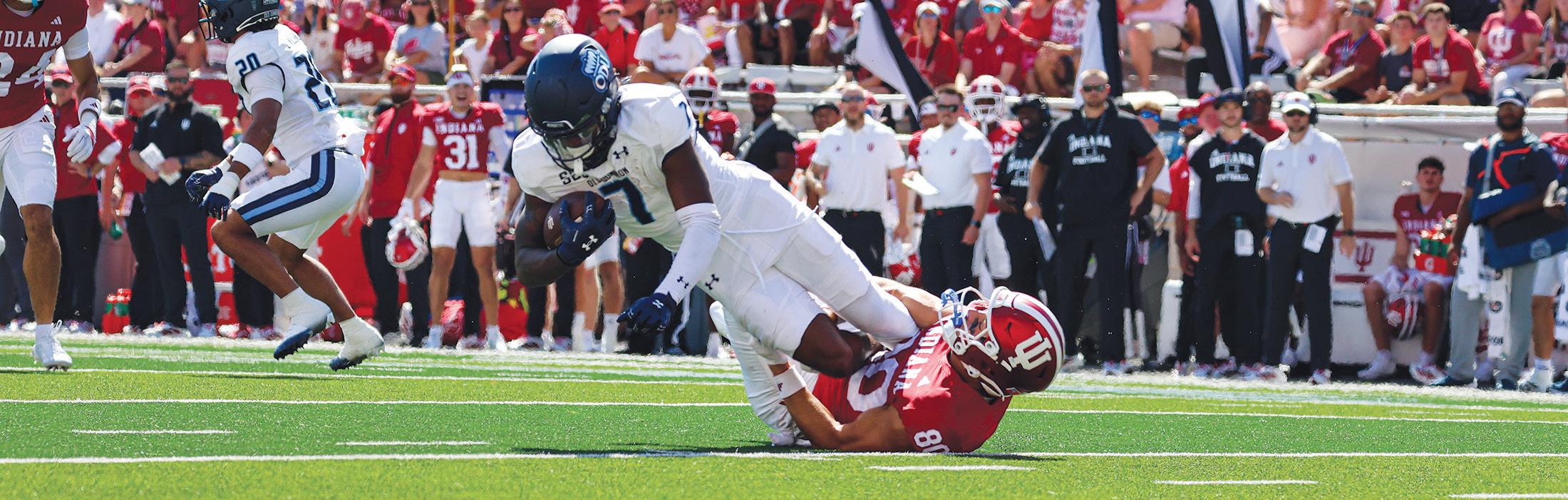



PHOTOS
Indiana men’s, women’s golf set to begin fall seasons
By Savannah Slone srslone@iu.edu | @savrivers06
Indiana women’s golf
Only three Hoosiers remain from the 202425 Indiana women’s golf roster — senior Madison Dabagia, sophomore Cara Heisterkamp and redshirt senior Maddie May. While the team only stood at seven players during last year’s fall season — and five players during the spring — Indiana has a lot of new golfers to acclimate to its culture ahead of the upcoming season.
Dabagia and former Hoosier Caroline Smith were the only Hoosiers last season to make it to the NCAA Lexington Regional in May.
Smith set the lowest singleseason stroke average in program history last season with 73.09 strokes per round.
Dabagia set the secondlowest mark with 73.12 strokes per round.
Apart from the returnees, fourth year head coach Brian May’s squad consists of two freshmen and three transfers.
Freshman Saia Rampersaud was a threetime North Carolina Independent Schools Athletic Association team state champion and a fourtime All-State honoree at Durham Academy in Durham, North Carolina.
The Hoosiers’ other freshman, Grace Heiss, attended Highland Park High School in Dallas — the same
school as two-time Masters Tournament champion and current No. 1 golfer in the world, Scottie Scheffler.
Redshirt junior Sheridan Clancy competed as a member of the Texas Christian University golf team from 2022-24 before taking a gap year and transferring to Indiana ahead of this season. Clancy averaged 78.56 and 76.38 strokes per round during her sophomore and freshman seasons, respectively. The Perth, Australia, native’s best performance at TCU was a tie for 16th place at the Big 12 Championship her freshman year.
During her two seasons at the University of Central Florida, junior Katie Poots averaged 74.45 strokes per round as a freshman and 75.17 strokes per round as a sophomore. Her lowest finish came her freshman year at the Moon Golf Invitational, when Poots shot three under par for the tournament to finish in sixth place.
Junior Presli Webb started all of Bellarmine University’s tournaments as a sophomore when she averaged 77.9 strokes per round, which ranked second best for the Knights.
With all the new members, Brian May will have a fresh start to the season after the Hoosiers tied for 16th place at the Big Ten Championship, despite taking home the title of Big
Ten Champions the year prior.
The Hoosiers started out their season with a promising finish at the Boilermaker Classic on Sept. 1-2 at the Kampen-Colser Course in West Lafayette, Indiana. Indiana took home second place, just one stroke behind the University of Mississippi. Dabagia placed first with a score of 209 strokes, which was three strokes better than second place.
Maddie May and Poots both tied for ninth place with a score of evenpar. Clancy and Rampersaud rounded out the lineup for the Hoosiers placing 28th and 64th, respectively.
Indiana men’s golf
Unlike the women’s team, the Indiana men’s golf roster is full of returning players. The only new additions to the Hoosiers’ squad are freshmen Jake Cesare — younger brother of junior Alec Cesare — and Caleb Schnarr.
Jake Cesare attended Westfield High School in Westfield, Indiana, where he holds the all-time lowest four-year scoring average with 71.6 strokes per round and earned All-State honors all four years. Schnarr went to Jasper High School in Jasper, Indiana, where he was a three-time state qualifier.
The Hoosiers’ only losses over the offseason were Robert Bender III and

Kieran Hogarth. Bender — a team captain last season — averaged 75.17 strokes per round last year coming off his best collegiate season where he scored an average of 74.29 strokes per tournament during his redshirt junior season. Hogarth played his final two seasons with the Hoosiers after transferring from Chicago State University in 2023. He played a total of 21 rounds and averaged 74.48 strokes per tournament throughout his time with Indiana. Last season, redshirt
senior Clay Merchent was the only Hoosier to advance to the NCAA Urbana Regional where he finished tied for 38th place with a score of four over par for the tournament. Merchent finished inside the top 20 in six tournaments last season en route to being an AllBig Ten Second Team and PING Division I All-Region honoree. His performance last season put him on the 2025-26 Big Ten preseason players to watch list. Indiana finished the 2024-25 season with an eighth-place finish at the Big Ten Championship. Junior Cole Starnes was the top placing Hoosier, finishing tied for 12th with 212 strokes, which put him
Unity of Bloomington A Center for Spiritual Growth
Evangelical Lutheran Church in America
Rose House LuMin & St.
Thomas Lutheran Church
3800 E. Third St. 812-332-5252 Stlconline.org
lcmiu.net
Instagram: @hoosierlumin facebook.com/LCMIU facebook.com/StThomasBloomington
Sunday: 8:30 a.m. & 11 a.m.
@ St. Thomas Lutheran Church
3800 E. Third St.
Tuesday: 6:30 p.m. Dinner & Devotions
@ Rose House LuMin 314 S. Rose Ave.
Rose House LuMin and St. Thomas Lutheran Church invite you to experience life together with us. We are an inclusive Christian community who values the faith, gifts, and ministry of all God’s people. We seek justice, serve our neighbors, and love boldly.
Rev. Adrianne Meier Rev. Lecia Beck
Rev. Amanda Ghaffarian - Campus Pastor
St. Mark’s United Methodist Church
100 N. State Rd. 46 812-332-5788 smumc.church facebook.com/BloomingtonStMarksUMC instagram: @stmarksbloomington
Sunday: Worship 10:30 a.m.
Office: Mon. - Fri. 9 a.m. - 3 p.m.
St. Mark’s United Methodist Church of Bloomington, Indiana is an inclusive community, bringing Christ-like love, healing, and hope to all. We embrace the United Methodist ideal of open hearts, open minds, and open doors by welcoming those of all races, cultures, faith traditions, sexual orientations, and gender identities.
Rev. John Huff - Pastor Rev. Mary Beth Morgan - Pastor
4001 S. Rogers St. text/call: 812-333-2484 unityofbloomington.org IG: @unityofbloomington facebook@UnityofBloomington
Sunday Celebration: 10:30 a.m.
Discover a vibrant, welcoming community at Unity of Bloomington – “a positive path for spiritual living”. Our center offers a space for spiritual growth; embracing all with open arms. We proudly affirm and welcome the LGBTQ+ community, fostering love, acceptance, and inclusion. Join our loving congregation, where everyone is valued and encouraged to explore their spiritual journey. At Unity of Bloomington, all are welcome and together we thrive!
Minnassa Gabon - Spiritual Leader
Phyllis Wickliff - Music Director
Trinity Reformed Church 2401 S. Endwright Rd. 812-825-2684 trinityreformed.org instagram.com/trinityreformed facebook.com/trinitychurchbloom
Sunday: 9:15 a.m., Sunday Bible Classes 10:30 a.m., Worship
We are a Reformed Protestant church on the west side of Bloomington with lively worship on Sunday mornings, Bible classes beforehand, home groups, and a college age group called The Mix (a group of young adults who are both attending college and beyond).
Jody Killingsworth - Lead Pastor Max Curell - Shepherding Pastor Stephen Baker - Discipleship Pastor Philip Moyer - Worship & Youth Pastor
Christian Science
Christian Science Church
2425 E. Third St. 812-332-0536 bloomingtonchristianscience.com facebook.com/e3rdStreet
Sunday Church Service: 10 - 11 a.m. Wednesday Testimony Meeting: 7 - 8 p.m. Mon. - Fri. Reading Room: Noon - 2 p.m.
Interested in spirituality and healing? We welcome you to our church to explore how you can address issues spiritually and experience healing.
Inter-Denominational
Redeemer Community Church
111 S. Kimble Dr. 812-269-8975
redeemerbloomington.org
facebook.com/RedeemerBtown
Instagram & Twitter: @RedeemerBtown
Sunday: 9 a.m., 11 a.m.
Redeemer is a gospel-centered community on mission. Our vision is to see the gospel of Jesus Christ transform everything: our lives, our church, our city, and our world. We want to be instruments of gospel change in Bloomington and beyond.
Chris Jones - Lead Pastor
United Methodist
(219 E. 4th St.) for free food, honest discussion, worship, and hanging out. Small groups, service projects, social events (bonfires, game nights, book clubs, etc.), outreach retreats, and leadership opportunities all play a significant role in our rhythm of doing life together. Markus Dickinson - jubilee@fumcb.org
4001 S. Rogers St. text/call: 812-333-2484 unityofbloomington.org IG: @unityofbloomington facebook@UnityofBloomington Sunday Celebration: 10:30 a.m. Discover a vibrant, welcoming community at Unity of Bloomington – “a positive path for spiritual living”. Our center offers a space for spiritual growth; embracing all with open arms. We proudly affirm and welcome the LGBTQ+ community, fostering love, acceptance, and inclusion. Join our loving congregation, where everyone is valued and encouraged to explore their spiritual journey. At Unity of Bloomington, all are welcome and together we thrive!
Minnassa Gabon - Spiritual Leader
Phyllis Wickliff - Music Director
Field hockey looks to build upon last season in 2025
By Sean McAvoy semcavoy@iu.edu | @sean_mc07
Entering the 2025 season, Indiana field hockey aims to compete with the heavy hitters in the Big Ten. With the likes of National Field Hockey Coaches Association preseason poll No. 1 Northwestern — the reigning national champions — No. 4 Maryland, No. 7 Michigan, plus four other ranked teams, the Hoosiers have a tough task.
However, the tough schedule does not affect the mentality of head coach Kayla Bashore and a younger squad that only bolsters three seniors.
“Executing the objectives of what we want to see, that’s the focus,” Bashore said on Aug. 27. “We’ve really tried to train our team and our mindset on ‘we ought to focus on ourselves and not what the opponent is ranked or who they have outside of key players and tendencies.’”
Last season, Indiana compiled a 9-9 overall record with a 4-4 Big Ten record, which was its best overall performance since 2021 and best conference record since 2015. The Hoosiers also picked up three ranked wins against No. 12 Iowa, No. 18 University of California, Berkeley and No. 7 Michigan, the most in a season since 2011.
Now, the Hoosiers are trying to continue their momentum in the biggest

games on their schedule.
Indiana started their season in Orono, Maine, against then-No. 8 Boston College and the University of Maine. The Hoosiers pushed the Eagles to the wire in a lastsecond 1-2 loss on Aug. 30, but responded by defeating the Black Bears 4-3 on Sep. 1.
Indiana will also play the University of Louisville, Drexel University and Miami University during their nonconference games, but the meat of their season will be played against Big Ten opponents. The Hoosiers will travel to Maryland, Michigan, Northwestern and Penn State. Picking up wins in the conference will be crucial for Indiana due
to only seven out of the nine teams being able to play in the postseason, and making the tournament is very significant this season.
Deborah Tobias Field in Bloomington will host the Big Ten Field Hockey Tournament this year. Indiana made its first conference tournament appearance since 2021 last season, when the Hoosiers lost to the No. 3 seed Michigan 1-2 in overtime on Nov. 7.
But the opportunity to play in front of home fans in the postseason has not changed how Indiana is treating this upcoming season.
“It’s how are we preparing
ourselves to put ourselves in the best position to win games regardless of where,” Bashore said. “At home or away, ranked, not ranked, in the Big Ten Tournament, out of conference, in conference, every game is different. When we’re showing up, we have to say, ‘We’ve done the training.’ We’ve prepared all these scenarios.”
Indiana will return two out of three leading scorers from last season. Junior midfielder and team captain Inés Garcia Prado returns after leading the Hoosiers with eight goals in 18 games. She was selected to play for Spain’s U21 national team over the summer and is on the 2025 NFHCA Watchlist
for this upcoming season.
Sophomore forward Mijntje Hagen looks to increase her productivity from her fivegoal output during her first year in Bloomington.
“It’s exciting to have both of them back and providing that attack and that dangerous attacking players for us,” Bashore said. “Then adding in some extra players with some nice technical skill, good goal scoring abilities.”
Indiana returns senior back Emma Thompson, who started in all 18 games last season and remains a team captain. She will try to bolster the defense after Indiana lost two backs in Yip van Wonderen, who
Check the IDS for your directory of local religious services, or go online anytime at idsnews.com/religious For membership in the Indiana Daily Student Religious Directory, please contact ads@idsnews.com
Society of Friends (Quaker)
Bloomington Friends Meeting 3820 E. Moores Pike bloomingtonfriendsmeeting.org
Sunday (in person & by Zoom):
9:45 a.m., Hymn singing 10:30 a.m., Meeting for Worship Children’s program available
We practice traditional Quaker worship, gathering in silence with occasional Spirit-led vocal ministry by fellow worshipers. We are an inclusive community with a rich variety of belief and no prescribed creed. We are actively involved in peace action, social justice causes, and environmental concerns.
Rex Sprouse - Clerk rsprouse@iu.edu
Bahá'í Faith
Bloomington Bahá'í Community and Bahá’í IU Association
424 S. College Mall Rd. 812-331-1863 bloomingtoninbahais.org
facebook.com/Baháí-Community-ofBloomington-Indiana-146343332130574
Instagram: @bloomingtonbahai
Sunday: 10:40 a.m., Regular Services, Devotional Meetings. Please call or contact through our website for other meetings/activities
The Bahá'í Association of IU works to share the Teachings and Principles of the Founder, Bahá'u'lláh, that promote the "Oneness of Mankind" and the Peace and Harmony of the Planet through advancing the "security, prosperity, wealth and tranquility of all peoples."
Karen Pollock Dan Enslow
Independent Baptist Lifeway Baptist Church
7821 W. State Road 46 812-876-6072 lifewaybaptistchurch.org facebook.com/lifewayellettsville
Sunday: 9 a.m., Bible Study Classes
10 a.m., Morning Service
5 p.m., Evening Service
*Free transportation provided. Please call if you need a ride to church.
Student Ministry: Meeting for Bible study throughout the month. Contact Rosh Dhanawade at bluhenrosh@gmail.com for more information.
Steven VonBokern - Senior Pastor Rosh Dhanawade - IU Coordinator 302-561-0108 bluhenrosh@gmail.com
Non-Denominational
Christ Community Church
503 S. High St. 812-332-0502 cccbloomington.org facebook.com/christcommunitybtown Instagram: @christcommunitybtown
Sunday: 9:15 a.m., Educational Hour 10:30 a.m., Worship Service
We are a diverse community of Christ-followers, including many IU students, faculty and staff. Together we are committed to sharing the redeeming grace and transforming truth of Jesus Christ in this college town.
Bob Whitaker - Senior Pastor Adam deWeber - Worship Pastor Dan Waugh - Adult Ministry Pastor
Great Harvest Ministry Center (GHMC Family)
1107 S. Fairview St. 812-325-2428 (GHMC) ghmcfamily.org
Sunday: 10:30 a.m.
GHMC Family is a small church with a big heart. We follow Jesus and not a religion. We believe God’s Word as written for real people living in a messy world. We are a family of believers — your home away from home. Casual, welcoming, and here to support each other through life’s challenges. Come grow with us!
Tony Taylor - Pastor
Christian Student Fellowship
1968 N. David Baker Ave. 812-332-8972 csfindiana.org Instagram: @csfindiana office@csfindiana.org
Monday - Friday: 10 a.m. - 5 p.m.
Christian Student Fellowship (CSF) exists as a Christ-centered community focused on helping students truly know Jesus Christ. Our ministry hub is located on campus at the last stop on the B bus. Reach out to schedule a tour, or join us for our 8 p.m. Thursday night worship service (Encounter)!
Ben Geiger - Lead Campus Minister
Stephanie Michael - Campus Minister
Nick Conrad - Associate Campus Minister
United Church of Christ and American Baptist Churches-USA First United Church
2420 E. Third St. 812-332-4439 firstuc.org facebook.com/firstuc instagram.com/firstuc2420 youtube.com/@FirstUCBtown
Sunday: 10:30 a.m., Worship
Monday: 10 a.m. via Zoom, Bible Study
We are an Open, Welcoming, and Affirming community of love and acceptance dedicated to welcoming the diversity of God’s beloved. We exist to empower, challenge, and encourage one another to live out Jesus’ ways (compassion, truth, and justice) authentically as human beings in community to create a better world.
Rev. Jessica Petersen-Mutai Senior Minister
Nazarene
Bloomington Eastview Church of the Nazarene
4545 E. Lampkins Ridge Rd. 812-332-4041 eastviewnazarene.org
Facebook - Eastview Church of the Nazarene
Sunday: 9 a.m.: Morning Prayer 9:30 a.m.: Sunday School 10:30 a.m.: Worship Service
3 p.m.: Cedar Creek Worship Wednesday: 10 a.m.: Bible Study
Join us at Bloomington Eastview Church of the Nazarene, where faith meets community! Connect with fellow students through engaging worship, meaningful discussions, and service opportunities. Discover a supportive space to grow spiritually and make lasting friendships. Everyone is welcome - come as you are and be a part of our vibrant family!
Rev. Bruce D. Yates - Pastor
Alicia J. Dollens - Facility Manager
Unitarian Universalist Unitarian Universalist Church of Bloomington
2120 N. Fee Ln. 812-332-3695 uubloomington.org facebook.com/uubloomington
Sunday: 10:30 a.m. via in person or livestream
We’re a multi dynamic congregation actively working towards a more just and loving world. We draw inspiration from world religions and diverse spiritual traditions. Our vision is “Seeking the Spirit, Building Community, Changing the World.” A LGBTQA+, Dementia Friendly, Welcoming Congregation to all ages and groups and a Certified Green Sanctuary.
Rev. Susan Frederick-Gray
scored seven goals last season, and Sydney Keld, who scored four goals, due to graduation.
To help the Hoosiers after losing 10 seniors plus graduate students, Bashore and her staff brought in nine freshmen.
“They’re all very different in terms of where they play and their styles,” Bashore said. “Getting them to be at the place where we can utilize them to their best, to their strengths, is going to be key, and figuring that out early.”
One of Indiana’s strongest position groups is its goalkeeper tandem of sophomore Sadie Canelli and freshman Kai Killian. Canelli posted a 7-7 record when starting in goal last season with a 1.35 goals against average, which landed her on the Big Ten All-Freshman team. Killian had a 90% save percentage during her senior season in high school and was brought in after former Hoosier goalkeeper Brooke Ross graduated. “I think our goaltending is very strong this year,” Bashore said. “That’s very exciting for us because that’s another position you want to really make sure you got locked up. They both have somewhat different styles, but their strengths are going to work well for the team.” Indiana will play its first game at home this season at 3 p.m. Sept. 4 against Drexel.
Episcopal (Anglican)
Canterbury Mission 719 E. Seventh St. 812-822-1335 IUCanterbury.org
facebook.com/ECMatIU
Instagram: @ECMatIU
Youtube: @canterburyhouseatiu9094
Sunday: 3 p.m. - 7 p.m.
Mon., Wed., Thu.: 10
By
Canterbury: Assertively open & affirming; unapologetically Christian, we proclaim the gospel of Jesus Christ by promoting justice, equality, peace, love and striving to be the change God wants to see in our world.
Ed Bird - Chaplain/Priest
Baptist Emmanuel Church
1503 W. That Rd. 812-824-2768 Emmanuelbloom.com
Instagram & Facebook: @EmmanuelBloomington
Sunday: 9:15 a.m., Fellowship Sunday: 10 a.m., Worship Groups: Various times
Emmanuel is a multigenerational church of all types of people. Whether you are questioning faith or have followed Jesus for years, we exist to help fuel a passion for following Jesus as we gather together, grow in community, and go make disciples.
John Winders - Lead Pastor
Second Baptist Church 321 N. Rogers St. 812-336-5827 sbcbloomington.org facebook.com/2ndbaptistbloomington youtube.com/@secondbaptist churchbloomington
Sunday Service: 10 a.m., In house and on Facebook/YouTube Sunday School: 8:45 - 9:45 a.m. Bible Study: Available In House and on Zoom Wednesdays, 6:30 p.m., Thursdays, Noon
Please come and worship with us. We are in training for reigning with Christ! Need a ride? Call our Church bus at 812-3271467 before 8 a.m. on Sunday Rev. Dr. Bruce R. Rose - Pastor Rev. Dr. William Vance - Associate Pastor Tallie Schroeder - Secretary
GISELLE MARSTELLER | IDS
Then-junior back Emma Thompson pushes the ball against Ball State University on Sept. 13, 2024, at Deborah Tobias Field in Bloomington.
Indiana field hockey compiled a 9-9 overall record last year.
COLUMN: Hoosier the Bison is exactly what Indiana football needed
By Oliver Swats oswats@iu.edu
On Indiana football’s Aug. 30 matchup against Old Dominion University, Hoosier the Bison skydived into a packed Memorial Stadium, with a Hoosiers flag trailing behind him, swaying in the wind. He landed, and 52,626 Hoosier fans erupted with thunderous applause. Hoosier then instantly got up, waving his hands to get the crowd on their feet and loud. Minutes later, he came bursting out of the tunnel riding a motorcycle, doing circles around the field, electrifying the crowd with chants and the anticipation of a new mascot for Indiana fans to root for.
This is exactly what the new look Indiana football team needs: a mascot to get fans excited, be it at the game or watching on television.
Mascots, in general, give fans, especially younger ones, something fun to cheer for. Hoosier the bison could majorly increase Indiana’s fanbase majorly, especially among kids who just saw a big bison skydiving into the stadium. Along with the early game antics, Hoosier will provide halftime and commercial break entertainment all season long, being part of the “Band Day Halftime Show.” Hoosier will be an icon in Bloomington for decades to come. And the newfound culture Curt Cignetti brought to a struggling program is continuing to redefine itself with the era of the Bison.
It’s obvious that bringing Hoosier the Bison back involves marketing tactics to sell plush stuffed animals and put infinitely more T-shirts on the shelves, but that isn’t a bad thing. Having a mascot helps increase merchandise sales, so one could expect Indiana’s merchandise sales to rise as well. Having something like an animal that looks cool on a shirt could instantly skyrocket sales, and apparel
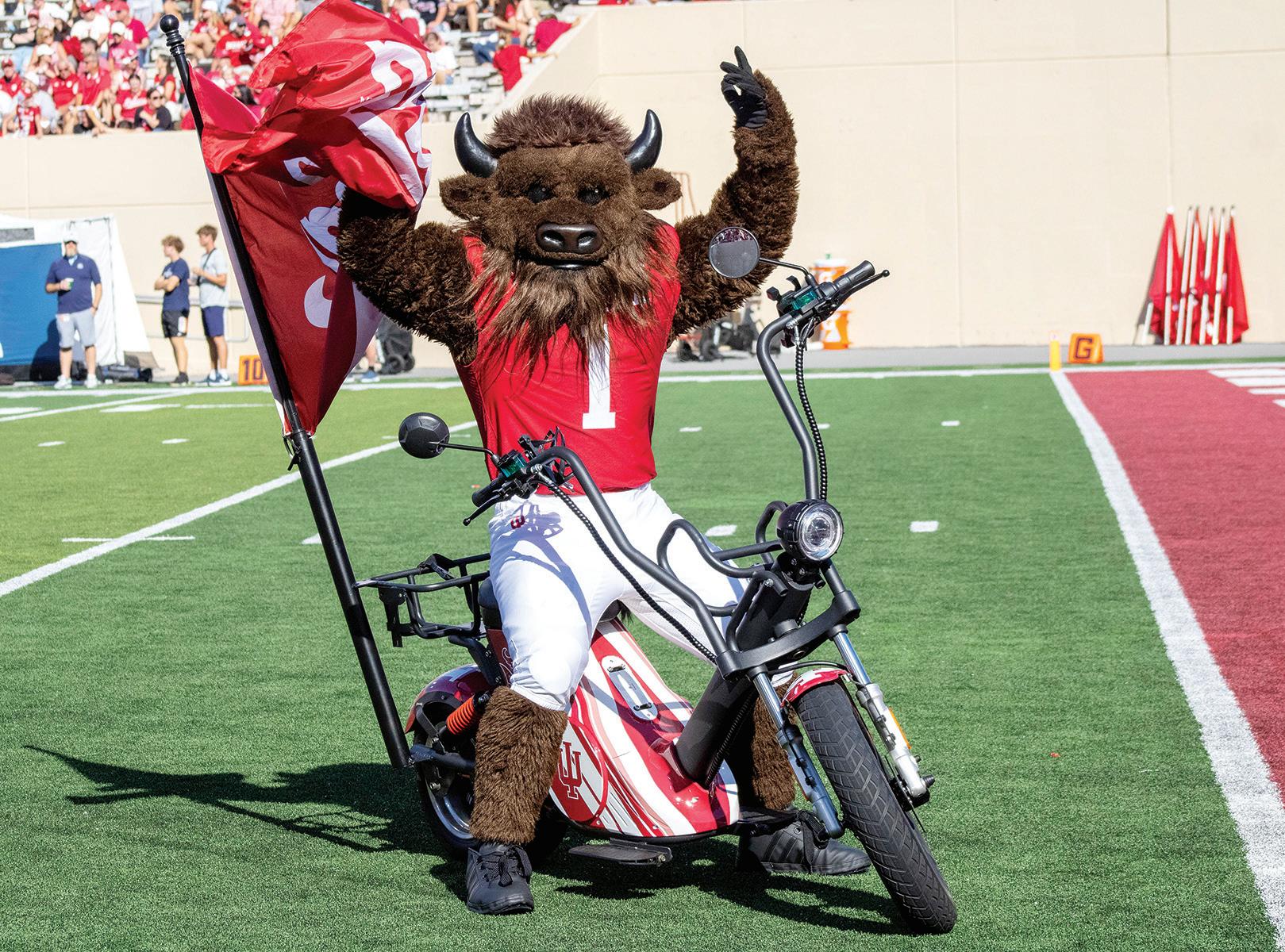
with the Bison on it will be seen much more around Indiana and the country.
Along with this, bringing back the bison shows the university’s commitment to not only displaying the rich history of Indiana, but to educating people on the species that used to inhabit the ecosystem and the brutal way settlers caused the extinction of the bison.
What many Indiana residents don’t know is that 200 years ago, bison roamed freely from the northern prairies and into the southern hills of
Indiana. They lived there for centuries, untouched and unbothered until European settlers hunted them all down, the last of them being seen in 1830.
Although bison had remained extinct for some time, in 2016 a small herd was reintroduced to the Kankakee Sands prairie in Newton County, Indiana. There, the ecosystem is now able to thrive due to the bison’s ability to manage the prairie lands.
In 1965, IU adopted the bison logo as a representation of the state’s
history, but like the wild
bison that lived there over 100 years ago, the mascot’s time quickly came to an end in 1969 due to the teams’ losing records and the bison’s terrifying design.
Former Assistant Athletic Director Bob Dro even described it as “The devil with a cheerleader in it.”
After the bison’s disastrous trial in the ‘60s, the idea of bringing back the mascot could’ve easily backfired. The head of the bison was much bigger than the size of the body, making it difficult to move,
and it looked frightening to viewers. But, after the reveal of the new mascot archetype, it was clear that they’d fixed that problem. Hoosier the Bison not only looks much cleaner and isn’t disproportionate, but it looks more menacing and intimidating to opposing teams.
The name “Hoosiers” has always been Indiana’s unique sense of pride, as IU’s typically been the only Big Ten team without a mascot face to put with their name. Which is why going all in with the bison
will add an extra layer of identity, while still holding onto the Hoosier name. It will unite fans week in and week out, already being seen everywhere at the tailgate fields the weekend of kickoff. And it will bring together Indiana alumni and supporters all over the country to support their team. Hoosier signifies a new era, not only in Indiana football, but for Indiana athletics and the campus overall, the mascot will influence tradition for decades to come.
Indiana Daily Student
JIMMY RUSH | IDS
Indiana University’s mascot Hoosier the Bison attempts to motivate the crowd while on a motorcycle during a football game against Old Dominion University on Aug. 30, 2025, at Memorial Stadium in Bloomington. Hoosier rode on the motorcycle throwing T-shirts toward fans.