IDS
a
By Emerson Elledge
eelledge@iu.edu
The Bloomington Faculty Council passed a resolution urging IU to remove the U.S. Department of Homeland Security, along with its Customs and Border Protection and Immigration and Customs Enforcement agencies, from the university’s list of approved employers with the ability to post on the IU Events calendar.
The resolution comes after the university received criticism for having virtual career expos and webinars hosted by CBP on the university event calendar. The events were also posted on Handshake, a third-party platform IU uses to connect students to available jobs and other professional events.
“Indiana University students have access to all job and internship opportunities posted on Handshake,” IU spokesperson Mark Bode previously told the Indiana Daily Student in an email. "While Handshake events are listed on the IU events calendar, virtual events of this nature are hosted and controlled by employers, not Indiana University.” Anthropology professor Sarah Phillips presented the resolution to the council. She began her statement by referencing the CBP Feb. 18 event description, which begins with “Help Defend the Homeland.”
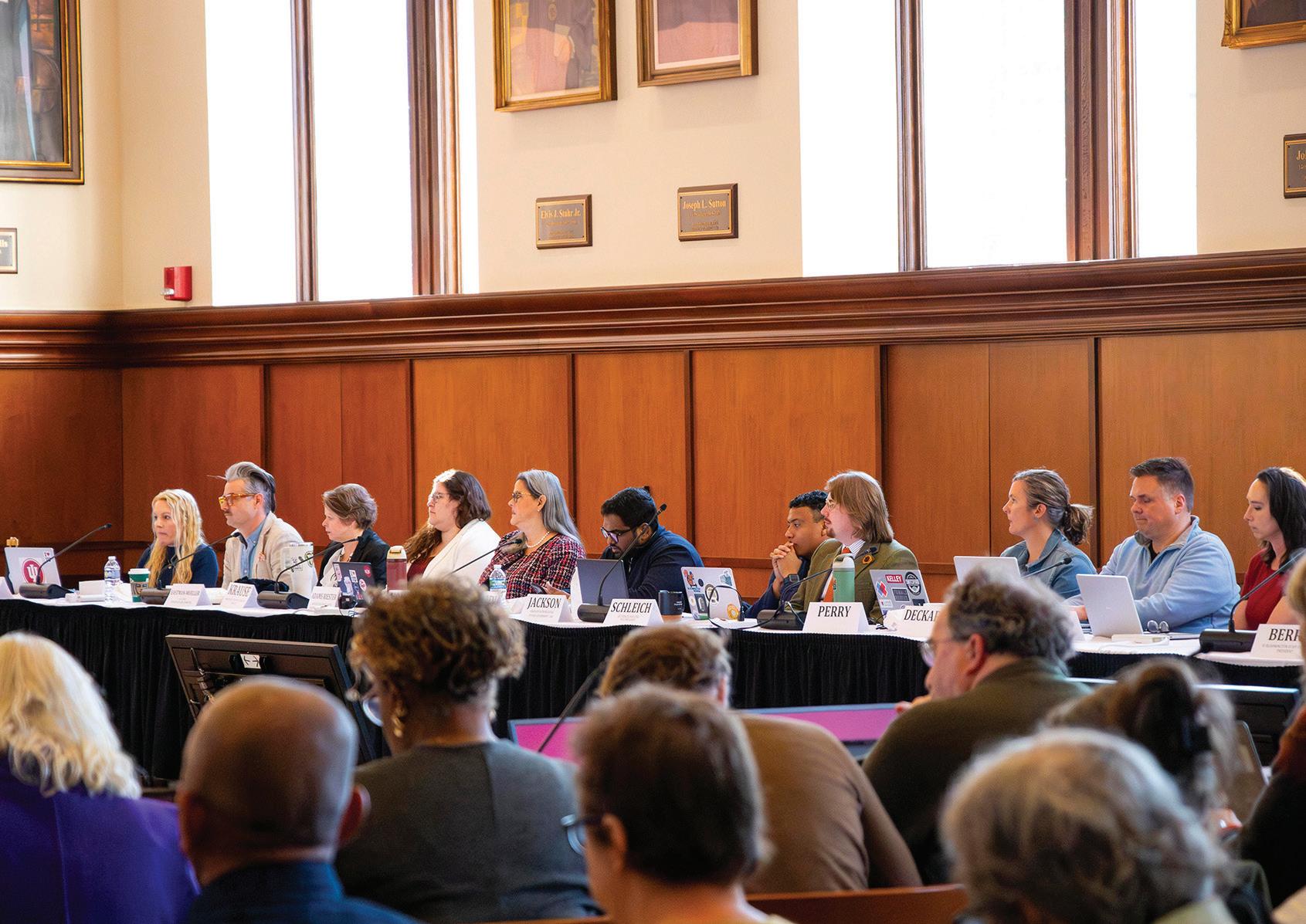
“This is not subtle,” Phillips said. “This is disturbing and this is a xenophobic subheading that pretty much sets the stage here and explains partially the concerns that I'm expressing and that many of my colleagues are expressing.”
When Phillips began addressing the council, around 30 audience members not part of the BFC stood up holding signs, most of which read “NO ICE.”
“It's disturbing that while IU is not hosting this virtual career expo by Customs and Border Protection, it is providing a platform for Department of Homeland Security to recruit students to these agencies,” Phillips said.
events,” associate professor Seth Freedman said. “They can choose to disengage, can choose to approach. Maybe a more appropriate role for us as faculty would be to encourage our students to critically assess the implications of potential employment choices available to them rather than restrict those choices.”
As partial reasoning for the resolution, Phillips referenced a petition created by an IU Northwest student when the DHS events first came to public attention during her address. Freedman said he was unaware of the petition prior to the council meeting.
Some BFC members shared concerns about the precedent of blocking certain employers from listing opportunities without giving students the chance to evaluate employers themselves.
“Students are not required to attend these
She mentioned that Minnesota’s federal chief judge found that ICE violated at least 96 court orders in 74 cases during January. Phillips shared print copies of the resolution with all in the room, including those not on the council. The official resolution called on IU to remove DHS, ICE and CBP from its approved employers list until “all court cases involving potential violations of civil rights and alleged illegal and unconstitutional activity” by the agencies is resolved.
By Natalia Nelson nelsonnb@iu.edu
Beacon, a Bloomington homeless shelter, has to turn people away. Its overnight shelter, Friend’s Place, is full every night. And Wheeler Mission is operating close to capacity.
Several of Bloomington’s homeless shelters are full or close to full, Bloomington’s Homelessness Response Coordinator Brian Giffen said.
“We definitely don’t have the shelter capacity for everyone that’s living on the street,” Giffen said.
But Senate Bill 285 would make it a Class C misdemeanor for people to camp or sleep on public land.
Those who violate the bill would first receive a warning. If they have already received one and are still camping within 300 feet of where the warning was issued after two days, they could be jailed for up to 60 days and fined up to $500.
The bill also bars cities and counties from creating policies that would prevent the enforcement of the law and allows residents to sue if such a policy is created.
One of the bill’s authors, Sen. Cyndi Carrasco, R-Indianapolis, said at the bill’s third reading Jan. 28 that she authored it to address chronic homelessness and help some of the most vulnerable individuals.
“We have a responsibility to do something to help people who are living on streets in encampments that pose health and safety risks,” Carrasco said.
Carrasco said during the reading that the goal of the bill is not to criminalize homelessness, but rather allow intervention.
“The misdemeanor provision exists to create a moment where outreach, diversion and connection to services can occur,” Carrasco said.
“And to move individuals towards a healthier and more stable life through a
clear, multi-step process that prioritizes services before enforcement.”
A bill amendment last year would have similarly criminalized public sleeping, though it did not become law.
Now that the idea of criminalization has reemerged and passed the Indiana Senate on Jan. 28, some local leaders are concerned Monroe County would not be able to accommodate those who are living on the street in shelters.
According to a Point-inTime Count report taken on one night in January 2025, 305 people were experiencing homelessness in Monroe County.
Beacon Executive Director Forrest Gilmore said there wasn’t enough shelter in the city and county to house everyone currently sleeping on the streets — a little over 100 people, he said.
Beacon’s overnight shelter is filled every night, he said.
“We know there are other, there are more that are seeking shelter, that we’re turning people away,” Gilmore said.
Gilmore said he is inherently opposed to the state criminalizing something without giving people an alternative. It’s a complicated problem from a funding standpoint, he said, but the simplest and most obvious solution to homelessness is investing in housing.
He said the state government is not substantively investing in homeless services, care and shelter, which he sees as the response to homelessness. Indiana uses Emergency Solutions Grant funding to give money to shelters and for transitional housing for the homeless.
A 2023-22 memo showed the Indiana Housing and Community Development Authority allocated nearly $4 million to shelters around the state.
“I understand the chal-
lenges that people are talking about with street homelessness, especially with large camps, and the issues with those,” Gilmore said.
But he feels the solution of “trying to punish this out of existence” makes no sense.
Mary Morgan is executive director of Heading Home of South Central Indiana, a coalition looking to decrease homelessness and strengthen housing security.
She expressed concerns about the bill and the lack of funding for alternative treatments and services to homeless people.
“We need to be working to get people into housing, not to make it more difficult for them to just survive,” Morgan said.
When people have criminal records, she said, it’s much more difficult to secure housing because some apartment complexes may not accept them.
The city’s current policy, Giffen said, is to issue a 72hour notice for tents that pop up on the sidewalk and a 30-day notice for larger encampments. Officers will try to connect with people camping on the streets and give them grace, he said, but some could be charged with trespassing.
The 48-hour notice the bill proposes, Giffen said, would not be enough time for the city to get people in larger encampments access to resources. The new bill could also impact the relationships law enforcement have built with Bloomington’s homeless community, Giffen said.
“That can break down a lot of the trust they’ve built,” Giffen said. “You know, they’re specialized officers. They wear different uniforms. People know them.”
The bill was referred to the House’s Committee on Courts and Criminal Code on Feb. 2. To move forward, the bill would need to move out of committee and be voted on by the entire House.
When the resolution was put to a vote, the council voted anonymously on paper ballots. BFC President Bill Ramos said it was the first time the BFC voted that way because the council’s executive board decided the group would trial it. The reasoning, he said, was to let members feel free to “express their true voice and that of the constituents” without being concerned about how their vote could be perceived by their peers. Forty-two members voted for the resolution. Six others abstained, and 10 voted against it.
Though the resolution passed, the university will not be required to follow it and any other future resolutions passed because of a state law passed earlier in 2025, which shifted faculty councils to an advisory-only role.
By Zoe Reed reedzoe@iu.edu
Indiana University’s Media School will launch a journalism program this fall for students to cover underreported topics in Southern Indiana. The Indiana Newsroom will allow 15 students per semester to work directly with student and professional news organizations, starting with Indiana Public Media, according to a Feb. 9 news release from IU Today. Media School associate professor Suzannah Evans Comfort said the program is a collaboration between her, Media School Director of Development Emily Harrison, Indiana Public Media and the Community Foundation of Bloomington and Monroe County, which provides philanthropic support for Bloomington’s community. She said students will receive hands-on mentorship and paid opportunities while gaining professional experience.
The idea for The Indiana Newsroom emerged from a local news summit co-hosted by The Media School and the Community Foundation in fall 2024, Comfort said, which brought together local journalists to discuss how to support the news infrastructure for Indiana.
“It was pretty clear our journalists around here, local news organizations, really want to keep doing things the way they’ve been doing it,” Comfort said. “But at the same time, they really want more support, particularly from the university and from our students.”
The program will operate using a content-sharing model, similar to the Arnolt Center for Investigative Journalism, with students producing news in partnership with local news organizations.
This approach is designed to expand news-making capabilities in the region without competing with existing outlets, Comfort said.
“This is meant to be adding capacity to our local news ecosystem, not reproducing news that’s already
being made,” Comfort said. “In particular, we’re interested in the newsroom focusing on underreported topics or underserved communities.”
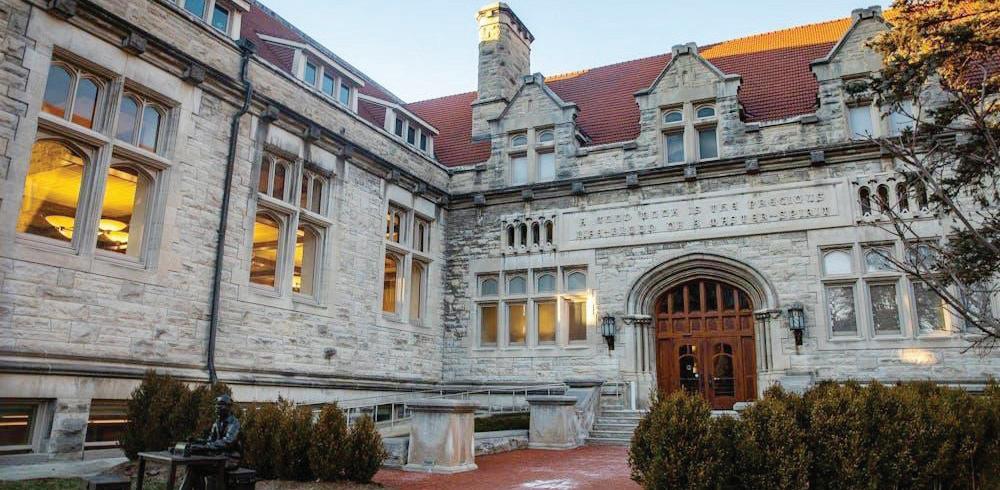
Funded by a two-year, $300,000 grant from the Community Foundation, the program will be housed on the second floor of Franklin Hall.
Comfort hopes to employ up to 15 student reporters per semester, with students able to return each semester, alongside a visiting professor of practice in community journalism, who will serve as founding director of the lab. All positions and travel for students and pay for the professor of practice will be covered by the grant.
Students will start by taking a new three-credit community journalism course, available in the upcoming fall semester. After their first semester in the program, students can qualify for $15 an hour by daily news reporting five hours a week, Comfort said.
The new course will focus on journalism in Southern Indiana, helping students get to know the institutions, people and figures involved in events and issues in the region.
In the past year, more than 136 newspapers have closed, leaving around 50 million Americans with limited or no access to reliable local news sources, according to Northwestern University’s Medill State of Local News Report 2025.
Michael Arnold leads WFIU/WTIU as IU integrated public media executive director. He also currently serves as interim director
of student media, which includes the Indiana Daily Student, IUSTV and WIUX. Arnold said the program addresses the nationwide challenge facing local journalism.
“There is kind of like a trend across the country of students helping to solve the journalism crisis in communities,” Arnold said. The Media School is currently seeking applicants for the visiting professor of practice position, with a March 6 deadline. The position requires at least five years of local journalism experience and a dedication to serving rural communities, with a goal to work with funders and grow the project beyond the two-year pilot period, according to the job posting.
As the program’s first partner, Arnold said Indiana Public Media will work with students on daily news gathering projects during the first semester.
“What this allows is for students to provide more coverage of certain areas that maybe a local news organization can’t do,” Arnold said. “They’ll be able to sort of cover some gaps with that.”
Other news organizations will be invited to join as partners as the program expands, Comfort said. Students interested in learning more can reach out to Comfort directly.
“I hope that not only will it succeed in serving our local news ecosystem, that it will also succeed in helping us recruit more journalism students because we need more journalists,” Comfort said.
By Elizabeth Schuth ekschuth@iu.edu
Fluoridated toothpaste was invented in Bloomington, but until recently, the city drinking water supply lacked the mineral.
Bloomington experienced almost five years of inconsistent fluoridation from Bloomington’s water supply, which comes from the Monroe Water Treatment Plant. But on Jan. 28, the city reintroduced fluoride into the system.
Citing a reoccurring leak in the fluoride bulk chemical storage tank that started in 2019, city utilities completely discontinued fluoride service in 2023 due to upkeep costs and safety hazards to water plant workers, the B-Square Bulletin reported in summer last year.
According to the Centers for Disease Control and Prevention, fluoride in water reduces tooth decay by about 25% in children and adults. Additionally, a 2016 study found that communities with fluoridated water save $32.19 per capita on cavity treatments.
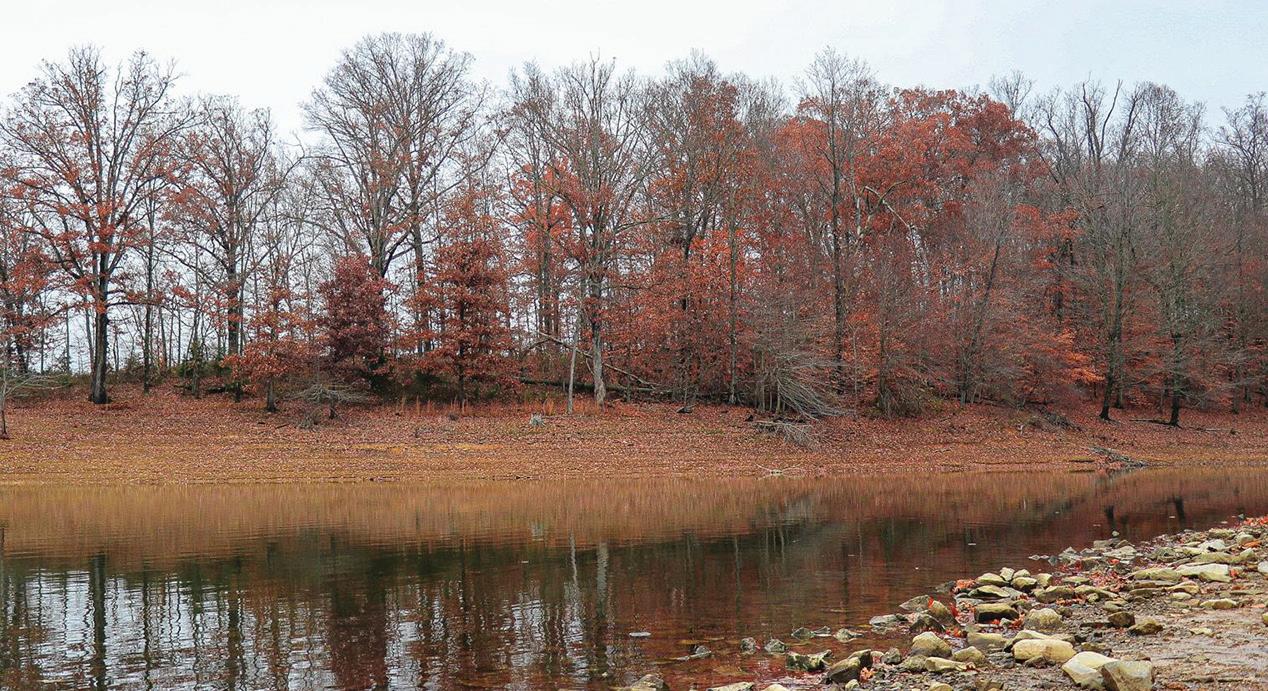
Fluoride is a naturally occurring mineral in water supply. Bloomington began supplementing the water in 1967, raising the amount of fluoride to CDC approved levels to help prevent tooth decays.
The city’s new temporary water system uses multiple smaller tanks instead of a bulk storage tank to hold the chemical. According to a
Feb. 9 press release, the city hopes the new system will reduce safety risks for staff, lower operational costs and make future replacement efforts easier.
“This solution meaningfully addresses a community concern while strengthening the overall reliability of the fluoride delivery system,” Bloomington’s Utilities Director Katherine Zaiger said in the release. “I appreciate the time, expertise, and problem-solving our staff brought to this project.”
Acording to information the City of Bloomington Utilities provided the
B-Square Bulletin, fluoride levels in Bloomington have averaged below 0.25 milligrams per liter since April 2021. The CDC recommends that levels are 0.7 milligrams per liter.
CBU failed to report lack of fluoridation to residents, according to the B-Square Bulletin. The problem first went public following personal research from IU Associate Scientist Katherine Edmonds.
Edmonds found fluoride levels were 0.09 milligrams per liter in a footnote in the 2025 Bloomington Annual Drinking Water Quality Report.
“These kids right now, like my kids age, who missed out on ingesting fluoride for a couple of years, those were critical years where their adult teeth are developing,” Edmonds said. “I feel like my children have been significantly harmed by this.”
In the Feb. 9 press release, the city addressed its lack of transparency when fluoride was initially discontinued, saying it “acknowledges that public reporting on fluoride levels was inconsistent in prior years.”
As of July 2025, the city requires the CBU to present the consumer confidence report in a public meeting
of the Utilities Service Board annually, the press release said. Utilities Service Board meetings are twice a month on Mondays from 5-7 p.m at the city Utilities Service Center. The meeting schedule can be accessed on the city website. Indiana is ranked 12th in fluoridated water systems across the country with 91.5% of the population using community water services that received fluoridated water, according to a 2022 report from the CDC.
Though considered by the CDC to be one of the greatest public health achievements of the past
century, concerns about fluoridating water systems have arisen in recent years. According a report by PBS, Utah banned the practice in March 2025, and Secretary of Health Robert Kennedy Jr. campaigned for the CDC to stop endorsing fluoridation. Opponents to fluoridation are concerned that a mix of fluoridated water and toothpaste will lead to overdosage. Large amounts of fluoride can cause children under 8 to develop fluorosis, a condition causing white flecks on the teeth, according to the CDC. A 2025 study by the Journal of American Medical Association linked 2 milligrams per liter or greater fluoride exposure to lower IQs.
However, these effects have not been found when fluoride levels meet the CDC regulated amount of 0.7 milligrams per liter.
Bloomington’s new temporary system will be incorporated into a permanent fluoridation system as part of the CBU’s Capital Improvement Program, which has several long-term projects to improve the water treatment plant including creating an improved cybersecurity system and rebuilding high service pumps. The permanent system will be created by “replacing and restoring any equipment or surrounding infrastructure” that wasn’t fixed through the temporary repairs, Daniel Frank, CBU communications manager, said in an email.
By Adelyn Rabbit adrabb@iu.edu
Recently proposed Senate Bill 236 would let any Hoosier sue someone who manufactures, distributes, delivers, mails, prescribes or provides abortion-inducing drugs in Indiana.
Under Indiana’s current near-total abortion ban, Hoosiers can legally use mail-in abortion drugs prescribed by physicians in other states. They can also travel out of state to receive an abortion procedure in person. Websites like Plan C help women, including those who live in states with abortion bans, access abortion drugs through the mail.
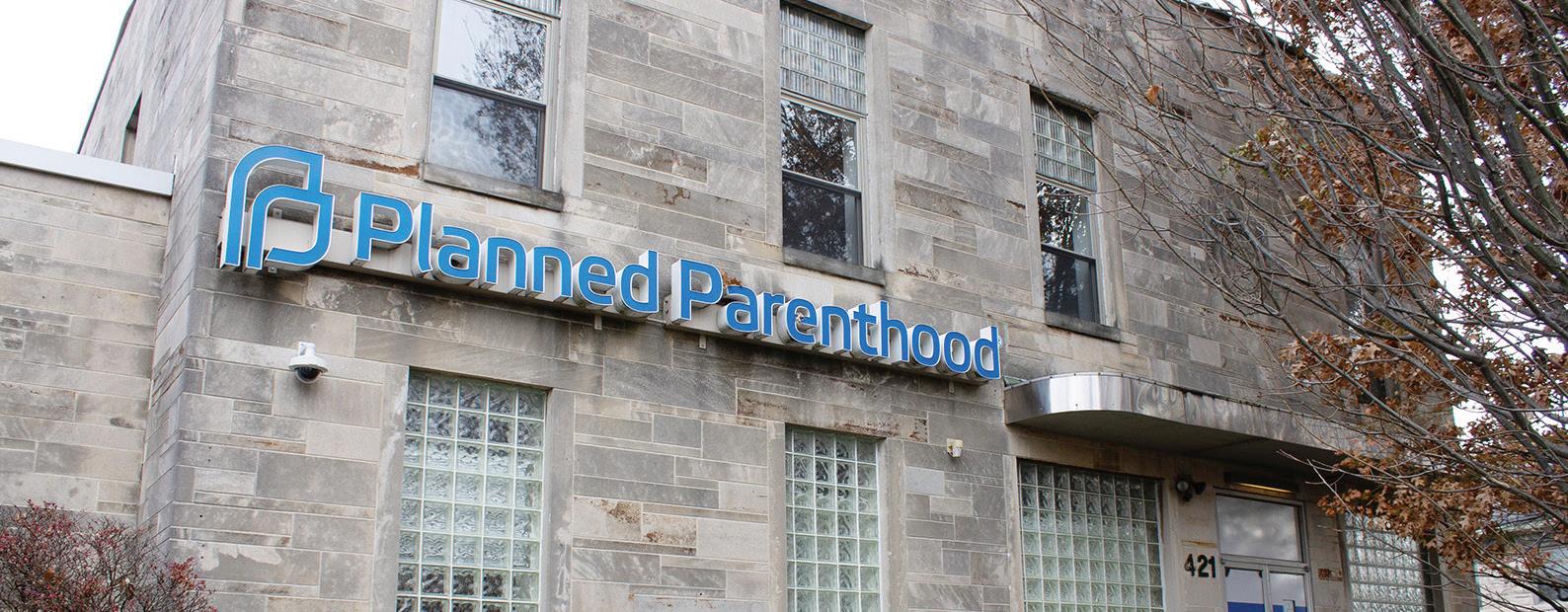
Mifepristone and misoprostol are commonly used medications to induce an abortion, according to Planned Parenthood.
SB 236 would redefine abortion as anything intended to “cause the death of an unborn child” and allow any Hoosier to bring a wrongful death suit upon those who aid a pregnant person in accessing an abortion in Indiana. This includes distributing, mailing, transporting, prescribing, manufacturing or providing abortion drugs for the pregnant person.
The bill states that an act done to preserve a fetus’s life or remove an ectopic pregnancy, miscarriage or still-
born child is not an abortion.
Under SB 236, Indiana would award a minimum of $100,000 to plaintiffs who bring a successful case to court and cover all their legal fees. Defendants would be required to pay the award to the plaintiff. Hoosiers could bring a lawsuit forward up to 20 years after the legal violation occurs.
The authors of the bill, Republican Sens. Tyler Johnson and Liz Brown, did not respond to requests for comment, but both spoke about the need for the legislation in front of the senate.
“It is the violator who bears the cost, creating a powerful deterrent against illegal trafficking of these life-ending drugs,” Johnson said during a committee hearing Jan. 27.
Brown described distributing abortion pills as “the most egregious business practices that have invaded the state” during floor debate Jan. 26.
In a press release, Indiana anti-abortion nonprofit Right to Life President Mike Fichter said SB 236 “protects women from abortion-pill trafficking” and pressures to have abortions.
Sen. Shelli Yoder, a Democrat representing Bloomington, attempted to amend SB 236 in January to remove the provision allowing private individuals or groups to
sue others on behalf of the government. That amendment, as well as others by Democrats to limit the legislation’s restrictions on abortion pills, failed.
Yoder said the bill pits neighbors against each other and opens the door to speculative lawsuits.
She also criticized how the bill only lets private individuals sue, not “accountable” public institutions.
“We’re basically saying the state can’t sue, but your neighbors can,” Yoder said.
The bill would make healthcare providers hesitant to provide care if they are not certain whether a pregnant person is going through an abortion or a miscarriage, Yoder said, which could put pregnant people’s lives at risk. This could impact those not just those seeking an abortion, but those who require one if they run into complications during their pregnancy, she said.
Justina Licata, assistant professor of U.S. history at Indiana University East, has focused the last 15 years of her research on the history of reproductive rights, abortion and contraception.
A historian, Licata said the implications of SB 236 remind her of the Fugitive Slave Act of 1850, which imprisoned and fined individuals who aided the escape of
or provided food or shelter for people escaping slavery.
“It was a tactic of putting fear into people who were just willing to help, and it seems that that’s the tactic here,” Licata said. “They’re trying to place tremendous fear in people who are willing to help: health care practitioners, but even friends who might know something and be able to help someone get access to medication abortions.”
Giving more legal rights to the fetus, Licata said, takes certain rights away from the pregnant person. Licata said in some scenarios, the opportunity to sue and bring wrongful death lawsuits could be used by a pregnant person’s partner if they are not included in the decision to have an abortion.
Licata said these restrictions are often more harm-
ful for people of color, people without legal residency status and those living in poverty. The more government support like welfare they get, she said, the more involved the government is in their lives. She added SB 236 would force more Hoosiers to travel for an abortion, which is unaffordable for many.
Haley Bougher, Indiana state director for Planned Parenthood Alliance Advocates, said she is worried more abortion providers will leave Indiana due to the bill. She’s also concerned that pregnant Hoosiers will delay receiving care and be afraid to access care or discuss it with friends and family.
She said she worries the already “abysmal” infant and maternal mortality rate in the state will worsen as pregnant people become worried
about seeking abortion care. As of 2023, Indiana had the 13th-highest infant mortality rate in the country. Indiana had the United States’ thirdhighest maternal mortality rate in 2024.
Bougher said exempting the removal of an ectopic pregnancy, stillbirth or miscarriage from the definition of abortion is incorrect, and that these should be medically classified as abortions. “When medical terminology doesn’t align with what they put in Indiana code, it causes confusion among providers, it causes confusion among patients and it creates a chilling effect overall,” Bougher said.
SB 236 passed the Senate Jan. 27 with a 35-10 vote, with all amendments introduced by Democrats failing. It’s now moved to the House for consideration.
By Emerson Elledge eelledge@iu.edu
Indiana residents will no longer be able to change their gender marker on their driver’s licenses or stateissued IDs starting Feb. 12.
The Indiana Bureau of Motor Vehicles previously allowed residents with a court-ordered gender change or physician statement to update their gender on driver’s licenses and other state-issued IDs. This policy will change Feb. 12, according to a notice on the bureau’s ID amendment page. The BMV has allowed gender changes on licenses and IDs since 2009. A decade later, the agency became the sixth in the nation to have a third gender option for the marker, allowing citizens to choose between “M” for male, “F” for female or “X” for other gender identities.
The “X” option was removed six months later in September 2019 after thenIndiana Attorney General Curtis Hill criticized the change, saying the policy needed legislative backing.
A group of Hoosiers sued the BMV in June 2021 over Hill’s decision and a Monroe County judge ruled in their favor in December 2022. The Indiana Court of Appeals issued a dissenting ruling April 2024, agreeing with Hill and putting an end to the legal fight for a third gender option.
Indiana Gov. Mike Braun issued an executive order on March 2025 opposing “modern gender ideology” and establishing further legal framework for the “biological dichotomy between men and women.” In the order, Braun defines terms like “sex,” saying the term “means an individual human being’s immutable biological classification as
either male or female” and says “gender” is synonymous with “sex.” He also instructs executive branch agencies to stop using gender neutral language like “people who menstruate” or “birthing persons.”
A proposition to remove the ability to change gender on Indiana IDs was first considered by the BMV in June 2025, before debate resurfaced in November 2025 when the agency refiled the proposal. The agency allowed a period for public comment after both filings.
Indiana BMV spokesperson Greg Dunn said in an email to the Indiana Daily Student the agency received the document notifying them of the amendment approval Jan. 13. The agency was then given 30 days to complete any internal changes needed to make the implementation process run smoothly.
Dunn said the rule
change notice was first published on the BMV website Feb. 3. Dunn said the BMV “considered all of the public comments submitted on this matter” while executing Braun’s executive order.
“The proposed rule is discriminatory, serves no rational government interest, and impedes equal access to government services as the rule will effectively bar all transgender, gender diverse, or intersex Hoosiers from obtaining credentials which accurately reflect their identity,” one person said in during a period for public comment.
LGBTQ+ advocacy group IYG first noticed the change Feb. 7 and released a statement regarding the change Feb. 9.
“The people of Indiana spoke clearly and repeatedly against this policy, and the BMV chose to ignore them,” IYG CEO Chris Paulsen said in the statement. “Quietly implementing a rule that puts transgender Hoosiers at risk —
By Jonathan Frey jonafrey@iu.edu
A 2025 Pew Research Center poll estimated 73% of Americans aged 18-29 have been victimized by at least one internet scam.
The Indiana University Police Department and Bloomington Police Department have identified two main scams frequently reported in recent months.
Below is a guide to identifying, combatting and avoiding these common scams:
Ticket scams
False ticket sales have become common across campus, especially with recent success by the Indiana football and men’s basketball teams. In an interview, IUPD Public Information Officer Hannah Cornett said most ticket scams targeting students occur through social media platforms and are difficult for law enforcement to investigate, underscoring the importance of prevention and education.
Cornett said fraudulent ticket sales are most often
reported after transactions conducted through platforms such as Facebook, GroupMe and Snapchat, rather than verified ticket vendors. In these cases, individuals advertise tickets for major sporting events, accept payment and disappear without delivering valid tickets.
“These crimes are happening online,” Cornett said. “Investigating them often leads to a dead end because the accounts are fake, automated or operated by individuals outside law enforcement’s reach.”
Because recovery of lost money is rarely possible, Cornett said, IUPD focuses on education efforts aimed at preventing students from becoming victims. She said the department often shares fraud prevention tips on social media and on its website.
She said students should slow down and trust their instincts during purchases, particularly when ticket prices are significantly lower than market value for highdemand events, such as championship games.
“If it seems too good to be true, it probably is,” she said.
“Trust your gut.”
She also advised students to avoid buying from nonverified vendors and stay away from social media apps for ticket purchases.
Federal agent scams In addition to ticket scams, IUPD and Bloomington police have reported impersonation scams where callers pose as law enforcement or federal officials and demand immediate payment under threat of arrest. Cornett said international students are disproportionately targeted in these schemes.
Public backlash toward federal agencies, such as U.S. Immigration and Customs Enforcement, has risen in Bloomington in recent months. After ICE and Customs and Border Patrol agents shot and killed two people in Minneapolis in separate incidents, more than 400 people gathered in Bloomington to protest the agency.
No ICE arrests have been reported in Bloomington

this year, but a May 22, 2025, press release from the U.S. Department of Homeland Security detailed more than 20 immigration-related arrests in Bloomington and Evansville between April and May. ICE arrested a Mexican citizen Apr. 29 at the Charlotte Zietlow Justice Center, the IDS reported.
“These scams prey on fear and unfamiliarity with the U.S. legal system,” Cornett said. Victims in such cases
have lost up to thousands of dollars, according to IUPD and BPD reports.
Cornett said IUPD conducts educational outreach with international student groups at the beginning of each semester to raise awareness of common scams.
The Federal Trade Commission advises on its website that scammers may impersonate agents by offering an employee identification number or other form of documentation that is easily
fabricated. “Government agencies will never call, email, text, or message you on social media to ask for money or personal information. Only a scammer will do that,” the website states.
The FTC advises against using wire transfers like Western Union or MoneyGram and payment apps like Venmo or Cash App in transactions with unknown parties, as they’re difficult to track and retrace.
By Briana Pace
bjpace@iu.edu
Erin Brockovich, an environmental activist and inspiration for the Academy Award-winning movie “Erin Brockovich” (2000), spent the day in Bloomington Feb. 10.She hosted a lecture in collaboration with the IU School of Public Health.
Community members, students and faculty filled Alumni Hall at the Indiana Memorial Union to hear Brockovich discuss her journey as an environmental activist, the importance of community and water pol-
lution.
The lecture was part of the series “The Power of One,” which was established by Ruth Clifford Engs, a retired IU Department of Applied Health Science professor. The goal of the series is to present the link between the environment and health.
Brockovich shared her story of exposing Pacific Gas and Electric’s water contamination in Hinkley, California, the focus of the movie where she was portrayed by Julia Roberts. During Feb. 10’s event, she encouraged people to get involved in their communities’ issues
and to not give up.
“The difference you will make will be significant,” Brockovich said.
The second half of the lecture focused on the website Brockovich created called Community Healthbook. The website allows people to self -report environmental issues they are experiencing and see what others in their towns are facing.
Two land issues were reported in Bloomington, according to the website, though the map does not list any more specifics or when these cases were reported.

The website also allows community members to submit photos. She displayed some of these on the screen during the lecture. The photos, from all over the United States, showed bathtubs filled with brown water, yellow water running out of sinks and bottles filled with orange water.
Nearly 2,000 water reports have been made to Community Healthbook, one of which was made in a residential area near Lake Monroe.
“99.99% of the time it is one person that starts all the commotion,” Brockovich
said, “and it’s one pissed off mom.”
Brockovich spent some time teaching the basics of water pollution to the audience. She said she hopes the public can better understand when water is dangerous and when it is not.
Over the last several years, the Bloomington community has, at times, noticed that occasionally there is a brown tint, smell and bad taste to the water. The city has acknowledged the issue and assures the public it is not dangerous and that discoloration is often linked to seasonal
changes. It is brought by harmless microorganisms produced by changing temperatures in the town’s freshwater source, according to an Indiana Public Media article. There was only time for one question from the audience at the end of the lecture. A pediatrician living 90 miles from Bloomington shared her story of working with pollution in southern Indiana for the last 15 years.
“This needs attention,” the pediatrician said.
“When lies start in the environment,” Brockovich said, “You must fight.”
Eric Cannon (he/him)
is a sophomore studying philosophy and political science and currently serves as a member of IU Student Government.
So, you bought her roses, knocked on her door and are now parked outside Osteria Rago.
“Table for two,” you tell the hostess. She scans the reservations and leads you to your table.
The hostess sets down two menus. Then a third.
She won’t meet your eyes.
“I hope you don’t mind,” she says. “We were a bit overbooked, and—”
Behind you, an old man steps up, dragging a heavy crozier along the wooden floor. He has a tall green mitre, an unkempt white beard and deep-set, wrinkled eyes.
“This is… a tough week for him,” the hostess tells you under her breath before she hurries off.
The old man’s eyes settle on yours.
Your date elbows you. You pull out a seat for your new supper-mate.
But really, this is no meetcute. That old man staring back at you shouldn’t be a stranger — it’s St. Valentine. The founder of your feast.
Unfortunately, you might
Odessa Lyon (she/her)
is a senior studying biology and English, pursuing a minor in European studies.
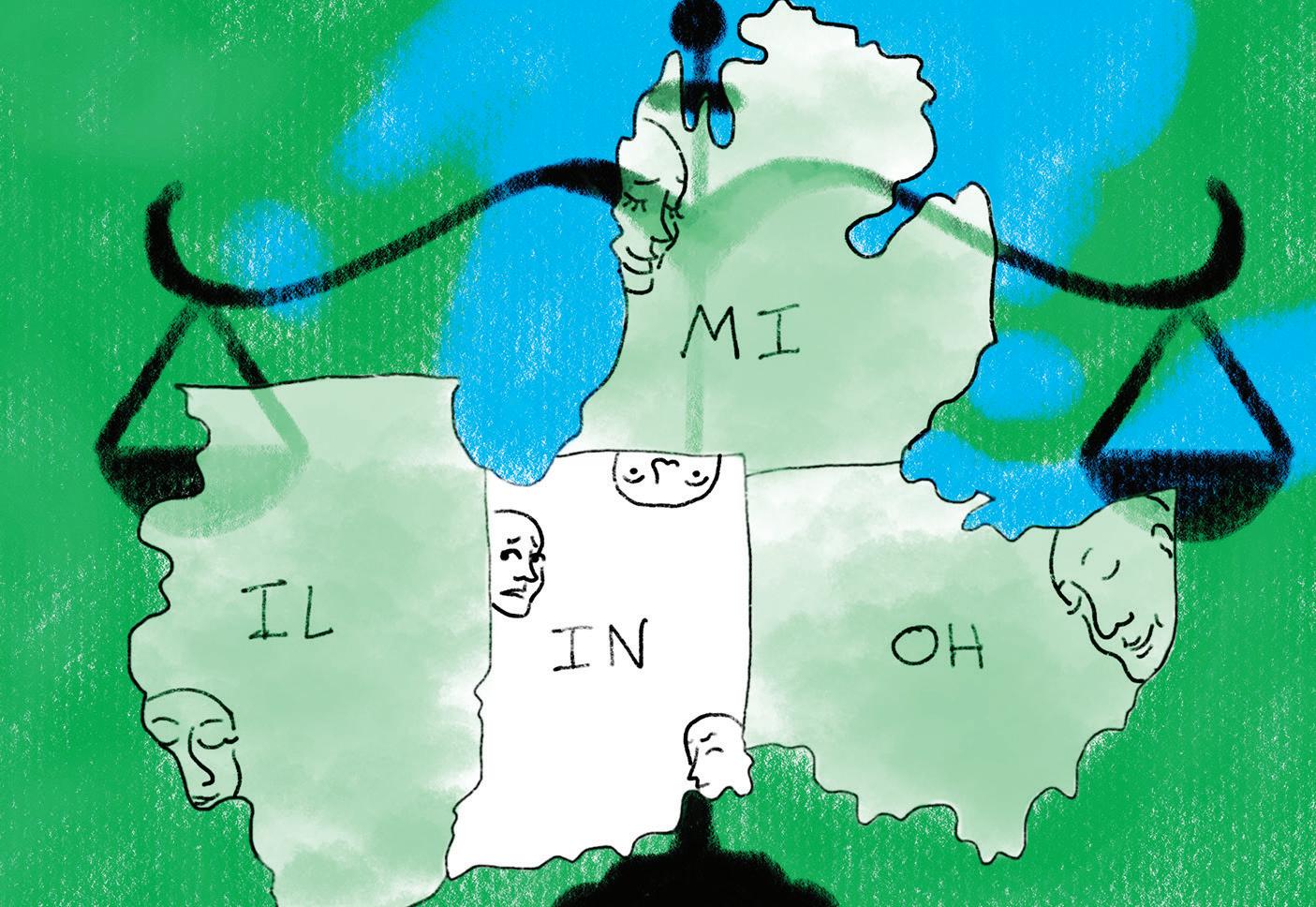
On Dec. 18, 2025, President Donald Trump issued an executive order to reclassify marijuana from a Schedule I drug with no accepted medical use to Schedule III — transferring it from the company of drugs like heroin or LSD to the likes of Tylenol with codeine or testosterone. Accordingly, it’s well past time for Indiana to join our Michigander, Illinoisan and Ohioan neighbors in the fruits of legal marijuana: expanded medical research, symptom management for psychological disorders and chronic pain and plain ol’ recreation.
Indiana’s House of Representatives and Senate are now reading multiple bills that propose changes to state laws regarding cannabis (the plant), marijuana (high-THC cannabis), THC (tetrahydrocannabinol, the high-inducing psychoactive compound) and hemp (little-to-no-THC cannabis).
It’s worth noting, however, that other countries eschew the term marijuana, which is essentially derogatory North American slang used negatively toward people of color. The term originally comes from Mexico, but by 1920s and ‘30s United States, “anti-drug activists often used the word marijuana in a negative way, and the media and government officials also turned it against people of color, including Mexican immigrants and jazz musicians,” writes David
not remember him. Since Geoffrey Chaucer retired his quill — five centuries ago — Valentine has been suffering a rough patch.
Working in an industry where mythical creatures dominate is a tried-and-true way of slipping from cultural relevance. Myths endure because every age refashions them. Cupid, shaped by one culture, has shifted time and again to meet subsequent generations’ demands. We’ve cast him as a cute, chubby and harmless baby on greeting cards — far from the lord over desire and revulsion the Romans imagined him to be.
Valentine, on the other hand, gathered a culture around himself: Christendom. In doing so, he wed his fortune to its survival. So, when Christian society gave way to the secular moment that has replaced it, Valentine, too, exited the stage. And the day celebrating him was emptied of all prior substance. After all, do you know the seventh-century Gelasian Sacramentary’s prayer to St. Valentine? Neither do I.
The result is a holiday that resembles a shipwreck’s shore-ridden plank. After being torn from the whole vessel, it risked sinking into
the deep before the tide beached it on foreign soil. Now, exposure slowly degrades it, which is to say, Americans celebrate it less than ever.
Can we save Valentine’s Day?
Look again at your old dining partner. Valentine’s Day’s earliest celebration is difficult to date, but undoubtedly, it began as a commemoration of your new companion’s martyrdom, whoever he was. Early modern scholars combing through ancient sources counted at least seven Valentines.
Two of these figures, from around Rome, were both purportedly beheaded by Roman authorities on Feb. 14. It’s not unlikely these accounts preserve just one early martyr claimed by two cities, however. A third possible Valentine was a bishop of Genoa, a city northwest of Rome, executed on May 2.
So, how did one of these saints shrouded in historical uncertainty enter the business of love?
It’s fashionable to trace St. Valentine’s romantic association to older pagan holidays, but this is historically untenable. Medieval lovebirds — and real birds — are likelier the true culprits.
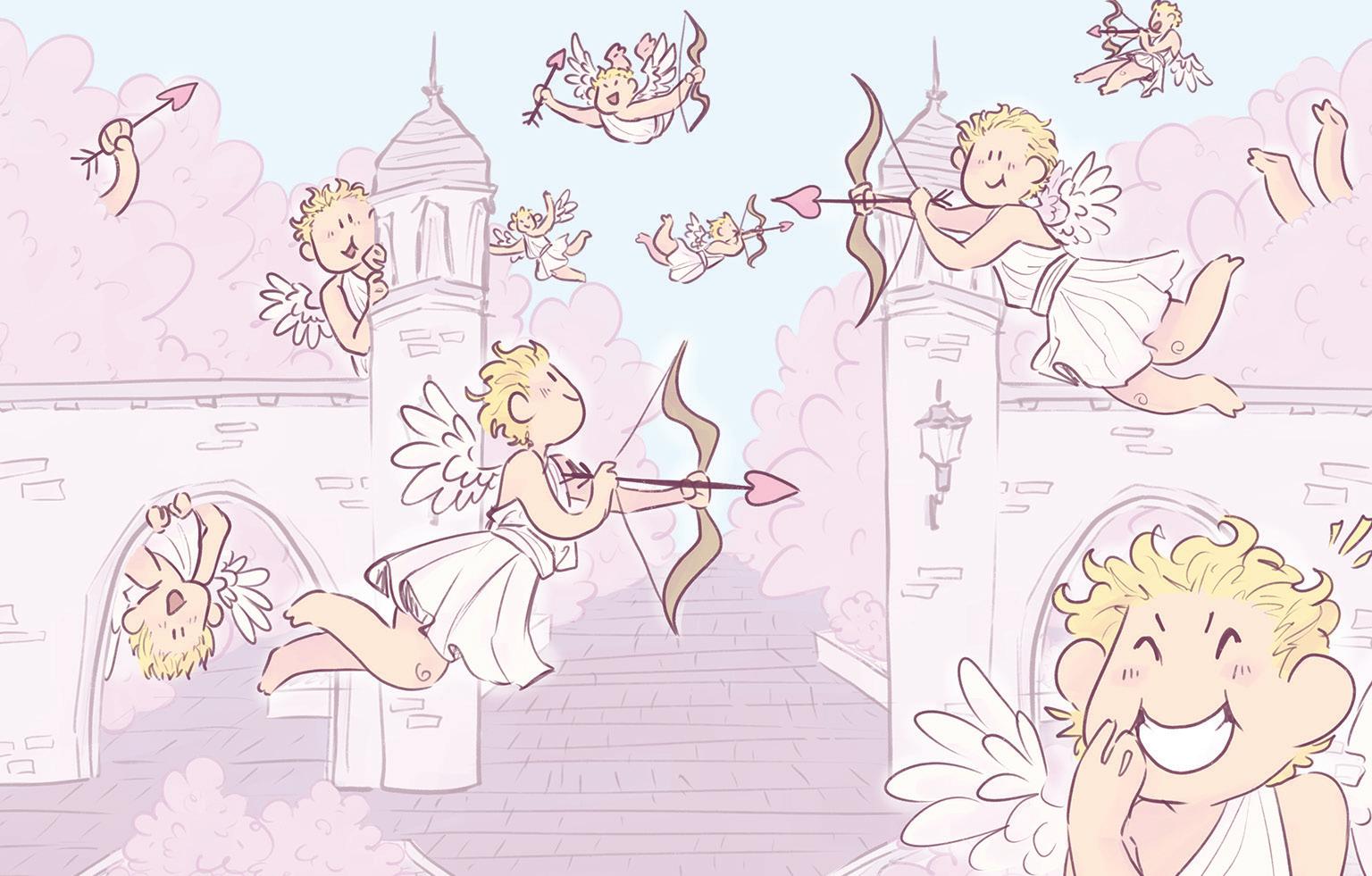
To commemorate English King Richard II’s engagement on May 3, 1381, Chaucer composed his poem “The Parliament of Fowls,” in which he likened Richard and his soon-to-be wife to the birds who “come to choose their mate” on Valentine’s Day. Valentine of Genoa’s Day. May 2. In the spring, when birds ascend on the newly warm skies. Yet then, as now, Feb. 14 was better known for saints named Valentine. And the poem, which filled royal courts across Europe with
romantic ideas, was thought instead to refer to that February day, Henry Ansgar Kelly, a research professor in UCLA’s English department, has argued. Poetry paired Valentine’s Day with love. Perhaps the wrong Valentine’s Day. But that error doesn’t render our celebrating love on this day invalid. Whether or not the Valentines of Rome and Terni commemorated on Feb. 14 were one saint, a Valentine gave up his life for the one he loved on this day. He even made this sacrifice
without expecting anything in return — for example, being remembered in any substantial way. Rather than nullify his gift, this surrender of ego perfected it. If Valentine’s Day can be saved, it is because it still gestures toward someone who gifted all they had and were while asking for nothing. The lack of verifiable content about St. Valentine lets all of us become a Valentine. With roses. With dinners. Most of all, with just ourselves.
ericcann@iu.edu
Hyde in 2022 for KUOW. Simply put, “marijuana” is historically fraught while “cannabis” is scientific. Because of these roots, lawmakers in Washington, Maine and Virginia have introduced bills to make the vocab swap in their state laws.
Striking while the iron is hot, Indiana Rep. Jim Lucas, R-Seymour, for example, proposed House Bill 1298 to reflect this pending federal reclassification of marijuana and THC at the state level. Similarly, Rep. Mitch Gore, D-Indianapolis, is fighting for a less restrictive possession policy with House Bill 1191, decriminalizing “two ounces or less of marijuana.”
The Senate is also reading bills concerning testing, packaging and distribution rules like Senate Bill 286 for cannabis — to establish an Indiana Cannabis Commission — and Senate Bill 250 for hemp — to define THC products.
But before any jokers, smokers or midnight tokers rejoice, as with much that leaves Trump’s mouth, there’s more to his announcement than meets the eye; some question if the new federal marijuana rhetoric is too good to be true.
This process of rescheduling marijuana has been underway since October 2022, when former President Joe Biden asked the U.S. Department of Health and Human Services and the Drug Enforcement Administration to review scheduling. In August 2023, HHS recommended the move from Schedule I
to III to the DEA, and by May 2024, the DEA proposed a rule to do just that.
A few months later, in July, a period for public comment was opened. In August the DEA announced a hearing on the proposal, October saw participants selected by the DEA for the hearing and by December the hearing was finally scheduled to take place Jan. 21, 2025.
However, mirroring the Democratic Party’s halfbaked efforts to codify abortion into federal law, Biden’s plan failed at the finish line.
By the time he left office Jan. 20 2025, the DEA hearing was halted from further legal progress, and the participants were ordered to “provide ongoing status updates,” which is like that friend who says they’ll “lyk” and doesn’t text back for a week.
Biden was able, though, to pardon thousands of Americans convicted on possession charges in October 2022 and December 2023. He also signed the Medical Marijuana and Cannabidiol Research Expansion Act , increasing the approved research entities to study medical marijuana.
If Biden’s efforts to move the needle on marijuana already seem like small pennies, Trump’s executive order to the attorney general — to hurry up and reschedule the drug already — is worth even less than chump change.
Because courts have interpreted the Constitution’s “vesting” and “take care” clauses concerning execu-
tive power to merely “permit the president a vehicle/voice to ensure that federal law or policy is implemented (executed) properly,” Trump’s big pronouncement might not amount to more than a “pretty please.” Either way, executive orders cannot overrule federal laws.
But thankfully, states’ rights are still worth something, and the horizon looks tentatively positive: Indiana could finally be following in the happy footsteps of the greater Midwest. If the general assembly bills pass, they would provide invaluable support to medical marijuana research and, more importantly, for the people who would benefit from it.
For decades, innovative research has suggested CBDdominant cannabis — the
secondary, non-intoxicating cannabinoid — can reduce symptoms of post-traumatic stress disorder, trauma-related stress and anxiety; various cannabinoids can reduce inflammation at the cellular level; and cannabis can provide cancer symptom relief, as well as possibly fight neurodegenerative diseases like Alzheimer’s and Parkinson’s.
The evidence is so overwhelming as to prompt The American Legion, the nation’s largest veteran’s service organization, and Jeff Staker, head of Hoosier Veterans for Medical Cannabis, to endorse the reclassification. The potential benefits of rescheduling marijuana abound, though the current federal Schedule I classification — rooted in the racist doctrines of President Rich-
ard Nixon's War on Drugs — hinders further findings by limiting access and availability. To stymie the marijuana reclassification movement is to keep Americans behind bars on injudicious and racist terms and hold back extremely promising scientific progress. When cannabis use rates are generally equal across races, yet Black Americans are arrested on marijuana charges at a far higher rate, and when medical marijuana advancements promise relief to many suffering, we must stop to ask ourselves how the current federal classification of marijuana as a Schedule I drug serves the country. Hint? It doesn’t.
oolyon@iu.edu
By Guest Writer
To the Editor,
There is growing concern on the Bloomington and Indianapolis campuses about the numerous job postings from civilian immigration enforcement agencies like Customs and Border Patrol that have appeared across Indiana University-branded Career Services websites and on the IU calendar. University officials claim that this is an unavoidable consequence of using a third-party career platform, Handshake, with a boilerplate disclaimer that appears repeatedly across IU career platforms. At best, this explanation is unconvincing. Career Services is not obligated to advertise ev-
ery employer that requests its services. Like any career office, there are established guidelines and standards at IU for employers to recruit our students and young alumni. When an employer’s practices raise concerns about legality, workplace conditions or student safety, even if that employer once had a strong reputation, Career Services is not obliged to continue to promote them. The nation is still mourning the tragic deaths of Alex Pretti and Renee Good. Both were shot and killed by federal immigration agents in Minneapolis in January 2026. On numerous occasions, federal courts have found Immigration and Customs Enforcement to have violated Fourth Amendment protections by
wrongfully detaining U.S.
citizens (Gonzalez v. ICE).
As a university committed to constitutional principles and student well-being, IU cannot ignore these agencies’ documented pattern of irresponsible conduct when asked to provide them a recruitment platform. Concerns about the First Amendment, IU’s Expressive Activity and Institutional Neutrality policies, or the Chicago Principles, all of which govern free speech and expression on campus, do not apply in this case. Rather, IU must exercise care in evaluating employers and applying Career Services standards to provide those employers a platform. The presence of these advertisements on IU’s Career Services website implies an IU endorse-
ment, which should not be extended to an employer whose recent workplace practices are under numerous serious legal and constitutional challenges.
The Supreme Court Rumsfield v. Forum for Academic and Institutional Rights, Inc. (2006) decision, related to the Solomon Amendment, makes federal funding contingent on universities allowing military recruitment. However, ICE and CBP are not U.S. military agencies — they are civilian law enforcement agencies under the Department of Homeland Security. Thus, they are not subject to the Uniform Code of Military Justice, and they are outside the scope of the Solomon Amendment.
The removal of IUbacked recruitment post-
ings about civilian immigration enforcement agencies does not impugn individual CBP employees, many of whom currently perform important jobs ethically and responsibly. Instead, IU must discern whether DHS leadership and workplace practices currently meet the basic standards that govern employers promoted through Career Services. IU Career Services professionals are hardworking, ethical and dedicated. They should not have to promote employers whose practices may be illegal, unconstitutional or unethical, nor should they have to entice students to take signing bonuses for jobs that may expose them to physical harm or legal risk. IU’s use of Handshake does not absolve IU of the responsibil-
ity to use discretion in approving employers. Federal courts across the country are currently deciding whether CBP, ICE and DHS have systematically violated court orders, misapplied federal immigration law, denied constitutional due process and defied judicial authority. The solution is simple: take these IU-branded postings down until ongoing concerns about DHS, CBP and ICE are fully resolved by the courts.
Thank you, Dr. Kathy Marrs, Profes-
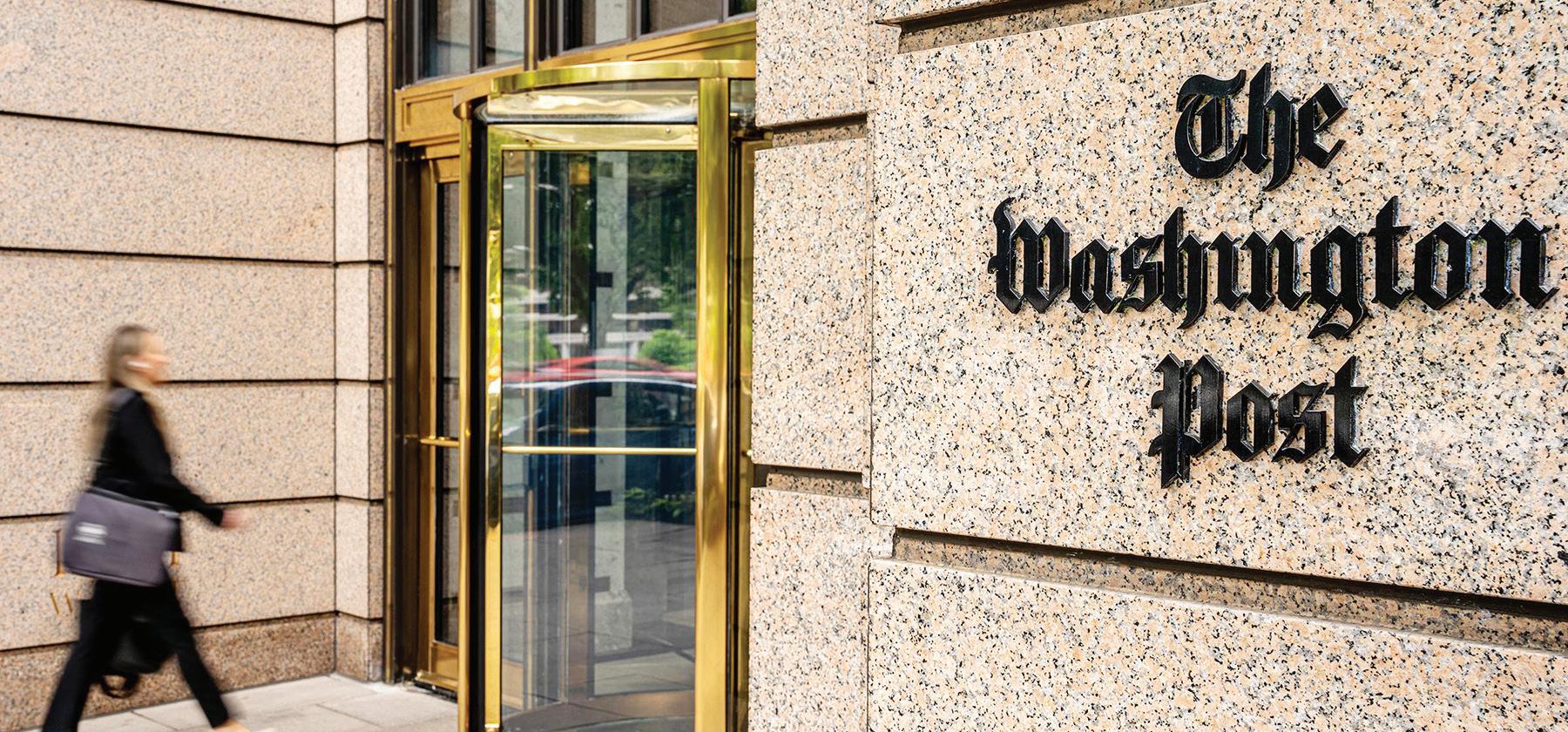
How is austerity supposed to bring ‘innovation’ to The Washington Post?
Andrew Miller (he/him)
is a senior studying journalism and history. He is currently co-editor-in-chief of the Indiana Daily Student.
The age of instant communication was born without much fuss. Barack Obama’s 2008 campaign took over YouTube and people kept up their Snapchat streaks. Our globalized culture took in social media as a tool through which it could express itself.
What happened next should have been obvious in retrospect. The tool of instant communication grew into an amorphous shoggoth and began, on its own, molding people and culture. Screen times jumped, and content became shorter and more dopamine-focused. We are now at the point where many of life’s interactions are sent through algorithms focused on rage and instant gratification.
This revolution resulted in institutions left and right buckling at the seams; just look around and you’ll see it throughout politics, leisure and journalism. What’s made my pessimism worse is how our society’s responding: illogically.
Journalism will have to survive this crisis one way or another to keep us in a functioning society — one
where power is held to account, where people know and understand what’s going on around them, where there are informed voters and decision-makers. It’s mine and most of my staff’s dream that the world understand the gears that turn it, including the dings in them, as intimately as possible. If my industry pulls the transition off, we could live in a world where journalism becomes the perfect platform to fight back against the paradoxical forces of instant communication that push us apart.
If we pull it off. On Feb. 4, The Washington Post (owned by the fourth-richest man in the world) fired more than 300 journalists. Hit hardest were the metro section, the sports section and international coverage. For all intents and purposes, this was a gutting. Now that doesn’t mean we’re hearing a death rattle of any sort.
Reporters are out there as we speak risking their lives and working over 80 hours per week for the cause. I’m sure the Post will continue its tradition of excellent journalism, carrying on with its mission.
But the layoffs are a symptom of the larger backsliding.
If something doesn’t change, we’re going to live in a successively less democratic and less connected world.
We, as a society, need to work out ways to strengthen journalism. I hope most can agree on that. Doing so will require more than just capital or reporters making funny TikToks; it’ll necessitate a deeper cultural shift.
How’d we get here?
No one person is to blame, really. There’s a lot of finger-pointing in my industry about why we’re failing to reach the public, or why the public’s failing to pay attention.
As someone who’s looked at the Indiana Daily Student’s engagement metrics and spoken with people in our community, I’ve come to understand the idea of us “failing to reach people” is farcical. The IDS is. The Post was and still is. What infuriates me most is the constant stress of “innovation” as an end-all solution to doing so. “Innovation” is not something people sitting in a room can decide to do. Firing hundreds at the Post and cutting resources decade after decade is also certainly not conducive to “innovation.”
To me, the word’s come to symbolize smoke and mir-
rors thrown together by cowardice. Am I really supposed to believe there’s some grand plan here? The fourth estate must thrive, but we’re not confronting the crisis headon.
The deeper issue is falling ad revenue and consolidation, which has laid off astronomical amounts of journalists well before Feb. 4’s firings. The industry long understood as profitable faced deficits year after year as the digital world grew and grew.
For the owners of news outlets, that presented a liveor-die option between austerity and running in the red. Many chose austerity. Where has that left local news? Well, check out how many stories at Bedford’s Times-Mail actually came from that outlet.
There used to be a culture of wealthy people taking on newspapers or other public services at a loss to give back to their community. To an extent, that still exists. Good patrons just let the news be, unlike Bezos’ infringement of editorial independence vis a vis blocking the Post’s endorsement.
I’m just saying, if I was the fourth-wealthiest person in the world, I’d be OK with The Washington Post operating at a loss, especially as my own net worth grows. And I cer-
tainly wouldn’t pretend the newsroom was the problem when hundreds of thousands canceled their subscriptions after breaking editorial independence. What must be done?
In simplified Keynesian economics, recessions are usually viewed as a symptom of waning aggregate demand (meaning consumer spending, business spending and confidence). To fight recessions, which most agree are bad, Keynesians will argue for government intervention to (guess what!) boost aggregate demand. Under recessions, that usually means making it easier to borrow money (lowering interest rates) and government investment in infrastructure and other ways to increase employment. Traditionally, this model has worked.
You can think about journalism as being in a crisis of aggregate demand. There’s just not enough incentive to buy in or make revenue work unless you’re the New York Times and own Wordle.
So, the basic platform of a solution to my industry’s woes is kind of simple: take steps to help make journalists’ lives easier and invest in them. Then watch the ripple effect grow. There are tons of
Spencer Schaberg (he/him) is a sophomore studying microbiology.
At long last, rapper A$AP Rocky treated fans with his first album since 2018. Released Jan. 16, “Don’t Be Dumb” marked A$AP Rocky’s fourth studio album. The first track, “ORDER OF PROTECTION,” begins by referencing his prolonged absence from the scene:
“It’s been a lil’ while since I been in the league / A couple lil’ trials, couple of leaks / Still in the field like I’m runnin’ in cleats.”
The trials A$AP Rocky mentions took place in 2019 and 2025, though “lil” is putting it lightly. In the latter, he faced up to 24 years in prison for allegedly shooting at a former friend after an altercation in Hollywood.
The trial received widespread public attention, in part due to the judge’s decision to allow cameras in the courtroom. In such a publicized trial involving a prominent rap artist, where both sides’ attorneys scrutinized text messages, surveillance video, recorded conversations and more, you might expect the prosecution to turn to his songs’ lyrics for evidence.
Luckily for him, the prosecution did not — and broke from an increasingly common trend in the litigation of rap artists. Like many prominent rap artists, he has quite a few lyrics that could appear suspicious to the eyes of an uninformed juror.
A$AP Rocky was acquitted in February 2025.
More than a year before, fellow rap superstar Young Thug accepted a plea deal sentencing him to 15 years of probation in Georgia’s longest criminal trial in history. In this case, however, pros-
ecutors were permitted to use lyrics from 17 of Thug’s songs as evidence.
Trial judges granted the same allowance in the criminal trials of rappers Gunna, Tay K, YNW Melly, Tekashi 6ix9ine, Bobby Shmurda and even Snoop Dogg. An Arizona State University research article found that between 2012 and 2017 alone, prosecutors in 211 different cases used an artist’s lyrics as evidence against them at trial.
The abundance of these cases is stunning in a country where we are guaranteed freedom of expression. Why are so many rappers targeted for their speech during trials?
While the First Amendment means the government cannot exercise prior restraint by, for example, preventing an artist from creating a song, there is not a constitutionally-enshrined guarantee that any comment an artist makes in a song is inadmissible as evidence.
“The evidentiary value of song lyrics and the right to make those song lyrics are just two different legal issues,” Zachary Cormier, an associate professor at the IU Indianapolis Robert H. McKinney School of Law, said.
Trial judges determine which evidence is admissible in a trial and must first consider if a certain piece of evidence is relevant to the case. To be used, a judge must decide if evidence will impact how probable a given “fact” of the case is. A judge must also weigh the value of the evidence against its potential to bias the jury — if the risk for prejudice exceeds its value as proof, the evidence can’t be admitted, according to Rule 403 of the Federal Rules of Evidence.
“The judge has to look at
ways to do so: donate to nonprofit newsrooms, donate to scholarships for people studying journalism. If you’re an administrator at a school teaching journalism, maybe let’s view investment as a public good to society rather than a leash. And hint hint, wink wink, if you have a tip, let a journalist know. As for jobs, investment during the crisis of adapting to the online world needs to be seen as a necessity. So, to those with the will: deficit spend. I’m not concerned about the ability of reporters to report; if anything, I feel the opposite. But journalists deserve to live and work without feeling the fear of what’s coming upon the “voluntary buyout” email and being embalmed with quiet rage after the “terminated” subject line. The bigger question of how we shift our culture away from the dopamine cages is beyond my 22-year-old mind’s comprehension. But I can’t emphasize enough that the solution is not going to come from austerity. If there is to be a way forward in journalism, its path will come from time, investment and care.
ami3@iu.edu

the lyrics at issue, whether or not there’s some type of relevance to the actual crime,” Cormier said. “Okay, well, how risky is it at trial that the lyrics themselves are going to cause the jury to make a verdict based upon an emotional response and not the rest of the evidence?”
In some cases, the prosecution might use an artist’s lyrics to argue for their bad character rather than prove they committed a crime. If a defendant claimed they know nothing about drugs during a drug trafficking case, the prosecution could try to use the artist’s own lyrics to prove them wrong.
“If they have rap lyrics that are going into detail about drug use, or about certain types of drugs or selling drugs, that could be used, not for purposes of approving knowledge, or plan, or intent, and not necessarily the crime itself,” Cormier said.
The evidentiary rules are supposed to apply equally to all forms of artistic expression, but in practice, it’s rare to see any other kind of art used in court. To understand
why, we first need to understand the genesis of rap’s conventions.
Since its creation in the 1970s, but particularly with the rise of the “Gangsta Rap” subgenre in the late ‘80s (think N.W.A., Ice-T, The Notorious B.I.G. and Tupac Shakur), many rap songs express the daily struggles of people living in poor, urban areas. Indeed, poverty, drug addiction, crime, encounters with the police, systemic discrimination and violence remain common subjects in rap songs today.
Not only are these themes inherent in the genre, but rappers also frequently exaggerate and allegorize them for entertainment. Some rappers, like the late MF DOOM, even adopt different personas song to song. A complex blend of personal experiences, imagination, figurative language and wordplay are all-toocommonly misidentified as literal.
When I wake up in the morning and put on my rap playlist, I’m not looking to fantasize about fleeing the
police or stealing a car — I just want to start the day off with some energy. Sure, a song’s lyrics might be provocative, but they’re just one aspect of a larger work crafted by an artist to be punchy, raw and unapologetic, not necessarily true.
Unsurprisingly, Paul McCartney was never subpoenaed to testify about the grisly murder he wrote about in “Maxwell’s Silver Hammer.” Despite confessing to killing a man within the first minute of “Bohemian Rhapsody,” Freddie Mercury was never charged with homicide. Nor was Bruce Springsteen ever brought to justice for the mass murder he describes in “Nebraska.”
In any other category of art, it would be exceptional to prosecute the artist using their art as evidence — but because of the history and culture of rap, it’s become an accepted practice. Rap emerged from predominantly Black communities, so it’s no surprise that it’s the frequent target of a legal system that still struggles with racial bias.
Some politicians, like
Reps. Hank Johnson, D-Ga., and Sydney Kamlager-Dove, D-Calif., are working to change that. Last July, they reintroduced the Restoring Artistic Protections (RAP) Act to Congress, which would create an additional federal rule of evidence to prohibit the admission of a defendant’s creative or artistic work. Importantly, it would still let the work be admitted if it can be proven it was meant literally and contains specific references to the crime — à la GunRack from “Key & Peele.” If adopted, this would be a monumental leap for a more equitable justice system. Rappers wouldn’t be immune from the law. They would finally be treated like every other artist on trial. Too often, rappers face an unfair standard in American courts. Though it might be viewed as more inflammatory than other genres, purely due to its history and culture, rap music is art, not autobiography. The legal system needs to catch up and start treating it as such. sschaber@iu.edu
By Abby Whited abwhited@iu.edu
How you feel about Valentine’s Day is often dependent on your romantic relationship status. But I believe a universal truth of life is that love is for everyone, in whatever forms it may take. So, no matter where you are in life, I think it’s worth it to be able to appreciate the merits of a well-written love song. Whether you’re in a romantic relationship, happily single or searching for love this Valentine’s Day, here are five of my favorite songs about love.
“Thirteen” by Big Star
After years of loving this song, it never fails to make me emotional, and it resonates even more around the season of love.
“Thirteen” by Big Star paints a tender portrait of adolescence, innocence and the novelties of first love. Its lyrics revolve around the small, intimate interactions of a first teenage relationship – walking home together, sharing music, being nervous for a school dance – that make adolescent feelings of attachment feel so enormous. It takes me back to my early teen years, when every emotion felt so big and so all-encompassing that having a crush seemed like the most exhilarating and terrifying feeling in the world.
The perspective of this song doesn’t feel removed from the earnestness of

young love and it doesn’t try to minimize or make light of those big feelings. No matter how many years away you are from teenage love, this song has the power to bring you back, and to me that is what makes it so pure and timeless.
“Lovin’ You” by Minnie Riperton
From its very first note, “Lovin’ You” by Minnie
Riperton creates a sonic atmosphere that is light and ethereal. With a melody originally composed as a lullaby for Riperton’s daughter Maya Rudolph, this song maintains its soothing quality and its pure expression of unconditional love.
Minnie Riperton’s voice in this song feels like a beautiful Sunday morning, a blossoming garden, a deep sigh after a refreshing nap.
“Loving you has made my life so beautiful,” she sings, delivering the lyrics with complete sweetness and sincerity. With soft instrumentals, sounds of birds chirping and Riperton’s whistle tones, this song captures love in its purest and most peaceful form.
“I’ll Be Your Mirror” by The Velvet Underground What makes this 1967
song so great is that it is simply and sparsely written, making its message so universally relatable. The simple phrase “I’ll be your mirror/Reflect what you are” isn’t particularly groundbreaking, but it’s a beautiful sentiment about how special it is to be truly seen by someone, romantically or platonically.
The idea that someone else recognizes all the things
you dislike about yourself, sees beyond them and still chooses to love you is, I think, something we all long for, whether we admit it or not.
“Spring” by Angel Olsen I wouldn’t categorize Angel Olsen’s “Spring,” released in 2019, as a straightforward love song that is strictly happy or melancholy. Instead, it resides in the space between several emotions, including nostalgia, yearning and hope. In this song, Olsen acknowledges the difficulty of hanging onto love while also recognizing when it may be time for a change. This song is defined by its intense sense of longing and by its bittersweet reflections on change and the passing of time. It posits that while relationships may inevitably change, love is always waiting and possible.
“God Only Knows” by The Beach Boys One of The Beach Boys’ most famous songs and possibly the most well-known from “Pet Sounds,” “God Only Knows” is, in my opinion, one of the most timeless love songs out there. This song frames love as something as profoundly fundamental to human experience, as essential as breathing. Signature Beach Boys layered arrangements, flawless harmonies and orchestral instrumentals take this simple love song to a level that transcends beyond genres, time and generations.
By Ursula Stickelmaier
ustickel@iu.edu
In 1897, Irish author Bram Stoker made literary history with the release of his novel “Dracula.” Though the novel was only moderately successful during Stoker’s lifetime, his story of the powerful King of Vampires has attracted a massive fanbase and been marked as one of the most influential horror novels in history.
Given the sheer popularity of the novel, it’s no surprise the legendary Count Dracula has left a legacy of hundreds of movies, books and series adaptations all stemming from Stoker’s original work. What is surprising however, is how in only two hours and nine minutes French filmmaker Luc Besson’s latest film, “Dracula: A Love Tale,” manages to disrespect that legacy so completely.
“Dracula: A Love Tale” originally premiered in France in July 2025. Soon after its release, Vertical, an independent film distribution company, acquired the rights to it and the film received a wide theatrical release in North American theaters Feb. 6.
The movie is broken into two separate storylines with the main narrative taking place in 19th century Paris and Transylvania, Romania. Accompanying this main timeline are flashbacks, going as far back as the 15th century, of Dracula’s (Caleb Landry Jones) early years as he adapts to life as a vampire
and tries to find the reincarnated version of his late wife Elisabeta (Zoë Bleu).
Even though Dracula is the titular character and the film spends most of its runtime breaking down his story and relationship with Elisabeta, later reincarnated as Mina, the main narrative of the movie also features a character known simply as the Priest (Christoph Waltz) and his work to hunt Dracula down.
Although the Priest is never explicitly named, it’s clear that Besson drew inspiration from Stoker’s infamous vampire hunter Abraham Van Helsing for his clergyman character. Not only do both serve as the primary antagonist to Dracula, but the way they approach vampirism is very similar as both characters attack the subject from a more scientific angle.
While Waltz’s character is introduced as a priest and wears a cassock throughout the film, he treats vampires in a clinical sense with measured tests as if he is curing a disease and only really brings up religion when prompted. Besson could have omitted these religious details and the viewer would probably have little to no idea that the Priest had any strong ties to the church whatsoever.
I’m not saying the Priest’s religious beliefs necessarily matter to the plot of the film; he is such a minor character compared to Dracula. I’m also not saying those beliefs being more present in his character would have made
this bad movie any better. However, for a character who already seems to be so closely related to Van Helsing, it feels lazy and seriously lacks creativity on Besson’s part to largely omit the main thing that really separates the two.
The poor Van Helsing dupe is not the only thing that lacks creativity, as most of the characters feel like watered down versions of those from past “Dracula” inspired films and stories.
This is most blatantly shown with Elisabeta, later reincarnated as Mina, who throughout the film feels more like a narrative device than she does a person.
Originally appearing in Francis Ford Coppola’s 1992 film “Bram Stoker’s Dracula,” Mina (Winona Ryder) is the reincarnated version of Dracula’s lost love, Elisabeta. In Coppola’s film, Mina is a complex character and active participant in the story. She is intelligent, courageous and, as she starts to learn more about her past life, she embraces a passion that feels inspiring for a woman of her time.
Besson’s Mina lacks all that character and dimension, and for most of the film, she acts at the whims of those around her. As she and Dracula begin to reconnect, this becomes even more evident, as it seems like she cannot do anything without him, and she loses all bodily autonomy and what little personality she had left. Instead of the strong character we see in Coppola’s film,

viewers of Besson’s “Dracula: A Love Tale” get what feels like the equivalent of a human prop.
The only thing this movie manages to do right is its setting and costumes. Filmed primarily in Finland and France, most of the film is set in a stunning wintery landscape that really transports you into the era of the story. The costumes, especially in the main narrative where we see the intricate Victorian era gowns that Mina and Dracula’s main follower Maria (Matilda De Angelis)
wear, only add to this beauty and immersion, even when the actual plot lets its viewers down time and time again.
Unfortunately, impressive visuals can’t save a film when the story itself is so fundamentally lacking.
Dracula’s story of undying love doesn’t feel as powerful or romantic as it does shallow and overdone. Virtually every other character in the film lacks any real personality. And, despite being classified as a horror film, “Dracula” often felt like a comedy in the worst ways, with many moments that were seemingly supposed to be dramatic or frightening just coming across as ridiculous. For fans of the vampire genre, take my advice and avoid “Dracula: A Love Tale” completely next time you’re looking for something to satisfy your vampire fix. Try watching “Bram Stoker’s Dracula,” Robert Eggers’ 2024 film “Nosferatu” or any of the other hundreds of Dracula adaptations that would be much more worthy of your time and enjoyment.
By Addison Jacoby agjacoby@iu.edu
Indiana University an-
nounced Feb. 3 that the Jacobs School of Music’s ballet program and the College of Arts and Sciences contemporary dance program will unite next school year to form the new Jacobs Dance department. Jacobs Dance will offer a revised version of the degrees, allowing students to graduate with a concentration in either ballet or contemporary dance. Contemporary dancers are only given the Bachelor of Fine Arts degree program option, while ballet dancers can earn either a Bachelor of Science or Bachelor of Fine Arts. The new department will also continue its Bachelor of Science in music with an outside field with a ballet
concentration. This degree is currently only open to ballet students and will continue to only be open to ballet students next school year.
Sarah Wroth, chair of the ballet department, and Elizabeth Shea, the director of contemporary dance, are spearheading the transition.
“The plan is for this first year to have just a new presence of dance and in a new location, and then as we see how we can enhance each other’s offerings and build stronger connections on the stage and in the community,” Wroth said.
The discussion of merging ballet and contemporary dance into one department within Jacobs has been in the works since Wroth joined the ballet staff in 2017. The merger has been languidly brought up at administrative meetings but was only given strong consideration when
Indiana House Enrolled Act 1001 took effect July 1, which requires bachelor’s degree programs at public universities to have a minimum of 15 graduates.
The law affected both the contemporary dance and ballet programs at IU, which suspended new admissions into their programs last cycle. Proposals have swirled to form a new iteration of the programs, with IU considering moving the entire department of Theater, Drama and Contemporary Dance from the College of Arts and Sciences to Jacobs.
Linda Pisano, the chairperson for the current Theatre, Drama and Contemporary Dance department, said that Theatre and Drama are now also undergoing the early steps to merge with Jacobs.
Pisano said the process of merging her department
into Jacobs will take a longer amount of time due to the robust number of staff and students as well as the 11 degree programs offered. The separate Theatre and Drama department will remain under the College of Arts and Sciences for the time being while the merging process is executed behind the scenes.
“We’re taking the next 18 months or so, until fall 2027,” Pisano said. “We will exist as Theatre and Drama, which is acting and directing, musical theatre, design and technology, history theory and literature.”
Jacobs Dance, on the other hand, will be offered to new and existing student dancers next school year. Students who are already within the ballet or contemporary dance programs will have the option to matriculate their original degree path or adopt one of the
new iterations of degree programs offered.
The adjustments made to the Bachelor of Fine Arts in dance degree program are mostly the consequence of moving the degree from the College of Arts and Sciences and into Jacobs, with the general education requirements differing between the schools.
“Largely, except for minor changes and the changes to gen-ed requirements for contemporary dancers, there weren’t many changes,” Shea said. “And they fit beautifully into this Bachelor of Fine Arts degree.”
According to the university’s outline of the merging process, faculty are protected under a merger and will not be terminated because of the change. Since the only instance that termination can occur under a merger is when the transition is
caused by financial exigency, all existing members of the contemporary dance and ballet faculty will join Jacobs Dance.
As Jacobs Dance steps onto the stage next year, Wroth and Shea said they see tremendous potential for collaboration between the two dance concentrations. Faculty and dancers alike will be given opportunities to dance a new style, choreograph different types of dances and work with dancers of a different style.
“I think we have a lot of shared strengths as individual programs and so utilizing those shared strengths to really connect with that identity and figure out how we want to present,” Wroth said.
“We love our dance colleagues,” Pisano added. “But we think that this is a great opportunity for them to be with other dancers.”
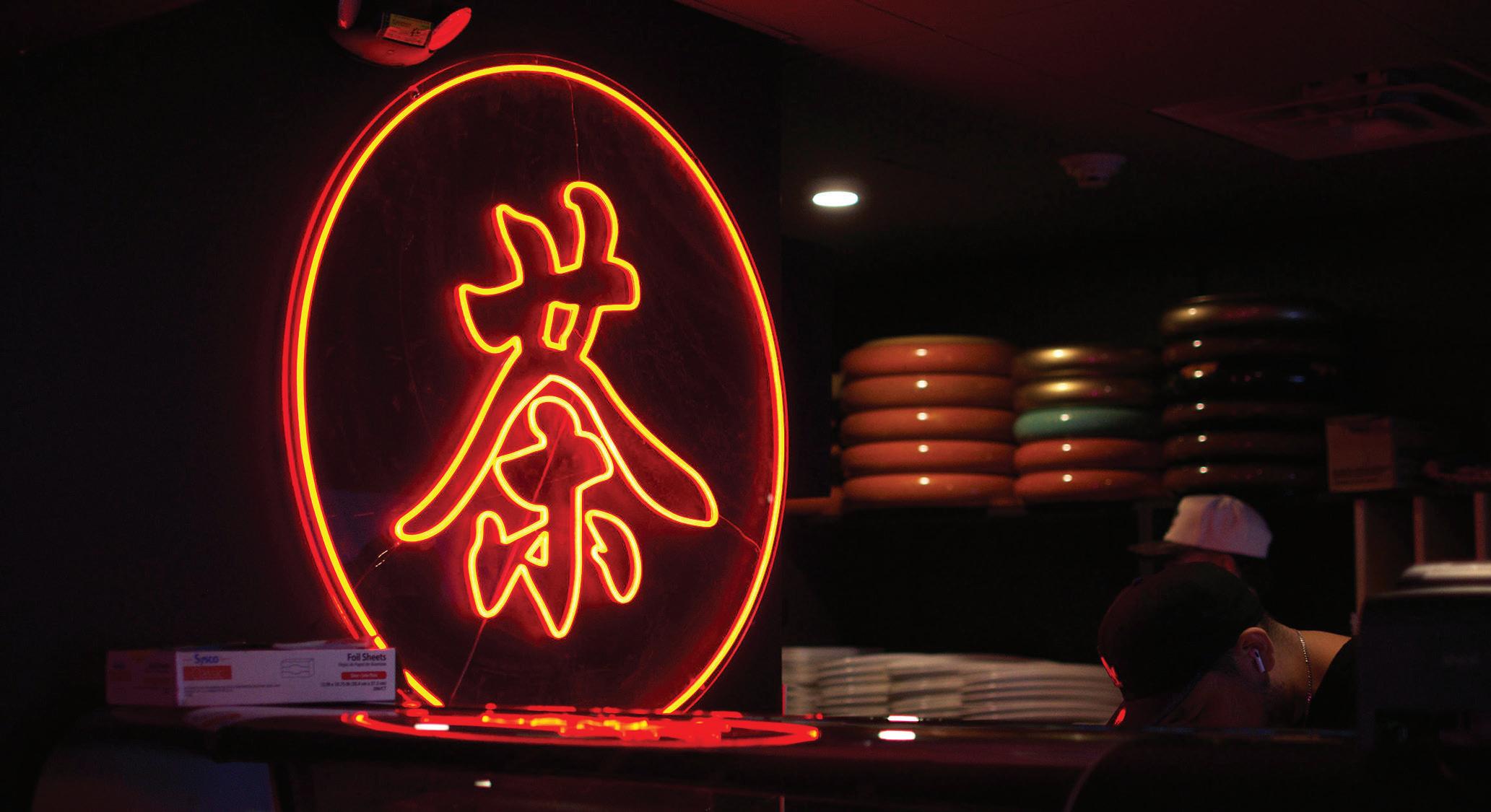
The bar inside Japones, a new Japanese restaurant, is pictured Feb. 5, 2026, in Bloomington. The restaurant opened in the former Princess Theatre building.
delicious bite.
Japones
By Lexi Bunting
lexbunti@iu.edu
Bloomington offers many delicious spots for sushi lovers to explore. From budget-friendly picks for a quick lunch to upscale cuisine perfect for a date night or celebration, there are plenty of options for everyone.
Earlier this year, Japones, a new high-end Japanese restaurant, opened and brought a new buzz to the sushi landscape here in Bloomington. In addition to Japones, here are some other great local favorites that are worth checking out.
Sushi Bar Sushi Bar was the first sushi restaurant I tried after coming to Bloomington, which may explain my bias. I always suggest this restaurant for the classics such as tuna rolls and Philadelphia rolls; they do traditional well here with simple rolls and quality ingredients.
options, making it a great budget-friendly choice.
Suki Sushi
Sushi Bar offers a large menu with affordable pricing, making it a strong option for students who do not want to commit to an expensive dinner. It stands out for its lunch combo meals, which make it easier to sample multiple items at a lower cost. A simple tuna roll only costs $4.99 any time of day at Sushi Bar. Located at 2522 E. 10th St., Sushi Bar is within walking distance of campus and offers a wide range of
Tucked into a small section of the food court at College Mall, I was a little skeptical about Suki Sushi at first. Looking back, I am so glad a friend introduced me to it. It is a perfect spot for end-of-the-day takeout or a casual sit-down meal while people watching in the mall.
No matter what I try on the menu, it is always delicious. Suki has plenty of rolls with cream cheese in them — including one of my personal favorites, The Shaggy Dog Roll. Suki Sushi is incredibly affordable, making it an easy choice if you are already out and looking for a quick,
Restaurant Ami
Restaurant Ami is a great pick for a date night or small celebration when you want something a little nicer without feeling over the top. The space is warm and inviting the moment you walk in, but the outdoor patio is the real highlight — especially on late spring nights when the weather is just right.
Beyond the cozy atmosphere and consistently good sushi, this location stands out to me for its close proximity to campus.
Located right at 1500 E. Third St., it is a short walk from campus and a convenient dinner choice for students who want something nicer
than takeout without going too far.
MAJÉ SUSHI
If you love trying new flavors, MAJÉ SUSHI is the place for you. It has a large menu with lots of creativity. The menu ranges from the playful Philly Berry Wrap, a sweet roll with cream cheese and strawberries, to classic favorites like the traditional California roll. No matter how adventurous your taste buds are, there’s something here for everyone. A highlight of this location every time is the kind employees.
Located at 601 N. College Ave., MAJÉ SUSHI is an excellent choice if you are looking for quality sushi and great service.
A new addition to Bloomington’s dining scene, Japones opened in late January at 206 N. Walnut St. Though it has not been in town long, it has already stood out as a strong contender among Bloomington’s go-to sushi spots. The restaurant offers a wide range of options, all made with fresh ingredients and plated with care, including sushi, ramen and chicken teriyaki, along with signature cocktails. The space has a high-end feel, making it a strong choice for larger celebrations such as birthdays and anniversaries. The experience left me feeling elevated and fancy.
By Steven Leatherwood sjleathe@iu.edu
The sound of clicking camera lenses filled the third-floor atrium of Kirkwood Hall as sophomore Olive Shurr posed in an upcycled cardboard skirt and top and paper mache antlers against a black backdrop.
Shurr, alongside other sophomores and juniors in professor Lori Frye’s Fashion Studio II class, were preparing their submissions to the annual Trashion Refashion show taking place in Bloomington in April.
Shurr and her design partner Lorena Gamez put together an outfit inspired by foliage and made with leftover craft material such as cardboard, paper and wreath leaves.
“I had all this leftover greenery from a wreathmaking thing,” Shurr said. “So, we decided to do a kind of forest-themed outfit, using cardboard as a basic skirt, and then cardboard packing paper for the top, which I wove. And then we did like some paper mache antlers.”
Many of these students have been working on their outfits for two to three weeks in preparation for the Feb. 16 submission date. The show itself is April 12, but every outfit must go through a vetting process held by a
committee within the Trashion Refashion organization in order to be accepted into the show. The committee is looking for originality as well as the amount of previously-owned material used.
“Things they look for are the level of transformation, so it’s how much do you transform your materials? Is it wearable? Is it functional?” Frye said. “They also want to try to make sure they feel like it’s trash.”
Another student, sophomore Josh Sexton, is designing a cowboy look inspired by his interest in the ‘70s bootcut flared jeans look. He said this style lent itself well to the cowboy aesthetic. For his design, Sexton plans to create a shawl out of a recycled carpet, as well as a hat made from Monster cans. He said he found his materials from a variety of locations around Bloomington and at home.
“The tarp for the pants I found in my garage,” Sexton said. “I got this carpet from Habitat ReStore, and then the shirt my partner got from Goodwill. And then we’re gonna make a big hat. His buddy had a bunch of Monster cans, so we’re gonna construct that out of it.”
The students are all taking a variety of directions with this project.
For example, Audrey Poynter and her design
partner Linnea Correale are creating a late 18th-century Cinderella-inspired gown, outfitted with at least 500 wine corks affixed to the corset.
“My great aunt actually collected them, like all throughout the years, all these wine bottles. So, she was like, I have these wine corks,” Poynter said. “So, we cut them in half and we hot glued them to this corset, and it looks really cool.”
Poynter and Correale aren’t the only ones taking
inspiration from a romantic story. Junior Phoenix Childress is creating a look based off of Netflix’s “Bridgerton.” She created a dress using duct tape and old bed sheets, which are covered in hand-crafted flowers.
She said her personal style primarily leans toward being “pretty” and utilizing “lacy things,” which led her to the “Bridgerton” inspiration.
Childress created 14 ornate flowers to accent her outfit using plastic spoons,
which she hot glued together. She said she will probably make even more flowers to adorn a headpiece for the outfit as well.
“The flowers were a long process,” Childress said. “Each of them is eight spoons, and they probably each took, like, at least 10 to 15 minutes to make,”
While they have created individual garments like shirts, skirts and pants for classwork, this will be the very first show many students are designing for.
“It’s gonna be my first fashion show that I’ve ever presented a piece at,” Poynter said. “So, I’m pretty pumped.” The Trashion Refashion Runway Show will be held April 12 at the BuskirkChumley Theater, where many IU fashion design students’ outfits will be displayed. The show is also a fundraiser for The Center for Sustainable Living. Tickets will be released on the Trashion Refashion website closer to the show’s date.
By Josh Baskin joshbask@iu.edu
Since “Avengers: Endgame,” Marvel Studios has released over 15 television series on Disney+ over just seven years. This oversaturation of content has caused me to skip over many projects, as I felt they lost the originality that made Marvel stand out originally. From the first trailer for “Wonder Man,” I could tell this show was going to be nothing like what Marvel has done in the past. “Wonder Man” follows Simon Williams (Yahya Abdul-Mateen II), an aspiring actor with energy manipulation abilities, who is struggling to find work while maintaining his social life. When he hears about
the role of a lifetime, Simon seeks guidance from Trevor Slattery (Ben Kingsley), a washed-up actor associated with his villainous past as the Mandarin. Unlike most Marvel projects, “Wonder Man” rarely shows Simon’s powers, instead focusing on his character and his relationships. This was extremely refreshing to watch, as it made me able to sympathize with Simon much more than a typical comic book superhero mainly defined by their abilities.
The series is also hilariously meta, often poking fun at actors or shows that are in some way owned by Disney. This humor felt very similar to “The Studio,” a comedy series about Hollywood, although they were certainly
pulling their punches when it came to mocking the superhero entertainment business.
Over the first three episodes, Simon and Trevor form a close bond over their love of acting, while preparing their auditions for “Wonder Man,” the new superhero reboot that everyone in Hollywood is losing their minds over.
“Wonder Man” wastes no time grounding the audience, with the first episode showing Simon getting fired from an acting gig and his girlfriend dumping him immediately afterwards. With no intense score or mind control powers to save the day, it’s clear this is going to be a series about emotional growth, not defeating your enemies in battle.
The chemistry between Abdul-Mateen II and Kingsley feels incredibly authentic, allowing the dialogue to flow naturally. Although the “young rookie and old pro” trope has been used countless times in media, these two actors made me feel as though this relationship was unique.
While these episodes were certainly entertaining, the fourth episode of the series sticks out to me the most. Stepping away from Simon and Trevor, this episode follows Demarr Davis (Byron Bowers), who mysteriously obtains the power to open doors from his body after encountering a foreign substance while throwing out garbage.
Over the span of just 30 minutes, we see Demarr go
from rags to riches and back to rags, with his new abilities granting him fame that can only be dragged on for so long. I found it hilarious that Demarr’s entire superpower is just acting as a human door, and instead of trying to use this power for good, he stars in action films and infomercials. It felt strange seeing a Marvel superhero do nothing beneficial with their abilities, which is why this episode resonated with me the strongest. The fourth episode ends with an incident on a film set with Demarr, leading to a permanent ban on superheroes from acting in films, which shows the audience why Simon is so stressed about auditioning for this superhero role. This segues
into the rest of the series, which follows Simon and Trevor earning callbacks for the film and working together to seal the deal. While I appreciated the lack of superpower use to create a grounded feeling for the show, this choice left Simon’s character feeling incomplete, as his abilities were sidelined to the point where I would often forget he had them at all. In fact, it’s not until one of the last scenes of the entire series that Wonder Man’s suit is finally revealed. This miniseries may have been created solely to establish the character of Wonder Man for future projects, but through hilarious dialogue and unique writing choices, it sticks out as a refreshing take on the superhero genre.
By Dalton James jamesdm@iu.edu @ DaltonMJames
Aiden Fisher was a zerostar recruit out of Riverbend High School in Fredericksburg, Virginia, when he sat in Curt Cignetti’s office at James Madison University in 2021.
Cignetti offered Fisher a scholarship. He sought an immediate commitment.
“Do you want to do anything with it?” Cignetti asked. Fisher did.
His belief in Cignetti led to 19 wins and just four losses over Fisher’s two seasons at JMU. When Cignetti saw Fisher in the transfer portal, he wanted him to become a Hoosier. Once again, Cignetti made him an offer.
Fisher believed Cignetti, who talked a big game in his first days on the job, could turn around college football’s losingest program.
“To be successful you have to be a little delusional,” Fisher said.
Over two years after Fisher trusted Cignetti a second time, he ended his college career with a national championship T-shirt draped on his left shoulder and a national championship hat on his head.
As Fisher left the field for the final time, Indiana football fans waved their white rally towels and cheered.
Fisher raised his right arm and waved, showing his gratitude for the Hoosier faithful over 1,100 miles from Bloomington at Hard Rock Stadium in Miami.
“You have to buy into some things that maybe don’t seem will come true,” Fisher said. “But if you believe enough, they will.”
When Indiana hired Cignetti after the 2023 season, he had his work cut out for him. Almost every offensive starter and half the defensive starters sat in the transfer portal. The Hoosiers were coming off a 9-27 threeseason stretch under former head coach Tom Allen.
Cignetti saw a handful of JMU players entering the portal. He wanted to make them Hoosiers.
Nine former Dukes pledged to the Hoosiers by Dec. 24, including Fisher. He came off a season in which he logged 108 total tackles, six tackles for loss and 1.5 sacks in 2023. When the Dukes lost their starting linebackers to injury that September 2023, Fisher stepped in.
He’s been the de facto quarterback of defensive coordinator Bryant Haines’ unit ever since.
When Fisher arrived at Indiana, he had a “weird” feeling. He was unsure whether holdovers from the Allen era would have “hard feelings” toward Cignetti bringing JMU players to Indiana.
“So, when we got here, the first thing I wanted to do was get away from football,” Fisher said Nov. 11, 2025, inside the Don Croftcheck Team Room in Memorial Stadium. “Get with people outside of the facility to let them know you’re trying to build new relationships.”
Fisher didn’t want his peers to think he came to Bloomington to compete with them and just be “work buddies.” He wanted real relationships, which, he said, required all the former Dukes to check their egos.
“I think the best thing we did was just getting together outside of football, building relationships, friendships that I think, at this point, will last forever,” Fisher said. “But instead of just being teammates, we took it off the field.”
The 10 former Dukes didn’t want it to appear as if they were trying to show the Hoosiers how to do things their way; they wanted it to be everyone’s way throughout the spring.
With fresh faces in the facility and an almost all-new coaching staff, building unity was rough at first.
Fisher said he didn’t feel like the Hoosiers’ leader until halfway through spring practice in 2024. Players were looking for someone who would take the lead, he said.
So that’s what he did.
“We were able to kind of
find common things together, see things the same way,” Fisher said. “I think that’s when we took a big step. So, pretty much halfway through spring, I think everybody kind of gravitated towards each other a little bit, and it was kind of smooth sailing since then.”
The Hoosiers concluded spring practice in mid-April with their spring game. The 2024 season opener against Florida International University, which marked the beginning of the Cignetti era, was 135 days away.
With uncertainty in what the Hoosiers had in the 2024 roster, Cignetti knew at least one thing for certain: Haines “sleeps a lot better” knowing he has Fisher on his unit.
And Fisher proved it in his first season in Bloomington. He made 118 total tackles, the 18th best nationally, 5.5 tackles for loss and 1.5 sacks.
Fisher earned first-team All-American honors from the Football Writers Association of America and was named to first-team All-Big Ten. Haines said ahead of the 2024 College Football Playoff that Fisher is his “mouthpiece” to the rest of the unit on the field and couldn’t say enough about his positive traits.
“He's the unquestioned leader,” Haines said. “He knows what I want, and he's able to get it done and gets his 10 teammates to play the right call.”
Although Indiana football went 11-1 in the 2024 regular season, the Hoosiers’ final game left a bitter feeling.
The Cream and Crimson reached the CFP for the first time in program history, but they lost to the University of Notre Dame by 10 points and were largely uncompetitive. Fisher totaled 10 tackles and 1.5 sacks in the loss.
Fisher helped guide the program to a 180-degree turnaround. Indiana was no longer the laughingstock of the Big Ten or the Power Four. Fisher recognized the “great” experience that first season, but the Hoosiers “didn’t finish the job.”
“I think we've laid a foundation of what Indiana football can be and what it is now,” Fisher said after the CFP loss. “And I expect to be right back here next year.”
Fisher took the playoff stickers off his helmet and water bottles shortly after the season ended. He didn’t want to be reminded of the past.
Through Indiana’s first seven games in 2025, Fisher totaled 48 tackles and 6.5 tackles for loss.
The Cream and Crimson announced their true arrival as a title contender with victories against Iowa and thenNo. 3 Oregon. They showed they could not only compete with the sport’s best but beat them in hostile environments. After retaining the Old Brass Spittoon against Michigan State, Fisher and the Hoosiers eyed a victory over UCLA on Oct. 25. On the Bruins’ second play from scrimmage, Fisher intercepted a pass and returned it for a touchdown, sending the Hoosier faithful inside Memorial Stadium into a frenzy.
However, on UCLA’s ensuing possession, Fisher said he was folded up on. He remained on the field for the rest of the drive and played the next with a black brace on his left knee, as he had a “minor tweak of something.” He didn’t play for the rest of the game following that drive.
“When I first got hurt, the biggest thing that went through my mind was, ‘I could either be a really bad teammate by woe is me, and I'm going to be hurt, I'm going to put my head down and look for pity,’” Fisher said Nov. 11. Such behavior would’ve been a “terrible representation” of Fisher and his leadership, he said. Instead, he opted to be as positive as possible.
Fisher helped his linebacker counterparts as they
were thrown into different spots due to his absence. He wore an earpiece on the sideline to listen in on Haines’ play calls to redshirt junior linebacker Isaiah Jones, who took on the defense’s green dot responsibilities.
Fisher wanted to help build the linebackers’ confidence, letting them know he was there every step of the way.
“But I mean, I can’t say enough about just how much those guys just carried themselves with such pride when they were out there,” Fisher said. “And they played so well.”
The four primary linebackers against Maryland on Nov. 1 accumulated 11 total tackles and an interception in a 45-point drubbing of the Terrapins, as Fisher missed the game.
“So, maybe they didn't need me as much,” Fisher laughed. “But they did a great job.”
Fisher returned Nov. 8 against Penn State and made his presence known. He recorded nine total tackles, one interception and a fumble recovery in the Hoosiers’ comeback victory over the Nittany Lions.
“You just talk about resiliency, always coming up in the clutch and refusing to lose,” Fisher said. “When it comes down, game on the line, it’s time to make money; this team refusing to lose. I think that’s the best quality you can have as a team.”
The Hoosiers then returned for Senior Day inside Memorial Stadium. Their victory over Wisconsin marked Fisher’s final time on the field in Bloomington. The stadium was sold out — a far cry from the environment before Fisher.
When he first got to Indiana, he met with athletes from different sports, curious as to why football wasn’t talked about. Football was “everything” at JMU. But not at Indiana.
Those he spoke with said they hadn’t been to an Indiana football game for several years. Fisher thought it was weird. JMU sold out its contests every weekend.
By the 2025 season, Fisher’s family struggled to find tickets. It’s a good problem to have, he said, because it’s a “complete turnaround.”
Indiana dominated its final two regular-season contests over Wisconsin and Purdue, securing the program’s first berth in the Big Ten Championship game. After falling to Ohio State in the 2024 regular season, the Hoosiers had an opportunity to exact revenge in Indianapolis. Fisher notched five tackles in the 13-10 victory. Singing the school’s fight song standing in the locker room was a tradition. Fisher led the Hoosier faithful through a rendition on the victory stage inside Lucas Oil Stadium.
But as has become the norm under Cignetti, Indiana was already focused on its next task: the College Football Playoff.
Although the Hoosiers
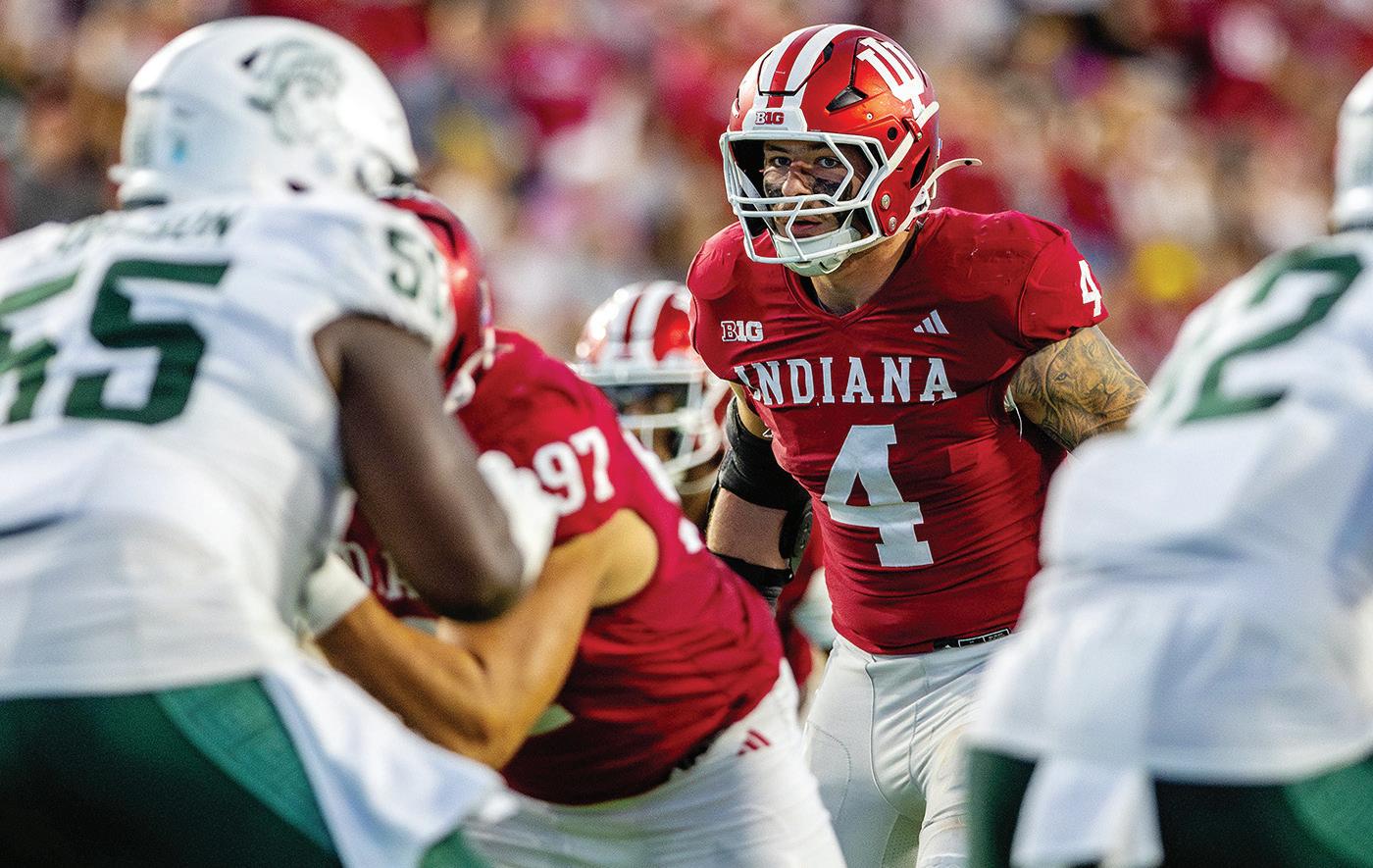
were making their first appearance in the Rose Bowl since 1968, Fisher said three days before facing the University of Alabama it felt like “any other game.”
However, Fisher acknowledged that when he arrived at Indiana, he heard about the program’s ambitions of reaching the Granddaddy of Them All.
“So, I'm glad we were able to do it,” Fisher said Dec. 29. “But job’s not finished for us. Getting here is one thing, but winning is another. That's the goal, and nothing else matters if you don't win that game.”
The Hoosiers didn’t just win. They throttled the Crimson Tide by 35 points Jan. 1 in Pasadena, California. Again, Fisher led the overpowering pro-Indiana crowd through the school’s fight song after securing a berth in the Peach Bowl.
When Fisher and three other Hoosiers sat just beyond the north end zone inside Mercedes-Benz Stadium two days before facing Oregon, all attention was on the Ducks.
Fisher even said, tonguein-cheek, that the Hoosiers didn’t know the location of the National Championship game.
After the Cream and Crimson dismantled Oregon to secure the program’s first opportunity at a national championship, they earned a date with the No. 10 University of Miami inside Hard Rock Stadium in Miami Gardens, Florida.
When Fisher stood inside the Don Croftcheck Team Room at Memorial Stadium on Jan. 13, he addressed reporters for the final time inside the Hoosiers’ facility. With just one game left in his collegiate career, he’d already helped break records and change how others think about Indiana football.
But even with 26 victories and just two losses behind him, he rendered the past nearly unimportant. Only the future mattered to the senior linebacker.
“It won't mean really anything unless we walk away with a win in this game,” he said.
Cignetti rid the Hoosiers of complacency from his first day in Bloomington. That no-
nonsense mindset trickled down to the veteran leaders, Fisher especially.
When Fisher was on a phone call with his mom, Leslie Amore, he noticed a Cignetti-ism in his words.
“I was just like, ‘Yeah, I hope somebody doesn't get complacent,’” he said Jan. 13. “And I was like, ‘Wow, I have been with Cig way too long.’” Fisher spent the entirety of the week ahead of the title game against the Hurricanes delivering a simple message: for one week, he needed each Hoosier to give him their all.
Several players, such as quarterback Fernando Mendoza and receiver Elijah Sarratt, emphasized deleting social media apps from their phones to block any potential distraction. However, Fisher wanted every Hoosier to place their full attention on the national championship.
“Just give me a week of your everything and we'll reap the benefits after,” Fisher said. “But just eliminate distractions, be in the moment. This is a once-ina-lifetime opportunity that you have to take advantage of.”
Donning a sleeveless white hoodie emblazoned with the Indiana trident and a lone “4” over his heart, Fisher walked into the field inside Hard Rock Stadium for his final collegiate game. With his space gray Apple AirPods Max over his head, Fisher prepared for a moment he’s worked his whole career for: the opportunity to be atop college football. When the Hoosiers entered the same tunnel at halftime three and a half hours later, they led the Hurricanes by 10 points. With the Cream and Crimson holding much of the momentum after halting Miami’s offense, 30 minutes stood between Indiana and immortality. The Hurricanes scored touchdowns on three of their first five possessions in the second half, flipping the script from the opening half. Miami regained possession and faced a six-point deficit with less than two minutes left.
“We told ourselves on the sideline, ‘We're going to have a chance to go win this thing,’
and I feel like that was kind of fitting for our team,” Fisher said postgame. “Put it on us one more time and kind of let the chips fall.”
Indiana’s defense had one final opportunity.
One final opportunity to cement itself as one of the nation’s best units. One final opportunity to save the Hoosiers’ dream season. One final opportunity to accomplish perfection. With the Hurricanes marching into the Hoosiers’ territory, Indiana seized its chance.
Redshirt junior defensive back Jamari Sharpe hauled in the game-sealing interception. The Indiana-branded chips fell. Cream and Crimson confetti followed, raining down on the field once the clock struck zero. After 28 games as a Hoosier across two seasons in Bloomington, Fisher ended his collegiate career with a national championship. No longer did he have to buy into delusion.
Fisher’s belief is now rooted in substance.
“It's just been such a special journey for me, starting at James Madison and coming here, really betting on myself to be able to transform my game from the Group of Five level to here,” Fisher said.
Cignetti changed Fisher’s life, he said.
“I owe a lot to him,” Fisher said. “He's an unbelievable coach, but he's an unbelievable person. Yeah, it's been special. I'm glad I made both decisions the right way.”
While Fisher finished his career with glamorous statistics, he won’t remember just the tackles, the sacks or the interceptions.
It’ll be the mid-January Monday night in Miami, where the Hoosiers stamped their name in history: the first 16-0 season in the modern era. And the night where Fisher had both a national championship-branded hat on his head and a T-shirt draped over his left shoulder.
“It's something that I'll carry with me for the rest of my life. Just doing it with my guys, I'll carry that with me forever.” Fisher walked back through the same tunnel he previously exited over six hours earlier. This time, a national champion.
By Kasey Watkins kaslwatk@iu.edu | @kaseywatki87731
As the NCAA Tournament nears, every game holds weight for Indiana men’s basketball if it wishes to hear its name called on Selection Sunday on March 15.
After going on a fourgame losing skid in January, the Hoosiers’ future looked uncertain, as the losses piled up and the absence of quality wins was apparent.
But since that losing streak, the Cream and Crimson appeared to turn a new leaf, winning four of their next five games and picking up multiple Quadrant 1 victories to strengthen their NCAA Tournament resume.
Ahead of their matchup with a struggling Oregon team that sits at the bottom of the conference standings, all the Hoosiers needed to do was come away with a win. A victory wouldn’t enhance the resume, while a loss could have prevailed as detrimental.
So, against the Ducks inside Simon Skjodt Assembly Hall on Feb. 9, the Hoosiers took care of business and did exactly what it needed to do to come away with their 9274 victory over Oregon.
“Even through that fourgame stretch, I thought we came in every day at practice and continued to really work at what we needed to work on, and it’s kind of resulting in this run that we been on a little bit so far,” redshirt senior forward Tucker DeVries said postgame.
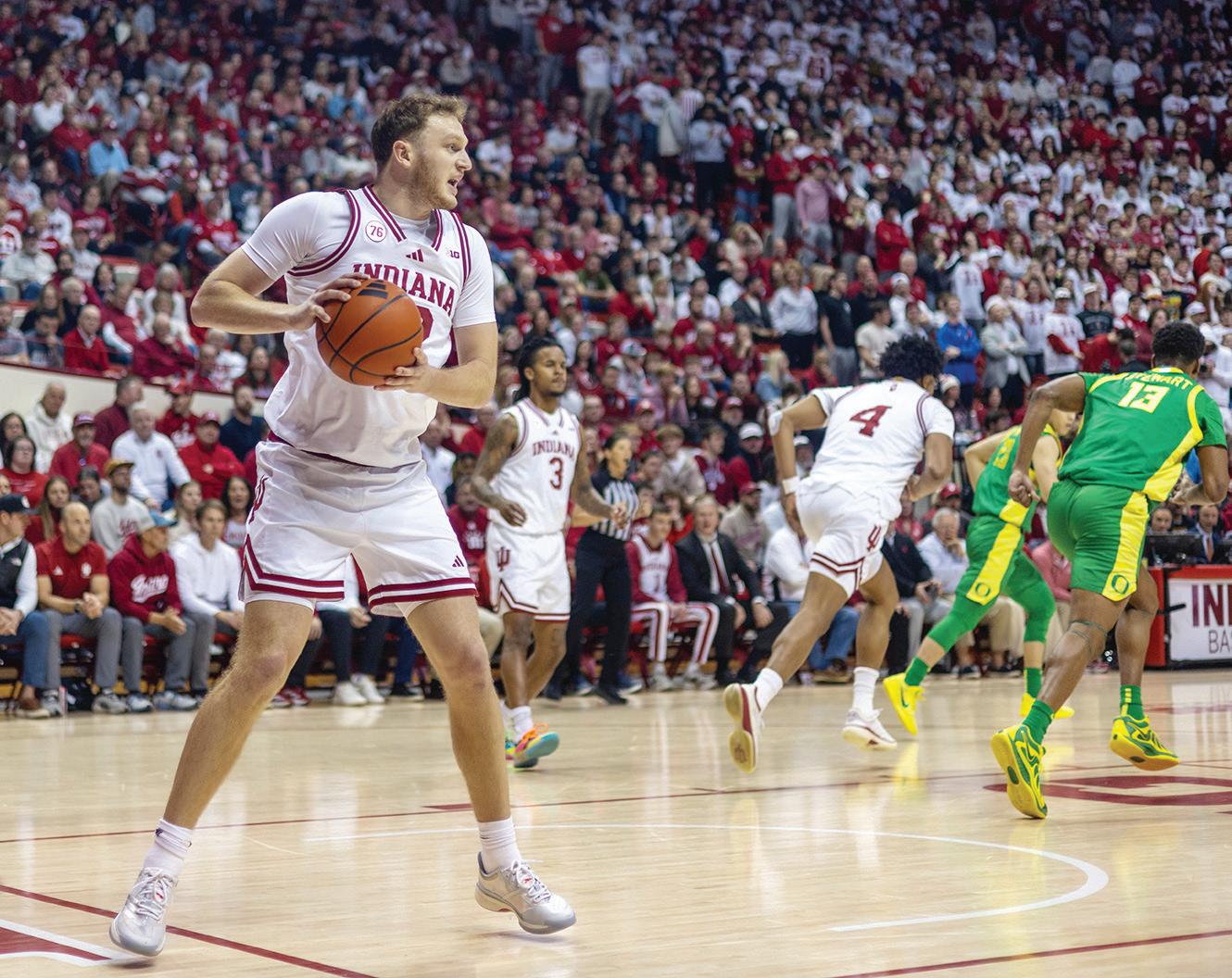
Against the Ducks, Indiana saw production from all facets of the roster, as four of the five players in the starting rotation finished in double-digit scoring. Fifth year senior guard Lamar Wilkerson led the way with 41 points off 13-for-20 shooting from the field and six made shots from beyond the arc. While Wilkerson’s performance stood out, his effective shot making created opportunities for his teammates.
Senior forward Sam Alexis was one Hoosier who benefited.
Throughout the night, Alexis tallied 16 points on a perfect 8-for-8 shooting from the field. The University of Florida transfer also notched five boards and two assists in his 25 minutes on the floor.
The 16-point performance marked his second consecutive game in double figure scoring.
“He (Alexis) kind of is our motor and enthusiasm every day,” Tucker DeVries said. “I think that leads to the success he’s had as of late, too. He’s so versatile at that position.”
After the game, Indiana head coach Darian DeVries said Indiana has not utilized Alexis enough and will continue to make use of him as the season progresses.
In addition to individual performances, the Hoosiers as a whole played together and efficiently. The Cream and Crimson limited turnovers and won the rebounding battle — two statistics Darian DeVries has emphasized all season long. Indiana had nine turnovers and outrebounded Oregon 29-25 Indiana also did not let
up in the second half. At times this season, the Hoosiers were accustomed to crumbling in the second half and letting wins slip away. But recently, and against the Ducks, Indiana has broken that habit.
Darian DeVries attributed this change to his team finding an “identity at both ends of the floor.” He said that at other points this season they only played 30 minutes of a game, instead of sustaining for the full 40.
“That’s a problem, you can’t be that team,” he said postgame.
But against Oregon, they weren’t “that team.” The Hoosiers played the game efficiently and secured a victory they needed. And while the win was crucial to Indiana’s NCAA Tournament hopes, the victory carried importance beyond the Hoosiers’ resume. The win added to the Cream and Crimson’s momentum, which they will likely need ahead of its upcoming gauntlet stretch of games. Of Indiana’s next four games, three are against top-15 opponents. The Hoosiers will be tasked with facing No. 10 Michigan State at home and No. 8 Illinois and No. 13 Purdue on the road. And with the NCAA Tournament hopes on the line, each game carries weight for the Hoosiers. But now having won five of it’s last six games, Indiana looks to be on the right path.
“Basketball is a game of runs,” Wilkerson said. “I just feel like it’s our run right now. You’d rather be playing your best basketball in March than January.”
By Savannah Slone srslone@iu.edu | @savrivers06
Indiana women’s basketball struggled in its first contest against Purdue earlier this season. It was a game Indiana head coach Teri Moren thought would be a good opportunity for her team that was on a then seven-game losing streak, but the Hoosiers weren’t able to take advantage. In the rematch between the two squads Feb. 8, it was a different story. The Hoosiers ran away with a 74-59 win over the Boilermakers at Simon Skjodt Assembly Hall in Bloomington.
“We went to West Lafayette a couple weeks ago, we let one get away, had a great opportunity and just felt like we let it get away from the beginning, for a multiple of reasons,” Moren said Feb. 8. “Starting with us not getting back in transition, just giving up too many threes, getting beat on the boards, 50-50 balls. You know, all of it, right? That’s a recipe for a loss.” In the first contest between Indiana and Purdue on Jan. 25, the Hoosiers got
By Conor Banks conbanks@iu.edu | @Conorbanks06
Indiana softball led the country in batting average last season. But entering 2026, the Hoosiers lost two of their most productive hitters from 2025, graduating Brianna Copeland and Taylor Minnick. Without Copeland and Minnick, Indiana looked like a shell of itself from the season prior in its 2026 season opener against Florida Atlantic University on Feb. 5. The Cream and Crimson collected just three hits across five innings, as the Owls struck out eight Indiana batters en route to an 8-0 victory. But Indiana settled in offensively following the shutout loss. The Hoosiers would go on to score 44 runs across their next four games of the Paradise Classic in Boca Raton, Florida, finishing the
out to an early lead but let it slip away. After being up 7-2, Indiana struggled, but its lead remained until the beginning of the second quarter.
Two Purdue free throws put the Boilermakers ahead 16-15, and the Hoosiers were unable to eliminate the deficit through the end of the game. Purdue took a doubledigit lead midway through the second quarter, and Indiana fell 80-69. The first quarter started similarly for the Hoosiers on Feb. 8. An 11-0 start through the first three minutes and 44 seconds gave Indiana a cushion. However, they were only able to score four points through the final seven minutes of the quarter, allowing Purdue to tie the contest at 15 points nearly three minutes into the second period. Indiana didn’t allow a repeat of what happened in West Lafayette two weeks ago. Instead, the Hoosiers began to pull ahead. Senior guard Shay Ciezki made three free throws on the next possession, then corralled the rebound on the defensive end.
Freshman guard Nevaeh
Caffey missed her shot attempt on the other end, but recovered by grabbing her own rebound, drawing a foul and making both free-throw attempts. The series put Indiana up 20-15 and proved the Hoosiers wouldn’t fade away as quickly as their last game against the Boilermakers. By the end of the first half, Indiana held a 13-point lead over Purdue. Apart from the Hoosiers’ resilience, they improved their performance in many statistics Feb. 8.
On Jan. 25, the Hoosiers collected just 31 rebounds, while they had a season-high 47 on Feb. 8. In the first contest against Purdue, Indiana had just seven assists and 20 turnovers. But on Feb. 8, the Hoosiers had 18 assists — eight from Ciezki — and 17 turnovers.
When Moren talked to her team before the game, she told them that watching the offense from the first Purdue game was like “watching paint dry.” She said the Hoosiers lacked urgency, despite knowing that when they place fast, they’re “at our best.”
Indiana’s defensive efforts were also below Moren’s
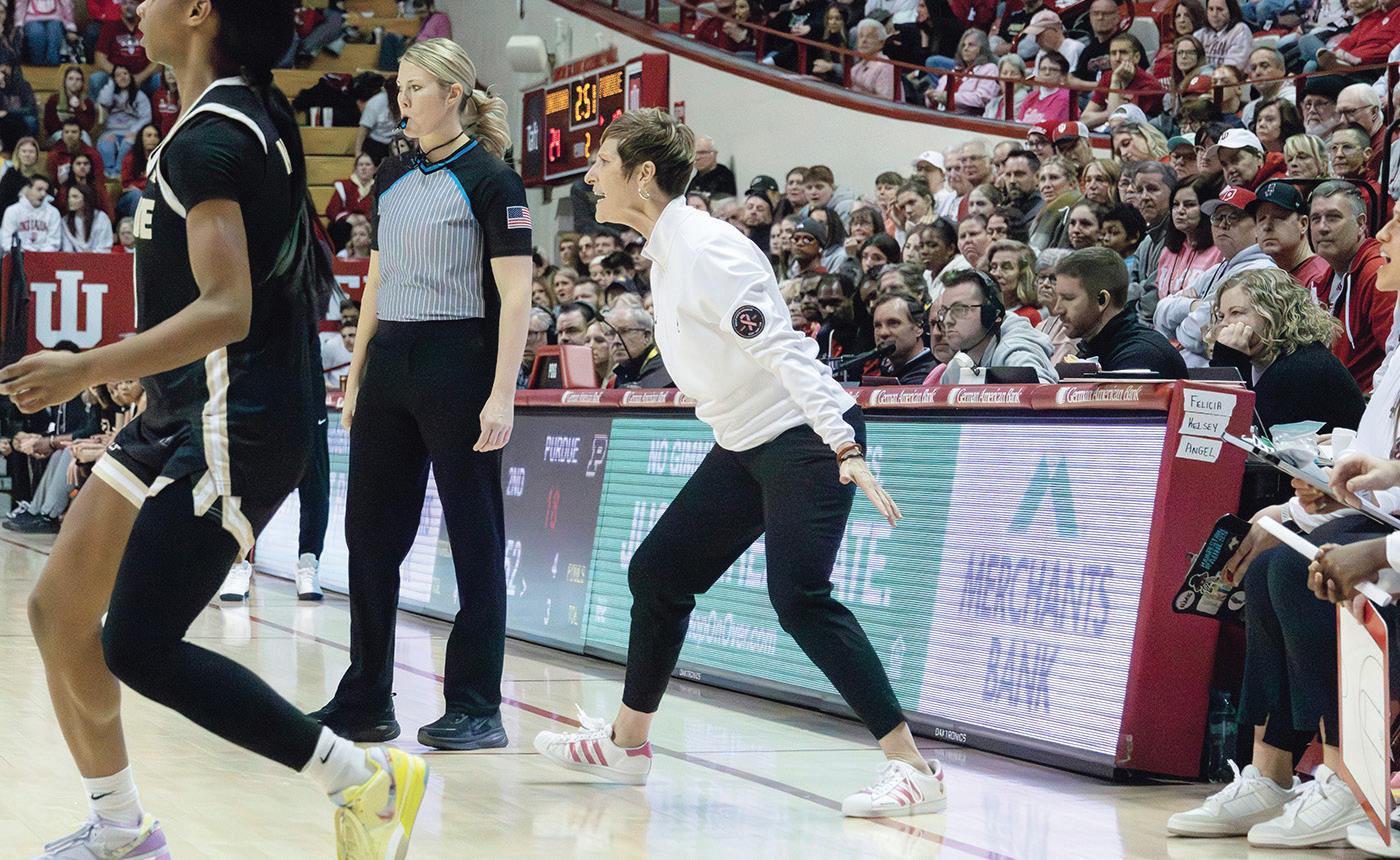
standard in West Lafayette, specifically in transition. She said the Hoosiers “reverted back to some of our bad habits” and again emphasized the lack of urgency.
“A lot of things went wrong in (West) Lafayette,” Moren said, “but I thought today, there were a lot of really good things.” With the win over Purdue, Indiana moved up one
classic with a 4-1 record. Indiana faced the U.S. Military Academy West Point in the first leg of a doubleheader Friday in search of redemption after the Hoosiers’ opening game loss to Florida Atlantic.
After totaling just three hits Feb. 5, Indiana strung together nine hits Friday against Army West Point, notching an 8-2 victory.
During open practice Feb. 2, Indiana head coach Shonda Stanton said “a lot of the attention and focus” of opposing teams will be on senior catcher Avery Parker this season. In 2025, Parker’s 11 home runs finished third highest on the team behind Copeland and Minnick, leaving the catcher with more responsibilities at the plate in 2026. Parker registered just one hit in Indiana’s opening game, but notched the Hoosiers’ first home run of the season in the bottom of the
third inning against Army West Point, which brought in two runs. While Parker is expected to take on much of the power hitting role left by the two graduated seniors, junior utility player Alex Cooper led the team with three RBIs against Army West Point. Stanton described Cooper as a “great performer” in the past for the Hoosiers during open practice Feb. 2. As a freshman in 2024, Cooper blasted a walk-off grand slam against the University of Notre Dame. This season, Cooper has a chance to shine in a larger role. In the second leg of the Cream and Crimson’s doubleheader Friday against then-No. 25 Ohio State, Cooper tied for the team lead with three RBIs. Cooper’s offensive efforts powered Indiana to a 12-3 win in five innings. Feb. 7 presented another doubleheader for the Hoo-
siers, and an opportunity to build upon successful offensive outings on Friday. Indiana did just that. The Cream and Crimson produced their highest scoring output of the weekend against the University of Delaware on Saturday, securing a 14-2 victory.
Cooper led the Hoosiers with three hits, while sophomore first baseman Josie Bird and sophomore infielder Madalyn Strader each contributed three RBIs.
Senior outfielder Ellie Goins, who transferred to Indiana from North Carolina State University during the offseason, also made an impact against Delaware. Goins went 2-3 at the plate and drove in a pair of runs — her first game with multiple RBIs as a Hoosier. Indiana closed the Paradise Classic strong with a 10-0 shutout win over Stonehill College on Feb. 7.
different
spot in the Big Ten standings with a 3-10 conference record. It sits ahead of Purdue and Northwestern, both of which the Hoosiers have beaten, and Rutgers and Penn State, which the Cream and Crimson will play in the five regular-season games remaining on its schedule.
As Indiana continues it push toward the Big Ten Tournament, which it now
spot, it will be
for the Hoosiers to learn from their mistakes in past games, just like they did against Purdue. Moren has continually said that losses mean lessons throughout Indiana’s 10game Big Ten losing streak, and that growth showed against Purdue, but it needs to continue throughout the final five games.
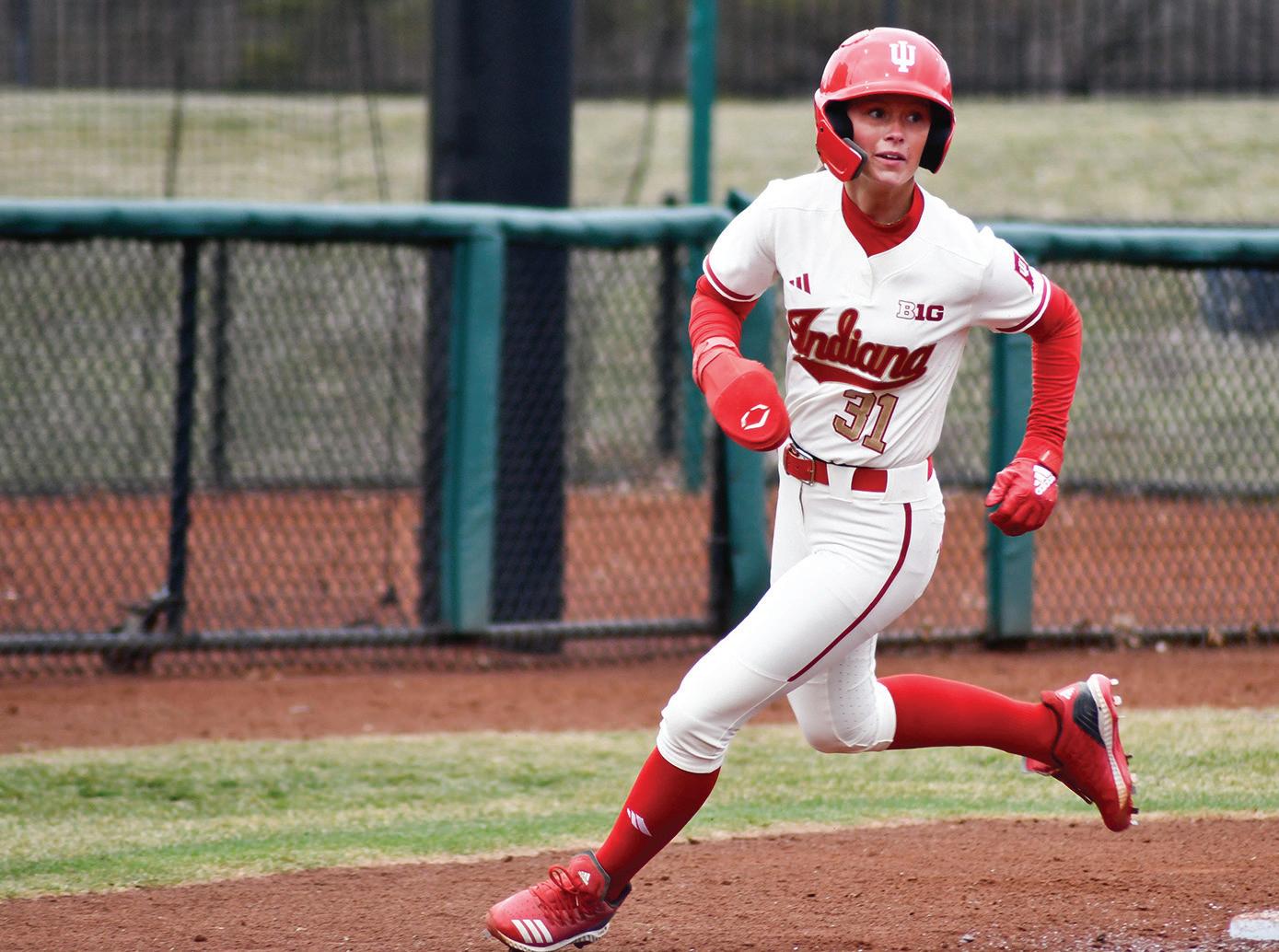
By Noah Boudouris nboudour@iu.edu
The Hoosiers started the meet with eight consecutive wins, two of which were upsets
No. 22 Indiana wrestling returned to its winning ways with a 30-9 dual meet victory over No. 15 Wisconsin on Feb. 7 in Madison, Wisconsin. The Hoosiers won eight of 10 bouts against the Badgers. The Cream and Crimson entered the meet with hopes of bouncing back from a 27-7 loss against then-No. 12 Illinois on Jan. 30. Indiana took its first lead of the day with No. 18 graduate student Jacob Moran topping No. 15 redshirt junior Nicolar Rivera by a score of 4-2 in the 125-pound bout. An escape for Moran in the second period gave him a 1-0 lead before the final two minutes. More points came for Moran with a takedown in the third period, sandwiched between two Rivera escapes, which secured the victory by decision and gave the Hoosiers a 3-0 advantage.
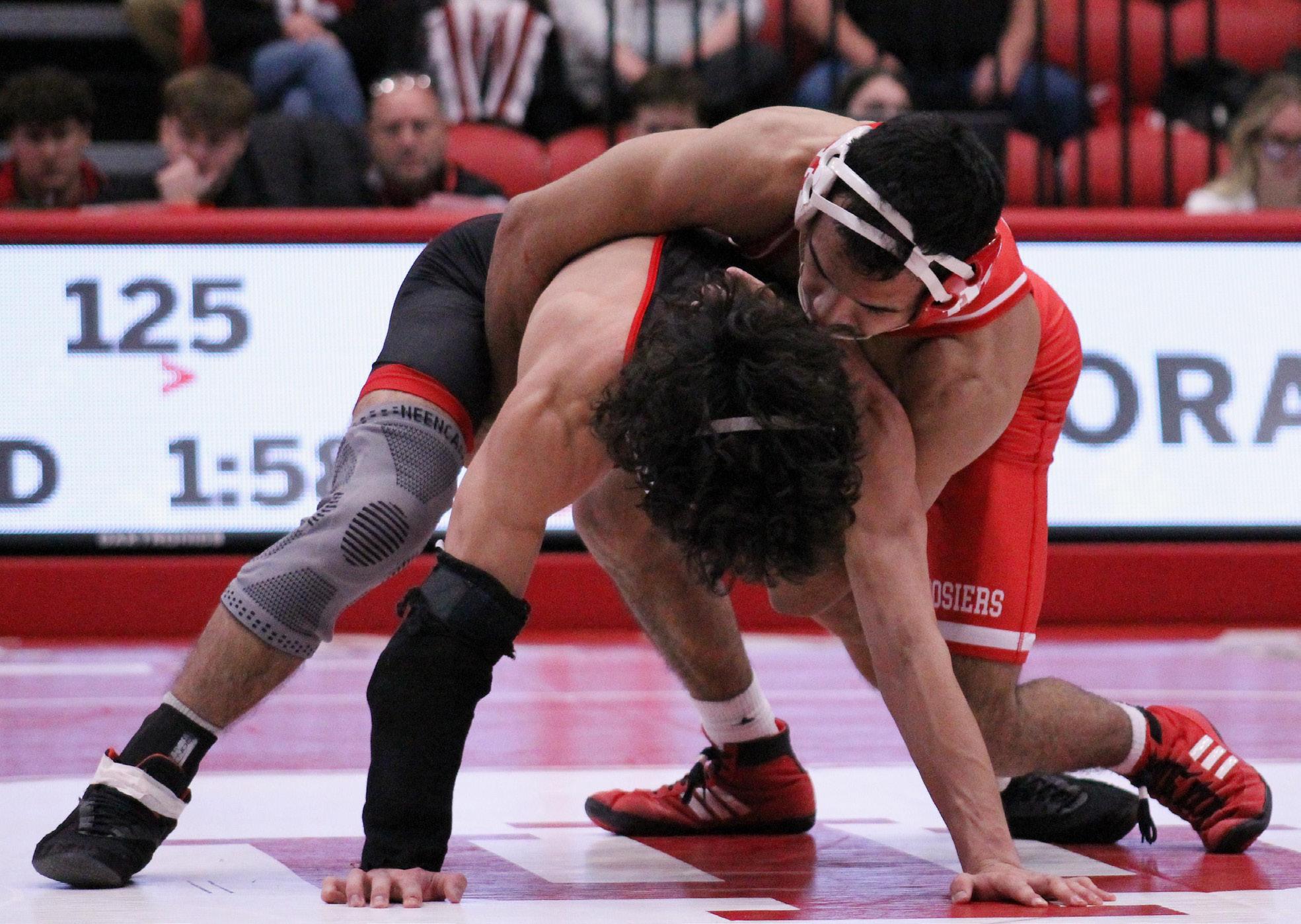
Indiana’s Jackson Blum extended his team’s lead with an upset in the 133-pound match. The unranked freshman scored an escape and a takedown in the third period and toppled No. 8 Wisconsin redshirt sophomore Zan Fugitt 4-1. The Hoosiers continued to roll through three bouts, with a takedown, an escape and a riding time point adding up to a 5-1 victory by decision for No. 25 redshirt junior Henry Porter over Wisconsin redshirt freshman Carson Exferd in the 141-pound bout. The fourth consecutive Hoosier victory and second upset of the day was delivered in the 149-pound bout by way of a victory for redshirt sophomore Joey Buttler over No. 12 Wisconsin redshirt senior Joseph Zargo. The two were tied with one point at the conclusion of the third period, but a Buttler takedown early in the
By Sean McAvoy semcavoy@iu.edu
UConn vs Tennessee. LSU vs South Carolina. UCLA vs USC. Indiana vs Purdue. Those games feature some of the biggest rivalries in women’s college basketball. And the Hoosiers and Boilermakers added another chapter in the storied history between the two programs. After Indiana women’s basketball was defeated 80-69 by Purdue on Jan. 25 at Mackey Arena in West Lafayette, Indiana, the Hoosiers sought revenge Feb. 8. At times, that mentality didn’t appear to be rewarded, as the Boilermakers cut away at Indiana’s lead at multiple points throughout the game. Purdue even tied the Hoosiers at 15-15 with seven minutes left in the second quarter after Indiana jumped out to an 11-0 start to the game. However, Indiana withstood the pressure and eventually won 74-59.
Yet, even during the Hoosiers’ lulls and rough stretches, there was one group that backed and cheered for Indiana: the 9,110 fans in attendance at Simon Skjodt Assembly Hall.
“I love this crowd,” Indiana junior forward Edessa Noyan said postgame. “The support from everybody around IU, IU Athletics, like overall it’s so good here.”
Ten days ago, the crowd didn’t have a reason to show
up on Feb. 8, as Indiana’s season seemed to require a miracle. Then-No. 9 Michigan demolished the Hoosiers 95-67 on Jan. 29 in front of the home crowd at Simon Skjodt Assembly Hall.
That night, the Hoosier faithful didn’t have much to cheer about. Indiana went down early, and by halftime, the Wolverines were leading by 18 points. The Hoosiers drew their highest number of personal fouls (24) in a Big Ten game and were outrebounded by 12. Indiana also coughed up 23 turnovers — second most in a Big Ten game — mostly due to the pressure that Michigan brought with its press. An aspect of the game that was much to the displeasure of Indiana fans in attendance. The Hoosiers on the court were met with loud constructive criticism from the Hoosiers in the stands.
“I haven’t forgotten how to coach,” Indiana head coach Teri Moren said postgame Jan. 29. “I am incredibly grateful for our fans, that they continue to show up. I would ask them to continue to show up for these kids.”
And the fans continued to show up.
Against Michigan, 7,619 fans were in the stands.
Against Northwestern on Feb. 1, 8,515 people watched Indiana finally win its first Big Ten game, 89-75, after the 10 previous attempts resulted in a loss. The winning ways for
overtime period granted him the sudden victory. Indiana solidified its perfect first half as redshirt sophomore Bryce Lowery pinned No. 25 Wisconsin redshirt senior Luke Mechler. The third upset of the day lifted the Hoosiers to an 18-0 lead. Lowery led the 157-pound match 3-0 by way of a takedown in the first period before the pin, which came with just over a minute
Indiana continued, as the Hoosiers defeated Wisconsin 77-74 at the Kohl Center in Madison, Wisconsin, on Feb. 4. That led the attendance number to trickle up over 9,000 on Feb. 8.
“In this state, when it comes to Purdue and Indiana, you don’t want to be on the other end,” Moren said postgame. “You want to be on the winning side of it, because it’s such an important thing for our fans.”
And Indiana put on a confident and rewarding effort that left likely Indiana fans satisfied. The Hoosiers combined to shoot 49% from the field and 38.5% on their 3-point attempts. Indiana also outrebounded Purdue 47-29 and finished with 18 assists — it’s the most against a Big Ten opponent.
Senior guard Shay Ciezki was dominant in multiple aspects of the game, compiling 29 points, 12 rebounds and eight assists. Along with Ciezki, junior forward Edessa Noyan stepped up to finish with 12 points and 10 rebounds. Freshman guard Nevaeh Caffey played stellar defense against Purdue’s guards of redshirt junior Tara Daye and sophomore Nya Smith.
Last time against the Boilermakers, an away crowd of 7,917 helped propel Purdue past Indiana. On the court, the Boilermakers played more physically than the Hoosiers. Off the court, Mackey Arena is undisputedly one of the hardest places to play in
left in the opening period. The Hoosiers’ dominance carried into the second half, as a 19-3 technical fall victory, courtesy of No. 19 redshirt junior Tyler Lillard, extended the advantage to 23-0 through the 165-pound bout. Lillard’s four takedowns in two periods overwhelmed Wisconsin’s No. 25 redshirt junior Cody Goebel, as Indiana stayed undefeated through
six matches. Indiana had a 26-0 upper hand through seven matches, following No. 29 graduate student Derek Gilcher’s 8-3 victory by decision over Wisconsin redshirt sophomore Luke Condon in the 174-pound bout. Gilcher earned all eight points in the final period via an escape, two takedowns and a riding time point.
Indiana’s No. 20 redshirt
freshman Sam Goin cruised to an 11-2 victory over Wisconsin redshirt
freshman Matthew Jens. An escape, three takedowns and a riding time point was Goin’s recipe for victory, as the Hoosiers led 30-0 with two matches remaining. Wisconsin’s first takedown of the afternoon came in the 197-pound bout when No. 28 Badger redshirt freshman Wyatt Ingham took a 3-0 lead in the first period over No. 18 redshirt junior Gabe Sollars. Sollars evened the score with an escape and a reversal before the end of the second period. A takedown from both men in the third period forced overtime, before Ingham snagged the sudden victory with a takedown. With nothing to wrestle for in the heavyweight bout, Wisconsin’s No. 9 redshirt junior Braxton Amos narrowed the Hoosier deficit against redshirt freshman Caleb Marzolino. Marzolino remained winless on the season, as he was pinned before the end of the second period.
Indiana ended the day winners of eight of 10 matches, winning all eight consecutively. Three unranked Hoosiers earned victories over ranked opponents as Indiana wrestling improved to 3-3 in conference, and 2-4 on the road. Indiana wrestling will continue its season with a dual meet against Nebraska at noon Feb. 15 at Wilkinson Hall in Bloomington.
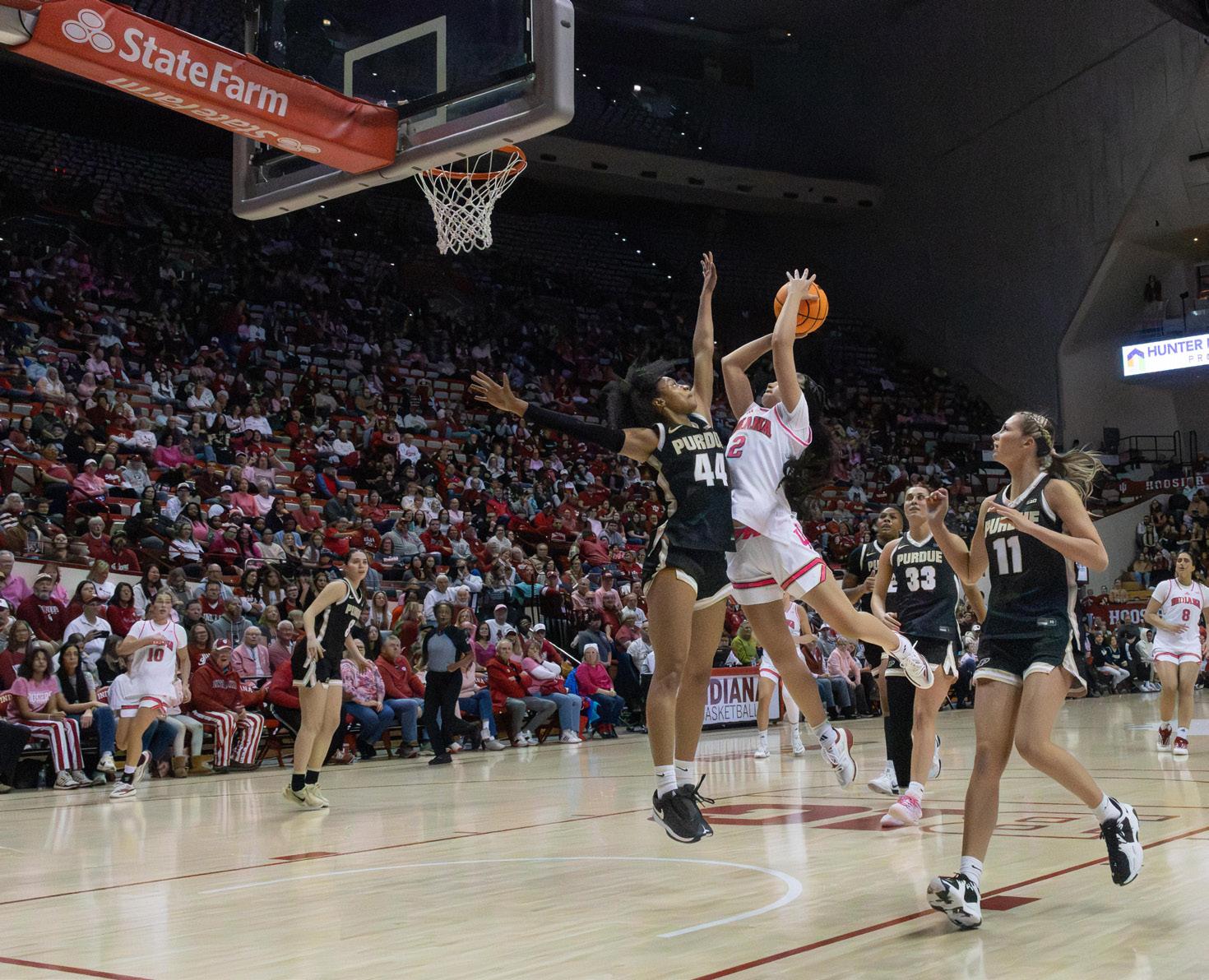
the country.
But Feb. 8’s game was a different story. Cheered on by the home fans at Simon Skjodt Assembly Hall, Indiana took the game to Purdue. And-1 opportunities from Ciezki and freshman forward Maya Makalusky made the crowd erupt and rise to its feet.
“I thought our effort was better,” Moren said postgame. “Our intent was greater. We were awfully disappointed after we lost there a couple weeks ago. I thought the crowd
was awesome.”
Now, Indiana turns its attention to another rivalry game: USC. And yes, I can hear you complaining about how the Hoosiers and Trojans are not rivals. They’ve only played two women’s basketball games against each other in both programs’ history. But the Big Ten Basketball Rivalry Series presented by Venmo begs to differ.
I’m being sarcastic about the rivalry aspect of the matchup on Feb. 12 night, and other than the 10 p.m.
start time against USC, the only other downside to the game is that it’s at the Galen Center in Los Angeles. But the Hoosier faithful knows how to travel well, especially when Indiana is playing for its season.
The Hoosiers jumped out of the bottom three of the Big Ten standings and into 14th place on Feb. 8. As a result, any victory Indiana gains before Rutgers on Feb. 25 and Penn State on Feb. 28 can help those contests not make-or-break the Hoosiers’ season.
By Dalton James jamesdm@iu.edu | @daltonmjames
Lamar Wilkerson earned Big Ten Co-Player of the Week on Feb. 9, according to the conference’s release, after Indiana men’s basketball split its two games last week. The fifth-year senior guard led the Hoosiers in scoring in both games, averaging 29 points and adding four rebounds and 2.5 assists per game. Indiana followed its loss at USC on Feb. 3 with an overtime victory at home over Wisconsin on Feb. 7. Wilkerson shared the honor with Iowa senior guard Bennett Stirtz, who scored
Wilkerson scored 58 points across the Hoosiers’ two games last week
29 points per game over the Hawkeyes’ pair of wins last week over Washington and Northwestern. Wilkerson began the week with a 33-point performance against the Trojans — his third game with at least 30 points this season. However, he said postgame his showing “doesn’t really matter” since the Hoosiers lost. When Indiana returned home on Feb. 7 to face Wisconsin, Wilkerson’s play helped the Cream and Crimson earn their 16th victory of the season. The Ashdown, Arkansas, native notched 25 points, four rebounds and four assists in the one-point win.
The 6-foot-6, 205-pound Wilkerson drained two free throws with 16 seconds left in regulation to force overtime. He scored all six of Indiana’s points in overtime, including the game-winning free throws.
Wilkerson is averaging 23.2 points per game through Indiana’s 13 Big Ten contests thus far. His 38% mark from 3-point range is tied for eighth-best in the conference and second on the team, trailing junior guard Nick Dorn. Wilkerson’s distinction Feb. 9 is his second of the season and Indiana’s third, as redshirt senior forward Tucker DeVries earned the honor Nov. 10.