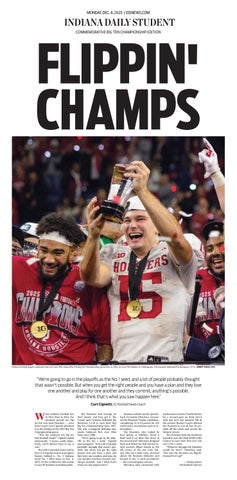
“We're going to go in the playoffs as the No. 1 seed, and a lot of people probably thought that wasn't possible. But when you get the right people and you have a plan and they love one another and play for one another and they commit, anything's possible. And I think that's what you saw happen here.”
When Indiana football lost to Ohio State in 2024, the moment proved too big for the new-look Hoosiers — even head coach Curt Cignetti admitted it in the leadup to the 2025 Big Ten Championship game.
“Was the moment too big for that football team?” Cignetti asked rhetorically. “I mean, really objectively, you’d almost have to say it was.”
But with a retooled roster and its first 12-0 regular season in program history behind it, No. 2 Indiana faced No. 1 Ohio State on Dec. 6, 2025, for the conference title inside Lucas Oil Stadium in Indianapolis.
Curt Cignetti, IU football head coach
The Hoosiers had revenge on their minds, and they got it. The Cream and Crimson defeated the Buckeyes 13-10 to earn their first Big Ten Championship since 1967. The win, a program-defining one, marks Indiana’s first over Ohio State since 1988. “We're going to go in the playoffs as the No. 1 seed,” Cignetti said postgame. “And a lot of people probably thought that wasn't possible. But when you get the right people and you have a plan and they love one another and play for one another and they commit, anything's possible. And I think that's what you saw happen here.”
Indiana redshirt junior quarterback Fernando Mendoza cemented his Heisman Trophy candidacy, completing 15 of 23 passes for 222 yards with a touchdown and an interception. The Hoosiers, who trailed by four points at halftime, faced a third and 8 on their first drive of the second half. Mendoza dropped back and lofted the ball toward senior receiver Elijah Sarratt in the left corner of the end zone. Sarratt, who ran a fade route, elevated above the Buckeye defender and hauled in the 17-yard touchdown — the eventual game-winner. Mendoza later connected with
sophomore receiver Charlie Becker for a 33-yard gain on third and 6 with just over two minutes left in the contest. Becker’s catch allowed the Hoosiers to run all but 18 seconds off the clock and secure the historic victory.
The Hoosiers held the Buckeyes scoreless over the final 40:08 of the contest to earn their first-ever win over a No. 1 team.
“Whoever thought the Hoosiers would be here?” Mendoza said.
“But now the Hoosiers are flippin’ champs! Let’s go!”
— Dalton James, IDS football reporter
Indiana football players celebrate their win over Ohio State after the Big Ten Championship game Dec. 6, 2025, at Lucas Oil Stadium in Indianapolis. The Hoosiers defeated the Buckeyes 13-10. JIMMY RUSH | IDS
Homelessness funding criteria is changing
By Emerson Elledge eelledge@iu.edu
The U.S. Department of Housing and Urban Development awards more than $3.5 billion in grants each year to address homelessness. For the first time in over a decade, the criteria for funding are changing.
This could slash funding renewal protection for homelessness assistance programs by 60% by requiring annual reviews before renewal, according to the National Alliance to End Homelessness. Monroe County currently employs a “housing-first” approach to homelessness aid and response, but changes may require them to shift the strategy.
CoC is a federal program through the HUD that distributes funds to communities and nonprofit providers with the goal of ending homelessness. Its annual $3.5 billion budget is then dispersed throughout the country for states to address homelessness solutions within their respective regions. Indiana’s counties are divided into 14 regions, which independently decide how to allocate the funds. Region 10 includes Greene, Lawrence, Martin, Monroe, Morgan and Owen counties.
HUD released its annual Notice of Funding Opportunity last month. NOFO is a document which details grant opportunities and the requirements to earn the funds. This fiscal year’s NOFO funding award criteria shifted drastically from years past.
Eligibility criteria remained largely the same in recent years, Mary Hamric, the strategic partnerships director of Heading Home of South Central Indiana, said. The changes announced
fundamentally changing.
Nov. 13 are something providers are still trying to understand the effects of.
“A lot of it is unknown to us,” Hamric said. “It’s very new and kind of a different thing than we’ve seen in over a decade.” Hamric said one of the biggest changes in the new NOFO is how grants are renewed. Grant funding under NOFO is split into two tiers. Tier 1 guarantees almost all projects’ renewal unless they had critical performance issues and was where 90% of CoC funding fell. Under the new guidelines, only 30% of grants are protected in Tier 1. The remaining grants will be subjected to merit reviews to earn renewal.
This means that if Monroe County’s CoC ranking falls, it could lose funding for programs that have operated uninterrupted for
years. The uncertainty of the future makes planning difficult, Hamric said.
“CoC funding is our backbone,” Hamric said. “It’s what keeps permanent supportive housing units open and what allows our outreach teams to exist.”
CoC has historically funded programs such as permanent supportive housing, rapid rehousing and outreach. Monroe County partners with Community Solutions — a national nonprofit which runs the Built for Zero movement. Built for Zero has the goal of finding an ethical and sustainable solution to homelessness and has been adopted by over 100 cities across the country.
In a press release Nov. 24 in response to HUD’s NOFO adjustments, Community
Solutions said the current NOFO criteria will “compound” existing housing issues.
“Congress should direct HUD to renew all 2026 CoC grants for 12 months because keeping Americans safely housed matters more than bureaucratic timelines,” Rosanne Haggerty, Community Solutions’ president, said in the release.
The new NOFO deprioritizes a housing-first mode, Hamric said. Housing-first is a model of homelessness response that emphasizes the importance of permanent housing as the solution to the issue, rather than focusing on less critical, more long-term issues first.
The new standards prioritize transitional housing, mandatory participation in on-site substance-use treatment and programs that
enforce local camping bans — all of which Hamric said don’t follow a housing-first mentality.
“Things are not going to get better until their primary need of shelter or housing stability is met, right?” Hamric said.
Joseph Callahan is a Monroe County resident. He spoke at the county commissioners meeting Dec. 4, advocating for responses to homelessness within the community other than overnight shelters.
“I also would not go to a shelter,” he said while addressing the commissioners. “I’m obstinate as a mule. I want to do things on my own. I don’t want to be a burden to others. And to be under someone else’s rules is not something that everyone is prepared for.”
NOFO also states sub-
stance-use disorders no longer qualify as mental health conditions for permanent housing eligibility.
The NOFO said HUD may deny funding to organizations with public complaints, verified negative media attention or a history of subsidizing activities that “conflict with this NOFO.” Hamric doesn’t know how HUD will define or interpret those terms.
Hamric said providers within Monroe County are still reviewing over 100 pages of documents. They hope lobbying Congress will get 2026 funding approved regardless of NOFO requirements.
“We just don’t know yet what’s going to happen,” she said. “But we know it could fundamentally change how providers in Monroe County are able to do this work.”
More MCCSC 3rd graders held back under new state law
By Elizabeth Schuth
ekschuth@iu.edu
Nineteen Monroe County Community School Corporation third graders will be held back next year under new IREAD testing regulations.
Indiana Senate Enrolled Act 1, passed in March 2024, requires all third graders to pass IREAD exams or qualify for a “Good Cause Exemption.” Students who do not pass are retained. This fall, 104 MCCSC students failed the test, 19 of whom will be held back. This is the largest number in over a decade, according to MCCSC data. In 2024, only one student was held back.
Good Cause Exemptions are granted for a variety of reasons, according to the Indiana Department of Education. The three main categories for consideration include students in special education, identified English learners and students who have already been retained twice.
Several steps of review by a committee of parents, teachers, administrators and reading specialists are required for a student to receive a GCE. This year, 80 of the 104 MCCSC third graders who failed the test received a GCE. The remaining five did not enroll with MCCSC for next year. About 75% of GCEs across the state were granted to children in special education and 24% were English learners.
IREAD results are in for MCCSC: 19 students will be held back next year
Overall, MCCSC had a successful testing year with an 86.8% pass rate for IREAD, which is a 3.7% increase from last year, but .53% lower than the statewide average. “At MCCSC, our approach to reading instruction is grounded in researchbased practices that support all students in becoming confident, capable readers,” Sarah DeWeese, MCCSC director of strategic communications, said. “We prioritize high-quality literacy instruction throughout the school year across all grade levels. Our long-term strategy centers on early intervention and ongoing support.”
SEA 1 covers more than just third grade retention. With the purpose of increasing literacy rates in Indiana, the law mandates testing to start in second grade, giving students more opportunities to pass the test and help with early detection and intervention.
The law is designed to work with House Enrolled Act 1558, which requires reading curriculum to be based on the science of reading. This is a teaching approach that focuses on phonetics, vocabulary and comprehension based on psychology and neuroscience.
The motivation behind HEA 1558, according to Indiana Senate Republicans, was a drop in IREAD scores following the pandemic, which caused concerns about literacy. Following the passage of
SEA 1, the Indiana Department of Education reported a 5% increase in reading proficiency for second and third graders tested by IREAD, the largest increase since the test’s creation in 2013. The 5% increase brings the state to 87.3% pass rate, the highest percentage since the pandemic. This gives Indiana a sixth place ranking for reading from the Nation’s Report Card. The Board of Education’s goal is to raise IREAD pass rates to 95% across the state.
However, the Indiana Department of Education reported 10,663 students statewide failed the IREAD test in 2025, and 3,040 are scheduled to repeat third grade next year. Comparatively, in 2024, 455 third graders were held back.
Several advocacy groups across the state have voiced concerns about retention policies, including the Indiana Coalition for Public Education in Monroe County.
“Retention should always be a local decision,” coalition Chair Keri Miksza said. “It is a decision between a parent and a teacher and a principal. It shouldn’t be something that’s dictated by the state, because the state doesn’t know the full story.”
Miksza was also concerned with the emotional toll that high-stakes testing has on young children.
“Our state government is supposed to support our public schools, and our public schools are supposed to help our communities,” Mik-
sza said. “When it’s creating an element of fear and anxiety, it may not be really doing its purpose.”
IREAD is the English language arts portion of the ILEARN assessments, which also test math skills, science and social studies for students in third through eighth grade. The purpose of the exams is to test students’ learning progress as well as the success of curriculum in general.
“It’s good to use standardized tests to help track students and make sure that they are progressing,” Miksza said. “It’s just wrong when adults use it to compare and contrast one school against another school.”
The Intercultural Developmental Research Organi-
zation also finds tests to be misleading to the public and that teacher quality and resources are better indicators of education quality. Other arguments against standardized testing include fears such as those cited by the National Education Association, that curriculum is too tailored to the test, meaning students will succeed on the exam but fail to be able to use the skills in other scenarios. NEA recommends using performance-based assessments like a creative project or designing an experiment over standardized testing.
Other community efforts to improve literacy beyond testing come from the Monroe County Public Library’s children’s programming. The library provides oppor-
tunities for all ages to get involved in reading starting with the “1,000 Books Before Kindergarten” initiative.
“Any chance a child can get to learn letters or reading will help them immensely when they get into school,” Angelica Candelaria, MCPL children’s services manager, said. “I think people take for granted that we can read and we do it every day, but we all we do start somewhere.”
To improve reading skills, Candelaria recommended reading as much as possible, especially for young children.
“We can all read things, but knowing the context of it, what it actually means and how to take out that information is the most important,” Candelaria said.
IU scientists discuss grant cuts, grad students concerned
By Ella Curlin elcurlin@iu.edu
Concerned Scientists at IU hosted this semester’s third community forum Dec. 3 with “The Future of the Sciences at IU,” a panel discussion on recent changes to federal grant funding, the experiences of graduate and international students and the atmosphere for science research at IU.
The discussion included three science department chairs, a graduate student and Rick Van Kooten, the executive dean of the College of Arts and Sciences. About 30 professors and students attended in-person and another 35 joined online.
Biology chair Armin Moczek, physics chair Mark Messier and anthropology chair Stacie King described an uncertain landscape for professors and graduate students amid cuts to federal grants.
The federal government funded fewer grants for science research this year, and
Indiana institutions lost millions in canceled funding. Earlier this semester, the U.S. Department of Education cut a fellowship funding six IU doctoral students studying physics.
As federal grant opportunities shrink, King said the anthropology department is looking for alternative sources of funding.
Van Kooten said IU is looking to establish corporate partnerships to help pay for graduate students, such as IU’s recently announced partnership with Eli Lilly.
During the question-andanswer session, a graduate student expressed concerns about the impact of corporate funding on academics.
“Tomorrow are we going to be fine with Exxon Mobile supporting O’Neill School of Environment?” the student said. “And when there are no corporates who will look after certain departments like Kinsey, or the Food Institute, they will cease to exist.”
Panelist Amelia Binau, a doctoral candidate in ex-
perimental neutrino physics, said the changes to federal funding have added stress and uncertainty for many grad students.
“It’s putting a lot of strain not only on our advisors, who are trying to figure out ways to make sure that we can get funded so we can afford our apartments and our food while we pursue these careers, but also just on graduate students themselves,” Binau said.
Several graduate students in the audience grilled panelists, including Van Kooten, about grad students’ wages.
“It’s not that particularly complicated,” one student said. “A living wage is a living wage.”
Van Kooten agreed the current wages are too low, but said the administration doesn’t have the finances to increase those numbers while still retaining graduate students.
“We couldn’t pay $43,000,” Van Kooten said. “Things would just fall over. We couldn’t afford it.”
Panelists also discussed how crackdowns on immigration and H-1B visas have impacted international students.
Binau said she knows international students who are afraid to leave the country for home visits.
“When you’re not even sure if you can see your family during the holidays, when everybody else is going home, that’s some kind of cruel,” Binau said.
Moczek and Messier said limitations and extra expenses on the processes for issuing H-1B visas have limited efforts to bring in qualified academics.
“We’re just hurting ourselves by not bringing the best minds to this country to advance science,” Messier said.
Moczek said IU is facing attacks on sciences and academia from both the federal government and the state legislature, and the administration is staying silent.
Moczek pointed to a recent state law that instituted
post-tenure review that takes into account complaints from students.
Senate Enrolled Act 202, passed last year, requires professors to foster “intellectual diversity” in the classroom. Universities can revoke tenure for professors that violate that rule.
Indiana’s 2025 budget bill also added “productivity reviews” for tenured professors, and faculty that don’t meet standards can be put on probation or dismissed.
IU recently sanctioned Germanic Studies professor Ben Robinson following a student complaint asserting that Robinson had violated SEA 202 while teaching last year. In October, IU brought lecturer Jessica Adams under investigation and temporarily removed her from her class on social justice after a student reported her lesson on white supremacy to the office of Republican Sen. Jim Banks.
CSIU organizer and retired IU professor Michael Hamburger said they never heard back.
Binau said members of IU’s science community need to organize, swap ideas and stay involved in the face of recent challenges.
“A lot of the work that student organizations are doing right now, both undergraduate and graduate, are very important,” Binau said. “And I encourage people to continue to support those organizations and the events that they put on, because communication of ideas is fundamental to the sciences.”
Moczek said the rules add work for faculty and administrators while contributing to a “climate of fear” on campus. In the spring, CSIU submitted a letter to IU President Pamela Whitten and Provost Rahul Shrivastav asking them to speak out in support of science at IU. The letter referenced state and federal actions including layoffs of scientists at government agencies and the slashing of federal grant opportunities.
EMERSON ELLEDGE | IDS
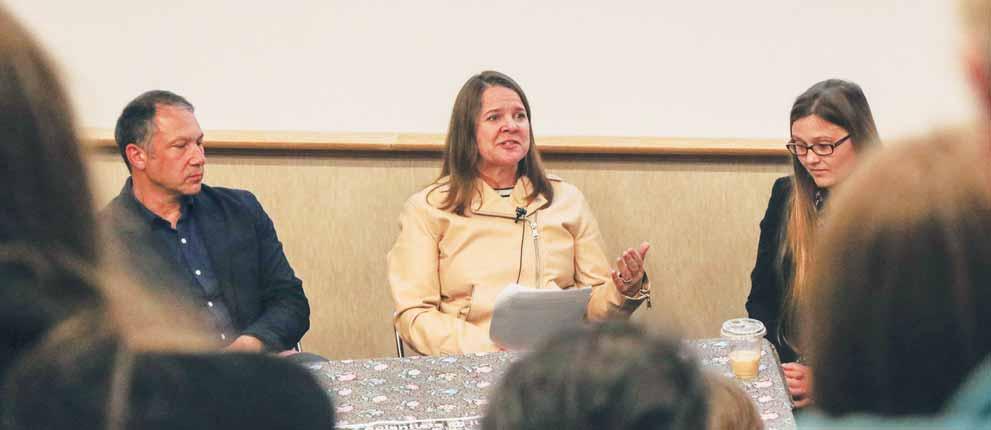
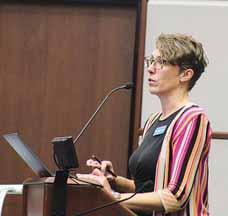
IU Anthropology Department Chair Stacie King speaks to the audience during a panel held by the university’s chapters of Advocates for Science and Concerned Scientists on Dec. 3, 2025, inside Myers Hall. King spoke on
“The Future of the Sciences at IU” panel with Biology Department Chair Armon Moczek and Physics Department Chair Mark Messier.
IU Trustees approves policy changes
By Zoe Reed reedzoe@iu.edu
The Indiana University Board of Trustees approved changes to the university’s post-tenure faculty review policy, increased the cost of housing and dining plans and restructured standing committees during its meeting Dec. 5.
comment on the proposed changes.
The board met at IU South Bend for its last meeting of the semester.
BOT-24 policy updates
The policy requires annual reviews of faculty members and creates a system for reviewing tenured faculty every five years. Faculty working groups at each campus, working with deans and faculty governance structures, have developed standards for evaluating teaching, research and service performance.
next academic year, raising rates by 2% at IU Bloomington. IU Treasurer Donald Lukes said in a press release the university will manage costs throughout facility improvements.
“The approved rate increases will support ongoing renovation, maintenance and operations, ensuring our residence halls and dining services remain safe, modern and student-centered,” Lukes said.
The move consolidates the previous seven committees into five, separating audit and compliance duties from financial operations and merging student and academic affairs. The changes also created the Executive Committee. According to a press release, the changes combined related areas to support more efficient oversight.
The trustees approved revisions to BOT-24, which describes post-tenure faculty review, ahead of its spring 2026 implementation.
After consulting with University Faculty Council leadership, the university adopted the original policy in June 2025 to comply with Indiana Code 21-39.5-2-2 and 2138-3.5 and House Enrolled Act 1001, which requires all tenured faculty to undergo performance reviews every five years.
The changes stem from a joint working group with members from both the Academic Leadership Council and the University Faculty Council, which incorporated feedback from stakeholders this fall.
The updated policy was then posted to give faculty, staff and students 10 business days to view and
Campuses will approve final standards through their own governance systems. The standards take effect in 2027 for reviews of 2026 performance. The working group will continue reviewing the policy and considering public comments as part of the ongoing Policy Alignment Initiative.
Under the policy, faculty receive one of four productivity ratings, which apply to both annual reviews and five-year post-tenure reviews. The top two ratings, “exceeds” and “meets” productivity expectations, have no negative consequences. Faculty rated “does not meet expectations” are placed on probation with an improvement plan, and those rated “unsatisfactory” may be dismissed.
Housing and dining rates increase by 2%
The board set housing and dining plan costs for the
IU Bloomington’s standard room and board rate will rise to a total of $12,679 per year, up from $12,431 in 2025-26. The university has maintained increases around or below 2% since 2022.
Dining plan rates at IU Bloomington will also increase by 2%. The classic 7-day meal plan will cost $4,404, up from $4,318.
Committee structure changes
The board voted to amend its bylaws, giving trustees authority to form committees as needed and outlining how committee members will be chosen.
Under the new committee structure, the board will operate with five standing committees: Academic and Student Affairs; Finance and Facilities; Audit, Compliance and Governance; Compensation and Executive.
Each committee will have five trustees, including the board chair, David Hormuth, who will serve on all of them. Hormuth will select the four other members and each committee chair. The chair and vice chair will jointly appoint the Executive Committee leadership.
Trustees clarified that the Executive Committee can act on behalf of the full board only when urgent business arises between regular meetings. The four-member committee includes the board chair, vice chair and two selected trustees. It can meet at the chair’s request and may include the university president and general counsel. The changes allow the trustees to address pressing issues quickly without giving up the full board’s authority, according to the release. The meeting Dec. 5 marked the last of the semester. The board’s next meeting will take place February 1920 at IU Indianapolis.
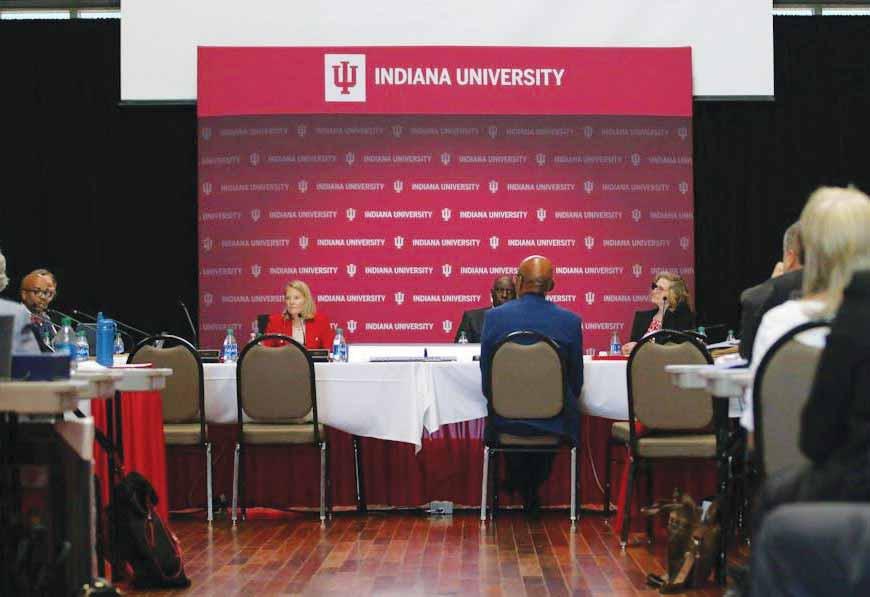
The IU Board of Trustees sits during a meeting June 13, 2024, at the Henke Hall of Champions in Bloomington. The board made changes to housing costs,
IU Student Government vice president
resigns, Congress to vote on new VP
By Sofía Rodríguez
sr73@iu.edu
IU Student Government
Vice President Ava Smith an-
nounced Nov. 30 she has resigned from her role to study abroad in Italy during the spring semester. Smith was elected in March as part of the ACTION ticket alongside Student Body President Zachary Goldberg. Though she has resigned, she will continue to temporarily serve as acting vice president until Jan. 13.
IUSG leadership — Goldberg, Smith and Chief of Staff Maddi Sponsel — identified Parliamentarian Luke Carman as the nominee for Smith’s replacement. Carman is a sophomore majoring in political science, and his current role is to understand congressional rules and advise members on how to achieve their procedural outcomes.
“I think what really drew me to my feelings about taking it over if I’m confirmed is that I have a heart and passion for advocacy,” Carman said. “And an opportunity to do that on behalf of the student body at such a greater level is one that I couldn’t turn down.”
Smith said the decision to step down was difficult to make, but she felt it was the best choice for her.
“The opportunity presented itself, and I thought as a student this would be a good decision for me personally, for academic growth and personal growth,” Smith said. “So, it definitely took a lot of time and consideration.”
Smith worked alongside Goldberg on a multitude of projects, including the Crimson Closet initiative, a program that allows students to borrow professional clothing, and the All-Schools Committee, a committee made up of members from each IU school’s student government that collaborates or brings attention to issues and
events in each school. IUSG helps organize meetings between student governments and IU administration, if necessary.
“I hope to continue some of the progress and the committees that I’m on right now, finishing up everything towards the end of the semester,” Smith said. “Alongside of that, being there to answer any questions for anybody so that, again, it’s a very transparent and very fluid process.”
Goldberg said the process of looking for the next vice president started soon after Smith told him about her resignation in late September.
Goldberg said he waited to announce the resignation so the student body was fully informed of the decision and the future of the vice presidency.
“The whole thing with waiting was that we wanted to come up with a plan so that way everyone felt confident as soon as we had announced it,” Goldberg said. “The idea there was that we didn’t want to come to the
student body and congress without knowing what was going to happen or the general timeline behind things because we felt that it would just cause undue stress, like, if nobody knew what was going on.”
Goldberg said he took a “really long look” at other members of IUSG and those outside the organization as potential replacements for Smith.
“Ava’s are big shoes to fill, so we needed to find somebody who is really good with people and will be able to talk to students and kind of understand different perspectives on campus,” Goldberg said.
He landed on Carman, officially proposing the vice president replacement to congress Dec. 1. After congress’ first reading of the proposal, there will be a week of interviews during committee meetings to give students the opportunity to ask Carman questions.
As for Carman’s plans, he said he hopes to focus on student engagement.
“I think that our power as
an organization and the work we do is directly correlated to how engaged we are with the student body,” Carman said. “And I think that increasing our engagement generally is going to yield for better results on our side of things.”
Congress will vote on whether to confirm Carman next week during its meeting Dec. 8, though he would not be inaugurated until Jan. 13 when Smith leaves the position.
Carman will resign from his role as parliamentarian, allowing a new member of congress to be elected to the position.
“It’s all hands on deck from September to now, so the purpose of that is so that nothing has to change operationally through IU Student Government,” Goldberg said. “We’re going to ensure as well there’s going to be no operational halts from student government’s perspective.”
Smith said if the opportunity presents itself for her to return to IUSG next year, she would be more than happy to join again.
Bloomington controller to leave office
By Natalia Nelson nelsonnb@iu.edu | @natalianelsonn
Bloomington City Controller Jessica McClellan will step down from her role later in December, Mayor Kerry Thomson said in a press release Dec. 4.
Former Monroe County Councilmember Geoffrey McKim was appointed to take her place and will assume the role in mid-January.
“Bloomington is better for her service, and we are grateful for the foundation she leaves as she takes this next step in her career.”
Thomson,Bloomington Mayor
Kerry
The controller’s office helps manage the city’s budget and financials, assures its compliance with state and federal requirements and maintains records of its transactions.
McClellan has served in the role since 2024, for all of Thomson’s tenure. She previously served as Monroe County treasurer from 2017-2023 and unsuccessfully ran for Indiana treasurer in 2022.
“Managing the City’s finances is a complex and
often invisible job, and Jessica has done it with clarity, transparency, and poise,” Thomson said in the release. “Bloomington is better for her service, and we are grateful for the foundation she leaves as she takes this next step in her career.” McKim served on the Monroe County Council from 2009-2024 and was the fiscal body’s president from 2010-14. He also taught information systems at Indiana University’s O’Neill School of Public and Environmental Affairs for nine years as an adjunct lecturer. He currently works as a recreation fee program manager for the National Park Service and is an IU alumnus.
In the press release, Thomson said Bloomington was moving toward a more transparent budgeting system, which she referred to as “Outcomes-Based-Budgeting” The budgeting approach is described as one “that allocates resources based on the results a program or service is expected to achieve.”
“Geoff brings the analytical rigor and communityminded approach this work demands,” Thomson wrote. “He understands that every dollar we steward must advance the priorities our residents have identified,”
IDS FILE PHOTO
An IU Student Government banner stands Sept. 30, 2024, inside the IUSG office at the Indiana Memorial Union in Bloomington. IUSG Vice President Ava Smith resigned Nov. 30.
ENTERPRISE
8
Inside rehearsals for IU’s production of ‘The Nutcracker’
By Nadia Suben nadsuben@iu.edu
The IU ballet depart-
ment’s enclave on the third floor of the Musical Arts Center is filled with a frenzy of preparation for a full run of “The Nutcracker.” Because three different casts will be performing the show over Dec. 5-7 and Dec. 12-13, two other runs have already taken place.
Dancers who are finished with their work for the day find seats behind the barres that form a perimeter around the studio floor to watch Cast 1’s run. Child performers giggle as they race around the halls. Semi-costumed students about to dance slip on pointe shoes, stretch by the barres and practice leaps and turns.
“Dancers, let’s get started as soon as we can,” Sarah Wroth, chair of the IU ballet department, calls. Outside, rain pours and campus empties ahead of the week-long Thanksgiving break set to begin in some three hours. Here, there’s still work to do.
Nov. 21
Ella Sperry steps into the studio, touches at her hair to ensure it’s set and finds her place by a barre. When the room is finally brought to quiet, the rehearsal begins. All eyes fall on Sperry as she ventures to the center of the room, wearing the youthful wonder of protagonist Marie on her face.
Sperry, a senior studying ballet and economics, is central to IU’s production. Professor of Music (Ballet) Sasha Janes’ nationally-recognized reimagination of E.T.A. Hoffmann’s 209-year-old story casts the same dancer as Marie and the second-act Sugar Plum Fairy. While most “Nutcracker” roles are limited to one- or two-minute “divertissement” dances in the second act, Sperry’s combined leading roles means she is performing the entire ballet.
“It’s every little ballerina girl’s dream to end up playing Marie and the Sugar Plum Fairy,” Sperry, who started dancing at the age of 4 in her native Pittsburgh, said. “Since they’re the same person in Sasha’s ballet, it’s really special to be able to tell the whole story from beginning to end.”
Still, Sperry’s task of portraying two leading roles has held challenges, including an unusually condensed rehearsal schedule. This year’s
“Fall Ballet,” the department’s annual showcase of mixed repertoire, happened several weeks later than usual. As a result, Sperry’s final rehearsal before the show week which will begin as soon as Thanksgiving break ends, is the product of just a few weeks of rigorous practice.
“The role is super daunting, because you have to remember so much material,” Sperry said. “Coming home every night after a long rehearsal day and reviewing everything has been super
important for me.”
Sperry said staying on top of the athletic demands of her roles has also been a priority. During her sophomore year at IU, she suffered a shin fracture that sidelined her for six to eight weeks in a rehabilitative boot. She said the setback made her more conscious of recovery and her physical limits.
“Dancers are super driven, so we just want to keep pushing,” Sperry said. “But after having a serious injury, I would rather stop dancing
earlier and rest than keep pushing myself and it gets worse. It’s a super fine line, but physical maintenance at the end of a long day is important to keep doing what we do.”
Sperry’s methodical preparation has given way to fluidity. She delicately moves across the studio floor as if carried by a spirit of childhood whimsy. Constantly onstage, she is everimmersed in the show’s comic and magical world — even when the borders of
that world are amorphous. Inches from dancing mice and leaping nutcrackers, students whisper to each other, sneak mid-rehearsal snacks and headbang along with the rehearsal pianist. With limited props and costumes and no stage, the boundaries of the ballet’s scenes are blurry. The firstact Christmas party is festive, marked by distinguished attendees gazing at each other with respect. Or are those peers proud of the work their friends have done?
“Dancing with my class for the last four years, everyone gets super close,” Sperry said. “And we’re quite literally playing a family onstage. It’s pretty natural acting.”
As Sperry moves through the second-act grand pas as the Sugar Plum Fairy, a sequence of a pas de deux with partner Stanley Cannon, a Cannon solo and a Sperry solo in rapid succession, her classmates watch with rapt attention. The only sounds in the studio during Sperry’s solo are the twinkling notes of the piano, her pointe shoes knocking against the floor and her sharp breaths. Relief floods Sperry’s flushed face as, panting, she concludes the grand pas. She grins, rolls her eyes with a curtsy and runs to hug Cannon.
“I was really nervous this morning, but as soon as it started, it was just so much fun,” Sperry said. “I’m exhausted now, but it’s super rewarding to do it all the way and feel good about how it went.”
The end of a successful run-through and the arrival of a week-long break elicits deafening applause from the cast. Now, it’s time to rest.
“I think it looks really good — the standard keeps getting higher and higher every year,” Janes says to the cast as they gather in a final huddle. “Stay in shape, be safe and have fun.”
SEE NUTCRACKER, PAGE 9
BRIANA
Dec. 1 The Musical Arts Center stage is cloaked in ethereal white light, evocative of snow, as the scene is set. Props are moved to their places and directors give dancers last-minute notes about the show’s opening scenes. When the clock strikes 7 p.m., the MAC’s grand purple curtain falls. A current of backstage chatter goes quiet as the theater goes dark. It’s time for the first full onstage run. The rehearsal is meant to simulate live performance as closely as possible. A recording of an orchestra tuning and audience applause plays as the curtain rises, mimicking the atmosphere dancers will encounter this weekend. Still, there’s room for imperfection. The show’s prologue stops and starts for set adjustments and tinkering with the elaborate light projections that set Janes’s production apart.
Clad in a flowing pink gown and a bow in her hair, Sperry emerges to initiate the show’s story. The stage is overtaken with scenes of an opulent Christmas party and bickering siblings, a magicsoaked and universally relatable reality contrasting each other.
Although Sperry has some 14 years of dancing in “Nutcracker” productions under her belt, she said costumes, wigs and a set stage help make the ballet’s extensive acting more natural. Still, she’s tested to stay in character even when circumstances don’t exactly match those of audience performance. While the dancing continues, microphoned directors call out for prop, spacing and cue adjustments. When a dancer’s leap ends in a fall to the ground, the story doesn’t miss a beat, directors calling “keep going.”
Wrinkles ironed out in real time might just be ideal preparation for this weekend: after all, the show goes on.
“We can just kind of laugh little things off, especially in the first run,” Sperry said. “But it gets to the point where, if this were a show,
we would have to make everything work, so you have to keep going no matter what happens.”
The rehearsal’s hours pass in a pattern of ebbing and flowing action. Directors call comments out while dancers continue the story. Periodically, the production stops for larger readjustments, like when the first-act battle scene between the Nutcracker Prince and mice is run three times to sort out prop difficulties.
“Usually, you’re doing the ballet from beginning to end with a 20-minute intermission,” Sperry said. “But in tech rehearsals, it’s spread over three hours, and you’re stopping and running stuff again. We like to tell ourselves this is the hardest it will be — it’s very exhausting.” When rehearsal ends at
10 p.m., Sperry is ready to be finished for the day. Her feet are swollen and throbbing after three hours on pointe. She plans to return home to treat her feet with an ice bucket and compression boots and to eat a late-night second dinner. Tomorrow evening, she gets to rest and watch another cast run the show.
“It’s always hard and scary coming back after a week off, but overall, I’m happy with how the rehearsal went,” Sperry said. “We have this whole week to make it better. Starting at a really good place feels good, because we’re only going to build up on top of that.”
Dec. 3 Simulation grows closer and closer to reality. At this Wednesday evening final dress rehearsal, an ensemble
combining the IU chamber and university orchestras accompanies the dancers from the pit. Directors are quiet watching the scenes unfold. Gone is the stop-and-start of the first stage run: the dancers’ dreamlike world, close to being fully realized, has taken on a delicate life of its own.
Sperry watches the colorful episodes of the divertissements with Cannon by her side, at once removed and constantly absorbed in the action. Occasionally, she and Cannon get pulled into the fun, stepping with the groups of dancers passing around control of the stage or helping hold set pieces.
Sperry said being engrossed in rehearsals isn’t just about acting — it also helps her dance her best.
“Every run is a new run, so I try to just come in with
an open mind,” Sperry said. “If you get too in your head, I think it shows.”
When Sperry resumes her place at center stage, this attention is vital. Now dressed in regal magenta and a tiara, she has transformed from the young, curious Marie to the mature, self-assured Sugar Plum Fairy. She and Cannon have arrived at the secondact grand pas, the show’s emotional climax.
The sequence begins with a tender pas de deux. The pair embrace dignified dramatics, in nimble harmony with each other and a crescendoing orchestra as they move through demanding turns, leaps and lifts.
“The biggest thing I’m thinking about during the grand pas is pacing my stamina,” Sperry said. “It’s the whole pas de deux, I have
maybe 45 seconds offstage during the male solo, I have my solo and then it’s the coda. And then I’m thinking about all the corrections I’ve gotten.”
Still, emotion must remain at the center of Sperry’s dancing.
“Mostly, I’m trying just to connect with my partner and have fun performing for the audience,” she said.
When Sperry emerges after her brief break for Cannon’s solo, she projects both expressive grace and lightheartedness. She said capturing this duality has been one of the biggest challenges involved in Janes’ casting of Marie and the Sugar Plum Fairy, Marie’s seemingly perfect quasi-guardian angel, as the same dancer.
“Sasha reminded me that Marie is the same person as the Sugar Plum: I can still have fun and be the kid that Marie is during the pas,” Sperry said. “It is romantic, but it’s also just, ‘Oh look, we’ve done the whole ballet, and now let’s just have fun.’” The grand pas concludes with a brief coda of Sperry and Cannon reunited onstage, having fused the fragile beauty of romance with the comfort and safety of camaraderie. Then, a wave of color washes over the stage as the full cast returns to dance the finale.
Sperry now wears Marie’s light pink gown and the Sugar Plum Fairy’s tiara, achieving unity between her roles. She is left cradling the nutcracker at center stage as the curtain falls.
After the cast completes its bows, Sperry sits, cradling her pointe shoe-clad feet. She stares out at the Musical Arts Center’s sea of red seats, to be filled in two days’ time by eager balletgoers.
Sperry will face light rehearsals tomorrow, but the work is done. On Friday, she will dance the culmination of her IU — and lifelong — ballet career.
“My parents took me to see ‘The Nutcracker’ when I was 3 years old, when I hadn’t even started ballet,” Sperry said. “My mom told me when the Sugar Plum Fairy came onstage I said ‘that’s me, that’s what I am.’” Sperry smiled. “Well, now that is me.”
BRIANA PACE | IDS
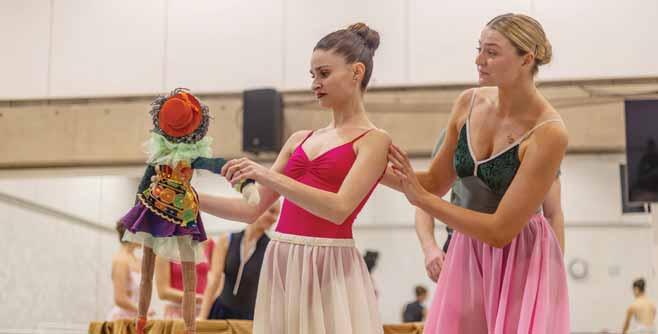
Ella Sperry (left) and Maddie Muth (right) rehearse “The Nutcracker” on Nov 21, 2025, at the Musical Arts Center in Bloomington. Sperry played Marie and Muth played Frau Stahlbaum.
KENNEDY HANNAH | IDS
Ella Sperry, who plays Marie, dances with The Nutcracker on Dec.
2025, at the Indiana University Musical Arts Center during dress
of “The Nutcracker.” She received the gift during the party scene in the first act of the ballet.
KATHERINE MANERS | IDS
Lillian Smith, who plays Drosselmeier,
Charter Services
Travel anywhere with ease! Whether you're heading to Bloomington, Indianapolis, Chicago, conventions, special events, or beyond, we offer professional group transportation for any size –even overnight trips. Call us at 888-570-1814 or request a quote online, and let our team create the perfect travel plan for IU students, alumni, and fans!
Door-to-door transportation in a private sedan, SUV, or executive Sprinter van. Private service can be reserved hourly, for airport transfers, meetings, outings, and events.
IU graduates’ short film featured on AMC+
By Sydney Weber syaweber@iu.edu
Ideally, co-director and producer Michelle Hernandez and her team — including two IU alumni who grew up in Zionsville — would have had a year and a half to make their short film
“Things You Know But Cannot Explain.” Instead, they had about five months.
The short film, a stopmotion animation piece centered around Wiyot tribe artist, and honorary uncle to Hernandez, Rick Bartow, is being featured on AMC+’s “Future of Film: Indigenous Voices” series until Dec. 15. Bartow, who died in 2016, often worked with pastel and graphite to create his signature large drawings. He also painted, sculpted and made prints. Many of his works depict surrealist human and animal figures. According to Bartow’s website, which is maintained by the Richard Bartow Trust, his work is featured in more than 100 public and museum collections.
“Things You Know But Cannot Explain” traces Bartow’s journey of coming to embrace his Indigenous heritage — Hernandez said that Bartow first thought his heritage was Yurok rather than Wiyot. The short film is narrated in the Wiyot language, Soulatluk.
Hernandez’s team had such a tight turnaround because the film came out of a repurposed theater grant that Zuzka Sabata, the film’s co-artistic director alongside Hernandez, received before the pandemic. Sabata and Hernandez rewrote the grant and conceived of a series of four films about Bartow.
Hernandez said Bartow’s diverse styles inspired the stop-motion nature of “Things You Know But Cannot Explain.”
“I think it’s just really
COLUMN:
By Ursula Stickelmaier ustickel@iu.edu
I remember going to see “Zootopia” in theaters when I was 10 years old. Released in March 2016, the city of anthropomorphic animals seemed like the dream place to live from my seat at my local AMC. Set to the soundtrack of Shakira’s “Try Everything,” I left that theater ready to give the movie nothing short of an Oscar.
While most of that childhood whimsy has worn off nearly a decade later, a rewatch of “Zootopia” has never failed to leave me in a good mood and bring back some of that nostalgia.
All that goes to say that “Zootopia 2” had big shoes to fill when it came to carrying on the story of its predecessor. So, I was pleasantly surprised to watch the sequel and find that not only did it live up to the many expectations I had set for it, but in most cases, it exceeded them, too.
“Zootopia 2” picks up shortly after where the first film left off, following Judy (Ginnifer Goodwin) and Nick (Jason Bateman) as they make history as the first bunny and fox partnership in the Zootopia Police Department. But it isn’t smooth sailing for the pair as they try to prove they make a good team while un-
By Lexi Bunting
amazing to see different artworks come together and make something,” Hernandez said. “And so, I was like, ‘How do we bring this to life?’ Bring it to on the screen and respect his artwork, as well. And so, I think stopmotion animation was the way we wanted to go about it. And then we also realized we kind of made the storybook kind of aspect to it. And so, when you watch it, it’s like a storybook come to life.”
Chris Burrus, a 2019 graduate of IU’s master’s program in musicology, composed the music for the film. Burrus said he worked at the Eiteljorg Museum of American Indians and Western Art in Indianapolis, where Bartow had been a fellow, and remembered having seen Bartow’s work.
“I was just really tickled of the idea of trying to see how I could set this to music,” Bur-
covering a conspiracy that has kept snakes out of Zootopia for a century.
Similar to the first film, where “Zootopia 2” succeeds the most is in its characters. Of course, Nick and Judy never fail to entertain audiences with their witty banter, sarcastic comments and determination to make the city a more welcoming place for all animals. However, at least for me, it’s the secondary characters that steal the show.
Not only do fan favorites from “Zootopia,” such as Officer Clawhauser (Nate Torrence), Gazelle (Shakira) and Mr. Big (Maurice LaMarche), make an appearance in the film, but this sequel also introduces a cast of new characters that are all just as funny and endearing.
A personal favorite of mine when it comes to these new additions is Gary De’Snake (Ke Huy Quan), a pit viper determined to restore his family’s reputation and reintegrate reptiles back into Zootopia society.
As far as snakes go, Gary may be one of the sweetest, most adorable snakes I have ever seen. His character is so motivated to reveal the truth behind the Lynxley Journal, a notebook that details the creation of the Weather Walls that keep Zootopia running, all so he can bring his family home. He is also
incredibly awkward and excited about everything, which makes him all the more fun to watch.
Pawbert Lynxley (Andy Samberg), the disgraced son of the Lynxley family, and Nibbles Maplestick (Fortune Feimster), a podcasting beaver with an affinity for reptiles, also stand out in this sequel’s cast of new characters. While Nick and Judy are obviously the stars of this film, it’s characters like Pawbert with his seemingly awkward nature and Nibbles with her overly enthusiastic ability to break the ice that help bring out the best in our main characters.
The artistry of “Zootopia” is also worth mentioning when it comes to this second movie.
While the animation itself isn’t anything extraordinary, the creativity in how they work elements from our world into the animal one makes the visuals stand out. The ferries in Marsh Market and how they’re entirely run by manatees, a speakeasy for reptiles and the concept of “Burning Mammal” instead of “Burning Man” all make up some of the funniest details in this film.
Like other Disney movies, “Zootopia 2” was not light with the Easter eggs. My absolute favorite came when Nick and Judy chased
rus said. “And then when I learned that Rick Bartow was himself a musician, that just kind of opened up this whole extra component of figuring out how to engage with him and his artistic identity because I had already found his work so moving, but then there was also this idea that he had a identity as a musician, as well.”
Hernandez and her team combed through hundreds of archived versions of Bar-
tow’s artwork to narrow down the list of what they’d use in the film, she said.
Many of Bartow’s works, Hernandez said, reflected the horrors he witnessed serving during the Vietnam War and the history of the Wiyot tribe, which Hernandez is part of, as well.
“When you have kind of this dark history from growing up, to learning about your history and culture, you find ways to deal with
that PTSD and deal with that trauma,” Hernandez said. “But I also have noticed that his images even got more livelier, as you see that he’s, like, healing from it. And I love that aspect of using art to heal yourself. And I also love that he incorporated every part of him in each piece and what he saw in nature.”
Richie Wenzler, a 2012 IU graduate, served as the film’s editor. He and Hernandez run Sugarbush Hill Productions, the company that produced the short film. He described his role as making sure that the animation flowed from one image to another.
“Like it was like hundreds of images and try to figure out, like, ‘What was the right speed and the right tempo to make sure that everything flow naturally from, from one piece to the other?’” Wenzler said.
Hernandez talked about Bartow’s reclamation of his Indigenous identity within the growing revitalization of Wiyot culture and language. The Wiyot tribe, according to its website, has 600 members. They are native to the Humboldt Bay area of northern California. She described the tribe’s traditions as sleeping, not lost, and said the younger generations are waking them up. She said she wants people to know that Indigenous cultures are still alive and present. The use of Soulatluk in the film is one example.
“Something that I’ve heard growing up was when I would tell people I was native, they’re like, ‘Oh, you guys are still around?’” Hernandez said. “And I want people to realize, yeah, we’re still present. We’re still here, we’re still making artwork. We’re still living our culture and our identity. And we’re speaking our language.”
a suspect through a kitchen, blowing off a chef’s hat and exposing a rat underneath pulling the strings in “Ratatouille” fashion. I loved pointing out these small things to my friends and hearing the laughs in the audience every time an especially obvious and absurd one happened on screen.
Despite my love for the film, this time I’m not going to once again trick myself into thinking it’s an Oscarworthy masterpiece. However, “Zootopia 2” did what I have felt many recent Disney films have lacked. It created a world that has all the comforting nostalgia of the 2016 movie while also introducing new elements that make the story fun to watch. So, even if you aren’t as big of a “Zootopia” fan as I have begun to accept that I am, “Zootopia 2” is more than worth the watch. And if that doesn’t convince you, hopefully the promise of another great song by Shakira will.
COLUMN: In A24’s ‘Eternity,’ love doesn’t end, it evolves
It’s not every day a romcom about death hits the big screen, but A24’s new film “Eternity,” directed by David Freyne, arrives with a surprisingly warm take on the afterlife. Released in theaters Nov. 26, the film blends the lines between genres while keeping a clear plot and going above expectations. “Eternity” stars Elizabeth Olsen and Miles Teller as Joan and Larry, who have been married for six decades, pass away and move on to the afterlife. In this universe, death is less of an
ending and more a bureaucratic adventure. In the world of “Eternity” you board a retro 1970s train and arrive at a convention center as the version of yourself from the age you were happiest. From there, you have a week to select where you want to spend eternity. One could choose to sunbathe forever in Beach World, go to a men-free utopia or a 1960s Paris-inspired realm where everyone conveniently speaks English. The choices feel endless, and most of them are pretty humorous and odd.
After Joan dies and reunites with Larry, they’re ready to settle into eternity
together. Until Joan’s first husband, Luke (Callum Turner), who died in the Korean War, appears unexpectedly after 67 years of waiting for her. In a pretty convincing speech, he confesses his love for her. Joan is suddenly thrown into an impossible choice, spending an eternity with her first love who she didn’t get a life with or the partner she raised a family with and loved for decades. The result is a charming, quirky love triangle that subverts classic rom-com tropes. But what is different about the “Eternity” love triangle is that it shows how relationships change and evolve over time. How a first
love can linger in memory for a lifetime and how the idea of a “soulmate” might not be a fixed definition, especially in the afterlife. The film balances its existential questions with constant humor, keeping the tone light but impactful. Olsen and Teller are the film’s beating heart. One of the most impressive parts of the production is the performance they both give. Both actors tackle the unique challenge of portraying characters who look youthful but carry the emotional weight and wisdom of age. Their chemistry feels livedin with a gentle annoyance that comes with being mar-
ried for 60 years balanced by the tenderness of a love that has surpassed decades. Turner’s performance in contrast is hopeful, charming and youthful, and his character represents the idealism that only the memory of a first love can carry.
By the time Joan must make her choice, “Eternity” has become more than a rom-com, but also a story about devotion, memory and aging. The film takes on complex relationships while maintaining each character as an individual with their own aspirations and inner worlds. It is whimsical and funny without being shallow and takes on one of the
most driving questions we have as humans: what happens after we die? The film is bold enough to imagine an afterlife shaped not by fear but love and connection. It pulls on your heartstrings in more ways than one and offers, for me at least, a refreshing way to reimage the afterlife and how love will evolve even beyond death.
“Eternity” is a clever and original film that encourages viewers not just to consider what comes after life, but who we hope to spend it with and what truly matters when forever is suddenly on the line.
COLUMN: ‘Stranger Things’ season 5 makes an epic and promising comeback
By Sophie Albert soalbert@iu.edu
The first volume of the final season of “Stranger Things” released Nov. 26 after three and a half years of anxious waiting from fans. While I was nervous for how the showrunners, Matt and Ross Duffer, would go about bringing this show to an end, the first volume proved to be a promising and epic comeback. There are many moments I loved from these episodes, but what really stood out to me was Will’s (Noah Schnapp) character arc. I have been Will’s No. 1 fan since I started watching the show in middle school. I was excited to hear this would be a Will-centric season so he could get his moment to shine, but the way the Duffer Brothers handled his character arc surpassed my expectations.
I specifically loved that the Duffer Brothers chose to make Will’s queer identity a focal point of the season. Seeing Will interact with Robin (Maya Hawke) and finally find someone who understands him and shows him it’s okay to be himself was so beautiful.
When I first started watching the show after Season 2 came out, I had my suspicions about Will being gay, but it always felt like more of a fan theory than something that would canonically happen. Seeing his journey to acceptance with his sexuality in Season 5 means so much to me and to so many queer fans.
Robin’s speech to Will that helped him accept himself was beautifully written, and I think it’s something every fan of the show can relate to and lean on to find self acceptance. I don’t think I can fully put into words how meaningful it was to see a moment like that in such a mainstream show, but I am sure it is going to be impacting fans for years to come.
I’m excited to see how the Duffer Brothers continue his storyline, especially with him now having powers, and I hope and pray he doesn’t die.
Apart from this plotline, I also loved Max (Sadie Sink) and Holly’s (Nell Fisher) storyline. I was scared Max would spend most of the season in a coma, not actually contributing to the plot. When she showed up at the end of episode three, I
couldn’t contain my excitement.
Additionally, I enjoyed how this season upped the action. These episodes have already been filled with highintensity moments that have kept me on the edge of my seat. The scene where the Demogorgon attacked the Wheeler family in episode two especially got my heart racing.
I also like that this season has a darker tone than the others. This definitely fits the finality of the show and highlights that these aren’t just kids playing “Dungeons & Dragons” anymore. The scene with Nancy (Natalia Dyer) in the hospital bathroom after her parents got attacked was especially emotional. It felt like one of the darkest moments in the show, and it was absolutely heartbreaking to watch.
On the other hand, I appreciate that the show still has its humor. I was scared the season would have fewer humorous moments with the more intense and darker tone, but the first four episodes were already filled with funny and iconic scenes.
Episode four’s scene where everything goes wrong in the bathroom heist
is especially funny to me. The sound effects, as well as the editing and camera work, somehow made it feel like a sitcom for a split second. I loved it.
The entirety of episode four was one of the best parts of this volume. This episode has already cemented itself as one of the best episodes in “Stranger Things” with a rating of 9.7 out of 10, surpassing Season 4’s “The Massacre at Hawkins Lab,” the secondmost popular episode on IMDb, which has a 9.6.
I truly loved every moment of this episode, from the fight scenes to the jokes, to the Will and Mike (Finn Wolfhard) moments and, of course, the epic ending.
I’m excited the show brought Eight (Linnea Berthelsen) back to tie her into the larger narrative, and I’m interested to see where her character will go.
And, of course, that final sequence where Will discovers his powers was absolute perfection. I think that has become one of my favorite scenes in the entire series, and I love that the entire fandom is collectively freaking out about it.
While the season definitely has some amazing
moments, I also thought there were some flaws.
The main part I didn’t love about this season was Eleven (Millie Bobby Brown) and Hopper’s (David Harbour) storyline in the Upside Down. El is widely considered the main character of the show due to her powers. While I understand the Duffer Brothers wanted to focus more on Will this season, I still feel like they could have given El a more interesting plotline and arc.
This storyline felt slow and pretty boring. I also feel like Hopper had lost some of the spark that made his character so infectious in earlier seasons. I hope this plotline picks up in the next volume, especially with the addition of Eight.
Going into the final season, there was so much that had to be done and explained and yet, now about halfway through the season, it doesn’t feel like the show has addressed any of these issues.
For example, the show glossed over the fact that the entire town of Hawkins was ripped open at the end of Season 4, looking like a literal battlefield. While they quickly explained what hap-
pened to the town in a radio show recap, it seems unlikely for Hawkins to be so back to normal given its state at the end of Season 4. Vecna has also barely been present this season, so it is unclear how he survived, and much about his past is still unknown. Additionally, the end of Season 4 left Mike and El’s relationship in a pretty unstable and uncertain place, yet they seemed perfectly fine at the beginning of this season without ever explaining how they got to that point.
I’m hoping that now with some major events having happened, the audience will get more answers. However, considering we’re now halfway through the season, it feels like a bit of wasted time on unimportant things that aren’t moving the narrative forward, like the characters’ constant elaborate plans that always end up falling apart. I’m excited to see where the rest of this season will go, but I’m also terrified of my favorite characters dying. I will be spending the next month anxiously awaiting the next volume but also living in ignorant bliss before learning the fates of the characters and Hawkins.
MOVIE STILLS DATABASE
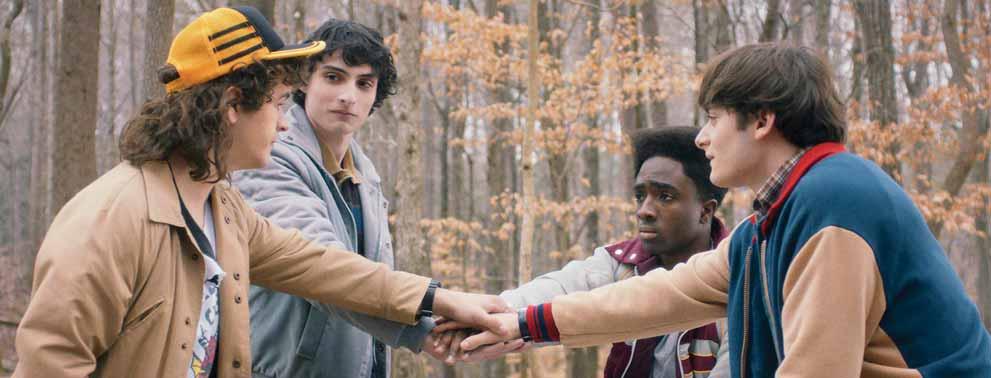
Gaten Matarazzo, Finn Wolfhard, Caleb McLaughlin and Noah Schnapp (left to right) act while filming the fifth season of “Stranger Things.” Volume one of the fifth season of the show was released Nov. 26, 2025.
COLUMN: An ugly game against Illinois can’t become norm for Indiana
By Sean McAvoy semcavoy@iu.edu | @sean_mc07
CHAMPAIGN, Ill. — The trouble for Indiana women’s basketball started in the first quarter.
After senior guard Shay Ciezki scored on the Hoosiers’ first two possessions, Indiana fell behind 12-4 in three minutes. Just like that, Indiana’s chances to win its first Big Ten game of the season withered away.
A slow start has plagued Indiana in way too many games this season. A sevenpoint deficit to the University of Illinois Chicago at halftime, nine points scored in the first quarter against Marshall University, a threepoint first quarter deficit to Florida Gulf Coast University and trailing Western Michigan University by five points when the first frame ended on Dec. 3. However, all of those games ended with wins for the Hoosiers. That wasn’t the case in the Dec. 6 78-57 loss in Champaign, Illinois.
“Illinois just came out and punched us right in the mouth,” Indiana head coach Teri Moren said postgame.
“We didn’t have a response, and we didn’t respond.”
It was as simple as that: Indiana didn’t respond.
The Fighting Illini were up 18-6 when Moren called her first timeout with 4:46 remaining in the first frame. When the buzzer sounded, Illinois had taken a 28-12 lead.
The ugly final scoreline for Indiana looks better than it could have been. The Fighting Illini had a 36-point lead by the end of the third quarter — an advantage that was larger than the number of points the Hoosiers scored: 32.
Indiana then went on a 12-0 run to open the fourth quarter that forced Illinois head coach Shauna Green to call a timeout. In total,
the Hoosiers outscored the Fighting Illini 25-10 in the fourth quarter, but the effort was too late.
“Ugly” might not do the game justice. Take your pick from some synonyms to describe this outing: hideous, unpleasant, grotesque, disgusting or awful.
That’s a qualitative way to look at the game. Let’s look at the quantitative numbers.
Indiana shot 35.8% from the field and 35% from 3-point range. Illinois hit 47.9% of its shots, but only 28.6% of its 3-point attempts. The lack of 3-point shooting from the Fighting Illini didn’t matter. Illinois finished with 58 out of its 78 points com-
ing from the paint.
The Hoosiers also gave up 20 turnovers, including six from redshirt sophomore guard Lenée Beaumont and five by Ciezki. The number was one shy of Beaumont’s season high — she had seven against Marshall — and tied Ciezki’s season high.
The only bright spot from Indiana was another 20-point performance from Ciezki, her eighth this season. She finished the game with 23 points on an 8-for-19 performance from the field and 1 for 6 on her 3-point attempts.
Ciezki played all 40 minutes — her second time doing so this season — but
none of her attempts came easy. Illinois matched junior guard Jasmine Brown-Hagger on Ciezki, and the 5-foot9 Brown-Hagger stuck to the 5-foot-7 Ciezki like glue.
“She’s a great defender,” Ciezki said postgame. “... They were plugging up the paint a lot. They weren’t overhelping. So, it was tough to find those kickouts tonight.”
The only place where Indiana shot well was from the free-throw line, as the Hoosiers knocked down all 12 of their attempts. The scoring output for Indiana was also helped by Beaumont’s 15 points and junior forward Edessa Noyan’s 11. After
that, the next highest scorer for the Hoosiers only produced three points.
Comparing those numbers to Illinois shows the discrepancy on the court.
The Fighting Illini finished with seven of their eight players who saw playing time in the State Farm Center producing at least one point. Four of them were in double digits.
Looking at the bench production — a place where Indiana has struggled this season — Illinois had 20 points. Indiana had three. Only three players came off the bench for the Fighting Illini, with junior guard Maddie Webber scoring
16 points. Indiana had five bench players see action, but freshman forward Maya Makalusky’s 3-pointer with under a minute remaining in the game was the group’s only points.
“They got to figure it out,” Moren said postgame. “... Those bench players are supposed to come in and impact the game, first and foremost on the defensive side of the ball, but then just allow the game to come to them.”
“We have a new squad, so this is just something that we can take and learn from and grow from it.”
Shay Ciezki, senior guard
It was a performance the Hoosiers will want to forget — or remember. Indiana must remember this game the next time they step on the floor against a Big Ten opponent, which doesn’t happen again until Dec. 29 against Minnesota. But the Hoosiers can’t let this performance affect their confidence in any future games. Indiana now goes back to nonconference play. The University of Louisiana at Monroe on Dec. 11, Eastern Michigan University on Dec. 14 and Western Carolina University on Dec. 21 close out the Hoosiers’ non-Big Ten slate.
“We have a new squad,” Ciezki said postgame. “... So this is just something that we can take and learn from and grow from it.” Indiana needs to grow from this game. The Hoosiers’ sloppy play on both ends of the floor also has to be cleaned up. The good news is they have time to figure out any mistakes — which there were a lot of Dec. 6 — and come into the remaining Big Ten schedule ready to be disruptive in the conference.
TRINITY MACKENZIE
Indiana men’s basketball offense falters against Louisville
By Nathan Shriberg naashri@iu.edu | @NShriberg
Heading into the season, the expectation for Indiana men’s basketball was an explosive offense. The hiring of head coach Darian DeVries in March came with the promise of a high-powered offense that the former West Virginia University and Drake University coach was known for.
And through the Hoosiers’ first few games, it looked like he had delivered. The Cream and Crimson scored 98 or more points on four occasions early in the season, including against Shaka Smart’s Marquette University. Inadequacy emerged for the first time in the DeVries era against the University of the Incarnate Word, with the Hoosiers only notching 69 points.
It reappeared in a ninepoint loss to Minnesota on Dec. 3, and it marred an 8778 loss to the University of Louisville on Dec. 6 inside Gainbridge Fieldhouse in In-
dianapolis.
From the jump, the Hoosiers were overmatched. The No. 6 Cardinals possessed more talent than Indiana has seen thus far, and it showed in the early minutes as Louisville stormed out to a 16-0 lead. The Cream and Crimson didn’t score until over six and a half minutes had passed — senior forward Sam Alexis slammed home a lob from fifth-year senior guard Lamar Wilkerson.
For a spell, the Hoosiers had life, as redshirt senior forward Tucker DeVries scored Indiana’s next nine points. Wilkerson hit a 3-pointer from the left wing to bring the Hoosiers within five, but senior guard Ryan Conwell knocked down a triple of his own to immediately reestablish Louisville’s momentum.
The Cardinals’ timely responses continued throughout the game. Every time Indiana made a run, Louisville answered in turn, refusing to let the Hoosiers back into the game. But for much of the
matchup, Indiana struggled to do what it had done so efficiently at the beginning of the season: score the ball.
“They did a really good job early defensively,” Darian DeVries said postgame. “They did a good job of making things tough and challenging, and we had some moments where we were able to break free and get loose a little bit, but overall it was just too big of a deficit to overcome.”
One of Louisville’s strengths defensively was physicality. The Cardinals flocked to the ball, frequently leaving the weak side to double ball handlers and take away passing lanes. At times, it appeared the Hoosiers weren’t prepared for the aggressive defensive style.
As Louisville crowded the 3-point line and swarmed Indiana’s primary options, turnovers became an issue for the Hoosiers. Instead of finding the open man, the Cream and Crimson often found a Louisville defender. Indiana’s 13 turnovers were
the second most it’s had in a single game all season. Darian DeVries emphasized the importance of offensive resilience postgame.
“If they’re pressed out taking away threes, you have to be able to, you know, drive and get to the rim and finish,” DeVries said. “Drive and get to the rim and get fouled, or back cuts, you know, those are other ways that you can put pressure.”
Due to high pressure from Louisville, Indiana’s offense often felt one dimensional. While Tucker DeVries was able to find individual success, there wasn’t much cohesion in the half court. DeVries was forced to shoulder the offensive load, ending with a game-high 26 points.
Against Minnesota, Wilkerson shot 5-for-14. He followed it up with a 5-for-15 effort Dec. 6. Despite offensive shortcomings, Darian DeVries praised his team’s mindset and mentality.
“Our guys played their tails off, they left it out there,” DeVries said. “I was proud
of them from that standpoint. Was there things that we could have done better? Yeah, absolutely. But I liked the way we approached the game. I liked our mindset. I liked our toughness, physicality. I thought that’s what we need to do every night.”
COLUMN: IU men’s basketball faced its most demanding opponent of the year
By Kasey Watkins kaslwatk@iu.edu
Indiana men’s basketball knew it would have its hands full ahead of its matchup with the No. 6 University of Louisville. The Cardinals entered the matchup with one of the best backcourts in the country, headlined by freshman guard Mikel Brown Jr. and senior guards Ryan Conwell and Isaac McKneely. The Cardinals were the first ranked team the Hoosiers saw this season. And right from the start, it was evident Indiana had not been faced with such a demanding task and opponent. The Hoosiers were simply overwhelmed from the jump in their 87-78 loss to Louisville on Dec. 6 inside Gainbridge Fieldhouse in Indianapolis. Within the first six min-
utes of action, Indiana found itself down 16-0, with the Cardinals scoring from all facets of the court. In fact, five different Cardinals scored during the run, including 3-pointers from redshirt senior forward Aly Khalifa and McKneely, layups from sixth year-senior forward J’Vonne Hadley and Conwell and a dunk from junior center Sananda Fru.
Indiana was rattled by the Cardinals’ relentless and physical defense and was unable to score a bucket until 13:28 remained in the first half.
The Hoosiers were taking damage from all areas of the floor early and had to adjust to the pace and level of physicality they were seeing for the first time this season. Ahead of Indiana’s matchup with Louisville, the Hoo-
siers had not yet faced an opponent within the top 70 of the Ken Pom ranking, which could explain the 16-0 start they allowed the Cardinals to have.
However, after settling in, Indiana did eventually adjust to the playing style and played competitively with the Cardinals. Yet it was never enough to take control of the game. While the Hoosiers did a good job of shutting down some of the Cardinals’ key offensive players, they would in turn open opportunities for other players on Louisville’s roster.
The depth of the Cardinals and its scoring options proved to be costly for Indiana, despite the defensive efforts from the Cream and Crimson. Indiana ultimately had to choose their battles.
“But overall, they did a really good job,” Indiana head coach Darian DeVries said postgame. “We just lost McKneely a few times. And then I even thought, you’re picking and choosing something. Their two bigs hit a couple of threes in the first half. There’s things that you’re probably living with, but they make them. Those are part of that stretch of getting us down and behind. Those things are hard to overcome against really good teams.”
The Hoosiers shut down the offense of Brown Jr., holding the projected 2026 NBA lottery pick to a single digit scoring performance and just 2 of 8 shooting from the field. But in turn, the Hoosiers gave up opportunities to other players, which the Cardinals made them pay for.
While the defensive prior-
ity may have been Conwell and Brown Jr., McKneely wound up with five 3-pointers and 15 total points.
“Yeah, the defensive end, again, I thought those guys did a really good job,” DeVries said. “Mikel Brown, he’s getting drafted, he’s probably a top five pick. Ryan Conwell’s their leading scorer, he’s a really good player. And then you talk about McKneely as the third guy that you’ve got to worry about from a shooting standpoint. They just put a lot of pressure on your defense from stretching you out.”
The depth and task of keeping up with all of Louisville’s offensive options proved too much for the Hoosiers to overcome in their first top 25 matchup of the season. Redshirt senior forward
Tucker DeVries and junior forward Nick Dorn led the Hoosiers’ offensive efforts with 26 and 15 points, respectively. While fifth-year senior guard Lamar Wilkerson added 12. While the Hoosiers were unable to overcome their early struggles, they put up a fight until the end and were exposed to a high demanding game — something Indiana needed to happen and something that will help the Hoosiers in the long run. Now that Indiana has faced a top team, it will be more prepared and know what to expect.
The Hoosiers will look to carry the lessons learned into it’s next stretch of games against an 8-1 Penn State team on Dec. 9 and No. 18 University of Kentucky on Dec. 13.
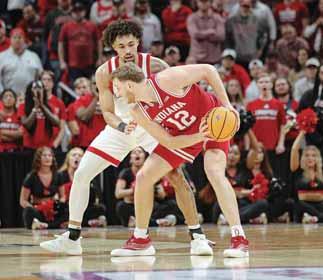
After starting
SOPHIA KAPLAN
of Louisville on
6, 2025, at Gainbridge Fieldhouse in Indianapolis. The Hoosiers fell to the Cardinals by nine points.
IU wins Big Ten Championship over
FOOTBALL
COLUMN: You’re not dreaming. Indiana stands atop the college football
By Quinn Richards qmrichar@iu.edu | @Quinn_richa
INDIANAPOLIS — Thirty years from now, Indiana fans will be able to tell you where they were at 11:24 p.m. on Saturday, Dec. 6, 2025.
In Indianapolis, tens of thousands of Hoosier faithful watched as a sea of white jerseys rushed Lucas Oil Stadium’s fluorescent-lit field. They looked on as Indiana football basked in streams of red and white confetti atop an elevated podium.
In Bloomington, hundreds of crimson-clad students took over Kirkwood Avenue, conducting themselves in a manner only college students are capable of. They scattered from their bars of choice as chants of “Hoo-Hoo-Hoo-Hoosiers” echoed through the town’s storefronts.
Millions more fans sat glued to their televisions in awe. Lifelong Hoosiers watched as head coach Curt Cignetti checked off another box in college football’s most unprecedented turnaround.
No matter the location, each scene had one thing in common. Disbelief.
Indiana’s 13-10 win over No. 1 Ohio State in the Big Ten Championship isn’t just improbable, it’s unimaginable. Look no further than the comments uttered by Hoosier players in the aftermath of Dec. 6’s win.
“Whoa, this is crazy,”
redshirt sixth-year senior right tackle Khalil Benson said before heading into the locker room.
“It feels like a culmination of all my prayers coming together,” redshirt senior running back Roman Hemby said during his postgame press conference. Sophomore wide receiver Charlie Becker reflected on beating the Buckeyes — the team he grew up rooting for. He called the moment “surreal.”
Ohio State was supposed to be a reality check. The big bad Buckeyes were the un-
tested superpower that were supposed to add a blemish to Indiana’s spotless record. Instead, they were the next chapter in the Hoosiers’ storybook season.
There are plenty of reasons why David beat Goliath. For one, he had a better weapon. For Indiana, that was redshirt junior quarterback Fernando Mendoza, who will most likely be accepting the Heisman Trophy later this week. Still, the biggest factor in the Hoosiers’ Big Ten Championship win was something that started when Cignetti first took over
Christian Science Church
Evangelical Lutheran Church in America
Rose House LuMin & St. Thomas Lutheran Church
3800 E. Third St. 812-332-5252 Stlconline.org lcmiu.net
Rose House LuMin and St. Thomas Lutheran Church invite you to experience life together with us. We are an inclusive Christian community who values the faith, gifts, and ministry of all God’s people. We seek justice, serve our neighbors, and love boldly.
Rev. - Adrianne Meier
Rev. - Lecia Beck
Rev. Amanda Ghaffarian - Campus Pastor
2425 E. Third St. 812-332-0536 bloomingtonchristianscience.com
Interested in spirituality and healing? We welcome you to our church to explore how you can address issues spiritually and experience healing.
at the helm — culture.
“We’re going to go in the playoffs as the No. 1 seed, and a lot of people probably thought that wasn’t possible,” Cignetti said. “But when you get the right people and you have a plan and they love one another and play for one another and they commit, anything’s possible. And I think that’s what you saw happen here.”
Even if Indiana’s head coach has an explanation for how the program jumped from a 3-9 record to an undefeated Big Ten title run in two seasons, does that make
it any more believable?
Well actually, yes, it should.
It just makes sense that a team representing Indiana, a state built on agriculture and manufacturing, would form its culture around effort, hard work and brotherhood. While those attributes might be cliches, they perfectly sum up the program since Cignetti arrived in Bloomington. The Hoosiers are a band of misfits. Most of Indiana’s key pieces are transfers, players that were overlooked by programs like Ohio State.
Light House Community Church
850 E. Winslow Rd. 812-339-3306 lhccbloomington.org facebook.com/lighthousecommunitychurchbloomingtonindiana instagram.com/lighthouse_community_ church
Sunday: 9 a.m., Empowerment Classes (for all ages) 10:30 a.m., Service Wednesday: 7 p.m., Bible Study
Light House Community Church is mandated, by the Word of God, to fulfill the Great Commission by winning lost souls to Christ and empowering the believer to grow in Christ through prayer, study of the Holy Bible, and life application teaching. All are welcome! Transportation is available.
Senior Pastor - Derek L. House Assistant Pastor - Clarence W. Boone,
Trinity Reformed Church 2401 S. Endwright Rd. 812-825-2684 trinityreformed.org instagram.com/trinityreformed facebook.com/trinitychurchbloom
St. Mark’s United Methodist Church
100 N. State Rd. 46 812-332-5788 smumc.church facebook.com/BloomingtonStMarksUMC instagram: @stmarksbloomington
St. Mark’s United Methodist Church of Bloomington, Indiana is an inclusive community, bringing Christ-like love, healing, and hope to all. We embrace the United Methodist ideal of open hearts, open minds, and open doors by welcoming those of all races, cultures, faith traditions, sexual orientations, and gender identities.
Rev. John Huff - Pastor Rev. Mary Beth Morgan - Pastor
We are a Reformed Protestant church on the west side of Bloomington with lively worship on Sunday mornings, Bible classes beforehand, home groups, and a college age group called The Mix (a group of young adults who are both attending college and beyond).
Jody Killingsworth - Lead Pastor Max Curell - Shepherding Pastor Stephen Baker - Discipleship Pastor Philip Moyer - Worship & Youth Pastor
Christian Science
Christian Science Church
2425 E. Third St. 812-332-0536 bloomingtonchristianscience.com facebook.com/e3rdStreet
Interested in spirituality and healing? We welcome you to our church to explore how you can address issues spiritually and experience healing.
On paper, the Hoosiers’ roster pales in comparison to other highly ranked teams based strictly on talent. According to 247Sports Team Talent Composite, Indiana entered the season with the 72nd most-talented roster. Well, the 72nd mosttalented roster just earned the No. 1 seed in the College Football Playoff. All of this is my attempt at highlighting the improbability of the Hoosiers’ historic season. It’s the right players, at the right place, at the right time, under the right coach. A mixture that has given Indiana football fans an opportunity to air out decades of disappointment. As the Hoosiers advance into the CFP, they’ll continue to add more pages to a story that seems too good to be true. While there’s uncertainty on whether Indiana’s book will have a happy ending, this chapter certainly did. So, before the Hoosiers flip the page to the Rose Bowl on New Year’s Day, stop for a moment and think. Where were you last night? Who were you with? Whatever those answers might be, remember them. If there’s one thing sports has taught us, these kinds of moments don’t come around very often. If you need to, pinch yourself, but I promise you’re not dreaming. For the first time in its 138-year history, Indiana football is No. 1.
Redeemer is a gospel-centered community on mission. Our vision is to see the gospel of Jesus Christ transform everything: our lives, our church, our city, and our world. We want to be instruments of gospel change in Bloomington and beyond.
Chris Jones - Lead Pastor
United Methodist
Jubilee
219 E. Fourth St. 812-332-6396 jubileebloomington.org
Facebook: First United Methodist Church of Bloomington, IN Instagram: @jubileebloomington
Sunday: 9:30 a.m., Classic Worship 11:45 a.m., Contemporary Worship Wednesday: 7:30 p.m., College & Young Adult Dinner
Jubilee is a Christ-centered community open and affirming to all. We gather on Wednesdays at First United Methodist (219 E. 4th St.) for free food, honest discussion, worship, and hanging out. Small groups, service projects, social events (bonfires, game nights, book clubs, etc.), outreach retreats, and leadership opportunities all play a significant role in our rhythm of doing life together. Markus Dickinson - jubilee@fumcb.org
Unity Worldwide Unity of Bloomington A Center for Spiritual Growth
4001 S. Rogers St. text/call: 812-333-2484 unityofbloomington.org IG: @unityofbloomington facebook@UnityofBloomington
Sunday Celebration: 10:30 a.m.
Discover a vibrant, welcoming community at Unity of Bloomington – “a positive path for spiritual living”. Our center offers a space for spiritual growth; embracing all with open arms. We proudly affirm and welcome the LGBTQ+ community, fostering love, acceptance, and inclusion. Join our loving congregation, where everyone is valued and encouraged to explore their spiritual journey. At Unity of Bloomington, all are welcome and together we thrive!
Minnassa Gabon - Spiritual Leader Phyllis Wickliff - Music Director
BRIANA PACE | IDS
Senior wide reciever Jonathan Brady (left) and sixth-year senior defensive back Louis Moore (right) celebrate the Hoosiers’ win over the Buckeyes after the game Dec. 6, 2025, at Lucas Oil Stadium in Indianapolis. The game was Indiana’s first Big Ten Championship win since 1967.
Indiana QB Mendoza bounces back from 1st play
By Dalton James jamesdm@iu.edu | @DaltonMJames
INDIANAPOLIS — The stakes couldn’t have been higher inside Lucas Oil Stadium on Dec. 6.
Whether it was the Heisman Trophy, the Big Ten Championship, the top overall seed in the College Football Playoff or a program-defining victory, Indiana football had everything to play for against Ohio State in Indianapolis.
But after just one play, it all nearly slipped from the Hoosiers’ grasp. Although redshirt junior quarterback Fernando Mendoza found senior receiver Elijah Sarratt for a 9-yard gain on the first play from scrimmage, Ohio State senior defensive end Caden Curry leveled Mendoza.
With Mendoza lying face down on the field, the crowd inside Lucas Oil Stadium went silent. The game wasn’t supposed to go this way — one of the Heisman favorites going down with an injury.
But after one play on the sidelines, Mendoza bounced back, finishing 15 for 23 for 222 yards passing with a touchdown and an interception in the Hoosiers’ 13-10 victory over the Buckeyes on Dec. 6.
“It’s a great win, obviously,” Cignetti said postgame.
“And we’re going to go in the playoffs as the No. 1 seed. And a lot of people probably thought that wasn’t possible. But when you get the right people and you have
a plan and they love one another and play for one another and they commit, anything’s possible.”
Curt Cignetti didn’t see Curry’s shot on Mendoza. Instead, he was assessing the Buckeyes’ coverage. But someone on the head coach’s headset alerted him that Mendoza was down.
“Oh boy,” Cignetti recalled thinking.
While fans collectively held their breath, the Hoosiers had no doubt Mendoza would respond.
Redshirt senior running back Roman Hemby said postgame what he wanted to do when he saw his quarterback sprawl on the field. First, make sure Mendoza was OK. Second, check to make sure Curry didn’t deliver a dirty hit.
But lastly, Hemby wanted to rally the Hoosiers because if Mendoza had missed extended time, his squad would’ve implemented the patented “next man up” mentality.
Kaelon Black’s thoughts when Mendoza went down were simple.
“For me, shake back,” Black, a sixth-year senior running back, said. “He’s got this. He’s a warrior. He was able to shake back, and we were just happy to have him back for the rest of the game.”
Sophomore receiver Charlie Becker, who emerged in the latter half of the season as another key weapon for Mendoza, had no doubts in the 6-foot-5,
Society of Friends (Quaker)
Bloomington Friends Meeting
3820 E. Moores Pike
bloomingtonfriendsmeeting.org
Sunday (in person & by Zoom):
9:45 a.m., Hymn singing 10:30 a.m., Meeting for Worship
Children’s program available
We practice traditional Quaker worship, gathering in silence with occasional Spirit-led vocal ministry by fellow worshipers. We are an inclusive community with a rich variety of belief and no prescribed creed. We are actively involved in peace action, social justice causes, and environmental concerns.
Rex Sprouse - Clerk rsprouse@iu.edu
Bahá'í Faith
Bloomington
Bahá'í Community and Bahá’í IU Association
424 S. College Mall Rd. 812-331-1863 bloomingtoninbahais.org
Please call or contact through our website for other meetings/activities
The Bahá'í Association of IU works to share the Teachings and Principles of the Founder, Bahá'u'lláh, that promote the "Oneness of Mankind" and the Peace and Harmony of the Planet through advancing the "security, prosperity, wealth and tranquility of all peoples."
Karen Pollock Dan Enslow
Independent Baptist Lifeway Baptist Church
7821 W. State Road 46 812-876-6072 lifewaybaptistchurch.org facebook.com/lifewayellettsville
Sunday: 9 a.m., Bible Study Classes
10 a.m., Morning Service
5 p.m., Evening Service
*Free transportation provided. Please call if you need a ride to church. Student Ministry: Meeting for Bible study throughout the month. Contact Rosh Dhanawade at bluhenrosh@gmail.com for more information.
Steven VonBokern - Senior Pastor Rosh Dhanawade - IU Coordinator 302-561-0108 bluhenrosh@gmail.com
225-pound quarterback.
“Fernando’s a really tough guy,” Becker said. “He’s really strong and resilient, so I knew that he was going to get back up and fight for his team.”
With all this on the Hoosiers’ minds, Cignetti saw the replay. He realized it appeared Mendoza had the wind knocked out of him, and that’s what he confirmed to Indiana’s staff.
Mendoza missed just one play before trotting back onto the field.
“He takes some shots and he extends plays,” Cignetti said. “And can’t say enough about the way he competes. He’s got the heart of a champion and played great tonight and when we needed him.”
The Hoosiers were ultimately forced to punt at the end of their first drive. But after they picked off Ohio State sophomore quarterback Julian Sayin, the Cream and Crimson were set up deep in Buckeyes territory. However, they couldn’t convert the advantage into a touchdown and instead settled for a field goal.
Mendoza tossed his lone interception of the contest on Indiana’s ensuing possession, as he tried to find Sarratt on a screen pass. Ohio State turned its fieldposition advantage into a touchdown to take a 7-3 lead.
Over the Hoosiers’ next two drives, Mendoza led the offense — the first covering 54 yards in five plays and the
Non-Denominational
Christ Community Church
503 S. High St. 812-332-0502
cccbloomington.org
facebook.com/christcommunitybtown
Instagram: @christcommunitybtown
Sunday: 9:15 a.m., Educational Hour 10:30 a.m., Worship Service
We are a diverse community of Christ-followers, including many IU students, faculty and staff. Together we are committed to sharing the redeeming grace and transforming truth of Jesus Christ in this college town.
Bob Whitaker - Senior Pastor Adam deWeber - Worship Pastor
Dan Waugh - Adult Ministry Pastor
Great Harvest Ministry Center (GHMC Family)
1107 S. Fairview St. 812-325-2428 (GHMC) ghmcfamily.org
Sunday: 10:30 a.m.
GHMC Family is a small church with a big heart. We follow Jesus and not a religion. We believe God’s Word as written for real people living in a messy world. We are a family of believers — your home away from home. Casual, welcoming, and here to support each other through life’s challenges. Come grow with us!
Tony Taylor - Pastor
Christian Student Fellowship
1968 N. David Baker Ave. 812-332-8972 csfindiana.org
Instagram: @csfindiana office@csfindiana.org
Monday - Friday: 10 a.m. - 5 p.m.
Christian Student Fellowship (CSF) exists as a Christ-centered community focused on helping students truly know Jesus Christ. Our ministry hub is located on campus at the last stop on the B bus. Reach out to schedule a tour, or join us for our 8 p.m. Thursday night worship service (Encounter)!
Ben Geiger - Lead Campus Minister
Stephanie Michael - Campus Minister
Nick Conrad - Associate Campus Minister
second spanning 61 yards in 14 plays. However, redshirt sophomore Nico Radicic missed a field goal after the first drive and made one to end the second.
Although Indiana trailed by four points at the break, it forced Ohio State to punt on its first second-half possession. Then, the Hoosiers went 88 yards in just seven plays. Mendoza found Sarratt on a third-down fade route for a 17-yard touchdown — the eventual gamewinner.
While Indiana led, Mendoza still delivered “dimes,” Cignetti said. On a third and 6 with just over two minutes left, the Hoosiers had a decision on their hands. Instead of opting to run the ball to ensure erasing time off the clock, Indiana called a pass play.
And Mendoza found
Becker down the near sideline for a 33-yard gain, which allowed the Hoosiers to run all but 18 seconds off the clock.
“We were playing to win,” Cignetti said of the call. “... We had to give our guys an opportunity to make plays. We were getting on top of them at certain points in that game, and Fernando was throwing great deep balls. And it was a great play.”
Indiana, which was tested three times in the waning moments of games this season against Iowa, then-No. 3 Oregon and Penn State, had confidence in crunch time.
“When you’ve been through something one time, you’re a lot better the second time,” Cignetti said. When the clock struck zero, Indiana did what was unthinkable when Cignetti
was hired: win the Big Ten Championship. But it’s more than just a victory. It’s a program-defining win — one that cemented Indiana’s spot at No. 1 in the College Football Playoff bracket. And it almost certainly cemented Mendoza’s case for the Heisman Trophy. The Miami native knew what was on the line Dec. 6. So, he was “never” going to stay down on the field and miss what he helped turn into what one could argue was the biggest win in the program’s history.
“I say it, and I know it could be a little interpreted as a little cringy sometimes, but I will die for my brothers on that field,” Mendoza said. “So, no matter whether it’s a gut punch, whatever it is, I’m always going to get back up.”
United Church of Christ and American Baptist Churches-USA First United Church 2420 E. Third St. 812-332-4439 firstuc.org facebook.com/firstuc instagram.com/firstuc2420 youtube.com/@FirstUCBtown
Sunday: 10:30 a.m., Worship
Monday: 10 a.m. via Zoom, Bible Study
We are an Open, Welcoming, and Affirming community of love and acceptance dedicated to welcoming the diversity of God’s beloved. We exist to empower, challenge, and encourage one another to live out Jesus’ ways (compassion, truth, and justice) authentically as human beings in community to create a better world.
Rev. Jessica Petersen-Mutai Senior Minister
Nazarene
Bloomington Eastview Church of the Nazarene
4545 E. Lampkins Ridge Rd. 812-332-4041 eastviewnazarene.org
Facebook - Eastview Church of the Nazarene
Sunday: 9 a.m.: Morning Prayer
9:30 a.m.: Sunday School 10:30 a.m.: Worship Service
3 p.m.: Cedar Creek Worship Wednesday: 10 a.m.: Bible Study
Join us at Bloomington Eastview Church of the Nazarene, where faith meets community! Connect with fellow students through engaging worship, meaningful discussions, and service opportunities. Discover a supportive space to grow spiritually and make lasting friendships. Everyone is welcome - come as you are and be a part of our vibrant family!
Rev. Bruce D. Yates - Pastor
Alicia J. Dollens - Facility Manager
Rev. Susan Frederick-Gray Check the IDS for your directory of local religious services, or go online anytime at idsnews.com/religious For membership in the Indiana Daily Student Religious Directory, please contact ads@idsnews.com
Episcopal (Anglican)
Canterbury Mission
719 E. Seventh St. 812-822-1335
IUCanterbury.org
facebook.com/ECMatIU
Instagram: @ECMatIU
Youtube: @canterburyhouseatiu9094 Sunday:
Fri., Sat.: By Appointment
Canterbury: Assertively open & affirming; unapologetically Christian, we proclaim the gospel of Jesus Christ by promoting justice, equality, peace, love and striving to be the change God wants to see in our world.
Ed Bird - Chaplain/Priest
Baptist Emmanuel Church
1503 W. That Rd. 812-824-2768 Emmanuelbloom.com Instagram & Facebook: @EmmanuelBloomington
Sunday: 9:15 a.m., Fellowship
Sunday: 10 a.m., Worship
Groups: Various times
Emmanuel is a multigenerational church of all types of people. Whether you are questioning faith or have followed Jesus for years, we exist to help fuel a passion for following Jesus as we gather together, grow in community, and go make disciples.
John Winders - Lead Pastor
Second Baptist Church
321 N. Rogers St. 812-336-5827 sbcbloomington.org facebook.com/2ndbaptistbloomington youtube.com/@secondbaptist churchbloomington Sunday: 10 a.m., Service (In
JIMMY RUSH | IDS
Redshirt junior quarterback Fernando Mendoza celebrates with senior wide receiver Elijah Sarratt during the Big Ten Championship game against Ohio State on Dec. 6, 2025, at Lucas Oil Stadium in Indianapolis. Mendoza completed 15 of 23 passes for 222 passing yards against the Buckeyes.