Former Crazy Horse employees allege sexual harassment
By Eva Remijan-Toba
eremijan@iu.edu
Editor’s note: is story includes mention of sexual assault, sexual harassment, verbal abuse and vulgar language.
Elizabeth Spaulding and Jewels Nelson breathed a sigh of relief as they stood before Crazy Horse. e women entered the Bloomington restaurant standing tall, prepared to end the cycle of sexual misconduct they had endured for months.
ey would soon discover the culture of silence engulfing Crazy Horse, and the owners’ suppression of anyone who dared to break it.
Spaulding, 25, and Nelson, 26, approached the establishment's owners July 24 for a meeting about general manager Joseph “Jay” Brink’s sexual harassment. Before they could speak, Crazy Horse owners Ron Stanhouse and his wife Liz Stanhouse immediately presented the women with documents for a oneweek suspension.
e Stanhouses told Spaulding and Nelson they were being suspended for standing on the bar and swearing at Brink, which Spaulding and Nelson said never happened. ey believe the story was a preemptive move to suspend them before they could bring allegations against Brink to the owners.
Spaulding and Nelson refused to sign the suspension papers. ey passed their own document to the Stanhouses detailing the sexual o enses Brink allegedly committed against them and their female coworkers.
ere were accusations from nine women on the list.
Nelson said the Stanhouses appeared surprised to hear of such behavior and said they had never received any complaints about Brink, 40. Even after hearing the numerous cases against the general manager, Ron Stanhouse said there was nothing he could do.
SEE CRAZY HORSE, PAGE B6
By
Incoming freshmen: e editors of the Indiana Daily Student have compiled some of the biggest stories of the last academic year for this special Freshman Edition of the newspaper. We hope it will be helpful to get you up to speed on the people and issues shaping the community. e IDS, established in 1867, is your independent, student-run news source. Keep up with the news of campus, Bloomington and beyond at idsnews.com.
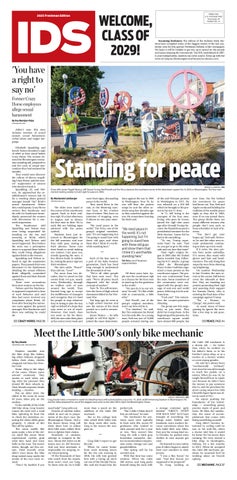
Standing for peace
By Mackenzie Lionberger mlionber@iu.edu
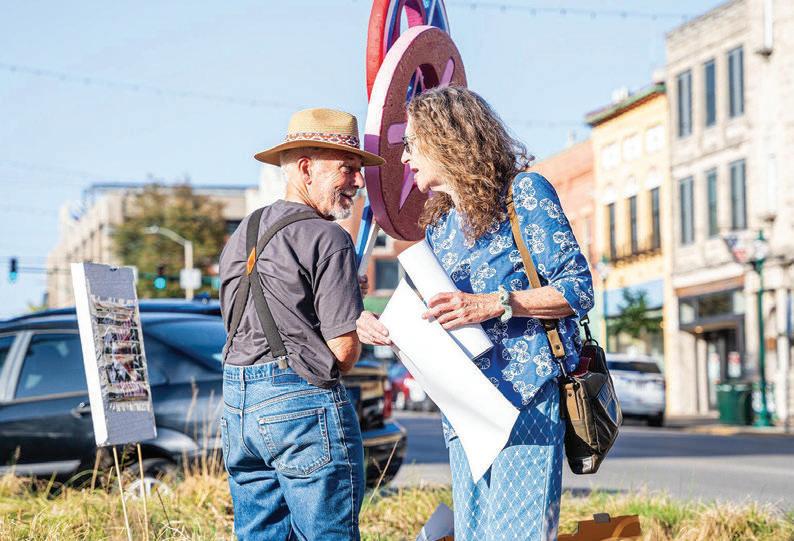
e older men stand at the corner of the courthouse square, back at their endless vigil. It’s a late afternoon in August, and as always, the four men in their 70s to early 80s are holding signs adorned with the peace symbol.
Students have just returned to Bloomington for the fall semester, and now they walk past, staring at their phones. Some turn their heads to avoid making eye contact. Cars pass, too, mostly ignoring the men. A few drivers honk in solidarity, raising the peace sign out their windows. e men smile. “Peace!” they call out. “Love!” For more than two decades, they’ve stood on this corner from 5-6 p.m. nearly every Wednesday, through an endless cycle of wars around the world. ey learned long ago to accept the indi erence of strangers and recognize that it’s hard for people to stop whatever they’re doing to join the tiny vigil on behalf of a hope that may seem so out of reach. However, that reach does not seem so far for them. Still, the men take their place at the corner every week and
wave their signs, demanding peace in the world.
ey stand there in the rain, in the blistering summer heat, in the cruelest days of winter. ey have no intention of stopping, even if almost no one pays attention.
“We need peace in the world,” Tim Terry, one of the group’s original members, said. “It’s not happening, but I’m going to stand here with these old guys and show them that I think it’s worthwhile standing here.”
***
Each of the four men is a part of the baby boomer generation. Each has lived long enough to understand the devastation of war.
“We’re all older people that have seen wars,” Tim said. “We’re all pretty much disgusted with the whole concept of warfare.”
Now 78, Tim still remembers the faces of high school classmates killed in the Vietnam War.
Not long ago, he went to a high school reunion and saw the names of the dead posted on a wall to remember them.
James Muncy — he tells people to call him Apple — joined the mass demonstra-
tions against the war in 1969 in Washington. Now 76, he can still hear the protest songs he and the other activists sang four decades ago as they marched against the war. He remembers burning his draft card.
“We need peace in the world. It’s not happening, but I’m going to stand here with these old guys and show them that I think it’s worthwhile standing here.”
Tim Terry, one of the group’s original members
All these years later, Apple sees the courthouse vigil as a chance for the four men to stand up for the goodness in the world.
“We just do it as our witness,” he said. “It’s like a little club or community, a little tribe.”
Ned Powell, one of the group’s original members, won’t say how old he is.
“I’m timeless,” he said. But Tim estimates his friend is in his early 80s. As a young man, Ned was one of 13,000 people arrested during one
of the anti-Vietnam protests in Washington in 1971. He was released on a $10 bill which he brought to the protest in his size 11 shoe.
At 71, Je Irving is the youngest of the four men. Irving, who goes by Goose, joined the vigil nine years ago after Donald Trump became the Republican party’s presidential nominee for the 2016 election. Goose felt he had to do something.
“To me, Trump represents hate,” he said. “And so, you got to go to the other side and out-love that hater.” eir vigil’s origins began in 2003 after the United States invaded Iraq following the 9/11 attacks. A group called the Bloomington Peace Action Coalition organized a mass protest on the courthouse square. e protest was controversial from the start. Some members of the community were outraged with the group’s message of anti-war and world peace, believing it to be antiAmerican.
“Fuck you!” Tim remembers the counter-protesters shouting. e group saw this negativity as just noise. ey didn’t let it stop them. At the beginning of the protests, the courthouse square would have almost 900 people, but
over time, the re behind the movement for peace had burnt out. Tim, Ned and Apple continued holding the tradition of the weekly peace vigils as they did in 2003, even if no one joined them. e group thinks there are many di erent reasons why people don’t join such as busy schedules or lack of interest.
“You don’t get your hopes up,” Ned said. However, he and the other men remain undeterred, continuing to show up every week. If it rains, the men protest from under umbrellas. If it snows, they stand with gloves and hats and handwarmers. e only thing that stops the men from showing up is lightning. On another Wednesday in late October, the men return to the corner. Fall leaves cover the sidewalk at their feet. ey are handing out posters promoting their vigil and asserting their support for Kamala Harris, who is entering the nal days of her campaign against Trump. “Put a Woman in Charge,” one poster said. As usual, many of those passing by ignore the men. But a few stop to ask questions. SEE PEACE, PAGE A4
Meet the Little 500's only bike mechanic
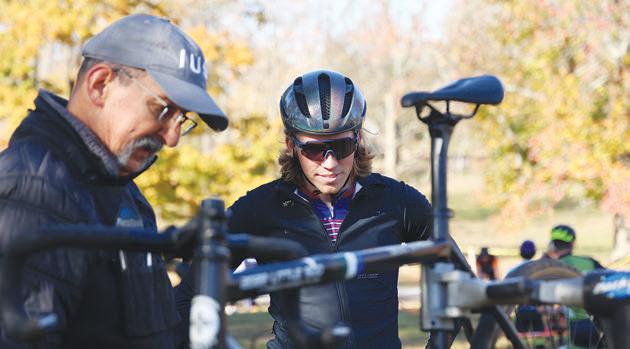
Rookies stumble into the bike shop like babies, big white helmets strapped below their chins, cheeks chapped red from the October cold. Some cling to the edges of the room. Others move around cautiously. ey mutter to each other asking what tire pressure they
tire to check the derailleur, ensuring the chain shifts gears properly. A chunk of dirt ies o the spokes. e room smells like spray paint, a few of the riders smell like sweat. More experienced cyclists grab what they need and wave hello to the man. e newer riders, though, are less certain. Until recently some didn’t even know the bike shop tucked away under the stands of the race track existed. “Don’t be bashful if you need help!” Greg yells out. Dozens of student riders whisk in and out in preparation of the day’s race: the Bloomington Classic. And a few dozen times, Greg will show them how to adjust their bike seats, in ate their tires or tighten their chains. Hundreds of students attempt to compete in the race. About 264 riders on 66 teams race on 185 bicycles. And one lone mechanic is responsible for keeping every wheel turning. Of the thousands of fans who watch from the stands, most won’t even see Greg. To those who do, he is little
more than a speck on the sidelines of the Little 500 racetrack. But to the college kids who wheel their bikes into his shop week after week, Greg is the reason the race goes on. *** Greg didn’t expect to get the job. When he came home from work mowing lawns for the city one evening in 2018, his wife Joie greeted him with a hiring ad she’d cut out of e Herald-Times. She said she found him the
perfect job. “But I didn’t think they’d hire an old man,” he said. e mechanics for previous races were typically in their early 20s, recent IU graduates who tended to stick around only for a year or two. ey weren’t like Greg, 69, with a thick gray horseshoe mustache, doctor-recommended compression socks, vintage cars and grandchildren. is spring will be his seventh year. With that time has come wisdom. When the Little 500 arrives, and Greg parks himself along the track with
a storage container aptly labeled “GREG’S STUFF FOR RACE DAY,” he’ll have thought of everything. He brings water bottles and bandaids, extra washers because sometimes when the kids build their own bikes, they put the wrong kind on. In October, he packed extra clothes in case anyone got cold. He learned to carry safety pins if riders forgot to attach their race numbers to their jerseys.
“I was a Boy Scout,” he said. “And Boy Scouts are supposed to be prepared.” To Greg, working as
the Little 500 mechanic is a dream job — far better than when he worked on his father’s farm, or in his brother’s pizza shop, or as a trucker or a factory worker or a tree stump grinder. He said he’s always been “mechanically inclined,” ever since he was old enough to reach the pedals on a tractor. When he was 16, he taught himself how to repair cars because he didn’t have the money to pay someone else to, and his penchant for street racing meant his 1965 Chevelle Super Sport was often in need of TLC.
He enjoys pushing the boundaries of his knowledge — unraveling greasy puzzles made of gears and wires. He likes the satisfaction, the sense of accomplishment that comes with doing something yourself. Greg didn’t become interested in cycling until he was in his mid-50s, when a doctor told him it would be better for his knees than running. He even owned a bike shop in Huntington, Indiana, for a few months in 2012. When he accepted the Little 500 mechanic position, he assumed he’d be working alone on bicycle upkeep.
MIKAYLA OWENS | IDS
(From left) James “Apple” Muncy, Je “Goose” Irving, Ned Powell and Tim Terry stand on the southeast corner of the downtown square Oct. 9, 2024, in Bloomington. The four men started meeting weekly to hold vigils for peace in 2003.
GRACE URBANSKI | IDS
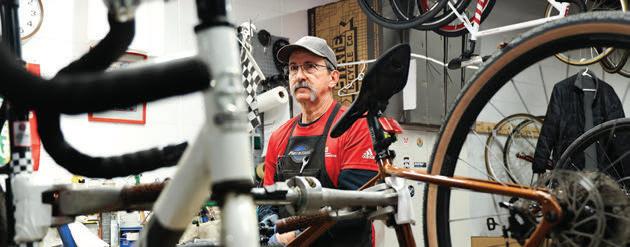
Greg Souder takes a moment to watch his bikeshop buzz with activity before a race Oct. 15, 2024, at Bill Armstrong Stadium in Bloomington. He and the riders prepared for one of the biggest races prior to the Little 500 in April, the Bloomington Classic.
Celebrating, urinating, graduating
Bloomington buzzes Friday, April 25, after the Little 500
By Alayna Wilkening
|
8:15 p.m. near Woodlawn Avenue
A group of women wearing yellow Kappa Alpha eta shirts crosses 10th Street and sees friends walking in the opposite direction.
“We’re going to Upstairs!” one yells.
e others say they’ll meet up later. e barbound group sings a eta chant as it heads down 10th Street.
Hours earlier, the team earned its 10th win in the women’s Little 500 at Bill Armstrong Stadium. Now, much like many other IU students, some of its members were beginning to hit the bars along Kirkwood Avenue.
Down the street, a trap remix of Kelly Clarkson’s “Since U Been Gone” ripples through the alleys surrounding Phi Gamma Delta. e rest of the sorority and fraternity houses on Woodlawn Avenue, including Kappa Alpha eta, are quiet after a long day of racing.
Empty cups and cans scattered along the side-
By Eva Remijan-Toba eremijan@iu.edu
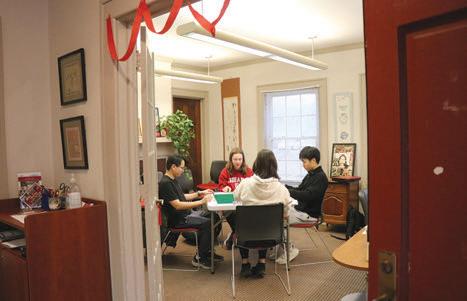
Every Monday night, a small group of IU students gather at the Asian Culture Center to participate in the classic Chinese tile game of mahjong. Players of all backgrounds come together to celebrate their culture, remind them of home or simply try something new.
“We get a good mix of people who have played and people who are complete newbies,” sophomore Jason Tang said. “It’s nice to have an event where we’re branching out Asian culture to people who wouldn’t traditionally encounter it.”
Tang runs the game nights for the center and encourages anyone interested in learning to join. He learned to play Fall 2024 when he attended one of the weekly events.
For Tang, mahjong is more than just a game — it’s a way to embrace his heritage. As a rst-generation Chinese American, he said he often struggles with understanding his cultural identity. Playing mahjong allows him to strengthen ties to his roots.
“Children of immigrants in the U.S. is like living in that weird grey area of not being able to fully connect to American culture but also
walks serve as the only trace of the parties held in the days and hours leading up to the race.
8:30 p.m. on Kirkwood Avenue
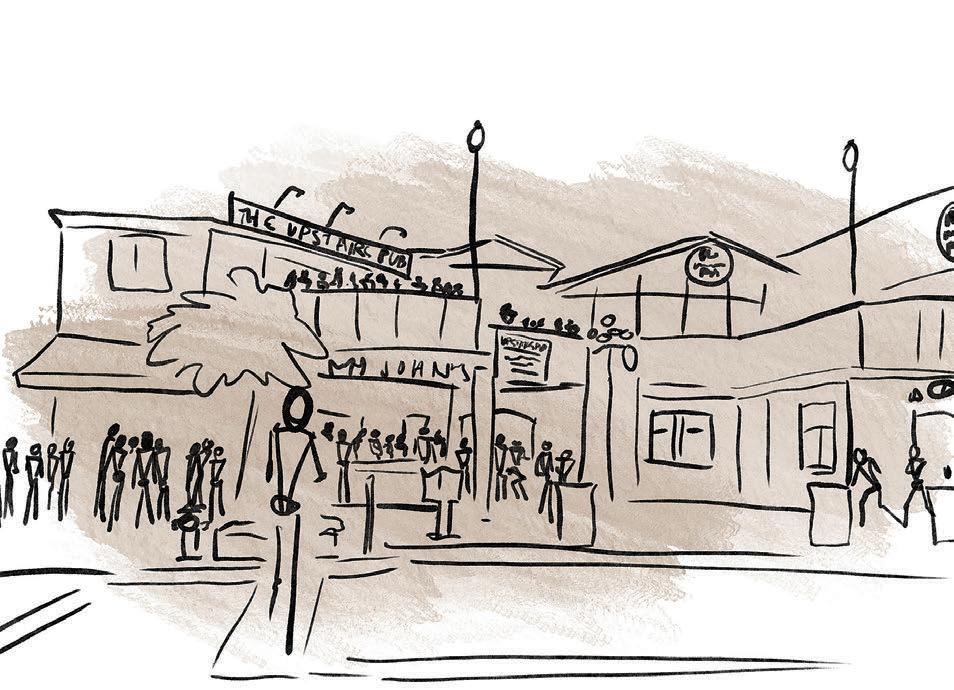
Between Sample Gates and Kirkwood Avenue sits an invisible wall, separating the smell of liquor and that of IU’s campus. ough it’s still early in the night, lines snake around the corners of Kilroy’s on Kirkwood and the Upstairs Pub. e group from Kappa Alpha eta, who announced their plans to meet at Upstairs, near the front of the line. People struggle to nd a spot to stand inside.
Two men ride electric scooters up and down Kirkwood Avenue for about a half hour. On their rst pass down, one nearly loses balance; but manages to stay upright as his scooter ings out from under him. He regroups for a moment, then continues riding with his friend. ey do this at least two more times, waving to people eating outside Z & C Teriyaki & Sushi. ey don’t seem to know the patrons, but it doesn’t seem to matter.
their own,” he said. “Something as simple as learning mahjong is like another step closer, reconnecting to that side.”
Although mahjong originated in China, there are several variations of the game that exist worldwide. At the ACC, players use Japanese rules, also known as Riichi mahjong.
On Feb. 20, four students, including Tang, sat around the culture center’s new mahjong table greeting one another. As they socialized, the players assembled their tiles and started the game.
To win in Riichi mahjong, players must create a hand with four sets — each consisting of either three identical tiles or a sequence — and one pair. Master’s student Sang Teng Chhim won the rst game.
Chhim, an international student from Cambodia, is in his rst semester at IU studying public a airs. He grew up in a Cambodian Chinese household but didn’t learn to play mahjong until he was an undergraduate student at Monash University in Australia. After he graduated, he temporarily forgot how to play but quickly regained his skills at the ACC.
“I nd it fascinating how the game came to be and how it’s played,” he said. “Engaging with the game I guess also feels integral to my iden-
9:15 p.m. in downtown Bloomington
Groups of friends talk about graduation, creeps at the bar, dream careers and roommate drama as they bar hop.
Downtown, three remen guard a live wire in front of Yogi’s. Someone called them after stepping on one of the wires and feeling a slight electric charge. e remen on the scene don’t know what the wires are connected to, but they got in contact with Duke Energy and, hopefully, would be getting help soon. In the meantime, they stand around the wire to make sure nobody else steps on it.
In the distance, a bouncer yells about a $5 cover charge at Brothers Bar and Grill. People line both sides of North Walnut Street as they wait to get into either Brothers or the Bluebird.
9:30 p.m. on Kirkwood Avenue
Two di erent people point out FARMbloomington to guests from out of town as they pass each other outside the restaurant. Neither had been there, but both recommend it.
tity.”
He has attended every Mahjong Monday this semester and plans to continue for the rest of the school year.
Freshman Zoe Huels, a Mahjong beginner, won the second round.
“It’s simple,” she said. “I’ve played a lot of card games recently, so it felt different, but the way Jason (Tang) explained it with the suits made is pretty relatable.”
She said the bamboo, numbers and directions on the tiles are similar to the hearts, spades and diamonds on a deck of cards.
Huels’ friend, Reanne Grooms, another freshman and beginner, won the third round.
ough neither Huels nor Grooms are of Asian descent, both said they are eager to attend more events at the ACC. is was the pair’s second time at Mahjong Mondays, and like Chhim, they’ve made it a tradition to come for the rest of the year.
For newcomers, Tang said to expect a welcoming environment and a chance to nd a judgment-free community.
“ ere’s no pressure, whether you’ve played before or not. Every single person has started from ground zero,” he said. “Just because someone doesn’t have Asian
A large group gathers outside Upstairs and debates joining the line. ey argue about going to the Video Saloon or Brothers instead but aren’t sure which bar would be the least crowded. Eventually, they decide to head in the direction of Brothers, but stay outside Upstairs for a bit, waiting on someone. None of them knew who they were waiting for. At the intersection of Dunn Street and Kirkwood Avenue, a man dances against a black Porsche Panamera. He’d been there for some time, a City of Bloomington employee who had already been there for a few hours says, and had been blasting rap music through his car speakers before he was asked to turn down the volume. He lowers it for a bit, then turns it back up.
e same employee talks to him a bit later and asks the man to get out of the intersection, as cars behind him were forced to merge into one lane. e man lifts the hood of his car, closes it a few minutes later and continues dancing.
Bloomington residents
Dennis and Kathleen Spahr laugh at the situation a few feet away and brie y chat with the employee as he walks away from the dancing man. e Spahrs both went to IU, had kids who attended IU and even watched their son get married at Beck Chapel on campus. Now, they make a date out of every Little 500 weekend. ey grab a treat from Hartzell’s Ice Cream, nd a spot to sit and watch students stumble around the entrance of Upstairs and fumble with door handles as they climb into Ubers.
Dennis Spahr teaches at IU, so he chose to wear a hat to avoid being recognized by former students.
10 p.m. on Third Street
Two men pee in the bushes that line Swain West. ey talk about their upcoming graduation and future plans as they zip up and head back across the street to Chi Phi, where music and colorful strobe lights peek out behind tarps lining the backyard.
10:30 p.m. on Kirkwood Avenue
ILLUSTRATION BY ALAYNA WILKENING
Lemons and limes fall from the Upstairs balcony, narrowly missing people’s heads down below. Members of Chi Alpha, a Christian organization on campus, o er free bottled water to people walking past. Most decline. An older woman sticks her upper body out a maroon SUV’s sunroof and records a video of the bars as she rides down Dunn Street. 11 p.m. on Eagleson Avenue Fraternity and sorority houses on Eagleson Avenue buzz with life. Groups of students walk into and out of houses, some returning home and some heading out for the rst time that night. It’s already 11 p.m., but the night has just begun for many students, and the streets of Bloomington would be lled well into the early morning. Lines would begin to form as early as 4 a.m. the next day in anticipation of the bars re-opening with breakfast, free merchandise and more drinks as race fans prepared for the men’s Little 500 on April 26. is story was originally published April 26, 2025.
roots or isn’t familiar with aspects of Asian culture, they shouldn’t shy away from expanding their horizons and trying new things.”
Mahjong Mondays will continue from 5:30-7 p.m. throughout the semester at the ACC,
e vibrations of drums beating and the echoes of the traditional Native American singing rang across Wilkinson Hall as the First Nations Educational and Cultural Center hosted its 12th Powwow on April 12.
Last year’s was canceled after IU Athletics noti ed the culture center its reserved space would be unavailable. e center couldn’t nd other venues in time as various events for the total solar eclipse and other festivals had spaces reserved. ey then decided to cancel the event. at left people excited, and ready, for this year’s Powwow.
Adin Kawate, native education and programs assistant for FNECC, said the center began receiving questions about this year’s Powwow in January.
“I think for the community at large, people were really ready for it,” Kawate said.
“We got a lot of inquiries about the cancelation last year and if we were having one this year. I think it’s been around for long enough that people really look forward to it.”
e schedule for the 9-hour event featured performances from Native American drum groups like Ribbon Town Singers, Eagle Flight Singers, Iron Bear and Horse ief. ere were also dances performed by professional head dancers Katy Isennock and Johnston Taylor. Traditional food, crafts and drinks were also available.
According to the FNECC website, IU’s Traditional Powwow attracts hundreds of visitors each year. It’s a time when generations come together to participate in song and dance to celebrate the diversity of contemporary Native American tribal identity.
“ is Powwow probably had one of the greatest engagements with local Native communities,” Kawate said.
“We have built relationships with a number of our original tribes from the area of Bloomington that are recognized in our land acknowledgement. For the rst time, we had a large turnout from our Native friends.” IU was built on the Indigenous and ancestral homelands of the Miami, Delaware, Potawatomi and Shawnee people. Sherene Ing, director of the FNECC, said that the event had received positive engagement from both members of the Potawatomi and Shawnee tribes. Other dancers that live in surrounding states attended this year’s Powwow as well.
By Mia Hilkowitz, Marissa Meador, Andrew Miller and Deshna Venkatachalam
Several IU students have had their student visas canceled, IU Provost Rahul Shrivastav said April 8 at the Bloomington Faculty Council meeting.
e discussion came after an attendee at the meeting referenced the actions of other universities in regard to revoking student visas.
“I can con rm that is happening here,” Shrivastav said at the meeting. “It is ongoing. It is no di erent than what’s happening in other institutions.”
Shrivastav said the number of IU students this has a ected is “small relative to some other institutions.”
e university is responding on a case-by-case basis and working to help students to the extent the institution can while complying with federal legislation, he said.
“No institution actually controls visa issues,” Shrivastav said. “ ose are federal regulations and federal jurisdiction. With what is within our ability, we are trying to help as best we can.”
Shrivastav said the students that have been involved in student visa cancellations have gotten “ex-
“Starting in my role, I was able to take some time to visit with some of the communities nearby,” Ing said.
“Now they’re our friends and I really appreciated that they showed up to support us and to dance and sing with us over the weekend.” e modern Powwow have their roots in the historic societies of the Southern and Northern Plains.
According to the Smithsonian Center for Folklife and Cultural Heritage, the intertribal exchange between the Plains tribes occurred after the U.S. government seized land from people from both the Southern and Northern Plains in the late 19th century.
Now, Powwows are a place for Native American people representing all tribal backgrounds to join together and share experiences, reconnect with old friends and make new ones.
Kawate said this idea was re ected during the inner tribal dance toward the end of the night. Anyone attending could come and dance on the gym oor.
“When you see the inner tribal, the stands look empty, but the circle looks really full,” Kawate said. “Native people, local Bloomington community, everybody was in the circle and that was the telling sign for me that the Powwow was successful, and that people were really excited to be there.”
Despite scheduling and venue issues that led to the cancelation of last year’s event, the culture center experienced less con ict this year in planning. ey had the help of many communities such as IU Corps, IU Athletics and FireHouse Broadcasting.
ceptional” support from their academic units and faculty.
e revocations at IU come as dozens of colleges across the country say their students have had their visas canceled. e New York Times reported this week nearly 300 international students have had their visas revoked at both public and private institutions. In March, federal immigration authorities arrested Columbia University graduate student Mahmoud Khalil, a leader at the university’s pro-Palestinian protests and encampments. Khalil’s detention was the rst publicly known student arrest as part of the Trump administration’s executive order to combat antisemitism on college campuses. In a fact sheet about the order, the administration wrote it would revoke visas for and deport students who participated in “pro-jihadist protests” — though not all the students who have had their visas revoked have participated in protests and encampments. In other cases, students and lawyers said immigration o cials gave no reason behind the visa revocations. Student visas can be revoked if students violate the rules that govern them, such as by not keeping a full class load or getting an o -cam-
Kawate said that the planning of large events like these can be chaotic
because of all the moving pieces both with performances and behind the scenes. However, according to her, the chaos was worth the result.
“ ere’s something really special about creating space for all di erent kinds of communities at an institution like IU,” Kawate said.
“ e more Native guests we bring in, the more the community just explodes and blossoms. Everyone leaves these experiences feeling good and feeling like they belong, and that’s important.”
While last year’s IU Traditional Powwow was cancelled, both Kawate and Ing have hope that this tradition will live on.
“We’re in a period of uncertainty right now, with lots of things going on locally and in the country,” Ing said. “I’m hoping that things will be good next year and that we will be able to provide the space once more for the community.”
is story was originally published April 16, 2025.
pus job without permission. ey can also be revoked if students commit a crime.
Students who get their visas revoked can have them reinstated if they meet special requirements, but it’s historically rare for students to have their visas terminated from the Student and Exchange Visitor Information System, an online state department database that keeps records on international students. Many of the
revocations have also included terminated records, though it’s unclear if this is the case at IU. e state department did not provide the exact number of IU students who have had their visas canceled. “We don’t discuss individual pieces due to the privacy of those involved,” state department Spokesperson Tammy Bruce said at a briefing April 8. “We don’t go into statistics or numbers.”
IU did not immediately respond to questions on its response, nor how many students the cancelations have impacted.
Students concerned about the status of their visa can check it through the Department of State’s Visa Status Check portal. Students who have had their visas revoked or terminated should consult an immigration lawyer. Information on students’ rights when dealing with Im-
migration and Customs Enforcement
COURTESY PHOTO
The Ribbon Town Singers group performs during the IU Traditional Powwow April 12, 2025, at Wilkinson Hall in Bloomington. The First Nations Educational and Cultural Center Traditional Powwow returned after canceling due to scheduling con icts in 2024.
man performs during the IU Traditional Powwow on April
2024.
“What are you guys doing here?” a middle-aged woman asked.
“We’re standing here for peace,” Goose said. “Do you want a sign?”
“Yes, when are you guys out here?” she asks.
“Every Wednesday from 5 to 6,” Goose said, hopeful of their return. Whenever people show interest in participating, Goose always gets excited with the hope of new people joining. However, every Wednesday it continues to only be the four of them who show up.
“I nd it unconscionable that we have a university of, well, how many 40 plus 1000 students… I nd it hard to believe that we don’t have a whole bunch of young people there saying, ‘Yeah … we need peace,” Tim said.
is past summer, Ned took his peace sign to stand with protesters on campus against the Israel-Hamas war. ough people protested in Dunn Meadow, no one asked about his peace sign, and Ned never mentioned the peace vigil at the protest, believing it wouldn’t be relevant. However, he believes people recognize the point behind the vigils but ignore the greater cause.
During the same summer, Goose made 60 peace signs and posters to advocate for the group's simple message of peace, which they hoped would resonate with many community members.
“People walked away with them,” Goose said. “I'd give them away trying to get people back each week, and it never worked.”
While their presence is regular and expected by those out by the square around the same time, who know them as the peace guys on the corner, few know the story behind their passion for peace.
Tim was a member of the Peace Corps who served in Nigeria during the Biafran War from 1968 to 1970. e war began in 1967 due to the attempt at secession from provinces in Nigeria. During
the war, Tim and his wife, Barbara, served as teachers.
After serving in the Corps, he became a jeweler, cultivating his designs in New York until moving to Bloomington in 2003 with Barbara. Soon after moving to Bloomington, he joined the protesters outside the courthouse. In 2019, his wife of 50 years passed away after su ering from congestive heart failure. After losing his wife, he found comfort in continuing to create jewelry as well as participating in the weekly vigil. Outside of the vigil, Tim enjoys bike rides and spending time with his rescue Pitbull mix, Layla.
Ned grew up in Chicago, where his father’s activism inspired him to join the steelworkers’ union and shaped his advocacy view. As years have passed, he has been a passionate volunteer , serving organizations like Pas-
tors for Peace, Friends of the Library Bookstore, Opportunity House thrift store, and Habitat for Humanity ReStore.
Apple is a retired auto parts store manager. Before retiring, he returned to school to get his general studies degree from Indiana University South Bend. For Apple, attending the peace vigil has become a part of his weekly routine, and he couldn’t imagine not joining.
Before joining the group, Goose was a Bloomington local for decades and worked as a Pizza X driver. Goose brie y lived in Florida after high school, though he ultimately returned to Bloomington where he took classes at Indiana University.
When Goose initially joined the group, he began making the same peace signs the group currently uses, crafting symbols of unity and
peace that would be presented weekly. e peace signs, coded with bright colors and messages of love and peace, quickly became a staple of their vigil.
On the day of the November 2024 election, rain showered the city of Bloomington. Tim spent the night at home, listening to the hard raindrops hitting his roof instead of following the election. He sat in his living room as Layla laid her head on his lap, comforting him through the storm and the anticipation of the day to follow. As the sun rose the next morning, the United States woke to a new president. Regardless of the outcome of the election, peace is still the goal and the four men’s mission. Undeterred by the soaked
ENDLESS PLAY
streets and the political division, Tim arrives rst at the vigil that Wednesday after the election, standing, waiting a couple of minutes for the other men to arrive. e three others join, holding their signs.
“I’ve seen you guys here before. What are you doing?” a woman asked.
“We’re here to spread peace, we’re here every Wednesday,” Goose said.
e other men slowly turn to hear the conversation.
“Well, thank you for being here. I would love to join you guys sometime,” she said.
“ at would be great. We’ll have a sign for you,” Goose said.
As she walks away, the four men smile. As the hour ticks by, more people than normal honk and shout “peace” toward the men. While the group had no idea if the woman would return to
join the vigil, they would be back.
Appreciation for the peace signs roll in from community members after a divisive election. A shadow of fear clouds over half of the country, but Tim, Ned, Goose and Apple stand on the corner with their signs. e uncertainty of others joining has never mattered to them. Whether it’s the four of them or hundreds of participants, they would be standing at the corner with their signs, as they have for over two decades. Standing at the corner every Wednesday may seem futile to some, but for the men, they carry a greater hope along with their signs. eir signs and weekly presence continue to be the same simple one-word call: Peace. is story was originally published Jan. 16, 2025.
MIKAYLA OWENS | IDS
IU terminated professor the same day FBI searched homes
By Andrew Miller ami3@iu.edu | @andrew_mmiller
Indiana University terminated professor Xiaofeng Wang on March 28, the same day that two of his homes were searched by the FBI, according to a document sent by the American Association of University Professors’ IU Bloomington chapter.
e document, IU Provost Rahul Shrivastav’s email informing Wang of his termination, said it was Shrivastav’s understanding that Wang had accepted a faculty position with a university in Singapore. Shrivastav said in the email that Wang would not be eligible to be hired again at IU.
e email also told Wang he needed to return all IU property to the IU Police Department as soon as possible. IUPD did not respond to a request for comment by publication.
e Indiana Daily Student reached out to IU to conrm the document’s verac-
ity, to which a spokesperson responded that IU will not comment on the investigation.
“Indiana University was recently made aware of a federal investigation of an Indiana University faculty member,” an IU spokesperson told the IDS on Monday. “At the direction of the FBI, Indiana University will not make any public comments regarding this investigation. In accordance with Indiana University practices, Indiana University will also not make any public comments regarding the status of this individual.”
e FBI has not given further information on the nature of the searches of the two homes belonging to the professor and IU Libraries analyst Nianli Ma.
“ e FBI conducted court authorized law enforcement activity at the home on Xavier Court in Bloomington Friday,” FBI spokesperson Chris Bavender said over a text message March 29. “It was related to the FBI activ-
ity at the home in Carmel. We have no further comment at this time.”
e FBI searched their homes in Bloomington and Carmel on March 28. e search took nearly all day in Bloomington according to neighbors who spoke with the Indiana Daily Student. Neighbors said they didn’t know Wang or Ma well — several said they didn’t see the couple much, especially not in recent weeks.
Wang, a Luddy School of Informatics, Computing, and Engineering professor, and Ma had their pages scrubbed on IU’s websites as of March 31. Neither could be reached by the IDS for comment.
Wang had been a director at IU’s center for Security and Privacy in Informatics, Computing, and Engineering. e center’s co-director, L. Jean Camp, con rmed details rst reported by the South China Morning Post that Wang is still in the United States, and that to her knowledge he has
not been charged with anything.
A search on the U.S. government’s Public Access To Court Electronic Records system yielded no recent results for either Wang or Ma. Searches for both in a database of federal prison inmates and Immigration and Customs Enforcement detainees also did not return results.
An archived version Wang’s page on the Luddy website described him as an associate dean for research. According to the archived page, he had served on projects totaling nearly $23 million by 2022. He joined the university in 2004. According to the SPICE website, Wang’s research focuses on system security and data privacy, specializing on security issues relating to mobile and cloud computing, and human genomic data.
Other colleagues have not responded to requests for comment as of publication.
PHOTO ILLUSTRATION BY ALAYNA WILKENING
Did Whitten plagiarize?
By Jack Forrest jhforres@iu.edu | @byjackforrest
Editor’s note: e IDS received a tip about potential plagiarism in President Whitten’s 1996 dissertation and 2006 article in September. IDS sta veri ed examples and interviewed experts but decided it did not have enough evidence to break a story with allegations of this nature. Following publication of e Chronicle of Higher Education’s article, the IDS has decided to publish the expert interviews to add to the public discourse about what does or does not constitute plagiarism.
Does copied language in IU President Pamela Whitten’s doctoral dissertation constitute plagiarism? e Chronicle of Higher Education rst reported Jan. 22 it received documents including examples of writing from Whitten’s 1996 doctoral dissertation about telemedicine and a 2006 article alongside the source text.
In September, the Indiana Daily Student received the same examples and more in multiple spreadsheets, which it was able to verify with both the original text source and the dissertation. e sources of the documents requested anonymity due to fear of repercussion for sharing them.
It also received tips about seven examples of
potential plagiarism unique from the Chronicle’s, including a 52-word example of language taken from an article Whitten co-wrote in Telemedicine Journal. at example was attributed to herself and her co-author but was not in quotations. In a statement to the Chronicle, an IU spokesperson claimed an independent law rm investigated and found the “assertions” to be meritless in August last year. In the statement to the Chronicle, the spokesperson did not identify the law rm employed or detail why the university asked for the investigation. An IU spokesperson did not respond to the IDS’ request for clari cation. Further, some of the original works’ authors had con icting opinions on the examples. Telemedicine researchers Douglas Perednia and Ace Allen are the authors of a paper who Whitten cited from extensively. Whitten and Allen also cowrote a 1995 article in “Telemedicine Today” and a 2001 book, “E-Health, Telehealth & Telemedicine,” according to her curriculum vitae. Perednia told the Chronicle that Whitten’s use of his paper did not constitute plagiarism; Allen, though, told the publication that the language appeared to be copied.
SEE WHITTEN, PAGE A7
‘Devastating’: IU ends Intensive First-Year Seminars
By Isaac Perlich and Chloe Oden iperlich@iu.edu | chloden@iu.edu
Indiana University announced it will discontinue Intensive First-Year Seminars in an abrupt end to the over 30-year-old program.
IFS was a transition-tocollege program for rst-year students which began a few weeks before the start of the fall semester, according to the IFS website. Prior to their start to college, incoming freshmen could participate in a threecredit course, working with faculty and participating in an academic forum that would help connect them to IU’s resources and prepare them for college, according to the IFS website.
IFS had courses specically tailored to students with merit or need-based scholarships like Hudson & Holland and 21st Century Scholars, as well as students in the Arts and Sciences Undergraduate Research Experience.
At the Bloomington Faculty Council meeting Oct. 1, one member asked Vice Provost of Undergraduate Education Vasti Torres for clari cation about whether or not Torres made the decision to end IFS.
“I made the decision to reallocate resources,” Torres said. According to Torres, the role that IFS had is being “transformed and redesigned” for all students, but she did not give speci cs.
Impact of IFS
Some courses for the 2024 program were “Arts of War,” taught by professor Marco Arnaudo; “Blood, Babies, and Chainsaws: Gender in/ as Horror,” taught by Jennifer Maher, clinical professor and director of undergraduate studies for gender studies; “Queer Activism and Public Issues” taught by associate professor A. Freya imsen; and “Happy Hoosiers: Exploring Nature, Heritage and Health,” taught by lecturer Brian Forist.
“ ere’s just a di erent
kind of bond that you can build in (the intensive format),” imsen said. “It allows you to build knowledge in a di erent way.”
imsen said she has observed “life-changing impacts” in her IFS class. Most students in the class, she said, identify as part of the queer community and come from places that aren’t supportive of or are aggressive toward their identities. e class taught them about the history of queer politics and helped them “build community with each other.”
She said students have emailed her to say the connections made in the course became the foundation for their time at IU.
IFS professors learned IU was canceling the program at a “debrie ng meeting,” according to Arnaudo. Torres announced that the university was ending the program at this meeting.
“I’ve rarely seen faculty cry at faculty meetings,” Arnaudo said. “Everybody in the room was extremely upset, angry, devastated or crying.”
Arnaudo, who has taught in the program for over 10 years, said with how passionate IFS professors are, Torres’ approach to breaking the news was “unprofessional” and without warning. He said he wishes the university had consulted them on how to handle any problems with the program instead of ending it completely without a fully formed replacement program.
“It’s devastating for the real-life impact that it will have on hundreds of students,” Arnaudo said. To Arnaudo, IFS is an especially important program because it bene ts rst-generation college students. He said the seminar helped acclimate them to college and living on a college campus. Arnaudo was a rst-generation student.
“My experience starting college in another town with no friends, not knowing how things work was extremely disorienting. So much so that I got depressed and over-
whelmed, and I dropped out of college,” he said. “ en I went back, and I was able to make it that time. So, I know how di cult it can be if you’re a rst-generation student from a low-income background, how hard it can be to make the transition.”
Arnaudo said he doesn’t think he would have dropped out if he had the opportunity to go through a program like IFS.
For rst-generation students, IFS is a valuable time to learn what is expected of them in college and meet people, and without it, Arnaudo said, many will have a “rocky start and may not complete” the semester.
Brian Forist, who teaches in IU School of Public Health’s Department of Health and Wellness Design, said IFS was “special” and taught students “colleging 101.”
He was turning in his IFS grades and writing a note to his teaching assistant when he learned the program was discontinued Friday.
“It was heartbreaking,” he said. “It was a gut punch.”
He said he now realizes the impact IFS had on faculty.
“ ese people — my colleagues — aren’t just teaching their IFS courses,” he said. “ eir experience in uences how they teach, and they become ambassadors in their departments and schools for a more student-
centered, intensive, contextual approach in learning and teaching.”
Forist has taught for IFS since 2020 and re ected on his four years with the program.
He said a student took his IFS class in 2020, became one of his teaching assistants, graduated last year and is now a park ranger and pursuing a master’s degree at IU.
“To see a student from her rst day of college to park ranger has been a source of incredible joy,” he said.
One of his favorite memories came when he gave the faculty address for the IFS closing ceremony last year.
“In that talk, I o ered a charge to the students, but I also o ered a charge to my peers and that was, ‘I’ve heard you say this is the best of teaching on IU’s campus. is is how teaching should be.’ And I said, ‘ en make it so,’” Forist said.
Maher said IFS is a program that sticks with students, saying that many refer to it as one of the best college experiences that they had at IU.
According to Maher, a student from her IFS class in 2018 messaged her this year on Facebook about the impact the course had on her.
“Your class/IFS was one of my favorite parts of undergrad. I met some of my best friends through there, and it helped mold my academic career,” the student wrote in
the message. “I know others in our cohort feel the same.”
Faculty react to cancelation Maher, Arnaudo, imsen and Forist all said that IFS professors were not consulted prior to the decision.
“It was one of the most disrespectful meetings I’ve ever been to in my life in terms of how I was treated as an educator,” Maher said. “In fact, (Torres) didn’t refer to us as educators, she referred to us as stakeholders.”
At the BFC meeting, Torres said she had met with Tanya Koontz Orbaugh, director of IFS, who said IFS faculty were meeting the next day. She then decided to announce it at that meeting Sept. 27.
“ at is why it rolled out in the manner it did,” Torres said. “It is not my usual manner.”
In the meeting, Arnaudo said, the university told them that they wanted to have a college readiness program that served all students.
Mark Bode, IU executive director for media relations, referred the Indiana Daily Student to a statement from Torres.
“ roughout the years, the Intensive First-Year Seminar has bene tted approximately 9% of our beginner students annually, and our goal is to reimagine a program that serves 100% of our beginner students,” Torres said in the statement.
According to Torres, the O ce of the Vice Provost for Undergraduate Education is working with Bloomington Faculty Council leadership to “identify the next steps” in creating a rst-year program that serves all beginner students.
In the Bloomington Faculty Council meeting Oct. 1, BFC members asked Torres what role the BFC had in the decision to end IFS. ey also asked if any BFC members were aware that creating a new rst-year program would include ending IFS.
“ e collaboration with BFC was around the creation
of the rst-year seminar learning objectives,” Torres said. “No, (BFC) were not consulted on the change of the IFS.”
Torres said in her original statement that students in a pilot of this new seminar this semester reported that their participation was “helping them learn about the educational journey, transition to college and feel acclimated to campus.”
She also said during the BFC meeting Tuesday that “IFS could be part of the picture, but not in its current nancial resource intensive way.”
Torres said in the statement the redesigning of the rst-year seminar would connect the program with faculty by giving them a chance to “be involved in the important work of supporting our students in their transition to IU Bloomington.”
“None of us knew, nor were consulted about the Intensive First-Year Seminar and its status,” Danielle DeSawal, president of the BFC, said. “We learned on Friday, just as everyone else learned on Friday.” To imsen, IFS is already accessible to all students. She said the program had around 800 students in its courses each year.
“I think that requiring all of the undergraduates who are coming to IU to take a remedial study skills course just shows a level of disrespect for the undergraduate students and their capacities,” imsen said. “ e students are going to resent it right o the bat.” imsen said she does not think the new program is an appropriate replacement for IFS. To her, it represents the “cheapening of undergraduate education at IU.” Arnaudo said he wants the administration to bring IFS back amid the disapproval of professors but doesn’t think it is likely under the current administration.
“We’ve seen the last couple of months, faculty opinions are treated like they don’t matter,” he said.
COURTESY PHOTO | THE BLOOMINGTONIAN
Agents search a Bloomington home belonging to an IU professor and IU Libraries analyst March 28, 2025, in Bloomington. IU informed the professor of his termination of employment March 28.
JONATHAN FREY | IDS
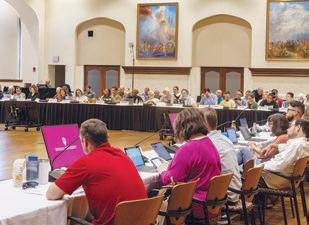
Members of the Bloomington Faculty Council meet Oct. 1, 2024, in Presidents Hall. Indiana University announced it will discontinue Intensive First-Year Seminars (IFS).
The push for Middle Eastern, Muslim Culture Centers
By Samantha Camire scamire@iu.edu | @CamireSamantha
Despite years of e ort from students, IU remains without a cultural center for Muslim and Middle Eastern students.
e university supports seven culture centers and institutes – the Asian Culture Center, First Nations Educational and Cultural Center, Jewish Culture Center, La Casa Latino Cultural Center, LGBTQ+ Culture Center, Neal Marshall Black Culture Center and the African American Arts Institute.
But to some students, the current lineup has glaring omissions.
Students have been advocating for several years for the creation of new culture centers for the Muslim and Middle Eastern communities. e O ce of the Vice President for Diversity, Equity and Inclusion, which oversees the existing culture centers, touts the culture centers as “community learning spaces, providing an array of unique programming and events” and describes them as “a home away from home.”
Students believe that new Muslim or Middle Eastern centers would similarly provide a safe space for students on campus and o er built-in advocates.
“I think it would be another place where I could feel more engaged on campus and more included and I think it could be a really good space for IU to start those conversations and make sure that their Muslim and Arab students also feel welcome on campus,” Hafsa Khan, a junior studying biology and environmental science, said. Despite past talks with IU, little progress
Last year, Khan served as the president of the Muslim Student Association (MSA). She said she was involved in several conversations, in partnership with the Middle Eastern Student Association, with the O ce of the Vice President for Diversity, Equity and Inclusion about the
creation of new culture centers. Khan says they spoke to both James Wimbush, the former vice president of DEI who stepped down from the position in July to return to a faculty role, and Rashad Nelms, the current vice president for DEI. Despite these talks, which Khan says began back in 2022, no progress has been made.
“Everything that I’ve been a part of has been more like, ‘this is something that we hope is gonna happen,’ but it doesn’t seem like there’s a lot of motion of how it’s going to happen,” Khan said.
e O ce of the Vice President of Diversity, Equity and Inclusion declined the IDS’s multiple requests for interviews but said in an email that “IU is constantly assessing needs and adapting resources to best ensure support for members of the campus community.”
Other groups also believe creating new culture centers is important.
e IU Divestment Coalition and Palestine Solidarity Committee, which formed an encampment in Dunn Meadow for 100 days Spring 2024 in protest of the Israel-
Hamas War, listed the establishment of Muslim and Middle Eastern Culture Centers as one of their demands from the university on a petition.
Establishing a new culture center is also a priority for the FUSE administration, which currently leads IU Student Government. In campaign materials last year, FUSE pledged to form a Middle Eastern, North African and Muslim Culture Center in its rst 100 days in o ce.
ough those 100 days have now passed without any action, the administration says it remains committed to establishing a new center.
Alexa Avellanada, executive secretary of communication for IUSG said in an email that IU administration is withholding an audit report of the existing culture centers.
“Due to the IU administration’s withholding of the audit report, there have been numerous unexpected delays. What we were told is that a new culture center cannot be established while an audit is being written or reviewed,” Avellanada wrote in an email. “ e FUSE administration, because of this,
has their hands tied, but we continue to advocate strongly for the new culture center’s establishment.”
e O ce of the Vice President for Diversity, Equity, and Inclusion con rmed the existence of such a report but said it “remains condential and deliberative,” according to spokeswoman Elizabeth Blevins.
One di erence between the advocates is their vision for the culture centers. Khan believes there should be two separate culture centers, one for Middle Eastern students and one for Muslim students. She said most Muslims in the world are not Middle Eastern, and so a distinction between the two centers is important. Avellanada wrote that although the FUSE administration has been advocating for a joint center, they “would gladly accommodate to the student body.”
Benefits of a center Students envision a culture center as a place of education and community.
Khan hopes for a Muslim cultural center that offers education for both the university as a whole and
for the Muslim community. She described an “Ask a Muslim” tabling event that MSA held last year, in which they o ered free chai tea and invited students to ask any questions they had about the Muslim faith, as a vision of the types of events the center could hold. She also described education for Muslim students on their resources at IU, such as how to report bias incidents.
Khan said she sees a lot of value in having IU sta members at a campus culture center who can advocate for the needs of students in that community. Khan said she had to nd a quiet corner of the Biology Building to pray because there was nowhere else for her to go. ough there is an Interfaith Prayer Space at the Indiana Memorial Union, she believes students deserve more options.
“If we had a Muslim Culture Center, they’d have sta and people that work for the university that can be advocates of like, ‘hey in some of the bigger spaces, like in the bigger spaces on campuses… there should be a little space for students to pray,’” she said.
Imran Mihas, who is on the executive board of both MSA and the Middle Eastern Student Association, described a vision for mentoring programs, in which older Middle Eastern students are paired up with underclassmen just arriving at IU. He says this would be particularly helpful for younger students who are struggling to nd a community on campus.
Student groups bridge the gap
Until a Middle Eastern or Muslim culture center can be established, student organizations are trying to ll the void. MSA and MESA do their best to support students on campus, often serving as both social groups and advocacy groups, Khan and Mihas said.
MSA has an o ce in the Student Involvement Tower that is “doing overtime,” Khan said, functioning as an o ce, gathering space and prayer room all in one. “ ere are a lot of culture centers already on campus, and we kind of have to congregate with ourselves at just random areas,” Farah Rafa, the vice president of MESA, said.
Without clear gathering spaces, students in MESA often gather in a free room at the Student Involvement Center intended for use by all student organizations. On one Wednesday afternoon, the room was full, with at least 25 students of Middle Eastern descent, studying and socializing in what is essentially a makeshift culture center.
“We’re trying our best to create a good community, but there’s only so much we can do as student orgs,” Rafa said. All three student leaders believe creating Middle Eastern and Muslim culture centers on campus would be a welcome resource for students in these communities. “ ere are so many culture centers already and I just think that we’re deserving of one as well,” Rafa said.
Your
ILLUSTRATION BY JULIETTE ALBERT
Indiana Public Media reported Monday that the Journal of Telemedicine and Telecare, which published Whitten’s 2006 paper, is investigating it for plagiarism.
Since the publication of the Chronicle’s story, a change.org petition calling for the University of Kansas to rescind Whitten’s 1996 doctoral degree has received over 120 signatures.
“Students get reprimanded harshly for plagiarism,” one comment on the petition read. “It’s a part of the syllabus of every single class. It’s been ingrained since I started school that cheating, copying, and plagiarism is never okay. Yet, we’re going to let our university president walk away scott free? I don’t think so.”
Universities’ de nitions of plagiarism can vary.
“Students get reprimanded harshly for plagiarism. It’s a part of the syllabus of every single class. It’s been ingrained since I started school that cheating, copying, and plagiarism is never okay. Yet, we’re going to let our university president walk away scott free? I don’t think so.”
Comment from petition calling
Kansas’ 1996 university senate rules and regulations considered plagiarism as both academic and scienti c/scholarly misconduct. It doesn’t de ne what’s considered plagiarism. e university did not respond to the Chronicle’s request for comment, but its current rules state research misconduct claims older than six years old won’t be investigated, with some exceptions:
If circumstances indicate the misconduct couldn’t be identi ed earlier
If the original author continues to republish, cite or otherwise use the work in question
If the work would have an adverse e ect on public health
An IU website says seven or more words in a row lifted from a source without quotation marks, a full in-text citation with a locator or reference would be classed “word-for-word plagiarism.” One plagiarism expert told the IDS that seven words is “really a short amount.” But another said the chances of two people repeating the same sevenword sequence multiple times are small.
e IDS sorted the more than 50 instances of potential plagiarism between the dissertation and paper — from 25 individual sources — into six informal categories:
Seven or more words, word for word, in line with IU’s policy
• An attributed quote immediately followed by a quote without quotations or attribution
• Misattribution, which is attributing to a primary source but using language from the secondary source Self-plagiarism, which is taking text from the author’s past work and not attributing it properly
• Attribution to a secondary source instead of primary source
Unattributed
e IDS provided examples from these categories to three plagiarism experts over the course of several months. is is what they had to say:
A ‘gray area’
Jonathan Bailey is a plagiarism expert who runs the website Plagiarism Today and has provided commentary on multiple high pro le plagiarism allegations in academia. In a September interview with the IDS, Bailey
said two instances were not particularly compelling examples of plagiarism. In one, Whitten pulled seven or more words, word for word, from a book by Charles Goodwin and Alessandro Duranti.
“So many cases exist in a gray area where two reasonable people can look at the same facts and draw di erent conclusions, including experts in the same field.”
Jonathan Bailey, plagiarism expert
In another, she quoted a section from Robert Yin’s “Case study research: design and methods,” attributed the quote to him, then followed that with more text from Yin but without quotes or attribution. Bailey said the latter example appeared “sloppy,” rather than like a deliberate shortcut.
In two examples the IDS categorized as “misattribution,” Whitten attributed to sources that Perednia and Allen used but copied the two authors’ language. One section repeats over 90 words from Perednia and Allen, attributing to them for part of the paragraph near the end but not all of it. e IU plagiarism website says more than seven words word for word without quotation marks, even with an attribution, is word-for-word plagiarism.
Bailey said these were a “fairly serious issue” he’d expect to be corrected at the very least, though someone would have to determine if it had an impact on the dissertation research before making a decision. In Kansas’ most recent university senate rules and regulations, it outlines a process for adjudicating both academic and research misconduct.
e citation attributed to a secondary source rather than a primary source seemed accidental rather than intentional or reck-
less, Bailey said. He said the era Whitten wrote the dissertation in, prior to digital research being common, added to the challenge of writing academic work.
“ at said, the author of a dissertation still has a responsibility to make sure their citations are correct and in line,” Bailey said.
He said what is considered plagiarism or not is dependent on the space it’s written in — journalistic attribution, for example, has a di erent standard than academic writing.
“So many cases exist in a gray area where two reasonable people can look at the same facts and draw di erent conclusions, including experts in the same eld,” Bailey said.
Expert warns of ‘weaponization’ of plagiarism
Susan Blum is a cultural, linguistic and psychological anthropologist and professor at the University of Notre Dame. She wrote the 2009 book, “My Word! Plagiarism and College Culture.”
In October, Blum told the IDS she was concerned with “weaponizing plagiarism accusations for political reasons,” regardless of the political a liation of the target or accuser.
“I think that academic leaders should be exemplary in every way, but they are also human. Unless we are subjecting everybody to the same scrutiny, I don’t think it’s good practice to raise this selectively.”
Susan Blum, cultural, linguistic and psychological anthropologist
Many plagiarism accusations in academia have been levied at Black faculty and administrators, including former Harvard University President Claudine Gay. A conservative media organization, the Daily Wire, alleged in September
that Maryland President Darryll Pines plagiarized two papers he co-authored. Both Gay and Pines are their universities’ rst Black presidents.
“I think that academic leaders should be exemplary in every way, but they are also human,” Blum said. “Unless we are subjecting everybody to the same scrutiny, I don’t think it’s good practice to raise this selectively.”
She said she questioned why people would be looking at the author, Whitten, in this particular moment. If it’s for a political reason, it would be an easy way to “score points” against a gure they don’t like. ese people, Blum said, don’t actually care about academic integrity.
Whitten has garnered criticism in the past year for the university’s cancellation of a Palestinian painter’s art exhibit, its decision to call Indiana State Police to arrest pro-Palestinian protesters in April and its enforcement of the new Expressive Activity Policy, among other reasons. A faculty vote of no-condence passed with 93.1% of the vote and multiple rallies have since called for Whitten’s resignation or termination.
Blum said she’s a “stickler for precision and honesty.” But that, she said, involves addressing the circumstances in which the accusations are raised.
Whitten’s dissertation ‘hard on the borderline’ Debora Weber-Wul is a retired media and computing professor at the HTW Berlin, a German university. She said she’s been researching plagiarism since 2002 when her students submitted papers in English — too good of English. About a third of those papers were plagiarized, she said.
Weber-Wul wrote an elearning unit on detecting plagiarism in journalism and published her book, “False Feathers: A Perspective on Academic Plagiarism,” in 2014. She documents plagiarism online
with the German group, “VroniPlag Wiki.” Weber-Wul favors a plagiarism de nition from Teddi Fishman, former director of the International Center for Academic Integrity. Fishman de nes plagiarism as when someone “uses words, ideas, or work products” without attributing to its source when there is a legitimate expectation of original work. is is done so the authors of the new work can gain some bene t that’s not necessarily monetary.
“That said, the author of a dissertation still has a responsibility to make sure their citations are correct and in line.”
Jonathan Bailey, plagiarism expert
In November, WeberWul compared identifying plagiarism to identifying if a man is bald.
“It’s very clear when he is, and it’s very clear when he’s not, but there’s not a question of ‘one more hair and now he’s bald,’” WeberWul said.
Unlike Blum, WeberWul does not care where the plagiarism accusation originates from or why.
“If it’s plagiarism, it’s plagiarism,” she said. She said misattributed quotes happen all the time and are wrong. In the case of a doctoral dissertation, more than two examples may warrant an investigation. A doctoral dissertation as opposed to a master’s thesis, Weber-Wul said, should be original research. She said the unattributed examples of plagiarism were “beginning to be problematic” but no university would withdraw a doctorate for them alone. Based on the examples provided by the IDS, Weber-Wul said “they’re hard on the borderline.” But she said if there were similar examples found across Whitten’s work, then it would be more di cult to call them honest errors.
for the University of Kansas to rescind Whitten’s 1996 doctoral degree
ACTION wins popular vote in IUSG election
By Kendall Geller kmgeller@iu.edu
e ACTION for IUSG ticket won the 2025 IU Student Government executive election, according to preliminary results released by IUSG Election Director Jack Tyndall March 6. ACTION for IUSG received 54.38% of the total vote, while the second-place ticket, EMPOWER for IUSG, received 45.61%.
Sophomores Zach Goldberg and Ava Smith make up the ACTION ticket and emphasized three core pillars during their campaign: safety, community and success. President-elect Goldberg is the current secretary of federal relations under the FUSE administration, while Smith is new to IUSG but is involved in Greek life and IU Dance Marathon. ACTION’s platform included hosting IUSG-sponsored events to increase its campus presence and expanding sexual assault prevention resources. ey also claimed to support measures bolstering nancial accessibility, such as improving access to course
materials and advocating for federal funding opportunities like Pell Grants by meeting with U.S. Congress representatives. A more detailed version of their platform can be found on the o cial policy document linked on their Instagram, @actionforiusg.
Tyndall released preliminary voting results on the IUSG website just after 10 p.m. March 6, a little over 24 hours after voting closed March 5. In a statement on the IUSG website, Tyndall said there were 5,389 votes cast in the election, “a huge increase” from last spring.
Tyndall said in an email that IUSG bylaws require him to publicize results within 48 hours of the end of the voting period; however, these results are not nal and are subject to change pending certi cation by the IUSG Supreme Court. is certi cation will take place prior to the inauguration April 15, where the chief justice will swear in the president-elect and vice president-elect.
is story was originally published March 6, 2025.
Jimmy John’s Friday
By Samantha Camire scamire@iu.edu | @CamireSamantha
It’s Friday and for IU sophomore John Broadwell, that can only mean one thing: Jimmy John’s.
Jan. 17 marked week 77 in John’s quest to have a weekly Jimmy John’s sandwich. He gets the same thing every time.
“A No. 5, no onions.”
John’s love for Jimmy John’s is so deep-rooted it has become part of his weekly routine, a natural commitment he documents with a weekly sel e on his Instagram story. Not only does he make weekly trips to the store for his go-to order, he often arrives dressed in Jimmy John’s-branded clothing. And in a digital art class freshman year, he made every one of his projects themed to his favorite sandwich shop.
“I always encourage them to consider having a consistent theme to work with; a lot of people might explore grief or something of that nature, or sustainability,” professor Dominick Rivers, who taught the course, said. “And he came in and was like, ‘Jimmy John’s it is.’”
John’s rst project was a Photoshop piece of the discovery of the No. 5 sandwich — with no onions, of course.
After it was nished, his professor encouraged him to print it out and give it to the employees of his go-to Jimmy John’s.
“We got it framed, it was in the store right above their ice cube machine for a few months,” John said.
Next was a 3D virtual reality world with a Jimmy John’s temple and a website that laid out a conspiracy theory surrounding the creation of Jimmy John’s.
John printed out all the projects he created that semester and compiled them on a bulletin board that hangs directly across from the front door of his apart-
ment.
“My conspiracy board, yeah,” he said, explaining his ctional Jimmy John’s lore.
John’s ctionalized version of history begins in 1450 with the discovery of the No. 5 by Spanish conquistadors, who then disappeared.
In the 1960s, John imagined, the CIA began to work with a Jimmy John’s competitor, Anthony Bolognavich, to replicate the magical life-giving properties of the sandwiches.
“And they don’t want you to know this,” John said. “But Jimmy John is that original conquistador. He’s lived for hundreds of years, sustaining himself on the power of his magical sandwich.”
John’s own Jimmy John’s story began during his senior year of high school. He was a wrestler and with every win, he would head to his favorite sandwich shop with his friends to celebrate. When he made it to Indiana state wrestling nals in the spring, his family made cus-
tom shirts with his name, school mascot and — of course — a Jimmy John’s sandwich. So, it was only natural for him to turn to a familiar favorite once he came to IU.
Each Friday, John crossed the street from his Eigenmann Hall dorm to the tiny 10th Street Jimmy John’s for a sandwich to celebrate the end of the week.
On Aug. 11, 2023, he posted a sel e of himself at the black plastic table outside the store, holding a wrapped sandwich with the caption “ rst o cial Jimmy John’s Friday went swimmingly.”
“I think I said it almost ironically,” John said. He certainly didn’t think it would become a weekly tradition. But for 77 weeks, he has kept up the gig. He almost always goes on a Friday and always gets that famous No. 5 sandwich, the Vito.
“ at’s what I’ve always gotten. When I was a lad, when I was like eight, my mom picked it out for me, and I like it,” John said.
“ at’s what I’ve just been doing ever since.”
He often invites friends to eat with him, but none have remained as devoted as he has. He admits his girlfriend, while “supportive,” doesn’t particularly like Jimmy John’s.
“Personally, I like Subway,” Brooke Roessler, his girlfriend of a year and a half, said.
And even a sandwich superfan like John doesn’t always crave his favorites.
“I won’t lie, sometimes it’s tough,” he admitted. “But for the most part, my love of Jimmy John’s has stayed pretty consistent.”
On one sunny Friday in December, John arrives at Jimmy John’s around 1:05 p.m. He’s not wearing his signature red Jimmy John’s shirt or even his branded Christmas sweater, but he is still dressed for the occasion in a red zip-up and black shorts.
He orders his regular, paying $6.47 before sitting down at the high top with his sandwich. He unwraps the paper to reveal salami, capocollo and provolone, topped with lettuce, tomato, oil, vinegar and oregano-basil, on freshly baked French bread.
“I think that’s the biggest thing that separates them from other competitors,” John says. “Beautiful, beautiful bread.” He speaks with wisdom, nodding as he expounds on topics from the Jimmy John’s rewards program to the controversial Picklewich. Soon enough, he nishes his sandwich and heads back out to his car. But he’ll be back; John doesn’t
on the go!
IU Credit Union members enjoy:
• Full-Service Branch at 17th & Dunn
• Online Banking & Bill Pay
• Mobile Banking* with Mobile Deposit (and touch ID for phones with touch ID capability)
• Online Loan Applications
• Free Checking
• Nationwide ATM Network
• And so much more! Open your account at any branch or online: *Message and data rates
JACK FORREST | IDS
The IU Student Government logo is pictured on a sign Sept. 30, 2024, in the IUSG o ce in the Indiana Memorial Union. The 2025 election results were announced late March 6, with the ACTION ticket winning.
COURTESY PHOTO
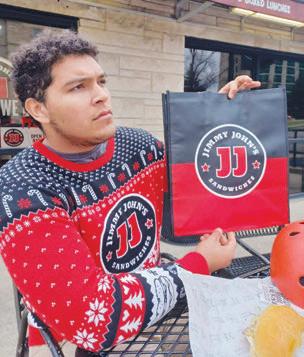
John Broadwell poses with a Jimmy John’s sandwich bag. He went to
Jimmy John’s weekly for 77 weeks straight.
Community members attend IU Women’s March
By Ella Curlin and Deshna Venkatachalam elcurlin@iu.edu devenkat@iu.edu
Freshman Maggie Williams attended her rst march in 2017 when her mom took her to the women’s march in Indianapolis.
“I stood in that day hoping and praying that I would not have to worry about the things that I was being told and listening to,” Williams said. “I’m still here. I’m 19, and I’m still worrying about them.”
On March 9, over 70 people gathered at Showalter Fountain for the IU Women’s March. Williams, organizer of the demonstration, collaborated with eta Nu Xi, Women in Government, Girl Up at IU and IU Student Government to plan the event focused on community and solidarity.
Williams began planning the march in December
when she started feeling a sense of helplessness following the 2024 election. She pitched the idea of a women’s march to multiple campus organizations, and since then, she’s regularly met with student leaders to arrange details.
Local bands Bachelorette and Opal performed live music and Pili’s Party Taco brought in a food truck. Club booths o ered supplies for attendees to make posters.
Some demonstrators carried signs advocating for transgender rights, abortion access, equal pay and other political causes.
“Equal pay, cause we slay,” one read.
Junior Graciana Leonard, one of the attendees, held a sign reading, “Women’s rights are human rights” in pink and purple lettering.
Leonard said the state and federal governments are challenging women’s rights.
“I think it’s important to understand that reproductive rights are human rights for women,” Leonard said. “It’s not just a women’s issue; it’s a human right’s issue.”
After performances from the live bands, Williams introduced a speech from senior lecturer in the international studies department Nicole Serena Kousaleos, whose research has focused on gender violence and human rights.
Kousaleos encouraged attendees to speak out for women’s bodily autonomy.
“It is time to stand up and stand together, to stand shoulder to shoulder, to challenge the broligarchs who want to shut us up and tell us, ‘Your body, my choice,’” Kousaleos said.
Students Lucy Schoettle and Casey Krusch also advocated for bodily autonomy with signs protesting anti-
abortion laws.
In August 2023, Indiana implemented Senate Enrolled Act 1. SEA 1 eliminated all state licensure of abortion clinics and required abortions to be performed in licensed hospitals instead. Additionally, the law placed limits on who has access to abortion services.
Abortions are only permitted if the procedure is necessary to prevent any serious health risk to the pregnant individual, or if the fetus is diagnosed with a lethal fetal anomaly, up until 20 weeks post-fertilization.
Abortions are also permitted until 10 weeks if the pregnancy is result of rape or incest.
Gigi Rivera, co-president of WIG, helped plan the women’s march. In 2022, Rivera protested Indiana Attorney General Todd Rokita’s visit to campus. His visit included a discussion of In-
diana’s near-total abortion ban.
Rokita has an extensive anti-abortion campaign, including co-leading a multistate coalition defending a Georgia law prohibiting most abortions after heartbeat, which usually occurs about 5-6 weeks after conception.
“By helping preserve pro-life laws in other states, we can prevent precedents that might endanger pro-life laws here in Indiana,” Rokita said in a December press release.
Rivera said protesting Rokita’s 2022 visit inspired her to aid in planning this event, which she saw as an opportunity for community building on campus.
“We want women to feel like they have a community at this campus, in this town, as well as that they still take up space,” Rivera said. “ ough there have been a
lot of messages that discourage this in our government and our news recently, we all stay together.” Williams’ mother and grandmother both attended the march to support her.
Mary Pat Sharpe, her grandmother, was also politically active in college and hopes that advocacy for women’s rights won’t continue to be necessary.
In the meantime, Williams hopes to create a committee or club that continues this kind of advocacy.
“I would not be standing here today if it weren’t for the e orts of the women that came before me. ose who stood up, never backed down and took blow after blow in an e ort to get you all here to where we are today,” Williams said. “I will not go back.” is story was originally published March 10, 2025.
DESHNA VENKATACHALAM | IDS
A crowd gathers to shout chants about women’s rights and bodily autonomy March 9, 2025, at Showalter Fountain in Bloomington. IU freshman Maggie Williams organized the IU Women’s March.
Morty came to the Bloomington Animal Shelter with 67 other dogs from a seizure in 2023.
Now, he’s the last one waiting on adoption.
By Mia Hilkowitz
| @MiaHilkowitz
mhilkowi@iu.edu
e rst thing Michael Clarke noticed as he stood in front of the Bloomington home was the smell of skin infection.
With his rst steps inside, the animal control o cer also quickly picked up the smell of feces. Of urine. Of ammonia. His eyes watered as he moved further into the home.
Stepping over the straw and excrement covering the oors, Clarke looked at the chaotic scene in front of him — and dozens of dogs stared right back at him.
Some of the dogs, mostly Carolina dogs, sat in wired cages. Others strode throughout the two-bedroom house, their eyes tracking the ocers as they walked across the room. In the kitchen, a large male Carolina dog with pointed ears paced back and forth. His black fur coat was marked by light brown on his paws, chest and face — two small patches above his eyes almost resembled eyebrows.
ough his path was somewhat obstructed by a wire cage, he walked, panicked, close to where another dog lay under the sink with her litter of puppies.
Clarke put a pile of nylon rope leashes down on a kitchen counter. He’d start by trying to take this dog out of the house rst. But as he slipped the leash over the dog’s neck, the Carolina dog dropped to the ground. He started alligator rolling and pushed away.
“He will be di cult and may bite, none of them have ever been on leashes,” the homeowner told o cers.
It took several o cers to carry the dog, ailing, out of the house and into a plastic carrier waiting to transport him to the Bloomington Animal Shelter. ough the homeowner had given ofcers names for some of the dogs as they brought each one out, others didn’t have names yet and the animal
shelter would rename many of them. As o cers coaxed the dog into a carrier to transport him back to the shelter, there were 67 dogs waiting back in the house — assigning each dog a number would have to sufce for a short while. e ocers made a note and headed back in to the house. Dog number one was accounted for. Now just 67 more.
Every day, animal shelter and control representatives in Bloomington and across the country see the harm humans can in ict on animals.
Maybe a resident, struggling with mental health, accumulates more animals than they can feasibly take care of, crowding dozens of pets into a single room. Sometimes a family decides their lifestyle is incompatible with a young, energetic puppy and turns it into an over owing shelter. In some cases, animal control nds an animal already deceased, physically abused by a previous owner.
e Bloomington Animal Shelter was already nearing capacity when animal control and local police seized 68 dogs, mostly Carolina dogs, in March 2023 from what people familiar with the case described as the largest animal hoarding complaint ever received in Monroe County. In every case, the shelter tries to heal some of this harm. But these 68 dogs tested this ability. Perhaps no dog tested this more than this rst dog, who now goes by a di erent name: Mortimer (but many call him “Morty”).
Almost two years after the initial seizure, the rest of the Carolina dogs have slowly disappeared from the shelter’s list of adoptable animals — a sign of success. But though he was the rst one taken out of the house by animal control, Morty’s page remains, the last of the dogs from the seizure waiting on
Mortimer Ocatvius, or “Morty,” looks at his dog friends playing outside while he stands just outside the doorway of his foster mom, Casey Green’s, house Oct. 5, 2024, in Bloomington. Casey said
adoption. It’s left those close to him wondering: can they help him nd a home?
***
Clarke had started his job at Bloomington Animal Control a month and a half before a woman called his department to deliver a complaint that, at rst, didn’t seem like anything out of the ordinary.
She had purchased a dog from Robert Pryor, who was living in a two-bedroom home on North Adams Street. She told animal control she could smell feces and urine from the home’s front yard.
Animal control and the Bloomington Animal Shelter had heard of Pryor before. In years past, he had lived just outside of Monroe County. From 2018 to 2023, the shelter received at least 10 dogs associated with him. But because he lived outside of Bloomington municipal limits, there wasn’t much they could do. e shelter also wasn’t a stranger to animal hoarding and neglect situations. Even in Bloomington, which had an ordinance banning the retail sale of cats and dogs until
the state legislature voided it this year, animal neglect is prominent. A shelter representative said animal control o cers respond to several thousand calls — ranging from reports of neglect, to stray animals to animal infestations — each year.
After receiving the complaint March 8, 2023, O cer Clarke and another animal control o cer approached the home, unsure of exactly what they would nd. Immediately he noticed dirt buildup on the home’s windows, trash bags of dog food in the yard and insects ying around the property.
After a few knocks, Pryor opened the front door.
Clarke told Pryor he would need to ll out the proper litter and boarding application to keep the animals in his home — and that he would need to schedule a required home inspection. ey wanted to give him a chance to keep his breeding business. Pryor, who o cers and shelter representatives described as very cooperative and helpful, agreed. Pryor also told o cers he planned to bring some of the dogs to a Carolina dog rescue in South
Carolina that month. e animal control ofcers didn’t enter the home their rst visit. But before Pryor closed the door, Clarke noticed three Carolina dogs peering out at him.
Carolina dogs are a relatively rare breed that are usually found living near the Georgia-South Carolina border, according to the American Kennel Club, a not-forpro t dog breed registry. e dogs are hesitant with strangers but adopt a pack mentality.
Over the next few days, o cers communicated with Pryor over the phone and email. In an email, Pryor gave o cers a list of seven adult dogs and 12 puppies that he planned to register. en, ofcers scheduled an animal permit home inspection for March 16, 2023. By the day of the scheduled home inspection, animal control and the shelter suspected the number of animals at 227 N. Adams St. was much higher than the list Pryor gave them — especially when a man arrived to the shelter the day of the inspection with a U-Haul carrying 10 dogs in wire cages, most with skin infections and urine scalding. Pryor had asked him to hide the dogs until ofcers nished the home visit, the man told animal control. e rst day o cers entered the home for the inspection, they tallied 50 dogs and puppies — but the number rose to 68 when o cers returned the next day to ocially remove the animals. During the initial inspection, o cers took photo evidence of the home and wrote a davit statements to obtain a seizure warrant, which judge Mary Ellen Diekho signed. However, when ocers reached out to Pryor, he said he would rather freely sign over all the Carolina dogs to the shelter.
***
When Morty and the other
dogs arrived at the shelter March 17, 2023, it was staggering.
In addition to arriving with skin infections and urine scalding, one of the dogs from the seizure, a dachshund, was in poor health and the veterinarian recommended euthanasia. Emily Herr, an outreach coordinator who has worked at the shelter for 17 years, said she has seen seizures where the dogs were in much worse physical condition. But Morty and the other dogs posed what she believes is a bigger challenge for a local shelter: behavioral issues. Many of the dogs’ behavioral issues manifested as soon as o cers entered the home for the seizure. Some of the dogs seemed uncertain or scared to see a human being, Clarke said. Others, like Morty, were terri ed of leashes. For a small shelter with only 20 people on sta , these challenges could be much more time-intensive and tougher to address than infection.
After they placed as many dogs as possible in foster care, shelter sta identi ed eight dogs who were “struggling behaviorally the most.” Morty was at the top of this list. Herr said he could not even lift his head to look at the sta and volunteers who tried to meet him. Morty, like all the at-risk dogs at the shelter, received a team of four people. eir objective? To help Morty reach small goals — goals that might appear natural to other canines. One of Morty’s goals was simple: to wear a collar. eir strategy all depended on Morty’s love for cheese whiz. First, a sta member would put a collar on Morty. en, before he could think about his new accessory, they would give him some cheese whiz to eat, drawing his attention away. en, they would take the collar o . And repeat. “He had very small goals in the beginning,” Herr said.
● ● Learn Russian, Bosnian/Croatian/Serbian, Czech, Polish, Ukrainian, & Romanian—languages emphasized by the National Security Education Program (NSEP) ● ROMANIAN
● Department of Slavic & East European Languages and Cultures (SLAV)
● Enjoy small, friendly classes
Enhance your major with professional proficiency in a less common language
Checkout ourcourses under SLAV for Fall 2025: slavic.indiana.edu ● 812.855.2608 ● iuslavic@iu.edu
BRIANA PACE | IDS
Morty is her longest-term foster, but she can’t keep him because of her job and the possibility of moving.
“But piece by piece, they all ll in and make almost a real dog.”
Slowly, Morty came to accept the collar and would take on a new goal. But while Morty made progress, some other dogs regressed. Herr said the shelter was forced to euthanize three Carolina dogs who became “o ensively aggressive,” trying to bite people with the intention to harm — something that can be dangerous for shelter sta and potential foster and adoptive families.
e Bloomington Animal Shelter never turns away an animal and will hold an animal for at least ve days. After that, the shelter gives animals a behavior and health evaluation. Many of the animals can be adopted or fostered, but if an animal is too sick, injured, aggressive or “behaviorally unsound” the shelter considers euthanasia, stating it “believes that euthanasia is the most humane alternative to an existence of su ering and pain or being limited to life in a cage.”
“ ose were really, really hard decisions because obviously we want to take animals from a situation like that and give them a better outcome and regardless, I still do think we did,” she said. “We could at least provide them with a clean space to rest and food and water and fresh air. And though they didn’t want our love, we still love them.”
In March 2024, Indiana Gov. Eric Holcomb signed House Enrolled Act 1412. e law voided local municipal ordinances that banned retail dog sales in Indiana — including Bloomington’s own ban on the retail sale of dogs. Critics argued the legislation protects inhumane puppy mills and commercial breeders. e law will also make commercial dog breeders subject to random Indiana Board of Animal Health inspections starting July 1, 2025. If breeders do not register with the Board of Animal Health, they can face a Class A misdemeanor charge.
However, Herr said many hoarding and breeding situations are not always straight-
“I think the biggest misconception is that these people are monsters, and that’s just not the case,” Herr said.
“When we look at people who end up in hoarding situations, it’s oftentimes a symptom of a much bigger problem that they’re having. You know, there’s a lot of mental health issues that they’re struggling with, there’s a lot of nancial issues that they’re struggling with.”
Herr said she felt Pryor was unfairly targeted after the seizure, including when a broadcast news team started taking video of Pryor’s home.
“I do think there were some ethical issues happening, but he was very cooperative, he was very kind,” Herr said. “And he became a target in Bloomington. Even though the things he did were not great, people did not treat him with any kind of respect at all.”
Both Clarke and Herr said they believed Pryor did care for the dogs — that he thought he was helping protect the Carolina breed. Clarke said when one of the Carolina dogs escaped from his original foster home, Pryor had called the foster o ering to help nd the dog. He o ered to send the foster parent a voice recording of himself talking to get the dog to come back.
“What kind of ‘monster’ would reach back out like that and o er help?” Clarke said. “ at’s not a bad person, that’s a person with a great heart who still cares, you know, and just wants to do right. He wanted to make sure that those animals succeeded, and he thought he was doing that. He thought he was saving the breed.”
After the seizure, Pryor faced two di erent legal cases. In the rst, he faced a civil charge for violating Bloomington’s local animal care ordinance, but this charge was dismissed. He was later convicted of a Class A criminal misdemeanor for cruelty to an animal. He was sentenced to 180 days in the Monroe County Jail — but this term was suspended — and 180 days of unsupervised probation.
Pryor could not be reached for comment
through a phone number associated with him.
***
Although he came to her with the name “Mortimer,” Casey Green, Morty’s foster mom, thinks his middle name, Octavius, is more tting for the canine. Green assigned him the name, which he shares with a Roman emperor, when he started to come out of his shell this past year.
“He’s an Octavius,” Green said. “He’s regal, you know. at just stuck.”
And one day in mid-September, Morty was living up to his courageous name: by leaving his bed in the kitchen to catch a glimpse of the stranger standing in his living room.
He started by peeking his head around the kitchen doorframe. Only for a second, though — he didn’t want the stranger to see him. And he succeeded: by the time his visitor looked in his direction, Morty was already gone.
But it wasn’t good enough. His foster sister, Eleanor, was barking — what if she needed his help? He obviously needed another quick peek around the doorframe. is time he waited for a few seconds longer before bolting away.
Still, he wanted to know more. So, Morty continued his game of cat-and-mouse for the next 30 minutes, stuck between his curiosity and trepidation, before nally retiring back to his bed. Maybe he’d try again later. For another dog, the task might be easy and an opportunity to snag a few treats and pets. But for Morty to even look at the newcomer from a distance, Green said, was “brave.”
Before coming to Green, Morty was in one other foster home for a few weeks. While he made signi cant progress in the shelter setting, Herr said they didn’t want to keep him there for long. at’s when the shelter asked Green if she would be interested in taking him in. Green was known among the shelter as one of the best animal foster parents in Bloomington. She’s fostered around 130 dogs — mostly puppies
MANAYYWS
— since she was in college. She’s fostered lots of dogs with complicated histories. Sometimes she takes in puppies whose “mama dog” has tried to attack her litter. She’s fostered Pitbulls, mutts and designer breeds she thinks “shouldn’t exist” due to their con icting health and behavior qualities — like “mastodor” named Mabel, whose family surrendered her to the shelter after refusing to bring her into their RV on a camping trip.
Before welcoming Morty, she fostered two other Carolina dogs from the seizure: Eleven and Kaia. Eleven’s adoptive parents, Karen and Mike Kelley, call Green the “kibble fairy,” because she hand-feeds all her animals.
e Bloomington Animal Shelter brought Morty to Green’s house in December 2023. Usually, Green would pick the animal up at the shelter, but she didn’t have a car at the time and Morty was too large for her to transport by herself. When Morty got there, he was covered in feces (a “panic poop,” as Green described it). It was obvious he was scared. at was nothing new for her. She sat on her kitchen oor with Morty, as he avoided her gaze and tried to push himself against the walls of her kitchen. He didn’t know Green and likely didn’t know why he was in this unknown house. e presence of another animal, a curious hound-mix named Eleanor, who was separated from him by a baby gate, probably wasn’t clearing up the situation.
It took a few days after this rst introduction, but he eventually started to explore his new home. He sni ed the kitchen oor thoroughly and started to look through a glass panel on the kitchen door that led to Green’s backyard. Slowly, he started to venture out more — into the living room, into Green’s bedroom. Eventually, the baby gate blocking him from Eleanor came down.
A few weeks later, Morty decided to try something he’d seen Eleanor doing: playing with a toy. While Green was at work, he experimented with a dinosaur squeaky toy. He wasn’t exactly sure what
to do as he approached the toy lying on the kitchen oor. He picked it up and started swinging his head, before accidentally letting go and launching the toy into the kitchen sink and hitting some dishes — a fun surprise for Green when she got home that night. His con dence grew even more when he met one of his rst friends: a Pitbull named Bronson. Green was watching Bronson, one of her former fosters, for a few weeks when the two rst met, as Bronson pummeled into the kitchen and took a “play bow” stance. Unsure of what to do, Morty imitated him, awkwardly trying out the stance himself. Luckily, Bronson didn’t care about Morty’s hesitancy and started playing with him anyways. Bronson was the one who got Morty to go outside for the rst time in May 2024. Bronson was playing with Eleanor and Morty, and he ran outside into the backyard. Swept up in Bronson’s energy, Morty followed, stepping outside into the backyard full of scattered tennis balls, water guns and lawn chairs. While he’s started to feel more con dent going outside in the months since, sometimes he still needs an extra push. And one day in October, Green and four other canine companions — Bronson, Penelope, Sierra and Eleanor — were giving him that push. Morty was presented with a new challenge: go outside with ve people (three of whom were strangers) to play with his closest friends. At rst, Morty considered it too much to overcome — he would just stay in the kitchen. But as he looked out through a window at the game of fetch going on outside, he decided to give it a shot. First, in his usual manner, he started with a quick look outside the door to assess the situation. It seemed like the other dogs didn’t mind the new people, but he couldn’t be too sure. He’d watch for a little while longer.
e dogs ran back and forth from the kitchen to backyard, as if begging him to come outside. en, Morty, suddenly caught up in the energy, ran outside, jumping
over Green’s welcome mat reading “Wipe Your Paws.” Morty seemed just as shocked as Green that he was outside. Morty looked at her, then the strangers, then the dogs around him. He paced back and forth on the concrete porch, trying to decide his next move.
In the end, he didn’t join the dogs in their game of keep away in the yard or approach the strangers for the kibble treats they held in their hands. Instead, he chose to sit in the doorway, watching. ***
Green’s only ever failed at saying goodbye to a foster once: when she adopted Eleanor, her “foster failure.” Still, Morty is her longestterm foster ever. When she took him in December 2023, she thought she would foster him for a month. en, she extended the foster by two months. Eventually, both Green and the shelter stopped assuming she would bring him back.
Morty’s last potential adopter called in March.
Everyone who knows the Carolina dog has said he’s come a long way since his rescue — much of this progress due to his time with Green. “ at foster mom taught him that being a dog can be a lot of fun,” the Bloomington Animal Shelter wrote on his adoptable pet pro le page. “She showed him how to have best dog friends, how to get pets, how to be
OPINION
Deaf by design: how money and politics shield IU leadership from accountability
is
In February, the IU Board of Trustees voted to give President Pamela Whitten a contract extension and a raise of nearly $200,000 more per year. e decision ignores the IU community’s overwhelming dissatisfaction with her administration. University leadership’s deafness to our concerns reveal their true commitment to political and business interests. Whitten’s appointment followed an untransparent process, leading some to question her quali cations for the job. Her tenure, too, has been mired in controversy. Refusing to bargain with the Indiana Graduate Workers Coalition resulted in academic disruptions to the spring 2022 and 2024 semesters.
In April 2024, her administration created an apparent pretext to quash the Dunn Meadow encampment. In a targeted, capricious and sudden move, the administration changed the university’s policy on protesting in Dunn Meadow the night before deploying
the Indiana State Police, resulting in the arrest of 57 protesters. e Monroe County Prosecutor labeled the rushed adoption and enforcement of the new policy “constitutionally dubious,” and thus declined to charge the vast majority of arrested protestors. e controversial policy also landed IU a rst amendment lawsuit from the Indiana ACLU when the Board of Trustees o cially updated the policy.
Weeks before the arrests, faculty added their voice to the chorus of dissent, voting in unprecedented near-unanimity to declare “no-con dence” in her administration and calling for her and other top administrators to resign. In naked de ance of the will of the university community, and without deliberation, the IU Board of Trustees published a statement unequivocally supporting Whitten. e distance between the administration’s actions and their professed values of transparency, shared governance and free speech creates the impression of an unrepresentative university leadership, unconcerned with public accountability.
is distance is owed to a leadership structure designed to be responsive to state and industry politics, not to be democratic.
Pamela Whitten ultimately answers to the IU Board of Trustees, a body bound by political and business pressures. As most trustees are appointed by the Indiana Governor, the board and its president are constrained by the political process. Voters nominally dictate that process, but the in uence of corporate funding is often the decisive factor in elections. e betterfunded candidate almost always wins in elections, incentivizing those in power to wield it for the bene t of their donors. As one of the largest employers in Indiana, IU is an asset to be leveraged for political gain, and thus corporate gain. e agenda to wield this power is outlined in the university’s long-term strategic plan, IU 2030, which aspires to center IU in an academicindustry ecosystem.
A slew of announced industry partnerships provides a potential explanation for Whitten’s support from the Board, as she delivers on stated metrics in the
plan. e new IU Launch Accelerator for Biosciences facility at the Indianapolis campus, among other recent industry collaborations, satis es a few IU 2030 aspirations like expanding “partnerships with business and industry” and the number of “IU graduates hired to Indiana-based industry sectors.” Made possible by a $138 million grant from the Lilly Endowment, the nonpro t arm of the Indianapolis-based Fortune 500 pharmaceutical company, IU LAB is a leap forward in realizing the IU-industry ecosystem. is fact is made explicit in an o cial press release and from the mouth of new IU LAB CEO David Rosenberg.
“We really want to be the front-door where academia meets industry, to really have a sandbox for all the incredible assets. It’s really the right time and the right place, the right corridor, where we really can nd that next discovery, commercialize that next product, and train the lifescience leaders of the future,” Rosenberg told Inside Indiana Business.
Comments like Rosenberg’s work illustrates that
industry partnerships like those from the Lilly Endowment are not charity; they’re investments bearing fruit. Eli Lilly & Co. donated nearly $200,000 to Indiana candidates and committees in 2023 and 2024, both directly and through their political action committee. at included a $10,000 donation to Gov. Mike Braun and an additional $25,000 to fund his inauguration. e university-business industrial complex Whitten is realizing o oads the labor of research and development onto undercompensated students while allowing Lilly to “commercialize that next product.” e “partnership” is more of an incestuous relationship in which industry bribes politicians with campaign contributions to have the public subsidize their input costs.
As outrageous as the above dynamic is, the situation is nuanced. ese investments will undoubtedly bring economic development and prosperity to Southern Indiana and the entire state. IU 2030 initiatives like IU Innovates and the aforementioned partnerships will bring thousands of high-paying jobs to
the region, making the state a more attractive place for a uent professionals to call home. ese new, wealthier Hoosiers pay property taxes into our schools and spend money at local businesses, pumping vitality into the state economy. Economic prosperity and popularly supported university leadership should not be mutually exclusive. It never used to be; while political in uence over trustees is not new, past IU presidents were able to oversee unprecedented growth in IU’s reputation and scope while enjoying community support. Herman B Wells ushered in IU’s golden age while navigating a fraught and conservative social climate. History adores Wells for his brave and politically inconvenient actions like the desegregation of campus and supporting Alfred Kinsey’s sexual research. For skirting accountability and caving to political pressure, it’s doubtful that history will be as fond of Whitten.
esandstr@iu.edu is story was originally published March 26, 2025.
Trump, tari s and the decades of decline that got us here
Eivin Sandstrom (he/him) is a senior studying political science and Spanish.
President Donald Trump’s “Liberation Day” tari s have been confused, chaotic and disastrous. He touted his tari regime as an e ort to onshore manufacturing. Yet, simultaneously, he’s undermined this goal by claiming them to be both a replacement for income tax and merely a geopolitical negotiating tactic. In enacting his tari s, Trump circumvented the Republican controlled Congress, spooked foreign investors and plunged markets into turmoil.
e policy was announced April 2, introducing a 10% baseline tari of all imports from all countries and additional “reciprocal tari s” to be placed on certain nations with large trade de cits. On April 9, the same day the increased rates took e ect, Trump reversed course and announced a 90day pause on the reciprocal rates on all countries except for China, while maintaining the 10% baseline rate. Most recently, the White House announced that electronics imported from China, like smartphones, would be exempt from the steep 145% tari on Chinese goods and will only be subject to his 20% “fentanyl tari ” until his “semiconductor tari ” is announced in “probably a month or two.”
Despite facing backlash from Wall Street donors and those fearing for their retirement portfolios, few Republicans have dared to criticize their president. Trump’s vice
grip on the Republican party is owed to the tremendous political capital he’s accrued by branding himself as antiestablishment to the electorate. Trump is a orded the leeway to break norms and threaten stability because he uniquely sympathizes with the economic hardship associated with those norms and re ects a nostalgia for a time before it.
Economists often dub the period between 1945-1979 the “Golden Age of Capitalism,” when the U.S. economy saw consistent, unprecedented growth in gross domestic product. New Deal policies ushered in an era of skyrocketing wages in unionized manufacturing jobs, a ordable homeownership and a robust social safety net that assured a digni ed life to the elderly, disabled and unemployed. e increasing economic mobility of the middle class provided fertile ground for many hallmarks of American culture to sprout.
Families had the luxury of buying homes and automobiles, quickly becoming a staple of the American dream. e burgeoning auto industry made cities like Detroit into boom towns. is newfound a uence allowed citizens to spend time and money on leisure, spawning iconic cultural staples of the era like Motown Records. Consumer goods like radios and televisions were now a ordable, meaning Americans could enjoy football, baseball and basketball from the comfort of their living rooms. However, this trend of shared prosperity began to reverse in the 1970s
as American politics left the New Deal era and entered the neoliberal era.
A bipartisan consensus formed in Washington supporting free-trade, deregulation of business, reducing the welfare state and military interventionism. While President Jimmy Carter implemented austerity measures and cut industry regulations, President Ronald Reagan fully embraced neoliberalism with his tax cuts, rampant deregulation and surge in military spending. President Bill Clinton carried neoliberalism into the new millennium, signing the NAFTA free-trade deal, balancing the federal budget by gutting the welfare state and expanding NATO in uence eastward through enlargement and bombing in Yugoslavia.
While neoliberal policies provided massive gains for American companies, the bene ts never trickled down. Instead of sharing in the riches, workers saw the decline of the industrial Midwest, perpetual involvement in foreign wars and a middle-class little wealthier than they were in the ‘70s. Wealth inequality exploded in this period as corporate America outsourced manufacturing and spent their savings on executive compensation and shareholder dividends.
As America entered the 21st century, the consequences of neoliberalism began to manifest. Bipartisan nance sector deregulation under President Clinton led to the subprime mortgage crisis and Great Recession of 2008. In its
wake, dissatisfaction toward a failing political status-quo propelled Barack Obama to a landslide 2008 victory on a platform of systemic “change.” Instead, the public received more neoliberalism; banks that enriched themselves gambling on people’s mortgages received a taxpayer funded bailout while millions lost their jobs and homes.
As Obama failed to depart from neoliberalism, dissatisfaction turned to cross-sectional anger. On the political left, anger manifested as the Occupy Wall Street movement. While Occupy was acknowledged by Democrat leadership, the party establishment failed to provide an outlet for their frustrations. Presidential primary bids from Bernie Sanders in 2016 and 2020 echoed anger with the neoliberal consensus but were stymied and rejected by party leadership in favor of candidates inextricably linked with the legacy of neoliber-
alism in Hilary Clinton and Joe Biden. e right, however, gave refuge to the anger, absorbing it into the Republican mainstream. Failures of neoliberalism became understood by the Republican base as the failures of elite institutions; notably a bloated, wasteful and outof-touch federal bureaucracy perceived to despise their “traditional” values. e Tea Party movement saw the party appropriate this anger, as voters replaced several Republican incumbents with rebrands echoing that understanding in the 2010 congressional primaries. It was in this context that Trump ascended to power. Speaking to the damage in icted by free-trade and perpetual involvement in foreign wars, Trump re ected a resentment toward the neoliberal consensus and a contempt for the institutions, cultural attitudes and gureheads associated with it. Without competition on
his populist rhetoric, Trump stood alone to voters as the anti-establishment candidate on the 2016 ballot, winning him former Democrat strongholds in the rustbelt and, ultimately, the presidency. I don’t have good news for those hoping for an end to the Trump era; it’s here to stay. e context expressed in this piece should serve as a lesson to the Democrats and anyone hoping to counter Trump’s power. Electoral success is found in populist messaging that mirrors the justi ed anger of a working class that’s been shafted for a generation. e viable counter to Trump will build their power by railing against institutions and politicians captured by corporate America and advocate for radical, universal, redistributive policies.
esandstr@iu.edu
MIA HILKOWITZ | IDS
IU President Pamela Whitten speaks at the graduate commencement ceremony May 3, 2024, at Assembly Hall in Bloomington. In February, the IU Board of Trustees voted to give President Pamela Whitten a contract extension and raise.
Eivin Sandstrom (he/him)
a senior studying political science and Spanish.
TRIBUNE NEWS SERVICE
President Donald Trump addresses supporters Oct. 26, 2024, at the Bryce Jordan Center in State College, Pennsylvania. Trump drastically raised tari s on what he called “Liberation Day.”
Eric Cannon (he/him)
is a freshman studying philosophy and political science and currently serves as a member of IU Student Government.
Within the next decade, arti cial intelligence could replace human educators and healthcare workers, Bill Gates said in Harvard Magazine. But will that be as far as AI goes? Many in Silicon Valley foresee a future in which humans will befriend and fall in love with AI. e same human-like intelligence that enables AI to rival us in professional domains will enable it to rival us in social ones, like friendship and love.
“AI could fundamentally rede ne what tasks (we) delegate to people or to machines,” Gates said.
How far AI will go remains an open question.
But we cannot imagine there will be limits on how far it could go because in the tech industry, attention is money, and money drives development.
In an article from e New Yorker, the father of virtual reality technology, Jaron Lanier asked, “is it important that your lover be a biological human instead of an A.I. or a robot?” Lanier said that this kind of talk is fashionable at tech industry gatherings. Industry insiders, like Noam Shazeer, believe that social AI will help people who are lonely. In 2021, Shazeer, a former Google employee, created Character, an AI friend — or lover — that boasted 20 million monthly users in September 2024, according to e Wall Street Journal.
Replika, a similar social AI created in 2017, boasted 30 million monthly users as of August 2024, its CEO Eugenia Kuyda said in an interview with e Verge.
That robot is not your friend
The rise of social AI threatens human connection
Rather than replace human relationships, Kuyda said Replika’s goal is to “create an entirely new relationship category.” But humanto-human and human-to-AI relationships don’t exist on separate planes; time spent on one is time taken from the other. Since the rise of social AI, extreme cases that testify to this fact have appeared in the news. Within the last year, e New York Times reported on one woman who spends 20 to 56 hours a week with her ChatGPT boyfriend and a 14-year-old boy whose death a ChatGPT friend contributed to. “ ese are extreme cases,” Allison Pugh, a professor of sociology at John Hopkins University and vice president of the American Sociological Association, said in an interview with the IDS. “But they represent real dangers.”
Pugh said a more mundane, but more prevalent, danger is going unmentioned: we could miss out on
“precious moments of being seen by another human being.” In this regard, social AI’s trap is laid out before all of us. Social AI isn’t relegated to Character, Replika or ChatGPT.
According to Meta, Instagram’s explore page offers 21 chatbots that engage with more than 400 million people per month. Financial Times reported that Instagram and Facebook users can generate their own AI characters that garner hundreds of thousands of followers.
Snapchat’s chats page features My AI at the top. Its default prompts include “festive dinner attire,” “songs with catchy lyrics” and “captions for yers.” Once upon a time, we might have asked friends these mundane questions. In their answers, we were seen. But a possible future lies ahead in which we’ll be virtually unseen, like one child Pugh witnessed in a remote school.
Alone, the elementary-
‘Severance’ isn’t a real procedure, but don’t we all lead double lives?
Joaquin Baerga (he/him) is a sophomore studying journalism.
Dan Erickson and Ben Stiller’s Apple TV show “Severance” introduces a ctional, surgical procedure of the same name that sounds ideal on paper. Wouldn’t it be lovely to clock into work, skip to the end of your shift and clock out?
It’s not so lovely when you have zero memory of what happens at your job, or when your work self is almost clueless about your life outside. e idea of a consciousness split between work and personal life is exaggerated in the show, however, there is some truth to the fact that we are di erent people when we occupy different social spaces.
I must credit @etymologynerd on TikTok for shedding light on the ‘compartmentalization of identities’ that is now discussed more informally in terms of the show. He explained how the words “innie” and “outie” from the show generally describe parts of people’s personalities they feel uncomfortable with overall, not just their behavior in and outside of work.
“Severance” lingo has now replaced clinical language such as Freud’s id, superego and ego.
ese sides of ourselves that we selectively embrace in di erent contexts can lead to doubts about what exactly de nes us.
One question asked multiple times in the show is “who are you?” It’s the rst line ever spoken when Helly (Britt Lower) wakes up disoriented on a conference room table inside an empty room.
e question is a constant motif, hinting at the show’s core message of discovering personhood.
ere is not one thing that de nes a person. You could look at memories, experiences and free will. All of these, or lack thereof, are things the characters wrestle with.
Mark Scout (Adam Scott) grows increasingly frustrated with the mystery surrounding his job as a “macrodata
re ner.” His coworker, Irving Baili (John Turturro), is robbed of love and a sense of self. ese problems all stem from having their consciousness split in two. In our world, there are instances where we unconsciously act di erently. Upon any rst impression, we may hide some aspects of ourselves that seem like too much for those who haven’t warmed up to us.
We’re not the same person at home versus inside a lecture hall or at work. We don’t use the same vocabulary around our friends and family. A public Instagram post may feel very di erent from a “Close Friends” story available to a select group.
Even when we do simple things like code-switching, we can become di erent versions of ourselves. I’ve noticed how I act and even feel di erent when I’m speaking Spanish, my native language, versus English.
However, there is no need to pick a facet of yourself and decide it’s your main personality. Mark’s journey in the show is more about reconciliation than domination over himself, or at least that’s how I prefer to think of it.
Compartmentalizing our identity is a natural way for
us to navigate society, and “Severance” questions how we can make sense of our many sides. However, the show doesn’t argue for “innie” or “outie” supremacy; rather, it suggests we learn to coexist with each version of ourselves.
Just as “innie” Mark has his own motives that di er from his “outie’s,” we present ourselves di erently with a variety of motives in mind. We act di erently at school or work to make a good impression and succeed. We feel freer around those we love.
e key is to recognize each person as a multitude, a mosaic, a medley of personalities. ink of people as glass prisms that re ect di erent “colors” of personality.
e prism is not separated or severed; it maintains its wholeness. By rejecting certain facets of ourselves, we risk di culty in feeling whole. When we acknowledge and embrace all parts of our identity, this authenticity invites others to do the same and promotes healthier connections.
jbaerga@iu.edu
is article was originally published April 2, 2025.
aged boy struggled with math problems on his computer. Finding a correct answer, he swung his arm with success and excitedly said, “Yes!” en, he looked around the room with a fading smile to see if anyone saw him. No one did, except Pugh.
Advanced social AI is a little di erent, Pugh said.
“It can feel like we’re being seen,” she said.
But she said there’s no relationship, so there’s no connection. It individualizes us.
“Over the past century technology has rendered us utterly as individuals when we are actually social beings,” Pugh said.
Technology is never merely a tool to solve problems, like loneliness, but always also a new way of engaging with the world and thinking about who we are within it.
Before cell phones, for example, Pugh said: “If you called your friend, you might get the friend’s father
or brother or friend — the whole family.” Now you have to choose which one to call.
“ e household is not a household,” Pugh said.
“Technology has fragmented our social lives and forced us to think about each other as individuals.”
It’s di cult to predict the ways in which social AI could change us, but it could accustom us to easier, more controlling and intolerant kinds of friendship and love — false kinds. Another person comes to us a mystery and a problem — an “other” who cannot be de ned on our terms. erefore, we must confront them and ask, “Who are you?”
In that opposition, love becomes possible because the other person occupies a position beyond our own, a vantage point from which we may be seen and accepted. e beauty of human relationships relies on the otherness present within them. us, I wrote in an-
AINSLEY’S ANECDOTES
other column, “Life will be more exciting when we accept that our minds aren’t so large as to t a whole other person within the width of our skull.” By contrast, social AI comes to us as an extension of ourselves — an object whose every speci cation we can program. As a result, it can’t see us in the way that matters. It doesn’t possess a point of view opposed to our own.
“An A.I. lover might very well adapt to avoid a breakup,” Lanier said. But social AI can be used for good when it enhances, rather than replaces, human interaction, Pugh and David Crandall, a professor of computer science at the Luddy School of Informatics, Computing, and Engineering and director of the Luddy Arti cial Intelligence Center, agreed.
Crandall and Weslie Khoo, a postdoctoral researcher at Indiana University, worked on a team that developed IRIS, a social robot intended for use for group therapy. e robot’s mistakes in human language, logic and convention served as occasions for patients to bond with one another, prompting jokes and more serious discussion, Crandall and Khoo said in an interview. In a future where ever more humanlike AI bots will vie for our attention and try to steal us from our friends, a robot like IRIS could reconnect us with our friends. But even IRIS will never see us in the way that matters, and if it cannot really see us, it cannot really accept us.
ericcann@iu.edu is story was originally published April 3, 2025.
Pride, performativity
and the path forward
Ainsley Foster (she/her) is a junior studying Elementary Education.
In the months following the murder of George Floyd in 2020, America made a promise. From gyms to gas stations to grocery stores, everywhere you looked or shopped echoed the promise: “We will do better.” Protests were marched, murals were painted and Donald Trump was defeated in the polls. It seemed that nally, we might be on a path towards a better future.
In August of the same year, then-CEO of Duke Energy Lynn Good joined the chorus of corporate promises, saying, “our company and, indeed, the nation have been challenged by the killing of George Floyd and its aftermath. Issues surrounding racial equity and social justice are front and center as they should be. A national movement has been ignited that demands much more than its debate, it deserves action.”
However, in recent months, Duke has backtracked from this stance, removing commitments to diversity, equity, and inclusion from their SEC lings and other corporate communications and documents. e sixth-largest private utility in the world dropped HBCU partnerships and diversity targets from its reports. Clearly, they weren’t feeling “challenged” for very long.
Duke isn’t the only culprit here; since the 2024 presidential election, a slew of other in uential corporations, including Amazon, Meta, Google, Target, Ford and Walmart have come down with a severe case of Trump-appeasement fever and backpedaled on DEI promises, all despite having made strong racial justice pledges in 2020. e message from these corporations is clear: Black Lives Matter, but only as marketing.
How many more innocent people will have to die and posthumously become martyrs for a well-inten-
tioned movement of Instagram infographics and empty corporate promises before the United States decide it’s time for real change?
With Pride Month coming up in June, many cities are nding that their longtime corporate sponsors — many of whom once proudly displayed rainbow logos and released Pride collections — are folding this summer. Eve Keller, co-president of USA Prides, a national network of LGBTQ Pride organizers, said that Pride organizers across the country have reported receiving “signicantly less in sponsorship dollars this year.” Keller said some of the smaller, rural Prides are down “70% to 90% when compared to the average year.”
“How many more innocent people will have to die and posthumously become martyrs for a well-intentioned movement of Instagram infographics and empty corporate promises before the United States decide it’s time for real change?“
According to a Pew Research Center survey, 56% of employed U.S. adults, focusing on increasing DEI at work is a good thing. But meaningful change takes time. It takes consistent effort, deep re ection, and a willingness to confront uncomfortable truths. Reversing decades — if not centuries — of systemic discrimination in the workplace isn’t something that can be solved with a one-time training or a temporary initiative. It requires long-term commitment, accountability at every level, and policies that are actually designed to uplift and include — not just to check boxes. When cor-
porations quietly walk back their promises, they aren’t just abandoning a program; they’re abandoning people. Dismantling these programs to appease political pressure isn’t just ethically questionable; it’s bad business. e reality is, a diverse America exists whether our government or corporations want to accept it or not. Human rights don’t change based on what is perceived as popular or not and neither should our commitment. Making sure the voices of individuals from historically marginalized communities are heard is a promise that should be taken seriously, something that should facilitate lasting change in an organization and should be seen on all levels. e mass corporate backsliding of DEI policies we are witnessing now reveals what these policies were all along: performative virtue signaling that was never actually intended to help anyone. So, what can you do? As it turns out, quite a bit. Start by doing your research and voting with your dollar. Quit supporting companies that wouldn’t support you. Civil rights activist Reverend Al Sharpton recently led a “buy-cott” at a Costco in East Harlem, New York, with more than 100 members of his nonpro t, National Action Network, to support the company’s commitment to DEI. We make decisions every day, from where we do our grocery shopping to where we choose to work. ese decisions have power, so use that power to make a di erence. No action is too small. Real change doesn’t come from slogans or rainbow-colored logos, it comes from action. If corporations won’t uphold their promises, it’s up to us to hold them accountable. Spend intentionally, speak up, and support the communities that need it most.
ainsfost@iu.edu is article was originally published April 17, 2025.
ILLUSTRATION BY EVELYN STRAUSS
JOAQUIN’S JOURNAL
MOVIE STILLS DATABASE Britt Lower and Adam Scott act during lming of Season 2 of “Severance.” The show has received major critical acclaim since being released Jan. 17, 2025.
Nelson said Ron insisted more women needed to come forward because they depended heavily on Brink.
e next week, Nelson and Spaulding were taken o the schedule and removed from the employee software system. ey text messaged Ron Stanhouse on July 27 to ask why they couldn’t work.
“It’s best if you don’t come in for any reason,” the owner responded.
***
e Indiana Daily Student spoke to four sources, including Nelson and Spaulding, who said Crazy Horse ownership and management fostered a culture of sexual harassment and abuse for at least three years.
e IDS reached out to the Stanhouses for comment on the accusations of negligence and fostering an unsafe work environment. Ron Stanhouse initially agreed to an interview over the phone, but later rescinded his agreement.
“Our company policy at Crazy Horse is not to make statements regarding current or past personnel,” he said in an emailed response. In a later email, he added, “We have many sta that have worked with us for 10, 20, and even 30 years and they are the backbone of our operation.”
e IDS also reached out to Brink over the phone and by text for comment. He did not reply.
***
Spaulding started serving at Crazy Horse during summer 2023. She said her initial experience was positive but quickly changed when she began working night shifts supervised by Brink. He often made comments toward Spaulding including, “I want to bite your nipples o ,” or “You look so good I want to jizz on you.”
She said she hit her breaking point when she heard Brink make similar disturbing remarks about an 18-year-old employee.
Spaulding’s relationship with the owners did little to make her feel safer at work.
In June, Spaulding forgot to tip out the kitchen at the end of her shift. e next day, she said Ron Stanhouse yelled at her in the middle of the restaurant and threatened to re her. Later that week, Spaulding called a meeting with Liz Stanhouse, who manages the schedule, to address her husband’s intimidation.
When Spaulding asked for an apology, Liz Stanhouse refused to reply according to an audio recording of the meeting. Unsatis ed, Spaulding left the meeting.
e following week, Spaulding and Nelson, who typically had two to four shifts per week, were given only one each. Although Nelson was not involved in the confrontation with the owners, she felt she was punished due to her friendship with Spaulding.
e two women felt increasingly powerless, and they feared the consequences of speaking out.
“Are we actually doing something wrong or is it the fact that we’re speaking up and saying something about this treatment?” Nelson said. “Every time we tried to change something to make it a safer environment, we were always punished.”
Spaulding said Ron and Liz Stanhouse’s tactics to repress women employees protected them and Brink from accountability.
At least 10 female employees have accused Brink of sexual harassment between the compiled document and a police report led by Nelson. Ranging from vulgar comments to forceful sexual advances, the women subjected to Brink’s harassment said he has engaged in inappropriate behavior for years with no punishment.
“You just dreaded going to work every day,” Spaulding said. “It became normal to walk in and know, ‘I’m going to get harassed today.’”
After Spaulding was told not to come back to Crazy Horse, she asked her coworkers to come forward about Brink’s harassment. At least two other employees sent text messages to Ron Stanhouse with the compiled document of Brink’s o enses, which were ignored. en, more employees showed the
same document to Ron and Liz Stanhouse in person, and they claimed to have never seen it before.
“We were all so frustrated because now there’s proof of multiple people coming forward, and they’re lying saying they had never heard anything about this,” Nelson said. “Nothing was being done.”
***
Nelson began serving around the same time as Spaulding. Both women said they regularly experienced unwanted touching from Brink on their buttocks and waist. When they told him to stop, Brink said it was an accident.
“I could always tell he had an interest in me,” Nelson said. “I tried to brush it o like it was no big deal.”
After a month of working at the restaurant, Brink attempted to kiss Nelson twice without her consent. Nelson said she told him no, but Brink persisted.
“I tried to be respectful about it because he was the general manager, the highest manager, and I didn’t want to o end him in any way,” she said. “It’s di cult to assert yourself because he’s a higher-up.”
Zoe Peterson, director of the Sexual Assault Research Initiative at the Kinsey Institute, said power dynamics are a key factor in harassment cases.
“In workplace environments where there is a pretty big power di erential, consent almost loses its meaning,” she said. “People don’t have the power to say yes or no.”
Peterson said restaurants and bars are high risk spaces for sexual misconduct because employees often struggle to identify inappropriate harassment, or they dismiss the behavior. Hourly workers are especially vulnerable, as they fear losing their jobs and can be easily replaced.
As general manager, Brink supervised the entire Crazy Horse sta when the owners weren‘t in the restaurant. Every woman Brink sexually harassed worked under him.
In November 2023, Nelson said Brink spread a rumor that the two of them had
sexual relations in the restaurant’s bathroom.
“It was humiliating,” Nelson said.
When she asked the managers for help to stop the rumors, they told her to “brush it o .”
“Whenever we try to talk about those things, it’s like they’re uninterested,” Nelson said.
“ ey don’t want to talk about it and they don’t want to hear it.”
Zach Dickstein, 21, served at Crazy Horse from September 2022 to August 2023. He witnessed Brink’s harassment toward his women coworkers.
“Everyone was free game to Jay,” Dickstein said. “He would grope and smack people’s butts. He would comment on female workers’ bodies and made a lot of people very uncomfortable.” ***
Brink’s harassment wasn’t limited to just the employees.
Spaulding said Brink once threw coasters toward a customer’s cleavage while she sat at the bar.
Brink also tried to take home a drunk woman who was too intoxicated to stand, according to an employee who worked at Crazy Horse at the time. She requested anonymity for fear of retaliation.
Originally drinking with a group, the intoxicated woman’s friends left her alone and she passed out in a booth.
When the employee tried to help the woman get home, Brink demanded to drive her himself. Suspicious of his intentions, the employee ordered an Uber for the woman anyway.
She knew all too well what could happen when locked in a car with Brink.
In 2021, Brink, in his late 30s at the time, o ered to drive the then-21-year-old employee to her car after work. As she tried to exit his vehicle, Brink tried to kiss her, which she resisted. Brink then pulled down his pants to expose himself and told the woman to perform oral sex on him, despite her telling him “no.”
“I was trapped,” she said. Brink persisted until she told him she “needs to think
about it until tomorrow.”
“It made me feel devalued,” she said. “It’s like losing a part of yourself.”
Brink never apologized to the employee, and later insisted to her the encounter was consensual.
***
In early July, the female employees of Crazy Horse started sharing their stories with one another. ey realized Brink had been making young women uncomfortable for years and decided to compile a document detailing each sexual o ense he had committed against them.
“I opened up to some of the other servers and they had even worse stories than me,” Nelson said. “People have quit because of the things he’s done.”
When Brink caught wind of the employees discussing his harassment, Nelson and Spaulding said he tried to re them from Crazy Horse on July 21. Unable to provide su cient reasoning for their dismissal, Brink told the women they were suspended instead to avoid wrongful termination.
Later that week, Nelson and Spaulding had their meeting with the owners, resulting in nothing.
After they realized the owners wouldn’t help them, Nelson and Spaulding decided to take action themselves.
On Aug. 13, Spaulding led an Equal Employment Opportunity complaint against Ron Stanhouse for discrimination based on her sex and retaliation for reporting harassment. She claimed her former employer intimidated female sta by yelling at them and threatening their jobs daily.
On the same day, Nelson and three of her coworkers led a sexual harassment police report against Brink.
“I want restaurants in general to be a safe environment,” Nelson said. “It should not be acceptable for anyone to be harassed, talked down to, or to be treated unfairly. None of that is okay.”
Spaulding took her activism public by writing reviews on the Crazy Horse Yelp page, exposing the sexual misconduct and intimida-
tion she faced. Her reviews were promptly deleted, but not before a user on Reddit reposted Spaulding’s story on Aug. 11. e Reddit post garnered over 250 upvotes and 130 comments, with overwhelming support for Spaulding and her coworkers. Many comments criticized Ron Stanhouse for his unfair work environment, and others pledged to boycott the restaurant. “I want to make sure that the story is told so people aren’t supporting Crazy Horse, by giving their money to people who have no regard for women,” Spaulding said. “I wanted to stand up for the women who are after me.” Brink was red from Crazy Horse during the second week of August, which a current employee attributed to social media pressure in an interview with the IDS. On Aug. 15, the restaurant’s Facebook page made a post announcing they hired a new general manager.
None of the women affected by Brink’s sexual misconduct received an apology.
“I think it’s impressive when victims come together and take action,” Peterson said. “But it shouldn’t have to be that way. People shouldn’t have to feel like they’re putting their careers on the line to come forward and call attention to a problem.”
Peterson said employees should have the ability to report sexual misconduct without fear of retaliation, while also having access to support and resources. She advised owners to establish clear reporting procedures to foster a safe work environment.
Sexual harassment training is not legally required for non-government workers in Indiana. However, there are several programs designed to combat this issue, including prevention training courses speci cally for restaurants. When asked if she had advice for women working in the service industry, Spaulding said, “I hope they know they have a voice and they don’t have to be scared of being retaliated against. You have a right to say no.” is story was originally published Oct. 4, 2024.
“I never dreamed that I would have such oneon-one conversations and things with the students,” Greg said. “And there’s a teaching aspect to it that I never dreamed about, because these students are like sponges.”
Dorothy Curran-Muñoz joined the Little 500 her sophomore year. She was looking for somewhere that made the campus of almost 50,000 students feel smaller. She was invited to start the women’s Novus team, but she knew nothing about racing. Dorothy didn’t even have her own bike to practice with outside of Little 500.
“So my mom found one for me on Facebook Marketplace for like 80 bucks,” she said. “And it was totally only worth 80 bucks.”
When it wouldn’t shift gears correctly, the men’s Novus captain directed her to the mechanic. Greg welcomed Dorothy, xed her bike and showed her what the di erent parts were. He opened the bike shop for her one day and spent an hour teaching her.
“I remember walking away that day feeling such a sense of belonging that I hadn’t before,” Dorothy said. “I was like, ‘Okay, maybe I can do this.’”
Now, Dorothy is a senior on the Riders Council.
She says she often encourages rookies to go to Greg for help because he never makes them feel out of place. Whenever she sends someone his way, she makes sure to tell them to say thank you.
“You know when professors, like, you can just tell that they love what they’re doing? ey love the content. ey love teaching. ey want you to understand,” she said. “ at’s how Greg is about bikes.”
Dorothy said Greg taught her everything she knows about bikes. When she walks into the shop the day of the Bloomington Classic, he catches up with her and asks if she got a haircut.
Other riders learned what they know from Greg, too. Owen Teed is a senior and President of Riders Council.
e Little 500 is in his blood — his dad raced for Human Wheels when he went to IU, and his sister Abby raced for Melanzana.
During Welcome Week his freshman year, Owen’s sister introduced him to Greg. e next year when Owen started his own team — a revitalized Human Wheels — he went to Greg again.
“He remembered my last name and I told him I was, in fact, Abby Teed’s brother,” Owen said. e rst few times Greg xed his bike, Owen didn’t watch carefully. But soon he realized just how often they needed repairs.
“So the next time I took it to him, I paid close attention,” he said. “And everything I've had him do on my bike, I've paid close attention, to the point where last year I built my team's race bikes.”
Greg says it’s harder for boys to ask him for help than girls. He thinks boys don’t want their teammates to think less of them. Owen says Greg told him the men’s teams don’t take enough advantage of the skills he has to o er.
But Owen is quick to say he’s glad to learn from Greg.
“You can tell it kind of warms his heart a little bit to
see that what he’s taught you has paid o , and you’re now able to do it on your own,”
Owen said.
To Greg, that’s one of the best parts about the job. He loves watching students grow during their time at IU — not just as riders or mechanics, but as adults.
Just a few weeks before this year’s Little 500, Greg told Owen it seemed like just yesterday he walked into the bike shop as a freshman.
“And in four years just, poof,” Greg said. “Went by already.”
Before the Bloomington Classic, Greg kneels down on the cement oor marked with tire prints to show a girl how to pump air into her tire.
“In a couple of years,” he says to the rookie, “you’ll be captain of the team.”
When Greg and his wife moved to Bloomington in 2017 from Markle, Indiana, they didn’t know many people in town. en in December 2021, Greg found out he had a tumor on his kidney.
“When you go to a doctor and that doctor mentions the C-word —” he says. His voice trails o . “My mind just went fuzzy.”
He’d never received a
diagnosis like it. He’d never even broken a bone, spare a few ngers he smashed working in a factory.
Cancer changed things for Greg. He could no longer ride his bike for miles every day. He could no longer move as freely. But more than that, it changed how Greg thought. It lingered in the back of his mind no matter what he was doing. He had a granddaughter and a grandson on the way. Joie had health problems too, and he wanted to take care of her.
“I just kept thinking, ‘Man, I want to be here for them,” he said.
On Valentine’s Day 2022, he had his kidney removed, but the cancer had spread to his bladder. He had to undergo immunotherapy treatments for the next two and a half years. Being away from home made it more di cult.
“It’s really hard when you move across the state and move away from all your family and friends, or most of them,” Greg said. “At my age, it’s hard to make close friends.”
e support he found at the Little 500, though, from the race director. the students and o ce sta , meant everything to him. His bosses let him keep his job and take time o . ey brought
in another mechanic to help him. Calls and texts poured in from people wishing him well.
“It just made me realize this is where I belonged,” he said.
at’s why he was back working the race that April 1, less than two months after having his kidney removed. He loves this job, he says.
Today, Greg is healthy. But even now, he chooses not to use the word “cancerfree.” He says he’s lucky he didn’t have to go through chemo, lucky that life is good. Still, when he goes in for scopes and scans, he holds his breath and hopes they don’t nd anything.
Tucked away on a shelf in his garage at home, wrapped safely in a plastic baggie, he stores the cards riders wrote to him when he was sick.
“Kept every one of them,” he says. ***
As the spring approaches, Greg stays at Bill Armstrong Stadium later and later, often past 9:45 p.m. when the racetrack closes.
He can feel the anticipation building. He sees teams glide around the track in packs, day after day until the end of April. All the riders are nervous, he says, every single
one of them. He tells them to have fun. Enjoy the moment. “You’ll be ne,” he says. “ at’s usually the last words — ‘You’ll be ne.’” He stands at the track, watching as kids lap him. A rider calls out to him from her bike, and then she’s gone. She zips past before he can recognize who it is.
“ at happens all the time,” he says. e anxiety leading up to the race doesn’t get to him anymore, not like it did the rst year or two. He doesn’t take any stress home from work. Joie said he can fall asleep at the drop of a hat. At home Greg’s garage is pristine. Every tool is hung just so, his dog Kylo is sprawled in front of the hood of his prized possession, a sparkly blue 1963 Mercury Meteor. His grandson Lewis and granddaughter Norah love riding in its rear-facing back seat. Norah is 8 and chatty and orbits Greg like he’s the sun.
He could stay at home, relaxed and retired. But he chooses to be the lone mechanic.
“Before I was trying to make money doing everything, you know? When your kids are young, that’s your focus, especially as a man providing for your family,” he says. “And I don’t have to do that anymore. So I think that makes it more enjoyable that I don’t have to do this.” For now, Greg has no plans to retire. When he does, he thinks they should replace him with another “older gentleman.”
“I know the end will come someday, and I just sincerely hope that the IUSF can nd somebody that loves this job as much as I do,” he says. He waits in the bike shop. Even though it’s cold he leaves the door propped open for kids to come in. On the workbench, he’s framed a photo of him and some riders, all of whom are long graduated. Soon, he’ll be done too.
“I’m hoping if I make it 10 years,” he says, “Maybe they’ll name the bike shop after me.” is story was originally published April 23, 2025.
Resting Pitch Face qualifies for ICCA semifinal
By Ishwari Dawkhar
Indiana University’s Resting Pitch Face, a 17-member Jacobs School of Music premier all-gender a cappella group, won in its group for the 2025 International Championship of Collegiate A Cappella Midwest quarternals. Known for their symphonic performances, RPF is celebrating its 10th year as a group.
e ICCA, a prestigious global competition, encourages young artists to form dream teams and participate in the competition hosted by Varsity Vocals. e groups battle through quarter nals and semi nals for a spot in the nals in New York City.
“I’ve always wanted to do these competitions since I
was a freshman,” Fodjo Kanmogne, the group president and a senior, said. “Every year, new members join and the group changes, and I just don’t think that was what the group was going for when I rst joined. But I feel that as I’ve been in the group, we’ve just gotten better and better and we wanted to musically challenge ourselves this year.
Kanmogne said the team practices three times a week for the competition. e group has been working on perfecting their set for the semi nals, but it is challenging to balance that with learning new compositions and work on improving the existing set.
Kanmogne described the ICCA as the “pinnacle of a cappella.” e group relentlessly practiced for
their show “Fragments.” e group started researching songs around October and nished the set arrangement by December.
“We wanted to tell a story with our show, and not just, like, go out there and sing three songs and do choreography, but to have a story and meaning and emotion behind it,” he said. “So, me and our music director, Matthew Richards, came up with the story rst that we wanted to go with, and then from there, we picked the songs to match our story in which ways we thought we would ow.”
Richards, a junior at IU, said that most ICCA groups that previously did well were ones who had an underlining theme and story in their showcase. RPF brain-
Transforming trash into fashion in runway show
By Hayden Kay haykay@iu.edu
If you saw a beach umbrella in the trash, would you think to turn it into an out t?
Unconventional materials like burlap bags, a hammock, pop tops and underwear were upcycled into runway looks for the 16th annual Trashion Refashion Runway Show on April 13 at the Buskirk-Chumley eater. IU faculty Yaël Ksander and Cydni Robertson were the fashion show co-emcees.
Ksander is a founding member of the Trashion Show, while Robertson, a rst-year faculty member at the Eskenazi School of Art, Architecture and Design, was a newcomer to the show. Both spoke of the importance of the runway show in reducing waste and showing support for local designers.
“I hope that this show inspires and ignites joy in you, in hopes you can use your critical thinking skills to examine your personal relationship with clothing consumption and its reuse through creative expression,” Robertson said. e show is produced by Discardia, one of many projects at the Center for Sustainable Living in Bloomington. Community members and IU fashion design students of any skill level can submit their designs or model. Designs are usually due in February and are made from materials that would otherwise be thrown away.
Ksander and Robertson’s out ts were designed by IU senior Kenzie Mills. Mills said she was inspired by the emcees as individuals, with silhouettes and materials that were bold and playful. In addition to beach umbrellas, their looks were created using curtains, old city of Bloomington banners and even the tiny metal pieces of the umbrella’s frame.
For each design, Ksander and Robertson took turns announcing the model, designer, design name and
brie y explained the materials used. e show was split into two groups with an intermission.
Carol Hedin, a designer in group one, has been involved in the Trashion Show for 15 years since she learned about it by a Facebook post from a friend. When she isn’t designing dresses for the show, Carol is the owner of Sublime Design in Bloomington, which does custom paintings and epoxy jewelry.
“I originally thought I was going to be like famous after the rst year from my design, but I’ve since learned that it’s more about fun and learning and the experience,” Carol Hedin said. “It’s just great to see everybody’s di erent designs and what they can do. My daughter loves it, and that makes me happy to do it with her and see her inspired every year.”
12-year-old Sadie Hedin has been modeling in the Trashion Show since she was 3. Her favorite part about the fashion show is how nice everyone is. From taking photos with people to getting dressed for the runway, Sadie said everyone is very kind. is year, she modeled and co-designed a dress with her mother titled “Fairy Tale Wedding.” e blue and purple ensemble was made from old bridal gowns, with a long train and butter y veil.
“My favorite thing to see over time is my fashion sense changing,” Sadie Hedin said. “I’ve had like small dresses, owy dresses, tight dresses.”
e dress Carol Hedin designed and modeled this year was called “Rainbow Connection.” She cut up recycled T-shirts and knotted them together. She said the Trashion Show is something she plans to continue for years to come.
Group two featured another mother-daughter duo. Nicki Stewart-Ingersoll, also known by her designer name Nicki Seven, got involved with the Trashion
Show about nine years ago. She has always been interested in repurposing materials, but she said it was thrilling to nd a community of people creating with trash.
e look she designed this year was made with pieces from her daughter’s old 15-foot trampoline. After a big storm in June 2024 destroyed the trampoline, Stewart-Ingersoll salvaged the metal and used the remaining safety netting for her dress.
“I decided to make a design out of that, and I did make it for my daughter who is 17,” Stewart-Ingersoll said. “She used to play on the trampoline and now this evening she will be wearing the trampoline. It’s a little bit of a more sophisticated design, you know, appropriate for a 17-year-old, but I just love being able to nd something to do with it and something that pulls her in and something that we can do together.”
At the end of each group, designers joined their models for a nal walk. e emcees concluded the show by thanking each of the 2025 organizers.
For the full 2025 program or for ways to get involved, visit the Bloomington Trashion website.
is story was originally published April 14, 2025.
stormed themes like friendship and love until theynalized their actual theme of the set.
“We eventually got to the point where we were like ‘we want to create a heartbreaking set,’” Richards said. “We wanted it to start happy and then we wanted it to kind of go into more of like a re ective state and then to end in the sense of heartbreak and heartache. We nally gured out that idea and we started researching songs and looking at songs we already knew.”
Richards said the group’s show was comprised of three songs: “Parachute” by Song House and Kyndal Inskeep, “Death Proof” by New West and “Kaleidoscope” by Chappell Roan. Each song had a theme the
group wished to bring out for audience to experience the themes.
“Parachute” talks about early stages of entering a relationship and experiencing new love. “Death Proof” confronts the feeling of love where no matter how beautiful it feels, no feeling is “death proof”’ and good things can come to an end. “Kaleidoscope” talks about the awkward stage of transitioning from lovers to friends after a relationship does not work out.
Kanmogne found the songs “Parachute” and “Death Proof” to tie the set up and Matthew found “Kaleidoscope” to recap the entirety of the set.
RPF worked closely on not just getting the pitches right but also the underlying
emotion of each song.
“We spent a lot of time going over what each song meant to us and encouraging each other to nd that meaning because it makes it resonate more with people,” Ally Stallsmith, RPF director of marketing and a senior, said.
Stallsmith said the members have a close-knit bond, which brings a sense of belonging to the group and helps them compose good performances.
Editor’s note: A writer currently on sta at the IDS is a member of Resting Pitch Face. at writer was not involved in the reporting, writing or editing of this story. is story was originally published Feb. 19, 2025.
Explore the world of Marvel at IU’s Mike Zeck exhibit
By Ishwari Dawkhar idawkhar@iu.edu
From the world of Marvel comic books straight to IU’s campus, the University Collections opened its newest exhibit April 11 featuring comic artist Mike Zeck’s contributions to Marvel comics. e exhibition, “ e Comic Art of Mike Zeck: e Marvel Years,” is in the McCalla School and features Zeck’s original artwork, props and costumes, which were adapted by Marvel in its movie productions.
Zeck began working with Marvel comics in 1974 with the iconic “Captain America” series. He went on to sketch comic characters for other series like “Marvel Super-Heroes Secret Wars” (1984–85), where he was the primary sketch artist for what became a best-selling comic book. “ e Punisher” (1986) and “Master of Kung Fu” (1978-1981) are some of his other famous contributions.
Zeck’s realistic character interpretation and attractive cover art formed the storyboard for Marvel’s television and lm productions. His work also helped the franchise form cover art like “ e Marvel Super-Heroes Secret War,” which is one of the most successful series in the franchise.
Charles Costas, a seasoned comic art collector and IU alumnus, collected Zeck’s work as an admirer and a friend since 1981. He helped bring the exhibit together.
Costas recalled meeting Zeck for the rst time at the age of 14 during a comic book convention in Alexandria, Virginia. He found
himself completely captivated by Zeck’s work, and he spent around $375 to buy Zeck’s original “G.I. Joe” cover along with the complete set of original artwork from “ e Punisher Limited Series” issue two.
“It was a big investment as a kid, but it was probably one of the best investments I ever made,” Costas said. “It introduced me to collecting original artwork and the creative process on how books were created.”
Costas said Zeck was an observant artist who drew inspiration from cinema. Zeck’s artwork in “Master of Kung Fu,” a comic book series featuring Shang-Chi, was inspired by the movements of martial artist and actor Bruce Lee. Costa said Zeck studied Lee’s lmography to add an element of realism to Shang-Chi’s movements. Zeck, a childhood fan of Captain America, expressed his desire to sketch the hero when he joined Marvel, and began his creative journey under the guidance of the series’ editors, Mark Gruenwald and inker John Beatty. His work on “Super-Heroes: Secret Wars” became iconic — especially his sleek and minimalist design of the Black Spiderman costume, which is still a fan favorite.
e McCalla School exhibit drew the attention of comic art and illustration enthusiasts. Raphael Cornford is a professional illustrator and avid comic art enthusiast who draws inspiration from the comic art designed in the ‘80s with a hint of modern intricacies. He said he was interested in seeing the original copies Zeck sketched,
including the areas of white out where something had to be corrected in edits, to understand the design process in its rawest form. Cornford also shared that some Indie publishers in the role-play gaming industry love the traditional art form from 1980s with a touch of modern art intricacies.
Brian Woodman, associate director of University Collections and director of the McCalla School, said the exhibit is a collective e ort between Costas and McCalla School to recognize and applaud Zeck’s contribution to television and lms.
“It’s the mission of our department to try to help people see value and understand cultural heritage collectibles. 50 years ago, everyone thought comics were trash, but over time, people became attached to them and realized the talent that went behind them,” Woodman said. “I’m hoping this reminds people of the artists and their contributions.” Woodman said there was a transition in storytelling and character development in the comic genre over time as modern readers are more invested in nuanced character arcs and storylines compared to readers of the 1980s who were more interested in the artistry of the stories. e exhibition is open through February 2026. e exhibition gallery is open from 11 a.m. to 4 p.m. from Tuesday to ursday every week. Visitors can get additional information from the o cial University Collections website.
is story was originally published April 18, 2025.
idawkhar@iu.edu
HAYDEN KAY | IDS
IU junior Sammi Zeldin models during the Trashion Refashion Runway Show on April 13, 2025, at the Buskirk-Chumley Theater. The look, designed by Joci Horne, was titled “Slinky CD Slip.”
COURTESY PHOTO
Resting Pitch Face members pose with their winning certi cates at the International Championship of Collegiate A Cappella quarter nals Feb. 8, 2025, at Warren Central High School in Indianapolis. The group won with 10 other college a cappella groups competing from the Midwest Region.
ABDULRAHMAN ALSUBHI | IDS
Visitors explore “The Comic Art of Mike Zeck: The Marvel Years” exhibit on April 11, 2025, at the McCalla School. The exhibition featured original artwork and vibrant displays from Zeck’s Marvel career.
‘Miss Indiana University’ 2025 crowned
By Hayden Kay haykay@iu.edu
IU senior Alexxys Standish was crowned Miss Indiana University 2025 on Feb. 9 in Wilkie Auditorium.
e winner of Miss IU receives a $1,500 scholarship from the IU Foundation and goes on to compete at Miss Indiana.
Members of the student organization Pageantry at IU act as an advisory board to produce the annual Miss IU Scholarship Competition, as well as two to three service events each semester.
is year’s pageant opened with all eight contestants performing choreography to ABBA’s “Dancing Queen” alongside Miss IU 2024 Kat Nagler. Everyone was dressed in black cocktail attire and took turns introducing themselves at the end of the dance.
e next phase of the competition was the onstage interview. Each contestant answered a question related to their chosen community service initiative, which they would advocate for if they won the Miss IU title. Judges scored the contestants on the intricacy of their responses and not if they agreed or disagreed.
Before the competition, contestants went through a lengthy preparation process where Standish said she learned new things about herself while discovering new skills.
“I’m just kind of having fun with it, I haven’t really seen any big challenges, except maybe learning the choreography and getting it down,” Standish said. “I can actually remember and memorize a speech a lot faster than I think I can. So, all will be well, I actually have it under control, and I don’t need to overthink it.”
e judges this year were IU alumni Bianca Davis, Cathi Jackson, Julie Oelschlager, Daniel Schlegel Jr. and visiting faculty member Ramir Williams, senior space planner Tony White
and local Miss America director Evan Elliot were this year’s auditors, who manually tabulate the scores. Judges scored each delegate on a scale of 1-10 for each competition phase.
IU freshman and contestant Alana Trissel was given the idea to compete when her family friend Kalyn Melham, Miss Indiana 2024, told her about it. Trissel said she went out of her comfort zone to compete but quickly realized how supportive everyone was throughout the competition process.
“I think that as a woman, it’s important to put yourself out there, to nd self-condence and just attacking the world, which is something that I’d like to continue into my womanhood,” Trissel said. “ e most fun part was being able to have lunch with our sponsors
and the people that contribute to this event. I have learned just how accepting and helpful everyone can be through this whole process.”
After the interview portion, contestants took part in the talent phase, which featured a mix of two vocal performances, two instrumental performances, a lyrical dance routine, a poetry performance, a memoir recitation and what is known by Miss America as a HERStory. is was IU freshman Jyllian Knolinski’s second local pageant. She is involved with the Singing Hoosiers on campus and has been dancing since she was 3, which led her to choreograph a dance in honor of her sister.
“It’s always been something that I’ve loved. My talent is a dance that is dedicated to my sister as a
reminder to come back up from the hard times in life,” Knolinski said. Pageantry at IU asked attendees bring donations for Crimson Cupboard, a food pantry that provides free food for Bloomington students, sta and faculty. is year, Pageantry at IU collected 160 donations and approximately $170. Every item brought for the food drive or every $1 donation equaled one ra e ticket. Members from the audience won various prizes like a giant container of cheeseballs and gift cards to Bucceto’s Pizza & Pasta. After the intermission, the student-run performance group, the Crimsonettes Dance Team, performed a hip-hop routine to “Partition” and “Yoncé” by Beyoncé. After the performance, the nal two phases of Miss IU began: t-
ness and evening gown. While the auditors worked on nalizing the judges’ scores, faculty advisor for Pageantry at IU Teresa White was thanked for all that she has done for the organization since joining in 2011. Nagler then gave her farewell speech. Standish won Miss IU as well as $250 for the People’s Choice Award and $250 for being the interview phase winner. Other contestants received scholarship awards, including $1,000 for the rst runner-up Meg Dimmett who also received the Forever Miss IU Legacy Award with an additional $250 and another $250 for winning the talent phase. Trissel was second runnerup, winning $500 and Miasa Pratt won the Community Service Award of $250. e contestants voted IU
was
other contests throughout the competition.
has been competing in Miss Indiana pageants since her sophomore year of high school and said she was particularly drawn to Miss IU ever since she’d planned on attending IU. She said the experience had been a great one, highlighting all that White had done to prepare and inspire her during her preparation for the competition. “I think it’s refreshing, but also, I think there’s so many more opportunities,” Axsom said. “You’re surrounded by women who make you grow as a person.” is story was originally published April 14, 2025.
freshman Elizabeth Axsom for Miss Congeniality, who they said had an upbeat attitude and
helpful to
Axsom
HAYDEN KAY
Latte artists battle in Soma Showdown
By Sydney Weber syaweber@iu.edu
Over the course of two hours the night of Jan. 29, more than 30 shots of espresso and numerous pitchers of milk were pulled and steamed during the Soma Showdown. In this Battle of the Baristas, 16 competitors faced o , two-by-two, vying to be recognized as the best latte artist in town.
e competition was the brainchild of Mallory Chapman, manager of the Soma Co eehouse and Juice Bar on Kirkwood Avenue. She said she’d always wanted to participate in a latte art competition but had never done it herself.
ere have been latte art competitions in Bloomington before. Morgenstern Books and Cafe hosted one in April 2024.
“I know a couple of the baristas at Kirkwood have competed in the competitions at Morgenstern’s before,” Chapman said. “We have a lot of baristas who practice their art every day, and they’re always wanting to learn more and show o their skills. So, I was just like, ‘Why not do one here then and invite all the other stores?’”
The contestants Participants came from seven co ee enterprises: various Soma locations, Hopscotch Co ee, Inkwell Bakery & Cafe, Crumble Coffee & Bakery and Specialty Dose, a co ee distributor.
ere was also one free agent, who, under “store you are representing” on the sign-up sheet, wrote “none lol.”
Like Chapman, this was the rst latte art competition for Crumble Co ee’s Marco Fiorini.
“Some of my old coworkers from Soma approached me and were like, ‘You gotta do this,’ Fiorini said. “So, I thought, ‘Why not? It’ll be fun.’”
Fiorini brought his own steaming pitchers to the competition. He said he felt very comfortable with them, having used them at Crumble, where he’s an assistant manager and sometimes referred to as “the co ee wizard.”
“You just don’t really understand how long two minutes is until you’re back there.”
Brooke Sturgeon, Kirkwood Soma barista
“I think that using the same kind of things every time can help with consistency,” Fiorini said.
Malea Floyd from the Soma on Kirkwood signed up at the last minute. Floyd said she felt nervous as it was her rst latte art competition.
“I’m kind of just curious to see, like, if it’s as easy here
as it is at work or, like, how it translates, you know,” Floyd said.
Another competitor, Brooke Sturgeon of the Kirkwood Soma, said it’s not as easy to make latte art in a showdown as it is while working.
“It’s very di erent when you’re behind the bar, under time crunch, than when you just are doing it day to day, just for customers, and you have like a moment to calmly do things,” Sturgeon said. “ e nerves can kind of get to you.”
Sturgeon has participated in latte art competitions before at Morgenstern Books and Cafe. She said the experience helped ease the tension of working under pressure.
“It’s not as nerve-wracking to have somebody watching you do it anymore,” Sturgeon said. “It’s more like you don’t understand time when you’re back there. We have
two minutes to make art and try again a second time if we want to, but we can’t see a timer. We don’t have time to even look up to see a timer. You just don’t really understand how long two minutes is until you’re back there.”
The competition
During the competition, contestants had two minutes and two tries to create latte art that would score highly in the categories of symmetry, quality of the foam, clarity of the design, level of di culty and overall impression.
Two baristas competed against each other and the one with the highest score moved on to the next round.
e judges didn’t know which latte came from which contestant.
e front room of Soma on Kirkwood Avenue was full as community members came to cheer on the competitors and judges. Bella Inman and Kai Miller, IU
students, came bearing signs reading “#1 Soma Fan!” and “Go Natalie!” in support of the co ee shop and one of the judges of the competition, Natalie Ha ner. In front of the crowd were announcers Ryan Wainscott and Jackson Moore, wearing identical Jägermeister ight suits and black bow ties.
ey cracked jokes during the introductions and while contestants prepared their lattes.
“It’s such an honor. It feels so good.”
Franklin Hou Soma Showdown winner
e contestants had different strategies as they ground, steamed and poured the elements to create their latte art.
“My strategy right now is to do a safe one and then try to experiment and go the extra mile in another one,”
Fiorini said before the competition started. “So, if the rst one doesn’t turn out well, I’m just gonna have to try to do the rst one again even better.” Designs also varied by participant. Sturgeon preferred hearts or tulips, which she described as a three-layered heart.
“ e more complicated ones, like a rosette or something, require a little bit more of a precise hand I haven’t quite mastered yet,” Sturgeon said. “I’ve attempted things like a swan. I think I’ve gotten as close as a duck before is the best I can say.” Sturgeon’s design got her through the rst round, but she fell to Andrew Good of Kirkwood Soma in the second. Good lost to Matthew Myer, also of Kirkwood Soma, in the quarter nals. Myer went on to face Franklin Hou of Hopscotch in the nal round. In the quarter nals, Hou defeated Moore, who acted as emcee and contestant. Before Myer and Hou battled it out for the trophy — an upcycled baseball trophy from 2006 featuring a steaming pitcher circled by espresso beans — Good and Moore competed one more time to determine who would take third and fourth place. Good nished in fourth place, Moore in third. In the nal Battle of the Baristas, Hou triumphed
BRIANA
By Abby Turner abbturne@iu.edu
Michael McAuley is a sculptor, an immortalizer. He insists he must take his time sculpting people or else they may end up mangled, like so many realistic bronze gurative sculptures.
e Bloomington native McAuley said the goal of gurative sculpture is to honor a person for what they’ve given to society. at is precisely why he decided to raise money to sculpt a Hoagy Carmichael statue on IU’s campus as a passion project, which took permanent residence outside the IU Auditorium in 2008.
McAuley was then commissioned by IU for an Elinor Ostrom sculpture in 2020, the rst statue of a woman on the IU campus. Ostrom was a former IU professor and was the rst woman to win the Nobel Prize in Economics in 2009.
McAuley’s third gift to IU was nished four years later: a bronze John Mellencamp and his guitar.
As McAuley puts it, everyone’s brother is a painter. But no one knows a sculptor. Sculpting requires more tools, a live model to pay out of pocket and the patience to fail and try again. Not many people can do what he does, especially when only given a photograph to work from. ere is pressure when the person you are hoping to bring to life is still living and will personally evaluate it.
In total, John Mellencamp took McAuley ve months to complete from his studio in Indianapolis. e sculpture was unveiled on Bloomington’s campus Oct. 18, 2024. Mellencamp himself made an appearance for the occasion, smiling for photos and singing a few songs for those who gathered.
Mellencamp’s bronze gure now stands forever outside the IU Auditorium next to Hoagy Carmichael. His left arm holds the neck of his acoustic guitar and his right arm is held up, ready to strum.
When McAuley sculpted Carmichael, he had complete artistic freedom, choosing the age in which he would appear and the pose he deemed most Hoagy-like.
e Mellencamp commission was much stricter.
e singer’s agent gave McAuley a recent photograph and said this is how he wanted to be depicted. is was after McAuley had already prepared a presen-
tation where he explained the public might nd it more iconic to see a young Mellencamp as he was creating his hit songs.
McAuley saw Mellencamp in concert once or twice, he can’t remember.
ey are only three years apart in age, with McAuley turning 70 this year and both have been residents of Bloomington. e sculpture tethered them together.
“I respect Mellencamp as an artist, as a songwriter, because you know me, I use clay,” McAuley said. “And he uses words like I use clay.”
His mother an artist and his dad a mathematician, the values of art and perfection were instilled in McAuley when he was born.
“With my father, everything was black and white,” McAuley said. “ ere are no gray areas. When he would shovel the snow o the driveway, it had to be a perfectly straight line. No snow on the pavement, always on the grass.”
McAuley knows no life without art. His mother and grandmother were always painting and crafting. He drew a lot in high school and worked with clay when he could. During those years, he bought motorcycle parts from his friend for $25 and put it together himself.
“ e motorcycle was a machine, 3D,” McAuley said. “And clay, I could make anything I wanted out of that clay.”
For years, he rode on the wooded trails behind his home in Bloomington, occasionally venturing onto the road.
McAuley said the motorcycle gave him the same freedom he found in art, which brought him “great exhilaration.”
He sold his motorcycle to go to college for art and hasn’t ridden one since.
In college at IU, his pottery classes were his favorite because he enjoyed working with his hands and making mistakes, changing and adding things to the clay as he worked.
e beginnings of a bronze sculpture are in clay.
McAuley sculpted Mellencamp with it, then sent it to a foundry to be cast in bronze.
McAuley said getting a sculpture cast in bronze is di cult, especially in the Midwest, because it is essentially a desert for foundries. One must nd a foundry they trust, where bronze is melted and poured into a cast after the wax is removed from an intermediary plaster form.
Once nished, few adjustments can be made; the bronze statue will remain as it is forever. is is McAuley’s reputation. is is his livelihood.
e pressure to make his sculptures perfect wakes him up at night.
***
To maintain his reputation as an artist of high integrity and to ensure accuracy, McAuley hung up posters outside his bathroom door showing the anatomy of a human ear and the muscle groups of the face. No two ears are the same, but he said they all share a certain unity.
McAuley said the ears and the face are the hardest
to get right. If you get the face wrong, you get the person wrong.
Sculpting the body of a person is easy enough if you have a model to stand still for you. e model must have the same body type as your subject and be willing to wear whatever clothes they are given.
Finding Mellencamp’s body, however, proved to be a great challenge.
McAuley stood across the street from the nearest Starbucks in Indianapolis for hours to scout out someone willing to do the job. He was turned down by every man he found whose body could resemble the famous singer. Eventually, someone responded to his Facebook notice.
He didn’t mind that the model’s body didn’t match — McAuley was able to sculpt his legs and cut them down from there. e sculptor used his knowledge of anatomy to change the body type to t Mellencamp.
Down the hall from the bathroom in his studio, a room with glass windows and a sliding door sits cluttered with art, some nished and some awaiting his delicate hand. e room smells of paint with no visible source. An empty black platform sits near the back of the room, where the bronze Mellencamp once stood holding his guitar.
McAuley said he is relieved to be done with the project, proud of what he produced. He is now working on a piece for an art show, a circular clay sculpture he calls “Madonna and
Child” based on Michelangelo’s “ e Virgin and Child with Infant Saint John.”
McAuley takes inspiration from Michelangelo. He is a Christian, like him. He prays for the good of the world and the safety of his mother. He prays for himself and his nation, for the good that he wants to see in everything. He sculpts with a photograph of Michelangelo’s original “Virgin and Child” sitting on the table beneath him.
Michelangelo’s piece depicts a young Jesus laid in the arms of Mary with a young John the Baptist holding out a baptismal bowl to her. McAuley’s takes the same circular shape but instead is set on a beach with Mary wearing a swimsuit and baby Jesus snug inside an inner tube with goggles on his head. John the Baptist is awaiting to take full shape, but when he is nished, he will bear a mischievous grin and tease Mary with a locust.
McAuley’s hair is gray. His tools are tiny, silver and sharp. e table they rest on is covered in a blue tarp, stained in clay. He works slowly, sometimes listening to the radio to avoid the starkness of silence. His choice of rhythm is light, classical or jazz or 1970s music.
He was listening to the radio on the day he feared most for his reputation.
It was the morning broadcast of his favorite Indianapolis station, WICR 88.7, and the two hosts were talking about the new John Mellencamp statue down in Bloomington.
ey said the statue didn’t look like him. For
McAuley, that is the worst thing he could hear as a gurative sculptor.
McAuley emailed them immediately.
“I said, ‘I listen to you every morning, I love your commentary on life and politics, but I really think you missed the boat on this one,’” McAuley said. ‘“I was given a photograph to work from, and here is a picture of him right beside the head. People are in uenced by you and what you say. I wish you had done more research before you made a comment on something you are aesthetically ill-prepared to comment on.’” He kept listening to the station in the following mornings in hopes they would retract their statement, but if they did, he didn’t hear it. He has seen similar remarks in the comment sections of news articles.
McAuley said he wishes people had studied the aged version of Mellencamp’s face as he had. He knows he followed the photograph exactly. He knows the statue is one he should be proud of because Mellencamp himself thanked him. e letter from Mellencamp was short, but it was all he wanted. It read: “Michael, thank you for your work, and your eye, to the sculptor.” As he worked on Mellencamp, he viewed his anatomy references time and time again, walking back and forth between the door and the studio where John stood atop his platform. In the hallway between them, sculptures of his past line the walls.
During his bathroom breaks, he could reach for the aged book above the toilet bowl, which detailed the lives and artworks of famous sculptors like Michelangelo and Raphael. When he washed his hands, he could read the Bible verse he taped to the mirror: “He who humbles himself will be exalted — and he who exalts himself will be humbled.”
With the Mellencamp pro ts, part of his compensation went into savings and the other part was reserved for non-essentials. He never married, never had children. He is free to do as he pleases with the funds and his free time. He thinks he will buy a motorcycle.
is story was originally published Feb. 6, 2025.
COURTESY PHOTO
Sculptor Michael McAuley is pictured. McAuley sculpted the Elinor Ostrom, Hoagy Carmichael and John Mellencamp statues on IU’s campus.
COURTESY PHOTO A sculpture by artist Michael McAuley depicting Hoosier singer John Mellencamp is pictured outside IU Auditorium. The statue was unveiled to the public in October 2024.
Jesse Tyler Ferguson speaks at IU
By Natalia Nelson nelsonnb@iu.edu | @natalianelsonn
He’s a podcast host, LGBTQ+ rights advocate, business owner, cookbook author and Broadway actor, but he is best known for his role as Mitchell Pritchett in ABC’s sitcom “Modern Family.”
Jesse Tyler Ferguson took to the IU Auditorium stage Oct. 15, 2024, as a part of the “Speaking of Excellence” lecture series, which previously brought in speakers like “Euphoria” actress Hunter Schafer and “Star Trek” actor George Takei.
Union Board President Laurie Frederickson welcomed the enthusiastic crowd of about 700. After an introduction by musical theater major Jonah Broscow, who brie y covered Ferguson’s history as a Tony Award-winning actor and long-time advocate for the LGBTQ+ community, Ferguson peeked out of the wings to resounding applause.
He sat between moderators Brayton Rose, the vice president of external a airs for the Union Board, and Marcus Wilson, a Union Board Lectures Committee member, who asked Ferguson questions ranging from his favorite quick dinners to his experiences as an openly gay actor.
Ferguson said growing up in Albuquerque, New Mexico, as a closeted kid attending a Catholic high school was di cult for him, and he found refuge in an unlikely place: onstage.
“ at fear, of not feeling like I could be who I felt like I was inside, was such a motivation for me to discover a group of people that did make me feel safe,” Ferguson said. “For me, those people were theater people.”
He said he had to constantly search for people who understood him as child, which motivated him to tell stories about the LGBTQ+ community through his work.
In his role as Pritchett on “Modern Family,” he played a gay man in a secure relationship at a time when, the show rst aired in 2009, gay marriage was not legal at the federal level in the United States.
“When I read the pilot script from ‘Modern Family,’ I thought, ‘Oh god, this is the couple that I wish I had seen on my TV,’” Ferguson said. “‘ is role, if this show does well, will be that couple for kids like me to look up to.’”
Ferguson said he got married to his husband Justin Mikita the same year that his character Pritchett did on the show — 2013 — though the nale in which Pritchett had his wedding did not air until 2014. Gay marriage did not become legal across all 50 states until the following year.
“Jesse got married before Mitchell,” Ferguson said. “I
By Ursula Stickelmaier
ustickel@iu.edu
e lights over the audience dim. e sound of the orchestra rises from the pit. As the curtain begins to rise, the Musical Arts Center is taken into a magical world, the world of “ e Nutcracker.”
ough Pyotr Ilyich
Tchaikovsky’s “ e Nutcracker” has been a holiday staple for most families for generations, Jacobs School of Music brings fans an updated version of this classic tale.
Choreographed by Jacobs faculty choreographer Sasha Janes, this version of the ballet tells the original story from the new perspective of the young Marie as she and the Nutcracker Prince make their journey through an extraordinary world. Unlike previous versions of this ballet, which took place at a holiday party in the Victorian era, this updated version starts out at an embassy party in the mid-20th century. For Linda Pisano this meant designing costumes that stay as true to the time and the characters as possible without appropriating the cultures being repre-
got married that summer, and then over the next two weeks, there were these episodes leading up to Mitchell getting married. And I just thought, ‘Wow, this is an incredible moment that I got to be a part of.’”
Ferguson and Mikita cofounded a foundation supporting LGBTQ+ rights called Tie the Knot in 2012, which sold bow ties to raise over a million dollars for charities that advocated for gay marriage.
Now called Pronoun, the foundation aims to educate and advocate for the LGBTQ+ community. He said his dream would be for the business to go out of business — for the organization to not be needed anymore — but said they still had work to do ghting for women’s and trans rights.
During the hour-long interview, Ferguson discussed how his “Modern Family” character’s daughter, Lily, prepared him for fatherhood. He talked about balancing his work as an actor with being a father to two sons and feeling pigeonholed into his character Pritchett.
“It’s a double-edged sword, because it was such a great job for 11 years,” Ferguson said. “But it has been harder for me to have people look at me in a di erent way for other jobs that I think I’m also capable of doing.”
In her interview for the same lecture series last year, Hunter Schafer similarly spoke on typecasting and looking for roles that didn’t solely center on transness. Typecasting is when actors are cast repeatedly in similar roles — for Ferguson, that of a worried gay man like his “Modern Family” character.
When asked if he had any advice for IU theater, arts or entertainment students struggling with self-doubt, Ferguson said that he felt doubt and fear were important motivations.
“Being scared about things only means that you care, and when those things disappear, I kind of take it as a bad sign that I’m too comfortable and I’m not caring about something,” Ferguson said. “I feel like I’m going to be one of those people that always doubts myself a little bit.”
Since starring in “Modern Family,” Ferguson won a Tony Award for his role in the o -Broadway play “Take Me Out” and was featured in movies “Cocaine Bear” and “All at We Love.” Recently, he’s hosted a celebrity podcast called “Dinner’s on Me.” In the future, he hopes to try directing and will perform alongside Peter Dinklage and Sandra Oh at Shakespeare in the Park in New York City next summer.
is story was originally published Oct. 17, 2025.
sented.
“I wanted to nd a way that took the avor, the color, the texture, the pattern of these cultures without compromising the integrity of their culture and their nationality,” Pisano said. One of the most noticeable changes audience members will see is in the Rat King and his mice. As opposed to the menacing rodent characters seen in many performances of “ e Nutcracker,” which battle with the Nutcracker Prince and try to torment Clara Stahlbaum, the original main character of the ballet, these updated mice are more stu ed animal-like than threatening.
“We just wanted to explore the quirkiness and the sweetness and the movements of the round, u y rodent body,” Pisano said. “So, they are in a battle with the soldiers but it’s more looking at how a child sees a mouse, which is as this cute little thing.”
e costumes aren’t the only thing that’s been updated. e set, which was designed by addeus Strassberg, a stage director and production designer, has also undergone a huge up-
‘Not
Too Late’ is right on time
By Ursula Stickelmaier ustickel@iu.edu
Part sketch comedy, part talk show, all Hoosier humor. at’s what’s found in a typical episode of IU Student Television’s show “Not Too Late,” a student run production that combines current events and college life to create lighthearted commentary on IU culture.
Part of the entertainment division of IUSTV, “Not Too Late” is one of three entertainment shows within the organization. e rst episode of “Not Too Late” premiered Feb. 18, 2018, and currently the show is wrapping up its 15th season, with a new installment of the show starting each semester. ough it can vary, each season generally consists of ve to six episodes. IU senior Mikayla Taylor has been involved in “Not Too Late” since their junior year. As a Spanish major, Taylor said it had never been their plan to make “Not Too Late” part of their collegiate career but their friends already working on the show motivated them to join. Taylor said that it was the fun environment and passionate members of IUSTV that not only kept them at “Not Too Late” but piqued their interest in media enough to add a Media School minor to their degree.
“I ended up declaring a minor in media, sex and gender just so I could spend more time in Franklin Hall,” Taylor said. “I genuinely love getting to interact with media in the way I do, and I don’t think I would have gotten that opportunity had I never joined.” e typical timeline for an episode takes place over the course of two to three weeks, with meetings every Tuesday and ursday. e rst week’s Tuesday and ursday meetings are dedicated to pitching ideas and coming up with di erent characters who they can include in the episode. e script is nished at the next
date in this new version of “ e Nutcracker.” As opposed to other versions of the ballet, the set works largely in tandem with technological elements, such as the lighting and projections that play on the wall throughout the performance.
ough the entire show is set within the con nes of the embassy party room, Strassberg and the rest of the design team went to great lengths to transport the ballet characters and the audience members into this magical world.
with the whole design team including lighting and video and costumes and props to create a world that is seamless,” Strassberg said. “In the sec ond act when the mo imagery changes almost in stantly from one scene to the
is one of three IUSTV entertainment shows
Tuesday meeting and then lmed during their studio time that nal ursday.
From the start of each new semester, taping days are planned ahead, which gives the team a good outline on how the schedule should be laid out. As a junior producer on the show, Taylor has helped coordinate many of these tapings.
“As a junior producer, if I am assigned to produce an episode, I typically print scripts and bring any supplies mentioned in our meetings that we might possibly need,” Taylor said. “I also usually do playback in the control room, so I make sure the episode is actually being recorded.”
While this year “Not Too Late” has gotten around two hours to tape their episodes, in the past they have
Pitched as IUSTV’s way of “changing the culture of IU,” the event gained enough traction for Pizza X to reach out to “Not Too Late” with ideas for a follow up event. After expressing their initial interest and taking some time to workshop the idea with a representative of Pizza X, Carter and the “Not Too Late” team were able to make the “Pizza Man” event a reality. Carter said it was these kinds of events that helped build a larger fan base around “Not Too Late” this past year.
“ e rst Chicken Man competition event that we did turned out better than we could have imagined at the time,” Carter said. “It was especially fun to do something that was outside of our usual studio and the usual people that we attract.
“Even if we don’t get like thousands and thousands of views on a video, just seeing something I came up with in my own mind be created and put on a big screen or on a major platform like YouTube still makes me feel really proud and really impressed with how much we could do as just a campus group.”
not been as lucky. Taylor said that having even less time to lm presents the added challenge of meeting tight deadlines. is can be especially di cult when they are trying to work with di erent groups around Bloomington as their tight schedule doesn’t always align with other organizations.
Events like “Chicken Man” and “Pizza Man” are amongst the ideas that took longer to organize, going as far as taking a few months, since there was a lot more collaboration involved. IU sophomore John Carter, who is set to be the host of “Not Too Late” next season, brought up the idea for “Chicken Man” in fall 2024.
next, you get a feeling of go-
ing on a journey to di erent times and places without having to really move a lot of scenery, which keeps a dreamy, magical feeling alive.”
e idea of the set as one closed-o room brought the
Just to see a lot more people having eyes on the show was really awesome.” But at its core, so much of the show is made up of the ideas pitched and written by their sta . Among those sta members is IU sophomore Delia Bratton. Currently a writer and producer, Bratton joined “Not Too Late” at the beginning of her freshman year after being introduced to the show at the fall Involvement Fair. Currently a literary adaptations major through IU’s individualized major program, the idea of writing for a “Saturday Night Live”type show was the main draw for Bratton.
In the writers’ meetings collaboration is a key ele-
ment. Bratton said they will typically work in several small groups to brainstorm ideas before pitching them to everyone. From there they all work together to write the episode so that when it is lmed, edited and released to the public, everyone can see a piece of their work in the nished product. According to Bratton, seeing her hard work performed for people to see is somewhat of a mindblowing experience.
“It’s so exciting,” Bratton said. “Even if we don’t get like thousands and thousands of views on a video, just seeing something I came up with in my own mind be created and put on a big screen or on a major platform like YouTube still makes me feel really proud and really impressed with how much we could do as just a campus group.” is feeling of being proud of “Not Too Late” and the work created there is one shared amongst sta both past and present. At least that’s the case for IU alumna and former IUSTV Entertainment Executive Producer Lily Schairbaum. Currently, Schairbaum is a green room assistant on the late-night talk show, “Jimmy Kimmel Live!” but before working on the ABC show, she was heavily involved in “Not Too Late” as a writer and producer. Looking back, Schairbaum said she credits most of the skills she uses in her job now to “Not Too Late” and encourages anyone interested in working on an entertainment show in the future to take advantage of the opportunities presented at IU.
“Just the fact that you can put on your resume that you technically worked at a late-night show already is so rare, and I feel like that opportunity is not easily accessible,” Schairbaum said. “I think it truly prepared me. It taught me everything I know and I’m so grateful for that experience.”
might be considered better owing or easier entrances and exits from the dancers.
e set for this updated version eliminates the more classical entrances and exits for the show, replacing those open spaces with doors.
“Normally, dancers have wings that are more ab stract to run in from, but we felt strongly that this world where Marie’s fantasy plays out is a kind of box that is closed o from the outside world,” Strassberg said. “So, Sasha had to choreograph movements.”
Both Strassberg and Pisano considered this idea of tradition while creating the set and costumes. With a show like “ e Nutcracker,” Strassberg and Pisano answer the question of how to update the show without completely changing the performance that fans have come to expect.
“Every time you enter a project where so many people have this one expectation you want to honor that tradition but also you want to introduce a new point of view,” Pisano said. “ ere will always be the importance of tradition, but at the same time we also value the importance of disrupting expectations.”
is story was originally published Dec. 6, 2024.
COURTESY PHOTO
“Not Too Late” host Mark Lowney (left) sits down in Studio 7 with JB Diehl (right) who is portraying a ctional WWE wrestler, Princess Twinkletoes, on Jan. 30, 2025, on campus in Bloomington. The “Princess Twinkletoes” sketch was part of the Season
Delia Bratton, IU sophomore and “Not Too Late” writer and producer
Photos by Chloe LaVelle
By Halie Jasinover hjasino@iu.edu
I have a long history with “Legally Blonde” the musical. It started in ninth grade when auditions were announced for a production at my local community theatre. I then spent every afternoon propping up my laptop and doing karaoke to the show’s songs (when my family wasn’t home of course). If you are a theater kid, you know the show inside and out. So, when I went to see the IU Department of eatre, Drama and Contemporary Dance’s production last week, I was jittering with excitement.
e story of “Legally Blonde” is iconic for a reason. Growing up, I idolized Elle Woods and her drive. Based on the 2001 lm of the same name, the musical follows Woods, a blonde sorority girl from Malibu, who is constantly put in a box of assumed vacuous super ciality. No one takes her seriously. When she arrives at Harvard Law School in search of her ex-boyfriend Warner, she is quickly the laughingstock of the program. What gives Elle drive is the fact that she earned her place at Harvard like everyone else. e musical showcases her quest to prove she belongs, and she succeeds.
As a blonde, I have been there. Elle’s story is one of many women, and it resonated with this production’s very own Elle, played by junior musical theatre major Mia Stewart.
Before the show I had the opportunity to speak with Stewart about what it meant to step into Elle’s sparkly shoes.
“Everyone knows who Elle Woods is. She has really made an impact on our society and our generation speci cally,” Stewart said. “I really wanted to be able to explore that character in an in-depth way, while also making it more myself rather than a caricature.” For Stewart, taking on
the role of Elle carried even more weight.
“Since I am a Black woman, it almost spins the story in a di erent way,” she said. “It becomes less about the fact that she is a blonde woman and more about the fact that she is a minority in a place where Black women aren’t often seen.”
Stewart’s Elle was unmistakably her own. Yes, she was bubbly and vibrant, but she brought a nuance to the role that reminds us why Elle’s story remains relevant 24 years after the original movie released in 2001.
“Elle is very strong, she grew up very privileged, but she has experienced discrimination for how she looks and the way she is,” Stewart said. “She perseveres throughout all of it, and it is very rare that she gets pushed aside and lets it happen.” e show started with
the hyper energetic number
“Omigod You Guys.” e ensemble depicted the sorority members of the ctional UCLA chapter of Delta Nu, running around in a rainbow of costumes prepping for Elle’s presumed engagement to Warner. I was out of breath watching this number. I truly do not know how these girls did it, but it was so satisfying. Stewart came out in the middle of the number to thunderous applause and soon enough had an onstage quick change that impressed as well as a voice that demands to be heard. e end of the number brought in the delightfully douchey Warner, played by sophomore musical theatre major Justin Katin.
“Serious,” a duet between Elle and Warner was perfectly hilarious. Elle wants to get engaged; Warner wants someone who, as the song suggests, is more “serious”
as he sings, “Less of a Marilyn, more of a Jackie.” Katin’s voice soars in this number; he was opting up, these vocal choices so true to Warner’s showy character, and he sounded amazing. He has a voice that makes me even more envious that I will never be a musical theatre tenor. It makes you like him so much that you forget that during this number, Warner is breaking up with Elle.
In true Elle Woods fashion, she gets her groove back in “What You Want.” e ensemble number starts with Elle studying for her LSAT and ends in a giant cheerthemed dance break that, naturally, leads to her acceptance into Harvard’s Law School. Stewart has a ridiculous voice (seriously, check out IU Musical eatre on TikTok to hear for yourself), but in this number especially, her dancing and stage command really shine.
is was one of my favorite numbers of the night. I also loved that this production reimagined Elle’s parents as a queer couple — it just makes so much sense that she would have two dads.
Elle is immediately ostracized at school. Dressed in all pink in a sea of browns and beiges, she is kicked out of class by Professor Callahan played by second-year MFA acting candidate Eric ompson. By the way, ompson’s Callahan was e ortless, I was terri ed of him just sitting in the audience. His presence was that commanding. Elle nds comfort in hairdresser Paulette, played by senior musical theatre major Alanna Porter. Porter’s Paulette was so grounded and warm, with her humor coming almost e ortlessly. She made me love her song “Ireland,” a tune that I always
skip when listening to the cast album. Her scenes with Stewart were so natural, the chemistry was there. She also meets Emmett, another law student who acts as her mentor. Senior musical theatre major Evan Vaughan gave Emmett a quiet sincerity. He was so easy to love and shined in the number “Chip on My Shoulder.” Elle and Emmett’s relationship is a slow-burn throughout the show, and the actors captured that progression with a natural rhythm that made it feel so real. Everyone stood out in this show. Vivienne, Warner’s “serious” new girlfriend and soon enough ancée, played by sophomore musical theatre major Isabel Rodriguez, nally had her moment to shine in one of the nal numbers “Legally Blonde Remix.” Rodriguez had ri s pouring out of her as she belted her face o .
Elle’s journey wouldn’t be the same without her UCLA best friends: Margot, Serena and Pilar. ey serve as her inner voice, cheering her on when she needs it the most. e trio’s energy never faltered. Margot, played by junior musical theatre major Molly Higgins, stood out with her comedic timing. Her bubbly nature reminded me so much of the original Broadway cast Margot, played by Annaleigh Ashford.
Seeing IU’s production of “Legally Blonde” reminded me why this show has stayed so close to my heart. e cast captured the spirit of Elle Wood’s story, making it feel so fresh and relevant. Legally Blonde is not just
Indiana season ends in CFP loss to Notre Dame
By Daniel Flick
dan
ick@iu.edu | @bydaniel ick
SOUTH BEND, Ind. —
Mikail Kamara laid face- rst on the Notre Dame Stadium
turf, his arms extended and his eyes down.
Indiana football’s redshirt junior All-American defensive end, who’s been one of the Hoosiers’ most outspoken players from the early goings this season, only lifted himself to his feet after University of Notre Dame redshirt junior receiver Jayden
omas jumped over him.
omas was on his way to the corner of the South endzone, racing to join his teammates after Notre Dame senior quarterback Riley Leonard’s one-yard touchdown run inside of ve minutes to play in the fourth quarter. e score extended the Fighting Irish’s lead to 27-3.
Perhaps then reality set in: Kamara and the Hoosiers’ dream season had reached the nish line. e air had been let out. e nal result decided. e alarm clock ringing.
No. 10-seed Indiana (112) scored two touchdowns in the waning minutes, but the Hoosiers still fell 27-17 to No. 7-seed Notre Dame (12-1) on Dec. 20 at Notre Dame Stadium in South Bend, Indiana, in the rst round of the College Football Playo .
“All good things come to an end,” Indiana head coach Curt Cignetti said postgame.
“I have a lot of guys hurting in there, but a part of life is learning how to deal with disappointment the proper way and come back a stronger person because of the experience. You never get everything you want in life.
at’s how life is.”
Keeping in perspective, Cignetti said the Hoosiers’ defeat doesn’t diminish what they accomplished, which includes a laundry list of rst-time feats — most notably the rst double-digit win season in program history.
Indiana, which went 3-9 last season, had an eight-win turnaround this season, the biggest ip in college football this fall. Sixth-year senior quarterback Kurtis Rourke threw two touchdowns against Notre Dame, which gave him a single-season program-record 29 scores through the air this season.
Cignetti won AP National Coach of the Year in his rst
season with the Hoosiers.
Known as a basketball school, Indiana captivated Bloomington with perhaps the best story in college football. It’s a ride that ended four wins shy of a national title, but one that rst-year defensive coordinator Bryant Haines, who was a graduate assistant at Indiana in 2012, said is the start of a new, long-lasting era of Hoosier football.
“I think what we have here is a foundation,” Haines said postgame. “I told some of the guys that are hurting in that locker room, ‘We built something here.’ is is a building block. is is a foundation that’s laid. And now the standards are up. I’m just proud. We could have done a lot of things better, but it doesn’t take away from what we’ve accomplished — it’s the rst step to many.”
Several Hoosiers said they made too many mistakes to keep their season alive. ey discovered the razor thin margin of error — from lling the wrong gap on defense to failing to capitalize on red zone opportunities o ensively — that exists in games against elite opponents.
Indiana’s defense allowed a season-high 164 rushing yards in just three quar-
ters. O ensively, the Hoosiers totaled just 152 yards from scrimmage before a late charge in their nal two drives of the fourth quarter.
Junior linebacker Aiden Fisher said postgame Notre Dame simply played a better game and deserved to win. But it’s also worthwhile, Fisher said, to appreciate the program’s development.
On Dec. 20, 2023, Cignetti held a Zoom press conference, which is when his viral, “I win. Google me,” quote arose. Exactly one year later, he led the Hoosiers out of the tunnel in the rst game of the 12-team College Football Playo . It’s fair to wonder where Indiana will be this time in 2025. Fisher thinks he knows.
“You look at the track that Indiana football was on previously before we got here, then you look now, it’s kind of a full 180,” Fisher said. “I think we’ve laid a foundation of what Indiana football can be and what it is now, and I expect to be right back here next year.”
e path to doing so starts right away. e Hoosiers have seven transfers scheduled to visit Dec. 22, and Cignetti said the nature of modern college football requires teams to start over each year. Everything is
about recruitment, development and retention, he said.
But Indiana’s hopes of replicating its roster-building success from last o season face an unintended consequence of making the College Football Playo .
“You’re kind of penalized in the portal recruiting area because, like, we didn’t have o cial visits this week because I wanted 100% focus in preparation for Notre Dame,” Cignetti said. “So that’s time that, last year, we were spending on the portal. But we’ve got a good nucleus coming back, and we’ll be okay.”
Fisher, Kamara and sophomore cornerback D’Angelo Ponds are among the key members of the defensive nucleus with eligibility remaining. O ensively, the Hoosiers could return two of their leading receivers in junior Elijah Sarratt and redshirt sophomore Omar Cooper Jr., to go along with redshirt sophomore left tackle Carter Smith.
However, Indiana is losing several core pieces to the foundation it built — seven starters on o ense and ve on defense played their nal college game Dec. 20. Perhaps none built more sweat equity than sixth-year senior center Mike Katic,
WOMEN’S BASKETBALL
who made his 50th start in the Cream and Crimson on Dec. 20. Katic, who took the postgame podium with bright red ears and tears in his eyes, said he’s most proud of how Indiana stuck together and, despite being underdogs nationally, proved many people wrong.
Katic rode the highs and lows of Indiana football during his time in Bloomington. He started his career on an eight-win team in 2019 and the Cinderella team during the 2020 COVID-19 season before winning just nine total games the next three years.
He initially entered the NFL Draft after last season but returned after talking with Cignetti — a decision he’s since said is the best he’s ever made. Despite the loss Dec. 20, Katic is excited about the program’s future.
“I think fans and everyone should see what we did this year,” Katic said. “We changed the trajectory of Indiana football. We changed the way people think about Indiana football. And I’m just so happy that I could have been a part of it.”
Katic noted his appreciation for Rourke and fthyear senior Justice Ellison, who joined him on the stage. Sixth-year senior defensive tackle James Carpenter did
the same with the two players on his right in Fisher and senior linebacker Jailin Walker. Both players then thanked their teammates as a collective. Indiana has portrayed itself as a family all season. Carpenter said he hopes to see each of his teammates at his wedding someday, a nod to the Hoosiers’ bond — one formed through breaking down barriers at the all-time losingest program in college football.
For Carpenter, the game against Notre Dame may be one to forget. He picked up an unnecessary roughness penalty for a late hit on Leonard, gifting the Irish an extra set of downs in the third quarter. But that play — and this game — doesn’t dim the light on Carpenter’s nal collegiate season.
“Coming into this year, no one thought we’d be here,” Carpenter said. “A lot of doubters, a lot of haters. For us to make this run, get to this point, it’s been surreal. It’s been unbelievable. Something I’ll remember for the rest of my life. is program is only going up. Coach Cig is just getting started here. He wins. He’s going to get it done and this program’s on the right track.” e Hoosiers didn’t get a fairytale nish. Late in the fourth quarter, they heard jeers of “Hoosier Daddy” from the Irish faithful, some of whom had long removed their shirts despite 20-degree temperatures. ey endured de ating plays on both sides of the ball time and again across the three-and-a-halfhour contest. But Indiana’s season should — and by Hoosier fans, will — be remembered for what it was, not what it wasn’t: the greatest season in program history. So far.
“Although it wasn’t the way we wanted to end it, glad we were able to do it together,” Rourke said, “and kind of start the dynasty of Indiana as it moves forward.”
It’s only tting Rourke nished his press conference, and career, sitting next to a pair of teary-eyed captains with di erent paths, di erent stories and the same pain of a dream ending three games too soon.
is story was originally published Dec. 21, 2024.
Seniors leave behind Indiana after season-ending loss
By Dalton James
jamesdm@iu.edu | @daltonmjames
COLUMBIA, S.C. — Indiana women’s basketball had already felt what it was like to have its season end at the hands of the University of South Carolina.
So, when the Hoosiers faced o with the Gamecocks on March 23 in the NCAA Tournament Round of 32 in a rematch of last season’s Sweet 16, they emphasized not thinking about last year. However, the same result followed. e Cream and Crimson’s campaign again ended with a loss to South Carolina –– this time 64-53 inside Colonial Life Arena in Columbia, South Carolina.
Still, the Hoosiers were proud of their performance.
“I don’t think anybody expected us to be in a game with South Carolina,” graduate student guard Sydney Parrish told the Indiana Daily Student postgame.
“ ey’re an amazingly wellcoached, skilled basketball team and so are we.”
In the end, though, the Hoosiers’ — who were 22.5-point underdogs — third-quarter performance prohibited their upset aspirations from coming to fruition. After beginning the quarter with a 1-point lead, Indiana trailed by 11 points after 10 minutes of play.
In last season’s matchup, the Hoosiers were the team that fell behind in the opening half and clawed their way back. But this season, it was South Carolina that fought back and seized control of the game en route to victory.
While the two squads
faced o at a neutral venue last season at MVP Arena in Albany, New York, the Gamecocks had home court advantage in this season’s iteration. e 12,322 fans in attendance at Colonial Life Arena on March 23 were rather quiet when the Hoosiers had the advantage in the rst half.
However, when South Carolina came to life in the third quarter, the Gamecocks’ fans were energized.
“You guys heard it yourselves; it was very loud out there and it’s basically a sixth man for them,” senior forward Karoline Striplin said.
“We tried not to let that affect us, and I felt like we did a very good job of that, but they just capitalized on the little lapses we had.”
Not only has Indiana been matched up with South Carolina in back-to-back seasons, but this season it didn’t have the luxury of staying home to begin March Madness.
Over the past three NCAA Tournaments, Indiana has had homecourt advantage in the rst and second rounds.
Although it went 5-1 in those games, the Hoosier faithful at Simon Skjodt Assembly Hall played a vital role in helping the Hoosiers advance in the tournament.
Indiana head coach Teri Moren spoke during her press conference March 20 about potentially moving the rst and second rounds of the tournament to neutral sites, and she further expressed her support for that idea to be implemented in upcoming NCAA Tournaments. “But going to neutral
sites, would that help? e parity is so great right now, does that matter?” Moren asked. “I think it does. I think we’ve got to get to a point where we sort of mirror what the guys do and have those neutral sites because matchups matter, but home-court advantage matters.”
With all the change the Hoosiers went through in the o season — losing Mackenzie Holmes and Sara Scalia to graduation and adding junior guard Shay Ciezki and Striplin out of the transfer portal — the up-and-down regular season led them to a matchup like the one March 23.
Now, Moren and her coaching sta will look ahead to next season and begin to ll the holes in their roster as the transfer portal opens March 24.
Again, the Hoosiers will lose crucial pieces from their team. Graduate student guard Chloe Moore-McNeil, Parrish and Striplin have all exhausted their eligibility.
As Parrish and MooreMcNeil, who spent ve and three seasons in Bloomington, respectively, move on from Indiana, they’ve left a legacy.
Moore-McNeil was on the 2020-21 squad that reached the Elite Eight, the 2022-23 team that won a Big Ten championship and now the team that reached the Round of 32. She’s a rarity in college basketball in the name, image and likeness era where players routinely enter the transfer portal if they don’t earn playing time right away.
“ ere’s a certain standard that we’re going to live up to, and from the best
player to the player that may not see a lot of time, eventually they will,” Moren said. “You’ve got to stick with the process. at’s why I’m so proud of Chloe. ose Chloes are gone. ey’re not saying four years. ey’re not staying ve years.”
Although she didn’t play much during her freshman year, Moore-McNeil stayed in Bloomington. She reaped the bene ts, turning into a program legend that scored 1,153 total points.
“So, she’s somebody that you write about as far as sticking with the process, being loyal,” Moren said. “I think that’s real important.”
Parrish arrived in Bloomington after a pair of seasons at Oregon, where she chose to attend out of high school in 2020. Like Moore-McNeil, Parrish turned into a fanfavorite amongst the Hoosier faithful.
“I’m just proud of my teammates for ghting and proud that I was able to come to Indiana and just put on the uniform,” Parrish said, crying. “It’s been a special three years.”
Although Parrish made the Sweet 16 with the Hoosiers and played in March Madness in all three of her seasons in Bloomington, it’s not the games that she’ll remember most. Instead, it’s the moments o the oor with the program and the relationships she’s built.
“I was kind of trying to reect on it last night — those laughs in practice when someone just trips in the middle of the oor,” Parrish said. “Just like Beau (Lenée Beaumont) can’t get over a screen and she falls all the
time and just those little things. You’re going to miss all those laughs and those fun times. It’s a special group to be around, it’s a special university to be around and I’m going to miss it very dearly.”
Striplin spent just one season at Indiana after playing her rst three collegiate seasons at the University of Tennessee. However, she started 16 of the Hoosiers’ 33 games and felt at home at Indiana.
For Moren and her coaching sta , their attention now turns toward improving their roster in the transfer portal. Guards Maya Makalusky and Nevaeh Ca ey will join the Hoosiers from the high school ranks for next season. For now, Indiana’s season has ended in an all too familiar way — with a loss to the one of the national championship favorites.
is story was originally published Feb. 23, 2025.
“Even though I was only here for one year, I’ve really felt supported by my teammates, the coaching sta , the fans, everybody that’s around us,” Striplin said. “It really felt like home to me, and I feel like I couldn’t have made a better decision on where to come.”
JACOB SPUDICH | IDS
Sixth-year senior quarterback Kurtis Rourke claps his hands in a game against University of Notre Dame on Dec. 20, 2024, at Notre Dame Stadium in South Bend, Indiana. Rourke played his nal college football game Friday against the Fighting Irish.
EMERSON ELLEDGE | IDS
How DJ Washington overcame health scare
By Aidan Pollitt adpollit@iu.edu | @pollitt_52
In pursuit of a longawaited NCAA championship, DJ Washington felt o , experiencing persistent stomach pains throughout the day. It wasn’t until the Indiana graduate student wrestler found himself urinating blood in a Philadelphia hotel bathroom that Washington sought help and landed in the emergency room.
It was his last chance to secure a spot on the podium of the NCAA Championships, yet on the night of March 20, just after the rst day of the NCAA championships, it seemed unlikely whether he’d pull it o .
“I feel like working for a goal for six years, sometimes it just feels like you were never gonna make it,” Washington said.
Washington’s journey to this monumental opportunity started when he began his wrestling career at 7 years old. From the moment he stepped onto the mat, Washington’s path seemed destined for success. Even at such a young age, Washington knew that he was a competitor after winning a youth state title at 8 years old.
“I like the feeling of winning. I like the feeling of catching up and beating people that I couldn’t beat before,” Washington said.
Washington’s father instilled a growth mindset, teaching him that setbacks were temporary and with hard work, they could defeat opponents who once seemed unbeatable. is philosophy became increasingly useful as his career progressed.
After a standout career in the youth wrestling circuit and two years of wrestling at Marian Catholic High School in Chicago Heights, Illinois, Washington made the move to Portage, Indiana, for his junior year. e encouragement of current Hoosier wrestler graduate student Jacob Moran helped in uence that decision.
“My boy Jake was telling me about how well they are doing out at Portage and getting college ready for wrestling,” Washington said. “ ey had a few coaches who wrestled at the college level, so they knew what they were doing.”
After a solid fth place nish at the Indiana state tournament his junior year of high school, Washington dominated competition in o season tournaments, wrestling in national contests around the country with a style that caught the eye of wrestling fans: o ensive and explosive. For his senior year, he was a heavy favorite to win an Indiana state title.
Washington blitzed through the 160 lbs. weight class in the state championships his senior year, winning all four matches including a pin in just under a minute against future Hoosier and two-time state champion Gabe Sollars. All that came to a grinding halt in his nal high school match when he gave up a 12-7 decision to Cathedral High School senior Jordan Slivka in the nals. Slivka went on
to wrestle at Ohio University.
“How can I say it?” Washington said. “It was like one of those things that hurt so bad, like you just don’t want to do it again.”
While the loss to Slivka stung, it became fuel for his college career at Indiana. It was here, under the guidance of head coach Angel Escobedo, that Washington would nd the environment he needed to develop not just as a wrestler, but as a person.
“I saw IU as the best plan for me to do academics and wrestling,” Washington said. “Our coaching sta , I was able to familiarize myself with them, and they felt like family and home.”
Washington kicked o his rst o cial season in 2020 with a statement win.
Wrestling at 174 lbs., he defeated Penn State’s No. 5 Carter Starocci. At the time, both were just redshirt freshmen, but Starocci would go on to su er just one more loss in his college career and become the only wrestler to win ve NCAA division one wrestling titles.
“Our coaching sta , I was able to familiarize myself with them, and they felt like family and home.”
Graduate student DJ Washington
As for Washington, the win propelled him into the upper echelons of the national rankings, and he enjoyed a breakout season. He entered the 2021 NCAA Championships as the No. 9 seed but ultimately fell short of All-American status.
Washington went on to qualify for the NCAA tournament three more times, becoming just the ninth ever Hoosier wrestler to qualify for four NCAA championships. He quali ed by
placements at the Big Ten Championships and once by securing college wrestling’s wild card via an at-large bid.
Plagued by injuries and unable to wrestle to his fullest potential, he made a weight change for his nal collegiate year.
Washington began by bumping up into what many considered the toughest weight class in division one wrestling. e eld of 184 lbs. wrestlers included titans of the sport — Starocci, reigning national champion and University of Northern Iowa redshirt senior Parker Keckeisen and a myriad of other All-American’s.
Even with a stacked weight class, Washington was undeterred. He and Escobedo knew that to perform at his best, staying injuryfree was crucial — a goal made di cult by the strain of a tough weight cut.
“One thing about Angel is that he’s never afraid of competition,” Washington said. “So we never even thought about like ‘oh, this guy is coming down to 184, this guy is going up to 184.’”.
Washington had a solid campaign and felt good about his return to 184 lbs., collecting ranked wins along the way. Adjusting to the new weight class, he relied heavily on proper nutrition and weightlifting to support his performance.
“If anything, I feel like going up a weight class was harder than cutting the weight,” Washington said. “It’s hard to put on weight and put on muscle. It’s a different type of grind than actually just losing weight.”
Finally starting to hit his stride at the Big Ten Championships, Washington ran with momentum into hisnal NCAA Championships.
e rst morning of the competition on March 20, Washington began to experience stomach pains while
warming up, which persisted throughout the day.
Washington dropped a close 4-1 decision in the rst round and had the tall task of wrestling back in the consolation bracket to achieve an All-American nish. He had to win four straight matches against the best college wrestlers the sport has to o er. Not only that, but Washington’s stomach pains continued.
“It really wasn’t going away, and it was just getting worse and it’s getting worse,” Washington said. “But I ended the rst day without really telling the coaches anything.”
Initially, Washington told himself to tough it out and that he would be ne but realized he had a problem when he was urinating blood in the hotel that night. at’s when he texted Indiana sta about the issue and by midnight, Washington was in the emergency room.
It was there that hospital sta diagnosed him with the early stages of Rhabdomyolysis or “Rhabdo” — a serious condition brought on by dehydration that could lead to potential kidney failure. Rhabdo can be potentially life threatening. Washington ended up staying in the emergency room until about 4:30 a.m. with an early day of wrestling ahead. With little to no sleep, Washington awoke the following morning to lose his last half pound before weigh-ins at 10 a.m.
Despite being on medication for a torn MCL, which contributed to his condition, Washington decided to continue. Notably, he refused an IV in the emergency room to rehydrate him because it would’ve added around ve pounds of additional weight to lose the following morning.
“Maybe I wrestle better o of no sleep than I wrestle with a good night’s rest,”
Washington said jokingly. “I was feeling really good.”
Despite exhaustion, injury and anxiety, Washington had to punch through two returning All-American’s in South Dakota State’s No. 5 seed redshirt sophomore Bennett Berge and Illinois No. 10 seed redshirt senior Edmond Ruth.
First, Washington shutout Berge with a 12-0 major decision.
“Once I nally opened up and got to my bread and butter, which is that double to the body lock, I was like ‘yeah, let’s do it,’” Washington said.
After his match with Berge, one match remained to determine if Washington would leave Philadelphia as an All-American or empty handed, and he began to feel the pressure of the moment.
Assistant coach Riley Lefever was there to help him refocus.
“(Lefever) was just saying ‘being nervous is a good thing, that means you’re ready to go,’” Washington said. “And secondly, he’s just happy I’m even able to be in the position to go out there and compete.”
When Washington stepped onto the mat against Ruth, the stakes were higher than ever. Having lost to Ruth in two previous encounters, the pressure was mounting. But this time, something was di erent.
“I’m just like, ‘it’s not happening,’ you know?” Washington said. “I’m not going out this way again. I don’t wanna feel like I just came up short and that’s the story of my career. I wasn’t gonna let it happen for the last time.”
After learning from his losses earlier in the year, Washington was prepared for a tactful approach. He scored early and forced Ruth to chase him for the remainder of the match.
“He doesn’t shoot, and he doesn’t come after you if he doesn’t have to,” Washington said. “I knew he’ll have to come after me and it was just gonna open up one of my re-attacks so I just kind of stayed patient.” Washington executed the plan to perfection scoring on a re-attack in the second period going up 7-1 into the third with over a minute of riding time. As the nal seconds ticked o the clock, Washington shouted in excitement and rushed to the corner to his coaches’ embrace.
Washington walked o the mat for the last time as a student-athlete March 22 at the 2025 NCAA Championships. He had just completed a nearly six-year long journey with the Hoosiers. After years of uncertainty, he became the rst wrestler to achieve All-American status since 2017.
A wave of relief passed through him when he nally accomplished the historical feat.
With that victory, Washington secured an eighthplace nish and ascended onto the podium for the rst time in his career and in his very last collegiate competition.
Following this accomplishment, Washington recovered from the Rhabdo scare and returned to Bloomington. He has thoughts about helping the next generation chase greatness just as he has.
“I think I might pivot into coaching,” Washington said. “I have two little brothers that are on the high school level trying to get ready for college.” Who better to teach them than DJ Washington — an All-American and an Indiana wrestling legend.
is story was originally published April 15, 2025.
PHOTO COURTESY OF INDIANA ATHLETICS
Graduate student DJ Washington celebrates at the NCAA Championships on March 21, 2025, at Wells Fargo Arena in Philadelphia. Washington earned All-American status in his nal season with the Hoosiers.
Hands-o coaching: Inside Cignetti’s process
By Daniel Flick dan ick@iu.edu | @bydaniel ick
After his second-quarter touchdown catch Nov. 9 against Michigan, Indiana football junior receiver Elijah Sarratt pointed to the crowd, moving his arms in a motion that symbolized the IU trident for all who were watching.
His head coach wasn’t one of them.
While Sarratt stood in the left corner of the north endzone and received attention from fellow receivers fthyear senior Myles Price and redshirt sophomore Omar Cooper Jr., Curt Cignetti was nearly 50 yards away, a margin growing further by the step. He nally stopped 70 yards away from where the celebration rst began.
Cignetti, the Hoosiers’ rst-year coach and architect of one of college football’s greatest turnarounds, has spearheaded the program’s ascent. While his stardom grows — perhaps best shown by his vast array of appearances on top television talk shows — he’s seemingly tried to embrace the darkness on the sideline.
During Indiana’s 47-10 victory at Michigan State on Nov. 2, Cignetti’s face remained stoic after the Hoosiers’ rst score, which trimmed their de cit to 10-7.
When sophomore defensive back Amare Ferrell intercepted his second pass of the game with roughly ve minutes to play in the second quarter, Cignetti distanced himself on the opposite 25-yard line from where Ferrell’s celebration commenced.
Junior linebacker Aiden Fisher, the Hoosiers’ leading tackler, said Cignetti’s composure speaks volumes to the team. No matter the situation, there’s no need to get too high or too low emotionally but rather nding equilibrium — an idea Cignetti has preached since his introductory press conference
Dec. 1, 2023.
Sixth-year senior defensive tackle James Carpenter, who’s been with Cignetti since 2019 at James Madison University, said he’s heard the message one million times by now. It still holds validity.
“He says it, but if he does it, it means even more,” Carpenter said. “He’s always going to be cool, calm and collected, and that really helps us calm down if we’re in a little de cit.”
Perhaps Cignetti’s composure stems from trust in his team. Or maybe it’s because he’s already played the whole game through his mind each of the six days prior.
Cignetti gets to Memorial Stadium long before Indiana’s dining halls open or campus buses start running. He wakes up at 4 a.m. and enters his o ce early every Sunday — around 4:30 a.m. — to review lm from the game played the day before.
e 63-year-old Cignetti watches Indiana’s o ense, defense and special teams — all before his coaches arrive. He holds a quick sta meeting, then re-watches each offensive play with the team’s o ense.
Sometimes, he cuts out a few plays to watch with the defense, but he’s an offensive-minded coach who trusts defensive coordinator Bryant Haines to correct his unit’s aws. Cignetti and Haines have worked together for 10 years, and Cignetti said earlier this season he doesn’t need to look over Haines’ shoulder.
While in the o ensive meetings, Cignetti becomes more hands-on. His attention to detail grows apparent, fth-year senior o ensive tackle Trey Wedig said.
“With Cig, sometimes he says some really pointed things,” Wedig said. “You’re like, ‘Why are you focusing
on that?’ But it makes sense sometimes.”
Once the Hoosiers depart their Sunday meetings, Cignetti and his sta move onto the next opponent. ey start by watching explosive plays — runs of 12plus yards and passes of 15-plus yards — then view anywhere from three to ve games together. ereafter, the group splits. Cignetti spends another hour or two watching a variety of other plays on tape.
Leading into the Hoosiers’ victory over Michigan State, Cignetti started his Monday morning by rewatching a few concepts on the Spartans’ defense, then viewing their previous two games on o ense. He’d already seen parts of their offense while studying other opponents but took a deeper dive at the beginning of game week.
Indiana practices common down and distances on Monday — a walkthrough day — and Tuesday nights. Wednesdays are for third down, and ursdays center around red-zone, two-point and two-minute goal line plays.
If the Hoosiers are on the road, they travel Friday. If they’re at home, they’ll go to a team hotel to ride the bus to the stadium Saturday — and win, as they’ve done in each of their rst 10 games this season.
en, Cignetti heads home, and when his head hits the pillow Saturday night, he sets his alarm for 4 a.m. Sunday, starting the process — which, by the end, includes 80 hours of lm — over again.
“He de nitely is a lm junkie,” sophomore cornerback D’Angelo Ponds said. “He doesn’t really talk too much, but he watches a lot of lm.”
Sixth-year senior quarterback Kurtis Rourke said he’s tried to improve his lm watching habits for a long time. His approach hasn’t
necessarily been altered by Cignetti’s tape tendencies, but the e ort and time he spends doing it has.
“Knowing how much Coach Cig watches lm shows how much he cares, and that makes you want to watch even more,” Rourke said. “I de nitely recognize — and we all recognize — how hard he works, and it makes us want to work hard as well.”
Cignetti worked with six of his 10 current assistant coaches at James Madison. Haines, o ensive coordinator Mike Shanahan and special teams coordinator Grant Cain have spent a combined 25 years coaching under Cignetti.
With experience comes trust. us, Cignetti lets his coordinators handle their responsibilities while he holds more of a game management role on the sideline.
“I like to stay on top of what’s going on in the game,” Cignetti said. “See what’s going on in coverage defensively and also game situations — (I’m) always thinking a play or two ahead.”
If it’s third down and the Hoosiers’ defense is on the eld, Cignetti will ask Cain over the headset whether he thinks Indiana should try to block or return the opponents’ punt. Cignetti then adds his own input.
He’ll switch to other channels, spending time with the o ense before ipping to the defense. He wants to hear what’s happening on all three phases — a desire that often leads him to the other side of the eld from where the ball is snapped.
“I’m trying to manage the game, be on top of the game, and stay out of the way, too,” Cignetti said. “But I’ve learned through the years game management is a critical component of being successful. To do the best
job I can, that’s where I feel like I’m the best, is a little bit removed, let the coaches coach.”
Game management, Cignetti said, consists in part of deciding whether to go for it on fourth down, how to handle two-minute situations, when to call the timeouts and when to be aggressive in end-of-half scenarios. But it also includes having a pulse on his team’s attitude.
Fisher recalled a moment when Indiana’s defense started a drive on its 5-yard line, right on the edge of giving up a touchdown. Cignetti spoke to the Hoosiers’ defenders, and they responded by getting four straight stops to get the ball back to the offense.
Cignetti used a di erent example.
Indiana went three-andout on its rst two o ensive possessions against Michigan State. Before the third, Cignetti rallied his team.
“I said, ‘Look, a lot of game left here. One play at a time. Nobody has to do anything special,’” Cignetti said. “And that’s the way I operate.”
Cignetti, a Pittsburgh native, is a revolving door of viral quotes. He said Purdue, Ohio State and Michigan “suck” on his rst day in Bloomington and hasn’t stopped since.
But when the cameras aren’t on him, Cignetti is reserved — until he needs to ip a switch.
“During games, he doesn’t talk much, but when he does, everybody’s listening,” Fisher said. “His words really do mean a lot when he comes in the huddle.”
Yet Cignetti, unlike his predecessors and colleagues who sell dreams with words but fail to deliver on the sideline, stays true to his word.
Now, Indiana prepares for a road trip to face No. 2 Ohio State at noon Saturday in Ohio Stadium in Columbus, Ohio. It’s perhaps the
Hoosiers’ biggest game in program history but Cignetti — as he’s done throughout the year — said it’s only the most important contest because it’s the next one. After all, any other approach would be riding the rollercoaster of emotions. And Cignetti, if nothing else, has proven he wants the Hoosiers nowhere near the proverbial amusement park.
“A lot of people will say certain things and go about their business in a di erent way — that’s not the case with him,” Fisher said. “He walks what he talks. It’s huge, especially going into games like this — there’s going to be moments where you’re low, you’re high, you’re having good plays, you’re having bad plays.”
But through the ebbs and ows of games, Indiana has found ways to stay in the middle and often distance itself from opponents. e Hoosiers, ranked No. 5 in the country and with more wins this year than the last three combined, are entering uncharted territory Saturday: the rst top ve matchup in program history.
Implications are large, from College Football Playo seeding to the chance to sweep Michigan and Ohio State for the rst time since 1987. But don’t tell Cignetti or any of the Hoosiers’ players. ey’re focused on lm, walkthroughs and, as Cignetti said in his intro, stalking complacency.
Cignetti said he’s heard comments about the Hoosiers adopting the personality of their head coach, and he thinks it’s a good thing. Considering his resume, lm habits and apparent low heart rate, few others would disagree.
“I think we have a condent team that believes,” Cignetti said, “and takes care of business.”
is story was originally published Nov. 22, 2024.
BRIANA PACE | IDS
Indiana football head coach Curt Cignetti prepares to lead the Hoosiers out of the tunnel Aug. 31, 2024, at Memorial Stadium in Bloomington. Cignetti has guided Indiana to its rst season with at least 10 victories.
Coach DeVries trying to build roster
By Daniel Flick dan ick@iu.edu | @bydaniel ick
Darian DeVries doesn’t need to set an alarm on his phone — his phone is either dead, or it’s being used to talk to coaches, players, agents and anyone else who can help set a foundation. He’s been to dinner in Bloomington a few times and taken brief hour-long breaks. Eventually, he says, he’ll get time to spend with his family and explore his new city. But for Indiana men’s basketball’s new head coach, who was hired March 18 after one season at West Virginia University, there are more pressing boxes to check o .
“For the most part, it’s just full-go all the time,” DeVries told the Indiana Daily Student in a sit-down interview April 4. “It’s just part of the process.”
DeVries’ daily schedule includes a heavy dose of screen time — he spit-balled around 20 hours a day — and C4 Energy drinks — he likes the Grape Frost and Orange Slice avors. Most of his lm work is done late at night or early in the morning.
Such is life for DeVries, who’s facing the daunting challenge of rebuilding Indiana’s roster from scratch.
e Hoosiers lost seven scholarship players to the transfer portal and ve to graduation. Four of Indiana’s seven transfers have already found new homes. Senior forward Luke Goode requested a medical waiver and is currently seeking a fth year of eligibility.
e 50-year-old DeVries arrived in Bloomington open-minded about his roster and how many players he’d be able to retain — which, three weeks into his tenure, stands at zero.
“You’re kind of okay with, like, however that plays out is how it plays out,” DeVries said. “You don’t have a relationship with any of those kids as you come in. So, they got to do what’s best for them, and I certainly understand.”
DeVries has watched “some” of Indiana’s games from last year — not as much as he’d like, he said, because he hit the ground running with recruiting and hasn’t had the time. He looked more at individual players than watching the Hoosiers’ season at large, trying to gather information on the players he inherited and had sit-down meetings with before they chose to leave.
DeVries is already familiar with the process.
During his lone season at West Virginia, he had only one Mountaineer return from the year prior. rough his rst four weeks on the job in Morgantown, West Virginia, DeVries had just two commitments: his son, Tucker, who’s now following his dad to Bloomington, and guard KJ Tenner, who originally signed to play for DeVries at Drake University.
All the while, seven players left West Virginia.
Such an exodus is understandable, DeVries said, because players committed to a di erent coaching sta . But it’s also a two-way street where the incoming coaching sta must make decisions on players.
“You need to do what’s best for you and make sure there’s a t, whether it’s staying here or going somewhere else, and then vice versa — we’re in the process of the same way,” DeVries said. “Wasn’t necessarily their decision, so now they have a new decision to make of what they want to do to best nish o their careers.”
In an ever-changing era of college athletics marked by name, image and likeness deals and mass player movements, DeVries hasn’t strayed from his core principles.
e same traits he thought players and coaches needed when he rst took the head coaching job at Drake in 2018 — personality, enthusiasm, discipline and basketball-speci c attributes such as defensive rebounding and limiting turnovers — are still emphasized.
And as DeVries starts building Indiana’s roster from the ground-up, he said he won’t sacri ce any of his foundational values while navigating the chaos of the transfer portal.
“I think the main thing is: are they about wanting to win, are they about wanting to get better? It’s more about what they’re about,” DeVries said. “ ose things kind of shine through within conversations with people around them or with the kids. So, ultimately, we want guys that want come play for something bigger than themselves.”
When teams are built with sel ess players, DeVries said chances rise to make a run in the NCAA Tournament. But the transfer portal, which has over 2,000 players in it as of April 13, o ers a mixed bag of characters.
Still, DeVries hasn’t changed his approach to meeting with recruits — he’s asking the same questions and is focused on putting together a team with complementary skill sets. DeVries said NIL has added another component, forcing programs to manage money and gure out which prices work best for each player they’re recruiting.
It’s a time-consuming process. At West Virginia, DeVries didn’t pick up momentum on the recruiting trail until his fth week, when he landed three players. He added two more commitments the next week.
Senior guard Javon Small, the Mountaineers’ leading scorer this past season, didn’t commit until May 1, 2024 — 38 days after DeVries o cially took over. DeVries started faster in Bloomington. Within DeVries’ rst three weeks, Indiana received commitments from DePaul University guard Conor Enright and Davidson College forward Reed Bailey, while Tucker DeVries con rmed his intents to follow his father. Incoming freshman Trent Sisley, a four-star forward, also rea rmed his commitment to Indiana.
With a portal past rooted in patience, Darian DeVries has reason to be unconcerned about his four-man roster — but his current high-screen-time, low-sleep lifestyle underscores the pressing nature of crafting his rst Hoosier squad.
“Trust me, there is urgency to get a roster put together,” DeVries said. “ ere’s urgency in the guys we’re recruiting, and we feel really good about. We’re doing everything we can to try to get them, so we’re going to continue to always expand, but we got a lot of guys we’re recruiting. We’re pushing as hard as we can to get this roster built as quickly as possible.”
DeVries has been forced away from his preferred route of roster construction — he said in his introductory press conference March 19 he’d like to get two or three freshmen in each recruiting class, retain them over time and build from within.
LITTLE 500
But he acknowledged that’s not possible in Year 1.
e Hoosiers, who missed the NCAA Tournament each of the past two years, are trying to get back to the heights re ected in the ve national championship banners hanging inside Simon Skjodt Assembly Hall.
DeVries said banners will come when his team plays with joy, pride and sel essness that’s recognizable each time it takes the oor. But that only happens with non-negotiable standards and a commitment to building a strong locker room.
At West Virginia, DeVries spearheaded a 10-win improvement in his rst season. He implemented his brand of basketball and took the Mountaineers from the Big 12 cellar to the rst team left out of March Madness.
DeVries, naturally, wants to build a winner. He also wants to build a culture — something that starts with recruiting the right pieces willing to help establish his brand each day.
“Certainly, that rst year, it’s harder, because so much of it has to come from your coaching sta ,” DeVries said. “You’re trying to get that locker room to kind of think and act the way you want it to do. But in Year 2, hopefully there’s some carryovers that stay and now it starts to become from the locker room instead of just from the coaches.”
DeVries, a Midwesterner who grew up on a farm in Aplington, Iowa, said Indiana, with its history, tradition and resources, is one of a handful of schools he considers “a dream job.” Now, he’s responsible for waking up a sleeping giant — and he’ll drink as much C4 as necessary to do it.
is story was originally published April 13, 2025.
Coach Woodson retires
By Daniel Flick dan ick@iu.edu | @bydaniel ick
Indiana men’s bas-
ketball head coach Mike Woodson will retire after this season, Indiana Athletics announced in a press release Feb. 7.
e Indiana Daily Student reported Feb. 7 Woodson will nish the season but leave the program once the Hoosiers’ 2024-25 campaign ends.
“During a meeting with Coach Woodson on Wednesday, he informed me he wanted to step down as our program’s head coach at the end of the current season,” Indiana Athletic Director Scott Dolson said in the release. “He said it had been weighing on his mind for a while, and that it was an emotional and dicult decision.”
Dolson said he and Woodson have engaged in “thoughtful conversations” about Woodson’s decision and his desire to put the program in the best position moving forward. Woodson’s top priority, Dolson said, is to take the attention o him and unite the Hoosier faithful in support of the student athletes. Indiana’s coaching sta informed the team of Woodson’s looming departure during a team meeting Feb. 6, multiple sources close to the team told the IDS.
Entering the Hoosiers’ 1 p.m. tipo Feb. 8 against Michigan at Simon Skjodt Assembly Hall, Woodson owns a coaching record of 77-49. Indiana is 14-9 overall and 5-7 in the Big Ten this season, and the Hoosiers have lost six of their past seven games.
Dolson said he and Woodson hope Indiana fans rally around and support the program over the nal eight games of the regular season before turning the page on Woodson’s tenure.
“Coach Woodson is a class act,” Dolson said. “During the last four years, he has led the program during a transformational time in college athletics and helped us become a national leader in evolving areas including NIL and the Transfer Portal. No one loves IU Basketball more than he does.” is story was originally published Feb. 7, 2025.
Kappa Alpha Theta sorority claims back-to-back title
On April 25, Theta made history being the only women’s team to reach double-digit championships
By Molly Joseph mojosep@iu.edu | @mollyrjoseph
After crossing the nish line, junior rider Bailey Cappella threw her hands in the air as sweat ran down her face. Her teammates ran to embrace one another while the crowd erupted with cheers from fans, alumni and friends who had followed the team’s journey all year long.
Cappella and the rest of her Kappa Alpha eta teammates cemented their place in history April 25 by winning the 37th annual women’s Little 500 race at Bill Armstrong Stadium. e team securing backto-back victories and its 10th title overall. With this win, eta became the rst
women’s team to reach double-digit championships since the race began in 1988. “It’s just such an honor with all the alumni standing behind us and the legacy before us. We’ve never been prouder,” sophomore rider Greta Heyl said after the race. “It is an incredible team with the best support system.”
Despite their dominant nish, eta wasn’t a clear frontrunner for much of the 100-lap race.
But with just 15 laps remaining, eta began making its move. e team’s strategy, teamwork and experience kicked into high gear as they surged forward, closing the gap with precision and control.
On the nal lap, Cappella launched into a sprint that put her out in front of Alpha Chi Omega’s Libby Lewis and Novus Cycling’s Dorothy Curran-Muñoz. Entering turn three, Cappella found the path she needed, passing Lewis and securing the lead as she powered through thenal stretch and crossed the nish line rst, the same honor she had in last year’s race. eta entered the race after placing third in qualications, but its veteran riders and mental toughness proved to be their greatest assets when it mattered most.
“I think it’s a mental race too, like you can do all the physical training,
but just knowing how to be in a bike race, there are so many variables, there’s a lot of things that can happen,” junior rider Claire Tips said. “But, these girls, I have so much faith in them and this program.” As the crowd erupted and fans ooded the track, the four riders embraced with tears in their eyes and smiles stretched across their faces, still trying to wrap their heads around what they had just accomplished.
Tips, Heyl and junior Greta Weeks all didn’t know what to say. e Little 500 began in 1951, but in its early years, no all-women teams qualied among the top 33. Instead, the Mini 500, a tricycle race introduced in 1954,
served as a recreational alternative for women, though many hoped for a more competitive opportunity. In 1987, four members of eta attempted to qualify for the men’s race, placing 34th and missing the cut. Determined to create a space for female cyclists, they worked with the IU Student Foundation to launch the rst women’s race the following year. Over 30 teams signed up, and with their experience and visibility, eta became the face of the event and the team to beat. ey placed rst in qualications but nished nine seconds behind Wilkie Sprint, who won the inaugural women’s Little 500 in
1988.
Earlier this season, Tips re ected on eta’s foundational role in growing the event and supporting other teams. She mentioned that Wilkie Sprint started by getting a few friends together and asking eta for help in an Indiana Daily Student article April 23. After stepping onto the podium and receiving their trophies, the four eta riders made their way back onto the track for a nal lap. eir sorority sisters and fans, decked out in the team’s signature yellow, followed behind, cheering them on in celebration of yet another historic win. is story was originally published April 25, 2025.
JACKSON KRONLAND | IDS
JIMMY RUSH | IDS Indiana head coach Mike Woodson yells during a game against the University of Tennessee at Chattanooga on Dec. 21, 2024, at Simon Skjodt Assembly Hall in Bloomington. Indiana Athletics announced Woodson will retire at the end of the season.
Indiana completes near perfect October
By Matt Press mtpress@iu.edu | @mattpress23
Justin Weiss never regretted his decision to transfer.
He didn’t care about the goals. He wanted more. He wanted titles.
Starting his rst 11 games with No. 16 Indiana men’s soccer scoreless was a moot point. Weiss, a graduate student who transferred from Northwestern this season, knew the goals would come.
ey did, to the tune of four in three consecutive matches.
On Oct. 29 at Bill Armstrong Stadium, scoring a pair of goals against his former Wildcats wasn’t the primary reason for his joy.
“He wasn’t motivated to beat Northwestern,” head coach Todd Yeagley said postgame. Weiss was motivated by something much grander.
e Hoosiers pummeled Northwestern 6-1, and with the help of an Ohio State draw against Michigan State, clinched a share of their 19th Big Ten regular season title. at’s what Weiss cared about.
“ is was the vision I saw,” Weiss said. “ is is what you come to Indiana for: championships like this.”
e match itself was never in much question. Senior forward Sam Sarver opened the scoring with a howling long shot in the 17th minute, and his senior running mate Tommy Mihalic added two of his own goals before the rst half concluded.
Weiss scored two clinical nishes in the second half, and freshman mid elder Charlie Heuer found the back of the net in the 88th minute to put an end to Indiana’s attacking onslaught.
Mihalic and Sarver are perhaps the two Hoosiers most acquainted with the postseason and with the magic of October. Mihalic was reminded by his Snapchat memories of exactly
one year ago when Indiana trounced Rutgers 4-1 en route to a share of the Big Ten regular season crown.
e Hoosiers experienced a similarly slow start last year. But something about this season felt different. A position switch for Hugo Bacharach –– the No. 9 overall pick in the 2024 MLS SuperDraft –– spearheaded Indiana’s seemingly unfathomable turnaround in 2023. Without Bacharach, there would be no miracle position change this season. And yet, the Hoosiers nished the conference slate on a sixgame winning streak. ey haven’t lost a game since Sept. 21 against Maryland. In the last six matches, Indiana outscored its opponents 21-5. “We can beat anyone,” Mihalic said. “We can put a
lot of goals past any team. at’s where we gain the con dence. Lifting trophies is almost the reward, the icing on the cake.”
e season-opening loss to Saint Louis University on Aug. 23 left a poor taste in Yeagley’s mouth. If the squad played four or ve more matches in a similar manner, he said that would’ve been cause for concern. But they didn’t. Even when goals seemed excruciatingly hard to come by. Even when they drew Butler University on Sept. 4 and lost to the University of Dayton at home ve days later. e talent, bolstered by strong transfer and freshman classes in the o season, was always evident. e Hoosiers knew that. More important, however, was how much they were willing
to sacri ce for one another. “I think we’re talented guys that know it’s not just talent that’s going to get wins,” Weiss said. “We’re willing to do the hard work, do the little gritty things, the extra tackles, the extra run for each other.”
roughout September, the proverbial puzzle of Indiana’s squad hadn’t fully taken shape. It certainly took time for the revamped group to mesh and instill a distinct level of trust in one another. But when October hit, the puzzle rapidly formed.
On Oct. 29, it looked nearly complete.
“ e reason we do so well in October is because that’s when coach Todd nds the right puzzle pieces,” Sarver said. “You’re not going to get them in September. It’s a process.”
roughout the entire season, Yeagley elded questions about the team’s leadership. He consistently responded that there wasn’t one central voice. at it was a collective e ort. roughout October, it’s been an area he’s seen speci cally make strides.
He never worried much about the lack of goal-scoring early in the year. e players didn’t either. But over Indiana’s last eight matches, the collective of players’ voices has become louder, while the coaching sta has quieted.
“ ey’ve taken ownership the last two, three weeks,” Yeagley said. “You kind of subtly feel like there’s less that we say at halftime, less we say before the game. I hear them through the locker room, and they’re talk-
ing, they’re solving things, they’re getting themselves ready. at’s when you know you got a group that’s really locked in.” e Hoosiers will certainly be paying close attention to Ohio State’s season nale against Maryland on Nov. 3. A Buckeye draw or loss grants Indiana the outright Big Ten regular season title. It isn’t lost on Yeagley that a little over a month ago, there was external doubt. He’s been around the game, around the Indiana program, long enough to know how that ends. “I think there were some people that were writing us o a little bit,” Yeagley said. “It’s a dangerous thing to do.” is story was originally published Oct. 30, 2024.
IU’s
DID YOU KNOW? The US Department of Labor (2024) reports that…
• The median annual salary for speech-language pathologists is $95,410; job growth is projected at 18% from 2023-2033 (“much faster than average”).
• The median annual salary for audiologists is $92,120; job growth is projected at 11% from 2023-2033 (“much faster than average”).
• Clearly, an SLHS major offers the opportunity to “do well” for the foreseeable future.
Speech-language pathologists and audiologists diagnose and treat communication disorders in people ranging from newborns to older adults — our majors have the chance to enjoy a life-long fulfilling career in which they also “do good” by helping their fellow human beings.
To start your journey, register this fall for SLHS S-104.
GISELLE MARSTELLER | IDS The Indiana men’s soccer team poses with the Big Ten trophy after defeating Northwestern on Oct. 29, 2024, at Bill Armstrong Stadium in Bloomington. The Hoosiers defeated the Wildcats 6-1.
Hoosier fans cheer IU to victory despite the rain
1 2 2 3
Indiana defeats Purdue
By Daniel Flick dan ick@iu.edu | @bydaniel ick Directionless. Apathetic.
Worst record in the Big Ten. Indiana football, on Nov. 30, 2023, checked all three boxes. en, it hired Curt Cignetti as its head coach.
Exactly one year later, the Hoosiers, ranked No. 10 in the country, appear headed for the College Football Playo . ey entered the game against Purdue on Nov. 30 in front of 53,082 heavily bundled fans inside Memorial Stadium, even with kicko temperature sitting at a chilly 28 degrees.
Indiana sent Purdue back to West Lafayette with a 66-0 defeat. It was the Hoosiers’ most points ever against the Boilermakers, and it marked Purdue’s largest loss in program history.
e Hoosiers faked a punt already leading 38-0 in the third quarter. Junior receiver Elijah Sarratt lifted his knees three times before pounding his chest, a nod to NBA star LeBron James. Cignetti kept his starting o ense on the eld until the team reached 59 points with 12:01 remaining in the fourth quarter. Indiana nished with almost twice as many touchdowns (nine) as Purdue had rst downs ( ve).
Indiana, in Cignetti’s words, took it to Purdue. Sarratt said Nov. 30 the Hoosiers approached this week as they have every other — in essence, business as usual.
But for Indiana, a program that went 9-27 over the previous three years before Cignetti’s arrival, 66-point wins are far from commonplace. For the 2024 team, which led college football in margin of victory through the rst 10 weeks, it truly has become the status quo.
e Hoosiers are 11-1 as result. ey still want more.
“ is is just step one,” senior linebacker Jailin Walker said postgame. “We’re getting ready for the College Football Playo s. is wasn’t our ambition — our ambition is to go to the College Football Playo s.”
Still, some Hoosiers, like sixth-year senior center Mike Katic, winning the Old Oaken Bucket in such dominating fashion means more than a regular win.
One year ago, Katic thought he’d played his last collegiate game in Ross-Ade Stadium, home of the Boilermakers, and walked o the eld with a 35-31 loss. He entered the NFL Draft shortly after but ultimately returned to school, which he dubbed the best decision of his life.
Two years ago, Katic watched Purdue clinch a trip to the Big Ten title game on the Memorial Stadium turf. Indiana won’t be playing for a Big Ten championship, but it likely will have a shot to compete for the national title — a stark contrast from where the program stood in years past when the Bucket has been distributed.
“It’s crazy how much a di erence two years can make,” Katic said. “We were at the low of the lows, and now we’re at the high of the highs. It’s an incredible feeling and I’m just happy I stuck through everything.”
Cignetti is at the forefront
of Indiana’s turnaround. Redshirt junior outside linebacker Mikail Kamara said he saw the Hoosiers’ process shift throughout the spring, when the number of players who skipped lifts or other team activities steadily diminished.
Indiana’s players bought in, Cignetti said, to a plan he had in his mind the night he accepted the job. Cignetti looked at the Hoosiers’ 2024 schedule while lying in bed with his wife, Manette, and he saw 10 wins as a possibility. His team exceeded that mark Nov. 30. Afterward, while walking into the locker room, he shared a brief embrace with Indiana athletic director Scott Dolson and IU President Pamela Whitten. e moment — and all that led to it — may have seemed unlikely at the start of the season, when Indiana was projected by the Big Ten’s media to nish 17th in the 18-team conference. Yet for the parties involved, there’s little surprise the Hoosiers have reached this point.
“Scott called ... and told me I was the next head coach at Indiana,” Cignetti said postgame. “And I said, ‘Okay.’ And he said, ‘We’re going to shock the world.’ And I said, ‘Eh, right, we are.’”
e Hoosiers returned only 36 scholarship players from last year. Cignetti ipped the roster in the transfer portal, bringing 13 players with him from James Madison University. He’s said often this year he needed to change the mindset of his team, and many of his newcomers — several of whom were honored pregame during Senior Day ceremonies — helped accomplish that.
Cignetti said postgame the nature of the coaching industry means he hasn’t had much of a chance to reect on how much Indiana’s program has changed. He’s process-oriented and often moves onto the next task or next game of lm to watch.
He did, however, take time the night of Nov. 30 to relax and, in his words, drink a beverage or two. It’s the culmination of a process he’s long believed in and watched unfold from winter workouts through the best season in program history.
“When you’ve got capable people that are very motivated, disciplined, committed and all think alike — like they keep their eye on the bull’s eye, and there’s no personal agendas — anything is possible,” Cignetti said. “ is group has proven that.”
After its rst loss this season Nov. 23 to then-No. 2 Ohio State, the Hoosiers faced questions about the legitimacy of their record.
ey won only three games against bowl-eligible teams and will enter the Dec. 8 playo selection with no ranked victories.
However, on a college football Saturday in which several teams — including Ohio State — lost or dealt with close calls to inferior teams, Indiana handled business. Cignetti felt the Hoosiers made a statement. Sixth-year senior quarterback Kurtis Rourke, who threw a career-high six touchdown passes, said the statement centered around the team’s resiliency.
On a broader scale, Indiana’s regular season, Rourke said, is a lesson rooted in what a team with one goal can accomplish together.
“We had no individuals on this team — we had all teammates — and everyone just wanted to win for each other and win for this team,” Rourke said. “And even if, on paper, we weren’t the most talented team going into the season, we had the most heart, we had the most will to win. It showed, and every game, we just wanted to prove we belonged.”
e Hoosiers did that.
ey’re now entering waters once unthinkable — for those not named Cignetti, Dolson or Whitten.
And to Katic, who proudly lifted the Old Oaken Bucket as soon as the clock hit zero, this year’s Indiana team is merely the start of turning a once-dormant program into a national contender.
“I think it’s done so much, and I’m so happy I could be a part of it,” Katic said. “I’m just so happy for the fans and the alumni and people that are coming back for games and traveling for games. It’s all I’ve ever wanted, and I’m just so happy for the future of Indiana football.”
is story was originally published Dec. 1, 2024.
IU has one of
the top German programs in the nation. Do you have global vision? Then learn the language and cultural skills to match!
Germanic Studies is your passport to a future with the planet in mind.
Combined BA/MA Become A German Pathway Student
The German Studies Pathway to a five year B.A./M.A. degree will provide students with options for careers in the private or public sector. Advanced competence in the language, history, and culture of German-speaking Europe will make students highly competitive for employment in the global economy, green technology, teaching, the military or foreign service. Alone or combined with College programs such as LAMP, PACE, or coursework in the School of Global and International Studies, students will be positioned for jobs in U.S.-based multinationals as well as industries, banks, and research and cultural centers in German-speaking Europe. The combined degree is also ideal preparation for advanced degrees in international law or schools of public policy and business.
Dutch, Norwegian, Yiddish
We have one of the oldest and largest Dutch programs in the US.
As global models for healthcare, education, and economics, Scandinavian countries inspire policy-makers and global leaders.
As a major American heritage language, Yiddish is a cornerstone of Jewish Studies and American Cultural Studies.
Study Abroad
Our overseas programs in Freiburg, Vienna, Bayreuth, and Berlin are custom-designed living-learning experiences that change students’ lives. The IU Europe Gateway Office in Berlin opens new opportunities for international education.
Check out our Business German Certificate and our options for minors, certificates, and the German major.
BRIANA PACE | IDS
Indiana head coach Curt Cignetti is pictured before a game against Purdue on Nov. 30, 2024, at Memorial Stadium in Bloomington. Cignetti and the Hoosiers nished the regular season 11-1.
Your ve-year plan just got an upgrade. Earn your Master’s from the Luddy School in just one extra year with an Accelerated Master’s Program (AMP). Start your career with higher earning potential, sought-after skills, and the interdisciplinary expertise you need to make a di erence in tomorrow’s tech elds.
Some AMPs require speci c majors. Talk to an advisor for more information about your options.