A doctor doubted a Black woman’s pain. 4 years after her death, an IU student mourns his mom
By Isabella Vesperini
isvesp@iu.edu | @IVesperini
At sunset Henry Moore sits down on his bed at Willkie South. After a long day of classes, the gym and his church group, he needs quiet.
Then he remembers. It’s Oct. 2. Today would’ve been his mom’s 56th birthday.
The 23-year-old IU senior closes his eyes. He sits in silence for two minutes. Behind him, the air conditioning drones. Henry’s mom used to bake cakes for her friends and family. Some years she made vanilla or chocolate cake. Other years she made lemon merengue pie. Sometimes, Henry and his mom worked together in their kitchen to make Jamaican rum cake. An involved process, yes — the recipe took two days — but the feeling of getting coconut, cherry and cinnamon all in one bite was worth it.
He opens his eyes. He can still taste the coconut and the cherry and the cinnamon.
“Happy birthday, mom,” he whispers.
***
Henry Moore’s mother, Dr. Susan Moore, died from COVID-19 five days before Christmas in 2020. She was only 52 years old.
In a Facebook video and subsequent posts throughout the month of December, Moore said she received inadequate healthcare from her doctor at Indiana University Health North Hospital in Carmel. Even though she was a physician, she said the doctor didn’t believe her when she told him she was in pain and needed medication to treat COVID-19.
“He made me feel like I was a drug addict,” Moore said from her hospital bed in the video.
In her account, she blamed her poor care on the fact she was Black.
“I put forward and I maintain that if I was white, I wouldn’t have to go through that,” she said.
Racial disparities in
American health care have been extensively documented, dating back to slavery; doctors rarely visited enslaved people, and when they did, they provided little to no information about the patients’ condition. The outbreak of COVID-19 further exposed the prevalence of these racial disparities. Infection and mortality rates during the pandemic were significantly higher for Black people than for white people.
Black people often receive poorer care compared to other patients. Doctors sometimes don’t believe a patient when they say they’re in pain and make inaccurate assumptions about Black patients. Black women are even more likely than Black men to receive unfair treatment from a healthcare provider.
Doctors also didn’t believe Henry’s mom when she said she was in pain.
Now, sitting in his dorm room, Henry suddenly finds himself without his mother there to lean on.
“Who am I without my mom?”
***
Before contracting COVID-19, Moore worked as a primary care physician at a women’s prison in Indianapolis. It was there she may have encountered an agent, like dust or a virus, that triggered sarcoidosis, an autoimmune disease that attacks the lungs, causing fatigue and shortness of breath, Henry said. At one point, she was taking 14 different pills. She was stressed. Her immune system became compromised. She became increasingly isolated and didn’t want to leave her room.
Her dad tested positive
for COVID-19 on Thanksgiving in 2020. She then tested positive for COVID-19 three days later. That's when things got worse.
Her neck became stiff, and she couldn’t breathe enough to sleep well. She felt very weak; she could barely walk. So she decided to go to the hospital closest to her house at the time, IU Health North. In her Facebook video, Moore said when she asked for Remdesivir, a medication commonly used to treat COVID-19, the doctor was hesitant to give it to her.
“It wasn't enough,” Henry said. “My mom said it was like giving a Tic Tac to a whale. That was her exact analogy; it was so small, so miniscule for the amount she needed, and she just didn't feel like her authority as a physician was noted.”
Moore’s heart rate sometimes broke 150. She had a
LETTER FROM THE EDITORS
fever of 101.5 degrees Fahrenheit. She would call Henry late at night crying.
“I can't sleep, I can't do this,” Henry recalled her saying. He encouraged his mom to document her poor care in the hospital. So, she posted a seven-minute Facebook video.
“(The doctor) wanted to send me home,” she said in the video. “At that time, I’d only received two treatments of the Remdesivir. He said, ‘ah you don’t need it, you’re not even short of breath.’” Moore's eyes widened.
“I said, 'yes I am.'” Moore started tearing up in the video.
“I was in so much pain from my neck. My neck hurt so bad,” she said. “I was crushed. He made me feel like I was a drug addict, and he knew I was a physician.”
She asked to be sent to another hospital for better care. But soon after, she got her results back from a scan of her neck. They found something wrong: the lymph nodes in her lungs were inflamed, and there was excess fluid.
Suddenly, she said, the doctor was ready to treat her pain.
***
Henry and his mom moved 21 times before high school: Michigan, Indiana, Ohio, Florida. Minnesota, Colorado, Texas. The one constant throughout it all was his mom.
“We were two peas in a pod,” he said.
When Henry was in elementary school, he and his mom would read books together after school to help him catch up with his classmates’ reading levels, such as “The Time Machine,” by H.G. Wells or “Gulliver’s Travels,” by Jonathan Swift. After reading the books, they’d also watch the movies and compare.
Outside of school, they would cook together. The last Thanksgiving they spent together, they stayed up all night cooking.
SEE HENRY, PAGE 4
Emails reveal provost pressure to cut IDS costs
The provost office reportedly preferred an immediate reduction in the print edition despite The Media School dean’s pitch for a longer timeline, according to emails the IDS obtained in a public records request. The IDS made the requests in September and October to better understand the conversations surrounding the student media plan, and has decided to release highlights of its findings to the public to ensure transparency.
In an email Sept. 24, Dean David Tolchinsky wrote that “something has to happen this year re print (a move to special editions)” citing his conversation with “folks in the provost’s office.” His email was prompted by a separate email from Director of Student Media Jim
Rodenbush, who expressed concern over how an abrupt ceasing of print would cause damage to advertiser relationships.
Tolchinsky wrote that he tried to pitch a longer timeline to no avail and advised they stay on course.
“(My worry is if we don’t offer up print as a cost savings, we might be asked to find savings elsewhere. We’re prioritizing staff.)” Tolchinsky wrote.
Projected cost savings from cutting print are expected to be a little over $20,000 during the spring semester, a figure that relies on the IDS’ ability to increase revenue from special editions to cover lost revenues from weekly editions.
In an email to the IDS on Wednesday, Tolchinsky characterized the decision to cut print immediately as
a “consensus” among multiple people at the school and campus level “to start realizing savings sooner rather than later to reduce the deficit.”
Though the emails reveal more about the decision to reduce the IDS’ print edition, efforts to reverse the decision have so far been unsuccessful. We have offered alternative ways to save money, potential initiatives that, if successful, could bring the IDS to a profitable position next semester and asked for a way to draw direct donations for print from the community. All offers have either been ignored, delayed or rejected. Barring a last-minute change of course, the IDS will be forced to only print seven editions next semester. We are grateful to still have print as a platform, but in an environment where our rev-
enue-generation initiatives are slowed through layers of bureaucracy and secrecy, subject to final approval from university administration, we fear the future only holds further reductions in our print edition or other costcutting measures.
The Media School’s most recent budget conference over the summer indicated the school was open to cutting further.
“While we continue to explore the potential for generating advertising revenue, including new opportunities via a converged student media model, we will prioritize a transitional implementation of cost-saving measures. This could include a potential further reduction in the print schedule of the Indiana Daily Student in the current fiscal year with additional adjustments made in the
years ahead,” the document read.
As we navigate these changes and work toward increasing revenue and enhancing the quality of our coverage, our very dedicated staff will continue to report freely and fairly. We appreciate The Media School’s quiet advocacy for the IDS but hope future decisions of such magnitude are done with more transparency and close collaboration with stakeholders.
MARISSA MEADOR CO-EDITOR-IN-CHIEF
JACOB SPUDICH
CO-EDITOR-IN-CHIEF
By Natalia Nelson nelsonnb@iu.edu
The Department of Education released the 2025-26 Free Application for Federal Student Aid form on Nov. 21, 2024, 10 days before its initial goal of Dec. 1. The form must be submitted by June 30, 2025. The FAFSA is a free form that allows students to be eligible to receive federal financial aid in the form of grants, loans and scholarships for college or career schools. Last year, the Department of Education faced numerous problems with the delayed rollout of the form, releasing it on Dec. 30 instead of Oct. 1 as it had in past years. Since then, it’s revamped its contact center for students and families. It has increased staffing by nearly 80% and will continue to add agents to its contact center, which now offers evening and weekend hours. Contact center hours will extend until March 2 and can be found on the Federal Student Aid website. A newly passed bill authored by Rep. Erin Houchin of Indiana, the FAFSA Deadline Act, will require the Department of Education to make the FAFSA available by Oct. 1 in future years.
The priority deadline for Indiana residents is April 15.
To fill out the FAFSA form, both the student and the contributor(s) — the student’s parent, spouse or legal guardian — will first need to create a StudentAid account. Students and contributors will need their Social Security Numbers (or A-Numbers for non-U.S. citizens), tax returns, balances in current checking and savings accounts and other general financial information. Forms can be printed and mailed or filled out online through the FASFA website. After the student’s dependency status is confirmed, they can invite contributors by providing the contributor’s name, date of birth, email address and SSN. While filling out the form, students can expect to answer questions about their circumstances, demographics and financials. They have the option to send the form to up to 20 schools. Once both the student and the contributor fill out the FAFSA, it will be submitted for processing.
The priority deadline for Indiana residents is April 15, though those who do not meet the deadline should still submit the form.
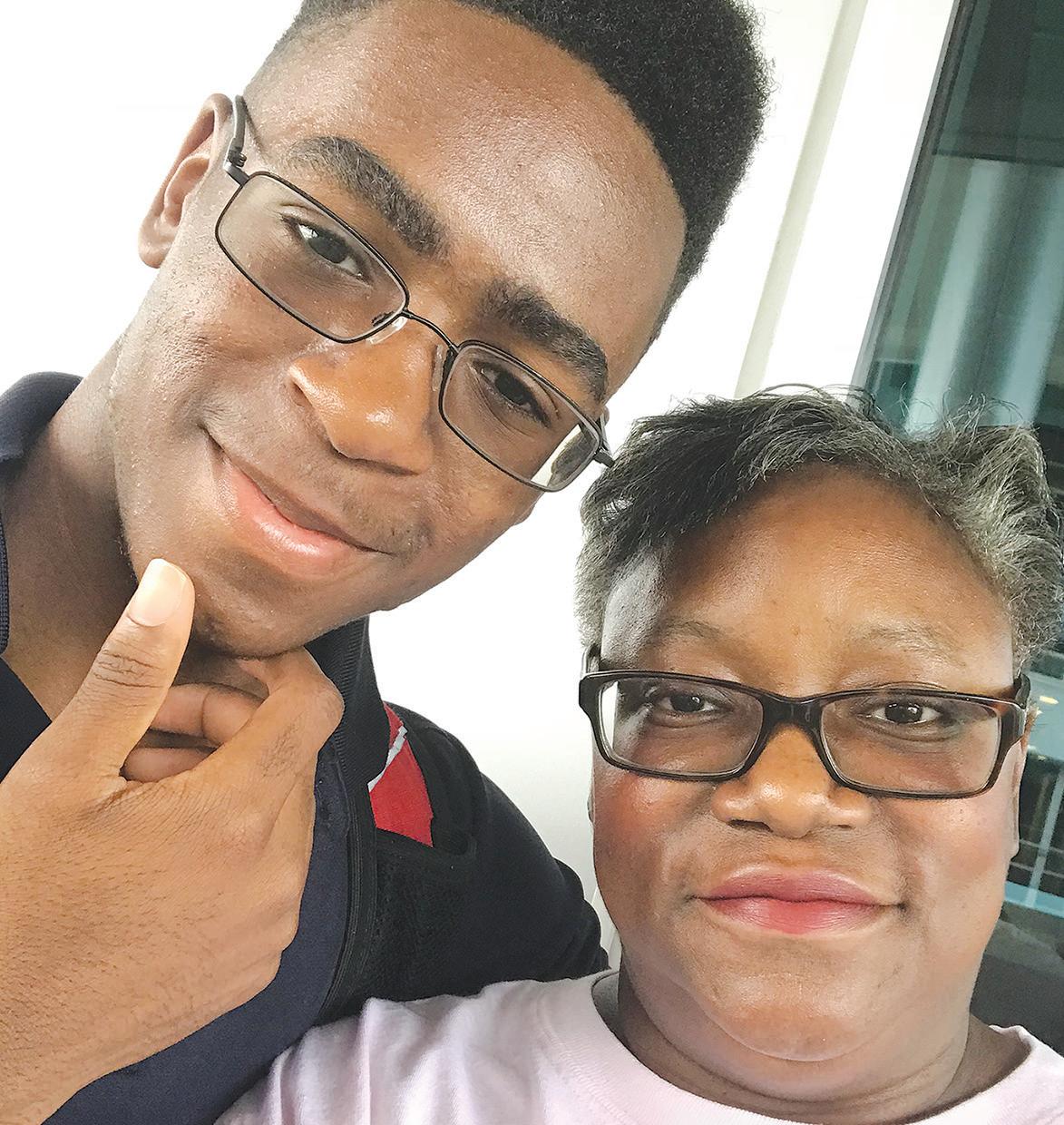
COURTESY PHOTO | IDS Henry Moore and his mother, Dr. Susan Moore, pose for a photo. Susan Moore documented the poor care she received while she battled COVID-19 in the hospital.
Could the state cut IU funding over the IDS?
By Mia Hilkowitz mhilkowi@iu.edu | @MiaHilkowitz
IU President Pamela Whitten sat in front of the state budget committee on Nov. 13 to outline a $430 million request. She told the Indiana State Budget Committee about IU’s plans to invest in renovations and capital improvement projects across its Bloomington and regional campuses. One of its biggest asks was $154 million for infrastructure projects and building science labs on its new IU Indianapolis campus. But her first question from lawmakers had nothing to do with these high price tags. Instead, Sen. Fady Qaddoura, D-Indianapolis, posed a different inquiry:
“How can you stand up as leadership of the university against the pressure of politicians and the pressure of donors to do what is right?”
To Qaddoura, “doing what is right” meant protecting freedom of speech on campus.
The day before, Qaddoura noted to Whitten, incoming Lieutenant Governor Micah Beckwith threatened the Indiana Daily Student and IU in an X post over the IDS’ Nov. 7 front cover featuring a photo illustration of President-elect Donald Trump and quotes from his former political allies.
In the past year, Qaddoura said he thought state politicians and donors had been “pushing IU in making certain decisions,” specifically mentioning IU deciding to use Indiana State Police officers to arrest pro-Palestinian protesters during an encampment on IU Bloomington’s campus in April. He argued these actions took away students’ and faculty members’ ability to speak in “civil, nonviolent” ways.
Whitten responded that all decisions were made with the safety of campus as the top priority and that IU privileged free speech. However, she pushed back on the suggestion that politicians and donors are influencing the university leadership’s decisions.
“Just because you read in the paper or you see on social media that something happened as a result of something,” Whitten said, “I would not necessarily assume that to be true.”
State lawmakers’ questions about funding for IU in light of debates over free speech will likely continue. The Nov. 13 committee meeting was one of the first steps of a months-long process for the legislature to pass its state budget bill, ultimately heading to incomingGov. Mike Braun’s desk for approval.
In an interview with the IDS on the day of this committee hearing, Beckwith said the state should investigate IU using “covert” methods to support the IDS using taxpayer dollars. The IDS is editorially independent and was historically financially independent from the university, now running on a deficit since 2021.
He stated IU and higher
education institutions were “indoctrination centers” and, along with the IDS, were silencing conservative viewpoints — something he would aim to address in his new role come January.
IU spokesperson Mark Bode referred back to Whitten’s comments at the budget committee meeting when responding to a request for comment.
But could Beckwith influence IU’s funding over the content choices of its student newspaper? State government representatives and legal experts say there’s not a simple answer.
“Defunding” the IDS, other IU entities Indiana’s biennial budget bill appropriates money to state agencies and other public entities, including public universities, for two fiscal years. The drafting process for each budget bill begins during even-numbered years. The State House and Senate must approve the bill — each chamber can modify by a majority vote. After both chambers approve the bill, it goes to the governor for a signature or, in some cases, a veto, which the General Assembly can override by a majority vote in both chambers.
As lieutenant governor, Beckwith won’t directly have any hand in the budget process — although he does preside over the Senate during the legislative session and can cast a tie- breaking vote.
However, Matt Pierce, D-Bloomington, said Beckwith could influence “more extreme members of the General Assembly” to make amendments that would prohibit the university from funding specific programs or decrease funding.
“He would have to make an attempt to become something more than just the presiding officer and attempt to influence legislation,” Pierce
said. “That would be unusual for the lieutenant governor to be actively participating beyond just presiding over the session days.”
He pointed to the Indiana General Assembly’s 2023 decision to approve a budget prohibiting IU from using state funds for the Kinsey Institute, an institute researching sexuality, gender and reproduction. Rep. Lorissa Sweet, R-Wabash, proposed this amendment to the state budget bill after alleging, without evidence, that the institute conducted child sex studies and harbored sexual predators.
Although this amendment passed and was ultimately included in the enacted legislation, Pierce, who voted against the amendment, pointed out the Kinsey Institute wasn’t getting any direct state taxpayer dollars in the first place. Under the state budget bill, there are generally no specific line items for different academic departments, institutes or programs.
In its presentation to the state budget committee Nov. 13, IU outlined general capital and renovation projects it wanted state funding for. It also requested funding for four line items: IU Innovates, IU Public Safety, the Indiana Geological and Water Survey and the Indiana Clinical and Translational Sciences Institute.
“That’s the other irony — no money was really taken away from Kinsey when they said ‘you can’t use any state tax dollars to fund Kinsey’ because they weren’t getting a direct appropriation,” Pierce said. “So all it did is created a very complicated kind of bookkeeping exercise for the university where they had to go in and say, ‘Oh, are we paying the electric bill?’”
Since there is no separate line item in the state budget specifically for the IDS, “the best that they can do is say
none of this money being appropriated for the university may be used for the newspaper,” Pierce said. Pierce said he would oppose any amendments to prevent money from going to the IDS.
“I don’t think that the legislature should be micromanaging the university at that level,” Pierce said. “And they certainly shouldn’t be trying to punish newspapers that might publish comments that one particular politician doesn’t like.”
However, he noted that just as the IDS is “free to print what it wants under the First Amendment,” the state legislature is “free to decide what it funds and what it doesn’t.”
First Amendment concerns Daniel Conkle, a constitutional law and First Amendment professor at IU Maurer School of Law, said he felt that Beckwith’s X post threatened the First Amendment.
“I would regard it as, you know, clearly an attempt to persuade, if not intimidate, the editors at the IDS,” Conkle said. “I thought it was quite inappropriate.”
He said that while the state government can’t directly control content — such as by instituting criminal penalties for publishing certain content — decisions around state funding do give it more freedom to decide how it spends public money. One example of this, he said, is the government funding programs promoting environmental consciousness but not funding programs arguing for degrading the environment.
“Fund one thing but not the other,” he said. “The government has some leeway to do that in the particular setting of the IDS.”
As an IU auxiliary organization, the IDS generates its revenue through advertise-
ments and events, including the IDS Housing Fair. The IDS pays a tax to IU to operate out of Franklin Hall, an IU property. While not directly funded by IU, The Media School committed to allowing the IDS to operate in a deficit for three years in 2021, and the university covered the IDS’ nearly $1 million debt during the summer. The IDS is not listed as a line item in the state budget bill. Even though the IDS does not receive direct funding from the state or university, Conkle said any legislative attempts to “defund the IDS” or prohibit the university from giving money to the paper would raise First Amendment concerns.
“Can it be shown that in fact it’s because (the state legislature) agrees with Beckwith that the IDS is too ‘left-wing’ or ‘woke’ or whatever language he might want to use?” Conkle said. “In other words, you’ve got issues of motivation. Why would the legislature do this? You know, is it hostility to the IDS or the political viewpoint as it perceives it?”
In an interview with the IDS, Beckwith said conservative viewpoints are being silenced by the IDS and IU. Conkle said that there is no objective way, from a legal standpoint, to gauge if a publication is suppressing a viewpoint.
However, Conkle said the state legislature could frame an amendment to strip funding from the IDS as an attempt to “promote a range of viewpoints,” similar to the intended purpose of Senate Enrolled Act 202. The law, which went into effect this past July, increased the state legislature’s oversight of public universities and tenure. It requires the university board of trustees to have policies prohibiting faculty from receiving tenure if they are unlikely to foster “free inquiry, free expression and intellectual diversity.”
Conkle said the core of the debate — the government taking away funding for a student newspaper because of a political viewpoint — is inconsistent with the First Amendment and “the commitment to free speech generally.”
“Part of the story here is ‘what does free speech mean?’ regardless of wheth-
er a court somewhere might say that you’ve crossed the line,” Conkle said. “In other words, that if a society is committed to free speech, it should not welcome, and in fact should be critical, of comments like those made by Micah Beckwith, in my view, regardless of whether it would lead potentially to successful litigation.”
Joseph Tomain, a senior lecturer at the Maurer School of Law, said he would interpret Beckwith’s statement as “jawboning” — when the government attempts to indirectly threaten or coerce individuals or organizations to do something when it cannot directly force this action or speech.
“That’s something all Americans should care about regardless of the issue at play,” Tomain said. In an interview with the IDS, Tomain said Beckwith’s comments raise concerns about “government coercion of private parties.”
“Government coercion is problematic regardless of if it’s Democrat or Republican officials engaging in such conduct,” Tomain said.
From the late 1940s until 1987, the Federal Communications Commission enforced the “Fairness Doctrine,” which required radio and TV broadcast networks, but not newspapers, to present contrasting views on issues. This doctrine was instituted because lawmakers were concerned NBC, ABC and CBS — which controlled the three main broadcast networks — could set a “biased public agenda.” The FCC began rolling back its enforcement of this doctrine under the Reagan Administration. Tomain said Republicans were generally opposed to the Fairness Doctrine because they believed it interfered with editorial discretion.
He said from a legal standpoint, publications, including the IDS, have a right to cover what they want to cover and are not legally required to represent multiple viewpoints. He stated that imposing viewpoint requirements on the press is “not good democracy.”
“This isn’t about the viewpoint,” Tomain said. “This is about ensuring the government doesn’t interfere with freedom of the press.”
COURTESY OF LESLIE BONILLA MUÑIZ/INDIANA CAPITAL CHRONICLE
Indiana Lieutenant Governor-elect Micah Beckwith speaks on the debate stage Aug. 13, 2024. Beckwith threatened the Indiana Daily Student and IU in an X post regarding the IDS’ Nov. 7 front cover featuring a photo illustration of President-elect Donald Trump and quotes from his former political allies.
IU Arabic Debate Team prepares for world championship
By Kamellia Tredway miltredw@iu.edu
The IU Arabic Debate Team ranked first in the nation this year. The team has been a part of IU for three years, but Iman Alramadan, IU professor and team coach, said this is the first time they’ve been number one.
“It was really a very stressful time to put together a team,” Alramadan said.
According to Alramadan and other team members, IU junior Fares Hajji was a crucial part of recruiting for the team and creating its culture this year. He was a part of the team the year before, retaining knowledge of the debate skills required to perform well and the determination it took to be a part of the team.
Hajji and Alramadan sought out students who stood out to them during the school year in her classes to join the team.
“Fares and I had a meeting,” Alramadan said. “We had this criteria and we agreed on them, that we need people who are really native speakers who are determined.”
Once the team was crafted, they had one month until competitions began.
IU junior Salima Al Battashi said they practiced every single day before the competition.
“We would meet up for hours and hours and hours and hours,” Battashi said.
“And basically, what we did was we had like a topic, and we would just practice how the competition would go.”
According to the team, despite last-minute planning and their limited familiarity with each other, they said they knew they could win because Alramadan told them they could — and
she was right. After placing highly in regional competitions, the team traveled to New York City in September.
The debate competition they competed in is a part of an organization called Qatar Debate. It is funded by the Qatari government and coordinates debates for countries across the globe. It also oversees debates for native and non-native speakers of Arabic from universities across the world. The IU team is part of the native speaker category, meaning all members speak Arabic as a first or second language.
“They have a bunch of championships, one in the U.K. that’s been going for few years in Europe, in pretty much every Arab country as well,” Hajji said.
According to the Qatar Debate website, the championship IU participated in had more than 200 contenders and hosted 38 universities, including Harvard and Georgetown. It was also the fifth debate to happen in the U.S. and the first ever championship hosted at New York University.
According to the team, the debate follows the British parliamentary style. During the debate there are several rounds. Each round reveals a new topic. One team debates the opposition which is the argument against the issue. The other team debates the proposition, the argument for the issue.
The teams are allowed only 20 minutes to prepare their arguments. These topics can be ethical, political or social issues. Each team is then given seven minutes to give their arguments. While constructing arguments, they cannot have access to the internet or cell phones.
Alramadan said when they arrived in New York City, her students got straight to work bonding and training with one another. Tasneem Al Balushi, team member and IU junior, said their work paid off quickly.
“Each round, we would just go and put 100% as soon as we leave the room, in 15 minutes, we win,” Al Balushi said. “We had to go through, I don’t know how many rounds, six? But after each round, we just put the work and then it pays off. Then put the work and then it pays off.”
Alramadan said after a few rounds, one of the most experienced judges from Qatar Debate came to her and asked if her team had competed in an international debate before.
“I told him, actually, this is the first time,” Alramadan said. “The judge told me they have this structure and organization, like they had participated in a global championship before, and that made me like, ‘okay, we are going to win, I’m sure,’ but I didn’t share that with them until the end.”
The team says after they won, they felt pride for their school. Each member received a medal and a trophy to take home.
“How did it feel to win? Have you guys been to the IU football games this year? I’ve been to every single home game and that’s exactly how it felt to win.” Hajji said. “I am glad we were able to put IU’s name up there.”
According to the team, the future for the IU Arabic Debate Team is still filled with more work. Since they won the U.S. competition, they will travel to Qatar for the International Debate Championship in 2025.
What to know about Indiana’s first execution since 2009
By Natalia Nelson nelsonnb@iu.edu
Joseph Corcoran is ex-
pected to be the first person executed by the state of Indiana in 15 years this month.
The state has not executed someone since Matthew Wrinkles in 2009.
In 1999, Corcoran was convicted of killing four people, including his brother and his sister’s fiancé, with a semi-automatic rifle in Allen County. His sentence was the death penalty, which he is scheduled to face Dec. 18.
The state of Indiana has executed 22 people since 1976. Including Corcoran, eight inmates are currently on death row. After a 15-year hiatus due to several pharmaceutical companies refusing to sell their drugs to prisons for executions, Indiana governor Eric Holcomb said in June the state’s Department of Corrections had acquired a drug used for lethal injections and planned to resume state executions.
In June, he and Indiana Attorney General Todd Rokita requested the Indiana Supreme Court set a date for Corcoran’s execution. Holcomb told the Indiana Capital Chronicle he had been working on resuming executions for seven years, despite the necessary drugs being “harder to get for various reasons” and felt it was his duty to serve justice.
“In Indiana, state law authorizes the death penalty as a means of providing justice for victims of society’s most heinous crimes and holding perpetrators accountable,” Rokita said in a press release. “Further, it serves as an effective deterrent for certain potential offenders who might otherwise com-
mit similar extreme crimes of violence.”
In September, the Indiana Supreme Court set a date for the execution. Corcoran exhausted his appeals in 2016. Since then, several groups have come forward condemning the sentence. Notably, the Indiana Abolition Coalition and Conservatives Concerned About the Death Penalty protested the decision to resume them at the Indiana Statehouse in November.
David Frank is president of the Indiana Abolition Coalition, an organization with a goal to abolish the death penalty. He said the upcoming execution would set a shocking precedent.
“Mr. Corcoran is undisputedly, seriously mentally ill,” Frank said. “The state is only able to proceed this far because Mr. Corcoran, in order to escape his suffering, has sought and desired to be executed.”
Doctors who interviewed Corcoran for the defense during his 1999 trial diagnosed him with paranoid schizophrenia, a disorder that has caused him to experience delusions and hallucinations while in prison. His attorneys requested a stay of his execution date on Nov. 15, arguing his mental illness warranted a Ford claim.
Ford v. Wainwright was a 1986 U.S. Supreme Court case that ruled imposing the death penalty on defendants who were “insane” violated the Eighth Amendment’s cruel and unusual punishment clause. The court classified “insane” defendants as those who were not aware of their upcoming execution or the reason for it.
“To be declared competent, you have to, number
one, know the reason you’re being executed,” Hayley Bedard, the communications associate for the Death Penalty Information Center, said. “Two, understand that the execution is imminent, and three, actually understand the link between one’s crime and impending execution.”
In a proposed stay of execution, Corcoran’s attorneys said he did not rationally understand that he was sentenced to death for his quadruple murder conviction. In a Nov. 26 response in opposition to the stay, Rokita argued that because Corcoran’s signature was not on his attorneys’ petition, and it was unclear if he wanted post-conviction review, the stay was legally insufficient and should be denied.
Rokita also responded to the stay’s claim that Corcoran was severely mentally ill, pointing out a 2006 letter he wrote to a federal district court where he confessed to fabricating a delusion that the prison was torturing him with ultrasound.
Corcoran’s attorneys responded on Dec. 3, reemphasizing his mental illness impacted the trial proceedings and his schizophrenia prevented him from “rationally understanding that the State intends to execute him because a jury found him guilty of murder.” They asserted his attorneys’ signatures on his petitions were legally sufficient on his behalf. The final decision on the motion for a stay will be decided by the Indiana Supreme Court in the coming days.
His sentence will be carried out by using pentobarbital, instead of the threedrug combination used in
previous Indiana executions. Bedard said Indiana has not released any public information as to how they acquired the drug, how much it costs or who the state acquired it from.
“Pentobarbital is a barbiturate and suppresses brain activity, their nervous system and breathing,” Bedard said.
In the 15 years since Indiana’s last execution, it’s been harder for the state to attain the necessary drugs for executions. Bedard said about a decade and a half ago, several pharmaceutical companies publicly came out saying they would no longer sell the drugs necessary for executions. The companies included Akorn, Hospira and Lundbeck and made it more difficult for states across the U.S. to carry out executions without the necessary drugs.
Anti-death penalty groups have concerns about
pentobarbital and the possibility of botched executions due to the drugs being improperly stored or expired.
In 2015, a scheduled execution had to be canceled in Georgia because the pentobarbital was kept at too cold of a temperature. It has already been used in 13 federal executions in Terre Haute, Indiana and for executions in 14 states.
“The state has just simply said, ‘This is what it is,’ but we have no idea,” Frank said. “It truly has the nature to, or however, it has the potential to cause, a long, prolonged death and suffering of the person who’s being executed.”
Alexander Mingus, the executive director of the Indiana Catholic Conference, said he thought the future of the death penalty in Indiana would be brought up once the Indiana General Assembly reconvenes Jan. 8.
“It sounds to me like, if nothing else, for the coming session, we are going to have a robust conversation about the death penalty,” Mingus said. “How is it applied? Is it applied fairly? Can we apply it fairly? How expensive is it for the state, for local governments, to go through the process?”
In Indiana, the average death penalty case can cost almost $800,000, over four times as much as the average life without parole case. That includes costs of execution, legal fees and incarceration costs. Indiana is one of 27 states where the death penalty is still legal.
“It would signal to Hoosiers, in I think, a negative way, that the state is willing to do this,” Mingus said. “Despite the expense, despite the moral questions, despite the inequitable application of the death penalty.”
IU sued for ignoring history of sexual misconduct
By Dalton James jamesdm@iu.edu | @DaltonMJames
Editor’s note: This story includes mention of sexual violence or assault.
A woman who reported being sexually assaulted by a former IU football player alleged IU ignored her abuser’s history of sexual misconduct in a lawsuit filed Nov. 11. The lawsuit also claims IU failed to put in place policies to prevent assault, sex-based harassment and discrimination. According to the lawsuit, filed in a federal district court, IU and IU Health Bloomington exhibited “deliberate indifference” to sexual assault and harassment by Connor Delp, who played for Indiana football from 2021-22. Delp was previously withheld from all football team activities in late 2021
after being accused of sexual misconduct by an IU student. He then redshirted the season and returned to the team for the 2022 season, when he appeared in eight games as a punt returner before being suspended and eventually charged with rape in May 2023. The lawsuit states IU and IU Health failed to provide the plaintiff, who is referred to in the lawsuit as
Jane Doe I, “necessary and appropriate post-assault medical care and support.” The lawsuit states Jane Doe I attempted to go to the IU Student Health Center on
TRIBUNE NEWS SERVICE
Jail bar shadows are seen. The state has not executed someone since 2009, when it executed Matthew Wrinkles, but is expected to execute Joseph Corcoran this month.
COURTESY PHOTO
Junior Tasneem Al Balushi hugs professor Iman Alramaden during the U.S. Universities Arabic Debating Championship on Sept. 29, 2024, in New York City. The IU Arabic Debate Team ranked first in the nation this year.
Bomba ruled competent in lawsuit
By Mateo Fuentes-Rohwer
matfuent@iu.edu | @mateo_frohwer
Editor's Note: This story includes mention of sexual violence or assault.
A judge ruled Tuesday that former Indiana men’s basketball team physician Brad Bomba Sr. is competent to provide a deposition in a class action lawsuit filed against Indiana University.
Bomba was accused of sexual misconduct by former Indiana player Haris Mujezinovic in a complaint publicly released by IU on Sept. 11. On Oct. 15, Mujezinovic and former player Charlie Miller filed a class action lawsuit against IU, alleging the university “systemically mishandled” the players’ complaints of sexual misconduct from Bomba.
Mujezinovic played for Indiana from 1995-97, over-
lapping with Miller who played from 1994-98.
Initially, the plaintiffs in the case intended to serve a subpoena for Bomba’s deposition, while also calling for an expedited discovery due to his “quickly declining health.” The motion was originally agreed upon, but a few weeks later, Joseph Bomba, Brad Bomba Sr.’s son and guardian, filed a motion to quash the subpoena.
Bomba’s counsel cited Bomba’s incompetency to provide a deposition. Specifically, the counsel argued his “capacity to recall is severely impaired; he is unable to distinguish between truth and fiction; and he is incapable of asserting his Fifth Amendment rights.”
The plaintiffs responded that Bomba’s competency is irrelevant to the subpoena, there is no good reason to grant Bomba a protective
1320 W. Bloomfield Rd., Suite B 812-287-8851 btownorthodontics.com
Baron D Hall, DDS, MSD Jake Willhite, DDS, MSD Orthodentists
Erica Hall, Hannah Elliott, Kaitlyn Jacobs, Marilyn Lee, Adrian Price
Baron D Hall, DDS, MSD Jake Willhite, DDS, MSD Orthodentists
Erica Hall, Hannah Elliott, Kaitlyn Jacobs, Marilyn Lee, Adrian Price
With modern techniques and a fun style, B-town Orthodontics is the most up-and-coming orthodontics office in the Bloomington area! We offer the latest technologies including invisalign, gold brackets, laser treatments, and even mini implants that can help restore missing teeth and even eliminate the need for surgery. B-town Orthodontics offers FREE consultations and don’t forget to download The Braces App, the hottest free app designed by B-town Orthodontics’ Dr. Baron Hall.
Tue. - Thu.: 8:30 a.m. - 4:30 p.m. Lunch 12:30 p.m. - 1:30 p.m. Mon. & Fri.: Appointments Only 1320 W. Bloomfield Rd., Suite B 812-287-8851 btownorthodontics.com
order and the subpoena is a reasonable request that does not cause Bomba any prejudice.
Ultimately, the court ruled to deny Joseph Bomba’s motion to quash the subpoena, stating Brad Bomba Sr.’s testimony would be beneficial to both the plaintiff and defense. The court cited Bomba’s ability to determine a truth from a lie and his lack of stress or anxiety during the hearing as two key factors into the decision.
WFIU/WTIU reported that Bomba was unable to answer simple questions about his age and birthday. However, he managed to identify certain truths and lies, such as the fact the judge’s tie was red and not yellow.
Have a tip? Email us at sports@idsnews.com.
Occasionally, they’d watch Hell’s Kitchen and Master Chef together. Moore was passionate about cooking; she had wanted to go to culinary school after Henry moved out, but she was never able to.
One time for his birthday, she baked pineapple upside down cake. She would also tell him the story of the day he was born. Her water broke at 9 p.m. Oct. 17. He was born the next morning at 3:15 a.m., three weeks premature. It took him two days to start crying.
This year for his 23rd birthday, Henry stayed up until 3:15 a.m. to tell himself the story instead.
In mid-December, doctors allowed Moore to go home with an oxygen tank. Henry thought she should’ve stayed in the hospital if she still needed oxygen, but she was happy to be home. She didn’t trust
With modern techniques and a fun style, B-town Orthodontics is the most up-and-coming orthodontics office in the Bloomington area! We offer the latest technologies including invisalign, gold brackets, laser treatments, and even mini implants that can help restore missing teeth and even eliminate the need for surgery. B-town Orthodontics offers FREE consultations and don’t forget to download The Braces App, the hottest free app designed by B-town Orthodontics’ Dr. Baron Hall.
Ryan D. Tschetter, DDS Lauren R. Hoye, DDS Jackson Creek Dental is conveniently located on South College Mall Road. Most insurances accepted, including the Indiana University Cigna Insurance plans as well as the IU Fellowship Anthem. Dr. Tschetter and Dr. Hoye offer state of the art dental technology such as Zoom whitening, same day crown appointments, and Invisalign. We also provide restorative, cosmetic and emergency care. We pride ourselves in giving the best care to our patients while offering a pleasant yet professional atmosphere.
A Way of Wellness Chiropractic specializes in comprehensive spinal care. We offer treatment for many different spinal conditions and problems, while also addressing the body as a whole. We provide effective chiropractic care helping patients reduce stress, improve mobility and spinal health. The quality treatment we provide is always fit to your individual needs and goals. Let us help you achieve and maintain good spinal health. We look forward to meeting you!
Mon. - Thu.: 8 a.m. - 6 p.m. 1121 W. Second St. 812-336-2225 bloomingtonchiropractor.com
the doctors there anymore. In her Facebook update post, Moore wrote, “I am home in my own bed.”
The next morning, she was still fatigued and short of breath and had a 103-degree fever. Henry sent her to a different hospital that day, Ascension St. Vincent Carmel Hospital, after the nurses called to check in.
On Facebook, she reported she was receiving compassionate care, but by now she’d been diagnosed with pneumonia.
A few days later, the hospital asked Henry for permission to put his mom on a ventilator. The last time he talked to her on the phone, he could hear her coughing. She was starting to cry.
“I want to see you make it to college. I want to see you choose your career,” Henry recalled his mom telling him. “I’m fighting for you.” Even near the end, she was thinking about her son.
The day after she died, he broke the news to his maternal grandparents. His grandma started sobbing. His grandpa rubbed her back.
“She’s okay,” he told his grandma. “She’s in a good place now.”
Both grandparents have dementia. His grandma forgot 10 minutes later. His grandpa remembered for a few hours before he also forgot again. Every time they realized that their daughter was gone, they would react the same way as the first time. His grandpa would rub his grandma’s back as she cried. Henry told them five different times. By the time Christmas came around five days later, he stopped trying to tell them.
Physicians
Ricardo Vasquez MD
Mon. - Fri.: 8 a.m. - 5 p.m. 815 W. Second St. 812-336-6008 vascularcenterandveinclinic.com
Dr. Andrew Jones, Dr. Marzia Zamani, Cheyenne Brown, Megan Sipes, Milli Nally, Kenzy Hawkins, Christina Thompson
Dr. Tavel Family Eyecare is your partner in your personal eyecare journey. Since 1940, the company has believed that every Hoosier deserves quality eyecare and vision solutions at an affordable price. Dr. Tavel offers comprehensive eye exams, special testing, management of eye diseases, glasses, contact lenses and much more, all backed by an insurance acceptance guarantee. The company is committed to advancing eye health by investing in the latest technology and providing treatments that are right for every patient’s unique needs.
2552 E. Third St. 812-233-2343 drtavel.com/locations/bloomington
Our eye care clinics serve patients in Bloomington-Atwater Eye Care Center and Indianapolis Eye Care Center, with faculty doctors and student interns who work together to provide the most comprehensive eye care available. Our many services include primary care, pediatrics, low vision, dry eye, disease, laser and surgical care, contact lenses including specialty lenses, myopia management, aniseikonia, and eye wear center. Open to the public and accepting most insurances. Mon., Tue., Thu.,
Mon. -
Austin C. Starr, D.D.S HOOSIER ORAL SURGEON? Dr. Starr is an Indiana University Football Alum who provides pain-free experiences for all Hoosiers with IV sedation. He performs specialized oral surgery services including Wisdom Teeth Extractions, Dental Implants, Bone Grafting, and Plasma Therapy. Equipped with modern 3-D technology, he has the most up-to-date surgical skills and techniques to accomplish beautiful results with his patients. He looks forward to accomplishing beautiful results with his patients, enhancing confidence and satisfaction for all he serves. Go Hoosiers! We look forward to taking care of you!
Welcome to Insights Optical, where quality eye care is our number one priority. Our dedicated team is ready to learn all about you and your vision needs while using innovative technology and a comprehensive care approach to take care of your eye health.
Mon. - Fri.: 9 a.m. - 5 p.m. 3925 Hagan St., Suite 203 812-334-0001 jantaylorschultz.com Eating Disorder Brent Mezger, FNP-C Alyssa Van Duzer, PA-C Our board certified nurse practitioners and physician assistants provide primary care, acute care, physicals, vaccines, weight management and more to patients 12 months and older. Appointments and walk ins welcome. We accept most commercial insurance, Medicare and several Medicaid plans. We offer transparent pricing for the uninsured.
Dr. Philip Clark Brittain Jenna Kelly, RN
Vibrant Life specializes in hormone replacement therapy and medical aesthetics. Vibrant Life is pleased to offer personalized care, employing the latest medical technology. Services include: hormone therapy, neuromodulators (botox, dysport), dermafillers,
- Thu.: 8 a.m. - 4:30 p.m. Lunch Break
w Jan Taylor-Schultz
Health Spotlight
Daylight saving time has got to go
is a sophomore studying journalism.
On Oct. 30th, the controversial practice of daylight saving time ended.
Daylight saving time has been controversial for decades, and for good reason. It was initially conceived as a way to conserve energy during World War I and better use daylight in warmer months. But now that our energy consumption habits have changed and our understanding of the impacts of daylight saving time has grown, it’s clear the practice no longer serves its original purpose — and it may even do more harm than good.
Daylight saving time has been proven to have far-reaching health consequences. According to sleep expert Adam Spira, professor of mental health at Johns Hopkins University, “The scientific evidence points to acute increases in adverse health consequences from changing the clocks, including heart attack and stroke.” This is because it disrupts our circadian rhythms, which hurts our sleep quality and affects a whole range of bodily functions.
The circadian rhythm is the body’s internal 24hour clock that regulates sleepiness and alertness in response to light and
darkness. According to the National Library of Medicine, daylight saving time disrupts the natural adjustment of the human clock due to the effect of late-evening light on the circadian rhythm.
Another issue with daylight saving time is that it disrupts people’s work schedules and productivity. Although the idea behind it is to give people more daylight hours during the evening, the shift in time doesn’t necessarily align with when people are most productive. When people lose an hour it can lead to sluggishness, difficulty focusing and irritability.
Studies have shown that productivity dips in the days
following the time change, and it can take several days, if not longer, for people to get back to their normal rhythm. In a fast-paced, always-on world, the last thing anyone needs is an additional hurdle to overcome to get through the workday. According to Spira, daylight saving time also hurts your driving ability. A 2020 study found that the time shift increases the risk of fatal car accidents by 6%.
Toward the end of daylight saving time, it gets darker and darker, making it harder to drive.
For some, the effects of daylight saving time extend beyond physical health and into mental well-
The value of teaching kids to love reading
Abby Whited (she/her)
is a freshman studying journalism.
A few weeks ago, I was reading “Green Eggs and Ham” to an 8-year-old girl with green eyes, freckles and chipped fingernails decorated with Halloween designs done by her mother. She knew the book very well and had read it several times before, so she interrupted me when she knew what rhyme scheme was coming next. She could go on for pages at a time, reciting the story word for word. When we came to a part she did not remember quite as well, I took the opportunity to help her sound out the words she was unfamiliar with. I taught her about the “sh” sound and silent “e’s,” and she applied these new skills as we continued. It felt good to know that when our 30 minutes were up, I had left her with new knowledge that would help her along her reading journey, and her education as a whole.
Many things are debatable, but the silent “e’s” at the end of words and the “shhhh” sound of the letters “sh” will always be undeniably true, and I find comfort and value in the idea that I could introduce at least one child to some new facts of life. Those reading skills will remain true and reliable even as she grows up and finds her place in the world. They will eventually guide her to pursue more knowledge, discover personal interests and form her own educated opinions. When I left the Boys and Girls Club that day, I had the feeling that maybe I had opened her eyes to new ideas, possibilities and books to read.
Two days a week, volunteers spend about 30 minutes as a “reading buddy” to children at the Boys and Girls Club. Some volunteers read with a different child each time, while others have certain kids who gravitate toward them week after week. As reading buddies, volunteers are able to connect with children by engaging with their interests and helping
to foster an interest in reading.
“Read to Succeed,” an IU club and organization that volunteers at the Boys and Girls Club, is an organized opportunity for college students to make a positive difference within their community. Since becoming a volunteer with Read to Succeed, I and many other college students have been introduced to an extremely rewarding and engaging experience through becoming an important part of children’s reading journeys.
While incredibly rewarding, this experience has led me to observe firsthand the lack of comprehension and reading skills in elementary-age children. Besides difficulty with phonics and fluency, children I have read with displayed a distinct absence of enthusiasm.
Research shows children’s attention spans have been shortened significantly by easy access to short-form entertainment content, which may explain their lack of enthusiasm. At the risk of sounding against progress, I have noticed children nowadays are unfamiliar with the joys of losing oneself in a book for hours on end, instead having become harmfully accustomed to the instant gratification of
all the technology at their fingertips. Quick fixes of entertainment seem to be the norm for today’s young children.
This lack of enthusiasm for reading is disheartening to me as someone who was a child who absolutely loved reading and felt that it enriched my life in so many ways. As a kid, I devoured every book I could get my hands on, and I believe this was crucial in the development of my personality and interests. My love of reading instilled in me an interest in history, mythology and the arts, as well as a desire to gather as much knowledge as possible. Reading taught me to think beyond just myself and my own life, and it changed my perspective of the world. Now it seems books have been replaced with iPads, and curiosity has been replaced with short attention spans, poor reading skills and a lack of critical interest in the world around them. They seem to lack the childlike excitement and exuberance that reading enhanced within my own childhood.
As a college freshman who is not pursuing a degree in childhood education or anything related, I feel somewhat powerless against the issue of children’s disinterest in engaging themselves in learning and reading.
I often wish that I was better equipped to give children the motivation that I see so many of them lacking; nevertheless, I feel a responsibility as a reading buddy to simply try my best to spark a love of books in the children I read with. If I am able to leave a child even just a little more excited for next time, I consider my time with them to be successful.
I have found the key to helping a child become interested in reading even a little bit is to give them a reason to be excited. Whether it’s encouraging them to choose a book they think looks interesting, celebrating their progress or speaking words of praise, I’ve found that it is so important for children to associate excitement and positivity with reading.
Although the experience can be discouraging at times, I have found my time as a reading buddy so far to be extremely rewarding. It has improved my skills of interacting and communicating with children, as well as my ability to remain calm among chaos as I am often volunteering in the midst of loud noises. Though I am only one person, it is incredibly rewarding to feel as though I am giving back to my community in such a meaningful way.
abwhited@iu.edu
being. The loss of an hour of sleep can have significant consequences on people’s moods and mental state. For example, people who already struggle with Seasonal Affective Disorder might find that the abrupt change in lighting can exacerbate their symptoms.
The original idea behind daylight saving time was to conserve energy, but it wasn’t successful. The thought was that by extending daylight hours, people would use less lighting, and thus conserve power. Energy savings during daylight saving time are minimal due to modern technology, which has dramatically reduced the need for lighting after
dark. The energy savings from reduced lighting are offset by increased energy consumption, such as people using more air conditioning or heating during longer daylight hours. Daylight saving time is a relic of the past that creates more problems than it solves. It disrupts sleep, can cause health issues, hurts our mental well-being and has little to no impact on energy conservation. It’s time to reconsider whether the clock shifts should remain a part of our lives. It’s time we leave daylight saving time behind and let our schedules and bodies operate naturally.
jjd5@iu.edu
MARIA AMANDA’S MANY OPINIONS
We need to stop romanticizing toxic relationships
Maria Amanda Irias is a senior studying psychology and journalism.
Have you noticed that some of our favorite movies and shows glorify toxic relationships? Take “The Notebook” as an example. It’s the pinnacle of romance movies, it’s the Titanic of love stories and yet Noah and Allie, the main characters, make so many mistakes that it becomes catastrophic.
Noah and Allie were high school sweethearts but broke up somewhere along the way to adulthood. Now fast forward to their late 20s and Allie is engaged to another man. When Noah sees Allie, everything changes. They’re in love, again. So in love Allie cheats on her fiancé with Noah.
Don’t get me wrong, I am a hopeless romantic who loves love, but I will never excuse cheating. That’s toxic. In the movie, however, the cheating is glossed over with rose-colored glasses. The audience is just as in love with their relationship as Noah and Allie are with each other. The audience waits throughout the first half of the movie for when they finally kiss and reignite the flame. That isn’t the reality of it though. Sure, Allie and Noah were meant to be together, but Allie cheated on her fiancé and pretended it was all OK.
Cheating is never OK. It should not be glossed over or even worse, glorified. Another example of glorified toxicity is the show ‘Tell Me Lies,’ released in 2022. It’s drama, drugs, alcohol, college and sex all in one. The main characters Lucy and Stephen are in an obviously toxic relationship; they even accept they make each other worse. Despite it all, just like it happens to many people who are stuck in their ways and can’t seem to break free from a toxic relationship, they keep coming back to each other. This is not passion or
love — it’s toxicity. Coming back to each other time after time does not mean you are meant to be together: it means you’re stuck in a cycle. The reason Lucy and Stephen keep coming back is because they don’t allow themselves to grow. They want to be comfortable and, unfortunately for them, they are comfortable in toxicity. The audience, including me in the beginning, is almost rooting for them to stay together. Even when we know they yell and insult each other, we take it because we think that’s love. You might be thinking, why does this matter? “Tell Me Lies” is ranked as the 68th most popular show online. It was also the fifth most popular show on Hulu. So, it matters because millions of people are watching these movies and shows thinking that what happens is normal and should be called love. Instead of learning that love is kind, respectful and empathetic, the youth are learning love is yelling and then apologizing, cheating but excusing it and coming back to one another even when it continues to be toxic. I used to be one of those people who ran back to the toxic ex every single time. It took growth and acceptance to move on, to re-learn what love really is. I used to look at healthy signs of love, like no jealousy or no controlling behavior, and think it was too boring for me. I didn’t want that type of love; I wanted the passion and the screaming. But I didn’t really want it, did I? I was conditioned to think that. Deep down when I would cry, I knew that wasn’t what I was looking for. I yearned, like most of us do, for a love that is unconditional, that accepts us and embraces us for the person we are and want to be. No insults, no screaming, no jealousy, just love.
mirias@iu.edu
Jack Davis (he/him)
ILLUSTRATION BY EVELYN STRAUSS
ILLUSTRATION BY KELSEY GAULT
String quartet ATLYS releases original album
By Nadia Suben nadsuben@iu.edu
Melodic dubstep fans might seem unlikely to be in the audience of a string quartet concert, but they regularly fill the venues of genrebending ensemble ATLYS’s concerts — even when the group is performing works from their recently-released neo-romantic album the “Sonnenberg Suite.”
Violinists Sabrina Tabby and Jinty McTavish, violist Rita Andrade and cellist Genevieve Tabby formed ATLYS in 2016. The ensemble is completely self-managed and self-directed, and it is on a mission to make the often inscrutable — or seemingly archaic — world of classical music broadly accessible.
ATLYS’s classically trained members apply a high level of virtuosity to more traditional chamber fare as well as its ambitious arrangements of tunes infused in our day-to-day lives.
“ATLYS is about being inspired by our actual surroundings, this beautiful, diverse world, and allowing that to seep into classical music traditions,” Sabrina said.
A long-standing partnership with prominent EDM
By Ellie Adam ehadam@iu.edu
more than 10,000.
artist Seven Lions exemplifies ATLYS’s commitment to transcending genre boundaries. In 2021, Seven Lions’s management reached out to ATLYS about joining the artist onstage to play an acoustic string quartet rendering of his music. Ari Fisher, ATLYS’s composer and an IU Jacobs School of Music alumnus, got to work on these meticulously constructed arrangements.
“Ari did such an incredible job of distilling the emotional content and pulling that out with strings while adding the virtuosic flair that other composers might be afraid of writing,” Sabrina said.
Composing fearlessly is one of Fisher’s priorities.
“I’m all about high risk, high reward,” Fisher said.
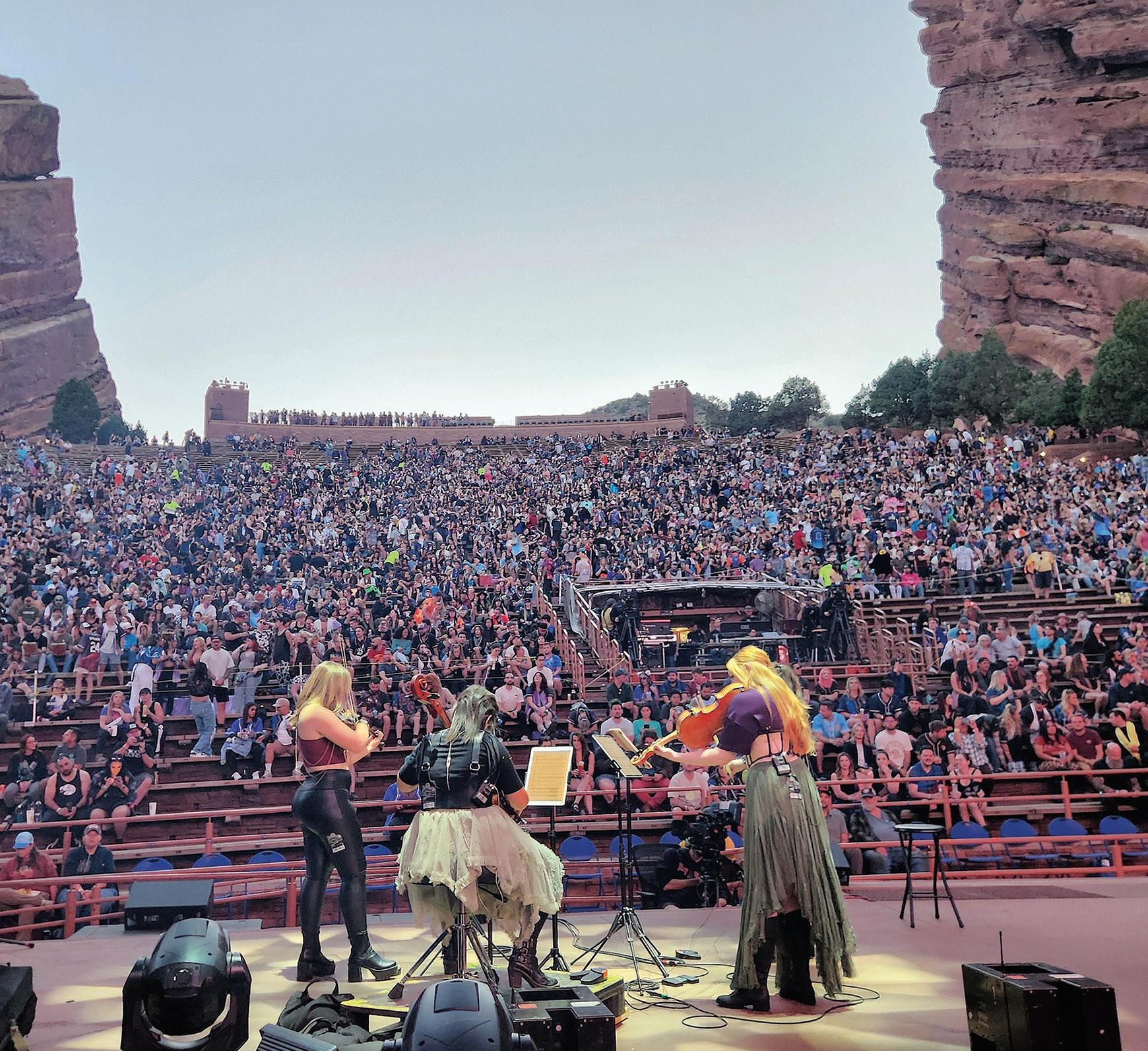
ATLYS first brought Fisher’s bold arrangements of Seven Lions’s music to the stage at Denver’s Red Rocks Amphitheater not long after the two artists initially connected. This year, the ensemble returned to that same venue to open for Lions to a crowd of 10,000 people.
The recent concert was not the only artistic milestone for ATLYS in 2024. On Nov. 15, the quartet released an album recording of them performing Fisher’s com-
position the “Sonnenberg Suite,” a 10-movement neoRomantic piece inspired by the Sonnenberg Gardens in Canandaigua, New York. Each movement is dedicated to a particular themed section of the garden, evoking varied scenes and moods, while the piece as a whole aims for aesthetic and emotional cohesion.
“The suite is written in a way that anyone can connect to,” McTavish, another Jacobs School of Music alumna who first crossed paths with Fisher when the pair were freshmen at IU, said. “It’s coming back to what our audiences are here to do: they’re here to feel something. We’re trying to bring things back to that.”
The Sonnenberg Gardens, originally designed and built by the lady of the Sonnenberg Mansion over the first two decades of the 20th century following her husband’s death, are a tapestry of love and loss, lending themselves to emotional storytelling that can reach all audiences.
By carefully considering audiences’ backgrounds and responses to their music, as well as the tastes of modern audiences, ATLYS creates a dynamic artistic identity that transcends rigidity in listening.
“My upbringing was all about classical music, but in some not-so-traditional ways, like cartoons and Disney,” Fisher said. “For me to understand this classical music through film and pop, I feel like I have this appreciation for introducing people through this music by whatever means necessary.”
The ensemble hopes positioning diverse influences side-by-side on a concert program can help bring unlikely listeners into the classical fold just as Fisher’s childhood inspired.
“In an ATLYS show, we’ll play a few movements of ‘Sonnenberg,’ but we’ll surround it with ‘Zelda’ music, we’ll surround it with Rihanna,” McTavish said. “Those are other things that make them feel something. So, when we get to ‘Sonnenberg,’ even though it’s neoRomantic, it fits right in, because it makes them feel something.”
ATLYS aims to derive resonant classical music from modern culture. The vitality of the genre depends on the constant stream of new muses we find by simply looking — and listening — around.
The “Sonnenberg Suite” is available to stream on all major listening platforms.
6 specialty burgers to try in Bloomington
By Marnie Sara mbsara@iu.edu
Americans love a basic cheeseburger with lettuce, tomato and onions. Yet, some local Bloomington restaurants have decided a classic cheeseburger is boring. Here are six local restaurants that offer a more exciting version of a traditional burger.
Bru Burger’s Double Bacon Burger
229 S. Grant St. Awarded this year’s title of Best Burger in Indiana by Reader’s Digest!, Bru Burger is recognized for its high-quality burgers in the Midwest. The restaurant offers 18 specialty burgers, including a personal favorite, the Double Bacon. The $15.50 Double Bacon features two thin smashed patties, crispy bacon, white cheddar cheese, lettuce, onion, tomatoes and a special tangy pink burger sauce that elevates the meal to the next level.
Yogi’s Ranch Burger
302 N. Walnut St. Yogi’s Ranch Burger is the ultimate test for people who insist they love ranch dressing. The $13 burger comes with two patties, fried cheese with the flavor of Cool Ranch Doritos, shredded lettuce, tomatoes and Cajun ranch. The Ranch Burger got a positive endorsement on Yelp and was recommended by an Indianapolis Monthly food reporter. I think adventurous eaters who love a zesty ranch flavor should try this exotic burger.
NY Fat Burger at Fat Dan’s Deli 221 E. Kirkwood Ave. Have you ever eaten a grilled pastrami sandwich and felt like a ground beef patty was missing in between the rye bread? Fat Dan’s Deli offers the perfect solution with its $16 NY Fat Burger, which comes with a ground beef patty, smoked corned beef, Swiss cheese and spicy mustard. In a parody March Madness competition, 1,167 Indy Star readers voted Fat Dan’s burgers to the “Elite Ate” in 2024. While I’ve never had this concoction, there is no doubt in mind that my pastrami lovers will enjoy Fat Dan’s special reedition
of this NY style sandwich.
Upland Brewing Co.’s Sweet Plum Burger 350 W. 11th St. Upland Brewing Co. offers a burger that pairs a rare, sweet flavor with ground beef. The $17 Sweet Plum Burger includes smoked gouda, applewoodsmoked bacon, arugula and plum sauce. With over 300 five-star reviews on Yelp, Upland Brewing Co. has a great reputation in Bloomington. I bet the burger will have a plethora of rich flavors stemming from the charred bacon, savory meat and sweet glaze. The next time I am craving a non-traditional burger, I will be ordering the Sweet Plum burger from Upland’s.
FARM Bloomington’s Classic Bison Burger
108 E. Kirkwood Ave. The star of the $20 FARM Bloomington’s Classic Bison Burger is the 7-ounce Bison patty. Since the burger features extremely ordinary toppings (lettuce, tomato, onion and pickle), the highquality meat is the highlight of the meal. I love that the juicy burger is grilled with a flavorful cayenne-spiced cowboy rub that can be tasted in each bite. If you are looking for a fancy but basic burger, FARM’s Classic Bison Burger should be added to your must-try list.
Big Woods Bloomington’s Hard Truth Whiskey Burger
116 N. Grant St. Big Woods Bloomington’s Hard Truth Whiskey Burger combines sweet and salty flavors into one sandwich. The $18 burger contains a ground beef patty, white cheddar cheese, lettuce, caramelized onion, candied bacon, whiskey glaze and garlic aioli. In my opinion, the homemade candied bacon jam is the best selling point of this burger. The candied bacon perfectly complements the rich whiskey glaze and garlic aioli. If you’ve never tried candied bacon, I suggest starting with Big Woods’ Hard Truth Whiskey Burger. Bloomington restaurants are not afraid to try new things, and you shouldn’t be either. Try the peculiar burger! Who knows, you might love it.
COLUMN: How to find the perfect gift for that special someone
Now that December is finally here, it’s time to start thinking about your holiday shopping list. One of the best parts about the holiday season is exchanging gifts with the ones you love. Watching a bright smile form on your partner’s face as they open your gift is a special feeling that you won’t want to forget. Shopping for your partner can be stressful because you want their gift to be special. If you’re feeling lost about what to get your partner for the holidays, read below to find some gift ideas. Gift ideas for him
Alo:
Alo is a great place to buy some nice basics that will look flattering on your boyfriend. I specifically recommend browsing through their selection of pants and shirts, both of which offer a variety of different styles. If your boyfriend needs some more athletic apparel, I suggest looking at the Conquer Reform Crewneck Short Sleeve, the 7” Conquer React Performance Short and the Triumph Long Sleeve Tee. These items are under $70 each and will have your partner looking stylish during his workouts. Alo also offers a wide selection of trendy lifestyle clothing. Two pieces that deserve an honorable mention are the Double Take Short Sleeve and the Triumph Restore Crewneck.
These are perfect for a casual date night and cost less than
$90. If you’re looking for a nicer style that will last a long time, you can buy the Conquer Revitalize Pant for $118. Any one of these items will please your boyfriend this December and they’re all listed on the Men’s Best Sellers. If you’re eager to see what else Alo offers, take a look at its website.
Abercrombie & Fitch: If your boyfriend’s closet offers few options for stylish going out clothes, then make your way to Abercrombie & Fitch this holiday season. A staple pair of jeans makes all the difference. Abercrombie & Fitch offers an abundance of high-quality jeans for less than $100. The straight leg jean fit usually looks the best on guys. My favorite jean looks from Abercrombie & Fitch are the ‘90s Straight Jean (dark wash) and the Athletic Straight Jean. I also recommend looking through their NFL collection as it offers a wide selection of gear including hats, sweatshirts, vests, T-shirts and more. The collection also offers an abundance of vintage-styled clothing that are under $70. Visit the company’s website to find the different styles highlighting your boyfriend’s favorite team.
Gifts for her
Madewell: I think Madewell is one of the best stores to find the perfect holiday gift for your girlfriend. Not only do they sell stylish clothing, but they also offer a variety of accessories and shoes. You can never go wrong with a nice necklace, but every girl
has a distinct style. You can easily find a necklace shape suited to your girlfriend’s taste. If she likes the look of a simple chain, I recommend checking out the Demi-Fine Skinny Herringbone Chain. The Three-Pack Mother of Pearl Necklace Set and the Freshwater Pearl Dangle Chain Choker Necklace are also some fun styes to look at. All of these options are under $60, which would go perfectly with a nice clutch or top. Check out “The Madewell Good Gift Guide” to find the perfect addition to some Madewell Jewelry. The Pouch Clutch in Leather, the Mini Bag and the Sculptural Mini Shoulder Bag are all exceptional options if you’re considering a two-part gift.
Ulta Beauty: You can never go wrong with a nice fragrance or beauty product for the holidays. Every girl loves a new elegant scent. Ulta’s website has a helpful gift guide that directs you to the type of product and price you’re going for. It even has lots of three-piece sets, which include different variations of the scent. Usually, the set includes the main perfume, a roller perfume and a lotion. This allows your partner to make the most of the scent and cherish the gift even longer. Some top-rated items are the Ariana Grande sixpiece Mini Coffret Gift Set, Billie Eilish’s No. 2 Gift Set and the Marc Jacobs Daisy Discovery four-piece Mini Holiday Gift Set. You can even find the Clinique makeup and skincare gift set for under $60, which includes a variety
of everyday skincare and makeup products. Another favorite purchase is the Sol De Janeiro Shower Ritual, as it includes all of the classic beauty bum lotions and fragrances.
Thrift shops I’ve found some of Bloomington’s best secondhand shops if you’re shopping locally for the holidays. I haven’t always appreciated thrift stores for their reliable gift finds, but I was proven wrong this semester. I visited the Bloomington Thrift Shop and My Sister’s Closet of Monroe County, both of which had some of the best finds I’ve ever gotten. I ended my thrift shopping trip with leather boots, antique glass ice cream bowls and a vintage Barbour jacket. All of the items I found at Bloomington Thrift Shop were under $10 each. Usually, my finds at My Sister’s Closet don’t exceed the price of $40. I guarantee you will find a gift at one of these thrift stores that will hold much more value than any typical department store. You just have to be patient when browsing at these stores. Whenever I find something special at a thrift store, I either look up the brand or ask the clerk. These tips have always helped me figure out how valuable something is. My Sister’s Closet and Bloomington Thrift Shop are both
short drives off IU’s campus. Check out their websites to find their hours and extra information.
Gender neutral gifts
It can be quite stressful to find a gift that will bring a true smile to your partner’s face. Here are some fun gift ideas that are enticing for everyone.
Kindle This is a great gift idea for those who like to read in their free time. Kindle recently came out with a new Light and Compact version, which is perfect for whenever you’re on the go. It’s both thoughtful and easy to buy, as it’s currently on sale on Amazon. Let your partner read effortlessly in any light with this unique gift.
Slippers
Why not ensure your significant other is always comfy and cozy this winter with a quality pair of slippers. Don’t worry about paying a pretty penny for a pair of UGG slippers, because there are quite a few options
selection of slippers that are both trendy and affordable. There are many stylish options of Bearpaw slippers that are currently under $60 on DSW’s website. I highly suggest taking a look now to order a pair while they are still available.
Bluetooth speaker A speaker is a fabulous gift idea for music lovers and those who always have company over. This item is great because it can serve multiple purposes and it’s easily attainable to buy. Various tech companies now sell a wide range of different speakers, for as cheap or expensive as you’d like. If you want to focus on the cheaper side, you can purchase an Amazon Echo speaker for just $22.99 on Target’s website. If you’re looking for something of higher quality, Walmart is selling JBL portable Bluetooth speakers for just about $40 right now. You could also go bigger and get an Altec Lansing Everything Speaker for about $64 at Best Buy. While you don’t have to buy these specific items, these are just some ideas to push you in the right direction this
COURTESY PHOTO
The quartet ATLYS performs Sept. 27, 2024, at Red Rocks Park Amphitheater in Jefferson County, Colorado. ATLYS opened for Seven Lions, a house and techno music producer, to a crowd of
FOOTBALL
COLUMN: Indiana deserves a spot in the College Football Playoff
By Jhett Garrett
jhgarr@iu.edu | @jhettgarrett
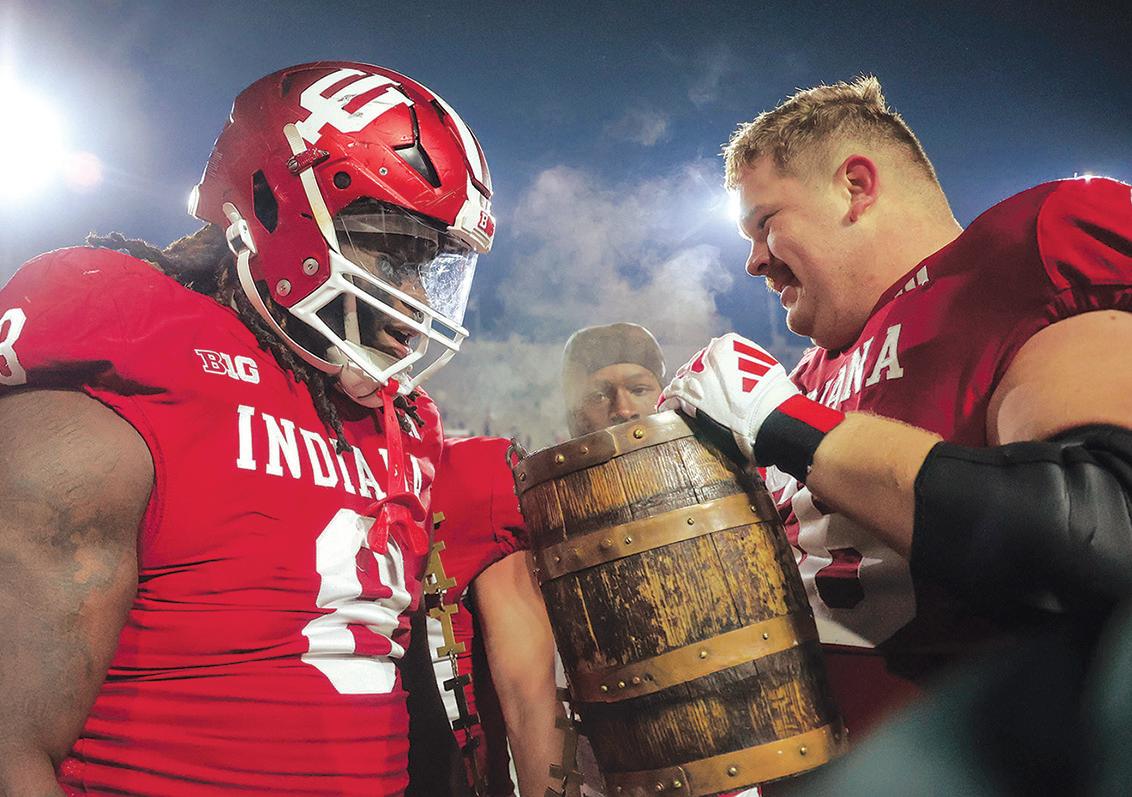
No. 10 Indiana football finally did it. And it was about time. Since 2017, Indiana has lost to Purdue five of the six times the two teams have met for the Old Oaken Bucket. But on Nov. 30, the Hoosiers put all of that behind them as they dismantled the Boilermakers 66-0, solidifying their playoff resume at 11-1 while simultaneously giving Purdue its worst loss in program history.
This rivalry victory is not the only way the Hoosiers have reinvented themselves in year one of the Curt Cignet
40-point games (8) in school history. If that isn’t enough for a team in one of the top two conferences in college football to make the College Football Playoff, then the sport is broken beyond repair.
There were plenty of bright spots for the Hoosiers in their momentum-building victory.
Sixth-year senior quarterback Kurtis Rourke collected his first game with more than 300 yards passing since Oct. 5 against Northwestern, as he finished 23-of-31 for 349 yards and a season-high six passing touchdowns. His connection with junior wideout Elijah Sarratt seemed to get right back to where it once was as he went for 165 yards and two touchdowns on eight receptions.
“We’ve been practicing hard and wanting to come out and get back to the offense that we’re used to,” Rourke said postgame. “Hopefully it’ll be momentum carrying into whatever’s next for us.”
The running game had struggled in the last few outings, with just 245 yards total in their last three games. Against Purdue on Nov. 30, the Hoosiers combined for 233 yards and three touchdowns.
But at the end of the day, Indiana has hit yet another peak as it will now be at the mercy of the CFP committee. There have been a lot of cases against the Hoosiers, especially since their road loss against No. 2 Ohio State on Nov. 23, but the wins do not lie.
Of Indiana’s 12 opponents, seven suffered their worst losses of the season to the Hoosiers, including teams like Nebraska and Michigan State. While you can point your finger and say Indiana hasn’t played a hard schedule, no one in the country has a higher point differential than the Hoosiers.
Sixth-year senior offensive lineman Mike Katic wore a massive smile across his face during postgame interviews after the victory. In his previous three seasons with the Hoosiers, Katic had won a combined nine games with 27 losses. Since deciding to come back for his sixth year, he has been a massive part of the record-breaking 11-win season.
“It’s the greatest feeling ever playing for this university and playing for the fans,” he said. “Everything has just meant so much to me.”
Seeing the joy and gratitude on Katic’s face after the game made this entire season feel real. From begging fans to come to games at all costs, to 53,000 white towels waving just two days removed from Thanksgiving, Katic and company are going to secure the first-ever playoff bid in program history. He is the perfect face of this Indiana football renaissance, and there is arguably no one in college football who deserves to play December football more than him.
From week one against Florida International University, to shutting out Purdue in the final week of the regu-
lar season, Indiana has gone through so much growth in its greatest season ever. In just three months, an unranked team projected to finish in the bottom two of the Big Ten, has improved to ESPN giving the Hoosiers a 99% chance of making the playoffs.
“Even if on paper we weren’t the most talented team going into the season, we had the most heart,” Rourke said. “Every game we’ve just wanted to prove that we belonged.”
They’ve done more than prove they belong — they’ve proven they deserve to step on the field with any team in
the country. Even with the Ohio State loss, which was inflated by two miscues on special teams and a touchdown in garbage time, Indiana football would be a consensus top five team in college football if it had a different logo next to its name, or if it played a little farther south. Selection Sunday will be upon us in just one week on Dec. 8. It is then that the committee will ultimately decide if the Hoosiers have done enough to be included in the 12-team playoff bracket. However, no matter what happens Dec. 8, this football season has been magical for everyone that has had the privilege of putting their fingerprints on it — on or off the field — and no one can ever take that away. “I’m just so happy for the fans and the alumni and people that are coming back for games and traveling for games,” Katic said. “It’s all I’ve ever wanted and I’m just so happy for the future of Indiana football.” The future is bright, and it starts at noon Dec. 8.
BRIANA PACE | IDS
Redshirt senior defensive lineman CJ West (left) and sixth-year senior offensive lineman Mike Katic (right)
Stadium in Bloomington.
HARRY
No. 14 Indiana falls to No. 3 Denver in Sweet 16
By Matt Press mtpress@iu.edu | @mattpress23
The quest for Indiana men’s soccer’s ninth national championship will have to wait another year.
The No. 14 Hoosiers fell to No. 3 University of Denver 1-0 on Nov. 30 in Denver, in the NCAA Tournament Sweet Sixteen. For the first time since 2021, Indiana failed to advance to the Elite Eight. For some of Indiana’s players, like fifth-year seniors JT Harms and Jansen Miller, Nov. 30 marked their final collegiate match. The flood of emotions and locker room silence are outcomes Todd Yeagley has seen frequently in his 15 seasons as the Hoosier head coach.
“Anytime it’s your last game of the season, they’re always emotional,” Yeagley said postgame. “It means a lot of tears — just shows how
much they want it and invest and love the program.”
Denver controlled the bulk of possession early in the first half, continually probing into Indiana’s backline and piecing together combinations in the final third. The hosts’ physicality and quality were evident. In the ninth minute, the Pioneers struck first.
Redshirt junior defender Ian Smith burst past Indiana junior defender Quinton Elliot on the edge of the 18-yard box and fired a threatening pass across the Hoosiers’ penalty area. Junior midfielder Jack Wagoner attempted to thwart the danger, but his clearance ricocheted off sophomore defender Alex Barger and left Denver freshman forward Keegan Kelly in position for an easy tap-in goal. Chances in the remainder of the half came few and far between for both sides.
Indiana mustered just one shot through the first 45 minutes, which harmlessly deflected off a Pioneer defender.
“They had great help defense,” Yeagley said of Denver. “They’re disciplined, they don’t make stupid mistakes with rotations, they’re sturdy.”
The script mirrored Indiana’s win over the University of Akron on Nov. 24. During that game, the Hoosiers logged one first-half shot and trailed 1-0 at the break. In that match, Indiana’s attack jumpstarted in the second half and peppered the Zips with shots.
After graduate forward Justin Weiss equalized in the 71st minute, Miller served as the overtime hero to send the Hoosiers into the Nov. 30 match.
But against Denver, the Hoosiers couldn’t follow a similar blueprint.
Canterbury Mission
719 E. Seventh St. 812-822-1335 IUCanterbury.org facebook.com/ECMatIU Instagram & Twitter: @ECMatIU Youtube: @canterburyhouseatiu9094
Canterbury: Assertively open & affirming; unapologetically Christian, we proclaim the gospel of Jesus Christ by promoting justice, equality, peace, love and striving to be the change God wants to see in our world.
Ed Bird - Chaplain/Priest
The Church of Jesus Christ of Latter-day Saints
Bloomington Young Single Adult Branch
2411 E. Second St. To Contact: Send message from website maps.churchofjesuschrist.org/ wards/237973
Sunday: 12:30 p.m.
The Church of Jesus Christ of Latter-day Saints has four congregations in Bloomington—Three family wards and our young single adult branch for college students. This info is for the YSA Branch. Weekday religious classes at 333 S. Highland Ave, Bloomington IN 47401, next to campus.
More info at churchofjesuschrist.org.
Lutheran - Missouri Synod
University Lutheran Church and LCMS U Student Center
607 E. Seventh St. 812-336-5387 indianalutheran.com facebook.com/ULutheranIU instagram.com/uluindiana
Sunday: 9:15 a.m.: Sunday Bible Class
10:30 a.m.: Sunday Divine Service
Wednesday: 7 p.m.: Wednesday Evening Service
Student Center open daily:
9 a.m. - 10 p.m.
The LCMS home of campus ministry at IU, our mission is to serve all college students with the saving Gospel of Jesus Christ, located across from Dunn Meadow and the IMU. The Student Center is open daily for study, recreation, and prayer. For full schedule, visit our website.
Rev. Timothy Winterstein - Campus Pastor
They held considerably more possession in the second half, but little of it led to testing Denver junior goalkeeper Isaac Nehme. The Pioneers’ 18 fouls created a few promising set piece opportunities, and one nearly came to fruition in the 77th minute.
Senior midfielder Patrick McDonald curled a free kick directly to the six-yard box and at the foot of Miller, but he steered his shot into the gloves of Nehme. While Indiana’s urgency started to mount, its chances never came quite as close as Miller’s.
“They’re fouling you in dangerous spots,” Yeagley said. “I thought they killed a couple of our attacks — it’s probably the right thing to do.”
Denver won a pair of corners with a little over eight minutes remaining in the match, and the Hoosiers
engaged in a final push of desperation. The Pioneers’ backline held firm, and Indiana’s equalizer never arrived.
Now, the Hoosiers are left with an all too familiar feeling: the bitter sting of a season-ending defeat. They felt it gravely in 2022, falling to Syracuse University via penalty kicks in the NCAA title game. They felt it last season, losing to the University of Notre Dame in the Elite Eight by way of penalty kicks yet again.
Nov. 30 wasn’t quite as dramatic, but the loss doesn’t ache any less.
“It’s also reassuring that what experience they have means a lot to them,” Yeagley said. “It’s difficult to be in that moment with them. You can’t really sum it up in postgame talk. You’re there for them, reminding them how well they did for the program and team.”
Indiana’s regular season — as has been the case so often in Yeagley’s tenure at the helm — offered indications that it might be able to finally conquer those demons and, for the first time since 2012, hoist a national championship trophy. The seven straight wins to cap the regular season, earning the Hoosiers a share of the Big Ten regular season title, displayed the squad’s attacking prowess. The second-round NCAA tournament win over Akron showed their resiliency. But Indiana took a cruel, spiraling crash back down to Earth against Denver. Now, faced with a handful of departing players, Yeagley won’t dwell for long. He’ll soon shift his focus to replenishing talent for another year, and another chance to make a national title worth the pain of these heart wrenching defeats.
United Methodist
Jubilee
219 E. Fourth St. 812-332-6396 jubileebloomington.org
Facebook: First United Methodist Church of Bloomington, IN
Instagram: @jubileebloomington
Sunday: 9:30 a.m., Classic Worship
11:45 a.m., Contemporary Worship
Wednesday: 7:30 p.m., College & Young Adult Dinner
Jubilee is a Christ-centered community open and affirming to all. We gather on Wednesdays at First United Methodist (219 E. 4th St.) for free food, honest discussion, worship, and hanging out. Small groups, service projects, social events (bonfires, game nights, book clubs, etc.), outreach retreats, and leadership opportunities all play a significant role in our rhythm of doing life together.
Markus Dickinson - jubilee@fumcb.org
Inter-Denominational
Redeemer Community Church
111 S. Kimble Dr. 812-269-8975 redeemerbloomington.org facebook.com/RedeemerBtown
Instagram & Twitter: @RedeemerBtown
Sunday: 9 a.m., 11 a.m.
Redeemer is a gospel-centered community on mission. Our vision is to see the gospel of Jesus Christ transform everything: our lives, our church, our city, and our world. We want to be instruments of gospel change in Bloomington and beyond.
Chris Jones - Lead Pastor
American Restoration Movement
North Central Church of Christ
2121 N. Dunn St. 812-332-2248 nc3family.org Facebook.com/nc3family
Sunday: 10 a.m., Worship 11 a.m., College Class
Come learn about historic Christian teaching on theology, ethics, and culture. We offer an alternative to the post-modern ideologies and teachings you often see in your lives today.
Shane Himes, PHD - Senior Minister
Christian Science
Christian Science Church
2425 E. Third St. 812-332-0536 bloomingtonchristianscience.com facebook.com/e3rdStreet
Sunday Church Service: 10 - 11 a.m.
Wednesday Testimony Meeting: 7 - 8 p.m.
Mon. - Fri. Reading Room: Noon - 2 p.m.
Interested in spirituality and healing? We welcome you to our church to explore how you can address issues spiritually and experience healing. Knowing God loves, guides and cares for each one gives a sense of peace and joy. We appreciate the Christian Science Monitor news magazine for its integrity, fairness and compassion. (Christian Science Monitor) csmonitor.com
Orthodox All Saints Orthodox Christian Church
6004 S. Fairfax Rd. 812-824-3600 allsaintsbloomington.org webbrk1@gmail.com Youtube video of services on website
Sunday: 9 a.m.: Sunday Matins 10 a.m.:
Father Peter Jon Gillquist Thomas Przybyla - Pastoral Assistant
Bahá'í Faith
Bloomington Bahá'í Community and Bahá’í IU Association
The Bahá'í Association of IU works to share the Teachings and Principles of the Founder, Bahá'u'lláh, that promote the "Oneness of Mankind" and the Peace and Harmony of the Planet through advancing the "security, prosperity, wealth and tranquility of all peoples."
Karen Pollock Dan Enslow
Haworth’s ace ignites Indiana sweep of Illinois
By Parker Rodgers parkrodg@iu.edu | @parrod153
Senior setter Camryn Haworth began her final match for Indiana volleyball with a statement.
Standing behind the service line to open the first set, she delivered an ace that landed just inside the back of the court, catching Illinois off guard as the Fighting Illini assumed the ball was out of bounds.
From that moment, the momentum was firmly on Indiana’s side. Despite the absence of students, fans packed Wilkinson Hall on Nov. 29 for one final time this season, creating an atmosphere that fueled the Hoosiers’ dominant performance.
Illinois struggled to counter Indiana’s energy, and the Hoosiers swept the Fighting Illini to close out the season. The victory also served as re-
demption for Indiana, which Illinois swept on Oct. 16 in Champaign, Illinois.
Indiana head coach Steve Aird pointed to his team’s improved health as a factor in the turnaround. The Hoosiers applied consistent pressure, out-serving Illinois with six aces to one.
“We had a lot of aces and put a lot of pressure on them,” Aird said postgame. “I think for the most part, it looked like the team when healthy is kind of exactly what I thought we’d be.”
Indiana’s balanced attack proved too much for Illinois’ defense to handle. Junior outside hitter Candela Alonso-Corcelles led the way with 18 kills, while two other Hoosiers contributed eight or more.
On the other side, Illinois struggled to find a rhythm. Graduate student outside hitter Raina Terry was the lone bright spot, tallying 10
Society of Friends (Quaker)
Bloomington Friends Meeting
3820 E. Moores Pike
812-336-4581
bloomingtonfriendsmeeting.org
Facebook: Bloomington Friends Meeting
Sunday (in person & Zoom) :
9:45 a.m., Hymn singing
10:30 a.m., Meeting for Worship
10:45 a.m., Sunday School (Children join worship 10:30-10:45)
11:30 a.m., Refreshments and Fellowship
12:30 p.m., Events (see website)
Wednesday (Zoom Only) :
7 p.m., Meeting for worship for Peace
Friday (Zoom Only) :
9 a.m., Meeting for worship
We practice traditional Quaker worship, gathering in silence with occasional Spirit-led vocal ministry by fellow worshipers. We are an inclusive community with a rich variety of belief and no prescribed creed. We are actively involved in peace action, social justice causes, and environmental concerns.
Peter Burkholder - Clerk burkhold@indiana.edu
kills — the only Illini player to reach double digits.
Indiana’s defense played a significant role, totaling 46 digs. Sophomore libero Ramsey Gary highlighted the effort with a crucial pancake in the second set that extended a key rally.
Though Alonso-Corcelles fell just short of 20 kills, her impact went beyond offense. Late in the third set, she recorded a block that brought Aird to his feet in celebration.
“She drives me crazy,” Aird said. “Every once in a while, she does something we tell her to in the scouting report and it works out.”
After the match, all seven seniors were recognized for their careers as Hoosiers. All of them had a white jersey placed in a frame, and each player received a bouquet of flowers from an underclassman on the team.
Some players, like
City Church 1200 N. Russell Rd.
812-336-5958
citychurchbloomington.org
tiktok: @citychurchbtown
Instagram: @citychurchbtown
Sunday Service: 8:30 a.m., 10 a.m., 11:45 a.m.
City Church is a multicultural church on the east side of Bloomington. We provide transportation from campus. Our college and young adult ministry meets on Tuesday nights.
David Norris - Pastor
Sacred Heart Church
615 N. Fairview St. 812-345-5239 sacredheartbloomington.org facebook.com/sacredheartbloomington
Haworth and outside hitter Mady Saris, smiled and waved to the crowd during the post-match senior celebration. Others, like fifthyear outside hitter Morgan Geddes — who spent her entire collegiate career in Bloomington — became emotional. As Geddes wiped away tears, Aird leaned over with a smile to her, saying, “Don’t cry,” as they posed for a photo beside her framed jersey.
Reflecting on the seven seniors, Aird praised them as program builders. When he took over in 2018, the team had won just one Big Ten match the previous season. Now, with the victory over Illinois, the Hoosiers secured their third consecutive season finishing at or above .500 — their first such streak since 1998-2000.
“When we got here, we had won one match,” Aird said. “There (were) a couple
hundred people that would come to matches. We’re selling out Wilkinson Hall now.”
As the season ends, Aird is looking forward to next season as he feels “the skies the limit” with most of his players returning while also
United Church of Christ and American Baptist Churches-USA First United Church
2420 E. Third St. 812-332-4439 firstuc.org facebook.com/firstuc
Sunday: 10:30 a.m., Worship
Monday: 10 a.m. via Zoom, Bible Study
We are an Open, Welcoming, and Affirming community of love and acceptance dedicated to welcoming the diversity of God’s beloved. We exist to empower, challenge, and encourage one another to live out Jesus’ ways (compassion, truth, and justice) authentically as human beings in community to create a better world.
Rev. Jessica Petersen-Mutai Senior Minister
Baptist
recruiting some of the top players in the country. Although
Evangelical Lutheran Church in America
Rose House LuMin & St. Thomas Lutheran Church
3800 E. Third St. 812-332-5252 Stlconline.org lcmiu.net
Sunday: 8:30 a.m. & 11 a.m. @ St. Thomas Lutheran Church 3800 E. Third St. Tuesday: 6:30 p.m. Dinner & Devotions @ Rose House
Unity Worldwide
Christ Community Church
503 S. High St. 812-332-0502 cccbloomington.org
facebook.com/christcommunitybtown
Instagram: @christcommunitybtown
Sunday: 9:15 a.m., Educational Hour
10:30 a.m., Worship Service
We are a diverse community of Christ-followers, including many IU students, faculty and staff. Together we are committed to sharing the redeeming grace and transforming truth of Jesus Christ in this college town.
Bob Whitaker - Senior Pastor
Adam deWeber - Worship Pastor Dan Waugh - Adult Ministry Pastor Non-Denominational
Christian Student Fellowship
1968 N. David Baker Ave. 812-332-8972 csfindiana.org
Instagram: @csfindiana
Monday - Friday: 9 a.m. - 5 p.m.
Christian Student Fellowship (CSF) exists as a Christ-centered community focused on helping students truly know Jesus Christ. Our ministry operates from an on-campus house where students can live. Reach out to schedule a tour of the house or a visit to our Thursday night worship service!
Ben Geiger - Lead Campus Minister
Stephanie Michael - Campus Minister
Joe Durnil - Associate Campus Minister
Hailee Lutz - Office Manager
Church of Christ
825 W. Second St. 812-332-0501 facebook.com/w2coc
Sunday: 9:30 a.m., Bible Study
10:30 a.m. & 5 p.m., Worship
Wednesday: 7 p.m., Bible Study
We
can
John Myers - Preacher
Sacred Heart is a nondenominational church that seeks to follow Jesus by acting justly, loving mercy and walking humbly with God. We strive to be a safe, inclusive community where you can bring your doubts, questions, struggles, and joys before a loving God and find true belonging. All are welcome!
Dan Caldwell
Episcopal (Anglican)
Canterbury Mission
719 E. Seventh St. 812-822-1335 IUCanterbury.org facebook.com/ECMatIU Instagram & Twitter: @ECMatIU Youtube: @canterburyhouseatiu9094
Canterbury: Assertively open & affirming; unapologetically Christian, we proclaim the gospel of Jesus Christ by promoting justice, equality, peace, love and striving to be the change God wants to see in our world.
Ed Bird - Chaplain/Priest
Independent Baptist
Lifeway Baptist Church
7821 W. State Road 46 812-876-6072 lifewaybaptistchurch.org facebook.com/lifewayellettsville
Sunday: 9 a.m., Bible Study Classes
10 a.m., Morning Service
5 p.m., Evening Service
*Free transportation provided. Please call if you need a ride to church.
Student Ministry: Meeting for Bible study throughout the month. Contact Rosh Dhanawade at bluhenrosh@gmail.com for more information.
Steven VonBokern - Senior Pastor Rosh Dhanawade - IU Coordinator 302-561-0108 bluhenrosh@gmail.com
Emmanuel Church 1503 W. That Rd. 812-824-2768 Emmanuelbloom.com Instagram & Facebook: @EmmanuelBloomington
Sunday: 9:15 a.m., Fellowship Sunday: 10 a.m., Worship Groups: Various times
Emmanuel is a multigenerational church of all types of people. Whether you are questioning faith or have followed Jesus for years, we exist to help fuel a passion for following Jesus as we gather together, grow in community, and go make disciples.
John Winders - Lead Pastor
Second Baptist Church
321 N. Rogers St. 812-327-1467 sbcbloomington.org facebook.com/2ndbaptistbloomington youtube.com/@secondbaptist churchbloomington
Sunday Service: 10 a.m., In house and on Facebook/YouTube Sunday School: 8:45 - 9:45 a.m. Bible Study: Available In House and on Zoom Wednesdays, 6:30 p.m., Thursdays, Noon
Please come and worship with us. We are in training for reigning with Christ! Need a ride? Call our Church bus at 812-3271467 before 8 a.m. on Sunday
Rev. Dr. Bruce R. Rose - Pastor Tallie Schroeder - Secretary
Unitarian Universalist
Unitarian Universalist Church of Bloomington 2120 N. Fee Ln. 812-332-3695 uubloomington.org facebook.com/uubloomington
Unity of Bloomington A Center for Spiritual Growth
4001 S. Rogers St. text/call: 812-333-2484 unityofbloomington.org
Discover a vibrant, welcoming community at Unity of Bloomington – “a positive path for spiritual living”. Our center offers a space for spiritual growth; embracing all with open arms. We proudly affirm and welcome the LGBTQ+ community, fostering love, acceptance, and inclusion. Join our loving congregation, where everyone is valued and encouraged to explore their spiritual journey. At Unity of Bloomington, all are welcome and together we thrive!
Minnassa Gabon - Spiritual Leader Phyllis Wickliff - Music Director Reformed Protestant
Trinity Reformed Church 2401 S. Endwright Rd. 812-825-2684 trinityreformed.org lucas@trinityreformed.org facebook.com/trinitychurchbloom
Sunday: 10:30 a.m., Sunday Morning Services 7 p.m., Bible Study at the IMU
We are a Reformed Protestant church on the west side of Bloomington with lively worship on Sunday mornings and regular lunches for students after church. We love God and His Word. Please get in touch if you’d like a ride!
Jody Killingsworth - Senior Pastor Lucas Weeks - College Pastor
GISELLE MARSTELLER
Four days after Dr. Moore died, Dennis Murphy, chief executive officer for IU Health, released a statement expressing his condolences.
After a preliminary review, Murphy said he didn’t believe the medical team “failed the technical aspects of the delivery” of Dr. Moore’s care. He attributed the potential lack of proper care to the time constraints the pandemic presented.
IU commissioned a panel of healthcare and diversity experts to investigate her allegations of racial bias in her care. The panel went over the medical records, interviewed IU Health personnel and reviewed the hospital’s policies and procedures.
Five months later, in May 2021, the panel returned with its findings. The treatment Dr. Moore received, the report found, did not contribute to her untimely death. However, her care was marked by an absence of understanding.
SEE HENRY, PAGE 10
“There was a lack of empathy and compassion shown in the delivery of her care,” Murphy wrote in a press release. “Cultural competence was not practiced by all providers and several caregivers lacked empathy, compassion and awareness of implicit racial bias in the delivery and communication of Dr. Moore’s care.”
The panel recommended training sessions that teach staff how to improve communication between patients and staff, as well as diversity, equity and inclusion training that focuses on microaggressions, anti-racism and unconscious bias. Plans also included hiring a DEI expert to analyze the culture of IU Health hospitals.
After multiple requests, IU Health would not provide any further information on whether these recommendations were followed.
According to Steven Langer, a medical malpractice lawyer that worked on Dr. Moore’s case,
an internal negligence claim was filed and resolved. After multiple calls, emails and a public records request to IU, neither IU nor Langer offered any additional information on the case. ***
Following Dr. Moore’s death, state Rep. Robin Shackleford, D-Indianapolis introduced a bill to require healthcare providers across the state to complete two hours of cultural competency training.
“We're trying not to be so intrusive and add on any extra regulations but at least make it a requirement as part of their continuing education,” she said. “With this education, we feel that providers will have a better connection with those patients as they're learning about their experiences.”
It did not pass. But Shackleford said these trainings are crucial for healthcare providers to understand how Black women tend to internalize pain until they can’t anymore and self-medicate more often. Research shows maternal health and COVID-19 death rates are significantly higher for Black people; the bill would aim to reduce these disparities.
“We've been taught to be strong. We've been taught to endure,” Shackleford said. “If you don't understand that as a culture, as their background, then you may perceive that an African American woman is not in pain.”
Studies show 6 in 10 Black adults prepare for providers to insult them, and they feel they need to be careful about their appearance to be treated fairly. Sometimes healthcare providers ignore their questions and concerns, refuse to prescribe pain medication, assume something or blame the patient for a health problem.
Many Black patients report experiences similar to Dr. Moore's, including Rep. Shackleford, who is a Black woman herself. Sometimes, when meeting a new health provider to get her prescription refilled for her chronic migraines, she faces
hesitation.
“There's kind of a stare or glance or some people feel that I shouldn't need that narcotic,” she said. "You already, probably get those glances when you're trying to refill or get more of a narcotic, you get kind of scared to even ask the provider once it runs out, because you don't want to feel the shame, but at the same time, also you don't want to continue to be in pain. And if you're taking a narcotic, then you're in deep pain. So there's usually, that's where the biases come from.”
When talking with constituents, Shackleford said many Black women say they feel they are not taken seriously by a doctor.
“Sometimes they feel like if they're trying to talk to their doctor, they're not going to relate to what they're saying,” she said. “So they may just not say anything, and then just talk among
at the state level to get the legislation even to be heard and accepted,” she said. “But we'll continue to fight.”
***
Henry eyes the deadlift bar. It sits on the ground, all 475 pounds. He shakes out his arms as “Chatter” by Connor Price begins to play in his ears. He can’t hear anyone else around him; the beat drops in the song as Connor Price begins to rap.
He walks over to the bar. He adjusts his glasses. The earbuds stay in.
“Alright everyone,” Henry announces to the room.
Some of the powerlifters at the Rising Star Gymnastics’ Eclipse Gym watch as he inhales deeply and slowly pulls the bar from the ground. He braces his core as 475 pounds leave the ground.
Henry stands up straight, his body slightly shaking from the heavy weight. He holds the bar down in front of him, and then suddenly drops the bar back onto the ground. He exhales. A personal deadlift record. All in a matter of 3.5 seconds.
He starts dancing around, flicking off the black belt he has on to support his back.
Others congratulate him.
their girlfriends or their friends instead of talking to the provider.”
Because the majority of the Indiana General Assembly are white men, Shackleford said it’s been hard to pass this type of legislation on the state level.
“This is an issue, especially when we're talking about maternal health, we're talking about something that's affecting women, which are the minority in the General Assembly,” she said. “We're also talking about things that are affecting minorities, which is also the minority in the General Assembly. So, it's sometimes hard to get the majority to understand a minority major issue and to get it seen as a priority.”
Shackleford had some luck at the national level, but wants to see more done locally.
“We’re still struggling
After his mom died, powerlifting was just one of the things Henry tried out at IU. He auditioned for a comedy club and a choir. He also joined Chi Alpha, a Christian group. Henry relied on his faith to piece his life back together after his mom died.
“When she passed, I was like, ‘Why? Why? Why? Why?’” Henry said. He looked down at his lap.
“That's left us with so many questions I wanted answers to. I'm a STEM guy, I want answers to questions. You know, that's why I went into STEM,” he said. “So not having all those answers, that degree of uncertainty really kind of blocked me, ruled my life and gave me so much anxiety.”
Through Christianity, Henry found peace and was able to move on from his mom’s death. He recited his favorite proverb, Proverb 3:5-
6, from memory.
“Lean not on thine own understanding and on all thy ways Acknowledge Him, for He shall straighten thy paths.”
After his mom died, Henry had to get his mom cremated. Had his mom not died, they would’ve lived in a house together, along with his grandparents, while Henry took classes. 203 S. Clark St. His room would’ve been the one painted a baby blue color on the first floor. “It’s the house!” he recalls thinking as he’d bike by on his way to the barbershop freshman year. “It’s Clark Street.”
His mom had already signed the lease a month before her passing. They’d submitted a deposit of $2,400.
“We can’t take this house now,” he said. “I can’t pay for that; I don’t have a job.” Henry decided to live in the dorms instead. He’s studying biochemistry. His mom always got on him about studying more.
The last time Henry talked to his mom’s ashes in the summer, he asked her for advice about school. She doesn’t talk back, but he imagines what she’d say to him if she was still alive. She’d tell him to stick with it.
Henry sits in the blue car for five seconds before getting out. He closes the car door but his eyes never leave the beige-stone, ranchstyle house. There are four carved pumpkins to the right of the front door and a red ‘Hoosiers’ sticker on the glass of a window. He unlocks his phone and checks his mom’s email records to make