IDS


By Samantha Camire and Gentry Keener news@idsnews.com
The IU Funding Board is unable to provide student organizations with adequate funding after IU allowed the account to overdraft, president of the board and IU senior Larry McDowell told the Indiana Daily Student.
IU Funding Board is an organization run by students that provides money to student organizations on campus for events and general activities, according to its website.
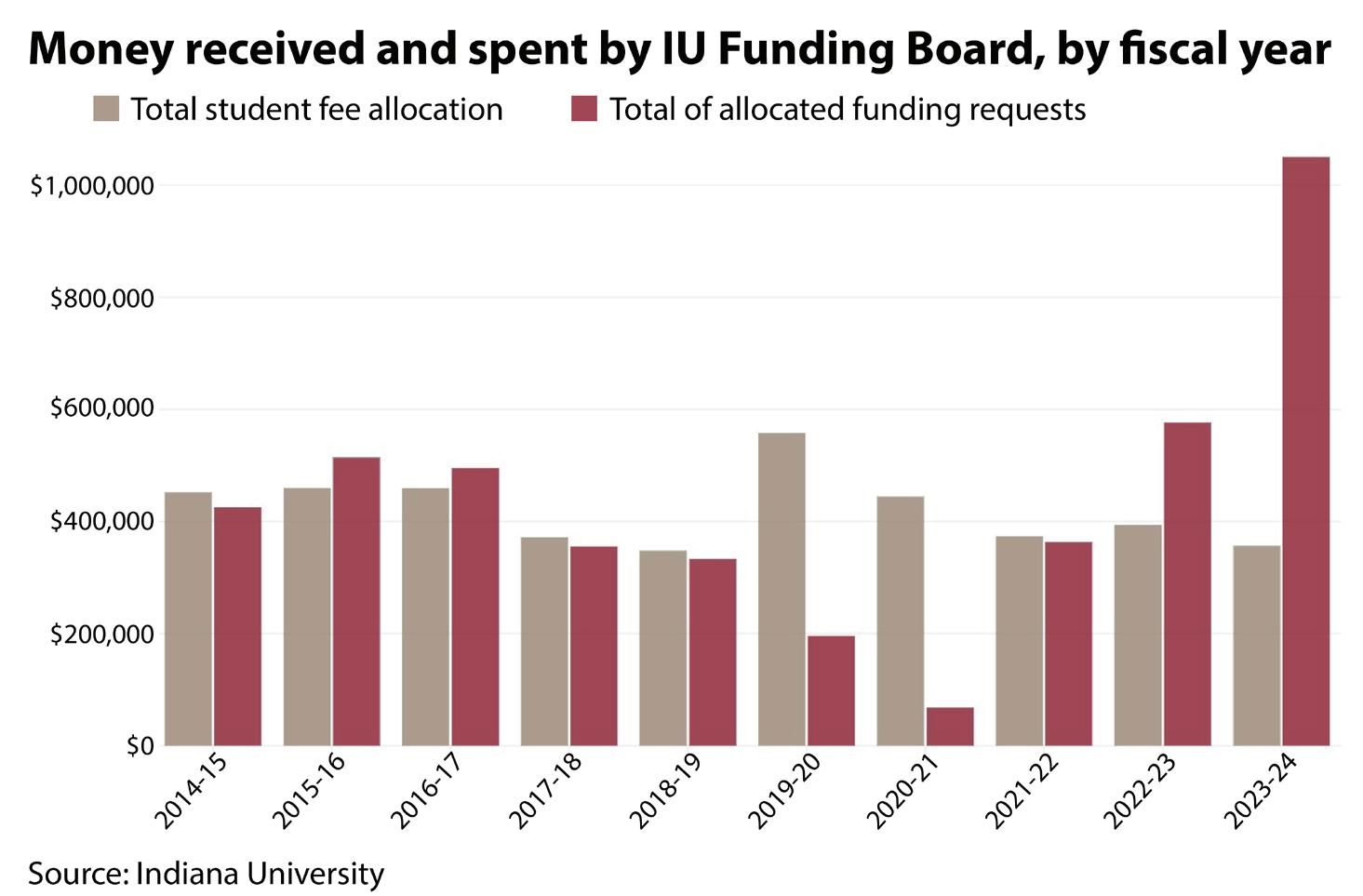
Last year, it allocated over $1.2 million to student organizations and supported over 400 events. However, McDowell said this year it will only be able to support about 100 events, providing a maximum $2,000 to each student organization.
McDowell said IU Funding Board is a University Supported Organization, and as such its financial accounts are managed by the university. The student leaders of the Funding Board must ask their advisors to reach out to the Office of Finance in order to receive updates on the account.
“At the beginning of the spring semester, and three more times throughout the
course of the spring semester, Funding Board leadership requested numbers on what was in our account and what we would be looking at for the duration of last semester, and that information was never given,” McDowell said.
Unbeknownst to the students on Funding Board, McDowell said they had given out more money to student organizations than they held in their reserves. The account was overdrafted by $220,000 by the end of the spring semester.
When asked why the Funding Board continued giving out money if they were unsure how much they had to give, McDowell explained they closed the application for funding midsemester. He says this was “unprecedented.” But the Board’s policy is to approve all applications as long as they follow the group’s bylaws, so they needed to process the applications they already had and get an update on the amount of money in their account before taking more.
“The assumption was that we would not be anywhere near the end of the account because we would have been notified well before then (by the university),” McDowell said.
It’s our responsibility to teach media students how
By David Tolchinsky
The U.S. lost 2.5 newspapers a week in 2023.
The epidemic of vanishing newsrooms was documented in a report from Northwestern University. By year's end, our country will have two-thirds the newspapers it had in 2005. We’ve watched for 20 years what happens when news organizations don’t evolve. And we will not let that happen to IU student media. A year ago, the IDS's deficit was approaching $900,000. IUSTV and WIUX had limited revenue generation capabilities. And there were well-documented pleas from our students for a “comprehensive solution.”
So we listened.
A committee of faculty, staff, alumni and students (including leaders of the IDS) researched and presented recommendations for a sustainable future for student media. Media School staff reviewed them, incorporated as many as possible and operationalized them. On Oct. 8, we presented our plan to reimagine student media.
We had planned to share the plan with student media leaders and faculty first, but when we learned the IDS had obtained a copy and was going to publish a
story, we felt it necessary to announce the plan early so our community could hear it directly from us. It was hard. It will continue to be hard. If it was easy, it would have already been done.
This plan is thoughtful and creative. It required difficult decisions. Here’s one: the IDS’s top three expenditures are professional staff salaries, student pay and newsprint. When it came time to choose, we prioritized the people of the IDS. Because it is the people, more than the print, that makes this venerable publication.
We acknowledge the loss the IDS community feels for its weekly print edition. "Journalist” is not just a job; it’s an identity. We hear you: Why can’t IU just give student media more money? Actually, that would be a lot easier than what we’re doing. But subsidizing a business model on campus that does not reflect the ecosystem off campus won’t adequately prepare students for the career landscape they’re entering. Remember those vanishing newsrooms? Someone has to do something about those. And our goal is to turn out creative and bold graduates equipped to solve that problem — and many more. You can do this. WE can do this. The Media School will always support student media.
David Tolchinsky is dean of The Media School at Indiana University.
“I have asked my team to increase the level of communication with the Funding Board moving forward to avoid this situation reoccurring in the future,” Lamar Hylton, the Vice Provost for Student Life, said in a statement provided to the IDS.
McDowell said he decided to spend some of the money allocated to the 2024-25 academic year in the spring to pay off the overdraft. Many of the organizations who had received those $220,000 in funds had already hosted their events and were relying on reimbursement from the Funding Board, so he felt it was unfair to withhold those funds.
McDowell said the student body needs $1.1 million in funding this year to meet all of their needs. The Funding Board is simply unable to offer that support.
“The university is the steward of our money,” McDowell said. “And poor stewardship will get you in these situations every single time.”
"The pressure should be on the university” McDowell released a press release Sept. 18 explaining the situation to the student body. He said IU administration was “very
angry” that he decided to release a statement at all.
“They (IU administration) have the capacity and the ability to resolve this problem,” McDowell said. “The pressure should be on the university at this point in time to reallocate their own money to ensure that the student body is thriving.”
McDowell said he has tried to meet with Hylton to discuss possible solutions but all attempts to do so have been unsuccessful.
“This is someone that in the past, I could get a meeting with at the drop of a hat,”
he said. “I could go in and stop by and say, ‘Hey can you get me on a schedule?’ And my meeting with them has been canceled four times in a row.”
In an emailed statement, Hylton told the IDS, “My two initial meetings with Larry had to be rescheduled due to circumstances beyond my control. My staff and I have shared with Larry directly that we want (to) meet with him. The offer to meet still stands.”
But McDowell says students on the Funding Board have been left to figure out
Editor’s note: This letter is a response to a Letter to the Editor written by Media School Dean David Tolchinsky.
As student journalists, we are no strangers to the idea of vanishing newsrooms. New technologies and apps have changed the way businesses advertise. People consume the news in a variety of mediums. These economic pressures are real, but they are not the only way a newspaper dies.
Take Northwestern’s 2023 report, which Media School Dean David Tolchinsky cites in his Letter to the Editor on Oct. 21. Corporate consolidation of local news has been a major driver of these “vanishing newsrooms” according to the report, with Gannett eliminating 97 newspapers across the country between 2022 and 2023. Another report confirms the trend — Gannett sloughed off another 126 local papers between 2020 and 2022.
In other words, these newspapers aren’t “vanishing” — they’re being killed. The weapons these corporations use will sound familiar — reduced staff, reduced print and such a focus on generating clicks that they lose the trust of the community they originally promised to serve.
This was the driving point of the April committee report from students, faculty, staff and alumni, which argues in its first paragraph the university must commit to supporting student media to help fulfill the IU 2030 plan’s focus


what to do.
“It kinda gives me the perspective that it’s like ‘OK, we're not interested in solving this problem. We’re interested in ignoring it and putting it on the students to figure out,’” McDowell said. Less money from the Committee for Fee Review
Adding to the problem, the IU Funding Board received less money from the Committee for Fee Review for this academic year, McDowell said. SEE FUNDING, PAGE 4
‘vanish.’
on “experiential and careerrelated” education.
“For many years, the economic realities of IU’s nationally-recognized student newsrooms have been characterized as issues of profit and deficit,” the report’s second paragraph reads. “This is misguided framing.”
The IDS’ history of excellence continues to attract numerous students into The Media School, yet IU is measuring success based on whether the IDS brings in a profit. The Media School is prioritizing financial gains at the expense of the quality of our craft.
Still, The Media School finds itself promoting that same craft that has won countless Associated Collegiate Press and Society of Professional Journalists awards.
The dean does not lie when it says it incorporated many of the ideas in the April report. But each idea was contingent on university support.
In 2005, the IDS had nearly $1 million in reserves. But its expenses at the time — $2 million — were more than double what they are now at around $900,000. Over the past few decades, the IDS has evolved to keep up with new technologies, creating podcasts, videos and a strong social media presence. Despite that, these new platforms are still a financial blow — we cannot currently make as much from Instagram ads as we made in print in 2005.
Each financial dip became a reason to cut our expenses. When professional
staff members left or retired, The Media School prohibited us from replacing them. Remaining staff members took on more work. With diminished staff came a reduced ability to seek out new advertisements, so our revenue decreased. We found ourselves in a spiral of falling revenue, which initiated cut after cut, which further reduced our revenue.
The Media School’s plan is just more of the same.
Media School leaders claim their decision to cut rather than invest will teach us the economic realities of the industry we’re entering. We expect to face a similarly flawed thinking if we end up working for a corporation, but we had hoped that Indiana University, as a public college funded by our tuition dollars and Hoosier taxpayers, would want to be a pioneer in changing this tired approach rather than repeating what has already failed. By refusing to charge mandatory fees for student media, which provides free multi-platform news for the campus and wider community, IU is indicating it believes student media is not worth even a dollar per student per year. Yet, it requires each IU student to pay over $80 a semester to fund the Student Recreational Sports Center, which many of IU's 48,000 students do not use on a daily basis.
Beyond just providing the news, the IDS provides students across campus with jobs including marketing, design, photography and web development. IDS


educates future professionals and gives voice to student organizations and leaders who will learn valuable skills regarding dealing with the press. It’s hard to feel like Media School leaders value what we do when they believe “subsidizing a business model on campus,” in their own words, would not adequately prepare us for a future career in journalism.
Unfortunately, cutting the weekly print edition ensures we are not adequately prepared for jobs with some of the largest newspaper employers that do have a print edition, like Gannett, the New York Times, the Washington Post or the Wall Street Journal — all places that have IDS alumni working there today.
If IU and the Media School do not want to invest in student media like they do in the SRSC, a new $43 million property in D.C., the Kinetic Imagery and Extended Reality Lab or even their $104,929 contract with Mapt Solutions to develop a strategic plan, that’s their decision to make. But they cannot in the same breath pretend they are prioritizing journalism.

Marissa Meador CO-EDITOR-IN-CHIEF
Spudich

By Samantha Camire scamire@iu.edu | @CamireSamantha
Despite years of effort from students, IU remains without a cultural center for Muslim and Middle Eastern students.
The university supports seven culture centers and institutes – the Asian Culture Center, First Nations Educational and Cultural Center, Jewish Culture Center, La Casa Latino Cultural Center, LGBTQ+ Culture Center, Neal-Marshall Black Culture Center and the African American Arts Institute.
But to some students, the current lineup has glaring omissions.
Students have been advocating for several years for the creation of new culture centers for the Muslim and Middle Eastern communities. The Office of the Vice President for Diversity, Equity and Inclusion, which oversees the existing culture centers, touts the culture centers as “community learning spaces, providing an array of unique programming and events” and describes them as “a home away from home.”
Students believe that new Muslim or Middle Eastern centers would similarly provide a safe space for students on campus and offer built-in advocates.
“I think it would be another place where I could feel more engaged on campus and more included, and I think it could be a really good space for IU to start those conversations and make sure that their Muslim and Arab students also feel welcome on campus,” Hafsa Khan, a junior studying biology and environmental science, said.
Despite past talks with IU, little progress
Last year, Khan served as the president of the Muslim Student Association (MSA). She said she was involved in several conversations, in partnership with the Middle Eastern Student Association, with the Office of the Vice President for Diversity, Equity and Inclusion about the creation of new culture cen-
ters. Khan says they spoke to both James Wimbush, the former vice president of DEI who stepped down from the position in July to return to a faculty role, and Rashad Nelms, the current vice president for DEI. Despite these talks, which Khan says began back in 2022, no progress has been made.
“Everything that I’ve been a part of has been more like, ‘this is something that we hope is gonna happen,’ but it doesn’t seem like there’s a lot of motion of how it’s going to happen,” Khan said.
The Office of the Vice President of Diversity, Equity and Inclusion declined the Indiana Daily Student’s multiple requests for interviews but said in an email that “IU is constantly assessing needs and adapting resources to best ensure support for members of the campus community.”
Other groups also believe creating new culture centers is important.
The IU Divestment Coalition and Palestine Solidarity Committee, which formed an encampment in Dunn Meadow for 100 days this spring and summer in pro-
test of the Israel-Palestine War, listed the establishment of Muslim and Middle Eastern Culture Centers as one of their demands from the university on a petition.
Establishing a new culture center is also a priority for the FUSE administration, which currently leads IU Student Government. In campaign materials last year, FUSE pledged to form a Middle Eastern, North African and Muslim Culture Center in its first 100 days in office. Though those 100 days have now passed without any action, the administration says it remains committed to establishing a new center.
Alexa Avellanada, executive secretary of communication for IUSG, said in an email that IU administration is withholding an audit report of the existing culture centers.
“Due to the IU administration’s withholding of the audit report, there have been numerous unexpected delays. What we were told is that a new culture center cannot be established while an audit is being written or reviewed,” Avellanada said in an email. “The FUSE admin-
istration, because of this, has their hands tied, but we continue to advocate strongly for the new culture center’s establishment.”
The Office of the Vice President for Diversity, Equity, and Inclusion confirmed the existence of such a report but said it “remains confidential and deliberative,” according to spokeswoman Elizabeth Blevins.
One difference between the advocates is their vision for the culture centers. Khan believes there should be two separate culture centers, one for Middle Eastern students and one for Muslim students. She said most Muslims in the world are not Middle Eastern, and so a distinction between the two centers is important. Avellanada wrote that although the FUSE administration has been advocating for a joint center, they “would gladly accommodate to the student body.”
Benefits of a center Students envision a culture center as a place of education and community.
Khan hopes for a Muslim cultural center that offers education for both the
university as a whole and for the Muslim community. She described an “Ask a Muslim” tabling event that MSA held last year, in which they offered free chai tea and invited students to ask any questions they had about the Muslim faith, as a vision of the types of events the center could hold. She also described education for Muslim students on their resources at IU, such as how to report bias incidents.
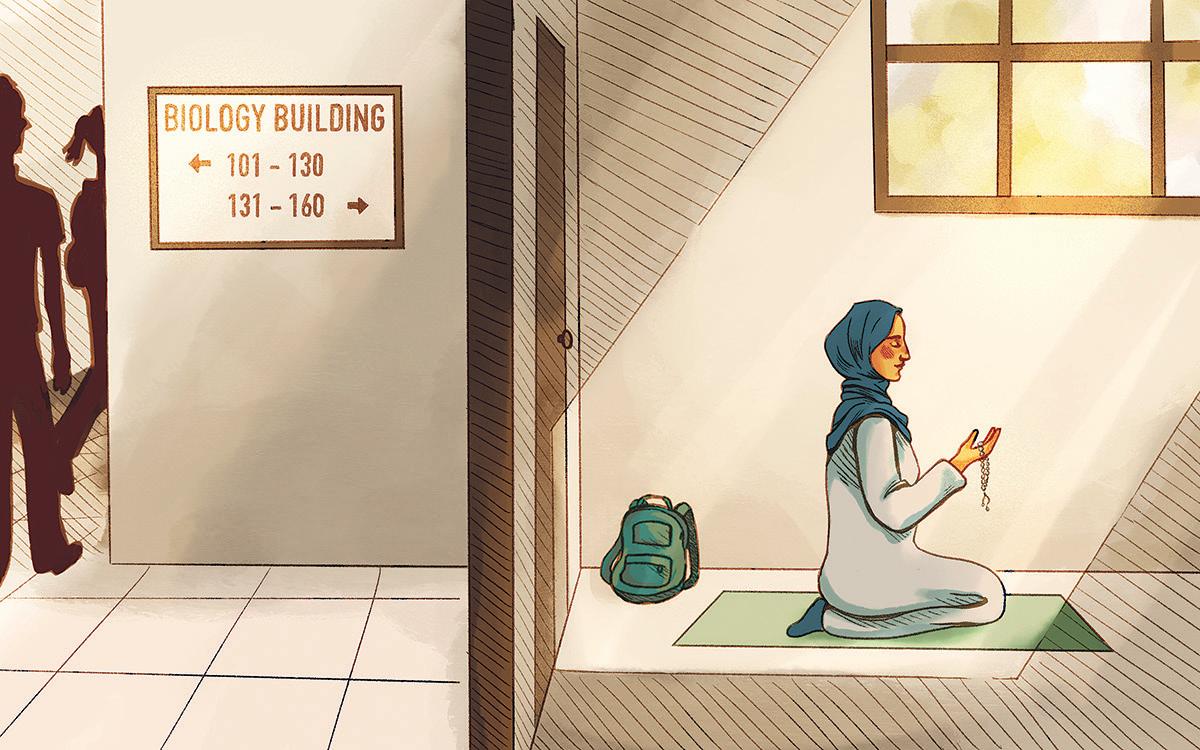
Khan said she sees a lot of value in having IU staff members at a campus culture center who can advocate for the needs of students in that community. Khan said she had to find a quiet corner of the Biology Building to pray because there was nowhere else for her to go. Though there is an Interfaith Prayer Space at the Indiana Memorial Union, she believes students deserve more options.
“If we had a Muslim Culture Center, they’d have staff and people that work for the university that can be advocates of like, ‘hey in some of the bigger spaces, like in the bigger spaces on campuses… there should be a little space for students to pray,’” she
said. Imran Mihas, who is on the executive board of both MSA and the Middle Eastern Student Association, described a vision for mentoring programs, in which older Middle Eastern students are paired up with underclassmen just arriving at IU. He says this would be particularly helpful for younger students who are struggling to find a community on campus.
Student groups bridge the gap Until a Middle Eastern or Muslim culture center can be established, student organizations are trying to fill the void. MSA and MESA do their best to support students on campus, often serving as both social groups and advocacy groups, Khan and Mihas said.
MSA has an office in the Student Involvement Tower that is “doing overtime,” Khan said, functioning as an office, gathering space and prayer room all in one.
“There are a lot of culture centers already on campus, and we kind of have to congregate with ourselves at just random areas,” Farah Rafa, the vice president of MESA, said. Without clear gathering spaces, students in MESA often gather in a free room at the Student Involvement Center intended for use by all student organizations. On one Wednesday afternoon, the room was full, with at least 25 students of Middle Eastern descent studying and socializing in what is essentially a makeshift culture center.
“We’re trying our best to create a good community, but there’s only so much we can do as student orgs,” Rafa said. All three student leaders believe creating Middle Eastern and Muslim culture centers on campus would be a welcome resource for students in these communities.
“There are so many culture centers already and I just think that we’re deserving of one as well,” Rafa said.
By Riya Malik
rimali@iu.edu
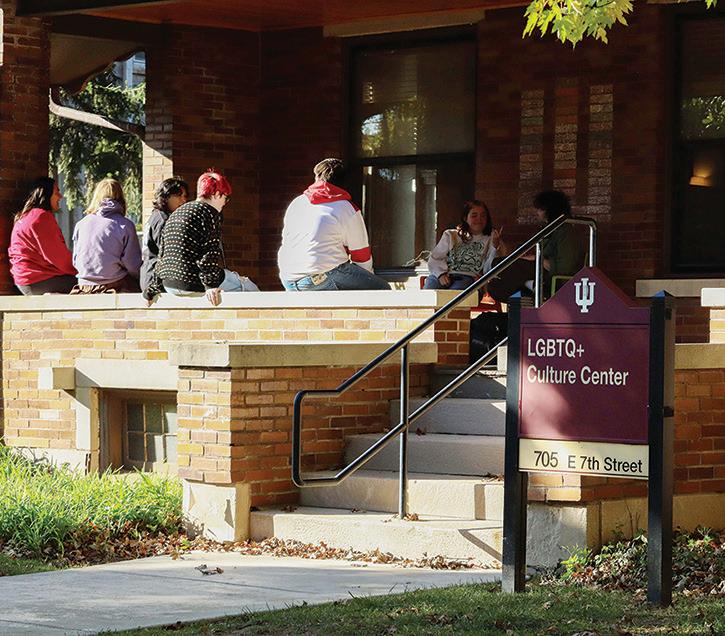
After a summer of renovations, the LGBTQ+ Culture Center celebrated its new space Oct. 17.
Members of the LGBTQ+ community, students, staff members and allies showed up to mingle and explore the culture center’s new spaces. The event began with a ribbon-cutting ceremony and opening remarks from Director Bruce Smail, members of the alumni board, center founder Doug Bauder and Vice Provost for Diversity, Equity and Inclusion Rashad Nelms, among others.
“My favorite part of the night was probably the speech that [Smail] gave,” Nalini Krishnan, office services assistant for the center, said. “He has really been the one that has been at the head of this project, and it’s been in the works for many, many years. And I think finally seeing it culminate into what it has become was really emotional.”
Smail said that in 2022, IU designated the building space for the LGBTQ+ Cul-
ture Center after the student affairs department relocated its office space within the building. With the opportunity to transform office rooms into center space, Smail and his coworkers began looking at ways to make the building more studentfriendly through facility improvements and interior design renovations. They created plans for interior designs that would replace the first floor office spaces in the building entrance with an open student cafe lounge.
Now, students can hang out in the new student lounge, study or read in the library, and utilize the multipurpose counseling room.
On Mondays, Counseling and Psychological Services staff will be available and on Fridays Accessible Educational Services will offer support. The room will be also utilized for accessible HIV testing. The renovations also helped create a gender-affirming closet, a room where students can try on gender-affirming clothing and feel comfortable expressing themselves. Since its founding in
adds a new flavor, new feel to the center. And I’m happy that we were able to successfully make that happen.”
To fund the renovations, the LGBTQ+ Culture Center received a grant from the IU Queer Philanthropy Circle and reached out to outside donors for more support. In total, they were able to raise around $225,000 for their renovation procedure, Smail said.
1994, the LGBTQ+ Culture Center has grown both structurally and in significance. Smail said the center began as an office for gay, lesbian and bisexual students rather than encompassing all gender identities and sexual orientations. The center has since grown to be more inclusive on campus.
“It was a little small section in what is now the library and almost a quarter of the room space,” Smail said. “To see the center grow from there to us having the entire building is amazing. And for us to be able to do a whole renovation, have a repainting job, recarpeting, new furniture, it just really
“I just want to say thank you to the folks that supported us in making this possible,” Smail said. “[To] the Queer Philanthropy Circle, departments that supported us and all the donors that did matching funds and challenged other folks to donate. There was a real great community effort to make this happen. So we’re extremely grateful for all the support.”
For the re-opening ceremony, the center was decorated with balloons, a variety of pride flags and historical posters and catered food from The Trojan Horse.
“I think that the night itself was an incredible success. I’m so thankful for the people that showed up to show their support for the center and then to also finally [see] some of the donors,” Krishnan said. “A lot of the students who have been here multiple years [got to] see the center before and
after to see the product of all of our hard work and our joint efforts.” Krishnan, who also serves as president of the Queer Student Union described the event as a “fullcircle moment.”
“I’m a senior now and I came to IU as someone who has grown up in Indiana and who never really had like a queer community where I grew up,” Krishnan said. “And the center was kind of like that first exposure for me, like, ‘oh, something like this can exist in Indiana.’ I think the renovation was really a testament to the strength, the closeness and the ties between the queer community here at IU.” The project’s success also highlights how the queer community feels supported at IU, Krishnan said.
“I think that this renovation indicates that the LGBTQ+ Culture Center and many folks at IU are still committed to prioritizing and making sure that safety and the feeling that IU is a home for queer people is emphasized,” Krishnan said. Allies and members of the LGBTQ+ community can engage with the center through their fall programming schedule and keep up with their announcements and events by signing up for their QNews e-mail newsletter.
By Gentry Keener gekeener@iu.edu | @Gentry_Keener
Despite the visible struggles of homelessness on Bloomington’s streets, there are a lot of efforts behind the scenes intended to fight the increasing battle. From three meals served daily, to rehousing programs, to new couples’ shelters in development, the city is seeing small but impactful victories that offer hope to those experiencing homelessness — even as challenges persist.
Wheeler Mission is an Indiana charity with a homeless shelter in Bloomington that has been serving the community since 1893. Dana Jones, the director of engagement and services, said the shelter is a one-stopshop for everything someone experiencing homelessness could need. It serves meals three times a day, has 80 beds available nightly and provides showers and even clothing in the winter.
Jones said Wheeler Mission’s goal is always to help those experiencing homelessness get back on their feet. Its programs help them do this.
Although the shelter is “come as you are,” meaning no background checks or drug tests are required to stay there, the beds have rules in the summer. From April 1 to Oct. 31, when the days get warmer and the weather less harsh, Wheeler Mission offers a 20-day stay once every 30 days.
However, if one makes appointments with case management, an initiative aimed at helping the unhoused community get the resources they need and build plans toward personal goal advancements, then they can stay as many days as they need.
The goal is to make sure those coming in are working toward “personal goal advancements,” such as housing, employment, work readiness or treatment for addiction or mental health.
“Having people remain stagnant is not healthy,” Jones said. “In the summer months is the safest time for us to be working towards those goals.”
In the winter, from Nov. 1 to March 31, a person can stay indefinitely if they choose to. Case management is offered but not required to stay.
Jones said most people who stay at the emergency shelter are only there for two to three weeks.
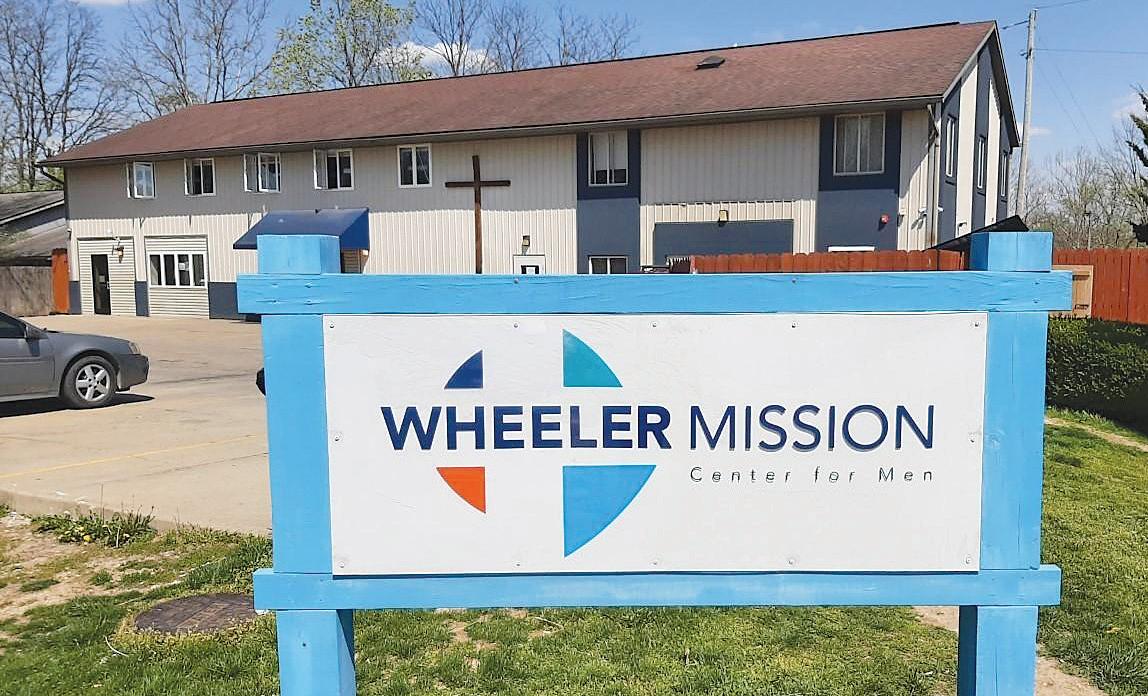
With programs like weekly addiction groups and relapse prevention, along with transitional care, which offers 18-24 months of housing as long as someone is employed, Jones said there is a lot happening behind the scenes that the public often doesn’t see.
“I know we see homelessness on the streets of Bloomington all the time,” Jones said. “But there is so much progress being made.”
Every January, the Indiana Housing and Community Development Authority helps organize a point-intime count of people experiencing homelessness in the state of Indiana.
This year’s PIT count shows a doubling of unsheltered people in Monroe County, compared to 2023. The 2023 PIT count was 72 unsheltered people, rising to 142 in 2024.
Homelessness numbers have been on the rise, with 456 being homeless in Bloomington and Monroe County in 2024 compared to the 427 people in 2023. A significant portion of those are living without shelter, according to the PIT report. This means a large portion of those unhoused are living on the streets rather than in a shelter, car or any form of protection from outside.
Jones said the fight against homelessness is a big, collaborative effort in the community.
Wheeler Mission collaborates with many local organizations, clinics, churches and other shelters to make a bigger impact, including HealthNet.
HealthNet, specifically the Homeless Initiative Program, aims to provide direct, acute medical and psychi-
atric care to the unhoused community in Monroe County, according to HIP Bloomington coordinator Melissa Burgess.
Not only does HealthNet provide medical care to those living in homeless encampments, parks or other locations around Bloomington, it also partners with Wheeler Mission, Middle Way House and the downtown public library to provide more access to health care.
It holds clinics twice a week, with treatments that range from case management to wound care.
Other organizations like Beacon are also working to create a space for those experiencing homelessness. Wheeler Mission’s overnight shelter is a male-only shelter, whereas Beacon’s overnight shelter, Friend’s Place, reserves 20 out of their 40 beds a night specifically for women.
Forrest Gilmore, the executive director of Beacon, said all 40 beds are filled most nights, with predominantly women and people part of the LGBTQ+ community.
Beacon helps to house over 200 people a month through their day and overnight shelter.
“The homeless population has remained relatively steady over the last decade,” Gilmore said. “And that is directly due to community intervention and housing intervention.”
Gilmore said if it weren’t for this, the homeless population would be much higher since housing access has become a much more challenging issue.
However, not every person experiencing homelessness uses shelters or joins
the programs. Street homelessness is still occurring, and increasing, throughout the U.S., Jones said.
Both Jones and Gilmore explained various reasons why some people choose not to come into shelters.
They cited pets as a major reason, as many shelters don’t allow pets, and there are limited beds in those that do. They also said there are limited options for those in an opposite-sex relationship. They often can’t stay together, so they choose not to go into the shelters at all.
Jones said a huge reason is drugs and addiction. There are no drugs allowed in the shelters, and someone can’t take drugs if they spend the night there.
Shelters have control over some of these reasons, and some they don’t, Gilmore said.
However, the shelters are still creating outreach programs to bring more people in, expanding overnight shelters to accommodate more people if needed, and even building new centers.
Beacon is in the process of building a new center on the west side that will be complete in about two years. Gilmore said the new center will provide beds for couples and it will be pet friendly.
“People think there is nothing happening,” Burgess said. “That could not be further from the truth.”
She said although there is still a long way to go, there are many collaborative efforts underway.
“There are so many working groups, committees, social service providers and non-profits working together to bring real solutions,” Jones said. “We’re just faced with a lot of challenges.”
By Andrew Miller ami3@iu.edu | @andrew_mmiller
Libertarian senate candidate Andy Horning views politics and elections much differently than most politicians and voters. But, he argues, he views them in the way the founders of the United States did.
Horning doesn’t see the two major U.S. political parties as etched into the country’s foundation, but rather a system that lost its way. And in losing its way, he argues, the country suffers.
“Mankind is disposed to suffer as long as evils are sufferable,” Horning said, quoting Thomas Jefferson.
“We will put up with an awful lot before we will change our dumb habits. And let’s be frank here. The two-party system is a dumb habit.” He doesn’t view the foundation as static, citing several elected Libertarians in elected office. The Libertarian Party’s website lists seven Libertarians holding elected office in Indiana — all in local or county-level positions. There are more than 300 in elected office nationally.
Horning’s background has not a lot to do with politics. He has a clinical background and works part-time in cardio diagnostic testing. So, why did he enter politics?
“If you know you’re going to be an underdog, you must be doing it for some kind of reason,” Horning said. His reason was being on “the wrong side of government.”
Horning and his wife lived in Indianapolis in the 1990s in a neighborhood with what he described as having rich people along with very poor people. He said he watched rich residents use governmental leverage to help evict poor people and micromanage the community.
“I was watching how they were repairing sidewalks up in places where these people were very wealthy,” he said. “But they were not repairing sidewalks where we really needed them very badly.”
He said large cities, usually run by Democratic politicians, carry what he described as some of the ugliest aspects of politics.
Horning now lives in the countryside in the unincorporated community of Freedom, Indiana, among
pileated woodpeckers, foxes and great horned owls.
Horning ran to represent Indiana’s 7th congressional district as a Republican in 2004 but lost by a 10% margin to incumbent Democrat Julia Carson. He claimed, without evidence, that he would have won “if only living people were counted.” The district, representing parts of Indianapolis, has voted reliably Democratic since 2002. As senator, Horning would have large influence over national policy. Still, he believes many of those powers should be left up to the states. That includes abortion, which he is personally against but believes should remain as state policy. His policies also require a shrinking of the federal government, notably over regulation of the economy. His issues with politics aren’t only hyperlocal or state-focused — he is running to represent Indiana’s interests in America’s national and international affairs. And he’s not happy with the government’s present state.
“It’s corrupt and they’re doing terrible things worldwide,” he said.
Horning would like to see the U.S. pivot toward an isolationist route, discontinuing military funding abroad to instead spend money on domestic issues. He said he’s concerned that the United States’ current dominant role in the world, and what he calls aggression, could lead to World War III. But his harshest criticisms are largely over monetary policy. He frequently cites the U.S. government taking its currency off the gold standard in the 1970s, which had previously tied the dollar to the value of gold. Horning argues that move, and the entire Federal Reserve itself, are unconstitutional. Horning will face an uphill battle by not running under the two main parties, though Libertarians saw success in the 2020 gubernatorial election.
“It’s frustrating that people think that elections are about parties and candidates,” Horning said. “They’re not, they’re about voters. And voters are the ones who were stuck on the two-party system that our founders warned us against.”
complicated history of the IU Bloomington chancellor position
By Isaac Perlich
iperlich@iu.edu | @isaacperlich
The search for a chancellor continues in Bloomington. IU announced the reinstatement of the campus’s chancellor position in June and held a series of listening sessions in September. Four chancellors have held office at IU Bloomington, but the campus has not had one since 2006.
IU President Pamela Whitten wrote in June the position is needed due to the “challenges of higher education” and the “size and complexity” of the Bloomington campus. All of IU’s other eight campuses across the state have a chancellor.
Faculty voted no confidence in Whitten in April and held resolutions for her and Provost Rahul Shrivastav to resign in May.
“While the role has been meshed with the IU president’s for as long as most can remember, the challenges of higher education paired with the size and complexity of the Bloomington campus have made it clear that a chancellor is needed,” she wrote.
Whitten wrote that the chancellor will report directly to her, overseeing the Provost’s Office. Whitten said the chancellor will also collaborate with the campus community, work to increase faculty participation and manage diversity, equity and inclusion initiatives, but the specifics of exactly how the chancellor will achieve these goals is unknown.
The university has partnered with search firm Isaacson, Miller along with a
16-member committee of IU students, faculty and staff for the search.
At a listening session Sept. 5, one IU faculty member asked about the history of the Bloomington chancellor position.
“This place looks so different than back then,” Danielle DeSawal, president of the Bloomington Faculty Council and co-chair of the search committee, said at the session. “I wouldn’t say that we are mirroring it, but rather we’re learning from it.”
John W. Snyder
John Snyder started as a history professor at IU in 1956 and served as vice president and dean of undergraduate development from 1967 to 1969. He then became the first acting chancellor on the Bloomington campus in 1969, holding office until July of that year.
IU Historian James Capshew said IU reorganized and needed a temporary leader in Bloomington at the time.
Students protested the Vietnam War during Snyder’s tenure and organized a lockin of Ballantine Hall in May 1969. Around 130 students locked IU administrators inside the Ballantine Faculty Lounge until the Board of Trustees agreed to meet and discuss rising tuition costs.
Byrum E. Carter
Byrum Carter joined the university in 1947 in the government department — now known as the political science department — and became a professor in 1960. He served as dean of the College of Arts and Sciences from 1966 until the Board of Trust-
ees named him chancellor in August 1969.
He led academic development, campus budget and recruitment, promotion, tenure, retention and termination of faculty and staff. He also supervised student services, according to IU’s website.
In the 1969-70 academic year, IU had 29,308 students at the Bloomington campus, making up more than half of the university’s total enrollment of 54,949.
“He was well-known around campus,” Capshew said. “He was sort of one of the ‘heavy hitters’ that faculty looked up to.”
The Board of Trustees voted to reorganize IU in 1974. The Bloomington and Indianapolis chancellors became vice presidents of their respective campuses.
Carter resigned in June 1975 and retired from IU in 1986. He died in 2015.
Kenneth R. R. Gros Louis
Kenneth Gros Louis started at IU in 1964 as an English and comparative literature professor. He won the Ulysses G. Weatherly Award for Distinguished Teaching in 1970 and became dean of the College of Arts and Sciences in 1978.
Gros Louis became vice president of the Bloomington campus in 1980. In 1988, he was promoted to vice president for academic affairs for all campuses and Bloomington chancellor.
Capshew said Gros Louis was faculty-oriented and presided over the Bloomington Faculty Council. He also said Gros Louis was a gifted speaker.
“He was really good about having good things to say,” he said. “There are a lot of ceremonial things a chancellor has to do, whether it’s a conference, scholars, students, faculty, donors, alumni — they have to be very adept at talking to a lot of different kinds of people.”
Gros Louis developed the Herman B Wells Scholars Program in 1990. The merit-based program pays the full cost of attendance for four years for nearly 20 undergraduate students in the Hutton Honors College every year.
“He loved students,” Capshew said. “He was a great friend of students. He had friends everywhere, and he was very similar to Herman B Wells.”
Gros Louis also expanded the IU School of Journalism to be system-wide and independent in 1989 and established the Office of Gay, Lesbian and Bisexual and Transgender Student Support Services — now known as the LGBTQ+ Culture Center — in 1994. He served as chair of the Committee on Institutional Cooperation for 15 years. The committee was renamed as the Big Ten Academic Alliance in 2016 and allows all 18 Big Ten universities to share expertise, leverage campus resources and collaborate with one another.
“His peers recognized his leadership qualities,” Capshew said. “He was ‘the big guy.’”
Gros Louis retired in 2001.
Sharon Brehm
Sharon Brehm succeeded Gros Louis and served as the
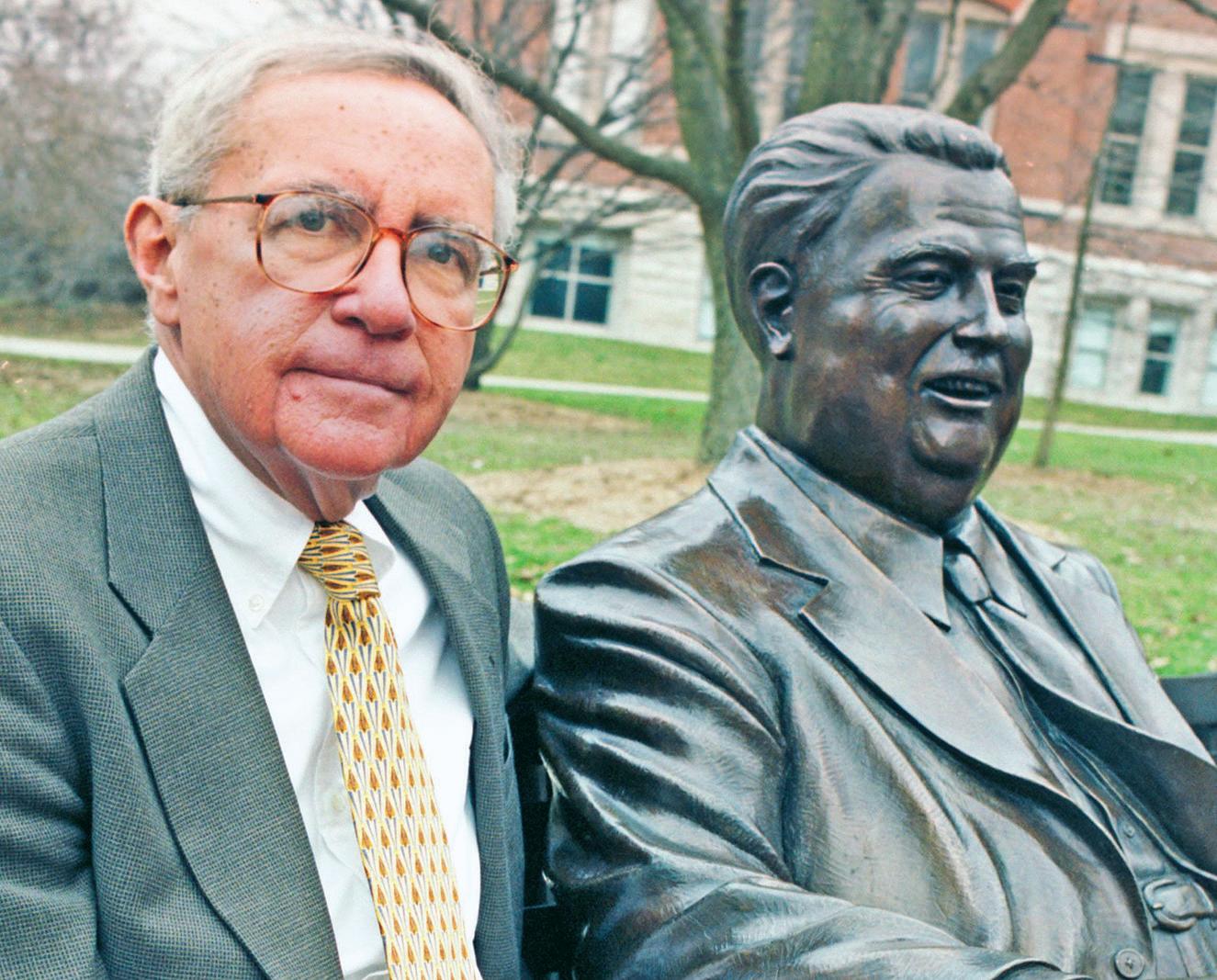
campus’s first female chancellor from 2001 until she resigned in 2003. She also taught in IU’s department of psychological and brain sciences and served as president of the American Psychological Association. She was inducted into the Presidents Circle in 2011, which honors donors who give at least $100,000 to the university. She died in 2018.
After Brehm’s departure in 2003, Gros Louis returned as interim senior vice president and chancellor in 2004.
Then-IU President Adam Herbert struggled to fill the position permanently. A search committee recommended three candidates in October 2005, but Herbert rejected the candidates and decided to extend the search process.
IU faculty voted no confidence in Herbert that year because of his failure to find a chancellor, and he announced he would not renew
his contract, which expired in 2008. Herbert and the Board of Trustees ultimately decided to restructure the campus’s leadership in 2006, eliminating the chancellor position in favor of a provost. The provost became the chief academic officer, while Herbert absorbed the remaining duties.
Gros Louis was appointed as the second-ever university chancellor that year, a title which, at that time, had only been held by Gros Louis’ close friend and former IU president Herman B Wells from 1962 to 2000. Gros Louis held the title from 2006 to 2011, and he died in 2017.
“Gros Louis was seen as an heir for Wells,” Capshew said, “in the sense of having the biggest interest of the whole university.”
Michael McRobbie became IU’s third university chancellor in 2021 after a 14year run as president.
The committee, which convenes every two years, decides how to allocate money generated from student activity fees. When the committee last met in 2022, McDowell said it decided to give less money to the board. CFR wanted to see more diversity in the leadership of the Funding Board and wanted concrete information about the impact of the money given to student organizations, McDowell said. The committee also noted that Funding Board had $600,000 in cash reserves during the 2022-23 school year, much of it being money left over from years marked by the COVID-19 pandemic when student organizations operated with fewer events.
“The Funding Board should not be punished for this, but the CFR believes the current cash reserves should be exhausted first...” the CFR
wrote in a letter to the Funding Board regarding money allocated for 2024 and 2025.
“In the meanwhile, student fee money should be allocated to other purposes which directly impact current students.”
“They were asking (us) to completely spend down that money before they even considered giving us the same amount of money as previous years,” McDowell said.
McDowell made it a goal to reduce the Funding Board reserves. The Funding Board began meeting for two sessions a week rather than one, in order to review more funding applications and grant more money.
This plan would have allowed the Funding Board to spend its reserves on important student initiatives and then ask for more money from the CFR for this year, McDowell said, if not for the mismanagement by the university. The overdrafting of the account left the board scrambling for solutions.
Student organizations struggle to maintain operation
Ultimately, the loss of money for the Funding Board hurts student organizations, McDowell said.
“A lot of organizations are suffering financially, and some are even completely unable to operate, because the Funding Board is unable to provide any amount of money that would be significant to them,” McDowell said.
University Players is a student-led theater production company on IU’s campus that relies on Funding Board to finance their shows each year.
According to Evan Anderson, IU student and the managing director of UP, productions are not cheap to put on.
Scripts and rights to the shows can be anywhere from $700 to $1,300. Costumes and sets are an additional cost to every production, along with annual expenses, such as a storage unit. One show can cost $3,000 in total to put on, and they usually present around
four shows a year.
In the past, UP would submit a budget request to Funding Board and would get reimbursed in full or almost in full, Anderson said. Anything not covered by the reimbursement would be covered through fundraising.
Now, with the Funding Board unable to provide as much money to organizations, UP is left to fundraise all the money required on their own.
“They didn’t announce this before we had already started planning our budget and starting our season,” Anderson said. “We have already spent more than $2,000 because we didn’t know that money wasn’t going to be there.”
Now, UP is one of many other organizations on campus trying to come up with plans to fund their projects, Anderson said. They have taken to Instagram to do digital fundraisers and are coming up with more ideas for what comes next.
Another option UP has considered is taking a more

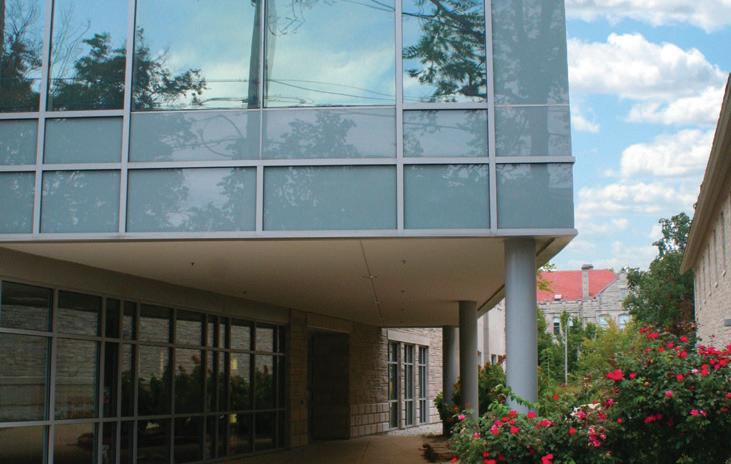
optometry.iu.edu

Baron D Hall, DDS, MSD Jake Willhite, DDS, MSD Orthodentists
Erica Hall, Hannah Elliott, Kaitlyn Jacobs, Marilyn Lee, Adrian Price
With modern techniques and a fun style, B-town Orthodontics is the most up-and-coming orthodontics office in the Bloomington area! We offer the latest technologies including invisalign, gold brackets, laser treatments, and even mini implants that can help restore missing teeth and even eliminate the need for surgery. B-town Orthodontics offers FREE consultations and don’t forget to download The Braces App, the hottest free app designed by B-town Orthodontics’ Dr. Baron Hall.
1124 S. College Mall Rd. 812-336-5520 jcdsmiles.com Mon.,
Tue. - Thu.: 8:30 a.m. - 4:30 p.m. Lunch 12:30 p.m. - 1:30 p.m.
Mon. & Fri.: Appointments Only 1320 W. Bloomfield Rd., Suite B 812-287-8851 btownorthodontics.com
Center and Indianapolis Eye Care


Ryan D. Tschetter, DDS Lauren R. Hoye, DDS Jackson Creek Dental is conveniently located on South College Mall Road. Most insurances accepted, including the Indiana University Cigna Insurance plans as well as the IU Fellowship Anthem.
Dr. Tschetter and Dr. Hoye offer state of the art dental technology such as Zoom whitening, same day crown appointments, and Invisalign. We also provide restorative, cosmetic and emergency care. We pride ourselves in giving the best care to our patients while offering a pleasant yet professional atmosphere.
Mon. - Thu.: 7 a.m. - 5 p.m. Fri.: 7 a.m. - 3 p.m.
Dr. Andrew Pitcher, D.C.
Dr. Crystal Gray, D.C.
A Way of Wellness Chiropractic specializes in comprehensive spinal care. We offer treatment for many different spinal conditions and problems, while also addressing the body as a whole. We provide effective chiropractic care helping patients reduce stress, improve mobility and spinal health. The quality treatment we provide is always fit to your individual needs and goals. Let us help you achieve and maintain good spinal health. We look forward to meeting you!
Mon. - Thu.: 8 a.m. - 6 p.m. 1121 W. Second St. 812-336-2225 bloomingtonchiropractor.com
Eating Disorder
minimalist approach to their productions.
“It is a shame that we wouldn’t be able to be as creative or let our designers have as much fun with what they want to do with the show,” Anderson said. “It’s always cool for them to have a vision be realized on the stage, and it would be sad to have that aspect be taken away for every single design aspect.”
The Filipino American Association also depends on funds from Funding Board to keep their club running. President Jona Rivera explained that the organization hosts a large end-of-year event called Filipino Culture Night.
“We have heavily relied on IU Funding Board for that event specifically; it’s almost completely funded by them,” she said.
Rivera said that their event costs much more than the new $2,000 limit imposed on requests to Funding Board for the year. They are left “scrambling” to find new funding options, she said.
“I know a bunch of the cultural organizations on campus rely on IU Funding Board and a lot of big events that usually happen across all the culture orgs might not happen this year because of the new plan,” Rivera said.
IUSG steps in In response to the loss of funding from the Funding Board, IU Student Government has started a new initiative to offer limited funding to student organizations. Student organizations can apply to receive up to $300 to pay for event and material purchases. “I encourage all students to apply for funding,” student body president Cooper Tinsley said. “I know at this moment in time, it probably doesn’t seem like a lot, but it’s what we could get together quickly.”
To finance the project, IUSG reallocated money from their internal budget. IUSG says this is intended as a temporary solution before longterm solutions can be found.
Vasquez MD Mon. - Fri.: 8 a.m. - 5 p.m. 815 W. Second St. 812-336-6008 vascularcenterandveinclinic.com Physicians
Dr. Andrew Jones, Dr. Marzia Zamani, Cheyenne Brown, Megan Sipes, Milli Nally, Kenzy Hawkins, Christina Thompson
Dr. Tavel Family Eyecare is your partner in your personal eyecare journey. Since 1940, the company has believed that every Hoosier deserves quality eyecare and vision solutions at an affordable price. Dr. Tavel offers comprehensive eye exams, special testing, management of eye diseases, glasses, contact lenses and much more, all backed by an insurance acceptance guarantee. The company is committed to advancing eye health by investing in the latest technology and providing treatments that are right for every patient’s unique needs.
Mon.: 7:30 a.m. - 6 p.m. Tue.: Closed Wed.: 7:30 a.m. - 6 p.m. Thu.: 9 a.m. - 7:30 p.m. Fri.: 7:30 a.m. - 6 p.m. Sat.: 7:30 a.m. - 1:30 p.m. Sun.: Closed
2552 E. Third St. 812-233-2343 drtavel.com/locations/bloomington
744 E. Third St. 812-855-8436 optometry.iu.edu
Health
Mezger, FNP-C Alyssa Van Duzer, PA-C Our board certified nurse practitioners and physician assistants provide primary care, acute care, physicals, vaccines, weight management and more to patients 12 months and older. Appointments and walk ins welcome. We accept most commercial insurance, Medicare and several Medicaid plans. We offer transparent pricing for the uninsured.

Austin C. Starr, D.D.S HOOSIER ORAL SURGEON?
Dr. Starr is an Indiana University Football Alum who provides pain-free experiences for all Hoosiers with IV sedation. He performs specialized oral surgery services including Wisdom Teeth Extractions, Dental Implants, Bone Grafting, and Plasma Therapy. Equipped with modern 3-D

Jan Taylor-Schultz
I have been an eating disorder

Dr. Zachary Short, O.D.
Dr. Madison Witthoft, O.D.
Welcome to Insights Optical, where quality eye care is our number one priority. Our dedicated team is ready to learn all about you and your vision needs while using innovative technology and a comprehensive care approach to take care of your eye health.
Mon.: 10 a.m. - 6 p.m. Wed.: 9 a.m. - 4 p.m. Tue., Thu., Fri.: 9 a.m. - 5 p.m. 415 S. Clarizz Blvd. 812-333-1911 insightsoptical.com
812-323-4301 kroger.com/health/clinic

Dr. Philip Clark Brittain Jenna Kelly, RN
Vibrant Life specializes in hormone replacement therapy and medical aesthetics. Vibrant Life is pleased to offer personalized care, employing the latest medical technology. Services include: hormone therapy, neuromodulators (botox, dysport), dermafillers, microneedling, laser hair removal, age spot reduction, blue light acne treatment, treatment for urinary incontinence and much more. Come visit us
bloomingtonbraces.com
Thu.: 8 a.m. - 5 p.m. Fri.: 8 a.m. - 4 p.m. 473 S. Landmark Ave. 812-318-1023 starroralsurgery.com
jantaylorschultz.com
Joey Sills (he/him) is a senior studying English, comparative literature and political science.
It’ll go down as an unbelievable coincidence that, April 25, the same day the Indiana Daily Student staged a walkout last semester, the Indiana State Police arrested 33 people in Dunn Meadow at the site of a pro-Palestinian encampment.
The walkout came about because “the severity of the threats against student media warrant(ed) immediate action.” Even without a published story, we still compiled a thread on X about the historic scene, because ultimately, the need to inform the community about this moment superseded any pious adherence to our own demonstration. The thread, which received over 200 reposts and 1,000 likes, exhibited the fact readers were turning to us for up-to-date information. Nevertheless, while we were reporting from the Meadow, we had fashioned a temporary newsroom at the Monroe County Public Library. Our usual space in Franklin Hall was empty. No cohesive story about what happened that day went up until midnight, April 26.
This unbelievable coincidence, as I called it, ended up a perfect indicator of what a world without the IDS might look like: it should go without saying that a student newspaper is uniquely wellequipped and well-suited to report, analyze, record and commentate on what’s happening to students.
The lack of any published content that day conveyed
Jack Davis (he/him)
is a sophomore studying journalism.
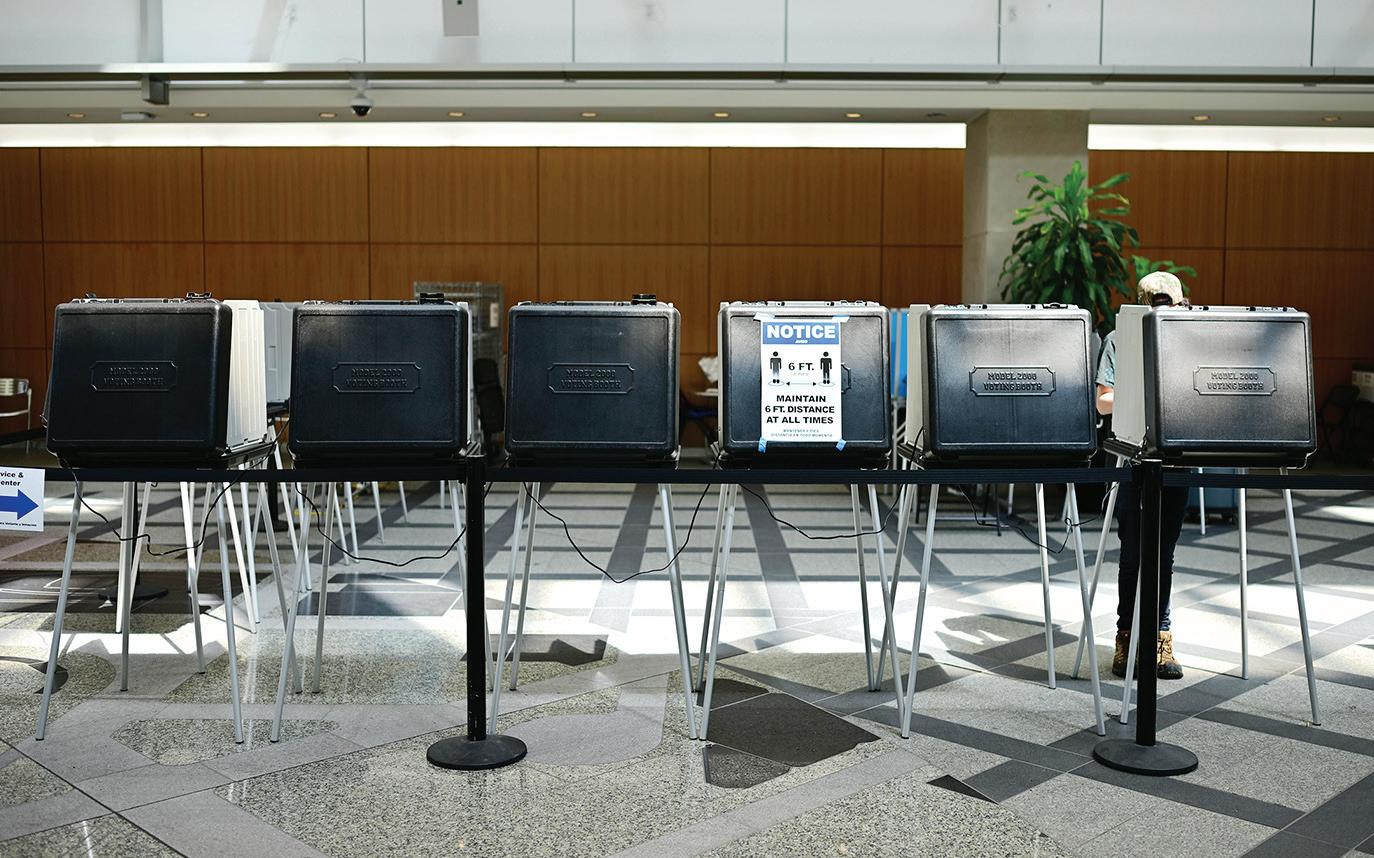
The election is right around the corner, which means polls are coming out of the woodwork at rapid speed. There are the “mainstream” polls from outlets like CNN, the New York Times, and the Washington Post, but there are also independent pollsters separate from large media corporations, and some polls that just seem made up. This is why it’s essential to look at the bigger picture when it comes to polls — who paid for the survey, how it might’ve gotten the results it did and several other factors.
One of the first things to look for before anything else is whether the poll is skewed. You can look at the crosstabs of a poll to see if anything is fishy. If there are no cross-tabs on the polls website that may be another sign not everything is transparent. All you have to do is look back at the 2022 midterm elections to see how partisan polls flooded the zone to give the illusion of a so-called “red wave.”
According to the New York Times, traditional nonpartisan polls mostly fixed some of the polling errors, such as undercounting Republican support, from previous election cycles. Still,
Advait Save (he/they) is a sophomore studying economics and sociology.
With enrollment dates coming up, I am sure everyone is scrolling through courses on iGPS and scheduling appointments with their advisors to figure out what their schedule might look like in the upcoming semester. All undergraduates at IU need to complete a general education requirement , which includes at least six credits of GenEd-approved arts and humanities classes. If you are a freshman or sophomore, it is quite likely you haven’t completed this requirement yet. I have just the solution for you. Most 100 and 200-level philosophy classes at IU fulfill the A&H requirement, making it an option students might opt for. It was this very requirement that drove me to take a philosophy class
a powerful message, but unfortunately, it seems to have gone over the Media School’s head. Or, perhaps, it was simply ignored. On Oct. 8, the school announced in a press release a plan to cut the IDS’ weekly print edition. The announcement was released early — a day before administrators were scheduled to meet with student media leaders and journalism faculty — after the IDS had received a leaked copy of the report. But still, most students only learned of the plan after the press release.
This is hardly the first time the Media School has made important decisions on behalf of the IDS without first involving the ones it directly affects. And the IDS is hardly the only student newspaper in the country that’s been negatively affected by university overreach. This specific circumstance does not exist within a vacuum — it’s a systemic issue that needs to be considered within a much broader context.
Here at IU, it’s impossible to not view this recent decision from the Media School within the context of all that’s happened in 2024. Even the front page of our Oct. 10 edition closely resembled the vote of no confidence in President Pamela Whitten and Provost Rahul Shrivastav in April. The chaotic response to the encampment was just later that month. The Board of Trustees passed the new Expressive Activity Policy only three months ago, and, since August, Dunn Meadow has been encased by a fence. Amid all this, it’s understandable why students might be left wondering whether the
they also produced fewer polls, creating a polling vacuum filled by a sudden influx of partisan Republican polls trying to paint a narrative. For example, the Trafalgar polling group incorrectly suggested that Republican candidates such as Mehmet Oz, Herschel Walker and Kari Lake would win their election. In fact, these races weren’t particularly close. Next, you need to be aware of the background of each pollster. Some Republican GOP-leaning polls include Patriot Polling, Trafalgar, and Rassmussen. Rassmussen has been under fire recently for secretly showing the Trump campaign polling results before they came out publicly. This is highly frowned upon, for what their X account profile says is an “independent” pollster. If true the collaboration could lead to legal issues, as Rassmussen tends to portray itself as independent and nonpartisan.
This isn’t just GOP-specific, though. There are also Democrat-aligned pollsters, though they seem less likely to release results because I rarely see them. One that I’d look out for, though, is Big Village polling, which seems to overestimate Democrat’s support compared to others.
You must be careful when looking at the findings, even
my freshman year. I am three semesters in, and I haven’t had a semester without one. Growing up in India, I did not have a formal background in philosophy; my high school education was a program that focused on the natural sciences — physics, chemistry and mathematics. The way these were taught was not foundational, but instead steered toward memorization for doing well on tests.
My first philosophy class was not offered through the philosophy department; it was a critical approaches class called “Original Sin: Religion, Psychology and Behavior” that intersected the fields of philosophy, religious studies and psychology. It was this intersection that introduced me to foundational thinking. We read from thinkers who produced the structural ideas that led to the creation of a coherent theory about something that the
decision to cut the IDS’ print edition is another act of suppression.
Of course, there’s little, if any, evidence of such an assertion. To say the Media School made this decision with malice would be a baseless accusation, and one I’m not certain is even representative of reality. But it’s hard to argue that the optics aren’t terrible. There’s a certain image of the IU administration that already exists, and this infringement on a historical student newspaper only perpetuates that image.
I’m reminded of The Battalion, Texas A&M University’s student newspaper, publishing its “Print is not dead” editorial in 2022. The column came after the A&M administration attempted to cease the weekly print publication of the paper, an attempt that would, in time, prove a failure. The public was overwhelmingly in support of the student journalists, and The Battalion still distributes a weekly edition today.
“It’s not the administration’s decision to tell us if we can or cannot print,” the editorial board wrote then. “It’s not its place to tell us we can or cannot do anything.”
The IDS is in a bit of a different position from The Battalion because it’s considered a university auxiliary, not a student organization, which means the paper makes its own money and pays all the salaries and benefits for professional staff members, as well as each student staffer’s paycheck. However, at the same time, because it’s an
auxiliary organization, all fundraising efforts must be approved by the university administration, which limits its ability to raise as much money as it needs. And it’s also true that, this past summer, the university cleared the paper’s nearly $1 million debt. In other words, while we are editorially independent, we’re not financially independent, making it difficult to be totally free from any key decision the university makes out of monetary concern.
In fact, a study from the University of Florida’s Brechner Freedom of Information Project released in February shows about 56% of student newspapers across the country receive some sort of direct or allocated funding from their university. While this funding has almost certainly helped many papers stay afloat, and it’s impossible to say what the student media landscape might look like without it, it’s also very obvi-
with reputable pollsters. There are many reasons polls might show inaccurate or misleading results. Maybe they sampled the electorate incorrectly, didn’t crosstabulate the polls well or the sample size was too big or small. These are all reasons why a poll may be off, which is why polls have a margin of error. Plus or minus three is considered a typical margin of error. Pew Research describes the margin of error as follows: “A margin of error of plus or minus 3 percentage points at the 95% confidence level means that if we fielded the same survey 100 times, we would expect the result to be within 3 percentage points of the true population value 95 of those times.” Even a five-point lead nationally can be considered a close race, though it may not seem that way to the public.
Christopher Desante is an IU political science professor who specializes in American politics, race and racism in America, media framing, climate change and statistical methods. For him, a poll has to show a real blowout to feel safe.
“In my own personal opinion, unless one candidate is leading by more than 8-10% in several independent polls, I would say the race is too close to call,” De-
ously an invitation for university overreach.
In 2017, then IDS Editorin-Chief Jamie Zega reported that the Media School had forced the early resignation of former Director of Student Media Ron Johnson, a decision then Dean James Shanahan said was out of “financial consideration.”
“If our charter is revised on terms by administrators with students’ ‘best interests’ in mind, we could go from a dean simply moving the director’s resignation up a month to eventual loss of independence from the University,” Zega wrote.
The charter she’s referring to is our revised Student Media Charter, adopted and approved in 2005. It does several things, but, most importantly, it reiterates the responsibility of the editorin-chief to make all final decisions regarding editorial matters. Make no mistake: cutting the IDS’ weekly print edition, without input from
the IDS itself, does seriously compromise the paper’s editorial independence. By making this decision for us, the Media School is deciding, to an extent, the sort of content we can publish and the way in which we can publish it. Student newspapers can be an inconvenience for colleges. They’re uniquely positioned to report on the failings — and, lest they be forgotten, the successes — of their parent institution. They can, in other words, be the gadfly, a constant ache in the side of the university. And that is precisely what they should be. And when the university suddenly understands it has the power to pick off the gadfly, whether out of genuine financial concern or not, we lose a vital aspect of student life and, ultimately, a vital aspect of a healthy academic ecosystem.
sillsj@iu.edu
sante said.
Another issue that has plagued all pollsters in the past two presidential elections is nonresponse bias. For example, in 2016, polls significantly under-polled white voters without a college degree, which is one of Donald Trump’s largest demographics of support.
Though pollsters believed they had fixed this in 2020, they were wrong. The “shy” Trump voter effect was in full swing and showed up in polls. According to CloudResearch, 12% of Republicans
Take a philosophy class!
thinkers were talking about. These thinkers included theologians like Martin Luther, early modern political thinkers like Jean Jacques Rousseau and contemporary leftist thinkers like Paolo Freire. All these in a single 100-level class called “Original Sin: Religion, Psychology, and Behavior” — may seem overwhelming. However, the structure of the class made it all just make sense. I know “just made sense” is not a convincing enough argument. So, let me illustrate through an example. If I were to commit the sin of oversimplifying this class, I’d say that the structure was mostly arranged like a survey of competing ideas rather than learning only about stand-alone thinkers. Because it is only when we compare and contrast that we truly understand the scope of an idea. This expert analysis of an idea allows
us to see the strengths and weaknesses of both arguments from a broader outsider’s perspective. We then, from that perspective, form our beliefs about the original idea. Making someone question their base beliefs about something and then providing them with people who have produced interesting ideas about those beliefs helps develop critical thinking. A major aspect of critical thinking is to question our dogmatic beliefs and develop a mature understanding of the circumstances that led us to form those dogmatic beliefs. The dogma weakens as we critically examine a belief, helping us examine concepts with conviction and openness. This is essential when navigating a world of difference and diversity.
It is not just the reading and interpreting thinkers or contrasting perspectives that
didn’t feel comfortable saying their true voting intention in phone polls, compared to 5% of Democrats saying the same. However, in the 2022 midterms, solid polls underestimated Democrats a little, so polling errors can, and do, go wrong in both directions. It’s truly unknown whether or not these issues have been solved this time around.
Polling isn’t perfect. I like to think of every poll as a snapshot in time that changes from day to day. There is also room for error, manipulation and misinterpretation.
help develop critical thinking. It is engaging in an active conversation with people who are in a similar setting to you. This is why most philosophy classes either have a discussion section or are conducted in a fashion that forces students to engage with the ideas through verbal articulation.
Developing an ability to think and engage with complex foundational ideas is one of the great advantages that a philosophy course offers. However, that is not all. Converting these thoughts into a communicable language is essential for a liberal arts education.
Most of my ability to articulate comes from the papers that I wrote for my philosophy classes and not from the required English composition class. Just the sheer complexity of ideas provokes you to search for a language in your response that brings
It is not useful to read one poll and worry about the election not going your way. Do your research to learn more about each poll. If you enjoy politics and polling, or just want to stay informed during election season, I suggest looking at polling aggregators like 538 or Votehub to get the best gauge of the state of the race. However, don’t get anxious over every new poll drop. Nothing is set in stone until the actual votes are counted.
jjd5@iu.edu
justice to the complexity. It is this provocation to think about language that I found missing in the English class that I took. In my experience, the discipline of philosophy, through its nature of being the mother of all disciplines and its rich history from ancient India and Greece to contemporary post-modernists, presents a practice of creation. It is a practice of creating concepts, as Deleuze would say. It is this process of concept creation that is examined in philosophy classes. So, if you wish to gain an understanding of the process of concept formation, if you wish to develop an ability for critical thinking and good articulation, then don’t forget to add a philosophy class to your spring schedule. ausave@iu.edu
By Taylor Kuelthau tkueltha@iu.edu
With Halloween creeping around the corner, students are beginning to think of potential costume ideas. While some students are planning to buy their costumes, others have decided to make theirs. Since the holiday falls on a Thursday this year, many students plan to have multiple costumes to wear throughout the weekend.
Bloomington doesn’t offer all of the clothing stores students typically enjoy. Options are more limited for students when they’re shopping in the college town. Therefore, ordering costumes online is an easy option. Sophomore Emma Rotherberg is planning on having multiple costumes this year.
“I think I’m going to have about three costumes this year,” Rotherberg said. “I’m buying most of them from Amazon.”
For students like Rotherberg, who have chosen to do multiple Halloween costumes this year, the preparation is more extensive. One common costume that has been all over social media this year is a mermaid.

another online retailer.
Third Street. Fortunately, it’s near Spirit Halloween’s new location. Therefore, students can easily visit both stores if one doesn’t have what they’re looking for.
Although some students are buying their costumes this year, others are choosing to make do of what they already have at home. This tends to be repeated by those who don’t plan their costumes until right before Halloween occurs.
“I will typically make my costumes,” IU senior Colin Wright said. “Whenever Halloween would roll around I would see what is in my closet and see what kind of existing costume parts my family had accumulated over the years. I’ve been in Party City, but I don’t buy any of those costumes.”
“I’ve recently been seeing Tik Tok videos that list out different Halloween costumes for girls,” Rotherberg said. “Many of them have been of mermaid costumes. My friend and I decided to be that for one of the nights.”
Along with Amazon being a quick and common place to shop for this holiday, some students are ordering from other websites instead of shopping in person. One IU student, Blanca Benitiz, said she already bought her costume from
“I got my costume this year from Dolls Kill mainly because they have a big range of costumes that are cute, scary and two day shipping,” Benitiz said. “I have also bought stuff from Amazon beforehand for my costumes.”
Purchasing costumes online continues to be a common trend because of
the limited number of Halloween stores there are in Bloomington. However, the only Halloween store in town, Spirit Halloween, made its annual return this fall. Along with Spirit Halloween, people can also visit Target and Walmart for costume pieces.
“I usually go to Spirit Halloween to buy my costumes,” IU freshman Sarah
Sampat said. “I’m planning to buy an eight ball costume.”
The holiday store is officially open again for the season. Its new location is on College Mall Road, repurposing the old CVS building, which closed in May. Party City is another popular shopping destination. This storefront is open year round and located on East
Students at IU have their own Halloween traditions of what they enjoy doing when the holiday comes around. Some may dress up in costumes and go out with their friends, while others will turn on a movie and stay at home for the night.
“I’m a senior now, so my friends and I will sometimes dress up and go out if we feel like it,” Wright said. “When I was younger, I loved going through the closets in my house and finding pieces for my costumes. That was a tradition I always did.”
By Sophie Albert soalbert@iu.edu
“The Substance,” filmmaker Coralie Fargeat’s sophomore feature, has been exceeding expectations at the box office, passing $25 million globally since its release on Sept. 20. It has received divisive reviews since it premiered at the 77th Cannes Film Festival in May, where it won the award for Best Screenplay.
The film follows the story of a faded Hollywood star, Elisabeth Sparkle (Demi Moore), after she gets fired from her job as a host for a long-running aerobics TV show for being “too old.” In desperation to get the success of her early years back, she takes The Substance, a drug which creates a new, separate version of herself, called Sue (Margaret Qualley), who is younger and more perfect than Elisabeth.
The rules for The Substance are simple: each body gets seven days to be “awake,” then they have to switch. At first, this situation works perfectly; Sue becomes the new, young, popular star of the rebooted version of the show Elisabeth hosted. However, Elisabeth becomes increasingly jealous of Sue’s success as Sue becomes increasingly greedy with the time she spends awake.
The film uses intense body horror to communicate themes of how women are treated in Hollywood. Moore’s character is constantly pushed aside and mistreated because the industry considers her “old.” We then see how the industry idolizes and praises Qualley’s character for having the features
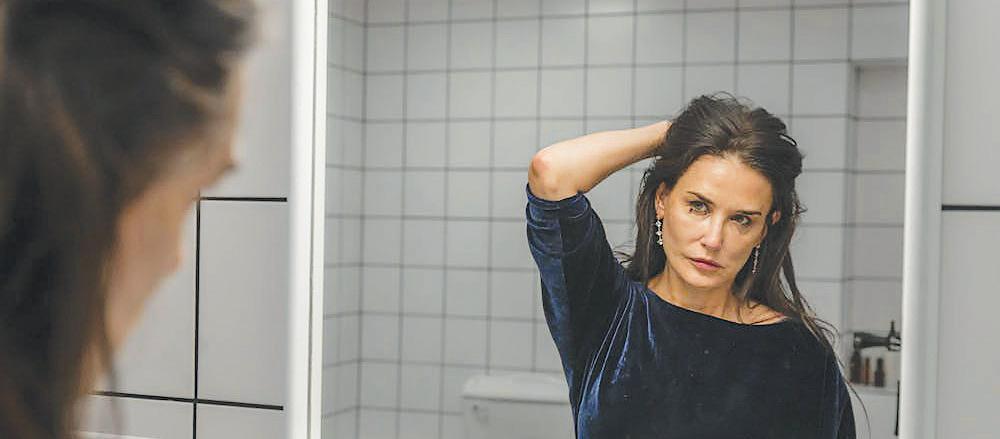
Elisabeth supposedly did not have that would specifically cater to the male gaze. The film shows each of these characters deteriorate as they continuously try to appeal to the world around them, exemplifying the toll beauty standards take on people — especially women — in our society.
Fargeat takes this theme one step further with the grotesque, but strangely comical, ending to the film, which I won’t spoil, but know it is not an image I ever thought I would see in my lifetime. Nonetheless, the stark ending of the film, which parallels the opening sequence, perfectly sums up the commentary on how Hollywood treats women. Although there has been some progress, Hollywood continues to sideline older actresses in favor of younger stars and provides a lot more opportunities for older male
actors in Hollywood than for older women. This idea is used in a visual motif that comes back at the end of the film in an image that will leave a lasting impact on you.
People have criticized the excessive use of body horror and gore in the film as well as its long run time, claiming that it, ironically, doesn’t have much substance. According to writer Iana Murray, the message is “painfully unsubtle,” and others feel it dragged on too long, repeating the same situation, even after the audience understood the consequences it had on the characters. Some critics also believe the scenes intended to display how women’s bodies are used to appeal to the male gaze in Hollywood only further objectified and over-sexualized the women in the film. However, after having watched the film
myself, I really liked it; I thought the story was unique and thoughtprovoking, the technical production of the film was very well done and the acting was brilliant.
If you hate gore, especially body horror, I would definitely sit this one out, because it included some of the grossest things I have ever seen (I will never look at a chicken wing or a belly button the same again.) As one Letterboxd reviewer commented, “I feel trauma bonded with everyone in that cinema today.” Nevertheless, if you can handle gore, I would recommend this movie.
The visuals are absolutely stunning, the sound design, led by Valérie Deloof and Victor Fleurant, is some of the best I’ve heard and makes the movie so much more disgusting (somehow watching someone eat
shrimp was one of the most nauseating parts for me, in large part thanks to the sound design) and the message is very important. If you’ve ever had any feeling of body dysmorphia, where you obsess over perceived flaws in your appearance, this film will hit hard.
It does take on this topic in a head-on way, but I think that’s the point of the movie. Nothing about the film is subtle, so why should the message be?
The entire plot of the movie revolves around this idea of body dysmorphia and beauty standards; it’s what motivates the characters to repeatedly make questionable decisions that drive the plot forward, so if they tried to weave this subject in sub-textually, it would deter from the whole point of the film. Thus, I think it’s entirely reasonable for a film that literally
advertises itself to be about beauty standards to assess this issue in an in-your-face manner.
I also enjoy that it doesn’t take itself too seriously. While it touches on serious topics and dark things happen within the film, it takes a very camp approach to the story that, in its hardest moments to watch, makes you want to laugh rather than cry. With the world of media being so oversaturated, I find it refreshing to have unique films like this that are unlike anything I’ve ever seen. So, if you’re looking for a distinctive movie to watch that will have a lasting impact on you (and if you can handle gore!) I would highly recommend checking out “The Substance.” I guarantee you will see things you have never seen and maybe have never wanted to see, before!
‘Imagination is 99% of what we do’: The story of the Pop-Up Opera
By Nadia Suben nadsuben@iu.edu
The opening scenes of attending an opera are standard. Storming applause announces the conductor’s assumption of his post at the front of the pit. A grand curtain rises to reveal a dazzling set, and a cast clad in elaborate costumes, both of which immediately draw the audience into the world in which they will be immersed throughout the ensuing production.
However, this familiar routine of being introduced to a performance will be given a fresh spin during this weekend’s run of the “Pop-Up Opera.” Rather than a conventional, fully staged production, the “Pop-Up Opera” will treat audiences to a narrated
concert — with singers and instrumentalists alike on the stage — of Johann Strauss II’s “Die Fledermaus” at 7:30 p.m. Oct. 25-26 at the Musical Arts Center.
Due to the scale of the 2024-25 IU opera season centerpiece — the Jacobs School of Music’s upcoming co-production with the Metropolitan Opera of “The Amazing Adventures of Kavalier and Clay” — the selection of the Pop-Up Opera was left until this fall. The opera performances surrounding this co-production needed to accommodate the great logistical, financial, and manpower demands of “Kavalier and Clay.”
“We knew it was going to be a concert,” Michael Shell, the IU Opera and Ballet Theater’s resident stage director, said. “The expense
of the show is much less, because we’re not going to be building scenery: we’re going to be using projections. The costumes will be mostly concert attire.”
The uniquely tuneful score of “Die Fledermaus” made the work a natural choice for Jacobs’ first opera in concert. Additionally, the opera’s whimsical plot lends itself well to a stripped-back production, which requires audiences to lean on their imaginations.
“Because we don’t have sets, anything can really be possible. It’s kind of freeing,” Shell said. “We have a few singers interact with the orchestra and the maestro; we can blur the lines between what is a show and what isn’t.”
This opportunity to tap into the opera’s creative
essence is similarly valued by its performers.
“We shouldn’t need a set or props in order to connect with our characters,” Jonathan Elmore, a doctoral voice student who will portray Gabriel von Eisenstein in one of the two “Fledermaus” casts, said. “It’s been a good exercise for a lot of us not to have the world to live in and to create the world in our heads.”
Carson Hardigree, a master’s voice student who will portray Rosalinde Eisenstein in one of the two
“Fledermaus” casts, agreed.
“Without props or a set, I can let my imagination take over, because I already know who I am as a character, which gives me freedom to be that person,” Hardigree said.
In addition to providing a creative challenge, the
“Pop-Up Opera” has also afforded critical training for the practical demands of the professional opera world. The cast’s work on Strauss’s music started the first week of October, and staging began only about two weeks ago. The condensed schedule to bring “Die Fledermaus” to life roughly simulates major opera companies’ timetable for putting together productions.
“As someone who has worked professionally, this is the typical timeline, if a little bit shorter,” Elmore said. “For a lot of students who haven’t had the opportunity to do this yet, it’s been a learning process in the best way. It’s a bit more intense, but the pressure is making diamonds.” Hardigree credited
all of the cast, crew and faculty working on “Die Fledermaus” with making the expedited production process a seamless one.
“Everyone’s just jumping on and going all in,” Hardigree said. “We have a wonderful director, Michael Shell, and conductor, Kevin Murphy. They’ve just been so prepared for us and know what they want us to do, so we come in, get it done, and head home. I’ve really enjoyed it — it’s been fast, but it’s been good.” Those behind the scenes and on stage of the “PopUp Opera” have embraced the spontaneity and fun of the creative process. Tickets to watch the end product of their journey are $10 for students and otherwise range from $15 to $35, and are available on the Musical Arts Center website.
By Marnie Sara mbsara@iu.edu
Enjoy peak apple season in Indiana with these four recipes centered around the fall fruit. These recipes will satisfy any apple craving and get you in the spirit for the fall season.
Homemade applesauce
Elevate this typical afterschool snack by making it at home. For this recipe, you will need your choice of apples, ground cinnamon, lemon juice and vanilla extract.
Peel and chop your apples into large wedges. I recommend choosing a sweet apple like Honeycrisp, Fuji or Pink Lady.
Place your chopped apples, 1/2 a teaspoon of ground cinnamon, 2 tablespoons of lemon juice and a 1/4 cup of water in a large pot over medium-low heat.
Put the lid on the pot and allow the apples to soften for 25-35 minutes.
Once apples are soft, mash them with a wooden spoon to your desired texture. As the applesauce cools, the consistency will thicken.
If necessary, sweeten the applesauce with honey, brown sugar or maple syrup.
Harvest and feta salad
This festive salad won-
By Vaishnavi Banala bbanala@iu.edu
Renowned musician and IU alumnus Dennis James made his yearly Halloween return to the IU Auditorium stage Oct. 17, honoring the author Edgar Allan Poe with a night of music.
The event, “Silent Films and Radio Drama,” featured live radio reenactments, vintage silent films and James’ performance on IU Auditorium’s 4,543-pipe organ.
“It’s fantastic to be back on campus,” James said during his performance, reflect-
derfully complements any main course and embodies the crisp taste of fall. For this recipe, you will need Honeycrisp apples, kale, pomegranate seeds, avocado and apple cider vinaigrette.
In a large bowl combine 6 cups of kale, 1/2 a cup of crumbled feta, sliced apples, avocadoes and pomegranate seeds. Additional toppings can include prosciutto, toasted pecans or pumpkin seeds. Dress and toss the salad with the apple cider vinaigrette.
Apple cinnamon French toast
This delicious breakfast item perfectly embodies the fall spirit and is easy to make at home. For this recipe you will need the usual French toast ingredients (bread, eggs and vanilla extract) plus two apples, ground cinnamon and brown sugar. Add the peeled apple slices, 3/4 of a cup of brown sugar and 4 tablespoons of butter into a saucepan over medium high heat. Once the sugar and butter has dissolved, put a 1/4 teaspoon of vanilla and a 1/2 teaspoon of cinnamon into the pan and cook for about seven minutes. The apples will become the texture of pie filling and serves as the topping of French toast.
ing on his return.
Opening performance:
“The Raven”
The night began with a short silent film called “Edgar Allen Poe” (deliberately misspelled), which dramatized the inspiration for Poe’s famous poem “The Raven.” The film highlighted Poe’s attempts to care for his ailing wife and gain respect for his literature. James’ organ accompaniment provided a melancholy tone, emphasizing the personal struggles that inspired so much of Poe’s poetry.
While the sliced apples are simmering on the stove, combine two eggs, 1/2 a cup of milk, a 1/4 teaspoon of vanilla and 1/2 a teaspoon of cinnamon into a bowl.
Douse each slice of bread with the egg mixture and place it onto a pan over medium-high heat. Cook each slice of bread for 90 seconds and then top with the cinnamon apple filling.
The audience sat quietly as the film depicted Poe’s increasingly frantic attempts to sell his masterwork. Each note from James’ organ brought the poet’s agony to life, offering an intimate glimpse into the man behind the renowned words.
Live Radio Drama: “The Tell-Tale Heart”
The performance then transitioned to a live radio play adaptation of Poe’s “The Tell-Tale Heart,” based on a 1940s episode of “Inner Sanctum.” IU students from the Department of Theatre,
Apple cobbler
If you are longing for a homemade delicacy, follow this straightforward recipe for a classic apple dessert. For this recipe you will need apples, brown sugar, granulated sugar, flour, baking powder, milk, butter, ground cinnamon, ginger and vanilla extract.
In a bowl, combine four
Drama, and Contemporary
Dance performed the psychological thriller, which depicted a man’s spiral into madness as he was plagued by the sound of a beating heart.
James’ organ performance provided suspense to the live reenactment, with each note heightening the narrator’s crumbling mind. The students’ delivery of Poe’s text, paired with live music, produced a vibrant and disturbing environment.
The Feature: “The
sliced Honeycrisp apples, 1/4 cup brown sugar, 2 tablespoons of granulated sugar, 3 tablespoons of flour, 2 teaspoons of vanilla extract and a teaspoon of both cinnamon and ginger. Pour the apple mixture into a greased baking dish. In another bowl, whisk 1 cup of flour, 2 teaspoons of baking powder, a 1/4 teaspoon of salt and a 1/2 a cup of sugar. Mix 3/4 cup of milk,
Avenging Conscience”
“The Avenging Conscience,” a 1914 silent horror film directed by D.W. Griffith based on Poe’s “The Tell-Tale Heart” and the poem “Annabel Lee,” served as the evening’s focus. James returned to play the organ for the film, using his live score to heighten the dramatic tension.
The film featured a young man who, after being forbidden by his domineering uncle to pursue a romantic relationship, murders him out of frustration. However, as in “The Tell-Tale Heart,” the guilt of the crime quickly

overcomes him, causing visions and psychosis. James’ live performance skillfully paralleled the protagonist’s mounting discomfort, with the organ music expressing both the horrific visuals onscreen and the character’s psychological suffering. As the film came to its climax, it was revealed that the awful events were all a dream. The softening of James’ music conveyed the protagonist’s relaxation, giving the audience a momentary break from the tension that had accumulated during the play.

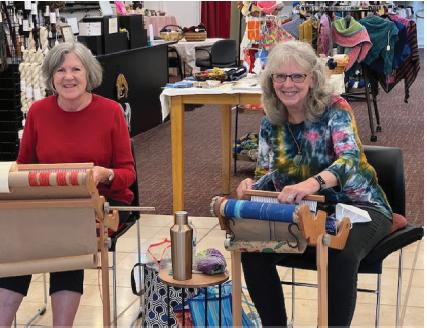








by Briana Pace 1 2 3 4
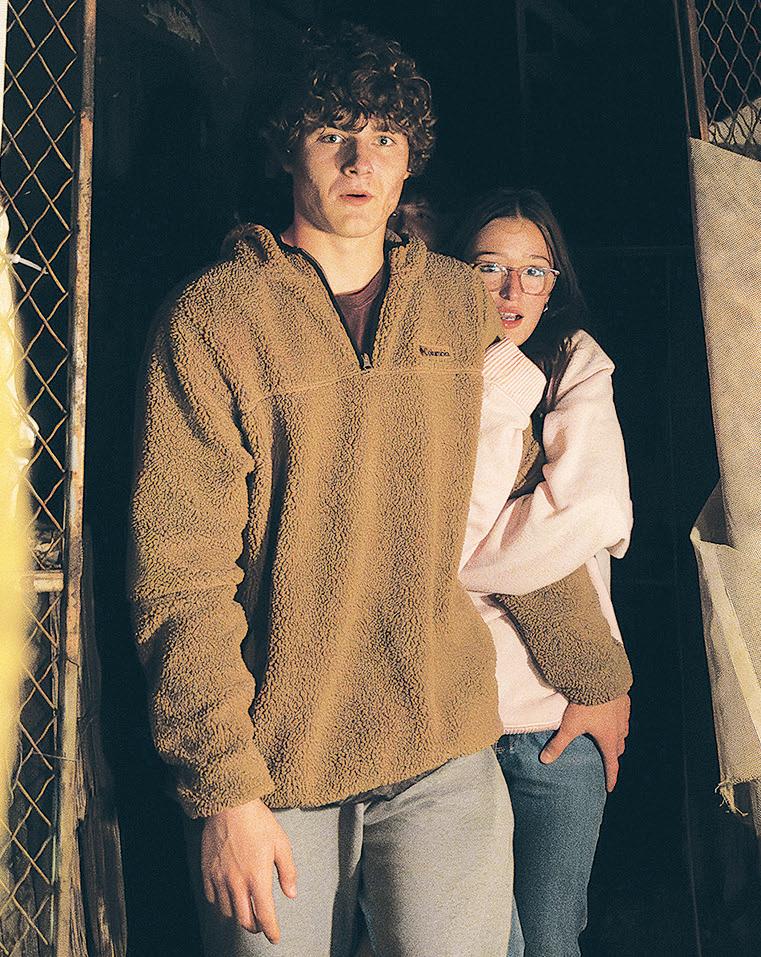


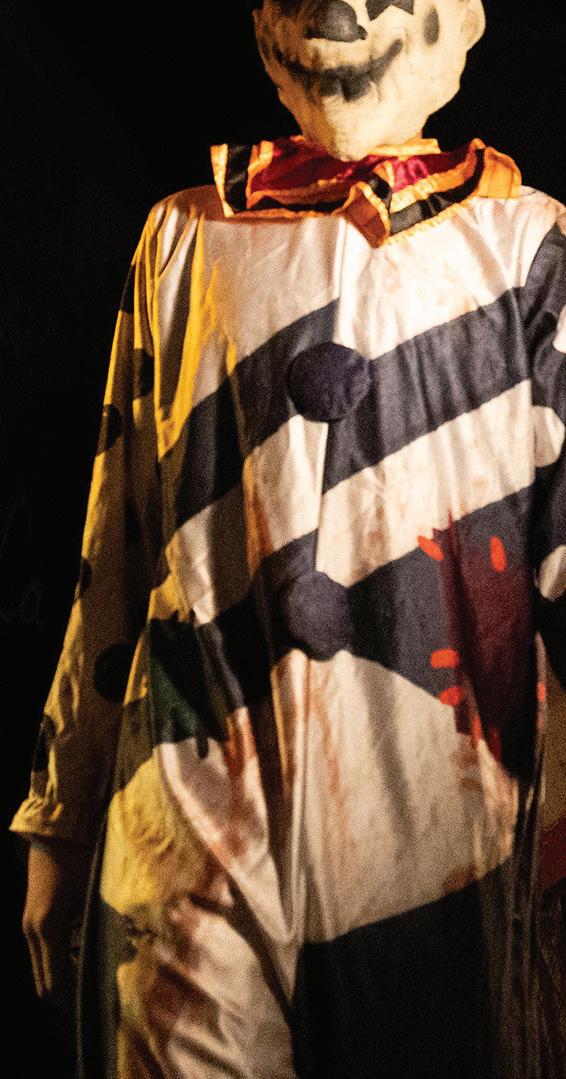

6
By Jhett Garrett jhgarr@iu.edu | @jhettgarrett
The sleeping giant that is Indiana football is awake after just seven games of the Curt Cignetti era. For the first time since 2021, the Hoosiers played in front of a sold-out crowd at Memorial Stadium for their Homecoming matchup with Nebraska. The crowd wasn’t the only thing that showed up, as Indiana dominated the Cornhuskers for 60 minutes, reigning victoriously 56-7.
“I’ve never played in front of a crowd like this,” senior linebacker Jailin Walker said postgame. “They came with loud noises, and it motivated us to play fast.”
Through the first six games of the season, the doubters harped on the “weak” schedule Indiana started out with. Many thought Nebraska would expose the Hoosiers’ weaknesses, but they were wrong once again, as Indiana proved it is not only a presence in the Big Ten, but a real contender to win the conference.
“I think with success comes belief, which comes confidence, which comes success,” Cignetti said after the game.
If there was any game the Hoosiers needed to prove they could control the line of scrimmage, it was this one. Coming into the game, Nebraska was arguably the best defensive front in the Big Ten. It had given up just 505 total rushing yards (84.2 per game) and zero rushing
touchdowns. Indiana shattered these numbers, finishing with 215 yards (6.5 yards per carry) and five touchdowns. The Hoosiers’ backfield was once again led by fifthyear senior Justice Ellison, who ran for 105 yards on nine carries with two touchdowns. The first of Ellison’s scores broke Nebraska’s scoreless rushing touchdown streak, another example of the Hoosiers proving doubters wrong. “I know they didn’t have any rushing touchdowns, and I had in my mindset we need to break that,” Ellison said. “We knew we had to have a chip on the shoulder.”
With Oct. 19 offensive showing, Indiana has put up 30 or more points in every game this season, including six straight games with 41 or more, extending the school record. The Hoosiers were already a force to be reckoned with, averaging 515.7 yards per game coming into the game. While they finished just below that mark at 495 yards of offense, there is proof that this is the best offense in the Big Ten.
“I know there was a national perception that Nebraska had a pretty legit defense on a national side,” Cignetti said postgame. “That will open their eyes.”
The main point with this Indiana team is continuing to dominate in areas they aren’t supposed to. In a week they take on Washington, which ranks first in the country in passing yards allowed per game. There will more than
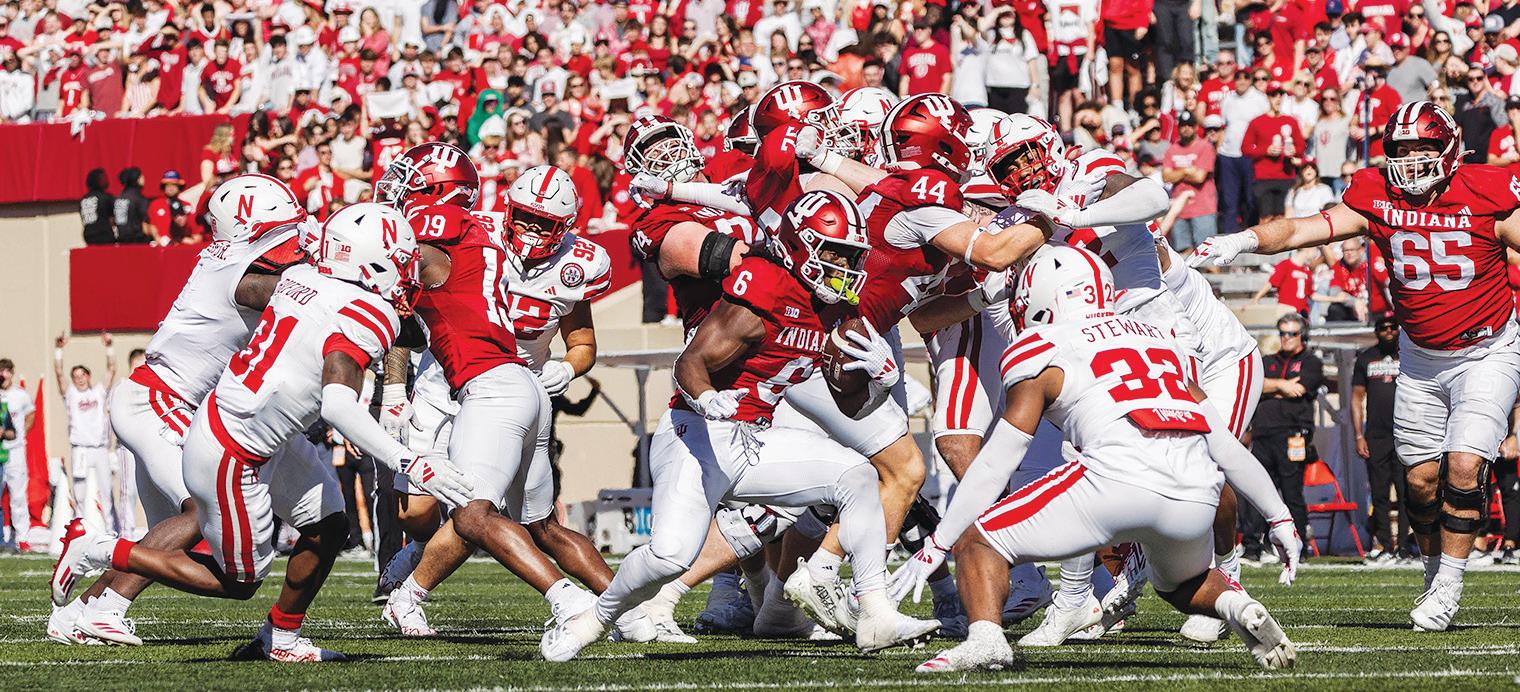
likely be talks that this is where the pass game is going to show a decline, but with sixth-year quarterback Kurtis Rourke at the helm, nothing is slowing the air raid down.
Rourke didn’t play a snap in the second half as he finished 17-of-21 for 189 yards, a touchdown and an interception at the end of the first half on a Hail Mary. Despite exiting with a thumb problem during the second quarter, the injury isn’t expected to be a big deal, with Cignetti saying he felt “optimistic.”
Oct. 19 was a matchup between two of the best defensive fronts in the Big Ten. While the Nebraska side didn’t live up to the hype, the Hoosiers certainly did.
They shut down the Cornhuskers’ run game, allowing
just 2.4 yards per carry and a measly 70 total rushing yards. In the pass game, the Hoosiers were active, getting to freshman quarterback Dylan Raiola frequently. While seniors Shawn Asbury and Jamier Johnson, as well as freshman Rolijah Hardy, all came away with interceptions, it started with the defensive line.
“It makes our job way easier,” sophomore cornerback D’Angelo Ponds said postgame. “Just them getting pressure on the quarterback, keeping him uncomfortable and get him off his platform. That makes it way easier on us.”
Following two sacks from senior defensive back Terry Jones Jr. and junior defensive lineman Mikail Kamara, the
Indiana defense is now tied with none other than Nebraska for the conference lead.
With veteran quarterbacks Will Rogers from Washington and Will Howard from Ohio State remaining on the schedule, applying pressure is going to be a key point of emphasis.
While the doubters get quieter from week-to-week, the believers get that much louder. It’s been an area of emphasis for Cignetti and his team to not pay attention to any noise, no matter if it’s good or bad.
“That’s just rat poison,” Walker said. “You really got to stay off social media because they’re not on the field when we play. Whatever Coach Cig says, that’s what we listen to.” Cignetti is a great figure to
Gemini (May 21-June 20) Today is an 8 — Express your creativity
listen to as he’s now led the Hoosiers to their best start since 1967 and he’s done it his way. He is outmuscling opponents’ game-to-game, no matter what the narrative is. Going into this game, the “rat poison” said this was potentially the end of the road for the glistening 2024 undefeated start. However, the Hoosiers stayed true to themselves, as they have all season, naturally silencing all the doubters in the process. Indiana football is legit. The fans will continue to show up, the players will continue to dominate, and the media will start giving flowers. But the locker room, doesn’t care about that at all — it’s just about winning, which is exactly what the 7-0 Hoosiers have done.
(Oct. 23-Nov. 21) Today is an 8 — Monitor professional developments for opportunities. Talk about what you want. Determine what skills you lack. Plan your moves. Set aside excess baggage. Provide excellence.

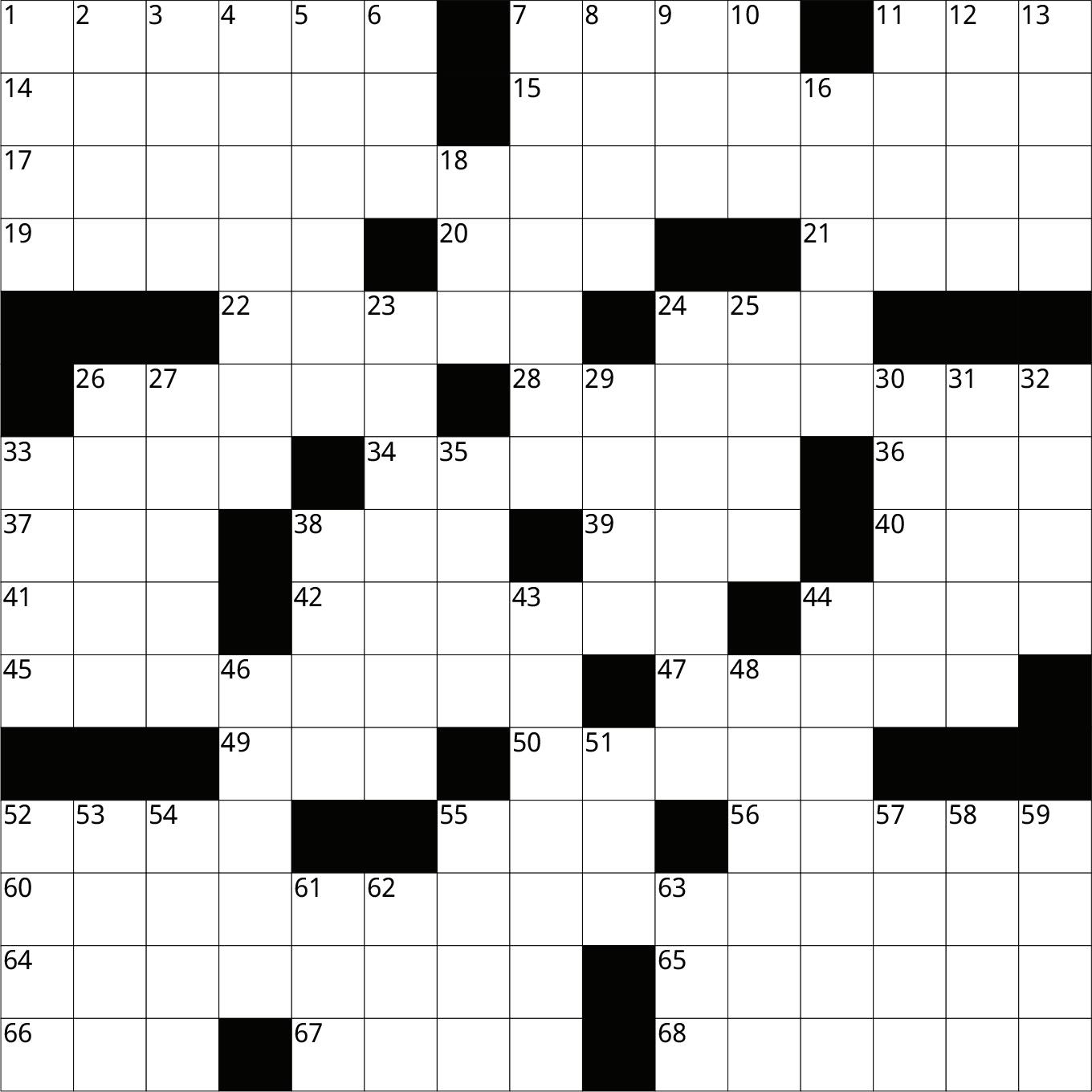
By Will Kwiatkowski wdkwiatk@iu.edu | @ wkwiatkowski_15
In the midst of a threegame win streak, which included two significant Big Ten victories, Indiana field hockey faced off against two California teams, hoping to extend its streak.
The Hoosiers secured a 2-0 victory over No. 18 University of California, Berkley on Oct. 18, shutting out the Golden Bears and showcasing their best field hockey of the year. As they prepared for the Oct. 20 match against Stanford, the 7-6 Hoosiers aimed to build on their recent success. However, in its second game of the weekend, Indiana lost a closely contested match to Stanford, coming up just short 2-1 despite dominating in the box score.
Cal presented yet another formidable challenge for Indiana.
However, Indiana gained the first lead through senior midfielder Meredith Lee’s goal in the 23rd minute, giving the Hoosiers a 1-0 lead.
Indiana’s defense was formidable, allowing Cal just three shots in the first half, while the Hoosiers managed five shots and controlled possession throughout the first 30 minutes.
In the third period, sophomore midfielder Hannah Riddle netted her first career goal on a penalty shot, extending Indiana’s lead to 2-0.
Indiana freshman goalkeeper Sadie Canelli earned Division I National Defensive Player of the Week from the National Field Hockey Coaches Association on Wednesday. She continued her strong performances by pitching a shutout against No. 18 ranked Cal, making eight saves to secure the victory.
Indiana aimed to carry that momentum into its sec-
ond game of the weekend. However, the Hoosiers were unable to secure a win, falling 2-1.
It was standing room only for the Oct. 20 Senior Day game against Stanford, and the fans brought the energy, as they cheered enthusiastically and rallied support for Indiana throughout the match.
Riddle, who scored her first goal of the season in Oct. 18 game, found herself in the same spot again. From the penalty spot, she launched a quick shot to the left corner of the goal, just beyond the reach of sophomore goalkeeper Daisy Ford.
Her goal was the only one of the day, as Stanford’s defense, along with some misfortune and a lack of execution from Indiana, limited the Hoosiers to just one score. Despite a barrage of 24 shots, Indiana managed only five shots on goal.
Stanford struck first in the 24th minute, as junior defender Scout Butler scored off a penalty corner, redirecting her teammates pass over Canelli for the score. Indiana quickly pushed back, but a potential equalizer was overturned due to a penalty call, leaving the crowd frustrated.
Trailing at halftime, Indiana aimed to keep the Cardinal scoreless while searching for an offensive answer. However, Stanford’s full-field pressure proved overwhelming, making it difficult for the Hoosiers to move the ball out of their half for most of the third quarter.
A defensive lapse from Indiana allowed Stanford’s graduate student forward Allison Kuzyk an open path to the goal. Kuzyk connected with sophomore forward Star Horlock for a score, extending the Cardinal lead to two.
After Riddle’s goal in the 42nd minute, Indiana came

to life, trailing by just one score. However, despite their efforts, the Hoosiers were unable to find the back of the net again and ultimately fell short in their comeback attempt, remaining shut out for the remainder of the game.
Despite finding themselves lining up for a penalty corner ten times in the second half, the Hoosiers
424 S. College Mall Rd. 812-331-1863
bloomingtoninbahais.org facebook.com/Baháí-Community-ofBloomington-Indiana-146343332130574
Instagram: @bloomingtonbahai
Sunday: 10:40 a.m., Regular Services, Devotional Meetings. Please call or contact through our website for other meetings/activities
The Bahá’í Association of IU works to share the Teachings and Principles of the Founder, Bahá’u’lláh, that promote the “Oneness of Mankind” and the Peace and Harmony of the Planet through advancing the “security, prosperity, wealth and tranquility of all peoples.”
Karen Pollock
Dan Enslow
The Church of Jesus Christ of Latter-day Saints
Bloomington Young Single Adult Branch
2411 E. Second St.
To Contact: Send message from website maps.churchofjesuschrist.org/ wards/237973
Sunday: 12:30 p.m.
The Church of Jesus Christ of Latter-day Saints has four congregations in Bloomington—Three family wards and our young single adult branch for college students. This info is for the YSA Branch. Weekday religious classes at 333 S. Highland Ave, Bloomington IN 47401, next to campus.
More info at churchofjesuschrist.org.
United Methodist
Jubilee
219 E. Fourth St. 812-332-6396 jubileebloomington.org
Facebook: First United Methodist Church of Bloomington, IN
Instagram: @jubileebloomington
Sunday: 9:30 a.m., Classic Worship
11:45 a.m., Contemporary Worship Wednesday: 7:30 p.m., College & Young Adult Dinner
challenge Stanford goalkeeper Daisy Ford. The Hoosiers will travel for their final two road games of the regular season next weekend, starting in Columbus, Ohio, to take on Ohio State at 3:00 p.m. Oct. 25.
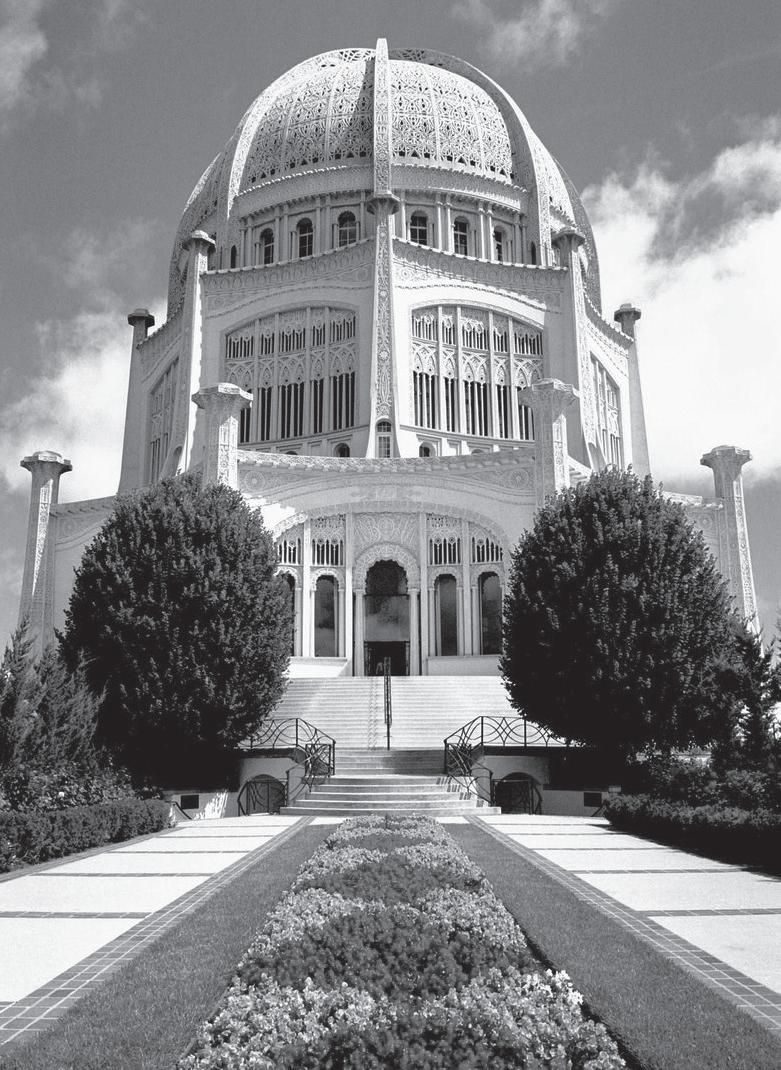
American Restoration Movement
North Central Church of Christ
2121 N. Dunn St. 812-332-2248 nc3family.org Facebook.com/nc3family
Sunday: 10 a.m., Worship 11 a.m., College Class
Lutheran - Missouri Synod Orthodox All Saints Orthodox Christian Church
University Lutheran Church and LCMS U Student Center
607 E. Seventh St. 812-336-5387 indianalutheran.com facebook.com/ULutheranIU instagram.com/uluindiana
Sunday: 9:15 a.m.: Sunday Bible Class
10:30 a.m.: Sunday Divine Service
Wednesday: 7 p.m.: Wednesday
6004 S. Fairfax Rd. 812-824-3600 allsaintsbloomington.org webbrk1@gmail.com
recreation, and prayer. For full schedule, visit our website.
Rev. Timothy Winterstein - Campus Pastor
Jubilee is a Christ-centered community open and affirming to all. We gather on Wednesdays at First United Methodist (219 E. 4th St.) for free food, honest discussion, worship, and hanging out. Small groups, service projects, social events (bonfires, game nights, book clubs, etc.), outreach retreats, and leadership opportunities all play a significant role in our rhythm of doing life together.
Markus Dickinson - jubilee@fumcb.org
Inter-Denominational
Redeemer Community Church
111 S. Kimble Dr. 812-269-8975 redeemerbloomington.org facebook.com/RedeemerBtown
Instagram & Twitter: @RedeemerBtown
Sunday: 9 a.m., 11 a.m.
Redeemer is a gospel-centered community on mission. Our vision is to see the gospel of Jesus Christ transform everything: our lives, our church, our city, and our world. We want to be instruments of gospel change in Bloomington and beyond.
Chris Jones - Lead Pastor
Come learn about historic Christian teaching on theology, ethics, and culture. We offer an alternative to the post-modern ideologies and teachings you often see in your lives today.
Shane Himes, PHD - Senior Minister
Christian Science Church
2425 E. Third St. 812-332-0536 bloomingtonchristianscience.com facebook.com/e3rdStreet Sunday Church Service: 10 - 11 a.m.
each one gives a sense of peace and joy. We appreciate the Christian Science Monitor news magazine for its integrity, fairness and compassion.
(Christian Science Monitor) csmonitor.com Christian Science
bloomingtoninbahais.org facebook.com/Baháí-Community-ofBloomington-Indiana-146343332130574
Instagram: @bloomingtonbahai
Sunday: 10:40 a.m., Regular Services, Devotional Meetings.
By Daniel Flick danflick@iu.edu | @bydanielflick
The legacy of late Indiana
men’s basketball head coach
Bob Knight not only lives on in Bloomington, but also Springfield, Massachusetts.
The Naismith Basketball Hall of Fame honored Knight on Oct. 13 with a bench dedication as part of the Naismith Coaches Circle Program. The program honors Dr. James Naismith, who’s often credited with inventing basketball, and serves as a tribute to his core values: teamwork, cooperation, leadership, perseverance and integrity.
Through the bench dedication, the Coaches Circle Program aims to be a pathway for current coaches to honor those who impacted or inspired their careers.
Marian University men’s basketball head coach Pat Knight, Bob Knight’s son, represented the family at Sun-
day’s event. Pat played under his father from 1991-95 and was an assistant coach on the Hoosiers’ staff from 19992000.
Indiana had several representatives present for Knight’s honoring, including head men’s basketball coach Mike Woodson, athletic director Scott Dolson, Indiana Athletics Hall of Fame members Quinn Buckner, Scott May and Steve Ferguson and longtime team physician Larry Rink.
Knight, who passed away Nov. 1, 2023, was inducted into the Naismith Basketball Hall of Fame in 1991. He coached the Hoosiers from 1971-2000, compiling a record of 659-242 while winning three NCAA championships and 11 Big Ten regular season titles.
Knight’s bench is on display and available for fans to see at the Naismith Basketball Hall of Fame in Springfield.
Society of Friends (Quaker)
Bloomington Friends Meeting
3820 E. Moores Pike
812-336-4581
bloomingtonfriendsmeeting.org
Facebook: Bloomington Friends Meeting
Sunday (in person & Zoom) :
9:45 a.m., Hymn singing
10:30 a.m., Meeting for Worship
10:45 a.m., Sunday School
(Children join worship 10:30-10:45)
11:30 a.m., Refreshments and Fellowship
12:30 p.m., Events (see website)
Wednesday (Zoom Only) :
7 p.m., Meeting for worship for Peace
Friday (Zoom Only) :
9 a.m., Meeting for worship
We practice traditional Quaker worship, gathering in silence with occasional Spirit-led vocal ministry by fellow worshipers. We are an inclusive community with a rich variety of belief and no prescribed creed. We are actively involved in peace action, social justice causes, and environmental concerns.
Peter Burkholder - Clerk burkhold@indiana.edu
Non-Denominational
Christ Community Church
503 S. High St. 812-332-0502 cccbloomington.org
facebook.com/christcommunitybtown
Instagram: @christcommunitybtown
Sunday: 9:15 a.m., Educational Hour
10:30 a.m., Worship Service
We are a diverse community of Christ-followers, including many IU students, faculty and staff. Together we are committed to sharing the redeeming grace and transforming truth of Jesus Christ in this college town.
Bob Whitaker - Senior Pastor Adam deWeber - Worship Pastor Dan Waugh - Adult Ministry Pastor
Christian Student Fellowship
1968 N. David Baker Ave. 812-332-8972 csfindiana.org
Instagram: @csfindiana
Monday - Friday: 9 a.m. - 5 p.m.
Christian Student Fellowship (CSF) exists as a Christ-centered community focused on helping students truly know Jesus Christ. Our ministry operates from an on-campus house where students can live. Reach out to schedule a tour of the house or a visit to our Thursday night worship service!
Ben Geiger - Lead Campus Minister
Stephanie Michael - Campus Minister
Joe Durnil - Associate Campus Minister
Hailee Lutz - Office Manager
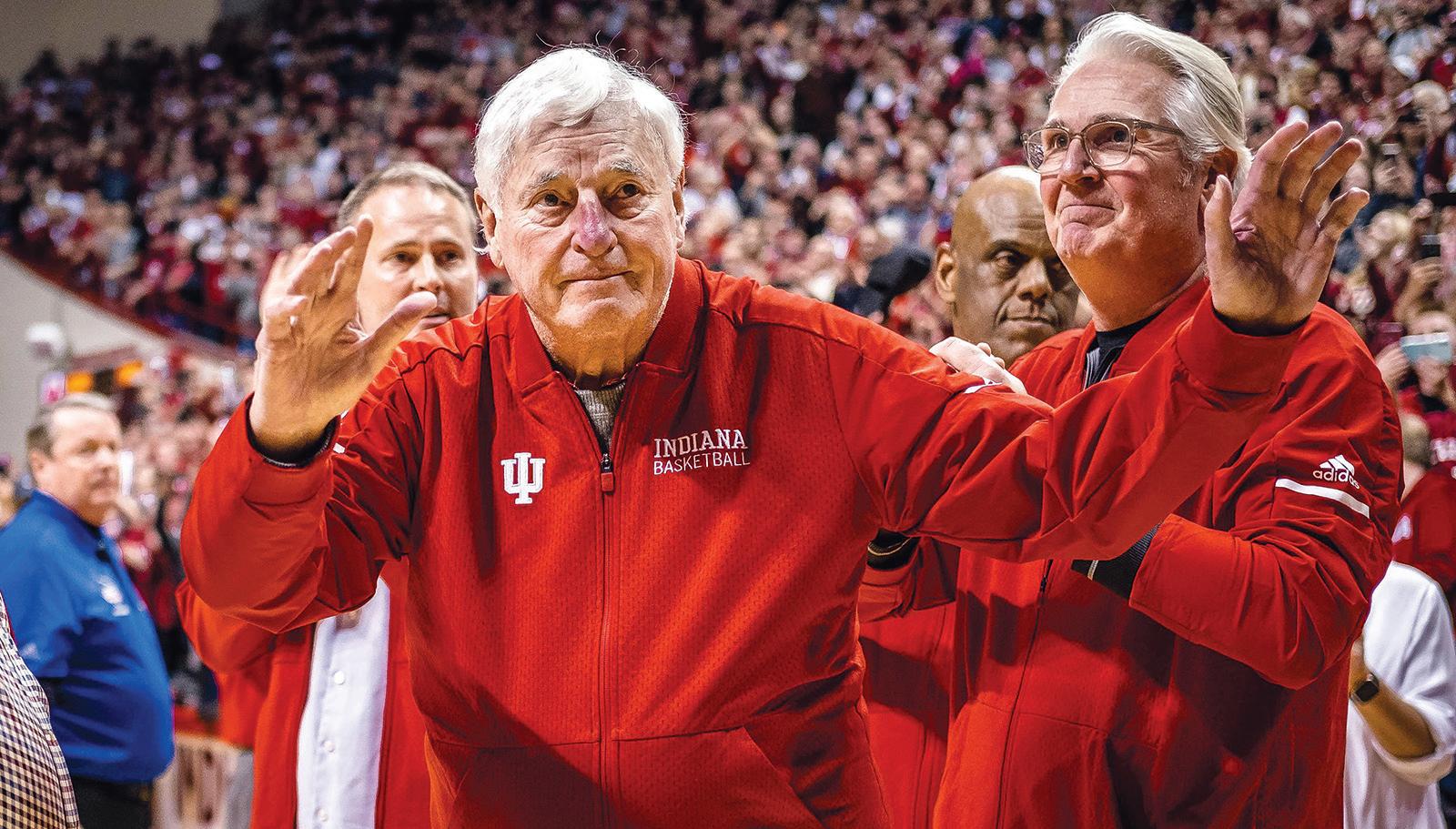
City Church 1200 N. Russell Rd. 812-336-5958
citychurchbloomington.org
tiktok: @citychurchbtown
Instagram: @citychurchbtown
Sunday Service: 8:30 a.m., 10 a.m., 11:45 a.m.
City Church is a multicultural church on the east side of Bloomington. We provide transportation from campus. Our college and young adult ministry meets on Tuesday nights.
David Norris - Pastor
Sacred Heart Church
615 N. Fairview St. 812-345-5239 sacredheartbloomington.org facebook.com/sacredheartbloomington
Sunday: 10:30 a.m.: Refreshments and Fellowship
10:45 a.m.: Worship Service Tue., Wed., Thu.: Midweek Meals (Check Facebook)
Sacred Heart is a nondenominational church that seeks to follow Jesus by acting justly, loving mercy and walking humbly with God. We strive to be a safe, inclusive community where you can bring your doubts, questions, struggles, and joys before a loving God and find true belonging. All are welcome!
Dan Caldwell
Episcopal (Anglican)
Canterbury Mission
719 E. Seventh St. 812-822-1335 IUCanterbury.org facebook.com/ECMatIU Instagram & Twitter: @ECMatIU
Youtube: @canterburyhouseatiu9094
Sunday: 3 p.m. - 7 p.m.
Mon., Wed., Thu.: 10 a.m. - 6 p.m.
Tuesday: Noon - 8 p.m. Fri., Sat.: By Appointment
Canterbury: Assertively open & affirming; unapologetically Christian, we proclaim the gospel of Jesus Christ by promoting justice, equality, peace, love and striving to be the change God wants to see in our world.
Ed Bird - Chaplain/Priest
Independent Baptist
Lifeway Baptist Church
7821 W. State Road 46 812-876-6072 lifewaybaptistchurch.org facebook.com/lifewayellettsville
Sunday: 9 a.m., Bible Study Classes 10 a.m., Morning Service
5 p.m., Evening Service
*Free transportation provided. Please call if you need a ride to church.
Student Ministry: Meeting for Bible study throughout the month. Contact Rosh Dhanawade at bluhenrosh@gmail.com for more information.
Steven VonBokern - Senior Pastor Rosh Dhanawade - IU Coordinator 302-561-0108 bluhenrosh@gmail.com
United Church of Christ and American Baptist Churches-USA First United Church 2420 E. Third St. 812-332-4439 firstuc.org facebook.com/firstuc
Sunday: 10:30 a.m., Worship
Monday: 10 a.m. via Zoom, Bible Study
We are an Open, Welcoming, and Affirming community of love and acceptance dedicated to welcoming the diversity of God’s beloved. We exist to empower, challenge, and encourage one another to live out Jesus’ ways (compassion, truth, and justice) authentically as human beings in community to create a better world.
Rev. Jessica Petersen-Mutai Senior Minister
Baptist
Emmanuel Church
1503 W. That Rd. 812-824-2768 Emmanuelbloom.com
Instagram & Facebook: @EmmanuelBloomington
Sunday: 9:15 a.m., Fellowship
Sunday: 10 a.m., Worship Groups: Various times
Emmanuel is a multigenerational church of all types of people. Whether you are questioning faith or have followed Jesus for years, we exist to help fuel a passion for following Jesus as we gather together, grow in community, and go make disciples.
John Winders - Lead Pastor
Second Baptist Church
321 N. Rogers St. 812-327-1467 sbcbloomington.org facebook.com/2ndbaptistbloomington youtube.com/@secondbaptist churchbloomington
Sunday Service: 10 a.m., In house and on Facebook/YouTube Sunday School: 8:45 - 9:45 a.m. Bible Study: Available In House and on Zoom Wednesdays, 6:30 p.m., Thursdays, Noon
Please come and worship with us. We are in training for reigning with Christ! Need a ride? Call our Church bus at 812-3271467 before 8 a.m. on Sunday
Rev. Dr. Bruce R. Rose - Pastor Tallie Schroeder - Secretary
Sunday: 10:15 a.m., via in person or livestream We’re a multi dynamic congregation actively working towards a more just and loving world. We draw inspiration from world religions and diverse spiritual traditions. Our vision is “Seeking the Spirit, Building Community, Changing the World.” A LGBTQA+, Dementia Friendly, Welcoming Congregation to all ages and groups and a Certified Green Sanctuary.
Rev. Susan Frederick-Gray
Evangelical Lutheran Church in America
Rose House LuMin & St. Thomas Lutheran Church
3800 E. Third St. 812-332-5252 Stlconline.org lcmiu.net
Instagram: @hoosierlumin facebook.com/LCMIU facebook.com/StThomasBloomington
Sunday: 8:30 a.m. & 11 a.m. @ St. Thomas Lutheran Church 3800 E. Third St. Tuesday: 6:30 p.m.
& Devotions @
S.
Rose House LuMin and St. Thomas Lutheran Church invite you to experience life together with us. We are an inclusive Christian community who values the faith, gifts, and ministry of all God’s people. We seek justice, serve our neighbors, and love boldly.
Rev. Adrianne Meier Rev. Lecia Beck Rev. Amanda
Unity Worldwide
Unity of Bloomington A Center for Spiritual Growth
4001 S. Rogers St. text/call: 812-333-2484 unityofbloomington.org IG: @unityofbloomington facebook@UnityofBloomington
Sunday Celebration: 10:30 a.m.
Discover a vibrant, welcoming community at Unity of Bloomington – “a positive path for spiritual living”. Our center offers a space for spiritual growth; embracing all with open arms. We proudly affirm and welcome the LGBTQ+ community, fostering love, acceptance, and inclusion. Join our loving congregation, where everyone is valued and encouraged to explore their spiritual journey. At Unity of Bloomington, all are welcome and together we thrive!
Minnassa Gabon - Spiritual Leader Phyllis Wickliff - Music Director Reformed Protestant
Trinity Reformed Church
2401 S. Endwright Rd. 812-825-2684 trinityreformed.org lucas@trinityreformed.org facebook.com/trinitychurchbloom
Sunday: 10:30 a.m., Sunday Morning Services 7 p.m., Bible Study at the IMU
We are a Reformed Protestant church on the west side of Bloomington with lively worship on Sunday mornings and regular lunches for students after church. We love God and His Word. Please get in touch if you’d like a ride!
Jody Killingsworth - Senior Pastor Lucas Weeks - College Pastor
By Mateo Fuentes-Rohwer matfuent@iu.edu | @mateo_frohwer
To most people, it was history. For Todd Yeagley, it was just another game. Indiana men’s soccer’s 3-1 victory over Michigan State propelled the Hoosiers to the top of the Big Ten standings, although second place Maryland has played two fewer games. However, the match also secured Yeagley’s 200th victory as Indiana’s head coach, a number that to him was simply just that.
A number.
“I don’t look at numbers, I just don’t,” Yeagley said postgame. “But it’s fun. I really appreciate the guys; we had a fun time in the locker room.”
Nothing better encapsulates Yeagley’s emotions than his response to the victory. With the seconds ticking down to zero, the head coach stood with his hands in pockets, looking out at his team. Then, when the horn sounded, he shook the hands of the Michigan State players and staff, without a hint of emotion in his demeanor.
It would be impossible to tell his squad secured their third straight victory and extended their unbeaten streak to seven. It would be impossible to recognize a head coach with a 22-4-6 record in the month of October since 2021.
But that’s exactly what Yeagley and Indiana accomplished, although he was quick to highlight his team’s performance in the month over his own accomplishments.
“It’s just fun to see the team always getting better,” Yeagley said. “That’s what I’m always proud of, is the team gets better as the year goes on.”
Justin Weiss represents Yeagley’s sentiments perfectly. The graduate student forward began the year with 13 straight scoreless games, but his opening finish Oct. 18 marked his third goal in two games. A transfer from North-
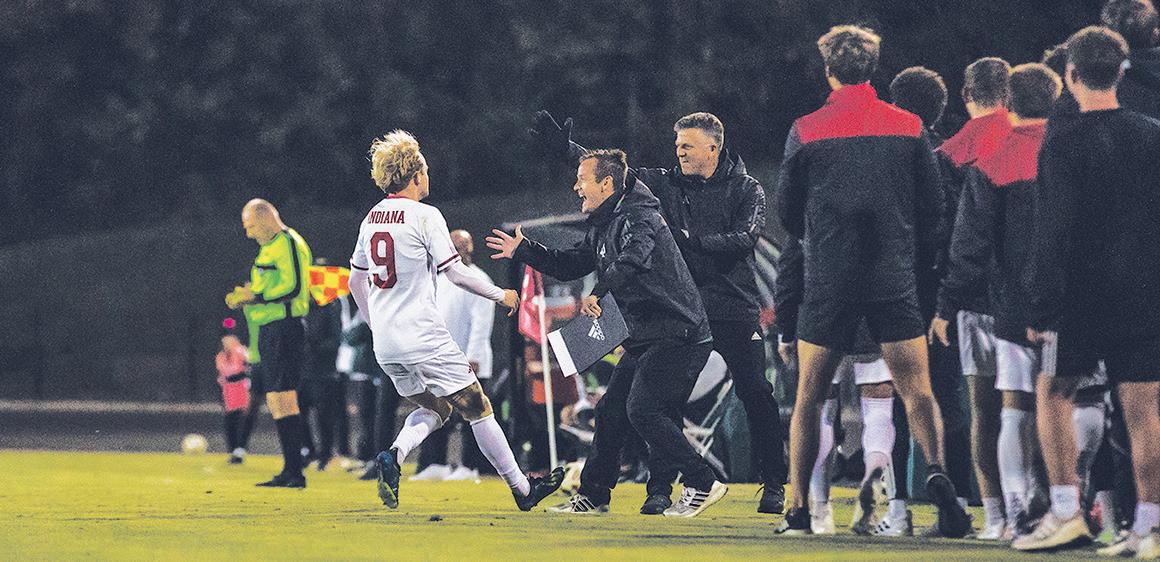
western, Weiss said he’d been frustrated with his lack of production, although it was more about “letting the team down” than the statistic itself.
But Yeagley and his staff disagreed, citing the other positive qualities he contributed beyond his scoring ability.
Now, as the goals finally arrive, Weiss believes his time was bound to come — a matter of if, not when.
“I wasn’t not a goal scorer all of a sudden,” Weiss said postgame. “I always had it in me. Sometimes it takes a little bit of time, and (when) you hit form, you hit form.”
Just before the half, Weiss earned Indiana a penalty from a Michigan State handball, and senior forward Patrick McDonald stepped up to double the Hoosiers’ lead. But only minutes later, McDonald was called for a handball of his own following a video review, and Michigan State sophomore midfielder Cristiano Bruletti made the game 2-1 entering halftime. Throughout the first half, senior forward Sam Sarver struggled to gain any rhythm, reflected in his uncharacteristic first half substitution only 22 minutes into the game. Sarver himself acknowledged his poor performance postgame.
“He gave me some tough love in the first half,” Sarver said about Yeagley. “It obviously wasn’t my best half. ...
He gave me a little talking to at halftime privately just to ... go out there and play your game.”
Sarver did just that.
Only five minutes into the second half, Sarver dribbled the ball at the top of the box on his patented right wing and rifled a shot to the top left corner, extending Indiana’s lead to 3-1. Without hesitation, he sprinted to the sideline, pointed at his head coach and gave him a big hug.
Yeagley noted the “deep relationship” he and his senior forward have, and Sarver reflected a similar sentiment with his appreciation for his coach.
“I felt I owed him a little hug just for having faith in me,” Sarver said. “Lots of coaches, if their players aren’t playing (well), they’ll take them out and they’ll be done for the day. I’m grateful that he kept his faith in me and let me keep going.”
The two-goal lead was one Indiana would never relinquish as it cruised to the three points. But the final 40 minutes following Sarver’s would likely not have been as smooth without Jack Wagoner.
To begin the year, the junior midfielder’s position was up for grabs alongside graduate student transfer Luke Jeffus. Yet, as the season wore on, Wagoner es-
tablished himself as the No. 2 guy in the midfield next to McDonald, a role that epitomizes his character.
“He’s an engine back there, and he’s the most unselfish player we have on the team,” Weiss said. “He doesn’t care about scoring goals (or) giving assists — he’s just working hard getting second balls, and he cares about the team’s success.”
Wagoner played all 90 minutes in the match, a feat he’s achieved in three of the last five games. But with a week break before Indiana’s trip to Los Angeles to face UCLA on Oct. 25, Weiss pointed out the junior will have the weekend to “decompress” from the heavy usage.
As the Hoosiers begin to establish themselves and gain momentum, Sarver is ready to welcome the outside noise after disregarding it for so much of the year.
“Sometimes it takes a few games for the teams to mesh, and you got to ignore the outside comments of, ‘IU (is) not the same anymore,’” Sarver said. “Now everyone can hop on the bandwagon again.”
Bandwagon or not, the wins are all Yeagley wants. And if the match is his 201st victory, further extending his national record win total since 2010, it won’t matter to him — it will just be a number.
By Parker Rodgers parkrodg@iu.edu | @parrod153
WEST LAFAYETTE, Ind. — At 24-9 in the third set, the Boilermaker fans all rose to their feet. They grabbed their car keys and waved them around to make noise to cheer on Purdue at match point.
Sophomore middleblocker Lizzie Carr lined up on the right side and spiked the ball to the middle of the court. The Hoosiers were too late to react to the ball. The crowd erupted and the Boilermakers sprinted to the court to gather in a big huddle as they lifted the Monon Spike in the air.
Indiana fell short Oct. 19 in Mackey Arena as Purdue’s offense dominated each set (25-18, 25-14, 25-9).
With 14,876 fans in attendance, it was an environment that impressed Indiana head coach Steve Aird.
“(I) thought it was a fantastic environment,” Aird said. “It’s certainly an environment the program is not accustomed to.”
While the first set was the smallest margin of victory for Purdue by 7 points, the Boilermakers kept finding their rhythm. By the third and final set, they beat Indiana by 16 points. In the first two sets, Indiana hung around but eventually fell victim to Purdue’s late-set runs. The Hoosiers couldn’t catch up.
“I was disappointed we didn’t have a little more pushback,” Aird said.
Purdue’s offense clicked from start to finish, hitting 33.3% in three sets. Junior outside hitter Eva Hudson and sophomore
outside hitter Chloe Chicoine led the Boilermakers with 17 and 12 kills, respectively. Meanwhile, Indiana struggled to find its rhythm at the net offensively as no Hoosier reached double-digit kills. Junior outside hitter Avry Tatum led the team but was limited to just seven kills. The Hoosiers, typically strong behind the service line, recorded no aces and four errors. Although junior setter Camryn Haworth and graduate student defensive specialist Delaynie Maple have powerful jump serves that disrupt opponents, neither player used them Saturday, with Aird wanting to manage his players’ health.
“We were trying to manage (Haworth) physically,” Aird said. “We desperately need some rest for some key players.” In contrast, Purdue’s efforts from behind the line were no match for Indiana. The Boilermakers earned nine aces through the three sets, with sophomore setter Taylor Anderson tallying three of them. Indiana is now on a four-game losing streak in conference play, with three of the last four opponents being nationally ranked. This losing streak marks the Hoosiers’ longest since 2022.
“It’s challenging, but that’s the conference,” Aird said. “I would’ve loved to maybe pick up one of them over the last three or four.” Indiana continues its tough slate of Big Ten play against Wisconsin at 7 p.m. Oct. 24 back inside Wilkinson Hall in Bloomington.