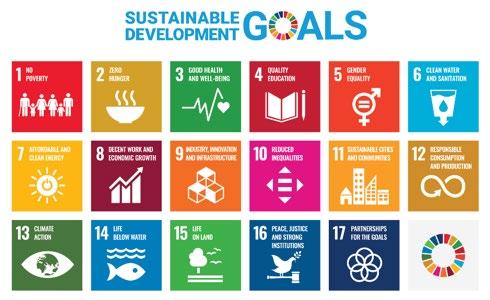
Business, the public sector and organisations have a major impact on people, society, the environment, climate and animals. Businesses contribute to development, innovation and better living conditions, but the activity also entails risk and real damage. Therefore, companies have a key role in the work to achieve the UN's Sustainable Development Goals and the Paris Agreement's 1.5-degree goal. This is best done in collaboration. Ethical Trade Norway is a member organisation and multi-stakeholder collaboration with business, trade unions, employers' organisations, civil society and the public sector that together address the complex challenges in the global supply chains that individual companies cannot solve alone.
Openness, accountability and continuous improvement are fundamental to this work. This member's report can be used as a report under the Transparency Act, but covers broader topics such as climate, the environment and anti-corruption. Our framework is based on the UN Guiding Principles on Business and Human Rights and the OECD's model for due diligence – internationally recognised standards that form the basis for Ethical Trade Norway's 13 principles for sustainable business practices. These principles include human rights, decent work, the environment/climate, animal welfare and anti-corruption.
All members of Ethical Trade Norway are obliged to carry out risk-based due diligence assessments and report annually on the progress of their own work. Companies at our quality level Basis satisfy the Transparency Act's requirements for reporting on due diligence assessments. Members can also reach for the levels Completing and now in 2026 Leading.
Good due diligence is not about being "risk-free", but about being transparent and systematic: identifying risks, preventing and reducing negative impacts, communicating openly about handling and – where necessary –contributing to recovery.
I would like to thank all members for their efforts, transparency and willingness to contribute to responsible supply chains. Together, we show how responsible trade can be for the good of people, animals, society and the environment.
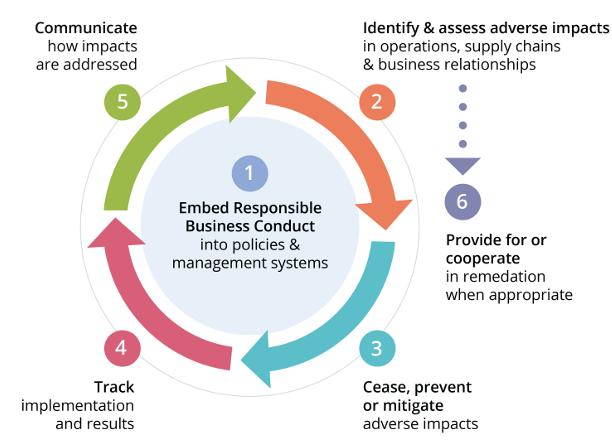
This report is built around the UN Guiding Principles on Business and Human Rights and the OECD's model for due diligence for responsible business conduct.
The model has six steps that describe how companies can work towards more responsible and sustainable business practices. Being good at due diligence does not mean that a company does not have a negative impact on people, society and the environment, but rather that the company is open and honest about challenges and handles this in the best possible way in consultation with its stakeholders. This report is divided into chapters based on this model.
Foreword by the general manager
As the Nordic region's largest total supplier of product media, we at IDÉ Group have a significant responsibility, both to our customers and to the people, communities and environments that are affected by our business. Our value chain spans several continents, and large parts of our production take place in regions where the risk of violations of human rights, working conditions and environmental standards may be elevated. That is precisely why systematic due diligence is a fundamental part of how we do business.
The Transparency Act and Ethical Trade Norway's guidelines set clear expectations for how companies should identify, prevent and manage risk.
These expectations are not new to us; they have been integrated into our work for many years. However, the Act has contributed to further structure, anchoring and transparency, both internally in the organisation and in the dialogue with our suppliers and customers.
Over the past year, we have strengthened our work in several areas.
We have increased our insight into risk in parts of the supply chain, improved internal expertise and further developed our collaboration with strategic partners to achieve more robust and responsible practices. We have also prioritised better follow-up where the risk is greatest, and we have continued our efforts to reduce our environmental impact through more circular and sustainable product choices. These are measures that support both the UN's Sustainable Development Goals and our own principles for sustainable business practices.
At the same time, we recognize that responsible business conduct is a continuous effort. We will continue to face dilemmas and challenges, and we know that we do not always have full insight or full control.
But our ambition is clear: We will be open about the challenges, transparent about our assessments and clear in our priorities.
We will do everything we can to reduce the risk of negative impact and contribute to positive development where we have the opportunity.
In the coming year, we will particularly strengthen our work with:
1. Clearer risk priorities.
2. Improved complaint mechanisms and increased accessibility.
3. Even closer dialogue with suppliers in high-risk areas.
4. Measurable improvements in climate and circular economy.
I would like to thank our employees, suppliers and customers for their cooperation over the past year. Responsible business practices can only be achieved when we stand together, and I am proud of the work we do and the direction we are going in
"We know where we want to go, but we don’t have
all the answers yet"
Nina Lauritzen ManagingDirectorNorway
The board's signature
12.02.2026
| IDÉ House of Brands/IDÉ Group
Drøbak
Key information about your business and supply chain
Key information about the business
Name of the enterprise
IDÉ House of Brands/IDÉ Group
Address Head Office
Dyrløkkeveien 19, 1448 Drøbak
Main brands, products and services
IDÉ Group is the Nordic region's leading supplier of "Product Media" to the corporate market. This includes promotional products, corporate clothing, gifts, food and beverages, office supplies, large format and exhibition equipment.
Description of the structure of the enterprise
IDÉ House of Brands AS was established in 1987 by Lasse Lauritzen and Morten Pedersen. Today, the company is part of the group structure IDÉ Group AS, which functions as a holding company. IDÉ Group AS owns 100% of IDÉ House of Brands AS (Norway), IDÉ House of Brands Sweden AB and IDÉ House of Brands Oy (Finland), as well as 75% of IDÉ House of Brands Danmark A/S, 50% of IDÉ House of Brands Iceland and 43.7 % of House of Print AS.
At the very end of 2025, Wackes AB and Wackes AS were acquired 100% by IDÉ Group. The group is owned by the Lauritzen family.
We have been a leading player in the profile industry for 39 years and operate exclusively in the B2B market. The company supplies product media, including promotional products, corporate clothing, gifts, food and beverages, office supplies, large format and exhibition equipment. IDÉ Group is considered Europe's largest privately owned player in product media.
The business is organised with category managers who are responsible for following up cooperation agreements with selected suppliers and manufacturers (contract partners). Sales and customer follow-up is handled by local offices organized with Key Account Managers, Account- Managers and Coordinators, who order goods from the contract partners in accordance with the agreements
This structure provides clear responsibilities between purchasing, supplier follow-up and the customer level.
IDÉ Group operates in several Nordic markets through local sales offices. In 2025, we had the following organization of sales offices and full-time equivalents:
Turnover of NOK 471 million relates to IDÉ House of Brands AS (Norway).
Turnover of NOK 741 million applies to the entire IDÉ Group.
Anchoring due diligence and sustainable business practices
The Board of Directors, CEO and CEO of Norway have the overall responsibility for the work with due diligence related to sustainable business practices in IDÉ Group.
The operational responsibility is divided between the ESG & Compliance team and the sustainability management. The ESG & Compliance team is led by the CFO and is responsible for the implementation and coordination of the work across the organization.
The team is located in Norway, Finland and Sweden and works group wide
The Head of Sustainability and Product Quality has the operational responsibility for conducting due diligence assessments and reports to the CFO, who in turn reports to the CEO. Reporting on the work takes place through semi-annual reports that are approved by the CEO in Norway and the CEO of IDÉ Group.
This organisation ensures a clear anchoring of the work on sustainable business practices in the company's management, clear responsibilities and good internal communication across markets and functions.
The work on due diligence assessments is an integral part of the company's management and continuous improvement work.
Turnover in the reporting year (NOK)
471 000 000
Is the enterprise covered by the Transparency Act?
Yes
Significant organisational changes since the last reporting and the period of this report
The report covers the period 1 January 2025 – 31 December 2025.
IDÉ Group entered into an agreement to acquire Wackes AB and Wackes AS with signing on 19 December 2025, following a due diligence process that took place from August 2025.
The acquisition was completed towards the end of the reporting year and has therefore not had operational significance for the company's organisation, management or due diligence work in 2025.
The integration of Wackes will be completed in 2026. They are 59 employees divided into 47 full-time equivalents. Organisational, structural and supplier-related changes because of the acquisition, including consequences for governance, routines and due diligence in the supply chain, will be assessed and handled in line with the company's obligations under the Transparency Act and Ethical Trade Norway's principles, and will be accounted for in future reporting periods.
Name, title of the contact person for the report
Wenche Moseng, Head of Sustainability and Product Quality
Email address of the contact person for the report wenche.moseng@idegroup.no
Supply chain information
General description of the company's purchasing model and supply chain
IDÉ Group emphasizes long-term and responsible relationships with our contractual partners, which include brand suppliers, agents and manufacturers.
The Group has a broad product portfolio, which entails procurement from many different suppliers with different roles and risk profiles in the value chain. Parts of the value chain are global and thus associated with inherent risks.
Purchasing model
We do not have a centralized purchasing department. The purchase of standard products is mainly carried out by Account Managers and Coordinators in the individual branch offices, who order products from approved contract partners and coordinate decoration before delivery to the customer. This model provides proximity to customer needs and flexibility, but requires a clear framework, system support and close follow-up of suppliers.
Whollyorpartlyownedproductionincludes our own printing plant in Drøbak and House of Print AS in Sofiemyr. Purchasingdirectlyfromthemanufacturerapplies to production we order directly from the factory or via agents, such as modification of standard products or development of new products. We call this "specialproduction"and applies to 36 contract partners, which account for approximately 12% of our turnover. We have no ownership interests in the factories we use. Procurementviaanagent,intermediary,importerorbrandsupplierincludes products that have been manufactured and/or imported into the EU by a contracting partner. Products are decorated with customer logo before distribution. Other purchases include warehousing, design work, packaging, operation of Webshop, IT support, financial and administrative systems, travel expenses, transport and logistics costs.
To strengthen the follow-up of special productions, we established in August 2025 a dedicated resource with responsibility for coordination with producers, requirements follow-up and the use of our digital traceability system, the "PartnerPortal".The Partner Portal is our central tool for collecting, validating, and using supplier data. Here, partners register their own supply chain, primarily Tier 1 and Tier 2, as well as raw materials included in the products.
The data includes, among other things, the factory's identity and location, production stage (tier), certifications, material types and product specifications.
When a partner registers or changes information about subcontractors, raw materials or production stages, IDÉ Group receives a notification.
This enables ongoing validation of the information and control of new supply chains.
The information is automatically linked to each product when it is created in the portal, and then on to specific orders.
In this way, the supply chain is directly linked to the actual products produced.
The data is used as a basis for risk mapping in line with ESRS S2. This applies in particular to the risk of human rights violations in the early stages, country risk, raw material risk and factory-related conditions. The partner portal thus provides a structured data basis that enables us to carry out systematic due diligence assessments, prioritise risk and follow up measures across the value chain.
The system ensures more uniform data collection, improves traceability and contributes to a more efficient and documentable follow-up of risks in the supply chain.
The supplier base .
In the reporting year 1 January – 31 December 2025, IDÉ Group had 228 written cooperation agreements with suppliers. Of these, 15 were new, 13 agreements were renegotiated. 19 agreements were terminated in the reporting year. 36 contract partners are used for special production.
Partner loyalty
To ensure control and follow-up of the supply chain, the Group aims for 90% of purchases to be made through these contract partners. We refer to this as "partnerloyalty".
The remaining 10% covers specific needs such as catering, office operations, and specific brands according to customer needs.
Partner loyalty was as follows in 2025:
1. Norway : 92.78%
2. Sweden: 90.77%
3. Denmark : 79.11%
4. Finland: 82,76 %
5. Island: 83,07%
For special production, partner loyalty was even higher, as 95% of all special production orders were placed with contract partners.
Number of suppliers with whom the enterprise has had commercial relationships in the reporting year
228
Comment on the number of suppliers
IDÉ Group had 228 written cooperation agreements with suppliers in 2025. Responsibility in the supply chain is ensured through written agreements and ethical guidelines, while the Partner Portal is used to follow up special production. This provides visibility and supports and supports a risk-based approach that protects people, society and the environment.
Type of purchasing/supplier relationship
Wholly or partly owned production
Sourcing directly from the manufacturer
Sourcing via agent/intermediary /porter/brand suppliers
Other
1. Wholly or partly owned production includes our own printing plant in Drøbak and House of Print AS in Sofiemyr.
2. Sourcing directly from the manufacturer includes the production we do ourselves at factories or via agents. We call this special production. Special production means modification of standard product or newly developed products. If a standard product is modified in shape, color or choice of material, it falls under the category of special production. 36 contract partners are used for special production.
3. Sourcing via agent/intermediary/porter/brand suppliers includes those products that have been manufactured and imported into the EU by a contracting partner. We buy these products and decorate them with customer logo, before they distributed to our customers.
4. Other apply to warehousing, design work, packaging, operation of Webshop, IT support, financial and administrative systems, travel expenses, transport and logistics costs. List of first -link manufacturers by country
Our first-tier manufacturers are defined as factories or facilities where the goods are completed or assembled. This also applies to products purchased through agents or other intermediaries, where we collect information about where the production is carried out.
In 2025, we placed orders for special production with 36 partners, and 31 of this shared detailed information about their factories, or the factories they use.
Based on this manually collected information, we were able to map our supply chain at the Tier 1 level, which represents around 75% of the turnover associated with partners with special production agreements.
In total, we have mapped 75 factories that are used for IDÉ Group's special production. These are in eight different countries: Bangladesh, Bulgaria, China, India, Poland, South Korea, Taiwan and Turkey.
Of the 75 facilities, 58 had a valid social audit at the time of booking and processing. Of these, 46 were amfori BSCI audits.
Through our membership in amfori, we gain access to historical and detailed audit results, which makes it possible to follow developments over time, assess improvement measures and have a more targeted dialogue with our partners about issues that need to be addressed.
Amori’s tools also allow us to collect and use data from first-tier manufacturers for various reporting purposes. As of today, 36 contract partners are registered in our PartnerPortal.
The partner portal gives us structure and transparency in the follow-up of these partners, while at the same time making it possible to document and map both Tier 1 and Tier 2 facilities.
By 2026, all our special production partners will be fully integrated into the portal, making mapping more systematic and holistic across the value chain.
In addition to these partners, we have "hybrid special productions" through wholesalers with strong Nordic roots. These wholesalers give us access to information about their factories and supply chain, and share responsibility for due diligence assessments, including the identification of first-tier manufacturers.
Our agents and intermediaries mainly consist of two groups:
1. Wholesalers with established Nordic roots, who offer a high degree of transparency and work closely with us on responsibility work
2. Agents and traders with no ownership in the factories they represent. The latter category often has large and more complex portfolios and therefore entails a higher risk when it comes to mapping first-tier producers. We work systematically to improve transparency in these value chains as well, so that we get the most complete picture possible of the production stages behind our products.
Enter the number of workers at first -link manufacturers
Number of workers
23,503
Comment on the number of workers
The number of workers at first-tier manufacturers reported above is based on data provided by amfori for all the factories our special manufacturing partners have provided, and which are registered in our supply chain in the amfori platform. The data basis includes information from 54 factories, which corresponds to 73 % of all stated first-link manufacturers.
Some of these manufacturers have more than one active factory registered in the platform. 2025 was the first year we were able to use the amfori platform to collect this type of information, which has made it possible to achieve better transparency in the supply chain for special manufacturing. This data collection marks the start of the work to gain a more comprehensive and detailed overview of our supply chain.
The next steps involve expanding the scope to include factories that are not connected to amfori, so that we get better coverage and insight into the entire value chain. One alternative is to shift the business more towards partners who use factories audited through amfori, which will increase data access and strengthen our opportunities for follow-up and improvement
Main input factors/raw materials for products or services and geography
Cotton
Polyester (Virgin and recycled)
Glass
Metal s (Aluminium, Titan, Sink, Nikkel, Stål)
Plastic (Virgin and Recycled)
Cardboard and Paper
Silicone
Trim (buttons, zippers, labels, sewing thread, elastic, etc.)
Bangladesh
India
Turkey
Bangladesh
China
Turkey
China
The European union
China
China
The European union
China
The European union
China
The European union
Bangladesh
The European union
The input factors and raw materials we consider to be high risk are those that are most often used in our special production, where IDÉ Group itself has the producer responsibility.
Special production accounts for about 12% of our total sales, and mainly includes textile products, promotional articles, printed matter and other products with composite materials.
The most relevant high-risk inputs across these categories are cotton, polyester, plastics, metals, paper/cardboard, glass, silicone, and trim components (such as buttons, zippers, labels, and sewing thread). These raw materials are considered to be particularly at risk due to global challenges related to working conditions, traceability, raw material extraction and environmental impact in the value chains.
Our products in special production use raw materials from a combination of Asian and European production countries, where the risk may vary depending on the type of material and the local context.
Is the enterprise a supplier to the public sector?
Yes
Goals and progress
Process goals and progress in the reporting year
Processgoalsfor2025
IDÉ Group:
Towards the end of 2024, Lauritzen Holding AS underwent a rebranding and adopted the new name IDÉ Group. This strategic move was made to ensure a more precise adaptation to the activities of the IDÉ Group and its subsidiaries. For the reporting period from 1 January to By 31 December 2025, the main goal is to operationalise a unified approach across the Nordic region. This will be achieved through the implementation of standardized routines and guidelines for sustainable business practices.
Statusattheendofthereportingyear2025
IDÉ Group:
In the reporting year 2025, IDÉ Group has made significant progress in its efforts to operationalize a unified approach to sustainable business practices throughout the Nordic region. The rebranding of IDÉ Group has helped to bring the Group together under a common strategic framework and has been an important starting point for the harmonization work.
A systematic survey of existing routines, guidelines and practices in the Nordic companies has been carried out. Based on this, work has been initiated to develop and harmonise common principles, minimum requirements and processes for sustainability and responsible business conduct. During the year, several Group-wide guidelines and management principles were established, and these were adopted in parts of the organisation. Full implementation of standardized routines across all Nordic units has begun but not completed by the end of the reporting period. The work will continue in the next period with the aim of further operationalisation, anchoring in the organisation and consolidation of common practices throughout the Group.
Processgoalsfor2025
Partner loyalty:
The use of suppliers that we do not already know or identify with entails a significant risk to our producer responsibility and our obligation to take people, society and the environment into account. Therefore, we have set ourselves a strategic goal that 90 percent of our purchases will be made through our contract partners, a goal that we call "Partner Loyalty".
For the reporting period 1 January to 31 December 2025, the goal for IDÉ Group is to achieve 90% Partner Loyalty
Statusattheendofthereportingyear2025
Partner loyalty:
During the reporting period, IDÉ Group has had a clear strategic focus on partner loyalty as a key risk-reducing measure within responsible and sustainable business practices. The use of contract partners has been systematically prioritised in the procurement processes, and the majority of our procurement takes place through established collaborations with well-known and proven suppliers and manufacturers.
The proportion of purchases through contract partners has increased during the period, but overall, the Group has not fully reached the target of 90% partner loyalty.
The deviations are due to a need for flexibility in certain product categories and markets, as well as transition periods related to harmonization of purchasing routines across the Nordic companies. At the same time, we have seen very positive developments in parts of the organization.
For us, it is particularly gratifying that our branches in Denmark have increased their partner loyalty by 15% from 2024, and that Sweden is also showing a solid improvement with an increase of 6%.
This confirms that the focus and measures we have introduced are yielding tangible results.
The work to strengthen partner loyalty will continue in 2026, including through further consolidation of the supplier portfolio, better support for category managers and strengthened compliance with established procurement routines.
Processgoalsfor2025
Supplier evaluation:
We will use CEMAsys Supply Chain Control to continue our work on transparency and due diligence in the supply chain. In the next reporting period, only a selection of partners will receive questionnaires with specific follow-up questions on topics we have identified as high risk in previous surveys. We will focus on partners who carry out special production where IDÉ Group has the producer responsibility, and the selection will be based on turnover.
The reason why we choose a selection of partners is to ensure closer follow-up, measures and training.
Once we have mapped the supply chain of these partners on the amfori platform, we get a better overview of their status in relation to social and environmental responsibility measures, and thus we have the opportunity to address any new topics.
Statusattheendofthereportingyear2025
Supplier evaluation:
After a thorough evaluation of the available tools for supplier evaluation and due diligence assessments, IDÉ has decided not to continue using CEMAsys Supply Chain Control. Instead, the Group has chosen to use EcoVadis as its main platform for monitoring the supply chain.
The background for the decision is the need for a more scalable, standardized and document-based solution that supports systematic risk mapping, targeted follow-up and continuous improvement in the supply chain. EcoVadis provides access to recognised and validated assessments based on international standards, thirdparty data sources and documented information from the suppliers themselves.
Through EcoVadis, IDÉ can map and prioritize suppliers based on risk, criticality and turnover, as well as follow up high-risk partners through specific improvement plans, training and corrective measures. The platform also provides a better overview of suppliers' status in the areas of the environment, labour and human rights, ethics and responsible sourcing.
In line with the Group's risk-based approach, priority will be given to partners who carry out special production where IDÉ Group has producer responsibility. The selection of suppliers will be based on turnover and risk profile to ensure closer dialogue, more targeted measures and efficient use of resources.
The transition to EcoVadis strengthens the Group's work on transparency, due diligence and compliance with relevant legal requirements, including the Transparency Act, and provides a better basis for decision-making for further development of responsible supplier follow-up.
Processgoalsfor2025
EcoVadis' evaluation of IDÉ Group:
Our goal is to achieve Platinum, and we are strongly committed to achieving this ambitious goal. In the previous evaluation, the following areas were identified as prioritised for further improvement: Strengthening reporting on environmental issues.
Improvement of reporting on labour and human rights.
Development of more detailed reporting on ethical issues.
Increased documentation of risk assessments related to corruption.
We want to implement targeted measures to address these areas, and we focus on being able to present concrete improvements before the next evaluation.
Statusattheendofthereportingyear2025
EcoVadis' evaluation of IDÉ Group:
IDÉ has a long-term ambition to achieve EcoVadis Platinum, and we remain clearly committed to this goal. In the previous evaluation, several areas for improvement were identified, including reporting on the environment, labour and human rights, ethical issues and documentation of corruption-related risk assessments.
At the last EcoVadis evaluation, we did not achieve Platinum, and our overall result was rated Silver, down from Gold in the previous assessment.
This is a result we are not satisfied with. At the same time, it is important to clarify that our score in the evaluation was on a par with the previous assessment, and that the downgrade is mainly due to stricter requirements and increased maturity in EcoVadis' methodology and assessment criteria.
EcoVadis continuously develops its assessment models, with higher expectations for documentation, transparency and measurable results. This means that over time, it becomes increasingly challenging to maintain or improve the level of Gold and Platinum, even when the business maintains or improves its actual practices.
The results highlight the need for further strengthening of systematics, documentation and reporting. IDÉ has therefore intensified its work on targeted measures within the identified areas of improvement, with particular emphasis on better substantiation of existing practices and clearer documentation of risk assessments and measures.
We see the EcoVadis result as an important management signal in our continuous improvement work, and the work to strengthen the basis for future Gold and Platinum levels will be prioritized further until the next evaluation.
Processgoalsfor2025
Corruption:
In line with our Responsible Business Practice Policy, we will look into this area to identify whether further action is required, including regular risk assessments and anti-corruption training for employees.
Statusattheendofthereportingyear2025
Corruption:
During the reporting period, we have not made sufficient progress in our anti-corruption work beyond the existing guidelines in the Group's Code of Conduct. No separate, systematic risk assessments related to corruption have been carried out, and the area has been subject to limited targeted training or measures during the period.
We recognise that anti-corruption is a key area of responsible business practice and that current anchoring and operationalisation are not sufficiently detailed or clear.
We see a need for a more concrete and independent policy that clarifies expectations, risk areas and the handling of non-conformities, beyond what is currently stated in the ethical guidelines. The lack of progress during the period is not due to a lack of will, but to prioritisation of other areas within sustainability and compliance work.
This is an area of improvement that has been clearly identified, and which will be prioritised in the coming reporting period.
Further work will focus on conducting structured risk assessments related to corruption, preparing a clear and operational anti-corruption policy, as well as establishing relevant training for employees in high-risk functions. The aim is to strengthen prevention, awareness-raising and compliance in this area.
Processgoalsfor2025
Climate accounting:
In connection with the CSRD project, we have carried out Scope 3 screening. Our climate accounts for 2025 will include the data we are able to obtain on Scope 3, in addition to Scope 1 and 2.
Based on the climate accounts, we will set concrete and time-bound targets for emission reductions in line with the Paris Agreement.
We will involve employees, customers, contract partners and other stakeholders in the work to reduce emissions.
In CSRD reporting, we will identify and implement measures to reduce emissions. This can include energy efficiency, transition to renewable energy, improvement of transport and logistics systems, and reduction of waste.
Statusattheendofthereportingyear2025
Climate accounting:
IDÉ has now committed to the Science Based Targets initiative (SBTi) and will set science-based climate targets within 24 months, in line with current requirements from the initiative. For the 2025 climate accounts, efforts are being made to include available Scope 3 data in addition to Scope 1 and 2.
It has been mapped which contractual partners can deliver data to Scope 3, particularly in Category 1 (purchased goods and services) and Category 4 (upstream transport and distribution). This is considered an important basis for further improvement of data quality and coverage over time. The climate accounts for 2025 will be completed by the end of the first quarter of 2026. For the calculation and recording of emission data, we still use the CEMAsys platform "Carbon Footprint". We receive professional support from CEMAsys to ensure correct methodology, consistent calculations and documentation in line with recognized standards.
Processgoalsfor2025
CSRD reporting and DMA analysis:
As of the date this report is published, IDÉ Group is obliged to report for the financial year 2025 and publish the result in 2026. We conducted the Double Materiality Assessment (DMA) in the autumn of 2024, and this and the EU Taxonomy are scheduled to be revised in 2025. However, we are aware that there are proposals for significant changes to this legislation at the time of writing this report. Therefore, we will follow these
changes closely and make any strategic decisions regarding our further work when final legislative amendments are available.
Statusattheendofthereportingyear2025
CSRD reporting
During the reporting period, significant changes were proposed to the CSRD regulations, through the so-called omnibus process, the "stop the clock" mechanism and increased thresholds for which enterprises are subject to the reporting obligation. On the basis of these changes, as the regulations now stand, IDÉ will be below the threshold values and thus not be reportable under the CSRD, as was previously assumed.
As a result, the Group has decided not to continue the work on full CSRD reporting. At the same time, we have chosen to continue a structured and ambitious approach to sustainability reporting by reporting in accordance with the VSME standard. This standard is considered to be more proportionate to the size, complexity and risk profile of the enterprise, while at the same time providing a good framework for systematic work on significant sustainability topics.
The work on reporting according to the VSME standard is planned to begin towards the end of the first quarter of 2026. Existing mappings, including the DMA work from 2024, will form an important knowledge base in this work.
Processgoalsfor2025
Membership in ETI Sweden and Denmark:
Our membership in EHN is very valuable. Membership and active participation in ETI Sweden and ETI Denmark will strengthen our goal of implementing a unified approach for IDÉ Group throughout the Nordic region.
Statusattheendofthereportingyear2025
Membership in ETI Sweden and Denmark:
IDÉ considers membership and active participation in ETI Sweden and ETI Denmark to be an important tool for strengthening the work on responsible business practices and for establishing a unified Nordic approach. Membership of Ethical Trade Norway is today very valuable to the Group, both as professional support and as a framework for further development.
In the current reporting period, IDÉ has not entered into membership in ETI Sweden or ETI Denmark. The reason for this is limited internal resources and a conscious prioritization that any memberships should be active and binding, rather than formal. We believe that the real value of such membership requires capacity for participation, follow-up and contributions in relevant activities and professional forums.
However, the acquisition of the Swedish company Wackes has actualized a future membership in ETI Sweden. When the integration of the companies has been completed, and the sustainability and ESG work is gathered in one common department for IDÉ Group, there will be a better organizational and resource basis for active participation in a Swedish network for ethical trade.
A possible membership of ETI Sweden could then contribute to further harmonisation of the Group's due diligence and responsible Group's due diligence and responsible business practice work in the Nordic region, in line with the Group's long-term goal of a uniform and structured approach. Membership will be assessed when the organisational structure and division of responsibilities are fully established.
Processgoalsfor2025
Living wage:
We will implement the following measures at partners who carry out special production where IDÉ has the producer responsibility. The choice of partners will be based on turnover to ensure the greatest possible influence.
1. Mapping and analysis: Conducting thorough analyses of wage levels at the factories in supply chain and compare these with living wage indicators to identify any pay gaps.
2. Dialogue with suppliers: Establish an open dialogue with the selected partners on wage levels and the importance of living wages. This can include regular meetings and collaboration to find solutions.
3. Purchasing practices: Evaluate our purchasing practices to check if the prices paid to the partner enables the payment of living wage to the workers.
4. Training and capacity building: Offer training and support to the suppliers to help them with understanding and implementing measures for a living wage.
Statusattheendofreportingyear2025
Living wage:
During the reporting period, no specific measures related to living wages have been implemented at partners who carry out special production where IDÉ Group has the producer responsibility. The work has not progressed sufficiently, and the topic requires more systematics and capacity than what has been available during this phase.
Living wages are a complex area that requires good access to data, methodological mapping of wage levels, analyses of wage gaps and close dialogue with suppliers over time. During this year's period, we have prioritised other tasks that have been considered more urgent, including climate accounting, supplier follow-up and further development of the Partner Portal, which has a considerable number of resources in an organisation with limited capacity. At the same time, we are concerned with to be transparent about the framework within which we operate. Our purchasing power is limited, and we are rarely such a significant customer of manufacturers that we alone can drive structural changes in the wage levels of workers. This makes it even more important that we carry out thorough surveys and that we choose partners where there are the will and ability to work with the topic. Using living wages as a criterion when choosing suppliers can therefore be a key part of it further work. Although progress in 2025 has been limited, we recognize that a living wage is an important element of responsible business practice, particularly in supplier relationships where we have producer responsibility.
The topic has been identified as a clear area for improvement and will require a more structured, realistic and prioritised approach in the coming periods to be able to follow up in a credible and effective manner.
Processgoalsfor2025
Partner portal:
We will develop a supplier portal, where the goal is:
Efficient communication: Simplify communication between IDÉ Group and contract partners, by providing a central platform for information exchange.
Transparency: Increase openness in the supply chain by providing access to important information such as procurement conditions and CSR requirements.
Streamlining : Automating and streamlining processes such as recording and maintaining product information, which can reduce administrative work.
Quality control: Ensuring that partners meet IDÉ Group's standards and requirements through systematic
evaluation and follow-up.
Collaboration: Building stronger relationships with suppliers based on mutual respect, openness, and trust.
Training and capacity building : Ensure that training is not just a one-time event, but an ongoing process of regular follow-up and evaluation.
Risk management: Identifying and managing risks in the supply chain by collecting and analysing data on suppliers' practices and performance.
Statusattheendofthereportingyear2025
Partner portal:
During the reporting period, IDÉ Group has made good progress in the development and implementation of the Partner Portal, which is a key tool for strengthened interaction, transparency and risk management in the supply chain.
During the reporting period, 35 contract partners are integrated into the portal. These use the solution to register and maintain information about their own supply chain (Tier 1–3), including subcontractors, raw materials and packaging, as well as for registration and follow-up of orders. This contributes to increased transparency and better data basis for assessing risk, compliance and quality control across the supply chain.
The Partner Portal supports more efficient and structured communication between IDÉ and contract partners by gathering relevant information, requirements and processes on one common platform. At the same time, the solution contributes to streamlining administrative processes, including through standardized registration and continuous updating of product and supplier data.
Follow-up of the portal and associated order processes is handled by a dedicated resource in the organization, who ensures continuity, quality in the data basis and close dialogue with the contract partners. This provides better conditions for systematic evaluation, follow-up and further development of the collaborations. Overall, the Partner Portal represents an important step in strengthening supplier relationships, ensuring compliance with IDÉ Group's standards and facilitating continuous training, capacity building and improved risk management in the supply chain.
Processgoalsfor2025
Sustainability strategy:
Our existing sustainability strategy is valid until 2025 and will be updated during the next reporting period which runs from 1 January - 31 December 2025.
Statusattheendofthereportingyear2025
Sustainability strategy:
Our current sustainability strategy runs until 2025. During the reporting period, it has not been prepared and published a new, updated sustainability strategy.
The background for this is the planned acquisition of Wackes, which was only finally clarified towards the end of December 2025.
As a result, the Group has deemed it inappropriate to prepare a new sustainability strategy based on a temporary company structure.
The ambition is to develop a common sustainability strategy that reflects the overall business after IDÉ Group and Wackes are fully integrated. Such a strategy will ensure a comprehensive framework for sustainable business practices, clear priorities and coordinated goals across the overall group.
The work on the new sustainability strategy is therefore planned to be carried out in 2026, when the integration of the companies has started and there is a better basis for establishing long-term goals, measures and management parameters that cover the entire business. Until a new strategy is in place, existing principles, goals and commitments within sustainable business practices will be continued.
Process goals for the coming year
1
Processgoalsfor2026
IDÉ Group:
In the next reporting period, IDÉ Group will prioritize further operationalization and consolidation of groupwide sustainability practices in the Nordic region.
A key framework for the work will be the merger of IDÉ and Wackes, which will have a significant impact on the Group's further development. The merger involves the unification of two established corporate cultures, different objectives and strategic approaches, which will be coordinated into one common direction going forward.
The work during the period will be directed towards:
• Further harmonisation and completion of common guidelines and processes, adapted to an overall group structure after the merger of IDÉ and Wackes.
• Integration of sustainability into the overall corporate strategy, so that common goals, priorities and level of ambition reflect the strengths and experiences of both companies.
• Implementation of standardized routines in all Nordic companies, with a focus on practical compliance and equal application across previous organizational boundaries.
• Strengthening of culture, anchoring and ownership, through clear management, shared expectations and increased understanding of sustainability as an integral part of the Group's identity and business model.
• Further development of management and follow-up structures, to ensure comprehensive reporting, better comparability and continuous improvement in the Group's sustainability work.
| IDÉ House of Brands/IDÉ Group
Through these measures, IDÉ Group will lay the foundation for a more coordinated, robust and future-oriented corporate model, where sustainability is a natural part of both organizational culture, strategy and operational operations.
Processgoalsfor2026
Partner loyalty:
In the next reporting period, we will prioritize strengthening partner loyalty and consolidating the supplier base because of the merger between IDÉ and Wackes.
A key goal is to integrate Wacke's existing supplier base into IDÉ Group's structures, systems and requirements for responsible business conduct.
This work involves:
• Mapping and assessment of Wackes' suppliers against IDÉ Group's current requirements for human rights, working conditions, the environment and business ethics.
• Implementation of relevant suppliers in the Partner Portal, so that they are included in the same system for registration, documentation, follow-up and risk assessment as other contractual partners in the Group.
• Clarification and harmonization of expectations and requirements, where suppliers who continue must adapt to IDÉ Group's principles, routines and standards for responsible business practice.
We recognize that integrating a new supplier base brings with it several challenges, including: Different historical forms of cooperation and contract structures.
Varying maturity related to sustainability and due diligence work at suppliers.
A need for training and close dialogue to ensure a common understanding of requirements and expectations. Through systematic follow-up, use of the Partner Portal and emphasis on long-term relationships, the goal is to maintain and further develop cooperation with suppliers who share the Group's ambitions, while at the same time gradually consolidating and professionalizing the supplier base. This will contribute to increased partner loyalty, better risk management and a more robust and responsible supply chain in a unified IDÉ Group.
Processgoalsfor2026
Supplier evaluation:
In the next reporting period, the goal is to operationalize the transition to EcoVadis and strengthen the Group's systematic follow-up of the supply chain through clear priorities, targeted measures and improved data basis. This includes:
• Define internal guidelines for the use of EcoVadis in procurement and supplier follow-up, including requirements for documentation and updating.
• Map and risk assess priority suppliers based on turnover, geographical risk, category and criticality, with a particular focus on suppliers in special production where the Group has producer responsibility.
• Establish a clear selection of high-risk suppliers for further follow-up.
• Follow up suppliers with identified areas for improvement through EcoVadis-based improvement plans, dialogue and guidance.
Processgoalsfor2026
EcoVadis' evaluation of IDÉ Group:
In the profiling industry, EcoVadis has been given a particularly central role as a frame of reference for assessing sustainability work.
The industry is characterized by complex and global supply chains, often with special production, varying maturity of manufacturers and increased regulatory and commercial pressure related to responsible production. This makes the need for a recognised, standardised and credible assessment methodology particularly great. Our targets for the next reporting period are based on EcoVadis' corrective action plan and target in particular identified gaps in climate, ethics and responsible sourcing.
Through the establishment of clear climate targets, strengthened documentation of practices, systematic due diligence in the supply chain and more structured reporting, the Group will close deviations with high and medium priority and regain the EcoVadis gold medal.
Processgoalsfor2026
Corruption:
In the next reporting period, IDÉ Group will strengthen its work on the prevention of corruption through increased systematics, clearer governance documents and better anchoring in the organization.
The goal is to prepare and adopt a separate anti-corruption policy that clearly complements the Group's ethical guidelines, and that describes risk areas, roles and responsibilities, expectations of employees and partners, as well as routines for reporting and handling non-conformities.
Furthermore, structured risk assessments related to corruption will be carried out, with a particular focus on procurement, supplier relations and other functions with elevated risk.
Based on these assessments, relevant measures and training needs will be identified and followed up.
The long-term goal is to ensure increased awareness, prevention and compliance with anti-corruption requirements throughout the organization.
Processgoalsfor2026
Climate accounting:
By 31 December 2026, IDÉ will have established a group-wide climate framework that includes mapping of Scope 1 and Scope 2 emissions, as well as a prioritised approach to significant Scope 3 emissions related to procurement and transport.
The climate framework must be based on recognised methodologies (the GHG Protocol) and include specific emission reduction measures, clear responsibilities and annual follow-up.
Furthermore, at least 70% of the Group's purchase volume must be associated with suppliers who have either reported climate data or have started work on climate mapping and reduction measures within the same period.
Progress and goal attainment must be documented through internal reporting and public sustainability reporting.
Processgoalsfor2026
VSME Reporting:
By 31 December 2026, IDÉ will have prepared and published its first sustainability report in accordance with the VSME standard.
The reporting shall be based on a structured assessment of significant sustainability topics, build on existing mappings, including previously conducted double materiality analysis, and cover relevant areas within the environment, social conditions, ethics and governance.
The work on VSME reporting must be group-based, with clear responsibilities, documented processes and quality-assured data.
Progress and goal attainment will be followed up through internal reporting and form the basis for further development of the Group's sustainability management.
Processgoalsfor2026
Membership in ETI Sweden:
By the end of the next reporting period, IDÉ Group will have carried out a structured assessment of membership in EIT Sweden as part of the work to establish a uniform Nordic approach to responsible business practices. This means that the Group:
• Has completed the integration of IDÉ Group and the Swedish company Wackes, including merging the ESG functions into a common organizational unit.
• Has clarified resource needs, organization and responsibilities related to a possible active membership in ETI Sweden.
• Has prepared a basis for decision making for the management that assesses the timing, level of ambition and expected contribution in the event of membership.
• That goal attainment is documented through a completed decision basis and a management decision on the further process for membership in ETI Sweden.
Processgoalsfor2026
Living wage:
We will implement the following measures at partners who carry out special production where IDÉ has the producer responsibility. The choice of partners will be based on turnover to ensure the greatest possible influence.
• Mapping and analysis: Conducting thorough analysis of wage levels at the factories in the supply chain and comparing these with living wage indicators to identify any wage gaps.
• Dialogue with suppliers: Establish an open dialogue with the selected partners about wage levels and the importance of living wages. This can include regular meetings and collaboration to find solutions.
• Purchasing practices: Evaluate our purchasing practices to check if the prices paid to the collaborator enable the payment of living wage to the workers.
• Training and capacity building: Provide training and support to providers to help them understand and implement live wage measures.
Processgoalsfor2026
Partner portal:
In the next reporting period, we will further develop the Partner Portal as a key tool for interaction, transparency and strengthened management in the supply chain. The portal will increasingly support the professionalisation of the purchasing function in the Group. The work will focus on the following objectives:
• Furtherroll-outandincreaseduseofthepartnerportal:Increase the proportion of active contract partners who use the portal as their primary channel for information exchange, orders and documentation.
• Establishmentofadedicatedpurchasingfunctionwithsystemanchoring:Establish four dedicated employees who act as buyers, with clear responsibility for using the partner portal in the daily work. This will ensure that the right contract partners are used for the right products, and that the Group fully exploits the benefits associated with framework agreements, quality, sustainability requirements and risk-reducing measures.
• Improveddataqualityandcompletenessofsupplierinformation- Further develop the quality of registered information on supply chains (Tier 1-3), raw materials and packaging, so that the data basis provides good support for purchasing decisions, risk assessments and reporting.
• Strengthenedriskmanagementandcomplianceinprocurementprocesses- Integrate the use of the partner portal as a regular part of the procurement process, so that sustainability risk assessment, compliance and quality control are systematically included before selecting supplier and product.
• Furtherautomationandstreamliningofpurchasingandorderprocesses- Use the portal actively to standardize and streamline processes related to orders, documentation and follow-up, with the goal of reduced manual work and a better overview.
• Strengthenedcooperation,trainingandcapacitybuildingamongcontractpartners- Further develop the partner portal as an arena for ongoing dialogue, training and guidance, to strengthen the suppliers' understanding of IDÉ Group's requirements and contribute to continuous improvement in the supply chain.
Through these measures, the partner portal and the strengthened purchasing function will contribute to more correct purchasing decisions, better utilisation of the Group's agreements, increased transparency and a more efficient and responsible supply chain
Processgoalsfor2026
Sustainability strategy:
The development of a joint sustainability strategy is a key goal for the next reporting period and an important step in the coordination of the Group's sustainability work after the integration of IDÉ Group and Wackes. The strategy will provide clear direction, common priorities and a robust framework for further work on due diligence, responsible procurement and sustainable value creation.
Anchoring sustainability in the business
Anchoring accountability related to sustainable business practices in the business is about having strategies, plans, relevant policies and due diligence guidelines adopted by management. These should include the entire business, as well as the company's supply chain and business contacts. Effective management systems for implementation are a prerequisite for success, and the work with due diligence should be an integral part of the company's business operations. Clear expectations from senior management, as well as a clear allocation of responsibilities within the company for the implementation of the various parts of due diligence are important. Everyone involved must know what to do. Transparency about the company's obligations to itself, the challenges they face and how this is handled is essential.
1.A Policy for own business
1.A.1 Link to publicly available policy for own business
1.A.2 What does the company say publicly about its obligations to respect people, animals, society and the environment?
IDÉ Group works systematically to ensure sustainable and responsible business practices that respect human rights, labour rights, animal welfare, society and the environment throughout the supply chain.
The company's policy for responsible business conduct, including the Supplier Code and Code of Conduct, is in accordance with the principles of Ethical Trade Norway and the OECD Guidelines for Multinational Enterprises. Through this policy, we commit to:
• Conduct due diligence to identify, prevent, mitigate and account for actual and potential adverse impacts in the supply chain, as well as contribute to recovery where relevant.
• Practice responsible purchasing practices and continuously assess and improve their own practices to contribute to better conditions for people, animals, society and the environment.
• Respect and support the right to freedom of association and collective bargaining, both in their own operations and in the supply chain
• Avoid cooperation with business partners operating in countries or areas that are subject to trade embargoes from the UN and/or Norwegian authorities.
• Take a clear stand against corruption, bribery and other forms of unethical business behaviour These commitments form the basis of our work on sustainability and ethical trade in the supply chain and are communicated publicly through the company's websites, policies and membership in relevant initiatives.
The policy for responsible business conduct (including guidelines for own operations and contractual partners) has been adopted by the Board of Directors and publicly available on the Company's website The policy is available in English and serves as a key tool for communicating the company's expectations to suppliers and partners.
IDÉ Group strives to establish long-term relationships with suppliers and partners who demonstrate a willingness and ability for continuous improvement and positive development within working conditions, environmental impact and business ethics.
We recognize that our industry is complex and characterized by complex risk factors. Therefore, we want to contribute to increased openness, dialogue and knowledge sharing, both internally and externally, to strengthen common understanding and improve practice in the industry. We encourage our customers and partners to work with us to choose more sustainable solutions. Furthermore, we require that products and production processes do not cause harm to people, animals, society or the environment.
We prioritise collaboration with players who set clear requirements in their own supply chain and who combine responsible production with high quality and functionality.
1.A.3 How has the policy for your own business been developed and anchored?
The policy for responsible business conduct (including guidelines for own operations and contractual partners) has been developed based on templates prepared by Ethical Trade Norway and is in accordance with EHN's
Declaration of Principles and the OECD Guidelines for Multinational Enterprises.
The Head of Sustainability and Product Quality has been responsible for adapting the guidelines to IDÉ Group's operations and risk profile. The guidelines are then reviewed and quality assured by the sustainability management, anchored in the management team and formally adopted by the company's board.
Sustainability is anchored in the company's strategy and governing documents and is further developed through the company's ongoing work on responsible business practices.
This policy forms the basis for the public obligations described in section 1.A.2.
1 - B Organization and internal communication
1.B.1 How is the work on due diligence organised in the organisation, anchored in internal guidelines and procedures?
The Board of Directors and the CEO have the overall responsibility for the due diligence work in IDÉ Group. Operational responsibility has been delegated to the Sustainability Management Team and the company's ESG & Compliance team, within the framework of the company's ongoing responsible business practice work.
The ESG & Compliance team is responsible for the practical implementation of the due diligence work, including the collection, assessment and documentation of relevant information.
The team consists of the Nordic Sustainability & Development Manager, Merchandiser Special Production and Head of Sustainability and Product Quality, who reports to the CFO.
The interdisciplinary composition ensures expertise in sustainability, procurement and product, and facilitates holistic risk assessments in the value chain.
The Sustainability Management , consisting of Managing Director Norway, Nordic Sales Manager, Managing Director in Sweden and Head of Sustainability and Product Quality, contributes to anchoring and decisionmaking across functions and markets.
The work on due diligence is reported semi-annually through internal reports approved by the CEO and used as a basis for follow-up and further prioritisation. The board is kept informed of significant risk assessments, findings and measures through ordinary management reporting.
The due diligence work is anchored in the company's internal guidelines and procedures for responsible business practice and is part of the company's ordinary management and follow-up processes.
All employees are obliged to follow the company's guidelines and procedures for due diligence, and relevant training is provided as part of this work.
1.B.2 How is the importance of the company's due diligence assessments concretised and clarified for the employees through job descriptions (or similar), work tasks and incentive schemes?
All employees with decision-making authority are made aware of the company's policy for their own operations and guidelines for suppliers through active involvement in the preparation, review and/or mandatory training. The guidelines are available on the company's intranet and are integrated into the company's management systems through the ISO wheel.
IDÉ House of Brands AS, IDÉ House of Brands Sweden AB, IDÉ House of Brands Oy (Finland) and IDÉ House of Brands Denmark are certified according to ISO 9001, ISO 14001 and ISO 45001. These management systems contribute to a structured and systematic approach to due diligence, with clear routines for planning, implementation, follow-up and continuous improvement.
All new employees with decision-making authority must complete basic courses at Ethical Trade Norway, in addition to internal training in the company's policies and procedures. The policies are relevant to the individual
position and form the basis for decisions related to, among other things, purchasing, choice of suppliers, product development, risk assessments and environmental considerations.
The company's values, where sustainable business practices are central, are communicated in job advertisements and reviewed in interview processes.
The values and associated guidelines are included as part of the training for new employees and are followed up through regular dialogue, management meetings and internal reporting routines.
For relevant roles, responsibilities related to due diligence assessments and compliance with guidelines are part of the role expectations and work tasks, although this is not always stated as separate points in formal job descriptions.
At present, the company does not have its own financial incentive schemes related to due diligence assessments, but compliance with guidelines and responsible business practice is part of management responsibility, goal follow-up and assessment of decisions in purchasing, product and supplier management.
1.B.3 How can it be ensured that relevant employees have sufficient competence to carry out the work with due diligence assessments?
IDÉ Group assesses competence needs related to due diligence assessments based on role, decision-making authority and degree of involvement in purchasing, supplier follow-up, product development and sales.
It is mainly category managers, employees responsible for tenders, department managers as well as Key Account Managers, Account Managers and coordinators who need expertise beyond a general level of information.
All new hires receive basic training on the company's responsible sourcing practices, product safety, and the company's five key principles for sustainable business practices at startups. We call this the "High Five"
The training is adapted to the individual's role and area of responsibility and forms the basis for further competence development.
In the sales-related part of the business, decision-makers have on average long seniority, with an average of seven years of experience, and considerable practice in working in line with the company's principles and requirements for sustainable business operations.
This contributes to continuity and a high level of practical competence in the implementation of due diligence assessments.
Furthermore, competence is secured and further developed through regular internal training, review of routines in each team and joint sales meetings that are conducted over several days twice a year. These sessions include training on topics such as sustainable business practices, product safety, and relevant regulatory requirements.
In the daily work, orders for special production are controlled by Merchandiser Special Production.
This role has a special responsibility for ensuring that contract partners register and specify orders in the company's Partner Portal.
The portal contributes to increased transparency in the supply chain and supports systematic due diligence related to people, animals, society and the environment, as well as compliance with requirements for product safety, including GPSR.
All relevant guidelines are easily accessible to employees via the intranet, and selected documents are also published on the company's website
Digital meetings via Teams are actively used for training and information sharing. The meetings are recorded and made available afterwards, together with presentation material, so that the expertise can be updated and used over time.
Competence needs and training are assessed on an ongoing basis through dialogue between managers and employees, as well as through experience from conducted due diligence assessments, identified nonconformities and changes in regulations and customer requirements.
1.C Plans and resources
1.C.1 How are the company's obligations to respect people, society, animals and the environment anchored in strategies and action plans?
IDÉ Group's overall strategy is to assist both the business and public sectors with solutions that strengthen customers' profile and values through products, digital solutions and concepts. Sustainable and responsible business practices are integrated into this strategy and are a prerequisite for delivering the right product with the right quality, at the right price and at the right time.
Sustainable and responsible business practices at IDÉ Group also include the company's commitment to respect human rights, labour rights, local communities, animal welfare and the environment, in line with recognised international standards.
To operationalize the strategy, IDÉ Group has established strategic goals and action plans for the period 2022–2025.
These include, among other things, responsible sourcing practices, reduction of climate and environmental impact, safe products, consideration for people, society and animal welfare, as well as systematic due diligence in the supply chain. Strategic goals and action plans are used as management tools for prioritising measures, resource use and follow-up of risks in the areas of human rights, working conditions, the environment and animal welfare.
The document showing our sustainability strategy should have been updated in 2025, but because of the acquisition of Wackes towards the end of 2025, it was decided to postpone the revision until 2026.
This is to ensure that the new strategy and action plan cover both companies and facilitate a holistic approach.
The upcoming strategy will include, among other things, the company's commitment to set science-based climate targets (SBTi), which was approved in the autumn of 2025.
This involves a clear link between the company's business strategy, climate ambitions and operational decisions.
IDÉ Group has set aside the necessary resources for the work on sustainable business practices in the form of dedicated full-time equivalents, budget funds and internal management systems.
Resources are used for competence development, supplier follow-up, climate accounting, reporting and certifications, among other things.
The work is supported by digital tools, including CEMAsys for climate accounting and future VSME reporting, amfori and EcoVadis for supply chain management.
As part of the strategy, IDÉ Group prioritizes collaboration and knowledge development through membership in Ethical Trade Norway, EcoVadis, amfori and bluesign®.
Furthermore, the company has been certified according to ISO 9001 and ISO 14001 since 2008, and ISO 45001 since the spring of 2024, which supports systematic work on quality, the environment and the working environment.
The work on responsibility and sustainability has clear strategic and business implications for the business.
This affects, among other things, the choice of suppliers and products, customer offerings, cost structure, risk management and competitiveness, as well as the ability to meet regulatory requirements and customer expectations, particularly in the public sector.
Overall responsible business practices policies are publicly available on the company's website. Strategies and action plans are currently internal management documents, but key goals and commitments are communicated externally through reporting and membership of relevant initiatives.
1.C.2 How are strategies and plans for sustainable business practices followed up by management and the board?
IDÉ Group is a family-owned business with short decision-making lines between the operational level, corporate management and the board of directors.
This provides the management and the board with close and ongoing follow-up of the company's goals related to sustainable and responsible business practices.
Follow-up of strategies, action plans and identified risk areas takes place through regular reporting from the ESG & Compliance team via the CFO to the CEO, CEO and the Board of Directors.
The reporting includes, among other things, the status of due diligence assessments, identified risk areas in the supply chain, progress on strategic goals, as well as assessment of business and regulatory consequences.
The reporting is used as a basis for management's and the board's assessment of progress, prioritisation of measures and any adjustments to strategic goals and use of resources.
Sustainability and responsible business practices are a regular topic in the management team and are raised to the board, when necessary, especially when identified risks or measures have strategic, financial or reputational implications.
The Board of Directors and Group management are particularly involved in prioritising risk areas, decisions on resource use, choosing strategic partnerships and setting the level of ambition.
One of the owners actively participates in sustainability management, which contributes to strong anchoring of sustainability work at the highest level.
This commitment is reflected in concrete strategic decisions and direct involvement from both the Board of Directors and Group Management.
A particularly prioritised topic for management and the Board of Directors is the reduction of environmental impact and increased control in the supply chain, including follow-up of risks related to working conditions, human rights, product safety and environmental impact.
The CEO has had a clear commitment to the work of making IDÉ Group a bluesign®SYSTEM PARTNER, and uses his position to influence key partners to follow the same standard.
This is considered a strategic instrument to reduce risks related to chemical use, environmental impact and product safety, while strengthening the company's competitiveness and offering to customers.
The work with bluesign®, together with other certifications and memberships, has direct business implications for product development, supplier selection and customer offerings, and is therefore closely followed up by both management and the board.
Partnerships and collaboration with suppliers and business associates
1.D.1 How does the company clarify the importance of sustainable business practices in its dealings with suppliers and business associates?
IDÉ Group places great emphasis on clearly communicating expectations and requirements to business partners and suppliers when it comes to respect for human rights, labour rights, animal welfare, society and the environment.
We expect our partners to comply with applicable legislation in the production countries, as well as internationally recognized standards for responsible and sustainable business practices.
The expectations are communicated through IDÉ Group's guidelines for business contacts and suppliers, including the Code of Conduct, which is an integral part of all written agreements.
The guidelines are reviewed when the contract is entered into and are also publicly available on the company's website
The communication of expectations does not only take place at the start of collaboration but is followed up through ongoing dialogue and collaboration at product and production level.
IDÉ Group works closely with suppliers to increase awareness and expertise, and to contribute to increased transparency in the supply chain, better product safety and the choice of more sustainable solutions.
When selecting new business contacts and when assessing products with existing suppliers, the supplier's work with sustainable business practices is included as a key assessment criterion, in line with price, quality, delivery capacity and capacity.
Requirements for responsibility and sustainability are seen in the context of other commercial matters, and consideration is given to how price, volume, delivery time and product specifications may affect the supplier's ability to comply with the requirements.
IDÉ Group is aware that its own purchasing practices can affect the risk of negative impact on people, animals, society and the environment.
In dialogue with both suppliers and customers, we therefore seek to plan production and deliveries in a way that reduces time pressure, price pressure and other conditions that can lead to unfortunate working conditions or environmental impact. This includes, among other things, the choice of packaging, transport solutions and production methods.
If IDÉ Group uncovers routines at suppliers or business associates that may have a negative impact, this is initially handled through dialogue, guidance and follow-up with the goal of improvement. If this does not lead to the desired development within a reasonable time, further measures are considered based on the degree of severity and the possibility of influencing, including changes in the scope of the collaboration or termination of the business relationship.
Indicator
Proportion of the company's suppliers that have accepted the supplier guidelines
We have ongoing cooperation agreements with our suppliers, which are updated and re-signed in the event of significant changes in commercial or contractual terms. It is specified that the percentage applies to suppliers with a written cooperation agreement.
Guidelines for suppliers were first integrated into the cooperation agreements in 2019, as part of formalising the company's expectations for responsible and sustainable business practices.
In 2022, we prepared an updated agreement template, which was gradually implemented during 2023. In this agreement template, sustainable business practices are highlighted as a key point early in the agreement. This clarifies the company's prioritisation of responsibility and the expectation that partners respect people, society, animals and the environment throughout the collaborative relationship.
1.E Experiences and changes
1.E.1 What experiences has the company had with its work on sustainable business practices in the reporting year, and what has changed as a result?
In the reporting year, we have experienced a clear increase in expectations from both customers and business partners related to human rights, decent work, climate goals and contributions to limiting global warming in line with the Paris Agreement.
This development is closely linked to new and stricter requirements for reporting, extended producer responsibility and increased transparency in the supply chain.
Due diligence has increasingly become an established and expected practice in our industry.
In the reporting year 2025, IDÉ Group received 18 information requirements in accordance with the Norwegian Transparency Act. In addition, at the request of customers, the company has responded to several evaluations through management and reporting tools such as Coupa Risk Assess, Factlines, Integrity Next, CDP and similar platforms. These processes have provided valuable insight into our own areas for improvement and contributed to increased maturity in the work on responsible business practices.
A key experience is that customers' expectations are increasingly moving from general compliance to concrete and documentable commitments. As a result, IDÉ Group has updated internal procedures and further developed more systematic due diligence assessments, including clearer guidelines for suppliers and more structured internal follow-up.
Several of the company's largest customers are now demanding a commitment to the Science Based Targets initiative (SBTi), which has strengthened the link between business strategy and climate work.
In 2024, the company achieved ISO 45001 certification, which, together with existing ISO 9001 and ISO 14001 certifications, has contributed to better integration of considerations for the working environment, people and safety into daily operations.
Based on the experiences from the reporting year, IDÉ Group has also strengthened communication and training related to sustainability internally in the organization, so that policies and guidelines are translated into practical action to a greater extent. Overall, the reporting year has contributed to increased awareness, clearer priorities and more robust management systems for the work on sustainable and responsible business practices. The experience forms the basis for further improvements and gradually increased ambitions in future reporting periods.
Determine the focus of the report
Mapping of the company's impact on people, animals, society and the environment
Mapping is about identifying the company's risk of, and actual negative impact/harm, on people, animals, society and the environment, including in the supply chain and through business contacts. It is a matter of first forming an overall risk picture and then prioritising the most significant risk areas for more thorough mapping and management of findings. How the company is involved in any negative impact on people, animals, society and the environment is central to determining the right response and measures. Stakeholder involvement, especially affected parties, is central to the mapping work, as well as to measures to address the challenges in a good way.
2.A Mapping and prioritisation
PRIORITY NEGATIVE IMPACT/HARM TO HUMANS, ANIMALS, SOCIETY AND THE ENVIRONMENT
2.A.1 List the priority risk of potential and/or actual negative consequences for humans, animals, society and the environment.
Workers in the supply chain (ESRS S2) Working conditions: Risk of violations of labour rights, including child labour, forced labour, long hours, lack of pay, health and safety conditions, and limited freedom of association.
Ourinvolvement:IDÉ Group is directly connected through the choice of suppliers and product categories. We can make an impact through contract requirements, audits and training.
Business Ethics (ESRS G1)
Risk of corruption, bribery and unethical handling of supplier relationships, payment practices.
Ourinvolvement:IDÉ Group is directly connected and can influence through internal policies, supplier agreements and compliance programs
Climate change (ESRS E1)
Climate impact of products. High greenhouse gas emissions from production, transport and material use.
Ourinvolvement:IDÉ Group contributes indirectly and can influence through requirements for suppliers and climate calculations.
Pollution (ESRS E2)
Pollution and use of hazardous substances. Substances that give cause for great concern. Risk of water and soil contamination, and the use of chemicals that have a high environmental impact.
Ourinvolvement:IDÉ Group is directly connected through product selection and supplier requirements (bluesign® and testing).
Forced labour Trade unions and collective bargaining
Child labour
Salary Working Hours Bangladesh Turkey
Corruption
Bangladesh China Turkey European Union
Environmental Emissions
Greenhouse gases Waste Material use Global
Environment Emissions Waste
Bangladesh China Turkey
The prioritized risk areas have been identified through IDÉ Group's systematic due diligence assessments and reflect areas where the company considers the risk of negative impact on humans, animals, society and the environment to be particularly relevant. The assessments are based on the degree of severity, probability and the company's ability to influence the outcome through its own decisions and measures. The risks include both potential and actual negative consequences, and vary depending on the supplier, country of manufacture and product category.
The prioritisation has been carried out in line with the principles of Ethical Trade Norway and the European
Salient risk
Relatet theme
Geography
Sustainability Reporting Standards (ESRS), with particular emphasis on the severity, scope and possibility of reversal of the consequences. Labour rights in the supply chain are given the highest priority, as violations of these can lead to serious and irreversible consequences, such as forced labour, child labour and loss of life or health. Climate change and pollution are also a high priority due to their long-term and wide-ranging impact on society and the environment.
Risks related to animal welfare and business ethics, including corruption, are significant, but are ranked somewhat lower in this survey based on the extent and degree of reversal. This does not mean that these risk areas are considered less important but reflects an overall prioritisation in this phase of the work.
Mapping and prioritising risk is an ongoing process, and the assessments are updated regularly based on new information, changes in the business and developments in the supply chain.
JUSTIFICATION FOR WHY THESE CHALLENGES ARE PRIORITISED AS MOST IMPORTANT FOR PEOPLE, ANIMALS, SOCIETY AND THE ENVIRONMENT
2. A.2 Describe:
a) the enterprise's routines for mapping and identifying risk and how that risk was identified and prioritised b) any parts of the enterprise that are not covered in the mapping (product groups, own products, departments or the like) and why
c) how information was collected, which sources were used and which stakeholders are involved
d) whether areas have been identified where there is a lack of information to assess risk and how you will proceed to obtain more information about this.
a) Routines for mapping, identifying and prioritising risk
In the reporting year 2025, IDÉ Group has continued and further developed the routines for mapping and identifying the risk of negative impact on people, animals, society and the environment in the supply chain. Risk is assessed in line with Ethical Trade Norway's and the OECD's recommendations, based on the following main criteria:
- Severity – how serious the potential or actual consequence is.
- Extent – how many people, animals or areas are affected.
- Possibility of reversal – the extent to which the damage can be repaired.
The assessments include risks that the company may have caused, contributed to, or is directly associated with through the supply chain. The risks are prioritised through an overall qualitative assessment, where seriousness is given the highest weight when ranking risk areas.
The survey has had a particular focus on product categories and deliveries with elevated risk, especially in special production. The prioritization is based on turnover, country of origin, supplier level (Tier 1 and Tier 2) as well as previously identified risk areas. The work is supported by data from the company's Partner Portal, EcoVadis Supply Chain Control and previously conducted risk assessments.
The assessments include risks that the company may have caused, contributed to, or is directly associated with through the supply chain. The risks are prioritised through an overall qualitative assessment, where seriousness is given the highest weight when ranking risk areas.
The survey has had a particular focus on product categories and deliveries with elevated risk, especially in special production. The prioritization is based on turnover, country of origin, supplier level (Tier 1 and Tier 2) as well as previously identified risk areas. The work is supported by data from the company's Partner Portal, EcoVadis Supply Chain Control and previously conducted risk assessments.
b) Parts of the business that are not covered in the survey
The following areas are not included in the detailed risk mapping for the reporting year 2025:
- Rental of computer equipment.
- Purchasing for office operations.
- Catering.
- Some brand suppliers without a cooperation agreement. Overall, these areas are considered to represent a lower risk of serious negative impact and are therefore not prioritised in this year's survey. The areas are monitored at an overall level and can be included in future surveys if the risk picture changes.
c) Gathering information, sources, and stakeholders involved
The risk mapping is based on a combination of internal assessments and external sources. The following sources and stakeholders have been used:
- Digital tools and portals: Partner portal, EcoVadis Supply Chain Control.
- Third - party databases and risk tools : Høyrisikolisten, CSR Risk Check, List of Goods Produced by Child Labor or Forced Labor, World Animal Protection
- Risk data related to corruption, labour rights and climate: Transparency International CPI, ITUC, Climate Change Performance Index, Germanwatch, Riskfilter.org
Internal stakeholders have been category managers, Key Account Managers and the ESG & Compliance team. External stakeholders, including suppliers and customers, have been involved through dialogue to verify the risk picture and identify areas for improvement.
d) Lack of information and further measure
Missing information has been identified in parts of the supply chain, particularly related to Tier 2 suppliers and certain raw material links. Limited availability of data in these subsections is a significant area for improvement. To strengthen the information base and reduce uncertainty, IDÉ Group prioritizes:
• Further collection of data via Tier 1 providers.
• Increased use of digital tools and third-party assessments, including EcoVadis Supply Chain Control, Partner Portal, amfori and other relevant data sources.
• The work to close knowledge gaps will be continued and intensified in future reporting periods as part of the company's ongoing due diligence work.
• Increased use of digital tools and third-party assessments, including EcoVadis Supply Chain Control, Partner Portal, amfori and other relevant data sources.
• Increased use of digital tools and third-party assessments, including EcoVadis Supply Chain Control, Partner Portal, amfori and other relevant data sources.
• The work to close knowledge gaps will be continued and intensified in future reporting periods as part of the company's ongoing due diligence work.
Identified priority risk areas in 2025
Based on the mapping, the following risk areas have been prioritised:
• Workers in the supply chain (ESRS S2): working hours, pay, health and safety, freedom of association, child and forced labour.
• Business ethics (ESRS G1): corruption, bribery and ethical handling of supplier relationships.
• Climate (ESRS E1): emission reduction and climate adaptation.
• Pollution (ESRS E2): use of harmful substances as well as risk of water and soil contamination.
This systematic approach facilitates that IDÉ Group prioritizes the most significant risk areas, while mapping and prioritization is seen as a continuous process that is further developed over time.
Indicator
Percentage of suppliers in high -risk supply chains that have been identified
The indicator "proportion of suppliers in risky supply chains that have been mapped" shows the proportion of suppliers who, based on the enterprise's risk assessments, are classified as high or very high risk and who have been followed up through closer mapping.
In 2025, IDÉ Group has further developed methodology and data basis for risk classification through the introduction of EcoVadis Supply Chain Control. The transition to a more nuanced and tool-supported system means that the number of suppliers defined as "risky supply chains" is not directly comparable to previous years.
In 2025, 76 out of 211 suppliers were assessed with EcoVadis IQ, of which 16 (21%) were classified as high or very high risk. Three of these were further assessed through EcoVadis Vitals. The results of these assessments form the basis for the indicator for the reporting year 2025.
The mapping rate of around 80% in 2023 and 2024 is based on an earlier, simpler methodology without EcoVadis tools, and the figures are therefore not directly comparable to 2025. The mapping provides a basis for prioritising further follow-up, and in 2026 all remaining suppliers with high or very high risk will be included in further Vitals assessments.
OTHER NEGATIVE IMPACT/DAMAGE
2.A.3 Describe other risks of negative impact/harm to people, animals, society and the environment that were identified but not prioritised, and how these have been handled
Other identified risks that are not prioritized:
In the reporting year 2025, IDÉ Group, through its due diligence assessments and double materiality analysis (DMA) in 2024, has identified several risks of potential negative impact on humans, animals, society and the environment that are not prioritized among the most significant risk areas for the year. These include:
• Own workforce (ESRS S1): equal treatment and equal opportunities, training and skills development, as well as inclusion of persons with disabilities.
• Consumers and end-users (ESRS S4): access to correct and sufficient information about products and services.
• Circular economy (ESRS E5): resource use, waste management and access to raw materials.
• Water and marine resources (ESRS E3 ): water consumption and potential impacts on water and marine resources.
These areas are assessed as less critical in the reporting year based on an overall assessment of the severity, scope and possibility of reversal, as well as the enterprise's potential for influence, cf. the methodology described in Chapters 2.A.1 and 2.A.2.
The fact that the risks are not prioritised does not mean that they are considered insignificant, but that the available resources during the period are concentrated on the areas where potential negative impacts are most serious.
Managing lower priority risks
All identified risks are documented in the company's double materiality analysis and are included in the overall risk understanding. Lower priority risks are followed up through existing management systems, internal routines and ongoing monitoring, with the aim of capturing changes that may affect the risk level. IDÉ Group is aware that both internal conditions and external framework conditions can change the risk picture over time. Risks that are currently considered less significant may therefore be subject to reassessment and prioritisation in subsequent reporting periods. Risk management processes are reviewed regularly, and the approach to risk management is further developed in line with increased insights, available information and the company's maturity in responsible business practices.
3 . Managing Priority Impact
Stop, prevent or reduce negative influences
Stopping, preventing or reducing is about handling findings from the mapping in a good way. The company's most significant negative impact on people, animals, society and the environment is prioritized first. This does not mean that other risks are immaterial or that they are not managed. How the business is involved is central to taking the right measures. Actual negative impact/damage that the company causes or contributes to must be stopped, prevented and reduced. Businesses that are directly associated with negative impacts must use their influence to get business contacts (e.g. suppliers) to stop, prevent and reduce this. This involves developing and implementing plans and procedures for managing risk and may require changes to one's own policies and management systems. Companies' successful management of negative impacts on people, animals, society and the environment is a crucial contribution to the UN's Sustainable Development Goals.
3.A Stop, prevent or reduce
3.A.1 Describe the goals and status of the measures the company has implemented to reduce priority risk
Workers in the supply chain (ESRS S2)
Working conditions: Risk of violations of labour rights, including child labour, forced labour, long hours, lack of pay, health and safety conditions, and limited freedom of association.
Our involvement: IDÉ Group is directly connected through the choice of suppliers and product categories. We can make an impact through contract requirements, audits and training.
Overall goal:
Status :
Objectives for the reporting year:
IDÉ Group aims to contribute to decent, fair and safe working conditions for workers in the supply chain. This means respecting workers' rights, promoting health, safety and welfare, and working to ensure that suppliers and partners comply with applicable laws, regulations and recognised ethical standards.
Since the previous reporting period, IDÉ Group has made progress in mapping the supply chain in line with set goals. The work is still resource- and timeconsuming, and the complexity of the supplier structure, with many contract suppliers and associated manufacturers, means that the mapping is not yet complete.
Challenges related to access to necessary information and varying degrees of transparency in the supply chain have been identified, which affect progress. This confirms the need for a step-by-step and risk-based approach, as was also the case in the previous report.
In parallel, initial assessments have been initiated related to a possible reduction and consolidation of the supplier base. The work is in an early phase and is being considered as one of several measures to strengthen the overview in the supply chain, reduce risk related to employee conditions and facilitate more efficient and systematic follow-up of suppliers over time.
During the reporting year, IDÉ Group has aimed to strengthen the knowledge base on working conditions in the supply chain through increased mapping and systematization of available information.
Due to the complexity of the supply chain and the company's ability to influence, the work has been geared towards a step-by-step approach, with priority given to contract suppliers and selected manufacturers in riskexposed product categories and production countries.
Due to the complexity of the supply chain and the company's ability to
influence, the work has been geared towards a step-by-step approach, with priority given to contract suppliers and selected manufacturers in riskexposed product categories and production countries.
A key goal has been to establish more structured and verifiable indicators that show progress in the mapping of the supply chain, including increased insight into the supply chain beyond Tier 1.
The indicators are intended to provide an overview of the scope of the mapping carried out, and to form a better basis for further prioritisation of dialogue, follow-up and any measures.
During the reporting year, IDÉ Group has prioritised the establishment of systems, tools and routines for mapping and documentation, rather than setting detailed quantitative targets for improving working conditions. This reflects the company's current maturity and will facilitate more targeted and measurable measures in future reporting periods.
Describe implemented or planned measures :
Negative consequences and the role of the business.
IDÉ Group is mainly directly associated with potential negative impact on employees in the supply chain through our purchasing and supplier relationships. At the same time, the company acknowledges that commercial requirements related to price, delivery time and flexibility may in some cases contribute indirectly to an increased risk of unacceptable working conditions for suppliers and manufacturers, for example in the form of overwork, low pay or inadequate health and safety measures. Such conditions can have serious consequences for the health, safety and welfare of employees.
Furthermore, IDÉ Group may be jointly responsible for negative consequences if violations of labour rights occur at a contract supplier without this being uncovered, and the collaboration is continued without sufficient measures being implemented. This underlines the importance of systematic mapping, follow-up and dialogue in the supply chain.
IDÉ Group aims to be a conscious and responsible client. The company recognises that very low costs or short delivery times may indicate an increased risk of unacceptable conditions in production and therefore emphasises compliance with ethical guidelines and decent working conditions in supplier follow-up.
Working conditions – measures implemented:
IDÉ Group has established clear requirements for working conditions in all supplier contracts. These include, among other things, requirements for compliance with labour rights, regulation of working hours, fair pay and health and safety conditions. All contractual partners commit to these requirements through the signing of a contract and a Code of Conduct.
Furthermore, IDÉ Group conducts overall risk assessments of the supply chain to identify areas with an elevated risk of violations of labour rights. These assessments form the basis for prioritising further mapping, dialogue and follow-up of suppliers.
Working conditions – planned and ongoing measures:
IDÉ Group has decided to use EcoVadis Supply Chain Control as a tool for more systematic collection and assessment of ESG information from suppliers.
The implementation started in the autumn of 2025 and is in an early phase.
As part of the initial rollout, we included 76 preferred contract partners, which together represent approximately 70% of the company's total revenue. These suppliers are considered priority because they meet criteria related to turnover and/or criticality (suppliers of unique products that cannot be easily replaced).
The tool is expected to contribute to increased structure, comparability and transparency in the assessment of suppliers' practices related to working conditions and human rights.
As a member of amfori , IDÉ Group has access to third-party audits and training offers that can be used for selected suppliers, especially in high-risk areas. These measures provide valuable insights and help identify areas for improvement in suppliers.
Furthermore, we plan to strengthen the dialogue with suppliers through more regular meetings and follow-up, with the aim of ensuring understanding of requirements, promoting continuous improvement and reducing the risk of negative consequences for workers in the supply chain.
Reporting and follow-up of the work with the supply chain will take place in line with the VSME – detailed module, with a focus on relevant and proportionate indicators of social impact in the supply chain.
Other work -related rights – child labour and forced labour:
IDÉ Group has established and implemented clear guidelines that prohibit child labour and forced labour throughout the supply chain. The guidelines are in line with international standards, including the ILO conventions, and are communicated to all contracting parties through contracts and the Code of Conduct.
Risk assessments related to child labour and forced labour are part of the overall assessment of the supply chain. Furthermore, IDÉ Group collaborates with Ethical Trade Norway and amfori to strengthen expertise, share experiences and improve practices related to the prevention of serious human rights violations.
IDÉ Group has established an anonymous whistleblowing channel operated by BDO. No reports related to child labour or forced labour have been received in the reporting year. This may indicate a need for better availability and communication of whistleblowing mechanisms to workers in the supply chain. As a further measure, IDÉ Group will, where deemed relevant, consider the use of amfori Speak for Change to ensure safe and accessible whistleblowing channels.
Describe actual or expected results of the measure, as well as goals and activities for the coming reporting year :
The measures implemented and initiated during the reporting year lay the foundation for a better overview and more structured follow-up of the supply chain. The work on mapping contract partners has contributed to an increased understanding of the supplier structure, including the identification of suppliers and product categories with elevated risk. At the same time, there is still work to be done before a complete overview is established, especially at the producer and subcontractor level.
Based on the improved insights gained through mapping, IDÉ Group expects to be able to: implement more targeted and proportionate measures to prevent and reduce the risk of negative consequences for workers in the supply chain. This includes clearer expectations of suppliers, strengthened dialogue and follow-up, as well as a better basis for prioritising further measures where the risk is highest.
In future reporting years, it is a goal to:
• Continue and expand the mapping of the supply chain, with a particular focus on priority suppliers and manufacturers in risk-exposed areas.
• Increase the proportion of suppliers assessed through EcoVadis Supply Chain Control or equivalent tools.
• Strengthen the systematics in the follow-up of suppliers, including documentation of dialogue, non-conformities and improvement measures.
• Further develop internal procedures and expertise related to responsible supplier follow-up and due diligence.
Over time, this approach is expected to contribute to better risk management, increased transparency in the supply chain, and more effective management of potential and actual negative impacts. The work is part of IDÉ Group's long-term ambition to act as a responsible client and contribute to positive ripple effects for employees and local communities in the supply chain, within the framework of the company's ability to influence.
Indicator
Share of total purchases covered by EcoVadis IQ
2025
The indicator shows the proportion of our contractual partners who are categorised as agents, intermediaries, importers or brand suppliers, i.e. suppliers who sell finished products to us, and where we are responsible for decorating before distribution to customers.
We refer to this group as Tier 0, although this is not a formal industry standard.
The follow-up covers matters related to working conditions in the supply chain, including working hours, pay, health and safety, freedom of association, and the risk of child labour and forced labour. The follow-up is carried out step by step and is prioritised based on their commercial importance or criticality (e.g. suppliers of products that cannot be easily replaced).
The indicator shows the extent of the follow-up carried out in the reporting year but does not in itself provide a basis for assessing actual compliance or the absence of breaches by the suppliers. The results are used as a basis for further prioritisation of dialogue, closer follow-up and any risk-reducing measures.
The information is obtained from amfori, EcoVadis and direct supplier dialogue, among other things.
Share
2025
The indicator shows the proportion of our 36 contract partners who carry out special production for IDÉ Group who have shared information about their Tier 1.
Such information is crucial for identifying risk factors in the production chain and is a key part of the company's due diligence assessments.
Mapping of Tier 1 links is particularly important in product categories and production countries with an elevated risk of violations of labour rights.
The indicator therefore provides insight into how far we have come in establishing the necessary transparency in the most relevant production environments, and forms the basis for prioritising further dialogue, follow-up and any risk-reducing measures.
The information is retrieved from the Partner Portal, amfori, EcoVadis and direct supplier dialogue, and follow-up is prioritised based on risk level, criticality and the company's ability to influence.
Business Ethics (ESRS G1)
Risk of corruption, bribery and unethical handling of supplier relationships, payment practices.
Ourinvolvement:IDÉ Group is directly connected and can influence through internal policies, supplier agreements and compliance programs.
Overall goal:
IDÉ Group shall act with a high degree of integrity and responsibility in all business relationships, and treat customers, suppliers and other partners with respect and in line with good business practice. The company shall prevent corruption, bribery and other unethical practices through clear internal guidelines, compliance with applicable regulations and clear expectations of business contacts.
IDÉ Group shall carry out assignments for its customers with good quality, transparency and independence. Customers must be able to trust that advice and recommendations are given on a professional and ethical basis, and that decisions are made without undue influence or conflicts of interest.
Since the previous reporting period, IDÉ Group has had increased attention to risks related to business ethics, including corruption, undue influence and grey areas in commercial relations. The work has mainly been aimed at clarify expectations of correct behaviour and to raise awareness of ethical issues in meetings with customers, suppliers and others business contacts.
Status: Objectives for the reporting year:
IDÉ Group recognizes that the company's business model, which among other things include customer events, samples and profile-related activities, entail an increased risk of ambiguity related to gifts, representation and influence.
This is considered an area that requires special care. Increased transparency in communication and reporting have therefore aimed to reduce the risk of misunderstandings and ensure that such activities are carried out within clear ethical frameworks.
The work on business ethics is still considered to be an area for improvement. IDEA
The Group will therefore prioritise further development of guidelines, internal guidance and systematic follow-up to ensure that the business is always acting in line regulations, its own ethical principles and expectations from customers, and other stakeholders.
In the reporting year, IDÉ Group has assessed that the business is currently not fully ripe for a certification process according to ISO 37001.
This is based on the current business size, risk picture and the level of existing systems for anti-corruption work.
Our focus has therefore been to strengthen the internal foundation before a possible formal certification is considered later
As part of this work, the goal in the reporting year has been to review and evaluate current guidelines, routines and practices against key principles in ISO 37001, with particular emphasis on the prevention of corruption, bribery and unethical influence in commercial relationships.
The purpose has been to identify areas for improvement and ensure that expectations for correct behaviour are clear both internally and towards partners.
The work during the reporting year has thus been about laying a solid foundation for further development of our anti-corruption program, as well as moving gradually towards recognized best practices for ethical business operations, without describing a level of maturity that is not yet fully documented.
In line with this approach, we have prioritised strengthening frameworks, guidelines and internal awareness rather than establishing detailed quantitative target figures at this stage.
The chosen indicators therefore primarily reflect the establishment of systems and structures for systematic follow-up and will form the basis for more precise and measurable reporting in future periods.
Describe the measures taken or planned:
Negative influence and the role of the business.
IDÉ Group has not identified actual cases where the business has contributed to corruption or bribery. At the same time, we recognize that we operate in an industry where relationship building, customer events and the use of gifts and samples are an established part of the business model. This entails an inherent risk of grey areas related to influence, conflicts of interest and unethical practices, especially if the framework, expectations and guidelines are not sufficiently clear or well known in the organisation. Without adequate awareness and training, both employees and management may inadvertently behave in a way that may be perceived as incompatible with good business practice. Such situations can, even without intention, entail a risk of weakening the trust of customers, suppliers and other stakeholders. This underlines the importance of preventive measures, a clear framework and transparency around ethical dilemmas.
Corruption and bribery – measures taken:
IDÉ Group has established and implemented internal and external ethical guidelines that apply to all employees. The guidelines cover, among other things, the handling of gifts and entertainment, conflicts of interest, impartiality and interaction with the company. The company has also established an external and anonymous whistleblowing channel, available to both third parties, and has the purpose of providing guidance in situations where ethical dilemmas may arise.
The whistleblowing scheme shall help to uncover unethical behaviour or censurable conditions at an early stage and ensure that such matters can be handled in a responsible manner without the risk of reprisals. Through reporting to Ethical Trade Norway and other publicly available information, IDÉ Group seeks to be transparent about its approach to business ethics and responsible business practices. Transparency is an important tool for reducing the risk of misunderstandings and unfortunate practices.
Corruption and bribery – planned and ongoing measures:
IDÉ Group will further develop its work with training and awareness-raising related to ethical standards and correct conduct, with particular emphasis on grey areas such as gifts, entertainment and customer events. The goal is to strengthen employees' ability to identify and handle ethical dilemmas in practice and contribute to a culture of integrity and accountability.
Furthermore, the company will review existing procedures and control mechanisms to assess whether these sufficiently support the prevention of corruption and bribery. This work will be based on relevant principles from recognised standards, including ISO 37001, without a decision having been made during the reporting year to establish a full-fledged certification process.
Management of supplier relationships and payment practices – implemented measures: DÉ Group has established written and clear agreements with suppliers, where terms for deliveries, payment terms and expectations for ethical conduct are clearly defined. This contributes to predictability, equal treatment and reduced risk of unfortunate practices in supplier relationships. The company attaches importance to maintaining regular and open dialogue with contractual partners, so that any challenges can be identified and dealt with at an early stage. IDÉ Group follows agreed payment deadlines and uses automated payment solutions to reduce the risk of late payments, which is especially important for smaller suppliers.
Management of supplier relationships and payment practices – planned measures:
IDÉ Group will further develop its work on systematic assessment of suppliers, including assessment of ethical practices, quality and sustainability. This will be done in a proportionate manner, adapted to the supplier's role and risk profile.
Furthermore, the company will seek to strengthen cooperation with suppliers on improvement measures where relevant, including through dialogue and a common understanding of expectations.
To reduce vulnerability and dependency, IDÉ Group will also assess the composition of the supplier base over time, as part of comprehensive risk management.
Describe the actual or expected results of the measure, as well as the goals and activities for the coming reporting year :
To manage risks related to business ethics (ESRS G1), IDÉ Group has implemented some preventive measures with the aim of reducing the likelihood of negative consequences related to corruption, bribery and unethical business practices.
The company has developed and implemented guidelines for ethical business practices that provide employees and management with a clear framework for correct conduct, including the handling of gifts, representation and conflicts of interest. The measures are considered to contribute to increased awareness of ethical issues and to strengthening a culture of integrity, although the effect of such measures is difficult to measure directly in the short term.
The establishment of a secure and anonymous whistleblowing channel has lowered the threshold for reporting concerns related to unethical behaviour.
As of the reporting year, no notifications have been received in this area. This may indicate that serious incidents have not taken place but may also point to a need for further information and awareness of available whistleblowing mechanisms.
IDÉ Group has also emphasized increased transparency in reporting and communication about business ethics and responsible business practices. This is considered an important preventive measure to reduce the risk of misunderstandings and contribute to trust among customers, suppliers and other stakeholders, without the company if this alone eliminates risk.
In the coming reporting years, IDÉ Group will review and update existing ethical guidelines to ensure that they are in line with applicable legal requirements and recognized best practices in the prevention of corruption and bribery. This includes an assessment of how principles from relevant standards, such as ISO 37001, can be used as a reference in the further development of internal routines.
Furthermore, the company will work to further develop reporting and internal communication on business ethics, including by clarifying expectations, describing measures and reflecting on learning points. The aim is to strengthen the understanding of ethical risk in practice and facilitate continuous improvement, rather than to express that the risk has been fully eliminated.
Overall goal:
Climate change (ESRS E1)
Climate impact of products.
High greenhouse gas emissions from production, transport and material use.
Our involvement:IDÉ Group contributes indirectly and can influence through requirements for suppliers and climate calculations.
Status :
IDÉ Group's overall goal is to reduce the company's overall climate impact in line with the Paris Agreement's goal of limiting global warming to 1.5 °C.
This involves working systematically to reduce greenhouse gas emissions associated with the company's activities and products, including emissions from material use, production, transport, energy consumption and waste management.
As a company with a mainly indirect impact on emissions from production and suppliers, IDÉ Group seeks to influence through conscious product choices, clear requirements and expectations for suppliers, as well as gradual improvement of data and the use of climate calculations in decision-making processes.
An important goal in this work is to support and guide our customers so that they can make good and informed choices and thus contribute to reducing the climate impact throughout the value chain
Since the previous reporting period, IDÉ Group has continued and strengthened its work on mapping and understanding the company's climate impact. For several years, the company has prepared climate accounts for Scope 1 and Scope 2, which include direct emissions from its own activities as well as indirect emissions from purchased energy.
In the reporting year 2025, IDÉ Group has prepared a full-fledged climate account for Scope 1 and Scope 2. The climate accounts have been verified by a third party (BDO) and provide a solid and quality-assured data basis for further work on climate management and goal setting.
As part of the work with CSRD and ESRS E1, IDÉ Group has also carried out an overall screening of Scope 3 emissions, which includes other indirect emissions in the value chain. The screening shows that the enterprise has a reporting obligation for 11 out of 15 Scope 3 categories, including emissions related to purchased goods and services, transport and distribution, waste management and use of sold products.
For 2025, the work on Scope 3 has been continued through the collection of activity-based data from selected and prioritised suppliers, where possible, supplemented with estimates and spend-based calculations where complete information has not been available.
Objectives for the reporting year:
During the reporting year, IDÉ Group has committed to the Science Based Targets initiative (SBTi). The commitment means that the company must set science-based climate goals in line with the Paris Agreement. At present, such goals have not been set. The goal is for SBTi targets to be established during
2027, based on a more complete and quality-assured climate account, including significant Scope 3 emissions, which is planned to be completed in 2026.
The status for the reporting year thus reflects a phase in which IDÉ Group has established a robust basis for further climate work, while at the same time acknowledging that the data basis, especially for Scope 3, is still under development. The work ahead will be aimed at improving data quality, increasing coverage in the value chain and facilitating more targeted measures and scorecards over time.
During the reporting year, IDÉ Group has aimed to strengthen the quality and coverage of the data basis for the company's greenhouse gas emissions, particularly related to Scope 3 emissions, as a necessary basis for later determination of science-based and measurable reduction targets.
As part of this work, IDÉ Group has collaborated closely with CEMAsys and external advisors with specialised expertise in climate accounting and value chain emissions.
I løpet av rapporteringsåret er 76 avtalepartnere kontaktet med forespørsel om klimadata, noe som representerer om lag 70 % av virksomhetens samlede omsetning.
A structured template has been used for data collection, prepared in collaboration with CEMAsys, with the aim of collecting activity-based emission data for Scope 3, category 1 (purchased goods and services). Data collection is still ongoing at the time of reporting. Based on preliminary assessments, IDÉ Group expects that about 50% of the requested suppliers will be able to provide sufficiently detailed and relevant activity data for Scope 3, Category 1. For the remaining suppliers, the use of calculation methods based on a spend-based approach is planned, including the use of recognised inputoutput databases such as EXIOBASE, where direct data are not available.
A key objective in the reporting year has therefore been to establish a methodical and verifiable approach to calculating Scope 3 emissions, combining supplierspecific activity data where possible with estimates based on financial data where necessary. The purpose of this work has been to improve precision, comparability and transparency in the climate accounts over time.
The work during the reporting year has laid an important foundation for further development of the company's climate work, including the preparation of a fullfledged climate account for Scope 3 in 2026 and the setting of science-based climate targets in line with the SBTi in 2027. The choice to prioritise data quality and methodological robustness over early setting of quantitative targets reflects a conscious and responsible approach to climate reporting.
This work also forms the basis for the establishment of business-specific indicators related to coverage and data quality in Scope 3, which will be used to monitor developments in the years ahead.
Describe the measures taken or planned:
Negative climate impact and the role of the business.
IDÉ Group recognizes that the company's activities contribute to greenhouse gas emissions and thus to climate change. The emissions are linked both to direct factors, such as energy use and transport in the company's own operations, and to indirect impacts through the supply chain. This applies to emissions from the production of products, material use and transport, which are mainly outside the company's direct control, but where IDÉ Group can influence through requirements, choices and cooperation.
As a company with a mainly indirect impact on emissions from production and supply chains, IDÉ Group emphasizes understanding and highlighting the climate impact in the value chain, and in the long-term contributing to reduction through more informed decisions, dialogue with suppliers and gradual improvement of practices.
Climate change mitigation – measures taken:
Energy efficiency and energy use: At all office locations, employees are encouraged to consciously use energy, including turning off equipment when not in use. This contributes to reduced energy consumption in own operations (Scope 2).
Waste management and resource use: IDÉ Group has established policies and systems for waste sorting and waste management at all branch offices.
In Norway, from 1 August 2025, the company entered into a cooperation agreement with NORSIRK for the management of producer responsibility and return schemes, which contributes to better compliance with regulations and more systematic follow-up of waste streams.
In Sweden and Denmark, existing agreements with local waste companies were terminated during the reporting year. This has been done as part of a plan to coordinate return and waste solutions across the Group. In the next reporting period, the goal is for all departments in IDÉ Group to enter into an agreement with Nordic PRO Solution, which is NORSIRK's Nordic collaboration with recycling companies in the Nordic countries. A coordinated solution is considered to provide a better overview, more uniform guidelines and common routines for waste management and producer responsibility.
In the textile area, the company collaborates with Norwegian Re:Textile for sorting end-of-life textiles, and with Vandre for repair and extension of product life. These measures contribute to increased resource utilisation and reduction of waste and support a more circular approach to the product life cycle.
Transport and mobility: The company's environmental policy encourages the use of public transport, cycling and electric cars where possible. Most company cars are electric. Digital interaction, including the use of video meetings, is actively used to reduce the need for travel and associated emissions.
Digitalization: IDÉ Group has reduced paper consumption through digitization of documents and work processes, which contributes to lower resource use and indirect emissions.
Procurement and supplier dialogue: The company promotes suppliers and products with more sustainable solutions where available and uses climate considerations as one of several assessment criteria in dialogue with suppliers and customers. Work on climate calculations and better data for products is under development, cf. indicators for Scope 3.
Climate-related collaboration initiatives: IDÉ Group supports external initiatives such as Treebytree and gives trees as gifts to employees as part of their commitment to nature and climate. Customers are encouraged to do the same. These activities are intended to contribute to awareness and engagement and are not included as compensation for the company's own emissions.
Climate change mitigation – planned actions:
Data basis and supplier involvement: Further work will prioritise improving data quality and coverage of Scope 3 emissions, particularly related to purchased goods and services.
This includes further dialogue with suppliers, the use of activity-based data where available, and the gradual establishment of more structured expectations for climate data.
As part of this work, IDÉ Group will also use Order Control to strengthen the collection, structuring and quality assurance of data from the supply chain.
The solution will contribute to a more precise overview of product data, material information and documentation, and thus support a more data-driven approach to both climate calculations and supplier follow-up in the future.
Renewable energy: The company will work to ensure that all office locations can document the use of electricity with a guarantee of origin from renewable energy sources, where this is practical and commercially feasible.
Awareness and competence: IDÉ Group plans to strengthen internal awareness of climate and climate impact through training, information sharing and dialogue, with the aim of better integrating climate considerations into relevant decision-making processes.
Adaptation to climate change – actions taken
Flexible working methods and mobility: The possibility of working from home and flexible working methods contribute to reduced transport needs and increased resilience in the event of climate-related events.
Knowledge sharing: The company uses existing networks to share experiences and knowledge related to sustainability and climate-related issues, including potential consequences of climate change for the value chain.
Adaptation to climate change – actions taken
Flexible working methods and mobility: The possibility of working from home and flexible working methods contribute to reduced transport needs and increased resilience in the event of climate-related events.
Knowledge sharing: The company uses existing networks to share experiences and knowledge related to sustainability and climate-related issues, including potential consequences of climate change for the value chain
Adaptation to climate change – planned actions
Climate risk and lessons learned from previous mapping: In 2024, IDÉ Group conducted a double materiality analysis (DMA) as an exercise to strengthen the company's understanding of sustainabilityrelated risks and impacts, including climate risk. Although IDÉ Group does not report in accordance with the CSRD, the analysis has been an important tool for identifying how climate change may affect the company's operations, supply chains and logistics. The survey has provided valuable insights and served
as a professional starting point for priorities and measures in the reporting year 2025, as well as for further work planned in 2026.
Robustness in the supply chain: Based on experiences and insights from previous surveys, IDÉ Group will continue to work to strengthen the robustness of the supply chain. This includes an increased overview of supplier structure; assessment of geographical exposure and reduced vulnerability related to dependence on individual suppliers in areas that may be particularly vulnerable to climate-related events. Emergency preparedness and continuity: Based on further assessments of climate-related risk, IDÉ Group will assess the need for contingency and continuity plans related to events such as extreme weather, disruptions in deliveries or other climate-related impacts. If necessary, the company will ensure that relevant roles and functions have the necessary knowledge of how to handle such situations, with the aim of maintaining stable operations and delivery capacity.
Describe the actual or expected results of the measure, as well as the goals and activities for the coming reporting year :
Through the collaboration with Norwegian Re:Textile and Norsk Tekstilgjenvinning in Sandefjord, IDÉ Group expects to achieve better control and an increased degree of sorting, reuse and material recycling of end-oflife textiles. These collaborations contribute to reduced waste and more efficient resource utilisation in the value chain.
The collaboration with Vandre on repair services gives customers the opportunity to extend the life of the products and thus contributes to a reduced need for new production and a lower overall environmental impact over the products' life cycle. Overall, these measures facilitate a more circular approach to textiles, although the effects can currently mainly be described qualitatively.
At the time of reporting, IDÉ Group lacks sufficient and consistent baseline data to quantify the overall climate impact of these measures, including specific emission reductions. The lack of data limits the ability to set precise and measurable reduction targets in the short term. A key goal for the coming reporting year is therefore to improve the data basis related to material use, product volumes and handling of end-of-life textiles, as well as to assess how such data can be included in the company's further climate accounts, particularly within relevant parts of Scope 3.
In the coming reporting period, IDÉ Group will further develop its collaboration with existing partners, and consider how experiences from repair, reuse and material recycling can be used more systematically in dialogue with suppliers and customers. Over time, the ambition is to move from primarily qualitative assessments to more structured and measurable follow-up of results, in line with the company's overall work on improved data quality and methodological robustness in climate work.
Indicator
Number of priority contracting parties where climate data has been collected or requested
2025: 76
The indicator shows the number of IDÉ Group's priority agreement partners that have been requested for climaterelated data during the reporting year, including activity data and other relevant information related to greenhouse gas emissions.
The indicator is used as a measure of the company's progress in the work to map and improve the data basis for Scope 3 emissions, particularly in category 1 (purchased goods and services).
The 76 contract partners included in the indicator represent about 70% of IDÉ Group's total turnover and are considered priority because they meet the criteria for turnover and/or criticality (suppliers of unique products that cannot be replaced by others). These are the same agreement partners that have been implemented in EcoVadis Supply Chain Control, and who are therefore part of our systematic work on risk classification, supplier dialogue and improving climate data access.
Share of revenue covered by activity - based data in Scope 3, category 1
2025: 40
The indicator shows the share of turnover that comes from the suppliers described in the indicator where the number of priority contracting parties where climate data has been collected or requested.
The purpose of the indicator is to highlight the progress made in improving the quality and precision of the calculation of indirect greenhouse gas emissions from the value chain, while at the same time reducing dependence on calculations based solely on economic estimates.
The figure is an indication, as the final climate accounts for the period have not been completed at the time this report is written.
Pollution (ESRS E2)
Pollution and use of hazardous substances. Substances that give cause for great concern. Risk of water and soil contamination, and the use of chemicals that have a high environmental impact.
Our involvement: IDÉ Group is directly connected through product selection and supplier requirements (bluesign® and testing).
Overall goal:
Status:
IDÉ Group's overall goal is to limit and prevent negative impact on air, water and soil related to the company's products and value chain.
This means reducing risks related to the use of chemicals and other substances of particular concern, including through conscious product selection, clear and documented requirements for suppliers, as well as the use of recognised standards, certifications and testing schemes.
As a company with mainly indirect impact on pollution, IDÉ Group seeks to exert influence through systematic follow-up of chemical requirements, ongoing dialogue with suppliers and gradual strengthening of routines for control, testing and documentation over time.
In 2024, IDÉ Group entered into a bluesign®trademark agreement, which entails an obligation to work in line with the bluesign® system's requirements for chemical management, environmental protection and product safety. The agreement provides a structured framework for setting and following up requirements for the use of chemicals in textiles and relevant product categories, while also laying down guidelines for documentation, testing and supplier follow-up.
Objectives for the reporting year:
As part of its efforts to reduce the risk associated with the use of substances of particular concern, IDÉ Group has conducted a survey related to the use of PFAS (perand polyfluorinated alkyl substances) in selected product categories. In this context, relevant contractual partners have been asked to confirm in writing that PFAS are not used in their products, where relevant. These confirmations are part of the company's documentation and follow-up of chemical requirements for suppliers.
As part of its efforts to reduce the risk associated with the use of substances of particular concern, IDÉ Group has conducted a survey related to the use of PFAS (perand polyfluorinated alkyl substances) in selected product categories. In this context, relevant contractual partners have been asked to confirm in writing that PFAS are not used in their products, where relevant. These confirmations are part of the company's documentation and follow-up of chemical requirements for suppliers.
Furthermore, in 2024, IDÉ Group carried out a CSRD preparatory project with a double materiality analysis (DMA). Even if the company does not report in accordance with the CSRD, the process has provided valuable insight into which topics are considered most significant for the business. ESRS E2 Pollution was identified as a relevant risk area, particularly related to the use of chemicals in products and suppliers.
The results of the DMA work have helped to clarify priorities and direction in the work on pollution in 2025 and have been an important basis for further development of requirements, routines and indicators related to chemicals and product control.
In the reporting year 2025, IDÉ Group has not conducted a new double materiality analysis (DMA). Instead, the work has been based on the DMA process that was carried out in 2024, and which is still considered relevant and covering the enterprise's risk picture related to pollution and the use of chemicals.
A key goal in the reporting year has been to operationalise the findings from DMA 2024 through specific measures, requirements and improvements in the company's practices, rather than conducting a new analysis. This has been a deliberate priority, among other things to ensure efficient use of available resources and to translate previous mapping into actual action.
Based on identified risk areas, IDÉ Group has in 2025 aimed to:
- Strengthen requirements and expectations for suppliers related to chemical use and pollution.
- Further develop systems for documentation, testing and follow-up of products.
- Establish and pilot indicators that provide a better overview of compliance with chemical requirements and test regimes.
- Improve the basis for more structured and measurable follow-up of pollution-related risk in future reporting periods.
The work during the reporting year has thus aimed to move from an overall risk assessment to more practical and feasible follow-up, with particular emphasis on proportionality, available capacity and the greatest possible effect within the enterprise's area of influence. This lays a more robust foundation for further development of goals and measures related to pollution in 2026 and beyond.
Describe the measures taken or planned:
Negative influence and the role of the business.
IDÉ Group acknowledges that its activities are mainly indirectly associated with the risk of pollution through the supply chain. Adverse impacts can occur if suppliers or subcontractors use polluting production processes,
chemicals or materials that give cause for concern, or if waste and by-products from production are not handled in a proper manner.
Furthermore, products with a short lifespan, limited opportunities for reuse or recycling, or content of problematic substances can contribute to increased waste and the risk of pollution of air, water and soil. Transport related to the enterprise's activities may also result in emissions that contribute to local air pollution.
Although IDÉ Group does not have direct control over the production processes of suppliers, the company has a real opportunity to influence through product selection, contract requirements, standards, testing and dialogue, and therefore emphasizes preventive measures rather than reactive ones.
Measures taken.
Requirements for suppliers and cooperation in the value chain: IDÉ Group works closely with contract partners and other suppliers to reduce the risk of pollution.
This includes clear requirements related to the use of chemicals, choice of materials and compliance with relevant environmental standards, as well as dialogue on improving practices where risks have been identified.
Chemical management and substitution: IDÉ Group works systematically to reduce the use of hazardous chemicals and substances that give cause for concern.
Where possible, such substances are replaced with less harmful alternatives, and requirements are set for safe handling, storage and documentation by suppliers.
The work includes mapping PFAS and obtaining confirmations from relevant suppliers that such substances are not used in the products.
Standards, testing and documentation: IDÉ Group is a bluesign® SYSTEM PARTNER.
For selected product lines, there is a requirement that products that carry the iwear trademark, IDÉ Group's own trademark and unique clothing collection developed especially for our customers must be bluesign® PRODUCTS.
The use of recognised standards and testing regimes helps reduce the risk of unwanted chemicals and strengthens documentation and traceability in the value chain.
This is supported by indicators related to the proportion of product volumes tested for chemical content and the proportion of suppliers subject to documented chemical requirements.
Planned measures.
Further development of mapping and follow-up: IDÉ Group will further develop the mapping of potential sources of pollution in the value chain, with a particular focus on products and suppliers in higher risk categories. This includes strengthened follow-up of chemical requirements, test regimes and documentation over time.
Competence and internal awareness: The company plans to strengthen internal awareness and competence related to pollution, chemicals and product liability, so that relevant employees have the necessary understanding of requirements, risks and the company's role in preventive work.
Gradual improvement based on existing risk assessments: Based on the findings from the DMA carried out in 2024, IDÉ Group will further develop and adjust measures to reduce pollution, including through:
- Increased use of less harmful materials.
- Improved routines for documentation and control.
- Further integration of environmental considerations into product development, procurement and transport
The measures will be developed in stages and in line with available resources, with the aim of continuous improvement and increased maturity in the work on pollution and chemical management.
Describe actual or expected results of the measure, as well as goals and activities for the coming reporting year:
Through the use of the bluesign® system as a framework for chemical management, IDÉ Group expects to contribute to reduced risk of contamination of air, water and soil in the value chain.
The system is designed to eliminate or limit the use of harmful chemicals early in the production process, preventing negative environmental impact rather than dealing with consequences afterwards.
At the same time, the use of bluesign® contributes to more efficient use of resources, including through requirements for reduced consumption of water and energy in production, and facilitates more environmentally responsible production processes at suppliers. Furthermore, the system provides increased traceability in the production chain, which strengthens documentation, transparency and compliance with set environmental requirements across supply chains.
It is expected that the systematic use of recognised standards, combined with testing and supplier requirements, will contribute to a gradual improvement in practice over time, including a reduction in the use of substances of concern and better control of chemicals in products.
In the coming reporting years, IDÉ Group will prioritise:
Further operationalization of chemical requirements in supplier dialogue and contract follow-up.
Increased coverage of indicators related to chemical requirements and testing of products.
Strengthened documentation of compliance, including follow-up of PFAS-related requirements.
Continuous improvement of monitoring and reporting routines, in line with the maturity of the business and available resources.
The goal is to build a more robust and verifiable basis for the work with pollution (ESRS E2), so that IDÉ Group can over time demonstrate a better overview, increased control and reduced risk of negative environmental impact related to products and the value chain.
Indicator
Percentage of prioritised textile suppliers with documented compliance with chemical requirements
This indicator measures the proportion of IDÉ Group's prioritised textile suppliers who meet the company's requirements for chemical use, and who can document this through recognised standards, product and material testing or other relevant documentation.
The purpose of the indicator is to highlight progress in the work to prevent pollution and reduce the risk associated with chemicals that are hazardous to health and the environment in the value chain.
The indicator helps to strengthen the overview of which suppliers have established clear chemical restrictions, and where there is a need for further dialogue, requirements or follow-up.
The indicator will be further developed over time, for example through clearer delimitation of supplier groups, more
precise data sources and increased coverage. It will serve as a management tool for continuous improvement and prioritisation of measures in the supply chain.
Proportion of contract partners who have responded to the survey and confirmed the policy for PFAS-free products
2025 2024
The indicator shows the proportion of the contract partners who received the survey who have both responded and confirmed that they have a formalised policy for PFAS-free products.
In 2024, the survey was sent to 171 relevant partners, and 87 (51%) responded. Of these, 30 partners (34%) had an established PFAS policy and 57 can declare that their products do not contain PFAS.
The indicator is intended to help identify where there is a need for further dialogue, setting requirements or risk-reducing measures in the value chain.
The follow-up was not continued in 2025 because of other prioritised work areas but will be carried out again in 2026 with the goal of a higher response rate and clearer documentation requirements.
The fact that the indicator does not cover all our contract partners is since not all of them were entered in CEMAsys when the survey was sent out.
The indicator will be further developed over time to provide a more comprehensive picture of PFAS risk in the value chain
3.B Other measures to manage the risk of negative impact/damage
3.B.1 Reduction of natural and environmental impact
IDÉ Group strives for long-term and binding cooperation with suppliers, business associates and customers. Such relationships provide a good basis for collaboration to reduce negative impacts on people, animals, society and the environment, and for developing more responsible solutions over time.
The company takes a circular perspective in its work with nature and environmental impact, where the goal is to reduce the use of virgin raw materials, waste volumes, energy consumption and water consumption.
IDÉ Group seeks to prioritize measures in the following order: quality, reuse, repair and recycling. By emphasizing product quality and lifespan already in the design and procurement phase, it is facilitated for more sustainable use and reduced overall environmental impact.
To support circular waste management, several of the company's self-produced products are marked with QR codes that provide information about correct handling at the end of their life. This contributes to increased awareness among customers and end users, and to better sorting, reuse and material recycling.
IDÉ Group participates in several voluntary memberships and collaborations that contribute to competence enhancement, structure and improvement in the work with responsible and sustainable business practices:
Ethical Trade Norway provides access to tools, guidance and expertise related to due diligence, responsible sourcing practices and management of risk in the supply chain.
EcoVadis is used for assessment and follow-up of sustainability performance in the areas of the environment, labour and human rights, ethics and sustainable procurement.
Amfori supports the work of mapping and follow-up of supply chains through third-party tools, audits, training and stakeholder dialogue.
As a bluesign®SYSTEM PARTNER, IDÉ Group sets strict requirements for chemical management and environmental impact, especially for its own brand iwear. The use of bluesign® contributes to reduced use of harmful substances, better resource management and increased consumer safety.
Through cooperation with Vandre, the company offers repair services that make it possible to extend the life of products and reduce the need for new production.
Agreements with Norwegian Re:Textile and Norsk Tekstilgjenvinning facilitate sorting, reuse and material recycling of end-of-life textiles. Textiles that cannot be reused are sorted by fibre type and are included in further recycling processes, which contributes to reduced waste and more circular use of resources.
Taken together, these measures contribute to reducing IDÉ Group's environmental impact beyond the prioritized risk areas and support the company's long-term goals of more responsible products, more efficient resource flows and gradual improvement of environmental performance throughout the value chain. Overall, the measures contribute to reduced use of harmful chemicals, lower extraction of virgin raw materials and more efficient use of resources such as energy and water in the value chain.
Indicator
Number of garments repaired through Vandre 2025: 0
The indicator shows the number of garments from IDÉ Group that are repaired through the collaboration with Vandre. No repairs were registered in the reporting year, but the indicator has been established to highlight the enterprise's commitment to extending the life of products in the coming years.
The purpose of the indicator is to ensure structured follow-up and to be able to measure progress when the repair
service is put into active use.
In 2026, IDÉ Group plans to expand its repair offering to include the entire textile range, and the indicator will be an important tool for assessing effect, development and scope over time.
Number of kilograms of textiles sent for reuse or recycling
2025: 0
2024: 200
The indicator shows the number of kilos of expired textiles from IDÉ Group that have been sent for reuse or material recycling in the reporting year through collaboration with Norwegian Re:Textile and Norsk Tekstilgjenvinning.
In addition, IDÉ Group has entered into a cooperation agreement with NORSIRK in Norway, and plans in the next reporting period to gather return and producer responsibility solutions in the group through Nordic PRO Solution, which is NORSIRK's Nordic collaboration with recycling companies in the Nordic countries. Over time, this solution will also contribute to more comprehensive and comparable reporting of figures related to extended producer responsibility for textiles.
The indicator is used as a measure of the company's ability to reduce waste, increase circularity and limit negative impact on nature and the environment. By following developments over time, IDÉ Group will have a better basis for decision-making to assess the effect of measures related to product design, lifespan and return and waste solutions across the business.
3.B.2 Reduction of greenhouse gas emissions
IDÉ Group's impact on the climate is mainly related to indirect greenhouse gas emissions in the value chain. Emissions occur throughout the product's life cycle, from raw material extraction and production by suppliers, via transport and distribution, to the use and reuse of sold products. This means that the majority of the company's climate footprint is within Scope 3.
In connection with the CSRD project and the double materiality analysis carried out in 2024, IDÉ Group has carried out an overall mapping and screening of Scope 3 emissions. This survey showed that the enterprise has a relevant reporting basis within 11 of 15 Scope 3 categories, including in purchased goods and services (Category 1), transport, waste management and use of sold products. The survey has served as an important basis for decision-making for priorities and measures in the work carried out in 2025, and for planning further work in 2026.
A key challenge to reducing greenhouse gas emissions is the lack of sufficient and comparable activity data in the supply chain. Limited access to supplier-specific emission data makes it challenging to set precise and quantitative reduction targets currently
IDÉ Group has therefore chosen to prioritize improving data quality and methodological robustness as a necessary first step in climate work.
During the reporting year, the company has worked systematically to strengthen the data basis for Scope 3, Category 1, including through structured collection of climate data from priority suppliers in collaboration with CEMAsys.
Where activity -based data are not available, recognised calculation methods based on economic data are used, including input-output databases such as EXIOBASE. This combined approach contributes to increased transparency, better comparability and gradual improvement of the climate accounts over time.
Some of IDÉ Group's largest contract partners are subject to the reporting obligation according to the CSRD, which
contributes to increased availability of quality-assured and verifiable Scope 3 data. This puts us in a better position to influence suppliers to reduce their own emissions, set clearer expectations for climate measures and, where relevant, assess changes in the supply chain to achieve a lower overall climate impact.
Through improved data collection, close collaboration with suppliers and a step-by-step approach to climate work, we will lay the foundation for more targeted and effective measures to reduce greenhouse gas emissions.
The work during the reporting year aims to enable the preparation of a more complete climate account for Scope 3 in 2026, and the subsequent determination of science-based reduction targets in line with recognised frameworks.
To follow up the work on reducing greenhouse gas emissions in the value chain, IDÉ Group uses the indicator proportion of suppliers who measure their greenhouse gas emissions. The indicator provides a picture of the extent to which the company has access to supplier-specific emission data and serves as a key management tool in the work to improve data quality and lay the foundation for future, measurable reduction measures within Scope 3.
3.B.3 Adaptation of own purchasing practices
IDÉ Group is aware that its own purchasing practices can have a significant impact on people, society and the environment in the supply chain. Inappropriate ordering processes, time pressure, short lead times and inadequate forecasts can contribute to undesirable consequences such as overtime work, the use of urgent transport and an increased risk of violation of employee rights. The company therefore seeks to adapt purchasing practices to reduce the risk of negative impact and facilitate more responsible supplier relationships.
As part of this work, IDÉ Group assists customers with planning and structuring orders, with the aim of reducing time pressure in production and logistics. Better planning contributes to more predictable production processes, less need for urgent orders and air transport, and gives suppliers better conditions for ensuring proper working conditions.
During the year, we have carried out several professional days and competence initiatives for both customers and employees, with internal and external speakers. These arenas are used to share knowledge about responsible sourcing practices and the connection between purchasing decisions and influence in the supply chain. Topics highlighted include:
- How price pressure and short deadlines can affect working conditions at manufacturers.
- The difference between minimum wage and living wage and why living wage is a key sustainability topic.
- Selection of materials and products that are considered more responsible.
- Measures to reduce the use of plastic and improve packaging solutions.
- Other conditions that may have a negative impact on people, society and the environment.
All employees of IDÉ Group receive training in and must comply with the company's five main principles for sustainable business practices, referred to as the "High Five". The principles serve as an operational framework for purchasing, product development and customer dialogue, and include:
Target group – understand the needs and expectations of customers and stakeholders and ensure the right concept and product selection.
Risk analysis – identify and assess risks associated with product selection, including compliance with GPSR (General Product Safety Regulation).
Life cycle – consider the life cycle of products to reduce overall environmental impact.
Choice of contract partner – working with suppliers and partners who share IDÉ Group's values and sustainability ambitions.
Environmental impact – continuous work to reduce impact through, among other things, the choice of shipping solutions and packaging.
Through systematic competence building, dialogue with customers and suppliers and clear internal principles, IDÉ Group seeks to ensure that purchasing practices support responsible deliveries, more predictable production conditions and reduced negative impact in the value chain.
Indicator
Andel av bedriftens leverandører som bedriften har hatt forretningsforhold med i mer enn tre år
2025
The indicator shows the proportion of IDÉ Group's suppliers with whom the company has had a continuous business relationship for more than three years.
The figures provide a picture of the degree of long-term perspective and stability in supplier relationships. Long-term business relationships are considered an important basis for responsible sourcing practices, as they provide better conditions for trust, dialogue and continuous improvement related to working conditions, environmental impact and compliance with requirements. Such relationships can contribute to more predictable planning, better forecasts and reduced risk for time pressure in production.
The indicator is used as a measure of the extent to which IDÉ Group facilitates long-term collaborations rather than short-term supplier changes and will over time provide a basis for assessing the relationship between purchasing practices, supplier follow-up and reduced risk of negative impact in the supply chain.
3.B.4 Selection of products and certifications
IDÉ Group is aware that choices related to products, materials, design and production processes have both a direct and indirect impact on people, animals, society and the environment. The company therefore attaches importance to promoting products and solutions that contribute to reduced environmental impact, increased traceability and better control in the value chain, as well as opting out of solutions that entail unacceptable risks related to the environment, chemical use or working conditions.
IDÉ Group is ISO 14001 certified, which confirms a systematic and structured approach to environmental management and continuous improvement. The certification supports the work of identifying and following up environmental impacts related to products and activities and helps to integrate environmental considerations into decision-making processes related to product development, procurement and selection of suppliers.
Although there is no unambiguous definition of a "sustainable product" in the company's industry, IDÉ Group facilitates that customers can choose products with relevant third-party certifications where available. Examples of such certifications include bluesign®, which helps ensure that textiles are free of harmful substances, GOTS, which promotes more responsible cotton production, FSC for responsible forestry, and Fairtrade, which
supports better trading conditions and working conditions. These certifications provide increased transparency related to raw material selection and production processes and are available for a wide range of product categories.
As a particularly important measure in the textile category, IDÉ Group has entered into a bluesign®trademark agreement and is a bluesign®SYSTEM PARTNER. This choice is based on an assessment of the textile sector's significant environmental and chemical risk.
Through the bluesign® system, strict requirements are set for chemical management, resource use and production processes, which helps to eliminate harmful substances early in the value chain and reduce the risk of pollution of air, water and soil.
For the company's own brand iwear, the goal is for the products to be bluesign®PRODUCTS. Furthermore, IDÉ Group encourages suppliers and contract partners who produce textiles to use recognized certifications and systems that strengthen traceability, documentation and environmental control. More partners has strengthened its work in this area during the reporting period, which contributes to gradual improvement in the value chain.
To follow developments in this area, IDÉ Group has established an indicator that measures the proportion of specially produced products that are registered in the Partner Portal and that have documented certifications, including relevant product, raw material or production certifications. The indicator is limited to special production, as this part of the range gives the company the greatest opportunity to influence the choice of materials, production processes, use of chemicals and traceability. By linking the indicator to registration in the Partner Portal, a structured, verifiable and consistent data basis is ensured over time.
Overall, IDÉ Group's choice of products, certifications and production requirements helps to reduce the risk of negative impact, increase transparency in the value chain and facilitate more responsible and sustainable product choices over time.
Indicator
Number of special productions with mandatory documented certification or relevant test reports registered in the Partner Portal
2025: 8
The data basis for the indicator is based on a pilot project for registration of special production in the Partner Portal, which was carried out in the autumn of 2025.
The figure therefore does not provide full coverage of all special production this year, but it does provide a first indicative picture of the proportion of products with documented certification or relevant test reports.
From 1 January 2026, all special production in IDÉ Group must be registered in the Partner Portal. This will provide a complete, verifiable and comparable data basis for the indicator in the coming reporting years and make it possible to follow developments and progress over time.
The indicator has been established to strengthen transparency, improve the basis for decision-making and ensure systematic follow-up of product choices and certifications in special production, in line with the company's goal of reducing environmental impact.
3.B.5 Actively support free trade union organisation and collective bargaining, or where the law does not permit this, actively support other forms of democratically elected worker representation
IDÉ Group recognizes trade union freedom and the right to collective bargaining as fundamental human
rights, and as central to ensuring decent working conditions, fair wages and the opportunity for employees to promote common interests and concerns to the employer.
At the same time, we are aware that the absence of independent trade unions can constitute a significant risk factor, particularly in parts of the supply chain and in countries where such rights are limited in practice.
All contractual partners that IDÉ Group cooperates with have signed the company's Code of Conduct (CoC), which is available in English and Chinese. The CoC contains explicit demands related to the right to free trade union organisation and collective bargaining.
Where national legislation restricts or prohibits trade union freedom, IDÉ Group expects suppliers to facilitate alternative forms of democratically elected worker representation.
The requirements are followed up through dialogue, risk assessments and the use of third-party tools where relevant.
As part of this work, IDÉ Group also emphasizes learning from good practices within the Group.
Just before Christmas 2025, IDÉ Group acquired the Swedish company Wackes, and the merger process is underway in the first quarter of 2026.
Wackes already has an established collective agreement ("facket", which is a well-known and widespread arrangement in Sweden), and IDÉ Group's employees in Sweden plan to be integrated into this agreement as part of the merger in 2026.
This is considered a positive and natural step to strengthen predictability, rights and co-determination for employees in the Swedish market.
Internally in IDÉ House of Brands AS (Norway), the degree of trade union organisation has traditionally been low, which can partly be explained by the size, composition and cultural conditions of the business.
To raise awareness of rights and opportunities related to trade unions, the company invited representatives from trade unions in the autumn of 2024 to inform employees about trade unions, collective agreements and collective rights.
During 2025, dialogue and internal discussions have been conducted related to a possible collective agreement. After an overall assessment and dialogue with employees, it turned out that there was insufficient support for entering into a collective agreement at this time. As an alternative, a housing association has been established that provides employees with a structured and democratic arena for representation, dialogue and participation. Some employees are also unionized individually, but this is currently not coordinated at the enterprise level.
IDÉ Group emphasizes that all employees should have real and safe opportunities to express their views, influence matters that affect everyday work and participate in dialogue with management, either through a trade union, housing association or other forms of representation. The enterprise will continue to facilitate open dialogue, information sharing and participation, and will continuously assess whether existing arrangements are appropriate and sufficient to safeguard employees' rights.
3.B.6 Contribution to development, skills development and training internally and of suppliers and workers in the supply chain
IDÉ Group emphasizes that systematic and effective due diligence requires sufficient expertise, both internally in the company and with suppliers and workers in the supply chain. Development and training are considered key instruments for preventing and reducing the risk of negative impacts on people, the environment and society, and are an integral part of the company's work on responsible business practices.
3.B.7 Combating corruption and bribery in your own business and supply chain
IDÉ Group emphasizes that systematic and effective due diligence requires sufficient expertise, both internally in the company and with suppliers and workers in the supply chain. Development and training are considered key instruments for preventing and reducing the risk of negative
impacts on people, the environment and society, and are an integral part of the company's work on responsible business practices.
In the autumn of 2025, IDÉ Group switched to using EcoVadis Supply Chain Control as a tool for structured follow-up of the supply chain.
The transition has included an implementation phase where a selection of contract partners are included based on turnover, criticality and risk. As a result of this transition, a new complete survey has not been conducted in the reporting year.
Instead, the work has been concentrated on dialogue, guidance and follow-up in connection with the implementation of the EcoVadis solution.
In parallel with this, IDÉ Group has had several conversations with contract partners as part of the introduction of the Partner Portal, which is used for structured registration and documentation of products, material choices and certifications.
These dialogues have contributed to increased understanding of the suppliers' practices, challenges and competence needs, and have served as an important supplement to formal mapping tools
IDÉ Group sees EcoVadis and the Partner Portal as complementary tools: EcoVadis is primarily used for assessment and follow-up of the supply chain and management systems, while the Partner Portal provides a better overview and traceability at the product level.
Together, these measures help to strengthen the data basis for due diligence, while at the same time facilitating ongoing dialogue, exchange of expertise and improvement.
Where IDÉ Group collaborates with Amfori, requirements for training, involvement of workers and follow-up of improvement measures are included as part of the audit and follow-up work.
These requirements are used to identify the need for further upskilling and any corrective actions by suppliers and workers in the supply chain.
Internally, IDÉ Group works continuously with competence development as part of the company's long-term strategy for responsible operations.
All new employees receive training in the company's values, sustainability work and requirements for responsible business practices. The IDÉ school functions as a joint training program for employees, and the intranet is used as a central competence and knowledge centre.
Overall, IDÉ Group's work with training, tools and dialogue contributes to building internal and external expertise, strengthening the quality of due diligence assessments and laying the foundation for gradual improvement in the supply chain and the company's own practices over time.
Indicator
Number of contract partners for special production registered in the Partner Portal
The indicator shows the number of contract partners who carry out special production, and who in the reporting
year are registered and onboarded in the Partner Portal.
Special production is limited from ordinary goods purchases, as this part of the supplier base gives us the greatest opportunity to influence material selection, production processes, chemical use and traceability.
The partner portal is used as a central tool for structured collection and follow-up of documentation related to products and production.
The indicator has been established to ensure a verifiable and consistent data basis, and to follow developments in registration and control of special production over time.
3.B.8 Other relevant information for how you work to reduce, prevent and manage negative impact
IDÉ Group is a Nordic group with operations in several markets and complex value chains. Even though there is no requirement for reporting in accordance with the CSRD as of today, IDÉ Group continues to follow developments in the EU closely regarding new and upcoming regulations that affect responsible business practices, products and due diligence in the value chain. This includes, among other things, the Corporate Sustainability Due Diligence Directive (CSDDD), Ecodesign for Sustainable Products Regulation (ESPR), Packaging and Packaging Waste Regulation (PPWR), extended producer responsibility (EPR) for textiles and the Green Claims Directive.
IDÉ Group sees these regulations as important drivers for improvement in the industry. The requirements contribute to a more level playing field, increased transparency and a better basis for decisionmaking for customers and end users and support the transition to more circular and responsible business models. Regulations such as ESPR and PPWR are particularly relevant to the business, as they set specific requirements for the environmental performance, design, lifespan and packaging of products.
As part of this development, IDÉ Group has chosen to invest significant resources in sustainability and product safety.
In the reporting year, our capacity was three full-time equivalents, divided between four people, dedicated to sustainable business practices, including due diligence, regulatory compliance and advising customers and internal functions. This investment reflects a clear ambition to integrate sustainability into all parts of the business – not as a side project, but as part of the core business.
To ensure broad support, an interdisciplinary sustainability group has been established with representatives from various functions and countries in the Group. The group functions as an internal competence and development forum, and helps to translate requirements from regulations, industry initiatives and stakeholder expectations into practical measures in the company's daily operations.
Furthermore, in recent years, IDÉ Group has made significant investments in systems and tools that strengthen its work with due diligence assessments and risk management.
EcoVadis Supply Chain Control is used for systematic follow-up of the supply chain, while the Partner Portal is being implemented to ensure better traceability, documentation and control related to products and special production.
Together, these tools provide better data quality, increased transparency and a more robust basis for identifying, preventing and managing negative impacts on people, the environment and society in the value chain.
IDÉ Group also has a clear goal of being an advisor and driving force towards customers and partners. Through dialogue, sharing of expertise and concrete solutions, such as the choice of certified products, repair offers, circular solutions and improved product information, the company helps to make it easier for customers to make more responsible and informed choices.
Taken together, these examples illustrate how IDÉ Group works holistically and long-term to reduce, prevent and
manage negative impacts, also beyond what is covered in the other questions in the report. The work is continuous, learning-based and closely linked to both regulatory development and the Group's ambition to contribute to a more responsible and sustainable industry.
Monitoring of implementation and results
Monitoring of implementation and results is about measuring the effect of the systematics and one's own work in each step of the due diligence assessments and showing whether the company carries out good due diligence assessments. The company must have systematics and procedures in place to be able to capture and critically assess its own conclusions, priorities and measures that have been taken as part of due diligence assessments. For example: Has the mapping and prioritisation of the most negative impact been carried out in a professionally sound and credible manner, and that reflects the actual conditions? Are the measures to stop, prevent and/or reduce the negative impact/damage of the business working as intended? Is damage recovered where relevant? This may apply to measures taken by the enterprise itself, and which are carried out by or in collaboration with others. The experience the company gains with the work with due diligence is used to improve processes and results in the future.
4.A Monitoring and evaluation
Describe a) who is responsible for monitoring the effect and results of measures implemented and how this is implemented in practice, b) who is responsible for evaluating the work on due diligence assessments, and how this is implemented in practice
Responsibility and organisation
• Overall responsibility: Corporate management (CEO, CFO, etc.) has the governing responsibility and sets direction, requirements and priorities for the work on due diligence assessments.
• Operational responsibility: The ESG & Compliance team, including the Head of Sustainability & Product Quality, is responsible for the practical follow-up, monitoring and reporting.
• Collaboration: Professional resources in sustainability/product quality, purchasing, quality, as well as external partners such as Ethical Trade Norway, auditors, bluesign, amfori and the like.
The ESG & Compliance team has the primary responsibility for monitoring the impact of measures taken in the supply chain and internally. The monitoring is carried out through:
• Systematic data collection via digital tools (CEMAsys, EcoVadis, amfori, Partner Portal) and ongoing supplier mapping.
• Ongoing dialogue and follow - up of suppliers , including meetings, review of audit reports, collection of documentation and assessment of nonconformities.
• Internal and external audits (including ISO audits, EcoVadis and EHN annual report) assessing compliance and improvement needs.
• Semi -annual progress reports from the ESG & Compliance team to the CEO, CFO and other management.
• Interdisciplinary reviews in the ESG forum, where results, findings and progress are discussed, and any corrective measures are decided. This will ensure a practical and regular check of whether "we are doing what we say we will do", and provides a clear basis for adjustments of measures and priorities
The evaluation of the due diligence assessments is carried out by the ESG & Compliance team and includes:
• Analysis of findings from risk assessments, due diligence processes and measures that have been implemented.
• Collection of insights from supplier reporting, partners and external professional communities, including Ethical Trade Norway.
• Results from internal audits and ISO follow - up, which are used to validate implementation and compliance.
• Annual evaluation by the Corporate Executive Committee, where strategic goals, methodologies, management systems and priorities are assessed and, if necessary, adjusted. The evaluation is actively used to improve management systems, develop guidelines and ensure continuous development of due diligence work.
4. A.2 Describe how you substantiate and/or measure the effect of measures to reduce risk
We assess the effect of measures through a combination of quantitative data, qualitative assessments and close dialogue with suppliers. The work is under development, and we are gradually building a more systematic framework for impact measurement.
Quantitative indicators (what we measure today and what we try to improve) These indicators are used to follow developments and reveal whether risk is reduced:
• Severity of non-conformities (classification from third-party auditors).
• Response time from suppliers to requests for documentation.
• Proportion of suppliers with valid environmental and social certifications.
• The number of products with up-to-date sustainability data in the Partner Portal.
• Developments in ESG scores where available.
• Number of completed supplier interviews and follow-up meetings. These figures show whether the measures implemented lead to better compliance, fewer deviations and more maturity among suppliers.
Qualitative assessments (important, but still under development)
We use qualitative assessments to understand changes that are not always captured by numbers:
• Impressions from supplier dialogues about understanding, ownership and maturity.
• Assessments from audit reports (e.g. level of transparency and willingness to cooperate).
• Feedback from suppliers on what works and what creates challenges.
• Observed changes in work practices, routines or quality systems.
• Whether suppliers share information unsolicited (signs of increased trust and maturity).
• Assessments of willingness to improve and attitudes. These assessments help us understand whether measures provide real change and whether risk is reduced in practice.
How we work with suppliers and business partners
We actively follow up suppliers to ensure that the measures work as intended:
• Regular meetings and documentation reviews.
• Collaboration with Ethical Trade Norway and other professional communities to validate insights.
• Sharing expectations and guidance.
• Assessment of the supplier's willingness to change practice and comply with the requirements. This means that we can better substantiate that the measures are not only implemented but also have the desired effect.
Assessment of undesirable consequences
We continuously assess whether measures may create new risks, such as:
• Increased pressure on smaller suppliers.
• Administrative burdens that can impair cooperation and transparency.
• Changes in production practices that may create new occupational safety and health (OSH) risks. This is followed up in dialogues, audits and through supplier reporting.
What we're still developing
We currently lack fully systematic KPIs for:
• Effect of training and guidance to suppliers.
• Long-term reduction of risk.
• Better data on actual conditions in the factories (working hours, wages, HSE, etc.).
• Climate risk and environmental impact at the product level.
• Systematic measurement of undesirable consequences of our measures. This work is underway, and we are building a more holistic framework for continuous improvement.
How the lessons learned are used to improve due diligence
Feedback, audit findings and supplier data are included in:
• Updating risk assessments.
• Adjustment of measures and priorities.
• Further development of management systems and guidelines.
• Decision-making basis in ESG forums and management reporting.
4.A.3 Efficacy Indicators
Share of purchases from production sites revised against scheme covering all ILO indicators for forced labour
2025
Goal: 100%
The indicator only applies to special production, where we have direct contact with the production sites and strive for full insight into the supply chain.
Here we can ensure that the factories are audited against schemes that cover all the ILO indicators for forced labour. It does not apply to products we purchase through agents, importers or brand suppliers and only decorate with customer logos, as these flows of goods do not provide the same level of transparency at the production stage
Share of purchases from production sites revised against scheme covering child labour
2025
Goal: 100%
The indicator only applies to special production, where we have a direct dialogue with the production sites and can ensure audits that cover key requirements related to child labour. This includes verification of age, documentation systems, work practices and guidelines for young people's work.
For these flows of goods, we strive for full transparency and can verify that the factories have been audited against schemes that address child labour in a holistic way.
The indicator does not include products purchased via agents, importers or brand suppliers, where we do not have equivalent insight into the production stage and therefore cannot ensure the same audit coverage.
Communication of how negative impact/harm has been handled
The prerequisite for good external communication about the work related to companies' due diligence assessments for sustainable business practices is that it is based on specific activities and results. The company must communicate publicly about relevant governance documents related to due diligence assessments, such as policies, guidelines, processes and activities related to identifying and managing the company's actual and potential negative impact on people, animals, society and the environment.
The communication should include how the risk has been identified and managed, as well as the effects achieved by the measures/activities. Pursuant to Section 4 of the Transparency Act, enterprises that are covered must publish an annual account of due diligence assessments.
5.A Communicate Remotely
5.A.1 Describe how the business communicates with affected stakeholders about the management of negative impact/damage
We communicate with affected stakeholders both externally and internally to ensure transparency around how we identify, manage and follow up on negative impacts in the supply chain.
External communication: takes place through our website, email, Teams and physical meetings, where category managers and the ESG & Compliance team have regular dialogue with our contract partners. For suppliers who do special production, the Partner Portal serves as a central communication tool. The portal mirrors our internal knowledge center (intranet) and gives suppliers access to up-to-date information about:
• Our supply chain requirements.
• Current and upcoming regulations and policy initiatives, including the European Green Deal and associated legislation such as PPWR, EUDR, ESPR and DPP, as well as the Norwegian Transparency Act and other relevant requirements. This explains why we demand comprehensive documentation and traceability.
• Vår Code of Conduct.
• Information about Ethical Trade Norway, amfori, EcoVadis and other relevant schemes. This gives suppliers a clear basis for understanding our expectations and what is the basis for our follow-up.
Communication with workers in the production chain:
At the production stage, we communicate our expectations to the workers by making the Code of Conduct available in the factories, translated into relevant languages.
While we recognize that posting alone does not ensure full understanding or compliance, in some cases this is the only way we can communicate directly with workers.
Where we do not have direct contact with the production sites, we require contract partners to pass on the CoC and document how they follow up and ensure compliance in their own supply chain. We encourage all suppliers to establish grievance mechanisms available to workers, so that affected parties can safely report censurable conditions.
When such mechanisms exist, we ask for access to how complaints are handled and what measures are implemented to rectify any negative conditions
Internal communication and training:
Internal communication and training ensure that all employees understand the company's policies, values, and responsibilities.
Employees in the ESG & Compliance team, category managers and Merchandiser Special Production have a particularly important role in identifying and managing risk. Therefore, they receive training in due diligence, dialogue with suppliers and handling findings that can affect people, society, animals and the environment.
Indicator
The number of supplier meetings or follow -up dialogues where risks related to human rights, working conditions, HSE, the environment or ethical issues have been a main topic.
2025: 29
The indicator shows how many meetings and follow-up dialogues we have had with suppliers where risk is the main topic. This gives us insight into how actively we follow up findings from the due diligence assessments and helps to prioritise further action, especially in relation to suppliers in high-risk segments.
5.A.2 Describe how the company communicates publicly about its own work with mapping and handling negative impacts/damage
We communicate openly about our due diligence work through multiple channels, including our website, social media and marketing materials. On our sustainability pages, we present key governance documents and information that is relevant to our stakeholders, including:
• Guidelines for sustainable business practices including our Code of Conduct
• Environmental policy
• Sustainability strategy and prioritized sustainability goals
• Annual climate accounts
This enables customers, partners, and other stakeholders to understand our requirements, how we work, and why we prioritize the way we do.
The annual report of Ethical Trade Norway serves as a central, public account of how we carry out due diligence assessments, what risks we have identified, and what measures we have prioritised in line with the Transparency Act.
The report describes both what we are achieving and areas where we are experiencing challenges or lack full maturity.
The sustainability report also provides a broader overview of progress, goal achievement, challenges and measures related to human rights, working conditions, the environment and climate.
It is actively used in dialogue with customers and other stakeholders who request information about our accountability practices.
We emphasize being open about both successes and areas for improvement, including where we are still developing systematics or do not have a full overview.
This transparency is important for building trust, showing accountability and facilitating continuous improvement, both internally and in collaboration with our suppliers and contractual partners.
Indicator
Antall publiserte rapporter om bærekraft og aktsomhetsvurderinger (årsrapport, bærekraftsrapport o.s.v)
2025: 5
2024: 5
This indicator shows how many reports we publish annually that deal with sustainability, responsibility and due diligence, including the annual report of Ethical Trade Norway, the sustainability report and other relevant reports. The indicator provides a picture of how openly and systematically we communicate our work externally, and shows that we publish information about priorities, results and challenges in a structured manner. It helps ensure transparency towards customers, partners and other stakeholders, and serves as a measure of the extent of the company's public reporting on negative impacts and actions.
Number of visits to the "Sustainable Business Practices" website
2025: 1106
This indicator shows the number of visitors to our "Sustainable Business Practices" information page during the reporting period. The number is taken from Google Analytics and gives us a measure of how effectively we reach out with information about our policies, due diligence work and expectations of suppliers.
The increase or change in traffic help us assess whether our communications are visible, relevant, and easily accessible to stakeholders.
The indicator thus helps to evaluate the degree of transparency and whether we succeed in making our work with responsible business practices understandable and accessible to customers, suppliers and others who seek insight into our sustainability work.
Number of visits to the information page about the Transparency Act and published report
2025: 86
This indicator shows how many people have visited our website that deals with the Transparency Act and contains our annual report to Ethical Trade Norway, which serves as our report under the Act. The visitor numbers are taken from Google Analytics and give an indication of how visible and accessible the information about our work with responsible business practices is to customers, suppliers and other stakeholders. The indicator helps us assess whether we are reaching our target groups with relevant and easily accessible information. The traffic on this page can also say something about the interest in how we carry out due diligence assessments and comply with legal requirements. Changes from year to year provide us with a basis for decisionmaking to improve our communication, both in format and content.
Number of readers of our sustainability report
2025: 407
The number shows how many people have opened and read our sustainability report on the ISSUU platform. This gives us a good indication of the reach and engagement around the report and is used as a supplement to our other communication channels to monitor interest in our reporting on responsible business practices.
5.A.3 Describe the company's routine for attending to and responding to external inquiries related to the information requirement imposed on companies under the Transparency Act.
IDÉ Group has published information about the Transparency Act on our website, where there is also a separate email address for information requirements: aapenhetsloven@ide.no In 2025, we received 18 information requests, and all were answered within three weeks, in line with the requirements of the law.
To ensure uniform, efficient and lawful handling, IDÉ Group has established an internal procedure for processing information requirements. The routine is available on the intranet and is reviewed in the training channel "purchasinghour", and a weekly Teams meeting for relevant employees. The routine means that:
• Employees who receive an information request through email, phone, social media, or the website's contact form must forward the inquiry to aapenhetsloven@ide.no.
• The sender receives a standardized response that confirms receipt and informs about further processing and the expected response deadline the inquiry is handled by the ESG & Compliance team, which coordinates the collection of documentation and prepares the response
• The final response is quality assured and sent within the three-week deadline set by law. This structured process ensures that information requirements are handled consistently, efficiently and in accordance with the Transparency Act's requirements for transparency and timely response.
Indicator
Number of information requirements according to the Transparency Act
2025: 18
2024: 16
2023: 54
This indicator shows how many external information requests the company receives annually under the Transparency Act. The number provides an indication of interest and demand for insight into our work on accountability, due diligence and risk management in the supply chain. The indicator makes it possible to follow developments over time and ensures that inquiries are handled systematically, uniformly and within the legal requirements for response time. It also supports our goal of transparency and accessibility for customers, partners and the general public.
Recovery where required
When a company has identified that it has caused or contributed to harm to people, animals, society or the environment, the damage is handled by ensuring recovery, or cooperating on restoration. Restoration may involve financial compensation or compensation, a public apology, or that the damage is otherwise repaired. It is also about ensuring access to grievance mechanisms for workers and/or communities so that they can have their case heard and handled.
6.A Recovery
6.A.1 Describe the company's policy for recovery in the event of negative consequences
IDÉ Group has a policy for recovery that is based on the principles of openness, accountability and dialogue. If the enterprise's activities cause or contribute to negative impact or harm to people, society, animals or the environment, the activity in question must be stopped or corrected as soon as possible. The enterprise shall then contribute to recovery through appropriate measures, which may include corrective actions, compensation where relevant, as well as changes in routines and practices to prevent recurrence.
If IDÉ Group has not caused or contributed to the damage but is directly connected to it through a business associate or supplier, we expect the partner to stop, prevent or reduce the negative impact and contribute to the recovery of the affected parties. In such cases, we seek dialogue with relevant stakeholders, workers or their representatives to understand the situation and ensure that the measures taken are appropriate.
If, despite repeated inquiries, a supplier or partner does not show a willingness or ability to rectify the situation, termination of the collaboration will be considered as a last resort.
Through this approach, IDÉ Group ensures that negative impacts are handled in a responsible manner, and that the business contributes to lasting improvements both internally and in the supply chain.
Describe any instances of recovery during the reporting period
During the reporting period, IDÉ Group has not identified cases where the company's activities have caused or contributed to a negative impact on people, society, animals or the environment that has triggered a need for recovery. We regularly carry out due diligence assessments in line with the UN Guiding Principles on Business and Human Rights (UNGP) and the OECD Guidelines for Responsible Business Conduct.
These assessments are used actively to identify risks and follow up potential negative impacts in our own operations and in the supply chain.
Although no circumstances have been uncovered that have required restorative measures during the period, IDÉ Group has established routines for handling if such situations should arise.
We continuously monitor relevant conditions and assess the need for measures as part of our ongoing work with responsible business practices.
6.B Ensuring access to grievance mechanisms
6.B.1 Describe what the business is doing to ensure that employees and other stakeholders, particularly impacted workers and communities, have access to whistleblowing channels and grievance mechanisms
IDÉ Group has established a whistleblowing channel that can be used by employees, partners, suppliers, customers and other stakeholders to report censurable conditions.
The whistleblowing channel is operated by an independent third party (BDO AS) and allows for anonymous whistleblowing.
This contributes to a low threshold for use and reduces the risk of reprisals. All reports are treated confidentially and in line with established internal routines.
The whistleblowing channel is available both internally and externally through our website and internal guidelines. Internal: We inform employees about the scheme through onboarding, internal meetings, training sessions and intranet. External: Contract partners and suppliers are informed via dialogue, contract documents
and the Partner Portal.
The channel is intended to be accessible to workers and other stakeholders in the supply chain as well, and we encourage suppliers to pass on information about how workers can report, either through our channel or their own mechanisms.
To strengthen the accessibility of the whistleblowing channel, IDÉ Group will consider measures such as increased visibility on the website, as well as clearer communication through internal and external surfaces, including intranets and other relevant information channels.
The purpose is to make it easier for employees, partners and other stakeholders to make use of the scheme.
The whistleblowing channel is currently used as an overarching tool for reporting censurable conditions.
To strengthen access to grievance mechanisms for workers and other rights holders in the supply chain, IDÉ Group plans to use "Speak for Change " through amfori. This will expand access to legitimate and safe grievance mechanisms where risks may be higher and direct communication with workers is more demanding.
Received notifications and messages of concern are processed within a reasonable time, and the whistleblower receives, where possible, confirmation of receipt and feedback when the case has been processed.
We attach great importance to ensuring that the whistleblowing channel is safe to use, without the risk of negative consequences for the sender.
Through this work, IDÉ Group ensures that affected stakeholders, especially workers and communities, have access to legitimate, accessible and safe grievance mechanisms.
This is an important part of our ongoing work on responsible business practices and recovery where required.
Indicator
The number of notifications and reports of concern received through the company's whistleblowing channels during the reporting period.
This indicator shows how many notifications and reports of concern have been received through the company's whistleblowing channels during the reporting period.
The number gives an indication of how familiar and accessible the whistleblowing channel is for employees, suppliers and other stakeholders, and can also say something about confidence in the system.
The number of reports is used to monitor developments over time and to assess whether the work on visibility, training and awareness -raising is working as expected. The indicator also supports the work on recovery by ensuring that censurable conditions can be reported and handled in a responsible and structured manner.
Contact information:
IDÉ House of Brands/IDÉ Group
Wenche Moseng, Head of Sustainability and Product Quality wenche.moseng@idegroup.no