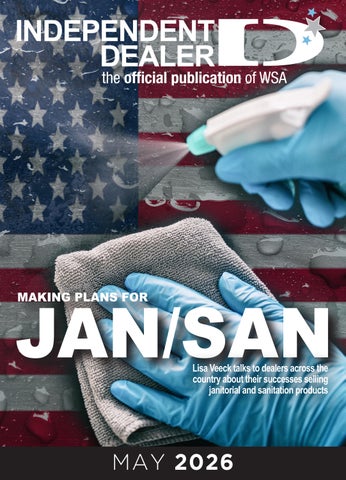
Independent Dealer May 2026

Page 1


INDEPENDENT DEALER

MAKING PLANS FOR

JAN/SAN

the official publication of WSA MAY 2026

Lisa Veeck talks to dealers across the country about their successes selling janitorial and sanitation products

Editorial & Contents

In 2027, it will be 20 years since my predecessor, mentor, fellow Englishman and all-round wonderful chap Simon De Groot first published INDEPENDENT DEALER, and those of us working at ID Towers have been discussing how best to celebrate this milestone. You’ll find out more about that in due course.

One of the things I have been doing in preparation is looking back over early issues of the publication and, while there have certainly been a number of seismic changes in the industry over the past two decades, there are also a few things that haven’t changed—such as the need for independent dealers to diversify their product portfolios and expand their offering into other product categories. This was something mentioned in our very first issue and the message is still conveyed strongly in our pages today.

If you look at Sonny Arora’s opinion piece on page 34 about the post-Essendant landscape,

diversification is one of the core planks of his strategy. Likewise, both our Anniversary Dealer, Acme, and our Secrets of Success dealer, Gem State, were founded 80 years ago and both point to diverse product portfolios as one of the reasons for their longevity.

We first ran a cover story about jan/san in April of our freshman year and make no apologies for continuing to do so. As the dealers who have spoken to us point out, it is a great opportunity when done right and far less vulnerable to competition from Amazon than traditional OP. To find out if you are doing it right and perhaps pick up a few tips on how to improve your offering, check out page 38

ISG’s Frank Hoard explains how to manage the impending disposable glove supply crisis

AOSWARE’s Sonny Arora on what Essendant’s exit means for independent dealers

Making plans for jan/san: Lisa Veeck talks to dealers across the country about their successes selling janitorial and sanitation products

44 West McDonald: The AI advantage for jan/san

48 Marisa Pensa: Making prospecting work

50 Jennifer Vitanzo: The unsung heroes of jan/san

52 Troy Harrison: Navigating your sales structure

54 Tom Buxton: Everyone else is raising prices!

INDEPENDENT DEALER

Rowan McIntyre

Associate

DeliveringHope

Led by 2026 honoree Greg Welchans, president and CMO of Distribution Management, we’re honoring the values that define the business products industry—speed, service, and integrity—by helping City of Hope® expand compassionate, leading‑edge cancer and diabetes care across the country.

Together, we’re accelerating research breakthroughs, advocating for veterans, and advancing whole‑person care—while carrying forward a legacy of generosity that has defined our field for decades. With a special focus on access and equity, this year’s campaign is helping bring hope to more patients and families—faster than ever before.

CITY OF HOPE’S NATIONAL BUSINESS PRODUCTS INDUSTRY’S 2026 UPCOMING EVENTS

Tuesday and Wednesday, May 26-27

FBS HOPE Awards

Dinner and Golf Outing

Celebrating Carey Jaros

President Clorox Purell

Firestone Country Club, Akron, OH 44319

Sunday and Monday, June 14-15

Honoree Golf Outing at Conway Farms, Hosted by Distribution Management

Conway Farms Golf Club, Lake Forest, IL 60045

Wednesday and Thursday, September 23-24

Spirit of Life Golf & Gala, Honoring Greg Welchans

Hosted by the National Business Products Council

Cantigny Golf Club and Navy Pier Chicago, IL

Management

For more information or to register for one of our events, scan here:

2026 Spirit of Life® Honoree Greg Welchans President and CMO Distribution

Winner’s Circle

Acme Paper & Supply celebrates 80 years

In 1946, Edward Attman and his wife, Mildred, were exploring entrepreneurial opportunities. After meeting a well-dressed man in the office supply business who drove a nice car and didn’t have to work weekends, Edward thought this might be a good fit for them. Post-war, products were in short supply, but he still managed to find suppliers for seven lines, including several types of paper, bags and twine. He founded Acme Paper & Supply Company in a 1,500-square-foot rented garage in Baltimore, Maryland. One key reason for the company’s initial success was its founder’s love of finding and introducing customers to the latest innovations.

Ron Attman, current CEO and Edward’s grandson, began working at Acme at the age of 13 and joined full time after graduating from the University of Maryland in 1968. Though he had not initially planned to build a career in office products, he found himself immersed in the family business along with two brothers and a nephew.

Today, Acme is headquartered in Savage, Maryland, and has a warehouse in Savage and a distribution center in Richmond, Virginia. It services the Baltimore/

D.C. area, Virginia, Central Pennsylvania and New Jersey. While the company carries office, janitorial and other products, its largest customers are in food service, encompassing everything from restaurants to commercial kitchen design and installation for large institutions such as hospitals, schools and stadiums.

Ron believes the personal touch has been a key factor behind Acme’s success over the past 80 years: “First I would say is our customer service.

A lot of our competitors have gotten big but seem to have lost sight of great service, including having the right inventory. We try to make sure we have the products our customers

need; and if we don’t, we go out of our way to procure them. Many of our competitors don’t do this.

“Keeping up with new products, like our grandfather and father did, is another,” he continues. “Last month, we held our annual innovation showcase, featuring about 80 top suppliers, to show our customers what is new in the industry. Not many competitors do this either. Some family businesses continue to do what they’ve always done. We are always trying to improve our service and offerings.”

Of course, none of this would be possible without a willing workforce. “We have the best and the brightest employees!” enthuses Ron. “We

Washington

have great family members and this extends beyond our biological family. Some of our employees have been with us for more than 40 years.”

A company can’t survive in business for eight decades and

customers got what they needed, even if it meant calling Asia at 2:00 a.m. to source hard-to-find products. Having what our customers needed endeared us to them and showed we could help in tough times.”

Acme is looking forward to reaching its centennial in 20 years’ time. “We have a strong third generation of management in place, ensuring continuity for the future,” says Ron. “We actively embrace innovations

Winner’s Circle Storey Kenworthy makes blankets for ChildServe

Storey Kenworthy (SK) and Workspace, Des Moines, Iowa, recently hosted a volunteer event to make tie blankets for local pediatric healthcare provider ChildServe. SK supplied the materials and at least a dozen SK employees used their volunteer time off (VTO) hours to produce 26 blankets. SK dropped off the blankets at ChildServe in Des Moines for distribution on an as-needed basis across the organization’s programs and facilities.

“I recently toured one of ChildServe’s facilities and talked to someone on its team about ways SK could support the organization with volunteer time, and the blanket-making seemed like a good fit,” explains partner Nicole Boyington. “Our team members consistently vote on supporting causes for children, so it seemed like a fitting opportunity for our in-house VTO opportunity. This hands-on approach helps our team connect with the needs of our community and see firsthand the positive impact we create when we work together. We are grateful for the chance to make a difference and it’s our hope that these efforts will inspire others to support and uplift the communities around them as well.”

ChildServe’s mission is to partner with families to help children with special healthcare needs live a great life. It operates Iowa’s only children’s specialty hospital, offering a variety of services and programs to meet the unique needs of each child.

Blaisdell supports several area nonprofits

Blaisdell’s Business Products in Oakland, California, recently supported the following nonprofit organizations with generous donations:

• $1,500 to the M.L.K. Jr. Freedom Center in Oakland;

• $1,750 to the Center for Elders in Berkeley;

• $2,500 to the YMCA in San Francisco; and

• $3,000 to the Lend-A-Hand Foundation in Oakland.

“These are all truly impactful and worthwhile causes, and we’re honored to contribute to the important work they do,” says chief operating officer Michael Witt.

In separate news, Blaisdell’s was a sponsor of the annual UnPeeled event

hosted by BANANAS, Inc. The free family event was held at Children’s Fairyland in Oakland. BANANAS’

mission is to partner with families and childcare providers to raise happy, confident children.

Your business isn’t one-size-fits-all and your ecommerce platform shouldn’t be either. Logicblock delivers the customization, support, and scalability you need to grow, without locking you into overpriced plans or cookie-cutter templates.

Take a 30-day test drive with real data, real support, no surprises.

Winner’s Circle

McCartney donates to local police union, among others

McCartney’s Inc., Altoona, Pennsylvania, has made one of its two annual donations to the union representing the local police departments. The company makes other monetary and time contributions

to various local nonprofit organizations throughout the year.

“At McCartney’s, we pride ourselves on the role we take in social responsibility,” says president Randy Green. “It’s all part of our community

focus. We recognize the importance of giving back to the community that supports us. Within our particular industry, that is one of many things that truly set us apart.

“On an individual basis, hardly a day goes by that a McCartney’s employee isn’t out volunteering in the community. We are coaches, volunteers, actors, leaders, scoutmasters, missionaries, music parents, yoga teachers, armed service veterans, Rotarians, religious education teachers, community-based board members, musicians and so much more. Each year, we pay our employees for up to eight hours of volunteer community work, provided they wear a McCartney’s t-shirt while volunteering. Our 25-plus employees are constantly making central Pennsylvania a better place to live and raise a family.”

Office Peeps transitions to new space and strengthens commercial focus

Office Peeps, Watertown, South Dakota, has moved its Brookings, South Dakota, operations to a new location in the town. The company inherited its original premises when it purchased a business based there. The new location is 1040 22nd Ave South.

“The move fits our needs better as a combined company and is an updated space for our team and visitors,” explains president Joel Vockrodt. “The new space includes sales, a furniture showroom and order pickup. Along with the Watertown and Brookings locations, our two other locations—in Madison and Huron, also in South Dakota—transitioned this year from retail stores to order pickup locations inside other businesses. These changes reflect our declining retail store traffic while allowing us to streamline our commercially focused business while maintaining visibility in the communities.”

The Supply Room helps Fill the Cruiser and partners with Virginia Lottery

The Supply Room, Ashland, Virginia, has participated in Fill the Cruiser, an annual event hosted by the Hanover and Ashland County Sheriff’s Department to support local senior citizens. The Supply Room donated paper towels, toilet paper and facial tissues to the cause.

“We chose to support Fill the Cruiser because we recognize the importance of giving back and supporting the wellbeing of seniors in our community,” says chief operating officer Yancey Jones Jr.

In separate news, The Supply Room employees have participated in the Virginia Lottery’s Park 365 Cleanup.

“We have a long-term partnership with Virginia Lottery and share a commitment to giving back to the community,” continues Jones. “We regularly team up for local events. With April being National Volunteer Month, we’ve partnered

on many volunteer opportunities, including supporting local K-12 schools throughout the Commonwealth. These initiatives are important to The Supply Room because we care deeply about our community and recognize the positive impact we can have through our hands-on involvement.”

Tejas commits to a quarterly donation

Tejas Office Products, Inc., Houston, Texas, is donating a pallet of paper to a local School throughout the year, including the academic, summer and holiday seasons.

Nativity Academy of Houston is a non-tuition-based, independent private Christian pre-kindergarten 3rd through 8th-grade school serving exclusively low-income students and families of all faiths and cultures. It offers a challenging, progressive curriculum, personalized attention, extended days and a longer school year. Teja’s donation aims to help ease the institution’s financial burden. Due to space constraints, Tejas is delivering much-needed paper to thee school in quarterly installments.

“We started this program earlier this year when we took a call from Cathy Garcia Pratts, the school’s president and board member,” Michele Fraga, Tejas co-owner and account executive, explains. “Cathy has been a life-long friend of our parents, as our

families went to school and church together.

“Tejas Office Products, Inc. has always operated under the premise of community first, which is how our parents, Lupe and Irene Fraga, raised the three of us [sibling co-owners]. Our parents lead by example, constantly focusing on helping others and being involved and giving back to this community that has given us so much in our personal and business lives. It only makes sense that we would honor our parents by continuing to live the way they lived: always being ready to help our fellow Houstonians, our treasured employees and our family and friends.”

“When I reached out to Michele to ask if Tejas Office Supply might be able to help, the answer was an immediate and generous yes,” added Garcia-Prats. “Without hesitation, the Fraga family stepped in to support Nativity Academy, making it possible for teachers and students to focus

on learning without worrying about resources.

Their gift may seem simple, but it reflects something much deeper: a family legacy of generosity, faith, and quiet leadership. The Fraga family continues to honor Lupe and Irene’s example by giving in ways that truly matter—and Nativity Academy is better because of it.

In their 16th year, these awards honor excellence in products, companies and individuals in the business supplies industry. Winning brings industry-wide recognition and can significantly benefit your business. Don’t miss this opportunity to gain the recognition your team deserves.

Free and simple to enter

Both entries and nominations are accepted to ensure the industry’s best are rewarded.

The awards will be presented at Industry Week ’26 taking place from November 1-5 in San Diego. The deadline for entries is May 15. Enter now at www.opi.net/naopa2026

• Best Product – Core Business Product

• Best Product – Furniture

• Best Product – Facilities

• Best Product – Technology

• Product Innovation of the Year

• People’s Choice

• Young Executive of the Year

• Professional of the Year

• Industry Achievement

Secrets of Success

Gem State Paper and Supply Co.

In 1946, having just returned from World War II, Armour Anderson was keen to start a business, but wasn’t sure on exactly what. He canvassed some friends and his community about their needs and was presented with a diverse set of products—everything from Bic pens to pantyhose. He duly sourced those products and began selling them from the trunk of his car.

Armour’s market research paid dividends. Sales took off and the business grew and opened a brick-and-mortar location in downtown Twin Falls and continued to expand its product offering. In 1975, after years working in sales, Armour’s son John took over as general manager.

Today, the company has two locations in Twin Falls, plus one in the state capital, Boise, one in Pocatello and one in Elko, northern Nevada. John’s three sons have been at the helm since his retirement in 2015.

“As kids, John, Travis and I would watch how my dad ran the business,” recalls Ryan Anderson. “He made it seem magical. He’d do things like drive up to the house, honking the horn when he bought a new delivery truck. We also got to see behind the scenes; and we saw how he knew all his employees by name and made each one of them feel like part of the family. This is why all

Headquarters: Twin Falls, Idaho

Top management: Ryan Anderson, president; John Anderson, vice president sales; Travis Anderson, vice president service

Number of employees: 72

Annual sales: $26 million

Sales breakdown by category: 40% janitorial; 25% food service; 20% office products; 10% packaging; 5% furniture

three of us wanted to follow in his footsteps and go into the business. It is also why we have so many longtime employees; one sales rep retired on his 50th anniversary. Some dealers say their biggest asset is their customers, but our biggest asset by far is our employees.”

To ensure this longevity, Gem State needed to tweak its culture. “People need to like their work and have a good time doing it,” Ryan explains. “If they don’t enjoy what they do, it’s not worth it. When I started with the company about 10 years ago, it was a good work environment, but somewhat stiffer, with a more nose-to-the-grindstone mentality. We realized we needed to make it more flexible so our employees could have a good work-life balance. It was a huge change; unfortunately, we had to let the naysayers go, as negativity can be infectious and bring down morale. The employees appreciate it and we’ve found it creates even more loyalty: they work even harder to ensure our great customer service.”

Building on this strong culture and loyalty, Ryan highlights Gem State’s stellar customer service as another key to its success: “We don’t sell floor cleaner; we sell clean floors. We don’t sell products; we sell solutions. We don’t just deliver packages; we put them where customers want them. We even take inventory for some, so they don’t have to be bothered.”

Staying current is also crucial, he suggests: “As expensive as it can be, we keep up with new technology. We track inventory, procurement and customer purchases. With five locations, we recently invested in an app that lets customers and reps see their location, view inventory at the nearest store and order with a few clicks.” Looking forward, Ryan reports that expansion is off the cards. “We’re not concerned with expanding our territory,” he says. “A lot of people dream of growing large and making more money, but our concern is losing control of the company, so our goal is to grow by offering more to our existing customers.”

For other independent dealers looking to thrive, Ryan counsels: “Stress a more flexible culture. I know it’s hard for some seasoned employees who see the greater flexibility as unproductive, but a good work-life balance develops employees with greater dedication and loyalty.” Company info

IN A GEL PEN

Black, Pearl White, Ocean Fog, Forest Green or Icy Violet Plastic Barrel

ECI sues Essendant Industry News

ECI Software Solutions has filed a lawsuit against Essendant claiming the wholesaler is in breach of contract.

In a document filed with the Illinois Northern District Court on March 4, ECI alleges that Essendant failed to pay $125,000 tied to unused software development hours and has wrongly attempted to terminate an existing agreement between the two parties.

According to the complaint, the dispute centers on a longstanding relationship in which ECI provides services that enable independent dealers to place orders with Essendant’s wholesale platform.

Under a payment consolidation agreement (PCA), Essendant had committed to a minimum annual spend equivalent to 1,500 development hours. The lawsuit states that 625 unused hours which carried over into 2024 expired at year-end, triggering a payment obligation of $125,000.

ECI claims it invoiced Essendant $270,200 on December 31, 2025—including the $125,000 in question—but Essendant disputed this portion of the bill, arguing that a 2025 amendment to the agreement removed the relevant contractual obligation.

The software provider maintains that the charge had already accrued prior to the amendment and therefore remains payable. It also alleges that Essendant has not paid the undisputed portion of the invoice.

In addition to the payment dispute, ECI argues

that Essendant has improperly sought to cancel the agreement. The amended PCA, which runs through to the end of 2026, allows early termination if order volumes fall by more than 37.5% year on year. ECI says the reported decline in 2025 was 36.6%—below the threshold required to trigger cancellation.

The complaint notes that Essendant questioned the accuracy of the 36.6% figure, saying it did not match its own evaluation of the business decline. After ECI refused to provide the underlying transaction data, Essendant retorted it had “no choice but to consider the agreement canceled.”

ECI contends that no contractual basis exists for such a termination and is seeking a judicial declaration to that effect. It is also asking the court to award damages, interest and legal costs, and to confirm that Essendant remains bound by the agreement through December 2026, including the obligation to pay outstanding and future invoices.

NAOPA open for entries

Entries and nominations are now being accepted for the 2026 North American Office Products Awards (NAOPA).

The NAOPA—which are free to enter—are open to companies and individuals headquartered, or with a physical presence, in North America that work within or supply products and services to the independent dealer community. They recognize the companies, products and individuals driving progress across the industry.

As in previous years, the program spans product and individual categories, with the People’s Choice award again expected to draw strong interest as OPI and INDEPENDENT DEALER readers get a chance to choose their favorite product.

The deadline for submitting entries and nominations is May 15, after which a panel of judges will begin the selection process. A shortlist will be revealed in mid-August, with the winners announced during ISG’s Industry Week 2026, taking place in San Diego, California, from November 1-5.

OPI is encouraging businesses to take advantage of the opportunity to raise their profile, celebrate their teams and gain industry-wide recognition. Full details, category information and the entry form are available at www.opi. net/naopa2026

Former Essendant exec joins EPIC Business Essentials

Independent Suppliers Group’s EPIC Business Essentials has announced the appointment of a national account manager.

Joining the national accounts initiative, in what was described as a “strategic hire,” is Joe Hofmann. In his new role, Hofmann will be responsible for supporting and expanding EPIC’s national account relationships while working closely with member dealers to drive alignment, service excellence and long-term growth.

Hofmann brings almost 20 years of experience in sales, marketing and enterprise account management. Most recently, he served as an enterprise account sales executive at Essendant, where he managed over $100 million in annual business across major national accounts, including

Grainger Industrial Supply. Earlier in his career, Hofmann supported commercial and consumer brands at Newell Rubbermaid, driving e-commerce growth, leading strategic planning and pricing initiatives and supporting customer training programs.

“Joe’s experience managing complex national accounts and his ability to build strong relationships make him an ideal fit for this role,” said Dante Ercoli, managing director at EPIC Business Essentials. “He will be a critical contributor in supporting our member dealers and national accounts as we continue to grow and execute on our strategic priorities.”

SPR recognizes top suppliers Industry News

S.P. Richards (SPR) has announced the winners of its 2025 Supplier Awards.

The presentation took place during the wholesaler’s Supplier Summit in Orlando, Florida, with the following suppliers and individuals recognized for their achievements:

• The Supply Chain Excellence award went to ACCO Brands for its strong partnership, consistent communication and ability to navigate supply chain challenges.

• Essity scooped the Item Content Excellence award for providing accurate, high-quality product content that enhances the online buying experience and supports reseller success.

• Fellowes won the Marketing Excellence award for delivering impactful marketing resources that drive awareness and sales growth.

• Merchant’s Choice Award was presented to Newell Brands for its continued partnership, product innovation and support of key merchandising initiatives.

• Kimberly-Clark Professional was named Collaborative Growth Partner for its focus on partnership, innovation and strategic initiatives that drive shared business growth.

• The Strategic Alliance Partner award went to Domtar for its collaborative approach, alignment with SPR and commitment to mutual growth.

• Sammey Mitchell of Rubbermaid Commercial Products won the Sales Professional of the Year award for her dedication, responsiveness and support of SPR and its reseller network.

The evening concluded with the Vendor of the Year award, which went to TOPS Products in recognition of its enduring partnership with SPR and consistent support in meeting customer needs.

As well as celebrating achievements and strengthening relationships, an important part of the event, in partnership with suppliers, was supporting City of Hope in its efforts to find cures for cancer and diabetes. An impressive $450,000 was raised through a City of Hope golf tournament and other initiatives.

AFFLINK hires VP of distribution

Jan/san and facilities dealer group AFFLINK has said the appointment of a new VP of distribution will strengthen its commitment to the independent reseller community.

The organization has named John Carr to the role, effective March 30, 2026. He will oversee member support functions, including internal and regional teams, customer care and national and strategic accounts. Carr joins from HD Supply, where he held senior leadership roles focused on strategic accounts and operations. He also brings experience from the independent dealer channel, having previously served as VP of sales and marketing at Northern Colorado Paper—a former AFFLINK member.

AFFLINK CEO Michael Wilson said Carr’s background provides a combination of independent channel insight and large-scale distribution experience. He added that the appointment supports the group’s focus on strengthening relationships with members and delivering enhanced service.

Carr said AFFLINK’s model of supporting independent distributors aligns with his own experience in the channel and highlighted his intention to work closely with members to identify growth opportunities.

TOPS Products received Vendor of the Year

Kimberly-Clark comments on California fire Industry News

A massive fire has destroyed a Kimberly-Clark paper products warehouse in California.

The blaze ripped through the 1.2m sq ft facility in Ontario, California in the early hours of Tuesday April 7. Twenty staff were inside the building at the time, but none were harmed, it has been confirmed.

The location is operated by NFI Industries, a third-party logistics provider, and is leased by Kimberly-Clark.

The jan/san and cleaning products vendor said its supply chain network is designed for continuity during disruptions and mitigating actions are already underway.

“The company has activated its coordinated response plans

and is working closely with local logistics providers to maintain continuity for customers,” it stated.

“Teams have identified alternative locations for inbound shipments and are securing additional warehousing capacity through local

partners. The company is working through mitigating any short-term disruptions as these plans are executed.”

The fire is being treated as arson and an employee at the warehouse has already been detained.

Ross moves to HP

Well-known North American managed print specialist Tanya Ross has landed a role at HP Inc.

Based in Toronto, Canada, Ross has spent much of her career working with the independent dealer channel, including spells at dealer groups TriMega and ISG. She was most recently a director at managed print provider Footprint and also serves on the board of the Managed Print Services Association.

In a LinkedIn post, Ross confirmed she has joined HP Canada as an enterprise account executive and will continue to be based in the Greater Toronto area.

Stock image

CUSTOM LABELS Jan / San

In today ’ s fast-paced , hygiene-driven environment , the righ t cleaning an d sani t ation so l utions aren ’ t j ust a necess i ty— t hey’ r e a reflection of you r brand ’ s commi t ment to hea l th, safety, and professi o nalism. Your product s are designed to deliver powerful performance , cons i sten t results, an d cost-effec t ive va l ue across every facili t y. From h i gh-traf fi c commercia l spaces to specialized environments, we can help yo u with your brand . Whether you need :

LABEL U S E S

C l eaners & De t ergen t Labe l s

Hardwa r e Too l s & Acces s ory L abe l s

Odo r Con t ro l Labe l s

Safe t y & Secur i t y L abel s

San it izer L abe l s

Soap & D is penser Labe l s

Much more ..... .

You will find tha t TABBIES has the experience, exp e r tise and equipmen t to hand l e all your cus t om label printing needs . Ca p abil i ties of Digital & Flexo , up t o 1 0 co l ors and 16" wide. We offer & s t o ck a wide varie t y o f materia l s , dies & adhesives t o choose from. We hav e been successful l y serving t he needs of our customers across a wide r a nge of products & industr i es since 1955 .

Chem i ca l & So lv ent Re s is t ant L abel s

Barcod e / QR Code L abe l s

Pee l & Re v ea l L abe l s

LABEL TY PE S

Produc t & Packaging L abe l s

Promo t ion & D is coun t L abel s

Therma l Tran s fer L abe l s

U L L abe l s

Much more ..... .

www.tabbies.co

ES Robbins acquires Defelcto chair mat division

Workplace products vendor ES Robbins has announced the acquisition of the chair mat division of Deflecto.

Deflecto has been owned by Acacia Research since October 2024 following a deal worth more than $100 million. ES Robbins said the acquisition marked a significant milestone for the company and underscored its longstanding commitment to the office products industry.

“This acquisition will expand ES Robbins’ strategic reach across key markets and enhance its ability to provide comprehensive solutions for distributors, dealers, retailers and consumers alike,” it stated in a press release.

ES Robbins confirmed the deal involves Deflecto’s chair mat division, not the wider office products unit. It declined to specify when the acquisition was effective from, but noted that Deflecto’s chair mat operations have been fully relocated to the ES Robbins facility in Alabama. No Deflecto staff members made the move across to the new owner and all products will be transitioned to the ES Robbins brand.

“The combination of both product lines enhances our strategic mission to provide customers with an end-to-end chair mat solution—from commercial utility to high-performance, feature-rich innovation,” stated ES Robbins. “The acquisition expands ES Robbins’ reach across complementary channels, creating a seamless ladder from opening price points to premium innovation— empowering a unified portfolio that accelerates growth across distributors, dealers, retailers and end users.”

Partnership brings more MPS automation, says ECI

ECI Software Solutions has said a strategic alliance with software provider In Time Tec will give a competitive advantage to managed print resellers.

The agreement centers on the integration of ECI’s Printanista platform with In Time Tec’s Cartos Suite, enabling dealers to automate key elements of managed print services (MPS) assessments and fleet design.

According to the companies, the combined solution connects device data collection with assessment and proposal tools, allowing resellers to move more quickly from data gathering to decision-making. This is designed to reduce reliance on manual processes—such as spreadsheets—while improving the speed and accuracy of sales proposals.

ECI said the integration brings together business logic and real-time fleet intelligence, helping dealers generate more data-driven insights and streamline end-to-end workflows. The aim is to shorten sales cycles and increase the number of devices under contract.

The move forms part of ECI’s broader strategy to further automate MPS operations and create a more connected dealership environment.

Laryssa Alexander, industry president, field service at ECI, said the partnership reflects ongoing investment in digital transformation across the print channel, adding that the combined offering will provide the “speed, accuracy and scalability” needed for resellers to grow.

Anthony Chen, SVP of sales at In Time Tec, added that the integration allows dealers to analyze large fleets and generate assessments more quickly, turning device data into actionable insights and enabling a more data-led sales approach.

The companies said the integration is now available to Printanista users, positioning the offering as a tool to help MPS providers improve efficiency and competitiveness in an increasingly data-driven market.

COE Distributing expands national footprint with new Charlotte warehouse and showroom

National office furniture distributor COE Distributing has announced the opening of a new 225,000 sq ft, Class A distribution center and showroom in Charlotte, North Carolina. This expansion increases COE’s total US distribution footprint to 750,000 sq ft, reinforcing the company’s continued growth.

The new Charlotte facility significantly enhances COE’s ability to serve its dealer network and customers with greater speed, efficiency and inventory capacity. In addition to expanded warehousing capabilities, the showroom offers an immersive environment where the firm’s partners can explore the latest workplace furniture, design trends and solutions tailored to today’s evolving workspaces.

“This expansion represents a major milestone for COE,” said Scott Nichols, executive vice president of sales, marketing and product development.

“By increasing our distribution capacity and investing in a state-of-the-art showroom, we are better positioned than ever to support our partners and deliver exceptional value across the country.”

To celebrate this milestone, COE Distributing hosted a grand opening event at the new facility on April 30. Dealers, partners and industry professionals were invited to tour the space, experience new product offerings and connect with the COE team.

CEO change at Xerox; IT services offering launched

Xerox’s COO has stepped up into the CEO role following the news of Steve Bandrowczak’s sudden departure.

Louie Pastor has succeeded Bandrowczak with immediate effect, the company confirmed in a press release. Pastor—formerly a legal exec at Icahn Enterprises— joined Xerox in 2018, shortly before its Carl Icahn-backed bid to

acquire HP. He was named COO in September of last year.

Bandrowczak spent almost four years as Xerox CEO, a period which saw the tech firm acquire IT services provider ITsavvy and fellow print OEM Lexmark. Despite these deals, he was unable to engineer a turnaround and Xerox’s top and bottom lines have continued to shrink. Furthermore, the company is hampered by a heavy debt burden, significant interest payments and a share price that is currently trading near all-time lows.

Meanwhile, Xerox is targeting SMBs with a new IT as a Service (ITaaS) platform powered by AI.

Based on ServiceNow AI technology, Xerox ITaaS has been purpose-built for SMB and commercial mid-market organizations.

“The platform delivers simplified IT operations without

Logitech names new CCO, makes key promotion at B2B unit

Logitech has promoted Yalcin Yilmaz to the post of chief commercial officer, effective April 1.

Yilmaz, formerly VP of Europe and Asia Pacific Developed, succeeds Quin Liu, who has elected to step away from the business after 16 years of global leadership.

A Logitech veteran from Basel, Switzerland, Yilmaz rose through the ranks—from key account manager in his home country to his current role—over a 22-year period. He is credited with delivering growth across multiple regions in sales, marketing and general management roles.

He stated: “I have grown with this organization since 2004 and understand the passion and resilience that define our complementary, winning teams. I look forward to working closely with our customers and partners around the world to innovate and drive shared growth.”

Meanwhile, Jedd Williams has been promoted to chief commercial officer at Logitech for Business.

Williams has been with the division at the tech accessories firm since 2024 and was previously global head of sales. Prior to Logitech, Williams spent more than 21 years at Cisco,

the complexity traditionally required to deploy and manage it,” stated Xerox. “By connecting infrastructure, workflows and decision making in real time, Xerox ITaaS replaces fragmented tools and manual processes with a unified system that enables predictive insights, automated workflows and self-healing capabilities.”

Xerox CTO Munu Gandhi called the new service a “fundamental shift” that enables mid-market companies to benefit from enterprise-grade technology tools. The OEM said the launch reflects the broader transformation of Xerox “from a product-centric company to a services-led, AI-enabled platform provider.”

The new ITaaS platform is available across the US, with global expansion planned throughout 2026.

More details can be found here

followed by a senior sales role at Logitech rival Poly, now owned by HP.

“In this new role, my mandate is to lead our dedicated B2B commercial strategy, accelerating our growth in the enterprise space while working in lockstep with our broader global commercial team under Yalcin Yilmaz,” Williams stated.

Canon to start US remanufacturing

Print giant Canon has announced that it will expand its remanufacturing operations into the US.

The OEM currently has remanufacturing plants in Japan and Europe and will now introduce the business model at its Canon Virginia subsidiary, with production set to begin in April 2026.

Canon described the move as part of a global rollout of its multifunction device (MFD) remanufacturing program, which refurbishes used devices to a like-new condition for resale. The Virginia location will deploy the same standardized processes and technologies used at its existing facilities in Japan and Germany.

According to Canon, the system enables a parts reuse rate of more than 90% per device, supporting both cost efficiencies and sustainability goals. Standardization of processes across regions is also expected to improve production efficiency and ensure consistent product quality.

Canon’s approach is based on platform-designed devices, allowing components and modules to be reused across product ranges. The remanufacturing process is supported by operational data, including usage history and print volumes, to determine which parts can be reused and which need replacing.

The US launch will initially focus on a single MFD series, with Canon targeting what it described as steady demand for remanufactured devices in the market.

IP acquires North American paper and packaging firm

International Paper (IP) has agreed a $360 million deal to acquire North Pacific Paper Company (NORPAC).

The Washington state-based producer has been owned by private equity firm One Rock Capital Partners for almost 10 years. Before that, it operated as a joint venture between Weyerhaeuser and Nippon Paper.

Its Longview mill employs around 500 people and three machines produce approximately 1 million tons of containerboard and other grades annually. It historically made newsprint, but recently announced it was exiting this segment to focus on recycled packaging-grade paper.

“The facility will complement IP’s existing mill system, increasing system flexibility, reducing costs and expanding capabilities to support growing customer demand for lightweight, high-performance recycled containerboard,” IP stated in a press release.

The transaction is subject to regulatory approval and IP gave no indication as to when it might close.

With IP’s strategic shift toward packaging, it will be interesting to see what becomes of NORPAC’s paper products. Included in “other grades” are the company’s lines of copy paper, marketed under environmentally friendly brands such as Natural Choice and Orca and available at major US and Canadian retailers.

creative design service

Planning an advert in Independent Dealer?

Our end-to-end creative service ensures your brand not only looks great but performs. With unrivalled industry knowledge, our team designs high-impact adverts built to stand out. Whether it’s a web banner, digital or print magazine advert, event and marketing assets or full show guides, we’ve got it covered.

Georgia-Pacific names CEO

Georgia-Pacific (GP) has selected a seasoned Koch Industries exec as its new CEO.

Taking on the top job at the Koch-owned paper, packaging and jan/ san vendor is David Duncan, who has led GP’s Consumer Products division since 2019. In all, Duncan has almost 30 years’ experience at Koch businesses, including managing director at Koch Ventures and Koch Equity Development and CFO at Koch Minerals.

Duncan succeeds another Koch veteran, Mark Luetters, who has been in interim charge at GP since the retirement of Christian Fischer in October 2025.

Ricoh and Brother in Canada tie-up

Print OEMs Brother and Ricoh have unveiled what they are calling a “strategic alliance” in the A4 segment in Canada.

Building on a similar arrangement in the US—announced in June 2025—the companies have now promised to “provide a comprehensive portfolio of complementary print solutions” to customers in Canada.

Citing the need to offer a “broader A4 strategy” driven by the needs of hybrid and remote work, the agreement means Ricoh will be able to supply Brother’s more compact devices alongside its existing A4 portfolio.

According to a joint press release: “The expanded portfolio adds new, increased options for document-intensive work environments, such as healthcare, legal, financial and retail organizations, to manage their complete print infrastructure through a single vendor, using a common print management platform—RICOH Streamline NX—that is being adapted to support Brother devices.”

Scott Dabice, VP of commercial strategy and operations at Ricoh North America, added: “By expanding our A4 portfolio to include the Brother Exclusive series, we’re giving customers more choice, more value and more ways to build print environments that fit the way people work today.”

Imperial Dade acquires in Canada

Imperial Dade is back on the acquisition trail.

A month after its merger with BradyPLUS was confirmed, Imperial Dade has announced its first acquisition for some time.

Both Imperial Dade and BradyPLUS went quiet on the acquisition front while their deal was being finalised. Now, Imperial Dade has confirmed an agreement to buy Enterprise Paper, a distributor of paper, packaging and janitorial products in the west of Canada, for an undisclosed sum.

Founded in 1973, Enterprise Paper is a member of the Balpex buying group, which serves the Canadian facilities supplies sector. According to an Imperial Dade press release, its management team has “built a strong reputation for its knowledgeable sales force, wide breadth of products and high-touch customer service.”

Stephane Lapointe, president of Imperial Dade Canada, stated: “Enterprise Paper has earned the trust of its customers the right way through consistency, care and a genuine commitment to service. That is a story we are proud to be a part of. Together, we will build on what has already been accomplished and bring even more to the table for customers and vendor partners across Canada.”

Imperial Dade’s press release made no reference to the recently completed merger with BradyPLUS.

Industry News Office pod firm starting US production

A Finnish acoustic pod manufacturer has confirmed it will begin making its products in the US.

Finland-based Framery said it will convert its existing logistics center in Zeeland, Michigan, into a full-scale manufacturing facility in the second half of 2026, with operations expected to ramp up through 2027.

The move forms part of the company’s broader growth strategy in North America, one of its fastest-growing regions. Local production is also set to support the launch of a new product line designed specifically for the North American market, with further details to be announced at a later date.

Framery said manufacturing in the US would allow it to respond more quickly to customer demand while optimising its supply chain. Additional anticipated

New CEO at Zep

benefits include reduced logistics-related carbon emissions, lower reliance on global supply chains and protection against potential trade policy risks.

Until now, the Michigan site has been used for logistics as well as small-scale local sourcing and assembly linked to customized products manufactured at Framery’s Tampere facility in Finland. The new set-up will build on an existing seven-year partnership with a local operator, which will also support manufacturing activities.

The company highlighted Michigan’s position as a major hub for the office furniture industry as a factor in the decision, citing access to skilled labor and established supplier networks.

Alongside the production shift, Framery plans to expand its US workforce from around 30 employees today to approximately 40 by the end of 2027. The total employment impact of the factory is estimated at around 30 full-time roles, most of which will be through its operating partner.

While final assembly of the new product family will take place in the US, the Tampere facility will remain central to the business, supplying core technologies and sub-assemblies. Framery added that the new initiative is not expected to affect staffing levels in Finland, and existing Tampere-manufactured products will continue to be sold in North America.

CEO Samu Hällfors described the move as a “strategic step,” noting that local manufacturing would strengthen the company’s ability to serve customers and broaden its offering with products tailored to US workplace requirements.

Professional cleaning products manufacturer Zep has a new CEO less than a year after its acquisition by Truelink Capital.

Taking on the role is Tim Feast, a seasoned consumer and industrial products leader with a nearly three-decade track record of driving growth and operational transformation, including at private equity-backed businesses.

Truelink bought Zep in July 2025 from New Mountain Capital. Managing partner Todd Golditch called Feast the right leader to take the business forward, adding: “Since closing our acquisition of Zep last year, we’ve seen the strength of this brand and the great opportunity in front of us. Tim’s track record of building high-performance teams and delivering results across complex, multichannel businesses makes him uniquely suited to drive the next phase of Zep’s evolution.”

SILENCE HAS A COST: make your voice heard in Washington before it’s too late

We are now just months away from what could be one of the most consequential elections in modern American history. Not just because of who wins or loses, but because of what’s at stake for the future of our economy and the small businesses that power it.

Every election cycle is labeled “the most important of our lifetime.” But this one feels different.

The country is more divided than at any point in recent memory. The political center is shrinking. The loudest voices are no longer competing to solve problems; they

are competing to win, to control and to dominate the narrative. Depending on where you sit, the future looks entirely different. But one thing is certain: the policy outcomes that follow this election will not be incremental; they will be decisive.

And for small businesses, that should raise a serious question: where do you fit into all of this?

Because if history tells us anything, it’s this: during election season, small businesses rise to the top of the political talking points, only to fall back into the shadows once the votes are counted.

The political prop every campaign needs

Every candidate claims to fight for small businesses. You are in their ads. You are in their speeches. You are in their mailers. You are the example they point to when they talk about the American Dream. You are described as the backbone of the economy: the job creators, the innovators, the lifeblood of communities around the country. But when the election ends, something changes. The urgency fades. The conversations shift. The policies that follow often fail to reflect the reality you face every day trying to run, grow and sustain your business. Small businesses go from being the centerpiece of the conversation to an afterthought. That is not a political statement; that is a pattern. And it will continue—unless small businesses do something about it.

A rapidly evolving industry in a volatile political environment

Small businesses today are navigating more change than ever before. Technology is reshaping industries overnight. Workforce expectations are shifting. Supply chains are unpredictable. Costs are rising. Competition is global. And layered on top of all of this is a political environment that is just as volatile. Policy is no longer stable. It changes—quickly—depending on who holds power. We have seen

regulations rewritten, tax structures altered, labor rules redefined and economic priorities reversed from one election cycle to the next. That means your business is not just competing in the marketplace; it is operating in a constant state of policy uncertainty.

Yet too many small businesses remain on the sidelines when it comes to shaping the very policies that impact them the most.

The questions that should keep you up at night

Ask yourself the following questions:

• Who in Congress is actively looking out for your business today?

• Who has your back when decisions are being made?

• Whose ear do you have when policy is being written?

• What legislation has been championed specifically for you?

If the answers are unclear, you are not alone. But that does not make it acceptable. Because in Washington, if you are not part of the conversation, you are not part of the outcome.

Advocacy is not optional; it’s survival

For too long, advocacy has been treated as optional—something nice to have, but not essential. That thinking is outdated. Advocacy must be part of your business model. It must be part of your strategy. It must be part of your bottom line. Because the stakes are simply too high.

Consider the reality:

• The House of Representatives can flip every two years.

• The presidency shifts every four years.

• The Senate evolves every six years.

Each of those cycles has the power to reshape the policies that govern your business.

That means uncertainty is not occasional; it is constant. We saw it during the pandemic, when government decisions determined which businesses could operate and which could not. We saw it in 2024, when policy shifts impacted labor, taxes and economic direction in real time. And we are seeing it today, as new policies continue to redefine the business landscape.

Policy is not theoretical. It is not distant. It is immediate—and it directly impacts your ability to succeed.

The cost of silence

It is easy to look at Washington and feel frustrated. The division. The noise. The dysfunction. It can make you want to throw your hands up and ask: “Why bother?”

But the answer is simple. Look at the policies that have been enacted over the past several years. Look at the impact they have had on your business. That’s what happens when you are not fully engaged. Today, it’s not just the squeaky wheel that gets the grease. The loudest, most persistent, most organized voices get the attention. And those voices are shaping policy every single day. If small businesses are not among them, decisions will be made without you—and those decisions will affect you.

Backbone without voice doesn’t matter

Small businesses are the backbone of this country. You create jobs. You generate revenue. You drive innovation. You fuel local economies and contribute significantly to the tax base that keeps this country running. Congress depends on you.

But too often, it forgets you. That’s the hard truth. Being essential does not guarantee being represented. Being important does not guarantee being heard. Only engagement guarantees that.

This is not the time to sit on the sidelines

The political environment has changed. The rules have changed. The expectations have changed. We now live in a time when extreme positions dominate headlines, when economic trade-offs are openly accepted and when policies can move forward even if they result in higher costs, lost jobs or economic disruption. For some in Washington,

those consequences are theoretical. For small businesses, they are real. You do not have the luxury of being indifferent. You do not have the ability to absorb policy mistakes without consequence. And that is exactly why your voice matters.

A call to action

This is not a moment for observation. It is a moment for action. Small businesses must stop being passive participants in a system that directly shapes their future. You must engage. You must invest in advocacy. You must build relationships in Washington before you need them—not after. You must ensure that your voice is not just

present, but impossible to ignore. Because nothing in Washington comes easy. And nothing in Washington happens by accident. It happens because people show up, speak up and refuse to be overlooked.

The countdown to this election is not just about politics. It is about your business. It is about your employees. It is about your future. Because who we elect matters. But how engaged you are in shaping what comes next matters even more. And in today’s Washington, there is one truth small businesses can no longer afford to ignore: if you’re not in the fight, you’re not in the outcome.

Protecting your public sector business … WSA can help!

Last month, I reported on the Workplace Solutions Association’s (WSA) new partnership with the Institute for Local Self Reliance (ILSR). I shared information on a webinar titled “How to Help Your Local Government Stop Buying from Amazon, Save Money and Support Small Business.” The statistics, insights and practical guidance shared by ILSR offered a wealth of resources to support dealers in reclaiming business lost to Amazon. I’ve since spoken with numerous members about how big the problem is for their company and their plans to protect their business. I was shocked to learn that public sector sales accounted for 20% or more of most dealers’ sales—even up to 50% for some. That said, most did not realize how much Amazon

had encroached on their sales by aggressively targeting public sector accounts with dynamic pricing and other tactics that have never been tolerated/allowed by public institutions.

Many believe that fighting Amazon is a waste of time and money. I disagree. It may take years to win a federal court case or get a weak settlement against Amazon, but the chances of winning local victories with school boards, cities and counties are actually very good. With WSA’s help and tools and data developed by ILSR, dealers are winning.

In mid-May 2026, we will be hosting a second webinar to help you create and implement an Amazon strategy for your public sector customers. We will discuss:

• Amazon’s growth in the public sector;

• the truth about dynamic pricing;

• how public agencies are unusually vulnerable to abuse;

• how to access and share information on what is being purchased from Amazon; and

• presentations to public agencies.

ILSR will also have open office hours, via Zoom, every Friday through May 22 from 12:00 to 1:00 p.m. Eastern Time. Please feel free to drop in to ask questions or chat about the information you’ve obtained and how to use it. Here’s the Zoom link

Stay tuned for more information on this and other WSA programs in the coming months. If you have any questions in the meantime, you can contact me at miket@issa.com

NAVIGATING THE SURGE: HOW TO MANAGE THE 2026 DISPOSABLE GLOVE SUPPLY CRISIS

The disposable glove market has entered a new period of extreme volatility.

As we move through the second quarter of 2026, geopolitical conflict has led to energy disruptions which have triggered a critical raw material shortfall. For independent distributors, in the next three to six months the disposable glove market will be defined by price surges and tighter inventory controls. Understanding the mechanics of this

disruption is the first step in protecting your business and your customers.

The root of the crisis Iranian missile strikes on March 18–19 caused extensive damage to Qatar’s Ras Laffan industrial city, hitting the world’s largest liquefied natural gas (LNG) facility. Because 83% of Gulf-region LNG powers Asian manufacturing and over 80% of global glove production is centralized

in Southeast Asia, the impact was instantaneous. Manufacturers are witnessing a 30% deficit in nitrile butadiene rubber (NBR) and reports from Malaysia indicate that NBR latex costs doubled in late March 2026.

Pricing trends and the “new normal”

The financial impact will be significant. NRB production costs have already surged by 25–30% and further price hikes are expected.

Although NRB will be the most affected, other substrates are not immune.

Vinyl gloves are projected to see increases of $3–4 per case due to demand shift away from NRB.

While we anticipate a three to six-month disruption, it is unlikely that we’ll see the same demand or panic buying as during COVID. But distributors should not expect a return to pre-crisis price levels. We are likely looking at a new normal when it comes to prices, where elevated costs for energy and logistics remain baked into the landed price going forward.

Allocation shifts

Glove suppliers learned some lessons during COVID. To prevent total stockouts, major suppliers have already started moving their customers to allocation models. For most suppliers, shipments will be restricted based on historical usage as the anticipated pressures are realized. Some manufacturers will use this supply crisis as an “opportunity” to right-size their customer base, prioritizing large-scale contracts over smaller users. If distributors have been moving back and forth from suppliers based on pricing, they may find it tougher—not only now, but in the future—to help their customers with their disposable glove needs.

Immediate action for distributors

To maintain stability of supply, independent distributors should take the following steps immediately:

• Secure your supply: Contact your manufacturers now to confirm your allocation. If you lack a direct relationship, distributors can leverage a group like the ISG, which has 10 different direct suppliers of disposable gloves.

• Audit customer substrates: Many end users utilize NBR for tasks where vinyl, synthetic or latex would suffice. Guide your customers to these alternative substrates to

help keep their budgets in line. As a distributor, you should always look to help customers protect their budget and supply to ensure they aren’t left emptyhanded during an NBR stockout.

• Involve technical reps: Use glove manufacturer reps in customer conversations. They provide the technical validation needed to convince a client that switching substrates is safe and effective.

• Plan for delays: Again, global shipping faces at least a three-month disruption. While “on-the-water” inventory provides a temporary buffer, ordering early accounts for extended lead times.

The strategic advantage: turning disruption into opportunity

While market volatility is challenging, it also provides a unique opening to transition from a vendor to a vital partner. By diversifying your purchasing plan and proactively managing expectations, you can move beyond transactional selling to a solution-based approach. Use this period to act as a strategic consultant, helping customers navigate constraints and protect their operations—this builds the kind of enduring loyalty and trust that will remain long after the supply chain stabilizes.

WHAT ESSENDANT’S EXIT MEANS FOR INDEPENDENT DEALERS— AND WHAT TO DO NEXT

In early October 2025, Essendant—one of the biggest names in office products distribution— confirmed it would exit the independent office products dealer channel. For many dealers, it felt like the ground shifted overnight. Not because the category suddenly changed, but because the last decade of change finally showed up as an undeniable operational reality: fewer safety nets, fewer options and a supply chain that will now

reward those dealers that adapt fastest.

Meanwhile, the broader office supplies market has been under sustained pressure. Circana reported US office supplies sales revenue of $11.5 billion in 2024, down 5% year on year, with unit demand also declining—it also projected continuing softness into 2025, which would then flatten. This was the context for Essendant’s decision— and underlies the context for what independent dealers must do next.

The takeaway is simple: independent dealers can no longer wait out the market. The path forward is to protect relationships, expand relevance and modernize operations— and fast.

Territory matters—own yours before someone else does

When supply options narrow and fulfillment becomes less forgiving, the winners are the dealers that become the default provider in a defined area,

vertical or service model. That doesn’t mean playing small. It means being intentional:

• Define your footprint (zip codes, counties, metro zones or regional corridors).

• Set a coverage plan (sales cadence, onsite visits, contract outreach and service level agreements).

• Establish local authority through community visibility, customer success stories and vertical specialization.

Sonny Arora has been a managing partner at industry technology provider AOSWARE since March 2010, with over 16 years of experience in software solutions for office products, jan/san, education supplies, copier dealers and the MRO/industrial supplies sector.

In a tighter wholesale environment, territory isn’t about ego; it’s about defensibility. If you don’t actively claim your market, someone else—national, online or local—will.

Niche is a survival strategy

Most dealers already have what others pay millions to acquire: trusted relationships. The mistake is treating those relationships as “office supply” relationships. They’re not. They’re

business relationships, built on reliability, responsiveness and local accountability.

That’s why the next era belongs to dealers who build niche value around:

• operational convenience (one invoice, one portal, one rep, one delivery rhythm);

• government procurement fluency (compliance, documentation, speed, contract vehicles); and

• industry-specific bundles (healthcare clinics, municipalities, light industrial, education, legal).

The niche is where you stop competing on a line item and start competing on outcomes.

Your biggest growth is in the categories you “stayed away from” Dealers who thrive in the next phase will look less like office products dealers and more like workplace solutions providers, because that’s what customers need.

The immediate expansion categories are right in front of us:

• Promotional products: Customers already buy branded goods—they just buy them somewhere else. Bring it in-house (or partner it in) and you become stickier. Promo isn’t just revenue; it’s retention.

• Print (managed and project based): From

business cards to signage to forms and direct mail, print is still deeply local and deeply relationship driven. Pair print with office and facilities and you become the “make my life easy” supplier.

• Jan/san and facilities: This is the most natural adjacency. Many wholesalers and distributors have been investing in jan/ san depth for years as the workplace shifts.

Customers want fewer deliveries, fewer vendors and fewer surprises.

Material handling and

breakroom

Gloves, shelving, totes, carts, safety supplies, packaging—these categories align perfectly with light industrial, municipal and school accounts. They’re also harder for “pure online” competitors to win when you provide local service and consistent replenishment.

The point is not to be everything to everyone, but to become a one-stop shop for the customers you already serve by adding the categories that make their operations smoother.

Convenience is now a procurement requirement Procurement teams (and SMB owners) are tired. They want fewer approvals, fewer portals, fewer vendor setups, fewer invoices and

fewer deliveries.

Dealers that can credibly offer office products, facilities, print and promo, and select industrial aren’t upselling. They’re solving an operational problem. And importantly, you don’t need new relationships to do this. You need to reframe old ones: “We’ve supported your workplace for years. We can now cover more of what you buy anyway—under one program, with one point of contact and one delivery experience.”

That’s how you defend your accounts while expanding wallet share.

Government and contract business: the dealers who learn it will own it Government, education and municipal buyers value three things: compliance, consistency and documentation.

Dealers—especially local and regional dealers—can win here if they commit to learning the buying process and building repeatable motions.

The opportunities are ripe for dealers that can offer:

• compliant product substitutions and documentation;

• reliable delivery cycles;

• strong reporting, invoicing and spend visibility; and

• broader category coverage (jan/san, safety, breakroom, furniture and print).

Sonny Arora

The dealers that treat government like a side quest will lose. The dealers that treat it like a system will build a moat.

Automation is your margin strategy

If Essendant’s exit has taught the channel anything, it’s that the old way of doing business is too manual to survive tighter economics.

Every dealer should be asking the following questions:

• “How many touches does it take to process an order?”

• “How many touches does it take to resolve an issue?”

• “How much time do we burn quoting, chasing, rekeying and fixing preventable errors?”

Modern dealer competitiveness is built on process automation:

• e-commerce that actually converts (not a brochure site);

• punchout and integrated procurement for larger accounts;

• electronic data interchange/application programming interface integrations for ordering, inventory, status and invoicing;

• automated replenishment programs for facilities and recurring SKUs;

• customer relationship management discipline and account-based workflows; and

• real reporting: margin by category, customer and contract.

Automation doesn’t replace relationships. It protects them by removing friction and making you easier to buy from.

The new dealer playbook: focus, expand, modernize

To every independent dealer reading this: the market has already changed. The question is whether your operating model changes with it.

A practical path forward looks like this:

• Mark and defend your territory.

• Pick niches where you can be the best.

• Expand into adjacencies customers already buy.

• Build “one-stop” convenience as a core value proposition.

• Commit to SMB and government programs with discipline.

• Modernize technology and automate the business.

Because change isn’t coming. It’s here.

Click it. Grip It. Write It. Clip It.

Zebra Pen o ers a wide range of retractable ballpoint and gel pens. Whether metal or alligator, Zebra’s retractable pens o er reliable clipability, guaranteed to be right there where you need it, when you need it.

Designed for everyday writing, these pens deliver smooth ink flow, comfortable grips, and reliable performance. The durable clip can be attached to shirt pockets, notebooks, check presenters, and more, always keeping your pen secure.

Clip it!

MAKING PLANS FOR

JAN/SAN

Lisa Veeck talks to dealers across the country about their successes selling janitorial and sanitation products

If you are an independent dealer in the office products industry and managed to keep your business afloat during the COVID pandemic, it’s highly probable you are selling at least some janitorial (jan/san) lines. Many dealers now face two critical questions: how much to invest in jan/ san and whether its growth—despite strong competition—can reliably sustain their business going forward. To help determine if heavy investment in jan/san is a good idea for your dealership, let’s hear how some dealers in various parts of the country have been faring.

An East Coast perspective Guernsey, Inc., Dulles, Virginia, started selling convenience jan/ san products, like Raid and Windex, before moving into the institutional space in 2012. According to COO Jake Mages, it was a natural fit: “Office products were declining, so we were looking to offset the loss. We already sold furniture and breakroom, so janitorial was another box we could check off for customers. We hired a jan/san

specialist and started buying from jan/san wholesaler RJ Schinner. The category continued to grow, although it was feast or famine during the COVID pandemic in terms of getting product. But it has been stable since.”

Today, jan/san accounts for 12–15% of Guernsey’s annual sales of $80–85 million. The company’s largest customers in the category include educational facilities, car dealerships and building service contractors.

Some of the challenges Mages has encountered in jan/san include the large number of products available, the size of some competitors and Guernsey’s own reputation as an office products or breakroom supplier, which made it harder to break into this new category.

“Also, the ability to support customers nationally is tougher,” Mages acknowledges. “S.P. Richards isn’t as big in jan/san [as Essendant was] and the products tend to be big and/or heavy; jan/san paper is an odd shape and takes up a lot of space for the price, so

freight is an issue. Hiring can also be problematic. It’s not a sexy industry and the workforce is aging. It’s hard to attract talent, including good sales reps.”

The Imperial Dade/Brady Plus merger has also shaken things up in Guernsey’s territory. “They are gobbling up dealers in all kinds of industries,” reports Mages. “They picked up Dacon, a large jan/san dealer, and made a lot of smaller dealer acquisitions that are all over our footprint.”

Yet Mages sees a silver lining: “This is an opportunity both for other independent dealers and for us. We are further along with our technology than many of the traditional jan/ san dealers and we are still in the mid-market level. We are nimble and flexible. We have a high personal touch reputation with our customers. It’s what we do best, so it feels natural. It’s harder for the large corporations to have that.”

Mages believes this is what enables Guernsey and other independent dealers to compete with Amazon, especially in the jan/

Cover Story

san field: “Amazon is ubiquitous and the single-source vendor is a thing of the past. But Amazon doesn’t do institutional well. We walk in and put the product where the customers want it. These little service touches are things Amazon can’t or won’t do.” Essendant’s abrupt exit from the market caught Guernsey unawares. “We were blindsided by the 60-day notice,” admits Mages. “We formed a contingency plan that went smoother than it could have. But pair Essendant’s announcement with the fact that S.P. Richards’ business doubled in size overnight …. It’s getting better day by day, but it has been a challenge.”

Looking to the West Ryan Puccinelli, CEO and co-owner of IQ Total Source, Scottsdale, Arizona, explains why the company took the plunge into jan/san in 2014: “My business partner and I were 24 years old with no industry background at all. At an S.P. Richards show, over 10 years

ago, Rick Toppin got on stage and challenged dealers to take jan/san seriously. We took it to heart and that decision became a turning point for us.”

Today, jan/san accounts for 50% of IQ Total Source’s $23 million annual sales. While Puccinelli acknowledges there are challenges in the space, he thinks the pros far outweigh the cons: “Office products can be a very transaction-driven business. Jan/san, when it’s approached thoughtfully, tends to be more program-based, more profitable and often stickier over time. When you help a customer build a strong janitorial program, you’re no longer just supplying products; you’re contributing to outcomes and that trust can open the door to additional categories. In my view, the industry sometimes treats jan/san as an add-on when it can be a real centerpiece of a modern dealership.”

Puccinelli believes gaining this trust requires expertise and, for those looking to take it up a notch,

certification. “Frank Hoard at ISG encouraged us to put our reps through the ISSA Clean Standards certification, and we decided to do it. Being Clean Audit Certified gives our sales team confidence in doing facility walks and being consultative. Training is an investment. It takes time and it isn’t cheap, which is exactly why it can be such a differentiator. For us, trust comes less from showing up with a catalog and more from showing up with real knowledge and the ability to guide customers to the right solution.”

Puccinelli also highlights the Brady/Dade merger but sees this as more a positive than a negative: “I actually think consolidation can create opportunities for independent dealers. Larger organizations can gain scale, but they can also become more standardized and slower to adapt. Independents often win by moving quickly, customizing programs and staying close to the customer. When manufacturers support that approach, whether

through flexible pricing or program alignment, it can help independents stay very competitive. At the end of the day, responsiveness and execution still matter a lot.”

Similarly, Amazon doesn’t keep Puccinelli up at night—at least not in jan/san: “Amazon isn’t the primary competitive concern for us in jan/san. In many cases, pricing and availability in this category don’t line up well with how customers buy programs and some manufacturers are still cautious about broad marketplace distribution, even as that continues to evolve. Where dealers can really separate themselves is by building a consultative offering: audits, standardization, training and ongoing program support,” he explains.

Southern exposure

Tiffany Cooper, vice president of mergers, acquisitions and partnerships at A-Z Office Resource in Nashville, Tennessee, has a jan/ san background that includes 15 years at S.P. Richards and a stint as a territory sales rep for Bunzl. In her three and a half years with A-Z, she has led the acquisition of 10 independent dealers. Most were traditional office products dealers that sold some jansan, while one had a strong jan/san base.

Today, jan/san accounts for 12% of A-Z’s annual sales—an impressive chunk of the company’s $54 million year-end total. Its largest jan/san customers are in education, local and municipal government, churches and industry.

Like other independent dealers,

A-Z’s early forays into the sector were not without their challenges.

“The biggest issue was with our sales reps,” Cooper reveals. “It was a combination of fear of the unknown and the fact that there were different buyers than the reps were used to selling to. These buyers are usually not the office manager, but rather the facility or warehouse managers or janitors, so some reps had trouble reaching the right people. Initially, reps were uncomfortable selling new product categories, like chemicals, because they were worried about not knowing what to recommend or giving customers the wrong product. Selling jan/san is not difficult, but this is why training is so important. So too is internal and external support— which our reps have between me and our category manager and buyer.”

Cover Story

While this may seem intimidating at first, Cooper suggests the payoff is more than worth it. She sees this as a definite growth category—and one that is Amazon resistant: “Amazon’s presence in jan/san is very small, primarily because it can’t compete with how products are shipped and the need to ship chemicals. Our biggest competitors are Imperial Dade[/Brady Plus], which acquired American Paper and Twine, a longstanding family dealership, a few years ago, and operates several locations in our region; as well as local dealers that are good at what they do.”

Making a Midwest mark

Mark Ortmeyer, managing member of Office Emporium in Labadie, Missouri, estimates that one-third of the company’s annual sales—which range from $1–2 million—are of janitorial supplies. The company began dipping its toe into the market in 2018, well before COVID, but it wasn’t until the pandemic hit that jan/san orders really began rolling in. Like most independent dealers,

Office Emporium struggled to keep up with demand due to supply chain shortages; but it got a boost in the category when it acquired a small jan/san distributor.

“The dealer had been after me for a while to buy him out, but I kept saying no,” explains Ortmeyer. “Then in 2022, he told me I had to buy him; that he was done. So, we did. Now it’s a major part of our business. In fact, it’s the fastest-growing category and we are poised to have our best year ever thanks to it.”

Ortmeyer credits S.P. Richards— and specifically S.P. rep Cameron Statler—with persuading the company to look further into jan/ san: “Cameron gave us the most assistance and opened our eyes on what we needed to do, telling us who we needed to talk to and what inventory we needed to carry. Before we were stocking about $40,000 of product. Now it’s more like $200,000.”

Yet this model can prove a challenge. “If you can only buy 5,000 pounds of a product, it’s not a full truck,” explains Ortmeyer.

“There’s a huge price difference between companies that can buy a full truckload and us. I get it; the manufacturers have to make it worthwhile. But especially on the chemical side, it’s harder to compete when you are buying from wholesalers and the bigger companies can buy direct. S.P. is getting more aggressive with its chemical pricing, but we aren’t seeing that with other wholesalers. When customers have been using the same floor finish for 15 years and getting a good price, it’s hard to take the business away from the current supplier, especially if your pricing isn’t competitive. We’ve found the best way to break in is with specialty items where there are fewer comparables.”

So, who are the main competitors in Office Emporium’s neck of the woods? “The Brady/Dade merger hasn’t really affected us much,” reveals Ortmeyer. “The company is definitely more aggressive going into schools, but we are still experiencing an increase in market share with our K-12 customers.”

Similarly, “I don’t really see Amazon as a player,” he continues. “Amazon tried to get more into the category a few years ago—mostly with paper and food service. But the orders are so large; they take up a lot of room in its vans and are too big to ship. It also involves shipping chemicals. In jan/san, our biggest competitors are companies like Hillyard and Grainger.”

A round of advice

Our interviewees have some invaluable insights for dealers keen to succeed in the jan/san space. “If you are going to sell janitorial supplies, you must carry inventory—and more than a few weeks’ worth,” cautions Ortmeyer. “Wholesalers are often inconsistent in what they stock and when customers run out of something they need, they don’t take too kindly if you can’t get it fairly quickly. Also, go see your customers at least twice a year. Ask if there are any problems or concerns, or items they haven’t been able to get from their other vendors. I have won more business from that question and it helps build loyalty. It’s

a simple approach that can remove customer headaches. They usually mention a product they use a lot, so even if you don’t carry it, it’s worth looking into. We sold four truckloads of bubble wrap because we asked that question and the customer didn’t realize we could get it for them.”

Cooper advises: “First, utilize buying groups; ISG has people with a jan/san background and is adding new manufacturers almost daily. It gives independent dealers options to buy direct without the big investment. Second, if you can partner with a manufacturer of towels, tissues or whatever is your strong suit, make the investment if you can, because stocking is so important. Next-day delivery is antiquated compared to just a few years ago, so leverage the cost of goods and significant savings by buying a full truckload when you can. Also, leverage drop shipping as the right partner can offer favorable pricing. And take advantage of special pricing from manufacturers based on

customer relations. For example, if you have a customer with 15 locations, get a manufacturer to install its dispensers and most will give you soap at a lower cost than you can get buying direct or from a wholesaler.”

Mages suggests that insider expertise is crucial: “You need a champion, a specialist, to help set up your program and convince your sales team. If you reach critical mass and can afford it, hire a repair technician to take things to the next level. It’s a real value-added service and not many dealers offer one. The technicians are also the first to know when new equipment is needed.”

And Puccinelli concludes by highlighting the importance of training: “Invest in education. Start transactionally if you need to, but be intentional. Learn dispensers, learn a few core chemicals and build from there. Dealers with a strong grasp of the category are more likely to succeed as market trends evolve. This statement is meant as an observation, not a caution.”

JAN/SAN, AI AND THE INDEPENDENT DEALER’S NEXT ADVANTAGE

Let’s start with the obvious: if you’re an independent office products dealer in 2026, you are not going to out-Amazon Amazon. You are not going to out-scale the big box players either. That ship has sailed, circled back and docked at somebody else’s warehouse. But that doesn’t mean independents are out of moves.

In fact, jan/san may be one of the best places to make one. OPI’s latest state-of-industry research

reveals that Amazon, Amazon Business and other marketplaces have gained significant ground, while traditional small independents are among those most likely to be losing share. The same report says categories like PPE and cleaning products are expected to make up a greater chunk of distributor revenue.

Translation: the old core keeps getting tougher and jan/san is no longer just an add-on. It is one of the

areas independents can grow share of wallet and make themselves harder to replace.

The opportunity is not to sound futuristic. It is to be more useful.

That is a sweet spot for independents. The big players win on scale and convenience. The regional dealer can still win on responsiveness, local knowledge, category expertise and relationships. AI simply gives that dealer leverage.

Questions your team should be asking before the next customer call

• “What does this account buy every month and what has dropped off lately?”

• “What jan/san products should I recommend based on similar customer profiles?”

• “What documentation should I have ready if they ask about greener or compliant alternatives?”

• “Which items are likely

West McDonald, founder of GoWest.

ai, is a recognized expert in AI solutions, with extensive experience across various technology sectors. His work focuses on generative AI applications and strategies for maximizing recurring revenue, guiding businesses toward innovative growth. West is dedicated to fostering a culture of learning and excellence through AI-driven innovation.

coming up for reorder before the customer starts shopping around?”

Use AI workspaces to make reps better prepared

One of the biggest near-term advantages for independents is not some exotic AI moonshot. It is giving reps and customer-facing teams faster access to the information they already have but rarely have time to dig through. This is where the newer workspace capabilities in tools like ChatGPT Business, Google Gemini and Microsoft Copilot start to matter. OpenAI says ChatGPT Business can work across business apps, with integrations for sources like Google Drive, Gmail, SharePoint,

West McDonald

connectors, including connected sources like Microsoft SharePoint. Why does that matter to an independent dealer? Because now a rep can prepare for a customer call with more than memory and a price list. Instead of digging through folders and emails, they can ask smart, plain-English questions and get usable answers fast.

Get in front of the reorder, not behind it

The big online players are built for convenience. Independents need to get better at timing.

Microsoft Teams, Slack, GitHub, Box and Dropbox. Microsoft says Microsoft 365 Copilot Search is a secure, AI-powered unified search experience across Microsoft 365 and beyond, with connectors that can pull in external business data. Google is pushing in the same general direction with Gemini Enterprise

Jan/san is full of products with predictable usage patterns: tissues, towels, liners, soaps, disinfectants, gloves, floor-care chemicals and breakroom consumables. If you can identify reorder windows before the customer starts shopping around, you put yourself in a much stronger position.

There are real tools

in the market aimed at that problem. Netstock says it helps businesses forecast demand, minimize stock-outs and reduce excess inventory with AI-supported planning. EazyStock and GAINS are also in this broader inventory optimization conversation. That said, we have not used EazyStock or GAINS ourselves. What we have done is build similar capabilities for clients using custom AI orchestrations that pull together order history, account behavior, product data and business rules to flag reorder timing, suggest next-best offers and help teams act earlier.

Speed up substitutions, specs and quote response

Anybody who sells jan/san knows how often a simple order stops being simple. A customer wants a greener option. A product is unavailable. A buyer asks for the safety data

GoWest.ai helps independent office product dealers use AI in practical, business-ready ways. We focus on sales enablement, marketing, operations and training, with one goal in mind: helping independents move faster, compete smarter and protect margins in a changing market.

sheet (SDS). Someone needs to compare two disinfectants. A facility wants a compliant substitute. A quote needs to be turned around quickly but the supporting details are buried in PDFs, vendor sheets and old emails.

This is exactly where AI can make a smaller team feel much larger. General purpose tools like ChatGPT Business, Gemini and Copilot can help internal teams compare product sheets, summarize specs, draft responses, pull relevant documents and speed up research. On the quote and pricing side, providers like Conga and Zilliant are active in the broader market around quote acceleration, pricing intelligence and revenue optimization.

The same caveat applies here: we have not used those platforms directly ourselves. What we have done is build custom AI workflows for clients

that help with product comparisons, substitute recommendations, information retrieval and quote support logic using connected internal content and orchestrated steps behind the scenes.

Treat the website like part of the sales team

A lot of dealers still think about their websites mainly in old-school search engine optimization (SEO) terms: rank on Google, get the click, hope the customer finds what they need.

SEO still matters—no question—but the search landscape is changing quickly. More buyers are beginning their research inside tools like ChatGPT, Copilot and other AI-driven search experiences instead of just typing a few keywords into Google and clicking around. That means dealers need to think not just about SEO, but increasingly

about agentic search optimization (ASO).

In plain English: is your website structured, written and organized in a way that makes it easier for AI assistants and answer engines to understand what you do, what products you carry, what categories you serve and why a buyer should consider you? This is not theoretical. We have already built and updated websites for clients with this shift in mind, so they perform better not just in traditional search, but in emerging ASO environments as well. So, what does this look like in practice?

• Make product pages more specific, with category language buyers actually use.

• Add structured, useful copy around industries served, top jan/ san categories and differentiators.

• Think about how an

AI assistant would summarize your company from the content on your site.

Become the customer’s translator for complexity Jan/san is getting more complicated, not less. ISSA says extended producer responsibility laws are reshaping how products are designed, packaged and brought to market, shifting more responsibility onto the companies that make and sell products. PFAS-related restrictions are also affecting some cleaning products and related categories across multiple states. Even when customers are not asking about the law by name, they are still feeling the downstream effects in product availability, substitutions, packaging and buying decisions. That is not just a manufacturer issue. It trickles down to the dealer and, eventually, the

customer. This is another place where AI can help. A dealer can use tools like ChatGPT Business, Gemini or Copilot to build an internal knowledge layer around vendor bulletins, product sheets, regulatory notes, FAQs and talking points. Then, when a customer asks, “What changed?”, “What is the safer option here?” or “Is there an alternative?”, your team is not starting from scratch.

One to watch: cleaning robotics

Cleaning robots are real, but I would still put them in the one-to-watch category for most office products independents. Cleaning and Maintenance

Management magazine reports that 36% of the facility respondents most likely to buy cleaning technology within the next year are looking at robotic or autonomous equipment. That is meaningful. Brain Corp announced BrainOS Clean 2.0 with SelfPath AI in March 2026, saying Tennant floor-cleaning robots can now generate and adapt their own paths with less manual route training.

So yes, robotics is real. But for most independents, the bigger takeaway is not “Go become a robot dealer.” It is that customers are getting more comfortable with technology that promises

West McDonald

labor savings, consistency, proof of performance and smarter operations. Even if you never sell a robot, you should be ready to sell into a market that is getting smarter.

What independents can do right now

• Centralize jan/san product sheets, SDS files, vendor bulletins and FAQs in a secure AI workspace.

• Create simple rep prompts for pre-call prep, reorder checks and cross-sell ideas.

• Use AI to draft faster answers to product, compliance and substitution questions.

• Audit your website

for both SEO and ASO so AI tools can better understand your categories and expertise.

Independents are not going to win in jan/san by trying to be bigger. They are going to win by being sharper: in how they prepare reps, how they spot reorder opportunities, how they answer questions and how they turn product complexity into customer confidence. That is where AI fits: not as a gimmick; as leverage.

And if any of this sounds like something you’d like help thinking through for your business, we’re here to help. You can visit www. gowest.ai to get in touch.

FROM COLD CALLS TO CALENDAR INVITES: BUILDING A PROSPECTING SYSTEM THAT WORKS

Marisa Pensa is founder of Methods in Motion, a sales training company that helps dealers execute training concepts and create accountability to see both inside and outside sales initiatives through to success. For more information, please visit www. methodsnmotion.com

• “How are you today?”

• “Do you have 30 seconds?”

• “Can I tell you quickly what we do?”

Do any of these sound familiar?

They weren’t expecting your call. They picked up thinking it was someone else.

Now they realize its a sales call.

The good news? The interaction in the first two minutes is predictable— and anything that is predictable, we can master. The goal of the call is simple: set the appointment. Unless you are contacting a facilities director, facilities manager, plant manager, environmental services manager or even an office manager, you can create the flow.

In today’s technologydriven world, there are more tools than ever to help you prepare for these conversations. Tools like AI (e.g., ChatGPT, Gemini, Claude) can help

you quickly research a company, identify decision makers and brainstorm relevant reasons for reaching out, so you go into each call more confident and prepared. And the best

in the business take full advantage of them. Top sales pros don’t wing it; they plan it. They get to the point: who they are, the purpose of the call and what’s in it for the customer.

What the data shows According to Hyperbound, top-performing sellers are significantly more likely to clearly state the purpose of the call in the first 30 seconds and up to twice more likely to advance the conversation as a result. Calls with a clear reason for the call in the opening are also 30–50% more likely to result in a next step or scheduled appointment.

Here are a few dos and don’ts to help you be more direct when setting a first appointment and/or positioning a next set time. Remember, your time is valuable too.

Stop saying this:

• “I’m so sorry to bother you.”

• “I don’t mean to be a nuisance, but ...”

• “If it isn’t too much trouble, could I ask you to ...?”

• “I’m sorry to bug/disturb/ pester/interrupt you.”

• “I don’t want to take too much of your time.”

• “I hope I’m not calling you at a bad time”/“Is this a bad time to talk?”

• “Is this a good time to talk?”

Say this:

• “Let’s get together to discuss. How’s Tuesday at 2:00 p.m.?”

• “Here is what I recommend as the next step for us.”

• “Let’s do this … How about we get back together …?”

• “How about we …?”

• “I thought of something that could make an impact on what we can do for your company and have a quick question to run by you.”

• “I am well prepared and look forward to making the most of our time.”

Selling is a transfer of enthusiasm and your time is valuable too.

Your goal is to get the appointment—that’s it. More appointments don’t just fill calendars; they build pipeline, improve forecast accuracy and drive predictable growth. Keep it simple. Build the habit. Create a rhythm for consistent prospecting.

In a category as large and opportunity rich as jan/san, consistency in these prospecting habits can quickly open doors to new conversations and long-term customer relationships.

Good selling out there!

THE UNSUNG HEROES OF CLEAN

WHY EVERY WORKPLACE NEEDS THESE JAN/SAN ESSENTIALS

In 2026, workplace cleanliness has evolved into something far more strategic than a mop and a checklist. Commercial cleaning is now woven into the fabric of employee wellness, indoor air quality, sustainability commitments and operational efficiency. Organizations of every kind—from corporate offices and school districts to government agencies and healthcare facilities—

are recognizing that a clean environment isn’t just about appearances. It’s about protecting people, preserving property and building a culture that signals care at every level.

The business case for proper cleaning and maintenance is well established. Studies consistently link clean work environments to reduced employee sick days, higher productivity

and improved morale. For schools, it’s not difficult to understand why an environment riddled with surface bacteria and poor air quality is simply not one where learning thrives. Consistent sanitation protocols directly impact student attendance and academic performance. Government buildings that serve the public carry an even greater responsibility, as foot

traffic and shared surfaces create constant vectors for contamination. When cleaning is done right and done consistently, everyone benefits: workers stay healthier, facilities last longer and organizations spend less on reactive repairs and emergency deep-cleans.

Yet despite the growing sophistication of cleaning programs, some of the most indispensable tools in the janitor’s closet rarely get the credit they deserve. These are the unsung heroes of the janitorial and sanitation industry—the

Jennifer Vitanzo is a content writer for Fortune Web Marketing. She has been writing professionally for over 20 years. When not wordsmithing, Jenn is performing onstage as a singer/songwriter or out in nature photographing wildlife for conservation organizations.

products that quietly move off shelves month after month because they work, because they’re reliable and because no facility can truly function without them.

Up first are microfiber cloths. Deceptively simple in appearance, these workhorse textiles represent one of the most significant leaps in everyday cleaning technology. Unlike traditional cotton rags that push dirt around, microfiber’s densely woven fibers trap and lift dust, bacteria and

allergens from surfaces, making them far more effective for both cleaning and sanitizing. They’re durable enough to withstand hundreds of wash cycles, reducing waste and cost over time. They’re also sufficiently versatile to handle everything from stainless steel fixtures to computer screens. In a world increasingly focused on reducing single-use disposables, microfiber cloths deliver eco-friendly performance without compromise.

Heavy-duty can liners— the kind engineered to hold weight without tearing or leaking—are another product that rarely makes headlines, but whose absence is immediately felt. Whether in a break room, a hospital corridor or a school cafeteria, a liner failure is more than an inconvenience; it’s a hygiene hazard and a labor cost. High-quality liners eliminate that risk and, in the long run, reduce the time and resources spent on managing waste.

Surface disinfectants and glass cleaners round out the category of daily essentials. High-touch surfaces such as door handles, elevator buttons and shared equipment are the frontlines of pathogen transmission in any shared space. Treating them consistently with effective disinfectants isn’t optional. Similarly, streak-free glass

Jennifer Vitanzo

cleaners ensure that the surfaces people interact with and look through maintain clarity and professionalism, which matters in client-facing environments and public-serving institutions alike.

Hardwound towel dispensers are another quiet champion of restroom hygiene and operational efficiency. Compared to folded paper towel stacks, hardwound systems reduce waste, lower the frequency of refills and minimize the handling required during maintenance—a meaningful labor saving in high-traffic facilities like hospitals and schools. Their high-capacity design is built for heavy use; and they consistently outperform alternatives in hygiene outcomes because users interact with them in a controlled, sanitary way.

For more specialized maintenance tasks, M-Viton applicators have earned a devoted following among facilities professionals. Designed for precise coating application across a wide range of liquids, from cleaners to lubricants, these durable tools bring accuracy and efficiency to tasks that would otherwise involve improvisation and waste. Their heavy-duty construction holds up under regular use, making them a dependable investment for any

maintenance crew.

Degreasers are similarly indispensable in kitchen and industrial settings, where built-up grease moves beyond being merely unsightly to becoming a fire hazard and a health code liability. A quality degreaser cuts through residue that ordinary cleaners can’t touch, restoring surfaces to a safe and functional condition. And specialty brushes—engineered to reach corners, wheels and recessed areas that standard tools miss— ensure that cleaning is genuinely thorough rather than cosmetically sufficient.

Finally, there is perhaps the most universal problem-solver in any supply closet: duct tape. It patches, seals and holds together the unexpected. It’s affordable and always available, and consistently delivers when something needs a fast, reliable fix.

The same quality unites all of these products: they solve real problems without fanfare. They don’t require a training seminar or a capital expenditure proposal. They simply work, day after day, in facilities that depend on them to function safely and efficiently. In a cleaning industry increasingly defined by innovation and increasing costs, it’s worth remembering that the most important tools are often the ones you take for granted and overlook.

Troy Harrison

Troy Harrison is the Sales Navigator and the author of Sell Like You Mean It and The Pocket Sales Manager He helps companies navigate the elements of sales on their journey to success. He offers a free 45-minute sales strategy review. To schedule, call 913-645-3603 or email troy@troyharrison.com.

What most sales organizations get wrong

—AND HOW TO FIX IT

Here’s a question I ask almost every CEO I meet: “How much of your sales organization was designed and built on purpose and how much just happened?”

I’ve been asking that question for 20 years, in 23 countries, in companies ranging from five employees to 5,000. And here’s what I can tell you: almost nobody designed their sales organization. They accumulated one. They hired their first salesperson because they needed help. Then they hired another when things got busy. They promoted someone to sales manager because they’d been there

the longest or because they were top rep—which, as any experienced sales leader will tell you, has absolutely nothing to do with whether someone can actually manage. Fifteen years later, they have something that looks like a sales organization from the outside but operates like an accident from the inside.

Then they wonder why training doesn’t stick, results don’t improve and good salespeople keep leaving.

Here’s the diagnosis: they’re trying to solve an organizational problem with an individual solution. And it never works.

The navigator’s chart I’ve developed a framework I call “the navigator’s chart.” It’s a complete operating model for the modern B2B sales organization and it has four layers:

• The waters: Understanding your buying environment.

• The vessel: Building the organizational infrastructure.

• The crew: Hiring and developing the right people.

• The route: The actual selling.

Most companies have invested heavily in the route. Sales training. Scripts. Closing

techniques. Customer relationship management systems. But they’ve left everything above the individual salesperson completely to chance. That’s the expensive mistake. Here’s what it looks like in each layer.

The waters: your buyers changed but your sales approach didn’t A CEO came to me recently with a one-star review of one of his salespeople. The rep had used a technique called negative reverse selling: you tell the prospect you don’t see a fit and try to get them to convince you. It’s a technique built on the assumption that the customer expects a little game-playing from salespeople.

The customer didn’t see it as a technique. He saw it as a lie. The review said, “Most dishonest salesman I’ve ever dealt with.” And that customer would have

been one of their top five accounts.

The rep wasn’t executing the technique wrong. He was executing it in the wrong century. Today’s B2B buyer has done 70–80% of their research before they even agree to a conversation with you. They don’t need you to educate them. They need you to earn the right to be in the room. Techniques built for buyers who expected salespeople to fudge a little don’t work on buyers who expect you to be straight with them—and have zero patience when you’re not.

The vessel: you can’t hold people accountable to standards you never set When a salesperson underperforms and there are no defined metrics, the only thing a manager can point to is the result—the missed number. And when the only evidence you have is the outcome, the conversation inevitably becomes about the person rather than the behavior. You’re not discussing what they did or didn’t do. You’re telling them they’re not good enough. That’s when defensiveness sets in, morale erodes and good people start looking for the door.

Metrics change that entirely. When you know a rep needs 12 first appointments per week to build a healthy pipeline and they’re running at seven, you have a specific,

coachable problem—not a character indictment. Without those baselines, you have no way of knowing whether you have a people problem or a process problem. No call targets. No appointment benchmarks. No pipeline conversion rates. That’s not a management system. That’s a hope-based system. And hope is not a strategy.

The crew: gut feel is not a hiring process

Two out of three sales hires fail. Think about what that means. The average company is wrong more than it’s right every time it hires a salesperson.

The reason isn’t that good salespeople are hard to find. The reason is that most companies have no real process for identifying them. They run a standard interview, ask the candidate what their strengths are, decide they like the person and make an offer based on vibes.

Behavioral interviewing— asking candidates to walk you through specific

situations from their actual experience, not what they would do in a hypothetical—is the most accurate predictor of future performance we have. But only 30% of companies use it consistently. The other 70% keep hiring on gut feel, then wondering why their winning percentage is so low.

The interview’s job is not to find someone you like. It’s to find evidence of the behaviors you need. You can learn to like them later. Maybe.

Navigating

what most sales organizations get wrong

Start with the vessel. Sit down with your sales manager and answer three questions:

• How many first appointments does each rep need per week to build a healthy pipeline?

• How many proposals need to go out?

• What does the conversion rate between each stage need to look like for someone to hit their number?

If you can’t answer those with actual data, define them—today.

Once the metrics exist, your hiring problem gets easier too. Now you know what behaviors you’re selecting for. A rep who has never managed a 20-call-per-week prospecting cadence is a different candidate than one who has. Behavioral interviewing lets you find that out before you make the offer instead of three months after.

None of this requires a consultant. It requires an honest afternoon and the willingness to define what good looks like—in writing, with numbers attached. The companies that do it stop wondering why results are inconsistent. They’ve finally built the instrument panel that tells them exactly where to look.

Most CEOs already know how much of their sales organization was designed and how much just happened. The next step is deciding to do something about it.

Tom Buxton

EVERYONE ELSE IS RAISING THEIR PRICES! (MAYBE YOU SHOULD TOO …)

“Sales of our basic commodities are shrinking, good people are harder to find and our suppliers aren’t recognizing our plight.”

This is a common refrain among dealers in the IDC and we must admit that it’s a struggle out there. Costs are rising and unless you make the “risky” effort to act or react to these challenges, business might only get worse.

I can hear you saying, “Thanks, Tom. Being reminded of our problems is not exactly what we look to read about from consultants like you.”

But let me challenge you for a minute on how you should determine the right perspective for your company and the independent solution business as a whole. You need to gain as much knowledge as possible about the sales world we live in, the competitors you fear and the partners who support you before you become too discouraged. This column is designed to

help you see opportunities where you might not have seen them before.

Let’s start with “The Big A” and how it is reacting to current conditions. In early April, Amazon announced 3.5% price increases on fulfillment for those who sell through its sites.

Remember, Amazon brags about its diverse supplier network, which it claims is responsible for 60% of its overall sales. Why does it do this? Because it has found that its delivery costs are rising.

USPS is applying a “temporary” 8% fee because its delivery costs have gone up significantly. Airlines have hiked fares approximately 14.9% over the past year and have just started “adjusting” (raising) their fees for checked baggage while tacking on fuel surcharges.

We lost an office products wholesaler last year because it said it wasn’t making enough money to continue providing next-day delivery. Minimum wages,

especially in “Blue States,” have risen sharply, alongside innocuous-sounding laws like family leave acts.

Despite these facts, do you think your company needs to keep its prices and margins the same or lower than last year in order to survive? Do you also think there is no need to add new lines of business—like janitorial, promotional products and furniture—while not planning to buy more items direct than ever before? Please don’t think that way. Consider doing the following two things right now.

First, raise your prices on contract items and matrices. Don’t wait until the end of the month or check with your sales team. Raise them all by at least 3%, except for accounts where you have a written contract. This one change will more than cover the extra fuel expenses that your company is incurring at the moment. (By the way, if you are one of ECI’s and/ or Interbizgroup’s Margin Accelerator customers, just move up one level from the

In addition to serving as national sales manager for AOPD, Tom Buxton, founder and CEO of the InterBizGroup consulting organization, works with independent office products dealers to help increase sales and profitability. Tom is also the author of a book on effective business development, Dating the Gatekeeper. For more information, visit www.interbiz group.com

matrixes we provide.) You can also add a minimum order charge for low-volume customers and for orders under $50, and/or a fuel surcharge. However, remember that if you introduce a fuel surcharge, customers will expect it to go away when gas prices go down, so you won’t make any extra to the bottom line. Second, meet with your top 20 customers to discuss their business and yours. Ask them how they are dealing with price increases in their company and offer to help them find cost saving products where possible. (Call or email me if you would like specific ideas about how to increase your most important customers’ loyalty with a conversation like this. There will be no charge for my suggestions and no sales pitch unless you want one.)

Do these two things right now and I will have more ideas to help you save your future in the next issue; or contact me if you need more help now.

About CBIZ Employee Benefits

CBIZ Employee Benefits is the single-source benefits solution for members of the Workplace Solutions Association. With a national presence, enrollment support, and supplemental communications materials, CBIZ can help you meet the needs of your employees in an everchanging market.

CBIZ Employee Benefits is the single-source benefits solution for members of the Workplace Solutions Association. With a national presence, enrollment support, and supplemental communications materials, CBIZ can help you meet the needs of your employees in an everchanging market.

CBIZ Employee Benefits is the single-source benefits solution for members of the Workplace Solutions Association. With a national presence, enrollment support, and supplemental communications materials, CBIZ can help you meet the needs of your employees in an everchanging market.

Our team of specialized experts will collaborate with you to develop an actionable plan tailored to your unique pain points and goals. This is not cookie-cutter consulting. With thousands of clients nationwide, and more than a decade of proven results, we’re the partner you can count of to provide the strategic benefits solutions you need.

Our team of specialized experts will collaborate with you to develop an actionable plan tailored to your unique pain points and goals. This is not cookie-cutter consulting. With thousands of clients nationwide, and more than a decade of proven results, we’re the partner you can count of to provide the strategic benefits solutions you need.

Our team of specialized experts will collaborate with you to develop an actionable plan tailored to your unique pain points and goals. This is not cookie-cutter consulting. With thousands of clients nationwide, and more than a decade of proven results, we’re the partner you can count of to provide the strategic benefits solutions you need.

To learn how we can help you please email or click the link:

To learn how we can help you please email or click the link:

Ryan Oursler at ryan.oursler@cbiz.com

Ryan Oursler at ryan.oursler@cbiz.com

To learn how we can help you please email or click the link:

Contact CBIZ

Contact CBIZ

Ryan Oursler at ryan.oursler@cbiz.com

Contact CBIZ

Get Better Benefits Through WSA Membership

Get Better Benefits Through WSA Membership

HOW CBIZ

LEARN HOW CBIZ EMPLOYEE BENEFITS CAN HELP WITH YOUR UPCOMING RENEWAL

Are you looking to lower your rates while offering improved benefits to your employees?

Are you looking to lower your rates while offering improved benefits to your employees?

Are you looking to lower your rates while offering improved benefits to your employees?

Explore our free on-demand webinar to discover strategies to reduce costs, options for optimizing benefits for your team, and more!

Explore our free on-demand webinar to discover strategies to reduce costs, options for optimizing benefits for your team, and more!

Explore our free on-demand webinar to discover strategies to reduce costs, options for optimizing benefits for your team, and more!

Watch Now

Watch Now

Watch Now

Turn static files into dynamic content formats.

Create a flipbook
Independent Dealer May 2026 by Independent Dealer - Issuu