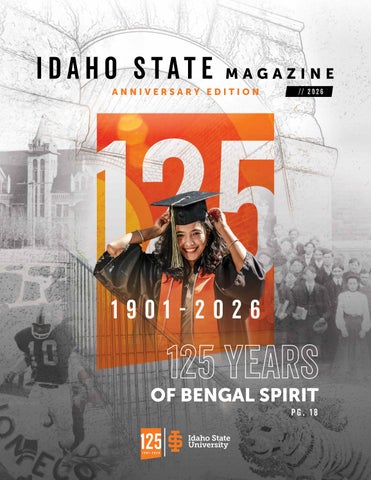
ANNIVERSARY EDITION
125 years
OF BENGAL SPIRIT pg. 18
Contents ISU Magazine // 2026
2
ON THE COVER Academy of Idaho class photo. 1903 - 1904 125 YEARS | ISU MAGAZINE
From the president
04
Ties to the Past: Featured Past Leaders
04
Message From the President
05
ISU’s Contract for Idaho
06
Budget and Restructuring Update
07
a bold beginning
08
A Powerful Partnership
30
A Growing Partnership of Innovation
32
Serious Gaming
36
Ties to the Past: Alumni Who Transformed Their Field
37
Inspiring Educators
38
Ties to the Past: Idaho State Inherits a New Teaching Program
39
08
Beyond Nursing
41
Ties to the Past: ISU’s Timeline of Growth
10
Learning on Common Ground
43
Bengal Triathlon Celebrates 20 years
11
Physical Therapy Celebrates 35 Years
11
BENGAL LEGACIES
44
Nursing: Celebrating 70 Years
44
Taking the Lead in Healthcare
46
Alumni and Friends Awards 2026
12
Connections Through the Generations
48
From ISU to Team USA
14
50
Shooting for the Moon
16
Celebrating 125 Years of Impact
To the Moon and Back
17
125 Years of Bengal Spirit
18
The Year That Changed My Life
20
Because Someone Stepped In
20
Bengal Bloodlines
21
Still Singing Together
21
Bringing Care Home
24
A BROAD IMPACT
25
28
Theodore Turner: The Father of ISU
BENGALS WHO ROAR
12
Powering the Future of Nuclear Energy
BUT WAIT, THERE’S EVEN MORE ONLINE Check out our website for additional stories, videos and photos.
PRODUCTION: The Idaho State Magazine is produced by the Office of Marketing and Communications in collaboration with the Idaho State University Foundation. Office of Marketing and Communications
ISU Foundation
Lee Ann Waldron, Co-Editor
Craig Joseph
Emily Frandsen, Co-Editor
Amy Dressel Elisabeth Curtis
More Than a Performance
25
Kelsey West, Art Director
Meeting Demand
26
Iris Evans, Print Graphic Designer Joe Marley, Web Content Lead Luna Steed, Web Content Designer Jordon Beesley, Photos & Video
Look for this flag to learn more about our ISU history
Ryker Reese, Photos & Video
ON THE COVER Swanson Hall, built in 1902. The building was added onto three times, with a west wing added in 1905, an east wing in 1907, and a third story in 1928. The building was eventually demolished in 1973, but the Swanson Arch was preserved.
from the president
Ties to the Past: Featured Past Leaders
1902 - 1907
John w. faris
1907 - 1918
MILES F. REED
1946 - 1959
Carl mcintosh
Was the first principal of the
Oversaw the school as it
Led during the post-WWII era,
Academy of Idaho. Built the
transitioned from an Academy
supporting campus growth,
institution’s foundation.
to a Technical Institute.
raising one building per year.
4
125 YEARS | ISU MAGAZINE
A
s Idaho State University celebrates 125 years of service, I am reminded that our story has always been defined by impact. Since 1901, we have expanded opportunity, advanced healthcare, strengthened communities, supported economic growth, and prepared generations of students to lead. While our institution has evolved, our commitment to transforming lives through education, research, creative arts and service has remained constant. That commitment does not end with our first 125 years. This year, I met with more
1965 - 1975
than 640 alumni, donors, and friends across the nation, gathered in their hometowns, demonstrating that wherever Bengals go, they continue to strengthen their communities and carry Idaho State’s mission forward. This reminded me that the Bengal Nation extends far beyond our campuses. As we look to the future, our responsibility is not simply to preserve our legacy, but to build on it. The future depends on preparing the next generation to build, heal, teach, innovate and lead. It also depends on a university that continues to evolve alongside the needs of
our state, nation, and world. That is why, in our 125th year, we launched ISU’s Contract for Idaho. It is our forwardleaning, public commitment to provide an empowering education, practice responsible stewardship, strengthen communities, and deliver measurable results for the people of Idaho. It reflects our promise to remain a trusted partner in building a thriving workforce, advancing innovation, and creating a stronger future for our state and beyond.
ROBERT W. WAGNER, PH.D. | President
1985 - 2005
william “bud” davis
richard l. bowen
Focused on academic program
Served for 20 years, reversing
development. Supported the
enrollment decline, securing
construction of the Minidome.
Idaho State University’s future.
We honor the leaders of yesterday, today and tomorrow whose courage and vision shape Idaho State University’s enduring legacy.
Isu’S CONTRACT FOR idaho Idaho State University’s Contract for Idaho is a clear promise to the people of this state to provide empowering education, responsible stewardship, community engagement and measurable results.
This contract is how ISU measures success and promotes public responsibility. We will report progress, adapt to Idaho’s changing needs and remain accountable to students, employers, communities and taxpayers. ISU stands ready to serve as a trusted partner in building Idaho’s workforce, strengthening its communities and securing its future.
6
125 YEARS | ISU MAGAZINE
SCAN TO READ the full contract isu.edu/contractforidaho
BUDGET AND RESTRUCTURING UPDATE F
ulfilling the Contract for Idaho requires a resilient and sustainable university. In 2025, Idaho State University eliminated a $15 million historical structural budget deficit a full year ahead of schedule, achieving a balanced budget for the first time in more than a decade. Just one month later, the University was impacted by permanent state budget reductions, creating an estimated $8 million funding gap. Last year, the University undertook a collaborative and transparent planning process to address these challenges while advancing our mission. More than 2,000 comments from faculty and staff helped identify five strategic budget themes that guided the planning process:
1. STRUCTURAL REDESIGN 2. STRENGTHENING OUR ACADEMIC CORE 3. OPERATIONAL EFFICIENCY 4. INVESTING IN PEOPLE AND PERFORMANCE 5. REVENUE GROWTH AND DIVERSIFICATION
Building on these themes, the University developed and implemented strategic budget initiatives to address the funding gap while positioning ISU for long-term success. ISU’s budget realignment and revenue-generation strategies prioritize long-term structural alignment to improve efficiency, strengthen organizational effectiveness, and create opportunities for strategic reinvestment. Throughout the process, decisions were made with careful and empathetic consideration for employees and students, ensuring the University remains financially sustainable while continuing to fulfill its mission and the Contract for Idaho.
VISIT KISU.ORG to listen to the Bold Path Podcast Series, which offers a straightforward, accessible way to learn what’s changing, why it matters, and how decisions are made to keep our community engaged in the path forward. It reflects our commitment to transparency, clarity, and staying connected during a time of change.
SCAN TO LEARN about our planning process and the University’s comprehensive budget response. VISIT ISU.EDU/BUDGET/FY2026-BUDGETPLANNING
ISU MAGAZINE | 125 YEARS
7
| A Bold Beginning
Theodore Turner: The Father of ISU
Theodore Francis Turner was not only the founder of Idaho State University— he was one of its greatest champions.
Left to Right: Fred D. Turner and wife, Vivian May Perris; Theodore F. Turner and wife, Lucy Petty Turner; Theodore J. Turner and wife, Evelyn Gertrude Patterson.
8
125 YEARS | ISU MAGAZINE
Academy of Idaho, early 1900’s
WATCH THE 125 ANNIVERSARY VIDEO
Looking Back | 1903: Turner Hall The original Turner Hall was built in 1903 and demolished in 1966 to provide the site for the Business Administration building.
From those first sparks in 1901, Idaho State University has risen—shaped by resilience, fueled by ambition, and strengthened by generations who dared to dream bigger.
started planning the
creation, he kept advocating
when there was a desperate
school in 1889 when
for it to evolve, including while
need for student housing.
the University of Idaho was
he was serving in the state
Because of his support, in 1921,
started, stating to his wife that
senate. The first step he took
the women’s dormitory was
“if Idaho ever honor[ed him]
was to fight for a change in
with a seat in its legislature, [he
the school’s name to decrease
would] establish a school of
the stigma that it was basically
higher learning at Pocatello.”
just an elevated high school.
Idaho did honor him with a seat in the legislature, and in turn, he wrote Idaho House Bill 53, which was signed by Governor Frank W. Hunt on March 11, 1901. This bill
In 1947, Turner and his wife, Lucy Petty Turner, watched
renamed Turner Hall. Although the original Turner Hall has been demolished, one of the residence halls still bears his name.
Governor C.A. Robins sign the
While Turner himself made
legislation officially making it
a huge impact, his family
a four-year school. This was
contributed as well. After his
even signed with the same
passing, Lucy Turner donated
officially created
his extensive
the Academy of
library to the
Idaho, and his dream became
“ W h i l e T u r n e r h i m s e l f made
school.
a huge impact, his family contributed as well.”
The Turner family
a reality.
BENGALS WHO ROAR
Building Association Board
A BROAD IMPACT
Even after the school’s
was involved in
Almost
the school for
immediately, Turner was faced
pen used for the Academy of
with another hurdle—the bill
Idaho’s creation. Turner said
required that land be secured
that this was “the greatest day
for the institution by May 1,
of [his] life.”
1901. Community leaders
Throughout his life, Turner
argued about location, and
continued his love and support
when there seemed to be an
of the Bengal Nation, from
impasse, Turner donated 8.5
sponsoring the prize for oratory
acres of his own land where
competitions to a scholarship
the modern-day lower campus
that still remains in his name.
is today. Later, he donated
On occasion, he stepped into
in 1920, and continued to be
another 160 acres of farmland
classes as a substitute teacher.
involved in campus activities
and Red Hill to the University.
He served on the Dormitory
with his wife.
a very long time in various capacities. He had two sons who attended and graduated from the Academy of Idaho: Theodore J. Turner, Jr., and Fred Turner. Theo Turner, Jr. continued his father’s legacy of involvement by serving as the alumni association president
ISU MAGAZINE | 125 YEARS
9
BENGAL LEGACIES
T
heodore Turner first
A BOLD BEGINNING
WRITTEN BY: Madelyn McCracken
Looking Back | 1913: The Pocatello Tribune
Looking Back | 1951: Campus Map
An early newspaper article from the Pocatello Tribune shows Turner’s indelible support of the city of Pocatello and the Academy of Idaho.
A map shows the layout of campus as it was in 1951. Several buildings from this time period remain.
WITHOUT THEODORE TURNER, Idaho State wouldn’t have been created, have the land it does, or have evolved into the school we know and love today. There is no more fitting way to honor him than the Bengal newspaper did in 1950: “Certainly, a great measure of thanks are in order when we realize that, were it not largely for his efforts, we could not have celebrated our first birthday. Were there a Purple Heart for devotion to this type of duty, it would certainly be awarded to the ‘father of Idaho State [University].’ We are sorry that he will not be here in person to celebrate…he will be with us in spirit at least. The spirit of Theo Turner and others like him, who gave so freely of their time and energy in our behalf, cannot die. Its evidence is tangible, we see it wherever we turn. Certainly such spirit cannot be ephemeral. All around us it lives on, forever an abiding benediction.”
Ties to the Past: Idaho State’s Timeline Of Growth
1901 ACADEMY OF IDAHO The Academy was established on March 11, 1901, when Governor F rank W. Hunt signed Senate Bill 53 into law, which was drafted by Theodore F. Turner. The Academy opened its doors on September 22, 1902.
10
10
125 YEARS | ISU MAGAZINE
IDAHO TECHNICAL INSTITUTE The Academy of Idaho was renamed the Idaho Technical Institute, referred to by many as “the Tech.” The two-year vocational collegiate institute was divided into two schools, the Technical School and the College Preparatory School.
1915
1927 SOUTHERN BRANCH, UNIVERSITY OF IDAHO House Bill 160 transformed the Tech into the University of Idaho-Southern Branch, referred to as the “Branch” or “Twig” by many.
2026 milestones Bengal Triathlon Celebrates 20 Years
SCAN TO LEARN about all the buildings that were once on campus
What started as an idea to bring the Pocatello community together with ISU in a way that was revolutionary is now the 20th A BOLD BEGINNING
Annual Bengal Triathlon on the ISU Pocatello campus. What was Participants hold up their medals after crossing the finish line at the Bengal Triathlon
once just several dozen of Caroline “Smitty” Faure’s friends running a race together quickly grew into one of the largest triathlon events in the Western United States, with
BENGALS WHO ROAR
SCAN TO LEARN MORE
500 participants in 2026.
Celebrating 35 Years of Physical Therapy Education in Idaho When Idaho State University started Idaho’s only physical
A BROAD IMPACT
therapy program, physical therapists (PTs) accounted for less than one percent of healthcare professionals in the United States, even lower. Today, ISU celebrates 35 years of graduating competent,
Students in the physical therapy program learn by providing treatment to each other before applying their knowledge to clinic patients
BENGAL LEGACIES
with Idaho’s percentage being
caring PTs to meet Idahoans’ healthcare needs. Read about the program in our virtual magazine.
SCAN TO LEARN MORE
Idaho Legislators, 1899
IDAHO STATE COLLEGE On March 3, 1947, Governor Robins signed the bill establishing Idaho State College, independently granting four-year degrees.
1947
1963 IDAHO STATE UNIVERSITY On July 1, 1963, the institution became Idaho State University, obtaining its fifth and final name. Classes were dismissed for the historic occasion. Students and administrative leaders traveled to Boise to witness Governor Smylie sign the bill.
Looking Back | 1963: Another “Great Day” Students’ joy and pride captured when Idaho State College became Idaho State University. ISU MAGAZINE | 125 YEARS
11
11
| BENGALS WHO ROAR
aLUMNI AND FRIENDS AWARDS 2026
“
The Academy
at present has a senior class of eleven members who, when they are graduated, will become members of this association, so in years to come each class, as graduated, will become a part of this body, of which the Academy of Idaho and the state is most proud.
”
- Leroy Nielson WRITTEN BY: Amy Dressel and Elisabeth Curtis
E
very Homecoming, Idaho State University celebrates the people whose achievements, leadership, and service reflect the best of the Bengal community. This year’s Alumni and Friends Awards recognize students beginning their next chapter, alumni whose careers and service have made a lasting impact, dedicated friends of the University and former student-athletes whose accomplishments continue to inspire future generations.
As Idaho State celebrates its 125th anniversary, these honorees represent the many ways Bengals shape their professions, strengthen their communities and carry the University’s legacy forward. Their stories span classrooms, boardrooms, laboratories, businesses, hospitals, athletic fields and communities around the world, but they share a common connection: each has left a lasting mark on Idaho State and beyond.
12
125 YEARS | ISU MAGAZINE
1906 Academy of Idaho Bulletin announcing the founding of “The Alumni Association of the Academy of Idaho.”
Looking Back | 1906: The Alumni Association is Established The Alumni Association was established on May 20, 1906, when the Academy of Idaho boasted only 14 graduates. The photo above is of the 1907 senior class that would have been some of the newest members of the Association. This photo is from the first issue of the school annual, “The Wickiup.”
* PRESIDENT’S MEDALLION AWARDS
established in Idaho State University’s 125th anniversary, honors Bengal alumni whose distinguished achievements and enduring contributions have advanced ISU, elevated their professions, and enriched their communities. HOMECOMING AWARDS honor alumni and friends whose leadership, service and accomplishments have strengthened Idaho State University and the communities they serve.
College of Arts and Letters, Social Sciences Vanna Haddock B.A. History
College of Business* Marc McDonald ‘97, ‘99, B.B.A. Accounting, M.B.A.
College of Business Kade Borgholthaus B.A. Finance College of Education Grace Tigue B.A. Elementary Education
College of Nursing, Rehabilitation, and Human Health* Dr. Jess Stich-Hennen ‘08, Doctor of Audiology
College of Health Amina Miljkovic Honors B.S. Health Science and B.A. Health Professions
L.S. Skaggs College of Pharmacy and Health Professions* Dr. Page Haviland ‘20, M.S. Clinical Psychopharmacology
College of Pharmacy Duncan Andrus Pharm.D. and M.B.A.
College of Science and Engineering* Dr. Judith Damewood ‘61, B.S. Chemistry
College of Science and Engineering, Natural Sciences Lauren Jager B.S. Chemistry
College of Technology* Brandalin Barnes ‘13, ‘15, ‘17, A.A. Nuclear Operations, B.S. in Nuclear Operations, M.S. in Organizational Learning and Performance
College of Science and Engineering, Physical, Computational, and Engineering Sciences Mathew Shumway B.S. Mechanical Engineering and M.S. Mechanical Engineering College of Technology Andrew Christensen Honors B.S. Health Science Graduate School, Master’s Candidate Kasey Wozniak M.S. Biology Graduate School, Doctoral Candidate Rifat Ara Tasnim Ph.D. Computer Science
include former studentathletes, coaches and contributors whose legacy continues to inspire current and future generations of student-athletes.
School of Arts* Brent Lowman ‘68, B.A. Art Graduate School* Dr. Henry T. Evans ‘89, ‘10, ‘12, B.A. Mass Communication, M.A. Political Science, Doctorate Political Science
SPORTS HALL OF FAME Hailey Breakwell ‘15 B.S. Physical Education Softball Mike Castrilli ‘96 B.B.A. Finance Men’s Tennis
HOMECOMING AWARDS SPORTS HALL OF FAME inductees
College of Humanities, Education, and Social Sciences * Bonnie ‘96 and Dr. Alan Frantz ‘80 B.S. Education, German; Master of Education
Brian Janssen Cross Country, Track & Field Coach
ISU Distinguished Alumnus Jared Allen
Phil & Bekki Meador Lifetime Achievement
William J. Bartz Award Dr. Marcia L. Lloyd ISU Young Alumni Award Angela Garcia ‘19, M.S. Geology
Tressa Lyman Page ‘16 B.S. Elementary Education Women’s Basketball, Volleyball
ISU Achievement Award Dr. Alex Bolinger ‘02, ‘04, ‘10, B.B.A. and M.B.A. Management, M.A. Political Science, Doctor of Philosophy
Chelsea Pickering Hooker ’08, ‘12 B.B.A. Finance, MBA Women’s Basketball
ISU MAGAZINE | 125 YEARS
A BOLD BEGINNING
Parade Grand Marshal Glenn Alford
BENGALS WHO ROAR
graduating seniors who demonstrate exceptional academic achievement, leadership, and service to ISU and their communities. Recipients represent the next generation of Bengal alumni and exemplify the promise of ISU’s future.
College of Arts and Letters, Fine Arts and Humanities Hadley Bodell B.A. Multiplatform Journalism
A BROAD IMPACT
ACHIEVEMENT AWARDS recognize
ISU Distinguished Service Heidi Berry
BENGAL LEGACIES
OUTSTANDING STUDENT
OUTSTANDING STUDENT ACHIEVEMENT AWARDS
13
from isu to team usa
An Idaho State alumnus takes his chances at the Olympic Skeleton Race.
WRITTEN BY: Madelyn McCracken
O
ne day in 2020, ISU alumnus Andy Whittier was midday scrolling when he saw a sponsored ad that would change his life: “USA BobsledSkeleton Virtual Tryout. Send us your [athletic] numbers.” Thanks to the movie Cool Runnings, he was familiar with bobsledding, but skeleton was a mystery. Taking a chance, he submitted his athletic stats from his ISU football days and was invited to a fast-track training and trial run. A month later, Whittier’s trajectory had changed, and he began chasing a new dream. Going from knowing virtually nothing about skeleton to flying down an icy track three inches off the ground at 75-77 miles per hour in just two weeks, Whittier’s path to Olympic training is certainly unique, but it’s not the first time his life took a big turn.
ISU Alumni Andy Whittier’s life was changed when he saw an ad for USA Bobsled-Skeleton team tryouts. After narrowly missing a spot in the 2026 Winter Olympics, he’s looking forward to having fellow Bengals join him on his journey to the next Olympic Games.
While at ISU, Whittier played
“This is the accountability part
as a defensive back on the
of Team USA that I’d die and
ISU Football team. He was
live for… At the end of the
a walk-on player without
day, I’m going to be just as
a scholarship, juggling the
happy for my teammates on
demands of athletics and
the podium as I would expect
academics with multiple jobs
them to be for me.”
to fund his education. His junior year, it became too much to balance. He went to his coach, planning to quit the team, but before he could speak, he was offered a scholarship. Whittier said those
i’M HERE TO PUSH THEM, AND FOR THEM TO PUSH ME”
were the “best five minutes of my life, it was a crazy five
Throughout his experiences,
minutes, but best five minutes.”
Whittier has remained grateful
After graduating with a bachelor’s degrees in business
to those who have helped him along the way.
and marketing in Fall 2018,
Whittier attributed his desire
Whittier’s hopes of playing
to keep going in sports to
professionally didn’t pan out.
Kam Yancy, his position coach
He helped coach Pocatello
while playing ISU football, and
High School’s football team to
Dave Spillit.
stay involved in sports, and was
“(Dave) was an absolute father
working for Lookout Credit Union, where his supervisors encouraged him to chase his dreams. He kept training and eventually got an offer he couldn’t turn down. In 2024, he was offered summer housing in Lake Placid, New York, where he would train full-time with the U.S. Olympic BobsledSkeleton Team.
figure to me. Just the way he treated us as kids, treated us growing up, showed me the type of man I want to be,” he said. “And the values he instilled in us from 10 years old to 18, and the expectations that we still had coaching under him: incredible. And that’s very much the reason I am the way I am, because of him and his
Team USA has opened many
family. They are so supportive
doors for Whittier.
of me. I would not have been
“I’m here to push them, and
able to accomplish a lot in my
for them to push me,” he said.
life without him and his family.”
With consistent year-round training, it’s difficult for Team USA athletes to make enough money to support their athletic endeavors, and sponsorships make this easier. A lot of his sponsors are local, including Cole Chevrolet and Hooligans, and he is very grateful for each. Hooligans hosts fundraiser nights for Whittier and contributes 100% of the proceeds. All of Whittier’s sponsors have a sticker on the bottom of his sled. Whittier, who remains loyal to his alma mater, hopes to someday have a “Bengal Sled” to compete. Bengals, he said, are innovators. “We’ve got four years to prototype, and eight years to become the fastest sled developers in the nation,” he said. Looking Back | 1970: The Iconic Red Hill Pillars The Red Hill Pillars were donated by McHan Henderson Funeral Home in 1970, where they once stood as the entrance to the Henderson building. “The three pillars connected under the lintel represent the individuals within the group or the students, while the single pillar represents the alumnus who has left the student group and is standing alone.” — Bill Ryan | Idaho State’s First Alumni Director
Shooting for the Moon: ISU Alumna Serves as NASA Science Officer on Artemis II Mission
Artemis science officer, Angela Garcia, stands at the new SCIENCE console in the Mission Control Center at NASA’s Johnson Space Center in Houston. Credits: NASA/Josh Valcarcel
WRITTEN BY: Logan McDougall
A
ngela Garcia’s career has taken her as close to outer space as you can get without being an astronaut. During NASA’s 10-day Artemis Mission in May 2026, Garcia was one of the three science officers stationed at the SCIENCE console in Mission Control. The Idaho State University alum spent her youth on the Hawaiian Island of Oahu. The idyllic setting got her curious about the natural world.
her first taste of out-of-this-
students’ success and is a really
world work with NASA.
great mentor. Shannon really
“I was working in a geochemistry lab doing
After earning her bachelor’s
research on Martian Soil,”
degree at UNLV, Garcia
Garcia said. “We got data back
completed a summer
from the rovers, so we were
internship with Jacobs
trying to replicate some of
Technology at NASA’s Johnson
those results in the lab.”
Space Center. Once at ISU, she
As her time at UNLV wound down, Garcia started looking into graduate schools. A friend attended ISU’s five-week field camp at the Lost River Field Station near Mackay, Idaho
“I’ve always loved the outdoors and the way you read Earth’s history has always resonated with me,” said Garcia. “Nature is this grand teacher, and geology is Earth’s storybook, and the rock record is the language.”
and met Shannon Kobs
After high school, Garcia headed to the University of Nevada, Las Vegas (UNLV) to major in geology. It was during her time in Vegas that she got
and found a kindred spirit.
16
125 YEARS | ISU MAGAZINE
sold ISU.”
Nawotniak, professor of geosciences at ISU, who was working on her own projects with NASA. After a bit of prodding by her friend, Garcia reached out to Kobs Nawotniak
plunged into the Systematic Underwater Biogeochemical Science and Exploration Analog (SUBSEA) project. Under the guidance of Kobs Nawotniak, she studied places deep in the ocean that could most closely resemble sites that might harbor life on other planets or moons. During her work with SUBSEA, Garcia, along with another graduate student, Ashley Shields, discovered a new hydrothermal vent field in the Pacific Ocean. Midway
“I really went to ISU because
through her time at ISU, Garcia
Shannon’s my girl,” Garcia said.
took a brief break to complete
“She’s so generous with her
another internship at NASA.
time, and she really cares about
Garcia returned to Pocatello
to complete her master’s while working remotely on her internship project, then was hired at NASA for a fulltime position post-graduation. At the time, the Artemis program was in its early stages, and Garcia was tasked with investigating ways to mitigate the problems caused by lunar dust.
rounding out the teams who would support the four astronauts while they were in space. Brand new for Artemis II would be the incorporation of science officers into mission control. Garcia fit the bill, and served alongside her colleagues,
“It was a practical kind of
who focused on other mission
application of sciences
functions such as life
versus doing research,”
support, communications
explained Garcia. “It was like,
and propulsion.
‘Hey, you have knowledge about these materials, now help engineers build hardware that can withstand that natural environment.’”
“I think I was picked because I was able to work in environments that can be undefined but still be productive, and have a good
From there, Garcia was tasked
attitude, work hard, and
with training the Artemis II
produce results. I’m a very
astronauts and NASA support
detail-oriented, process-
staff in lunar geology.
written-down type
“When the crew gets assigned
of person,” Garcia
for missions, we will also take
said, “and so
them out and teach them
I think that was
more mission-specific skill
a skill set that
sets,” said Garcia. “To train
benefits a lot to
people to go to the Moon, you
have in the group
have to train them how to use
because as we
the suit, how to use geology
figure out stuff,
tools, and how to do science,
I’ll make sure that
but within those limitations.”
it gets written
As the Artemis program picked up steam in preparation for
down and kind of codified.”
Artemis II’s mission around
Looking ahead,
the Moon, NASA went to work
Garcia plans to
stay with NASA and the Artemis program and see it through to the crewed landings on the Moon. “I’ll be a part of that in whatever capacity is needed of me,” Garcia said. “It’s definitely been a whirlwind of work and very humbling. I’m super honored that I’m able to be one of the few people who are at that very tip who are building the path for folks to come in and continue.”
SCAN TO LEARN MORE
to the moon & back Five species of tree seeds flew aboard the Orion spacecraft and orbited the Moon during the successful uncrewed Artemis I test flight in 2022 and ISU will plant one of them on its historic Hutchinson Quad this fall as part of its 125th Anniversary celebrations. The Idaho Museum of Natural History and ISU are custodians of the Artemis Moon Tree, 17 accurately nicknamed “Lunafir.”
Homecoming Parade, 1947
Homecoming, early 1960’s
First Mascot, Benji 1956
125 Years OF Bengal Spirit:
Three Homecoming Traditions That Bring Us Together WRITTEN BY: Elisabeth Curtis
W
hat is your memory of Homecoming?
Maybe it was watching the parade wind through Pocatello when you were a kid, warming your hands by the bonfire on a crisp October evening, cheering from the stands during a Bengal football victory with
18
125 YEARS | ISU MAGAZINE
the rest of your roommates, or making the walk up Red Hill to meet someone special. Some traditions have been part of the Idaho State experience for generations. Others are new, giving today’s students and tomorrow’s alumni traditions of their own. For more than a century,
Homecoming has brought campus and community together. As Idaho State celebrates its 125th anniversary, we’re honoring the moments that bring Bengals back together and celebrating new ways to be part of the tradition.
Bonfire, 2025 THE BONFIRE
A crowd wearing orange and black gathers as the ISU Cheerleaders and Bengal Dancers perform, the football coach rallies the crowd, and the lighting of the flames signals that Homecoming has officially begun. NEW THIS YEAR: Start the evening with the Pre-Bonfire Ice Cream Social at the ICCU Bengal Alumni Center before heading out to the fire. It’s a chance to gather with fellow Bengals, enjoy a sweet treat and start the celebration together. GAME DAY
From the parade through Pocatello to pregame tailgating with buddies and cheering from the stands, game day
is the central feature of our Homecoming spirit. The parade remains one of the week’s most recognizable traditions, with marching bands, floats, student organizations, community groups and local families lining the streets to celebrate before folks move to the ICCU Dome for tailgating before the game. NEW THIS YEAR: We’re introducing
an Alumni Passport, giving attendees another way to explore events, participate throughout the week, and celebrate their Bengal connection. ICONIC SYMBOLS AND PLACES
Built in 1927, the Red Hill “I” has welcomed Bengals home for nearly a century.
It has overlooked first days of class, commencements, homecomings and countless walks across campus. The Red Hill Pillars have their own place in Bengal lore. They’ve served as the backdrop for countless photos and the legendary “True Bengal” tradition. According to legend, if you kiss your sweetheart at midnight at the pillars on Red Hill, you’re destined to stay together forever. NEW THIS YEAR: Some things are
worth keeping exactly as they are. The best traditions don’t need to be reinvented, they just need another generation of Bengals to experience them.
Homecoming 2026 (oct 5-10) While Homecoming traditions connect us to the past, each year brings new opportunities to create memories of our own. This year’s celebration includes new ways for students, alumni, families and friends to connect, including our student and
alumni mixer that will be held on Thursday, October 8. Whether you’re returning to campus, reconnecting with old friends or experiencing Homecoming for the first time, there are more ways than ever to be part of the celebration.
SCAN TO EXPLORE the full Homecoming schedule, event details, and registration.
Looking Back | 1970: The First One of Its Kind The ASISU Minidome opened its doors to fans on September 26, 1970. It was renamed Holt Arena in 1988 to honor coach “Dubby” Holt’s vision. In 2021, a major renovation upgraded the facility and it was renamed the ICCU Dome in 2024. It was the first-ever enclosed stadium on a college campus.
TO LEARN MORE VISIT ISU.EDU/HOMECOMING For a full list of upcoming Alumni Events, visit giving.isu.edu ISU MAGAZINE | 125 YEARS
19
the year that changed my life Nick Phelps, Class of 2024 | Master of Business Administration WRITTEN BY: Nick Phelps
F
rom Iowa to Idaho’s
campus left a meaningful
mountains, I found a true
and enduring impact.
sense of belonging at ISU.
I loved everything about it.
Through experiences in the Holt
Nick Phelps at the November 2024 home game against UC Davis.
Arena (now ICCU Dome) as
Today, I remain actively engaged
a football athlete, to hikes up
with my alma mater because
Red Hill, ISU will always have
everything connected to ISU
a special place in my heart and
reminds me of a time when I felt
be a large part of my life story
happiest, most connected, and
and journey. Since arriving to
most successful. I am truly grateful
pursue my graduate degree,
that I had an opportunity to be
my time on the field and on
part of ISU.
Because Someone Stepped In Philanthropic support to modernize the Sargent Boardroom
WRITTEN BY: Elisabeth Curtis
F
or the Associated Students of Idaho State University (ASISU), the Sargent Boardroom is where student leaders make decisions, host campus partners and represent their fellow Bengals. But prior to philanthropic support from the Sargent Family, some of the room’s outdated technology often made that work more difficult. ”The upgrades make it easier to share information, host people remotely and create an efficient setup so that we can focus on what we need to [which is] leading,” said ASISU President Sky Halter. Through the Shirley Sargent Boardroom Fund, John and Michelle Sargent are honoring the legacy of John’s late mother, Shirley—a dedicated Idaho State staff member for more than 30 years—by ensuring the space that bears her name continues to support generations of student leaders.
20
125 YEARS | ISU MAGAZINE
ISU Leadership celebrates the renovation of the Sargent Boardroom with John and Michelle Sargent and their family members. Sky Halter, ASISU president, is third from the right.
Bengal Bloodlines Shawnee Burt, Class of 2008, 2012 | B.S. Health Science, Master’s Health Education WRITTEN BY: Shawnee Burt
and independence. ISU was big enough to have all the fun traditional college activities while still feeling intimate enough to meet friends and connect with professors. I loved being a part of ASISU,
and my membership on the Alumni Board. We both want to share the positive and impactful experience with our kids and mentor coming Bengals. We love being forever Bengals. Go Bengals!
the honors program, attending awesome campus events and being an ambassador! Shawnee Burt’s children
I
I met my husband and we had our first child during our grad
n 2003 I became an ISU
programs. She was our Bengal
Bengal and started one of
baby, coming to study rooms
the best seasons of my life!
and even to class occasionally!
From the wonderful teachers to
We moved away from Pocatello,
the beautiful campus, my time at
but we love staying involved by
ISU was a new chapter of learning
attending events on campus
Shawnee Burt and her husband.
Still Singing together WRITTEN BY: Elisabeth Curtis
n rehearsal nights, dozens of ISU alumni gather in the same choir room where many of them once spent countless hours as students. When the director raises his arms, voices that have been separated by years come together again. This is the ISU Alumni Chamber Choir: 39 singers spanning four decades, reunited under longtime emeritus ISU Choral Director, Dr. Scott Anderson.
Dr. Scott Anderson, emeritus choral director
ISU MAGAZINE | 125 YEARS
21
Members of the Alumni Chamber Choir rehearse at the Stephen’s Performing Arts Center with emeritus Choral Director, Dr. Scott Anderson. Allyson Johnson is pictured in the center.
Allyson Johnson ‘05, who played a pivotal role in bringing the group together, said, “This project has been months and years in the making, but we finally did it!” After years of staying connected through friendships and shared memories, the choir reunited for rehearsals and its first concert in December 2025 and returned to the stage again in June 2026.
“The music department
former students sing with
became my home, and this
mature voices, capable of
choir in particular gave me
making vocal sounds with a
a place of belonging,” said
palate of color not possible
Johnson. “These people
when they were 15–20
became family – they are
years younger,” he said.
the people who were in our
For younger alumni, the
For many alumni, being part of the ISU Chamber Choir as students was where they found belonging. Haley (Jones) Baker ‘02, ‘08, who sang in the Chamber Choir from 1998– 2001, said, “Shape my life? Choir was my life!”
22
125 YEARS | ISU MAGAZINE
weddings, who show up when we lose a parent, who we raise our kids with, who we work with.”
choir offers a place to be challenged and connected across generations. Despite differences in age and
The Alumni Chamber Choir
experience, the group
brings together singers from
shares a common musical
the 1990s through today.
language — one shaped by
“What has struck me most is
years of working under the
how quickly those generational
same director.
gaps disappear once we begin
For many, the chance to work
making music together,” said Shawn Bascom, ‘06, ‘17.
again with beloved choir director, Dr. Anderson, was
From Anderson’s perspective,
a powerful draw. “Returning
time has added depth. “These
to sing under Dr. Anderson is
both an honor and a privilege,
“From working with Dr.
they trod the halls of ISU.
and a chance to once again
Anderson in choir and Kathy
Thank you for making this old
contribute to something
Lane in her private studio, my
heart feel plugged into some
collective, intentional and
love for classical music grew
of my former students who I
deeply beautiful,” said Bascom.
into something that I can’t
get to share new relationships
imagine living without now,”
with as adults.”
The choir represents singers from every ISU Chamber Choir
she said.
For many alumni, returning to
Anderson conducted over
For many, those
sing together has reminded
his 30 years at the University
lessons show up in careers,
them that the lessons and
prior to his retirement in 2024.
relationships, and daily life—a
connections they found at ISU
“I view this Alumni Chamber
lasting influence rooted in
never truly faded. “We may not
Choir as one of the greatest
shared experience.
all know each other, but we
opportunities of my career, or
At the June 13, 2026, ISU
understand the same language
post-career!” he said. “There
Alumni Chamber Choir
from our director,” said (Jones)
aren’t many conductors
concert, Anderson reflected on
Baker. “We are all passionate
anywhere in the world who
what the group has become.
about achieving the same goal,
have the chance to gather such
“Standing behind me are about
a group for regular rehearsals,
and we all felt that singing
a dozen musical educators,
and then perform together.
in the ISU Chamber Choir
medical professionals and
It’s thrilling!”
changed us for the better.
alumni from a wide variety
Being inspired by Dr. Anderson’s
Alumni credit Anderson not
of backgrounds,” he shared
passion again has filled my
only with musical excellence,
with the audience, “but most
cup to overflowing and is the
but with shaping who they
importantly, they share that
homecoming I didn’t
became. “He demands greatness in a way that is both inspiring and a little terrifying, but the end result is gratifying beyond words,” Johnson said. The lessons of the Alumni Chamber Choir extend far beyond the stage. “Chamber Choir taught me what it means to listen as much as I sing, and to be part of something larger than myself, a lesson that carries into many other contexts throughout life,” Bascom said. Claire Dye ‘23, credits her experience in choir with shaping her career path.
The inaugural Alumni Chamber Choir
know I needed.”
bringing care home
The Idaho Area Health Education Center (AHEC) program prepares healthcare professionals to make a difference.
WRITTEN BY: Elisabeth Curtis
G
rowing up in Wendell, Idaho, Cindy Calderon
often found herself helping her family navigate the healthcare system. She saw firsthand how difficult it could be to find providers who understood both the language and the people they served. Those experiences shaped her desire to pursue a career in healthcare. While completing graduate school at ISU, she joined a program that was instrumental in her success. She became an
Cindy Calderon
24
125 YEARS | ISU MAGAZINE
AHEC Scholar through the Idaho Area Health Education Center (AHEC) program, which prepares health professions students to serve rural and medically underserved communities.
For Calderon, AHEC created
Associate Director of Idaho AHEC, Rylee O’Neill, says that between 2022 and 2026, AHEC has reached over 9,000 students and trained 308 AHEC Scholars. Federal and state funding and philanthropic partners help expand its reach. Support from the Blue Cross of Idaho Foundation for Health has been key to that growth.
a multidisciplinary group
“The Blue Cross Foundation for Health has been instrumental in extending our reach,” said Dr. Christopher Owens, director of the Idaho AHEC Program Office. “Over the past three years, we’ve been able to quadruple our efforts in middle and high schools, providing students with handson experiences with real healthcare careers that build their confidence and help them to see that a future in healthcare is not only possible, but something they could really enjoy.”
nurse practitioner in Twin Falls.
a sense of belonging. “AHEC brought different disciplines together and we were able to talk about healthcare from different points of view. Working alongside emphasized that healthcare is a collaborative effort and that every profession plays an essential role in improving patient outcomes. It helped humanize healthcare.” After earning her Doctor of Nursing Practice from ISU in 2024, Calderon returned to southern Idaho as a family As a bilingual family nurse practitioner, she helps patients navigate a complex system while building the kind of trusting relationships she once wished her own family had experienced. “I grew up here seeing the needs of the community, recognizing how vulnerable some of our communities are,” she said. “I always knew I wanted to stay local, and AHEC cemented that idea.”
A broad impact |
more than a performance A new chapter begins at the newly named School of the Arts.
WRITTEN BY: Meg Holmes
T
he Idaho State University School of the Arts is entering an exciting new chapter, but the heart of our programs has always been the same: the people.
Step inside the Stephens Performing Arts Center and hear from students, faculty, and Interim Executive Director Tara Young as they share what makes our theatre and music programs so meaningful. Through collaboration, creativity, and hands-on learning, you’ll discover how artists are inspired, challenged, and transformed every day. Whether you’ve walked these halls before or are experiencing them for the first time, we invite you to see what makes the School of the Arts so special.
WATCH THE VIDEO The video features original music composed and performed by Idaho State University Commercial Music students Giovanni Beeman and Cesar Ruiz.
Looking Back | WWII: Arts During Times of Adversity During the war, the U.S. Navy used campus as a training base. Among the sailors was world-famous pianist, Louis Weertzknown as Roger Williams. Williams graduated from ISU in 1950. Student actors dance during the Fall 2025
25
I S U M A G A production Z I N E | 1 2of5 “AY Christmas EARS Carol.”
Meeting Demand
College of Technology’s roots run deep in the history of ISU.
WRITTEN BY: Corinne Koelsch
W Lowering an engine into an automobile in the 1920s.
Academy of Idaho Machine Shop instruction began in 1915.
hen the Idaho Legislature passed Senate Bill 53 on March 11, 1901, it established the foundation for what would become one of the region’s most consequential workforce institutions.
became known as the School
The Academy of Idaho opened in 1902 with 40 students in two branches: a College Preparatory School and a Technical School focused on agriculture, domestic science and mechanics. The institution’s technical identity deepened in 1915 when it was renamed the Idaho Technical Institute (ITI), a move celebrated by students who placed a giant “T” for “The Tech” on Pocatello’s Red Hill.
University elevated the division
THE EVOLUTION OF APPLIED LEARNING As time went on, the Tech’s
125 YEARS | ISU MAGAZINE
Education. In April 1991, it was renamed the School of Applied Technology to signal a curriculum that blended scientific theory with hands-on application. In June 2001, the to the College of Technology, placing it on equal footing with the University’s other academic units. Deb Thompson, former associate dean, said that throughout its history, the College has significantly evolved as workforce education became increasingly technical. For example, in the 1970s, the institution transitioned to offering Career Pathways and Tech Prep, allowing students to “stack” technical credits toward a Bachelor of Applied Science
name evolved alongside
degree. Today, the College
the regional workforce. By
utilizes more than 35 industry
the time ITI became Idaho
advisory committees to ensure
State University, it’s Technical
programs remain aligned with
School branch eventually
regional needs.
Part of the Technical School’s focus at the Academy of Idaho in the early 1900s was domestic sciences.
26
of Vocational-Technical
MACHINE SHOP
1928 AUTOMOTIVE TECH
1940’s WARTIME DEMANDS
1951 HEALTH PROFESSIONS
1960’s TECH & LAW ENFORCEMENT
1990 - 2000’s BUSINESS MANAGEMENT
Machine shop instruction began and eventually evolved into today’s computerized machining programs.
Automotive Technology - 1928 Collision Repair - 1935
Aircraft Maintenance - 1937 Cosmetology - 1937 Welding - 1940 Electronics Instruction - 1940 Diesel and Power Generation - 1945
Practical nursing began at Bannock Hospital, opening the doors for today’s broad range of health occupation programs.
Civil Engineering Technology - 1965 Law Enforcement - 1966 Data Processing - 1968
Adult Farm Management - 1990 Hospitality Management - 1990 Accounting Clerk - 1991 Paralegal Studies - 1999 Small Business Technology - 2013
Looking Back | 1909: Technical Education Gets Its Start After Turner donated the 160-acre “Tech Farm” and barn to the Academy of Idaho, the first training on tractors began.
Now, heading into the 2026-2027 academic year, the College is introducing new programs to expand student options. APPLIED ARTIFICIAL INTELLIGENCE CERTIFICATE
Builds on decades of computing education, focusing on automation and data-driven technologies. AGRICULTURAL BUSINESS AND PRODUCTION TECHNOLOGY PROGRAM
Trains students in agribusiness management, ag finance and diverse crop and livestock production systems. INTERACTIVE MEDIA DESIGN
Prepares students for game development and digital content. BARBERING CERTIFICATE
Enhances the cosmetology offerings. Jerry Anhorn, the former dean of the College of Technology, said he’s optimistic about where the college is headed. “The College of Technology is strategically positioned to serve Idaho well into the future by evolving in areas like nuclear energy and commercial aviation. For 125 years, ISU has remained true to its original 1901 mandate of empowering students with the practical skills required to power the regional economy.”
ISU MAGAZINE | 125 YEARS
27
BENGALS WHO ROAR
1915
A BROAD IMPACT
BUSINESS & SERVICE
Business and service education began at the Academy of Idaho with secretarial and shorthand courses.
BENGAL LEGACIES
1902
“Industry wasn’t simply looking for degrees—it was looking for people with skills,” said former dean, Scott Rasmussen. “The College of Technology has always prepared students to contribute from day one.”
A BOLD BEGINNING
THE ROAD TO 2027
WRITTEN BY: Logan McDougall
I
daho State University’s on-campus reactor has helped Bengals lead the way in nuclear energy for more than 60 years. Now, this piece of 1950s-era tech will help guide the industry into the future.
Powering the future of nuclear energy A piece of 1950s-era tech, the AGN-201 reactor, will help guide the industry forward.
Chad Pope, professor of nuclear engineering (left), and Jay Kunze, emeritus professor of nuclear engineering (right), pose with the disassembled AGN-201 nuclear reactor on ISU’s Pocatello campus. The photo recreates a 1957 photo taken at the Aerojet Nucleonics facility in California.
28
125 YEARS | ISU MAGAZINE
The reactor–model AGN 201—was developed by Aerojet-General Nucleonics and touted as “the world’s first mass-produced nuclear reactor,” precisely “designed specifically for universities.” At one point, more than 40 of the low-power reactors were in use. “AGN-201’s are safe and simple in terms of their design,” explains Chad Pope, professor of nuclear engineering. “The design features multiple failsafes, including four control rods – only one is needed to shut the reactor down – and a thermal fuse that will trip and shut the reactor down if it gets too hot. They utilize solid fuel, and there are no pumps, pipes or valves for coolant since it generates only a minimal amount of heat.”
owner of the third one made.
Management, an adjunct
“They don’t have great
faculty member at ISU, and
documentation on their own
the chair of the Reactor Safety
reactor, but their estimated
Committee. “After I earned
date for when it first went
a Senior Reactor Operator
critical was April 1957,” said
license, I ran the reactor
in their hiring,” said Mary Lou
Matt Lambert, a graduate
during the undergraduate
Dunzik-Gougar, a professor of
student from Coeur d’Alene,
reactor laboratory.”
nuclear engineering.
Those licenses have
ISU’s AGN-201, currently
allowed ISU to find a niche
the second-oldest operating
on the people side of the
reactor in the U.S., will help
Despite sounding ominous,
nuclear energy equation.
pave the way for the future
“critical” in the nuclear energy
Reactors require licensed
of nuclear reactors. High
of ISU’s reactor as part of his master’s thesis.
reports from graduates from both programs that having the license was a deciding factor
world just means “on.” After for the reactor, it stayed at the Aerojet-General Nucleonics
A BROAD IMPACT
flipping the proverbial switch
“ t h e r e a c t o r brought to life all of the
concepts I learned about in class. ”
facility in California for about a decade. In January 1966, AGN notified the United States Atomic Energy Commission
operators, and ISU’s
Assay Low Enriched Uranium
they didn’t want to operate
AGN-201 offers an opportunity
(HALEU) powers ISU’s reactor,
it anymore.
for students to earn a Reactor
the same type of fuel that
Enter Albert Wilson, a professor
Operator license.
will power advanced reactors
of engineering, who worked
“They are able to perform
still in development. To date,
with the AGN and Atomic
start-ups, shutdowns, and
there has been little research
Energy Commission to bring
reactivity changes, as well as
on reactors using HALEU
the reactor to ISU in 1967.
practice logkeeping, conduct
as fuel and ISU faculty and
“The reactor brought to life all
operations and radiological
students recently disassembled
of the concepts I learned about
safety in a functioning nuclear
the AGN-201 to take exact
in class,” said Kermit Bunde, an
facility,” said Mackenzie
measurements of all its parts,
ISU alumnus who now serves
Gorham, program coordinator
analyze the fuel, and then
as senior nuclear criticality
for the College of Technology’s
put it all back together. From
safety subject matter expert
nuclear operations
there, they’ll gather data on
for the Department of Energy
technology program.
how it performs in different
ISU MAGAZINE | 125 YEARS
29
BENGAL LEGACIES
Idaho, who compiled a history
“We have received
A BOLD BEGINNING
Office of Environmental
BENGALS WHO ROAR
Idaho State is the proud
program necessary to operate it, using the AGN-201 program as a template,” said Dan LaBrier, associate professor of nuclear engineering. “In that way, the AGN-201 reactor has laid the groundwork for bringing the NuCube Energy reactor to Mary Lou Dunzik-Gougar, professor of nuclear engineering, inserts the cadmium source into the reactor core of AGN-201, ISU’s on-campus nuclear reactor.
configurations, feeding it to designers and engineers creating computer models of advanced reactors, who can then use it to confirm whether their design works or if they need to go back to the drawing board. In the spring of 2026, ISU received authorization to host the NuCube Energy Advanced Research and Test Reactor (ART) through
the Nuclear Energy Launch Pad USA program. Managed through the National Reactor Innovation Center, the program provides streamlined pathways for developers wanting to demonstrate advanced nuclear energy technology and accelerate commercial deployment. “As we build and test the ISU ART reactor, we will also be developing the training
our campus and allows ISU to offer two unique experiences to a new generation of nuclear reactor operators.” “The development of advanced reactors is being aggressively pursued,” said Pope. “Billions of dollars of private investment are being spent to make these reactors a reality. ISU’s nuclear engineering program, our nuclear reactor and our subcritical assembly place us in a perfect position to participate.”
A powerful Partnership O
WRITTEN BY: Ila Garrido and Logan McDougall
A new industry partnership has propelled ISU into the national conversation for advanced reactors.
30
125 YEARS | ISU MAGAZINE
ne of the world’s most advanced nuclear reactors is set to be built on Idaho State University’s Pocatello campus, paving the way for Bengals to continue leading when it comes to nuclear energy.
States selected for the U.S. Department of Energy’s Nuclear Reactor Innovation Center (NRIC) Launch Pad USA program. Through a partnership with NuCube Energy, Inc., the University plans to site, design and commission a functional microreactor directly on campus. “We are thrilled and deeply honored that the ISU Advanced
This system uses a specialized fuel made of tiny, coated particles that has been demonstrated to be highlyresistant to stresses from high temperatures and intense radiation levels. Heat produced by the reactor system is
needed for working in the
offer the potential to provide valuable resources to our communities,” said Dan LaBrier, associate professor of nuclear engineering at ISU and ART project lead. “By providing students with the experience modern energy landscape, we are training the next generation of scientists, engineers, technicians and researchers to power the Idaho of tomorrow.”
Research and Test (ART) Reactor project has been accepted into the Nuclear
“ b y b r i n g i n g this technology to a campus setting,
Energy Launch Pad USA program,” said Dr. Cristian Rabiti, chief executive
A BOLD BEGINNING
only University in the United
can be safely operated and
ISU is proving that modern reactors can be safely operated and offer the potential to provide valuable resources to our communities.”
officer of NuCube Energy.
BENGALS WHO ROAR
as the first and, to date,
The proposed campus installation is a NuCube Energy microreactor that is the same design planned for commercial deployment. For ISU, the reactor will support University research, education and workforce development.
A BROAD IMPACT
In 2026, ISU made history
strong third-party validation of our technology, our safety approach and our ability to deliver real-world nuclear solutions.” For many people, the term “nuclear reactor” brings to mind massive, imposing cooling towers. But the future of energy can be much smaller.
Example of NuCube’s microreactor.
removed using a series of heat pipes, technology that is employed in everyday systems such as laptops and HVAC systems. This process requires no moving parts and does not utilize water as a coolant; this allows for more efficient heat removal and eliminates the need for water as part of the primary reactor system. “By bringing this technology to a campus setting, ISU is proving that modern reactors
This project will serve as a hub for student learning, applied research and reactor operations. As the home of the only ABET-accredited nuclear engineering undergraduate program in the state, ISU is in a prime spot to help lead these national deployment efforts and prepare the workforce needed to support the country’s evolving energy infrastructure.
ISU MAGAZINE | 125 YEARS
31
BENGAL LEGACIES
“This acceptance provides
For decades, a powerful connection has been quietly shaping higher education and scientific innovation in Idaho.
Students conduct research at the Critical Materials and Energy Systems Innovation Center (CMESIC), a joint facility operated by ISU and Idaho National Laboratory.
a growing partnership of innovation
WRITTEN BY: Ila Garrido
T
he relationship between Idaho State University and the Idaho National Laboratory (INL) began in 1949, when the lab was first established as the National Reactor Testing Station. Today, that historic bond has grown into a massive partnership that is boosting the regional economy while strengthening the future of American energy leadership.
32
125 YEARS | ISU MAGAZINE
An entry sign for the National Reactor Testing Station (NRTS) with the East Butte in the background in the early 1950’s.
“ w e a r e s e e i n g what is possible when education and innovation are fully aligned. ”
workforce, proving that a local education prepares students for future job opportunities.
BENGAL LEGACIES
development, and economic growth,” said Mustafa Mashal, who previously served as associate vice president for research and innovation partnerships at ISU. The impact of this collaboration is easy to see in the sheer number of people bridging the gap between the
“With so many ISU alumni contributing to INL’s mission
ISU MAGAZINE | 125 YEARS
A BOLD BEGINNING
“Through the SUPER Agreement, Idaho State University and Idaho National Laboratory are building more than a research partnership - we are creating a longterm ecosystem for research, innovation, workforce
classroom and the research facility. Nationally, ISU holds the highest number of joint appointments with INL, allowing faculty researchers to seamlessly exchange ideas. Furthermore, the University serves as a primary talent pipeline, with more than 1,150 ISU alumni building successful careers within the lab’s
BENGALS WHO ROAR
direct economic development, creating high-paying jobs and keeping local talent in Idaho.
A BROAD IMPACT
At the heart of this growth is a major milestone. In 2024, ISU became the first higher education institution in Idaho to sign the Strategic University Partnership for Education and Research, known as the SUPER Agreement, with the lab. This landmark five-year accord lays out a shared vision to tackle some of the country’s biggest challenges, opening new doors for students and faculty to work directly with world-class scientists on everything from energyenvironmental security to securing the domestic supply chain for critical materials. The ripples of this agreement will be felt across Idaho for generations, positioning the state as a central hub for reliable and secure advanced energy solutions. By focusing on regional resource sustainability, the alliance brings federal investments into local technology hubs and creates cooperative ventures with the mining industry. This means the research conducted on campus and at the lab translates into
33
Idaho National Laboratory employee Braden Walker inserts a uranium-235 fuel plate into ISU’s subcritical assembly.
and researchers holding joint
energy future and secure our
world-renowned professionals.
appointments that bridge
nation’s critical infrastructure.”
These pathways go far beyond
academia and the national
For students, this partnership
traditional engineering roles
laboratory, we see what is
transforms the college
and are not restricted to
possible when education and
experience by turning the
advanced doctoral candidates.
innovation are fully aligned,”
entire state into a living
Because the lab requires a
Todd Combs, INL deputy
classroom. Through expanded
varied workforce, students
laboratory director for science
internships, practicums,
pursuing various degrees
and technology and chief
collaborative research
or certificates are finding
research officer said. “We
programs and co-supervision,
immediate career opportunities
are not just training the next
dozens of students from a
in areas like technical
generation. We are placing
variety of academic disciplines
operations, nuclear
them at the center of INL’s
actively participate in industry
science and engineering,
vision to change the world’s
roles, working side by side with
cyber-physical systems,
34
125 YEARS | ISU MAGAZINE
“ W e ’ r e E n s u r i n g that Idaho remains
an environment where students move seamlessly from the classroom to the forefront of national energy innovation, ensuring Idaho remains at the heart of America’s energy future.” A major focus of their current joint research involves addressing the global supply risk of critical materials. These materials, minerals, and rareearth elements are essential Idaho National Laboratory employee Carter Johnson inserts a uranium-235 fuel plate into ISU’s subcritical assembly.
BENGAL LEGACIES
at the heart of America’s energy future. ”
A BOLD BEGINNING
initiatives push to significantly increase nuclear power over the coming decades, ISU and INL are collaborating on the development and deployment of advanced nuclear reactors. By aligning their strengths, they are doing more than just solving complex technical problems; they are cultivating the next generation of Idaho scientists and skilled workers, fueling regional economic growth and reinforcing America’s energy leadership and national security in sectors that matter most.
BENGALS WHO ROAR
Describing the excitement of this hands-on environment, Martin Blair, ISU’s vice president for research and economic development, noted that, “The synergy between ISU and INL is transformative. As we integrate our academic and research expertise with the nation’s premier nuclear energy laboratory, we are creating
for modern technology, yet the United States currently relies heavily on foreign supplies to get them. By combining the University’s academic strengths in fields like the geosciences and chemistry with the lab’s advanced research capabilities, teams are exploring innovative ways to recover these minerals from various sources, including wastestreams from Idaho’s agriculture and mining industries.
A BROAD IMPACT
business and accounting, mechanical engineering, health and occupational safety, and cybersecurity.
At the same time, researchers are looking ahead to the next generation of reliable energy. As federal
ISU MAGAZINE | 125 YEARS
35
Serious Gaming Researchers are developing a virtual reality game to study classical literature.
Reece Foulkrod (right), ISU student, plays Lit-VR, a virtual reality game based in 17th-century London, while Farjana Eishita, assistant professor at Idaho State University, observes on-screen.
WRITTEN BY: Logan McDougall
H
ow students learn about the classics by Shakespeare, Dickens, and Austen may soon not be from the page but from the inside of a virtual reality headset, thanks to the work of two Idaho State University researchers and their students.
Lit-VR, the game isn’t a run-of-
behavioral change or solving
the-mill first-person shooter or
real-world problems.”
Farjana Eishita, assistant professor in the Department of Computer Science, and Curtis Whitaker, professor in the Department of English, have joined forces to develop a VR game set in Renaissance-era London. With a working title of
36
125 YEARS | ISU MAGAZINE
survival game; Lit-VR is what’s known as a serious game.
Once a player dons the headset and steps into the
“Serious games are a type of
world of Lit-VR, they’re
game designed with a primary
spawned at Westminster
purpose beyond entertainment,
Abbey in the 17th century. In
such as education, training,
the first moments, players will
healthcare or social
visit Poets’ Corner to collect
awareness,” said Eishita, an
information about classical
expert in utilizing gaming
authors. After that, they’ll make
in learning environments.
their way around the capital
“These games blend engaging
of England, visiting iconic
gameplay mechanics with
landmarks such as the House
meaningful content to achieve
of Commons, Shakespeare’s
specific outcomes, such as
Globe, and London Bridge,
teaching skills, promoting
along the way collecting
Ties to the Past
Dr. Peter Frischmann B.S. Chemistry | 2005 Frischmann co-founded Sepion Technologies, named one of the “10 Start-ups to Watch” by the American Chemical Society for pioneering lithium-metal batteries that boost electric vehicle range and sustainability.
A BROAD IMPACT
“Our goal is to develop a gamified learning platform for college-level students to enhance their learning experience,” said Eishita. “By exploring themes, settings and narratives from historical texts, students gain insights into the cultural, social and philosophical underpinnings of the era.” The researchers completed an initial prototype of Lit-VR in the spring of 2026. From there, they aim to introduce a new ingame location with new narratives and gameplay. “Working on Lit-VR has been a privilege and an incredible learning experience,” said Reece Foulkrod, a junior majoring in computer science who’s working with Eishita and Whitaker to develop Lit-VR. “I came into the project with limited game design experience, so much of the work has involved learning new skills and researching how to implement specific features. Since the game is meant to authentically represent 1600s London, I’ve also spent a good amount of time researching what the city looked, felt and sounded like during that period to help make the experience as accurate and immersive as possible.” “The future of VR learning is promising, with the potential to become a mainstream educational tool,” said Eishita. “As technology becomes more accessible and content diversifies, VR could revolutionize education by offering personalized, hands-on experiences that transcend traditional classroom boundaries.”
BENGALS WHO ROAR
“Much of English literature, especially during the Renaissance, is in fact London literature, so getting to know the city takes students a long way in understanding the geographical and historical context of English literature in general,” Whitaker said. “The game will improve students’ understanding of the English literary tradition by allowing them to visualize London locations discussed in the poems and plays they’re reading.”
Numerous Idaho State alumni have made a profound impact in their fields through research. These are just a few examples.
Dr. Robson Bonnichsen B.A. Anthropology | 1965 Bonnichsen was an influential anthropologist whose work reestablished the understanding of the first humans in the Americas. After graduating from Idaho State, he became a master flintknapper, founding the Center for the Study of Early Man to promote research on ancient human migration. His innovative studies and leadership helped establish First American Studies as a major scientific field internationally.
ISU MAGAZINE | 125 YEARS
37
BENGAL LEGACIES
rewards and learning more about the literature of the era, the English government and geography. In the final stages – and if a player has accumulated enough rewards – they’ll head to the London Docklands to discover a destination overseas.
A BOLD BEGINNING
Alumni Who Transformed Their Field
Inspiring Educators WRITTEN BY: Nicole Doucette
P
reparing exceptional teachers requires more than just coursework. It takes meaningful field experiences, strong partnerships with schools and evolving programs to cater to the needs of students and the community. At Idaho State University, the School of Education is working alongside school districts across Idaho to prepare the next generation of educators, while also supporting current
Empowering educators has been part of ISU’s mission for over 100 years.
educators through professional development, service initiatives and collaborative partnerships. It starts with the dedication of the Office of Field Experience, where Director of Clinical Experience Mona Heern conducts ongoing in-person meetings with school districts. “Regular in-person visits help principals and teachers see the School of Education as a collaborative partner rather than an outside entity, which builds trust and increases the schools’ openness to host and train our student teachers in the field,” she said. Heern says feedback from the field is an essential element for teacher preparation programs. This input ensures
38
125 YEARS | ISU MAGAZINE
that efforts in training future educators align with the realities and needs facing schools today. Based on this feedback, the program has added additional workshops on classroom practices to support high-need learners, trauma-informed practices and teacher mental health. These visits also help clarify expectations for student teachers, cooperating teachers, and principals, leading to smoother and more meaningful student teaching placements. “In my experience, school leaders are more open and direct when sharing feedback in-person compared to formal reports or surveys,” said Heern.
Ties to the Past
Among these initiatives is the Robert Noyce Teacher Scholarship Program, which is funded by the National Science Foundation (NSF), and encourages undergraduate STEM majors to become K-12 mathematics and science teachers by committing to teaching in high-need school districts in return for financial support. Scholars are eligible for up to $16,000 per year to Left: Students in ISU’s education programs provide hands-on interaction with elementary-aged students in schools across Southeastern Idaho.
Another opportunity provided by the School of Education is the Paraprofessional to Certified Teacher Pathway (PaCT). This scholarship pathway of the Online Teacher Education Program (OTEP) provides working paraprofessionals the opportunity to earn a bachelor’s degree and teacher certification in K-12 special education or K-8 elementary education. Elementary candidates can pursue an additional endorsement in ESL, early literacy or special education.
State of Idaho by Josiah E. Miller as initial property of the Albion State Normal School on April 14 of that same year and the first building for the school was constructed using volunteer labor and local materials. On September 11, 1894, the Normal School, located in Albion, Idaho, opened with a student population of 26 and offered a two-year teacher training program. In 1947, the school was renamed the Southern Idaho College of Education and began awarding baccalaureate degrees until 1951. Although Idaho State University had been offering education courses since 1919 and had established a four-year teaching curriculum in 1945, the College of Education was not established until 1958.
Top Photo: Albion State Normal School students study insects under microscopes. Bottom Photo: Swagner Hall, the administration building at Albion State Normal School.
ISU MAGAZINE | 125 YEARS
39
BENGALS WHO ROAR
The conversations with school leaders have helped shape a variety of programs and opportunities designed to strengthen Idaho’s educator workforce. In response to those needs, the School of Education has created innovative programs to combat educator shortages, expand access to teacher preparation, and support rural districts that face unique challenges.
Five acres were deeded to the
A BROAD IMPACT
teaching credential through the Master of Arts in Teaching program.
The Albion State Normal School was established by an Act of the Idaho Legislature on March 7, 1893.
BENGAL LEGACIES
complete their degrees and earn their
The state mandate to prepare educators was first transferred to the Idaho State College (now ISU) in 1951 when the Albion State Normal School was no longer able to fulfill its responsibilities.
A BOLD BEGINNING
Idaho State Inherits a New Teaching Program
“ t h e s u c c e s s of our students, educators and communities is at the heart of everything we do. ”
The pathway places a strong
in classrooms to support
responding to workforce
emphasis on field experience,
teachers and students, and
needs, and investing in
allowing participants to take
collaborating with schools on
innovative pathways for
classes online and continue
events such as STEM nights.
working full-time in schools
These partnerships developed
while completing the program.
and facilitated additional
For rural school districts, the
learning stations and allowed
teacher preparation and professional growth, we are helping shape a stronger
need for more teachers is
for planning and implementing
future for education across
imperative as they often face a
larger service initiatives in
Idaho. The success of our
greater challenge in attracting
partnership with schools and
students, educators, and
and retaining teachers. With
community organizations such
communities is at the heart
the Teaching in Rural Areas
as the Boys and Girls Club of
Immersion Learning (TRAIL)
Southeast Idaho.
Experience, teacher candidates
Outside of student service
are immersed in a one-week
initiatives, faculty also
trip in a rural community.
provide workshops and other
College of Arts and Letters as
Participants gain knowledge
professional development
part of a budget reduction
of teaching in rural school
opportunities for educators
and organizational
districts from teachers and
throughout the year.
school leaders, participate in
restructuring plan in 2026,
Support offered has included
activities, and explore the area.
workshops on trauma-
becoming the School of
While these programs help
informed strategies to support
prepare future teachers, the
students with behavioral needs,
School of Education is equally
hands-on activities focused
generation strategies
committed to supporting the
on introducing artificial
prioritize long-term structural
educators already serving
intelligence in the growing
alignment to improve
Idaho communities.
technological world, and
efficiency, strengthen
other topics identified
organizational effectiveness,
During the 2025-26 school year, the Education Club and Mathematics Education
through ongoing conversations with schools.
of everything we do.” The College of Education was strategically merged with the
Education. ISU’s budget realignment and revenue-
and create opportunities for strategic reinvestment.
Association partnered with
“At Idaho State University, we
the Office of Field Experience
view educator preparation
to do several service projects
as both a privilege and a
with local school districts.
responsibility,“ said Esther
These efforts took many forms,
Ntuli, Ed.D., associate dean
planning process and the
including providing volunteers
of the School of Education.
University’s comprehensive
for school-sponsored events,
“By listening to schools,
budget response.
40
125 YEARS | ISU MAGAZINE
Visit isu.edu/budget/ fy2026-budgetplanning to learn more about our
and strengthens long-term
anesthesia care in the U.S., and in some states, they are the only anesthesia professionals
access to exceptional care for all Idahoans.” With over 200 applicants vying
Idaho is no different, with over
for a spot in the inaugural
three-quarters of its counties
cohort, ISU meticulously
being served solely by CRNAs
selected experienced
or receiving no anesthesia care.
bachelor’s degree-holding
Housed on its Meridian Health
nurses who embody the
Science Center campus, ISU
program’s values. Accepted
launched Idaho’s first CRNA
applicants average four
training program to address
and a half years of critical
this shortage of anesthesia
care experience prior to
daho State University’s
providers. The program
beginning their three-year
Doctor of Nurse
currently accepts about 25
anesthesia journey. Graduates
Anesthesia Practice
applicants per year, but that
of the DNAP program will be
(DNAP) program has
number is likely to increase
completed its first step in
with continued program
training the next generation
success. Graduates take the
of Certified Registered Nurse
National Certification Exam,
Anesthesiologists (CRNAs),
with those who pass receiving
or nurse anesthetists, with the
their CRNA license.
completion of its inaugural
“This three-year, full-time
year. CRNAs are advanced
program prepares competent,
practice registered nurses
compassionate CRNAs
who administer anesthesia
to serve rural and diverse
and other medications,
populations through intensive
providing crucial medical
didactic education, advanced
care for more than 58 million
simulation, and extensive
anesthesia experts equipped
patients annually.
clinical training,” said Maria
with the skills required to
For more than 150 years,
Konen, president of the
provide quality care without
CRNAs have been serving
Idaho Association of Nurse
physician supervision.
more than
80%
of anesthesia care is provided by nurse anesthetists
ISU MAGAZINE | 125 YEARS
41
A BOLD BEGINNING
anesthesia workforce needs
provide more than 80% of
BENGALS WHO ROAR
ISU helps address Idaho’s
access. Nurse anesthetists
A BROAD IMPACT
future providers locally,
may otherwise lack medical
in nearly all rural hospitals.
ISU wraps up its first year of the new Certified Registered Nurse Anesthesiologist program.
I
Anesthesiology. “By educating
critical care in areas that
BENGAL LEGACIES
beyond nursing
U.S. patients and providing
The new CRNA program is currently accepting 25 applicants per year.
During the first year of the
“Idaho has definitely invested
program, students spend
standards of safety and care. “It’s fun that we get to go to
their time in the classroom
so many clinical sites that are
opportunity to be here,
and simulation lab studying
so distant,” said Samantha
especially as a non-resident,”
physiology, pharmacology, and
“Sam” LaFargue, DNAP class
said Wittig. “It is important to
anesthesia principles. Their
president. “A lot of programs
me to give that back.”
in me by giving me the
remaining two years are spent cycling through eight different clinical rotations, where they receive thousands of hours of
“ w e h a v e over 30 clinical sites that these students
hands-on training.
rotate through throughout Idaho, Oregon, Washington, Montana, and Arizona. ”
“We have over 30 clinical sites that these students rotate through throughout Idaho, Oregon, Washington, Montana, and even a site in
have very central sites, and they don’t get a lot of exposure to different ways
With a successful first year under their belt, ISU’s DNAP program is excited to continue
Arizona,” said Shad Westover,
of doing things.”
program director.
Even with the vast career
New additions include
Ranging from rural clinics to
opportunities available to
cutting-edge simulation
metropolitan hospitals, ISU
CRNAs across the country,
tools, such as a needle that
DNAP students can find the
most of the current DNAP
“punctures” skin using light
critical care niche that suits
students plan to stay within
instead of metal and a lifelike
them. Program faculty facilitate
the state after licensure.
patient-simulation mannequin
opportunities for their students
LaFargue and Elizabeth
that responds to student
to learn anesthesia practices
Wittig, DNAP student and
decision making, along
for pediatrics, obstetrics,
student representative for the
with the hiring of two new
neurology, cardiology, and
Idaho Association of Nurse
faculty members.
other specialties. This depth
Anesthesiology, are both East
“The future of nurse anesthesia
of preparation enables CRNAs
Coast natives who moved to
practice in Idaho is bright, and
to manage patients across the
Idaho exclusively to join the
we look forward to making a
lifespan and efficiently respond
DNAP program. Both plan
significant positive impact on
to rapidly changing clinical
to practice in Idaho after
the health of the region,”
situations, ensuring the highest
their graduation.
said Westover.
42
125 YEARS | ISU MAGAZINE
growing its staff and facilities.
learning on common ground
In the classroom and in the field, ISU is utilizing a collaborative framework that brings university researchers and local community members together to solve regional issues. Tribal experts, professional staff, and faculty operate as equal contributors to address critical energy and water challenges. Students are developing advanced research methodologies that respect traditional ways of knowing, and local K-12 teachers now have access to curriculum that integrates authentic Native
To help provide a well-rounded experience for all students, Idaho State is also working to ensure that Native American and Indigenous students have the support they need so they can bring their perspectives to the learning environment. Along with Marshall, who began her work in 2025, Summer Baldwin joined ISU as the Native American
“I’m so excited to start this new chapter,” said Baldwin. “I’m so proud and inspired by our students. Growth in others fills my heart.”
BENGALS WHO ROAR
“The most meaningful part of this work is the recognition that the Shoshone-Bannock Tribes are not simply participants in University research, but partners whose knowledge, expertise and relationship to these lands are essential to the work,” said Idaho State University’s inaugural Director of Tribal Relations Echo Marshall. “True collaboration requires us to build relationships grounded in respect, reciprocity and trust, while creating space for Tribal knowledge and Western academic approaches to inform one another. That is where meaningful colearning begins.”
Student Services Coordinator in July 2026. Baldwin works directly with students, helping them connect with campus resources, build community and navigate their educational experience at ISU. She also coordinates student programs, cultural activities and engagement opportunities.
A BROAD IMPACT
As part of a commitment made in a 2025 Memorandum of Understanding, tribal leaders and the University are working together to bring new environmental research and education to the forefront, and to bring new perspectives to classrooms and laboratories campuswide.
perspectives into science and civics courses.
BENGAL LEGACIES
A
growing partnership between Idaho State University and the Shoshone-Bannock Tribes is already paying dividends in research endeavors and student and community support.
A BOLD BEGINNING
WRITTEN BY: Emily Frandsen
Summer Baldwin, Native American Student Services Coordinator
ISU MAGAZINE | 125 YEARS
43
| bengal legacies
celebrating 70 years T
his September, nursing programs at Idaho State University will be celebrating 70 years of providing critical training and education for Idaho residents. The School of Nursing will recognize the accomplishments of the past, while uplifting the present and embracing what lies ahead at a celebration in the fall. ISU’s 1956 nursing graduating class consisted of seven students who wore blue uniforms with white nursing caps. Since the first class, nursing and nursing education have come a long way. There was a time when nurses were not allowed to take a patient’s blood pressure or use a stethoscope, but now, nurses are at the forefront of patient care. Today in 2026, ISU has over 5,000 nursing alumni across undergraduate and graduate levels. The School of Nursing enrolls approximately 90 traditional and 100 accelerated nursing students each year across Idaho at the Pocatello and Meridian campus locations, and in hospital partnerships in Coeur d’Alene, Twin Falls, and Idaho Falls. “For 70 years, Idaho State University has been a cornerstone of nursing education in our state — and one of its greatest strengths has been the ability to adapt, evolving its programs to meet the ever-changing needs of healthcare organizations and the people of our communities,” said Teresa J. Stanfill, executive director of the Idaho Center for Nursing. “The graduates who have come through ISU’s programs haven’t just filled positions in our
School of Nursing photos from historic scrapbooks including photos of the first graduating class in 1956 (bottom left).
44
Idaho State College nursing students began using the newly renovated Medical Arts Building in 1961. Today, this building houses the dental hygiene program. 125 YEARS | ISU MAGAZINE
“We got to know each of our students individually. It wasn’t just one person teaching and then a different person in clinical. Frequently, we did both those jobs so there was continuity for the students,” said Grace Jacobson, retired professor emeritus who taught for ISU’s nursing program for over 40 years.
“The foundation of nursing, that is present from 1956 to today, is presence. It is being present. All the transitions in life, nurses are present for them,” said Weaver. Randy Hudspeth, an ISU alumnus who admits he never planned to go
Looking Back | 1967: A Trailblazer in Geriatric Nursing Lorraine Backstrom (class of ‘67), was part of the first bachelor’s degree nursing class at ISU. Lorraine championed patientcentered care by eliminating bed restraints for the elderly, reducing inappropriate medication use, and introducing interdisciplinary care teams, setting new standards in longterm care.
Hudspeth’s foundation with ISU’s nursing program led to two graduate degrees and a highly successful career, with him having the opportunity to serve as chairman of the Idaho Board of Nursing and as clinical director of nursing at St. Alphonsus Hospital in Boise. After 70 years of growth, ISU still aspires to take the nursing program even further by expanding the program to ISU’s Idaho Falls campus, creating a pathway for paramedics to pursue nursing, and developing DNP and master’s degree options that address the growing need for nursing educators. Recently, the Doctor of Nurse Anesthesia Practice (DNAP) program completed its inaugural year as the first Certified Registered Nurse Anesthetist program in Idaho and will see the first graduates in 2028.
ISU MAGAZINE | 125 YEARS
45
A BOLD BEGINNING
“ISU provided a very good education and prepared me to be a practicing clinical nurse,” Hudspeth said. “I would encourage people to go into the field because you can choose any avenue, your nursing degree and license open a lot of doors.”
BENGALS WHO ROAR
Melody Weaver, interim coordinator and clinical associate professor for ISU’s DNP program, notes that with the growth, the heart of nursing—caring for patients— hasn’t changed since the early beginnings of nursing at ISU.
into the field of nursing, says ISU helped prepare him for a lifelong career of service and opportunity.
A BROAD IMPACT
With a nationwide shortage of nurses, Idaho is experiencing one of the lowest nurseto-population ratios in the country. ISU is responding to this growing crisis by offering comprehensive nursing education that focuses on rural settings and improvement of health outcomes throughout all stages of life. Dedicated faculty are the cornerstone for fulfilling this mission through intentional, connection-based pedagogy.
ISU is also addressing the nursing shortage by offering stackable certification and degree programs to meet students where they are in their educational journey, ranging from a certified nursing assistant program to a doctor of nursing practice (DNP). ISU also offers an accelerated nursing undergraduate degree, allowing bachelor’s degreeholding individuals to earn their nursing degree in just one year.
BENGAL LEGACIES
hospitals and clinics; they have shaped the profession itself, stepping into roles as educators, leaders, and advocates who strengthen the workforce for generations to come.”
For over 100 years, Idaho State University has been home to major health education programs in the state.
WRITTEN BY: Makenzie Kohler
T
hrough decades of strategic growth and innovation, Idaho State University has become Idaho’s premier health sciences university. While the nation enjoyed the booming economy of the Roaring Twenties, ISU took advantage of the time to spearhead Idaho’s first, and to this day only, pharmacy program. What started as five students walking onto the Pocatello campus in 1920 for a non-four-year pharmacy program is now a robust pharmacy program spanning two campuses in Idaho and one in Alaska. Pharmacy, however, was just the first of the more than 60 health sciences programs now offered through ISU’s Kasiska Division of Health Sciences (KDHS). Today, KDHS trains
46
125 YEARS | ISU MAGAZINE
ISU pharmacy instruction in April of 1959.
taking the lead in healthcare
Looking Back | 1918-1948: The Pharmacy Program is Born Eugene O. Leonard developed the pharmacy program in 1918. The program launched with five students in 1920. In 1942, Leonard Hall was constructed and named in his honor. Leonard served as dean of the College of Pharmacy (est. 1947) until 1948.
health professionals across
two new colleges this
multiple disciplines to enter
year to serve its students
Idaho’s most in-demand
and mission. The first
healthcare fields.
new college, the College
Following its core values of
of Pharmacy and Health
professional integrity, holistic
Professions, consolidates
health, collaboration, discovery
most of the KDHS
and innovation, dedication, and
undergraduate degrees
excellence, KDHS continues
needed to pursue health
its mission of developing
professions into one place.
healthcare professionals who
The College of Nursing,
can both treat people with
Rehabilitation, and Human
kindness and treat their injuries.
Health is the second new
Through this philosophy, KDHS
KDHS college, providing
maintains strong support from
the specialized degrees
its students, alumni,
needed to meet
and partners.
Idaho’s healthcare
The Kasiska Family Foundation
The newly renovated Leonard Hall has a variety of open study spaces with views of the pharmacy laboratories.
workforce needs.
has provided philanthropic
ISU’s KDHS plans to
support for ISU’s health
continue growing its
sciences programs for
already strong health
decades. Through donations
sciences presence with
totalling over $20 million,
the build-out of
ISU has provided hundreds
the Treasure Valley
of scholarships for health
Anatomy and Physiology
sciences students and
Laboratories and a 23-acre
built or updated health
expansion at the Meridian
sciences facilities. The
campus. KDHS leaders are
ALSAM Foundation has also
excited to continue its
contributed heavily to KDHS,
mission of education and
providing financial support
training comprehensive
for ISU to expand to Meridian
healthcare providers to
in 2009 and the Leonard Hall
serve rural Idahoans
renovation completed in 2025.
through critically
KDHS strategically realigned
needed health
its programs and established
sciences programs.
ISU plans to expand the existing Treasure Valley Anatomy and Physiology Laboratory in Meridian with a campus expansion.
WATCH THE VIDEO Learn more about health sciences at ISU.
ISU MAGAZINE | 125 YEARS
47
connections through the generations Sandee Gehrke (far right), Raquel Reese Anderson (second from right), and Doug Crabtree (fourth from right), pose with other healthcare administration students and faculty.
WRITTEN BY: Logan McDougall
T
he connections you
“As a child, Raquel was curious
Eastern Idaho Regional Medical
make follow you
and perceptive,” said Gehrke.
Center (EIRMC) in Idaho Falls
through life, and that’s
“She seemed to understand the
in 1999. In 2010, he needed to
no more evident than for a
world and the hearts in it, far
fill the Chief Operating Officer
trio of Bengals: Raquel Reese
beyond her years.”
position at EIRMC, hiring
Anderson, Sandee Gehrke, and
“I looked up to her from when
Gehrke for the post.
Doug Crabtree.
I was little, and I wanted to be
Crabtree and Gehrke worked
Born in Boise, Anderson
like Sandee when I grew up,”
together for close to four years.
moved to Colorado with
said Anderson.
Gehrke took the next step in
her parents when she was
Gehrke spent a year
her career as Vice President
just six months old. Gehrke,
and a half looking
meanwhile, had decided to
after Anderson.
pursue an M.B.A. focused on
After completing
health administration at the
her master’s
University of Colorado Denver
at CU Denver,
after earning her bachelor’s
Gehrke began
in healthcare administration
her career
from Idaho State University.
in healthcare
of Operations at St.Luke’s
administration,
Health System in Boise in 2014.
first in Denver and
Crabtree capped off his career
later in Las Vegas.
– or so he thought – and
while she pursued her graduate
Enter Crabtree. A seasoned
retired in 2018.
studies, Gehrke stepped in to
healthcare administrator,
“Doug was a leader and
be a nanny for the then-two-
Crabtree took the helm as
a mentor and a boss that
year-old Anderson.
Chief Executive Officer of
really led with authenticity,
Anderson and Gehrke’s parents had gone to graduate school together, and, in need of work
48
125 YEARS | ISU MAGAZINE
“ i t ’ s f u n to see the influence that you may have had on somebody, and know that you’re making a difference. ”
“I was looking for a healthcare
Gehrke said. “You could see it
administration program. I
in everything that Doug did in
wanted to explore and learn
that hospital. It showed me the
something new. And then I was
boss I wanted to be.”
also looking to be a part of a
Just a few short months into
track team at the college level.”
retirement, Crabtree was
Over the years, Gehrke and
selected as the healthcare
Anderson stayed in contact.
administration program’s first
“Sandee’s always supported
Executive in Residence at ISU.
me in everything,” Anderson
From there, he moved on to
said. “She made it to my high
serving as a Clinical Assistant
school graduation in Colorado.
Professor in the program.
Sandee’s just a solid rock
“I was delighted to join the
that has always been a part
faculty and begin teaching
of my life.”
about an industry that I had
And in 2022, Anderson took
loved for the previous 30
a class from her mentor’s
years,” Crabtree said. “I loved
mentor. “I met Raquel, and
healthcare administration,
then connected the dots that
loved working in the hospital.
“It’s exciting knowing that
she and Sandee knew each
I loved working with great
they’re in my corner,” said
other, and Sandee and I knew
people like Sandee, and
Anderson. “Anytime I have a
each other, so it’s just been
hundreds of doctors and
question, I’ve called Doug, I’ve
a lot of fun,” said Crabtree.
employees. I never thought
called Sandee, I’ve called a lot
“Connections are tight in the
I’d find anything that I liked
of the healthcare professors
healthcare world.”
at ISU. That’s the beautiful
In 2024, Anderson graduated
thing about networking, that’s
with her bachelor’s degree in
the beautiful thing about
Back to Anderson, after
healthcare administration, and
healthcare, is there’s always
graduating from high school,
in 2025, she earned an MBA
more to learn.”
from Idaho State. Now, she’s
“It’s really fun to see the
ventured into the field on her
influence that you may have
own, but she’s still leaning on
had on somebody, and know
“I’ve always been an Idaho
her support network, which
that you’re making a difference,
baby. I’ve just always wanted
began when she was a couple
even when you’re not making a
to come back,” said Anderson.
of years old.
difference,” Gehrke said.
the hospital.”
it was on to college, and Idaho State University fit the bill. Perfectly.
BENGALS WHO ROAR ISU MAGAZINE | 125 YEARS
49
A BROAD IMPACT
Sandee Gehrke (left) was Raquel Reese Anderson’s (right) nanny for a year and a half.
BENGAL LEGACIES
as much as I did being in
A BOLD BEGINNING
vulnerability, and integrity,”
CELEBRATING
125 YEARS of impact
50
125 YEARS | ISU MAGAZINE
A
t the turn of the 19th century, the world was changing, and the communities in Southeast Idaho rallied behind a cause that would allow them to evolve with the times—education. The Academy of Idaho was created on March 11, 1901, when Gov. Frank W. Hunt signed Senate Bill 53 into law. The bill was drafted by Theodore F. Turner, considered the “father” of Idaho State University, who also served as an Idaho senator and as mayor of Pocatello.
Turner and those who were involved in establishing the school began a tradition of community, academic excellence, and inclusion that has persevered through an array of obstacles. Through the years, the University has overcome the Great Depression, two world wars, crippling drought, the Spanish flu and the COVID-19 pandemic. Today, the University faces budget fluctuations and national trends that put the value of higher education in question. As Bengals, we set out all those years ago to flourish,
FEELING INSPIRED? If you’re feeling inspired to contribute to another 125 years of impact at Idaho State University, here’s how you can make a difference.
to innovate, and to be the architects of a bright future. Now, in 2026, we celebrate and honor those who came before us and look ahead to the opportunities we have to carry that work forward for the next 125 years and beyond. Going forward, there are plenty of meaningful opportunities for Bengals and friends to join in celebrating this significant year. Whether you’re an alumnus, current or former employee, student or community supporter, you are invited to make a lasting contribution to the next 125 years in a way that is meaningful to you.
VISIT ISU.EDU/GIVE
OR SCAN THE QR CODE
ISU Foundation 921 S. 8th Ave. Stop 8050 Pocatello, ID 83209
join us in
celebrating
our legacy
VISIT ISU.EDU/125YEARS
OR SCAN THE QR CODE
Visit the Anniversary Website to: • Watch & read about our history • Join Anniversary-specific events • Share your Idaho State memories • Buy 125th merchandise