A century of commitment. And counting.
For over 100 years we have seen the cycles, weathered the storms and adapted with the times, steadfast in our commitment to support producers and rural communities alike. Because some things should never change. Learn more at AgWestFC.com
Equal Housing Lender This institution is an equal opportunity provider and employer.
Protect Your PRF and LRP
CONTACT
Jack Field 509-929-1711 jfield@ckpinsurance.com
(Pasture, Rangeland, Forage & Livestock Risk Protection)
• • • • • •
Affordable Backed by the USDA Protects your cash flow No claim forms for PRF Quick & easy claim payments No adjusters required
Let CKP Help You Protect Your PRF & LRP so you: • Protect your land and livelihood against potential losses due to lack of rainfall • Make the most informed decision for your business • Never purchase unnecessary coverage and pay more than you need
Reduce risk and protect your operation from the unpredictable markets with Livestock Risk Protection (LRP)! LRP can be used as a useful tool to securing lending for your operation! It provides year-round coverage on a per-head basis and a guaranteed price with no bid/ask spread.
877-CKP-INS1 (877-257-4671)
ckpinsurance.com
W h e n b u yin g b u s in e s s in s u ra n c e , it ’s o ka y to h av e a g e n e ra list a g e n t. W h e n b u yin g PR F in s u ra n c e , it ’s S M A R T to h av e a S PE C IA LI S T.
TABLE OF CONTENTS
JULY/AUGUST 2026
BOARD OF DIRECTORS PRESIDENT
CattleWomen Issue
Val Carter..................... (Pingree) 208-390-4811 PRESIDENT-ELECT Arnold Callison.......... (Blackfoot) 208-681-8441 VICE PRESIDENT Jesse Human...................(Jerome) 208-358-1277 PAST PRESIDENT Spencer Black...................(Malta) 208-647-8130 TREASURER Scott Bunderson..... (Grand View) 208-250-7549 FEEDER COUNCIL CHAIR Logan Peters.................... (Boise) 208-999-2584 PUREBRED COUNCIL CHAIR Chase Lanting............(Twin Falls) 208-539-4371 COW-CALF COUNCIL CHAIR Royce Schwenkfelder...(Cambridge) 208-550-2200 CATTLEWOMEN COUNCIL CHAIR Christie Prescott.......... (Fairfield) 208-420-3548 DISTRICT 1 REPRESENTATIVES Meranda Small........ (Grangeville) 208-816-2004 Cece Baldwin.......(Coeur d’Alene) 208-699-6611 DISTRICT 2 REPRESENTATIVES Mark Moura...................(Cambridge) 208-830-5417 Rex Hoagland................. (Melba) 208-800-2798 DISTRICT 3 REPRESENTATIVES Broden Matthews............(Oakley) 208-431-3263 Valene Cauhorn............. (Jerome) 208-571-9086 DISTRICT 4 REPRESENTATIVES Shane Rosenkrance.........(Mackay) 208-589-3110 Danna Beckman...... (Idaho Falls) 208-201-9902 DISTRICT 5 REPRESENTATIVES Tim Munns.................(Snowville) 435-279-4420 Matt Thomson.......... (Idaho Falls) 208-589-6901 ALLIED INDUSTRY REPRESENTATIVE Elena Montemagni........(Caldwell) 559-786-3627 CATTLEWOMEN BOARD REPRESENTATIVE Bailey Storms............(Idaho Falls) 208-973-2710 DIRECTORS AT LARGE Casey Scott............... (Clarkston) 208-431-3024
DEPARTMENTS Message from the President
6
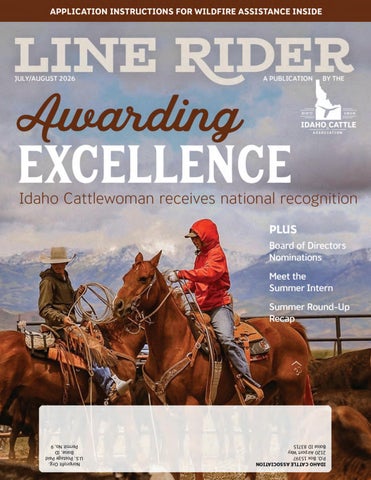
Cover Story: Awarding Excellence
Message from the EVP
8
Beef Improvement Federation: Idaho Hosts Leaders in Beef Improvement
Message from Natural Resources Policy Director
10
CattleWomen Council
14
Meet the IPLC/ICA Summer Intern!
30
Guest Column: A Few Thoughts
47
Cover photo by Bre Ashmead 4
LINE RIDER JULY/AUGUST 2026
Randall Raymond.... (Grand View) 208-599-0391
FEATURES 16
EXECUTIVE VICE PRESIDENT Cameron Mulrony........cameron@idahocattle.org MEMBER PROGRAMS & SERVICES MANAGER
22
Montana Ertel.................montana@idahocattle.org ADMINISTRATIVE ASSISTANT Michelle Johnson.......... michelle@idahocattle.org
U of I: Tools to Make Comparisons Across Beef Breeds
26
Summer Round-Up Recap
32
Idaho CattleWomen Council: Pretty, Functional Cowboy Gear
40
Member Awards
41
Young Cattlemen’s Conference
42
Young Cattle Producers Conference
ADMINISTRATIVE STAFF
43
NATURAL RESOURCES POLICY DIRECTOR Karen Williams..................karen@idahocattle.org Contact Idaho Cattle Association: Mailing address: P.O. Box 15397, Boise, ID 83715 Location: 2120 Airport Way, Boise, ID 83705 Phone: 208-343-1615
For advertising sales, contact: idahocattlepublications@gmail.com The Line Rider is the official publication of the Idaho Cattle Association. It is published 10 times each year, in January, February, March, April/May, June, July/August, September, October, November and December.
www.idahocattle.org
Board of Directors
NOMINATIONS Are you or someone you know interested in ICA leadership? The ICA Board of Directors is comprised of 23 members that meet to help direct the organization throughout the year. Nominations are due October 15th, 2026. MAIL TO: Idaho Cattle Association ATTN: Nominating Committee PO Box 15397 Boise, ID 83715 Or Call/Email: 208-343-1615, cameron@idahocattle.org
www.idahocattle.org
IDAHO CATTLE ASSOCIATION
5
MESSAGE FROM THE PRESIDENT
The strength beside us A tribute to the Idaho Cattlewomen whose strength, service, and steady influence sustain ranches, families, and the future of the cattle industry
“W
ho are Idaho Cattlewomen? We are experienced, skilled, and educated. We are young, passionate, and ready to learn. We are single and married. We are daughters, moms, grandmas, sisters, and aunts. We work beside our spouses and partners – roping, riding, and branding. We work the chute, give the shots, keep the records, and run the errands. We feed the crew and our families. We work other jobs in town to help support our ranching life-
My entire life, I have been blessed with the influence of saintly women. style. We teach and guide the younger generations. We care for the land and cattle. We support our family, our friends, and our neighbors. We volunteer in our communities, schools, and churches. We are diverse.” (ICA Website, Idaho Cattlewomen Council). My entire life, I have been blessed with the influence of saintly women. My mother, grandmothers, sisters, and now my wife and daughters. I grew up on a small dairy and beef cattle operation with two older
6
LINE RIDER JULY/AUGUST 2026
BY VAL CARTER ICA President
brothers, four younger sisters, and then another baby brother. My mother kept the books and my sisters helped move pipe and did other chores, but most of the cattle work was done by the boys. Maybe it was a different time culturally and women tended more to the domestic chores, or maybe we didn’t want them to know it was more fun driving cows than moving pipe. What I do know is, that they stepped up twice a year and milked the cows so we could go on a “boys only” horse pack trip and a hunting trip in the fall. Fast forward a few years to when Heather and I started a family. It began with three girls; Cheyenne, Cassidy, and Quincy. We finally got Colter, a boy, on the fourth try and then ended with our youngest daughter Josey. Whatever gender roles may have existed during my generation of the Carter family were soon abandoned, as we had 3 older daughters who took an active role with all of the usual ranch work, including roping, riding, and branding. When Colter reached an age where he could take on some of those responsibilities he would often argue with the girls that he was Dad’s “right hand man.” That was true, but I also had four “right hand women.” Through the years, I have been dependent on the talent and capable skills of many women in many capacities. The ICA has a seat on the Executive Committee
www.idahocattle.org
and Board of Directors for our Idaho Cattlewomen. They provide valuable knowledge and insight to our board meetings. Several have gone on to serve as President of the ICA. Idaho’s own Kim Brackett is currently the National Cattlemen’s Beef Association President-Elect and will take the reins of the nation’s largest cattle association in February. The ICA provides an opportunity to attend NCBA meetings, Public Lands Council meetings, and travel to Washington D.C. to meet with lobbyists and legislators. It has been impressive to see the many exceptionally talented and informed women involved in our cattle industry. At the risk of appearing to turn back the cultural clock, I would like to highlight another role our cattle women play, by quoting Sara Josepha Hale, a famous 19th century writer, activist, and editor. She wrote: “There is no influence so powerful as that of a mother.” Please allow me to include some history that may give Sara’s quote more credibility. Sara Josepha Hale (1788-1879) led a 17-year campaign to create a unified national holiday to help heal a fractured nation. This led President Abraham Lincoln to declare Thanksgiving a national holiday. She was a champion of women’s education and advocated for higher education for women. She also became the editor of the most widely circulated magazine in pre-civil war era, shaping American tastes in fashion, literature, and domestic science. What you may not know about Sara Josepha Hale is that she was also a mother, widowed at the age of 34 with five children to support. She then turned to writing to support her family. Sara was no stranger to the professional world; however, she viewed her role as a mother to be a more powerful influence than any other. Mothers can be the most dominant influence in their children’s lives. They help instill in them a love for learning, the confidence to achieve, and the resilience to endure hard things. Ranch life is the perfect setting to teach responsibility, work ethic, and respect for the land and livestock. When mom comes along to gather cattle, she takes a little more time to smell the flowers, and her focus is on the kids, not the cows. Those teaching moments on the trail have a more lasting impact than any lecture. My intent here is to let the women in our lives know how much we appreciate all they do. There isn’t always a lot of praise and recognition for taking care of the family and helping on the ranch. When asked about occupation, I have often heard the reply “I am just a mother.” Not every cattlewoman has a job in town. Some work off the ranch out of necessity, and some choose to have a career or business. If so, the professional world will be lucky to have them. However, if they have chosen to stay closer to home and focus on their family, the influence may be felt for generations. Know that you are enough as “just a mother.” Ladies, thank you for being who you are! www.idahocattle.org
Keeping Idaho farms safe and productive since 1968. Our employee owners are dedicated to ensuring you get the best tires and auto service.
WE PROUDLY
SUPPORT
IDAHO CATTLE ASSOCIATION
7
MESSAGE FROM THE EVP
Keeping track of tech How do you measure industry tools for your operation
T
echnology is always changing, and our industry has been flirting with new tools and how they can impact our operations. We all know that innovation moves at a rapid pace—what is new today may become obsolete in just the blink of an eye. The evolution of technology is fast and furious, as are the impacts of those same tools. Not long ago, I mentioned in a panel discussion that the biggest barrier for utilizing newly available technologies is still the cost. This comment drew some skepticism, as continued evolution has lessened the financial burden for some producers... but I still see many who don’t adopt a new tool simply because of the price point. I could use myself as
Technology continues to evolve, and many of today’s tools have reached a point where the benefits can outweigh the costs. an example: with a small herd and utilizing many small pastures to split and manage my cattle, the newest tools on the market don’t pencil out. For me, the juice just isn’t worth the squeeze. That said, technology continues to evolve, and many of today’s tools have reached a point where the benefits can outweigh the costs, depending on the size, goals, and resources of your operation. More producers are beginning to test new technologies, and finding value in doing so. Many of these conversations lead to the value of our time. How do you value your time? If the cost of technology is $10, $20, or even $100 per cow, how many hours do you need to save in order to cover the costs? 8
LINE RIDER JULY/AUGUST 2026
BY CAMERON MULRONY ICA Executive Vice President
Like many others in agriculture, we do not put a fair market value on our time, as we often just get the job done because it needs to happen... ranchers tend to be in a constant state of “clocked in.” I’ve often told my family and friends that if I did in fact have more time and money, I could get more done. This is not a secret, but even if the funds were available, time is still our most limiting resource. You can’t create more. I would encourage each of you to consider the value of your time and whether there is a tool, technological or not, that can give you back some of that most valuable resource. I recently had a conversation with a cattleman who lives in the Midwest. We were discussing discounts on calves based on hide color, horns, breed influence, and other market factors. During our conversation, he brought up a few thoughts that made me think a little differently. He explained that docility was a significant factor in the genetics he chose for his operation. Over the years, he had run multiple breeds before settling on genetics that best fit his business based on temperament. I asked him about the discounts he might see at the sale barn because of those breeding decisions. His response was simple: since selecting for docility, he had seen a significant reduction in veterinary bills and hospital expenses. To him, eliminat-
www.idahocattle.org
ing those costs alone was worth a decade of potential sale barn discounts. He also mentioned lower facility maintenance costs and the value of the time he had gained. Like many of us, he didn’t have an exact dollar value assigned to that time, but he made it clear that the genetic selection tools he utilized had paid dividends—not only to his bottom line, but also to his personal health and happiness. Now, if you’ve followed my ramblings over the years, you know I believe it takes all kinds of kinds to make the world go around. Not every tool works for every operation, but there are some factors to be considered that may not be calculated in a spreadsheet. So here is my challenge to you: put a value on your time. Once you have an estimate of your time value, look at a tool that you have been considering for your operation and evaluate the true cost of implementation. You may find a return on your investment when you consider the potential for opportunities. Saving yourself time and stress is worth something! After all, your time has value. Your peace of mind has value. And your family and friends certainly appreciate both. I hope you do, too. Finally, I invite you to join us in November for our annual meeting in Sun Valley. It will be a great time to visit with vendors, learn about new technologies, and exchange ideas. I think you will find the returns exceed the costs.
Is Proud To Support The Idaho Cattle Association
powderriver.com P: 800.453.5318 F: 801.377.6927
THE AUTHORITY IN LIVESTOCK HANDLING EQUIPMENT
TRUST THE BLUE TUB. Calves are more valuable than ever.
That’s why Vitalix tubs are built to deliver concentrated nutrition that calves need to thrive. With highly digestible vitamins and minerals, Vitalix supports health, growth and consistent performance. Learn more from your local sales manager today! Northern ID • Jason Bean • 509-794-9059 • jbean@vitalix.com Southern ID • Owen Albrecht • 385-335-1745 • oalbrecht@vitalix.com www.idahocattle.org
IDAHO CATTLE ASSOCIATION
9
MESSAGE FROM NATURAL RESOURCES POLICY DIRECTOR
An impactful day on horseback Strengthening Idaho’s agriculture industry partnerships
I
n today’s world of texting, social media scrolling, off camera zoom calling, and self-checkout stands, face to face communication is just about becoming a lost art, nearly as gone with the sands of time as home phone lines and letter writing. However, with its less frequent use, its value and effectiveness has increased rather than diminished. As a case in point, I give you the Governor’s Trail Ride event, hosted annually by the Idaho Cattle Association (ICA) and Governor Little. Over the course of the event, federal
When the formalities of business suits, board tables, and technologies are removed, it is quite remarkable what can be accomplished. agency leadership, representatives of state and federal natural resource agencies, local ranchers, and other stakeholders have the chance to interact and share ideas in an informal setting. Meeting on horseback and around the picnic table while overlooking state, private, and federal land offers a rare perspective that not only showcases the importance of active resource management, but provides the invaluable opportunity to look people in the eye and have meaningful conversations. It’s a setting that can not be replicated in the austere setting of an office building. Consequently, the event breaks down barriers, fosters relationship building, and leads to the transition of impersonal professional associates into meaningful friendships. The event, which moves around to different reaches of the state each year, was hosted this year 10 LINE RIDER JULY/AUGUST 2026
BY KAREN WILLIAMS ICA Natural Resources Policy Director
by former ICA President, Spencer Black and Black Livestock in Almo, Idaho in June. The location proved to be an ideal spot to foster solid working relationships between ICA, Governor Little, and various key government representatives, including Trump administration officials from Washington D.C. The landscape, in the shadows of the Albion Mountains under Cache Peak and near the famed City of Rocks, offered a perfect backdrop for dialogue on the need for management flexibility and coordination amongst state and federal land management agencies; we rode through all types of land from private to state to Bureau of Land Management (BLM) and Forest Service while on the trail ride. As you would suppose, outfitting government officials who typically have little to no horse-riding experience can be a challenge. Consequently, we intentionally keep the trail ride itself to a manageable size by limiting participation to ICA leadership, the governor, heads of state agencies, and key officials from the U.S. Departments of Agriculture and Interior. We then expand the opportunity for greater participation on the afternoon of the trail ride by hosting a discussion and dinner gathering at the campsite for additional agency staff, elected officials, and local ICA members who are all invited to also camp overnight. It is often at this discussion that we really get into the meat of key issues impacting Idaho ranchers and natural resource use and management in Idaho. With a full suite of activity coming out of Washington D.C. lately related to grazing issues, we certainly had an abundance of things to talk about. Key among those issues discussed was wildfire and fuels management. With the changes by the Trump administration to the wildfire management structure, we had questions related to how those changes www.idahocattle.org
would impact firefighting efforts on the ground. Sam Crofts, Department of Interior (DOI) Senior Advisor, shared that DOI Secretary Doug Burgum’s background is in running large organizations and identifying inefficiencies and gaps. He has taken this expertise and applied it to the government’s wildfire structure and organization in the creation of the National Wildland Fire Service (NWFS). The intent of the creation of NWFS is to consolidate DOI firefighting efforts under one structure, which will ultimately also include the Forest Service’s wildland fire division. While we support efforts to create greater government efficiencies, we also want to ensure that currently proactive and functional firefighting efforts are preserved. The Rangeland Fire Protection Associations (RFPAs), which have now been in existence in Idaho for over 10 years, have proven to be invaluable tools in initial attack of wildfires. With the restructuring of fire management, we want to ensure that RFPAs are able to continue working seamlessly with the federal government.
virtual fence. Management information collected by the collars, such as cattle movement and location, must be protected and kept private to the livestock owner. The agencies assured us that they too are concerned about this and are working on internal policy to provide for data privacy and protection. Brenda Younkin, DOI Deputy Assistant Secretary, provided an overview of the changes and improvements to grazing management through the updates to the BLM grazing regulations that will allow for more flexibility to manage the land and permits based on on-the-ground conditions. She also discussed how the department is shifting how they conduct NEPA across the scope of their decision-making. DOI has issued fifteen new NEPA categorical exclusions (CEs) that relate to grazing which should serve to streamline several processes related to managing grazing permits. ICA is in the process of reviewing those CEs and we will prepare a guide for our members so that grazing permittees can be aware of the opportunities presented by the changes.
IDAHO CATTLE ASSOCIATION MEMBERS, IDAHO STATE DEPARTMENT OF AGRICULTURE STAFF, DEPARTMENT OF INTERIOR PROFESSIONALS, AND SEVERAL INDUSTRY STAKEHOLDERS START TOWARD THE TRAIL, KICKING OFF A DAY OF KEY RANGELAND CONVERSATIONS.
Post fire rehabilitation was also a topic of discussion. We made sure to point out that after a fire, the landscape should be managed on a site-specific basis for return to grazing. There should not be automatic mandatory 2-year restrictions from grazing. Indications from both the Forest Service and BLM leadership are that they are being given direction that should better enable them to make those decisions on the ground, on an incident specific basis. We also discussed the opportunities that emerging technologies, such as virtual fences, provide in post fire return to grazing, but we also urged caution to the agencies that they don’t become mandated as the only available fire restoration tool and that fence and range improvement reconstruction are still prioritized. Another word of caution that we offered, and that we are working on solutions for, is the privacy of the data collected by www.idahocattle.org
Forest Service leadership in attendance discussed the administration’s efforts at both the Forest Service and BLM to reopen vacant allotments for grazing. In Region 4 of the Forest Service, it was reported that there are forty-six vacant allotments that may have the requisite NEPA work completed and infrastructure to allow for reopening, sixteen of which are in southern Idaho. The agency is currently working through its process to determine their availability and will then go through their designated grant process this fall to open them to grazing. After that process concludes, they will move onto the other vacant and closed allotments that will require more work to open. Governor Little concluded the formal portion of the discussion by urging all in attendance to follow through on the issues IDAHO CATTLE ASSOCIATION
11
LEFT: MEMBERS ENJOYED A DUTCH OVEN COBBLER DURING THE CASTLE ROCKS STATE PARK TOUR, ADDING A MEMORABLE CAMPFIRE MEAL TO A DAY OF EXPLORING IDAHO’S LANDSCAPES. RIGHT: ICA MEMBERS AND INDUSTRY STAKEHOLDERS TOURED CASTLE ROCK STATE PARK.
presented and work to make changes. Referring to the current political climate, regulatorily speaking, he said, “It’s times like this that we’re going to make progress. Don’t take your foot off the gas. Support ICA in their efforts and don’t get complacent because now is the time to make the changes we need.” On a personal note, I want to thank the individuals that helped make this event happen. Under the leadership of Ida-
AFTER THE TRAIL RIDE, PARTICIPANTS GATHERED AROUND THE TABLE TO CONTINUE CONVERSATIONS ON THE ISSUES SHAPING AGRICULTURE AND THE CATTLE INDUSTRY.
12 LINE RIDER JULY/AUGUST 2026
ho State Department of Agriculture (ISDA) Director Chanel Tewalt and Deputy Director Lloyd Knight, ISDA is an invaluable partner in the trail ride. ISDA staff serve as our camp cooks and provide excellent meals and service to participants. Governor Little’s Policy Director, Kristin Sleeper is a force to reckon with when it comes to understanding and guiding the state through difficult policy issues, but she is also a terrific partner in planning and carrying out this event. Several ICA board members generously gather tack and haul their horses across the state to provide a mount for government partners on the trail ride. Various government leaders set time aside in their schedule to attend the event and participate in meaningful dialogue. My experience, through several years of these annual trail ride events, has proved to me the immense value of this event. Because of conversations that took place at past trail rides, I have personally witnessed problems plaguing our industry being directly resolved and policy decisions being made based on information and suggestions presented on the trail ride. Beyond that, I have found doors open to us that would have otherwise been hard to get through which have facilitated further problem solving. When the formalities of business suits, board tables, and technologies are removed, it is quite remarkable what can be accomplished through walls coming down and friendships built. Year after year, the trail ride has more than proven its worth in building relationships between our industry and government decision makers and in turning campfire conversations into meaningful solutions and lasting, impactful interpersonal connections. www.idahocattle.org
N O C V E L N A T U I N O N A & Trade Show N NOVEMBER 9-11, 2026
Sun Valley, Idaho
CATTLEWOMEN COUNCIL
Who is a Cattlewoman? Defining the women of the beef industry
T
he term “cattlewoman” might conjure images of rugged women like Annie Oakley and Calamity Jane tending vast herds under open skies, but the reality is both broader and deeper. Yes, the term “cattlewoman” evokes images of resilience, strength, and dedication. Yet, it encompasses so much more than just the care and management of cattle. A cattlewoman is a multifaceted individual who plays a crucial role in the livestock industry, contributing not only to the Idaho landscape, but also to the cultural and social fabric of agricultural communities.
BY CHRISTIE PRESCOTT CattleWomen Council Chair
women can thrive in the rugged landscape of the West. Women are now actively involved in all aspects of the cattle industry, from ranch management to veterinary medicine, and from agricultural research to advocacy. They are leaders in sustainability, focusing on practices that ensure the long-term health of the land and animals.
THE ROLE OF A CATTLEWOMAN
In the American West, women worked alongside men to establish and maintain ranches. They were instrumental in the success of family-owned oper-
The future of cattlewomen is promising, with opportunities for education, networking, and leadership development. ations, often taking on additional tasks like bookkeeping and educating their children. These early cattle women were often unsung heroes, juggling domestic responsibilities while contributing to the survival of their families. Beyond these hands-on tasks, she often engages in financial planning, marketing, and community outreach. Today, the image of the modern cattlewoman is one of empowerment and expertise. Women like Temple Grandin and Beth Dutton have become symbols of independence and strength, showing the world that 14 LINE RIDER JULY/AUGUST 2026
Cattlewomen are integral members of their communities, often participating in local agricultural boards, fairs, and educational programs. They serve as advocates for the agricultural industry, promoting sustainable practices and supporting initiatives that benefit rural areas. Their contributions help preserve the traditions and values that define agricultural life, while also embracing innovation and change. The future of cattlewomen is promising, with increasing opportunities for education, networking, and leadership development. Organizations like the American National CattleWomen (ANCW) provide valuable resources and support, helping women connect, share knowledge, and advocate for their interests. The advent of technology has revolutionized the cattle industry, and women have been at the forefront of this transformation. Modern cattlewomen utilize everything from GPS tracking for herd management to data-driven approaches for improving cattle health and productivity. Social media has also become a powerful tool for connecting with consumers, sharing stories, and promoting the importance of sustainable ranching practices. By www.idahocattle.org
sharing their stories and knowledge, they empower other women to pursue careers in agriculture and contribute to a more diverse and inclusive industry. Many cattlewomen are committed to sustainable farming practices that protect the environment and preserve natural resources. They employ techniques such as rotational grazing, integrated pest management, and soil conservation to minimize their ecological footprint. Their stewardship ensures that the land remains productive and healthy for future generations. A cattlewoman is a vital force in agriculture, embodying strength, wisdom, and perseverance. Her contributions extend beyond her own farm or ranch, impacting the community, environment, and society at large. The reach of a cattlewoman spans from the day-to-day management of cattle to shaping the future of agricultural policies and practices. As the world continues to evolve, so too will the role of cattlewomen, ensuring that they remain vital contributors to the global food supply and rural communities. The journey of a cattlewoman is one of passion and perseverance, grounded in a deep connection to the land and integral part of the agricultural world. By celebrating and supporting cattlewomen, we not only acknowledge their invaluable contributions but also pave the way for a more inclusive and sustainable agricultural future. They blend tradition with innovation, ensuring that their ranches are not only successful but also sustainable for future generations. Their lives are a mix of grit and grace, where hard work meets heartfelt dedication.
57 Years of Manufacturing Excellence
HONORING THE SPIRIT OF IDAHO CATTLEWOMEN
Being a cattlewoman is truly a lifestyle! It’s not just about dressing the part; sometimes it means postponing your hair appointment for preg checking. If you find yourself nodding along, wear that cattlewoman badge with pride, as you are an essential part of a legacy that keeps the world moo-ving and grooving! “The connections between and among women are the most feared, the most problematic, and the most potentially transforming force on the planet” ~Adrienne Rich Whether you are a cattlewoman all the time or just once a year, have mud on your boots or only wear boots to the Snake River Stampede, take a moment to honor the spirit of all these extraordinary women. If you are the one who prepares and delivers the lunches or cleans and fills the syringes, you are making a valuable contribution to this important industry. Whether you’re out daily feeding cattle or working in an office while never missing your friends’ branding, your dedication to the livestock industry is truly inspiring. So, cheers to the Idaho cattlewoman—may their coffee be as strong as their fences, and may their herds and kiddos flourish like wildflowers! www.idahocattle.org
IDAHO CATTLE ASSOCIATION
15
COVER STORY
BY BAILEY STORMS
ICA CATTLEWOMEN BOARD REPRESENTATIVE
16 LINE RIDER JULY/AUGUST 2026
www.idahocattle.org
Awarding
Excellence Idaho Cattlewoman receives national recognition. www.idahocattle.org
IDAHO CATTLE ASSOCIATION
17
he beef industry is built by people who are willing to put in the work long before anyone notices. Whether it is serving on committees, volunteering at events, talking to consumers about beef, or helping teach the next generation, there are countless people who give back because they care about the future of the industry. Those efforts often happen behind the scenes, but they make a lasting impact on producers, consumers, and communities alike. If you’ve attended an Idaho Cattle Association (ICA) event in the last 15 years, there is a strong chance that you have met Laurie and Tim Munns. Laurie is a steady presence within the Idaho CattleWomen Council, bringing experience from the ranch and various levels of involvement to offer good advice, ideas, and perspective to
18 LINE RIDER JULY/AUGUST 2026
the meetings. Laurie has been ranching alongside Tim in Idaho and Utah for the past 40+ years.
A LIFETIME OF INFLUENCE
Earlier this year, Laurie was recognized by American National CattleWomen (ANCW) in Nashville, Tennessee
www.idahocattle.org
LAURIE RECEIVES EDUCATOR OF THE YEAR AWARD AT THE 2026 AMERICAN NATIONAL CATTLEWOMEN’S ANNUAL MEETING, HELD IN NASHVILLE, TN.
as the ANCW Educator of the Year, thanks to a nomination from the Utah Cattlewomen’s Association. Laurie was recognized for her decades of dedication to educating people of all ages about the beef industry. Some of the areas she is especially passionate about are youth education and the Beef Checkoff programs. An example of how she practices actively educating those around her is that she and Tim go to Utah State University each fall to guest lecture on beef production, sharing their vast knowledge with students. Laurie’s family surprised her by being in attendance at the award ceremony, which was a huge moment for their family. When asked what receiving the award meant to her, Laurie shared that it was an honor to be recognized by her peers for what she has contributed; it showed that her input had value. Even though being in the spotlight is not necessarily Laurie’s favorite thing, it was a welcome moment for all the years of hard work and dedication that had gone into it. Laurie’s involvement within the beef industry has spanned over 30 years through Utah Cattlemen’s Association, Idaho Cattle Association, and the National Cattlemen’s Beef Association (NCBA). Operating in two states, Utah in the winters and Idaho in the summers, has proven to bring its own set of challenges. The Munns’ have had to be very up-to-date in the latest health and brand regulations for crossing the UT/ID border, and it comes with a lot of logistics. They actively decided to be involved with both Utah and Idaho Cattle Associations due to feeling like they could gain knowledge from both and bring ideas based on their experience sitting at those other tables. www.idahocattle.org
Even though being in the spotlight is not necessarily Laurie’s favorite thing, it was a welcome moment for all the years of hard work and dedication that had gone into it. When asked what her why is, Laurie said, “we all get to live this life, we need to give back to the industry what it has given to us.” The friendships made across the organizations she and Tim are involved in has proven to be invaluable.
STEWARDSHIP BEYOND THE RANCH
This wasn’t the first time that Laurie was recognized on a national level: in 2024 she and Tim were recipients of the Leopold Conservation Award. This highlighted their dedication to conservation for the benefit of their ranch as well as the environment and wildlife around them. They have worked with a number of agencies to practice sustainability within their operation, focusing IDAHO CATTLE ASSOCIATION
19
on building up their vegetation and soil. They have also worked tirelessly to rid their ranch of invasive weeds and work with the applicable agencies to treat them. The Sand County Foundation credits them with their upgrades to water systems and how they conserve that resource in the arid regions that they operate in, playing a key role in an increase to various bird populations where they run their cattle. They have not only been cattle ranchers, but they have been true stewards of the land.
A LEGACY WORTH CELEBRATING
Laurie’s favorite ranch task is getting to ride in the mountains checking water troughs, and her least favorite is pulling a truck to start. Her role on the ranch has evolved over the years from mom and caretaker to then running a tractor and working cows. Now, as their operation starts to transition to the next generation, she is getting to enjoy time with her grandchildren. “We have been blessed, there is a God-given beauty in what we do, and it is because of that to be able to live where we live and have the freedoms we have.” When asked what advice she would give her 20-year-old self, she said, “enjoy life, it goes by so fast and when you are young you have the world by the tail, but it goes by fast.”
While awards are a special way to recognize someone’s contributions, they only tell part of the story. The real impact comes from the countless conversations, volunteer hours, and relationships built over the years. Laurie has spent much of her life helping others learn about the beef industry, whether that was through teaching students, mentoring fellow producers, or representing cattle producers through the organizations she serves. She has always been willing to share her experiences and help others find their place within the industry. People like Laurie remind us why organizations like Idaho CattleWomen Council and the Idaho Cattle Association are so important. They are built by members who are willing to give back, share what they have learned, and make the industry stronger for the next generation. Laurie has done exactly that throughout her career. Her recognition as the American National CattleWomen Educator of the Year is a reflection of the respect she has earned from her peers, but it is also a celebration of the example she continues to set. Through her dedication to ranching, conservation, education, and service, she has made a difference that will continue to be felt for years to come. The Idaho CattleWomen Council would like to thank Laurie for her countless contributions, presence and openness to help teach others, and we feel fortunate to have her as part of our organization.
TOP NOTCH FEED & FENCE
Work Hard Feed Right Fence Strong
FENCE BUILT
01. TO LAST
Everything you need to get the job done right: • Posts • Panels • Wire • Gates • Tough, Reliable Materials
YOUR HERD 02. KEEP STRONG
High-quality livestock supplements that support: • Growth & Weight Gain • Herd Health • Peak Performance
208.642.2134
20 LINE RIDER JULY/AUGUST 2026
Top Notch Feed & Fence
1340 S. 16th St. Payette, ID
www.idahocattle.org
MAKE THE CO-OP CHOICE
Propane, bulk fuel, oils & lubricants
RETAIL
Farm supply, clothing, boots, fencing & feed
AGRONOMY
vwcenergy.com
shop.valleywidecoop.com
valleyag.com
ENERGY
Precision agriculture, fertilizer & seed
A Box For ALL Seasons Rumax BoviBox
RUMAX BOVIBOX
1 0 0 l b N o- M e l t fo rmul a i n bi o degra da bl e a n d e d ib le pa cka gi ng. Co m pl e te ye a r - ro und vi ta mi n, mi nera l a nd p rote in suppl ement. S uppo r t for m a x i mum perfo rma nce a nd effic ie n cy at a l l pro ducti o n sta ges. I m p rove d i g e sti o n, bo dy co ndi ti o n, repro d u c t io n a nd feta l grow th. Co nta i ns Avai l a 4 a nd Bovi a ci l l us Pro du c t io n Pl us o pti o n.
In addition to a full vitamin and mineral package it has 30% crude protein along with high levels of mono and poly unsaturated fat and a live multispecies probiotic for improved immunity and reproduction NOW WITH MULTI-SPECIES LIVE PROBIOTIC!
BOVIBOX NATURAL
Has all the benefits of a quality mineral and vitamin package with 20% all-natural protein and the same high mono and poly unsaturated fat and live probiotic combination to boost immunity and reproduction NOW WITH MULTI-SPECIES LIVE PROBIOTIC!
Multiple Formulations to serve your nEEds ˜°˛˝˙˜˝ˆˇ ˆ ALL-Season ˜ Formula
Easy ˆto ˙˜˝ ˝ ˙ ˝˙ disperse
ˆˇ˝ ˝ ˙ˇ ˆˇ˝ Consistent ˆˇ Consumption
F i n d o u t m o r e at P e r fo r m i x n u t r i t i o n .c o m | 8 0 0 .4 2 6 .3 5 7 2
www.idahocattle.org
IDAHO CATTLE ASSOCIATION
21
BEEF IMPROVEMENT FEDERATION
Idaho Hosts Leaders in Beef Improvement Beef Improvement Federation 2026 comes to Boise. BY JOHN B. HALL AND J. BENTON GLAZE, JR.
Extension Beef Specialists University of Idaho
T
he Idaho Cattle Association and the University of Idaho teamed up to host the 2026 Beef Improvement Federation (BIF) Research Symposium & Convention on June 1-4 in Boise. With 416 attendees, the meeting filled the Boise Center with seedstock and commercial beef producers, genetic company representatives, scientists, Extension specialists and allied industry personnel. The crowd, mostly from North America, but some from as far away as New Zealand, was actively engaged in meetings and discussions during the breaks and trade show. The Idaho BIF Steering Committee (see inset) worked with the BIF board to design a program that was relevant to Pacific Northwest and intermountain beef producers. Creating a meeting that featured Idaho hospitality was important to the committee. In addition, they helped raise sponsorship funds to
22
LINE RIDER JULY/AUGUST 2026
enhance the quality of the meetings. Finally, the group created opportunities to showcase the Idaho beef industry particularly through Thursday’s tours. The two and a half days of meetings were kicked off Monday afternoon with a Young Producers session focused on “Rebuilding the Herd” which included strategies for younger producers to enter or expand in the business. Subjects included a look into the future of the beef value chain, replacement heifer selection tools, and financial and risk management strategies. The evening concluded with the Opening Reception featuring Simplot Lot 29 Charolais prime beef, finger steaks, sidewinder fries, and other Idaho favorites. Governor Brad Little welcomed everyone to start the first full day of meetings and discussed the breadth and value of Idaho agriculture to the state and the country. The general session focused on the current and future economic climate for beef and strategies for improving efficiency of the Western beef cow. Afternoon breakout sessions keyed in on three main top-
ics: Advancements in Producer Applications featuring tools for improved breeding cattle selection, Advancements in Genetic and Genomic Prediction focusing on emerging abilities for the identification of genetic indicators for health, and Advancements in Efficiency and Adaptability keying in on multiple aspects of bovine congestive heart failure. Graduate students had over 15 posters on their beef genetics related research on display Tuesday and Wednesday. Dinner featured a Basque style buffet featuring paella, lamb, and other regional dishes. The final meeting day, participants, groggy from the past evenings discussions, were welcomed by Dr. Matt Powell, UI Interim Associate Dean for Research and head of the Idaho Agricultural Experiment Station who focused on the College of Agriculture’s commitment to beef research. The final general session feature presentations on capturing the value of genetic investment. From Simplot’s maternal-terminal system to Country Natural Beef’s program to systems leveraging beef x dairy genetics, the range
www.idahocattle.org
of opportunities to receive compensation from investment in beef genetics was clear. Afternoon breakout sessions included: Advancements in Emerging Technology focusing on the gamut of “wearable technology” for cattle management as well as gathering data, Advancements in End Product Improvement providing information ranging from liver abscesses to grading for Wagyu type cattle to carcass ultrasound, and Advancements in Selection Decisions examining the current status of genomic testing, the potential and challenges for gene editing, and tools for science-based selection. The attendees dispersed for the evening across Boise for private dinners, meetings or just to enjoy the Boise nightlife. Some other Idaho highlights of the 2026 BIF Meeting included: • Colyer Hereford and Angus receiving the BIF Seedstock Producer of the Year. • SS Cattle Company named as a national finalist for BIF Commercial Producer of the Year • Wyatt Prescott and Jay Smith giving their views on heifer selection. • Dr. Justin Buchanan, Simplot, discussing the relationship between bovine congestive heart failure and bovine respiratory disease. • Dr. Randle Raymond presenting “Leveraging Genetic Decisions Across the Value Chain: The Simplot Story.” • Dr. John Hall receiving one of the BIF Continuing Service Awards. The final day of the meetings are always tours of the host state’s beef industry. From the tours listed below, you can see the steering committee did an excellent job. In fact, we had to find some extra seats for folks. The tours covered the Idaho beef industry from conception to consumption with some allied industry along the way. The gracious hosts at the individual stops made the tours great and we were always behind schedule due to superb questions and interactions. Extra special stops included lunches at Colyer’s www.idahocattle.org
and PerforMix as well as Cleo Shaw’s paella (and some beverages) at Shaw’s. The 2026 BIF Meeting could not have happened without tremendous teamwork. The Idaho Steering Committee was fantastic, and Cameron and the ICA Staff were amazing. The BIF staff managed huge amounts of the logistics, and NCBA staff handled all the registration. University of Idaho Extension Educators provided some of the AV equipment and helped with setup. A special thank you to the tour stop hosts. To all the organizations and individuals that provided sponsorship https://beefimprovement. org/2026-symposium/2026-symposium-sponsors/, you allowed us to produce a great meeting. All of you are the reason we heard so many compliments about the meeting as well as “Thank you for bringing BIF to Idaho.” If you did not get a chance to attend the BIF meetings this year, we hope you are thinking “I missed out.” Well, over the next few months, the Beef Improvement Federation will be posting proceeding papers and presentation recordings, so you still have a chance to view topics that are of interest you at https:// beefimprovement.org/2026-symposium/2026-presentation-archive/. Also consider attending a BIF Research Symposium & Convention. Next year, it will be in Missouri, and it will be worth the trip. Where else could you actually sit down with Donnell Brown of Texas, Tucker Shaw from Idaho, Bill Tucker from Virginia, and Dr. Matt Spangle of the University of Nebraska and listen to and participate in the conversation? There is no other meeting where such a diverse group of leaders and thinkers in the beef industry come together to discuss methods for making better, more efficient cattle that produce an amazing product for the consumer.
Tour 1: Idaho Beef Industry – Conception to Harvest Stop 1: CS Beef Packers and Simplot AS IVF lab – Kuna
Stop 2: TLK Dairy and Feed Center – Mountain Home Stop 3: Colyer Hereford and Angus Ranch, Purebred Breeder – Bruneau (Lunch Sponsor) Stop 4: Simplot Land and Livestock Feedlot – Grandview Stop 5: Reynolds Creek Calf Ranch, Beef/Dairy Crosses – Melba
Tour 2: Idaho Beef Industry – Integrating Idaho Agriculture with Beef
Stop 1: Joint Stop Combining Amalgamated Sugar Company & PerforMix Nutrition Systems Liquid Supplement Plant – Nampa Stop 2: Boise Valley Feeders – Agri Beef/ Johnson’s Feedlot – Parma Stop 3: PerforMix Nutrition Systems Dry Mineral and Block Plant – Fruitland (Lunch Sponsor) Stop 4: M&M Feedlot, Dairy Calf and Heifer Development – Parma Stop 5: Shaw Cattle Company, Purebred Breeder – Caldwell
2026 BIF IDAHO STEERING COMMITTEE Guy Colyer Colyer Hereford & Angus Val Carter Carter Angus Tucker Shaw Shaw Cattle Company Jeremey Howard Simplot Marty Gill AgriBeef/PerforMix Nutrition Jared Patterson Western Livestock Journal Cameron Mulrony Idaho Cattle Association Benton Glaze University of Idaho John Hall University of Idaho
IDAHO CATTLE ASSOCIATION
23
FOR IMMEDIATE RELEASE Contact: Katie Wagner, Beef Improvement Federation Communications, beefimprovementfed@gmail.com, 573-239-3050 June 3, 2026
Colyer Herefords and Angus Named BIF Seedstock Producer of the Year BOISE, Idaho – The Beef Improvement Federation (BIF) recognized Colyer Herefords and BOISE, Bruneau, Idaho – The Beef Improvement (BIF) recognized Colyer Herefords and Angus, Angus, Idaho, as the 2026 Federation BIF Seedstock Producer of the Year on June 3 during Bruneau, Idaho, as theresearch 2026 BIFsymposium Seedstock Producer of the Year This on June 3 duringaward the group’s annual a the group’s annual in Boise, Idaho. national recognizes producer’s dedication to improving beef industry at the seedstock research symposium in Boise, Idaho. Thisthe national award recognizes a producer’slevel. dedication to improving the beef industry at the seedstock level. Rooted in Bruneau, Idaho, since 1876, Colyer Herefords and Angus represents a masterclass in balancing multi-generational heritage with cutting-edge genetic progress. Today fifth, sixth and seventh generations of the family manage the ranch, Rooted the in Bruneau, Idaho, since 1876, Colyer Herefords andColyer Angus represents a masterclass in balancing which has evolved from a traditional commercial cow-calf operation into one of the multi-generational heritage with cutting-edge genetic progress. Today the fifth, sixth and seventh nation’s premier seedstock programs. generations of the Colyer family manage the ranch, which has evolved from a traditional commercial
The Colyer philosophy on a “commercial-first” mindset. After a strategic shift in cow-calf operation into oneisofbuilt the nation’s premier seedstock programs. 1992 to focus entirely on seedstock, the family dedicated itself to producing Hereford and Angus genetics that thrive in the rugged western environment. A hallmark of the family’s The Colyerisphilosophy is builtof on“black a "commercial-first" mindset. After a strategic shifttoin improve 1992 to focus program the production baldie” females, leveraging heterosis fertility and longevity their customers. entirely on seedstock, the for family dedicated itself to producing Hereford and Angus genetics that thrive in the rugged western environment. A hallmark of the family’s program is the production of “black baldie”
What truly sets the Colyers apart is their early and unwavering adoption of technology. females, leveraging their heterosis improve fertility andtolongevity for their customers. Platinum TPR From purchasing firsttocomputer in 1984 achieving the prestigious status, a distinction held by only 23 Hereford breeders in the U.S., the ranch prioritizes data integrity. By utilizing artificial insemination, embryo transfer (ET), in vitro fertilization What truly sets the Colyers apart is their early and unwavering adoption of technology. From purchasing and genomic testing, they provide commercial cattlemen with a level of predictability that their first in 1984 to achieving the prestigious Platinum TPR status, a distinction held by only is rare incomputer the industry. 23 Hereford breeders in the U.S., the ranch prioritizes data integrity. By utilizing artificial insemination,
Their to consumption” is further evidenced by with embryocommitment transfer (ET),to in the vitro“conception fertilization and genomic testing, chain they provide commercial cattlemen their direct involvement in marketing their customers’ feeder cattle, ensuring that Colyer a level of deliver predictability rare in the industry. genetics valuethat at is every level of the beef industry. The cow herd of approximately 200 registered Herefordbyand registered Theircurrent commitment to the consists “conception to consumption” chain is further evidenced their200 direct Angus females, along with roughly 300 recipient cows used in their ET program. The involvement in marketing their customers' cattle, ensuring that Colyer geneticsbull deliver at ranch markets cattle through multiplefeeder annual events, including an annual salevalue hosted every level of the beef industry. in February, Frozen Genetics Sale on March 3, 2026, and the 25th Annual Female Sale scheduled for October 3, 2026.
24 LINE RIDER JULY/AUGUST 2026
www.idahocattle.org
“For nearly 150 years, the Colyer family has made a lasting impact on commercial cow herds across the United States by supplying Hereford and Angus genetics rooted in disciplined selection, comprehensive data collection and a focused breeding program,” says Shane Bedwell, American Hereford Association chief operating officer. “Their longevity, combined with a forward-thinking approach to genetic improvement, is something that should be admired across the beef industry.” Beyond the ranch gates, the Colyer family remains deeply embedded in their community and industry. With family members serving as EMTs, school board trustees and industry leaders, their impact extends far beyond the cattle they sell. The American Hereford Association nominated Colyer Herefords and Angus for this award, which is sponsored by Drovers. Approximately 400 beef producers, academia and industry representatives attended the organization’s 58th Annual Research Symposium and Convention in Boise, Idaho. BIF’s mission is to help improve the industry by promoting greater acceptance of beef cattle performance evaluation. For more information about this year’s symposium, including additional award winners and coverage of meetings and tours, visit BIFSymposium.com. ### The Beef Improvement Federation (BIF) is an organization dedicated to coordinating all segments of the beef industry — from researchers and producers to retailers — in an effort to improve the efficiency, profitability and sustainability of beef production. The organization was initiated more than 50 years ago to encourage the use of objective measurements to evaluate beef cattle. Continuing the tradition, BIF is now the clearinghouse for developing standardized programs and methodologies for recording of performance data for all traits, from birth weights to carcass traits. Its three-sided logo symbolizes the link between industry, extension and research.
Colyer Herefords and Angus of Bruneau, Idaho, was honored on June 3 as the 2026 Beef Improvement Federation Seedstock Producer of the Year at the 58th Annual BIF Research Symposium and Convention in Boise. Pictured L-R include: Angie Denton of Drovers, Guy Colyer, Katie Colyer, Cruz Colyer and BIF Board President Gordon Hodges.
www.idahocattle.org
IDAHO CATTLE ASSOCIATION
25
UNIVERSITY OF IDAHO
Tools to Make Comparisons Across Beef Breeds How do the tools in your toolbox measure up? BY J. BENTON GLAZE, JR., Ph.D.
Extension Beef Cattle Specialist Animal, Veterinary & Food Science Department University of Idaho
S
ince the release of the first national sire summary in 1971, beef cattle producers have been using expected progeny differences (EPD) to assist them in making selection decisions. Expected progeny differences are estimates of the differences in performance of future progeny from two or more sires from the same breed. Expected progeny differences are specific to the breed from which they were generated and cannot be compared across breeds. This is due in part to the computations of EPD being done separately for each breed, the different base adjustments used by the breed associations, the differences in genetic trends for traits within the breeds, and the limited amount of information from comparisons of animals from different breeds. A host of beef producers have benefited from using EPD to select animals to meet defined or desired production goals. However, since EPD are specific to the breed from which they were generated and cannot be compared from one breed to another, commercial beef producers using crossbreeding have found challenges in using EPD.
26
LINE RIDER JULY/AUGUST 2026
To address these challenges, the concept of across-breed adjustment factors was employed. For several years, researchers at the United States Department of Agriculture’s Meat Animal Research Center (USMARC) in Clay Center, Nebraska have evaluated breeds, collected data, and developed tables of adjustment factors that account for differences between breeds. These adjustment factors, along with other useful tools and information, are updated annually and presented at the Beef Improvement Federation (BIF) Research Symposium and Convention (https://beefimprovement.org) which was recently held in Boise (see related story in this issue). The most recent list of evaluated breeds and their acrossbreed adjustment factors are presented in Table 1. An example of how to use the adjustment factors to calculate an across-breed EPD follows. To calculate an across-breed EPD, you need a current EPD from a breed association sire summary and a current across-breed adjustment factor for the same breed and trait. Consider a Hereford bull with a carcass weight EPD of +100.0 lbs. and a Gelbvieh bull with a carcass weight EPD of +100.0 lbs. The across-breed adjustment factors (presented in Table 1) for yearling weight are -68.2 lbs. for Hereford and -17.5 lbs. for Gelbvieh. To calculate an across-breed yearling weight EPD for the Hereford and www.idahocattle.org
Gelbvieh bulls, simply add the adjustment factor to the bull’s original EPD. The across-breed carcass weight EPD is 100.0 lbs. + (-68.2) lbs. = 31.8 lbs. for the Hereford bull and 100.0 + (-17.5) lbs. = 82.5 lbs. for the Gelbvieh bull. The expected difference in progeny yearling weights when both bulls are mated to cows of another breed would be about 50 pounds (82.5 lbs. – 31.8 lbs. = 50.7 lbs.). In other words, there is a fair amount of difference in what these bulls can provide in terms of carcass weight potential to their progeny. As producers switch between breeds and select bulls for their commercial/ crossbreeding programs, they often compare EPD values for economically important traits. Taken at face value, these bulls look identical for yearling weight growth. However, as previously mentioned, these bulls cannot be compared directly, and their within-breed EPD must be adjusted to make a fair and accurate comparison. Once the adjustment is made, a direct comparison of the bull’s adjusted EPD can be made. From the comparison, it is clear that the Hereford bull lacks (approximately 50 lbs. less) the carcass weight potential of the Gelbvieh bull. The expected carcass weight difference of progeny when both of these sires are mated to cows of another breed would be 50 lbs. In other words, the progeny of the Hereford bull is expected to have, on average, 50 lbs.
lighter carcasses than the progeny of the Gelbvieh bull. It is well known that traditional, within-breed EPD have associated accuracy values that range from zero (low accuracy; EPD likely to change) to one (high accuracy; EPD not likely to change). These accuracy values reflect the amount of data/information use in the EPD calculations and how much the EPD might change over time as more data/information is included in the calculations. While not listed specifically, accuracies for across-breed EPD are similar to the original within-breed EPD accuracies. The across-breed EPD accuracies contain a small amount of additional error that is associated with the estimation of the adjustment factors. Generally, the accuracy of the across-breed EPD can be gauged by taking into account the accuracies of the within-breed EPD. Table 1 provides the adjustment factors that are necessary to directly compare the EPD of bulls from different breeds. Table 2 is a presentation of the breed of sire means from the breeds of cattle evaluated at USMARC. The values in Table 2 are different than the additive adjustment factors in Table 1, so they have different intended uses. As mentioned previously, the adjustment factors (values in Table 1) allow for a fair comparison of EPD of bulls from different breeds (e.g., Hereford bull’s EPD compared to
Table 1. 2026 adjustment factors used to estimate across breed expected progeny differences (EPD). (USDA-MARC, 2026; BIF, 2026) Birth Weight
Weaning Weight
Yearling Weight
Maternal Milk
Marbling Score
Ribeye Area
Fat Thickness
Carcass Weight
Angus
0.0
0.0
0.0
0.0
0.00
0.00
0.000
0.0
Hereford
0.8
-14.3
-24.0
-12.8
-0.25
0.01
-0.068
-68.2
Red Angus
2.3
-19.4
-21.2
0.8
-0.04
0.32
-0.029
-3.8
Shorthorn
4.0
-21.9
-20.1
0.2
-0.03
0.29
-0.027
-7.3
South Devon
2.9
-27.9
-44.2
4.5
-0.09
0.27
-0.036
-20.7
Beefmaster
3.1
25.7
20.2
6.8
-
-
-
-
Brahman
8.6
54.9
19.7
13.2
-0.67
0.08
-0.141
-37.4
Brangus
3.1
28.9
24.3
12.6
-
-
-
-
Santa Gertrudis
4.5
39.8
45.2
20.8
-0.38
0.20
-0.077
1.1
Braunvieh
1.6
-16.0
-30.6
18.2
-0.03
0.49
-0.041
-16.9
Charolais
7.3
6.0
-13.0
-1.8
-0.27
0.76
-0.179
10.2
Chiangus
3.0
-14.6
-22.3
-1.8
-0.48
0.48
-0.116
-27.7
Gelbvieh
2.9
-8.6
-15.9
6.0
-0.44
0.62
-0.088
-17.5
Limousin
1.7
-3.9
-14.6
-8.9
-0.22
0.62
-0.062
-11.5
Maine-Anjou
1.6
-27.2
-34.5
-6.4
-0.45
0.85
-0.146
-35.8
Salers
2.3
-9.4
-14.7
3.8
-0.15
0.45
-0.064
-21.2
Simmental
2.2
-10.9
-16.8
0.0
-0.08
0.43
-0.051
-4.0
Tarentaise
1.9
26.6
13.8
15.1
-
-
-
-
Breed
www.idahocattle.org
IDAHO CATTLE ASSOCIATION
27
Table 2. Breed of sire means for 2024 born animals under conditions similar to USMARC. (USDA-MARC, 2026; BIF, 2026) Birth Weight
Weaning Weight
Yearling Weight
Maternal Milk
Marbling Score
Ribeye Area
Fat Thickness
Carcass Weight
Angus
84.9
544.9
987.0
520.4
6.33
13.79
0.672
927.4
Hereford
87.0
517.2
930.3
508.6
5.38
13.53
0.605
874.1
Red Angus
84.2
522.5
949.0
521.2
5.91
13.49
0.632
888.5
Shorthorn
89.0
498.9
908.9
516.6
5.40
13.68
0.544
867.1
South Devon
87.4
506.6
908.0
514.3
5.35
13.72
0.513
846.3
Beefmaster
87.1
528.9
923.3
510.3
-
-
-
-
Brahman
94.2
547.8
916.7
513.6
4.83
13.40
0.510
849.9
Brangus
86.7
528.6
934.4
513.9
-
-
-
-
Santa Gertrudis
88.1
525.9
923.7
515.1
5.17
13.30
0.573
870.3
Braunvieh
87.1
509.9
902.4
528.5
5.51
14.17
0.499
848.5
Charolais
89.7
544.7
966.7
517.6
5.35
14.55
0.486
906.2
Chiangus
88.6
512.3
919.7
508.6
5.31
13.98
0.515
871.7
Gelbvieh
86.3
539.3
960.1
523.4
5.37
14.19
0.543
888.9
Limousin
86.5
538.9
995.4
510.5
5.33
14.44
0.548
893.9
Maine-Anjou
86.6
488.5
884.2
507.6
5.16
14.22
0.477
848.1
Salers
86.2
519.8
924.1
515.9
5.21
14.18
0.502
860.1
Simmental
87.2
543.1
965.2
517.5
5.59
14.35
0.530
899.0
Tarentaise
86.1
517.3
904.3
509.5
-
-
-
-
Breed
Gelbvieh bull’s EPD). The breed of sire means (values in Table 2) provides a sense of how progeny from one sire breed will differ from progeny of another sire breed when those sire breeds are mated to another unrelated crossbred group of cows. For example, if you take the birth weight breed of sire means for Hereford and Gelbvieh, you will see a difference of 0.7 lbs. [Hereford (87.0) – Red Angus (86.3) = 0.7]. Therefore, we would expect, on average, calves sired by Hereford bulls to weigh 0.7 lbs. more at birth than calves sired by Gelbvieh bulls. The values provided in Table 2 provide producers with a picture of how breeds change over time and allow them to identify the breeds to implement in their breeding program. Since the 1970’s, beef cattle producers have benefitted from using EPD to select animals to meet defined or desired production and marketing goals. However, as producers strive to identify the best sires to use in commercial breeding situations, they face challenges such as not being able to directly compare the EPD of sires from one breed to those of sires from another breed. The tools (adjustment factors) and information (breed of sire means) generated at USMARC and presented on the BIF website can assist producers as they seek to select sires to improve/optimize economically important traits in their herds. 28
LINE RIDER JULY/AUGUST 2026
Let us watch the market while you run your operation. Choose Livestock Risk Protection with StoneX for market expertise.
The trading of derivatives such as futures, options, and over-the-counter (OTC) products or “swaps” may not be suitable for all investors. Derivatives trading involves substantial risk of loss. Past results are not necessarily indicative of future results. © Copyright 2025. All rights reserved.
www.idahocattle.org
Driving Demand and Supporting Idaho’s Beef Industry
Your Beef Checkoff at Work BRAND INSPECTION COLLECTION BREAKDOWN What Does Each $3.12 Fee Cover?
Idaho Beef Council $1.425
Brand Inspection Fee $1.35
BEEF EDUCATION, PROMOTION, AND RESEARCH
Brand Board Collection Fee $0.075
Raised Right, Right Here Consumer Campaign Targeting Newcomers to Idaho
$13.41 ROI Back to the Industry for Every Beef Checkoff Dollar Invested
Source: idbeef.org/raising-beef/ raising-beef-meet-idahos-ranchers
Source: BeefBoard.org/ROIstudy
$3.5 Million in Beef Sales Major Retailer E-Commerce Campaign
82% of Consumers in Idaho Have a Positive Perception of Beef
Provided by retail partner
Consumer Beef Tracker, 2025
9.5 Million Online Social Media Campaign Impressions
Milano Cortina 2026 “Hero” Commercial Aired 410 Times Across Platforms
Paid and organic efforts, Aug 2025 – Feb 2026
Provided by SRG.com through Idaho NBC channels—Feb 2026
$266 Million in Fresh Meat Sales in 2025—an Increase of 13.6% From 2024
2.8 Million Servings of Beef Distributed Since the Launch of the Beef Counts Program
Source: Circana, data ending 12/28/2025
Visit idahofoodbank.org/beef-counts
OWNERSHIP VERIFICATION
Predator Control (ISDA) $0.05
Animal Disease Control (ISDA) $0.22
Resource: isp.idaho.gov/brands/fees/
Your Partner in Progress
Six Ways the Idaho Beef Council Works for Our Industry The Idaho Beef Council collects $1.50 for each cattle sale to support beef and dairy producers through education, promotion, and research. The mission is to build trust in beef products, enhancing demand both globally and domestically while highlighting beef’s importance in healthy diets and Idaho’s economy.
CONSUMER MARKETING
INDUSTRY SUPPORT
RETAIL PARTNERSHIPS
FOODSERVICE DEVELOPMENT
INTERNATIONAL MARKETING
RESEARCH
The national Beef. It’s What’s For Dinner. brand gives Idaho’s multi-generational ranching heritage a platform. We connect with shoppers through influencer partnerships and retail campaigns so they reach for beef products, not a substitute.
Idaho Beef Council (IBC) partners with retailers to educate consumers at the point of purchase, building the confidence needed to move beef cuts. By providing expert guidance on beef cuts and quality traits, we ensure shoppers choose Idaho-raised beef with confidence.
IBC increases global market share and trust in U.S. beef, ensuring Idaho-raised products remain a premium, high-value choice in international markets.
IBC provides Idaho’s cattle and dairy producers with the training, insights, and resources needed to strengthen their operations. By focusing on market efficiency and practical tools, we work to ensure the long-term viability and success of Idaho’s beef industry.
To keep beef a top-tier menu item, IBC provides chefs and foodservice operators with specialized training and consumer insights. This investment builds professional confidence in beef prep and presentation, ensuring every cut—from steak to brisket—is a success for the diner.
IBC invests in research on utilization, nutrition, and food safety to provide the foundation for all Beef Checkoff programs. By backing every claim with hard science, we protect the reputation and value of Idaho-raised beef.
Created in 1967, the Idaho Beef Council is a producer-funded state agency that boosts beef demand and profitability through promotion, education, and research, overseen by an eight-member board. 1951 W Frederic Lane, Boise, ID 83705 | 208-376-6004 | beefcouncil@IDBeef.org For more information, follow us @IdahoBeefCouncil
or visit www.IDBeef.org
For additional information, refer to the data sources available at www.idbeef.org/cattlemens-corner accessible via the QR code.
GUEST COLUMN
Meet the IPLC/ICA Summer Intern! A season in the rodear
H
ello, my name is Rachel Wandell, and I am the Idaho Public Lands Council (IPLC) and Idaho Cattle Association (ICA) 2026 summer intern. I grew up in Meridian, Idaho, where seeing a horse usually meant someone was headed to a birthday party, not checking cattle. However, when I went to high school, I quickly became an active and afire member of all things FFA. Getting to learn about agriculture over the last several years and finding a passion for the beef industry is something I have been truly blessed with. Discovering a passion for agriculture later in life gave me a strong sense of direction and the confidence to fully commit, which has pushed me to step outside of my comfort zone to learn something new about agriculture every day.
Holding the outside isn’t just waiting your turn; it’s learning how to be ready when the time comes. In addition to this internship, I have served as a National Beef Ambassador this past year. The experience entailed traveling the country to meet with ranchers and policymakers, advocating for beef, and creating events for others to connect through agriculture. In short, I have spent the last year discovering that the beef industry isn’t just an industry at all, it’s a family spread across many county lines, state borders, and generations. Whether on the national stage, back home, and throughout college at the University of Idaho, I’ve had the opportunity to be30
LINE RIDER JULY/AUGUST 2026
BY RACHEL WANDELL
IPLC/ICA Summer Intern come closely acquainted with the ICA/IPLC and the hardworking, resilient people who live and work alongside these organizations. A few weeks ago, I had the chance to attend the Governor’s Trail Ride in the heart of Elba, Idaho. I was amazed to see ranchers and policymakers from all walks of life come together to do meaningful work amidst camp chairs, horse trailers, and Dutch oven cooking. Trail Ride brought to mind a quote from Harry S. Truman: “It is understanding that gives us an ability to have peace. When we understand the other fellow’s viewpoint, and he understands ours, then we can sit down and work out our differences.” It also prompted me to realize that some of the most valuable efforts put forward in our industry are not just found in the work we do, but the understanding we cultivate in others. In a timely July, as our nation celebrates 250 years of independence, I couldn’t help but think that many of the ideas that formed early America started much like the conversations taking place around camp chairs and Dutch ovens in Elba - people from different backgrounds gathering, juggling many irons in the fire, and finding common purpose. The backdrop may look different today, but the significance of those conversations remains the same. As I reflect on my summer, I keep coming back to a concept that many ranchers throughout the west know well: the rodear. Rodear is a Spanish word that means “to surround.” On ranches throughout the western United States, many operations teach their cattle to rodear. It’s especially useful if they are low on help because cattle learn to stay gathered, allowing cowboys to move through the herd, rope what needs doctored, and sort cattle without having them strewn all over creation. www.idahocattle.org
While the work is happening in the middle, others are through the issues shaping Idaho’s cattle industry. As I holding the outside. The calf can be branded and vacci- finish my last year at the University of Idaho, wrapping nated and then go right back to find its mother. The work up in the spring where I will graduate with a degree in gets done because someone else is creating the calm and agricultural education, I am excited to return home and stay involved with the beef industry. stability that allows it to happen. Looking back on this summer, I am grateful for all the Being in the intern stage of life is much like a rodear. Life is fluid, often you find yourself on the outside doing people who have held the outside of the rodear for me. the quiet work that keeps everything together. Then, with- Thank you to the staff, leadership, ranchers, and memout much warning, you’re asked to step into the middle; bers of ICA and IPLC who created opportunities for me to act fast, take on new responsibilities, and learn lessons to learn, ask questions, and grow in ways I never could that only come through experience. I found myself in both have on my own. John Locke wrote, “The improvement of understandof those roles during my summer with IPLC and ICA. Holding the rodear is quiet work, but it matters. On ing is for two ends; first, for our own increase of knowlthe outside, you learn to stay steady, read what’s hap- edge; secondly, to enable us to deliver and make out that pening, and trust the timing of things you can’t control knowledge to others.” This summer has been a season yet. Watching more experienced hands work teaches of the first part; gaining knowledge and understanding you more than being in the middle sometimes; how they from those around me. Whether on a range tour, around move, when they wait, and how small decisions keep ev- a campfire, in a boardroom, or behind a desk, many have erything together. You start to realize, holding the out- given me the opportunity to watch experienced hands side isn’t just waiting your turn; it’s learning how to be work. The greatest way I can honor that investment is by embracing the second part of Locke’s words; taking what ready when the time comes. There were days spent helping behind the scenes, I have learned and using it to serve, teach, and create oplearning how policy, communications, meetings, and portunities for others in the years to come. events come together. There were also opportunities to step into the middle, learning firsthand from ranchers, industry leaders, agency representatives, and policymakers. Whether attending the Governor’s Trail Ride, participating in Summer Round Up, or working in the office, I was constantly surrounded by people willing to answer my questions, share knowledge, and help me understand not only what they do, but why they do it. Just as a rodear depends on people working together Established in 1959, Scales NW offers a wide range of equipment, to hold the herd, the future of agriculture from precision lab balances to high Scales NW depends on people willing to listen, learn, is proud to capacity rail scales, as well as certified and work alongside one another. serve: scale service and installation. A lot of learning reminds me of cutting California Idaho out the last cow of the afternoon. There is Montana Nevada the anticipation of waiting for your time to Oregon come, the stress of starting new skills, not Utah Washington wanting to make a mistake, and wondering if you know enough to sort. But there is also the satisfaction that comes from finally getContact Steve Orr for more ting it right and finding a new token of wisinformation today! dom to stow away in your pocket for later. Email: steveorr@scalesnw.com Phone: (503) 510-3540 I attended Summer Round Up in Fort Hall, where producers, industry partners, www.scalesnw.com • (800) 451-0187 and association members gathered to work
Specializing in Truck and Livestock Scales
www.idahocattle.org
AD_POWELL_LivestockTruckScale_4.5x5.indd 1
IDAHO CATTLE ASSOCIATION
31
12/20/2017 4:34:34 PM
SUMMER ROUND-UP RECAP
SUMMER ROUND-UP 2026 More than a summer gathering. BY RACHEL WANDELL
E
ach year, Idaho Cattle Association’s Summer Round-Up brings producers together to learn, discuss current issues, and connect with fellow cattlemen and industry partners. This year’s event offered a full agenda of educational sessions, policy updates, and networking opportunities, covering topics that directly impact Idaho ranching operations.
OPENING SESSION: STATE LEGISLATIVE PANEL
During the State Legislative Panel, Idaho legislators and policy leaders discussed several issues affecting cattle producers, including state endowment lands, water infrastructure, immigration policy, and private property rights. Representative Britt Raybould focused on the future of Idaho’s endowment lands, noting 32 LINE RIDER JULY/AUGUST 2026
concerns that grazing revenues alone often cannot compete with development values in rapidly growing areas. Using a recent precedent in Teton Valley, she explained how current requirements can pressure the state to sell endowment lands when higher value offers arise, creating uncertainty for ranchers who depend on those grazing permits. Discussion centered on finding ways to maintain revenue for beneficiaries while preserving working agricultural landscapes. Water resources were another major topic. Legislators highlighted Idaho’s investment of more than $30 million in water infrastructure projects and discussed ongoing efforts surrounding water storage, aquifer recharge, and future development. Senator Mark Harris also discussed Senate Bill 1326, legislation designed to reinforce private property protections, along with immigration
issues affecting agriculture, including H-2A labor programs and E-Verify requirements. Representative Kevin Cook provided insight into the state budgeting process, explaining that agencies were asked to identify spending reductions as Idaho addressed a revenue shortfall. During the audience question-and-answer session, producers raised concerns about recreational use of state lands, water infrastructure funding, data center development, and the long-term certainty needed for agricultural operations to continue investing in the future.
MARKETING & CATTLE HEALTH
The Marketing & Cattle Health Education Session opened with Idaho State Veterinarian Dr. Scott Liebsle, who provided an update on New World Screwworm response efforts. www.idahocattle.org
MEMBERS TOOK A SEAT DURING THE GENERAL SESSION TO HEAR UPDATES, SHARE PERSPECTIVES AND ENGAGE IN DISCUSSIONS AFFECTING IDAHO AGRICULTURE.
He highlighted ongoing research to produce sterile male flies and the construction of new production facilities in Mexico and southern Texas. Together, the two facilities will be capable of producing up to 400 million sterile flies each week. Liebsle also discussed animal movement requirements and health certificate regulations. He encouraged producers to remain mindful of changing inspection and transportation requirements. Cattle market analyst John Nalivka followed with an overview of current market conditions, noting that U.S. heifer slaughter is down 10% and steer slaughter is down 7% from last year, reflecting historically low cattle numbers and continued herd rebuilding. Reduced slaughter capacity, labor disruptions, and strong consumer demand for high-quality beef continue to support favorable cattle prices.
where increasingly complex challenges require long-term planning and significant investment. Discussion focused on upgrading headgates, expanding telemetry systems for real-time water monitoring, improving canal efficiency, and exploring additional storage opportunities such as the Anderson Ranch Dam raise. The Idaho Water Resource Board’s $250 million investment continues to support projects across the state,
WATER INFRASTRUCTURE Water infrastructure remained one of the conference’s central themes. Speakers Jeff Raybould and Paul Arrington described Idaho’s water system as entering its “teenage years,” www.idahocattle.org
IDAHO STATE VETERINARIAN, SCOTT LIEBSLE, DVM PROVIDED AN UPDATE ON NEW WORLD SCREWWORM.
including aquifer recharge, canal improvements, groundwater monitoring, and regional water reliability efforts. Speakers emphasized that these projects are expensive but essential to maintaining Idaho agriculture, particularly as drought conditions continue across much of the West. The session reinforced that Idaho’s water future will depend on modernization, collaboration, and proactive investment.
STATE & FEDERAL LANDS
The State & Federal Lands breakout session featured updates from the Public Lands Council, Idaho Department of Lands, and international guests. Brenda Richards reviewed federal grazing issues and ongoing regulatory changes affecting public lands ranchers, while highlighting legislation intended to streamline permitting, improve forest management, and address predator conflicts. Idaho Department of Lands Director Dustin Miller discussed wildfire preparedness, fuel management, and coordination among state agencies, noting Idaho currently has ten Rangeland Fire Protection Associations protecting more than 3.5 million acres. IDAHO CATTLE ASSOCIATION
33
Trudi Oxley then gave an interesting new perspective of public lands management... from the other side of the globe! She shared the challenges of ranching in Australia, where she raises commercial cattle, providing Brahman cross steers to the Indonesian live export market.
(Idaho Rangeland Resource Commission), Erica Hansen (Intermountain West Joint Venture, and Amie Miller (Natural Resources Conservation Service) on working to advance conservation, research, and public education across the state. They discussed the importance of wet meadows and riparian areas for sage grouse habitat, meadow management research, and opportunities to improve public understanding of Idaho’s working rangelands. Speakers also highlighted ongoing efforts to secure grant funding, expand educational resources, and strengthen partnerships benefiting both producers and wildlife.
WHEN IN DROUGHT
Dr. Jim Sprinkle of University of Idaho Extension led the drought management session, focusing on practical tools producers can use during dry conditions. Topics included satellite imagery for monitoring forage conditions, body condition scoring, supplementation strategies, stocking rates, and forage evaluation techniques to help producers make sound nutritional and economic decisions during drought.
CATTLE BARONS BASH & GOLF CALCUTTA
The first day concluded with the annual Cattle Barons Bash and Golf Calcutta. Auctioneer Arnold Callison kept the crowd engaged throughout the lively Calcutta auction to wrap up the delicious prime rib meal. The event provid-
BID CARDS FLEW AT THE 2026 GOLF CALCUTTA.
ed the perfect opportunity to reconnect with fellow producers, celebrate the cattle industry, and reflect on another successful Summer Round-Up.
PARTNER PANEL BREAKFAST
Day two kicked off with the Breakfast Partner Panel Session, where attendees heard success stories from several Idaho Cattle Association partners including; Tracey Johnson (Rinker Rock Creek Ranch), Darcy Helmick
LIONS & TIGERS & BEARS
The wildlife breakout session, “Lions & Tigers & Bears, Oh My!”, focused on the intersection of wildlife management and livestock production, with Matt Pieron of the Idaho Department of Fish & Game, Josh Uriarte with the Office of Species Conservation, and Sandi Fisher with the US Fish & Wildlife Service. Panelists discussed Chronic Wasting Disease, brucellosis, wolf depredation, grizzly bear management, and the legal challenges surrounding
STATE AND FEDERAL LANDS PANELISTS, BRENDA RICHARDS, DUSTIN MILLER, AND TRUDI OXLEY DISCUSSED CURRENT ISSUES AND UPDATES ON STATE AND FEDERAL LANDS.
34
LINE RIDER JULY/AUGUST 2026
www.idahocattle.org
THE IDAHO CATTLE ASSOCIATION HOSTED THE ANNUAL GOLF TOURNAMENT AT THE JUNIPER HILLS COUNTRY CLUB.
predator management in Idaho. They emphasized that wildlife health, livestock production, hunting opportunity, and habitat management remain closely connected, making collaboration between producers and wildlife managers increasingly important.
ACCOUNTING FOR CHANGE
University of Idaho Extension economist Brett Wilder discussed current market conditions and the volatility affecting agriculture. Topics included energy prices, fertilizer costs, global markets, and long-term cattle inventory trends. While uncertainty remains, Wilder noted that many markets are expected to stabilize over the coming years, with herd rebuilding likely becoming more noticeable later in the decade.
CLOSING SESSION: NCBA UPDATE
The final session of the event was an update from Clay Parker, Associate Director of Government Affairs at the National Cattlemen’s Beef Association. He shared information on federal policy priorities, including the Farm Bill, www.idahocattle.org
Product of the USA labeling, cultivated protein labeling, livestock hauler hours-of-service exemptions, trade, and continued efforts surrounding New World Screwworm prevention. NCBA also highlighted recent successes securing funding for wild horse and burro management, wolf delisting efforts, and livestock depredation programs.
RANGE TOUR
The annual ICA Range Tour gave participants the opportunity to see eastern Idaho’s rangelands firsthand. Guided by Danielle Gunn and representatives from the Fort Hall Natural Resources Division, attendees learned about the Shoshone-Bannock Tribes’ management of bison, elk, feral horses, and other natural resources on the Fort Hall Reservation. The tour also included a stop at Tim Munns’ King Creek Grazing Association, where participants discussed grazing management and local range conditions before visiting the historic townsite of Chesterfield. The experience connected modern land stewardship with the history of ranching in southeastern Idaho.
GOLF TOURNAMENT
Some Summer Round-Up participants were able to let their competitive sides show at the golf tournament, which took place at Juniper Hills Country Club. After a beautiful day on the green and some saddle tee-off shenanigans, the results were in. The “Hicks with Sticks” team—Randy Lancaster, Roger Blass, Jared Brackett, and Brennan Lancaster— came in first to win the belt buckle prize. Second place went to “Fore the Herd” (Spencer Black, Ken Black, Saylor Black, Larry Henson, and Broden Matthews), with “Country Club Cowboys” coming in third (Wade and Gwenna Prescott and Todd and Anita Erickson). Throughout Summer Round-Up, one theme remained consistent: Idaho’s cattle industry continues to face complex challenges, but producers, partners, researchers, and policymakers remain committed to working together to strengthen the future of ranching across the state. From policy discussions and educational sessions to networking opportunities and the annual range tour, Summer Round-Up once again demonstrated the value of bringing the industry together. IDAHO CATTLE ASSOCIATION
35
Idaho CattleWomen CONGRATULATIONS TO THE 2026 SCHOLARSHIP RECIPIENTS Tymber Billman is from Rigby, Idaho. She will be attending Black Hawk East College. She is majoring in Agribusiness. She will also competing on the livestock judging team.
Grace Noe is from Melba, Idaho and she is attending the University of Idaho. She is majoring in Animal Science: Pre-Veterinary Option, with a minor in Rangeland and Ecology Management.
Elias DeVries is from Midvale, Idaho. This fall he will be attending Treasure Valley Community College. He will study Natural Resources, specializing in Invasive Species, Range Management & Forestry.
Kenley Olsen is from Fairfield, Idaho and she is a Freshman at the University of Idaho. She is pursuing a degree in Pre-veterinary Science.
Jace Waggoner is from Midvale, Idaho and will be attending the University of Idaho where he will study Farm and Ranch Management. He will also be playing football.
Thank you to all those who purchased tickets! We appreciate your support!
WE APPRECIATE OUR SADDLE SPONSORS!
Katie O’ Connell is form Gennesee, Idaho. This fall she will be attending the University of Idaho, and will be majoring in Agriculture Education and Ag Business.
Not pictured: Emory Chandler of Weiser, Idaho. She is attending Brigham Young University - Idaho. She will major in Animal Science and Nutrition.
THANK YOU TO OUR SADDLE MAKER MATT ROCKWELL!
Wyatt Moura is from Cambridge, Idaho. He will attend the University of Idaho this fall to pursue degrees in Rangeland Ecology and Animal Science.
EACH RECIPIENT RECEIVES A $1,000 SCHOLARSHIP
Julie Rae Kerner Memorial Scholarship Julie Rae Kerner of Washington County was a longtime volunteer who believed in the 4-H program, she was a 4-H member in her youth, and an active parent volunteer before becoming a certified leader. She served as a 4-H leader in Washington County for 13 years before losing her battle to cancer. Julie made a significant impact in the lives of everyone she met. Not just because she served on multiple boards, donated time and money to her favorite causes and managed her family’s cattle ranch and feedlot business, but because she truly saw the best in all situations and treated everyone with kindness and respect. Julie’s life focused on agriculture, family, community and faith. Over the years, Julie served in leadership roles for the Washington County 4-H Leaders Council as Treasurer, President, Vice President, awards committee, livestock judging committee, audit committee, fair board representative, portfolio/record book committee and willingly volunteered for anything else needed within the program. Julie’s service brought out the best in everyone she worked with. In addition to her service to 4-H, she also supported FFA, was a member of National Junior Hereford Association Board, Gamma Phi Beta Sorority, Weiser Hospital Board, Idaho Cattle Women’s Association, Weiser River Cattleman’s Association, Leadership Idaho Agriculture, Shamrock Club, Chapter T- PEO, National Hereford Association and St. Agnes Catholic Parish. Her grace and compassion will be greatly missed by all the organizations she served and the people whose lives she touched. Julie was the 2015 DSA winner, 2015 Friend of the Fair and 2008 Outstanding Leader of the Year because she lived the 6 Pillars of Character that we strive to achieve in 4-H. Overall, she was an amazing example of “Making the Best Better”. The Idaho CattleWomen are please to continue to honor the legacy of Julie Rae Kerner, who passed in 2017. Julie was an advocate for the cattle industry and was a dedicated, longtime member of the Idaho Cattle Association and Idaho CattleWomen. Her kindness, her smile and her deep passion for the cattle industry were present anywhere Julie went. Although she may have left us, the spirit Julie carried never will. We were honored to select and name one ICW scholarship applicant to receive a $750 scholarship funded thought the saddle raffle ticket sales.
Congratulations Alyssa McNees 2026 Scholarship Recipient.
Alyssa is from Nampa, Idaho. She will be attending the College of Western Idaho to major in Applied Veterinary Sciences.
IDAHO CATTLEWOMEN COUNCIL
Pretty, Functional Cowboy Gear Meet Lakyn Walker, the 2027 Saddle Maker. BY BAILEY STORMS
ICA CattleWomen Board Representative
T
he Idaho CattleWomen are excited to announce Lakyn Walker as the 2027 saddle maker! Lakyn was able to join us at the Summer Round-Up in Fort Hall, ID to share more about herself and her craft. Lakyn, along with her husband and 2 sons, lives on a ranch in Menan, ID. In addition to being a mother of two beautiful little boys who play their own big role on the family ranch, she is also a wife/ranch hand, a leather worker/saddle maker, and is talented at beading. She runs LW Bead & Leatherwork, producing buckle holders, wedding bouquet holders, spur straps, wild rag holders, headstalls, wallets, etc. Her pieces are unique, each with their own special touches and a lot of heart put into them through patterns, colors, and the overall design. Lakyn grew up on ranch in Grant, ID, where she participated in 4H, FFA and competed in barrels and breakaway roping. After marrying her husband, she moved 7 miles north from where she grew up and continues to live a life in ranching that she loves. Life on the Walker ranch revolves around their herd of Black Angus mother cows, where it takes the whole family to keep things running. During the spring, they A.I. their heifers and brand calves; summer finds them on the move keeping the roads hot getting cattle out to grass, fixing fence and pumping water until the cows and calves are moved to forest allotments for the summer. When fall hits, their calves come home for pre-vac, weaning and preg-testing for the cows. Just in time for winter to hit and start all over again in January with the future baby calves. “Whenever I have spare time, you can find me out in my leather shop working on projects. I am a self-taught leather worker and beader. What started as a high school hobby making beaded headstalls and belts turned into a passion after having my first son. Over the years, I’ve slowly collect-
40 LINE RIDER JULY/AUGUST 2026
ed the tools and developed the skills needed to craft pretty, functional cowboy gear. That includes custom leather belts, chaps, tack, and saddles. My goal has always been to use quality materials made by using traditional techniques, ensuring each piece is both beautiful and built to last. Four years ago, I set out to learn the art of saddle making. Thanks to the incredible kindness and mentorship of David Rigby, that dream became a reality. I have built several saddles under David’s guidance, and he remains the first person I call whenever I have questions or need advice about leatherwork. I am proud to carry on the traditions of the craft with his continued support. Life in agriculture is hard work, but it’s the most rewarding life I could ever ask for. I’m so proud to be part of this community and to raise my boys with dirt on their hands and values in their hearts. Everything we work for today is for them, and I hope our hard work creates a thriving legacy for generations to come. I would like to express my gratitude to you all and to the Idaho CattleWomen Council for the opportunity to build the raffle saddle.” A true testament to the cowgirl spirit and western values that she possesses, Lakyn attended the 2026 Cowgirl Congress in Ketchum, ID where she was able to share her craft with others in attendance. The gathering, as stated on the Idaho.gov website, was a spotlight for craftswomen and highlighting traditions of the Mountain West. This particular event was put on by Idaho Commission on the Arts as part of America’s 250th birthday. Lakyn had an opportunity to feature some of her work at the Sun Valley Museum of Art and Handwork during this event. This was a unique opportunity where Lakyn and some of our other fellow CattleWomen were able to gather to promote their businesses and stories. The Idaho CattleWomen are thrilled to have Lakyn join the long list of esteemed saddle makers who have been a part of the scholarship program and for her representation and influence within the industry. www.idahocattle.org
MEMBER AWARDS
Blackfoot Ranchers Mark and Wendy Pratt Receive Award From Western Association of Fish and Wildlife Agencies Couple has worked extensively with Fish and Game on wildlife research and public access.
M
ark and Wendy Pratt of Blackfoot were recently presented the Western Association of Fish and Wildlife Agency’s “Outstanding Citizen Wildlife Contributor of the Year Award” for their exemplary work balancing private land stewardship, wildlife conservation and public access. “Mark and Wendy exemplify the values of stewardship, collaboration and public service, and it’s my distinct honor to congratulate them for this well-deserved award,” Idaho Fish and Game Director and WAFWA president Jim Fredericks said. “They have not only preserved access to a significant Idaho landscape, but they have also improved the relationship between the sporting public, scientific community and private landowners.” The Pratts come from third- and fourth-generation ranching families. As a leader in the Eastern Idaho Grazing Association, Mark has demonstrated a strong commitment to balancing working lands. Rather than restricting public access, the Pratts proactively engaged with the Idaho Fish and Game and the Idaho Department of Parks and Recreation to identify solutions that would maintain public access while addressing on-theground resource impacts. Mark’s leadership led to the enrollment of 27,000 acres of private land into Fish and Game’s Access Yes! program. This monumental contribution ensures continued public access for hunting and angling while protecting critical habitats for mule
deer, elk, sage-grouse, Columbian sharp-tailed grouse, along with many other species. Wendy was instrumental in one of the largest and longest wildlife research projects in Idaho history – the sage-grouse and grazing project. Her efforts were the catalyst that built the trust necessary to initiate and sustain a ground-breaking 10-year project. Wendy’s role went far beyond advisory by ensuring that rigorous study designs were also logistically feasible for those working on the land. Throughout the project, she remained a staunch advocate for finding the truth and making sure the results were actionable by both the scientific community and those working on the land. “Together, the Pratts have given thousands of hours of uncompensated time and traveled thousands of miles at their own expense to open the eyes of many to the crucial link between working landscapes and wildlife conservation,” Fredericks said. “We are fortunate in Idaho to have them because their tireless work has benefitted the ranching community, wildlife and Idaho sportsmen and women, and we all owe them a debt of gratitude.”
*Originally published on Idaho Fish and Game website. www.idahocattle.org
IDAHO CATTLE ASSOCIATION
41
YOUNG CATTLEMEN’S CONFERENCE
Unparalleled Opportunities at YCC Idaho Represented at the 2026 NCBA Young Cattlemen’s Conference. BY LOGAN PETERS
T
ICA Feeder Council Chair
his summer, the Idaho Cattle Association was proud to sponsor Logan Peters as Idaho’s representative to the National Cattlemen’s Beef Association (NCBA) Young Cattlemen’s Conference (YCC). Held May 28–June 4, the conference brought together 71 participants from 44 states for an immersive, cross-country tour designed to provide a comprehensive look at the U.S. beef industry—from pasture to consumer—while developing the next generation of industry leaders. Joining the tour was Idaho’s own Kim Brackett, who is serving as the 2026 NCBA President-Elect, further highlighting Idaho’s strong leadership within the national beef industry. YCC offers participants unparalleled opportunities to network with industry leaders, policymakers, and fellow young producers while gaining firsthand insight into every segment of the beef supply chain. Throughout the week,
42
LINE RIDER JULY/AUGUST 2026
attendees visited the NCBA headquarters in Denver, CattleFax, Five Rivers Feedyard, Greeley Hat Works, a Tyson Foods beef processing facility, Empirical Foods, and Certified Angus Beef. These behind-the-scenes experiences provided a deeper understanding of the innovation, collaboration, and dedication that drive the U.S. beef industry.
ICA’S LOGAN PETERS MEETS WITH SENATOR JIM RISCH AT THE YCC.
The conference concluded in Washington, D.C., where participants met with members of Congress and their staff to advocate for policies affecting America’s cattle producers. Logan met personally with Senator Jim Risch, an Idaho beef producer himself, whose visit came just one day after U.S. Sec-
retary of Agriculture Brooke Rollins announced new actions regarding the New World screwworm. He also met with the offices of Congressman Russ Fulcher, Congressman Mike Simpson, and Senator Mike Crapo, discussing issues important to Idaho’s cattle producers and the beef industry as a whole. Reflecting on the experience, Logan said, “The Young Cattlemen’s Conference was the single best cattle industry event I’ve had the opportunity to attend. It’s something I’ll always cherish—not only because of everything I learned and the incredible tours we experienced, but also because of the relationships I built with people from all across the country. Those connections will last a lifetime and will continue to strengthen our industry.” Since its inception in 1980, the NCBA Young Cattlemen’s Conference has served as the premier leadership development program for the beef industry. By providing participants with an indepth understanding of the entire beef supply chain and the policy issues shaping its future, YCC continues to prepare emerging leaders to advocate for and strengthen the U.S. cattle industry for generations to come. www.idahocattle.org
YOUNG CATTLE PRODUCERS CONFERENCE
Idaho YCC Recap Expanding industry knowledge with eight young producers.
BY MERANDA SMALL
T
University of Idaho
he Idaho Young Cattle Producers Conference (YCC) completed its tenth year, taking place in conjunction with the Idaho Cattle Association’s (ICA) Summer Round-Up held in Fort Hall, Idaho. Eight cattle producers, representing regions from across the state as well as various segments of the industry came together for this three-day conference with the intention of expanding their knowledge of the Idaho cattle industry while networking with seasoned producers. To start the conference off, participants heard about the topic of generational operation success, delivered by Lieutenant Governor Scott Bedke of Bedke Ranches in Oakley, who spoke of the need to be willing to adapt and diversify an operation sometimes, whether that be adjusting grazing management or getting into a niche market. He also touched on family operations going through succession planning and operational transition to ensure the next generation is prepared and willing to step into the role. Focus then moved into mar-
ket outlooks and utilizing risk management tools along with financing a beef cattle operation, delivered by Brett Wilder, University of Idaho Ag Economist and Cody Hendrix from AgWest Farm Credit. The morning continued with a marketing panel to provide insight to the participants on the multiple marketing channels to consider when selling various types of cattle. On the panel was Barry McCoy of Dillon Livestock Auction; Rex Hoagland of CS Beef Packers; Logan Peters of Agri Beef Co. Procurement; and Broden Matthews from Western Video Market. Following each panelist further explaining their role within the procurement segment of the industry, participants had the opportunity to ask and discuss further marketing focused questions. A consistent theme across each representative’s response was the importance of implementing a solid vaccination protocol supported by quality mineral status at the ranch level. This was followed with the necessity to provide management documentation to ensure a better relationship between the operation and the buyer. Another valuable marketing tool mentioned was the Beef Quality Assurance Certification (BQA), a program provided through Beef Checkoff dollars and the Idaho Beef Council (IBC). IBC Board of Director member Jared Brackett, a cow-calf producer based in Filer,
LEFT TO RIGHT: KRISTI MORRIS, CARLIE WOOTAN, DALLIN MUNK, BRADIE ANDERSON, BRENTON NELSON, KAYLEE LIERMAN, ALLE WILLIAMS. NOT PICTURED: BRACKEN ANDERSON
www.idahocattle.org
IDAHO CATTLE ASSOCIATION
43
gave in-depth insight into how Beef Checkoff dollars work in both promoting beef to the consumer base, but also in providing back to the producer through programs such as BQA. Monday finished with participants attending ICA’s Opening General Session and dinner, providing them with the opportunity to network with other industry members. On day two, participants heard Anna Lickley with the Idaho State Department of Agriculture Farm and Ranch Center speak on how succession planning and transition can be impacted due to approach of communication by all parties involved. The morning finished out with the Idaho Rangeland Resource Commission, who shared the need for members of the agriculture industry to take advantage of opportunities to educate the next generation of consumers, such as volunteering at a school event where the IROAM trailer will be used. Participants were then taken on an industry tour of the Central-Eastern Idaho region, including touring at Riverbend Meats, Riverbend Ranch, Johnson Feedyard, Neff Livestock, and Pratt Livestock. Following completion of the tour, dinner was hosted at the Pratt’s barn and participants enjoyed a beef-based dinner and participated in a “Think on Your Feet” activity led by Past ICA Presidents Mark Pratt and Jerald Raymond, along with current President Val Carter. The final day began with ICA’s Executive Vice President Cameron Mulrony and President Val Carter, who encouraged participants to not only become members, but to seek out leadership opportunities as well as stay informed on policies that affect the cattle and agricul-
44 LINE RIDER JULY/AUGUST 2026
ture industry in Idaho and how vital they will be moving into the future. Also joining from the ICA was Natural Resources Policy Director Karen Williams, who provided updates on legislation impacting cattle presence on public lands and in relation to wildlife policy. Kylee Urie, Regional Manager for Idaho Farm Bureau Federation, then spoke about additional resources and opportunities geared towards young and beginning cattle producers and farmers, and to consider involvement with the organization. Finally, Dr. Benton Glaze, University of Idaho Extension Beef Specialist, and Jerald Raymond from Select Sires took participants through a hands-on practice of the management tool of bull selection and using EPDs before the presentation of completion certificates. The success of this program is in great part due to the support of the many industry sponsors which include Simplot Land & Livestock/Western Stockmen’s, Agri Beef Co., Axiota, Merck Animal Health, Magic Valley Cattle Association, AgWest Farm Credit, Idaho AgCredit, Phibro Animal Health Co., Zoetis, Idaho Angus Association, B & B Cattle Co., Idaho Farm Bureau Federation, Lemhi Regional Land Trust, Medicine Creek Nutrition, and the Idaho Cattle Association. Additionally, the work on an annual basis of planning and executing this conference is accomplished through the dedication of industry YCC Planning Committee members Elena Montemagni, Samantha Short, Sara Somsen-Fowler, Bailey Storms, Tyler Johnson, and UI Extension faculty Carmen Willmore, Benton Glaze, and Meranda Small.
www.idahocattle.org
WILDFIRE ASSISTANCE APPLICATION 2026 Fire Season: Application submission deadline for receipt to ICA office by October 31, 2026
Application Instructions & Information 2026 season Wildfire Assistance Applications are to be received to ICA office no later than October 31, 2026. Mail to: Idaho Cattle Association, PO Box 15397, Boise, ID 83715 • Qualifying entities or individuals: o ICA members and local associations o Cattle producers o Rural Fire Protection Associations (RFPA) o Volunteer Fire Departments or similar organizations o Individuals or others that provided assistance, resources or funds to fight 2026 wildfires which caused losses or threatened cattle producer’s livestock, property or resources. • Assistance funds were received by ICA as private donations (no public funds). • Most wildfire assistance funds will be awarded at levels between $1,000- $4,000. • Assistance applications (with supporting documentation) will be considered for reimbursement of expenses or losses incurred by individuals or entities as a direct result of wildfires in Idaho counties for claims which have not been or are not expected to be covered by the reimbursement of another program or source such as property insurance or FSA Emergency Conservation Program (ECP) cost share program. • Assistance applications will be considered for incurred expenses or losses suffered from: a) Emergency feed, transport, or pasturing, b) Fencing loss, c) Infrastructure loss, d) Seeding cost, e) Assistance provided to producers for wildfire related costs, f) Supplies & materials used, which are to be replaced, or g) Other losses or expenses as described by applicant. The procedure for reviewing applications received, as well as review of applicant’s supporting documentation, and issuing disbursements to qualified applicants will be determined by ICA’s Board of Directors. This committee will determine if the application meets program criteria, as well as award amounts. The wildfire fund may not be sufficient to meet all requests and may be prorated between applicants at the committee’s discretion. Any questions may be directed to Cameron Mulrony, ICA Executive Vice President, at (208)343-1615 or cameron@idahocattle.org. •
www.idahocattle.org
IDAHO CATTLE ASSOCIATION
45
WILDFIRE ASSISTANCE APPLICATION Contact Information Contact Name: Address: City: State: Zip: County: Phone: Email: TOTAL ASSISTANCE FUND REQUEST AMOUNT: ICA Member? Yes ☐ No ☐
Assistance Claim *Please include a brief description of how the assistance funds requested were, or will be, utilized, as well as supporting documents for all requests, along with completed application. Use addt’l page for further details. A. Emergency Feed, Transport, or Pasturing for $ Displaced Livestock B. Permanent or Temporary Fencing 1. Supplies and Materials: $ 3. Other Costs (Describe Below): $ Description: Please indicate length or number of miles of fence related to the above listed expense: C. Other Infrastructure Loss (structures, water improvements, etc): D. Seeding Cost for
$
E. & G. Other Losses, Costs, or Expenses incurred fighting wildfire: F. Equipment, Supplies or Materials lost, used or to be replaced: FIRE NAME(S):
$
acres burned:
$
$
Applicant Role & Description of Assistance:
46 LINE RIDER JULY/AUGUST 2026
www.idahocattle.org
GUEST COLUMN
A few thoughts Cattle production profitable but industry challenges persist.
D
iscussions concerning the U.S. cattle and beef industry over the past two years has centered on record-high prices driven by the lowest U.S. cattle numbers in 75 years and supported by record beef demand. For ranchers, this has meant record-high returns, but not without the ever-present challenge of assessing and managing risk in their business. Risk comes in many forms including markets, weather, politics, and government policy just to name a few. In late 2025, New World Screwworm was once again added to the list of risks facing U.S. ranchers as the screwworm was found in northern Mexico and by January, approaching the U.S. border. On June 3,2026, the news of finding New World Screwworm in South Texas hit the headlines and this is a top news story for not only the U.S. beef industry, but also for American beef consumers. I have written and stated publicly many times since last fall that it is critical to keep screwworm out of the U.S. The impact on ranchers and the U.S. beef industry could be devastating with the potential of making this year’s 75-year low inventory only the beginning. This is not an article to discuss screwworm but rather to present screwworm as a more critical risk factor this year. I doubt if there is anyone raising cattle that does not already believe that. In fact, much, if not most, of what I have mentioned is not news to the ranchers. Regarding risk management, there is another key issue at play in Oregon which could easily move to other states and that concerns People for the Elimination of Animal Cruelty. Their agenda to eliminate livestock production has been around for several years, but it once again picked up steam in Oregon with the introduction of Initiative Petition 28 (the PEACE ACT) in Oregon with the objective of removing long-held animal husbandry practices such as dehorning, tail docking, and castration and would criminalize routine reproductive management practices such as artificial insemination unless performed by a licensed veterinarian. In addition to the elimination of animal husbandry practices, 28 would also eliminate hunting and fishing in the state of Oregon which has obviously caught the eye of many other residents and non-residents who don’t raise cattle. I don’t have to tell anyone the importance of hunting and fishing to not only Oregon, but the entire U.S.
www.idahocattle.org
BY JOHN NALIVKA Sterling Marketing Inc.
While two previous attempts by this group to attack livestock production Oregon failed, IP 28 captured the 117,173 signatures required to get the initiative on the November ballot. Will it pass? I am not sure if I can answer that but as a resident of Eastern Oregon and close to Idaho, Oregon’s largest share of population is on the west side of the Cascade Range. How many California residents thought Prop 12 (space requirement) would pass in 2018? How many Oregon residents thought IP 28 in Oregon would be headed for the ballot in November? Is this going to be a replay of Prop 12? Yes, record-high prices are generating record returns for cow-calf producers, but the risks to those returns persist.
160+-ACRES Zoned: Agriculture, Sage brush grazing with fencing around perimeter. Aberdeen: $240,000 1826.74+-ACRES Livestock well, 314+-CRP, 320+- AUMS Carey: $2,745,000 74.691+-ACRES 66.73+- Irrigated, 75.27+- TFCC water Buhl: $1,680,000 320+-ACRES Zoned: Agriculture, dryland, surrounded by BLM Carey: $400,000 657.72 +- ACRES 367 +Carey: $7,800,000
NEW PRICE!!!
160 +- ACRES 128+-Irrigated, IDWR, Pivot/Handlines Pingree: $1,995,000 Call Mark Jones 208.308.3030
We Specialize in Tax Deferred Exchanges - Accredited Land Consultant
IDAHO CATTLE ASSOCIATION
47
MEMBERSHIP
New and renewed ICA members 42 North Land Company
Greg & Rita Hall
Phillip Bass
A. John, Todd & Chase Lanting
Guy & Sherry Colyer
Pristine Springs Angus
AgRisk Advisors
Hal & Pam Harris
Producers Livestock Marketing
Anita Gonzalez
Howard Equipment & Supply
Richard & Taylor Savage
Arimo Ensign Ranches
Jackie Ingram
Rinker Rock Creek Ranch
Art & Stacy Butler
Jacob Vowels
Romans Ranches Charolais
Barry Burke
Jerry & Hanna Wroten
Sam Kerner
Bo Clark
Jim Dartt
Scott Kesl
Bob Harrell
John & Reta Sutton
Shane Jacobson
Bonneville County Cattlemen’s Assn.
Johnson Research
Stanley & Trish Dowton
Brice & Katy Starr
Katrina Hartman
StoneX
Carl & Robin Lufkin
Ken, Brayden & Nathan Eliason
Timber Creek Recycling
Clay & Laura Pickard
Larry Whittier
True West Beef
Cody Coates
Lee, Cindy, Rick & Zak Miller
Wade Greig
Colleen Lockwood
Les Nunn
Wayne & Carol Olesen
Dale Silflow
Lewiston Veterinary Clinic
Wayne & Julie Burkhardt
Dave & Sheila Patterson
Lottie Mathers
Western Video Market
Don Pape
Mark & Wendy Pratt
Wyatt Greig
Ed & Jeff Johnson
Matt & Lisa Tindall
Ernie Robinson
Mike & Lisa Henslee
Futures West
Neil Nelson
Gary & Gerrie Dickard
Nick Van Engen
Gary & Jackie Ingram
North Valley Vet Clinic
Gerald & Celia Marchant
Paul Marchant
Graye Wolfe
Payette River Cattlemen Association
50
LINE RIDER JULY/AUGUST 2026
www.idahocattle.org
2 Year Olds & Spring Yearling Bulls Spring Yearling Hereford & Red Baldy Heifers Check out our offering at jbbalherefords.com James & Dawn Anderson 208-280-1505 208-280-1509 Beverly Bryan
KNIPE LAND COMPANY
Hang’n A Cattle Company Alan and Leslie Alexander
(509) 727-9151 - Alan (509) 432-4802 - William PASCO, WA
Bulls and Females available Private Treaty Email : william@hangnacattle.com hangna@owt.com
JBB/AL HEREFORDS Bryan & Charly Anderson 208-280-1964 1973 S 1500 E Jae Anderson GOODING, ID 83330 jbbalherefords@gmail.com
www.hangnacattle.com Follow Us on Facebook
Your Northwest Source for Quality Charolais Cattle
• Farm, Ranch, Recreation, Large Land Parcels, and High Net-Worth Real Estate • 1031 Tax Deferred Exchanges
Our experienced sales team is ready to solve your real estate needs. Ready to buy or sell? Call today! info@knipeland.com • 208-345-3163 • www.knipeland.com
(208) 431-0346
NEW WINKEL LIVESTOCK EQUIPMENT FOR SALE
BREEDER & SERVICE GUIDE
PRIVATE TREATY SALES HEREFORD & RED ANGUS
Dennis Boehlke 9351 Lake Shore Drive Nampa ID 83686 2 miles west of Hwy. 45
Dennis: (208) 989-1612
PHOTO CREDIT: CHARLOTTE MULKEY
www.idahocattle.org
IDAHO CATTLE ASSOCIATION
51
Your Trusted Representatives in
Livestock Marketing Since 1989
©DOVERSPIKE
Upcoming Sale Dates AUGUST 10-11
SEPTEMBER 5
OCTOBER 16
Selling 50,000 head! Golf Tourney | Trade Show
Consignment Deadline: August 31
Consignment Deadline: October 8
Little America Cheyenne, WY
Haythorn Ranch Ogallala, NE
WVM Headquarters Ogallala, NE
Follow Us!
(530) 347-3793 wvm@wvmcattle.com
wvmcattle.com