Russell Hill – Slade Pharmacy Services and Slade Health Compounding
Background
Chemotherapy order processing for over 70 outreach oncology clinics involved inconsistent and manual workflows, leading to significant administrative burden, risk of transcription errors, and delays. Slade Pharmacy Services implemented an AI solution to streamline chemotherapy order entry while maintaining critical clinical oversight.
Objective
To automate chemotherapy transcription using AI to improve safety, reduce errors, and enhance workforce efficiency in Slade Pharmacy Services.
Method
Discover and Design: AI models were developed to interpret handwritten and unstructured oncology-medication charts. Proof-of-concept testing validated feasibility and reduced implementation risk.
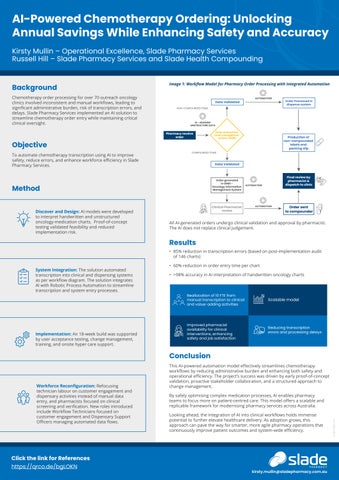
System Integration: The solution automated transcription into clinical and dispensing systems as per workflow diagram. The solution integrates AI with Robotic Process Automation to streamline transcription and system entry processes.
Implementation: An 18-week build was supported by user acceptance testing, change management, training, and onsite hyper care support.
All AI-generated orders undergo clinical validation and approval by pharmacist. The AI does not replace clinical judgement.
Results
• 85% reduction in transcription errors (based on post-implementation audit of 146 charts)
• 60% reduction in order entry time per chart
• >98% accuracy in AI interpretation of handwritten oncology charts
Reallocation of 10 FTE from manual transcription to clinical and value-adding activities
pharmacist
Conclusion
Workforce Reconfiguration: Refocusing technician labour on customer engagement and dispensary activities instead of manual data entry, and pharmacists focused on clinical screening and verification. New roles introduced include Workflow Technicians focused on customer engagement and Dispensary Support Officers managing automated data flows.
Reducing transcription errors and processing delays
This AI-powered automation model effectively streamlines chemotherapy workflows by reducing administrative burden and enhancing both safety and operational efficiency. The project’s success was driven by early proof-of-concept validation, proactive stakeholder collaboration, and a structured approach to change management.
By safely optimising complex medication processes, AI enables pharmacy teams to focus more on patient-centred care. This model offers a scalable and replicable framework for modernising pharmacy services across Australia.
Looking ahead, the integration of AI into clinical workflows holds immense potential to further elevate healthcare delivery. As adoption grows, this approach can pave the way for smarter, more agile pharmacy operations that continuously improve patient outcomes and system-wide efficiency.
Image 1: Workflow Model for Pharmacy Order Processing with Integrated Automation
Scalable model
Atovaquone Dosing for Pneumocystis Jirovecii
Pneumonia
Prophylaxis in Practice: A Retrospective Review of Dosing Strategies
Linda Nguyen1, Neil Kim Chiu Lam1
1. Slade Pharmacy Auchenflower, Icon Cancer Centre Wesley, The Wesley Hospital, Brisbane QLD Australia
Background
Pneumocystis jirovecii pneumonia (PJP) is a potentially life-threatening infection in immunocompromised individuals, including those with cancer.
While trimethoprim-sulfamethoxazole is standard PJP prophylaxis, atovaquone is used when there is sulfonamide allergy or intolerability. Australian guidelines recommend atovaquone 1500mg daily.1 However, a recent Japanese study explored a 750mg daily dose in lower-risk haematological patients.2
Aim
To retrospectively evaluate local atovaquone prescribing for PJP prophylaxis and associated PJP infection rates in cancer patients at a day oncology outpatient clinic.
Method
Pharmacy dispensing records from January 2020 to December 2024 were reviewed to identify all patients who received atovaquone dispensing at the day oncology outpatient clinic
Data was collected on dose and duration
Medical records were examined throughout the observation period to determine incidence of PJP infection
Statistical analysis was performed using Microsoft Excel
Results
Patient Characteristics
Characteristics
References
Distribution and Risk Stratification of Patients on Atovaquone
Distribution
Atovaquone 1500mg daily (All risk, n=44)
Atovaquone 750mg daily (All risk, n=44)
Atovaquone 750mg daily (Low to intermediate risk, n=40)
Atovaquone 750mg daily (High risk, n=4)
Incidence of PJP Infection
Discussion
The majority of patients were prescribed atovaquone for PJP prophylaxis due to trimethoprim/sulfamethoxazole allergy (e.g. rash). Other reasons for the change included intolerability due to side effects, difficulty swallowing large tablets and elevated serum creatinine. We found no report of PJP infection whilst on 750mg daily dosing in our patient population during the prophylaxis and observation period. Most patients were haematology patients considered to have low to intermediate risk of PJP infection based on eviQ guidelines.1
Limitations of this study include:
• Small sample size and single centre
• External supply and patient compliance were not assessed
Conclusion
While no PJP infections were observed in the low-dose group, further study with a larger sample and patient risk stratification is required to establish clinical implication. Consideration of low-dose atovaquone in select patients may reduce financial burden and assist patient compliance and tolerability.
1. eviQ. Prophylaxis – Pneumocystis jirovecii (carinii) pneumonia in cancer patients. Updated May 19, 2023. Accessed Aug 9 2025. https://www.eviq.org.au/clinical-resources/sideeffect-and-toxicity-management/prophylaxis-and-treatment/220-pneumocystis-jiroveciipneumonia-pjp-prophyl
2. Sugi T, Mita M, Kushi R, Hanai H, Uchida T, Inoue M et al. Prevention of pneumocystis pneumonia in patients with hematological disease: efficacy of low-dose atovaquone. Int J Clin Pharmacol Ther. 2023 Nov;61(11):515-519.
Acknowledgements
We would like to acknowledge Jason Karydis for conducting the pilot study as part of his Quality Use of Medicines project (UQ)
Electrolytes in Flux: A Case of Drug-induced Hypocalcaemia
To describe a case of hypocalcaemia and hypophosphataemia following administration of denosumab and ferric carboxymaltose (FCM).
Case
A 78-year-old female was referred to the Emergency Department with severe epigastric pain and abnormal biochemistry: hyperkalaemia (5.8mmol/L), hypocalcaemia (1.79 mmol/L) and hypophosphataemia (0.44mmol/L). Parathyroid hormone (PTH) was elevated at 35.4pmol/L while renal function (stage 3b) remained stable.
Relevant medications taken prior to admission include denosumab for osteoporosis (56 days prior to admission) and FCM (10 days prior). She was also taking perindopril for hypertension.
Discussion
Denosumab and parenteral iron therapies are increasingly used in both community and hospital settings.1
• Denosumab induced hypocalcaemia is well recognised, particularly in patients with advanced kidney disease or vitamin D deficiency.1
• FCM-induced hypophosphataemia is increasingly reported. A meta-analysis described hypophosphataemia in 47% of FCM patients compared to 4% with ferric derisomaltose.2
• Emerging reports suggests an additive effect with FCM and denosumab.1,3,4,5
Proposed Mechanism (Figure A):
• Denosumab suppression of bone resorption and secondary hyperparathyroidism.
• FCM elevation of fibroblast growth factor-23 (FGF-23) > renal phosphate wasting and impaired vitamin D activation.1,6
• Impairment of compensatory mechanisms usually involved in maintaining calcium and phosphate homeostasis.1,6
Figure A : Proposed mechanism of hypophosphataemia and hypocalcaemia with denosumab and FCM1
Treatment and Outcome
Serum Calcium & Phosphate trend prior and during hospital admission
Recovery & Discharge
Pharmacist Intervention
• The Pharmacist involvement included conducting a Best Possible Medication History (BPMH) and discussion with Emergency Consultant to identify likely causes of electrolyte imbalance.
• Recommended change of antihypertensive and suggested phosphate supplementation.
• Provision of administration and monitoring advice on calcium gluconate infusion during infusion period.
• Escalation to Medication Safety Team prompting hospital-wide guidelines and implementation of clinical alert in guardrails for calcium gluconate infusion.
Conclusion
This case highlights the importance of thorough medication history in identifying medication-related hospital admissions. Clinicians should be aware of the potential drug interaction between denosumab and FCM and monitor for electrolyte disturbances. An alternative iron formulation with reduced risk of hypophosphataemia such as ferric derisomaltose should be considered in at risk patients.
Acknowledgements
Thank you
Dr Gavan Doig and the Wesley Emergency Department, Nikita Shukla, Annie Lam and Melissa Siah
Denosumab Given Day -56 Ferric carboxymaltose Given Day -10
Enhancing Safety in Cancer Services: A Risk Assessment Framework for Monoclonal Antibody Handling
Margaret Patterson1, Michelle Rantucci1,2
1 Slade Pharmacy Quality and Medication Safety Unit
2 Icon Group Cancer Services
Background
Monoclonal antibodies (mABs) are widely used in the treatment of cancer and non-cancer conditions. Unlike traditional cancer treatments, mABs are not cytotoxic (unless conjugated to a cytotoxic molecule) and are usually not considered hazardous.
As new mABs are developed, many present novel mechanisms of action, increased compounding complexity, and uncertain compatibility with closed-system transfer devices (CSTDs).
This highlights the need for further evaluation beyond existing general guidelines.
Objective
To develop a standardised risk assessment tool that:
Actions
• Literature review conducted to identify any existing risk assessment frameworks
• Researched key medication formulation factors that may influence the likelihood of systemic absorption
• Risk assessment tool developed
• Refined in collaboration with nursing & pharmacy teams
• Endorsed by the organisation’s Medication Safety Committee
Development of a New Risk Matrix:
The organisation’s default risk matrix based on “likelihood” and “impact” (severity of consequence) was not fit for purpose.
A new risk matrix was created mapping risk ratings against likelihood of exposure/absorption and using hazardous classification as the consequence descriptor.
Hazardous ratings were categorised to align with existing guidelines (e.g. eviQ):
• Non-hazardous
• Hazardous
• Reproductive and/or developmental risk only
Evaluation
Since implementation, the tool has been successfully applied to assess several newly introduced mABs.
Feedback from pharmacists and nursing staff has been positive, reporting increased confidence when compounding and during administration of these medications. This highlights the value of a consistent, structured approach ensuring appropriate controls are in place.
Discussion
Scan QR code for Epcoritamab Risk Assessment Example
While general guidelines exist for the safe handling of mABs, there was no comprehensive tool to assess the safety of individual agents, particularly in relation to compounding and administration requirements.
Enables individualised mAB evaluation
New Risk Assessment
Ensures medicine integrity
Supports pro-active decision making Safeguards staff safely
Risk assessment adoption across a national cancer care organisation demonstrates its practical utility and potential for broader implementation.
New Risk Matrix:
Evolving Patient Experience Metrics in Hospital Pharmacy: A Transition from Recommendation Scores to
Claire Fitzgerald1
1Slade Pharmacy Quality and Medication Safety Unit
Background
• Measuring consumer experience is essential for driving service improvements in hospital pharmacy settings.
• The Net Promoter Score (NPS), widely used by businesses to assess customer loyalty, has been adopted by many healthcare organisations as a simple tool to gauge patient experience.
• However, NPS has not been validated for effectiveness in healthcare settings.1
• Patients have a right to provide feedback following a healthcare interaction, including services provided by health professionals.2
• In private hospitals, pharmacy services are often delivered by contracted third-party providers, necessitating separate feedback mechanisms.
Objective
To evaluate the suitability of NPS in a hospital-based pharmacy setting and identify the most appropriate feedback approach
Action - Phase 1
A national pharmacy provider, contracted to deliver services within public and private hospitals across the country, trialled the NPS as a standardised tool to assess consumer sentiment and experience.
The survey was introduced across the network, with multiple servicerelated questions and concluded with the NPS question “How likely are you to recommend this service to a friend or colleague?”
Surveys were distributed via QR codes on discharge medication bags and on pharmacy information brochures.
Pharmacy teams were educated on the purpose of the survey.
Interim review
Response rates were low, and surveys were not often completed in full. A group of consumers were engaged to provide feedback on the survey design.
Consumer feedback highlighted several key challenges:
• Hospital visits and pharmacy service is often a one-time service, making NPS less relevant.
• Confusion about whether feedback was for the hospital or pharmacy provider.
• Consumers had not actively chosen the pharmacy.
After reviewing available feedback tools, the team concluded that while NPS may have a role in pharmacy, it is better suited to community or retail settings where repeat business is a key driver of success.
The Customer Satisfaction Score (CSAT), which measures satisfaction with a product, service, or interaction—typically on a numerical scale—is more appropriate for gauging immediate satisfaction with specific aspects of the consumer experience.
Action - Phase 2
Following an interim review, the survey was updated with a new question asking “On a scale of 0 to 10, how satisfied are you with your recent experience with Slade Pharmacy”.
Service-related questions followed the CSAT item, along with a free-text question to gather more detailed insights.
Pharmacy teams were re-educated on the purpose of the survey and why the question had changed.
NPS vs CSAT
Measuring Customer Experience
Evaluation
The CSAT survey generated higher response rates and more meaningful feedback through open-ended questions.
Consumers were more comfortable rating their satisfaction with the actual service received.
Results were more actionable for local teams and reduced duplication with hospital-wide surveys using NPS measure.
Whilst survey responses increased, overall response rates are still very low considering the number of pharmacies across the organisation and the number of customers to whom a service is provided each month.
Discussion
This project highlights the need to tailor consumer feedback tools to the healthcare context. In hospital pharmacy, satisfaction measures (CSAT) are more relevant than loyalty metrics like NPS. Transitioning to CSAT improved the quality and usefulness of feedback, supporting continuous quality improvement.
Pharmacists must become more proactive in seeking feedback as their scope of practice evolves. Patient Reported Experience Measures (PREMs) and Patient Reported Outcome Measures (PROMs), widely used in other healthcare areas, represent the next evolution of feedback for pharmacy.
Novel Tracking System for Accurate Reporting of Discharge Counselling
Sarah Holster: Slade Pharmacy Services - Port Macquarie Base Hospital Pharmacy
Josh Carter: Lismore Base Hospital - Northern NSW Local Health District
Background
Effective communication and comprehensive data capture are essential for patient safety and healthcare quality. However, manual data recording in busy hospital departments can reduce recordings and take time away from clinical tasks. The pharmacy department aimed to address a documentation gap for discharge-related Key Performance Indicators (KPIs) required for accreditation. To achieve this, a preexisting electronic discharge tracking system was adapted for real-time recording of counselling services.
Objective
To implement a system for real-time documentation and systematic reporting of medication counselling at discharge, replacing manual data collection to enhance data visibility and reporting, thereby improving hospital planning and quality initiatives.
Action
• Manual, paper-based discharge forms were redesigned into a secure, Excel® application.
• Data entered only by technicians and pharmacists ensuring data integrity.
• Housed on facility desktops for real-time tracking with read only access.
• Captures various types of counselling data:
• Consumer Medicine Information (CMI) leaflets
• QR code-accessible patient education material
• Patient friendly medication list (PFML)
• Communication with external pharmacies
• In-person counselling
• Enables comprehensive reporting and KPI monitoring of counselling activities.
Evaluation
Ongoing data monitoring and reporting have shown an increased capture of pharmacy services for discharge counselling, benefiting all patients, not just those classified as high risk.
In one-month, post-deployment, 664 discharge encounters were recorded with an average data entry time of 12 seconds, compared to 60 encounters using the previous method, which took several minutes per entry.
Between April and July 2025, a total of 2,582 discharge encounters were captured.
Discussion
This enhanced framework delivers measurable improvements in workflow and data capture:
• Enables efficient real-time data capture
• Enhances transparency of counselling practices
• Provides a scalable platform for future KPI development
• Improves workflow efficiency and maintains patient care focus
Figure 2: Improved data capture for discharge encounters
Figure 3: Improved entry time for data capture
Figure 1: Discharge Counselling Tracking System
Figure 4: Most frequently provided counselling types
Smart Tools, Safer Pills: A pharmacist-led interprofessional workflow intervention in a dialysis unit
Bashford M 1 , Ball C 1
• Dialysis patients require complex medication regimens and experience a high pill burden.
• Frequent care transitions and multiple healthcare providers increase medication risk.1,3
• Outpatient clinical pharmacy services, like medication reconciliation, improve safety and outcomes by ensuring accurate and timely reviews.2,4,5
1 Slade Pharmacy Wesley Background Objective
To evaluate the impact of a pharmacist-led interprofessional workflow intervention including:
• Prioritisation tool to triage patients for Medication Management Plan (MMP)
• Partnered Pharmacist Medication Charting (PPMC)
• Discharge medication profiles at transitions of care
Action
Initial Audit
• Evaluated 52 charts for medication documentation compliance in October 2024. Intervention
• Implemented a workload prioritisation tool and PPMC.
• Identified MMPs older than six months or patients with recent hospital admission.
• Used MMPs with PPMC to streamline communication.
• Delivered targeted training to dialysis and pharmacy teams.
Post-implementation Audit
• Re-evaluated 46 charts for medication documentation compliance 6 months post implementation (May 2025).
Evaluation
Number of in-date MMPs completed within a 6-month period increased considerably.
MMPs updated within 1 month after a hospital admission improved notably.
Significantly increased the number of patients receiving a patient-friendly medication list. 68%
PPMC saved 30 minutes/week in confirming verbal orders, enabling more time for clinical review
Key Recommendations
Formalise and embed the prioritisation tool into routine practice to support consistent patient triaging in out-patient services.
Expand PPMC by up-skilling pharmacists and extending clinical service offerings to support workforce capability.
Ongoing multidisciplinary education to support sustained engagement and safer transitions of care.
Figure 1: Results post-implementation of a workflow prioritisation tool in the dialysis unit, aimed at improving clinical service uptake and patient outcomes.
Supporting Clinical Transitions with Virtual Mentorship: A National Training Framework for Hospital Pharmacists
Kristen Thessman,1 Nerida Jenkins,1 Stacy La Hood1
1. Slade Pharmacy Quality and Medication Safety Unit
Background
New hospital pharmacists within a national pharmacy network may experience challenges when transitioning into clinical roles, often due to limited access to experienced mentors and structured support systems.1 While previous training approaches, like paper-based plans, provided a foundational framework, they offered limited functionality for tracking progress, automating learning, and delivering consistent clinical support.
Objective
Design & implement scalable competency-based hospital pharmacy training plan
Deliver through a digital learning platform
Support pharmacists with <2 years hospital experience
Action
Structured training program
Module 1
Hospital Charts and Forms
Module 2
Dispensary Procedures - Inpatient and Discharge Supply
Training plan is fully integrated into the organisation’s online learning platform, allowing real-time tracking and reporting.
Twelve months post-implementation, 27 pharmacists had completed the program.
Participant feedback has been overwhelmingly positive:
• All would recommend the program to peers
• Program increased confidence and satisfaction in clinical roles
• Recorded buddy webinars were considered most valuable
Discussion
This structured program represents a significant advancement in onboarding and training for early career hospital pharmacists. The buddy webinars function as virtual mentorship, supporting clinical reasoning and decision-making while enabling consistent knowledge transfer. These functions are particularly valuable for smaller or resource-limited sites.
Its digital integration, competency-based progression, virtual mentorship, and structured onsite check-ins offer a sustainable and scalable workforce development solution.
Locking Safety In: Addition of Cancer-Care Medicines to Intravenous Infusion Pumps
L. Stronach¹, N. Shukla¹, A. Lam², M. Campbell², R. Ward²
Background
Intravenous medicine administration errors in oncology pose significant risks to patient safety. Smart infusion pumps with dose-error-reduction software (Guardrails™) help prevent infusion programming errors.
Problem Identified
The oncology medicine library (OML) at our large private hospital encompassed only a limited selection of high-risk cancer-care medicines, with Guardrails parameters largely absent in cancer-care infusions. Despite multiple clinical checks, the risk of human error during administration persisted, creating a critical patient safety concern requiring immediate intervention.
Developed and delivered education package to staff via oncology-nurse educator
Results
700%
Increase in OML profiles (7 to 49 profiles)
Safety improvement: Following implementation, non-Guardrails infusions in the oncology department decreased by 32% relative risk.
Pre-update (Nov 24 - Jan 25)
Post-update (Jan 25 - Mar 25)
without Guardrails Total infusions
Complex dosing solutions: Sub-profiles enhanced parameters for complex medicines with variable dosing, administration times, rate titration, and weight/BSA-based adjustments. For example, Methotrexate required 9 sub-profiles.
Discussion and Impact
Significant reduction in unprotected infusions
Evidence-based interprofessional collaboration model
Enhanced medication safety through technology optimisation
Sustainable framework for ongoing library refinement
Clinical impact: This project demonstrates how optimised smart infusion pump technology can substantially enhance medication safety in oncology settings.
Future directions:
Sub-profiles created For specific protocols
97 17
New clinical advisory notes added 800+
Safe cancer-care infusions delivered since OML update
• Ongoing monitoring for continuous library refinement
• Model replication for other institutions
• Further expansion of safety protocols
The interprofessional, evidence-based approach successfully enhanced medication safety in oncology through optimised smart infusion pump technology, providing a replicable model for healthcare institutions