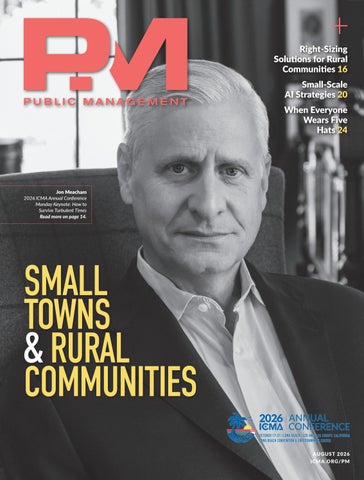

SMALL TOWNS & RURAL COMMUNITIES


$715
average cost recovered per billable run
How much can you recover?
Fire Recovery USA can help your municipality recover costs for fire and emergency service runs, including motor vehicle accidents, even when utilized by non-city residents. On average Fire Recovery USA recovers $715 dollars per billable run. Do some quick math, and see how much revenue is possible.





2,100+ clients in 43 states and growing
97 % collection rate for inspections CALCULATE YOUR COST RECOVERY

In celebration of the 25th anniversary of ICMA’s Credentialed Manager program, we’ll be acknowledging each author that holds the credential with this gold icon ICMA-CM in each issue of 2026.
FEATURES
How Our Past Informs the Present: Q&A with ICMA Conference
Keynote Jon Meacham
A presidential historian and Pulitzer Prize-winning author, Jon Meacham discusses how lessons from American history can guide local government leaders in navigating division, building trust, and sustaining democracy. 16
Right-Sizing Solutions for Rural Communities
Surrounding issues, challenges, and scalable approaches for small municipalities.
Kimberly Boyd
20
Smart, Small-Scale AI Strategies for Local Government
How small and rural communities can begin to adopt targeted AI tools without major costs, complex systems, or a large IT team.
Katryna Peart
When Everyone Wears Five Hats
In small and rural governments, coordination allows limited staff to execute council direction, deliver services, and manage risk when everyone takes on multiple roles.
Max Fisher
The Climate Resilience Advantage for Small and Rural Communities

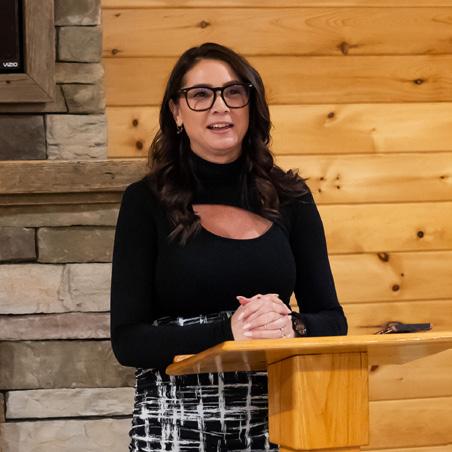
activating what’s already there.
Fernando Ortiz-Moya, PhD & Sarah Sieloff, AICP
How to move from climate planning to implementation, and why those communities that act now are already pulling ahead.
Joyce Coffee, LEED AP & Robert Macnee, PhD
Community-Driven Economic Development Gets a Boost from the Economic Recovery Corps
Economic Recovery Corps fellows are helping distressed communities align local priorities, build partnerships, attract investment, and shape their future.
Debra Perry
Life care specialists, a new hospital-based role, are connecting patients with treatment, reducing barriers to care, and offering hope where resources are limited.
Cammie Wolf Rice
Lessons in community reinvention from
Bruce Applegate, ICMA-CM
Executive Director’s Corner
Population: Small. Impact: Huge.
Ethics Matter!
A Closer Look at Endorsements and Testimonials
Assistants and Deputies
Rebuilding Resident Trust in a Tourism-driven Small Town
Global Engagement
Healing the Wounds of War through the Power of Partnership
Strategic Planning
Turning Your Strategic Plan into Action
Member Spotlight
Leading Where Everybody Knows Your Name
48 Local Gov 250
The Founders’ Bet on Local Government Is Still Paying Off—Let’s Not Let It Slip
52 In Our Region
An Optimistic Book on Democracy for Local Government Leaders
54 Insights
Building Community-Driven Programs that Succeed
56 Professional Services Directory
International City/County Management Association
Cover photo by Heidi Ross
Population: Small. Impact: Huge.
The August issue celebrates the local government professionals serving small towns and rural communities and the lessons their work offers the entire profession.
BY JULIA D. NOVAK, ICMA-CM

JULIA D. NOVAK, ICMA-CM is executive director of ICMA.
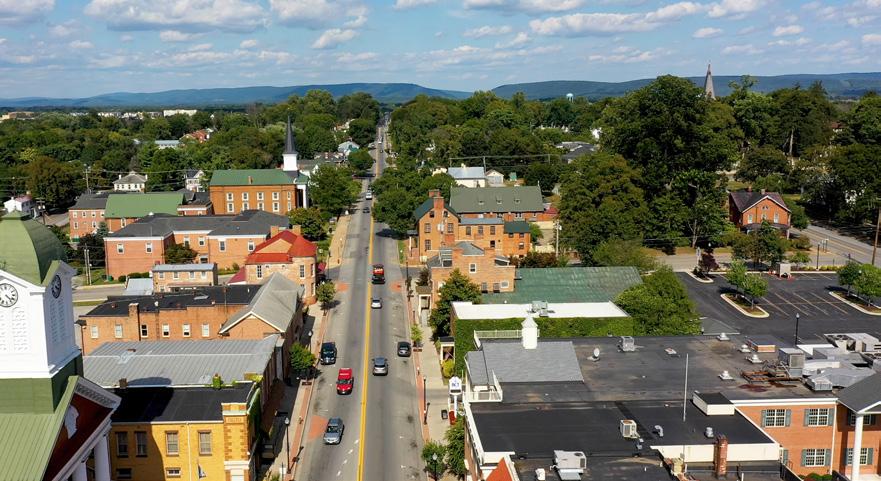
This month’s issue of Public Management focuses on small towns and rural communities—places central to the story of local government in the United States and to the work of ICMA. These communities are not simply smaller versions of larger jurisdictions. They have their own rhythms, expectations, constraints, relationships, and opportunities. They are also not a niche part of our profession. The U.S. Census Bureau’s Census of Governments shows that of the more than 38,700 general-purpose local governments in the United States, more than 35,000 have populations of 25,000 or fewer, and more than 28,800 have populations of 5,000 or fewer. From a membership perspective, more than 2,700 ICMA full members work in communities with fewer than 25,000 residents—47% of our 5,760 full members. Those numbers remind us that much of local government happens at a scale where people know one another, decisions feel immediate, and the person answering the phone may also be preparing the council packet, reviewing a grant opportunity, coordinating a public works response, and helping a resident navigate a complicated issue. In small communities, government is close. The manager, administrator, clerk, department head, or assistant may see residents at the grocery store, at a school event, or at a
International City/County Management Association
icma.org
August 2026
ICMA has moved!
Our new address: 660 N Capitol St NW Suite 700, Washington, DC 20001
Public Management (PM) (USPS: 449-300) is published monthly by ICMA (the International City/County Management Association) at 660 North Capitol St NW, Suite 700, Washington, DC 20001. Periodicals postage paid at Washington, D.C., and at additional mailing offices. The opinions expressed in the magazine are those of the authors and do not necessarily reflect the views of ICMA.
COPYRIGHT 2026 by the International City/County Management Association. All rights reserved. Material may not be reproduced or translated without written permission.
REPRINTS: To order article reprints or request reprint permission, contact khansen@icma.org
SUBSCRIPTIONS: U.S. subscription rate, $60 per year; other countries subscription rate, $155 per year. Printed in the United States. Contact: 202/289-4262; subscriptions@icma.org.
POSTMASTER: Send address changes to Public Management, ICMA, 660 North Capitol St NW, Suite 700, Washington, DC 20001.
ARTICLE PROPOSALS: Visit icma.org/writeforus to see editorial guidelines for contributors. For more information on local government leadership and management topics, visit icma.org.
Friday night game. The distance between policy and lived experience is short.
Our August issue recognizes that reality. The articles gathered here explore right-sized solutions for rural communities, small-scale approaches to artificial intelligence, the coordination required when everyone wears five hats, climate resilience implementation, community-driven economic recovery, and the possibility that some towns can thrive without growing. Together, they reflect a truth that every local government professional knows: effective management is not defined by population size. It is defined by the ability to align people, resources, values, and action in service to a community.
Capacity is often the central issue—not commitment, talent, or ambition. Many small communities are served by capable professionals and deeply committed elected officials, staff members, volunteers, and partners. But there may be fewer people to do the work, fewer specialized departments, and less depth when a vacancy occurs, a key person is out, or a new mandate arrives.
Expectations are not small. Residents care that trash is picked up, snow is plowed, roads are maintained, development is contextually appropriate, public safety
Public Management (PM) icma.org/pm ICMA
660 North Capitol St NW Suite 700 Washington, DC 20001
EDITORIAL: khansen@icma.org
ADVERTISING SALES: Natalie Matter Bellis The YGS Group natalie.matterbellis@ theygsgroup.com 717-580-8184
ICMA MEMBER SERVICES: 800.745.8780 | 202.962.3680 membership@icma.org
ICMA
Creating and Supporting Thriving Communities
ICMA’s vision is to be the leading association of local government professionals dedicated to creating and supporting thriving communities throughout the world. It does this by working with its more than 13,000 members to identify and speed the adoption of leading local government practices and improve the lives of residents. ICMA offers membership, professional development programs, research, publications, data and information, technical assistance, and training to thousands of city, town, and county chief administrative officers, their staffs, and other organizations throughout the world.
Public Management (PM) aims to inspire innovation, inform decision making, connect leading-edge thinking to everyday challenges, and serve ICMA members and local governments in creating and sustaining thriving communities throughout the world.
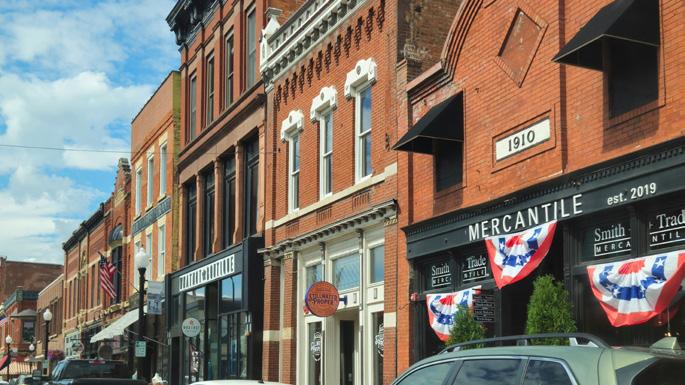
is reliable, parks are welcoming, and community activities help people feel connected. They expect decisions to be transparent and local government to be responsive, ethical, and competent. They may understand that resources are limited, but they still expect their local government to solve problems and deliver services that matter in daily life.
ICMA’s commitment to small communities is reflected not only in this issue but also in how we think about membership and service. ICMA makes a small community discount available to full members who serve as chief administrative officers and assistant chief administrative officers in communities of fewer than 7,500 with budgets below $7.8 million. Approximately 1,100 members serve communities of fewer than 7,500 residents, and 57% take advantage of this discount. Professional connection, ethics guidance,
practical resources, and peer learning should not be limited by the size of a jurisdiction or its budget.
To our members serving small towns and rural communities: We understand that your challenges are real—limited capacity, fewer specialized staff, intense public visibility, and the constant expectation that you will find practical solutions no matter the constraint. We see the professionalism required to lead when relationships are close, resources are limited, and the work is both strategic and deeply hands-on. We also see the pride that comes from helping a community make progress in ways that are tangible and meaningful.
We also see the innovation that comes from necessity. Small communities need solutions that are clear, manageable, affordable, and durable. That discipline can produce some of the most useful ideas in the profession. When a small staff coordinates
across departments, simplifies a process, leverages a partnership, communicates with residents, or implements a practical technology solution, the lesson is often valuable far beyond that community.
For that reason, this issue is not only for members who serve small towns and rural communities. Members in larger communities will find good ideas and adaptable solutions throughout these pages. A strategy developed for a small town may translate to a neighborhood, department, service area, or pilot program in a larger organization. A rural resilience approach may offer lessons about partnership and implementation. A small-scale AI strategy may help a larger government think more carefully about targeted use cases and responsible adoption. A story about thriving without growing may challenge all of us to think more broadly about what success means.
ICMA is stronger when it reflects the full range of communities our members serve. Our profession is stronger when we learn across size, geography, structure, and circumstance. And our communities are stronger when local government professionals have access to ideas, peers, tools, and encouragement that meet them where they are.
This month, I hope you are reminded that ICMA is committed to all our members—and that small community professionals are essential leaders in the future of local government.
PRESIDENT
Michael Land*
City Manager Coppell, Texas
PRESIDENT-ELECT
Andy Pederson*
Village Manager Bayside, Wisconsin
PAST PRESIDENT
Tanya Ange*
County Administrator
Washington County, Oregon
VICE PRESIDENTS
International Region
Meighan Wark
County Administrative Officer Huron County, Canada
Lungile Dlamini
Chief Executive Officer
Municipal Council of Manzini, Eswatini
Jānis Lange
Chief Executive Officer
Riga City Municipality, Latvia
Midwest Region
Jeffrey Weckbach* Township Administrator Colerain Township, Ohio
Cynthia Steinhauser*
Deputy City Administrator Rochester, Minnesota
Cori Burbach*
Assistant City Manager Dubuque, Iowa
Mountain Plains Region
Pamela Davis
Assistant City Manager Boulder, Colorado
Sereniah Breland
City Manager Pflugerville, Texas
Penny Postoak Ferguson*
County Manager Johnson County, Kansas
Northeast Region
Steve Bartha*
Town Manager Lexington, Massachusetts
Brandon Ford
Assistant Township Manager
Lower Merion Township, Pennsylvania
Kristy Rogers*
Town Manager Milton, Delaware
Southeast Region
Eric Stuckey
City Administrator Franklin, Tennessee
Chelsea Jackson
Deputy City Manager
Douglasville, Georgia
Justin Smith
Assistant City Manager Pelham, Alabama
West Coast Region
Nat Rojanasathira*
Assistant City Manager Monterey, California
Elisa Cox*
City Manager
Rancho Cucamonga, California
Katie Koester* City Manager Juneau, Alaska
* ICMA-CM
Managing Director, Lynne Scott lscott@icma.org
Brand Management, Marketing, and Outreach
Senior Managing Editor Kerry Hansen khansen@icma.org
Senior Editor Kathleen Karas kkaras@icma.org
Design & Production picantecreative.com
ICMA Executive Director Julia D. Novak, ICMA-CM
Stillwater, Minnesota
A Closer Look at Endorsements and Testimonials
Every member has the ethical obligation to “just say no” to leveraging a public position for personal gain.
BY JESSICA COWLES
One of the potentially sticky requests our members receive is to offer testimonials or endorsements to professional service providers who serve their communities. Sometimes these service providers become long-time partners who help members address challenges, and there is professional respect for the work that they have done for their jurisdictions.
This is an area where it is possible to cross into a gray area that may conflict with ICMA’s Code of Ethics. Our members must be cautious about leveraging their public position for personal gain—and while frequently there may be nothing to gain by taking the time to offer a reference or a testimonial, we know that professionalism rests on impartiality.
There are limited circumstances when members should consider providing a testimonial or endorsement. I will break down ICMA’s interpretation in each of Tenet 12’s provisions in the endorsements guideline:
Tenet 12. Public office is a public trust. A member shall not leverage his or her position for personal gain or benefit.

JESSICA COWLES is director of ethics at ICMA (jcowles@icma.org).
Guideline on Endorsements. Members should not endorse commercial products or services by agreeing to use their photograph, endorsement, or quotation in paid or other commercial advertisements, marketing materials, social media, or other documents, whether the member is compensated or not for the member’s support. Members may, however, provide verbal professional references as part of the due diligence phase of competitive process or in response to a direct inquiry.
This official guideline is admittedly cautious and is intended to help members navigate challenging situations.
Members should not provide written (or video) testimonials. These testimonials could outlive the
relationship you have with individuals or a firm, and if they run into issues in another jurisdiction because of poor performance, etc., your endorsement lives on, and your professional reputation could be on the line.
When a local government has a positive experience with a vendor and would like to share it, a member can be a verbal reference as part of a competitive process or in response to a direct question about that experience. Let them know (especially if they are a valued service provider) that you can serve as a reference if another jurisdiction is looking to hear about your personal experience with their services. The proper venue is “private”—not part of their marketing materials.
Members may agree to endorse the following, provided they do not receive any compensation: (1) books or other publications; (2) professional development or educational services provided by nonprofit membership organizations or recognized educational institutions; (3) products and/or services in which the local government has a direct economic interest.
Provided the member receives no compensation for the endorsement, members may endorse books or other publications, professional development or educational services from ICMA or state associations or other nonprofit membership organizations, or for an asset the local government owns like a civic or convention center. The “direct economic interest” in the guideline means those items where the local government has direct budget allocation or responsibility.
Members’ observations, opinions, and analyses of commercial products used or tested by their local governments are appropriate and useful to the profession when included as part of professional articles and reports.
Members can partner with private sector service providers who have been, or are, a local government
client to write professional articles or reports or provide content for sessions focused on professional development.
The ICMA Annual Conference provides a good example of this. Members who have used the product and have valuable insights to share with other attendees can propose a session with the vendor to include time for attendees to ask questions about that experience. Vendor sessions featured in the Innovations Theater area in the exhibit hall give companies the flexibility to present with or without a member.
Real-world Member Questions
Here are recent questions members posed to me about testimonials and endorsements, along with my answers.
I’ve recently read a manuscript on leadership topics in the workplace.
I enjoyed the book, and after debriefing with the author, he asked me if I would consider writing a testimonial for the book. I provided my thoughts and he wants to include it in his book when it’s published this year. I am not being compensated, and the author has no business dealings with me or my local government. Is this allowable and would this be okay?
Yes, you can endorse a book provided you receive no compensation, and there is no perceived or actual conflict of interest at play here.
I read the Code with the guideline that we can offer endorsements for products and services in which our local government has a direct economic interest. I have been asked to be part of a video for my local government’s service provider discussing a special event we have in our community that has a substantial economic benefit. This service provider is a private company who also runs other events on behalf of my local government.
This scenario is one that does not meet the definition of “direct economic interest.” You should decline because this private company may want media they can use to attract new clients, and this would create conflicts in considering other vendors who may pursue your local government’s procurement for other events.
One of my local government’s IT consultants asked me to join a customer advisory board in a volunteer capacity. The board intends to provide the company with insights to better serve
clients, including my local government. From what has been shared, it seems like it is largely a networking opportunity, as well as a sounding board for the company as it grows. They are not seeking (and I would not give) an endorsement.
I believe my participation will be of benefit to the local government, and at first review, I do not see direct ethical issues but thought a second opinion was warranted. To be honest, the “advisory board” wording is the main reason.
The endorsements guideline puts parameters on service provider relationships. The last sentence— “Members’ observations, opinions, and analyses of commercial products used or tested by their local governments are appropriate and useful to the profession when included as part of professional articles and reports”—is a decidedly two-sided approach that is meant to be interactive and not static.
I encourage you to think about any possible conflicts of interest in appearance. If in the future the local government issues a request for proposals (RFP) for IT services, would this company feel like they have a leg up over competitors because you serve on the customer advisory board? Serving on an unpaid, volunteer customer advisory board would be acceptable as long as the local government is not actively going through a procurement process for IT services.
A former employee started their own consulting business and asked me to provide a recommendation. What do you recommend?
This is a situation where you should decline providing your endorsement through a written recommendation or quote about this former employee who is now consulting. You can be a verbal reference as part of a competitive process or if directly asked. You should explain your ethical obligations to this former employee, so it is not just a “no.”
I have been asked to participate in a video for one of my organization’s public safety service providers. I want to make sure my approach aligns with the Code of Ethics. What do you advise?
You should not participate in the video, and I recommend explaining why to the service provider. This would be considered an endorsement and the Code’s Tenet 12 endorsements guideline has very specific parameters for when something like this would be
While frequently there may be nothing to gain by taking the time to offer a reference or a testimonial, we know that professionalism rests on impartiality.
permitted, and this is not one of those circumstances. What is okay is offering to be a verbal reference in the RFP process or partnering with this service provider to do a presentation at a state association or ICMA conference since that presentation would allow for audience Q&A.
While the endorsements guideline allows very limited circumstances for when an endorsement is acceptable, it is designed to protect members’ long-term interests. What if the service provider did something that you no longer wish to align yourself with or they stop meeting the organization’s expectations and the relationship ends?
The guideline helps members stay on solid ethical ground in service provider relationships. When in doubt, pause, review the Code, and seek guidance from me ( jcowles@icma.org ) before agreeing to any testimonial, quote, or public endorsement.
Hear from your peers on how they've faced ethical challenges on the following topics:
Tuesday, August 4: 2pm-3pm ET
Securing Trust:
How Philadelphia and Other Cities Are Strengthening Election Preparedness
Thursday, September 10: 2pm-3pm ET
The Science of Trust:
How Local Leaders De-Escalate, Depolarize, and Reconnect

Learn more & register: https://icma.org/page/free-member -only-ethics-webinars
Calendar of Events
National Economic Mobility and Opportunity Conference
The National Economic Mobility and Opportunity Conference is a field-building gathering for those working to create communities where every resident can thrive. Join local practitioners, national thought leaders, and other key stakeholders in Washington, DC, August 19–21, to explore on-the-ground responses to pressing local issues.
Registration is just $75. Secure your spot today!
UPCOMING EVENTS
Securing Trust: How Philadelphia and Other Cities Are Strengthening Election Preparedness
August 4 | Webinar
The Current State of Student Debt and Forgiveness August 6 | Free Webinar
Credentialed Manager Summit | Durham, North Carolina
August 6 | ICMA Members-only Summit
2026 National Economic Mobility and Opportunity Conference
August 19–21 | Conference
Credentialed Manager Summit | Palo Alto, California August 27 | ICMA Members-only Summit

Get to the Point: How to Make Complex Information Easy to Understand August 27 | Webinar
For a full listing of events and details, visit icma.org/events. Shop all courses at learning.icma.org.
Rebuilding Resident Trust in a Tourism-driven Small Town
How Solvang, California’s wildly popular newsletter helped them reconnect with the people who call it home.
BY OLIVIA URIBE MUTAL
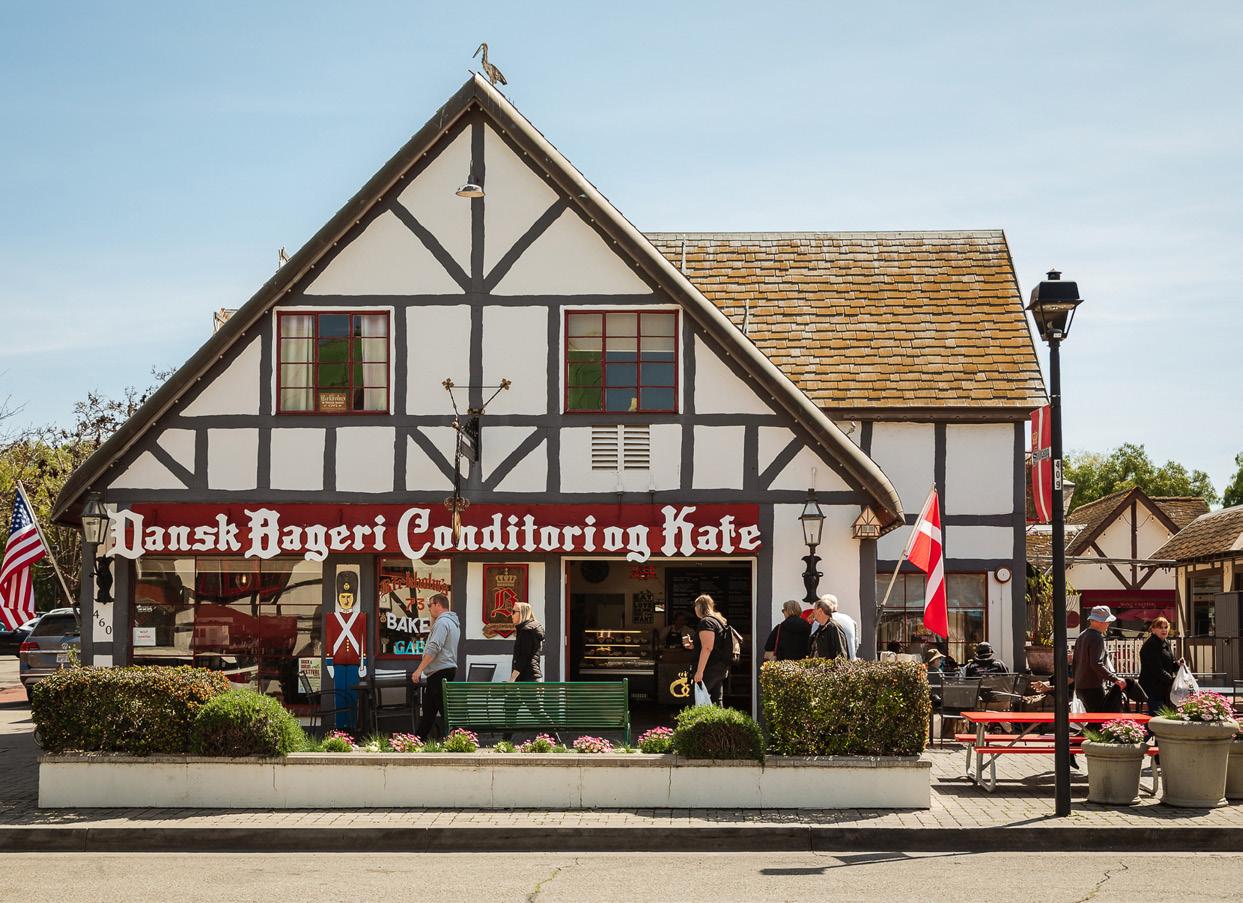
Five million visitors, 6,000 residents, 2.43 square miles: these three numbers define Solvang, California, and the tension that comes with it.
On a winter weekend, the ratio of visitors to residents can approach 100:1. The downtown fills with wine enthusiasts and Danish pastry seekers from all over, drawn to a place that has marketed itself as a European village transplanted to California wine country. The city’s transient occupancy tax (TOT) revenue has grown from $6.3 million to over $8 million in just three fiscal years. By every tourism metric, Solvang is succeeding. And yet, for the people who live here, something had gone quiet.
The Asymmetry that Built Up Slowly
Solvang has invested heavily in tourism, approximately $1.1 million annually, including destination marketing
campaigns designed to reach travelers from California’s major metro areas who were planning weekend getaways. That investment has been rational. Tourism funds this city. TOT outpaces sales tax revenue by more than three to one, and it is what allows Solvang to fund public safety, streets, and parks without placing that full burden on residents. The math made sense.
But that investment had a direction: outward. It faced the traveler, not the resident. And while the city has been earning national recognition—Solvang was named the “#1 Best Small Town in the West” by USA TODAY in 2025—the people who called it home were increasingly underserved by their city’s communications. They learned about road closures, planning decisions, and major projects the same way visitors did: accidentally, late, or not at all.
The problem was not indifference. It was structural. A small staff, a visitor-oriented communications posture,

MUTAL is assistant to the city manager for Solvang, California, and a member of ICMA’s ACAO Committee (oliviaum@ cityofsolvang.com).

OLIVIA URIBE

and the absence of a dedicated channel for residents had created a real gap between city hall and the community. Strengthening resident communications was already a formal council priority, with a specific goal directing the city manager to assess the city’s community outreach programs. The gap had been named. With city manager Randy Murphy’s support and the help of an outreach agency, we decided to close it.
Before proceeding, the city asked for input. A June 2025 survey of Solvang residents found that 74% preferred email as their primary channel for city communications, the top response by a significant margin, outpacing social media, the city website, and print materials. When asked what they wanted to hear about, 84% said infrastructure project updates and 78% said new development updates. Residents were not disengaged. They just lacked a channel built for them.
Hej Solvang
The cost of a well-run resident newsletter is modest. The return is high, but only if the communication is genuine. A newsletter that reads like a press release will be treated like one.
The name means “Hello Solvang” in Danish, a nod to the city’s founding heritage and a deliberate signal about who this was for. Launched in mid-2025, the Hej Solvang newsletter was built on a simple premise: residents deserved a direct, consistent line to their city government. The newsletter would read like a conversation rather than a press
release or a social post built for engagement. It gave the city a way to move past comment threads on NextDoor and build a story arc over time. (Access the newsletter archive at lp.constantcontactpages.com/sl/BQylmPK .) Building the subscriber base required no elaborate campaign. We pulled from existing city listservs and offered every subscriber a clear, low-friction way to opt out from the beginning. A newsletter that people choose to stay with tells you something different than one they tolerate. Within roughly six months, the list grew to approximately 2,200 subscribers. In a city of 6,000 residents organized into roughly 2,500 households, that is near-complete household penetration. Solvang’s advertising campaigns reach millions worldwide; this newsletter reaches the people who live here.
The engagement data confirmed what the instinct suggested. A recent edition recorded a confirmed open rate of nearly 59%, more than double the typical benchmark for government communications. Unsubscribes in the same period: two. Spam reports: zero. People were not just opening emails. They were coming back.
What followed read less like a newsletter and more like a conversation the city had needed for a while. Residents submitted content ideas. Survey responses arrived as full essays. A resident who parks near a shopping center wrote
in about red curb markings on the adjacent street, the kind of hyperlocal detail that never surfaces in a council chamber but matters deeply to someone navigating that street every day. He received a substantive reply: the city was conducting a citywide curb assessment and would evaluate which restrictions were still warranted. The response didn’t promise everything, but it demonstrated something that residents had not always been certain of: that the channel ran in both directions.
Something shifted internally as well. Early on, generating content required actively soliciting contributions from department heads. Within months, staff were bringing their own stories forward. They could see the responses coming in, hear residents referencing the newsletter at public meetings, and watch their work land in the community in a way that a staff report to council rarely does. Managing the newsletter stopped being about convincing people to participate and became about managing the deadline. Not every response was a compliment. Residents pushed back on proposed trail configurations, flagged late-night holiday music in the park, and raised pointed questions about projects they felt the city wasn’t explaining clearly enough. That friction was useful. It told staff where communication gaps remained and what residents were
watching closely. A newsletter that only generates praise isn’t doing its job.
When the city opened applications for the urban boundary exploration committee, a 13-member resident advisory body, five people applied within an hour of the newsletter going out. When the city manager held an all-day Saturday goal-setting session and promoted it through the newsletter, 20 members of the public showed up. At one point, the mayor turned to look across the room and asked me, “Do you know how these residents got here?” The answer was the newsletter. Residents who had been paying attention had shown up to participate, and city hall was surprised enough to notice.
Why Small Cities Can Move This Way
Here is what a city of 6,000 can do that a city of 600,000 cannot: it can close the distance between a decision and the people it affects almost entirely on the strength of proximity.
Solvang’s urban boundary exploration committee is a useful illustration. The city faces genuine growth questions, state housing mandates, wastewater capacity constraints, and a geographic boundary that has not changed in years. Rather than process those questions internally and present conclusions to a disengaged public, the city convened a
13-member resident advisory body that reflected a genuine cross-section of the community. It is a room organized for productive disagreement, not managed consensus.
The whole process—identifying the need, seating the committee, and holding its first meeting—took months, not years. The newsletter is part of what makes that kind of speed possible. When a committee opening is announced through a channel that reaches nearly every household, the city is not broadcasting to residents; it includes them.
The Lesson for Small Towns
The tension Solvang is navigating is not unique: a tourism economy funds the city while residents need to feel the city is still theirs. It shows up in ski towns, wine regions, and historic main streets across the country. Visitor spending is the source of revenue, but resident trust is the foundation. If you lose the latter while chasing the former, the city starts to hollow out from the inside.
What Hej Solvang demonstrated is that closing that gap is neither expensive nor technically complicated. The cost of a well-run resident newsletter is modest. The return is high, but only if the communication is genuine. A newsletter that reads like a press release will be treated like one. A newsletter that tells residents what is actually happening and why it matters earns a different kind of attention.
The small-town advantage is real. Staff know the community well enough to write to it, not at it. A city manager can attend a public meeting and recognize most
of the faces in the room. A resident with a question about a project can walk into city hall and hear back from the decision-maker within a day. That proximity, maintained intentionally, is what makes communication feel like a conversation rather than an announcement.
For communities navigating a similar gap, the path is not complicated. Find the channel your residents already check. Tell them in plain language what is actually happening. Invite them in before decisions are set. The city that does that consistently discovers something: the residents who felt left out were not gone. They were waiting to be included.
Gallup finds that about two-thirds of Americans trust their local government, but that advantage is not guaranteed. It has to be earned and maintained. Research from the Organization for Economic Co-operation and Development points to one factor that does more for local trust than almost any other: giving residents a real say before decisions are made. That is a low bar, and small cities are uniquely positioned to clear it.
Solvang is still working through its growth questions, wastewater capacity, boundary decisions, and a downtown that must remain competitive without losing the character that drew people there in the first place. But the issues become more manageable when the people who live here are informed, engaged, and present in the process.
Five million visitors come to Solvang to experience this place. The 6,000 people who live here deserve to help shape it.








Healing the Wounds of War through the Power of Partnership
A comprehensive rehabilitation center in Ukraine is helping wounded soldiers and civilians rebuild their lives.
BY MARTA RUDNYTSKA
On April 8, 2022, Russian forces shelled the railway station in Kramatorsk, Ukraine, where around 4,000 civilians were awaiting evacuation. The sudden missile strike killed 61 people and injured 121 others.
Among the injured was 12-year-old Yana Stepanenko, along with her mother and twin brother. The Russian missile took both of the girl’s legs and one of her mother’s. She underwent treatment in the United States and later continued rehabilitation at the UNBROKEN National Rehabilitation Center in Lviv, Ukraine, where she received new prosthetics for an active life.
Almost exactly two years later, Yana ran five kilometers on prosthetic legs at the 2024 Boston Marathon to raise funds for a prosthetic limb for a wounded soldier. In 2025, she completed the same distance at the Tokyo Marathon. Her story inspires other patients and the entire UNBROKEN team, proving that even after the most severe trials, it is possible to return to life and become a symbol of resilience.
Since the beginning of the full-scale Russo-Ukrainian War, more than 25,000 wounded Ukrainians have received care through UNBROKEN, the country’s largest medical and rehabilitation facility for war-wounded adults and children.
Getting Started

MARTA RUDNYTSKA
is director, secretariat department, Lviv City Council, Ukraine.
Since February 24, 2022, the day Russia invaded Ukraine, Lviv has taken on a new role. The city in western Ukraine long associated with culture, its UNESCO status, tourism, and education became a refuge for hundreds of thousands fleeing the war. Here, a response began to take shape to one of modern Europe’s greatest challenges: how to provide dignified medical treatment, comprehensive rehabilitation, and a return to active life for wounded soldiers and civilians.
Despite shelling, power outages, and limited financial resources, Lviv did not stop. On the contrary, the city became one of the most progressive in the field of medicine since Ukraine’s independence. Thanks to the joint efforts of the community, businesses, and international partners, a system began to emerge
Since the beginning of the full-scale Russo-Ukrainian War, more than 25,000 wounded Ukrainians have received care through UNBROKEN.
with people at its core. This led to the creation of the UNBROKEN ecosystem—a comprehensive approach to medicine, rehabilitation, prosthetics, mental health, and social reintegration.
An Ecosystem, Not a Hospital
UNBROKEN is not a single building or a standalone hospital. It is a true ecosystem of humanity that brings together more than 20 interconnected projects. In UNBROKEN, a person is supported throughout the entire journey, from the moment of injury to the return to maximum independence. Patients receive surgical treatment; prosthetics, including temporary prostheses; physical rehabilitation; psychological and psychotherapeutic support; mental health rehabilitation; accommodation during treatment; and support in returning to civilian life.
New facilities have been opened, including a mental health center and a center for assistance to people after captivity. Prosthetics capabilities have also been expanded with modern workshops and laboratories.

Community, Business, and International Partners United
UNBROKEN is a powerful example of true collaboration, where the community, businesses, volunteers, and international partners act as one. At the most difficult moment, everyone stood together to ensure that the country’s largest rehabilitation center could begin operating as quickly as possible and provide high-quality care to those who need it most.
The building itself was transformed from a Soviet-era clinic to a modern facility, filled not only with renovations, but with trust, responsibility, and solidarity. Each of the building’s seven stories was restored by a different city or organization:
• The 1st floor was restored by the city of Lviv.
• The 2nd floor by Lviv IT Cluster, a community of IT companies in Ukraine.
• The 3rd floor by the city of Warsaw, Poland.
• The 4th floor by Naftogaz, Ukraine’s largest state-owned oil and gas company.
• The 5th floor by the city of Vilnius, Lithuania.
• The 6th floor by the city of Freiburg im Breisgau, Germany.
• The 7th floor by the Red Cross Society. Partners from dozens of cities and countries have contributed to building this system, including Gdańsk, Wrocław, Murnau am Staffelsee, Aarhus, and Würzburg.
The UNBROKEN Cities Network has united cities such as Manchester and Liverpool in England for knowledge exchange and joint initiatives.
Challenges and Looking to the Future
Despite significant achievements, challenges remain. The demand for rehabilitation is growing every day, resources are limited, and the need to expand capacity is critical. Yet Lviv’s experience proves that even during wartime—when most funding is directed toward supporting the military and critical infrastructure—a city can become a driver of innovation in medicine, rehabilitation, and social policy.
The demand for rehabilitation is growing, resources are limited, and the need to expand capacity is critical.
Both during the war and after its end, when thousands of veterans return from the front line, the need for funding, partnerships, and systemic solutions will only increase. To ensure that every veteran and every civilian affected by the war receives high-quality rehabilitation and recovery services, a global response is required. That is why we appeal to cities, communities, businesses, and foundations in the United States.
UNBROKEN is an opportunity to contribute to building a model that is already working. It is an investment not only in buildings or equipment, but in human dignity, societal resilience, and post-war recovery. American partners can become part of a global ecosystem: joint veteran programs, exchange of medical expertise, professional training, and scaling successful solutions to other countries.
UNBROKEN is not only about treatment. It is a new model of a city where medicine, urban space, and international partnership work for people. Lviv’s experience serves as an example for municipalities worldwide: an integrated ecosystem, a clear mission, international cooperation, and strategic governance are the keys to sustainable and scalable success.
We invite you to join. To build together. To recover together. To restore lives—together.
Learn more at unbroken.org.ua.

HOW OUR PAST INFORMS THE PRESENT:
Q&A WITH ICMA CONFERENCE MONDAY KEYNOTE JON MEACHAM
A presidential historian and Pulitzer Prize-winning author, Jon Meacham discusses how lessons from American history can guide local government leaders in navigating division, building trust, and sustaining democracy.

America’s past is a story of challenges overcome, crises resolved, and progress made. In his Monday keynote presentation at the ICMA Annual Conference, Jon Meacham will walk us through moments in history to offer guidance on how to endure and prevail in hard times. PM Magazine was eager to chat with him before the conference to hear more about how his message will translate to local government professionals.
Your work often reminds us that America has endured periods of profound division and uncertainty before. What lessons from history do you think are most relevant to today’s city and county managers facing polarization and public skepticism?
The key lesson from history is that division is the rule, not the exception. The great task of leadership is to confront differences of opinion, however profound, and come to a result. It isn’t easy, but that’s the job.
Much of your writing focuses on leaders who succeeded not because they avoided crises, but because they navigated them with courage and patience. Looking across history, what leadership qualities do you believe are most essential for local government professionals today? A sense of history—of what has worked, and what has not worked, in the past—is essential. So is curiosity, candor, and empathy. You have to want to know all you
Heidi Ross
can about the issues at hand and about why people feel so strongly about these issues. Then acknowledge their views—and their passions about those views—honestly while seeing things from their vantage point. No one is going to compromise if they don’t think you appreciate their perspective. They still may not compromise, but the conversation won’t even get started without their knowing that they are being heard.
Local government is where democracy becomes tangible for most people. How does history shape your understanding of the important role that local leaders play in sustaining democracy itself?
You’re exactly right. And history tells us that people tend to be more flexible on local matters than on national ones. When leaders can frame questions not as grand ideological issues but as problems to be solved, they stand the best chance of getting something done.
City and county managers are often expected to solve complex problems while remaining nonpartisan and focused on serving the entire community. Have you encountered historical figures whose ability to lead above political divisions offers lessons for today’s local government leaders?
I think there’s much local leaders can learn from successful national leaders in terms of general lessons. FDR’s insistence on what he called “bold, persistent experimentation.” Reagan’s belief that 60% of what you want is better than 0%. And
George H.W. Bush’s emphasis on “sound governance” over performative politics are just three examples.
Many of your books explore how trust is earned and how easily it can be lost. In an era when confidence in institutions is under pressure, what advice would you offer local government leaders working every day to build public trust within their communities?
Show, don’t tell. Have examples of past projects that were once controversial but are now accepted as part of the fabric of a community in your repertoire. Always be a storyteller. People respond best to narrative, so find examples of what you want to replicate and tell those stories.
Your keynote is titled Hope Through History. Hope can sometimes seem like an abstract idea, especially for leaders facing budget constraints, workforce shortages, natural disasters, or contentious public meetings. How can history help public servants maintain optimism without ignoring reality? Hope is the opposite of fear. It’s not an elusive dream but the animating force for public servants. Why else be in the arena? And hope is grounded in history. It’s important to remember that there was never an Edenic moment of total cooperation but that every era faces its own challenges and crises. Study the past well, and you’ll see that it was the hopeful leaders—not the divisive ones—who carried the day.
Many ICMA members entered public service because they wanted to improve people’s daily lives. From your perspective as a historian, what distinguishes leadership that leaves a lasting legacy from leadership that merely manages the moment?
Well,legaciesaremadeupof moments,soIthinkthat’s kind ofafalsedichotomy.If you dothesmallthingswell, the bigthingstendtoget done, too.Therealquestionis how theleaderseeshisorher own mission—definesuccess and managetothat.
Throughout your career, you’ve demonstrated the importance of understanding historical context before judging current events. How can local government leaders apply that same mindset when responding to community conflict or making difficult policy decisions?
Precedentsmatterlessin theirdetails—noanalogyis perfect—andmoreintheir capacitytoshowusthat progressispossibleevenwhen thingslookbleak.Runcase studieswithyourteamand you’llseethatwhatseems
simple in retrospect was far from straightforward in real time. And there’s inspiration in that realization.
As our members prepare to join you in Long Beach this October, what do you hope they will take away from your keynote?
That what they do is vital, and rarely more so than in a time when so many distrust and disbelieve. They are on the front lines, and their success is essential.
You’ve spent your career studying some of America’s most consequential leaders. If you could invite one historical figure to spend a day shadowing a modern city or county manager, who would it be and what do you think would surprise them most about local government today? I think any of the founders— Jefferson, Madison, Hamilton—would be stunned at the sheer complexity of twenty-first century life. But they were also excellent students of human nature, which doesn’t change much. They knew America would be hard but worth the effort. And that’s what we should believe, too.
Hear more from Jon Meacham in his keynote presentation, “Hope Through History: How to Survive Turbulent Times,” at the 2026 ICMA Annual Conference. Learn more at conference.icma.org.
RIGHT-SIZING SOLUTIONS for Rural Communities
Surrounding issues, challenges, and scalable approaches for small municipalities.
BY KIMBERLY BOYD
Across rural America, a town of 1,000 or fewer residents may operate a water utility, maintain miles of roadway, administer landuse regulations, prepare audited financial statements, coordinate elections, oversee procurement, manage capital projects, and respond to emergencies—all with a staff small enough to gather around a single conference room table. The scope of responsibility mirrors that of much larger cities. The capacity does not.
Residents expect safe drinking water, reliable infrastructure, fiscal accountability, professional governance, and transparent communication regardless of population size. Yet rural municipalities deliver these services with limited personnel, constrained revenue sources, and infrastructure systems that are often decades old. The defining management challenge is not commitment or competence—it is scale. Scale influences staffing redundancy, institutional knowledge retention, financial resilience, implementation timelines, and public expectations. In small organizations, responsibilities
are concentrated rather than distributed. When one employee retires or resigns, finance, records management, procurement compliance, human resources, elections administration, and regulatory reporting may all be affected simultaneously. When one infrastructure component fails unexpectedly, reserves intended for capital planning may be redirected overnight. Limited tax bases constrain revenue diversification. Agricultural cycles, modest sales tax collections, and limited commercial development create variability in annual projections. Construction markets may lack competitive bidding depth, increasing project costs. Access to engineers, attorneys,
cybersecurity consultants, or grant specialists often requires regional travel and added expense. These structural realities do not reduce expectations; they simply define the tools available to meet them.
In Small Organizations, Scale Magnifies Consequence.
Aging infrastructure remains one of the most significant pressures facing rural communities. Water and wastewater systems constructed decades ago must now meet modern regulatory standards for sampling, monitoring, reporting, cybersecurity safeguards, and operational redundancy.

Roadways require preventative surface treatments to delay full reconstruction. Public facilities must meet updated safety, accessibility, and efficiency requirements.
In larger jurisdictions, departments divide these responsibilities among specialists. In rural communities, a single public works supervisor may oversee utilities, streets, fleet, facilities, contractor coordination, and capital project inspections simultaneously. Asset management planning becomes an operational necessity rather than a theoretical best practice. Maintaining updated inventories, usefullife assumptions, condition assessments, and replacement
schedules strengthens fiscal forecasting and supports informed policymaking.
For small municipalities, preventative maintenance often determines whether a budget remains stable or shifts into crisis. A single equipment failure at a lift station or treatment facility can consume contingency reserves. Proactive inspection and incremental upgrades extend asset life and reduce exposure to destabilizing emergency expenditures. Preventative maintenance is therefore not simply an operational preference; it is a strategic financial safeguard.
Preventative Maintenance in Rural Communities Is Practical Risk Management.
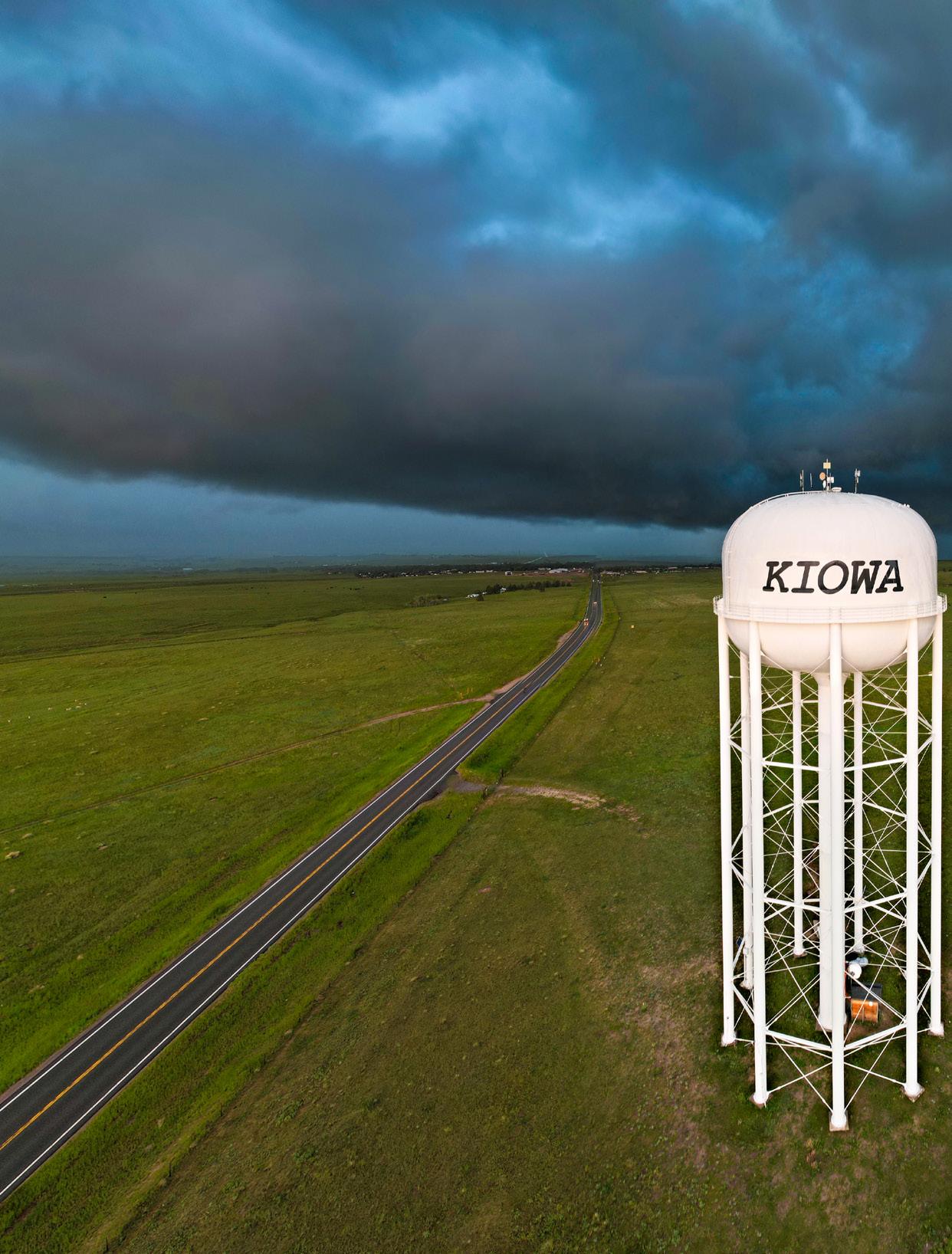
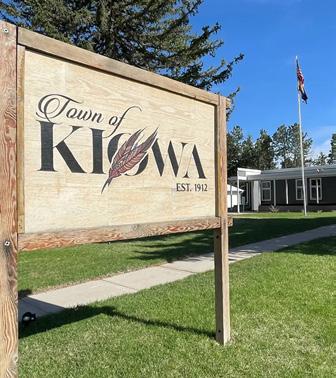
Kiowa, Colorado, illustrates how right-sized planning aligns responsibility with capacity. Facing aging water distribution lines and limited staffing depth, the town initiated a targeted, riskbased system assessment rather than commissioning a comprehensive replacement plan that would have exceeded fiscal capacity. The assessment prioritized segments most vulnerable to failure or compliance risk.
Instead of issuing substantial debt to replace the entire system at once, Kiowa sequenced improvements across multiple fiscal years. Projects were aligned with reserves, incremental rate adjustments, and carefully pursued grant opportunities. This phased approach reduced financial exposure while allowing staff to manage oversight responsibilities alongside daily operations. Clear
communication accompanied each phase, linking infrastructure condition to financial forecasting and public understanding.
Sustainability Depends on Matching Scope to Capacity.
Financial forecasting plays a central role in right-sized management. Multi-year projections incorporating anticipated capital needs, inflation assumptions, reserve targets, debt service,


and potential grant match requirements allows elected officials to see beyond a single budget cycle. In Kiowa, five-year financial modeling reframed policy discussions from reactive annual debates to forward-looking strategic planning.
Formal reserve policies further strengthen resilience. Establishing minimum operating reserves, capital replacement funds, and emergency contingencies protects against volatility. In Kiowa, reserve discussions during budget workshops clarified expectations and reduced reactive decisionmaking. Reserves were framed not as surplus funds but as
essential safeguards against service disruption and sudden rate spikes.
Utility rate design illustrates another dimension of scalesensitive governance. In rural communities, even modest increases can raise concerns among residents with fixed or limited incomes. Yet deferring rate adjustments often leads to deferred maintenance and future crisis-driven spikes. Incremental, predictable adjustments supported by transparent financial modeling preserve infrastructure reliability while minimizing sudden shocks.
Workforce vulnerability is inherent to scale. Smaller municipalities may have
fewer than 10 full-time employees. The departure of a single individual can disrupt multiple operational areas simultaneously. Cross-training and documentation, therefore, become essential management tools rather than optional administrative exercises.
In Kiowa, administrative staff were trained in procurement tracking, compliance documentation, and grant reporting to reduce vulnerability during absences or turnover. Public works personnel documented operating procedures for utility operations, equipment maintenance, and emergency coordination. When a longserving employee retired,
written procedures and crosstraining ensured continuity without significant disruption.
Professional
Resilience in Rural Communities Depends on Cross-training and Documentation.
Recruitment remains an ongoing challenge. Smaller communities may not compete with urban salary scales, but they can offer meaningful responsibility and direct community impact. Supporting staff participation in certification programs, regional professional networks, and continuing education strengthens retention and builds internal expertise. Investing in people is as critical as investing in infrastructure. Strategic grant planning is often essential to rural capital progress, but pursuing funding without alignment can create unintended strain. Rather than applying for every available opportunity, Kiowa prioritized grants aligned with its capital improvement plan and staffing capacity. Updated asset inventories, environmental documentation, and preliminary engineering estimates allowed the town to respond quickly when competitive funding windows opened.
Lifecycle cost analysis preceded each grant submission. Construction funding was evaluated against long-term maintenance, reporting obligations, cybersecurity requirements, and staffing capacity. Projects that would introduce disproportionate operational strain were deferred in favor of improvements aligned with realistic organizational capacity. This disciplined evaluation
prevented well-intentioned projects from becoming unsustainable obligations.
Grants Are Most Effective when Integrated
into Disciplined Long-term Planning.
Emergency response planning further illustrates the impact of scale. In rural communities, the same personnel responsible for daily operations may also coordinate incident response. Kiowa strengthened preparedness by clarifying roles, updating contact protocols, and formalizing mutual aid agreements with county partners. Practical planning— clear communication channels, defined responsibilities, and documented procedures— proved more valuable than complex frameworks that would be difficult to sustain.
Right-sizing technology modernization also contributes to organizational resilience. Rather than adopting enterprise systems designed for large cities, rural municipalities benefit from sustainable digital tools. Cloud-based document storage, standardized financial software, and shared data platforms improve transparency and continuity without requiring dedicated IT departments. Technology investments must be evaluated not by sophistication, but by sustainability.
Governance in closeknit rural communities presents both strengths and complexities. Elected officials and staff often share longstanding relationships. Decisions regarding rates, staffing levels, or infrastructure investment may involve neighbors and friends. Transparency, documentation,
and data-driven presentations become essential tools for maintaining credibility during difficult discussions.
Regular infrastructure condition reporting and financial forecasting support informed policy conversations. When elected officials understand the relationship between rate structures, maintenance schedules, staffing levels, regulatory obligations, and reserve policies, discussions shift from reactive to strategic. Clarity builds trust, and trust strengthens governance.
In Rural Governance,
Clarity Builds Trust. Policy frameworks must also recognize the realities of scale. Many state and federal funding programs assume administrative capacity that small municipalities lack. Complex reporting requirements, matching fund thresholds, and compressed timelines can disadvantage rural applicants. Aligning funding structures with rural realities—through simplified reporting, technical assistance partnerships, and phased funding models—would strengthen outcomes nationwide.
Several consistent lessons emerge for rural managers:
• Align capital planning with staffing capacity.
• Prioritize preventative maintenance over visible expansion.
• Use multi-year financial forecasting to guide rate decisions.
• Integrate grant strategy into long-term planning.
• Invest in cross-training and procedural documentation.
• Communicate openly about trade-offs and constraints.
In many rural municipalities, the same small group of professionals who prepares the annual budget also oversees utility compliance, manages procurement, coordinates elections, responds to emergency calls, updates websites, and communicates directly with residents. The scope of responsibility remains broad. The capacity remains lean.
The Conference Table May Be Small. The Responsibilities Are Not. Right-sizing is not about lowering professional standards. It is about sustaining those standards within realistic organizational limits. Through phased capital planning, disciplined maintenance, strategic grant alignment, workforce cross-training, regional collaboration, formal reserve policy, practical emergency planning, and transparent governance, rural municipalities demonstrate resilience every day. Scale defines the operating environment, but it does not define professionalism. When responsibility is deliberately aligned with capacity, small municipalities can deliver reliable services, maintain fiscal stability, preserve public trust, and plan confidently for the future. Rural communities continue to demonstrate that thoughtful management and steady leadership are not dependent on population size but on clarity, alignment, discipline, and sustainable decision-making.
KIMBERLY BOYD is a municipal administrator serving a rural Eastern Plains community in Colorado (kboyd@townofkiowa.com).


Smart, Small-Scale AI Strategies for Local Government
How small and rural communities can begin to adopt targeted AI tools without major costs, complex systems, or a large IT team.
BY KATRYNA PEART
In small and rural governments, the gap between workload and capacity can create real obstacles to the delivery of essential services. When a town administrator in a community of 8,000 receives a 100-page state funding update, there is no policy analysis unit waiting to interpret and disseminate it for the people it affects. If a federal grant opportunity opens with a three-week turnaround, there may be no one on staff with the specific skills to pursue it. Capacity constraints, in these cases, are not merely administrative— they are personal.
AI tools may seem costly or intimidating to adopt, but many smaller jurisdictions

have already found ways to deploy them effectively on limited budgets. In places where funding is tight and staff are stretched thin, successful implementation doesn’t depend on scale, but intentionality.
The Capacity Reality in Small Communities
People working in small and rural governments know the structural realities well. Departments may consist of one or two people. Managers routinely juggle operational, financial, and communityfacing responsibilities at the same time. IT support is often shared regionally or contracted out. And institutional knowledge tends to live in the heads of long-serving employees rather than in any organized system. Together, these conditions contribute to heavy workloads, service delays, staff burnout, and frustrated residents.
Real-World Examples: Practical AI on Limited Budgets
AI cannot replace professional judgment, but it can reduce the burden of administratively heavy and repetitive work. Small governments are already demonstrating that modest, targeted tools can make a meaningful difference in service delivery.
In Covington, Kentucky, a generative chatbot called Clive was launched and later expanded across the city’s municipal website. Reportedly developed for under $200 in initial deployment costs, the chatbot helps residents
The only meaningful metric is time saved — not whether the technology is new or cutting edge.
They need targeted applications aligned with their real operational constraints.
High-Impact, Low-Cost Use Cases
For small and rural communities, the most effective AI deployments tend to be narrow and clearly defined. A few areas stand out as particularly well-suited to the constraints these governments face.
and businesses navigate city services, permits, and local information. Covington paired the tool with a clear legal disclaimer noting that responses are informational only and carry no legal authority; a step that reflects a practical understanding that AI should extend service access, not replace official authority or expose the municipality to liability.
In Lebanon, New Hampshire—a city of around 14,000 residents—officials have explored AI tools to support municipal operations and community engagement. Rather than pursuing citywide automation, Lebanon’s approach has focused on practical use cases that amplify staff capacity without requiring a dedicated innovation team or a major procurement overhaul.
What both examples share is the same core insight: small governments don’t need complex AI ecosystems to benefit from the technology.
Summarizing regulatory guidance is one of the most immediate wins. Lengthy state or federal updates can be distilled into internal briefing notes, cutting down the time staff spend on initial reading while flagging key sections that warrant closer attention. AI tools can also contribute significantly to grant development—helping structure proposals, draft narrative sections, and match language to funding criteria— which matters enormously in communities without a fulltime grant writer.
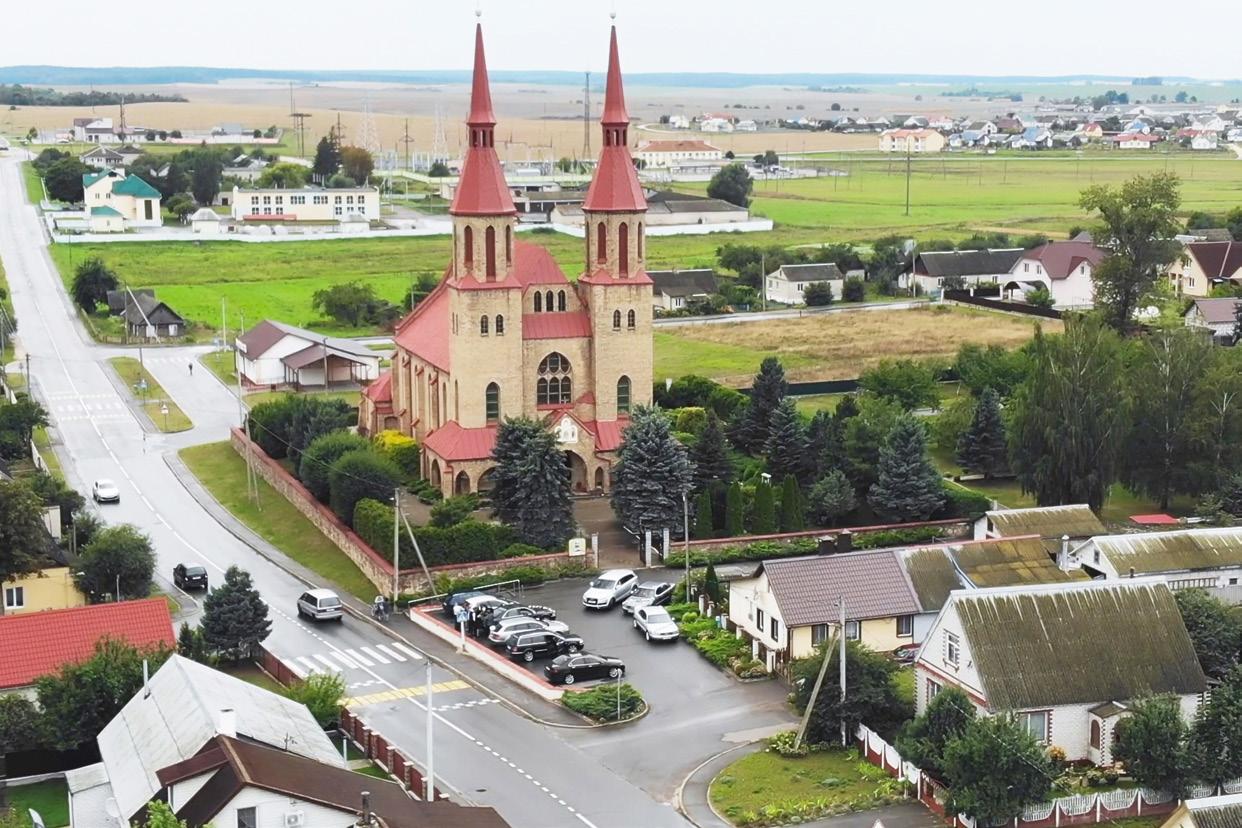
For communications, routine documents such as council updates, meeting summaries, public notices, and website FAQs can be drafted more efficiently, freeing up staff to focus on accuracy and clarity rather than starting from scratch. AI can also help organize public input, clustering comments from town halls or online forms by theme so managers can identify recurring concerns without sorting through everything manually. And over time, indexing current policies and procedures into searchable internal resources can reduce the institutional memory loss that small governments face
Zelva, Belarus
when long-serving employees move on.
None of these use cases involve full automation. They’re about improving efficiency and managing knowledge—getting more out of the capacity that already exists.
Budget-Conscious Deployment Principles
Smaller governments should resist the temptation to sign up for large, custom AI contracts without clear justification. The smarter path is to start with tools already embedded in existing productivity platforms, pilot them internally before launching anything publicfacing, and define use cases that are limited and measurable. The only meaningful metric is time saved—not whether the technology is new or cutting edge. The goal isn’t to “modernize” for its own sake. It’s to ease the burden on already overstretched teams.
Governance Matters, Especially at a Smaller Scale
Limited capacity also means limited margin for error,
The hardest choice for a small or rural government isn’t picking the best AI platform. It’s identifying one problem worth solving.
which makes basic governance guardrails essential even when a formal framework isn’t realistic.
At a minimum, AI-generated drafts and summaries should always be reviewed by a person before they’re published or used in decision-making. Tools should reference adopted, upto-date policies—not drafts or outdated materials—and even basic version control practices can prevent costly confusion. Staff need to understand what information is being entered into AI systems and whether privacy standards
apply. And if AI is supporting any public-facing services, its role should be communicated clearly. Covington’s disclaimer approach is a simple, replicable model.
Small governments don’t need elaborate governance frameworks. They need sensible, enforceable policies that match their actual staffing capacity.
Scaling Smart, Not Big
In larger jurisdictions, AI initiatives often aim for broad automation. In small towns
and rural communities, scaling looks different—and that’s fine. Meaningful progress might mean getting information to residents faster, building grant application capacity, retaining institutional knowledge through a staff transition, or simply freeing a manager from repetitive drafting tasks so they can focus on work that actually requires their judgment. AI should function as a force multiplier and not a risk multiplier.
Conclusion
The hardest choice for a small or rural government isn’t picking the best AI platform. It’s identifying one problem worth solving. Choosing a single repetitive task that consumes staff time and testing whether an available tool can reduce that burden is a low-risk start. Measure the result in hours saved or turnaround time, not in innovation metrics. Small communities have always done more with less. AI, used carefully, is another tool in that tradition—not a transformation, but a practical extension of what good governance already requires: clear thinking, sound judgment, and a commitment to serving residents well. Technology will keep evolving. The fundamentals won’t.
KATRYNA PEART is a civic AI strategist who has evaluated AI systems for Google and Uber. Her work has appeared in Governing Magazine and Route Fifty, and her research on generative AI policies was adopted into municipal policy by the town of Bolton, Connecticut.

Charles Town, West Virginia
Boost Recruitment & Retention through Student Loan Benefits


Join Savi and ICMA on the first Thursday of every month for a webinar designed for local government employees and HR leaders. See how Savi streamlines Public Service Loan Forgiveness (PSLF) enrollment and helps employees navigate student debt with confidence while giving HR leaders a meaningful financial wellness benefit that strengthens recruitment, retention, and workforce stability. Enhance your benefits strategy and empower your employees’ financial future. Scan the QR code below to register.
PSLF applications have been accepted since 2020
BENEFITS FOR YOU







WHEN EVERYONE WEARS FIVE HATS
In small and rural governments, coordination allows limited staff to execute council direction, deliver services, and manage risk when everyone takes on multiple roles.
BY MAX FISHER
At 10:30 a.m. in the city hall of Mesa Crossing, a fictional but familiar small rural town, the day is dense with responsibility. A utility customer stopped by the front desk with a billing question needing explanation. A vendor is waiting on a call-back to confirm next steps for a water project. The code compliance officer diligently reviews policy to simplify processes. Meanwhile, an email from the state flags a compliance report that needs one more attachment before close of business.
None of this is dysfunction; it is simply a normal Tuesday. In small and rural communities like Mesa Crossing, work rarely arrives in neat packages. Staffing shortages and lean budgets mean roles overlap by necessity. An assistant CAO may be functioning as the finance director, stepping in as the interim public works director, and filling HR gaps while the position is vacant.
A city secretary is covering the front-desk operations while coordinating essential HR functions. Analysts draft council packets in the morning, coordinate grants after lunch, and prepare public messages before heading home.
Wearing five hats is not a sign of inefficiency: it’s the operational reality of governments at this scale. Yet many management narratives and literature assume deep benches, specialization, and formal project offices. Those assumptions fail to translate cleanly to communities where the organization chart is short, the margin for error is thin, and the same few hands touch nearly every issue. In this environment, the management challenge is less about building structure, and more about making progress amid overlap and constraint.
If everyone wears five hats, how does anything get done well? Answering that question requires centering coordination as a management skill. In small and rural

is the glue that allows limited structures to function as a coherent whole. Coordination is not an informal workaround; it is stewardship that uses scarce resources responsibly, innovatively, and ethically in a setting where misalignment is visible and personal.
Why Coordination Matters More Than Structure
In large organizations, problems are often solved by new layers, new division, formal authority, or specialized staff. In small and rural governments, those options are usually unavailable or counterproductive. Budget cannot support redundancy, staffing levels do not support deep specialization, and many decisions rely on speed as much as precision.
When coordination is weak, predictable stress points emerge:
• Decisions are made informally, without shared understanding of ownership.
• Projects stall between departments because responsibility is assumed, not assigned.
• Staff burnout accelerates as priorities shift without explanation.
• Councils lose confidence when execution lags behind direction. These are not merely operational inconveniences. They are ethical risks.
In small communities, misalignment wastes public resources, delays services residents rely on, and erodes trust in governance.
Residents know staff by name. Councilmembers hear about delays at the grocery store. When coordination fails, the consequences are immediate,
visible, and human. When staff execution is inconsistent, councilmembers receive uneven information, invite informal workarounds, and may step into operational gaps, eroding the professional boundary the council-manager form of government depends on. Poor coordination is a real threat to organizational legitimacy.
Coordination is a force multiplier that acts as a supplement to scale. It aligns limited staff around shared goals, clarifying expectations, and reducing friction without requiring additional authority. Importantly, coordination reinforces accountability. When decision points, timelines, and responsibilities are visible, it is easier for councils, managers, and staff to understand why change is necessary, how decisions are implemented, and where adjustments are needed.
This is why coordination is no mere efficiency tool, but an expression of stewardship. Connected to the ICMA Code of Ethics, coordination upholds stewardship of public resources, professional competence, and respect for democratic governance. For lean organizations, coordination is a major mechanism by which those values are operationalized. Without coordination, even well-intentioned decisions risk waste, confusion, and inequity.
The CAO’s Office as the Coordination Hub
In small and rural governments, the CAO’s office occupies a unique position. Whether staffed by the CAO alone or supported by assistants and analysts, it is often the only vantage point where the entire organization is visible at once. That visibility creates responsibility,
even when formal authority is limited.
For those in or alongside the CAO office, influence comes less from command and more from connection. Coordination is embodied through synthesis, translation, and followthrough. Council’s intent is translated into operational clarity, departmental efforts are sequenced to not delay one another, and risks are surfaced while there is still time to adjust.
In Mesa Crossing, as in many small and rural governments, this coordination role takes several recurring forms:
• Translating council direction into clear next steps, boundaries, and timelines.
• Aligning departments around shared calendars and expectations.
• Identifying cross-department dependencies before they become bottlenecks.
• Ensuring follow-through without supplanting departmental expertise. Frequently, this work is misunderstood as micromanagement. In practice, it does the opposite. By reducing ambiguities, coordination frees departments to focus on execution rather than interpretation; it replaces guesswork with clarity and reactivity with rhythm.
Ethically, the approach reflects respect for professional roles and democratic governance. The ICMA Code of Ethics emphasizes integrity, competence, and respect for elected officials and staff responsibilities. Coordination upholds these principles by ensuring decisions are implemented faithfully and transparently, without burdening small or rural governments to build structures they cannot sustain.
Practical Coordination Tools That Work in Lean Organizations
Coordination does not require new software or additional staff. In small organizations, simple, repeatable practices often outperform complex systems. The following tools are effective in lean environments and can be implemented without new purchases.
The Weekly Alignment Brief
A one-page summary distributed weekly can drastically improve coordination and reduce surprises. An effective brief highlights key priorities, upcoming deadlines, recent council actions, and decision points that require follow-up. When paired with a short newsletter that includes departmental updates, emerging issues, and recent successes, this coordination enhances the situational awareness of the organization. For department heads and the CAO’s office, the report clarifies ownership and sequencing, helping staff be proactive with issue points before they arise as conflicts. What makes the brief particularly valuable is not the information itself, but the discipline it creates. Preparing the brief requires leadership to answer the fundamental question: What matters this week? This prioritization provided direction to coordination. With time, staff begin to understand the intent of the organization and adjust their work accordingly, raising concerns proactively. The benefits are cumulative: fewer last-minute scrambles, less missed work, more predictable council packets, and an organization that shares a vision of its work.
Decision Clarification Memos
After council meetings or leadership decisions, a short, written summary that answers the questions, “What was decided? Who owns it? What comes next?” can create a durable reference point. These memos can be informal and answered in incomplete sentences. Their value lies in creating a shared reference point for action. When decisions involve multiple departments in implementation, the memo can be a core part of the organization that helps reduce reinterpretation and decision drift.
For analysts and ACAOs, the memos serve to forge institutional memory. For any organization with role overlap, decisions are often revisited weeks later, and sometimes after transitions and shifting priorities. A simple memo protects against drift and provides staff with direction in the whiplash of changing narratives. For managers, it serves to say, “Here is what was decided; here is how we are executing it.” Both internally and with council, these memos reinforce trust.
A Single Point of Contact Norm
Every cross-departmental project can benefit from a designated coordinator, irrespective of rank. The role carries the responsibility for communication rather than authority. It is especially effective for capital projects, grants, and regulatory requirements that involve frequent handoffs. Establishing this norm prevents responsibility diffusion and helps keep the project
moving, even when staff are stretched thin.
For CAOs and ACAOs, the single-point-of-contact norm reduces the need for constant escalation. Instead of fielding updates from across departments, leadership has a strong conduit for information. For staff, the role creates clarity without adding hierarchy. The result is fewer stalled projects, clear timelines, and a culture where coordination is expected rather than a last-minute meeting. When everyone owns it, no one does; when one person coordinates it, everyone benefits.
Calendar-Based Execution
In organizations, calendars are not just personal schedules but management tools. Making milestones, reporting deadlines, and council actions visible across departments reinforces an organization’s shared accountability. When everyone sees when decisions are expected and reports are due, coordination is not only easier, but more proactive.
For staff, organizational calendars reduce cognitive load. Staff no longer must actively remember when a report is due and when a decision must be ready; the organization remembers for them. This also creates visibility that supports ethical administration by making timelines and expectations explicit. When everyone can see when decisions are expected and reports are due, missed deadlines are less about blame and more about course correction.
Together, these practices reinforce transparency, professional competence, and intentional management. The work feels simple but the
practices require discipline. They bolster a coordination system that has respect for limited capacity while enhancing execution.
Coordination in Mesa Crossing
Mesa Crossing, our fictional example city, faced a familiar convergence of priorities: a waterline replacement, new reporting tied to a grant, and a council initiative to streamline code compliance. Staff capacity is thin, with employees covering multiple departments and functions.
Initially, progress stalled. Public works assumed finance was tracking the grant timeline. Finance assumed public works was coordinating contractor reporting. Code enforcement waited for direction that never arrived. Deadlines crept; frustration grew.
The response was not reorganization; it was coordination. The CAO’s office responds, not by resolving all the issues, nor by restructuring the organization, but by coordinating. A point of contact is designated for the grant. A weekly alignment brief highlights project milestones. Decision memos clarify the council’s expectations. Key dates are shared on the office calendar.
The change? Subtle, but immediate. Roles become clear, departments communicate easier, the projects gain momentum without adding new staff or contracting out. Staff reports less last-minute stress; the dreaded phrase, “I didn’t know that,” quietly disappears; and council’s confidence improves as progress becomes regular.
The outcome is not perfection but predictability. Fewer crises come forth, morale
stabilize, and public resources are used more effectively. In small and rural communities, those wins matter. They reflect ethical stewardship of resources entrusted.
Why Coordination Matters Beyond Small Towns
The coordination skills developed in small and rural communities are highly transferable. Wearing five hats forces practitioners to make connections, anticipate impacts, and prioritize execution. Far from being a liability, experience in these communities is a professional asset.
Reframing coordination from a workaround to a discipline elevates it to an essential competency. It can be learned, practiced, and modeled across organizational size. For CAOs and their teams, investing in coordination strengthens governance, builds trust, and supports ethical administration. The work will not become simpler. Council packets will still be due, residents will still call with questions, and regulatory requirements will continue to expand. But with intentional coordination, the work becomes sustainable.
For small and rural communities, this sustainability is not optional. It is the foundation on which professional local government builds. Coordination holds up the quiet work that allows governments to meet their obligations with integrity and competence, no matter how many hats you’re wearing.
MAX FISHER is assistant to the city manager of Levelland, Texas.

The Climate Resilience Advantage for Small and Rural Communities
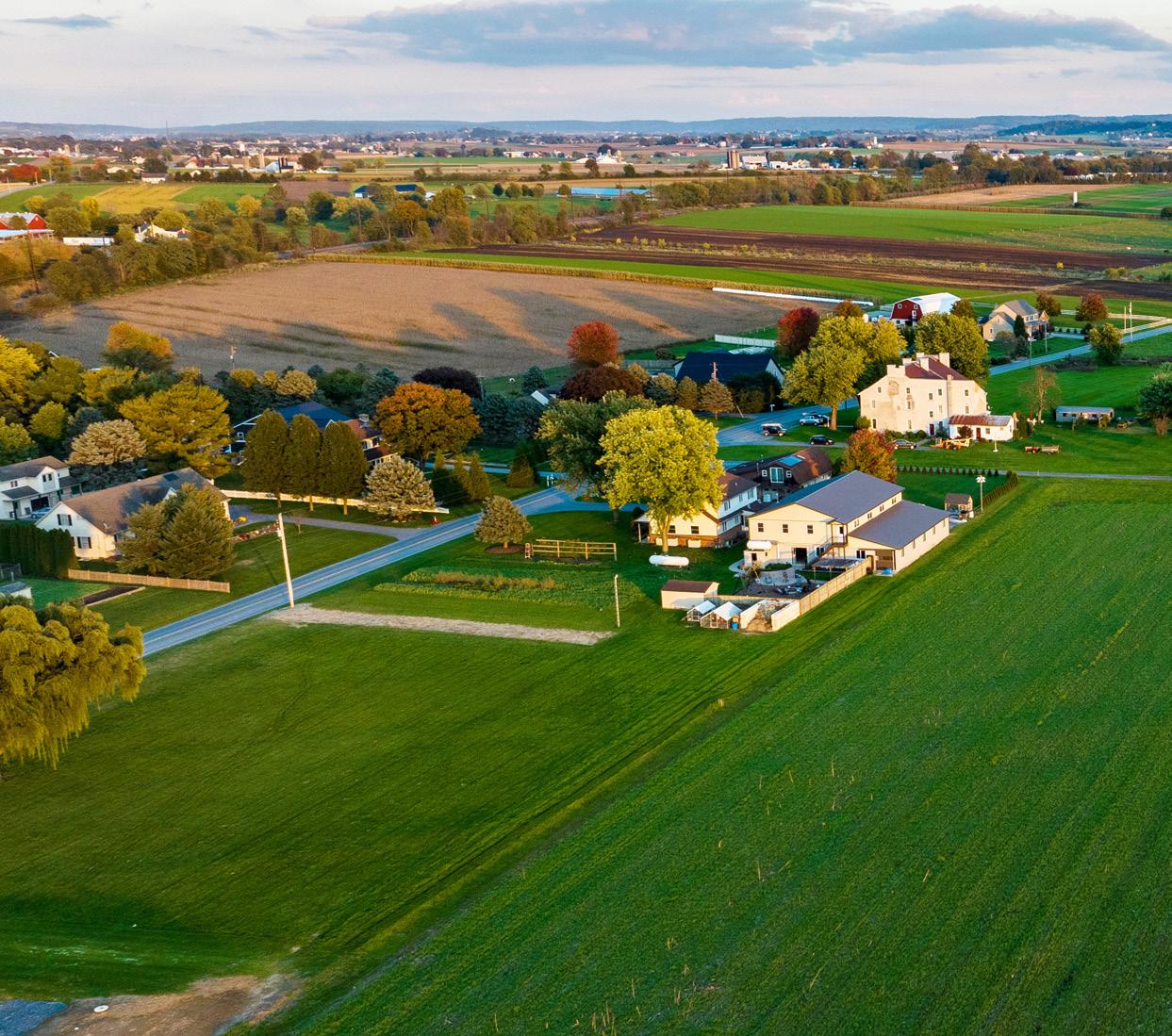
How to move from climate planning to implementation, and why those communities that act now are already pulling ahead.
BY JOYCE COFFEE, LEED AP & ROBERT MACNEE, PhD
When two communities face the same flood, the same heat emergency, the same aging infrastructure failure, what determines which one comes through intact?
It is rarely the quality of their climate plans. Across the country, local governments have invested in vulnerability assessments, hazard mitigation plans, and adaptation strategies. Many of those documents are technically sound. Most are also sitting in shared drives, unactioned, while the hazards they describe continue to compound.
What separates communities that implement resilience from those that plan it indefinitely is not the sophistication of the analysis. It is whether climate resilience has been woven into how the community actually governs, budgets, and serves residents. A plan on a shelf protects no one. Processes, capital decisions, and infrastructure standards that account for a changing climate do.

For managers leading small and mid-sized communities, where staff capacity is limited and the cost of deferred action is highest, understanding what resilient communities actually do differently is one of the most practical investments available. The good news is that community size is not the barrier. The path to the resilience advantage is open to any jurisdiction willing to take the first step.
The Gap Between Data and Action
Ask a city manager or county administrator what the real climate challenge is. The answer is rarely a lack of information. Risk data has never been more accessible. Federal mapping tools, state vulnerability assessments, and hazard mitigation plans have put more information in front of local leaders than ever before.
What has not kept pace is the capacity to act on it. Translating risk data into a specific, fundable project that can survive the next budget cycle is a different skill from assembling a comprehensive risk inventory, and most communities have not been given the support to develop it.
A Midwestern city has FEMA flood mapping, knows its stormwater culverts cannot handle the new rain patterns, and has a grant officer who has flagged three potential funding sources. But no one on staff has the time to connect those three threads into a competitive application. The data and the money are both within reach. The bridge between them is not.
A coastal county completes a thorough vulnerability assessment. Six months later, the report is in a shared drive that three people know how to find. Staff turns over. Institutional memory fades. The findings never become a project.
This is not a failure of local government. The resilience field has contributed to the problem by consistently delivering plans and
frameworks rather than operational tools that managers can act on Monday morning.
The Alignment Challenge
Even when a manager knows what needs to be done, getting it done requires alignment across departments, elected officials, and the community. That alignment does not emerge from a well-written plan.
What works are locally grounded risk narratives that connect a specific hazard to a specific neighborhood, a specific cost, and a specific consequence. When a councilmember can see what is at stake in their district in concrete terms, the political conversation changes. Stalled decisions move. Budgets shift. The same technical information that sat unused in a report becomes the basis for action.
Three Questions That Unlock Action
Budget size and staff capacity matter less than commonly assumed. What matters most is whether a community can answer three questions with enough precision to act on the answers:
1. What is the single highest-priority risk in this community, defined at the neighborhood level rather than the jurisdiction level?
2. What specific action addresses that risk and produces the best combination of safety benefit, funding eligibility, and return on available capacity?
3. Who needs to be aligned for that action to move forward, and what does each stakeholder need to understand to get on board? When a community can answer those questions with specificity, things move. Projects get scoped. Grant applications get written. Council votes happen. Communities that invest in broad planning

without developing the capacity to translate findings into specific projects often find themselves at the same starting point two or three years later. Depth of analysis is valuable. Planning without prioritization is a starting point, not a strategy.
Five Principles That Define Resilient Communities
Climate resilience field practice has identified a consistent set of principles that separate communities advancing toward implementation from those that remain in perpetual planning. They are most consequential for small and mid-sized governments, where the cost of planning without acting is most immediate.
1. Clarity beats comprehensiveness. A community does not need an exhaustive inventory of every vulnerable asset to start acting. What it needs is a clear picture of its highest-priority risks paired with locally grounded narratives that align people inside and outside of government around a shared course of action. The goal is not completeness. It is momentum.
2. Funding readiness is a resilience strategy.
Communities that maintain a pipeline of grant-eligible, well-documented projects consistently capture more federal and state funding than those that scramble to apply when a window opens. The disciplines required to build that pipeline, specific risk framing, project scoping, and community documentation are the same disciplines required for sound resilience planning. The Hazard Mitigation Grant Program, Community Development Block Grant Disaster Recovery Program (CDBG-DR), and state hazard mitigation programs reward communities that prepare before the announcement, not after.
3. Resilience must outlast elections. Communities that have made durable progress are those that embedded resilience into capital planning cycles, procurement criteria, budget processes, and zoning standards. A standalone initiative has roughly a four-year lifespan. Institutional integration does not. Treating resilience as a standing function of governance, rather than a time-limited project, is what creates compounding progress across administrations.
4. Equity is a practical requirement. The
What Integration Looks Like
Resilience is not a cost center. It is a performance strategy. Communities that have embedded climate adaptation into everyday governance are outperforming those that have not in ways that show up in grant award rates, budget efficiency, and recovery timelines. Their projects are documented before funding windows open. They spend less on post-disaster costs. The institutional trust they build makes each subsequent decision easier.
communities most exposed to climate impacts are almost always those with the fewest resources to respond. Strategies that do not account for who bears risk and who has access to recovery resources tend to widen those gaps over time. Strategies that center vulnerable populations consistently generate stronger, more durable community support for the investments that implementation requires.
5. Small communities need tools built for their scale. A city of 8,000 faces genuine climate risks: flooding, heat seasons, agricultural supply chain disruptions. It cannot absorb a $300,000 consulting engagement to assess them. The standard toolkit of large-scale adaptation planning rarely fits the capacity of a smalltown public works director or a part-time emergency manager. The communities that advance furthest access approaches sized to their actual situation. Emerging low-cost, software-based approaches are beginning to close this gap, delivering hazard data and prioritized actions without requiring dedicated GIS staff or six-figure contracts.
Figure 1 illustrates where the difference between reactive plan-on-the-shelf and integrated resilience is most pronounced across local government functions. Communities in the right column are not outliers. They are not consistently larger or better funded. What they share is a decision to treat resilience as something that belongs inside how government operates, not alongside it. That decision is available to any community, including small towns and rural areas that have been largely left out of the national resilience conversation.
The Small-Town Structural Advantage
The resilience advantage does not require a dedicated sustainability office or a large capital budget. Smaller communities hold structural advantages that large metros do not. They are less organizationally complex to align. Fewer departments, closer working relationships, and shorter distances between a manager’s decision and frontline implementation mean that a committed manager can move faster than a counterpart in a large city navigating layers of bureaucracy.
Seneca Falls, New York
1. Plan-on-the-Shelf vs. Integrated Resilience
Plan-on-the-Shelf
Resilience sits in a standalone plan, separate from day-to-day operations.
Vulnerability assessments completed; findings never translated into projects.
Political will treated as a barrier to action.
Resilience expertise accessible mainly to well-resourced jurisdictions.
Integrated Resilience
Resilience is embedded in capital plans, budget cycles, procurement, and zoning.
Risk data connected directly to specific, fundable project pipelines.
Local risk narratives built to align departments, councils, and residents.
Approaches scaled to the actual capacity of each community.
Success measured by plan adoption. Success measured by implementation and outcomes.
Source: Field observations across local government climate resilience engagements.
What small and rural communities need is not a scaled-down version of what large metropolitan areas do. They need approaches designed for their actual situation—ones that produce specific, fundable project scopes without requiring a prolonged process to generate them. Communities that start that work now, even on a single focused project, will be better positioned for every subsequent step.
Four Steps to Start
Every community sits somewhere on the spectrum between reactive plan-on-ashelf and integrated. The goal is not to jump immediately to full institutionalization. It is to take the next step deliberately.
1. Name the single highest-priority risk. Breadth can follow. What is needed first is one welldefined risk at the intersection of high exposure, community concern, and funding eligibility. That specificity is what turns a risk assessment into a project scope and
a project scope into a competitive grant application.
2. Map the funding landscape before a window opens. The Hazard Mitigation Grant Program, CDBG-DR, and state hazard mitigation programs operate on application cycles. Communities with scoped, documented projects ready to submit when a window opens are competitive regardless of size. Funding readiness is not separate from resilience planning. It is core to it.
3. Connect the capital plan to risk data. Ask in the next capital planning discussion whether current and projected climate risk is a named criterion in how projects are prioritized. If not, that is the integration gap to close first. Two documents that already exist in every jurisdiction—a capital improvement plan and a hazard mitigation plan— simply need to be connected in practice.
4. Build the shared narrative before it is
What Changes
Progress survives elections and staff turnover.
Faster, more competitive access to federal and state grants.
Stakeholders engaged before the emergency, not during it.
Small and rural communities access the same quality of analysis as large metropolitan areas.
Resilience that actually reduces losses when disasters hit.
needed. The communities that implement fastest share a common understanding of local climate risk across departments, officials, and residents. That understanding comes from conversations organized around specific, local, credible risk information, held before the emergency rather than during it.
Climate losses have risen from roughly $12 billion annually in 1980 to nearly $120 billion today, and the communities bearing the greatest losses are consistently those with the least capacity to absorb them. The window to build ahead of the next emergency is open. For local government managers, the question is not whether climate disruption will affect their community. It will. The question is whether the community is building its capacity now or after the fact.
Learn more at climateresilienceconsulting.com.
RESOURCES
• Fifth National Climate Assessment, Built Environment Chapter. U.S. Global Change Research Program, 2023. https://nca2023.globalchange.gov.
• Climate and Land Use Planning: A Policy Guide for U.S. States and Territories. U.S. Climate Alliance and Smart Growth America, 2025. https:// usclimatealliance.org/wp-content/ uploads/2025/02/USCA_Clima teandLandUsePlanningPolicyGui de_20250211-LowRes.pdf.
• Ready-to-Fund Resilience Toolkit. American Society of Adaptation Professionals. Available through http://asap-resilience.org.
• Hazard Mitigation Grant Program. Federal Emergency Management Agency. http://fema.gov/grants/ mitigation/hazard-mitigation.
• Community Development Block Grant Disaster Recovery (CDBGDR). U.S. Department of Housing and Urban Development. http://hud.gov/ program_offices/disaster_recovery.
JOYCE COFFEE, LEED AP, is the founder and president of Climate Resilience Consulting.
ROBERT MACNEE, PHD, is founder of the Resilience Intelligence Advantage.


Figure
Community-Driven Economic Development Gets a Boost from the Economic Recovery Corps
Economic Recovery Corps fellows are helping distressed communities align local priorities, build partnerships, attract investment, and shape their future.
Landdis Hollifield has lived most of her life in Marion, North Carolina, a small town of 7,700 people nestled in the foothills of the Blue Ridge Mountains. She has seen firsthand the challenges that small, rural communities
face and recalls the economic disruptions in the 1990s that were acutely felt on Main Street in Marion as businesses were boarded up and jobs left the region. She also knows that with strategic investments and community vision, it is possible to reimagine and rebuild.
Today, Landdis is an Economic Recovery Corps (ERC) fellow working in Highland County, Virginia. In 2024, Landdis packed up and drove the 320 miles from Marion to Highland County as she began the 30-month fellowship that was designed
to connect experienced mid-career professionals like Landdis with organizations that needed additional capacity and resources to catalyze economic revitalization.
Led by the International Economic Development Council (IEDC) with funding

BY DEBRA PERRY
Highland County, Virginia
from the U.S. Economic Development Administration, the ERC strengthens local economic development capacity by embedding fellows in host organizations working in distressed communities and regions. The program supported post-pandemic recovery while helping communities build resilience and pursue transformative, long-term change. Project partners—including ICMA, the National League of Cities, the National Association of Counties, the National Association of Development Organizations, and the Center for Rural Innovation—help support fellows and their host organizations.
United States. Nicole Manapol, IEDC’s vice president of emerging practice, explains the theory behind the program:

The Corps is comprised of 65 fellows situated in host organizations in some of the most economically distressed communities and regions in the
“When we designed the Economic Recovery Corps, we recognized that many communities weren’t lacking ideas or ambition— they were lacking sustained capacity to coordinate, implement, and build momentum over time. Particularly in rural, tribal, and persistently distressed places, one additional person with the right mix of technical skill, facilitation ability, and relationshipbuilding capacity can fundamentally change what a community is able to pursue. ERC was designed not just to support projects, but to test what becomes possible when you connect the right talent with communities to strengthen systems, build relationships, and expand longterm local capacity.”
In Highland County, Strategic Action and Catalytic Investments Create Momentum
For Landdis, Highland County felt familiar in some ways. The rural, mountainous county is situated along the border with West Virginia and the population (barely 2,300) is spread thinly across the
county’s 400 square miles. The county’s economy relies heavily on agriculture and tourism, it has limited public water and wastewater infrastructure, and no three-phase power, constraining its opportunities for traditional growth.
In a small community with limited capacity, creating partnerships and collaboration is a key strategy to leverage staff resources and maximize impact. Prior to the fellowship, five Highland County organizations had already aligned around a shared commitment to economic development.
Building on this foundation, Landdis helped them translate that alignment into action by developing a strategic plan that was intentionally “rightsized”—nimble enough to be updated as conditions changed, and practical enough to guide near-term decisions and priorities. That practical approach helped residents
see priorities advancing and reinforced trust in the work.
Landdis sees the plan as an important strategy for building trust and momentum and offers this advice: “Don’t create a document that gains dust over time—create a document that creates credibility over time.”
Since starting her fellowship, she has helped Highland County win a $1.7 million grant to restore a historic inn, a catalytic Main Street redevelopment project in the county’s largest town. She also helped create a local business registry and drew on her public relations background to launch a resident attraction effort, laying the groundwork to convert tourists into long-term community members.
Landdis notes that in places like Highland County, economic development success often hinges on “soft skills” like showing up consistently, breaking down communication
ERC Fellow Landdis Hollifield (upper right) with members of the Blue Grass Resource Center Board, owners of the Highland Inn, and VA 35th District Delegate Chris Runion (far right). The Highland Inn Revitalization Project will be a catalytic redevelopment project for this small town.
Photo courtesy of Blue Grass Resource Center
barriers, and connecting dayto-day work to community priorities. In distressed rural communities, that trustbuilding capacity is what turns one-time wins into durable momentum—supporting entrepreneurs, strengthening Main Street, and making it easier to secure future funding for the projects residents value.
A Fresh Perspective Kickstarts Action in Michigan City, Indiana
In Michigan City, Indiana, ERC fellow Dr. Tracey Clark Jeffries is also thinking about growing capacity through collaboration and focusing on catalytic investments. Michigan City, Indiana (population 32,000) is an urban community with a small-town feel situated on the southern shore of Lake Michigan. While it has an industrial history, its natural assets, including beautiful beaches and proximity to the
Indiana Dunes National Park, are an opportunity to expand the economic benefits of tourism and recreation.
Tracey has worked in economic development for more than 15 years with experience in the Midwest United States and internationally in Accra, Ghana. When accepted into the fellowship program, she was excited and saw it as an opportunity to expand her skills, network, and experience by working in another community.
As a fellow, Tracey notes one of the most valuable things she was able to bring to Michigan City was perspective. As an example, Tracey was able to bring a fresh lens to the revitalization of Michigan City’s West Side Corridor. It was an area that the community had long recognized needed attention and reinvestment, but political tensions and lack of strategy stood in the way of
progress. Tracey is considered a neutral party with no political agenda and was able to gain trust and build buy-in for a path forward. She helped to launch the West Side revitalization corridor committee.
Revitalizing the housing stock was a top priority, but it was important to do it in a way that met community needs. An idea took shape that focused on local contractors. The revitalization initiative has now created a small developer program that will partner with small contractors and developers to rehabilitate homes while growing their small businesses. Through the initiative they are able to connect with small contractors to support growing their skills and their businesses as they meet community housing needs.
To advance broader regional needs for small business support, Tracey has also been working to bring a new Innovation Hub from idea to reality. The Hub fills a critical gap in the local economic ecosystem and will provide a space that new entrepreneurs and start-ups need to cultivate their ideas and build their businesses. The idea was first hatched in a 2021 feasibility study but was not appropriately scaled to the needs of the
ERC fellow Dr. Tracey Clark Jeffries (right) attends the IEDC Leadership Conference with Clarence Hulse, executive director of Economic Development Corporation of Michigan City (left) and Angie Nelson Deuitch, mayor of Michigan City, Indiana (center).
ERC fellow Sasha Nelson staffs a monthly resource open house as she works to connect small businesses to resources across Northwestern Colorado.
community. Through her fellowship, Tracey was able to reconnect with the needs of small businesses to establish a small business roundtable and to revise the plans for the Hub to be smaller but better aligned to local priorities. She recently submitted a significant grant proposal to fund the Hub and hopes to leave her fellowship with news that the Hub is moving forward to implementation.
Tracey’s greatest lesson learned is that while the community may want change, to be successful you must keep up engagement as you move through implementation and stay connected with community needs. Start with small wins and build trust and momentum as you go. As Tracey describes, “Move delicately and continually test the waters, sensitive to the temperature… put your finger in, and then your toe, before you make the big splash.”
In Northwestern Colorado, Collaborations Are Key to Sustainability
Across the country in Northwestern Colorado, another ERC fellow is helping a rural region navigate a difficult economic transition after coal.
Sasha Nelson, who already lived in the area, saw the fellowship as a chance to retool and bring her background in journalism and education to help chart a new economic future for her community. The loss of 2,800 coal jobs and associated decline in tax revenue has been described as “economic Armageddon” for the region—a shock that has reshaped livelihoods and heightened the urgency to build a new economic base.
In Northwestern Colorado, economic development capacity was extremely limited and past efforts had come in fits and starts—investments were made, expectations rose, and when results didn’t materialize quickly, the community pulled back. To create sustained momentum, Sasha knew it was important to more clearly link community development and economic development. “If economic development isn’t clearly meeting the needs of communities, it erodes trust,” she explains, pointing to earlier projects that faltered without sustained engagement and support.
Like Landdis and Tracey, Sasha focused on practical, right-sized steps that responded to needs local residents and entrepreneurs had already named. One early example was a micro revolving loan fund for small businesses. She helped get it up and running with an initial $150,000—modest but meaningful because it filled an important gap identified by local small business owners and provided vital access to capital. The region also leaned into a “grow our own” strategy to support homegrown talent and build an entrepreneurial economy, and Sasha worked to develop a business retention and expansion program to support businesses in the region.
Prior to the fellowship, Sasha aided a survey of coal workers that informed the worker support programs developed by the State of Colorado Office of Just Transition, the first such office in the nation. Now, with mass lay-offs underway, she used the opportunity as a fellow to act as connector and technical
support provider. She brought insights and skills learned from the programs’ national partners home to apply at the hyper-local level.
One of her favorite success stories has been helping the Cooper family, generational coal miners, as they founded High Altitude Geothermal, the first geothermal drilling company in the Northwest corner of Colorado. “I used my ERC training to identify their business’s potential, and the Coopers did the hard work—extra shifts at the mine while developing their business plan. To be support crew and witness to the grit of families like the Coopers, who are reimagining their futures, has been one of the many unexpected gifts of this fellowship,” she reflects.
As Sasha winds down her fellowship, she continues to see creative ways to bolster local capacity. As she describes, “Pooling resources collectively to add capacity has been incredibly powerful for our region. When we break down regional silos to share knowledge and create meaningful collaborations, 1+1 can equal so much more than 2.”
Beyond the Fellowship, Creating Sustainable Economic Development
ERC is proving that by adding capacity where it is needed most and keeping the focus on community needs, right-sized approaches, collaboration, and trust, communities can move from episodic initiatives to sustained economic impact.
To date, ERC fellows have helped unlock nearly $250 million in new public and private investment across 65 host communities—an
8:1 return on the initial $30 million federal investment. They are advancing a range of initiatives that are building local assets and supporting entrepreneurs and main street revitalization, while creating new pathways for opportunity in communities that have experienced decades of disinvestment.
For IEDC and its national partners, ERC has served as a powerful proof of concept that strategic capacity may be one of the highest-return investments communities can make. Beyond individual projects, the fellowship is helping demonstrate a new model for economic development—one that equips communities not only to compete for resources, but to shape their own economic futures through stronger local leadership, deeper collaboration, and sustained on-the-ground capacity.
IEDC’s Nicole Manapol reflects, “ERC shows what’s possible when we invest in people and local capacity, not just projects. Through partnerships like this, we’re helping communities build the relationships, skills, and resilience they need to navigate change and create lasting economic opportunity long after any single funding cycle ends.”
Learnmoreaboutthe impactsoftheERCprogram at economicrecoverycorps.org
DEBRA PERRY is a program director of ICMA Innovation and Research.

HOW SMALL TOWNS CAN THRIVE WITHOUT GROWING
Chiloquin, Oregon, and Kamikatsu, Japan, are two small, isolated, and resource-dependent communities built around a single industry. But once their core economic sector vanished—and despite different cultures, institutions, and planning systems—they arrived at the same answer: Instead of chasing growth, they decided to focus on their existing assets and work with what remains.

BY FERNANDO ORTIZ-MOYA, PhD & SARAH SIELOFF, AICP
For shrinking rural communities, success may depend less on attracting what’s missing and more on activating what’s already there.
Most economic development policy frameworks assume that growth is the way to fight
decline. The underlying logic equates population decline with failure, which creates a sense of inadequacy that encourages municipal managers to look outward for the missing elements that could, ultimately, restore growth. As such, the standard economic development playbook suggests that local governments attract residents, court businesses, expand their tax base, and find a new “brand” for themselves. It is an approach that treats growth both as the engine and the goal.
Pro-growth approaches have had limited, if any, success to
date. Often, they are expensive and leave the needs of the actual community—those still living there—unattended. Yubari, Japan, is a clear example. Facing depopulation and declining tax revenues following the collapse of mining, the local authorities pursued costly growth-driven interventions, including an amusement park, new museums, and an international film festival. But the heavy investment required to sustain this expansionist program limited Yubari’s capacity to provide essential services, leading to its de facto bankruptcy in 2006. Ultimately,

aggressive pro-growth spending accelerated its financial problems without reversing depopulation. As of April 2026, Yubari’s population stands at 5,709—95% below its peak population of 116,908 in 1960.
Yet, neither Chiloquin nor Kamikatsu chose this path. They both looked inward and worked with their existing resources to improve quality of life. What follows are their stories.
Chiloquin, Oregon: Remaking Downtown to Make It Work for Everyone
Chiloquin, Oregon, is a city of fewer than 800 people within an area of less than a square mile in southern Oregon. More than half the city’s residents are Native American, of whom many are members of the Klamath Tribe. Chiloquin is not only small, but isolated: the nearest relatively large city, Klamath Falls (population 22,300), is a 54-mile roundtrip. From its beginnings in 1910, Chiloquin was a logging town. Local sawmills and other timber-related jobs formed the backbone of the local economy and supported a bustling downtown with multiple shops and offices. But when Oregon’s timber industry began to decline in the 1980s, so did Chiloquin. Gradually, Chiloquin’s small downtown grew quieter. Businesses closed or left, and buildings stayed vacant.
Chiloquin struggled for several decades after the decline of the timber industry, but today, residents are making strides toward rebuilding economic vitality and improving local quality of life. The city’s path forward,
therefore, has to involve a different approach, and to date, residents are focused on using available resources in new ways.
One of the ways they’ve done this is by addressing blight. In 2021, Chiloquin secured several brownfields grants from the U.S. Environmental Protection Agency (EPA) to conduct environmental assessments of downtown buildings. For example, the Hirvi Building had been a downtown staple ever since it opened in the 1920s. At various points, it hosted a bookstore, clothing store, a Klamath Tribe administrative office, and several other businesses. The Hirvi Building sat vacant from about 1980 to 2020, and in cooperation with the building’s private owner, the city used some of its EPA funding to assess the Hirvi Building for potential contamination. Assessments determined that the building was uncontaminated, which cleared the way for a $200,000 state grant to support new windows, doors, heating, ventilation, and exterior stucco.
The building’s private owner invested significantly more in interior improvements, and today, the Hirvi Building is once again a key part of downtown Chiloquin. Its four retail bays are full, with a bakery, a marijuana dispensary, a feed store, and a printing shop. At the rear of the building, six offices are on their way to being occupied.
“It’s just created this atmosphere in downtown,” says Cathy Stuhr, special projects manager for the city. “When you go into town it’s vibrant and there are people on the street. And every morning when the bakery opens, there’s a line.” Downtown Chiloquin
Chiloquin, Oregon
today is almost unrecognizable from even five years ago. The Hirvi Building’s success has sparked further activity, and more and more buildings are now occupied. Chiloquin will never be what it was in the 20th century, but that’s not a loss.
“We’re looking at taking what we have, making it look better, and putting it back into use,” says Stuhr. And so far, that focus has delivered significant results.
Recognizing that its future is unlikely to involve significant population growth, Chiloquin is also working proactively with state officials to identify more ways for small Oregon towns to share resources. “Could we have a single city planner shared between multiple nearby communities? City engineer? Accountant?” asks Stuhr.
“These are the kinds of models we’re trying to build because every community needs these services, but we also struggle to support the costs.”
Kamikatsu, Japan: How a Small Town Reinvented Itself
Kamikatsu is one of the smallest local authorities in Japan. With a population of 1,380 in 2020—55% of whom were over age 65—the town has shrunk by more than 75% since 1955. Yet, Kamikatsu frequently shows up in international media outlets— from the Washington Post to the BBC1—as an example of how a small community can turn its constraints into drivers of reinvention.
Throughout history, the town’s conditions shaped its economy. With 90% of its area covered by forests and characterized by a mountainous terrain, Kamikatsu’s economy rested on logging and smallscale agriculture, where
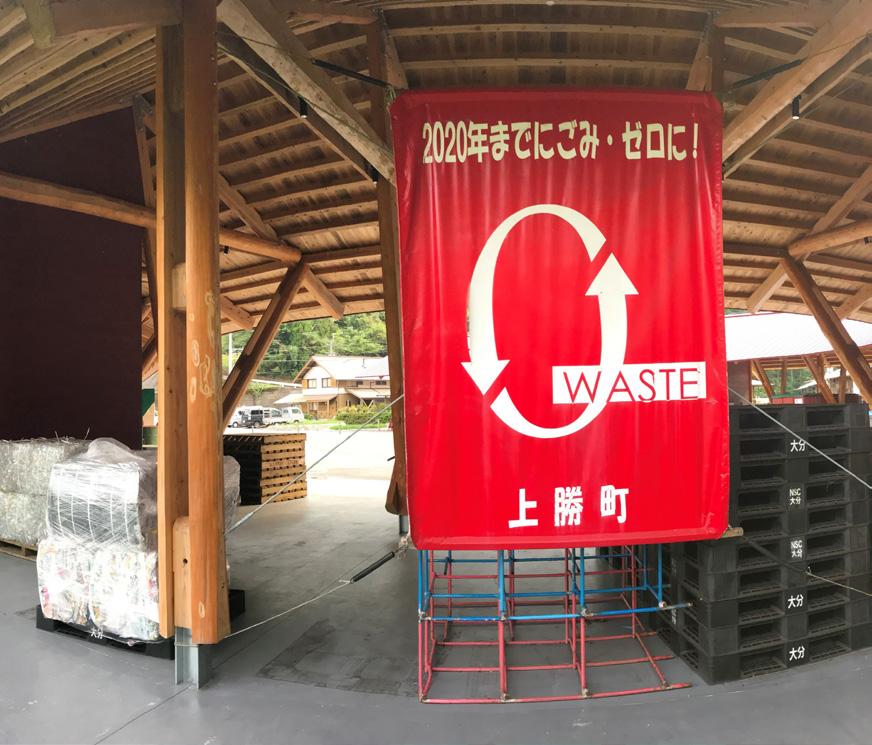
mikan (mandarin orange) orchards covered the patches of cultivable land in the mountains. Kamikatsu was also too isolated and remote—the mountainous terrain stretches the 25-mile journey from the nearest city of Tokushima to approximately one hour by car—for much else, making its narrow economic base structurally fragile.
The compound loss of its core industries—gradually in the case of forestry and overnight in the case of agriculture—forced Kamikatsu’s reinvention. While increased domestic and international competition decimated the forestry industry during the 1970s and 1980s, an unusual cold snap in 1981 killed the majority of the town’s mikan orchards, limiting agricultural production for years to come. Bereft of its main economic sectors—and already aging and depopulating—the town started to look for alternatives.
Yokoishi Tomoji, an officer in the Kamikatsu Agricultural Cooperative, tried substituting mikan with shiitake mushrooms. The effort failed because it was difficult for the town’s aging farmers to work with the heavy logs needed for shiitake cultivation. Years later while dining, Yokoishi noticed how a young woman appreciated the tsumamono—the decorative leaves and flowers used in high-end traditional Japanese restaurants and inns—on her plate. Leaves and flowers, he thought, were already abundant in Kamikatsu. They were also lightweight and easy to harvest, making them suitable for the town’s aging farmers. Despite widespread skepticism, and with only four women agreeing to join, Yokoishi established the Irodori (literally, “coloring”) company in 1986 to bring Kamikatsu leaves to the rest of Japan.
The Irodori company had a rocky start before becoming
a viable source of income for farmers. Yokoishi soon realized that picking leaves wasn’t enough. To succeed, Irodori would need to attend to the realities of the tsumamono market. He started researching high-end restaurants to better grasp their needs and the sought-after qualities of decorative leaves and flowers. Based on this work, Irodori farmers started looking for surprising leaves—those with striking colors or shapes—as well as packaging same-size leaves together so restaurants could easily match them to dishes. He also understood that Japanese cuisine tends to anticipate seasons. Then, he introduced early cultivation techniques learned from the town’s forestry industry to better meet market needs. Following these efforts, Irodori took off. It grew over the years, always attuned to new developments. For instance, in 1999, Yokoishi implemented a point-of-sale
Kamikatsu’s Zero Waste Center

IT system, fairly unusual for agricultural businesses at the time, to link farmers with restaurants, allowing farmers to use market data to improve planning and sales. With some farmers making over 10 million yen (roughly $60,000) a year, it seems that in Kamikatsu, money does grow on trees.
Kamikatsu later applied the same logic to a different problem: solid waste management. Changes in national legislation banned the open burning of waste— Kamikatsu’s sole option— leading to the construction of two small incinerators in 1998. But the dioxin control law of 2000 rendered one of the new incinerators unusable, with both shutting down by 2001. Faced with high collection costs due to its dispersed settlement pattern and lacking the financial capacity to build a compliant incinerator, the town was left without a viable conventional waste management solution.
The town turned to a community-based sorting system in which residents sort waste and deliver it to the Gomi Station (pickup point) themselves. The number of categories grew as years passed, starting with nine in 1997 and reaching 45 types (within 13 categories) by 2016. Officials engaged with residents, visiting all 55 hamlets to explain the system. At the same time, a volunteer group named Recycle Kamikatsu supported older residents and those unable to deliver their own waste. Given that organic waste represented 40% of household refuse, the town subsidized electric composters, reaching a 97% adoption rate while compost further supported farming. Over the years, Kamikatsu’s recycling rate grew to 80%, well above the 20% national average. Sorted recyclables generate around 3 million yen annually (roughly $19,000).
Kamikatsu has woven the zero waste notion into its identity. Capitalizing on the initial success of its recycling initiatives, the town became the first Japanese local government to issue a zero waste declaration in 2003. This brought attention to the town, drawing new business partnerships (such as Suntory’s bottle-to-bottle recycling initiative) tourists, and migrants. The Gomi Station became a community hub where people also came to socialize and to learn about waste. It grew into a onestop center for recycling that included a hotel (opened in 2020) to welcome people from outside the town. Even though the town has not reached its objective of becoming a zero waste place, now set for 2030, it has turned every condition that should have worked against
it—size, isolation, population aging, economic difficulties— into a source of purpose.
Beyond the Growth Playbook
On paper, Chiloquin and Kamikatsu should have little in common besides both being small rural communities. Yet, they both approached economic development by leveraging existing assets to benefit the community.
While remoteness, aging, and decline are usually framed as problems, in Kamikatsu, they forced creative solutions that wouldn’t have emerged in a growing town with ample resources: the town found value in leaves and garbage, things every community has but few think of as economic assets.
While a vacant and declining downtown is usually read as terminal decline, in Chiloquin, it was treated as raw material for renewal: the Hirvi Building went from 40 years of vacancy to almost full occupancy, bringing back pedestrian traffic to the area.
Chiloquin and Kamikatsu show that the most productive path for struggling small communities isn’t attracting what’s lacking but activating what they already have.
Chiloquin refurbished existing buildings to invigorate its downtown; Kamikatsu found new economic activities tailored to aging farmers. They both accepted their reality and built around it. They also redefined what success looks like. Traditional metrics—economic growth, tax base expansion, population figures—fail to capture the more intangible elements sustaining communities: older residents with purpose and places for people to meet.
When population growth is off the table, the question is not how to increase numbers but how to make the community work for the people who are still there. For managers in small communities, the first step isn’t a new strategic plan, campaigns to attract residents and businesses, or a rebranding exercise. What is needed instead is an honest inventory of what the community already has and the willingness to build from there. Chiloquin and Kamikatsu followed this path, developing solutions that suited their local reality—assets and constraints—to meet the needs of existing residents. A similar self-assessment will allow other small communities to tap into their unexplored potential as a source for renewed vitality and well-being.
Fernando Ortiz-Moya’s contribution to this work was supported by JSPS KAKENHI Grant Number JP26K07829.
ENDNOTE
1 See, for example, Shannon Osaka, ‘Postcards from Kamikatsu, Japan’s “Zero-Waste” Town,’ Washington Post, April 27, 2022; and ‘A Shrinking Town with Big Ambitions,’ BBC Future, November 11, 2019.
FERNANDO
ORTIZ-MOYA, PhD, is an assistant professor at the Waseda Institute for Advanced Studies, Waseda University in Japan.
SARAH SIELOFF, AICP, is an urban planner at Haley & Aldrich in Bellingham, Washington.



Closing the Gap on Rural Substance Abuse Recovery
Life care specialists, a new hospital-based role, are connecting patients with treatment, reducing barriers to care, and offering hope where resources are limited.
BY CAMMIE WOLF RICE
Across Georgia, our rural communities are carrying a burden. Hospital staff are stretched thin and resources are scarce. Yet it is here that substance misuse is on the rise. According to the CDC, overdose deaths in rural areas have now surpassed those in urban areas,1 along with reports that people living in rural communities are far less likely to receive care for alcohol-related concerns compared to those in urban communities.2 At the same time, stigma runs deep. Asking for help often feels like admitting defeat, especially in tight-knit communities where self-reliance is a way of life.
This is the reality Brandi Merritt walks into every day as a life care specialist (LCS) at Coffee Regional Medical Center in Douglas, Georgia. This summer, EMS brought in a middle-aged male patient who had relapsed after many years of sobriety. Alcohol had taken over his life. He told the ER doctor as much, and the very next morning, the doctor asked Brandi to meet with the patient.
When Brandi walked into his room, she saw that he had been given a list of rehab recommendations
thoughtfully provided by the case management team. She knew it would be up to him to find the right place to get the help he so desperately needed once he left the hospital. So, Brandi sat down with him and vowed to help him take this important next step. She listened to the stories of what had led him back to this place, and he admitted he was terrified of going home because he knew he would start drinking again. Brandi got to work. She contacted three different facilities, trying to find

the best fit for him. She told him she would not let him fall through the cracks. And he believed her because she showed up in ways most patients never get to experience. After he was discharged, he had a dangerous relapse at home. Brandi was notified and went to his home with EMS, then got approval to ride with him in the ambulance to make sure he made it back to the hospital safely. She stayed late into the night to advocate for him. She returned at dawn the next morning to make sure his transition into the rehab facility went smoothly. At one point, he told her, “In my life, I’ve never had someone care for me like this.”
Because of Brandi’s persistence, he did not fall back into the cycle of drinking. He went to rehab and called her days later to say the first week of detox had been brutal, but it was what
resources he needed after leaving the hospital. That loss is what drives me every day. I wanted to create a role inside the hospital that would fill the very same gaps that failed my family.
he needed. Two weeks into his sobriety journey, he was already noticing changes both in his health and his spirit. He told her he would not have made it this far without her. Without Brandi stepping in, his outcome could have been much different. He remains sober to this day and even recommended his best friend to Brandi to help him get sober, too.
Stories like this are why I created the LCS role in the first place. My own son, Christopher, lost his life after a 14-year struggle with opioid misuse that began with a prescription following a routine surgery. He was only 32 years old. Christopher did not fall through the cracks because we weren’t paying attention. He fell because there were no bridges in place when he needed them most. No one was there to walk us through our options or to make sure he had the
In 2019, we launched the first LCS program at Grady Memorial Hospital in Atlanta. Since then, the role has expanded into eight hospitals across Georgia and Arkansas, many in rural communities. LCSs build bridges between hospitals and treatment facilities. They provide emotional support in ways that overworked and exhausted doctors and nurses often do not have the time to. They connect patients to community resources that go beyond prevention, including domestic violence shelters, stable housing services, food assistance programs, and more. As Brandi puts it, “I’m not a doctor, I’m not a nurse; I’m here to be what you need during this time.”
In rural hospitals, that means becoming a trusted partner to ER doctors, nurses, EMS, and paramedics. At first, some providers are skeptical, but over time, they see the difference. Because once a patient is stabilized, there is very little a hospital can do for long-term substance abuse. The ER is not built for that. What Brandi and other LCSs provide is the bridge between short-term hospital care and long-term recovery.
Why does this matter so much for rural communities? Because the challenges here are unlike anywhere else. In many small towns across Georgia, there are no nearby rehab facilities. Families may
have to travel hours just to find a program that will take a loved one. That distance alone can be enough to stop someone from seeking help. On top of that, privacy is a huge concern for closeknit communities. People worry about being judged or becoming the subject of small-town talk if they admit to struggling with alcohol or drug misuse.
Doctors and nurses are doing all they can, but the reality is they are working with very limited resources. An LCS is a communitybased solution built to work alongside them. By advocating for patients when they are at their most vulnerable and connecting them to the right resources, the LCS brings hope into situations that might otherwise feel hopeless. Education, empathy, and a simple conversation can totally rewrite a patient’s trajectory. An LCS is a prescription for prevention. They are proof that even in a small-town hospital, with limited services, recovery can and is happening in communities just like Douglas.
Learn more about CWC Alliance at cwc.ngo.
ENDNOTES AND RESOURCES
1 https://www.cdc.gov/rural-health/php/ public-health-strategy/public-healthconsiderations-for-drug-overdose-in-ruralamerica.html
2 https://pmc.ncbi.nlm.nih.gov/articles/ PMC9702879/ CAMMIE WOLF RICE is the founder and CEO of CWC Alliance (cwc.ngo).

GUINNESS, GOVERNMENT, AND GOOD IDEAS
Lessons in community reinvention from Tennessee and rural Ireland
BY BRUCE M. APPLEGATE JR., ICMA-CM
County Longford, Ireland and the city of Alcoa, Tennessee are separated by thousands of miles, different histories, and very different accents. However, the ICMA Global Exchange in March 2026 revealed just how closely our communities are connected through shared challenges and aspirations.
Alcoa, a city of roughly 15,000 residents nestled within Blount County’s population of nearly 140,000, found an unexpected parallel with County Longford, Ireland, home to approximately 50,000 residents and communities navigating many of the same economic questions we have faced for decades.
Conversations that began around economic redevelopment quickly evolved into discussions about workforce retention, infrastructure investment, and the responsibility local

governments carry in helping residents build successful lives close to home. Somewhere between redevelopment presentations, a Team Ireland World Cup pre-qualification match being broadcast live during a formal dinner, and locals at the pub patiently teaching us the proper pronunciation of “Jesus, Mary, and Joseph,” it became obvious that while cultures may differ, the goals of local government remain remarkably similar.
Alcoa and County Longford were built around industries that shaped not only local economies, but community identity itself. Aluminum production has served as the economic foundation of Alcoa for more than 107 years. County Longford experienced a similarly deep connection to peat harvesting and fossil fuel industries that provided generations of residents with
stable jobs and opportunities. The roots of that relationship stretch back centuries. During the exchange, our group visited the Corlea Trackway, an Iron Age Road constructed in 148 BC through the region’s peat bogs. The preservation of the roadway highlighted how peat has influenced daily life, heating, cooking, transportation, and the local economy in Ireland for generations. As those industries declined or evolved, both communities faced the same difficult question: How do you preserve the character of a community while creating new opportunities for future generations?
That shared challenge made many of the conversations during the exchange feel immediately familiar. Leaders throughout Ireland repeatedly emphasized that redevelopment cannot happen in isolation and that long-term success depends
on relationships between governments, businesses, and residents.
One of the clearest lessons from the exchange was the realization that relationships become a form of infrastructure just as important as roads, utilities, and public facilities. Irish communities participating in redevelopment through the EU’s Just Transition initiative demonstrated an impressive ability to align local governments, national leadership, private business, and residents around common goals. The pace of those changes was particularly striking. Economic diversification in Alcoa occurred gradually over several decades following World War II and increased competition within the aluminum industry. Irish communities tied to fossil fuel industries, however, were forced to adapt within only a few years as policy changes
accelerated the decline of traditional industries.
Collaboration stood out as the defining characteristic of many of the Irish redevelopment efforts. Preparations underway in County Limerick for the 2027 Ryder Cup offered a particularly strong example of coordinated leadership and longterm planning. City, county, and national governments are collectively addressing housing, transportation, retail, and infrastructure improvements needed to support the event and future growth opportunities. The level of cooperation was so refined that the Ryder Cup preparations became a microcosm of Ireland’s broader redevelopment strategy.
Regional cooperation has similarly shaped growth in Blount County. Leaders in Alcoa, Maryville, and Blount County have intentionally worked to remove competitive
barriers between communities and instead focus on what best serves residents throughout the region. That philosophy has helped generate more than $1.2 billion in new investment across Blount County over the last five years, including nearly $800 million within Alcoa alone.
The relocation of the Smith & Wesson headquarters and development of a major Amazon distribution hub brought more than 4,200 jobs to the region while strengthening workforce opportunities and public infrastructure investments. Tourism has also become an increasingly important part of Alcoa’s diversification strategy as the home of McGhee Tyson Airport and a gateway community to the Great Smoky Mountains National Park.
Community identity remained central to redevelopment discussions in both Tennessee and Ireland.
leave their hometowns in search of opportunity elsewhere. That conversation resonated deeply because the same goal continues to drive redevelopment efforts in communities across East Tennessee and the world. Economic development is ultimately about giving people the opportunity to stay and build a life in the communities they love.
noelstock.adobe.com
Public acceptance of major economic change often depends on whether residents still recognize their community afterward. Redevelopment efforts in Alcoa continue to focus heavily on creating a walkable downtown district and reinvesting growth revenues into public spaces, local businesses, hotels, restaurants, and gathering places that allow residents to envision a future for themselves and their children. Irish leaders expressed many of the same priorities while balancing economic reinvention with preservation of local culture and character.
A lunch stop at Cooney’s Hotel in Ballymahon provided one of the most memorable moments of the exchange. The owner spoke passionately about how growing tourism opportunities were creating a future where younger residents would no longer feel obligated to
The ICMA Global Exchange created a rare opportunity to spend several days engaged with ministers, county executives, planners, and local leaders confronting many of the same issues faced by communities back home. Professional growth came not only through formal presentations and redevelopment tours, but also through shared meals, conversations at local pubs, and invitations from new Irish friends to future family weddings.
Experiences like those create a deeper appreciation for how strongly people care about their hometowns regardless of geography or nationality. The exchange ultimately reinforced a lesson that applies equally in Tennessee and Ireland: Communities accomplish far more when leaders place residents ahead of institutional ego and commit themselves to building a shared future together.
The host for the ICMA 2027 Global Exchange is currently being determined. Stay tuned for more information as it becomes available in the coming months. Reach out to global@icma.org with any questions.
BRUCE M. APPLEGATE JR., ICMA-CM is city manager of Alcoa, Tennessee.

Ronnie Nally’s public house in Ballymahon, County Longford, Ireland.
Turning Your Strategic Plan into Action
A simple, communication-first approach to helping staff understand, support, and execute the plan.
BY JAN PERKINS, ICMA-CM NICK ZOLLER, AND JOE AMBROSINI
For many local government leaders, developing a strategic plan is a marathon. Months— sometimes even more than a year—are spent getting to the finish line. Multiple meetings are held collaborating with staff, governing body members, and other stakeholders. Workshops are conducted. Data is gathered and analyzed. And finally, a vision and goals are created. When the final document is adopted by the department head for a departmental strategic plan, or by the board or council for an agency-wide plan, there is a natural inclination to exhale, put the document on the shelf, and return to the “real work” of the day-to-day.
But as any experienced manager knows, adoption is not the end point. It is the starting gun. The success of a strategic plan does not live in the magnitude of its goals; it lives in the hearts and minds of the staff who must execute
it. To move a strategic plan from a static document to an operational roadmap, you need more than a vision; you need a relentless, intentional communication rollout. This article provides some tips to ensure the strategic plan is not one that gathers dust and, rather, is one that can drive transformation. The difference: How the “why” is communicated to the “who” and “when” it is done.

JOE AMBROSINI is director of human resources for Placer County, California.
JAN PERKINS, ICMA-CM is a vice president at Raftelis and a former city manager with more than 30 years of experience in local government leadership.
NICK ZOLLER, APR, is a strategic communications counselor at Raftelis, specializing in organization-wide communication strategy, crisis communications, and change management.
To move a strategic plan from a static document to an operational roadmap, you need more than a vision; you need a relentless, intentional communication rollout.
The “Simple and Smart” Philosophy
A common pitfall in strategic planning is complexity. If a strategic plan is so dense that an employee cannot explain it in an elevator, it will never be operationalized. We advocate for a “keep it simple and smart” approach.
A strategic plan should be a way to simplify, not a way to complicate. People need to grasp what it is and, more importantly, “How does it relate to me?” Whether someone is a department head or a front-line technician, they need to understand how their daily tasks contribute to the broader goals. When the plan is simple, it becomes a tool for empowerment rather than a burden of bureaucracy.
Lessons from the Field:
The Placer County Experience
The rollout implementation for the Placer County human resources department provides some helpful lessons. Starting with a communications rollout framework that had a step-by-step approach, the department’s process provided a masterclass in both momentum and some pitfalls of timing. What worked well was that once the HR department strategic plan was finalized, department leadership immediately emailed it to all department staff. The email included clear, concise talking points that described the “why” of the strategic plan. The result? Immediate excitement. By making the information accessible and transparent from day one, the leadership signaled that this plan was different: it was active.
The next step was to present the strategic plan at an upcoming quarterly staff meeting. The intention was to do so shortly after the email went out. However, because the leadership team was still working on some details of implementation (assignments and timelines), the presentation was delayed. Staff were disappointed at the delay. In hindsight, department leaders could see that they did not actually need to have all details set before making the presentation.
The lesson? Do not let the pursuit of a perfect presentation slow momentum. Your staff does not need a complete or detailed implementation plan, but they do need an early touchpoint to understand what the strategic plan is all about. They need to see that you are committed to the path, even if every milestone is not yet fully mapped out.
The Power of the One-on-One
While mass emails and all-staff meetings are essential for reach, the real work of alignment happens in smaller rooms.
In developing the Placer County HR department Strategic Plan, initial input was gathered by the director by holding one-on-one meetings with department heads and elected officials across the county. This served a dual purpose:
Listening: Hearing firsthand what they needed from HR for their departments to succeed.
Translation: Explaining the purpose and intent of the HR strategic plan in a way that resonated with specific departmental challenges.
Making It Stick: The Cadence of Accountability
Operationalizing a strategic plan requires a shift in how the plan’s “owners” spend their time. If the strategic plan only comes up once a year during budget season, it becomes a memory.
To keep the momentum going, a tiered communication cadence can help:
Weekly: The executive team should devote a portion of their standing meeting solely to the strategic plan. This keeps the “big picture” goals at the forefront of operational decisions.
Bimonthly: Meet with mid-level managers. These are the individuals responsible for translating the plan into daily tasks. They need regular check-ins to ensure they have the resources required to meet the plan’s objectives.
Quarterly: Hold all-staff town halls or updates. Use this time to celebrate wins, acknowledge where progress is delayed, and reiterate the roadmap.
Semiannually: Provide updates to the broader organization or stakeholder community about progress.
Accountability Starts at the Top
An effective way of supporting the implementation of a strategic plan is to tie it to performance. This can be through including meaningful metrics in managers’ performance evaluations. How are the managers contributing to the success of the strategic plan? What level of progress is being made toward the strategic plan? What impediments are being encountered that will need course corrections?
When managers’ success is linked to the strategic plan’s success, staff within the organization take notice. It ceases to be a “special project” and becomes fundamental to the job. For HR, involving staff in the rollout is not just a “nice to do”; it is essential. When employees see their own feedback reflected in the plan and see their leaders being held accountable to it, buy-in is supported so much more.
Conclusion: The Strategic Plan as a Hook Communication and public engagement efforts are not separate from the strategic plan. They are the engine that drives it.
Whether you are a new city/county manager looking to establish transparency or a seasoned director looking to unify a department around a singular focus (as seen in the framework used in Placer County), the rollout is a great tool. Start with the end in mind. Keep it simple. And remember: a strategic plan does not fail because the goals were wrong; it fails because the people were forgotten. Make them part of the process, establish an implementation plan with timeframes and assignments, and the strategic plan will take care of itself.
Leading Where Everybody Knows Your Name
A conversation with Sandra Fournier, ICMA-CM, on relationships, regional collaboration, and serving small communities.
BY JESSI FINLEY
For many local government professionals, leadership means managing complex budgets, overseeing infrastructure projects, and navigating difficult policy decisions. But in small and rural communities, those responsibilities come with an added dimension: the people affected by every decision are often neighbors, friends, and family.
That reality has shaped Sandra Fournier’s approach to public service throughout her career. As town manager for the Tri-Towns of Mapleton, Castle Hill, and Chapman, Maine, Fournier oversees municipal operations across three communities while also managing relationships with school and county government. With more than 15 years of municipal leadership experience, she currently serves as president of the Maine Town, City and County Management Association and will begin serving as ICMA’s Northeast regional vice president this fall.
Despite her unique role, Fournier believes the most important lessons she’s learned are relevant to any local government professional serving a small community.
Leadership Without Distance
In larger cities, residents may never meet their city manager. In rural communities, that’s rarely the case. “If the plow doesn’t get down someone’s road, they’ll let me know about it the next time they see me at the gas station,” Fournier shares. Those everyday interactions create a level of accountability that extends far beyond the office.
“I can’t hide behind bureaucracy. Every budget line, every ordinance, every difficult decision has a human face behind it.”

FINLEY is a marketing manager at ICMA (jfinley@icma.org).
Rather than viewing that visibility as a challenge, Fournier considers it a strength in her role. Knowing residents personally reinforces the importance of leading with integrity, communicating openly, and remaining accessible even when conversations are difficult.
It also provides constant perspective. One day may involve discussions about major infrastructure
investments; the next may include hearing concerns about a noisy irrigation system or a neighborhood issue. While the scale differs, both conversations matter because both affect residents’ quality of life.
Seeing One Region Instead of Three Towns
Managing three municipalities might sound like an exercise in constantly dividing attention, but Fournier sees it differently. “I actually see it as serving one region made up of three distinct communities.”
That perspective has helped the Tri-Towns develop a collaborative model that allows each municipality to retain its own identity while sharing resources where it makes sense.
The communities work together on services ranging from highway operations and code enforcement to grant writing, recreation programming, assessing, and long-term capital planning. By sharing staff, equipment, expertise, and purchasing power, they are able to provide services that would be difficult for communities of their size to sustain independently.
“What surprises people is that sharing services doesn’t mean losing your identity,” Fournier explains. “Each community still has its own history, traditions, and priorities.” Instead, collaboration strengthens each
JESSI
municipality while creating efficiencies that benefit taxpayers across the region.
Building Trust Through Relationships
Whether working with one governing board or several, Fournier believes successful local government leadership begins with relationships. Every board has its own priorities shaped by the unique character and needs of its community. Her role is to understand those perspectives before recommending solutions. “My job isn’t to have all the answers. It’s to make sure everyone has the information they need to make good decisions.”
Conflicting priorities are inevitable, particularly during budget discussions or when determining how shared resources should be allocated. In those moments, Fournier has found that transparency is often the difference between disagreement and distrust. “When people understand the ‘why’ behind a recommendation, even if they don’t completely agree, they’re much more willing to work toward a solution.”
Listening first, communicating clearly, and maintaining strong relationships allow difficult conversations to remain productive, even when consensus isn’t immediate.
Wearing Many Hats
Fournier shares that one of the biggest misconceptions about managing a small community is that the work is somehow easier because budgets are smaller and organizations have fewer employees. In reality, the opposite is often true.
Small communities depend on leaders and staff who are comfortable wearing many hats. A single week may include economic development, personnel issues, grant writing, infrastructure planning, recreation programming, and helping organize a community event—all while responding to resident concerns.
“We don’t have departments for everything. We have people who care enough to figure it out together.”
That versatility has become one of the defining characteristics of successful small-community managers. It requires curiosity, adaptability, and a willingness to solve problems collaboratively rather than relying on specialized departments. It also reinforces the importance of building strong teams.
“No manager succeeds alone. My job is to remove obstacles, support my team, and make sure everyone has the tools they need to serve our residents.”
Finding a Professional Community
While small communities offer close relationships with residents, they can also present professional isolation. Managers may not have nearby colleagues facing similar challenges or serving as trusted sounding boards.
For Fournier, ICMA has helped bridge that gap. “When you’re managing small communities, you don’t necessarily have another manager down the hall to bounce ideas off of, but ICMA gives you thousands.”
Through conferences, mentoring, professional development, and relationships built over years of involvement, she has found

both practical advice and lasting professional friendships. Those connections have shaped her leadership and reinforced an important lesson she now shares with emerging professionals: don’t wait until you need your network. “Build it before you need it,” she advises.
Some of her strongest professional relationships began with a simple introduction over coffee at an ICMA conference. Today, those colleagues are the people she turns to when facing new challenges—and the people she hopes feel comfortable calling her in return.
Keeping People at the Center
When asked what advice she would offer someone considering municipal management, Fournier doesn’t begin with budgets, infrastructure, or governance. She begins with people. “This profession is about people, not roads, budgets, or ordinances,” she says. “Those things are important, but at the end of the day you’re serving people.”
It’s a philosophy that reflects the realities of small-community leadership, where every decision has a visible impact and every conversation is an opportunity to build trust.
As communities across North America continue exploring regional partnerships, shared services, and innovative approaches to delivering public services, the experience of Maine’s Tri-Towns offers an important reminder. Effective local government isn’t measured solely by organizational charts or population size. It’s built through relationships, transparency, collaboration, and a commitment to serving the people behind every policy decision.
In small communities, leadership is personal. For Sandra Fournier, that’s exactly what makes the work so meaningful.
WANT TO HEAR MORE?
Watch the full ICMA Member Spotlight interview with Sandra Fournier on YouTube at youtu.be/YmGMOYwOzcM.
The Founders’ Bet on Local Government Is Still Paying Off— Let’s Not Let It Slip
As America celebrates 250 years of independence, local government remains the most trusted level of government. Here’s how understanding the dimensions of resident trust is helping communities focus on what matters most.
DAVID SWINDELL is a professor at Indiana University and a leading researcher on local government performance and civic trust.
MICHELLE KOBAYASHI is an executive strategist at Polco, a civic engagement and data analytics platform serving local governments nationwide.
ELIZABETH STEWARD is vice president of marketing and research at Envisio, a strategic planning and performance management platform for local government.
In Dublin, Ohio’s 2025 National Community Survey, 99% of residents rated the city as an excellent or good place to live, and overall quality of life came in at 97%—results that reflect years of intentional, residentcentered governance for the suburb of almost 50,000 near Columbus.
Then city leaders did something that distinguished them just as much as the scores themselves. They looked carefully at a few categories where Dublin had slipped slightly against national benchmarks: housing affordability, public transit, and cost of living. They treated those findings as a signal, not a footnote.
The instinct to absorb strong results with gratitude and difficult results with curiosity captures something essential about how Dublin has built an enviable trust record in local government. “You build trust by listening, reacting, and doing something about what you’ve heard,” said Brandon Brown, Dublin’s chief innovation and technology officer.
The Trust Crisis Is Real
As the United States marks the semiquincentennial anniversary of the signing of the Declaration of Independence, the document’s radical proposition that governments derive their just powers from the consent of the governed feels fragile.
The anniversary comes at a time when public trust in the federal government has reached historic lows: 17%—near the lowest point in nearly seven decades of polling, according to a December 2025 survey by Pew.1 The 2026 Edelman Trust Barometer shows trust declining and a world retreating toward insularity, with people narrowing their worlds to more familiar circles in response to technological disruption, economic stress, and geopolitical tension.2
For most of American history, local government has been viewed differently than the government in
Washington, DC. People might distrust Congress, but they generally trusted the city manager who answered the phone about a pothole or park needing attention. It’s a distinction with deep roots. Before national identity fully took hold, Americans built trust through their towns, counties, and colonies, where governance was close, visible, and personal.
A 2025 Governance poll by Gallup showed that 59% of Americans trusted their state government to handle state problems, and 65% trusted their local government to handle local problems.3 The averages have remained similar across the past decade and are broadly in line with Gallup’s measurements from the 1970s.
That trust reservoir isn’t bottomless, and it is being tested. When residents lose trust in local government, the consequences compound: lower compliance with regulations, less civic participation, resistance to new initiatives, and weaker democratic legitimacy for the decisions local managers make every day. In recent years, local governments have begun moving beyond intuition toward a more disciplined understanding of trust.
Why Trust Is Central to Strong Communities
Trust in local government underpins democratic legitimacy, effective governance, and community resilience, yet it remains difficult to define and measure in practical ways.
The need for greater context around resident trust helped drive a multi-year public-private-academic partnership between Arizona State University, government technology companies Envisio and Polco, and three diverse U.S. municipalities. The goal is straightforward but ambitious: move beyond anecdotal evidence about trust and create a validated, research-based tool that any local government could use to diagnose where it stands with residents and why.
BY DAVID SWINDELL, MICHELLE KOBAYASHI, AND ELIZABETH STEWARD

The experiences of Dublin, Ohio, and Broadview, Illinois, demonstrate how communities of very different sizes can apply the same trust-building principles in different ways.
Drawing on an extensive annotated review of the existing trust literature and original survey data from almost 3,000 residents, the study developed and empirically tested a multidimensional Trust Index. Factor analysis supported a cohesive construct of trust comprised of four interrelated dimensions:
Competency: Do residents believe the city delivers quality services and provides value for their tax dollars?
Integrity: Does local government act in the community’s best interest, keep its word, and take responsibility when things go wrong?
Openness: Is the government transparent? Does it actively inform residents and genuinely welcome their involvement?
Fairness: Are residents treated fairly, with respect, and are decisions made without favoritism or bias?
The research also surfaced a striking finding about the relationship between information and trust. Among residents who described themselves as “very informed” about their local government’s activities, roughly 80% expressed confidence in that government. Among those who were only “slightly informed,” confidence dropped sharply.
Informing residents through active communication across multiple channels—not just posting information online
and waiting for them to find it—emerged as one of the most powerful levers available to local managers. Increased access to information and clearer communication about government actions and priorities appears to be associated with higher levels of confidence and perceived legitimacy.
Taken together, the results indicate that trust is influenced not only by service delivery but also by the extent to which residents feel informed and included in local government processes. Indeed, the trust indicators comprising the openness and integrity dimensions had an outsized impact on residents’ levels of trust. Building a stronger base of resident trust in their local government provides a firmer foundation on which residents can come together and address community challenges.
How Dublin and Broadview Put Trust Into Practice
In Dublin, one of the clearest examples of resident-centered communications is Tell Dublin, the city’s standardized resident engagement platform.4 It replaced a patchwork of survey tools and forms, with a single system that captures resident feedback across everything from community events to major planning initiatives.
That philosophy shapes policy decisions as well. When Dublin considered new regulations for residential solar installations, it gathered more than 1,000 responses through Tell Dublin before council amended the ordinance based on that feedback.
Dublin, Ohio
“We shouldn’t expect residents to seek us out for information,” said Bruce Edwards, Dublin’s digital and brand manager. “Our job is to understand where residents already get their information and meet them there—whether that’s Nextdoor, Facebook, or another platform. The days of posting something on the website and assuming everyone will find it are over.”
That philosophy extends to Dublin’s use of a platform that analyzes public sentiment across social media and civic channels, giving the communications team a near real-time read on how residents are experiencing city services and decisions. The goal, Brown explained, is to close the loop—not just gather input but demonstrate to residents that their feedback changed something. Dublin also takes a conservative, long-horizon approach to fiscal management that Brown credits as an underlying trust asset. The city council established a policy dedicating 25% of income tax revenues to annual capital projects. Maintaining reserves, avoiding over-reliance on grants, and consistently reinvesting in infrastructure helps Dublin avoid service disruptions or tax surprises that erode resident confidence. Even when the 2025 survey showed slight declines in areas like housing affordability, the city’s leaders acknowledged the findings publicly, situated them in a regional context of central Ohio’s persistent housing shortage and connected them to ongoing planning initiatives. The transparency itself is the trust-building move.
Broadview, a Chicago suburb of roughly 8,000 residents, demonstrates that these same trust principles can work in a much smaller community with different resources and challenges. After participating in the Trust Index research, village leaders recognized that many residents simply didn’t see or experience the work of their local government. Through Ask Broadview (app.repd.us/broadview/en), residents can submit questions and receive AI-assisted answers, with department leaders providing video responses when appropriate. The village also used resident feedback to shape its first comprehensive plan update in nearly two decades. “It opened our eyes to the power of listening,” said village administrator LeTisa Jones. “When we asked our residents what they wanted, they helped shape the vision for a stronger, more connected community.”
A Framework for Action
The research and the experiences of Dublin and Broadview point to a set of practices that can be applied across communities of different sizes, demographics, and political contexts.
1. Measure before you assume. The Trust Index research found significant variation across communities in which dimension of trust was most in need of attention. Resident surveys and data tools can pinpoint where the gap is, so leaders can target resources effectively rather than treating trust as a single undifferentiated problem.
2. Make information active, not passive. One of the strongest predictors of trust in the research was whether residents
Learn More about Local Gov 250
felt informed about what their local government was doing. That means omnichannel outreach—social media, newsletters, neighborhood platforms, direct mail where needed—not just a website update.
3. Close the loop publicly. Residents who have given input and never hear what happened with it learn quickly that participation doesn’t matter. Building in explicit feedback mechanisms—communicating how survey results influenced a decision, reporting back on a plan’s implementation milestones— turns one-way communication into a trust-building cycle.
4. Treat transparency as a strategy, not a policy. Proactively sharing financial information, planning decisions, and service data—even when results are mixed—builds more trust than carefully managed messaging. Residents are more forgiving of imperfect outcomes than they are of a lack of transparency.
5. Build equity into operations, not just statements. The fairness dimension of the Trust Index tracks whether residents believe they are treated fairly and with respect. That is a function of everyday interactions—how service requests are handled, whose concerns are heard, who has access to engagement processes—not just policy language.
6. Think institutionally, not episodically. Dublin and Broadview illustrate that trust-building is not a campaign. It is the accumulated result of consistent systems: standardized feedback tools, disciplined fiscal management, representative hiring practices, and follow-through on commitments made during community engagement processes.
The Oldest Test of Democratic Legitimacy
The founders made a radical bet 250 years ago that the government could earn and sustain the trust of the people it served. The local level has always been where that bet gets tested most concretely— in the quality of a road, the response to a service call, and the fairness of a zoning decision. The data suggest that the test is getting harder. But it is not one that local government is destined to fail. Communities like Dublin and Broadview demonstrate that when managers treat trust as a measurable asset, residents respond.
The work of democratic legitimacy is not glamorous. It is surveys, feedback loops, omnichannel outreach, and comprehensive plans that get implemented. It is telling residents what you found out and what you’re going to do about it. This is the work that naturally builds trust, and the communities that do it consistently are the ones that will carry the promise of local self-governance forward into the next 250 years.
ENDNOTES AND RESOURCES
1 https://www.pewresearch.org/politics/2025/12/04/public-trust-ingovernment-1958-2025/
2 https://www.edelman.com/trust/2026/trust-barometer
3 https://news.gallup.com/poll/697421/trust-government-depends-upon-party-control.aspx
4 https://telldublin.dublinohiousa.gov/
In collaboration with other local government associations, ICMA is commemorating America’s 250th anniversary by celebrating the “democracy at the doorstep” facilitated by cities, counties, regional councils, and tribal governments. Learn more at localgov250.org




UPCOMING FREE WEBINARS – Register at icma.org/coachingwebinars
WEDNESDAY, SEPTEMBER 16
Combating Chronic Organizational Distress
WEDNESDAY, OCTOBER 14
How To Become a Great Coach
WEDNESDAY, NOVEMBER 18 What I Wish I Knew As a Younger Manager
All Webinars start at 1:30pm Eastern time. Miss a webinar? Watch it anytime! Register and watch on-demand. Don’t miss out on these FREE 2026 coaching webinars. REGISTER TODAY!

Additional free coaching resources at ICMA Coaching:
• Access digital recordings on ICMA’s Learning Lab
• Career Compass monthly advice column
• CoachConnect for one-to-one coach matching
• Live speed coaching events, talent development resources, and more. Join our list for coaching program updates and more. Email coaching@icma.org. Learn more at icma.org/coaching.
An Optimistic Book on Democracy for Local Government Leaders
An ICMA regional director discusses a book that reminded her that political divides have been a part of our country since its founding and offers hope for democracy.
BY KATE FITZPATRICK
“In Our Region” is PM’s new column written by ICMA’s regional directors. In this edition, Pat Martel, West Coast regional director and former ICMA president, revisited the book Healing the Heart of Democracy: The Courage to Create a Politics Worthy of the Human Spirit by Parker J. Palmer. The recently updated version provides an optimistic view of the critical role local government can play in meeting what may feel like insurmountable challenges.

about what is right and wrong and who is right or wrong. They contribute to the weakening of the civic foundations of our communities and democracy.
Reflecting on the current political divides across the country and in our local communities, Palmer reminds us that throughout the history of our American experiment we have witnessed disruptive forces that have threatened our democracy. He offers historical context to illustrate this point. “Of the 55 delegates to the Constitutional Convention of 1787, only 39 signed the final document. The remaining 30% disagreed so deeply with one part or another of the Constitution they took a pass on posterity”—not unlike the contemporary dividing line we are witnessing today.

KATE FITZPATRICK
is ICMA’s northeast regional director (kfitzpatrick@ icma.org).
As a reminder to ICMA Credentialed Managers, you can receive 10 hours credit for each professional book that you read.
What book did you choose to highlight and why?
Recently, I revisited the updated edition of Healing the Heart of Democracy by Parker J. Palmer. For the last few years, at regional conferences and other venues where local government leaders gathered to discuss challenges in the profession, overarching themes included partisanship, polarization, divisiveness, lack of civility, public trust, bridging the great divides, and the appropriate role for local government leaders in this fractured political climate. Recognizing the importance of political neutrality, I found that this book offers hope and a positive path forward for those who care about democracy at the doorstep, engaging and building community, contributing to positive neighbor-to-neighbor and community dialogue, and who want to be part of the solution to healing the “broken heart” of our democracy.
How did the book encourage you to think more broadly or change your mind about an issue?
Palmer examines our “instincts to explore the common good by offering practical ways to bridge political divides” that make enemies of those who disagree with one another. These divides are affecting public discourse
Despite those dissenting voices, “we the people” have sustained our American experiment through countless challenges in 250 years and continue to move forward with the aspiration of establishing a “more perfect union.” Yet somehow today the issues seem so intractable, affecting us at the core or “heart” of who we are individually and collectively because of our inability to view divisive issues through the lenses of those with whom we disagree, as well as our inability to better define the common good and establish common purpose. Enhancing understanding, if not acceptance, of political differences and the resulting conflicts they create can preserve the civic fabric of the community on which a healthy democracy relies.
What practical strategies from the book could be applied in local government?
The premise of Palmer’s book is that we all have the capacity to lead change at all levels, not simply in the political sense, but in the manner in which we interact with one another, create safe spaces for exchanging ideas, and see each other as collaborators despite our differences.
The “five habits of the heart” Palmer outlines are “deeply defined patterns of receiving, interpreting, and responding to experience that involve our intellects, emotions, selfimages, and concepts of meaning and purpose.” Developing these habits in families, neighborhoods, educational institutions, faith organizations, and workplaces that
Pat Martel, West Coast Regional Director and former ICMA President
make up the civic infrastructure of our communities can contribute to increased interpersonal understanding, community engagement, and the rebuilding of trust in our institutions and one another.
Citizens of a democracy can cultivate “democratic habits of the heart” by focusing on the habits that tend to be the weakest among us:
• An understanding that we’re all in this together.
• Appreciating the value of otherness or differences.
• Being able to tolerate tension in a positive way.
• Evolving our sense of personal voice and agency.
• Developing a greater capacity to create community. Developing these habits through personal conversations and public discourse can help us begin to move the needle in empowering our residents to pursue the change that they desire for their communities, their country, and their democracy.
Did you find anything in the book that was particularly relevant to your region?
Many ICMA members on the West Coast are grappling with how to address the growing polarization in their communities without engaging in the partisan political fray. Several case studies in the book highlighted how public and civic organizations can create engagement, social bonding, and meaningful community dialogue leading to effective community building. Examples focused on the
neighborhood level, recognizing that too often the strangers closest at hand are our neighbors.
Isolation experienced by neighbors can be harnessed for positive personal and community benefits. One such example involved a neighborhood association where residents deepened their social bonds by creating a “neighborhood resource catalog.” Neighbors were invited to submit descriptions of services they would be willing to contribute, which were then distributed in a printed catalog. The range of neighbor-to-neighbor services included pet sitting, visiting shut-ins, and minor home repairs. Services were time-limited and all entries in the catalog had a three-month life span, subject to renewal or expiration. A coalition of local faith congregations helped screen, publish, and monitor entries.
While individuals can contribute significantly to community building, local governments can play a role, too. For example, the city of Seattle established a “department of neighborhoods” whose mission is to bring government closer to the residents by “engaging them in civic participation; helping them to make positive contributions to their communities; and being inclusive of underrepresented residents in civic discourse, processes, and opportunities.” This story underscores the key role government plays in creating public policies to help drive civic engagement rather than waiting for civic engagement to help drive public policy.

Elevate Your Impact
If you care about community planning, you belong at APA. Membership connects you to trusted resources, meaningful networking, and opportunities to grow your influence in the field.

Building Community-Driven Programs that Succeed
Three
recommendations for launching and sustaining impactful programs for your residents.
BY DR. ZURI TAU
What would it take to stop poverty from passing from parent to child again and again? It was this question that led to the creation of Harlem Children’s Zone (HCZ), a nonprofit offering support to families throughout the Harlem neighborhood of New York City. With a “cradle to career” approach, HCZ begins with early childhood support and provides pathways that continue through adolescence. It quickly earned national recognition as a successful model of an effective community-based program.
Promise Neighborhoods (promiseneighborhoods. ed.gov) decided to bring that approach to cities across the country through the U.S. Department of Education. In 2011, the program selected 20 communities for federal grants. Early grantees showed promise and improved coordination across local schools, nonprofits, and families. Success emerged in some places, and partners began to operate like a system instead of a set of separate programs. But soon, the effort ran into limits of scale.
The grants stayed too small and ended too soon compared to the Harlem model. As a result, communities struggled to replace federal dollars with local philanthropy. Many also lacked the governance capacity that helped Harlem stay focused through years of change. As pressure rose, the work shifted toward compliance and narrowed metrics. Teams didn’t prioritize learning what conditions shaped the results, and ultimately, the program struggled because the design didn’t match the demands of the model. So, what can we learn from a model that succeeds in one place but fails in another?

DR. ZURI TAU
is founder and CEO of Social Insights (socinsights.com).
For local government leaders today, who are working with rising public expectations and tight funding, this history is important. Residents want solutions that reflect their lived realities, not a copy-and-paste model that made sense two years ago or in a neighborhood much different than their own. But much like the Promising Neighborhoods initiative, we often rely on early assumptions without creating space to check whether those assumptions still hold true.
Good intentions alone do not protect a program from structural blind spots. A community program may start with a clear plan, then run into realities that were hard to see at the design stage. That doesn’t mean the program was poorly designed. It means the context changed, and the program now has to change alongside it. The challenge is not just to design strong community-based programs, but to keep revisiting the foundational logic and theory of change, again and again. This not only saves time and money in the long run, but also fosters trust within your community.
Through our work at Social Insights, we have seen many of the same pitfalls when it comes to designing and scaling community-based programs.
1. Treat the original design as a starting point, not the finish line. Many leaders inherit community programs that were designed years earlier, or modeled after efforts in another city or state where the conditions looked much different. Those programs made sense when and where they launched, but as conditions change, the elements that once supported success may no longer exist. In other cases, a program may have been replicated without a clear understanding of what made it successful in its original setting. If the model stays fixed as is, the program may look strong on paper but fall short in practice. But with regular assessment, both at the design phase and as the program continues, you can better understand whether the approach fits your community’s current needs and where adjustments can strengthen alignment as it unfolds.
2. Widen your circle of expertise. It is natural to rely on internal leadership when you design or assess a program. It’s usually the faster option, and it feels like the safer one, too. But doing so also narrows the pool of ideas. Successful community-based programs depend on local knowledge. Public-private partnerships are a great way to widen this circle of expertise at the design stage and make mid-course adjustments easier later on. The same goes for community input. Prior to launch, talk with the residents who will be most affected by the program and keep having these conversations as the program

continues. Treat them as partners in the work, not as passive recipients of it.
Take the Partnership for Innovation (pingeorgia.org) as an example. Their work focuses on democratizing innovation by creating partnership opportunities for governments, researchers, nonprofits, companies, and communities. In Columbus, Georgia, they’re supporting a partnership between the local fire department and Georgia Tech to create an AIpowered wildfire “digital twin” that improves real-time forecasting for crews and expands the Citizen Fire Academy, so community preparedness is a core element of an effective safety strategy.1
3. Measure early signs of traction, not just the final results. You might feel pressure to demonstrate success in terms of the end results alone and produce “miracle outcomes.” The final outcomes matter, but they don’t tell the full story of a program. Early and mid-stage indicators allow you to understand how partnerships are working and how communities experience the program along the way. Build frequent
check-ins into your program design so you can make course corrections while change is still possible. In one of our projects involving a partnership across three universities and two community-based organizations, we created an evaluation plan that monitored equitable and accountable relationships between constituent groups using regular pulse check surveys. This approach surfaced early signs of misalignment and conflict, and gave the partnership the data they needed to navigate complex relationships.
Community programs are not one-size-fits-all. But every context can benefit from a more intentional approach to implementation and ongoing assessment. It’s never too late to change your approach to evaluation or get started altogether. By doing so, you have a chance to shift from replication to reflection and from topdown control to shared stewardship.
ENDNOTE
1 https://pingeorgia.org/all_projects/ai-powered-wildfire-digital-twin-forthe-wildland-urban-interface/









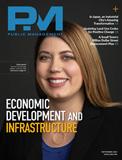
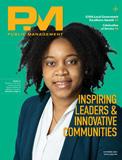

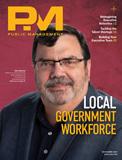























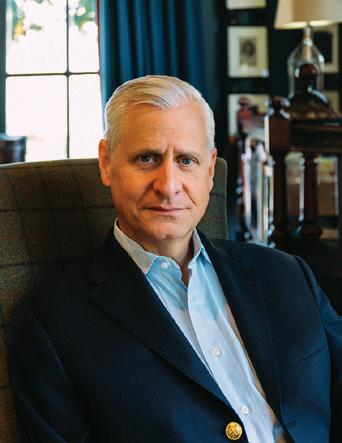





Sunday Fireside Chat