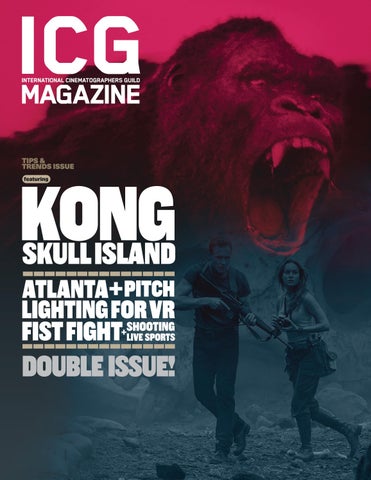
ICG MAGAZINE TIPS & TRENDS ISSUE
KONG featuring
SKULL ISLAND -------------ATLANTA+ PITCH
LIGHTING FOR VR SHOOTING
FIST FIGHT+
-------------LIVE SPORTS
DOUBLE ISSUE!
ZERO DELAY WIRELESS VIDEO UP TO
3000FT
MULTICAST
4 RX
VISUALLY LOSSLESS QUALITY
*ALL IMAGES ARE FOR ILLUSTRATIVE PURPOSES.
Pantone 109
cinema.teradek.com
Photo by Scott Alan Humbert
PRESIDENT’S
LETTER Feb/Mar 2017 {vol. 88 no. 02}
Steven Poster, ASC National President International Cinematographers Guild IATSE Local 600
“Stranger Things” In this strange, unpredictable time in both our world and our industry, we are offered so many products, ideas, and visions that are described as “completely new” (some of which really are) that we almost can’t recognize what’s beneficial and impactful, even when placed right before our eyes. Gatherings like the Consumer Electronics Show, held in early January in Las Vegas each year, always present new technology trends that promise “the most innovative methods for storytellers” in the history of the entertainment business. The hype is always about innovation that is so “new and revolutionary,” first adopters (many of whom are camera professionals) simply must have it all. Now. Such temptations barrage us daily and the questions that need to be asked are: “Are these technologies really new?” Some perhaps are. “Are they adaptable to our world?” Some perhaps yes. “Are they going to take over in the next twelve months?” Mostly no, but it’s the way the people who manufacture and market technology want us to think. Of course in the world of commerce, that last point is not necessarily a bad thing; those desires – to create or ride the wave of a trend – are part of what help sustain the economics of production. Just look at how many resources are being put into the development and demonstration of VR. But these new technology tools don’t often take into consideration the art and craft of moviemaking under the kinds of budget and time restraints that are now so typical of the film and television industry. These new tools also impose a sharp learning curve for our members to find that next artistic cog in the gear that will help them tell a story. In point of fact, I’ve found there hasn’t been any visual tool that I could not approach, and, after a short period of development, learn how to use to manufacture complex and beautiful imagery. It was simply a matter of knowing what the extremes of that technology were and how to work in between those edges. This process was how we learned what the empirical limits of any emulsion or any imaging system were. I’ve also found over the years that any “rules” associated with new technologies are made to be broken. How many times had I been told that I was outside the “limits”? That’s the most fun, actually, to find our own way of working with these tools. No matter how much I would share my own methods with another cinematographer, for example, that person would always find a different and unique way to utilize that same tool in their own work. The point being: individuality is essential (and inevitable) in this new world of ultra-fast digital industrialization. How does all this relate to a camera crew working on set to implement new technology? No matter the amount of “newness” hurled our way, camera department technicians and artisans must find a way to come together to finalize some concept of an image and memorialize it to whatever medium is being recorded. And no matter how many new tools we are presented with to make our working lives easier, it always becomes much more complex than any of us would imagine. That’s why we spend so much time training and educating this membership in new products, processes, and workflows.
4
FLORIDA • NEW YORK • GEORGIA • NORTH CAROLINA • LOUISIANA • NEW MEXICO CALIFORNIA • EUROPE • AUSTRALIA U.S. WEST COAST: 1-888-80CRANE • U.S. EAST COAST: 1-888-CRANE52 • DIRECT: (941) 492-9175 • CINEMOVES.COM •EMAIL: INFO@CINEMOVES.COM
FEB/MAR 2017 VOLUME 88 / NUMBER 02 / TIPS & TRENDS ISSUE
CONTRIBUTORS
table of contents DEPARTMENTS GEAR GUIDE / 12 DEEP FOCUS / 24 UNION LOVE / 30 EXPOSURE / 34
Ted Elrick (#teacherfight) “It’s cool to hear about the coordination, care and choreography of such an intricate sequence in Fist Fight, led by cinematographer Eric Edwards. Particularly the commitment to making it fresh, lively and with old-fashioned practical effects.”
SPECIALS LIGHTING FOR VR / 76 SHOOTING LIVE SPORTS / 84
FEATURES Kong: Skull Island
{46}
Matt Hurwitz (Large and In Charge) “I’ve been a fan of King Kong since it first began appearing on latenight television in the early 1970s. Larry Fong’s [ASC] shoot deep inside Vietnam sounds almost as spooky as the original, filmed on RKO’s backlot in Culver City.”
Valentina I. Valentini (Hustle & Flow) “When I watched Donald Glover’s new FX series Atlanta, it was before the series had won two Golden Globes – one for his acting and the other for best comedy series. After I’d binged on the first season and interviewed the team, it was clear they were on to something completely new in the scripted comedy world. DP Christian Sprenger said they were very interested in bringing the spirit and soul of independent cinema to TV, but it was never as direct as saying, ‘We want it to look like an indie film,’ she told me. They captured the indie heart with the cachet of a series.”
Pitch {52} Atlanta {62} Fist Fight {68} CORRECTION: We sincerely regret omitting Sheryl Main’s name from our January Deep Focus profile – she is not only a longtime ICG National Executive Board member, but one of the most respected unit publicists in Hollywood. Sorry Sheryl! (Really). 6
Chuck Zlotnick (Kong: Skull Island, Stop Motion) “I am so proud to be a part of the International Cinematographers Guild. I have had so many amazing opportunities and experiences over the years. It makes me feel good to know that there is someone looking out for us.”
RULE THE NIGHT
Final Grade
Scene from the film “It’s a Mess” by Director/DP Frank Prinzi, ASC Captured on VariCam 35, V-Log, AVC-Intra 4K 4:4:4 T4 at native 5000 ISO, negative gain set to 2500 ISO
Practical lighting enhanced by sensitivity and dynamic range
Nighttime skyline: Minimal noise and vibrant color gamut
You’ll Never Light The Same Way Again Shoot night or day with a minimal lighting kit thanks to the Super 35 4K Imager with dual native 800/5000 ISO that powers the VariCam 35 and VariCam LT. At 5000 ISO, you can work in ambient light long after dark, see deep into the shadows and capture stunning images no other camera can acquire. Native 800/5000 ISO changes everything: How you light, how you shoot, how you create.
VARICAM LT
VARICAM 35
See for yourself. Request a demo at us.panasonic.com/varicam © 2016 Panasonic Corporation of North America. All rights reserved.
Headlights: Direct light with no blooming
VariCam 35 Proven in feature, episodic, commercial, and live event shooting, the VariCam 35 captures 14+ stops and records 4K/ 2K/Proxy or UHD/ HD/Proxy simultaneously.
VariCam LT Perfect for handheld, SteadiCam, jib, drone and gimbal work, VariCam LT packs the same 4K sensor as the VariCam 35 into a smaller, lighter, more affordable body.
ICG MAGAZINE Publisher Teresa Muñoz Executive Editor David Geffner Art Director Wes Driver
ACCOUNTING Glenn Berger Dominique Ibarra COPY EDITORS Peter Bonilla Maureen Kingsley
February /March 2017 vol. 88 no. 02
INTERNATIONAL CINEMATOGRAPHERS GUILD Local 600 IATSE NATIONAL PRESIDENT Steven Poster, ASC NATIONAL VICE-PRESIDENT Heather Norton
STAFF WRITER Pauline Rogers
1ST NATIONAL VICE-PRESIDENT Paul Varrieur
CONTRIBUTORS Ted Elrick David Geffner Matt Hurwitz Valentina I. Valentini Chuck Zlotnick
2ND NATIONAL VICE-PRESIDENT John Lindley, ASC NATIONAL SECRETARY-TREASURER Eddie Avila NATIONAL ASSISTANT SECRETARY-TREASURER Douglas C. Hart NATIONAL SERGEANT-AT-ARMS Christy Fiers NATIONAL EXECUTIVE DIRECTOR Rebecca Rhine
PUBLICATIONS & PUBLICITY COMMITTEE Henri Bollinger, Chair
CIRCULATION OFFICE 7755 Sunset Boulevard Hollywood, CA 90046 Tel: (323) 876-0160 Fax: (323) 878-1180 Email: circulation@icgmagazine.com
ADVERTISING REPRESENTATIVES WEST COAST & CANADA Rombeau, Inc. Sharon Rombeau Tel: (818) 762 – 6020 Fax: (818) 760 – 0860 Email: sharonrombeau@gmail.com EAST COAST, EUROPE, & ASIA Alan Braden, Inc. Alan Braden Tel: (714) 846 – 7147 Fax: (714) 846 – 8271 Email: alanbradenmedia@gmail.com
ADVERTISING POLICY: Readers should not assume that any products or services advertised in International Cinematographers Guild Magazine are endorsed by the International Cinematographers Guild. Although the Editorial staff adheres to standard industry practices in requiring advertisers to be “truthful and forthright,” there has been no extensive screening process by either International Cinematographers Guild Magazine or the International Cinematographers Guild. EDITORIAL POLICY: The International Cinematographers Guild neither implicitly nor explicitly endorses opinions or political statements expressed in International Cinematographers Guild Magazine. ICG Magazine considers unsolicited material via email only, provided all submissions are within current Contributor Guideline standards. All published material is subject to editing for length, style and content, with inclusion at the discretion of the Executive Editor and Art Director. Local 600, International Cinematographers Guild, retains all ancillary and expressed rights of content and photos published in ICG Magazine and icgmagazine.com, subject to any negotiated prior arrangement. ICG Magazine regrets that it cannot publish letters to the editor. ICG (ISSN 1527-6007) Published Monthly by The International Cinematographers Guild 7755 Sunset Boulevard, Hollywood, CA, 90046, U.S.A. Periodical postage paid at Los Angeles, California. POSTMASTER: Send address changes to ICG 7755 Sunset Boulevard Hollywood, California 90046 Copyright 2015, by Local 600, International Alliance of Theatrical Stage Employes, Moving Picture Technicians, Artists and Allied Crafts of the United States and Canada. Entered as Periodical matter, September 30, 1930, at the Post Office at Los Angeles, California, under the act of March 3, 1879. Subscriptions: $92.00 of each International Cinematographers Guild member’s annual dues is allocated for an annual subscription to International Cinematographers Guild Magazine. Non-members may purchase an annual subscription for $48.00 (U.S.), $82.00 (Foreign and Canada) surface mail and $117.00 air mail per year. Single Copy: $4.95 The International Cinematographers Guild Magazine has been published monthly since 1929. International Cinematographers Guild Magazine is a registered trademark.
www.icgmagazine.com www.icg600.com
8
WIDE ANGLE FEBRUARY/MARCH 2017 TIPS & TRENDS ISSUE
David Geffner, Executive Editor Twitter: @DGeffner Email: davidgeffner@icgmagazine.com
I teased the many exciting new changes in store for ICG Magazine in 2017 in last month’s Wide Angle, and now we’re proud to officially introduce our first-ever double issue (and my 100th as Executive Editor!) for the months of February/March, highlighted by a beast of a cover story, Kong: Skull Island. The article was written by regular ICG contributor (and Kong super fan) Matt Hurwitz, who relished the movie magic cinematographer Larry Fong, ASC, and his team pulled out of their sleeves for this fun take on the big ape. (Literally: Fong is a seasoned magician who performs close-up tricks with cast and crew alike on all his sets.) One of two double issues in 2017 – June/July will be our next – we’ve combined the wintry hush of Valentine’s Day with the blossoming first four weeks of Spring into a single package themed around industry “Tips and Trends.” What this means for readers is four full feature-length stories (Kong, FOX Networks’ Pitch, Fist Fight and the Golden Globe–winning FX series, Atlanta), expanded Specials articles, and an ultra-meaty front of the book that allows for more Gear Guide products and new departments focused on the work of Local 600 members. And February/March makes good with that promise by marking the grand debut of Union Love, featuring Brooklyn, NY-based Caitlin Machak expounding on the joys of being a union camera assistant. The two new episodic series mentioned above reflect the (much-needed) changes that are also happening in our industry. Pitch, with its pilot shot by Yasu Tanida, and the series lensed by Paul Maibaum, ASC, and Bobby La Bonge, stars Kylie Bunbury as the first female athlete (who also happens to be African-American) to crack the longtime boys club that is MLB. Directed by two-time Emmy winner Paris Barclay (more on Paris later), Pitch accurately portrays race relations as not a big deal in the multi-colored world of professional sports. (Gender is another story.) Atlanta, created by Donald Glover and shot by Christian Sprenger, centers on two AfricanAmerican cousins climbing the ladder in the rap/hip-hop industry by very different means. The show reveals its titular city in honest and surprising ways, mostly because Glover (who grew up in the Atlanta area) and Sprenger were so eager to explore neighborhoods and people rarely seen on television. Another up-front section that we’ve plumped up is our Exposure conversation, which visits with Barclay, who, aside from executive-producing and putting his quality imprint on Pitch (Barclay has directed more than 150 episodes of network television dating all the way back to ground-breaking shows like ER and NYPD Blue), is also outgoing president of the Directors Guild of America. In his three years at the helm of the DGA, Barclay has fought ferociously for race and gender equality issues, not only within his own 16,000-plus membership rolls but on his crews as well. And he definitely walks the talk – four of Pitch’s ten episodes (Barclay directed four himself) were helmed by female directors who were far from the usual suspects. Episodes by Regina King, Zetna Fuentes, Joanna Kerns and Mary Lou Belli were among the most emotionally compelling in the series, proving, as Barclay shares in Exposure, that “when producers and creative heads consider hiring people beyond their usual comfort zones,” diversity doors in Hollywood will finally open wide. The best thing the esteemed TV director says his female hires brought to Pitch, (in addition to the “truly inclusive” approach Maibaum says was fostered on set), was “their fresh ideas and creative energy.” Just like we expect our first-ever double issue (and, oh yeah, my 100th!) will bring to ICG readers.
10
Russell Carpenter, ASC
COMPROMISE IS OVERRATED. After putting it to the test in his latest project, cinematographer Russell Carpenter, ASC was impressed by the flexibility and color output of the new Canon EOS C700. It’s a Super35 format camera combining 4K onboard recording, a 15-stop dynamic range, and 4.5K resolution. Designed to match industry standards, operating the EOS C700 is instantly intuitive. Your story deserves no less. GO BEHIND THE SCENES WITH RUSSELL CARPENTER, ASC AT USA.CANON.COM/EOSC700
© 2017 Canon U.S.A., Inc. All rights reserved. Canon and EOS are registered trademarks of Canon Inc. in the United States and may also be registered trademarks or trademarks in other countries.
Gear Guide
FEB/MAR 2017 by Pauline Rogers
Artemis Prime + Like an optical director’s viewfinder, but with a screen that more than one person can see + Specially made to accurately reproduce any digital camera format + The image on the screen can be recorded and broadcast to other on-set monitors + Will work with both PL- and PV-mount lenses + Includes software tools that help to pre-visualize shots
“For several years I have depended heavily on the Artemis app for its accurate frame lines while planning shots. Now with Artemis Prime, I can also see depth-of-field, exposure and a wide variety of looks, and I can record and play back. It is an ideal tool for scouts and for working out complex sequences in collaboration with a director and DP.” – Larry McConkey, SOC
Pricing for Artemis Prime viewfinder kit, which includes a case, an additional handle, and two device holders, is $6,500
www.chemicalwedding.tv
12
DaVinci Resolve 12.5 now with 1,000 enhancements and 250 new features for faster editing, better color and new effects! DaVinci Resolve 12.5 is a massive new update that gives professional editors and colorists a faster and more refined editing and grading experience! You get professional editing with advanced color correction, plus incredible new effects so you can edit, color correct, add effects and deliver projects from start to finish, all in one single software tool!
Faster Editing DaVinci Resolve 12.5 features dozens of new editing and trimming tools, along with faster timeline performance! You get new ripple overwrite, paste insert, revolutionary new audio waveform overlays that help you edit, and much more. DaVinci Resolve 12.5 now features virtually every editing and trimming tool imaginable!
Better Color Now you can use the same tools Hollywood colorists use every day on blockbuster films and television shows! DaVinci Resolve 12.5 Studio gives you new HDR grading, faster node editing, new Resolve FX and more! You get color that goes far beyond any other editing system and you can switch between editing and grading with a single click!
www.blackmagicdesign.com
New Effects DaVinci Resolve 12.5 introduces ResolveFX, an amazing collection of high performance plug-ins such as blurs, light rays, mosaics, and more! You also get more transitions, enhanced titles, keyframe animation and speed ramp effects, along with Fusion Connect, which lets you send shots to Fusion for visual effects!
DaVinci Resolve 12.5 Studio When you need to work at resolutions higher than Ultra HD, like DCI 4K or even on stereoscopic 3D projects, then upgrade to DaVinci Resolve 12.5 Studio. You get multi-user editing and color correction, network rendering, 3D, advanced temporal and spatial noise reduction, optical quality blur effects, additional ResolveFX and much more! DaVinci Resolve 12.5 DaVinci Resolve 12.5 Studio DaVinci Resolve Advanced Panel
Free Download $995 $29,995 Watch Video!
Gear Guide
RED WEAPON 8K + HELIUM 35.4-megapixel CMOS sensor + 8K 2.4:1 resolution up to 75 fps + 16.5+ stops of dynamic range + 300 MB/s data speed + REDCODE RAW + Apple ProRes or Avid DNxHR/HD + Upgrade path to WEAPON 8K VV
“With at least one stop more sensitivity in the blacks, it opens up the possibility to shoot magic-hour scenes for much longer than what was possible before. And the increased image quality gave new life to some of my favorite Super-35-mm lenses. Even vintage lenses now show amazing detail, while retaining their character.” – Markus Förderer, BVK
Pricing for WEAPON 8K starts at $49,500
www.red.com/products/weapon-8k
14
Y O U R
S T O R Y
DESERVES TO BE SEEN
Test drive gear for free up to a week. adorama.com/renttobuy *Refund on rental fee applies only to items that Adorama rents and sells. Does not apply to Canon Cinema Line.
For more information or to purchase visit www.adorama.com
Adorama Pro is your complete resource for professional tools, in-depth knowledge & product support.
42 W 18TH ST NYC 888.582.3900 adorama.com
Gear Guide
FoxFury Nomad T56 + Cordless and generator-free design + High-quality 95-CRI light + Durable and weather resistant + Rechargeable + Portable light deploys in under 20 seconds with one-person carry + Available in 5600 K (daylight) and 3200 K (tungsten)
“We’ve used the Nomads on a variety of productions. Their light spectrum is ideal for true color reproduction. What is really great about the Nomads is that they are as useful as utility lights as well as production lights on set. We keep them in all of our trucks and use them all the time for setting up and wrapping. The price point is perfect for smaller production houses.” – Andrew Petersen, Director, Drone Dudes
Pricing for Nomad T56 is $3,149
www.foxfury.com
16
Gear Guide
DJI Inspire 2 + Records 5.2K at 30 fps and 4K at 60 fps + CinemaDNG RAW and Apple ProRes enabled + Dual encoding – H.264/H.265 at 100 Mbps + Integrated intelligent flight features including smart return to home + Video transmission system works up to 4.3 miles and transmits up to 1080p + Dual-battery system for flights up to 27 minutes
“I have used the Inspire 2 with X5S on Granite Mountain. The image quality is up to my standard for feature films. You just kind of look at it and think, ‘That is really small. How can it give such a big result?!” – Claudio Miranda, ASC
Pricing for the combo, including airframe and X5S camera, is $5,999
www.dji.com
18
It’s all in your hands
MASTER GRIPS FINGERTIP CONTROL OF LENS AND CAMERA
ARRI MASTER GRIPS. TRULY CINEMATIC.
www.arri.com/ecs/mastergrips
Gear Guide
Teredek Bolt 3000 + Zero-delay wireless video + Up to 3000-ft transmission + Rapid reconnection + 20% smaller chassis + Two new DFX channels + 20-MHz channels to cut through interference + Built-in HDMI-to-SDI converter
“Getting a strong wireless video signal to the director, client and especially my focus puller is essential to my everyday workflow on set. Having a longerrange system allows me to accomplish this without having the set crowded with non-critical personnel. We can basically push video village back 3,000 feet, far out of the way, and still keep everyone happy.” – Sam Nuttmann, 1st AC
Pricing for Bolt 3000 starts at $9,490
www.teradek.com
20
The Cooke Look
®
Original photo, Luke Varley
One Look. All Speeds
"I had never shot a comedy, but the series Fleabag was an easy choice. Phoebe Waller-Bridges scripts are inspirational and so is she. There is a subtext and dysfunctionality to Fleabag that I was interested in underscoring. I wanted to expand my pallete from the darker Hopperesque environments that I do frequently to something brighter.
T2.3
I chose the new Cooke Anamorphic/i lenses. They are not perfect and they distort — the whole point of anamorphic lenses. I mainly used the 32mm and 50mm. In prep I shot Phoebe from different angles and heights on all focal lengths to learn what worked best. She is incredibly photogenic but the wider lenses, especially the 32mm, worked great just above her eye line. It made us feel complicit. We shot 2-39-1 format to use the width of the frame for multiple relationships and tensions to exist in the same frame. I also tried to create a style where the camera becomes another player with the viewer unaware that it is shot completely handheld.
T2.8
T1.4
The Cooke Anamorphics have a very beautiful look, with all the characteristics of the S4s in anamorphic form. They were the perfect choice for this dramatic comedy.” Tony Miller, BSC Fleabag Amazon Studios original series Nominated for 2016 RTS Craft & Design Award for Photography
British Optical Innovation and Quality Since 1893.
cookeoptics.com
T: +44 (0)116 264 0700
T2.0
Canada, South America, USA: T: +1-973-335-4460
Gear Guide
Kodak PixPro SP360 4K + Designed to capture and share 360° VR videos + Easily create full-spherical VR with PIXPR’s Stitch Software for Mac or PC + Supports YouTube 360° videos and Facebook 360° photo and video upload + Free iOS and Android apps for wireless control + Accessories include SP360 4K bundle packs + Splash-proof, dustproof, freezeproof, shockproof
“Utilizing the SP360 4K camera, our team has never had a problem getting up close and personal to craft the experience. The astonishingly small dualcamera rig finds itself in the heart of the action without detracting from the performance. It’s practically invisible. True 4K footage from two cameras, stitched as a 360-degree video, immerses the audience in the story in a whole new way.” – Ryan Moore, CEO of Experience 360°
Pricing for SP360 4K starts at $499 for entry-level bundle pack.
www.kodakpixpro.com
22
Capturing unique moments. ZEISS LWZ.3 21-100mm
ZEISS Lightweight Zoom LWZ.3 21-100mm/T2.9-3.9 T* The new ZEISS Lightweight Zoom LWZ.3 21-100mm/T2.9-3.9 T* strikes the perfect balance between weight, size and optical performance. Combining a rugged, splash-proof housing with a weight of just 2 kg, it truly embodies the much-anticipated cine-style ergonomics. Its outstanding optical performance delivers razor-sharp structures, vibrant colors and excellent contrast.
www.zeiss.com/cine/lwz3
Deep Focus.
SCOTT CONNOLLY
“ Why did 3D die? Price,
quality, speed – pick two. The complexity and cost of 3D were what ultimately led to its demise. We were constantly getting calls focusing on creating the cheapest possible product in the least amount of time. The industry was focusing on making as much money as was possible from the high-ticket premium. Creating high-quality 3D was painstakingly slow and expensive. continued on page 26
24
photo courtesy of Scott Connolly
Tips & Trends Issue
PARAMOUNT PICTURES CONGRATULATES
DENZEL WASHINGTON MOTION PICTURE SHOWMAN OF THE YEAR
© 2017 PARAMOUNT PICTURES. ALL RIGHTS RESERVED.
25
Deep Focus. Tips & Trends Issue
Even with the early success of The Astronauts Guild’s
stereoscopic projects, my partners, Ian Spohr, Roham Rahmanian and Evan Pesses and I realized that the technical limitations of the medium were creating a ceiling to its potential. We knew that there was a demand for this type of experience, but it also became obvious that 3D – 3D television especially – was not the correct medium to deliver those experiences.
Virtual reality embraces all the good parts of 3D and eliminates most of the bad. Stereoscopy is about immersion, but the glasses only further separated you from the content. Even though you still need to wear a headmounted display (HMD) to view virtual reality, the content feels more immersive. The image surrounds the viewer and is not contained by the screen’s edges. VR is a personal experience and can be calibrated specifically to the individual viewer. This means no headaches, better immersion, and a unique experience for each individual user. Future VR technology may allow HMDs to detect other users for shared and social VR experiences.
26
VR is a work in progress and I constantly have to remind myself that perfect is the enemy of good. If we get too focused on the small imperfections, we are distracting ourselves from the creative content. We are better off taking these small imperfections as learning experiences, chalking certain problems up to uncontrollable circumstances (such as the physics of lenses) and focusing more on creating truly immersive experiences. Every day the tools are getting better and the final product is improving.
Live-action VR in its current state is only a
stepping-stone toward the creation of “room scale” and volumetric video experiences, so we are keeping our R&D team focused on these kinds of future technologies.
Most people think about today’s stories as being told as though you are looking through a window. When you start working in VR, that window is gone and the viewer is a ghost in the room. Virtual reality is about perspective, so it is important to treat the camera like a person, not an object. There is no frame, and you can no longer tell the viewer where to look.
But you can predict where the viewer will likely be looking and focus your story and editing around those ideas. As a content creator, you have to think of your world as extending in all directions. You’re rotating the world around the static viewer, placing important content where he or she is likely to be looking. continued on page 28
9 BAFTA NOMINATIONS BEST PICTURE
INCLUDING
BEST CINEMATOGRAPHY
27
Deep Focus. Tips & Trends Issue
There are so many distribution avenues for 360° video
and virtual reality that it is really important to know how your product will be distributed. Some projects may never be seen in an HMD and are only intended for the Web in 360°. They will be shot completely differently than something that is intended for a head-mounted display.
Although the barrier to entry in VR is very low cost, people often mistakenly assume that just because it can be done with cheap action cameras it must be easy. Working with actioncamera arrays is often much more complicated than the more advanced alternatives.
Virtual reality is a wonderful medium, but it’s not an “improvement” to 2D, as 3D was marketed. It’s a new and exciting tool that is going to develop into something that, I believe, is going to change the way we tell stories. Not only does it allow us to be immersed in a story, there are also so many opportunities to interact socially. Whereas 3D tended to create a barrier from others in the real world, VR will allow us to interact with our friends in new worlds, just like the “holodeck” we grew up watching on Star Trek.
SCH_NancySchreiber-ICG-halfPgAd.qxp_Layout 1 8/13/16 10:15 AM Page 1
“
I have to be ready for the unexpected, and lately I've been all over, from a network series in New York to an indie feature in the Republic of Trinidad and Tobago. The cameras, lenses, locations, actors all differ—but my filter kit always travels with me. And Schneider Classic Softs® and Black Frosts™ have been my go-to filters for over a decade.
SCHNEIDER SMOOTHS THE WAY FOR NANCY SCHREIBER, ASC On “Moving Parts”, shot in Trinidad, I used a ½ or a 1 Classic Soft® every day to take the edge off sharp lenses and help portray this very human story about a young woman who gets tangled up in sex trafficking. For the more mature co-star, I sandwiched on a ½ Black Frost™, which didn’t eliminate her facial lines, but smoothed them just enough to maintain the character of her seasoned life. The subtlety of the filters let me get the look we needed while keeping the authentic, almost documentary feel of the mainly handheld production.
w w w.s c h n e i d e ro p t ic s. co m
”
info@schneideroptics.com • 818-766-3715 • 800-228-1254
28
“
The main advantage of these filters is their neutrality, especially when using 4 stops (1.2ND) or above. When I use other IR ND filters I normally have to compensate for a color shift in the grade, but with these I haven’t seen any noticeable color shift. They are by far the best front of camera ND filters I have used.
”
John Lee – Director of Photography
A NEW standard
in n neutral-density filters for cinematography
Our ProGlass Cine range of neutral-density filters has been designed to meet the exacting needs of all cinematographers – whether shooting digitally or on film. Their neutrality ensures all colors remain accurate and true, saving you time and simplifying your workflow.
4” x 5.65”
■ Durable and long lasting ■ Manufactured from 4mm thick optically flat glass
0.3ND 0.6ND 0.9ND 1.2ND 1.5ND 1.8ND 2.1ND
■ Scratch resistant and edged with a metal rim ■ Available in two sizes and seven densities
Full range available now Visit us at NAB Booth C11746
6.6” x 6.6”
leefilters.com 29
Union Love.
CAITLIN MACHAK
30
photo by Sarah Shatz
Tips & Trends Issue
Joining the Union was a whirlwind experience for 2nd AC Caitlin Machak. In the summer of 2011, she received a call to become a full-time A-Camera 2nd AC on The Magic of Belle Isle. She had two hours to gather her proof of 100 days’ paid work and join. Thankfully, both focus pullers were there to answer her questions about the gear – and contracts. “It was eye-opening to work on a set with an experienced director since most of the work I had done previously was with first-time directors,” she recalls. “I felt my non-union AC work had given me a good base training, and it was time for me to experience a more organized, union production. It was just the beginning for me.” WHAT IS THE KEY DIFFERENCE BETWEEN WORKING NON-UNION AND UNION? The biggest relief [working union] is having a base rate negotiated in the contract and not having to work flat rates. Negotiating those terms from job to job was quite stressful. I’m happy that we are an organization that has the power to negotiate our terms as a collective group. I am also grateful for the consistent health insurance. WHAT’S THE MOST IMPORTANT PART OF BEING A UNION MEMBER? Like most things in life, communication is an essential skill. When we communicate well, we can look out for each other on set. And, in my experience of listening to members who may feel distanced from the union, I often find these members hold valuable information as to how we can achieve a better sense of solidarity and community. WHAT VALUES AND PRINCIPLES DO YOU WANT YOUR UNION TO STAND FOR? A balance in this often unbalanced and unforgiving business. I have worked on productions that pride themselves on doing good work calmly, efficiently and in shorter days. When I am provided with the ability to have a work-life balance, I do my best work. SINCE JOINING THE UNION, WITH WHAT GROUPS HAVE YOU BECOME INVOLVED, AND WHY? I’m a National Executive Board (NEB) member representing Eastern Region Assistants and co-chair of the Eastern Region Young Workers Committee. It was important to take my desires and grievances to a place where I could actually have a voice and make a change. HAVE YOU BECOME INVOLVED IN THE LABOR MOVEMENT? I attended the very first IATSE Young Workers Conference in 2012. There I learned more about the labor movement and its impact on workers in all industries. Since then, I have become a more active member.
HAVE YOU WORKED WITH OR SEEN OTHER UNION CRAFTS COME TOGETHER TO ADDRESS SITUATIONS/PROBLEMS? On shows where crews successfully banded together on an issue, there was already a good rapport and respect between the producers and at least one department head on the crew. So, when larger issues came up, it was easier to make their voices heard. In one case, my A-camera operator noticed that safety meetings were not being conducted at call. Instead of antagonizing the production, he politely pointed this out to the producers and offered that every day someone from a different department would conduct the safety meeting. My favorite crew safety meeting was when a couple of PA’s created a safety-meeting rap! HOW CAN UNION MEMBERS GIVE BACK? Research organizations that benefit our members, especially when work is scarce – and if they are able, donate time or money to them. For example, I support The Actors Fund based in New York City that offers training as well as resources in housing and health insurance. WHAT ADVICE WOULD YOU GIVE PEOPLE WHO ARE JUST STARTING THEIR CAREERS AND JOINING? Participate in union events, listen and discuss experiences with other members, and don’t be afraid to ask questions. WHAT NEEDS TO HAPPEN IN LOCAL 600 THAT HASN’T YET? A greater sense of community within the membership, which I think is strained by quality-of-life issues. Once we understand that the union will make quality of life a number-one priority in contract negotiations, I believe we will band together more effectively. HAVE YOU BEEN ABLE TO INTERACT WITH UNION REPS? I constantly communicate with union reps whenever I need clarification on a contract term. When I am on A-camera, I go into the office to review the production’s contract with the Business Representative before the show starts, so that I have a better handle on the finer points of the contract. HOW CAN THE UNION BEST PREPARE ITS MEMBERS FOR THE RAPID CHANGES IN TECHNOLOGY? The training courses that the union already provides for members are wonderful. I would like to see the workshops have more sessions and dates so that more members can participate. CAN YOU TELL US ABOUT A FELLOW MEMBER WHO HELPED YOU PERSONALLY AND/OR PROFESSIONALLY? Erin Henning has been my teammate, teacher, and friend since he met me and brought me onto my first non-union job, and then many union jobs to follow. With our shared passions and convictions, we both became more involved and worked our very best to lead by example as an A-camera team. The people that we have met along the way have also been a huge part of my personal and professional development. 31
On The Street. Tips & Trends Issue
New technology is literally flooding the market. Kickstarter and other venues encourage artists to get in on the ground floor of the next best thing. And yes, sometimes it’s cool to add a great new tool to your camera package before the market is saturated – that is, if you have the time to test the waters. However, it’s often the tool that you know that makes the difference. For our Tips and Trends issue this month, ICG Magazine checked in with a variety of Guild professionals about their go-to tools on set. 32
1.
2. 3. 4. 5.
1
BEN KUFRIN Director of Photography The Bounce Back, Filly Brown, Adulterers, Enter The Dangerous Mind “For me, it’s the Matthews Max Menace and the smaller Mini Max Menace arms. They are both invaluable tools that my key grip, Ernesto Pérez, turned me onto. When rigging is limited or even out of the question, these arms are critical to getting lights of various sizes up and out of the frame and in hard-to-get-at spaces quickly and safely. I carry at least one each of both sizes on the truck at all times and add to as needed. The time, space, footprint, maneuverability and costs are highly economical and get us rolling quickly.”
2
MICHAEL BECKER
Unit Stills Photographer American Horror Story, American Crime Story, Scream Queens “One of my favorite pieces of gear is the Fiilex P100 LED light. It’s about the size of a soda can, with zero percent to one hundred percent brightness adjustment. It has color temperature adjustment from 3000K to 5600K with a CR rating of 90 at any power. It will run two hours at full power [100-watt equivalent output] on its built-in rechargeable battery. I have used this light as a handheld key on gallery shoots where we wanted to move quickly and incorporate set practicals. I also use it when shooting behind the scenes in dim locations, backstage, clubs, et cetera. Its focusable Fresnel lens delivers a beautiful quality light, and there are clever light-shaping tools such as a diffusion dome and gel holder. It’s my go-to light for quick portraits on darker locations.”
3
NATHAN LEVINE-HEANEY
Operator 24: Legacy (pilot), Snowfall (pilot), Marvel’s Most Wanted (pilot), Marvel’s Agent Carter, Guardians of the Galaxy (additional photography) “The MōVI Freefly is an incredible, cutting-edge tool, and to get the most out of it, you need the right accessories. The Ready Rig is by far the best support vest for gimbals that I’ve used. The dual arms support the gimbal in a natural and balanced fashion. Also, because the arms come straight out from the shoulders – not upwards, as with other support-vest systems – the operator can still fit through tight spaces. On the pilot for 24: Legacy, it was perfect for fast-paced action sequences. I could fly down a hallway, through a door, and under a flag, and I could do fifteen takes in a row without destroying my arms or back. And with the pro-arms upgrade, I was able to boom from shoe height to eye level with a six-foot-four-inch actor. The Ready Rig is essential support gear for using the MōVI on-set.”
4
DANIEL MING
1st AC Granite Mountain, The Founder, Tomorrowland, American Sniper, Life of Pi “A first AC has a lot on their plate, but ultimately what everyone notices is if the footage is in focus or not. There are a lot of focus assist tools out there like the Cinetape, Sniper and Light Ranger 2, but the can’t-do-without for me is my Preston Hand Unit 3 remote-focus unit. Being able to use a consistent focus scale allows me to know if someone is running from ten feet to four feet, for example. I turn the knob a certain amount and the focus on the lens will do the same thing regardless of what lens is on the camera. It also allows me to get off to the side for a better view of what is happening depth-wise if there is a lot of equipment around the camera blocking the view from beside it.”
5
CHARLIE ANDERSON
DIT Vinyl, Z: The Beginning of Everything, Meadowland “For me, it’s my Leader 5330. It is almost impossible for me to do my job on set without it. It allows me to quickly match cameras in terms of exposure and color; and, for instance, where I can’t take my whole cart [such as process trailers and small car setups], it is an incredibly significant tool with which I can still monitor exposure with only a single-channel iris controller.”
33
Exposure. Tips & Trends Issue
34
PARIS BARCLAY by David Geffner photos by Nicola Goode
Paris Barclay occupies a rarefied place in Hollywood, and it’s not just because he’s one of the few TV directors who also executive produces (see Pitch, page 52 ). Barclay, who directed musical theater at Harvard, started his career as a NYC “mad man.” He transitioned to music videos ( 1990’s iconic Mama Said Knock You Out, for LL Cool J, has more than 16 million views on YouTube) and in 2013 became the first African-American president of the DGA (his second term concludes in 2017 ). Years before his groundbreaking work at the DGA, Barclay led a revolution that brought intimate, handheld storytelling to TV – with John Wells on Angel Street and ER, and with Steven Bochco on NYPD Blue and City of Angels, the latter show winning two NAACP Image Awards for its African-American cast. (An NAACP Hall of Fame award also put Barclay alongside black entertainment icons Lena Horne, Paul Robeson, Sidney Poitier, and Oprah Winfrey.) Through shows like Glee, In Treatment, and CSI: Crime Scene Investigation, he’s garnered honors from U.S. Health and Human Services and the Academy of Television Arts and Sciences, moving the needle forward on how the world perceives mentally ill, disabled, and gay characters. In a wide-ranging interview with ICG Executive Editor David Geffner, Barclay talks about race, trade unionism, and the first cinematography tip he ever received. (You’ll never guess whom it was from.) ICG: Let’s get in the way-back machine and travel to music-video land, circa 1990. How did that set the table for a career in television? Paris Barclay: Well, the wayway-back machine starts with the first thing I ever directed, which was a commercial. I was an advertising copywriter for 12 years with various agencies – BBDO, Gray Advertising, Cunningham & Walsh – and I got the chance to direct a commercial I had written that starred Elizabeth Taylor. This was 1985/1986, it was the first commercial she’d ever done, and it was for her new foundation for AIDS research. My first job in Hollywood was directing Elizabeth Taylor – no pressure, right? How did it go? Quite well, actually, and I even picked up valuable tips about cinematography. Elizabeth Taylor came
onto the set with her long cigarettes and very profane language [laughs], and said in that famously airy voice: “Paris, I need to speak with you.” I walked over, slightly terrified, and she said: “You see that light over there? It needs to go down. You see that light? It needs to go out.” I realized later, after analyzing the spot, that, obviously, this woman has worked with the best cinematographers in Hollywood and knew exactly where the light needed to be for her to look like Elizabeth Taylor. It had to be top light that threw everything under her chin in shadow to help define those famous cheekbones. And there had to be light on her eyes, which really were violet, this strange shade of purple I’d never seen before. Now, of course, it all makes perfect sense. But on my very first job, a Hollywood icon was my teacher. continued on page 36
35
Exposure. Tips & Trends Issue
From there you moved into music videos and worked with some great NYC-area indie DP’s. Yes, I was sort of dragged into this new music-video company called Black & White Television, where it was assumed I could bring in some high-profile R&B, hiphop, and rap artists, simply because I was a black director who talked a lot! It was a huge failure for the first few years, and then we got LL Cool J and everything changed.
Mama Said Knock You Out is still a classic. [Laughs.] Thanks. You asked about what I learned from my music-video experiences, and the New York DP’s I worked with. The first thing I learned was don’t micromanage. You hire great people, like Daniel Pearl and Declan Quinn, both New York indie DP’s, and let them do their jobs, which they do really well. The second thing is to be extremely prepared. It was cool [in the music industry] to be the director who just shows up and lets everything flow spontaneously – with blocking, camera movement, et cetera. But whenever I did that, I never got what I wanted. So I created very elaborate shot lists for all my music videos. In fact, I did a video with LL Cool J just a few years ago where we had one warehouse with seven sets, all in a circle next to each other, knowing we had only one day to shoot. What did John Wells see that heralded a move into episodic television? John, who was doing a new show where all the shots would be oners, saw emotionally compelling storytelling, and he knew about my background of having directed theater. The thing is that my videos were always storybased, not performance-based. The reason Bob Dylan came to me [to direct the video for It’s Unbelievable] was he saw Papa Was A Rolling Stone [for Was, Not Was], which drew from my own experience of going back to my childhood home [in Chicago] and finding it all dilapidated. In the LL Cool J video Jingling Baby, which still gets a lot of play around Christmas, I appear as his manager and we have this dramatic scene with dialogue and everything. I wanted that on my reel to help me move into narrative. Declan Quinn shot Jingling Baby for $40,000 in one day, and he also shot [the LL Cool J video] Big Ole Butt, which had a panther! Did you take steps during this time to lessen the color gap? I was part owner of [Black & White Television], so I had discretion
in hiring. And I always tried for at least half of the crew to be diverse. Even if they were non-union [laughs] – and I wasn’t as much of a union guy back then as I am now, obviously – our feeling was for [people of color] to get hired. The biggest reason producers told them no was for lack of experience, and we could change that. In 1996, you directed your first (and only) theatrical feature, which has quite a cult following. [Laughs.] I did Don’t Be A Menace To South Central While Drinking Your Juice in the Hood because of having directed the videos for the Wayans brothers, as well as video promos for Kid ’n Play’s House Party. Also, I had just read Sidney Lumet’s book, which said you never turn down a feature film, no matter what, because they’re so hard to get. [Pause] The movie was not the best fit for me, but we came in under budget and it made almost $50 million. It established the Wayans’ style of parody films that has brought them so much success. My comic sensibility is not as broad as theirs, but people quote lines from it all the time, and I still get residual checks. What show paved the way for you to learn the producing side of television? NYPD Blue, which came about after John Wells started ER, where I did the first few seasons, and was then recommended to [NYPD Blue co-creator] David Milch, with whom I got along great. When Michael Robin left [NYPD Blue], I was brought on as producer and director. Now, I had done the music-video company, so I already knew how to read a budget. The guys from that show – Greg Hoblit and Mark Tinker, who had done Hill Street Blues with Bochco – felt it was critical to have a director as part of the production team. And I always thought what Greg did was so great – working closely with the writers, being part of the editorial process – you don’t just come in, direct an episode, and leave. You help make the show. I’ve done that eight to ten times since, and all the shows have been so different – Cold Case, In Treatment, Sons of Anarchy, The Bastard Executioner and now Pitch. How has television changed since the days of NYPD Blue? The biggest change, in my view, has been audience expectations. You have to provide a cinematic experience, period, and [viewers] don’t care about length because they’re binge-watching and not following a weekly pattern. Television has continued on page 38
36
“
My first job in Hollywood was directing Elizabeth Taylor – no pressure, right?”
37
Exposure. Tips & Trends Issue
“
The number-one goal of any union is to be future oriented and negotiate the best possible contracts for its membership.”
evolved into a complex, quality-driven medium, especially in terms of the visual experience, and thank goodness for that. They want Game of Thrones, and if you can’t hit that level of quality, you’re out. That’s a high bar! Does that mean HBO deserves the lion’s share of credit for this evolution? They’ve played a huge part, certainly. But the underrated game-changer has been FX Networks. The Shield took that documentary experience that Steven Bochco pioneered to another level. John Landgraf and the people at FX don’t get the props of an HBO, but their impact, while more surreptitious, has been massive. Many people think television has far surpassed features in the diversity department, offering stories that reflect the world we live in – color, gender, sexual preference. Do you agree? [Smiles.] Unfortunately, civilization has lost the motion-picture business. I say business because movies have become only about the tent-pole film. That offers some diversity in casting. But it’s mostly driven out the smaller, quality pictures, which now only show up as five to seven great indie movies in the Best Picture category at Oscar time! As for being a director, you can’t make a living in the feature business because it can take six to ten years to get that movie made. And that movie is not likely to be a big Marvel franchise that will provide tons of residuals. We charted 500-plus television series this past year, and three- to four-thousand episodes made in a single year. Quality storytelling has shifted to TV, and I celebrate that; but it’s sad to think the big-screen experience may well be lost to us in a decade. I saw a quote from Kenya Barris [creator of Black-ish] expressing how tired he was of always talking about “diversity.” Should we keep talking about it? Yes, sadly, enough, we need to keep talking about
38
it. But I do agree with Ava [DuVernay] and many others who say the word “diversity” has gotten beaten into the ground. What I want for my crew – and for my own kids at school – is a feeling of inclusion, of being a real part of something that’s alive and important.
out of school will squeeze the middle, which has always preferred the status quo. As far as DP’s, they are captains of the crew, even more so than directors, really, because they deal so closely with each department. Just like the leadership capabilities of female directors were once questioned when those directors [Series DP’s] Paul Maibaum, ASC, walked onto a set, I think that attitude still and Bobby LaBonge say you definitely exists for a female DP. But I also think it’s achieved that on Pitch. We worked very hard incumbent upon women DP’s, just like it has to make Pitch an inclusive environment – in been upon women directors, to have a strategy the casting, obviously, since it’s about the first that inspires and makes people want to work black female player in MLB, but also on the hard for them. To use a food metaphor – I crew. I told [producers and department heads] think once the hamburger gets squeezed from to really keep their eyes open. For myself, I both sides of the bun, the meat [and the made a concerted effort to hire directors that overall diversity numbers] will become more might not be a clear fit for Pitch. And it paid nutritious. [Laughs.] off – big-time! You have six months left as DGA How so? I hired some women [directors] president, the first African-American that people, myself included, had probably to hold that role in the history of your undervalued because of their résumés. Joanna Guild. How have you made a difference? Kerns [Episode 6] is not someone who people The number-one goal of any union is to be think of for drama, or a big sports show. But future oriented and negotiate the best possible when you talk to her, you find out she was contracts for its membership. Creative rights, in the Olympic trials for gymnastics, and her pension and health plan, and in the case of sister has two Gold medals! Her brother is a the DGA, how are these 16,000 members golfer, and her father was that father on Pitch going to support their families in five, ten, [who relentlessly drives his daughter in her twenty years? Using those guidelines, I think baseball career]. Zetna Fuentes [Episode 9] my biggest contribution has been to help sold me when she said she’s done 100-page shift the residual load of the studios to the days directing soap operas. Who knew? The SVOD [streaming video on demand] world. key to “diversity in hiring” is just opening your Very quickly, it’s going to be a streaming mind to consider people beyond your usual world, and television will never again be the comfort zone. And I told all our producers on live experience that we all knew as children. Pitch to make that effort. Making that move has been very complex, with a 70-member negotiating team, and The camera department has made hundreds of people working very hard, which progress with women and people of I all helped to oversee. I hope 2016 will be color, but not so much in the director looked back at as the year the DGA led the of photography position. Directors industry into the streaming world, the future, and actors get a lot of attention, but is if you will. I’m also very proud of having inclusion happening all the way through? been a very loud voice demanding more It’s not. Yet. And my strategy for the next ten access for female directors. It’s a different and years is bottom-up, top-down. Bringing in better climate than when I began as president different kinds of directors and producers, [in 2013], and that means a lot to me. and then doing the same with interns coming
JAMES LAXTON ON MOONLIGHT
‘
James Laxton has been universally lauded for his uniquely stunning imagery in Moonlight. He sensitively brings the viewer into the psyche of the characters, immersed within the lush Monet greens and salty blues of the Florida landscape. VER applauds cinematographer James Laxton on his many Moonlight honors, and more to come:
To me a successful project is based on
trust. Trust in my colleagues from the producers
and director to the actors, the crew and the
equipment house to the editors and post house—
’
all collaborating to bring something meaningful
to the screen. And trust that following my instincts
is the best path to telling an honest story.
VER Camera Prep facilities:
LOS ANGELES | NEW YORK | CHICAGO | NEW ORLEANS | ATLANTA | MIAMI
Nominee Academy Award® Best Cinematography Nominee ASC Theatrical Release Award Winner LAFCA Award Winner NYFCC Award Nominee Critics’ Choice Award Nominee Film Independent Spirit Award Nominee Golden Frog Nominee Satellite Award Nominee WAFCA Award
ver.com CAMERA | LIGHTING | LED | VIDEO | AUDIO | BROADCAST | RIGGING | AV 39
Larry Fong, ASC, pulls some sleight-of-hand visual magic for the latest incarnation of Kong, the great ape
40
BY Matt Hurwitz FRAME GRABS courtesy of Warner Bros Pictures UNIT STILLS by Chuck Zlotnick OTHER IMAGES courtesy of Larry Fong, ASC
41
It’s hard to find a more enduring (and misunderstood) movie monster than the great gorilla, Kong, who made his debut in Merian C. Cooper’s 1933 self-titled feature and has reappeared on the big screen twice since (by Dino De Laurentiis in 1975 and again by Peter Jackson in 2005). Visual effects have been key to Kong’s legacy since Willis O’Brien’s stopmotion magic first brought the big ape to life; then Jackson’s own WETA Digital VFX shop brought the monster to another level 12 years ago. Now, in 2017, director Jordan Vogt-Roberts, working with Larry Fong, ASC, and a host of ILM effects masters, has updated the timeless tale, having the 100-foot tall Kong doing battle on his home turf. Kong: Skull Island takes place just after the end of the Vietnam War. The plot involves a pseudoscientific organization (led by John Goodman) that sends a group of former military explorers to a remote island in search of strange and undiscovered creatures. Led by a former British SAS tracker (Tom Hiddleston) and an American colonel (Samuel L. Jackson), the misguided warriors trigger Kong’s wrath when they drop explosives on the island from whirling choppers. In response, Kong destroys the colonel’s helicopter fleet (and a good many of his men). The remaining team, including a photojournalist (Brie Larson), chance upon a long-stranded American (John C. Reilly) and try to make their way off the island. Among the first decisions production company Legendary Pictures made was to enlist Fong. Producer Alex Garcia 42
says Vogt-Roberts wanted a “fresh look” unrelated to Jackson’s version. “We wanted someone with the ability to make the many jungle locations really pop,” Garcia recounts. “We were very fortunate to get Larry.” In fact, Vogt-Roberts wanted to create an island environment that wasn’t so much fantasy as a fantastic place. “Almost like a bastard child of nature,” Garcia adds. “Tactile and beautiful, but also incredibly dangerous.” Also Vogt-Roberts wanted to conjure a different feel from previous franchises or series. “Jurassic Park has owned the aesthetic of Hawaii,” he notes, “and I wanted a different kind of landscape.”
Kong’s look has elements of naturalism, but [Fong] veered the visual style into its own world.
In fact, it took three countries to create Skull Island. Shooting began in Hawaii where veteran A-camera operator P. Scott Sakamoto, SOC, says they were able to move efficiently through familiar territory. Along with beaches and jungles, several key scenes were filmed on Kualoa Ranch, including the film’s Boneyard Valley and Fire Lake sequences, with a military base in Oahu used for parts of the big helicopter sequence. A large amount of 2nd Unit work, led by director Spiro Razatos and DP Jacques Haitkin, also took place in Hawaii. Joining Fong and Sakamoto was 1st AC Bill Coe and B-camera operator Steve Adcock (who, like Fong, had also worked in Hawaii on Lost) and gaffer Walter Bithell. The company then moved to Australia’s Gold Coast, with stage work at Village Roadshow Studios, including the interiors of a freighter and that of the long-ago shipwrecked Wanderer, which the locals use as a shrine to their oversized ape god. Fong lit that impressive set with striking shafts of light piercing through its rustedout hull using beam projectors, PAR cans and moving lights. (Fong’s seasoned Aussie team included B-Camera Operator Calum McFarlane, C-Camera Operator Damian Wyvill, ACS, and Key Grip Toby Copping.) When Kong: Skull Island moved to Vietnam, the film’s look was fully solidified. Fong and Vogt-Roberts were able to introduce numerous unique South Asian elements. “The landscape there, with those huge limestone plinths,” McFarlane says, referring to the unusual rising Karst towers in Ha Long Bay, to the north, “are hard to describe. They’re 100 feet tall, almost like teeth, and perfect for a character who’s that big. They let [Kong] appear and disappear, and it looks not quite of this world.” 43
Vogt-Roberts’ naturalistic vision drew on 1970s-era films. Or, as he describes it, “sort of a funhouse-mirror version of Apocalypse Now – capturing the beauty, but also something that’s digestible and fun.” McFarlane calls the look Fong captured “overripe. There’re elements of naturalism, but it veers into its own world, so you’re more prepared to accept fantastical creatures,” he observes. As Fong notes: “It was our intent to emulate and embrace the style of 1970s films. But in the end, though, you can’t completely do that without becoming a parody. So we didn’t hesitate to use more modern film techniques, such as Technocrane and Steadicam, that help tell the story as well.” The director sent the B-camera unit to capture additional nature for use as inserts. He added DP Ross Riege to shoot nature footage once ensconced in Vietnam. Riege, who has worked extensively with VogtRoberts in TV and indie features, said the director wanted “an autonomous mobile unit he could send out to nab things he had seen during the day’s shoot or on a scout. We had an Alexa and would just bring with us whatever lens Larry or Bill Coe could spare for the day, or even for an hour.” Fong and Vogt-Roberts credit Fotokem colorist Dave Cole with helping pin down the look, along with DIT Robert Howie, whom Fong calls “my secret weapon.” “He went out and developed LUTs for certain scenes,” most of which were based on a Show LUT from Steve Yedlin, ASC. “We called it the S-LUT,” Fong chuckles. Fong shot on ARRI ALEXA XT Plus, supplied and supported by Panavision LA, with occasional use of a Phantom for highspeed shots. Fong also turned to Panavision for some custom anamorphic lenses. “I 44
“Everyone thought [me and Larry] were crazy for wanting to shoot anamorphic because Kong was so tall.” – Director Jordan Vogt-Roberts
always knew I wanted to shoot anamorphic – which everyone thought was crazy, because Kong is so tall,” Vogt-Roberts reveals. “But I knew if we could find a way to fit him in the frame, or use that frame to actually make him feel bigger, because he’s being cut off, that would achieve what I wanted.” Fong adds that although “some didn’t agree with the choice, we stuck to our guns, and I think the images prove us correct.” On a visit with Dan Sasaki at Panavision, Vogt-Roberts saw elements from various older lenses to create something unique, “one which allowed us to have a clean, modern look, but with some idiosyncrasies that also feel vintage at the same time,” he recalls. Fong adds that he and Vogt-Roberts “wanted a specific vintage look that no lens we knew had.” As Coe explains: “We assembled the lenses with Cooke primes as the base lenses of the whole series. We used a single-layer coating to give them the older-looking amber flare that Jordan loved. And then Dan put the whole thing together in some old B-series anamorphic cylinders, making what we called a ‘B hybrid set.’” “They performed well – sharp, but not overly crisp or contrasty,” describes Sakamoto. Adds McFarlane, “Putting this older glass in front of digital sensors gives a real Seventies big-screen look, something like Close Encounters.” Copping suggested an interesting camera-head system – CineMoves’ Oculus 4-Axis Gimbal, used in conjunction with the company’s CineFlip head, mounted on their Extreme Gator vehicle or a 45-foot Scorpio crane. “It’s super stable,” Copping relates. “You can use it without a leveling head. The CineFlip allows you to go from underslung to overslung in about 15 seconds.”
45
“We used a single-layer coating on the Cooke prime lenses for that 1970’s amber flare Jordan loved. Then [Panavision’s] Dan [Sasaki] put the whole thing together in some old B-series anamorphic cylinders.” – 1st AC Bill Coe
Adds Fong: “The Oculus is a game changer – quick, robust and reliable.” The Oculus – in combination with the diminutive G-F-M GF-6 crane, as well as that company’s sliders – came in particularly handy on the plentiful boat work in Vietnam. “Because of the environments there, we couldn’t really use any large equipment, such as Technocranes,” Copping continues. “I was only allowed a minimal lighting and grip package,” Fong adds. “The Oculus remote head and the crane arm lived on their own boat for the duration. Without them, our boat scenes would’ve been fairly pedestrian.”
Boats were the prime way to travel inside Vietnam, both as camera and picture “vehicles” and as a “transportation department,” sometimes helmed by the locals. The vessels moved the team from one base camp to another and to scenic locations in Ninh Binh, which included scenic caves and the waterways that pass through the mountains. Gear was stowed in little wooden boats, probably no longer than eight feet long, and paddled by women who typically ferry tourists, not filmmakers. “Every remote location in Vietnam was reached using multiple boats,” Fong explains. “Larger boats were brought in by our marine specialists for the crane and other heavy 46
equipment. For the ancillary support crew, we frequently used small, local skiffs and their friendly, helpful owners, who rowed around by hand, and also their feet. I still can’t figure out exactly how they were able to do that!” he laughs. The locals also assisted on set – two bilingual Vietnamese ADs were especially helpful with extras – and they got to enjoy Fong’s legendary other passion – magic. “When given a chance,” Sakamoto smiles, “Larry’s more than happy to entertain,” with the local hosts being especially enthralled by his sleight-of-hand tricks. “He would finish, and you could hear them all asking, ‘How did he do that?’ in Vietnamese.” Big VFX elements in Kong were led by VFX Supervisor Stephen Rosenbaum, working closely with Sakamoto and main unit, while ILM VFX Supervisor Jeff White shadowed the 2nd Unit camera team, led by Haitkin and his operator, Onofrio (Nino) Pansini, along with other top operators as needed, including veteran Henry Tirl. Haitkin’s unit, which worked only Hawaii, shot with the same ALEXA XT Plus that Fong did, and, as much as possible, with the same anamorphic lenses. (Haitkin did use spherical lenses for some VFX plates to take advantage of the XT Plus’s large sensor.) “We made a pledge to shoot anamorphic as much as we could,” Haitkin recalls. “But when there’s a shot that will have
47
multiple layers, [ILM] doesn’t want to be dealing with an optical deficiency.” [White notes that ILM went to great effort to pre-test the custom anamorphic lenses and map unique color and flaring qualities, to digitally reapply them in post to spherically captured images.] Providing more image data was also the key to the many aerial sequences captured by David Nowell. “We shot with the Alexa open gate to account for any frame-line deficiencies,” Haitkin informs. “We protect for 2.40, but if something bumps the full-frame spherical shot, at the top and bottom, there’re huge amounts of space that you can dip into, optically, top and bottom, to catch the action, without having to cut. I also leave five percent on each side for any lateral jumps.” Pansini employed a specially modified Talon two-axis repeatable (i.e. motion control) remote head that could whip-pan as high as 560 degrees in one second. “It’s rigid and powerful,” the operator explains. “For its size and weight, it can handle massive G force and not have motors stall or slip. It is precise and records all the moves,” something Haitkin favored for complex crane moves. The Talon was important for the complex helicopter battle with Kong (which the crew affectionately called “Flight of the Valkyries”). Pansini would fly handheld, his feet duct-taped to the skids of one of the three Huey helicopters in the scene, to capture the actors inside. “That was an exhilarating experience,” he adds, noting the obvious! Nowell, working with his longtime pilot, Fred North, shot both action and VFX plates in Hawaii and Vietnam. For single-camera 2nd-Unit work, he used the ALEXA XT Plus housed in a Shotover K1 6-axis stabilized gimbal system, shooting with 11:1 zoom lenses that Panavision modified for the occasion to a 26-300 mm. For other plates, including landscape backgrounds, Nowell used a system developed by his own rental company, Team 5, with Shotover, known as the Hydra. The system comprises two rows of three toed-in RED Dragons. “It provides an image that’s 152 degrees wide and 64 degrees top to bottom,” Nowell explains. “Each Red is 6K resolution, so that’s a 36K image.” Just a few passes through a scenic Vietnamese canyon would provide an image with nearly 270 degrees of coverage. “Our time was tight every day, so that was an incredible help,” ILM’s White adds.
Some action sequences required a complex blend of Main and Second Units. For the Valkyries, Nowell and North found themselves capturing the three Huey helicopters as they encircled Kong (sometimes circling them in the opposite direction to ramp up the energy) or flying with them to capture their POV as a VFX plate. (Pansini was onboard one of the birds, capturing detail.) Afterwards, Fong shot a Huey mockup inside an aircraft hangar with a 360-degree green 48
Director Jordan Vogt-Roberts with actress San-TIAN JING
For the Valkyries scene, Fong shot a mockup inside an aircraft hangar with a 360-degree green screen, and Sakamoto strapped to the outside of the violently shaking Huey.
49
screen. Sakamoto was strapped onto the outside of the shaking buck to capture the actors inside. “That thing shook so violently, it was all I could do to hold onto the camera,” Sakamoto recalls. (Adcock supplemented with Technocrane work.) As for lighting the scene, Fong noticed during an aerial scout a rotor shadow on the chopper pilot. “It was kind of pulsing,” he remembers, “so we had Walter think of a way to get that subtle pulse.” The gaffer devised a lighting scheme comprised of AAdynTech Punch Plus 5500K and Chroma Q Color Force LED units, with 18K Arrimax lights with HMI shutters, arranged to fire in a chase sequence to mimic the movement of light through chopper blades. Fong says the entire sequence takes place in morning light and took an “incredible effort and collaboration” between many teams to bring to the screen. “Dave Cole with Fotokem was instrumental in maintaining a sense of continuity to this ten-minute scene,” Fong reveals. “It was easily our biggest undertaking of the film.” Besides previs, Rosenbaum and White would sometimes make use of a tool first introduced on Jurassic World called Cineview. Though ILM initially considered using a more complex mocap visualization system, White says, “we realized in remote areas like Vietnam we would need to stay pretty lightweight.” Cineview allows loading into the iPad- and iPhone-bound app a simple, crude static image of a character, whose distance from the lens and choice of lens can be set within the app and applied to the device’s camera image to show the operator proper framing on site. “It would also help with making positive corrections, when you have an actor who’s reacting to something in the foreground or background,” Adcock shares. In one suspenseful shot, Samuel Jackson’s Colonel Packard is awaiting Kong as the latter passes through the woods. “[Jackson] was clenching his fist,” Adcock concludes. “When the shot starts, Kong’s at a certain point in the background. I went down to get [Jackson’s] fist, and when I went back up, I knew to give it a little more headroom, because Kong was approaching.” Bringing Kong back to life was something Larry Fong had always wanted to do, expanding on his fascination with the magic of Willis O’Brien’s work. “I’ve been a big fan of King Kong since I was a kid. Hopefully some of that is channeled into this film.” 50
CREW LIST HAWAII Director of Photography Larry Fong, ASC A-Camera Operator P. Scott Sakamoto, SOC A-Camera 1st AC Bill Coe A-Camera 2nd AC Bobby McMahan B-Camera Operator Scott Adcock
DIT Assistant Julian Lawrence 2ND UNIT Director of Photography Jacques Haitkin Camera Operator Onofrio (Nino) Pansini Camera Operator/Steadicam Colin Hudson, SOC Camera Operator/Steadicam Henry Tirl
B-Camera 1st AC Tony Nagy
Key Camera 1st AC/ Technocrane Greg Luntzel
B-Camera 2nd AC Rylan Akama
Talon Camera 1st AC Rob Sagaser
DIT Robert Howie
Steadicam 1st AC Brad Edmiston
DIT Utility Will Wacha
Crash Cam 1st AC Steve Wong
Unit Still Photographers Chuck Zlotnick Mario Perez
Long Lens 1st AC Matt Berner
AUSTRALIA/VIETNAM A-Camera Team (same as above) B-Camera Operator Calum McFarlane B-Camera 1st AC Ricky Schamburg B-Camera 2nd AC Robbie MacKinnon DIT Robert Howie
Key Camera 2nd AC Matt Fortlage Talon 2nd AC Andrew Crankshaw Steadicam 2nd AC Noah Hamilton Crash Cam 2nd AC Brandon Ho Long Lens 2nd AC Nigel Nally DIT Brook Willard
The Right Tool for the Job Stunning output. Accurate fixed color.
Stunning output. Accurate variable color.
Both the Cineo HS2 and HSX LED lighting systems feature the same beautiful color rendering and extended deep-red spectrum that professionals have come to expect from Cineo. Incomparable output, intuitive operation, rugged construction, and innovative new features like built-in wireless DMX and Photo-Accurate dimming make Cineo’s HS-series soft sources the right choice for any critical lighting application.
www.cineolighting.com 51
52
YOU THROW LIKE A GIRL...
A team of Guild shooters goes extra innings to portray MLB’s breaking of the gender line in the new FOX drama, Pitch BY David Geffner UNIT PHOTOS BY Ray Mickshaw/FOX FRAME GRABS COURTESY OF CoSA VFX/FOX
53
The many flashback scenes to Ginny’s childhood were distinguished by a warmed up color palate and a lack of handheld camera. Here a young Ginny (Corinne Massiah) warms up with her father (Michael Beach).
Sports fans take note: Pitch is the best baseballthemed series on television since…forever. Created by Dan Fogelman (This Is Us) and Rick Singer (Younger, American Dad) from an idea that originated years ago by Singer as a feature film, this new episodic drama from FOX Television emulates, in many ways, the state-of-the-art approach to programming for the small screen, circa 2017. 54
Consider that Pitch’s pilot, shot by
Yasu Tanida, had nearly 300 VFX shots,
virtually none of which (according to VFX Supervisor and CoSA VFX co-founder
David Beedon) will be visible to viewers.
(More on that shortly.) Also consider that series DP’s Paul Maibaum, ASC, and
Robert La Bonge employed a bullpen of skilled union operators for a show
that is upwards of 80 percent handheld. The intimate and always surprising
camerawork (some of it inches from
actors’ faces with ultra-close focus lenses) pushes viewers deep into the hectic world of MLB’s first female star, Genevieve
“Ginny” Baker (a terrific Kylie Bunbury)
and her San Diego Padres teammates. The raw spontaneity is like watching athletes who are “wired up” 24/7, taking viewers to physical (and emotional) places MLB would never dare go.
“The [handheld camera] referenced Barry Ackroyd’s work on The Big Short, and what he’s done with [director] Paul Greengrass,” Maibaum explains. “We told the operators to be loose, and even a bit messy. They could be searching for focus, or have compositions – like overs – where the person in the foreground takes up most of the frame, and you might see just an eye or a cheek of the main subject.” As Executive Producer and lead director Paris Barclay (see Exposure, page 34) elaborates: “We had to do three things at once in Pitch. Accurately portray the insane public stress this insecure, young woman experiences when she suddenly becomes the most famous athlete in the world. That was best done as handheld with the operators free to react spontaneously to the actors’ own choices in blocking and interaction.” Barclay adds that since the narrative structure includes many flashbacks to Ginny’s childhood – dominated by an intense Michael Beach as her father – reaching second base was achieved via “traditional camerawork, on the dolly or Steadicam, and the look warmed up, color-wise – because they’re Ginny’s memories,” he notes. [For the flashback-heavy Episode 4, directed by Regina King, Maibaum drew on his work as an AC in late 1970’s/early 80’s TV, “where anything that was period we’d put a double-fog and/or Coral filter on the lens.”] “The third aspect,” Barclay continues, “was all the baseball [shot in Petco Park, Dodger Stadium and AT&T Park, San Francisco]. That part of the show had to emulate real MLB camera positions you’d see on TV. Since this show is on Fox [which broadcasts MLB], we had access to those placements. But to support the drama, we also needed to get what I describe as an ‘all-access pass’ to places you’d never see in a real TV broadcast – the mound, the dugout, et cetera. In the pilot episode we signaled when that was happening with a big push-in and an audio cue – the Fox game ticker on the screen goes away, the crowd noise goes down, and suddenly you’re there with Ginny and Mike Lawson [San Diego Padres catcher played by Mark-Paul Gosselaar] figuring it all out.”
Figuring out how to shoot Pitch’s baseball action [prominently featured in seven of the ten episodes] was no easy feat for the trio of Guild DP’s. Tanida’s pilot episode enjoyed the most time and resources for on-field action. Shooting in San Diego’s Petco Park, he incorporated four MLB broadcast crews (using Ikegami broadcast cameras with 2/3-inch sensors capturing at 1080p) along with his own four ALEXA Studio cameras (rated at 1600 and 2000 ISO). Tanida used Technicolor’s 50/50 LUT, which he says, “added some contrast and knocked down” the Rec.709 saturation of the image. “I also used the LUT for the flashback footage,” he adds, “shooting at 800 ISO and warming up the color temperature to 6200K in daytime and 3800K in nighttime.” Certainly one of the keys to Ginny Baker’s memorable debut at Petco Park in
55
Above and following page: These before and after crowd fill-in images illustrate CoSA VFX’s “particle” system, which included 3D geometry scans of each section of the stadium.
the pilot (as well as her taking the mound in later episodes at Dodger Stadium and in San Francisco) was a close working relationship with VFX Supervisor Beedon and his team, who were able to create raucous, packed parks, even though only a few hundred extras were available on most shooting days. “David supplied us with different tests they’d shot in MLB parks before our actual shooting day,” Tanida says. “One test had Kylie changing her throwing speed from 80 miles per hour, 90 miles per hour, fastball, curve ball, et cetera. It showed us what we could get away with using VFX to make her a seamless ball player. Another test had examples of filling the stadium of people behind our ball players,” he continues. “David had different methods for that depending on the distance between the camera and crowd, the lens size, and the depth of field we used for each shot.” Beedon, who had worked with Pitch producers Kevin Falls and Neal Ahern, Jr. on last year’s Minority Report, says no one saw a big VFX show on paper. “But once you stand in a major league stadium and do the math – one section is roughly 400 people,” he explains, “it’s clear there would need to be a lot of [crowd backgrounds] from the many different camera angles. In fact, the budget [CoSA] spent on VFX for ten episodes of Pitch and for their contribution to ten episodes of Agents of Shield differed by only 1,000 dollars!” The FOX connection certainly helped. The network gave Co-VFX Supervisor Chris Martin
56
“David [Beedon of CoSA VFX] had different methods for [fan fill-in] depending on the distance between the camera and crowd, lens size, and depth of field for each shot.” Pilot DP Yasu Tanida
and Beedon full access to roam major-league parks shooting background plates, albeit with very small (Sony a7S 4K) cameras so as to be completely invisible. “Low-first, low-third, high-first, highhome, et cetera are all standard MLB broadcast camera positions we shot plates from,” Beedon details, “along with anywhere else we needed for crowd reactions. We also filled in pockets [toward the edges of the frame for closer-in angles] by shooting a dozen or so of our staff [with Blackmagic 4K Cinema cameras]. The last and most challenging approach was our particle system. We’d shoot several hundred people against green screen doing different actions – seated clapping, standing cheering, et cetera – all on GoPros, at offset frame rates. That was used for large reveals of the stadium because the people in the frame are small and far away.” The key to the clever (but more costly) “particle” method was Beedon’s team scanning the entire stadium to create 3D geometry for each section of seats where the extras would be doing their actions. “Because everyone is randomly placed, and the frame rates are offset,” Beedon continues, “you can’t tell we’re repeating those 300 people over and over again. And this methodology [from the pilot] was the same for the series. I would sit in video village, studying where Paul or Bobby had their cameras, and try to help them reduce the amount of VFX shots. I remember Bobby saying to his operators, ‘Frame the shot like you have to pay for the visual effect,’” Beedon laughs. “And they’d suddenly
57
Episode 5 (bottom image) shot by Bobby La Bonge, features intense handheld action in the “war room,” as Padres GM (Mark Consuelos)
58
tighten up so extras were filling the frame.” The results are truly spectacular. Watching the pilot episode [in his home on a 70-inch 4K home display], Barclay defies viewers to identify VFX elements. “Even my 12-year-old son, ‘Mr. Critical,’ does not suspect [the moment Ginny walks out from center field toward the mound for her debut] that’s not a full stadium,” the director exclaims. “In the old days that shot had to be all green screen,” he adds. “But we simply shot an empty stadium, and [CoSA VFX’s] particle approach did a tremendous job replicating the crowds cheering and waving, shading people under the stands or the sections behind glass. All of the handheld work in these scenes had to be individually tracked [for VFX], so this was very sophisticated stuff.”
main hospital set was all built-in practicals,” he remembers, “so we didn’t have to light George Clooney or Julianna Margulies. Richard Thorpe was the DP, and we’d create these very elaborate Steadicam oners that go in and out every room and corner; that’s how we were able to do10 to 12 pages a day.” Much the same philosophy was at play in Pitch. To accommodate the exigencies of production, Barclay says Pitch’s most-often seen sets, like the clubhouse, and the GM’s “war room,” were built to be ready to go. “But, we did want to have some nice lighting,” Barclay laughs. “For example, in the war room [Episode 5] we would shoot in one direction, and then turn around from the other way so the cameras were not looking at each other. Doing close-ups, and the wide and medium angles all at the same time, is so difficult for the DP’s. And we wanted to give Paul and Bobby some love!”
“Leading edge” also describes Pitch’s approach to lighting, which was needed to support the roaming, 360-degree camerawork. Prime examples include the Padres’ clubhouse/ locker room, where much of the tension and shenanigans play out between Ginny and her teammates. Nearly an entire episode (#8, “Unstoppable Forces & Immovable Objects”) is built around a game rain-delay and team leaders Mike Lawson and Blip Sanders (Mo McRae) staging a “kangaroo court.” Maibaum recounts how, working with Production Designer David Blass, they tried, “wherever appropriate, to light using overhead fluorescent fixtures. We got crazy with details,” he remembers, “down to what kind of diffusers were put in the fixtures – two-by-four or fourby-four; heavy ones that were highly reflective; or those smaller, egg-cratey things. The goal was to turn the lights on and let the actors do their thing.” The large variation in skin tones posed a different kind of challenge. “We would need to augment [360 lighting] with LED light strips or small, battery-operated units,” Maibaum continues. “I really depended on a new LED ring light developed [by gaffer Eric Forand, co-founder of L.A.-based Cinering] on Pretty Little Liars. It’s wirelessly dimmable via DMX and is very precise, with seven or eight color temperatures. I used one for each camera, often dimming in-shot to get light under the baseball caps, and offset the heavy top shadows from the [overhead] fixtures.” La Bonge agrees, noting that he always tries to supply some light on actors’ eyes. “The lighting is so advanced these days, meaning you can get plenty of pop from an LED unit that’s hidden behind a locker or another character. Our gaffer, Tony [Anderson], really helped get light under those baseball caps using these [Cush Flex] LED strips. They’re color-corrected [for Tungsten or Daylight] and easily cut up into any size piece that’s required,” he describes. Barclay says embracing the demands of 360 lighting came from his experience on ER. “That
“The lighting is so advanced these days, meaning you can get plenty of pop from an LED unit that’s hidden behind a locker or another character.” Series DP Bobby La Bonge
Production love was also generously afforded to Pitch’s camera operators (James Goldman, Wally Sweeterman and Spencer Combs on the pilot, and James Takata and Heather Brown during the series), whose intuition and spontaneity helped erect an emotional tent for so many of the show’s compelling performances. In the pilot, which opens with a series of very close shots of Ginny preparing to leave her hotel room (a set replica of the Omni San Diego that overlooks Petco Park), Tanida used Panavision close-focus lenses that put the ALEXA literally inches from Bunbury’s face. The operator’s right hand steadied the ALEXA, while his left was on Bunbury’s shoulder. “My first AC’s, Sean O’Shea and Rich Floyd, who pulled from those close-focus lenses, were amazing,” Tanida recounts. “We used the lenses in the hotel room, when she’s on the mound, and in the locker room as well.” Barclay says the opening scene of the pilot was an effort to meet Fogelman’s request for a Birdman-like oner that would introduce Ginny’s world in a single take. “Dan and Rick are incredibly visual writers,” Barclay adds. “And although we couldn’t do the opening [in a true oner], there is a four-minute section, from when she leaves her hotel, gets out of the limo and arrives at the park [ending with a stunning crane-up of all her fans mobbed outside] that appears to be a single shot. We used practical TV screens – playing in the hotel and the limo – throughout to hide the cuts.” Tanida recalls how the single-take approach was stitched together in VFX from four different shots. “We used a 24-millimeter lens handheld,” he describes. “I actually filmed the entire sequence with my iPad in prep to see how it would play out. The opening is great because it sets the tone, visually, for everything that follows – you see Ginny’s world from the inside and the immense pressure she’s under.” Series operators Takata and Brown were 59
60
This image (bottom) from the pilot was part of an extended series of shots that co-creator Dan Fogelman asked DP Yasu Tanida and director Paris Barclay to create as a “Birdman-like oner.”
similarly challenged by Maibaum and La Bonge to help punch-up key dramatic moments. One entire episode (#5, “Alfonzo Guzman-Chavez”) revolves around whether Ginny’s best friend on the team (and biggest supporter), Blip Sanders, will be traded by the MLB deadline. General manager Oscar Arguella (superbly rendered by Mark Consuelos) counsels in the war room with team statisticians (à la Moneyball) frantically trying to make deals. Maibaum calls the scene one of his favorites (it was shot by La Bonge) for its use of quick pans, pop zooms, and other found moments by Takata and Brown that enhance the tension. La Bonge, who operated and shot 2nd unit on the baseball film Angels in the Outfield some 20 years ago, asked Maibaum (during Episode 2 at Dodger Stadium) if he could operate C-camera to “get a feel” for Pitch’s realistic baseball action. “My camera was mounted right next to Vin Scully in the press box,” La Bonge remembers. “The scene was a triple error – from first to second to center field to home plate. I followed the action flawlessly in the run-through and Paris didn’t like it at all. He said, ‘You knew exactly where the ball was going! [MLB operators] will overshoot because what happens on the field is unpredictable.’ I laughed, and said, ‘If I did that in the old days, they’d tap me on the shoulder to say we’re making a change.’ But on Pitch, we intentionally loosened things up, even for scenes that were carefully rehearsed.” Like the pilot, early Pitch episodes (2, 3 and 4) shot at Petco Park, incorporated MLB broadcast cameras, along with recreated ALEXA game footage. The latter was achieved using Angénieux 24- to 290-mm zooms and 50- to 1000-mm Canon zooms with 1.4 extenders. The lightweight Angénieux Optimo zooms, the 15mm to 40mm, 28mm to 76mm and 45mm to 120mm, enjoyed heavy rotation for Pitch’s handheld work. To duplicate MLB coverage, Maibaum did research – noting the five standard broadcast positions as well as added positions for playoff games (which can number into the 20’s). “I created a shot list based on the [episode’s] script that detailed what each camera position would look like in an MLB broadcast and when [the position] would be live in a game,” he relates. “Fortunately, Canon had just come out with a 50to1000-millimeter cine zoom,” he adds, “which has a built-in optical extender converting it to a 75-1500 mm. It’s smaller and weighs less than a huge broadcast lens and even smaller than the Angenieux 24-290 mm; you can go from 50-500 at 5.6, or past that at 9. We would stay at f11 to get the full focal range before it stopped down, as video lenses do. I had two for Dodger Stadium and San Francisco and was able to get a third [from Otto Nemenz] for our last shoot at Petco. We put one in center field, one at low first or low third, and one on the high third position to mimic an MLB broadcast. We also shot with a 90-degree shutter to sharpen up our footage and remove the motion blur, to better simulate MLB.” Both Maibaum and La Bonge praise Pitch’s ultrahigh-quality mindset, like producers who cut deals to carry four complete camera packages all the time, and a director [Barclay] who pushed for alternating DP’s, allowing, as La Bonge reflects, “for us to have splinter, insert, and double-up units, and additional operators whenever we needed without ever having to spend time prepping new gear.”
Bobby La Bonge (L) and Paul Maibaum, ASC (R) at Dodger Stadium / Courtesy of James Takata
Night for Day scene at Petco Park / Courtesy of Bobby La Bonge
CREW LIST PILOT
SERIES
Director of Photography Yasu Tanida
Directors of Photography Paul Maibaum, ASC Bobby La Bonge
A-Camera Operator/Steadicam James Goldman A-Camera 1st AC Sean O’Shea A-Camera 2nd AC Brian Wells B-Camaera Operator Wally Sweeterman B-Camera 1st AC Rich Floyd B-Camera 2nd AC Rich McCarthy C-Camera Operator Spencer Coombs C-Camera 1st AC Chuck Whelan C-Camera 2nd AC Britta Richardson
A-Camera Operator James Takata A-Camera 1st AC Wayne Goring A-Camera 2nd AC Carter Smith B-Camera Operator Heather Brown B-Camera 1st AC Camille Freer B-Camera 2nd AC Mike Cahoon Camera Utility Kyle Sauer Unit Still Photographers Ray Mickshaw Michael Becker
Camera Utility Scott O’Neil Camera Loader Mike Langford
61
62
Hustle & Flow Creator Donald Glover gives cinematographer Christian Sprenger the keys to FX Network’s new hit series, Atlanta
by Valentina Valentini photos courtesy of FX Network
63
“Poor people don’t have time for investments because poor people are too busy trying not to be poor. I need to eat now, not in September.”
Biting and insightful commentary, like the line above from creator and star Donald Glover’s character Earn in response to a plan made by Darius (played by Keith Stanfield) for a payday selling purebred puppies yet to be born, is what makes FX’s new series, Atlanta, special. Instead of romanticizing the city’s impoverished neighborhoods, the first season of this half-hour comedy/ drama has delivered nuanced (and funny) situations about a city that seems to double for every other American urban landscape these days but is rarely portrayed as the real, surprising and compelling place it is all by itself.
64
“
True diversity to me is not just representation but also allowing room for nuance and specificity within the representation.” Hiro Murai, Director
But please don’t call Atlanta (centered on two cousins climbing the Atlanta rap-music ladder) a show about “diversity.” Glover – who has made his name through the cultrevived Community and his own rap career as Childish Gambino – doesn’t like that term. “I’m more interested in honesty,” says the 33-year-old, who recently landed the role of Lando Calrissian in an upcoming Star Wars anthology film. “Honesty is believable and allows me to tell my story better, frankly, and more easily,” Glover adds. In fact, it was from a place of creative honesty that Glover’s core team, led by Director Hiro Murai and Cinematographer Christian Sprenger, gathered together in early 2015 to begin filming Atlanta’s pilot. A 10-episode first season soon followed, as well as a Critics’ Choice Award and a Golden Globe nomination. “True diversity to me is not just representation but also allowing room for nuance and specificity within the representation,” explains Murai, who directed two of Glover’s rap videos. “Atlanta is special not just because it’s framed around a black cast, but because the stories within it derive from a specific point of view within black culture.” ICG asked longtime freelancer Valentina Valentini to piece together a virtual roundtable with Atlanta’s creative team, along with Digital Imaging Technician Chris Hoyle and Colorist Ricky Gausis, to hear all about Glover’s vision for America’s most photographed but least understood city. 65
The
Look
MURAI: I think TV tends to represent hip-hop and black culture in either a stylized, glossy way or as gritty docudrama – our show does not fit either of those boxes. The scope of Atlanta is introspective and grounded, so we leaned into a more naturalistic and understated look. SPRENGER: We were very interested in the idea of bringing the spirit and soul of independent cinema to TV, but it was never as direct as saying, “We want it to look like an indie film.” We did reference a few indie films like Memphis, but then we would reference films like Django Unchained, too; it was a very broad spectrum. Mostly, we wanted to make sure that it didn’t feel like a conventional TV show. Television is in a really exciting place right now where you can do that. MURAI: I think the naturalism also allowed us to set a baseline of expectations, so when something surreal or heightened occurred (like an invisible car hitting people or a box of chicken wings glowing), it really took the audience by surprise. In other words, the look helped us blur the line between realism and surrealism, which is a key part of the show. SPRENGER: Early on, we knew it wasn’t going to be a jokey half-hour comedy. So there was never even a conversation about following a certain visual structure. I wanted the aesthetic to feel as true and honest as possible, especially considering the hyperreal moments sprinkled throughout the season – like those Hiro mentioned. GAUSIS: Atlanta doesn’t look like anything else on TV; there is a definite cinematic feel, with the tone being set when Hiro, Christian and I collaborated on the pilot episode. We wanted a rich, dark and mostly moody look, but one which didn’t take the viewer too far away from the comedy world in which the show lives. Once it went to series, Christian and I started a dialogue on how we were going to maintain that approach. We were looking for the optimum exposure levels whereby he could underexpose and push the ISO to give the image a rough texture, but not have the shadows break up in the grade. Christian wanted to retain information in all highlights and also give me enough latitude to manipulate the image while maintaining skin tone throughout. SPRENGER: Hiro and I decided very early on that our mantra would be to embrace as many imperfections as possible. We wanted to create the opposite of this perfect, digital cinematography world that you see on television a lot now. We both love celluloid, and much of our previous work, separately, has focused on the concept of underexposing, so there was a conversation about whether or not we could pull off shooting on film. Ultimately, after much testing, I decided to shoot on the Arri Amira 66
wanted a rich, dark ““We and mostly moody look, but one which didn’t take the viewer too far away from the comedy world in which the show lives.” Ricky Gausis, Colorist
and then add as many elements as possible to create a bit of digital chaos. Our concept was to underexpose the negative [file] and then perform a digital push process back up to proper exposure. And thanks to Chris Hoyle, our DIT, we were able to do that live, on set, and in a completely fluid manner, where we weren’t locking ourselves into one choice. We shot using very old Kowa Cine Prominar Spherical Prime lenses that have a wonderful soft milky patina. I embraced as much environmental lighting as possible and often built custom lighting into what would photograph as environmental lighting. GLOVER: I wanted the show to feel real. I didn’t think the style and humor would work if you didn’t believe the world. I talked to Hiro about little things, like not wanting people to wear makeup and not matting the skin. But Hiro and Christian met up beforehand a few times, and Hiro was really excited when we met again, so I assumed they’d struck something. I was really blown away when I saw the picture. Christian really captured it.
The
CITY
GLOVER: Atlanta is a special place. It’s always fun to subvert people’s thoughts; you know, assumptions are your friends [when it comes to surprising an audience]. There are a lot of assumptions about Atlanta and there is also a lot of mystery. It’s not often that you get to show people something like that anymore. SPRENGER: We wanted to frame Atlanta in an open and honest way. We watched Vice’s documentaries on the Atlanta music and strip-club scenes, and we were also inspired by articles about the side of the city that you don’t see much. We wanted to capture that side as much as possible, as opposed to creating a false or sculpted world. It was more about doing Atlanta justice. MURAI: I honestly didn’t know the city very well before we started the show, but in prep, we toured the whole town in a passenger van [with line producer Alex Orr, an Atlanta native, at the wheel], talking about what made it interesting and unique. Donald would tell us stories about growing up in Atlanta, and Christian and I would use his stories as an entry point for the world building. We wanted to find locations that served the story but also highlighted specifics of the city that you never get to see in media.
“
“Practical locations played an enormous role in telling this story because the show is so much about the city.” Christian Sprenger, DP
SPRENGER: Practical locations played an enormous role in telling this story because the show is so much about the city. For me, it’s essential to emotionally connect to where the story takes place. Hiro and I were fortunate enough to have a team of Atlanta natives who were all really excited to share parts of their city that aren’t normally portrayed. There is a great sequence in the fourth episode where Earn and Darius go on a wild goose chase trying to make a profit on a pawnshop transaction. They soon find themselves at a country farm and an underground Pokémon gambling ring! Our location manager was excited to show us a warehouse that was being used as storage for a local antique importer. The interior felt perfect and we signed off on it almost immediately. As we were leaving, we walked around back and discovered a very random makeshift pasture – home to a herd of goats – right in the middle of this rundown warehouse park. Hiro and Donald immediately started re-working the scene to partially take place outside at this goat pasture and during sunset. This was the Atlanta that we were after, one that can at times feel ridiculous but is, in fact, real. We were constantly on the lookout for those wonderful random discoveries every step of the way. 67
The
Process
SPRENGER: It’s not traditionally done on a TV show, but instead of running all of our dailies and archiving through a post house, our DIT [Chris Hoyle] handled the entire dailies and post workflow on set, along with a bit of archive and upload support at our production office. A good portion of the show was shot using one camera, and this allowed us to be shooting and lighting on one monitor, and then he would be on another monitor color-correcting our dailies at the same time. We would know, in real time, if we were underexposing too much or if we could keep pushing it more. The live feedback process at full quality was invaluable and is a perfect example of how essential a DIT is to digital cinematography.
HOYLE: Christian and I have worked together for more than six years, and during that time we’ve built a workflow that’s specific to his needs. He’s incredibly hands-on when it comes to grading. Atlanta was a great opportunity for me to reconfigure my DIT system completely. [A quick changeover in locations and jobs] forced me to upgrade to an Inovativ Echo 36 cart, which I customized to hold two 24-inch OLED monitors, a 27-inch iMac, and a 15-inch Retina Macbook Pro. An eight-core 2013 Mac Pro connected to the iMac, and I used the Pro as my primary computer for ingesting, grading and transcoding. The iMac primarily worked as a display, but what was nice about having this setup was that if the Pro were to malfunction, the iMac could take over and I was never left helpless on set. SPRENGER: We approached lighting the series with a wide range of LED fixtures. Our gaffer, Cody Jacobs, came prepared with an arsenal of custom Litegear LEDs that could quickly be hidden or wired into a pre-existing fixture. A combination of Arri Skypanels and Cineo Quantum120s provided by Cinelease became the main go-to for most larger night exteriors or citystreet scenes. We were able to program most of our lighting setups with wireless DMX controlled by Synthe-FX’s Luminair software running on an iPad. With our fluid underexposure technique, having the ability to make small brightness and color-temperature adjustments quickly and wirelessly became a vital part of the process. HOYLE: We were underexposing the image by two or three stops and then lifting everything back up using LiveGrade. Given how fast-paced shooting TV is, it helped to have a dedicated system for quick, last minute adjustments, which LiveGrade can easily do. Our two Amiras each had a Teradek Colr living onboard. The Colr was an essential tool – without it, everyone would have been looking at a very dark image. And since 68
the Colr could live on the camera, everyone who was receiving an image, whether it was video village, DIT, or the first assistant, all received the same grade. Resolve is where the real magic happened. Normally, Christian and I would be building looks that were several nodes deep. Being able to work with multiple nodes is such a game changer because you can individually toggle small adjustments on or off. This meant anytime we would grade, any adjustment would get its own node. The first node would always be our basic contrast adjustment to correct the Log-C image. From there we would make color adjustments to our lift/gamma/ gain.
“
We were underexposing the image by two or three stops and then lifting everything back up using LiveGrade.” Chris Hoyle, DIT
SPRENGER: Atlanta is a beautiful example of creative flow. We all felt encouraged to take risks, both technically and aesthetically; Hiro and Donald’s endless confidence made that possible. Together, they created an environment where there was no possible way to fail. Every day felt like making a film in your friend’s backyard. HOYLE: For me, the workflow on Atlanta was ideal because transcodes were picked up the next morning. This meant at the end of the night, if I wasn’t finished transcoding, I could simply complete my timeline in Resolve, save the project, and run the remaining clips on the Pro offsite. It relieves so much of the stress a DIT can feel, and also meant I was always home in good time!
CHAPMAN/LEONARD S T U D I O
E Q U I P M E N T
WWW.CHAPMAN-LEONARD.COM
I N C .
CREATING MOMENTS THROUGH MOVEMENT
RAPTOR MOBILE BASE WITH HYDRASCOPE & CL HEAD COBRA VT 22-61 Chapman/Leonard’s smallest pneumatic lift dolly. Cobra track available.
Equipped for most terrain, Hydrascope available in: 15”, 20”, 32”, 43”, & 73”
MINISCOPE 5&7 Electric Telescoping Jib Arm & capable of single man operation.
Celebrating camera support service to the motion picture industry for 72 years! Hollywood, CA (888) 883-6559 • LA, NM, TX, GA (888) 758-4826 • Florida (888) 337-8243 • UK & Europe +44 1 727 838424 @CHAPMAN_LEONARD #CHAPMANLEONARD
Ask about our Orlando Sound Stages. Made in the USA69
#teacherfight
Eric Edwards goes bare knuckles (and back to school) for the new Warner Bros. comedy, Fist Fight by Ted Elrick photos by Bob Mahoney
70
Schoolyard brawls have been the stuff of cinematic conflict dating back to classics like The Blackboard Jungle, Rebel Without a Cause and Three O’Clock High. But Fist Fight takes the premise into a new realm when mildmannered English teacher Charlie Day (It’s Always Sunny in Philadelphia, Horrible Bosses) causes intimidating history teacher Ice Cube (Barbershop, Ride Along, Boyz N the Hood) to get fired on the last day of the school year. Cube’s character (Mr. Strickland) challenges Day (Mr. Campbell) to a fight, after school, and word goes viral as all gather to see the “adults” settle their differences. Rounding out the seasoned cast for this New Line/Warner Bros. comedy are Christina Hendricks (Mad Men), Tracy Morgan (30 Rock), Jillian Bell (Workaholics), Dean Norris (Breaking Bad), and Dennis Haysbert (24).
71
“I wanted the feel to be a little grittier than a typical studio comedy.” -Director Richie Keen
72
Director Richie Keen has honed his comedic sensibilities over many years on sitcoms, including multiple episodes of It’s Always Sunny in Philadelphia. He says the script for Fist Fight read like an R-rated John Hughes movie. “I grew up in the Chicago suburbs where they filmed all of [Hughes’] movies, and I just idolized that guy. I would sneak on the set as a kid when they were filming Ferris Bueller,” Keen recalls. Keen says that once he dug deeper into the script, he envisioned a prison-riot movie with undertones of High Noon. “I wanted the feel to be a little grittier than a typical studio comedy,” he adds, “so it was important that we tell the story with lighting and lensing.” When he met with Guild DP Eric Alan Edwards (Cop Land, Lovelace, Dirty Grandpa), he remembers how Edwards began explaining his idea for the lighting and lensing arc. “We were having dinner and Eric said he envisioned the arc ‘like Ordinary People’ [shot by John Bailey, ASC], and I almost fell out of my chair. The therapy scenes in Ordinary People were what inspired my original concept. I knew then we were speaking the same language. Before we finished our meal I asked him if he would come to Atlanta and shoot the movie.” Edwards says that by setting the dramatic conflict between teachers, the film was able to make a statement about dysfunctional schools. “Budgets are going to hell and the teachers are unhappy with the school system,” he explains. “It’s a grievance between the teachers and school system that is the kindling point for the film. I think it has a little political bent to it, which is very good and very funny.” The cinematographer shot on ALEXA XT (open gate), rented from Cineverse in Atlanta. He shot with three cameras – A and B, and one devoted to Steadicam. “We used a lot of B-camera coverage,” he says, “which is always tricky for lighting. But that way the director is not missing anything.” Edwards used Codex Capture drives and Cooke lenses. “We had doubles on the Cooke Primes and we had an Angénieux 24 to 290, a 17 to 80 and a 15-40. So we definitely had ourselves covered.” Edwards had suggested anamorphic because he loves the Hawk
DP Eric Edwards (left and bottom image) with director Richie Keen
lenses. But Keen felt the film would work best in 1.85. “I think it’s more in the psychology of the characters,” Edwards observes. “We were shooting in a high school where it did make more sense to shoot in 1.85 because it would have been more demanding on the production designer to cover the wider frame. And in 1.85 you can separate two people more easily.” First AC Jon Lindsay (The Hunger Games: Catching Fire, Triple 9, The Walking Dead) describes how Keen would often watch the shot back in slow motion to see if anything was out of focus. “And if anything was out, even a frame, he’d say, ‘Go again,’” Lindsay remembers. “It was the most challenging work I’ve ever done, and it’s also the work I’m most proud of.” Keen agrees, admitting to being “meticulous” about focus and camera moves. “When you watch something back on the monitor on set and you sense something is slightly off, you’re probably right,” he laughs. “I kept joking about ‘future me’ watching the movie in a theater and noticing the imperfections now the size of a bus on the screen. Of course, these imperfections always happen during shooting. But I wouldn’t move on until I knew I had the exact moment, both engaging in performance and physically right.”
Fist Fight was shot at an abandoned high school in Atlanta, which added to the sense of urban decay. The building’s being empty allowed the filmmakers the luxury of setting up and staying for the length of the shoot. According to Edwards, the grip department had two or three classrooms to store their gear, the camera department used a large science lab and they could just roll camera carts into rooms and lock up for the night. “It was an ideal production situation,” he says. But because the entire film occurs over one day, Edwards and his gaffer, Atlanta-based Stephen Crowley, were presented with several lighting challenges. “We go from early morning to noon to end of day in Charlie’s English class,” Edwards recounts. “The school itself was in the shape of a U with a courtyard, and the open end of the courtyard was facing north. “ 73
“They were throwing pretty hard at each other on set. It was fun.” -stunt coordinator daniel hernandez
According to Edwards, shooting the fight scene was almost a short film unto itself – with as many as four hundred extras and eight days slotted on the schedule. Edwards says he originally wanted to run cables across the rooftops, over the up and down parts of the U, and run large sections of light grid across the cables, “so we could sweep them back and forth sort of like the Roman Coliseum where they actually had canvas,” he smiles. “Unfortunately, there were too many angles with the camera tilting up and panning, and we also wanted a lot of lighting that would cover 360 [degrees] for the number of cameras we needed.” In the end, Edwards and Crowley opted for three Condors just in the courtyard. “We would use those to control the sun and direction of light and also to cope with the changing lighting conditions of the sky,” Edwards recalls. “We also picked spots where we could run several large sheets of ultra bounce up the wall. When the sun came around and hit the brick wall, everything just went red, so we had to be very conscious of red pollution in the afternoon.” Keen created the extensive fight sequence with fight consultant Sam Hargrave, putting together stunt coordinators Kamani Ray Smith and Daniel Hernandez. With fight choreographer Thayr Harris, they took doubles into a warehouse and, using a camcorder, shot the sequences of the fight as detailed in the script and storyboards. The camcorder footage was run past Keen, who would then make adjustments. “It was really broad initially,” Hernandez says. “Here’s where we have a throw, what kind of throw should we use? And that’s what Thayr and I would discuss, in collaboration with Richie. Then we filmed the previs, sent that to [Keen], and kept doing it until we were totally on point. “From there we started working with Charlie,” he continues. “He really had no fight experience, which is perfect because there were no bad habits. I’ve worked with a lot of actors, and Charlie’s pickup was incredible. I would show him three moves and he would have it within five minutes. You want to film with your actors as much as you can because it looks more believable.” Hernandez says Ice Cube has done a lot of action films and was immediately up to speed. “I showed him a couple of moves and he got it right away. They were throwing pretty hard at each other on set. It was fun.” 74
Steadicam/A-Camera Operator Henry Tirl (Black Mass, Spotlight, Dunkirk) reflects how
CREW LIST Director of Photography Eric Edwards
C-Camera Operator Marcis Cole, SOC
A-Camera/Steadicam Operator Henry Tirl
C-Camera 1st AC’s Eric Leftridge Ryan Weisen
A-Camera 1st AC Jon Lindsay A-Camera 2nd AC Jonathan Quintana B-Camera Operators Peter Hawkins and Tim Fabrizio B-Camera 1st AC’s Tom Jordan Christian Satrazemis B-Camera 2nd AC Mike Fischer
C-Camera 2nd AC’s Marc Casey, SOC, Jon Metcalfe Utility Dave Lindsay Digital Imaging Technician Jonathan Carbonaro Unit Still Photographer Bob Mahoney
it was wise to bring him on for preproduction planning, particularly for an epic crane move that covers the big fight scene. “Cinematographers think of lenses and how many lights, but they don’t always think of all the specialty camera equipment that might be needed or what we’ll need to do for a special configuration of our gear in that particular location,” Tirl offers. “I told Eric and [UPM] Marty Ewing that if you bring me out to participate in some of the scouts, I could save fifteen minutes to a half hour on a day. Half an hour for a whole crew is a lot more money than for me to be there an extra day on a scout.” Tirl describes the key move, executed on a 50foot Technocrane: “We start behind the students and skim down over their heads and into this very narrow courtyard, almost sort of a cauldron, and into the middle of this mosh pit that was created by our two lead characters squaring off. A two-story house is one thing, but a two-story commercial building is even taller.” The crane is down on the ground in the parking lot below, on a very steep angle for the arm to be reaching over the edge of the roof, Tirl says, “so we had to be very cautious of the extras. Plus the crane operators [dolly grip Darryl Humber and John ‘Sparky’ Stevens] cannot see what’s on the roof. It was a very delicate operation.” The demands of the crane alone involved one full camera rehearsal day without the actors. Keen confesses to designing an “overly ambitious group of crane shots for our short amount of time with the crane, and a couple of moves that were very complicated. I suggested we rent the equipment during a prep day and rehearse the moves so we would know our exact positioning and lensing. So on the day we could show up, set it up and not have to do R and D,” he explains. “The oner that starts on the roof is one of the most important shots of the movie. So we spent a lot of time getting it right.” Also pressed into service for the fight sequence was aerial footage shot by veteran DP Phil Pastuhov, who said the company opted for a helicopter (rather than a drone) because there was a news helicopter that was part of the sequence as well. “That way we could double as both the news helicopter and a camera platform,” Pastuhov notes. “We had a GSS mount with an Alexa M on the helicopter, which is a much smaller, stabilized mount. We used a 10 to 1, and then we moved in for some tighter stuff as the actors were maneuvering around through the crowd, then also when news trucks show up and there’s a huge crush to get in and cover it.” Other physical sequences involved Day’s being dragged by a horse down the hallway of the school. “The kids are doing these pranks and it’s the last day of school,” Edwards describes. “They set up a lasso that Charlie steps into and the horse drags him down the hall. It was a really fun shot as we had a horse POV back down at Charlie as he’s being dragged. “We had a sled on the floor with an extreme close-up of Charlie,” Edwards continues. “We dragged him and the camera down the hallway on this sled. We shot back up at the horse as well, so there was a lot of rigging that Eddie Edmunds and his team put together. We had a great grip crew. It was demanding, and everyone came through. It was a lot of fun.” 75
VR LIGHTING FOR
76
TIPS AND TRENDS FOR THE HOTTEST (AND MOST CHALLENGING) NEW TECHNOLOGY AROUND BY PAULINE ROGERS
77
360/virtual reality (VR) production is no longer in the toddler stage. Some say it’s entered the terrible twos, others say the format is struggling with puberty – fighting for attention and trying to find its way. The truth is the industry doesn’t know where virtual reality is going or where it will end up. But if it is going to mature into adulthood and truly capture an audience’s attention, VR subject matter must be treated as seriously as narrative or live-event capture.
78
Day of Empathy / Courtesy of Andrew Shulkind
That’s why cinematographer Céline Tricart says lighting for VR is such an “important tool” to help the director tell his or her story. “The participants can technically look everywhere they want, but carefully crafted lighting can direct their attention where it matters in a subtle and organic way,” Tricart observes. But exactly how should a Guild DP light a scene where the audience can turn in any direction? How does one avoid lens flares and other optical interference when the cameras are catching every angle? The first clue depends on capture. Cinematographer Andrew Shulkind says if he is capturing with a spherical array – multiple sensors capturing the entire 360 degrees simultaneously – it’s mainly about incorporating fixtures into the production design. “This is challenging,” Shulkind says, “because it often requires lighting from outside windows, which means managing overexposure of the window while needing the exposure of the light being projected into the room.” Solutions included making multiple passes at a bracketed exposure to marry two different exposures in post, and shooting separate elements from the same nodel position to be dropped in as a tracked element. “Then there is shooting nodally,” Shulkind adds. “This is capturing a narrow slice at a time. It’s the best case for lighting because I can light subjects beautifully by simply lighting from outside of the camera’s field of view. What is important is to keep light continuity between adjacent slices, so we can’t get too crazy. We have to be aware of the sun’s position when shooting exteriors.” Thirdly, Shulkind says, “there is less than a 360 shoot. It’s a new format that is emerging – a wide-field-of-view, immersive experience with stereo pairs. While it isn’t full 360 but 220 or 240 or 250, from a lighting perspective this is great, just like shooting nodally, and it is simple to achieve because we are using two cameras. We just have to be sensitive to normal considerations that we have in shooting 3D, where the highlight kicks matching from eye to eye.” Lighting companies are starting to look at the challenges of shooting 360. “As techniques [and cameras] are developed and the field matures, we see the focus turn toward lighting,” says Fiilex’s Brent Siebenaler. “Soft lights are unwieldy, and it becomes virtually
impossible to shield the lenses from a large source. This is why we believe that controllable, low-profile, point-source lighting is going to play a large role going forward.” Fillex’s theory is based on three different scenarios. Quadrant lighting involves setting aside on a 90-degree section of the 360 viewing space that will have no action, and then covering up that section of the video with a plate of the static scene. It becomes a designated lighting setup area where point sources allow for directional lighting and throw. Although Fiilex hasn’t demonstrated the concept of lighting from above, Siebenaler believes it will be the best solution for 360 video productions where complex lighting is necessary. “This technique is similar to the quadrant setup, but instead you set aside the ceiling as your ‘no action’ space, shoot the plate, then rig pipes above the scene for hanging your lights,” he adds. “It’s like theatrical lighting – audience in one place, and the scene unfolds in front of them. Hard sources seem to be more effective than soft.” There’s also the more traditional bounce-light approach, i.e., lighting from behind objects as a simpler approach to a 360-degree scene. Siebenaler says incredibly small and powerful lights are the keys to bounce and hide – and not just in VR shooting. Post, too, has developed several methods to help DP’s light for VR. “Pre-rendering VR is necessary because of the stitching required,” describes The Mill’s lead compositor Lee Towndrow. “There are three common lighting and postproduction strategies we use for prerendered 360 scenes, assuming a fixed camera rig. Moving camera is also possible, but it requires some additional planning specific to the motion of the camera and the scene.” In the lights-in, lights-out approach, DP’s light with fixtures in the shot, then shoot a clean plate or plates with lighting removed from the scene. In post, garbage matte or fine roto replaces the area showing the lights with clean plates. “It’s important to make sure that the lighting for the clean plate is sufficiently similar to the beauty plate, so you may not get a fully clean plate,” Towndrow adds. “Rather, it may be a case of shifting the lights enough that they provide clean ‘areas’ to use for patching. Keep lighting to a minimum and centered in the middle of any given 79
For a VR music video shot with a mirrorless Sony A7s, Guild DP Evan Pesses rigged lights beyond the point where optical resolution drops to half, “so the back lights just flare out as beautiful little points of light,” he describes. / Courtesy of Evan Pesses
“VR cameras generally have lower dynamic range than modern cinema cameras so lighting is, in many ways, more important than ever.” - Evan Pesses
lens’s POV with respect to the camera rig.” The Half-and-Half approach uses two halves of the set, where half the lenses are pointed toward the other half. “Keep all the lighting on the back half of the set, and shoot the primary, lit half,” Towndrow advises. “Then, turn over the lighting and put all the lights on what was the primary half of the set, and shoot the back half. Stich the scene using only the parts that are lit, and discard the parts where the lighting fixtures are.” The Nodal Pass approach uses the same technique that is used to shoot HDRI spherical images for effects work, describes Towndrow. “Unlike full 360 VR rigs, you can use a production camera like an Arri Alexa or Red Weapon with a nodal head. You can, in fact, use any camera that your nodal rig supports. The optical center of the lens is directly over the rotational axis of the head. “You shoot each of the images necessary to make up a full sphere, adding and removing lighting fixtures, obtaining beauty passes and clean passes on each angle,” he continues. “It’s a time-consuming technique and requires good organization and a good deal of patching across each of the angles to merge the lighting changes. It offers great advantages in terms of camera options, and saves a lot of time in stitching because you don’t have the differing optical centers of each of the lenses like you do on a 360 VR rig.” Theory – even extremely intelligent and well-defined theory – is one thing. But what about Guild DP’s who are out there with a VR rig and a concept, in the middle of this very new and unproven medium? “VR cameras generally have lower dynamic range than modern 80
cinema cameras so lighting is, in many ways, more important than ever,” observes Evan Pesses. “At the same time, because VR is a spherical world, you can’t build the grip-lighting jungles DP’s have been accustomed to building to get that perfect shape on an actor. In VR we must think of framing and lighting environments. In general, we have to think of VR shots as we would long Steadicam shots, where we see the whole world. Pesses recounts a recent music video shot with a Sony A7s darkcorner rig. “We rigged lights beyond the point in the lenses where optical resolution drops to half, so the back lights just flare out as beautiful little points of light,” he says. “Above the camera, I rigged 1Ks with Chimeras as key, and we plated them out with a ceiling plate.” China balls, practicals, LED and string lights also can help to create shape and light, he notes. Christian Sprenger’s Hard World for Small Things is a film about a small community in South Central Los Angeles caught up in a police shooting. “We needed to make sure that every second was as honest and believable as possible,” he says. “VR blocking becomes quite a unique process, much more similar to theater than traditional camera blocking. Over-the-shoulders no longer work, and with only static marks get very boring quickly. Low-angle shots could turn out to accidentally be giving the audience the POV of a bug crawling on the floor.” Sprenger determined his light plan by watching tests. “Magic hour for exteriors, and for both aesthetic and logistical reasons,” he explains. “The only artificial lighting was TrueColor Cineo LEDs on telephone poles that looked like street lights from our camera position. For interiors, we added a few small custom LED fixtures built into the set. But mostly our location was lit by overhead
NEW LENSES Order Now
15 18 21 25 29 35
Available Now
40 50 75 100 135
CW Sonderoptic GmbH Wetzlar, Germany | Los Angeles, USA
www.cw-sonderoptic.com sales@cw-sonderoptic.com 81
For Hard World For Small Things, a VR film about a small community in South Central L.A., Guild DP Christian Sprenger says, “staging the action was much more similar to theater than traditional camera blocking.” / Top and bottom images courtesy of Christian Sprenger
fluorescent tubes wrapped in deep amber gel. It was important that the audience instantly believe that our VR world was real, so I chose to light the space and let the actors move through it naturally.” The recent documentary/pilot (potential VR series) A Seat at the Table, shot by Guild DP Eve M. Cohen, directed by Michael Wohl and produced in association with Radiant Images, featured many interiors in the restaurant Republique. Cohen recalls a scene “where the audience has a seat at the table with our hosts and their friends upstairs. It’s a large lofted space above the main dining room, specifically lit by one chandelier that matched the mood and ambiance of the overall restaurant. “We were filming with the Jaunt camera, and I needed to not only bring up the ambiance of the room,” she continues, “I had to do it without disturbing the rest of the clientele enjoying their dinner down below.” An industrial floor lamp in one corner, the chandelier on the ceiling and a few tea lights in mason jars on the table provided lighting. “Pinpoints of light cause tiny lens flares that can be a problem in 360 VR and are costly to remove,” Cohen explains. “The mason jars 82
added just the right bit of minimal distortion between the flame and lens. Since the camera was rigged on a three-foot pole, a couple of feet of LiteRibbon wrapped around the pole worked well. I also used some Tweenies, hiding them on the ground behind a couple of diners at the table, out of the sight lines of the camera,” she adds. “Using black wrap to control the spill, we were able to direct the sources into the ceiling toward the far side of the chandelier, so it appears as if the extra light in the room is just coming from practical sources.” Gaffer-turned-cinematographer Reinhart Peschke (who first tackled lighting schemes for a short-film-turned-video-game for director Roger Avery and DP Robert Brinkmann) says, “Every VR shoot has its own set of challenges. But with the modern lighting equipment at hand [fluorescents, LEDs EL-lights, LED strips, etc.], any problem can be solved elegantly. As the camera rigs become more sophisticated, the resolution gets much better, making it easier to light in night situations or low-light locations. 360/VR production is growing up quickly, with better and better quality, yet we really don’t know where it is going or where it will end up. One thing for sure is it’s here to stay.”
2017 Los Angeles
June 1-4, 2017 Exhibits: June 2-3 The Studios at Paramount Hollywood, CA www.cinegearexpo.com info@cinegearexpo.com
83
PLAY
BA LL! MEET THE CHAMPIONSHIP TEAM OF LOCAL 600 MEMBERS WHO HAVE DEDICATED THEIR CAREERS TO SHOOTING LIVE SPORTS
84
by Pauline Rogers
85
Greg Noyes shooting the NBA All Star Game (2011) / Courtesy of Greg Noyes
Carl Seibert shooting World Cup Soccer/ Courtesy of Carl Seibert
Joe Fondy shooting first 3D telecast of the Rose Parade (2012) / Courtesy of Joe Fondy
Dana Levin shooting College Football National Championship (2016) in Phoenix, AZ / Courtesy of Dana Levin
“Covering these events takes not only an obvious working knowledge of the sports themselves but also an anticipatory quality.” Greg Noyes Longtime sports camera operator Greg Noyes describes live sports as the last real, unscripted human drama left on television. “Outcomes are not predetermined,” offers Noyes, whose credits run the gamut from the NHL to beach volleyball at the Olympics. “The athletes’ successes or failures are played out in real time for the world to see,” he adds. “Covering these events takes not only an obvious working knowledge of the sports themselves but also an anticipatory quality.” It also requires an intimate knowledge of the gear involved – anywhere from five to 55 video cameras, typically Sony, Ikegami or Grass Valley, outfitted with Canon or Fujinon long lenses, each of which can be worth more than $300,000. The key to operating these rigs is the ability to anticipate the next moment of action while listening closely to the director in one ear and the announcers calling the game in the other. Perhaps even more critical is the sports shooter’s ability to block out the tens of thousands of screaming fans whose waves of emotion can impact coverage. Joe Sonnenburg says that while sports shooters “thrive off” the energy of the game and the excitement of the live environment, it also helps to know the sports and teams. “For example, with baseball,” he says, “you need to know the rules and all the scenarios that could happen, so you are ready to capture the appropriate shot. It also helps to know the players and positions – it’s such a fast environment.”
86
Sonnenburg’s most memorable moment was shooting Clayton Kershaw’s no-hitter for the Dodgers a few years ago. “Halfway through the game, you knew something special was going on,” he remembers. “And, obviously, there’s more pressure on the camera crew because you can’t miss anything on what could be a historical night.” Shooting sports for Noyes is about capturing a unique slice of Americana – whether it’s the NBA, “where the athletes are high flying and balletic” and where he’s shot many finals, or the NHL, “where the game is so fast and relentless that you really can’t afford to take a moment off because following the puck takes laser focus,” he describes. Noyes has done six Winter Classics for the NHL – special hockey games that are played outdoors in iconic stadiums like Wrigley Field, Fenway Park, The Big House in Ann Arbor, and venerable Dodger Stadium. “The game at Ann Arbor featured rivals the Detroit Red Wings and the Toronto Maple Leafs,” Noyes recalls. “A record 106,000 screaming fans in minus five degree temps and blowing snow. My colleagues from back east came prepared with heated parkas, electric socks and heating pads for their hands and feet. As the sole representative from Southern California, I was not nearly as well upholstered!” Noyes also remembers the 2014 Stanley Cup Finals like it was yesterday. “The game was tied 2-2, deep in the second overtime,”
he recounts. “The L.A. Kings break out of their end but the Rangers’ defensemen are back. Kyle Clifford skates over the blue line and dumps it to Tyler Toffoli, who is defended and does not have a great angle on goal. “Out of the corner of my eye, I see the Kings’ Alec Martinez heading to the goal, unchecked,” Noyes continues. “I widen my frame to include him just as Toffoli shoots. Rangers’ goalie Henrik Lundqvist turns the shot away with his pad, but Martinez is waiting in the perfect spot to bury the deflection into the back of the net. Series over. The Kings are Stanley Cup Champions.” Noyes says that by simply widening his shot slightly, the entire sequence developed in his frame. “I then widened it a little more to include Martinez heaving his gloves in the air as his teammates dog-piled him, with delirious fans in the background,” he recalls. “A dejected Lundqvist, also in frame, provided the perfect juxtaposition. Sometimes the simplest shots are the best.”
try to live and be prepared for when the game comes to you. Keane was on my side of the goal, and I was able to capture the goal and his passionate reaction in the aftermath.” Then, Seibert notes, the same level of excitement was repeated for his lens to decide the game with a penalty kick. “In the closing minutes, the Galaxy had a penalty kick awarded them at my end of the field. Keane was chosen to make the PK and he nailed it, sealing the win. Then he turned his back to my camera to acknowledge the roars of Galaxy fanatics at the north end of the field.” Seibert says that producers and directors typically don’t like shots where you see the player’s head and jersey from the back, but his instinct said to go for it. “I pulled out just slightly, but stayed zoomed in to ‘compress’ the shot,” he remembers, “keeping Keane in focus and everything else out of focus. When he raised both hands up in the classic victory salute and held them there, I felt I had captured something iconic.”
Carl Seibert gets equally excited when asked to describe what he calls the “patchwork quilt” of jobs he’s done in the world of live sports – from NBC, CBS, ESPN and FOX national broadcasts to regional cable networks. Seibert says that while shooting sports does fall into certain patterns, the adrenaline is always pumping because of the live event’s unpredictability. “It could be a pitcher working on a no-hitter; or a basketball player with a hot hand who’s suddenly close to scoring 60 points,” he relates. “It’s drama and the human element in every contest.” The medium does have unique challenges. Hard camera operation requires the assembling of the camera – lens, body, head, arms – and a tripod, which can all add up to close to 250 pounds. “The jobs vary from covering play-byplay to isolation shooting that requires specific assignments – stay on the pitcher or batter, or isolate the quarterback and stay with him. Or, “during a power play, isolate the goalie and stay with him in-crease,” Seibert explains. “Handheld, on the other hand, turns me into a camera platform. That means off the shoulder and different responsibilities. Isolating a coach is fun, so is following a player. Then there is that crazy fan you just have to get a shot of – and don’t forget following the ball or the puck – and staying out of the way of it at the same time.” Seibert recalls an MLS soccer game from 2014 where the L.A. Galaxy were locked in a tight contest with the Portland Timbers, all tied up with 20 minutes to go. “I was operating the ‘low end zone’ hard camera [super slo-mo camera and recording setup that helps capture hundreds or thousands of frames per second], and L.A.’s Robbie Keane headed in a goal to put the Galaxy up 2-1,” Seibert recalls. “It was a great moment, one you
Southern California-based Dana Levin brings an interesting perspective to the profession. After doing hard news for 20 years, Levin transitioned into sports photography in 1997 – and brought his news sensibility with him. “Most sports have basic coverage, game camera, tight, ISO, handheld looks, et cetera,” he describes. “It gets more complicated with sports like baseball, where multiple things are happening on the field simultaneously, and you need cameras surrounding everything from field to dugouts.” For Levin, the best part of the job is when a director gives him some latitude outside his assignment. “The key to searching for that shot that makes a show is to be totally into the event you are covering,” he explains. “You are listening to the announcer and director – you are close to the athletes, depending on your position – and you are constantly focused on the action to anticipate potential upcoming shots. “The payoff is when you get complimented for a nice shot by colleagues and directors on headset during a game,” Levin continues. “I remember working a Dodger home opener for a national network a couple of years ago and was assigned to the low first camera. The situation was late in the game, the Dodgers were behind by a run, bases were loaded, and Clayton Kershaw was at bat. As he is a left-handed batter, his back is to me in the batter’s box. So, I would be responsible for the runner on third and any runs scored if there’s a hit. I took a chance and shot Kershaw from behind, waist up.” Levin’s risk paid off. Kershaw hit a grandslam home run. “I let him leave my frame and then pushed to the Dodger dugout across from my position, racked focus to [Dodger first baseman] Adrian Gonzalez and others around him,” Levin recalls.
“When [L.A. Galaxy’s Robbie Keane] raised both hands up in the classic victory salute and held them there, I felt I had captured something iconic.” Carl Seibert
87
Courtesy of Joe Sonnenburg
“The payoff is when you get complimented for a nice shot by colleagues and directors on headset during a game.” Dana Levin
“Needless to say, my headset was alive with ‘attaboys’!” Joe Fondy has a similar story covering MLB. Last year it was a Cubs game at Dodger Stadium, with Fondy operating an RF handheld camera. “When the game started, I was all over the stadium, giving the telecast a look from different vantage points,” Fondy recalls. “Around the seventh inning, I looked up at the scoreboard. When I’m moving a lot, I’m so into the job, thinking about what angles I can provide to support what the announcers are talking about, so I have no idea who is winning, let alone what the score is. The scoreboard showed no hits for the Dodgers. And the Cubs had their ace, Jake Arrieta, on the mound.” Up to that point, Fondy had been from the field level up to the top of the stadium and back again, without specific, ongoing direction. “I was just selling shots and then hearing the director – ‘ok, camera 20, hold there – or give me a pan,’” he adds. “I decided that I would continue doing what I was doing, but when the final out was tallied, the place to be was down on the field level. The bottom of the ninth arrived, and everyone was on edge. Arrieta struck out the first two batters and the place became electric; everybody was on their feet. When he recorded the final out, all the Cubs ran onto the field.” Fondy remembers how the other RF cameras went to cover the on-field interviews, “so I went looking for the guys who were taking the lid off of the Gatorade bucket to douse Arrieta. And it paid off!”
88
Like Fondy, for more years than he can count, Gary Zeitlow has been on or near an MLB field – either low first-base camera shooting runners and right-handed batters and getting tight on pitcher’s faces or following the announcers, which is known as “shagging.” “The higher cameras are the fun jobs,” Zeitlow says about shooting baseball. “You get to go with the ball and then back to the hero – and you get the ball when that player is out. It’s fun to get both – the hero and the other side – when someone messes up.” Zeitlow’s favorite memory is the sixth game of the 2002 World Series – Angels vs. Giants – for ESPN. “It was a comeback game,” he recalls. “I’ll never forget being down there – in a perfect position, catching Scott Spezio hit the home run that changed the whole game.” Despite the rain, snow and searing heat that goes with the territory of outdoor events, ICG sports photographers love their jobs. And who wouldn’t? As Fondy says, “You never have two gigs that are exactly the same.” “What other job lets you wear shorts every day?” Zeitlow laughs, or “get in on a pass?” Seibert jokes. With so much of today’s entertainment carefully modulated to manipulate audience reaction, sports represent the last great experience of living, breathing human drama in all its thrilling unpredictability. And ICG sports shooters are there to capture each instant memory for the ages – the creative conduit between the field and the couch.
TO WIN, YOU’VE GOT TO PLAY AS A TEAM.
Sony’s playbook for next-generation broadcasting Our individual components are recognized all-stars, but they achieve even greater synergy playing as a team. Our cameras capture 16x Super Slow Motion in HD and 8x 4K with full-quality color shading. Our servers record at 10 bit for spectacular HDR and empower a single operator to control up to twelve IP networked instant replay servers. And our switchers and CCUs achieve entirely new connectivity with IP Live. For the best in 4K, High Dynamic Range, High Frame Rate, and IP live production, put Sony on your team. Meet the team at sony.com/sports.
© 2017 Sony Electronics Inc. All rights reserved. Reproduction in whole or in part without written permission is prohibited. Features and specifications are subject to change without notice. Sony and the Sony logo are trademarks of Sony. 89
AER I
GRAPHY IDEO V AL scoring
VFX
bo
ra
tio
n
VIDEO
ll a co
MOBILE GAMING TELEVISION FILM SOCIAL MEDIA ADVERTISING LIVE EVENTS IMMERSIVE SOUND
M E TEFFECT RADIO
THE
MEDIA. ENTERTAINMENT. TECHNOLOGY.
.
.
.
SM
ENTER THE NEW DIGITAL ECOSYSTEM
APRIL 22–27, 2017
LAS VEGAS, NV USA • NABShow.com REGISTER TODAY: FREE EXHIBITS PASS Use Code: PA67
90
Technology is evolving faster than humankind itself. And we’re living in a world of our own invention. Behavior and business have merged to redefine content, workflows and revenue streams. It’s The M.E.T. EffectSM, a cultural phenomenon fueled by hybrid solutions and boundless connectivity that’s changing the very nature of how we live, work and play. At the center of it all is NAB Show®.
LET’S THRIVE.
91
Production Credits. Tips & Trends Issue
COMPILED BY TERESA MUÑOZ – AS OF JANUARY 30, 2017 ICG Magazine strives to maintain an up-to-date and accurate record of all crew members for the Production Credits section. In order for us to continue to provide this service, your input is invaluable and of the utmost importance. You are our only source of information. Please take note of the following requests. They will allow us to better serve you. Please provide up-to-date and complete crew information (including Still Photographers, Publicist, etc.). Please note that the deadline for the Production Credits is on our around the first of the preceding month.
Submit your jobs online by visiting: www.icg600.com/MY600/Report-Your-Job Any questions regarding the Production Credits should be address to Teresa Muñoz at teresa@icgmagazine.com
92
“ALITA: BATTLE ANGE” Dir. of Photography: Bill Pope, ASC Operators: Mark Goellnicht, PK Munson Assistants: Sebastian Vega, Theda Cunningham, Chris Smith, Leslie Frid, Wes Turner Utility: Jack Lewandowski Loader: Amber Rosales Digital Imaging Tech: Robin Charters Still Photographer: Rico Torres “AMERICAN HORROR STORY” SEASON 6 Dir. of Photography: Nelson Cragg, Michael Goi, ASC Operators: Jesse M. Feldman, Brice Reid, Nikhil Paniz Assistants: John Holmes Mike Vejar, Maricella Ramirez, Michael Yaeger, Alvaro Navarro, Shane Carlson Steadicam Operator: Brice Reid Digital Utility: Baird Steptoe, Jr. Loader: Justin Steptoe 2ND UNIT Dir. of Photography: Jesse M. Feldman “APB” Dir. of Photography: Bart Tau Operators: Marcis Cole, Robert Arnold Assistants: Christian Satrazemis, Eric Arndt, Chris Wittenborn, Ron Ruanphae Camera Uitlity: Elaisa Vargas Digital Imaging Tech: Joe Dare “BONES” SEASON 11 Dir. of Photography: Bobby Altman Operators: Gerry O’Malley Assistants: Steve “Spike” Barnes, Gary Johnson, Maurizio “Nino” Dotto, Larissa Supplitt Steadicam Operator: Gerry O’Malley Loader: Kara Rittenhouse Still Photographer: Dean Hendler, Ron Jaffe “FRESH OFF THE BOAT” Dir. of Photography: Brandon Mastrippolito Operators: Greg Matthews, Brian Moreno Assistants: Greg Dellerson, Tomoka Izumi-Maronn, Christian Cobb, Steve Whitcomb Camera Utility: Adam Kolkman Still Photographer: Nicole Wilder “LAST MAN STANDING” Dir. of Photography: Donald A. Morgan, ASC Operators: Marvin Shearer, Randy Baer, Larry Gaudette, Neal Carlos Assistants: Missy Toy-Ozeas, Damian Della Santina, Al Myers Camera Utility: John Weiss, Steve Masias Digital Imaging Tech/Colorist: Doug DeGrazzio Still Photographer: Nicole Wilder, Danny Feld “LIFE IN PIECES” Dir. of Photography: Mike J. Pepin Operators: Jacob Pinger, Jeremiah Smith Assistants: Chris Workman, Edward Alfred Neilsen, III, Sergei Sorkin, Jay Sharron Camera Utility: Noel Vidal “MODERN FAMILY” Dir. of Photography: James Bagdonas, ASC
Operators: Trey Clinesmith, Toby Tucker Assistants: John Stradling, Michael Bagdonas, Noah Bagdonas, Rebecca Martz Spenser Camera Utility: Gavin Wynn Digital Utility: Corey Gibbons Still Photographer: Nicole Wilder “ORVILLE” Dir. of Photography: Kramer Morganthau, ASC Operator: Don Davis, George Billinger, Michael Ryan Sharp Assistants: Gregory Irwin, Milan “Miki” Janicin, Steve Wong, Dan Urbain, Bob Heine, Matt Fortlage Digital Imaging Tech: Ryan Kunkelman Utility: David Stelhorn Digital Loader: Violet Jackson “PITCH” Dir. of Photography: Paul Maibaum, ASC, Bobby LaBonge Operators: James Takata, Heather Brown Assistants: Wayne Goring, Camille Freer, Carter Smith, Mike Cahoon Steadicam Operator: James Takata Steadicam Assistant: Wayne Goring Digital Imaging Tech: Kyle Sauer “ROSEWOOD” Dir. of Photography: Michael Stecher Operators: Keith Jordan, Steve Matzinger Assistants: Tommy Lewis, David “Clean” Berryman, Ken Tanaka, Blake Hooks, Gus Bechtold Steadicam Operator: Keith Jordan Still Photographer: Nicole Wilder “SLEEPY HOLLOW” SEASON 3 Dir. of Photography: Bing Sokolsky, ASC, Jan Richter-Friis Operators: Matthew Doll, Michael Gfelner, Brown Cooper Assistants: Justin Deguire, Taylor Case, Tom Nemy, Justin Noel, Tim Risch, Alex Hooper Digital Loader: Oren Malik Utility: Erik Olsen “SPEECHLESS” Dir. of Photography: Rhet Bear Operators: Jaxon Woods, Patrick McGinley Assistants: Blair Rogers, Peter DePhilippis, David Erickson, Suzy Dietz Camera Utilty: Brittany Meadows Still Photographer: Nicole Wilder “STAR” Dir. of Photography: Rodney Taylor Operators: Brian Freesh, Chris Squires Assistants: Daniel Turek, Adam Castro, Bodie Orman, Kyle Simmons Loader: Caitlin Trost Utility: Trent Walker “THE LAST MAN ON EARTH” Dir. of Photography: Carl Herse Operators: Jeff Bollman, Brian Sowell Assistants: Mark Legaspi, Barry Elmore, Emily Zenk, Devon Hoff-Weekes Camera Utility: Clayton Daily “THE MICK” Dir. of Photography: Craig Kief Operators: Brad Richard, Dave Linstrom, Derek Carver Assistants: Jarrod Oswald, Joe Solari, Richard Avalon, Aaron Tichenor, Michele McKinley, Sharla Cipicchio, Caleb Einhorn Camera Utility: Aaron Biller, Katie Detemple Still Photographer: John. P. Fleenor
“THIS IS US” Dir. of Photography: Yasu Tanida Operators: James Takata, Miguel Pask Assistants: Sean O’Shea, Rich Floyd, Brian Wells, Arturo Rojas Steadicam Operator: James Takata Steadicam Assistatn: Sean O’Shea Digital Loader: Mike Gentile Still Photographer: Ron Batzdorff ABC STUDIOS “AMERICAN CRIME” Dir. of Photography: Ramsey Nickell Operator: Nikhi Paniz, Baudine Credle Assistants: Jon Jung, Mike Fauntleroy, Charlie Murphy Digital Imaging Tech: Shannon Cook Digital Utility: Seth Sherman Still Photographer: Mitch Haddad, Nicole Wilder “CODE BLACK” Dir. of Photography: Spencer Combs Operators: Jason LeBlanc, Mike Sharp, Brian Garbellini Assistants: Jon Sharpe, Stephen Franklin, Jim Thibo, Oliver Ponce, Bill Marti, Tim McCarthy Digital Loader: Joe Pacella Still Photographer: Ron Jaffe “GREY’S ANATOMY” SEASON 13 Dir. of Photography: Herb Davis Operators: Fred Ianonne, Steve Ullman Assistants: Nick McLean, Chris Johnson, Forrest Thurman, Marte Post Steadicam Operator: Steve Ullman Loader: Leslie Puckett Still Photographer: Adam Taylor, Nicole Wilder “HOW TO GET AWAY WITH MURDER” Dir. of Photography: Michael Price Operators: Joe Broderick, John Hankhamer, Scott Boettle Assistants: Heather Lea LeRoy, Vanessa Morehouse, Darrel Herrington Drew Han, Scott Birnkrant, Mark Sasabuchi, Summer Marsh Digital Imaging Tech: Andrew Osborne Digital Utility: Andrew Hays Still Photographer: Nicole Wilder DOUBLE UP UNIT Dir. of Photography: Joe Broderick Operators: Victor Macias, Andrea Rossotto Assistants: Mark Sasabuchi, Mike Rush “JIMMY KIMMEL LIVE” Lighting Director: Christian Hibbard Operator: Randy Gomez, Parker Bartlett, Ritch Kenney, Kris Wilson, Garret Hurt, Marc Hunter, Mike Malone Camera Utility: Scott Spiegel, Travis Wilson, Randy Pulley Video Controller: Guy Jones Still Photographer: Danny Feld, Karen Neal, Michael Desmond, Adam Larkey 2ND UNIT Dir. of Photography: Jimmy Lindsey “NASHVILLE” Dir. of Photography: Micheal Lohmann Operators: Tim Sutherland, Bob Scott, Jeremy Curtis Assistants: Ron Peterson, Tyler Bradley, Mark Reilly, Jarrett Rawlings, Kenny Bazal
Production Credits.
20TH CENTURY FOX “24: LEGACY” SEASON 1 Dir. of Photography: Jeff Mygatt Operators: Greg Bubb, Dave Drzewiecki Assistants: Butch Pierson, Steve Magrath, Scott Forte, Ryan Abrams Loader: Matt Evans Digital Utility: Mary-Margaret Porter Still Photographer: Guy D’Alema
93
Digital Imaging Tech: Casey Nearing Still Photographer: Mark Levine
Vickie Walker, Michael J. Denton Camera Utility: Steve Clark, Steve Bagdadi
“SCANDAL” SEASON 6 Dir. of Photography: Oliver Bokelberg, ASC, Daryn Okada, ASC Operators: Steve Fracol, SOC, Bill Boatman Assistants: Jon Zarkos, Anthony Schultz, Jorge Pallares, Hannah Levin Steadicam Operator: Steve Fracol, SOC Steadicam Assistant: Jon Zarkos Digital Utility: George Montejano, III Digital Imaging Tech: Andrew Lemon Still Photographer: Mitchell Haddad, Nicole Wilder
BLUE CAT PRODUCTIONS “OZARK” Dir. of Photography: Ben Kutchins Operators: Ben Semanoff, Ari Issler, Danny Eckler Assistants: Liam Sinnott, Justin Cooley, Brandon Dauzat, Jamie Pair, Jackson McDonald, John Hoffler Loader: Taylor Seaman Still Photographer: Eliza Morse
“THE CATCH” Dir. of Photography: Ross Riege Operators: Stephen Collins, Patrik Thelander Assistants: Bianca Bahena, Chris Sloan, Greg Dellerson, Terry Wolcott Digital Utility: Chris de la Riva Digital Loader: Earl Fulcher Still Photographer: Nicole Wilder
BONANZA “THE ORIGINALS” SEASON 4 Dir. of Photography: Roger Chingirian, Kurt Jones Operators: Ian Forsyth, Brian Davis Assistants: Matt Brewer, Billy Mueller, Uly Domalaon, Trevor White Steadicam Operator: Ian Forsyth Digital Imaging Tech: Dustin Diamond Utility: Andy Lee
“THE FOSTERS” Dir. of Photography: Kees Van Oostrum, ASC Operators: Aaron Schuh, Robin Charters, Rob Draper Assistants: Carlos Doerr, Nathan Lewis, Tammy Fouts, Nicholas Neino, Matthew Del Ruth, Brad Gilson, Jr. Digital Utility: Maya Morgan Still Photographer: Nicole Wilder
“VAMPIRE DIARIES” SEASON 8 Dir. of Photography: Darren Genet, Michael Karasick Operators: Geoff Shotz, Pierre O’Halloran Assistants: Colin Duran, Nichole Castro, Ryan Weisen, Kelly Poor Steadicam Operator: Geoff Shotz Digital Imaging Tech: Eric Henson Digital Utility: Anna-Marie Aloia
AFN PRODUCTIONS-TELEPICTURES “THE REAL” Dir. of Photography: Earl Woody, Matt Ford Operators: David Kanehann, Kevin Michel, Marc Stump Steadicam Operator: Will Demeritt Camera Utility: James Magdalin, Henry Vereen, John Markese Jib Arm Operator: Jim Cirrito Video Controller: Gary Lord Still Photographer: Erica Parise
CBS “2 BROKE GIRLS” SEASON 6 Dir. of Photography: Christian La Fountaine, ASC Operators: George La Fountaine, Brian Sweeney, Chris Wilcox, Kevin Haggerty, SOC Assistants: Jeff Johnson, Brian Lynch, Jeff Roth, David Colclasure, Craig La Fountaine Digital Imaging Tech: Ryne Niner Video Controller: Andy Dickerman Camera Utility: Chris Todd, Vicki Beck
Production Credits.
ATLANTIC 2.1 ENTERTAINMENT “HOMELAND” SEASON 6 Dir. of Photography: David Klein, ASC, Giorgio Scali Operators: Rick Davidson, Jonathan Beck Assistants: Dominik Mainl, Courtney J. Bridgers, Wesley Hodges, Andy Hamilton Steadicam Operator: Rick Davidson Steadicam Assistant: Dominik Mainl Digital Utility: Corey Licameli Still Photographer: Jo Jo Whilden
94
A VEY GOOD PRODUCTION, INC. & WAD PRODUCTIONS “THE ELLEN DEGENERES SHOW” Lighting Director: Tom Beck Ped Operator: David Weeks, Paul Wileman, Tim O’Neil Hand Held Operator: Chip Fraser Jib Operator: David Rhea Assistants: Nolan Ball, Jason Brignola Steadicam Operator: Donovan Gilbuena Video Control: James Moran Head Utility: Craig “Zzo” Marazzo Utilities: Arlo Gilbuena, Jody Roberts, Wally Lancaster BEACHWOOD SERVICES “DAYS OF OUR LIVES” Dir. of Photography: Mark Levin, Ted Polmanski Operators: John Sizemore, Mark Warshaw,
“BULL” Dir. of Photography: Derick Underschultz, John Aronson Operators: Phil Oetiker, Erli Aronoff Assistants: Chris Trova, Roman Lukiw, Soren Nash, Mike Lobb Steadicam Operator: Eli Aronoff Digital Imaging Tech: Gabe Kolodny Loader: Trevor Wolfson, Carlos Barbot “CRAZY EX GIRLFREIND” Dir. of Photography: Todd A. Dos Reis Operators: Ian Todd, Taj Teffaha Assistant: Eric Dyson, Megan Morris Joel Perkal, Eric Wheeler Digital Imaging Tech: Sam McConville Digital Utility: Genna Palermo “COLONY” SEASON 2 Dir. of Photography: Christopher Faloona Operators: Allen Easton, Steve Andrich, Nicole Lobell Assistants: Brian Legrady, Scott Whitbread, Jeff Graham, Thomas Lairson, Bryan DeLorenzo, Brett Gates Digital Loader: Scott O’Neil Digital Utility: Ben Shurtleff “DOUBT” Dir. of Photography: Alex Nepomniaschy, ASC Operators: Chris Squires, Bonnie Blake Assistants: Stefan Tarzan, Simon Jarvis,
Scott Martinez, Chris Garland Steadicam Operator: Chris Squires Loader: Lauro Avila “ENTERTAINMENT TONIGHT” Dir. of Photography: Kurt Braun Operators: Jaimie Cantrell, James B. Patrick, Daniel Diaz, Marcus Glasgow, Ed Sartori, Henry Zinman, Tom Van Otteren, Bob Cambi, Rodney McMahon, Anthony Salerno Camera Utility: Terry Ahern Video Controller: Mike Doyle, Peter Stendal “HAWAII FIVE-O” Dir. of Photography: Michael Martinez, Krishna Rao Operators: Greg Lundsgaard, Jim Jost, Ruben Carillo Assistants: Rick Brock, Brian Matsamura, Jeff Pelton, Kanoa Dahlin, Mike Prioste, Caleb Lucero, Warner Wacha, Will Wacha Digital Imaging Tech: Scott Mason Loader: Ezekiel Hanohano Digital Utility: Ryan Charlton-Halweg, Brandon Ho “JANE THE VIRGIN” Dir. of Photography: Lowell Peterson, ASC, Joe Gallo Operators: Rory Knepp, Paul Planette Assistants: John Flinn, IV, Peter Norkus, John Pouncey, Don Burton Utility: Jai Corria Still Photographer: Ron Jaffe “MAN WITH A PLAN” Dir. of Photography: Gary Baum Operators: Glen Shimada, Travers Hill, Lance Billitzer, Ed Fine Assistants: Adrian Licciardi, Jeff Goldenberg, Alec Elizondo, Meggins Moore, Jason Herring Utility: Adan Torres, Richard Fine Digital Imaging Tech: Derek Lantz Video Controller: John O’Brien “NCIS” SEASON 14 Dir. of Photography: William Webb, ASC Operators: Christos Bitsakos, George Loomis Assistants: Chad Erickson, James Troost, Nathan Lopez, Helen Tadesse Still Photographer: Adam Taylor “NCIS: LOS ANGELES” SEASON 8 Dir. of Photography: Victor Hammer Operators: Terence Nightingall, Tim Beavers Assistants: Keith Banks, Richie Hughes, Peter Caronia, Jacqueline Nivens Steadicam Operator: Terence Nightingall, Tim Beavers Steadicam Assistants: Keith Banks, Richie Hughes Digital Imaging Tech: John Mills Digital Utility: Trevor Beeler Still Photographer: Ron Jaffe “NCIS: NEW ORLEANS” SEASON 3 Dir. of Photography: Gordon Lonsdale, ASC Operators: Greg Morris, Vincent Bearden, Jerry Jacobs Assistants: Peter Roome, Brouke Franklin, Jeff Taylor, Toni Weick, Dave Edwards, Sienna Pinderhughes Steadicam Operator: Vincent Bearden Digital Loader: Christian Wells Still Photographer: Sam Lothridge
30/20 DMX Now with Gel presets & Dial-in 360° Colors
2840 North Hollywood Way, Burbank, CA USA
“SUPERIOR DONUTS” SEASON 1 Dir. of Photography: Gary Baum Operarors: Glen Shimada, Travers Hill, Lance Bilitzer, Edward Fine Assistants: Adrian Licciardi, Jeff Goldenberg, Alec Elizondo, Clint Palmer, Jason Herring Jib Operator: Brian Gunter Jib Tech: Terry Gunter Utility: Sean Askins, Daniel Lorenze Digital Imaging Tech: Derek Lantz Video Controller: John O’Brien “THE GREAT INDOORS” Dir. of Photography: Patti Lee Operators: Mark Davison, Cary McCrystal, Robert Guernsey, Ed Fine Assistants: Adrian Licciardi, Vito De Palma, Alec Elizondo, Lisa Anderson, Clint Palmer Digital Imaging Tech: T Brett Feeney Digital Utility: Alicia Brauns, Selvyn Price Video Controllers: Stu Wesolik, Ed Moore, Pete Stendal “THE INSIDER” Dir. of Photography: Kurt Braun Operators: Jaimie Cantrell, James B. Patrick, Daniel Diaz, Marcus Glasgow, Ed Sartori, Henry Zinman, Tom Van Otteren, Bob Cambi, Rodney McMahon,
Anthony Salerno Camera Utility: Terry Ahern Video Controller: Mike Doyle, Peter Stendal “THE TALK” Lighting Director: Marisa Davis Ped Operators: Art Taylor, Mark Gonzales, Ed Stebler Hand Held Operators: Ron Barnes, Kevin Michel Jeff Johnson Jib Operator: Randy Gomez Head Utility: Charlie Fernandez Utility: Steve Deaver, Doug Bain, Mike Bushner, Joe Zuccaro, Robert Cade Video Controller: Richard Strock Still Photographer: Ron Jaffe CHORRI PERROS PRODUCTIONS LLC “BALLERS” SEASON 3 Dir. of Photography: Anthonyu Hardwick Operators: B.J. McDonnell, Gary Hatfield Assistants: Ryo Kinno, Darby Newman, Trevor Caroll-Coe, Tim Luke Steadicam Operator: B.J. McDonnell Loader: Maya Morgan Still Photography: Jeff Daly COLUMBIA “TOSH.0” SEASON 7 STAGE CREW Operator: Jason Cochard Camera Utility: Benjamin Steeples, Kyle Kimbriel, Roger Cohen FIELD CREW Dir. of Photography: Andrew Huebscher Operator: Jason Cochard Assistants: Benjamin Steeples, Kyle Kimbriel, Roger Cohen, Delfina Garfias
CONACO “CONAN” Operator: Ted Ashton, Nick Kober, Kosta Krstic, James Palczewski, Bart Ping, Seth Saint Vincent Head Utility: Chris Savage Utilities: Baron Johnson, Johs Gwit COVET “MISFORTUNE” Dir. of Photography: Alex Vendler Assistants: Wde Whitley, Sterling Wiggins Loader: Alexander Talley CRANETOWN MEDIA “MINDHUNTER” Dir. of Photography: Erik Messerschmidt Operators: Brian Osmond, David Richert Assistants: Alex Scott, David Edsall, Gary Beavans Still Photographer: Merrick Morton “SHE’S GOT TO HAVE IT” SEASON 1 Dir. of Photography: Daniel Patterson Operators: Christine Ng Assistants: Pierson Robinson, Andrew Brinkman, Alec Nickel, Mabel Haugen Santos Steadicam Operator: Brandon Sumner, Technocrane Tech: Sebastian Almeida Libra Head Tech: Kevin Kasarda, Sean Folk Loader: Michelle Clementine Still Photographer: David Lee “THE QUAD” Dir. of Photography: Alison Kelly Operators: Ramon Engle, Keith Peterman Assistants: Robert Delgado, Alan Newcomb, Trisha Solyn, Nubia Rahim Loader: Peter Johnston
Production Credits.
“SCORPION” Dir. of Photography: Ken Glassing, Fernando Arguelles Operators: Paul Theriault, Wally Sweeterman Assistants: Scott Ronnow, John Paul Rodriguez, Chris Mack, Tim Sheridan, Digital Imaging Tech: Greg Gabrio Utility: Tyler Ernst Still Photographer: Ron Jaffe
www.kinoflo.com
95
Digital Utility: Lauren Cummings Still Photographer: Eli Ade CRACKLE “SPORTS JEOPARDY!” SEASON 3 Dir. of Photography: Jeff Engel Operators: Mike Tribble, Jeff Shuster, David Irete, Ray Reynolds, Diane L. Farrell, SOC Jim Arm Operator: Mark Hunter, Steve Simmons Video Controller: Gary Taillon Head Utility: Fortino Marquez Utility: Ray Thompson Still Photographer: Carol Kaelson CURB YOUR ENTHUSIASM, INC. “CURB YOUR ENTHUSIASM” Dir. of Photography: Patrick Stewart Operators: Phil Miller, Parker Tolifson, Houman Forough, SOC Assistants: Joseph Keppler, Tiffany Aug, Palmer Anderson, Aaron Tichenor Loader: Rachael Wiederhoeft DEEP CREEK PRODUCTIONS, LLC “UNTITLED ERROL MORRIS NETFLIX SERIES” Dir. of Photography: Igor Martinovic Operators: Oliver Cary, John Schwartz Assistants: Sebastian Slayter, Ian Braccone, Christopher Cafaro, Autumn Moran Digital Imaging Tech: Ted Viola Loader: Quinn Murphy, Josh Bote EYE PRODUCTIONS, INC. “BLUE BLOODS” SEASON 7 Dir. of Photography: Gene Engels Operators: Jim McConkey, Jack Donnelly, Perris Mayhew Assistants: Geoffrey Frost, Martin Peterson, Justin Whitacre, Jake Stahlman, Kellon Innocent, Yvonne Vairma Steadicam Operators: Jim McConkey, Perris Mayhew Digital Imaging Tech: Ryan Heide Dailies DIT: Steve Calalang
Production Credits.
“ELEMENTARY” SEASON 5 Dir. of Photography: Ron Fortunato, ASC, Tom Houghton, ASC Operators: Alan Mehlbrech, Jeremy Weishaar Assistants: Kate Larose, Jason Cleary, Charlie Foerschner, Kyle Blackman Loader: Tricia Mears, Patrick O’Shea Steadicam Operator: Alan Mehlbrech Still Photographer: Thomas Concordia, Cara Howe, Michael Parmelee, Christopher Saunders
96
“MACGYVER” SEASON 1 Dir. of Photography: Gabriel Beristain, ASC, BSC, Peter Levy, ASC, ACS Operators: Mark Moore, Al “Tiko” Pavoni, Paul Krumper Assistants: Al Cohen, Kate Roberson, Trevor Blake Rios, Stefan Vino-Figueroa, Mike Torino, Danny Vanzura Steadicam Operator: Mark Moore Steadicam Assistant: Al Cohen Digital Imaging Tech: Greg VandZyck Digital Utility: Melissa Porter Still Photographer: Guy D’Alema “MADAM SECRETARY” SEASON 3 Dir. of Photography: Learan Kahanov Operators: Jamie Silverstein, Peter Vietro-Hannum Assistants: Heather Norton, Jamie Fitzpatrick, Anthony DeRose, Damon LeMay Loaders: Christopher Patrikis, Peter Staubs Steadicam Operator: Peter Vietro-Hannum
Digital Imaging Tech: Keith Putnam Still Photographer: Sarah Shatz, Christopher Saunders FICUS TREE PRODUCTIONS “OUTCAST” SEASON 2 Dir. of Photography: Evans Brown, Scott Kevan Operators: James Reid, Robert Newcomb Assistants: Joshua Greer, Chris Lymberis, John Carreon, Monica Barrios-Smith Digital Imaging Tech: Nick Hilter Still Photographer: Kent Smith FOGTEETH PRODUCTIONS, LLC “BRIGHT” Dir. of Photography: Roberto Schaefer, ASC, AMC Operators: Chris Duskin, Eric Zimmerman Assistants: David Seekins, Olivia Montano, Todd Schlopy, John Holmes, Harrison Reynolds, Chuck Katz, Megan Morris Digital Imaging Tech: Dane Brehm Digital Utility: Richard Dabbs Loader: Lance Hashida VFX Array Assistant: Mik Klimchak, Kevin Potter, Dustin Whittlesey FREEDOM FILMS, LLC “CLIFFS OF FREEDOM” Dir. of Photography: Cory Operator: Steve Finestone, Beau Chaput Assistants: Michael Lincoln, Chip Byrd, Erick Castillo, Ryan Eustis, Artu Arin Loader: Arlen Cooke Still Photographer: Lewis Jacobs
Artemio Pena Still Photographer: Brandon Hickman GO2 Z, LLC PRODUCTIONS “Z NATION” SEASON 2 Dir. of Photography: Alex Yellen Operators: Federico Verardi Assistants: Coty James, Shaun Springer, Nick Kelling, Kyle Petijean Digital Loader: Nicole Heigh GOOD FILM PRODUCTIONS “LABYRINTH AKA: 187” Dir. of Photography: Monica Lenczewska Operators: Jacques Jouffret, Richard Coy Aune Assistants: Michael Weldon, Bob Hall, Kirk Bloom, Jonathan Clark Steadicam Operator: Jacques Jouffret Steadicam Assitant: Michael Weldon Loader: Kristen Correll Loader: Suzanne Tenner HALF A YOGURT PRODUCTIONS, LL. “GIRLS” SEASON 6 Dir. of Photography: Timothy Ives Operators: Mark Schmidt, Julian Delacruz Assistants: Rebecca Arndt, James Daly, Eric Schwager, Caitlin Machak Steadicam Operator: Wylda Bayron Digital Imaging Tech: J. Eric Camp Loader: Rachel Doughty, Robert Wrase Still Photographer: Craig Blankenhorn, Mark Schafer, Giovanni Rufino, JoJo Whilden
FRB PRODUCTIONS, INC. “THE BREAKS” SEASON 1 Dir. of Photography: Teodoro Maniaci Operators: George Bianchini, John Pirozzi Assistants: Tim Metivier, Keitt, Graham Burt, Yasuke Sato Digital Imaging Tech: Lewis Rothenberg Loader: Yale Gropman
HBO “VEEP” Dir. of Photography: David MIller Operators: Bo Webb, Josh Wiliamson, Johnny Martin Assistants: Mark Figueroa, Greg Kurtz, Aaron Bowen, Will Evans, Maryan Zurek, Ana Amortegui Digital Loader: Rachel Mangum Still Photographer: Justin Lubin
FTP “BLACK-ISH” Dir. of Photography: Rob Sweeney Operator: Jens Piotrowski, Brian T. Pitts Assistants: Art Martin, Lou Demarco, Tiffani Stephenson, Tony Muller Steadicam Operator: Jens Piotrowski Steadicam Assistant: Art Martin Digital Loader: Josh Schnose Digital Utility: Pablo Jara Still Photographer: Scott Everett White, Adam Taylor, John P. Fleenor
HORIZON “ANIMAL KINGDOM” SEASON 2 Dir. of Photography: Loren Yaconelli Operators: Simon Jayes, Brooks Robinson Assistants: Ray Milazzo, Patrick Bensimmon, Blake Collins, Kristen Laube Steadicam Operator: Simon Jayes Steadicam Assistant: Ray Milazzo Digital Imaging Tech: Jefferson Fugitt Digital Utility: Mike Prior
FX “FEUD” Dir. of Photography: Nelson Cragg Operators: Andrew Mitchell, SOC, Brice Reid, Jesse M. Feldman Assistants: Penny Sprague, Ben Perry, David Leb, Betty Chow, Toby White, Vanessa Ward Steadicam Operator: Andrew Mitchell, SOC Digital Imaging Tech: Justin Steptoe Camera Utility: Jared Wilson Digital Utility: Aidan Ostrogovich 2ND UNIT Dir. of Photography: Jesse M. Feld GEMINI 3 PRODUCTIONS “FACE OFF” Dir. of Photography: Bruce Dorfman Operators: Dave McCoul, David Gaines, Matt Ferguson, Jason Ippolito, Brandon Benning Assistants: Dustin Penn, Clarence Nelson, Dave Mickler, Carlos Carmona, Brian Griffo,
“GAMERS GUIDE” Dir. of Photography: Thomas T. Eckelberry Operators: Brian Gunter, Mike Denton, Bob McCall, Cory Gunter Utility: Terry Gunter, Ryan Eckelberry Video Controller: Tim Gamble Still Photographer: Nicole Wilder “LIV AND MADDIE” Dir. of Photography: Thomas T. Eckelberry Operators: Ken Herst, Thomas Dougherty, Jack Chisolm, Pete Wilson Utility: Adan Torres, Angelica Giangregorio Video Controller: Keith Anderson Still Photographer: Nicole Wilder “STUCK IN THE MIDDLE” Dir. of Photography: Suki Medencevic, ASC Operators: Benjamin Spek, Radan Popovic Assistants: Bill Coss, Salvatore Coniglio, Chris Friebus, Angela Ortner Steadicam Operator: Benjamin Spek Steadicam Assistant: Bill Coss Digital Imaging Tech: Scott Resnick Digital Utility: Baird Steptoe
JMX, LLC “LUNCHEONETTE” PILOT Dir. of Photography: Robert Barocci Operators: Charlie Beyer, Ricardo Sarmiento Assistants: Cory Stambler, James Daly, Dan Pfiefer, Emily Deblasi Loader: Frank Milea “SAS & JAKE” PILOT Dir. of Photography: Sharon Meir Operators: Gregor Tavenner, Scott Sans Assistants: Ben Dailey, James Daly, Dan Pfeifer, Emily Deblasi Loader: Frank Milea IT’S A LAUGH PRODUCTIONS, INC. “ANDI MACK” Dir. of Photography: Matthew Williams Operator: Scott Hoffman Assistants: John Williams, Kurtis Burr, David Rhineer Digital Imaging Tech: Sean McAllister “BUNK’D” Dir. of Photography: Joseph W. Calloway Operators: Cory Gunter, John Goforth, Brian Gunter, Ray Liu Camera Utility: Terry Gunter Digital Utility: Michael Sweeney Video Controller: Brian Dodds
“K.C UNDERCOVER” SEASON 3 Dir. of Photography: Joseph W. Calloway Operators: Brian Gunter, Larry Blumenthal, Deborah O’Brien, Cory Gunter Camera Utility: Glen Broadus, Jr., Selvyn Price Video Controller: Nichelle Montgomery KING BOLDEN, LLC “BOLDEN” Dir. of Photography: Neal Norton Operators: Frank Godwin, Matt Doll Assistants: Patrick Borowiak, Keith Pokorski, Roy Knauf, Sean Yaple Loaders: Seth Lewis, John McIntyre Steadicam Operator:Matt Doll Steadicam Assistant: Patrick Borowiak Digital Imaging Tech: Mark Gilmer Still Photographer: Fred Norris LADY PRISON PRODUCTIONS “ORANGE IS THE NEW BLACK” SEASON 5 Dir. of Photography: Ludovic Littee Operators: William Gillis, Julian Delacruz Assistants: Scott Tinsley, Michelle Sun, Blake Alcantara, Justin Mancuso, Michael Swearingen Digital Imaging Tech: Matthew Selkirk Loader: Joshua Waterman Still Photographer: JoJo Whilden, Cara Howe LIONSGATE “DWP” Dir. of Photography: Jeff Waldron Operators: Mikael Levin, Ilan Levin Assistants: Jorge Devotto, Charlie Murphy, Leoncio Provoste, Cristy Arboleda Steadicam Operator: Ron Schlaeger Loader: Chase Azimi Still Photographer: Eddie Chen
LONG ROAD HOME PRODUCTIONS, LLC “THERE’S JOHNNY” Dir. of Photography: Benjamin Kasulke Operator: Marc Carter, Eric Schilling Assistant: Jacquiline Stahl, Giselle Gonzalez, Stephen Taylor-Wehr, Otis Sherman Digital Imaging Tech: Kevin Britton Still Photographer: Lisa Rose MARVEL ENTERTAINMENT “AGENTS OF SHIELD” SEASON 4 Dir. of Photography: Feliks Parnell, Allan Westbrook Operators: Kyle Jewell, Bill Brummond Assistants: Coby Garfield, Josh Larsen, Derek Hackett, Tim Cobb Steadicam Operator: Bill Brummond Steadicam Assistant: Josh Larsen Digital Imaging Tech: Ryan Degrazzio Digital Utility: Josh Novak Remote Head Operator: Clay Platner Still Photographer: Kelsey McNeil 2ND UNIT Dir. of Photography: Kyle Jewell Operators: Operators: Tony Cutrono, Miguel Pask MEQUITE PRODUCTIONS, INC. “BLACKLIST REDEMPTION” Dir. of Photography: Eric Moynier Operators: Gregor Tavenner, Carlos Guerra Assistants: John Olivieri, Andrew Smith, Cornelia Klapper, Jonathan Monk Digital Imaging Tech: Michael Maiatico Loader: Carrie Willis “THE LAST TYCOON” Dir. of Photography: Danny Moder Operators: Kim Marks, Jason Ellson Assistants: Jason Garcia, Jan Ruona,
Production Credits.
HUDSON STREET PRODUCTIONS “LOPEZ” SEASON 2 Dir. of Photography: Jeffrey Waldron Operators: Michael Levin, Ilan Levin Assistants: Jorge Devotto, James Barela, Jule Fontana, Chase Azimi Digital Imaging Tech: Mike Perez Still Photographer: Dale Berman, Mike Yarish
97
Come visit our showroom or call for our latest Magliner product c catalog
We are the largest retailer specializing in Magliner customized c products oducts and accessories for the Film and Television Industry in the world
)6 92 -2
7
www.backst age we b.c om
(800
87
See us at NAB Show 2017 • Las Vegas Convention Center • Las Vegas, NV • April 24 - 27, 2017 (Booth C12716) Backstage Equipment, Inc. • 8052 Lankershim Bl. • North Hollywood, CA 91605 91 • (800) 692-2787 787 • (818) 504-6026 • Fax (818) 504-6180 • E-mail info@backstageweb. info@backstageweb.com • www.backstageweb.com
Kirk Bloom, David O’Brien Steadicam Operator: Jason Ellson Loader: Brandon Butierrez Digital Utility: Carl Lammi MTV “TEEN WOLF” Dir. of Photography: Dave Daniel Operators: Dominic Bartolone, Todd Barron Assistants: Lee Jordan, Gavin Alcott, Sarah Galley, Marshall Rao Steadicam Operator: Dominic Bartolone Steadicam Assistant: Lee Jordan Digital Imaging Tech: Aaron Picot Loader: Jeremy Hill Still Photographer: Scott Everett White
Production Credits.
MUTINY PICTURES “ANNABELLE 2” ADDITIONAL PHOTOGRAPHY Dir. of Photography: Brandon Cox Operator: BJ McDonnell Assistants: Markus Mentzer, Francis Capone Digital Imaging Tech: Nina Chadha Loader: Freddy Fernandez
98
NAVY ST. PRODUCTIONS “KINGDOM” Dir. of Photography: Sidney Sidell Operator: Chris Murphy, Chris Cuevas Assistants: Mike Vejar, Naomi Villanueva, Mark Strasburg, EJ Misisco, David Seekins, Dan Coscina, Dawn Nakamura, Joey O’Donnell, Jose De Los Angeles, Ryan Pilon Loader: Spencer Swetz Digital Utility: Sean Kehoe Still Photographer: Jusin Lubin NBC “CHICAGO FIRE” SEASON 5 Dir. of Photography: Jay Crothers Operators: Jack Messitt, Billy Nielsen Assistants: Melvina Rapozo, Hunter Whalen, Zach Gannaway, Gary Malouf Digital Loader: J’mm Love Digital Utility: Amy Tomlinson Still Photographer: Elizabeth Morris 2ND UNIT Dir. of Photography: Billy Nielsen “CHICAGO MED” Dir. of Photography: Lex du Pont, ASC Operators: Scott Steele, Faires Anderson Sekiya, Joseph Fitzgerald
Assistants: George Olson, Laura Difiglio, Keith Huffmeier, Sam Knapp, Jason H. Bonner, Patrick Dooley Steadicam Operator: Faires Anderson Sekiya Loader: Joey Richardson Utility: Michael Olson Still Photographer: Elizabeth Sisson “CHICAGO PD” Dir. of Photography: Rohn Schmidt Operators: James Zucal, Will Eichler, Seth Thomas Assistants: John Young, Don Carlson, David Wightman, Jamison Acker, Phillip Walter, Bing Liu Digital Utilty: Corinne Anderson, Nick Wilson Steadicam Operator: Will Eichler Loader: Kyle Belousek Digital Utility: Nick Wilson, Michael Gleeson Additional Unit Dir. of Photography: James Zucal “SHADES OF BLUE” SEASON 2 Dir. of Photography: Stefan Czapsky Operators: Gregory Pricipato, Eric Tramp Assistants: Raul Erivez, Michae Indursky, Dean Martinez, Pete Keeling, John Walker, Joshua Waterman Digital Imaging Tech: Patrick Cecilian Loader: Brian Lynch, Ken Martell Technocrane Tech: Michael Ellis, Paul Goroff Camera Utility: James Abamont Still Photographer: Giovanni Rufino “STRANGER THINGS-WONDER VIEW” Dir. of Photography: Timothy Ives Operator: Bob Gorelick, SOC, Jeff Crumbley, SOC Assistants: Julie Donovan, Jason Lancour, Angela Holford, Nelson Moncada Steadicam Operator: Bob Gorelick, SOC Loader: Laura Mattingly Camera Utility: Kevin Wilson “SUPERSTORE” SEASON 2 Dir. of Photography: Jay Hunter Operators: Sarah Levy, Adam Tash, Hassan Abdul-Wahid Assistants: Jason Zakrzewski, Brandon Margulies, Eric Jenkinson, Ryan Sullivan, Sean Mennie, Keith Moore Loader: Matthew Goodwin
“THE PATH” SEASON 1 Dir. of Photography: Yaron Orbach Operators: Brian Osmond, Arthur Africano, Philip Martinez Assistants: Toshiro Yamaguchi, Waris Supanpong, Adriana Brunetto Lipman, Eric Lichtenstein, Becki Heller, Maria Gonzales Digital Imaging Tech: Tiffany Armour-Tejada Loaders: Matthew Martin, Nathalie Rodriguez, Elmer Vargas Still Photographer: Chris Saunders, Greg Lewis “UNBREAKABLE KIMMY SCHMIDT” SEASON 3 Dir. of Photography: John Inwood Operator: Jeff Dutemple, Douglas Pellegrino Assistants: Doug Foote, Cai Hall, Eric Schwager, Caroline Ibarra, J. Eric Camp Digital Imaging Tech: Rachael Doughty, Julia Leach Still Photographer: Eric Liebowitz NEP STUDIO 54 “DRUNK GIRL HIGH GUY” PILOT Dir. of Photography: Stephen Calitri Operator: Ben Dailey Assistants: Rossana Rizzo, Adriana Brunetto-Lipman, Sarah May Guenther, Maria Gonzales Digital Imaging Tech: Guillermo Tunon NETFLIX “ATYPICAL” Dir. of Photography: Joe Kessler Operators: Greg Daniels, Jacob Avignone Assistants: Peter Lee, Mark Connolly, Gaston Richmond, Brandon Szajner Camera Utility: Ryan Simpson Digital Imaging Tech: Mauricio Gutierrez Still Photographer: Eddy Chen NEW REMOTE PRODUCTIONS, INC. “SWEET/VICIOUS” Dir. of Photography: Steve Gainer Operators: Troy Smith, Todd Barron Assistants: Shereen Saleh, Kymm Swank, Jonathan Goldfisher, Colin Kelly Digital Imaging Tech: Aaron Picot NEXT PARLAY, LLC “BEING MARY JANE” Dir. of Photography: Michael Negrin, ASC Operators: Deke Keener, Alfeo Dixon Assistants: Tom Cherry, Emil Hampton Cait Rockwell, Chris Dawson Steadicam Operator: Deke Keener
Steadicam Assistant: Tom Cherry Digital Imaging Tech: Tyler Blackwell Digital Utility: Amanda Gianneschi Still Photographer: Eli Ade NICKELODEON “THUNDERMANS” Dir. of Photography: Wayne Kennan Operators: Keith White, Vickie Walker, Dave Forrest, Pete Wilson Utility: Brian Lynch, Selvyn Price Video Controller: Stuewe Prudden Still Photographer: Dale Berman
Digital Motor CDM-100 Chrosziel‘s new Digital Lens Motor
NORTHERN ENTERTAINMENT PRODUCTIONS “MIDNIGHT TEXAS” Operators: Lawrence “Doc” Karman, Adam Santelli Assistants: Aileen Taylor, Gabe Pfeiffer, Jeff Lamm, John Hamilton Steadicam Operator: Lawrence “Doc” Karman Steadicam Assistant: Aileen Taylor Digital Imaging Tech: Lane Luper C Camera Utlity: Taylor Hilburn M
OPEN 4 BUSINESS “GRIMM” Y Dir. of Photography: Ross Berryman, ASC, ACS, CM Eliot Rockett Operators: Tim Spencer, Mike McEveety MY Assistants: Wili Estrada, Jerry Turner, Patrick LaValley, Danielle Eddington CY Steadicam Operator: Tim Spencer CMY Steadicam Assistant: Patrick LaValley Loader: Nate Goodman K Camera Utility: Thomas Oliver
SILENT
LIGHT WEIGHT SMALL
“PLAYING HOUSE” Dir. of Photography: Mark Doering-Powell Operators: Joel Schwartz, Grayson Austin Assistants: Robert Schierer, Michael Kleiman, Simon Jarvis, William Dicenso Loader: Lauro Avila Still Photographer: Nicole Wilder, Mike Yarish
Digital Motor CDM-100
PATRIOT PICTURES, LLC “HANGMAN” Dir. of Photography: Larry Blanford Operators: Chris Campbell, Cooper Dunn Assistants: Tom Jordan, Max Junquera, Mike Fisher, Oren Malick Steadicam Operator: Chris Campbell Digital Utility: Marie Morrell
2ND UNIT DIr. of Photography: Radium Chung, HKSC PREACH PRODUCTIONS “GREENLEAF”SEASON 2 Dir. of Photography: Francis Kenny, ASC Operators: Paul Varrieur, SOC, Tim Fabrizio Assistants: Larry Gianneschi, IV, Steven Latham, Louis Smith, Nick Gianneschi Steadicam Operator: Tim Fabrizio Loader: Kelsey Symons Digital Utility: George Zelasko Still Photographer: Guy D’Alema PRODCO., INC. “BABY DADDY”SEASON 6 Dir. of Photography: Paul Maibaum , ASC
Exclusive U.S. Distributor: 818-766-3715 | 800-228-1254 schneideroptics.com
Operators: Keeth Lawrence, Dave Levisohn, Stephen Jones, Richard Price Assistants: Brian Lynch, Steve Masias Digital Imaging Tech: Rick Dungan Camera Utility: Brad Traver SAN VICENTE PRODUCTIONS, INC. “THE BLACKLIST: REDEMPTION” Dir. of Photography: Eric Moynier Operators: Gregor Tavenner, Carlos Guerra Assistants: John Oliveri, Andrew Smith, Cornelia Klapper, Jonathan Monk Steadicam Operator: Carlos Guerra Digital Imaging Tech: Michael Maiatico Loader: Carrie Wills SCREEN GEMS PRODUCTIONS “CADAVER” Operators: Scott Lebeda, Tom Fitzgerald Assistants: Dan Mason, Nolan Ball, Roy Knauf, John McCarthy Steadicam Operator: Matthew Doll
Loader: Tom Bellotti Still Photographer: Claire Folger SOLDADO MOVIE, LLC “SOLDADO” Dir. of Photography: Dariusz Wolski, ASC Operator: James Goldman Assistants: Willam Coe, Dan Ming, Robert McMahan, Dorian Blanco, Xander Paul Digital Imaging Tech: Ryan Nguyen Loader: Cosmo Wolski Still Photographer: Richard Foreman Publicist: Wolf Schneider SONY PICTURES “BLOODLINE”SEASON 3 Dir. of Photography: Jaime Reynoso, AMC Operators: Mike O’Shea, Brian Nordheim Assistants: Anthony Zibelli, April Ruane Crowley, Marvin Lee, Willem Van Vark
Production Credits.
POSSIBLE PRODUCTIONS “BILLIONS” SEASON 2 Dir. of Photography: Jake Polonsky, BSC Operator: Aiken Weiss, Radium Chung Assistants: Eddie Effrein, Daniel Wiener, Leonardo Gomez, III, Steven Doty Steadicam Operator: Aiken Weiss Loader: Derrick Dawkins Sean McNamara Still Photographer: Jeff Neumann, Mark Schafer
SCAN TO START THE MOVIECLIP
99
mole.com
150W Vari-Panel LED
(323) 851-0111
12154 Montague St. Pacoima, CA 91331
Steadicam Operator: Mike O’Shea Loader: Wade Ferrari Utility: Ian Hernand Still Photographer: Saeed Adyani “DR KEN” SEASON 2 Dir. of Photography: Wayne Kennan Operators: Ron Hirschman, David Dougherty, Vernon Kifer, Candy Edwards Assistants: Marianne Franco Camera Utility: Brad Traver, Doug Minges Digital Imaging Tech: Dave DeMore Video Controller: Keith Anderson Still Photographer: Nicole Wilder “JEOPARDY!” SEASON 33 Dir. of Photography: Jeff Engel Operators: Diane L. Farrell, SOC, Ray Reynolds, Mike Tribble, Jeff Shuster, L. David Irete Jib Arm Operator: Marc Hunter Head Utility: Tino Marquez Camera Utility: Ray Thompson Video Controller: Gary Taillon Still Photographer: Carol Kaelson
Production Credits.
“KEVIN CAN WAIT” Dir. of Photography: Bill Berner Operators: Alain Onesto, Jimmy O’Donnell, Mark Renaudin, Miguel Armstrong Assistants: Deborah Lipman Camera Utility: Richard Hyman, Craig Haft Video Controller: David Satin
100
“THE GOLDBERGS” Dir. of Photography: Jason Blount Operators: Scott Browner, Kris Denton Assistants: Tracy Davey, Nate Havens, Gary Webster, Jen Bell-Price Digital Imaging Tech: Kevin Mills Digital Utility: Dishan Herath Still Photographer: Nicole Wilder, Adam Taylor “WHEEL OF FORTUNE” SEASON 34 Dir. of Photography: Jeff Engel Operators: Diane L. Farrell, SOC, Ray Reynolds, Jeff Schuster, Ray Gonzales, Steve Simmons, L. David Irete, Mike Corwin Camera Utility: Ray Thompson Head Utility: Tino Marquez Video Controller: Gary Taillon Jib Arm Operator: Randy Gomez, Sr. Still Photographer: Carol Kaelson
SKYDANCE TELEVISION “TEN DAYS IN THE VALLEY” Dir. of Photography: Edward Pei, ASC Operators: Andy Grahm, Rob Carlson Assistants: James Sprattley, Maryan Zurek, James Dunham, Jim Gavin Steadicam Operator: Rob Carlson Loader: Jared Wilson Digital Utility: Peter Pei Still Photographer: Alice Hall STALWART FILMS, LLC “FEAR THE WALKING DEAD” SEASON 3 Dir. of Photography: Scott Peck, Chris Lavasseur Operator: Craig Cockerill Assistant: Ray Dier, Victor Enriquez Digital Imaging Tech: Conrad Radzik Still Photographer: Michael Desmond Publicist: Diane Slattery “THE WALKING DEAD” SEASON 7 Dir. of Photography: Michael Satrazemis Operators: Stephen Campbell, Robert Carlson, Deke Keener Assistants: David Galbraith, Matt McGinn, Robert McMahan, Matt Horn, Robert Veliky, Lauren Gentry Loader: Austin Blythe Still Photographer: Gene Page 2ND UNIT Dir. of Photography: Stephen Campbell “TURN” SEASON 4 Dir. of Photography: Marvin Rush, ASC Operators: George Pattison, Jim Contner Assistants: Liz Heslep, Sean Sutphin, Shawn Mutchler, Eric Eaton Still Photographer: Antony Platt STARZ “COUNTERPART” Dir. of Photography: Martin Ruhe, Luc Montpellier Operators: Andy Shuttleworth, Jonathan Bruno Assistants: Dennis Seawright, Beaudine Credle, Dale White, Charlie Murphy Loader: Dustin Keller Still Photographer: Nicole Wilder STERLING ROAD FILMS “UNTOGETHER” Dir. of Photography: Autumn Durald Assistants: Stephen Taylor-Wehr, Otis Sherman Steadicam Operator: Chris Cunningham Digital Imaging Tech: Conrad Radzik
TESSERACT PRODUCTIONS “A WRINKLE IN TIME” Dir. of Photography: Tobias Schliessler, ASC Operators: Lucas Bielan, Kirk Gardner Assistants: Paul Santoni, Keith Davis, Dan Schroer, Melissa Fisher Steadicam Operator: Kirk Gardner Digital Imaging Tech: Indy Saini Hydrascope Operator: Steven Miller Remote Head Tech/Operators: Nino Defranco, Chris Defranco Still Photographer: Atsushi Nishijima TNT “THE LAST SHIP” SEASON 4 Dir. of Photography: Chris Baffa, ASC, Peter Kowolski Operators: Bud Kremp, SOC, Chris Duskin Assistants: Michael D. Alvarez, , Roger Spain, Steve Pazanti, Haydn Pazanti Steadicam Operator: Bud Kremp, SOC Digitual Utility: George Billinger Utility: Zac Prange “THE LIBRARIANS” Dir. of Photography: David Connell Operators: Gary Camp, Houman Forough, SOC Assistants: Kyril Cvetkov, Michael Crockett, Troy Wagner, Justin O’Shaughnessy Steadicam Operator: Gary Camp Digital Utility: Devin Greenman, Rodrigo Melgarejo TOPANGA PRODUCTIONS “NOTORIOUS” Dir. of Photography: Shawn Maurer Operators: Richard Crow, Greg Williams, Tom Lembcke Assistants: Andrew Degnan, Ryan Jackson, Ron S. Peterson, Tony Hart, Ryan Parks, Logan Turner Digital Utility: Brandon Gutierrez Loader: Tim Balcomb Still Photographer: Nicole Wilder, Adam Taylor TURNER NORTH CENTER PRODUCITONS “THE DETOUR” SEASON 2 Dir. of Photography: Jonathan Furmanski Operators: Alec Jarnagin, Chris Aran Assistants: Tim Trotman, Eve Strickman, Kyle Parsons, Somer Mojica Loader: Yayo Vang ULTIMO FILMS, INC. “MAGIC CAMP” Dir. of Photography: Theo Van De Sande, ASC Operators: Henry Tirl, SOC, Steve Adcock
Assistants: Tommy Tieche, Paul Janossy, Eric Amundsen, Daniel Taylor Steadicam Operator: Henry Tirl, SOC Steadicam Assistant: Tommy Tiecem Digital Imaging Tech: Bobby Maruvada Digital Utility: Whitney Jones Still Photographer: Justina Mintz UNIVERSAL “BROOKLYN NINE-NINE” Dir. of Photography: Giovani Lampassi Operators: Phillip Mastrella, Rick Page, Jon Purdy Assistants: Jamie Stephens, Bill Gerardo, Lauren Gadd, Dustin Miler, Will Schmidt Loader: Nick Gilbert Digital Utility: Rochelle Brown Still Photographer: John P. Fleenor “CHICAGO JUSTICE” SEASON 1 Dir. of Photography: Lisa Wiegand, ASC Operator: Tari Segal, Jessica Lopez, SOC Assistants: Luis Fowler, Matt Rozek, Stephanie Dufford, Matt Feasley Steadicam Operator: Jessica Lopez, SOC Loader: Drew Fulton Digital Utility: Ryan Schuck Still Photographer: Parrish Lewis “E’ CHANNEL: THE ARRANGEMENT” Dir. of Photography: Itai Ne’eman Operators: Mark LaBonge, Michael Cassidy Assistants: Chuck Whelan, Marc Margulies, Trevor Coe, Lorna Leslie Digital Imaging Tech: Alan Gitlin Digital Utility: Paulina Gomez
“LAW & ORDER-SVU”SEASON 18 Dir. of Photography: Michael Green Operators: Jonathan Herron, Mike Latino Assistants: Christopher Del Sordo, Matthew Balzarini, Emily Dumbrill, Sara Boardman Steadicam Operator: Jonathan Herron Camera Utility: Christopher Marlow Loader: Justin Zverin “MARLON” Dir. of Photography: Abderrahman Operators: Dana Ross, Brian Sweeney, Jeff Miller, Kevin Haggerty Assistants: Jeff Johnson, John Weiss, Roger Cohen, T. Brett Feeney Camera Utility: Selvyn Price, Jordan Hristov Video Controller: Ed Moore “SHADES OF BLUE” SEASON 2 Dir. of Photography: Stefan Czapsky, ASC Operators: David Taicher, Eric Tramp Assistants: Gregory Principato, Raul A. Erivez, Pete Keeling, John C. Walker Digital Imaging Tech: Patrick Cecilian Loader: Brian Lynch, James McEvoy U SEGALL PRODUTIONS, INC. “HAP AND LEONARD” SEASON 2 Dir. of Photography: Joseph Gallagher Operators: Chris Campbell, Bobby Boothe Assistants: Mary Stankiewicz, Zach Junquera, Fred Thomas, Rodrigue Gomes Loader: Violet Jackson Digital Utility: Dwayne Green Still Photographer: Jackson Lee Davis
www.wbphotolab.com WARNER BROS. “BLINDSPOT” Dir. of Photography: Dave Tuttman, David Johnson Operators: Andrew Priestley, Pyare Fortunato, Peter Ramos Assistants: Lee Vickery, John Romer, Marcos Rodriguez-Quijano, Nicknaz Tavakolian, Kyle Clark, Kjerstin Rossi Steadicam Operator: Pyare Fortunato Steadicam Assistant: John Romer Digital Imaging Tech: Jeff Cirbes, Chloe Walker “GOTHAM” SEASON 2 Dir. of Photography: Christopher Norr, Crescenzo Notarile, ASC, AIC Operators: Gerard Sava, Al Pierce, SOC Assistants: Braden Belmonte, Gavin Fernandez, George Tur, James Schlittenhart, Grace Preller Chambers Steadicam Operator: Gerard Sava Steadicam Assistant: Braden Belmonte Digital Imaging Tech: Dan Brosnan Loader: Samantha Panger “LETHAL WEAPON” Dir. of Photography: David Moxness, ASC, CSC, Andy Strahorn Operators: Michael Brian Hart, Eric Roizman Assistants: James Rydings, Kaoru Ishizuka, Lauren Soriano, Kelsey Castellitto Digital Utility: Alex Gadberry Digital Imaging Tech: Mike DeGrazzio Technocrane Operator: Nico Bally, Nazariy Hatak, Joseph Rodmell Remote Head Operator: Jay Sheveck Still Photographer: Adam Taylor 2ND UNIT Dir. of Photography: Ian Seabrook
Assistants: David William McDonald, Loren Elkins “LITTLE BIG SHOTS” Lighting Designer: Kieran Healy Video Controller: Chris Gray Ped Operators: Greg Smith, Helena Jackson, Keith Hobelman, Kary D’Alessandro, John Bromberek Hand Held Operators: Danny Webb, Ed Horton, Dylan Sanford, Derek Hernandez, Allen Marriweather Techno Jib Operators: Keith Dicker, David Eastwood, Brian Reason, Alex Hernandez Steadicam Operator: David Kannehan Remote Head: Alex Hernandez, Derek Hernandez Utility: Jon Zucarro, Byron Blades, Sean Woodside, Robert Cade, Dustin Stephenss, Delvin Careathers, Joe Algandar “MAJOR CRIMES SEASON 5” Dir. of Photography: David A. Harp, Kenneth Zunder, ASC Operators: Chris Hood, Tim Roarke, Duane Mieliwocki Assistants: Matt Guiza, Randy Shanofsky, Dan Squires, Adam Tsang, Russ Miller, Veronica Bouza Digital Imaging Tech: Evin Grant “MOM” SEASON 4 Dir. of Photography: Steven V. Silver, ASC Operators: Cary McCrystal, Jamie Hitchcock, Larry Gaudette, Candy Edwards Assistants: John Graham, Nigel Stewart, Damian Della Santina, Mark Johnson, Benjamin Steeples Camera Utility: Alicia Brauns, Andrew Pauling Digital Imaging Tech: Robert Zeigler
Production Credits.
“GIRLFRIEND’S GUIDE TO DIVORCE” Dir. of Photography: Scott Williams Operators: Mark LaBonge, Michael Cassidy Assistants: Chuck Whelan, Trevor Coe, Marc Margulies, Lorna Leslie Steadicam Operator: Mark LaBonge Digital Imaging Tech: Alan Gitlin Digital Utility: Wil Sterner Still Photographer: Paul Drinkwater
101
Video Controller: Kevin Fraust Still Photographer: Ron Jaffe “OCEAN’S EIGHT” Dir. of Photography: Eigil Bryld Operators: Duane Manwiller, Mark Schmidt Assistants: Craig Pressgrove, Bradley Grant Victoria K. Warren, Suren Karapetyan, Pedro Corcega, Marc Loforte Steadicam Operator: Mark Schmidt Steadica Assitant: Bradley Grant Digital Imaging Tech: Bjorn Jackson Loader: Holly McCarthy Libra Head Tech: Pierson Silver Still Photographer: Barry Wetcher Publicist: Jule Kuehndorf “PRETTY LITTLE LIARS” SEASON 7 Dir. of Photography: Larry Reibman Operators: Craig Fikse, Carlos Arguello, Ken Lehn Assistants: David Dowll, Brian Morena, Gretchen Hatz, Rocio Meda Steadicam Operator: Craig Fikse Steadicam Assistant: Brian Morena Digital Imaging Tech: Conrad Hunziker Digital Utility: Nate Lewis Technocrane Tech: Brett Folk, Clay Platner 2ND UNIT Dir. of Photography: Carlos Arguello “READY PLAYER ONE” Dir. of Photography: Janusz Kaminski Operators: Mitch Dubin, David Emmerichs Assistants: Mark Spath, Todd Schlopy, Ryan Jackson, Matt Fortlage Digital Imaging Tech: Lisa Guerriero Technocrane Operator: Chris Mayhugh Remote Head Tech: Jay Sheveck “SHAMELESS” SEASON 7 Dir. of Photography: Loren Yaconelli Operators: David Sammons, SOC, Bradley Richard Assistants: Ray Milazzo, Blake Collins, Patrick Bensimmon, Kirsten Laube Digital Utility: Mike Prior Digital Imaging Tech: Jefferson Fugitt
Production Credits.
CHICAGO UNIT Dir. of Photography: Ted Lichtenheld Operators: Sebastien Audinelle, Darry Miller Assistants: Dave “Whitey” Wightman, Kate Moss, Josh Ramos, Nina Portillo Digital Imaging Tech: John Waterman Digital Utility: Max Moore Still Photographer: Chuck Hodes
102
UNDERWATER UNIT Dir. of Photography: Simon Jayes Operator: Robert Settlemire Assistant: David William McDonald “SUPERGIRL” Dir. of Photography: David Stockton, ASC, Jeff Mygatt Operators: Tom Schnaidt, Joel Schwartz Assistants: Dennis Seawright, Dale White, Bruce De Aragon, Trevor Coe Digital Utility: Brooke Mygatt Digital Imaging Tech: Mike DeGrazzio 2ND UNIT Assistants: Scott Birnkrant, Keith Moore “THE BIG BANG THEORY” 10 Dir. of Photography: Steven V. SIlver, ASC Operators: John Dechene, Richard Price, SOC, Jamie Hitchcock, Brian Armstrong Assistants: Nigel Stewart, Chris Hinojosa, Steve Lund, Meggins Moore, Benjamin Steeples
Camera Utility: Colin Brown, Jeannette Hjorth Video Controller: John O’Brien Digital Imaging Tech: Robert Zeigler “THE MIDDLE” Dir. of Photography: Blake T. Evans Operator: John Joyce, SOC, Bret Harding Assistants: Jefferson T. Jones, Bryan Haigh, Nathan Crum, Emily Goodwin Steadicam Operator: John Joyce, SOC Steadicam Assistant: Jefferson T. Jones Loader: Suzy Dietz “TIME AFTER TIME” Dir. of Photography: Dave Insley Operators: Tom Schnaidt, Jon Delgado Assistants: Boots Shelton, Elizabeth Singer, Jerome Williams, Christian Bright, Chris Seehase, Cameron Sizemore, Behnood Dadfar Steadicam Operator: George Byers Digital Imaging Tech: Gary Isaacs Loader: Myo Campbell, Peter Westervelt, Jackson Lewis, Fran Milea Still Photographer: Jo Jo Whilden, Sarah Shatz “TRAINING DAY” Dir. of Photography: Robert Gantz, Thomas Camarda Operators: Kenneth Brown, Craig Cockerill Assistants: Jamie Felz, Matthew Freedman, James Barela, Chris Burket Digital Imaging Tech: Kevin Britton Digital Utility: Sean Kehoe WOODBRIDGE “BETTER CALL SAUL” Dir of Photography: Marshall Adams, ASC Operators: Paul Donachie, Matt Credle Assistants: Chris Norris, Rob Magnano, Rob Salviotti, Cheryl Barnard Steadicam Operator: Paul Donachie Digital Loader: Bryan Jones Digital Utility: Claudio Banks Still Photographer: Michelle Short “OUTSIDERS” Dir. of Photography: Scott Peck Operators: Brian Nordheim, Rich Sutte Assistants: Anthony Zeibele, Colin Sheehy Amanda Rotzler, Jason Cianella Steadicam Operator: Brian Nordheim Steadicam Assistant: Anthony Zeibele Loader: Wade Ferrari “UNDERGROUND” SEASON 2 Dir. of Photography: Kevin McKnight Operators: Joseph Arena, SOC, Michael Watson, Alan Jacoby Assistants: John Szajner, Stephen Early, Taylor Fenno, Callie Moore Steadicam Operator: Joseph Arena, SOC Steadicam Assistant: John Szajner Loader: Katrienne Soulagnet
COMMERCIALS AERO FILM “CNN” Dir. of Photography: Johan Palm Assistants: Lucas Deans, Noah Glazer Digital Imaging Tech: Evan Butka Technocrane Operator: Karl Eckhardt, James DeLaTorre Alpha Operator: Christian Hurley “UNVIERSAL STUDIOS” Dir. of Photography: Johan Palm Assistants: Lucas Deans, Noah Glazer Digital Imaging Tech: Francisco Sauta ANONYMOUS CONTENT “ALLSTATE” Dir. of Photography: Neil Shapiro Assistants: Bill Robinson, Tyler Allison, Eric Matos Digital Imaging Tech: Lee Sumner Phantom Tech: Kevin Zanit “LAND ROVER” Dir. of Photography: Newton Thomas Sigel Assistants: Micah Bisagni, Noah Glazer “SCOTTS LAWN” Dir. of Photography: Tim Hudson Assistants: Darrin DeLoach, Daisy Smith, Faith Brewer, Vanessa Kazachka Digital Imaging Tech: Eric Yu Phantom Tech: Patrick McGraw, Steve Harnell ART & SCIENCES “AAA” Dir. of Photography: Sean Meehan Assistants: Chris Toll, Sal Alvarez Digital Imaging Tech: Matthew Love Drone Operators: Colin Burgess, Bennett Cerf BACKYARD PRODUCTIONS “DIRECT TV” Dir. of Photography: Jason McCormick Assistants: David Parson, Peter Parson Digital Imaging Tech: Michael Borenstein BELIEVE MEDIA “FANS” Dir. of Photography: Santiago Gonzalez Assistants: Carolyn Pender, Olivia Kimmel BUNKER “MOBIL” Dir. of Photography: Peter Donahue Operator: Gregor Tavenner Assistants: Robert Ragozzine, William Powell Digital Imaging Tech: Jeremy Ball CAVIAR “CONVERSE” Operatot: Arri Robbins, Tom Marvel Assistants: Nicholas Martin, Nick Martin, Matt Kelly Digital Imaging Tech: Jesse Tyler “OPERA CAKE” Dir. of Photography: Kalid Mohtaseb Movi Operator: Richard Moriarty Assistants: Lucas Deans, Christian Kessler, Noah Glazer Digital Imaging Tech: Mark Wilenkin Surf Assistant: David William McDonald Underwater Assistant: Francesco Sauta CMS PRODUCTIONS “FX FEUD” Dir. of Photography: Paul Tolton Operator: Chris Robertson
Crew Photo: APB (L to R) Paul Demos (A Dolly Grip) / Scott Theile (B Cam Op) / Ron Ruanphae (B Cam 2nd AC)
/ Chris Wittenborn (B Cam 1st AC) [in back] / Bart Tau (Director of Photography) [Centre, Blue Jacket] / Eric Arndt (A Cam 2nd AC) / Elaisa Vargas (Digital Utility) / Kevin Miller (Camera Truck Driver) / Marcis Cole (A Cam Operator) / Wil Hughes (Loader) / Christian Satrazemis (A Cam 1st AC) / Still Photographer: Adrian Burrows FREEMEDIA “NEUTROGENA” Dir. of Photography: Pascal Lebegue Assistants: Nicolas Martin, Robyn Buchanan Digital Imaging Tech: Nathan Pena
CHELSEA HANDLER PRODS. “CHELSEA” Dir. of Photography: Peter Thompson Operators: Sean Flannery, Clint Childers Assistants: Dagan Reinhardt, Kenny Chang Technocrane Tech: Jay Sheveck
GIFTED YOUTH “VW” Dir. of Photography: Chris Soos Operator: Vincent Foillet Assistants: Andrew Hallbach, Collin Davis, Greg Hatton Digital Imaging Tech: Kevin Zanit
CMS PRODUCTIONS “PA LOTTERY” Dir. of Photography: James Bartolomeo Assistants: Jim Mayfield, Jim McCann Digital Imaging Tech: Jason Cortazzo ELEMENT PRODUCTIONS “CEDARS-SINAI” Dir. of Photography: Tim Gillis Operator: Andrew Mueller Assistants: Ethan McDonald, Lucas Deans, Paul Saunders Digital Imaging Tech: Ben Molyneux FRAMESTORE “SERENITY NOW” Dir. of Photography: Fernando Cardenas Assistant: Lucas Deans Digital Imaging Tech: Daniel Applegate
GIRALDI MEDIA, INC. “TOYOTA” Dir. of Photography: Ross McLennan Assistants: Mike Blauvelt, Andrew Porras Digital Imaging Tech: Matthew Love GO FILM “THINKTHIN BARS” Dir. of Photography: Jordan Levy Operator: John Connor, Logan Schneider Assistants: Brandon Cox, Don Duffield, Jr., Christopher McGovern Digital Imaging Tech: Kyle Hoekstra HB COLLECTIVE “I AM JOHN” Dir. of Photography: Max Goldman Operator: Petr Hlinomaz
Assistants: Walter Rodriguez, Ken Thompson Digital Imaging Tech: David Berman Libra Head Tech: Kevin Kasarda Crane Tech: Sebastian Almeida HEY WONDERFUL @RSA “XFINITY 4” Dir. of Photography: Matthew Woolf Operators: Alice Gu, Gary Hatfield, Jalal Pashandi, Dane Lawing, Jamie Sterba Assistants: Chris Jones, Matt Stenerson, Kira Murdock, Manash Das, Symon Mink, Chris Collins, Jessyca Harrison, Jose De Los Angeles, Katie DeTemple Digital Imaging Tech: Mike Kowalczyk Digital Utility: Nina Chadha Technocrane Operator: Chris Mayhugh Remote Head Tech: Jay Sheveck HODGES PRODUCTIONS “MR. MERCEDES” Dir. of Photography: Amando Salas, Yaron Levy Operators: Nicholas Davidoff, Rick Davison, Bob Newcomb Assistants: Neil Chartier, Alan Aldridge, Ian Braccone, Traci Chartier, Justin Urban, Autumn Moran Digital Imaging Tech: Ted Viola Loader: Nick Brown, Quinn Murphy, Josh Bote Still Photographers: Nicole Rivelli, Zach Dilgard
Production Credits.
Assistants: Steve Wolfe, E. Gunnar Mortensen, James Jermyn, Jeremy Cannon Digital Imaging Tech: Nathan Pena, Steve Harnell Steadicam Operator: Bela Trutz
103
HUNGRY MAN, INC. “MAKE-A-WISH” Dir. of Photography: Eric Steelberg, ASC Assistant: Eric Anderson Digital Imaging Tech: Kevin Zanit “WHY I MARCH” Dir. of Photography: Amy Vincent, ASC Assistants: Erin Naifeh, Emily Amos Digital Imaging Tech: Nina Chadha IDENTITY “MODELO” Dir. of Photography: Jeanne Vienne Assistants: Cheli Clayton, Aaron Smith, Rikki Alarian Jones Digital Imaging Tech: Cid Pineda Phantom Techs: Patrick McGraw, Kevin Zanit IMPERIAL WOODPECKER “H&R BLOCK” Dir. of Photography: Mihai Malaimare Assistants: Shaun Mayor, Paul Saunders Digital Imaging Tech: Eli Berg Technocrane Operator: Mazariy Hatak, Philip Hallford, Jay Sheveck NDEPENDENT FILMS “CONFUSED.COM” Dir. of Photography: Hoyte Van Hoytema Operator: Hans Bjerno Assistants: Daniel Ferrell, Laura Goldberg, Nate Cummings, Kira Hernandez Digital Imaging Tech: Steve Harnell LOGAN AND SONS “NETFLIX” Dir. of Photography: Eric Schmidt Assistants: Lila Byall, Kira Hernandez Digital Imaging Tech: Dane Brehm MELLOW MEDIA “BMW” Dir. of Photography: Magdalena Gorka Assistants: Rick Gioia, Jordan Levie Digital Imaging Tech: Tyler Isaacson
Production Credits.
“CHEVROLET” Dir. of Photography: Arnold Peters Assistants: Micah Bisagni, Noah Glazer, Mark Santoni, Roger Wall Digital Imaging Tech: Michael Borenstein, Joe Kocsis Utility: Ryan Prouty
104
MJZ “MSNBC” Dir. of Photography: Adam Beckman Phantom Operator: Edward Richardson Assistants: Peter Morello, Jeff Taylor Digital Imaging Tech: Jeff Flohr MODOP FILMS “SIGMA 18” Dir. of Photography: Dana Christiansen Operator: Dean Mitchell Assistants: Robert Sagaser, Andrew Crankshaw, Doug O’Kane, Noah Glazer O POSITIVE “TOYOTA” Dir. of Photography: Rodrigo Prieto, ASC, AMC Operator: Daniel Gold, SOC Assistants: Andy Depung, Patrick Romero, Lucas Deans, Jeremy Cannon Digital Imaging Tech: Jason Bauer, Nate Kalushner Edge Driver: Brian Mussetter Edge Crane: Rob Petrin Edge Technician: Lev Yevstratov
PARANA FILMS “HONDA” Dir. of Photography: Federico Cantini Operator: Dennis Noyes Assistants: Micah Bisagni, Wayne Goring, Noah Glazer PARK PICTURES, LLC “CHASE” Dir. of Photography: Lance Acord, ASC Operators: Mateo Bordieu, Joseph Messler Assistants: Patt McArdle, Tim Guffin, Henry Nguyen Digital Imaging Tech: Steve Harnell Camera Utility: Sam Lino “KIND SNACKS” Dir. of Photography: Emmanuel “Chivo” Lubezki, ASC, AMC Assistants: Jimmy Ward, Nathan Stern Digital Imaging Tech: Matthew Stern “VOYA PARK BENCH, COFFEE SHOP” Dir. of Photography: Shawn Kim Assistants: Mike Blauvelt, Andrew Porras Digital Imaging Tech: Steve Harnell PARTIZAN ENTERTAINMENT “SCAMAWARENESS.COM” Dir. of Photography: Adam Beckman Assistants: Collin Davis, Nate Cummings Steadicam Operator: Manolo Rojas Digital Imaging Tech: Steve Harnell PRETTY BIRD “SOUTHWEST” Dir. of Photography: Thoma Kloss Assistants: Leo Abraham, Noah Glazer Digital Imaging Tech: Kyle Hoekstra QURIOSITY “ILLINOIS LOTTERY” Dir. of Photography: Herman Asph Assistants: David YT Wightman, Josh Ramos Digital Imaging Tech: Filip Dvorak RADICAL MEDIA “GEICO” Dir. of Photography: Eric Schmidt Operator: Peter Berglund Assistants: Lila Byall, Kira Hernandez, Noah Glazer Digital Imaging Tech: John Spellman Technocrane Operator: Christian Hurley Technocrane Tech: Karl Eckardt “HONDA” Dir. of Photography: Sal Totino ASC Operator: Ian Clampett Assistants: Rudy Salas, Ian Congdon, Andrew Porras Digital Imaging Tech: Francesco Sauta “SAMSUNG” Dir. of Photography: Paul Laufer Operator: Ian Clampett Assistants: Pergrin Jung, David William McDonald, David Seekins, Roxanne Stephens Digital Imaging Tech: Pat Paolo “OSCAR MAYER” Dir. of Photography: Jason McCormick Assistants: Garret Curtis, Wes Arnold Digital Imaging Tech: Michael Borenstein “YOU BY KOTEX FITNESS” Dir. of Photography: Ross McLennan Assistants: Mike Blauvelt, JoJo Canon Digital Imaging Tech: Matthew Love Steadicam Operator: Ross Cosica
RSA FILMS, INC. “LIFE WTR” Dir. of Photography: James Laxton Operator: Matthew Rodgers Assistants: Jarrod Oswald, Diona Mavis Digital Imaging Tech: Ryland Jones Technocrane Operator: Joe Rodmell, Chris Mayhugh Remote Head Tech: Jay Sheveck SANCTUARY “USAA” Dir. of Photography: Nic Restreppo Assistants: Chris Strauser, Nate Cummings Digital Imaging Tech: Steve Harnell “TERMINIX” Dir. of Photography: Eric Schmidt Assistants: Lila Byall, Seth Kotok, Kira Hernandez Digital Imaging Tech: John Spellman Steadicam Operator: Chris Cunningham Technocrane Operator: Karl Eckhardt Technocrane Tech: James De La Torre Remote Head Tech/Operator: Christian Hurley SOCIETY “BRITA” Dir. of Photography: Chris Rejano Assistants: Scott Rolf, Josh Ramos Digital Imaging Tech: Jason Helgren SPARE PARTS “WORLD OF DANCE LAUNCH” Dir. of Photography: Peter Selesnick Operators: Ted Hayash, Tim Roarke, Alexa Ihrt Assistants: Steve Mattson, Chris Slany, Rob Monroy, David Auerbach, Kelly Simpson Digital Imaging Tech: Jason Helgren Phantom Tech: Scott Stephens Technocrane Operator: Mike “Ryan Technocrane Tech: Michael Montez Digital Imaging Tech: Michael Borenstein SPRING STUDIOS “ESTE LAUDER” Dir. of Photography: Tristan Sheridan Operator: John Clemens, Jon Chen (BTS) Assistants: Kevin Walter, Mitch Malpica, Scott Miller Digital Imaging Tech: Othmar Dickbauer STARDUST “MOTO COPPERFIELD + DANTE” Dir. of Photography: Cale Finot Assistants: Jimmy Ward, Nathan Stern Digital Imaging Tech: Michael Borenstein STATION FILMS “WENDY’S” Dir. of Photography: Marten Tedin Assistants: Lucas Deans Digital Imaging Tech: Nick Strauser STINK USA “MARS PETCARE” Dir. of Photography: Sebastain Phaffenbichler Operator: Jason La Fargo Assistants: Errin Zingale, Bil Robinson, Christian Kessler Digital Imaging Tech: Steve Harnell Phantom Tech: Jordan Harriman STORY “MCDONALD’S” Dir. of Photography: John Pingry Assistants: Mike Caparelli, Matt Sumney Digital Imaging Tech: Michael Borenstein
SUPERLOUNGE “TOYOTA” Dir. of Photography: Mike Svitak Assistants: Bradley Rochlitzer, Tyson Banks Digital Imaging Tech: Casey Sherrier Camera Utility: Ben Brady
WONDROS “BANK OF AMERICA” Dir. of Photography: Paul Ryan Assistants: Aaron Gambel, Zach Whiteside Digital Imaging Tech: Jeremy Ball
SWEET RICKEY “WEBSTER BANK 2.0” Operator: Gregor Tavenner Assistants: Mary Anne Janke, John McCarthy Digital Imaging Tech: Nicolas Pasquariello TASTE + SUPPLY & DEMAND “DOMINIQUE ANSEL” Phantom Operator: Steve Romano Assistant: John Clemens TOOL OF NORTH AMERICA “JACK IN THE BOX” Phantom Operator: Bryan Newman Operator: Vincent Foeillet Assistant: Rick Osborn, Cory Bringas, Seth Peschansky Digital Imaging Tech: Steve Harnell “WENDY’S” Phantom Operator: Flor Collins Operator: Michael Merriman Assistant: Michael Caparelli, Matt Sumney, Chuck Whelan Digital Imaging Tech: Michael Borenstein WASHINGTON SQUARE FILMS “SPECTRUM” Dir. of Photography: Johan Palm Assistants: Lucas Deans, Noah Glazer Digital Imaging Tech: Francesco Sauta 2ND UNIT Operator: Cale Finot Assitants: Aaron Gambel, Paulina Bryant
Advertisers Index URL www.adorama.com www.arri.com/ecs/mastergrips www.backstageweb.com www.b lackmagicdesign.com www.usa.canon.com/eosc700 www.chapman-leonard.com www.schneideroptics.com www.cinegearexpo.com www.cinemoves.com www.cinelighting.com www.cinemoves.com www.cookeoptics.com www.cw-sonderoptic.com www.dji.com www.filmo-usa.com www.jlfisher.com www.kinoflo.com www.leefilters.com www.mole.com/TenerLED www.nabshow.com www.paralinx.net www.panasonic.com/varicam www.panavision.com www.paramountguilds.com www.schneideroptics.com www.sony.com/sports www.tiffen.com www.filmo-usa.com www.ver.com www.wbphotolab.com www.zeiss.com/cine/lwz3
TELEPHONE
(888) 88 DOLLY
(310) 669-9888 (818) 767-6528
(310) 669-9888
ADVERTISING REPRESENTATIVES WEST COAST & CANADA
ROMBEAU INC. Sharon Rombeau Tel: (818) 762-6020 Fax: (818) 760-0860 Email: sharonrombeau@gmail.com
EAST COAST & EUROPE
ALAN BRADEN INC. Alan Braden Tel: (714) 846-7147 Fax: (714) 846-8271 Email: alanbradenmedia@gmail.com
Production Credits.
COMPANY PAGE Adorama 15 ARRI 19 Backstage Equipment 98 Blackmagic Design 13 Canon 11 Chapman Leonard 69 Chrosziel 99 Cine Gear Expo 83 Cinemoves 7 Cineo Lighting 51 Cinemoves 5 Cooke Optics 21 CW Sonderoptic 81 DJI 9 Filmotechnic 17 JL Fisher 97 Kino Flo 95 Lee Filters 29 Mole Richardson 100 NAB Show 90 Paralinx 108 Panasonic 7 Panavision 105 Paramount 25, 27 Schneider 28 Sony 89 Teradek 2,3 Tiffen 91 VER Camera Facilities 39 Warner bros Photo Lab 101 Zeiss 23
105
Stop Motion. Tips & Trends Issue
Chuck Zlotnick This photo was taken in Oahu, Hawaii at a location called “the bone yard set.” Having shot the Hawaii portion of Kong: Skull Island in different jungle environments as well as valleys and on beautiful mountain tops, I especially loved this set (comprising Kong family members) because there were so many wonderful practicals to work with, as this image shows. The art department did a fantastic job!
106
Introducing
The Panavision Millennium DXL 8K Camera Advanced airflow system for superior temperature management
Optimized for Panavision large format optics including Primo 70 wireless motorized lenses
8K HDR large format high resolution sensor
Independent video, power, audio, menu and communication modules
C OMP ATIBLE * WITH :
UL
SDI & HDMI
-COMP
60%
CT
DUAL VIDEO INPUT ON TX
RA
A
T
BOLT2000 TOMAHAWK1 SIDEKICK1
SM ALLER!
R
EC
EIVE
R
TOMAHAWK 1 BOLT 2000 SIDEKICK1
ID
E I NPU T
W
*
7-28V DC VO
ON-SCREEN MENUS
LTAGE
EASY PAIRING/ CHANNEL SELECTION
LONG RANGE WIRELESS HD SMALLER, TOUGHER, SMARTER WWW.PARALINX.NET
*SEE WEBSITE FOR DETAILS
THE NEW