
Icebug AB social report
Reporting period: Financial year March 2025 – February 2026

Organisational chart
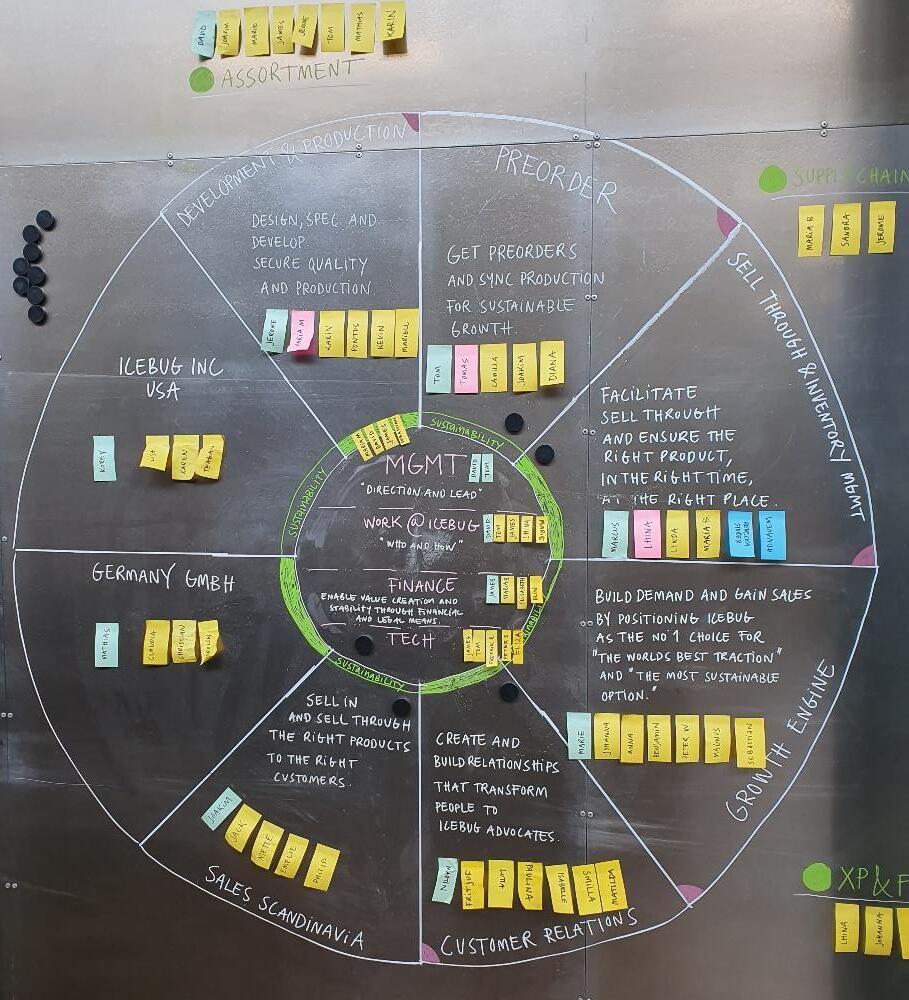
Icebug AB is a Sweden based outdoor footwear brand with HQ based in Jonsered, outside of Göteborg in southwest of Sweden. Overall management, product development, sales, product logistics and customer service are done from the HQ. We also have two brand stores, one in Gothenburg and one in Stockholm. The value flow Teams follow the Collection work (Assortment, Development and production, Preorder, Sell through and Inventory management (STIM), Growth engine, Sales, Customer relations and Retail, and are also integrated in each other’s work through roundabouts where value flow deliveries are made, and responsibility is handed over between the teams. In the center you see the Management, Work at Icebug, Finance, Tech and Sustainability that is integrated in all of Icebug’s work. The organizational chart is well visible on the office wall.
Icebug also has sales and marketing offices in Germany and USA. The shoe assembly production is made in three assembly factories in Vietnam. The shoe mid- and outsoles are made by one main tier2 suppliers (Yi Sing) and different materials are supplied from many materials suppliers (around 80 active tier 2 material suppliers) Icebug’s sourcing partner and co-owner Vanbestco, Taiwan, supports the sourcing process as well as quality control including chemicals testing.
Governance and Accountability for HRDD
Our owners’ directives clearly state that people in our supply chain are stakeholders whose interests must be factored into company decisions. To make this operational, Icebug’s senior management oversee Responsible Business Conduct (RBC) and HRDD through sustainability reviews and annual strategy sessions. The co-CEOs and the Director of Product oversee progress and risks, ensuring that HRDD is embedded in the company's decision-making processes in all teams. This governance structure means HRDD is not a side project it’s part of how we run the company.
Summary: Goals, Achievements and Challenges 2025-26
Our latest Brand Performance Check for 2023-24 placed Icebug in Fair Wear’s Leader category the highest performance tier. That recognition matters to us not because of the label, but because it shows that the way we work can make a real difference. It means we have strong systems for transparency, risk assessment, and responsible purchasing. We got a benchmark score of 70 points, met 100% of the foundational criteria, disclosed all our production locations, and followed up on 86% of outstanding audit findings. See the BPC for 2023-24 here: https://issuu.com/icebug/docs/bpc-icebug-ab-2024_final?fr=sMDI1NDY5Njg5OTUT .
These are achievements we’re proud of because they reflect our core belief: business as a force for good. As a leader the BPC can be made every other year and therefore our next one is focusing on both fiscal year 2024 and 2025 and will be conducted in May 2026.
Even though being in the “Leader” category reflects our commitment to fair working conditions, it doesn’t mean we’ve reached the finish line. The BPC also showed us where we need to do better. It highlighted four main areas: applying a stronger gender lens, developing a clear strategy for living wages, strengthening social dialogue and grievance mechanisms in the factories, and going deeper with preventive systems beyond corrective actions. These insights shaped our work during 2024 and 2025
During 2024 and 2025 we put a lot of energy into understanding and addressing these challenges. We deepened our Human Rights Due Diligence risk scoping and assessment both for Vietnam as a country and for each of our assembly factories. By collecting data from Fair Wear’s country profile and other external sources we could map the highest likelihood and consequences of different topics. Based on that we were able to address and be aware of these risks in our four factories.
Overtime and living wages stood out as two of the most pressing issues in audits from 2022 and 2023. During 2024, we dug into these topics and found that they are closely linked. To understand the connection, we had to take a closer look at the workers' wages and how to bridge the gap between minimum wages and living wages During 2025 we collected detailed data on wages and overtime every month from all our suppliers and used the benchmark on living wages from the Global living wage coalition for different regions in Vietnam. By calculating the gap as well as considering our leverage at the supplier, we are able to see how much we as a company are able to pay in accordance with prizing and our own budget. The overtime hours for the workers heavily effects the salary as an overtime premium is paid out for every overtime hour. For 2025 we have acknowledged the monthly overtime hour are still very high. Our ambition is to get the wages to a level where the workers don't feel like they need to take all of the overtime hours as the basic salary plus bonus is enough for them and their families. It’s complex work, but essential if we want to make real progress and has a set goal of paying our share of a living wage for all our workers by 2026 at the same reducing the overtime.
We also focused on gender issues and applied more of a gender lens in our CSR and Fair Wear work during 24-25. The textile and garment industry is one of Vietnam’s key export sectors, contributing about 20% of the country’s GDP and employing over 3 million workers around 75% of them are women. As female workers make up the majority of the workforce, extra focus needs to be applied on to the risks of being a female worker. They are disproportionately exposed to sector-specific risks such as wage gaps, limited access to social dialogue, job insecurity related to pregnancy and care responsibilities, and heightened vulnerability to workplace discrimination and harassment. Gender responsiveness for all genders is critical if we want a system that promotes equity, safety, and equal opportunity across the supply chain.
Previous audits revealed issues such as lack of lactation rooms, childcare allowances only paid to women, and insufficient accommodations for pregnant workers. These were solved during 2023 and 2024, but we realized that fixing individual problems isn’t enough, we have to have a deeper risk based approach. So, in February 2024, we brought in staff with gender and sustainability expertise and started collecting gender-specific data to inform future actions. Icebug CSR manager is also enrolled in FairWears GR-HRDD (Gender responsive Human Rights Due diligence) seminars that will go on untill 2027 and focuses on how to implement a gender responsive approach to HRDD. This is important to us and about building a system where gender equality is part of the decisions we make daily in our supply chain to mitigate the risks for harm for our workers.
During the past year, we also strived to get closer engagement from workers’ representatives in the improvement of working conditions during audit follow-ups and factory visits. We met workers’ representatives in all assembly factories during our visits in 2024 and again in 2025 and hope to develop those relationships so we can reach the next level of social dialogue between workers and management. It’s important that we don’t tell them how to do this, but encourage them to develop their own system that works for them - as an enabler for good communication, equity, and safety.
In general, a need for strengthening social dialogue between workers and management remains, including raising awareness about gender-based discrimination. It is also important to keep a low level of extensive overtime (helped by sustainable forecasting) and to strive for that all workers receive a living wage - not just that the factory average meets the benchmark. Finally, we need to continue following up on all eight elements of Fair Wear’s Code of Labour Practices in a structured way, based on updated annual risk scoping and assessments.
Looking ahead, our targets for 2026 are clear:
• Continue our living wage project with the help of a living wage expert from FairWear and other relevant parties with a clear timeline hopefully in collaboration with other brands. This will continue be a top priority for Icebug during 2026, to be able to pay our share of the workers living wage by 2026
• Continue dialogue with suppliers regarding long term contracts and sign in 2026.
• Engage in dialogue with factory management of all assembly factories regarding factorylevel training on social dialogue and gender equality in 2026.
• Strengthen monitoring of grievance mechanisms and integrate worker feedback into evaluations
• Continue reducing overtime risks through responsible purchasing and production planning and expand gender-based data analysis and connect it to the 2026 action plan.
These challenges won’t be solved overnight, but we’re committed to continuous improvement.
“There are many ways to approach why improving labor conditions is so important to Icebug and what we want the company to do. Our vision is to be a changemaker for a society where people can thrive on a planet in balance. That our products are made in a fair and just way is an obvious part of that. On the governance side, our owners’ directives specifically names people involved in our supply chain as stake holders, meaning that their interest always needs to be factored in when running the company. We strive to use our business as a force for good and taking responsibility for the people that we influence is simply the right thing do.”
-David Ekelund, co-founder and co-CEO ICEBUG
Sourcing strategy
HUMAN RIGHTS DUE DILIGENCE
All sourcing and purchasing decisions involve risks that must be identified and managed. Icebug considers social and environmental risks as part of every purchasing decision, both when selecting production locations and when introducing new materials. In addition to the sourcing strategy for assembly factories, all new materials are subject to a dedicated evaluation process to identify potential risks related to labour conditions and environmental impact.
Icebug aligns its work with external initiatives and certification schemes that include labour conditions within their scope, such as Fair Wear, Leather Working Group (LWG), bluesign®, Forest Stewardship Council (FSC), and B Corp. These frameworks support our internal risk assessments and contribute to transparency and accountability.
Since the end of 2022, Icebug has worked according to Fair Wear’s structured six-step Human Rights Due Diligence (HRDD) framework, which guides how risks are identified, prioritised, addressed, and reported.
Step 1: Embed HRDD in policy & management systems
Step 2: Identify actual and potential harms in supply chain
Step 3: Cease, prevent and/or mitigate harm in operations and supply chain
Step 4: Track progress
Step 5: Communicate about human rights due diligence
Step 6: Provide for or co-operate in remediation
Step 1: Embed HRDD in policy & management systems
The CSR Lead is responsible for leading Human Rights Due Diligence (HRDD) implementation, supported by the Development & Production Team in sourcing-related decision-making. Ultimate accountability for HRDD outcomes lies with Icebug’s co-CEOs, David Ekelund and Tom Nilsson, ensuring that social sustainability is prioritised alongside financial and operational considerations.
Icebug’s Responsible Business Conduct (RBC) Policy functions as our HRDD policy and is a cornerstone of our work. In line with Fair Wear’s HRDD policy, the OECD Guidelines, and the UN Guiding Principles on Business and Human Rights, the RBC Policy sets out Icebug’s commitments to responsible business conduct across our value chain and clarifies how due diligence is embedded in management systems and organisational structures.
First adopted in December 2023, the RBC Policy has guided our work throughout 2024 and 2025 and is used on a daily basis by both Icebug’s Development & Production Team and our sourcing partner Vanbestco, who jointly manage sourcing and follow-up on Fair Wear audits. The policy applies to all employees and suppliers and is supported by operational procedures that describe how it is implemented in practice.
The CSR Lead, together with top management, is responsible for developing and updating Fair Wear-related policies and for raising internal awareness of their content and importance. The RBC Policy is a living document, reviewed and updated on an annual basis. The latest version includes a responsible exit strategy and is publicly available: https://issuu.com/icebug/docs/icebug_responsible_business_conduct_policy_2025
Step 2: Identify actual and potential harms in supply chain
(Conducting a scoping exercise, risk assessment and informing workers and suppliers)
Icebug conducts regular HRDD risk scoping to identify actual and potential harms at country, sector, factory, and product level. For 2025, this process focused primarily on Vietnam, where Icebug’s main
assembly production takes place. Risk scoping is updated annually, or more frequently if supplier conditions change, and is carried out jointly by the Sustainability Manager and the Development & Production Team.
In 2025, Icebug introduced Fair Wear’s Risk Scoping Tool as a core part of this process. The tool supports a structured assessment of risks by analysing severity and likelihood and by linking country-level risks to factory-level conditions. Risk scoping is informed by Fair Wear’s learning pathways, Vietnam country profile updates for 2025, and findings from factory visits and sourcing dialogue.
Icebug’s main assembly production takes place in three factories in Vietnam two in the Ho Chi Minh City area and one in a rural area outside Hanoi. While the full HRDD risk scoping for 2025 is available upon request, priority risk areas identified include:
• Freedom of association and collective bargaining
• Reasonable working hours, including overtime
• Payment of a living wage
These risks form the basis for our subsequent prioritisation and action planning.
Step 3: Cease, prevent and/or mitigate harm in operations and supply chain
(Stopping
harm, prioritising and implementing prevention and mitigation)
Based on the outcomes of risk scoping and assessments, Icebug determines risk profiles and prioritises follow-up actions according to the severity and likelihood of potential or actual harm. Overall priorities are reflected in our Fair Wear Brand Action Plan. At factory level, specific action plans are developed based on each production location’s risk profile, including timelines and capacity considerations. Dialogue with factory management, worker representatives, and other brands is used to better understand root causes and Icebug’s potential contribution to risks. Where relevant, Icebug implements internal controls, such as adjustments to our sourcing practices or internal procedures, to prevent continued contribution to harm. Indicators that may signal increased risk are monitored through ongoing sourcing dialogue.
Step 4: Track progress
(Tracking and validating on progress made in the Implementation and Prevention Programmes)
Icebug tracks progress on HRDD through multiple monitoring mechanisms linked to Fair Wear’s Code of Labour Practices. These include Fair Wear audits of Tier 1 factories- approximately every 3d year, corrective action plans, annual risk-based supplier assessments supported by external audits and factory visits, and follow-up on Fair Wear trainings and pilot projects. This information is used to adjust our approaches where needed and is summarised annually in Icebug’s Social Report. Tracking combines verification (confirming actions were implemented), monitoring (ongoing review of risk developments), and validation (assessing whether actions were effective). From middle of 2025 Fairwair offers the possibility for brands to get validation assessments on the actions they have taken towards preventing or mitigating human rights risks. Icebug have not had the chance to use this asset yet but will do so moveing forward to make sure the efforts are effective.
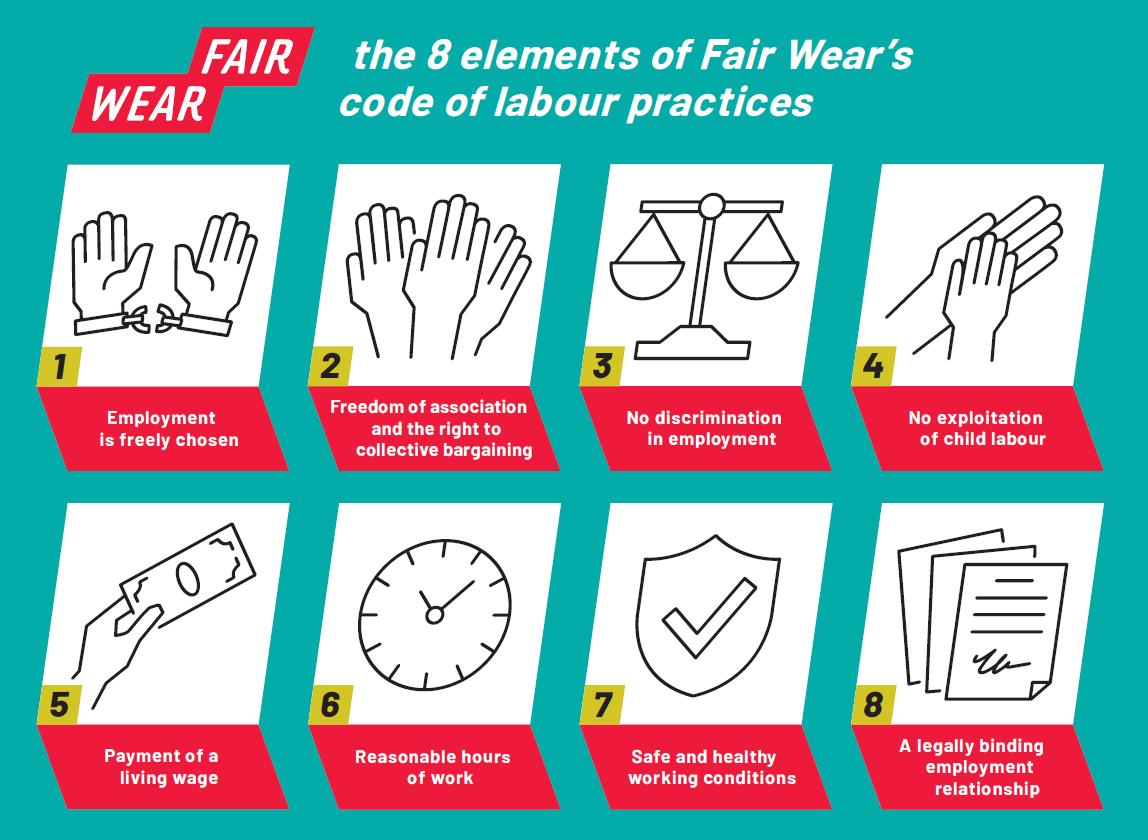
The eight elements of Fair Wear’s code of labor practices:
Step 5: Communicate about human rights due diligence (Publicly reporting on risks and progress)
Icebug reports on sustainability performance and HRDD annually through our Impact Report and Social Report. Fair Wear’s Brand Performance Check, together with audits, trainings, stakeholder engagement, and corrective action plans, this provides the framework for tracking and validating progress. Our public reporting includes identified risks, how they are addressed, progress made, and challenges encountered. Icebug’s Impact Reports, Brand Performance Check reports, and Social Reports are publicly available on our website
Icebug’s annual Impact Report is available on our website, displaying our targets and the yearly sustainability progress, https://www.icebug.com/en-SE/sustainability/icebug-impact-reports. The Brand Performance Check made annually by Fair Wear Foundation is available at https://www.icebug.com/en-SE/sustainability/fair-wear-foundation-reports where the result of our social sustainability performance is shown, including the areas which need improvements. Here you will also find Icebug’s yearly Social Report (this report)
Step 6: Provide for or co-operate in remediation
(Provide for or co-operate in remediation)
Step 6 focuses on remediation of actual harm. Where Icebug has caused or contributed to adverse impacts, Icebug provides for or cooperates in remediation. When we are directly linked to an impact but has not caused or contributed to it, our leverage is used to influence suppliers or business partners to prevent or mitigate harm and provide remedy. The leverage could be in the sense of long buisness relationship with the supplier or if we have a high FOB leverage. If impacts are not remediated, we contribute to remediation to the extent feasible and reasonable, in line with Fair Wear’s Access to Remedy requirements.
A key example is the gap between minimum wages and living wage estimates. Icebug wants to pay our share of living wages and want to collaborate with other brands and stakeholders to create more leverage. We also want to better understand labour cost structures and identify shared solutions for closing wage gaps, with workers’ interests at heart.
Sourcing strategy & pricing
Icebug buys the ready-made shoes FOB from three assembly factories in Vietnam. The sourcing of materials, key parts as midsoles and outsoles and the quality control of ready products is made in close cooperation with Icebug’s sourcing partner and co-owner Vanbestco, Taiwan
Branded accessories represent a much smaller segment of the business. To minimize sourcing risks and resource requirements, Icebug has decided to limit this offering and prioritize sourcing from lower-risk countries (e.g., a new supplier identified in Spain in 2024). Icebug also decided to exclude China based on risk assessment conclusions. Moving forward, the Responsible Business Conduct (RBC) Policy will serve as the primary sourcing guideline, and new business will only be initiated if resources can be realistically allocated based on the risk assessment to monitor the supplier
The sourcing strategy forms the framework for the outsourced supply chain of the Icebug brand. It is the basis for the development of all responsible purchasing practices that are crucial to reach a good level of the elements in Fair Wears Code of Labor Practices (CoLP).
The basis for Icebug’s sourcing strategy is long-term cooperation with suppliers where mutual trust is created through a practice of treating each other as equal partners – Icebug doesn’t have supplier contracts with penalties. We collaborate to raise the social sustainability level of the supply chain. Since the start of the company in 2001, Icebug’s owners have searched for suppliers sharing the same values as Icebug and that are open to develop and improve Changing business conditions and product portfolio as well as different rates of organizational development, sometimes leads to changes in which suppliers Icebug works with, but our aim is to always work long term. The latest introduction Icebug had with a new shoe factory was in 2014 (for Fulgentsun we changed the factory from Fulgentsun Cambodia to Fulgentsun Vietnam in 2020 but it’s part of the same company group with same top management). During 2025, we have created a draft for long term Purchase contract respcting the interest of both parties. The draft has been shared with our shoe factory partners and is now under finalization, we are aiming to signed the agreements during 2026 Since 2015, when Icebug started to work with sustainability in a more structured way, we have since asked our suppliers to source materials with lower resource use and less negative impact (recycled, biobased, low impact processes, less harmful chemicals, climate smart etc). This field is developing fast and there is a value in the Icebug development working proactively in this part of the sourcing. Being identified as a sustainability leader in the footwear industry, Icebug is nowadays often approached by material
innovators For new materials and processes, the Icebug team frequently nominates suppliers of high sustainability standard. A material specialist joined the Development and production team started working at Icebug 2024. He is evaluating different material options by comparing durability (based on mechanical test results), environmental impact (considering composition and production processes), and cost. He is also overseeing testing on finished products to ensure maximum durability.
Icebug has been using Follow the footprint since 2021 to track and measure the impact off all the components that needs to assembly the shoe. See Impact report for more info.
The social conditions are integrated in the sourcing strategy. Icebug’s former Code of conduct was replaced in March 2023 with the more detailed Responsible Business Conduct policy, see https://www.icebug.com/en-SE/sustainability/fair-wear-foundation-reports that we expect all suppliers to meet As this is a “living document” its updated annually (updated 2025)
In the Vanbestco sourcing team 15 persons support Icebug’s sourcing, and their leader is member in Icebug’s Development & Production Team securing regular contact and feedback both ways. In 2024 this team was expanded with a sustainability expert. The team from Taiwan visits the factories regularly to carry out quality controls and check production. In addition, an Icebug-employed sourcing expert and quality controller conducts regular on-site inspections at the factories. The production team in Sweden has daily comunication and exchanges information with them.
Icebug’s Development & Production Team is responsible for sourcing and consists of seven members, including designers, product engineers, and material, data, and quality specialists. In 2025, the team was strengthened with a CSR Lead embedded directly in the team to follow social sustainability risks and Human Rights Due Diligence (HRDD) implementation. This ensures that HRDD is integrated into everyday sourcing decisions rather than managed as a separate function. The team includes three Asia-based members: the sourcing manager and assistant at our sourcing partner and co-owner Vanbestco, as well as an Icebug-employed sourcing expert and quality controller. This structure enables close and continuous dialogue with suppliers and effective follow-up on production, working conditions, and social issues.
The Development & Production Team Leader, together with the Preorder Team Leader, decides how orders are allocated across manufacturers. Decisions are based on defined criteria including technical capacity, margins, tooling investments, compliance with labour standards, sustainability
performance, and product quality, ensuring that social considerations are evaluated alongside commercial and technical factors.
The team works through structured meeting formats that support continuous HRDD implementation. Daily meetings address ongoing operational issues related to production, factories, CSR, and HRDD. Bi-weekly sprint planning meetings focus on current and upcoming projects, while 100-day planning meetings align the team on longer-term priorities, responsibilities, and strategic initiatives. During 2025, these meetings covered topics such as wage and overtime data collection, preparation and follow-up of social dialogue audits and planned training at Haksan (13498), and the review and development of key living documents including the Responsible Business Conduct Policy, Code of Labour Practices, and this Social Report.
HRDD and CSR topics are standing agenda items across all meeting formats and are used as a qualitative performance indicator to confirm that social sustainability considerations are consistently integrated at both operational and strategic levels. When significant social risks or unresolved HRDD issues are identified, the team follows a clear escalation process. The CSR Lead flags issues that cannot be resolved at team level or that may have strategic, financial, or reputational implications. If needed, these are escalated to top management, ensuring accountability at the appropriate decision-making level.
The price level of Icebug’s products reflects the brand promises: Superior traction, build to last and Business as a force for good. The price category for end costumer is medium to high. We aim to sell at full price and don’t do Black Friday or in-season sales to drive consumption with aggressive pricing. The price reflects the quality of the products and is also part of the strategy, to be able to make durable, high-quality shoes with high sustainability content (durable, low climate impact with high content of recycled and biobased materials that are manufactured in low impact processes from responsibly sourced raw materials).
Further corner stones in the sourcing strategy are:
- Having a concentrated supplier base so that Icebug can be an important customer
- Avoid dependence of human rights high-risk areas, with a preference for sourcing countries where workers can freely form or join a trade union and bargain collectively
- Planning production to avoid causing excessive overtime
- Paying prices that allows for paying a living wage
Forecasting and placing orders
A responsible forecasting and production planning starts with a deep understanding of the supply chain partners’ capacity and respecting lead times. During 2024 there were a lot of reported overtime and therefore we wanted to know the root cause and have a good understanding if we were causing and if we could mitigate this overtime. During our factory vistit in may 2025 we talked to all factorys how we could contribute to less overtime for the workers. All factories mentioned that forecasting and earlier placing of orders could help as that would spread out the production and avoid bottlenecks for the production line. For the upcoming production season, that we could affect was FW26 where we had a dialogue with the suppliers regarding daily output and capacity to avoid as much overtime as possible. We adjusted the production plan accordingly and started sending our uppdated forecasts more frequently and purchase orders earlier We will see if it had any effect on the overtime for this upcoming season.
Based on Icebug’s forecast, the supply chain partners provide a production plan with allocation of quantity in different periods, with a corresponding order placing plan. This plan is discussed back and forth creating a dialogue on how we can do business that fits both us as a brand and the capacity in the factories. We then send updated forecasts continuously to keep the dialogue going regarding the styles we want to order in each production Icebug has deliberately set up the business model in a way that enables us to spread production over a longer period: No fashion or single season styles or colorways also contributes to this A high degree of carry over styles that last for many years enable long-term planning and avoiding campaign prices thus keeps the margins up. Safeguarding the value of the products is also a mechanism that enables us to pay correct purchase price – FOB prices paid by Icebug should always allow us to pay our share of living wages throughout the supply chain. Product price are reviewed based on cost breakdown and extensive knowledge on product allow us to estimate if the labor cost of product match the production time needed for the manufacturing.
Suppliers are regularly visited by the Development & Production team and our Icebug emploee that works from Asia, approximately 4 times a year (latest visit in march 2025) before placing the order to understand or get an update on the setup of the production locations and ensure there are no apparent human rights violations (Icebug regularly conduct the health and safety check for new and repeated factory visit). Some of the details that are up-dated and evaluated on a season to season basis are:
• Quantities per country / supplier / style / season
• The factory capacity and how to plan production to avoid excessive overtime
• Ratio sampling vs. bulk production
• Supplier matrix per product
• Supply chain mapping (partners per supply chain step)
• Internal analysis (key success factors, strategic success position, strengths and weaknesses, key performance indicators)
• External analysis (market trends, industry benchmarks, opportunities and risks)
• Tracking and validation of social progress are included in the sourcing dialogue between member brands and suppliers.
Based upon these parameters Icebug takes decision on whether to place orders, how to prevent and mitigate risks that violates Fairwears 8 labour standards, and what remediation steps may be necessary.
Even though Icebug have long lasting relationships with all our tier 1 suppliers for over 10 years and have no new buisness relationships during 2025 we still have a solid onboarding process. Upon the start of a new business relationship we follow the onboarding for new suppliers guide. (before first order is placed) Icebug needs to gain a basic level of insight into the human rights situation at a potential factory to inform sourcing decisions. As a Fair Wear member Icebug commits to:
• Raise awareness of the workers and the management on human rights
• Stress the importance of gender-representative social dialogue (with democratically elected worker representatives).
• Assess whether there is an effective operational-level grievance mechanism established through social dialogue with workers.
• Establish the Fair Wear helpline as a safety net.
• Conduct a healthy and safety check for the factory.
• If the supplier is in a new country, update the HRDD risk assessment at country level
PRODUCTION CYCLE
The production cycle and planning have so far been based on two seasons per year, Spring/Summer and Fall/Winter. The development starts with factories about 2-4 years before the delivery for the season. The first forecasts are sent to factories 9-10 months before the start of the deliveries for the season. The forecasts are then slightly adjusted on a monthly basis, maintaining a long planning horizon for the factory Icebug places the orders in a window of 6-9 months before the products are made available to customers. The delivery window for the highest volume season, fall/winter, is spread out over a period of nearly six months, with a good balance of quantity during each month –this is to respect factories’ production capacity avoiding peaks, and to best use the space both before and after the peak season. This is supported by the large majority of Icebug’s production volumes being carry over products that are kept in the line and produced for many years. Icebug makes efforts to make clear plans and involve the manufacturer as early as possible to support good manufacturing and agree on capacity and timing, allowing reasonable hours of work and avoiding overtime peaks. Icebug does not produce ad‐hoc or spontaneous customer requests.
The sourcing agent Vanbestco and our Icebug employee in Asia are also supporting and in close contact with the assembly factories, they have regular dialogue about the sourcing process, sampling process and production planning, so that the production plan will grow in a communication between the manufacturer and Icebug’s Preorder and Development team. Icebug partially nominates materials like outsoles and midsoles. Nevertheless, Icebug always buys ready‐made footwear (FOB) from its three main suppliers
FACTORY RELATIONS
During 2025, no new assembly factories were added to Icebug’s supply chain. Icebug’s sourcing strategy prioritises long-term relationships over frequent supplier changes, as stable partnerships create better conditions for dialogue, transparency, and continuous improvement on social sustainability.
When selecting a new assembly factory or other key supplier, Icebug applies a defined set of criteria to ensure alignment with our business values and Human Rights Due Diligence (HRDD) approach. These criteria include long-term strategic fit and a shared business vision; proven quality performance and relevant technical capabilities (such as experience with membranes or other critical production
processes); development capacity; openness and organisational commitment to collaboration; and the supplier’s sustainability maturity level. Sustainability maturity is assessed through available external social audit reports, certifications (such as FSC, OEKO-TEX® or equivalent), climate-related data, and willingness to engage on improvement actions.
Additional selection criteria include commitment to Fair Wear’s Code of Labour Practices, access to low-carbon energy sources, evaluation of country-level risks and logistics, and a price level that enables compliance with labour standards and responsible production. These criteria are applied consistently in sourcing decisions, as also described in the sections on sourcing strategy and purchasing practices.
Long-Term contracts
As part of strengthening long-term factory relations, during 2025 Icebug has worked on long-term relationship contracts together with top management at suppliers and VBC. This work has been led by Icebug’s CEO and developed through ongoing dialogue between Icebug, our sourcing partner Vanbestco (VBC), and factory management. The aim of these contracts is to formalise long-term commitments, clarify mutual expectations, and increase transparency around volumes, collaboration, and responsible business conduct. A key component of this is Icebug’s target of moving towards occupying production lines evenly through-out the year, which has influenced the work internally but has also been communicated to the suppliers. This is an important undertaking to be a good customer partner and reduce the pressure on excessive over time. Developing long-term contracts is an ongoing process that requires time, even though it builds on the long business relationship that is already in place. Icebug’s approach is to ensure that all parties Icebug, VBC, and suppliers are comfortable with the content and commitments of the agreements. This collaborative process is intended to strengthen partnerships, support stable planning, and enable more effective HRDD by increasing predictability and leverage. The goal is to finalise these long-term relationship contracts during 2026.
Through this approach to factory relations, Icebug aims to build durable sourcing partnerships that support responsible business practices, improved working conditions, and open dialogue over time, rather than short-term transactional relationships
MONITORING ACTIVITIES AND SOURCING DECISIONS
Icebug’s Tier 1 assembly factories are audited on a regular basis in line with Fair Wear requirements and a risk-based approach.
In 2022, Fair Wear audits were conducted at two of Icebug’s assembly factories in Vietnam: Haksan and Great Process, both located in the Ho Chi Minh City area. Icebug’s third assembly factory, Fulgentsun, located in a rural area outside Hanoi, had been audited in the preceding period through an external social audit conducted by Sumations between June 2021 and January 2022.
In 2024, Fulgentsun was audited through an external social audit conducted by Bureau Veritas (Audit ID 35172). The audit covered all elements of Fair Wear’s Code of Labour Practices. Findings were identified, and a Corrective Action Plan (CAP) was created in line with Fair Wear requirements. None of the findings were considered severe or heightened in nature, and all issues were addressed through dialogue with factory management and follow-up during regular sourcing engagement. Progress on the CAP actions has been tracked as part of Icebug’s ongoing HRDD monitoring processes.
Haksan was audited again in 2025 (Audit ID 13498). An audit of Great Process is planned for 2026 in accordance with the regular audit cycle.
Accessories account for approximately 5% of Icebug’s total FOB and are sourced outside the core assembly supply chain. The insole supplier Wei Sheng (FOB 3.7%) was last externally audited in 2023 (Audit ID 35130) and was visited by Icebug in May 2025. The overshoe and floor saver supplier Yi Sing (FOB 0.95%) began production at a new factory site at the end of 2024 and was visited by Icebug in May 2025, including a health and safety check. An audit was initially planned for 2025 and is now scheduled to take place in 2026.
Icebug also works with two accessory suppliers in Sweden, together representing less than 1% of total FOB. Based on the 2024 risk scoping, no high-risk issues were identified, and no social audits were planned. One of these suppliers, Cansocks in Borås, was visited by Icebug in February 2026.
The findings of these audits and visits, and the remediation of harm that was done as a follow-up, are described below for each factory where Icebug did assembly in 2025-26. There was no single finding in any of the factories that made us question whether we shall continue sourcing from them. All the findings in audits and in our visits were of the nature that we can discuss
with the management and solve them together, and that will be part of the continuous improvement moving into the next year.
When follow up of the audit findings and CAPs for 100 % of the assembly factories its a great asset to do it with other brands. For 2025 Icebug only did one Audit together with Fond Of and the past year we ave focused on the follow up and on finding root causes and do deeper risk evaluations.
Evaluations of new material suppliers (Tier 2, not included in the Fair Wear scope) are regularly ongoing. The selection process is made with clear sustainability criteria regarding material properties and responsible raw material sourcing. Working conditions are often part of sustainable sourcing certifications such as Forest Stewardship council® (FSC) for the natural rubber in outsoles and leather Working Group for leather. However, there is need for clearer criteria of material suppliers’ social conditions. This will be the next level of Icebug’s risk assessment after covering all Tier 1 factories.
System for monitoring and remediation
Icebug applies a coherent monitoring system in which different monitoring activities together provide an understanding of risks, progress, and opportunities within the supply chain. Monitoring is combined with dialogue and follow-up to support remediation and continuous improvement. During the reporting period, Icebug undertook the following actions to monitor and address social sustainability risks in the supply chain.
In addition to regular visits by Icebug’s employed quality controller and the headquarters-based Development & Production Team, one factory visit in May–June 2025 was carried out with the specific participation of the CSR Lead and was explicitly dedicated to Human Rights Due Diligence topics. These discussions focused on working conditions, social dialogue, grievance mechanisms, overtime, gender-based discrimination, and living wages, among other issues.
During this visit, Icebug conducted interviews at all assembly factories with factory management, worker representatives, and union representatives. These discussions provided deeper insight into
workers’ overall working situations and created an opportunity for workers to raise concerns directly with Icebug as a brand with potential leverage to influence improvements. The visit also included accessory suppliers Yi Sing and the insole supplier Wei Sheng, supporting a broader understanding of working conditions beyond the main assembly factories.
Building on this engagement, Icebug has sought to strengthen relationships with worker representatives at assembly factories during 2025–2026, with the aim of supporting more meaningful and continuous social dialogue between workers and management. Through monitoring activities and dialogue, Icebug identified a need for further training at some factories related to Fair Wear’s Code of Labour Practices and workers’ rights.
In response, Icebug decided to organise a Code of Labour Practices training at Haksan (13498) in 2025, in cooperation with another customer brand, Fond Of. This initiative is intended to strengthen shared understanding among management and workers, support effective social dialogue, and contribute to the prevention of future labour rights risks. Follow-up on the outcomes of this training will be integrated into Icebug’s ongoing monitoring and remediation processes during 2026
FACTORIES IN VIETNAM
Icebug has the following Tier 1 suppliers in Vietnam, based on ruling factory list 2025/26:
• Haksan, Assembly factory, Bihn Duong, Ho Chi Mihn area (Collaboration with brand Fond Of)
• Great Process, Assembly factory, Bihn Duong, Ho Chi Mihn area
• Fulgentsun, Assembly factory, rural Hanoi area
• Wei Sheng, insole factory, Bihn Duong, Ho Chi Mihn area
During 2025 Icebug staff including CSR Lead, Designers, Development and production team lead and CEO visited all assembly factories on several ocations. On these visits updated health and safety checklists were made and ongoing conversations with management, union reps and working reps took place one of the visits were dedicated to HRDD questions and CSR topics (may/june 2025)
During 2025 Icebug has identified the following risks as most prioritized to follow up in Vietnam in order to raise the level to prevent future harm and to remediate actual harms that will still arise.
• Freedom of association and collective bargaining
• Reasonable working hours (overtime)
• Payment of a living wage
Below we describe the prioritized risk areas, the status and root causes that needs to be addressed, first per risk area (element of code of labor practice) and after that per facility
More detailed evaluation of probability and severity of potential harms are described in the risk assessment matrix (in an excel files Factory risk assessments for 2024, accessible upon request), for each factory. For 2025 a HRDD risk scoping and assessment was done through the Fair Wear platform for our assembly factories
FACTORY VISITS AND INTERVIEWS
Factory visits and interviews
As part of Icebug’s Human Rights Due Diligence (HRDD) and ongoing monitoring, factory visits and stakeholder interviews were conducted between 29 May and 2 June 2025 at Icebug’s main assembly factories, as well as selected accessory and component suppliers. The purpose of the visits was to deepen dialogue, verify working conditions, and strengthen engagement with management, workers, and worker representatives.
The visits were conducted by members of Icebug’s Development & Production Team together with the CSR Lead, supported by local translators where needed. At each factory, GTP, Yi Sing, HAKSAN and FULGENSUN Icebug met with factory management, worker representatives, and where present trade union representatives. Worker and union representatives were invited to separate interviews to reduce pressure and enable them to raise concerns more freely.
Interviews followed a semi-structured approach, allowing discussions to be adapted to each factory’s context, known risks, and previous audit findings, while ensuring consistency across locations. Core topics included social dialogue and freedom of association, grievance mechanisms, working hours and overtime, wage structures and living-wage considerations, and long-term sourcing relationships.
A central focus of the visits was social dialogue and collective bargaining. Discussions explored how worker concerns are raised and addressed in practice, the role and selection of worker representatives, the functioning of Collective Bargaining Agreements (CBAs), and perceived barriers to open communication. Icebug also assessed factories’ openness to further support or training from Fair Wear. While two factories expressed strong openness to additional training, one factory highlighted concerns that increased dialogue could raise worker expectations and the perceived risk of industrial
action. Icebug considers this an important area for continued dialogue and capacity building. At the same time, overall management commitment to HRDD at this factory was assessed as high. Working hours and overtime were discussed in depth with management and, where appropriate, with worker representatives. Icebug reviewed forecasting and production planning practices, identified pressure points contributing to excessive overtime, and discussed how planning and communication could be improved. Workers confirmed that overtime is voluntary and paid with the legally required premium; however, overtime levels exceeding legal limits remain an issue. The discussions reinforced the close link between overtime and wage levels, as workers often rely on overtime to increase income. In response, Icebug explored how earlier forecasting, improved order timing, and capacity alignment could contribute to overtime reduction (see also section on forecasting).
Living-wage discussions focused on understanding current wage structures, gaps between minimum wages and actual living costs, gender-related wage aspects, and existing bonus or allowance systems. These discussions informed Icebug’s ongoing living-wage assessment and supported decisions to engage in a living wage project, where Icebug contributes based on leverage (see Living Wage section).
The visits also served as a platform to discuss long-term relationships and responsible purchasing practices, including Icebug’s ambition to formalise long-term commitments through partnership contracts. Discussions covered forecasting horizons, payment and delivery terms, handling of quality issues, and responsible exit principles. Dialogue on contract development has continued throughout 2025 between Icebug, Vanbestco (VBC), and supplier management. Draft agreements have been developed and the dialogue is ongoing in a constructive spirit, with the aim of finalising and signing long-term partnership contracts during 2026.
In addition to assembly factories, selected accessory and component suppliers were visited following a risk-based and proportional approach, contributing to a broader understanding of working conditions beyond Tier 1 production.
In summary, the factory visits and interviews confirmed ongoing challenges related to excessive overtime, wage adequacy, and the need for greater long-term stability in supplier relationships. These findings were documented and integrated into Icebug’s HRDD processes and became priority focus areas during the year. Follow-up actions include continued work on overtime reduction through improved forecasting and production planning, active engagement in a living wage project, and the
ongoing development of long-term partnership contracts with suppliers. Together with corrective action plans, targeted training initiatives, and continued dialogue with suppliers and worker representatives, these measures aim to address root causes rather than symptoms and support sustainable improvements in working conditions, in line with Fair Wear’s expectations for meaningful monitoring, responsible purchasing practices, and remediation.
REASONABLE WORKING HOURS
Ensuring reasonable working hours is a key focus area in Icebug’s Human Rights Due Diligence work. During 2025, Icebug monitored monthly overtime reports for all Tier 1 assembly factories and the insole supplier Wei Sheng. The data showed that all three Vietnamese assembly factories and Wei Sheng recorded overtime levels exceeding what is considered acceptable, indicating a risk of excessive overtime.
Excessive overtime was discussed in detail with factory management during supplier meetings and factory visits in May–June 2025 to better understand root causes and identify preventive measures. A recurring challenge identified across factories was an uneven distribution of production during peak seasons, which increases pressure on working hours.
Factory management across all locations stated that some workers actively seek overtime opportunities to supplement their income. This highlights the link between overtime and wage levels. Icebug recognises that where base wages are closer to a living wage, workers are generally less dependent on overtime. Addressing excessive overtime is therefore closely connected to Icebug’s ongoing living-wage work and responsible purchasing practices.
Icebug plans and places orders in line with confirmed factory capacity and does not require delivery timelines that exceed agreed production capability. However, even with capacity-aligned forecasting, unforeseen disruptions such as delayed material deliveries or changes in how other brands schedule production can compress timelines and contribute to overtime peaks, as confirmed through dialogue with suppliers.
Overtime is not forced. This was confirmed through interviews with worker representatives, union representatives, and factory management, as well as through follow-up communication.
Nevertheless, Icebug recognises that voluntary overtime can still reach levels that pose risks to workers’ health and well-being and may affect product quality. In summary, Icebug assesses the risk of excessive overtime as present, particularly during peak demand periods. While this risk can change quickly with fluctuations in demand, it requires continuous attention. Icebug therefore continues to follow up regularly with suppliers on overtime levels, production planning, and capacity management, alongside efforts to improve purchasing practices and address underlying wage-related factors. Protecting workers’ health remains the primary concern.
PAYMENT OF LIVING WAGE
The difference between a minimum wage and a living wage is the minimum wage is set by the government as the lowest wage a company is allowed by law to pay their workers, and the living wage is a wage that reflects the actual cost of living in a specific area. The minimum wage was raised by 7% for Vietnam on 1st of January 2026. However, a minimum wage is barely a wage a factory worker and their families can live off. Therefore we set a target to pay our share up to a living wage for every worker in our Tier1 factories by 2026.
Icebug uses the calculations for Living wages provided by the Global Living Wage Coalition where the benchmark is calculated by using the Anker living wage methodology. This methodology is widely recognised and used by Fair Wear and other international initiatives. A living wage, according to this method, is the gross wage required for a typical family of four two adults (one in full-time employment and one in part-time employment) and two children to afford a decent standard of living. This includes a nutritious, low-cost diet, adequate housing, health care, education through secondary school, transport, and other essential needs, as well as a small margin for unexpected expenses.
The living wage estimates for Vietnam are based on a combination of secondary data and primary cost data. Secondary data includes household expenditure, labour force participation, and population statistics from the General Statistics Office of Vietnam, while primary data reflects local costs of food, housing, health care, education, and transport. The underlying study covers a representative sample of six districts across six provinces in Northern, Central, and Southern Vietnam, providing a robust basis for assessing regional differences.
The original Anker living wage study for Vietnam was carried out in November 2022 and has since been updated using official inflation data to remain relevant over time. Between November 2022 and June 2024, cumulative inflation in Vietnam was 8.0%, which forms the basis for the 2024 living wage reference. Between November 2022 and October 2025, cumulative inflation reached 8.8%, which forms the basis for the 2025 living wage reference. Based on these updates from the Global Living Wage Coalition, the gross monthly living wage estimates are 9,294,701 VND for Area 1 and 8,249,799 VND for Area 3 as of October 2025. As our factories are located in Hanoi, Area 1 and Ho chi min, area 3 these are the only areas of Vietnam we have focused on. https://www.globallivingwage.org./countries/vietnam
These benchmarks are used to calculate when calculating Icebug’s human rights risk assessments, action plans, and ongoing dialogue with suppliers and other brands as part of our continued work towards living wages.
The shoe assembly factories’ (representing 95 % of Icebug FOB) average wages were found to be at a fairly decent level. Fulgensun had average wages of 96,1% of Anker living wage and they stand for 19,6% of icebugs FOB, GTP had an average of 93,% of Anker wages and stand for 57,8% of Icebugs total FOB, Haksan had 86% in average of the Anker wages and stand for 17.5% of Icebug’s total FOB. Wage for FGS is based on region 3 and both Haksan and GTP in region 1
As a summary, there is a clear risk of workers in Vietnam inc. Icebug’s facilities being paid less than a living wage, leading to a stressful situation for these families. Therefore 2025 we collected extensive data to be able to pay our share of a living wage and is decided by our CEO is a commitment we want to honour and make a reality in 2026.
GENDER BASED DISCRIMINATION
Gender responsiveness for all genders is essential in the garment and footwear industry as we want to contribute to a more sustainable system that promotes equity and safety. Even though most of the workers are women, this gender often faces specific and systematic challenges such as gender-based discrimination. In our audits of our factories from 2022/23 regarding gender-based discrimination there were findings that was all solved during the years 2023 and 2024. This included lack of lactation room, childcare allowance only paid to women, and pregnant women did not get easier tasks or shorter work hours as required by law.
Even though these topics were solved, we learned that Icebug needed to apply more of a gender lens in all of our systems. Therefore in February 2024 we included staff that has sustainability and gender education in questions on the topic of gender. Its important to keep vigilant that the managements are aware of the importance of gender equality and willing to do trainings and raise awareness among management staff and workers. There was a lack of understanding of some issues from some managements, leading to interesting discussions and exposing a need for training about gender conditions as part of the social dialogue. There is a risk of potential harm and we should contribute to lower that risk by training.
HEALTH AND SAFETY CONDITIONS IN THE FACTORIES
Safe and healthy working conditions are a key part of Icebug’s Human Rights Due Diligence work. During audits, factory visits, and supplier dialogue, health and safety topics such as chemical handling, ventilation and glue exposure, fire safety, emergency exits, and ergonomics for both standing and seated work have been reviewed.
Overall, a high standard of health and safety has been observed across Icebug’s assembly factories. Factory management addresses health and safety issues promptly when identified, reflecting a strong commitment to preventive action. While new risks can emerge over time, established routines and a high level of awareness among staff reduce the likelihood of serious harm. Health and safety requires continuous attention and regular reinforcement. Effective prevention depends not only on formal systems but also on day-to-day compliance from both management and workers. Icebug therefore considers regular health and safety checks during factory visits by brand representatives to be essential.
In 2025, Icebug strengthened its internal routine by ensuring that a factory walkthrough and basic health and safety check are included in every visit conducted by Icebug team members. These checks complement formal audits and support early identification of potential risks. Corrective Action Plans (CAPs) are used where relevant to document findings and follow up on improvements. Icebug assesses the overall health and safety risk in assembly factories as low but ongoing. Although serious incidents have not been identified, potential harm can have significant consequences if not
addressed. Ongoing monitoring, regular training, and structured follow-up therefore remain central to Icebug’s approach.
Assembly factory Great Process, GTP, Binh Duong
Great Process (GTP) is Icebug’s largest assembly factory and a long-term strategic partner. In 2025, GTP represented 58% of Icebug’s total FOB, corresponding to an estimated leverage of 22%. GTP is also the only assembly factory supplying Icebug that does not produce for other Fair Wear member brands.
The most recent Fair Wear audit at GTP was conducted in April 2022. Since then, Icebug has followed up regularly on the Corrective Action Plan (CAP) through ongoing dialogue with factory management. All practical findings have been resolved, except for an ongoing issue related to break times during the workday. While Vietnamese labour law allows flexibility in how breaks are organised and GTP applies an individual break system, Icebug has encouraged the introduction of scheduled short breaks based on good-practice examples. Management has so far declined due to production concerns, and the issue remains under discussion.
Strengthening social dialogue remains a challenge. Management has expressed concern that increased dialogue or external training could raise worker expectations and increase the perceived risk of strikes, leading to reluctance toward Fair Wear-led trainings. Icebug, together with Fair Wear’s Country Manager, addressed this during a visit in May 2025, and again during a follow-up visit in March 2026. Dialogue continues, and a new Fair Wear audit is planned for 2026.
Regarding wages, the 2022 audit showed that average wages at GTP met 100% of the Anker living-wage reference at that time (USD 315/month). When compared with the updated Anker reference for 2023, average wages corresponded to 91% in January 2024 and 90.8% in 2025, following a wage increase in July 2024. The relative decrease reflects rising living-wage benchmarks rather than wage reductions.
Icebug visited GTP in May 2025 and March 2026. Excessive overtime remains an ongoing risk. Production growth in 2024 contributed to higher total overtime hours despite advance planning and forecasting. Overtime is monitored monthly and is voluntary and compensated according to legal requirements, but continued effort is needed to reduce overtime to reasonable levels and protect workers’ health.
GTP remains a key partner for Icebug. Priority focus areas include improving social dialogue, reducing excessive overtime, supporting progress toward living-wage benchmarks, addressing break practices,
and conducting the planned Fair Wear audit in 2026. These actions are integrated into Icebug’s ongoing HRDD work and sourcing strategy.
Wei Jie, GTP outsourcing - stitching uppers tier 2, Ho Chi Mihn area
Since 2024, GTP has been using a tier 2 Wei Jie for production of uppers to Icebug and Icebug decided to include them in the Fair Wear platform for close monitoring during the past years but will now exclude them from the platform as We think they have reached a high level off social sustainability and are monitored by GTP. Wei Jie has been informed about Fair Wear Code of labor practice and posted the Fair Wear worker sheet on the wall. Several visits with health and safety check were performed. In the first GTP Health and Safety check they found need for improvements regarding emergency lights, emergency exits, standing work ergonomics. All findings were efficiently improved and reported with pictures In October 2024, building renovation was made after inspection and some mold were found on the wall and inner roof. For 2025, Wei Jie decided to invest in more modern facility. Icebug and GTP are supporting the project in order to secure health and safety working conditions.
Haksan (Viina), Ho Chi Mihn area
Haksan is a long-term assembly factory for Icebug. In 2025, Haksan accounted for approximately 17% of Icebug’s total FOB, corresponding to an estimated leverage of 6.5%. The relationship is generally constructive, with regular dialogue and engagement, but also includes several complex and unresolved challenges.
During May 2025, Icebug conducted interviews with factory management, union representatives, and worker representatives as part of ongoing Human Rights Due Diligence. These discussions focused on working conditions, wages, overtime, and the functioning of social dialogue mechanisms. The interviews confirmed that while formal systems are in place, several structural risks remain, particularly related to wages and excessive overtime.
A living-wage pilot project was initially explored in March 2024, together with several brands sourcing from Haksan. This joint initiative did not proceed. In response, Icebug developed its own living-wage contribution project for 2025, based on proportional leverage, which was presented to Haksan management and received positively. Prior to the project, Icebug’s wage analysis showed that the average wage level at Haksan corresponded to approximately 84.4% of the Anker living-wage reference for 2025, confirming a clear living-wage gap.
Icebug has also presented long-term partnership contracts to Haksan. Management has expressed openness toward signing, but these contracts have not yet been finalised. Production planning for Icebug footwear is generally carried out in good time and aligned with factory capacity; however, seasonal production peaks continue to result in elevated overtime levels during certain months, requiring continued monitoring and adjustment.
Audit during 2025 (ID 13498)
In 2025, a Fair Wear audit and full assessment was conducted at Haksan in collaboration with another Fair Wear member brand, Fond Of. The audit identified several key risk areas, notably:
• Wages below living-wage benchmarks, despite compliance with legal minimum wages
• Excessive overtime beyond legal limits, particularly during peak seasons
• Limited effectiveness of social dialogue, despite formal structures such as a registered union and a Collective Bargaining Agreement signed in May 2025
A Corrective Action Plan (CAP) was established following the audit. All CAP actions assigned to Icebug have been addressed, except for one key item:
“Gradually increase wage payments to workers until wages reach the living-wage level.”
This finding remains open by design, as Icebug considers it appropriate to close the action only once Icebug’s living-wage contribution payments have actually been made and verified.
The audit also identified that during the Covid-19 period, wages at Haksan fell below the statutory minimum wage level. This is a complex issue. At the time, Icebug offered financial support to help cover wage shortfalls, but the offer was declined by factory management. When the issue was formally identified in the 2025 audit, Icebug re-engaged with the factory and calculated its proportional responsibility based on leverage.
As a result, Icebug has now completed payment for its share of the affected wage gap. Haksan has committed to investing the funds in benefits for workers, and Icebug will follow up during 2026 to verify what form this investment has taken. This issue is therefore considered addressed from Icebug’s side, with follow-up ongoing regarding implementation at factory level.
Overtime records reviewed during the audit confirmed that working time is reliably documented, overtime is voluntary, and overtime premiums are paid correctly. At the same time, overtime levels regularly exceed legal limits, representing a continued risk to workers’ health and well-being.
Social dialogue training during 2025 (ID 13498)
As part of CAP follow-up and preventive action, Icebug collaborated with Fond Of to organise a social dialogue and communication training programme at Haksan during 2025.
The training consisted of:
• an introductory session for management on the role of social dialogue and worker representation, and
• a structured communication programme aimed at improving trust, clarity, and engagement between management and worker representatives. The training directly responded to audit findings related to social dialogue effectiveness. Icebug does not consider this training sufficient on its own to resolve FOA-related risks, but views it as an important first step in strengthening dialogue structures and practical implementation of the CBA. Follow-up and continued engagement are therefore planned.
Fulgentsun, Hanoi region (rural area)
Fulgentsun (FGS) is one of Icebug’s assembly factories located in a rural area outside Hanoi. In 2025/2026, Fulgentsun accounted for approximately 20% of Icebug’s total FOB, corresponding to an estimated leverage of 0.6%. While Icebug’s leverage is limited, Fulgentsun remains an important supplier in the overall sourcing strategy.
The most recent external social audit was conducted by Bureau Veritas in April 2024. Although the audit was completed, the associated Corrective Action Plan (CAP) was not retrieved. Icebug is investigating the reason for this, including whether it may be linked to staff changes on either the Icebug or supplier side. To ensure proper follow-up, Icebug is investigating what hapend and if not found, we will conduct a new audit in 2026.
Icebug visited Fulgentsun in May 2025 where Interviews were held with factory management, worker representatives, and trade union representatives. Fulgentsun was assessed as very communicative and open in dialogue, and management has been proactive in raising concerns related to production planning and working conditions.
Excessive overtime is a key challenge at the factory, with overtime levels assessed as too high and potentially harmful to workers’ health. Management has communicated that continued high overtime is not sustainable and may require relocating part of Icebug’s production to another site, FGS5 Sunglory, to reduce pressure. Icebug is currently assessing this option as part of its HRDD and sourcing considerations. Management has also proposed introducing a rolling monthly forecast to support steadier workflows and improved planning together with other brands.
Living wages were a central topic during the visit. Icebug’s review shows that in 2025, the average wage at Fulgentsun corresponded to approximately 93.8% of the Anker living wage reference. Management has expressed interest in the living wage project that Icebug has been working on during 2025. Icebug has also identified social dialogue training as a relevant next step and plans to propose such training during 2026.
Despite limited leverage, Icebug continues engagement with Fulgentsun through dialogue, monitoring, and planned follow-up actions, including overtime reduction, living wage progress, and improved planning, in line with a risk-based and proportional HRDD approach
Wei Sheng insole producer, Ho Chi Mihn area
In 2025, insole production at Wei Sheng represented approximately 3.5% of Icebug’s total FOB, corresponding to an estimated leverage of 0.8%.
An external social audit was conducted by Intertek in August 2023, resulting in an overall facility score of 90%, which is above the national average. Health and safety findings were resolved efficiently. The main remaining issue identified was excessive overtime, requiring continued monitoring. Intertek reported an average wage level of 11.1 million VND. However, during an Icebug visit in March 2024, management stated that the current average wage level was closer to 8 million VND. Icebug will therefore review and compare wage data against the Anker living wage reference as part of ongoing HRDD follow-up.
Icebug visited Wei Sheng in May 2025 and conducted a health and safety check with satisfactory results. Management stated that overtime is currently within legal limits (maximum 12 hours per week and 40 hours per month). Workers reportedly expressed interest in additional overtime, as overtime premiums increase income.
Given Icebug’s very limited leverage, Icebug has chosen not to apply the living wage contribution project at Wei Sheng, as the brand-specific impact per worker would be negligible. Engagement therefore focuses on monitoring, dialogue, and proportional follow-up.
Yi Sing midsole and outsole producer, Ho Chi Mihn area
Yi Sing, part of the Yi Chang Group, was established during the 2023 fiscal year. Initially a Tier 2 supplier of midsoles and outsoles, Yi Sing began producing the overshoe/floor saver accessory for Icebug in 2025. This represents approximately 0.6% of Icebug’s total FOB, corresponding to an estimated leverage of 1.5%.
Icebug visited Yi Sing in May 2025 and conducted health and safety assessments, with overall satisfactory results. No critical health or safety risks were identified during these visits.
Due to Icebug’s limited leverage at Yi Sing, Icebug has chosen not to apply the living wage contribution project, as potential impact per worker would be minimal. Monitoring and engagement are therefore carried out on a risk-based and proportional basis in line with Icebug’s HRDD approach.
ACCESSORY FACTORIES IN SWEDEN
Except for Vietnam, accessories were purchased from Two Swedish suppliers during 2024/25:
• Cansocks AB: Branded socks since 2021/22 (0,8% of FOB, 0,5 % leverage 2025)
• Smellwell AB: Branded Shoe care products for web shop sale. (0,15% of FOB, 4 % leverage 2025).
Sweden is a low risk country with high HRDD compliance as it is enforced and followed up by law. The latest risk scoping that was made on Sweden was therefore done in 2024. The factories have not gone through a risk assessment as they are annually checked in accordance with Swedish regulations. A Health and safety check was conducted where they follow all requirements. During 2025 we did our first visit at Cansocks. A factory located in Borås, Sweden. We have direct and long- term relationship with this supplier with transparent and open communication. No audit nor training has been made in this factory as the need for one has not been there. We plan to visit Smell Well during 2026.
Complaints handling
Access to remedy is an essential part of Icebug’s Human Rights Due Diligence (HRDD) approach. Icebug is committed to addressing and remedying adverse impacts and to cooperating with suppliers and Fair Wear when grievances arise, as set out in our Responsible Business Conduct (RBC) Policy.
During 2025/26, no complaints were reported through the Fair Wear helpline or via Icebug’s own reporting channels. However, the absence of reported complaints does not remove the responsibility to ensure that grievance mechanisms remain accessible, trusted, and effective.
Icebug primarily relies on the Fair Wear complaint mechanism for workers in the supply chain. During factory visits, Icebug verifies that Fair Wear worker information sheets are visibly posted and up to date. These sheets include contact details for the Fair Wear helpline and clearly state that complaints can be submitted confidentially and without retaliation. Where information sheets have deteriorated (for example due to exposure to sunlight), they are replaced.
While the RBC Policy does not describe a detailed procedural workflow, it sets out Icebug’s commitment to remedy adverse impacts and to engage constructively with suppliers and Fair Wear. In practice, complaints would be handled through Icebug’s HRDD processes, which include dialogue with affected parties, assessment of root causes, agreement on corrective actions, and follow-up to prevent recurrence. These elements are reflected in Icebug’s audit follow-up, corrective action plans (CAPs), and supplier engagement.
To ensure timely response if a complaint is raised, Icebug has appointed two designated internal contact persons responsible for handling grievances. This ensures availability also during holiday periods. Any complaint received would be treated as urgent and addressed in cooperation with Fair Wear and the relevant supplier, with the aim of providing remedy and strengthening systems to reduce the risk of future harm.
Training and capacity building
ACTIVITIES TO INFORM STAFF MEMBERS AND SALES AGENTS
The following activities were undertaken to inform and train the Icebug staff, in HQ Sweden and at sales offices in Germany and US, about Fair Wear membership:
• Presentations of Fair Wear code of labor practice activities at Sales kick off meetings for Fw26 (oct 25 2024)
• Presentation of Fair Wear membership is communicated in look books and sales material since seasons SS25 to all sales repsFor ss27 we onlyhad a short digital sales kick off but introduction is in writing in the lookbook (new distributors are receiving a specific introduction on fairwear)
• Fair Wear and working conditions in supply chain are included in Icebug’s sustainability base education, for all employees annually (done during monthly meeting Nov 2025)
• Fair wear working targets reviewed for Icebug 100 days targets (4 times per year) with an own plan and integrated in the Development and Production targets
• Presentations of details in the uppdated Responsible Business Conduct Policy for Vanbestco (VBC) team in Taiwan presented during fiscal year 2025- and 20260423 from Icebug CEO to VBC.
Information management
Icebug keeps track of progress on the implementation of the Code of Labor practices by following up on social indicators and report yearly progress about these in Icebug’s sustainability impact report. From 2023 we also had the idea to do so via the Follow the Footprint QR code where we display all suppliers under “Product journey” https://Icebug.com/footprints Initially for assembly factories and then for material suppliers (Tier 2) and raw material suppliers (Tier 3) to add some social indicators like for example:
Supplier level, display some of them in Follow the footprint product journey:
• Average wage, % of the relevant living wage for that area (above 100 % is acceptable).
• % of workers that get on or above living wage level (should be 100 %).
• % of woman workers
• % of workers that got training in Code of labor practices
• Complies to X of 8 CoLP practices (1-8), confirmed by Fair Wear audit/external social audit
• If not compliance, areas to improve: name relevant issue of 1-8 in CoLP
• Latest Fair Wear audit/external social audit of the factory: YYMMDD
• Has democratically elected worker representatives in Union and CBA
During 2024, we had to pause this idea and instead did follow the new product passport demand from the EU regulation coming. This means a rethink needed for 2026 including some new tech to be sourced.
EU regulations, greenwashing prevention and Human Rights Due Diligence
Recently EU has adopted new legislation to strengthen corporate accountability and prevent greenwashing. These initiatives go beyond marketing claims and focus on how companies manage risks and impacts in practice. Companies are expected to demonstrate structured due diligence, credible risk management, and transparent reporting on how adverse human rights and environmental impacts are identified, prioritized, prevented, mitigated, and where relevant remediated. For Icebug, this direction is consistent with how we want to make business as a force for good.
OECD guidelines – foundation for due diligence expectations
The OECD Due Diligence Guidance for Responsible Business Conduct forms the foundation for the EU’s approach to corporate sustainability and human rights. They define due diligence as a continuous process to identify, prevent, mitigate, and remediate adverse impacts across a company’s operations and value chain, supported by transparent public reporting. Icebug’s HRDD system is aligned with these principles. Through Fair Wear’s HRDD framework, we conduct regular risk scoping and assessments, prioritize risks based on severity and likelihood, engage with suppliers and stakeholders, and follow up through action plans, remediation, and learning. Our Responsible Business Conduct (RBC) Policy translates these expectations into concrete requirements for suppliers, sourcing partners, and internal decision-making. Because Fair Wear’s methodology explicitly aligns with OECD guidance, our existing practices correspond closely to the due diligence model that EU legislation now formalizes
Corporate Sustainability Due Diligence Directive (CSDDD)
The Corporate Sustainability Due Diligence Directive (CSDDD) establishes mandatory human rights and environmental due diligence requirements for companies operating in, or selling to, the EU. It requires companies to integrate due diligence into policies and management systems, assess and prioritize risks in their value chains, take preventive and mitigative measures, contribute to remediation, and report publicly on their processes and progress.
While Icebug is not immediately in scope based on company size, CSDDD is still highly relevant to our operations. Many of our business partners will be directly covered and increasingly expect suppliers to demonstrate structured HRDD systems. Icebug’s sourcing strategy is risk-based, focused on long-term relationships, and designed to maintain sufficient leverage to influence working conditions. Human rights considerations are an integral part of sourcing decisions, not a parallel compliance activity.
CSDDD reinforces the importance of documenting how HRDD is embedded into sourcing and governance, which is consistent with Fair Wear’s Brand Performance Check focus on how due diligence is integrated into business practices.
Empowering Consumers for the Green Transition Directive (EmpCo)
The Empowering Consumers for the Green Transition Directive (EmpCo) strengthens requirements for how sustainability claims are communicated to consumers. It aims to prevent misleading or vague claims by requiring that environmental and social claims are clear, specific, and substantiated. Broad or generic claims without evidence are no longer acceptable.
EmpCo is particularly relevant from an HRDD reporting and Fair Wear perspective because it strengthens the link between due diligence and communication. Icebug addresses this by relying on recognised third-party systems rather than self-defined claims. Our Fair Wear membership with Brand Performance Checks and social audits As well as certifications such as FSC, 1% for the planet and B Corp provide independent verification. The right to use logos or communicate affiliations is conditional on meeting defined criteria and undergoing regular external review. This approach supports accurate, transparent communication and reduces the risk of overstating progress, in line with Fair Wear’s communication requirements and Brand Performance Check indicators on public reporting.
In every Icebug shoe, there is a QR-code leading to a web page with information on materials, product footprint and value chain. This is a key component in Icebug’s work to help consumers know what they are buying.
Icebug communicates on its engagement in working conditions not as a “finished job” but as work in progress. We are open to the fact that there are improvements to be made when it comes to social as
well as environmental sustainability. We even have a communications concept called “There are no green shoes” where we communicate on the fact that our shoes are not “green”. However, we’re a brand that takes responsibility for our production and make choices that we see benefit both people and planet.
From legal compliance to credible HRDD reporting Together, OECD guidance, CSDDD, and EmpCo reflect a shift from sustainability claims towards accountability, evidence, and continuous improvement. Their purpose is not only to prevent greenwashing, but to create a level playing field where companies that invest in responsible sourcing and HRDD are not disadvantaged.
Transparency & communication
Icebug discloses 100% of production locations internally through Fair Wear's information management system and 100% of production locations externally on Fair Wear's transparency portal.
This report, which we have chosen to call social sustainability report, is sometimes called or referred to as HRDD report depending on the company and primarily focus on social sustainability. The impact report on the other hand focuses on the environmental impact and overall sustainability targets, action and progress These reports are a way for us to be transparent and show how we actively work with fair working conditions and sustainability as well as prevent green washing as environmental and social sustainability are closely linked.
Fair Wear is mentioned on Icebug’s web page Fair Wear and to commit to Code of labor practices is also an important part of “Brand promises” https://Icebug.com/sustainability/our-promise#wages
We don’t always mention Fair Wear by name, but fair working conditions is one of the recurring themes of our brand communication. We sometimes posts in social media on our engagement in Fair Wear. Our Instagram and Linkedin channels have approximately 50.000 followers and the Facebook account has approximately 44.000 followers Icebug also has a newsletter with approximately 60.000 subscribers
Stakeholder engagement
Beyond factory-level work, Icebug engages in policy discussions to create enabling environments for fair labor. In 2025, we contributed insights to Fair Wear webinars on living wages and social dialogue, and shared feedback on draft guidance for responsible purchasing practices. Our intent is simple: advocate for systemic changes that make fair wages and safe conditions the norm, not the exception. Outcomes include better alignment between Fair Wear’s country guidance and local realities in Vietnam, and stronger collaboration among brands on wage projects.
Icebug has increasingly started to address the views of stakeholders and what impact the company’s activity has on different stakeholders. The directive from the owners clearly points out nature and society as stakeholders prioritized over the shareholders, specifically mentioned stakeholders are also employees and suppliers It is understood that employees of suppliers is also an important stakeholder, direct and as a part of society https://Icebug.com/explore-Icebug/owner-s-directives
STAKEHOLDER MEETINGS
During the year Icebug has sought deeper knowledge about relevant labor conditions through input from various stakeholders, like Fair Wear meetings on specific topics, other brands both Fair Wear members and non-members sourcing in “our” factories. We approached labor experts in NGO and research organizations in Vietnam. We often seek collaboration to share experience and develop.
We use the Fair Wear stakeholder resources such as country studies to do the HRDD risk scoping and to generally get better knowledge on labor conditions in different countries The Fair Wear Webinars and learnings in FW platform.
In March 2024 Icebug’s sustainability manager met Fair Wears Vietnam country manager Duong Thi Viet Anh in Hanoi and by her recommendation she also met with labor expert Ann Dinh at the Center for Development and Integration (CDI Vietnam), and researcher Do Quynh Chi from Research Center for Employment Relations (ERC), all in Hanoi. The meetings gave valuable insights:
• Fair Wear gave detailed answers about the Vietnam legislation laws regarding CAP findings where the local union did not give clear answers, and the same questions kept coming back in
the CAP follow up meetings without clear direction: regulated short breaks and the requirements about workers representation in the social dialogue with the employer.
• CDI, in collaboration with ERC, is conducting research to gain a better understanding of human rights due diligence in the apparel sector in Vietnam. For this research, they conducted in-depth interview with Icebug as a brand sourcing from Viet Nam.
• The ERC researcher is expert of Anker living wage calculation methodology that has been part of ongoing revising of the Anker references in Vietnam. She gave her view on a proposed BSCI estimate for Bihn Duong that she found clearly too low, and offer to explain ERCs living wage tool kit for Icebug and other fellow brands, to make a Binh Duong estimate.
• Both CDI and ERC offers social trainings to workers and managements, that we consider.
Icebug engages with several stakeholder groups both in Europe and in production countries to raise various key topics/concerns through stakeholder engagement Icebug is member of Forest Stewardship Council, FSC Sweden – a certification of sustainable forestry that has labor condition requirements in the standard and will affect the labor conditions in the supply chain of FSC certified materials that we use (so far Icebug has certified natural rubber and carton)
Social issues are a big part of the holistic sustainability B corps certification where Icebug was approved as a B corps in 2022(and still is 2025), see https://www.bcorporation.net/en-us/find-a-bcorp/company/Icebug-ab/ Icebug is also a member of 1% for the Planet, a global movement where businesses commit to donating at least one percent of annual sales not profit to environmental and social causes. This commitment applies regardless of financial performance, ensuring that we always contribute to positive change. In 2025, our donations supported various organizations and the three that has a direct impact on inclusion includes: Inclusive Business Sweden, which promotes inclusive and circular business models, Hej Främling!, an NGO fostering social integration and well-being for newcomers in Sweden and Build Up Nepal, which empowers local communities to construct climate-smart, earthquake-resistant homes using sustainable materials. Through 1% for the planet partnership, we aim to create impact that goes beyond our own supply chain and contributes to a fairer, more resilient society.
Corporate Social Responsibility
Corporate Social Responsibility Icebug is working with CSR in different ways, however our main focus lies with the directives provided by Fair Wear. Apart from the efforts in the factories we focus on inclusive business choices in the supply chain and CSR at our headquarters and in our Brand stores.
Inclusive business in the supply chain: Icebug initiated a sourcing project with Inclusive business Sweden and FSC international, aiming at enabling small rubber farmer cooperatives in Thailand to connect their supply of FSC certified rubber with the demand side in the footwear industry. The FSC certification includes social working conditions and the project aims to enforce the farmers to stay independent compared to working for big rubberƒ plantations.
Wellness Hours (Friskvårdstimmar) at Icebug
At Icebug, employee well-being is a priority. We offer Friskvårdstimmar, which translates to wellness hours, three times a week. These dedicated hours allow our team to exercise or engage in healthpromoting activities during work time. This initiative reflects our belief that a healthy lifestyle supports both personal well-being and sustainable performance. By integrating wellness into the workday, we aim to create a workplace where balance and health are part of everyday life.
https://www.icebug.com/en-SE/explore-icebug/wellness-time-at-icebug
Deliberate development
During 2025, we continued with deliberate personal development, exploring how our inner development can help us act more in line with what is required to meet and solve the sustainability challenges of our time.
https://www.icebug.com/en-SE/explore-icebug/inner-development-at-icebug