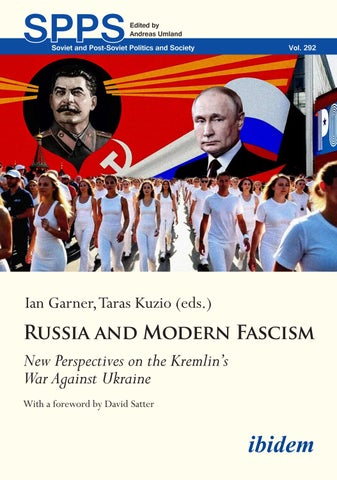
Russia and Modern Fascism
The editors Dr Ian Garner is Assistant Professor at the Center for Totalitarian Studies at the Pilecki Institute in Warsaw. He is also an adjunct faculty member in War Studies at the Royal Military College, Canada, Fellow at the Centre for International & Defence Policy, Canada, as well as lifetime fellow of the Royal Historical Society in London. His books include Stalingrad Lives: Stories of Combat and Survival (Mc-Gill-Queen’s UP 2022) and Z Generation: Into the Heart of Russia’s Fascist Youth (Hurst/Oxford UP 2023). He regularly writes for major media outlets including the Globe & Mail, National Post, The Guardian, Foreign Policy, and UnHerd. Dr Taras Kuzio is Professor of Political Science at the National University of Kyiv Mohyla Academy. He is the author and editor of 24 books, including Russia’s War on Ukraine: The Four Roots of Putin’s Invasion (Cambridge University Press 2025, with Michał Wawrzonek), Fascism and Genocide: Russia’s War Against Ukrainians (ibidem 2023), Russian Nationalism and the Russian-Ukrainian War (Routledge 2022), The Sources of Russia’s Great Power Politics (E-IR 2018, with Paul D’Anieri), Putin’s War Against Ukraine (University of Toronto Press 2019), Ukraine: Democratization, and Corruption and the New Russian Imperialism (Praeger 2015).
292
SPPS
Edited by Andreas Umland
Soviet and Post-Soviet Politics and Society
Vol. 292
Garner, Kuzio (eds.)
Russia seems to be hurtling toward fascism. Vladimir Putin and his allies—domestic and foreign—have obliterated and colonised Ukrainian cities in a “holy war,” committed over 100,000 war crimes, introduced Draconian domestic crackdowns on free speech and political opposition, and rewritten the constitution to seize power in perpetuity. The state and its propagandists declare their intentions to destroy the Ukrainian state and commit genocide against the Ukrainian people, to overthrow the liberal international order, and to recreate the Tsarist and Soviet empires. Meanwhile, the Russian population languishes in a militarising culture in which civic life has been replaced by a cult of war, past and present. Each of these phenomena invites comparisons with past fascist regimes. This volume gathers leading experts in the first scholarly study of a new Russian fascism that draws on distinctly modern forms of control and violence as much as on historical precedents. An array of theoretical debates and case studies from across disciplines makes this a pioneering study of modern Russian politics. The volume’s contributors include Jaroslava Barbieri, Paul D’Anieri, Jolanta Darczewska, Maria Domanska, Ian Garner, Joanna Getka, Andreas Heinemann-Grüder, Taras Kuzio, Alexander J. Motyl, Andreas Umland, and Michał Wawrzonek.
SPPS
Ian Garner, Taras Kuzio (eds.)
Russia and Modern Fascism New Perspectives on the Kremlin’s War Against Ukraine With a foreword by David Satter
ISBN: 978-3-8382-2015-4 Distributed by
ibidem
ibd
ibidem
Soviet and Post-Soviet Politics and Society (SPPS)
Vol. 292
ISSN 1614-3515 General Editor: Andreas Umland,
Commissioning Editor: Max Jakob Horstmann,
Stockholm Centre for Eastern European Studies, andreas.umland@ui.se
London, mjh@ibidem.eu
EDITORIAL COMMITTEE* DOMESTIC & COMPARATIVE POLITICS Prof. Ellen Bos, Andrássy University of Budapest Dr. Gergana Dimova, Florida State University Prof. Taras Kuzio, Kyiv-Mohyla Academy Prof. Heiko Pleines, University of Bremen Dr. Sarah Whitmore, Oxford Brookes University Dr. Harald Wydra, University of Cambridge SOCIETY, CLASS & ETHNICITY Col. David Glantz, “Journal of Slavic Military Studies” Dr. Marlène Laruelle, George Washington University Dr. Stephen Shulman, Southern Illinois University Prof. Stefan Troebst, University of Leipzig POLITICAL ECONOMY & PUBLIC POLICY Prof. Andreas Goldthau, University of Erfurt Dr. Robert Kravchuk, University of North Carolina Dr. David Lane, University of Cambridge Dr. Carol Leonard, University of Oxford Dr. Maria Popova, McGill University, Montreal
FOREIGN POLICY & INTERNATIONAL AFFAIRS Dr. Peter Duncan, University College London Prof. Andreas Heinemann-Grüder, University of Bonn Prof. Gerhard Mangott, University of Innsbruck Dr. Diana Schmidt-Pfister, University of Konstanz Dr. Lisbeth Tarlow, Harvard University, Cambridge Dr. Christian Wipperfürth, N-Ost Network, Berlin Dr. William Zimmerman, University of Michigan HISTORY, CULTURE & THOUGHT Dr. Catherine Andreyev, University of Oxford Prof. Mark Bassin, Södertörn University Prof. Karsten Brüggemann, Tallinn University Prof. Alexander Etkind, Central European University Dr. Ian Garner, Pilecki Institute, Warsaw Prof. Gasan Gusejnov, Free University of Berlin Prof. Leonid Luks, Catholic University of Eichstaett Dr. Richard Mole, University College London Prof. Andrei Rogatchevski, University of Tromsø Dr. Mark Tauger, West Virginia University
ADVISORY BOARD* Prof. Dominique Arel, University of Ottawa Prof. Jörg Baberowski, Humboldt University of Berlin Prof. Margarita Balmaceda, Seton Hall University Prof. Timm Beichelt, European University Viadrina Dr. Katrin Boeckh, University of Munich Prof. em. Archie Brown, University of Oxford Dr. Vyacheslav Bryukhovetsky, Kyiv-Mohyla Academy Prof. Timothy Colton, Harvard University, Cambridge Prof. Paul D’Anieri, University of California Dr. Heike Dörrenbächer, Friedrich Naumann Foundation Dr. John Dunlop, Hoover Institution, Stanford, California Dr. Sabine Fischer, SWP, Berlin Dr. Geir Flikke, NUPI, Oslo Prof. David Galbreath, University of Aberdeen Prof. Frank Golczewski, University of Hamburg Dr. Nikolas Gvosdev, Naval War College, Newport, RI Prof. Guido Hausmann, University of Regensburg Prof. Dale Herspring, Kansas State University Dr. Stefani Hoffman, Hebrew University of Jerusalem Prof. em. Andrzej Korbonski, University of California Dr. Iris Kempe, “Caucasus Analytical Digest” Prof. Herbert Küpper, Institut für Ostrecht Regensburg Prof. Rainer Lindner, University of Konstanz Dr. Luke March, University of Edinburgh
Prof. Michael McFaul, Stanford University, Palo Alto Prof. Birgit Menzel, University of Mainz-Germersheim Dr. Alex Pravda, University of Oxford Dr. Erik van Ree, University of Amsterdam Dr. Joachim Rogall, Robert Bosch Foundation Stuttgart Prof. Peter Rutland, Wesleyan University, Middletown Prof. Gwendolyn Sasse, University of Oxford Prof. Jutta Scherrer, EHESS, Paris Prof. Robert Service, University of Oxford Mr. James Sherr, RIIA Chatham House London Dr. Oxana Shevel, Tufts University, Medford Prof. Eberhard Schneider, University of Siegen Prof. Olexander Shnyrkov, Shevchenko University, Kyiv Prof. Hans-Henning Schröder, SWP, Berlin Prof. Yuri Shapoval, Ukrainian Academy of Sciences Dr. Lisa Sundstrom, University of British Columbia Dr. Philip Walters, “Religion, State and Society”, Oxford Prof. Zenon Wasyliw, Ithaca College, New York State Dr. Lucan Way, University of Toronto Dr. Markus Wehner, “Frankfurter Allgemeine Zeitung” Dr. Andrew Wilson, University College London Prof. Jan Zielonka, University of Oxford Prof. Andrei Zorin, University of Oxford
* While the Editorial Committee and Advisory Board support the General Editor in the choice and improvement of manuscripts for publication, responsibility for remaining errors and misinterpretations in the series’ volumes lies with the books’ authors.
Soviet and Post-Soviet Politics and Society (SPPS) ISSN 1614-3515 Founded in 2004 and refereed since 2007, SPPS makes available affordable English-, German-, and Russian-language studies on the history of the countries of the former Soviet bloc from the late Tsarist period to today. It publishes between 5 and 20 volumes per year and focuses on issues in transitions to and from democracy such as economic crisis, identity formation, civil society development, and constitutional reform in CEE and the NIS. SPPS also aims to highlight so far understudied themes in East European studies such as right-wing radicalism, religious life, higher education, or human rights protection. The authors and titles of all previously published volumes are listed at the end of this book. For a full description of the series and reviews of its books, see www.ibidem-verlag.de/red/spps.
Recent Volumes 284
Herausgegeben von Memorial Deutschland e.V. ISBN 978-3-8382-1994-3
285
Nadiya Kiss, Monika Wingender (Eds.) Contested Language Diversity in Contemporary Ukraine National Minorities, Language Biographies, and Linguistic Landscape ISBN 978-3-8382-1966-0
286
Richard Ottinger (Ed.) Religious Elements in the Russian War of Aggression Against Ukraine Propaganda, Religious Politics and Pastoral Care, 2014– 2024 ISBN 978-3-8382-1981-3
287
Editorial correspondence & manuscripts should be sent to: Dr. Andreas Umland, Department of Political Science, Kyiv-Mohyla Academy, vul. Voloska 8/5, UA-04070 Kyiv, UKRAINE; andreas.umland@cantab.net
„Alles kann sich ändern“ Letzte Worte politisch Angeklagter vor Gericht in Russland
Yuri Radchenko Vspomogatel'naia politsiia, mestnaia administratsiia SD i Shoa na ukrainsko-rossiisko-belorusskom pogranich'e (1941–1943) With forewords by John-Paul Himka and Kai Struve ISBN 978-3-8382-1878-6
288
Business correspondence & review copy requests should be sent to: ibidem Press, Leuschnerstr. 40, 30457 Hannover, Germany; tel.: +49 511 2622200; fax: +49 511 2622201; 289 spps@ibidem.eu. Authors, reviewers, referees, and editors for (as well as all other persons sympathetic to) SPPS are invited to join its networks at www.fa290 cebook.com/group.php?gid=52638198614 www.linkedin.com/groups?about=&gid=103012 www.xing.com/net/spps-ibidem-verlag/
291
Zsofia Maria Schmidt Hungary’s System of National Cooperation Strategies of Framing in Pro-Governmental Media and Public Discourse, 2010–18 With a foreword by Andreas Schmidt-Schweizer ISBN 978-3-8382-1983-7
Richard Ottinger (Hrsg.) Religiöse Elemente im russischen Angriffskrieg gegen die Ukraine. Propaganda, Religionspolitik und Seelsorge, 2014–2024 ISBN 978-3-8382-1980-6
Galyna Zelenko (Ed.) Crises of Political Development in Ukraine The Challenges of Post-Soviet State-Building and Ways to Overcome Them With a foreword by Oleg Rafalskiy ISBN 978-3-8382-2027-7
Galyna Zelenko (Ed.) Fake Russia Investigations into Moscow’s Imitations of Greatness and Power ISBN 978-3-8382-1997-4
Ian Garner & Taras Kuzio (Eds.)
RUSSIA AND MODERN FASCISM New Perspectives on the Kremlin’s War Against Ukraine
With a foreword by David Satter
Bibliografische Information der Deutschen Nationalbibliothek Die Deutsche Nationalbibliothek verzeichnet diese Publikation in der Deutschen Nationalbibliografie; detaillierte bibliografische Daten sind im Internet über http://dnb.d-nb.de abrufbar. Bibliographic information published by the Deutsche Nationalbibliothek The Deutsche Nationalbibliothek lists this publication in the Deutsche Nationalbibliografie; detailed bibliographic data are available on the Internet at http://dnb.d-nb.de.
ISBN (Print): 978-3-8382-2015-4 ISBN (E-Book [PDF]): 978-3-8382-8015-8 DOI: 10.24216/9783838220154 © ibidem-Verlag, Hannover • Stuttgart 2025 Alle Rechte vorbehalten
Leuschnerstraße 40 30457 Hannover Germany / Deutschland info@ibidem.eu
Das Werk einschließlich aller seiner Teile ist urheberrechtlich geschützt. Jede Verwertung außerhalb der engen Grenzen des Urheberrechtsgesetzes ist ohne Zustimmung des Verlages unzulässig und strafbar. Dies gilt insbesondere für Vervielfältigungen, Übersetzungen, Mikroverfilmungen und elektronische Speicherformen sowie die Einspeicherung und Verarbeitung in elektronischen Systemen. All rights reserved. No part of this publication may be reproduced, stored in or introduced into a retrieval system, or transmitted, in any form, or by any means (electronic, mechanical, photocopying, recording or otherwise) without the prior written permission of the publisher. Any person who commits any unauthorized act in relation to this publication may be liable to criminal prosecution and civil claims for damages.
Printed in the EU