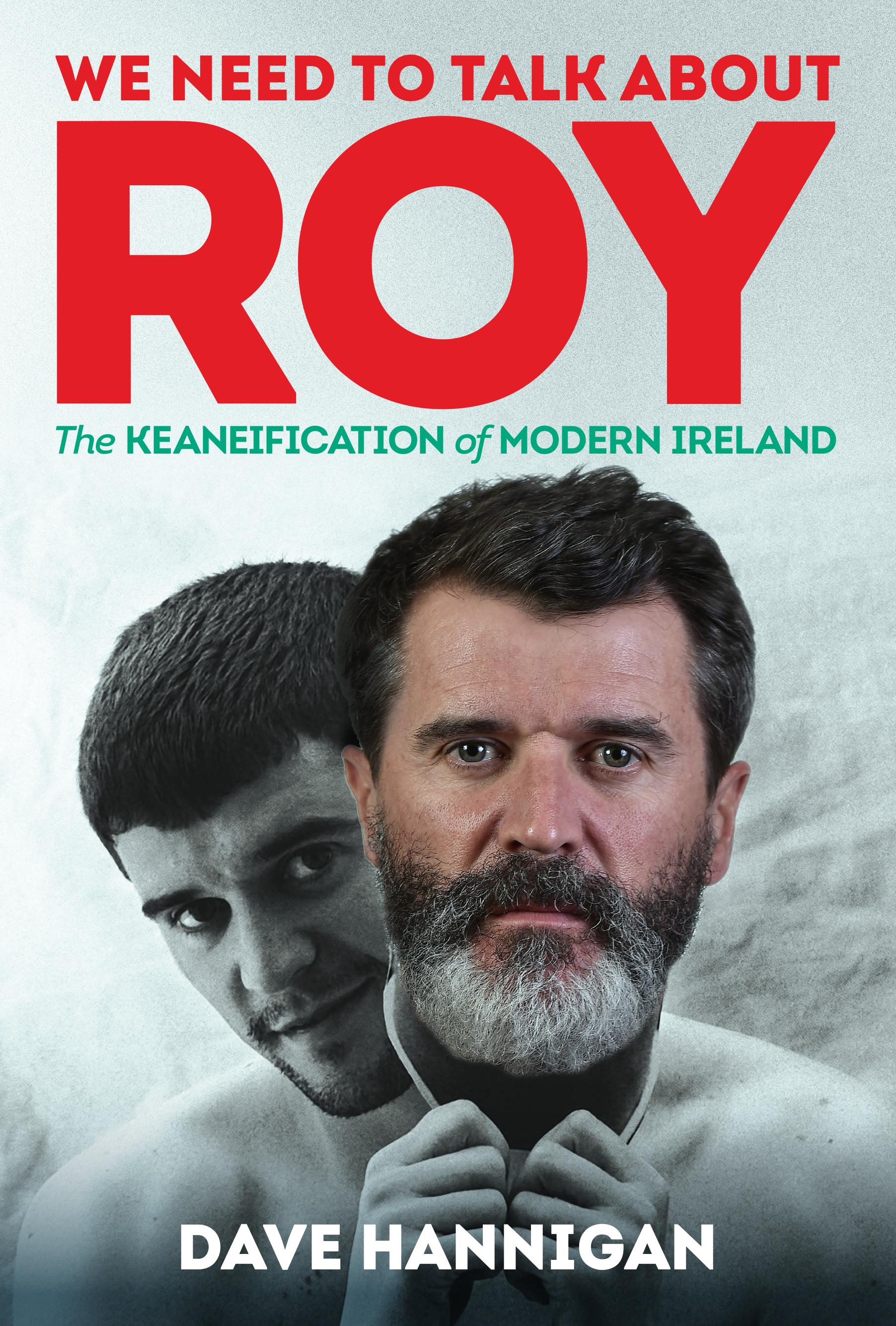
WE NEED TO TALK ABOUT ROY
Dave Hannigan is a professor of history at Suffolk County Community College in New York, a weekly columnist with The Irish Times, and author of several non-fiction books, including The Big Fight: When Ali Conquered Ireland, and Drama in the Bahamas, the story of Ali’s final bout against Trevor Berbick. A native of Cork, Dave currently lives in East Setauket with his sons Abe, Charlie and Finn.
WE NEED TO TALK ABOUT ROY
THE KEANEIFICATION OF MODERN IRELAND
DAVE HANNIGAN

First published in 2026 by Merrion Press
10 George’s Street Newbridge Co. Kildare
Ireland
www.merrionpress.ie
© Dave Hannigan, 2026
978 1 78537 579 8 (Paperback)
978 1 78537 589 7 (eBook)
A CIP catalogue record for this book is available from the British Library.
All rights reserved. No part of this publication may be reproduced, stored in a retrieval system, or transmitted, in any form or by any means (electronic, mechanical, photocopying, recording or otherwise), without the prior written permission of both the copyright owner and the publisher of this book.
Typeset in Minion Pro 12/18 and Adriane Text
Cover design by Fiachra McCarthy
Front cover images: Roy Keane © Billy Stickland/INPHO; superimposed image of older Roy © David Maher/Sportsfile
Merrion Press is a member of Publishing Ireland.
To Jill
PROLOGUE
Sports tells anyone who watches intelligently about the time in which we live.
Roger Kahn
Whenhe lived in digs above The Fountain café on Cork’s Grand Parade, Christy Ring used to walk the short distance to St Augustine’s church each morning for 7.30 a.m. Mass. He gifted his eighth All-Ireland hurling medal to the priests there and it was used to decorate a chalice. A daily communicant and a member of the Catholic Young Men’s Society in his native Cloyne, on the biggest days of his sporting life he genuflected and kissed the ring of some bishop or prelate in the middle of Croke Park. Nobody flinched at the bizarre spectacle. That was just the way things were in the country then.
Once upon a time in New York City, some enterprising businessman wanted to open a bar with Ring’s name over the door. In return for use of the brand, half of all profits would be his. A lifelong Pioneer, he turned them down, just like he eschewed a variety of other lucrative commercial opportunities, preferring
to earn his corn driving an oil truck for Shell, a company that famously tried to stop him travelling to the States on a hurling tour because it clashed with his delivery schedule. In the 1940s and 1950s, Ring was the greatest sportsman in the country and he was of that particular Ireland: sepia-tinted, devout, teetotal, Corinthian, humble, pious.
A Cork City rather than a country boy, his every feat available in glorious technicolour across all media, Roy Keane played a different game, lived in a different era and came from a different world. The first superstar of Ireland’s tabloid age; the very opposite of Ring. Yet there were uncanny similarities between him and his predecessor. Both were obsessed with the minutiae of correct preparation, fanatical about the virtues of proper training and preternaturally capable of willing others around them to greater heights. In the heat of the moment, when it mattered most, on the biggest days, they also shared a demented desire to put their bodies on the line. Anything to win. Always. All ways.
One afternoon in 1964, Ring was walking along Patrick Street with the journalist Breandán Ó hEithir when a gaggle of students chanted ‘Dirty Ring’ in their direction, a mocking reference to a county championship match where a UCC player marking the Glen Rovers’ man had suffered a broken wrist from a bad fall. Duly rising to the bait, Ring fired back abuse at his assailants, his apoplexy only adding fuel to their fire. As Ó hEithir tried his best to calm him down, advising that the best policy was to ignore the taunts, Ring turned on him too. ‘That’s all you know then,’ he said. ‘You probably think I’m a respected man in this town. There are
people in this town, boy, who think I’m locked up in the red house [the mental asylum on the Lee Road] on the hill all week and only let out to hurl on Sundays.’
There have been times in Keane’s career when not all of Cork or Ireland was warm in its embrace of him either. For a while, it seemed as if a wiseacre, emboldened by drink, jealous of his celebrity and envious of his burgeoning wealth, lurked in every pub and nightclub ready to have a pop. There was name-calling about his flash car and mockery of his father – nasty carry-on that fed his innate truculence. Yet, as in the case of Ring, those who reckoned him to be a little bit crazed also greatly appreciated that when Keane took to the field wearing the green of Ireland, he represented the country’s best chance – perhaps for many years its only chance – of winning. Even the worst of the begrudgers had to admit there was only one Keano.
Like every emigrant, he discovered the longer you live away, the fonder they become of you back home. Time passes, people mature and edges soften. Jealousy can even segue into a very definite and boastful pride. It helps too, of course, if you have used your global fame to regularly laud the city of your birth, crucially namechecking its private icons in dispatches to British audiences. ‘Growing up in Ireland,’ Keane told the watching millions on an episode of Monday Night Football in 2022, ‘again, the GAA, it was a big part of my life. Hurling, watching Jimmy Barry-Murphy playing for Cork. You know, a brilliant sportsman.’
There are Cork people who will vouchsafe that any man from Keane’s generation who doesn’t tell you Barry-Murphy is their hero
can’t be trusted. Nobody born in the late 1960s or early 1970s could possibly grow up with any other deity before them. The one true god. The father, the son, the player, the manager, the holy spirit. While the name-drop resonated with the audience back home, getting JBM onto a subsequent episode of The Overlap on Tour also did wonders for Keane’s credibility. You can take the boy out of Cork, but you can’t take Cork out of the boy.
Keane’s sometimes fractious history with his own people ensures he may never reach Barry-Murphy levels of adoration. He’s too complicated a character for that. But the angst and unease of the early days have given way to a more straightforward type of adulation. In the summer of 2025, 15,000 people spent eighty and ninety euros a ticket to listen to him chat with Roddy Doyle, ghostwriter of his second autobiography, over the course of three nights at The Marquee, a big top erected on the banks of the River Lee every summer.
It was more than a sort of homecoming. The venue was appropriate because, in some ways, here was the sporting equivalent of an old-timey evangelical tent revival, where a preacher swoops into town and packs sinners and sceptics from surrounding areas underneath the canvas to hear him recite in the name of the Lord. There was no preaching from Keane, but there was worship. Plenty of it. People had come to pay homage and to hear a very particular gospel. The word according to Roy.
There was idolatry too. T-shirts with his image on the front. Jerseys with his name and number on the back. They got to their seats 15 minutes before showtime because they know how
obsessive the celebrant is about timekeeping. At this Mass, nobody dared sidle in late hoping the priest wouldn’t notice.
When he eventually walked on stage, there was sustained chanting of ‘Keano’. He smiled that trademark sly grin and then raised his hands in the gesture that said, ‘Stop now, don’t be overdoing it.’ Thirty-eight years earlier, another Cork crowd had packed the Opera House uptown for the homecoming of Rory Gallagher, and when they chorused ‘Rory’ too long, he brought his hands up in exactly the same diffident manner to tell them to give over. The embarrassment of acclaim – the happy plight of every local hero who comes back trailing genuine achievement. All part of the evening cabaret.
Just as Gallagher did when he made his Fender Strat sing, Keane recited his greatest hits, gently prompted by Doyle. The diverse profiles of those hanging on his every word told their own story. Paunchy middle-aged men with silver locks and bald pates had come to hear their voice of reason, the man who rails against so much they also decry in modern society. One or two probably falsely claimed to have had his measure on the playing fields of their youth. Others only wished they could boast to have breathed the same air as the boy who became a giant. All were happy to sit there, sipping the heady brew of nostalgia being liberally poured.
Plenty of youngsters trooped in too. Some of them were not born the last time he wore United red or Ireland green. So how did they know him? By reputation, as handed down by their parents and elders; from highlight reels of his most glorious days available
on YouTube; from memes of his verbal denunciations that regularly go viral; or perhaps some curious amalgam of all of the above.
Unlike the exclusively male audience for Gallagher back in the day, this was a unisex crowd. Nearly as many women there as men. Attendees included blasphemous Liverpool fans whose Corkness brought them to touch the hem of the garment of a Manchester United all-time great, Olympic boxing champions, fathers and sons, grandmothers and grandfathers. From the city and surrounding county, they came for a show that was nothing new, just a genial, good-humoured performance by an experienced showbiz pro. Brazed enough now in the ways of Vaudeville to know how to work a crowd, Keane sprinkled funny yarns with snark, unfurling trademark put-downs and pithy remarks. That they’d heard them all before on television or online scarcely mattered. Nobody ever wants to hear a legacy act play new material. They had come to see ‘Roy the Boy’, as he was once known around town, because, in ways much more significant than football, he has been part of their lives since forever. And he remains resolutely one of their own.
A friend of mine happened upon Keane sitting with friends sipping coffee in Blarney, just outside Cork City, last year. Instinctively, without even thinking, he raised his hand to salute him as he went by, like he would have done if it was an old school friend or some chap he used to work with. His natural response to seeing that famous face was not to approach or pester Keane for a photograph but to make a gesture of recognition, because that is what you do when you see somebody you know. Even if you really don’t know them.
And nobody outside his family really knows Keane. We think we do because he’s been part of the national story for nearly four decades, through good times and bad for him and us. Periods of intense love and real hate. We feel invested in him, a sense of ownership almost. We see photos of him eating a 99 down in Youghal on a summer’s day and it’s reassuring. Just another emigrant who has done well for himself revisiting a simple joy of childhood during his holidays. Totally normal, like. And yet, through no fault of his own, not.
In Dublin’s inaugural Fashion Week in 2025, Pellador – a Limerick-based label – unveiled the Roykini, a two-piece swimsuit featuring images of Keane the younger on one cup, Keane the elder cuddling a dog on the other. The bottoms come emblazoned with his number 6 on the back and an image of him rehydrating at the 1994 World Cup on the front. Nothing showcased at the event grabbed more headlines than a beachwear re-imagining of a superannuated footballer far removed from his athletic prime. A bizarre illustration of his enduring reach into our lives, a reminder that his fame is not the preserve of any one demographic. Truly, uniquely, he belongs to everyone from the football fans to fashionistas. No Irish athlete has had more written and said about them. Ever. No Irish athlete has had more of substance to say for themselves. About everything and anything. Two volumes of autobiography, a sprawling archive of sound bites, and counting. Umpteen books written about him too. Which begs the cogent question of why we might need another. Well, this is an attempt to place his story in a different context, to
revisit the narrative of his life in tandem with that of Ireland itself in the same period. An effort to try to figure out how he put the manic in talismanic, flitted from bestriding Lansdowne Road to being booed there, oscillated violently between national argument and national treasure. We already know the details of his biography. We know the history of the Republic too. But, across the past half century, the most transformative in our history, his turbulent personal journey sometimes mirrored and often intertwined with the evolution of the country that made him. In the most singular and insightful way.
That is surely worthy of closer examination and deeper excavation, because the sporting heroes of every era offer us a window into the values and norms of that society. Those we look up to and how we idolise them present a snapshot of who we were and what we were about at a particular moment – our vices and virtues, our fortunes and foibles. From Danno Mahony’s wrestling exploits in America (ersatz as they may have been) enthralling people back home struggling through the depressed 1930s, to Brian O’Driscoll embodying the supreme self-confidence of the affluent 2000s, we can always find an athlete whose career enables us to frame the broader social history of any epoch. Ring was then. Keane somehow, so far past his playing pomp, is still now.
A prominent part of our cultural furniture, he straddles so many decades, contrasting eras full of want and wanton carry-on. These were tumultuous times in Irish life, when his own personal revolutions paralleled the roller-coaster trajectory of the society that first shaped him: the teenage party animal in Nottingham
turned late career yogi at United has now morphed into the voluble greybeard of middle age. He has been a mirror in which we’ve often seen plenty, and perhaps too much, of ourselves. Warts and all, depending on the day, depending on the year. The best of us. The worst of us. Reflecting our own aspirations one minute, a shrill voice calling us out for our merry relationship with mediocrity the next. A character of principle. A prisoner of his own ambition. Troubled. Content. Struggling. Striving. Infuriating. Exhilarating. Snarling. Smiling. Big mouth. Close-mouthed. Righteous. Rapscallion. Walking his dog. Dog of war. Drunk. Sober. Public figure. Private man. Adamantine. Acerbic. Saucy. Sincere. Prophet. Pundit. Role model. Clothes model. Poacher. Gamekeeper. Team player. Solo act. Jekyll. Hyde. A mess of contradictions. A strange study in the art of compromise. So many moods, so many iterations, but always affecting us. Even today, so long after he kicked a ball in anger – oh so much anger – for the final time.
‘No man can adequately describe Irish life who ignores the Gaelic Athletic Association,’ the poet Patrick Kavanagh once wrote. No man will ever adequately understand Ireland in the last half century without knowing Roy Keane. While that is an almost impossible task, any attempt to do so must begin with the time and place from whence he came.
ONE DARKNESS ON THE EDGE OF TOWN
I am the blood of Erin, spilt in an empty cave
I am the flower of Ireland, out on the drifting wave
I am the lark of Mayfield, tumbling down the hill
I am the child of summer, I can remember you still
John Spillane, ‘Magic Nights in the Lobby Bar’
Inthe aftermath of his departure from Manchester United and his brief dalliance with Celtic, Roy Keane started retirement by calling a family meeting at his home in the leafy Cheshire village of Hale. A sprawling property that he and his wife, Theresa, bought the previous year for an estimated £3.2 million, it boasted a tennis court, a swimming pool and eight bedrooms.
‘I sat down with the kids and gave them the news, about how things were going to change,’ wrote Keane. ‘It wasn’t anything too
drastic. There’d be fewer holidays and so on – “Those days are over.” I was trying to put the frighteners on them, a little bit. But kids pick that up. They were looking through me, going, “Get on with the lecture, we want to watch the TV.”’
Some people who read that story in the second volume of Keane’s autobiography cringed on his behalf. How could he be so out of touch with reality? This was a man who was reputedly the highest-paid footballer in Britain in 1999, drawing down £52,000 per week, a stunning sum at a time when the average annual industrial wage was £17,803. In 2003, two years before the appearance on MUTV that caused his contract at Old Trafford to be terminated, his salary was £3.5m, supplemented by a signing bonus of £1m. Even the terms for what proved to be his final season stipulated a bonus of £1m should he play in more than 50 per cent of United’s games in the campaign. A millionaire many times over suffering an episode of financial anxiety – nothing enrages people more.
Except this was no ordinary multi-millionaire. To understand Keane’s sudden pecuniary concerns and to appreciate why losing his job might impact him like this, you must know where he came from. Not just the city or the country where he was born, but the fraught time and peculiar place where he spent his formative years. Far removed from what estate agents have described as his country manor down a secluded, leafy cul-de-sac in Manchester’s stockbroker belt, the world that he was born into was depressed, monochromatic and, in some ways, stuck in a time warp. A place closer in spirit to the 1920s than the twenty-first century.