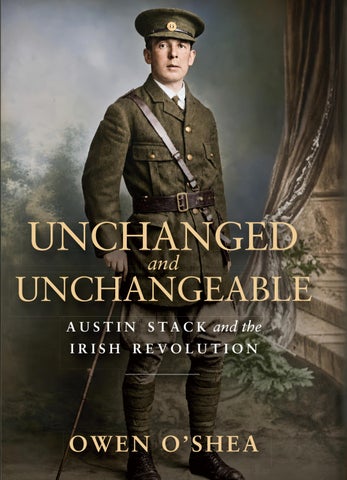
UNCHANGED and
UNCHANGEABLE
Books by Owen O’Shea From Bullets to Ballots: Politics and Electioneering in Post-Civil War Kerry, 1923–33 (UCD Press, 2025) The Civil War in Kerry and Beyond: Histories, Memories and Legacies, edited with Bridget McAuliffe and Mary McAuliffe (Four Courts Press, 2025) One Man’s Ireland: Memoirs of Dan Mulvihill, Maverick Republican (Merrion Press, 2025) Chub: The Life and Times of a Remarkable Kerryman, with Patrick O’Connor (Laune Press, 2023) No Middle Path: The Civil War in Kerry (Merrion Press, 2022) Ballymacandy: The Story of a Kerry Ambush (Merrion Press, 2021) A Century of Politics in the Kingdom: A County Kerry Compendium, with Gordon Revington (Merrion Press, 2018) Kerry 1916: Histories and Legacies of the Easter Rising, edited with Bridget McAuliffe and Mary McAuliffe (Irish Historical Publications, 2016) Heirs to the Kingdom: Kerry’s Political Dynasties (O’Brien Press, 2011)
UNCHANGED and
UNCHANGEABLE AUSTIN STACK and the IRISH REVOLUTION
OWEN O’SHEA
First published in 2026 by Merrion Press 10 George’s Street Newbridge Co. Kildare Ireland www.merrionpress.ie
© Owen O’Shea, 2026 978 1 78537 615 3 (Hardback) 978 1 78537 620 7 (eBook)
A CIP catalogue record for this book is available from the British Library. All rights reserved. No part of this publication may be reproduced, stored in a retrieval system, or transmitted, in any form or by any means (electronic, mechanical, photocopying, recording or otherwise), without the prior written permission of both the copyright owner and the publisher of this book.
Typeset in Minion Pro and Sabon LT Pro Cover design by Padraig McCormack Front cover image courtesy of the Stack family Back cover image: An RIC poster from c. 1916
Merrion Press is a member of Publishing Ireland.
CONTENTS
1
‘Nurtured in the traditions of Fenianism’
1
2
‘A tower of strength to his team’
6
3
‘Be armed, and armed without delay’
18
4
‘Necessary to offer ourselves as martyrs’
26
5
‘Oh God, lads, the game is up’
35
6
‘I am not afraid to sacrifice myself for my country’
48
7
‘He got the tube down eventually, causing me great pain’
63
8
‘Enthrone the great O’Stack as King of West Kerry’
79
9
‘We would follow Austin Stack to death’
97
10
‘To provide a Court in every corner of Ireland’
109
11
‘Your department, Austin, is nothing but a bloody joke’
122
12
‘The Republic, the whole Republic, and nothing but the Republic’
138
13
‘If you don’t believe it in your hearts, vote against it’
153
14
‘The Irish Republic will never be allowed to die’
168
15
‘Worse than the Black and Tans have ever done’
186
16
‘They require hostages to protect them from ghosts’
202
17
‘There should be no such thing as compromise’
219
18
‘One of Ireland’s bravest and best’
231
Endnotes Acknowledgements Index
245 286 287
1 ‘Nurtured in the traditions of Fenianism’
IT WAS LESS THAN A WEEK before Christmas Day 1921, but the atmos-
phere at the National University on Dublin’s Earlsfort Terrace was anything but festive. Irish republicans had gathered to wrestle with their consciences and wrestle verbally with each other over the terms of a controversial treaty that was less than three weeks old. The scene ‘inside the Council Chamber of the University was animated and solemn in turn’, noted The Freeman’s Journal, under a large headline ‘Momentous Debate Initiated at Public Session of National Assembly’.1 The Irish Independent added that there was ‘world-wide interest’ in the debates, which had moved from private session to public sittings the previous day.2 Speaker after speaker – members of an independent republican parliament, Dáil Éireann – spoke passionately, often emotionally, about the merits and evils of the agreement, depending on their political perspective. It was something of an alien environment for a shy and unassuming former law clerk and income tax collector from Tralee in County Kerry, who had celebrated his forty-second birthday the day after the controversial Anglo-Irish Treaty was signed. The pact, signed in Downing Street
2
UNCHANGED AND UNCHANGEABLE
in London on 6 December, a few months after the end of the War of Independence, triggered a political paroxysm into which Austin Stack was rapidly being subsumed. Stack – one of Ireland’s most dedicated and committed republicans – was in little doubt about where he stood on what he considered to be a noxious and catastrophic arrangement reached between Irish representatives and the British government of David Lloyd George. His turn to speak in the debate on the Treaty came immediately after that of his ally, mentor and leader, Éamon de Valera, the president of the Irish Republic. A reporter with the Irish Independent, John F. Boyle, recorded that, on the completion of de Valera’s address: ‘Austin Stack got up. He neither aims at emotional power or at cheer getting … His whole face was that of a speaker of unbending firmness. He analysed the clauses [of the Treaty] in a sharp and businesslike away.’3 Boyle was either unaware of or oblivious to Stack’s abhorrence of public speaking. Like so many of his peers – ordinary men and women who had been thrust into the limelight by the dramatic events of the previous years – Stack was no trained orator or political maestro. Yet, despite being petrified of public platforms and the public gaze, he composed himself as he prepared to speak. This was a seminal moment in the history of his people and his country, and it required a clarity of thought and the power of persuasion. Somehow, he found an inner resolve and confidence in what would become an oft-quoted rhetorical demolition of the terms of the accord being dissected by the Dáil. That resolve ran deep in his family’s blood and his political pedigree. Stack told his comrades of his revulsion towards the terms of the Treaty, particularly a bitterly divisive oath of fealty to the British Crown, which all members of a new, independent Irish parliament would be required to take. The Treaty, he believed represented an abandonment of the cherished republic for which he and previous generations had fought: I was nurtured in the traditions of Fenianism. My father wore England’s [prison] uniform as a comrade of Charles Kickham and
‘Nurtured in the traditions of Fenianism’
3
O’Donovan Rossa when as a ’67 [1867] man he was sentenced to ten years for being a rebel, but he wore it minus the oath of allegiance. If I, as I hope I will, try to continue to fight for Ireland’s liberty, even if this rotten document be accepted, I will fight minus the oath of allegiance and to wipe out the oath of allegiance if I can do it. Now I ask you[,] has any man here the idea in his head, has any man here the hardihood to stand up and say that it was for this our fathers have suffered, that it was for this our comrades have died on the field and in the barrack yard.4 It was no coincidence or spontaneous notion that prompted Stack to invoke the memory of his father. William Moore Stack had suffered in the barrack yard at the hands of British oppression. A founding father of and much-loved figure in the Fenian movement of the nineteenth century, he had faced physical, psychological and financial hardship because of his devotion to ridding Ireland of British rule by the use of violent means. Convicted for his involvement in the Irish Republican Brotherhood (often referred to as the Fenians) in 1867, Moore Stack spent time in the same London prison as Fenian icon Jeremiah O’Donovan Rossa.5 The pair would develop a close political relationship. It is impossible to understand Austin Stack without understanding his father, who devoted his life to Fenianism and Irish independence. Moore Stack and all that he stood for – and endured – was a foundational force for his son. Austin’s first biographer suggested that in the family home ‘the lessons learnt at such a fireside stamped on to the boy’s plastic mind an impression which never left it’.6 Moore Stack was widely popular in his native Tralee: John Devoy, a fellow Fenian and leading figure in Clan na Gael in the United States, described him as the ‘chief man’ in the Fenian organisation in County Kerry.7 It was to his home town that Austin’s father would return from Dublin after marrying for the second time, in 1877. Donnybrook native Nanette O’Neill, his wife and Austin’s mother, was a kindred spirit: she was
4
UNCHANGED AND UNCHANGEABLE
president of the local branch of the Ladies’ Land League – which, along with the men’s branch, aimed to end landlordism and restore land ownership to native farmers – and was jailed for attending a league meeting in Castleisland.8 Apart from militant revolutionary activity, Moore Stack was a founder and leading light in the Gaelic Athletic Association (GAA), which was founded in 1884, and the Land League in his home county. He chaired an enormous meeting held in Tralee in November 1880 to commemorate the revered Manchester Martyrs.9 Two years later, he headed a committee to raise funds for a permanent memorial in Tralee to the martyrs, and he continued to attend and address public meetings throughout the 1880s.10 It was to agrarian politics and land agitation – and through them, the achievement of Irish independence – that Moore Stack became increasingly devoted. He was listed among those on the platform at a Land League meeting in Lixnaw in north Kerry in September 1881, which heard calls for ‘every labouring man to hold his plot of land free’ and which was attended by ‘eight thousand persons’.11 When Moore Stack was jailed again in 1881 for ‘treasonable practices’, depriving the family of its breadwinner, Nanette and their young family, including two-year old Austin, were reported to be in dire straits: they were in receipt of £1 per week from the Tralee Board of Guardians under laws which provided for the families of those in custody.12 After his release in 1882, Moore Stack remained indefatigable, despite the privations he had faced during his incarceration. In 1884, in one of the few recorded accounts of his remarks, he told a commemoration that the Manchester Martyrs ‘suffered for their courage and heroism, the English people rewarded it with the scaffold and penal cell, and even those who were not hanged or sent to prison were buffeted, beaten and stoned by the furious and cowardly English blood hounds’.13 At the commemoration two years later, he described as ‘a holocaust’ the loss of men who ‘gave up their lives in the cause of Ireland. We must all meet death,’ he continued, ‘let us follow their example, and in a good cause lay down our lives.’14 Three years
‘Nurtured in the traditions of Fenianism’
5
later, the United Irishman noted that it was thanks to Moore Stack, one of the few remaining ‘earlier Fenians’, that a ‘militant spirit survives under the shadow of Cathair Conree,’ a peak in the Sliabh Mish mountains in west Kerry.15 J.J. O’Kelly of Valentia Island, later a close comrade of Austin’s, noted that William Moore Stack ‘carried to his grave the wounds left on his wrists by England’s prison manacles’.16 Those scars remained seared in the mind of his son throughout his long and tumultuous career.
2 ‘A tower of strength to his team’
AUGUSTINE MARY MOORE STACK WAS BORN on 7 December 1879
in Ballymullen, on the outskirts of Tralee. He was named after his grandaunt, Mother Mary Augustine, a nun with the Presentation Order, who was among the founders of their convent in Listowel.1 From a young age, however, he would always be better known as Austin and, unlike his father, tended not to use the Moore prefix to the Stack surname. Austin was the third child in a family of eight, and the first son born to William Moore Stack and Nanette O’Neill. His siblings were Nicholas, James, Josephine, Nanette, Teresa, Beatrice and Nora. There was also a step-brother, John, from his father’s first marriage, and a brother, Louis, who died as a baby.2 In about 1881, the family moved from Ballymullen to Boherbee, closer to the centre of town, to a house known as ‘The Nursery’. Austin attended national school at Moyderwell Convent School and then moved on to the local Christian Brothers school on Edward Street in the town. In his schooldays, he was said to be a keen student of history.3 This interest was fostered at home, not least by his father, and decades later, Austin would recall that he learned more about Irish history and politics – particularly the Irish nationalist cause – in his childhood and from his father than he did from any book:
‘A tower of strength to his team’
7
[T]he English pretended for many a long generation that they were the superior race. Now I must candidly admit that to myself sometimes I thought it: reading the books which were given to us in school, the only books which unfortunately we poor young Irishmen could get … Even if we had gone to the Irish high school, we wouldn’t have learned much Irish history anyway. But for the fact that I was able to learn the history at home … I would have believed that the Englishman was the last thing in existence. He was supposed to be worth two Frenchmen, three Germans, and I suppose about one hundred and fifty Portuguese.4 Stack was described as ‘shy and reserved’ in his youth, a description that would follow him into adulthood.5 His childhood was accurately described by his biographer J. Anthony Gaughan as one of ‘sadness and want’.6 As well as the hardships of the periods when his father was in prison, he lost his mother in 1889, when he was aged just ten. After Nanette’s death and the loss of his employment with a local solicitor, Moore Stack operated a small shop at his home but struggled to make ends meet.7 Nevertheless, Austin was able to enjoy the normal leisurely and sporting pursuits of the time. A friend, James Clarke, recalled seeing him for the first time at a coursing meeting: He was then only about 15 years of age. I saw a boy this day trying to see the progress of the dogs over the heads of people much taller than himself. I lifted him up on to a stand so that he could see the race. One of my friends then informed me that his name was Austin Stack, son of Moore Stack.8 Despite being a busy provincial town with an agricultural hinterland, the Tralee into which Stack was born was labouring under many of the prevalent social and economic problems of the late nineteenth century. A friend
8
UNCHANGED AND UNCHANGEABLE
of his, Cornelius (Con) Casey, remembered a grim period in Tralee during their youth: Gas-lit Tralee of the flagged sidewalks and the muddy roads was a good place to live in before the Great War for those who had but not for those who had not. There were a number of well-off people, many in regular jobs in offices or behind counters or in trade, and the unskilled majority, labourers, barely had sufficient to keep themselves and their families just about fed in poor housing conditions. There were casual workers who, with their families, lived from hand to mouth, and there were the unemployed who God alone knew how they existed … Life was grim … poor housing without water and sanitation. Wives and children were often in dire need and poorly clad children, often barefoot, in winter was a sad sight.9 At the age of fourteen, Stack left school and took up work as a legal clerk with John O’Connell, a busy and successful solicitor who dealt with probate, civil and criminal cases and was based at Nelson (now Ashe) Street in Tralee. Stack’s father, too, had worked briefly for O’Connell, who was also the coroner for west Kerry and an elected member of Tralee Urban District Council between 1902 and 1905.10 Stack immersed himself in clerical and administrative work, occasionally attending court with his employer. Moore Stack died in 1899, when Austin was twenty, and his shop was taken over by Stack’s older sisters, Nora and Beatrice. However, emigration, an all-too common phenomenon in Kerry, hollowed out the Stack family at the turn of the century: within the space of two years, six of Stack’s siblings left Ireland for the United States. His brother Nicholas was the only sibling who remained in Tralee after 1905; he was employed by another local law firm, Terence J. Liston and Company. Initially, the brothers lived together in lodgings on Strand Street,11 but Austin later moved to digs on
‘A tower of strength to his team’
9
Rock Street and, as an active member of the Irish language organisation, Conradh na Gaeilge, gave lessons in Irish there.12 It was through his legal work that Stack would have gained his first experience of elections. In April 1899, he was one of the polling clerks for the Kerry County Council elections.13 This was the very first election to the council, which had been established under the Local Government Act of 1898. Following this, Stack regularly acted as a polling clerk or presiding officer for local authority elections, including in 1908.14 He first dipped his toe into nationalist politics during the general election to the Westminster Parliament in 1900. Thomas O’Donnell, a native of Ballyduff near Castlegregory, was put forward as the candidate of the Irish Parliamentary Party for the single-seat constituency of West Kerry, of which Tralee was then part. The only other contender was James Edward Julian, a wealthy Protestant landowner whom O’Donnell defeated at the selection convention, a meeting which Stack attended with John O’Connell.15 O’Connell lent his support to O’Donnell, and Stack ‘did the clerical work associated with the campaign’.16 It is not apparent whether Stack’s involvement in the election campaign was because of his enthusiasm for O’Donnell and the Irish Parliamentary Party or because of his employment circumstances, although, if later events are anything to go by, it was likely the latter. Though Stack was never keen on public speaking during his subsequent political career, he received a good grounding in public speaking skills through his membership of the Century Debating Club in Tralee. Another member was Maurice Griffin, later a Sinn Féin councillor and one of the founders of the influential Kerryman newspaper.17 The debating club had ‘a purely literary character’ and debated national and international issues, including ‘Will the policy of expansion be beneficial to America?’18 Stack was also elected to the committee of the Tralee Catholic Literary Society, which was chaired by St John Donovan, a member and the first chairman of Kerry County Council.19 Stack was also a member of the local Liberal Club, and, in a clear demonstration of his political attitudes at this
10
UNCHANGED AND UNCHANGEABLE
time, set fire to an image of King Edward VII that was on display in the headquarters of the club.20 Tralee in the early 1900s was, Irish Republican Army (IRA) veteran John Joe Sheehy recalled, ‘steeped in the cultural nationalism of the time’.21 Stack joined and became active in several socio-cultural and political groups, including the nationalist Irish National Foresters.22 He also became involved in the Industrial Development Association, which formed a branch in Tralee in 1909. This organisation aimed to curb unemployment by establishing industries outside of the agricultural base on which the country was so dependent. Its inaugural meeting in Tralee heard an appeal to end ‘the gaping wound through which our country is bleeding to death’ and that the lack of industrial development was ‘the real cause of most of the miseries of our country’.23 Among the committee’s objectives was the encouragement of the purchase of Irish goods over imported produce.24 In his early twenties, gymnastics provided Stack with a significant sporting outlet. He became a member of the Pioneers Gymnastics Club in Tralee, where training was provided by a soldier who was based with the Royal Munster Fusiliers in the town. Stack also became secretary of the Tralee Gymnasium Club and joined a committee which aimed to establish a gymnasium in the town.25 He also briefly played rugby with the Pioneers club.26 Apart from gymnastics, sport in Tralee at the beginning of the twentieth century was dominated by cricket and rugby. This would change during the first decade or so, as Tralee and County Kerry played a major part in propelling Gaelic games to the centre of Irish sporting and cultural life through the GAA. However, when Stack came to join the organisation early in the 1900s, the GAA in the county was relatively weak, with a limited number of clubs and an overarching organisational lethargy. Stack first immersed himself in the administrative side of the GAA and became involved in hurling when, in 1901, members of the Tralee Gaelic League came together to set up a hurling club. The inaugural meeting was chaired by John O’Connell. Stack was elected secretary of what came to be
‘A tower of strength to his team’
11
called Tralee Celtic Club.27 That the new club was anchored by the local members of the Gaelic League reflected the close connection between the two organisations: ‘the League’s promotion of an independent Gaelic culture was a natural extension of the GAA’s own primary mission to secure and promote native Irish games’.28 The Gaelic League, established in 1893, aimed to restore and promote the use of the Irish language, which was in significant decline. Stack joined the League at a time of expansion, and by 1905 it was well established in Kerry. Members of the League and the GAA were privately and publicly encouraged to join both bodies, though, in the long term, it was the GAA that recruited and sustained members with greater success. It would be Gaelic football to which Stack – and most Kerry GAA clubs and members – became devoted, and in April 1902 he was one of the founders of a new Gaelic football club in Tralee.29 The gathering took place at the rooms of the Gaelic League, and the omnipresent O’Connell became the club’s president and Stack one of the secretaries. Named after the nationalist and Young Irelander John Mitchel, the club – often known simply as ‘Mitchels’ – almost immediately became a huge success, winning every County Championship competition between 1902 and 1910. It was, as historian Richard McElligott notes, on the back of the success of this club that much of Kerry’s intercounty championship success was built in subsequent years. Stack is credited with contributing greatly to the transformation of football in Kerry in these formative years, both as an administrator and as a player. For many years, the GAA intercounty competition was played by club teams who had won their own county title. However, Stack recognised that this was unfair to traditionally weaker clubs, some of whose players were just as competent to represent Kerry.30 He encouraged the idea that county sides should comprise players from a multipli city of clubs, not just the County Championship-winning club, to ensure that the best players from across Kerry represented the county. Therefore, the Kerry team that won its first All-Ireland title in 1905 – in a victory
12
UNCHANGED AND UNCHANGEABLE
over Kildare – included just eight of the Mitchels team that had won the County Championship. This selection system was not without its critics, but Stack staunchly defended the approach: he responded to a pseudonymous letter to the Kerry People, which was critical of how players were chosen for the county team, insisting ‘there are no better men available in Kerry’ than those who played a recent game against Clare.31 One newspaper noted that Stack’s ‘brains [were] always at work in the interest of the GAA’ at this time.32 His administrative skills and commitment to Gaelic games made him an ideal addition to the GAA County Board, of which he was joint honorary secretary between 1904 and 1908. He also became a delegate to the Munster Council of the Association.33 These nominations and appointments suggest that Stack was already exhibiting the sort of administrative and organisational talents he would later deploy with great success in other arenas. But Stack was not just a successful official and administrator with the GAA: he became a successful player too, gaining a profile and legendary status in a county in which Gaelic football would become a fundamental part of community and cultural life. Building on his experience as a referee for club games in the early 1900s, he became a player of renown at both club and county level.34 He was captain of his club, John Mitchels, from its foundation until he was replaced in 1907 by Maurice McCarthy.35 He also began to play intercounty football from about 1903, usually in the centre-back position, and was, for example, part of a Kerry team which played Tipperary in Cork in October that year; he captained Kerry in a friendly against Cork in the same month.36 One account described him as not being a ‘brilliant’ player, but rather one who was ‘always in the gap and never let his side down’.37 In 1904, Stack played for Kerry in victories against Clare and Cork, games that were part of the deferred 1903 intercounty championship.38 On 23 July the following year, in what was the deferred 1903 All-Ireland home final, he played against Kildare in front of a crowd of 12,000 spectators
‘A tower of strength to his team’
13
in Thurles. It became a ‘red-letter day in the annals of the GAA and Irish sport’.39 The encounter with Kildare, who were competing in their first AllIreland final, attracted huge interest and ‘went down in the history of the association as one of the greatest matches ever witnessed’.40 The Kerryman recorded that ‘Austin Stack proved a tower of strength to his team. He stuck the fast and furious pace to the interruption, when he seemed still anxious for the renewal of hostilities. He is very fast, and his play on the wing could not have been better.’41 The closely fought match ended in controversy when the referee awarded Kerry a goal, having decided that the Kildare goalkeeper was standing behind his goal line after catching a ball kicked by Dick Fitzgerald of Killarney.42 The decision gave Kerry a one-point advantage (1–4 to 1–3), which led to the game having to be abandoned as jubilant Kerry suppor ters ran onto the pitch. The referee awarded the match to Kerry, but the GAA Central Council insisted on a replay, which took place in Cork on 27 August.43 Such was the intensity of the replay at the Cork Athletic Grounds that the referee collapsed from exhaustion, while the football burst and had to be replaced.44 Ending in a draw, Kerry on 0–7 to Kildare’s 1–4, the final went to a second replay. The second replay was set for Cork on 15 October 1905. In a preview of the game, The Nationalist and Leinster Times warned readers that Stack, who would play right half-back, was a formidable player and that if Kerry were defeated, ‘it will not be his fault’.45 Kerry finally got the upper hand, winning the game by 0–8 to 0–2. To seal their All-Ireland title, Kerry beat London-Hibernian in the away final on 12 November 1905, to become All-Ireland champions. At the victory banquet in the Hibernian Hotel in Tralee, Stack was singled out for congratulations by County Board chairman Eugene O’Sullivan, who extolled his ‘untiring energy, organising abi lity and striking personality’. He had ‘done more than any other to bring about that victory’.46 Success for Kerry on the playing field was considered to be partly a product of training innovations that Stack introduced as captain of the
14
UNCHANGED AND UNCHANGEABLE
team. Before major intercounty contests, he arranged for the Kerry players to take on other county teams or clubs within Kerry in challenge matches. These trial games, McElligott explains, would be followed by the selection and announcement of the Kerry team, which would be published in the local press.47 Success in competitions also brought the need for more funds to support the county side, and a team training fund was established, with Stack as one of the treasurers.48 The initiative was fully supported by the local press and met with a huge response. Stack captained Kerry in 1906, during which they won the deferred 1904 All-Ireland Championship. Kerry beat Dublin by 0–5 to 0–2 on 1 July at Cork Athletic Grounds in what was described as a ‘dour’ and ‘disap pointing’ match.49 The following year, in 1907, Kerry defeated Limerick in the deferred Munster final of the 1905 Championship before progressing to another encounter with Kildare in the final, which was played in Thurles on 16 June. Kildare triumphed on this occasion, on a scoreline of 1–7 to 0–5. Following criticism in the local newspapers of the Kerry performance, as well as the performance of the referee, Stack wrote in reply that the referee had been ‘absolutely impartial’, adding that his team was ‘beaten fairly and squarely on the day’s play’.50 Injury forced Stack to step away from the field of play in 1908, but this coincided with a major escalation of his role with the GAA off the field. In August that year, and in a further recognition of his leadership skills and organisational capacity, he became president and chairman of the Kerry GAA. Its annual convention was told that everyone knew Stack’s ‘qualities as a Gael, and the great services he had rendered to the Association in the Kingdom’.51 He replaced Eugene O’Sullivan from Killarney in what was alleged to have been a ‘preconceived plan’ to oust the outgoing chairman.52 A former nationalist MP for East Kerry – albeit briefly before he was unseated in controversial circumstances – O’Sullivan had captained the Dr Crokes club in Killarney to County Championship success in 1901 and was a leading figure in the construction of Fitzgerald Stadium (named after local footballer Dick Fitzgerald) in the town in later years. In 1923,
‘A tower of strength to his team’
15
and in a curious a twist of fate, Stack and O’Sullivan would appear for different interests on a ballot paper in a Kerry general election. Stack took the top job in Kerry GAA at a time of internal difficulties and stagnation in Gaelic football around the county, for much of which his predecessor was blamed. The County Board effectively ‘did not exist’ and held no meetings between autumn 1906 and autumn 1907, when it was reconstituted.53 However, there quickly followed a period of growth and expansion, in which Stack was deeply involved and for which he received much of the credit. In 1907, there were ‘only a few football and hurling teams in Kerry, and even these were on the point of extinction’, but, within a year or so, the county had ‘over a dozen excellent football teams and seven hurling clubs’.54 Stack’s administrative talents ensured that ‘slowly over the next six years, the association rebuilt its base in the county’ with many new clubs ‘springing to life’.55 He was also instrumental in establishing and printing a GAA Annual magazine, which was the ‘only publication solely devoted to our national pastimes’.56 Where there were organisational travails and difficulties in recruiting members and sustaining teams and clubs, Stack was clear in identifying one of the major causes: In the old days every town and almost every village and parish had its hurling or football team, but the great exodus to foreign lands has left us with only ten or twelve affiliated clubs … Where are those who made the summer eve re-echo from the playing field? … Ask the Emigration Agent – still unfortunately with us. Inquire of the Landlord – unhappily not yet quite exterminated.57 The language emphasised what Stack identified as a key political connection between Irish sport and cultural nationalism and the need to end British rule in Ireland. To his mind, economic hardship, poverty and landlordism were hampering the development of Gaelic games through the flight of young people from the country. His comments also identify
16
UNCHANGED AND UNCHANGEABLE
the symbiosis in membership of the GAA and other political and cultural organisations that were pursuing Irish independence. Stack personified this common membership and, as McElligott rightly argues, ‘few men better represented the blurring lines between the cultural, sporting, political and militant strands of Irish nationalism than Austin Stack’.58 His ideal was ‘a Gaelic Association, embracing the noblest and best of Éire’s young manhood, and whose mission was to mould these lives in accordance with national principles’.59 In 1905, for example, the Kerry GAA, with Stack’s support, had hosted a football tournament with the Kerry ’98 Memorial Association to commemorate the 1798 rebellion, which, Stack told a meeting, would ‘honour the memory of sterling patriots’.60 The Kerry GAA considered itself very much part of the wider nationalist movement. At its 1905 annual convention, the secretary, Thomas F. O’Sullivan, reminded delegates: [I]t must be remembered that the Gaelic Athletic Association is not merely the greatest athletic body the world has ever seen, but is a National organisation in the truest and best sense of the term … our teams … were convinced that the be-all and endall of their existence was not to secure Championship honours but to assist the Association in its patriotic work of popularising our distinctive pastimes and Nationalising the rising generation of Irishmen.61 Stack’s term as head of the GAA in Kerry was not without controversy. In 1909, he was forced to defend against objections from County Louth, who alleged that Kerry had fielded a player in their All-Ireland win over their intercounty team using a name that was not his own, although the Louth County Board eventually withdrew the complaint.62 Kerry then boycotted the 1910 All-Ireland final, again against Louth, because of an acrimonious dispute with the Great Southern and Western Railway over travel arrangements and costs for transporting the team and officials. Stack was forced to
‘A tower of strength to his team’
17
argue Kerry’s case before the GAA Central Council amid calls that Kerry be suspended from the championship for five years because of their decision not to travel. After a protracted debacle, and despite offers from Louth to play the final in Cork, the Central Council awarded the title to Louth.63 Kerry had a prompt exit from the 1911 championship when they were unexpectedly defeated by Waterford in the Munster semi-final. The following year, in ‘perhaps the most sensational GAA result of all time’, Kerry succumbed to Antrim in the All-Ireland semi-final.64 There was something of a return to form when the Kingdom won the Dr Croke Memorial competition in 1913, following a replay against Louth, and before which Stack was in receipt of significant financial support for the training of the Kerry team from the Kerrymen’s Patriotic and Benevolent Association in New York. Within five years of assuming the chair of the GAA in the county, Stack was presiding over an association in Kerry that was growing rapidly. As McElligott notes, ‘By 1913, a record twenty-eight clubs were reported as entering the county championship. The increase in the county board’s revenue also points to the significant growth of the organisation in that the GAA in Kerry operated with receipts of £304 16s … almost a tenfold increase in the finances of the body in the seven years since 1906 …’65 Stack would remain chairman of the Kerry GAA through the turbulent years that followed, despite the fact that he was taking on significant new roles and becoming ever more deeply involved in militant nationalism and the campaign for Irish independence.
Austin Stack’s father, William Moore Stack. (Courtesy of UCD Archives)
Austin Stack’s mother, Nanette O’Neill. (Courtesy of UCD Archives)
Austin Stack as a child. (Courtesy of UCD Archives)
A ‘Tralee Pioneers’ football team including Austin Stack (back row, centre) c. 1900.
The Kerry team who were All-Ireland champions in 1903 (the final was played in 1905). Stack is pictured in the back row, centre. Second from left, standing, is Eugene O’Sullivan, chairman of the GAA County Board and later MP for East Kerry.
A parade of Irish Volunteers in Tralee on 14 June 1914.
‘Wanted’: an RIC poster from c. 1916.
RIC Head Constable John A. Kearney, who arrested Stack on Good Friday 1916.
Con Collins, who was arrested and detained with Stack on Good Friday 1916.
Stack (right) with Thomas Ashe (centre) at Banna Strand in August 1917 to mark the first anniversary of Roger Casement’s execution.