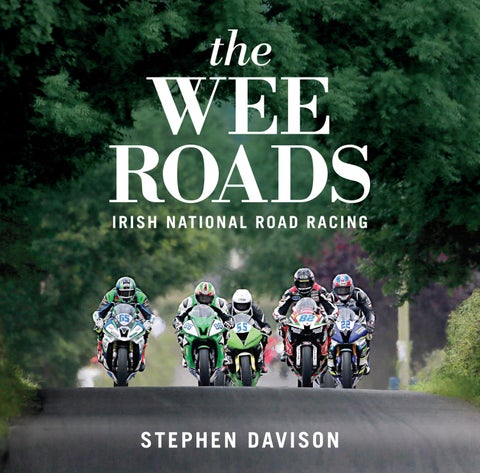
the
WEE ROADS
Portrush/ Portstewart Armoy
Irish National Road Races
Cookstown
Dundrod Temple
Bush Arney
Tandragee Glaslough
Clough
Dundalk
Crossakiel
Tullyallen Skerries Killalane
Walderstown
Athea
Faugheen
Glanmire Dunmanway Ballinhassig Clonakilty
Timoleague
Twohigs Hill
Dunboyne
Carrowdore
the
WEE ROADS IRISH NATIONAL ROAD RACING
STEPHEN DAVISON
First published in 2026 by Merrion Press 10 George’s Street Newbridge Co. Kildare Ireland www.merrionpress.ie © Stephen Davison, 2026 978 1 78537 614 6 (Hardback) A CIP catalogue record for this book is available from the British Library. All rights reserved. No part of this publication may be reproduced, stored in a retrieval system, or transmitted, in any form or by any means (electronic, mechanical, photocopying, recording or otherwise), without the prior written permission of both the copyright owner and the publisher of this book. Typeset in Gotham OTF and Century Gothic Cover design by Fiachra McCarthy Map by Kevin O’Sullivan Front cover image: The Supersport race gets underway at the 2017 Faugheen road races. Back cover image: Fans lining the roadside were delighted to see Michael Dunlop win the feature Superbike race on his MD Racing BMW at the 2026 Cookstown 100.
Merrion Press is a member of Publishing Ireland.
A Brief History of Road Racing in Ireland Richard Agnew As soon as Irish folk were able to get their hands on a motorcycle, they wanted to go racing, blazing a pioneering trail that many others would eventually follow. Those earliest races, at the beginning of the twentieth century, were run on public roads, initially both closed and open, creating a racing culture in Ireland that remains the dominant tradition today.
IN THE BEGINNING The first race for motorcycles and tricycles in Ireland was held during the Navan Cycling and Athletic Club Sports. It ran on a gravel track at the County Meath Agricultural Society grounds in Navan on Wednesday, 15 August 1900. From around a dozen entrants, four starters competed in two heats over 2 miles. The final, run over 5 miles, resulted in an easy win for John C. Cooney from Kells, who beat Dublin’s Joe McDonald by over a lap. It would be another two years before Irish motorcycle sport began to organise itself more professionally. The Motorcycle Union of Ireland (MCUI) was founded as a governing body on 7 March 1902 in the Metropole Hotel, Sackville Street (now O’Connell Street), Dublin. The Auto Cycle Union, the British governing body, wasn’t founded until 1903, and the world governing body, the Fédération des Clubs Motocyclistes (FICM) (now known as the Fédération Internationale de Motocyclisme (FIM)), didn’t come into existence until 1904. The first MCUI-sanctioned event was a bike run from Gough Statue in Dublin’s Phoenix Park to Bray on Saturday, 26 April 1902. A hill climb, held on Saturday, 12 July 1902 at Glenamuck, near Carrickmines Railway Station, which was won by G. Millington, was the first competitive motorcycle event run under MCUI rules. 1
In Ulster, the earliest motorcycle races took place at the Strabane Show in Co. Tyrone, over 3- and 5-mile courses, on Wednesday, 30 July 1902. Both races were won by Belfast man Tom Mallon on an Excelsior. It would be another five months before the inaugural meeting of the MCUI (Ulster Centre) was held on Friday, 9 January 1903, in the Hicks Hotel in Belfast. The first event run under the auspices of the new northern body’s authority was a hill climb near Campbell College, Belfast, on Saturday 28 March that year. It was won by Bob Ireton on a 2hp Riley.
HILL CLIMBS, RELIABILITY TRIALS AND DRAG RACES Most of the early competitive Irish events were hill climbs and reliability trials, which covered distances of 200 and 400 miles. The reliability trials were run on public roads, with set checkpoints along the route. The idea was to maintain a steady average speed, with secret checks being carried out to discourage speeding. The Ulster Centre organised a 200-mile reliability trial on Tuesday, 19 July 1904, to mark the occasion of the marriage of their president, the Honourable Leopold Canning. While a reliability trial in name, this event was, in fact, the first road race in Ireland, as the winner would be the first competitor to complete the course. Starting from the Belfast Banking Company premises in Donegall Street at 6 a.m., it followed a route from Belfast to Londonderry via the coast road, through Carrickfergus, Cushendall, Portrush and Coleraine. The return was via an inland route that finished at The Crown and Shamrock Inn outside Glengormley, which is still in existence today. The victor was Belfast man John Paul Burney, riding a Royal Enfield. Hill climbs were popular from the outset all over Ireland. The Dublin and District Club ran a hill climb at Kilmacanoge, Co. Wicklow, as their first competitive event in 1908. The Dublin University Club ran similar events at various locations right up until the 1990s. Ulster also had its fair share of hill climbs, with the Red Brae event at Carrickfergus running until the 1940s. The West Cork Motorcycle Club resurrected the Irish hill climb discipline in 1998, running a series of events at venues such as Twohigs Hill in Clonakilty, Robert’s Cove, Minane Bridge, Jagoe’s Mills and Dunderrow, Kinsale. The Cork Motorcycle Racing and Vintage Club also ran events at Jagoe’s Mills and Robert’s Cove between 2013 and 2018. Mike Browne, Brian McCormack and Declan Swanton were multiple winners of these events, but the most successful competitor is Derek Sheils, with seven victories. 2
The West Cork Club has also run regular drag races on the N71 Bandon Road outside the village of Halfway at Ballinhassig.
THE FIRST IRISH ROAD RACES On Sunday, 8 August 1920, O’Grady Bros of the Motor and Cycle Works in Cashel held an Isle of Man TT-type speed trial over two laps of a 30-mile circuit near the Co. Tipperary town. The riders started at two-minute intervals in very bad weather and with the roads in a poor state because of rain. Only one of the seven starters – R. Stapleton riding a 1914 3hp Rudge – completed the course. However, the first Irish road races as we would know them today were held between August and October 1921. Killough in Co. Down hosted an event on Tuesday 16 August over three laps of a 12-mile circuit. Four riders started the race, and James Stewart, riding a 4hp Harley-Davidson, was the winner. Less than three weeks later, on Saturday 3 September, the Temple Club staged a 25-mile Handicap race around a course that started at Temple Crossroads, Co. Down. Thomas G. Lindsay was the winner, riding a 2hp Imperial-JAP. A week later, it was Banbridge Club’s turn to hold a 25-mile race on a 5-mile circuit at Ballynahinch, with Belfast’s Herbert Chambers taking the win on a 2hp AJS. Not content with just one race, the Banbridge Club staged a second event. The Bann 50 was run on a 10-mile circuit near Loughbrickland on Thursday 29 September. Banbridge man James Finney, riding a 3hp Norton, was the winner, with the event also marking the road-racing debut of Stanley Woods. Woods raced a Harley-Davidson machine, both as a solo and with a sidecar attached. Throughout the 1920s and 1930s, he would go on to become one of the all-time greats of road racing, with ten Isle of Man TT wins, seven Ulster Grand Prix successes and twenty other European Grand Prix victories. The Ulster Motorcycle Club brought the curtain down on that first road-racing season with a second event at Ballynahinch, on Saturday 15 October. The 50-mile race was won by Jimmy Shaw on a 3hp Norton.
CHANGING TIMES The roads had not been officially closed for the 1921 meetings, as they were run without permission from the local authorities. The organisers relied upon the co-operation of the local constabulary, who manned road junctions and kept the roads clear of traffic and spectators. Spearheaded by Thomas Moles MP, the editor of the Belfast Telegraph and a leading member of the Ulster Motorcycle and Ulster 3
Automobile clubs, the Road Races Act (Northern Ireland) was passed in May 1922, providing an official process for road closures. Over the next decade, races came and went from the calendar. The Temple (1921–99) and Ballynahinch (1921–25) races would survive, with the Banbridge Club running another meeting, the Banbridge 100, between 1928 and 1930. In 1922, new races were held at Ballydrain (1922–32), Clandeboye (1922–23), and Greengraves at Newtownards (1922 only), with the first Ulster Grand Prix on the Clady course with its famous 7-mile-long straight. A single Coleraine 100 was held in 1923, the Dungannon 100 only ran between 1924 and 1927, and the North Down 60 was held just once, at Carrowdore in 1925. South of the border, the Leinster 100 was first run in 1923 at Dunshaughlin, establishing itself as an international event before becoming the Leinster 200 in 1931, running until 1967, after which it continued as a short circuit event at the newly opened Mondello Park. The Athy 75 was held between 1925 and 1930, counting many leading racers amongst its winners, including Gordon Burney, Eric Fernihough, Ernie Mitchell, Ernie Nott, Henry Tyrell-Smith and Stanley Woods.
ROAD RACING BANNED Disaster struck the fledgling sport during 1926, when road racing was banned by Down County Council. The ban followed a court action arising out of a spectator fatality at the North Down Club’s Clandeboye speed trial on Saturday, 23 April 1923. Events such as the Ballydrain, Ballynahinch, North Down and Temple races were also cancelled, and the incident saw the demise of North Down Club, before the ban was eventually rescinded in May 1927 and road racing returned.
TEMPLE The Temple road race, which began in 1921, gradually increased in distance from the original 25-mile race, eventually becoming a 100-mile race that ran between 1933 and 1963. In 1964, separate scratch races were introduced as the decade heralded a shift from a single 100-mile race to individual races for each class. One by one, all the ‘old’ 100-milers made this transition, accommodating a larger field of riders who could then compete in more than one event each race day. Ray McCullough of ‘Dromara Destroyer’ fame won his first road race at the Temple, a 200cc handicap event, in 1960. He would go on to enjoy great success at the Temple, winning twenty races between 4
James Courtney (RC30 Honda) leads Bob Jackson (McAdoo Kawasaki) on his way to victory and a new outright lap record at the Temple 100 in 1998.
1960 and 1979. Fellow ‘Dromara Destroyer’ Brian Reid is second on the Temple winners’ list, with fifteen victories between 1980 and 1993. The Temple 100 continued until 1999, when the event was abandoned after a fourth fatal accident in a decade. The Temple Club attempted to find a new circuit, but their efforts were unsuccessful and the Temple 100, Ireland’s oldest road race at the time, passed into history.
COOKSTOWN The first Cookstown race meeting was held in 1922, making it the oldest road race in Ireland following the Temple’s demise. Cookstown and District Motorcycle Club was formed in 1922, but the first races, scheduled for Thursday, 4 May 1922, had to be cancelled due to heavy rain. The race was rescheduled for 15 June on a 6-mile Sherrygroom circuit with just six starters. The local council refused to grant a road closing order for 1923, but the race was back as a 70-mile event in 1924. In 1930, the race distance was increased to 100 miles, as the Cookstown club made the move to the 7.5-mile Orritor circuit. 5
Sammy Millar won the General Handicap event in his first road race at Cookstown during 1954, and another all-time great, ten-time world champion Mike Hailwood, made his road-racing debut there in 1958. The eighteen-year-old won the 200cc Handicap race on a MV Agusta. The Cookstown road races have taken place on several different courses down the decades, including the Grange, Sherrygroom and Orritor circuits. One of the main features of the race was the run along the famous main street, which is said to be the longest and widest in Ireland. Many Irish road races were held mid-week to coincide with the host town’s early closing day, with the Cookstown running on a Wednesday right up until 1974 as the last of these mid-week events.
CARROWDORE Founded in 1906, the Belfast and District Motor Club that ran the Carrowdore 100 is Ireland’s oldest motorcycle club. After running a race at Greengraves in 1922, the club stepped in to run the first Carrowdore as an 80-mile race in 1927. Extending to a 100-miler in 1928, the Carrowdore continued until 1965 over various courses. From 1966, separate races were held for each class as the event moved back to the original 1927 circuit. This course would be used until 2000. Ray McCullough is the most successful Carrowdore competitor, with thirteen wins between 1971 and 1981. Bangor rider Steven Cull won twelve races between 1975 and 1990, plus the General Handicap event in 1975. Carrowdore was the last race to run a Handicap race, a format that gave every competitor a chance of winning. John McDowell claimed the last Handicap victory during the 1978 event. The introduction of separate practice and race days at road race meetings in 2000 created major disruption in the Co. Down village, eventually forcing the cancellation of the Carrowdore 100.
ENNISKILLEN Enniskillen and District Motorcycle Club ran the Enniskillen road races from 1929 to 1952 on the triangular 6.25-mile Mossfield circuit near Ballinamallard. The first race was held on Wednesday, 19 June 1929, and, with the first two races being run over fourteen laps, they were titled the Enniskillen 90. Gordon Burney won both events riding a 346cc Royal Enfield. From 1931, the distance was increased to 100 miles. The meeting was such a success that, in 1932, it was suggested the race distance be increased to 200 miles. International status was sought and a proposal put forward that the Ulster Grand Prix be 6
moved to the Fermanagh course. On 22 June 1949, the race was cancelled because of the hot weather. Weeks of scorching sunshine left the roads in a treacherous condition, with pools of melting tar. Leading stars Cromie McCandless, Malcolm Templeton and Norton sensation Geoff Duke completed just two sighting laps before declaring the circuit unfit for racing. In 1950, Enniskillen introduced the first 125cc event at a National road race, with Austin Carson taking the honours. On 20 August 1952, Louis Carter won the 500cc race, raising the lap record to 86.54mph. Thereafter, the Fermanagh event disappeared, despite dates being scheduled for 1953 and 1954. In 1955, the club ceased to exist, and the road closing order was transferred to the Killinchy club. In 2018, following a sixty-six-year break, a new Enniskillen and District Motorcycle Club brought road racing back to Co. Fermanagh on a new course at Arney. In the middle of Northern Ireland’s warmest summer for years, the organisers had to fight melting tar once again. Mullingar’s Derek McGee claimed five victories and the Man of the Meeting award. The races were run during 2019 on the same course before disappearing from the calendar once again.
NORTH WEST 200 The North West 200 was originally organised by the Derry and District Motor Club and run as a handi cap event over 200 miles in April 1929 around an 11-mile course connecting Coleraine, Portrush and Portstewart. W.J. McCracken was the winner from a field of thirty-one competitors. During the intervening ninety-seven years, the seaside meeting has become Ireland’s largest motor cycle race and one of the world’s major international events, alongside the Isle of Man TT, Ulster Grand Prix and Macau Grand Prix. Attracting the leading international road racers throughout its long and celebrated history, the event is now heading towards its centenary celebrations in 2029.
CLANE 90 / STRAFFAN 60 / PHOENIX PARK The early 1930s saw two new races run by the Irish Motor Racing Club (IMRC). The Straffan 60 took place in 1931 and 1932, and the Clane 90 ran in 1932 and 1933. In 1939, the IMRC ran a motorcycle event – a 50-mile race in Phoenix Park – in conjunction with a car race. The Dublin and District Motorcycle Club held its first road race, the Dublin 100, in the Phoenix Park during 1931. It ran until 1940, when it was one of the few motorcycle events to take place during the Second World War. With the demise of sand racing in the early 1930s, the Irish 100 Mile Speed championships were 7
held in conjunction with the Dublin 100 from 1934. After the war, the Phoenix Park was not available for motorcycle racing. The action resumed in 1951, when the Dublin and District Club ran a series of ten-lap races on the 1.7-mile Oldtown circuit.
ULSTER 100 After the Second World War, motorcycle sport resumed in Ulster, with the Ards Club hosting the first motorcycle road races held in Britain and Ireland in the grounds of Bangor Castle on Saturday, 14 July 1945. Ernie Lyons and Cromie McCandless were amongst the winners. During September the same year, the Ulster Motor Cycle Club, promoters of the Ulster Grand Prix, held the Ulster 100 on a 5-mile course outside Lisburn. The war had produced an abundance of airfields that would prove perfect for racing. The first such meeting took place at Long Kesh in Co. Antrim during November 1945, when Artie Bell and Bill Nicholson were amongst the winners. Irish road racing at Dunboyne during the 1960s. Photographer unknown.
8
SKERRIES With the Phoenix Park having been used to store tens of thousands of tonnes of turf during the Second World War, it was in no fit state for the Dublin 100 to be resurrected there in 1946. The Skerries Development Association approached the Dublin and District Club with a view to holding a race in the seaside resort of Skerries instead. The Skerries area had hosted the Leinster 100 and 200 races for seven years on a 13-mile Skerries–Rush–Lusk circuit between 1930 and 1936. The first Skerries 100 was held on Saturday, 6 July 1946, on a 7.1-mile circuit, using some of the main streets in the town. The winner was Harry Turner from Belfast, riding a 348cc Norton. Concerns about spectator safety resulted in a shorter 6.56-mile circuit being used from 1964 to 1968 to avoid the town centre. The circuit was shortened further in 1969 and 1971 producing the 2.92-mile version that is in use today. The Skerries course was raced in a clockwise direction up to 1978, when it was changed to anti-clockwise for safety reasons. The Dublin and District Club continued to run the race until 1986, when the event was taken over by the local Loughshinny Motorcycle Supporters Club alongside their own Killalane road race. The first Loughshinny-promoted Skerries event was marked by Steven Cull (500 Suzuki) posting the inaugural 100mph lap of the circuit.
Ray McCullough in action at the Skerries 100 in 1970. At this time the race still ran through the town. Picture by Rowland White.
KILLALANE / EAST COAST The Loughshinny Motorcycle Supporters Club was founded in October 1978 in memory of Joe Lindsay, who was killed at the Skerries 100 in July that year. On Saturday, 22 September 1984, the first Killalane road race was held on the 2.3-mile Margaretstown circuit. Amongst the race winners were Joey Dunlop, Robert Dunlop, Sean McStay and Steven Cull. In 1989, the race was run on the Skerries circuit due to roadworks near Ardgillan Castle, and while it was intended to return to Margaretstown, the road surface was considered too rough. The meeting 9
eventually moved to the 3.6-mile Killalane circuit in 1990, still using the Kearney’s Tree to St Movee Corner section of the original circuit. Dave Leach lapped at over 100mph in its inaugural year, and in 2007 Conor Cummins set the first 110mph lap. Phillip McCallen is still the most successful rider at Killalane, with eighteen wins, including an unprecedented run of three hat-tricks in 1989, 1991 and 1992, followed by a four-timer in 1993. After financial issues forced the cancellation of the 2016 and 2017 Killalane meetings, the new East Coast Motorcycle Club stepped in to run the 2017 event, which was rebranded as the East Coast Racing Festival. The East Coast races continued in 2018 and 2019 but have not run since.
MUNSTER 100 Motorsport in Co. Cork enjoys a long but sporadic history. The county was the starting point of the infamous End to End reliability trial held from 1909 until 1930. It was also the home of the Cork Grand Prix car races, which ran between 1936 and 1938 on the 6.1-mile Carrigrohane circuit. The Carrigrohane Straight is famous as the venue at which Joe Wright set a motorcycle world land speed record on a motorcycle in November 1930. Riding a 1000cc OEC Temple JAP, Wright broke through the 150mph barrier. Danny Keany and Mel Nolan set various Irish speed records on the same machine in 1978 and 1981 respectively. The Munster Motorcycle and Car Club, formed in 1938, held a Munster 75 event in 1940, which was won by Terry Hill on the 1.6-mile Monahan circuit near Cork city centre. In 1947, a shorter Carrigrohane circuit was used for a 50-mile race won by Luke Duffy. The Monahan circuit was used again in 1948, 1949, 1954 and 1955, whilst the full Carrigrohane circuit was used for the Munster 100 between 1950 and 1955, deciding the Irish 100 Miles Speed Championships. The Munster 100 road races were not held again until 1976, when they were run as a short circuit event at Mondello Park, with Joey Dunlop taking victory. The event returned as a road race on the Ard cloyne circuit near Kinsale for six meetings between 1977 and 1985. After a three-year gap, a further four races were held at Clonakilty from 1989 to 1992. A long gap then ensued before the West Cork Motorcycle Club, formed in 1997, ran races at Dunmanway in 2010 and at Timoleague in 2011. The Cork Motorcycle Racing and Vintage Club held a Sprint in Dunmanway in 2012, which was won by Derek Sheils. The club organised a Cork road race meeting at Glanmire in 2013, before heavy rain forced its cancellation after just two races. The event briefly returned to the calendar as the Munster 100 at Glanmire again in 2019. 10
MID ANTRIM The first Mid Antrim race was held on 24 July 1946 on the 6.11-mile Ballygarvey circuit. George Dummigan (249 Rudge) was the winner from local man Malcolm Templeton (348 Norton). Ballygarvey was one of the fastest courses in Ireland at that time, with Ralph Bryans (Ryan Norton) lapping at 104.52mph in 1963. The race moved to the Rathkenny circuit for 1965, before the shorter and more manage able 3.5-mile Clough circuit was introduced in 1989. In 1998, James Courtney lapped the Mid Antrim circuit at 110mph for the first time. In recent years the event has suffered setbacks including
cancellations
because
of
bad
Con Law and Mervyn Robinson are locked in battle over the Mid Antrim 150 jumps in 1979. Picture by Billy Reid.
weather, boycotts and sabotage. It returned to the calendar in 2026.
ULSTER ROAD RACE With the Ulster Grand Prix cancelled for 1946, the Ulster MCC held the Ulster road race on Saturday 17 August around a shortened Clady circuit. New airfields and runways at Nutts Corner and Aldergrove had obliterated approximately a quarter of a mile of the original circuit. Prior to the beginning of the action, Race Secretary Billy McMaster wheeled a flag-draped machine onto the grid in silent tribute to those who had died since the last Ulster Grand Prix had taken place before the war in 1939, including leading competitors Wal Handley, Walter Rusk and Ted Mellors.
DUNDROD AND KILLINCHY Although its genesis as a race track had more to do with car racing than motorbikes, Dundrod became the principal focus of bike sport in Ireland when Belfast and District Club ran the first motorcycle race there on Saturday, 23 September 1950. Cromie McCandless and Louis Carter were the stars of those 11
first Dundrod races, and Belfast and District Club increased the event distance for 1951, dubbing it the Dundrod 200. However, Antrim County Council had no desire to maintain two international racing circuits at Clady and Dundrod. In February 1953, the council announced it would permit only Dundrod to be used for the Ulster Grand Prix. Initially bikes and cars shared the Dundrod course, but three fatal accidents during the 1955 car event brought an end to four-wheel competition. A year later, the Ulster Grand Prix was joined by another motorcycle event. The Killinchy Club, formed in June 1947, wanted to promote a road race in their own area of Co. Down. When Down County Council would not sanction the proposal, the club became the organisers of the Killinchy 150 National meeting at Dundrod in June 1956. Thereafter, a separate National road race was held at Dundrod almost every year until 2003, giving local competitors an opportunity to race on the same circuit as the Ulster Grand Prix’s world championship contenders.
Eddie Laycock, Michael Swann, Joey Dunlop and Robert Dunlop line up on the grid of the Killinchy 150 at Dundrod for the start of the 250cc race in 1989. 12
The Killinchy Club continued to promote its event until 1991, before declining interest saw the meeting switched to Bishopscourt as a short circuit event in 1992. The Dundrod and District Motorcycle Club then stepped in to take control, returning the National event to Dundrod in 1993 and renaming it the Dundrod 150. Amongst the winners of the inaugural meeting were Denis McCullough (125cc), Brian Reid (250cc) and Johnny Rea, with a 600cc and Open race double. For the next ten years, the Dundrod 150 continued as a successful National road race before hitting financial problems. As a result, the race combined with the Ulster Grand Prix to operate under the title of Ulster Grand Prix Bike Week, before that too suffered a financial collapse in 2019. With the promise of financial support from the Northern Ireland administration at Stormont, there is renewed hope that the Ulster Grand Prix will be revived within the next two years.
TOSTAL 100/150 An Tóstal was a short-lived series of festivals launched in 1953. Held throughout the country, they were celebrations of Irish life aimed at attracting tourists. The Dublin and District Club provided the motor cycling contribution, with a 150-mile race in the Phoenix Park during 1953 and a 100-mile race at the Curragh in 1954. Louis Carter (Norton) won the 500cc class in both years, while the General Handicap winners were Harry Lindsay in 1953 and journalist Basil Brindley in 1954.
TANDRAGEE 100 The North Armagh Motorcycle Club was formed in October 1949 and held its first speed event in Lurgan Park during 1951, with the park becoming a regular venue for races throughout the 1950s and 1960s. In September 1957, the club decided to run a road race. The first Tandragee 100 was held on Saturday, 19 April 1958, around the same circuit that is still largely in use today. Brian Cartwright (125 BSA) won the first event, a 200cc
A huge crowd cheers Joey Dunlop across the finish line as he takes
Handicap race.
the chequered flag to win the 125cc race at the 1993 Tandragee 100. 13
In 1959, Ralph Bryans won his debut road race on a 197cc Ambassador at Tandragee. The same race would give Joey Dunlop his first road race victory, in 1971. In 1966, the start was moved from the Cabra to Bells Crossroads, and Marlacoo Corner was realigned before the 1991 race.
RATHDRUM / TULLYALLEN / BOYNE 100 / ATHBOY In 1962, the Motor Enthusiasts Club brought racing to Rathdrum in Co. Wicklow on the 0.8-mile-long, triangular Corballis circuit. A combination of car and motorcycle races were held there several times until 1967, and then again from 1971 until 1973. The Club also ran races at Tullyallen in 1965 and 1966, with Brian Steenson winning his first road race in the Unlimited class during 1966. The Tullyallen Motorcycle Club brought racing back to the village in 2006 as the renamed Boyne 100. The winners included Conor Cummins, William Dunlop, Michael Dunlop and Martin Finnegan. In 1965 and 1966, the Fingal Motor Club ran races at Athboy, where Austin Kinsella, Gerry Mateer and Ian McGregor were the winners in 1965.
COMEREAGH 50 / FAUGHEEN 50 The Blackchurch Racing Association held the Comeragh 50 races at Rathgormack, Co. Waterford, between 1970 and 1972. Following a three-year break, the races moved across the county border to the Co. Tipperary village of Faugheen. The first Faugheen 50 was held on Sunday, 11 July 1976, and the winners included Don Carlisle (50cc), David Wood (200cc), Austin Kinsella (250cc), Brendan Ryan (250cc) and Conor McGinn (Production), with Sam McClements enjoying a double success in the 500cc and Unlimited races. The races continued each July until 1986, after which increasing insurance costs brought the event to an end. During this period, Eddie Laycock was the most successful competitor, with seven wins between 1981 and 1985, and two of the original winners, Conor McGinn and Don Carlisle, taking five wins each. In October 2001, a group of enthusiasts revived the Faugheen 50, with the first race run on Sunday, 5 October 2003. Darran Lindsay claimed a hat-trick, with a 125cc win and a 250cc double. The races moved to a July date and continued until 2009. After a five-year break, the event returned in 2014, continuing until 2022. Ryan Farquhar is the most successful Faugheen racer, with sixteen wins between 2004 and 2009, including three four-timers in 2005, 2007 and 2009.
14
RACE OF THE SOUTH / FORE / WALDERSTOWN The Race of the South was originally held by Fingal Motor Club as a short-circuit event at Mondello Park during the 1970s. The Club made an application to have the 8-mile Wicklow circuit inspected for their first road race in August 1973. The Wicklow Town–Beehive–Rathnew circuit had last been used in 1957 for the Leinster 200, but the Club’s plans were unsuccessful. Undeterred the Club held its first road race on Sunday, 26 August 1973, around the 3.5-mile Fore circuit, near Castlepollard in Co. Westmeath. The winner of the Race of the South feature event was Mickey Laverty, father of the successful Co. Antrim racing brothers, Michael, John and Eugene. The Fingal Motor Club continued to run the event until 1979, after which the North Dublin Motor Club took control between 1980 and 1987. This involved changing the direction of the circuit from anti-clockwise to clockwise from 1986. The race was a casualty of an insurance crisis in 1988 before it returned to the calendar in 1989, when it was promoted by the local Fore Motorcycle Racing Club. That Club continued to hold the race until 1997, when an anti-social element forced it to abandon plans for the 1998 and 1999 races. Thereafter, the event was relocated to the Walderstown course near Athlone, where it continues on the 2-mile circuit.
SLIGO / LEITRIM A road race was held in Sligo between 1984 and 1986 before becoming a victim of increased insurance costs in 1987. Denis Todd was the most successful rider, with four wins. An attempt was made to revive the races as the Leitrim Road Race in May 1991 on a new Elphin circuit, but the races were cancelled during practice when the road surface was deemed unfit for competition. The Leitrim Road Race was revived in 1997 and 1998, with Richard Britton winning four races in 1999, before the event was cancelled due to heavy rain. The meeting has not run since.
DUNDALK During its eighteen-year history, the Dundalk road races must hold the record for the greatest number of different circuits used. These include Cooley (1990), Old Louth (1991), Louth Village (1992–96), Togher (1997), Dundalk By-Pass (1998–99 and 2007) and Darver (2000–05). Winners on the inaugural race day, Sunday, 1 July 1990, included Aubrey McCauley, Andy Bell, Fran Morrison, Brian Reid and Grand Final 15
champion Michael Topping. James Courtney remains the most successful Dundalk racer, with nine wins between 1993 and 1998. The Grand Final was held on an international permit in 2000, but the races were postponed from June until July and switched to the Darver circuit, when permission to use the Dundalk by-pass was refused. The Darver circuit continued to be used until the event Supersport contenders John Donnan (12, Yamaha), Victor Gilmore (70, Yamaha) Adrian McFarland (7, Suzuki) and Seamus Greene
was cancelled in 2006. The races returned to the by-pass circuit in 2007 but have not been
(44, Honda) race off the start line in front of the Readypenny Inn
held since the local council refused permis-
at the 2001 Dundalk road races on the Darver course.
sion in 2008.
KELLS The Kells and District Motor Cycle Racing Club was formed in October 1992 with the ambition of bringing road racing back to Co. Meath for the first time since the Dunboyne course last hosted the Leinster 200 in 1967. The first Kells road races were held on Sunday, 8 May 1994, around the Dulane circuit, with Ian King winning the Grand Final and Supersport races. Joey Dunlop won the 250cc event and the second 125cc race, after James Courtney took victory in the opening 125cc race. Future road racing star Adrian Archibald was the Support race winner. The race moved a few miles west in 1995, to a course near the village of Crossakiel. Following cancellation of the meeting in 1996, the event used a revised 2.25-mile Crossakiel circuit in the same area. The Kells event established itself as one of the most exciting National road races on the calendar for both riders and spectators, before suffering financial difficulties and a series of cancellations. Padraig Campbell (2009), Stephen Larkin (2010) and Jack Oliver (2022) lost their lives at the Co. Meath venue. The event had not run since Oliver’s death but returned to the calendar in 2026.
MONAGHAN The North Monaghan and District Motorcycle Club ran the Monaghan road races from 1996 until 2006 on a 2.45-mile course at Glaslough. Derek Young scored a hat-trick of wins during the first meeting, 16
on Sunday, 25 August 1996, winning the Supersport, Open and Grand Final races. The most successful Monaghan competitor was the late Owen McNally, with seven wins. The Coleraine rider scored a hattrick in 1998 with a 250cc win and two 125cc victories. He repeated that success the following year, adding a Supersport victory for a four-timer. After returning from the cancellation of the 2001 meeting during the foot and mouth disease restrictions, the organisers found it increasingly difficult to secure a suitable date in the Irish road
John Burrows leads Dwyer Agnew (34) and Damian
racing calendar and, following disturbances at the
Mulleady (111) in a R6 Yamaha train during the Supersport
2006 event, the meeting was permanently cancelled.
race at the 2004 Monaghan road races outside Glaslough.
ATHEA The Athea Motorcycle Club was founded in 2002 and brought motorcycle racing to Co. Limerick. The first Athea road race was to have been held on Sunday, 28 April 2002, on a 3.3-mile circuit, but it had to be postponed due to heavy rain. The race was rescheduled for Sunday 28 July, and the winners included Mark Curtin, Darren Burns, Martin Finnegan and Victor Gilmore. Finnegan went on to score a hat-trick of victories in 2003; by 2007 he had notched up seven wins. Road surface issues saw the 2010 event cancelled. The same problem caused severe damage to riders and their machines the following year, and the races had not run since 2011. The meeting returned to the calendar in 2026, with the new South West Motorcycle Road Race Club as the organisers. The Athea club hosted a road race meeting on the Co. Kerry coast at Ballybunion during August 2005, but the event was abandoned after Richard Britton suffered a fatal accident during the third race of the day, and it has not run since.
DUNGANNON 100/ BUSH The Dungannon and District Motorcycle Club held four Dungannon 100 races between 1924 and 1927. The first race in 1924 took place in heavy rain over nineteen laps of a 5.4-mile circuit and was won by Johnston Hill on a 500cc Douglas. 17
Deteriorating road conditions forced a change of circuit for 1927. Just under 6 miles long, the Limekiln–Bush–Laghey Corner circuit was used just once. Captain T.E. Oliver from Coalisland, riding a 574cc Scott, was the winner from Jimmy Shaw, although the event was marred by the death of James Gibson from Belfast. The Dungannon 100 then passed into history, and it would be nearly eighty years before the Dungannon and District Motorcycle Club was re-formed in August 2005 as the organisers of the Bush road races. The first Bush meeting was held on Saturday, 24 June 2006, on a 3.3-mile circuit, using part of the 1927 course between Bush village and Coagh. Raymond Porter was a double winner on the day in both the Supersport and Open races, the latter by just 0.141 seconds from circuit resident Paul Cranston. Ryan Farquhar is the most successful competitor at the event, with sixteen victories between 2008 and 2014, when the meeting was held for the final time.
ARMOY The Armoy Motorcycle Road Racing Club was formed in 2008 with the intention of holding an event in the Co. Antrim village that had been home to local road racers Frank Kennedy, Mervyn Robinson and the Dunlop brothers, Joey and Jim, during the 1970s. Dubbed the ‘Armoy Armada’, the Co. Antrim quartet battled with their Co. Down counterparts, Ray McCullough, Ian McGregor, Trevor Steele and Brian Reid of ‘Dromara Destroyers’ fame during the 1970s and early 1980s. The first race at Armoy’s inaugural event was held on Saturday, 8 August 2009. Jim Dunlop, the only surviving member of the Armada quartet, flagged the riders off, with Ryan Farquhar claiming a treble and Michael Dunlop scoring a double success in the 125cc and 250cc races. A fatal accident to spectator Hill McCook during the final race of the day cast a cloud over proceedings, but the races returned in 2010 with the addition of a chicane to the 3-mile circuit. Living just a few miles from the start line, Michael Dunlop is Armoy’s most successful competitor, with twenty-nine victories, including ten wins in the Race of Legends feature event.
CRISIS POINTS Periodically, Irish motorcycle road racing has faced major challenges that have threatened the very future of the sport. A spate of fatalities at road race events during the 1999 and 2000 seasons sparked major official reviews of the sport, first by the MCUI and later by a government-ordered task force 18
during the winter of 2000–01. The task force consisted of Jim Cray and Harris Healey from the Ulster Centre, with Sean Bissett and George Rogers from the Southern Centre, plus representatives of both the Northern Ireland and Irish Sports Councils. They produced sixty-seven recommendations to improve the safety record of road racing, with the major change being the introduction of practice sessions on a separate day to the race action. Having escaped the restrictions of the Covid pandemic, Irish road racing fans had been looking forward to the action returning in earnest during 2022. Instead of enjoying the roar of engines between the hedges, fans were met with a series of silent summers following the cancellation of road racing in the Republic of Ireland during the 2023, 2024 and 2025 seasons. The crisis was precipitated by the failure of the sport’s governing body, Motor Cycling Ireland, to acquire affordable public liability insurance following a huge rise in costs. Although the situation wasn’t quite as bleak in Northern Ireland, the sport’s recovery remained sluggish following a limited return of action in 2022. This recent insurance crisis was not without precedent. In 1924 the Ulster Automobile Club (UAC) secured the rights to hold the RAC Tourist Trophy, a race for sports cars that had previously been held in the Isle of Man up until 1922, in Co. Down. The Ards TT ran from 1928 until 1936, when Jackie Chambers lost control of his machine on the approach to Newtownards, causing the death of eight spectators. A furore ensued, forcing the cancellation of events and raising the cost of insurance cover as county councils were stripped of their authority to provide sole permission for events. With the Northern Ireland government involved in the decision-making process, racing in built-up areas was discouraged. During the 1987/88 seasons, heightened insurance costs forced the cancellation of Faugheen and Sligo road races, plus the Race of the South, in the Republic of Ireland. Insurance rates almost doubled again in 2017, sidelining the Kells and Killalane events. In the aftermath of the Covid pandemic, the MCUI Ulster Centre faced a 240 per cent increase in insurance costs, from £170,000 during 2000 to £410,000 for 2023, with a capped excess of £300,000. Initially considered unfeasible, subsequent negotiations with the insurers, along with private donations and the support of a crowd-funding campaign eventually produced a solution that would avert a crisis for motorcycle events in Northern Ireland. The situation was not as positive for Motor Cycling Ireland. Unable to secure affordable insurance cover, road races and many other motorcycle events were cancelled between 2023 and 2025. A policy that includes insurance cover for road racing has now been accepted and the action resumed throughout the island of Ireland during 2026. 19
A Good Day Out As the home of motorcycle road racing, Ireland has produced the sport’s greatest races and riders. With the North West 200 and Ulster Grand Prix traditionally sitting alongside the Isle of Man TT and Macau Grand Prix as the major international events, Ireland also plays host to a season-long calendar of National events. Or as they are often fondly referred to, the ‘Wee Roads’. Currently that calendar begins with the Cookstown 100 in Co. Tyrone, followed by the Kells road races in Co. Meath, Co. Armagh’s Tandragee 100, the Skerries 100 in Co. Dublin, the Walderstown races in Co. Westmeath, the Armoy and Mid Antrim meetings in Co. Antrim, Co. Tipperary’s Faugheen event, and the Athea races in Co. Limerick. Many similar events have come and gone over time. In Northern Ireland, the Temple, Carrowdore, Enniskillen, Killinchy and Bush races have disappeared over the past two decades. The Munster 100, Killalane, Fore, Sligo/Leitrim, Dundalk and Monaghan meetings have suffered a similar fate in the Irish Republic.
Push starts were still the order of the day at the Cookstown 100 in 1988. This competitor needed some assistance to get his machine off the line in the 250cc race. 20
Unlike the Isle of Man TT and Macau GP, which are organised by government departments and are principally financed from the public exchequer, Irish motorcycle road racing remains a largely amateur pursuit. Run by clubs of motorcycle racing enthusiasts and volunteers, the National meetings operate in Northern Ireland under the auspices of the Ulster Centre of the Motorcycle Union of Ireland and in the Republic under Motorcycling Ireland. Co. Antrim’s Michael Dunlop, and his uncle Joey, both honed their racing skills on the Irish National courses, going on to become the most successful road racers of all time. Notching up a record twentysix TT wins before his death in 2000, Joey’s tally has now been surpassed by his nephew, who has accumulated thirty-six victories and counting. Numerous other Irish racers who served their racing apprenticeships on the National scene have gone on to make their marks on the sport. During the last three decades, that list has included Michael’s father Robert, Tom Herron, Eddie Laycock, Brian Reid, Phillip McCallen, Ryan Farquhar and Adrian Archibald, to name just a few who have graduated from the Irish National scene to become North West 200, TT and Ulster Grand Prix winners. The ‘Wee Roads’ have also played host to travelling talents such as Guy Martin, Ivan Lintin, Dean Harrison and Davey Todd, all English racers who have gone on to make their mark at major international events after serving a significant part of their road-racing apprenticeships between Irish hedges.
Brian Reid is chased by Phillip McCallen and Noel Hudson during the 350cc race at the 1988 Cookstown 100 on the old Sherrygroom course in Co. Tyrone. I had recently bought my first SLR camera, and this was one of my earliest attempts at photographing road racing. In the years that followed I got to know both Brian and Phillip as I documented other moments during their careers. 21
Joey Dunlop keeps a close eye on proceedings as his mechanics, Andy Inglis and Willie Fulton, make final preparations at Skerries road races in 1994. 22
On race weekends, normal life is suspended on the narrow byways of the Irish National scene as motorbikes roar into action beneath a backdrop of big skies, green glens and rolling hills amongst tiny hamlets and villages you might struggle to find any mention of on a map. The conditions found at events such as Kells or Tandragee bear no resemblance to the purpose-built tracks and exotica of motorcycle racing’s MotoGP and World Superbike series. Despite the best efforts of the organisers, facilities in Ireland remain basic, with minimal safety features. In an environment littered with natural hazards, the best hope can only be to make things safer, although never safe. My first experience of Irish road racing came on a June day in 1974 at the Killinchy 150 meeting. Thrilled and terrified in equal measure, that thirteen-year-old boy, captivated by the spectacle, has been a follower of the sport ever since. The camaraderie and excitement I discovered on those good days out with family and friends drew me into a world I wanted to be part of; one I would find my place in, not as a competitor but as a photographer. While I have had the good fortune to witness and record road racing all over the world, it has always been the smaller Irish National events closest to home that have retained the greatest fascination. Punching well above their weight in terms of impact and legacy, these grassroot events epitomise the true nature of the sport in places where rural byways are transformed into race tracks over a summer weekend. Captured over the past two decades, the images that follow are a very personal experience of Irish National road racing. Documenting the changing rhythms of a weekend’s action, they illustrate every aspect of the challenges road riders face whilst competing on the ‘Wee Roads’. Stephen Davison 2026
23